Next Article in Journal
Multi-Objective Optimization of a Modular Unequal Tooth-Shoe PMLSM via an ARD-Kriging Surrogate-Assisted Framework
Previous Article in Journal
Experimental Evaluation of Vibration and Noise Responses of a Diesel Engine Fueled with Sour Cherry Pyrolytic Oil–Butanol–Diesel Blends with 2-EHN Additive
 
 
Due to scheduled maintenance work on our servers, there may be short service disruptions on this website between 11:00 and 12:00 CEST on March 28th.
Article

ADS-B Flight Trajectory Tensor Data Recovery Method Based on Truncated Schatten p-Norm

College of Air Traffic Management, Civil Aviation Flight University of China, Guanghan 618300, China
*
Author to whom correspondence should be addressed.
Appl. Sci. 2026, 16(7), 3217; https://doi.org/10.3390/app16073217 (registering DOI)
Submission received: 22 January 2026 / Revised: 23 March 2026 / Accepted: 24 March 2026 / Published: 26 March 2026

Abstract

To address the issue of missing position in flight trajectory data collected by Automatic Dependent Surveillance-Broadcast (ADS-B) systems, a flight trajectory tensor completion model based on truncated Schatten p-norm minimization is proposed. First, the low-rank characteristics of the trajectory set are validated using Singular Value Decomposition (SVD); based on this, the data is transformed into a three-dimensional tensor structure. Next, a regularization strategy combining the Schatten p-norm with a singular value truncation mechanism is introduced to construct the trajectory tensor completion model, which suppresses noise and interference from minor components while preserving the main variation patterns of the trajectories. Finally, the model is optimized and solved using the Alternating Direction Method of Multipliers (ADMM) to obtain the completed trajectories. Taking historical ADS-B trajectory data from Orly Airport to Toulouse Airport as an example, the completion results of the proposed model under different missing patterns, missing rates, and flight phases are analyzed from both qualitative and quantitative perspectives. Experimental results show that compared with other representative models, the proposed model achieves the best completion performance under different missing patterns and missing rates; the completion performance during the cruise phase is better than during the ascent and descent phases. The proposed model can serve as a preprocessing technique for flight trajectory data in air traffic, providing more complete and reliable data support for various downstream applications.

1. Introduction

In the concept of the Next-Generation Air Transportation System, ADS-B is regarded as a primary navigation surveillance technology [1]. Aircraft equipped with ADS-B transmitters obtain real-time flight positions via global navigation satellite systems and periodically broadcast this information to ground receiving stations and to other aircraft carrying ADS-B receivers, thereby enhancing situational awareness of air traffic controllers, strengthening air–ground and air–air coordination, and improving air traffic operational efficiency. Compared with conventional radar surveillance, ADS-B offers numerous advantages, including higher positioning accuracy, faster data updates, and lower maintenance costs. With the continuing development of ADS-B, trajectory data can now be readily acquired through public websites (e.g., FlightAware and Flightradar24). As comprehensive records of aircraft flight processes, these trajectory data can support a variety of downstream studies and applications, such as air traffic flow prediction [2,3], flight conflict detection [4], and airspace complexity assessment [5,6]. In particular, with the rise of artificial intelligence and data mining techniques in civil aviation, trajectory data have become especially important for training intelligent models. For instance, advanced trajectory prediction models such as FlightBERT [7] and M2FlightNet [8] have demonstrated that high-quality trajectory data is essential for achieving accurate predictions. However, affected by onboard equipment, internal system factors, and numerous external factors (e.g., signal strength, communication links, and weather conditions), the collected ADS-B trajectory data typically exhibit the phenomenon of missing position points [9,10], meaning that position information, represented by aircraft longitude, latitude, altitude, and related variables, is missing to varying degrees at different time instants or over consecutive intervals, which greatly limits the potential and application value of trajectory data-driven models.
In this context, how to accurately complete ADS-B trajectory data has been regarded as a fundamental and important topic and has consistently been a focus of extensive attention among researchers. Some researchers have treated incomplete trajectories as a type of positional jump phenomenon and have used filtering techniques to estimate missing positions; among them, the combination of various Kalman filtering algorithms with statistical models is one of the classic methods [11,12]. Olive et al. [13] developed a toolbox for processing air traffic trajectory data, achieving rapid trajectory completion through steps such as cleaning, filtering, and resampling. In addition, some studies have considered missing values as a special type of outlier and have performed trajectory completion based on anomaly detection theory; for example, Wang [14] identified abnormal points using a density-based clustering algorithm and corrected position points by estimating flight time in conjunction with ground speed information. Tan et al. [15] addressed position missingness caused by non-uniform sampling frequencies in four-dimensional trajectory data by using the Newton interpolation method to obtain trajectory samples at equal time intervals. However, the above methods are mainly applicable to trajectory completion under scenarios of discrete position missingness and are difficult to extend to complex scenarios involving continuous position missingness. To address this issue, Lin et al. [16] first introduced low-rank theory into the ADS-B trajectory completion task by organizing multidimensional features such as trajectory longitude, latitude, and altitude into a three-dimensional tensor and constructing a tensor completion model based on trace-norm minimization. Compared with spline interpolation and trajectory planning methods, the proposed method achieved the best performance under various missing patterns, including random, continuous, and block missingness. With the rapid development of deep learning, data-driven methods have also been introduced into the trajectory completion task. Fan et al. [17] proposed DAMOT, a Transformer-based decoupled adaptive learning algorithm, which leverages self-attention mechanism to learn inferential relationships among trajectory points and employs multi-head outputs to decouple multi-dimensional attributes, thereby achieving effective interpolation of sparse flight trajectories with both discrete and continuous missing segments. Wang et al. [18] proposed an end-to-end flight trajectory completion framework based on deep autoencoder network. Comparative experimental results showed that the proposed method not only achieved favorable completion performance but also further improved the predictive performance of downstream models. Subsequently, Zhao et al. [19] proposed SA-AEGAN, which applies a generative adversarial network with a self-attention mechanism to impute missing values in Quick Access Recorder (QAR) flight data by learning the underlying data distribution and temporal dependencies of multivariate flight parameters. Furthermore, Tao et al. [20] proposed a trajectory imputation method integrating representation transformation and pattern regression, which encodes four-dimensional spatiotemporal trajectories into RGB-channel color images and reformulates the missing trajectory completion problem as an image inpainting task, enabling effective modeling of complex spatiotemporal dependencies in trajectory data.
To further address the trajectory data completion problem, a tensor completion model based on truncated Schatten p-norm minimization is proposed in this study. First, given that trajectories associated with the same callsign on different dates typically exhibit similar spatiotemporal patterns, the position information of these flights is constructed as a three-dimensional tensor to provide a unified representation of the high-order correlation structure of trajectories. Second, based on the constructed tensor structure, a truncated Schatten p-norm regularization term is formulated by integrating the Schatten p-norm with a truncation mechanism. Compared with existing trajectory completion methods, the proposed truncated Schatten p-norm advances prior work in two key aspects. Firstly, as a generalization of the nuclear norm, the Schatten p-norm enables a more flexible rank approximation by dynamically adjusting the norm between the nuclear norm and the rank function, thereby characterizing the low-rank structure and spatiotemporal features of trajectory data. Secondly, the truncation mechanism suppresses smaller singular values by adjusting a threshold, so as to reduce the influence of noise and secondary components and to improve the accuracy and robustness of trajectory completion. Finally, the Alternating Direction Method of Multipliers (ADMM) algorithm is employed to iteratively solve the constructed optimization model, yielding a numerical solution for the completed tensor. Using historical ADS-B trajectory data from Orly Airport to Toulouse Airport as an example, qualitative and quantitative experiments were conducted to verify the effectiveness of the proposed method.
The rest of this paper is organized as follows. In Section 2, the low-rank characteristics of flight trajectories have been verified. On this basis, we propose a trajectory data completion framework in Section 3. Section 4 provides a case analysis to demonstrate the effectiveness of the framework. Finally, Section 5 presents the conclusions of this paper and the prospects for future work.

2. Low-Rank Characteristics of ADS-B Trajectory Data

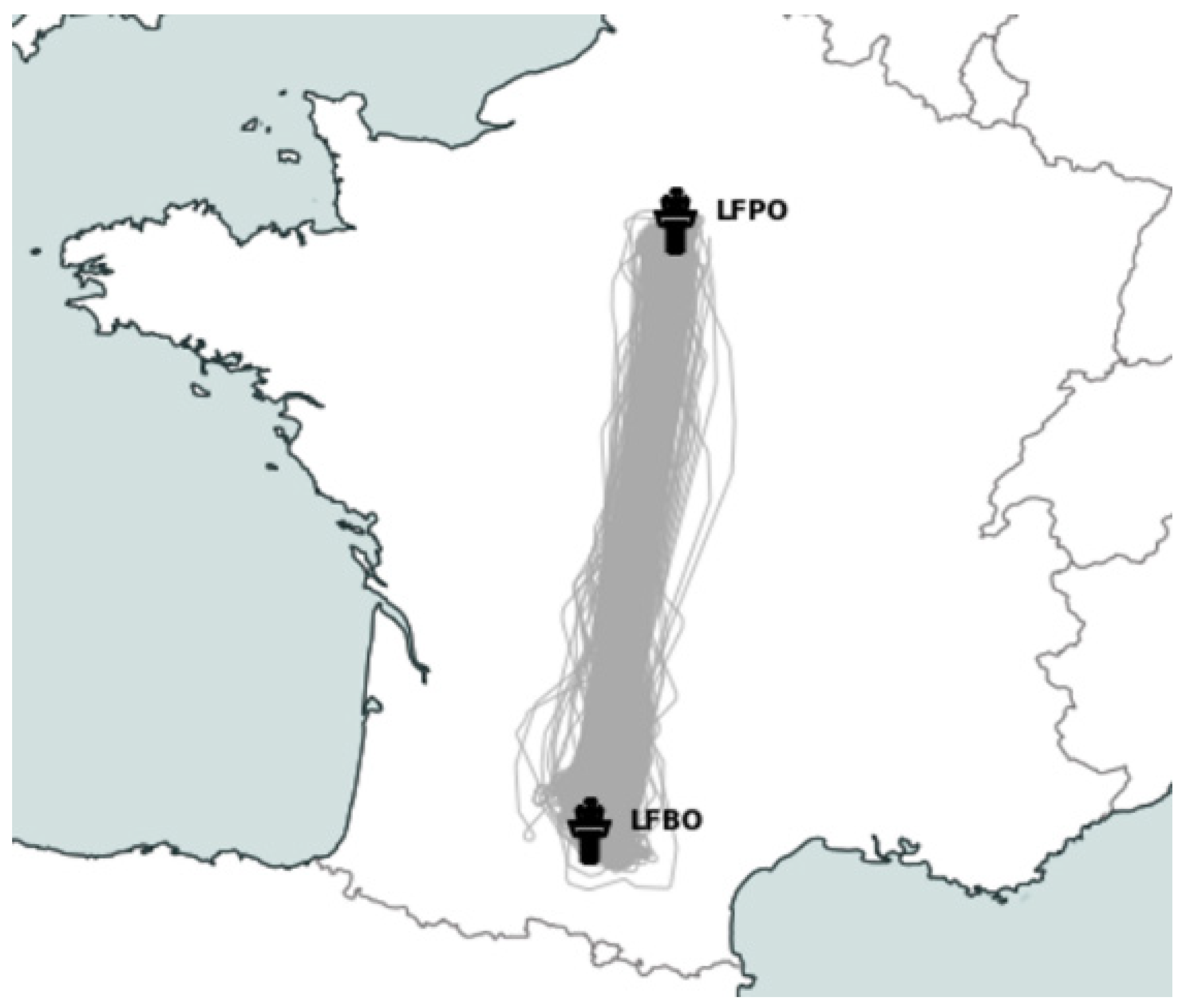
To investigate the low-rank characteristics of ADS-B trajectory data, real-world trajectory set collected by the OpenSky network were used in this study. As the first ADS-B sensor network specifically designed for academic research, this network relies on low-cost sensors deployed by volunteers worldwide to capture ADS-B information and transmit it to a central database, thereby providing researchers with raw data that are not filtered or processed [21]. Specifically, through the API provided by the OpenSky Network, all flight data in 2017 for flights departing from Orly Airport (ICAO code: LFPO) to Toulouse Airport (ICAO code: LFBO) were collected, yielding a total of 3531 trajectories and involving 28 distinct flight callsigns, as shown in Figure 1.
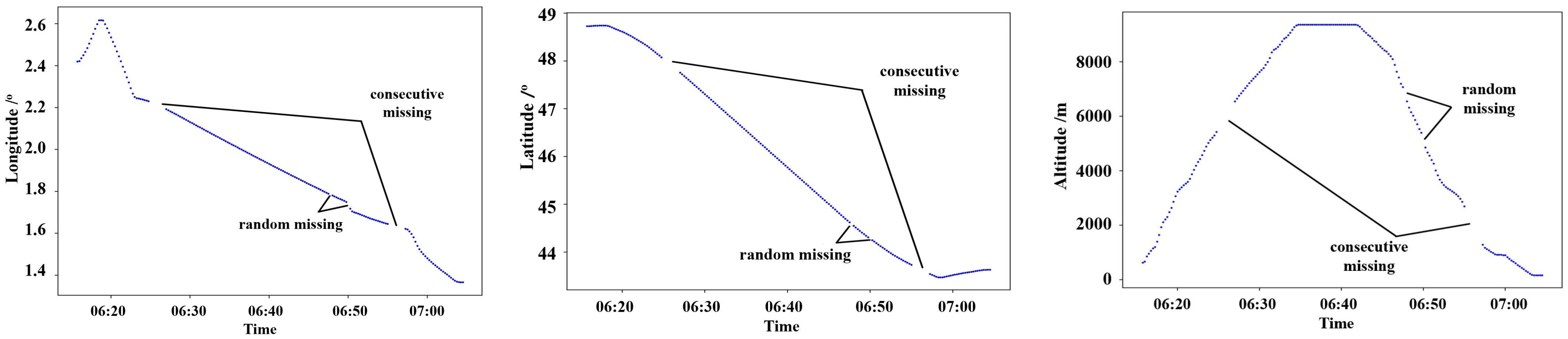
Actually, missing trajectory positions are one of the common issues in the ADS-B data collection process, which is mainly attributable to collisions among multi-source broadcast messages that degrade channel quality. In general, the update interval of ADS-B messages is 1 s, and trajectories with missing positions can be automatically identified by comparing the number of recorded positions in each trajectory with its duration. Among the trajectories with missing positions, two missing patterns were observed, namely random missing and consecutive missing. Figure 2 presents a schematic illustration of the missing-position phenomenon in ADS-B trajectories, including longitude, latitude, and altitude. Therefore, it is necessary to design an effective method for completing ADS-B position data.
The rank of a matrix is an important concept in linear algebra and can reflect the redundancy of the information it contains. In general, a low-rank matrix has high redundancy, with strong correlations between their rows and columns. In the context of flight trajectories, if a trajectory matrix composed of multiple aircraft with the same callsign is low-rank, it indicates high similarity between different trajectories. When it is necessary to predict missing positions in a trajectory, other complete trajectories can be used as references. To verify that the trajectory matrix constructed from the same callsign exhibits a favorable low-rank structure, singular value decomposition (SVD) method was applied. Specifically, for a trajectory matrix X R N × K containing N trajectories of K dimensions, it can be decomposed as follows:
X = U Σ V T
where U R N × r and V R K × r are composed of orthogonal singular vectors, V T is the transpose of V , and Σ R r × r is a diagonal matrix with positive real entries. The diagonal elements (i.e., the singular values) are typically arranged in descending order:
Σ = d i a g ( σ 1 , σ 2 , , σ r )
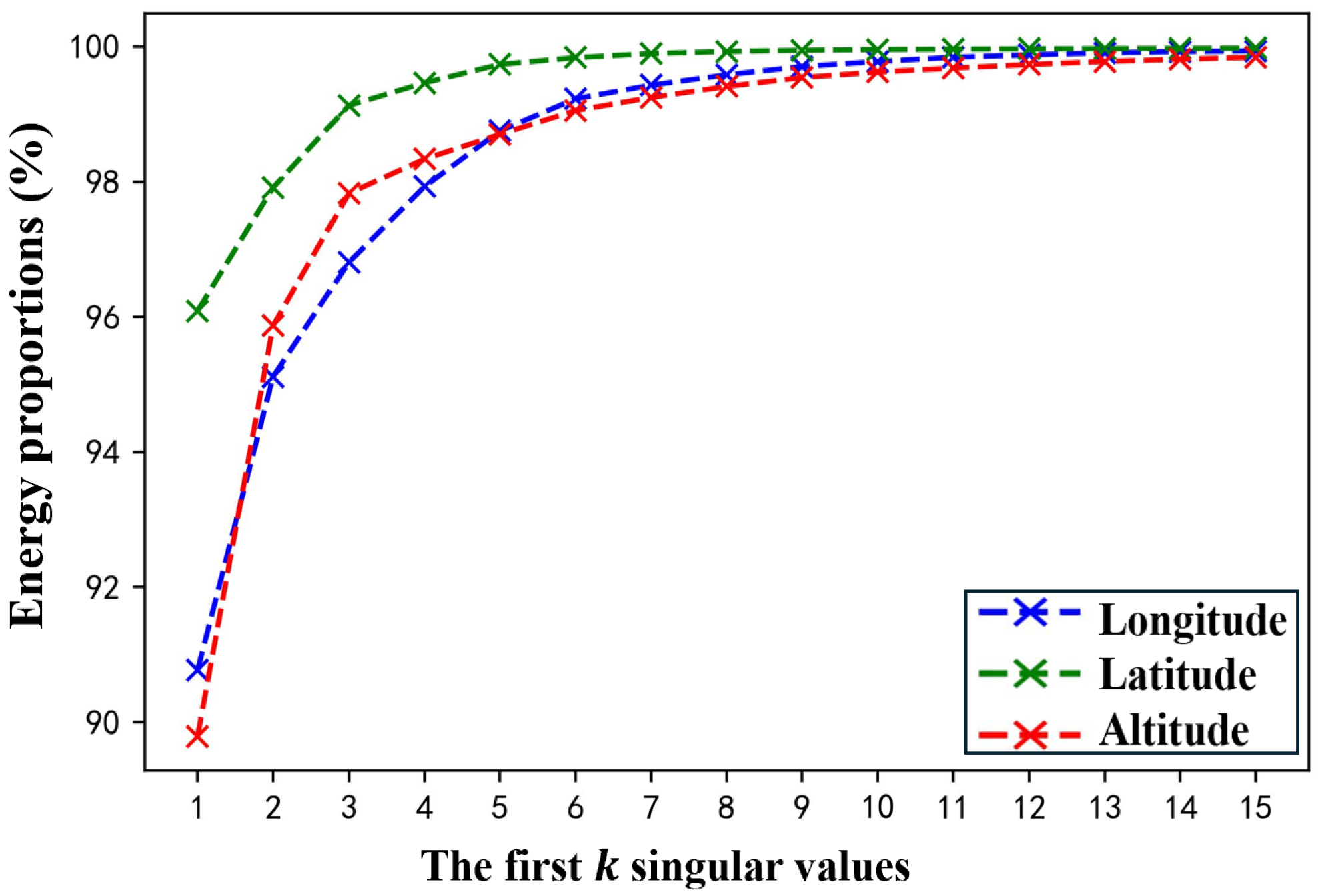
where σ 1 σ 2 σ r > 0 , and r denotes the rank of matrix X . When r is much smaller than N and K , X is regarded as a low-rank matrix. In particular, if a matrix is low-rank, the energy contained in its first k singular values is close to the total energy (i.e., i = 1 k σ i 2 i = 1 r σ i 2 ). Therefore, the structural low-rankness of the trajectory matrix is verified by examining the ratio between the energy of the first k singular values and the total energy. Specifically, longitude, latitude, and altitude were selected as the basic positional features of trajectories, based on which three trajectory matrices were constructed and decomposed using SVD. Figure 3 shows the energy proportions of the leading singular values for each of the three trajectory matrices. For ease of observation, only the first 15 singular values are displayed. It can be observed that the first five singular values of each trajectory matrix already capture at least 98% of the total energy. The results clearly show that the three-dimensional positions of the trajectories exhibit good low-rank characteristics, which provides a prerequisite for the subsequent tensor completion model designed to address missing trajectory position data.

3. Modeling

3.1. Trajectory Data Completion Framework

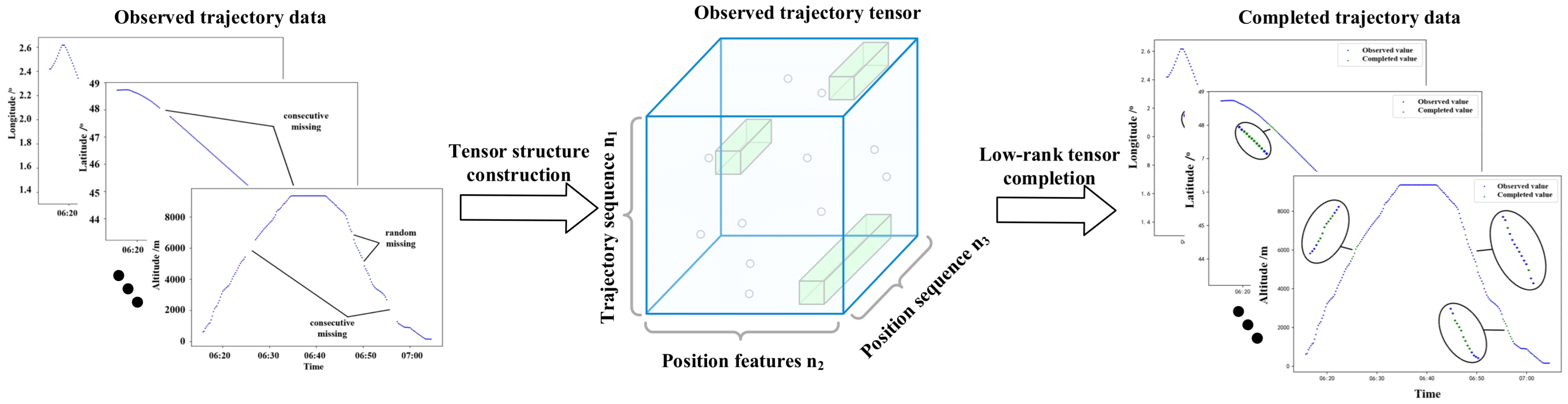
The proposed ADS-B trajectory tensor completion method is illustrated in Figure 4. First, ADS-B trajectory data with missing positions are collected for flights with the same callsign. Correlation features in the temporal and spatial dimensions are extracted to construct a partially observed three-dimensional trajectory tensor, in which white circles denote discrete missing positions under the random missing pattern, whereas green cuboids indicate sequences of missing positions under the consecutive missing pattern. Then, based on the observed trajectory tensor, the proposed low-rank tensor completion algorithm is applied to impute the missing position information, thereby restoring complete trajectory data and reconstructing the spatiotemporal characteristics of the trajectories. The purpose is to provide a high-quality flight trajectory data for subsequent downstream tasks.
Without loss of generality, the trajectory set T is modeled as a three-dimensional tensor X n 1 × n 2 × n 3 . As shown in Figure 4, n 1 denotes the number of trajectories with the same callsign across different dates, n 2 is the number of features for each position point where n 2 = 3 represents the longitude, latitude, and altitude, respectively, and n 3 denotes the number of position points for each trajectory. It is important to note that, in order to ensure the representativeness of the positions, they are sampled at equal time intervals.

3.2. Low-Rank Tensor Completion Model Based on Truncated Schatten p-Norm

Based on the low-rank characteristics of ADS-B trajectory data and its tensor structure, the low-rank tensor completion (LRTC) algorithm based on the truncated Schatten p -norm is further proposed to recover missing position from partially observed trajectories. In general, the basic mathematical model of low-rank tensor completion can be expressed as follows:
min   X r a n k ( X ) s . t .   P Ω ( X ) = P Ω ( Y )
where r a n k denotes the rank of the tensor, Ω is the index set of observed trajectory position points, and Y n 1 × n 2 × n 3 is the observed trajectory tensor with missing position points. The operator P Ω denotes the orthogonal projection onto Ω , which is expressed as follows:
[ P Ω ( X ) ] i , j , k = x i , j , k , i f i , j , k Ω 0 , o t h e r w i s e
Since the rank function of a tensor is non-convex and discrete, directly minimizing this objective is an NP-hard problem. Therefore, many scholars have proposed various alternative methods, one widely used solution being the introduction of the nuclear norm of a matrix. Since the nuclear norm is the tightest convex envelope of the rank function, the rank minimization problem can be transformed into a nuclear norm minimization problem that is easier to solve. On this basis, Liu et al. proposed the High-accuracy Low-Rank Tensor Completion (HaLRTC) algorithm [22], which approximates the rank of a tensor by taking a weighted sum of the nuclear norms of the three unfolded matrices, i.e., r a n k ( X ) k = 1 3 α k X ( k ) , where X ( k ) is the matrix obtained by unfolding tensor X along its k - th mode, a k 0 is the weight parameter of X ( k ) , satisfying k = 1 3 α k = 1 . Here, X ( k ) = i = 1 r k σ i X ( k ) is the nuclear norm of X ( k ) , and r k is the rank of X ( k ) . Therefore, Equation (3) can be transformed into the following form:
  min X k = 1 3 α k X ( k ) s . t .   P Ω ( X ) = P Ω ( Y )
Although the nuclear norm effectively reduces the computational complexity of the rank minimization problem, its natural property of assigning equal weight to all singular values may lead to the loss of important information. Since larger singular values typically contain more critical information and are closely related to the primary projection directions, the Truncated Nuclear Norm (TNN) is further proposed. TNN captures the core features in trajectory data by reducing the penalty on large singular values, and its optimization objective is as follows:
  min X k = 1 3 α k X ( k ) r , s . t . P Ω ( X ) = P Ω ( Y )
where | | | | r , represents the truncated nuclear norm, indicating the sum of the smallest n 1 , n 2 r singular values of the X ( k ) , i.e., i = r + 1 min { n 1 , n 2 } σ i ( X ( k ) ) , r is the truncation rate, and the singular values sorted in descending order, i.e., σ 1 σ 2 σ min { n 1 , n 2 } 0 .
However, the traditional truncated nuclear norm still has limitations when dealing with trajectory data that do not have a strictly low-rank structure. To address this, Chen et al. proposed a traffic data completion algorithm based on tensor Schatten p-norms [23]. As a generalization of the nuclear norm, the tensor Schatten p-norm further enhances the flexibility of the norm definition, and the specific form is as follows:
X S p = k = 1 3 α k X ( k ) S p p 1 p
where p ( 0 , 1 ] and X ( k ) S p = ( i = 1 r k σ i ( X ( k ) ) p ) 1 p . In particular, when p equals to 1, the Schatten p-norm becomes the nuclear norm, while the Schatten p-norm approaches the rank function when p close to zero. Therefore, the Schatten p-norm effectively balances the rank norm and the nuclear norm, allowing it to better capture the spatiotemporal features of trajectory data.
Considering the effectiveness of both the truncated nuclear norm and the Schatten p-norm in traffic data completion tasks, we further introduce the truncated Schatten p-norm, which truncates smaller singular values based on the Schatten p-norm. Its specific form is as follows:
X S p , τ = k = 1 3 α k | | X ( k ) | | S p , τ = k = 1 3 α k i = 1 r k min σ i X ( k ) , τ p 1 p
where τ is the threshold used for filtering the singular values. If τ is greater than all the singular values of X ( k ) , the truncated Schatten p-norm of the trajectory tensor X degenerates to the standard Schatten p-norm. As a unified algebraic paradigm, by adjusting the parameters p and τ of the truncated Schatten p-norm, the adverse effect of smaller singular values can be effectively reduced, while retaining the main information contained in the larger singular values. Equation (9) presents the proposed low-rank tensor completion model based on the truncated Schatten p-norm, which recovers the underlying correlated structure of trajectory data by minimizing the p - th power of the truncated Schatten p-norm of the trajectory tensor X , thereby improving the accuracy and robustness of trajectory completion. The specific optimization objective is as follows:
min X   X S p , τ p = min X   k = 1 3 α k | | X ( k ) S p , τ p s . t .   P Ω ( X ) = P Ω ( Y )
Due to the coupling relationship among the three unfolding matrices (i.e., X 1 , X 2 , X 3 ), an auxiliary variable M is further introduced to ensure the consistency of the observed data and pass them to each unfolding matrix. By adding an additional constraint X k = M , Equation (9) can be decoupled into an optimization form with four independent variables, with the specific optimization objective as follows:
min { X k } k = 1 3 , M k = 1 3 α k X k ( k ) S p , τ p   s . t .   X k = M , P Ω ( M ) = P Ω ( Y )
where X k ( k ) denotes the k - th matrix by unfolding the k - th tensor X k .

3.3. Optimization Solution

To solve the above low-rank tensor completion model, Alternating Direction Method of Multipliers (ADMM) algorithm is used to enhance the accuracy and stability of the solution. Specifically, to handle equality constraints and facilitate block optimization, the augmented Lagrangian method is used to transform Equation (10) into the following objective function:
L { X k , T k } k = 1 3 , M = k = 1 3 α k X k ( k ) S p , τ p + < X k M , T k > + ρ k 2 X k M F 2 s . t .   P Ω ( M ) = P Ω ( Y )
where T k n 1 × n 2 × n 3 , k = { 1 , 2 , 3 } represents the Lagrangian multipliers, used to dynamically balance the differences between dimensions, < , > is the inner product of two tensors, ρ k 0 represents the penalty factor of the k - th mode. Based on Equation (11), the optimization process of the low-rank tensor completion model based on the truncated Schatten p-norm can be decomposed into three subproblems that can be solved iteratively, as follows:
X k l + 1 : = arg min X L X k , T k l k = 1 3 , M l M l + 1 : = arg min M L X k l + 1 , T k l k = 1 3 , M T k l + 1 : = T k l + ρ k X k l + 1 M l + 1
where l means the l - th iteration.
In each iteration, the update of X k can be viewed as an optimization problem with a truncated Schatten p-norm regularization term. Its goal is to minimize the rank of the k - th unfolding matrix while ensuring consistency with the observed trajectory data. The specific optimization objective is as follows:
arg min X λ X k ( k ) S p , τ p + 1 2 X k M l T k l ρ k F 2
where λ = α k ρ k is the regularization parameter, used to balance the Schatten p-norm regularization term with the consistency of the trajectory data. For ease of solving, the tensor is unfolded along the k - th dimension, and Equation (13) can be equivalently transformed into the matrix optimization form of Equation (14), as shown below:
arg min M λ M S p , τ p + 1 2 M N F 2
where M = X k ( k ) and N = M k l T k k l ρ k .
Since Equation (14) is non-convex, an approximate update strategy based on the SVD algorithm is further introduced [24]. Specifically, the original matrix N is first decomposed using SVD to obtain U d i a g ( σ 1 , σ 2 , , σ i ) V T , where U and V represent the left and right singular vector matrices of the original matrix N , and σ i denotes the original singular values. Since the updated matrix M shares the same singular vector directions as the original matrix N , it can be decomposed as U d i a g Ψ 1 , Ψ 2 , , Ψ i V T , where Ψ i is the updated singular value. On this basis, Equation (14) can be transformed into one-dimensional non-convex optimization subproblems that are independent of each other, with each involving a single singular value as a variable. The one-dimensional objective function corresponding to the i - th singular value can be expressed as f ( Ψ i ) = λ min ( Ψ i , τ ) p + 1 2 ( Ψ i σ i ) 2 . By solving the minimum value of each f ( Ψ i ) one by one, the optimal set of singular values Ψ i * is obtained, forming the optimal singular value vector Ψ . With Ψ in minds, the update formula for X k l + 1 in Equation (12) is finally represented as follows:
X k l + 1 = Q k U d i a g { Ψ } V T
where Q k is the tensor folding operator that converts a matrix to a third-order tensor along the k - th dimension. d i a g represents the diagonalization operator, which is used to map the singular value vector Ψ into a diagonal matrix.
After the X k update is completed, the optimization problem for M can be transformed into a weighted least squares problem with a closed-form solution by fixing the other variables, and its update form is shown:
M l + 1 = 1 k = 1 3 ρ k k = 1 3 ρ k X k l + 1 + T k l
In summary, the ADMM-based ADS-B trajectory tensor data completion algorithm is shown in Algorithm 1. Specifically, during each iteration, the algorithm first checks the convergence condition, and if the condition is not met, the update strategy is executed. Following the parameter settings from the previous studies [24], the penalty factor ρ is updated with a scaling factor of 1.4 to accelerate the algorithm’s convergence. Meanwhile, the regularization parameter λ is set to 1 max ( n 1 , n 2 ) n 3 , ensuring that the regularization strength scales adaptively with the tensor size. Additionally, a min–max normalization is applied to scale the input features to accommodate the heterogeneity of the trajectory data.
Algorithm 1: ADS-B trajectories tensor data completion algorithm based on ADMM
Input: The observed trajectory data Y with missing position points, the observed trajectory position set Ω , the maximum iteration number m a x _ i t e r , the minimum tolerance threshold m i n _ t o l , the upper bound of the penalty factor ρ m a x , the regularization parameter λ , the truncation threshold τ for singular values, the norm parameter p
Output: The completed trajectory tensor X
Initialize: Number of iterations l = 0 , the current optimal tensor Z = Y , tensor to be updated X 0 = T 0 = M 0 = 0 , modal weighting coefficient α 1 = α 2 = α 3 = 1 3 , modal penalty factor ρ 1 = ρ 2 = ρ 3 = ρ 0 , observational consistency P Ω M 0 = P Ω Y
While  l < m a x _ i t e r  or  ε > m i n _ t o l
        Update penalty factors ρ i = min 1.4 × ρ i , ρ m a x , i = 1 , 2 , 3
        Perform min–max normalization on each position attribute separately
        for k in 1:3
                Update X k l + 1 via Equation (15)
        Update M l + 1 via Equation (16)
        for k in 1:3
                Update T k l + 1 via Equation (12)
        Perform min–max denormalization for each positional attribute separately
        Update relative error ε = | | X l + 1 X l | | F / | | Z | | F
        Update the current optimal tensor Z = X l + 1
        Update the number of iterations l = l + 1
End while
Return Optimized trajectory tensor X

4. Case Analysis

4.1. Experimental Data and Settings

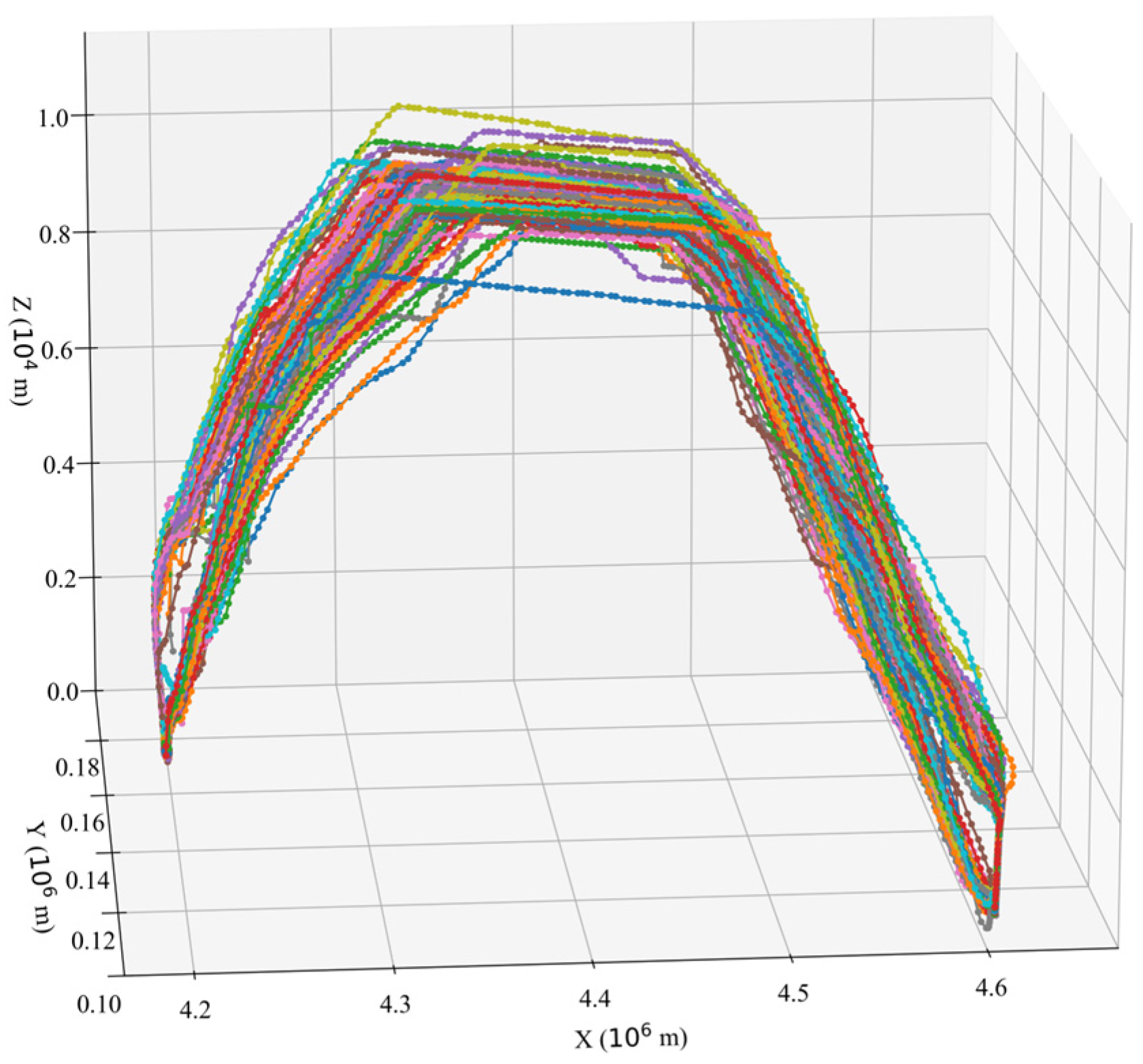
A total of 124 high-quality flight trajectories data with the callsign EZY4019 were selected as the main data source, and the Mercator projection method was used to convert the latitude and longitude coordinates of each trajectory into planar coordinates for the purpose of calculating estimation errors. Since flights with the same callsign have almost identical durations and the trajectory position points are updated at a frequency of 1 Hz, each original trajectory is downsampled at equal time intervals to obtain a 196-dimensional preprocessed trajectory. Figure 5 shows the visualization results of the final trajectory set. It can be observed that the flight trajectories with the same callsign are generally similar, exhibiting consistent transition patterns such as changes in speed and altitude. Therefore, when there is a position missing in a single flight trajectory, in addition to using other positional information from that flight for correction, the spatiotemporal variation patterns of flight trajectories on other dates can also be used for inference, thereby improving the accuracy and reliability of trajectory completion.
In addition, two typical missing patterns, random missing (RM) and continuous missing (CM), were set to simulate the phenomenon of trajectory position missing in real scenarios. The RM mechanism corresponds to occasional missing such as analog signal interference, while the CM mechanism is used to reflect systematic missing such as equipment failures. For each type of missing data mechanism, different missing rates ranging from 0.1 to 0.4 were set with a basic step size of 0.1 (i.e., the proportion of missing points in the trajectory to the total number of points in the trajectory). To validate the effectiveness of the proposed Tensor Completion Based on Truncated Schatten p-Norm Minimization (TC-TSNM), five representative trajectory completion methods were selected for comparative experiments. These include Matrix Completion (MC) [25], Tensor Completion Based on Nuclear Norm Minimization (TC-NNM) [22], Tensor Completion Based on Truncated Nuclear Norm Minimization (TC-TNNM) [23], Tensor Completion Based on Schatten p-Norm Minimization (TC-SNM) [24], and Cubic Spline Interpolation (CSI) [26]. The first four methods represent matrix or tensor-based completion models, while the last one is an interpolation-based completion model. Especially, as a classic statistical interpolation method, CSI has been widely regarded in previous studies as the baseline model for the task of flight trajectory completion [16,20].
With the help of Python 3.1.2, all of the above models were implemented on a Lenovo Legion laptop equipped with an Intel Core i9-14900 processor and 16 GB of RAM. In terms of experimental parameter settings, for the tensor-based models, the weight coefficients α 1 , α 2 , α 3 for each mode were set to 1/3, the initial values of the penalty factors ρ 1 , ρ 2 , ρ 3 for each mode were set to max ( n 1 , n 2 ) n 3 , the minimum tolerance threshold m i n _ t o l was set to 10 5 , and the maximum number of iterations m a x _ i t e r was set to 400. The truncation rate r for TC-TNNM was set to 0.05 , 0.1 , 0.2 , 0.3 , the norm p for TC-TSNM and TC-SNM was set to 0.1 , 0.3 , 0.5 , 0.7 , 0.9 , and the singular value threshold τ for TC-TSNM was set to 1 , 10 , 20 , 30 , 50 , 100 , 1000 . For the matrix-based model, the number of iterations k was set to 400, the singular value threshold τ was set to 300, and the iteration step size was set to 0.1. For the interpolation-based model, the interpolation nodes are composed of the observation time series corresponding to the trajectory, and the interpolation variables are the three-dimensional attribute sequences x j , y j , z j of the trajectory corresponding to this time series. Its interpolation boundary is set to natural boundary conditions, meaning the second derivative at the endpoints is zero. To quantitatively compare the missing data completion performance of each method, the Mean Absolute Percentage Error (MAPE) and Root Mean Square Error (RMSE) are selected as the primary evaluation metrics. The calculation formulas are as follows:
MAPE = 1 Ω i Ω y i y i ^ y i × 100 %
RMSE = 1 Ω i Ω ( y i y i ^ ) 2
where Ω denotes the set of missing position points, y i and y i ^ represent the true value and the completed value of the missing position point i , respectively.

4.2. Completion Performance Analysis and Evaluation

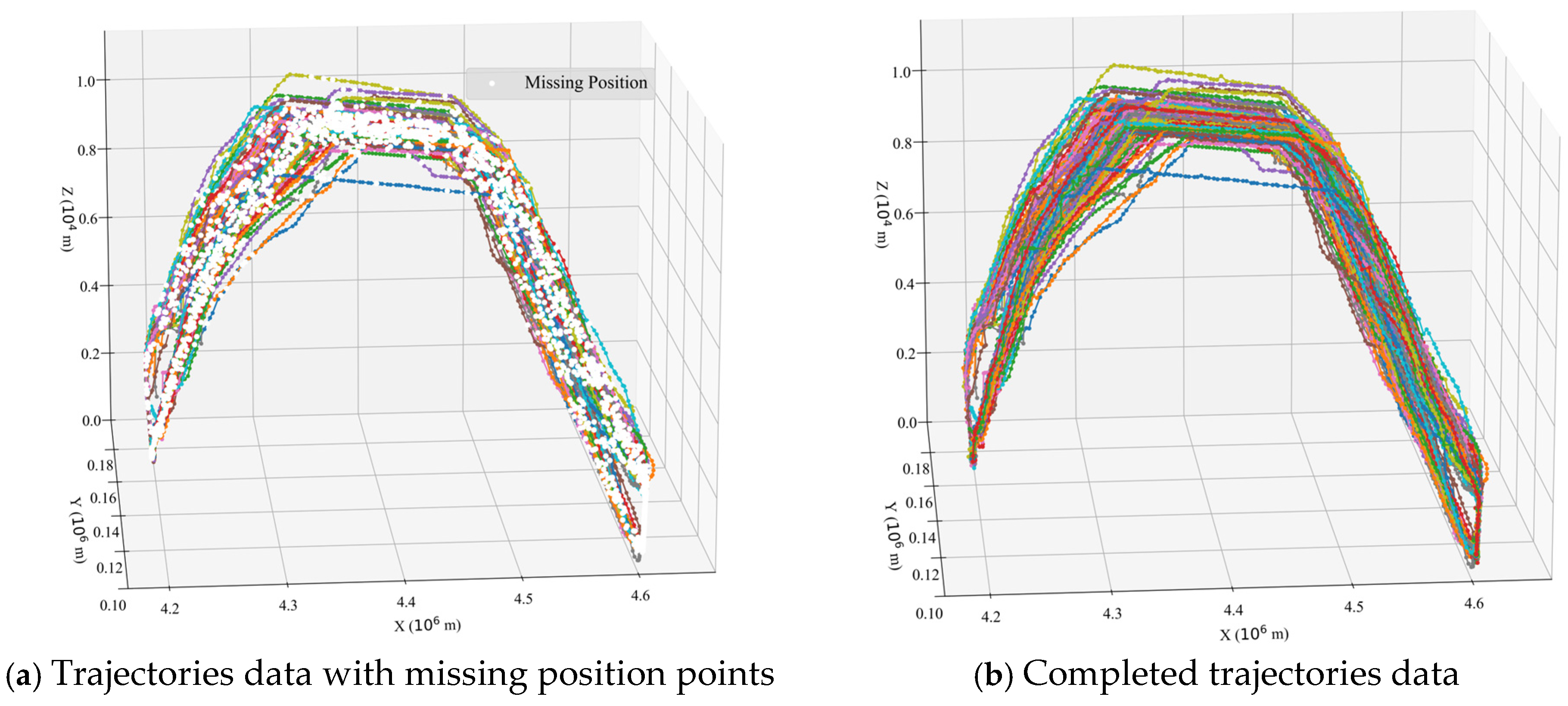
To validate the completion performance of the proposed model under complex missing patterns, a hybrid missing (HM) pattern is constructed under the coexistence of RM and CM patterns to reflect the real operational scenarios. Figure 6 shows the original trajectory and its completion results under the HM mode with a missing rate of 10%. It can be observed that the proposed model effectively captures the spatiotemporal correlation characteristics among multiple trajectories, allowing it to recover local missing segments while maintaining the overall continuity of the trajectory, thereby achieving high-accuracy completion of the trajectories.
Furthermore, to quantitatively evaluate the completion performance of different models, Table 1 presents the statistical results of MAPE and RMSE for both RM and CM patterns across missing rates from 10% to 40%. Overall, regardless of the missing patterns, the TC-TSNM model exhibits lower MAPE and RMSE compared to other completion models, with its performance advantage becoming more pronounced as the missing rate increases. This result validates the effectiveness of the proposed model in completing missing data by exploiting trajectory low-rank characteristics. In addition, at the same missing rate, the completion errors of various models are generally higher in the CM pattern than in the RM pattern. This is because, under the CM pattern, the effective observation points available to guide trajectory reconstruction are significantly reduced, disrupting the local continuous structure of the trajectory sequence and thereby increasing completion uncertainty. Among the various models, the interpolation-based completion model (i.e., the CSI model), as a commonly used baseline model, suffers from limited completion accuracy because it only uses neighborhood observations near the missing position points for polynomial fitting, without fully exploiting the spatiotemporal relationships between multiple trajectories. In contrast, matrix-based or tensor-based completion models show better performance, indicating that reasonable low-rank constraints can effectively mine the structural information in trajectory data. Further comparison between TC-NNM, TC-TNNM, TC-SNM, and TC-TSNM reveals that both the truncation mechanism and the Schatten p-norm have contributed to the improved performance of trajectory completion. On one hand, introducing the Schatten p-norm and expanding the norm parameter p to a tunable range between 0 and 1 allows the model to adapt to the intrinsic characteristics of different datasets and various missing scenarios, thereby achieving optimal completion results. On the other hand, the truncation mechanism reduces the overfitting of noise components by filtering out insignificant singular values, enhancing the model’s robustness and stability.
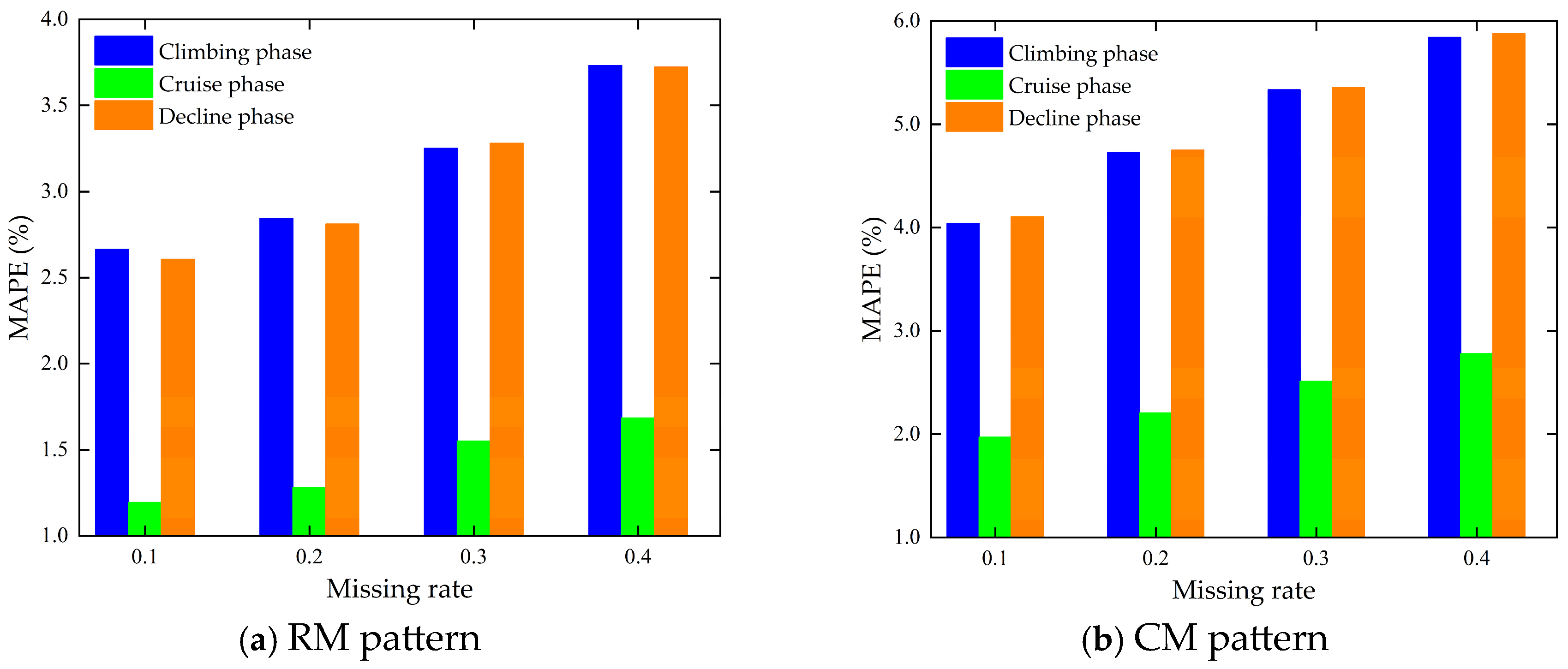
Considering that overall performance metrics are difficult to characterize the differences in maneuverability and nonlinearity of the aircraft during different flight phases, each complete flight trajectory is further divided into three phases: climb, cruise, and descent. Figure 7 shows the MAPE completion results of trajectory segments from different flight phases using the TC-TSNM method under various missing rates and missing patterns. It is observed that the average MAPE of the climb and descent phases is generally higher than that of the cruise phase, with the average MAPE of the descent phase being similar to that of the climb phase. During the climb phase, the aircraft needs to accelerate to cruising speed and reach the target altitude, causing the trajectory to exhibit nonlinear trends, which results in a lower accuracy. In contrast, during the cruise phase, the aircraft flies at a relatively stable speed at a certain flight level, with a regular flight trajectory and simple pattern, resulting in higher completion accuracy. After entering the descent phase, the aircraft frequently adjusts its speed and altitude as it approaches the ground, which results in a trajectory with stronger nonlinearity and uncertainty. Nevertheless, the TC-TSNM method still ensures that the completion performance remains within an acceptable range. Furthermore, under the same missing rates and flight phases, the MAPE of the CM pattern is generally higher than that of the RM pattern, which indirectly reflects the greater challenge of completing tasks with continuous missing position points.

4.3. Sensitivity Analysis

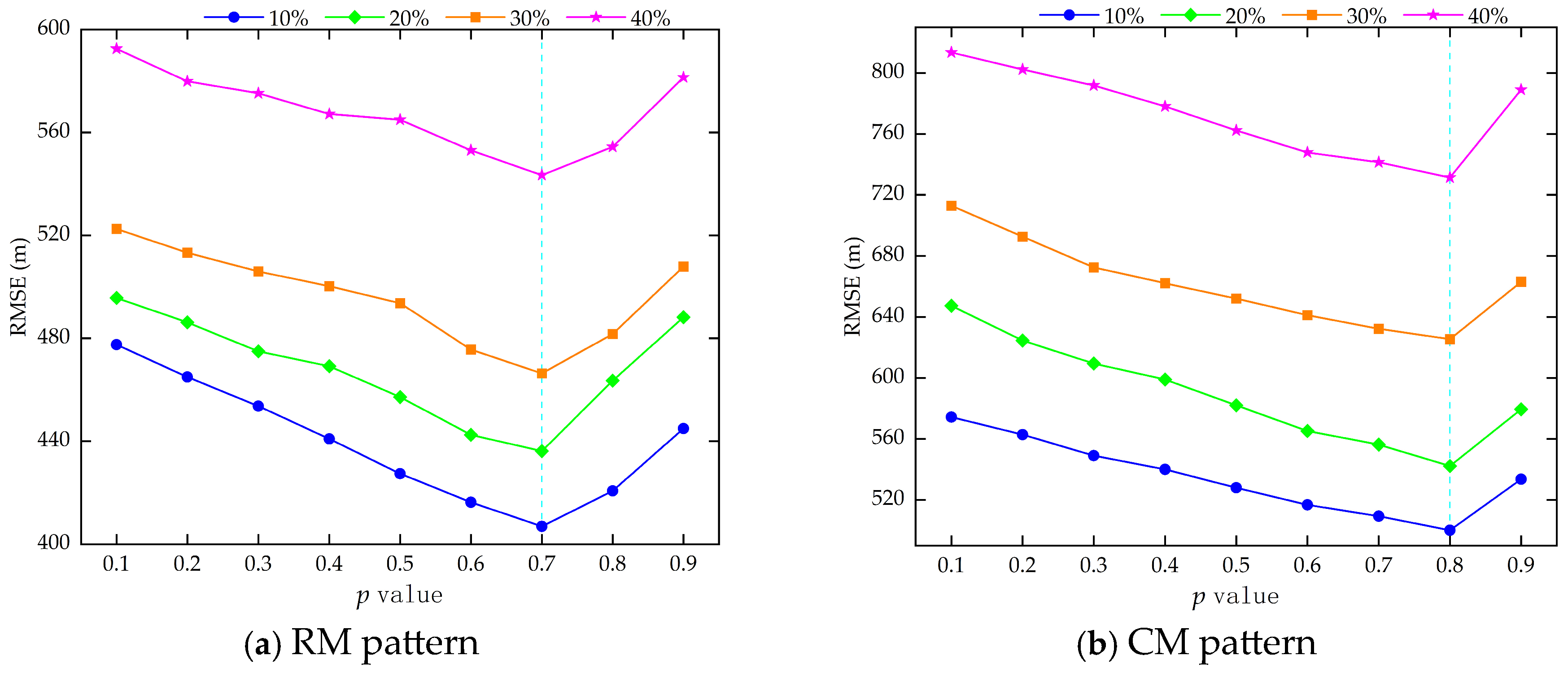
As described above, the truncated Schatten p-norm is a unified algebraic representation of tensors. By adjusting the norm p and the singular value truncation threshold τ , it can degenerate into other basic forms. Figure 8 presents the sensitivity analysis of parameter p under different missing patterns. Overall, the RMSE curve mostly shows a trend of first decreasing and then increasing. In the RM and CM scenarios, performance curves exhibit saddle points when p is 0.7 and 0.8, respectively (i.e., at the cyan dashed line positions). Compared to the rank function (i.e., p = 0 ) and nuclear norm (i.e., p = 1 ), this result validates the flexibility and superiority of the tensor Schatten p-norm. Since the value of p controls the non-convexity level of the tensor Schatten p-norm, an appropriate p value can be selected in practical applications based on different datasets and missing patterns to achieve a balance between model complexity and accuracy.
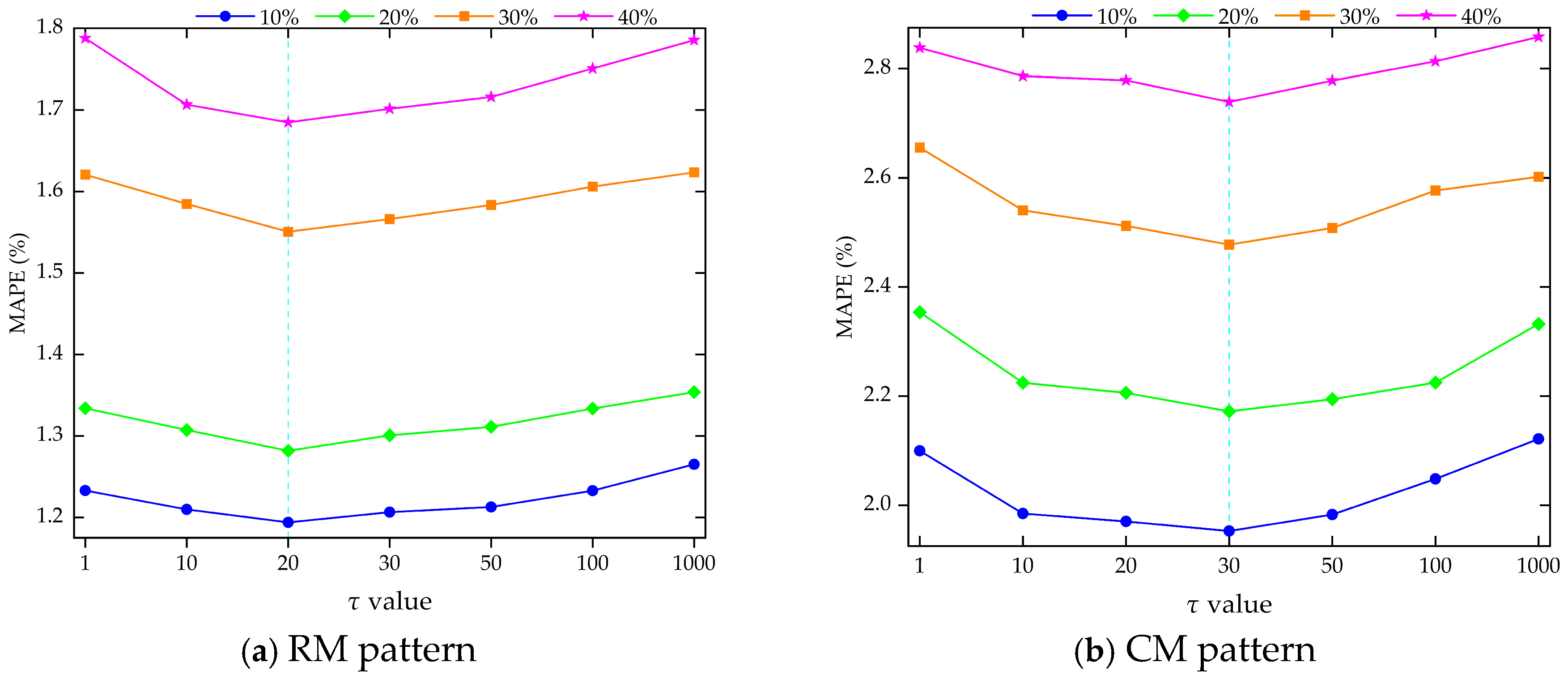
Figure 9 further illustrates how the singular value truncation threshold τ affects the RMSE under different missing patterns. Hereby, τ = 1 is lower than all singular values of the unfolded matrices, while τ = 1000 is used as the maximum value for comparison. The remaining τ = 10 , 20 , 30 , 50 , 100 corresponds to different truncation ratios. It can be seen that the MAPE increases significantly when τ = 1000 . In this scenario, the truncated Schatten p-norm degenerates into the conventional Schatten p-norm, which cannot suppress minor singular values, thereby significantly reducing the performance of trajectory completion. Similarly, when τ = 1 , the MAPE is also significantly increased, indicating that excessive truncation of small singular values disrupts the structural information of trajectories and consequently reduces completion accuracy. In the RM and CM patterns, the optimal value of τ are 20 and 30, respectively (as indicated by the cyan dashed lines). The above results validate the effectiveness of τ in balancing major structural information with noise suppression.
In order to further analyze the performance of the proposed method on flight trajectories of varying complexity, we further extracted trajectory sets with different callsigns and compared the optimal completion performance and the corresponding model parameters in Table 2. Without loss of generality, we provide the evaluation results of RM and CM patterns when the missing rate is 20%. It can be observed that, although the departure and arrival airports are the same, trajectories composed of different callsigns also have varying degrees of low rank. As the degree of low rank decreases, the completion performance is also significantly affected, which directly indicates that the proposed method relies on the spatiotemporal correlations among trajectories. In contrast, the model parameters corresponding to optimal performance exhibit minimal fluctuations, with only slight increases observed for the callsigns AFR27GH and AF128UU.

5. Conclusions

Missing positions in flight trajectory data collected by the ADS-B system have long been a core issue in trajectory data processing. This problem is often characterized by the interplay and superposition of various missing patterns, such as random missing and consecutive missing. Based on the intrinsic low rank of the trajectory data verified by the SVD algorithm, a trajectory tensor completion model is proposed in this paper. It introduces a regularization strategy that combines the Schatten p-norm with a singular value truncation mechanism and uses the ADMM algorithm for optimization. Experiments conducted on real flight trajectory data are analyzed from both qualitative and quantitative perspectives, examining the completion results under various missing patterns, missing rates, and flight phases. The results indicate that the proposed model has higher accuracy and robustness compared to other representative models. It is worth noting that when historical trajectories of the same callsign exhibit significant differences due to extreme weather events, temporary route adjustments, or airspace control measures, the completion performance of the proposed model may decrease due to weak low-rank characteristics.
Future research will focus on how to integrate additional prior information related to trajectory evolution (such as spatiotemporal smoothing constraints and trajectory similarity constraints) to further improve the accuracy and robustness of trajectory tensor completion in complex missing data scenarios.

Author Contributions

Conceptualization, W.Z. and J.D.; methodology, W.Z., H.L. and J.D.; software, W.Z., H.L. and Z.D.; validation, W.Z., H.L. and Z.D.; formal analysis, J.D.; investigation, Q.C.; resources, Q.C.; data curation, W.Z.; writing—original draft preparation, W.Z., H.L. and Z.D.; writing—review and editing, W.Z. and H.L.; visualization, W.Z. and H.L.; supervision, J.D.; project administration, Q.C.; funding acquisition, W.Z. and J.D. All authors have read and agreed to the published version of the manuscript.

Funding

This work is partially supported by the National Natural Science Foundation of China (52502433), the Sichuan Science and Technology Program (2025ZNSFSC1484, 2026NSFSC1310), the Fundamental Research Funds for the Central Universities (25CAFUC04053, 25CAFUC04062).

Institutional Review Board Statement

Not applicable.

Informed Consent Statement

Not applicable.

Data Availability Statement

Data is contained within the article. Due to the nature of this research, participants of this study did not agree for their data to be shared publicly, so supporting data are not available.

Acknowledgments

We would like to thank the OpenSky Network for providing rich APIs to help the authors collect the ADS-B flight trajectories data used in this paper.

Conflicts of Interest

The authors declare no conflicts of interest.

References

  1. Khan, H.A.; Khan, H.; Ghafoor, S.; Khan, M.A. A Survey on Security of Automatic Dependent Surveillance-Broadcast (ADS-B) Protocol: Challenges, Potential Solutions and Future Directions. IEEE Commun. Surv. Tutor. 2024, 27, 3199–3226. [Google Scholar] [CrossRef]
  2. Lin, Y.; Zhang, J.; Liu, H. Deep learning based short-term air traffic flow prediction considering temporal–spatial correlation. Aerosp. Sci. Technol. 2019, 93, 105113. [Google Scholar] [CrossRef]
  3. Bao, J.; Zhang, J.; Chen, Y.; Zhang, Z.; Kang, J. A semantic-embedded multi-view graph to sequence learning approach for air traffic flow prediction in the terminal maneuvering area of multi-airport system. Eng. Appl. Artif. Intell. 2025, 155, 111054. [Google Scholar] [CrossRef]
  4. Sui, D.; Xu, W.; Zhang, K. Study on the resolution of multi-aircraft flight conflicts based on an IDQN. Chin. J. Aeronaut. 2022, 35, 195–213. [Google Scholar] [CrossRef]
  5. Guo, D.; Zhang, J.; Yang, B.; Lin, Y. Multi-modal intelligent situation awareness in real-time air traffic control: Control intent understanding and flight trajectory prediction. Chin. J. Aeronaut. 2025, 38, 103376. [Google Scholar] [CrossRef]
  6. Zhang, W.; Pan, W.; Yang, C.; Zhu, X.; Yin, J.; Du, J. Subjective Air Traffic Complexity Analysis Based on Weak Supervised Learning. Promet-Traffic Transp. 2025, 37, 1040–1051. [Google Scholar]
  7. Guo, D.; Wu, E.Q.; Wu, Y.; Zhang, J.; Law, R.; Lin, Y. FlightBERT: Binary encoding representation for flight trajectory prediction. IEEE Trans. Intell. Transp. Syst. 2023, 24, 1828–1842. [Google Scholar] [CrossRef]
  8. Wu, L.; Wang, X.; Yang, T.; Zhang, J.; Dong, F.; Liu, G.; Chu, R.; Wang, L. M2FlightNet: Multi-Scale Modeling Network for Short-Term Flight Trajectory Prediction. IEEE Trans. Aerosp. Electron. Syst. 2025, 61, 12875–12891. [Google Scholar] [CrossRef]
  9. Sun, J.; Ellerbroek, J.; Hoekstra, J. Flight extraction and phase identification for large automatic dependent surveillance–broadcast datasets. J. Aerosp. Inf. Syst. 2017, 14, 566–572. [Google Scholar] [CrossRef]
  10. Zhang, Z.; Guo, D.; Zhou, S.; Zhang, J.; Lin, Y. Flight trajectory prediction enabled by time-frequency wavelet transform. Nat. Commun. 2023, 14, 5258. [Google Scholar] [CrossRef]
  11. Hu, M. Flight Trajectory Processing and Filtering Based on ADS-B. Master’s Thesis, University of Electronic Science and Technology of China, Chengdu, China, 2012. [Google Scholar]
  12. Zhang, D. Research on Aircraft Trajectory Processing and Display System Based on ADS-B. Master’s Thesis, University of Electronic Science and Technology of China, Chengdu, China, 2017. [Google Scholar]
  13. Olive, X.; Basora, L. A Python Toolbox for Processing Air Traffic Data: A Use Case with Trajectory Clustering. In Proceedings of the 7th OpenSky Workshop 2019, Zurich, Switzerland, 21–22 November 2019; EasyChair: Manchester, UK, 2019; pp. 60–73. [Google Scholar]
  14. Wang, B. Data cleaning method of ADS-B historical flight trajectories. J. Traffic Transp. Eng. 2020, 20, 217–226. [Google Scholar]
  15. Tan, X.; Sun, X.; Zhang, C.; Wandelt, S. Efficient and Effective 4D Trajectory Data Cleansing. Trans. Nanjing Univ. Aeronaut. Astronaut. 2020, 37, 288–299. [Google Scholar]
  16. Lin, Y.; Li, Q.; Guo, D.; Zhang, J.; Zhang, C. Tensor completion-based trajectory imputation approach in air traffic control. Aerosp. Sci. Technol. 2021, 114, 106754. [Google Scholar] [CrossRef]
  17. Fan, X.; Li, Q.; Chu, R.; Wu, C. DAMOT: A Novel Algorithm for High-Speed Target Sparse Flight Trajectory Interpolation. In Proceedings of the 2025 IEEE 5th International Conference on Power, Electronics and Computer Applications (ICPECA), Shenyang, China, 17–19 January 2025; IEEE: Piscataway, NJ, USA, 2025; pp. 452–462. [Google Scholar]
  18. Wang, L.; Wang, X.; Zhang, J.; Ge, C.; Chu, R.; Wu, L. FTIM: An End-to-End Flight Trajectory Imputation Method. Aerosp. Sci. Technol. 2025, 168, 111031. [Google Scholar] [CrossRef]
  19. Zhao, J.; Rong, C.; Dang, X.; Sun, H. Qar data imputation using generative adversarial network with self-attention mechanism. Big Data Min. Anal. 2023, 7, 12–28. [Google Scholar] [CrossRef]
  20. Tao, Y.; Tang, J.; Yan, Z.; Zhou, C.; Wang, C. A trajectory imputation method integrating representation transformation and pattern regression. Acta Aeronaut. Astronaut. Sin. 2026, 47, 332106. [Google Scholar] [CrossRef]
  21. Strohmeier, M.; Olive, X.; Lübbe, J.; Schäfer, M.; Lenders, V. Crowdsourced air traffic data from the OpenSky Network 2019–2020. Earth Syst. Sci. Data 2021, 13, 357–366. [Google Scholar] [CrossRef]
  22. Liu, J.; Musialski, P.; Wonka, P.; Ye, J. Tensor completion for estimating missing values in visual data. IEEE Trans. Pattern Anal. Mach. Intell. 2012, 35, 208–220. [Google Scholar] [CrossRef]
  23. Chen, X.; Yang, J.; Sun, L. A nonconvex low-rank tensor completion model for spatiotemporal traffic data imputation. Transp. Res. Part C Emerg. Technol. 2020, 117, 102673. [Google Scholar] [CrossRef]
  24. Hu, L.; Jia, Y.; Chen, W.; Wen, L.; Ye, Z. A flexible and robust tensor completion approach for traffic data recovery with low-rankness. IEEE Trans. Intell. Transp. Syst. 2023, 25, 2558–2572. [Google Scholar] [CrossRef]
  25. Xie, K.; Ning, X.; Wang, X.; Xie, D.; Cao, J.; Xie, G.; Wen, J. Recover corrupted data in sensor networks: A matrix completion solution. IEEE Trans. Mob. Comput. 2016, 16, 1434–1448. [Google Scholar] [CrossRef]
  26. Dyer, S.A.; Dyer, J.S. Cubic-spline interpolation. 1. IEEE Instrum. Meas. Mag. 2002, 4, 44–46. [Google Scholar] [CrossRef]
Figure 1. Visualization of flight trajectories from Orly Airport to Toulouse Airport in 2017.
Applsci 16 03217 g001
Figure 2. ADS-B flight trajectories position missing phenomenon.
Applsci 16 03217 g002
Figure 3. Energy proportion analysis of singular values.
Applsci 16 03217 g003
Figure 4. Proposed trajectory data completion framework.
Applsci 16 03217 g004
Figure 5. One-hundred and twenty-four flight trajectories with the callsign EZY4019.
Applsci 16 03217 g005
Figure 6. The original trajectories and its completed results in the HM pattern with a missing rate of 10%.
Applsci 16 03217 g006
Figure 7. The MAPE completion results of the TC-TSNM model in different flight phases ( p = 0.7 , τ = 20 ).
Applsci 16 03217 g007
Figure 8. Sensitivity analysis of parameter p under different missing patterns ( τ = 20 , ρ = 10 5 ).
Applsci 16 03217 g008
Figure 9. Sensitivity analysis of parameter τ under different missing patterns ( p = 0.7 , ρ = 10 5 ).
Applsci 16 03217 g009
Table 1. Comparison results of completion performance of different models (MAPE (%)/RMSE (m)).
Missing PatternsMissing RatesInterpolation-Based ModelMatrix-Based ModelTensor-Based Models
CSIMCTC-NNMTC-TNNMTC-SNMTC-TSNM
RM10%1.96/573.621.75/524.051.41/475.211.36/456.961.27/435.271.19/406.92
20%2.21/614.381.97/562.441.62/506.031.55/474.721.35/453.171.28/436.18
30%2.54/695.232.35/632.821.94/572.831.83/542.831.62/486.401.55/466.38
40%3.07/803.502.86/725.292.13/660.202.08/617.221.79/562.921.68/543.41
CM10%3.21/834.632.92/798.612.65/665.572.43/624.912.12/564.481.82/500.09
20%3.78/935.163.27/875.092.81/716.892.60/681.672.33/622.312.13/542.24
30%4.62/1105.724.02/1025.583.08/820.802.90/774.092.60/673.992.48/625.43
40%6.36/1356.335.31/1217.423.39/957.293.12/896.202.86/797.992.70/731.39
The use of bold corresponds to the best performance.
Table 2. Comparison of optimal performance and model parameters under different callsigns.
Missing Scenario
(Patterns/Rates)
CallsignsDegree of Low-Rank *
( k )
Completion Performance
(MAPE (%)/RMSE (m))
Model Parameters
( p / τ )
RM/20%EZY401951.28/436.180.7/20
AFR22MT71.46/470.530.7/20
AFR27GH101.59/508.220.8/20
AF128UU141.74/560.940.8/20
CM/20%EZY401952.13/582.240.8/30
AFR22MT72.35/629.300.8/30
AFR27GH102.70/706.650.8/50
AF128UU142.96/794.820.9/50
* The degree of low rank is quantified by the number of the first k singular values corresponding to 98% of the total energy. The smaller k is, the better the low-rank property of the trajectory set.
Disclaimer/Publisher’s Note: The statements, opinions and data contained in all publications are solely those of the individual author(s) and contributor(s) and not of MDPI and/or the editor(s). MDPI and/or the editor(s) disclaim responsibility for any injury to people or property resulting from any ideas, methods, instructions or products referred to in the content.