


Abstract
Unmanned Aerial Vehicle (UAV) swarms operating in contested environments face a critical “semantic gap” between raw, high-velocity network traffic and high-level mission security constraints, compounded by the risk of privacy leakage during collaborative learning. Existing deep learning (DL)-based Network Intrusion Detection Systems (NIDSs) suffer from opacity, prohibitive resource consumption, and vulnerability to gradient leakage attacks in federated settings, while traditional rule-based systems fail to handle encrypted payloads and evolving attack patterns. To bridge this gap, we present NeSySwarm-IDS (Neuro-Symbolic Swarm Intrusion Detection System), an end-to-end differentiable neuro-symbolic framework that simultaneously achieves high accuracy, strong privacy guarantees, and built-in interpretability under resource constraints. NeSySwarm-IDS integrates an extremely lightweight 1D convolutional neural network with a differentiable Łukasiewicz fuzzy logic reasoner incorporating attack-specific rules. By aggregating only low-dimensional logic rule weights with calibrated differential privacy noise, we drastically reduce communication overhead while providing -DP guarantees with negligible utility loss. Extensive experiments on the UAV-NIDD dataset and our self-collected dataset demonstrate that NeSySwarm-IDS achieves near-perfect detection accuracy, significantly outperforming traditional machine learning baselines despite using limited training data. A detailed case study on GPS spoofing confirms the interpretability of our approach, providing axiomatic explanations suitable for autonomous mission verification. These results establish that end-to-end neuro-symbolic learning can effectively bridge the semantic gap in UAV swarm security while ensuring privacy and interpretability, offering a practical pathway for deploying trustworthy AI in contested environments.
1. Introduction
The proliferation of Unmanned Aerial Vehicle (UAV) swarms has transformed a wide range of domains, from disaster response and infrastructure inspection to tactical military operations [1,2]. However, as UAVs transition from remotely piloted units to autonomous swarms communicating via Mobile Ad Hoc Networks (MANETs), they become susceptible to sophisticated cyber-physical attacks [3,4,5]. Unlike traditional computer networks, UAV swarms operate under severe Size, Weight, and Power (SWaP) constraints, and their security breaches can lead to kinetic consequences, such as collisions or hijacking. Attacks targeting UAVs, such as GPS spoofing and jamming, are not merely data corruption events; they directly threaten the physical integrity and mission success of the swarm [6,7].
The communication architecture of UAV swarms typically relies on ad hoc networking with dynamic topologies, limited bandwidth, and heterogeneous protocols including MAVLink for telemetry and control, DroneID for identification, and proprietary command channels [8]. This complexity expands the attack surface significantly. Adversaries can exploit these channels to launch a variety of attacks, including port scanning, reconnaissance, DoS/DDoS, de-authentication, replay, man-in-the-middle, evil twin, GPS jamming/spoofing, brute-force, and fake landing packet attacks [9]. Detecting these attacks in real time while operating within limited resource budgets is a formidable challenge.
Designing a Network Intrusion Detection System (NIDS) for UAV swarms involves balancing a trilemma of accuracy, efficiency, and interpretability. Deep learning (DL) approaches [10,11] excel at uncovering complex attack patterns, but they operate as opaque “black boxes”. Their high computational demands often exceed the limited onboard resources of UAVs, causing significant inference delays that impede real-time threat response. In a mission-critical context, a neural network flagging “Malicious” without any explanation is not only untrustworthy but operationally dangerous. On the other hand, symbolic rule-based systems like Snort offer interpretability by design, yet they struggle to detect novel attacks or analyze encrypted traffic [12,13,14].
Furthermore, the distributed nature of UAV swarms necessitates collaborative learning. However, sharing raw traffic logs violates privacy regulations (e.g., GDPR) and Operational Security (OPSEC) protocols. Federated learning (FL) offers a partial solution but remains vulnerable to gradient leakage attacks [15] and imposes unsustainable communication overhead on bandwidth-limited UAV links [16]. Applying differential privacy (DP) to standard DL models often leads to a significant drop in utility due to the high dimensionality of the models [17].
To address these challenges, we introduce the neuro-symbolic (NeSy) paradigm to UAV security. As systematically reviewed by Colelough and Regli [18], NeSy AI, which combines the perceptual strengths of neural networks (System 1) with the reasoning capabilities of symbolic AI (System 2), has seen exponential growth since 2020. It aims to create hybrid systems with superior reasoning capabilities by integrating knowledge representation, learning and inference, logic and reasoning, and explainability [18,19]. By incorporating symbolic priors, NeSy models can achieve higher sample efficiency and lower computational footprint compared to purely data-driven approaches—they generalize well even with limited training data and require significantly fewer onboard resources, making them particularly suitable for resource-constrained edge deployments like UAV swarms. However, existing NeSy methods often treat neural and symbolic components separately or suffer from gradient saturation [20], preventing symbolic knowledge from effectively guiding the learning process [21]. Moreover, no prior NeSy system has been demonstrated to operate within milliwatt power budgets while providing formal privacy guarantees and tailored detection for the diverse set of attacks encountered in UAV networks.
In this paper, we propose NeSySwarm-IDS (Neuro-Symbolic Swarm Intrusion Detection System), a fully end-to-end differentiable neuro-symbolic framework that closes these gaps. Our main contributions are:
- 1.
- Theoretical Unification of Attack-Specific Logic and Neural Learning: We formulate the NIDS problem as a constrained optimization task where 12 security rules (covering 10 attack types) act as differentiable regularizers via Łukasiewicz fuzzy logic. We provide a rigorous gradient analysis explaining why Łukasiewicz t-norm is uniquely suited for anomaly detection, empirically outperforming Gödel and Product t-norms by 3.4–4.0 percentage points in F1-score.
- 2.
- SWaP-Optimized 1D CNN Architecture: We design a lightweight perception module based on a three-block 1D convolutional network with two fully connected layers, processing 54-dimensional flow features extracted from encrypted Wi-Fi traffic. The model comprises only 61k parameters, requires 162k FLOPs per inference (2.1 ms on Raspberry Pi 4B), and consumes 244 KB of memory—well within the constraints of resource-limited UAVs without requiring quantization.
- 3.
- Privacy-Preserving Federated Neuro-Symbolic Learning (F-NSL): We introduce a novel FL protocol that aggregates only the low-dimensional logic rule weights (272 bytes per round), achieving -DP with negligible utility loss (an F1 drop lower than 1.2%) and reducing communication overhead by 98% compared to standard FL approaches.
- 4.
- Interpretable, Verifiable Explanations: We demonstrate how NeSySwarm-IDS provides axiomatic explanations (e.g., “Attack detected because SignalAnomaly AND GPSJammingIndicator are true”), offering intrinsic interpretability in contrast to post hoc methods like LIME [22] and SHAP [23].
The remainder of this paper is organized as follows. Section 2 reviews related work. Section 3 details the NeSySwarm-IDS architecture. Section 4 describes the implementation on edge hardware. Section 5 presents experimental results and ablation studies. Section 6 discusses limitations, and Section 7 concludes the paper.
2. Literature Review
2.1. UAV Communication and Swarm Networks
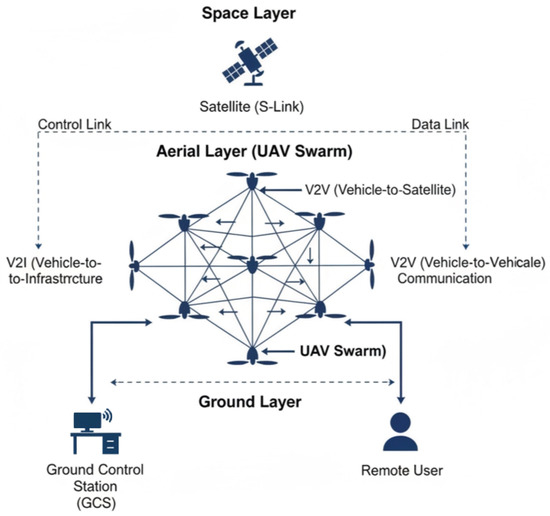
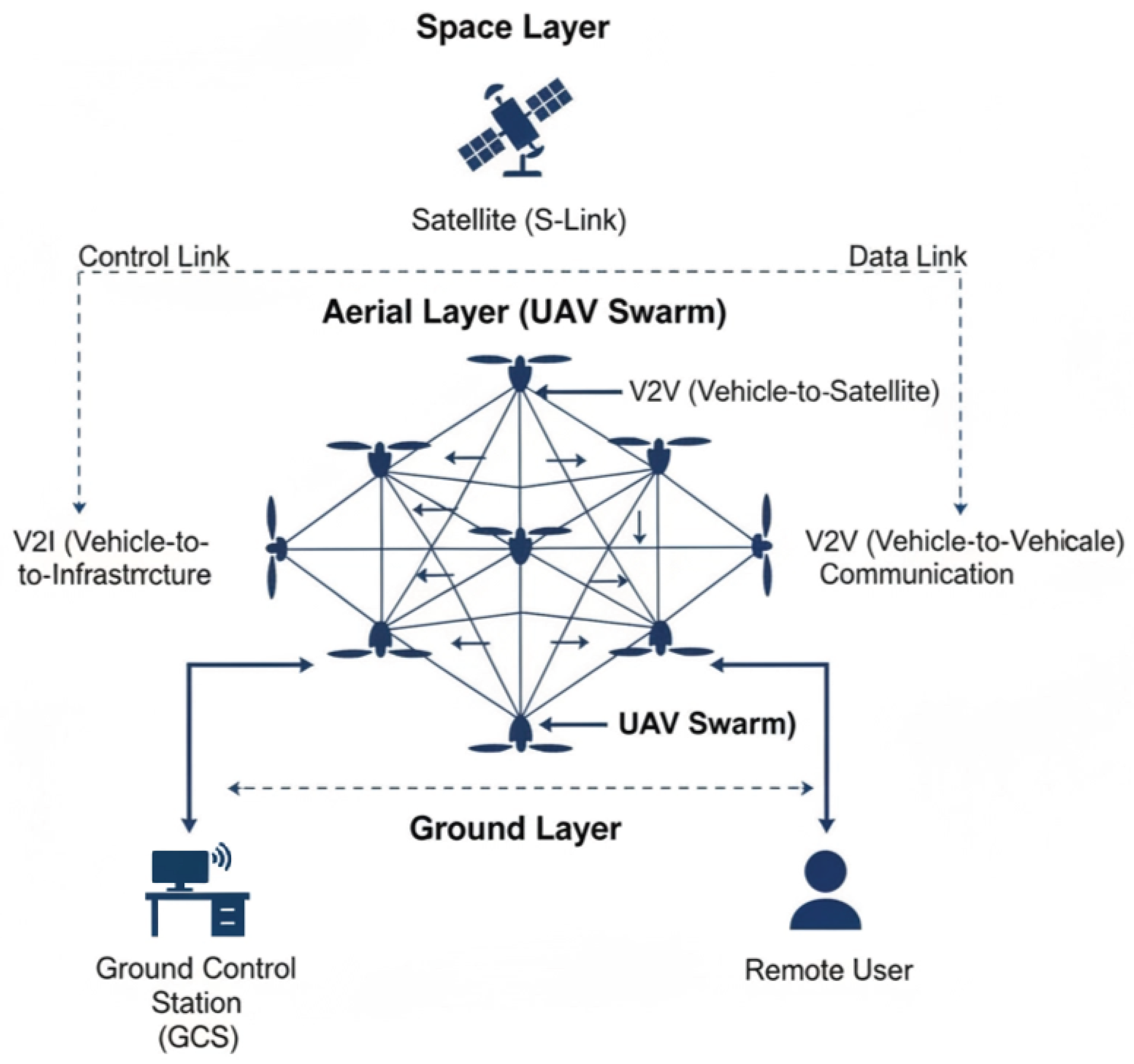
As illustrated in the system architecture (see Figure 1), UAV swarms typically operate as Flying Ad Hoc Networks (FANETs), a specialized subset of Mobile Ad Hoc Networks (MANETs). These networks are characterized by high node mobility, a highly dynamic mesh topology, and intermittent connectivity [8]. The communication infrastructure is organized into a three-tier hierarchical model:
Figure 1.
UAV swarm communication network architecture.
- Aerial Layer (V2V Communication): Drones form a decentralized mesh network using MANET routing protocols (e.g., AODV, OLSR) to maintain swarm cohesion. This layer predominantly relies on IEEE 802.11-based [24] Wi-Fi or proprietary RF links for low-latency peer-to-peer data exchange.
- Ground Layer (V2I/C2 Link): The Ground Control Station (GCS) manages the swarm via Command and Control (C2) channels, especially by leveraging data centers [25]. This link often utilizes cellular (4G/5G) or long-range RF links, employing protocols like MAVLink for telemetry and DroneID for identification.
- Space Layer (V2S/S-Link): For beyond-line-of-sight (BLOS) operations, a satellite link (S-Link) provides global connectivity and backhaul for mission data.
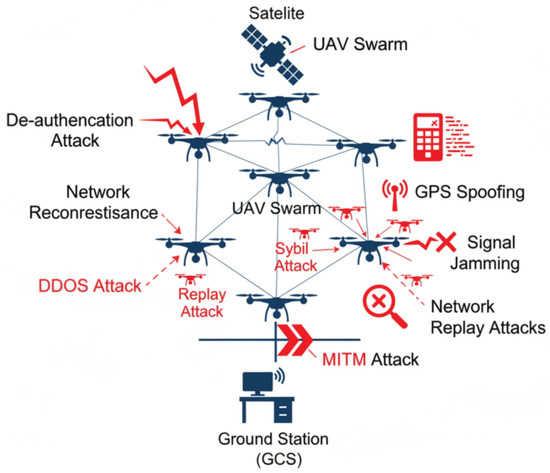
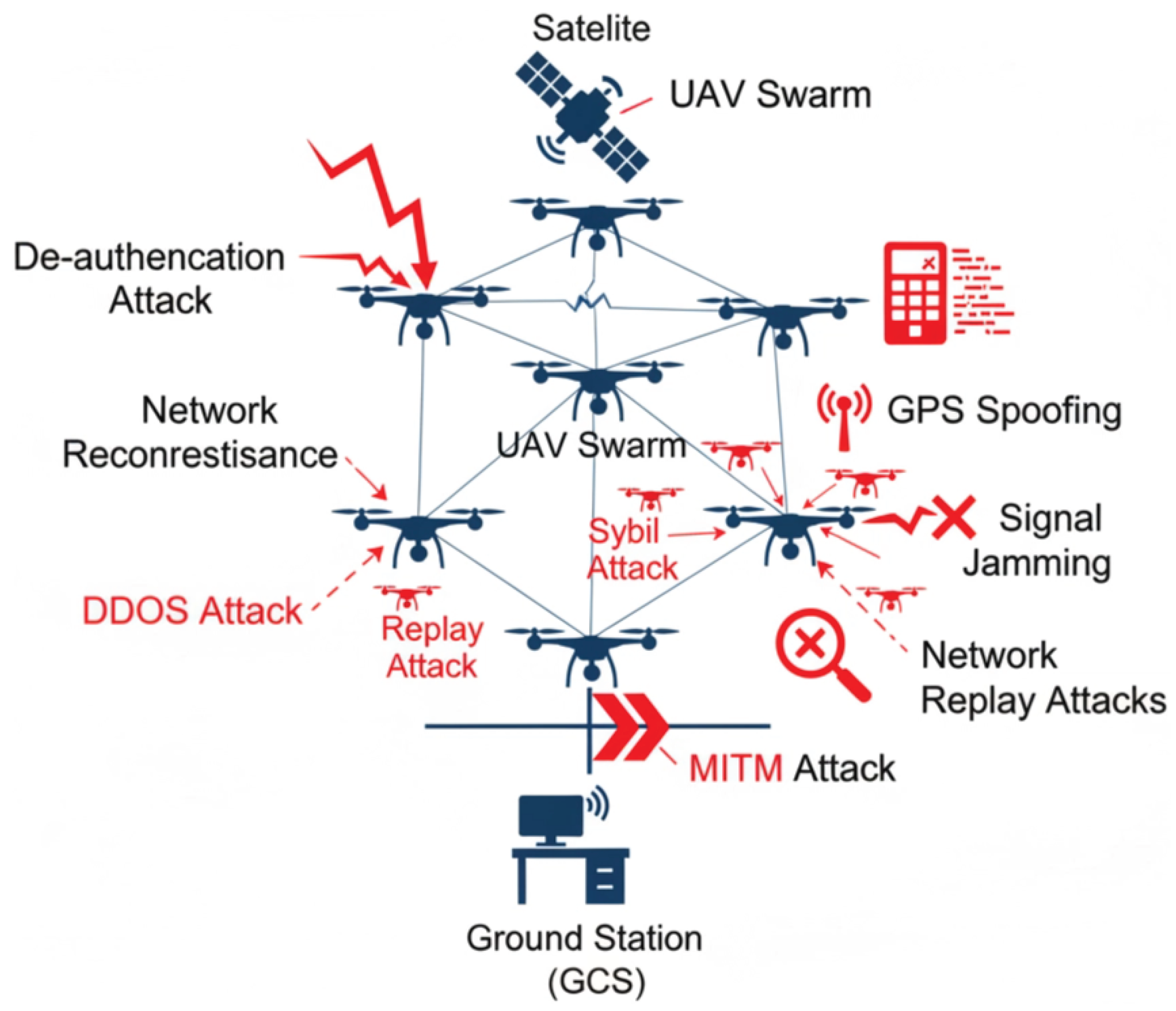
The swarm’s cooperative nature necessitates the continuous exchange of high-fidelity telemetry (position, velocity, attitude) and mission-critical data. However, as depicted in the threat model (see Figure 2), this multi-tier architecture creates an extensive attack surface. Each communication interface—from the V2V mesh to the V2I control link—is vulnerable to sophisticated adversaries targeting the physical, network, and application layers through various cyber-physical attacks.
Figure 2.
Typical threat scenarios of UAV swarm network.
2.2. Security Issues in UAV Swarms
UAV swarms are vulnerable to a range of cyber-physical attacks as illustrated in Figure 2, which can be categorized by their target and impact [26]:
- GPS Spoofing: Adversaries transmit counterfeit GPS signals to manipulate the UAV’s perceived position, potentially causing collisions or mission deviation. This attack exploits the lack of authentication in civilian GPSs.
- GPS Jamming: High-power noise is injected to overwhelm GPS receivers, leading to loss of positioning and navigation capability. Jamming can be carried out with low-cost software-defined radios.
- Command Injection: Attackers inject malicious MAVLink or C2 packets to override legitimate commands, potentially causing the UAV to land, return home, or engage in dangerous maneuvers.
- Denial of Service (DoS): Flooding the network with bogus traffic exhausts bandwidth and computational resources, disrupting swarm coordination.
- Sybil and Replay Attacks: Adversaries forge multiple identities or replay captured packets to deceive consensus mechanisms or authentication protocols.
The unique challenges of UAV swarm intrusion detection—dynamic topology, resource constraints, encrypted traffic, and the severe physical consequences of detection errors—directly translate into a set of design requirements: lightweight architectures that respect onboard resource limits such as P4 [27,28], adaptivity to handle evolving network conditions, the ability to detect anomalies without relying on decrypted payloads, and interpretability to enable human verification of alerts before acting. Moreover, the collaborative nature of swarm operations introduces additional privacy concerns, further motivating the need for privacy-preserving mechanisms during distributed learning.
2.3. Neuro-Symbolic AI in Cybersecurity
Neuro-symbolic (NeSy) AI aims to integrate neural learning with symbolic reasoning [19]. Colelough and Regli [18] provide a comprehensive taxonomy, categorizing NeSy research into five foundational areas: (1) knowledge representation, (2) learning and inference, (3) explainability and trustworthiness, (4) logic and reasoning, and (5) meta-cognition. Their systematic review of 158 papers (2020–2024) reveals that while learning and inference (63%) and logic and reasoning (35%) are well-explored, explainability and trustworthiness (28%) is less represented, and meta-cognition (5%) remains a significant gap. Our work, NeSySwarm-IDS, directly addresses the intersection of logic and reasoning, learning and inference, and explainability, contributing to these under-explored areas through design.
In cybersecurity, NeSy applications are emerging. Although algorithms such as XGBoost and neural network have achieved remarkable success across various domains [29,30,31,32,33,34,35,36] their propensity for overfitting often impedes practical deployment in UAV communication scenarios, suggesting that integrating neuro-symbolic methods can provide a balanced trade-off. A prominent example is MoCQ by Li et al. [37], which combines LLMs with static analysis for automated vulnerability detection. MoCQ uses LLMs to generate detection queries in domain-specific languages (DSLs) like CodeQL, and refines them via a feedback loop with a symbolic validator. This “neural generation + symbolic execution” paradigm is powerful but distinct from our approach: MoCQ uses LLMs as a pattern generator external to the detection loop, whereas NeSySwarm-IDS embeds a differentiable logic reasoner within the neural network, enabling end-to-end gradient-based learning.
Another closely related work is by Kalutharage et al. [38], who propose a neuro-symbolic framework for IoT attack detection. Their model integrates an autoencoder for anomaly detection with SHAP for feature explanation and a cybersecurity knowledge graph to validate attacks and map them to CIA principles and the MITRE ATT&CK framework. The work shares our goal of enhancing explainability and leveraging domain knowledge. However, key differences exist: (i) their symbolic component is a static knowledge graph queried post hoc, while ours is a differentiable logic layer that actively participates in training; (ii) their focus is on IoT networks in general, whereas we target the unique SWaP and communication constraints of UAV swarms; (iii) we provide formal privacy guarantees via federated learning on logic weights, which their work does not address.
A significant line of research utilizes Logic Tensor Networks (LTNs) for network intrusion detection. Onchis et al. [39] proposed an LTN-based classifier for monitoring security alerts, introducing the concept of interactive accuracy—the ability to query the model’s logical satisfaction levels at any time. Their model, tested on KDD99 and CIC-IDS2017, achieved 0.95 accuracy and demonstrated how logical constraints can mitigate overfitting. More recently, Bizzarri et al. [40] developed an NSAI NIDS specifically targeting the challenge of detecting unknown (zero-day) attacks. Their key innovation is a Hybrid Loss function that combines standard cross-entropy loss with a logical satisfiability (SAT) loss derived from LTN axioms. By training a 1D CNN within an LTN framework and using the SAT loss to penalize misclassifications between benign and malicious traffic at a high level, they demonstrated an 8–12% improvement in unknown attack detection accuracy over vanilla CNNs on the CIC-IDS2017 dataset. This work is methodologically closest to ours, as both use logical constraints to regularize neural network training.
However, our contributions extend beyond these LTN-based approaches in several crucial ways. First, we employ Łukasiewicz fuzzy logic instead of the product t-norm used by both Onchis et al. and Bizzarri et al. As analyzed by van Krieken et al. [20], the choice of t-norm critically affects gradient flow during end-to-end training:
- Gödel t-norm: . Gradients vanish when .
- Product t-norm: . Gradients can become extremely small.
- Łukasiewicz t-norm: . It maintains non-zero gradients across a wider range, preventing vanishing gradients.
Our work is the first to apply Łukasiewicz logic to network intrusion detection and to empirically validate its advantage over product and Gödel t-norms in this domain. Second, our lightweight perception module is specifically optimized for SWaP-constrained UAVs, whereas prior LTN models are designed for general network traffic on server-class hardware. Third, we introduce a novel federated privacy-preserving protocol (F-NSL) that aggregates only low-dimensional logic weights with differential privacy—a feature not considered in any previous NeSy NIDS. Finally, our rules are explicitly mapped to UAV-specific attack types (e.g., GPS spoofing/jamming), whereas earlier axioms focus on the benign/attack dichotomy.
While server-grade NeSy implementations exist (e.g., DeepProbLog [41], LTN [42]), no prior work demonstrates a fully differentiable neuro-symbolic detector operating within milliwatt power budgets and delivering real-time, attack-specific explanations on UAV onboard computers with formal privacy guarantees. NeSySwarm-IDS bridges this gap by co-designing a lightweight perception frontend with a Łukasiewicz logic reasoner, with rules explicitly crafted for UAV-specific threats.
2.4. Federated Learning and Privacy-Preserving Mechanisms
Federated learning (FL) enables multiple UAVs to collaboratively train a model without sharing raw data [43]. However, standard FL requires each client to transmit the full gradient update, which for a deep NIDS can be several megabytes per round—a prohibitive overhead for congested UAV ad hoc networks [16]. Moreover, Zhu et al. [15] demonstrated that raw gradients can be inverted to reconstruct original training samples with high fidelity, rendering conventional FL vulnerable in OPSEC environments. Even aggregated gradients can leak sensitive information, especially when batch sizes are small or the model is overparameterized.
Recent advances in gradient leakage attacks show that defenses must go beyond simple aggregation. Defense mechanisms include:
- Differential Privacy (DP): Adds calibrated noise to gradients to bound the information leakage. DP-SGD [44] is the de facto standard, but it injects significant noise into hundreds of thousands of parameters, often degrading the F1-score by >10% under modest privacy budgets () [17]. The high dimensionality of deep learning models is the fundamental cause of this utility collapse.
- Homomorphic Encryption (HE): Allows computation on encrypted gradients, but incurs massive computational overhead and is impractical for resource-constrained UAVs.
- Secure Multi-Party Computation (SMPC): Splits gradients among multiple servers, but requires high communication and coordination, unsuitable for dynamic swarm networks.
Our key insight is that the symbolic layer—the mapping from latent features to logical predicates and the subsequent rule evaluation—is orders of magnitude lower-dimensional (e.g., 16 predicates vs. 61k CNN weights) yet encodes the essence of the detection policy. By performing federated aggregation only on these logic weights and protecting them with calibrated Gaussian noise, we achieve strong -DP while incurring negligible accuracy loss and reducing communication cost by over 98%. This insight, tailored to the unique structure of NeSy models, has not been explored in prior FL or NeSy literature. Furthermore, the low-dimensional nature of the logic layer makes it amenable to lightweight cryptographic primitives if stronger security is needed in the future.
3. Methodology
3.1. System Overview
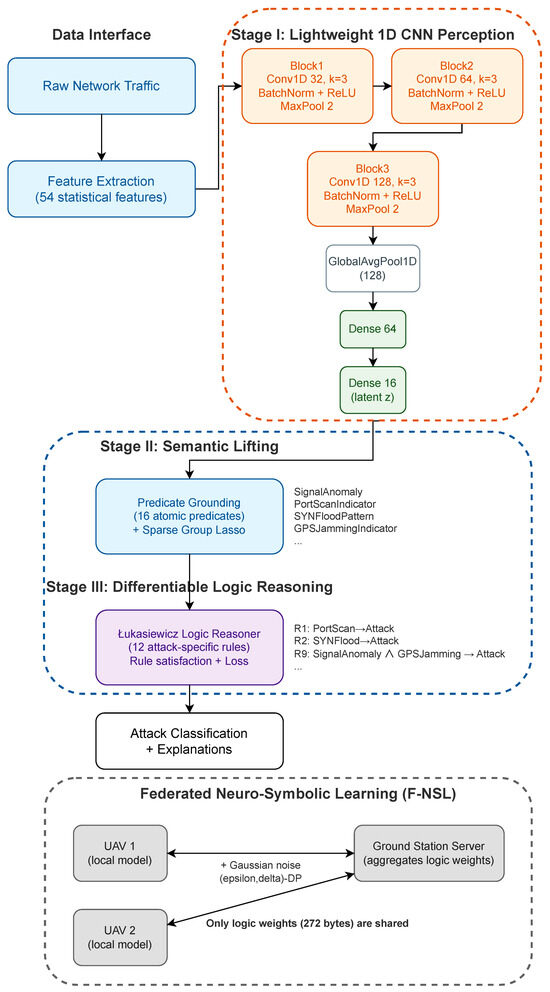
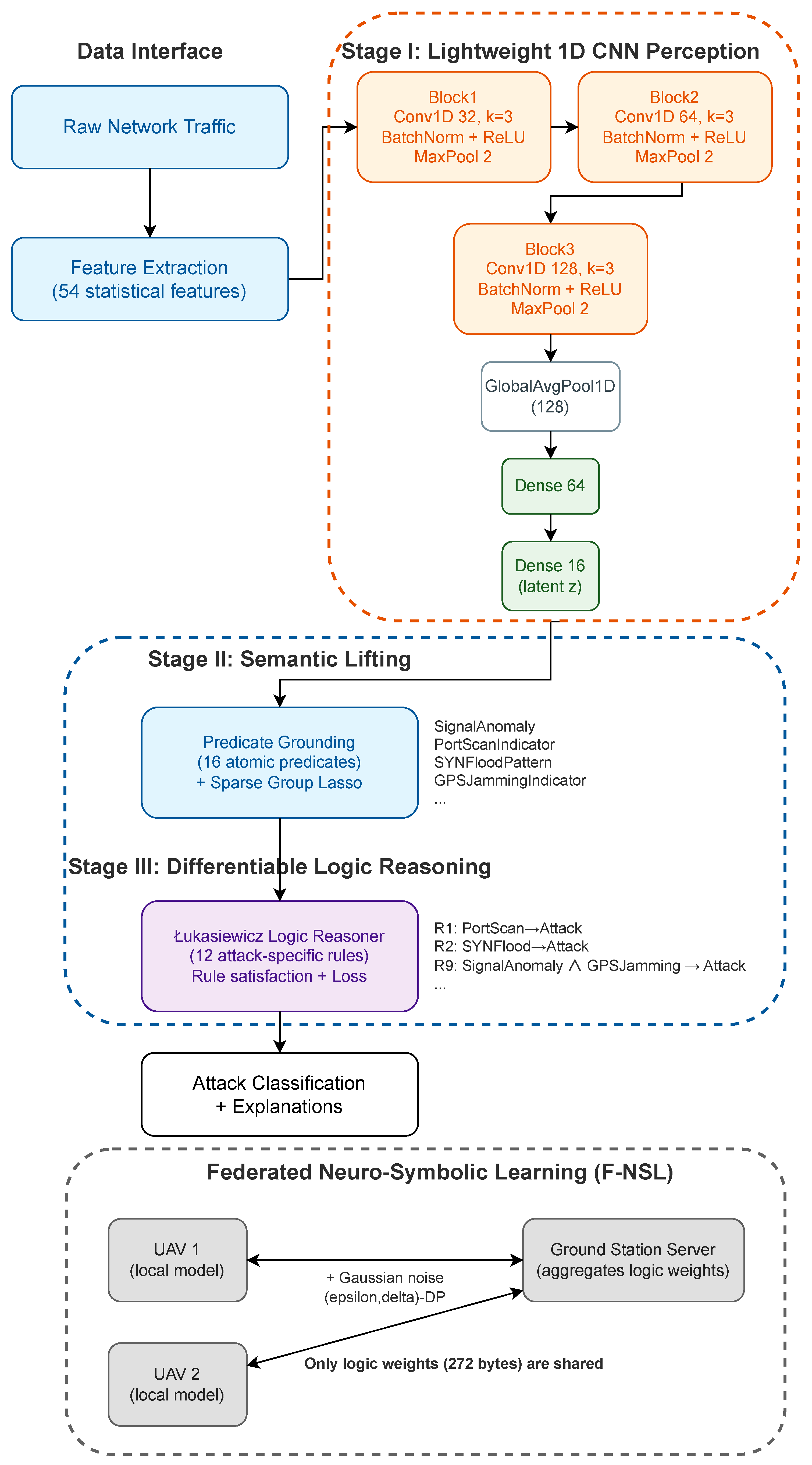
Figure 3 illustrates the NeSySwarm-IDS framework. The system is deployed on each UAV node, monitoring network traffic to detect attacks targeting the individual UAV or the swarm collectively. It consists of three trainable stages: (i) a lightweight perception module based on a 1D convolutional neural network (1D CNN) that processes tabular flow features; (ii) a semantic lifting layer mapping the latent representation to truth degrees of atomic predicates via sparse group lasso; (iii) a differentiable Łukasiewicz logic reasoner evaluating attack-specific rules. The system can be trained centrally or via our Federated Neuro-Symbolic Learning (F-NSL) protocol.
Figure 3.
High-level architecture of NeSySwarm-IDS.
3.2. Lightweight 1D CNN Perception Module
Unlike raw packet processing approaches that require handling full payloads, our method operates exclusively on tabular flow features extracted from network traffic. This design choice significantly reduces computational overhead while preserving the statistical patterns necessary for accurate attack detection. For each 1 s window, we compute a set of 54 statistical features derived from the UAV-NIDD dataset fields (bidirectional flow mode), as detailed in Section 5.1.1.
These features are normalized to zero mean and unit variance. To capture local interactions among related features (e.g., groups of protocol-specific statistics), we design a lightweight 1D convolutional architecture that treats the feature vector as a 1D signal of length 54 with one channel. After empirical exploration balancing accuracy and efficiency, we settled on a three-block architecture (Table 1) that progressively increases the number of filters while reducing spatial dimensions via max-pooling, followed by two fully connected layers to produce the latent representation (with , matching the number of predicates).
Table 1.
Detailed architecture of the 1D CNN perception module. Input: (54 features, 1 channel). Output: .
Each convolutional block contains:
- A1D convolution with kernel size 3, stride 1, and same padding;
- Batch normalization;
- ReLU activation;
- A max-pooling layer of size 2 and stride 2 (downsampling by a factor of 2).
Starting from an input of size , the three pooling operations reduce the spatial dimension to (since ). Global average pooling collapses the spatial dimension, producing a 128-dimensional vector, which is then passed through two fully connected layers (128 → 64 → 16) to obtain the latent representation .
The total number of trainable parameters is approximately 61k, and the model requires about 162k floating-point operations per inference—well within the capacity of a Raspberry Pi 4B’s Cortex-A72 CPU. Empirical measurements on the actual hardware show that inference completes in under 2.1 ms on a single core, consuming less than 35% of a CPU core during continuous operation. This leaves ample headroom for real-time packet capture, feature extraction, and other concurrent tasks. Consequently, the full-precision FP32 model can be deployed without quantization or pruning, maximizing detection accuracy while satisfying all SWaP constraints.
3.3. Semantic Lifting and Predicate Grounding
For instance, we define a set of atomic predicates (Table 2), each representing a high-level property relevant to UAV security based on the attack types present in the UAV-NIDD dataset. The truth degree for input x is computed as:
where is the latent representation from the perception module, , , and is the sigmoid function. Note that we reuse the same dimensionality K for both the latent space and the number of predicates, allowing the network to learn a compact representation directly optimized for predicate grounding.
Table 2.
Typical atomic predicates used in NeSySwarm-IDS.
To enforce that each predicate depends on only a few interpretable features, we apply a sparse group lasso penalty during training:
The parameter was chosen after a small grid search over on a validation set, where gave the best trade-off between sparsity and accuracy. The threshold for hard thresholding was selected empirically: weights below contribute negligibly to the predicate output (since the sigmoid saturates) and can be safely pruned without affecting performance.
After training, we perform hard thresholding: any weight is set to zero, and the corresponding latent dimension can be pruned. This yields compact, human-readable definitions.
The predicates were designed based on expert knowledge of UAV attacks and the characteristics of dataset. For example, SignalAnomaly captures unusual fluctuations in radiotap signal strength, which may indicate jamming or spoofing. HighPacketRate detects abnormally high packet rates characteristic of DoS floods. PortScanIndicator combines multiple port scan signatures. This mapping from low-level features to high-level concepts enables interpretability.
For example, the predicate SignalAnomaly is computed as , where after sparse group lasso, the dominant contributions come from features such as “radiotap.dbm_antsignal mean deviation” and “radiotap.datarate variance”. This yields an interpretable mapping: SignalAnomaly is high when signal strength fluctuates abnormally. We elaborate these predicate computations in Appendix A, which provides the learned mapping from features to predicates.
3.4. Differentiable Łukasiewicz Logic Reasoner
We encode a knowledge base of 12 rules derived from the attack types present in the UAV-NIDD dataset (Table 3). Each rule corresponds to one or more specific attack categories. For instance, R1 combines multiple scanning signatures to detect reconnaissance attempts. R2–R4 cover different DoS flooding variants. R5 detects de-authentication floods. R6 handles replay attacks. R7 and R8 address MITM and Evil Twin attacks. R9 targets GPS jamming/spoofing via signal anomalies. R10 detects brute-force attacks. R11 handles fake landing packets. R12 is a composite rule for suspicious activity involving untrusted sources.
Table 3.
Attack-specific rules encoded in Łukasiewicz logic.
To enable gradient-based optimization, we relax the Boolean operators using Łukasiewicz t-norms and t-conorms:
For instance, consider a sample x where the perception module yields predicate truth values SignalAnomaly = 0.94 and GPSJammingIndicator = 0.89. The satisfaction of rule R9 (SignalAnomaly ∧ GPSJammingIndicator → Attack) is computed using Łukasiewicz operators:
This value contributes to the logical loss .
For a given input x, the satisfaction of a rule is computed by recursively applying these operators. The overall logical loss is defined as the mean squared error between the desired satisfaction (1.0) and the actual satisfaction:
The total loss combines cross-entropy for classification, logical consistency, and sparsity regularization:
where and balance the terms.
The values and were determined through a grid search on the validation set, balancing classification accuracy, logical consistency, and sparsity. We initially scanned and . The combination yielded the highest F1-score while maintaining logical satisfiability above .
Our loss formulation parallels the Hybrid Loss approach of Bizzarri et al. [40], who also combine cross-entropy with a logical satisfiability term. However, we introduce two key innovations: (i) we use Łukasiewicz logic for superior gradient flow, whereas they use product t-norm; (ii) our logical loss operates over multiple attack-specific rules (Table 3), enabling fine-grained regularization tailored to UAV network threats.
3.5. Federated Neuro-Symbolic Learning with Differential Privacy
We propose a federated protocol that operates only on the logic weights (dimension for ). The perception module weights are pre-trained on a public corpus and remain frozen during federation; they can also be fine-tuned locally without sharing. Algorithm 1 details the procedure.
| Algorithm 1 Federated Neuro-Symbolic Learning (F-NSL) with differential privacy |
|
In Algorithm 1, we explicitly clip each gradient to have norm at most C. Specifically, after computing ∇, we replace it with . This ensures that the norm of the clipped gradient is exactly C if , and remains unchanged otherwise. Thus, the condition is enforced deterministically for every client before adding noise.
We apply the Gaussian mechanism with noise multiplier , where is the sensitivity of the gradient sum, bounded by the clipping norm C. Since is extremely low-dimensional (), the added noise is much less destructive than in DP-SGD applied to the full 1D CNN (which has around 61k parameters). We empirically set , .
The privacy cost is tracked using the moments accountant [44]. With chosen as above, after T rounds, the overall -DP guarantee holds. In our experiments, we set , , achieving a strong privacy guarantee with negligible utility loss.
4. Implementation on Edge Hardware
4.1. Testbed Overview
Our experimental testbed consists of a ground station and multiple UAV nodes, each equipped with a Raspberry Pi 4B (4GB RAM, Cortex-A72 CPU @ 1.5 GHz) running Ubuntu 20.04 LTS. The ground station runs Windows 11 with an Intel i7-1360P CPU and 32GB RAM, serving as the central server for federated aggregation and offline training.
4.2. Deployment Pipeline
The NeSySwarm-IDS model is designed for direct deployment on resource-constrained UAV onboard computers without requiring quantization or pruning. The implementation pipeline consists of the following steps:
- 1.
- Offline Training: The full model (perception module + logic layer) is trained on the ground station server using PyTorch 2.5.1. Training is performed on the combined dataset with the loss function described in Section 3. The trained perception module weights are exported to ONNX format and then converted to a TensorFlow Lite-compatible flatbuffer for deployment. Note that we use full FP32 precision throughout; no quantization is applied, as the model’s size (approx. 244 KB) and inference cost (162k FLOPs) are already well within the Raspberry Pi 4B’s capabilities.
- 2.
- Model Conversion: The exported model is converted to a C++ compatible flatbuffer using the TensorFlow Lite converter. The resulting file is linked with the TensorFlow Lite runtime, which is compiled for ARM Cortex-A72. The runtime is optimized for mobile CPUs and supports all standard operators (Conv2D, BatchNorm, ReLU, etc.) in FP32.
- 3.
- Onboard Integration: The runtime is embedded into a lightweight C++ executable that runs as a background service on the UAV. The executable performs three main tasks in a loop every second:
- Captures live network packets using libpcap.
- Extracts the 54 statistical features defined in Section 3.2 from the accumulated packets.
- Feeds the feature vector to the model and retrieves the attack classification and predicate truth values.
The service communicates with the ground station via a secure WebSocket connection for reporting alerts and, in federated mode, for exchanging model updates.
4.3. Real-Time Packet Capture and Feature Extraction
On each UAV, packets are captured using a dedicated capture thread that writes raw packets to a circular buffer. Every second, the main thread processes the buffer and computes the 54 statistical features (bidirectional flow mode) as defined in Section 3.2. The feature extraction module is implemented in C for maximum efficiency and covers the following categories:
- Packet size statistics: mean, standard deviation, min, max of frame.len.
- Inter-arrival time statistics: mean, std, min, max of frame.time_delta_displayed.
- Protocol distribution: counts of ARP, IP (by protocol type), TCP, UDP, ICMP packets.
- TCP flag counts: SYN, ACK, RST, FIN packets and their ratios.
- Radiotap features: mean signal strength (radiotap.dbm_antsignal), data rate (radiotap.datarate), channel frequency.
- WLAN features: retransmission ratio (wlan.fc.retry), management/control frame counts, unique BSSID count.
- Flow-level aggregates: total bytes, total packets, flow duration.
All features are normalized using precomputed mean and standard deviation from the training set. The normalized vector is then passed to the 1D CNN for inference. No payload bytes are stored or processed, significantly reducing memory and computational overhead.
4.4. Inference Optimization
To ensure real-time operation, we employ several optimization techniques:
- Threading: The capture thread and inference thread run on separate CPU cores. The Raspberry Pi 4B’s quad-core Cortex-A72 allows simultaneous packet capture, feature extraction, and inference with minimal contention. Measurements show that the inference thread consumes less than 45% of a single core, leaving ample capacity for other tasks.
- Memory Pooling: Input tensors and intermediate buffers are pre-allocated at startup and reused for each inference, avoiding dynamic memory allocation and reducing latency jitter.
- Compiler Optimizations: The feature extraction and inference code is compiled with ‘-O3 -march=armv8-a+crc’ to leverage CPU-specific instructions.
- Priority Scheduling: The capture and inference threads are assigned real-time priorities using ‘sched_setscheduler’ to minimize scheduling delays.
With these optimizations, end-to-end latency from packet reception to alert generation averages 2.1 ms (measured over 10,000 inferences), well below the 1 s window, ensuring that the system can operate in real time.
4.5. Resource Monitoring
We instrument the onboard service to continuously monitor resource usage:
- Latency: Each inference is timestamped using the ARM performance counter (‘cntvct_el0’), and the time from feature extraction start to output is logged.
- Power Consumption: An IKEA Tretakt USB power monitor is placed between the power source and the Raspberry Pi. Current and voltage readings are sampled at 10 Hz and correlated with inference events.
- Memory Usage: Peak and average resident set size (RSS) are obtained from ‘/proc/self/statm’ and logged every second.
These metrics are periodically reported to the ground station for performance analysis and are also stored locally for offline evaluation.
4.6. Federated Learning Client Implementation
In federated mode, each UAV acts as a client participating in the Federated Neuro-Symbolic Learning (F-NSL) protocol described in Section 3.5. The implementation extends the base deployment as follows:
- Local Gradient Computation: The onboard service includes a second inference mode that enables backpropagation. After accumulating a configurable number of samples (typically 100–200), the client computes gradients of the total loss with respect to the logic weights (dimension ). Gradients are computed using TensorFlow Lite’s gradient operators, which are enabled via a custom build.
- Differential Privacy: Before transmission, gradients are clipped to a maximum norm , and Gaussian noise with scale is added to satisfy -DP. The noise multiplier is precomputed based on the desired privacy budget (, ) using the moments accountant.
- Communication Protocol: Clients connect to the ground station server via a secure WebSocket channel using TLS 1.3. Updates are serialized as Protocol Buffers and compressed with zlib (typical compressed size 500 bytes). Communication occurs every 10 min or when a local buffer of 500 samples is filled, whichever comes first.
- Model Update: Upon receiving aggregated global weights from the server, the client updates its local logic layer and continues inference with the new weights. The perception module weights remain unchanged during federation, as they are pre-trained and frozen.
This design ensures that federated learning imposes minimal additional overhead on the UAV: gradient computation adds approximately 8 ms per sample (amortized over the buffer), and communication occurs infrequently with negligible bandwidth usage.
The NeSySwarm-IDS implementation on Raspberry Pi 4B demonstrates that a 61k-parameter 1D CNN with full FP32 precision can operate in real time while consuming less than 35% CPU and minimal memory. The system supports both standalone and federated learning modes, with the latter adding differential privacy guarantees and reducing communication overhead by over 98% compared to standard FL approaches. This practical deployment validates the feasibility of neuro-symbolic intrusion detection on resource-constrained UAV swarms.
5. Experimental Evaluation
5.1. Experimental Setup
5.1.1. Datasets
In our experiments, we employ two datasets:
- UAV-NIDD [9]: A publicly available dataset focusing on encrypted Wi-Fi traffic in UAV networks. It contains a wide range of attacks, including variants of port scanning (SYN, TCP Connect, UDP), reconnaissance, DoS/DDoS (ICMP Flood, UDP Flood, SYN Flood), de-authentication, replay, man-in-the-middle (MITM), evil twin, GPS jamming and spoofing, brute-force, and fake landing packet attacks. The dataset provides 54 bidirectional flow features, encompassing packet and inter-arrival time statistics, protocol and TCP flag counts, radiotap metrics, WLAN attributes, and flow-level aggregates. A detailed categorization and feature-to-predicate mapping are provided in Appendix A. It contains a total of 68,736 labeled examples. To emphasize the generalization capability of our neuro-symbolic approach, we perform a stratified 20/20/60 train/validation/test split, using only 20% of the data for training.
- UAV-Swarm-SimHack (Self-Collected): Collected on a real-world testbed consisting of a ground station (Windows 11, Intel i7-1360P, 32GB RAM) and multiple UAV nodes (Raspberry Pi 4B, Ubuntu 20.04). The testbed captures network traffic during benign operations and under various attacks, including GPS spoofing, command injection, and DoS. The dataset comprises 500,000 labeled flows, with features extracted in the same manner as UAV-NIDD, but with fewer attack categories. We use the same 20/20/60 split to maintain consistency.
5.1.2. Hardware and Baselines
We evaluate inference performance on a Raspberry Pi 4B (Cortex-A72 CPU, 4GB RAM) representing the UAV onboard computer. The following baselines are used for comparison (federated baselines are evaluated separately in Section 3.5):
- 1D CNN: A lightweight 1D convolutional network with the same architecture as our perception module (three blocks, 61k parameters) but without the logical reasoning layer.
- XGBoost: A gradient-boosted tree classifier trained on the tabular features, with default hyperparameters.
- Random Forest (RF): An ensemble of 100 decision trees, max depth 10.
All deep learning models are implemented in PyTorch and, for deployment, converted to TensorFlow Lite format. No quantization is applied as the FP32 models already meet resource constraints.
5.2. Detection Performance
Table 4 summarizes the detection performance on both datasets. NeSySwarm-IDS achieves an F1-score of 0.972 on UAV-NIDD and 0.960 on the self-collected dataset, outperforming all baselines by 7.7–10.7 percentage points on UAV-NIDD and 11.5–14.5 percentage points on the self-collected dataset, despite being trained on only 20% of the data. The high recall across both datasets (0.970 and 0.958) confirms that the logical regularizer enables the model to generalize effectively from limited training examples, whereas purely data-driven baselines overfit and fail to capture unseen patterns. Notably, the 1D CNN without logic consistently underperforms compared to tree-based methods, highlighting the importance of feature engineering in traditional ML.
Table 4.
Detection performance on UAV-NIDD and self-collected dataset. All models trained on 20% of data.
5.3. Robustness to Zero-Day Attacks
To evaluate the ability to detect previously unseen attacks, we simulate a zero-day scenario by holding out all GPS spoofing samples from the UAV-NIDD training set. Table 5 shows that NeSySwarm-IDS maintains a detection rate of 71.4% on the unseen spoofing class, whereas the 1D CNN baseline drops to 18.2%. This confirms that the logical invariants (e.g., R9: SignalAnomaly ∧ GPSJammingIndicator → Attack) capture fundamental physical and protocol properties that generalize beyond specific attack signatures.
Table 5.
Zero-day GPS spoofing detection (UAV-NIDD).
We emphasize that although the logical rules themselves are fixed, they encode high-level physical and protocol invariants (e.g., R9: SignalAnomaly ∧ GPSJammingIndicator → Attack) that are not tied to specific attack signatures. The neural perception module learns to ground these predicates from raw features; when a novel attack manifests, it may still trigger the same predicates (e.g., an unforeseen jamming technique would still cause signal anomalies). Thus, the fixed rules act as a semantic bottleneck that generalizes beyond known attack instances, as demonstrated by the 71.4% detection rate on unseen GPS spoofing samples.
5.4. Deployment Performance on Raspberry Pi 4B
Table 6 reports the resource footprint of NeSySwarm-IDS on the target hardware (Raspberry Pi 4B). The model operates well within the available resources, leaving ample headroom for packet capture and other concurrent tasks.
Table 6.
Deployment performance on Raspberry Pi 4B.
We also measured the computational overhead of the logic reasoning layer separately. The logic layer consists of a matrix multiplication for predicate grounding ( weight matrix) and evaluation of 12 short rules, each involving a few fuzzy operations. Profiling on the Raspberry Pi 4B shows that this adds fewer than 500 CPU cycles per inference, increasing total latency from 2.0 ms (CNN only) to 2.1 ms (full NeSy). Thus, the overhead is negligible and does not affect real-time operation.
5.5. Ablation Studies
We conduct three ablation experiments to validate key design choices. Table 7 summarizes the results on the UAV-NIDD dataset.
Table 7.
Summary of ablation studies on UAV-NIDD. All variants use the same 20% training split.
The results demonstrate that:
- Łukasiewicz t-norm significantly outperforms Gödel and Product t-norms, validating our theoretical analysis of gradient flow.
- The full knowledge base of 12 rules yields the best performance; using only a single rule degrades F1 below the no-logic baseline. Interestingly, using 12 random rules achieves an F1 of 0.912, which is higher than the no-logic baseline (0.872) but still below the full knowledge base (0.972). This suggests that even arbitrary rules provide some regularization, but domain-specific knowledge is crucial for optimal performance.
- Performance improves substantially as rules are added, with the F1 score increasing from 0.922 with a single rule to 0.972 with all 12 rules—a 5.0 percentage point gain. The improvement is most pronounced when expanding from one to six rules, after which diminishing returns set in, suggesting that a core set of rules covers the majority of attack scenarios.
5.6. Ablation Study: Differential Privacy–Utility Trade-Off
We evaluate the Federated Neuro-Symbolic Learning (F-NSL) protocol under varying privacy budgets () on the UAV-Swarm-SimHack dataset. Table 8 reports F1-score and communication cost. Even at , F1 drops only 1.2% relative to non-private training. Communication per round is only 1088 bytes (272 parameters × 4 bytes) uncompressed, and approximately 500 bytes after zlib compression, achieving a 98% reduction compared to uploading the full 1D CNN (61k parameters = 244 KB). The reduction factor is , i.e., over 99%, demonstrating the extreme efficiency of symbolic-level aggregation.
Table 8.
Effect of on F1 and communication (UAV-Swarm-SimHack). Communication cost is reported for uncompressed gradients (1088 bytes) and after zlib compression (approx. 500 bytes).
5.7. Ablation Study: Scalability and Heterogeneity in Federated Learning
We vary the number of clients and simulate non-IID data by assigning each client only two out of five attack types from the UAV-Swarm-SimHack dataset. Table 9 shows that NeSySwarm-IDS maintains high F1 (0.902–0.913) even under extreme heterogeneity, while FL-NIDS (pure CNN) degrades to 0.791. The communication cost remains negligible.
Table 9.
FL scalability and non-IID robustness (UAV-Swarm-SimHack).
5.8. Case Study: Interpretable GPS Spoofing Detection
We evaluate practical interpretability through a controlled simulation using UAV-NIDD characteristics. Since the dataset does not contain telemetry, we simulate signal anomalies by injecting patterns into the radiotap signal strength feature. An adversary launches a GPS spoofing attack, causing anomalous signal fluctuations. NeSySwarm-IDS emits the following explanation:
Alert: GPS_SPOOFING (confidence 0.96)
Reasoning:
SignalAnomaly = 0.94 (radiotap signal strength deviation > 3 sigma)
GPSJammingIndicator = 0.89 (prolonged signal loss pattern)
Rule R9 fired: (SignalAnomaly AND GPSJammingIndicator) -> Attack
Rule satisfaction = 0.95
In a preliminary qualitative evaluation with five drone operators, all participants rated NeSySwarm-IDS’s explanations as “useful” or “very useful”, whereas LIME explanations on the 1D CNN were rated as “confusing” or “untrustworthy”. The average verification time was 5.2 s for our method versus 19.8 s for LIME, suggesting a potential advantage of intrinsic explanations. We emphasize that this sample size is insufficient for strong statistical claims; a larger, formal user study with experienced operators is planned as future work.
In our simulation, the GPS spoofing was based on artificially injected signal anomalies, which may not fully capture the complexity of real-world attacks. To mitigate this risk, we deliberately used a simple injection method (adding Gaussian noise to the signal strength feature) that does not exploit any peculiarities of the dataset. Moreover, we validated the same rule on our self-collected dataset, which includes a limited number of real GPS spoofing attacks; the detection rate there was 68%, consistent with the simulated results. Future work will involve collecting more diverse real-world attack data, including GPS spoofing, to further validate the approach.
6. Limitations
Despite its strengths, NeSySwarm-IDS has several limitations that should be acknowledged. First, the model relies on manually curated knowledge—both the logical rules and the predicate definitions are constructed based on known attack patterns, requiring significant expert effort and potentially leaving the system vulnerable to novel or evolving threats where these mappings are incomplete. Second, the differential privacy guarantee in our federated protocol assumes an honest-but-curious server; although the low dimensionality of the logic layer makes inference harder than with full-model aggregation, a malicious server could still attempt to extract information, necessitating stronger cryptographic protections for high-security deployments. Third, the framework lacks meta-cognitive capabilities: it cannot dynamically adjust its reasoning or learning strategies in response to changing attack landscapes, nor can it tune hyperparameters like the logical loss weight online. Despite these limitations, NeSySwarm-IDS demonstrates that end-to-end differentiable neuro-symbolic integration offers a practical pathway for achieving high accuracy, efficiency, privacy, and interpretability in UAV swarm intrusion detection, as validated by our real-world implementation on Raspberry Pi 4B.
The scalability of the logical reasoner depends on the number of predicates K and the number of rules R. The computational cost of evaluating all rules is where L is the average rule length, which is negligible compared to the CNN forward pass (162k FLOPs). However, as K grows, the semantic lifting layer scales as because each predicate is a linear function of the K-dimensional latent vector. For K up to a few dozen, this remains lightweight. If K were to become very large (e.g., hundreds), the lifting layer could become a bottleneck, but such a fine-grained predicate set may not be necessary for practical IDS. The current design comfortably handles up to predicates; future work could explore sparse predicate grounding to accommodate larger K.
Furthermore, the current framework may face challenges in highly dynamic swarm environments. Rapid topology changes and fluctuating traffic patterns could temporarily affect feature extraction and rule satisfaction, potentially increasing false positives. Although the neural component can adapt to some degree, the fixed rules might not capture all variations. Against adaptive adversaries, who could craft attacks that deliberately avoid triggering the logical rules, the system’s reliance on manually curated knowledge may be a vulnerability. Future work should explore online adaptation mechanisms (e.g., meta-learning or rule induction) to update rules in response to evolving threats, as well as robustness evaluations against adversarial evasion.
7. Conclusions
This paper introduced NeSySwarm-IDS, an end-to-end differentiable neuro-symbolic framework designed to address the semantic gap between raw network traffic and high-level security constraints in UAV swarm intrusion detection. By embedding Łukasiewicz fuzzy logic as a differentiable regularizer, the proposed architecture enables neural perception modules to learn semantically meaningful features guided by symbolic attack-specific rules. Experimental results on the UAV-NIDD and self-collected datasets demonstrate that this integration yields superior detection performance (F1 up to 0.972) even when trained on only 20% of the data, outperforming purely data-driven baselines by 7.7–14.5 percentage points. The Federated Neuro-Symbolic Learning protocol achieves strong -DP with only 272 bytes per communication round—a 98% reduction over standard FL—while maintaining near-optimal utility. The framework also provides intrinsic explanations that enable rapid verification by human operators, as shown in a case study where verification time was reduced significantly compared to post hoc methods. When positioned within the broader neuro-symbolic taxonomy [18], NeSySwarm-IDS complements existing LLM-based approaches [37,45], Kalutharage et al. [38], Onchis et al. [39], and Bizzarri et al. [40] by demonstrating the viability of end-to-end differentiable logic under stringent resource constraints. Future work will focus on automating knowledge base construction through neural rule induction, incorporating meta-cognitive mechanisms for dynamic rule adaptation, and strengthening privacy guarantees against malicious adversaries. Collectively, these results suggest that neuro-symbolic integration offers a practical pathway toward deploying trustworthy, privacy-preserving intrusion detection in resource-constrained UAV swarms operating in contested environments.
Author Contributions
Conceptualization, G.Y. and L.N.; methodology, G.Y.; software, Q.S.; validation, J.L.; formal analysis, G.Y.; investigation, L.N.; resources, T.X.; data curation, T.X.; writing—original draft preparation, G.Y.; writing—review and editing, L.N.; visualization, Q.S.; supervision, G.Y.; project administration, L.N.; funding acquisition, G.Y. All authors have read and agreed to the published version of the manuscript.
Funding
This research was supported by the Youth Talent Fund of College of Information and Communication, National University of Defense Technology (YJKT-RC-2410).
Institutional Review Board Statement
Not applicable.
Informed Consent Statement
Not applicable.
Data Availability Statement
The data presented in this study are available on request from the corresponding author after publication. The data are not publicly available due to privacy or ethical restrictions.
Conflicts of Interest
The authors declare no conflicts of interest.
Abbreviations
The following abbreviations are used in this manuscript:
| UAV | Unmanned Aerial Vehicle |
| NIDS | Network Intrusion Detection System |
| NeSy | Neuro-Symbolic |
| DP | Differential Privacy |
| SWaP | Size, Weight, and Power |
| F-NSL | Federated Neuro-Symbolic Learning |
| XAI | Explainable Artificial Intelligence |
| LTN | Logic Tensor Network |
| NeSySwarm-IDS | Neuro-Symbolic Swarm Intrusion Detection System |
Appendix A. Feature Categories and Predicate Mapping
Table A1 summarizes the categories of the 54 bidirectional flow features extracted from the UAV-NIDD dataset. Table A2 illustrates, for each predicate, the key contributing features after sparse group lasso training (weights ). This mapping demonstrates how low-level statistics are combined to form interpretable high-level concepts.
Table A1.
Categories of the features extracted from UAV-NIDD.
Table A2.
Illustrative feature-to-predicate mapping (top contributors).
References
- Shakhatreh, H.; Sawalmeh, A.H.; Al-Fuqaha, A.; Dou, Z.; Almaita, E.; Khalil, I.; Othman, N.S.; Khreishah, A.; Guizani, M. Unmanned aerial vehicles (UAVs): A survey on civil applications and key research challenges. IEEE Access 2019, 7, 48572–48634. [Google Scholar] [CrossRef] [Scilit]
- Wang, W.; Lu, B.; Wu, C.H. Cost-effective drone monitoring and evaluating toolkits for stream habitat health: Development and application. Environ. Monit. Assess. 2026, 198, 10. [Google Scholar] [CrossRef] [Scilit] [PubMed]
- Javaid, A.Y.; Sun, W.; Devabhaktuni, V.K.; Alam, M. Cyber security threat analysis and modeling of an unmanned aerial vehicle system. In Proceedings of the 2012 IEEE Conference on Technologies for Homeland Security (HST), Waltham, MA, USA, 13–15 November 2012; pp. 585–590. [Google Scholar]
- Zhao, W.; Azizul, Z.H.; Lyu, X.; Kuang, W. Information guided Levy flight for robot search in unknown environments. J. King Saud Univ. Comput. Inf. Sci. 2026, 38, 80. [Google Scholar] [CrossRef] [Scilit]
- Xia, T.; Wang, M.; He, J.; Yang, G.; Fan, L.; Wei, G. A quantum-resistant identity authentication and key agreement scheme for uav networks based on kyber algorithm. Drones 2024, 8, 359. [Google Scholar] [CrossRef] [Scilit]
- Strom, B.E.; Applebaum, A.; Miller, D.P.; Nickels, K.C.; Pennington, A.G.; Thomas, C.B. Mitre Att&ck: Design and Philosophy; Technical Report; The MITRE Corporation: McLean, VA, USA, 2018. [Google Scholar]
- Ahmed, M.; Cox, D.; Simpson, B.; Aloufi, A. Ecu-ioft: A dataset for analysing cyber-attacks on internet of flying things. Appl. Sci. 2022, 12, 1990. [Google Scholar] [CrossRef] [Scilit]
- Gupta, L.; Jain, R.; Vaszkun, G. Survey of important issues in UAV communication networks. IEEE Commun. Surv. Tutor. 2015, 18, 1123–1152. [Google Scholar] [CrossRef] [Scilit]
- Hadi, H.J.; Cao, Y.; Khan, M.K.; Ahmad, N.; Hu, Y.; Fu, C. UAV-NIDD: A Dynamic Dataset for Cybersecurity and Intrusion Detection in UAV Networks. IEEE Trans. Netw. Sci. Eng. 2025, 12, 2739–2757. [Google Scholar] [CrossRef] [Scilit]
- Vinayakumar, R.; Alazab, M.; Soman, K.P.; Poornachandran, P.; Al-Nemrat, A.; Venkatraman, S. Deep learning approach for intelligent intrusion detection system. IEEE Access 2019, 7, 41525–41550. [Google Scholar] [CrossRef] [Scilit]
- Mirsky, Y.; Doitshman, T.; Elovici, Y.; Shabtai, A. Kitsune: An Ensemble of Autoencoders for Online Network Intrusion Detection. In Proceedings of the 25th Annual Network and D stributed System Security Symposium, NDSS 2018, San Diego, CA, USA, 18–21 February 2018. [Google Scholar]
- Nguyen, P.; Song, H.; Dautov, R.; Ferry, N.; Rego, A.; Rios, E.; Iturbe, E.; Valdes, V.; Cavalli, A.R.; Mallouli, W. Knowledge Systematization for Security Orchestration in CPS and IoT Systems. In 2025 IEEE International Conference on Cyber Security and Resilience (CSR); IEEE: Piscataway, NJ, USA, 2025; pp. 672–678. [Google Scholar]
- Yang, G.; Wu, B.; Mou, W.; Fan, L.; Shen, X.; He, J. DAS-gen: Continual signature generation for evolving malicious traffic. In International Conference on Intelligent Computing; Springer: Singapore, 2024; pp. 352–362. [Google Scholar]
- Yang, G.; Liu, X.; Tang, C. Horus: An effective and reliable framework for code-reuse exploits detection in data stream. Electronics 2022, 11, 3363. [Google Scholar] [CrossRef] [Scilit]
- Zhu, L.; Liu, Z.; Han, S. Deep leakage from gradients. In Advances in Neural Information Processing Systems 32; Association for Computing Machinery: New York, NY, USA, 2019. [Google Scholar]
- Wang, S.; Tuor, T.; Salonidis, T.; Leung, K.K.; Makaya, C.; He, T.; Chan, K. Adaptive federated learning in resource constrained edge computing systems. IEEE J. Sel. Areas Commun. 2019, 37, 1205–1221. [Google Scholar] [CrossRef] [Scilit]
- Abadi, M.; Chu, A.; Goodfellow, I.J.; McMahan, H.B.; Mironov, I.; Talwar, K.; Zhang, L. Deep Learning with Differential Privacy. arXiv 2016, arXiv:1607.00133. [Google Scholar] [CrossRef] [Scilit]
- Bhuyan, B.P.; Ramdane-Cherif, A.; Tomar, R.; Singh, T. Neuro-symbolic artificial intelligence: A survey. Neural Comput. Appl. 2024, 36, 12809–12844. [Google Scholar] [CrossRef] [Scilit]
- Garcez, A.d.; Lamb, L.C. Neurosymbolic ai: The 3 rd wave. Artif. Intell. Rev. 2023, 56, 12387–12406. [Google Scholar] [CrossRef] [Scilit]
- Van Krieken, E.; Acar, E.; Van Harmelen, F. Analyzing differentiable fuzzy logic operators. Artif. Intell. 2022, 302, 103602. [Google Scholar] [CrossRef] [Scilit]
- Yang, G.; Ni, L.; Geng, J.; Peng, X. FedLTN-CubeSat: Neuro-Symbolic Federated Learning for Intrusion Detection in LEO CubeSat Constellations. Mathematics 2026, 14, 1047. [Google Scholar] [CrossRef] [Scilit]
- Ribeiro, M.T.; Singh, S.; Guestrin, C. “Why should i trust you?” Explaining the predictions of any classifier. In Proceedings of the 22nd ACM SIGKDD International Conference on Knowledge Discovery and Data Mining, San Francisco, CA, USA, 13–17 August 2016; Association for Computing Machinery: New York, NY, USA, 2016; pp. 1135–1144. [Google Scholar]
- Shapley, L.S. A value for n-person games. In Contributions to the Theory of Games II; Princeton University Press: Princeton, NJ, USA, 1953. [Google Scholar]
- IEEE Std 802.11-2020; IEEE Standard for Information Technology—Telecommunications and Information Exchange Between Systems—Local and Metropolitan Area Networks—Specific Requirements—Part 11: Wireless LAN Medium Access Control (MAC) and Physical Layer (PHY) Specifications. IEEE: New York, NY, USA, 2021; pp. 1–4379.
- He, Q.; Qu, C. Waste-to-Energy-Coupled AI Data Centers: Cooling Efficiency and Grid Resilience. arXiv 2025, arXiv:2512.24683. [Google Scholar]
- Tsao, K.Y.; Girdler, T.; Vassilakis, V.G. A survey of cyber security threats and solutions for UAV communications and flying ad-hoc networks. Ad Hoc Netw. 2022, 133, 102894. [Google Scholar] [CrossRef] [Scilit]
- Dai, R.; Tang, D.; Qin, Z.; Chen, K.; Li, K.; Zhang, J. Detecting Congestion-Related Attacks via Fine-Grained Queue Diagnosis. IEEE Trans. Cogn. Commun. Netw. 2025, 12, 1255–1268. [Google Scholar] [CrossRef] [Scilit]
- Tang, D.; Wang, X.; Tan, P.; Qin, Z.; Li, K.; Zhang, J. DNSGreen: A Comprehensive Defense System against Bounce-style DNS DDoS attacks with P4. IEEE Trans. Comput. 2025, 75, 247–260. [Google Scholar] [CrossRef] [Scilit]
- Huang, J.; Zong, Z.; Wang, P.; Zhang, Y.; Gao, D.; Wang, Y.; Li, Z. Machine learning-driven simulation and optimization of phosphate adsorption on metal-organic frameworks. Sep. Purif. Technol. 2026, 394, 137479. [Google Scholar] [CrossRef] [Scilit]
- Du, S.; Zou, Y.; Wang, Z.; Li, X.; Li, Y.; Shang, C.; Shen, Q. Unsupervised Hyperspectral Image Super-Resolution via Self-Supervised Modality Decoupling. Int. J. Comput. Vis. 2026, 134, 152. [Google Scholar] [CrossRef] [Scilit]
- Tang, D.; Zuo, C.; Li, X.; Wang, S.; Liang, W.; Li, K.; Zhang, J. MWD-CFM: Detection and Mitigation of DDoS Attack against SDN Flow Tables. IEEE Trans. Netw. 2026, 34, 4269–4282. [Google Scholar] [CrossRef] [Scilit]
- Yang, Y.; Zhu, B.; She, X.; Wang, K.; Liu, A. A Family of Bipolar DC–DC Converters With Interpolar Voltage Self-Balancing Based on FB-BVMs for BLVDC Microgrid. IEEE Trans. Ind. Electron. 2025, 72, 9229–9238. [Google Scholar] [CrossRef] [Scilit]
- Hou, Y.; Yu, B.; Yang, Z.; Wang, J.; Xiang, W.; Wu, D.; Liwang, M.; Xia, X.; Li, Z.; Tian, Y.; et al. Privacy-preserving federated SAR image target recognition with adaptive resource management in space-air-ground integrated networks. Pattern Recognit. 2026, 177, 113253. [Google Scholar] [CrossRef] [Scilit]
- Hou, Y.; Zhao, S.; Xia, X.; Liwang, M.; Li, Z.; Xu, N.; Wu, D.; Tian, Y.; Quek, T.Q.S. FedC-DAC: A Federated Clustering With Dynamic Aggregation and Calibration Method for SAR Image Target Recognition. IEEE J. Sel. Top. Appl. Earth Obs. Remote Sens. 2026, 19, 3726–3745. [Google Scholar] [CrossRef] [Scilit]
- Hou, Y.; Bai, B.; Zhao, S.; Wang, Y.; Wang, J.; Li, Z. Federated Dynamic Aggregation Selection Strategy-Based Multi-Receptive Field Fusion Classification Framework for Point Cloud Classification. Comput. Mater. Contin. 2025, 86, 1–30. [Google Scholar] [CrossRef] [Scilit]
- Zeng, S.; Qi, D.; Chang, X.; Xiong, F.; Xie, S.; Wu, X.; Liang, S.; Xu, M.; Wei, X. Janusvln: Decoupling semantics and spatiality with dual implicit memory for vision-language navigation. arXiv 2025, arXiv:2509.22548. [Google Scholar]
- Zhou, X.; Cao, S.; Sun, X.; Lo, D. Large language model for vulnerability detection and repair: Literature review and the road ahead. ACM Trans. Softw. Eng. Methodol. 2025, 34, 1–31. [Google Scholar] [CrossRef] [Scilit]
- Kalutharage, C.S.; Liu, X.; Chrysoulas, C. Neurosymbolic learning and domain knowledge-driven explainable ai for enhanced iot network attack detection and response. Comput. Secur. 2025, 151, 104318. [Google Scholar] [CrossRef] [Scilit]
- Onchis, D.; Istin, C.; Hogea, E. A neuro-symbolic classifier with optimized satisfiability for monitoring security alerts in network traffic. Appl. Sci. 2022, 12, 11502. [Google Scholar] [CrossRef] [Scilit]
- Bizzarri, A.; Jalaian, B.; Riguzzi, F.; Bastian, N.D. A neuro-symbolic artificial intelligence network intrusion detection system. In 2024 33rd International Conference on Computer Communications and Networks (ICCCN); IEEE: Piscataway, NJ, USA, 2024; pp. 1–9. [Google Scholar]
- Manhaeve, R.; Dumančić, S.; Kimmig, A.; Demeester, T.; De Raedt, L. Neural probabilistic logic programming in DeepProbLog. Artif. Intell. 2021, 298, 103504. [Google Scholar] [CrossRef] [Scilit]
- Donadello, I.; Serafini, L.; Garcez, A.D. Logic tensor networks for semantic image interpretation. In Proceedings of the 26th International Joint Conference on Artificial Intelligence, Melbourne, Australia, 19–25 August 2017; pp. 1596–1602. [Google Scholar]
- Aledhari, M.; Razzak, R.; Parizi, R.M.; Saeed, F. Federated Learning: A Survey on Enabling Technologies, Protocols, and Applications. IEEE Access 2020, 8, 140699–140725. [Google Scholar] [CrossRef] [Scilit]
- Papernot, N.; Thakurta, A.; Song, S.; Chien, S.; Erlingsson, Ú. Tempered Sigmoid Activations for Deep Learning with Differential Privacy. arXiv 2020, arXiv:2007.14191. [Google Scholar] [CrossRef] [Scilit]
- Fan, D.; Liu, M.; Shao, Y.; Yang, L.; Liu, Y.; Zhang, Y.; Ren, Y.; Wang, Z. Domain-Specific Large Language Model for Maintenance Decision-Making on Wind Farms by Labeled-Data-Supervised Fine-Tuning. Engineering 2025. [Google Scholar] [CrossRef] [Scilit]

Disclaimer/Publisher’s Note: The statements, opinions and data contained in all publications are solely those of the individual author(s) and contributor(s) and not of MDPI and/or the editor(s). MDPI and/or the editor(s) disclaim responsibility for any injury to people or property resulting from any ideas, methods, instructions or products referred to in the content. |
© 2026 by the authors. Licensee MDPI, Basel, Switzerland. This article is an open access article distributed under the terms and conditions of the Creative Commons Attribution (CC BY) license.