


Abstract
Risk-based management of water quality in drinking water supply systems requires decision-support tools that extend beyond parameter-level hazard assessment and enable prioritization at the level of physical system objects. In this context, hazard assessment refers specifically to drinking water quality parameters and their possible operational and health-related implications, particularly in facilities serving sensitive user groups. This study proposes a class-based extension of the FPOR (Fuzzy Priority of Objects at Risk) framework to support object-level operational prioritization under conditions of limited data availability. Hazard importance is adopted from prior hazard prioritization using the Fuzzy Priority Index (FPI), while priority premises (PP) are represented as object classes reflecting typical functional and operational characteristics. Class-based profiles of local hazard relevance and object vulnerability are defined using expert-informed fuzzy representations and aggregated into FPOR scores to produce a relative ranking of priority premises classes. The results demonstrate how hazard prioritization can be systematically propagated to object-level decision units without reliance on site-specific monitoring data. The proposed framework provides a transparent and scalable basis for early-stage risk-based planning and supports the operational implementation of object-oriented management strategies in drinking water systems, while maintaining a clear conceptual separation from health risk assessment addressed in subsequent studies.
1. Introduction
Drinking water supply systems are spatially distributed and operationally heterogeneous infrastructures in which water quality conditions may vary considerably between individual system components. Although regulatory compliance is commonly assessed at the scale of supply zones or treatment plant outlets, numerous studies have shown that water quality may deteriorate within distribution networks and building installations as a result of infrastructure ageing, hydraulic variability, material–water interactions, stagnation, and operational disturbances [1,2,3,4,5,6,7,8]. Consequently, system-level compliance indicators often fail to identify locations where operational attention and preventive or corrective actions are most urgently required.
In response to these challenges, both regulatory frameworks and scientific research increasingly promote risk-based management approaches that extend beyond treatment processes to encompass distribution systems and downstream installations [9,10,11]. In the European Union, this shift is explicitly reflected in the recast Drinking Water Directive (EU) 2020/2184, which introduces a comprehensive risk-based framework covering the entire water supply chain and highlights the importance of priority premises (PP) [12]. These premises, including hospitals, healthcare facilities, schools, and nursing homes, are characterized by high occupancy, sensitive user groups, and complex internal water systems, making them particularly susceptible to adverse water quality changes occurring within distribution networks [13,14]. This regulatory context reinforces the need for technical methodologies capable of supporting object-oriented decision-making within drinking water systems.
From an engineering and operational perspective, the core challenge is not the identification of water quality hazards themselves, but the prioritization of actions under constrained resources. While a substantial body of literature addresses hazard identification and risk assessment in drinking water systems—most notably through Water Safety Plans and related frameworks—these approaches primarily support systematic hazard recognition and control measure identification [10,15]. They frequently rely on qualitative or semi-quantitative assessments and do not inherently yield a prioritized list of system objects requiring immediate operational attention. Complementary research has focused on hazard prioritization methods, in which water quality parameters are ranked according to their relative importance using expert judgement, multi-criteria decision analysis, or fuzzy logic–based techniques [16,17,18,19,20,21]. Such methods provide valuable insight at the parameter level and support strategic monitoring design. However, hazard prioritization alone does not resolve a critical operational question faced by water utilities: how to translate parameter-level priorities into a ranked set of physical objects—such as priority premises or other infrastructure elements—where monitoring, diagnostics, or interventions should be implemented first.
This distinction between hazard-level and object-level decision-making is fundamental. Water quality hazards are inherently system-wide, whereas operational actions are necessarily local and object-specific. Effective decision-support tools must therefore integrate information on hazard importance with object-specific characteristics, including the expected local manifestation of hazards and the technical and operational properties of infrastructure elements. In the absence of such integration, a methodological gap persists between analytical assessments of water quality hazards and practical, object-level risk management.
To address this gap, this study proposes the FPOR (Fuzzy Priority of Objects at Risk) framework as a method for object-level risk management in drinking water systems. In this work, hazards are defined strictly as water quality parameters, without explicit consideration of exposure or health outcomes. Risk is interpreted exclusively as object-level, operational risk, reflecting the relative level of concern associated with a given object rather than human health risk. Priority premises, as defined under Directive (EU) 2020/2184, are treated as decision units and analyzed using a class-based representation that captures typical functional and operational characteristics.
The FPOR framework integrates three components: (i) the relative importance of hazards derived from prior hazard prioritization, (ii) class-based representations of local hazard relevance, and (iii) object vulnerability associated with technical and operational features. These components are aggregated into a transparent and interpretable index enabling the ranking of classes of priority premises according to their relative operational priority. The framework is designed to support decision-making under conditions of data uncertainty and limited availability, while remaining consistent with risk-based management principles. In this study, the term “hazard” refers exclusively to drinking water quality parameters, while “risk” is used only in the operational sense at the object level, without explicit consideration of exposure or health outcomes.
The remainder of this article presents the FPOR framework in detail, including the definition of its components, the aggregation procedure, and a theoretical, class-based illustration of object-level prioritization. The proposed approach provides a structured bridge between hazard prioritization and operational risk management for priority premises within drinking water systems.
It should be emphasized that the proposed framework is primarily intended to support decision-making by water utilities and other entities responsible for drinking water quality management within the water supply system. In this context, priority premises are treated as critical receiving objects at the interface between the water distribution network and private plumbing. The framework therefore does not assign direct responsibility for internal installations to the utility, rather, it provides a structured basis for identifying premises where supplied water quality and local infrastructure conditions may justify increased monitoring, communication with users, or further technical investigation.
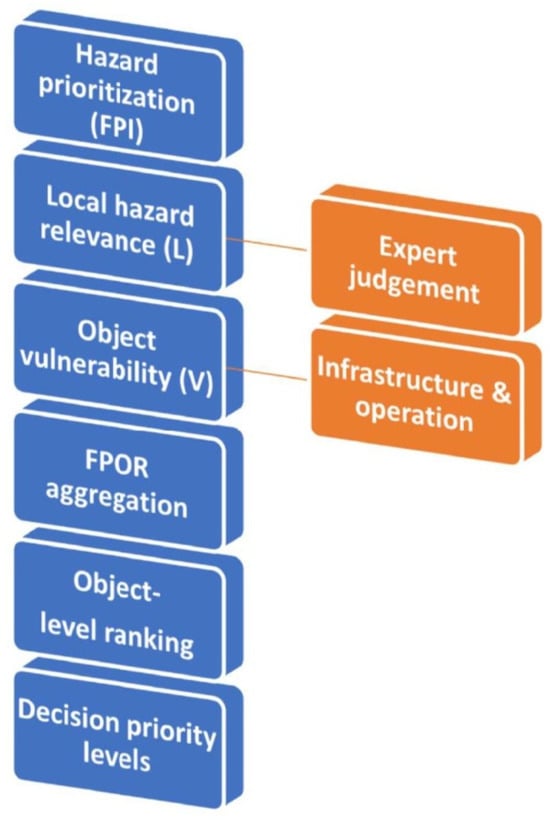
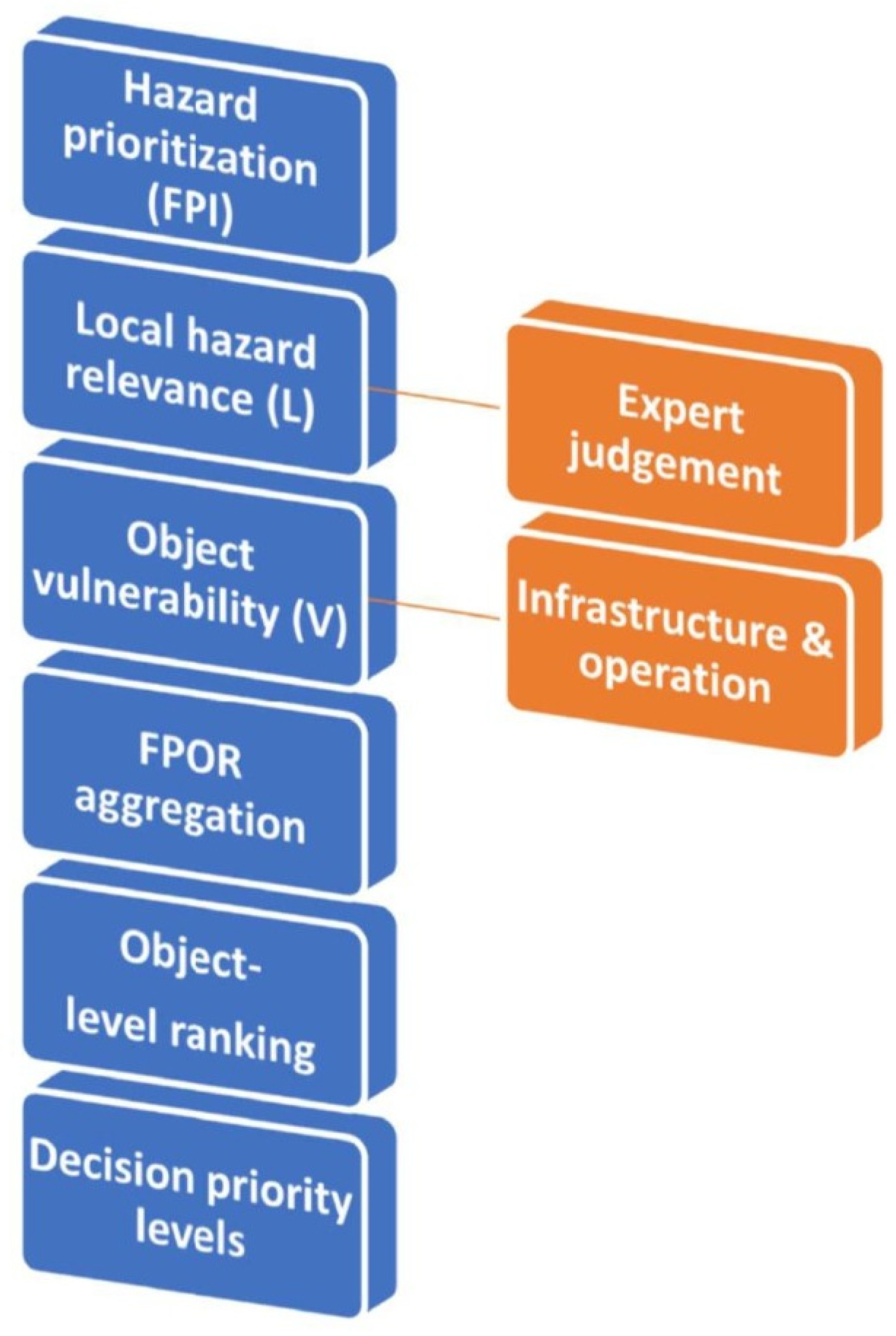
Figure 1 illustrates the conceptual structure of the FPOR framework, linking parameter-level hazard prioritization with object-level operational decision support. Hazard importance derived from prior prioritization (FPI) is combined with local hazard relevance and object vulnerability to produce an object-level ranking and corresponding decision priority levels.
Figure 1.
Conceptual structure of the FPOR framework for object-level prioritization in drinking water systems.
2. Materials and Methods
2.1. Scope of the Method, Decision-Making Units and Input Assumptions
The paper proposes the FPOR (Fuzzy Priority of Objects at Risk) methodological framework as a tool supporting risk management at the object level in drinking water supply systems. The starting point is the engineering assumption that operational decisions regarding monitoring, diagnostics, and preventive and corrective actions are made in relation to specific infrastructure objects, rather than water quality parameters considered on a system-wide scale. This approach is consistent with the concept of risk management covering the entire water supply chain, formally established in Directive (EU) 2020/2184 on the quality of water intended for human consumption.
The decision-making unit adopted in this methodology is priority premises as defined in Directive (EU) 2020/2184. In practical terms, the framework is intended to support utilities in identifying classes of priority receiving premises receiving water from the distribution network, where supplied water quality, combined with known infrastructural and operational characteristics of internal installations, may justify increased monitoring or further technical assessment. The framework does not replace the legal distinction between responsibility for the water distribution network and responsibility for private plumbing but instead supports risk-informed prioritization at their operational interface.
The Directive defines PP as large non-domestic premises with multiple users where the potential risk associated with water intended for human consumption may be increased, in particular in the context of internal installations and their operating conditions. The identification of priority premises as part of risk assessment is one of the key regulatory requirements, shifting the focus from assessing average water quality to assessing local and premises-specific conditions.
From a practical point of view, the full identification of all priority premises and the acquisition of homogeneous monitoring data for each of them is not possible in many water supply systems at an early stage of implementing a risk-based approach. Therefore, a class-based approach has been adopted, in which priority premises are represented by classes of facilities corresponding to the categories specified in Directive (EU) 2020/2184 and its transposition acts. This solution allows for prioritization in a manner that is consistent with regulations, comparable between different systems and resistant to gaps in detailed data.
The class-based approach has significant engineering justification. Firstly, it allows for early identification of areas requiring increased operational attention without the need for a complete facility database. Secondly, it allows for the inclusion of typical technical and operational characteristics specific to a given category of facilities, such as the complexity of internal installations, the residence time of water in the system, or operational control capabilities. Thirdly, the class structure provides a framework that can be naturally refined to the level of individual facilities as empirical data is acquired.
For the sake of interpretative clarity, the following operational definitions have been adopted and are used consistently throughout the methodology. Hazard is defined as a water quality parameter (e.g., As, Pb, THM, NO3−), without modeling exposure and health effects. Hazard prioritization means the ranking of water quality parameters at the system level, expressed by FPI (Fuzzy Priority Index) weights, derived from an earlier stage of the analysis [22]. The term risk refers exclusively to risk at the facility level in an operational and managerial sense, understood as the relative level of urgency of action, rather than health risk [23,24]. FPOR refers to a facility prioritization framework, not a health risk indicator. Local hazard significance (L) describes the degree to which a given hazard is significant for a given class of facilities under typical operating conditions, without probabilistic interpretation. Facility vulnerability (V) refers only to infrastructure and operational vulnerability resulting from the technical and operational characteristics of the facility.
The classes of priority premises were adopted in direct reference to the categories specified in Directive (EU) 2020/2184, covering: healthcare facilities, long-term and social care facilities, educational facilities and childcare facilities, as well as other large non-residential facilities identified by the competent national authorities. The adoption of this classification ensures that the methodology is consistent with the European Union legal framework and allows the results of the prioritization to be used directly in risk management and regulatory oversight practices [12,25].
As a result, the proposed methodology allows for the systematic transfer of information on the importance of risks at the level of water quality parameters to the priority structure at the level of priority facility classes. The FPOR framework defined in this way is a coherent tool supporting operational decision-making in conditions of uncertainty and limited data availability, while remaining fully compliant with the requirements of Directive (EU) 2020/2184.
2.2. Selection of Hazards and Source of Weights (Hazard Prioritization)
Within the proposed methodology, it was assumed that the set of hazards consists of parameters of water quality intended for human consumption, which are relevant from a regulatory and operational point of view. Hazards are understood exclusively as water quality factors, without taking into account exposure, doses or health effects, which is consistent with the separation of facility management from health risk assessment adopted in this work.
The selection of water quality parameters was based on the applicable requirements of Directive (EU) 2020/2184 and on the practice of water quality monitoring in the water supply systems of European Union Member States. Both parameters of direct regulatory significance and parameters which, in operational practice, may be indicators of secondary problems in the distribution network or internal installations were taken into account. This selection ensures that the analysis remains consistent with the legal framework while reflecting the actual operational challenges.
The hazard prioritization was carried out at the system level, independently of specific priority premises. For this purpose, the results of an earlier stage of the analysis were used, in which water quality parameters were ranked according to their relative importance using fuzzy preference relations. The result of this stage is the Fuzzy Priority Index (FPI) assigned to each water quality parameter, expressing its relative importance in the set of analyzed hazards.
In this methodology, it was assumed that FPI values are treated as input data and are not subject to further modification at the facility analysis stage. This separation of stages ensures the logical consistency of the entire procedure: the importance of hazards is determined once, based on expert knowledge and inter-parameter comparisons, and then propagated to subsequent levels of analysis. This avoids a situation in which the significance of a hazard would be secondarily ‘adjusted’ to the characteristics of the objects, which could lead to ambiguous interpretations.
The use of FPI as hazard-importance weights also has significant engineering justification. Firstly, it allows for direct comparison of water quality parameters of different nature and different units of measurement, without the need to normalise them to a common physical scale. Secondly, it allows for the formal consideration of uncertainty and subjectivity in expert assessments in an explicit and controllable manner. Thirdly, it separates the assessment of the systemic importance of hazards from the assessment of the conditions of their manifestation in specific facilities, which is crucial for further facility-specific analysis.
Consequently, in the further stages of the methodology, each water quality parameter is represented by a pair of pieces of information: its systemic importance expressed by the FPI and its local significance and object importance, which will be defined in the following sub-sections. This approach creates a coherent basis for moving from prioritising hazards at the parameter level to prioritising actions at the level of priority object classes.
2.3. Priority Object Classes in Accordance with Directive (EU) 2020/2184
In accordance with Directive (EU) 2020/2184 on the quality of water intended for human consumption, an important element of the risk-based approach is the identification and analysis of so-called priority premises. The Directive indicates that these are, in particular, large non-domestic premises where the potential risk associated with water intended for human consumption may be increased, especially in the context of internal installations, the manner of use and the number and characteristics of users. The obligation to identify such premises rests with the Member States and is an integral part of the risk assessment within the implementation of a systemic approach to water safety.
In this methodology, it is assumed that priority premises are represented in the form of facility classes that correspond to the categories specified in Directive (EU) 2020/2184 and in the legal acts transposing it. This approach allows for full regulatory compliance while enabling analysis to be carried out in conditions of limited availability of detailed data on individual facilities. Class representation is therefore a conscious methodological choice, reflecting the phased nature of the implementation of the risk-based approach in water supply systems.
Based on the provisions of Directive (EU) 2020/2184, the following classes of priority premises have been identified [26,27,28]:
- Healthcare facilities, including hospitals, clinics, outpatient clinics and other facilities where medical treatment is provided. These facilities are characterised by highly complex internal installations, a large number of water consumption points and specific operational requirements. From a risk management perspective, it is also important that the operation of these facilities requires a highly reliable water supply with stable quality parameters.
- Long-term care and social care facilities, such as nursing homes, retirement homes and other facilities providing 24 h care. These facilities have constant use of water installations, often with limited possibilities for intensive operational management. The characteristics of these facilities justify treating them as a separate class in the facility analysis.
- Educational establishments and childcare facilities, including schools, kindergartens and nurseries. Directive (EU) 2020/2184 explicitly identifies children as a group requiring special protection, which is reflected in the need to include these facilities among the priority premises. From an engineering point of view, an important feature of this class is the variable and often intermittent nature of the use of the installations, leading to periods of water stagnation.
Other large non-residential buildings, including public buildings and other buildings designated by the competent national authorities in the transposition of the Directive. This category is open-ended and allows for national or local specificities to be taken into account, while remaining consistent with the European Union regulatory framework.
The adoption of the above classification has significant regulatory and methodological justification. Firstly, it ensures that the results of the analysis can be directly referenced to the categories of buildings specified in EU law, which facilitates their interpretation and use in supervisory and operational practice. Secondly, the classes of facilities reflect typical differences in the configuration of internal installations, the manner of use and the possibilities for operational control, which are of key importance for the further assessment of the local significance of hazards and the vulnerability of facilities. Thirdly, the class structure allows for a gradual refinement of the analysis as empirical data is obtained, without the need to modify the basic methodological assumptions.
Consequently, further stages of the analysis focus on assigning priority profiles of local risk significance and infrastructure and operational vulnerability to individual classes of facilities, which forms the basis for determining the priority of actions within the proposed FPOR methodology.
2.4. Local Significance of the Hazard (L)
The proposed methodology introduces the concept of local hazard relevance (L), hereafter referred to as the local significance of the hazard. This value describes the extent to which a given hazard (water quality parameter) is significant from the point of view of a specific class of priority premises.
Classic risk analyses often use the concept of the probability of an event occurring. However, in the context of water quality in distribution systems and internal installations, this approach is problematic for several reasons. Firstly, the monitoring data available for priority premises are usually incomplete, irregular or limited to single measurements, which makes reliable probabilistic estimation impossible. Secondly, many of the phenomena affecting water quality in internal installations are conditional and contextual in nature, depending on the use of the facility, the hydraulic regime or the configuration of the installation, rather than random events in the statistical sense.
For this reason, probabilistic interpretation has been abandoned in this methodology and replaced with the concept of local significance of the hazard (L). The L parameter does not describe the probability of exceeding the parametric value, but the relative significance of a given hazard for a given class of facilities, resulting from typical mechanisms of water quality deterioration observed in engineering practice. This approach is consistent with the recommendations for risk management under conditions of uncertainty, commonly used in Water Safety Plans and in analyses based on fuzzy logic.
For each hazard and each class of priority premises, a Li,c value has been defined:
where
Li,c ∈ [0, 1]
- i = 1, 2, …, n denotes the hazard index (water quality parameter),
- c = 1, 2, …, m denotes the index of priority objects,
- Li,c is a dimensionless measure of the local significance of the hazard and for class c objects.
The Li,c value reflects typical conditions conducive to the occurrence of a given hazard in a given class of objects, rather than its current concentration level.
Adopting the range [0, 1] allows for:
- Unambiguous interpretation of extreme values (0—no significance, 1—very high significance),
- Easy aggregation with other dimensionless quantities in further stages of the methodology,
- Compatibility with fuzzy logic tools and multi-criteria methods.
The Li,c value reflects typical conditions conducive to the occurrence of a given hazard in a given class of facilities, rather than its current concentration level:
- The high L value for lead in educational facilities is due to the frequent occurrence of older internal installations and periods of water stagnation,
- An elevated L value for trihalomethanes in healthcare facilities may be due to the long residence time of water in extensive internal systems,
- A low L value for a given parameter means that, from the point of view of typical operation of a given class of facilities, this hazard is of limited operational significance.
This understanding of the L parameter is consistent with the approach used in the literature on risk assessment in distribution networks, which emphasises the role of local conditions, such as stagnation, hydraulic variability and material interactions, as key factors determining water quality at the end user [9,10,11,24,29,30,31,32].
Due to uncertainty and the lack of quantitative data for individual facilities, the Li,c parameter is first defined as a linguistic variable taking qualitative values such as very low, low, moderate, high or very high significance. These values are then mapped to the range [0, 1] using a fuzzy logic membership function.
The use of linguistic variables allows for the formal consideration of expert knowledge and practical observations, which is commonly recommended in environmental and infrastructure risk analyses in situations where quantitative data is limited. At the same time, interpretative transparency is maintained, as the assignment of L values can be audited and modified as knowledge about a given system increases.
Li,c values determined on the basis of [3,7,8,12,13,26,27,28]:
- The provisions of Directive (EU) 2020/2184 concerning priority premises and internal installations,
- Scientific literature describing the mechanisms of secondary deterioration of water quality in networks and internal installations,
- Operational experience and expert knowledge in the field of the functioning of facilities with different usage profiles
This approach ensures that the L parameter is not arbitrary but is based on sound technical and regulatory grounds.
The local hazards significance parameter Li,c is one of the three key elements of further aggregation within the FPOR indicator. Its function is to differentiate the impact of the same hazard between different classes of objects, without changing its systemic importance as previously determined by the FPI. In combination with the assessment of the vulnerability of objects (V), this enables a transition from the prioritization of hazards to the prioritization of objects in a logical, transparent manner consistent with engineering practice.
Local hazard relevance was first assessed using linguistic categories to reflect the inherently imprecise and context-dependent nature of expert judgement at the object level. These linguistic assessments were subsequently represented as fuzzy intervals defined over the numerical range [0, 1]. The use of interval-based representation explicitly accounts for uncertainty and semantic vagueness associated with linguistic terms such as ‘high’ or ‘moderate’, while maintaining compatibility with numerical aggregation. The linguistic categories, their corresponding fuzzy intervals, and representative singleton values used for computation are summarised in Table 1.
Table 1.
Linguistic evaluation and numerical ranges for local hazard relevance (L) and object vulnerability (V).
The representative values shown in Table 1 are illustrative. In the present study, specific numerical values within the defined intervals were selected for each object class (see Section 3).
The Li,c and Vc ratings were defined as linguistic variables to enable the formal representation of expert knowledge in conditions of uncertainty and limited availability of objective data. For this purpose, a five-point qualitative scale (very low–very high) was adopted, corresponding to the typical resolution used in engineering screening assessments and in risk analysis practices based on the Water Safety Plans approach. The five-point scale is a compromise between: the ability to distinguish between classes of objects and mechanisms of water quality degradation, the stability of assessments and the limitation of excessive detail in the absence of empirical data.
For each linguistic category, a value range of [0, 1] has been defined, which ensures unambiguous interpretation of extreme values and compatibility with further aggregation in the FPOR model. The boundaries of the ranges were adopted as uniform segments with a width of 0.20, which is a standard and transparent practice in simple fuzzy models and allows for unambiguous classification of numerical values into linguistic categories (e.g., 0.75 ∈ [0.60, 0.80] → ‘high’).
For the purposes of FPOR calculations, defuzzification in the form of representative values (singletons) was used. These values correspond to the midpoints of the ranges for the ‘low’ and “moderate” categories, while for the extreme categories (‘very low’ and ‘very high’), values shifted towards the extremes (0.10 and 0.85, respectively) were adopted to reflect the interpretative asymmetry of extreme assessments: the ‘very high’ category is intended to represent the dominant state and enforce a clear differentiation of priorities in the ranking, while ‘very low’ is intended to reflect a practically negligible contribution to the object priority. This approach (fuzzy intervals + singleton representatives) preserves the interpretability of linguistic assessments while ensuring full replicability of calculations.
2.5. Object Vulnerability (V)
The second key element of object analysis is object vulnerability, denoted as V. This value describes the degree to which a given class of priority objects is vulnerable to the negative effects of water quality deterioration resulting from its technical, hydraulic, organisational and operational characteristics.
In water supply systems, the same water quality delivered to the property boundary may lead to different conditions at the tapping points, depending on the characteristics of the internal installations and the way the facility is used. Numerous studies have shown that factors such as the age of the installation, pipe materials, water residence time, the complexity of the hydraulic system and the operating regime have a significant impact on the stability of water quality at the end user. From a risk management perspective, this means that not all facilities respond in the same way to the same quality risk.
For this reason, this methodology introduces a separate parameter describing the vulnerability of a facility, independent of the hazard itself. This allows two fundamentally different issues to be separated:
- How significant a given hazard is for a given class of facilities (parameter L)
- How sensitive a given class of facilities is in terms of infrastructure to water quality deterioration (parameter V).
This separation is in line with good engineering practices and the approach recommended in Water Safety Plans, which emphasise the importance of system and installation characteristics for the actual level of operational risk.
For each class of priority objects c, the following values of vulnerability have been defined:
where
Vc ∈ [0, 1]
- c = 1, 2, …, m denotes the index of priority objects,
- Vc is a dimensionless measure of the infrastructure and operational vulnerability of a given class of facilities.
As in the case of the L parameter, adopting the range [0, 1] enables:
- Unambiguous interpretation of extreme values (0—very low vulnerability, 1—very high vulnerability);
- Consistent aggregation with other components of the methodology;
- Flexible use of fuzzy logic and multi-criteria methods.
The Vc parameter describes the vulnerability of an object as a technical system, rather than the sensitivity of users in terms of health. This means that factors such as age, health status or biological vulnerability of the population using the object are deliberately not included in its definition. This limitation of the scope of interpretation is deliberate and results from the adopted separation of operational analysis from health risk assessment.
The Vc value reflects the characteristics that affect the stability of water quality within the facility, in particular:
- The complexity and extent of internal installations;
- The length and structure of internal pipes;
- The length of time water remains in the installation (water age);
- The possibility of stagnation zones;
- The degree of operational control and frequency of maintenance activities;
- Susceptibility to hydraulic changes resulting from the mode of use.
This understanding of vulnerability is consistent with the approach presented in the literature on water quality in internal installations, which indicates that infrastructure characteristics are one of the main determinants of secondary water quality deterioration.
Due to the class-based approach, the Vc parameter is determined at the level of a class of facilities, rather than a single building. This means that the susceptibility value describes the typical level of infrastructure susceptibility for a given category of priority premises, resulting from their characteristic functional and operational features.
This approach is justified at the initial prioritization stage, when the aim of the analysis is not to precisely assess the risk to a specific facility, but to compare and classify facility classes in terms of the need for management actions. Class representation also allows for a subsequent transition to the level of individual facilities by modifying the V value based on detailed data.
Analogous to the L parameter, the vulnerability of an object Vc is initially described as a linguistic variable, taking qualitative values such as very low, low, moderate, high or very high vulnerability. These values are then mapped to the interval [0, 1] using a fuzzy logic membership function.
The basis for assigning the vulnerability level is:
- The provisions of Directive (EU) 2020/2184 relating to internal installations and priority premises,
- Scientific literature on the impact of internal installation characteristics on water quality,
- Operational experience and expert knowledge in the design and maintenance of facilities with different usage profiles.
This approach allows for the formal consideration of uncertainty and ensures the transparency of the assessment process, which is important from the point of view of auditability and the possibility of subsequent updating of the results.
The vulnerability parameter Vc acts as a coefficient that amplifies or attenuates the impact of hazards at the facility level. In the next stage of the methodology, it is combined with the local significance of the hazard Li,c and the systemic importance of the hazard expressed by FPI. This makes it possible to differentiate the priorities of actions not only according to the nature of the hazard, but also according to the technical capacity of the facility to maintain stable water quality.
As a result, the inclusion of the V parameter is a key element enabling the transition from hazard analysis to consistent, facility-based prioritization of operational activities in water supply systems.
Object vulnerability was defined using the same linguistic scale and numerical mapping as local hazard relevance. The fuzzy categories, corresponding numerical ranges, and representative values applied to Vc are identical to those defined for Li,c in Table 1, ensuring methodological consistency across all components of the FPOR framework.
2.6. FPOR Object Aggregation—Definition of the Indicator, Mathematical Structure and Engineering Interpretation
The final stage of the methodological part is the formal aggregation of information about hazards and characteristics of objects in the form of the FPOR index. The aim of this stage is to transform the knowledge dispersed across three levels of analysis—the importance of hazards, their local significance and the vulnerability of objects—into an unambiguous ranking of priority object classes that can be directly interpreted for decision-making purposes.
Conceptual Assumptions of Aggregation
The FPOR aggregation was designed based on the following engineering assumptions:
- Separation of analysis levels—the severity of hazards is determined at the system level and does not depend on the characteristics of the facilities. In turn, the local significance of hazards and the vulnerability of facilities are facility-specific. Aggregation should not lead to secondary modification of hazard weights depending on the facility.
- Conditional impact of a hazard—a hazard with high systemic importance should not generate a high priority for action if:
- Its local significance for a given class of facilities is low;
- The facility is characterised by low infrastructure vulnerability.
- Monotonicity and interpretability—an increase in any of the factors (hazard importance, local significance, vulnerability) should not lead to a decrease in the FPOR value. At the same time, the aggregation structure should be easy to interpret and auditable.
- Compatibility with uncertainty and fuzzy logic—aggregation must allow the use of linguistic variables and fuzzy values without compromising mathematical consistency.
On this basis, a multiplicative-additive structure was adopted, commonly used in engineering models for operational risk assessment.
The FPOR index is calculated as an aggregated contribution of hazard importance, local hazard relevance, and object vulnerability:
where
- FPORc—object priority index for object class c (dimensionless), FPOR represents object-level operational prioritization rather than health risk assessment.
- i = 1, 2, …, n—hazard index (water quality parameter),
- c = 1, 2, …, m—index of priority objects,
- FPIi ∈ [0, 1]—systemic significance of the hazard, determined during the hazard prioritization stage (based on the Fuzzy article),
- Li,c ∈ [0, 1]—local significance of the hazard and for class c facilities,
- Vc ∈ [0, 1]—infrastructure and operational vulnerability of class c facilities.
Aggregation structures of this type are commonly used in risk assessment and multi-criteria prioritization models [16,17,18,24].
All variables are dimensionless and defined in the range [0, 1]. The values assigned to the parameters Li,c and Vc represent representative numerical values within predefined linguistic intervals describing the relative intensity of hazard manifestation and object vulnerability. These values were selected based on engineering judgement reflecting typical operational characteristics of the analyzed classes of priority premises. For example, healthcare facilities were assigned higher vulnerability values due to the complexity of internal plumbing systems, the presence of sensitive populations, and the increased potential consequences of water quality deterioration. In contrast, public or general-use buildings were assigned lower vulnerability values due to simpler infrastructure and lower health sensitivity. The objective of this parameterisation is not to provide a fully formalized expert elicitation protocol but to establish a transparent screening-level representation of infrastructure-related vulnerability and hazard manifestation, suitable for early-stage prioritization and decision support.
For numerical aggregation, fuzzy intervals associated with linguistic assessments were represented by characteristic singleton values, corresponding to the representative values defined in Table 1.
The use of the proposed product according to Formula (3) has a clear engineering justification. This structure ensures that the contribution of a given hazard to the FPOR is significant only when all three conditions are met simultaneously:
- The hazard is significant on a system scale;
- It is locally significant for a given class of objects;
- The object exhibits infrastructural vulnerability
If any of these factors takes a value close to zero, the contribution of the hazard to the FPOR also tends towards zero. This prevents situations where a single factor dominates the result without the appropriate technical context. This approach is consistent with classical operational risk models, in which risk is seen as a function of the significance of the event and the vulnerability of the system.
Summing the contributions of individual hazards allows for the fact that the object priority is the result of the accumulation of many qualitative factors, rather than a single parameter. The additive structure allows for the comparability of object classes within a single system, the analysis of the relative contribution of individual hazards to the FPOR value, and the future extension of the analysis to include additional parameters without changing the structure of the method.
At the same time, it should be emphasized that FPOR is not a measure of absolute risk, but an ordering indicator used to determine the sequence of actions.
The FPORc value forms the basis for ranking priority objects according to the relative urgency of operational activities. A higher FPOR value indicates a greater need to intensify monitoring, carry out diagnostics of internal installations, and implement preventive or corrective measures [29,30,31,32].
It should be emphasised that FPOR does not replace detailed technical analyses or compliance assessments but serves as a tool to support resource allocation and action planning within a risk-based approach.
The proposed aggregation has been designed for the initial and intermediate phases of risk management implementation, where access to object data is limited. As empirical data is obtained, it is possible to:
- Specify the values of Li,c and Vc;
- Move from class representation to the level of individual objects;
- Extend the aggregation structure without violating its basic logic.
To facilitate practical interpretation of the FPOR index, decision-oriented priority levels were defined based on FPOR value ranges. The corresponding operational implications are summarized in Table 2.
Table 2.
Mapping of FPOR values to decision priority levels and operational interpretation.
The proposed decision thresholds are intended to support operational prioritization rather than regulatory compliance assessment. They may be adapted to local system characteristics, monitoring capacity, and management objectives without altering the underlying FPOR framework. Fuzzy logic is thus employed at the level of linguistic representation and interval-based numerical mapping, rather than through a full fuzzy inference system.
3. Results
3.1. Classes of Priority Premises Considered in the Analysis
The results are presented at the level of classes of priority premises (PP), defined in accordance with Directive (EU) 2020/2184. The use of class-based representation allows for systematic comparison of objects with similar functional and operational characteristics in situations where detailed data for individual buildings are not yet available. This approach is consistent with the staged implementation of risk-based management in drinking water systems and supports early prioritization at the system scale.
For clarity and consistency with regulatory terminology, the abbreviation PP (Priority Premises) is used throughout this study. This notation directly refers to the term “priority premises” as defined in Directive (EU) 2020/2184 and does not represent an author-defined risk category. Four classes of priority premises were considered: PP-H (Healthcare), PP-C (Care facilities), PP-E (Education and childcare), and PP-P (Public and other non-residential buildings).
The classification reflects systematic differences in infrastructure configuration, water use patterns, and operational conditions that influence the stability of drinking water quality at the point of use. Such differences, particularly those related to premise plumbing complexity, stagnation potential, and material–water interactions, are well documented in the literature on drinking water distribution and building installations.
Table 3 summarizes the considered classes of priority premises together with their defining infrastructure-related and operational characteristics.
Table 3.
Classes of priority premises (PP) according to Directive (EU) 2020/2184.
Table 3 defines the classes of priority premises (PP) used as decision units in the object-level analysis. The PP notation directly follows the terminology of Directive (EU) 2020/2184 and does not represent an author-defined risk category.
3.2. Selection of Hazards and Local Hazard Relevance Across Priority Premises Classes
3.2.1. Selection of Hazards
In the illustrative analysis, a reduced set of six drinking water quality parameters was considered: lead (Pb), arsenic (As), trihalomethanes (THM), nitrate (NO3−), mercury (Hg), and chromium (Cr). This selection represents a deliberate methodological choice rather than a limitation of the framework.
The parameters were selected based on three criteria:
- Regulatory relevance, as these parameters are explicitly regulated or commonly addressed within the framework of Directive (EU) 2020/2184 and national monitoring programmes;
- Documented susceptibility to deterioration within distribution systems and premise plumbing, particularly under conditions of stagnation, elevated water age, corrosion, and material–water interactions;
- Consistency with the preceding hazard prioritization stage, in which these parameters constituted the core set used to derive the Fuzzy Priority Index (FPI).
The selected parameters are also relevant because they may be influenced, directly or indirectly, by the quality of water supplied from the water distribution network. Some parameters, such as arsenic or nitrate, are primarily associated with source water quality and treatment performance and therefore reflect the baseline quality of water entering the distribution system. Others, such as lead, chromium, or trihalomethanes, may additionally be affected by conditions within the distribution network and premise plumbing, including corrosion processes, stagnation, water age, and material–water interactions. Consequently, the selected hazard set reflects both the quality of water delivered by the utility and the potential for secondary deterioration at the level of internal installations, which is particularly relevant for PP.
3.2.2. Local Hazard Relevance Li,c
Local hazard relevance Li,c was assigned for each combination of hazard i and priority premises class c. Assessments were first conducted in linguistic terms and subsequently mapped to numerical values using the fuzzy scale defined in Table 1. This approach reflects the fact that local manifestations of hazards within buildings are often difficult to quantify probabilistically yet are well understood from an engineering and operational perspective.
Differences in L values between classes reflect variations in installation complexity, usage patterns, and hydraulic conditions. Differences within the same linguistic category (e.g., values of 0.70 versus 0.75, both classified as “high”) indicate varying intensity of the same underlying mechanisms rather than a change in qualitative classification.
Table 4 summarizes the local relevance of selected hazards for each priority premises class, expressed as linguistic assessments mapped to numerical values using the fuzzy scale defined in Table 1.
Table 4.
Local hazard relevance (L) of selected drinking water quality parameters across priority premises classes.
The rationale for selecting the six parameters is discussed in Section 3.2.1.
3.3. Object Vulnerability of Priority Premises Classes
Object vulnerability Vc was defined as a class-level characteristic describing the susceptibility of a given type of priority premises to quality deterioration driven by infrastructure-related and operational factors. Vulnerability was assessed independently of individual hazards and expressed using the same linguistic scale and fuzzy mapping as local hazard relevance, ensuring methodological consistency.
The assignment of Vc values was based on expert judgement informed by four technical criteria:
- Complexity and branching of internal plumbing systems;
- Potential for stagnation and elevated water age;
- Material heterogeneity and potential for material–water interactions; and
- Feasibility of operational control and maintenance.
These criteria are widely recognized in the literature on premise plumbing and distribution system stability as key determinants of local water quality variability.
Table 5 presents object vulnerability values assigned at the class level, representing typical infrastructure-related susceptibility rather than hazard-specific effects.
Table 5.
Object vulnerability Vc for priority premises classes.
The Vc values were adopted on the basis of an expert assessment of infrastructure and operational vulnerability, taking into account the complexity of the installation, the potential for stagnation, material heterogeneity and operational control capabilities. Linguistic assessments were remapped to numerical values.
3.4. Illustrative Numerical Application of the FPOR Framework
To illustrate the computational logic of the proposed FPOR framework, an illustrative numerical example was carried out at the level of priority premises classes. The purpose of this example is to demonstrate the operational structure of the framework rather than to provide empirical validation of its performance in real-world systems.
The example is not linked to a specific geographical area or utility service zone. Instead, it is constructed as a generic screening-level illustration based on representative classes of priority premises (PP-H, PP-C, PP-E, and PP-P) and on hazard importance values adopted from the preceding hazard prioritization stage. Its purpose is to demonstrate how the framework can be applied under conditions where class-based information is available but detailed object-specific data are not yet available.
Hazard importance values FPIi were adopted from the preceding hazard prioritization stage [22], while values of Li,c and Vc were taken from Table 4 and Table 5, respectively.
For each hazard and class of priority premises, partial contributions to the FPOR index were calculated as the product FPIi⋅Li,c⋅Vc. As an illustrative example, the contribution of lead (Pb) for healthcare facilities (PP-H) was calculated using FPIPb = 0.70, LPb,PP−H = 0.75, and VPP−H = 0.85, resulting in a partial contribution of 0.446.
The complete set of partial contributions and the resulting FPOR values for each priority premises class are presented in Table 6. This table allows direct identification of hazards that dominate the object-level priority structure.
Table 6.
Illustrative FPOR computation: partial hazard contributions and aggregated object-level priorities.
3.5. FPOR-Based Ranking and Decision-Oriented Interpretation
Based on the computed FPOR values, a ranking of priority premises classes was established. As FPOR is intended as a prioritization index rather than a probabilistic risk measure, the results are interpreted in a decision-oriented manner.
The final FPOR values, ranking positions, and corresponding priority levels are summarized in Table 7.
Table 7.
FPOR-based ranking of priority premises classes and decision-oriented interpretation.
The five-level prioritization scheme translates numerical FPOR values into operational guidance, ranging from routine monitoring to immediate diagnostic and corrective actions. This mapping enables direct integration of the FPOR results into operational planning while preserving flexibility for adaptation to local system characteristics and management objectives.
3.6. Sensitivity Analysis of the FPOR Framework
To evaluate the robustness of the proposed FPOR framework, a deterministic sensitivity analysis was performed. The analysis examined how changes in the three key components of the model—hazard importance (FPIi) local hazard relevance (Li,c), and object vulnerability (Vc)—affect the resulting FPOR values and the ranking of priority premises classes. Four perturbation scenarios were tested. In Scenario S1, all FPIi values were increased by 20%, representing an extreme upward shift in hazard importance. In Scenario S2, all Li,c values were reduced by 20%, simulating a conservative decrease in local hazard manifestation. In Scenario S3, the vulnerability value of the highest-ranked class (PP-H) was reduced by 20%, while in Scenario S4 the vulnerability value of the intermediate class PP-E was increased by 20%. The resulting FPOR values are presented in Table 8.
Table 8.
Deterministic sensitivity analysis of the FPOR framework under selected parameter perturbations.
The analysis shows that the absolute FPOR values change proportionally to the perturbations, as expected from the multiplicative-additive structure of the model. However, the overall ranking of the priority premises classes remains unchanged in all tested scenarios. This indicates that the FPOR framework is relatively robust with respect to substantial variations in key input parameters, at least in ordinal terms. Such stability is particularly important for screening-level applications, where the primary objective is to support relative prioritization rather than precise quantitative risk estimation.
4. Discussion
The results of this study demonstrate that prioritizing drinking water quality hazards solely at the parameter level is insufficient for supporting operational decision-making in complex water supply systems. While hazard prioritization provides essential insight into the relative importance of individual water quality parameters, it does not indicate where within the system limited monitoring, diagnostic, and intervention resources should be allocated.
Recent studies have increasingly emphasized the importance of decision-support frameworks for risk-based management of drinking water systems, particularly in the context of distribution networks and building installations where local water quality conditions may differ from system-wide monitoring results. Several recent publications highlight the need for methodological approaches that integrate hazard identification with operational prioritization at the level of specific infrastructure components or premises. For example, recent studies have explored the use of decision-support tools, fuzzy-based prioritization methods, and risk-oriented operational frameworks for water infrastructure management and resilience assessment [33,34,35,36,37,38].
In addition, growing attention has been given to risks associated with premise plumbing systems and priority premises such as hospitals, schools, and care facilities, where complex internal installations, intermittent water use, and water stagnation may contribute to localized deterioration of water quality. Recent research has therefore emphasized the need for structured methodologies capable of supporting operational decision-making under conditions of incomplete data [39]. In this context, the FPOR framework proposed in this study contributes to the emerging body of research on practical decision-support tools for drinking water system management by providing a transparent and structured approach for translating hazard prioritization into object-level prioritization aligned with engineering practice.
The class-based ranking of priority premises highlights the importance of considering downstream installations and building-level conditions within risk-based drinking water management. Facilities such as healthcare and care institutions consistently emerge as higher-priority objects due to the combined effects of complex internal plumbing, elevated stagnation potential, heterogeneous materials, and limited tolerance to water quality variability. These findings provide an engineering-based justification for the regulatory emphasis placed on priority premises in Directive (EU) 2020/2184 and demonstrate how regulatory concepts can be operationalized within a structured decision-support framework.
The use of fuzzy linguistic variables for representing local hazard relevance and object vulnerability offers practical advantages in contexts characterized by limited data availability and high structural heterogeneity. By employing interval-based fuzzy representations, the proposed approach explicitly acknowledges the uncertainty and imprecision inherent in expert judgement while maintaining numerical transparency and reproducibility. Importantly, fuzzy logic is applied at the level of linguistic representation and interval mapping rather than through a full fuzzy inference system, preserving interpretability and computational simplicity. This design choice makes the framework accessible to practitioners while retaining the key benefits of uncertainty-aware assessment.
FPOR is intentionally formulated as a prioritization index rather than a probabilistic risk metric. Its primary function is to establish a stable and interpretable ordering of objects according to their relative operational priority. The decision-oriented mapping of FPOR values to priority levels enables direct translation of analytical results into practical guidance for monitoring, diagnostics, and infrastructure management. The flexibility of the proposed decision thresholds allows adaptation to local system characteristics, regulatory contexts, and resource availability, reinforcing the role of FPOR as a complement to existing risk management instruments such as Water Safety Plans and compliance-based monitoring programmes.
Several methodological limitations should be acknowledged. The illustrative implementation presented in this study relies on class-level representations rather than object-specific data. While this approach is suitable for early-stage prioritization and strategic planning, future applications could refine the framework using building-specific monitoring data where available. In addition, values of local hazard relevance and object vulnerability are derived from expert judgement. Although this is consistent with common engineering practice, the robustness of results may depend on the composition and experience of the expert panel, suggesting that structured elicitation protocols and sensitivity analyses may be beneficial in applied implementations.
The FPOR framework adopts a deliberately simple aggregation structure that can be interpreted as a linear-compensatory multi-criteria prioritization model. This choice was intentional and reflects the operational context in which the framework is intended to be applied. In many drinking water systems, particularly at the early stages of risk screening, detailed datasets or extensive expert elicitation required by more complex MCDA approaches (such as AHP, TOPSIS, or advanced fuzzy inference systems) are often unavailable. For this reason, the proposed framework prioritizes transparency, interpretability, and operational applicability over algorithmic complexity. The main contribution of the FPOR concept therefore lies not in introducing a new mathematical decision-analysis method, but in providing a structured mechanism that links hazard prioritization with object-level operational prioritization within drinking water systems. In this sense, the framework can be interpreted as a screening-level decision-support tool designed to support practical engineering applications.
The FPOR framework does not attempt to replace health risk assessment. Instead, it addresses an earlier stage of the decision-support process. In practical water utility management, screening-level operational prioritization is often required before detailed exposure data and toxicological parameters necessary for quantitative health risk analysis become available. In this sense, the FPOR framework should be understood as a complementary tool that supports the identification of facilities requiring increased monitoring or further investigation, which may subsequently be analyzed using more detailed health risk assessment approaches.
The parameterisation of local hazard relevance and object vulnerability relies on expert-based judgement and simplified class representations of infrastructure characteristics. The numerical example presented in this study serves to illustrate the computational logic of the framework and does not constitute empirical validation.
The present formulation excludes explicit health risk metrics such as exposure assessment, hazard quotients, or cancer risk indicators [40]. This separation reflects a conceptual distinction between operational object-level prioritization and health risk assessment, allowing each analytical layer to be developed and applied appropriately. Within this context, FPOR occupies an intermediate position between hazard prioritization and detailed risk analysis, providing a practical bridge between analytical assessment and operational decision-making in drinking water systems.
The deterministic sensitivity analysis further confirmed that the proposed framework is stable in ordinal terms, as substantial perturbations of key input parameters did not alter the ranking of priority premises classes.
5. Conclusions
This study presents the FPOR (Fuzzy Priority of Objects at Risk) framework as a structured approach for translating drinking water quality hazard prioritization into object-level operational decision support. By integrating parameter-level hazard importance with local manifestation and object vulnerability, the framework addresses a critical methodological gap between analytical assessments of water quality hazards and practical management of drinking water systems.
The results demonstrate that class-based prioritization of priority premises enables systematic identification of objects requiring increased operational attention, even under conditions of limited data availability. The explicit consideration of infrastructure-related and operational characteristics allows FPOR to capture mechanisms of water quality deterioration that are not reflected in system-wide compliance indicators.
The use of fuzzy linguistic representation for local hazard relevance and object vulnerability provides a transparent and flexible means of incorporating expert knowledge while explicitly acknowledging uncertainty [41,42]. By applying fuzzy logic at the level of linguistic assessment and interval-based numerical mapping, the framework maintains interpretability and computational simplicity, making it suitable for practical implementation by water utilities [43].
FPOR is intentionally formulated as a prioritization index rather than a probabilistic or health-based risk metric. Its decision-oriented interpretation supports targeted monitoring, diagnostics, and infrastructure management, and complements existing risk-based instruments such as Water Safety Plans. The framework is particularly well suited for early-stage prioritization and strategic planning in heterogeneous water distribution systems [44,45].
Future work will extend the object-level prioritization presented in this study towards explicit health risk assessment and decision optimization [46,47,48,49]. In particular, the FPOR results provide a structured input for subsequent analysis of exposure, health risk metrics, and intervention effectiveness, which will be addressed in a companion study focusing on the linkage between object-level prioritization and health risk-based management of drinking water systems.
Author Contributions
Conceptualization, I.P.; methodology, I.P.; software, I.P.; validation, I.P. and J.R.; formal analysis, I.P.; investigation, I.P. and J.R.; resources, I.P.; data curation, I.P.; writing—original draft preparation, I.P.; writing—review and editing, I.P., B.T.-C. and J.R.; visualization, I.P.; supervision, B.T.-C. and J.R.; project administration, I.P.; funding acquisition, I.P., B.T.-C. and J.R. All authors have read and agreed to the published version of the manuscript.
Funding
This research received no external funding.
Institutional Review Board Statement
Not applicable.
Informed Consent Statement
Not applicable.
Data Availability Statement
The original contributions presented in this study are included in the article. Further inquiries can be directed to the corresponding author.
Acknowledgments
We thank the reviewers and academic editor for their feedback, which helped to improve the quality of the manuscript.
Conflicts of Interest
The authors declare no conflicts of interest.
References
- Kirmeyer, G.J.; Friedman, M.; Clement, J.; Sandvig, A.; Noran, P.F.; Martel, K.D.; Smith, D.; LeChevallier, M.; Volk, C.; Dyksen, J.; et al. Guidance Manual for Maintaining Distribution System Water Quality; The Water Research Foundation: Denver, CO, USA, 2000. [Google Scholar]
- Liu, G.; Zhang, Y.; Knibbe, W.J.; Feng, C.; Liu, W.; Medema, G.; van der Meer, W. Potential Impacts of Changing Supply-Water Quality on Drinking Water Distribution: A review. Water Res. 2017, 116, 135–148. [Google Scholar] [CrossRef] [Scilit] [PubMed]
- Prest, E.I.; Hammes, F.; van Loosdrecht, M.C.M.; Vrouwenvelder, J.S. Biological Stability of Drinking Water: Controlling Factors, Methods, and Challenges. Front. Microbiol. 2016, 7, 45. [Google Scholar] [CrossRef] [Scilit] [PubMed]
- Rhoads, W.J.; Pruden, A.; Edwards, M.A. Survey of Green Building Water Systems Reveals Elevated Water Age and Water Quality Concerns. Environ. Sci. Wat. Res. Tech. 2015, 2, 164–173. [Google Scholar] [CrossRef] [Scilit]
- van den Hoven, T.; Slaats, N. Lead Monitoring. In Analytical Methods for Drinking Water: Advances in Sampling and Analysis; Wiley: Chichester, UK, 2005. [Google Scholar] [CrossRef] [Scilit]
- Nescerecka, A.; Rubulis, J.; Vital, M.; Juhna, T.; Hammes, F. Biological Instability in a Chlorinated Drinking Water Distribution Network. PLoS ONE 2014, 9, e96354. [Google Scholar] [CrossRef] [Scilit]
- Lytle, D.A.; Schock, M.R. Impact of Stagnation Time on Metal Dissolution from Plumbing Materials in drinking Water. J. Water Supply Res. Technol.—AQUA 2000, 49, 243–257. [Google Scholar] [CrossRef] [Scilit]
- Rajani, B.; Kleiner, Y. Modelling the deterioration of water mains and planning their renewal. NRC Pub. Arch. 2002, 25–27, 1–13. [Google Scholar]
- World Health Organization (WHO). Water Safety in Distribution Systems; WHO Press: Geneva, Switzerland, 2014. [Google Scholar]
- World Health Organization (WHO). Guidelines for Drinking-Water Quality, 4th ed.; WHO: Geneva, Switzerland, 2017. [Google Scholar]
- World Health Organization (WHO). Strengthening Drinking-Water Surveillance Using Risk-Based Approaches; WHO: Geneva, Switzerland, 2019. [Google Scholar]
- Directive (EU) 2020/2184 of the European Parliament and of the Council of 16 December 2020 on the Quality of Water Intended for Human Consumption (Recast). Off. J. Eur. Union 2020, L435, 1–62.
- World Health Organization (WHO). Water Safety in Buildings; WHO: Geneva, Switzerland, 2011. [Google Scholar]
- Scanlon, M.M.; Gordon, J.L.; Reynolds, K.A. Building Water Quality Commissioning in Healthcare Settings: Reducing Legionella and Water Contaminants Utilizing a Construction Scheduling Method. Buildings 2023, 13, 2533. [Google Scholar] [CrossRef] [Scilit]
- Gunnarsdóttir, M.J.; Gardarsson, S.M.; Elliott, M.; Sigmundsdóttir, G.; Bartram, J. Benefits of Water Safety Plans: Microbiology, Compliance, and Public Health. Environ. Sci. Technol. 2012, 46, 7782–7789. [Google Scholar] [CrossRef] [Scilit]
- Ferdous, R.; Khan, F.; Sadiq, R.; Amyotte, P. Analyzing Systemic Risks in Drinking Water Systems Using Multi-Criteria Decision Analysis. Water Sci. Technol. 2018, 77, 947–958. [Google Scholar] [CrossRef] [Scilit]
- Marques, J.; Cunha, M.; Savić, D. A Multicriteria Approach for a Phased Design of Water Distribution Networks. Process Eng. 2015, 119, 1231–1240. [Google Scholar] [CrossRef] [Scilit]
- Sadiq, R.; Kleiner, Y. Fuzzy-Based Risk Analysis for Water Distribution Systems. Reliab. Eng. Syst. Saf. 2007, 92, 1080–1091. [Google Scholar] [CrossRef] [Scilit]
- Beker, B.A.; Kansal, M.L. Fuzzy logic-based integrated performance evaluation of a water distribution network. AQUA—Water Infrastruct. Ecosyst. Soc. 2022, 71, 490–506. [Google Scholar] [CrossRef] [Scilit]
- Barzegar, Y.; Gorelova, I.; Bellini, F.; D’ascenzo, F. Drinking Water Quality Assessment Using a Fuzzy Inference System Method: A Case Study of Rome (Italy). Int. J. Environ. Res. Public Health 2023, 20, 6522. [Google Scholar] [CrossRef] [Scilit]
- Erdem, F. Risk Assessment With the Fuzzy Logic Method for Ankara OIZ Environmental Waste Water Treatment Plant. Turk. J. Eng. Environ. Sci. 2022, 6, 268–275. [Google Scholar] [CrossRef] [Scilit]
- Piegdoń, I.; Tchórzewska-Cieślak, B.; Raček, J. A New Fuzzy Preference Relation (FPR) Approach to Prioritizing Drinking Water Hazards: Ranking, Mapping, and Operational Guidance. Water 2025, 17, 3410. [Google Scholar] [CrossRef] [Scilit]
- ISO 31000:2018; Risk Management—Guidelines. International Organization for Standardization: Geneva, Switzerland, 2018.
- Aven, T. Foundations of Risk Analysis, 2nd ed.; Wiley: Hoboken, NJ, USA, 2012. [Google Scholar]
- Directive 2000/60/EC of the European Parliament and of the Council establishing a framework for Community action in the field of water policy (Water Framework Directive). Off. J. Eur. Communities 2000, L327, 1–73.
- Kamm, L.; Hagen, R.M.; Mutters, N.T.; Schmithausen, R.M.; Weppler, R.; Dohla, M. Drinking Water and Sanitation Safety Planning for Medical Facilities: An Innovative PoU Approach for a Water System Description Using Ecomaps. Environments 2025, 12, 217. [Google Scholar] [CrossRef] [Scilit]
- Hayward, C.; Ross, K.E.; Brown, M.H.; Bentham, R.; Whiley, H. The Presence of Opportunistic Premise Plumbing Pathogens in Residential Buildings: A Literature Review. Water 2022, 14, 1129. [Google Scholar] [CrossRef] [Scilit]
- Singh, R.; Hamilton, K.A.; Rasheduzzaman, M.; Yang, Z. Managing Water Quality in Premise Plumbing: Subject Matter Experts’ Perspectives and a Systematic Review of Guidance Documents. Water 2020, 12, 347. [Google Scholar] [CrossRef] [Scilit]
- Swamee, P.K.; Tyagi, A. Describing Water Quality with Aggregate Index. J. Environ. Eng. 2000, 126, 5. [Google Scholar] [CrossRef] [Scilit]
- American Water Works Association (AWWA). Water Quality in Distribution System, Manual M68; AWWA: Denver, CO, USA, 2017. [Google Scholar]
- U.S. Environmental Protection Agency (EPA). New Risk Assessment and Emergency Response Plan Requirements for Community Water Systems; EPA: Washington, DC, USA, 2019.
- ISO 15975-2:2013; Security of Drinking Water Supply—Guidelines for Risk and Crisis Management. International Organization for Standardization: Geneva, Switzerland, 2013.
- Li, Q.; Chen, A.; Li, Z. Multi-Objective Optimization of Monitoring Point Placement in Water Supply Networks Based on Pressure-Driven Analysis and the Virtual Node Method. Sustainability 2026, 18, 1460. [Google Scholar] [CrossRef] [Scilit]
- Mounce, S.; Mounce, R.; Boxall, J. Al-Augmented Water Quality Event Response: The Role of Generative Models for Decision Support. Water 2025, 17, 3260. [Google Scholar] [CrossRef] [Scilit]
- Grigg, N.S. Digital Transformation in Water Utilities: Status, Challenges, and Prospects. Smart Cities 2025, 8, 99. [Google Scholar] [CrossRef] [Scilit]
- Menapace, A.; Zanfei, A.; Herrera, M.; Brentan, B. Graph Neural Networks for Sensor Placement: A Proof of Concept towards a Digital Twin of Water Distribution Systems. Water 2024, 16, 1835. [Google Scholar] [CrossRef] [Scilit]
- Lokman, A.; Ismail, W.Z.W.; Aziz, N.A.A.; Ghazali, A.K. Water Quality Index (WQI) Forecasting and Analysis Based on Neuro-Fuzzy and Statistical Methods. Appl. Sci. 2025, 15, 9364. [Google Scholar] [CrossRef] [Scilit]
- Bellini, F.; Barzegar, Y.; Barzegar, A.; Marrone, S.; Verde, L.; Pisani, P. Sustainable Water Quality Evaluation Based on Cohesive Mamdani and Sugeno Fuzzy Inference System in Tivoli (Italy). Sustainability 2025, 17, 579. [Google Scholar] [CrossRef] [Scilit]
- Ghimire, A.B.; Magar, B.A.; Parajuli, U.; Shin, S. Impacts of Missing Data Imputation on Resilience Evaluation for Water Distribution System. Urban Sci. 2024, 8, 177. [Google Scholar] [CrossRef] [Scilit]
- Hunter, P.R.; MacDonald, A.M.; Carter, R.C. Water Supply and Health. PLoS Med. 2010, 9, e1000361. [Google Scholar] [CrossRef] [Scilit]
- Renn, O. Risk Governance: Coping with Uncertainty in a Complex World; Earthscan: London, UK, 2008. [Google Scholar]
- Epishin, V.; Bogacheva, N. Tolerance for Uncertainty and Patterns of Decision-Making in Complex Problem-Solving Strategies. Multimodal Technol. Interact. 2020, 4, 58. [Google Scholar] [CrossRef] [Scilit]
- Heumer, F.; Grischek, T.; Tranckner, J. Water Supply Security—Risk Management Instruments in Water Supply Companies. Water 2024, 16, 1814. [Google Scholar] [CrossRef] [Scilit]
- Shuang, Q.; Liu, H.J.; Porse, E. Review of the Quantitative Resilience Methods in Water Distribution Networks. Water 2019, 11, 1189. [Google Scholar] [CrossRef] [Scilit]
- Carneiro, J.; Loureiro, D.; Cabral, M.; Covas, D. Comprehensive Resilience Assessment Framework for Water Distribution Networks. Water 2024, 11, 2611. [Google Scholar] [CrossRef] [Scilit]
- Maier, H.R.; Dandy, G.C. Neural Networks for the Prediction and Forecasting of Water Quality Variables: A Review. Environ. Model. Softw. 2000, 15, 101–124. [Google Scholar] [CrossRef] [Scilit]
- Trach, R.; Trach, Y.; Kiersnowska, A.; Markiewicz, A.; Lendo-Siwicka, M.; Rusakov, K. A Study of Assessment and Prediction of Water Quality Index Using Fuzzy Logic and ANN Models. Sustainability 2022, 14, 5656. [Google Scholar] [CrossRef] [Scilit]
- Du, X.; Shao, F.; Wu, S.W.; Zhang, H.; Xu, S. Water quality assessment with hierarchical cluster analysis based on Mahalanobis distance. Environ. Monit. Assess. 2017, 189, 335. [Google Scholar] [CrossRef] [Scilit]
- Yang, X.; Tan, C.; Qin, M.; Chen, Z. Adaptive decision framework for sustainable urban water management under multi-source uncertainty: A multi-scenario and multi-model integration approach. Sustain. Cities Soc. 2025, 135, 107037. [Google Scholar] [CrossRef] [Scilit]

Disclaimer/Publisher’s Note: The statements, opinions and data contained in all publications are solely those of the individual author(s) and contributor(s) and not of MDPI and/or the editor(s). MDPI and/or the editor(s) disclaim responsibility for any injury to people or property resulting from any ideas, methods, instructions or products referred to in the content. |
© 2026 by the authors. Licensee MDPI, Basel, Switzerland. This article is an open access article distributed under the terms and conditions of the Creative Commons Attribution (CC BY) license.