


Abstract
Understanding how anthropometric characteristics influence internal load during boxing remains limited, despite heart rate (HR) being a key indicator of exercise intensity. This study examined the relationship between anthropometry and HR responses during three boxing-specific exercises—shadowboxing, pad work, and heavy bag work—in 39 male practitioners (29.0 ± 2.3 years). Body height (BH), body mass (BM), and body mass index (BMI) were assessed. HR_peak and HR_mean were recorded using a validated chest-strap monitor (Polar H10). Significant positive correlations were observed between BH, BM, BMI, and HR responses across all modalities, with the strongest associations during heavy bag work (e.g., HR_peak: BH r = 0.658, BM r = 0.681, BMI r = 0.677; all p < 0.001). Regression analyses indicated that BH explained 23–36% of HR variance during shadowboxing and pad work, whereas BM and BMI showed greater predictive capacity during heavy bag work, explaining up to 46% of HR_peak variance. Repeated-measures ANOVA revealed significant differences between modalities, with heavy bag work eliciting the highest intensities (p < 0.001). These findings demonstrate that greater anthropometric dimensions are associated with higher cardiovascular responses, supporting individualized training prescriptions based on morphological characteristics.
1. Introduction
Understanding how physiology modulates internal load during boxing has gained increasing scientific attention over the past years [1,2]. Importantly, the present study refers specifically to Olympic-style boxing governed by the International Boxing Association (IBA) and performed by senior male athletes, which is typically structured as three rounds of three minutes separated by one-minute recovery intervals [3,4]. Boxing performance depends on the effective execution of different punching techniques, which are typically classified into straight punches, hooks, and uppercuts according to their biomechanical trajectory and plane of motion [5]. Among the physiological indicators commonly employed in combat-sport research, heart rate (HR) is widely recognised as a valid measure of exercise intensity across distinct technical tasks [2,6]. Previous studies have shown that boxing is a highly demanding sport, with HR responses frequently exceeding 85% of the age-predicted maximal HR [1,7,8]. Furthermore, HR responses appear to differ substantially according to the technical nature of the task [1]. Non-contact exercises, such as shadowboxing, involve neuromuscular and metabolic activation patterns that diverge from those elicited during impact-based tasks, consequently producing distinct physiological demands [9,10]. Impact-based activities, including pad work and heavy bag training, typically require greater force production and mechanical interaction with external resistance, potentially increasing neuromuscular activation and cardiovascular stress compared with non-contact drills [3,11].
There is consistent evidence that body mass (BM) influences offensive performance in combat sports, affecting the type, frequency, and magnitude of strikes delivered [3,12,13]. Anthropometric characteristics such as body height (BH) and armspan (AS) may also influence technical strategies and striking effectiveness, particularly in relation to reach advantage and optimal fighting distance [5,14]. Greater reach allows athletes to initiate attacks from longer distances while reducing exposure to counterattacks, which may influence both offensive efficiency and defensive positioning during exchanges. More recent findings indicate that other anthropometric attributes—including BH and AS—also contribute to punching power and mechanical efficiency, underscoring the importance of morphological profiling for technical performance in boxing [15]. From a biomechanical perspective, effective punching relies on coordinated force transmission along the kinetic chain, involving lower-body drive, trunk rotation, and upper-limb acceleration [16,17]. Additionally, higher body mass indices (BMI) have been associated with alterations in movement economy, increased fatigue, and different energetic costs for equivalent workloads [18,19]. Although BMI provides a general indicator of body composition and overall body size, it does not capture reach-related characteristics or segmental proportions that may directly influence punching mechanics. However, the present study focused specifically on BH, BM, and BMI because these variables are easily obtainable, widely reported in sports science literature, and provide a general characterization of an athlete’s body size and mass distribution, which may influence both mechanical output and cardiovascular demand during repeated striking actions.
Training interventions aimed at improving boxing performance often incorporate strength and conditioning (S&C) methods designed to enhance force production, power output, and neuromuscular efficiency. Previous research has demonstrated significant associations between muscle performance variables—such as one-repetition maximum bench press (1RM BP), countermovement jump (CMJ), and handgrip strength (HS)—and punching impact [20,21,22,23]. These findings highlight the multifactorial nature of boxing performance, where physiological capacity, biomechanical efficiency, and anthropometric characteristics interact to determine technical effectiveness. Despite the relevance of these factors, it remains unclear whether anthropometric characteristics directly influence HR responses during distinct technical boxing exercises—specifically shadowboxing, heavy bag work, and pad drills. To the best of our knowledge, few studies have comparatively examined this relationship, suggesting a meaningful gap in the current literature. Therefore, the aim of the present study was to examine whether anthropometric characteristics influence HR responses during different boxing-specific exercises, including shadowboxing, heavy bag work, and pad drills.
Accordingly, we propose the following hypotheses: (i) greater BH, BM, and BMI will each be associated with higher HR responses across exercises; and (ii) contact-based tasks will elicit higher HR values than non-contact exercises due to increased mechanical demands and neuromuscular activation.
2. Methods
2.1. Participantes
An a priori power analysis (G*Power 3.1.9.4; Kiel University, Kiel, Germany) determined that a total sample size of 34 participants was required based on the following parameters: correlation point biserial model, statistical power of 0.80, α-value of 0.05, and an effect size of 0.40. Accordingly, 39 male boxing practitioners (age: 29.0 ± 2.3 years; training experience: 3.2 ± 0.3 years), all from the same boxing gym, volunteered to participate in the study. All participants were classified as recreational boxing practitioners, had at least one year of boxing experience, and reported training at least twice per week, with sessions lasting approximately 60 min during the four weeks preceding data collection. This training schedule corresponds to an approximate weekly training volume of ~120 min and reflects a recreational training level. None of the participants reported regular participation in official boxing competitions, and training sessions typically involved technical drills, bag work, and general conditioning performed at moderate-to-high perceived intensity.
No participant reported musculoskeletal injuries in the previous three months or the use of substances that could interfere with physiological responses. The study was approved by the Ethics Committee of Universidade Lusófona (protocol no. AB3025) and conducted in accordance with the Declaration of Helsinki [24]. Written informed consent was obtained from all participants after a detailed explanation of the study procedures, associated risks and right to withdraw. Recruitment was carried out through newsletters, the academy’s website and social media channels.
2.2. Procedure
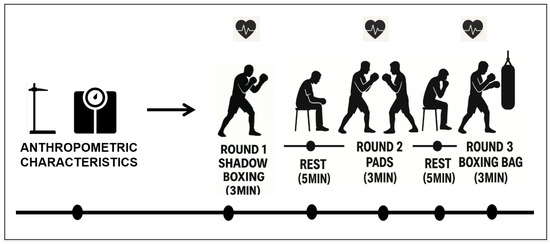
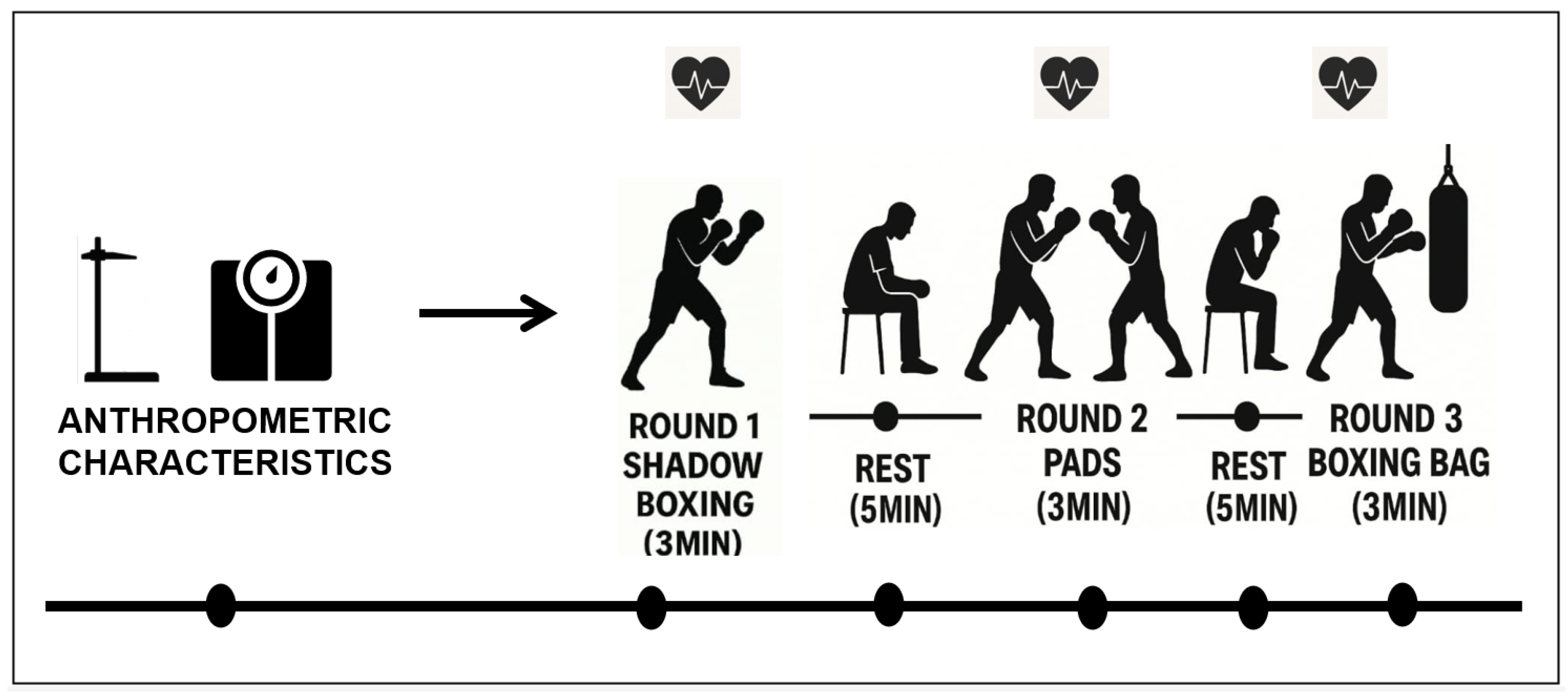
All testing sessions were supervised by the same primary investigator and two certified boxing coaches, and were conducted between 08:00 and 11:30 at the participants’ training facility. Participants were instructed to abstain from caffeine, alcohol and vigorous physical activity for at least 24 h before testing. To minimize learning effects, two familiarization sessions were completed during the week preceding data collection. Anthropometric assessments were performed between 08:00 and 10:00, followed by HR evaluation between 10:00 and 11:30. HR was recorded using a Polar H10 chest strap (Polar Electro Oy, Kempele, Oulu, Finland), a device shown to have high measurement reliability [25]. To ensure physiological stability, participants were also required to refrain from training or strenuous effort during the 48 h prior to data collection. The experimental procedures are detailed in Figure 1.
Figure 1.
Schematic representation of the study design.
2.3. Measures
Anthropometric Characteristics Analysis
Anthropometric characteristics were measured using standardized procedures. BH was measured barefoot to the nearest 0.1 cm using a stadiometer (Seca 217; Birmingham, UK), and BM was assessed with an electronic scale (Seca 713; Hamburg, Germany) with a capacity of 150 kg and accuracy of 100 g, with participants wearing light athletic clothing. Body mass index was calculated as BM/BH2 (kg·m−2). All measurements were performed by a single trained observer to minimize measurement error, following recommendations from standard anthropometric literature [26,27]. Intra-observer reliability was assessed using a test–retest procedure. Three measurements were obtained on two occasions separated by 24 h in a subsample of 10 individuals, following standard anthropometric reliability procedures. Reliability was calculated using the coefficient proposed by Malina et al. [28], r = S12/(S12 + S22), where S12 and S22 represent the variances of the first and second measurement sessions, respectively. The resulting coefficients indicated very high reliability for BH and BM (r ≈ 1.00), reflecting the extremely small technical error of measurement observed for these variables.
2.4. Experimental Protocol
Before the experimental protocol, all participants completed a standardized warm-up consisting of a general component (90 s of rope skipping, shoulder and elbow rotations, frontal and lateral leg swings and lunges) and a specific component (a single 3 min round of self-selected intensity shadowboxing). The experimental protocol comprised three 3 min rounds performed in the fixed order of shadowboxing, pad work and heavy bag work. Rest intervals of 5 min were provided between rounds to ensure adequate physiological recovery, and each round began only when HR had returned to below 60% of age-predicted maximal HR (~110 bpm). During each round, participants executed repeated cycles of maximal-effort strikes consisting of three straight punches, three hooks and three uppercuts. Each sequence of three punches was performed within a 3 s interval. This tempo was standardized using verbal cues provided by the supervising boxing coaches, who ensured that participants maintained a consistent punching frequency throughout the round. The sequence was continuously repeated during the round in order to maintain a controlled and comparable work rate across participants and exercise modalities. This tempo was selected to simulate a high-intensity striking rhythm commonly observed during boxing training while allowing adequate technical execution of each punch type.
2.5. Statistical Analyses
Data were analyzed using IBM SPSS Statistics (version 25.0; IBM Corp., Armonk, NY, USA). Data normality was assessed using the Shapiro–Wilk test, and results are presented as mean ± standard deviation with corresponding 95% confidence intervals. Pearson’s correlation coefficient was used to examine associations between anthropometric characteristics and HR responses, with magnitudes interpreted as trivial (<0.1), small (0.1–0.3), moderate (0.3–0.5), large (0.5–0.7), very large (0.7–0.9) or nearly perfect (>0.9) [29]. Simple linear regression models were applied to predict HR responses from anthropometric variables.
To examine differences in HR responses between exercise modalities (shadowboxing, pads and bag), a repeated-measures analysis of variance (ANOVA) was performed. Sphericity was assessed using Mauchly’s test; when violated, the Greenhouse-Geisser correction was applied. When significant main effects were identified, pairwise comparisons with Bonferroni adjustment were used for post hoc testing. Effect sizes were calculated using partial eta squared (ηp2) and interpreted as small (0.01), medium (0.06) or large (0.14) [30]. Statistical significance was set at p < 0.05.
3. Results
The descriptive characteristics of the participants, including anthropometric measures and heart rate performance variables across shadowboxing, pad work, and heavy bag tasks, are summarized in Table 1.
Table 1.
Descriptive statistics of anthropometric characteristics and heart rate performance variables in male boxing practitioners (values are presented as mean ± standard deviation [95% confidence interval], N = 39).
Table 2 presents the correlation coefficients between anthropometric characteristics and the heart rate performance variables obtained during shadowboxing, pad work, and heavy bag tasks.
Table 2.
Correlation coefficients (r) between anthropometric characteristics and heart rate performance variables (HR_peak and HR_mean) in male boxing practitioners (N = 39).
Table 3, Table 4 and Table 5 present the simple linear regression models used to examine the predictive value of anthropometric characteristics—BH, BM, and BMI—on HR performance variables (HR_peak and HR_mean) during shadowboxing, pad work, and heavy bag tasks. These analyses provide insight into how different anthropometric factors contribute to variations in cardiovascular responses across distinct boxing-related activities.
Table 3.
Simple linear regression models examining the ability of BH to predict heart rate performance variables (HR_peak and HR_mean) during shadowboxing, pad work, and boxing bag tasks in male boxing practitioners (N = 39).
Table 4.
Simple linear regression models examining the ability of BM to predict heart rate performance variables (HR_peak and HR_mean) during shadowboxing, pad work, and boxing bag tasks in male boxing practitioners (N = 39).
Table 5.
Simple linear regression models examining the ability of BMI to predict heart rate performance variables (HR_peak and HR_mean) during shadowboxing, pad work, and boxing bag tasks in male boxing practitioners (N = 39).
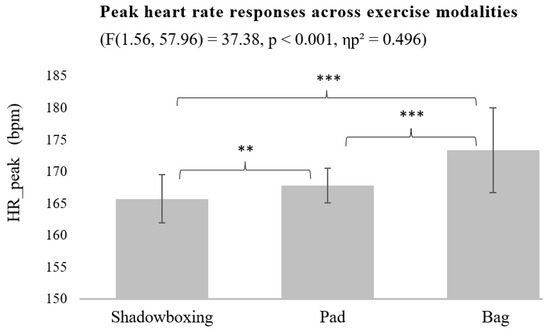
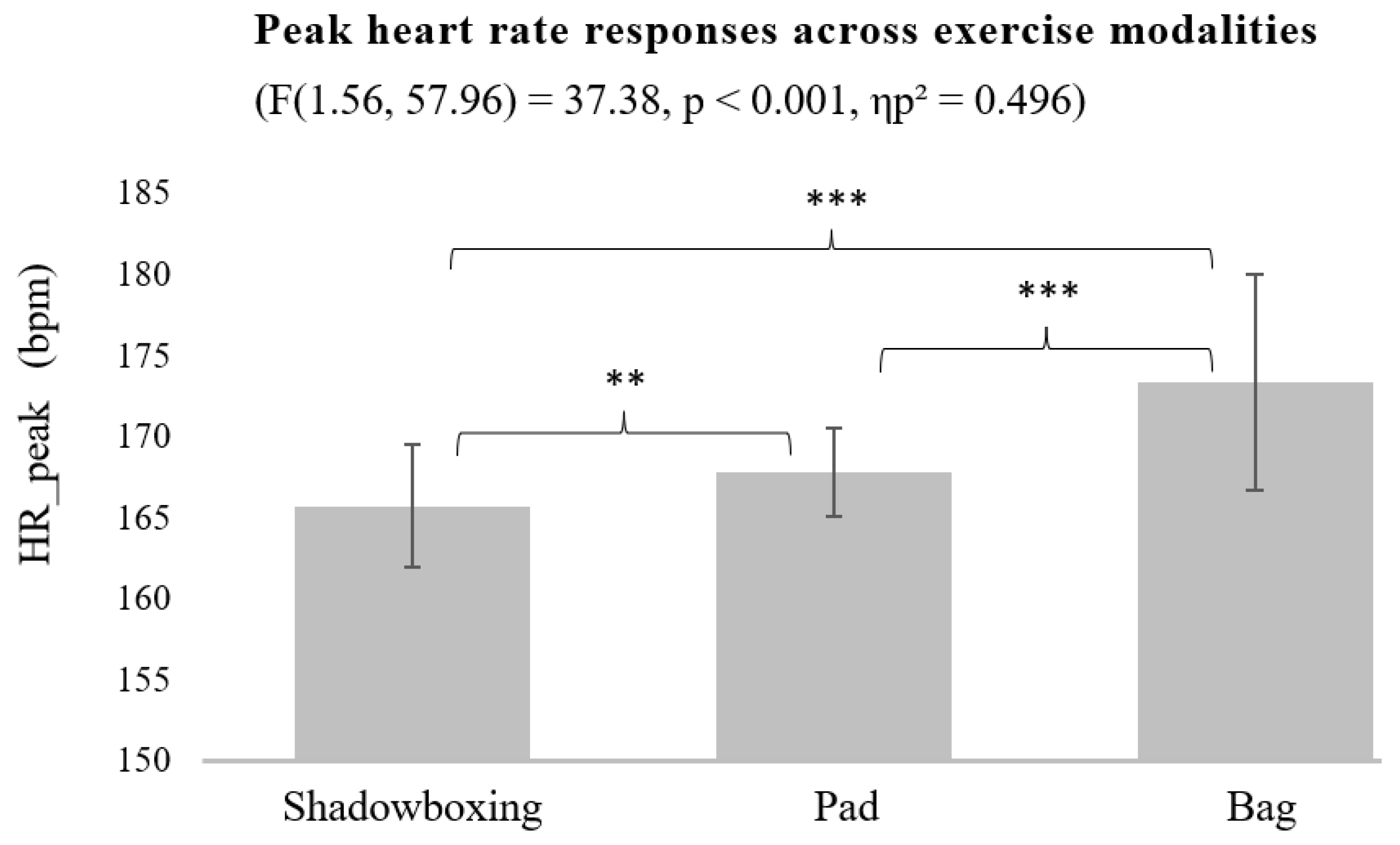
A repeated-measures ANOVA was conducted to compare peak HR (HR_peak) across the three striking exercise tasks (shadowboxing, pad work, and heavy bag). The multivariate test indicated a significant main effect of exercise type, Wilks’ Λ = 0.437, F(2, 37) = 23.807, p < 0.001, ηp2 = 0.563. Mauchly’s test of sphericity indicated a violation of the sphericity assumption, W = 0.719, χ2(2) = 12.215, p = 0.002; therefore, the Greenhouse–Geisser correction was applied (ε = 0.781). The corrected univariate ANOVA confirmed significant differences in HR_peak across exercise modes, F(1.56, 57.96) = 37.38, p < 0.001, ηp2 = 0.496. Post hoc Bonferroni-adjusted pairwise comparisons showed that shadowboxing differed significantly from pad work (p = 0.010) and from heavy bag work (p < 0.001), while the comparison between pad work and heavy bag work was also significant (p < 0.001) (see Figure 2).
Figure 2.
Peak heart rate (HR_peak) responses across boxing exercise modalities (shadowboxing, pad work, and heavy bag work) in recreational male boxing practitioners (n = 39). Values are presented as mean ± standard deviation. A repeated-measures ANOVA revealed significant differences between exercise modalities (F(1.56, 57.96) = 37.38, p < 0.001, ηp2 = 0.496). Pairwise comparisons were performed using Bonferroni correction. Error bars represent standard deviations. ** p < 0.01, *** p < 0.001.
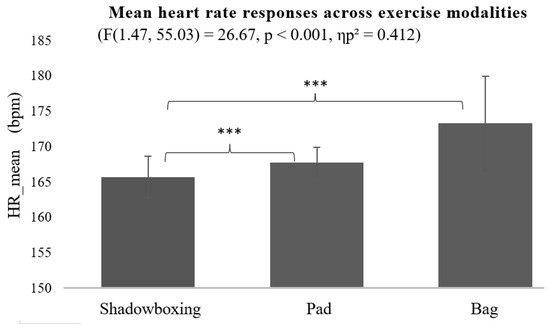
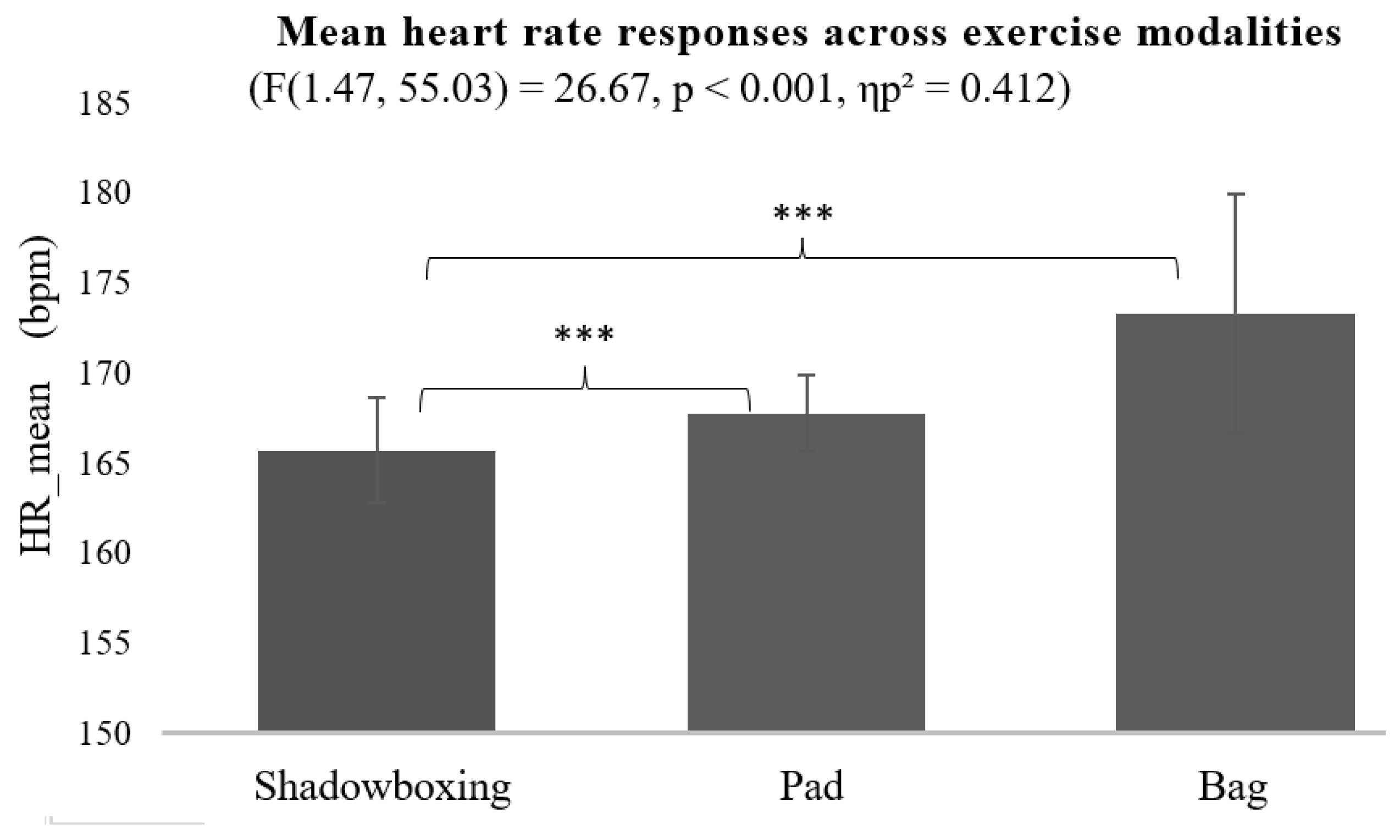
A repeated-measures ANOVA was also conducted to compare HR_mean across the three exercise tasks. The multivariate test indicated a significant main effect of exercise type, Wilks’ Λ = 0.318, F(2, 37) = 39.748, p < 0.001, ηp2 = 0.682. Mauchly’s test indicated that the assumption of sphericity had been violated, W = 0.644, χ2(2) = 16.310, p < 0.001, therefore the Greenhouse–Geisser correction was applied (ε = 0.737). The corrected univariate analysis confirmed a significant effect of exercise task on HR_mean, F(1.47, 55.03) = 26.67, p < 0.001, ηp2 = 0.412. Post hoc Bonferroni-adjusted comparisons indicated significant differences between shadowboxing and pad work (p < 0.001), and between shadowboxing and heavy bag work (p < 0.001), whereas the comparison between pad work and heavy bag did not reach statistical significance (p = 0.095) (see Figure 3).
Figure 3.
Mean heart rate (HR_mean) responses across boxing exercise modalities (shadowboxing, pad work, and heavy bag work) in recreational male boxing practitioners (n = 39). Values are presented as mean ± standard deviation. A repeated-measures ANOVA indicated significant differences between modalities (F(1.47, 55.03) = 26.67, p < 0.001, ηp2 = 0.412). Bonferroni post hoc comparisons revealed significant differences between conditions. Error bars represent standard deviations. *** p < 0.001.
4. Discussion
The present study aimed to analyze how anthropometric characteristics modulate HR responses during three common technical boxing exercises—shadowboxing, pad work and heavy bag work. The results demonstrated clear differences between modalities and revealed systematic associations between BH, BM and BMI with HR responses (Table 1 and Table 2). These findings offer novel insight into how individual morphology contributes to internal load during boxing-specific tasks.
Consistent with previous research describing boxing as a high-intensity, intermittent sport with HR frequently exceeding 85% of age-predicted maximal values [1,7,8], the present study confirmed that even recreational practitioners achieve high physiological intensities during structured striking rounds. Heavy bag work elicited the highest responses (HR_peak = 173.36 ± 6.63 bpm; HR_mean = 160.13 ± 6.64 bpm; Table 1), followed by pad work and shadowboxing (Figure 2 and Figure 3). It should be noted that the exercises were performed in a fixed order (shadowboxing, pad work and heavy bag work), which could theoretically introduce a cumulative fatigue effect on the final task. However, rest intervals of five minutes were implemented between rounds and each new round only began once participants’ HR returned to below 60% of age-predicted maximal HR, in order to minimize residual fatigue. This pattern is aligned with previous studies and highlights the expectation that contact-based exercises impose greater mechanical and neuromuscular demands, thereby eliciting higher HR values—supporting the hypothesis that impact-based exercises would induce greater cardiovascular responses than non-contact tasks [9,10]. Accordingly, shadowboxing produced the lowest HR responses (HR_peak = 165.72 ± 3.79 bpm; HR_mean = 153.59 ± 2.93 bpm), which is consistent with its non-contact nature and reduced mechanical load. Pad work, although involving impact, presented intermediate HR values (HR_peak = 167.79 ± 2.74 bpm; HR_mean = 157.74 ± 2.10 bpm), likely because the technical constraints imposed by the coach’s tempo and target placement limit continuous maximal force application. The heavy bag, by contrast, allows repeated maximal-effort strikes without such constraints, helping explain why HR_mean significantly differed from shadowboxing (p < 0.001) and nearly differed from pad work (p = 0.095), whereas HR_peak differed in all pairwise comparisons. These observations reinforce the biomechanical principle that increased external resistance raises energetic cost, directly influencing cardiovascular load.
The central aim of the present study was to determine whether morphological attributes influence HR responses during technical exercises. The results revealed consistent positive associations between BH, BM and BMI with both HR_peak and HR_mean across modalities (Table 2). These findings confirm the hypothesis that individuals with higher BH exhibit greater HR responses, as taller participants displayed significantly higher HR values, particularly during impact tasks (HR_peak r = 0.658, HR_mean r = 0.511; both p < 0.001).
Similarly, the results support the hypothesis that individuals with higher BM would show elevated HR responses, as BM demonstrated large correlations with HR_peak (r = 0.681) and HR_mean (r = 0.524) during heavy bag work. A similar pattern was observed for BMI, supporting the hypothesis that individuals with higher BMI exhibit higher HR responses, likely due to reduced movement economy and increased energetic demands when displacing greater body mass—a mechanism consistent with previous findings [18,19].
Previous literature often suggests that a higher BMI elicits greater HR responses due to reduced movement economy and the increased energy demands of displacing a larger BM. However, the interpretation of BMI in athletic populations should be approached with caution, as BMI does not distinguish between fat mass and lean body mass. In trained athletes, particularly in combat sports, a higher BMI may therefore reflect greater muscularity rather than increased adiposity [31]. Consequently, BMI may not accurately represent body composition in this population and should be interpreted primarily as a general indicator of body size rather than a direct proxy for fatness.
In the context of combat sports practitioners, a higher BMI and BM often reflect a greater proportion of metabolically active muscle mass. This greater muscle mass requires increased oxygen delivery and metabolic support during high-intensity efforts, which may contribute to elevated cardiovascular responses during repeated striking actions. Therefore, the positive association observed between BMI and HR responses in the present study may be partially explained by the increased metabolic demand associated with greater lean tissue involvement rather than by reduced movement economy alone.
Furthermore, it is crucial to contextualize these findings within the demands of the experimental protocol, which imposed a continuous and a standardized work rate of three punches performed every three seconds. From a biomechanical perspective, the higher HR responses observed in individuals with greater BH may be partially related to the increased acceleration and deceleration demands of longer and heavier upper limbs during repeated striking actions. This greater segmental inertia may require increased muscular effort to maintain the predetermined punching frequency, potentially contributing to elevated cardiovascular responses [14]. Consequently, this fixed rhythm likely amplified the metabolic load in larger athletes by preventing them from adopting a biomechanically optimal pacing strategy suited to their morphology [32].
Finally, the observation that heavy bag work induced the most extreme cardiovascular responses cannot be explained solely by the absence of the timing and target placement restrictions typically imposed by a trainer during pad work. Impact kinetics play a crucial role in this disparity. The mechanical resistance and rebound effect generated by the heavy bag’s inertia require intense isometric stabilization of the trunk (core) and lower limb musculature to absorb and redirect force [33]. This heightened global neuromuscular recruitment—largely absent in non-contact or lower-impact modalities—is a key determinant of the greater physiological load observed during this specific task [34].
Regression models (Table 3, Table 4 and Table 5) further substantiate the influence of anthropometric characteristics. BH explained approximately 23–36% of the variance in HR responses during shadowboxing and pad work, whereas BM and BMI exhibited their strongest predictive capacity during heavy bag work, explaining up to 46% of the variance in HR_peak and 27% in HR_mean. These results complement earlier research [15], which reported that individuals with higher BH and BM produce higher impact forces, thereby increasing mechanical output and metabolic cost. The present findings extend this knowledge by demonstrating that morphology meaningfully modulates cardiovascular responses even under standardized technical constraints during boxing-specific actions.
Taken together, the results confirm all conceptual expectations: greater BH, BM and BMI are associated with higher HR responses across tasks, and impact-based exercises elicit greater cardiovascular demand than non-contact drills. These outcomes underscore the importance of considering anthropometric profiles when evaluating internal load or prescribing training intensities in boxing, as individuals with larger body dimensions may experience disproportionately higher physiological stress during identical technical workloads.
5. Limitations
This study provides valuable insight into how anthropometric characteristics (BH, BM and BMI) modulate HR responses during distinct technical boxing exercises; however, several limitations must be acknowledged. First, the sample consisted exclusively of recreational male boxing practitioners with relatively modest and heterogeneous training experience. As such, the findings may not represent novice athletes, female practitioners or elite-level boxers, who may exhibit different mechanical efficiency and HR responses. Future research should therefore include participants across broader experience levels to enhance external validity.
Second, all participants were recruited from the same boxing facility and were exposed to similar coaching strategies and training environments. Although this approach reduces methodological variability, it limits the generalizability of the results to athletes from other gyms, where technical focus, training tempo and striking methodologies may differ and subsequently influence HR responses. Including diverse training settings would provide a more comprehensive understanding of physiological demands in boxing.
Third, the cross-sectional design prevents causal inference regarding the influence of BH, BM and BMI on HR. Longitudinal or intervention-based studies are needed to determine how changes in anthropometry or technique affect HR responses over time. Finally, the study relied exclusively on HR as an indicator of internal load; although HR is a valid metric, the absence of complementary physiological variables (e.g., lactate, VO2, RPE) limits the depth of physiological interpretation. Combining HR with additional markers could lead to a more complete characterization of internal load in boxing.
6. Conclusions
This study demonstrates that anthropometric characteristics—particularly higher BH, BM and BMI—meaningfully influence HR responses during boxing-specific tasks. Individuals with larger body dimensions exhibited higher HR_peak and HR_mean across all modalities, with the strongest effects observed during heavy bag work, where impact and mechanical demands are greatest. These findings indicate that morphology interacts with task-specific mechanical requirements to shape internal load, even when the exercise structure is standardised.
Furthermore, the study confirmed that contact-based exercises elicit higher HR responses than non-contact tasks. The observed hierarchy—shadowboxing < pad work < heavy bag—reinforces the role of impact, external resistance and mechanical work in determining physiological intensity. This highlights the importance of differentiating between technical tasks when monitoring internal load or prescribing training intensities.
Overall, these results underscore the relevance of integrating anthropometric profiles into training design and load interpretation. Practitioners with higher BH, BM or BMI may experience disproportionately elevated HR responses during technical drills, suggesting the need for individualized load adjustments. These findings can guide coaches and practitioners in optimizing training prescription and internal load monitoring in both recreational and competitive boxing contexts.
7. Practical Application
The findings of this study offer meaningful guidance for coaches and strength and conditioning professionals seeking to optimise internal load management and technical training in boxing. Two key practical applications emerge from the results:
First, training prescription should consider individual anthropometric characteristics—particularly BH, BM and BMI—when interpreting HR responses during technical drills. Practitioners with higher BH, BM or BMI exhibited systematically greater HR_peak and HR_mean across modalities, especially during heavy bag work. This suggests that larger athletes may experience disproportionately higher cardiovascular strain under identical training conditions. Coaches are therefore encouraged to individualise training intensity and recovery strategies, ensuring that athletes with greater body dimensions are not unintentionally exposed to excessive internal load. Monitoring HR throughout boxing-specific drills can help adjust round duration, tempo and drill selection to maintain appropriate training zones.
Second, the substantial differences in HR between shadowboxing, pad work and heavy bag work highlight the importance of selecting exercise modalities based on the intended physiological target. Shadowboxing may be more suitable for technical refinement, warm-up routines or low-intensity conditioning, given its lower HR demands. Pad work represents a moderate-intensity option that balances technical precision and metabolic load, while heavy bag training should be prioritised when the goal is to elicit high-intensity cardiovascular stress. Integrating modality-specific HR profiles into training planning allows practitioners to structure sessions more effectively, modulate internal load and avoid unintended fatigue accumulation.
Together, these findings reinforce the utility of HR monitoring as a practical tool in boxing training and underscore the need to account for anthropometric differences when designing and evaluating conditioning programmes. Incorporating individual morphology into training decisions may enhance performance outcomes, support athlete well-being and improve the efficiency of technical and physical development in both recreational and competitive boxing settings.
Author Contributions
Conceptualization, M.P., J.C. and L.M.; methodology, M.P., J.C. and L.M.; validation, M.P., J.C. and L.M.; formal analysis, M.P. and J.C.; investigation, M.P., J.C. and L.M.; data curation, L.M.; writing—original draft preparation, M.P. and L.M.; writing—review and editing, J.C.; supervision, L.M. All authors have read and agreed to the published version of the manuscript.
Funding
This research received no external funding.
Institutional Review Board Statement
Not applicable.
Informed Consent Statement
Not applicable.
Data Availability Statement
Data generated or analyzed during this study are available from the corresponding author upon reasonable request.
Conflicts of Interest
The authors declare no conflict of interest.
References
- Arseneau, E.; Mekary, S.; Léger, L.A. VO2 requirements of boxing exercises. J. Strength Cond. Res. 2011, 25, 348–359. [Google Scholar] [CrossRef] [Scilit] [PubMed]
- Dunn, E.C.; Humberstone, C.E.; Franchini, E.; Iredale, F.K.; Blazevich, A.J. The effect of fatiguing lower-body exercise on punch forces in highly-trained boxers. Eur. J. Sport Sci. 2021, 22, 964–972. [Google Scholar] [CrossRef] [Scilit] [PubMed]
- Chaabène, H.; Tabben, M.; Mkaouer, B.; Franchini, E.; Negra, Y.; Hammami, M.; Amara, S.; Chaabène, R.B.; Hachana, Y. Amateur boxing: Physical and physiological attributes. Sports Med. 2015, 45, 337–352. [Google Scholar] [CrossRef] [Scilit]
- International Boxing Association. Technical and Competition Rules; International Boxing Association: Lausanne, Switzerland, 2023; Available online: https://www.iba.sport (accessed on 13 February 2026).
- Hristovski, R.; Davids, K.; Araújo, D.; Button, C. How boxers decide to punch a target: Emergent behaviour in nonlinear dynamical movement systems. J. Sports Sci. Med. 2006, 5, 60. [Google Scholar]
- Nassib, S.; Hammoudi-Nassib, S.; Chtara, M.; Mkaouer, B.; Maaouia, G.; Bezrati-Benayed, I.; Chamari, K. Energetic demands and physiological responses to a boxing match and subsequent recovery. J. Sports Med. Phys. Fit. 2016, 57, 8–17. [Google Scholar] [CrossRef] [Scilit]
- Ghosh, A.K. Heart rate, oxygen consumption and blood lactate responses during specific training in amateur boxing. Int. J. Appl. Sports Sci. 2010, 22, 1–12. [Google Scholar] [CrossRef] [Scilit]
- de Lira, C.A.B.; Peixinho-Pena, L.F.; Vancini, R.L.; de Freitas Guina Fachina, R.J.; de Almeida, A.A.; Andrade, M.D.S.; da Silva, A.C. Heart rate response during a simulated Olympic boxing match is predominantly above ventilatory threshold 2: A cross sectional study. Open Access J. Sports Med. 2013, 4, 175–182. [Google Scholar] [CrossRef] [Scilit]
- Portela, B.S.; Barbosa, M.R.; Cavazzotto, T.G.; Tartaruga, M.P. Kinematics analysis of the front kick with and without impact in traditional karate. Sci. Martial Arts 2014, 30, 21. [Google Scholar]
- Madadi Shad, M.; Farahpour, N. A comparison of activity of selected shoulder girdle muscles in boxers during punch kick using three different techniques. Sport Sci. Health Res. 2016, 8, 83–97. [Google Scholar]
- Ruddock, A.D.; Wilson, D.C.; Thompson, S.W.; Hembrough, D.; Winter, E.M. Strength and conditioning for professional boxing: Recommendations for physical preparation. Strength Cond. J. 2016, 38, 81–90. [Google Scholar] [CrossRef] [Scilit]
- Walilko, T.; Viano, D.; Bir, C. Biomechanics of the head for Olympic boxer punches to the face. Br. J. Sports Med. 2005, 39, 710. [Google Scholar] [CrossRef] [Scilit]
- Pierce, J.D.; Reinbold, K.A.; Lyngard, B.C.; Goldman, R.J.; Pastore, C.M. Direct measurement of punch force during six professional boxing matches. J. Quant. Anal. Sports 2006, 2, 1–19. [Google Scholar] [CrossRef] [Scilit]
- Lenetsky, S.; Harris, N.K.; Brughelli, M. Assessment and contributors of punching forces in combat sports athletes: Implications for strength and conditioning. Strength Cond. J. 2013, 35, 1–7. [Google Scholar] [CrossRef] [Scilit]
- Pinto, M.; Crisóstomo, J.; Kirk, C.; Abián-Vicén, J.; Monteiro, L. Influence of anthropometric characteristics and muscle performance on punch impact. Sports 2025, 13, 281. [Google Scholar] [CrossRef] [Scilit]
- Filimonov, V.I.; Koptsev, K.N.; Husyanov, Z.M.; Nazarov, S.S. Boxing: Means of increasing strength of the punch. Strength Cond. J. 1985, 7, 65–66. [Google Scholar]
- Piorkowski, B.A.; Lees, A.; Barton, G.J. Single maximal versus combination punch kinematics. Sports Biomech. 2011, 10, 1–11. [Google Scholar] [CrossRef] [Scilit]
- Gonçalves, R.; Szmuchrowski, L.A.; Damasceno, V.O.; Medeiros, M.L.D.; Couto, B.P.; Lamounier, J.A. Association of body mass index and aerobic physical fitness with cardiovascular risk factors in children. Rev. Paul. Pediatr. 2014, 32, 208–214. [Google Scholar] [CrossRef] [Scilit] [PubMed]
- Kumar, N.; Laroiya, N. Association of VO2 max, agility and BMI among collegiate athletes. Ann. Sports Med. Res. 2017, 4, 1121. [Google Scholar]
- Beattie, K.; Ruddock, A.D. The Role of Strength on Punch Impact Force in Boxing. J. Strength Cond. Res. 2022, 36, 2957–2969. [Google Scholar] [CrossRef] [Scilit]
- Dunn, E.C.; Humberstone, C.E.; Franchini, E.; Iredale, K.F.; Blazevich, A.J. Relationships Between Punch Impact Force and Upper- and Lower-Body Muscular Strength and Power in Highly Trained Amateur Boxers. J. Strength Cond. Res. 2022, 36, 1019–1025. [Google Scholar] [CrossRef] [Scilit]
- López-Laval, I.; Sitko, S.; Muñiz-Pardos, B.; Cirer-Sastre, R.; Calleja-González, J. Relationship Between Bench Press Strength and Punch Performance in Male Professional Boxers. J. Strength Cond. Res. 2020, 34, 308–312. [Google Scholar] [CrossRef] [Scilit]
- Loturco, I.; Pereira, L.A.; Kobal, R.; Fernandes, V.; Reis, V.P.; Romano, F.; Alves, M.; Freitas, T.T.; McGuigan, M. Transference Effect of Short-Term Optimum Power Load Training on the Punching Impact of Elite Boxers. J. Strength Cond. Res. 2021, 35, 2373–2378. [Google Scholar] [CrossRef] [Scilit]
- World Medical Association. World Medical Association Declaration of Helsinki: Ethical principles for medical research involving human subjects. JAMA 2013, 310, 2191–2194. [Google Scholar] [CrossRef] [Scilit] [PubMed]
- Schaffarczyk, M.; Rogers, B.; Reer, R.; Gronwald, T. Validity of the Polar H10 sensor for heart rate variability analysis during resting state and incremental exercise in recreational men and women. Sensors 2022, 22, 6536. [Google Scholar] [CrossRef] [Scilit] [PubMed]
- Sobral, F.; Silva, M.J.C. Cineantropometria: Curso Básico; Edições FMH: Cruz Quebrada, Portugal, 1997. [Google Scholar]
- Lohman, T.G. Anthropometric Standardization Reference Manual; Human Kinetics: Champaign, IL, USA, 1988. [Google Scholar]
- Malina, R.M.; Hamill, P.V.; Lemeshow, S. Selected Body Measurements of Children 6–11 Years, United States; Vital and Health Statistics Series 11, No. 31; National Center for Health Statistics: Hyattsville, MD, USA, 1973.
- Hopkins, W.G.; Marshall, S.W.; Batterham, A.M.; Hanin, J. Progressive statistics for studies in sports medicine and exercise science. Med. Sci. Sports Exerc. 2009, 41, 3–13. [Google Scholar] [CrossRef] [Scilit]
- Gaskill, B.N.; Garner, J.P. Power to the people: Power, negative results and sample size. J. Am. Assoc. Lab. Anim. Sci. 2020, 59, 9–16. [Google Scholar] [CrossRef] [Scilit]
- Reale, R.; Burke, L.M.; Cox, G.R.; Slater, G. Body composition of elite Olympic combat sport athletes. Eur. J. Sport Sci. 2019, 20, 147–156. [Google Scholar] [CrossRef] [Scilit]
- Miarka, B.; Coswig, V.S.; Dell Vecchio, F.B.; Brito, C.; Amtmann, J. Comparisons of Time-motion Analysis of Mixed Martial Arts Rounds by Weight Divisions. Int. J. Perform. Anal. Sport 2015, 15, 1189–1201. [Google Scholar] [CrossRef] [Scilit]
- McGill, S.M.; Chaimberg, J.D.; Frost, D.M.; Fenwick, C.M.J. Evidence of a double peak in muscle activation to enhance strike speed and force: An example with elite mixed martial arts fighters. J. Strength Cond. Res. 2010, 24, 348–357. [Google Scholar] [CrossRef] [Scilit] [PubMed]
- Bridge, C.A.; Jones, M.A.; Drust, B. The activity profile in international taekwondo competition is modulated by weight category. Int. J. Sports Physiol. Perform. 2011, 6, 344–357. [Google Scholar] [CrossRef] [Scilit]

Disclaimer/Publisher’s Note: The statements, opinions and data contained in all publications are solely those of the individual author(s) and contributor(s) and not of MDPI and/or the editor(s). MDPI and/or the editor(s) disclaim responsibility for any injury to people or property resulting from any ideas, methods, instructions or products referred to in the content. |
© 2026 by the authors. Licensee MDPI, Basel, Switzerland. This article is an open access article distributed under the terms and conditions of the Creative Commons Attribution (CC BY) license.