


Abstract
The global maritime industry, a critical pillar of international trade, continues to face persistent challenges in ensuring the integrity, security, and transparency of containerized cargo data, particularly during ocean transport. Traditional container tracking systems at sea often lack the reliability and resilience required to prevent data tampering, cyber threats, and operational inefficiencies. As supply chains become more complex and interconnected, the demand for robust, end-to-end data security solutions becomes more pressing. A promising technological advancement in this area is the convergence of smart containers, equipped with Internet of Things (IoT) sensors for real-time condition monitoring, and blockchain technology (BCT) for secure data validation. These IoT devices facilitate continuous tracking of critical parameters such as location, temperature, humidity, tilt, and the like. However, the data they generate remains vulnerable to cyberattacks, signal disruptions, and unauthorized alterations. Blockchain’s decentralized and tamper-evident architecture addresses these vulnerabilities by enabling secure data immutability, transparent audit trails, and enhanced stakeholder trust. Despite its potential, the practical integration of blockchain with smart container systems in maritime logistics remains largely underexplored. To bridge this gap, this paper proposes a blockchain-enabled smart container monitoring system that combines container real-time data with secure physical tracking. Furthermore, to ensure scalability and efficient in data storage, hybrid on/off-chain architecture is introduced, balancing blockchain integrity with performance and resource optimization.
1. Introduction
Shipping containers are the cornerstone of global trade, facilitating the efficient movement of goods and supporting just-in-time logistics systems. Approximately 90% of non-bulk cargo is transported via container ships, with an estimated 65 million containers currently in circulation worldwide [1,2]. The standardization of containers has revolutionized global logistics, establishing them as symbols of international commerce. Notably, around 20% of the global container fleet now consists of smart containers, with a figure projected to rise to 30% by 2027 due to the advancements in telematics [3,4].
Smart containers, equipped with sensors and communication modules, offer real-time tracking and predictive analytics, which significantly improve supply chain visibility, safety, and operational efficiency [5]. The integration of the IoT has been pivotal in this transformation, despite ongoing challenges such as limited connectivity, cybersecurity vulnerabilities, and a lack of standardization [6]. Leading shipping companies are increasingly leveraging IoT technologies to enhance operational efficiency and security of transporting high-value, sensitive, or hazardous goods. These specific goods include perishables, pharmaceuticals, electronics, nuclear waste, and luxury items, which require strict environmental control and continuous monitoring [7,8,9,10,11,12,13]. Smart containers can monitor parameters such as temperature and humidity, issuing alerts to mitigate risks [14], etc. Furthermore, satellite-based IoT systems and Automatic Identification System (AIS) technologies enhance both tracking and navigational safety [15].
Despite these advancements, documentation bottlenecks, particularly surrounding the Bill of Lading (BoL), persist. The BoL serves as a receipt, proof of ownership, and contract of carriage [16], while traditional paper-based BoLs are vulnerable to fraud, delays, and administrative errors. The BCT, with its decentralized and tamper-proof architecture, presents a compelling alternative. By enabling secure and transparent documentation, it significantly enhances traceability, minimizes the risk of fraud, and streamlines workflow processes, particularly through the adoption of electronic BoL (eBL). Platforms such as Bolero, essDOCS, and CargoX have already demonstrated the potential of blockchain technology in digitizing trade documents [17]. However, many of these initiatives have failed, and they have simply ceased to exist [18,19]. Blockchain has been great promise for the maritime logistics sector, but one aspect remains in demand, and that is better data security. This study is a further step in this direction, where well-known blockchain technology is being integrated with smart-container implementation process and its use within maritime logistics chain.
Nevertheless, key questions remain regarding the effectiveness of smart container tracking in open-sea environments. These include the design and deployment of blockchain-based code for data security, and the real-world integration and validation of these technologies in maritime operations. Therefore, this study aims to address these challenges by conducting experiments on smart container tracking, developing secure blockchain-based mechanisms for data integrity, and validating their integration in maritime logistics. The proposed approach is based on the Do-It-Yourself (DIY) smart cargo container tracking prototype developed by Bauk & Dzankic [20]. It combines real-time tracking with verifiable, tamper-proof documentation and hybrid on/off-chain storage, enhancing both scalability and security.
The rest of the paper is organized as follows: Section 2 presents a review of the relevant literature; Section 3 outlines problem statement; Section 4 presents applied methodology; Section 5 details an experimental investigation that demonstrates the use of a local blockchain server for smart container secured tracking; Section 6 provides the conclusions, while Section 7 discloses limitations, offering recommendations for future research.
2. Literature Review
From an operational perspective, smart containers have enhanced logistics efficiency and sustainability. Simulation studies indicate that their adoption can reduce fleet sizes, shorten processing times, and decrease pick-up distances [21], resulting in lower fuel consumption, reduced emissions, and minimized idle time. Simultaneously, telematics platforms leverage container data to improve cargo security and support decision-making during disruptions [22].
On a broader scale, Smart Maritime Container Terminals (SMCTs) have become central to port modernization by integrating advanced technologies. Smart port terminals utilize machine learning, computer vision, and real-time analytics to automate maintenance and conduct more accurate container damage inspections [23]. Such automation reduces human error, boosts operational efficiency, and enables ports to handle larger cargo volumes with greater speed and precision.
Blockchain technology is another key enabler for smart containers, providing secure data management and fostering trust among multiple supply chain stakeholders. Systems such as CryptoCargo record container conditions and violations via blockchain-based smart contracts, generating transparent, tamper-proof records [24]. This capability is particularly valuable for ensuring reliable and verifiable access to data for owners, shippers, insurers, financiers, and regulators.
Smart containers deliver benefits across multiple dimensions: technological (e.g., advanced sensors, satellite tracking, artificial intelligence, etc.), operational (e.g., faster, more reliable, and eco-friendly logistics, etc.), and strategic (e.g., enhanced visibility, regulatory compliance, and sustainability, etc.) [25]. However, widespread adoption faces several barriers, including high initial costs, cybersecurity and data privacy concerns, and the lack of global standards for data sharing and system integration [26,27]. Addressing these challenges requires coordinated collaboration among customers, logistics providers, policymakers, and technology developers, alongside investments in training and digital skills to ensure stakeholders across the maritime cluster can fully leverage smart container capabilities.
The strategic importance of these technologies has also been recognized by international organizations. UNCTAD [28] highlighted that digital tools such as IoT and automation are essential for enhancing global maritime transport in the face of growing cargo volumes and stricter environmental regulations. Similarly, the UNECE [29] noted that smart containers improve customs compliance, reduce border delays, and support risk management in international trade, while emphasizing that data standardization, interoperability, and strong public–private partnerships are critical for large-scale and effective deployment.
2.1. Smart Cargo Containers Applications
Given the rising global demand for energy and the strategic goal of achieving clean, low-carbon electricity by 2050, the utilization and international transport of nuclear materials are expected to increase [30]. Maritime transport, which accounts for most of the global cargo movement, will play a critical role in supporting this growth. However, the shipment of radioactive substances, such as irradiated nuclear fuel, plutonium, and radioactive waste, poses unique safety, security, and regulatory challenges, particularly in terms of continuous monitoring, safeguarding, and risk mitigation across long distances and complex operational environments. To address these challenges, Bauk [10] proposed adapting the ARG-US Radio Frequency Identification (RFID) system, originally developed by Argonne National Laboratory for road and rail transport, for maritime applications. This adaptation involves affixing RFID chips with environmental and tamper-detection sensors to transport containers. The chips monitor key parameters, including temperature, humidity, shock, and radiation levels, while linking to a vessel’s onboard monitoring and communication systems. This setup enables real-time data exchange with business entities, port authorities, and regulatory bodies. Furthermore, evolving ARG-US technologies [13] should be integrated with digital platforms such as the Traveler system, which supports the full lifecycle management of nuclear materials by maintaining secure, authenticated records of storage, handling, and transit. Together, these systems uphold the international Safety, Security, and Safeguards (3S) framework, which ensures that all movements of radioactive cargo are continuously tracked and fully auditable.
In parallel, innovations in blockchain and IoT technologies offer enhanced cargo security and supply chain transparency, providing relevant solutions for logistics. For example, Tsai & Shen [31] proposed a blockchain-based smart contract system integrated with IoT-enabled smart containers, originally developed for the floral supply chain. These containers continuously monitor environmental conditions, automatically triggering alerts when thresholds are exceeded. Data is immutably recorded on the Ethereum blockchain, while images are securely stored on the InterPlanetary File System (IPFS) to improve traceability. Smart contracts automate inspections, payments, and dispute resolution, reducing manual labor and potential fraud. Testing revealed, however, that false alerts from unreliable sensors could increase operational costs, highlighting the need for robust IoT devices.
A similar blockchain-based approach was developed by Baygin et al. [32], who designed a smart cargo management system for local distribution networks. This system combined UHF-RFID, IoT sensors, and Ethereum smart contracts to improve security, transparency, and automation in logistics. Environmental data were stored on cost-effective cloud servers, while blockchain ensured tamper-proof transactions. Testing confirmed successful integration among components, resulting in reduced paperwork, lower labor costs, and increased trust among stakeholders.
In the refrigerated cargo sector, Lukasse et al. [33] investigated advancements in smart reefer containers for fresh produce. Modern reefers increasingly incorporate Controlled Atmosphere (CA) systems, used in approximately 15% of units, to extend shelf life and reduce food waste. Energy-efficient refrigeration units and low-carbon refrigerants such as R513A and CO2 are also being adopted to meet climate goals. IoT sensors and digital twins enable real-time monitoring and predictive analytics, although challenges remain regarding data integration, temperature uniformity, and market consolidation. Nevertheless, shifting from airfreight to maritime reefers, which have a significantly lower CO2 footprint (approximately 60:1), demonstrates the environmental and operational benefits of these technologies.
Despite their potential, widespread implementation of digital technologies faces significant barriers. Nguyen et al. [34], drawing on over 30+ industry interviews, identified ten key obstacles to blockchain adoption in container shipping, including technical complexity, data privacy concerns, regulatory ambiguity, and uneven stakeholder engagement. While early adopters, such as certain shipping companies, drove innovation, other actors, including freight forwarders, remained hesitant due to high costs and perceived disruption. Furthermore, the same authors emphasized that education, phased adoption, and stronger policy support are essential to bridge the gap between blockchain’s potential and its practical application in maritime logistics.
2.2. Smart Cargo Containers on Blockchain
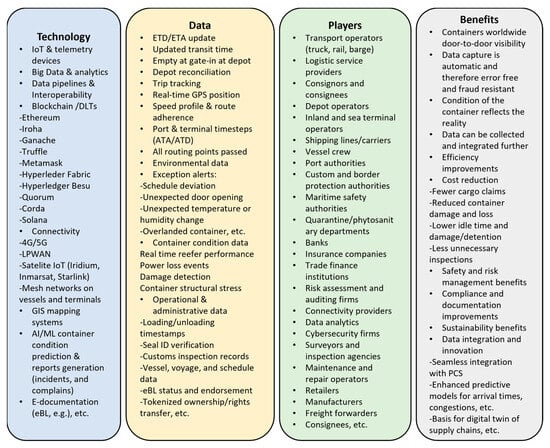
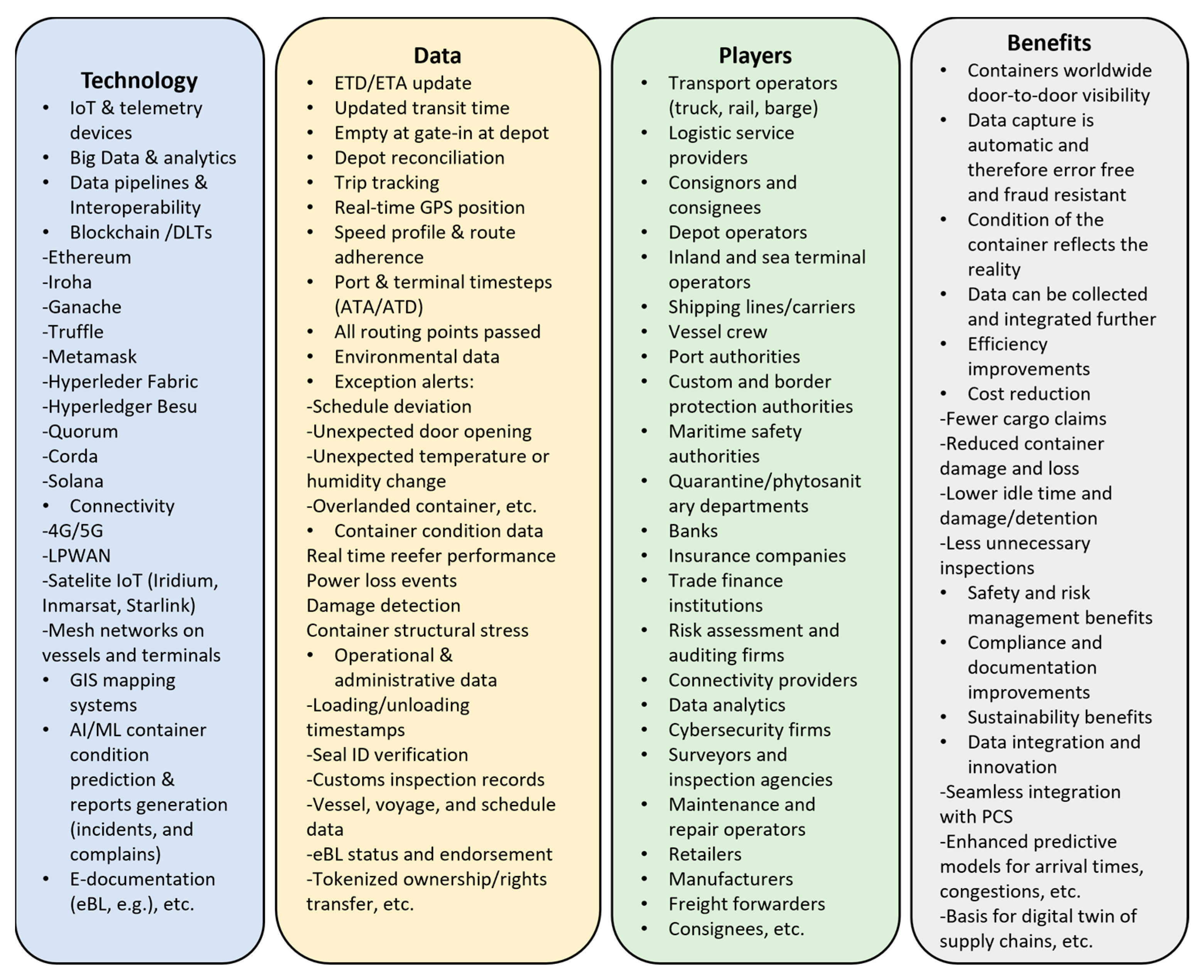
The integration of blockchain technology into smart container systems remains an emerging and under-researched area, with relatively scarce publications. The UNECE white paper [29] provided a foundational overview of smart containers within the context of IoT, big data, blockchain, and data pipeline frameworks (Figure 1). Building on this, Iakushkin et al. [35] proposed an architectural model for tracking and tracing (T&T) smart containers using the permissioned Hyperledger Iroha blockchain to record location and status data. Elmay et al. [36] explored similar concepts for unimodal and multimodal logistics, employing the Ethereum blockchain and InterPlanetary File System (IPFS) to enable decentralized and secure data storage. Baygin et al. [32] demonstrated a blockchain-based T&T system integrating UHF-RFID technology, with implementation via Solidity and tools such as Ganache, Truffle, and Metamask, while Meyer et al. [37] proposed a blockchain interoperability framework for T&T of smart containers within the Physical Internet (PI).
Figure 1.
Smart container technology, data, players, and benefits.
A broader examination by Farah et al. [38] highlighted blockchain’s potential to enhance transparency, traceability, and operational efficiency in the maritime sector. They emphasized smart contracts for automating transactions and discussed cybersecurity challenges and network infrastructure limitations faced by ports and vessels. Balci & Surucu-Balci [39] empirically investigated blockchain adoption in Taiwanese maritime firms, analyzing such factors as process virtualization, interorganizational trust (competence, goodwill, and contractual trust), and institutional pressures (mimetic, coercive, and normative). Their findings identified perceived technological control, all three trust dimensions, and coercive institutional pressure as key adoption drivers, with market turbulence positively moderating the relationship between competence-based trust and adoption intention.
Wang et al. [40] similarly analyzed blockchain integration, highlighting benefits such as enhanced transparency and traceability, as well as implementation strategies and cybersecurity risks, reinforcing the observations of Farah et al. [38]. Extending this work, Wang et al. [41] developed a blockchain-based platform for supervising dangerous goods in supply chains. Their multi-layered architecture leveraged smart contracts and IPFS for decentralized data sharing, addressing challenges such as data silos and limited cross-agency accountability. Prototype implementation demonstrated improved transparency, data integrity, and accountability. Furthermore, Liu’s et al. [42] survey paper provides a comprehensive analysis of blockchain consensus mechanisms by decomposing the consensus process into block generation and validation phases, while reviewing state-of-the-art optimization strategies for mainstream protocols. Research further introduces a TOPSIS-based multi-criteria evaluation model to quantitatively rank sixty improved mechanisms based on performance metrics such as security, energy efficiency, and scalability.
From a strategic perspective, Li et al. [43] modeled blockchain adoption timing for two competing shipping companies under market uncertainty. Using game theory, they compared early (ex-ante), delayed (ex-post), and sequential adoption strategies, revealing that coordinated ex-post adoption yielded mutually beneficial outcomes, whereas simultaneous early adoption often resulted in suboptimal performance akin to a Prisoner’s Dilemma.
Research at the intersection of blockchain and IoT further underscores opportunities in maritime logistics [44,45], providing frameworks for enhanced cargo visibility, real-time condition monitoring, and secure documentation. These studies highlight blockchain’s transformative potential: by enabling smart contracts, improving traceability, and reducing data fragmentation. Blockchain offers a decentralized and secure solution for long-lasting industry challenges, particularly in the supervision of sensitive goods. However, its adoption is shaped by organizational trust, regulatory pressures, and perceived technological control, while successful implementation often relies on strategic timing and cross-sector collaboration.
Tsiulin et al. [46] provide a conceptual framework categorizing blockchain applications in the maritime industry into three core areas: document workflow management, financial processes, and device connectivity. Their systematic review highlights that while these areas are interlinked, current implementations have yet to integrate all three simultaneously to fully address the communication and security inefficiencies prevalent in traditional port management. Furthermore, Tsiulin et al. [47] identify 18 critical challenges to blockchain adoption across organizational, operational, human, and technological dimensions, underscoring how uneven levels of digitalization among ports significantly hinder implementation. The authors caution that “one-party ownership” of blockchain initiatives may undermine decentralization and foster new monopolistic structures, while also complicating the allocation of responsibility in the situation of data breaches within distributed networks. Bauk [48] proposes a conceptual framework for a blockchain-based maritime supply chain system through the Blockshipping platform, which employs a decentralized container registry to support real-time tracking and intelligent “just-in-time” container allocation. While the framework enhances data visibility and risk assessment, the study highlights a critical limitation: blockchain systems cannot inherently prevent fraudulent or inaccurate data from being recorded on the ledger. Through a study involving maritime stakeholders in a developing maritime environment, Bauk & Ntshangase [49] ranked the key BCT implementation barriers in emerging maritime environments and identified the absence of government regulation as the fundamental cause of slow adoption. Although it has been shown that BCT has the potential to significantly reduce smart containers delivery delays, the authors conclude that concerns over sharing sensitive business information remain a central “linkage” barrier, triggering cascading resistance among stakeholders.
2.3. Cybersecurity Concerns
With billions of Internet-connected devices capable of communication and data exchange, the Internet of Things (IoT) has rapidly transformed multiple sectors, including healthcare, maritime transportation, agriculture, oil and gas, and logistics [50]. In logistics, many transported goods are perishable or fragile and require strictly controlled environmental conditions. However, most commercial containers have traditionally lacked integrated IoT capabilities for real-time environmental monitoring and remote data transmission, highlighting the need for IoT-enabled smart container solutions.
Despite their potential, IoT devices are inherently vulnerable to cybersecurity threats such as Denial of Service (DoS), Man-in-the-Middle (MITM), and replay attacks, largely due to limited computational and energy resources [51]. Consequently, robust cybersecurity architectures are essential for the safe deployment of smart containers. Xie et al. [52] address adversarial threat modeling by employing the Dolev-Yao and Canetti-Krawczyk frameworks to analyze an attacker’s ability to manipulate public channels or access compromised session secrets. The security analysis extends beyond simple data integrity by treating internal group members as untrusted and implementing specific cryptographic defenses against active MITM, replay, and collusion attacks. Furthermore, utilizing a STRIDE threat model allows for a more detailed assessment of architecture’s ability to resist MITM exploits and unauthorized database edits, providing a more robust proof-of-concept for industry stakeholders [53].
Although Datagram Transport Layer Security (DTLS) is widely used to secure IoT communications, it remains susceptible to Distributed Denial of Service (DDoS) attacks during the handshake phase. To mitigate this vulnerability, Khan et al. [54] proposed a cyber-securing framework based on a hybrid DTLS protocol designed to reduce attack impact during handshake operations. The framework was evaluated using performance metrics including packet delivery ratio, throughput, handshake duration, and energy efficiency.
Complementing these efforts, Thallapally et al. [55] developed an IoT-based smart shipping container system using ESP8266 microcontrollers (Espressif, Shanghai, China) and multiple environmental sensors, including temperature, humidity, vibration, smoke, and Global Positioning System (GPS). Data was transmitted via the lightweight Message Queuing Telemetry Transport (MQTT) protocol to Firebase Cloud, which enables low-latency updates, real-time visualization, and alerting through a mobile application. The proposed system enhanced cargo safety, regulatory compliance, and operational efficiency by supporting real-time tracking, proactive risk mitigation, and optimized route planning. The authors also suggested integrating blockchain within future system iterations in order to further strengthen supply chain security.
A critical vulnerability in blockchain-enabled IoT systems is the oracle problem, i.e., ensuring data authenticity before on-chain anchoring. Recent literature addresses this through hardware-level roots of trust. Trusted Execution Environments (TEEs) protect data integrity and confidentiality during processing on untrusted platforms [56]. Frameworks like TRUST further combine TEEs with threshold homomorphic cryptosystems to mitigate side-channel leakage [57]. At the device layer, Hardware Security Modules (HSMs) provide tamper-resistant environments for secure key management and cryptographic operations [58]. Integrating such secure elements into IoT endpoints establishes a hardware root of trust that defends against cloning and impersonation [59].
Harish et al. [60] conducted a comprehensive review of maritime cybersecurity research published during 2013–2023, analyzing more than 300 studies. The review revealed an evolution from early conceptual discussions to advanced research on autonomous vessels, human factors, and regulatory frameworks. It also highlighted the growing prevalence of cyber threats, such as ransomware and DoS attacks, the introduction of regulatory measures, including IMO’s MSC.428(98) Resolution, and persistent challenges such as underreporting of incidents and insufficient testing of operational technologies (OT). The authors emphasized the need for experimental research and standardized cybersecurity frameworks, particularly as Artificial Intelligence (AI)-driven automation becomes more prevalent in maritime systems.
In line with this research direction, Mohsendokht et al. [61] proposed a data-driven Bayesian network model for assessing cybersecurity risks in maritime infrastructures using two decades of incident data. Employing a Tree-Augmented Naive Bayes (TAN) approach, the study identified key Security Risk Influencing Factors (SRIFs), including threat types, targets, geographic regions, and temporal patterns. The results indicated that ransomware is the most common threat to stationary infrastructures, while spoofing represents the dominant risk for vessels, especially in digitally advanced countries such as the United States. The validated model demonstrated high predictive accuracy and supports the development of adaptive cybersecurity strategies for maritime operations.
Additionally, Džankić et al. [62] explored the use of Raspberry Pi platforms to enhance security and privacy in applications such as Virtual Private Networks (VPNs), firewalls, encrypted storage, and real-time cargo monitoring. A case study demonstrated the platform’s effectiveness in tracking sensitive maritime shipments using GPS, temperature, and tilt sensors; alerts were triggered upon detecting anomalies. The authors emphasized cybersecurity best practices, including two-factor authentication, Secure Shell (SSH) key-based access, and regular system updates, to mitigate operational risks.
These studies highlight the growing importance of IoT and cybersecurity innovation in maritime logistics. While connected container systems offer significant opportunities for real-time monitoring, automation, and transparency, they also introduce complex cybersecurity challenges. Addressing these challenges, potentially in combination with blockchain technologies, will be essential to ensuring the resilience, safety, and trustworthiness of increasing digital maritime supply chains.
3. Problem Statement
As global maritime logistics grows in its complexity, ensuring the integrity, security, and traceability of data throughout the supply chain has become a critical challenge. Traditional systems for tracking containers at sea lack the resilience and transparency required to prevent data tampering, cyberattacks, and operational inefficiencies. While smart containers equipped with IoT sensors and real-time tracking capabilities promise to revolutionize data collection and monitoring, the absence of robust mechanisms to secure and validate this data poses significant risks. Blockchain technology offers a potential solution through its decentralized and tamper-evident framework, yet its practical integration with smart container systems in the maritime domain remains largely untested. This study seeks to explore the viability of combining smart containers with blockchain-based data locking solutions, examining the real-time tracking of containers at sea, the development and implementation of blockchain code for data security, and the integration as well as validation of these systems within maritime logistics operations.
While blockchain technology offers strong guarantees of data integrity and transparency, its limitations in handling high-frequency IoT data streams necessitate careful system design. Throughput constraints, latency, and transaction costs make it impractical to store raw smart container data directly on public blockchains. These challenges motivate the need for a hybrid architecture that preserves the security benefits of blockchain, while maintaining scalability and cost efficiency.
Against this background, the main research question of this study is: How can a blockchain-based system for smart container monitoring achieve robust data integrity and auditability without compromising the scalability and cost-efficiency required for high-frequency IoT data streams?
This question is further decomposed into the following sub-questions:
SQ1: What architectural patterns and database technologies effectively decouple high-throughput data ingestion from the constraints of blockchain consensus?
SQ2: How can advanced cryptographic techniques optimize the on-chain data footprint while maintaining efficient verification of individual data points?
We store sensor data in off-chain databases and leverage blockchain to ensure the data’s integrity through cryptographic hashes. This approach ensures the security and auditability of a blockchain without losing performance required for real-time data logging.
4. Applied Methodology
This research builds on the studies presented in Bauk & Dzankic [20], i.e., on a DIY smart cargo container tracking device using a Raspberry Pi computer with various sensors (temperature, humidity, light, tilt and time) and communication modules (Global System for Mobile Communications (GSM) modem and GPS device). Developed device, mounted inside a container door, that could transmit status data to a secure web application, providing a continuous record of the container’s environment. The motivation was to address the gap in tracking individual containers within large shipments, especially for high-value, perishable or dangerous goods. The experimental results demonstrated the feasibility of real-time monitoring and highlighted the benefits for safety, efficiency, and visibility of the supply chain. Building on this foundation, this research proposes a blockchain-based smart container monitoring system in which container sensor data are secured using smart contracts. Critical events and measurements are recorded on the blockchain to ensure data integrity and tamper resistance, while smart contracts regulate data validation, access, and automated notifications. This approach links physical container monitoring with secure digital data management, enhancing trust and resilience in logistics operations.
4.1. System Architecture
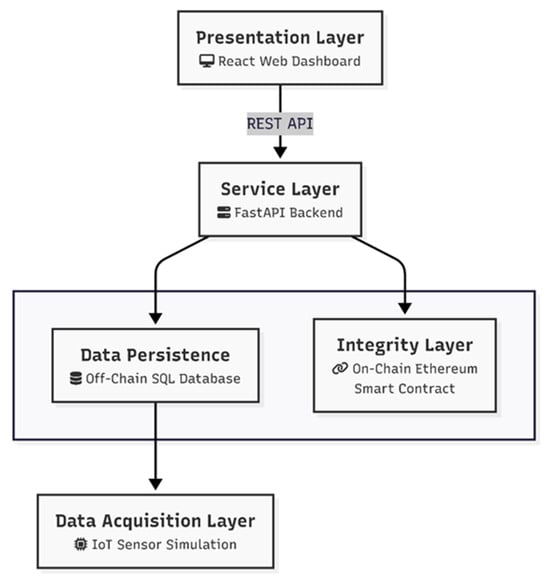
The proposed system architecture is composed of five layers, each responsible for specific functions:
- (1)
- Data Acquisition Layer: IoT sensor simulation that generates environmental and status data for containers.
- (2)
- Data Persistence Layer: An off-chain SQL database that stores all sensor readings.
- (3)
- Integrity Layer: An on-chain component (blockchain smart contract) that records cryptographic hashes of the sensor data, acting as an immutable ledger for data integrity.
- (4)
- Service Layer: A backend service that orchestrates data flow. It receives data from the acquisition layer, writes to the database, computes hashes, and interacts with the blockchain. It also exposes Application Programming Interfaces (APIs) for external queries and integrity verification.
- (5)
- Presentation Layer: A web-based dashboard that allows users to visualize sensor data in real-time and verify the integrity of past data via the backend service.
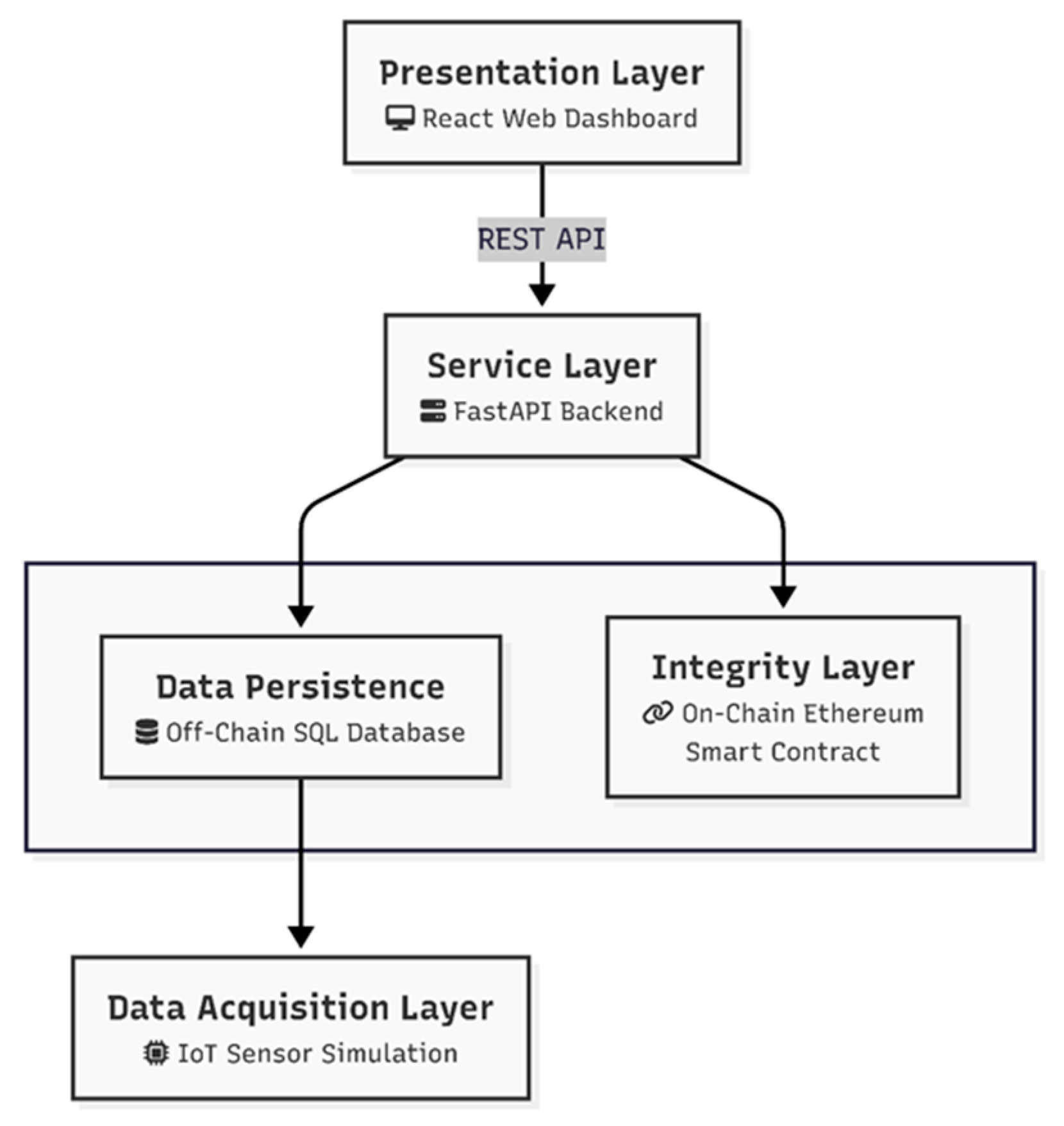
Each layer is detailed below, emphasizing data flow and its role in ensuring integrity without compromising performance (Figure 2).
Figure 2.
Blockchain-based smart container tracking model architecture.
4.1.1. Data Acquisition Layer
This layer emulates the telemetric behavior of IoT sensors on smart shipping containers, using a limited dataset collected from a single container as a reference. The device was initially tested in road traffic along the Subotica–Belgrade route and Belgrade–Bar route [20] to validate connectivity and sensor reliability. The primary dataset was collected during a maritime deployment, with the container carried on a fishing vessel from the Port of Bar to Italian Adriatic waters, enabling emulation of signal quality, location accuracy, and cargo status under real sea conditions [63]. Based on the statistical characteristics of this dataset, a Python-based simulation was developed to generate an artificial, realistic stream of timestamped sensor readings for continuous off-chain storage. For Proof-of-Concept (PoC) validation, the simulation instantiated three virtual containers (N = 3), though the framework supports any configurable positive integer N. The simulated telemetry parameters mirror those observed in the reference datasets:
- -
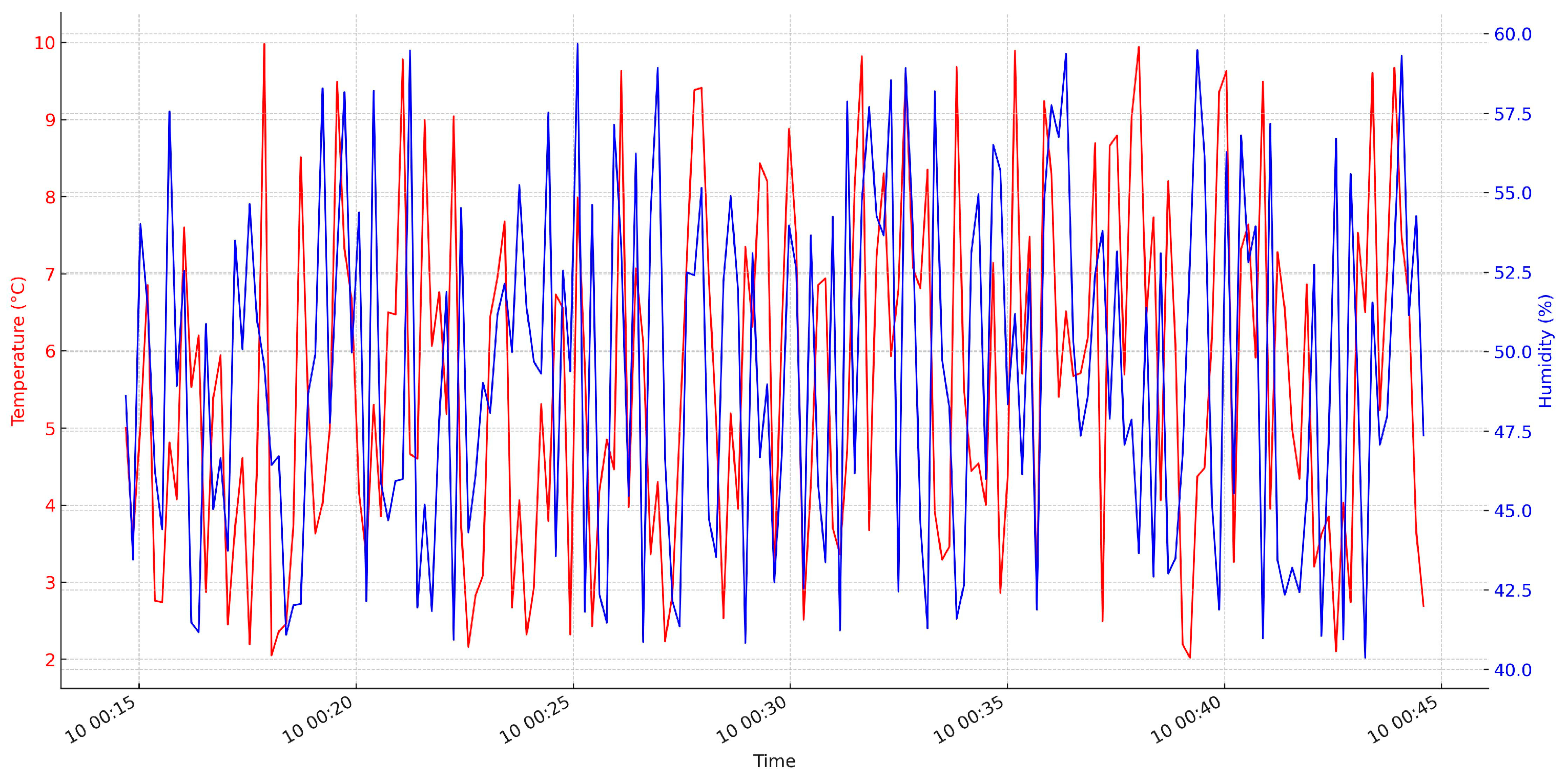
- Temperature (°C): Critical for cold-chain logistics. Generated temperature values are sampled from U(2.0, 10.0)°C, representing typical conditions within a refrigerated container.
- -
- Humidity (%): Important for moisture-sensitive goods. Generated humidity values are sampled from U (40.0%, 60.0%) to reflect a controlled atmospheric environment.
- -
- Shock detection (0/1): To model mechanical stresses experienced during transit, shock events are modeled in Boolean as either ‘0’, indicating a nominal state with no significant impact, or ‘1’, signaling the detection of a shock event. The shock detected flag is set to true with a probability of p = 0.02, representing the sporadic occurrence of significant physical impacts during transit.
- -
- Door Status (Open/Closed): A Boolean flag for security events with occasional 1 when the container is opened for inspection. The door open flag is set as true with a probability of p = 0.05, simulating infrequent access or inspection events.
- -
- Location (X, Y): The model simulates container movement using a discrete 2D (X, Y) random walk. At each subsequent time step, the container’s latitude and longitude are updated by adding a random vector taken from a uniform distribution, specifically U(−0.01, 0.01).
A uniform distribution has been used to generate temperature, humidity and location parameters. This ensures that each possible outcome has an equal chance of occurring, thereby maintaining fairness and unpredictability. This is fundamental to random number generation due to the equal probability it offers across a specified range, making it a cornerstone of various computational applications [64].
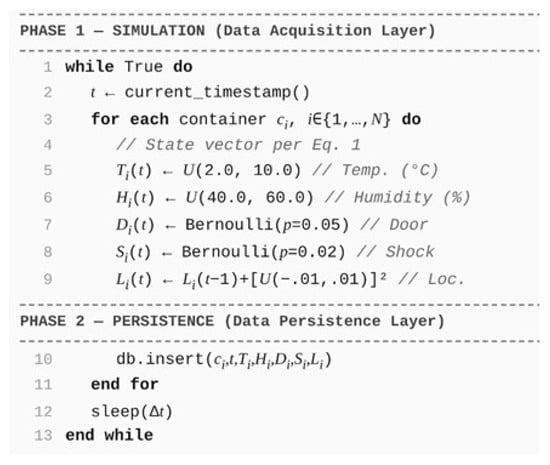
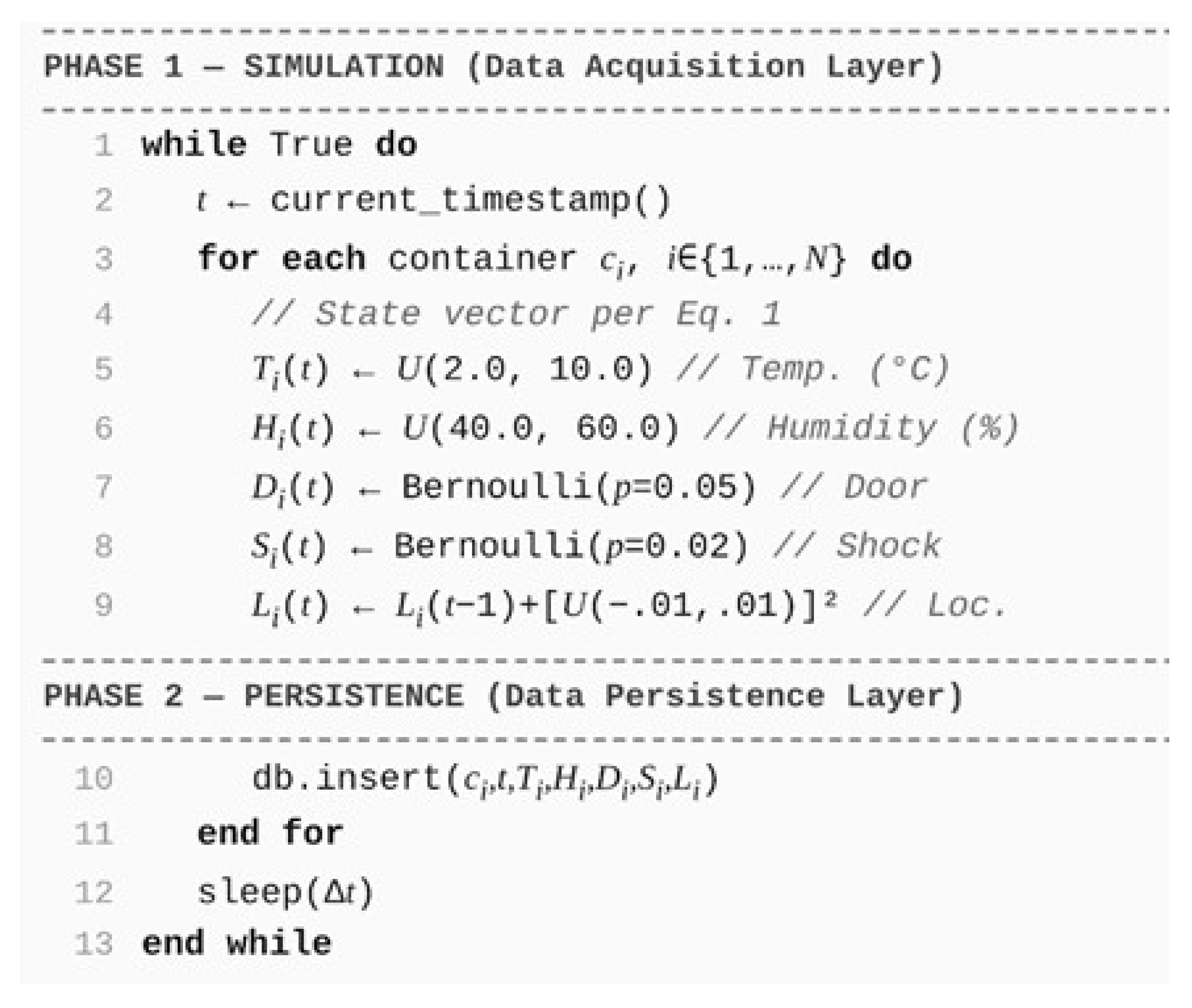
The simulation layer generates distinct time-series data for each of the N smart containers. Each container, represented as ci (1 ≤ i ≤ N), maintains an independent state vector Si(t)at each discrete time step t. This vector contains the full set of simulated parameters (Equation (1)):
where
ci(t) = [Li(t), Ti(t), Hi(t), Di(t), Si(t)]
- -
- Li(t) is the location coordinates;
- -
- Ti(t) is the temperature;
- -
- Hi(t) depicts humidity; and,
- -
- Di(t) and Si(t) are the Boolean state flags for the door status and shock detection, respectively.
The script runs autonomously, inserting new sensor readings into the off-chain database at configurable intervals. In our PoC, we used a 10 s interval between readings, resulting in six readings per minute per container (this interval is adjustable). The simulation extrapolates from the limited real dataset collected from the reference container, using its statistical patterns to produce realistic, synthetic readings for multiple virtual containers. Figure 3 provides a simplified illustration of the simulation, showing how data is generated and stored in the database. This code continuously generates timestamped sensor readings for each container and stores them in the off-chain database.
Figure 3.
Sensor data simulation loop in Python.
This model does not capture the additional complexities introduced by real-world maritime telemetry, such as temporal autocorrelation, transient noise and intermittent signal dropouts during deep-sea transit. However, these anomalies do not compromise the proposed architecture. The system’s primary contribution, tamper-evident anchoring via cryptographic hashing, remains independent of the statistical properties of the underlying data.
4.1.2. Data Persistence Layer (Off-Chain)
All sensor measurements are initially stored in an off-chain database to provide fast access and to buffer data before any blockchain interaction. This design avoids latency, throughput limitations, and transaction costs associated with writing large volumes of time-series directly to a blockchain, which would be impractical and inefficient [60]. The Persistence Layer supports high-frequency data ingestion by decoupling real-time data writes from blockchain constraints. This decoupling is essential for achieving scalability and ensures that data ingestion remains performant as system load increases.
For the PoC, SQLite is used due to its lightweight, serverless design, enabling rapid development and testing. The proof of concept was successfully run on an HP ZBook Studio 16-inch G9 Mobile Workstation (Intel Core i7-12800H, 32 GB RAM, Windows 11 Pro), demonstrating the system’s capability to operate on standard developer workstation hardware. Database access is abstracted using SQLAlchemy Core (ver. 2.0.48), allowing the system to migrate to a production-grade Relational Database Management System (RDBMS) such as PostgreSQL (ver. 18.3) or MySQL (ver. 9.6) with minimal code changes.
Although SQLite is ideal for rapid prototyping and local PoC execution, it lacks the scalability required for commercial-scale operations involving thousands of containers. The immense volume and high velocity of continuous IoT sensor data would quickly cause a bottleneck in an embedded, single-node database. To allow for future scalability, database access is abstracted using SQLAlchemy Core. This enables migration to a distributed NoSQL database (e.g., Apache Cassandra or MongoDB) or a specialized time series database (e.g., InfluxDB) with minimal code changes. Crucially, the blockchain integrity layer is independent of the choice of off-chain database because it only operates on serialized data retrieved via the Service Layer API. This ensures that the persistence tier can be upgraded independently.
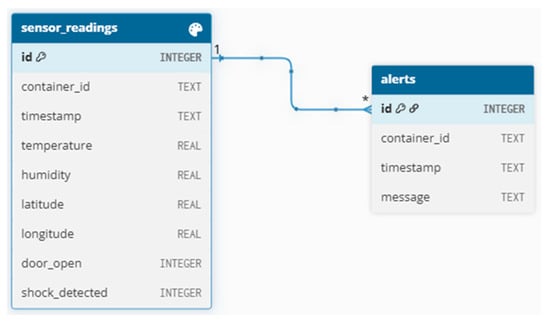
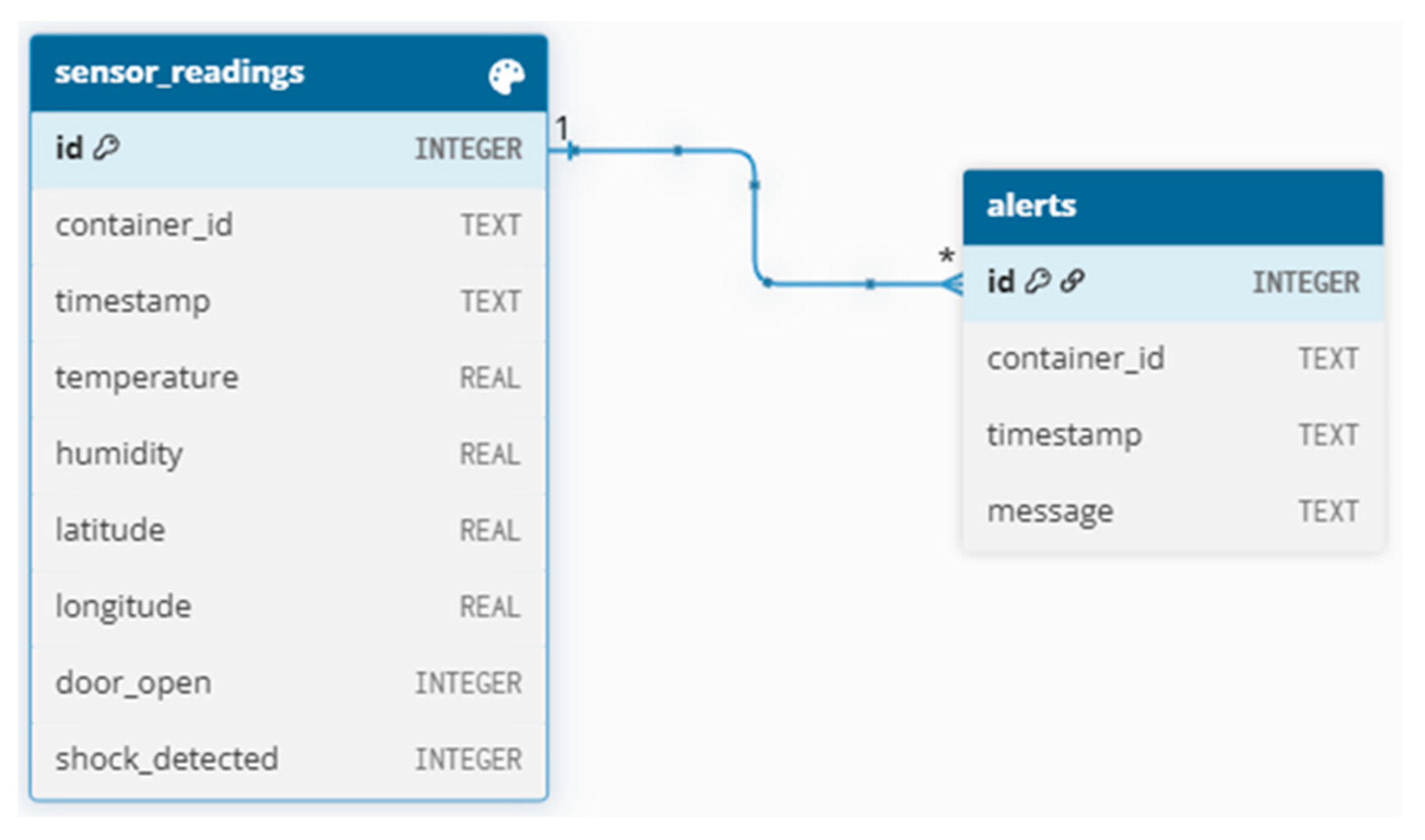
The database schema is normalized to ensure data integrity and efficient querying. It consists of two data sets: sensor readings and alerts (Figure 4). The sensor readings data set stores container ID, high-precision ISO 8601 [65] timestamps, and environmental as well as operational data such as temperature, humidity, location, door status, and shock events. The alerts table records critical events, including the container ID, timestamp, and a descriptive alert message. Together, these tables support effective monitoring and analysis of cargo conditions.
Figure 4.
Relationship between the sensor readings and alerts data.
4.1.3. Integrity Layer (On-Chain)
The system’s security and trustworthiness are provided by an Integrity Layer that combines off-chain data storage with on-chain cryptographic anchoring to address the blockchain verifiability–scalability trade-off. High-volume sensor data is stored off-chain, while an Ethereum smart contract serves as an immutable trust anchor by recording cryptographic commitments rather than raw data. This design guarantees data integrity and non-repudiation without incurring the latency and cost of on-chain time-series storage.
Data integrity is ensured through periodic anchoring of off-chain records. For each container, all sensor readings collected over a 24 h period are deterministically serialized in timestamp order and hashed using Secure Hash Algorithm (SHA)-256. The resulting digest acts as a tamper-evident fingerprint: any alteration of the off-chain data produces a mismatched hash when compared against the on-chain record. This approach follows established designs that store only hashes or Merkle roots on-chain while maintaining bulk data off-chain [66,67]. The contribution of this work lies in applying this technique to a smart container use case and demonstrating it in a complete end-to-end prototype.
Ethereum was selected due to its mature smart contract capabilities and developer ecosystem. For the proof-of-concept, a local Ethereum simulator (Ganache) was used to enable rapid development and testing while abstracting gas costs. The system is designed for seamless migration to public Ethereum networks by reconfiguring the JavaScript Object Notation—Remote Procedure Call (JSON-RPC) endpoint, as the smart contract bytecode is portable across Ethereum Virtual Machine (EVM)-compatible chains.
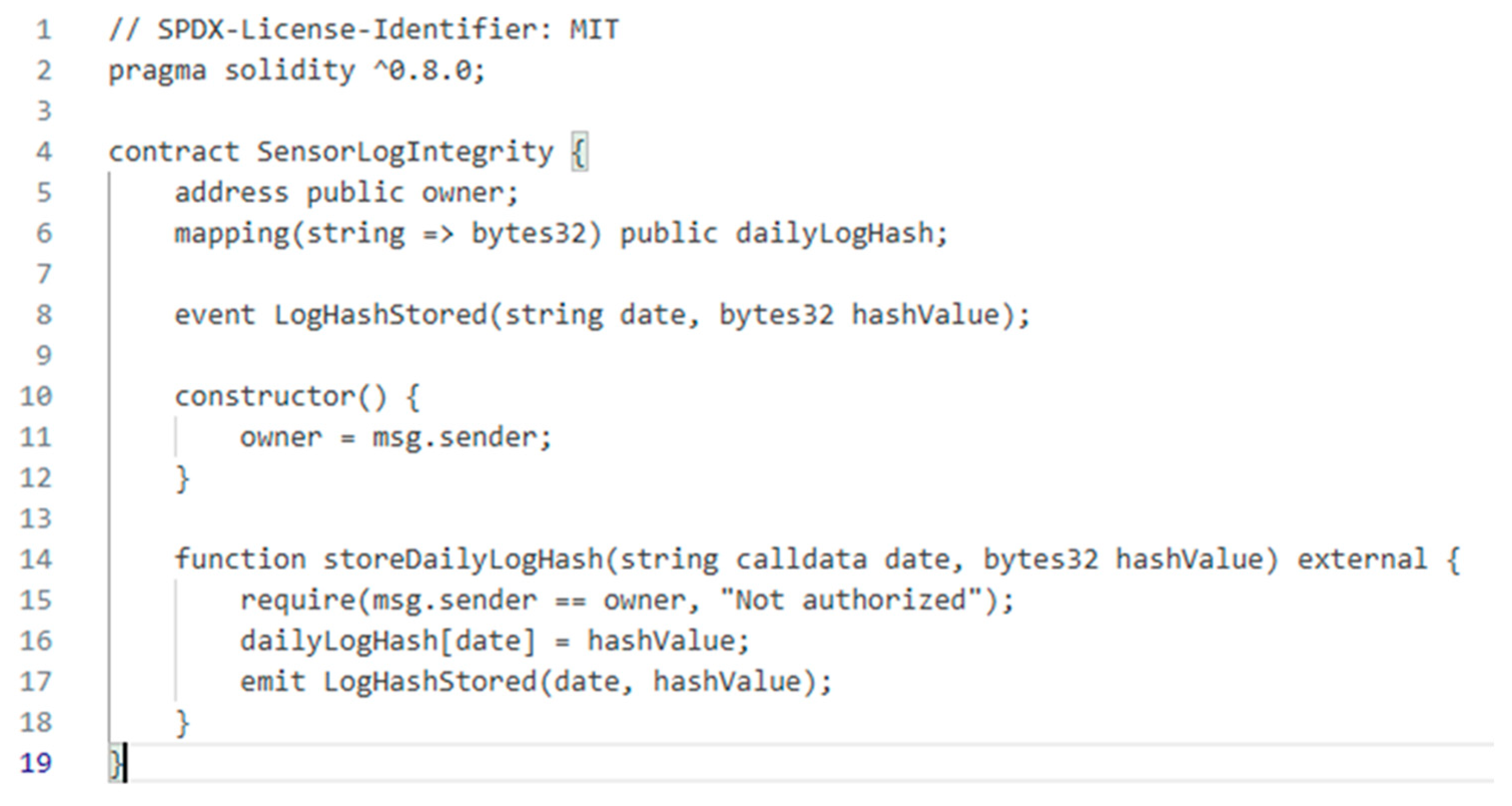
The anchoring process is implemented by a scheduled backend service that submits daily hashes to a Solidity smart contract—SensorLogIntegrity (Figure 5). The contract exposes an owner-restricted function that stores each hash against a unique container–date key, ensuring immutability and auditability (Figure 6). While the current PoC operates in a fully localized environment, evaluating the system under realistic distributed IoT conditions remains future work.
Figure 5.
Implementation of the SensorLogIntegrity smart contract in Solidity.
Figure 6.
Ganache confirming the successful deployment of the SensorLogIntegrity smart contract.
4.1.4. Service Layer
The Service Layer acts as the orchestration component between the off-chain database and the on-chain integrity layer and is implemented using FastAPI for its high-performance asynchronous execution and built-in API documentation. It serves two primary functions: executing scheduled background tasks and exposing RESTful APIs for data access and verification. A scheduled process, implemented via a cron job or asynchronous task, performs daily integrity anchoring by computing SHA-256 hashes over the previous day’s sensor data, constructing and locally signing blockchain transactions, and submitting them to the Ethereum network via web3.py, with error handling for transaction failures. The backend also provides API endpoints for client applications, including retrieval of the latest sensor readings, historical data queries, and integrity verification requests. Upon a verification request, the backend deterministically serializes and hashes the relevant sensor data from the SQLite database, retrieves the corresponding hash from the smart contract, and compares the two values; matching hashes confirm data integrity since anchoring, while discrepancies indicate potential data tampering or corruption.
4.1.5. Presentation Layer (Web Dashboard)
The Presentation Layer supports high-frequency data ingestion by decoupling real-time data writes from blockchain constraints. This decoupling is essential for achieving scalability and ensures that data ingestion remains performant as system load increases. This layer provides a user-facing web interface for monitoring container conditions and verifying data integrity. It is implemented using React.js for dynamic user interaction and Material-UI for consistent component styling. The dashboard retrieves data from the backend via RESTful APIs and updates near–real-time sensor readings through periodic polling.
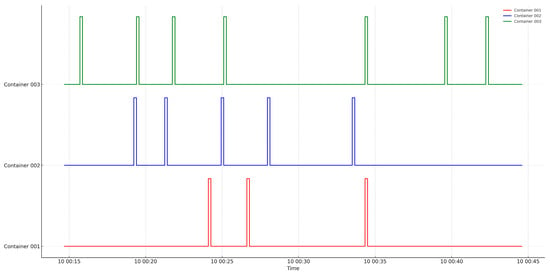
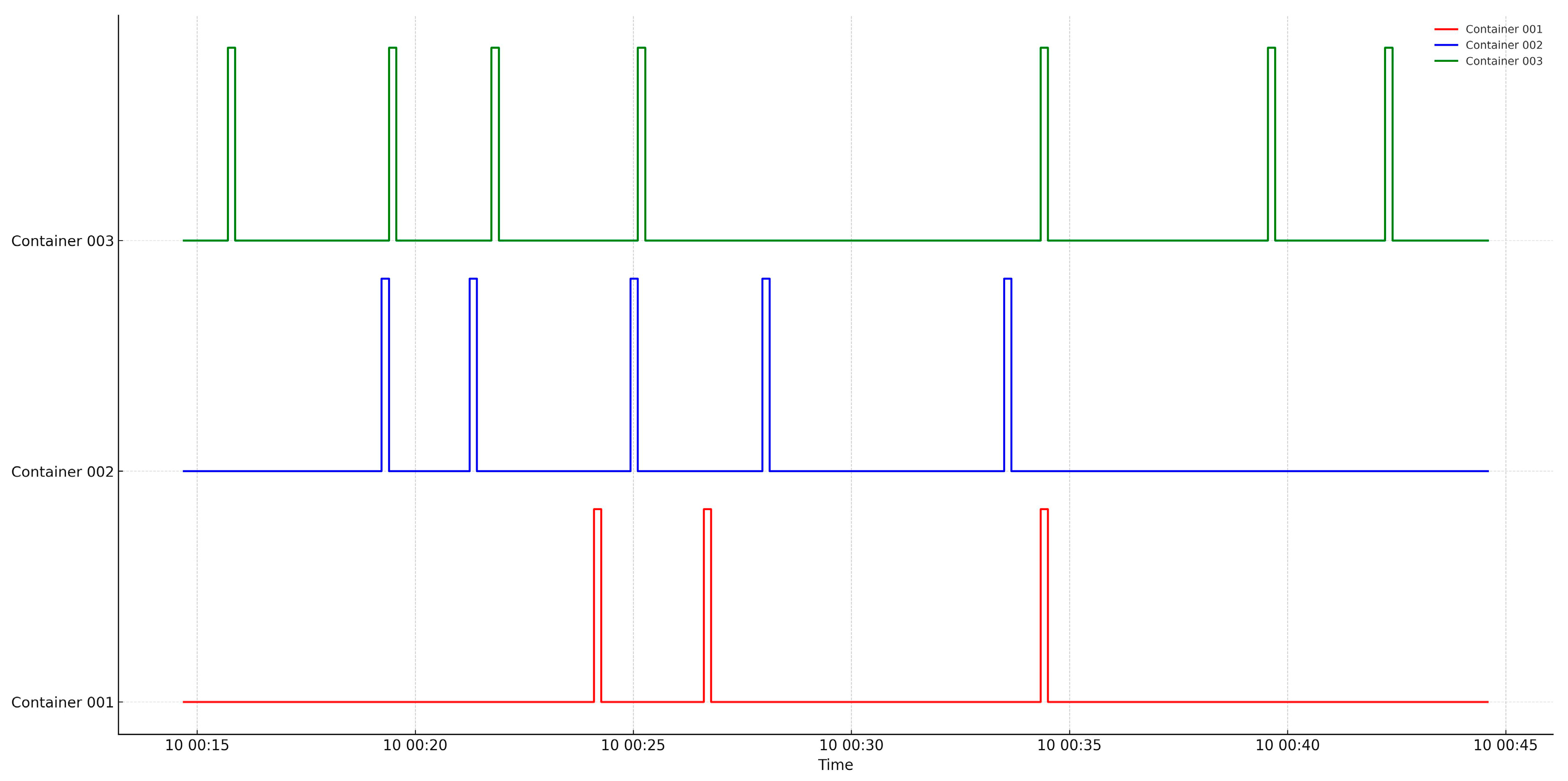
The interface allows users to select a container and view live sensor readings, including temperature, humidity, door status, shock events, and geographic location. To provide a historical overview, the platform also displays temperature and humidity trends over a selectable time interval in a dedicated graph (Figure 7), and shock events recorded during the same interval in a separate graph (Figure 8). This dual-view design enables operators to monitor both environmental conditions and physical impacts on the container over time. Container location is visualized using Leaflet.js with OpenStreetMap tiles; in the proof-of-concept, GPS coordinates follow a simulated random-walk pattern. Historical time-series charts display sensor data for the previous 24 h, enabling analysis of trends and anomaly detection.
Figure 7.
Smart container temperature—humidity tracing.
Figure 8.
Smart containers shock tracing.
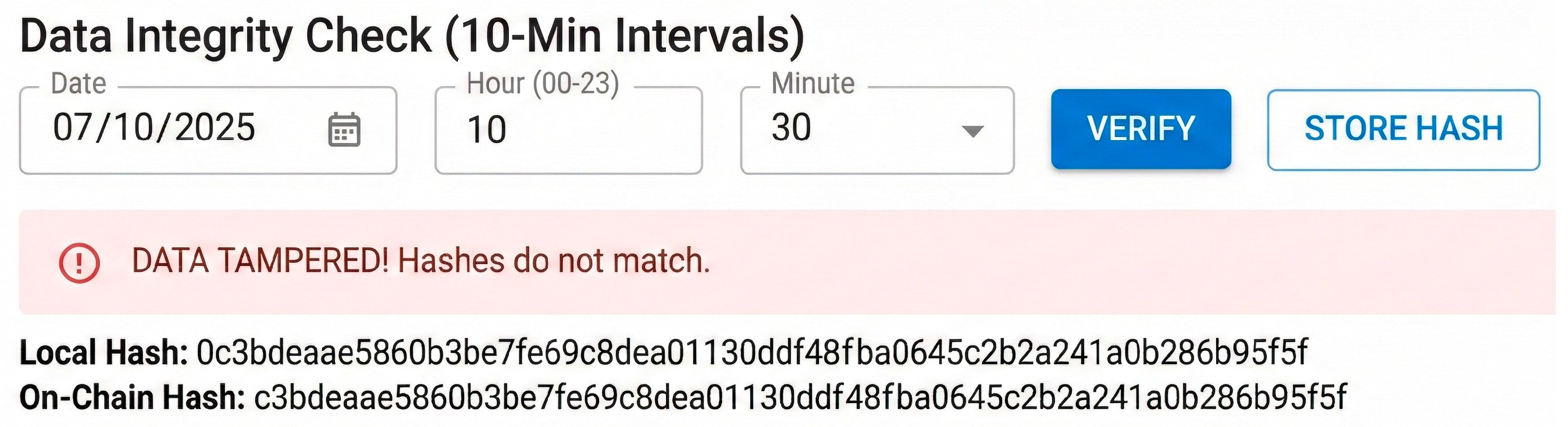
The dashboard also exposes integrity verification controls that allow users to select a container and date, as well as trigger the verification protocol. The frontend invokes the backend verification endpoint and presents the result of the hash comparison. If the locally recomputed hash matches the on-chain hash, the data is reported as intact; otherwise, the system indicates a mismatch, signaling potential data alteration. Both hash values are displayed to ensure transparency.
To validate this functionality, a tampering scenario was simulated in the proof-of-concept by modifying historical sensor data in the off-chain database after anchoring. Subsequent verification correctly detected the modification through a hash mismatch, demonstrating that post-anchoring data manipulation is reliably identified by the system.
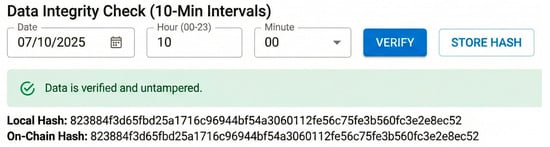
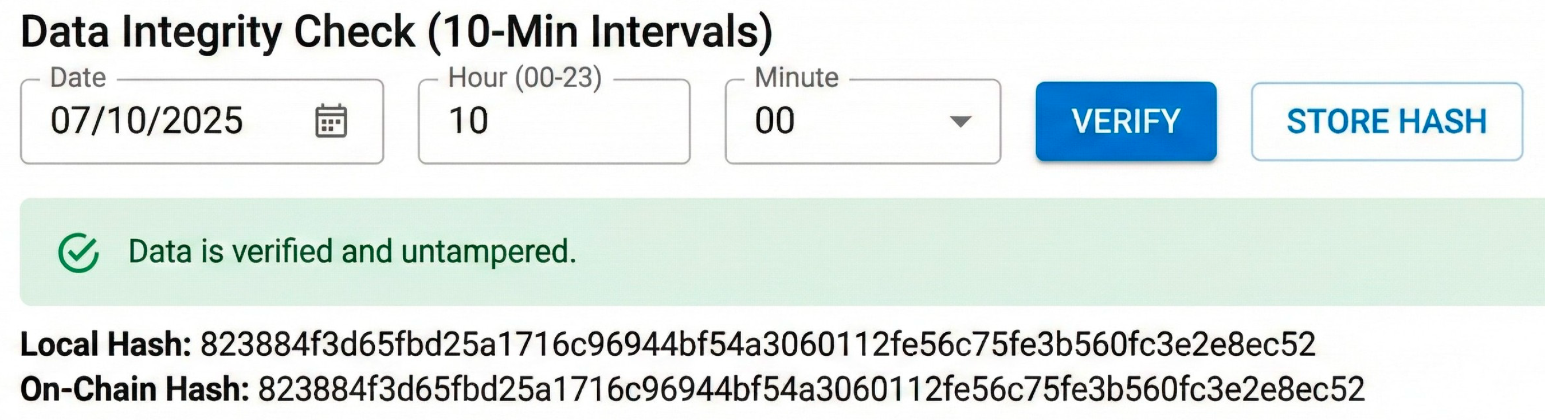
The dashboard also provides controls to initiate integrity verification. Upon selecting a container and date, the frontend invokes the backend verification endpoint, which compares the locally recomputed hash with the on-chain hash. If these hashes match, the dashboard displays a green notification indicating that the data is verified and untampered, along with both hash values for transparency. Figure 9 illustrates a successful verification result. If a mismatch is detected, a red alert is shown, indicating potential data alteration. Figure 10 demonstrates this scenario, where deliberate tampering of historical sensor data causes the locally recomputed hash to differ from the anchored on-chain hash, confirming that the record has been modified. In a production environment, such an alert would trigger further investigation or remediation.
Figure 9.
Successful data integrity verification.
Figure 10.
Failed verification after data tampering.
5. Analysis of Experiments
This section evaluates the proposed hybrid architecture with respect to security, performance and scalability, including cost efficiency. It highlights the strengths of the approach, while explicitly discussing its limitations and underlying assumptions.
5.1. Security Analysis
The primary security objective of the system is to ensure data integrity, i.e., that sensor logs cannot be modified without detection. This is achieved by anchoring cryptographic hashes of off-chain data on an immutable blockchain ledger. Once a daily hash is recorded on-chain, neither system administrators nor data owners can alter the corresponding historical data without creating a detectable mismatch during verification. Experimental tampering tests confirmed this property, demonstrating that any post-anchoring modification of off-chain records is reliably detected. Assuming the continued security of SHA-256, forging an alternative dataset that produces the same hash is computationally infeasible, allowing the blockchain to serve as an unbiased witness to the database state at a given time.
In this architecture, a primary security consideration is the anchoring frequency, which determines the vulnerability window. This refers to the period during which off-chain data has not yet been cryptographically committed to the blockchain and could be altered undetected. In the PoC, this window is set to 24 h. Reducing the anchoring interval to, for example, every hour or at each critical event (e.g., shock detection or door opening) would proportionally reduce this window. However, this would increase the volume of on-chain transactions and the associated gas fees. As shown in Table 1, the cost advantage of hybrid architecture increases in line with the anchoring frequency. For instance, hourly anchoring for 1000 containers would necessitate 24,000 transactions per day instead of 1000; nevertheless, this approach remains more cost-effective than a fully on-chain solution. The 24 h interval was chosen for the PoC to strike a balance between security and cost. This architecture does not impose a fixed constraint, since the anchoring schedule is a configurable parameter within the Service Layer’s scheduled task. This enables operators to adjust it based on cargo sensitivity and risk tolerance.
Table 1.
Performance metrics for the proposed hybrid on/off-chain system.
The integrity guarantee provided by the system is limited to post-recording immutability and does not address data correctness at the time of collection. This reflects the well-known oracle problem in blockchain–IoT systems: faulty sensors or malicious manipulation prior to data ingestion cannot be detected by the blockchain, which faithfully preserves hashes of whatever data it receives. Addressing data authenticity at the source would require additional mechanisms such as trusted hardware, source-level digital signatures, or decentralized oracle schemes. These are beyond the scope of this proof-of-concept.
Access control for on-chain writings is enforced through only an owner restriction in the smart contract, ensuring that only the backend service can anchor hashes and preventing unauthorized modifications to the integrity log. While sufficient for the PoC, multi-stakeholder deployments would require stronger controls, such as role-based access control, multi-signature authorization, or consortium blockchain governance. These extensions are feasible within Solidity, but were deferred to future work.
A notable security limitation of the PoC is private key management. The Ethereum private key is stored in a plaintext environment file, which is acceptable for local development, but unsuitable for production use. In a real deployment, this risk would be mitigated through a Key Management Service (KMS), where private keys are securely stored and used only for signing transactions via controlled APIs, ensuring the backend never directly accesses the key material.
5.2. Performance and Scalability
The hybrid architecture is designed to balance scalability with real-time performance. High-frequency sensor data is handled entirely off-chain, where relational databases can support thousands of writes per second. The blockchain is only used for a single, small transaction per container per day, minimizing latency and transaction overhead. In PoC testing, the daily anchoring process was completed within seconds, supporting scalability requirements.
Table 1 summarizes key performance metrics measured during benchmarking of the PoC system across three containers. Computing the SHA-256 hash over the full dataset took approximately 30 ms per container, showing that the cryptographic overhead is minimal. Deploying the smart contract required 405,929 gas units, while each subsequent anchoring transaction consumed 49,919 gas units, reflecting the cost of a single SSTORE operation plus execution overhead. On a local Ganache simulator, transaction confirmation latency averaged 27 ms; in contrast, a public Ethereum Layer 1 network would typically require 12–60 s, whereas Layer 2 networks like Arbitrum achieve sub-second finality. The Service Layer also maintained a modest resource footprint throughout, with CPU utilization peaking at 30.8% and memory usage reaching 101.6 MB [68].
Real-time responsiveness is preserved because the user interface reads directly from the off-chain database via the backend API. In the demonstration setup, polling every five seconds resulted in near–real-time updates, with end-to-end latency dominated by the polling interval rather than blockchain interactions. This decoupling ensures that blockchain confirmation delays do not affect monitoring performance, which would be infeasible if data were written on-chain in real time.
Compared to fully on-chain designs, the proposed model offers substantial scalability advantages. Only fixed-size 32-byte hashes are stored on-chain, resulting in constant blockchain storage requirements regardless of data volume. Off-chain storage can be scaled using conventional database techniques. For very large deployments (e.g., tens of thousands of containers), anchoring could be migrated to a Layer 2 network or a permissioned blockchain to further reduce costs and increase throughput, without affecting the rest of the system architecture.
5.3. Cost Efficiency
Cost efficiency is a key advantage of the proposed approach. Storing raw IoT data on a public blockchain is widely recognized as economically impractical [66]. Table 2 provides a comparative cost estimation, showing the difference between a full on-chain approach, where every sensor reading is recorded as an individual blockchain transaction, and the proposed hybrid architecture, where only one SHA-256 hash per container is anchored daily. This estimation is based on the parameters used in our proof of concept, in which a smart container generates one sensor reading every ten seconds, totaling 8640 readings per day.
Table 2.
Estimated daily on-chain transaction costs: full on-chain vs. hybrid approach.
The analysis in Table 2 highlights the economic rationale behind the hybrid architecture. While these estimates are subject to gas price volatility, they clearly demonstrate that the hybrid approach renders blockchain-based integrity assurance economically viable on a commercial scale.
6. Conclusions
This research demonstrates the feasibility of a hybrid blockchain-enabled smart container monitoring system that ensures data integrity without compromising on scalability or real-time performance. By decoupling high-frequency IoT sensor data from blockchain storage and only anchoring cryptographic hashes on-chain, the proposed architecture achieves tamper-evident logging, auditability, and cost efficiency. The proof-of-concept implementation validated that post-recording data manipulation can be reliably detected through hash verification, while the off-chain database supports near–real-time monitoring and historical analysis. The results confirm that blockchain can effectively function as an immutable integrity layer rather than a primary data store, thus overcoming a key barrier to its practical adoption in maritime logistics. Therefore, this study provides an end-to-end, experimentally validated reference architecture that connects smart container sensing and blockchain-based trust mechanisms, offering a pragmatic pathway toward more secure and transparent maritime supply chains.
From a management perspective, the tamper-evident audit trails generated by this system provide valuable information for key maritime stakeholders. For example, port authorities could use verified data to automate customs clearance processes, reducing dwell times and administrative overhead by trusting the integrity of container history records without manual inspection. In turn, insurance companies could utilize immutable logs to automate claims processing. For instance, a shock or temperature deviation that is both detected and immutably recorded could trigger an immediate and transparent claim investigation or payout based on smart contract conditions. By transforming sensor data into legally credible evidence, the system bridges the gap between technical security and operational decision-making, enabling a shift toward data-driven, automated, and trust-minimized workflows in the maritime industry. However, realizing this potential is contingent upon addressing the multifaceted challenges that lie beyond the scope of a technical proof-of-concept. Translating these technical capabilities into institutional practice requires a more detailed investigation into liability frameworks, cross-jurisdictional data admissibility, and stakeholder alignment. Such inquiries require longitudinal field studies and resource-intensive pilot deployments to validate economic viability and regulatory compliance under real-world operational constraints.
Notwithstanding, this study contributes an end-to-end, experimentally validated reference architecture that bridges smart container sensing and blockchain-based trust mechanisms, offering a pathway toward more secure, efficient, and transparent maritime supply chains.
7. Limitations
Despite its contributions, this study has several limitations. Firstly, the PoC relies on simulated sensor data derived from a limited set of referential measurements collected from a single container and a local blockchain environment. As a result, it may not fully capture the variability, latency, and fault conditions encountered in real-world maritime operations. Secondly, the system guarantees data immutability only after anchoring; it does not address data authenticity at the point of collecting, leaving it vulnerable to faulty or compromised sensors. Thirdly, access control and key management are simplified for experimental purposes and would require more robust, multi-stakeholder governance and secure key handling in production deployments.
A critical limitation pertains to the human factor, as well, since it remains underexplored in the current design. The system’s security assumptions do not account for intentional adversarial actions by crew members or other personnel with physical access to the container, nor do they mitigate the risk posed by storing Ethereum private keys in a plaintext environment file. This is a practice that creates a single point of failure, where an attacker gaining access to the backend server could extract these keys and irrevocably compromise the on-chain anchoring process. These human-centric vulnerabilities underscore that technical safeguards alone are insufficient without robust procedural controls and physical security measures.
Beyond these human factors, the performance evaluation was qualitative rather than benchmark-driven, with large-scale stress testing outside the scope of this work. Future research should therefore adopt a multi-faceted approach encompassing field trials with physical smart containers to assess durability and resilience against tampering; integration of TEEs or HSMs for secure, tamper-proof key storage and sensor-level authentication; deployment on public or Layer 2 blockchains to evaluate real transaction costs and latency; and quantitative performance as well as cost benchmarking under realistic operational loads to validate economic and technical scalability.
Author Contributions
Conceptualization, S.B., R.D. and E.A.J.; methodology, S.B., R.D. and E.A.J.; software, E.A.J.; validation, E.A.J.; formal analysis, E.A.J.; investigation, R.D., E.A.J., S.B. and O.-P.H.; writing—original draft preparation, R.D., E.A.J., S.B. and O.-P.H.; writing—review and editing, R.D., E.A.J., S.B. and O.-P.H.; visualization, R.D. and E.A.J.; supervision, S.B. and O.-P.H. All authors have read and agreed to the published version of the manuscript.
Funding
The fourth author of this research work has received funding from Horizon-Widera-2023-Access-02-02 under the grant agreement no. 101159424 project titled “Twinning to enable Baltic Sea vessels to meet Fit-for-55 regulations” by the European Research Executive Agency (REA) delegated by the European Commission. The views and opinions expressed are those of the authors only and do not necessarily reflect those of the European Union or REA. Neither the European Union nor the granting authority can be held responsible for these views and opinions.
Institutional Review Board Statement
Not applicable.
Informed Consent Statement
Not applicable.
Data Availability Statement
The data supporting this study were generated through simulations as part of a proof-of-concept implementation. No public datasets were produced. Pseudocode is available from the authors upon reasonable request.
Acknowledgments
During the preparation of this manuscript/study, the authors used React.js (v19.2), Python (v3.14.0) with FastAPI (v0.119.1), Solidity (v0.8.30), and the Truffle Suite (v5.11.5) including Ganache (v7.9.2) for the purposes of developing the user interface, managing backend API services, scripting smart contracts, and simulating the local Ethereum blockchain environment. The authors have reviewed and edited the output and take full responsibility for the content of this publication.
Conflicts of Interest
The authors declare no conflicts of interest.
Abbreviations
The following abbreviations are used in this manuscript:
| 3S | Safety, Security, and Safeguard |
| AI | Artificial Intelligence |
| APIs | Application Programming Interfaces |
| ATA | Actual Time of Arrival |
| ATD | Actual Time of Departure |
| BCT | Blockchain Technology |
| BoL | Bill of Lading |
| CA | Control Atmosphere |
| CPU | Central Processor Unit |
| DDoS | Distributed Denial of Service |
| DIY | Do-It-Yourself |
| DLT | Distributed Ledger Technology |
| DoS | Denial of Service |
| DTLS | Datagram Transport Layer Security |
| eBL | Electronic Bill of Lading |
| ETA | Estimated Time of Arrival |
| ETD | Estimated Time of Departure |
| EVM | Ethereum Virtual Machine |
| GPS | Global Positioning System |
| GSM | Global System for Mobile Communications |
| HSM | Hardware Security Modules |
| IoT | Internet of Things |
| IPFS | Inter Planetary File System |
| JSON-RPC | JavaScript Object Notation—Remote Procedure Call |
| KMS | Key Management Service |
| MITM | Man-in-the-Middle |
| MQTT | Message Queuing Telemetry Transport |
| OT | Operational Technology |
| PCS | Port Community System |
| PI | Physical Internet |
| PoC | Proof-of-Concept |
| RDBMS | Relational Database Management System |
| RFID | Radio Frequency Identification |
| SHA | Secure Hash Algorithm |
| SMCT | Smart Maritime Container Terminal |
| SRIF | Security Risk Influencing Factors |
| SSH | Secure Shell |
| SSTORE | Storage Store |
| STRIDE | Spoofing (Identity); Tampering (with Data); Repudiation; Information Disclosure; Denial of Service; Elevation of Privilege |
| T&T | Tracking and Tracing |
| TAN | Tree-Augmented Naïve Bayas |
| TEE | Trusted Execution Environment |
| TLA | Three Letter Acronyms |
| TOPSIS | Technique for Order of Preference by Similarity to Ideal Solution |
| TRUST | Toolkit for TEE-assisted Secure Unsourced computation over in Tegers |
| UHF-RFID | Ultra-High Frequency Radio Frequency Identification |
| UNCTAD | United Nations Trade and Development |
| UNECE | United Nations Economic Commission of Europe |
| VPN | Virtual Private Networks |
References
- Living in a Container. How Many Shipping Containers Are There in the World: An Overview of Global Container Statistics. 29 December 2023. Available online: https://www.livinginacontainer.com/how-many-shipping-containers-are-there-in-the-world-an-overview-of-global-container-statistics/ (accessed on 31 January 2026).
- Wikipedia. Container Ship. Available online: https://en.wikipedia.org/wiki/Container_ship?utm_source=chatgpt.com (accessed on 31 January 2026).
- Global Growth Insights Shipping Containers Market. Available online: https://www.globalgrowthinsights.com/market-reports/shipping-containers-market-106317 (accessed on 31 January 2026).
- Think Global Logistics. What Are Smart Containers?|The Rise of Smart Containers. 14 August 2023. Available online: https://www.youtube.com/watch?v=-Ry-0HermnE (accessed on 31 January 2026).
- BOXXPORT GmbH Your Container Marketplace What Are Smart Containers? Ft. BOXXPORT GmbH #ytshorts. 19 January 2023. Available online: https://www.youtube.com/watch?v=6YtNAYtHBlA (accessed on 31 January 2026).
- Drozhzhyn, O.L. IOT in container shipping industry: Applications and examples of solutions. Syst. Technol. 2024, 68, 112–120. [Google Scholar] [CrossRef] [Scilit]
- Sallam, K.; Mohamed, M.; Mohamed, A.W. Internet of Things (IoT) in Supply Chain Management: Challenges, Opportunities, and Best Practices. Sustain. Mach. Intell. J. 2023, 2, 22103. [Google Scholar] [CrossRef] [Scilit]
- Bamakan, S.M.H.; Moghaddam, S.G.; Manshadi, S.D. Blockchain-Enabled Pharmaceutical Cold Chain: Applications, Key Challenges, and Future Trends. J. Clean. Prod. 2021, 302, 127021. [Google Scholar] [CrossRef] [Scilit]
- Schudel, S.; Shoji, K.; Shrivastava, C.; Onwude, D.; Defraeye, T. Solution Roadmap to Reduce Food Loss along Your Postharvest Supply Chain from Farm to Retail. Food Packag. Shelf Life 2023, 36, 101057. [Google Scholar] [CrossRef] [Scilit]
- Bauk, S. Modelling Radioactive Materials Tracking in Sea Transportation by RFID Technology. TransNav Int. J. Mar. Navig. Saf. Sea Transp. 2020, 14, 1009–1014. [Google Scholar] [CrossRef] [Scilit]
- Chierici, A.; Cancemi, S.A.; Niederleithinger, E.; Lo Frano, R. Enhanced Radioactive Waste Drum Monitoring: A Sensorized LoRa-Based Network for Identification and Integrity Assessment. Nucl. Eng. Des. 2024, 424, 113231. [Google Scholar] [CrossRef] [Scilit]
- Esser, M.; Borremans, A.; Dubgorn, A.; Shaban, A. Nuclear Waste Transportation: Quality Assurance and Control. Transp. Res. Procedia 2021, 54, 871–882. [Google Scholar] [CrossRef] [Scilit]
- ARG-US Remote Monitoring Systems: Use Cases and Applications in Nuclear Facilities and during Transportation. Available online: https://www.ans.org/news/2025-02-28/article-6787/argus-remote-monitoring-systems-use-cases-and-applications-in-nuclear-facilities-and-during-transportation/ (accessed on 31 January 2026).
- Wattanakul, S.; Henry, S.; Bentaha, L.; Reeveerakul, N.; Ouzrout, Y. Improvement of the Containerized Logistics Performance Using the Unitary Traceability of Smart Logistics Units. In IFIP Advances in Information and Communication Technology; Springer International Publishing: Cham, Switzerland, 2018; pp. 410–419. [Google Scholar]
- Baeza, V.M.; Ortiz, F.; Garcia, S.H.; Lagunas, E. Enhanced Communications on Satellite-Based IoT Systems to Support Maritime Transportation Services. Sensors 2022, 22, 6450. [Google Scholar] [CrossRef] [Scilit]
- Pejović, Č.; Lee, U. Blockchain Bills of Lading: A New Generation of Electronic Transport Documents. Poredbeno Pomorsko Pravo 2022, 61, 31–62. [Google Scholar] [CrossRef] [Scilit]
- Paladin, Z.; Bauk, S.; Mujalović, R.; Kapidani, N.; Lukšić, Ž. Blockchain Technology’s Effects on Big Data in Maritime Transportation. In Proceedings of the 28th International Conference on Information Technology (IT), Zabljak, Montenegro, 24–28 February 2024; pp. 1–7. [Google Scholar] [CrossRef] [Scilit]
- Najati, I. Exploring the failure factors of blockchain adopting projects: A case study of tradelens through the lens of commons theory. Front. Blockchain 2025, 8, 1503595. [Google Scholar] [CrossRef] [Scilit]
- Zheng, H.; Li, K.X.; Ng, A.K.Y.; Liu, Y.; Jin, M.; Chen, Z.; Xiao, Y. Enhancing data sharing in maritime blockchain platforms: An incentive mechanism based on principal-agent model. Transp. Res. Part E 2025, 199, 104153. [Google Scholar] [CrossRef] [Scilit]
- Bauk, S.; Dzankic, R. Smart cargo container tracking and IT security management: Experimental results. J. Marit. Res. 2023, 21, 128−134. Available online: https://www.jmr.unican.es/index.php/jmr/article/view/851/855 (accessed on 31 January 2025).
- Nettesheim, P.M.; Burggräf, P.; Steinberg, F. Enhancing Brewery Logistics with Smart Kegs: A Simulation Study. J. Transp. Supply Chain. Manag. 2024, 18, 1073. [Google Scholar] [CrossRef] [Scilit]
- Folinas, D. Containers in Ports Can Be Tracked Smartly. Int. J. Appl. Logist. 2018, 9, 39–52. [Google Scholar] [CrossRef] [Scilit]
- Aslam, S.; Herodotou, H.; Garro, E.; Martinez-Romero, A.; Burgos, M.A.; Cassera, A. Emerging IoT Applications and Architectures for Smart Maritime Container Terminals. In Proceedings of the 2023 IEEE 9th World Forum on Internet of Things (WF-IoT), Aveiro, Portugal, 12–27 October 2023; pp. 1–6. [Google Scholar] [CrossRef] [Scilit]
- Alkhoori, O.; Hassan, A.; Almansoori, O.; Debe, M.; Salah, K.; Jayaraman, R.; Arshad, J.; Rehman, M.H.U. Design and Implementation of CryptoCargo: A Blockchain-Powered Smart Shipping Container for Vaccine Distribution. IEEE Access 2021, 9, 53786–53803. [Google Scholar] [CrossRef] [Scilit]
- Lyu, J.; Zhou, F.; He, Y. Digital Technique-Enabled Container Logistics Supply Chain Sustainability Achievement. Sustainability 2023, 15, 16014. [Google Scholar] [CrossRef] [Scilit]
- Akpan, F.; Bendiab, G.; Shiaeles, S.; Karamperidis, S.; Michaloliakos, M. Cybersecurity Challenges in the Maritime Sector. Network 2022, 2, 123–138. [Google Scholar] [CrossRef] [Scilit]
- Sobb, T.; Turnbull, B.; Moustafa, N. Supply Chain 4.0: A Survey of Cyber Security Challenges, Solutions and Future Directions. Electronics 2020, 9, 1864. [Google Scholar] [CrossRef] [Scilit]
- Review of Maritime Transport 2018|Technological Developments. Available online: https://unctad.org/publication/review-maritime-transport-2018 (accessed on 1 February 2026).
- UNECE (n.d.). Real-time Smart Container Data for Supply-Chain Excellence. Available online: https://unece.org/DAM/cefact/GuidanceMaterials/WhitePapers/WP-SmartContainers_Eng.pdf (accessed on 1 February 2026).
- Agency, I.A.E. Climate Change and Nuclear Power 2024: Financing Nuclear Energy in Low Carbon Transitions. 2024. Available online: https://www.iaea.org/publications/15754/climate-change-and-nuclear-power-2024-financing-nuclear-energy-in-low-carbon-transitions (accessed on 1 February 2026). [CrossRef] [Scilit]
- Tsai, W.-C.; Shen, C.-W. Using a Smart Contract for the Floral Supply Chain. Asia Pac. Manag. Rev. 2024, 29, 347–361. [Google Scholar] [CrossRef] [Scilit]
- Baygin, M.; Yaman, O.; Baygin, N.; Karakose, M. A Blockchain-Based Approach to Smart Cargo Transportation Using UHF RFID. Expert Syst. Appl. 2021, 188, 116030. [Google Scholar] [CrossRef] [Scilit]
- Lukasse, L.J.S.; Schouten, R.E.; Castelein, R.B.; Lawton, R.; Paillart, M.J.M.; Guo, X.; Woltering, E.J.; Tromp, S.; Snels, J.C.M.A.; Defraeye, T. Perspectives on the Evolution of Reefer Containers for Transporting Fresh Produce. Trends Food Sci. Technol. 2023, 140, 104147. [Google Scholar] [CrossRef] [Scilit]
- Nguyen, S.; Chen, P.S.-L.; Du, Y. Blockchain Adoption in Container Shipping: An Empirical Study on Barriers, Approaches, and Recommendations. Marine Policy 2023, 155, 105724. [Google Scholar] [CrossRef] [Scilit]
- Iakushkin, O.; Selivanov, D.; Pavlova, E.; Korkhov, V. Architecture of a Smart Container Using Blockchain Technology. In Lecture Notes in Computer Science; Springer: Cham, Switzerland, 2019; pp. 537–545. Available online: https://link.springer.com/chapter/10.1007/978-3-030-24296-1_42 (accessed on 1 February 2026).
- Elmay, F.K.; Salah, K.; Yaqoob, I.; Jayaraman, R.; Battah, A.; Maleh, Y. Blockchain-Based Traceability for Shipping Containers in Unimodal and Multimodal Logistics. IEEE Access 2022, 10, 133539–133556. [Google Scholar] [CrossRef] [Scilit]
- Meyer, T.; Kuhn, M.; Hartmann, E. Blockchain Technology Enabling the Physical Internet: A Synergetic Application Framework. Comput. Ind. Eng. 2019, 136, 5–17. [Google Scholar] [CrossRef] [Scilit]
- Farah, M.B.; Ahmed, Y.; Mahmoud, H.; Shah, S.A.; Al-Kadri, M.O.; Taramonli, S.; Bellekens, X.; Abozariba, R.; Idrissi, M.; Aneiba, A. A Survey on Blockchain Technology in the Maritime Industry: Challenges and Future Perspectives. Future Gener. Comput. Syst. 2024, 157, 618–637. [Google Scholar] [CrossRef] [Scilit]
- Balci, G.; Surucu-Balci, E. Blockchain Adoption in the Maritime Supply Chain: Examining Barriers and Salient Stakeholders in Containerized International Trade. Transp. Res. Part E Logist. Transp. Rev. 2021, 156, 102539. [Google Scholar] [CrossRef] [Scilit]
- Wang, W.; Peng, Y.; Xu, X.; Li, X.; Liu, H.; Liu, S.; Yan, X. Smart Container Port Development: Recent Technologies and Research Advances. Intell. Transp. Infrastruct. 2023, 3, liad022. [Google Scholar] [CrossRef] [Scilit]
- Wang, A.; Zhu, G.; Li, J. Collaborative Supervision of Dangerous Goods Supply Chain: A Blockchain-Based Conceptual Platform. Comput. Ind. Eng. 2024, 200, 110818. [Google Scholar] [CrossRef] [Scilit]
- Liu, J.; Liu, C.; Lin, M.; Xu, G. Comprehensive Survey of Blockchain Consensus Mechanisms: Analysis, Applications, and Future Trends. Comput. Netw. 2025, 272, 111661. [Google Scholar] [CrossRef] [Scilit]
- Li, H.; Gao, J.; Li, X.; He, W. Timing of Blockchain Adoption under Market Acceptance Uncertainty in a Competitive Shipping Supply Chain: Ex Ante or Ex Post? Transp. Policy 2025, 169, 133–149. [Google Scholar] [CrossRef] [Scilit]
- Balfaqih, M.; Balfagih, Z.; Lytras, M.D.; Alfawaz, K.M.; Alshdadi, A.A.; Alsolami, E. A Blockchain-Enabled IoT Logistics System for Efficient Tracking and Management of High-Price Shipments: A Resilient, Scalable and Sustainable Approach to Smart Cities. Sustainability 2023, 15, 13971. [Google Scholar] [CrossRef] [Scilit]
- Idrissi, Z.K.; Lachgar, M.; Hrimech, H. Blockchain, IoT and AI in Logistics and Transportation: A Systematic Review. Transp. Econ. Manag. 2024, 2, 275–285. [Google Scholar] [CrossRef] [Scilit]
- Tsiulin, S.; Reinau, K.H.; Hilmola, O.-P.; Goryaev, N.; Karam, A. Blockchain-Based Applications in Shipping and Port Management: A Literature Review towards Defining Key Conceptual Frameworks. Rev. Int. Bus. Strategy 2020, 30, 201–224. [Google Scholar] [CrossRef] [Scilit]
- Tsiulin, S.; Reinau, K.H.; Hilmola, O.-P. The Key Challenges of Blockchain Implementation in Maritime Sector: Summary from Literature and Previous Research Findings. Procedia Comput. Sci. 2023, 217, 348–357. [Google Scholar] [CrossRef] [Scilit]
- Bauk, S. Maritime Blockchain Conceptual Framework and Blockshipping Application. In Proceedings of the 11th Mediterranean Conference on Embedded Computing (MECO), Budva, Montenegro, 6–10 June 2022. [Google Scholar] [CrossRef] [Scilit]
- Bauk, S.; Ntshangase, L.H. Blockchain Implementation Barriers in Maritime: A Case Study based on ISM and MICMAC Techniques. J. Marit. Res. 2023, 20, 72–80. Available online: https://www.jmr.unican.es/index.php/jmr/article/view/736/766 (accessed on 31 January 2025).
- Ahmetoglu, S.; Cob, Z.C.; Ali, N. A Systematic Review of Internet of Things Adoption in Organizations: Taxonomy, Benefits, Challenges and Critical Factors. Appl. Sci. 2022, 12, 4117. [Google Scholar] [CrossRef] [Scilit]
- Fereidouni, H.; Fadeitcheva, O.; Zalai, M. IoT and Man-in-the-Middle Attacks. Secur. Priv. 2025, 8. [Google Scholar] [CrossRef] [Scilit]
- Xie, M.; Liu, J.; Chen, S.; Lin, M.; Xu, G.; Xu, Z.; Chang, Z. Traceability and Identity Protection in Smart Agricultural IoT System Framework Based on Blockchains. IEEE Trans. Dependable Secur. Comput. 2025, 22, 5335–5351. [Google Scholar] [CrossRef] [Scilit]
- Erbas, M.; Khalil, S.M.; Tsiopoulos, L. Systematic Literature Review of Threat Modeling and Risk Assessment in Ship Cybersecurity. Ocean. Eng. 2024, 306, 118059. [Google Scholar] [CrossRef] [Scilit]
- Khan, W.U.; Marwat, S.N.K.; Ahmed, S. Cyber Secure Framework for Smart Containers Based on Novel Hybrid DTLS Protocol. Comput. Syst. Sci. Eng. 2022, 43, 1297–1313. [Google Scholar] [CrossRef] [Scilit]
- Thallapally, A.; Jayasurya, P.; Shylaja, G.; Buggaveeti, P.; Subhash, M. Shipping Container with IoT: A Smart Way to Monitor Environment and Location. Int. Res. J. Mod. Eng. Technol. Sci. 2024, 6, 52672. Available online: https://www.irjmets.com/uploadedfiles/paper/issue_4_april_2024/52672/final/fin_irjmets1713075136.pdf (accessed on 1 February 2026).
- Alam, A.K.M.M.; Chen, K. TEE-MR: Developer-Friendly Data Oblivious Programming for Trusted Execution Environments. Comput. Secur. 2024, 148, 104119. [Google Scholar] [CrossRef] [Scilit]
- Zhao, B.; Li, J.; Qiao, C.; Liu, J.-N.; Pei, Q.; Shen, Y. TRUST: A Toolkit for TEE-Assisted Secure Outsourced Computation over Integers. Fundam. Res. 2025. [Google Scholar] [CrossRef] [Scilit]
- Alzoubi, Y.I. Hardware Security Modules for Sustainable Energy Systems: Targeted Review. Int. J. Crit. Infrastruct. Prot. 2025, 50, 100791. [Google Scholar] [CrossRef] [Scilit]
- Mesa-Simón, M.; Escobar-Molero, A.; Parrilla, L.; Morales, D.P.; Álvarez-Bermejo, J.A.; Romero, F.J. Integration of Hardware Security Modules into BLE Beacons: Fundamentals and Use in a Secure and Private Geofencing Application. Internet Things 2025, 34, 101762. [Google Scholar] [CrossRef] [Scilit]
- Harish, A.V.; Tam, K.; Jones, K. Literature Review of Maritime Cyber Security: The First Decade. Marit. Technol. Res. 2024, 7, 273805. [Google Scholar] [CrossRef] [Scilit]
- Mohsendokht, M.; Li, H.; Kontovas, C.; Chang, C.-H.; Qu, Z.; Yang, Z. Decoding Dependencies among the Risk Factors Influencing Maritime Cybersecurity: Lessons Learned from Historical Incidents in the Past Two Decades. Ocean. Eng. 2024, 312, 119078. [Google Scholar] [CrossRef] [Scilit]
- Džankić, R.; Bulatović, Z.; Bauk, S. Improving Security and Privacy with Raspberry Pi Devices. In Maritime Cybersecurity; Bauk, S., Ed.; Springer: Cham, Switzerland, 2025; pp. 217–233. [Google Scholar] [CrossRef] [Scilit]
- Džankić, R.; Bauk, S. Tracking (hazardous) cargo at sea: An experiment. In Proceedings of the 16th International Conference on Information Technologies for e-Education (ITeO), Banja Luka, Bosnia and Hezegovina, 27–28 September 2024; pp. 27–35. Available online: https://www.researchgate.net/publication/401349205_TRACKING_HAZARDOUS_CARGO_AT_SEA_AN_EXPERIMENT (accessed on 28 February 2026).
- Lei, X. An Efficient Method for Generating a Discrete Uniform Distribution Using a Biased Random Source. J. Appl. Probab. 2023, 60, 1069–1078. [Google Scholar] [CrossRef] [Scilit]
- ISO 8601; Date and Time Format. ISO: Geneva, Switzerland, 1988.
- Peker, Y.K.; Rodriguez, X.; Ericsson, J.; Lee, S.J.; Perez, A.J. A Cost Analysis of Internet of Things Sensor Data Storage on Blockchain via Smart Contracts. Electronics 2020, 9, 244. [Google Scholar] [CrossRef] [Scilit]
- Jeong, Y.-S. Blockchain Processing Technique Based on Multiple Hash Chains for Minimizing Integrity Errors of IoT Data in Cloud Environments. Sensors 2021, 21, 4679. [Google Scholar] [CrossRef] [Scilit]
- Kostamis, P.; Sendros, A.; Efraimidis, P.S. Data Management in Ethereum DApps: A Cost and Performance Analysis. Future Gener. Comput. Syst. 2023, 153, 193–205. [Google Scholar] [CrossRef] [Scilit]



Disclaimer/Publisher’s Note: The statements, opinions and data contained in all publications are solely those of the individual author(s) and contributor(s) and not of MDPI and/or the editor(s). MDPI and/or the editor(s) disclaim responsibility for any injury to people or property resulting from any ideas, methods, instructions or products referred to in the content. |
© 2026 by the authors. Licensee MDPI, Basel, Switzerland. This article is an open access article distributed under the terms and conditions of the Creative Commons Attribution (CC BY) license.