


Abstract
The Middle Cambrian salt–anhydrite succession in the Tarim Basin has been regarded as an effective regional cap-rock. However, numerous Ordovician hydrocarbon reservoirs have been discovered above the anhydrite, and recent drilling has identified industrial oil and gas flows beneath anhydrite-bearing intervals. These findings call into question the sealing effectiveness of anhydrite rocks in deep subsalt settings. In this study, X-ray diffraction (XRD), petrographic analysis, scanning electron microscopy (SEM), and triaxial compression tests were conducted to investigate the mineral composition, deformation behavior, and failure mechanisms of anhydrite rocks. The results indicate that: (1) dolomite-bearing anhydrite undergoes plastic deformation at depths greater than 4400~4600 m (~70 MPa confining pressure), whereas dolomitic anhydrite enters the plastic deformation regime below 5200~5400 m (~80 MPa confining pressure); (2) the deformation evolution of the cap rocks can be divided into four stages. Stages I–III are dominated by brittle deformation, with plasticity progressively increasing with confining pressure, whereas Stage IV is characterized by pervasive plastic deformation and strong sealing capacity, representing an effective cap rock during the critical period of hydrocarbon accumulation; (3) Middle Cambrian reservoirs in the eastern Tazhong area were destroyed by reverse faults that cut through brittle Middle Cambrian cap rocks. In contrast, Lower Cambrian gas reservoirs were charged during the Himalayan period, when the cap rocks remained intact, and exhibited strong sealing capacity. This study demonstrates the temporal variability in the sealing effectiveness of Middle Cambrian anhydrite cap rocks in the eastern Tazhong area and provides a methodological basis for deep and ultra-deep subsalt hydrocarbon exploration.
1. Introduction
Evaporite composed of anhydrite–gypsum–salt is the most effective cap rock for hydrocarbon reservoirs worldwide [1,2,3,4,5]. Previous studies have shown that evaporites commonly overlie or seal carbonate reservoirs and are associated with approximately 50% of the world’s known petroleum reserves [6]. Among the world’s 25 largest gas fields, nine are sealed by evaporites, whereas sixteen are sealed by shales or hydrates [6]. In China, anhydrite–gypsum–salt layers occur in four of the thirteen major gas-bearing basins [7]. In the Sichuan Basin, seven of the nine large gas fields are directly sealed by anhydrite–gypsum–salt cap rocks, and gas reserves associated with anhydrite–gypsum–salt sealing account for 86.8% of the total large gas fields [7].
The Tarim Basin is the largest onshore petroliferous basin in China. The Middle Cambrian anhydrite–gypsum-salt succession displays a typical bull-eye depositional pattern, with lithologies dominated by anhydrite, gypsum, salt, dolomite, limestone, and mudstone [8,9,10]. Although both anhydrite and salt have extremely low matrix permeability and can effectively inhibit hydrocarbon migration through the rock matrix [11,12], they differ markedly in physical and mechanical properties. Salt exhibits a much stronger capacity for plastic deformation than anhydrite [13,14] and is therefore commonly regarded as a superior cap rock. However, recent deep hydrocarbon exploration in the Tarim Basin indicates that subsalt reservoirs beneath salt-dominated cap rocks have been widely destroyed, as documented by wells F1 [15] and MB1 [16]. In contrast, reservoir–cap rock assemblages consisting of Middle Cambrian anhydrite cap rocks overlying dolomite reservoirs of the Xiaoerbulak Formation display favorable exploration potential [14]. Industrial oil and gas flows have been obtained from wells ZS-1 [17], KT-1 (Jingneng) [18], and LT-1 [19], and minor hydrocarbon shows have also been encountered in the Lower Cambrian in well ZS-5 [20].
Previous studies have primarily focused on the deformation behavior and sealing capacity of pure salt, anhydrite, gypsum, and micritic dolomite [21,22,23,24,25]. However, recent investigations of carbonate–anhydrite–salt coexisting systems [26,27,28,29,30,31], indicate that thick, pure anhydrite or salt layers are rarely developed in Paleozoic anhydrite-gypsum–salt successions in China. Instead, gypsum, anhydrite, salt, mudstone, and carbonate rocks commonly occur as mixed assemblages in varying proportions. Anhydrite typically occurs in massive, nodular, or thinly bedded forms, and lithologies such as anhydrite-bearing dolomite, anhydritic dolomite, dolomitic anhydrite, and dolomite-bearing anhydrite are widely developed. The mechanical properties of these mixed lithologies differ markedly from those of pure anhydrite [32]. Nevertheless, the deformation behavior and sealing properties of carbonate–anhydrite assemblages with different anhydrite contents have not been systematically investigated.
In this study, mineral compositions were determined using X-ray diffraction (XRD). Breakthrough pressure tests and triaxial compression experiments were conducted under different confining pressures on carbonate–anhydrite assemblages with varying anhydrite contents, using samples from the Huolianzhai anhydrite mine and cores from Tazhong area. The sealing capacity, failure modes, mechanical behavior, and associated brittle–plastic deformation stages of these assemblages were systematically analyzed. By examining the brittle–plastic transition of cap rocks during key hydrocarbon accumulation periods in wells ZS-1 and ZS-5 in the eastern Tazhong area, an evolutionary model for cap-rock sealing capacity was established. This study provides a theoretical basis for future ultra-deep subsalt hydrocarbon exploration.
2. Geological Setting
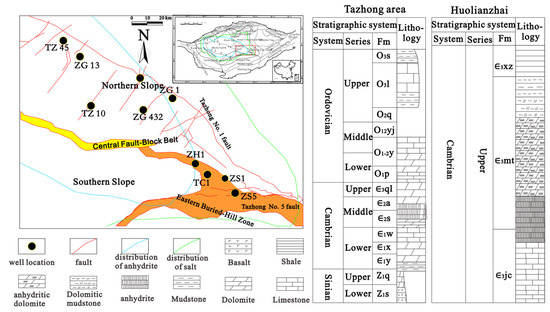
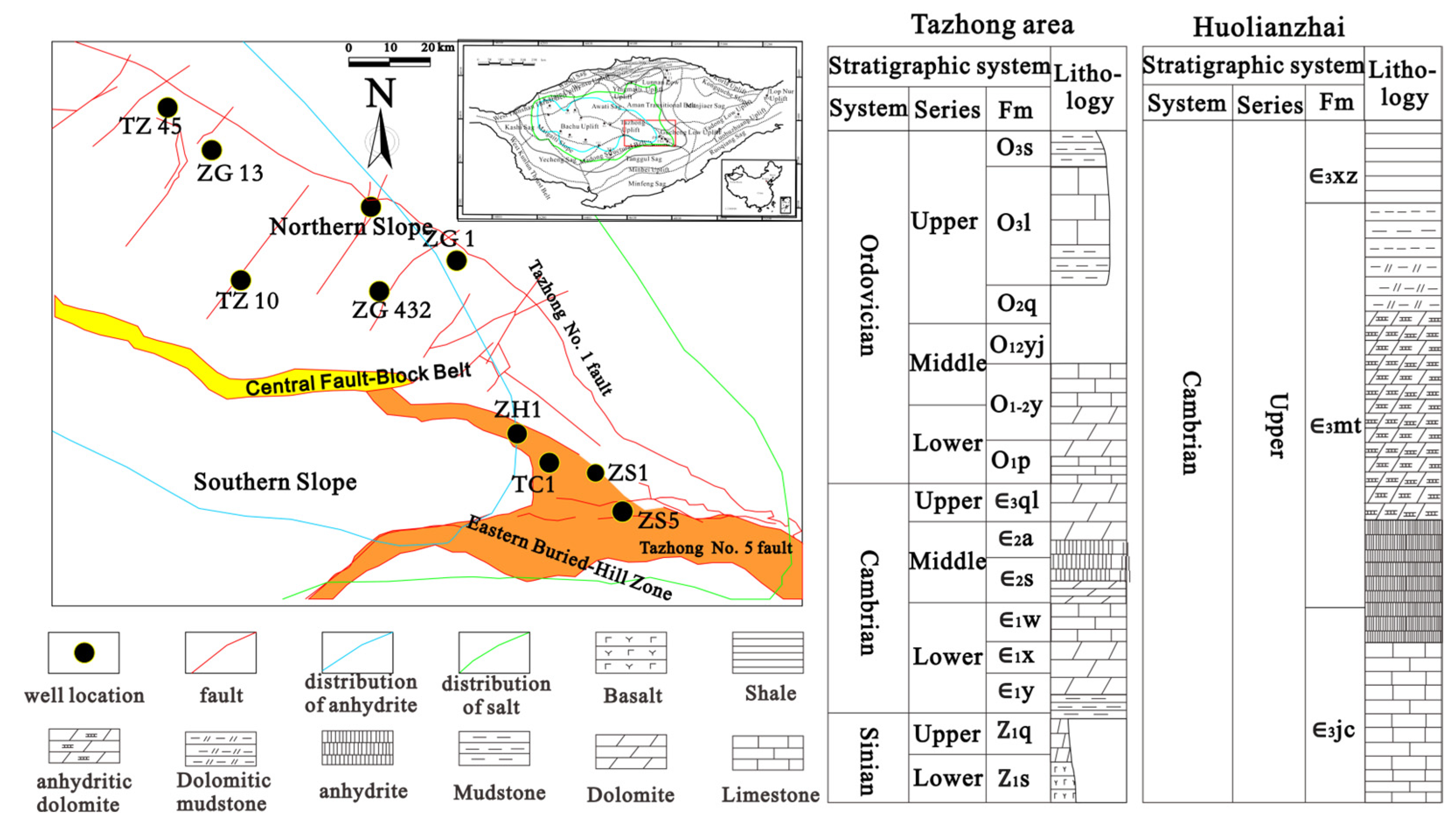
The Tarim Basin is located in southern Xinjiang, northwestern China. It covers an area of about 5.6 × 10⁵ km2. The basin is bounded by the Tianshan, Kunlun, and Altyn Tagh orogenic belts. From north to south, it is divided into several structural units: the Kuqa Depression, the Tabei Uplift, the Northern Depression, the Central Uplift, the Southwestern Depression, the Tanan Uplift, and the Southeastern Depression. Anhydrite and salt are mainly concentrated in the core areas of the Bachu Uplift, the Tazhong Uplift, and the Awati Depression (Figure 1). In contrast, dolomite-bearing anhydrite and anhydritic dolomite are widely distributed across the basin [33]. The Tazhong area lies in the central part of the Central Uplift and represents a second-order tectonic unit. It forms a large uplift that is wide in the west and gradually narrows eastward. It is bounded by the Bachu Uplift to the west, the Tadong Uplift to the east, the Southwestern Depression to the south, and the Northern Depression to the north. The total area is about 2.2 × 10⁴ km2. The study area is located in the eastern part of the Tazhong Uplift. It includes the Tazhong No. I structural belt and the eastern buried-hill zone (Figure 1).
Figure 1.
Location map of tectonic units in the Tazhong region of the Tarim Basin.
The Tazhong Uplift began to form during the Sinian and was largely established during the Caledonian–Hercynian orogenic stages [34,35]. Its northern and southern boundaries, as well as its overall structural evolution, were strongly controlled by fault activity. Structurally, the uplift is higher in the east and lower in the west. Major fault belts converge eastward and diverge westward, forming a broom-shaped structural pattern [33,34,36,37,38]. The Tazhong area is often described as showing “east–west segmentation and north–south zonation.” It can be divided into four structural units: (I) the northern slope, (II) the central fault-uplift belt, (III) the southern slope, and (IV) the eastern buried-hill zone [39]. In the eastern Tazhong area, the Middle Cambrian succession represents a restricted-platform to evaporitic-platform depositional system [40]. Salt is mainly developed in the western Tazhong area. Based on well-log data and regional stratigraphic correlations, the Lower to Middle Cambrian strata (Figure 1) consist, from bottom to top, of the Xiaoerbulake Formation and Wusongger Formation (Lower Cambrian), followed by the Shayilik Formation and Awatage Formation (Middle Cambrian). The succession is mainly composed of dolomite and anhydrite. The Xiaoerbulake Formation is dominated by dolomite. The Awatage Formation mainly consists of anhydritic dolomite, argillaceous dolomite, and dolomite. The Shayilik and Awatage formations are composed mainly of anhydrite, dolomite, and dolomitic limestone. The samples used in this study were collected from anhydrite-bearing dolomite of the Awatage Formation and anhydritic dolomite of the Shayilik Formation in Well ZS-5.
The Liaoyang Basin is located on the northeastern margin of the North China Platform. During the Cambrian, it was characterized by a coastal gypsiferous lagoon environment. The lithofacies paleogeography was dominated by supratidal and intertidal zones. The sampling site in this study is the Huolianzhai anhydrite mine in the Liaoyang Basin. This mine hosts a marine evaporite-type anhydrite deposit. A set of NNW-trending faults divides the mining area into eastern and western parts. The sampling sites are located east of Huolianzhai and are not affected by faulting. In this area, the Lower Cambrian Mantou Formation is mainly composed of dolomite and dolomite-bearing anhydrite [41,42,43,44]. The Cambrian anhydrite of the Mantou Formation was deposited at the same time as the Middle Cambrian anhydrite in the Tazhong area. They share a similar origin and depositional facies. Therefore, the Huolianzhai anhydrite is a suitable analogue for studying evaporite cap rocks.
3. Materials and Methods
3.1. Sample Preparation
Surface-exposed anhydrite undergoes long-term weathering. This process significantly changes its physical and mechanical properties. Therefore, weathered anhydrite cannot accurately represent the sealing capacity of anhydrite cap rocks under subsurface conditions. In the Tarim Basin, anhydrite cores from hydrocarbon exploration wells are very limited. Only a few samples of anhydritic dolomite and anhydrite-bearing dolomite suitable for cap-rock deformation analysis were obtained from the Middle Cambrian Shayilik and Awatage formations in Well ZS-5. To address the shortage of downhole core samples, this study selected anhydrite from the Huolianzhai anhydrite mine in Benxi City, Liaoning Province. Based on the regional geological background, the Lower Cambrian anhydrite from Huolianzhai and the Middle Cambrian anhydrite in the eastern Tazhong area were deposited during the same period. They share similar depositional origins and facies. Dolomite-bearing anhydrite and dolomitic anhydrite were collected from the mine. The petrophysical and mechanical properties of the ZS5 well samples and the Huolianzhai samples were quantitatively compared (Table 1). The two datasets are highly consistent in uniaxial compressive strength (UCS), elastic modulus, porosity, and permeability. The UCS of the ZS5 samples ranges from 70 to 80 MPa, while that of the mine samples ranges from 50 to 60 MPa. Both fall within the same strength class. The elastic modulus ranges overlap significantly (25 to 50 GPa for ZS5 and 29 to 50 GPa for the mine samples), indicating similar stiffness and deformation behavior. Both groups are low-porosity and ultra-low-permeability rocks. Porosity ranges from 0.1 to 5% (ZS5) and 0.192 to 1.719% (mine samples). Permeability ranges from 0.0001 to 0.3 mD (ZS5) and 0.0075 to 0.0257 mD (mine samples). These values are of the same order of magnitude. Overall, the mechanical strength, stiffness, and sealing capacity of the two sample sets are highly comparable. Therefore, the mine samples provide a reliable analogue for the Cambrian cap rock in Well ZS5. They are suitable for subsequent thermomechanical and sealing evolution experiments. Before X-ray diffraction (XRD) analysis, about 50 g of fresh anhydrite and dolomite were crushed and sieved to obtain powders smaller than 74 μm. For mechanical testing, cylindrical specimens were drilled parallel to the core axis. For samples from the Huolianzhai mine, specimens were drilled perpendicular to bedding. Each specimen was 50 mm long and 25 mm in diameter. Both ends were carefully ground to ensure flatness and perpendicularity to the axial direction. Before triaxial compression testing, the specimens were wrapped with heat-shrink tubing. Whenever possible, multiple specimens were prepared from the same rock block. This approach reduced sample heterogeneity and improved experimental reproducibility.
Table 1.
Comparison of Basic Physical and Mechanical Properties Between Mine and Well Samples.
3.2. Experimental Conditions and Procedures
XRD analyses were conducted at the State Key Laboratory of Continental Evolution and Early Life, Northwest University, using a D8 ADVANCE multifunctional X-ray diffractometer (Bruker Corporation, Ettlingen, Germany). The main technical specifications are as follows: line focus size of 0.04 × 12 mm; point focus size of 0.4 × 1.2 mm; goniometer radius of 280 mm; 2θ scanning range from −110° to 168°; minimum readable step size of 0.0001° with an angular reproducibility of 0.0001°; two-dimensional detector active area of 14 mm × 16 mm. The detector used was a Lynxeye_XE-T, with an energy resolution of ≤380 eV.
All XRD measurements were performed under constant laboratory conditions of 25 °C and 30% relative humidity. Mineral phases were identified using standard powder diffraction data provided by the Joint Committee on Powder Diffraction Standards (JCPDS). The analyses followed the Chinese petroleum industry standard SY/T 5163–2018 [45], X-ray Diffraction Analysis Methods for Clay Minerals and Common Non-Clay Minerals in Sedimentary Rocks. Quantitative mineral composition was determined using the reference intensity ratio (RIR) method.
Breakthrough pressure experiments were conducted using an HBXS-70 high-temperature and high-pressure two-phase relative permeability testing system. The system allows a maximum confining pressure of 70 MPa with a pressure accuracy of 0.001 MPa. The experiments were performed in accordance with the Chinese petroleum industry standard SY/T 5748–2020 [46], Method for Determining Gas Breakthrough Pressure of Rocks.
Triaxial compression tests were carried out using an RTR-1000 servo-controlled triaxial rock mechanics testing system manufactured by GCTS (Tempe, AZ, USA). The system specifications include a maximum axial load of 1000 kN, a maximum confining pressure of 90 MPa, a maximum pore pressure of 140 MPa, axial dynamic frequency of 0–20 Hz, confining pressure dynamic frequency of 0–5 Hz, and a maximum operating temperature of 150 °C.
The triaxial compression tests were conducted in accordance with the Chinese national standard SL 264–2001 [46], Rock Test Code for Water Conservancy and Hydropower Engineering, as well as the recommended methods issued by the International Society for Rock Mechanics (ISRM) Commission on Testing Methods. Tests were performed at room temperature (20 °C) under confining pressures of 0, 50, 60, 70, 80, and 90 MPa.
4. Results
4.1. Petrographic Characteristics
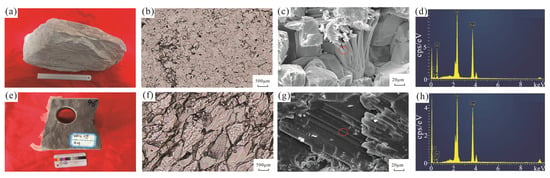
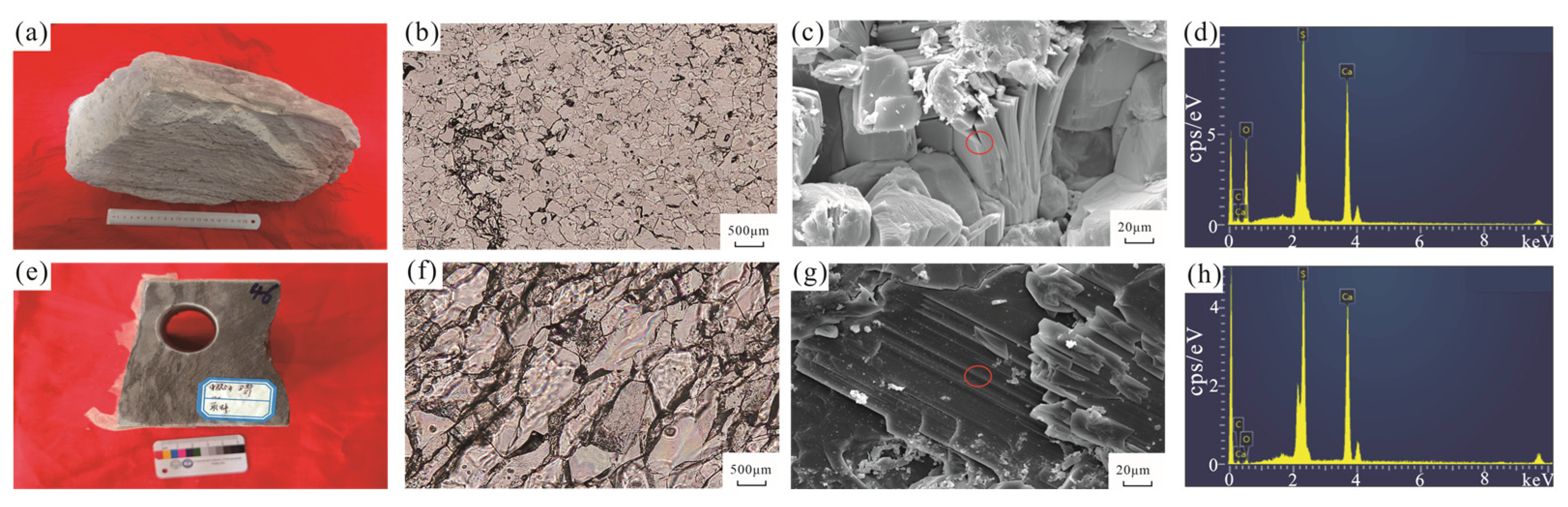
Macroscopic observations of anhydrite from the Huolianzhai mine and subsurface cores show similar features. The anhydrite is mainly grayish white (Figure 2a,e). Under transmitted-light microscopy, samples from the Huolianzhai mine show a granular texture. Pseudo-cubic cleavage is common, and small amounts of dolomite occur locally (Figure 2b). Scanning electron microscopy (SEM) shows that the anhydrite crystals are mostly elongate. Cleavage fractures are densely developed along the long axes of the crystals (Figure 2c). Energy-dispersive X-ray spectroscopy (EDS) indicates that the samples are mainly composed of calcium (Ca), sulfur (S), and oxygen (O) (Figure 2d).
Figure 2.
Microstructural images and textural characteristics of anhydrite. (a) Huolianzhai, Liaoning Province, Cambrian Mantou Formation, dolomite-bearing anhydrite; (b) plane-polarized light (PPL) photomicrograph of (a), showing a fine-grained texture with granular crystals; (c,d) SEM images and EDS spectra of (a), The red circle represents the test location in figure d, showing the development of elongate anhydrite crystals; (e) Well ZS-5, Cambrian Shayilik Formation, depth 6548.9 m, anhydritic dolomite rock; (f) plane-polarized light photomicrograph of (e), showing a fine-grained texture with granular crystals; (g,h) SEM images and EDS spectra of (e), The red circle represents the test location in figure h, showing the development of platy anhydrite crystals.
The subsurface core samples show similar granular crystals. They display granular to microcrystalline textures, with grain sizes ranging from 0.1 to 0.3 mm. The crystals are relatively well developed and are subhedral to anhedral in shape. They commonly occur as elongate or tabular aggregates (Figure 2f). SEM images show densely developed cleavage fractures in short elongate anhydrite crystals (Figure 2g). EDS results confirm that the subsurface anhydrite is also dominated by Ca, S, and O (Figure 2h). These observations indicate that the Huolianzhai mine samples and the Well Zhongshen-5 samples have similar mineralogical compositions and textures. This similarity supports the use of Huolianzhai anhydrite as a suitable alternative material for this study.
XRD results of Cambrian samples from Well ZS-5 in the Tazhong area and the Huolianzhai anhydrite mine indicate a wide range of anhydrite contents ranging from 23.36% to 73.40%. Based on mineralogical composition, the samples can be classified into four lithologies: dolomite-bearing anhydrite, dolomitic anhydrite, Anhydrite-dolomite rock, and Anhydrite-bearing dolomitic rock (Table 2).
Table 2.
Mineral composition.
4.2. Petrophysical Properties and Breakthrough Pressure Tests of Anhydrite and Dolomite
Breakthrough pressure is a critical parameter for evaluating caprock sealing capacity [47,48]. To systematically assess the sealing performance of anhydrite and dolomite, laboratory breakthrough pressure tests were conducted on the collected anhydrite samples in accordance with standardized procedures. Breakthrough pressure data for dolomite were compiled from Shi et al. [49] and Li [50] for comparison. N2 was used as the injection fluid, and specimens were fully saturated with kerosene prior to testing. All experiments were performed under constant confining pressure, with pore pressure increased stepwise until fluid breakthrough occurred. This approach follows a decreasing effective stress path and simulates progressive fluid overpressure conditions. Specimens were cored perpendicular to the original core axis using wire cutting to ensure consistent sample orientation.
The results (Table 3) show that dolomitic anhydrite and dolomite-bearing anhydrite have an average breakthrough pressure of up to 11.5 MPa. This value indicates strong sealing capacity. Breakthrough pressure increases significantly with confining pressure, suggesting that sealing performance improves with increasing burial depth. The initial porosity ranges from 0.192% to 1.719%, and the initial permeability ranges from 0.0084 to 0.0257 mD. These low values reflect the dense texture and excellent sealing capacity of the anhydrite. Previous studies reported that anhydrite-bearing dolomite and dolomitic anhydrite have an average breakthrough pressure of 8.1 MPa [49]. This value is slightly lower than that of dolomite-bearing anhydrite and pure anhydrite. The relatively lower breakthrough pressure of dolomite is mainly related to fracture development. Nevertheless, it still indicates strong sealing capacity.
Table 3.
Petrophysical Properties and Breakthrough Pressure Test Results.
4.3. Shear Resistance Tests
4.3.1. Experimental Principles
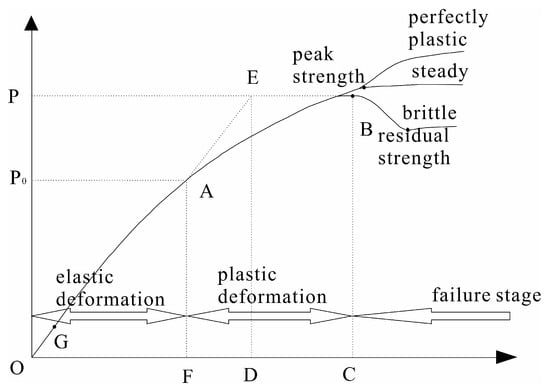
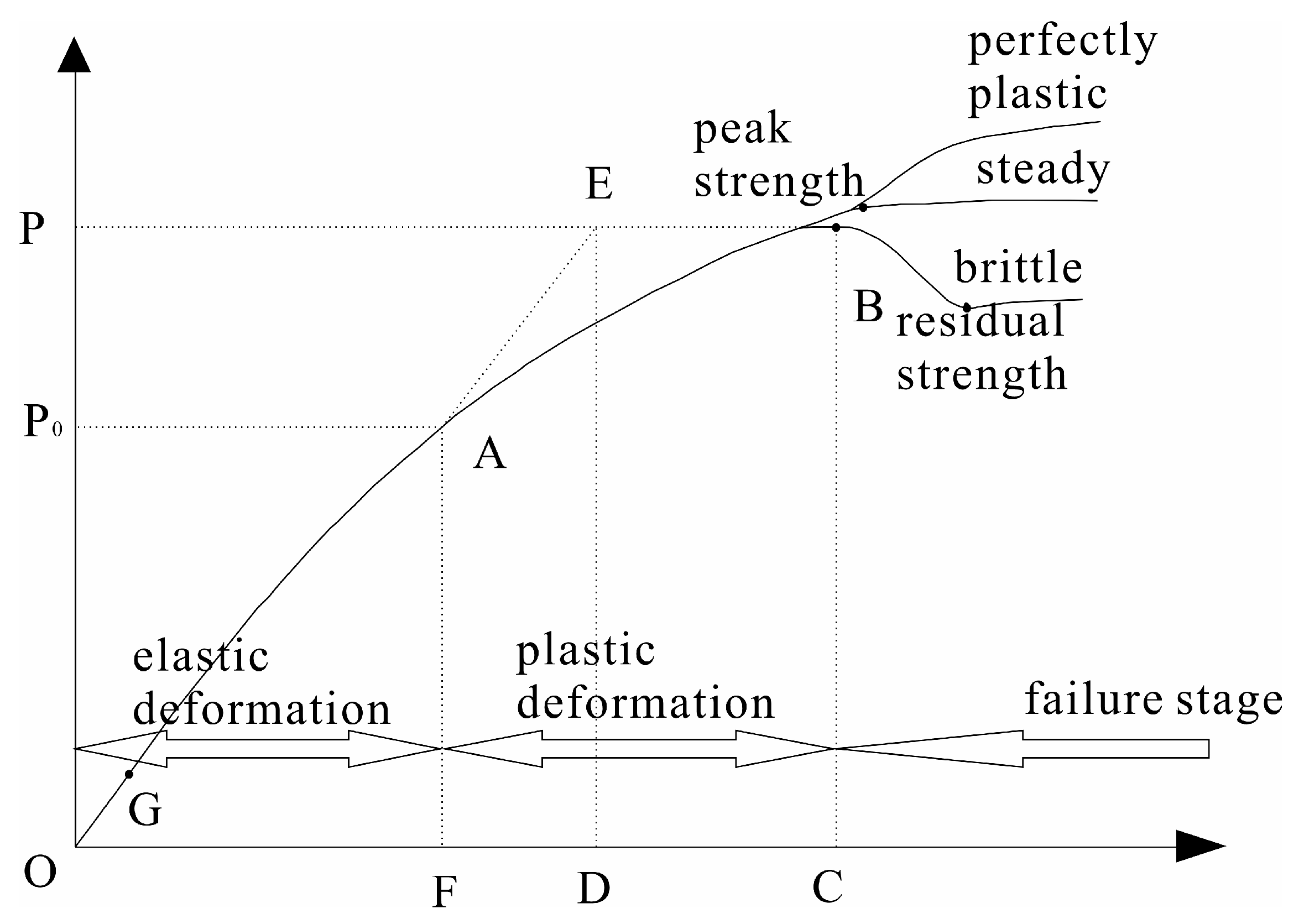
Triaxial compression experiments on cap rock samples simulate progressive burial conditions. They are used to study the mechanical behavior of rocks during the transition from brittle to plastic deformation. As confining pressure increases, rocks typically change from brittle failure to plastic deformation (Figure 3). With an increasing plasticity index, the rock shows greater plastic deformation capacity. When the residual strength approaches zero and the plasticity index exceeds 6, the rock is considered to have entered a plastic deformation regime [51,52,53,54,55,56,57]. These experiments help determine the critical confining pressure at which the brittle–plastic transition occurs. This provides a mechanical basis for evaluating the deformation state and sealing capacity of cap rocks under geological conditions.
Figure 3.
Schematic stress–strain curves of rocks under increasing confining pressure.
All triaxial compression experiments were conducted at room temperature. High-temperature conditions representative of ultra-deep burial were not simulated in this study. No pore pressure was applied during testing; therefore, the confining pressure represents total stress rather than effective stress. Axial loading was applied under strain-controlled conditions at a constant strain rate of 1 × 10⁻⁵ s−1. A total of thirteen cylindrical specimens were tested.
4.3.2. Failure Mode Characteristics
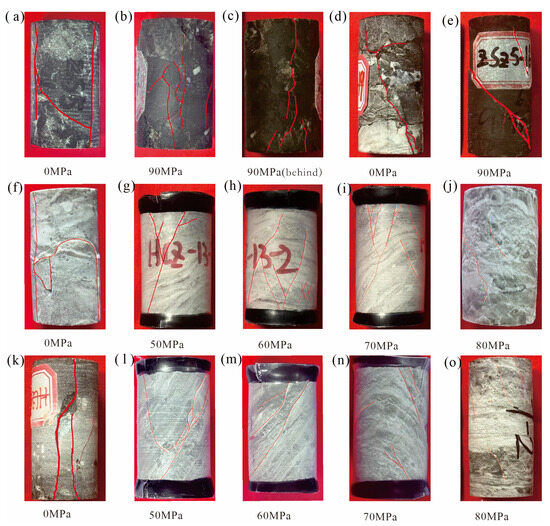
A series of triaxial compression tests were conducted under different confining pressures. The tested rocks include anhydrite-bearing dolomite, anhydritic dolomite, dolomitic anhydrite, and dolomite-bearing anhydrite. Figure 4 shows the failure characteristics of these samples under different confining pressures.
Figure 4.
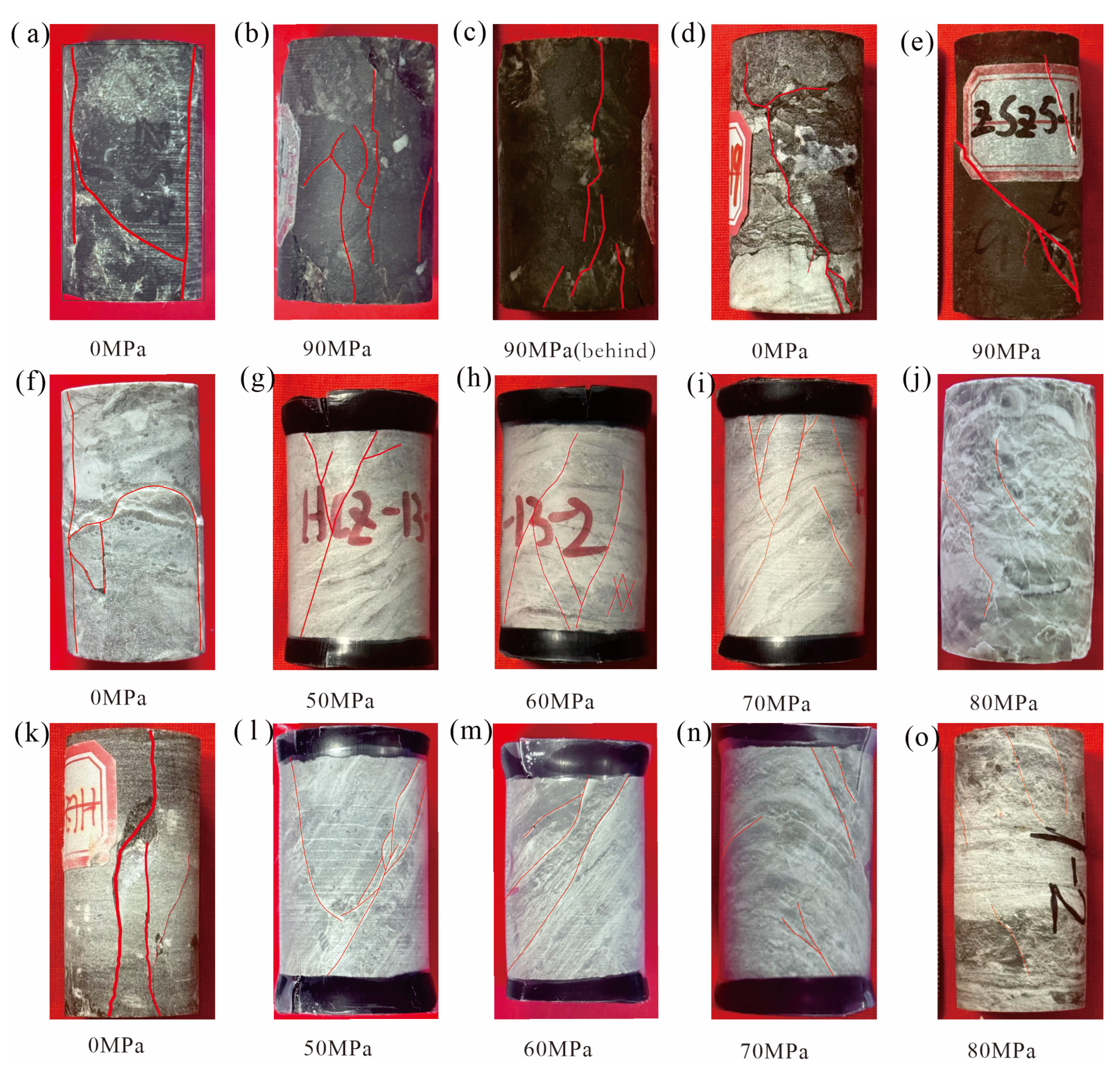
Fracture characteristics observed in triaxial compression tests under different confining pressures. (a–c) Well ZS-5, Cambrian Shayilik Formation, depth 6178 m, failure characteristics of anhydrite-bearing dolomitic rock; (d,e) Well ZS-5, Cambrian Awatage Formation, depth 6548.9 m, failure characteristics of anhydritic dolomite rock; (f–j) Huolianzhai anhydrite mine, Mantou Formation, failure characteristics of dolomitic anhydrite; (k–o) Huolianzhai anhydrite mine, Mantou Formation, failure characteristics of dolomite-bearing anhydrite.
Under uniaxial compression (confining pressure = 0 MPa), both dolomite and anhydrite show typical brittle shear failure [58,59,60]. A well-developed, throughgoing principal shear fracture forms in each sample. This fracture is roughly parallel to the maximum principal stress. In addition, one to three secondary shear fractures commonly appear on the sample surface. Together, these fractures form a highly connected shear failure zone. Overall, the failure is dominated by brittle fracturing (Figure 4a–f,k).
As confining pressure increases, the failure mechanism changes significantly. Dolomite-bearing anhydrite and dolomitic anhydrite develop conjugate or cross-cutting shear fractures. Slight volumetric dilation is also observed (Figure 4g–i). A principal shear fracture still forms, but it is narrower than under uniaxial conditions. It is accompanied by several shorter and poorly connected secondary shear bands.
The formation of conjugate fracture networks reflects internal stress redistribution and increased resistance to fracturing. This pattern marks the transition from purely brittle behavior to a brittle–plastic deformation regime [58,59,60,61].
With further increases in confining pressure, plastic behavior becomes more obvious in dolomite-bearing anhydrite and dolomitic anhydrite. Failure is characterized by one to three small secondary shear bands with low connectivity. Noticeable volumetric dilation is observed (Figure 4i,m). This dilation indicates enhanced plastic deformation.
At even higher confining pressures, all rock types show stronger plasticity. Fractures become finer and more dispersed. Their connectivity decreases further, and volumetric dilation becomes more pronounced (Figure 4j,n,o). Under these conditions, failure is no longer controlled by a single large fracture plane. Instead, deformation is dominated by distributed micro-shear, grain-boundary sliding, and crystal plasticity.
This progressive change agrees with classical rock-mechanics models of the brittle–plastic transition. Increasing confining pressure suppresses tensile crack growth and promotes frictional sliding and crystal-plastic deformation. As a result, the macroscopic failure pattern and mechanical behavior of the rocks are significantly altered [58,59,60,61,62,63].
In this study, compressive stress and axial strain are both defined as positive. The detailed experimental results are summarized in Table 4.
Table 4.
Experimental results of triaxial/uniaxial compression.
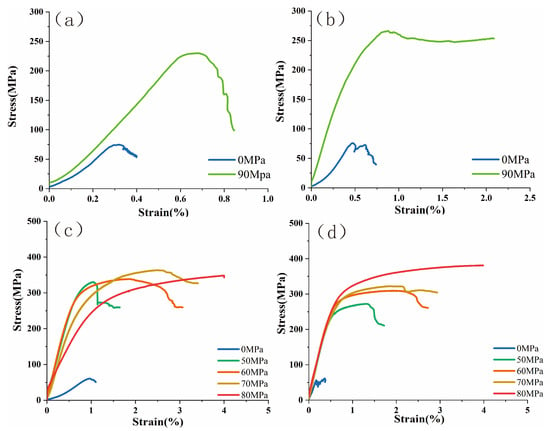
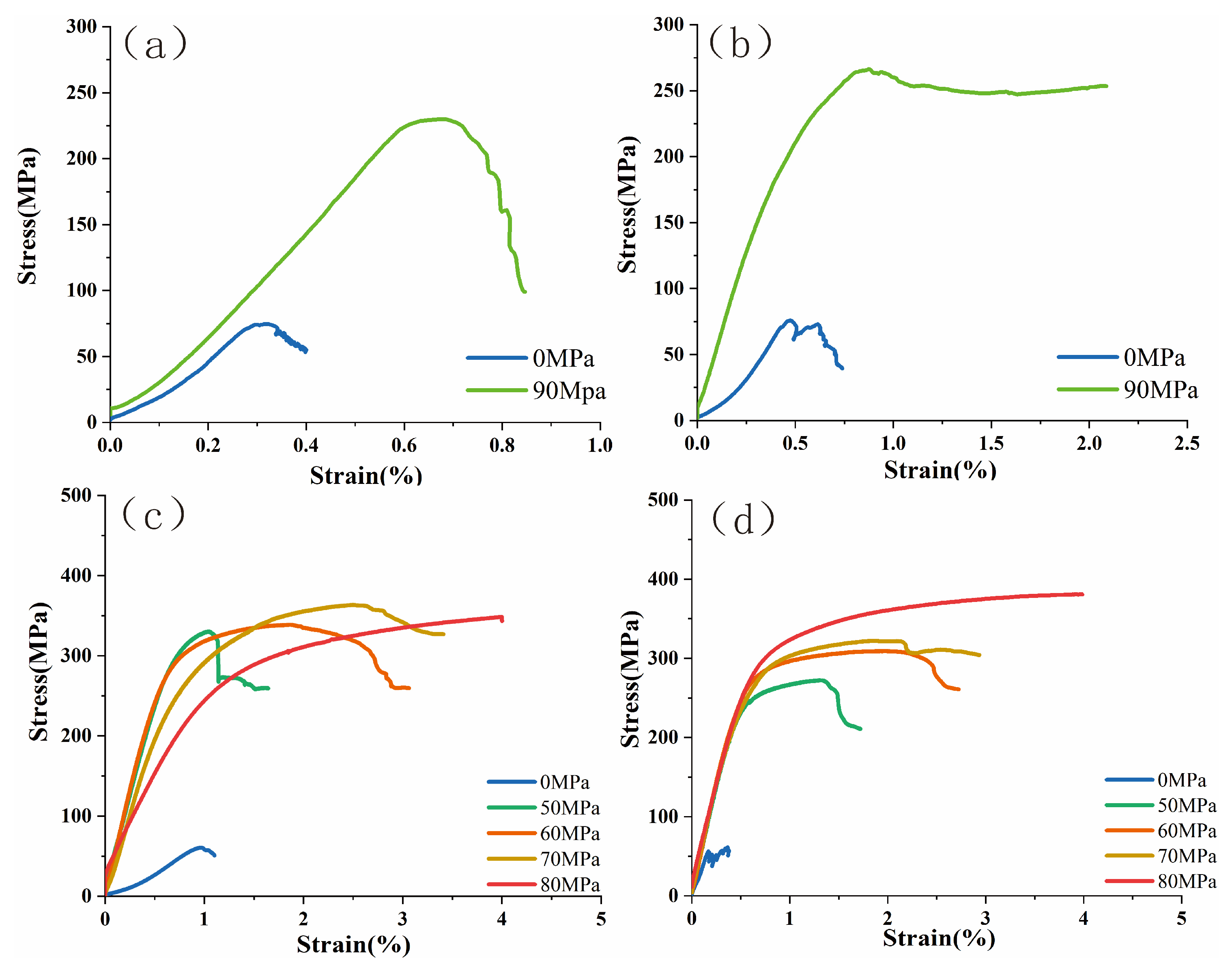
As shown in Figure 5, the peak strength of all rock types increases steadily with increasing confining pressure. This trend indicates a clear confining-pressure strengthening effect on rock mechanical behavior. Anhydrite-bearing dolomitic rock still shows typical brittle deformation at a confining pressure of 90 MPa (Figure 5a). Its stress–strain curve displays a clear post-peak stress drop, indicating strong strain-softening behavior. In contrast, anhydritic dolomite behaves differently. When the confining pressure reaches 90 MPa, no obvious post-peak stress drop is observed. The stress–strain curve shows features of brittle–plastic deformation (Figure 5b). For dolomitic anhydrite, the stress–strain curve at 80 MPa shows clear strain-hardening behavior. The peak strength increases further, and the deformation behavior fully shifts to plastic deformation (Figure 5c). Therefore, 80 MPa is considered the threshold confining pressure for the brittle–plastic transition of dolomitic anhydrite. For dolomite-bearing anhydrite, noticeable changes occur at a confining pressure of 70 MPa. No clear post-peak stress drop is observed, indicating the onset of plastic deformation. At 80 MPa, the strain-hardening feature becomes more obvious, and deformation is fully plastic. Thus, 70 MPa is interpreted as the threshold confining pressure for the brittle–plastic transition of dolomite-bearing anhydrite (Figure 5d).
Figure 5.
Stress–strain curves obtained from triaxial compression tests. (a) Well ZS-5, Cambrian Shayilik Formation, depth 6178 m, triaxial test results of anhydrite-bearing dolomitic rock; (b) Well ZS-5, Cambrian Awatage Formation, depth 6548.9 m, triaxial test results of anhydritic dolomite rock; (c) Huolianzhai anhydrite mine, Mantou Formation, triaxial test results of dolomitic anhydrite; (d) Huolianzhai anhydrite mine, Mantou Formation, triaxial test results of dolomite-bearing anhydrite.
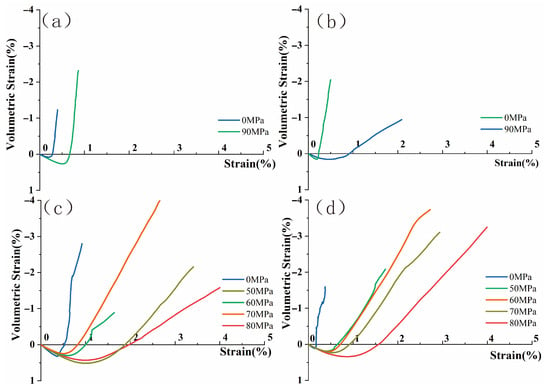
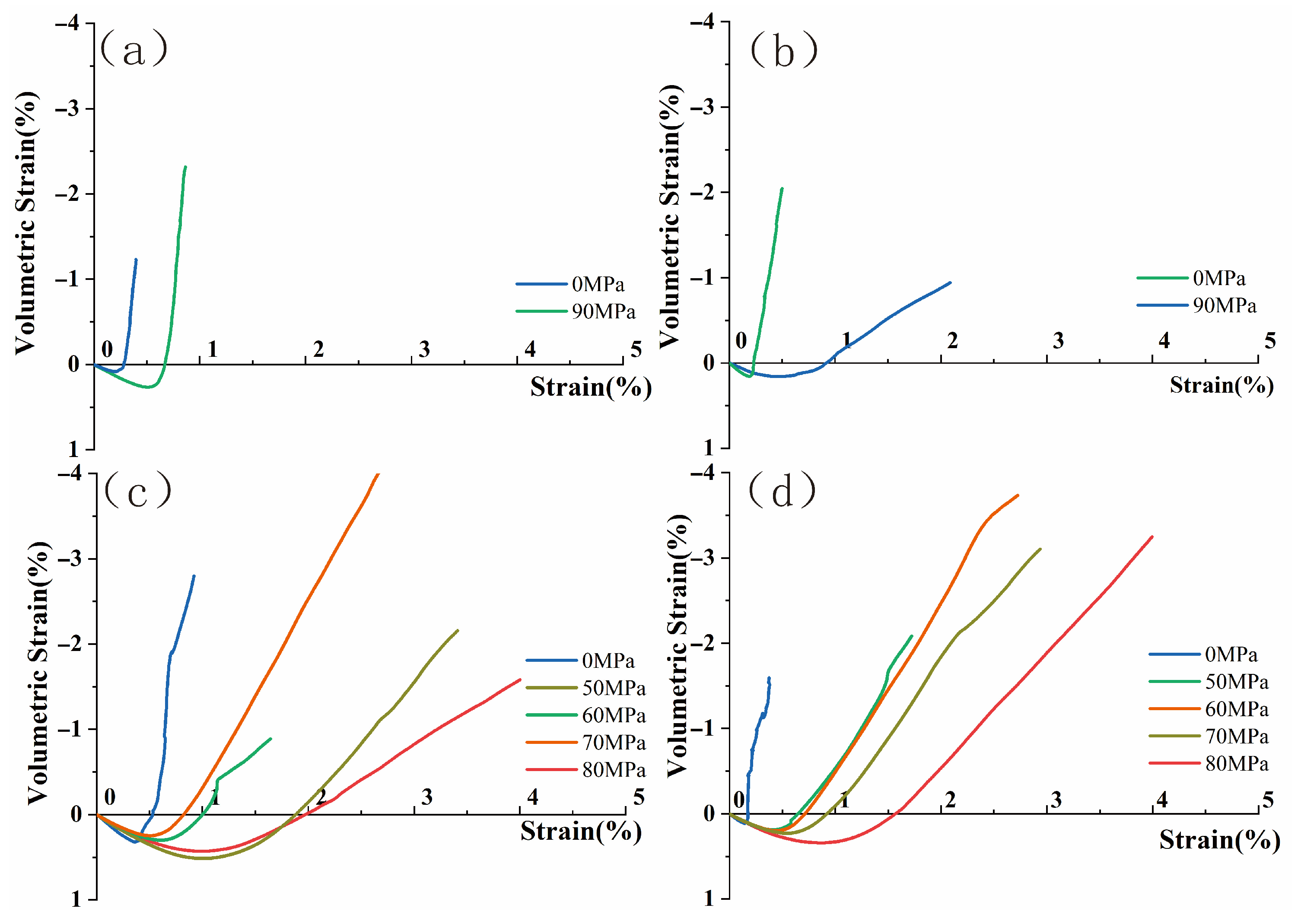
The mechanical behavior of rocks under confining pressure can also be described using volumetric strain–axial strain relationships. As shown in Figure 6, the curves of the four rock types change systematically as confining pressure increases. Under low confining pressure (uniaxial compression), all four lithologies show typical brittle volumetric strain behavior. After reaching peak strength, the samples enter a failure stage marked by a rapid increase in volumetric strain. This stage represents a clear post-peak damage phase. During this process, numerous microcracks initiate, propagate, and coalesce within the rock. These cracks include both intergranular and intragranular types. Over time, they merge to form macroscopic shear fractures that cut through the entire specimen from top to bottom [64]. As confining pressure increases, the volumetric strain–axial strain curves of dolomite-bearing anhydrite and dolomitic anhydrite gradually show plastic deformation features (Figure 6c,d). In the post-peak stage, axial strain continues to increase, but the rate of volumetric strain accumulation decreases significantly. This change reflects a transition from brittle failure to strain-hardening behavior.
Figure 6.
Volumetric strain responses under different confining pressures during triaxial compression tests. (a) Well ZS-5, Cambrian Shayilik Formation, depth 6178 m, volumetric strain of anhydrite-bearing dolomitic rock; (b) Well ZS-5, Cambrian Awatage Formation, depth 6548.9 m, volumetric strain of anhydritic dolomite rock; (c) Huolianzhai anhydrite mine, Mantou Formation, volumetric strain of dolomitic anhydrite; (d) Huolianzhai anhydrite mine, Mantou Formation, volumetric strain of dolomite-bearing anhydrite.
5. Discussion
5.1. Critical Conditions for the Brittle–Plastic Transition of Caprocks
The experimental results presented above indicate that the average breakthrough pressure of anhydrite reaches 11.5 MPa, whereas that of dolomite averages 8.1 MPa. According to the caprock sealing effectiveness classification criteria established in SY/T 6942–2013: Evaluation Methods for Oil and Gas Caprocks [56], a breakthrough pressure exceeding 5 MPa is considered sufficient for an effective caprock. Therefore, anhydrite-bearing dolomite, dolomitic anhydrite, anhydritic dolomite, and anhydrite–dolomite rocks can all be classified as effective caprock lithologies. However, ultra-deep caprocks have experienced long and complex geological histories; in addition to high breakthrough pressures, they must withstand intense tectonic stresses and large overburden loads. By simulating geological conditions through rock-mechanical experiments, this study systematically investigates the deformation mechanisms of anhydrite under high-pressure conditions and explores its brittle–plastic transition behavior. Emphasis is placed on evaluating the plastic deformation capacity of anhydrite and assessing the effectiveness of ultra-deep anhydrite caprocks during critical hydrocarbon accumulation stages and periods of tectonic activity.
Due to experimental limitations, temperature and pore pressure were not incorporated in this study. Previous studies show that elevated temperature and pore pressure enhance the plastic deformation capacity of evaporites [65]. Therefore, their potential effects are considered in the interpretation of plastic deformation, and depth estimates are presented as conservative ranges. Confining pressure can be calculated using Equation (1) [56]:
where
- PH—denotes the effective overburden pressure (MPa);
- —denotes the weighted-average bulk density (g/cm3);
- —denotes the formation-water density (g/cm3);
- H—denotes the sampling depth (m).
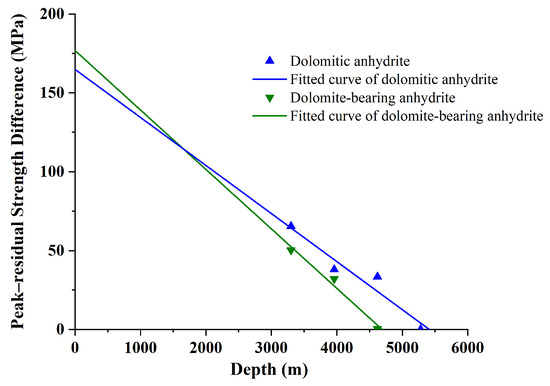
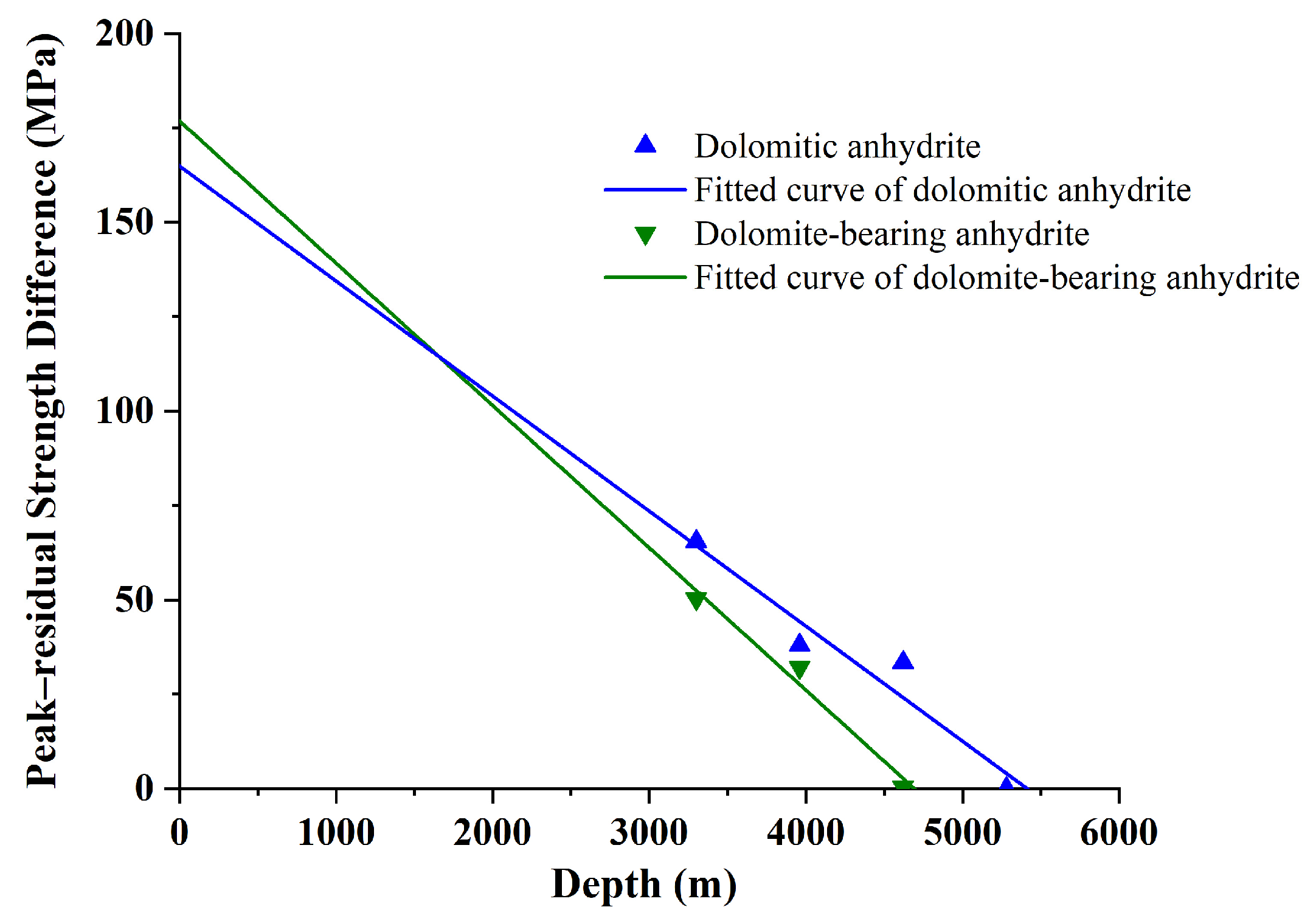
Previous studies have demonstrated a clear linear relationship between confining pressure and the difference between peak stress and residual stress in anhydrite. Based on the confining pressure–depth conversion defined by Equation (1), linear regression of the peak–residual strength difference for dolomite-bearing anhydrite and dolomitic anhydrite at different depths (Figure 7) was performed. The results suggest that dolomitic anhydrite enters a plastic deformation regime at an approximate laboratory-derived burial depth of 5200–5400 m, corresponding to a confining pressure of ~80 MPa. In contrast, dolomite-bearing anhydrite transitions to plastic deformation at a shallower laboratory-derived depth range of approximately 4400–4600 m, corresponding to ~70 MPa. These depths represent estimates derived from experimental data and should be regarded as approximate ranges.
Figure 7.
Relationship between the peak–residual strength difference in dolomite-bearing anhydrite and dolomitic anhydrite with depth.
A large number of triaxial compression experiments demonstrate that, with increasing confining pressure, rocks progressively evolve from brittle to plastic deformation. The plastic deformation capacity of rocks can be quantified using the work derived from stress–strain curves obtained from triaxial tests. The plasticity coefficient corresponding to a given confining pressure can be calculated using Equation (2) and subsequently subjected to linear fitting to determine whether the caprock is in a plastic deformation regime. [56,65]:
where
- AF—denotes the total work expended prior to rock failure;
- AE—denotes the elastic strain energy stored in the rock;
- The areas SOABC and SODE are illustrated in Figure 3.
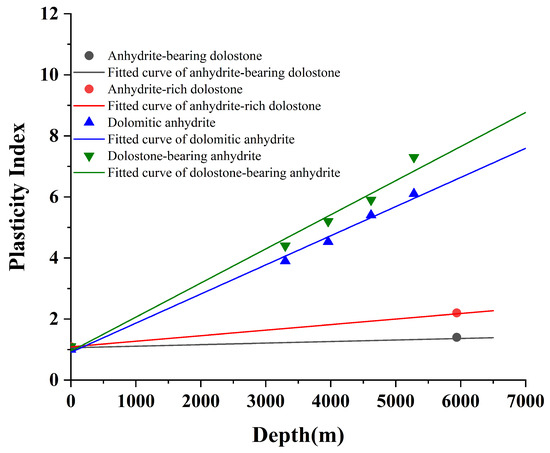
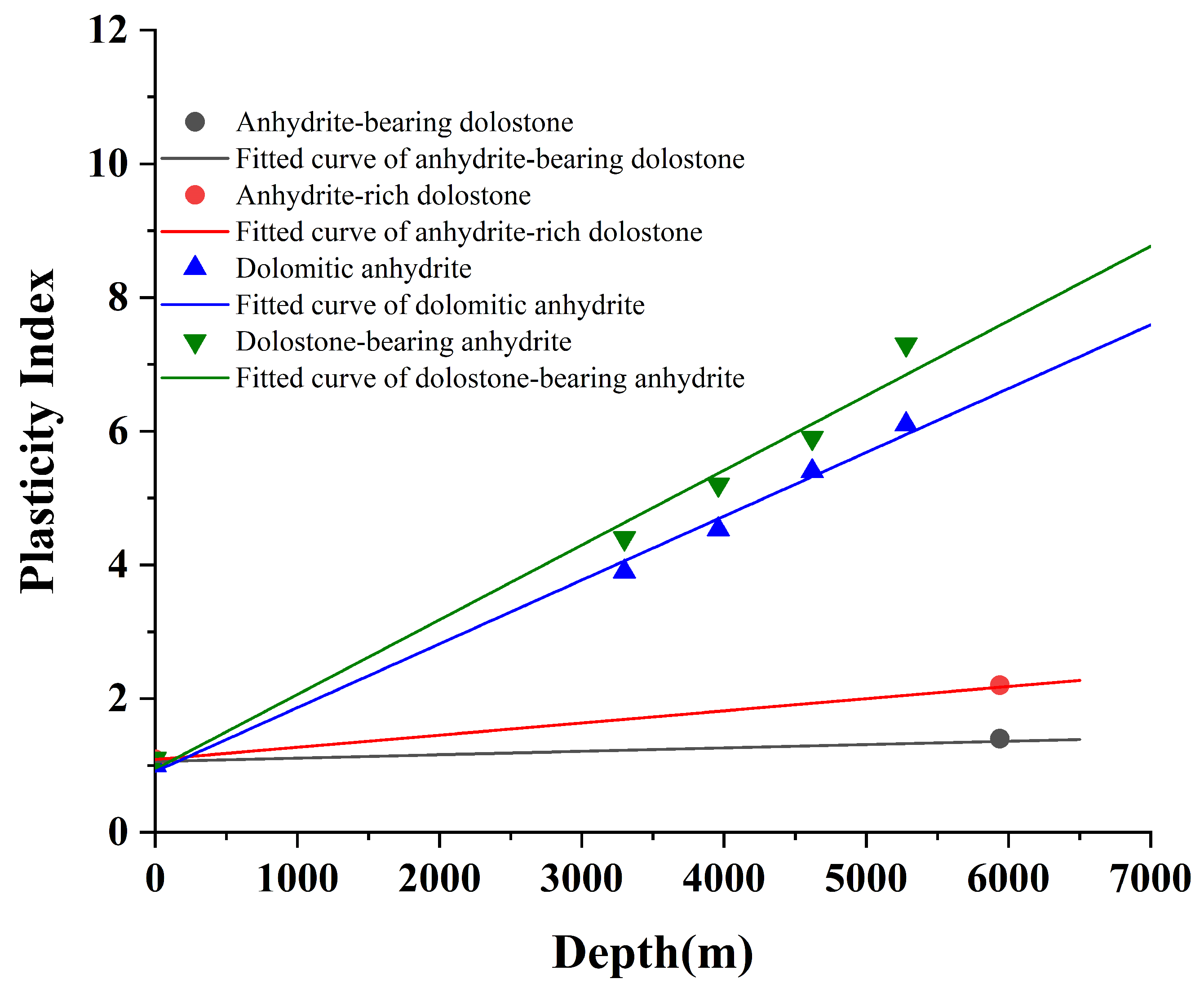
Using the approaches described in Equations (1) and (2), confining pressures were converted into corresponding burial depths, and the plasticity coefficients were calculated and linearly fitted (Figure 8, Table 5). The results show that: The plasticity coefficient increases progressively with increasing confining pressure, indicating enhanced plastic deformation capacity and confirming that confining pressure strongly controls the brittle–plastic transition. When the plasticity coefficient is ≥6, rocks predominantly exhibit plastic deformation characteristics [56,66]. Anhydrite content also plays a key role in deformation behavior, with higher anhydrite content corresponding to a stronger tendency toward plastic deformation. As shown in Figure 8, the laboratory-derived burial depth corresponding to the brittle–plastic transition is approximately 4400–4600 m for dolomite-bearing anhydrite and approximately 5200–5400 m for dolomitic anhydrite. These depths are estimated from the experimentally determined critical confining pressures (~70 MPa and ~80 MPa, respectively) and should be regarded as approximate ranges. Due to the experimental limitation of a maximum confining pressure of 90 MPa, the critical confining pressure for the brittle–plastic transition of dolomite was not fully constrained. However, both the plasticity index and stress–strain behavior indicate progressively enhanced plastic deformation with increasing confining pressure. These results demonstrate that lithological composition exerts strong control on rock mechanical properties and the depth range of the brittle–plastic transition. Collectively, the data suggest that dolomite-bearing anhydrite tends to enter a plastic deformation regime at burial depths greater than approximately 4400–4600 m, whereas dolomitic anhydrite does so at depths greater than approximately 5200–5400 m. Under such conditions, anhydrite-rich caprocks are more likely to maintain sealing capacity even during intense tectonic deformation.
Figure 8.
Variation in the plasticity index of anhydrite rocks and dolomite with different anhydrite contents with depth.
Table 5.
Summary of Plasticity Index Values.
5.2. Evolutionary Model of Caprock Sealing Capacity
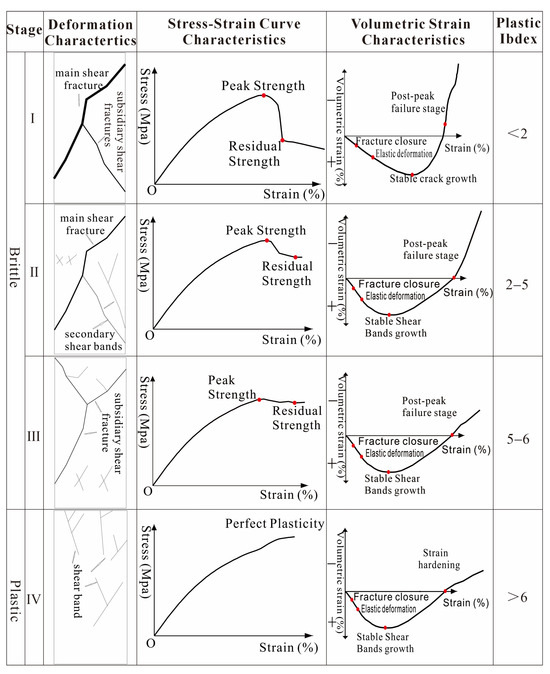
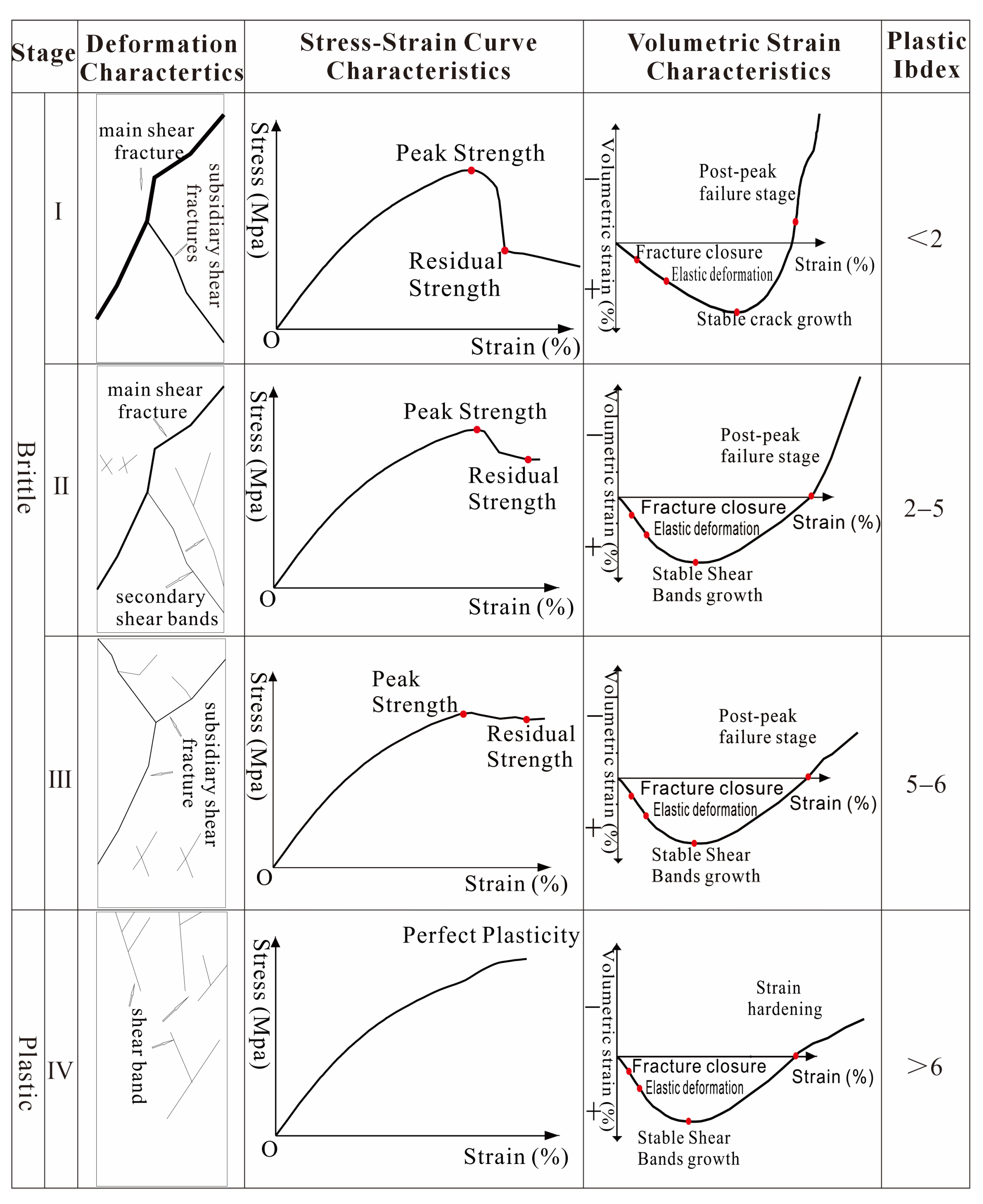
By integrating deformation characteristics, stress–strain behavior, and volumetric strain features, the brittle–plastic evolution of caprocks can be divided into two deformation regimes and four distinct stages (Figure 9).
Figure 9.
Evolutionary model of brittle–plastic stages.
Stage I represents a fully brittle deformation stage. Its deformation characteristics are mainly manifested by the development of a highly connected principal shear fracture zone within the rock, commonly accompanied by one to three subsidiary shear fractures with relatively poor connectivity and smaller fracture scales. In terms of stress–strain behavior, this stage is characterized by a pronounced post-peak differential stress drop and relatively high peak–residual strength difference, indicating strong strain-softening behavior. From the perspective of volumetric strain, this stage corresponds to the unstable crack growth stage through the post-peak failure stage, during which deformation accumulates extremely rapidly. The volumetric strain–axial strain curves display a sharp increase in slope during these stages, reflecting accelerated microcrack initiation, propagation, coalescence, and rapid energy release within the rock. This stage is dominated by brittle deformation, with a plasticity coefficient of less than 2.
Stage II represents a deformation stage in which plastic deformation capacity gradually increases. Deformation is characterized by the formation of a principal shear fracture zone, but with significantly reduced fracture scale and connectivity compared to the fully brittle stage. Several secondary shear bands with limited connectivity and smaller fracture sizes commonly develop around the main shear fracture. The stress–strain curves show a smaller post-peak stress drop than that observed in Stage I, indicating a progressive transition from brittle to plastic mechanical behavior. In terms of volumetric strain, deformation accumulation rates during the unstable crack growth stage and post-peak failure stage are lower than those in the fully brittle stage, and the increase in curve slope is less pronounced. This reflects the coexistence of crack propagation and plastic adjustment mechanisms. The corresponding plasticity coefficient ranges from 2 to 5.
Stage III represents the critical transitional stage from brittle to plastic deformation. This stage is mainly characterized by the development of one to three poorly connected, small-scale secondary shear bands. The stress–strain response exhibits little or no obvious post-peak stress drop. In terms of volumetric strain, deformation during the unstable crack growth and post-peak failure stages is significantly reduced, and the curve slopes are lower than those of the brittle stages, indicating enhanced plastic deformation capacity within the rock. The corresponding plasticity coefficient ranges from 5 to 6.
Stage IV corresponds to the plastic deformation stage. Its deformation characteristics are dominated by the development of multiple dispersed shear deformation bands with low connectivity. The stress–strain curves exhibit continuous post-peak strength increase, commonly referred to as strain hardening or post-peak strengthening, accompanied by sustained strain-hardening behavior. In terms of volumetric strain, deformation accumulation rates during the unstable crack growth and post-peak failure stages are significantly reduced, with low and smoothly varying curve slopes. This indicates that plastic flow and lattice-scale deformation mechanisms dominate the internal deformation process, while crack development is effectively suppressed. The corresponding plasticity coefficient is greater than 6.
5.3. Temporal Evolution of Sealing Capacity of Caprocks in the Eastern Tazhong Area
Gypsum and anhydrite are both sulfate minerals; however, they exhibit significant differences in crustal stability and spatial distribution [67]. Gypsum is typically distributed near the surface or within modern sedimentary environments, as it is stable under ambient temperature and pressure conditions. With increasing burial depth, however, rising geothermal gradients and lithostatic pressure induce the dehydration of gypsum, transforming it into anhydrite. Previous studies have shown that the maximum temperature for the gypsum–anhydrite transformation is approximately 60 °C [67,68,69,70].
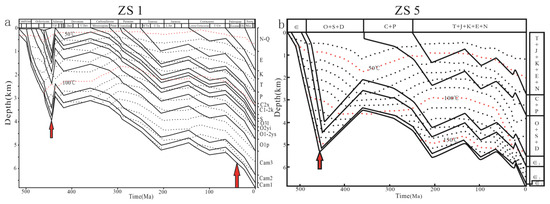
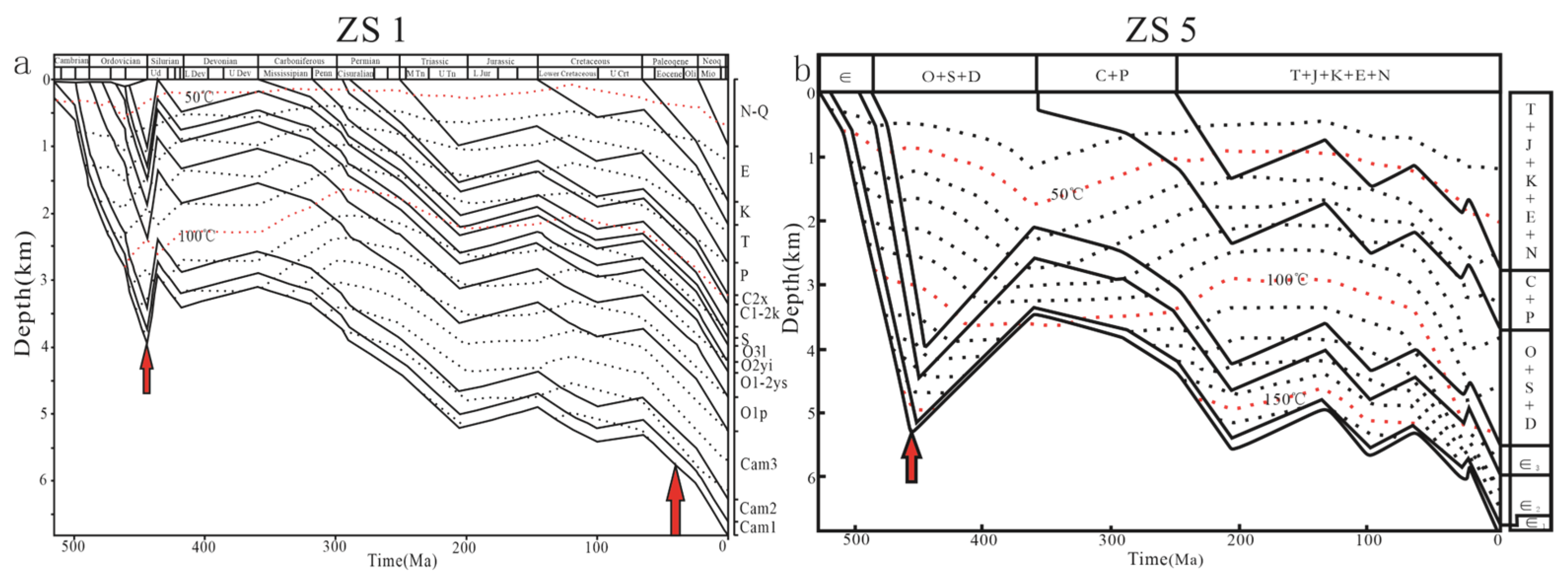
Burial and thermal history reconstructions of Wells ZS-1 [71] and ZS-5 [72] in the eastern Tazhong area (Figure 10) indicate that the Middle Cambrian strata reached temperatures of approximately 60 °C at burial depths of around 1000 m. Combined with the hydrocarbon charging history of the Tazhong area, these results suggest that during the critical hydrocarbon accumulation period, the Middle–Lower Cambrian caprocks in the eastern Tazhong area consisted predominantly of anhydrite.
Figure 10.
Burial and thermal history of wells ZS1 and ZS5 in the eastern Tazhong area (Modified from [71,72]). (a) Well ZS1 thermal history diagram, where the red arrows in the diagram represent the main hydrocarbon accumulation period of well ZS1; (b) Well ZS5 thermal history diagram, where the red arrows in the diagram represent the main hydrocarbon accumulation period of well ZS5.
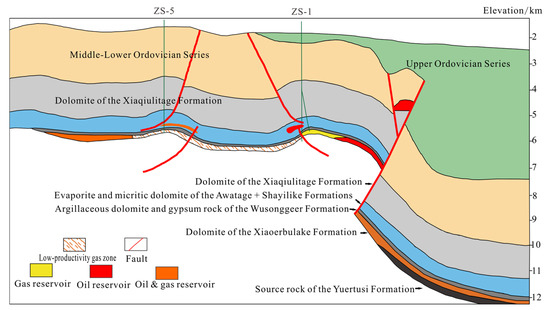
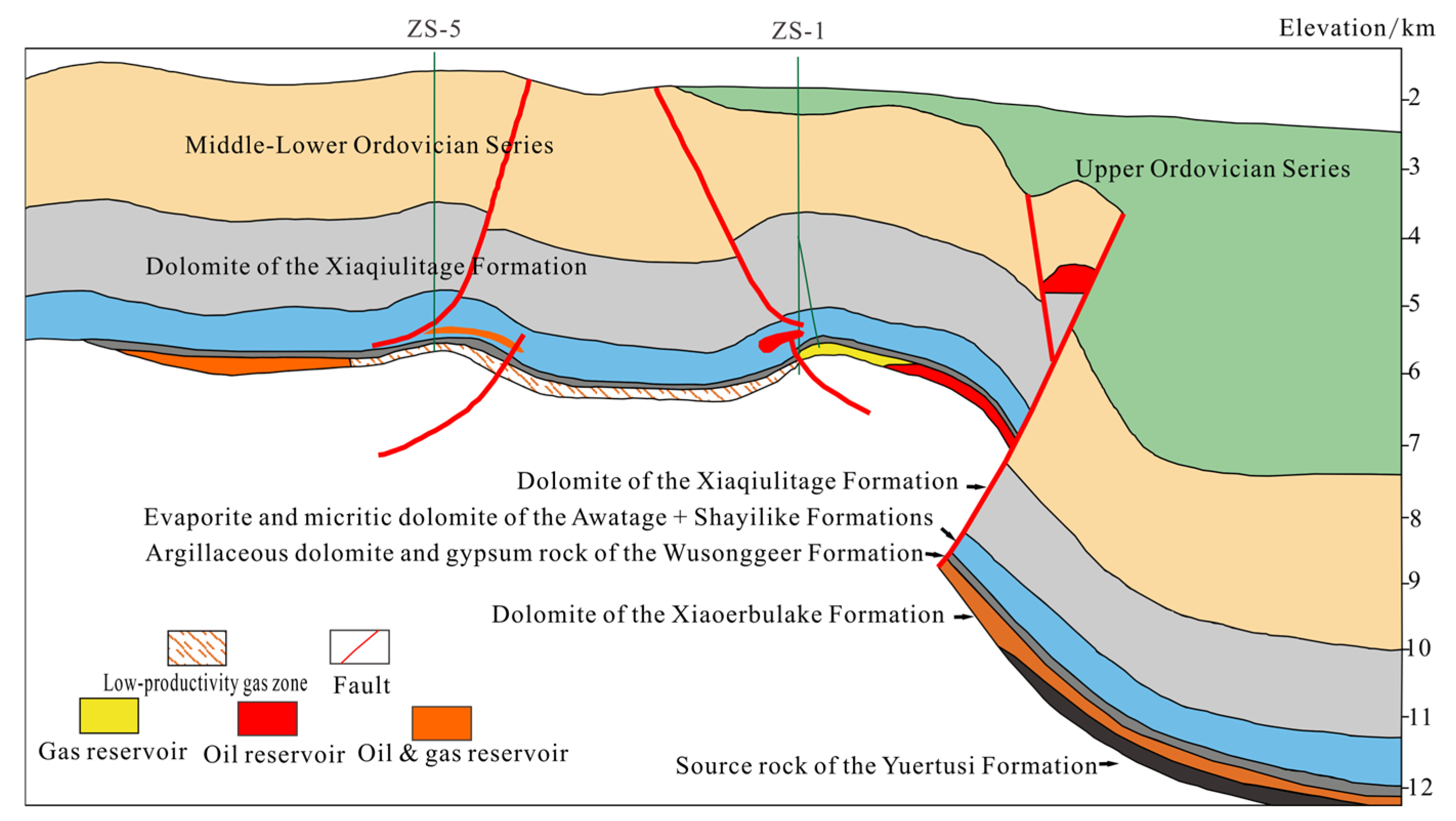
At present, anhydrite strata of the Lower Cambrian Wusongger Formation and the Middle Cambrian Shayilik and Awatage formations in the Tazhong area are buried at depths of approximately 5200–6400 m (Figure 11). Three major hydrocarbon accumulations have been identified in Wells ZS-1 and ZS-5. The first corresponds to oil reservoirs formed during the Late Caledonian stage [71,72], in which evaporites in the upper Shayilik Formation act as caprocks, overlying dolomite or anhydritic dolomite rock reservoirs. The second corresponds to gas reservoirs formed during the Himalayan stage [68], with dolomite of the Lower Cambrian Xiaoerbulake Formation serving as the main reservoir, sealed by overlying anhydrite of the Wusongger, Shayilik, and Awatage formations.
Figure 11.
Hydrocarbon accumulation model of the Middle–Lower Cambrian in the Tazhong area (Modified from [71]).
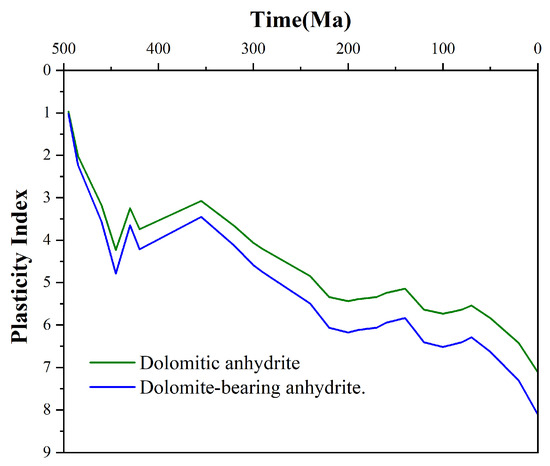
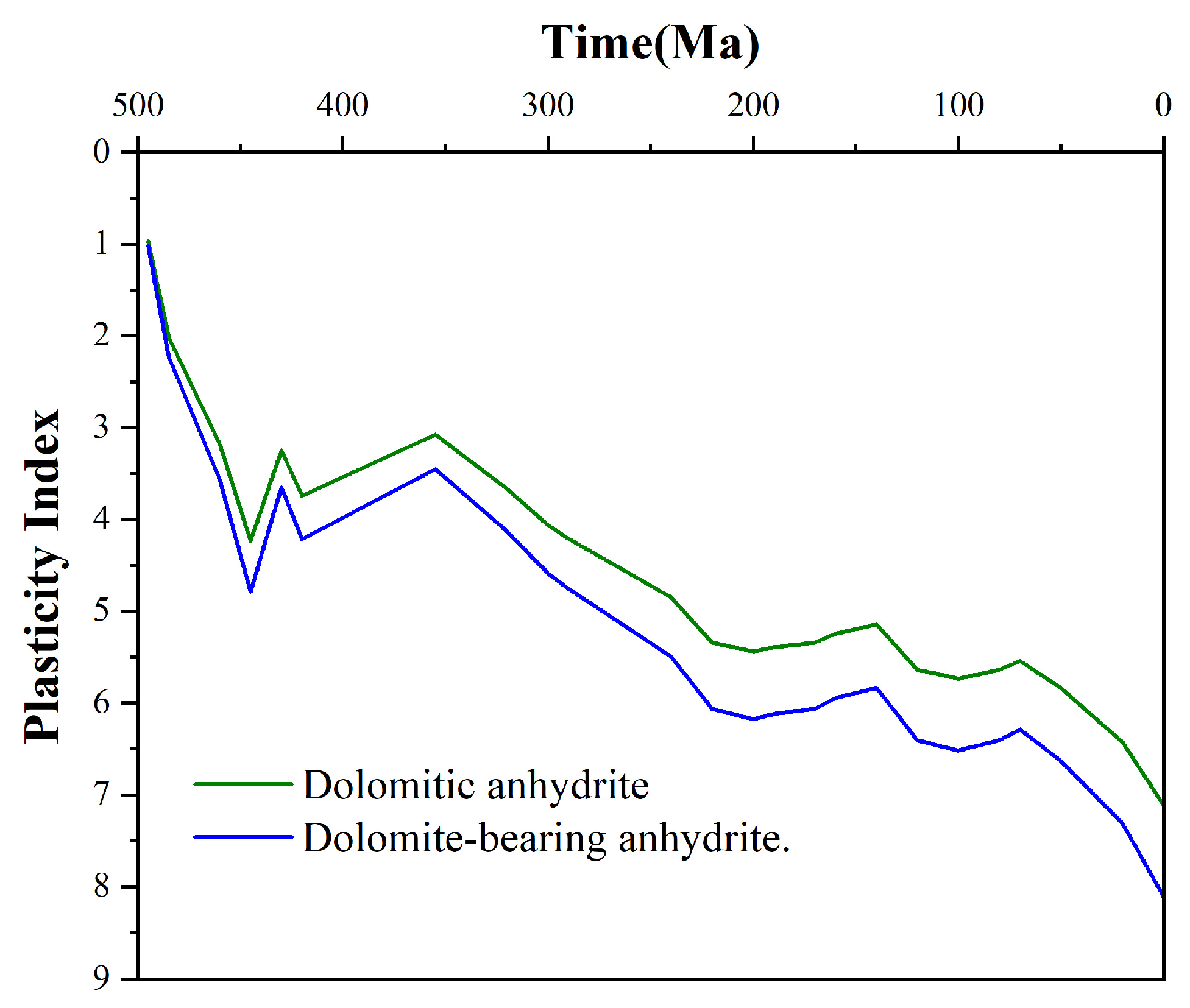
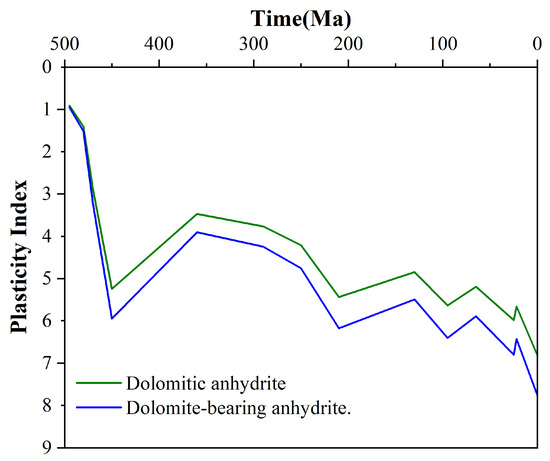
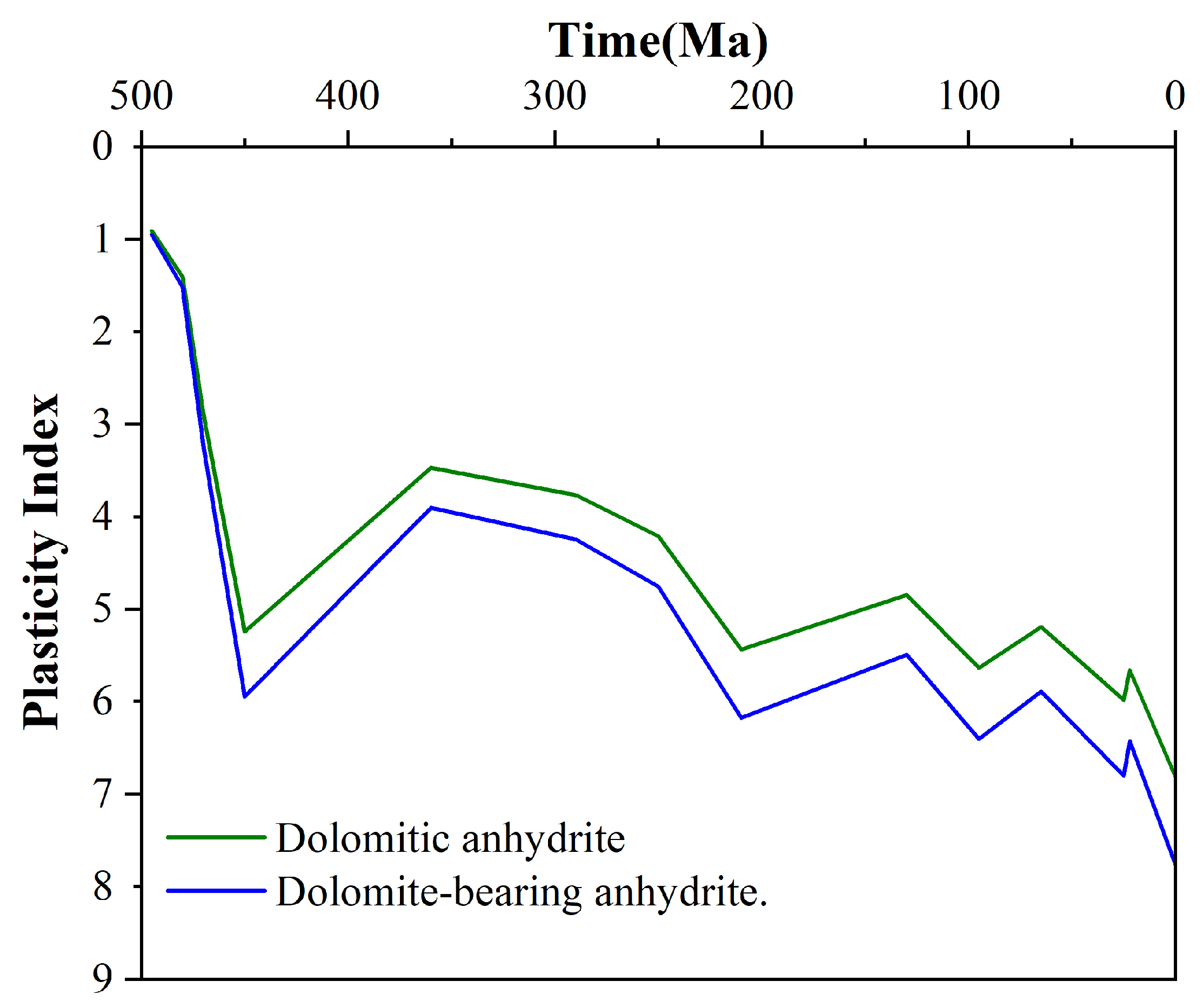
Analysis of the plasticity evolution of caprocks during the main hydrocarbon accumulation stages in the eastern Tazhong area (Figure 12 and Figure 13) suggests that during the Caledonian period, caprocks were likely dominated by brittle deformation behavior with relatively limited plastic accommodation capacity. Under such mechanical conditions, fault reactivation may have been more prone to inducing fracture propagation and permeability enhancement, potentially increasing the risk of hydrocarbon leakage. In contrast, during the Himalayan period, the caprocks are inferred to have been in a comparatively more plastic deformation regime, which may have facilitated strain accommodation without extensive fracturing and thereby contributed to improved sealing integrity. Well ZS-5 is located within the Tazhong No. 5 fault zone, which initiated during the Middle Caledonian and experienced significant reactivation during the Hercynian period [59]. Well ZS-1 is situated in the Tazhong No. I fault zone, formed during the Middle Caledonian and largely finalized in the Late Caledonian [28]. Liu et al. [65] documented hydrocarbon-bearing fluid inclusions and bitumen streaks within the Middle Cambrian Awatag gypsum caprock in Well ZS-5, indicating that hydrocarbon charging and leakage events occurred during the accumulation history. These petrographic observations provide geological evidence that sealing effectiveness in the eastern Tazhong area may have varied through time. The coincidence between the inferred brittle mechanical regime during the Caledonian period and the timing of fault activity suggests that brittle caprock behavior may have reduced sealing capacity and contributed to the partial destruction or dissipation of early hydrocarbon accumulations in Wells ZS-5 and ZS-1. However, it should be emphasized that this interpretation represents a conceptual model integrating laboratory-derived mechanical parameters with regional tectonic evolution, rather than a deterministic reconstruction.
Figure 12.
Evolution of cap-rock plasticity in Well ZS1, Tazhong area.
Figure 13.
Evolution of cap-rock plasticity in Well ZS5, Tazhong area.
Natural gas in Well ZS-1C was charged during the Himalayan period [72]. When considered together with the inferred plastic deformation regime and the structural position at a local high, the preservation of Himalayan gas accumulations may reflect improved sealing conditions during this stage. Nonetheless, further quantitative structural and permeability modeling would be required to fully validate this evolutionary interpretation.
6. Conclusions
(1) An increase in anhydrite content significantly enhances the plastic deformation capacity of dolomite–anhydrite rocks. Dolomite-bearing anhydrite exhibits pronounced plastic deformation at a confining pressure of approximately 70 MPa, whereas dolomitic anhydrite shows similar behavior at approximately 80 MPa. In contrast, the plastic deformation capacity of anhydrite-bearing dolomitic rock and anhydritic dolomite increases only slightly with increasing confining pressure, indicating a comparatively stronger tendency toward brittle behavior. Based on the laboratory-derived confining pressure–depth relationship, dolomite-bearing anhydrite caprocks are inferred to enter a plastic deformation regime at burial depths greater than approximately 4400–4600 m, whereas dolomitic anhydrite may do so at depths exceeding approximately 5200–5400 m. At relatively shallow burial depths, however, anhydrite-bearing dolomitic rock and anhydritic dolomite are more prone to brittle failure, which may compromise caprock sealing capacity under tectonic stress conditions.
(2) Based on the mechanical properties, deformation characteristics, stress–strain behavior and volumetric strain features, the deformation evolution of caprocks can be divided into four distinct stages. Stages I–III are dominated by brittle deformation. Stage I corresponds to fully brittle deformation; Stage II represents the gradual development of plastic deformation capacity with increasing confining pressure; and Stage III marks the transitional state between brittle and plastic deformation. Stage IV is dominated by plastic deformation, characterized by strong shear resistance and high plastic deformation capacity, and represents the most effective caprock state during critical hydrocarbon accumulation periods.
(3) Based on the evolution of physical and mechanical properties in dolomite-bearing anhydrite, dolomitic anhydrite, anhydrite–dolomite rock, and anhydrite-bearing dolomitic rock, this study provides new insights into the potential sealing behavior of Middle Cambrian evaporite caprocks during key hydrocarbon accumulation stages in the eastern Tazhong area. The mechanical analysis suggests that caprocks were likely dominated by brittle deformation behavior during the Caledonian period, whereas a comparatively more plastic deformation regime may have prevailed during the Himalayan period. Under brittle mechanical conditions, reverse fault activity may have enhanced fracture development and permeability, thereby potentially reducing sealing effectiveness. Therefore, brittle deformation of the caprock may have been an important controlling factor influencing the partial destruction or dissipation of Caledonian reservoirs. In contrast, during the Himalayan period, plastic deformation of anhydrite-rich caprocks may have facilitated strain accommodation without extensive fracturing, which could have contributed to improved sealing integrity. This mechanical regime, together with favorable structural positioning, may partly explain the effective preservation of the Cambrian gas reservoir in Well ZS-1C. It should be emphasized that this interpretation represents a conceptual framework integrating laboratory-derived mechanical properties with regional tectonic evolution, rather than a deterministic causal reconstruction.
(4) This study provides a basis for understanding deformation behavior and sealing capacity of deep to ultra-deep carbonate–anhydrite caprocks with different anhydrite content. These findings can be applied to evaluating the integrity of deep to ultra-deep anhydrite caprocks during key hydrocarbon accumulation periods in the other area of Tarim Basin and other basins with similar carbonate–anhydrite succession (e.g., Ordos Basin and Sichuan Basin).
Author Contributions
Conceptualization, T.H. and L.J.; methodology, T.H.; software, T.H.; validation, T.H., L.J. and S.L.; formal analysis, T.H.; investigation, T.H.; resources, L.J.; data curation, T.H.; writing—original draft preparation, T.H.; writing—review and editing, T.H. and L.J.; visualization, T.H.; supervision, L.J.; project administration, L.J.; funding acquisition, L.J. All authors have read and agreed to the published version of the manuscript.
Funding
This work was financially supported by the National Natural Science Foundation of China (Grant Nos. 41972143, 41502148).
Data Availability Statement
The original contributions presented in this study are included in the article. Further inquiries can be directed to the corresponding authors.
Acknowledgments
We thank anonymous reviewers for helping us to greatly improve this manuscript.
Conflicts of Interest
The authors declare no conflicts of interest. The funders had no role in the design of the study; in the collection, analyses, or interpretation of data; in the writing of the manuscript; or in the decision to publish the results.
References
- Grunau, H.R. A worldwide look at the cap-rock problem. J. Petrol. Geol. 1987, 10, 245–266. [Google Scholar] [CrossRef] [Scilit]
- Tao, Y.; He, Y.; Zhao, Z.; Wu, D.; Deng, Q. Sealing of oil-gas reservoir caprock: Destruction of shale caprock by micro-fractures. Front. Earth Sci. 2023, 10, 1065875. [Google Scholar] [CrossRef] [Scilit]
- Warren, J.K. Evaporites: Sediments, Resources and Hydrocarbons; Springer: Cham, Switzerland, 2006; pp. 959–1079. [Google Scholar]
- Wang, J.; Hu, Z.; Li, S.; Cai, Q.; Guo, Y.; Zuo, Y.; Pang, Y. Distribution characteristics and sedimentary model of gypsum-bearing evaporite of the Middle Cambrian Gaotai Formation in the eastern Sichuan Basin. Arab. J. Geosci. 2022, 15, 1056. [Google Scholar] [CrossRef] [Scilit]
- Espinoza, D.N.; Santamarina, J.C. CO2 breakthrough—Caprock sealing efficiency and integrity for carbon geological storage. Int. J. Greenh. Gas Control 2017, 60, 69–84. [Google Scholar] [CrossRef] [Scilit]
- Kirkland, D.W.; Evans, R. Source-rock potential of evaporitic environment. Bull. Am. Assoc. Pet. Geol. 1981, 65, 181–190. [Google Scholar]
- Jin, Z.J.; Long, S.X.; Zhou, Y.; Wo, Y.J.; Xiao, K.H.; Yang, Z.Q.; Yin, J.Y. Distribution characteristics of gypsum–salt rocks in South China. Oil Gas Geol. 2006, 27, 571–583. [Google Scholar]
- Jia, K.; Yuan, W.; Liu, J.; Yang, X.; Zhang, L.; Liu, Y.; Zhou, L.; Liu, K. Hydrocarbon Generation and Accumulation in the Eastern Kuqa Depression, Northwestern China: Insights from Basin and Petroleum System Modeling. Appl. Sci. 2024, 14, 1217. [Google Scholar] [CrossRef] [Scilit]
- Chen, X.; Wei, M.; Li, X.; Li, M. The Co-Relationship of Marine Carbonates and Evaporites: A Study from the Tarim Basin, NW China. Carbonates Evaporites 2020, 35, 122. [Google Scholar] [CrossRef] [Scilit]
- Xu, Z.; Chen, S.; Yang, X.; Yang, G.; Xu, S.; Hu, F.; Lou, H.; Lv, H. Distribution and sealing capacity evaluation of gypsum-salt rocks in the Middle Cambrian in the Tarim Basin. Pet. Geol. Exp. 2023, 28, 54. [Google Scholar]
- Schoenherr, J.; Urai, J.L.; Kukla, P.A.; Littke, R.; Schleder, Z.; Amthor, J.E.; Newall, M.J.; Al-Siyabi, H.A.; Rawahi, Z.; Schreiber, B.C. Limits to the sealing capacity of rock salt: A case study of the infra-Cambrian Ara Salt from the South Oman salt basin. AAPG Bull. 2007, 91, 1541–1557. [Google Scholar] [CrossRef] [Scilit]
- Blenkinsop, T.G. Cap Rock. In Rock and Mineral Deformation Mechanisms, Microstructures and Rheology; Springer: Berlin/Heidelberg, Germany, 2015. [Google Scholar]
- Mertineit, M.; Schramm, M.; Thiemeyer, N.; Blanke, H.; Patzschke, M.; Zulauf, G. Paleostress, deformation mechanisms and finite strain related to chocolate-tablet boudinage and folding of a Permian rock salt/anhydrite sequence (Morsleben site, Germany). Tectonophysics 2023, 847, 229703. [Google Scholar] [CrossRef] [Scilit]
- Zulauf, G.; Zulauf, J.; Bornemann, O.; Brenker, F.E.; Hofer, H.E.; Peinl, M.; Woodland, A.B. Experimental deformation of a single-layer anhydrite in halite matrix under bulk constriction; Part 2, Deformation mechanisms and the role of fluids. J. Struct. Geol. 2010, 32, 264–277. [Google Scholar] [CrossRef] [Scilit]
- Wu, X.; Yang, W.; Bo, D.; Ji, T.; Dong, C.; Luan, T.; Qu, J. Research on lithofacies paleogeography and caprock evaluation of the Middle Cambrian in the Tarim Basin, NW China. Appl. Sci. 2014, 14, 9372. [Google Scholar] [CrossRef] [Scilit]
- Cao, Z.; Zhu, X.; Wu, X.; Xu, Q.; Lu, Q.; Li, J.; Jiang, H. Source of hydrocarbons discovered from Cambrian sub-salt dolomite in Bachu uplift area, Tarim Basin. Pet. Geol. Exp. 2021, 43, 648–654. [Google Scholar] [CrossRef]
- Song, D.F.; Wang, T.G.; Li, M.J. Geochemistry and possible origin of the hydrocarbons from Wells Zhongshen1 and Zhongshen1C, Tazhong Uplift. Sci. China Earth Sci. 2016, 59, 840–850. [Google Scholar] [CrossRef] [Scilit]
- Wang, Q.H.; Yang, H.J.; Xu, Z.P.; Yang, X.Z.; Li, Y.; Cai, Z.Z.; Zhou, L. Major breakthrough and exploration significance of Well Ketan 1 in Kuqa Depression, Tarim Basin. China Pet. Explor. 2023, 28, 1–10. [Google Scholar] [CrossRef]
- Zhu, G.Y.; Milkov, A.V.; Li, J.F.; Xue, N.; Chen, Y.Q.; Hu, J.F.; Li, T.T.; Zhang, Z.Y.; Chen, Z.Y. Deepest oil in Asia: Characteristics of petroleum system in the Tarim basin, China. J. Pet. Sci. Eng. 2021, 199, 108246. [Google Scholar] [CrossRef] [Scilit]
- Li, M.P.; Chen, Z.H.; Yi, S.W.; Lin, S.G.; Gao, Y.; Huang, F.X.; She, Y.Q.; Qiao, R.Z. Origin and accumulation mechanisms of deep paleozoic oil and gas: A case study of the central Tarim basin, western China. J. Pet. Sci. Eng. 2022, 208, 109634. [Google Scholar] [CrossRef] [Scilit]
- Hangx, S.J.T.; Spiers, C.J.; Peach, C.J. The effect of deformation on permeability development in anhydrite and implications for caprock integrity during geological storage of CO2. Geofluids 2010, 10, 369–387. [Google Scholar] [CrossRef] [Scilit]
- Gan, Q.; Elsworth, D.; Zhao, Y.; Grippa, A.; Hurst, A. Stress dependency of permeability porosity flow channels in anhydride carbonate rocks. J. Rock Mech. Geotech. Eng. 2019, 11, 110–121. [Google Scholar] [CrossRef] [Scilit]
- Thom, C.A.; Goldsby, D.L. Nanoindentation Studies of Plasticity and Dislocation Creep in Halite. Geosciences 2019, 9, 79. [Google Scholar] [CrossRef] [Scilit]
- Ramon, A.; Caselle, C.; Bonetto, S.M.R.; Costanzo, D.; Alonso, E.E. Effect of Microstructure and Relative Humidity on Strength and Creep of Gypsum. Rock Mech. Rock Eng. 2021, 54, 4121–4145. [Google Scholar] [CrossRef] [Scilit]
- Lu, K.; Bao, Z.; Sheng, M.; Bao, Y.; Dai, Q.; Cao, Y.; Liu, R.; Zhang, S.; Li, J. Influence of Internal Textures in Fracture Development in Dolostones: A Case Study of the Mesoproterozoic Wumishan Formation in the Jizhong Depression, Bohai Bay Basin, North China. Mar. Pet. Geol. 2021, 125, 104877. [Google Scholar] [CrossRef] [Scilit]
- Xu, A.; Hu, S.; Wang, Z.; Bo, D.; Li, M.; Lu, W.; Zhai, X. Sedimentary Mode and Reservoir Distribution of the Cambrian Carbonate and Evaporite Paragenesis System in the Sichuan Basin. Nat. Gas Ind. B 2017, 4, 88–98. [Google Scholar] [CrossRef] [Scilit]
- Xiao, D.; Cao, J.; Tan, X.C.; Xiong, Y.; Zhang, D.; Dong, G.; Lu, Z. Marine Carbonate Reservoirs Formed in Evaporite Sequences in Sedimentary Basins: A Review and New Model of Epeiric Basin-Scale Moldic Reservoirs. Earth-Sci. Rev. 2021, 223, 103860. [Google Scholar] [CrossRef] [Scilit]
- Fu, S.; Zhang, C.; Liu, H.; Wei, L.; Bao, H.; Ye, X.; Su, Z.; Chen, H.; Lin, L. Dolomites in a Carbonate–Evaporite System: The Fifth Member of the Middle Ordovician Majiagou Formation, Eastern Ordos Basin, China. Front. Mar. Sci. 2025, 12, 1585055. [Google Scholar] [CrossRef] [Scilit]
- Handford, C.R. The Sequence Stratigraphy, Sedimentology, and Economic Importance of Evaporite Deposits. Sediment. Geol. 2000, 123, 9–34. [Google Scholar] [CrossRef] [Scilit]
- Kadkhodaie, R.; Sohrabi, A.; Jodeyri-Agaii, R. A Syngenetic Classification of Anhydrite Textures in Carbonate Reservoirs and Its Relationship with Reservoir Quality: A Case Study from the Permo–Triassic Dalan and Kangan Formations. Carbonates Evaporites 2022, 37, 44. [Google Scholar] [CrossRef] [Scilit]
- Abdalla, M. Architectural Development of Early Eocene Third-Order Dolomite–Anhydrite Sequences, Sirte Basin, Libya—Sequence Stratigraphy and Controlling Factors. Carbonates Evaporites, 2025; in press. [CrossRef] [Scilit]
- Hangx, S.; Spiers, C.; Peach, C. The mechanical behavior of anhydrite and the effect of CO2 injection. Energy Procedia 2009, 1, 3485–3492. [Google Scholar] [CrossRef] [Scilit]
- Jia, C.Z. Tectonic Characteristics and Petroleum, Tarim Basin, China; Petroleum Industry Press: Beijing, China, 1997. [Google Scholar]
- Jia, C.; Wei, G. Structural characteristics and petroliferous features of Tarim Basin. Chin. Sci. Bull. 2001, 47, 1–11. [Google Scholar] [CrossRef] [Scilit]
- Wang, Y.; Shen, W.; Li, J.; Zhang, C.; Xie, H.; Chen, S.; Baima, Q.; Wang, C. Multi-Factor Controlling Diversity of the Ordovician Hydrocarbon Phase in the Tazhong I Block, Tarim Basin, NW China. Energies 2024, 17, 723. [Google Scholar] [CrossRef] [Scilit]
- Li, C.; Zhang, Y.; Xie, Z.; Chen, S.; Song, X.; Liang, X. Multi-stages of Paleozoic deformation of the fault system in the Tazhong Uplift, Tarim Basin, NW China: Implications for structural evolutionand hydrocarbon accumulation. J. Asian Earth Sci. 2024, 240, 106086. [Google Scholar] [CrossRef] [Scilit]
- Jin, W.Z.; Cui, Z.-H.; Ye, Z.X. Tectonic Characteristic and Origin of Tazhong Uplift, Tarim Basin. In Proceedings of the 2018 International Conference on Energy, Power and Materials Engineering (EPME 2018), Beijing, China, 22 April 2018; DEStech Publications: Beijing, China, 2018. [Google Scholar]
- Lu, X.-X.; Jin, Z.-J.; Liu, L.-F.; Li, J.-C.; Zhou, X.-X.; Zhang, Y.-W.; Lu, H.; Kang, Y.-Z. Oil and gas accumulations in the Ordovician carbonates in the Tazhong Uplift of Tarim Basin, west China. J. Pet. Sci. Eng. 2004, 41, 109–121. [Google Scholar] [CrossRef] [Scilit]
- Li, S.; Pang, X.; Jin, Z.; Yang, H.; Xiao, Z.; Gu, Q.; Zhang, B. Petroleum source in the Tazhong Uplift, Tarim Basin: New insights from geochemical and fluid inclusion data. Org. Geochem. 2010, 41, 682–693. [Google Scholar] [CrossRef] [Scilit]
- Wei, M.; Bao, Z.; Munnecke, A.; Liu, W.; Harrison, G.W.M.; Zhang, H.; Zhang, D.; Li, Z.; Xu, X.; Lu, K. Paleoenvironment of the Lower–Middle Cambrian Evaporite Series in the Tarim Basin and Its Impact on the Organic Matter Enrichment of Shallow Water Source Rocks. Minerals 2021, 11, 659. [Google Scholar] [CrossRef] [Scilit]
- Luo, D. Geological characteristics of Cambrian marine-built gypsum deposits in Dengta (Mantou–Jianchang formations, Liaoning). Liaoning Geol. 1998, 3, 185–194. [Google Scholar]
- Zhang, L.Q.; Zhang, H. Geologic Features and Metallogenic Regularity of Liaoyang Basin Gypsum Deposit in Liaoning Province. China Non-Metall. Min. Ind. Guide 2018, 1, 47–50. [Google Scholar]
- Li, H.M.; Qu, H.X.; Zhao, X.; Fei, P.; Hou, J.; Liu, S. Lithofacies paleogeography of the Cambrian Jianchang Stage in Liaoning Province. Geol. Resour. 2015, 24, 169–172. [Google Scholar] [CrossRef]
- Liaoning Bureau of Geology and Mineral Resources. Regional Geology of Liaoning Province; Geological Publishing House: Beijing, China, 1989. [Google Scholar]
- SY/T 5163–2018; National Energy Administration. Standard for Oil and Gas Reservoir Evaluation. Petroleum Industry Press: Beijing, China, 2018.
- SY/T 5748–2020; National Energy Administration. Evaluation Method for Geological and Geophysical Data for Geological Storage of Carbon Dioxide. Petroleum Industry Press: Beijing, China, 2020.
- Zhang, X.; Li, Y.; Wang, J.; Liu, T. Influencing Factors for Breakthrough Pressure of Carbonate Caprocks and Its Role in Sealing Capacity Evaluation. Sustain. Earth Sci. 2021, 15, 461–470. [Google Scholar] [CrossRef]
- Chen, Q.; Sun, H.; Zhao, R.; Zhang, Y. A Quantitative Approach for Evaluating Caprock Sealing Capacity: Key Parameters Including Permeability and Breakthrough Pressure. Environ. Sci. Pollut. Res. 2023, 30, 25689–25701. [Google Scholar] [CrossRef] [Scilit]
- Shi, J.J.; Zhang, L.; Lin, T.; Yu, B. Prediction method of breakthrough pressure of gypsiferous dolomite caprock in the Middle–Lower Cambrian, Tarim Basin. Daqing Pet. Geol. Dev. 2024, 43, 22–31. [Google Scholar]
- Li, S.C. Evaluation of Sealing Capacity of Cambrian Caprocks in the Tarim Basin. Master’s Thesis, Northeast Petroleum University, Daqing, China, 2018. [Google Scholar]
- Ramsay, J.G. Folding and Fracturing of Rocks; McGraw-Hill Companies: Columbus, OH, USA, 1967. [Google Scholar]
- Obert, L.; Duvall, W.I. Rock Mechanics and the Design of Structures in Rock; John Wiley & Sons: Hoboken, NJ, USA, 2013. [Google Scholar]
- Heard, H.C. Transition from brittle fracture to ductile flow in Solenhofen limestone as a function of temperature, confining pressure, and interstitial fluid pressure. Geol. Soc. Am. Mem. 1960, 79, 193–226. [Google Scholar]
- Rutter, E.H. On the nomenclature of mode of failure transitions in rocks. Tectonophysics 1986, 122, 381–387. [Google Scholar] [CrossRef] [Scilit]
- Fossen, H. Structural Geology; Cambridge University Press: Cambridge, UK, 2010. [Google Scholar]
- SY/T 6942-2013; National Energy Administration. Estimation Method for Oil and Gas Cap Rock. Petroleum Industry Press: Beijing, China, 2013.
- Yin, Y.; Xu, W.; Su, C.D.; Liu, B. On rock plasticity, damage, and their constitutive formulation. Sci. Geol. Sin. 1995, 30, 63–70. [Google Scholar]
- De Paola, N.; Faulkner, D.R.; Collettini, C. Brittle versus ductile deformation as the main control on the transport properties of low-porosity anhydrite rocks. J. Geophys. Res. Solid Earth 2009, 114, 258–266. [Google Scholar] [CrossRef] [Scilit]
- Hangx, S.J.T.; Spiers, C.J.; Peach, C.J. Mechanical behavior of anhydrite caprock and implications for CO2 sealing capacity. J. Geophys. Res. Atmos. 2010, 115, 138–139. [Google Scholar] [CrossRef] [Scilit]
- Brantut, N.; Schubnel, A.; Guéguen, Y. Damage and rupture dynamics at the brittle-ductile transition: The case of gypsum. J. Geophys. Res. Atmos. 2011, 116, 384–398. [Google Scholar] [CrossRef] [Scilit]
- Hester, F.M. The brittle-ductile transition in a deformation-mechanism map for halite. Tectonophysics 1988, 154, 125–136. [Google Scholar] [CrossRef] [Scilit]
- Peach, C.J.; Spiers, C.J. Influence of crystal plastic deformation on dilatancy and permeability development in synthetic salt rock. Tectonophysics 1996, 256, 101–128. [Google Scholar] [CrossRef] [Scilit]
- Zhu, W.; Wong, T.F. The transition from brittle faulting to cataclastic flow: Permeability evolution. J. Geophys. Res. Solid Earth 1997, 102, 3027–3041. [Google Scholar] [CrossRef] [Scilit]
- Tong, W.; Fu, X.; Liu, B.; Wang, H.; Xie, Z.; Pan, Z. Mechanical behavior and damage-induced permeability evolution of mudstone and gypsumcaprocks. J. Pet. Sci. Eng. 2021, 196, 108079. [Google Scholar]
- Liu, H.; Zhao, S.; Yang, X.; Zhu, Y.; Wang, S.; Zhang, K. Evolution and Application of Sealing Ability of Gypsum Caprocks under Temperature-Pressure Coupling: An Example of the ZS5 Well in the Tazhong Area of the Tarim Basin. Acta Geol. Sin. 2024, 98, 168–184. [Google Scholar] [CrossRef] [Scilit]
- Hucka, V.; Das, B. Brittleness determination of rocks by different methods. Int. J. Rock Mech. Min. Sci. Geomech. Abstr. 1974, 11, 389–392. [Google Scholar] [CrossRef] [Scilit]
- Murray, R.C. Origin and diagenesis of gypsum and anhydrite. J. Sediment. Petrol. 1964, 34, 512–523. [Google Scholar]
- Amadi, F.O.; Major, R.P.; Baria, L.R. Origins of gypsum in deep carbonate reservoirs: Implications for hydrocarbon exploration and production. AAPG Bull. 2012, 96, 375–390. [Google Scholar] [CrossRef] [Scilit]
- Serafeimidis, K.; Anagnostou, G. The solubilities and thermodynamic equilibrium of anhydrite and gypsum. Rock Mech. Rock Eng. 2015, 48, 15–31. [Google Scholar] [CrossRef] [Scilit]
- Hardie, L.A. The gypsum-anhydrite equilibrium at one atmosphere pressure. Am. Mineral. 1967, 52, 171–200. [Google Scholar]
- Liang, Y.L. Study on Hydrocarbon Accumulation Stages of the Cambrian in the Tazhong Area. Master’s Thesis, Yangtze University, Jingzhou, China, 2019. [Google Scholar]
- Lin, T.; Wang, T.; Li, Z.; Yuan, W.F.; Ma, W.; Xu, Z.H.; Li, Q.F. Hydrocarbon filling evolution and exploration direction of the middle-lower Cambrian interval in Tazhong area, Tarim Basin. J. China Univ. Pet. Ed. Nat. Sci. 2021, 45, 42–54. [Google Scholar]

Disclaimer/Publisher’s Note: The statements, opinions and data contained in all publications are solely those of the individual author(s) and contributor(s) and not of MDPI and/or the editor(s). MDPI and/or the editor(s) disclaim responsibility for any injury to people or property resulting from any ideas, methods, instructions or products referred to in the content. |
© 2026 by the authors. Licensee MDPI, Basel, Switzerland. This article is an open access article distributed under the terms and conditions of the Creative Commons Attribution (CC BY) license.