


Abstract
The digitalization of maritime information and operational data has led to increasing reliance on data-driven services to support safe and efficient maritime transportation. As maritime operations become more service-oriented, data quality and interoperability play a crucial role in operational reliability and safety-related decision-making. However, most existing data quality assessment approaches treat quality characteristics as independent attributes, offering limited insight into how deficiencies interact and propagate risk across interconnected services. This study proposes a safety-oriented analytical framework that focuses on the interrelations among data quality characteristics in service-oriented maritime operations. The framework combines Delphi-inspired expert elicitation with a structured prioritization approach based on the principles of the Analytic Hierarchy Process to capture both the perceived importance of data quality characteristics and their influence relationships. An expert survey was conducted with practitioners across the maritime transportation value chain, focusing on safety-relevant services such as condition monitoring and route planning. The results indicate that data quality characteristics are perceived as interdependent rather than isolated. Timeliness is identified as a key upstream factor that strongly influences both accuracy and reliability, especially in operational services that operate under time constraints. The analysis further shows that operational services are more vulnerable to compounded data quality degradation than reporting-oriented services. By framing data quality interactions as latent safety and interoperability risk factors, this study provides a practical perspective that complements existing standards and supports more effective prioritization of data quality management in digital maritime services.
1. Introduction
The maritime transportation sector is undergoing rapid digital transformation, primarily through the digitalization of operational information and multi-source transportation data and their integration into ship and shore operations via data-driven services and advanced information systems. Recent reviews and industry reports consistently indicate that maritime operations increasingly rely on large volumes of heterogeneous data to support efficiency, reliability, and safety across the maritime value chain [1,2]. In particular, data-driven services such as condition monitoring, maintenance management, and operational decision support are becoming integral components of modern maritime transportation systems [3,4].
Traditionally, maritime safety research and practice have focused on physical hazards, human factors, and equipment failures. However, recent studies emphasize that digitalization introduces new and less visible sources of operational risk, especially those related to data quality and data interoperability [2,5]. When safety-relevant services depend on integrated data flows, deficiencies in data quality—such as delayed information, inconsistent records, or incomplete datasets—can degrade situational awareness, reduce confidence in system outputs, and introduce uncertainty into safety-critical decision-making processes, even if they do not directly cause accidents [3,6].
Data quality is commonly described through characteristics such as accuracy, completeness, consistency, and timeliness, which are formalized in international standards such as ISO/IEC 25012 and ISO/IEC 25024 [7,8]. These standards provide a structured foundation for evaluating whether data are fit for their intended use. However, they generally treat data quality characteristics as independent attributes assessed against predefined criteria. Recent literature in data management and cyber-physical systems argues that such an assumption is insufficient for service-oriented and interoperable systems, where data are exchanged across heterogeneous platforms and organizational boundaries [9].
In practice, data quality problems in maritime transportation rarely occur in isolation. For example, delayed data delivery in condition monitoring services may lead to incomplete diagnostic information, while inconsistencies in maintenance records can undermine the perceived accuracy of safety-relevant data used in maintenance planning and operational decision support [3,4]. These observations suggest that data quality characteristics interact with one another in ways that affect the reliability and usability of data-driven maritime services.
From a risk and safety perspective, such interactions can be interpreted as upstream conditions that shape operational risk long before hazardous events or system failures become observable. Recent maritime safety studies increasingly recognize the importance of data-driven technologies and information reliability as contributors to safe maritime operations, particularly in the context of automation and advanced decision-support systems [2,5,6]. At the same time, a growing body of maritime digitalization research has focused on data integration architectures, interoperable platforms, and governance mechanisms to enable cross-organizational data exchange across ship–shore ecosystems [9,10,11,12]. While these studies emphasize the necessity of data quality to support interoperability and trust, data quality is typically framed as a prerequisite for data exchange or compliance with standards, rather than as an analytical object whose internal structure and interaction effects warrant explicit investigation.
In parallel, research on data-driven and AI-enabled maritime services—including predictive maintenance, intelligent navigation, and safety-related decision support—has demonstrated the operational value of integrating heterogeneous data sources [3,4,5,6,11]. These studies highlight how digital services contribute to safety and efficiency but generally assume that input data quality is managed externally or assessed independently for each characteristic. As a result, limited attention has been paid to how deficiencies in different data quality characteristics may interact and propagate within service workflows, particularly under time constraints and operational decision windows.
Insights from software engineering and data management research suggest that quality characteristics are rarely independent in complex service-oriented systems. Studies on quality modeling and data quality management have shown that deficiencies in one quality attribute can influence others, amplifying their combined impact on system reliability and performance [13,14,15,16,17]. Nevertheless, these interaction-oriented perspectives have not yet been sufficiently translated into the maritime transportation domain, where data quality is still often treated as a supporting technical concern rather than as an integral component of risk and safety management in digital services.
Against this background, the present study advances maritime data quality research by focusing explicitly on the interrelations among data quality characteristics in service-oriented maritime transportation contexts. Rather than proposing new algorithms, optimization methods, or performance indicators, the study adopts an expert-based, engineering-oriented approach to examine how practitioners perceive data quality deficiencies to interact within safety-relevant maritime services. By analyzing these perceived interdependencies, the study conceptualizes data quality interactions as upstream and latent risk factors that influence the reliability and safety of data-driven maritime operations.
An expert-based survey was conducted with professionals across the maritime transportation value chain to capture experiential knowledge of data quality issues encountered in real operational settings. The identified interrelations are interpreted not as direct causal mechanisms but as structural conditions that shape service reliability and decision support before hazardous events or system failures become observable [13,15]. Through this perspective, the study provides empirical evidence that data quality characteristics are perceived as interdependent in safety-relevant maritime services, challenging the adequacy of purely attribute-based data quality assessment models for maritime risk analysis [7,8,9,15].
By offering a structured, interrelation-based interpretation of data quality, this study complements existing maritime digitalization, safety, and data quality research. It provides a service-contextual analytical lens that supports more informed prioritization of data quality management efforts and contributes to a deeper understanding of how data interoperability issues translate into latent operational risk in modern maritime transportation systems.
2. Background
2.1. Data-Driven Maritime Services and Safety-Relevant Operations
Maritime transportation is increasingly characterized by the adoption of digital technologies and data-driven operational models. Sector-level analyses report that the maritime industry is facing growing operational complexity due to increased traffic density, environmental regulations, and the introduction of advanced automation and digital services, while safety remains a primary concern [1,2]. In response, data-driven services are increasingly deployed to support operational awareness, maintenance planning, and decision-making across ship–shore ecosystems.
In modern maritime operations, service-oriented workflows such as condition monitoring, predictive and condition-based maintenance, route planning, bunkering planning, and operational decision support rely on the integration of heterogeneous data sources. These sources include onboard machinery and sensor data, navigation and traffic information (e.g., AIS and radar), fuel consumption and inventory data, regulatory constraint information (e.g., emission control areas), and historical maintenance and inspection records. Recent reviews of artificial intelligence applications in maritime transportation identify predictive maintenance, navigation support, and risk analysis as key areas where data-driven techniques are applied to enhance safety and operational reliability [5].
Maintenance-related services are particularly illustrative of this shift. Predictive maintenance approaches aim to improve system reliability and reduce unplanned downtime by analyzing machinery condition data and operational parameters [3]. Recent maritime-focused studies emphasize that such approaches require consistent, timely, and sufficiently complete data to support maintenance planning and reliability-centered decision-making [3,11]. As a result, the effectiveness of maintenance services—and their contribution to operational safety—depends not only on analytical techniques but also on the quality and interoperability of underlying data.
Beyond maintenance and navigation, fuel-related services such as bunkering planning and fuel management increasingly constitute safety-relevant operational services in digitally integrated maritime operations. Bunkering decisions rely on forecasts of fuel consumption, voyage profiles, port availability, and regulatory constraints, and are therefore strongly dependent on interoperable and timely data flows between shipboard systems, shore-based planning tools, and external service providers [2,10]. Errors in bunkering forecasts or delays in updating fuel inventory and consumption data can lead to critical operational consequences, including insufficient fuel availability for propulsion or the inability to comply with fuel sulfur content requirements [9]. For example, if a vessel lacks fuel with a sulfur content below 0.1%, it may be prohibited from entering Sulfur Emission Control Areas (SECAs), forcing fundamental route changes, schedule disruptions, or unplanned port calls to ensure regulatory compliance [15]. In extreme cases, inadequate fuel planning and fuel quality mismatches have been reported as contributing factors to propulsion limitations and loss of operational flexibility, thereby directly increasing navigational and safety risk [2].
Navigation support services similarly depend on integrated data flows. Empirical research has demonstrated how combining AIS and radar data based on vessel trajectories can support intelligent navigation and the analysis of navigational behavior in inland waterways [6]. These studies highlight that safety-relevant maritime services increasingly rely on multi-source data integration, implying that data quality issues may influence service outcomes even before failures or hazardous events occur.
In this study, the term “safety-relevant maritime services” is used in a consequence-oriented sense, consistent with recent maritime safety and risk literature [2,15]. A service is considered safety-relevant when degraded data quality or interoperability failures can plausibly affect operational decisions under time constraints, undermine situational awareness, or impose regulatory or operational constraints that increase exposure to hazardous conditions. Importantly, such services do not necessarily control physical ship actuators directly; rather, they shape operational behavior through planning, decision support, and compliance-related constraints. Under this interpretation, services such as condition monitoring, maintenance decision support, route planning, and bunkering planning are classified as safety-relevant, whereas reporting-oriented services primarily affect accountability and post-operation verification.
2.2. Data Quality Characteristics in Service-Oriented and Interoperable Systems
Data quality is commonly described using a set of characteristics that define whether data are fit for their intended use. International standards such as ISO/IEC 25012 define a data quality model that includes characteristics such as accuracy, completeness, consistency, and timeliness, while ISO/IEC 25024 provides measurement concepts and data quality measures aligned with these characteristics [7,8]. These standards are widely adopted in engineering and information systems to provide a common basis for data quality assessment.
In many applications, data quality assessment is conducted using an attribute-based approach, where each characteristic is evaluated independently against predefined criteria or thresholds. While this approach provides clarity and comparability, it implicitly assumes that data quality characteristics can be treated as independent dimensions. In service-oriented and interoperable systems, however, this assumption is often violated. Services typically depend on chains of data processing and decision-making activities, where deficiencies in one quality aspect can influence others.
Research on service-based data pipelines illustrates that data quality is frequently intertwined with system-level considerations such as service composition, data protection, and performance constraints [9]. In such contexts, quality characteristics cannot be optimized in isolation; instead, they interact depending on service configuration and operational requirements. This perspective is particularly relevant for maritime operations, where safety-relevant services often operate under time constraints and rely on data exchanged across organizational and technical boundaries.
To clarify how standard-based data quality characteristics can be interpreted in maritime service contexts, Table 1 summarizes core data quality characteristics and their service-context interpretations for maritime interoperability.
Table 1.
Core data quality characteristics and service-context interpretation for maritime interoperability.
Table 1 illustrates that while data quality characteristics are formally defined and measured within standard-based frameworks, their operational meaning emerges only when interpreted in a specific service context. For example, timeliness is not merely a temporal metric but a condition determining whether diagnostic or navigational data can be used at the moment a decision is required. Similarly, inconsistencies across ship–shore records may not be critical in isolation but can undermine trust in aggregated information used for maintenance or safety-related decisions. This service-context interpretation motivates analyzing data quality characteristics not only as independent attributes but also as interacting elements that jointly influence service reliability. Similarly, consistency and compatibility across ship–shore records are not only matters of internal data coherence but also of semantic and structural alignment required for interoperable service execution, and deficiencies in this combined characteristic can undermine trust in aggregated information used for maintenance or safety-related decisions.
2.3. Literature Review
Recent maritime digitalization studies widely acknowledge that operational services increasingly depend on multi-source data integration across ship–shore ecosystems, including condition monitoring, maintenance planning, and navigation and traffic-related decision support. In these service chains, data interoperability issues (e.g., schema or semantic mismatches, delayed delivery, and fragmented record histories) are repeatedly noted as practical barriers to reliable service operation. For example, research on maritime data sharing architectures and digital infrastructure emphasizes cross-organizational data exchange and governance as prerequisites for future maritime traffic management and service interoperability but typically frames data quality as a prerequisite to enable exchange rather than as an interaction structure to be analyzed [11]. Similarly, recent work on interoperable data products and data spaces stresses standardization and governance mechanisms to facilitate reuse and trust, while operationalizing data quality mainly through compliance checks, validation rules, or product-level assurance practices [12].
In parallel, maritime transportation research increasingly emphasizes data-driven approaches to safety and risk management. A comprehensive review of artificial intelligence applications in maritime transportation identifies navigation support, predictive maintenance, and risk analysis as key areas where data-centric techniques contribute to safety-relevant decision-making [5]. These studies suggest that maritime safety is progressively influenced by the reliability of data-driven services rather than solely by physical system performance or human factors. Empirical research further demonstrates the operational relevance of data integration in navigation safety. For example, Lei et al. associated AIS and radar data based on vessel trajectories to support intelligent navigation and the analysis of navigational behavior in inland waterways [6]. Maintenance-related services provide an additional perspective on the safety relevance of data quality, as predictive maintenance approaches rely heavily on machinery and operational data to improve reliability and reduce unexpected failures [3,11].
Across these application-oriented studies, data quality deficiencies are frequently acknowledged; however, they are commonly addressed through preprocessing, filtering, or pipeline-specific improvement strategies. In this sense, data quality is often treated as a set of locally optimized or isolated technical attributes within individual systems, rather than as an interrelated structure influencing service-level reliability and risk. This pattern is consistent with broader empirical observations in marine transport organizations, where data governance frameworks (e.g., data asset management and “data product” thinking) highlight that operational value is shaped by end-to-end data handling across multiple stakeholders—yet the evaluation of data quality is still often implemented as checklists or attribute-by-attribute controls at individual handover points [10].
From a data management and information systems perspective, recent research on service-based data pipelines and organizational data quality practices similarly indicates that data quality dimensions are rarely independent in real operations. Nevertheless, many implemented assessment schemes remain dimension-wise (accuracy, completeness, consistency, timeliness, etc.) and focus on local conformance or measurement rather than interaction-aware risk interpretation [9,15]. As a result, although maritime and general data-quality literature increasingly recognizes interoperability and operational risk implications, systematic treatment of interrelations among data quality characteristics—and their role as latent upstream contributors to safety-relevant service degradation—remains limited, particularly in maritime transportation service contexts. This gap motivates the interrelation-based and safety-oriented analysis proposed in this study, which complements standard-based data quality models by focusing on how deficiencies propagate across characteristics under service time constraints and operational decision windows.
3. A Safety-Oriented Expert Framework for Analyzing Data Quality Interrelations
This study adopts an expert-based, engineering-oriented methodology to analyze how data quality characteristics interact in safety-relevant maritime service contexts [12,13,14,15,16]. Because such interactions are rarely documented explicitly and are often embedded in operational experience, the study relies on expert judgement as a primary source of analytical insight. The expert elicitation process is inspired by the Delphi method, which is a structured technique originally developed to systematically collect and aggregate expert opinions on complex problems where empirical evidence is limited [18,19,20,21,22,23]. In its classical form, the Delphi method involves multiple rounds of anonymous expert surveys with controlled feedback, aiming to promote reflection and convergence of judgement over successive iterations.
In this study, the Delphi method is adopted in an adapted form suited to the research objective. Rather than pursuing formal consensus through repeated survey rounds, the approach emphasizes the core principles of the Delphi method—independent expert judgement, structured questioning, and systematic aggregation of responses. This design choice reflects the aim of identifying and organizing perceived interrelations among data quality characteristics, rather than forcing convergence on a single assessment. In service-oriented maritime environments, such interrelations are highly context-dependent and may legitimately differ across operational perspectives.
To complement the qualitative structure provided by the Delphi-inspired elicitation, an AHP-inspired aggregation scheme is used to derive relative importance weights for data quality characteristics [24,25,26]. In this context, the approach follows the fundamental principle of AHP, namely the derivation of relative priorities among multiple evaluation criteria, while adopting a simplified procedure suitable for expert-based assessment. The combination of these two approaches enables practitioner knowledge to be translated into an interpretable analytical framework, supporting a safety-oriented interpretation of data quality interactions as upstream and latent contributors to risk in maritime digital services.
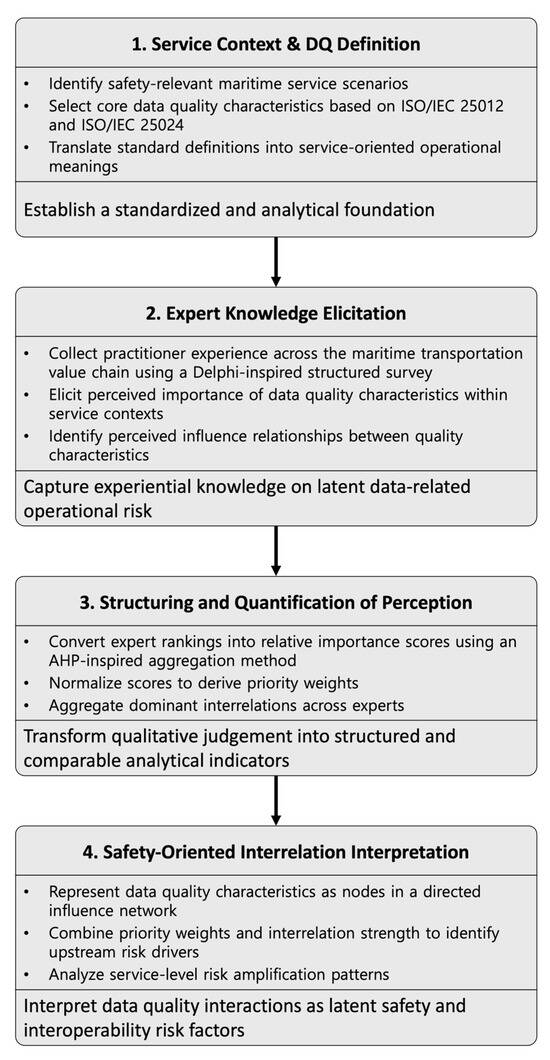
The overall methodological framework consists of four sequential stages:
- i.
- Definition of the service context and data quality characteristics;
- ii.
- Structured expert elicitation using Delphi-inspired procedures;
- iii.
- Derivation of priority weights for data quality characteristics using AHP-inspired aggregation;
- iv.
- Synthesis of interrelations into a safety-oriented interpretation framework.
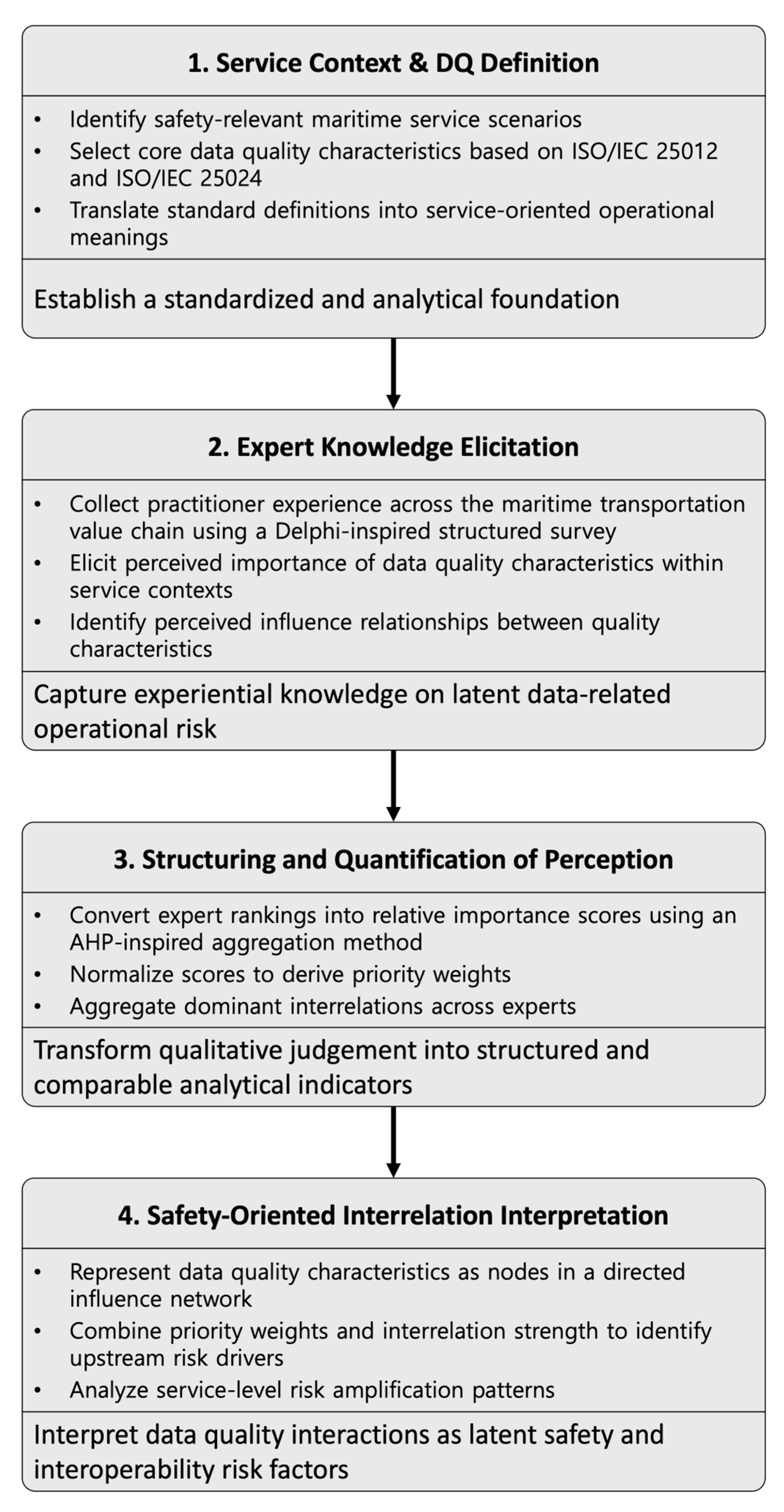
Figure 1 provides an overview of the proposed methodology, illustrating the logical progression from structured expert perception elicitation to quantitative interrelation analysis. The framework demonstrates how practitioner knowledge is systematically elicited, organized, and quantified to interpret data quality interactions as upstream and latent risk factors influencing safety-relevant maritime service operations.
Figure 1.
Safety-Oriented Expert Framework for Analyzing Interrelations among Data Quality Characteristics in Maritime Services.
3.1. Definition of Safety-Relevant Service Contexts and Data Quality Characteristics
The service context considered in this study focuses on safety-relevant, data-driven maritime operations, with particular emphasis on condition monitoring and maintenance management services. These services were selected because they integrate heterogeneous data sources from shipboard systems, shore-based platforms, and external service providers, and because they directly support operational reliability and safety-critical decision-making. Data quality characteristics were derived from the ISO/IEC 25012 and ISO/IEC 25024 standards. Based on their relevance to the selected service contexts and their frequent appearance in both academic and industrial practice, four core characteristics—accuracy, completeness, consistency, and timeliness—were selected for analysis. To ensure a shared understanding among experts, each characteristic was accompanied by a service-oriented explanation linking abstract standard definitions to concrete maritime operational scenarios.
3.2. Delphi-Inspired Expert Knowledge Elicitation for Safety-Relevant Service
A structured expert survey was conducted to capture practitioner knowledge regarding data quality issues encountered in maritime service operations. The survey targeted professionals across the maritime transportation value chain, including ship operators, maintenance engineers, maritime IT developers, and shore-based operational staff, with the aim of eliciting informed judgements grounded in both operational and digital service experience.
The expert elicitation process follows a Delphi-inspired approach that emphasizes expert relevance and contextual validity rather than numerical representativeness. Given the study’s focus on interrelations among data quality characteristics in safety-relevant maritime services, particular attention was paid to selecting experts with cross-domain competence—specifically, those combining maritime operational understanding with experience in data-driven systems, digital service implementation, and data quality management. Accordingly, the screening process prioritized practitioners directly involved in the design, operation, or management of maritime digital services, such as condition monitoring, maintenance systems, navigation support, and related decision-support workflows. Experts whose experience was confined exclusively to a single domain—either traditional maritime operations without exposure to digital data systems, or information technology roles lacking substantive maritime context—were intentionally excluded. This relevance-oriented screening reflects common practice in expert-based safety and risk research, where the depth, applicability, and contextual coherence of expert judgement are considered more critical than numerical breadth.
Importantly, the resulting expert composition reflects the functional roles required to assess data quality interrelations in contemporary service-oriented maritime systems, rather than an attempt to mirror the occupational distribution of the maritime workforce. In modern maritime services, data quality deficiencies and interoperability failures frequently emerge at the interface between operational requirements and digital service implementation—such as during data integration, transformation, transmission, and interpretation—rather than solely at the point of ship operation. Experts operating at this interface are typically responsible for translating operational needs into data specifications, managing multi-source data integration, and responding to inconsistencies, delays, or data gaps that affect downstream decision-support services. From a safety perspective, such experts are well positioned to identify latent and upstream data-related risks that may not be immediately visible in routine shipboard activities but nonetheless shape safety-relevant service outcomes. Therefore, the composition of the expert panel should be interpreted as a deliberate methodological choice aligned with the study’s analytical objectives, rather than as unintended sample bias.
3.3. Structuring and Quantification of Expert Perceptions Using an AHP-Inspired Approach
The AHP is a widely used multi-criteria decision-making method that supports the derivation of relative priorities among evaluation criteria through structured comparison procedures [24]. While classical AHP provides a rigorous analytical framework, it typically requires extensive pairwise comparisons and consistency checks, which can impose a substantial cognitive burden on experts when multiple service contexts and quality characteristics are involved. In this study, an AHP-inspired approach is adopted to retain the core prioritization logic of AHP while simplifying the elicitation process. Instead of full pairwise comparisons, experts were asked to rank data quality characteristics according to their perceived importance within each service context. These ordinal rankings were subsequently transformed into numerical scores and normalized to obtain relative priority weights, following established rank-based aggregation schemes derived from AHP-related research [25,26].
To structure expert perceptions in a transparent and systematic manner, an AHP-inspired weighting approach was applied to derive relative importance weights for the selected data quality characteristics. Because the survey elicited ordinal rankings rather than full pairwise comparisons, a rank-based aggregation and normalization scheme was employed to obtain comparable priority weights [24,25,26]. Each expert ranked the most important data quality characteristics for each service context. Ranks were converted into point scores, aggregated across experts, and normalized to derive relative priority weights. These weights represent perceived importance rather than absolute measures and are used to contextualize the significance of interrelations among characteristics.
It should be noted that the derived priority weights represent aggregated, service-invariant perceptions of relative importance across safety-relevant maritime services, rather than service-specific weights. This design choice reflects the study’s objective to establish a common importance baseline for analyzing how data quality deficiencies propagate across characteristics, while service-specific differences are examined through the composition and interaction of prioritized characteristics rather than through re-estimation of weights.
3.4. Safety-Oriented Synthesis and Interpretation of Data Quality Interrelations
Interrelations among data quality characteristics were analyzed by combining Delphi-inspired consensus assessment with the derived priority weights. Perceived influence relationships reported by multiple experts were treated as dominant interrelations, while the weighting results were used to contextualize the relative significance of influencing and influenced characteristics. This combined approach enables the transformation of fragmented expert perceptions into a coherent analytical structure that reflects how data quality deficiencies may propagate across service workflows.
The resulting interrelation structure was represented as a directed and weighted network, in which nodes correspond to data quality characteristics and directed links represent perceived influence pathways [25,27]. Link direction indicates the upstream–downstream relationship between characteristics, while link strength reflects the degree of expert agreement regarding the influence. This representation provides an intuitive yet systematic means of visualizing interaction patterns among data quality characteristics in safety-relevant maritime services.
In this study, safety relevance is operationalized through the potential impact of data quality degradation on the reliability and timeliness of operational decision support in maritime services, rather than through predefined accident scenarios or regulatory limit values. Safety constraints are therefore reflected in whether experts judge a given data quality deficiency to plausibly compromise service-level decision-making under realistic operational conditions. To ensure analytical consistency and feasibility, the expert elicitation and synthesis process was designed to be completed within a bounded evaluation session, focusing on relative judgements rather than exhaustive pairwise comparisons. This design choice enables experts to assess influence relationships and importance rankings based on stable professional experience, while avoiding fatigue or inconsistency associated with prolonged assessments. Acceptable thresholds are not defined as fixed numerical cut-offs but are implicitly embedded in the convergence of expert judgements. An interrelation is treated as analytically meaningful when it is consistently identified by multiple experts as having a non-negligible degrading effect on downstream data quality characteristics within a given service context. In this way, the methodology balances interpretability and rigor without introducing artificial thresholds that are difficult to justify across heterogeneous maritime services.
It is important to clarify that the priority weights integrated into the interrelation network do not represent vessel performance indicators or outcome-based safety metrics, such as energy efficiency, economic cost, environmental impact, or navigational safety performance. Instead, the weights reflect the relative perceived importance of data quality characteristics as evaluated by experts when supporting safety-relevant maritime services. Accordingly, the weighted network representation in this study should be interpreted as an analytical structure that highlights which data quality deficiencies are more likely to function as upstream and latent risk contributors within service-oriented workflows, rather than as a model that quantifies direct operational consequences. The weighting mechanism thus serves to contextualize influence pathways among data quality characteristics, enabling risk-oriented interpretation without conflating data quality importance with service performance optimization.
From a risk and safety perspective, these interrelations are interpreted not as direct causal mechanisms but as upstream and latent conditions that shape the reliability of data-driven maritime service operations [28,29]. Deficiencies in upstream characteristics—such as delayed data availability or incomplete records—may degrade multiple downstream characteristics, thereby amplifying operational risk before hazardous events or system failures become observable. In this sense, data quality interactions constitute a form of latent risk embedded within interoperable service architectures.
By integrating structured expert elicitation with AHP-inspired weighting, the proposed methodology bridges qualitative operational knowledge and engineering-oriented analysis. Rather than treating data quality characteristics as independent checklist items, the framework supports a service-contextual and interaction-aware interpretation aligned with maritime safety and interoperability concerns. This synthesis establishes a methodological foundation for the results presented in Section 4, where the identified interrelations are quantitatively analyzed and interpreted in terms of service-level risk amplification in maritime transportation.
4. Results: Interrelation-Driven Risk Propagation in Safety-Relevant Maritime Services
This section presents the empirical and analytical results obtained by applying the safety-oriented expert framework described in Section 3. Rather than merely reporting survey statistics, the objective of this section is to demonstrate how elicited expert knowledge on data quality can be systematically structured, quantified, and interpreted as latent risk propagation mechanisms in safety-relevant maritime services.
In alignment with the methodological stages illustrated in Figure 1, the results are organized to reflect the logical progression from empirical grounding to risk-oriented interpretation. First, the empirical basis of expert knowledge elicitation is established by examining the composition, experience, and service relevance of the expert panel. Second, expert-elicited priorities of data quality characteristics are analyzed across representative maritime service contexts, highlighting service-dependent quality requirements. Third, aggregated priority weights are derived to quantify the relative importance of individual data quality characteristics in safety-relevant operations. Finally, interrelations among characteristics are analyzed and synthesized into weighted influence structures and service-level risk amplification patterns, providing insight into how data quality deficiencies may propagate and compound operational risk. Through this structured presentation, Section 4 operationalizes the methodology proposed in Section 3 and translates expert perceptions into analytically grounded evidence supporting a risk- and safety-oriented interpretation of data quality and interoperability in maritime transportation systems.
4.1. Service Context and Data Quality Scope for Result Analysis
Before presenting expert judgements and quantitative analyses, it is necessary to clarify the service contexts and data quality characteristics that frame the scope of the results reported in this section. Although these elements were defined methodologically in Section 3.1, their role in shaping the empirical analysis warrants explicit confirmation at the result level. The results presented in this section focus on safety-relevant, data-driven maritime services that support operational decision-making across shipboard and shore-based systems. Condition monitoring, maintenance management, route planning, and related operational support services form the primary analytical context. These services were selected because they depend on continuous data exchange, integrate heterogeneous information sources, and directly influence operational reliability and safety-related decisions.
Within these service contexts, the analysis is restricted to a core set of data quality characteristics derived from ISO/IEC 25012 and ISO/IEC 25024. As introduced in Section 3.1, the characteristics considered in the result analysis include accuracy, completeness, consistency, and timeliness, supplemented by availability, reliability, compliance, and security where relevant to specific services. These characteristics represent those most frequently referenced by practitioners when describing interoperability issues and operational data challenges in safety-relevant maritime workflows. Importantly, the results do not evaluate these characteristics as abstract or standalone quality dimensions. Instead, they are interpreted in relation to concrete service functions and operational use cases. For example, timeliness is examined in terms of whether data arrive within decision-relevant time windows, while accuracy and reliability are assessed in relation to practitioner trust in analytics and decision-support outputs. This service-contextual framing ensures that the subsequent analyses reflect operational reality rather than generic data quality checklists.
By explicitly defining the service scope and data quality characteristics at the result stage, this section establishes a consistent analytical baseline for interpreting expert judgements, priority weights, and interrelation structures presented in Section 4.2, Section 4.3, Section 4.4 and Section 4.5. This alignment ensures that observed interrelations and risk amplification patterns can be directly traced back to the safety-relevant service contexts that motivated the study.
4.2. Empirical Basis of Expert Knowledge Elicitation
To ensure that the expert judgements elicited in this study reflect informed and contextually valid perspectives on data quality interrelations in maritime services, a multi-stage expert screening process was applied prior to the final survey. Rather than relying on open recruitment, the study adopted a relevance-driven selection strategy designed to identify experts operating at the intersection of maritime operations and data-driven service environments.
In the first stage, an initial pool of 85 professionals was identified through industry networks, research collaborations, and professional associations spanning maritime operations, shipbuilding, marine IT, and digital service development. This broad pool was intentionally constructed to capture diverse viewpoints across the maritime transportation value chain, including both operational and technical perspectives. In the second stage, candidates were screened based on direct involvement in data-driven maritime services. Professionals whose experience was limited either to traditional ship operation without exposure to digital systems, or to generic information technology roles without substantive maritime domain knowledge, were excluded. This domain-relevance screening reduced the pool to 32 experts, highlighting the practical difficulty of identifying professionals who operate at the intersection of maritime operations and data-centric system design.
In the third stage, remaining candidates were further evaluated according to professional seniority and functional responsibility. Priority was given to experts with demonstrable experience in system development, operation, data management, or operational decision-support functions, and with sufficient professional tenure to assess long-term and latent operational risks rather than isolated technical issues. This stage reduced the candidate pool to 18 experts who met both domain and role-based criteria. In the final stage, availability and engagement consistency were considered, as the expert survey required careful and coherent evaluation of both importance rankings and perceived interrelations among data quality characteristics. Experts who were unable to complete the full assessment process or whose responses lacked internal consistency were excluded at this stage. Through this final refinement, the expert panel converged to 13 experts who satisfied all relevance, experience, and engagement criteria.
The resulting composition of the expert panel is summarized in Table 2. A substantial proportion of respondents are engaged in maritime IT and software-related roles, complemented by experts with backgrounds in shipbuilding and shipping operations. The panel is further characterized by a high level of professional seniority, with more than half of the experts reporting over 20 years of experience. This profile indicates that the elicited judgements are grounded in long-term exposure to operational integration challenges rather than isolated project-level experiences.
Table 2.
Demographic characteristics of expert respondents (N = 13).
The expert panel is characterized by a strong concentration of senior practitioners, with more than half of the respondents reporting over 20 years of professional experience. This profile indicates that the elicited judgements are grounded in long-term exposure to operational integration challenges and service evolution, rather than isolated or short-term project experiences. Such seniority is particularly relevant for assessing latent and interaction-driven data quality risks, which often emerge over extended operational timescales rather than as immediately observable failures. In terms of functional roles, the panel shows a predominance of experts involved in system development, operation, and data management. This distribution aligns closely with the analytical focus of the study. In contemporary data-driven maritime services, issues related to data quality and interoperability frequently originate upstream of shipboard operation, at stages such as data modeling, system integration, validation, and lifecycle management across organizational boundaries. Professionals responsible for these activities are therefore repeatedly exposed to data inconsistencies, delays, and incompleteness that affect multiple downstream services.
Although the expert panel may appear skewed toward maritime IT and software-oriented roles, this composition reflects the structural characteristics of modern maritime service ecosystems rather than an unintended sampling bias. As maritime operations become increasingly service-oriented and digitally mediated, critical safety-relevant decisions are shaped not only at the point of ship operation but also through the design and operation of digital service infrastructures that support condition monitoring, maintenance planning, navigation support, and regulatory reporting. At the same time, the inclusion of experts with shipbuilding and shipping operation backgrounds provides essential operational grounding. Their presence ensures that the identified data quality interrelations are interpreted in relation to real service workflows and safety-relevant decision-making contexts. Taken together, the expert panel constitutes a contextually appropriate empirical basis for analyzing interaction-driven and latent data quality risks in service-oriented maritime environments, even though it does not aim to mirror the occupational distribution of the maritime workforce as a whole.
4.3. Structuring Service-Specific Data Quality Priorities
Data quality requirements in maritime transportation are inherently service-dependent. Operational services that support real-time or near-real-time decision-making impose different quality constraints than compliance- or reporting-oriented services. To capture this service-contextual dependency, experts were asked to identify and rank the most critical data quality characteristics for representative maritime service scenarios.
Table 3 presents the top-ranked data quality characteristics for representative maritime service contexts as identified by the expert panel. The objective is to reveal how data quality priorities vary depending on service function and operational exposure.
Table 3.
Top-ranked data quality characteristics by maritime service context.
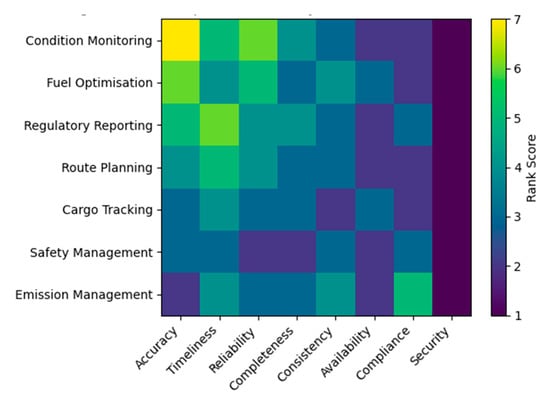
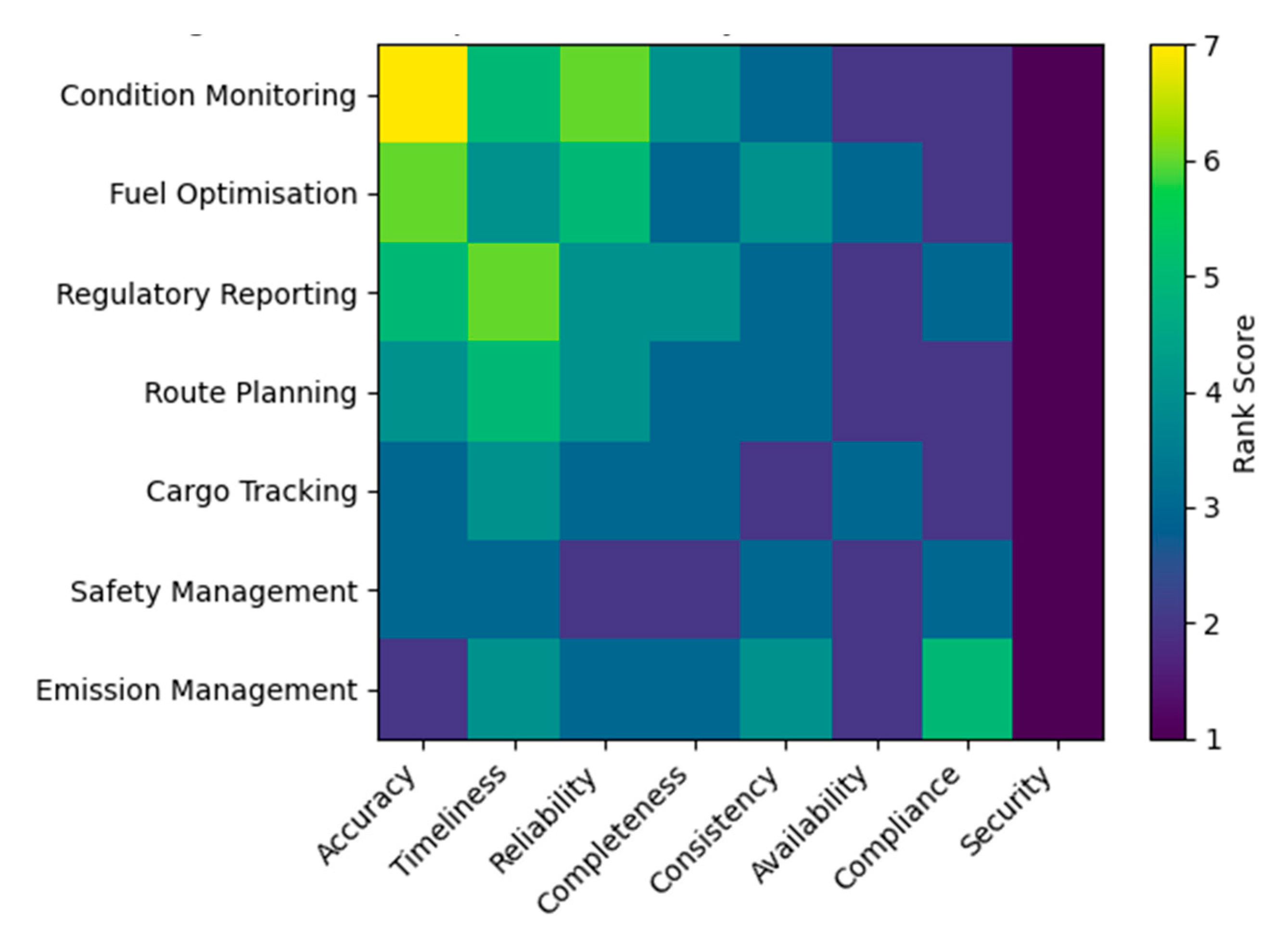
A clear distinction emerges between operational and reporting-oriented services. Operational services such as condition monitoring and route planning prioritize accuracy, reliability, and timeliness, reflecting their dependence on current and trustworthy information for safety-relevant decision-making. In contrast, reporting-oriented services emphasize compliance and completeness, indicating that their primary risk exposure lies in documentation credibility, auditability, and regulatory conformity rather than immediate operational sensitivity. A heatmap of rank-based scores, as shown in Figure 2, is used to visually reveal clusters (operational vs. regulatory) and to support the subsequent service-level risk amplification analysis. The color scale in Figure 2 visualizes aggregated rank scores obtained from expert evaluations. Each expert ranked data quality characteristics within each service context, and higher color intensity corresponds to higher average priority across experts. Accordingly, larger numerical values indicate greater perceived importance rather than absolute performance levels.
Figure 2.
Heatmap of service-specific priority rankings of data quality characteristics. The color scale represents aggregated rank scores derived from expert evaluations, where higher values indicate higher perceived importance. A score of 7 corresponds to the highest priority rank assigned by experts, while a score of 1 indicates the lowest priority.
The heatmap visualizes aggregated rank-based priority scores, which are inherently relative and ordinal in nature. Experts were asked to rank data quality characteristics within each service context, resulting in a fixed distribution of ranks rather than absolute evaluations. Consequently, only a limited number of characteristics can attain high scores within each service, while the remaining characteristics necessarily receive lower values. In this sense, the heatmap highlights relative prioritization patterns rather than performance deficiencies. Lower scores indicate characteristics that are perceived as less critical compared to others within the same service context, not that they are unimportant or adequately satisfied in practice. This visualization is therefore intended to reveal service-dependent priority structures and clustering tendencies (e.g., operational versus reporting-oriented services), which subsequently inform the interrelation and risk amplification analyses presented in later sections.
To connect these abstract priorities with concrete operational challenges, experts were also asked to report interoperability issues frequently encountered in practice. Table 4 summarizes the most commonly reported issues and their typical implications for service workflows.
Table 4.
Frequently observed data interoperability issues in maritime services.
The results in Table 4 show that missing or incomplete data and inconsistency between systems are the most frequently observed interoperability problems. These issues are foundational in nature and often arise when heterogeneous systems exchange data with partially aligned schemas or inconsistent semantics. Importantly, such problems can undermine multiple service functions simultaneously, supporting the argument that data quality deficiencies should be analyzed as systemic conditions rather than isolated technical faults.
4.4. Quantification of Data Quality Importance Using AHP-Inspired Weights
While service-specific rankings provide valuable qualitative insights, quantitative prioritization is required to support structured analysis of interrelations and risk propagation. In accordance with the methodology described in Section 3.3, expert rankings were therefore transformed into aggregated priority weights using an AHP-inspired, rank-based weighting approach.
Let denote the rank assigned by expert to data quality characteristic , where rank 1 represents the highest priority among characteristics. Each rank was converted into a point score using reverse-rank scoring:
The total score for each characteristic was then calculated as:
where is the number of experts. The normalized priority weight was obtained by:
Table 5 reports the aggregated and normalized priority weights of data quality characteristics derived from expert rankings. These weights represent overall importance across all considered safety-relevant maritime services and serve as a global reference scale for subsequent interrelation and risk propagation analysis. They are not intended to reflect service-specific prioritization, which is instead captured through service-dependent ranking patterns and characteristic combinations examined in later sections.
Table 5.
Aggregated priority weights of data quality characteristics.
The weighting structure indicates that accuracy, reliability, and timeliness collectively dominate the importance distribution. This finding suggests that, from a practitioner perspective, interoperability failures affecting these characteristics are more likely to undermine safety-relevant decision support than deficiencies in secondary characteristics. The relatively lower weight assigned to security does not imply irrelevance; rather, it reflects the tendency to treat security as a baseline or mandatory requirement in specific regulated contexts, rather than a differentiating factor across all services.
4.5. Safety-Oriented Interrelation and Risk Propagation Analysis
Priority weights alone do not explain how data quality deficiencies propagate across characteristics. To address this limitation, an interrelation matrix was constructed to capture perceived influence relationships among data quality characteristics, following the analytical framework described in Section 3.4.
For each ordered pair of characteristics , an interrelation coefficient was defined as the proportion of experts indicating that a deficiency in negatively affects . Table 6 presents the resulting interrelation coefficients.
Table 6.
Interrelation coefficients derived from expert responses.
Table 6 shows that timeliness is frequently perceived as an upstream driver influencing both accuracy and reliability. This reflects a common operational intuition: even accurate raw data may lose operational value if delivered too late to support decision-making. Similarly, the strong bidirectional relationship between completeness and consistency highlights documentation and lifecycle management problems, where incomplete records increase inconsistency across systems and vice versa.
To identify which interrelations are most critical from a safety perspective, the study combines priority weights and interrelation coefficients into a weighted interrelation impact index:
This index reflects both the intrinsic importance of a characteristic and its ability to influence others. Table 7 reports the resulting weighted impact matrix.
Table 7.
Interrelation impact index .
The interrelation impact analysis reveals that pathways originating from timeliness exhibit the highest weighted influence values, particularly toward accuracy and reliability. This indicates that timeliness acts as a multiplier for quality degradation: delays in data availability can simultaneously erode multiple quality dimensions, even when other characteristics are nominally maintained. Such compounded effects are particularly critical in operational services where decision windows are narrow, and situational awareness depends on timely updates.
4.6. Service-Level Risk Amplification Analysis
Service-specific vulnerability to compounded data quality degradation was analyzed using a risk amplification score , defined as:
where indicates whether characteristic is among the top three priorities for service .
Importantly, service-level differences reported in this section do not arise from variations in the priority weights themselves, but from differences in which data quality characteristics are prioritized within each service context. By combining global importance weights with service-specific top-ranked characteristics, the analysis captures how different service configurations are exposed to distinct patterns of compounded data quality risk.
Table 8 demonstrates that operational services such as condition monitoring and route planning exhibit the highest risk amplification scores. These services rely heavily on high-weight characteristics that also show strong interrelation impacts, making them particularly vulnerable to compounded data quality degradation. In contrast, reporting-oriented services show lower amplification scores, reflecting a risk profile dominated by long-term documentation credibility rather than immediate operational sensitivity.
Table 8.
Risk amplification scores by maritime service context.
The analysis is intentionally framed in a service-oriented manner rather than being tied to specific voyage instances. The service contexts listed in Table 8 (e.g., route planning, condition monitoring, cargo tracking) represent generalized categories of maritime digital services that are commonly deployed across a wide range of operational settings, including ocean-going voyages, short-sea shipping, and inland or coastal navigation. Accordingly, the risk amplification score reflects the relative vulnerability of a service type to compounded data quality degradation and is independent of specific passage length, route geometry, or voyage duration. The objective is to identify how strongly a service relies on highly weighted and interrelated data quality characteristics, rather than to model risks associated with a particular navigational scenario.
While actual navigational passages may differ significantly in distance, duration, and operational constraints, the proposed framework is designed to remain applicable across these variations by focusing on service-level dependency structures. Future work may apply the framework to concrete voyage scenarios or route-specific datasets to investigate how passage characteristics interact with data quality-driven risk amplification.
The risk amplification scores demonstrate that operational services such as condition monitoring and route planning are more vulnerable to compounded data quality degradation than reporting-oriented services. This vulnerability arises because these services rely heavily on characteristics that are both highly weighted and strongly interconnected. Consequently, interoperability-induced degradation in a single upstream characteristic—most notably timeliness—can trigger cascading effects that undermine multiple aspects of service performance and safety.
5. Discussion and Limitation
5.1. Discussion
This study examined data quality and interoperability in maritime transportation from a risk and safety perspective, focusing on how data quality characteristics interact within service-oriented operational contexts. Rather than treating data quality attributes as isolated technical properties, the findings demonstrate that deficiencies form interdependent structures that can amplify operational risk through interaction effects. This interaction-oriented interpretation is enabled by the stepwise, expert-based analytical framework proposed in this study, which systematically transforms practitioner knowledge into safety-relevant insights.
Although the analysis does not aim at statistical inference based on large observational datasets, it provides quantitative structure by translating expert judgement into numerical representations of data quality importance, interaction strength, and service-level risk amplification. The resulting priority weights and amplification scores do not represent absolute performance metrics, but rather relative indicators that enable comparison across data quality characteristics and service contexts. In this sense, the quantitative contribution of the study lies in structuring latent and interaction-driven risk patterns that are otherwise difficult to capture using conventional attribute-based or purely qualitative approaches.
A key finding is the upstream role of timeliness. Although accuracy was consistently ranked as the most important data quality characteristic, the interrelation analysis revealed that delays in data availability strongly influence both perceived accuracy and reliability. From an operational safety perspective, this implies that delayed data may compromise decision-making even when data values are technically correct. Such interaction effects represent latent conditions that shape risk long before hazardous events or system failures become observable.
The results further show that data quality characteristics cluster into tightly coupled groups. Completeness, consistency, and reliability form a recurrent interaction structure, particularly in maintenance and asset management services. In practice, incomplete records reduce consistency across systems, which in turn undermines confidence in analytical outputs. These cascading effects highlight structural vulnerabilities in maritime data interoperability architectures, where deficiencies introduced early in the data lifecycle propagate across multiple services and decision processes.
At the service level, the risk amplification analysis indicates that operational services—such as condition monitoring and route planning—are more vulnerable to compounded data quality degradation than reporting-oriented services. These operational services rely heavily on characteristics that are both highly weighted and strongly interconnected, making them particularly sensitive to upstream failures. This finding suggests that data interoperability requirements should be differentiated according to service-specific risk profiles rather than uniformly applied across all maritime services. It should be emphasized that these service-level differences do not result from statistically different priority weights across services, but from differences in how globally important data quality characteristics are combined and prioritized within each service context. In other words, the observed variation reflects configurational differences in service dependency rather than service-specific re-estimation of importance weights.
From a broader perspective, the study challenges the adequacy of purely hierarchical and attribute-based data quality assessment models for safety-relevant maritime services. While existing standards provide valuable definitions and taxonomies, they do not explicitly address interaction effects among characteristics [7,8,30,31]. The interrelation-based perspective adopted in this study complements existing approaches by enabling earlier identification of upstream risk drivers and supporting more effective prioritization of mitigation efforts in safety-critical digital maritime systems.
5.2. Practical Implications and Limitations
The findings of this study have direct implications for maritime data governance and safety management. Organizations responsible for designing or operating data-driven maritime services should prioritize data quality characteristics not only based on their individual importance but also on their interaction effects. Improving data timeliness may yield disproportionate safety benefits by preventing downstream degradation of accuracy and reliability. This suggests that upstream data acquisition, validation, and transmission processes should receive increased attention in safety-critical services. In addition, the results indicate that service-specific risk profiles should guide the formulation of data interoperability requirements. Operational services that support real-time or near-real-time decision-making require stricter controls on upstream data flows and lifecycle management, whereas reporting-oriented services may benefit more from consistency and completeness controls. Integrating interrelation-aware data quality assessment into maritime data governance frameworks can support more efficient resource allocation and reduce latent safety risks that are not captured by traditional quality checklists.
From a practical application perspective, the quantitative outputs of the proposed framework—such as priority weights and service-level risk amplification scores—are intended to function as relative screening indicators rather than absolute performance metrics. These indicators can assist practitioners in identifying which service types are more sensitive to compounded data quality degradation and which data quality characteristics are more likely to act as upstream risk drivers within service workflows. In operational settings where comprehensive performance data or large-scale incident statistics are unavailable, such structured indicators provide a pragmatic basis for prioritizing data governance measures, interoperability controls, and validation efforts in safety-relevant maritime digital services.
Despite these practical implications, the scope and interpretation of the findings should be understood in relation to the study’s methodological positioning. Specifically, the priority weights used in this study represent aggregated importance across safety-relevant maritime services and are not estimated separately for individual service categories. Accordingly, the analysis does not seek to establish statistically testable differences in data quality importance between services, but to examine how different service configurations are exposed to compounded risk through shared, globally significant data quality characteristics and their interaction structures. The analysis is based on a focused expert panel, which does not aim at statistical generalization but rather at identifying and structuring latent interrelations among data quality characteristics in safety-relevant maritime services. The objective of the study is exploratory and analytical in nature, targeting interaction structures that are difficult to observe through large-scale surveys or purely data-driven methods. Accordingly, the value of the results depends less on sample size alone than on the relevance, diversity, and cross-domain competence of the experts involved. All experts were selected through a multi-stage screening process to ensure substantial experience in both maritime operational contexts and data-driven or digital service systems. This approach reflects common practice in structured expert judgement and risk-oriented engineering studies, where expert relevance and judgement consistency are prioritized over numerical representativeness.
From this perspective, the findings support analytical and conceptual generalization rather than population-level inference. The proposed interrelation-based framework is intended to be transferable across safety-relevant maritime service contexts by providing a structured lens for interpreting how data quality deficiencies may propagate and amplify operational risk. While specific interaction strengths may vary across domains, vessel types, or organizational settings, the analytical logic and interpretive approach remain applicable beyond the studied cases. Finally, the service contexts examined in this study are representative but not exhaustive. Emerging applications, including autonomous navigation and AI-enabled decision support systems, may exhibit different data quality dependencies and interaction patterns.
Future research may extend the proposed framework to additional maritime domains and combine expert-based interrelation analysis with operational datasets, such as system logs, incident records, or near-miss reports, to further validate and refine the identified interaction structures. Where sufficient data become available, future studies may also derive service-specific priority weights and apply inferential statistical testing to enable more explicit comparison of data quality importance across maritime service categories.
6. Conclusions
This study proposed a safety-oriented, interrelation-based analytical framework for examining data quality and interoperability in service-oriented maritime transportation, with a focus on the digitalization of information and operational data exchanged across ship–shore ecosystems. By systematically combining service context definition, Delphi-inspired expert knowledge elicitation, AHP-inspired prioritization, and interrelation-based synthesis, the study demonstrated that data quality characteristics are perceived as interdependent rather than independent attributes. The results show that deficiencies in one characteristic can propagate across others, thereby amplifying latent operational risk in maritime services.
The empirical findings indicate that timeliness functions as a critical upstream driver influencing both accuracy and reliability, particularly in safety-relevant operational services. Even when data values are technically correct, delayed availability was shown to undermine confidence in analytical outputs and decision-support processes. Furthermore, service-level analysis revealed that operational services—such as condition monitoring and route planning—are more vulnerable to compounded data quality degradation than reporting-oriented services, which exhibit lower sensitivity to interaction effects.
This tendency is quantitatively illustrated by the risk amplification results in Table 8, where condition monitoring and route planning services exhibit the highest risk amplification scores ( = 0.545), compared to substantially lower values observed for reporting-oriented services such as regulatory inspection and environmental reporting ( = 0.359 and 0.356, respectively).
By explicitly modeling data quality interactions as latent risk factors, this study provides a complementary perspective to existing data quality standards and maritime risk assessment frameworks. The proposed framework enables more informed prioritization of data quality management efforts by identifying upstream characteristics and interaction pathways that disproportionately influence safety-relevant services in digital maritime ecosystems. Within its scope, the study contributes to maritime risk and safety research by introducing a structured, expert-based method for analyzing data quality interrelations beyond isolated quality checks. The findings highlight that data interoperability challenges in safety-critical maritime services require a service-aware and interaction-oriented perspective rather than purely attribute-based assessment approaches.
Future research may extend this work in several directions. Expanding the expert panel and conducting comparative studies across regions, vessel types, or operational domains would enhance the generalizability of the findings. Integrating objective operational data—such as system logs, anomaly records, or near-miss reports—would further support validation of the relationship between perceived data quality interactions and observable safety outcomes. In addition, the proposed framework could be extended using advanced modeling techniques, such as Bayesian networks or system dynamics models, to capture non-linear interactions and feedback loops. Applying the framework to autonomous and AI-enabled maritime services represents a promising avenue for supporting the development of safety-aware data interoperability standards for future maritime operations [32].
Author Contributions
Conceptualization, C.L. and S.L.; methodology, C.L.; software, C.L.; validation, C.L. and S.L.; formal analysis, C.L.; investigation, C.L. and S.L.; resources, C.L.; data curation, C.L.; writing—original draft preparation, C.L.; writing—review and editing, S.L.; visualization, C.L.; funding acquisition, S.L. All authors have read and agreed to the published version of the manuscript.
Funding
This work was supported by the Technology Development Program (RS-2024-00454634, Data standards development and service design between the smart autonomous ship and the value chains) funded By the Ministry of Trade, Industry and Energy (MOTIE, South Korea).
Institutional Review Board Statement
Not applicable.
Informed Consent Statement
Not applicable.
Data Availability Statement
The original contributions presented in this study are included in the article. Further inquiries can be directed to the corresponding author.
Conflicts of Interest
The authors declare no conflicts of interest.
References
- United Nations Conference on Trade and Development (UNCTAD). Review of Maritime Transport 2024; United Nations: Geneva, Switzerland, 2024. [Google Scholar]
- DNV. Maritime Safety Trends 2014–2024: Preparing for Future Risks; DNV: Høvik, Norway, 2024. [Google Scholar]
- Kalafatelis, A.S.; Nomikos, N.; Giannopoulos, A.; Alexandridis, G.; Karditsa, A.; Trakadas, P. Towards Predictive Maintenance in the Maritime Industry: A Component-Based Overview. J. Mar. Sci. Eng. 2025, 13, 425. [Google Scholar] [CrossRef] [Scilit]
- Park, M.-H.; Lee, W.-J. Comprehensive Review of Shipboard Maintenance Management Strategies in the Maritime Industry. Ocean Eng. 2025, 302, 116246. [Google Scholar] [CrossRef] [Scilit]
- Durlik, I.; Miller, T.; Kostecka, E.; Tuński, T. Artificial Intelligence in Maritime Transportation: A Comprehensive Review of Safety and Risk Management Applications. Appl. Sci. 2024, 14, 8420. [Google Scholar] [CrossRef] [Scilit]
- Lei, J.; Sun, Y.; Wu, Y.; Zheng, F.; He, W.; Liu, X. Association of AIS and Radar Data in Intelligent Navigation in Inland Waterways Based on Trajectory Characteristics. J. Mar. Sci. Eng. 2024, 12, 890. [Google Scholar] [CrossRef] [Scilit]
- ISO/IEC 25012; Systems and Software Engineering—Data Quality Model. ISO: Geneva, Switzerland, 2008.
- ISO/IEC 25024; Systems and Software Engineering—Measurement of Data Quality. ISO: Geneva, Switzerland, 2015.
- Polimeno, A.; Braghin, C.; Anisetti, M.; Ardagna, C.A. Maximizing Data Quality while Ensuring Data Protection in Service-Based Data Pipelines. J. Big Data 2025, 12, 62. [Google Scholar] [CrossRef] [Scilit]
- Viseschart, K.; Heikkilä, J.; Salovaara, A.; Hiekkanen, K. A Data Mesh–Based Data Asset Management Framework for Marine Transport Organisations. Proc. ACM Hum.-Comput. Interact. 2023, 7, 1–28. [Google Scholar] [CrossRef] [Scilit]
- Höhn, D.; Mumm, L.; Reitz, B.; Tsiroglou, C.; Hahn, A. Enabling Future Maritime Traffic Management: A Decentralized Architecture for Sharing Data in the Maritime Domain. J. Mar. Sci. Eng. 2025, 13, 732. [Google Scholar] [CrossRef] [Scilit]
- Harris, L.R.; Holness, S.D. A Practical Approach to Setting Heuristic Marine Biodiversity Targets for Systematic Conservation Planning. Biol. Conserv. 2023, 285, 110218. [Google Scholar] [CrossRef] [Scilit]
- Fernández Pérez, Y.; Cruz Corona, C.; Verdegay, J.L. Modelling the Interrelation among Software Quality Criteria Using Computational Intelligence Techniques. Int. J. Comput. Intell. Syst. 2018, 11, 1170–1178. [Google Scholar] [CrossRef] [Scilit]
- Henningsson, K.; Wohlin, C. Understanding the Relations between Software Quality Attributes. In Proceedings of the 12th International Conference on Software Quality, Ottawa, ON, Canada, 29–30 October 2002. [Google Scholar]
- Fu, Q.; Nicholson, G.L.; Easton, J.M. Understanding Data Quality in a Data-Driven Industry Context. Data Inf. Manag. 2024, 42, 100729. [Google Scholar] [CrossRef] [Scilit]
- Knauer, T.; Nikiforow, N.; Wagener, S. Determinants of Information System Quality and Data Quality. J. Manag. Control 2020, 31, 261–292. [Google Scholar] [CrossRef] [Scilit]
- Vetter, S.N.; Zettl, A.; Mützel, M.; Tafreschi, O. Quantitative Analysis of the Relationship between Master Data Quality and Process Quality. In Proceedings of the ICEIS 2024, Angers, France, 28–30 April 2024; pp. 50–60. [Google Scholar] [CrossRef] [Scilit]
- Dalkey, N.C. The Delphi Method: An Experimental Study of Group Opinion (RM-5888-PR); RAND Corporation: Santa Monica, CA, USA, 1969. [Google Scholar]
- Hsu, C.-C.; Sandford, B.A. The Delphi Technique: Making Sense of Consensus. Pract. Assess. Res. Eval. 2007, 12, 10. [Google Scholar]
- Rowe, G.; Wright, G. The Delphi Technique as a Forecasting Tool: Issues and Analysis. Int. J. Forecast. 1999, 15, 353–375. [Google Scholar] [CrossRef] [Scilit]
- Linstone, H.A.; Turoff, M. (Eds.) The Delphi Method: Techniques and Applications; Addison-Wesley: Reading, MA, USA, 1975. [Google Scholar]
- Saaty, T.L. The Analytic Hierarchy Process: Planning, Priority Setting, Resource Allocation; McGraw-Hill: New York, NY, USA, 1980. [Google Scholar]
- Barron, F.H.; Barrett, B.E. Decision Quality Using Ranked Attribute Weights. Manag. Sci. 1996, 42, 1515–1523. [Google Scholar] [CrossRef] [Scilit]
- Edwards, W.; Barron, F.H. SMARTS and SMARTER: Improved Simple Methods for Multiattribute Utility Measurement. Organ. Behav. Hum. Decis. Process. 1994, 60, 306–325. [Google Scholar] [CrossRef] [Scilit]
- Newman, M.E.J. Networks: An Introduction; Oxford University Press: Oxford, UK, 2010. [Google Scholar]
- Reason, J. Human Error; Cambridge University Press: Cambridge, UK, 1990. [Google Scholar]
- Leveson, N.G. Engineering a Safer World: Systems Thinking Applied to Safety; MIT Press: Cambridge, MA, USA, 2011. [Google Scholar]
- ISO 8000-61; Data Quality—Part 61: Data Quality Management: Process Reference Model. ISO: Geneva, Switzerland, 2016.
- IEC 61508; Functional Safety of Electrical/Electronic/Programmable Electronic Safety-Related Systems. IEC: Geneva, Switzerland, 2010.
- European Maritime Safety Agency (EMSA). Annual Overview of Marine Casualties and Incidents 2024; EMSA: Lisbon, Portugal, 2024. [Google Scholar]
- International Maritime Organization (IMO). Effective Application of the 0.10% Sulphur Limit Under MARPOL Annex VI in the Mediterranean Sea Emission Control Area; IMO Press Briefing: London, UK, 2025. [Google Scholar]
- International Maritime Organization (IMO). Maritime Single Window (MSW) Requirements Under the FAL Convention; IMO: London, UK, 2024. [Google Scholar]

Disclaimer/Publisher’s Note: The statements, opinions and data contained in all publications are solely those of the individual author(s) and contributor(s) and not of MDPI and/or the editor(s). MDPI and/or the editor(s) disclaim responsibility for any injury to people or property resulting from any ideas, methods, instructions or products referred to in the content. |
© 2026 by the authors. Licensee MDPI, Basel, Switzerland. This article is an open access article distributed under the terms and conditions of the Creative Commons Attribution (CC BY) license.