


Abstract
The rapid spread of fires underscores the urgency of high-accuracy fire smoke detection for public safety, but early fires pose major challenges—small flame/smoke targets, blurred boundaries, low contrast, and complex background interference—limiting the performance of existing models. To address these issues, this paper proposes SFFA-YOLO, an engineering-oriented improved algorithm based on the YOLOv11 framework for fire smoke detection, which achieves a balanced trade-off between detection precision, real-time performance, and lightweight deployment. The model integrates three synergistic optimization modules for targeted scene adaptation: (1) the FMFA module for cross-scale feature fusion to enhance thin smoke and small flame recognition; (2) the SGCA module for joint channel-spatial feature focusing to improve target localization accuracy; (3) the SDA-Loss function for dynamic weight adjustment based on target size and clarity to stabilize small target detection. Validated on the self-built FS-Blend dataset (supplemented with difficult samples such as distant thin smoke and backlit flames), SFFA-YOLO outperforms mainstream models (YOLOv8, YOLOv9, Faster R-CNN) in key metrics. Compared with the YOLOv11s baseline, it achieves a 2.5% Precision improvement and 3.9% mAP@0.5 improvement while reducing parameters by 12.8%, confirming its reliability as a real-time fire smoke detection solution.
1. Introduction
As industrial facilities become more dense and urbanization advances, the frequency of fires continues to rise, now ranking among the primary hazards threatening economic development and public safety. According to statistical data released by the National Fire and Rescue Administration in recent years [1,2,3], the number of fires in China increased from 825,000 to 908,000 between 2022 and 2024, with an average annual growth rate of 4.9%. Direct economic losses caused by fires rose from 7.16 billion yuan to 7.74 billion yuan, and the number of fire-related injuries increased by 12.3%. Beyond casualties and economic losses, fires also exert profound impacts on social governance and the ecological environment. Thus, efficient and early fire detection has become a critical task for safeguarding urban safety.
Fire smoke detection relies on identifying key attributes of flames and smoke, including texture variations, dynamic behaviors, and spatial characteristics. Traditional fire smoke detection primarily relies on infrared devices and temperature sensor-based alarm systems, while effective in relatively enclosed environments, these methods are susceptible to interference from noise, airflow, light, and occlusion in open spaces, compromising real-time performance and detection precision. With the rapid advancement of computer vision technology, fire smoke detection has shifted from sensor-dependent methods to image-based intelligent recognition. However, existing image-based algorithms still struggle with fire smoke in complex backgrounds—largely because early fire targets often feature blurred boundaries, sparse textures, low brightness, and small sizes. Therefore, maintaining high precision while ensuring real-time responsiveness in complex environments remains a core challenge in current intelligent fire detection.
To tackle this challenge, this paper proposes SFFA-YOLO (Scene-aware Global Coordinate Attention and Fire Multi-scale Dilated Feature Aggregation YOLO), an improved fire smoke detection algorithm based on the YOLOv11 framework. Tailored for fire smoke detection, the model incorporates targeted optimizations to enhance feature representation and multi-scale fusion capabilities. First, the FMFA (Fire Multi-scale Dilated Feature Aggregation) module is designed for the feature fusion stage, leveraging multi-dilation convolution and global semantic priors to enable the model to capture detailed features while retaining global semantic information, thereby boosting recognition of thin smoke and small flames. Second, the SGCA (Scene-aware Global Coordinate Attention) module is introduced to simultaneously analyze channel and spatial features, facilitating more precise target localization. Finally, a dynamic adaptive loss function—SDA-Loss (Smoke-aware Dynamic Adaptive Loss)—is developed to enable the model to learn samples of varying difficulty more balancedly during training, enhancing stability in detecting complex fire scenarios.
2. Related Work
As fire detection requirements evolve, traditional methods have increasingly shown limitations, prompting a shift in focus toward computer vision-based techniques.
2.1. Traditional Image Processing Methods
Traditional approaches primarily rely on handcrafted features such as color, texture, edges, and dynamic properties of flames and smoke. For instance, Celik et al. [4] proposed a multi-threshold segmentation algorithm based on color space conversion, which improves detection accuracy in simple environments but is prone to false positives when confronted with sunsets or car headlights. Chino et al. [5] introduced the Bowfire algorithm, integrating pixel color and texture features for static fire detection. However, such methods exhibit poor adaptability in dynamic scenes and often suffer from missed detections of small targets, making them unsuitable for complex fire warning scenarios. Dimitropoulos et al. [6] employed Sobel edge detection and contour analysis, enhancing accuracy for clear flames but experiencing significant performance degradation when flames are occluded or in complex backgrounds. In general, conventional color space-based detection methods often incorporate logical judgment rules to enhance background discrimination under varying lighting conditions, yet they still struggle with limited robustness in complex real-world scenarios.
Beyond spatial features, researchers have explored dynamic characteristics. Torabian et al. [7] combined image features with temporal changes to improve real flame identification in complex backgrounds. Xie et al. [8] developed an early indoor fire detection method based on firelight reflection characteristics, achieving high accuracy even with occluded flames. Infrared imaging technology, unaffected by visible light, has become crucial for all-weather detection. Sousa et al. [9] proposed a thermal infrared sensing system for real-time monitoring of pre- and post-combustion states, addressing the latency issues of traditional infrared equipment. Despite these advancements, traditional methods still struggle with lighting variations and environmental complexity, though they provide a foundation for subsequent deep learning-based approaches.
2.2. Deep Learning-Based Detection Methods
Deep learning has revolutionized fire detection by enabling automatic feature learning, thereby enhancing accuracy and stability. This shift has moved the field from manual feature engineering to data-driven feature extraction. Gu et al. [10] designed a dual-channel CNN, improving smoke detection accuracy through dual-branch feature fusion and laying the groundwork for subsequent deep learning models.
To address the dynamic morphological and color changes in flames, Tran et al. [11] proposed a 3D CNN to handle large-scale video datasets. Ba et al. [12] introduced “SmokeNet,” a CNN optimized for image classification through spatial integration and attention mechanisms. Yuan et al. [13] designed a multi-scale neural network with cascaded convolutional layers to enhance feature representation.
In terms of feature optimization, Dzigal et al. [14] advanced from single color spaces (e.g., RGB, YCbCr) to a multi-color space combination, leveraging the strengths of each to improve flame color feature extraction. Huang et al. [15] integrated a 2D Haar wavelet transform for spectral feature extraction, which were then fed into different levels of a CNN to enhance flame feature expression. Yoojin et al. [16] proposed a forest fire detection model that integrates spatial and temporal features to improve detection speed, demonstrating good real-time performance for early flames and thin smoke. Li et al. [17] developed a model capable of simultaneously detecting flame color, motion, and flicker characteristics without human intervention, thereby improving detection adaptability and accuracy.
Additionally, Anshuman et al. [18] constructed the FIgLib and SmokeyNet datasets and proposed a model combining multi-scale convolution with a real-time detection framework, achieving promising results in forest fire detection. Chaoxia et al. [19] improved Faster R-CNN by incorporating color information guidance during region proposal generation and adding global image features, enhancing the model’s target localization capability.
2.3. Fire Detection Research Based on YOLO Series Improvements
The YOLO (You Only Look Once) series has emerged as the most widely adopted framework for fire detection due to its exceptional speed and real-time performance. Unlike traditional methods, YOLO can simultaneously predict the location and class of flames and smoke in a single forward pass, making it significantly faster. With successive version updates, its adaptability across diverse scenarios, particularly for detecting distant small flames and thin smoke, has continually improved.
Zhao et al. [20] designed an improved model for forest fires by combining EfficientNet with YOLOv3, where EfficientNet enhances feature extraction and YOLOv3 handles precise localization, enabling the identification of distant, small, or occluded flames and smoke. Xu et al. [21] proposed a multi-model ensemble method, assigning YOLOv5 and EfficientDet to analyze local details and EfficientNet to extract global context, thereby reducing false alarms caused by light reflections and improving detection accuracy.
Xue et al. [22] optimized YOLOv5 for small target detection in early forest fires by replacing the SPPF module with SPPFP and modifying the Path Aggregation Network (PANet) to a Bi-directional Feature Pyramid Network (BiFPN), significantly enhancing the model’s ability to detect small flame and smoke targets. Zhang et al. [23] integrated an EMA multi-scale attention mechanism into YOLOv8 to improve recognition of irregularly shaped and blurry targets like smoke, and added a dedicated detection head for large-scale fires. However, this method remains susceptible to background interference, leading to missed detections and false positives.
Lin et al. [24] proposed LD-YOLO, a lightweight model based on YOLOv8, incorporating GhostConv, dynamic convolution, and lightweight sampling modules to balance speed and feature representation, making it suitable for deployment on drones or edge devices with limited computing power. Saydirasulovich et al. [25] enhanced YOLOv8 for long-distance drone-captured smoke by integrating the WIoU v3 loss function, which effectively reduced the missed detection rate.
Recent studies have also focused on YOLOv11. Jiang et al. [26] designed the lightweight YOLOv11-CHBG model, achieving an mAP@0.5 of 78.4% on the D-Fire dataset while balancing accuracy, parameters, and speed. Zhou et al. [27] proposed FEDS-YOLOv11n, replacing the C3k2 modules in the backbone and neck with the more efficient C3k2-Faster, reducing latency with minimal accuracy loss. Wang et al. [28] developed DSS-YOLO based on YOLOv8n, specifically optimized for occluded small flames and early thin smoke, improving recognition without significantly increasing computational complexity.
Zhu et al. [29] improved YOLOv8 by replacing full convolutions in C2f with lightweight depthwise convolutions and adding an EMA mechanism, achieving robust performance for distant, small, and occluded targets. Li et al. [30] proposed YOLOGX, achieving an mAP@0.5 of 80.9% and 115 FPS on the D-Fire dataset, making it suitable for large-scale real-time forest fire monitoring. Huang et al. [31] proposed FSFYOLO, a lightweight model based on YOLOv8s optimized via channel pruning and knowledge distillation for drone deployment, while significantly reducing parameters, its performance in detecting early fires and thin smoke remains unstable, and it is prone to false alarms in complex backgrounds.
Synthesizing the aforementioned research trends and considering the practical requirements for real-time performance, lightweight design, and deployment efficiency in fire detection, this study selects YOLOv11s as the baseline framework for improvement. The YOLO series offers distinct advantages in speed, accuracy, and cross-scenario adaptability, providing an excellent structural foundation for the subsequent integration of multi-scale fusion and attention mechanisms. Core Contributions 1. Targeted module integration: This study proposes a synergistic optimization strategy combining the SGCA attention module, FMFA multi-scale fusion module, and SDA-Loss dynamic supervision module, which effectively solves the problems of small target missed detection and blurred boundary misclassification in fire smoke detection. 2. Difficult sample dataset construction: The FS-Blend dataset is built by supplementing distant thin smoke, backlit flames, and background-confused samples, which improves the model’s generalization ability in complex real-world scenarios. 3. Lightweight deployment verification: The proposed SFFA-YOLO achieves accuracy improvement and parameter reduction simultaneously, providing an efficient engineering solution for edge devices such as drone fire monitoring. It should be noted that this work focuses on the engineering optimization and scene adaptation of existing deep learning technologies, rather than proposing a fundamentally new object detection paradigm.
3. Materials and Methods
3.1. Dataset Preparation
The data used in this study mainly come from the public fire and smoke dataset Fire-smoke from Baidu PaddlePaddle. On this basis, in order to improve the adaptability of the model in complex environments, this paper further expands the sample sources, including flame and smoke images extracted from forest monitoring videos, urban checkpoint monitoring, and drone inspection footage. It also focuses on supplementing samples of distant small smoke, backlight, or samples that are confused with the background, making the overall data more suitable for real application scenarios.
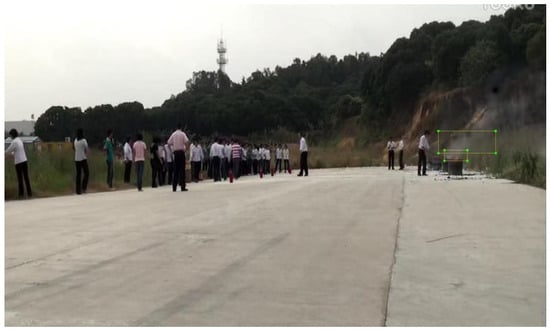
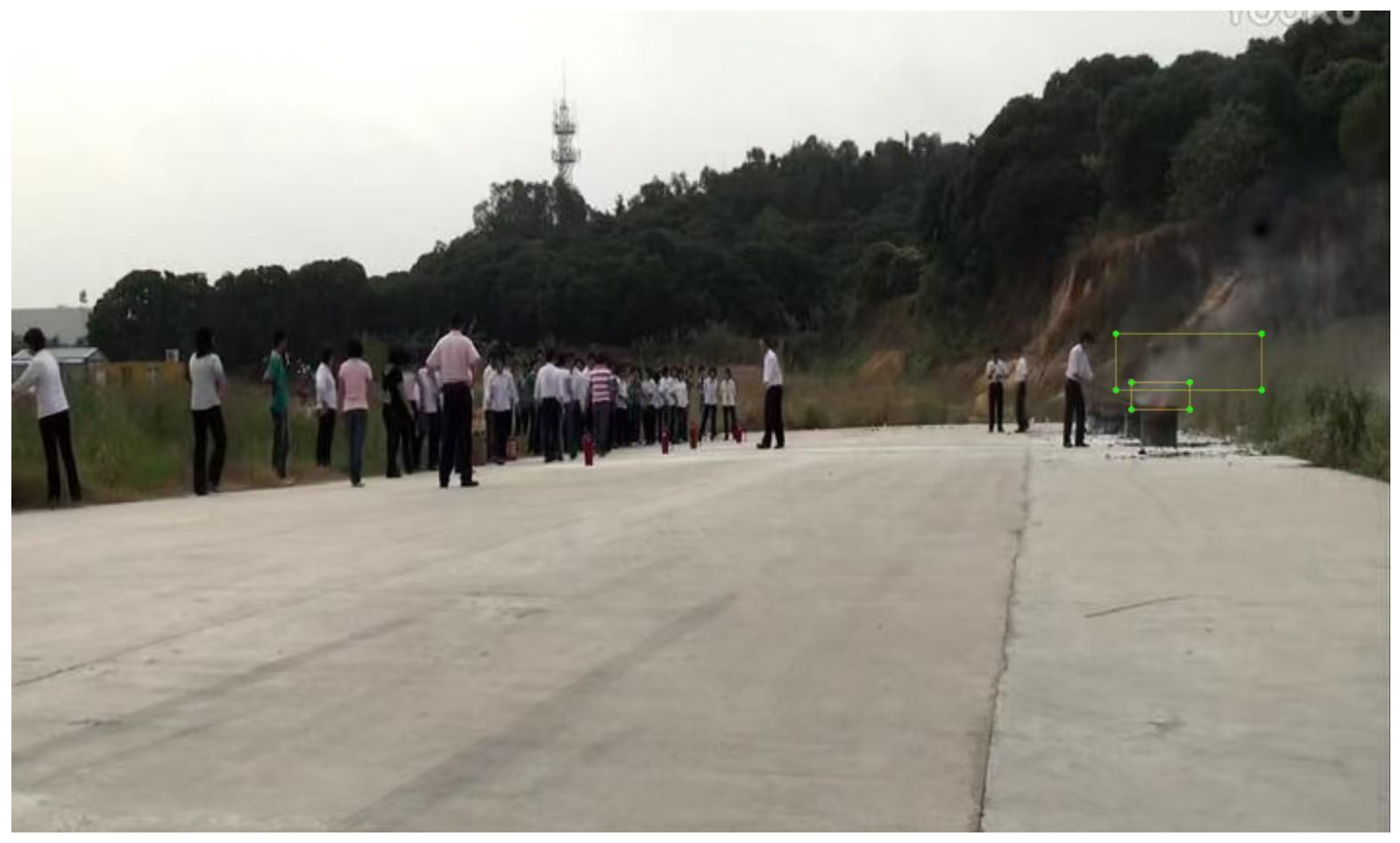
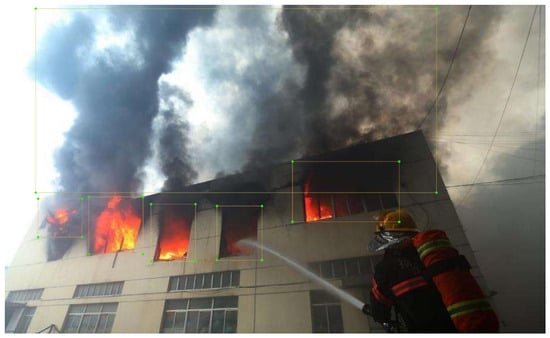
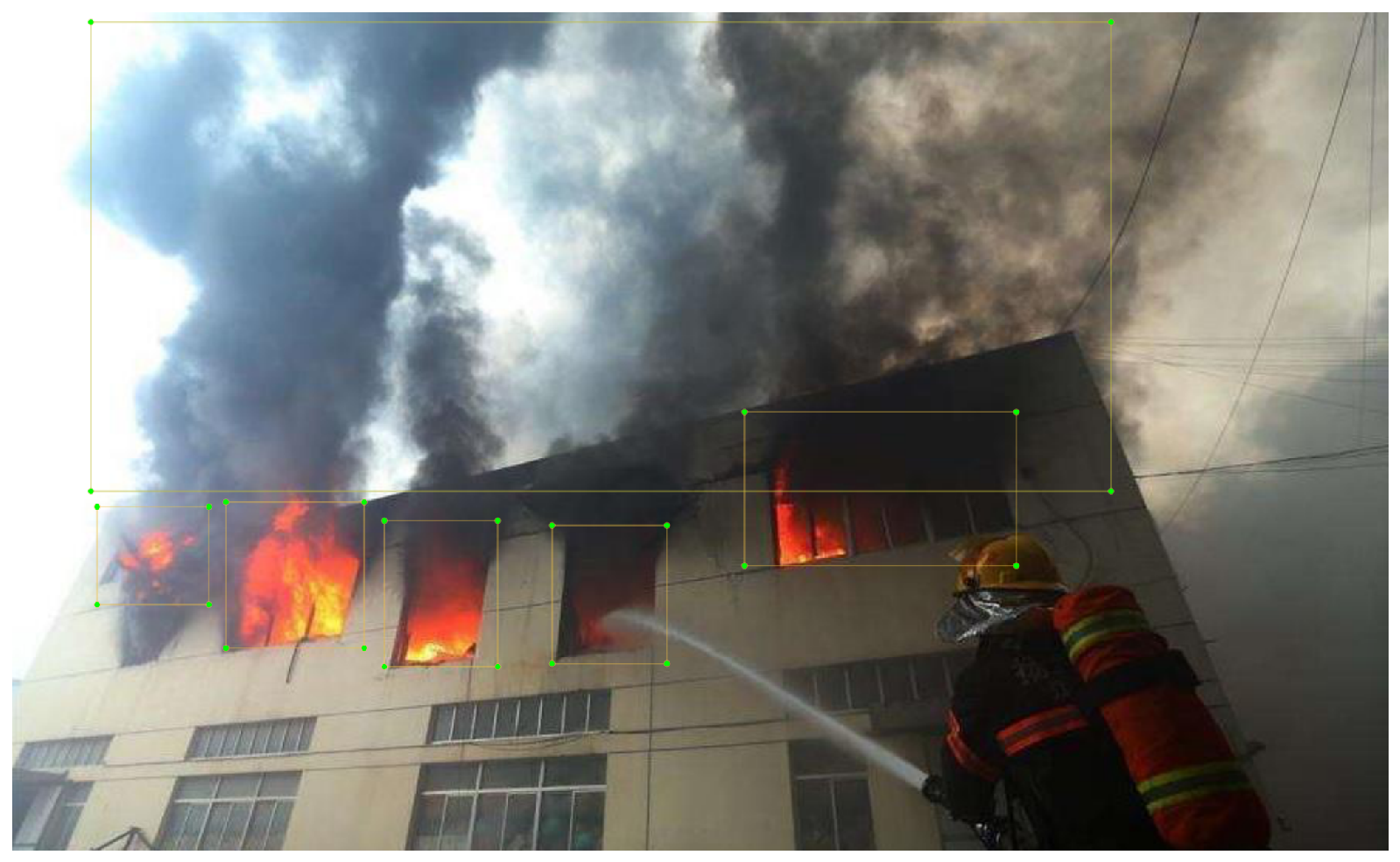
This paper refers to the FASSD dataset design principles proposed by Wang et al. [32] when constructing the dataset. The original high-resolution images were cropped and standardized in resolution to ensure that key information such as flames and smoke remains in the center of the image, while controlling the computational cost during model training. Combined with the lightweight data augmentation method proposed by Yang et al. [33], a self-built extended dataset FS-Blend containing 6516 images was finally completed. During the annotation stage, LabelImg was used to annotate all samples in YOLO format (categories are fire, smoke). Some annotation examples are shown in Figure 1 and Figure 2.
Figure 1.
Annotation (the green box marks the target fire smoke region identified by the SFFA-YOLO algorithm) Example 1.
Figure 2.
Annotation (the green box marks the target fire smoke region identified by the SFFA-YOLO algorithm) Example 2.
In order to improve the generalization ability of the model, this study performed various data augmentation operations on the training set, including random flipping, color bias jitter, mild blur, noise injection, etc., making the model closer to the real environment under surveillance cameras. Afterwards, the data were divided into training set, validation set, and test set in a ratio of 7:2:1. The results after division are shown in Table 1.
Table 1.
Dataset division.
3.2. Model Construction
3.2.1. SFFA-YOLO Model Architecture
The YOLOv11 architecture released by Ultralytics officially [34] and the latest model improvement direction proposed by the YOLOVision 2024 conference [35] (the direction is to focus on optimizing feature extraction and module fusion while maintaining the original inference speed advantage of the model) together lay the framework foundation for the construction of the SFFA-YOLO model proposed in this paper. Flames and smoke in natural scenes exhibit distinct morphological characteristics: smoke is semi-transparent with blurred boundaries, while flames are high-brightness and dynamically changing. These features cause noise interference, low detection accuracy, and positioning deviations in the baseline YOLOv11 model.
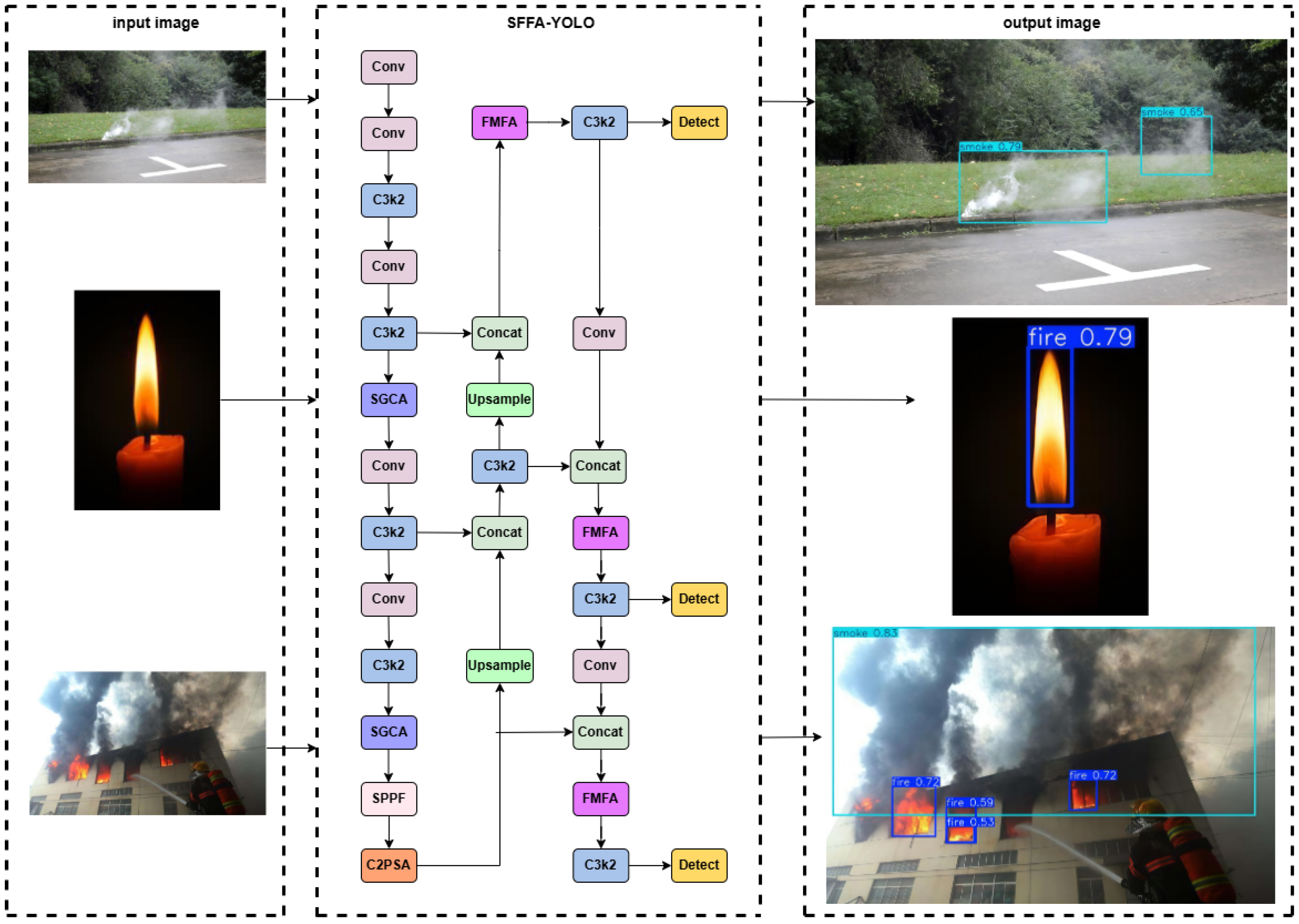
To address this challenge, this paper proposes an improved model SFFA-YOLO based on the YOLOv11 framework. Through structural optimization in three aspects: feature extraction, feature fusion, and loss constraints, the robustness and generalization performance of the model in complex fire scenarios are enhanced. In the feature extraction stage, the model introduces the SGCA module (Scene-aware Global Coordinate Attention) in the Backbone to enhance the model’s ability to focus on key areas, thereby improving the accuracy of model feature extraction. In the feature fusion stage, the model introduces the FMFA module (Fire Multi-scale Dilated Feature Aggregation) in the Neck. This module can achieve more sufficient semantic fusion of the model at different scales, so that even when facing flames and smoke of different sizes, distances, and shapes, it can maintain stable recognition ability. In terms of loss function, this paper introduces SDA-Loss (Smoke Detection Adaptive Loss) based on the characteristics of unstable flame boundaries and blurred smoke edges. This loss function achieves expected results such as easier convergence of the model during training, more stable bounding box regression, and less fluctuation in confidence by giving stronger learning strength to small and blurred targets.
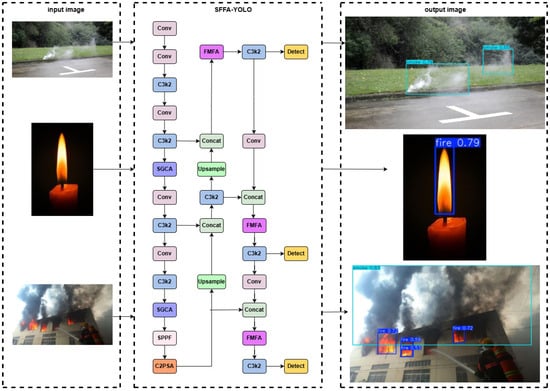
In summary, SFFA-YOLO has achieved targeted optimization at three levels of the original model: feature extraction, fusion, and loss constraints. Its overall structure is shown in Figure 3. The model’s global workflow, including the synergy of the three core modules, is standardized in Algorithm 1, where each step corresponds to the structural design in Figure 3, making the operation logic intuitive.
| Algorithm 1 Core Workflow of SFFA-YOLO |
| Require: Input image I (), YOLOv11s pre-trained weights, SDA-Loss hyperparameters () Ensure: Fire/smoke detection results (bounding boxes, confidence, categories)
|
Figure 3.
SFFA-YOLO model structure.
3.2.2. Feature Extraction Enhancement Based on SGCA
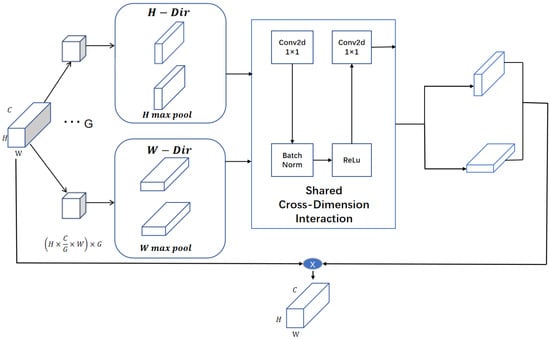
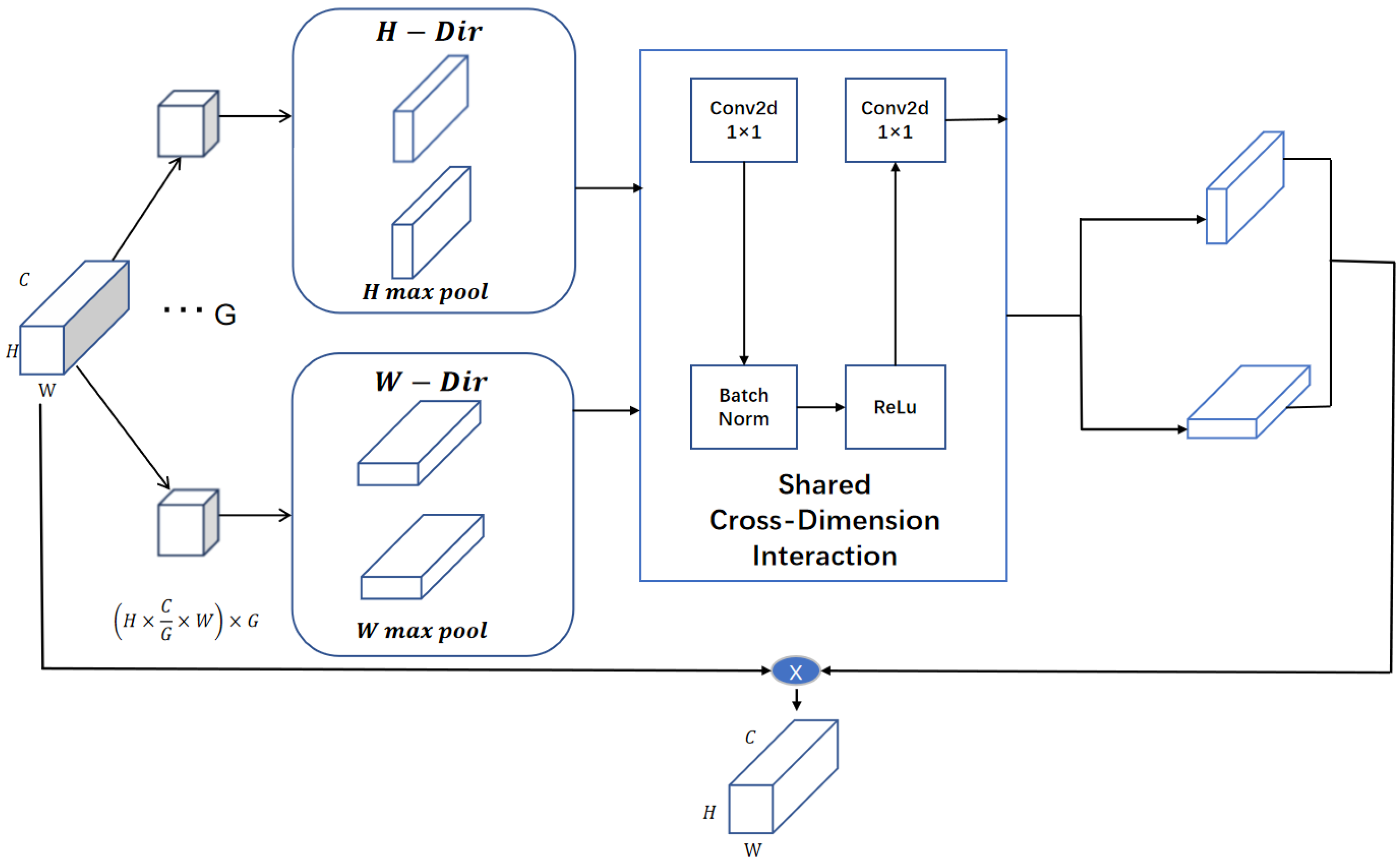
To solve these problems, this paper adds the SGCA (Scene-aware Global Coordinate Attention) module to the middle and high-level semantic paths of the Backbone. This module draws on the coordinate attention mechanism (Coordinate Attention) proposed by Hou et al. [36]. Its core advantages of being lightweight and efficiently capturing global and local feature correlations provide a theoretical basis for focusing on flame edges and smoke texture. On this basis, this study makes local adjustments to it, introducing channel grouping and lightweight global grouping pooling design, as shown in Figure 4.
Figure 4.
SGCA (Scene-aware Global Coordinate Attention module).
In order to make the model more accurate when extracting features, the SGCA module simultaneously performs global pooling from both the height and width directions, allowing the model to more clearly understand the laws of vertical jumping of flames and horizontal diffusion of smoke. Then the channels are divided into different groups for separate learning attention, allowing the model to more accurately focus on key parts with higher flame brightness and unclear smoke edges. Yin et al. [37] pointed out in YOLO-EPF that analyzing and researching from an overall perspective can greatly improve the stability of flame and smoke recognition. SGCA starts from this perspective: while keeping the structure lightweight and without too much cumbersome calculation, YOLOv11 can more attentively and stably extract features of blurred texture and low-contrast targets even in complex scenes. To maintain efficiency, SGCA utilizes depthwise separable convolutions in its attention branch, ensuring the module remains computationally lightweight.The key operations of the SGCA module (global pooling → channel grouping → attention weighting) are detailed in Steps 2–5 of Algorithm 1, which aligns with its structural design in Figure 4.
3.2.3. Multi-Scale Dilated Feature Fusion Based on FMFA
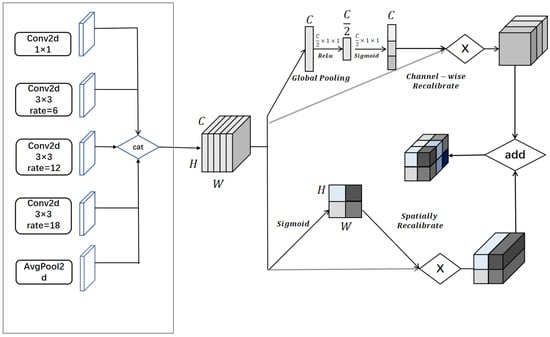
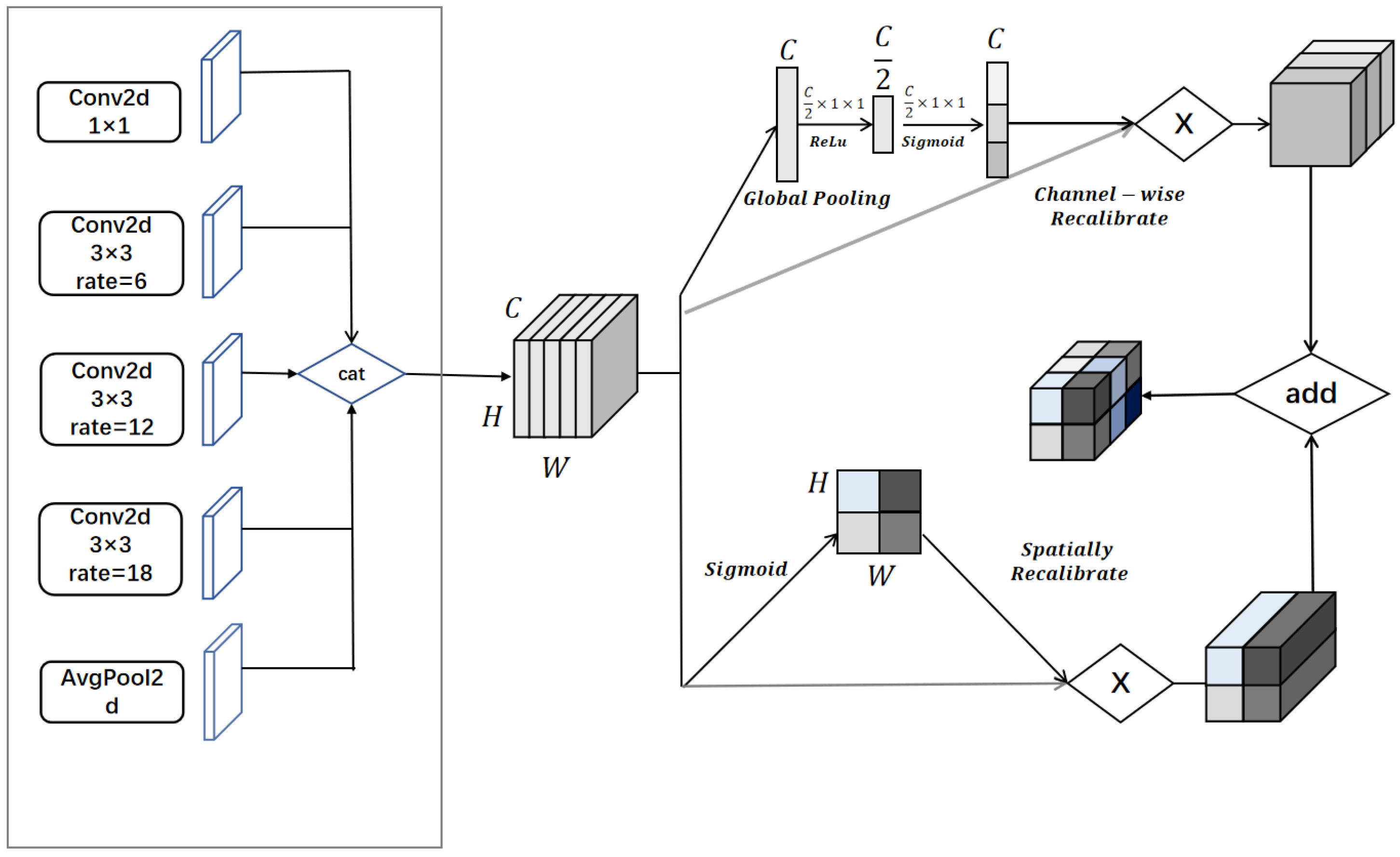
Therefore, this paper’s model adds the FMFA (Fire Multi-scale Dilated Feature Aggregation) module to the Neck part of the original model. As shown in Figure 5.
Figure 5.
FMFA (Multi-scale dilated fusion module).
FMFA consists of five parallel branches, including a 1 × 1 convolution, three sets of dilated convolutions with dilation rates of 6, 12, and 18, and a branch that can provide global semantics. Such a structure can accurately cover multiple receptive fields of small-sized flames and large-scale smoke (including blurred edges) without increasing the amount of computation, allowing the network to more fully capture feature changes at different scales. After multi-branch feature fusion, the module performs adaptive weighting through channel attention and spatial attention, highlighting key areas with more sensitive responses and suppressing background noise, thereby significantly improving the expressive ability of feature fusion.
The dilated convolution constructing a multi-scale detection network proposed by Valikhujaev et al. [38] provides ideas for the design of the FMFA module in this paper. The study pointed out that a multi-dilation rate parallel structure can significantly improve the accuracy of smoke detection and enhance the model’s ability to adapt to different scenes. On this basis, this study further adds a lightweight attention mechanism and channel compression strategy, making FMFA more suitable for deployment and can form a good complement with the SGCA module to enhance the model’s detection ability for small flames and thin smoke.
In summary, the problems of the original YOLOv11 model in detecting small flames, thin smoke, and multi-scale complex scenes are all solved after introducing the FMFA module. This shows that the FMFA module is one of the core structures of this model.FMFA uses depthwise separable dilated convolution (dilation rates 6/12/18) to control computation cost, and is deeply fused with the C3k2 modules in the YOLOv11 Neck (instead of being simply added as an extra branch), replacing the redundant multi-scale feature fusion computations in C3k2. Thus, the single-module parameter increment is only 0.3 M (from 9.4 M to 9.7 M). The multi-branch fusion and attention weighting of the FMFA module correspond to Steps 6–9 of Algorithm 1, which exactly matches the multi-scale receptive field design in Figure 5. To verify the rationality of the selected dilation rates (6/12/18), three groups of combinations were tested for sensitivity analysis, as shown in Table 2. The small-scale combination (3/6/9) has insufficient receptive field, leading to a 2.3% decrease in mAP@0.5 for large-scale smoke targets on the FS-Blend dataset. The large-scale combination (9/18/27) introduces excessive background noise, resulting in a 11.1% drop in small target recall. In contrast, the original combination (6/12/18) balances the detection needs of small flames and large-scale smoke, achieving optimal performance across all datasets, which proves its strong cross-scenario robustness.
Table 2.
Sensitivity analysis of key parameters in FMFA and SDA-Loss.
3.2.4. Dynamic Supervision Strategy Based on SDA-Loss
Therefore, this paper specifically designs the smoke-aware adaptive loss function SDA-Loss, and this function also forms a synergistic mechanism with the SGCA (Scene-aware Global Coordinate Attention) and FMFA (Multi-scale Dilated Feature Aggregation) proposed above. Simply put, SGCA helps the model grasp key positions, FMFA is responsible for providing detailed information at different scales, and SDA-Loss is responsible for giving more sufficient learning weights to small targets and blurred areas during training, thus forming a closed loop of “feature enhancement–dynamic supervision”, which greatly improves the stability and accuracy of flame and smoke detection. Previously, the Powerful-IoU loss proposed by Liu et al. [39] achieved a good balance between convergence speed and boundary regression accuracy through a linear weighting strategy, but there is still a problem of gradient instability on weak feature targets such as smoke with blurred boundaries. Therefore, this paper makes targeted improvements on this basis.
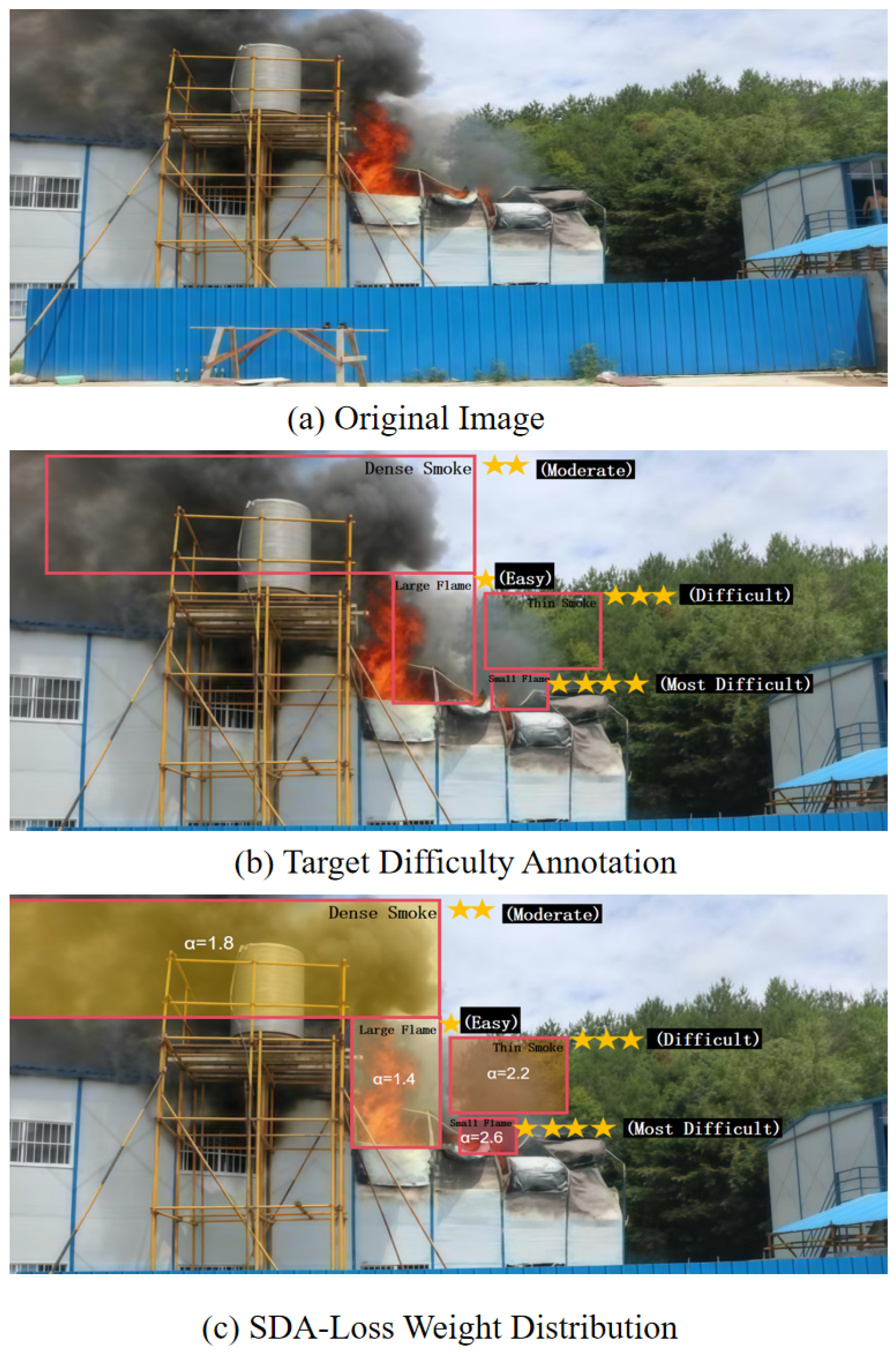
SDA-Loss is mainly responsible for solving three practical problems: difficulty in positioning due to blurred boundaries between smoke and the background, excessive size differences between near and far targets, and inaccurate classification of the model in complex environments that can easily cause false detections. To solve these problems, this paper designs three optimizations: using adaptive WIoU regression to correct boundaries, using texture-aware Focal Loss to improve classification accuracy, and using scale-balanced loss to adapt to targets of different sizes. Among them, adaptive WIoU will assign more weight to small targets when assigning training weights, making it easier to detect difficult-to-detect targets such as distant small smoke columns. Its expression is shown in Equation (1):
The calculation method of IoU is shown in Equation (2):
The scale adaptive weight is dynamically adjusted according to the relative area of the target, as shown in Equation (3):
where A is the target box area, and is the image area. When the target is smaller (i.e., is lower), the value of will be larger, thereby imposing stronger regression supervision on small targets; at the same time, the saliency information provided by SGCA will guide , further suppressing background interference and making boundary learning more stable.
Since smoke often exhibits characteristics such as semi-transparency, weak feature texture, and blurred edges, the model always suffers from the problem of unstable confidence scores in classification. To solve this problem, SDA-Loss adds texture consistency constraints to the traditional Focal Loss, so that the classification gradient can be consistent with the multi-scale texture output by FMFA, thereby obtaining more stable learning signals in weak texture areas. Its expression is shown in Equation (4):
where is the classification probability, , are Focal Loss parameters, and is the weight controlling the texture term.
In addition, in order to make the model pay more attention to targets such as distant small smoke columns and early small flames, SDA-Loss adds a scale-balanced objectness loss. The model will assign higher weights to these small targets during training. Its form is shown in Equation (5):
The scale weight calculation is shown in Equation (6):
The smaller A is, the larger is, which is more helpful to improve the recall rate of small targets. Finally, these three sub-losses are combined according to weights as the overall optimization goal, as shown in Equation (7):
SDA-Loss allows the model to train stably even in complex scenes by optimizing boundary regression, texture classification, and small target supervision. And after cooperating with the SGCA and FMFA modules, it can give the model clearer training guidance. It lays a solid foundation for the SFFA-YOLO model in subsequent fire detection. The weight coefficients of SDA-Loss were further optimized through sensitivity analysis (Table 2). The equal-weight combination (0.5/0.5/0.5) fails to prioritize small target supervision, causing a 4.4% reduction in small target recall. The high-weight combination (0.9/0.7/0.5) over-emphasizes difficult samples, leading to overfitting and a 1.8% drop in mAP@0.5 on the FIRE-SMOKE-DATASET. The original weight setting (0.7/0.5/0.3) achieves the best balance between boundary regression, texture classification, and small target supervision, ensuring stable performance on both the self-built and public datasets.
Algorithm 1 corresponds to Figure 3, Figure 4, Figure 5 and Figure 6, illustrating the synergy of SGCA (feature enhancement), FMFA (multi-scale fusion), and SDA-Loss (dynamic supervision) in SFFA-YOLO.
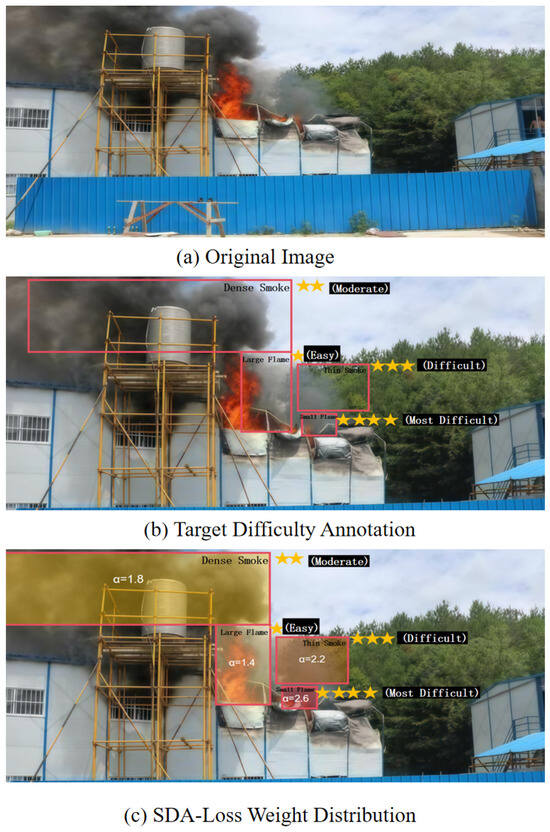
Figure 6.
SDA-Loss dynamic weight allocation diagram. Note: The figure takes Small Flame (small flame, ), Thin Smoke (thin smoke, ), Dense Smoke (dense smoke, ), and Large Flame (large flame, ) as examples to show the weight allocation rules of SDA-Loss for fire smoke targets of different difficulties. The darker the color, the higher the weight, reflecting the model’s key supervision strategy for small targets and blurred targets, consistent with the calculation results of Equations (3) and (6).
3.3. Experimental Setup
3.3.1. Experimental Environment
The training and evaluation of the model were conducted in a unified environment to ensure reproducibility. The hardware and software configurations are detailed in Table 3.
Table 3.
Hardware and software configurations.
3.3.2. Training Parameters
All models share the same training hyperparameters to eliminate interference from parameter differences. The key training settings are listed in Table 4, consistent with mainstream YOLO training standards.
Table 4.
Training hyperparameter configurations.
3.3.3. Evaluation Metrics
To comprehensively assess the model’s performance, we adopt four core accuracy metrics (Precision, Recall, F1-score, and mAP@0.5—the core metric for target detection) and three efficiency/lightweight metrics (GFLOPs for computational complexity, Params for the number of parameters, and FPS for inference speed).
The calculation formulas for accuracy metrics are as follows:
where (True Positive) is the number of correctly detected targets, (False Positive) is the number of false detections, (False Negative) is the number of missed detections, and N is the number of target categories (fire and smoke in this study).
To verify whether the performance differences between model variants and the baseline are statistically significant, paired t-tests are conducted on the key metrics (mAP@0.5, Precision, Recall, F1-score) with a significance level of . All ablation experiments are repeated 5 times independently with different random seeds, and the mean value and standard deviation are calculated. The null hypothesis assumes that there is no significant difference between the variant and the baseline. If the p-value < 0.05, is rejected, indicating that the performance improvement is statistically significant; p-value < 0.01 indicates extremely significant improvement, marked with * and ** in the table, respectively.
4. Results and Discussion
4.1. Ablation Study
In order to verify the effectiveness of each module in SFFA-YOLO, this paper conducted a detailed ablation study. The experimental results are shown in Table 5.
Table 5.
Ablation study results (with statistical significance).
It can be seen from the data in the table that using any single core module can improve the comprehensive performance of the model. Among them, the improvement of the FMFA module is the most obvious, with mAP@0.5 reaching 0.896, an increase of 0.020 compared to the baseline model. The FMFA module achieves the most significant improvement (mAP@0.5 increased by 2.0%), followed by the SGCA module (1.6% increase), indicating that multi-scale feature fusion and key region focusing are the core factors for performance improvement. Notably, SGCA slightly reduces Precision (0.878 vs. 0.887) and Recall (0.866 vs. 0.870) compared to the baseline, but improves mAP@0.5 to 0.892—this is because SGCA prioritizes capturing small/fluffy smoke targets (increasing true positives for weak-feature targets) at the cost of a small number of false positives for background interference, and the overall improvement in multi-scale target detection performance leads to a higher mAP@0.5. When using SDA-Loss alone, the improvement in mAP@0.5 is low (0.889) but it lays the foundation for subsequent synergistic optimization of modules; importantly, SDA-Loss only optimizes the training supervision strategy without changing the network structure, so the parameter count remains consistent with the baseline (9.4 M).
According to the results of module combination experiments, the comprehensive performance of pairwise combinations of modules is better than that of a single module, showing obvious synergistic gains. Among them, the FMFA + SDA-Loss combination performs the best (mAP@0.5 = 0.910, F1 = 0.889), as FMFA provides multi-scale detailed features and SDA-Loss strengthens learning of small/blurred targets through dynamic weighting, forming effective complementarity in feature expression and supervision. The SFFA-YOLO model integrating all three modules achieves the optimal performance: mAP@0.5 reaches 0.915, with Precision, Recall, and F1 scores increased by 0.025, 0.030, and 0.028 compared to the baseline, respectively.
Module combination also enhances efficiency and lightweight performance significantly. The FPS of SGCA + FMFA (34.2) outperforms single SGCA (28.9) or FMFA (28.5), owing to their complementary feature extraction/fusion that reduces redundant convolutions. Instead of simple superposition, the two modules deeply fuse with YOLOv11 Neck’s C3k2: SGCA replaces redundant channel attention, and FMFA replaces repetitive multi-scale convolutions in C3k2, achieving 1.0 M redundancy reduction. Their total parameter increment (0.5 M: 0.2 M SGCA + 0.3 M FMFA) is far less than the 1.0 M reduction, lowering parameters to 8.8 M (consistent with Table 5). After pairwise combination, parameters drop to 8.8–9.1 M and FPS rises to 33.3–34.2. The final SFFA-YOLO further reduces parameters to 8.2 M (1.2 M less than baseline) with FPS reaching 36.7 (6.3 higher than baseline), 0.6 M lighter than SGCA + FMFA. Key to this is SDA-Loss: it adds a sparsity constraint to the total loss function, guiding pruning of zero-weight channels (threshold ) in the fused regions of C3k2, SGCA, and FMFA, cutting another 0.6 M parameters. This optimizes feature learning efficiency, releases the lightweight potential of SGCA/FMFA (i.e., redundant channels in the fused modules are pruned without losing feature expression ability), and ultimately achieves improved accuracy alongside faster inference speed and fewer parameters. Furthermore, the sensitivity analysis in Table 2 confirms that the key parameters of FMFA and SDA-Loss are not tuned specifically for the FS-Blend dataset, and the performance gains are consistent across different datasets, which verifies the robustness of the proposed model.
The statistical significance markers in Table 5 further validate the reliability of the above conclusions: (1) the mAP@0.5 improvements of single-module variants (SGCA, FMFA, SDA-Loss) are marked with * (p < 0.05), indicating statistically significant gains compared to the baseline; (2) all multi-module combinations achieve extremely significant improvements (**, p < 0.01), which confirms the strong synergistic effect between SGCA, FMFA and SDA-Loss; (3) the full-module SFFA-YOLO achieves the most significant performance boost (**), verifying that the proposed optimization strategy has high stability and reproducibility in complex fire detection scenarios.
Training Validation Test Curve Visualization
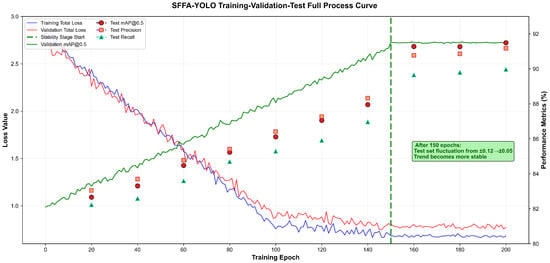
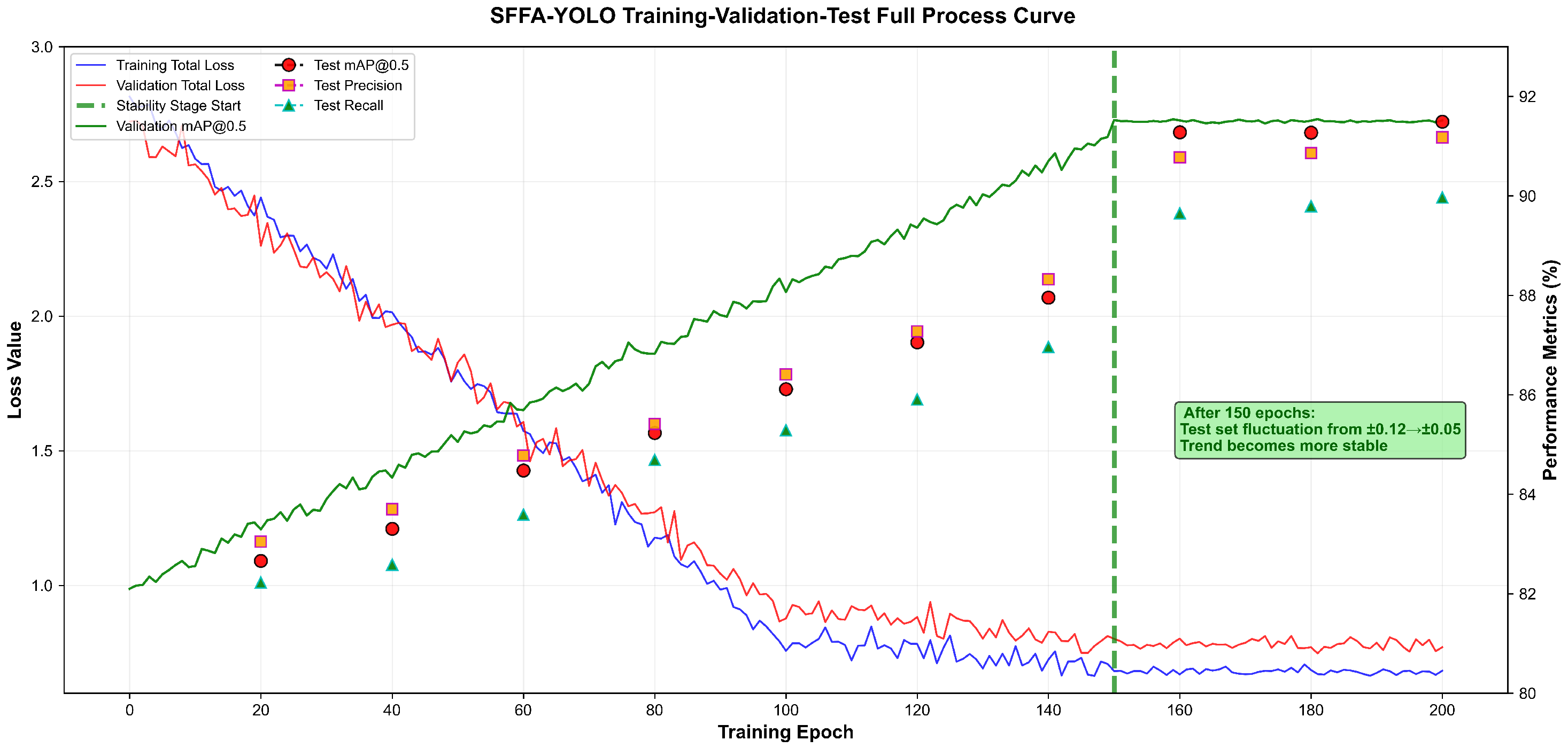
To verify the rationality and stability of the SFFA-YOLO training process, Figure 7 presents the full-process dynamic curves of key metrics over 200 epochs, supplementing the ablation study with intuitive evidence for training stage quality.
Figure 7.
Training-validation-test full-process curves of SFFA-YOLO on the FS-Blend dataset. The curves include training loss, validation loss, validation mAP@0.5, and test set metrics (mAP@0.5, Precision, Recall) over 200 epochs.
Key observations are as follows: Loss Convergence: Training loss (blue curve) and validation loss (red curve) decline rapidly in 0–100 epochs and stabilize after 150 epochs, converging to 0.68 (±0.01) and 0.78 (±0.015), respectively. Their consistency indicates no overfitting, attributed to data augmentation (random flipping, color jitter) and SGCA’s noise suppression. Validation Performance: Validation mAP@0.5 (green curve) rises from 82.1. Test Reliability: Test metrics (black: mAP@0.5, magenta: Precision, cyan: Recall) evaluated every 20 epochs show trends highly consistent with the validation set. Fluctuations reduce from ±0.12 (pre-150 epochs) to ±0.05 (post-150 epochs), verifying strong generalization.
This curve demonstrates the reliability of the SFFA-YOLO training-validation-test process, providing direct evidence for each stage’s quality and corroborating the effectiveness of the proposed modules (SGCA, FMFA, SDA-Loss).
4.2. Comparative Experiments
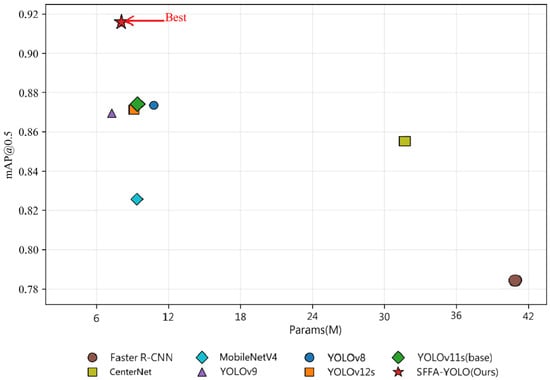
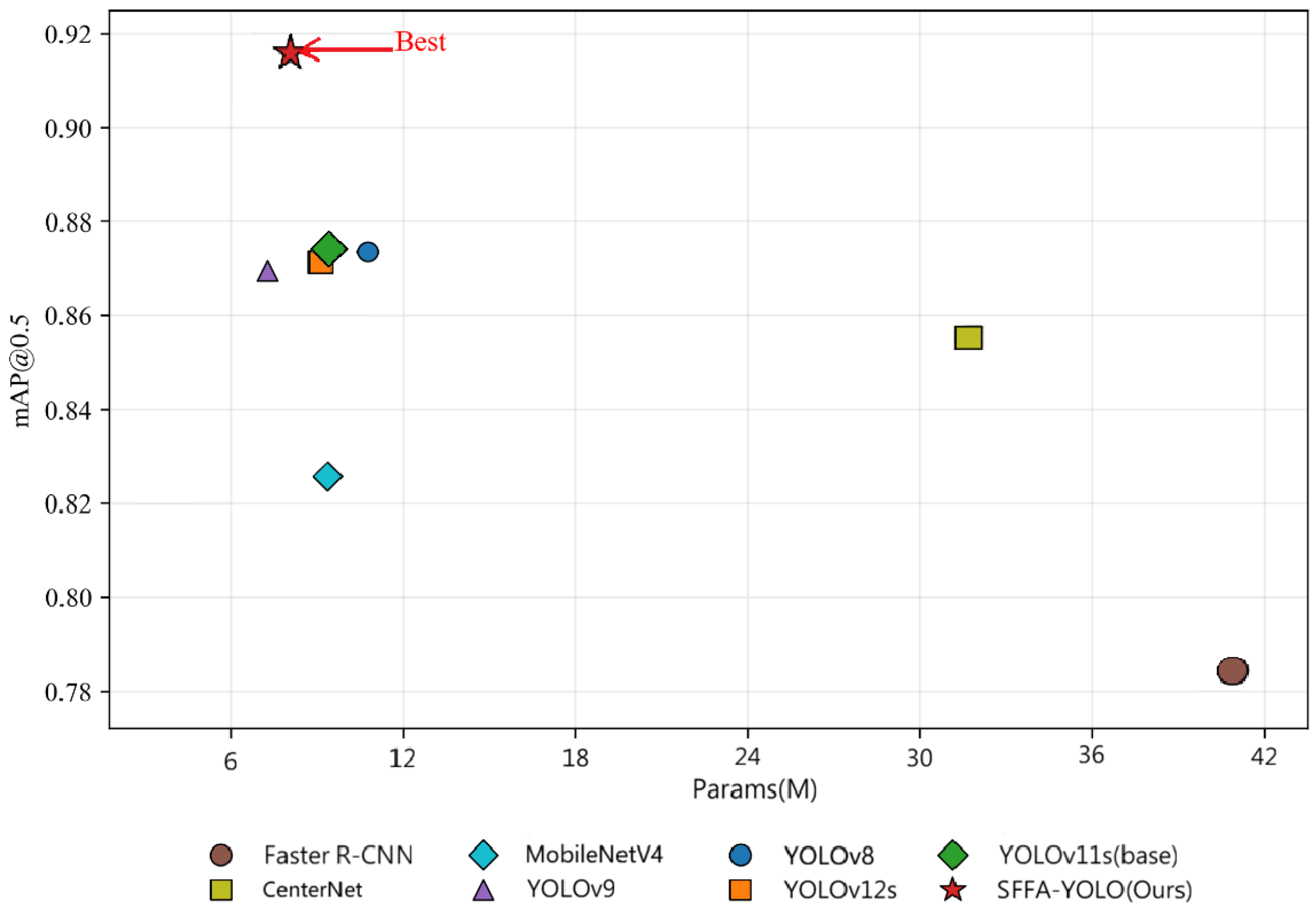
In order to comprehensively evaluate the comprehensive performance of the SFFA-YOLO model, this paper compares it with other mainstream object detection models on the FS-Blend dataset. Mainstream object detection models include: two-stage detector Faster R-CNN, keypoint-based CenterNet [40], lightweight network MobileNetV4 [41], and the latest versions of the YOLO series. The detailed comparison results are shown in Table 6. Figure 8 visually shows the balance relationship between accuracy (mAP@0.5) and number of parameters (Params) of each model.
Table 6.
Comparison with mainstream models.
Figure 8.
Balance between mAP@0.5 and model parameters (Params). The horizontal axis represents the number of model parameters (M), and the vertical axis represents the detection accuracy (mAP@0.5, %). SFFA-YOLO achieves the optimal balance with higher accuracy and fewer parameters.
From the mAP@0.5 indicator, the result of the SFFA-YOLO model is optimal, reaching 0.915, an increase of 3.9% compared to the baseline model YOLOv11s. Moreover, Precision, Recall, and F1-score are also comprehensively ahead of the baseline model, at 0.912, 0.900, and 0.906, respectively, which reflects excellent consistency in classification and positioning. On this basis, the most critical thing is that the SFFA-YOLO model achieves higher efficiency and better lightweight while improving accuracy. As can be seen from Table 6, among all comparison models, SFFA-YOLO has the lowest number of parameters, and its computational complexity is only higher than MobileNetV4, and its accuracy far exceeds the latter, achieving an optimal balance between accuracy and efficiency. At the same time, its inference speed (FPS) is the fastest, as high as 36.7. Compared with the baseline model YOLOv11s, the SFFA-YOLO model reduces the number of parameters by 12.8% from 9.4 M to 8.2 M under the premise of improving mAP@0.5 by 3.9%, and FPS increases by 20.7% from 30.4 to 36.7. The position of the SFFA-YOLO model in Figure 8 further illustrates that the model is in a relatively ideal area, with its accuracy significantly higher than other models while the computational complexity is also low.
In summary, SFFA-YOLO achieves the optimal balance between accuracy and lightweight among all compared models, benefiting from the synergistic optimization of the three modules and the sparsity constraint of SDA-Loss. This engineering optimization idea enables the model to be easily transplanted to other edge detection tasks while ensuring detection accuracy.
Cross-Dataset Generalization Verification
To further verify the generalization ability of the SFFA-YOLO model and eliminate overfitting concerns on the self-built FS-Blend dataset, cross-dataset validation was conducted on two widely used public fire smoke detection benchmarks: D-Fire and FIRE-SMOKE-DATASET. The D-Fire dataset contains 10,000+ forest fire images with a high proportion of small and occluded targets, which has been widely used in fire detection research. The FIRE-SMOKE-DATASET focuses on urban fire scenarios, covering complex background interference such as street lights, exhaust gas, and strong light reflections.
The experimental settings were kept consistent with those on the FS-Blend dataset to ensure fair comparison, including the same input size, hyperparameters, and evaluation metrics. The cross-dataset verification results are shown in Table 7.
Table 7.
Cross-dataset verification results.
As shown in Table 7, SFFA-YOLO maintains excellent performance on both public datasets, achieving mAP@0.5 of 89.7% and 88.9% on D-Fire and FIRE-SMOKE-DATASET, respectively. Compared with the baseline YOLOv11s, the mAP@0.5 is improved by 2.1% and 1.8% separately, while the inference speed is higher than the baseline under the lightweight design. This fully demonstrates that the proposed model has strong cross-scenario adaptability and is not overfitted to the self-built FS-Blend dataset. The excellent performance on public datasets verifies the effectiveness of the engineering optimization strategy of SGCA, FMFA, and SDA-Loss modules.
4.3. Visualization Analysis
In order to more intuitively demonstrate the performance advantages of the SFFA-YOLO model, this paper selects three typical scenarios for visual comparative analysis.
4.3.1. Complex Scene Detection Effect Comparison
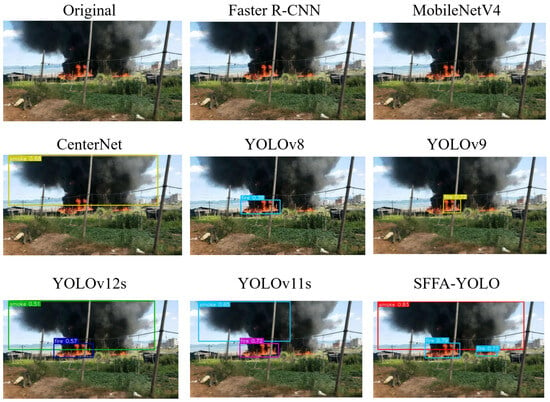
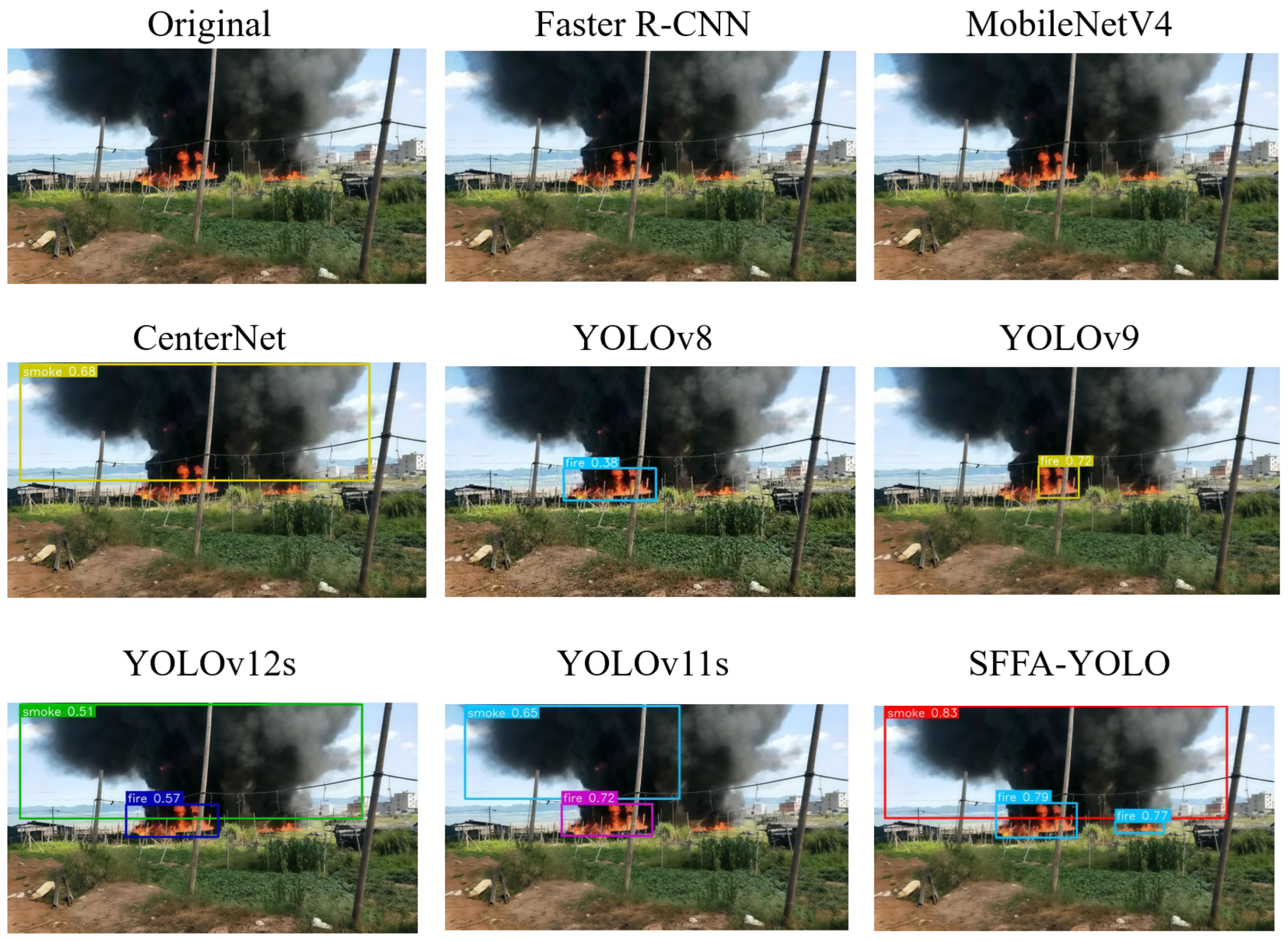
Figure 9 shows the detection effect comparison of each mainstream model in complex scenes. Faster R-CNN and MobileNetV4 both have missed detection problems. CenterNet, YOLOv8, and YOLOv9 have insufficient recognition ability when facing multiple targets. The performance of YOLOv11s and YOLOv12s gradually improves, but there is still room for optimization. The SFFA-YOLO model, with the synergistic effect of the SGCA, FMFA modules, and SDA-Loss, accurately identifies smoke and two flame targets.The root cause of poor performance in mainstream models is their inability to balance global semantics and local details: Faster R-CNN lacks efficient multi-scale fusion and misses occluded small flames; MobileNetV4 sacrifices feature extraction capability for lightweight design, leading to smoke target loss; YOLOv8 and YOLOv9 fail to capture thin smoke edges. By contrast, the SGCA module of SFFA-YOLO suppresses background clutter, the FMFA module covers multi-scale receptive fields, and SDA-Loss strengthens supervision for blurred targets, thus achieving accurate detection of overlapping flame-smoke targets.
Figure 9.
Detection effect comparison of each model in complex scenes.
4.3.2. Small Target Detection Effect Comparison
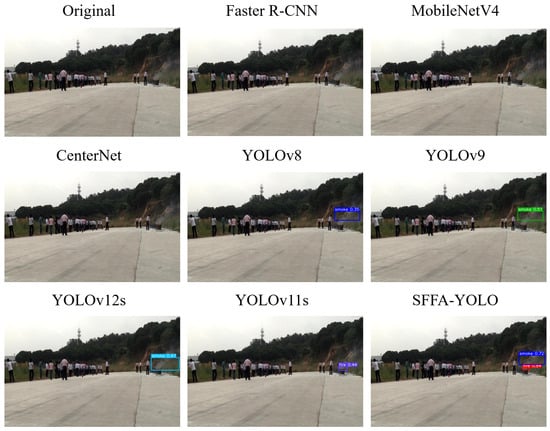
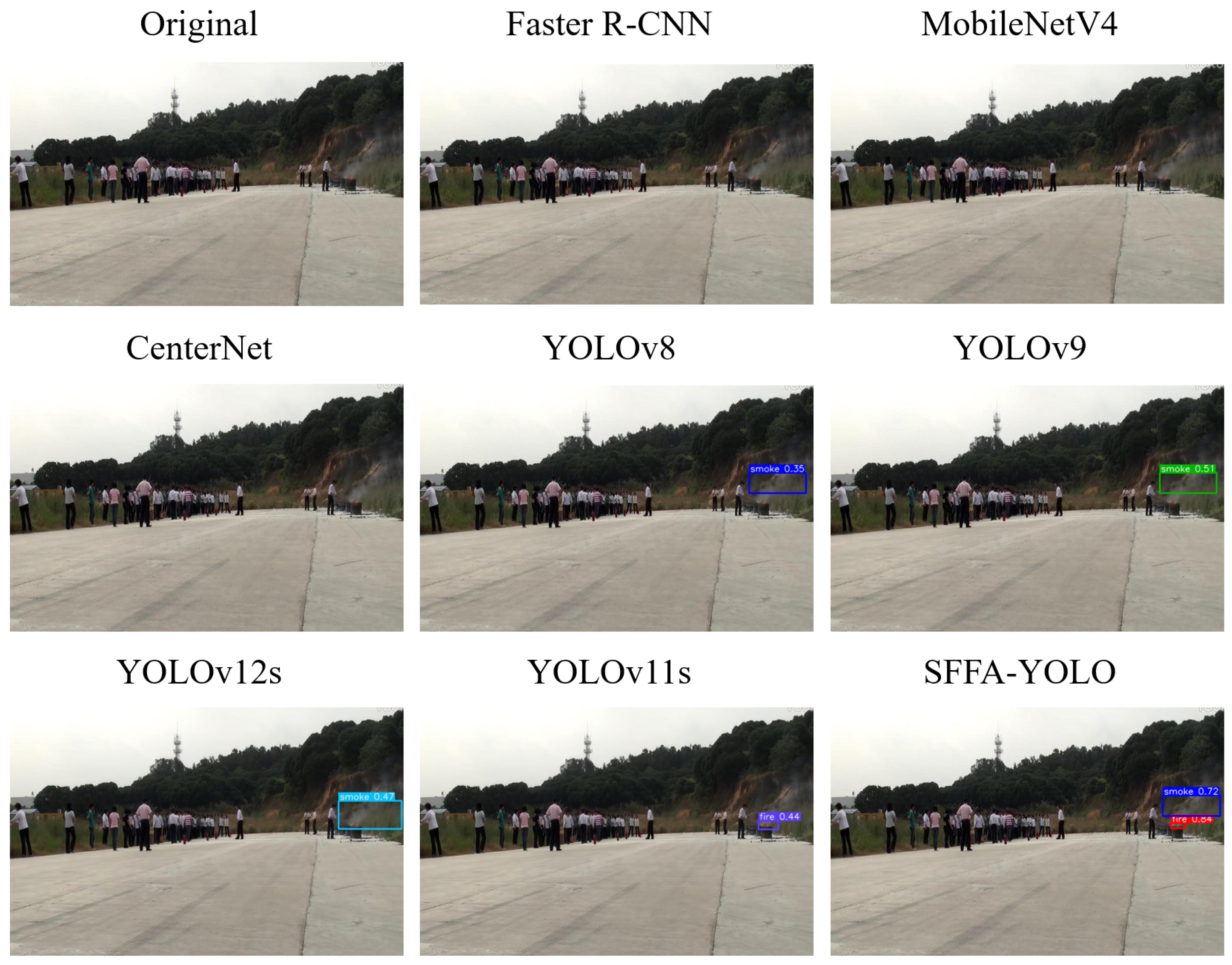
Figure 10 compares model performance in small-target scenes. Faster R-CNN, MobileNetV4, CenterNet and some YOLO models all miss targets with unstable smoke–flame recognition. Only SFFA-YOLO identifies them accurately. Mainstream models miss small targets from backbone shallow feature loss Faster R-CNN lacks tiny-target sensitivity and CenterNet suffers background noise SFFA-YOLO’s SGCA FMFA SDA-Loss synergy boosts recall.
Figure 10.
Detection effect comparison of each model in small target scenes.
4.3.3. Strong Light Interference Scene Detection Effect Comparison
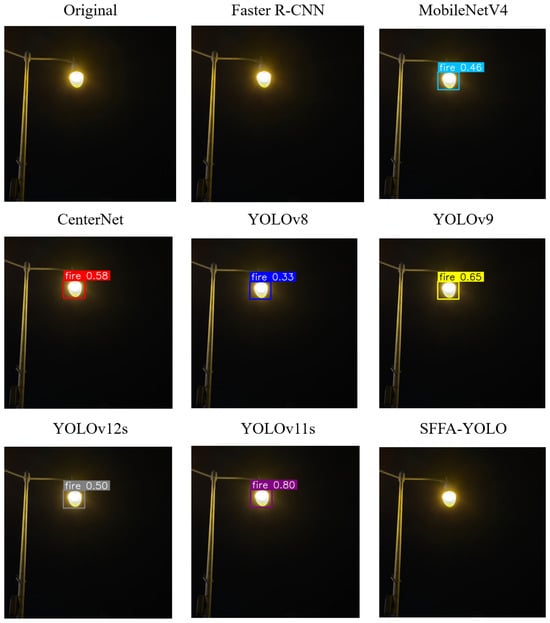
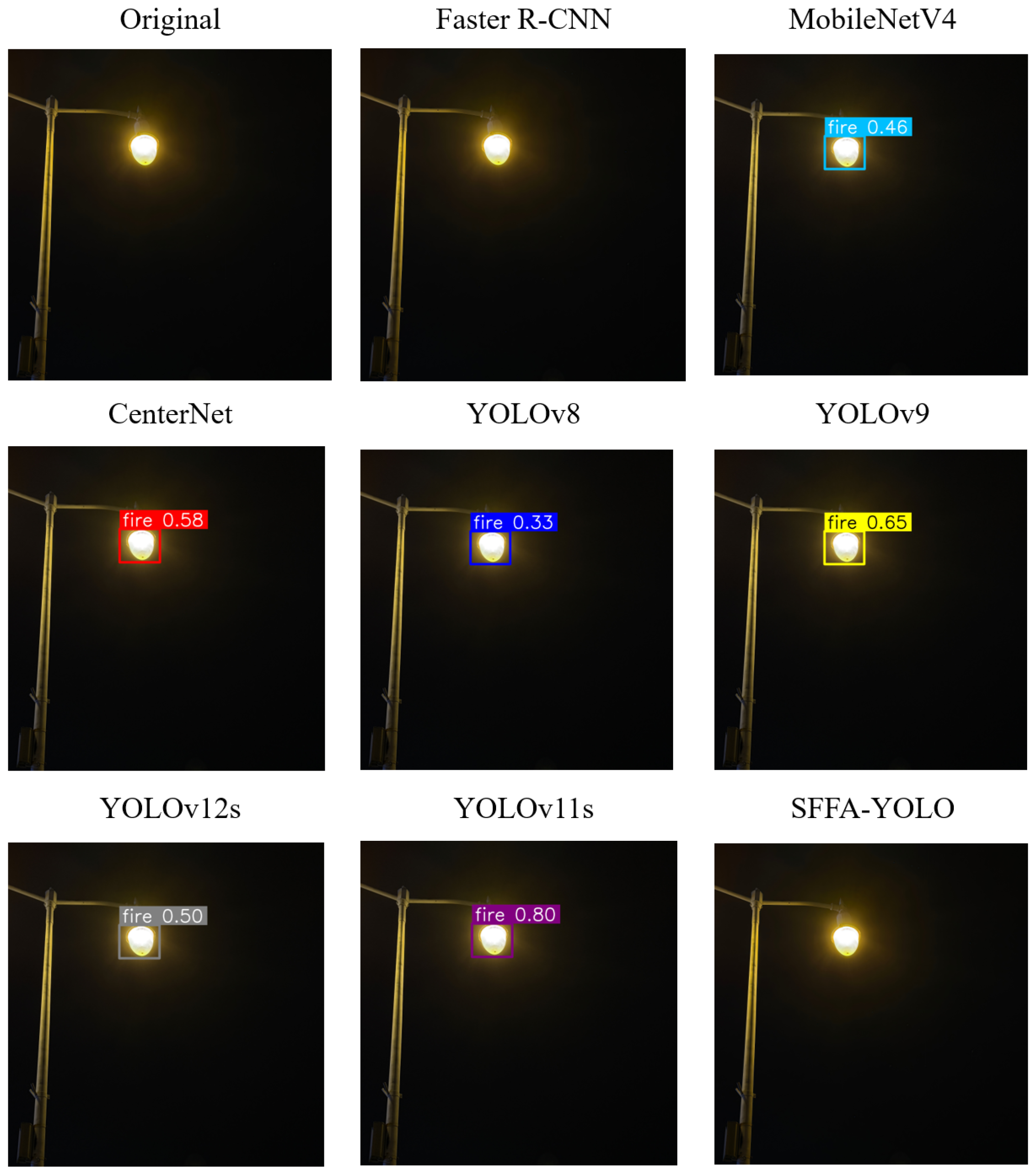
Figure 11 compares model performance in street lamp scenes: YOLOv8/v9 misdetect lamps as flames due to over-reliance on brightness instead of texture; Faster R-CNN avoids false detections but is far slower, while SFFA-YOLO achieves accurate, real-time detection via its SGCA module and texture-aware Focal Loss in SDA-Loss.
Figure 11.
Detection effect comparison of each model in strong light interference scenes.
4.3.4. Rainy Day Reflected Water Interference Scene Failure Mode Analysis
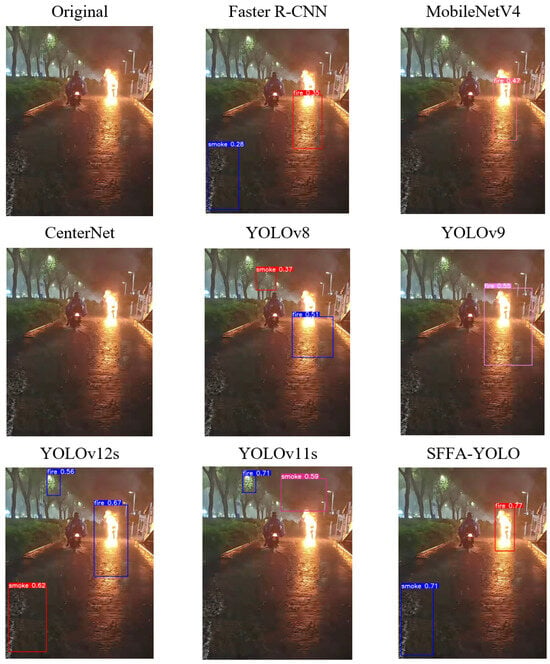
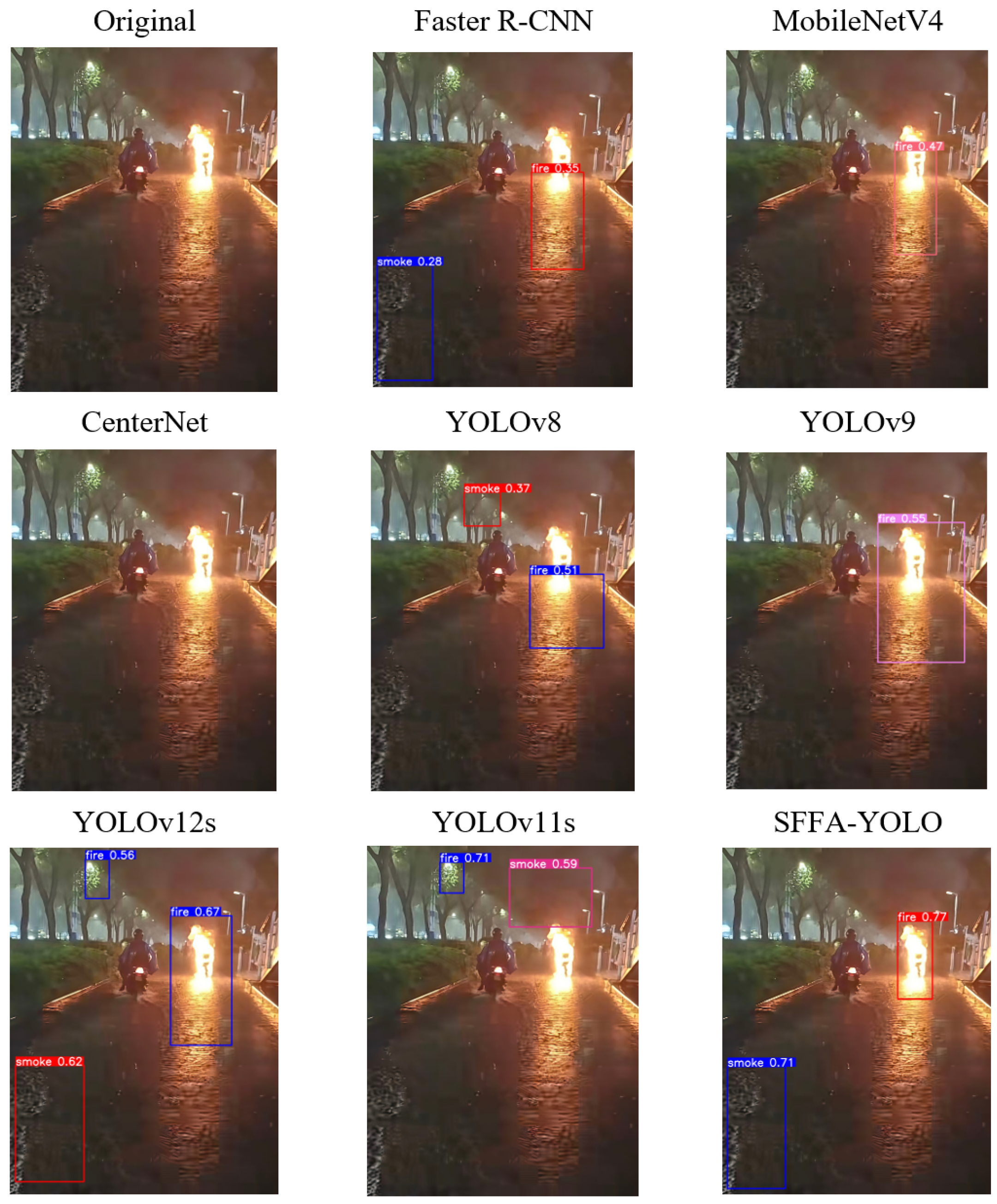
Figure 12 shows models’ detection performance in rainy day reflected water scenes. The core challenge is that reflected water resembles thin smoke (prone to misdetection) while flame dense smoke requires accurate recognition. All mainstream models have limitations: Faster R-CNN misses partial flames and misclassifies reflected water as smoke; YOLOv9 detects flames but misses weak combustion areas with wider reflected water misdetection; YOLOv11s (baseline) misses partial flames yet accurately recognizes dense smoke; SFFA-YOLO identifies full flames and dense smoke without misses but still misclassifies reflected water as smoke, as the FMFA module poorly distinguishes between specular reflection and smoke diffusion textures.
Figure 12.
Detection effect comparison of each model in rainy day reflected water interference scenes.
5. Conclusions
Accurate detection of flames and smoke in fire scenes is crucial for ensuring public safety. It effectively reduces casualties, reduces economic losses, and provides strong technical support for early fire warning. The multi-scale fusion detection Algorithm SFFA-YOLO proposed in this paper specifically solves the core problems of small targets, blurred boundaries, and complex scenes in early fires. In summary, SFFA-YOLO fully meets the needs of real-time fire monitoring scenarios and provides an efficient solution for fire smoke detection.
In the future, we will focus on collecting datasets in complex environments such as heavy rain, fog, and extreme lighting to strengthen the robustness of the model. And use multi-scene datasets to evaluate the adaptability of the algorithm to promote the application of this algorithm in practical scenarios such as smart fire protection and drone inspection.
Limitations and outlook: SFFA-YOLO still suffers from misdetection due to insufficient texture discrimination between specular reflections (e.g., rainy water reflections) and thin smoke, and its inference speed needs improvement on low-computing edge devices. Future work will introduce texture contrastive loss to suppress such misdetection, adopt lightweight convolution and quantization techniques to optimize edge deployment efficiency, and expand the dataset with extreme weather samples to further enhance the model’s scene generalization ability.
Author Contributions
Conceptualization, Y.J. and J.Z.; methodology, Y.J.; software, Y.J.; validation, Y.J. and J.Z.; formal analysis, Y.J.; investigation, Y.J.; resources, J.Z.; data curation, Y.J.; writing—original draft preparation, Y.J.; writing—review and editing, J.Z.; visualization, Y.J.; supervision, J.Z.; project administration, J.Z. All authors have read and agreed to the published version of the manuscript.
Funding
This work was supported by Heilongjiang Provincial Postdoctoral Research Start-Up Fund Project under Grant LBHQ19028.
Institutional Review Board Statement
Not applicable.
Informed Consent Statement
Not applicable.
Data Availability Statement
The original contributions presented in this study are included in the article. Further inquiries can be directed to the corresponding author.
Acknowledgments
We would like to express our sincere gratitude to Jialin Zhang for her valuable guidance and constant support throughout this research. Special thanks are extended to the School of Computer and Information Engineering, Harbin University of Commerce, for providing necessary experimental conditions and technical assistance. We also appreciate the anonymous reviewers for their insightful comments that significantly improved the quality of this manuscript. Finally, we thank all colleagues and peers who offered their help during the data collection and model training stages.
Conflicts of Interest
The authors declare no conflicts of interest.
References
- National Fire and Rescue Administration. National Police and Fire Situation in 2022. Available online: https://www.119.gov.cn/qmxfxw/xfyw/2023/36210.shtml (accessed on 24 March 2023).
- National Fire and Rescue Administration. National Police and Fire Situation in 2023. Available online: https://www.119.gov.cn/qmxfxw/mtbd/spbd/2024/41284.shtml (accessed on 5 January 2024).
- National Fire and Rescue Administration. The National Fire and Rescue Administration Holds a Regular Press Conference (Reporting 2024 National Fire and Emergency Response Data). Available online: https://mp.weixin.qq.com/s/R99uMjUoShaoQwvFL7qHWQ (accessed on 24 January 2025).
- Celik, T.; Ozkaramanli, H.; Demirel, H. Fire Detection Using Statistical Color Models in Video Sequences. J. Vis. Commun. Image Represent. 2007, 18, 176–185. [Google Scholar] [CrossRef] [Scilit]
- Chino, D.Y.; Avalhais, L.P.; Rodrigues, J.F.; Traina, A.J. Bowfire: Detection of Fire in Still Images by Integrating Pixel Color and Texture Analysis. In Proceedings of the 2015 28th SIBGRAPI Conference on Graphics, Patterns and Images, Salvador, Brazil, 26–29 August 2015; pp. 95–102. [Google Scholar] [CrossRef] [Scilit]
- Dimitropoulos, K.; Barmpoutis, P.; Grammalidis, N. Spatio-Temporal Flame Modeling and Dynamic Texture Analysis for Automatic Video-Based Fire Detection. IEEE Trans. Circuits Syst. Video Technol. 2015, 25, 339–351. [Google Scholar] [CrossRef] [Scilit]
- Torabian, M.; Pourghassem, H.; Mahdavi-Nasab, H. Fire Detection Based on Fractal Analysis and Spatio-Temporal Features. Fire Technol. 2021, 57, 2583–2614. [Google Scholar] [CrossRef] [Scilit]
- Xie, Y.; Zhu, J.; Guo, Y.; Huang, X.; Liu, Y. Early Indoor Occluded Fire Detection Based on Firelight Reflection Characteristics. Fire Saf. J. 2022, 128, 103542. [Google Scholar] [CrossRef] [Scilit]
- Sousa, M.J.; Moutinho, A.; Almeida, M. Thermal Infrared Sensing for Near Real-Time Data-Driven Fire Detection and Monitoring Systems. Sensors 2020, 20, 6803. [Google Scholar] [CrossRef] [Scilit]
- Gu, K.; Xia, Z.; Qiao, J.; Lin, W. Deep Dual-Channel Neural Network for Image-Based Smoke Detection. IEEE Trans. Multimed. 2019, 22, 311–323. [Google Scholar] [CrossRef] [Scilit]
- Tran, D.; Bourdev, L.; Fergus, R.; Torresani, L.; Paluri, M. Learning Spatiotemporal Features with 3D Convolutional Networks. In Proceedings of the IEEE International Conference on Computer Vision, Santiago, Chile, 7–13 December 2015; pp. 4489–4497. [Google Scholar] [CrossRef] [Scilit]
- Ba, R.; Chen, C.; Yuan, J.; Song, W.; Lo, S. SmokeNet: Satellite Smoke Scene Detection Using Convolutional Neural Network with Spatial and Channel-Wise Attention. Remote Sens. 2019, 11, 1702. [Google Scholar] [CrossRef] [Scilit]
- Yuan, F.; Zhang, L.; Wan, B.; Xia, X.; Shi, J. Convolutional Neural Networks Based on Multi-Scale Additive Merging Layers for Visual Smoke Recognition. Mach. Vis. Appl. 2019, 30, 345–358. [Google Scholar] [CrossRef] [Scilit]
- Dzigal, D.; Akagic, A.; Buza, E. Forest Fire Detection Based on Color Spaces Combination. In Proceedings of the 2019 11th International Conference on Electrical and Electronics Engineering (ELECO), Bursa, Turkey, 28–30 November 2019; pp. 595–599. [Google Scholar] [CrossRef] [Scilit]
- Huang, L.; Liu, G.; Wang, Y.; Wang, L.; Yuan, Y. Fire Detection in Video Surveillances Using Convolutional Neural Networks and Wavelet Transform. Eng. Appl. Artif. Intell. 2022, 110, 104737. [Google Scholar] [CrossRef] [Scilit]
- Yoojin, K.; Eunna, J.; Jungho, I.; Joon, M. A Deep Learning Model Using Geostationary Satellite Data for Forest Fire Detection with Reduced Detection Latency. GISci. Remote Sens. 2022, 59, 2019–2035. [Google Scholar] [CrossRef] [Scilit]
- Li, Z.; Mihaylova, L.S.; Isupova, O. Autonomous Flame Detection in Videos with a Dirichlet Process Gaussian Mixture Color Model. IEEE Trans. Ind. Inform. 2017, 14, 1146–1154. [Google Scholar] [CrossRef] [Scilit]
- Anshuman, D.; Yash, P.; Hans-Werner, B. FIgLib & SmokeyNet: Dataset and Deep Learning Model for Real-Time Wildland Fire Smoke Detection. Remote Sens. 2022, 14, 1007. [Google Scholar] [CrossRef] [Scilit]
- Chaoxia, C.; Shang, W.; Zhang, F. Information-Guided Flame Detection Based on Faster R-CNN. IEEE Access 2020, 8, 58923–58932. [Google Scholar] [CrossRef] [Scilit]
- Zhao, L.; Zhi, L.; Zhao, C.; Wang, Y.; Zhang, Y. Fire-YOLO: A Small Target Object Detection Method for Fire Inspection. Sustainability 2022, 14, 4930. [Google Scholar] [CrossRef] [Scilit]
- Xu, R.; Lin, H.; Lu, K.; Cao, L.; Liu, Y. A Forest Fire Detection System Based on Ensemble Learning. Forests 2021, 12, 217. [Google Scholar] [CrossRef] [Scilit]
- Xue, Z.; Lin, H.; Wang, F. A Small Target Forest Fire Detection Model Based on YOLOv5 Improvement. Forests 2022, 13, 1332. [Google Scholar] [CrossRef] [Scilit]
- Zhang, T.; Wang, F.; Wang, W.; Zhao, Q.; Ning, W.; Wu, H. Research on Fire Smoke Detection Algorithm Based on Improved YOLOv8. IEEE Access 2024, 12, 117354–117362. [Google Scholar] [CrossRef] [Scilit]
- Lin, Z.; Wang, J.; Chen, Y.; Liu, S. LD-YOLO: A Lightweight Dynamic Forest Fire and Smoke Detection Model with Dysample and Spatial Context Awareness Module. Forests 2024, 15, 1630. [Google Scholar] [CrossRef] [Scilit]
- Saydirasulovich, S.N.; Abdusalomov, A.; Jamil, M.K.; Nasimov, R.; Kozhamzharova, D.; Cho, Y.I. An Improved Wildfire Smoke Detection Based on YOLOv8 and UAV Images. Sensors 2023, 23, 8374. [Google Scholar] [CrossRef] [Scilit] [PubMed]
- Jiang, Y.; Li, H.; Wang, X.; Zhang, L. YOLOv11-CHBG: A Lightweight Fire Detection Model. Fire 2025, 8, 338. [Google Scholar] [CrossRef] [Scilit]
- Zhou, K.; Sun, Q.; Tang, X.; Li, W. Forest Fire Detection Algorithm Based on Improved YOLOv11n. Sensors 2025, 25, 2989. [Google Scholar] [CrossRef] [Scilit]
- Wang, H.; Fu, X.; Yu, Z.; Zeng, Z. DSS-YOLO: An Improved Lightweight Real-Time Fire Detection Model Based on YOLOv8. Sci. Rep. 2025, 15, 8963. [Google Scholar] [CrossRef] [Scilit] [PubMed]
- Zhu, W.; Niu, S.; Yue, J.; Zhou, Y. Multiscale Wildfire and Smoke Detection in Complex Drone Forest Environments Based on YOLOv8. Sci. Rep. 2025, 15, 2399. [Google Scholar] [CrossRef] [Scilit]
- Li, C.; Du, Y.; Zhang, X.; Wu, P. YOLOGX: An improved forest fire detection algorithm based on YOLOv8. Front. Environ. Sci. 2025, 12, 1486212. [Google Scholar] [CrossRef] [Scilit]
- Huang, Y.L.; Liu, J.; Yang, L.S. FSFYOLO: A Lightweight Model for Forest Smoke and Fire Detection. Int. J. Adv. Comput. Sci. Appl. (IJACSA) 2024, 15, 849–858. [Google Scholar] [CrossRef] [Scilit]
- Wang, M.; Jiang, L.; Yue, P.; Yu, D.; Tuo, T. FASDD: An Open-access 100,000-level Flame and Smoke Detection Dataset for Deep Learning in Fire Detection. Earth Syst. Sci. Data Discuss. 2023; in press. [CrossRef] [Scilit]
- Yang, J.; Zhu, W.; Sun, T.; Ren, X.; Liu, F. Lightweight forest smoke and fire detection algorithm based on improved YOLOv5. PLoS ONE 2023, 18, e0291359. [Google Scholar] [CrossRef] [Scilit]
- Ultralytics. Ultralytics YOLO11 Has Arrived! Redefine What’s Possible in AI! Ultralytics Blog. 2024. Available online: https://www.ultralytics.com/blog/ultralytics-yolo11-has-arrived-redefine-whats-possible-in-ai (accessed on 10 June 2025).
- Ultralytics. Ultralytics’ Key Highlights from YOLO Vision 2024! Ultralytics Blog. 2024. Available online: https://www.ultralytics.com/blog/ultralytics-key-highlights-from-yolo-vision-2024 (accessed on 10 June 2025).
- Hou, Q.; Zhou, D.; Feng, J. Coordinate Attention for Efficient Mobile Network Design. In Proceedings of the IEEE/CVF Conference on Computer Vision and Pattern Recognition (CVPR), Nashville, TN, USA, 20–25 June 2021; IEEE: Piscataway, NJ, USA, 2021. [Google Scholar] [CrossRef] [Scilit]
- Yin, D.; Cheng, P.; Huang, Y. YOLO-EPF: Multi-scale smoke detection with enhanced pool former and multiple receptive fields. Digit. Signal Process. 2024, 149, 104511. [Google Scholar] [CrossRef] [Scilit]
- Valikhujaev, Y.; Abdusalomov, A.; Cho, Y.I. Automatic Fire and Smoke Detection Method for Surveillance Systems Based on Dilated CNNs. Atmosphere 2020, 11, 1241. [Google Scholar] [CrossRef] [Scilit]
- Liu, C.; Wang, K.; Li, Q.; Zhao, F.; Zhao, K.; Ma, H. Powerful-IoU: More straightforward and faster bounding box regression loss with a nonmonotonic focusing mechanism. Neural Netw. 2024, 170, 276–284. [Google Scholar] [CrossRef] [Scilit]
- Duan, K.; Bai, S.; Xie, L.; Qi, H.; Huang, Q.; Tian, Q. CenterNet: Keypoint Triplets for Object Detection. arXiv 2019, arXiv:1904.08189v3. [Google Scholar] [CrossRef] [Scilit]
- Qin, D.; Leichner, C.; Delakis, M.; Fornoni, M.; Luo, S.; Yang, F.; Wang, W.; Banbury, C.; Ye, C.; Akin, B.; et al. MobileNetV4–Universal Models for the Mobile Ecosystem. arXiv 2024, arXiv:2404.10518v2. [Google Scholar]

Disclaimer/Publisher’s Note: The statements, opinions and data contained in all publications are solely those of the individual author(s) and contributor(s) and not of MDPI and/or the editor(s). MDPI and/or the editor(s) disclaim responsibility for any injury to people or property resulting from any ideas, methods, instructions or products referred to in the content. |
© 2026 by the authors. Licensee MDPI, Basel, Switzerland. This article is an open access article distributed under the terms and conditions of the Creative Commons Attribution (CC BY) license.