


Abstract
Neutral electrolyzed water (NW) is widely used in dentistry because of its strong bactericidal activity and high biosafety; however, its clinical application is limited by short retention time in the oral cavity and by the difficulty in maintaining and adjusting the available chlorine concentration (ACC) on-site. This study aimed to develop an on-demand NW-containing hydrogel (NWJ) that allows adjustment of ACC immediately before use while maintaining antimicrobial efficacy and handling properties. A methylcellulose–agar composite gel was prepared as a base gel and mixed with high-concentration NW to obtain prototype NWJs with target ACCs ranging 20–100 mg/L. Physicochemical properties (pH and ACC), time-dependent changes in ACC, bactericidal activity against Streptococcus mutans, and gel spreadability were evaluated. The base gel showed improved resistance to syneresis compared with an agar-only gel. All NWJs maintained a pH of approximately 6–7, exceeding the critical pH for enamel demineralization. Loss of ACC during gel preparation was less than 5%, and gradual ACC reduction was observed. Complete bactericidal activity was achieved at ACCs of 10 mg/L or higher, and gelation did not compromise antibacterial efficacy. These findings demonstrate that the developed NWJ provides a practical platform for clinical application of NW in dentistry.
1. Introduction
Electrolyzed water containing hypochlorous acid (HOCl) has gained increasing interest as an environmentally friendly disinfectant owing to its strong microbicidal efficacy, biosafety, and low environmental burden [1,2]. Neutral electrolyzed water (NW), in particular, has been applied in medical and dental fields because its near-neutral pH is suitable for intraoral use without inducing demineralization of dental hard tissues, including enamel [3] and dentin [4], and without causing corrosion of dental metals [5].
In addition to its favorable chemical properties, the storage stability of NW is a critical factor for ensuring consistent antimicrobial performance in clinical use [6]. Previous studies have shown that the physicochemical properties of NW, including pH, free available chlorine concentration (ACC), and bactericidal activity, are influenced by the initial ACC and storage conditions. For example, our recent investigation demonstrated that high-concentration NW can maintain a neutral pH and substantial ACC over several months under appropriate storage conditions, whereas gradual ACC reduction is unavoidable over time [7]. These findings indicate that although NW is effective at the point of preparation, its antimicrobial activity may diminish unless suitable handling or formulation strategies are employed.
In actual dental practice, liquid NW is frequently used for intraoral rinsing, periodontal or endodontic irrigation, and various cleaning procedures [8]. It is also applied to dental instruments, clinical devices, and laboratory-fabricated materials such as impression bodies, provisional restorations, and prosthetic components [9,10,11,12]. In addition to original experimental studies, several review articles have summarized the efficacy of electrolyzed water for oral rinsing, irrigation, and disinfection of dental materials and devices [2,11,13], collectively indicating its broad potential as a safe and effective disinfectant in dentistry.
However, because liquid disinfectants are rapidly diluted and cleared in the oral cavity, their retention time at the target site is inherently limited, which may reduce their effectiveness for localized or prolonged antimicrobial action. A gel-type formulation that adheres to oral soft and hard tissues could overcome this limitation by prolonging the residence time of NW at the application site. Such a formulation would potentially expand the clinical utility of NW to localized treatments, including periodontal pockets, mucosal lesions, and targeted disinfection of specific intraoral regions.
Polymer-based hydrogels are potential candidates for gelifying NW; however, each gelling agent presents drawbacks [14,15]. Moreover, for electrolyzed water containing HOCl as the principal microbicidal component—including NW—stable gelification itself is inherently challenging. Many thickening or gelling agents exhibit chemical reactivity toward HOCl, leading to a rapid reduction in ACC and making it difficult to retain sufficient antimicrobial activity after gel formation [16]. Therefore, the selection of gelling agents is critical for developing an NW-based gel that preserves its microbicidal effect.
Although HOCl has been widely used as a topical disinfectant, published studies on gels that directly incorporate and stably retain HOCl or electrolyzed water remain extremely limited. To date, only a few clinical reports have examined the combined use of liquid HOCl followed by an HOCl-containing gel for wound management [17,18,19], and no studies have established a stable, storage-ready hydrogel formulation that maintains the ACC of neutral electrolyzed water. Related approaches—such as ROS (reactive oxygen species)-responsive hydrogels [20] or to respond to HOCl/OCl− through reactive polymer networks—represent indirect strategies and do not address the challenge of preserving HOCl itself within a gel matrix.
In contrast, research on other disinfectant or oxygen-rich aqueous systems, such as oxygen nanobubble solutions, has advanced more rapidly. Recent studies have successfully embedded oxygen nanobubbles into hydrogels to enhance wound healing [21,22], highlighting strong international interest in gelifying functional aqueous media. Ozonated formulations have also been applied in gel or oil-based carriers, although stable gelification of ozonated water remains difficult [23]. These reports collectively indicate that while gel-based delivery systems for reactive disinfectant waters are of high clinical interest, stable HOCl- or NW-containing hydrogels have seldom been realized.
In our previous investigations, we systematically evaluated various polymer candidates for gelifying neutral electrolyzed water and demonstrated that agar and methylcellulose (MC) are suitable materials because they exhibit minimal chemical reactivity toward HOCl while maintaining sufficient gelation capability [24]. Furthermore, we reported that HOCl-containing aqueous gels prepared with different thickening or gelling agents can retain microbicidal activity and storage stability when appropriate polymers are selected [25]. Nonetheless, agar gels exhibit poor shape stability due to syneresis (liquid separation), whereas MC gels remain highly fluid at room temperature. A combination of these polymers may compensate for each other’s weaknesses and provide improved physical stability and handling characteristics [26].
The present study aims to develop and characterize a methylcellulose–agar composite hydrogel designed for on-demand preparation with high-concentration NW. By mixing NW at various ratios, gels with ACC values of approximately 20–100 mg/L can be obtained immediately before use. We evaluated the physical stability of the composite base gel, the physicochemical properties and flow characteristics of NW-incorporated gels, time-dependent changes in ACC, and their bactericidal activity. This study seeks to provide foundational data for the development of practical NW-based dental gels suitable for diverse intraoral applications.
2. Materials and Methods
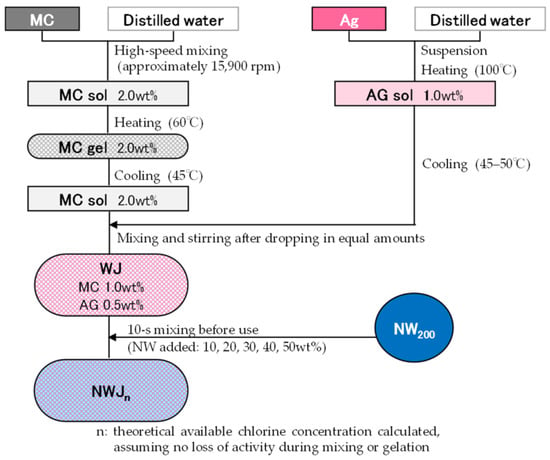
The materials used to prepare each prototype gel and a flow diagram of the preparation are shown in Table 1 and Figure 1, respectively.
Table 1.
Materials used to prepare the prototype gels.
Figure 1.
Flow diagram illustrating the preparation of the aqueous base gel (WJ) and the on-demand mixing of NW200 to obtain each prototype gel (NWJ).
2.1. Preparation of Neutral Electrolyzed Water (NW)
High-concentration neutral electrolyzed water (NW200) was prepared using tap water and an electrolysis auxiliary solution (5 wt% NaCl aqueous solution) with a neutral electrolyzed water generator (Meau DS-1, Medisto Sanite, Wakayama, Japan), which had been internally adjusted by the manufacturer. The electrolysis was performed initially under non-diaphragm conditions, followed by diaphragm conditions.
2.2. Preparations of Aqueous Base Gel (WJ) and NW-Containing Hydrogels (NWJs)
First, an aqueous base gel (WJ) was prepared using two thickening/gelling agents, methylcellulose (MC) and agar (AG). Following the operational flow shown in Figure 1, WJ finally contained 1.0 wt% MC and 0.5 wt% AG in distilled water to achieve a stable gel state. The concentrations of 1 wt% MC and 0.5 wt% AG were selected based on the typical concentration ranges used in food, pharmaceutical, and cosmetic applications to ensure appropriate gel consistency.
Subsequently, NW-containing hydrogels (NWJs) were prepared by mixing the pre-formed WJ with the liquid NW200. Immediately before use, NW200 was added to WJ at concentrations of 10, 20, 30, 40, or 50 wt% and stirred for 10 s to ensure NW200 was entirely and homogeneously incorporated into the gel matrix. This thorough mixing resulted in a uniform NWJ without any excess liquid remaining on the surface; thus, no wiping of the surface was required. The physical appearance and homogeneous gel state of the NWJs confirmed that the liquid NW200 was completely integrated into WJ matrix without phase separation (Supplementary Figure S1). Each NWJ is denoted as NWJ20, NWJ40, NWJ60, NWJ80, or NWJ100, with the theoretical available chlorine concentration—calculated from the mixing ratio of NW200 and assuming no loss of activity during mixing or gelation—shown at the bottom right.
Additionally, NWJs with lower theoretical ACCs (NWJ5 and NWJ10; 5 and 10 mg/L, respectively) were also prepared in the same manner and used exclusively for bactericidal activity tests (Section 2.5) to evaluate the minimum effective ACC, as higher-ACC NWJs resulted in complete bacterial elimination.
2.3. Shape Stability of WJ (Syneresis Rate)
Each NWJ sample (20.0000 g) was accurately weighed to the nearest 0.0001 g using an electronic analytical balance (LIBROR AEX-180, Shimadzu, Kyoto, Japan) and poured into a glass screw-cap bottle (30 mL; AS ONE, Osaka, Japan). The leachate separated from the gel over time was absorbed using a dry filter paper. Because the increase in the weight of the dry filter paper corresponds to the amount of water exuded from the gel, the syneresis rate was monitored for 30 days and calculated using the following formula:
Syneresis rate (%) = (Exuded water [g]/Initial weight of gel [g]) × 100
An agar-only gel prepared under the same conditions was used as the control (Cont.).
2.4. Measurement of Physicochemical Properties of NWJs
The pH of each NWJ was determined by a combination of a pH universal test paper (AS ONE, Osaka, Japan) and instrumental analysis using a pH meter (PHL-20, DKK-TOA, Tokyo, Japan). For gel-specific measurements, a pH electrode designed for gel samples was used for pH measurement. ACC, which reflects bactericidal activity, was measured from preparation up to 24 h using a chlorine comparator (Chlorine Comparator for Free Chlorine in Water; Sibata Scientific Technology, Saitama, Japan) according to the N, N-diethyl-p-phenylenediamine method (Sibata Scientific Technology, Saitama, Japan). For time-course analysis, ACC measurements were performed repeatedly on the same NWJ sample prepared at the initial time point, rather than on separately prepared samples for each time point.
All measurements were conducted in this manner for each sample type (n = 5).
2.5. Bactericidal Activity Tests Against Streptococcus mutans for NWJs
The bactericidal activity of each freshly prepared NWJ was evaluated using Streptococcus mutans (NBRC 13955, S. mutans), a major cariogenic bacterium, in the following two tests.
A bacterial suspension was prepared according to the following procedure. S. mutans was initially isolated on an agar plate, and a single colony was transferred into brain–heart infusion (BHI) broth (Becton, Dickinson and Company, Franklin Lakes, NJ, USA) and incubated overnight at 37 °C under aerobic conditions. The cultured bacterial cells were collected, washed twice with sterile phosphate-buffered saline (PBS; AS ONE, Osaka, Japan), and pelleted by centrifugation at 3000 rpm for 15 min. The resulting bacterial pellet was resuspended in fresh sterile PBS to obtain a bacterial suspension at approximately 2 × 10⁸ cells/mL, as measured using a bacterial counter.
This stock suspension was then diluted threefold (to approximately 6.7 × 10⁷ cells/mL). This diluted suspension was serially diluted, mixed with BHI agar medium (Becton, Dickinson and Company, Franklin Lakes, NJ, USA), and incubated aerobically at 37 °C for 48 h. The resulting colony count indicated that the bacterial concentration in this diluted suspension was approximately 5.0 × 10⁷ colony-forming units (CFU)/mL. This standardized bacterial suspension was subsequently used to conduct the two bactericidal activity tests.
To prepare the NWJ–bacterial reaction mixtures, the standardized bacterial suspension was combined with each NWJ at an NWJ-to-suspension volume ratio of 9:1 (v/v) using a sterile glass pipette, followed by vortexing for 3 min with a vortex mixer (Thermolyne Maxi Mix II Vortexer, Barnstead Thermolyne, Dubuque, IA, USA). These 3 min treated mixtures served as the reaction products for both the agar plate method (Section 2.5.1) and the MBC determination (Section 2.5.2).
2.5.1. Quantification of Surviving Bacteria (Agar Plate Method)
Each NWJ (4.5 mL) was added to 0.5 mL of the bacterial suspension by repetitive pipetting using a sterile glass pipette and then vortexed for 3 min using a vortex mixer (Thermolyne Maxi Mix II Vortexer, Barnstead Thermolyne, Dubuque, IA, USA) to examine its bactericidal effect. After treatment, each NWJ–bacterial mixture was added to BHI agar medium.
After the 3 min treatment, the NWJ–bacterial mixture was appropriately diluted with sterile BHI broth to obtain countable colony numbers and to avoid prolonging the reaction of residual available chlorine. From the prepared samples, 1.0 mL or 0.1 mL aliquots were spread evenly onto BHI agar plates. Because 1.0 mL is a relatively large volume for surface plating, plates receiving this volume were kept upright (not inverted) and allowed to stand on the bench for approximately 10–15 min to ensure sufficient absorption and drying before incubation. All plates were incubated aerobically at 37 °C for 48 h.
After incubation, colonies were counted, and the number of surviving bacteria was calculated based on the dilution ratio and the plated volume.
The bacterial removal rates were calculated using the following equation:
where Nsurviving is the number of surviving bacteria and Ninitial is the initial number of bacteria in contact with NWJ (2.5 × 10⁷ CFU).
Bacteria removal rate (%) = (Ninitial − Nsurviving)/Ninitial × 100
2.5.2. Determination of Minimum Bactericidal Concentration (MBC) (Broth Culture Method)
The same 3 min treated NWJ–bacterial mixtures prepared as described above were used to determine the MBC. Immediately after the 3 min treatment, each mixture was diluted twofold with sterile BHI broth to reduce further available chlorine–mediated bactericidal activity. Available chlorine is known to be readily consumed in the presence of organic matter such as culture media components [16]. Subsequently, 0.1 mL of each diluted sample was dispensed into individual wells of a 24-well plate, followed by the addition of 1.0 mL of fresh sterile BHI broth, resulting in an additional approximately tenfold dilution prior to incubation to terminate further available chlorine-mediated reactions. The plates were incubated aerobically at 37 °C for 48 h, and bacterial growth was assessed by visual observation of turbidity.
The MBC was defined as the lowest NWJ concentration that resulted in no turbidity, indicating the absence of viable S. mutans capable of regrowth under conditions where available chlorine activity was substantially attenuated.
Bactericidal tests were repeated five times for each sample type (n = 5).
2.6. Measurement of Spreadability (Spread Area) for NWJs
The spreadability of each NWJ was evaluated within 1 h after preparation. A 0.5 mL aliquot of each gel was placed on a cleaned horizontal glass surface and allowed to spread for 60 s. The spread gel was then photographed, and the images were analyzed using ImageJ [27] (version 1.53; National Institutes of Health, Bethesda, MD, USA) to determine the spread area of each gel. Measurements were performed five times for each formulation, and the mean area was calculated. For comparison, the same procedure was also applied to seven commercially available oral care products, as shown in Table 2.
Table 2.
Commercially available oral care products used for comparison in the spreadability test.
2.7. Statistical Analysis
For all outcome variables, including syneresis rate and ACC reduction rate, normality was assessed using the Shapiro–Wilk test, and homogeneity of variance was evaluated using the F-test for comparisons between two groups and Levene’s test for comparisons among more than two groups. When both assumptions were satisfied, parametric tests were applied: comparisons between two groups were performed using Student’s t-test, and comparisons among multiple NWJ groups were analyzed using one-way analysis of variance (ANOVA) followed by Tukey’s post hoc test.
When either normality or homogeneity of variance assumptions were not met, non-parametric methods were used: the Mann–Whitney U test for comparisons between two groups, and the Kruskal–Wallis test followed by the Steel–Dwass multiple comparison test for comparisons among multiple groups.
All statistical analyses were conducted using EZR statistical software version 1.68 (Saitama Medical Center, Jichi Medical University, Saitama, Japan). Data are presented as mean ± standard deviation, and statistical significance was defined as p < 0.05.
3. Results
3.1. Syneresis Stability of the Base Gel (WJ)
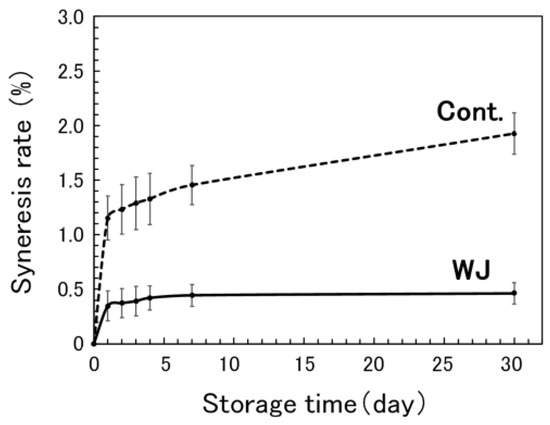
Figure 2 shows the time-dependent changes in the syneresis rate of the AG-only control gel (Cont.; MC-free base gel) and the MC–AG composite base gel (WJ) during 30 days of storage.
Figure 2.
Time-dependent changes in the syneresis rate of the control gel (Cont.) and the methylcellulose–agar composite base gel (WJ) during 30 days of storage. Data are presented as mean ± standard deviation. Statistical comparisons between groups were performed using Student’s t-test at 1 day (p < 0.05), and the Mann–Whitney U test at 30 days (p < 0.05). (n = 5).
At 1 day after preparation, the syneresis rate of WJ was significantly lower than that of the control gel (p < 0.05). This significant difference was maintained after 30 days of storage, with WJ consistently exhibiting a lower syneresis rate than the control (p < 0.05). These results indicate that WJ exhibits superior shape stability throughout the storage period.
3.2. Physicochemical Properties of NWJs Immediately After Preparation (pH and ACC)
Table 3 summarizes the pH and available chlorine concentration (ACC) of the NW-containing hydrogels (NWJs) measured immediately after preparation. The stock neutral electrolyzed water (NW200) exhibited a pH of 6.7 and ACC of 200 mg/L. Mixing NW200 with WJ at ratios of 10–50 wt% yielded NWJs with pH values broadly ranging from 6 to 7. Although slight differences in pH were observed among formulations, all NWJs remained within a near-neutral range suitable for intraoral application.
Table 3.
pH and ACC of NWJs immediately after preparation.
The measured ACC values of the NWJs increased proportionally with the mixing ratio of NW200, ranging from 19.4 ± 0.9 mg/L for NWJ20 to 96.4 ± 3.8 mg/L for NWJ100. These values closely matched the theoretical ACCs calculated from the mixing ratios. The reduction in ACC during mixing and gelation was less than 5% for all formulations. These results indicate that NWJs with adjustable ACC values can be prepared on demand by varying the mixing ratio of NW200, while maintaining pH values above the critical pH for enamel demineralization (pH 5.5).
3.3. Time-Dependent Changes in ACC of NWJs
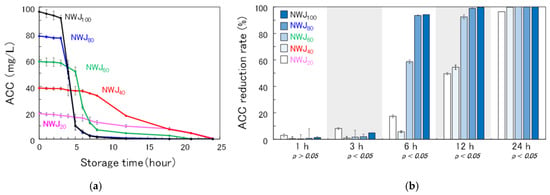
Time-dependent changes in the ACC of the prototype NWJs are shown in Figure 3.
Figure 3.
Time-dependent changes in the available chlorine concentration (ACC) of prototype NWJs after preparation: (a) changes in ACC over time; (b) ACC reduction rate (%) relative to the initial ACC at each time point (n = 5). Data are presented as mean ± standard deviation. Statistical analysis was performed using the Kruskal–Wallis test followed by the Steel–Dwass post hoc test (p < 0.05).
In all formulations, the ACC gradually decreased after preparation; however, the time course of inactivation differed depending on gel concentration. In the higher-concentration gels (NWJ60–NWJ100), the ACC decreased rapidly, reaching approximately 50% of the initial value within 4–6 h after preparation. In contrast, in the lower-concentration gels (NWJ20 and NWJ40), a comparable reduction in ACC was observed at a later stage, between 6 and 12 h (Figure 3a).
At 1 h after preparation, no significant difference in the ACC reduction rate was detected among the gels. From 3 to 12 h, the overall difference among formulations became statistically significant; however, post hoc multiple comparisons did not identify statistically significant differences between any specific pair of gels, possibly due to the conservative nature of the multiple comparison correction and the limited sample size. Nevertheless, a visible trend was observed where the higher-concentration groups (NWJ60–NWJ100) tended to show more rapid ACC reduction compared to the lower-concentration groups (NWJ20 and NWJ40), although this trend did not reach statistical significance in pairwise comparisons (Figure 3b). Regarding the physical stability after on-demand mixing, visual inspection confirmed that all NWJ formulations maintained their gel consistency without noticeable syneresis or softening for at least 5 h after preparation, which corresponds to the period during which sufficient ACC was retained (Figure 3).
3.4. Bactericidal Activity of NWJs Against Streptococcus mutans
3.4.1. Quantification of Surviving Bacteria (Agar Plate Method)
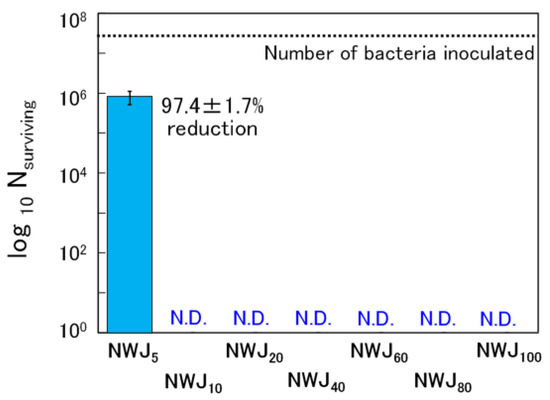
The bactericidal activity of the prototype NWJs against S. mutans is shown in Figure 4.
Figure 4.
Bactericidal activity of prototype NWJs against S. mutans evaluated by the agar plate method (n = 5). The y-axis represents log10 Nsurviving, where Nsurviving denotes the number of surviving bacteria remaining in NWJ, calculated from CFU counts. N.D.: not detected. It indicates that the number of surviving bacteria was below the detection limit (<50 CFU), corresponding to a removal rate of >99.999%. The initial bacterial inoculum (Ninitial) was 2.7 × 10⁷ CFU.
All NWJs with a theoretical ACC of 10 mg/L or higher (NWJ10–NWJ100) exhibited complete bactericidal activity after 3 min of contact, as no surviving bacteria were detected by the agar plate method. In contrast, viable bacteria were detected in the NWJ5 group (5 mg/L), indicating insufficient bactericidal efficacy at this concentration. Compared with the initial inoculum, NWJ5 achieved a bacterial reduction rate of approximately 97%, but did not result in complete bacterial elimination. For reference, Supplementary Figure S2 presents representative agar plate images of WJ and all NWJ formulations, showing abundant bacterial growth in WJ, partial reduction in NWJ5, and no detectable colonies in NWJ10 and higher. These results indicate that an ACC of at least 10 mg/L is required for complete bactericidal activity of the NWJ formulations under the present experimental conditions.
3.4.2. Determination of Minimum Bactericidal Concentration (MBC)
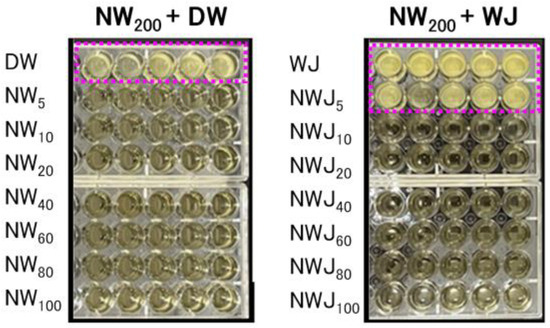
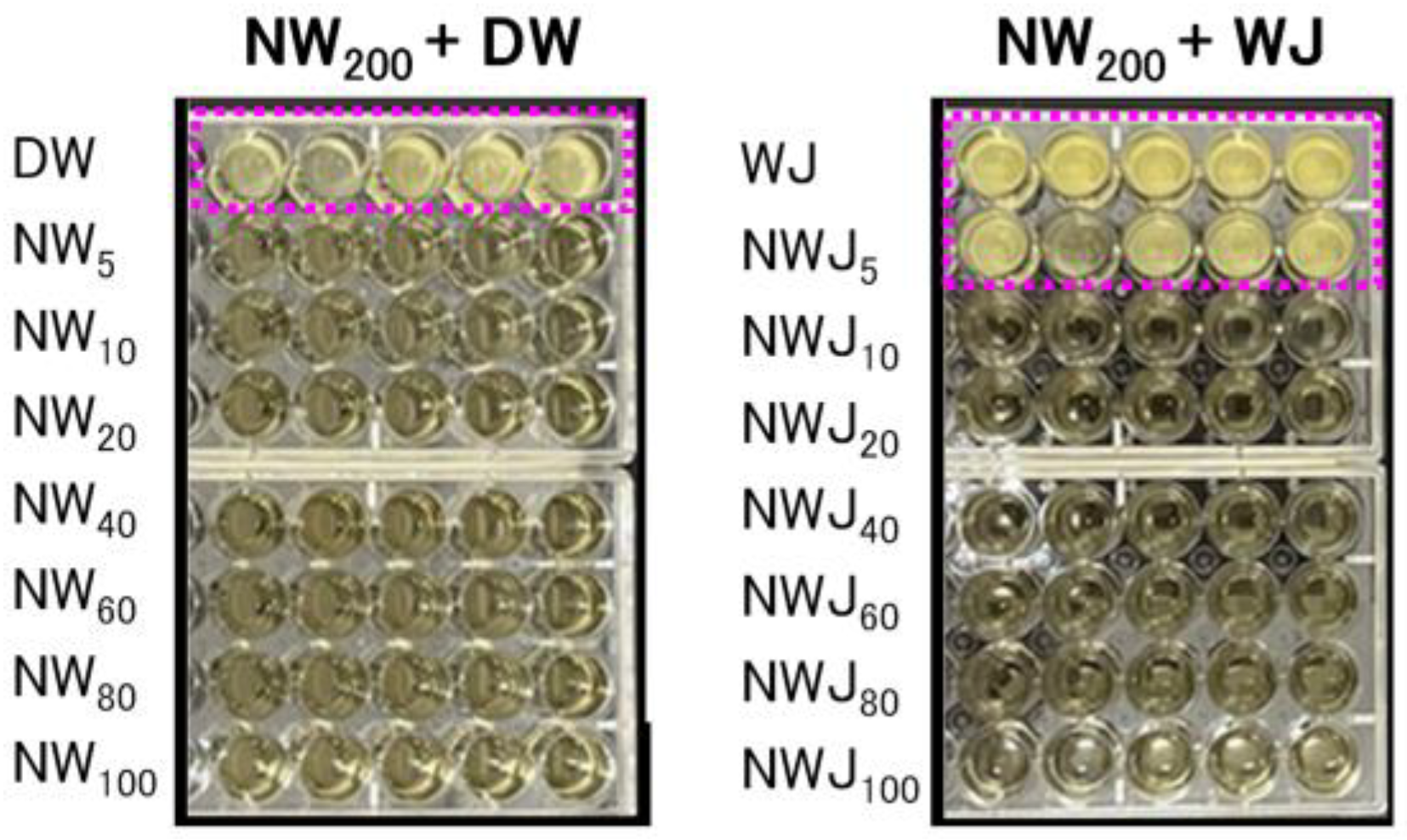
The minimum bactericidal concentration (MBC) of liquid NW and NWJs was determined by evaluating bacterial regrowth in liquid culture after treatment (Figure 5).
Figure 5.
Determination of the minimum bactericidal concentration (MBC) of liquid NW and NWJs against S. mutans, evaluated by turbidity in liquid culture (n = 5). After a 3 min exposure, treated bacterial suspensions were inoculated into fresh BHI broth and incubated for 48 h. The presence or absence of clearly visible turbidity was used as the criterion for bacterial regrowth; minor differences in optical appearance due to viewing angle or tube geometry were not considered indicative of bacterial growth.
For liquid NW, no turbidity was observed in cultures treated at available chlorine concentrations of 5 mg/L or higher. In contrast, for NWJs, no turbidity was observed at 10 mg/L, whereas visible turbidity was consistently detected at 5 mg/L. Distilled water (DW) and the aqueous base gel without NW (WJ) consistently showed turbidity, indicating bacterial growth. These results indicate that the MBC of NWJs against Streptococcus mutans is 10 mg/L under the present experimental conditions.
3.5. Spreadability and Flow Characteristics of NWJs Relative to Commercial Oral Care Products
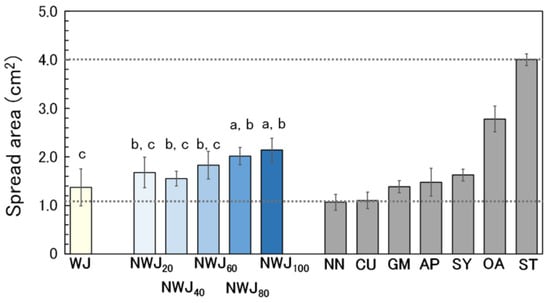
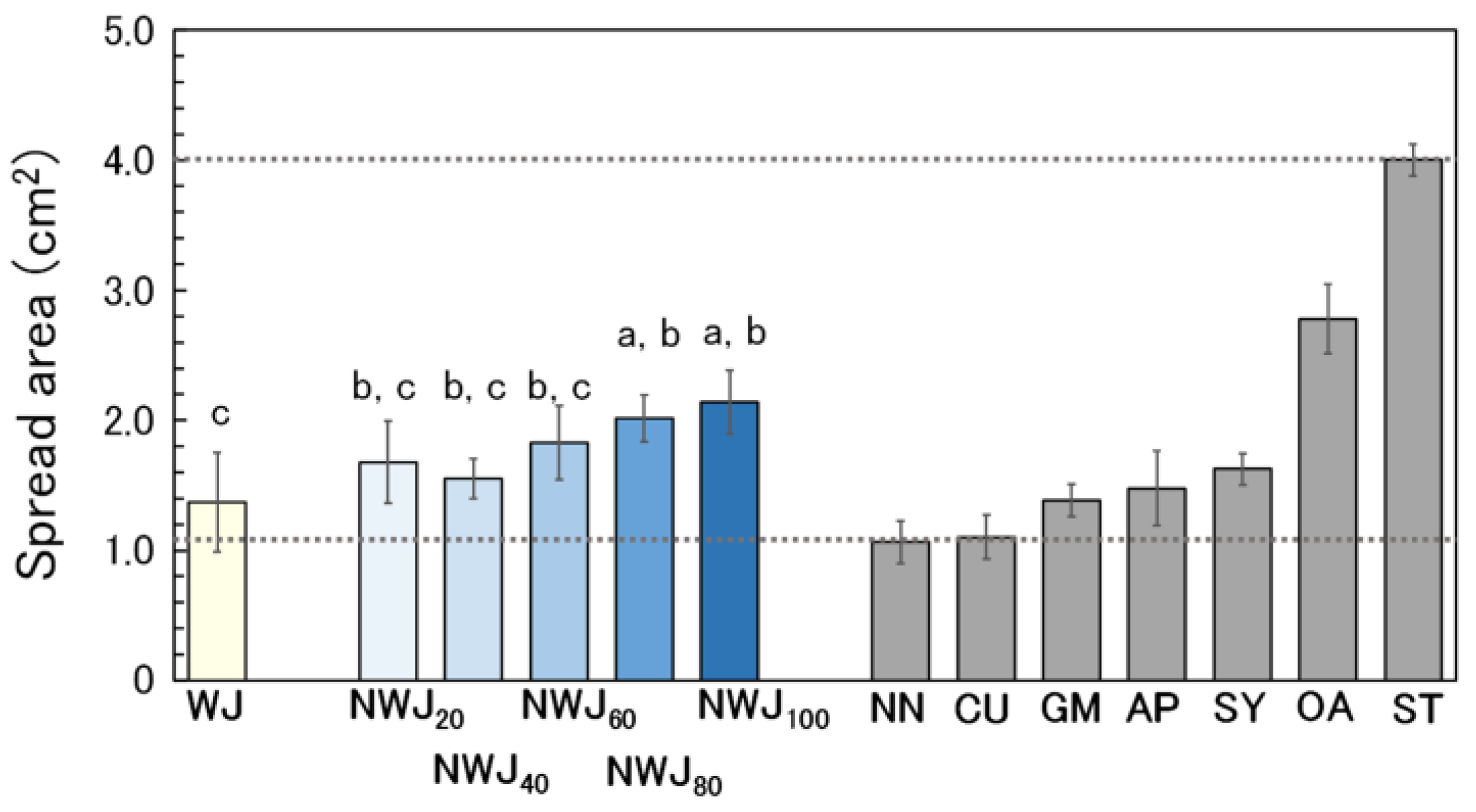
The spreadability of the NWJs, evaluated as an index of gel fluidity, is shown in Figure 6.
Figure 6.
Spread area of the prototype NWJs and commercially available oral care products (n = 5). For experimental groups (WJ and NWJs), different letters indicate significant differences (one-way ANOVA followed by Tukey’s post hoc test, p < 0.05). Commercial products are shown as reference values and were not included in the statistical analysis. The spread areas of the commercial products were measured by the authors using the same experimental procedure described in Section 2.6, and the product codes correspond to those listed in Table 2.
As shown in Figure 6, WJ exhibited the smallest mean spread area among the tested formulations; however, no statistically significant differences were observed between WJ and NWJ20, NWJ40, or NWJ60. In contrast, NWJ80 and NWJ100 showed significantly larger spread areas compared with WJ (p < 0.05). These results indicate that the spread area increased markedly when the NW200 content reached 40 wt% or higher. When compared with commercially available products, the spread areas of the NWJs were within a similar range. In particular, the spreadability of NWJs overlapped with that of non-abrasive oral gels and medicated interdental gels, while being generally greater than that of toothpaste-type products. These results indicate that the NWJs possess handling properties comparable to existing oral care gels while allowing on-demand adjustment of available chlorine concentration.
4. Discussion
NW is widely recognized for its strong antimicrobial activity [28] and high biosafety [29], and has been reported to exhibit greater stability of ACC than acidic electrolyzed waters. We and others have previously demonstrated that NW can maintain ACC during storage under appropriate conditions [30,31]. Specifically, in our previous study [7], high-concentration neutral electrolyzed water (ACC: 200 mg/L; NW200) stored in PET containers maintained a near-neutral pH (6.5–7.0) for approximately four months under both light-shielded room temperature and refrigerated conditions. Although a gradual decrease in ACC was observed during storage, the ACC remained within the range of approximately 100–120 mg/L, indicating high chemical stability suitable for use as a stock solution.
Nevertheless, the clinical application of NW remains limited by its liquid form, which results in insufficient retention at the application site, as well as by lack of flexibility in adjusting ACC at the point of use. Previous work from our group has shown that agar is a suitable gelling agent for NW, enabling gel formation while preserving antimicrobial activity [25]. However, while agar-based gels provide a potential solution, they still face challenges such as syneresis and limited adjustability of the chlorine concentration after gelation. The present results clearly demonstrate that AG-only base gels (Cont.) exhibit pronounced syneresis over time, whereas incorporation of MC into the AG matrix (WJ) markedly suppresses syneresis and improves the physical stability of the base gel, as shown in Figure 2. This suppression of syneresis indicates that AG and MC play complementary roles in the composite gel system, with AG providing the primary gel framework and MC contributing to water retention and stabilization of the gel network. Notably, although both AG and MC are present as sols during mixing, only AG undergoes gelation upon cooling, while MC remains in the sol state, which allows MC to retain water within the AG gel network and thereby suppress syneresis.
From a chemical standpoint, the MC–AG composite matrix consists primarily of hydroxyl-rich polysaccharides that are essentially non-reactive toward hypochlorous acid. Unlike polymers containing redox-active functional groups, such as amines or unsaturated moieties, both MC and AG exhibit high chemical inertness and do not promote oxidative degradation of available chlorine. This chemical stability, combined with the physical water-retaining properties of the composite network, likely contributes to the preservation of ACC in the gel during the clinically relevant time window. This enhanced stability of the composite base gel provides a rational foundation for the development of on-demand NW-containing hydrogels.
In the present formulation process, MC was intentionally subjected to a thermal gelation step prior to incorporation of agar. MC exhibits reversible thermal gelation, and pre-gelation followed by re-solubilization is known to improve molecular dispersion and reduce inhomogeneous aggregation. This thermal history may have facilitated a more uniform distribution of MC chains, allowing effective interaction with the AG network during subsequent gelation. As a result, the composite gel is likely to form a more stable, interpenetrating-like polymer structure, which contributes to enhanced water retention and suppression of syneresis.
The time-dependent reduction in ACC observed in the prototype NWJs provides important insight into the behavior of NW after gel incorporation. In all formulations, gradual ACC reduction occurred after preparation, with approximately 50% of the initial ACC being lost within 4–12 h, depending on the NW mixing ratio (Figure 3). Within this overall trend, the higher-concentration groups exhibited a relatively more rapid reduction in ACC, which is likely attributable to the intrinsic instability of available chlorine at higher concentrations, where increased absolute amounts of reactive chlorine species promote accelerated decomposition and consumption. Such behavior is consistent with previous reports indicating that the stability and reactivity of hypochlorous acid are influenced by concentration, dilution, and surrounding environments [32,33]. Importantly, NW has been shown to exhibit greater stability of ACC than acidic electrolyzed water under appropriate storage conditions, as demonstrated in our previous study [7].
Importantly, bactericidal activity tests were conducted within 1 h after gel preparation, when sufficient ACC was retained. Under these conditions, complete antibacterial activity against S. mutans was achieved at ACCs of 10 mg/L or higher (Figure 4 and Figure 5), in agreement with earlier studies demonstrating that the bactericidal efficacy of NW is strongly dependent on ACC [24,25]. Furthermore, gelation did not compromise antibacterial efficacy when compared with NW at equivalent ACCs, indicating that the MC–AG matrix itself does not interfere with chlorine-mediated antimicrobial action.
In clinical dental practice, only a small amount of gel is typically required for each treatment, and it is desirable to use the material in its freshest state to ensure maximum bactericidal potency. Therefore, an on-demand mixing system was adopted to provide the highest possible ACC at the point of care. Although the NWJs exhibit sufficient physical stability for several hours owing to the water-retention properties of MC, we recommend using the gel immediately, or at least within 1 h of preparation, to utilize peak antibacterial activity before significant chemical degradation of available chlorine occurs.
From a clinical perspective, the on-demand preparation concept proposed in this study offers a practical solution to several longstanding limitations associated with the use of NW in dentistry. This on-demand approach contrasts with conventional ready-to-use formulations, in which partial loss of available chlorine may occur during manufacturing, storage, and distribution before clinical use. By storing NW as a chemically stable, high-concentration stock solution and adjusting the ACC immediately before use through simple mixing with a stable composite base gel, both storage stability and clinical flexibility can be achieved. The developed NWJs maintained a near-neutral pH above the critical threshold for enamel demineralization, exhibited sufficient antimicrobial efficacy within a clinically relevant time frame, and retained practical flow characteristics comparable to commercially available oral gels. These features suggest that the present system is well-suited for localized intraoral applications requiring controlled retention, such as periodontal pockets, mucosal lesions, and targeted disinfection. Taken together, this study provides a foundational platform for the more flexible and effective clinical use of neutral electrolyzed water in dentistry and may facilitate the development of tailored gel formulations optimized for specific therapeutic purposes.
Compared with liquid NW, gelation is expected to substantially enhance retention at the application site by suppressing rapid dilution and washout by saliva in the oral cavity. The spreadability of the developed NWJs, which was comparable to that of commercially available oral gels, supports their practical applicability for localized intraoral use and targeted disinfection. Such retention is crucial for ensuring that the available chlorine (HOCl and OCl−) remains in contact with pathogens for a sufficient duration to exert its full microbicidal potential [32].
The spreadability of gels is a key factor influencing handling properties, retention at the application site, and clinical usability in oral care products. In the present study, incorporation of liquid NW200 into MC–AG composite gel resulted in concentration-dependent changes in spread area; specifically, higher NW content tended to increase fluidity due to the increased liquid proportion (Figure 6). Although significant differences were observed primarily at higher mixing ratios (NWJ80 and NWJ100), all NWJs retained measurable and practical fluidity, suggesting that the composite gel matrix effectively accommodates variations in water content without excessive loss of gel integrity. This structural robustness is likely due to the synergistic interaction between the AG framework and the MC water-retention network [26,33,34].
Compared with commercially available oral care gels, the spreadability of NWJs fell within a comparable range, particularly overlapping with non-abrasive oral gels and medicated interdental products. This indicates that NWJ formulations possess handling characteristics familiar to clinicians and patients, supporting their potential applicability in routine dental practice.
Importantly, the ability to modulate spreadability by adjusting the NW mixing ratio provides formulation flexibility, allowing optimization for specific clinical purposes, such as localized application requiring higher retention or broader coverage requiring increased flowability. Thus, the observed flow characteristics support the concept of NWJs as adaptable, on-demand formulations rather than fixed-composition products.
By adjusting the mixing ratios of MC, AG, and DW, the flow characteristics of the gel can be widely modulated. Moreover, the combination with NW200 enables flexible adjustment of ACC. Together, these features allow preparation of gels tailored to specific clinical applications, in terms of both handling properties and antimicrobial potency.
Several limitations of the present study should be acknowledged. First, although the syneresis behavior of the composite base gel (WJ) was evaluated, the physicochemical stability of the final NWJs after incorporation of NW was not directly assessed. Because the present formulation is designed for on-demand preparation and immediate use, the long-term storage stability of the mixed NWJs was beyond the scope of this study; instead, the stability of each stored component was addressed separately. However, as the proposed NWJs are designed for on-demand preparation and immediate use, long-term post-mixing stability was beyond the scope of this study. Moreover, the necessary post-mixing handling time, gel fluidity, and ACC retention may vary depending on the specific clinical application. Therefore, optimization of MC–AG ratios and NW200 concentration according to intended use will be conducted in future studies once specific applications are defined. In addition, although the spread area measurement provided a practical index of gel consistency, more detailed dynamic rheological characterization, such as storage and loss moduli, would be required to fully define the viscoelastic properties of NWJs in comparison with commercial oral gels. In future studies, specific dental applications will be defined in advance, and target ranges of viscosity and flow behavior appropriate for each clinical indication will be established and evaluated using comprehensive rheological analyses.
Second, since this formulation represents a preliminary proof of concept, further optimization will be required depending on the intended clinical application. Future studies should more precisely define formulation conditions such as gel fluidity, target ACCs, mixing ratios, and the incorporation of functional additives, including flavoring or coloring agents, to improve usability and patient acceptance in specific dental indications. Furthermore, although the present study focused on Streptococcus mutans as a representative cariogenic bacterium, the antimicrobial spectrum required for clinical use may vary depending on the intended dental application. Accordingly, future investigations will evaluate the bactericidal efficacy of NWJs against a broader panel of representative oral pathogens relevant to specific clinical scenarios.
Finally, although NW is known for its high biosafety, comprehensive biocompatibility evaluations of the gel formulations, including cytotoxicity assays and animal studies, are required. Following confirmation of biological safety, well-designed clinical trials will be essential to establish the clinical efficacy and safety of NWJs in actual dental practice.
5. Conclusions
In this study, an on-demand NW-containing hydrogel (NWJ) was developed by mixing a methylcellulose–agar composite gel with liquid NW (ACC 200 mg/L). The findings are as follows:
- Enhanced Physical Stability: The composite base gel significantly reduced syneresis compared to agar-only gels, ensuring superior shape stability and retention in the oral cavity.
- Tunable ACC on Demand: Precise adjustment of ACC (20–100 mg/L) was achieved by varying the mixing ratio of liquid NW, while maintaining a safe, near-neutral pH.
- Potent Bactericidal Efficacy: NWJs showed complete elimination of S. mutans at an ACC of 10 mg/L or higher, confirming that the gel matrix does not inhibit the microbicidal activity of HOCl.
- Maintained Gel Consistency: While increasing the liquid NW content raised fluidity, all formulations (NWJ20–NWJ100) remained within a range of consistency comparable to commercial oral gels, ensuring sufficient handling and retention properties.
In conclusion, the developed NWJ system offers a practical platform for dental clinical use, enabling immediate delivery of neutral electrolyzed water with optimized concentration and adequate retention.
Supplementary Materials
The following supporting information can be downloaded at: https://www.mdpi.com/article/10.3390/app16031216/s1, Supplementary Figure S1: Visual appearance of the prepared NW-containing hydrogels (NWJs). The photographs demonstrate the homogeneous gel state across all concentrations, confirming that the liquid NW200 was completely integrated into the aqueous base gel (WJ) matrix without phase separation or excess liquid on the surface. Supplementary Figure S2: Representative agar plates showing S. mutans after 3 min treatment with WJ and each NWJ formulation. Plates treated with WJ showed confluent bacterial growth, indicating no bactericidal activity of the base gel itself. Detectable colonies were observed only in NWJ5, whereas no colonies were detected in other formulations (NWJ10–NWJ100), confirming complete bactericidal activity at ACCs ≥ 10 mg/L.
Author Contributions
Conceptualization, Y.N. and H.N.; Data curation, Y.N.; Formal analysis, Y.N.; Funding acquisition, Y.N. and H.I.; Investigation, Y.N. and H.I.; Methodology, Y.N. and H.I.; Project administration, Y.N.; Resources, Y.N. and H.I.; Software, Y.N. and H.I.; Supervision, Y.N.; Validation, Y.N., H.I. and H.N.; Visualization, Y.N. and H.I.; Writing—original draft, Y.N.; Writing—review and editing, Y.N., H.I. and H.N. All authors have read and agreed to the published version of the manuscript.
Funding
This research received no external funding.
Institutional Review Board Statement
Not applicable.
Informed Consent Statement
Not applicable.
Data Availability Statement
The data presented in this study are available upon reasonable request from the corresponding author.
Acknowledgments
The authors express their gratitude to Medist Sanite (Wakayama, Japan) for modifying some of the neutral electrolyzed water generators to provide variable, freely available chlorine concentrations for this study. The authors also gratefully acknowledge the late Yoshio Kozono of Kyushu Dental University for his long-standing clinical advice and guidance in the research on neutral electrolyzed water-based gels.
Conflicts of Interest
The authors declare no conflicts of interest.
References
- Liu, D.; Lv, R. Safety Evaluation of Electrolyzed Water. Electrolyzed Water in Food: Fundamentals and Applications, 1st ed.; Ding, T., Oh, D.H., Liu, D., Eds.; Springer: Singapore, 2019; pp. 261–267. [Google Scholar] [CrossRef] [Scilit]
- Chen, B.K.; Wang, C.K. Electrolyzed water and its pharmacological activities: A mini-review. Molecules 2022, 27, 1222. [Google Scholar] [CrossRef] [Scilit]
- Chen, K.K.; Wu, J.H.; Wei, S.I.; Du, J.K. Influence of the acidity of electrolyzed water on the microhardness of inner layer dentin. J. Dent. Sci. 2019, 14, 419–425. [Google Scholar] [CrossRef] [Scilit]
- Nagamatsu, Y.; Chen, K.K.; Kita, N.; Tajima, K.; Kakigawa, H.; Kozono, Y. Application of electrolyzed neutral water to dental practice—Effects on human enamel surface. J. Jpn. Dent. Mater. 2008, 27, 283–290. [Google Scholar] [CrossRef]
- Dong, H.; Nagamatsu, Y.; Chen, K.-K.; Tajima, K.; Kakigawa, H.; Shi, S.; Kozono, Y. Corrosion behavior of dental alloys in various types of electrolyzed water. Dent. Mater. J. 2003, 22, 482–493. [Google Scholar] [CrossRef] [Scilit]
- Krishnan, C.S.; Lyons, K.M.; Tompkins, G.R.; Cannon, R.D. Storage-related stability and antimicrobial efficacy of bottled, neutral-pH Electrolysed Oxidising Water. J. Dent. 2023, 137, 104656. [Google Scholar] [CrossRef] [Scilit]
- Nagamatsu, Y.; Ikeda, H.; Nagamatsu, H. Long-Term Storage Stability of Neutral Electrolyzed Water by Two-Stage Electrolysis: Optimal Storage Conditions for Intraoral Use. Appl. Sci. 2024, 14, 9264. [Google Scholar] [CrossRef] [Scilit]
- Urrutia-Baca, V.H.; Paz-Michel, B.A.; Calderon-Porras, A.N.; Jiménez-Del Valle, J.A.; Alvarez-Fernández, W.J.; Mervitch-Sigal, N.; Rodríguez-León, M.A.; De La Garza-Ramos, M.A. Oral Hygiene With Neutral Electrolyzed Water and Systemic Therapy Increases Gastric Helicobacter pylori Eradication and Reduces Recurrence. Clin. Exp. Dent. Res. 2024, 10, e927. [Google Scholar] [CrossRef] [Scilit]
- Horiba, N.; Hiratsuka, K.; Onoe, T.; Yoshida, T.; Suzuki, K.; Matsumoto, T.; Nakamura, H. Bactericidal effect of electrolyzed neutral water on bacteria isolated from infected root canals. Oral Surg. Oral Med. Oral Pathol. Oral Radiol. Endod. 1999, 87, 83–87. [Google Scholar] [CrossRef] [Scilit]
- Kameda, T.; Oka, S.; Igawa, J.; Sakamoto, M.; Terada, K. Can hypochlorous acid be a powerful sanitizer to replace alcohol for disinfection?—Its bactericidal, degradation of the solutions under various storage condition, and steel rust effects. Dent. Mater. J. 2022, 41, 167–183. [Google Scholar] [CrossRef] [Scilit]
- Krishnan, C.S.; Tompkins, G.R.; Lyons, K.M.; Cannon, R.D. Electrolysed oxidising water as a multi-purpose biocide in dental healthcare-A scoping review. Gerodontology 2023, 40, 422–462. [Google Scholar] [CrossRef] [Scilit]
- Takigawa, T.; Endo, Y. Effects of Glutaraldehyde Exposure on Human Health. J. Occup. Health 2006, 48, 75–87. [Google Scholar] [CrossRef] [Scilit]
- Abreu, A.C.; Tavares, R.R.; Borges, A.; Mergulhão, F.; Simões, M. Current and emergent strategies for disinfection of hospital environments. J. Antimicrob. Chemother. 2013, 68, 2718–2732. [Google Scholar] [CrossRef] [Scilit]
- Caló, E.; Khutoryanskiy, V.V. Biomedical applications of hydrogels: A review of patents and commercial products. Eur. Polym. J. 2015, 65, 252–267. [Google Scholar] [CrossRef] [Scilit]
- Hoare, T.R.; Kohane, D.S. Hydrogels in drug delivery: Progress and challenges. Polymer 2008, 49, 1993–2007. [Google Scholar] [CrossRef] [Scilit]
- Fukuzaki, S. Mechanisms of actions of sodium hypochlorite in cleaning and disinfection processes. Biocontrol. Sci. 2006, 11, 147–157. [Google Scholar] [CrossRef] [Scilit]
- Wang, L.; Bassiri, M.; Najafi, R.; Najafi, K.; Yang, J.; Khosrovi, B.; Hwong, W.; Barati, E.; Belisle, B.; Celeri, C.; et al. Hypochlorous Acid as a Potential WoundCare Agent Part I. Stabilized Hypochlorous Acid: A Component of the Inorganic Armamentarium of Innate Immunity. J. Burns Wounds. 2007, 6, e5. [Google Scholar]
- Gold, M.H.; Andriessen, A.; Bhatia, A.C.; Bitter, P., Jr.; Chilukuri, S.; Cohen, J.L.; Robb, C.W. Topical Stabilized Hypochlorous Acid: The Future Gold Standard for Wound Care and Scar Management in Dermatologic and Surgical Procedures. J. Cosmet. Dermatol. 2020, 19, 270–277. [Google Scholar] [CrossRef] [Scilit]
- Sakarya, S.; Gunay, N.; Karakulak, M.; Ozturk, B.; Ertugrul, B. Hypochlorous Acid: An Ideal Wound Care Agent with Powerful Microbicidal, Antibiofilm, and Wound Healing Potency. Wounds 2014, 11, 342–350. [Google Scholar]
- Li, F.; Ding, J.; Li, Z.; Rong, Y.; He, C.; Chen, X. ROS-responsive thermosensitive polypeptide hydrogels for localized drug delivery and improved tumor chemoimmunotherapy. Biomater. Sci. 2024, 12, 3100–3111. [Google Scholar] [CrossRef] [Scilit]
- Han, X.; Saengow, C.; Ju, L.; Ren, W.; Ewoldt, R.H.; Irudayaraj, J. Exosome-coated oxygen nanobubble-laden hydrogel augments intracellular delivery of exosomes for enhanced wound healing. Nat. Commun. 2024, 15, 3435. [Google Scholar] [CrossRef] [Scilit]
- Ren, W.; Messerschmidt, V.; Tsipursky, M.; Irudayaraj, J. Oxygen nanobubbles-embedded hydrogel as wound dressing to accelerate healing. ACS Appl. Nano Mater. 2023, 6, 13116–13126. [Google Scholar] [CrossRef] [Scilit]
- Bocci, V.; Zanardi, I.; Travagli, V. Ozone acting on human blood yields a hormetic dose-response relationship. J. Transl. Med. 2011, 9, 66. [Google Scholar] [CrossRef] [Scilit]
- Nagamatsu, Y.; Ikeda, H.; Nagamatsu, H.; Shimizu, H. Simple preparation method of neutral electrolyzed water-based gel for oral care and its bacteria removal effect. Evaluation of polymer candidates for neutral electrolyzed water gels. J. Funct. Water Sci. 2022, 18, 1–7. [Google Scholar] [CrossRef]
- Nagamatsu, Y.; Ikeda, H.; Nagamatsu, H.; Shimizu, H. Microbicidal effect and storage stability of neutral HOCl-containing aqueous gels with different thickening/gelling agents. Dent. Mater. J. 2021, 40, 1309–1319. [Google Scholar] [CrossRef] [Scilit]
- Niemczyk-Soczynska, B.; Kolbuk, D.; Mikulowski, G.; Ciechomska, I.A.; Sajkiewicz, P. Methylcellulose/agarose hydrogel loaded with short electrospun PLLA/laminin fibers as an injectable scaffold for tissue engineering/3D cell culture model for tumour therapies. RSC Adv. 2023, 13, 11889–11902. [Google Scholar] [CrossRef] [Scilit]
- Schneider, C.A.; Rasband, W.S.; Eliceiri, K.W. NIH Image to ImageJ: 25 years of image analysis. Nat. Methods 2012, 9, 671–675. [Google Scholar] [CrossRef] [Scilit] [PubMed]
- Tsai, C.F.; Chung, J.J.; Ding, S.J.; Chen, C.C. In vitro cytotoxicity and antibacterial activity of hypochlorous acid antimicrobial agent. J. Dent. Res. 2024, 25, 345–365. [Google Scholar] [CrossRef] [Scilit]
- Sipahi, H.; Reis, R.; Dinc, O.; Kavaz, T.; Dimoglo, A.; Aydın, A. In vitro biocompatibility study approaches to evaluate the safety profile of electrolyzed water for skin and eye. Hum. Exp. Toxicol. 2019, 38, 1314–1326. [Google Scholar] [CrossRef] [Scilit] [PubMed]
- Nagamatsu, Y.; Chen, K.K.; Tajima, K.; Kakigawa, H.; Kozono, Y. Durability of bactericidal activity in electrolyzed neutral water by storage. Dent. Mater. J. 2002, 21, 93–104. [Google Scholar] [CrossRef] [Scilit]
- Block, Z.; Eyles, A.; Corkrey, R.; Stanley, R.; Ross, T.; Kocharunchitt, C. Effect of Storage Conditions on Shelf Stability of Undiluted Neutral Electrolyzed Water. J. Food Prot. 2020, 83, 1838–1843. [Google Scholar] [CrossRef] [Scilit] [PubMed]
- Reis, R.; Sipahi, H.; Dinc, O.; Kavaz, T.; Charehsaz, M.; Dimoglo, A.; Aydın, A. Toxicity, mutagenicity and stability assessment of simply produced electrolyzed water as a wound healing agent in vitro. Hum. Exp. Toxicol. 2021, 40, 452–463. [Google Scholar] [CrossRef] [Scilit] [PubMed]
- Niemczyk-Soczynska, B.; Gradys, A.; Kolbuk, D.; Krzton-Maziopa, A.; Rogujski, P.; Stanaszek, L.; Lukomska, B.; Sajkiewicz, P. A methylcellulose/agarose hydrogel as an innovative scaffold for tissue engineering. RSC Adv. 2022, 12, 26882–26895. [Google Scholar] [CrossRef] [Scilit] [PubMed]
- Martin, B.C.; Minner, E.J.; Wiseman, S.L.; Klank, R.L.; Gilbert, R.J. Agarose and methylcellulose hydrogel blends for nerve regeneration applications. J. Neural Eng. 2008, 5, 221–231. [Google Scholar] [CrossRef] [Scilit] [PubMed]

Disclaimer/Publisher’s Note: The statements, opinions and data contained in all publications are solely those of the individual author(s) and contributor(s) and not of MDPI and/or the editor(s). MDPI and/or the editor(s) disclaim responsibility for any injury to people or property resulting from any ideas, methods, instructions or products referred to in the content. |
© 2026 by the authors. Licensee MDPI, Basel, Switzerland. This article is an open access article distributed under the terms and conditions of the Creative Commons Attribution (CC BY) license.