


Abstract
Outdoor workout equipment is common in parks, yet little is known about how safely it can be used, especially in winter. This scoping review mapped evidence on injury risk, supervision, weather and season, and technology at public outdoor workout equipment. Four databases were searched for Scopus-indexed reports (2016–2026). Of 1190 records, 55 studies from 17 countries and territories were included: 34 from temperate, 5 from cold, 5 from tropical and 2 from arid climates, and 9 without an outdoor study site; the full texts of 38 of 108 reports (35.2%) could not be retrieved. No included study followed injuries among park users. Safety evidence came from perceived risk, expert ratings, audits and a few adverse events in supervised trials, while 30–45% of observed uses of selected machines departed from the manufacturer’s intention. Instructions were missing at about two in five audited Polish gyms but present at most Australian sites. Weather was the leading disadvantage in two Polish surveys (57.2% and 69.8%). Still, no included study examined cold surfaces, ice or sub-zero use, and none of the 22 technology studies was tested below 0 °C. Injury surveillance, winter studies, and technology testing are the main gaps.
1. Introduction
Public outdoor workout equipment offers residents a low-cost, free place to train, open at any hour. The term covers outdoor gyms (also called outdoor fitness equipment in the literature), fitness parks and trails with exercise stations, senior playgrounds, and calisthenics or street-workout parks built around pull-up bars, parallel bars and similar frames. WHO guidelines recommend 150–300 min of moderate-intensity aerobic activity per week for adults, together with muscle-strengthening activities on two or more days [1]. Outdoor workout equipment can in principle support both, which is one reason municipalities have installed it widely [2,3].
Previous reviews have concentrated on the use and effects of outdoor gyms. Systematic reviews have described the characteristics of outdoor gyms and the experiences of users [2], and have examined the effect of outdoor gyms on physical activity and fitness [3] and on health outcomes in older adults [4], the characteristics of outdoor gym interventions that promote physical activity [5], and the effectiveness of equipment-based interventions on health outcomes [6]. The central questions in this body of work are uptake and health benefit. These reviews did not focus on equipment-related injuries, instruction and supervision, the influence of weather and season, or the technology installed on the equipment.
Public equipment differs from a staffed gym: there is usually no induction, screening or coach. Users range from young children to older adults with chronic conditions. Many users are unfamiliar with the machines, which are sometimes used in ways the manufacturer did not intend. The equipment is also left outside, exposed to rain, sun, frost, wear and vandalism. Where street-workout practitioners have been surveyed, injury rates are high and tend to follow training load and technique [7]. Single cases of severe tendon injury have been reported [8]. Whether the same exposures occur at public equipment has not been established.
Season has received little attention in this literature. Weather and season influence physical activity [9], and a public facility should ideally remain usable and safe beyond the mild months. The Köppen–Geiger classification [10] separates temperate climates (group C), in which the coldest month stays above 0 °C, from cold climates (group D), in which at least one month averages 0 °C or below. Cold climates cover much of northern Eurasia and North America, and winter there brings ice, snow, short daylight and sub-zero surface temperatures. Occupational research has set limit values for touching cold surfaces with the bare fingertip [11], but this question does not appear to have been applied to the grips and bars of outdoor workout equipment.
Several standards address this equipment. EN 16630 [12] and ASTM F3101 [13] set safety requirements for permanently installed outdoor fitness equipment; EN 1177 [14] specifies how to test the impact attenuation of playground surfacing, and ISO 13732-3 describes how to assess human responses to contact with cold surfaces [15].
This study aims to map published evidence on the safe, year-round use of public outdoor workout equipment. It examines what has been reported on injury and safety risks at the equipment; supervision, instruction and feedback; the effects of weather and season; and technology developed or tested at the equipment, and it records the climate in which each study was carried out. The review is intended to identify gaps in this evidence for winter conditions, so that future research and equipment development can address them.
Four questions guided the review:
- •
- RQ1: What is known about injury and safety risks at public outdoor workout equipment, including misuse, equipment condition, maintenance and vandalism?
- •
- RQ2: How do supervision, instruction and feedback relate to the safe and effective use of this equipment?
- •
- RQ3: Which effects of weather, season and climate have been studied at this equipment, and where are the gaps?
- •
- RQ4: Which technological solutions have been developed or tested for this equipment, and what gaps remain, in particular for winter conditions?
2. Materials and Methods
2.1. Design and Reporting
This scoping review followed the JBI methodology [16], which builds on the Arksey and O’Malley framework [17] and is reported according to the PRISMA extension for scoping reviews (PRISMA-ScR) [18]. The review protocol was not registered. The completed PRISMA-ScR checklist and the extracted data are provided as Supplementary Materials.
2.2. Eligibility Criteria
Eligibility was defined with the Population–Concept–Context framework. The setting was public outdoor workout equipment of any kind: outdoor gyms, fitness parks and trails with exercise stations, senior playgrounds, calisthenics or street-workout parks, and pull-up or dip bars in public space. Studies of users, non-users, managers and the equipment itself were eligible. Studies of calisthenics or street-workout practitioners in any setting were also eligible if they reported injuries, pain, technique or training-related risk. The concept was at least one of six domains, for which the report had to present its own data:
- •
- D1: injuries, pain, falls, adverse events, misuse or exercise technique;
- •
- D2: supervision, instruction, signage or feedback;
- •
- D3: weather, season, climate, thermal comfort, lighting, shade or shelter;
- •
- D4: safety and security, vandalism, maintenance or equipment quality;
- •
- D5: technology installed at, integrated with or deployed for the equipment;
- •
- D6: other barriers and facilitators of use.
Any primary empirical design was eligible, as were engineering studies that included a test. Reviews, editorials, commentaries, protocols without results and conference abstracts were excluded; full conference papers indexed in Scopus were eligible. The period was 2016 to 2026, and the language was English. One included report had an English abstract and a full text in Portuguese; it was read with Google Translate and charted [19]. Studies whose only outcomes were fitness or physiological effects of an exercise programme were excluded, because safety and technology were the topics of interest; studies of equipment design, or of technology used to maintain the equipment, were included when they tested the equipment or the technology. In this review, an injury is physical harm to a user attributed to the equipment or to training on it, an adverse event is any unwanted event during use that a study reports (for example, a fall, pain or equipment failure), and misuse is use that departs from the use intended by the manufacturer.
2.3. Information Sources and Search
The authors searched PubMed, Scopus, Web of Science, and ScienceDirect databases. No other databases were searched. The searches were run between mid-August 2026 and 15 October 2026 (last searches: PubMed, 13 October; Scopus, Web of Science and ScienceDirect, 15 October). Each search combined setting terms with terms for one concept domain. The six configurations, one for each domain, were:
- •
- (“outdoor workout equipment” OR “outdoor fitness equipment” OR “outdoor gym*” OR “outdoor exercise equipment” OR “public fitness equipment” OR “fitness park*” OR “fitness trail*” OR “senior playground*” OR calisthenic* OR “street workout*” OR “urban workout*” OR “pull-up bar*”) AND (injur* OR accident* OR “adverse event*” OR fall* OR safety OR misuse)
- •
- (same setting terms) AND (supervis* OR instruct* OR signage OR coach* OR guidance OR feedback)
- •
- (same setting terms) AND (weather OR season* OR winter OR climate OR temperature OR shade OR lighting)
- •
- (same setting terms) AND (vandal* OR maintenance OR hazard* OR “equipment quality” OR security OR safety)
- •
- (same setting terms) AND (technolog* OR app OR “QR code*” OR sensor* OR wearable* OR digital OR smart)
- •
- (same setting terms) AND (barrier* OR facilitator* OR utili?ation OR motivation)
The complete search strings for each database are given in Supplementary Table S2. For practical reasons, the review was restricted to Scopus-indexed records, and 9 of 117 records not indexed in Scopus were removed before full-text retrieval. Reference lists and grey literature were not searched, and databases such as IEEE Xplore were not searched separately.
2.4. Selection of Sources
Records were first screened by title and abstract with AI assistance, then by full text, against the eligibility criteria, which were fixed before screening began. The first author checked all full texts and charted all data. To check the AI-assisted exclusions, the first author re-screened a random sample of 100 of the 429 excluded records, stratified by exclusion code; 98 decisions (98%) agreed, and the other two records could have qualified only through domain D6. Reports that could not be obtained through university subscriptions or open-access copies were recorded as not retrieved; interlibrary loan and requests to authors were not used.
Generative AI was used in three ways. Claude Sonnet 5.5 (Anthropic) helped screen records against the eligibility criteria, suggest keywords and Boolean operators for search strings, and improve the manuscript language. The decision and the reason for every record are listed in Supplementary Tables S3 and S4.
2.5. Data Charting and Analysis
Data from each included report were charted on the following items: country, design, setting, participants, domains addressed, key findings per domain, type and stage of any technology, outcomes, whether winter or sub-zero conditions were studied, and the gaps stated by the authors (Supplementary Table S1). The Köppen–Geiger climate group of each study site was looked up on the map of Beck et al. [10] (1 km resolution), which uses a threshold of 0 °C for the coldest month between groups C and D. It was assigned from the location of the site and is not a value reported by the original studies: A tropical, B arid, C temperate and D cold. For sites close to the 0 °C threshold, the group was checked against 1991–2020 station normals. Where a study did not name its site, the location of the authors’ institution was used, and a multi-site study was assigned the group of the main city named. Studies without an outdoor data-collection site (online surveys, case reports, and laboratory, image-based, or design studies) were coded NA (not applicable). The city, climate group and season of data collection of each study are given in Supplementary Table S1. As this is a scoping review, the authors did not critically appraise the studies [16]. The results are presented as counts by year, country, design and domain, followed by a narrative summary for each domain, linked to RQ1–RQ4 (Table 1). A domain was coded when a study dealt with it in its results, whereas Tables 2 and 3 list only the studies that report data on supervision or on weather, season, shade or lighting. The authors report percentages to one decimal place; percentages taken from the original studies are reported as stated, with the denominator provided.
3. Results
3.1. Study Selection
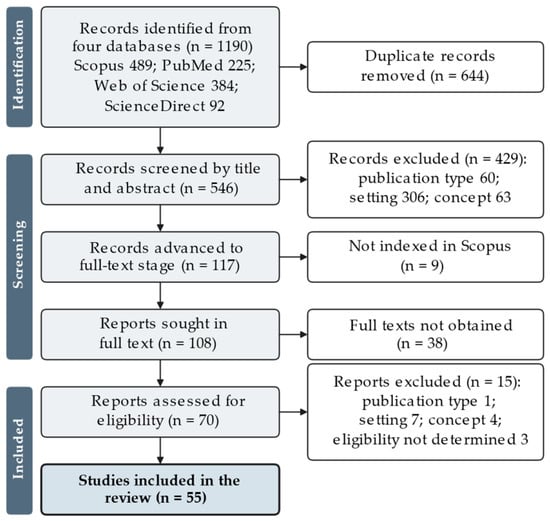
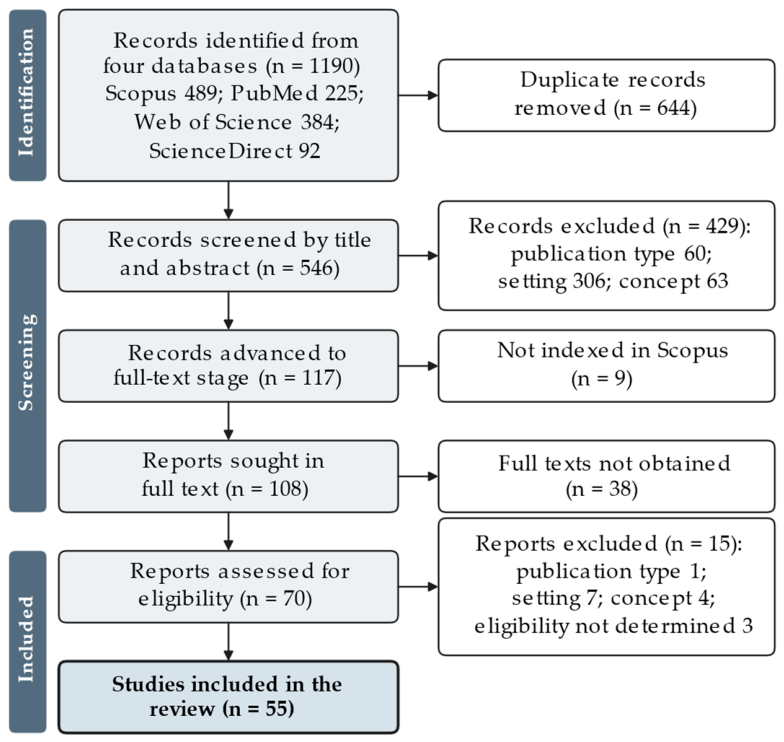
The searches identified 1190 records: 489 in Scopus, 384 in Web of Science, 225 in PubMed and 92 in ScienceDirect (Figure 1). After 644 duplicates were removed, 546 records were screened by title and abstract, and 429 were excluded (60 by publication type, 306 by setting and 63 by concept). Of the 117 remaining records, 9 were not indexed in Scopus, leaving 108 reports for full-text assessment. The full texts of 38 of these reports (35.2%) could not be accessed through the available subscriptions or open access. The other 70 full texts were assessed: 15 were excluded (publication type 1, setting 7, concept 4, eligibility could not be determined 3), and 55 studies were included. Decisions for every record are listed in Supplementary Tables S3 and S4.
Figure 1.
PRISMA-ScR flow diagram of the identification, screening and inclusion of sources.
3.2. Characteristics of the Included Studies
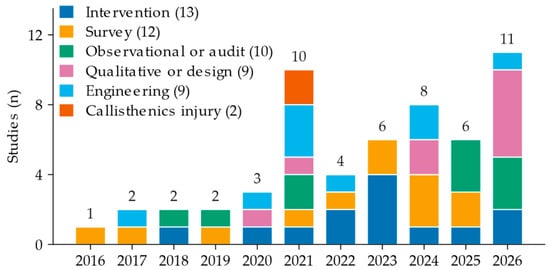
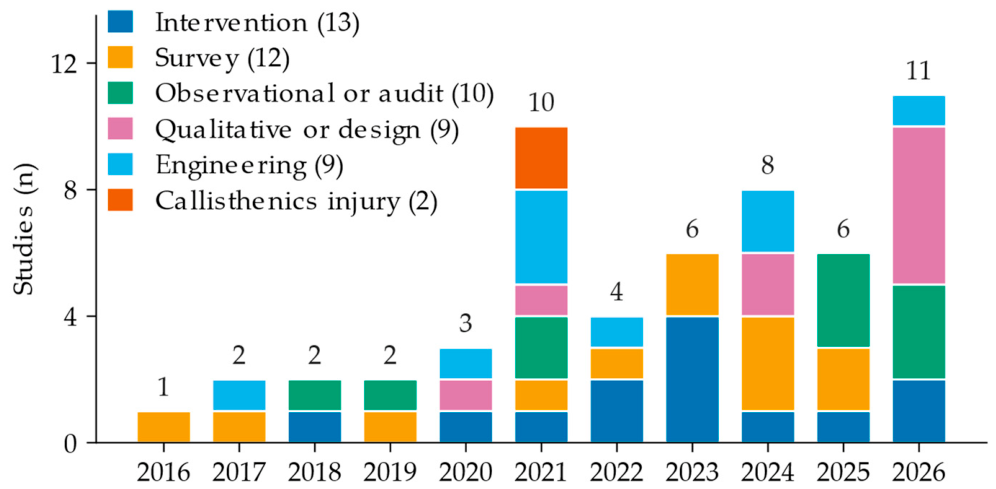
The 55 included studies were published between 2016 and 2026; 45 (81.8%) were published in 2021 or later, and 11 (20.0%) in 2026 (Figure 2). They originated from 17 countries or territories: Australia (n = 14), China (n = 13, including 4 from Hong Kong, which is counted as a separate territory), Brazil (n = 5), Poland (n = 4), and Spain (n = 4). The remaining 15 studies came from Taiwan, India, South Korea, Sweden, the USA, Thailand, Turkey, Israel, Indonesia, Chile and Malaysia (one or two studies each).
Figure 2.
Included studies by year of publication and study design (n = 55).
By design, 13 studies (23.6%) were intervention or implementation studies, 12 (21.8%) surveys, 10 (18.2%) observational or audit studies, 9 (16.4%) qualitative or design studies, 9 (16.4%) engineering or technology studies and 2 (3.6%) injury studies of calisthenics practitioners. Most studies addressed more than one domain: other barriers and facilitators (D6) in 41 studies (74.5%); supervision and instruction (D2) in 34 (61.8%); safety, maintenance and equipment quality (D4) in 33 (60.0%); weather and related conditions (D3) in 30 (54.5%); technology (D5) in 22 (40.0%); and injury or technique (D1) in 20 (36.4%). Table 1 lists each study’s characteristics.
Table 1.
Characteristics of the 55 included studies, grouped by study type.
Climate was assigned from the study location (Table 1). Thirty-four studies (61.8%) were set in temperate climates (group C), five (9.1%) in tropical climates (group A), two (3.6%) in arid climates (group B) and five (9.1%) in cold climates (group D): three Polish studies from Gdańsk and Katowice [22,34,40], a study from Liaocheng [33] and one from Yongin [66]. For nine studies (16.4%), mostly online surveys and laboratory or design studies, no climate group was applied (NA) [22,33,34,36,37,38,40,61,62]. Only one study (1.8%) covered the whole year, including sub-zero days; it surveyed self-reported training temperatures [40].
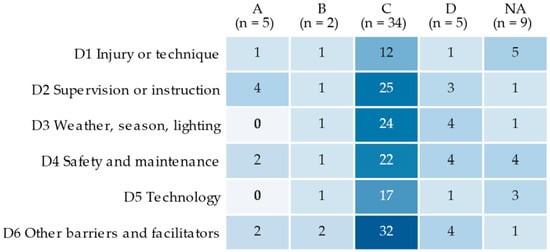
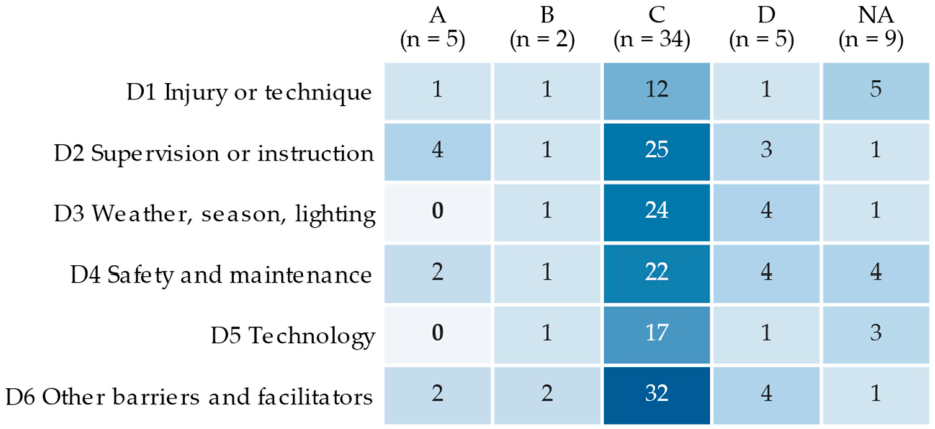
Of the five studies in cold climates (group D), four addressed weather (D3) and one addressed technology (D5) (Figure 3); only one [40], a survey, covered the whole year, including sub-zero days.
Figure 3.
Number of included studies addressing each domain, by Köppen–Geiger climate group of the study site.
3.3. Injury, Misuse and Safety at the Equipment (RQ1)
3.3.1. Injuries in Supervised Programmes
No included study followed users of public outdoor equipment for injuries. Where injuries were measured, the data came from four supervised programmes [52,55,57,59]. In a pilot trial with prefrail older adults, two adverse events occurred, both in the intervention arm: a slip on faulty equipment, and knee and back pain that resolved after modification [52]. In a supervised programme for residents with dementia, there were no falls and 13 pain reports, mostly of pre-existing joint pain [55]. Two supervised programmes for older adults with a history of falls recorded one fall each, without severe injury [57,59]; in one, 12 participants (15%) reported pain from pre-existing conditions in 16 events (0.95% of sessions) [59].
3.3.2. Misuse and Perceived Risk
For unsupervised use, evidence focuses on behaviour and perception. Video analysis of 493 user counts across four equipment types in two Taiwanese parks found users did not follow the manufacturer’s indication in 30% of uses of the waist twister, 45% of uses of the air walker and the ski machine, and 36% of uses of the massager; experts judged some of this use potentially risky and some harmless, and injuries were not recorded [24]. A camera study in a US park found equipment used as intended 60% of the time, 77% for adults and seniors but only 39% for children and youth [21]. Children were also seen using machines in unintended ways in Chinese fitness routes, with the authors raising injury risk but measuring none [20]. Older adults, and stakeholders speaking for them, feared falls or injury in three qualitative studies, and knee pain, balance limits and excess resistance shaped which machines older adults used [41,42,44].
3.3.3. Equipment Condition and Design
Equipment design and condition were the other source of safety evidence. A Polish audit of 74 outdoor gyms found an impact-absorbing rubber surface in only two (2.7%), neglected or damaged equipment in 21.6%, and vandalism in two (2.7%) [22]. A Brazilian audit of 214 public spaces rated 51.9% of spaces as good quality and found vandalism absent in 71.0% of them [27]. Damaged equipment was indicated by 45% of 66 interviewed users in an Indian campus study [29], and poor condition was indicated by 24.9% of 1036 Polish users [40]; 15.8% of 215 Polish users indicated damaged, vandalised or poorly maintained equipment [34]. In Israel, two of five gyms were unmaintained, cameras often did not work, and guards were absent in the evening [46].
Equipment was not adjustable to body size in Spanish and Turkish studies, with the Spanish team measuring changes in lumbar and pelvic posture on several machines [45,64]. An expert risk assessment in Beijing scored outdoor workout products 6.44 on a scale, where level 3 means generally safe, with sharp edges and tips flagged [38]. Fear of injury accounted for 4.4% of the barrier mentions in an Australian council survey [26].
3.3.4. Injuries in Calisthenics Practitioners
Injury data exist for street-workout practitioners. Among 93 street-workout practitioners in Chile, 62.3% had had at least one injury in the previous 12 months; tendinopathy was the most frequent diagnosis (31.0%), the shoulder was the most injured site, and perceived causes were overtraining (56.9%) and poor execution (27.6%) [7]. One case report described a complete pectoralis major tendon rupture during a one-arm static move [8].
3.4. Supervision, Instruction and Feedback (RQ2)
3.4.1. Supervised Programmes
Evidence on supervision came almost entirely from research programmes (Table 2). In a randomised trial with older adults in Brazil, only the group trained with one trainer per participant improved on functional tests, while the unsupervised group did not; quality of life rose in both [53]. A second trial from the same group found that supervised and unsupervised outdoor training both raised the overall lifestyle score. Still, only the supervised group improved physical activity, sleep and behaviour domains [54].
Supervised programmes in Australia initially used two staff for groups of three to four residents with dementia, then one staff member per two residents in the maintenance phase [55], or one accredited exercise physiologist for three to four participants [60]; in one programme, gains were maintained for up to nine months after the supervised phase [59].
Table 2.
Evidence on supervision, instruction and feedback at outdoor workout equipment.
3.4.2. Instruction at Public Sites
Where it was examined, on-site guidance at public sites was absent: all 38 users in a Brazilian satisfaction survey had received no professional guidance [32]. No instructions were found at 15 of 74 Polish gyms (20.3%), and 16 more (21.6%) had missing or damaged instructions [22]. In Australian local councils, instructional signage was present at 87.6% of 169 sites, and QR codes at 30.7%, yet low confidence or knowledge was the leading barrier (14.0%) [26]. In a Chinese field study, users ignored pictorial instructions on smart equipment, and none of 11 observed users met a multi-modal exercise recommendation [69].
The lack of professional advice was identified by 5.1% of Polish users, and the lack of an instructor by 1.4% in another Polish survey [34,40]; users in Turkey, China, Hong Kong and Australia asked for coaches, guidance or classes [30,41,45,48]. Providers in Australia also worried about injury from incorrect unsupervised use, and some doubted that volunteers were qualified to supervise [44].
3.5. Weather, Season and Lighting (RQ3)
3.5.1. Reported Barriers
Table 3 lists the 19 studies with a finding on weather, season, shade, or lighting; 10 reported weather as a barrier or unmet need. It was the leading disadvantage of outdoor gyms in 57.2% of 1036 Polish exercisers and 69.8% of 215 Polish users [34,40]; only 3.9% of the Polish sample said they trained at 0 °C or below [40]. Interview and survey studies named rain, heat, lack of shade or shelter and poor lighting as barriers or unmet needs [30,37,39,41,43,49]. In Turkey, all participants preferred indoor centres in winter [45], and an Australian volunteer reported that attendance dropped in wet, cold winter weather [44].
Table 3.
Reported effects of weather, season, shade and lighting.
3.5.2. Measured Effects
Measured weather effects came from temperate, tropical, and arid climates and were reported as shares of observations or cancelled sessions. In Chinese fitness routes, winter accounted for 10.0% of observations and season was not independently associated with moderate-to-vigorous activity [20]. Supervised sessions in Australia were cancelled for weather in 4.1%, 6.9% and 9.1% of sessions, mostly for rain, and in two programmes also in extreme heat (30 °C or 35 °C and above) [55,59,60]. In an Indian study, use was lowest in December, which the authors attributed to cold wind and a student break, although winter temperatures were mild (10–22 °C) [29].
Shade was the most frequent enabler (with 22.6% of respondents naming it as an enabler) in an Australian survey of adults aged 50 and over [30], but 44.6% of Polish gyms were fully sun-exposed and 32.4% unlit [22], and 48.5% of Australian sites had no shade and 21.3% had lighting [26]. A randomised trial scheduled its baseline in April to avoid winter daylight limits and saw use fall in both arms in summer, which the authors linked to heat, UV and absence of shade [51]. In a field study of a spraying drone used to disinfect public sports sites, a 2.2 km/h wind shifted the spray footprint [71].
3.5.3. Cold and Winter Conditions
No included study examined ice, snow, frost, cold-surface contact, hand thermal comfort, or heated equipment. Three studies collected data in winter [20,29,40], and only the Polish year-round survey reported sub-zero temperatures, with self-reported training temperatures between −8 and 32 °C; it did not examine safety [40].
3.6. Technology at the Equipment (RQ4)
3.6.1. Information Delivery
Twenty-two studies addressed technology (Table 4): 15 built or tested a technology, and 7 only mentioned, proposed or described one without evaluating it, such as the QR codes in [26,42,44,48]. The most frequent were QR codes and smartphone apps (8 studies, 36.4%). In Australian implementation work, QR codes on stations and an app produced 3702 scans (some at other park locations) and 165 registrations across six parks [50]; in a cluster randomised trial, 18 outdoor gyms with video-led workouts reached 1273 registrations, 141 QR scans by three months and mostly indoor workouts (62%) [51]; and in another trial, 92% of participants had logged at least one workout in the app [56].
Table 4.
Technology studied at or for outdoor workout equipment (n = 22 studies).
Pilot work in Hong Kong and Sweden used apps and wearables to deliver exercise programmes or track activity [52,61,62]; in one of the Swedish pilots, outdoor gym visits fell from 4.2 in the first three months to 0.9 in the next three, and nine participants did not use the app in the second half [62]. Lack of a smartphone or familiarity with QR codes was a barrier to use among older adults [44].
3.6.2. Sensing, Computing and Design
Sensing, computing and design studies reported mainly technical performance. A triaxial accelerometer algorithm counted repetitions on four machines with 97.22% accuracy in five volunteers [66]. A pose-estimation system compared joint angles with reference ranges for eight exercises, achieving 97.3% accuracy and a feedback delay of 1.42 s on images of 15 individuals with minor errors under extreme lighting [70]. An Internet of Things air walker was piloted with three users [68], a fob-based access log monitored a supervised programme [59], and camera images supported use analysis but needed manual coding [21].
Design work added a selectorised load system tested in laboratory electromyography [63,65]; a solar-powered concept [49]; pictogram, interactive and audio instruction boards for people with disabilities [37]; and participants’ proposals for QR-based instructions [48]. None of these studies evaluated the technology against injury outcomes, and none was tested in sub-zero conditions.
3.7. Other Barriers and Facilitators
Six studies reported social and practical barriers unrelated to safety: lack of time, crowding or children on the equipment, self-consciousness, privacy for women, gender norms, and the perception that the equipment is for children or older people [26,29,30,45,46,47].
Seven studies reported facilitators: free access, proximity to home, rest facilities and green space, social contact and programme promotion [19,28,32,33,35,36,50]. These barriers and facilitators were consistent with earlier reviews [2] and are not examined further in the Discussion.
4. Discussion
4.1. Principal Findings
This scoping review mapped 55 studies from 17 countries and territories, 45 of them (81.8%) published since 2021. For RQ1, none of the 55 studies followed users of public outdoor workout equipment for injuries. Evidence on injury was indirect: perceived risk in qualitative studies, expert risk assessment [38], audits of equipment condition [22,27], observed misuse [21,24] and adverse events in four supervised programmes [52,55,57,59]. For RQ2, 12 studies provided data on supervision or instruction (Table 2). Supervised delivery was feasible in research programmes, whereas on-site guidance was absent where examined; for example, in a Brazilian survey, all 38 users lacked on-site guidance [32]. For RQ3, weather was reported as a barrier in 10 studies, yet measured effects came from temperate, tropical and arid climates: 3 studies collected data in winter and 1 reported sub-zero temperatures. For RQ4, technology was addressed in 22 studies (40.0%). None tested sub-zero conditions or evaluated injury outcomes, and no study evaluated heated or winter-adapted equipment.
4.2. Interpretation and Comparison with Earlier Reviews
4.2.1. Injury Evidence
Earlier reviews of outdoor gyms asked whether they change physical activity and health [2,3,4,5,6]. The present map suggests that the premise of that question, that people can use the equipment safely and effectively without help, has rarely been examined directly. Adverse events were recorded only in four supervised programmes [52,55,57,59]; these figures describe monitored programmes with trained staff and should not be read as evidence of risk in unsupervised public use. The only other injury data come from street-workout practitioners. Ngo et al. found that 62.3% of 93 street-workout practitioners in Chile had had at least one injury in the previous 12 months, with tendinopathy as the most frequent diagnosis (31.0%) and overtraining (56.9%) and poor execution (27.6%) as the perceived causes [7].
These practitioners are trained athletes or committed enthusiasts, so the figures cannot be transferred to casual users; however, they show which exposures, load progression, and technique a bar or frame can present to anyone who trains on it. A case report by Choo and Ng of a complete pectoralis major rupture during a one-arm static move [8] shows that severe injury is possible, but it cannot give a rate. Evidence for bar-training injuries is based on one survey of 93 practitioners [7] and one case report [8].
A comparison of the exposures reported for practitioners and for casual users shows what they may share. Load progression belongs to the practitioners: overtraining was the most frequent perceived cause of injury among them (56.9%), and the odds of injury rose with vigorous activity [7]; no study reported load progression for casual users of public equipment. Technique may be shared: poor execution was a perceived cause for 27.6% of practitioners [7], and 30–45% of observed uses of some machines by casual users did not follow the manufacturer’s instructions [24]. However, no study linked this to injury. Practitioners did not report supervision, and public sites examined lacked on-site guidance (Section 3.4.2). Practitioners also did not report the surface, and an impact-absorbing surface was found at only 2.7% of the audited Polish outdoor gyms [22]. No included study measured these exposures in both groups, so which of them are shared remains an inference.
4.2.2. Misuse and Equipment Condition
Chow and Wu found that 30–45% of uses of four machines did not follow the manufacturer’s instructions [24], and Sami et al. observed intended use in 60% of uses in a US park and 39% among children and youth [21]. Part of this use was resting and socialising [21], which the equipment design may invite, but neither study recorded injuries. These percentages describe how the equipment was used and do not measure injury risk; misuse in these studies points to a poor fit between users and equipment and provides no measure of harm. Audits reported equipment condition: Gębczyńska-Janowicz et al. found an impact-absorbing surface at only 2 of 74 Polish outdoor gyms (2.7%) [22], and in Lee et al.’s pilot trial, one of two adverse events was a slip on faulty equipment [52]. No included study linked equipment condition to injury. EN 16630 refers to EN 1177 for impact-attenuating surfacing and assumes that the equipment is used according to exercise instructions attached to each piece of equipment [12]; ASTM F3101 refers to ASTM F1292 for protective surfacing, where required, and to ASTM F1749 for warning labels [13]. The missing or damaged instructions reported in Poland and Australia [22,26] therefore fall short of the standards’ assumptions. Neither standard refers to ISO 13732-3, which gives limits for contact with cold surfaces [15], and no included study applied it.
4.2.3. Supervision and Instruction
The supervision evidence is encouraging but difficult to scale. Barbosa et al. reported that only the group trained with one trainer per participant improved on functional tests [53], and a second trial from the same group found that only the supervised group improved physical activity, sleep and behaviour domains [54]. Staffing in the other programmes ranged up to one staff member per two residents with dementia [55] and one physiologist per three to four participants [60], ratios that municipalities are unlikely to provide at every public site. Much of this evidence comes from a few research groups: six reports from the ENJOY programme [44,50,55,57,59,60], two each from the Ecofit trials [51,56] and from Barbosa et al. [53,54], and three from Abelleira-Lamela et al. [63,64,65]; the supervision evidence therefore rests largely on one Australian programme.
Passive instructions were not a clear substitute. Crozier et al. found signage at 87.6% of 169 South Australian sites, yet low confidence or knowledge was the leading barrier (14.0%) [26], and Xu and Luh observed users ignoring pictorial instructions on smart equipment, with none of 11 observed users meeting a multi-modal exercise recommendation [69]. Researchers have not tested whether passive instructions are sufficient compared with alternatives such as short induction sessions, volunteer champions or digital feedback. Digital routes also have limits: according to Plotnikoff et al., 141 QR scans were recorded over three months among 1273 registrations [51], and Muoio et al. reported that older adults without smartphones or familiarity with QR codes were a barrier [44].
4.2.4. Weather and Cold Conditions
The weather evidence comes from two kinds of studies. In surveys, respondents named weather first: it was the leading disadvantage for 57.2% of 1036 exercisers in Sas-Nowosielski and Szopa-Wiśnios [40] and for 69.8% of 215 users in Szopa and Sas-Nowosielski [34]. Both are single-country, cross-sectional, self-report surveys, so reporting bias is possible. In observational and programme data from other settings, Tian et al. found that winter held 10.0% of observations and that season was not independently associated with moderate-to-vigorous activity [20], and Levinger et al. reported that weather cancelled 4.1–9.1% of supervised sessions [55,59,60]. Season and weather have been reviewed for general populations [9], but the measured data come from temperate, tropical and arid climates. The survey data and the programme data differ in setting, population and measure and are not compared directly.
In places with long frost seasons, open questions include whether people use the equipment at all and what happens to those who do. Only the Polish survey reached below 0 °C, and 3.9% of its respondents trained at 0 °C or below [40]. Users grip bars and handles with bare hands, and many are metal; occupational research sets limits for bare-finger contact with cold surfaces [11]. None of the 55 studies connected that literature to exercise equipment or examined icy surfaces, glove use or the effect of cold on grip and technique, and none evaluated heated or otherwise winter-adapted equipment. The weather search string did not include narrower terms such as snow, ice or frost (Section 4.5).
4.2.5. Technology
Most technology studies (Table 4) focused on information and measurement tools and reported uptake or technical accuracy; adverse events were reported only where the technology was part of a supervised trial or programme [52,59]. Kim and Choi counted repetitions on four machines with 97.22% accuracy in five volunteers [66], and Gopinath et al. reported 97.3% accuracy for pose classification on images of 15 individuals, with the system having been tested only on images [70]; both were experimental or image-based tests without reported testing in outdoor weather. Parker et al. found that outdoor gym visits among Swedish employees fell from 4.2 in the first three months to 0.9 in the next three, which suggests that novelty can fade [62].
Outdoor technology must also withstand weather, power supply issues, and vandalism. Only two studies addressed these: Xu et al. proposed a solar-powered concept [49], and Jorge et al. showed that a wind of 2.2 km/h altered the footprint of drone spraying [71].
4.3. Research Gaps and Recommendations
Five gaps follow from the map:
- Injury surveillance at public equipment—Prospective or registry-based studies, including emergency-department and municipal incident reports, are needed to estimate how often injuries occur, who sustains them, and on which equipment. Studies should report exposure, such as user-hours, so that rates can be compared. Existing emergency-department surveillance systems, such as the US National Electronic Injury Surveillance System [72] and the EU Injury Database [73], could provide such data if outdoor workout equipment were recorded as a distinct product category.
- Winter and cold-climate studies—Studies are needed from cold and polar climates (Köppen groups D and E) with winter measurements: surface and air temperature, ice and snow, daylight, glove use, contact duration and injury or incident outcomes, together with winter use counts.
- Comparative evaluations of supervision, instruction, surfacing and maintenance—Trials should compare signage, induction sessions, volunteers and digital feedback on technique, confidence and adverse events, and should report cost per user; surfacing and maintenance regimes should be evaluated against incidents and equipment condition.
- Technology tested at the equipment and under outdoor conditions—Evaluations should go beyond uptake to report technical reliability, durability, vandalism, power supply, usability with gloves or by older users, and safety outcomes.
- Reporting standards—Studies of outdoor equipment should state the climate, season of data collection, equipment type, and supervision model so results can be pooled.
4.4. Implications for Practice
For site owners and operators, the evidence points to basic measures that address the problems reported in the studies: impact-absorbing surfaces [22], adjustable or clearly sized equipment [45,64], regular maintenance [22,34,40,46], shade and lighting [22,26,30,39,41,43], and visible instructions placed where users stand [22,26]. For programme providers, several studies delivered short, staff- or volunteer-led inductions that appear feasible, as described by Levinger et al. [50] and Plotnikoff et al. [51,56]. EN 16630 also advises regular introductory courses led by trained experts [12]. For researchers, a cold-climate study of the safety of outdoor workout equipment that combines injury and incident reporting with measured temperatures would address the main gap identified here: the absence of sub-zero data.
4.5. Strengths and Limitations
Strengths of this review include four databases, transparent selection counts, and a charting form that records the climate group assigned to each study site and whether winter conditions were studied. Several limitations apply. Firstly, the review was restricted to Scopus-indexed records found in four databases; grey literature, citation searching, engineering databases such as IEEE Xplore, and municipal reports were not searched. The search string included winter, season*, climate, and temperature, but not narrower terms such as snow, ice, frost, or sub-zero; a check search in PubMed with these terms found no additional eligible records. Secondly, the full texts of 38 of 108 reports (35.2%) could not be retrieved through university subscriptions and open-access copies, and interlibrary loan and requests to authors were not used. Supplementary Table S3 lists them. Their eligibility is unknown, so the counts for technology (D5) and for cold climates (D) could change if they were included [74,75,76]. One of them, a microclimate study of a park fitness trail in Harbin [74], was obtained during revision and excluded, as the trail had no exercise equipment. Two others concern gaps reported in this review. According to their abstracts, a quasi-experiment with 54 adolescents in Spain found fewer execution errors on outdoor flexion–extension equipment after video instruction than after written panel instructions [75], and a survey of 181 Dutch calisthenics athletes reported a 12-month injury incidence of 59%, mostly of the shoulders, wrists and elbows [76]. If included, they could add evidence on instruction (RQ2) and on injuries among calisthenics practitioners (RQ1), but neither studied winter conditions or followed users of public equipment for injuries, so the main gaps could remain. The conclusions of this review therefore refer to the 70 reports that were assessed. Thirdly, records were screened with AI assistance, and a random sample of 100 title and abstract exclusions was re-checked. One author screened all full texts and charted all data, whereas JBI guidance recommends two independent reviewers [16]; excluded records were not re-read for incidental adverse events. Fourthly, errors in data extraction cannot be ruled out, and the Köppen group for each site is inferred from its location. Fifthly, the searches were run in 2026, so that year is incomplete. Sixthly, no critical appraisal was done, and the 55 studies are heterogeneous in design (Table 1), so the counts describe the extent of evidence, not its strength. Several reports came from the same research groups, so the number of independent study populations is smaller than 55.
5. Conclusions
The evidence on public outdoor workout equipment centres on who uses it and why. Evidence on injuries is indirect, as no study followed users of public equipment for injuries. Supervision was examined mostly in research programmes (Table 2), and weather was reported as a barrier in 10 of 55 studies, but only 1 study reported sub-zero temperatures. Technology of the equipment was addressed in 22 studies; none tested in sub-zero conditions or evaluated injury outcomes.
Future work should combine injury and incident surveillance at public outdoor workout equipment with year-round measurements in cold climates, including surface and air temperature, ice, daylight, glove use, contact duration and injury or incident outcomes. Surveillance could take the form of a prospective incident register at a defined set of sites, recording equipment type, surface, season, temperature, and number of users so that incidents can be linked to use. Controlled comparisons of supervision and instruction models, such as short inductions, volunteer champions and digital feedback, should report injuries, user confidence and cost per user. Technology intended for use at the equipment should be tested under outdoor conditions, including sub-zero temperatures, and report reliability, durability and safety outcomes. Cold climates supplied 5 of the 55 studies, and only one of them reported sub-zero temperatures [40]; they are a natural setting for such work. Consistent reporting of climate, season, equipment type, and supervision model would allow later reviews to pool results, and an update including the full texts not accessible here would show whether the map changes.
Supplementary Materials
The following supporting information can be downloaded at: https://zenodo.org/records/24376542 (accessed on 1 October 2026), Table S1: Charting of the 55 included studies, with the city, climate group and season of data collection of each study; Table S2: Search strategies by database; Table S3: Outcome of the full-text stage with exclusion reasons; Table S4: Title and abstract screening decisions with reasons; the completed PRISMA-ScR checklist; and the source data of the figures.
Author Contributions
Conceptualisation, P.P.A. and M.S.; methodology, P.P.A. and M.S.; investigation, P.P.A.; data curation, P.P.A.; writing—original draft preparation, P.P.A.; writing—review and editing, P.P.A. and M.S.; project administration, M.S.; funding acquisition, M.S. All authors have read and agreed to the published version of the manuscript.
Funding
This research was funded by research project No. D “1.6 Development of digital tools and safety systems for outdoor workout equipment”, under project No. 2.2.1.3.i.0/1/24/A/CFLA/007 “AMEMIL centre of excellence Support for the Development of Digital Products”, supported by the European Union Recovery and Resilience Facility.
Institutional Review Board Statement
Not applicable.
Informed Consent Statement
Not applicable.
Data Availability Statement
No new primary data were created. The screening decisions and extracted data for all included studies are provided in the Supplementary Materials and deposited in Zenodo (https://doi.org/10.5281/zenodo.24376542).
Conflicts of Interest
M.S. chairs the board of Ltd. “Kenguru Pro”, which manufactures outdoor workout equipment and carries out the funded project. P.P.A. was engaged in the project to review the literature and made all screening and charting decisions. The funders had no role in the study design; data collection, analysis, or interpretation; manuscript writing; or the decision to publish the results.
Abbreviations
The following abbreviations are used in this manuscript:
| D1–D6 | Concept domains of the review |
| EMG | Electromyography |
| IoT | Internet of Things |
| JBI | Joanna Briggs Institute |
| KJ | Kawakita Jiro (affinity diagram) method |
| NA | Not applicable |
| PCC | Population–Concept–Context |
| PRISMA-ScR | Preferred Reporting Items for Systematic Reviews and Meta-Analyses extension for Scoping Reviews |
| QR | Quick response (code) |
| RQ | review question |
| SOPARC | System for Observing Play and Recreation in Communities |
| UV | Ultraviolet |
References
- Bull, F.C.; Al-Ansari, S.S.; Biddle, S.; Borodulin, K.; Buman, M.P.; Cardon, G.; Carty, C.; Chaput, J.-P.; Chastin, S.; Chou, R.; et al. World Health Organization 2020 Guidelines on Physical Activity and Sedentary Behaviour. Br. J. Sports Med. 2020, 54, 1451–1462. [Google Scholar] [CrossRef] [Scilit] [PubMed]
- Lee, J.; Lo, T.; Ho, R. Understanding Outdoor Gyms in Public Open Spaces: A Systematic Review and Integrative Synthesis of Qualitative and Quantitative Evidence. Int. J. Environ. Res. Public Health 2018, 15, 590. [Google Scholar] [CrossRef] [Scilit] [PubMed]
- Jansson, A.K.; Lubans, D.R.; Smith, J.J.; Duncan, M.J.; Haslam, R.; Plotnikoff, R.C. A Systematic Review of Outdoor Gym Use: Current Evidence and Future Directions. J. Sci. Med. Sport 2019, 22, 1335–1343. [Google Scholar] [CrossRef] [Scilit] [PubMed]
- Ng, Y.L.; Hill, K.D.; Levinger, P.; Burton, E. Effectiveness of Outdoor Exercise Parks on Health Outcomes in Older Adults—A Mixed-Methods Systematic Review and Meta-Analysis. J. Aging Phys. Act. 2021, 29, 695–707. [Google Scholar] [CrossRef] [Scilit] [PubMed]
- Jansson, A.K.; Beacroft, S.; Mattern, V.; Plotnikoff, R.C. Characteristics of Outdoor Gym Interventions Promoting Physical Activity: A Systematic Review Toward Guiding Scalable, Population-Based Programs. J. Phys. Act. Health 2025, 22, 878–897. [Google Scholar] [CrossRef] [Scilit] [PubMed]
- Tang, Z.-Y.; Ji, Y.-Q.; Zhu, Y.-S.; Xiang, H.-B.; Ye, Q. Effectiveness of Outdoor Fitness Equipment Intervention on Health Outcomes: A Systematic Review and Meta-Analysis. Front. Public Health 2026, 14, 1701136. [Google Scholar] [CrossRef] [Scilit] [PubMed]
- Ngo, J.K.; Solis-Urra, P.; Sanchez-Martinez, J. Injury Profile Among Street Workout Practitioners. Orthop. J. Sports Med. 2021, 9, 2325967121990926. [Google Scholar] [CrossRef] [Scilit] [PubMed]
- Choo, C.H.; Ng, W.N. Complete Pectoralis Major Tendon Rupture in a Calisthenics Athlete: A Case Report. Malays. Orthop. J. 2021, 15, 124–127. [Google Scholar] [CrossRef] [Scilit] [PubMed]
- Tucker, P.; Gilliland, J. The Effect of Season and Weather on Physical Activity: A Systematic Review. Public Health 2007, 121, 909–922. [Google Scholar] [CrossRef] [Scilit] [PubMed]
- Beck, H.E.; Zimmermann, N.E.; McVicar, T.R.; Vergopolan, N.; Berg, A.; Wood, E.F. Present and Future Köppen-Geiger Climate Classification Maps at 1-Km Resolution. Sci. Data 2018, 5, 180214. [Google Scholar] [CrossRef] [Scilit] [PubMed]
- Geng, Q.; Holmér, I.; den Hartog, E.A.; Havenith, G.; Jay, O.; Malchaire, J.; Piette, A.; Rintamäki, H.; Rissanen, S. Temperature Limit values for touching cold surfaces with the fingertip. Ann. Occup. Hyg. 2006, 50, 851–862. [Google Scholar] [CrossRef] [Scilit] [PubMed]
- EN 16630:2015; Permanently Installed Outdoor Fitness Equipment—Safety Requirements and Test Methods. CEN: Brussels, Belgium, 2015.
- ASTM F3101-21a; Standard Specification for Unsupervised Public Use Outdoor Fitness Equipment. ASTM International: West Conshohocken, PA, USA, 2021.
- EN 1177:2018; Impact Attenuating Playground Surfacing—Methods of Test for Determination of Impact Attenuation. CEN: Brussels, Belgium, 2018.
- ISO 13732-3:2005; Ergonomics of the Thermal Environment—Methods for the Assessment of Human Responses to Contact with Surfaces—Part 3: Cold Surfaces. ISO: Geneva, Switzerland, 2005.
- Peters, M.D.J.; Marnie, C.; Tricco, A.C.; Pollock, D.; Munn, Z.; Alexander, L.; McInerney, P.; Godfrey, C.M.; Khalil, H. Updated Methodological Guidance for the Conduct of Scoping Reviews. JBI Evid. Synth. 2020, 18, 2119–2126. [Google Scholar] [CrossRef] [Scilit] [PubMed]
- Arksey, H.; O’Malley, L. Scoping Studies: Towards a Methodological Framework. Int. J. Soc. Res. Methodol. 2005, 8, 19–32. [Google Scholar] [CrossRef] [Scilit]
- Tricco, A.C.; Lillie, E.; Zarin, W.; O’Brien, K.K.; Colquhoun, H.; Levac, D.; Moher, D.; Peters, M.D.J.; Horsley, T.; Weeks, L.; et al. PRISMA Extension for Scoping Reviews (PRISMA-ScR): Checklist and Explanation. Ann. Intern. Med. 2018, 169, 467–473. [Google Scholar] [CrossRef] [Scilit] [PubMed]
- Mathias, N.G.; Melo Filho, J.; Szkudlarek, A.C.; Gallo, L.H.; Fermino, R.C.; Gomes, A.R.S. Motivos Para a Prática de Atividades Físicas Em Uma Academia Ao Ar Livre de Paranaguá-PR. Rev. Bras. Ciênc. Esporte 2019, 41, 222–228. [Google Scholar] [CrossRef] [Scilit]
- Tian, Y.; Zhu, B.; Zhao, M.; Yao, Z.; Han, Q.; Wang, K. Use Behavior and Spatial Characteristics of National Fitness Routes in China: An in Situ Observational Study. Front. Public Health 2026, 14, 1904288. [Google Scholar] [CrossRef] [Scilit] [PubMed]
- Sami, M.; Macridis, S.; Ogunseitan, O.A. Evaluating Actual Use of Outdoor Exercise Equipment in a Community Park in Southern California through Video-Captured Behavioral Assessment. Discov. Public Health 2025, 22, 598. [Google Scholar] [CrossRef] [Scilit] [PubMed]
- Gębczyńska-Janowicz, A.; Marczak, E.; Mazurkiewicz, W.; Krefta, D.; Mikołajczyk, N.; Kamrowska-Załuska, D. Outdoor Gym as a Public Space for the Elderly–The Example of Gdańsk, Poland. Med. Pr. 2025, 76, 249–257. [Google Scholar] [CrossRef] [Scilit] [PubMed]
- Veitch, J.; Salmon, J.; Abbott, G.; Timperio, A.; Sahlqvist, S. Understanding the Impact of the Installation of Outdoor Fitness Equipment and a Multi-Sports Court on Park Visitation and Park-Based Physical Activity: A Natural Experiment. Health Place 2021, 71, 102662. [Google Scholar] [CrossRef] [Scilit] [PubMed]
- Chow, H.; Wu, D.-R. Outdoor Fitness Equipment Usage Behaviors in Natural Settings. Int. J. Environ. Res. Public Health 2019, 16, 391. [Google Scholar] [CrossRef] [Scilit] [PubMed]
- Lei, D.; Liang, W.; Chen, W.; Jian, I.Y.; Mo, K.H. The Impact of Microscale Environmental Features on Older Adults’ Recreational Activities in Shared Spaces of High-Density Residential Neighbourhoods: A Recreationist-Environment Fit Perspective. Habitat Int. 2026, 170, 103738. [Google Scholar] [CrossRef] [Scilit]
- Crozier, A.J.; Gollan, S.; Wycherley, T.P.; Stenner, B.J. Understanding Outdoor Fitness Equipment in South Australia: Insights from Council Employees and an Environmental Audit. J. Outdoor Recreat. Tour. 2026, 54, 101051. [Google Scholar] [CrossRef] [Scilit]
- Manta, S.W.; Lopes, A.A.d.S.; Hino, A.A.F.; Benedetti, T.R.B.; Rech, C.R. Open Public Spaces and Physical Activity Facilities: Study of Systematic Observation of the Environment. Rev. Bras. Cineantropom. Desempenho Hum. 2018, 20, 445–455. [Google Scholar] [CrossRef] [Scilit]
- Somnil, P. An Observational Study on Who Is Using Outdoor Fitness Equipment in Urban Public Parks and How to Use It. A Case Study of Udon Thani Parks. J. Phys. Educ. Sport 2021, 21, 2320–2325. [Google Scholar] [CrossRef] [Scilit]
- Vatta, L.; Pandey, U.; Pandey, A.; Yelam, B.; Rathi, N. Open Gyms and Physical Activity in a University Setting: A Mixed-Methods Study from Varanasi, India. J. Health Popul. Nutr. 2025, 44, 155. [Google Scholar] [CrossRef] [Scilit] [PubMed]
- Stride, V.; Cranney, L.; Scott, A.; Hua, M. Outdoor Gyms and Older Adults–Acceptability, Enablers and Barriers: A Survey of Park Users. Health Promot. J. Aust. 2017, 28, 243–246. [Google Scholar] [CrossRef] [Scilit] [PubMed]
- Zheng, Z.; Mo, J.; Xu, Y. Research on Public Fitness Equipment Experience Based on Satisfaction. Healthcare 2021, 9, 501. [Google Scholar] [CrossRef] [Scilit] [PubMed]
- Vasconcelos, T.d.A.; Paes, P.P.; Costa, M.S.F.; Oliveira, B.S.C.; Xavier, H.d.S.; Santos, W.R.; Santos, W.R. Assessment of User Satisfaction in an Outdoor Gym as a Tool for Improvements and Increased Adherence. Retos 2024, 52, 333–337. [Google Scholar] [CrossRef] [Scilit]
- Liu, K.; Zhang, X.; Xu, D. Research on Community Fitness Spaces under the Guidance of the National Fitness Program. Sustainability 2023, 15, 13273. [Google Scholar] [CrossRef] [Scilit]
- Szopa, S.; Sas-Nowosielski, K. Family Recreation Zones as a Supportive Environment for Physical Activity in the Opinion of Its Users. New Educ. Rev. 2016, 43, 117–124. [Google Scholar] [CrossRef] [Scilit]
- Wei, W.; Xu, W.; Hong, M. Differentiated Impacts of Indoor and Outdoor Fitness Environments on Residents’ Activity Intensity: A Perspective on Homo Urbanicus. Buildings 2024, 14, 3323. [Google Scholar] [CrossRef] [Scilit]
- Huh, K.Y.; Heo, H.; Jung, H.; Kim, I. Users’ Recognition and Satisfaction of Trails and Exercise Facilities in Urban Mountainous Forests: Focused on Jinju City, South Korea. J. People Plants Environ. 2022, 25, 521–533. [Google Scholar] [CrossRef] [Scilit]
- Stępień-Słodkowska, M.; Siedziako, R. Activation and Support for the Development of People with Physical Disabilities in the Opinion of the Residents of the Social Welfare Home in Szczecin. Health Probl. Civiliz. 2024, 18, 328–338. [Google Scholar] [CrossRef] [Scilit]
- Chen, Q.; Wang, K.; Xu, L.; Fang, X.; Liu, X.; Li, Y. Research on Quality and Safety Risk Assessment of Elderly Fitness Products Based on Entropy Weight Fuzzy Comprehensive Evaluation Method. In Proceedings of the 2024 4th International Conference on Big Data, Artificial Intelligence and Risk Management, Chengdu, China, 15 November 2024; ACM: New York, NY, USA, 2025; pp. 1060–1065. [Google Scholar]
- Paudel, C.; Timperio, A.; Salmon, J.; Loh, V.; Deforche, B.; Veitch, J. Designing Outdoor Fitness Areas for Older Adults: A Conjoint Analysis Study. Leis. Stud. 2025, 44, 383–396. [Google Scholar] [CrossRef] [Scilit]
- Sas-Nowosielski, K.; Szopa-Wiśnios, S. Usage Patterns, Exercise Motives, and Perceived Benefits and Limitations of Outdoor Gyms: A Case from a Provincial City in South Poland. New Educ. Rev. 2023, 2023, 81–94. [Google Scholar] [CrossRef] [Scilit]
- Zhou, T.-Y.; Lu, H.-J.; Li, C.; Lyu, H. Environmental Barriers Meet Functional Limitations: An Exploratory Qualitative Study on the Usage and Experience of Outdoor Gym among Older Adults. Front. Public Health 2026, 14, 1861748. [Google Scholar] [CrossRef] [Scilit] [PubMed]
- Paudel, C.; Timperio, A.; Loh, V.; Salmon, J.; Deforche, B.; Veitch, J. Understanding Factors Influencing the Use of Specialized Outdoor Fitness Equipment among Older Adults in Australia. Health Promot. Int. 2024, 39, daae160. [Google Scholar] [CrossRef] [Scilit] [PubMed]
- Scott, T.; Lole, L.; Oorloff, A.; Aprile, K. “It’s about Getting the Best Bang for Your Buck”: Exploring Local Councils’ Perceptions about Providing Exercise Infrastructure in Public Parks. Health Promot. J. Aust. 2021, 32, 483–491. [Google Scholar] [CrossRef] [Scilit] [PubMed]
- Muoio, R.; Gilbert, A.S.; Fearn, M.; Dreher, B.; Hill, K.D.; Bauman, A.; Soh, S.-E.; Brusco, N.K.; Burton, E.; Levinger, P. Implementation Factors Influencing Utilisation of Seniors Exercise Parks: A Community Stakeholder Qualitative Study. Wellbeing Space Soc. 2026, 10, 100379. [Google Scholar] [CrossRef] [Scilit]
- Karadeniz, A.; Dursun, M.; Töre-Yargın, G. Exploring Design Requirements of Outdoor Fitness Equipment for Young People. In Advances in Intelligent Systems and Computing; Springer: Cham, Switzerland, 2020; Volume 955, pp. 628–639. [Google Scholar]
- Moran, M.R.; Odeh, S.; Baron-Epel, O. Barriers and Facilitators to the Development and Use of Outdoor Gyms in Arab Towns: Perspectives of Municipal Officials and Residents. Cities Health 2026, 1–16. [Google Scholar] [CrossRef] [Scilit]
- Yang, J.; Deng, S.; Yuan, Q.; Yang, Y.; Wang, C.; Yang, L. Factors Influencing the Use of Outdoor Fitness Equipment by Elderly Patients with Coronary Heart Disease: A Qualitative Study Based on the Social Ecological Model. Sci. Rep. 2026, 16, 31322. [Google Scholar] [CrossRef] [Scilit]
- Lee, J.L.C.; Lee, K.L.; Shi, S.L.; Lee, K.N.K.; Wong, A.Y.L.; Ho, R.T.H.; Ng, P.H.F. Applying a Participatory Design Model-Making Engagement Activity to Understand How Different Stakeholders Envision Senior-Friendly Outdoor Gyms in Parks. J. Aging Environ. 2026, 40, 238–262. [Google Scholar] [CrossRef] [Scilit]
- Xu, L.; Yu, A.; Zhou, Y.; Jiang, X. Design Strategies of Outdoor Fitness Equipment for Elderly Community Based on KJ Method and KANO. In Proceedings of the 15th International Conference on Applied Human Factors and Ergonomics (AHFE2024), Nice, France, 24–27 July 2024; Volume 133, pp. 168–177. [Google Scholar]
- Levinger, P.; Fearn, M.; Dreher, B.; Bauman, A.; Soh, S.-E.; Brusco, N.K.; Gilbert, A.; Muoio, R.; Burton, E.; Hill, K. What Works in Real-World Implementation? Practice-Based Insights from the ENJOY IMP-ACT Project Promoting Physical Activity among Older Adults. Health Promot. Int. 2026, 41, daag120. [Google Scholar] [CrossRef] [Scilit] [PubMed]
- Plotnikoff, R.C.; Jansson, A.K.; Duncan, M.J.; Beacroft, S.; Bauman, A.; Attia, J.; Cox, E.R.; Smith, J.J.; Robards, S.L.; Babic, M.; et al. MHealth to Support Resistance Training Using Outdoor Gyms: The Ecofit Hybrid Type 3 Implementation–Effectiveness Trial. Transl. Behav. Med. 2026, 16, ibag024. [Google Scholar] [CrossRef] [Scilit] [PubMed]
- Lee, J.L.C.; Wong, A.Y.L.; Ng, P.H.F.; Fu, S.N.; Fong, K.N.K.; Cheng, A.S.K.; Lee, K.N.K.; Sun, R.; Zhang, H.Y.; Xiao, R. Outdoor Exercise Facility–Based Integrative Mobile Health Intervention to Support Physical Activity, Mental Well-Being, and Exercise Self-Efficacy Among Older Adults with Prefrailty and Frailty in Hong Kong: Pilot Feasibility Randomized Controlled Trial Study. JMIR Mhealth Uhealth 2025, 13, e69259. [Google Scholar] [CrossRef] [Scilit] [PubMed]
- Barbosa, W.A.; Machado, A.F.; Bergamin, M.; Gobbo, S.; Bullo, V.; Pontes Junior, F.L.; Evangelista, A.L.; Scartoni, F.R.; Rica, R.L.; Bocalini, D.S. Effects of a 12-Week Training Program in Outdoor Gym Equipment in Morphological and Functional Parameters, Quality of Life, and Physical Activity Levels in Older Adults. Front. Sports Act. Living 2024, 6, 1444472. [Google Scholar] [CrossRef] [Scilit] [PubMed]
- Barbosa, W.A.; Leite, C.D.F.C.; Reis, C.H.O.; Machado, A.F.; Bullo, V.; Gobbo, S.; Bergamin, M.; Lima-Leopoldo, A.P.; Vancini, R.L.; Baker, J.S.; et al. Effect of Supervised and Unsupervised Exercise Training in Outdoor Gym on the Lifestyle of Elderly People. Int. J. Environ. Res. Public Health 2023, 20, 7022. [Google Scholar] [CrossRef] [Scilit] [PubMed]
- Levinger, P.; Goh, A.M.Y.; Dunn, J.; Katite, J.; Paudel, R.; Onofrio, A.; Batchelor, F.; Panisset, M.G.; Hill, K.D. Exercise interveNtion Outdoor proJect in the cOmmunitY–Results from the ENJOY Program for Independence in Dementia: A Feasibility Pilot Randomised Controlled Trial. BMC Geriatr. 2023, 23, 426. [Google Scholar] [CrossRef] [Scilit] [PubMed]
- Plotnikoff, R.C.; Jansson, A.K.; Duncan, M.J.; Smith, J.J.; Bauman, A.; Attia, J.; Lubans, D.R. MHealth to Support Outdoor Gym Resistance Training: The Ecofit Effectiveness RCT. Am. J. Prev. Med. 2023, 64, 853–864. [Google Scholar] [CrossRef] [Scilit] [PubMed]
- Levinger, P.; Dunn, J.; Panisset, M.G.; Haines, T.; Dow, B.; Batchelor, F.; Biddle, S.; Duque, G.; Hill, K.D. The Effect of the ENJOY Seniors Exercise Park Physical Activity Program on Falls in Older People in the Community: A Prospective Pre-Post Study Design. J. Nutr. Health Aging 2022, 26, 217–221. [Google Scholar] [CrossRef] [Scilit] [PubMed]
- Lee, J.L.C.; Ho, R.T.H. Engaging Community-dwelling Older Adults as Co-developers in a Public Outdoor Exercise Facilities-based Physical Activity Education Intervention: A Mixed-method Participatory Study in Hong Kong. Health Soc. Care Community 2022, 30, e1862–e1874. [Google Scholar] [CrossRef] [Scilit] [PubMed]
- Levinger, P.; Panisset, M.; Dunn, J.; Haines, T.; Dow, B.; Batchelor, F.; Biddle, S.; Duque, G.; Hill, K.D. Exercise interveNtion Outdoor proJect in the cOmmunitY for Older People–Results from the ENJOY Seniors Exercise Park Project Translation Research in the Community. BMC Geriatr. 2020, 20, 446. [Google Scholar] [CrossRef] [Scilit] [PubMed]
- Levinger, P.; Sales, M.; Polman, R.; Haines, T.; Dow, B.; Biddle, S.J.H.; Duque, G.; Hill, K.D. Outdoor Physical Activity for Older People—The Senior Exercise Park: Current Research, Challenges and Future Directions. Health Promot. J. Aust. 2018, 29, 353–359. [Google Scholar] [CrossRef] [Scilit] [PubMed]
- Johnson, U.; Ivarsson, A.; Parker, J.; Svetoft, I.; Andersen, M.B. A Study on the Benefits of Participation in an Electronic Tracking Physical Activity Program and Motivational Interviewing during a Three-Month Period. Mov. Sport Sci. Sci. Mot. 2023, 119, 1–8. [Google Scholar] [CrossRef] [Scilit]
- Parker, J.; Johnson, U.; Ivarsson, A. Initial Positive Indications with Wearable Fitness Technology Followed by Relapse: What’s Going On? Sustainability 2021, 13, 7704. [Google Scholar] [CrossRef] [Scilit]
- Abelleira-Lamela, T.; Marcos-Pardo, P.J.; Abraldes, J.A.; González-Gálvez, N.; Espeso-García, A.; Esparza-Ros, F.; Vaquero-Cristóbal, R. Electromyographic Comparison of Traditional Fitness Machines, Outdoor Fitness Equipment Without Load Selectors, and Outdoor Fitness Equipment with Load Selectors in a Seated Chest Press Exercise in Trained Young Men. Sensors 2024, 24, 7740. [Google Scholar] [CrossRef] [Scilit] [PubMed]
- Abelleira-Lamela, T.; Vaquero-Cristóbal, R.; González-Gálvez, N.; Esparza-Ros, F.; Espeso-García, A.; Marcos-Pardo, P.J. Sagittal Spine Disposition and Pelvic Tilt during Outdoor Fitness Equipment Use and Their Associations with Kinanthropometry Proportions in Middle-Aged and Older Adults. PeerJ 2021, 9, e12657. [Google Scholar] [CrossRef] [Scilit] [PubMed]
- Abelleira-Lamela, T.; Marcos-Pardo, P.J.; Abraldes, J.A.; González-Gálvez, N.; Espeso-García, A.; Esparza-Ros, F.; Vaquero-Cristóbal, R. Comparative Electromyographic Analysis in Leg Press of Traditional Fitness Equipment, Traditional Outdoor Fitness Equipment, and a New Model of Outdoor Fitness Equipment in Trained Young Men. Appl. Sci. 2024, 14, 7390. [Google Scholar] [CrossRef] [Scilit]
- Kim, S.-K.; Choi, K.S. Automatic Exercise Counting and Calorie Calculation for Outdoor Exercise Equipment in the Park. In Advances in Intelligent Systems and Computing; Springer: Cham, Switzerland, 2017; Volume 496, pp. 59–70. [Google Scholar]
- Arifin, Z.; Prasetyo, S.D.; Prabowo, A.R.; Cho, J.H. Preliminary Design for Assembling and Manufacturing Sports Equipment: A Study Case on Aerobic Walker. Int. J. Mech. Eng. Robot. Res. 2021, 10, 107–115. [Google Scholar] [CrossRef] [Scilit]
- Hsu, C.-T.; Chang, Y.-H.; Chen, J.-S.; Ho, W.-H.; Lin, H.-H.; Chou, J.-Y. Implementation of Internet of Public Fitness Equipment for Health Physical Fitness Improvement. WSEAS Trans. Comput. Res. 2020, 8, 16–21. [Google Scholar] [CrossRef] [Scilit]
- Xu, X.; Luh, D. Design Research on Outdoor Fitness Equipment for Cognitive Exercise. In Proceedings of the 13th International Conference on Applied Human Factors and Ergonomics (AHFE 2022), New York, NY, USA, 24–28 July 2022; Volume 38, pp. 173–181. [Google Scholar]
- Gopinath, R.; Rajan, C.; Seshadri, S.; Aakash, S.; Muthusankar, D.; Manimaran, P. PoseMentor: An AI-Powered Calisthenics Workout Form Correction System for Fitness Education. Genet. Mol. Res. 2026, 25, 1–7. [Google Scholar] [CrossRef] [Scilit]
- González Jorge, H.; González de Santos, L.; Fariñas Álvarez, N.; Martínez Sánchez, J.; Navarro Medina, F. Operational Study of Drone Spraying Application for the Disinfection of Surfaces against the COVID-19 Pandemic. Drones 2021, 5, 18. [Google Scholar] [CrossRef] [Scilit]
- National Electronic Injury Surveillance System (NEISS). Available online: https://www.cpsc.gov/Research--Statistics/NEISS-Injury-Data (accessed on 19 November 2026).
- Rogmans, W.H.J. Joint Action on Monitoring Injuries in Europe (JAMIE). Arch. Public Health 2012, 70, 19. [Google Scholar] [CrossRef] [Scilit] [PubMed]
- Zhao, X.L.; Zhao, D.Q.; Zhou, Y.; Lv, J.J. The Microclimate Effect of Urban Park Fitness Trail in Spring—A Case Study of Harbin Zhao Lin Park. Energy Procedia 2017, 134, 266–275. [Google Scholar] [CrossRef] [Scilit]
- Gutiérrez-Santiago, A.; Paramés-González, A.; Prieto-Lage, I. Effect of Teaching Method on Exercise Execution in Adolescents’ Use of Outdoor Fitness Equipment. Percept. Mot. Ski. 2022, 129, 1302–1320. [Google Scholar] [CrossRef] [Scilit] [PubMed]
- Mohammad, Y.S.; Mehrab, M.; Weir, A. Injury Incidence and Patterns among Dutch Calisthenics Athletes: A Cross-Sectional Observational Study. J. Sports Med. Phys. Fit. 2025, 65, 539–545. [Google Scholar] [CrossRef] [Scilit] [PubMed]

Disclaimer/Publisher’s Note: The statements, opinions and data contained in all publications are solely those of the individual author(s) and contributor(s) and not of MDPI and/or the editor(s). MDPI and/or the editor(s) disclaim responsibility for any injury to people or property resulting from any ideas, methods, instructions or products referred to in the content. |
© 2026 by the authors. Licensee MDPI, Basel, Switzerland. This article is an open access article distributed under the terms and conditions of the Creative Commons Attribution (CC BY) license.