


Abstract
In recent years, multimodal object detection has become an increasingly active research direction. However, existing methods still face several practical challenges, including limited fusion effectiveness between modalities, spatial misalignment across modalities, and performance degradation when one modality becomes unreliable in complex environments. To address these issues, we propose RCFDet, a frequency-domain-guided regional competitive fusion detector for RGB-IR object detection. We design a region-level competitive edge (RCE) enhancement module that leverages high-pass frequency information to support pixel-level fusion. We also design a cross-modal competitive attention (CCA) module that can adaptively choose between fusion and competition across modalities. And we introduce a frequency-domain adaptive weighting strategy to improve robustness under complex environmental conditions. Extensive experiments on the M3FD dataset demonstrate that the proposed method achieves competitive performance against state-of-the-art approaches in terms of detection accuracy, robustness, and adaptability.
1. Introduction
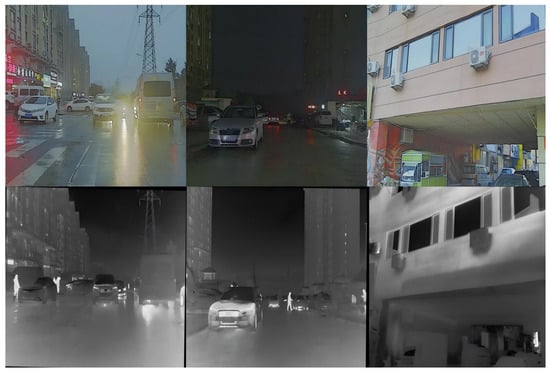
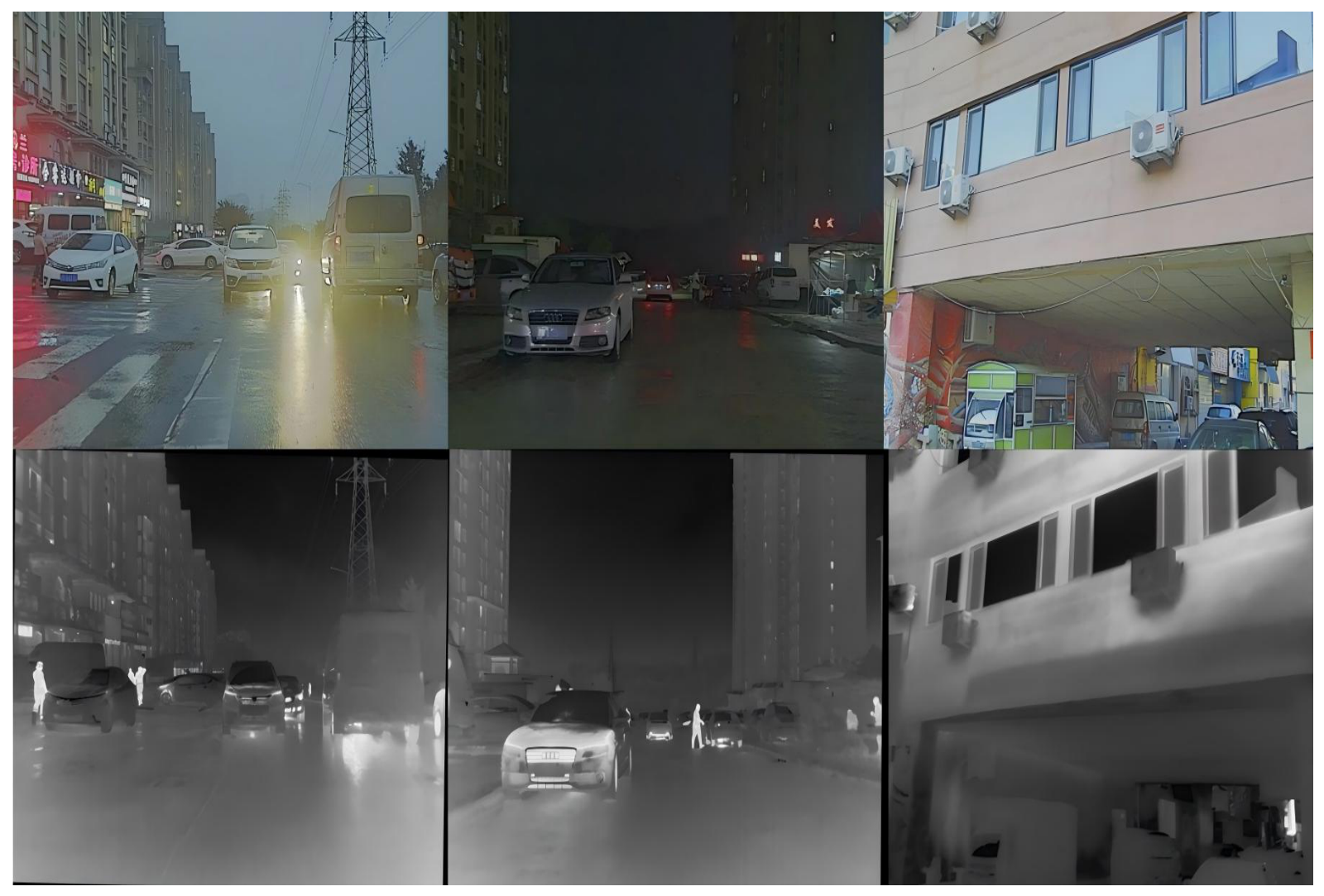
Object detection has traditionally relied on RGB images due to their rich visual information. Although RGB-based detectors perform well on benchmark datasets [1], these datasets are usually collected under ideal conditions. In real-world scenarios, factors such as fog, low illumination, and occlusion often degrade image quality, leading to poor generalization. To address this issue, multimodal object detection has been introduced to leverage complementary information from different modalities. As shown in Figure 1, infrared (IR) images complement RGB images in challenging conditions. Under low-light scenarios, RGB images may fail to distinguish pedestrians, while IR images highlight them clearly. Conversely, when thermal contrast is weak, RGB images provide useful texture and color cues to compensate for IR limitations.
Figure 1.
Complementary properties of RGB and IR modalities in complex environment.
In recent years, various methods have been proposed for dual-modal object detection. Many approaches focus on feature-level fusion to exploit complementary information from RGB and IR images. For example, U2Fusion [2] performs adaptive fusion based on feature information richness, while SDNet [3] combines dense and sparse representations to preserve important structures. In addition, some existing methods [4,5] adopt Transformer attention [6] to model cross-modal relationships at the feature level. These methods alleviate the influence of spatial misalignment between modalities through attention computation and achieve feature-level soft alignment by modeling the response relationships between different modal features. To address spatial misalignment, methods such as ReCoNet [7] and DAMSDet [8] introduce alignment-aware mechanisms for more accurate feature aggregation. In addition, some works incorporate edge cues or illumination-based weights to enhance fusion [9,10,11]. However, most existing methods rely on cooperative fusion and ignore the potential degradation of individual modalities under challenging conditions.
To address this issue, a frequency-domain-driven regional competitive fusion detection (RCFDet) is proposed to adaptively balance cross-modal fusion and modality selection. Specifically, pixel-level fusion is achieved via a fourier-transform-based region-level competitive edge (RCE) enhance module that extracts high-frequency, modality-specific details, which strengthens structural edges and improves robustness, especially for small object detection. Moreover, the cross-modal competitive attention (CCA) module is designed to support both correspondence learning and quality-aware competition, such that unreliable modalities can be adaptively suppressed rather than indiscriminately fused. In addition, a frequency-domain-based adaptive weighting strategy is proposed to replace illumination-driven weighting, leading to more accurate modality quality estimation and a more robust final fusion. Our contributions are summarized as follows:
- We design the RCE module for pixel-level RGB-IR fusion. It uses local search for pixel-level alignment and Gaussian high-pass filtering to extract modality-specific high-frequency cues, enabling effective fusion of RGB structural details and IR thermal information.
- We propose a modality-adaptive weight calculation method that combines frequency-domain features and information entropy to evaluate modality quality. It replaces illumination-based weighting and more accurately reflects the information contribution of each modality to the detection task.
- We propose a CCA module that dynamically switches between modality fusion and modality competition according to the modality quality estimated by RCE. It further uses Transformer attention to model cross-modal relationships, achieving feature-level soft alignment.
2. Materials and Methods
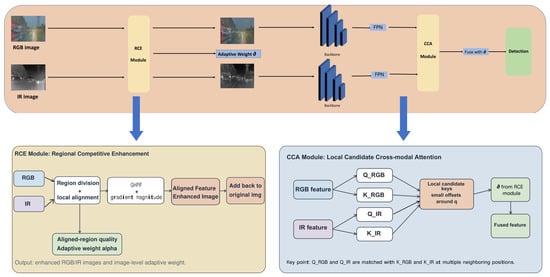
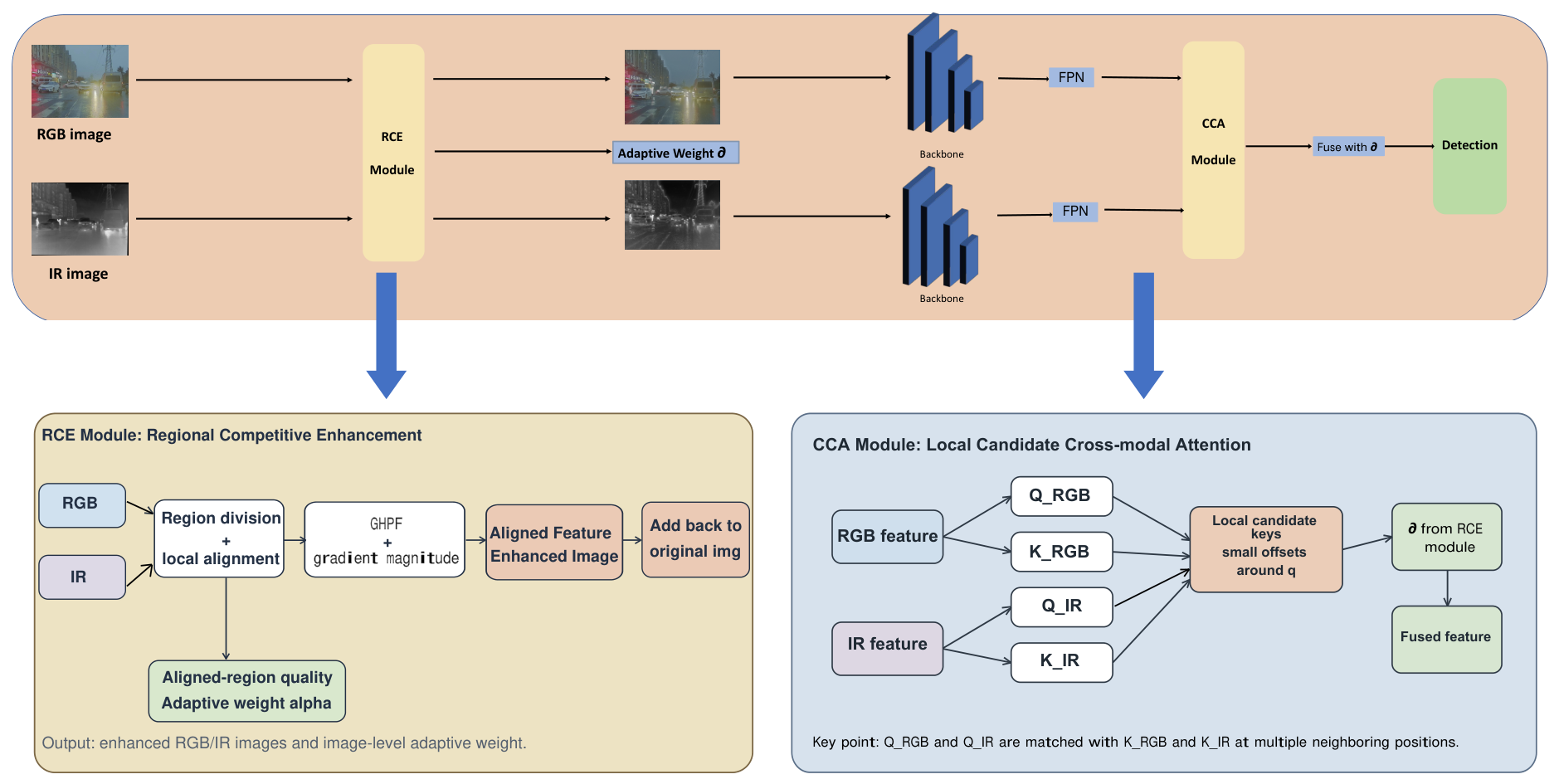
In this section, the overall workflow of the proposed model is presented, as illustrated in Figure 2. The model employs a dual-backbone design, with each backbone extracting features from a specific modality. It consists of three key components: (1) Pixel-Level Feature Enhancement Module Based on Region-Wise Search Alignment and Gaussian High-Pass Filtering (RCE), (2) Adaptive Weight Generation via Regional Information Entropy and Gradient-Residual Structural Quality Assessment, and (3) Cross-Modal Attention Module with Sparse Attention Mechanism (CCA).
Figure 2.
Overall framework of the proposed RCFDet with RCE and CCA module.
2.1. Region-Level Competitive Edge Enhancement Module
Edge enhancement has been widely used in single-modality object detection models to preserve fine-grained structural details during feature learning, which improves the detection performance of small objects [12,13]. This concept can be naturally extended to dual-mode object detection, with the key difference that edge information in our framework is jointly generated by both RGB and IR modalities. Empirical observations show that modality-specific discriminative features are primarily concentrated in the high-frequency components of the frequency domain. As a result, modality-specific information is isolated from each modality via Gaussian high-pass filtering. As shown in Equation (1),
where denotes the high-pass filtering response at the frequency coordinate ; represents the center of the frequency spectrum; and is the Gaussian scale parameter that controls the cutoff range of the high-pass filter. This filter suppresses low-frequency components near the spectrum center while preserving high-frequency components away from the center, thereby enhancing edges, textures, and local structural details in the image. Furthermore, we employ a local matching strategy to mitigate the effects of spatial misalignment between modalities. We use overlapping image blocks of pixels with a stride of 8 pixels. For each block, a local search is performed around the corresponding position in the infrared image, with a search range of pixels along both the horizontal and vertical axes and a search step of 2 pixels. During local matching, normalized cross-correlation, namely NCC, is used to measure the similarity between two local feature blocks. The NCC is computed as:
where A and B denote two local image blocks or feature blocks to be matched, such as the RGB high-frequency detail block and the IR high-frequency detail block; denotes the local matching window; represents the pixel coordinate within the window; and are the response values of the two feature blocks at coordinate ; and and denote the mean values of A and B within , respectively. NCC reduces the influence of local brightness and amplitude differences and focuses more on structural consistency, making it suitable for local similarity measurement between cross-modal RGB and IR images. To further improve local alignment between RGB and IR images, this paper constructs a matching score function by jointly considering high-frequency detail correlation, gradient magnitude correlation, gradient direction consistency, edge support, and displacement penalty:
Here, denotes the coordinate offset of a candidate IR region relative to the reference RGB region. Each candidate position is assigned a matching score , comprising five terms. measures the consistency of high-frequency detail distributions by computing local NCC between the absolute Gaussian high-pass responses after separate image-wise min–max normalization. computes local NCC between image-wise normalized Sobel gradient magnitudes extracted from the denoised grayscale images, measuring the consistency of edge-strength distributions. NGF averages the squared, stabilized normalized gradient inner products to measure edge-orientation consistency while accommodating cross-modal contrast reversals. measures the response of the continuous RGB support map at candidate IR edges, weighted by IR gradient magnitudes. Insufficient support reduces the matching score through the penalty term but does not directly determine whether an IR boundary is genuine. Finally, scales the displacement magnitude by the search radius r to discourage unnecessary large displacements. And the weights for feature correlation, gradient-magnitude correlation, and normalized gradient field similarity are set to , , and , respectively. The unmatched-edge and displacement penalty coefficients are set to and , respectively.
For the NGF formula, denotes the local matching region, x is a pixel coordinate, and is the candidate displacement. The vectors and denote stabilized Sobel gradients, obtained by dividing each gradient by the square root of its squared magnitude plus . In implementation, an additional is added to the product of the two normalization factors for numerical stability. NGF averages the squared gradient inner products over the region, accommodating contrast reversals between RGB and IR.
For the formula, denotes the IR gradient magnitude after image-wise min–max normalization. The continuous RGB support map is obtained by smoothing the normalized RGB gradient magnitude with a Gaussian standard deviation of 1.5, dividing by its 85th percentile with a lower bound of , and clipping to . A gradient magnitude map is normalized to zero if its range is below . When the denominator of the support formula does not exceed , is set to 1. This measure evaluates local cross-modal structural consistency rather than directly determining whether an IR boundary is genuine.
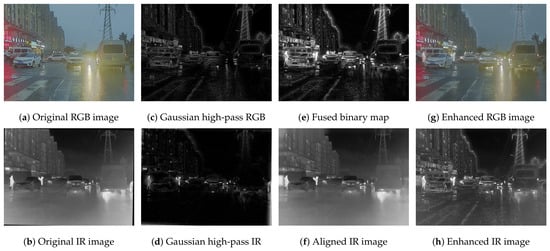
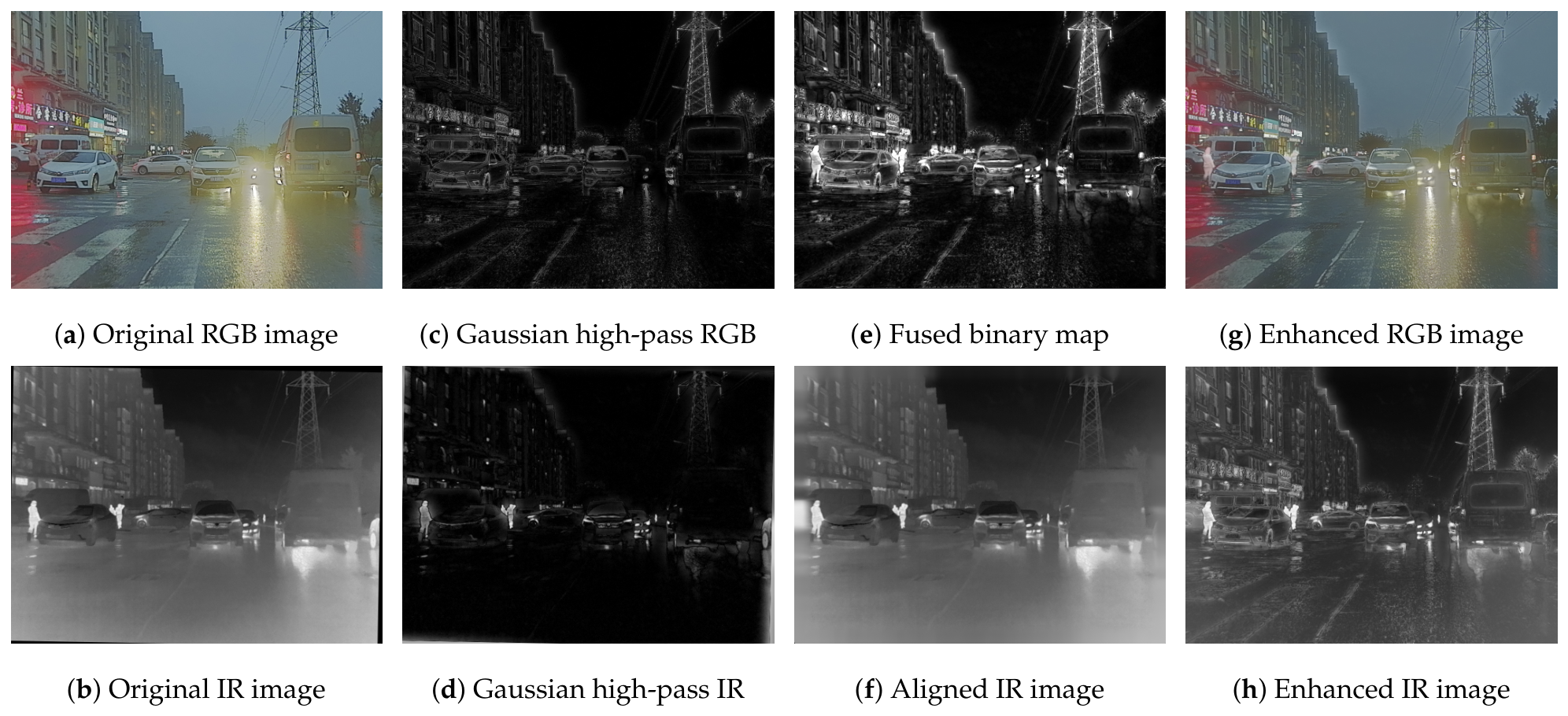
The combined score is used to select candidate displacements for local alignment. After alignment, high-frequency details from both modalities are fused to produce an edge map containing complementary structural information from RGB and IR images. Visualizations of this process are presented in the experimental section.
2.2. Frequency-Domain-Based Adaptive Weighting Strategy
In many existing dual-modal object detection methods, illumination coefficients are commonly used as adaptive weights for fusing RGB and IR features [11,14,15]. However, illumination intensity alone cannot accurately reflect the effective contribution of each modality under complex conditions.
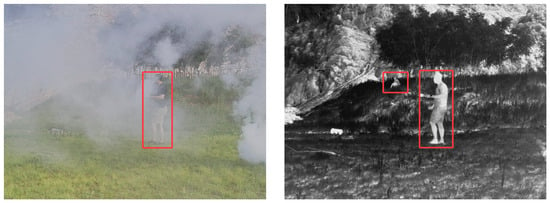
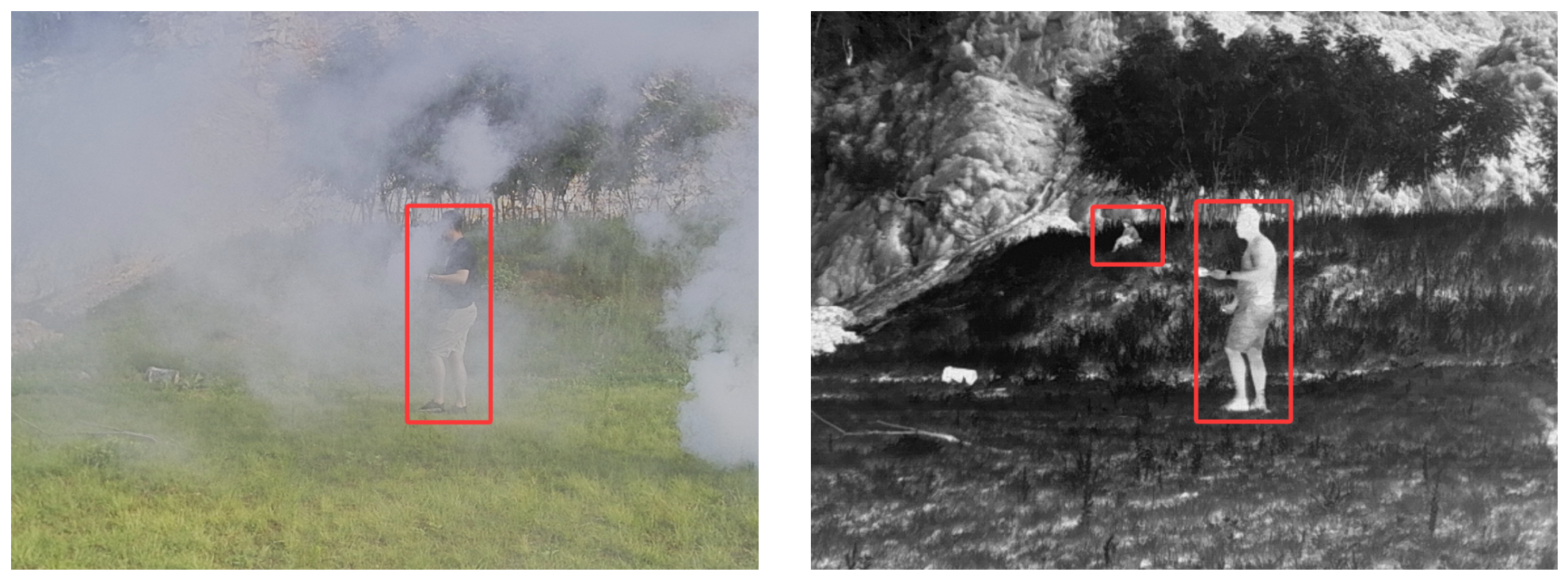
As shown in Figure 3, although the RGB image retains relatively high overall brightness under foggy conditions, only the foreground pedestrian within the red box can be readily distinguished, while details of the pedestrian farther behind are largely obscured by fog. In contrast, the infrared (IR) image preserves clear object contours and boundaries, allowing both pedestrians within the red box to be more clearly distinguished. To overcome the limitation that illumination intensity is easily affected by environmental variations, exposure conditions, and sensor response differences, this paper adopts a frequency-domain structural information based strategy for modality weight estimation. Specifically, Gaussian high-pass filtering is first applied to RGB and infrared images to extract their high-frequency components. Compared with low-frequency illumination cues, high-frequency components contain more reliable structural information, such as edges, contours, textures, and object boundaries. Therefore, they provide a more stable basis for modality selection in cross-modal fusion. Let denote the RGB and IR grayscale images after Gaussian high-pass filtering, respectively, and let k denote a local region. The amount of frequency-domain information in region k is measured by entropy:
where denotes the occurrence probability of gray value v in region k of modality m. A larger entropy value indicates a richer gray-level distribution and potentially more structural information. However, entropy alone may be affected by noise or invalid high-frequency responses. Therefore, a regional quality score is further introduced to jointly model frequency-domain information, structural strength, and modality reliability:
Figure 3.
RGB and IR image in foggy scenes.
The regional quality score is the product of three factors. The first is an information factor, which measures the richness of the regional grayscale distribution using entropy , normalized by . The operator restricts the result to , with saturation at 1 when the entropy reaches or exceeds . High entropy alone does not necessarily indicate reliable structure, motivating the other two factors.
The second is a structural strength factor, where denotes the mean gradient magnitude in region k, and is the gradient normalization scale. Its range is . This factor adjusts the quality score according to local structural strength while retaining a baseline contribution.
The third is a structural reliability factor, where denotes the mean absolute residual between the input grayscale image and its Gaussian-smoothed version, and prevents division by zero. The gradient-to-residual ratio reflects the strength of smoothed structural responses relative to local details and perturbations. It serves as a heuristic reliability measure rather than a strict signal-to-noise ratio. This factor lies in .
After obtaining the regional quality score , we further consider the relative information content of the two modalities within the same region. Accordingly, the regional entropy proportion is defined as:
Here, denotes the RGB or IR modality, and k indexes the corresponding local region. and denote the regional entropies of RGB and IR, respectively; is the entropy of the current modality, and prevents division by zero. Thus, represents the current modality’s share of the combined regional entropy.
While assesses regional information quality, describes its relative information proportion. Their product provides a regional contribution that accounts for both quality and relative information content. Averaging these contributions over the valid-region set yields the overall modality score:
where denotes the set of valid regions. It can be observed that is not a simple average of entropy values. Instead, it is obtained by weighting the regional quality with the modality information proportion , and thus reflects the amount of reliable structural information preserved by modality m and its relative contribution within valid regions. To prevent low-quality modalities from interfering with fused features, a modality reliability threshold is further introduced. When the overall quality score of a modality is lower than this threshold, the modality is considered to contain insufficient effective frequency-domain structural information and is excluded from dual-modal fusion. From dual-source object detection degenerates into single-source object detection. The infrared modality weight is defined as:
The corresponding RGB modality weight is:
Here, denotes the modality reliability threshold, and is an indicator function that returns 1 if the condition is satisfied and 0 otherwise. Specifically, when both RGB and IR quality scores are above the threshold, the system performs adaptive dual-modal fusion and assigns weights according to the relative values of and . When RGB is below the threshold while IR is above it, RGB is regarded as unreliable in the current sample, and , meaning that only the IR modality is used. Conversely, when IR is below the threshold while RGB is above it, , and only the RGB modality is used. When both modalities are below the threshold, their frequency-domain structural responses are both insufficient. In this case, the modality with the larger is selected as the single-source input, and the model degenerates into single-source object detection.
2.3. Cross-Modal Attention Module
In cross-modal attention computation, two major issues need to be addressed: the effective fusion of RGB and IR images, and the possible spatial misalignment between the two modalities.
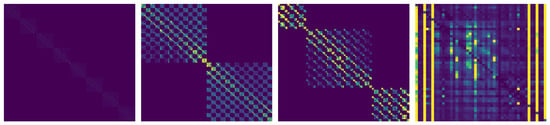
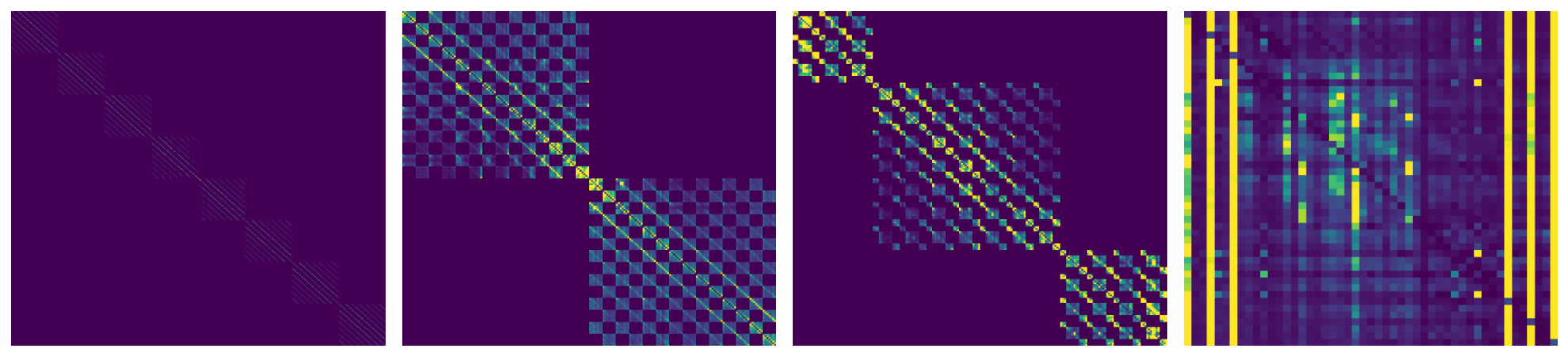
To mitigate cross-modal spatial misalignment, we employ sparse cross-modal attention to establish feature correspondences among local candidate positions while reducing computational cost compared with global dense attention. Specifically, we allow each query Q to interact only with keys K within a limited neighborhood. As illustrated by the Swin-T attention distributions in Figure 4, colors represent attention weight magnitudes, increasing from dark purple to yellow, with yellow regions indicating stronger attention responses. Strong responses are predominantly concentrated at the query location and its neighboring regions, except in the final layer, providing an intuitive motivation for local sampling. Furthermore, Deformable DETR achieves efficient feature aggregation by attending to a small set of sampling locations around reference points, improving training convergence and detection performance. Inspired by this design, we introduce local sparse sampling into cross-modal attention to model cross-modal correspondences through neighborhood interactions, reducing computational cost while mitigating local spatial misalignment.
Figure 4.
Visualization of Attention Weights across Different Layers of Swin-T.
Specifically, at each FPN level, the spatial location of each query is first mapped to a normalized reference coordinate within . Local perturbations are then applied in four directions: upward, downward, leftward, and rightward. Together with the reference position, these locations form the local candidate set. The perturbation range in normalized coordinates progressively decreases at deeper FPN levels, yielding level-dependent sampling ranges. Each query subsequently attends only to the keys and values of the opposite modality at these candidate locations, enabling local cross-modal feature aggregation. The local candidate set is defined as follows:
where and denote the horizontal and vertical perturbation offsets. Then, Q only computes attention with the K vectors corresponding to the perturbed neighboring absolute positions, instead of computing attention with all K vectors in the entire feature map. The reason for this design is that although RGB and IR images may have spatial misalignment, such misalignment usually appears as local displacement rather than global disordered correspondence. Therefore, for a query vector at a certain position, the most relevant key vectors are usually located around that position. By performing Q-K matching only within a local neighborhood, the model can effectively capture local cross-modal correspondences while avoiding the excessive computational cost caused by global attention. This strategy not only reduces computational complexity, but also alleviates the influence of spatial misalignment between RGB and IR images through four-directional perturbation.
To enable complementary information exchange between the two modalities, we introduce a bidirectional cross-modal attention mechanism. The features after FPN contain both multi-scale spatial details and high-level semantic information. Therefore, conducting modality interaction at this stage enables more effective fusion of texture and structural information from RGB features and thermal target responses from IR features. Specifically, this paper uses not only RGB image features to generate query vectors , but also IR image features to generate query vectors . Then, and are respectively used to compute attention with the key vectors K and value vectors V from both RGB and IR feature maps, thereby achieving bidirectional cross-modal information fusion. This process can be formulated as:
Here, RGB queries interact with local IR keys and values to obtain , while IR queries interact with local RGB keys and values to obtain . These interactions enable cross-modal information exchange and feature-level soft alignment. Here, l denotes the FPN level, denotes the query position in the feature map, and R and I denote the RGB and IR modalities, respectively. and are the query vectors. The set contains local candidate positions obtained through perturbations around the query position in four directions: upper-left, lower-left, upper-right, and lower-right. The matrices and are formed by stacking the key and value vectors of modality m at these candidate positions as rows.
For a feature map of size , there are query positions. Let . Omitting batch and attention-head dimensions, each query has dimensions , and the local key and value matrices have dimensions and , respectively. Here, is the query and key dimension, and is the value dimension. The attention scores therefore have dimensions , and the output has dimensions . Softmax normalizes over these local candidate positions, ensuring that the attention weights sum to one for each query. The two directions are computed separately, without concatenating keys and values across modalities or normalizing over all spatial positions.
Furthermore, CCA execution is controlled by the modality weights produced by RCE. Bidirectional attention is computed only when both RGB and IR weights are positive. If either modality has a zero weight, CCA is bypassed, and the features of the modality with a nonzero weight are forwarded to the subsequent detection network for single-modality object detection.
3. Results
To facilitate the reproduction of our results, this section provides details of the deployment environment and key hyperparameter settings of the proposed model.
Dataset and metric: We conduct training and evaluation on the M3FD dataset [9], which contains 4200 aligned RGB–IR image pairs across six object categories: People, Car, Bus, Motorcycle, Lamp, and Truck. We randomly split the dataset into training and test sets at a ratio of 8:2. This dataset covers diverse real-world scenarios, including low-light, nighttime, and adverse weather conditions, making it suitable for evaluating multimodal detection robustness.
Experimental Environment: All experiments are performed on a single NVIDIA RTX 4090 GPU with 24 GB memory. The implementation is based on PyTorch 2.8.0 + cuda12.8, MMCV 2.1.0, and MMDetection 3.3.0. Swin Transformer(Swin-T) is adopted as the backbone for both RGB and IR modalities to extract hierarchical features. Input images are resized to 384 × 384 pixels and augmented with standard data augmentation strategies, including horizontal flipping, vertical flipping, and random cropping, to enhance model generalization.
Hyperparameter Settings: After feature-level fusion, the integrated representations are fed into the detection head, which follows the DINO [16] architecture with six Transformer layers in both the encoder and decoder. We adopt the AdamW optimizer with a batch size of 4. The initial learning rate is set to . An adaptive learning rate scheduler (CosineAnnealingLR) is employed, using COCO mAP as the monitoring metric, with a minimum learning rate of . The model is trained for 50 epochs. The total number of trainable parameters is 158 M. The average inference time per image is 100.35 ms, corresponding to a throughput of 9.97 images per second (img/s), indicating a reasonable trade-off between accuracy and efficiency. Detailed hyperparameter settings are summarized in Table 1. Further configuration details are also available in the https://github.com/tmyz1/RCFDet (accessed on 14 October 2026).
Table 1.
Detailed configuration of hyperparameters.
3.1. Visualization Analysis of Local Search and Cross-Modal Fusion
To further verify the effectiveness of the Region-level Competitive Edge Enhancement Module, we visualize its intermediate results, as shown in Figure 5. The samples are selected from the M3FD dataset. The first column shows the original RGB and IR images. It can be observed that the original IR image contains obvious black borders around the image, and the RGB and IR images are not perfectly aligned in the spatial domain. Such misalignment may introduce interference into subsequent cross-modal fusion.
Figure 5.
The region-based edge enhancement process for RGB and IR images.
The second column presents the results after applying Gaussian high-pass filtering to the RGB and IR images. It can be seen that the RGB image mainly preserves structural information such as edges, textures, and contours, while the IR image retains more salient information related to thermal target responses. This indicates that Gaussian high-pass filtering can effectively highlight the modality-specific and complementary features of RGB and IR images, providing a reliable basis for subsequent region-level competitive fusion.
The third column illustrates the local search and fusion results of the proposed method. The first image in the third column is the binarized result obtained after model fusion. It shows that the proposed method effectively integrates the edge and texture information from the RGB image with the thermal target information from the IR image, demonstrating its ability to combine complementary features at the region level. The second image in the third column shows the corrected IR image after local search. Compared with the original IR image, the corrected result significantly suppresses the black borders and shows better local structural correspondence with the RGB image, indicating that the local search strategy can effectively alleviate spatial misalignment between RGB and IR images.
The fourth column presents the images enhanced by the Region-level Competitive Edge Enhancement Module. It can be observed that the enhanced RGB image contains more thermal target information from the infrared modality, while the enhanced IR image incorporates more edge, texture, and contour information from the RGB modality. These results demonstrate that the proposed module can suppress invalid boundary interference in infrared images while enabling effective information complementarity between the two modalities, thereby improving the structural representation and target saliency of the fused features.
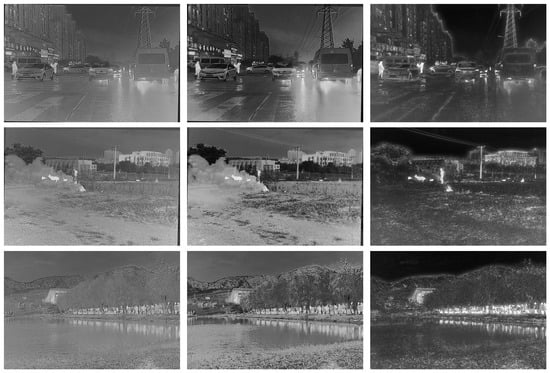
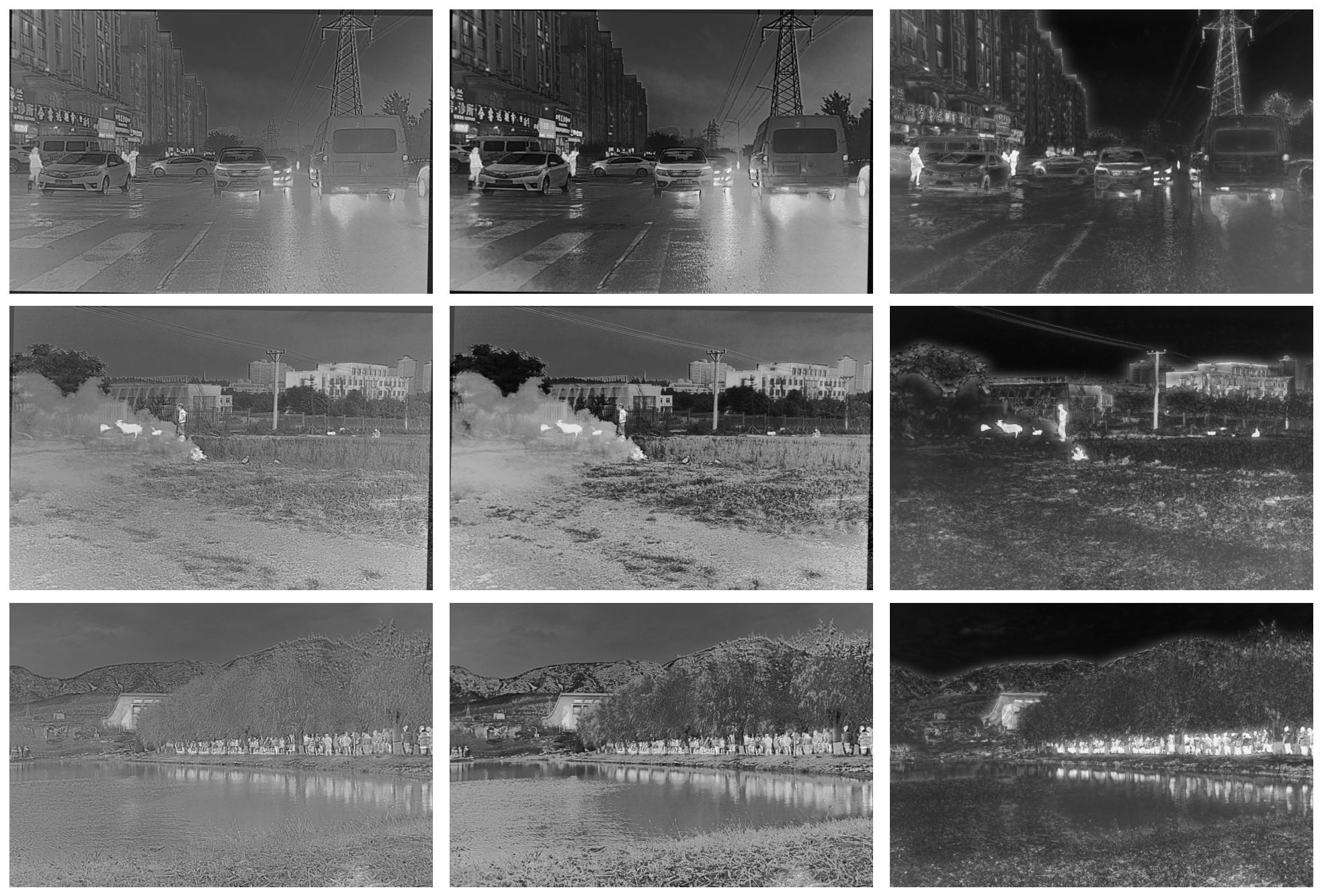
Since our RCE module performs pixel-level fusion, we also compare it with two other pixel-level fusion methods, DID [17] and U2F [2], as shown in the Figure 6.
Figure 6.
Pixel-Level Comparison of RCF, U2F, and DID Models.
The first and second columns present the images generated by DID and U2F, respectively. Since both methods produce grayscale outputs, we use the infrared (IR) images enhanced by our RCE module for comparison, as shown in the third column. The visual comparison indicates that our method preserves finer image details and achieves higher contrast than DID and U2F. Furthermore, in the subsequent detection stage, our approach can utilize both the enhanced IR images and complementary information, such as color cues, provided by the RGB images.
3.2. Visualization Analysis of Adaptive Modality Weights
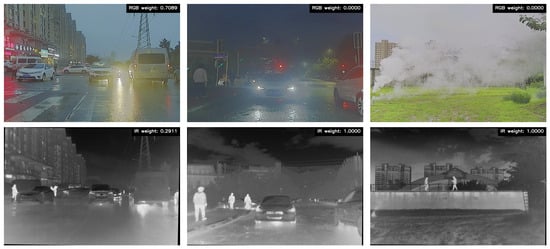
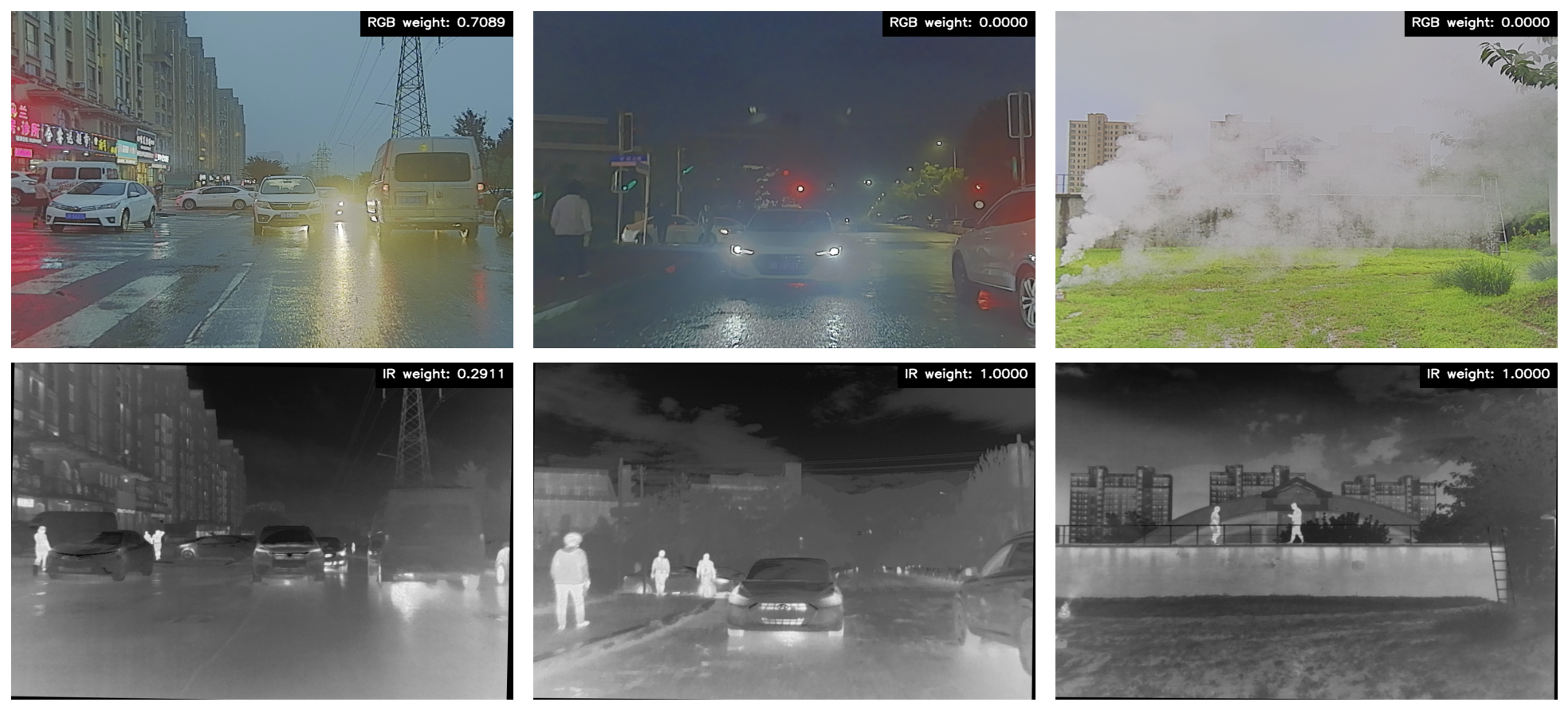
The visualization results of adaptive modality weights are shown in Figure 7. The first row presents RGB images, while the second row shows the corresponding IR images. The value displayed in the upper-right corner of each image denotes the adaptive weight computed by the model for the current modality. It can be observed that under normal illumination conditions, both RGB and IR images usually have non-zero weights, indicating that the model considers both modalities to contain useful information. In this case, dual-source object detection is performed, followed by cross-modal attention computation.
Figure 7.
Adaptive Weights of RGB and IR Modalities under Different Environmental Conditions.
However, under challenging conditions such as nighttime, low illumination, or haze, RGB images are more likely to suffer from insufficient illumination, reduced contrast, and degraded visibility, which significantly weakens their available structural information. In such cases, the model may assign a weight of 0 to the RGB modality, indicating that the current RGB image quality is too poor to provide reliable features for detection. As a result, the model no longer enforces RGB-IR dual-modal fusion, but degenerates into single-source object detection based only on the IR image, and the subsequent cross-modal attention computation is skipped. This result demonstrates that the proposed adaptive weighting mechanism can dynamically adjust the fusion strategy according to the modality quality under different environments, preventing low-quality modalities from negatively affecting detection performance and thereby improving the robustness of the model in complex scenarios.
3.3. Comparison with State-of-the-Art Methods
We compare our method with U2F [2], TAD [9], ReC [7], DAM [8], CDD [18], EID [19] and FSATF [20] on the M3FD dataset. Some of the compared methods primarily focus on pixel-level image fusion. For these methods, we feed the fused images into a Swin-T backbone for feature extraction, followed by a DINO detection head to obtain the final object detection results. All methods use the parameter settings reported in their original papers. As shown in Table 2, red and blue indicate the best and second-best results, respectively. Our method achieves the best overall performance, with an mAP50 of .
Table 2.
mAP50(%) of Different Models on the M3FD Dataset.
Compared with U2F, TAD, ReC, DAM, CDD, FSATF and EID, our method improves mAP50 by , , , , , and , respectively. Notably, our approach achieves superior performance on categories such as Bus, Motorcycle and People, which often involve complex backgrounds or degraded modalities. Furthermore, our method achieved the second-best performance in the Track category. This indicates that the proposed frequency-domain competitive fusion strategy effectively enhances discriminative feature representation under challenging conditions. For categories like Car and Lamp, the performance gains are relatively moderate, which may be attributed to their more stable appearance and lower sensitivity to modality degradation.
To further evaluate the applicability of the proposed method, we conducted experiments on LLVIP, which contains 15,488 RGB-IR image pairs captured predominantly under low-light conditions and includes pedestrians as the sole detection category. We divided the dataset into training and test sets at a ratio of 7:3 and compared RCFDet with DID, U2F, DAM, and EID. For DID and U2F, which primarily perform pixel-level fusion, we first generated fused images and then fed them into the same Swin-DINO detection framework. DAM and EID instead perform feature-level fusion. As shown in Table 3, all models were trained for 50 epochs using the same evaluation protocol as in the M3FD experiments. RCFDet achieved the highest mAP among the compared methods under this experimental setting, further demonstrating its effectiveness for pedestrian detection under low-light conditions.
Table 3.
Performance Comparison on the LLVIP Dataset.
3.4. Ablation Studies and Visualization Analysis
Table 4 presents the ablation results for different input modalities and the RCE and CCA modules. Using only RGB or IR images yields mAP scores of and , respectively, whereas the dual-modality baseline achieves , indicating the complementary information provided by the two modalities. Building on this baseline, the RCE module performs pixel-level fusion through Gaussian high-pass filtering and employs a local window search strategy to mitigate cross-modal spatial misalignment, increasing mAP to , a gain of 2.1 percentage points. The CCA module performs feature-level fusion through local cross-attention, restricting each query to interactions with key–value pairs within a local neighborhood to reduce the influence of cross-modal misalignment on feature interaction. Incorporating CCA alone achieves an mAP of , improving the baseline by 1.7 percentage points. Combining both modules yields the best performance, with mAP50, mAP75, and mAP reaching , , and , respectively. The overall mAP improvement of 5.0 percentage points over the baseline demonstrates the complementary benefits of pixel-level and feature-level fusion.
Table 4.
Ablation study of different modalities and strategies.
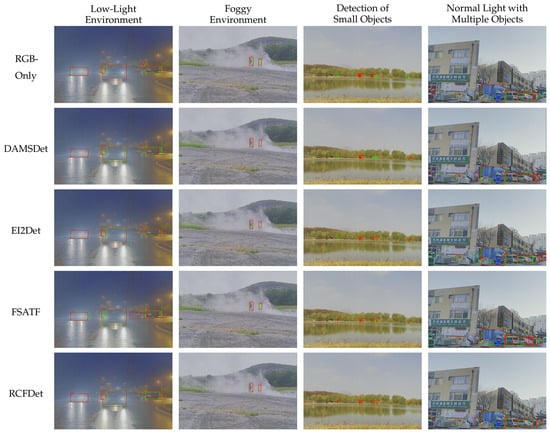
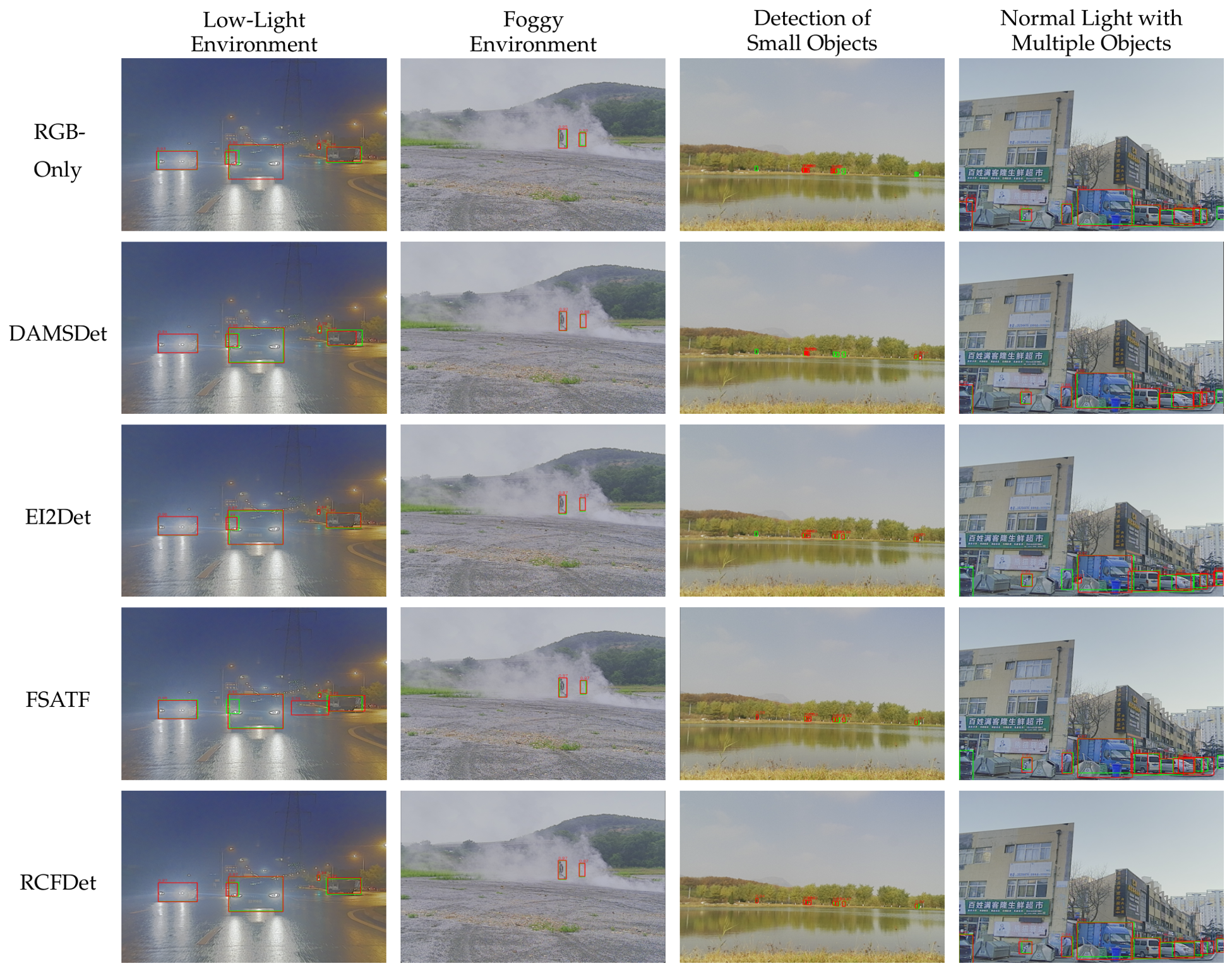
Figure 8 visualizes the comparison between RCFDet and other models. In the figure, the first row corresponds to the RGB-only method with a Swin Transformer backbone and DINO detection head, the second row corresponds to DAMSDet, the third row corresponds to EI2Det, and the fourth row corresponds to FSATF. The first column corresponds to low-light conditions, the second column to dense foggy weather, the third column to small object detection, and the fourth column to multi-object detection under normal illumination. It can be observed that RCFDet achieves accurate localization and reliable prediction under various challenging conditions, demonstrating superior overall performance compared with the other methods.
Figure 8.
Comparison of RCFDet and other models under different scenarios, where green boxes denote ground-truth bounding boxes and red boxes denote predicted bounding boxes.
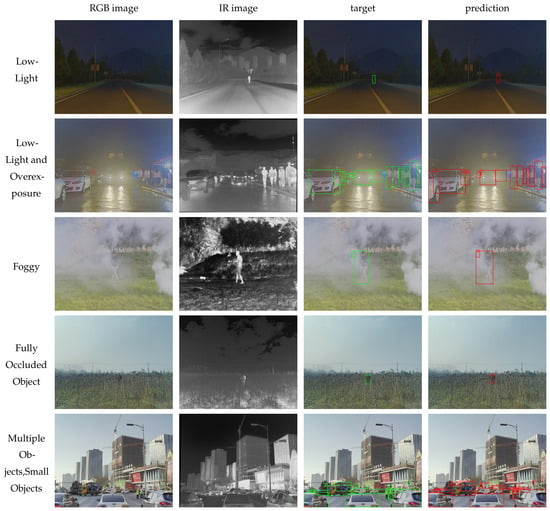
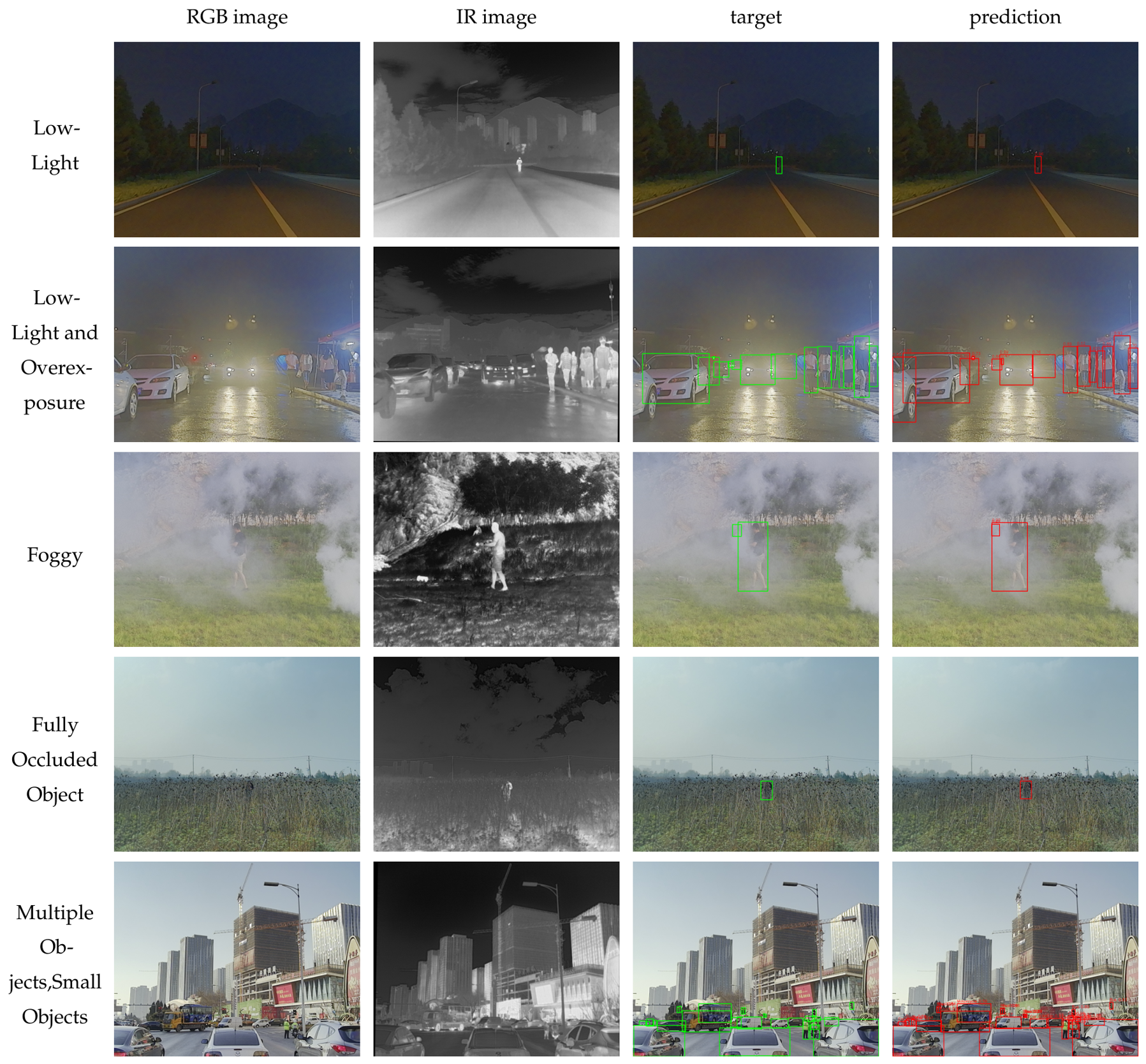
Figure 9 illustrates the object detection performance of the proposed model under complex environmental conditions. From left to right, the columns show RGB images, infrared (IR) images, ground-truth annotations (green bounding boxes), and predictions from our model (red bounding boxes). From top to bottom, the rows illustrate scenes with extremely low illumination; dark backgrounds combined with local overexposure caused by vehicle headlights; haze; severe or nearly complete target occlusion; and multiple objects, including small objects, in complex scenes.
Figure 9.
Object Detection Results of RCFDet in Complex Environments.
The visualization results show that, under these challenging conditions, RGB images are often affected by insufficient illumination, overexposure, reduced visibility, or occlusion, resulting in incomplete object appearance information or decreased contrast. Nevertheless, the proposed model can still effectively exploit the complementary information between RGB and IR modalities to accurately recognize and localize the targets. In particular, under dark, hazy, and occluded scenarios, the predicted bounding boxes remain highly consistent with the ground-truth boxes, demonstrating the strong robustness and stable detection performance of the proposed method in complex environments.
4. Conclusions
In this work, we propose RCFDet, an RGB-IR object detector that combines competition and fusion to mitigate performance degradation caused by incorporating low-quality modalities. The model extracts modality-specific structural cues through high-frequency analysis and introduces an adaptive weighting strategy combining frequency-domain information and entropy as an alternative to illumination-based weighting. The RCE module first assesses modality quality to select between dual-modality and single-modality detection. When both modalities are available, it performs local alignment and pixel-level fusion to enhance complementary structural details. When one modality is excluded, the original input of the remaining modality is retained, and cross-modal processing is bypassed. The CCA module subsequently enables feature interaction and soft alignment in the dual-modality branch. Experiments on M3FD and LLVIP demonstrate competitive detection performance.
Author Contributions
Conceptualization, Y.G. and Y.M.; methodology, Y.G.; software, Y.G.; validation, Y.G., G.N., H.L. and Y.Z.; formal analysis, Y.G. and G.N.; investigation, G.N., H.L. and Y.Z.; resources, Y.M.; writing—original draft preparation, H.L.; writing—review and editing, G.N.; visualization, Y.G.; supervision, Y.M.; project administration, G.N.; funding acquisition, Y.M. All authors have read and agreed to the published version of the manuscript.
Funding
This research was funded by the Research Institute of Electronic Science and Technology, University of Electronic Science and Technology of China.
Data Availability Statement
The datasets analyzed in this study are publicly available. The M3FD dataset is available at https://github.com/JinyuanLiu-CV/TarDAL (accessed date 14 October 2026) and the LLVIP dataset is available at https://bupt-ai-cz.github.io/LLVIP/ (accessed date 14 October 2026).
Conflicts of Interest
The authors declare no conflicts of interest. The funders had no role in the design of the study; in the collection, analyses, or interpretation of data; in the writing of the manuscript; or in the decision to publish the results.
References
- Yang, Y.; Dai, J.; Wang, Y.; Chen, Y. FM-RTDETR: Small Object Detection Algorithm Based on Enhanced Feature Fusion With Mamba. IEEE Signal Process. Lett. 2025, 32, 1570–1574. [Google Scholar] [CrossRef] [Scilit]
- Xu, H.; Ma, J.; Jiang, J.; Guo, X.; Ling, H. U2Fusion: A Unified Unsupervised Image Fusion Network. IEEE Trans. Pattern Anal. Mach. Intell. 2022, 44, 502–518. [Google Scholar] [CrossRef] [Scilit] [PubMed]
- Zhang, H.; Ma, J. SDNet: A Versatile Squeeze-and-Decomposition Network for Real-Time Image Fusion. Int. J. Comput. Vis. 2021, 129, 2761–2785. [Google Scholar] [CrossRef] [Scilit]
- Deng, B.; Liu, D.; Cao, Y.; Liu, H.; Yan, Z.; Chen, H. CFRNet: Cross-Attention-Based Fusion and Refinement Network for Enhanced RGB-T Salient Object Detection. Sensors 2024, 24, 7146. [Google Scholar] [CrossRef] [Scilit] [PubMed]
- Li, R.; Wang, Z.; Guo, J.; Zhang, C. CSANet: Context–Spatial Awareness Network for RGB-T Urban Scene Understanding. J. Imaging 2025, 11, 188. [Google Scholar] [CrossRef] [Scilit] [PubMed]
- Vaswani, A.; Shazeer, N.; Parmar, N.; Uszkoreit, J.; Jones, L.; Gomez, A.N.; Kaiser, L.; Polosukhin, I. Attention Is All You Need. arXiv 2017. [Google Scholar] [CrossRef] [Scilit]
- Huang, Z.; Liu, J.; Fan, X.; Liu, R.; Zhong, W.; Luo, Z. ReCoNet: Recurrent Correction Network for Fast and Efficient Multi-modality Image Fusion. In Proceedings of the Computer Vision—ECCV 2022; Springer: Berlin/Heidelberg, Germany, 2022; pp. 539–555. [Google Scholar] [CrossRef] [Scilit]
- Guo, J.; Gao, C.; Liu, F.; Meng, D.; Gao, X. DAMSDet: Dynamic Adaptive Multispectral Detection Transformer with Competitive Query Selection and Adaptive Feature Fusion. In Proceedings of the Computer Vision—ECCV 2024; Springer: Berlin/Heidelberg, Germany, 2024; pp. 464–481. [Google Scholar] [CrossRef] [Scilit]
- Liu, J.; Fan, X.; Huang, Z.; Wu, G.; Liu, R.; Zhong, W.; Luo, Z. Target-aware Dual Adversarial Learning and a Multi-scenario Multi-Modality Benchmark to Fuse Infrared and Visible for Object Detection. In Proceedings of the 2022 IEEE/CVF Conference on Computer Vision and Pattern Recognition (CVPR); IEEE: New York, NY, USA, 2022; pp. 5792–5801. [Google Scholar] [CrossRef] [Scilit]
- Zhang, F.; Zhang, Z. IEAM: Integrating Edge Enhancement and Attention Mechanism with Multi-Path Complementary Features for Salient Object Detection in Remote Sensing Images. Remote Sens. 2025, 17, 2053. [Google Scholar] [CrossRef] [Scilit]
- Zhang, Y.; Yu, H.; He, Y.; Wang, X.; Yang, W. Illumination-Guided RGBT Object Detection With Inter- and Intra-Modality Fusion. IEEE Trans. Instrum. Meas. 2023, 72, 1–13. [Google Scholar] [CrossRef] [Scilit]
- Guan, W.; Wang, T.; Qi, J.; Zhang, L.; Lu, H. Edge-Aware Convolution Neural Network Based Salient Object Detection. IEEE Signal Process. Lett. 2019, 26, 114–118. [Google Scholar] [CrossRef] [Scilit]
- Luo, Z.; Lv, X.; Wen, X.; Zhang, X. EFNet: Multiscale Edge Fusion Network for Camouflaged Object Detection. IEEE Signal Process. Lett. 2025, 32, 2957–2961. [Google Scholar] [CrossRef] [Scilit]
- Chen, K.; Liu, J.; Zhang, H. IGT: Illumination-guided RGB-T object detection with transformers. Knowl.-Based Syst. 2023, 268, 110423. [Google Scholar] [CrossRef] [Scilit]
- Guan, D.; Cao, Y.; Yang, J.; Cao, Y.; Yang, M.Y. Fusion of multispectral data through illumination-aware deep neural networks for pedestrian detection. Inf. Fusion 2019, 50, 148–157. [Google Scholar] [CrossRef] [Scilit]
- Zhang, H.; Li, F.; Liu, S.; Zhang, L.; Su, H.; Zhu, J.; Ni, L.M.; Shum, H.Y. DINO: DETR with Improved DeNoising Anchor Boxes for End-to-End Object Detection. arXiv 2022, arXiv:2203.03605. [Google Scholar] [CrossRef] [Scilit]
- Zhao, Z.; Xu, S.; Zhang, C.; Liu, J.; Li, P.; Zhang, J. DIDFuse: Deep Image Decomposition for Infrared and Visible Image Fusion. In Proceedings of the Twenty-Ninth International Joint Conference on Artificial Intelligence; IJCAI: Bremen, Germany, 2020; pp. 970–976. [Google Scholar] [CrossRef] [Scilit] [PubMed]
- Zhao, Z.; Bai, H.; Zhang, J.; Zhang, Y.; Xu, S.; Lin, Z.; Timofte, R.; Van Gool, L. CDDFuse: Correlation-Driven Dual-Branch Feature Decomposition for Multi-Modality Image Fusion. In Proceedings of the 2023 IEEE/CVF Conference on Computer Vision and Pattern Recognition (CVPR); IEEE: New York, NY, USA, 2023; pp. 5906–5916. [Google Scholar] [CrossRef] [Scilit]
- Hu, K.; He, Y.; Li, Y.; Zhao, J.; Chen, S.; Kang, Y. EI2Det: Edge-Guided Illumination-Aware Interactive Learning for Visible-Infrared Object Detection. IEEE Trans. Circuits Syst. Video Technol. 2025, 35, 7101–7115. [Google Scholar] [CrossRef] [Scilit]
- Zhang, T.; Zhao, J.; Zhu, Y.; Cui, G.; Lyu, Y. FSATFusion: Frequency-Spatial Attention Transformer for infrared and visible image fusion. Comput. Vis. Image Underst. 2026, 263, 104600. [Google Scholar] [CrossRef] [Scilit]
- Liu, Z.; Tan, Y.; He, Q.; Xiao, Y. SwinNet: Swin Transformer Drives Edge-Aware RGB-D and RGB-T Salient Object Detection. IEEE Trans. Circuits Syst. Video Technol. 2022, 32, 4486–4497. [Google Scholar] [CrossRef] [Scilit]

Disclaimer/Publisher’s Note: The statements, opinions and data contained in all publications are solely those of the individual author(s) and contributor(s) and not of MDPI and/or the editor(s). MDPI and/or the editor(s) disclaim responsibility for any injury to people or property resulting from any ideas, methods, instructions or products referred to in the content. |
© 2026 by the authors. Licensee MDPI, Basel, Switzerland. This article is an open access article distributed under the terms and conditions of the Creative Commons Attribution (CC BY) license.