


Abstract
The Western Sichuan Plateau is characterized by pronounced topographic relief, intense tectonic activity, and widespread metamorphic sandstone, slate, and locally carbonaceous strata, which create a potential for abnormal gas emission during highway-tunnel construction. Gas in non-coal-bearing formations can occur in concealed, spatially discrete sources and localized release zones whose structural connections are difficult to characterize fully by conventional investigation. The objective of this study is to identify the geological settings and inspection locations associated with localized methane enrichment in a low-gas highway tunnel through non-coal-bearing metamorphic strata, and to translate these findings into construction-stage control priorities. The Linchang Tunnel of the Jiuzhi–Maerkang Expressway is examined using geological investigation, gas-composition testing and periodic concentration records. The Linchang Tunnel mainly traverses metamorphic sandstone and slate of the Triassic Zhuwo and Zagunao formations. Locally developed carbonaceous slate provides a potential hydrocarbon source, whereas complex folding and relatively confined surrounding-rock conditions favor local gas preservation. The classification-stage absolute methane emission value was 1.185 m3/min, placing the tunnel in the low-gas category. On the basis of representative tunnel projects in Western Sichuan, China, gas emission from non-coal-bearing strata is generalized into three basic modes: direct exposure of hydrocarbon-generating strata, connection of deep gas reservoirs by gas-conducting structures, and indirect exposure of structurally controlled gas accumulations. Periodic field inspections show a cross-sectional concentration ordering at the tunnel face: CH4 concentrations are typically 0.04–0.05% at the crown, approximately 0.03% at the haunches, and approximately 0.02% at the arch feet; relatively high concentrations also occur locally in fractures and collapse cavities. Gas-composition tests confirm methane in the sampled gas–air mixtures. An explicitly idealized transport calculation and a three-grid comparison examine how source intensity, ventilation and effective mixing influence local enrichment; these calculations are distinguished from field observations of crown concentrations. Accordingly, a process-wide framework integrating advanced identification, dynamic monitoring, enhanced ventilation, borehole drainage, grouting sealing, and tiered management is proposed. The findings provide a basis for gas-hazard identification and construction-safety control in highway tunnels through non-coal-bearing metamorphic strata on the Western Sichuan Plateau, China, and in comparable geological settings.
1. Introduction
In recent years, as the number of gas-bearing tunnels in China has increased and construction conditions have become more complex, research has expanded from conventional gas control in coal-bearing strata to the genesis of gas in non-coal-bearing strata, shallow natural-gas occurrence, construction ventilation, risk assessment, and process-wide safety control. Previous studies have shown that advance identification, continuous monitoring, construction ventilation, active drainage, and dynamic classification are key components of gas-risk control in tunnels [1,2,3]. Source conditions, faults and fractures, reservoir space and sealing also control gas in coal-bearing strata. The distinction considered here is the engineering setting: in non-coal-bearing formations, a laterally traceable coal seam may be absent as a gas-bearing marker, and the generating formation, storage body and release point may be spatially separated [4,5,6,7]. Prediction must therefore examine the source-pathway-storage relationship along the alignment in addition to the lithology exposed at the face.
With respect to gas sources and migration mechanisms, studies in the Eastern Sichuan and Sichuan Basin, China, combining geological investigation, gas composition, and stable-isotope analyses have shown that shallow natural gas may originate either from adjacent organic-rich formations or from deeper hydrocarbon-generating strata. Gas can migrate upward through faults, joints, and fracture networks and subsequently accumulate in sandstone reservoirs or locally favorable structures [5,6,7]. This “deep source—structural migration—shallow accumulation” model indicates that abnormal gas emission may occur even where the rocks directly intersected by a tunnel have limited hydrocarbon-generation potential, provided that gas-conducting structures connect the tunnel zone to a deeper source. For spatial identification and prediction of gas hazards in non-coal-bearing strata, recent studies have combined geological conditions, field gas data, and multi-index risk assessment to improve pre-construction recognition of anomalous zones [2,3,7]. Experimental and modeling studies of excavation in non-coal rock masses further show that excavation disturbance can alter fracture connectivity and gas-pressure boundaries, thereby promoting gas migration and release from the surrounding rock [8]. Evidence from 6 shale-gas-bearing highway tunnels in Northwestern Hunan, China, adds a complementary accumulation setting: retained free and adsorbed gas can be released from low-permeability strata, with short-distance migration and groundwater confinement contributing to local preservation [9]. The transition from geological storage to construction-stage emission also depends on the mechanical response of fractures. Triaxial loading-unloading experiments show that fracture orientation, gas pressure, and damage affect permeability, with pronounced changes during unloading [10]. Gas-solid coupled modeling, supported by field measurements in the Hongdoushan Tunnel of China, further links gas escape near joints to excavation-induced pressure gradients and time-dependent seepage [11]. These results provide a mechanistic basis for reassessing gas-conducting pathways as the excavation face advances.
Once gas enters a tunnel, the gas distribution depends on the local airflow field and leakage geometry. Numerical and experimental work on shield tunnels shows that greater airflow can dilute methane while residual accumulation persists near leakage channels [12]. For construction tunnels, combined numerical and physical studies have examined mixed ventilation for gas and dust control [13], while highway-tunnel simulations identify duct diameter, outlet velocity, and outlet position as influential design variables [14]. Research on a large specially shaped railway tunnel also identifies recirculation near junctions and the importance of uninterrupted ventilation [15]. These studies motivate spatially distributed monitoring and project-specific ventilation checks; parameters derived for other tunnel geometries cannot be transferred directly to the Linchang Tunnel of this paper. Plateau conditions introduce an additional constraint. Research on high-altitude tunnels has examined how atmospheric pressure and oxygen conditions affect gas-explosion behavior and flammability limits [16]. This indicates that local environmental conditions should be considered alongside gas concentration when assessing hazards. The applicability of a ventilation arrangement should therefore be checked under the actual site conditions and construction configuration. Risk assessment has likewise developed beyond a single fixed indicator. For copper ore mines, threshold and fuzzy-logic approaches use rock porosity and gas pressure to characterize rock-gas outburst potential [17]. In coal mining, dynamic Bayesian inference updates risk across successive excavation cycles as new information becomes available [18]. Although these approaches were developed for different rock-gas systems, they illustrate how geological observations and monitoring can support repeated reassessment. Their thresholds and model parameters require local calibration before application to highway tunnels in non-coal-bearing strata.
Chinese highway-tunnel gas control is already governed by a dedicated technical framework. JTG/T 3374-2020, Specifications for Design and Construction of Highway Tunnels with Gas [19], covers gas classification, investigation, advance prediction, construction ventilation, detection and monitoring, blasting, electrical equipment and safety management. Its Section 6.3 differentiates manual inspection and automatic monitoring by gas-work-zone category, while Appendix A specifies field determination of absolute gas emission. The Linchang construction-stage classification is assessed against this national specification. The later Guizhou standard DB52/T 1666-2022 [20] provides a regional comparator for highway gas-tunnel practice. Existing construction practice combines advance probe drilling, forced ventilation through ducts, inspection of poorly ventilated spaces, methane alarms and electrical interlocks, and drainage or sealing where the gas-bearing conditions require treatment [1,12,13,14,15,19]. Published applications examine duct position and airflow adjustment, mixed ventilation and recirculation control [12,13,14,15]. At Linchang, the recorded response combined work suspension, power isolation, personnel withdrawal and ducted forced ventilation. These measures form the established technical basis of the present study.
The emitted gas should also be treated as a mixture. Studies of non-coal-bearing tunnels identify CH4 together with CO2 and, in some settings, H2S, H2 or CO [5]. The Linchang gas–air samples contain CH4 and CO2 alongside O2 and N2. Radon research in fractured terrain and former uranium workings at Mount Beshtau illustrates how another subsurface gas can trace air circulation through permeable rock [21,22]. Here methane remains the principal construction-safety indicator; the radon studies provide transport analogs, while the site composition evidence is given by the constituents tested at Linchang. Within the rock mass, molecular diffusion follows concentration gradients, whereas advection carries gas with pressure-driven fluid flow through connected pores and fractures. The term geogas describes subsurface gas occurrence and movement; its transport still requires a physical mechanism. Barometric pumping results from time-dependent pressure differences between the atmosphere and pore gas [23], while temperature-dependent density contrasts can drive circulation between connected openings at different elevations [21,22]. Groundwater may also carry dissolved gas that is released as pressure decreases. These processes can coexist with excavation-induced unloading [8,11]. Consequently, temporal monitoring must consider changing source connectivity, excavation and ventilation states, and atmospheric forcing alongside cross-sectional concentration differences.
Although considerable progress has been made in understanding shallow natural-gas occurrence and engineering control in non-coal-bearing formations, gas occurrence and emission in the metamorphic sandstone-slate terrains of the Western Sichuan Plateau, China, still require further investigation, particularly where carbonaceous strata, complex structures, fracture systems, and excavation disturbance act jointly. For low-gas tunnels in particular, hazard level cannot be characterized solely by the mean tunnel gas concentration. Short-term accumulation at the tunnel crown, in fractures and collapse cavities, and in other locally poorly ventilated spaces can also be critical to construction safety. A remaining need is to connect these advances in gas-source interpretation, fracture-controlled release, and ventilation assessment with field observations of local accumulation in low-gas metamorphic tunnels, so that changing geological conditions can inform construction-stage control.
Accordingly, this study uses the Linchang Tunnel on the Jiuzhi–Maerkang Expressway as the principal case and incorporates data from representative gas-bearing tunnels along the Wenchuan–Maerkang and Jiuzhi–Maerkang expressways. Gas occurrence and emission in non-coal-bearing strata are analyzed in terms of four elements (e.g., gas source, reservoir conditions, migration pathways, and excavation disturbance) and the spatial distribution of gas in the tunnel is examined using construction-stage field monitoring. On this basis, a process-wide integrated prevention and control framework suitable for tunnels in non-coal-bearing strata on the Western Sichuan Plateau, China, is developed. The objective is to identify where localized methane enrichment should be anticipated and monitored during excavation of a low-gas tunnel through non-coal-bearing metamorphic strata. Specifically, the analysis (i) relates the chainage-resolved gas encounter to the mapped lithology and structures, (ii) quantifies concentration contrasts among the crown, haunches, arch feet and other inspection locations, and (iii) connects these observations and regional source-pathway-reservoir configurations to practical identification and control priorities. The contribution is a case-based link between geological interpretation, spatial inspection priorities and dynamic control in metamorphic sandstone-slate tunnel construction.
2. Project Overview and Geological Conditions
2.1. Project Overview
The geological information in this section was compiled from the project’s pre-construction investigation and construction-stage records. Regional geological mapping, site mapping and investigation boreholes supplied the formation names, lithological proportions, stratigraphic intervals, bedding attitude and core-quality descriptions summarized in Section 2.2 and Section 2.3. These baseline surveys and boreholes belonged to the project investigation program. Construction records supplied the excavation chainage and gas-encounter chronology. This paper presents an integrated analysis of these geological and gas observations.
The Jiuzhi–Maerkang Expressway is an important expressway corridor in Northwestern Sichuan, China, and, together with the completed Wenchuan–Maerkang Expressway, forms a major transport network across the Western Sichuan Plateau of China. Both routes traverse terrain with large elevation differences and deeply incised valleys, and the region has experienced long-term tectonic compression and uplift accompanied by pronounced metamorphism. During construction of the two expressways, gas was encountered to varying degrees in several tunnels, revealing distinct regional engineering-geological characteristics. The spatial distribution of representative gas-bearing tunnels along the Wenchuan–Maerkang and Jiuzhi–Maerkang expressways is shown in Figure 1.
Figure 1.
Distribution of representative gas-bearing tunnels along the Jiuzhi–Maerkang and Wenchuan–Maerkang expressways.
The Linchang Tunnel in this paper is located near Wangjiazhai, Maerkang City, Sichuan Province of China, close to the terminus of the Jiuzhi–Maerkang Expressway. In the original design, the left tube was 1263 m long (chainage ZK222+745–ZK224+008), the right tube was 1338 m long (chainage YK222+685–YK224+023), and the maximum overburden was approximately 195 m. The design elevation is 3070–3095 m. The tunnel is a twin-tube, four-lane expressway tunnel with a design speed of 80 km/h and a clearance envelope of 10.25 m in width and 5.00 m in height. It was initially designed as a slightly gassy tunnel, with enhanced gas monitoring and advance probe drilling explicitly required during construction. According to the Specifications for Design and Construction of Highway Tunnels with Gas (JTG/T 3374-2020) of China, gas-bearing strata and gas work zones in highway tunnels can be classified using indicators such as the absolute gas emission rate, with corresponding requirements for advance prediction, gas detection, construction ventilation, and explosion-proof equipment [19]. Some local technical standards further strengthen dynamic zoning and graded control during construction [20]. Therefore, for tunnels in non-coal-bearing strata, the gas category established during investigation should be regarded as an initial assessment and should be dynamically verified against actual gas exposure and monitoring data during excavation.
The Linchang Tunnel lies in a middle- to high-mountain valley-slope terrain with steep slopes on both sides of the portals. The natural slope at the Jiuzhi entrance in Qinghai, China, is approximately 38–48°, whereas that at the Maerkang exit in Sichuan, China, is approximately 35–40°. Topographic incision influences not only near-surface weathering and groundwater recharge-discharge conditions but also the development of structural fractures and the preservation of subsurface gas.
2.2. Stratigraphy and Lithology
Geological investigation and drilling indicate that the Linchang Tunnel Site is mainly underlain by Quaternary Holocene colluvial deposits and the Upper Triassic Zhuwo and Middle Triassic Zagunao formations of the Xikang Group. The main tunnel alignment passes through interbedded metamorphic sandstone and slate of the Zhuwo Formation and metamorphic sandstone intercalated with slate of the Zagunao Formation. Grade V of surrounding rocks accounts for 62.78% of the tunnel and Grade IV for 37.22%. The Zhuwo Formation consists mainly of dark-gray metamorphic sandstone and slate in rhythmic alternation. Although the metamorphic sandstone is generally strong, joints and fractures are well developed. The slate was derived predominantly from argillaceous protoliths, and carbonaceous material occurs locally. The upper part of the Zagunao Formation is likewise dominated by metamorphic sandstone with slate interbeds; locally developed carbonaceous slate provides a potential material basis for gas generation in the non-coal-bearing strata. Along the right-tube geological section, the Zagunao Formation is identified over K222+665–K222+980 and the Zhuwo Formation over K222+980–K224+000. Their metamorphic sandstone-to-slate thickness ratios are approximately 5:1–7:1 and 2:1–4:1, respectively. Moderately weathered sandstone cores have reported RQD values of approximately 50–75%, compared with 50–65% for moderately weathered slate; strongly weathered material has lower RQD values. These observations characterize rock-mass fragmentation and potential discontinuity pathways. Quartz veins, 2–7 mm wide, are described as mineral-filled features.
From the standpoint of gas generation, the presence or absence of coal seams cannot be used as the sole criterion for assessing gas risk in a tunnel. Carbonaceous slate, carbonaceous phyllite, and other organic-rich sedimentary or metamorphic rocks may undergo thermal evolution of organic matter during prolonged burial, diagenesis, and regional metamorphism and can generate hydrocarbon gases. Engineering evidence from non-coal gas occurrences in Sichuan, China, also indicates that carbonaceous slate and phyllite in metamorphic terrains are hydrocarbon-generating lithologies that warrant particular attention.
2.3. Geological Structure
The regional structural framework is complex, and folds and faults are mainly controlled by long-term compressional tectonism. The Linchang Tunnel is located on the western limb of the Zuanjinlou overturned anticline and is accompanied regionally by several NW-trending transpressional fault zones. Although no major fault was directly identified within the tunnel-site area, the rock mass has undergone multiple phases of tectonic overprinting, and joints and fractures are pervasive. The reported bedding attitude on the anticline limb is 248°∠71°. The local interpretation focuses on the mapped lithology and joints, with regional faults providing the broader structural context. The Miyaluo reverse fault lies approximately 7 km east of the tunnel and is classified in the site geological characterization as having no identified Holocene activity; the Maomengchu fault lies approximately 15 km to the west. The activity classification applies specifically to the Miyaluo fault. For the Linchang case, the relevant discontinuities are interpreted as inherited tectonic fractures that may be associated with the regional fault system.
In the regional source-pathway framework, geological structures can either transmit gas or help form a seal. Tensile fractures, open faults, and well-connected fractured zones can act as migration pathways, allowing gas from deeper or more distant sources to move upward. Conversely, compressional or transpressional faults, clay-filled fractures, and intact low-permeability rock units can form local sealing boundaries, enabling gas to accumulate in sandstone, fracture-dense zones, or structural highs. Studies of non-coal-bearing strata and shallow natural gas in the Sichuan Basin, China, indicate that the spatial configuration of gas sources, migration pathways, reservoir spaces, and sealing conditions is a key control on engineering gas hazards [4,5,6,7]. In particular, deep natural gas can migrate upward along faults, joints, and fractures and accumulate in locally favorable reservoir media [5,6,7].
Mountain gas breathing is a possible boundary-condition effect where permeable rock connects the tunnel or lower slope with openings at higher elevation. Differences between rock-air and external-air temperatures alter density and the pressure balance along this connection; the circulation direction can change seasonally. At Mount Beshtau, Miklyaev and Petrova [21] related seasonal radon release in a fault zone to reversal of thermally driven convection. Measurements at former uranium-mine adits and fault exposures provide a related mountain-scale example [22]. Barometric pumping adds a separate pressure-transient mechanism [23]. For Linchang, these analogs motivate checks of connected fractures, air temperature, pressure and ventilation state. Their role is to guide temporal assessment within the mapped structural setting.
In the Linchang Tunnel area, local carbonaceous slate, folding and structural joints provide a geological basis for considering source, pathway and preservation conditions together. The construction-stage event at K223+950 lies within the right-tube Zhuwo Formation interval, providing a lithological context for the gas encounter; the genetic interpretation is considered in Section 6.5. Table 1 links the documented chainage, excavation event and lithological setting. Figure 2 presents a generalized longitudinal interpretation, with the recorded gas-event position separated from conceptual bedding and surface relief.
Table 1.
Chainage-resolved geological context and the Linchang gas encounter.
Figure 2.
Generalized longitudinal geological interpretation of the Linchang Tunnel and the recorded gas encounter at K223+950. Purple denotes the Middle Triassic Zagunao Formation and green the Upper Triassic Zhuwo Formation; both contain metamorphic sandstone and slate. Carbonaceous slate is identified as a local constituent in the formation description; surface relief and bedding are schematic. The tunnel design elevation is 3070–3095 m.
2.4. Research Methodology
The case analysis links geological context, concentration records and engineering operating conditions. Formation intervals, lithology, bedding and core descriptions are matched to the excavation chainage and gas-encounter chronology in Table 1. Two discrete gas–air samples characterize the tested constituents. The spatial comparison uses eleven inspection categories and twelve labeled rounds under each of Day 1–Day 10 (Appendix A); the twelve-value pattern for each category supplies its range, arithmetic mean and contrast with the arch-foot category. Repeated daily entries retain their recorded precision. The analysis then compares the two recorded ventilation conditions and regional cases while retaining their distinct concentration, emission-rate or pressure indicators. The methane-emission convention and equivalent-airflow calculation are stated in Section 4.1. The rounding analysis in Section 4.3 addresses recording precision separately from instrument uncertainty. The idealized tunnel-air calculation in Section 4.4 tests conservation, grid dependence and source/ventilation sensitivity under declared assumptions. Finally, the observations are compared with the conceptual modes to identify inspection and control priorities; geological source attribution and the transport analogs are interpreted at their respective evidence levels.
3. Gas Occurrence and Emission Modes in Non-Coal-Bearing Strata
3.1. Source-Reservoir-Pathway Assemblage
Gas observed during tunnel construction is the end result of gas generation, migration, accumulation, and remobilization during regional geological evolution. Analysis of gas in non-coal-bearing strata should therefore not focus solely on the lithology currently exposed at the tunnel face; instead, its formation mechanism should be understood in terms of the complete source—reservoir space—migration pathway—seal system. Previous studies have shown that gas in non-coal-bearing strata can be highly stochastic and spatially heterogeneous, with occurrence controlled jointly by hydrocarbon-generation conditions, cap rocks, faults and fractures, and reservoir media [1,4,5,6,7]. Geochemical evidence from engineering projects in the Sichuan Basin, China, also supports upward migration of deep gas through fault and fracture systems [5,6,7]. Because the gas source may be spatially separated from the tunnel, assessments based only on the lithology at the tunnel site can overlook potential gas-rich zones. Excavation disturbance can further modify fracture connectivity and the boundary conditions for gas release [8]. Gas-occurrence locations and emission intensity should therefore be evaluated dynamically by integrating regional geology, field exposure, and construction-stage monitoring [1,2,3].
Gas formation and emission in tunnels through non-coal-bearing strata are jointly controlled by the gas source, reservoir space, migration pathways, and excavation disturbance. The source may be hydrocarbon-generating strata directly intersected by the tunnel, such as carbonaceous slate or carbonaceous phyllite, or a deeper gas reservoir located some distance from the alignment. Thus, even where the penetrated formation itself has weak hydrocarbon-generation potential, abnormal gas emission may still occur if a fault or fracture system connects the tunnel zone to a deep source.
Whether generated gas can accumulate effectively around the tunnel depends further on local reservoir and sealing conditions. Pores in sandstone, interlayer fractures in slate, structural fractures, fault-fracture zones, and contacts between contrasting lithologies can all provide storage space. Sandstone with moderate pore and fracture connectivity is particularly favorable for local gas storage where it is overlain or laterally bounded by low-permeability argillaceous rocks or slate. Accordingly, gas accumulation in non-coal-bearing strata does not necessarily coincide with the hydrocarbon-generating layer itself and may instead exhibit pronounced secondary migration and local re-accumulation.
Where a connected source-pathway system exists, faults and fractures can transmit gas from deeper sources or adjacent hydrocarbon-generating strata toward a tunnel. Open faults and through-going fractures can form preferential gas-conducting pathways, whereas structural fractures that have undergone later compression, mineral infilling, or argillization may evolve into relatively sealing boundaries. Fault structures therefore have a dual role in gas occurrence: whether they conduct or seal gas depends on fracture connectivity, the degree of infilling, and their spatial relationship with the gas source and reservoir body.
Against this geological background, tunnel excavation is the key external disturbance that transforms gas from a long-term geological occurrence state into an engineering emission state. Tunnel face advance modifies the in-situ stress field and pore-pressure conditions and creates a new low-pressure free boundary. Once the excavation face becomes connected to gas-bearing fractures, gas-bearing reservoir strata, or gas-conducting structures, gas that was previously in relative equilibrium migrates toward the tunnel under the resulting pressure gradient. The response may range from persistent seepage and concentrated fracture discharge to locally sudden release. Gas problems in tunnels through non-coal-bearing strata are therefore fundamentally the product of coupled gas generation, structural migration, local accumulation, and excavation-induced unloading.
For Linchang, the K223+950 event follows blasting within the mapped Zhuwo Formation interval, and methane is confirmed in the crown and haunch-borehole gas–air samples. Mapped joints and the core-quality descriptions establish a fractured-rock setting; the relatively elevated fracture/cavity inspection values identify locations requiring attention. These observations link the geological interval, excavation event and inspection priority. Carbonaceous source attribution and local preservation remain geological interpretations informed by that setting. The Linchang analysis focuses on the exposed lithology, joints and localized gas encounter.
3.2. Three Typical Gas-Emission Modes
Based on the Linchang Tunnel, relevant projects in the Western Sichuan of China, and previous studies of gas genesis in non-coal-bearing strata, migration and accumulation of shallow natural gas, and excavation-induced gas release [1,4,5,6,7,8], gas emission from tunnels in non-coal-bearing strata are organized into three construction-oriented modes: (a) direct exposure of hydrocarbon-generating strata, (b) connection of deep gas reservoirs by gas-conducting structures, and (c) indirect exposure of source-related structural accumulations, corresponding to Figure 3a–c and the lettered descriptions below. This classification is based primarily on the spatial relationships among the gas source, migration pathway, and reservoir site.
Figure 3.
Conceptual gas-emission modes in non-coal-bearing strata: (a) direct exposure of source-bearing strata and connected fractures; (b) structural connection to a deep gas reservoir; and (c) exposure of a secondary, structurally controlled accumulation.
- (a)
- Direct exposure of hydrocarbon-generating strata
In this mode, the tunnel directly intersects carbonaceous slate, carbonaceous phyllite, black shale, or other strata with hydrocarbon-generation potential. Gas generated by thermal evolution of organic matter may be retained for long periods in micropores, bedding fractures, and structural fractures in free, adsorbed, or dissolved form. As the tunnel face approaches a gas-bearing layer, blast-induced crack propagation and unloading of the surrounding rock increase the connectivity of the existing pore-fracture system, allowing gas to be progressively released into the tunnel. Where relatively sealed gas-bearing fractures are developed locally, the response may include gas spouting from boreholes, bubbling in standing water, or a sudden local increase in concentration. The Linchang Tunnel is geologically consistent with this interpretation: its surrounding rock is dominated by metamorphic sandstone and slate, locally carbonaceous slate has hydrocarbon-generation potential, and the gas encountered during excavation is interpreted in relation to carbonaceous strata and fracture-hosted gas release at the face; the gas composition establishes methane occurrence, while source attribution remains geological. Similar behavior has been reported near the outlet of the Sanjiazhai Tunnel of China, where the tunnel face intersected a fracture-hosted gas zone after entering carbonaceous strata.
- (b)
- Deep-reservoir connection through gas-conducting structures
The defining feature of this mode is that the rocks directly intersected by the tunnel are not the principal gas source. Deep natural-gas reservoirs or highly gas-bearing strata become hydraulically or pneumatically connected to shallow rock through major faults, secondary faults, and fracture networks, allowing gas to migrate upward under a pressure gradient. Where sandstone lenses, fracture-dense zones, or structural traps occur, the migrating gas may re-accumulate. Under such conditions, routine geological observation at the tunnel face may not identify the deep source. Gas may enter the excavation rapidly only after advance boreholes or tunnel excavation intersect a critical gas-conducting structure. This mode can therefore be relatively abrupt, and the associated risk depends not only on lithology but also on fault connectivity, the scale of gas storage, and gas pressure. Studies of shallow natural gas in the Eastern Sichuan and Sichuan Basin, China, confirm that deep-source gas can migrate upward along faults, joints, and fractures and accumulate locally in favorable reservoir media such as sandstone [5,6,7]. For this mode, fault transmissivity and its spatial relationship with the deep gas source are therefore more important than lithology at the tunnel face alone.
- (c)
- Indirect exposure of source-related structural accumulations
This mode is intermediate between the preceding two. Gas is initially generated in hydrocarbon-generating strata located some distance from the tunnel, then migrates along bedding, pores, or fractures into geological bodies with favorable storage capacity. Where structural highs, local anticline culminations, sandstone lenses, or sealed fractures form effective traps, gas may accumulate as local “gas pockets”. Excavation does not directly expose the original source rock; instead, it intersects a local gas-storage structure produced by long-term secondary migration. The location of gas occurrence may therefore show little correspondence with the lithology currently exposed at the tunnel face, which is also why this mode is particularly difficult to predict in advance. The principal engineering characteristics of the three modes are summarized in Table 2.
Table 2.
Three gas-emission modes in tunnels through non-coal-bearing strata and corresponding control priorities.
It should be emphasized that gas emission in actual projects does not necessarily conform strictly to a single mode. In strongly tectonized regions, in-situ hydrocarbon generation, fault-controlled migration, and local trapping may occur simultaneously, producing a composite gas-occurrence system. The classification is therefore intended to identify the dominant controlling mechanism and guide construction-stage control priorities. Studies of shallow-gas distribution and risk assessment for non-coal-bearing tunnels show that, even where regional distribution patterns exist, local anomalies remain sensitive to reservoir scale, structural position, fracture connectivity, and the degree of investigation coverage [2,3,7]. Advance prediction of such anomalies consequently remains highly uncertain.
The modes are interpreted within the established classification framework and organized around construction-stage spatial relationships. Kang et al. [4] distinguished structure-connected tunnels (fracture, fault and fold subtypes), metamorphic-wall-rock tunnels and composite origins. In the present organization, mode (a) emphasizes excavation-source proximity, mode (b) emphasizes sustained connection to a deeper source, and mode (c) emphasizes the secondary storage body actually intersected by excavation. A fault-connected secondary trap can involve both (b) and (c); the dominant construction-stage pathway and storage relationship determines the identification priority. Table 3 makes these links explicit. Linchang supplies case evidence for localized release in a metamorphic sandstone-slate setting and for spatial inspection priorities; regional cases and published source studies provide the wider context for modes (b) and (c).
Table 3.
Relationship between the present modes and established non-coal gas-tunnel classifications [4,5,6,7].
4. Gas Monitoring and Spatial Distribution in Linchang Tunnel
4.1. Gas Classification and Field Monitoring
The Linchang Tunnel was originally designed as a slightly gassy tunnel. As excavation advanced, however, more evident gas occurrences were exposed. The construction-stage gas classification adopted an absolute methane emission value of 1.185 m3/min. On this basis, the completed section was classified as a low-gas tunnel, and the unexcavated section was managed as a low-gas work zone. According to the classification criteria for gas-bearing strata and gas work zones in the Specifications for Design and Construction of Highway Tunnels with Gas (JTG/T 3374-2020) of China [19], and in light of the measured gas parameters, the gas-risk control requirements during construction should be upgraded relative to those adopted at the design stage. This change illustrates the inherently dynamic nature of gas-risk assessment in tunnels through non-coal-bearing strata.
The calculation convention in Appendix A of JTG/T 3374-2020 [19] combines the measured airflow of a stable return section with its maximum methane concentration. If A is the airflow-section area (m2), u is the section-mean velocity (m/s), and Cmax is entered as a numerical percentage, the calculation is:
Qair = 60 A ū; QCH4 = Qair Cmax/100
The airflow section is normally selected in stable return flow about 20–30 m behind the face; it is not interchangeable with a gas bag collected at the crown or from a borehole. The adopted value 1.185 m3/min is used here as the classification-stage evaluation value and model reference source. Its underlying single-reading, mean or maximum aggregation is not assigned from that concentration series. For a transparent equivalent-flow check, the typical return concentration Cref = 0.04% gives Qair,eq = 1.185/(0.04/100) = 2962.5 m3/min. This derived reference ventilation scenario is used consistently in the idealized calculations below. The methane-source conversion is 1.185/60 = 0.01975 m3/s; this value is the methane release.
The same process demonstrates that gas classification in non-coal-bearing strata must be continuously refined. Investigation at the design stage can represent gas conditions only within the limited volume constrained by boreholes. When excavation subsequently exposes new carbonaceous layers, fracture zones, or local gas-storage spaces, the classification should be reassessed promptly using field measurements rather than being carried forward unchanged.
To characterize the spatial distribution of methane during construction, periodic point inspections covered the face, return airflow, fractures or collapse cavities, and the secondary-lining trolley. The face positions were the crown, left and right haunches, and left and right arch feet. Trolley-area positions included the waterproofing-trolley top, behind the waterproofing membrane, electrical equipment and the secondary-lining-trolley top. Eleven position categories and twelve labeled inspection windows per day are tabulated across Day 1–Day 10 in Appendix A. The time windows, each about 30 min, identify inspection rounds. Two measurement tasks are distinguished. Routine inspections describe methane in the working atmosphere, with numerical entries retained to 0.01 percentage point. Laboratory composition testing used two 4 L gas bags, identified as W2001006 (face crown) and W2001007 (haunch borehole). The crown bag contained 0.53% methane; that discrete sample is a separate observation from the periodic 0.04–0.05% crown entries (Table 4).
The measurement setup is described by task. For work-zone inspections, Section 6.3 of JTG/T 3374-2020 [19] specify a low-concentration optical-interference methane meter for low-gas zones, portable methane alarm detectors for designated personnel, and periodic instrument checking, adjustment and calibration. For excavation faces and lining trolleys, Section 6.3 specifies portable alarms within 0.25 m below the crown. These are the equipment-selection and placement requirements against which the inspection coverage is discussed. The directly traceable sampling apparatus for the composition tests comprises the two 4 L gas bags identified above, one from the crown and one from the haunch borehole. Instrument selection requirements, gas-bag test specifications and the tabulated concentration increment are reported separately so that each has a clear measurement role.
Table 4.
Composition of the Linchang gas–air samples tested on 10 November 2020.
The excavation context of the initial anomaly and its response is given in Table 1; the two recorded forced-ventilation operating conditions are compared in Section 5.3. The tabulation retains its relative Day 1–Day 10 labels and inspection-round windows. Recording precision and instrument-specific metrological uncertainty are evaluated as separate quantities. For operational quality assurance, zero/span verification using certified gas, pre-use function checks, recorded calibration dates and simultaneous airflow checks should accompany the inspection system [19]; these requirements are distinguished from the numerical precision evaluated in Section 4.3.
For the present analysis, each concentration entry is indexed by relative day, inspection-round window and position category. Each of Day 1–Day 10 contains twelve labeled rounds, beginning with 23:00–23:30 and then following the sequence listed in Table A1 and Table A2; the rounds are spaced approximately two hours apart. Within each round, the five face positions are compared with the return-air, fracture/cavity and four trolley-area categories. These entries are point-inspection records in CH4 volume percent; they are kept separate from the gas-bag composition tests and the classification-stage emission value. Operational monitoring supplements the scheduled rounds with checks associated with construction activities. JTG/T 3374-2020 [19] calls for methane checks before charging, before blasting and after blasting; increased attention during drilling and abnormal release; and comparison of manual readings with the corresponding automatic values where automatic monitoring is provided. Section 6.3 recommends combined automatic and manual monitoring in low-gas zones. These requirements define the control workflow: inspect the face and accumulation-prone spaces, evaluate the applicable work-zone concentration limits, respond through ventilation and work/power control, and verify conditions before work resumes. The twelve-round table is the dataset used here to compare inspection locations; the activity-linked checks explain the associated operational safety requirements.
4.2. Cross-Sectional Gas Distribution at the Tunnel Face
The monitoring results show a vertical ordering in gas concentration across the tunnel face. In the periodic inspection records, the CH4 volume fraction at the crown was mainly 0.04–0.05%, whereas values at the left and right haunches remained at approximately 0.03% and those at the left and right arch feet were approximately 0.02%. The return-airflow zone was approximately 0.04%, and local measurements in fractures and collapse cavities were 0.04–0.05%. Most monitoring points near the secondary-lining trolley recorded approximately 0.02–0.04%. The tabulated pattern is summarized in Table 5 and reproduced by inspection window in Appendix A.
Table 5.
Descriptive comparison of the recorded methane concentrations.
These records indicate that, even though the tunnel was classified overall as low gas, the recorded concentrations differed among inspection positions. Concentrations were relatively high at the crown and within fractures and collapse cavities, but lower at the arch feet and near some items of construction equipment. Previous studies of tunnel ventilation and methane dispersion show that duct jets, cross-sectional geometry, local recirculation, and source location jointly control the spatial distribution of gas. Low-velocity and recirculation zones are more susceptible to local accumulation, while methane buoyancy can further produce elevated concentrations in the upper part of a tunnel [24,25,26].
In addition to the ventilation flow field, the location of monitoring points affects the assessment of tunnel gas conditions. Studies of methane distribution and sensor placement indicate that appropriate selection of monitoring height and critical monitoring zones improves the representativeness of measurements for the actual concentration field [27,28]. Numerical studies further show that high-concentration zones near the face shift as the local source position and ventilation conditions change [25,26,28]. Field monitoring should therefore not rely on a single fixed location but should preferentially cover the face crown, fractures or collapse cavities, recirculation zones, and other elevated semi-enclosed spaces (Figure 4). The recorded crown mean is 0.015 percentage points above the haunch means and 0.025 percentage points above the arch-foot means; the crown-to-arch-foot mean ratio is 2.25. These descriptive effect sizes support inclusion of the crown and fractures or cavities in the inspection layout. Their association with airflow mechanisms is discussed separately in Section 4.4.
Figure 4.
Gas-monitoring arrangement and cross-sectional concentration distribution in the Linchang Tunnel.
4.3. Temporal Variation and Monitoring Timescales
The 10-day inspection table contains repeated daily patterns at a retained precision of 0.01 percentage point. The crown varies between 0.04% and 0.05%, while several other positions retain the same displayed value. The arithmetic means in Table 5 summarize these entries. Accordingly, the comparison emphasizes ranges and position contrasts rather than significance tests based on repeated entries.
A recording-precision sensitivity check can be made without assigning an instrument accuracy. Under rounding to the nearest increment r = 0.01 percentage point, the rounding interval is ±r/2 = ±0.005 percentage point. A uniform distribution within that interval has standard uncertainty uround = r/√12 = 0.00289 percentage point. For a difference between two displayed concentrations, the conservative rounding interval is ±0.010 percentage point. The crown-to-arch-foot mean difference of 0.025 percentage point therefore remains positive over 0.015–0.035 percentage point under this rounding-only check. These bounds quantify numerical recording effects.
The repeated patterns define the precision and temporal scope of the present comparison; they are not used to establish a time-invariant gas source. As the tunnel face advances, however, an abnormal increase, sustained rise, or marked change in concentration gradients among key locations such as the return airflow, crown, or fractures may indicate a change in gas-bearing conditions or the state of gas release from the surrounding rock. Construction-stage monitoring should therefore be used not only to determine whether concentration thresholds are exceeded but also to analyze concentration time histories, spatial gradients, and their correspondence with geological conditions at the tunnel face. Anomalous changes should be interpreted jointly with geological logging and advance-prospecting results. Studies of methane concentration fields and sensor placement likewise show that the choice of monitoring cross-section and sensor position directly affects the representativeness of monitoring results [27,28].
A slowly varying diffusive supply under stable boundary conditions can produce relatively steady concentrations. An open advective connection can respond more rapidly to pressure or ventilation changes, but it may also sustain a steady discharge while its driving gradient persists. Thus, the spatial modes in Figure 3 do not uniquely determine the time dependence, and the displayed inspection pattern alone is not used to select a diffusion-dominated or fault-driven mechanism. The temporal assessment should pair gas observations with face chainage, blast/drilling times, fan operation and airflow, and rock/tunnel/external temperature and pressure. More frequent records resolve short release pulses, while seasonal records test mountain-breathing effects [21,22,23]. The present ten-day table supports comparison of the sampled construction states at the retained precision. For Linchang, the recorded temporal pattern is interpreted within the inherited-fracture setting described in Section 2.3; it is not attributed to a measured episode of current fault movement. Section 6.2 discusses how fault activity and pathway permeability affect this distinction.
4.4. Idealized Transport Analysis and Ventilation Sensitivity
An explicitly idealized two-dimensional calculation is introduced to examine gas-source and ventilation effects independently of the geological source interpretation. The rectangular longitudinal domain is 30 m long and 5 m high, with an out-of-plane width of 10.25 m. The design clearance provides the reference width and height of this simplified envelope. A methane-free supply slot occupies x = 0 and z = 3.75–4.25 m. Methane is released uniformly within 0 ≤ x < 2 m and 0 ≤ z < 0.5 m. The source position represents a lower-face release scenario; its dimensions, the 30 m domain and the supply slot, are declared geometric assumptions of the analysis(Table 6 and Table 7).
The baseline methane source is 0.01975 m3/s and the equivalent air supply is 2962.5 m3/min. The gas is represented by a dilute methane volume fraction c. Density differences enter the upward buoyancy term through β = 1 − 16.04/28.97; density is otherwise constant. Effective momentum and scalar mixing use a uniform eddy viscosity νt and turbulent Schmidt number Sct. The constant-coefficient mixing closure is evaluated through the prescribed coefficient sensitivity cases. The calculation solves the following incompressible momentum and species balances:
Here π is kinematic pressure, ez is the upward unit vector, and Sc = qg/(W ls hs) inside the source zone and zero elsewhere. With W = 10.25 m, ls = 2 m and hs = 0.5 m, the baseline source term is 1.92683 × 10⁻³ s−1. Walls are no-slip with zero methane flux. The supply slot prescribes airflow and zero incoming total methane flux; the opposite boundary uses zero reference pressure, zero normal gradients and advective scalar outflow. A staggered-grid projection method [29] enforces incompressibility; first-order upwind advection, centered diffusion and explicit time advancement are used. The steady comparison requires a methane balance error below 0.1% and less than 0.02% change in monitored solution summaries over four successive checks (Table 8). The mixing assumptions and parameter dependence are stated explicitly because turbulent scalar transport depends on the selected closure [30].
∇·u = 0
∂u/∂t + (u·∇)u = −∇π + (ν + νt)∇2u + gβc ez
∂c/∂t + ∇·(u c) = (Dm + νt/Sct)∇2c + Sc
Table 6.
Declared inputs and boundary conditions of the idealized transport calculation.
Table 7.
Three-grid refinement check for the baseline idealized calculation.
Table 8.
Source, ventilation and mixing sensitivity on the 120 × 40 grid.
The outlet balance provides an independent numerical check against the prescribed well-mixed relation Cout = 100qg/Qa when consistent volumetric units are used. The baseline fine-grid outlet value is 0.03996%, compared with the reference 0.04000%. This is conservation verification: the equivalent air supply itself was defined using the 0.04% return reference. Local peak concentrations remain appreciably higher than the outlet value in the prescribed lower-source cases; greater effective mixing lowers those peaks. The field observations instead identify relatively elevated crown readings. Their comparison highlights that source placement, source extent and ventilation organization must be resolved before assigning a particular local concentration pattern to a calculated flow structure.
After entering the tunnel from the tunnel face, gas generally migrates longitudinally with the construction airflow while continuously mixing with fresh air. Cross-sectionally mixed gas is diluted as fresh air is supplied; local concentration need not decrease monotonically at every position. Nevertheless, tunnel geometry, the ventilation-duct jet, construction equipment, and the location of local gas sources can produce low-velocity or recirculation zones under particular configurations. Studies of methane dispersion in tunnels and underground roadways show that local flow structures and source locations strongly influence the position of high-concentration zones and that targeted ventilation enhancement can effectively reduce local accumulation [24,25,26]. Critical monitoring zones should also be adjusted as the concentration field and ventilation conditions evolve [28]. Accordingly, for the Linchang Tunnel, satisfying the design total airflow is only a necessary condition for gas control; it is also essential to ensure that effective airflow reaches the tunnel face and elevated adverse-ventilation zones. The inspection data establish spatial monitoring priorities, while recirculation and transient enrichment are retained as mechanism-based interpretations.
5. Integrated Gas Prevention and Control for Non-Coal-Bearing Strata
5.1. Basic Principles
Gas in non-coal-bearing strata is characterized by concealed sources, local accumulation, and dynamic changes during construction. Control should therefore not rely on a single measure but should establish a process-wide system that combines advance identification, monitoring and early warning, ventilation dilution, active drainage, and, where necessary, structural sealing. For gas that has already entered the tunnel, enhanced construction ventilation is the most direct concentration-control measure. For gas that remains stored in the surrounding rock or reservoir, borehole drainage, active extraction, or displacement should be used to reduce gas content and pressure proactively (Table 9).
Table 9.
Implementation status and verification basis of the gas-control measures.
Table 10.
Recorded gas concentrations under two forced-ventilation operating conditions.
Recent studies of active gas extraction in underground engineering indicate that extraction performance is closely related to formation permeability, borehole layout, sealing quality, and extraction pressure differential [31,32]. Injection of an inert gas for displacement can further modify pressure and composition within gas-bearing media and enhance gas-recovery efficiency [33]. Most of these studies concern coal-seam gas, so their specific quantitative parameters cannot be transferred directly to non-coal-bearing strata. However, the general controls of permeability, borehole configuration, sealing, and pressure differential/displacement on gas-removal efficiency provide useful methodological guidance for the design of borehole drainage and extraction in non-coal tunnel strata.
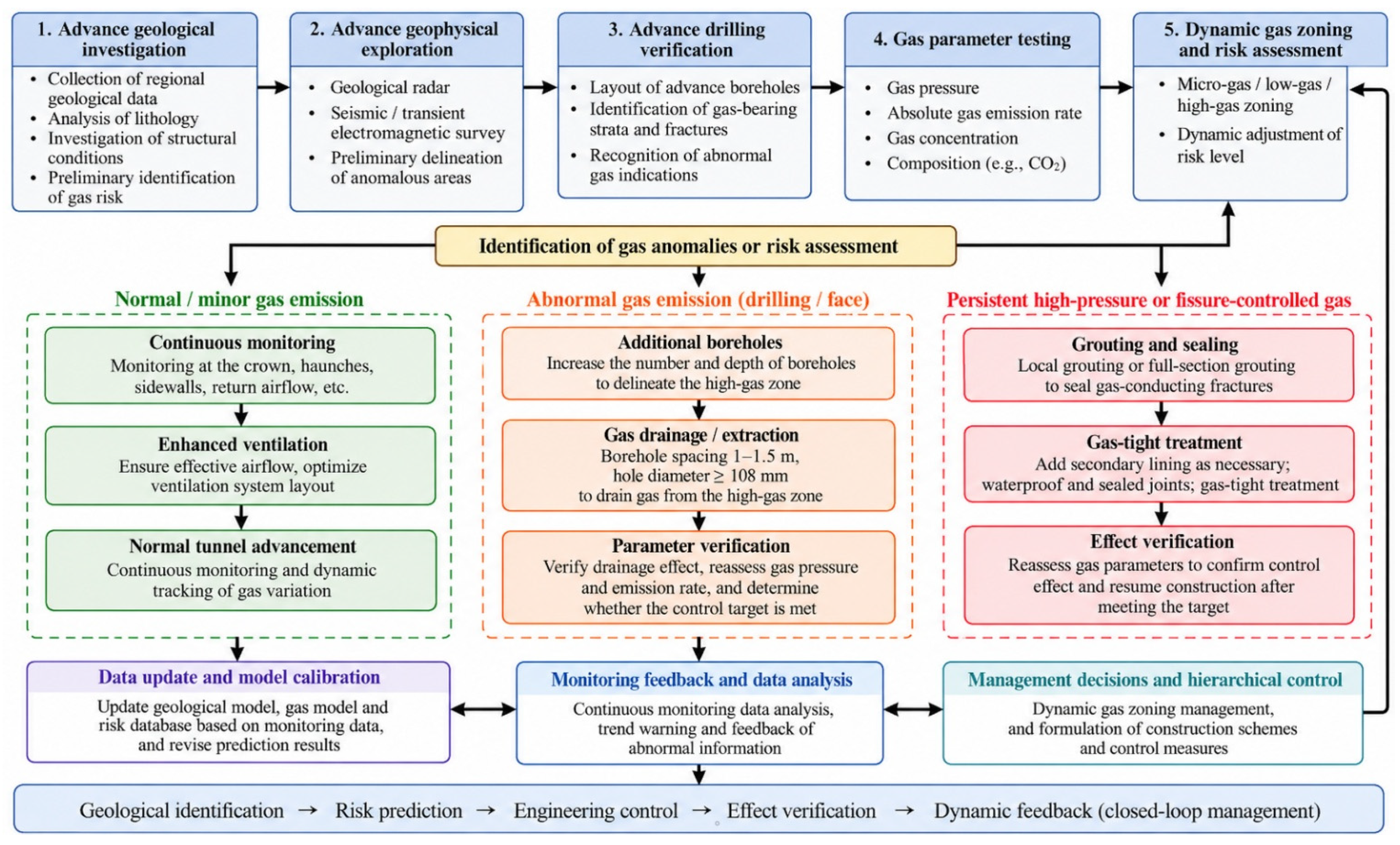
Beyond individual engineering measures, gas control requires a dynamic management system. Risk-assessment studies of gas tunnels in non-coal-bearing strata and engineering research in the geologically complex regions of the Southwest China emphasize that geological conditions, gas parameters, construction activities, and control measures should be incorporated into a unified dynamic risk-management framework [1,2,3]. For tunnels in non-coal-bearing strata, a closed-loop sequence of “risk identification—classification—targeted treatment—effect verification—dynamic feedback” is therefore more appropriate.
Figure 5.
Proposed closed-loop framework for gas prevention and control in tunnels through non-coal-bearing strata.
5.2. Advance Geological Prediction and Gas Detection
The primary challenge in controlling gas in non-coal-bearing strata is not treatment itself but accurate identification of potentially gas-rich geological bodies ahead of the tunnel face. Because drilling coverage is limited in mountain tunnels, small gas pockets, fracture zones, and deep gas-conducting pathways are difficult to delineate completely during the investigation stage. Project studies describe the rock mass ahead of the face as a “gray box” with substantial uncertainty; the role of advance geological prediction is to reduce that uncertainty progressively. Compared with indirect geophysical anomalies, advance boreholes can expose gas directly and therefore provide the most direct construction-stage evidence for gas assessment.
For non-coal-bearing strata, the purpose of advance prediction is not simply to locate coal seams but to identify anomalous geological bodies that may control gas migration and accumulation. Geological evaluation of shallow natural gas and risk studies of non-coal tunnels show that integrating regional structure, lithology, reservoir conditions, gas parameters, and construction-stage exposure information improves the ability to identify potential anomalous zones [2,3,7]. During the tunnel construction, however, advance drilling remains necessary for direct verification of lithology, fracture development, and the presence of gas ahead of the tunnel face.
Accordingly, where carbonaceous slate, carbonaceous phyllite, fault-fracture zones, fracture-dense zones, sandstone reservoir bodies, borehole gas spouting, drill-rod jacking, bubbling in standing water, or abnormal increases in gas concentration are encountered ahead of the face, the density of advance investigation should be increased and the prediction cycle length shortened. Studies of gas in non-coal-bearing strata and tunnel engineering in complex geological settings show that faults and fractures, local reservoir bodies, and information revealed during excavation are critical for identifying concealed gas anomalies [1,4]. Direct verification by advance drilling should therefore be combined with geological-prediction results.
5.3. Construction Ventilation and Gas Control
Construction ventilation is the most fundamental and continuously applied measure for controlling in-tunnel gas concentration. Under the current technical specification for highway gas tunnels [19], gas work zones of different categories should adopt ventilation schemes and safety measures commensurate with their risk level. Existing research shows that ventilation performance in gas tunnels is governed not only by total airflow but also by the position of the duct outlet, local recirculation, cross-sectional geometry, and gas-source location [24,25,26]. A dedicated fan and duct were installed for forced ventilation. Table 10 compares the recorded conditions with YSDD-1 No. 11.5 and No. 12.5 fans. The No. 12.5 condition has lower upper endpoints of the listed CH4 ranges. Because these are operating-condition ranges rather than matched observations at a fixed gas source, the comparison is used to document practice.
Field monitoring in the Linchang Tunnel showed that concentrations at the tunnel face crown remained higher than those at the haunches and arch feet, demonstrating that upper spaces should be priority targets for construction ventilation. Previous studies of tunnel ventilation and methane dispersion similarly show that low-velocity zones, recirculation zones, and regions near local gas sources can develop elevated concentrations and that shortening the effective air-supply distance or applying localized ventilation enhancement can markedly reduce gas accumulation [24,25,26]. The distance between the duct outlet and the face should therefore be adjusted dynamically with excavation advance, and the actual ventilation performance should be evaluated using gas-monitoring results at the crown, in the return airflow, and in locally enclosed spaces. Monitoring-zone layout should also account for spatial migration of the methane concentration field as wind speed and source conditions change [28].
If the ventilation-duct outlet is too far from the face, the jet may lack sufficient momentum on arrival and a ventilation dead zone can develop in the upper part of the working face. If it is too close, it may interfere with construction operations. The duct should therefore be moved dynamically with excavation advance, and its location should be optimized using measured air velocity and gas concentration.
Ventilation management should likewise shift from checking merely whether equipment is operating to evaluating “effective airflow + actual flow field + gas response.” In addition to fan status, airflow velocity, flow direction, and gas concentrations at different elevations should be measured concurrently, and the monitoring response should be used to assess actual ventilation effectiveness.
5.4. Borehole Gas Drainage
Where advance drilling reveals pronounced borehole gas spouting, drill-rod jacking, or other gas-dynamic phenomena, ventilation alone cannot eliminate high-pressure gas within the surrounding rock. Borehole pressure-relief and drainage measures should therefore be implemented before excavation resumes.
The treatment scheme uses advance identification of the gas-rich zone to establish a working stand-off before drainage drilling. Its example arrangement retains a 5 m stand-off, approximately 1 m × 1 m borehole spacing and a 108 mm borehole diameter under bench excavation, with holes extending through the anomalous zone and at least 0.5 m into the adjoining roof/floor rock. These scheme-specific values define the example drilling layout. Their application requires section-specific checks of fracture connectivity, rock stability, gas pressure and borehole discharge, together with treatment-effect acceptance before excavation resumes.
These borehole parameters are the Linchang scheme values described above and should not be applied mechanically to other projects. Studies of underground gas extraction show that surrounding-rock or reservoir permeability, borehole layout, and borehole sealing significantly influence extraction rate and effective drainage radius [31,32]. Gas-injection displacement studies further indicate that injection pressure, extraction conditions, and medium permeability jointly control the final treatment effect [33]. Borehole drainage design for non-coal-bearing strata should therefore be adjusted dynamically according to in-situ gas pressure, emission rate, and the decay behavior of discharge. Because the cited studies primarily concern coal seams, their quantitative values should be used only as mechanistic and methodological references; field verification should incorporate surrounding-rock stability, fracture distribution, and actual borehole gas discharge.
During borehole drainage, gas concentration at the collar, gas flow rate, and pressure should be recorded continuously as functions of time. A high initial flow followed by rapid decay suggests a limited local gas-storage volume. Conversely, sustained high discharge may indicate continuous replenishment from a connected source, in which case longer drainage, additional boreholes, or a dedicated extraction system should be considered.
5.5. Grouting for Gas Sealing
In sections continuously supplied by through-going fractures or faults, drainage alone may only temporarily reduce local gas pressure without completely isolating the source behind the excavation. In such cases, grouting can reduce the permeability of the surrounding rock and seal the principal gas-conducting fractures. Experimental and numerical studies of fractured rock masses show that grouting can substantially reduce gas or fluid permeability, with effectiveness controlled by fracture geometry, grouting pressure, and stress state [34,35]. From a seepage-control perspective, this demonstrates the importance of sealing connected fractures and weakening their capacity for sustained gas transmission.
For gas-bearing sections in which primary support or lining has already been installed, the long-term sealing performance of surrounding-rock fractures, grout bodies, and their interfaces should also be considered. Although grouting can markedly reduce fracture permeability, stress redistribution and fracture damage induced by excavation may subsequently increase local permeability again [34,35]. Persistent fracture-gas seepage should therefore be managed, as appropriate, by a combined strategy of “grouting and sealing of the surrounding rock + sealing by the support system + continuous monitoring and verification.”
5.6. Dynamic Classification During Construction
The change in the Linchang Tunnel from the originally designed slightly gassy condition to low-gas control during construction demonstrates that tunnel gas classification is not a static design attribute; it should be revised continuously as the face advances and field understanding improves. According to the Specifications for Design and Construction of Highway Tunnels with Gas (JTG/T 3374-2020) of China [19], gas-bearing strata and gas work zones should be classified on the basis of actual gas conditions, and local technical standards likewise emphasize dynamic identification and graded control during construction [20].
From a safety-management perspective, gas-risk control should not remain unchanged after a single classification exercise. Risk-assessment studies of non-coal gas tunnels recommend consideration of geological structure, gas occurrence, construction conditions, and control capability, with risk judgments updated as new excavation information becomes available [2,3]. Research on tunnels in the complex geological environments of Southwest China further emphasizes coordination among advance identification, monitoring, ventilation, and engineering treatment [1]. Tunnels in non-coal-bearing strata should therefore adopt a dynamic gas-classification system that is updated with face advance. A recommended management sequence is “initial identification during investigation → geological logging at the face → advance geophysics → verification by advance drilling → gas-parameter testing → dynamic classification → targeted treatment → verification of treatment effectiveness → resumption of construction”. Any anomaly identified at one stage should be fed back to the preceding stage for reassessment. In particular, where a tunnel initially designed as non-gassy or slightly gassy first encounters gas during construction, it is inappropriate to treat only the anomalous face and immediately revert to the original management category; gas risk should be reassessed for the remaining unexcavated section.
5.7. Monitoring-Data-Driven Closed-Loop Control
Conventional gas management often relies on fixed concentration thresholds for alarms. Continuous monitoring, however, can also reveal changes in gas-release conditions as the face advances. Studies of risk control and ventilation in tunnels under complex geological conditions show that once gas is encountered, geological identification, field monitoring, treatment measures, and construction ventilation should be considered jointly [1,24,25,26]. Such dynamic monitoring is especially important in non-coal-bearing strata because gas-rich zones often lack a laterally continuous gas-bearing layer that could serve as a direct geological marker. The proposed closed-loop framework is summarized in Figure 5.
The representativeness of gas assessment also depends on sensor location. Studies of methane concentration fields and monitoring layouts show that concentrations can differ substantially among elevations and local spaces and that proper selection of monitoring height and critical zones improves coverage of the actual concentration field [27,28]. For the Linchang Tunnel, the long-term monitoring can be used to establish baseline concentrations at representative positions such as the crown, haunches, arch feet, return airflow, and secondary-lining trolley. If concentration at one location shows a sustained rise or the concentration gradient among locations changes markedly, further investigation should be undertaken in conjunction with geological changes at the face and advance-drilling results, even if the instantaneous concentration remains below the prescribed control limit.
6. Discussion
6.1. Gas Risk in Non-Coal-Bearing Strata Cannot Be Assessed from Mean Concentration Alone
Although the overall gas concentration in the Linchang Tunnel was low during construction, the listed concentrations differed among locations across the face. Concentrations at the crown and within fractures and collapse cavities were higher than those at the arch feet and near some construction equipment. A “low-gas tunnel” classification therefore does not imply that all locations and all construction stages are subject to the same low level of risk.
Studies of methane-concentration distributions and sensor placement show that monitoring height and monitoring-zone selection directly affect the ability to identify local high-concentration zones [27,28]. Local risk in tunnels through non-coal-bearing strata should therefore not be evaluated solely from an in-tunnel mean value; priority should be given to unfavorable locations such as the face crown, fractures, collapse cavities, and local recirculation zones.
6.2. Lithological Identification Should Be Combined with Structural Conditions
In gas prediction for non-coal-bearing strata, no single lithology should be equated directly with a particular gas-hazard level. Carbonaceous slate and similar rocks may provide a source for hydrocarbon generation, but if fractures have remained open and connected to the ground surface for long periods, much of the generated gas may already have escaped. Conversely, ordinary sandstone has limited intrinsic hydrocarbon-generation potential but can become an effective gas reservoir where it is connected to a deep source by faults and sealed by low-permeability strata. Studies of non-coal-bearing formations and shallow natural gas in the Sichuan Basin consistently show that migration and accumulation are governed by the spatial association of the source, fault or fracture pathways, reservoir media, and sealing conditions [4,5,6,7]. The central task in predicting gas in non-coal-bearing strata is therefore not to identify a single “hazardous lithology”, but to recognize favorable source-pathway-reservoir-seal assemblages.
Fault activity and gas-pathway permeability should be considered separately. Compression and relaxation can modify fracture apertures and source-to-pathway pressure differences, so the direction of a gas response depends on fault geometry and connectivity. Baikal studies show that radon expression differs with fault type and activity history [36], and that temporal variations can reflect both seismic and environmental forcing [37]. The Kuznetsk Coal Basin literature describes weaker or more stable radon expressions over inactive structures and the potential sealing effect of secondary mineral infill [38]. Thus, inherited fractures may remain potential pathways without demonstrated recent slip, while mineral-sealed structures may restrict transport. At Linchang, the nearby Miyaluo fault’s non-Holocene activity classification and the mapped joints support an interpretation based on the existing structural setting. Temporal methane changes are assessed together with excavation, ventilation and pressure conditions; radon analogs are used to explain transport mechanisms.
6.3. Coupled Water-Gas-Rock Anomalies Require Particular Attention
In fault-fracture zones on the Western Sichuan Plateau of China, groundwater and gas commonly migrate through the same pore-fracture networks. Accordingly, abnormal water inflow, vigorous bubbling in standing water, or high-pressure gas should prompt consideration of possible co-occurrence of water and gas.
The Zhegushan Tunnel provides a regional warning case distinct from the Linchang observations. Gas discharge from drilling and fractures, with bubbling water, was recorded in September 2015 near K186+634. On 6 October 2015, a gas-associated rock-mass failure affected approximately K186+582–K186+592, with an estimated cavity volume of about 1000 m3. Miyaruo No. 3, investigated in December 2016, is a separate case with six-face gas-pressure measurements of approximately 0.23–0.26 MPa when the maximum at each face is considered. Their quantitative indicators are compared in Table 11.
Table 11.
Quantitative regional case comparison with measurement context retained.
For the Linchang Tunnel and similar projects in the Western Sichuan of China, advance prediction should therefore integrate water, gas, and the degree of rock-mass fracturing within a unified assessment rather than managing them as independent hazards.
6.4. Applicability of the Proposed Framework
The three gas-emission modes proposed in this study are intended primarily for non-coal-bearing metamorphic terrains on the Western Sichuan Plateau, China, and represent an engineering generalization of gas sources, migration pathways, and reservoir conditions. Previous studies of non-coal-bearing strata, shallow natural gas in the Sichuan Basin of China, and excavation-induced gas release from non-coal rock masses show that gas-source conditions, structural settings, reservoir media, and excavation responses vary markedly among regions [1,4,5,6,7,8]. The proposed modes can therefore support risk identification and mechanism analysis in comparable projects but cannot replace project-specific measurement of gas parameters and dedicated gas-hazard assessment. Sections with high gas content or outburst potential should be subject to dedicated outburst-prevention and mitigation design in strict accordance with the current technical specification for gas tunnels [19].
6.5. Study Limitations and Verification Scope
Three evidence levels are kept separate. The gas encounter, sampled methane and listed position concentrations are observations. Carbonaceous-source attribution, fracture migration and structural storage are geological interpretations constrained by the mapped formations and regional studies. Drainage, grouting and the closed-loop framework include conditional engineering recommendations. Methane presence and light-hydrocarbon screening in gas–air bags do not uniquely distinguish thermogenic, microbial or other source contributions; isotope, organic-carbon and maturity measurements would provide independent source discrimination.
The uncertainty check addresses recording precision, while calibration, sampling and airflow uncertainties require their own metrological evaluation. The numerical calculation is an openly specified scenario with a constant eddy-mixing closure, a rectangular clearance envelope and a prescribed local source. It verifies conservation and assesses grid/parameter dependence; it does not calibrate actual duct geometry, fracture permeability or the temporal response of the gas source. In particular, agreement with an outlet concentration used to define the reference air supply is a consistency check, not independent validation. These distinctions retain the engineering usefulness of the case while defining which conclusions can be transferred to other tunnels.
The temporal dataset comprises ten relative day labels and twelve inspection windows per day, with repeated patterns at a 0.01-percentage-point increment. Its duration and recording precision bound the interpretation to the sampled construction states; short pulses between rounds and seasonal cycling lie beyond that temporal coverage. Position categories provide spatial comparisons within the working zone, rather than a fixed-coordinate three-dimensional concentration field. Gas–air bags establish the tested composition, while source discrimination requires complementary geochemical indicators. Likewise, the geological interpretation is constrained by the mapped units, joints and encounter chainage; source pressure, pathway transmissivity and atmospheric coupling would need to be evaluated together to quantify a specific release mechanism. These bounds support use of the case for inspection priorities and conditional engineering interpretation, with transfer to other tunnels requiring site-specific verification.
7. Conclusions
- (1)
- The Linchang case illustrates the need to consider geological source candidates, fractures, possible storage and excavation context together when identifying gas-prone sections in non-coal-bearing strata. The Linchang Tunnel mainly traverses metamorphic sandstone and slate of the Triassic Zhuwo and Zagunao formations. Local carbonaceous slate and structural joints provide a geological basis for potential source and pathway interpretations. Gas bags confirm methane in the sampled gas–air mixture.
- (2)
- On the basis of the spatial relationships among the gas source, reservoir space, gas-conducting structures, and tunnel, gas emission from non-coal-bearing strata can be grouped into three modes: direct exposure of hydrocarbon-generating strata, connection of deep gas reservoirs by gas-conducting structures, and indirect exposure of source-related structural accumulations. In practice, composite gas-occurrence systems may involve the superposition of two or more mechanisms.
- (3)
- During construction of the Linchang Tunnel, the classification-stage absolute methane emission value was 1.185 m3/min, and the tunnel was managed as a low-gas tunnel. Ten days of periodic inspection records show cross-sectional differences in gas concentration: the crown was mainly 0.04–0.05%, compared with approximately 0.03% at the haunches and 0.02% at the arch feet. Fractures and collapse cavities also readily exhibited relatively high values. The crown-to-arch-foot mean difference of 0.025 percentage points remains positive under the stated rounding-only check. These descriptive contrasts support focused monitoring of elevated and poorly ventilated spaces.
- (4)
- The idealized two-dimensional transport calculation separates methane-source flow (0.01975 m3/s) from an equivalent ventilation scenario. Conservation checks and three-grid refinement show stable global dilution with residual sensitivity of local peaks; source, airflow and mixing-coefficient variations demonstrate why total airflow alone does not determine local enrichment. The observed crown pattern remains the basis for monitoring coverage of elevated spaces.
- (5)
- Given the concealed gas sources, spatial randomness, and dynamically changing classification of gas in non-coal-bearing strata, a process-wide closed-loop system should be established comprising “advance geological prediction—direct verification by drilling—continuous gas monitoring—enhanced construction ventilation—borehole drainage in anomalous zones—grouting sealing where necessary—dynamic classification adjustment”. This approach shifts management from reliance on concentration exceedance alone toward coordinated early warning based on geological information and gas monitoring.
Author Contributions
H.D.: Writing—original draft, Writing—review & editing, Investigation, Formal analysis, Software, Methodology; X.K.: Supervision, Formal analysis, Writing—review & editing; T.L.: Conceptualization, Funding acquisition, Investigation, Writing—review & editing; W.Z.: Methodology; W.F.: Methodology. All authors have read and agreed to the published version of the manuscript.
Funding
This work was supported by the National Natural Science Foundation of China (Grant No. 42377145), the Sichuan Science and Technology Program of China (Grant No. 2024YFFK0112), the Fundamental Research Funds for the Central Universities (Grant No. 2024SCUQJTX033), and the Sichuan Province Science and Technology Plan Project (2025YFNZH0041) for financial support.
Data Availability Statement
Data is contained within the article.
Conflicts of Interest
Author Wenju ZHANG is employed by Sichuan Tibetan Area Expressway Co., Ltd. The remaining authors declare that the research was conducted in the absence of any commercial or financial relationships that could be construed as a potential conflict of interest.
Appendix A. Inspection Windows and Concentration Records
Table A1 and Table A2 reproduce the tabulated inspection sequence. The same twelve-window numerical pattern appears under every day label from Day 1 to Day 10 at the retained precision; displaying it once with its ten-day coverage retains all listed values without treating repeated day entries as independent replicates. Each window is about 30 min. Day labels are relative inspection labels. All concentrations are CH4 volume percent.
Table A1.
Face and return-air inspection entries applying to each of Day 1–Day 10.
Table A2.
Trolley-area inspection entries applying to each of Day 1–Day 10.
References
- Lu, T.; Li, S.; Wang, Y.; Li, Y.; Fu, W.; Ju, G. An Integrated Survey-Modelling-Testing Framework for Seismic Characterization of Deep Overburden: Application to a High-Altitude Pumped Storage Project. Int. J. Geotech. Eng. 2026, 20, 373–397. [Google Scholar] [CrossRef] [Scilit]
- Zhang, K.; Zheng, W.; Xu, C.; Chen, S. Risk assessment of gas outburst in tunnels in non-coal formation based on the attribute mathematical theory. Geomat. Nat. Hazards Risk 2019, 10, 483–504. [Google Scholar] [CrossRef] [Scilit]
- Kang, X.B.; Luo, S.; Li, Q.S.; Xu, M.; Li, Q. Developing a risk assessment system for gas tunnel disasters in China. J. Mt. Sci. 2017, 14, 1751–1762. [Google Scholar] [CrossRef] [Scilit]
- Lu, T.; Fu, W. A Dirac Delta Function Approach for Closed-Form Dynamic Response of Jointed Curved Beams. Mech. Res. Commun. 2026, 155, 104699. [Google Scholar] [CrossRef] [Scilit]
- He, K.; Su, P.; Li, Y.; Ji, Y.; Zhang, H. Geological characteristics of shallow natural gas in eastern Sichuan and risk evaluation for tunneling: Chongqing-Wanzhou high-speed railway. Bull. Eng. Geol. Environ. 2022, 81, 352. [Google Scholar] [CrossRef] [Scilit]
- Wang, S.; Guo, X.; Su, P.; Li, L.; Ahmed, M.S.; Chu, X.; Zhang, X.; Gentzis, T.; Mansour, A. Sources of shallow natural gases in the Longgang Marine Gas Field, NE Sichuan Basin: An example from the water conveyance tunnel. Front. Earth Sci. 2025, 13, 1573369. [Google Scholar] [CrossRef] [Scilit]
- He, K.; Su, P.; Li, H.; Yang, S.; Yang, Y.; Zhao, Y.; Ahmed, M.S.; Mansour, A. Geological hazard characteristics, sources, and distribution patterns of shallow natural gas in the Dachiganjing Structure Belt, Eastern Sichuan: An integrated geochemical, isotopic, and petrographic approach. Nat. Hazards 2025, 121, 14957–14981. [Google Scholar] [CrossRef] [Scilit]
- Zhang, J.; Zhou, X.; Liu, X.; Fang, L.; Suliman, L.; Li, G. Migration and release characteristics of gases in excavation of a tunnel within magmatic rocks reservoir. Undergr. Space 2026, 27, 362–385. [Google Scholar] [CrossRef] [Scilit]
- Geng, B.; Su, P.; Quan, X.; Tao, X.; Lu, X. Geological control factors and accumulation patterns of harmful gas in tunnels in Northwest Hunan, China, and the sustainable development of tunnel engineering. Appl. Sci. 2026, 16, 7155. [Google Scholar] [CrossRef] [Scilit]
- Zhang, J.; Zhou, X.; Liu, X.; Fang, L.; Guo, X.; Chen, H. Full process evolution of deformation and seepage coupling in fractured rock under triaxial stress. Sci. Rep. 2025, 15, 21896. [Google Scholar] [CrossRef] [Scilit] [PubMed]
- Li, Y.; Su, P.; Luo, L.; Li, Y.; Liu, W.; Yang, J. Hazardous gas emission laws in tunnels based on gas-solid coupling. Processes 2025, 13, 3308. [Google Scholar] [CrossRef] [Scilit]
- Lu, T.; Zhong, H.; Fu, W.; Zhang, H. Geodynamic Analysis of Curved Tunnels under Rayleigh Wave Loading: A Virtual-Force Analytical Model for Axial Deformation Joints and Subgrade Response. Transp. Geotech. 2026, 62, 102122. [Google Scholar] [CrossRef] [Scilit]
- Zhang, X.; Wang, Z.; Chen, W. Optimisation of synergistic ventilation between dust and gas in a gas tunnel. Sci. Rep. 2024, 14, 27582. [Google Scholar] [CrossRef] [Scilit] [PubMed]
- Suo, L.; Li, S.; Wu, F. Influence of ventilation parameters on gas transportation patterns in long highway tunnels and sustainable development of ventilation systems. Sustainability 2025, 17, 1020. [Google Scholar] [CrossRef] [Scilit]
- Lu, T.; Zhong, H.; Xue, C.; Ye, F.; Wang, G.; Fu, W. Seismic Response of Tunnels with Isolation Layer Crossing Fault Zones: Large-Scale Shaking Table Tests and Numerical Verification. Tunn. Undergr. Space Technol. 2026, 176, 107883. [Google Scholar] [CrossRef] [Scilit]
- Yang, H.; Jiang, C.; Ding, Y.; Lin, Z.; Chen, X.; Wang, Z.; Gong, H. Research on the influence of high-altitude tunnel environment on gas explosion characteristics and explosion limits. Tunn. Undergr. Space Technol. 2025, 159, 106435. [Google Scholar] [CrossRef] [Scilit]
- Skoczylas, N.; Kozieł, K.; Sitek, L. The principles of evaluating the risk of rock and gas outburst in copper ore mines. Rock Mech. Rock Eng. 2024, 57, 11099–11116. [Google Scholar] [CrossRef] [Scilit]
- Zhang, G.; Wang, E.; Liu, X.; Li, Z. Research on risk assessment of coal and gas outburst during continuous excavation cycle of coal mine with dynamic probabilistic inference. Process Saf. Environ. Prot. 2024, 190, 405–419. [Google Scholar] [CrossRef] [Scilit]
- JTG/T 3374-2020; Specifications for Design and Construction of Highway Tunnels with Gas. China Communications Press: Beijing, China, 2020. (In Chinese)
- DB52/T 1666-2022; Technical Specifications for Highway Gas Tunnels. Guizhou Provincial Administration for Market Regulation: Guiyang, China, 2022. (In Chinese)
- Miklyaev, P.S.; Petrova, T.B. Study of abnormal seasonal variations in the radon exhalation rate in a fault zone. Geochem. Int. 2021, 59, 435–447. [Google Scholar] [CrossRef] [Scilit]
- Miklyaev, P.; Petrova, T.; Sidyakin, P.; Shchitov, D.; Murzabekov, M.; Tsebro, D.; Gavriliev, S.; Mikliaeva, E.; Klimshin, A. Radon release at a rehabilitated uranium mine site and dose assessment (case of the former Beshtaugorskiy mine, North Caucasus). Environ. Sci. Pollut. Res. 2025, 32, 102–116. [Google Scholar] [CrossRef] [Scilit] [PubMed]
- Massmann, J.; Farrier, D.F. Effects of atmospheric pressures on gas transport in the vadose zone. Water Resour. Res. 1992, 28, 777–791. [Google Scholar] [CrossRef] [Scilit]
- Fang, Y.; Fan, J.; Kenneally, B.; Mooney, M.A. Air flow behavior and gas dispersion in the recirculation ventilation system of a twin-tunnel construction. Tunn. Undergr. Space Technol. 2016, 58, 30–39. [Google Scholar] [CrossRef] [Scilit]
- Zhang, X.; Hu, J.; Zhang, D.; Cai, S.; Yang, F. Distribution of harmful gas and ventilation length design of high altitude long gas tunnel construction: A case study. Front. Earth Sci. 2023, 11, 1195880. [Google Scholar] [CrossRef] [Scilit]
- Kurnia, J.C.; Sasmito, A.P.; Mujumdar, A.S. CFD simulation of methane dispersion and innovative methane management in underground mining faces. Appl. Math. Model. 2014, 38, 3467–3484. [Google Scholar] [CrossRef] [Scilit]
- Sun, J.P.; Tang, L.; Chen, W.; Wang, F.Z. Numerical simulation of methane distribution and sensor placement in 2-Dimension roadway. J. China Univ. Min. Technol. 2007, 17, 372–375. [Google Scholar] [CrossRef] [Scilit]
- Lu, T.; Zhong, H.; Zhang, H.; Fu, W.; Xue, P. An Analytical Framework with Closed-Form Solutions for Hybrid Curved-Straight Tunnel Segments with Deformation Joints under Arbitrary Dynamic Loads. Appl. Math. Model. 2027, 161, 117171. [Google Scholar] [CrossRef] [Scilit]
- Chorin, A.J. Numerical solution of the Navier-Stokes equations. Math. Comput. 1968, 22, 745–762. [Google Scholar] [CrossRef]
- Gualtieri, C.; Angeloudis, A.; Bombardelli, F.; Jha, S.; Stoesser, T. On the values for the turbulent Schmidt number in environmental flows. Fluids 2017, 2, 17. [Google Scholar] [CrossRef] [Scilit]
- Fan, Z.; Fan, G.; Zhang, D. Representation of mining permeability and borehole layout optimization for efficient methane drainage. Energy Rep. 2021, 7, 3911–3921. [Google Scholar] [CrossRef] [Scilit]
- Zheng, C.; Li, H.; Kizil, M.; Jiang, B.; Xue, S.; Yang, W.; Chen, Z. Performance enhancement of horizontal underground-to-inseam gas drainage boreholes with double-phase-grouting sealing method for coal mining safety and clean gas resource. J. Nat. Gas. Sci. Eng. 2020, 76, 103179. [Google Scholar] [CrossRef] [Scilit]
- Yang, X.; Wang, G.; Du, F.; Jin, L.; Gong, H. N2 injection to enhance coal seam gas drainage (N2-ECGD): Insights from underground field trial investigation. Energy 2022, 239, 122247. [Google Scholar] [CrossRef] [Scilit]
- Cao, Z.; Wang, P.; Li, Z.; Du, F. Migration mechanism of grouting slurry and permeability reduction in mining fractured rock mass. Sci. Rep. 2024, 14, 3446. [Google Scholar] [CrossRef] [Scilit] [PubMed]
- Lu, T.; Xiao, Z.; Fu, W.; Zhang, H.; Zhang, S. Analytical Modeling of Dynamic Responses and Vulnerable Zones in Curved Finite Tunnels with Deformation Joints. J. Cent. South Univ 2026. [Google Scholar] [CrossRef] [Scilit]
- Seminsky, K.Z.; Bobrov, A.A. Radon activity of faults (western Baikal and southern Angara areas). Russ. Geol. Geophys. 2009, 50, 682–692. [Google Scholar] [CrossRef] [Scilit]
- Seminsky, A.K.; Seminsky, K.Z. Time-dependent variations of groundwater radon: Insights from a twelve-year study in the Baikal region, East Siberia, Russia. J. Environ. Radioact. 2024, 278, 107509. [Google Scholar] [CrossRef] [Scilit] [PubMed]
- Leshukov, T.; Legoshchin, K.; Larionov, A. Radon hazard of the Zhurinsky fault for the population in the Kuznetsk Coal Basin: Primary results. Sustainability 2023, 15, 16774. [Google Scholar] [CrossRef] [Scilit]
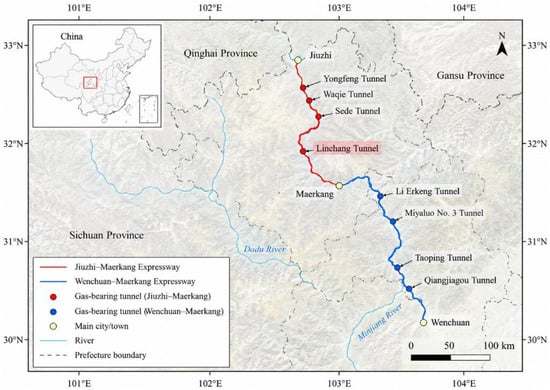
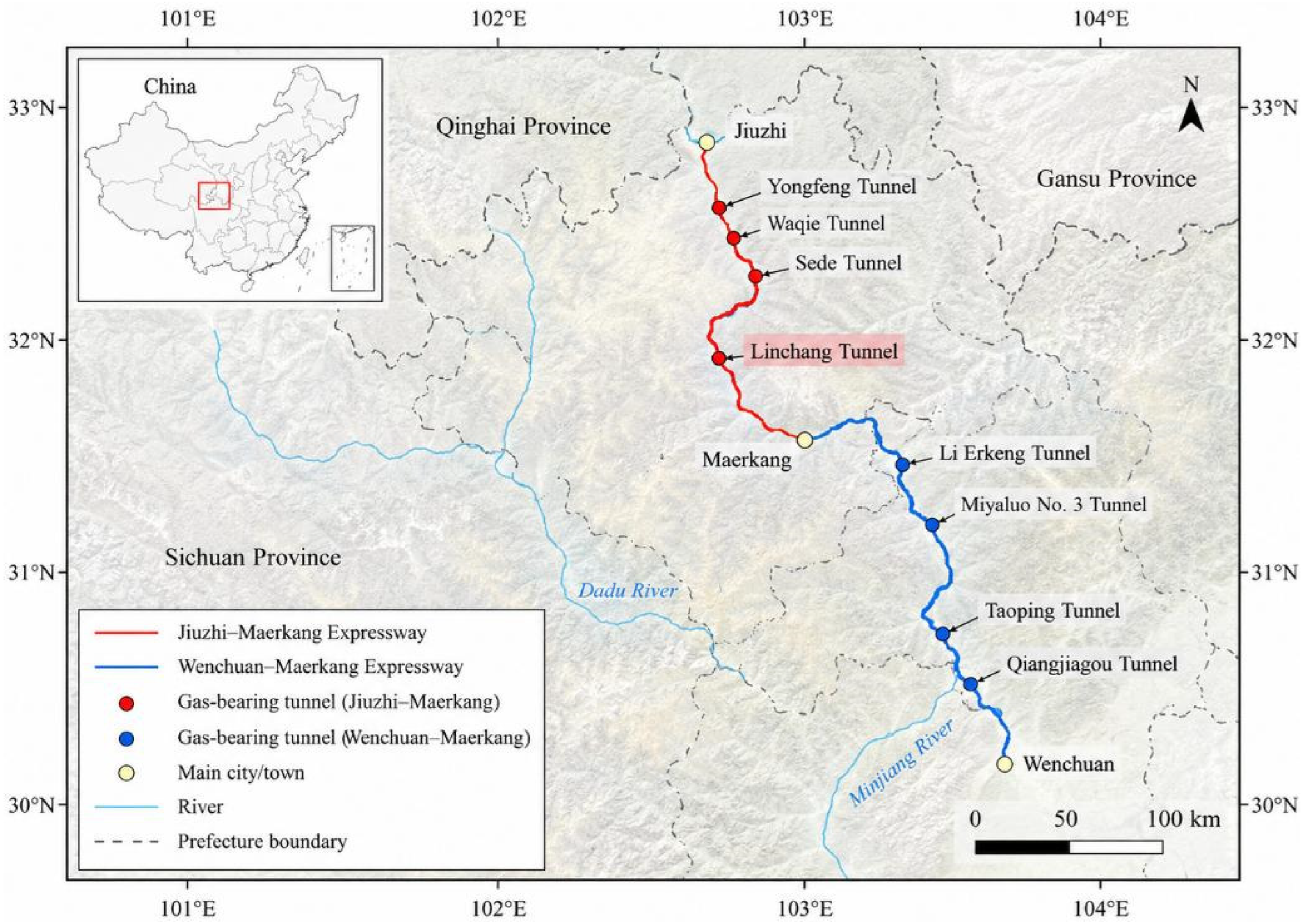
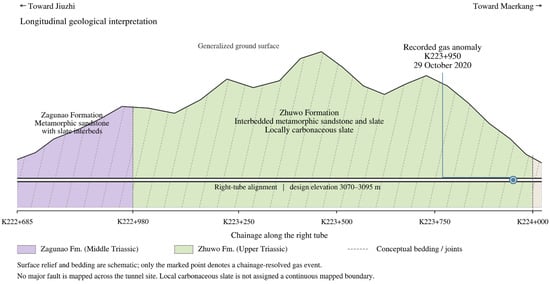
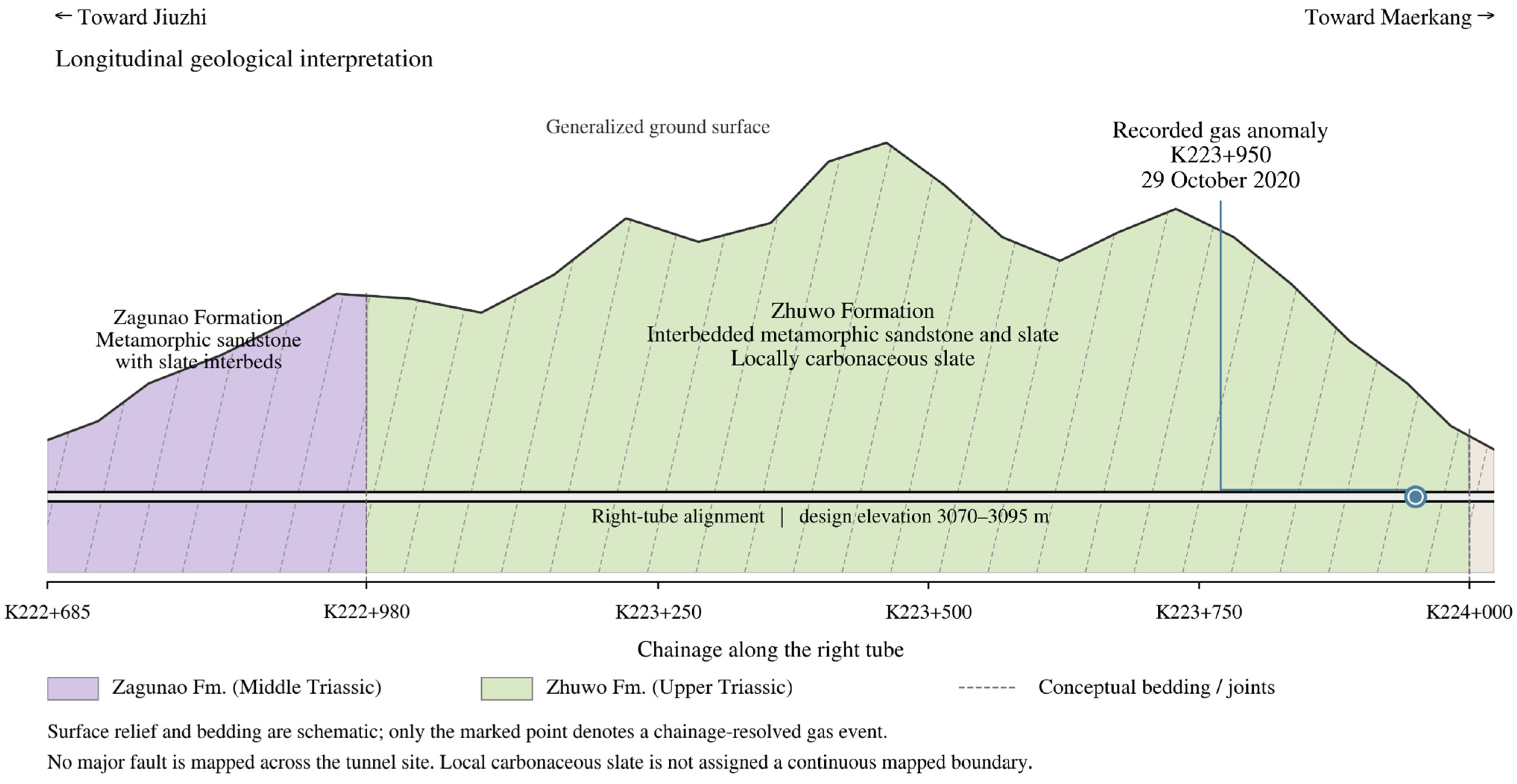
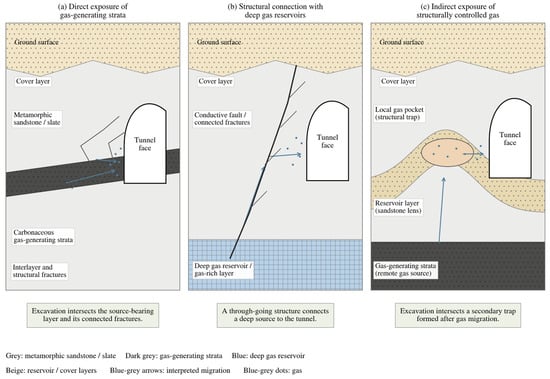
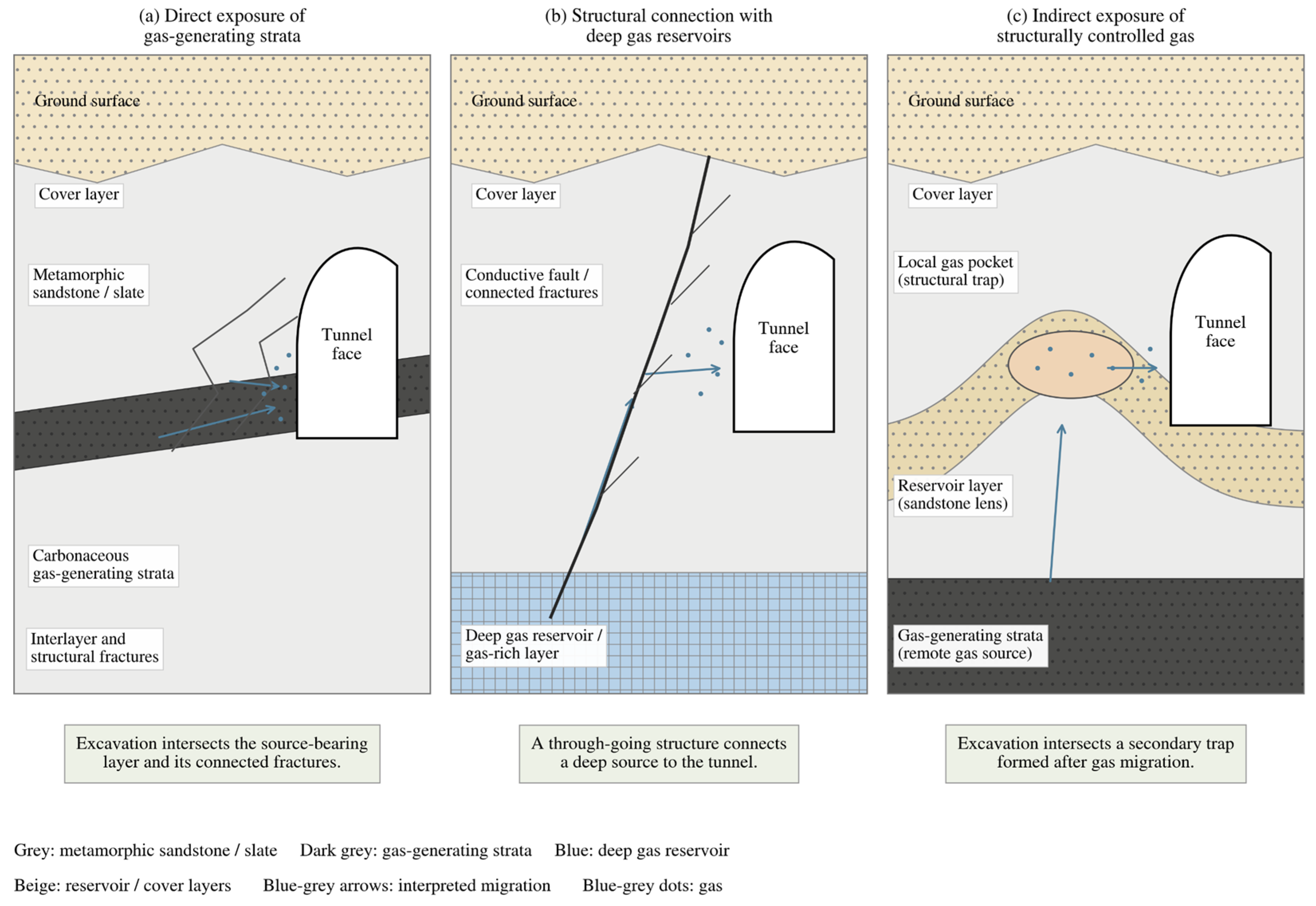
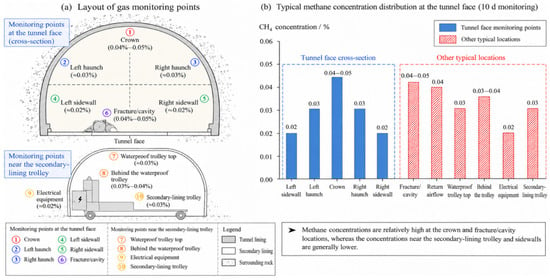
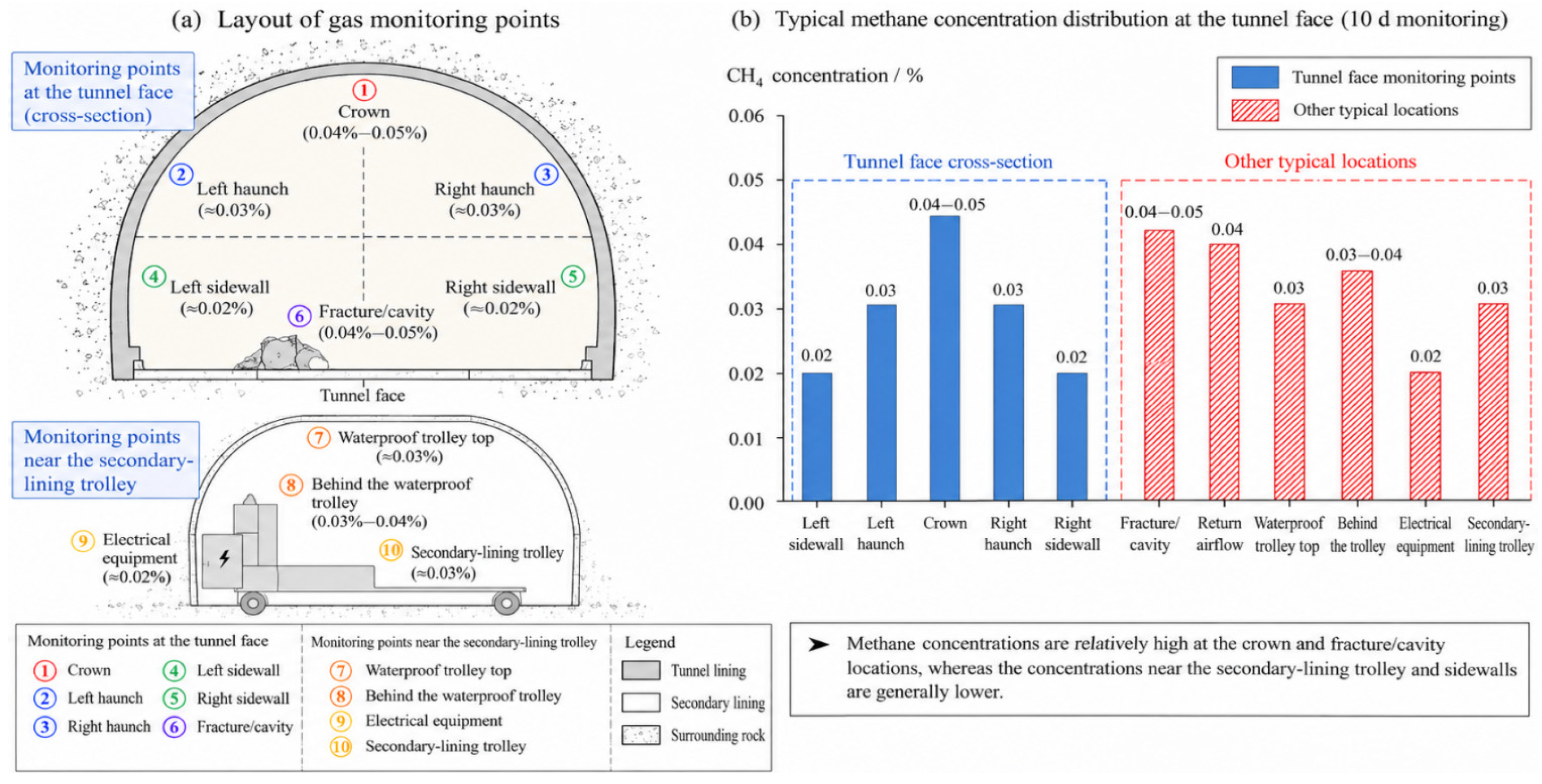

Disclaimer/Publisher’s Note: The statements, opinions and data contained in all publications are solely those of the individual author(s) and contributor(s) and not of MDPI and/or the editor(s). MDPI and/or the editor(s) disclaim responsibility for any injury to people or property resulting from any ideas, methods, instructions or products referred to in the content. |
© 2026 by the authors. Licensee MDPI, Basel, Switzerland. This article is an open access article distributed under the terms and conditions of the Creative Commons Attribution (CC BY) license.