


Abstract
This review provides a structured overview of nickel–titanium (NiTi) shape memory alloy applications in contemporary robotic systems. Due to their shape memory effect, superelasticity, and high energy density, NiTi alloys are widely employed as compact and lightweight actuators in robotics. This paper first reviews NiTi actuators and drive mechanisms, including linear, rotary, bending, self-sensing, and superelastic configurations, along with their performance limitations related to speed, efficiency, and thermal management. Subsequently, the use of NiTi-based actuation in robotic grippers is discussed, emphasizing compliant grasping, adaptability, compact actuation, and structural integration. The review further examines applications of NiTi alloys in soft robotics, where material compliance enables bio-inspired motion. Hybrid soft robotic systems integrating NiTi actuators with elastomeric structures are highlighted. In addition, recent advances in microrobotics employing NiTi-based microactuators and shape-transformable microrobots are summarized. Finally, current challenges and future research directions for NiTi alloy applications in robotics are outlined. Unlike actuator-centered reviews of shape memory alloys in robotics, this work adopts an application and system-oriented perspective focused specifically on NiTi, considering its use not only as a thermally activated actuator but also as a superelastic, structural, self-sensing, and multifunctional robotic element.
1. Introduction
Shape memory alloys (SMAs) constitute a unique class of functional materials whose mechanical behavior is strongly coupled with temperature and stress. Among them, nickel–titanium (NiTi), commonly known as nitinol, has attracted particular attention due to its exceptional combination of shape memory effect, superelasticity, corrosion resistance, and biocompatibility. These properties have positioned nitinol as one of the most widely investigated and applied SMAs across various engineering disciplines. In recent decades, the rapid development of robotics, especially in domains requiring compactness, compliance, and adaptability, has significantly intensified interest in NiTi-based actuation and structural elements.
1.1. Historical Background of Nitinol
The origins of nitinol research can be traced back to the late 1950s and early 1960s, when William J. Buehler and his colleagues at the U.S. Naval Ordnance Laboratory discovered an unusual nickel–titanium alloy exhibiting an unexpected ability to recover its original shape after deformation upon heating [1]. This serendipitous discovery marked a turning point in materials science, as it revealed a fundamentally new class of materials whose macroscopic mechanical behavior was governed by reversible solid-state phase transformations rather than plastic deformation mechanisms. The name “Nitinol” itself originates from its chemical composition (nickel–titanium) and the institution where it was discovered (Naval Ordnance Laboratory).
Early scientific investigations focused on understanding the anomalous mechanical properties of NiTi alloys. One of the first seminal publications systematically describing the temperature-dependent phase transformations and mechanical response of near-equiatomic NiTi alloys demonstrated that these materials undergo reversible martensitic transformations at relatively low temperatures [2]. Subsequent crystallographic studies provided deeper insight into the structural mechanisms underlying the shape memory effect, revealing the reversible transition between high-temperature austenite and low-temperature martensite phases [3]. These foundational works established the theoretical basis for interpreting the unusual thermo-mechanical behavior of NiTi alloys.
During the following decades, research on nitinol expanded rapidly, driven by both fundamental curiosity and application-driven needs. Review articles published in the late 20th and early 21st centuries summarized the progress in alloy processing, thermomechanical treatment, and application development, highlighting the versatility of NiTi in fields such as aerospace, medicine, and mechanical engineering [4]. Parallel to these developments, historical analyses documented how nitinol transitioned from a laboratory curiosity to an industrially relevant smart material, emphasizing milestones such as the first commercial actuators and biomedical devices [5]. This historical evolution underscores the importance of both fundamental materials research and application-oriented engineering in shaping the current status of nitinol technology.
1.2. Fundamental Principles and Functioning of Nitinol
The exceptional properties of nitinol originate from its unique crystallographic behavior. The shape memory effect and superelasticity observed in NiTi alloys are the result of a reversible, diffusionless martensitic phase transformation between a high-symmetry austenite phase and a low-symmetry martensite phase. This transformation can be induced either thermally or mechanically, enabling the material to recover following large strains without permanent deformation. Detailed crystallographic analyses have shown that atomic rearrangement during this phase transition follows well-defined orientation relationships, minimizing energy barriers and enabling reversibility [6].
From a functional perspective, the shape memory effect manifests when a NiTi component is deformed in its martensitic state and subsequently heated above its austenite finish temperature, causing it to return to its original, pre-deformed shape. In contrast, superelasticity occurs when the material is mechanically loaded at a temperature above the austenite finish temperature, inducing a stress-driven martensitic transformation that reverses upon unloading. These mechanisms have been extensively analyzed through experimental and theoretical studies, which have clarified the relationship between transformation temperatures, alloy composition, and mechanical performance [7].
Advanced modeling approaches have further contributed to the understanding of nitinol behavior by describing the energy landscape associated with phase transformations and predicting transformation pathways under combined thermal and mechanical loading [8]. Such models are crucial for designing NiTi-based components, as they allow engineers to tailor transformation temperatures, hysteresis width, and actuation strain through appropriate alloy composition and heat treatment. Moreover, microstructural investigations have demonstrated how defects, precipitates, and grain size influence transformation stability and fatigue life, which are critical factors for repeated actuation applications [9].
Beyond its actuation capabilities, nitinol exhibits additional functional characteristics that are particularly relevant for engineering applications. These include high corrosion resistance, excellent fatigue performance under cyclic loading, and, in certain compositions, biocompatibility. Comprehensive studies on the coupling between microstructure and functional response have shown that careful control of processing parameters is essential for achieving reliable and repeatable actuation behavior [10]. Together, these fundamental insights form the basis for the widespread adoption of nitinol in systems requiring compact, high strain, and thermally driven actuation.
1.3. Motivation for Using Nitinol in Robotics
The intrinsic properties of nitinol align closely with the emerging requirements of modern robotic systems. Traditional robotic actuators, such as electric motors and hydraulic systems, often impose constraints related to size, weight, rigidity, and mechanical complexity. In contrast, NiTi-based actuators offer high power-to-weight ratios, silent operation, and inherent compliance, making them particularly attractive for applications where adaptability and safe interaction with the environment are essential.
Robotics has increasingly shifted toward systems that operate in unstructured environments, interact with humans, or require biologically inspired motion. In such contexts, the compliance and smooth actuation provided by nitinol-based elements offer significant advantages over conventional rigid actuation technologies. Furthermore, the scalability of NiTi actuators from macroscale wires and springs to microscale films and fibers enables their integration into a wide range of robotic platforms, including miniature and soft robotic systems.
Another key motivation for the adoption of nitinol in robotics lies in its multifunctionality. NiTi components can serve not only as actuators but also as structural or sensing elements, depending on their configuration and operating principle. In selected actuator systems, changes in electrical resistance associated with thermomechanical transformations can additionally be exploited for self-sensing. This multifunctional nature supports the development of highly integrated robotic systems with reduced part count and simplified mechanical architectures. As a result, nitinol has emerged as a strategic material for advancing robotic designs that prioritize compactness, adaptability, and functional integration.
1.4. Scope and Structure of the Article
Recent reviews have addressed shape memory alloys from different perspectives, including robotic actuation, wire-form actuator modeling and control, fabrication, material properties, and broader engineering applications [11,12,13,14]. In particular, Romancik et al. [11] review SMA actuators in robotics, whereas Zhang et al. [12] focus on the modeling, design, and control of wire-form SMA actuators. Other recent reviews consider broader developments in SMA systems [13] and specifically NiTi processing, properties, and applications across multiple engineering domains [14]. These studies provide important actuator and material-oriented perspectives, but a focused comparison of recent NiTi-based robotic implementations from an application and system-oriented perspective remains comparatively limited.Accordingly, the contribution of this review is an application-oriented classification of recent NiTi robotic systems into four domains: actuators and drive systems, robotic grippers, soft robotics, and microrobotics. Rather than treating NiTi exclusively as a thermally activated actuator, the review also considers its use as a superelastic, structural, self-sensing, and multifunctional element integrated into robotic systems. Individual implementations are compared using domain-specific criteria including NiTi geometry, actuation configuration, structural integration, motion type, scale, and target application. This system-level perspective complements existing SMA actuator reviews and highlights how NiTi functionality is translated into complete robotic architectures.
Given the growing body of literature on nitinol-based robotic systems, a structured review of its applications in robotics is both timely and necessary. This article aims to provide a structured overview of NiTi alloy applications in robotics, focusing on how the material’s unique properties have been exploited across different robotic domains. The review primarily focuses on recent studies published between 2023 and 2026, while selected earlier works are included to provide relevant historical and technological context. The exact time frame of the analyzed articles is presented in Figure 1. Figure 2 illustrates the general scope of this article regarding the analyzed applications of NiTi in robotics. The selected studies were classified into four application-oriented domains: actuators and drive systems [15,16,17,18,19,20,21,22,23,24,25,26,27,28], robotic grippers [29,30,31,32,33,34,35,36,37,38,39,40,41], soft robotics [42,43,44,45,46,47,48,49,50,51,52,53,54,55], and microrobotics and miniaturized robotic systems [56,57,58,59,60,61,62,63,64]. The diversity of NiTi shape memory alloy applications in robotics is illustrated in Figure 3, which presents representative examples from four distinct technological domains.
Figure 1.
Temporal distribution of the reviewed publications on NiTi applications in robotics. Research categories and key literature groups over time: A1 [17,19,21], A2 [18,20,22,24,25,28], A3 [15,16,23,27], A4 [26]; G1 [37], G2 [38], G3 [33,35,36], G4 [29,30,31,32,34], G5 [39,41], G6 [40]; SF1 [42,46], SF2 [44,47,55], SF3 [43,45,50], SF4 [54], SF5 [48,49,51,52,53]; M1 [60], M2 [56], M3 [58,64], M4 [59,61], M5 [57,62,63].
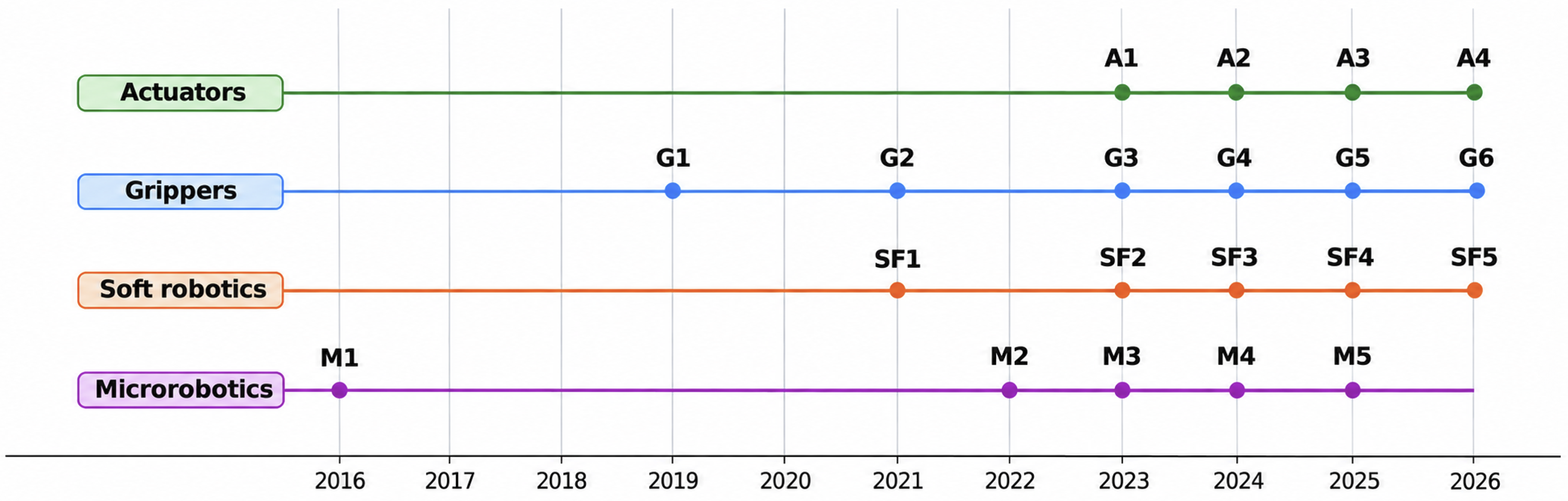
Figure 2.
Classification of NiTi applications in robotics into four application-oriented domains. The categories may overlap in their physical characteristics; individual studies are assigned according to their primary technical contribution.
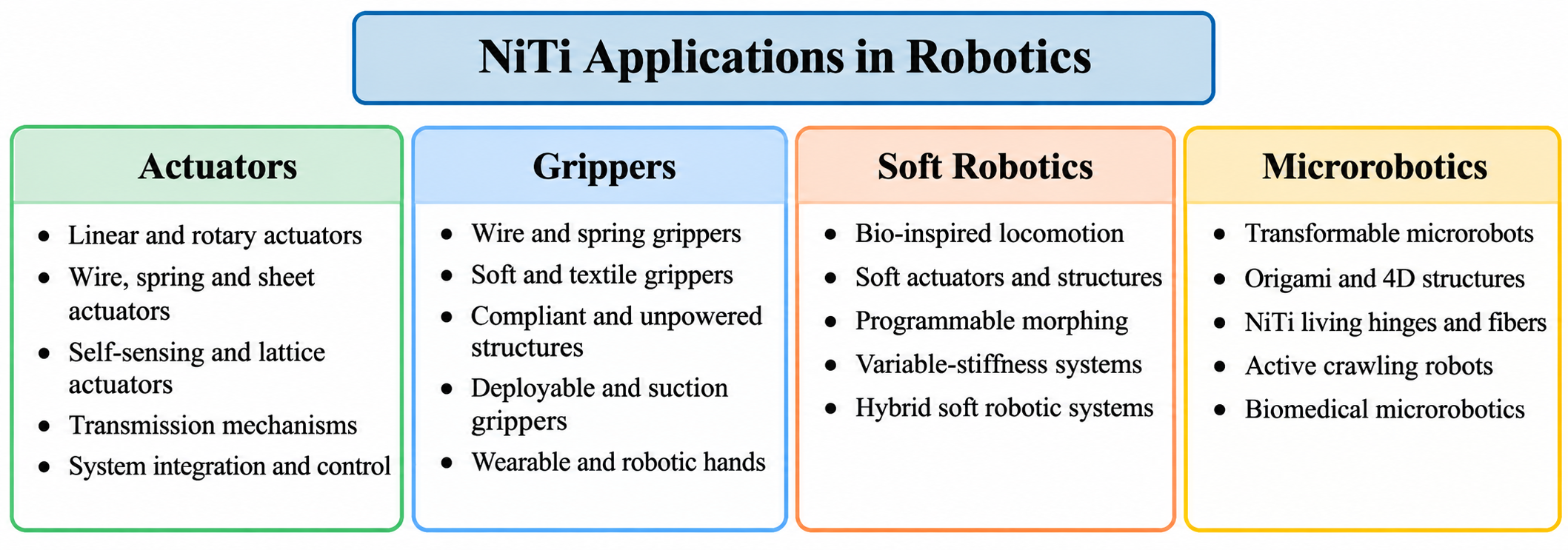
Figure 3.
Representative applications of NiTi shape memory alloys in four robotic domains: (a) angular actuator demonstrating thermally induced rotation from 0° at 20 °C to 158° at 90 °C, reproduced from Grosu et al. [15]; (b) CAD model of a robotic gripper incorporating NiTi-based actuation, reproduced from Teodoriu et al. [29]; (c) programmable soft robotic structure combining NiTi shape memory alloy springs with a shape memory polymer (SMP) core, including its mechanical configuration and thermally controlled deformation, reproduced from Chen et al. [51]; and (d) insect-inspired MEMS microrobot and miniature SMA rotary actuators based on BioMetal Helix BMX50, reproduced from Saito et al. [60]. The panels have been resized and arranged into a composite figure.
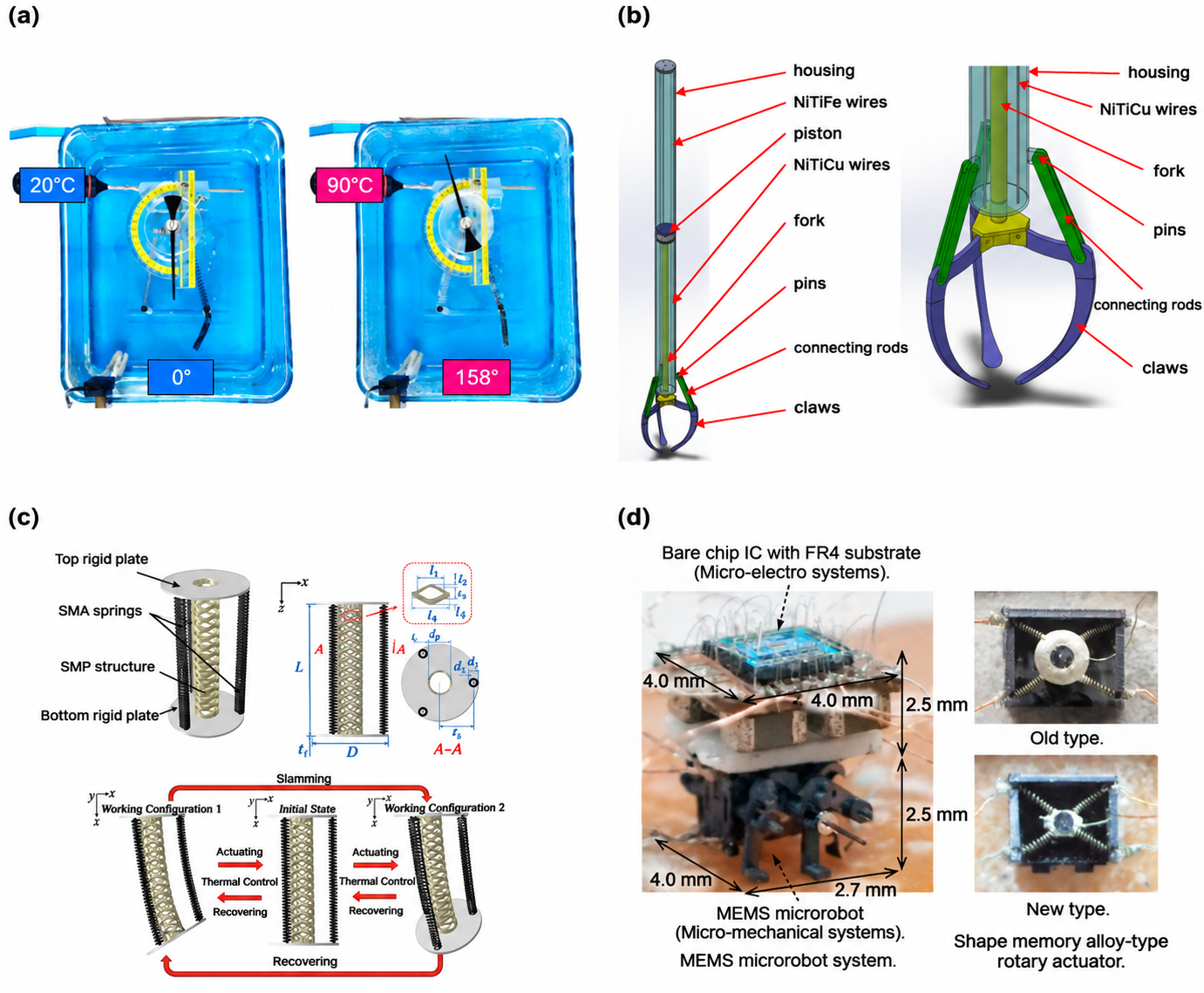
In actuation and drive systems, NiTi elements enable thermally induced mechanical displacement, as demonstrated by the angular actuator developed by Grosu et al. [15]. In robotic gripping applications, NiTi wires offer a compact alternative to conventional actuation mechanisms, as illustrated by the gripper design proposed by Teodoriu et al. [29]. In soft robotics, the integration of NiTi springs with shape memory polymers enables programmable deformation and reversible changes in structural configuration, as demonstrated by Chen et al. [51]. At the microscale, SMA-based actuators enable the development of miniature robotic systems, including the insect-inspired MEMS microrobot presented by Saito et al. [60]. These examples demonstrate the versatility of shape memory alloy actuation across different structural scales, mechanical configurations, and functional requirements.
1.5. Literature Search and Study Selection
The literature corpus was assembled using a structured, application-oriented search and screening procedure. The search was designed to identify original studies in which NiTi, nitinol, or a NiTi-based alloy performs a functional role in a robotic device, actuator, compliant mechanism, or robot-oriented prototype. The literature search was conducted primarily using Google Scholar, complemented by backward reference searching and examination of related publications identified from relevant studies. Keyword combinations were centered on the material terms “NiTi”, “Nitinol”, and “nickel–titanium shape memory alloy” together with application terms including “robot”, “robotics”, “gripper”, “actuator”, “drive”, “soft robot”, “wearable robot”, “microrobot”, and “microactuator”. Searches were iteratively refined using terminology encountered in relevant publications and by examining the reference lists of and literature related to the candidate studies. The search was subsequently supplemented using IEEE Xplore to improve coverage of robotics-oriented publications. The supplementary search included combinations of the terms “nitinol”, “nitinol gripper”, “nitinol soft robotic”. Particular attention was given to studies in which NiTi served as a superelastic structural element, steering component, or integrated functional material rather than solely as a thermally activated actuator. Publications identified through this supplementary search were evaluated according to the same eligibility criteria as the original literature corpus. The final literature search was conducted on 22 October 2026 using Google Scholar and IEEE Xplore.
The application-oriented part of the review primarily targets studies published between 2023 and 2026. Earlier publications were retained when they represent a relevant technological concept, a distinct form of NiTi integration, or an application that remains useful for comparison with recent work. Priority was given to original research articles presenting experimental characterization, a physical prototype, or a robot-level demonstration. Review papers were used to establish the broader background and to position the present work relative to recent literature, but they were not used as substitutes for the primary application studies summarized in Section 2, Section 3, Section 4 and Section 5.
Candidate publications were assessed at full-text level with respect to four eligibility criteria: (I) a functional connection to robotics or robotic actuation; (II) use of Ni-Ti/Nitinol or a NiTi-based alloy as an actuator, superelastic element, structural component, sensing element, stiffness-control element, or reconfigurable component; (III) sufficient technical information to identify the form and functional role of the material; and (IV) sufficient experimental or implementation detail to support comparison with other studies. Material identity was checked wherever possible from the article text, reported composition, or material/product specification. Studies concerned only with general SMA theory, without a clear connection to the robotic application categories considered here, were not included in the application comparison.
The four domains constitute an application-oriented analytical framework rather than a mutually exclusive classification based on a single physical criterion. Robotic grippers are distinguished by their manipulation function, actuators and drive systems by their role in generating or transmitting motion, soft robotics by the integration of NiTi with compliant architectures, and microrobotics by miniaturization and associated integration constraints. Some robotic systems may therefore exhibit characteristics associated with more than one domain. To avoid duplicate analysis, each publication was assigned to the category corresponding to its principal technical contribution and the main focus of its experimental evaluation. Cross-domain similarities and differences are subsequently examined in Section 6. The resulting corpus comprises 50 application-oriented studies, including four additional publications identified through the supplementary IEEE Xplore search. Because the objective is a structured, application-focused review rather than a formal systematic review or meta-analysis, the study set is not claimed to be exhaustive. Instead, the selection is intended to provide a technically representative basis for comparing NiTi integration strategies, functional roles, advantages, limitations, and emerging research directions across robotic domains. The literature identification, screening, eligibility assessment, and application-oriented classification procedure is summarized in Figure 4.
Figure 4.
Overview of the literature identification, screening, eligibility assessment, and application-oriented classification workflow. The selected corpus comprises 50 studies on NiTi applications in robotics, organized into four domains according to their primary technical contribution.
The remainder of this paper is organized as follows. Section 2 focuses on NiTi-based actuators and drive systems. Section 3 reviews the application of NiTi alloys in robotic grippers, highlighting design strategies, actuation mechanisms, and performance characteristics. Section 4 examines the role of nitinol in soft robotics, emphasizing compliant integration, hybrid material architectures, and bio-inspired motion. Section 5 addresses applications in microrobotics, where miniaturization and structural integration create distinct opportunities and constraints. Section 6 provides a cross-domain comparative synthesis of functional roles, limitations, and emerging research trends, followed by the conclusions and future research directions in Section 7.
2. Application of NiTi Shape Memory Alloys in Actuators and Drives
Shape memory alloy actuators based on NiTi are widely investigated as compact actuation elements capable of generating mechanical motion through thermally induced martensitic phase transformations. In robotic systems, NiTi is implemented in wires, springs, sheets, thin films, lattice structures, and superelastic rods. The reviewed studies address actuator design, material behavior, thermal activation, additive manufacturing, structural integration, sensing, and control. Rather than focusing solely on complete robotic systems, several works analyze NiTi components as enabling elements whose geometry and thermomechanical behavior determine the performance of the resulting robotic drive.
Grosu et al. [15] report the development of a nitinol angular actuator and present experimental results associated with its design and operation. The study describes the construction of an actuator intended to generate angular motion through the actuation behavior of NiTi elements. The work focuses on the development process and on experimentally obtained results that characterize the functioning of the actuator. The paper presents the design concept, prototype realization, and performance evaluation of the angular actuator system. The authors document the operational behavior of the device and demonstrate the feasibility of producing rotational actuation using nitinol-based components [15].
Murphy et al. [16] investigate the effect of volumetric energy density (VED) and lattice strut diameter on the shape memory effect of additively manufactured nitinol actuators. The study analyzes how manufacturing parameters influence the shape memory response of lattice structures produced from NiTi. The work examines relationships between fabrication parameters and resulting actuation behavior. The authors evaluate the shape memory performance of the structures by analyzing their ability to recover shape after deformation. The study focuses on material processing and structural characteristics that influence actuator performance, specifically in the context of lattice based NiTi actuator architectures [16].
Khan et al. [17] analyze the response of nitinol actuators under controlled conductive heating regimes. The study investigates how heating conditions affect actuator behavior when thermal activation is delivered through conductive heating methods. Experimental tests are conducted to observe actuator response under controlled heating conditions. The work focuses on understanding the relationship between heating strategy and actuator performance. The authors present experimental observations of actuation behavior and discuss the influence of heating regimes on the response of nitinol-based actuators [17].
Suraj and Kumar [18] present an experimental study focused on the characterization and optimization of shape memory alloy sheets intended for microelectromechanical system (MEMS) actuation. The study investigates the mechanical actuation behavior of SMA sheet materials and evaluates parameters influencing actuation performance. The authors conduct experimental tests to characterize the properties of SMA sheets used in actuation applications. The work aims to optimize the mechanical performance of these materials when used as actuating elements in MEMS devices. The results contribute to understanding how SMA sheet materials behave under conditions relevant to microactuation [18].
Sibirev et al. [19] examine methods for improving the performance stability of NiTi actuators by decreasing their operating temperature range. The study focuses on the stability of actuator performance during repeated operation and investigates how narrowing the operating temperature range influences actuator reliability. Experimental investigations are performed to evaluate actuator behavior under modified operating conditions. The authors analyze the resulting changes in performance stability and discuss how the proposed approach influences the actuation characteristics of NiTi-based devices [19].
A NiTi-based rotary servomechanism was experimentally developed in [20]. Linear contraction of the NiTi actuator was converted into angular motion of a bio-inspired joint, with position feedback enabling electronic control of the resulting motion [20].
Plotkowski et al. [21] investigate additive manufacturing of nitinol shape memory alloys for advanced actuator designs. The study explores fabrication methods that enable the production of complex NiTi structures using additive manufacturing techniques. The authors discuss manufacturing processes, material behavior, and structural design possibilities associated with additively manufactured NiTi components. The work examines how additive manufacturing technologies can be used to produce actuator structures that may not be achievable using conventional manufacturing approaches. The study contributes knowledge regarding the fabrication and application potential of additively manufactured NiTi for actuator development [21].
Alexandron and deBotton [22] present an experimental study focused on the behavior of nitinol springs. The work describes an experimental apparatus designed to investigate the mechanical response of NiTi springs and reports experimental results obtained using this setup. The study examines the behavior of the springs under controlled testing conditions and documents the mechanical response observed during experiments. The results provide experimental data describing the behavior of nitinol spring actuators and contribute to understanding their performance under repeated actuation conditions [22].
Narayane and Taiwade [23] investigated Ni–Ti/polyimide composite actuators in bilayer and trilayer configurations. The sandwich architecture enhanced the achievable stroke and displacement, demonstrating the potential of thin-film NiTi composites for compact actuation systems [23].
Table 1 summarizes the actuator and drive systems reviewed in this section. The comparison distinguishes the actuator architecture, physical form of the NiTi element, resulting mechanical output, integration strategy, and intended robotic application. This classification highlights how similar NiTi material forms can be employed in different mechanical configurations and functional roles, ranging from thermally activated motion generation to superelastic transmission and compliant structural integration.
Table 1.
List of NiTi actuators and drives.
Biasutti et al. [24] investigate a hingeless flexible robotic arm actuated by NiTi wires for space robotics applications. Multiple prototypes incorporating one or more NiTi actuators were manufactured and experimentally tested to evaluate bending capability and multidirectional actuation. The study demonstrates the integration of NiTi wires into a compliant robotic structure capable of large bending deformation without conventional mechanical joints, highlighting their potential for lightweight inspection systems in space environments [24].
Durante et al. [25] develop a three degree of freedom cable-driven parallel manipulator equipped with self-sensing NiTi actuators. The 20 mm Nitinol elements operate together with a bias spring, while the actuator response is used for self-sensing. The manipulator is physically realized and evaluated under closed-loop control, demonstrating the feasibility of integrating actuation and sensing functions within compact parallel robotic mechanisms [25].
Weerakkody et al. [26] propose a robust adaptive closed-loop controller for electro-thermally actuated NiTi SMA elements. The method is experimentally validated for different SMA configurations and is subsequently implemented in a NiTi-powered assistive robotic device. The study demonstrates that adaptive control can improve strain, stress, and position tracking despite uncertainty in SMA behavior, addressing one of the main limitations of thermally driven NiTi actuators [26].
Kim and Wi [27] investigate a discrete continuum robot unit driven by superelastic Nitinol rods and develop an online planar inverse-kinematics method based on Elastica analysis. In this configuration, NiTi is used primarily for its superelastic mechanical response rather than as a Joule-heated shape-memory actuator. Simulation and bench experiments validate the relationship between rod displacement and robot bending angle, illustrating a distinct structural and transmission role of NiTi in continuum robotics [27].
Islam et al. [28] investigated a composite actuator fabricated using additive manufacturing techniques, in which a Nitinol shape memory alloy wire was embedded within a three-dimensional printed thermoplastic polyurethane (TPU) structure. The proposed configuration combines the thermally induced contraction of the NiTi wire with the mechanical flexibility of the surrounding polymer, enabling deformation of a compliant actuator. This manufacturing approach offers opportunities for developing customized actuator geometries and reducing the complexity of mechanical assembly. However, embedding NiTi wires within polymeric structures introduces additional design considerations related to thermal transfer, interfacial mechanical stresses, and long-term cyclic reliability. The study provides an example of integrating NiTi actuation into additively manufactured compliant components, which may be relevant to future soft robotic mechanisms.
Comparative Analysis and Research Gaps
Across the actuator and drive studies, several complementary development directions can be distinguished. One focuses on improving the thermomechanical performance of NiTi elements through geometry, processing, heating strategies, and operating conditions [15,16,17,18,19,20,21,22,23]. Another emphasizes structural integration, ranging from compliant robotic mechanisms [24] to additively manufactured NiTi–polymer composites [28]. Further developments extend the functionality of NiTi beyond open-loop contraction through self-sensing [25], adaptive closed-loop control [26], and superelastic mechanical transmission [27]. Collectively, these approaches illustrate a shift from treating NiTi as an isolated actuation element toward integrating its mechanical, thermal, and functional properties into the overall robotic architecture.
The reviewed studies demonstrate that actuator geometry and integration strategy strongly influence achievable performance and design trade-offs. Wires and springs provide relatively simple actuation mechanisms, whereas sheets, thin-film structures, and additively manufactured geometries offer opportunities for bending, miniaturization, and customized deformation. Embedding NiTi wires within compliant polymeric structures, as demonstrated in [28], can simplify mechanical integration but introduces additional constraints related to heat transfer and interfacial stresses. Similarly, superelastic rods enable deformation transmission without thermal activation [27]. Consequently, comparing actuator concepts solely in terms of force or displacement is insufficient; relevant criteria also include response time, compliance, energy consumption, structural complexity, and the intended functional role of NiTi.
The principal research challenges remain thermal response, hysteresis, repeatability, and long-term reliability. Studies [17,19] demonstrate the influence of heating conditions and operating temperature, while [25,26] show the potential of sensing and adaptive control to compensate for nonlinear behavior. At the same time, increasingly integrated architectures [24,28] require consideration of material interfaces and coupled thermomechanical effects. Since fatigue life, cooling time, energy efficiency, and performance degradation are not evaluated consistently across the reviewed studies, direct quantitative comparisons remain limited. Future research should therefore emphasize the coordinated design and evaluation of NiTi materials, actuator geometries, surrounding structures, thermal management, and control systems.
3. Application of NiTi Shape Memory Alloys in Robotic Grippers
NiTi-based shape memory alloys are increasingly used in robotic grippers as compact, thermally driven actuators capable of generating force and motion without conventional motors and transmissions. The reviewed literature shows that NiTi elements are applied in grippers in several distinct roles: as work-generating contraction actuators, as constrained recovery force sources, as antagonistic elements paired with superelastic components, as embedded actuators in soft structures, and as textile integrated active elements. Recent publications focused on experimentally validated actuation behavior, actuator pairing strategies, structural embedding, and system-level demonstrations of grasping devices.
Teodoriu et al. [29] investigate the actuation capacity of commercial NiTi, NiTiCu, and NiTiFe wires and directly relate the measured behaviors to the design of a three-finger robotic gripper. The study experimentally evaluates two types of shape memory effects in NiTi-based wires: the work-generating shape memory effect (WG-SME) and the constrained recovery shape memory effect (CR-SME). Differential scanning calorimetry is used to characterize reversible martensitic transformations, and thermal cycling tests are performed to evaluate repetitive actuation behavior. The authors report that NiTi and NiTiCu wires repeatedly generate mechanical work during heating and can lift loads under cyclic activation. Constrained recovery experiments show that elongated wires experience shrinkage stresses when heated. In addition, tensile loading–unloading and failure tests are conducted. A NiTiFe superelastic wire is tested separately and shown to function as a cold shape-restoring element. Based on these experimentally verified properties, the paper introduces an actuation setup where SMA and superelastic wires operate against each other. The proposed gripper concept uses three SMA wires for fast grasping motion and three superelastic wires directly connected to them to provide slower releasing and shape restoration.
Schmelter et al. [30] present a two-finger gripper actuated by a shape memory alloy actuator and designed specifically for automation technology with minimized installation space. The study focuses on mechanical design under spatial constraints and on the feasibility of integrating SMA actuation into a compact gripping device. The gripper concept, actuator arrangement, and structural layout are described with the objective of reducing the required mounting volume. The work reports prototype realization and experimental validation of gripping functionality. The authors demonstrate that SMA-driven actuation can be used to implement a functional two-finger gripper in a reduced space envelope suitable for automation systems. The contribution is the demonstration of a compact SMA-actuated gripper architecture validated through experimental operation [30].
Romancik et al. [31] describe the design, implementation, and testing of a robotic gripper actuated by nitinol springs and manufactured using 3D printing technologies. The study combines additively manufactured structural components with SMA spring actuators. The authors present the mechanical design, fabrication process, actuator integration, and experimental testing of the device. The gripper uses nitinol springs as the active actuation elements that generate finger motion under thermal activation. Functional testing is reported to verify grasping capability and operational behavior. The work emphasizes the integration pathway between 3D-printed structures and NiTi spring actuation and documents a complete prototype development workflow from design to test [31].
Zuo et al. [32] developed a wearable soft robotic gripper incorporating nitinol wires within compliant fingers for deep-sea manipulation. The system was experimentally evaluated during deep-sea operations and demonstrated the ability to manipulate delicate objects while generating substantial gripping forces [32].
Perez-Sanchez et al. [33] report the modeling and application of an SMA-actuated lightweight human-inspired gripper developed for aerial manipulation. The primary design constraint addressed in the study is low mass compatible with aerial robotic platforms. The authors examined a lightweight gripper structure actuated by SMA elements and establish a modeling framework for its behavior. Both modeling and experimental validation are included. The work demonstrates that SMA-based actuation can be used to realize a functional lightweight gripper suitable for integration with aerial manipulators. The contribution lies in coupling SMA actuation with lightweight structural design and validated modeling for aerial grasping applications [33].
Kortman et al. [34] developed a deployable suction gripper in which superelastic nitinol wires form a compliant supporting frame for a magnetically actuated membrane. The nitinol structure enables compact folding and subsequent deployment of the gripper for attachment to curved surfaces [34].
In Ref. [35], a monolithic compliant robotic gripper was actuated using nitinol SMA wires. The compliant architecture converts the contraction of the thermally activated wires into gripping motion while reducing the need for conventional joints and transmission components [35].
Shin et al. [36] investigate the use of shape memory alloys within a textile platform to create smart textile–composite actuators and apply these actuators to soft gripper systems. The study focuses on embedding SMA elements into textile-based composite structures to form flexible actuating layers. The authors develop and characterize textile–SMA composite actuators and demonstrate their use in soft gripping devices. Experimental results confirm actuation capability and bending motion generation within the textile composite format. The work contributes an integration approach in which SMA actuators are realized as textile composites and applied to soft gripper implementations [36].
A different approach was proposed in [37], where nitinol wires were encapsulated within a hydrogel matrix to provide both actuation and passive thermal management. A soft robotic gripper incorporating two antagonistically arranged nitinol actuators demonstrated manipulation of delicate objects while reducing the external surface temperature of the actuator [37].
A Ti–Ni-based micro-hand was presented in [38], where miniature SMA actuators were integrated into a robotic hand to reproduce finger movements and generate human-like gestures [38].
Lazzari et al. [39] investigate a multimaterial soft gripper incorporating a NiTiCu6 shape memory alloy element embedded in a silicone rubber matrix functionalized with high-aspect-ratio graphene nanoparticles. The study focuses on improving thermal management and evaluates the influence of enhanced cooling and bias force on actuation performance. A functional soft gripper is fabricated by stepwise molding and experimentally tested, demonstrating how material-level thermal design can improve the response of SMA-driven soft gripping systems [39].
Thangaiyan et al. [40] develop and experimentally validate a retractable robotic grip-per driven by a NiTi SMA spring. The actuator generates forces up to approximately 4 N and about 6 mm of rod displacement, which is amplified by a lightweight additively manufactured linkage to produce 25 mm of jaw travel. The design therefore separates SMA contraction from jaw motion through a rod-based transmission mechanism, providing displacement amplification and improved mechanical robustness in a compact gripper [40].
Zuo et al. [41] developed a sensorized soft gripper designed for deep-sea manipulation, integrating nitinol elements and flexible bending sensors into compliant gripping fingers. The proposed system enables the estimation of interaction forces based on the measured deformation of the gripping structure. The authors investigated the influence of hydrostatic pressure on the mechanical and sensing characteristics of the device and demonstrated its operation during underwater experiments at a depth of 1384 m. A force-estimation resolution of 3 N was reported. Unlike conventional SMA-driven grippers, this approach emphasizes the integration of compliant structural elements and sensing capabilities rather than relying exclusively on thermally activated NiTi contraction. The study illustrates the potential of nitinol-based structural integration in robotic end-effectors operating under demanding environmental conditions.
Table 2 presents a comparative overview of the use of NiTi in robotic grippers.
Table 2.
List of NiTi robotic grippers.
Comparative Analysis and Research Gaps
A comparison of the gripper studies reveals two principal strategies for exploiting NiTi. In most configurations, the alloy serves as a thermally activated element generating motion or gripping force [29,30,31,32,33,35,36,37,38,39,40]. Other approaches utilize the mechanical compliance and recoverable deformation of nitinol primarily for structural functions, as demonstrated by the deployable suction gripper [34] and the sensorized deep-sea gripper [41]. These examples show that the contribution of NiTi to robotic grasping extends beyond replacing conventional actuators and may include structural adaptability, compliant interaction, and integration with sensing systems.
The reviewed designs also reveal trade-offs between actuator simplicity, mechanical transmission, and functional integration. Straight wires offer compact actuation but limited contraction, often requiring tendon arrangements or displacement-amplifying mechanisms [29,33,35,40]. Spring-based configurations provide greater displacement, while integration with compliant materials, textiles, and flexible structures improves adaptability to grasped objects [31,32,36,37,39]. Such integration, however, increases the interaction between actuator behavior and the surrounding structure. The deep-sea system in [41] introduces an additional consideration: environmental conditions can affect both mechanical response and sensing performance. Accordingly, the suitability of a NiTi-based gripper depends not only on gripping force and displacement but also on compliance, controllability, sensing requirements, and operating environment.
Thermal management and performance repeatability remain major challenges for actively driven NiTi grippers. The hydrogel-based architecture [37] and graphene-enhanced multimaterial design [39] address heat dissipation, whereas many other systems rely primarily on passive cooling. For structurally integrated and sensorized solutions [34,41], mechanical durability and reliable interaction-force estimation become particularly relevant. Across these different architectures, gripping force, response and cooling times, energy consumption, sensing accuracy, and fatigue life are not reported consistently, limiting direct quantitative comparison. Future investigations should therefore adopt common evaluation criteria and examine long-term performance under representative grasping loads and environmental conditions.
4. Application of NiTi Shape Memory Alloys in Soft Robotics
Soft robotics represents an important area of robotics research in which compliant materials are used to achieve adaptable interaction with complex environments. In this context, NiTi elements are integrated within elastomers, textiles, flexible structures, and hybrid smart-material systems to produce bending, contraction, locomotion, propulsion, morphing, and stiffness modulation. The reviewed works therefore span both conventional thermally activated SMA actuation and more integrated architectures in which NiTi interacts with sensing, structural, magnetic, or shape-memory components.
Ren et al. [42] integrated a U-shaped nitinol wire with a compliant elastomer structure and a liquid-metal curvature sensor. The resulting soft actuator enabled closed-loop curvature control while preserving the mechanical compliance required for soft robotic applications [42].
Ćurković and Mlivić [43] developed a silicone-based caterpillar-inspired soft robot actuated by NiTi SMA springs. Four NiTi actuators arranged in pairs generate cyclic body deformation and crawling locomotion through sequential electrical activation [43].
Piao et al. [44] developed a soft wearable robot for walking assistance using flexible artificial muscles based on nitinol wires routed through compliant tubing. The actuator architecture was integrated into a wearable suit designed to assist lower-limb motion while maintaining user comfort [44].
Cortez et al. [45] present a snake-inspired robot whose motion is generated using spring-shaped shape memory alloy actuators. The robot is designed to produce snake-like locomotion through the coordinated actuation of SMA springs embedded in the structure. The authors describe the mechanical design of the robot and the arrangement of SMA actuators responsible for producing motion. Experimental demonstrations show the ability of the system to generate movement patterns resembling biological snake locomotion. The work focuses on the design and experimental evaluation of SMA spring actuators used to drive a biomimetic robotic structure [45].
Koiri and Sharma [46] perform a characterization study of nitinol shape memory alloy wire with the aim of evaluating its suitability for use as an actuator in soft robotics. The work examines the behavior of NiTi wires under actuation conditions relevant to robotic systems. Experimental tests are conducted to analyze the response of the material and to assess its effectiveness as an actuator element. The study reports observations related to the actuation characteristics of nitinol wires and discusses their applicability in soft robotic devices. Although the study does not demonstrate a complete soft robotic system, it provides experimental characterization of NiTi actuator elements and identifies parameters relevant to the selection and integration of SMA-based actuation in soft robotics [46].
A soft bionic elbow exoskeleton was developed in [47] using NiTi SMA springs as artificial muscles in combination with elastic elements. The spring configuration provides substantially larger contraction than straight SMA wires and generates the tensile force required to assist elbow motion [47].
In the EdemaFlex system [48], nitinol SMA springs were integrated into a textile-based soft robotic glove to generate programmable localized compression. The work demonstrates the integration of miniature NiTi actuators directly within a wearable textile structure for personalized hand therapy [48].
A fully flexible bioinspired underwater robot was developed in [49] using Joule-heated coiled NiTi SMA actuators. The actuators deform the compliant propulsion structure to generate jet-based locomotion, demonstrating the suitability of NiTi for compact underwater soft robotic propulsion [49].
Longwell et al. [50] report progress toward submersible microrobots by introducing a low-power SMA-based actuator designed for underwater propulsion. The study describes a small-scale actuator system that uses SMA actuation to generate propulsion forces in water. The authors present the actuator concept and demonstrate its performance through experimental testing. The work focuses on the development of a compact actuator capable of producing propulsion while maintaining low power consumption. The actuator is intended for use in small underwater robotic systems [50].
Chen et al. [51] present a hybrid programmable morphing structure integrating shape memory alloy (SMA) springs with a shape memory polymer (SMP) core. The SMA springs provide thermally activated deformation, whereas the SMP component enables reversible shape locking and stiffness modulation. By combining these two shape memory materials, the structure can undergo programmable geometric reconfiguration and adaptive stiffness changes without conventional rigid joints. The study demonstrates how the coupled SMA–SMP architecture can be used to realize controllable morphing behavior for soft robotic applications [51].
Wu et al. [52] introduce nitinol torsion strips for soft robotic manipulation and morphing. The actuators are fabricated from commercial NiTi strips containing approximately 55–56% Ni and 44–45% Ti, with thicknesses from 0.05 to 0.20 mm, and are integrated with compliant substrates. Unlike conventional wire and spring actuators, the proposed configuration generates torsional deformation and supports programmable morphing, with demonstrations including artificial muscles, grippers, jumping robots, and soft valves [52].
Li et al. [53] develop an intelligent programming method for NiTi wire-driven bio-mimetic soft robots. A machine-learning model relates training parameters to the deformation angle of NiTi wires, enabling programmed one-, two-, and three-dimensional shape transformations. The trained wires are integrated into elephant trunk-, Venus fly trap-, and chrysalis-inspired soft robots, demonstrating how thermomechanical training can be combined with data-driven prediction to obtain reusable, application-specific morphing behavior [53].
Fontoura and Aguzzoli [54] develop a compliant NiTi–polydimethylsiloxane structure combining temperature-controlled longitudinal stiffness with magnetically actuated pillar arrays. NiTi is integrated into the PDMS base as a stiffness-controlling element, while iron-functionalized pillars provide magnetic motion. The hybrid concept demonstrates a multifunctional role for NiTi in soft robotic structures, where thermal stiffness regulation is combined with an independent magnetic actuation mechanism [54].
Lloyd et al. [55] presented a magnetically actuated soft robotic system incorporating a sliding nitinol backbone to achieve reconfigurable mechanical behavior and variable stiffness. The proposed mechanism combines remotely generated magnetic actuation with a flexible supporting structure, allowing the robot to perform reversible coiling motions. Experimental investigations demonstrated coiling deformations of up to 400° and the ability to grasp objects of different sizes. In contrast to conventional Joule-heated SMA actuators, the primary motion of this system is generated by magnetic forces, while the nitinol element contributes to its mechanical configuration and stiffness-related properties. This approach demonstrates the potential of NiTi as a structural and functional component in hybrid soft robotic systems, extending its application beyond thermally activated actuation.
Table 3 presents a comparative overview of NiTi applications in soft robotics, organized according to the type of robotic system, NiTi material form, host structure or matrix, functional role of NiTi, and distinctive system capability. The comparison highlights the diversity of NiTi integration strategies, ranging from thermally activated actuators embedded in compliant structures to multifunctional hybrid systems employing NiTi for shape reconfiguration, stiffness modulation, or structural support. Particular attention is given to distinguishing the functional contribution of NiTi from the overall capabilities of the robotic system, especially in architectures combining thermal and magnetic actuation.
Table 3.
List of NiTi in soft robotics.
Comparative Analysis and Research Gaps
The comparison in Table 3 indicates a progression from relatively simple NiTi-driven compliant mechanisms toward multifunctional hybrid soft robotic structures. Earlier implementations primarily employ wires or springs to generate bending, contraction, or locomotion [42,43,44,45,46,47], whereas other systems integrate NiTi with textiles, compliant matrices, shape memory polymers, and programmable structures [48,49,50,51,52,53]. More recent hybrid concepts also combine NiTi with magnetic actuation [54,55]. This development reflects a broader functional role for NiTi, extending from thermally activated motion generation to structural support, stiffness modulation, and mechanical reconfiguration.
The reviewed hybrid systems differ substantially in how NiTi contributes to their operation. In some configurations, the alloy provides active deformation combined with sensing or compliant integration, as illustrated by liquid-metal sensing [42], textile-based structures [48], and shape memory polymer composites [51]. Other approaches exploit specialized deformation mechanisms, including torsional morphing [52]. Magnetic hybrid systems [54,55] further demonstrate that NiTi can contribute to structural or stiffness-related functions while a separate physical mechanism generates motion. These architectures expand the capabilities of soft robots but also complicate comparisons because their performance depends on the interaction between the alloy, surrounding materials, and additional actuation or sensing components.
Thermomechanical coupling and interfacial durability are therefore central research challenges. In NiTi–polymer and NiTi–elastomer systems, differences in stiffness, thermal expansion, and deformation behavior can generate localized stresses during repeated operation, potentially affecting force transmission, structural integrity, and actuation repeatability. More specifically, repeated Joule heating and cooling can alter the interfacial bonding conditions between SMA actuators and surrounding elastomeric matrices. Xiao et al. [65] experimentally investigated the temperature-dependent bond behavior of SMA wires embedded in polydimethylsiloxane (PDMS), demonstrating the importance of temperature in the interfacial debonding process. Under repeated thermomechanical loading, insufficient adhesion may promote localized debonding and progressive delamination, thereby compromising mechanical load transfer and actuation reliability. To address such limitations, Pisaneschi et al. [66] investigated an elastomeric interlayer in SMA hybrid composites and demonstrated improved interfacial adhesion and stress transfer. These findings indicate that interface design, including compliant intermediate layers and appropriate bonding strategies, should be considered alongside thermal management when developing durable NiTi-based soft robotic systems. Hybrid architectures additionally require coordinated characterization of their distinct functional components, particularly when thermal and magnetic effects are combined [54,55]. Although the reviewed studies demonstrate improvements in motion generation, adaptability, morphing, and stiffness control, they employ different performance metrics, and long-term cyclic behavior is not consistently evaluated. Future research should prioritize robot-level testing under repeated loading, including interfacial reliability, thermal response, mechanical performance, and energy consumption, to distinguish the contribution of NiTi from that of the surrounding soft robotic architecture.
5. NiTi Shape Memory Alloys in Microrobotics
Microrobotics represents a rapidly developing field in which miniaturized robotic systems operate at millimeter or sub-millimeter scales. At these dimensions, conventional actuation technologies such as electric motors become difficult to implement due to size, weight, and integration constraints. Shape memory alloys based on NiTi offer an alternative actuation mechanism suitable for small-scale devices because they can generate mechanical motion through thermally induced phase transformations while maintaining relatively simple structural integration. Recent research demonstrates that NiTi-based elements can be used in microrobots in several roles, including microactuators, propulsion systems, and reconfigurable structures.
Zhang et al. [56] present helical microrobots based on shape memory alloy structures with transformable capability intended for vascular occlusion treatment. The study introduces a microrobot design that incorporates NiTi helical elements capable of changing their configuration. The work focuses on the development of microrobots that can modify their structure in response to activation, enabling functional transformation. The authors describe the fabrication and operational concept of the helical microrobot and demonstrate its ability to perform structural transformation relevant to biomedical applications. The study investigates how the shape memory behavior of the NiTi elements enables reconfiguration of the microrobot structure. Experimental demonstrations illustrate the functionality of the transformable helical design and its potential use in vascular occlusion treatment [56].
Gottwald et al. [57] report the development of an origami-inspired reprogrammable microactuator system based on antagonistic shape memory alloy microactuators. The study focuses on a microscale actuator architecture in which SMA elements are arranged to produce controlled folding behavior. The proposed system uses antagonistic actuation to generate reversible shape changes in an origami-like structure. The authors describe the design and fabrication of the microactuator system and demonstrate that the structure can be reprogrammed through actuation of the SMA elements. Experimental demonstrations illustrate the ability of the system to perform controlled folding and reconfiguration. The work highlights the potential of SMA microactuators for reprogrammable microsystems and microscale robotic mechanisms [57].
Trygstad et al. [58] introduce a fast unimorph SMA-based actuator developed for microrobotics. The actuator is designed as a miniature device capable of producing bending motion through thermally activated shape memory behavior. The study describes the actuator architecture and the fabrication process used to construct the unimorph structure. The authors present experimental testing results that demonstrate the actuation performance of the device. The work focuses on the development of a compact SMA-based actuator intended for integration into microrobotic platforms and reports experimental validation of its actuation behavior [58].
In a subsequent study, Trygstad et al. [59] present a fast bimorph SMA-based actuator designed for microrobotics. The actuator architecture consists of a bimorph configuration in which two layers contribute to bending motion during thermal activation. The study describes the design and fabrication of the actuator and reports experimental evaluation of its performance. The authors demonstrate the functionality of the device and analyze its actuation behavior during operation. The work focuses on the development of a microscale SMA actuator capable of generating rapid bending motion and demonstrates its suitability for microrobotic systems [59].
Saito et al. [60] present miniaturized rotary actuators based on shape memory alloys designed for insect-type MEMS microrobots. The study focuses on the development of rotary actuation mechanisms that can be integrated into small robotic systems inspired by insect locomotion. The authors describe the actuator structure and its operating principle based on the shape memory behavior of SMA materials. The work includes experimental demonstrations of the actuator operation and discusses its application in MEMS-scale robotic devices. The study contributes an example of SMA-driven rotary actuation implemented in a microrobot designed to emulate insect-like movement [60].
Hedrick et al. [61] demonstrate femtosecond-laser fabrication of nitinol living hinges for millimeter-scale robotic mechanisms. The fabrication process minimizes heat-affected zones and preserves the superelastic properties of NiTi. Rectangular and elliptic-notch hinges are modeled and experimentally characterized, and their applicability is demonstrated in miniature mechanisms including a piezoelectrically actuated robotic wing. This work highlights the use of NiTi as a compliant structural element rather than solely as a thermal actuator [61].
Li et al. [62] develop surface-functionalized SMA fibers for robotic hands and micro-robotic crawlers. Polydopamine and silver nanowires are introduced on the fiber surface to provide combined photothermal and electrothermal activation. The modified fibers exhibit approximately 3.2-times faster actuation under near-infrared irradiation and a 35% improvement in electrothermal response and are integrated into miniature crawling robots intended for lightweight autonomous operation [62].
Che et al. [63] present a 5 mm long, 10 mg active-morphing insect robot combining an arc-heating actuator with NiTi SMA elements. Trained NiTi SMA rings and wires form the morphing exoskeleton, while 0.08 mm superelastic NiTi wires are used in the legs. Thermal energy generated during arc actuation activates the SMA, allowing the robot to reduce its body thickness by approximately one third and traverse a gap corresponding to 70% of its original height. The system demonstrates coupled high speed locomotion, active morphing, and self-recovery at insect scale [63].
He et al. [64] developed a hybrid steerable robotic system intended for minimally invasive epilepsy surgery, combining a concentric tube robot with a magnetically actuated distal wrist and forceps. The concentric tube mechanism consists of three precurved nitinol tubes, which provide the structural flexibility required for navigating confined anatomical spaces. The system offers six degrees of freedom for positioning the surgical instrument, while magnetic actuation enables additional manipulation at the distal end. Experimental evaluation demonstrated a mean positioning error of 2.8 mm, and the feasibility of the proposed architecture was investigated using a brain phantom. Unlike conventional thermally activated NiTi mechanisms, the nitinol tubes serve primarily as superelastic structural elements. This study highlights the potential of NiTi for developing compact and dexterous surgical robotic instruments in which material compliance and mechanical integration are more important than shape-memory-driven contraction.
Table 4 presents a comparative overview of NiTi applications in microrobotics. The comparison includes microrobot class, NiTi form, fabrication or integration method, generated motion, characteristic scale or mass, and application, highlighting how NiTi functionality changes as robotic systems are miniaturized.
Table 4.
Comparative overview of NiTi applications in microrobotics and miniaturized robotic systems.
Comparative Analysis and Research Gaps
The reviewed studies demonstrate that miniaturization influences both the advantages of NiTi and the ways in which it is integrated into robotic systems. At millimeter and sub-millimeter scales, compact SMA elements can replace conventional actuation and transmission mechanisms, supporting locomotion, propulsion, reconfiguration, and active morphing [56,57,58,59,60,61,62,63]. In miniature surgical mechanisms, precurved superelastic nitinol tubes can instead provide structural flexibility and steerability without relying on thermally induced actuation [64]. These approaches highlight the distinction between NiTi as an active microactuator and as a mechanically functional material in miniaturized robotic structures.
Reducing the dimensions of NiTi elements can improve thermal response due to their lower thermal mass, but it also increases sensitivity to fabrication tolerances, electrical interconnections, heat transfer, and displacement control. Studies [58,59,60,61] illustrate the importance of specialized actuator and hinge architectures at the microscale, while robotic concepts intended for biomedical or autonomous operation [56,62,63,64] introduce additional requirements related to reliability, environmental interaction, and precise positioning. The surgical system in [64] also illustrates that miniaturized robotic instruments should not be evaluated using exactly the same criteria as MEMS microrobots, since their operating principles, characteristic dimensions, and functional objectives differ.
A major research gap is the limited comparability of miniature NiTi-based robotic systems. Reported parameters such as dimensions, mass, displacement, force, actuation frequency, power consumption, positioning accuracy, and cycle life vary considerably between studies. Furthermore, complete robot-level validation is less consistently reported than the characterization of individual actuators or mechanisms. Future investigations should therefore combine advances in fabrication and material integration with standardized electromechanical testing, long-term reliability assessment, and validation under representative operating conditions. Particular attention is required in biomedical applications, where positioning errors, structural degradation, or device failure may have significant practical consequences.
6. Comparative Synthesis and Research Trends
6.1. Functional Roles of NiTi Across Robotic Domains
The analysis of 50 application-oriented studies demonstrates that the contribution of nickel–titanium shape memory alloys (NiTi) to robotic systems cannot be reduced to thermally activated motion generation. Although the shape memory effect remains an important mechanism for producing mechanical work, the reviewed implementations also exploit superelasticity, structural compliance, stiffness regulation, and the integration of actuation with sensing and control. Consequently, the functional role of NiTi depends on the architecture of the robotic system and the requirements imposed by its intended application.
In actuator and drive systems, NiTi is implemented in the form of wires, springs, sheets, thin films, additively manufactured structures, and superelastic rods. These configurations enable linear contraction, bending, torsion, and rotary motion, as well as compliant force transmission. The reviewed studies demonstrate that actuator performance depends not only on the intrinsic thermomechanical properties of NiTi but also on geometry, biasing conditions, heat transfer, mechanical integration, and control strategy. Recent developments additionally address self-sensing actuation, adaptive closed-loop control, and the use of superelastic elements in continuum robotic mechanisms. Thus, NiTi-based drives increasingly combine motion generation with sensing, compliance, or structural functionality [15,16,17,18,19,20,21,22,23,24,25,26,27,28].
In robotic grippers, NiTi enables compact actuation and compliant manipulation through wire-driven, spring-based, antagonistic, embedded, textile-integrated, and deployable mechanisms. Thermally activated elements generate gripping forces or finger displacement, whereas superelastic components can provide restoring forces, structural compliance, or reversible deformation. The reviewed applications range from compact industrial grippers to soft, lightweight, aerial, and specialized manipulation systems. Their comparison indicates that the principal advantage of NiTi lies in the possibility of integrating actuation and compliant mechanical behavior within relatively simple and compact architectures. However, effective grasping also depends on force transmission, displacement amplification, cooling conditions, and the mechanical properties of the gripping structure [29,30,31,32,33,34,35,36,37,38,39,40,41].
In soft robotics, NiTi is frequently combined with elastomers, textiles, shape memory polymers, and other compliant or functional materials. These hybrid architectures support bending, contraction, locomotion, programmable morphing, and stiffness modulation. An important distinction emerges between systems in which NiTi directly generates motion and those in which it provides structural support or regulates mechanical properties while another mechanism produces the primary movement. Examples of the latter approach include hybrid systems combining NiTi with magnetic actuation. The reviewed studies therefore indicate a transition from relatively simple embedded actuators toward multifunctional soft robotic structures in which material behavior, geometry, and actuation mechanisms are designed together [42,43,44,45,46,47,48,49,50,51,52,53,54,55].
In microrobotics and miniaturized robotic systems, NiTi offers opportunities for integrating actuation and mechanical functionality within restricted spatial envelopes. The reviewed implementations include helical microrobots, origami-inspired microactuators, unimorph and bimorph mechanisms, MEMS rotary actuators, superelastic hinges, and insect-inspired robotic structures. NiTi is also employed as a superelastic structural material in miniaturized surgical instruments. These applications should not be considered equivalent in scale or operating principle: microscale thermally activated devices and larger surgical mechanisms impose different requirements on fabrication, thermal management, positioning accuracy, and mechanical reliability. Nevertheless, they demonstrate the value of NiTi where compact actuation, compliant deformation, or integrated structural functionality is required [56,57,58,59,60,61,62,63,64].
Across the four domains, the main finding is that the suitability of NiTi is determined by the interaction between material properties and system-level design rather than by a single performance characteristic. Thermally activated actuation is particularly relevant where compactness and mechanical simplicity are priorities, whereas superelastic and hybrid implementations extend the application range to compliant structures, transmission mechanisms, and multifunctional robotic components. This distinction provides a basis for comparing NiTi-based solutions according to their functional contribution, integration strategy, and application-specific constraints.
6.2. Cross-Domain Comparison
Across the four domains, the value of NiTi arises from different combinations of the same underlying material behaviors. Grippers primarily exploit compact force generation, compliance, and deployability; actuator and drive studies emphasize conversion of thermomechanical behavior into controlled motion, sensing, or transmission; soft robots exploit integration with compliant matrices and hybrid materials; and microrobots exploit high functional density and structural integration at small scales. Thus, the principal design question is not whether NiTi can generate motion, but which material form and functional role best match the mechanical, thermal, spatial, and control constraints of the robotic system.
6.3. Common Technological Limitations
Despite the diversity of applications, several limitations recur across domains. Ther-mally activated systems remain constrained by heating and cooling dynamics, while hysteresis and temperature-dependent behavior complicate precise control. Performance is also strongly affected by biasing strategy, surrounding structural stiffness, heat transfer conditions, and thermomechanical history. Fatigue and long-term stability are especially important for repeated robotic operation, yet cycle life is not characterized consistently across the reviewed studies. Finally, heterogeneous reporting of force, stroke, response time, power consumption, efficiency, and durability limits direct quantitative comparison between architectures.
6.4. Emerging Research Directions
The reviewed literature points toward increasingly integrated NiTi robotic systems. Prominent directions include self-sensing and closed-loop control, superelastic structural and transmission functions, hybridization with soft polymers and other smart materials, additive and microfabrication of application-specific geometries, improved thermal-management strategies, and data-driven programming or control. These trends shift the research focus from isolated SMA actuator performance toward co-design of material, geometry, structure, sensing, thermal management, and control. Progress in this direction, together with standardized reporting and long-duration validation, would make it easier to compare solutions and to translate laboratory demonstrations into repeatable robotic technologies.
6.5. Application-Oriented Future Research Directions
Future developments in NiTi-based robotic systems are expected to focus increasingly on the integration of material functionality with application-specific requirements. In actuators and drive systems, an important direction is the development of compact actuation modules combining self-sensing, closed-loop control, and improved thermal management. These technologies could facilitate the implementation of NiTi in robotic joints, continuum mechanisms, and lightweight transmission systems while reducing dependence on external sensors.
In robotic grippers, future research may emphasize adaptive end-effectors capable of manipulating delicate, irregular, or fragile objects. The combination of NiTi actuation and superelastic structural elements offers opportunities for compact, compliant, and force-controlled manipulation. Potential applications include medical manipulation, lightweight aerial grippers, and robotic devices operating in confined environments. Further progress will require improved grasping repeatability, faster actuation cycles, and reliable force regulation.
In soft robotics, hybridization of NiTi with elastomers, textiles, and other functional materials creates opportunities for multifunctional compliant systems. Promising directions include wearable assistive devices, bio-inspired locomotion platforms, and soft robots with controllable stiffness or programmable deformation. However, practical implementation will require improvements in thermal safety, interfacial durability, energy efficiency, and long-term stability under repeated operation.
In microrobotics and miniaturized robotic systems, NiTi may support compact steering mechanisms, reconfigurable structures, compliant joints, and integrated actuation where conventional electromechanical components are difficult to accommodate. Potential applications include minimally invasive medical devices and miniature robotic mechanisms operating in restricted environments. Further research should emphasize fabrication repeatability, precise motion control, safe thermal operation, and reliable integration with surrounding structures.
Across all four domains, a common priority is the transition from isolated demonstrations of NiTi functionality toward integrated robotic systems evaluated under realistic operating conditions. Application-specific validation of reliability, thermal behavior, response time, energy consumption, and functional effectiveness will be essential for determining the practical advantages of NiTi over conventional actuation and structural technologies.
Table 5 provides a cross-domain comparison of the dominant NiTi forms, functional roles, recurring limitations, and emerging research directions identified in the reviewed literature.
Table 5.
Cross-domain comparative synthesis of NiTi applications in robotics.
7. Conclusions
This review examined 50 application-oriented studies on the integration of nickel–titanium shape memory alloys into robotic systems, organized into four principal domains: actuators and drives, robotic grippers, soft robotics, and microrobotics. The analysis focused on the physical forms of NiTi, their functional roles, mechanical integration strategies, and application-specific advantages and limitations. By comparing implementations at the robotic system level, the review demonstrates that NiTi should be considered not only as a thermally activated actuator material but also as a functional structural material capable of providing superelastic compliance, force transmission, stiffness regulation, and support for integrated sensing and actuation.
The comparison reveals distinct patterns across the reviewed application domains. Actuator and drive systems primarily investigate the conversion of NiTi thermomechanical behavior into controlled motion, with increasing attention to self-sensing, adaptive control, and compliant transmission. Robotic grippers exploit compact force generation, simplified mechanical architectures, and the combination of active contraction with compliant or superelastic elements. Soft robotic systems extend these functions through integration with polymers, textiles, and hybrid actuation technologies, enabling programmable deformation and multifunctional structures. Microrobotic and miniaturized robotic systems exploit the possibility of incorporating actuation or compliant structural functions into mechanisms with restricted installation space, although their dimensions and operating requirements vary substantially.
A central conclusion is that the advantages of NiTi are strongly application-dependent. Compactness, compliance, and mechanical integration can justify its use even when thermally activated systems exhibit limitations in response speed, energy efficiency, or control precision. Conversely, superelastic and hybrid NiTi implementations can provide valuable mechanical functionality without relying on thermally induced phase transformations as the primary source of movement. Accordingly, the selection of a NiTi-based solution should be guided by the required functional role, mechanical architecture, thermal conditions, and control requirements rather than by material properties considered in isolation.
Despite the progress demonstrated in the reviewed studies, several limitations continue to restrict broader robotic implementation. These include heating and cooling dynamics, nonlinear and hysteretic actuator behavior, fatigue and long-term reliability, and the durability of interfaces between NiTi and surrounding materials. Another important limitation is the inconsistent reporting of performance parameters, including force, displacement, response time, power consumption, positioning accuracy, and cycle life. This heterogeneity makes direct quantitative comparisons difficult and limits the transferability of design conclusions between robotic platforms.
Future research should therefore prioritize the coordinated design of NiTi materials, mechanical structures, thermal management, sensing, and control. In actuator systems, particular attention should be given to repeatable closed-loop operation and improved thermal performance. In robotic grippers, the priorities include reliable force regulation and grasping repeatability. Soft robotic systems require improved interfacial durability and predictable behavior of hybrid materials, while microrobotic and miniaturized systems require reproducible fabrication, precise integration, and application-specific validation. Across all domains, standardized performance reporting and long-duration testing would improve the comparability of results and support the transition from laboratory prototypes to practical robotic applications.
Overall, the reviewed literature indicates that the future potential of NiTi in robotics lies not solely in improving conventional shape memory actuators, but in exploiting the combined actuation, superelastic, compliant, and structural capabilities of the material. The most promising developments are therefore expected to emerge from application-oriented integration strategies in which NiTi functionality is matched to the mechanical and operational requirements of the complete robotic system.
Funding
This work was supported by the Polish Ministry of Science and Education grants no. 0614/SBAD/1603.
Institutional Review Board Statement
Not applicable.
Informed Consent Statement
Not applicable.
Data Availability Statement
No new data were created or analyzed in this study. Data sharing is not applicable to this article.
Conflicts of Interest
The author declares no conflicts of interest.
References
- Kauffman, G.B.; Mayo, I. The Story of Nitinol: The Serendipitous Discovery of the Memory Metal and Its Applications. Chem. Educ. 1997, 2, 1–21. [Google Scholar] [CrossRef] [Scilit]
- Buehler, W.J.; Gilfrich, J.V.; Wiley, R.C. Effect of low-temperature phase changes on the mechanical properties of alloys near composition TiNi. J. Appl. Phys. 1963, 34, 1475–1477. [Google Scholar] [CrossRef] [Scilit]
- Wang, F.E.; Buehler, W.J.; Pickart, S.J. Crystal Structure and a Unique “Martensitic” Transition of TiNi. J. Appl. Phys. 1965, 36, 3232–3239. [Google Scholar] [CrossRef] [Scilit]
- Jani, J.M.; Leary, M.; Subic, A.; Gibson, M.A. A review of shape memory alloy research, applications and opportunities. Mater. Des. 2014, 56, 1078–1113. [Google Scholar] [CrossRef] [Scilit]
- Otsuka, K.; Wayman, C.M. (Eds.) Shape Memory Materials; Cambridge University Press: Cambridge, UK, 1999. [Google Scholar]
- Otsuka, K.; Ren, X. Physical metallurgy of Ti–Ni-based shape memory alloys. Prog. Mater. Sci. 2005, 50, 511–678. [Google Scholar] [CrossRef] [Scilit]
- Lagoudas, D.C. (Ed.) Shape Memory Alloys: Modeling and Engineering Applications; Springer: Boston, MA, USA, 2008. [Google Scholar]
- Volkov, A.E.; Evard, M.E.; Belyaev, F.S. Modeling of Deformation and Functional Properties of Shape Memory Alloys Based on a Microstructural Approach. Mater. Sci. Found. 2015, 81, 20–37. [Google Scholar] [CrossRef] [Scilit]
- Gall, K.; Maier, H.J. Cyclic deformation mechanisms in precipitated NiTi shape memory alloys. Acta Mater. 2002, 50, 4643–4657. [Google Scholar] [CrossRef] [Scilit]
- Duerig, T.; Pelton, A.; Stöckel, D. An overview of nitinol medical applications. Mater. Sci. Eng. A 1999, 273–275, 149–160. [Google Scholar] [CrossRef] [Scilit]
- Romančík, J.; Miková, Ľ.; Šarga, P.; Kelemenová, T.; Kelemen, M. Shape Memory Alloy Actuators in Robotics. Actuators 2026, 15, 162. [Google Scholar] [CrossRef] [Scilit]
- Zhang, R.; Yue, H.; Sun, H.; Wang, M.; Yang, F.; Liu, J.; Huang, X. Wire-form shape memory alloy actuators: Modeling, design, and control. Microsyst. Nanoeng. 2026, 12, 76. [Google Scholar] [CrossRef] [Scilit]
- Ahmed, A.; Pranto, S.I.; Al Faruq, M.H.; Kasfia, M.T.T.; Rashid, A.B. A comprehensive overview of shape memory alloys: Recent advances in fabrications, properties, and applications for next-generation smart systems. Next Mater. 2026, 10, 101441. [Google Scholar] [CrossRef] [Scilit]
- Uddin, H.W.; Progoti, Q.R.M.; Mondal, M.C.; Arman, S.E.; Malitha, S.B. Adaptive nickel–titanium shape memory alloy for smart systems: Mechanisms, manufacturing, and applications across biomedical, aerospace, civil, and energy. Mater. Today Commun. 2025, 50, 114564. [Google Scholar] [CrossRef] [Scilit]
- Grosu, O.V.; Milici, L.D.; Bejenar, C.; Pavăl, M. Development Results of a Nitinol (NiTi) Angular Actuator. Actuators 2025, 14, 546. [Google Scholar] [CrossRef] [Scilit]
- Murphy, J.R.; Chekotu, J.C.; Healy, P.; Brabazon, D. Investigating the Effect of VED and Lattice Strut Diameter on the Shape Memory Effect of Nitinol Actuators. J. Mater. Res. Technol. 2025, 41, 423–434. [Google Scholar] [CrossRef] [Scilit]
- Khan, L.A.; McCarthy, E.; Muilwijk, C.; Ahad, I.U.; Brabazon, D. Analysis of nitinol actuator response under controlled conductive heating regimes. Results Eng. 2023, 18, 101047. [Google Scholar] [CrossRef] [Scilit]
- Suraj; Kumar, A. Experimental study of characterization and optimization of shape memory alloy sheet for enhanced mechanical actuation performance for microelectromechanical systems (MEMS). J. Mater. Sci. Mater. Eng. 2024, 19, 15. [Google Scholar] [CrossRef] [Scilit]
- Sibirev, A.; Belyaev, S.; Resnina, N. Improvement of the NiTi actuator performance stability by decreasing its operating temperature range. Sens. Actuators A Phys. 2023, 363, 114743. [Google Scholar] [CrossRef] [Scilit]
- Zuñiga, S.; Bravo, D.; Rengifo, C. Design and construction of a servomechanism using a memory alloy linear actuator. HardwareX 2024, 20, e00587. [Google Scholar] [CrossRef] [Scilit]
- Plotkowski, A.; Fezi, K.; Fancher, C.; Nandwana, P.; List, F., III; Carver, K.; Goldsby, D. Additively Manufacturing Nitinol Shape Memory Alloys for Advanced Actuator Designs; Technical Report ORNL/TM-2023/3177; Oak Ridge National Laboratory: Oak Ridge, TN, USA, 2023. [Google Scholar]
- Alexandron, I.; deBotton, G. Experimental Study of Nitinol Springs: Apparatus and Results. Exp. Mech. 2024, 64, 981–994. [Google Scholar] [CrossRef] [Scilit]
- Narayane, D.; Taiwade, R.V. Tailoring the actuation characteristics of Ni-Ti shape memory alloy/polyimide thin film composites. Compos. Commun. 2025, 53, 102220. [Google Scholar] [CrossRef] [Scilit]
- Biasutti, T.; Rigamonti, D.; Casciaro, E.; Grande, A.M.; Bettini, P. Hingeless arm for space robotics actuated through shape memory alloys. Bioinspir. Biomim. 2024, 19, 016011. [Google Scholar] [CrossRef] [Scilit]
- Durante, F.; Raparelli, T.; Beomonte Zobel, P. Three-Degree-of-Freedom cable-driven parallel manipulator with self-sensing nitinol actuators. Robotics 2024, 13, 93. [Google Scholar] [CrossRef] [Scilit]
- Weerakkody, T.H.; Curcio, E.M.; Carbone, G.; Maletta, C.; Sgambitterra, E.; Lamuta, C. Robust Control of Shape Memory Alloys for Assistive Robotics Applications. Shape Mem. Superelasticity 2026, 12, 119–137. [Google Scholar] [CrossRef] [Scilit]
- Kim, Y.J.; Wi, D. Online planar inverse kinematics for superelastic Nitinol rod driven discrete continuum robot units. Robot. Auton. Syst. 2025, 196, 105227. [Google Scholar] [CrossRef] [Scilit]
- Islam, M.N.; Gonzalez, M.B.; Tabassum, S.; Billah, K.M.M. 3D printed shape memory alloy wire embedded actuator. In Proceedings of the 2024 IEEE 17th Dallas Circuits and Systems Conference (DCAS), Richardson, TX, USA, 19–21 April 2024; pp. 1–5. [Google Scholar]
- Teodoriu, A.P.; Pricop, B.; Lohan, N.M.; Popa, M.; Comăneci, R.I.; Doroftei, I.; Bujoreanu, L.G. Designing a Robotic Gripper Based on the Actuating Capacity of NiTi-Based Shape Memory Wires. Actuators 2024, 13, 319. [Google Scholar] [CrossRef] [Scilit]
- Schmelter, T.; Bade, L.; Kuhlenkötter, B. A Two-Finger Gripper Actuated by Shape Memory Alloy for Applications in Automation Technology with Minimized Installation Space. Actuators 2024, 13, 425. [Google Scholar] [CrossRef] [Scilit]
- Romančík, J.; Vagaš, M.; Majerčák, O. Design, Implementation, And Testing of a 3D-printed Gripper Actuated by Nitinol Springs. MM Sci. J. 2024, 2024, 7352–7356. [Google Scholar] [CrossRef] [Scilit]
- Zuo, Z.; He, X.; Wang, H.; Shao, Z.; Liu, J.; Zhang, Q.; Wen, L. A nitinol-embedded wearable soft robotic gripper for deep-sea manipulation: A wearable device for deep-sea delicate operation. IEEE Robot. Autom. Mag. 2024, 31, 96–107. [Google Scholar] [CrossRef] [Scilit]
- Perez-Sanchez, V.; Garcia-Rubiales, F.J.; Nekoo, S.R.; Arrue, B.; Ollero, A. Modeling and application of an SMA-actuated lightweight human-inspired gripper for aerial manipulation. Machines 2023, 11, 859. [Google Scholar] [CrossRef] [Scilit]
- Kortman, V.G.; de Vries, E.; Jovanova, J.; Sakes, A. Unlocking versatility: Magnetic-actuated deployable suction gripper for complex surface handling. Soft Robot. 2024, 11, 1020–1031. [Google Scholar] [CrossRef] [Scilit]
- Then Mozhi, G.; Dhanalakshmi, K.; Choi, S.B. Design and control of monolithic compliant gripper using shape memory alloy wires. Sensors 2023, 23, 2052. [Google Scholar] [CrossRef] [Scilit]
- Shin, J.; Han, Y.J.; Lee, J.H.; Han, M.W. Shape memory alloys in textile platform: Smart textile-composite actuator and its application to soft grippers. Sensors 2023, 23, 1518. [Google Scholar] [CrossRef] [Scilit]
- Sivaperuman Kalairaj, M.; Banerjee, H.; Lim, C.M.; Chen, P.Y.; Ren, H. Hydrogel-matrix encapsulated Nitinol actuation with self-cooling mechanism. RSC Adv. 2019, 9, 34244–34255. [Google Scholar] [CrossRef] [Scilit]
- Takumi, I.; Sumito, N. SMA micro-hand implemented in small robot for generating gestures. Intell. Serv. Robot. 2021, 14, 399–408. [Google Scholar] [CrossRef] [Scilit]
- Lazzari, F.; Romanò, J.; Villa, F.; Brambilla, L.; Castiglioni, C.; Pittaccio, S. Unraveling the Effects of Improved Cooling and Bias Force in the Actuation of a Shape-Memory Soft Multimaterial Gripper. Adv. Mater. Technol. 2025, 10, 70014. [Google Scholar] [CrossRef] [Scilit]
- Thangaiyan, D.; Kaliaperumal, D.; Choi, S.B. Design, modeling, and experimental validation of an SMA spring-actuated retractable gripper. Smart Mater. Struct. 2026, 35, 067001. [Google Scholar] [CrossRef] [Scilit]
- Zuo, Z.; Wang, H.; Zhang, Q.; He, X.; Liu, J.; Duo, Y.; Wen, L. A deep-sea sensorized soft gripper with force estimation and interactive capabilities. IEEE/ASME Trans. Mechatron. 2025, 30, 7670–7680. [Google Scholar] [CrossRef] [Scilit]
- Ren, Z.; Zarepoor, M.; Huang, X.; Sabelhaus, A.P.; Majidi, C. Shape memory alloy (SMA) actuator with embedded liquid metal curvature sensor for closed-loop control. Front. Robot. AI 2021, 8, 599650. [Google Scholar] [CrossRef] [Scilit]
- Ćurković, P.; Mlivić, D. Design and manufacturing of a simple soft caterpillar robot. Interdiscip. Descr. Complex Syst. INDECS 2024, 22, 633–645. [Google Scholar] [CrossRef] [Scilit]
- Piao, J.; Kim, M.; Kim, J.; Kim, C.; Han, S.; Back, I.; Koo, S. Development of a comfort suit-type soft-wearable robot with flexible artificial muscles for walking assistance. Sci. Rep. 2023, 13, 4869. [Google Scholar] [CrossRef] [Scilit]
- Cortez, R.; Sandoval-Chileño, M.A.; Lozada-Castillo, N.; Luviano-Juárez, A. Snake robot with motion based on shape memory alloy spring-shaped actuators. Biomimetics 2024, 9, 180. [Google Scholar] [CrossRef] [Scilit]
- Koiri, M.K.; Sharma, A.K. Characterization and Behavior Study of Nitinol Shape Memory Alloy Wire for Effective and Efficient Use in Soft Robotics as an Actuator. Indian J. Pure Appl. Phys. 2021, 59, 216–222. [Google Scholar] [CrossRef] [Scilit]
- Xie, Q.; Meng, Q.; Yu, W.; Xu, R.; Wu, Z.; Wang, X.; Yu, H. Design of a soft bionic elbow exoskeleton based on shape memory alloy spring actuators. Mech. Sci. 2023, 14, 159–170. [Google Scholar] [CrossRef] [Scilit]
- Youn, S.; Choudhury, A.; Ku, P.S.; Fu, W.; Tsai, M.; Rathod, M.; Kao, H.L. EdemaFlex: Textile-based soft-robotic platform toward personalized hand edema therapy. npj Flex. Electron. 2026, 10, 48. [Google Scholar] [CrossRef] [Scilit]
- Kitone, A.; Subedi, S.; Almubarak, Y. Fully Flexible Bioinspired Jet Propulsion Robot Actuated by Shape Memory Alloys. J. Mech. Robot. 2026, 18, 011002. [Google Scholar] [CrossRef] [Scilit]
- Longwell, C.R.; Trygstad, C.K.; Goncalves, F.M.; Xu, K.; Perez-Arancibia, N.O. Progress Towards Submersible Microrobots: A Novel 13-mg Low-Power SMA-Based Actuator for Underwater Propulsion. arXiv 2024, arXiv:2409.18347. [Google Scholar]
- Chen, Q.; Wu, R.; Schott, D.; Jovanova, J. Programmable structure with shape memory materials for soft robotics. Smart Mater. Struct. 2026, 35, 015049. [Google Scholar] [CrossRef] [Scilit]
- Wu, C.; Liu, H.; Lin, S.; Li, Y.; Lam, J.; Xi, N.; Chen, Y. Shape-Memory Alloy Torsion Strips for Soft Robotic Manipulation and Morphing. Adv. Intell. Syst. 2026, 8, 2500521. [Google Scholar] [CrossRef] [Scilit]
- Li, G.; Yang, Z.; Yang, L.; Cao, Q.; Zheng, A.; Wu, W.; Ren, L. Intelligent programming training of multi-dimensional functional transformation biomimetic soft robots. Matter 2026, 9, 102661. [Google Scholar] [CrossRef] [Scilit]
- Fontoura, C.P.; Aguzzoli, C. Development of magnetically actuated pillars with NiTi–polydimethylsiloxane integration for advanced mobility in soft robotics. Adv. Eng. Mater. 2025, 27, 2402468. [Google Scholar] [CrossRef] [Scilit]
- Lloyd, P.; Thomas, T.L.; Venkiteswaran, V.K.; Pittiglio, G.; Chandler, J.H.; Valdastri, P.; Misra, S. A magnetically-actuated coiling soft robot with variable stiffness. IEEE Robot. Autom. Lett. 2023, 8, 3262–3269. [Google Scholar] [CrossRef] [Scilit]
- Zhang, H.; Xu, B.; Ouyang, Y.; Wang, Y.; Zhu, H.; Huang, G.; Mei, Y. Shape memory alloy helical microrobots with transformable capability towards vascular occlusion treatment. Research 2022, 2022, 9842752. [Google Scholar] [CrossRef] [Scilit]
- Gottwald, V.; Seigner, L.; Ohtsuka, M.; Jia, R.; Shayanfard, P.; Wendler, F.; Kohl, M. Origami-inspired reprogrammable microactuator system. Microsyst. Nanoeng. 2025, 11, 182. [Google Scholar] [CrossRef] [Scilit]
- Trygstad, C.K.; Nguyen, X.T.; Pérez-Arancibia, N.O. A new 1-mg fast unimorph sma-based actuator for microrobotics. In Proceedings of the 2023 IEEE/RSJ International Conference on Intelligent Robots and Systems (IROS), Detroit, MI, USA, 1–5 October 2023; pp. 2693–2700. [Google Scholar] [CrossRef] [Scilit]
- Trygstad, C.K.; Blankenship, E.K.; Pérez-Arancibia, N.O. A New 10-mg SMA-Based Fast Bimorph Actuator for Microrobotics. In Proceedings of the 2024 IEEE/RSJ International Conference on Intelligent Robots and Systems (IROS), Abu Dhabi, United Arab Emirates, 14–18 October 2024; pp. 1349–1356. [Google Scholar] [CrossRef] [Scilit]
- Saito, K.; Iwata, K.; Ishihara, Y.; Sugita, K.; Takato, M.; Uchikoba, F. Miniaturized rotary actuators using shape memory alloy for insect-type MEMS microrobot. Micromachines 2016, 7, 58. [Google Scholar] [CrossRef] [Scilit]
- Hedrick, A.; Kabutz, H.; Smith, L.; MacCurdy, R.; Jayaram, K. Femtosecond laser fabricated nitinol living hinges for millimeter-sized robots. IEEE Robot. Autom. Lett. 2024, 9, 5449–5455. [Google Scholar] [CrossRef] [Scilit]
- Li, X.; Cai, B.; Zhao, H.; Jia, R.; Wang, X.; Wang, Q.; Wang, G. Scalable functionalized shape memory alloy fiber with synergistic effect for robotic hand and microrobot. npj Flex. Electron. 2025, 9, 88. [Google Scholar] [CrossRef] [Scilit]
- Che, J.; Yang, X.; Peng, J.; Li, J.; Liu, Z.; Qi, M. Arc-heating actuated active-morphing insect robots. Nat. Commun. 2025, 16, 3014. [Google Scholar] [CrossRef] [Scilit]
- He, C.; Nguyen, R.H.; Forbrigger, C.; Drake, J.; Looi, T.; Diller, E. A hybrid steerable robot with magnetic wrist for minimally invasive epilepsy surgery. In Proceedings of the 2023 IEEE International Conference on Robotics and Automation (ICRA), London, UK, 29 May–2 June 2023; pp. 6830–6836. [Google Scholar] [CrossRef] [Scilit]
- Xiao, J.; Zhang, K.; Liu, B.; Cheng, H.; Feng, M.; Liang, B. Influence of temperature on the SMA-PDMS interfacial bond behavior and its modeling with temperature dependent trapezoidal cohesive law. Compos. Struct. 2023, 323, 117513. [Google Scholar] [CrossRef] [Scilit]
- Pisaneschi, G.; Brugo, T.M.; Cosseddu, P.; Scalet, G.; Zucchelli, A. Enhanced interface adhesion in shape memory alloy hybrid composites via an elastomeric interface: An experimental and numerical investigation. Compos. Part B Eng. 2024, 286, 111785. [Google Scholar] [CrossRef] [Scilit]
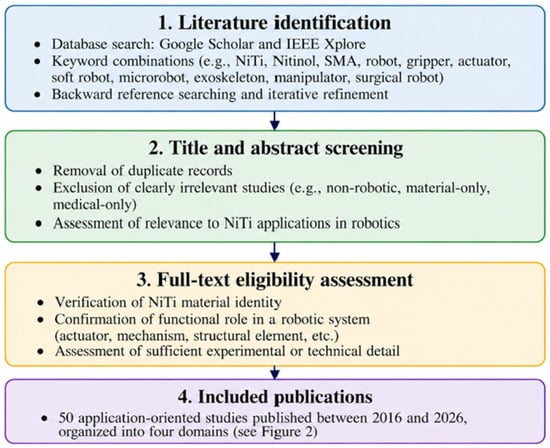
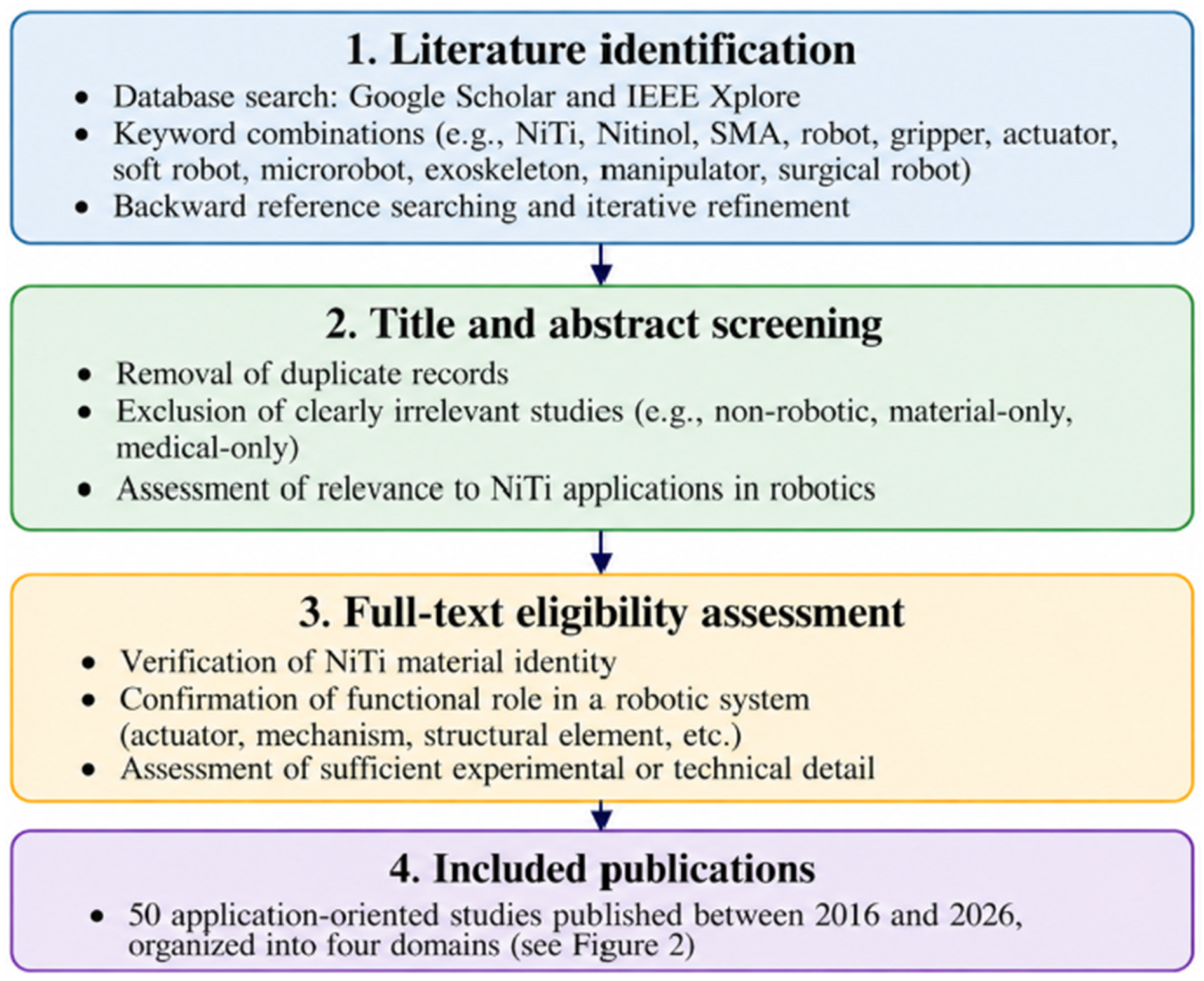

Disclaimer/Publisher’s Note: The statements, opinions and data contained in all publications are solely those of the individual author(s) and contributor(s) and not of MDPI and/or the editor(s). MDPI and/or the editor(s) disclaim responsibility for any injury to people or property resulting from any ideas, methods, instructions or products referred to in the content. |
© 2026 by the author. Licensee MDPI, Basel, Switzerland. This article is an open access article distributed under the terms and conditions of the Creative Commons Attribution (CC BY) license.