


Abstract
This systematic review characterizes bridge applications retrieved through a Scopus search requiring both Building Information Modeling (BIM/BrIM) and Extended Reality (XR) terminology, with perspectives for railway maintenance. This intersection selects publications mentioning both concepts and does not comprehensively cover bridge BIM research, XR research or Digital Twins (DTs). The historical search identified 196 records. A complementary DT/BIM/XR search returned 11 records, including ten duplicates. After cross-search deduplication, 197 reports were sought, 42 remained unavailable, 155 were assessed and 83 were excluded, yielding 72 included reports. This updated selection incorporates one recovered report, one corrected language exclusion and one new eligible report. Within this corpus, 34 reports (47%) are coded as BIM without point-cloud or finite element modeling components, and 22 (31%) combine BIM with point clouds. These representation categories are independent of XR implementation. Ten reports include finite element modeling. Seventeen reports are coded with XR, comprising seven AR, six MR and four VR applications. Mentioning XR for retrieval does not establish its implementation. These conditional frequencies cannot estimate technology prevalence in the broader field. Access restrictions and outstanding source-level recoding further limit generalization. The review distinguishes information models from data-connected representations and separates visualization from diagnostic or predictive functions. XR offers task-dependent opportunities for inspection and communication, while its additional value requires comparative validation. Future work should evaluate interoperable condition assessment and maintenance decision support, with XR assessed where a specific operational benefit can be demonstrated.
1. Introduction
Rail transport plays a fundamental role in the efficient movement of people and goods and, consequently, in the social and economic development of a country [1]. Within railway networks, bridges are critical elements because they provide continuity across natural and artificial obstacles such as rivers, valleys and roads, enabling direct routes and reducing travel times [2]. At the same time, a large share of the bridge stock in service is aging. In Germany, for example, bridges have an average age of about 40 years, and up to 80% of their construction cost may be additionally consumed by operation, inspection and maintenance over the life cycle [3]. Many bridges exceed 50 years of service and therefore require special treatment to remain operational [4]. Deterioration is further aggravated by increasing traffic loads [5], climate change and environmental exposure [6], and its latent nature means that vulnerabilities often remain undetected until a costly failure occurs [7]. Defects such as pavement cracking and reinforcement corrosion accumulate progressively and threaten structural safety if they are not detected and repaired in time [8].
In this context, Structural Health Monitoring (SHM) has become a central strategy for infrastructure safety. The continuous or periodic measurement of the structural response allows the condition of a bridge to be assessed, potential failures to be anticipated and preventive interventions to be planned [9,10]. Linking SHM data to an interactive Digital Twin (DT), understood as a virtual representation of the physical asset that is continuously updated with field data, contextualizes sensor information on the geometry of the structure and supports maintenance decision-making, reducing the need for costly and time-consuming manual inspections [11,12].
Current maintenance practice, however, is still largely reactive. Inspections are predominantly visual, information is dissociated across documents and follow-up is limited [13,14]. Operational and maintenance data are collected through paper-based reports which, even when digitized, remain fragmented across incompatible data models and do not provide a complete view of the condition of the asset [15,16]. Bridge managers must communicate intervention requirements, costs and risks to multiple stakeholders using static reports and tables, a process prone to misinterpretation and iteration [17]. The absence of a centralized information environment increases the cost and time of information exchange and degrades data quality, ultimately undermining the effectiveness of maintenance.
The Chilean railway context provides a practical motivation for this review. National initiatives such as Planbim and the adoption of NCh-ISO 19650 standards promote digital information management in public infrastructure [18]. Chilean studies have explored BIM-based facility management [19] and multi-user VR communication [20] for railway bridges. These cases establish the local relevance of the topic, without establishing operator-wide adoption of operational DTs or a measured reduction in inspection travel.
The general objective is to characterize bridge applications in publications retrieved through a combined BIM/BrIM and XR terminology search and assess their implications for inspection, condition assessment and railway maintenance. The search defines an intersection of terminology, not a comprehensive inventory of either technology in bridge engineering. The contribution is a systematic comparison and classification of previous studies, rather than the implementation of a new technological platform. DT concepts are evaluated where they arise within these workflows. The review does not claim exhaustive coverage of bridge DTs that do not involve BIM or XR. Previous reviews address BIM/GIS [21], DT lifecycle management [22], Scan-to-BIM [4], damage information modeling [3] and VR/AR [23]. This review connects those enabling components with sensing, structural analysis and the maintenance task.
The remainder of this article is organized as follows. Section 2 presents the theoretical background and the current state of the specialized literature. Section 3 describes the methodological framework based on PRISMA 2020, including the search strategy, eligibility criteria and analysis categories. Section 4 reports the results of the systematic review and of a complementary bibliometric analysis. Section 5 discusses the findings and research gaps, and Section 6 presents the conclusions.
2. Theoretical Background
This section introduces the concepts that underpin the review and summarizes the current state of the specialized literature, identifying the contribution space addressed by this work.
2.1. Structural Health Monitoring
Structural Health Monitoring (SHM) is the process of assessing and tracking the condition of a structure based on data acquired from instrumentation installed on it. Its objectives are to keep the structural behavior within acceptable margins, to evaluate performance during service, and to mitigate defects by studying changes in behavior over time [24]. In bridges, SHM systems typically combine static and dynamic measurements (e.g., strains, displacements, accelerations) with data processing pipelines that support diagnosis and prognosis of the structural condition [25,26].
2.2. IoT Devices
Internet of Things (IoT) devices are physical objects connected to the internet that collect, send and receive data through embedded sensors and software. In SHM applications they form interconnected networks that enable real-time monitoring of large volumes of data [11]. Low-cost wireless sensors combined with edge and cloud computing architectures allow bridges in remote or hard-to-access locations to be monitored efficiently, streaming raw measurement data for automated processing after each relevant event, such as a train crossing [26]. Advances in non-contact sensing further reduce the need for heavy equipment and physical intervention on the structure, which is especially valuable for aging assets [27].
2.3. Machine Learning
Machine Learning (ML), a discipline within Artificial Intelligence (AI), enables algorithms to learn significant patterns from training data and to generalize them to previously unseen data [28]. In bridge applications, ML has been applied to anomaly detection on monitoring data streams [26], to the semantic segmentation of point clouds that automates as-is modeling [29,30], and to the automated estimation of the dimensions of bridge components from survey data [31]. Combined with IoT sensing, ML increases the capacity to detect structural health problems with greater precision and anticipation [32].
2.4. BIM and BrIM
Building Information Modeling (BIM) is a modeling methodology based on three-dimensional digital technology that attaches semantic information to the geometric representation of an asset [33]. Because the information contained in BIM is computable, it can be shared and exploited at all stages of the life cycle, supporting management, monitoring and operation of infrastructure [21,34]. Applied to bridges, the methodology is often referred to as Bridge Information Modeling (BrIM), which supports design and construction while promoting the collection of real-time data, automated analysis and data-driven maintenance decisions [35,36,37]. BIM-based bridge maintenance systems have been developed to manage defect information throughout the service life of the asset [38]. In Chile, the State promoted the official use of BIM through the National BIM Plan (Planbim) and the adoption of the NCh-ISO 19650 standards for information management [18].
2.5. Digital Twin
A Digital Twin represents a physical asset and its associated state or behavior through a documented data connection [39]. Bridge applications can connect observations and analytical models to support condition assessment [22,26]. For reproducible comparison, this review adopts the data-integration distinction between digital model, digital shadow and bidirectional DT [40], operationalized in Section 3.6. This is an explicit classification convention, not a claim that all bridge literature uses the same DT definition. A static BIM or calibrated FEM is not automatically a synchronized DT. Update mechanism, direction of data flow, analytical function and validation are assessed separately.
2.6. Scan-to-BIM
Scan-to-BIM is the process of using 3D laser scanning or photogrammetry to obtain point clouds that accurately capture the physical condition of existing infrastructure, and of transforming those point clouds into semantically enriched BIM models [4]. The workflow typically comprises four stages: data capture, segmentation, semantic enrichment and 3D modeling. Research on bridges has addressed the automatic extraction of design parameters from point clouds [41], uncertainty-aware segmentation of large infrastructure point clouds [29], the semi-automated creation of IFC bridge models [42] and human-in-the-loop strategies to improve as-built model quality [43]. Photogrammetry has become increasingly relevant within these workflows because it acquires geometric information rapidly using only photographic imagery, including UAV-based capture, which makes it particularly valuable when technical documentation is scarce or outdated, as in aging bridges with limited accessibility [44,45]. Terrestrial laser scanning combined with BIM has also been applied to the documentation of heritage bridges [46,47].
2.7. BIM-to-FEM
Beyond geometric documentation, structural assessment requires finite element models (FEM) capable of providing static and dynamic information about the examined asset. Interoperability between BIM and FEM allows the information contained in the design model to be reused for structural analysis and for vibration-based model updating [48]. Fawad et al. [49] automated the SHM system of an existing bridge through a “BIMification” approach in which a validated finite element model is generated from the BIM model using visual programming scripts, and the SHM devices themselves are embedded in the BIM model so that it becomes the integral management tool of the monitoring system. Load tests have likewise been proposed as the calibration basis for creating and validating bridge DTs that couple BIM and FEM models [39].
2.8. Extended Reality (XR)
Extended Reality (XR) is an umbrella term for immersive technologies, including Virtual Reality (VR), Augmented Reality (AR) and Mixed Reality (MR) [23]. VR provides a fully computer-generated environment in which the user can immerse and interact with model objects. AR overlays digital content on the real world through smartphones, tablets or glasses. MR combines both approaches and allows digital content to interact with the real environment. In bridge engineering, these technologies support design verification, construction simulation, inspection and operation [23,50]. VR, in particular, has been used to build collaborative virtual replicas of transportation projects in which several users interact with the BIM model simultaneously, supporting design review under integrated project delivery [50], stakeholder assessment of construction impacts on traffic [51] and remote communication between site and office teams during bridge maintenance [20]. Other recent applications include MR visualization of subsurface data (e.g., ground-penetrating radar) integrated into the BIM model of a pedestrian bridge through HoloLens 2 glasses [52], BIM-based MR applications for bridge inspection [53], AR-based automatic registration of inspection data against digital models [54], and remote collaborative frameworks in which field inspectors and remote engineers share a common augmented scene for real-time condition assessment [55,56].
2.9. State of the Art and Contribution Space
The convergence of these technologies is best illustrated by recent integrated platforms. Fawad et al. first automated an existing SHM system through BIM-based FE modeling [49], then integrated the bridge health monitoring system with an AR application developed on a 3D game engine [57], and finally proposed an immersive bridge DT platform that couples multi-sensor SHM data (crack meters, tilt meters, laser displacement sensors and wireless gateways) with damage assessment and asset model updating [58]. Similarly, Awadallah et al. evolved from a remote collaborative AR framework for condition assessment [55] towards an AR-based smart SHM system with accurate 3D model alignment [56]. These trajectories show that the integration of DT, BIM and XR is technically feasible, but they remain isolated cases centered on modern road bridges.
The contribution space is the joint characterization of bridge contexts, digital representations, capture, sensing and XR functions in the retrieved BIM/XR literature. The railway perspective draws on published case studies [19,20,26] and identifies questions for application and validation. A low number of railway or XR reports in this constrained search does not demonstrate the absence of railway-DT research or establish that XR is necessary in every maintenance framework.
3. Materials and Methods
3.1. Registration Statement
This systematic review was not prospectively registered in a public registry. At the time the review commenced, the authors were unaware of prospective registration as a practice to enhance the transparency of systematic reviews. The authors acknowledge the absence of a prospectively registered protocol as a methodological limitation. Nevertheless, the review methodology, eligibility criteria, and analytical procedures were defined and applied to guide the review process.
3.2. Objectives and Research Questions
The General Objective (GO) is to characterize bridge applications within the retrieved BIM/XR terminology intersection and their relationship with inspection, condition assessment and railway maintenance. The specific objectives are:
- SO1: To characterize the bridge contexts addressed in the retrieved literature (material, usage and reported age).
- SO2: To identify modeling, reality capture, sensing and damage-detection components and distinguish their implemented functions from proposed DT or XR integration.
The research questions guiding the review are:
- RQ1: Which BIM and XR applications and bridge contexts are represented in the retrieved corpus?
- RQ2: Which modeling and reality-capture technologies support the reported bridge representations?
- RQ3: Which XR and sensing functions are implemented in these workflows, and what evidence supports their maintenance-related value?
3.3. Search Strategy
The completed PRISMA 2020 Checklist [59] is provided in Supplementary Material S1.
The review is reported with reference to PRISMA 2020 [59], a reporting guideline rather than a guarantee of exhaustive retrieval. The historical search was executed in Scopus on 5 May 2026. Its conceptual focus was BIM/BrIM and immersive terminology in bridge, railway or SHM research. Both the BIM/BrIM block and the XR block were mandatory AND conditions. Consequently, reports focused exclusively on BIM without matching XR terminology, or exclusively on XR without matching BIM terminology, were not systematically retrieved. A match establishes terminology in the searched fields, not an implemented BIM and XR integration. The resulting selection bias favors publications connecting or discussing these concepts, so technology percentages are conditional on this search-defined corpus and cannot estimate prevalence across bridge engineering. The primary search is retained for reproducibility rather than retrospectively described as a comprehensive search for BIM or XR separately. The printed query is retained below, including the XR block outside the TITLE-ABS-KEY parentheses. It did not explicitly search for DTs, so conclusions about DTs are limited to the BIM/XR-oriented corpus.
TITLE-ABS-KEY ( ( "bridge*" OR "railway*" OR "railwaybridge*" OR "structural health monitoring" OR "SHM" )AND ( "bim" OR "brim" OR "building information model*"OR "bridge information model*" ) ) AND ( "immersivevisualization" OR "virtual reality" OR "extended reality"OR "augmented reality" OR "mixed reality" OR "metaverse"OR "head-mounted displays" OR "HMD" OR "VR" OR "XR" OR"AR" OR "MR" ) AND ( LIMIT-TO ( DOCTYPE, "ar" ) ) AND( LIMIT-TO ( LANGUAGE, "English" ) )
The inclusion and exclusion criteria applied during screening and full-text assessment are summarized in Table 1. Only reports with a complete English-language text were eligible, consistent with the Scopus English-language filter. An English abstract alone was insufficient. Bilingual publications were eligible only when their complete English text was available. Open-access status is not an eligibility criterion. Subscription reports are assessed under the same scientific criteria when retrieved.
Table 1.
Inclusion and exclusion criteria.
The historical export contains 196 journal-article records with English-language metadata, dated 2020 to 2026. The intended eligibility window included 2019, but no 2019 records occur in the export. The saved final query contains no year clause, so the archive does not establish whether this lower bound was applied as a search-interface filter. An earlier draft has an explicit 2019 to 2026 filter but uses a different query and retrieval count. It cannot verify the final search settings. Thus, 2020 to 2026 describes the observed records, not a revised eligibility window.
The original selection spreadsheet records all 196 reports as satisfying publication-period and article-type criteria, but does not document a separate title/abstract relevance decision. All reports were sought, and bridge relevance was adjudicated at full text. Broad railway/SHM terms could retrieve non-bridge applications. Retention at this stage did not establish bridge eligibility. Forty-three reports marked “Closed Access” were not retrieved, leaving 153 assessed reports. The original log records 84 exclusions: 71 for lack of bridge application, 11 as reviews, one for language and one during a consistency pass, leaving 69 reports. Figure 1 now presents the complete current selection across both searches, with historical decisions reconciled to the final 72 reports. The historical archive does not establish an independently documented title/abstract relevance-screening stage, so none is retrospectively inferred in the updated flow.
The revision audit recovered John Samuel et al. [60], previously unavailable, through PUCV institutional access, and reinstated Uściłowski et al. [61] after confirming parallel English methods, results and conclusions in its bilingual PDF. The original language exclusion of [61] was therefore corrected, rather than retained as a current exclusion. Both reports satisfy the bridge-specific primary-report criteria. The targeted check added Jasiński et al. [62], whose complete publisher HTML was assessed as a primary BIM and FEM/SHM application. These three decisions produce a current working set of 72 reports. Across the two searches, 207 records were identified and ten cross-search duplicates removed, leaving 197 unique records sought for retrieval. Recovery of one of the 43 historically unavailable reports leaves 42 not retrieved. The 155 assessed reports comprise 154 historical reports and one new complementary-search report. Correcting the language exclusion reduces the current exclusions to 83: 71 without a bridge application, 11 literature reviews and one historical consistency exclusion whose specific reason is not documented. Thus, 197 = 42 + 155 and 155 = 83 + 72. The 72 are reports, and no equivalence to 72 independent bridge deployments is assumed. Forty-two historical reports remain unretrieved and require further assessment. The set is not a completed comprehensive update. Full-text availability includes the complete editorial HTML, not only a downloadable PDF. The spreadsheet records a consistency pass but does not establish independently duplicated screening. Assessor roles require confirmation.
Figure 1.
Updated PRISMA selection flow for the initial search (5 May 2026) and complementary search (7 October 2026). The yellow header identifies the combined search process and the blue box marks final inclusion. Downward arrows follow the selection sequence and rightward arrows lead to removed or unavailable records and reports. Counts incorporate the recovered report and corrected language exclusion. All unique records were sought for retrieval, as no separate title and abstract relevance decisions were documented. The reason for one historical exclusion remains undocumented. Table 2 details the revision decisions.
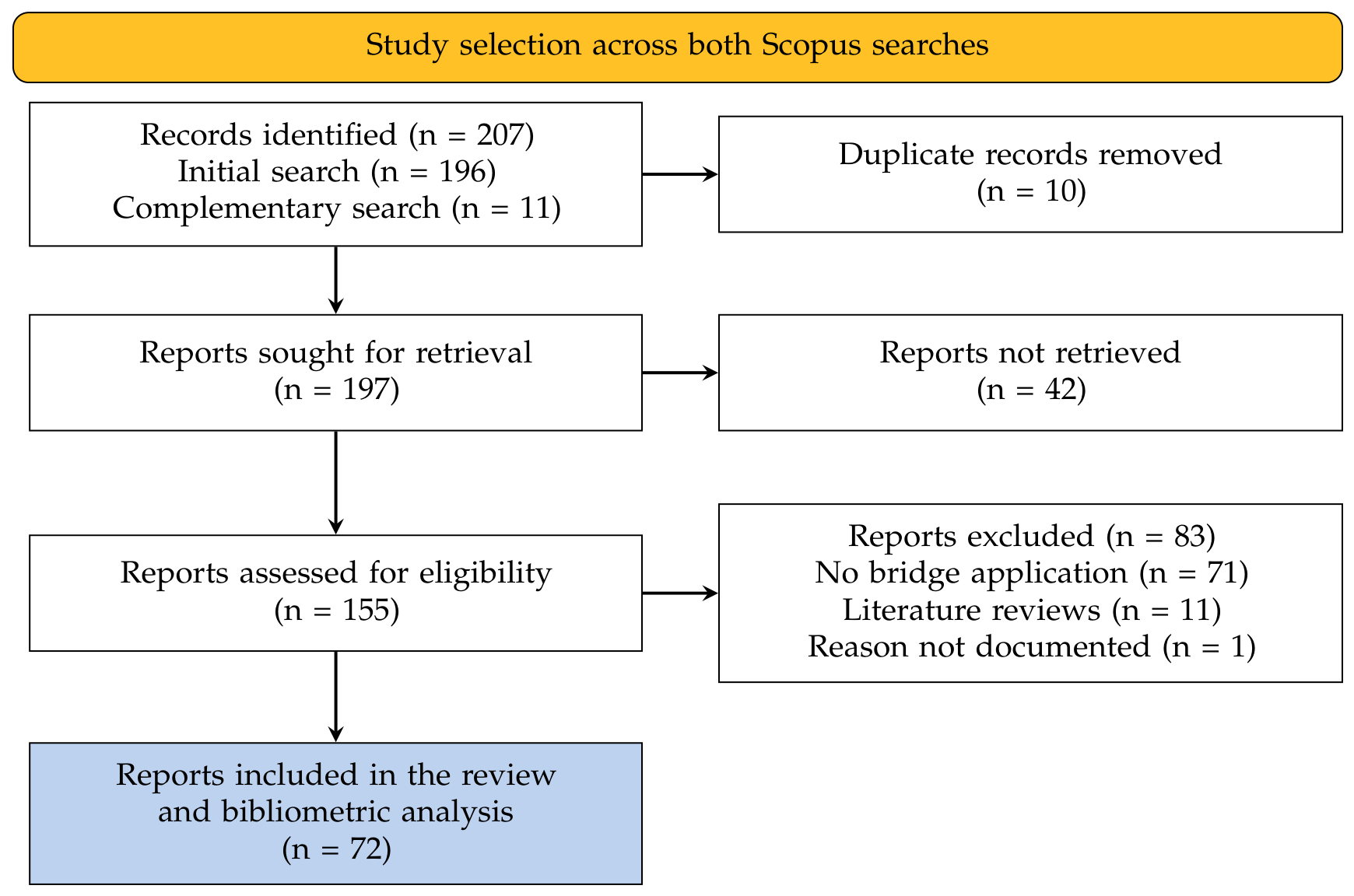
Table 2.
Report-level provenance of the changes incorporated in the updated selection flow in Figure 1.
3.4. Targeted Complementary DT Search
On 7 October 2026 a complementary Scopus check explicitly included DT terminology while retaining the BIM/BrIM and XR scope. The entire conceptual expression was restricted to titles, abstracts and keywords, with article, English and 2019 to 2026 filters:
TITLE-ABS-KEY((bridge* OR viaduct* OR footbridge*)AND ("digital twin*" OR "digital shadow*")AND (BIM OR BrIM OR "building information model*"OR "bridge information model*")AND ("immersive visualization" OR "virtual reality"OR "extended reality" OR "augmented reality"OR "mixed reality" OR metaverse OR "head-mounted display*"OR HMD OR VR OR XR OR AR OR MR))AND PUBYEAR > 2018 AND PUBYEAR < 2027AND DOCTYPE(ar) AND LANGUAGE(english)
The check returned 11 records, ten already present in the historical export by EID or DOI and one new candidate. The new report was assessed in complete editorial HTML and added as a BIM and FEM/SHM application [62]. Its Revit/Unity dashboard is not coded as implemented XR: AR/VR are mentioned as possible interfaces, while the demonstrated workflow estimates loads from strain data. Related historical reports are not added again. The remaining query matches include non-bridge applications, secondary reviews and prospective systems. The technology-adoption survey requires text retrieval because its abstract explicitly mentions bridge projects. A broader 378-record DT/maintenance query is retained as background sensitivity data, rather than replacing this BIM/XR-oriented set.
3.5. Analysis Categories
The original included reports were characterized manually in a structured spreadsheet using ten categories. Table 3 retains these categories and adds the digital-representation/data-integration criterion for source-level recoding during revision. The categories address bridge typology (SO1), enabling technologies (SO2) and XR, sensing and damage detection (RQ3). The added classification is not yet complete for the full working set.
Table 3.
Analysis categories of the systematic review.
3.6. Digital Representation and Synchronization Criteria
The distinction between digital model, digital shadow and digital twin depends on the demonstrated data connection, not the BIM label or the visual quality of the representation [40]. Table 4 adds explicit rules for the revision. Analytical functions are recorded separately, so a live sensor display is not equated with prognosis and a calibrated static FEM is not equated with automatic synchronization.
Table 4.
Additional criteria for assessing DT claims during source-level recoding.
The original matrix does not contain a complete synchronization classification, so no full numerical DT-maturity distribution is claimed. Source reading distinguishes the BIM and FEM/IoT workflow of Fawad et al. [49], the communication-focused VR prototype [20], the inspector-driven BIM/AR updates of BASIS [60], and the survey/annotation-based VR representation of [61]. Jasiński et al. [62] describe automatic sensor communication in Unity alongside file-driven ML execution in Revit. A complete synchronization rate or physical actuation is not established by the reported model-inference time. Bidirectionality is not inferred solely from the authors’ DT terminology.
For each report, extraction must identify the physical asset, the implemented data source and destination, update mechanism, direction, reported frequency or trigger, and supporting source location. Proposed capabilities are recorded separately from demonstrated operation. Manual inspection entry or periodic manual survey import is coded as a digital model. An implemented automatic asset-to-model link supports digital-shadow coding. Bidirectional DT coding additionally requires demonstrated automatic model-to-asset action. Missing frequency is recorded as unreported, while unclear implementation is coded as not determinable. Neither is replaced by an assumption of continuous real-time operation. Visualization, monitoring, diagnosis and prognosis are separate functional codes and cannot upgrade the data-integration class. These rules supplement the original ten categories and must be applied before reporting an aggregate DT-class distribution.
The 100-year boundary has a published precedent: Koteš et al. [63], in their assessment of a historic masonry arch bridge, explicitly state that bridges older than 100 years can be considered historical structures, relating this threshold to the contemporary design-life reference. We adopt the century boundary as a descriptive age criterion, rather than a universal definition of heritage or an indication of structural condition. To make the bands exhaustive and non-overlapping, this review uses below 100 years and at least 100 years. Inclusion of bridges exactly 100 years old in the latter band is our operational convention, whereas the cited paper refers to ages greater than 100 years. Reported construction year/age and formal heritage designation are recorded separately. Historical “modern/historic” matrix labels require checking against source ages. No age is inferred from missing documentation.
3.7. Complementary Bibliometric Analysis
The bibliometric input comprises the current working set of 72 reports, with provenance retained for historical and revision Scopus exports. The historical 196 records and broader 378-record set remain separate. Analyses were executed in R 4.6.1 with Bibliometrix 5.4.1 [64], using the Biblioshiny interface bundled with that package. Author keywords were available in 65 reports. Lowercase conversion, whitespace normalization and an explicit synonym dictionary merged BIM spelling/acronym variants and selected DT/SHM/XR variants. Author names were transliterated to remove accent variants. The archived script records all transformations and parameters.
The word cloud uses keywords occurring in at least two reports, capped at 40 terms. Co-occurrence uses the 25 most frequent author keywords, association-strength normalization, links in at least two reports and Louvain clustering, with isolates removed. The conceptual map uses multiple correspondence analysis (MCA), keywords occurring in at least three reports and a three-cluster presentation matching the exploratory automatic solution for this subset. This retains 54 reports and 15 terms. The thematic network selects up to 15 frequent author keywords and uses Louvain clustering. The retained terms occur in at least three reports. Author collaboration uses up to 30 authors present in at least two reports, with isolates removed. Country collaboration is extracted from affiliations in all 72 reports, using Bibliometrix country names and one occurrence per country per report. Country counts are non-exclusive, and links indicate co-affiliation in a report. Network layouts use a fixed random seed. Map locations and curves are schematic rather than the coordinates of institutions. Bibliometrix constructs the matrices and thematic/MCA structures. The MCA, thematic and author collaboration plots were regenerated and exported through Biblioshiny. The MCA map uses the publication export setting at 300 dpi, with a six-inch height and enlarged plot typography. For the thematic network, the native visNetwork renderer was configured with a minimum label font of 30 pixels, text wrapping at 24 characters, higher label contrast and node repulsion. These presentation settings retain all 14 terms, graph links and Louvain communities. The MCA coordinates, keyword selection and three-group solution are unchanged. The author collaboration network also uses native node repulsion to separate the densely connected group, retaining its authors, links and community colors. The word cloud, keyword co-occurrence network and country collaboration map retain their submitted presentation. The country map retains the existing flat projection and blue palette. Its native collaboration links and affiliation counts were not changed. Cited-reference coverage remains incomplete (14 reports), so no new cocitation analysis is claimed. These metadata-based analyses describe the current working corpus and do not establish field-wide prevalence or independent deployments.
4. Results
4.1. Overview of the Included Studies
Figure 2 shows the temporal distribution of the 196 historical search records and the current 72-report working set. Fifty-three working reports (74%) are dated 2024 to 2026. The two series have different retrieval histories: the original search was executed in May, while the targeted revision check was executed in October. Thus, 2026 is not a complete annual census and the figure does not estimate field-wide growth. Table 5 contains the current extraction.
Figure 2.
Temporal distribution of identified records and included studies.
Table 5.
Current extraction for 72 reports. PC = point cloud; FEM = finite element modeling; Laser scan. = laser scanning; Photogram. = photogrammetry; DD-I = damage detection from images; DD-S = damage detection from other sensors; Veh. = vehicular; Ped. = pedestrian; N/S = not specified; None = not employed or not reported; Both = both categories apply.
4.2. Purpose of the Studies
Figure 3 summarizes the current purpose coding. Structural inspection (21 reports), model updating (11), health monitoring (10) and Scan-to-BIM (nine) account for 51 of 72 reports (71%). Eight reports have construction-oriented purposes. The current classification separates information/inspection support from demonstrated maintenance prediction. The new load-estimation study [62] is coded as health monitoring, not deterioration prognosis.
Figure 3.
Distribution of the included studies by main purpose.
4.3. Modeling Technologies
Figure 4 records 34 reports coded as BIM without PC or FEM components (47%), 22 BIM/point-cloud reports (31%), seven BIM/FEM and three BIM/PC/FEM reports. Here, the BIM-only label refers exclusively to the representation components recorded in the modeling column. It does not mean absence of XR, sensing or other functions, which are coded separately in Table 5. Indeed, eight of these 34 BIM-category reports also have an XR code in the current extraction: two AR, three MR and three VR. The remaining 26 are coded as XR not employed or not reported. This cross-tabulation illustrates the independence of the two categories and does not replace outstanding source-level verification. Ten of 72 reports therefore contain FEM (14%). The current extraction also contains five point-cloud representations and one unspecified case.
Figure 4.
Representation components in the search-defined corpus (n = 72, PC = point cloud). The BIM category denotes BIM without PC/FEM components. XR implementation is classified separately, and frequencies do not estimate field-wide prevalence.
These are representation-layer frequencies within the retrieved 72 reports, not estimates for all bridge BIM research. Because XR terminology was mandatory in the search, bridge BIM reports without matching XR terms could be absent from the corpus. Conversely, a report can match XR terminology in background or prospective discussion without demonstrating an XR application. Retrieval, representation coding and implemented XR are therefore distinct, and the 47% must not be interpreted as the prevalence of BIM-only approaches in the broader field. Static geometric models, calibrated behavior models and synchronized systems must be distinguished when assessing DT functionality [39,49,62].
4.4. Bridge Typologies
Figure 5 presents current material and usage coding: 50 concrete reports (69%), 13 mixed-material, four steel/metallic, two masonry and three unspecified. Eight reports concern railway bridges, exclusively or jointly with vehicular use (11%). John Samuel et al. [60] add a pedestrian prototype whose age/material were not established from the report. Uściłowski et al. [61] adds a concrete road-viaduct pier. Jasiński et al. [62] add a steel pedestrian/cyclist bridge. Age coding contains 62 below-century cases, seven historic assignments exclusively or alongside modern cases, and three unspecified cases. Historical age labels still require verification. The new Twente bridge’s possibly reported 1980s commissioning is not treated as a confirmed construction date.
Figure 5.
Distribution of the included studies by structural material (left panel) and bridge usage (right panel).
4.5. Reality Capture and XR Environments
Figure 6 records explicit geometric capture in 29 of 72 reports (40%): laser scanning in 13, photogrammetry in nine and both in seven. The added hybrid capture case is [61]. Section 5.2 compares acquisition quality, segmentation, processing and inspection scenarios. These frequencies do not establish a temporal adoption trend or a universal cost advantage. Seventeen reports (24%) are coded with XR: seven AR, six MR and four VR. BASIS adds AR for inspector-entered observations. Uściłowski et al. [61] adds a Unity/Meta Quest VR reconstruction prototype without formal user validation. The new Revit/Unity monitoring dashboard is recorded as XR not demonstrated. Remaining historical implementation assignments require source-level checking.
Figure 6.
Distribution of the included studies by reality-capture technique (left panel) and XR environment (right panel).
4.6. Comparative Analysis Across VR, AR and MR
The working corpus codes 17 XR reports: seven AR, six MR and four VR. This comparison describes their reported tasks. Frequencies do not establish the effectiveness or superiority of a modality across bridge maintenance.
The four VR reports address communication, design simulation, work-zone interpretation [20,50,51] and reconstructed-geometry inspection [61]. Montecinos-Orellana, Muñoz La Rivera and colleagues [20] evaluate remote technical communication through five simulated railway-bridge maintenance RFIs with six experts. This provides a task-specific rationale for VR, while the small evaluation limits generalization. The [61] Unity/Meta Quest prototype lacks formal user testing and validation of VR measurements. These cases do not establish general reductions in physical inspection or travel.
Reported AR functions include inspection-information registration [54], collaborative assessment [55] and monitored-information access [57,58]. HoloLens use alone does not determine AR/MR implementation. WebGIS, proposed XR and implemented spatial interfaces require distinct coding. Matrix assignments remain subject to source verification.
Headset-supported inspection examples include spatial visualization of subsurface radar information and visible defects [52] and consultation of BIM-based damage objects [53]. Their usefulness depends on spatial registration, interaction and the inspection task. The six current MR assignments are descriptive extraction codes, not evidence of superiority or dominance across bridge engineering.
AR/MR examples support spatial information access and inspection interaction. VR examples include communication, planning and reconstructed-environment inspection. These are corpus-specific patterns. The small XR subset, particularly the four VR reports, and heterogeneous tasks and validation settings limit generalization and do not support a comparative ranking. Monitoring integration requires evidence of data currency, latency and registration, rather than inference from the headset or DT terminology.
4.7. Sensing and Damage Detection
The extraction records 11 image-based and eight other-sensor damage-detection reports, with two overlaps. Acquisition, display, automatic detection and human observations are distinct functions. These provisional codes require source verification and do not measure field-wide adoption. Section 5.2 discusses the computational and interoperability barriers between detection and BIM/XR use.
4.8. Characterization of the Included Studies
Table 5 retains the ten-category extraction, adding three source-evaluated rows to the 69 historical reports. Fawad (2023) BIM/FEM and Fawad (2024) AR corrections remain incorporated. For the new rows, absent/not demonstrated functions are distinguished from author-proposed future developments: [61] is not counted as implemented BIM solely because subsequent BIM enrichment is discussed, and the new predictive-load dashboard is not counted as an immersive XR experiment. A complete source-level recoding of the remaining historical assignments is still required.
4.9. Bibliometric Overview
The six bibliometric figures reproduce the analysis types in the submitted manuscript using the current 72-report set. Keyword figures use author keywords from 65 reports, with further frequency filtering as specified in Section 3.7. Their vocabulary reflects the search-defined sample and should not be interpreted as proof of implemented integration.
Figure 7 is dominated by building information modeling (32 reports after normalization), digital twin (ten), augmented reality (eight) and structural health monitoring (seven). These are keyword occurrences, not implementation counts.
Figure 7.
Author–keyword word cloud of the current corpus. At most 40 terms occurring in at least two reports are displayed.
Figure 7, Figure 8, Figure 9, Figure 10, Figure 11 and Figure 12 present the keyword word cloud, keyword co-occurrence network, MCA map, thematic network, author collaboration network and country collaboration map, respectively.
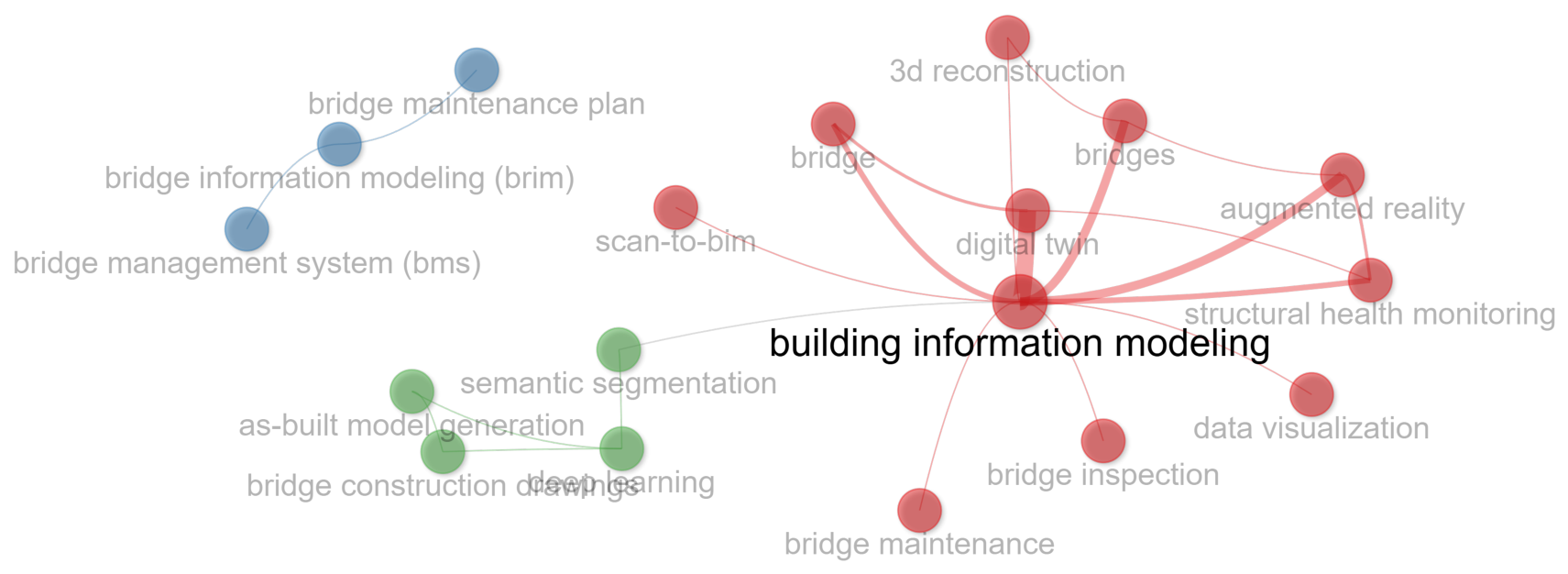
The filtered co-occurrence network contains 18 connected terms in three detected communities (Figure 8). It links the BIM vocabulary with monitoring, AR, geometric reconstruction and inspection terminology. The positions and communities depend on normalization, frequency thresholds and the layout algorithm.
Figure 8.
Author–keyword co-occurrence network generated with Bibliometrix. Links occur in at least two reports and colors identify Louvain communities.
The MCA map retains 54 reports and 15 terms and identifies three groups (Figure 9). Terms concerning reconstruction and maintenance, semantic processing and inspection, and BIM/monitoring interfaces occupy different regions. This is an exploratory lexical structure, not a DT-maturity classification or evidence that a technological combination is necessary.
Figure 9.
Conceptual structure map exported from Biblioshiny with enlarged labels. Colors identify the three clusters. Triangles mark keyword positions, circles indicate cluster centers and shaded polygons delimit the clusters. Dashed lines mark zero on the two MCA dimensions. The 54 reports, 15 author keywords, MCA coordinates and three-group solution are unchanged.
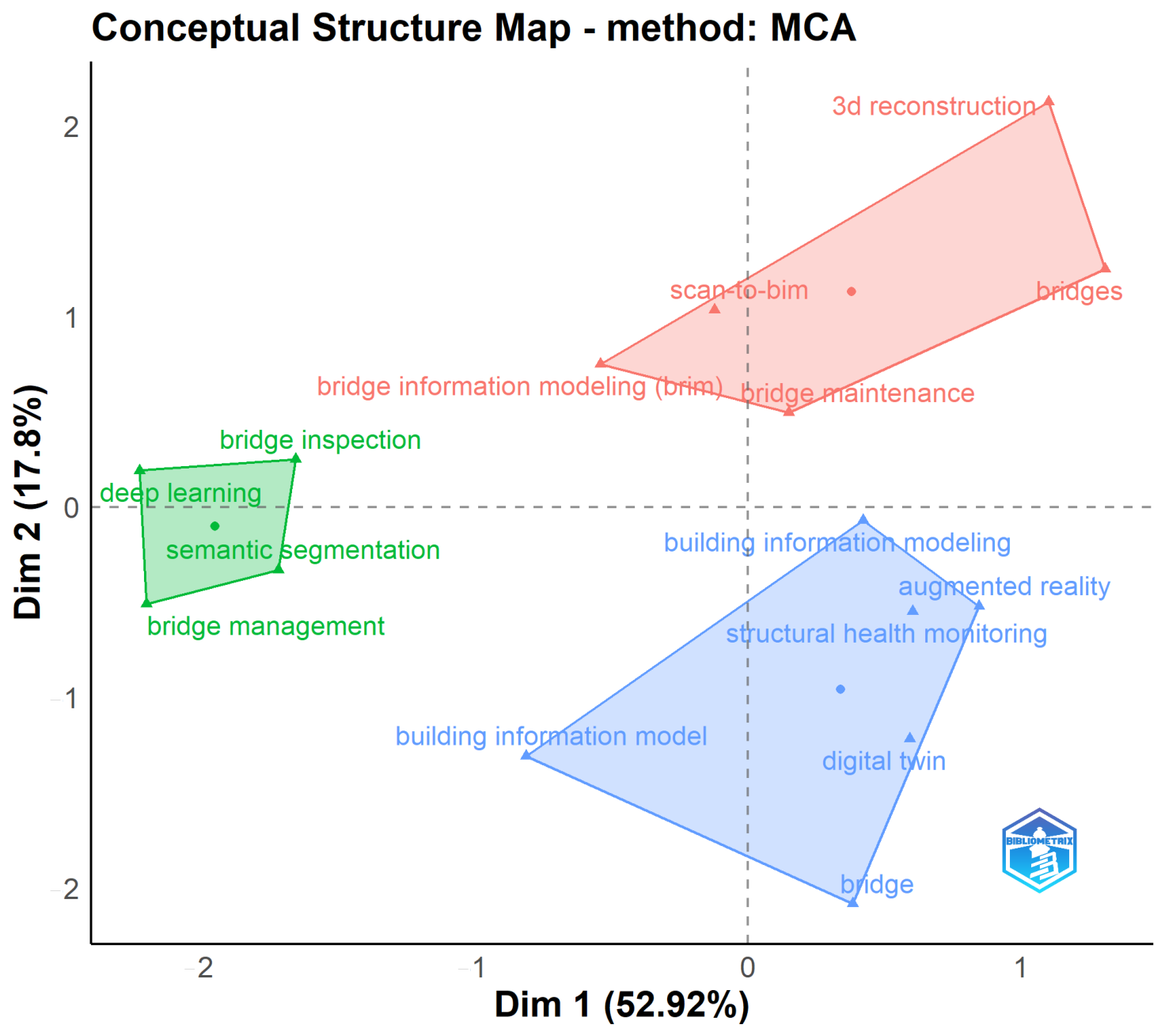
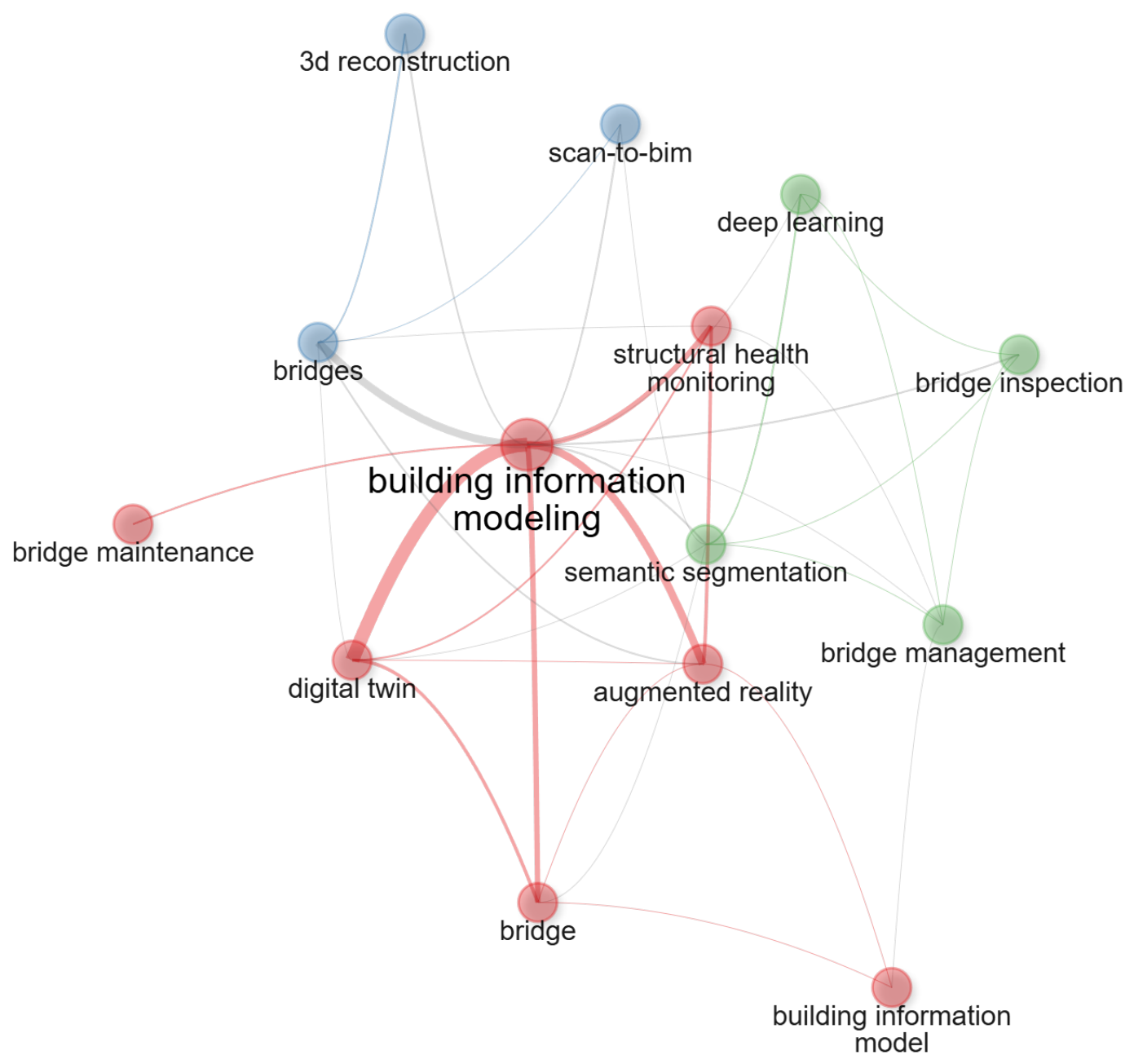
Figure 10 complements MCA with a thematic keyword network. The minimum three-report frequency reduces the influence of isolated terms. Communities summarize co-word associations and do not demonstrate performance differences or validated maintenance outcomes.
Figure 10.
Thematic keyword network exported from Biblioshiny with larger labels, greater contrast and adjusted node spacing. All 14 terms and their links are retained. Colors identify Louvain communities, with a three-report keyword threshold.
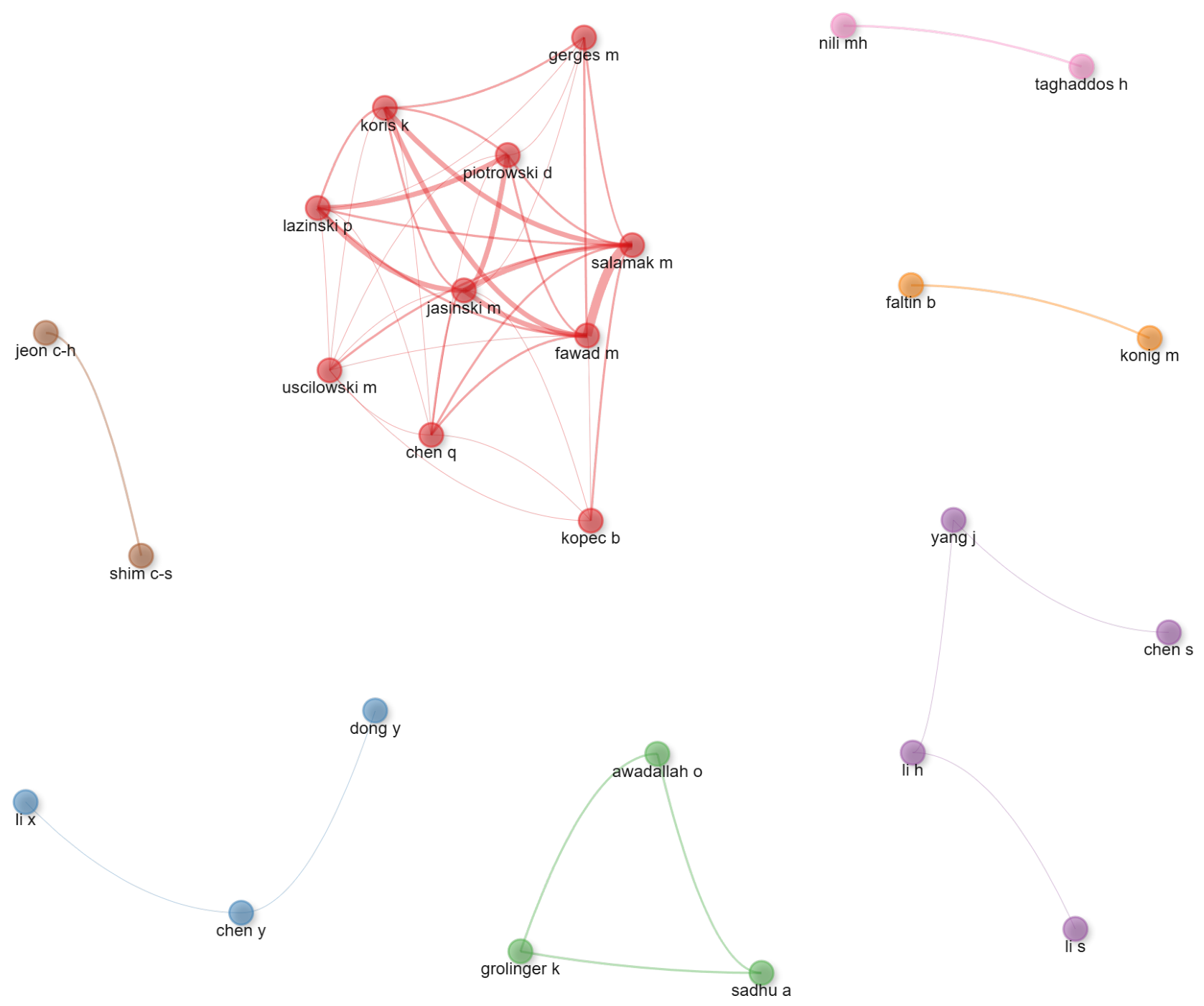
The author network displays 26 connected author names under the selected frequency threshold (Figure 11). Several separate groups are visible, including a group containing Salamak, Fawad, Koris and Jasinski. Name-based collaboration does not establish independent bridge deployments, and author-name ambiguity remains possible.
Figure 11.
Author collaboration network generated with Bibliometrix for authors present in at least two reports, capped at 30 names and excluding isolates. Nodes represent authors, links indicate collaboration within an included report and colors identify Louvain communities.
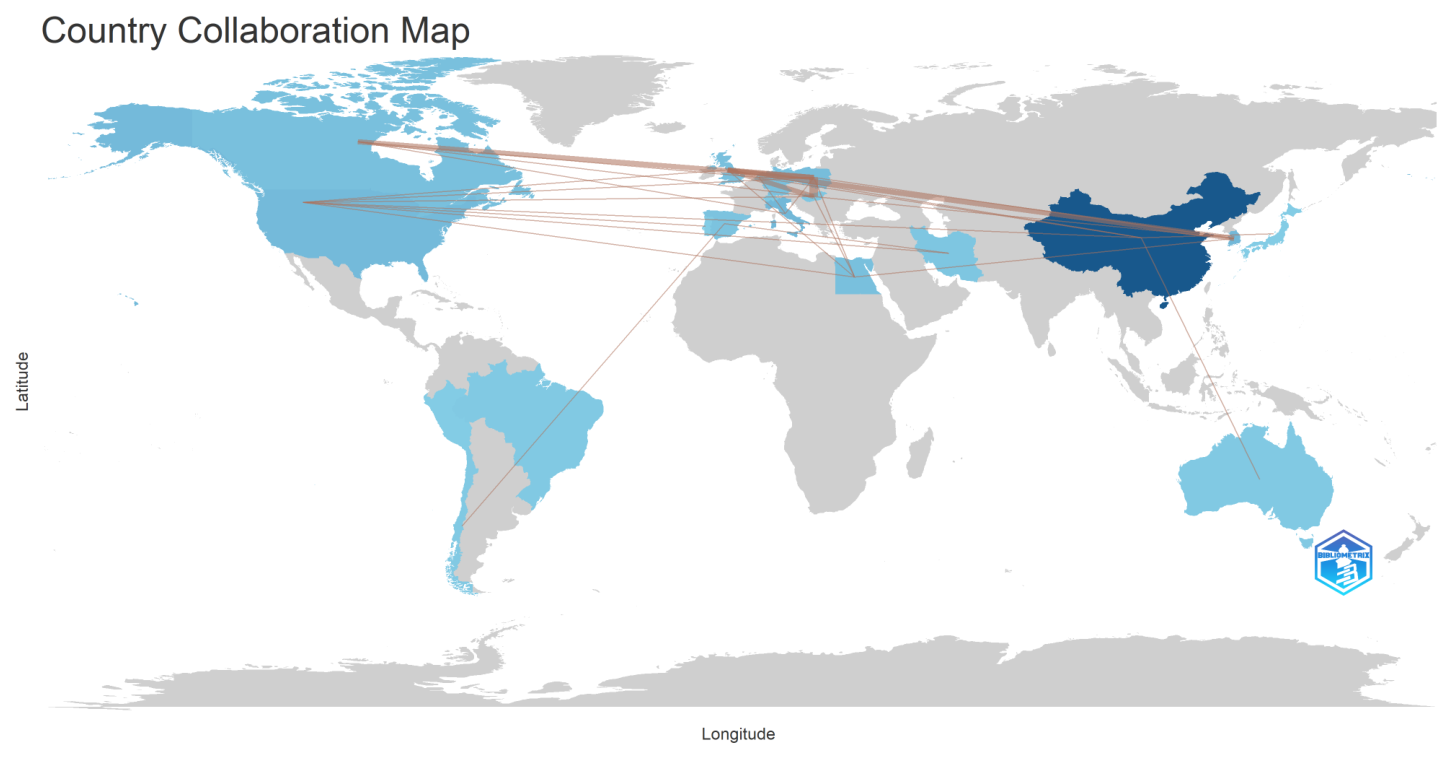
The country map represents 20 affiliation countries and 30 country pairs with joint reports (Figure 12). China appears in 23 reports, followed by Italy and Korea in eight each, the USA in seven and Poland in six. These non-exclusive counts describe affiliation metadata in this sample, rather than national production or the geographic distribution of bridge assets.
Figure 12.
Country collaboration from Bibliometrix affiliation analysis. Blue shading represents the number of reports with an affiliation in each country, with darker blue indicating more reports. Curved lines represent links between countries with affiliations in the same report.
4.10. Response to the Research Questions
RQ1:
Within the retrieved corpus, 74% of the included studies were published between 2024 and 2026, and their purposes concentrate on structural inspection, model updating, health monitoring and Scan-to-BIM modeling. Many retrieved representations are geometric-semantic models oriented to documentation and inspection support, and end-to-end integrations of DT, BIM and XR remain exceptional [56,57,58].BIM and XR applications and bridge contexts represented in the retrieved corpus.
RQ2:
Within this search-defined corpus, 47% of reports are coded as BIM without PC/FEM components and 31% combine BIM with point clouds, while FEM is recorded in 14%. These modeling categories are independent of XR implementation and do not estimate the distribution of technologies across all bridge research. A reality-capture technique is reported in 40% of the reports, with laser scanning in 20 (including combined cases) and photogrammetry in 16. Both techniques support reported as-is capture workflows [44,45]. The review does not pool their costs or accuracy.Modeling and reality-capture technologies supporting the reported bridge representations.
RQ3:
The current extraction codes 17 XR reports, seven AR, six MR and four VR. New source reading adds small-scale evidence for AR defect recording [60] and an explicitly unvalidated VR geometry prototype [61]. The BIM and FEM/ML study validates load estimation but not an XR interface or deterioration prognosis [62]. Historical image/sensor damage-detection codes remain 11/eight, including two overlaps, and still require implementation-level checking. These observations support task-specific interpretation rather than a modality ranking.Implemented XR and sensing functions and evidence supporting their value.
5. Discussion
The 72-report working set is conditioned on mandatory BIM/BrIM and XR terminology. Its BIM-centered distribution is therefore partly a consequence of retrieval design, not evidence that the same distribution characterizes bridge engineering as a whole. Studies addressing BIM without matching XR terms and XR without matching BIM terms were not systematically captured. The 17 implemented XR codes must also be distinguished from the terminology matches that allowed all reports to enter the search. Ten reports now combine FEM, and sources demonstrate different links between geometry, measured observations, behavior models and interfaces [49,57,58,62]. The added reports strengthen the distinction between manual condition records, geometric/VR inspection and instrumented load inference. Those functions should not be interpreted as interchangeable forms of DT maturity or predictive maintenance.
In terms of reality capture, laser scanning and photogrammetry support geometric reconstruction, while segmentation and semantic enrichment determine how observations become reusable bridge information [29,30,31]. A missing capture description does not establish that a model was built from design documentation alone. The suitability and cost of an acquisition method depend on coverage, access, required resolution, registration and the intended assessment. The heterogeneous corpus does not support a universal cost or accuracy ranking.
XR is a visualization and interaction layer whose value follows the task. Reported applications include registered information access, inspection-data collection and collaborative interpretation [52,53,54,55,56]. The 17 XR reports, including only four VR reports, provide a small and heterogeneous evidence base. Their applications are therefore interpreted as patterns observed in this corpus. The available evidence is insufficient to establish the superiority of one modality or to generalize benefits across bridge types and maintenance tasks. BIM, structural analysis and sensing can support maintenance through conventional interfaces. The rarity of XR integration is not evidence that XR is necessary. Comparative evaluations should use the same data and task and measure errors, time, registration, cognitive load and communication outcomes.
The current extraction is weighted toward concrete road-bridge applications. Railway, older-bridge and metallic/masonry cases have smaller representation within this search-defined corpus. Railway examples involving BIM information management, sensing and communication [19,20,26] motivate an application perspective for aging assets. The defensible research direction concerns interoperable and validated links between observations, assessment and maintenance decisions. Operational XR is one interface to evaluate where a specific task requires it.
5.1. BIM and FEM Interoperability and Validation
The original extraction identified five BIM and FEM and three BIM, point cloud and FEM reports. The working extraction contains seven and three, respectively, after correction of [49] and inclusion of the targeted BIM and FEM study. These counts describe reported modeling combinations, not ten equivalently validated or fully automated conversion pipelines. A geometric and semantic BIM model can organize inspections and condition records, but geometry alone does not provide the constitutive behavior, load path or boundary conditions needed for structural performance assessment. FEM is one possible behavioral model. Its presence alone does not establish predictive maintenance capability.
Geometry and analytical topology. Converting BIM solids into beams, shells or solids requires choosing an idealization appropriate to the response of interest. Member centerlines, eccentricities, local axes, connectivity, releases and mesh density must be checked. Visually adjacent components do not necessarily form a correct analytical connection. Fawad et al. [49] show that the topology needed for a bridge FE representation differs from the BIM solids and use an indirect visual-programming route to generate nodes and elements. Importantly, their BIM-derived geometry workflow leaves material assignment, load application and execution of the resulting analysis as future development. The reported load-test comparison therefore should not be interpreted as validation of a complete automated BIM-to-FEM pipeline.
Concrete, prestressing and loading. For concrete or prestressed bridges, an assessment model must address stiffness assumptions, reinforcement and tendon contributions, and support behavior rather than simply inherit nominal BIM properties. Jasiński et al. [39] identify uncertainty associated with concrete modulus, reinforcement, prestressing, nonstructural elements and foundations, and use measured loads and structural responses in model calibration. Depending on the assessment objective, additional effects such as cracking, creep, shrinkage, prestress losses, construction stages and deterioration may require explicit representation. These are engineering considerations for model selection, not features demonstrated in every included implementation. Load positions and combinations must also match the intended assessment. A model validated under selected service loads does not automatically establish accuracy for nonlinear, fatigue or ultimate-limit-state behavior.
Information transfer and maintenance use. Exchange must preserve units, coordinate systems, component identifiers and the distinction between geometric and analytical properties. Point clouds can support as-is geometry but do not directly establish internal reinforcement, tendon force, material condition or restraint stiffness. A defect overlay must be translated into justified analytical changes if it is to inform capacity. The separate defect layer reported in BASIS [60] illustrates the difference between displaying damage and using it in structural analysis. Changes made during FEM calibration should retain provenance and their links to the corresponding BIM components, so subsequent model updates do not silently replace measured condition with design assumptions.
Verification and validation. Conversion checks should first address topology, supports, mesh behavior and equilibrium. Comparison with measured deflections, strains or modal properties can then assess whether the model represents the asset under known conditions [39,49]. Calibration and independent validation should be distinguished: agreement with the observations used for updating does not establish prediction under other loads or damage states. Thus, the limited FEM representation in this corpus points to an integration and validation question, while query design and incomplete retrieval prevent attributing that frequency solely to technical difficulty.
5.2. Capture, Segmentation and Image-Based Damage Integration
Geometric reconstruction accuracy and semantic segmentation accuracy are separate outcomes. Laser scanning requires station/trajectory planning, registration and filtering, while photogrammetry requires suitable image viewpoints, overlap and reconstruction before segmentation. Both require component identification and information enrichment [29,41,42]. Their suitability should be compared by coverage, geometric error, semantic accuracy, processing burden and inspection scenario, rather than by a single general ranking.
Point-cloud quality and segmentation. Laser scanning measures surface geometry directly, whereas photogrammetry reconstructs geometry from overlapping images. Occlusion, sampling density and registration influence both outputs. Image texture, illumination and image matching additionally affect photogrammetric reconstruction. A dense or geometrically accurate cloud does not automatically yield accurate component labels. Vassilev et al. [29] show that segmentation confidence and changes in acquisition domain require attention even between laser-scanning datasets. Their results do not establish a laser-versus-photogrammetry accuracy ranking. For either technique, bridge-component segmentation should be evaluated using independently labelled data, class-specific errors and uncertainty, separately from geometric agreement with control measurements. Weathered surfaces and irregular historic components further motivate checking the acquired data and model assumptions for each asset.
Processing requirements and cost. Laser workflows require alignment of scans, removal of unwanted points, sampling and semantic processing. Image workflows additionally require image matching, camera-pose estimation and dense reconstruction before a point cloud can be segmented or converted into a BIM representation. Both can generate substantial datasets, and neither eliminates the effort of identifying components, resolving gaps and checking the as-is model. Uściłowski et al. [61] observe that adding photographs beyond a certain level may extend processing without improving the visual model. Consequently, lower camera acquisition cost should not be equated with lower total survey cost: access, control measurements, processing, manual correction and inspection validation must also be counted. The corpus provides no standardized comparison of total cost or computation time across equivalent bridge surveys.
Inspection scenarios and DT development. Terrestrial laser scanning can support accessible piers, abutments and heritage geometry when stable viewpoints and sufficient line of sight are available. UAV photogrammetry offers alternative viewpoints for elevated or difficult-to-reach surfaces and textured representations for visual review, but shaded surfaces and inadequate coverage can impair reconstruction. Neither technique guarantees coverage beneath decks or inside confined spaces. Acquisition should follow the inspection target rather than bridge material alone. The hybrid pier case [61] combines complementary observations where height and shading constrain either method. For aging bridges with incomplete drawings, such integration can strengthen as-is documentation, but a DT additionally requires repeat-survey registration, persistent component identifiers, dated observations and an update mechanism. A one-time scan or photogrammetric model alone does not establish a continuously updated DT.
The audited bridge-pier report of Uściłowski et al. [61] compares laser and photogrammetric models and reports their complementary use where access and shading constrain acquisition. It also simplifies meshes for VR and preserves more detailed models for detailed examination. This distinguishes acquisition resolution, analytical resolution and display resolution. Automated image-based damage results additionally need component identifiers, coordinates, timestamps, units and links to the original evidence. John Samuel et al. [60] report information loss during BIM and AR conversion and a defect layer not readily usable for structural analysis. These are concrete interoperability bottlenecks, while limited headset resources and environmental visualization problems [57] constrain interactive rendering. Proposed cloud processing or model simplification should be evaluated for latency and defect visibility, not assumed to solve the problem without a tradeoff.
The modest image-detection count in this review should not be interpreted as slow development of computer vision for infrastructure. For example, Alfaro et al. [103] combine UAV photogrammetry, binary segmentation and CNN-based crack detection with damage localization in a concrete arch-bridge model. They report false positives as well as detected damage, illustrating the need to validate outputs before maintenance use. This contextual reference supports the distinction between detecting damage and delivering validated results through BIM/XR. It is not added to the eligible corpus. Our BIM/XR-oriented query and historical retrieval constraints may underrepresent detection research. They cannot establish how much of the observed frequency is due to technical integration barriers.
Computational load and interaction. High-resolution imagery, dense geometry, inference and spatial rendering create different processing demands. For a lightweight XR device, simultaneous inference, tracking and model display is a potential resource bottleneck, rather than a constraint measured uniformly across this corpus. The practical tension is documented in related implementations: Fawad et al. [57] describe headset limitations in displaying complex BIM models, while Uściłowski et al. [61] reduce mesh density for VR and recommend full-resolution models for detailed assessment. A plausible architecture performs reconstruction and inference on a workstation or server and then transfers localized results to XR. Its validation must include acquisition-to-display latency, connectivity, stale-data handling and registration error, not inference time alone. Geometry or texture simplification must also be checked for its effect on the visibility of small defects.
Interoperability and semantics. Image-based defect segmentation and point-cloud component segmentation solve different tasks: the former locates damage evidence, while the latter identifies the bridge element to which that evidence belongs. Connecting them requires projection of image observations into a common 3D reference, association with a stable BIM component identifier and preservation of defect class, dimensions, uncertainty, timestamp and source imagery. A visually aligned overlay does not by itself provide an updatable condition record or a structural-analysis input. The separate defect layer and lack of a standard BIM and AR transfer process reported in BASIS [60] exemplify this gap. Moreover, a detected crack must be interpreted and, where justified, linked to analytical parameters before it can inform capacity assessment or a DT decision workflow. These requirements provide plausible explanations for the integration gap, but the review does not establish their relative causal importance.
5.3. Task-Specific Added Value of XR
BASIS [60] evaluated BIM/AR defect recording with two inspectors on a small pedestrian bridge with marked defects. It reports four minutes versus eight minutes manually, with consistent records, but does not establish general operational savings. The reinstated study [61] creates a VR inspection environment from hybrid capture without formal user testing. Simulated reinforcement is not evidence of the real reinforcement layout. The railway VR communication study [20] provides perceived benefits from six experts and five simulated RFIs. These examples motivate comparative evaluation, while the new BIM and FEM/ML case [62] shows that validated load inference can be implemented through a conventional dashboard. XR is an optional interface, not a necessary condition for structural assessment.
The railway studies coauthored by Muñoz La Rivera help distinguish information management from immersive communication. Cavieres-Lagos et al. [19] connect a Revit bridge model with inspection and damage records through Excel/Dynamo. This is a BIM/data-management application rather than a VR evaluation. Montecinos-Orellana et al. [20] instead investigate how a shared virtual bridge representation supports discussion of maintenance RFIs between geographically separated participants. The additional role proposed for VR is joint spatial interpretation of an element, defect or proposed intervention during a technical exchange, complementing the underlying condition information. Their expert evaluation favors some RFI categories, while information-clarification cases require further optimization. The study also reports synchronization limitations and simulator-sickness symptoms. Thus, it supports investigating VR for collaborative maintenance communication, while broader effectiveness, multi-user reliability and operational savings require further testing.
The reviewed evidence does not establish a maintenance problem that can only be solved using XR. BIM, an appropriate behavioral model and sensing can provide asset information, structural assessment and condition updates through conventional interfaces. The specific contribution to investigate is whether spatial interaction improves how people interpret and act on that information: for example, associating an inspector’s observation with a bridge component in AR [60], or discussing a repair alternative in a shared virtual railway-bridge model [20]. Transfer of these benefits to aging metallic railway bridges remains an application hypothesis, not a validated outcome for all such assets. A relevant evaluation should compare XR with a desktop/tablet BIM or dashboard workflow using equivalent data and tasks, and assess registration errors, RFI resolution quality, completion time, training burden and user discomfort. XR adoption is justified only where that comparison demonstrates a practical benefit. Structural-analysis validity remains a separate requirement.
The protocol was not prospectively registered and the historical search used Scopus alone with article/English restrictions. The historical query omitted explicit DT terminology, used broad railway/SHM concepts and ambiguous XR acronyms, and required the intersection of BIM and XR terminology. The complementary query retained that intersection. This selection bias prevents comprehensive coverage of either bridge BIM or bridge XR research and prevents field-wide interpretation of the 47% BIM representation category or the XR implementation frequencies. This first revision batch adds three evaluated reports but does not complete the retrieval of 42 historical unavailable reports or re-evaluate every historical exclusion. The targeted check is not a census of bridge DTs. Construction-year verification, independent assessor roles, project linkage and full implementation recoding remain outstanding. Working frequencies and bibliometric descriptions are conditional on this incomplete update and should not be generalized to field-wide prevalence.
The original non-retrieval of 43 reports (22% of the 196 search records) is a substantial potential source of selection bias. Availability may be associated with publication venue, geographic context or the type of application, so missing reports could change technology frequencies, bridge-type distributions and apparent research gaps. Their direction and magnitude cannot be established without assessing the missing texts. Institutional access recovered one eligible report, demonstrating that a closed-access label does not establish ineligibility. This recovery does not eliminate the bias. The remaining 42 reports are recorded as not retrieved, separately from scientific exclusions. Claims of scarcity and added technological value therefore remain conditional on the accessible evidence.
Future research should focus on the following directions:
- 1.
- Interoperable condition-assessment workflows for aging metallic railway bridges, with capture, validated behavioral modeling and sensing selected for the maintenance task.
- 2.
- Multiclass, image-based damage detection linked to bridge condition records, with XR interaction evaluated where it improves a defined inspection task.
- 3.
- Standardized information exchange, such as IFC extensions for steel bridges [87], with explicit tests of information preservation between tools.
- 4.
- Comparative evaluation of XR against conventional interfaces for inspection-data registration and repair-planning communication, extending the railway communication example in [20] where a practical need is established.
- 5.
- Empirical validation of these integrated platforms on in-service railway infrastructure, such as the historic bridges of the Valparaíso region.
6. Conclusions
This systematic review characterized a current working set of 72 reports, built from the historical Scopus archive and a targeted revision check, using PRISMA 2020 reporting guidance, on bridge applications retrieved through intersecting BIM and XR terminology and their implications for maintenance. Its scope excludes a comprehensive assessment of either technology alone, and all frequencies are conditional on the retrieved corpus. Four main conclusions arise:
- 1.
- Within the current working set, 74% of the reports were published between 2024 and 2026. Their purposes concentrate on structural inspection, model updating, health monitoring and Scan-to-BIM modeling.
- 2.
- Within this search-defined corpus, 34 reports (47%) are coded as BIM without PC/FEM components and ten reports (14%) include FEM. Point clouds from laser scanning or photogrammetry support reported as-is workflows. These counts describe the included reports and cannot establish broader technological prevalence or adoption trends. Modeling components and XR implementation are independent categories, and predictive capability requires evidence beyond geometric representation.
- 3.
- XR is coded in 17 of 72 working reports (24%), comprising seven AR, six MR and four VR reports. Their applications suggest task-dependent opportunities for inspection support, communication and interaction with bridge information. These are patterns observed within the current corpus. The small and heterogeneous XR subset, particularly the limited VR evidence, is insufficient to establish the superiority of one modality or to generalize its benefits across bridge types and maintenance tasks. The added value of XR requires further task-specific comparative evaluation.
- 4.
- The working set has a typological imbalance. Concrete road bridges dominate this retrieved subset, while railway bridges, historic structures and metallic typologies are scarcely addressed. Aging metallic railway bridges, such as those of the EFE network in Valparaíso, Chile, provide a context for investigating interoperable condition information and validated structural assessment, with XR as an optional interface whose maintenance benefit must be established comparatively. Neither the search-defined scarcity nor the reviewed evidence establishes that XR is necessary for railway DT development.
Supplementary Materials
The following supporting information can be downloaded at: https://www.mdpi.com/article/10.3390/app162110659/s1, Supplementary Material S1: PRISMA 2020 Checklist.
Author Contributions
Conceptualization, J.R. and F.M.; Methodology, F.M.; Formal analysis, J.R. and E.P.; Investigation, J.R.; Data curation, E.P.; Writing (original draft preparation), J.R.; Writing (review and editing), F.M., B.C., A.P. and M.V.; Visualization, J.R.; Supervision, F.M.; Project administration, J.R. All authors have read and agreed to the published version of the manuscript.
Funding
This research received no external funding.
Institutional Review Board Statement
Not applicable.
Informed Consent Statement
Not applicable.
Data Availability Statement
The historical and complementary Scopus exports, source-level decision records, PDF catalogue and current 72-report extraction are retained in the review archive and available from the corresponding author upon reasonable request. Complete retrieval and recoding remain in progress.
Conflicts of Interest
The authors declare no conflicts of interest.
Abbreviations
The following abbreviations are used in this manuscript:
| AI | Artificial Intelligence |
| AR | Augmented Reality |
| BIM | Building Information Modeling |
| BrIM | Bridge Information Modeling |
| DT | Digital Twin |
| EFE | Empresa de los Ferrocarriles del Estado (Chilean State Railway Company) |
| FEM | Finite Element Modeling |
| GNSS | Global Navigation Satellite System |
| GPR | Ground-Penetrating Radar |
| HBIM | Historic Building Information Modeling |
| IFC | Industry Foundation Classes |
| IoT | Internet of Things |
| ML | Machine Learning |
| MR | Mixed Reality |
| PC | Point Cloud |
| PRISMA | Preferred Reporting Items for Systematic Reviews and Meta-Analyses |
| SHM | Structural Health Monitoring |
| TLS | Terrestrial Laser Scanning |
| UAV | Unmanned Aerial Vehicle |
| VR | Virtual Reality |
| XR | Extended Reality |
References
- Wang, Y.W.; Ni, Y.Q.; Wang, S.M. Structural health monitoring of railway bridges using innovative sensing technologies and machine learning algorithms: A concise review. Intell. Transp. Infrastruct. 2022, 1, liac009. [Google Scholar] [CrossRef] [Scilit]
- Du, G.; Karoumi, R. Life cycle assessment framework for railway bridges: Literature survey and critical issues. Struct. Infrastruct. Eng. 2014, 10, 277–294. [Google Scholar] [CrossRef] [Scilit]
- Artus, M.; Koch, C. State of the art in damage information modeling for RC bridges—A literature review. Adv. Eng. Inform. 2020, 46, 101171. [Google Scholar] [CrossRef] [Scilit]
- Kellner, M.; Vassilev, H.; Busch, A.; Blaskow, R.; Cervantes, M.; Poku-Agyemang, K.; Schmitt, A.; Weisbrich, S.; Maas, H.G.; Neitzel, F.; et al. Scan2BIM—A Review on the Automated Creation of Semantic-Aware Geometric as-is Models of Bridges. AVN Allg. Vermess.-Nachrichten 2024, 2024, 159–181. [Google Scholar] [CrossRef]
- Le, B.; Andrews, J. Modelling railway bridge asset management. Proc. Inst. Mech. Eng. Part J. Rail Rapid Transit 2013, 227, 644–656. [Google Scholar] [CrossRef] [Scilit]
- Nasr, A.; Kjellström, E.; Björnsson, I.; Honfi, D.; Ivanov, O.; Johansson, J. Bridges in a changing climate: A study of the potential impacts of climate change on bridges and their possible adaptations. Struct. Infrastruct. Eng. 2020, 16, 738–749. [Google Scholar] [CrossRef] [Scilit]
- Deng, L.; Wang, W.; Yu, Y. State-of-the-Art Review on the Causes and Mechanisms of Bridge Collapse. J. Perform. Constr. Facil. 2016, 30, 04015005. [Google Scholar] [CrossRef] [Scilit]
- Tan, J.S.; Elbaz, K.; Wang, Z.F.; Shen, J.; Chen, J. Lessons Learnt from Bridge Collapse: A View of Sustainable Management. Sustainability 2020, 12, 1205. [Google Scholar] [CrossRef] [Scilit]
- Pallarés, F.; Betti, M.; Bartoli, G.; Pallarés, L. Structural health monitoring (SHM) and Nondestructive testing (NDT) of slender masonry structures: A practical review. Constr. Build. Mater. 2021, 297, 123768. [Google Scholar] [CrossRef] [Scilit]
- Awadallah, O.; Sadhu, A. Automated multiclass structural damage detection and quantification using augmented reality. J. Infrastruct. Intell. Resil. 2023, 2, 100024. [Google Scholar] [CrossRef] [Scilit]
- Abdelgawad, A.; Yelamarthi, K. Internet of Things (IoT) Platform for Structure Health Monitoring. Wirel. Commun. Mob. Comput. 2017, 2017, 6560797. [Google Scholar] [CrossRef] [Scilit]
- Tahat, A.; Al-Zaben, A.; El-Deen, L.; Abbad, S.; Talhi, C. An Evaluation of Machine Learning Algorithms in an Experimental Structural Health Monitoring System Incorporating LoRa IoT Connectivity. In Proceedings of the 2022 IEEE International Instrumentation and Measurement Technology Conference (I2MTC); IEEE: New York, NY, USA, 2022; pp. 1–6. [Google Scholar] [CrossRef] [Scilit]
- Salzano, A.; Miano, A.; Nicolella, M.; Prota, A. The structural maintenance process of existing bridges integrated in BIM tools. Mater. Today Proc. 2023, 85, 9–13. [Google Scholar] [CrossRef] [Scilit]
- Iacovino, C.; Turksezer, Z.; Giordano, P.; Limongelli, M. Comparison of Bridge Inspection Policies in terms of Data Quality. J. Bridge Eng. 2022, 27, 04021114. [Google Scholar] [CrossRef] [Scilit]
- Dayan, V.; Chileshe, N.; Hassanli, R. A Scoping Review of Information-Modeling Development in Bridge Management Systems. J. Constr. Eng. Manag. 2022, 148, 03122006. [Google Scholar] [CrossRef] [Scilit]
- Ciccone, A.; Suglia, P.; Asprone, D.; Salzano, A.; Nicolella, M. Defining a Digital Strategy in a BIM Environment to Manage Existing Reinforced Concrete Bridges in the Context of Italian Regulation. Sustainability 2022, 14, 11767. [Google Scholar] [CrossRef] [Scilit]
- Chuo, S.; Mehranfar, H.; Adey, B. Improving the decision-making and planning of future railway bridge interventions through digitalisation. Struct. Infrastruct. Eng. 2026, 22, 1076–1094. [Google Scholar] [CrossRef] [Scilit]
- Planbim, C. Estándar BIM Para Proyectos Públicos: Intercambio de Información Entre Solicitante y Proveedores. 2019. Available online: https://otec.blbimlab.org/wp-content/uploads/2022/03/Estandar-BIM-para-Proyectos-Publicos.pdf (accessed on 17 October 2026).
- Cavieres-Lagos, S.; Muñoz La Rivera, F.; Atencio, E.; Herrera, R. Integration of BIM Tools for the Facility Management of Railway Bridges. Appl. Sci. 2024, 14, 6209. [Google Scholar] [CrossRef] [Scilit]
- Montecinos-Orellana, S.; Muñoz La Rivera, F.; Mora-Serrano, J.; Ubach, P.A.; Bopp, M.J. Multi-User Virtual Reality Tool for Remote Communication in Construction Projects: Bridge Maintenance Application. Systems 2025, 13, 789. [Google Scholar] [CrossRef] [Scilit]
- Wei, J.; Chen, G.; Huang, J.; Xu, L.; Yang, Y.; Wang, J.; Sadick, A.M. Bim and gis applications in bridge projects: A critical review. Appl. Sci. 2021, 11, 6207. [Google Scholar] [CrossRef] [Scilit]
- Kang, C.; Walker, M.; Bartels, J.H.; Marzahn, G.; Marx, S. Digital twin technologies for bridge lifecycle management—Literature insights and a pilot study on the Nibelungen Bridge. Results Eng. 2025, 28, 108288. [Google Scholar] [CrossRef] [Scilit]
- Ho, T.; Thanh, N. Virtual Reality and Augmented Reality Technology in Bridge Engineering: A Review. Eng. Technol. Appl. Sci. Res. 2025, 15, 20729–20736. [Google Scholar] [CrossRef] [Scilit]
- Sun, L.; Shang, Z.; Xia, Y.; Bhowmick, S.; Nagarajaiah, S. Review of Bridge Structural Health Monitoring Aided by Big Data and Artificial Intelligence: From Condition Assessment to Damage Detection. J. Struct. Eng. 2020, 146, 04020073. [Google Scholar] [CrossRef] [Scilit]
- Huang, D.; Lu, Y.; Hua, L.; Lin, S.; Deng, J.; Chen, S. Building information modeling supported bridge structural health diagnosis and prognosis. Struct. Health Monit. 2026, 25, 684–701. [Google Scholar] [CrossRef] [Scilit]
- Armijo, A.; Zamora-Sánchez, D. Integration of Railway Bridge Structural Health Monitoring into the Internet of Things with a Digital Twin: A Case Study. Sensors 2024, 24, 2115. [Google Scholar] [CrossRef] [Scilit] [PubMed]
- Jayawickrema, U.; Herath, H.; Hettiarachchi, N.; Sooriyaarachchi, H.; Epaarachchi, J. Fibre-optic sensor and deep learning-based structural health monitoring systems for civil structures: A review. Measurement 2022, 199, 111543. [Google Scholar] [CrossRef] [Scilit]
- Talib, M.; Majzoub, S.; Nasir, Q.; Jamal, D. A systematic literature review on hardware implementation of artificial intelligence algorithms. J. Supercomput. 2021, 77, 1897–1938. [Google Scholar] [CrossRef] [Scilit]
- Vassilev, H.; Laska, M.; Blankenbach, J. Uncertainty-aware point cloud segmentation for infrastructure projects using Bayesian deep learning. Autom. Constr. 2024, 164, 105419. [Google Scholar] [CrossRef] [Scilit]
- Mansour, M.; Martens, J.; Blankenbach, J. Hierarchical SVM for Semantic Segmentation of 3D Point Clouds for Infrastructure Scenes. Infrastructures 2024, 9, 83. [Google Scholar] [CrossRef] [Scilit]
- Chen, Y.; Lin, C.; Li, X.; Kubo, S.; Yamane, T.; Chun, P.J. Automated dimension estimation of bridge components using semantic segmentation and geometric fitting of point cloud data. Eng. Struct. 2025, 342, 120837. [Google Scholar] [CrossRef] [Scilit]
- Sipola, T.; Alatalo, J.; Kokkonen, T.; Rantonen, M. Artificial Intelligence in the IoT Era: A Review of Edge AI Hardware and Software. In Proceedings of the 2022 31st Conference of Open Innovations Association (FRUCT); IEEE: New York, NY, USA, 2022; pp. 320–331. [Google Scholar] [CrossRef] [Scilit]
- Costin, A.; Adibfar, A.; Hu, H.; Chen, S. Building Information Modeling (BIM) for transportation infrastructure—Literature review, applications, challenges, and recommendations. Autom. Constr. 2018, 94, 257–281. [Google Scholar] [CrossRef] [Scilit]
- Succar, B. Building information modelling framework: A research and delivery foundation for industry stakeholders. Autom. Constr. 2009, 18, 357–375. [Google Scholar] [CrossRef] [Scilit]
- Mohamed, A.; Khaled, A.; Abotaleb, I. A Bridge Information Modeling (BrIM) Framework for Inspection and Maintenance Intervention in Reinforced Concrete Bridges. Buildings 2023, 13, 2798. [Google Scholar] [CrossRef] [Scilit]
- Samadi, D.; Taghaddos, H.; Nili, M.; Noghabaei, M. Development of a Bridge Maintenance System Using Bridge Information Modeling. Civ. Eng. Infrastruct. J. 2021, 54, 351–364. [Google Scholar] [CrossRef] [Scilit]
- Byun, N.; Han, W.; Kwon, Y.; Kang, Y. Development of bim-based bridge maintenance system considering maintenance data schema and information system. Sustainability 2021, 13, 4858. [Google Scholar] [CrossRef] [Scilit]
- Li, S.; Zhang, Z.; Lin, D.; Zhang, T.; Han, L. Development of a BIM-based bridge maintenance system (BMS) for managing defect data. Sci. Rep. 2023, 13, 846. [Google Scholar] [CrossRef] [Scilit] [PubMed]
- Jasiński, M.; Łaziński, P.; Piotrowski, D. The Concept of Creating Digital Twins of Bridges Using Load Tests. Sensors 2023, 23, 7349. [Google Scholar] [CrossRef] [Scilit] [PubMed]
- Kritzinger, W.; Karner, M.; Traar, G.; Henjes, J.; Sihn, W. Digital Twin in manufacturing: A categorical literature review and classification. IFAC-PapersOnLine 2018, 51, 1016–1022. [Google Scholar] [CrossRef] [Scilit]
- Lee, J.; Park, J.; Yoon, H. Automatic bridge design parameter extraction for scan-to-BIM. Appl. Sci. 2020, 10, 7346. [Google Scholar] [CrossRef] [Scilit]
- Schatz, Y.; Domer, B. Semi-automated creation of IFC bridge models from point clouds for maintenance applications. Front. Built Environ. 2024, 10, 1375873. [Google Scholar] [CrossRef] [Scilit]
- Sakr, M.; Sadhu, A. Human-in-the-loop-based improved as-built scan-to-building information modeling of bridges. J. Infrastruct. Intell. Resil. 2026, 5, 100210. [Google Scholar] [CrossRef] [Scilit]
- Barrile, V.; Bernardo, E.; Candela, G.; Bilotta, G.; Modafferi, A.; Fotia, A. Road infrastructure heritage: From scan to infrabim. WSEAS Trans. Environ. Dev. 2020, 16, 633–642. [Google Scholar] [CrossRef] [Scilit]
- Marra, A.; Trizio, I.; Fabbrocino, G. An Automated Information Modeling Workflow for Existing Bridge Inspection Management. Infrastructures 2025, 10, 312. [Google Scholar] [CrossRef] [Scilit]
- Willkens, D.; Liu, J.; Alathamneh, S. A Case Study of Integrating Terrestrial Laser Scanning (TLS) and Building Information Modeling (BIM) in Heritage Bridge Documentation: The Edmund Pettus Bridge. Buildings 2024, 14, 1940. [Google Scholar] [CrossRef] [Scilit]
- Gómez, A.; Adineh, A.; Rahrig, M.; Lerma, J. Narrating Serranos Bridge Evolution in Valencia (1500–2022) Using Historic Building Information Modelling and Historical Data. Remote Sens. 2024, 16, 310. [Google Scholar] [CrossRef] [Scilit]
- Talebi, A.; Potenza, F.; Gattulli, V. Interoperability between BIM and FEM for vibration-based model updating of a pedestrian bridge. Structures 2023, 53, 1092–1107. [Google Scholar] [CrossRef] [Scilit]
- Fawad, M.; Salamak, M.; Poprawa, G.; Koris, K.; Jasinski, M.; Lazinski, P.; Piotrowski, D.; Hasnain, M.; Gerges, M. Automation of structural health monitoring (SHM) system of a bridge using BIMification approach and BIM-based finite element model development. Sci. Rep. 2023, 13, 13215. [Google Scholar] [CrossRef] [Scilit] [PubMed]
- Hao, Z.; Zhang, W.; Zhao, Y. Integrated BIM and VR to implement IPD mode in transportation infrastructure projects: System design and case application. PLoS ONE 2021, 16, e0259046. [Google Scholar] [CrossRef] [Scilit] [PubMed]
- Marzouk, M.; Elsayed, A. Framework for assessing bridges construction impact on work zone traffic using BrIM. Sci. Rep. 2024, 14, 83. [Google Scholar] [CrossRef] [Scilit] [PubMed]
- Calvar, S.; Balado, J.; Salgado-Fernández, D.; González, E.; Solla, M. Mixed reality visualization of geospatial data through BIM model integration. Expert Syst. Appl. 2026, 316, 131934. [Google Scholar] [CrossRef] [Scilit]
- Martins, A.; Castellano, I.; Lenz César Júnior, K.; Franco de Carvalho, J.; Bellon, F.; de Oliveira, D.; Ribeiro, J. BIM-based mixed reality application for bridge inspection. Autom. Constr. 2024, 168, 105775. [Google Scholar] [CrossRef] [Scilit]
- Binni, L.; Vaccarini, M.; Spegni, F.; Messi, L.; Naticchia, B. An Automatic Registration System Based on Augmented Reality to Enhance Civil Infrastructure Inspections. Buildings 2025, 15, 1146. [Google Scholar] [CrossRef] [Scilit]
- Awadallah, O.; Grolinger, K.; Sadhu, A. Remote collaborative framework for real-time structural condition assessment using Augmented Reality. Adv. Eng. Inform. 2024, 62, 102652. [Google Scholar] [CrossRef] [Scilit]
- Awadallah, O.; Grolinger, K.; Sadhu, A. Augmented reality-based smart structural health monitoring system with accurate 3D model alignment. J. Infrastruct. Intell. Resil. 2026, 5, 100186. [Google Scholar] [CrossRef] [Scilit]
- Fawad, M.; Salamak, M.; Hanif, M.; Koris, K.; Ahsan, M.; Rahman, H.; Gerges, M.; Salah, M. Integration of Bridge Health Monitoring System with Augmented Reality Application Developed Using 3D Game Engine-Case Study. IEEE Access 2024, 12, 16963–16974. [Google Scholar] [CrossRef] [Scilit]
- Fawad, M.; Salamak, M.; Chen, Q.; Uscilowski, M.; Koris, K.; Jasinski, M.; Lazinski, P.; Piotrowski, D. Development of immersive bridge digital twin platform to facilitate bridge damage assessment and asset model updates. Comput. Ind. 2025, 164, 104189. [Google Scholar] [CrossRef] [Scilit]
- Page, M.; McKenzie, J.; Bossuyt, P.; Boutron, I.; Hoffmann, T.; Mulrow, C.; Shamseer, L.; Tetzlaff, J.; Akl, E.; Brennan, S.; et al. The PRISMA 2020 statement: An updated guideline for reporting systematic reviews. BMJ 2021, 372, n71. [Google Scholar] [CrossRef] [Scilit] [PubMed]
- John Samuel, I.; Salem, O.; He, S. Defect-oriented supportive bridge inspection system featuring building information modeling and augmented reality. Innov. Infrastruct. Solut. 2022, 7, 247. [Google Scholar] [CrossRef] [Scilit]
- Uściłowski, M.; Kopeć, B.; Salamak, M.; Bednarz, K. 3D reconstruction and solid modeling in bridge inspection using virtual techniques. Mater. Bud. 2025, 635, 126–138. [Google Scholar] [CrossRef] [Scilit]
- Jasiński, M.; Fawad, M.; Sabzi Khoshraftar, A.; Abbozzo, A.; Tao, Y.; Salamak, M.; Kopeć, B.; Chen, Q. Model-based predictive digital twin for bridge structural health monitoring: The integration of building information modeling, finite element analysis, and machine learning in a Netherlands case study. Eng. Appl. Artif. Intell. 2026, 181, 115458. [Google Scholar] [CrossRef] [Scilit]
- Koteš, P.; Farbák, M.; Vavruš, M.; Bahleda, F.; Krídla, O. Verification of resistance and usability of historic masonry arch bridge. Open Eng. 2026, 16, 20250191. [Google Scholar] [CrossRef] [Scilit]
- Aria, M.; Cuccurullo, C. bibliometrix: An R-tool for comprehensive science mapping analysis. J. Inf. 2017, 11, 959–975. [Google Scholar] [CrossRef] [Scilit]
- Gaspari, F.; Fascia, R.; Barbieri, F.; Roman, O.; Carrion, D.; Pinto, L. A 3D WebGIS Open-Source Prototype for Bridge Inspection Data Management. Geomatics 2025, 5, 68. [Google Scholar] [CrossRef] [Scilit]
- Colace, F.; Limongiello, M.; Lorusso, A.; Pellegrino, M.; Santaniello, D.; Santoriello, A. Digital twin for cultural heritage: A computational approach to predictive conservation. Digit. Appl. Archaeol. Cult. Herit. 2026, 40, e00519. [Google Scholar] [CrossRef] [Scilit]
- Elmetwaly, M.; Ali, A. An Analytical Study to Evaluate the Preservation State for One of Eiffel’s Structures in Egypt: The Suspension Bridge in Giza Zoo. J. Gen. Union Arab. Archaeol. 2025, 10, 154–183. [Google Scholar] [CrossRef] [Scilit]
- Nili, M.; Taghaddos, H.; Zahraie, B. Integrating discrete event simulation and genetic algorithm optimization for bridge maintenance planning. Autom. Constr. 2021, 122, 103513. [Google Scholar] [CrossRef] [Scilit]
- Park, S.M.; Kang, L.S. Visual Evaluation of Construction Schedule Progress by Linking Photographs and 4D Model. Buildings 2026, 16, 733. [Google Scholar] [CrossRef] [Scilit]
- Duan, B.; Ding, Y.; Lu, W.; Liu, Y.; Zhao, X.; Hu, H.; Zhu, Q. Precise prediction method for beam bridge component-level progress based on integration of BIM and graph neural network. Int. J. Digit. Earth 2025, 18, 2564903. [Google Scholar] [CrossRef] [Scilit]
- Faltin, B.; Schönfelder, P.; Gann, D.; König, M. Reconstructing as-built beam bridge geometry from construction drawings using deep learning-based symbol pose estimation. Adv. Eng. Inform. 2024, 62, 102808. [Google Scholar] [CrossRef] [Scilit]
- Jang, D.H.; Roh, G.T.; Jeon, C.H.; Shim, C.S. Simulation-Based Optimization of Crane Lifting Position and Capacity Using a Construction Digital Twin for Prefabricated Bridge Deck Assembly. Buildings 2025, 15, 475. [Google Scholar] [CrossRef] [Scilit]
- Zhou, D.; Pei, B.; Li, X.; Jiang, D.; Wen, L. Innovative BIM technology application in the construction management of highway. Sci. Rep. 2024, 14, 15298. [Google Scholar] [CrossRef] [Scilit] [PubMed]
- Lai, J.; Zhu, J.; Dang, P.; Wu, J.; Guo, Y.; Yang, X.; Li, N. Knowledge-driven semantic converting method of multimodal models toward a geospatial perspective. Geo-Spat. Inf. Sci. 2025, 28, 2596–2613. [Google Scholar] [CrossRef] [Scilit]
- Alhady, A.; Alanany, M.; Khodair, Y.; Salem, S.; El Maghraby, Y. Integrating building information modelling (BIM) and extended reality (XR) in the transportation infrastructure industry. Adv. Bridge Eng. 2024, 5, 22. [Google Scholar] [CrossRef] [Scilit]
- Arvikar, S.; Aung, P.; Cha, G.; Park, S. Augmented Reality-based construction site management using optimized BIM and project schedule integration. Autom. Constr. 2025, 175, 106204. [Google Scholar] [CrossRef] [Scilit]
- Jiang, F.; Ma, L.; Broyd, T.; Chen, K.; Luo, H. Underpass clearance checking in highway widening projects using digital twins. Autom. Constr. 2022, 141, 104406. [Google Scholar] [CrossRef] [Scilit]
- Nguyen, D.C.; Jeon, C.H.; Roh, G.; Shim, C.S. BIM-based preassembly analysis for design for manufacturing and assembly of prefabricated bridges. Autom. Constr. 2024, 160, 105338. [Google Scholar] [CrossRef] [Scilit]
- Tian, J.; Luo, S.; Wang, X.; Hu, J.; Yin, J. Crane Lifting Optimization and Construction Monitoring in Steel Bridge Construction Project Based on BIM and UAV. Adv. Civ. Eng. 2021, 2021, 5512229. [Google Scholar] [CrossRef] [Scilit]
- Zhang, H.; Yan, J.; Yang, J.; Meng, W.; Chen, S. Two-stage point cloud registration using multi-scale edge convolution for digital twin-based bridge construction progress monitoring. Autom. Constr. 2025, 178, 106415. [Google Scholar] [CrossRef] [Scilit]
- Rodriguez Polania, D.; Tondolo, F.; Osello, A.; Piras, M.; Di Pietra, V.; Grasso, N. Bridges monitoring and assessment using an integrated bim methodology. Innov. Infrastruct. Solut. 2025, 10, 59. [Google Scholar] [CrossRef] [Scilit]
- Salcedo Cerquin, R.; Alarcon, M.; Delgadillo, R. BrIM and Digital Twin Integration for Structural Health Monitoring and Analysis of the Villena Rey Bridge via Laser Scanning. Appl. Sci. 2025, 15, 11741. [Google Scholar] [CrossRef] [Scilit]
- Fan, T. Research on the Whole Process Visualization Management of Engineering Projects Based on Digital Twin Technology. Int. J. Comput. Inf. Syst. Ind. Manag. Appl. 2026, 18, 16. [Google Scholar] [CrossRef] [Scilit]
- Zhang, Y.; Wang, Y.; Guo, Z.; Zhu, J.; Huang, F.; Zhu, H.; Chen, Y.; Kang, Y. A Knowledge Graph-Guided and Multimodal Data Fusion-Driven Rapid Modeling Method for Digital Twin Scenes: A Case Study of Bridge Tower Construction. ISPRS Int. J. Geo-Inf. 2026, 15, 27. [Google Scholar] [CrossRef] [Scilit]
- Li, H.; Zhang, E.; Liu, Q.; Li, S. Parameterized Layout Method of Spiral Hoop Rebar in Bridge Pier Base on BIM. Buildings 2026, 16, 426. [Google Scholar] [CrossRef] [Scilit]
- Chen, C.; Su, W.; Dou, W.; Dong, Y.; Zhang, B. Construction control of cable-stayed bridge top push method based on BIM technology. Discov. Appl. Sci. 2025, 7, 346. [Google Scholar] [CrossRef] [Scilit]
- Yang, Y.; Xiang, J.; Zhang, Z. Research on BIM Modeling of Steel Bridges Based on IFC Extensions. Buildings 2025, 15, 3376. [Google Scholar] [CrossRef] [Scilit]
- Rios, T.; Cardoso, L.; Montelato, B.; Mognhol, T. Bridge Information Modeling (BrIM) used in the operation and maintenance of Civil Engineering Structures (CESs). Rev. IBRACON Estrut. Mater. 2024, 17, e17304. [Google Scholar] [CrossRef] [Scilit]
- Alsharif, M.; Thermou, G.; Ninic, J.; Tizani, W. Data integration framework for multi-level information modelling and numerical analysis of deteriorated RC bridges. Adv. Eng. Softw. 2025, 202, 103860. [Google Scholar] [CrossRef] [Scilit]
- Faltin, B.; Alani, R.; König, M. Extracting Geometric Parameters of Bridge Cross-Sections from Drawings Using Machine Learning. Infrastructures 2026, 11, 48. [Google Scholar] [CrossRef] [Scilit]
- Santos, C.; Luleci, F.; Amado, J.; Matos, J.; Catbas, F. Automating inspection data from bridge management system into bridge information model. Autom. Constr. 2025, 174, 106128. [Google Scholar] [CrossRef] [Scilit]
- Poku-Agyemang, K.; Reiterer, A. 3D Reconstruction from 2D Plans Exemplified by Bridge Structures. Remote Sens. 2023, 15, 677. [Google Scholar] [CrossRef] [Scilit]
- Wang, Y.G.; He, X.J.; He, J.; Fan, C. Virtual trial assembly of steel structure based on BIM platform. Autom. Constr. 2022, 141, 104395. [Google Scholar] [CrossRef] [Scilit]
- Nichols, L.; Ashmawi, A.; Nguyen, P. Digitalizing Bridge Inspection Processes Using Building Information Modeling (BIM) and Business Intelligence (BI). Appl. Sci. 2025, 15, 10927. [Google Scholar] [CrossRef] [Scilit]
- Yang, X.; Yang, J.; Li, R.; Li, H.; Xiao, Q.; Jiang, S. A multimodal link prediction approach for bridge maintenance via spatiotemporal feature fusion and cross-modal contrastive interaction. Comput. Ind. 2026, 178, 104478. [Google Scholar] [CrossRef] [Scilit]
- Mohammadi, M.; Rashidi, M.; Yu, Y.; Samali, B. Integration of TLS-derived Bridge Information Modeling (BrIM) with a Decision Support System (DSS) for digital twinning and asset management of bridge infrastructures. Comput. Ind. 2023, 147, 103881. [Google Scholar] [CrossRef] [Scilit]
- Chenghui, W.; Hao, C.; Bin, W. Construction Cost Control and Management Based on Mapping Model and BIM. Appl. Math. Nonlinear Sci. 2023, 8, 2617–2626. [Google Scholar] [CrossRef] [Scilit]
- Li, X.; Meng, Q.; Wei, M.; Sun, H.; Zhang, T.; Su, R. Identification of Underwater Structural Bridge Damage and BIM-Based Bridge Damage Management. Appl. Sci. 2023, 13, 1348. [Google Scholar] [CrossRef] [Scilit]
- Jiang, H.; Ma, Z.; Li, Y.; Wu, D.; Sai, H.; Zhang, K.; Chen, K. Parametric modeling and engineering application of the high-speed continuous beam bridge based on Building Information Modeling. PLoS ONE 2024, 19, e0310310. [Google Scholar] [CrossRef] [Scilit] [PubMed]
- Si, M.; Wang, L.; Dong, Y.; Chen, Y.; Tan, L.; Han, D. Modular Design of Steel Box Girders: A BIM-Driven Framework Integrating Knowledge Graphs and Data. Buildings 2025, 15, 4574. [Google Scholar] [CrossRef] [Scilit]
- Cao, Y.; Liu, X.; Huang, R.; Zhu, M.; Wang, Z.; Xu, P. Research on road parametric modeling and dynamic lightweighting methods driven by BIM-GIS integration. PLoS ONE 2026, 21, e0340062. [Google Scholar] [CrossRef] [Scilit] [PubMed]
- Lee, J.; Park, S.; Kang, L. Methodology for Activity Unit Segmentation of Design 3D Models Using PointNet Deep Learning Technique. KSCE J. Civ. Eng. 2024, 28, 29–44. [Google Scholar] [CrossRef] [Scilit]
- Alfaro, M.C.; Vidal, R.S.; Delgadillo, R.M.; Moya, L.; Casas, J.R. Structural Damage Detection Using an Unmanned Aerial Vehicle-Based 3D Model and Deep Learning on a Reinforced Concrete Arch Bridge. Infrastructures 2025, 10, 33. [Google Scholar] [CrossRef] [Scilit]
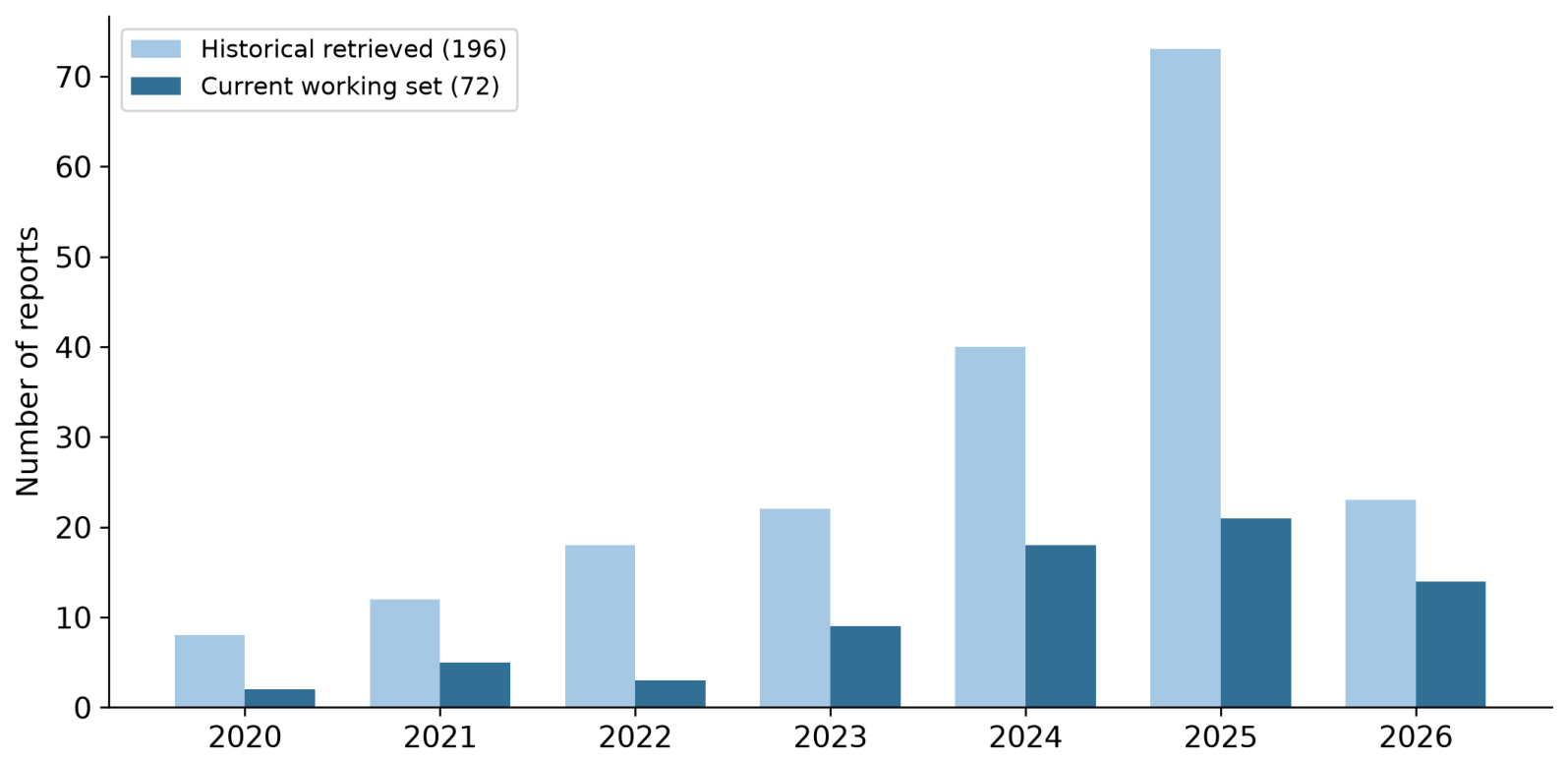
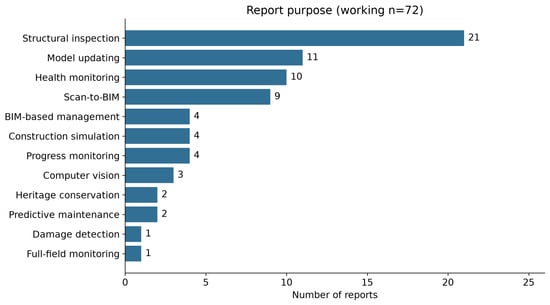
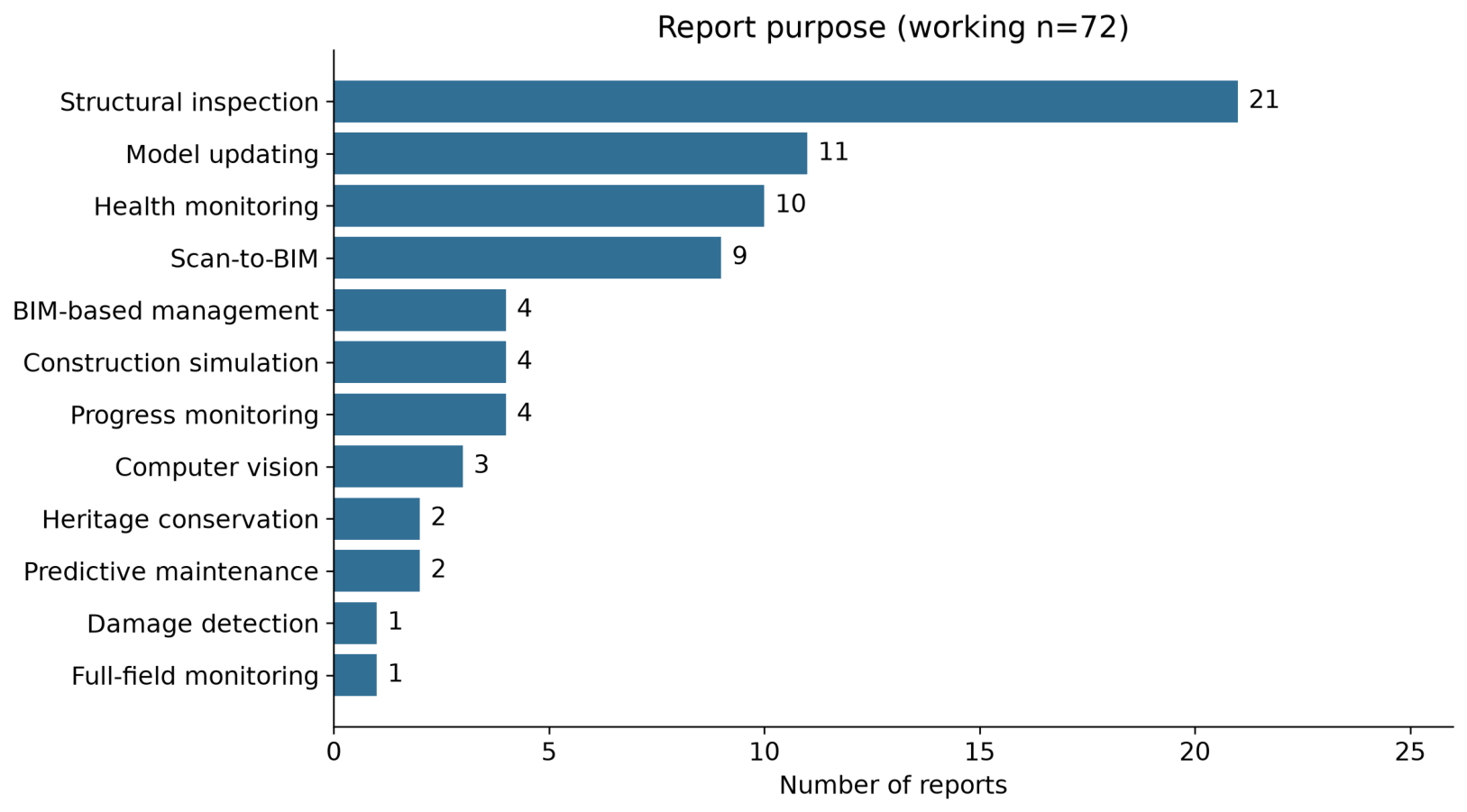
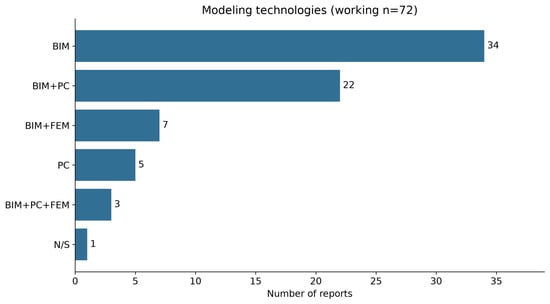
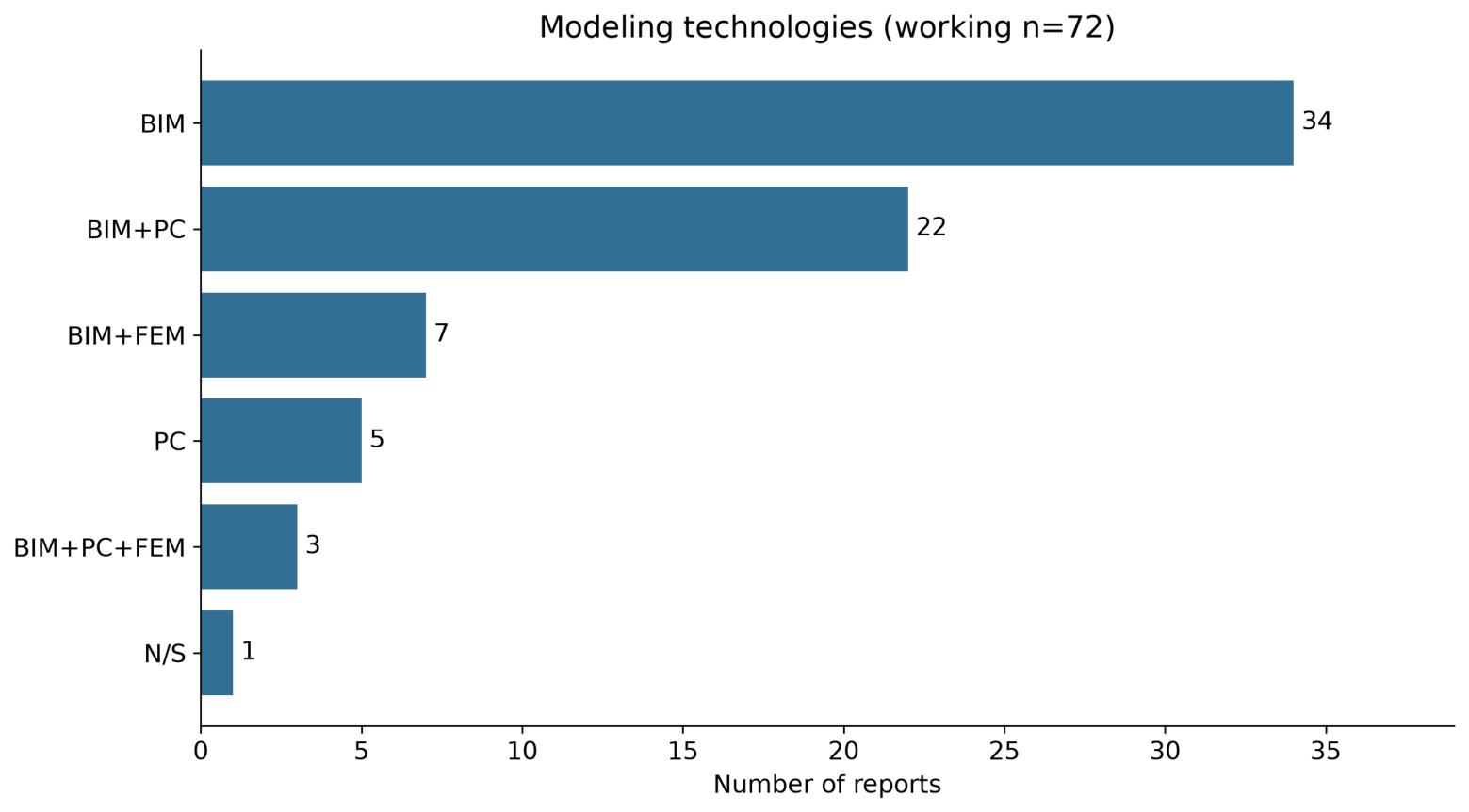
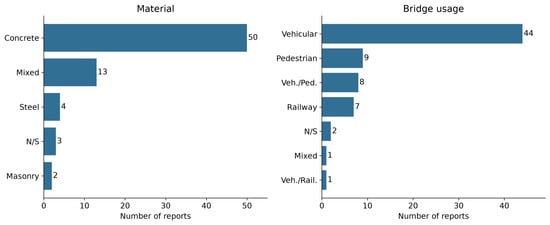
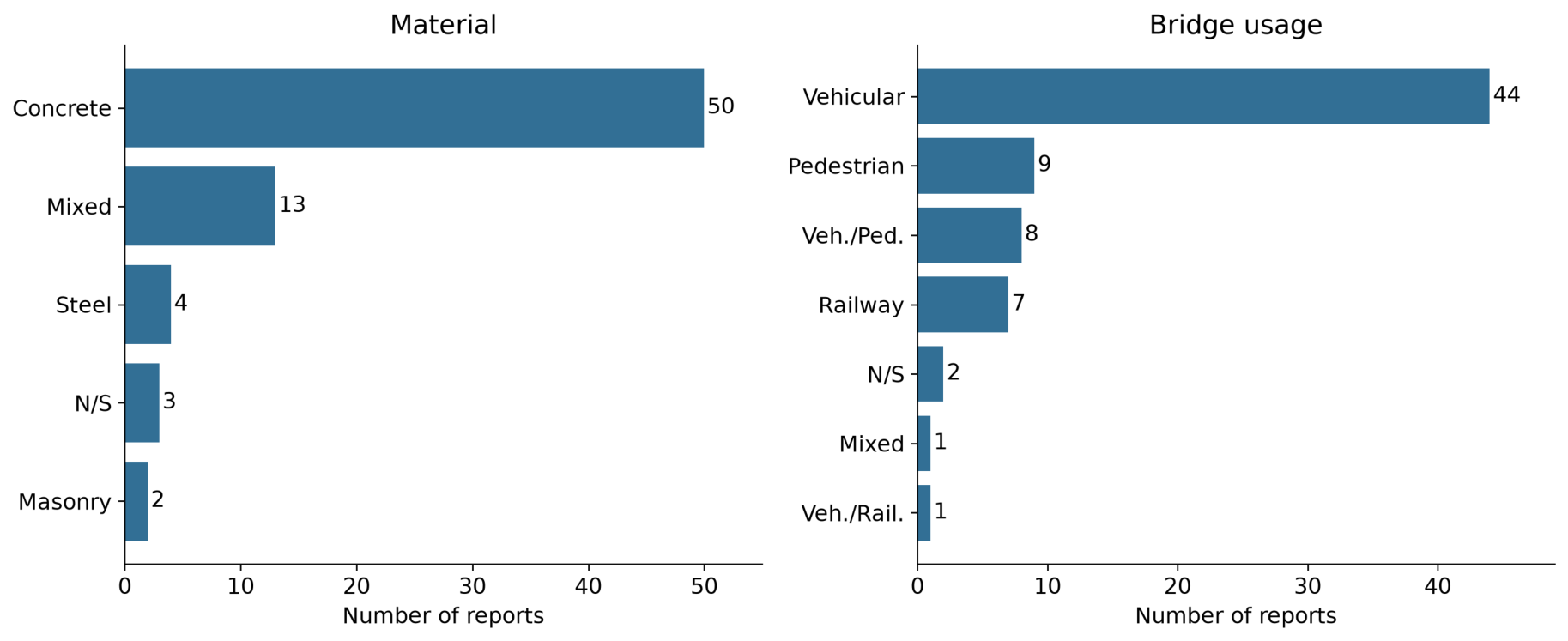
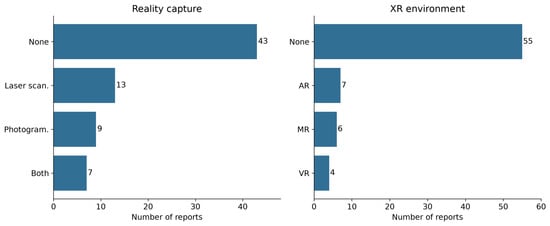
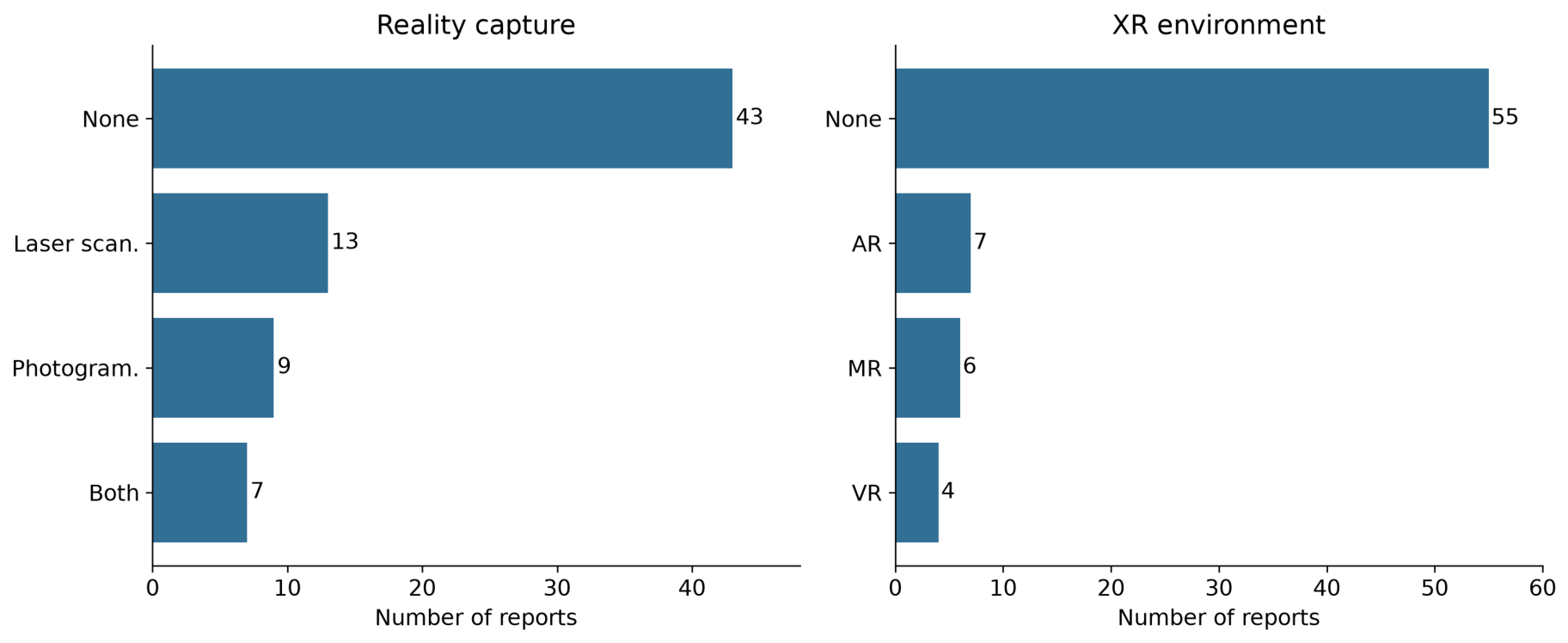



Disclaimer/Publisher’s Note: The statements, opinions and data contained in all publications are solely those of the individual author(s) and contributor(s) and not of MDPI and/or the editor(s). MDPI and/or the editor(s) disclaim responsibility for any injury to people or property resulting from any ideas, methods, instructions or products referred to in the content. |
© 2026 by the authors. Licensee MDPI, Basel, Switzerland. This article is an open access article distributed under the terms and conditions of the Creative Commons Attribution (CC BY) license.