


Abstract
Effects of calf and ankle tissue flossing on countermovement jump (CMJ) braking strategy and local passive mechanical properties were examined after repeated jumping. Forty healthy male college students matched by CMJ height were randomized within pairs to the flossing group (FLOSS; n = 20) or control group (CON; n = 20). After 100 jumps from a 30 cm box, FLOSS received calf and ankle flossing, whereas CON performed identical ankle movements without flossing. CMJ braking-phase variables, CMJ and squat jump (SJ) performance, and lower-leg muscle–tendon properties (MyotonPRO) were assessed at baseline (T1), immediately postexercise (T2), and postintervention (T3). After Holm adjustment, significant group-by-time interactions occurred for braking phase duration (p = 0.015, = 0.128) and braking rate of force development (RFD) (p = 0.012, = 0.145), but not jump height or passive mechanical properties. From T2 to T3, FLOSS showed a greater decrease in braking phase duration and a greater increase in braking RFD than CON, with similar braking net impulse. However, these differences were not confirmed by ANCOVA adjusting for T2 values. These findings suggest a possible acute modification of CMJ braking strategy rather than improved jump performance or recovery. Integrating force–time, jump, and muscle mechanical measures may allow for more comprehensive monitoring of acute flossing responses.
1. Introduction
Among lower extremity joints, the ankle is one of the first to bear ground reaction forces during jump landing and plays an important role in their initial absorption and regulation. Ankle injuries, including recurrent sprains and chronic instability, are particularly common in sports involving rapid changes in direction, repeated jumping, and landing [1,2]. Repeated stretch-shortening cycle (SSC) actions may cause structural muscle damage, impair force production, and compromise the ability to maintain the required mechanical output [3]. They may also alter the postexercise state and local passive mechanical properties of ankle related muscles, including stiffness, viscoelasticity, relaxation, and creep [4,5]. Therefore, postexercise interventions may influence movement strategies, local passive mechanical properties, or both, and assessing each aspect may provide complementary information on acute postexercise responses [6,7,8,9]. The countermovement jump (CMJ) is widely used to capture acute postexercise changes because of its sensitivity and ease of administration [5,10]. Previous studies on CMJ force–time analysis have shown that jump height alone may not fully capture changes in movement strategy, because alterations in phase-specific force production can occur without clear changes in overall jump output [11,12]. Since the CMJ involves the SSC, it is well suited for capturing force–time strategies and multipoint coordination. In contrast, the squat jump (SJ), which primarily involves concentric action, may serve as a useful comparison task to help interpret repeated jump-related strategy changes [13]. Thus, combining CMJ and SJ assessments with CMJ force–time variables may enable more comprehensive evaluation of postexercise intervention effects after repeated-jumping.
Tissue flossing involves wrapping an elastic band tightly around a limb segment while the joint is actively moved, followed by release of the band [14,15]. Proposed mechanisms include improved myofascial gliding, reactive hyperemia after band release, and neurophysiological effects [16,17,18]; however, these mechanisms have rarely been examined directly, and their contribution to the effects of flossing remains unclear. Previous studies have suggested that flossing may improve the joint’s range of motion and certain performance-related outcomes, including ankle dorsiflexion, single-leg jump performance, hamstring flexibility, and knee flexion angle [15,19,20,21]. However, it remains unclear whether tissue flossing can still improve performance when applied after exercise and whether it also alters local tissue mechanical properties [16].
In this context, the present study aimed to examine the acute response to calf and ankle tissue flossing after repeated jumping exercise. It was hypothesized that calf and ankle tissue flossing, when applied after repeated jumping exercise, would help maintain or improve ankle-related local passive mechanical properties and jump-related performance responses compared with active ankle movements without the floss band. This integrated approach may provide a more comprehensive understanding of acute postexercise responses and movement strategy modulation.
2. Materials and Methods
2.1. Participants
A total of 40 healthy male college students who participated in intercollegiate competitions were recruited for this study. All participants had engaged in regular sport training for at least 1 year and trained at least twice per week, with each session lasting at least 30 min. Their training included resistance, weight, or power training, or participation in sports involving repeated sprinting, jumping, and changes in direction, such as basketball, volleyball, soccer, badminton, track and field, weightlifting, judo, or other ball sports. Participants were between 18 and 30 years of age. The exclusion criteria were as follows: (1) known diseases affecting muscle tone and exercise performance; (2) a history of back or lower-extremity musculoskeletal injury or concussion within the previous 6 months; (3) any other health condition that would preclude participation in high-intensity exercise; and (4) any contraindication to tissue flossing, including latex allergy, thrombosis, fracture, pathological tumor, heart failure, use of high-dose corticosteroids, or use of anticoagulants. Participants were instructed to refrain from caffeine intake and strenuous exercise, including resistance training for 24 h before testing. Physical characteristics were assessed (Table 1). Body mass and body fat percentage were measured using a body composition analyzer (InBody 770; Biospace Inc., Seoul, Korea). This study was approved by the Institutional Review Board of National Taiwan Sport University (NTSUIRB-113-014). Written informed consent was obtained from all participants, and this study was conducted in accordance with the Declaration of Helsinki.
Table 1.
Physical characteristics of the participants.
2.2. Study Design
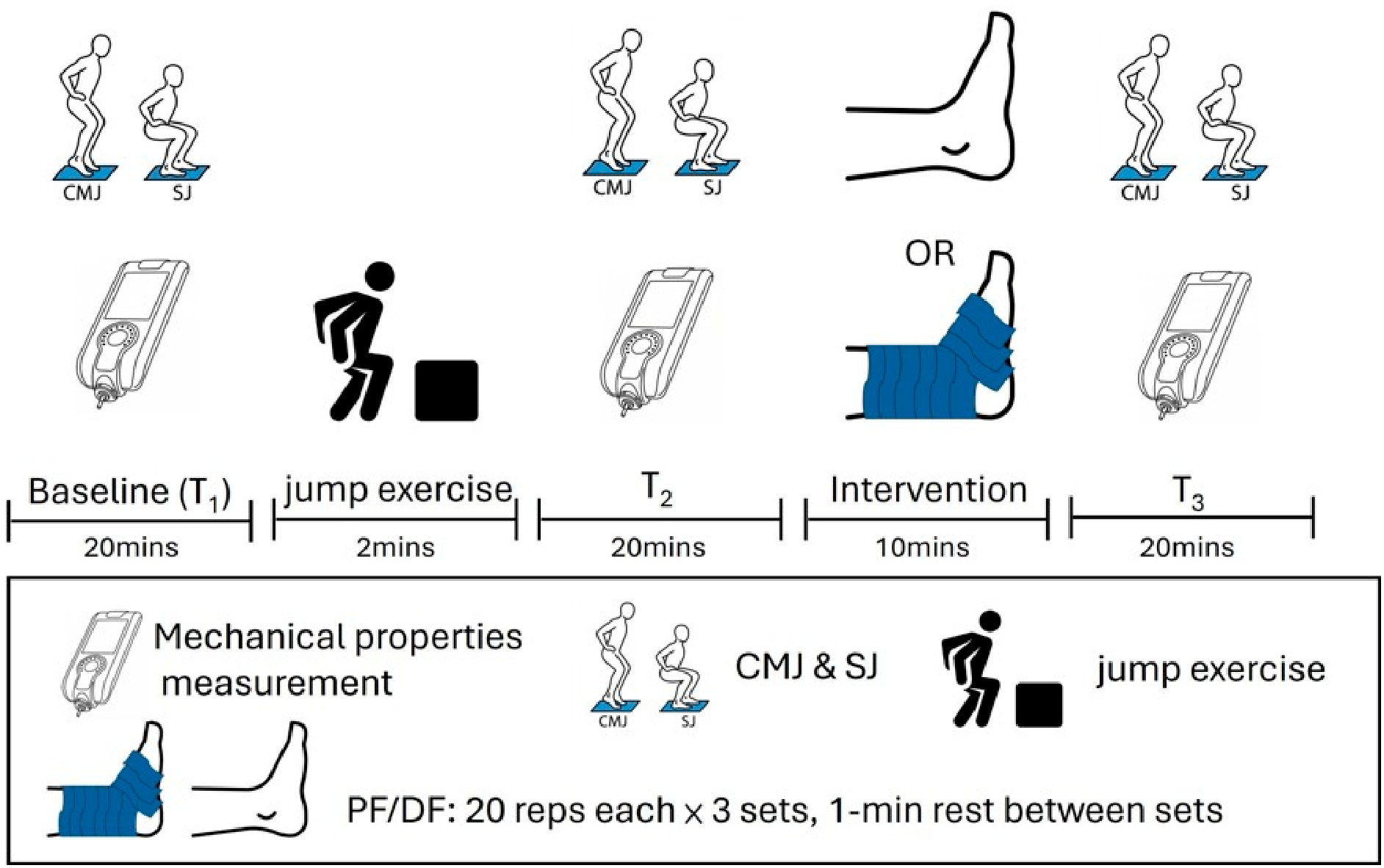
Figure 1 summarizes the experimental design. Because the repeated bout effect may influence the magnitude of muscle damage and the time course of recovery [22], a crossover design was not used in the present study. After all participants had been recruited and completed baseline (T1) testing, pairs were formed based on CMJ height, and one investigator, who also recruited and enrolled the participants, generated a computer-based randomization sequence to allocate one participant in each pair to the flossing group (FLOSS, n = 20) and the other to the control group (CON, n = 20). The investigator concealed group allocation until immediately before the intervention. Owing to the nature of the floss band application, participants and the investigators conducting the measurements, including the MyotonPRO (MyotonPRO; Myoton AS, Tallinn, Estonia) assessments, could not be blinded. However, the force-plate data were anonymized and processed by an investigator blinded to group allocation. Each participant received only one intervention condition. Outcome measures included (1) CMJ braking-phase variables (primary outcomes); (2) CMJ and SJ performance, and (3) passive mechanical properties. These variables were assessed at baseline (T1), immediately after the repeated jumping exercise (T2), and after the intervention (T3).
Figure 1.
Design of the experimental protocol. CMJ: countermovement jump; SJ: squat jump.
2.3. Repeated Jumping Exercise Protocol
Participants performed repeated jumps between the floor and a 30 cm box at a cadence controlled by a metronome set at 60 beats/min. Participants were required to keep their hands on their hips throughout the protocol to minimize the influence of arm swing on movement performance. The protocol was terminated if a participant was unable to perform five consecutive repetitions correctly or failed to maintain the prescribed cadence. No participant met the termination criteria, and all participants completed the full 100 repetitions.
2.4. Tissue Flossing Intervention
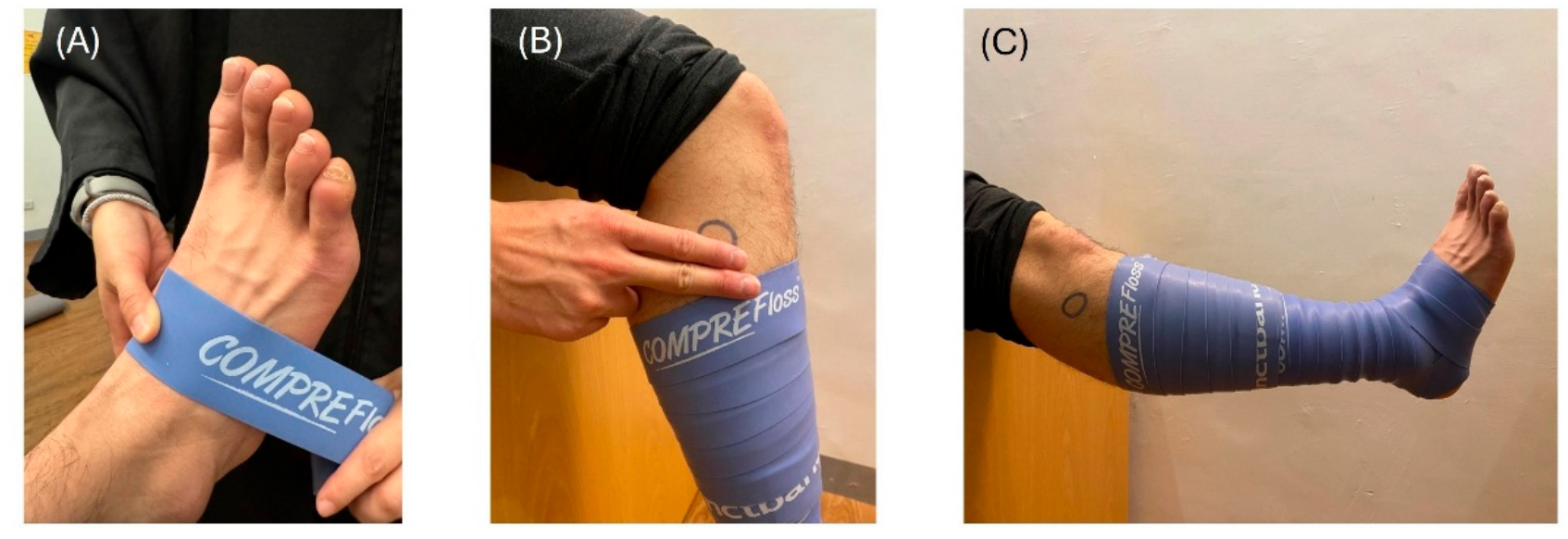
The floss band used was a Sanctband COMPRE Floss Blueberry with a size of 5 cm × 3.5 m (CompreFloss; Sanct Japan Co., Ltd., Tokyo, Japan). All floss band applications were performed by the same specialist with 2 years of experience who had completed the Easy Tissue Flossing Instructor Course Levels 1–2. Participants were seated with the ankle positioned at 90° dorsiflexion. The floss band was anchored on the dorsum of the foot and wrapped counterclockwise with 50% overlap from the heel and ankle to approximately two fingerbreadths below the fibular head (Figure 2B). The band was applied under tension to approximately 1.5 times its original length; if necessary, 2 bands were connected for wrapping [23]. Consistent with common clinical practice, elongation was estimated visually and tactilely rather than measured, and interface pressure was not assessed. Figure 2 illustrates the tissue flossing intervention procedure [14,15]. The CON group performed the same active movements without floss band application.
Figure 2.
Intervention with the tissue flossing band. (A) Direction of floss band application. (B) The band was wrapped proximally to a point approximately two fingerbreadths below the fibular head. (C) After wrapping was completed, participants remained still for 1 min. Participants then performed 20 repetitions of ankle plantarflexion and dorsiflexion. After band removal, they rested for 1 min, and the same procedure was repeated twice more. Each treatment bout lasted 3 min and 20 s, with 3 bouts completed in total (approximately 10 min).
2.5. Measurement of Passive Muscle–Tendon Mechanical Properties
Passive mechanical properties were assessed in a relaxed state using a handheld myotonometer (MyotonPRO; Myoton AS, Tallinn, Estonia), which has generally shown high reliability within and between raters across different muscles [24]. The tibialis anterior, medial gastrocnemius, lateral gastrocnemius, and Achilles tendon of the dominant limb were evaluated. The dominant limb was defined as the leg each participant preferred to use to kick a ball. To standardize measurements of the posterior structures, participants lay prone with their feet hanging freely over the edge of the examination table. Measurement sites were identified by palpation and marked with a skin-safe marker [9]. The tibialis anterior site was defined as the proximal one-third of the line between the fibular head and the medial malleolus, positioned 2 cm lateral to the tibial crest in the transverse plane. The Achilles tendon site was located 4 cm proximally to the tendon insertion. The lateral gastrocnemius site was marked at 30% of the distance from the fibular head to the heel, and the medial gastrocnemius site at 30% of the distance from the popliteal fossa to the lateral malleolus [9]. Three consecutive measurements were obtained at each site, and the mean value was used for analysis. According to the manufacturer’s protocol, the myotonometer applied a pre-load of 0.18 N followed by a brief mechanical impulse of 0.4 N for 15 ms, and tissue oscillations were recorded to derive natural oscillation frequency (F, Hz), reflecting muscle tone, and dynamic stiffness (S, N/m) [25].
2.6. Countermovement Jump Test
All participants were familiarized with the CMJ and SJ procedures before data collection. CMJ performance was assessed using a force plate (9260AA; Kistler Instrumente AG, Winterthur, Switzerland). Participants stood upright with their hands on their hips and remained motionless for at least 3 s before initiating the jump. They were instructed to perform a rapid countermovement and jump as high as possible. Trials in which the hands left the hips were discarded. Each participant completed three CMJs, recorded at 1000 Hz, and the best trial (highest jump height) was used for analysis. All braking-phase force–time variables were extracted from the same selected trial. Raw (unfiltered) vertical force data were used for all analyses. Force–time data were processed using a custom script in MATLAB (R2017b; MathWorks, Natick, MA, USA) according to McMahon et al. [26]. Movement onset was identified when vertical force fell below body weight by more than 5 SDs of the quiet-standing force. Center-of-mass velocity was obtained by integrating net force (vertical force minus body weight) divided by body mass. The braking phase was defined from peak negative velocity (end of unweighting) to zero velocity. Kinetic variables of interest were braking phase duration, braking rate of force development (braking RFD; change in force across the braking phase divided by its duration, normalized to body mass), braking net impulse (area under the net force–time curve during the braking phase), and peak braking force. Take-off was defined as the moment when vertical force fell below a threshold equal to 5 SDs of the flight-phase force (calculated over a 300 ms portion of the flight phase), and touchdown was defined as the moment when force rose above the same threshold; flight time was defined as the interval between these two events. Jump height was calculated as 0.5 × g × (flight time/2)2 [10,26].
2.7. Squat Jump Test
Squat jump performance was assessed using a force plate (9260AA; Kistler Instrumente AG, Winterthur, Switzerland) sampled at 1000 Hz. Participants stood with their feet shoulder width apart and with their hands on their hips, assuming a standardized semi squat position with 90° knee flexion which was verified with a goniometer before each trial and performed a maximal vertical jump on verbal command. Countermovement and arm movement were not permitted. The absence of a countermovement was verified by visual inspection of the force–time curve; any trial showing a decrease in vertical force below body weight before the propulsive phase was discarded and repeated. Three valid trials were completed and the trial with the highest jump height was analyzed. Jump height was calculated from flight time using the same take-off and touchdown criteria and equation as for the CMJ, and the eccentric utilization ratio (EUR) was calculated as CMJ height divided by SJ height (EUR = CMJ/SJ) [10,26].
2.8. Statistical Analysis
Sample size was estimated a priori using G*Power (version 3.1.9, Düsseldorf, Germany) for a repeated-measures ANOVA with a within–between interaction. Assuming 2 groups, 3 measurements, an effect size (f) of 0.25, an alpha level of 0.05, and a power of 0.80, the required minimum size was 28 participants. The data are presented as mean values (standard deviation, SD). Statistical analyses were performed using SPSS (version 22.0; IBM, Armonk, NY, USA), with statistical significance set at α = 0.05. Normality was examined using Q-Q plots and the Shapiro–Wilk test. A 2 (group: CON vs. FLOSS) × 3 (time: T1, T2, and T3) mixed-design ANOVA was used to examine interaction effects for each dependent variable. If Mauchly’s test of sphericity was violated, Greenhouse–Geisser or Huynh–Feldt corrections were applied. To control for multiple comparisons, p-values associated with the group by time interaction effects were adjusted using the Holm–Bonferroni correction separately within each outcome family (primary braking-phase variables: 4; jump performance: 3; passive mechanical properties: 8) [27]. Bonferroni-adjusted post hoc comparisons were performed only for outcomes with a significant Holm-adjusted interaction. Within-group changes and between-group differences in change (ΔFLOSS–ΔCON) from T2 to T3 were expressed as mean differences with 95% confidence intervals. Partial eta squared () values were computed as effect size estimates and were defined as small ( = 0.01), medium ( = 0.06), or large ( = 0.14) [28]. As a sensitivity analysis for the primary outcomes, an ANCOVA was performed with T3 values as the dependent variable, group as the fixed factor, and T2 values as the covariate (Supplementary Table S1).
3. Results
All 40 participants completed the study. No significant baseline differences were observed between groups in participant characteristics or CMJ height (Table 1).
3.1. CMJ Force–Time Variables and Jump Performance
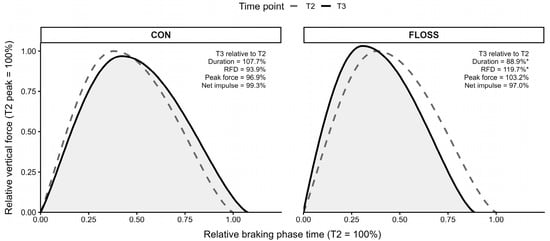
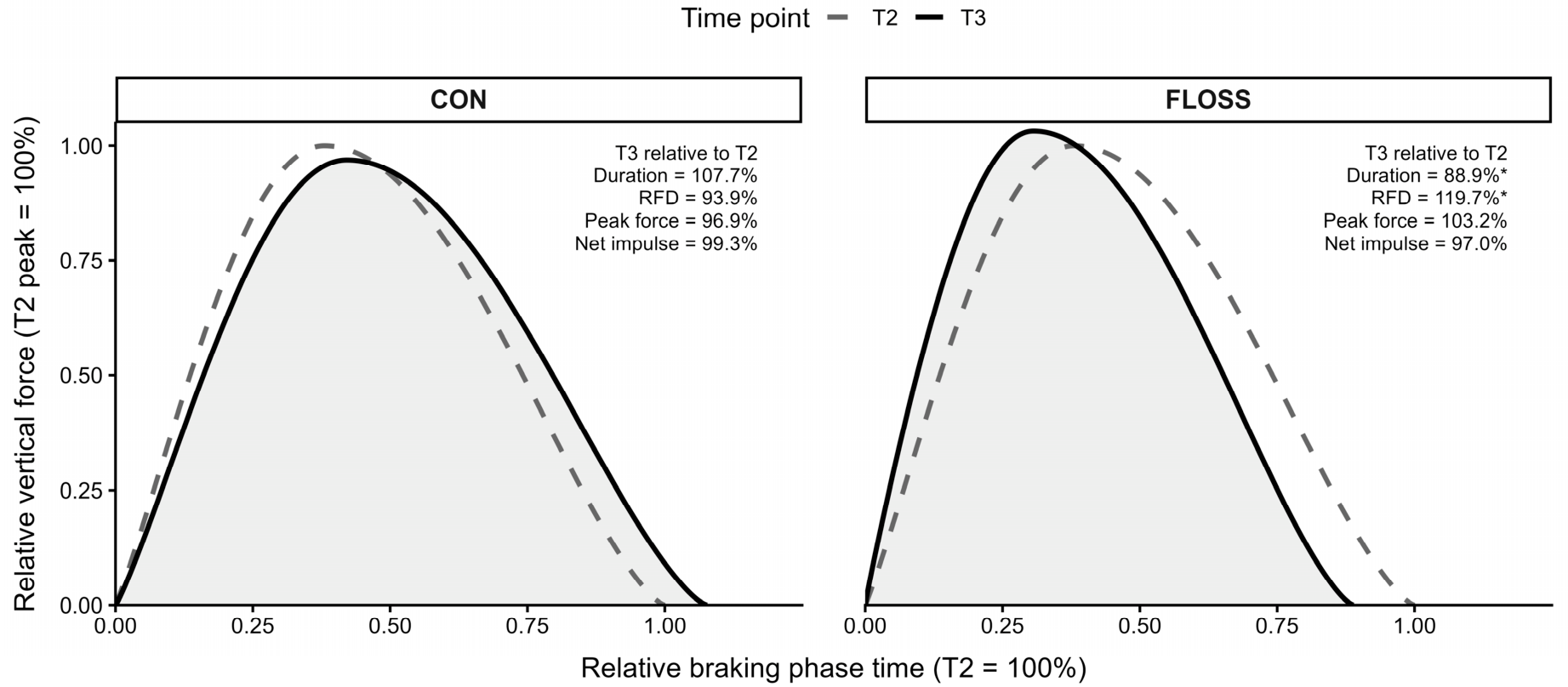
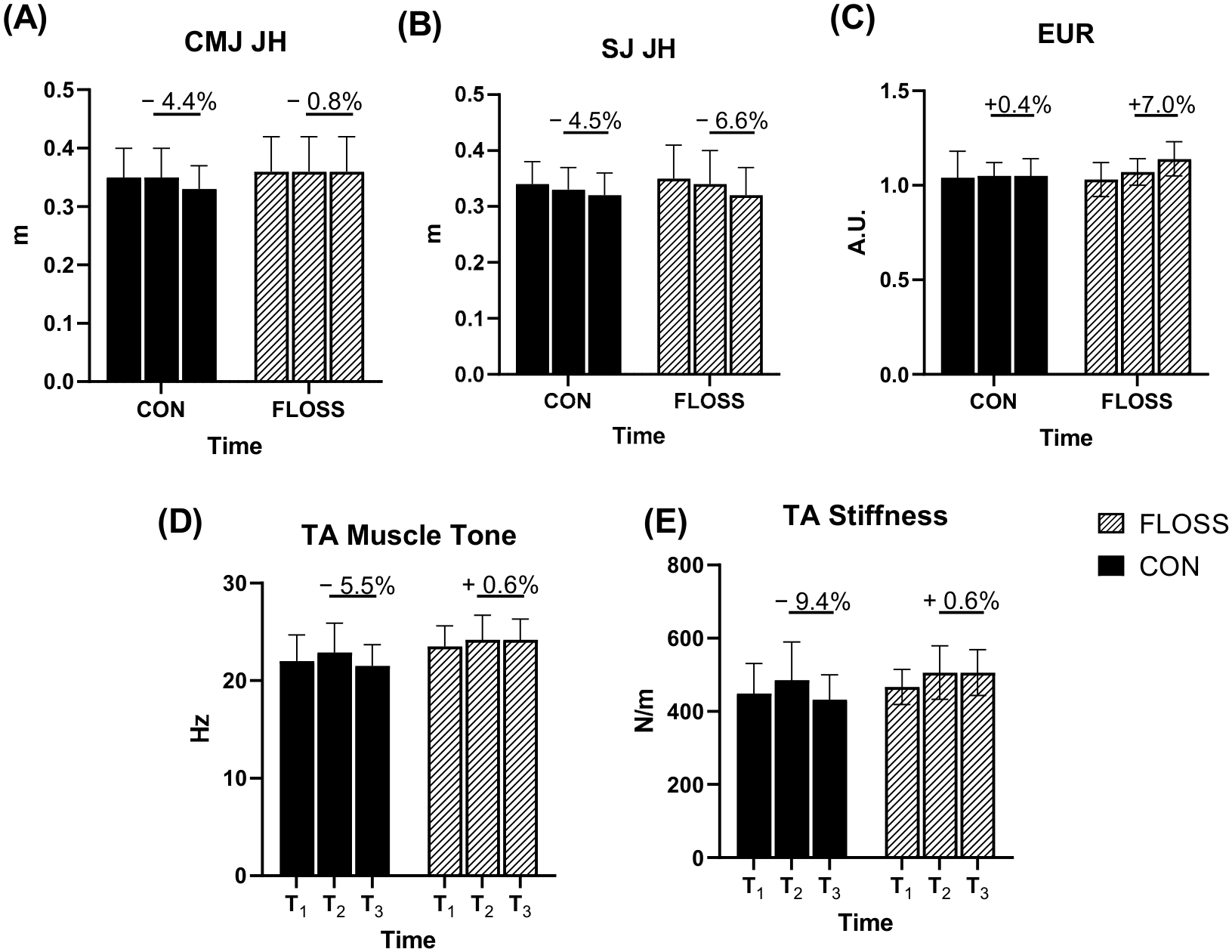
For the primary outcomes regarding CMJ force–time variables, significant group-by- time interactions were observed for braking phase duration (F = 5.588, p = 0.005, Holm-adjusted p = 0.015, and = 0.128) and braking RFD (F = 6.436, p = 0.003, Holm-adjusted p = 0.012, and = 0.145; Table 2; Figure 3), and both remained significant after Holm adjustment. Post hoc within-group comparisons revealed that, from T2 to T3, the FLOSS group showed significantly decreased braking phase duration (Δ = −0.02 s, p = 0.009) and increased braking RFD (Δ = 16.1 N·kg−1·s−1, p = 0.004), whereas the CON group showed no significant changes (all p ≥ 0.409). The between-group differences in change (ΔFLOSS–ΔCON) were −0.02 s [95% CI: −0.03, −0.007] for braking phase duration and 23.2 N·kg−1·s−1 [95% CI: 9.9, 36.6] for braking RFD. No significant interactions were observed for braking net impulse or peak braking force (all Holm-adjusted p > 0.05), nor for the secondary jump performance outcomes, including CMJ height, SJ height, and EUR (all Holm-adjusted p > 0.05; Table 2; Figure 4). In the ANCOVA sensitivity analysis adjusting for T2 values, the between-group differences in braking phase duration (p = 0.577) and braking RFD (p = 0.070) were not statistically significant (Supplementary Table S1).
Table 2.
Changes in countermovement jump and squat jump variables at T1, T2, and T3 in the CON (n = 20) and FLOSS (n = 20) groups.
Figure 3.
Schematic normalized illustrations of countermovement jump braking-phase force–time characteristics in the CON and FLOSS groups. For each participant, T3 values for braking phase duration, braking rate of force development, peak braking force, and braking net impulse were normalized to the corresponding T2 values (T2 = 100%) and subsequently averaged within each group. The schematic T3 curves were generated from the group-mean normalized braking duration, braking RFD, and peak braking force, while the normalized braking net impulse is presented as an additional descriptive outcome. The curves do not represent individual raw force–time trials or directly averaged group waveforms. CON, control group; FLOSS, tissue flossing group; RFD, rate of force development. * Indicates a significant Bonferroni adjusted post hoc difference between T2 and T3 within the same group (p < 0.05).
Figure 4.
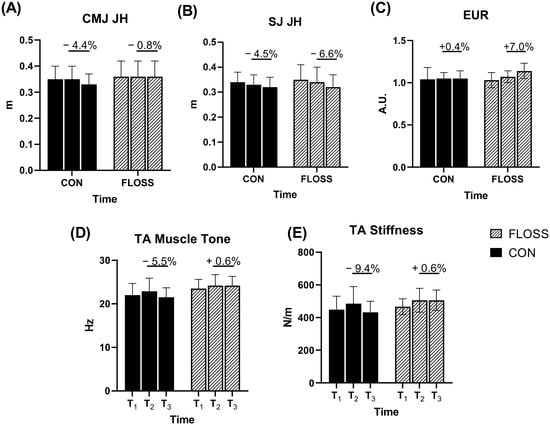
Changes in selected passive mechanical properties and jump variables in the CON and FLOSS groups. (A) countermovement jump heigh (CMJ JH); (B) squat jump height (SJ JH); (C) eccentric utilization ratio (EUR); (D) Tibialis anterior (TA) muscle tonet; and (E) TA passive stiffness. Bars represent mean ± SD. To facilitate interpretation of the magnitude of change, percentage change from T2 to T3 was calculated for each participant as Δ% = [(T3 − T2)/T2] × 100, and group mean percentage changes are presented above the bars.
3.2. Passive Muscle–Tendon Mechanical Properties
For the secondary passive muscle–tendon mechanical properties, tibialis anterior muscle tone and stiffness showed nominally significant interactions before adjustment (F = 3.308, p = 0.042, = 0.08; F = 5.186, and p = 0.008, = 0.12; Figure 4D,E), but these did not remain significant after adjustment (Holm-adjusted p = 0.294 and 0.064, respectively). No significant interactions were observed for the medial gastrocnemius, lateral gastrocnemius, or Achilles tendon (all Holm-adjusted p > 0.05; Table 3).
Table 3.
Changes in passive muscle–tendon mechanical properties at T1, T2, and T3 in the CON (n = 20) and FLOSS (n = 20) groups.
4. Discussion
The principal finding was that calf and ankle tissue flossing may have altered the CMJ braking strategy after repeated jumping but did not improve jump performance. Compared with active ankle movement alone, flossing was followed by a greater decrease in braking phase duration and a greater increase in braking RFD from T2 to T3, both of which remained statistically significant after Holm adjustment, whereas no statistically significant change was observed for braking net impulse. In contrast, flossing did not produce robust changes in jump height, EUR, or passive muscle–tendon mechanical properties once multiple comparisons were accounted for, although tibialis anterior tone and stiffness showed nominal interactions that should be interpreted with caution. Thus, the hypothesis was only partially supported.
4.1. Jump Performance and Force–Time Variables
This study revealed that, in the mixed-design ANOVA, flossing after repeated jumping exercise significantly increased braking RFD and reduced braking phase duration, without a statistically significant interaction between group and time for braking net impulse. This pattern suggests that participants in the FLOSS group adopted a more rapid and concentrated braking strategy, in which the shorter braking phase was accompanied by a faster rate of force development, thereby maintaining a similar braking net impulse (Figure 3) [26]. Although the functional relevance of this response was not tested, a shorter braking phase could be relevant to situations in which the transition from braking to propulsion is time-limited. In many sport situations, athletes are required to repeatedly land, decelerate, and rapidly prepare for the next jump or change in movement direction. This interpretation is consistent with CMJ force–time research emphasizing the braking phase as a key transition phase and with the broader literature on the RFD and stretch–shortening cycle, highlighting the importance of rapid force development during time-limited explosive actions [26,29,30]. From a practical perspective, these findings suggest that ankle tissue flossing may acutely modify the CMJ braking strategy following repeated jumping exercise; however, whether this altered braking pattern represents a functional or recovery-related benefit remains to be determined. Previous tissue flossing studies have reported inconsistent effects on jump performance, with some observing only small or limited benefits [15,16,31], which may partly reflect the fact that jump height alone is insufficient to capture changes in phase specific movement strategy [10,26]. These findings should be interpreted considering the baseline differences between groups. Although participants were pair-matched on CMJ height and randomized within pairs, the FLOSS group showed a longer braking phase duration and lower braking RFD than the CON group at T1 and T2, indicating that matching on jump height did not ensure balance in braking-phase strategy. When T3 values were adjusted for T2 values, the between-group differences were attenuated and did not reach statistical significance, although the direction of the braking RFD effect was consistent with the primary analysis (Supplementary Table S1). Because this sensitivity analysis addresses only the T2 to T3 change, whereas the mixed-design ANOVA evaluates the pattern across all three time points, the two analyses are complementary; however, regression to the mean cannot be excluded. Therefore, the present findings should be regarded as preliminary and require confirmation in studies with balanced baseline braking characteristics.
In contrast to the changes in braking characteristics, flossing did not produce robust changes in CMJ height, SJ height, or EUR. This is consistent with the inconsistent effects of tissue flossing on jump performance reported in previous studies. Ankle flossing has been reported to produce small improvements in single-leg jump performance in recreational athletes [15], whereas only trivial or non-significant effects on CMJ performance were observed in a follow-up study and in elite rugby players [31,32]. Other studies showed that thigh flossing did not change jump height [16] and even reduced CMJ height in another study [33]. Notably, lower-leg flossing preserved the reactive strength index after running-induced fatigue [34]. However, the present study did not provide evidence that flossing preserved SSC performance, as the EUR did not differ between groups after adjustment. Moreover, because the EUR is a ratio of CMJ to SJ performance, any change may result from maintained CMJ performance, reduced SJ performance, or both, and may also be associated with poorer SJ RFD; therefore, it does not directly demonstrate enhanced stretch–shortening cycle function [13,29]. Taken together, these findings suggest that CMJ force–time analysis can reveal postexercise changes in movement strategy that are not captured by jump height alone [10,26].
4.2. Changes in Passive Muscle–Tendon Mechanical Properties
In contrast to the changes in CMJ braking characteristics, passive muscle–tendon mechanical properties did not provide robust evidence of an intervention effect. No group-by-time interactions for the tibialis anterior, gastrocnemius, or Achilles tendon remained significant after correction for multiple comparisons, which is broadly consistent with previous tissue-flossing studies. Previous studies have reported that, following ankle flossing, the range of ankle motion showed moderate-to-large effect sizes without significant changes in tensiomyography-derived muscle parameters [17], and that calf flossing increased the range of dorsiflexion motion without altering overall muscle and fascial hardness [18]. Conversely, tissue flossing has been reported to reduce hamstring stiffness, although its flexibility gains were not superior to those of dynamic stretching [35]. These findings suggest that functional and passive mechanical responses to flossing do not necessarily occur together; however, because the direction and anatomical location of these responses vary across studies, such results should be interpreted with caution. Several mechanisms have been proposed, including myofascial gliding, reactive hyperemia, and neurophysiological effects [16,17,18], but these mechanisms were not assessed in the present study. Moreover, the two measurement approaches reflect different levels of function. MyotonPRO assesses superficial tissue properties under resting conditions, whereas the CMJ involves dynamic, high-velocity loading. Therefore, passive mechanical properties and dynamic jump performance provide complementary information, but the direct relationship between them remains to be established.
Although floss band elongation and overlap were carried out following previously reported procedures [20,23], and floss band stretch force has been shown to increase with elongation [36], these measurements do not establish the interface pressure delivered during wrapping. This distinction is important because the effects of flossing appear to be pressure-dependent. Galis and Cooper [37] reported that calf flossing at 150 mmHg improved ankle dorsiflexion range of motion and power, whereas application at 200 mmHg produced negligible effects. Similarly, in patients with chronic ankle instability, medium-pressure application (150 mmHg) produced longer-lasting improvements in dynamic stability and proprioception compared with high-pressure application (200 mmHg) [38]. These findings suggest that greater compression does not necessarily confer greater benefits. Because pressure-measuring devices are typically unavailable in clinical and sports settings, band tension in the present study was estimated visually and tactilely rather than measured, thus reflecting the effects of tissue flossing under real-world conditions. However, differences in limb circumference, tissue characteristics, and wrapping technique may have led to variation in the pressure applied [16,17,18,23]. In the present study, the prescribed elongation should therefore be interpreted as an application target rather than a quantified compression dose. Accordingly, this study cannot determine whether the observed effects were related to the compression pressure applied.
4.3. Practical Implications and Limitations
The main practical implication of this study is that calf and ankle flossing may be more relevant for acutely modulating CMJ braking-phase force–time characteristics than for improving jump height or explosive propulsive capacity. Accordingly, flossing should not be regarded as an established performance-enhancing or recovery strategy. Whether these acute changes in braking-phase force–time characteristics translate into meaningful improvements in subsequent performance or recovery requires further investigation. In addition, CMJ force–time variables, rather than jump height alone, may be useful for monitoring acute responses to such interventions.
This study has several limitations. First, no sham wrapping condition was included, and participants could not be blinded to group allocation; therefore, expectancy or nonspecific sensory effects cannot be excluded. Second, wrapping pressure was not standardized or monitored. Although this choice reflects applied sport practice, in which practitioners commonly adjust band tension without pressure sensors, it limits intervention reproducibility. Third, MyotonPRO assesses passive mechanical properties under static relaxed conditions and cannot directly represent dynamic or functional loading, including active muscle tension, individual subtendon tensile stiffness, or internal tendon load distribution. Fourth, the mechanistic interpretation focused primarily on the calf muscles and Achilles tendon. Because the CMJ is a multijoint movement requiring coordinated hip, knee, and ankle extension, the absence of measurements from major proximal muscle groups such as the gluteus maximus and quadriceps limited assessment of whole-limb kinetic adjustments. In addition, the lack of physiological or perceptual fatigue markers limited verification of the neuromuscular fatigue induced by the repeated jumping protocol. Finally, because the sample consisted of healthy male college students rather than elite athletes, the findings may not generalize to other sexes, athletic backgrounds, sports, or high-level competitive settings. In addition, despite pair matching on CMJ height, the groups differed in braking-phase variables at T1 and T2, and the primary findings were not robust to ANCOVA adjustment for T2 values; therefore, regression to the mean cannot be excluded, and these findings should be regarded as preliminary.
5. Conclusions
This study showed that a brief calf and ankle tissue flossing intervention was associated with a greater decrease in braking phase duration and a greater increase in the braking rate of force development, from immediately postexercise to postintervention in the countermovement jump after repeated jumping exercises, without changes in jump height, eccentric utilization ratio, or passive muscle–tendon mechanical properties. However, these findings were not confirmed by the ANCOVA sensitivity analysis and should be interpreted cautiously given the baseline differences between groups. These findings suggest a possible acute modification of the countermovement jump braking strategy rather than an improvement in jump performance, providing preliminary evidence of acute changes in selected CMJ force–time variables. Therefore, incorporating countermovement jump force–time analysis, passive muscle mechanical properties, and related performance variables may provide a more detailed assessment of acute postexercise responses and movement strategy modulation.
Supplementary Materials
The following supporting information can be downloaded at: https://www.mdpi.com/article/10.3390/app162010411/s1, Table S1: ANCOVA sensitivity analysis of the primary outcomes with significant group × time interactions (T3 adjusted for T2) in the CON (n = 20) and FLOSS (n = 20) groups.
Author Contributions
Conceptualization, H.-W.C., H.-T.L. and C.-S.H.; methodology, H.-W.C., H.-T.L. and Y.-C.S.; software, C.-S.H.; validation, H.-T.L., C.-A.H. and Y.-C.S.; formal analysis, H.-W.C. and H.-T.L.; investigation, H.-W.C., C.-A.H. and H.-C.Y.; resources, C.-A.H., H.-C.Y. and C.-S.H.; data curation, H.-W.C., H.-C.Y. and Y.-C.S.; writing—original draft preparation, H.-W.C.; writing—review and editing, H.-T.L., Y.-C.S. and C.-S.H.; visualization, H.-W.C., C.-A.H. and H.-T.L.; supervision, H.-T.L. and C.-S.H.; project administration, H.-W.C., H.-C.Y. and C.-S.H. All authors have read and agreed to the published version of the manuscript.
Funding
This research received no external funding.
Institutional Review Board Statement
The study was conducted in accordance with the Declaration of Helsinki and approved by the Institutional Review Board of National Taiwan Sport University (protocol code NTSUIRB-113-014 and date of approval: 10 April 2024).
Informed Consent Statement
Informed consent was obtained from all subjects involved in the study.
Data Availability Statement
The original contributions presented in this study are included in the article. Further inquiries can be directed to the corresponding authors.
Acknowledgments
We would like to thank all the participants in this study and thank the members of the Sports Technology Lab for their assistance during study preparation and implementation.
Conflicts of Interest
The authors declare no conflicts of interest.
References
- Doherty, C.; Delahunt, E.; Caulfield, B.; Hertel, J.; Ryan, J.; Bleakley, C. The incidence and prevalence of ankle sprain injury: A systematic review and meta-analysis of prospective epidemiological studies. Sports Med. 2014, 44, 123–140. [Google Scholar] [CrossRef] [Scilit] [PubMed]
- Caldemeyer, L.E.; Brown, S.M.; Mulcahey, M.K. Neuromuscular training for the prevention of ankle sprains in female athletes: A systematic review. Phys. Sportsmed. 2020, 48, 363–369. [Google Scholar] [CrossRef] [Scilit] [PubMed]
- Nuzzo, J.L.; Pinto, M.D.; Nosaka, K. Overview of muscle fatigue differences between maximal eccentric and concentric resistance exercise. Scand. J. Med. Sci. Sports 2023, 33, 1901–1915. [Google Scholar] [CrossRef] [Scilit] [PubMed]
- Pentidis, N.; Mersmann, F.; Bohm, S.; Giannakou, E.; Aggelousis, N.; Arampatzis, A. Effects of long-term athletic training on muscle morphology and tendon stiffness in preadolescence: Association with jump performance. Eur. J. Appl. Physiol. 2020, 120, 2715–2727. [Google Scholar] [CrossRef] [Scilit] [PubMed]
- Wdowski, M.M.; Rosicka, K.; Hill, M. Influence of lower-limb muscular and tendon mechanical properties and strength on countermovement jump performance. J. Sports Med. Phys. Fit. 2023, 63, 16–22. [Google Scholar] [CrossRef] [Scilit] [PubMed]
- Willems, M.; Gilson, L.; Verschueren, S.; Vanrenterghem, J.; Staes, F.; Vandenneucker, H.; Claes, S.; Smeets, A. Fatigue-induced Landing Alterations in ACL Reconstructed Athletes after Return-to-Sport. Int. J. Sports Med. 2023, 44, 830–838. [Google Scholar] [CrossRef] [Scilit] [PubMed]
- Koshino, Y.; Ishida, T.; Taniguchi, S.; Samukawa, M.; Kasahara, S.; Tohyama, H. Hip and knee kinematics, center of pressure position, and ground reaction force are associated with Achilles tendon force during jump landing. Scand. J. Med. Sci. Sports 2024, 34, e14510. [Google Scholar] [CrossRef] [Scilit] [PubMed]
- Vermeulen, S.; De Bleecker, C.; Spanhove, V.; Segers, V.; Willems, T.; Roosen, P.; De Ridder, R.; Vanrenterghem, J. Comparison of Jump-Landing Biomechanics during and after Fatigue: Investigation on the Optimal Timing of Screenings under Fatigue. J. Hum. Kinet. 2025, 99, 55–65. [Google Scholar] [CrossRef] [Scilit] [PubMed]
- Nguyen, A.P.; Bosquet, L.; Cugnet-Evans, L.; Detrembleur, C.; Mahaudens, P. Observation of the Achilles Tendon and Gastrocnemius Muscle’s Passive Stiffness During an Incremental Running Protocol. Int. J. Sports Physiol. Perform. 2024, 19, 1321–1327. [Google Scholar] [CrossRef] [Scilit] [PubMed]
- Gathercole, R.J.; Sporer, B.C.; Stellingwerff, T.; Sleivert, G.G. Comparison of the Capacity of Different Jump and Sprint Field Tests to Detect Neuromuscular Fatigue. J. Strength Cond. Res. 2015, 29, 2522–2531. [Google Scholar] [CrossRef] [Scilit] [PubMed]
- Gathercole, R.; Sporer, B.; Stellingwerff, T.; Sleivert, G. Alternative countermovement-jump analysis to quantify acute neuromuscular fatigue. Int. J. Sports Physiol. Perform. 2015, 10, 84–92. [Google Scholar] [CrossRef] [Scilit] [PubMed]
- Kipp, K.; Kiely, M.; Giordanelli, M.; Malloy, P.; Geiser, C. Joint- and subject-specific strategies in male basketball players across a range of countermovement jump heights. J. Sports Sci. 2020, 38, 652–657. [Google Scholar] [CrossRef] [Scilit] [PubMed]
- Hughes, S.; Warmenhoven, J.; Haff, G.G.; Chapman, D.W.; Nimphius, S. Countermovement Jump and Squat Jump Force-Time Curve Analysis in Control and Fatigue Conditions. J. Strength Cond. Res. 2021, 36, 2752–2761. [Google Scholar] [CrossRef] [Scilit] [PubMed]
- Starrett, K.; Cordoza, G. Becoming a Supple Leopard 2nd Edition: The Ultimate Guide to Resolving Pain, Preventing Injury, and Optimizing Athletic Performance; Victory Belt Publishing: New York, NY, USA, 2015. [Google Scholar]
- Driller, M.W.; Overmayer, R.G. The effects of tissue flossing on ankle range of motion and jump performance. Phys. Ther. Sport 2017, 25, 20–24. [Google Scholar] [CrossRef] [Scilit] [PubMed]
- Konrad, A.; Bernsteiner, D.; Budini, F.; Reiner, M.M.; Glashüttner, C.; Berger, C.; Tilp, M. Tissue flossing of the thigh increases isometric strength acutely but has no effects on flexibility or jump height. Eur. J. Sport Sci. 2021, 21, 1648–1658. [Google Scholar] [CrossRef] [Scilit] [PubMed]
- Vogrin, M.; Novak, F.; Licen, T.; Greiner, N.; Mikl, S.; Kalc, M. Acute Effects of Tissue Flossing on Ankle Range of Motion and Tensiomyography Parameters. J. Sport Rehabil. 2020, 30, 129–135. [Google Scholar] [CrossRef] [Scilit] [PubMed]
- Maemichi, T.; Ogawa, Y.; Wakamiya, K.; Yamaguchi, R.; Nagamoto, H.; Kumai, T. Elucidation of The Effect of Flossing on Improving Joint Range of Motion. J. Sports Sci. Med. 2025, 24, 75–83. [Google Scholar] [CrossRef] [Scilit] [PubMed]
- Cheatham, S.; Martinez, R.; Montalvo, A.; Odai, M.; Echeverry, S.; Robinson, B.; Bailum, E.; Viecco, K. Comparison of roller massage, instrument assisted soft-tissue mobilization, and floss band on passive knee motion among inexperienced individuals. Clin. Pract. Athl. Train. 2020, 3, 24–36. [Google Scholar] [CrossRef] [Scilit]
- Kaneda, H.; Takahira, N.; Tsuda, K.; Tozaki, K.; Kudo, S.; Takahashi, Y.; Sasaki, S.; Kenmoku, T. Effects of Tissue Flossing and Dynamic Stretching on Hamstring Muscles Function. J. Sports Sci. Med. 2020, 19, 681–689. [Google Scholar] [PubMed]
- Huang, Y.S.; Lee, C.L.; Chang, W.D.; Chang, N.J. Comparing the effectiveness of tissue flossing applied to ankle joint versus calf muscle on exercise performance in female adults: An observational, randomized crossover trial. J. Bodyw. Mov. Ther. 2023, 36, 171–177. [Google Scholar] [CrossRef] [Scilit] [PubMed]
- Vieira, A.; Siqueira, A.F.; Ferreira-Junior, J.B.; do Carmo, J.; Durigan, J.L.; Blazevich, A.; Bottaro, M. The Effect of Water Temperature during Cold-Water Immersion on Recovery from Exercise-Induced Muscle Damage. Int. J. Sports Med. 2016, 37, 937–943. [Google Scholar] [CrossRef] [Scilit] [PubMed]
- Sano, Y.; Kawabata, M.; Nakatani, K.; Uchida, Y.; Watanabe, Y.; Tsuihiji, Y.; Ishii, D.; Kenmoku, T.; Watanabe, H.; Takahira, N. Immediate Effects of Calf Tissue Flossing on Ankle Joint Torque and Dorsiflexion Range of Motion in Healthy Individuals: A Randomized Controlled Crossover Trial. J. Sports Sci. Med. 2024, 23, 778–786. [Google Scholar] [CrossRef] [Scilit] [PubMed]
- Lettner, J.; Królikowska, A.; Ramadanov, N.; Oleksy, Ł.; Hakam, H.T.; Becker, R.; Prill, R. Evaluating the Reliability of MyotonPro in Assessing Muscle Properties: A Systematic Review of Diagnostic Test Accuracy. Medicina 2024, 60, 851. [Google Scholar] [CrossRef] [Scilit] [PubMed]
- Myoton, A.S. MyotonPro Digital Palpation Device User Manual; Myoton AS: Tallinn, Estonia, 2023. [Google Scholar]
- McMahon, J.J.; Suchomel, T.J.; Lake, J.P.; Comfort, P. Understanding the Key Phases of the Countermovement Jump Force-Time Curve. Strength Cond. J. 2018, 40, 96–106. [Google Scholar] [CrossRef] [Scilit]
- Holm, S. A simple sequentially rejective multiple test procedure. Scand. J. Stat. 1979, 6, 65–70. [Google Scholar]
- Cohen, J. Statistical Power Analysis for the Behavioral Sciences; Routledge: New York, NY, USA, 2013. [Google Scholar]
- Maffiuletti, N.A.; Aagaard, P.; Blazevich, A.J.; Folland, J.; Tillin, N.; Duchateau, J. Rate of force development: Physiological and methodological considerations. Eur. J. Appl. Physiol. 2016, 116, 1091–1116. [Google Scholar] [CrossRef] [Scilit] [PubMed]
- Van Hooren, B.; Zolotarjova, J. The Difference Between Countermovement and Squat Jump Performances: A Review of Underlying Mechanisms With Practical Applications. J. Strength Cond. Res. 2017, 31, 2011–2020. [Google Scholar] [CrossRef] [Scilit] [PubMed]
- Mills, B.; Mayo, B.; Tavares, F.; Driller, M. The Effect of Tissue Flossing on Ankle Range of Motion, Jump, and Sprint Performance in Elite Rugby Union Athletes. J. Sport Rehabil. 2020, 29, 282–286. [Google Scholar] [CrossRef] [Scilit] [PubMed]
- Driller, M.; Mackay, K.; Mills, B.; Tavares, F. Tissue flossing on ankle range of motion, jump and sprint performance: A follow-up study. Phys. Ther. Sport 2017, 28, 29–33. [Google Scholar] [CrossRef] [Scilit] [PubMed]
- Paravlic, A.H.; Segula, J.; Drole, K.; Hadzic, V.; Pajek, M.; Vodicar, J. Tissue Flossing Around the Thigh Does Not Provide Acute Enhancement of Neuromuscular Function. Front Physiol. 2022, 13, 870498. [Google Scholar] [CrossRef] [Scilit] [PubMed]
- Nakai, Y.; Takeshita, Y.; Shibusawa, R.; Oe, K. Effects of Lower-Leg Fascial Flossing on Flexibility and Performance in Collegiate Distance Runners: Ultrasound Evaluation of Fascial Gliding. Int. J. Sports Phys. Ther. 2026, 21, 387–396. [Google Scholar] [CrossRef] [Scilit] [PubMed]
- Ren, K.; Zhao, Z.; Wu, L.; Luo, L. Effects of tissue flossing and dynamic stretching on hamstring stiffness and flexibility in light volleyball enthusiasts: A randomized controlled trial. Front. Physiol. 2025, 16, 1703100. [Google Scholar] [CrossRef] [Scilit] [PubMed]
- Cheatham, S.W.; Baker, R. Quantification of the Rockfloss® Floss Band Stretch Force at Different Elongation Lengths. J. Sport Rehabil. 2020, 29, 377–380. [Google Scholar] [CrossRef] [Scilit] [PubMed]
- Galis, J.; Cooper, D.J. Application of a Floss Band at Differing Pressure Levels: Effects at the Ankle Joint. J. Strength Cond. Res. 2022, 36, 2454–2460. [Google Scholar] [CrossRef] [Scilit] [PubMed]
- Chen, Y.; Zhang, X.; Han, B.; Mo, T.; Gou, Q.; Ma, M.; Zhang, Q.; Guo, C.; Hou, S. Acute Effects of Floss Band at Different Pressures on Multidimensional Ankle Stability in Patients with Chronic Ankle Instability: A Randomized Controlled Trial. J. Sports Sci. Med. 2026, 25, 1–15. [Google Scholar] [CrossRef] [Scilit] [PubMed]

Disclaimer/Publisher’s Note: The statements, opinions and data contained in all publications are solely those of the individual author(s) and contributor(s) and not of MDPI and/or the editor(s). MDPI and/or the editor(s) disclaim responsibility for any injury to people or property resulting from any ideas, methods, instructions or products referred to in the content. |
© 2026 by the authors. Licensee MDPI, Basel, Switzerland. This article is an open access article distributed under the terms and conditions of the Creative Commons Attribution (CC BY) license.