


1. Setting the Stage—Why This Special Issue, and Why Now?
A decade of Industry 4.0 has wired factories, supply chains and cities into data-rich, algorithm-mediated cyber–physical systems, with artificial intelligence (AI) as the engine that optimises throughput, quality and cost. Yet the same connectivity that unlocks efficiency also amplifies new exposures: skill mismatches, opaque automated decisions, synthetic misinformation, and a widening gap between what technology can do and what societies are willing to accept. Industry 5.0, articulated by the European Commission as a complement rather than a replacement to Industry 4.0, reframes the objective function of industrial innovation around three values: human-centricity, sustainability and resilience [1]. The arrival of generative AI (GenAI) raises the stakes further—machines no longer only sense and optimise; they converse, design and create.
Our own research trajectory mirrors this reframing. In Ref. [2], we proposed a strategic servitization design method for Industry 4.0-based smart intralogistics and production, showing that digitally enabled services—not automated hardware alone—drive competitive value on the shop floor. In Ref. [3], we examined how digital transformations should be designed and managed for value creation, arguing that transformation succeeds only when technology, organisation and human capability are engineered together. Most recently, in Ref. [4], we demonstrated a human–AI collaborative framework for public policy analysis that fosters dual-chain synergy through LLM-augmented TRIZ, extending collaborative intelligence from manufacturing into the policy arena. Across these studies one conviction has crystallised: digital transformation creates durable value only when AI is engineered in partnership with human expertise—a conviction that this Special Issue now tests across eight independent contributions.
It is against this backdrop that we launched the Special Issue “AI from Industry 4.0 to Industry 5.0: Engineering for Social Change”. The call invited research on AI-driven sustainability in smart manufacturing, intelligent order fulfilment and commercialisation, human–AI collaboration for workplace safety and productivity, and ethical AI and governance frameworks for Industry 5.0. The eight contributions assembled in this portfolio—spanning network infrastructure, foundries, drilling rigs, construction sites, offices, hotels, classrooms and the information ecosystem itself—collectively answer the Special Issue’s central question: how can AI, and increasingly GenAI, be harnessed to engineer social change towards an inclusive, ethical and human-centric industrial paradigm?
2. The Portfolio at a Glance: Eight Papers, Three Layers of Transition
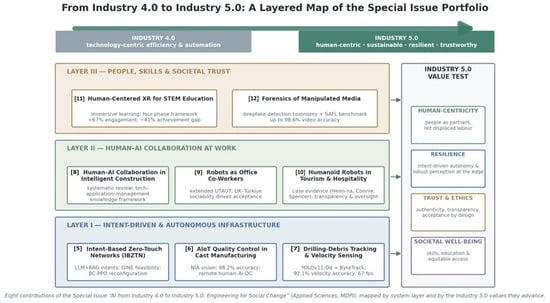
Figure 1 maps the portfolio onto the transition, and Table 1 summarises each contribution. Read together, the eight papers arrange themselves into three interacting layers: an infrastructure layer that is becoming intent-driven and autonomous; a workplace layer where humans and AI act as collaborators; and a societal layer of skills, trust and safeguards on which the whole edifice rests.
Figure 1.
A layered reading of the Special Issue portfolio: eight contributions mapped onto the transition from Industry 4.0’s technology-centric efficiency to Industry 5.0’s human-centric, sustainable, resilient and trustworthy paradigm.
Table 1.
The Special Issue portfolio at a glance: domains, methods, key evidence and dominant Industry 5.0 imperatives.
Layer I—Intent-driven and autonomous infrastructure. The transition begins below the visible application surface, in the networks and sensing stacks that must become both more autonomous and more attentive to human intent. Seo and Kim [5] propose a three-layer Intent-Based Zero-Touch Networking (IBZTN) pipeline for Industry 5.0 smart factories: natural-language intents are translated into quantitative quality-of-service profiles by retrieval-augmented large language models with schema- and rule-based validation; feasibility is predicted by a graph neural network; and infeasible states are recovered by a reinforcement-learning agent that reconfigures the network with minimal modification. Across 300 natural-language intents, the validator drove constraint violations to 0.0% for most evaluated LLMs—early evidence that operators can increasingly “speak” to infrastructure rather than programme it. Rosca et al. [6] tackle a complementary bottleneck in cast manufacturing: infrastructure compatibility. Their Artificial Intelligence of Things (AIoT) architecture fuses low-cost visual sensors through a cloud IoT hub, and a Nonconformity Indicator Algorithm detects casting defects with 98.18% accuracy, while explicitly preserving remote human–AI collaboration rather than replacing inspectors. Yang et al. [7] push perception to a harsher edge—unmanned drilling—where the velocity of ejected cuttings is a vital sign of drilling conditions. Their enhanced YOLOv11-Dd detector coupled with ByteTrack measures debris velocity at 92.12% accuracy in real time, turning a hazardous, labour-intensive monitoring task into a continuous, machine-readable signal.
Layer II—Human–AI collaboration at work. Above the infrastructure layer, three papers examine what happens when intelligent systems become colleagues. Du et al. [8] synthesise the literature on human–AI collaboration in intelligent construction into a three-dimensional knowledge framework—technical, application and management layers—revealing a co-evolutionary path between AI capability and the industry’s digital transformation. Doven et al. [9] ask the question on many professionals’ minds: will we accept robots as office co-workers? Extending the Unified Theory of Acceptance and Use of Technology with perceived sociability, their two-country (United Kingdom–Türkiye) empirical study shows that performance expectancy, effort expectancy, social influence and—critically—sociability shape behavioural intention, concluding that office robots are likely to be accepted provided they are designed as social actors rather than mere tools. Skubis et al. [10] move from offices to the front-of-house, analysing humanoid robots in tourism and hospitality through cases such as the concierge robot Connie, Amsterdam Schiphol’s Spencer and the robot-staffed Henn-na Hotel. Their managerial, ethical and societal reading is unambiguous: guests must always know when their service provider is a machine; privacy, employment and oversight mechanisms must be engineered in; and regulatory alignment—exemplified by the EU AI Act—is a design constraint, not an afterthought.
Layer III—People, skills and societal trust. The top layer addresses the human capital and institutional trust on which everything else depends. Iqbal et al. [11] review human-centred extended reality (XR) integration in New Zealand STEM education, quantifying the barriers—infrastructure gaps in 68% of reviewed studies, educator-training needs in 82% and curriculum misalignment in 57%—and documenting what success looks like: a 67% engagement increase at Auckland University of Technology and a 41% reduction in STEM achievement gaps at Wellington High School. Their four-phase implementation framework, and their call to integrate Mātauranga Māori, remind us that Industry 5.0 skills agendas must be culturally situated. Falcón-López et al. [12] defend the epistemic foundation of the transition: if synthetic media erode trust in digital evidence, neither smart factories nor smart cities can be governed responsibly. Their refined taxonomy of forensic methods and reproducible SAFL benchmarks show general-purpose tools reaching 98.6% accuracy on manipulated video, while exposing how specialised deepfake detectors still lag—an arms race the community must not lose.
3. Cross-Cutting Insights
Insight 1—Intent is becoming the new programming language. From natural-language network intents [5] to immersive, learner-directed environments [11], the interface between humans and industrial systems is shifting from code to declared goals. The critical trust machinery is validation: retrieval-grounded translation, feasibility checking and minimal-intervention recovery. Certifying intent translation in safety-critical settings is the defining systems problem of the next wave.
Insight 2—Acceptance is the binding constraint, and it is designed, not assumed. The empirical papers converge: people welcome robotic colleagues that are sociable, transparent and honest about what they are [9,10]. Technical superiority alone does not produce adoption; perceived sociability, disclosure and credible oversight do. Human–AI collaboration is therefore a design discipline as much as an algorithmic one.
Insight 3—Trust is infrastructure. Media forensics [12], transparency norms for humanoids [10] and human-verifiable quality control [6] are not peripheral compliance activities; they are load-bearing components of the Industry 5.0 stack, as essential as bandwidth or sensors. Engineering for social change begins by engineering the conditions under which people can verify what they are told.
Insight 4—Skills and education are the pacing item. The XR review [11] and the construction framework [8] both show that technology readiness outpaces human readiness. Educator training, culturally grounded curricula and lifelong reskilling determine how fast Industry 5.0 can deploy its benefits—and to whom.
4. Academic Agenda and Research Frontiers
Building on the portfolio, we chart six directions that we believe will define the field over the coming five years.
(1) GenAI-native industrial stacks. Large language and multimodal models will move from assistants to operators—translating intent, orchestrating agents and reconfiguring systems, as foreshadowed by [5]. The frontier is verifiable GenAI: benchmarks, formal contracts and audit trails that certify what an agent may do autonomously in safety-critical factories, grids and clinics.
(2) Measuring symbiosis, not just accuracy. The portfolio reports excellent technical metrics, but Industry 5.0 also needs instruments for the partnership itself: calibrated trust, cognitive load, skill growth and the distribution of value between human and machine contributors. A community-agreed symbiosis index would make human–AI teaming quality comparable across studies and sectors.
(3) Authenticity and provenance by design. As generative models improve, detection-only forensics [4] will be perpetually behind. Research must pair detection with provenance infrastructure—cryptographic content credentials, robust watermarking and chain-of-custody standards—so that trust does not depend on catching fakes after the fact.
(4) Governance of social and humanoid robots at scale. Acceptance studies [1] and hospitality cases [2] should be extended longitudinally and cross-culturally and connected to emerging regulatory regimes such as the EU AI Act. Human–AI collaborative policy analysis [4] offers a methodological bridge between technical evidence and regulatory design. Open questions include disclosure norms, labour-market transitions, dynamic consent in public spaces, and accountability involving embodied AI errors.
(5) Education and inclusion as first-class research objects. XR- and AI-supported learning [11] need long-term outcome evidence, cost models for under-resourced institutions, and genuine integration of indigenous and local knowledge systems—so that Industry 5.0 narrows rather than widens global skills divides.
(6) Sustainability as a quantified co-benefit. Few portfolio papers yet place instrument energy, carbon or well-being alongside performance. Future work should embed planetary and societal vital signs into the reward functions and dashboards of industrial AI, converting Industry 5.0’s values from aspiration into telemetry—and into financeable, auditable outcomes.
Eight papers, one turning point. Read individually, each contribution is a solid piece of engineering or social science; read together, they trace the arc of a paradigm change—from machines that replace effort to partners that amplify judgement. The question is no longer whether AI can outperform humans on isolated tasks, but whether humans and AI together can outperform either alone—on the metrics that matter to society. We thank all authors, reviewers and the Applied Sciences Editorial team who made this Special Issue possible, and we invite the community to treat it not as a closed archive but as a living benchmark for the human–AI partnerships still to be built.
Author Contributions
Conceptualization, C.-H.L.; writing—original draft preparation, C.-H.L., L.B. and D.C. writing—review and editing, L.B. and D.C.; visualisation, C.-H.L. All authors have read and agreed to the published version of the manuscript.
Funding
This research received no external funding.
Institutional Review Board Statement
Not applicable.
Informed Consent Statement
Not applicable.
Data Availability Statement
No new data were created or analysed in this study. Data sharing is not applicable to this article.
Acknowledgments
The Guest Editors sincerely thank all contributing authors and the anonymous reviewers for their rigorous evaluations, and the Applied Sciences Editorial Office for continuous support throughout the production of this Special Issue. The authors have reviewed and edited the output and take full responsibility for the content of this publication.
Conflicts of Interest
The authors declare no conflicts of interest.
References
- Breque, M.; De Nul, L.; Petridis, A. Industry 5.0: Towards a Sustainable, Human-Centric and Resilient European Industry; Publications Office of the European Union: Luxembourg, 2021. [Google Scholar]
- Lee, C.-H.; Li, L.; Wang, D.; Wee, H.J. Strategic servitization design method for Industry 4.0-based smart intralogistics and production. Expert Syst. Appl. 2022, 204, 117480. [Google Scholar] [CrossRef] [Scilit]
- Lee, C.-H.; Trappey, A.J.; Liu, C.L.; Mo, J.P.; Desouza, K.C. Design and management of digital transformations for value creation. Adv. Eng. Inform. 2022, 52, 101547. [Google Scholar] [CrossRef] [Scilit]
- Lee, C.-H.; Wang, Z.; Wang, C.; Dong, X.; Fan, X. A Human-AI collaborative framework for public policy analysis: Fostering dual-chain synergy via LLM-augmented TRIZ. World Pat. Inf. 2026, 86, 102480. [Google Scholar] [CrossRef] [Scilit]
- Seo, D.; Kim, K. An Integrated Pipeline for Intent-Based Zero-Touch Networks: From Intent Translation to Minimal-Modification Reconfiguration. Appl. Sci. 2026, 16, 5811. [Google Scholar] [CrossRef] [Scilit]
- Rosca, C.-M.; Rădulescu, G.; Stancu, A. Artificial Intelligence of Things Infrastructure for Quality Control in Cast Manufacturing Environments Shedding Light on Industry Changes. Appl. Sci. 2025, 15, 2068. [Google Scholar] [CrossRef] [Scilit]
- Yang, J.; Bao, Y.; Xie, Z.; Zhang, H.; Li, Z.; Li, Y. A Drilling Debris Tracking and Velocity Measurement Method Based on Fine Target Feature Fusion Optimization. Appl. Sci. 2025, 15, 8662. [Google Scholar] [CrossRef] [Scilit]
- Du, J.; Gu, R.; Tang, X.; Sugumaran, V. Systematic Literature Review of Human–AI Collaboration for Intelligent Construction. Appl. Sci. 2026, 16, 597. [Google Scholar] [CrossRef] [Scilit]
- Doven, G.; Sezen, B.; Demir, K.A.; Balcioglu, Y.S. Industry 5.0: Are We Going to Accept Robots as Co-Workers in Office Environments? An Empirical Analysis. Appl. Sci. 2025, 15, 1591. [Google Scholar] [CrossRef] [Scilit]
- Skubis, I.; Mesjasz-Lech, A.; Nowakowska-Grunt, J. Humanoid Robots in Tourism and Hospitality—Exploring Managerial, Ethical, and Societal Challenges. Appl. Sci. 2024, 14, 11823. [Google Scholar] [CrossRef] [Scilit]
- Iqbal, M.F.B.; Tran, K.T.P.; Yan, W.Q.; Abraham, H.; Nguyen, M. Human-Centered XR Integration for STEM Education in New Zealand: A Systematic Review and Implementation Framework. Appl. Sci. 2026, 16, 5090. [Google Scholar] [CrossRef] [Scilit]
- Falcón-López, S.A.; Tobarra, L.; Robles-Gómez, A.; Pastor-Vargas, R. Forensic Analysis of Manipulated Images and Videos. Appl. Sci. 2025, 15, 12664. [Google Scholar] [CrossRef] [Scilit]

Disclaimer/Publisher’s Note: The statements, opinions and data contained in all publications are solely those of the individual author(s) and contributor(s) and not of MDPI and/or the editor(s). MDPI and/or the editor(s) disclaim responsibility for any injury to people or property resulting from any ideas, methods, instructions or products referred to in the content. |
© 2026 by the authors. Licensee MDPI, Basel, Switzerland. This article is an open access article distributed under the terms and conditions of the Creative Commons Attribution (CC BY) license.