


Featured Application
Adaptive microwave holography and OAM-enabled structured-wave generation using a single digitally reconfigurable transmissive aperture.
Abstract
Programmable transmissive metasurfaces provide a flexible platform for dynamic electromagnetic wavefront manipulation, yet simultaneously achieving multiple functionalities with a low-complexity binary architecture remains challenging. In this work, a 1-bit programmable transmissive metasurface is proposed for reconfigurable far-field holographic imaging and near-field orbital angular momentum (OAM) vortex-beam generation at 5.5 GHz. The proposed meta-atom employs two complementary switching states to realize nearly identical transmission amplitudes with an approximately transmission-phase difference, enabling efficient binary phase modulation. Based on the designed meta-atom, a programmable array is constructed, where different electromagnetic functions are realized solely by updating the spatial coding sequence without modifying the physical structure. For far-field manipulation, binary holographic phase distributions are encoded to reconstruct representative “H” and “S” images, and the full-wave simulated results agree well with the theoretical predictions. For near-field manipulation, focused OAM beams with topological charges and are generated at an observation plane located 180 mm from the metasurface. The resulting intensity distributions exhibit pronounced vortex characteristics, while the corresponding phase profiles show the expected and azimuthal phase variations. OAM modal decomposition further confirms that the desired modes dominate the generated fields. These results demonstrate that a single 1-bit programmable transmissive aperture can support dynamically switchable electromagnetic functions in different propagation regimes, offering a low-complexity approach for reconfigurable holography, structured-wave generation, and software-defined microwave systems.
1. Introduction
Metasurfaces are planar arrays of engineered subwavelength or electrically small scatterers that provide spatial control over the amplitude, phase, polarization, and momentum of electromagnetic waves. Their reduced dimensionality, low profile, and compatibility with printed-circuit fabrication have enabled compact alternatives to conventional bulky lenses, phase plates, and wavefront-shaping networks. Foundational studies established both the homogenized description of metasurfaces and the generalized phase-discontinuity framework, while subsequent reviews demonstrated their applicability from microwave to optical frequencies [1,2,3,4,5]. These capabilities make microwave metasurfaces attractive for antennas, radar front ends, sensing systems, and emerging software-defined electromagnetic environments.
A major limitation of conventional passive metasurfaces is that their electromagnetic response is fixed after fabrication. Digital and programmable concepts were introduced to overcome this constraint by representing discrete meta-atom responses with digital states and controlling those states electronically. The digital-metamaterial framework and the coding-metasurface concept established a direct link between local electromagnetic responses and binary or multibit information [6,7,8]. Field-programmable and digitally controlled metasurfaces subsequently demonstrated dynamic beam redirection, multi-beam synthesis, and space–time modulation [9,10,11], while smart metasurfaces further introduced adaptive and self-reconfigurable functionalities [12]. For microwave implementation, PIN diodes remain attractive because they offer fast switching, simple biasing, and straightforward integration with digital control circuits.
Holography is one of the most representative phase-engineering applications because a prescribed image can be encoded into the spatial spectrum of a planar aperture. Phase-retrieval algorithms such as the Gerchberg–Saxton and related iterative methods provide a practical route from a target intensity distribution to a phase-only hologram [13,14]. Static metasurface holograms have achieved high-quality wavefront reconstruction and high diffraction efficiency [15,16], whereas electronically reprogrammable coding metasurfaces have enabled the reconstructed microwave image to be changed without modifying the physical aperture [17]. Reviews and later studies have expanded metasurface holography toward frequency multiplexing, low-profile in-plane-fed implementations, and dynamically focused Fresnel-zone apertures [18,19,20,21]. These advances show that programmable holography can function as an electromagnetic spatial light modulator in the microwave regime.
Orbital angular momentum (OAM) provides another important degree of freedom for structured electromagnetic waves. A vortex field contains an azimuthal phase factor , where l is an integer topological charge, and therefore exhibits a helical phase front and a phase singularity at the beam center. The connection between the helical phase and OAM was established in optics by Allen et al. [22], and the concept was later extended to low-frequency radio waves and experimentally explored for radio-frequency multiplexing [23,24]. Microwave OAM beams have been generated using spiral structures and circular phased arrays [25,26,27]. Reviews of OAM antennas and vortex-beam-generation approaches indicate continued interest in OAM for mode-division multiplexing, sensing, imaging, and structured-field manipulation [28,29]. Metasurfaces provide a particularly compact route to OAM generation because the required azimuthal phase can be directly encoded over a planar aperture. Binary reflective coding surfaces, reconfigurable reflective structures, transmissive metasurface lenses, and spin-dependent transmissive designs have all been used to synthesize vortex beams [30,31,32,33,34]. Of particular relevance to the present work, Bai et al. demonstrated a high-efficiency 1-bit transmissive programmable metasurface in which two PIN diodes produced nearly equal transmission amplitudes and inverse phase states for multimode OAM generation [35]. Related transmissive programmable platforms have been developed for phased-array-like beam control, multi-OAM synthesis, millimeter-wave dynamic OAM generation, multifunctional 1-bit beam shaping, and quantitative OAM-mode control [36,37,38,39,40]. Polarization-dependent transmissive digital coding metasurfaces have further extended the available OAM channels by combining polarization, beam direction, and topological mode [41].
The evolution of reconfigurable transmitarrays provides an additional engineering foundation for electronically controlled transmission-phase apertures. Electronically reconfigurable X-band transmitarrays have demonstrated large-element-count beam steering with 1-bit phase resolution [42]. PIN-diode-loaded unit cells have been developed specifically for 1-bit linearly polarized transmitarrays [43], while current-reversal and equivalent-magnetic-dipole strategies have been used to broaden bandwidth and scanning range [44,45]. Transmission-type programmable metasurfaces have also been exploited for single-frequency microwave imaging [46] and for anisotropic reconfigurable holography with independent transmission/reflection and polarization control [47]. Collectively, these studies highlight the practical advantages of transmission architectures, including reduced feed blockage and direct separation of the incident and manipulated fields. Recent research has moved toward multifunctional transmissive platforms that combine several wavefront-processing tasks within one hardware aperture. A programmable transmissive metasurface with joint phase and amplitude control has demonstrated vortex-beam generation, holographic imaging, and beamforming in the sub-6-GHz regime [48]. An ultra-wideband transmissive programmable metasurface has also been reported for near-field holography and far-field OAM generation across different frequency regions [49]. These advances demonstrate the broad potential of multifunctional transmission-mode architectures, but they also motivate simpler implementations that retain useful reconfigurability with only binary phase control at a single operating frequency.
In this work, a low-complexity 1-bit programmable transmissive metasurface is investigated at 5.5 GHz. The meta-atom employs two PIN diodes operated in complementary states to obtain comparable transmission magnitudes and an approximately phase difference. A 25 × 25 array is programmed with different binary coding matrices to realize two distinct field transformations using the same physical aperture: far-field holographic reconstruction of representative “H” and “S” patterns and near-field focused OAM generation with topological charges l = 1 and l = 2 at an observation plane located 180 mm behind the metasurface. The design therefore emphasizes software-defined functional switching between different propagation regimes while retaining the hardware simplicity of 1-bit phase control.
2. Materials and Methods
2.1. Architecture of the Programmable Transmissive Metasurface
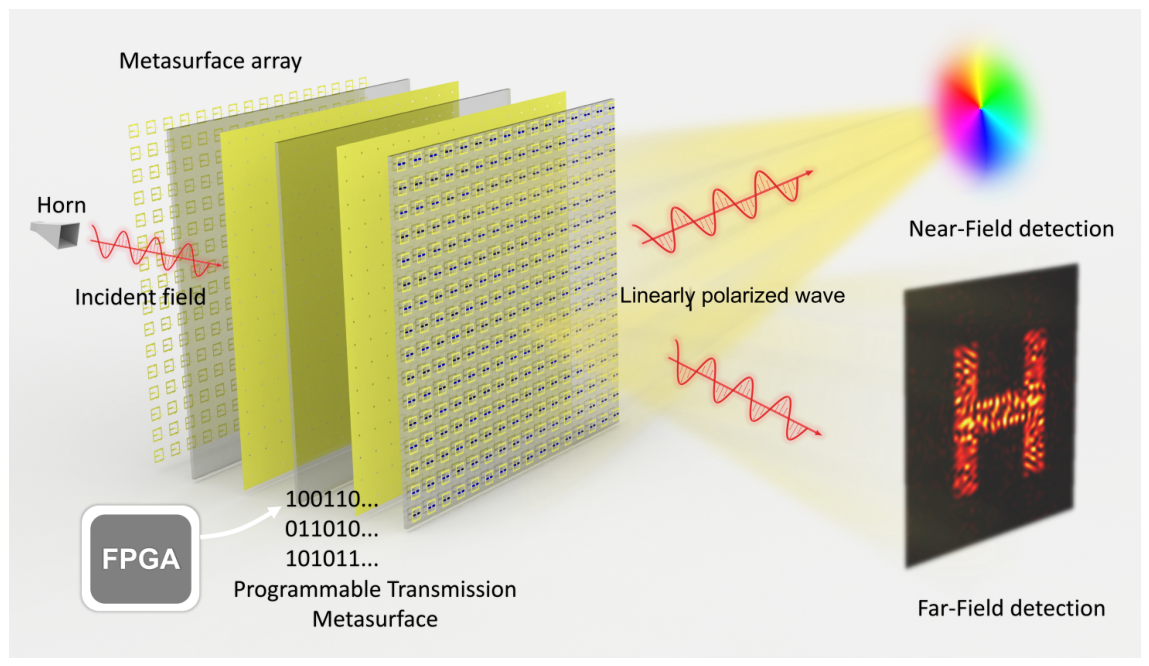
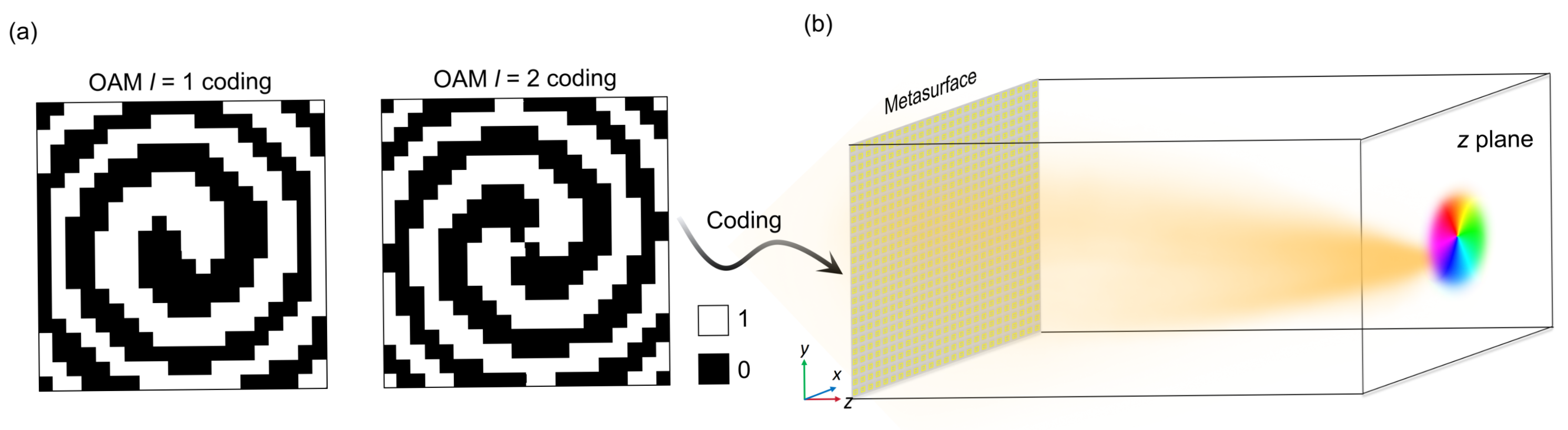
The conceptual configuration of the proposed system is illustrated in Figure 1. The platform consists of a programmable transmissive metasurface, a digital control system, and an electromagnetic observation region. A linearly polarized wave illuminates the metasurface from the input side. Each meta-atom can be assigned one of two binary states through the bias conditions applied to its two PIN diodes. The required digital coding matrix is calculated according to the desired electromagnetic function and can be applied to the corresponding switching states of the programmable meta-atoms. The full-wave electromagnetic models used in this work were implemented in CST Studio Suite 2026 (Dassault Systèmes, Darmstadt, Germany). MATLAB R2026a (The MathWorks, Inc., Natick, MA, USA) was used for coding calculations and data processing.
Figure 1.
Conceptual illustration of the proposed digitally programmable 1-bit transmissive metasurface for multifunctional electromagnetic wavefront manipulation at 5.5 GHz. By changing the binary coding states of the meta-atoms, the transmitted linearly polarized wave is digitally reshaped to realize near-field OAM vortex-beam generation or far-field holographic reconstruction.
The spatially varying transmission coefficient of the aperture can be expressed in terms of its local amplitude and phase. For an ideal phase-only 1-bit metasurface, only two phase values are required, and approximately uniform transmission amplitudes are desirable because unintended spatial amplitude modulation can distort the designed wavefront. The local complex transmission coefficient and the corresponding binary phase constraint are described by Equations (1) and (2), respectively.
The metasurface array consists of 25 × 25 unit cells with a period of 22 mm (approximately ), resulting in an overall aperture size of 550 mm × 550 mm (approximately ). At the operating frequency GHz, the free-space wavelength is mm. By updating only the coding matrix rather than the physical structure, the same array can operate in two distinct modes. In the holographic mode, the array controls the far-field angular spectrum to reconstruct a prescribed image. In the OAM mode, the aperture synthesizes a convergent helical wavefront whose vortex structure is evaluated at z = 180 mm.
2.2. Reconfigurable 1-Bit Transmissive Meta-Atom
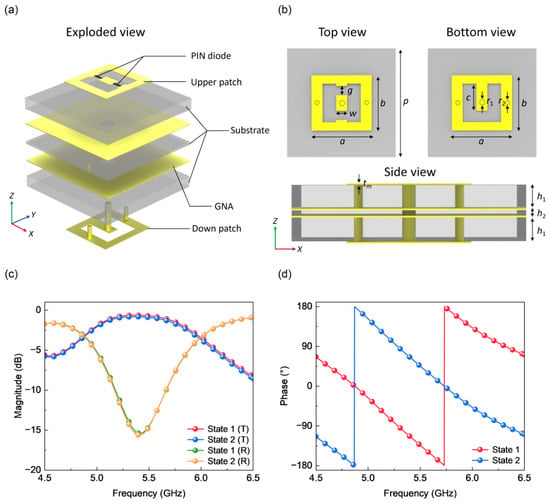
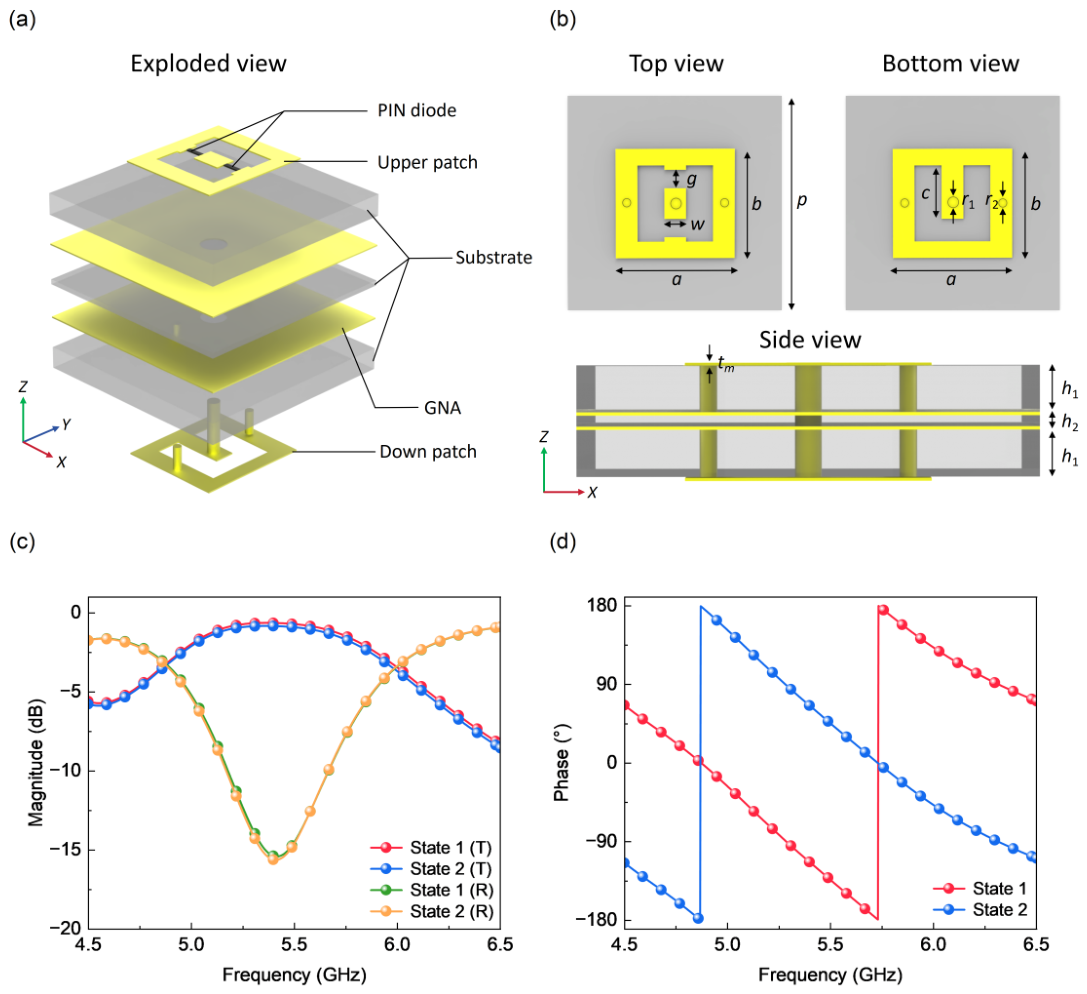
Figure 2a shows the exploded configuration of the proposed programmable transmissive meta-atom. The element contains patterned upper and lower metallic layers, dielectric substrates, metallic vias, and two PIN diodes integrated into the resonant structure. The PIN diode selected for the proposed metasurface unit cell is the MA4GP907 manufactured by MACOM Technology Solutions Inc. (Lowell, MA, USA). Its ultra-low capacitance and intrinsic switching time of approximately 2–3 ns make it particularly suitable as a switching component for programmable metasurfaces [50]. All patterned metallic layers are modeled as copper with a thickness of 0.05 mm. The dielectric substrate is Rogers RT/duroid 6002 (lossy; Rogers Corporation, Chandler, AZ, USA), with relative permittivity = 2.94, loss tangent = 0.0012, and relative permeability = 1. The top, bottom, and side views are shown in Figure 2b, and the corresponding geometrical parameters are summarized in Table 1.
Figure 2.
Configuration and electromagnetic characteristics of the proposed 1-bit programmable transmissive meta-atom operating at 5.5 GHz. (a) Exploded view of the unit cell, consisting of upper and lower copper patches, dielectric substrates, an intermediate metallic layer, metallic vias, and two PIN diodes. (b) Top, bottom, and side views with the corresponding geometrical parameters. (c) Simulated transmission and reflection magnitudes for the two binary states. (d) Simulated transmission phases of State 1 and State 2, showing an approximately phase difference around 5.5 GHz.
Table 1.
Geometrical and material parameters of the proposed meta-atom.
The two PIN diodes are operated in complementary states. In State 1, PIN 1 is assigned the ON-state equivalent circuit and PIN 2 the OFF-state circuit; in State 2, the two assignments are interchanged. This complementary switching changes the effective resonant pathway rather than simply suppressing a single resonance, which helps maintain comparable transmission magnitudes while producing an approximately opposite transmission phase. The two complementary switching states are summarized in Equation (3).
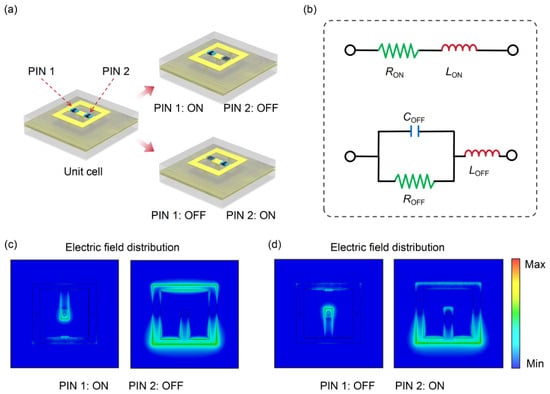
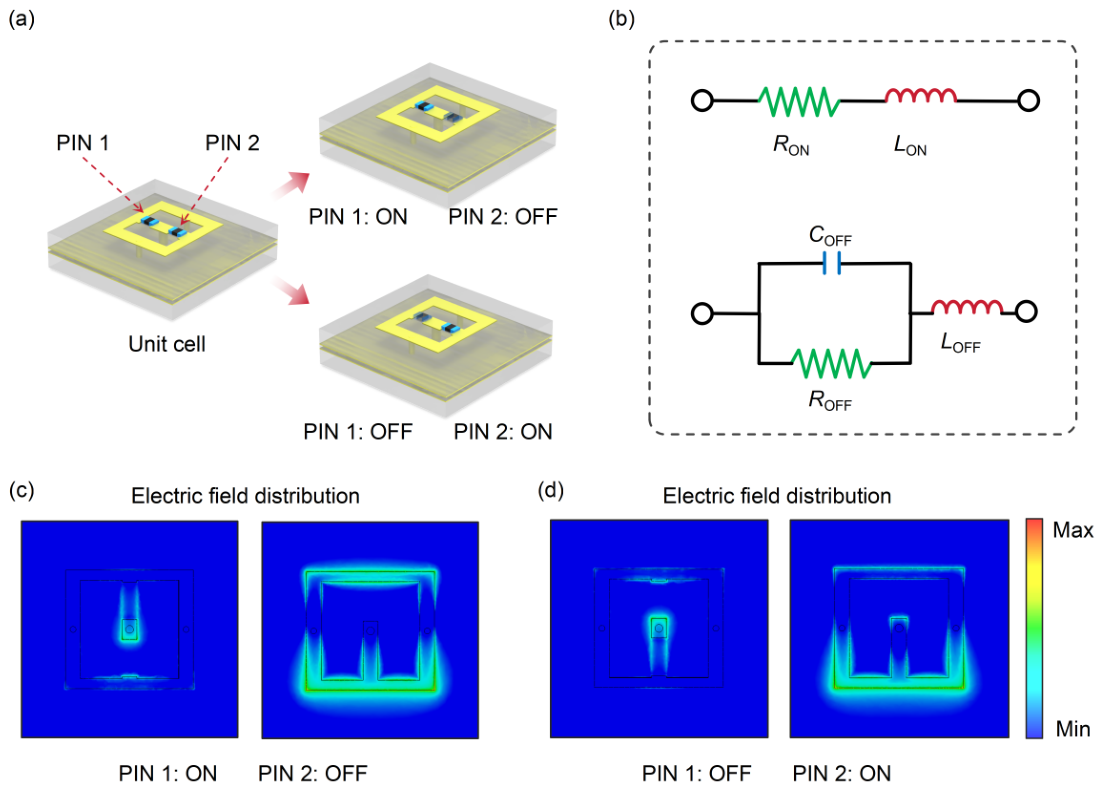
The two switching states are represented in CST by the lumped RLC networks shown in Figure 3b, using the effective values listed in Table 2. For the ON state, , , and . For the OFF state, , , and . These values are the effective circuit parameters adopted in the numerical model. The corresponding ON- and OFF-state impedances are given by Equations (4) and (5), respectively.
Figure 3.
Switching mechanism and electric-field characteristics of the proposed 1-bit meta-atom. (a) Two complementary switching configurations controlled by PIN 1 and PIN 2, corresponding to State 1 (PIN 1 ON and PIN 2 OFF) and State 2 (PIN 1 OFF and PIN 2 ON). (b) Lumped equivalent-circuit models adopted for the ON and OFF states. (c) Simulated electric-field distributions for State 1 at 5.5 GHz. (d) Simulated electric-field distributions for State 2 at 5.5 GHz, illustrating the redistribution of the resonant electric field induced by complementary switching.
Table 2.
Effective lumped equivalent-circuit parameters.
For the two coding states, the complex transmission coefficients can be written as and . For binary phase coding, the desired response is together with . As shown in Figure 2c, the two transmission magnitudes are close to each other around 5.5 GHz and remain near −1 dB, while the reflection magnitude reaches approximately −15 dB near the same operating region. Figure 2d shows an approximately transmission-phase difference around 5.5 GHz, as quantified by Equation (6), enabling direct mapping of the two electromagnetic states to digital states “0” and “1”.
2.3. Physical Mechanism of the Binary Phase Switching
The physical origin of the binary phase modulation is investigated using the electric-field distributions shown in Figure 3. The two complementary switching configurations are illustrated in Figure 3a. Because the two PIN diodes are assigned complementary switching states, the effective electrical connection of the resonant structure changes between the two configurations. In State 1, the field is concentrated mainly around one resonant branch and its coupled region. When the diode states are interchanged, the dominant field concentration shifts to the complementary branch. Although the transmission magnitudes remain similar, the two complementary resonant configurations produce different phase delays near the selected operating frequency. This behavior is well suited to binary coding: continuous phase tuning is not required, but the two available states should maintain comparable transmission amplitudes while providing a phase separation close to .
The electric-field distributions therefore provide a qualitative physical explanation for the simulated scattering coefficients. The complementary resonant pathways preserve similar overall coupling strengths while altering the phase delay introduced by the meta-atom, thereby converting electronic switching into a 1-bit transmission-phase degree of freedom.
2.4. Binary Phase Quantization
For an arbitrary continuous target phase, the implemented phase at the -th element is quantized to the nearest available 1-bit state. Assuming the two states provide nominal phases of 0 and , a nearest-state mapping is used. This direct mapping from a calculated phase distribution to a binary control matrix, as defined in Equations (7) and (8), is the principal simplification offered by 1-bit programming.
2.5. Far-Field Holographic Encoding
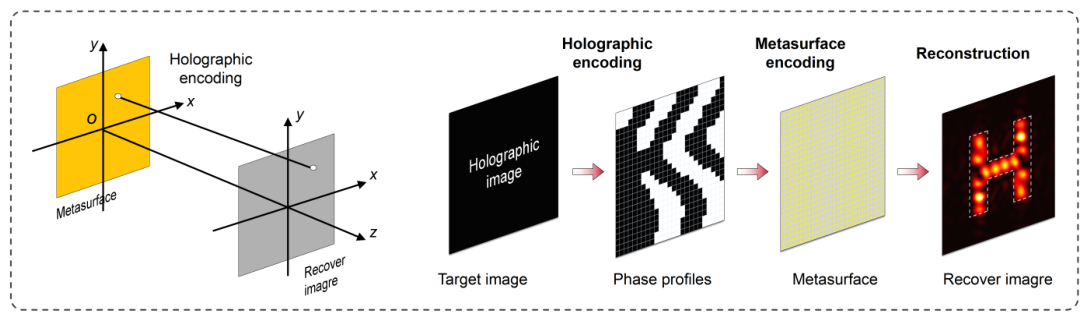
The far-field holographic encoding and reconstruction procedure is illustrated in Figure 4. Consider the programmable metasurface occupying the xoy-plane. Under normally incident illumination, the transmitted field immediately behind the aperture is determined by the incident field, the local transmission amplitude, and the programmed phase. Under Fraunhofer propagation, the far-field angular spectrum is proportional to the two-dimensional Fourier transform of the complex aperture field. For a discrete metasurface, the far field is evaluated by summing the complex contribution from every coded element. The prescribed holographic image defines the desired far-field spatial spectrum. A phase-only aperture distribution is generated numerically from the target pattern and is subsequently converted into the binary phase matrix using the 1-bit quantization rule. The binary phase profile is then mapped to the corresponding 25 × 25 PIN-diode state matrix. The aperture field and the corresponding far-field transformation are described by Equations (9)–(12). Two representative target patterns, “H” and “S”, are used to demonstrate reconfigurable far-field holographic reconstruction.
Here, denotes the complex aperture field, the far-field spectrum, and the transmission amplitude and phase of the -th element, and its spatial coordinates, M and N the numbers of elements along the two transverse directions, the free-space wavenumber, u and v the direction cosines, and and the observation angles.
Figure 4.
Schematic of the far-field holographic encoding and reconstruction procedure.
2.6. Near-Field Convergent OAM Encoding
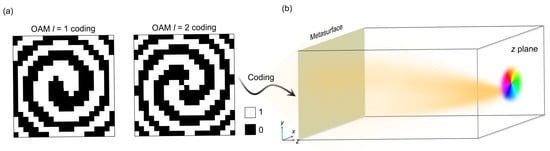
For OAM generation, the required aperture phase contains both an azimuthal phase term and a focusing phase term. The azimuthal component imposes the helical wavefront, whereas the focusing component compensates the propagation-path difference from each aperture point to the finite-distance observation region. The two contributions are superimposed before 1-bit quantization. In this work, the designed observation plane is located at . The continuous phase profile is calculated for and and subsequently quantized to obtain the corresponding spiral-like binary coding distributions. The wave is expected to undergo a total phase accumulation of around the vortex center, whereas the wave exhibits a accumulation. Because the phase is undefined at the vortex center, destructive interference produces a central intensity null. The azimuthal, focusing, and total phase profiles are given by Equations (13)–(15), respectively. The corresponding binary coding distributions and the near-field OAM configuration are illustrated in Figure 5a and Figure 5b, respectively.
Figure 5.
Schematic of the near-field OAM encoding and generation procedure. (a) Binary coding distributions designed for topological charges and , where the black and white pixels denote the two 1-bit phase states. (b) Schematic of the near-field OAM-beam configuration, with the observation plane located at .
2.7. Azimuthal OAM Modal Decomposition
To quantify the vortex fields, the complex electric field is sampled along a circular contour centered on the phase singularity. The sampled field is expanded into azimuthal harmonics by Fourier decomposition. Because the proposed metasurface manipulates the spatial phase under a fixed linear polarization excitation, the extracted modal spectrum represents the orbital angular momentum contribution without additional spin-dependent phase conversion. The normalized power associated with each integer order provides a relative azimuthal OAM-mode spectrum. Here, q denotes the integer azimuthal mode index in the OAM decomposition. Modes from to are included in the present analysis. The modal coefficient and normalized modal power are calculated using Equations (16) and (17), respectively, where denotes the complex field sampled along the circular contour as a function of the azimuthal angle .
3. Results
3.1. Transmission Characteristics of the 1-Bit Meta-Atom
The simulated magnitude responses of the two binary states are shown in Figure 2c. A key design requirement is that changing the switching configuration should primarily alter the transmission phase rather than the transmission magnitude. Near 5.5 GHz, the two transmission curves nearly overlap and remain close to −1 dB, indicating comparable transmitted amplitudes for the two binary states. The reflection coefficients reach a minimum of approximately −15 dB near the same frequency region. The combination of relatively high transmission and low reflection is favorable for a programmable transmissive aperture because a large state-dependent amplitude variation would impose an unintended amplitude mask on the designed binary phase distribution. The corresponding transmission phases are plotted in Figure 2d. Although both curves are dispersive, their phase difference is close to 180 around 5.5 GHz. This is because the two states exhibit similar local phase slopes near the operating frequency, so that their common dispersive variation is largely cancelled in the differential phase. The two configurations therefore satisfy the basic 1-bit requirement and can be represented by digital states “0” and “1”, respectively. The combination of similar transmission magnitudes and opposite phase states is particularly useful for both holography and OAM generation, because the designed aperture functions are predominantly phase-controlled. Residual amplitude imbalance contributes additional spatial-frequency components and can reduce holographic fidelity or OAM modal purity; therefore, amplitude consistency between the two binary states is an important element-level metric.
3.2. Switching Mechanism Revealed by Electric-Field Distributions
To further examine the origin of the binary phase states, the electric-field distributions are evaluated at 5.5 GHz. Figure 3c corresponds to PIN 1 in the ON state and PIN 2 in the OFF state. The field is strongly localized around one branch of the resonant structure and its coupling region, indicating that this branch dominates the electromagnetic response of State 1. After the diode assignments are interchanged, as shown in Figure 3d, the field concentration shifts to the complementary part of the structure. The overall field strengths remain comparable, whereas the spatial resonance pattern changes. This behavior is consistent with the similar transmission magnitudes and the opposite phase responses observed in Figure 2. The two-diode configuration therefore provides a practical route to binary phase switching without requiring a large change in transmission magnitude. Complementary switching modifies the effective resonant path while maintaining similar coupling conditions, which is advantageous for phase-only digital wavefront control.
3.3. Far-Field Holographic Reconstruction
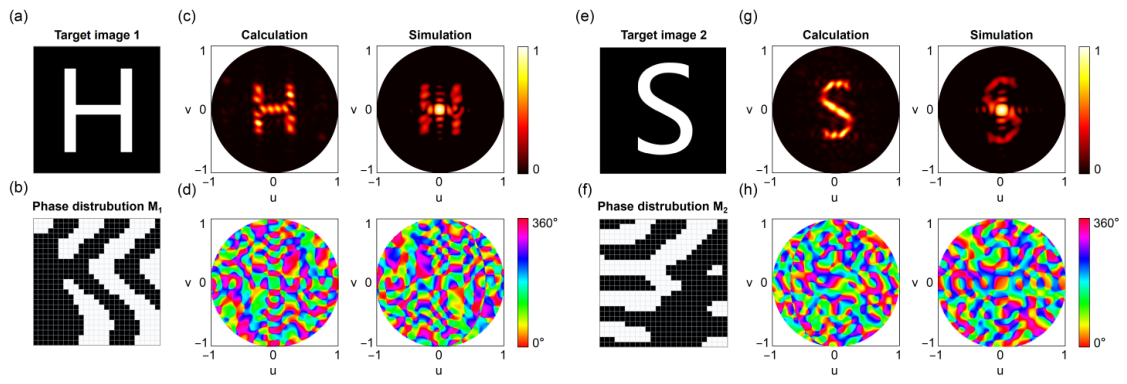
After validating the binary phase response of a single meta-atom, the programmable elements are arranged into a aperture. Two representative targets, the letters “H” and “S”, are selected to demonstrate far-field holographic reconstruction. For the first target, Figure 6a shows the desired “H” pattern and Figure 6b the corresponding 1-bit phase-coding matrix . The black and white pixels represent the two binary transmission states. Figure 6c compares the calculated and full-wave-simulated far-field intensity distributions. The corresponding calculated and simulated phase distributions are shown in Figure 6d. The principal spatial features of the target “H” are reproduced in both results, including the two vertical strokes and the connecting horizontal stroke. The result shows that the binary aperture retains the dominant spatial-frequency information required for recognizable holographic reconstruction. Differences between the calculated and simulated images arise from several sources. The analytical calculation assumes ideal local phase modulation, whereas the physical meta-atoms exhibit finite transmission loss and a frequency-dependent phase response. In addition, inter-element coupling and finite-aperture effects are included in the full-wave model but are simplified in the analytical reconstruction. Finally, 1-bit quantization introduces phase error and parasitic diffraction components. Despite these effects, the principal reconstructed features remain consistent between the two approaches.
Figure 6.
Far-field holographic reconstruction at 5.5 GHz. (a) Target image “H”. (b) Corresponding 1-bit phase-coding distribution . (c) Calculated and full-wave-simulated intensity distributions for “H”. (d) Corresponding calculated and simulated phase distributions. (e) Target image “S”. (f) Corresponding 1-bit phase-coding distribution . (g) Calculated and full-wave-simulated intensity distributions for “S”. (h) Corresponding calculated and simulated phase distributions.
For the second target, Figure 6e shows the letter “S”, and Figure 6f gives the corresponding binary coding matrix . The calculated and simulated intensity distributions in Figure 6g reproduce the curved geometry of the target, while the phase distributions in Figure 6h show comparable spatial variations. The change from to therefore produces a different far-field holographic pattern without altering the physical aperture. In a hardware implementation, different coding matrices can be stored in a digital coding controller and sequentially loaded into the bias network. The MA4GP907 PIN diode parameters used in the numerical model were taken from the manufacturer’s datasheet [50], which specifies a switching time of approximately 2–3 ns. This value represents the intrinsic switching capability of the selected diode, while the practical system-level reconfiguration rate would additionally depend on the bias network, control electronics, and array-addressing scheme. From a practical implementation perspective, a static prototype can be realized by fixing the binary state of each meta-atom according to a prescribed coding matrix, whereas a tunable prototype would require individually biased PIN diodes and an associated control network. The present equivalent-circuit model already includes the non-ideal ON/OFF characteristics of the PIN diodes. In a practical tunable implementation, additional bias lines, vias, and interconnections may introduce extra loss and parasitic loading, which could reduce the transmission magnitude and slightly perturb the phase response, thereby affecting holographic fidelity and OAM modal purity.
3.4. Near-Field Generation of OAM Vortex Beams
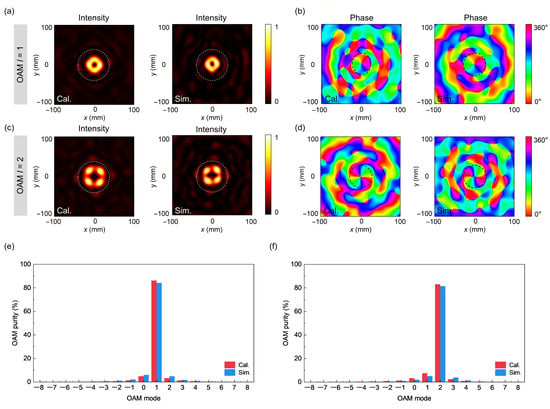
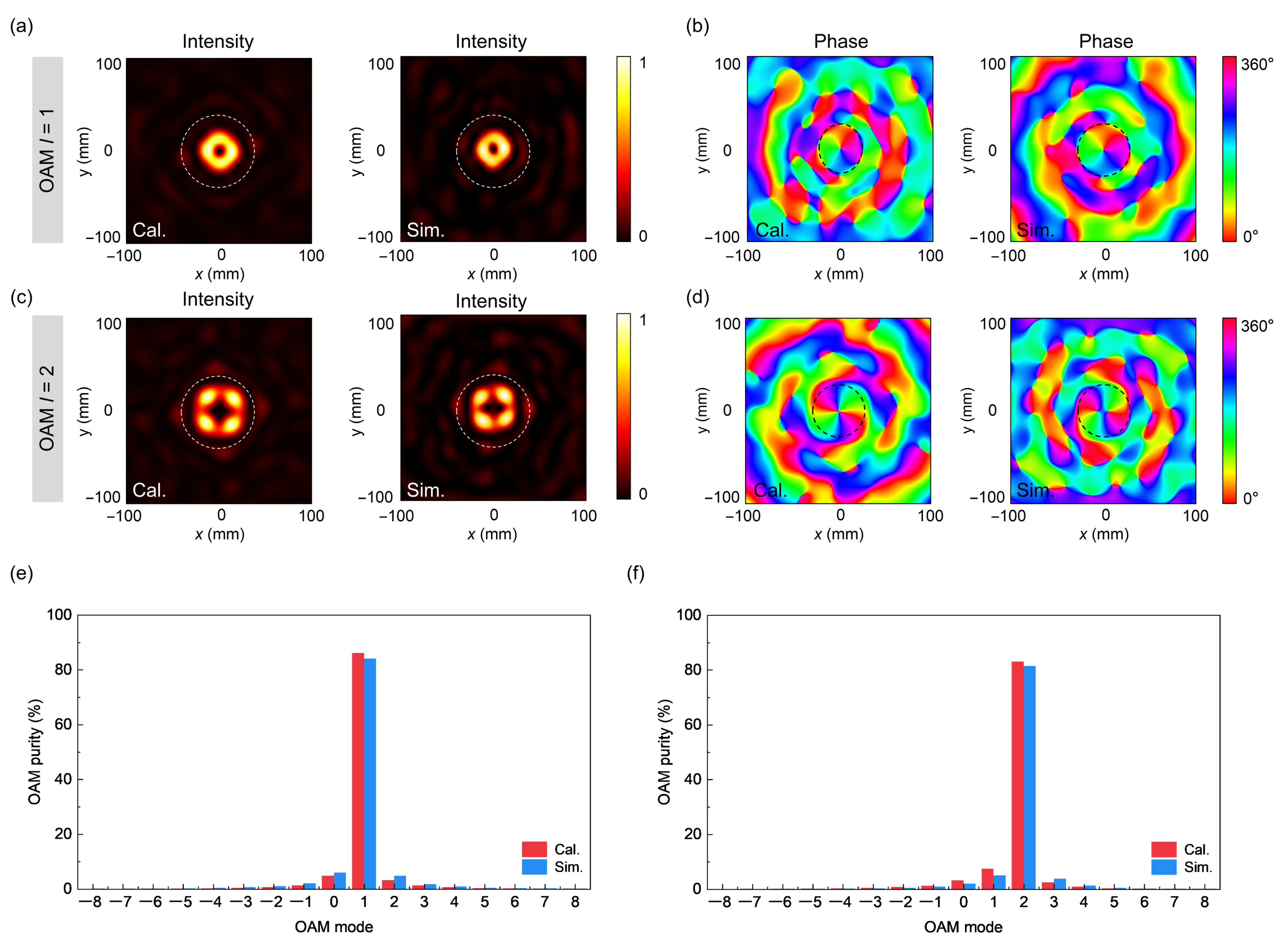
The same programmable aperture is subsequently reconfigured for focused OAM generation. Beyond the generation of individual OAM modes, the proposed binary phase aperture can also be extended to synthesize composite vortex fields containing multiple OAM components. By encoding the phase distribution derived from the coherent superposition of different helical modes, , the required binary coding matrix can be obtained through the same phase quantization procedure. Therefore, the proposed 1-bit architecture is not limited to single-mode OAM generation but also provides a potential platform for programmable OAM mode synthesis. Unlike the irregular coding matrices used for far-field holography, the OAM patterns exhibit spiral Fresnel-zone characteristics because the focusing phase and azimuthal helical phase are superimposed before 1-bit quantization. The complex field is evaluated at . According to Equation (14), the focal distance F is a design parameter and can be changed by recalculating the focusing phase profile. For a fixed aperture, however, increasing F reduces the phase curvature and effective numerical aperture, resulting in weaker field confinement and increased sensitivity to finite-aperture and 1-bit quantization effects. Therefore, the usable distance depends on the required beam quality rather than on a unique intrinsic distance limit. For , the calculated intensity distribution in Figure 7a exhibits a central null surrounded by a high-intensity annular region, which is characteristic of a first-order vortex beam. The full-wave-simulated result reproduces the same main feature, with modest azimuthal asymmetry and sidelobe structure introduced by finite aperture sampling and binary quantization. The corresponding phase maps in Figure 7b provide direct evidence of the vortex topology. The phase winds once around the central singularity, giving an accumulated azimuthal phase change of approximately . The full-wave result reproduces the same single-charge phase singularity, consistent with .
Figure 7.
Near-field OAM generation at 5.5 GHz. (a) Calculated and full-wave-simulated intensity distributions for . (b) Corresponding phase distributions, showing one azimuthal phase winding. (c) Calculated and full-wave-simulated intensity distributions for . (d) Corresponding phase distributions, showing two azimuthal phase windings and a total phase accumulation of approximately . (e) Calculated and simulated azimuthal modal spectra for . (f) Calculated and simulated azimuthal modal spectra for . The dashed circles indicate the circular sampling contours used to calculate the OAM modal purity.
When the coding matrix is changed to the distribution, Figure 7c shows a higher-order focused vortex field with a central low-intensity region and a more structured transverse intensity pattern. The phase maps in Figure 7d exhibit two azimuthal phase windings around the singularity, corresponding to an accumulated phase change of approximately and confirming the intended topological charge . The agreement between the calculated and full-wave-simulated fields for both topological charges demonstrates that the same binary aperture can be reprogrammed from far-field holographic reconstruction to finite-distance OAM generation by changing only the spatial switching matrix.
The same encoding principle can be extended to higher-order OAM modes by increasing the integer topological charge in the azimuthal phase term. However, for a fixed aperture and unit-cell period, increasing results in a more rapidly varying azimuthal phase and a larger vortex core, making the field more sensitive to finite-aperture truncation, discrete sampling, and 1-bit phase quantization. Increasing the array size provides more spatial sampling points and a larger effective aperture, which can better support higher-order OAM modes and reduce truncation-induced beam spreading. Nevertheless, the intrinsic divergence generally increases with OAM order, and therefore comparable field confinement at higher would require a larger aperture, finer phase sampling, or both.
3.5. Azimuthal OAM Modal Purity
The intensity and phase distributions identify the vortex structure qualitatively, whereas the azimuthal Fourier decomposition provides a quantitative measure of the modal content. Similar spiral-spectrum-based modal analysis methods have been widely used for quantitative characterization of OAM mode purity in vortex electromagnetic fields [51,52]. In the modal analysis, the complex electric field is sampled along a circular contour with a radius of 40 mm, which avoids the central phase singularity while maintaining a stable azimuthal phase distribution. Figure 7e and Figure 7f show the calculated and simulated spectra for mode orders to . For the coding pattern, the spectrum is strongly concentrated at ; for the coding pattern, the dominant component occurs at . The weak components appearing in other orders, including the opposite-sign modes, mainly originate from binary phase quantization, finite aperture sampling, and discrete element effects. In both cases, the desired-order component exceeds 80% in the plotted calculated and simulated spectra, while the remaining power is distributed mainly among adjacent parasitic orders.
The parasitic modes are expected for a binary phase aperture. Ideal continuous OAM phase modulation contains a single azimuthal harmonic, whereas 1-bit quantization introduces higher spatial harmonics. Finite aperture truncation, discrete cell sampling, inter-element coupling, nonuniform transmission amplitude, and the finite observation distance further redistribute energy among neighboring azimuthal orders. The aperture size also influences the beam quality. For a fixed unit-cell period, a larger aperture provides more spatial sampling points for the designed phase distribution and reduces finite-aperture truncation effects, thereby suppressing sidelobes and undesired modal components, whereas a smaller aperture generally leads to stronger diffraction and modal leakage. Nevertheless, the intended mode remains dominant for both and .
3.6. Comparison with Previous Studies
To further highlight the characteristics of the proposed design, Table 3 compares representative programmable transmissive metasurfaces reported in previous studies. Compared with approaches mainly focusing on OAM generation or relying on more complex multibit or amplitude–phase modulation, the present work realizes reconfigurable far-field holography and near-field focused OAM generation at the same operating frequency using a simple 1-bit phase-only transmissive architecture.
Table 3.
Comparison with representative programmable metasurfaces.
4. Conclusions
In summary, a 1-bit programmable transmissive metasurface has been investigated for multifunctional electromagnetic wavefront manipulation at 5.5 GHz. The meta-atom employs two PIN diodes in complementary switching configurations. Around the operating frequency, the two states exhibit similar transmission magnitudes and an approximately phase difference, providing the binary phase response required for digital coding. A 25 × 25 programmable aperture is then modeled with different binary coding distributions. In the far-field regime, the coding matrices reconstruct representative “H” and “S” patterns, with good qualitative agreement between calculated and full-wave-simulated field distributions. In the near field, focused OAM beams with topological charges and are formed at . The intensity distributions exhibit the expected vortex-core nulls, the phase maps show one and two azimuthal windings, respectively, and the corresponding modal spectra are dominated by the intended OAM orders. These results show that binary phase control can support more than one wavefront-processing task within a common transmissive aperture. The 1-bit architecture reduces control complexity compared with multilevel phase or joint amplitude–phase schemes, at the cost of quantization-related image artifacts and modal leakage. With experimental validation and a complete bias-network implementation, the proposed platform could provide a compact basis for adaptive microwave holography, structured-wave generation, and software-defined electromagnetic front ends.
Author Contributions
Conceptualization, M.Z. and Y.Y.; methodology, M.Z.; investigation, M.Z.; writing—original draft preparation, M.Z.; writing—review and editing, Y.Y.; visualization, M.Z.; supervision, Y.Y.; project administration, M.Z.; funding acquisition, Y.Y.; resources, M.Z. and Y.Y. All authors have read and agreed to the published version of the manuscript.
Funding
This research was funded by Project 101086493—TeraHertz—HORIZON-MSCA-2021-SE-01, supported by the Institute of Radioelectronics and Multimedia Technology of the Warsaw University of Technology, and sponsored in part by the NATO Science for Peace and Security Programme under Grant ID 8711.
Institutional Review Board Statement
Not applicable.
Informed Consent Statement
Not applicable.
Data Availability Statement
The original contributions presented in this study are included in the article material. Further inquiries can be directed to the corresponding author.
Conflicts of Interest
The authors declare no conflicts of interest. The funders had no role in the design of the study; in the collection, analyses, or interpretation of data; in the writing of the manuscript; or in the decision to publish the results.
References
- Holloway, C.L.; Kuester, E.F.; Gordon, J.A.; O’Hara, J.; Booth, J.; Smith, D.R. An overview of the theory and applications of metasurfaces: The two-dimensional equivalents of metamaterials. IEEE Antennas Propag. Mag. 2012, 54, 10–35. [Google Scholar] [CrossRef] [Scilit]
- Yu, N.; Genevet, P.; Kats, M.A.; Aieta, F.; Tetienne, J.-P.; Capasso, F.; Gaburro, Z. Light propagation with phase discontinuities: Generalized laws of reflection and refraction. Science 2011, 334, 333–337. [Google Scholar] [CrossRef] [Scilit]
- Kildishev, A.V.; Boltasseva, A.; Shalaev, V.M. Planar photonics with metasurfaces. Science 2013, 339, 1232009. [Google Scholar] [CrossRef] [Scilit]
- Glybovski, S.B.; Tretyakov, S.A.; Belov, P.A.; Kivshar, Y.S.; Simovski, C.R. Metasurfaces: From microwaves to visible. Phys. Rep. 2016, 634, 1–72. [Google Scholar] [CrossRef] [Scilit]
- Li, A.; Singh, S.; Sievenpiper, D. Metasurfaces and their applications. Nanophotonics 2018, 7, 989–1011. [Google Scholar] [CrossRef] [Scilit]
- Della Giovampaola, C.; Engheta, N. Digital metamaterials. Nat. Mater. 2014, 13, 1115–1121. [Google Scholar] [CrossRef] [Scilit]
- Cui, T.J.; Qi, M.Q.; Wan, X.; Zhao, J.; Cheng, Q. Coding metamaterials, digital metamaterials and programmable metamaterials. Light Sci. Appl. 2014, 3, e218. [Google Scholar] [CrossRef] [Scilit]
- Liu, S.; Cui, T.J. Concepts, working principles, and applications of coding and programmable metamaterials. Adv. Opt. Mater. 2017, 5, 1700624. [Google Scholar] [CrossRef] [Scilit]
- Wan, X.; Qi, M.Q.; Chen, T.Y.; Cui, T.J. Field-programmable beam reconfiguring based on digitally controlled coding metasurface. Sci. Rep. 2016, 6, 20663. [Google Scholar] [CrossRef] [Scilit]
- Huang, C.; Sun, B.; Pan, W.; Cui, J.; Wu, X.; Luo, X. Dynamical beam manipulation based on 2-bit digitally-controlled coding metasurface. Sci. Rep. 2017, 7, 42302. [Google Scholar] [CrossRef] [Scilit]
- Zhang, L.; Chen, X.Q.; Liu, S.; Zhang, Q.; Zhao, J.; Dai, J.Y.; Bai, G.D.; Wan, X.; Cheng, Q.; Castaldi, G.; et al. Space-time-coding digital metasurfaces. Nat. Commun. 2018, 9, 4334. [Google Scholar] [CrossRef] [Scilit]
- Ma, Q.; Bai, G.D.; Jing, H.B.; Yang, C.; Li, L.; Cui, T.J. Smart metasurface with self-adaptively reprogrammable functions. Light Sci. Appl. 2019, 8, 98. [Google Scholar] [CrossRef] [Scilit]
- Gerchberg, R.W.; Saxton, W.O. A practical algorithm for the determination of phase from image and diffraction plane pictures. Optik 1972, 35, 237–246. [Google Scholar]
- Fienup, J.R. Phase retrieval algorithms: A comparison. Appl. Opt. 1982, 21, 2758–2769. [Google Scholar] [CrossRef] [Scilit]
- Ni, X.; Kildishev, A.V.; Shalaev, V.M. Metasurface holograms for visible light. Nat. Commun. 2013, 4, 2807. [Google Scholar] [CrossRef] [Scilit]
- Zheng, G.; Mühlenbernd, H.; Kenney, M.; Li, G.; Zentgraf, T.; Zhang, S. Metasurface holograms reaching 80% efficiency. Nat. Nanotechnol. 2015, 10, 308–312. [Google Scholar] [CrossRef] [Scilit]
- Li, L.; Cui, T.J.; Ji, W.; Liu, S.; Ding, J.; Wan, X.; Li, Y.B.; Jiang, M.; Qiu, C.-W.; Zhang, S. Electromagnetic reprogrammable coding-metasurface holograms. Nat. Commun. 2017, 8, 197. [Google Scholar] [CrossRef] [Scilit]
- Huang, L.; Zhang, S.; Zentgraf, T. Metasurface holography: From fundamentals to applications. Nanophotonics 2018, 7, 1169–1190. [Google Scholar] [CrossRef] [Scilit]
- Iqbal, S.; Rajabalipanah, H.; Zhang, L.; Qiang, X.; Abdolali, A.; Cui, T.J. Frequency-multiplexed pure-phase microwave meta-holograms using bi-spectral 2-bit coding metasurfaces. Nanophotonics 2020, 9, 703–714. [Google Scholar] [CrossRef] [Scilit]
- Li, H.; Li, Y.B.; Shen, J.L.; Cui, T.J. Low-profile electromagnetic holography by using coding Fabry-Pérot type metasurface with in-plane feeding. Adv. Opt. Mater. 2020, 8, 1902057. [Google Scholar] [CrossRef] [Scilit]
- Yurduseven, O.; Marks, D.L.; Gollub, J.N.; Smith, D.R. Design and analysis of a reconfigurable holographic metasurface aperture for dynamic focusing in the Fresnel zone. IEEE Access 2017, 5, 15055–15065. [Google Scholar] [CrossRef] [Scilit]
- Allen, L.; Beijersbergen, M.W.; Spreeuw, R.J.C.; Woerdman, J.P. Orbital angular momentum of light and the transformation of Laguerre-Gaussian laser modes. Phys. Rev. A 1992, 45, 8185–8189. [Google Scholar] [CrossRef] [Scilit]
- Thidé, B.; Then, H.; Sjöholm, J.; Palmer, K.; Bergman, J.; Carozzi, T.D.; Istomin, Y.N.; Ibragimov, N.H.; Khamitova, R. Utilization of photon orbital angular momentum in the low-frequency radio domain. Phys. Rev. Lett. 2007, 99, 087701. [Google Scholar] [CrossRef] [Scilit]
- Tamburini, F.; Mari, E.; Sponselli, A.; Thidé, B.; Bianchini, A.; Romanato, F. Encoding many channels on the same frequency through radio vorticity: First experimental test. New J. Phys. 2012, 14, 033001. [Google Scholar] [CrossRef] [Scilit]
- Cheng, L.; Hong, W.; Hao, Z.-C. Generation of electromagnetic waves with arbitrary orbital angular momentum modes. Sci. Rep. 2014, 4, 4814. [Google Scholar] [CrossRef] [Scilit]
- Bai, Q.; Tennant, A.; Allen, B. Experimental circular phased array for generating OAM radio beams. Electron. Lett. 2014, 50, 1414–1415. [Google Scholar] [CrossRef] [Scilit]
- Liu, K.; Liu, H.; Qin, Y.; Cheng, Y.; Wang, S.; Li, X.; Wang, H. Generation of OAM beams using phased array in the microwave band. IEEE Trans. Antennas Propag. 2016, 64, 3850–3857. [Google Scholar] [CrossRef] [Scilit]
- Zhang, K.; Wang, Y.; Yuan, Y.; Burokur, S.N. A review of orbital angular momentum vortex beams generation: From traditional methods to metasurfaces. Appl. Sci. 2020, 10, 1015. [Google Scholar] [CrossRef] [Scilit]
- Xu, J.; Guo, Y.; Yang, P.; Zhang, R.; Zhai, X.; Huang, S.; Bi, K. Recent progress on RF orbital angular momentum antennas. J. Electromagn. Waves Appl. 2020, 34, 275–300. [Google Scholar] [CrossRef] [Scilit]
- Han, J.; Li, L.; Yi, H.; Shi, Y. 1-bit digital orbital angular momentum vortex beam generator based on a coding reflective metasurface. Opt. Mater. Express 2018, 8, 3470–3478. [Google Scholar] [CrossRef] [Scilit]
- Han, J.; Li, L.; Yi, H.; Xue, W. Versatile orbital angular momentum vortex beam generator based on reconfigurable reflective metasurface. Jpn. J. Appl. Phys. 2018, 57, 120303. [Google Scholar] [CrossRef] [Scilit]
- Bai, X.; Kong, F.; Qian, J.; Song, Y.; He, C.; Liang, X.; Jin, R.; Zhu, W. Polarization-insensitive metasurface lens for efficient generation of convergent OAM beams. IEEE Antennas Wirel. Propag. Lett. 2019, 18, 2696–2700. [Google Scholar] [CrossRef] [Scilit]
- Akram, M.R.; Bai, X.; Jin, R.; Vandenbosch, G.A.E.; Premaratne, M.; Zhu, W. Photon spin Hall effect based ultra-thin transmissive metasurface for efficient generation of OAM waves. IEEE Trans. Antennas Propag. 2019, 67, 4650–4658. [Google Scholar] [CrossRef] [Scilit]
- Bai, X. High-efficiency transmissive metasurface for dual-polarized dual-mode OAM generation. Results Phys. 2020, 18, 103334. [Google Scholar] [CrossRef] [Scilit]
- Bai, X.; Kong, F.; Sun, Y.; Wang, G.; Qian, J.; Li, X.; Cao, A.; He, C.; Liang, X.; Jin, R.; et al. High-efficiency transmissive programmable metasurface for multimode OAM generation. Adv. Opt. Mater. 2020, 8, 2000570. [Google Scholar] [CrossRef] [Scilit]
- Cao, A.; Chen, Z.; Fan, K.; You, Y.; He, C. Construction of a cost-effective phased array through high-efficiency transmissive programable metasurface. Front. Phys. 2020, 8, 589334. [Google Scholar] [CrossRef] [Scilit]
- Li, S.J.; Li, Z.Y.; Huang, G.S.; Liu, X.B.; Li, R.Q.; Cao, X.Y. Digital coding transmissive metasurface for multi-OAM-beam. Front. Phys. 2022, 17, 62501. [Google Scholar] [CrossRef] [Scilit]
- Bai, X.; Zhang, F.; Sun, L.; Cao, A.; He, C.; Zhang, J.; Zhu, W. Dynamic millimeter-wave OAM beam generation through programmable metasurface. Nanophotonics 2022, 11, 1389–1399. [Google Scholar] [CrossRef] [Scilit]
- Naqvi, A.H.; Pham, D.A.; Shah, S.I.H.; Lim, S. 1-bit transmission-type digital programmable coding metasurface with multi-functional beam-shaping capability for Ka-band applications. Micromachines 2023, 14, 1250. [Google Scholar] [CrossRef] [Scilit]
- Nadi, M.; Sedighy, S.H.; Cheldavi, A. Multimode OAM beam generation through 1-bit programmable metasurface antenna. Sci. Rep. 2023, 13, 15603. [Google Scholar] [CrossRef] [Scilit]
- Li, S.; Li, Z.; Liu, X.; He, C.; Huang, G.; Li, R.; Cao, X. Transmissive digital coding metasurfaces for polarization-dependent dual-mode quad orbital angular momentum beams. ACS Appl. Mater. Interfaces 2023, 15, 23690–23700. [Google Scholar] [CrossRef] [Scilit]
- Clemente, A.; Dussopt, L.; Sauleau, R.; Potier, P.; Pouliguen, P. Wideband 400-element electronically reconfigurable transmitarray in X band. IEEE Trans. Antennas Propag. 2013, 61, 5017–5027. [Google Scholar] [CrossRef] [Scilit]
- Nguyen, B.D.; Pichot, C. Unit-cell loaded with PIN diodes for 1-bit linearly polarized reconfigurable transmitarrays. IEEE Antennas Wirel. Propag. Lett. 2019, 18, 98–102. [Google Scholar] [CrossRef] [Scilit]
- Wang, M.; Xu, S.; Yang, F.; Hu, N.; Xie, W.; Chen, Z. A novel 1-bit reconfigurable transmitarray antenna using a C-shaped probe-fed patch element with broadened bandwidth and enhanced efficiency. IEEE Access 2020, 8, 120124–120133. [Google Scholar] [CrossRef] [Scilit]
- Wang, Y.; Xu, S.; Yang, F.; Li, M. A novel 1-bit wide-angle beam scanning reconfigurable transmitarray antenna using an equivalent magnetic dipole element. IEEE Trans. Antennas Propag. 2020, 68, 5691–5695. [Google Scholar] [CrossRef] [Scilit]
- Li, Y.B.; Li, L.L.; Xu, B.B.; Wu, W.; Wu, R.Y.; Wan, X.; Cheng, Q.; Cui, T.J. Transmission-type 2-bit programmable metasurface for single-sensor and single-frequency microwave imaging. Sci. Rep. 2016, 6, 23731. [Google Scholar] [CrossRef] [Scilit]
- Wu, L.W.; Ma, H.F.; Wu, R.Y.; Xiao, Q.; Gou, Y.; Wang, M.; Wang, Z.X.; Bao, L.; Wang, H.L.; Qing, Y.M.; et al. Transmission-reflection controls and polarization controls of electromagnetic holograms by a reconfigurable anisotropic digital coding metasurface. Adv. Opt. Mater. 2020, 8, 2001065. [Google Scholar] [CrossRef] [Scilit]
- Shi, H.T.; Wu, R.Y.; He, S.; Guo, X.Y.; Chen, X.Q.; Zheng, Y.N.; Zhu, B.B.; Zhang, L.; Cui, T.J. Multifunctional programmable transmissive metasurface with phase and amplitude manipulation capability. Adv. Sci. 2026, 13, e18176. [Google Scholar] [CrossRef] [Scilit]
- Wang, L.; Li, Z.; Chen, Y.; Bai, X.; Li, Z.; Zhang, F.; Gan, X. Ultra-wideband transmissive programmable metasurface enabled near-field holography and far-field OAM generation. Laser Photonics Rev. 2026, 20, e01020. [Google Scholar] [CrossRef] [Scilit]
- MACOM Technology Solutions Inc. MA4GP907 GaAs Flip-Chip PIN Diode Data Sheet, Rev. V10, DC-0007455. Available online: https://cdn.macom.com/datasheets/MA4GP907.pdf (accessed on 4 September 2026).
- He, Z.; Wang, Y.; Wang, X.; Kupriianov, A.S.; Tuz, V.R.; Fesenko, V.I. Multi-band orbital angular momentum mode-division multiplexing by a compact set of microstrip ring-shaped resonator antenna. Opt. Express 2022, 30, 46209–46226. [Google Scholar] [CrossRef] [Scilit]
- He, Z.; Gu, S.; Tuz, V.R.; Wang, X.; Fesenko, V.I. Stable vortex waves generation by a flexible antenna made of highly conductive graphene film. Appl. Phys. Lett. 2023, 123, 231103. [Google Scholar] [CrossRef] [Scilit]

Disclaimer/Publisher’s Note: The statements, opinions and data contained in all publications are solely those of the individual author(s) and contributor(s) and not of MDPI and/or the editor(s). MDPI and/or the editor(s) disclaim responsibility for any injury to people or property resulting from any ideas, methods, instructions or products referred to in the content. |
© 2026 by the authors. Licensee MDPI, Basel, Switzerland. This article is an open access article distributed under the terms and conditions of the Creative Commons Attribution (CC BY) license.