


Abstract
Tungsten–rhenium (W–Re) alloys supported by titanium–zirconium–molybdenum (TZM) substrates are relevant to high-heat-flux components, including the focal tracks of rotating-anode medical X-ray tubes. In this study, a nominal W–3 wt.% Re coating was deposited on a TZM substrate by vacuum plasma spraying (VPS), and its microstructure, density, through-thickness hardness, and surface residual stress were evaluated relative to a vacuum-sintered W–3Re reference. Field-emission scanning electron microscopy revealed the characteristic lamellar morphology of a plasma-sprayed deposit, while energy-dispersive X-ray spectroscopy detected W and Re throughout the analyzed coating region. The VPS and sintered specimens exhibited measured densities of 17.08 and 15.62 g cm−3, corresponding to relative densities of 88.04% and 80.52%, respectively, when referenced to a theoretical density of 19.4 g cm−3. The mean Vickers hardness of the VPS deposit was 419.7 ± 14.75 HV1, 90.6% higher than 220.2 ± 15.61 HV1 measured for the sintered reference. Surface tensile residual stresses were approximately 97 ± 35 MPa for the VPS specimen and 219 ± 21 MPa for the sintered specimen. The higher hardness of the VPS deposit was associated with its higher measured density and lower tensile residual stress, although these data do not establish a single causal mechanism; porosity, inter-splat bonding, local microstructure, and other processing-dependent factors may also contribute. Under the processing conditions investigated, VPS produced a denser and harder W–3Re material than the vacuum-sintered reference, supporting further evaluation of VPS for refractory-metal coating applications.
1. Introduction
Refractory metals and alloys are widely used in components exposed to severe thermal environments because they retain useful mechanical and thermal properties at elevated temperatures (typically ranging from 1000 °C up to 3000 °C under extreme or peak thermal loads) [1]. Such materials are used in aerospace systems, gas turbines, nuclear-energy systems, and other high-temperature components in which resistance to surface degradation, thermal loading, and mechanical damage is required [1]. Among refractory metals, tungsten is particularly attractive because of its extremely high melting point, high-temperature strength, thermal conductivity, and erosion resistance. Its broader engineering use, however, is constrained by relatively low fracture toughness, limited low-temperature ductility, and a high ductile-to-brittle transition temperature.
Rhenium alloying is an established approach for modifying the mechanical behavior of tungsten. Previous studies have shown that Re additions (typically 1–26 at.%) can reduce the temperature and strain-rate dependence of the yield stress and lower the ductile-to-brittle transition temperature (by approximately 85–185 K depending on Re content). These effects have been associated with reduced Peierls stress and enhanced screw-dislocation mobility, which facilitate plastic deformation [2,3,4]. High-temperature fracture studies (at temperatures ranging from room temperature up to 870–1800 °C) have also shown that W–Re alloys exhibit significantly improved fracture toughness (up to approximately 2–3 times higher than that of pure tungsten, although fracture behavior remains strongly dependent on recrystallization, grain structure, crystallographic texture, and impurity segregation [2,4]. These characteristics make W–Re alloys attractive for components subjected to repeated thermal and mechanical loading. Recent studies of W–3Re-based alloys have further demonstrated that microstructural modification and second-phase reinforcement can significantly influence their high-temperature mechanical properties [5].
One important application of W–Re alloys is the focal-track material of high-performance medical X-ray tubes. Modern diagnostic X-ray targets commonly employ tungsten containing 3–5 wt.% rhenium supported by a thermomechanically stable titanium–zirconium–molybdenum (TZM) backing material [6,7]. This material combination is particularly relevant to computed tomography (CT), in which the X-ray tube experiences severe thermal and mechanical loading. High-performance CT systems can operate at tube voltages of approximately 70–150 kV, with instantaneous electrical input powers approaching 120 kW per X-ray beam channel, while the rotating gantry can reach several revolutions per second [6]. Because only a small fraction (typically less than 1%) of the electrical input is converted into useful X-rays, most of the energy must be dissipated as heat. Consequently, the integrity of the W–Re focal track and its interface with the TZM support is critical to the thermal durability and service life of the target.
Refractory-metal components and W–Re materials are conventionally manufactured by powder consolidation, sintering, forging, or combinations of these processes. Such routes can require substantial amounts of expensive refractory material and may offer limited flexibility for localizing a functional surface layer. Thermal spraying provides an alternative route in which a high-performance material can be selectively deposited onto a substrate [8]. Plasma spraying is particularly suitable for refractory materials because the plasma jet can provide sufficient thermal energy to melt or soften powders with very high melting temperatures. During deposition, particles are heated and accelerated toward the substrate, where molten or partially molten particles impact, flatten, rapidly solidify, and progressively build a lamellar coating.
The final properties of a plasma-sprayed coating depend strongly on the thermal and kinetic histories of the feedstock particles. Particle size and morphology, plasma power, gas composition, powder feed rate, chamber pressure, and stand-off distance influence the degree of particle melting, impact deformation, splat formation, interparticle bonding, and porosity. Previous studies have shown that in-flight particle heating affects melting behavior and, consequently, the formation of pores and incompletely consolidated regions [9]. Spraying distance can also influence composition, hardness, and performance by altering particle temperature and chemical exposure before impact [10]. Accordingly, the mechanical properties of a plasma-sprayed coating should be interpreted as the combined outcome of density, porosity, splat bonding, solidification structure, impurity content, texture, and residual stress rather than as the consequence of a single processing variable.
Plasma spraying is commonly classified as atmospheric plasma spraying (APS) or vacuum/low-pressure plasma spraying (VPS/LPPS), depending on the deposition environment [8]. In APS, molten particles are exposed to ambient air and may oxidize during flight and deposition. For refractory metals such as tungsten, oxidation can alter the chemical composition and microstructure of the deposited material. VPS is performed under a controlled reduced-pressure atmosphere and therefore limits interaction between heated particles and ambient oxygen. This feature is advantageous for refractory metals and alloys that must retain their intrinsic high-temperature properties. Nevertheless, a reduced-pressure environment alone does not demonstrate that a coating is oxide-free; such a conclusion requires quantitative chemical analysis.
Previous studies have demonstrated the feasibility of depositing refractory-metal and ultra-high-temperature ceramic coatings by VPS. Vacuum plasma-sprayed tungsten coatings have been reported to exhibit comparatively low porosity (<12%), relatively high hardness (>350 HV), and good substrate adhesion (without interfacial delamination) [8]. VPS HfC, TiC, and related ultra-high-temperature ceramic coatings have also shown favorable microstructural and mechanical characteristics [10]. These studies establish VPS as a viable route for depositing high-melting-point materials. However, most prior work [8,9,10,11] has focused on pure tungsten or refractory ceramics, whereas systematic studies of W–Re alloy coatings on TZM substrates remain comparatively limited.
In particular, the relationships among processing route, coating density, through-thickness hardness, and residual stress in W–Re coatings are not yet fully established. Residual stress can affect indentation response, but it develops concurrently with changes in porosity, splat bonding, texture, impurity content, and other microstructural features [12]. Therefore, hardness differences between VPS and conventionally processed W–Re materials cannot be attributed uniquely to residual stress without considering these coupled variables.
Accordingly, this study aimed to fabricate a nominal W–3 wt.% Re coating on a TZM substrate by VPS and to characterize its microstructure, elemental distribution, density, through-thickness hardness, and surface residual stress. The VPS material was compared with a vacuum-sintered W–3Re reference prepared for this study. The primary independent variable was the processing route (VPS versus vacuum sintering), while the nominal W–3Re composition was maintained as the controlled material parameter. The working hypothesis was that, under the specific processing conditions examined, the VPS material would exhibit higher measured density, lower tensile residual stress, and higher hardness than the vacuum-sintered reference. Particular attention was given to the relationships among density, hardness, and residual stress, with residual stress considered as one of several processing-dependent factors rather than the sole cause of the hardness difference. The results provide baseline data for evaluating VPS as a material-efficient route for W–Re coatings on TZM and for guiding future studies of high-heat-flux applications, including rotating-anode X-ray targets.
2. Materials and Methods
2.1. Materials
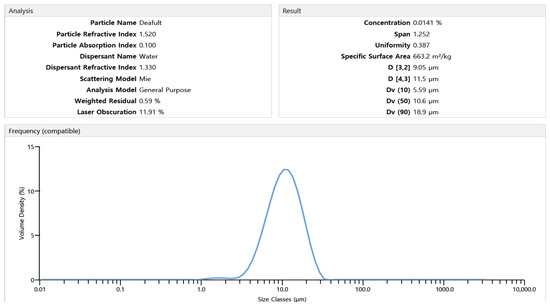
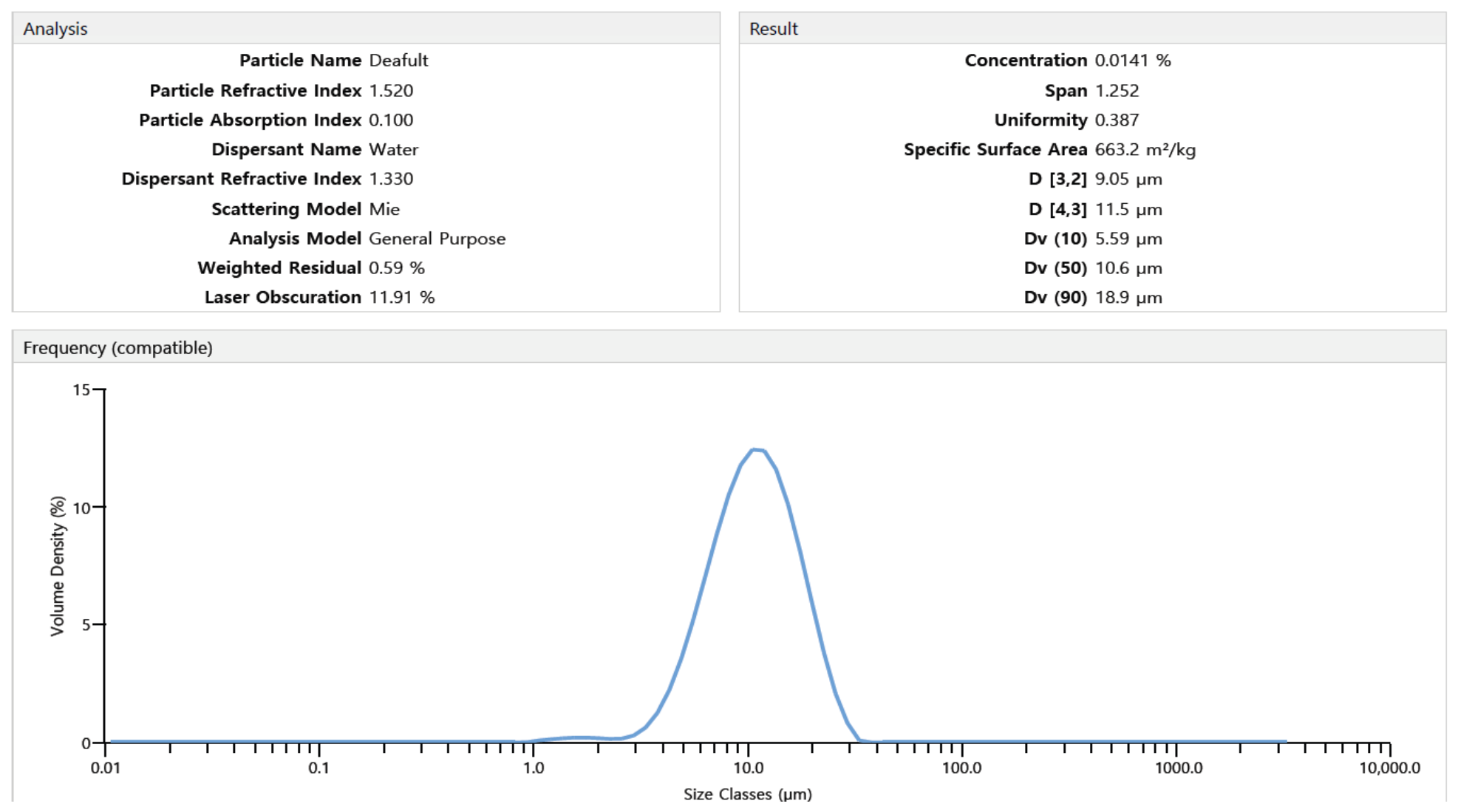
The feedstock was a nominal W–3 wt.% Re powder prepared using rhenium supplied by Rhenium Alloys, Inc., Ohio, USA. The powder exhibited a predominantly spherical morphology and a median volume-based particle diameter, Dv (50), of 10.6 μm, as determined by laser-diffraction particle-size analysis (Figure 1). The spherical morphology is favorable for stable powder feeding and transport into the plasma jet, while the relatively fine particle size facilitates rapid in-flight heating. However, the actual particle melting state also depends on processing parameters such as plasma power, gas composition, particle residence time, chamber pressure, and stand-off distance.
Figure 1.
Particle-size distribution of the W–3Re feedstock powder.
A titanium–zirconium–molybdenum (TZM) alloy disc, purchased from Xi’an Gemei Metal Material Co., Ltd., China, was used as the substrate. TZM is a refractory molybdenum-based alloy with high-temperature strength and thermal stability, making it suitable as a structural support for W–Re coatings exposed to severe thermal environments. The W–Re/TZM material combination is also technologically relevant to high-heat-flux applications, including rotating-anode X-ray targets.
Before VPS deposition, the TZM substrate surface was mechanically roughened by sandblasting with #220 alumina (Al2O3) particles for 30 s. Surface roughening increases the effective interfacial area and creates asperities that can enhance mechanical interlocking between deposited splats and the substrate [13,14]. After sandblasting, loosely attached abrasive particles and surface contaminants were removed before coating deposition. Ra = 2.24, Rz = 11.91.
For comparison, a nominal W–3Re reference specimen was prepared by vacuum sintering using an RHIS-160 system (ShenYang Hengjin Vacuum Technology Co., Ltd., China). The W–3Re powder compact was formed at approximately 12 MPa. Before high-temperature sintering, the furnace was initially evacuated to approximately 1 × 10⁻³ Pa. The compact was subsequently heated under vacuum to a peak temperature of 2200 °C and held at the peak temperature for 14 h before furnace cooling.
2.2. Vacuum Plasma Spraying
The W–3Re coating was deposited on the TZM substrate using a vacuum plasma spraying system at the High-Enthalpy Plasma Research Center (Figure 2) [15]. Before spraying, the prepared TZM substrate was mounted on a rotating turntable to provide uniform relative motion between the plasma jet and the substrate. The substrate was rotated at a constant speed during deposition.
Figure 2.
Photograph of the vacuum plasma spraying system and device.
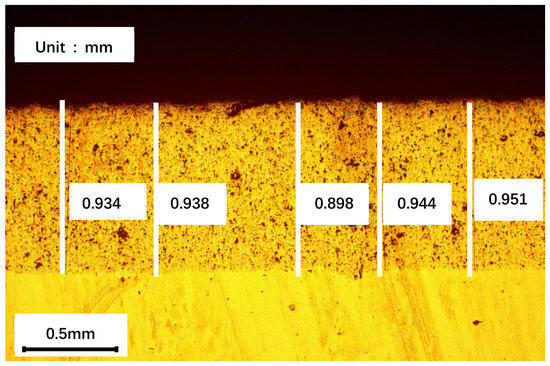
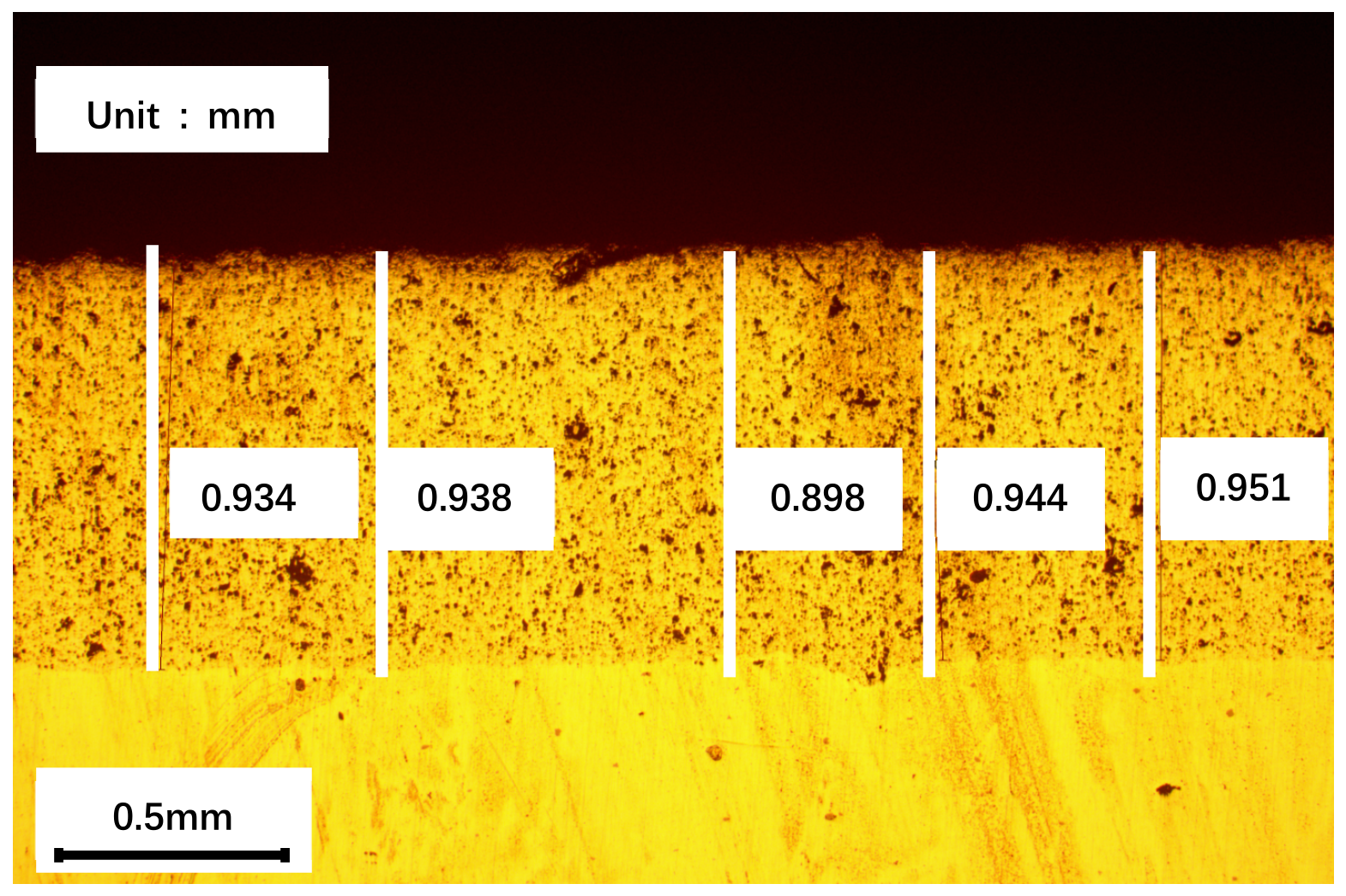
During VPS deposition, W–3Re powder was continuously fed into the high-temperature plasma jet, where the particles were heated and accelerated toward the TZM substrate. On impact, molten or partially molten particles flattened to form individual splats, and successive deposition and rapid solidification produced a lamellar coating. Coating thicknesses measured at five locations were 0.934, 0.938, 0.898, 0.944, and 0.951 mm, giving a mean thickness of 0.933 mm (Figure 3).
Figure 3.
Cross-sectional optical micrograph showing the thickness distribution of the VPS W–3Re coating. The average coating thickness measured at five locations was 0.933 mm.
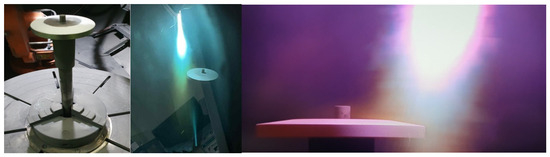
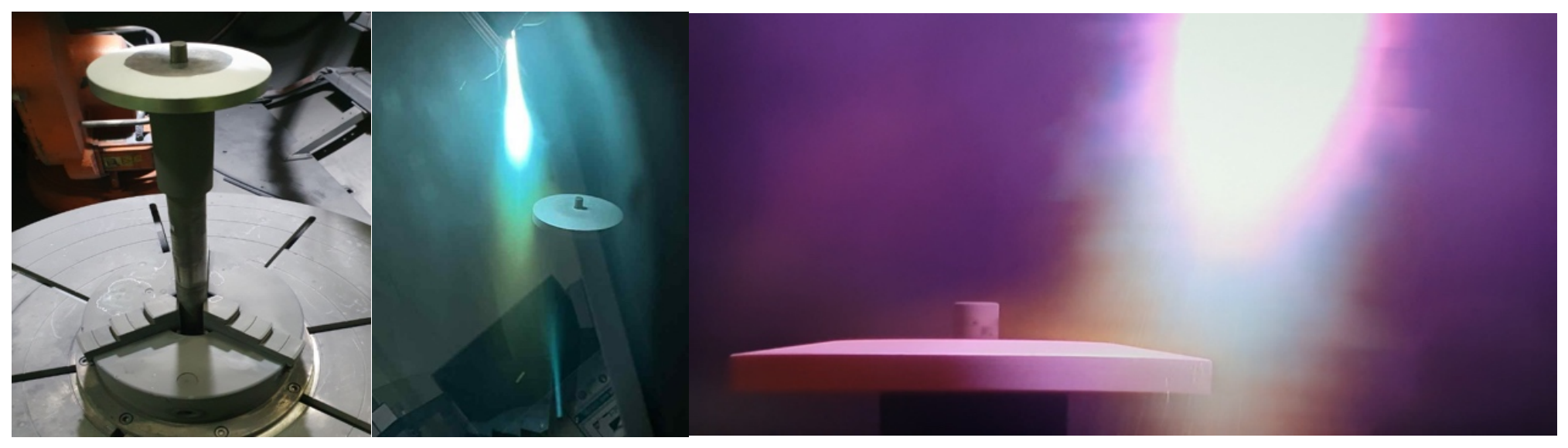
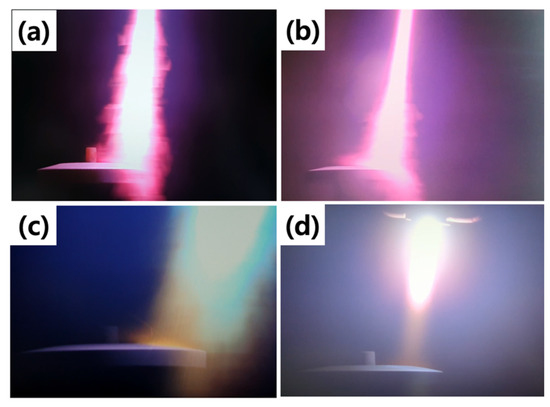
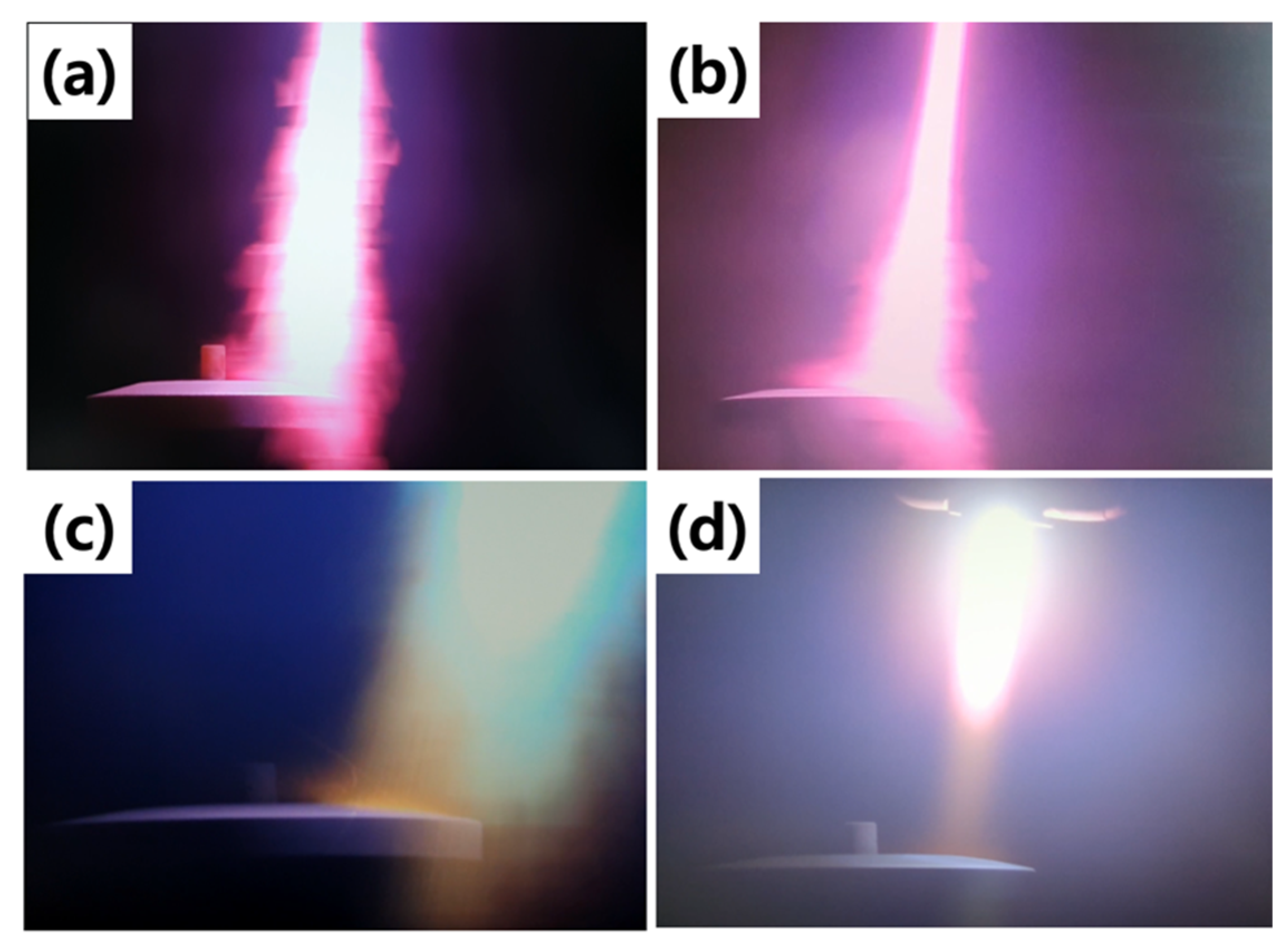
The VPS process parameters were selected based on preliminary deposition experiments performed for W–3Re coating of the TZM substrate. In the preliminary trial, a powder feed rate of 4 g min−1, a torch-to-substrate distance of 225 mm, a chamber pressure of 16 kPa, and a deposition time of 17 min were employed. Under these conditions, approximately 22 g of coating was obtained from 68 g of supplied powder, corresponding to a powder loss of approximately 66%, and partial vaporization of the powder before deposition was observed. Therefore, the powder feed rate was increased from 4 to 8 g min−1 and the stand-off distance was reduced from 225 to 210 mm to improve powder delivery and deposition efficiency. The deposition time was set to 35 min, corresponding to a total powder feed of approximately 280 g. The final VPS conditions used in this study were a nominal plasma power of approximately 42 kW, Ar/H2/He flow rates of 30/4/24 L min−1, a powder feed rate of 8 g min−1, a chamber pressure of 16 kPa, a torch-to-substrate distance of 210 mm, and a deposition time of 35 min. These parameters were maintained at constant during coating deposition. Figure 4 illustrates the VPS process sequence, consisting of (a) surface cleaning of the TZM substrate, (b) preheating of the substrate prior to deposition, (c) deposition of the W–3Re coating by vacuum plasma spraying, and (d) post-heating after coating deposition to stabilize the deposited layer.
Figure 4.
Photographs of the VPS sequence: (a) cleaning, (b) preheating, (c) coating deposition, and (d) post-heating.
The reduced-pressure VPS atmosphere was selected to limit interaction between the high-temperature W–3Re particles and ambient oxygen relative to atmospheric plasma spraying. Plasma power, process-gas composition, powder feed rate, chamber pressure, and stand-off distance jointly determine the particle temperature and velocity at impact and therefore influence splat deformation, inter-splat bonding, porosity, coating density, and mechanical response.
After deposition, the coated specimens were cooled before sectioning and characterization. Cross sections were prepared for microstructural examination and through-thickness hardness measurements, and the W–3Re material was also evaluated for elemental distribution and density.
The VPS processing conditions used in this study are summarized in Table 1.
Table 1.
Processing parameters used for VPS deposition of the W–3Re coating.
2.3. Characterization
The particle-size distribution of the W–3Re feedstock powder was measured by laser diffraction using a particle size analyzer (Mastersizer 3000, Malvern Panalytical). The distribution was evaluated on a volume basis, and the median particle diameter, Dv (50), was 10.6 μm.
The cross-sectional microstructure and elemental distribution of the VPS W–3Re coating were characterized using field-emission scanning electron microscopy (FE-SEM, JSM-7900F, JEOL, Japan) equipped with energy-dispersive X-ray spectroscopy (EDS).
X-ray diffraction analysis was carried out using an EMPYREAN X-ray diffractometer (PANalytical). Diffraction patterns were collected over a 2θ range of 1–90°, with a scan rate of 3° min−1 and a step size of 0.02°.
The density of the W–3Re specimens was determined according to the Archimedes principle using a precision balance (GF-200, A&D) with a resolution of 0.001 g. Dry and submerged masses were measured six times for each specimen, and the mean density was used to calculate the relative density with respect to the theoretical density of W–3Re.
Vickers microhardness was measured on polished cross sections using a microhardness tester (HVD-100IS, SIOMM, Shanghai, China). A load of 9.81 N (1 kgf) was applied for 5 s using a diamond pyramidal indenter. Six measurements were performed for each specimen, and the mean value was used as the representative hardness. The results are reported as HV1. For the VPS coating, hardness measurements were additionally performed at different distances from the coating/substrate interface to evaluate through-thickness hardness variation.
Surface residual stress was measured on both the VPS W–3Re specimen and the vacuum-sintered W–3Re reference using a portable X-ray residual-stress analyzer (μ-X360s, PULSTEC Industrial Co., Ltd., Hamamatsu, Japan) to compare their tensile residual-stress states.
3. Results
3.1. Microstructure and Elemental Analysis of the Coating
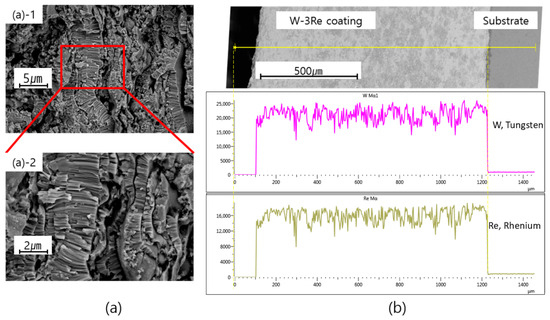
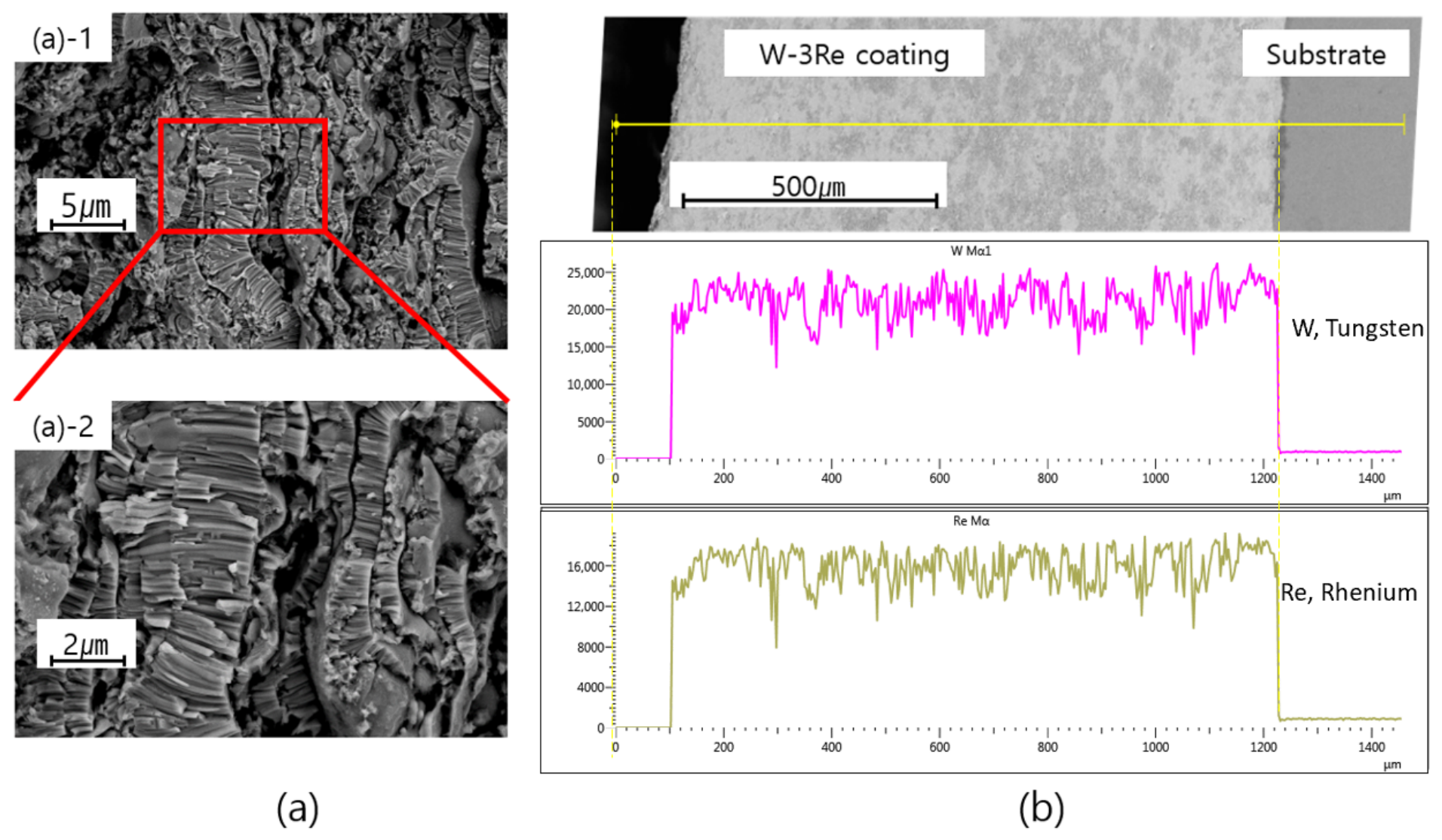
Figure 5a shows the cross-sectional microstructure of the VPS W–3Re deposit. The coating exhibited a layered morphology oriented approximately parallel to the substrate surface. At higher magnification, flattened splat regions and interfaces between successively deposited particles were evident, consistent with the characteristic lamellar architecture of plasma-sprayed coatings.
Figure 5.
Cross-sectional characterization of the VPS W–3Re coating: (a) field-emission scanning electron microscopy (FE-SEM) micrographs at ((a)-1) ×2000 and ((a)-2) ×5000 magnification; (b) EDS line-profile analysis across the coating.
The energy-dispersive X-ray spectroscopy (EDS) line profile in Figure 5b detected both W and Re throughout the analyzed deposit region, with no abrupt macroscopic change in the Re signal along the measured line. Because W and Re have similar atomic numbers and can present analytical limitations in EDS-based quantification, these data are interpreted as evidence of macroscale elemental continuity rather than proof of microscale chemical homogeneity.
3.2. Density of the W–3Re Material
The density of each W–3Re specimen was measured six times using the Archimedes method. The VPS specimen exhibited a mean density of 17.08 ± 1.32 g cm−3 (n = 6), while the vacuum-sintered specimen exhibited 15.62 ± 1.27 g cm−3 (n = 6). Using a theoretical density of 19.4 g cm−3, the corresponding relative densities were 88.04 ± 6.79% and 80.52 ± 6.53%, respectively (Table 2). Thus, the VPS specimen exhibited a relative-density advantage of 7.52 percentage points and a measured-density increase of 9.35% relative to the sintered reference.
Table 2.
Measured and relative densities of the W–3Re specimens. Values are presented as mean ± SD (n = 6).
3.3. Vickers Hardness of the W–3Re Materials
A load of 9.81 N (1 kgf) was applied for 5 s with a diamond pyramidal indenter, after which the indentation diagonals were measured. The resulting hardness values are reported as HV1.
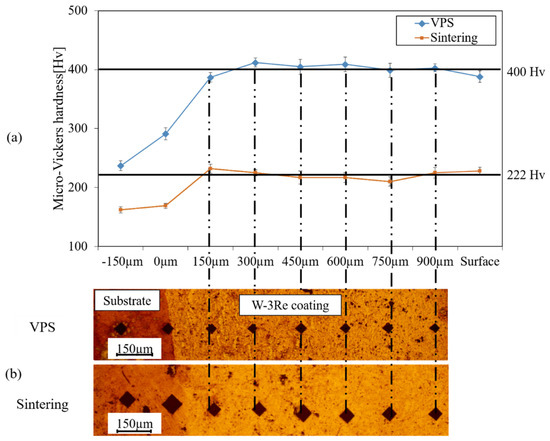
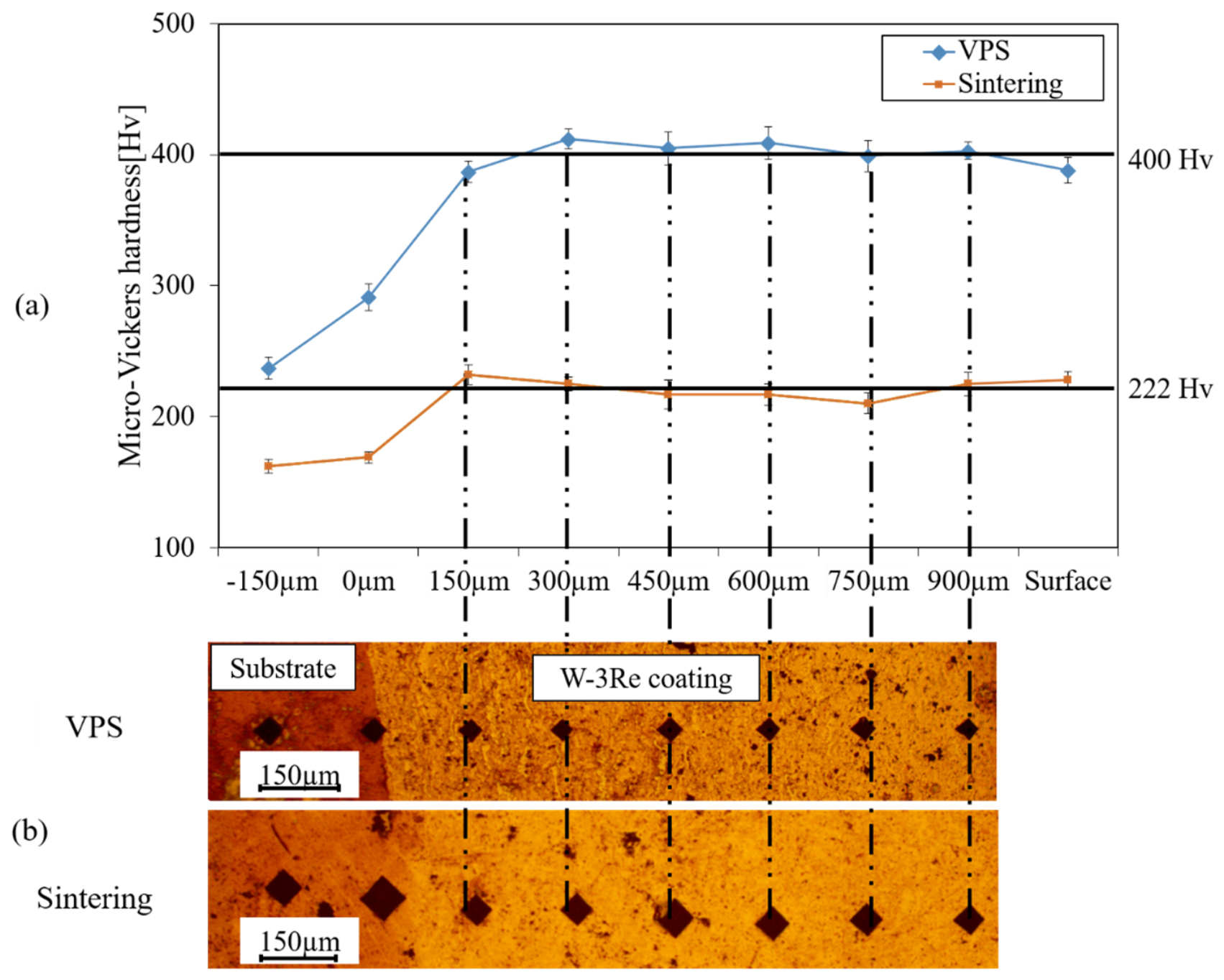
Because the VPS coating had a mean thickness of approximately 0.933 mm, hardness was evaluated as a function of depth. Indentations were placed at approximately 150 μm intervals from the coating surface toward the coating–substrate interface (Figure 6) to assess through-thickness variations associated with local microstructure and consolidation state.
Figure 6.
(a) Through-thickness Vickers hardness distributions of the VPS and vacuum-sintered W–3Re specimens; (b) optical micrographs showing the indentation positions. The horizontal axis represents the distance from the coating–substrate interface (0 µm) Positive values indicate locations within the W–3Re coating toward the surface, while the negative value (−150 µm) corresponds to the location inside the TZM substrate.
The VPS and vacuum-sintered W–3Re specimens exhibited mean hardness values of 419.7 ± 14.75 HV1 and 220.2 ± 15.61 HV1, respectively. The mean hardness of the VPS material was therefore 90.6% higher than that of the sintered reference. The VPS coating maintained comparatively high hardness over most of its thickness, although local variations were observed with measurement depth. The mean Vickers hardness of the vacuum-sintered W–3Re reference was 220.2 ± 15.61 HV1 (n = 6).
The higher hardness of the VPS material is consistent with differences in consolidation state and microstructure between the two processing routes. Its higher measured density and lower tensile residual stress may have contributed to the observed difference; however, the present data do not isolate the contribution of residual stress from those of porosity, inter-splat bonding, grain/sub-grain structure, texture, or impurity content. These coupled effects are considered further in the Discussion.
4. Discussion
4.1. Relationship Between VPS Processing and Lamellar Microstructure
The lamellar morphology observed in the VPS deposit is consistent with successive impact, deformation, and rapid solidification of plasma-heated W–3Re particles [8,9,16]. The final coating architecture is governed largely by particle temperature and velocity at impact, which in turn depend on plasma power, gas composition, chamber pressure, powder feed rate, particle size and morphology, and stand-off distance. Particle-size analysis yielded a median volume-based diameter (Dv (50)) of 10.6 μm for the W–3Re feedstock (Figure 1). The predominantly spherical morphology and fine particle size are expected to favor stable feeding and rapid heating, although pores can still form when the thermal input is insufficient for complete melting or when particle loading exceeds the available plasma enthalpy [9].
The relative density of 88.04% indicates that the VPS material retained a substantial void fraction relative to the theoretical density and should therefore be described as partially densified rather than fully dense. Nevertheless, its measured density was 9.35% higher than that of the vacuum-sintered reference under the specific conditions used in this study. The higher VPS density may reflect impact consolidation of molten or partially molten particles, whereas the lower density of the sintered reference may reflect incomplete neck growth or pore elimination during the vacuum-sintering cycle [9,17,18].
4.2. Contributions of Density and Microstructure to Hardness
The mean hardness of the VPS material was 90.6% higher than that of the sintered reference, whereas its measured density was only 9.35% higher. This disparity suggests that density alone is unlikely to account for the full hardness difference. Reduced porosity can increase the effective load-bearing area beneath an indenter and suppress pore-assisted local deformation, but additional contributions may arise from splat-boundary structure, rapid-solidification substructure, dislocation density, grain/sub-grain size, crystallographic texture, oxygen content, and residual stress.
Reviews of thermal-spray technologies show that feedstock characteristics and spray parameters govern coating porosity, hardness, adhesion, and related mechanical properties [19]. Tungsten powder-processing studies further indicate that spherical powder morphology can promote packing and densification [20], while plasma-jet characterization studies show that the thermo-kinetic state of the jet changes with process conditions and stand-off distance [21]. In atmospheric plasma spraying of molybdenum, spraying distance has been reported to alter both oxygen content and hardness. The reduced-pressure environment used here should limit interaction with ambient oxygen relative to APS; however, because oxygen content was not measured quantitatively, the present coating should not be described as oxide-free. Direct oxygen analysis or an appropriate surface/chemical characterization method would be required to support such a claim.
Rhenium also modifies the intrinsic deformation behavior of tungsten. Re additions are known to reduce the Peierls stress and enhance screw-dislocation mobility [3,4,18]. Nevertheless, the VPS and sintered specimens nominally had the same W–3Re composition; bulk Re concentration alone therefore cannot explain the difference between the processing routes unless processing generated differences in segregation, texture, second-phase formation, or impurity redistribution. Because porosity, residual stress, hardness, adhesion, and splat morphology are coupled in thermally sprayed materials, these quantities should be interpreted together [22].
4.3. Relationship Between Residual Stress and Hardness
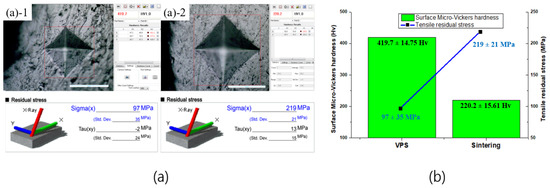
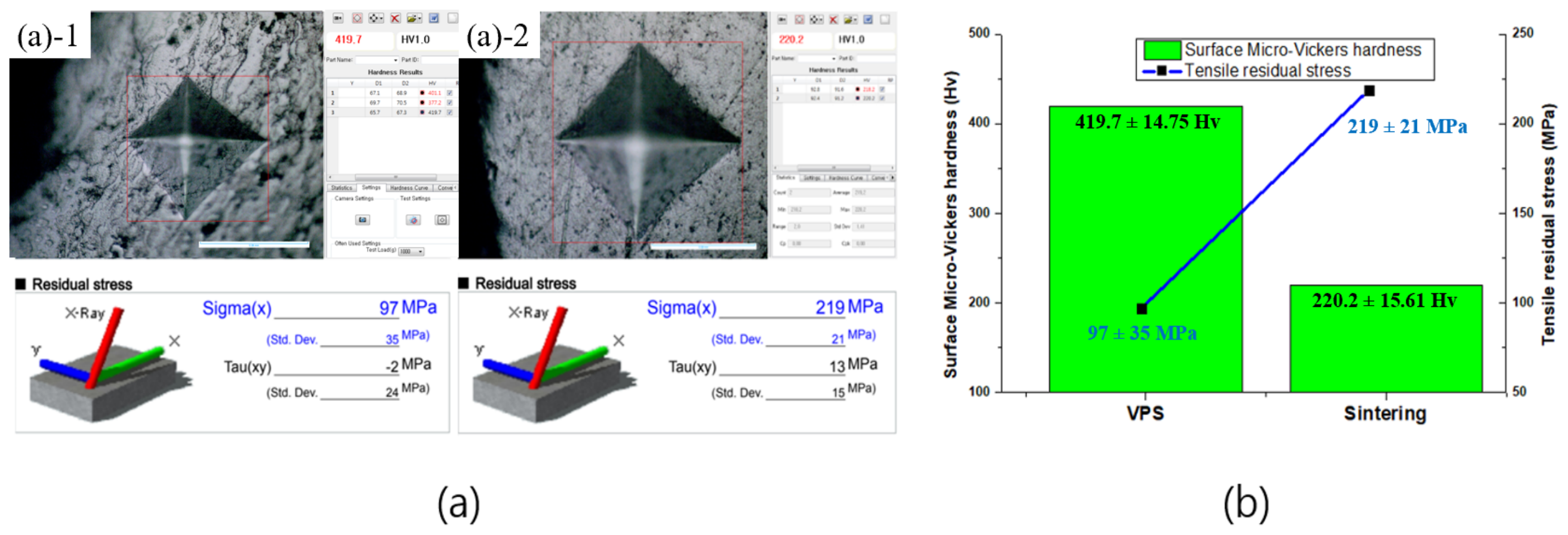
Figure 7 compares hardness and surface residual stress of the materials produced by the two processing routes. The VPS material had a 9.35% higher measured density and a 90.6% higher mean hardness than the sintered reference. The much larger relative difference in hardness than in density suggests that additional processing-dependent factors, including residual stress and microstructure, are involved.
Figure 7.
Comparison of the W–3Re specimens: (a) hardness and residual-stress measurements for ((a)-1) VPS and ((a)-2) the vacuum-sintered reference; (b) comparison of mean hardness and tensile residual stress.
Indentation studies in metallic materials have reported that compressive residual stress can increase measured indentation hardness, whereas tensile residual stress can reduce it [12,23]. The VPS and sintered specimens exhibited tensile residual stresses of approximately 97 ± 35 and 219 ± 21 MPa, respectively; thus, the tensile stress magnitude of the VPS specimen was approximately 55.7% lower. Previous work on vacuum plasma-sprayed tungsten has likewise shown that porous and heterogeneous sprayed microstructures can exhibit mechanical and residual-stress responses that differ substantially from those of dense bulk tungsten [24].
The higher tensile residual stress of the sintered reference may have contributed to its lower measured hardness, but the present two-condition comparison does not establish a quantitative causal relationship between residual stress and hardness. Residual stresses in thermally sprayed coatings arise from multiple mechanisms, including quenching, thermal-expansion mismatch, and deposition-related effects, and their measured magnitude is influenced by coating heterogeneity and the selected measurement method [25,26]. Different thermal-spray processes can therefore produce substantially different residual-stress states and mechanical responses [27,28]. The hardness difference observed here should consequently be interpreted as the combined outcome of density, microstructure, and residual-stress state rather than as an effect of residual stress alone.
Studies of tungsten exposed to high-temperature plasma show that near-surface structure and mechanical response can vary substantially with plasma conditions, underscoring the importance of service-induced degradation in refractory-metal applications [29]. Recent low-pressure plasma-spraying studies likewise show strong processing effects on porosity, defect populations, residual stress, and depth-dependent densification [30]. Thick tungsten coatings produced by DC vacuum plasma spraying and RF low-pressure plasma spraying have been assessed using hardness, porosity, microstructure, and crystal structure as key quality indicators [31]. Reported cross-sectional Vickers hardness values of approximately 260–300 HV for plasma-sprayed tungsten, together with residual porosity, further illustrate the sensitivity of hardness to sprayed microstructure [32]. Direct comparison with the present W–3Re data should nevertheless be made cautiously because alloy composition, spray conditions, porosity, indentation load, and measurement location differ among studies.
5. Conclusions
In this study, a W–3Re coating was fabricated on TZM by vacuum plasma spraying and compared with a vacuum-sintered W–3Re reference. Microstructure, elemental distribution, density, through-thickness hardness, and surface residual stress were evaluated. The principal findings are as follows:
- The VPS W–3Re material had a measured density of 17.08 g cm−3, 9.35% higher than the 15.62 g cm−3 measured for the sintered reference. Relative to a theoretical density of 19.4 g cm−3, the corresponding relative densities were 88.04% and 80.52%, respectively.
- The mean surface Vickers hardness of the VPS W–3Re coating was 419.7 ± 14.75 HV1 (n = 6), compared with 220.2 ± 15.61 HV1 (n = 6) for the vacuum-sintered reference, corresponding to a 90.6% increase.
- The VPS and vacuum-sintered specimens exhibited surface tensile residual stresses of 97 ± 35 MPa and 219 ± 21 MPa, respectively. The lower tensile residual stress of the VPS specimen may have contributed to its higher measured hardness; however, the present comparison does not isolate residual stress from the effects of density, porosity, inter-splat bonding, texture, and other processing-dependent microstructural factors.
Under the specific processing conditions examined, the VPS material exhibited higher measured density and hardness and lower tensile residual stress than the vacuum-sintered reference. These results support further investigation of VPS as a route for W–Re coatings on TZM, while quantitative assessment of coating adhesion, porosity, oxygen content, thermal cycling, and high-heat-flux durability is required before service-performance conclusions can be drawn.
Author Contributions
Conceptualization, Y.-H.C.; methodology, J.-B.P. and Y.-H.C.; validation, J.-B.P., H.-K.K. and D.-S.P.; formal analysis, J.-B.P., H.-K.K. and Y.-H.C.; investigation, J.-B.P.; resources, Y.-H.C.; data curation, J.-B.P.; writing—original draft preparation, J.-B.P.; writing—review and editing, H.-K.K., D.-S.P. and Y.-H.C.; supervision, Y.-H.C.; project administration, Y.-H.C. All authors have read and agreed to the published version of the manuscript.
Funding
This research was funded by the Korea Forest Service and supported by the Korea Forestry Promotion Institute, grant number RS-2025-02217444.
Institutional Review Board Statement
Not applicable.
Informed Consent Statement
Not applicable.
Data Availability Statement
The data presented in this study are available within the article.
Acknowledgments
The authors thank Gyu-Man Kim of the School of Mechanical Engineering, Kyungpook National University, for valuable advice and constructive discussions.
Conflicts of Interest
Author Jun-Beom Park was employed by the company Doosan Enerbility Co., Ltd. Author Dong-Su Park was employed by the company Daeyoung Tech Co., Ltd. The remaining authors declare that the research was conducted in the absence of any commercial or financial relationships that could be construed as potential conflicts of interest.
References
- Korea Institute of Materials Science (KIMS). White Paper on Materials Technology 2021; KIMS: Changwon, Republic of Korea, 2022; pp. 481–515. [Google Scholar]
- Mutoh, Y.; Ichikawa, K.; Nagata, K.; Takeuchi, M. Effect of rhenium addition on fracture toughness of tungsten at elevated temperatures. J. Mater. Sci. 1995, 30, 770–775. [Google Scholar] [CrossRef] [Scilit]
- Raffo, P.L. Yielding and fracture in tungsten and tungsten–rhenium alloys. J. Less-Common Met. 1969, 17, 133–149. [Google Scholar] [CrossRef] [Scilit]
- Wurster, S.; Gludovatz, B.; Pippan, R. High temperature fracture experiments on tungsten–rhenium alloys. Int. J. Refract. Met. Hard Mater. 2010, 28, 692–697. [Google Scholar] [CrossRef] [Scilit]
- Li, Y.; Zhang, W.; Li, J.; Lin, X.; Gao, X.; Wei, F.; Zhang, G.; Li, L. Microstructure and high temperature mechanical properties of advanced W–3Re alloy reinforced with HfC particles. Mater. Sci. Eng. A 2021, 814, 141198. [Google Scholar] [CrossRef] [Scilit]
- Behling, R. Medical X-ray sources now and for the future. Nucl. Instrum. Methods Phys. Res. A 2017, 873, 43–50. [Google Scholar] [CrossRef] [Scilit]
- Behling, R.; Hulme, C.; Tolias, P.; Danielsson, M. The impact of tube voltage on the erosion of rotating X-ray anodes. Med. Phys. 2025, 52, 814–825. [Google Scholar] [CrossRef] [Scilit] [PubMed]
- Moon, S.Y.; Choi, C.H.; Kim, H.S.; Oh, P.; Hong, B.G.; Kim, S.K.; Lee, D.W. Thick tungsten coating on ferritic–martensitic steel applied with a vacuum plasma spray coating method. Surf. Coat. Technol. 2015, 280, 225–231. [Google Scholar] [CrossRef] [Scilit]
- Hurevich, V.; Smurov, I.; Pawlowski, L. Theoretical study of the powder behavior of porous particles in a flame during plasma spraying. Surf. Coat. Technol. 2002, 151–152, 370–376. [Google Scholar] [CrossRef] [Scilit]
- Stolarski, T.A.; Tobe, S. The effect of spraying distance on wear resistance of molybdenum coatings. Wear 2001, 249, 1096–1102. [Google Scholar] [CrossRef] [Scilit]
- Kim, H.S.; Kang, B.R.; Choi, S.M. Microstructure and mechanical properties of vacuum plasma sprayed HfC, TiC, and HfC/TiC ultra-high-temperature ceramic coatings. Materials 2020, 13, 124. [Google Scholar] [CrossRef] [Scilit] [PubMed]
- Tosha, K. Influence of residual stresses on the hardness number in the affected layer produced by shot peening. In Proceedings of the 2nd Asia-Pacific Forum on Precision Surface Finishing and Deburring Technology, Seoul, Republic of Korea, 22–24 July 2002. [Google Scholar]
- He, G.; Guo, W.; He, D.; Zhang, J.; Xing, Z.; Lv, Z.; Jia, L.; Huang, Y. Study of the Mechanical Properties and Thermal Control Performance of Plasma-Sprayed Alumina Coating on Aluminum Alloy Surface. Appl. Sci. 2023, 13, 956. [Google Scholar] [CrossRef] [Scilit]
- Tronche, A.; Fauchais, P. Hard coatings (Cr2O3, WC–Co) properties on aluminium or steel substrates. Mater. Sci. Eng. 1987, 92, 133–144. [Google Scholar] [CrossRef] [Scilit]
- High-Enthalpy Plasma Research Center, Jeonbuk National University. 55 kW VPS. Available online: https://cprc.jbnu.ac.kr/cprc/20862/subview.do (accessed on 16 September 2026).
- Tokunaga, T.; Watanabe, H.; Yoshida, N.; Nagasaka, T.; Kasada, R.; Lee, Y.J.; Kimura, A.; Tokitani, M.; Mitsuhara, M.; Hinoki, T.; et al. Development of high-grade VPS-tungsten coatings on F82H reduced activation steel. J. Nucl. Mater. 2013, 442, S287–S291. [Google Scholar] [CrossRef] [Scilit]
- Qadir, D.; Sharif, R.; Nasir, R.; Awad, A.; Mannan, H.A. A review on coatings through thermal spraying. Chem. Pap. 2024, 78, 71–91. [Google Scholar] [CrossRef] [Scilit]
- Zheng, Z.; Lai, C.; Zhou, W.; Wang, Y.; Zhang, Y.; Wang, J. Preparation, Mechanical Properties and Strengthening Mechanism of W-Re Alloys: A Review. Materials 2024, 17, 102. [Google Scholar] [CrossRef] [Scilit] [PubMed]
- Łatka, L.; Pawłowski, L.; Winnicki, M.; Sokołowski, P.; Małachowska, A.; Kozerski, S. Review of functionally graded thermal sprayed coatings. Appl. Sci. 2020, 10, 5153. [Google Scholar] [CrossRef] [Scilit]
- Wang, D.; Yu, C.; Zhou, X.; Ma, J.; Liu, W.; Shen, Z. Dense pure tungsten fabricated by selective laser melting. Appl. Sci. 2017, 7, 430. [Google Scholar] [CrossRef] [Scilit]
- Mrotzek, J.; Viöl, W. Spectroscopic characterization of an atmospheric pressure plasma jet used for cold plasma spraying. Appl. Sci. 2022, 12, 6814. [Google Scholar] [CrossRef] [Scilit]
- Ang, A.S.M.; Berndt, C.C. A review of testing methods for thermal spray coatings. Int. Mater. Rev. 2014, 59, 179–223. [Google Scholar] [CrossRef] [Scilit]
- Yao, G.; Liu, Z.; Ma, H. A novel method for predicting residual stress in GH4169 machined surfaces through micro-hardness measurement. Appl. Sci. 2023, 13, 13257. [Google Scholar] [CrossRef] [Scilit]
- You, J.H.; Höschen, T.; Lindig, S. Determination of elastic modulus and residual stress of plasma-sprayed tungsten coating on steel substrate. J. Nucl. Mater. 2006, 348, 94–101. [Google Scholar] [CrossRef] [Scilit]
- Abubakar, A.A.; Arif, A.F.M.; Al-Athel, K.S.; Akhtar, S.S.; Mostaghimi, J. Modeling residual stress development in thermal spray coatings: Current status and way forward. J. Therm. Spray Technol. 2017, 26, 1115–1145. [Google Scholar] [CrossRef] [Scilit]
- Faisal, N.H.; Ahmed, R.; Prathuru, A.K.; Paradowska, A.; Lee, T.L. Measuring residual strain and stress in thermal spray coatings using neutron diffractometers. Exp. Mech. 2022, 62, 369–392. [Google Scholar] [CrossRef] [Scilit]
- Wenzelburger, M.; López, D.; Gadow, R. Methods and application of residual stress analysis on thermally sprayed coatings and layer composites. Surf. Coat. Technol. 2006, 201, 1995–2001. [Google Scholar] [CrossRef] [Scilit]
- Gassot, H.; Junquera, T.; Ji, V.; Jeandin, M.; Guipont, V.; Coddet, C.; Verdy, C.; Grandsire, L. Comparative study of mechanical properties and residual stress distributions of copper coatings obtained by different thermal spray processes. Surf. Eng. 2001, 17, 317–322. [Google Scholar] [CrossRef] [Scilit]
- Satbayeva, Z.; Rakhadilov, B.; Naimankumaruly, Y.; Turabekov, Y.; Batanov, Y. Effect of helium concentration on the structural and mechanical degradation of tungsten in high-temperature plasma. Appl. Sci. 2026, 16, 6256. [Google Scholar] [CrossRef] [Scilit]
- Schmidtmann, G.; Sohn, Y.J.; Litnovsky, A.; Rasinski, M.; Vaßen, R.; Coenen, J.W.; Brezinsek, S.; Linsmeier, C.; Guillon, O.; Mauer, G. Optimizing plasma spraying process parameters for tungsten coatings used in fusion reactors. J. Therm. Spray Technol. 2025, 34, 2129–2144. [Google Scholar] [CrossRef] [Scilit]
- Kim, H.S.; Hong, B.G.; Moon, S.Y. Thick tungsten layer coating on ferritic–martensitic steel without interlayer using a DC vacuum plasma spray and an RF low pressure plasma spray method. Thin Solid Films 2017, 623, 59–64. [Google Scholar] [CrossRef] [Scilit]
- Kobayashi, A.; Sharafat, S.; Ghoniem, N.M. Formation of tungsten coatings by gas tunnel type plasma spraying. Surf. Coat. Technol. 2006, 200, 4630–4635. [Google Scholar] [CrossRef] [Scilit]

Disclaimer/Publisher’s Note: The statements, opinions and data contained in all publications are solely those of the individual author(s) and contributor(s) and not of MDPI and/or the editor(s). MDPI and/or the editor(s) disclaim responsibility for any injury to people or property resulting from any ideas, methods, instructions or products referred to in the content. |
© 2026 by the authors. Licensee MDPI, Basel, Switzerland. This article is an open access article distributed under the terms and conditions of the Creative Commons Attribution (CC BY) license.