


Abstract
Tomato-processing residues present a viable secondary source of lycopene; however, the hydrophobic nature and chemical instability of this carotenoid limit its direct integration into aqueous products. This study employed ultrasound-assisted extraction to obtain a lycopene-rich extract from tomato by-products, subsequently incorporating it into oil-in-water emulsions stabilized by whole Spirulina biomass. The carrier, comprising 9.5 wt.% pumpkin seed oil and 0.5 wt.% linseed oil, was produced using rotor–stator homogenization followed by probe sonication. A formulation with 2.71 wt.% Spirulina, treated for 813 s, was selected. Pulsed extraction resulted in 1.05 ± 0.08 mg of apparent lycopene equivalents per gram of dry by-product. The UV-Vis method demonstrated linearity from 0.5 to 5.0 µg mL−1, with detection and quantification limits of 0.08 and 0.24 µg mL−1, respectively, and a recovery rate of 96.2 ± 3.1% from spiked emulsion. The incorporation of lycopene did not significantly affect the Z-average diameter, polydispersity, or 30-day physical stability. After 28 days, lycopene retention was 78.4 ± 3.2% at 4 °C and 49.6 ± 4.1% at 25 °C, with a significant interaction between time and temperature.
1. Introduction
The shift from linear food production models to a circular bioeconomy has heightened interest in the recovery of high-value constituents from processing side streams for incorporation into functional products [1,2]. The production of tomatoes results in by-products such as peels, seeds, and residual pulp, which contain dietary fiber, seed oil, proteins, phenolic compounds, and carotenoids [1,3]. Lycopene is particularly concentrated in the peel fraction, making tomato residues a valuable secondary feedstock rather than merely a waste disposal issue [3,4]. Nonetheless, successful valorization necessitates more than just demonstrating extractability; the recovery process must be reproducible, the analytical method must remain reliable within the final product matrix, and the recovered compound must be integrated into a technically viable carrier.
Lycopene, a highly unsaturated and lipophilic carotenoid, imparts the characteristic red color to tomatoes. Its extended conjugated system facilitates singlet-oxygen quenching but also renders it vulnerable to oxidation, geometrical isomerization, and degradation by heat, light, and oxygen. Conventional extraction methods typically utilize non-polar organic solvents. However, ethanol is more suitable for food-related processing, necessitating process intensification due to lycopene’s low polarity. Ultrasound-assisted extraction enhances solvent penetration and disrupts dried plant tissue through acoustic cavitation, while pulsed operation mitigates continuous energy input and aids in temperature control. Studies employing probe-based and pulsed ultrasound have demonstrated that factors such as amplitude, treatment duration, temperature, and liquid-to-solid ratio significantly affect carotenoid recovery from tomato residues [5,6,7]. Given that intense sonication and high temperatures can lead to pigment degradation, it is essential to report operating conditions, final temperature, and, when possible, actual energy input when comparing extraction protocols. UV–Vis spectrophotometry at approximately 502 nm provides a rapid method for routine monitoring, though its selectivity and efficacy must be confirmed in the presence of co-extracted carotenoids and emulsion components [7].
Recovery alone is insufficient to address the technological challenges associated with lycopene. Its minimal water solubility poses difficulties for its integration into primarily aqueous foods, nutraceuticals, and topical formulations. Oil-in-water emulsions offer a viable solution, as lycopene can be solubilized within the dispersed lipid phase, while the aqueous continuous phase aids in product integration [8]. Lycopene-loaded emulsions, nanoemulsions, and high-internal-phase emulsions have demonstrated significant loading and retention capabilities under various storage and environmental conditions [9,10,11,12,13]. However, it is important to distinguish between physical and chemical stability: a dispersion may appear macroscopically stable even as lycopene undergoes degradation, and a reduction in droplet size does not inherently ensure oxidative protection due to the increased interfacial area [12,14]. Many carriers reported in the literature depend on synthetic surfactants, purified proteins, or chemically modified biopolymers. Therefore, minimally processed biological stabilizers are appealing, provided their compositional heterogeneity and relatively lower interfacial efficiency are taken into account.
Spirulina, the commercial designation for Arthrospira platensis biomass, comprises proteins, pigment–protein complexes, polysaccharides, phospholipids, and other amphiphilic components, garnering interest as an additive in algae-enhanced foods [15]. Soluble fractions, protein-rich extracts, and protein isolates derived from Spirulina are capable of adsorbing at fluid interfaces and stabilizing oil-in-water emulsions [16,17,18,19,20]. Recent studies have demonstrated that ultrasound modification can alter the protein structure of Spirulina, enhancing its efficacy in high-internal-phase emulsions [21]. While purification generally enhances solubility and adsorption kinetics, it necessitates additional fractionation and results in the loss of potentially functional co-components. The use of whole biomass presents a less processed alternative; however, insoluble particles, protein aggregates, pigments, and polysaccharides may compete for the interface, induce depletion interactions, or alter the rheology of the continuous phase. Notably, whole Spirulina biomass has been employed to create ball-milled emulsion gels for the delivery of hydrophobic compounds [22]. Pumpkin seed and linseed oils serve as food-grade lipophilic carriers, yet their high unsaturation levels pose a chemically challenging environment for carotenoid retention. Furthermore, minor amphiphilic constituents in unrefined pumpkin seed oil may also engage at the interface [23].
Despite advancements in the field, the integration of ethanol-based pulsed-ultrasound recovery of lycopene from tomatoes with a low-oil, whole-Spirulina-stabilized pumpkin–linseed emulsion has been insufficiently explored. This study specifically addresses this integration gap without asserting the inaugural use of Spirulina or emulsions as delivery systems. The objectives were as follows: (i) to characterize the surface and interfacial activity of whole Spirulina dispersions; (ii) to assess the impact of Spirulina concentration and sonication time on the formation of pumpkin–linseed oil submicron emulsions; (iii) to recover a lycopene-rich fraction from tomato by-products using pulsed probe ultrasonication and evaluate the efficacy of the UV–Vis method; and (iv) to quantify lycopene retention at two storage temperatures, while assessing whether extract incorporation affected initial droplet size, polydispersity, or the 30-day physical stability of the emulsion compared to the unloaded emulsion.
2. Materials and Methods
2.1. Materials
Tomato-processing by-products, primarily comprising tomato peels and residual pulp, were provided by a local commerce. Spirulina powder (Arthrospira platensis) was sourced from Ecospirulina (Valencia, Spain) and utilized without further extraction or purification. The supplier indicated that the biomass contained approximately 63 wt.% protein, 9.4 wt.% fiber, and 13 wt.% polysaccharides. Food-grade pumpkin seed oil (Cucurbita pepo L.) was supplied by Condalab (Madrid, Spain), while linseed oil was procured from Sigma-Aldrich (Merck KGaA, Darmstadt, Germany). Ethanol (analytical grade), n-hexane (spectrophotometric grade), acetone, and all-trans-lycopene analytical standard were also acquired from Sigma-Aldrich. Ultrapure water, obtained via a Milli-Q purification system, was employed to prepare the aqueous phases. Samples containing lycopene were managed under reduced light conditions and stored in sealed amber containers.
2.2. Preparation of the Tomato By-Product
The tomato by-product was promptly stored at −20 °C following collection. Prior to extraction, the material underwent freeze-drying until a constant weight was achieved, after which it was ground using a laboratory mill and sieved to obtain particles smaller than 500 µm. The dried material was then stored at −20 °C in airtight amber containers until required for use. The moisture content was determined gravimetrically by drying approximately 3 g of the sample at 105 °C until a constant weight was reached. The extraction results were expressed on a dry-matter basis.
2.3. Ultrasound-Assisted Extraction of Lycopene
Ultrasound-assisted extraction was conducted utilizing a Vibra-Cell VCX750 ultrasonic processor (Sonics & Materials Inc., Newtown, CT, USA), which was equipped with a CV334 converter and a titanium probe. The device operated at a fixed nominal frequency of 20 kHz, rendering frequency an unmodifiable experimental parameter. For each extraction, 1.25 g of freeze-dried tomato by-product was combined with 90 mL of ethanol in a 150 mL jacketed glass vessel, resulting in a liquid-to-solid ratio of 72 mL g−1. The probe was centrally positioned approximately 10 mm below the liquid surface, avoiding contact with the vessel walls or bottom. Ultrasound was applied at 65% amplitude in pulsed mode, with cycles of 5 s ON and 5 s OFF, until a cumulative ultrasound ON-time of 20 min was achieved, corresponding to a total extraction duration of approximately 40 min. The extraction temperature was maintained at 65 ± 2 °C using a thermostatic circulating bath and was continuously monitored with a thermocouple. Following treatment, the suspension was immediately cooled in an ice bath and centrifuged at 6036× g for 10 min. The recovered supernatant was filtered through a 0.45 µm membrane and stored in an amber container at −20 °C until analysis.
2.4. Spectrophotometric Determination of Lycopene in the Extract
The apparent lycopene content was assessed using UV–Vis spectrophotometry, adhering to the spectral method outlined by Kuvendziev et al. [7], with slight modifications. An aliquot of the ethanolic extract was evaporated under nitrogen and subsequently reconstituted in a known volume of n-hexane. Absorption spectra were recorded from 300 to 600 nm using a 1 cm quartz cuvette, with n-hexane serving as the instrumental blank. Lycopene quantification was conducted at 502 nm to minimize interference from other carotenoids. A calibration curve was established using all-trans-lycopene standard solutions in n-hexane, spanning a concentration range of 0.5–5.0 µg mL−1. The method’s performance characteristics were evaluated in accordance with ICH Q2(R2) validation principles, encompassing detection limit, quantification limit, repeatability, and analytical recovery [24].
Repeatability was assessed through six replicate measurements and expressed as the coefficient of variation. Recovery was evaluated by spiking blank emulsion samples at the nominal loading level, applying the complete emulsion-extraction procedure detailed in Section 2.11, and comparing the measured and added lycopene concentrations. Measurements were conducted in triplicate unless otherwise specified.
where YLyc is the apparent extraction yield (mg lycopene equivalents g−1 dry by-product), CLyc is the concentration obtained from the calibration curve (mg mL−1), V is the total extract volume (mL), D is the dilution factor, and m is the dry sample mass (g). Due to the inability of UV–Vis spectrophotometry to fully distinguish lycopene from other carotenoids that absorb within the same spectral region, the findings were reported as apparent lycopene content or lycopene equivalents.
2.5. Preparation of Spirulina Dispersions
Aqueous dispersions of Spirulina were prepared using Milli-Q water at concentrations ranging from 0.001 to 10 g L−1. The preparation process involved gradually introducing Spirulina powder into a portion of the water while stirring continuously. Once the powder was incorporated, the remaining water was added, and the mixture was stirred until it appeared uniformly mixed. Prior to analysis, the samples were gently homogenized to ensure that any sedimented insoluble material was evenly redistributed.
2.6. Surface and Interfacial Tension
Surface and interfacial tensions were assessed using a Sigma 701 tensiometer (Biolin Scientific Oy, Espoo, Finland), which was equipped with OneAttension software (version 4.2.1) Biolin Scientific Oy, Espoo, Finland). and a Du Noüy ring. The surface tension was measured at the air–water interface, while the interfacial tension was evaluated between the Spirulina dispersion and pumpkin seed oil. A total of ten measurement points were recorded at a ring withdrawal velocity of 20 mm s−1. Milli-Q water served as the reference aqueous phase. For the interfacial tension calculations, the experimentally determined density of pumpkin seed oil, 0.921 g cm−3, was input into the software. The results were reported in mN·m−1.
2.7. Experimental Design and Preparation of Unloaded Emulsions
A central composite rotatable design was employed to assess the influence of Spirulina concentration (S) and ultrasound treatment duration (T) on the Z-average droplet diameter and polydispersity index (PdI). The Spirulina concentration varied between 1 and 3 wt.%, while the ultrasound treatment duration ranged from 300 to 900 s. The design included four factorial points, four axial points, and two center-point replicates, resulting in ten formulations (Table 1).
Table 1.
Central composite design used to optimize the unloaded Spirulina-stabilized emulsions.
All emulsions were prepared with a total mass of 100 g, incorporating a 10 wt.% oil phase composed of 9.5 wt.% pumpkin seed oil and 0.5 wt.% linseed oil. The aqueous phase included the Spirulina concentration as determined by the experimental design, with Milli-Q water added to achieve a total of 100 wt.%. The oils were premixed until a homogeneous mixture was obtained. Concurrently, Spirulina was gradually dispersed in water under continuous stirring. The oil phase was incrementally introduced into the aqueous phase over a period of 10 s, during which primary homogenization was conducted at 6000 rpm using an Ultra-Turrax T25 rotor–stator homogenizer (IKA-Werke, Staufen, Germany) equipped with an S25 KV-25 G rotor. Homogenization was subsequently continued at 8000 rpm for an additional 80 s. The resulting coarse emulsion underwent further processing using a Vibra-Cell ultrasonic processor equipped with the CV334 converter. Sonication was executed at 80% amplitude, employing cycles of 7 s ON and 3 s OFF. The duration of treatment was adjusted according to Table 1, with samples maintained in an ice bath throughout the sonication process.
2.8. Droplet Size, Polydispersity and Zeta Potential
The Z-average hydrodynamic diameter and polydispersity index (PdI) were assessed through dynamic light scattering, utilizing a Zetasizer Advance Pro instrument (Malvern Panalytical, Malvern, UK). The emulsions underwent gentle homogenization and were subsequently diluted at a ratio of 1:10 with Milli-Q water. Measurements were conducted at a temperature of 25 °C following a 1-min equilibration period, employing 3 mL disposable polystyrene cuvettes. The instrument software automatically determined the measurement position and acquisition duration. Each formulation was subjected to three measurements. The zeta potential of the blank E4 emulsion and the corresponding lycopene-loaded emulsion was determined by electrophoretic light scattering using the Zetasizer Advance Pro instrument employed for droplet-size analysis (Malvern Panalytical, Malvern, UK). Before analysis, the emulsions were gently homogenized and diluted [1:10] with Milli-Q water. Measurements were performed at 25 °C after 1 min of equilibration. Three determinations were performed for each formulation, and the results were expressed as mean ± standard deviation.
2.9. Preparation of the Lycopene-Enriched Oil Phase
After spectrophotometric quantification, ethanol was removed from each independent extract under reduced pressure at a temperature not exceeding 35 °C. The concentrated lycopene-rich extract was dispersed in the pumpkin seed–linseed oil mixture under gentle magnetic stirring and reduced light. The amount incorporated was adjusted to obtain a nominal concentration of 10 mg lycopene equivalents kg−1 of final emulsion, corresponding to approximately 100 mg kg−1 of oil phase. The actual concentration in the enriched oil was determined by dilution in n-hexane and measurement at 502 nm. A non-enriched pumpkin seed–linseed oil mixture was used as the matrix blank.
2.10. Preparation of the Lycopene-Loaded Emulsions
Formulation E4 was chosen for the lycopene-loading phase due to its lowest experimentally measured polydispersity index (PdI) while maintaining a submicrometric mean droplet diameter. This formulation comprised 2.71 wt.% Spirulina, 9.5 wt.% pumpkin seed oil, 0.5 wt.% linseed oil, and 87.29 wt.% water, and it underwent treatment for 813 s. Prior to loading, the formulation was independently reproduced three times to confirm its droplet size and PdI.
Loaded emulsions were formulated by employing the composition and homogenization parameters delineated in Section 2.7, substituting the original oil mixture with a lycopene-enriched oil phase. The sonication process was conducted for a total of 813 s, utilizing cycles of 7 s ON and 3 s OFF, resulting in an aggregate ultrasound ON-time of approximately 569 s. Three distinct loaded emulsions were independently prepared, each derived from a separate extraction batch. Blank emulsions, maintaining an identical composition but devoid of tomato extract, were produced to serve as physical controls and analytical matrix blanks.
2.11. Lycopene Retention
One gram of emulsion was combined with 4.0 mL of a solvent mixture consisting of n-hexane, acetone, and ethanol in a 2:1:1 volume ratio, specifically 2.0 mL of n-hexane, 1.0 mL of acetone, and 1.0 mL of ethanol [25]. The sample underwent vortex mixing to disrupt the emulsion, followed by centrifugation at 5000× g for 5 min to facilitate phase separation. A single extraction cycle was conducted. The organic phase containing lycopene was collected under reduced light conditions. The solvent was evaporated under a nitrogen atmosphere, and the residue was reconstituted to a precise volume of 2.0 mL with n-hexane prior to measurement at 502 nm. Blank emulsions underwent the identical procedure to account for absorbance due to carrier oils, Spirulina pigments, and other extractable components. Calibration solutions were prepared using all-trans-lycopene in n-hexane. The effectiveness of the single-cycle extraction was assessed through a recovery experiment conducted within the blank emulsion matrix, as detailed in Section 2.4.
Given that lycopene was directly dissolved in the dispersed oil phase and exhibits negligible solubility in water, the conventional encapsulation efficiency was not deemed an independently informative parameter. Consequently, the analytical response was expressed as lycopene retention relative to the concentration measured immediately following emulsion preparation:
where Ct is the lycopene concentration measured at storage time t and C0 is the concentration measured in the freshly prepared emulsion.
2.12. Storage and Physical Stability
Lycopene-loaded emulsions were allocated into individual sealed amber vials to prevent repeated exposure to oxygen. These samples were stored at temperatures of 4 °C and 25 °C in darkness for a duration of 28 days. Independent vials were analyzed at intervals of 0, 7, 14, 21, and 28 days to determine lycopene retention at each time point. The droplet size and polydispersity index (PdI) were measured in both freshly prepared blank and lycopene-loaded emulsions to evaluate the immediate impact of incorporating the lycopene-rich extract.
The physical stability of blank and lycopene-loaded emulsions was assessed using multiple light scattering with a Turbiscan Lab Expert instrument (Formulaction, Toulouse, France). Approximately 25 mL of freshly prepared emulsion was transferred into cylindrical glass cells and maintained in the instrument at 25 °C. Backscattering and transmission profiles were recorded hourly over a period of 30 days. Destabilization was assessed by analyzing the evolution of backscattering and transmission profiles, as well as the Turbiscan Stability Index (TSI). The TSI, a dimensionless global index, is derived from the cumulative variations in backscattered and transmitted light within the sample cell, compared to the initial scan:
where Si(hj) and Si−1(hj) are the backscattering or transmission signals recorded at height hj during two consecutive scans, Nh is the number of analyzed height positions, and k is the number of scans performed up to time tk. The index therefore represents the cumulative optical variation throughout the analyzed sample height. Higher TSI values indicate greater physical destabilization. A TSI value of zero signifies no detectable optical evolution, while increasing values denote progressively greater destabilization.
2.13. Field-Emission Scanning Electron Microscopy
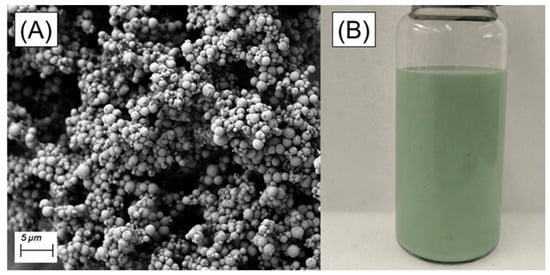
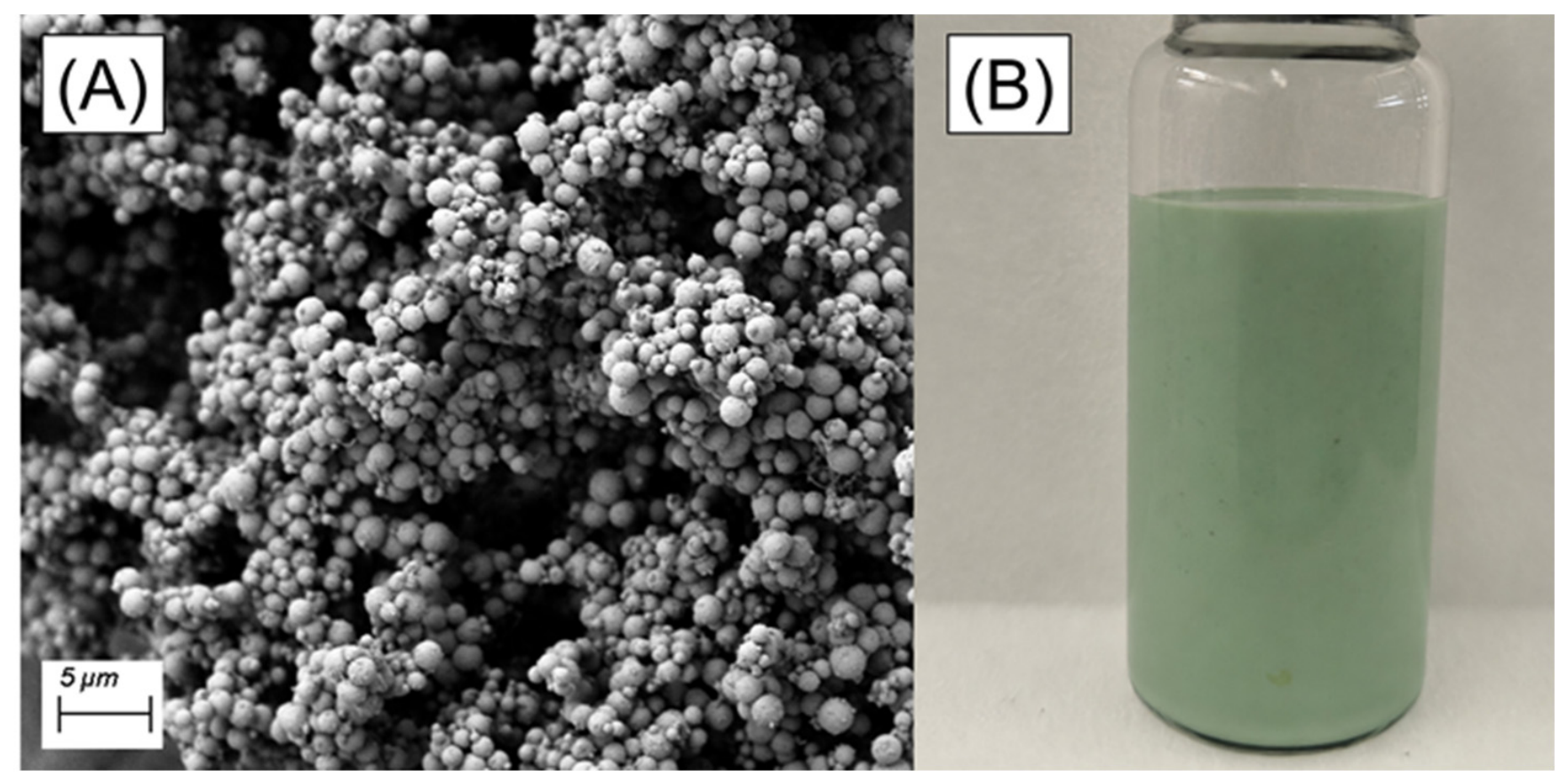
The microstructure of the lycopene-loaded E4 emulsion was analyzed using field-emission scanning electron microscopy (FESEM). Initially, the sample was fixed with glutaraldehyde (4 wt.% in 0.1 M cacodylate buffer) and subsequently post-fixed with osmium tetroxide (1 wt.% in 0.1 M cacodylate buffer). The fixed sample underwent dehydration through ethanol and acetone, followed by drying in a critical-point dryer (Leica EM CPD 300, Wetzlar, Germany) employing an automated slow-speed procedure. The critical-point drying parameters included a cooling temperature of 15 °C, a heating temperature of 40 °C, a slow CO2 influx, a gas-out speed set at 90% slow, and a total processing duration of 2 h and 30 min. The microstructure was then observed using a Carl Zeiss Auriga field-emission scanning electron microscope (Jena, Germany). Additionally, a macroscopic photograph of the corresponding lycopene-loaded emulsion was captured.
2.14. Statistical Analysis
Three independent batches of extraction and emulsion were prepared. Within each batch, analytical triplicates were averaged and not considered as independent experimental replicates. The effects of storage duration (7, 14, 21, and 28 days), temperature (4 and 25 °C), and their interaction on lycopene retention were assessed using a two-way analysis of variance. The day-0 measurement was maintained as the descriptive 100% baseline but was excluded from the factorial ANOVA, as it served as the common pre-storage reference for both temperature conditions.
3. Results and Discussion
3.1. Surface and Interfacial Activity of Whole Spirulina Biomass
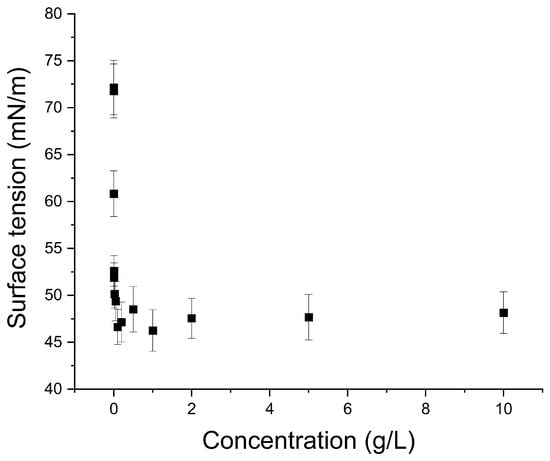
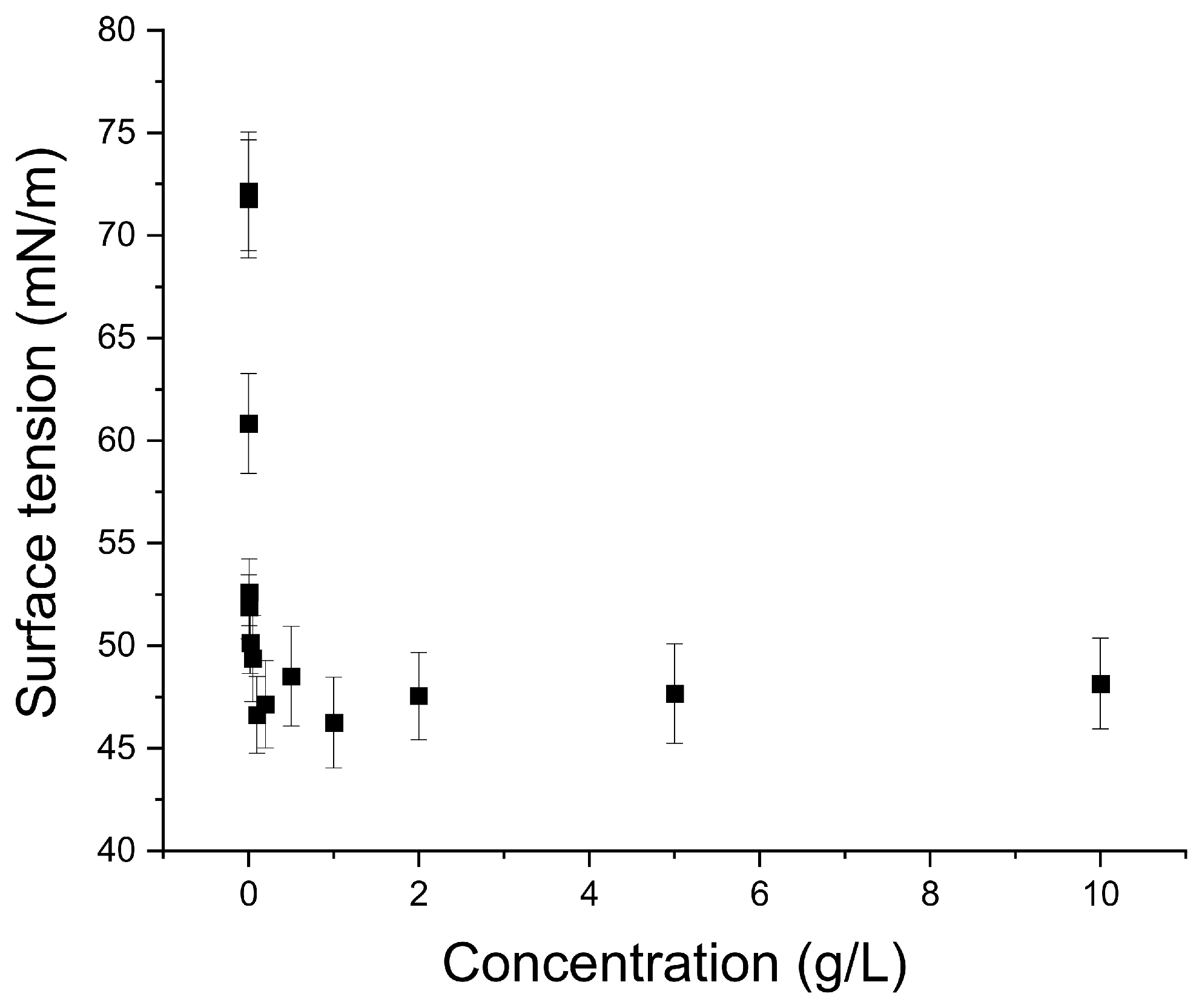
Increasing the concentration of whole Spirulina biomass resulted in a general reduction in the surface tension of the aqueous dispersions, as illustrated in Figure 1. The most significant decrease, approximately 39% compared to Milli-Q water, was observed at a concentration of 1 g L−1. This phenomenon confirms the presence of surface-active constituents capable of reaching and adsorbing at the air–water interface. Proteins and pigment–protein complexes are likely primary contributors due to their ability to reorganize their hydrophilic and hydrophobic regions at fluid interfaces. However, peptides, phospholipids, carbohydrates, and other low-molecular-weight constituents present in the whole biomass may also contribute to the observed response [18,19]. Therefore, the reduction in surface tension cannot be solely attributed to the protein fraction.
Figure 1.
Surface tension of aqueous whole-Spirulina dispersions as a function of biomass concentration. Values are means ± standard deviations of ten measurements.
The response was not strictly monotonic, particularly at intermediate concentrations. Unlike purified protein isolates, whole Spirulina biomass is compositionally heterogeneous, containing both soluble and insoluble fractions. Local variations in surface tension may thus be associated with aggregation, partial sedimentation, or competitive adsorption among proteins, pigments, and other surface-active constituents. Previous studies have demonstrated that protein purification alters the adsorption mechanism and emulsifying efficiency of A. platensis, while protein solubility, molecular conformation, and charge state also affect its interfacial behavior [17,18,19,20]. These findings suggest that the functionality of whole biomass cannot be predicted solely based on its total protein concentration. These measurements were conducted at concentrations up to 1 g L−1, while the emulsions contained approximately 10–30 g L−1 Spirulina. Consequently, the results indicate surface activity under dilute conditions; however, they should not be quantitatively extrapolated to the concentrated emulsions. In these emulsions, factors such as molecular crowding, aggregation, continuous-phase viscosity, and interactions among biomass components may influence adsorption and interfacial coverage.
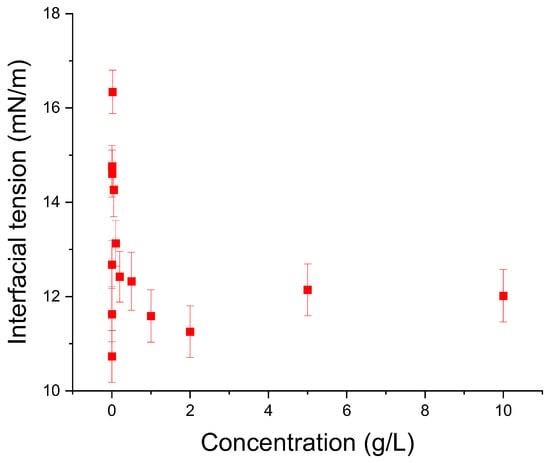
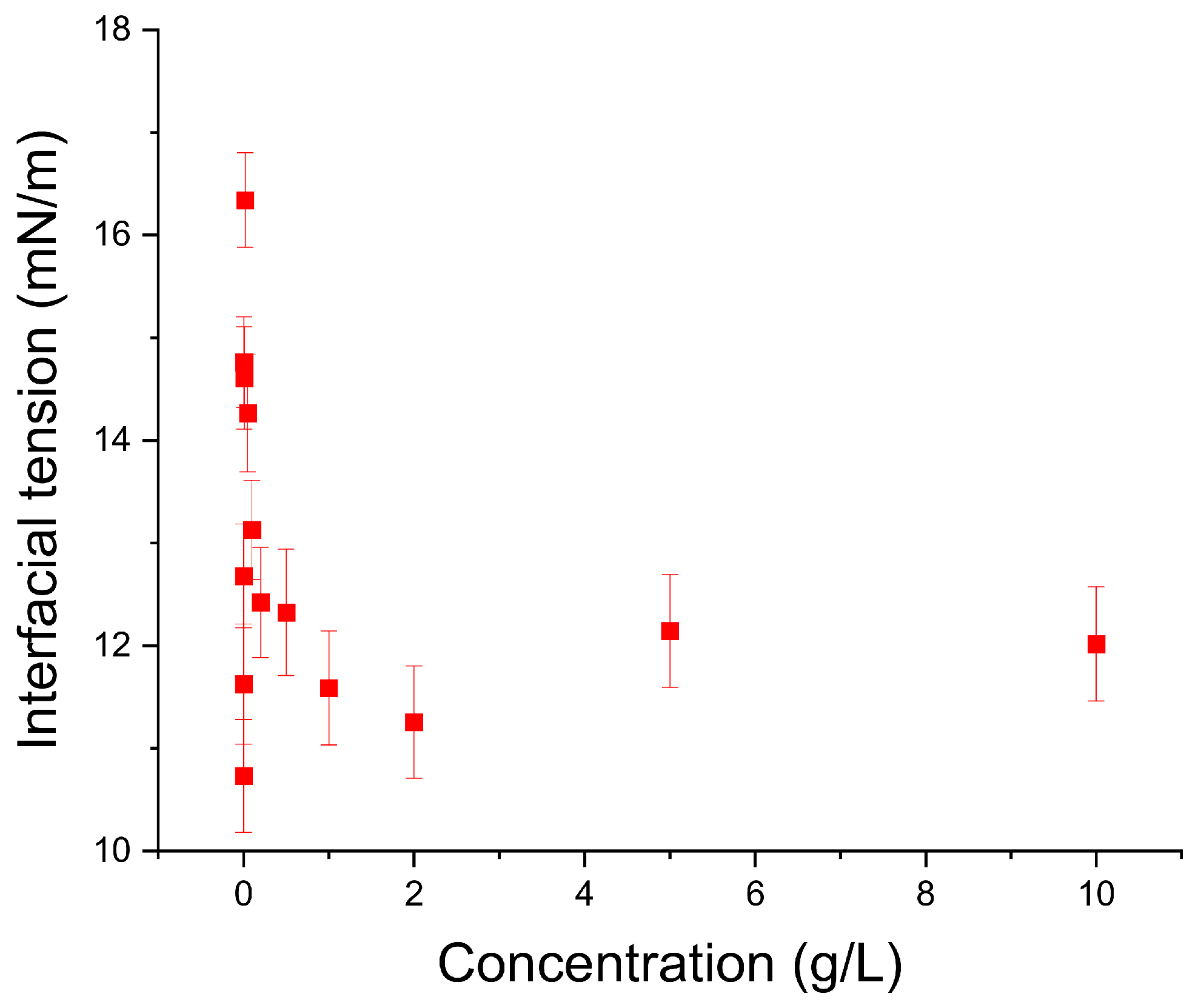
Spirulina also decreased the interfacial tension between pumpkin seed oil and the aqueous phase, achieving a maximum reduction of approximately 24% at 1 g L−1 (Figure 2). The increased variability observed at the oil–water interface may be attributed to both the heterogeneous composition of the biomass and the presence of minor surface-active constituents in pumpkin seed oil [23]. Despite this variability, the overall reduction supports the capacity of Spirulina constituents to interact with the oil–water interface and facilitate droplet formation. However, a reduction in equilibrium interfacial tension alone does not confirm the formation of a mechanically resistant interfacial layer. To determine the strength and viscoelasticity of the resulting film, adsorption kinetics or interfacial rheology would be necessary. Therefore, the subsequent emulsification experiments offer a more direct evaluation of the stabilizing performance of whole Spirulina biomass.
Figure 2.
Interfacial tension between pumpkin seed oil and aqueous whole-Spirulina dispersions as a function of biomass concentration. Values are means ± standard deviations of ten measurements.
Both surface and interfacial tension exhibited a significant initial reduction with increasing Spirulina concentration, followed by stabilization at higher concentrations (Figure 1 and Figure 2). The surface tension decreased from approximately 72 mN m−1 for water to around 47–48 mN m−1, while the interfacial tension against pumpkin seed oil decreased from approximately 16 mN m−1 to about 11–12 mN m−1. Notably, measurements conducted at 2, 5 and 10 g L−1 remained within the experimental variability of those obtained at approximately 1 g L−1. Consequently, increasing the Spirulina concentration to the lowest level used in the emulsions did not lead to a significant further decrease in equilibrium surface or interfacial tension. This stabilization indicates that the concentration of surface-active components at approximately 1 g L−1 was already adequate to approach interfacial saturation under the experimental conditions. Therefore, the enhanced emulsion stability at higher Spirulina concentrations cannot be solely attributed to a further reduction in equilibrium interfacial tension. Instead, additional biomass may affect adsorption kinetics, interfacial-film structure, particle-mediated stabilization, or the properties of the continuous phase, although these mechanisms were not independently assessed in the current study.
3.2. Optimization of the Unloaded Submicron Emulsions
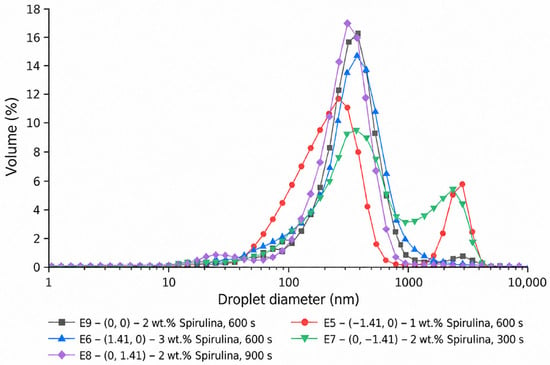
The integration of rotor–stator homogenization and probe ultrasonication yielded emulsions with Z-average diameters ranging from 448 to 625 nm and PdI values between 0.315 and 0.495, as detailed in Table 2. These findings suggest the formation of predominantly submicrometric systems. Nevertheless, the relatively high PdI values and the volume-based distributions depicted in Figure 3 indicate broad and, in some instances, multimodal droplet populations. Consequently, the term “submicron emulsions” is deemed more appropriate than “nanoemulsions” for describing the entire set of formulations.
Table 2.
Experimental droplet size and polydispersity of the unloaded emulsions.
Figure 3.
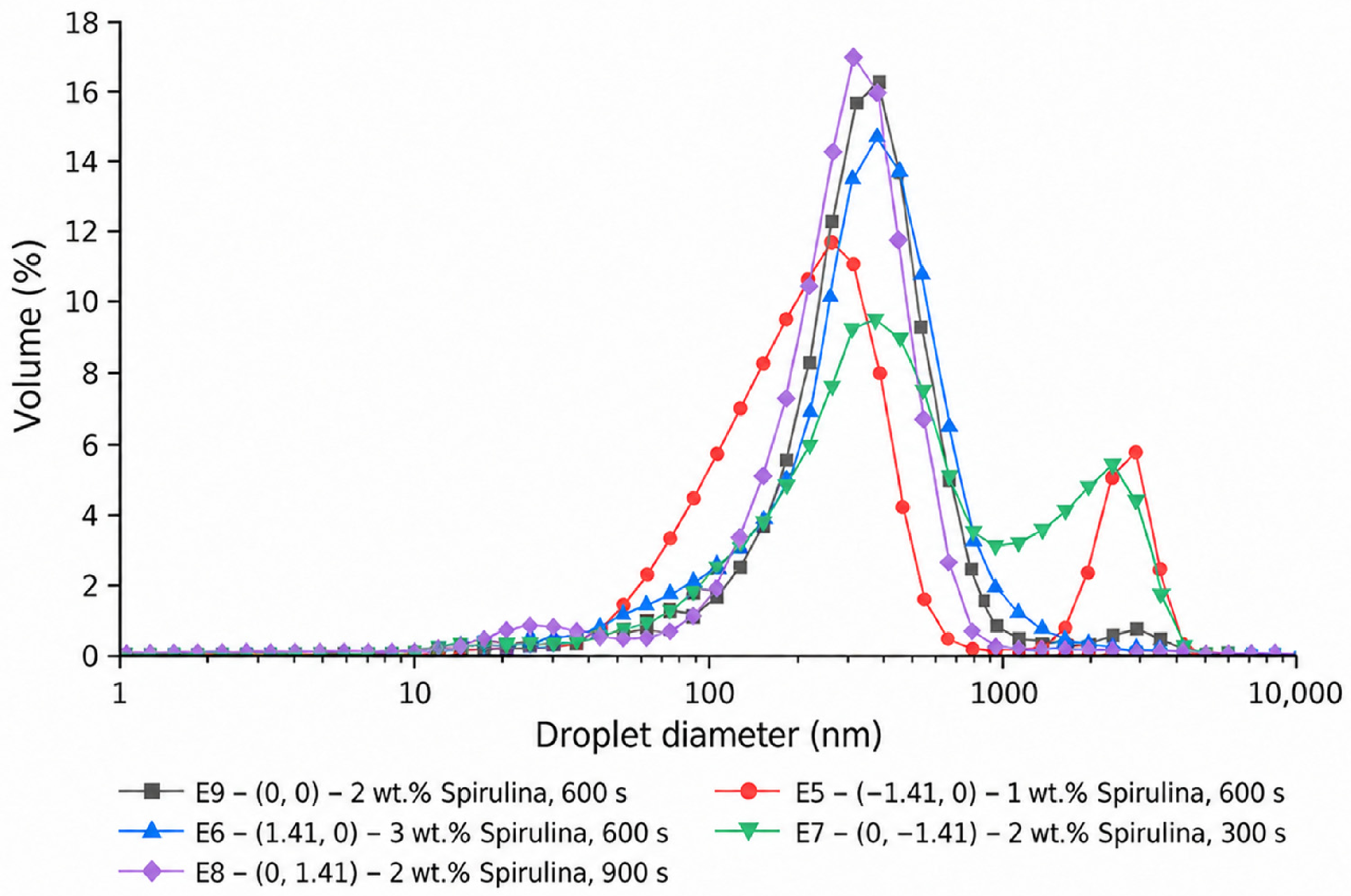
Volume-based droplet-size distributions for selected formulations in the central composite design. Legend entries report sample code, coded factor levels, Spirulina concentration (wt.%), and sonication time, respectively.
With a constant Spirulina concentration of 2 wt.%, extending the sonication time from 300 to 900 s resulted in a reduction in the Z-average diameter from 625 to 448 nm. The majority of this reduction occurred between 300 and 600 s, with only a marginal improvement observed at longer treatment durations. This diminishing response aligns with the progressively greater energy required to disrupt smaller droplets and the competition between the generation of new interfacial area and the adsorption of available stabilizing material. If the newly generated interface is not rapidly covered, recoalescence may restrict further reduction in droplet size [26,27].
The significance of jointly considering processing conditions and formulation variables has been established for emulsions produced using various high-energy homogenization technologies. For instance, Santos et al. [28] demonstrated that both microfluidization conditions and surfactant composition affect droplet size, polydispersity, rheology, and physical stability in mandarin essential oil emulsions. Although microfluidization and probe ultrasonication employ distinct disruption mechanisms, both studies indicate that increasing processing intensity does not uniformly enhance all emulsion attributes. Additionally, ultrasound may alter the aggregation state or expose hydrophobic regions of Spirulina proteins, as observed in isolated Spirulina protein [21]. However, protein conformation was not assessed in the current study; thus, this mechanism should be regarded as a plausible explanation rather than a confirmed effect.
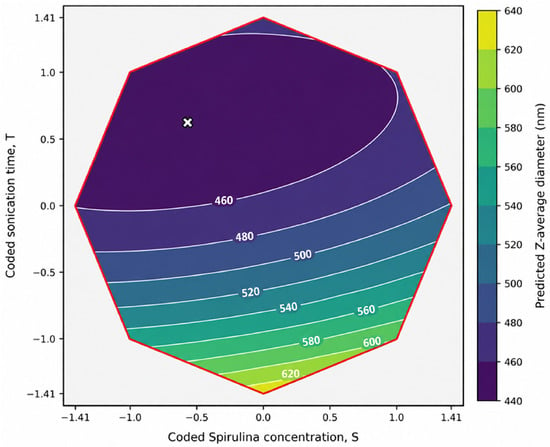
The quadratic model obtained for the Z-average diameter, expressed in terms of coded Spirulina concentration (S) and sonication time (T), was:
D (nm) = 465.3 + 14.9 · S − 59.1 · T − 10.0 · S · T + 7.6 · S2 + 42.7 · T2
The statistical analysis revealed that the model was significant (p = 0.0088), accounting for 95.4% of the variability observed (R2 = 0.954; adjusted R2 = 0.897). Among the factors examined, sonication time was the only one with a significant impact on droplet diameter (p = 0.0024). Both its linear (p = 0.0015) and quadratic (p = 0.0136) effects were noteworthy. The negative linear coefficient, coupled with a positive quadratic coefficient, suggests that an increase in sonication time initially led to a notable decrease in droplet size, with the effect diminishing at longer durations, as depicted in Figure 4.
Figure 4.
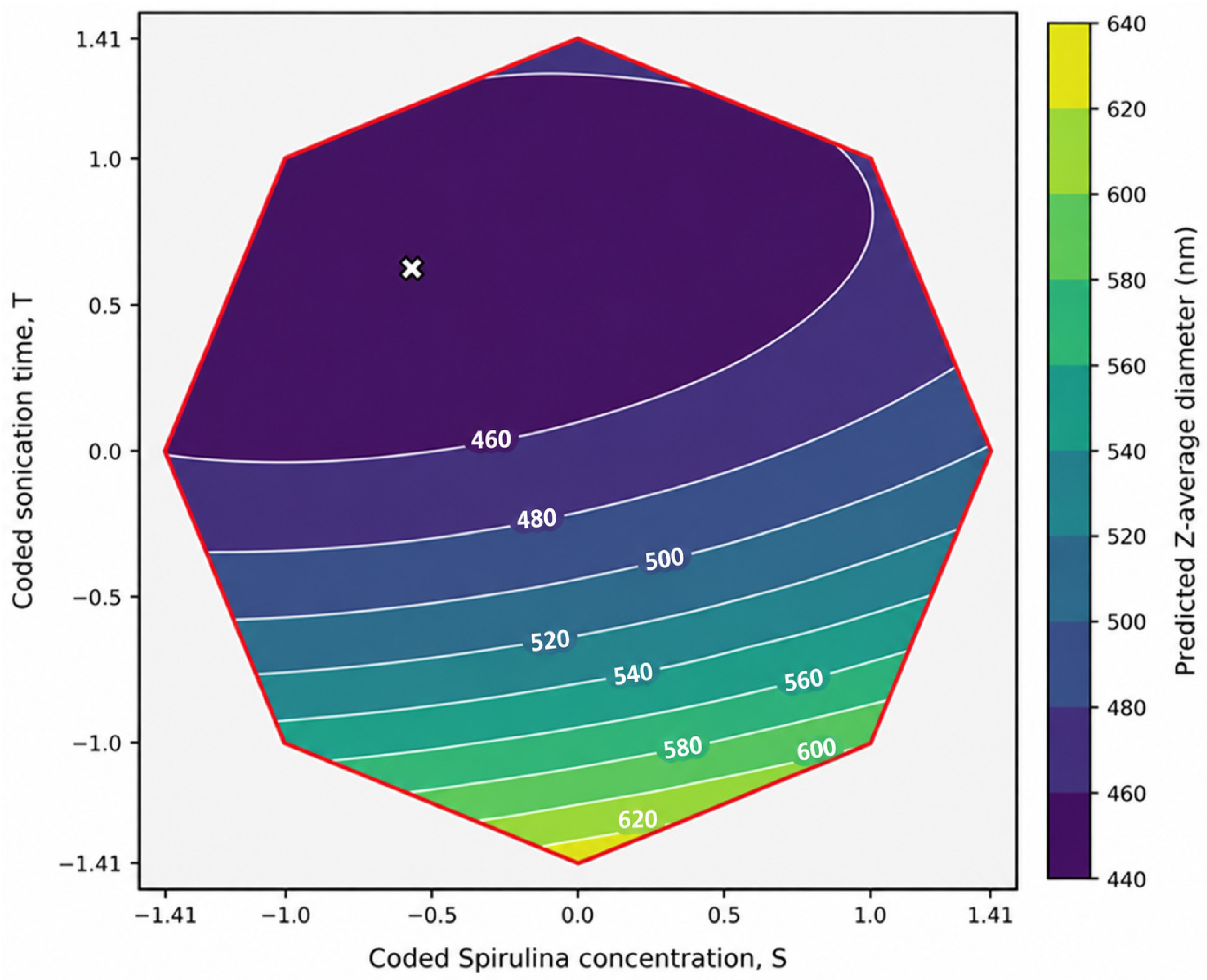
Contour plot of the predicted Z-average diameter, D (nm), as a function of coded Spirulina concentration (S) and sonication time (T). The red polygon denotes the experimental design region. The white cross indicates the predicted minimum Z-average diameter.
On the other hand, the concentration of Spirulina did not significantly influence the Z-average diameter within the tested range (p = 0.2331). Its linear (p = 0.1240) and quadratic (p = 0.5142) contributions, as well as its interaction with sonication time (p = 0.4074), were not statistically significant. This outcome does not imply that Spirulina concentration is unimportant for emulsion formation outside the studied range. Instead, it indicates that within the 1 to 3 wt.% range, the availability of surface-active material was not the main factor affecting the mean droplet diameter under the given homogenization conditions.
The PdI response was described by the following quadratic equation:
PdI = 0.423 − 0.034 · S − 0.043 · T − 0.037 · S · T − 0.020 · S2 + 0.014 · T2
The overall model demonstrated significance (p = 0.0060), with R2 = 0.962 and an adjusted R2 = 0.915. Spirulina concentration (p = 0.0119), sonication time (p = 0.0062), and their interaction (p = 0.0152) had significant overall effects. The linear contributions of Spirulina concentration (p = 0.0064) and sonication time (p = 0.0027) were significant, whereas their quadratic contributions were not significant (p = 0.0784 and p = 0.1788, respectively). However, the significant lack of fit (p = 0.0329) suggests that the quadratic equation did not account for all systematic variability in PdI. Consequently, the negative interaction coefficient should be interpreted as a local descriptive tendency rather than a robust predictive relationship. Within this limitation, the lower PdI values observed when relatively high Spirulina concentrations were combined with longer sonication times are consistent with simultaneous droplet fragmentation and suppression of immediate recoalescence. Nonetheless, direct evidence of interfacial coverage or adsorption kinetics was not obtained.
Although E8 exhibited the smallest experimental Z-average diameter (448 nm), formulation E4 demonstrated the lowest measured PdI (0.315) while maintaining a submicrometric diameter of 484 nm. Consequently, E4 was selected for the incorporation of the lycopene-rich extract. This selection underscores the importance of not using droplet diameter as the sole optimization criterion. Previous response-surface studies have similarly indicated that the processing condition yielding the smallest droplets does not necessarily result in the narrowest size distribution or the best physical stability [28]. Given the significant lack of fit of the PdI model, E4 should be described as the best-performing tested formulation according to the selected experimental criteria, rather than as a mathematically established global optimum.
3.3. Ultrasound-Assisted Recovery, Analytical Performance Assessment, and Characterization of the Lycopene-Rich Extract
The UV-Vis spectrum of the tomato by-product extract in n-hexane showed maxima at 445, 472, and 502 nm, consistent with a lycopene-rich carotenoid fraction [3,6]. The signal at 502 nm was selected for routine quantification because it offered the most suitable compromise between lycopene sensitivity and overlap with other carotenoids. The calibration curve was linear over 0.5–5.0 µg mL−1 and followed A = 0.312 C − 0.002, with R2 = 0.998. Using 3.3 σ/S and 10 σ/S, the detection and quantification limits were 0.08 and 0.24 µg mL−1, respectively. Repeatability was 2.8% (coefficient of variation; n = 6), and recovery from spiked emulsion samples was 96.2 ± 3.1%. These results support use of the method for comparative retention monitoring in the studied matrix, but spectral agreement alone does not establish chromatographic identity or isomer composition.
Application of the selected ultrasound conditions produced an apparent lycopene yield of 1.05 ± 0.08 mg lycopene equivalents g−1 dry by-product. The coefficient of variation among the three independent extraction batches was 7.6%, indicating acceptable between-batch reproducibility under the selected conditions. The final extraction temperature was 65.2 ± 1.8 °C, and the specific energy input was 233.3 ± 12.5 J mL−1. The main extraction and analytical results are summarized in Table 3.
Table 3.
Process parameters and analytical performance of the ultrasound-assisted lycopene extraction and UV-Vis method.
The observed yield is approximately 1050 mg of lycopene equivalents per kg of dry by-product, which is numerically comparable to the range of 1018–1120 mg per kg reported by Kuvendziev et al. [7] for enzymatically treated tomato skins. However, this numerical similarity should not be construed as indicative of equivalent extraction efficiency. Lycopene recovery is significantly influenced by factors such as the composition of the tomato residue, drying history, particle size, solvent, liquid-to-solid ratio, temperature, ultrasound device, probe geometry, amplitude, duty cycle, and analytical procedure. Kumar et al. [29] also employed probe ultrasonication to extract lycopene from industrial tomato peel prior to incorporating the extract into an enriched beverage. Their findings indicated that extraction was influenced by treatment time, ultrasound intensity, and liquid-to-solid ratio. Nonetheless, their use of an ethanol–ethyl acetate solvent mixture, pulsed regime, temperature, and analytical expression of the yield differed markedly from those employed in this study. Therefore, comparisons among ultrasound-assisted extraction studies should emphasize general process trends rather than isolated yield values. The 5 s ON/5 s OFF regime utilized in the present study interrupted the delivery of acoustic energy, potentially aiding in temperature control during the relatively prolonged treatment. However, the extraction temperature was primarily regulated by the thermostatic circulating bath and should not be solely attributed to the pulsed operation. Ultrasound can enhance solvent penetration, cellular disruption, and mass transfer, yet the current experimental design did not include a non-sonicated control. Consequently, the measured yield characterizes the selected ultrasound-assisted procedure but does not quantify its improvement over conventional extraction methods. As UV–Vis spectrophotometry does not chromatographically separate individual carotenoids, results should be reported as apparent lycopene content or lycopene equivalents. Co-extracted carotenoids that absorb in the same spectral region may contribute to the analytical signal, and cis–trans isomerization cannot be distinguished from degradation based solely on absorbance at 502 nm. Matrix-matched recovery and blank correction mitigate systematic analytical bias, rendering the method suitable for internally consistent retention measurements. However, HPLC analysis would be necessary to confirm carotenoid identity, quantify individual lycopene isomers, and differentiate isomerization from oxidative loss.
3.4. Effect of Lycopene-Rich Extract Incorporation on Droplet Size and Physical Stability
The lycopene-loaded emulsion was prepared at a nominal concentration of 10.0 mg kg−1, and the concentration measured immediately after preparation was 9.62 ± 0.35 mg kg−1. The freshly prepared blank emulsion had a Z-average diameter of 484 ± 12 nm and a PdI of 0.315 ± 0.015, whereas the corresponding lycopene-loaded emulsion showed values of 491 ± 15 nm and 0.322 ± 0.018, respectively (Table 4). No statistically significant differences were detected between the two systems for either diameter or PdI (p > 0.05). Thus, incorporation of the lycopene-rich extract into the oil phase did not measurably modify the initial droplet-size characteristics of the selected Spirulina-stabilized emulsion.
Table 4.
Droplet-size characteristics, zeta potential and physical-stability index of blank and lycopene-loaded emulsions.
The lack of significant change may be attributed to the minimal quantity of extract incorporated relative to the total oil phase and the capacity of the existing Spirulina-containing interface to accommodate this compositional modification. However, this explanation remains speculative, as neither interfacial composition nor adsorption was measured. Co-extracted tomato constituents may reside in the lipid core, at the interface, or in both regions. Consequently, an unchanged Z-average diameter does not necessarily indicate that the molecular composition or properties of the interfacial layer remained constant.
The blank E4 emulsion demonstrated a negative zeta potential of −34.9 ± 1.1 mV, while the lycopene-loaded emulsion exhibited a comparable value of −35.5 ± 0.5 mV. Thus, the incorporation of lycopene did not significantly alter the electrical properties of the dispersed phase. This finding aligns with the predominantly lipophilic and electrically neutral characteristics of lycopene, which is anticipated to remain primarily within the oil droplets, thereby not substantially affecting the composition or charge of the oil–water interface. The negative magnitude of approximately 35 mV indicates that electrostatic repulsion contributes to limiting droplet aggregation. However, stabilization should not be solely attributed to electrostatic effects. Proteins, polysaccharides, and suspended particles derived from whole Spirulina biomass may form a hydrated interfacial layer, providing an additional steric contribution. Therefore, the physical stability of these emulsions is more accurately interpreted as a result of combined electrostatic and steric mechanisms. Given that electrophoretic measurements may detect both emulsion droplets and suspended biomass particles, the values should be regarded as representative of the apparent electrokinetic potential of the dispersed phase.
Figure 5 illustrates both the microscopic and macroscopic characteristics of the lycopene-loaded E4 emulsion. The FESEM image reveals numerous rounded structures, many of which possess dimensions within the submicrometric range, organized into compact clusters. This morphology qualitatively aligns with the formation of a finely dispersed system, as indicated by dynamic light scattering measurements. However, a direct quantitative comparison between FESEM and hydrodynamic diameter is inadvisable due to the chemical fixation, dehydration, critical-point drying, and vacuum observation required by FESEM. These preparation steps may alter droplet dimensions and spacing, potentially inducing aggregation artefacts. Therefore, the clustered regions observed in Figure 5A should not be interpreted as direct evidence of flocculation or coalescence in the original hydrated emulsion. At the macroscopic level, the formulation exhibits a homogeneous pale-green appearance, primarily attributed to the whole-Spirulina biomass, with no visible bulk phase separation in the photographed sample (Figure 5B).
Figure 5.
Microscopic and macroscopic appearance of the lycopene-loaded E4 emulsion: (A) FESEM micrograph obtained after chemical fixation, solvent dehydration, and critical-point drying (scale bar: 5 μm); (B) macroscopic appearance of the corresponding emulsion.
Multiple-light-scattering measurements provided complementary information regarding the macroscopic physical stability of the systems without necessitating dilution. This technique detects spatial and temporal variations in transmitted and backscattered light associated with particle migration or changes in effective droplet size [30]. Both blank and lycopene-loaded emulsions exhibited similar backscattering and transmission profiles over a 30-day monitoring period. The changes observed near the upper region of the cells were consistent with limited creaming and were similar for both systems, while no pronounced systematic variation was detected in the middle region of the samples. The final TSI values were 2.45 ± 0.18 for the blank emulsion and 2.58 ± 0.21 for the lycopene-loaded emulsion, with no statistically significant difference between them (p > 0.05). These results suggest that the incorporation of the lycopene-rich extract did not increase the overall destabilization detected by multiple light scattering during the study period. Nevertheless, TSI is a global index that combines changes occurring throughout the measuring cell and should be interpreted alongside the individual backscattering and transmission profiles. Different destabilization mechanisms may contribute differently to the same TSI value [30]. Moreover, droplet size was only determined immediately after preparation. Therefore, the results demonstrate comparable macroscopic stability between blank and loaded emulsions but cannot entirely exclude subtle aggregation, flocculation, or coalescence during storage. Repeating the droplet-size measurements after storage would be necessary to confirm the absence of microstructural changes.
From a formulation perspective, the results indicate that the selected amount of lycopene-rich extract could be incorporated without altering Spirulina concentration or homogenization conditions. This provides evidence of physical compatibility at the tested loading level. However, it should not be interpreted as proof of encapsulation efficiency, permanent droplet-size stability, or the formation of a protective molecular barrier around lycopene.
3.5. Lycopene Retention at Two Storage Temperatures
Lycopene retention was monitored for 28 days at 4 and 25 °C, taking the concentration measured in freshly prepared emulsions as 100% (Table 5). The analytical range remained sufficient throughout the storage period. At the lowest observed retention, which was 49.6% after 28 days at 25 °C, the extraction of 1 g of emulsion followed by reconstitution in 2.0 mL of n-hexane yielded an estimated analytical concentration of approximately 2.38 µg mL−1. This concentration exceeded the limit of quantification (LOQ) of 0.24 µg mL−1 and fell within the validated calibration range of 0.5–5.0 µg mL−1. Therefore, extrapolation beyond the validated analytical range was unnecessary for the final retention value. A two-way ANOVA conducted on the results from days 7 to 28 revealed significant effects of both storage time and temperature on lycopene retention (p < 0.001 for both factors). Additionally, a significant interaction between time and temperature was observed (F(3,16) = 7.50, p = 0.0024). This interaction suggests that the impact of temperature varied over the storage period. The difference in retention between the two temperatures increased from 12.9 percentage points after 7 days to 28.8 percentage points after 28 days. Consequently, refrigeration became increasingly beneficial as the storage duration extended.
Table 5.
Lycopene retention in the Spirulina-stabilized emulsion during storage at 4 and 25 °C.
The higher apparent retention observed at 4 °C is consistent with the known temperature sensitivity of lycopene. Jain et al. [31] reported that the lycopene degradation rate increased with storage temperature in all the evaluated delivery systems and followed the order solution > emulsion > alginate beads. Murakami et al. [32] also observed an increase in lycopene degradation rate with increasing temperature during storage at 4, 25, and 40 °C. Nevertheless, their experiments were conducted using a purified mixture of lycopene isomers in an organic medium, and direct quantitative comparison with the present food-grade emulsion should therefore be avoided. More generally, storage-related carotenoid losses have also been reported in model beverages and emulsion-based delivery systems [9,12,13,33].
The observed decrease in apparent lycopene content may be attributed to both geometrical isomerization and irreversible oxidative degradation. Heat and light can facilitate the isomerization from all-E- to Z-forms, altering the UV–Vis absorption profile and potentially reducing absorbance at 502 nm without necessitating complete molecular decomposition. In contrast, exposure to oxygen, reactive oxygen species, and lipid-derived radicals can initiate oxidation of the conjugated polyene chain. This oxidation process may involve epoxidation followed by oxidative cleavage, resulting in the formation of lycopene epoxides, cyclolycopene derivatives, apo-lycopenals, and other lower-molecular-weight carbonyl compounds [34]. Although lipid oxidation was not measured in the present study, the oxidation of highly unsaturated linseed and pumpkin seed oils may also generate radicals capable of promoting carotenoid co-oxidation. Several apo-lycopenals, such as apo-6′-, apo-8′-, apo-10′-, apo-12′-, and apo-14′-lycopenal, have been identified in tomato-derived foods and human plasma [35]. Thus, their formation does not inherently indicate a toxicological risk. However, toxicological data on individual degradation products remain limited. Some oxidized lycopene fractions have demonstrated cytotoxic and apoptosis-inducing activity in cancer cell lines at micromolar concentrations [36], but these in vitro effects cannot be directly extrapolated to dietary toxicity or to the significantly lower concentrations anticipated in the present emulsions. As the degradation products were neither identified nor quantified in this study, no conclusions regarding their formation or safety can be drawn solely from the reduction in absorbance.
4. Conclusions
Ultrasound-assisted extraction allowed for the recovery of 1.05 ± 0.08 mg of apparent lycopene equivalents per gram of dry tomato by-product. This extract was then successfully added to an oil-in-water submicron emulsion containing pumpkin seed and linseed oils, stabilized with whole Spirulina biomass. Among the tested formulations, the emulsion made with 2.71 wt.% Spirulina and 813 s of sonication was chosen because it had a small droplet size (484 ± 12 nm) and the lowest polydispersity index (0.315 ± 0.015).
Adding lycopene did not significantly change the initial droplet size, polydispersity index, or physical stability of the emulsion (p > 0.05). Therefore, the lycopene-rich extract was physically compatible with the chosen formulation at the studied concentration. However, storage temperature greatly affected lycopene retention. After 28 days, emulsions kept at 4 °C retained 78.4 ± 3.2% of their initial lycopene content, while those at 25 °C retained only 49.6 ± 4.1%. Both storage time and temperature had significant effects, and their interaction was also significant (p = 0.0024), showing that temperature’s impact increased over time.
These results show that it is possible to combine ultrasound-assisted lycopene recovery from tomato by-products with its incorporation into whole-Spirulina-stabilized submicron emulsions. Refrigerated storage is necessary to maintain lycopene retention, and physical stability alone does not guarantee chemical stability. Since the study did not include a non-emulsified lycopene control, no specific protective effect can be linked to the emulsion structure. Future research should compare emulsified and non-emulsified systems and use chromatographic analysis to separate lycopene degradation from isomerization and any interference from co-extracted compounds.
Author Contributions
Conceptualization, N.E.-G. and L.A.T.-C.; methodology, J.S.; software, R.M.S.-G. and M.V.-A.; validation, N.E.-G., R.M.S.-G., M.V.-A., L.A.T.-C. and J.S.; formal analysis, N.E.-G. and J.S.; investigation, N.E.-G. and R.M.S.-G.; resources, L.A.T.-C. and J.S.; data curation, N.E.-G. and M.V.-A.; writing—original draft preparation, N.E.-G. and L.A.T.-C.; writing—review and editing, L.A.T.-C. and J.S.; visualization, R.M.S.-G. and M.V.-A.; supervision, L.A.T.-C. and J.S.; project administration, L.A.T.-C. and J.S.; funding acquisition, J.S. All authors have read and agreed to the published version of the manuscript.
Funding
This research was funded by the Government of Spain through Ministerio de Universidades (Programa Ramón y Cajal).
Institutional Review Board Statement
Not applicable.
Informed Consent Statement
Not applicable.
Data Availability Statement
The original data presented in the study are openly available in Zenodo at https://doi.org/10.5281/zenodo.22798158.
Acknowledgments
During the preparation of this manuscript, the authors used ChatGPT (OpenAI, GPT-5; accessed 9 October 2026) to assist with English-language editing, grammatical correction, and bibliographic organization. All scientific content, interpretations, and references were subsequently reviewed and verified by the authors, who take full responsibility for the final content of the manuscript.
Conflicts of Interest
The authors declare no conflicts of interest.
References
- Trujillo-Cayado, L.A.; Sánchez-García, R.M.; García-Domínguez, I.; Rodríguez-Luna, A.; Hurtado-Fernández, E.; Santos, J. Emerging Trends in Sustainable Biological Resources and Bioeconomy for Food Production. Appl. Sci. 2025, 15, 6555. [Google Scholar] [CrossRef] [Scilit]
- Granato, D.; Barba, F.J.; Bursac Kovacevic, D.; Lorenzo, J.M.; Cruz, A.G.; Putnik, P. Functional Foods: Product Development, Technological Trends, Efficacy Testing, and Safety. Annu. Rev. Food Sci. Technol. 2020, 11, 93–118. [Google Scholar] [CrossRef] [Scilit] [PubMed]
- Madia, V.N.; De Vita, D.; Ialongo, D.; Tudino, V.; De Leo, A.; Scipione, L.; Di Santo, R.; Costi, R.; Messore, A. Recent Advances in Recovery of Lycopene from Tomato Waste: A Potent Antioxidant with Endless Benefits. Molecules 2021, 26, 4495. [Google Scholar] [CrossRef] [Scilit] [PubMed]
- Deng, Y.; Zhao, S.; Yang, X.; Hou, F.; Fan, L.; Wang, W.; Xu, E.; Cheng, H.; Guo, M.; Liu, D. Evaluation of Extraction Technologies of Lycopene: Hindrance of Extraction, Effects on Isomerization and Comparative Analysis—A Review. Trends Food Sci. Technol. 2021, 115, 285–296. [Google Scholar] [CrossRef] [Scilit]
- Li, J.; Pettinato, M.; Casazza, A.A.; Perego, P. A Comprehensive Optimization of Ultrasound-Assisted Extraction for Lycopene Recovery from Tomato Waste and Encapsulation by Spray Drying. Processes 2022, 10, 308. [Google Scholar] [CrossRef] [Scilit]
- Mozafari, L.; Cano-Lamadrid, M.; Martínez-Zamora, L.; Bueso, M.C.; Kessler, M.; Artés-Hernández, F. Pulsed Ultrasound-Assisted Extraction of Lycopene and β-Carotene from Industrial Grated Tomato By-Products. LWT 2024, 204, 116462. [Google Scholar] [CrossRef] [Scilit]
- Kuvendziev, S.; Lisichkov, K.; Marinkovski, M.; Stojchevski, M.; Dimitrovski, D.; Andonovikj, V. Valorization of Tomato Processing By-Products: Predictive Modeling and Optimization for Ultrasound-Assisted Lycopene Extraction. Ultrason. Sonochem. 2024, 110, 107055. [Google Scholar] [CrossRef] [Scilit] [PubMed]
- McClements, D.J.; Decker, E.A.; Weiss, J. Emulsion-Based Delivery Systems for Lipophilic Bioactive Components. J. Food Sci. 2007, 72, R109–R124. [Google Scholar] [CrossRef] [Scilit] [PubMed]
- Li, J.; Campardelli, R.; Firpo, G.; Zhang, J.; Perego, P. Oil-in-Water Nanoemulsions Loaded with Lycopene Extracts Encapsulated by Spray Drying: Formulation, Characterization and Optimization. Chin. J. Chem. Eng. 2024, 70, 73–81. [Google Scholar] [CrossRef] [Scilit]
- Álvarez-García, S.; Couarraze, L.; Matos, M.; Gutiérrez, G. Lycopene-Loaded Emulsions: Chitosan versus Non-Ionic Surfactants as Stabilizers. Molecules 2024, 29, 5209. [Google Scholar] [CrossRef] [Scilit] [PubMed]
- Wang, D.; Zhang, J.; Zhong, L.; Yang, C.; Zhang, X.; Hu, Q.; Zhang, L. Characterization and Stability of Lycopene-Loaded High Internal Phase Emulsion Stabilized by Ovalbumin–Chitosan Complexes. Food Chem. X 2024, 23, 101689. [Google Scholar] [CrossRef] [Scilit] [PubMed]
- Kim, J.; Choi, S.J. Improving the Stability of Lycopene from Chemical Degradation in Model Beverage Emulsions: Impact of Hydrophilic Group Size of Emulsifier and Antioxidant Polarity. Foods 2020, 9, 971. [Google Scholar] [CrossRef] [Scilit] [PubMed]
- Katsouli, M.; Thanou, I.V.; Raftopoulou, E.; Ntzimani, A.; Taoukis, P.; Giannakourou, M.C. Bioaccessibility and Stability Studies on Encapsulated Phenolics and Carotenoids from Olive and Tomato Pomace: Development of a Functional Fruit Beverage. Appl. Sci. 2024, 14, 10495. [Google Scholar] [CrossRef] [Scilit]
- Ghasemi Baghabrishami, R.; Goli, S.A.H. Tomato Seed Oil-Enriched Tomato Juice: Effect of Oil Addition Type and Heat Treatment on Lycopene Bioaccessibility and Oxidative Stability. Food Chem. 2023, 402, 134217. [Google Scholar] [CrossRef] [Scilit] [PubMed]
- Singh, M.; Mal, N.; Trivedi, D.; Krishnamoorthy, S.; Behera, C.; Krishnan, C.; Naik, S.; Kuppam, C. An Overview of the Role of Algae-Fortified Foods in Nutraceutical Industries: Synthesis Pathway of Value-Added Bioproducts and Co-Products. Food Biosci. 2025, 63, 105568. [Google Scholar] [CrossRef] [Scilit]
- Barka, A.; Ben Amira, A.; Francis, F.; Blecker, C. Physicochemical Characterization of Colored Soluble Protein Fractions Extracted from Spirulina (Spirulina platensis). Food Sci. Technol. Int. 2018, 24, 651–663. [Google Scholar] [CrossRef] [Scilit] [PubMed]
- Böcker, L.; Bertsch, P.; Wenner, D.; Teixeira, S.; Bergfreund, J.; Eder, S.; Fischer, P.; Mathys, A. Effect of Arthrospira platensis Microalgae Protein Purification on Emulsification Mechanism and Efficiency. J. Colloid Interface Sci. 2021, 584, 344–353. [Google Scholar] [CrossRef] [Scilit] [PubMed]
- Bertsch, P.; Böcker, L.; Palm, A.-S.; Bergfreund, J.; Fischer, P.; Mathys, A. Arthrospira platensis Protein Isolate for Stabilization of Fluid Interfaces: Effect of Physicochemical Conditions and Comparison to Animal-Based Proteins. Food Hydrocoll. 2023, 136, 108290. [Google Scholar] [CrossRef] [Scilit]
- Silva, S.C.; Almeida, T.; Colucci, G.; Santamaria-Echart, A.; Manrique, Y.A.; Dias, M.M.; Barros, L.; Fernandes, A.; Colla, E.; Barreiro, M.F. Spirulina (Arthrospira platensis) Protein-Rich Extract as a Natural Emulsifier for Oil-in-Water Emulsions: Optimization through a Sequential Experimental Design Strategy. Colloids Surf. A Physicochem. Eng. Asp. 2022, 648, 129264. [Google Scholar] [CrossRef] [Scilit]
- Guo, X.; Wang, Q.; Yang, Q.; Gong, Z.; Wu, Y.; Liu, X. Effects of Molecular Structure and Charge State on the Foaming and Emulsifying Properties of Spirulina Protein Isolates. Food Res. Int. 2024, 187, 114407. [Google Scholar] [CrossRef] [Scilit] [PubMed]
- Liu, Q.; Chen, T.; Chen, L.; Zhao, R.; Ye, X.; Wang, X.; Wu, D.; Hu, J. High Internal Phase Emulsions Stabilized with Ultrasound-Modified Spirulina Protein for Curcumin Delivery. Foods 2024, 13, 1324. [Google Scholar] [CrossRef] [Scilit] [PubMed]
- Mou, K.; Liu, M.; Sun, Y.; Bai, L.; Wang, H.; Kontogiorgos, V.; Tan, M. One-Step Ball Milling of Whole Spirulina Biomass to Produce Emulsion Gels for 3D Printing and Sesamol Delivery. Food Hydrocoll. 2026, 179, 112730. [Google Scholar] [CrossRef] [Scilit]
- Dragosavac, M.M.; Sovilj, M.N.; Kosvintsev, S.; Holdich, R.G.; Vladisavljevic, G.T. Controlled Production of Oil-in-Water Emulsions Containing Unrefined Pumpkin Seed Oil Using Stirred Cell Membrane Emulsification. J. Membr. Sci. 2008, 322, 178–188. [Google Scholar] [CrossRef] [Scilit]
- International Council for Harmonisation of Technical Requirements for Pharmaceuticals for Human Use. ICH Harmonised Guideline Q2(R2): Validation of Analytical Procedures; ICH: Geneva, Switzerland, 2023. [Google Scholar]
- Yussof, N.S.; Tan, C.P.; Tan, T.B.; Utra, U.; Ramli, M.E. Influence of Soy Lecithin and Sodium Caseinate on the Stability and In Vitro Bioaccessibility of Lycopene Nanodispersion. Food Technol. Biotechnol. 2023, 61, 39–50. [Google Scholar] [CrossRef] [Scilit] [PubMed]
- Piorkowski, D.T.; McClements, D.J. Beverage Emulsions: Recent Developments in Formulation, Production, and Applications. Food Hydrocoll. 2014, 42, 5–41. [Google Scholar] [CrossRef] [Scilit]
- Jafari, S.M.; Assadpoor, E.; He, Y.; Bhandari, B. Re-coalescence of emulsion droplets during high-energy emulsification. Food Hydrocoll. 2008, 22, 1191–1202. [Google Scholar] [CrossRef] [Scilit]
- Santos, J.; Calero, N.; Trujillo-Cayado, L.A.; Martín-Piñero, M.J.; Muñoz, J. Processing and Formulation Optimization of Mandarin Essential Oil-Loaded Emulsions Developed by Microfluidization. Materials 2020, 13, 3486. [Google Scholar] [CrossRef] [Scilit] [PubMed]
- Kumar, S.; Rawson, A.; Kumar, A.; Sunil, C.K.; Vignesh, S.; Venkatachalapathy, N. Lycopene Extraction from Industrial Tomato Processing Waste Using Emerging Technologies, and Its Application in Enriched Beverage Development. Int. J. Food Sci. Technol. 2023, 58, 2141–2150. [Google Scholar] [CrossRef] [Scilit]
- Mengual, O.; Meunier, G.; Cayré, I.; Puech, K.; Snabre, P. TURBISCAN MA 2000: Multiple Light Scattering Measurement for Concentrated Emulsion and Suspension Instability Analysis. Talanta 1999, 50, 445–456. [Google Scholar] [CrossRef] [Scilit] [PubMed]
- Jain, S.; Winuprasith, T.; Suphantharika, M. Encapsulation of Lycopene in Emulsions and Hydrogel Beads Using Dual Modified Rice Starch: Characterization, Stability Analysis and Release Behaviour during In-Vitro Digestion. Food Hydrocoll. 2020, 104, 105730. [Google Scholar] [CrossRef] [Scilit]
- Murakami, K.; Honda, M.; Takemura, R.; Fukaya, T.; Kanda, H.; Goto, M. Effect of Thermal Treatment and Light Irradiation on the Stability of Lycopene with High Z-Isomers Content. Food Chem. 2018, 250, 253–258. [Google Scholar] [CrossRef] [Scilit] [PubMed]
- Ghodbane, A.; Bohli, T.; Vela-Albarrán, M.; Santos, J.; Trujillo-Cayado, L.A.; Ouederni, A. Spirulina-Stabilized Emulsions as Sustainable Delivery Systems for β-Carotene-Rich Sunflower Oil Extracted from Dunaliella salina. Appl. Sci. 2026, 16, 6874. [Google Scholar] [CrossRef] [Scilit]
- Rodriguez, E.B.; Rodriguez-Amaya, D.B. Lycopene epoxides and apo-lycopenals formed by chemical reactions and autoxidation in model systems and processed foods. J. Food Sci. 2009, 74, C674–C682. [Google Scholar] [CrossRef] [Scilit] [PubMed]
- Kopec, R.E.; Riedl, K.M.; Harrison, E.H.; Curley, R.W., Jr.; Hruszkewycz, D.P.; Clinton, S.K.; Schwartz, S.J. Identification and quantification of apo-lycopenals in fruits, vegetables, and human plasma. J. Agric. Food Chem. 2010, 58, 3290–3296. [Google Scholar] [CrossRef] [Scilit] [PubMed]
- Arathi, B.P.; Sowmya, P.R.R.; Kuriakose, G.C.; Vijay, K.; Baskaran, V.; Jayabaskaran, C.; Lakshminarayana, R. Enhanced cytotoxic and apoptosis-inducing activity of lycopene oxidation products in different cancer cell lines. Food Chem. Toxicol. 2016, 97, 265–276. [Google Scholar] [CrossRef] [Scilit] [PubMed]

Disclaimer/Publisher’s Note: The statements, opinions and data contained in all publications are solely those of the individual author(s) and contributor(s) and not of MDPI and/or the editor(s). MDPI and/or the editor(s) disclaim responsibility for any injury to people or property resulting from any ideas, methods, instructions or products referred to in the content. |
© 2026 by the authors. Licensee MDPI, Basel, Switzerland. This article is an open access article distributed under the terms and conditions of the Creative Commons Attribution (CC BY) license.