


Abstract
Periocular recognition is essential when full-face images cannot be used because of occlusion, privacy constraints, or sensor limitations, yet in many deployments, only periocular images are available at run time, while richer evidence, such as archival face photos and textual metadata, exists offline. This mismatch makes it hard to deploy conventional multimodal fusion. This motivates the notion of conditional biometrics, where auxiliary modalities are used only during training to learn stronger periocular representations while keeping deployment strictly periocular-only. In this paper, we propose Multi-Anchor Conditional Periocular Embedding (MACPE), which maps periocular, facial, and textual features into a shared anchor-conditioned space via a learnable anchor bank that preserves periocular micro-textures while aligning higher-level semantics. Training combines identity classification losses on periocular and face branches with a symmetric InfoNCE loss over anchors and a pulling regularizer that jointly aligns periocular, facial, and textual embeddings without collapsing into face-dominated solutions; captions generated by a vision language model provide complementary semantic supervision. At deployment, only the periocular encoder is used. Experiments across five periocular datasets show that MACPE consistently improves Rank-1 identification and reduces EER at a fixed FAR compared with periocular-only baselines and alternative conditioning methods. Ablation studies verify the contributions of anchor-conditioned embeddings, textual supervision, and the proposed loss design.
Keywords:
periocular; face; text; caption; modality alignment; anchor-conditioned; conditional biometrics 1. Introduction
Biometric systems are increasingly adopted in identity verification and security applications because they enable recognition based on distinctive physiological or behavioral characteristics [1,2]. Common biometric modalities include fingerprints [3], iris [4], periocular [5], and face images [1]. Each modality, however, is susceptible to practical constraints such as occlusion, illumination variability, and privacy concerns [5]. Among these modalities, the periocular region is particularly appealing, as it retains discriminative identity information even when other biometric traits are partially occluded or unavailable [5,6].
The periocular region, defined as the area surrounding the eyes, encodes rich identity information [7,8]. Its appearance captures fine-grained local textures and structures, including eyelids, eye corners, and eyebrows, which provide strong discriminative cues. These characteristics make periocular biometrics effective under partial occlusion and limited visual evidence, enabling recognition in scenarios where full facial or iris information cannot be reliably obtained, such as when subjects wear masks or sunglasses or are captured at a distance [6]. Nevertheless, recognition based solely on periocular information remains less reliable than full-face or iris-based systems in unconstrained environments, due to the reduced contextual scope and the absence of broader semantic cues [5,9].
To mitigate these limitations, prior work has explored multimodal biometric systems that integrate complementary traits [10,11]. In such systems, periocular images are fused with full-face or iris modalities at the feature, score, or decision level to exploit correlated but heterogeneous information. This integration improves robustness to occlusion, illumination variation, and sensor noise, and increases discriminative capacity in both verification and identification scenarios [3,10,11].
More recently, conditional biometrics [12] has been introduced as an extension of multimodal biometrics in which auxiliary modalities, such as face images or soft-biometric attributes, are incorporated only during training rather than being required at deployment. In this setting, periocular embeddings are explicitly regularized to be consistent with co-occurring facial or attribute representations [13], allowing cross-modal identity cues to be distilled into a stronger periocular-only representation. Consequently, enrollment and identification or verification rely exclusively on periocular images, while auxiliary modalities are jointly exploited during training.
Despite these advances, the complementary signals used in existing approaches remain restricted to visual information and do not fully resolve the challenge of capturing subtle identity differences from periocular data alone. Even under controlled conditions, visual fusion strategies, including conditional biometrics, have limited capacity to encode high-level semantic information such as identity attributes, appearance traits, or relationships among facial components, which are only weakly expressed in raw visual data [7,8,13]. As a result, these methods cannot explicitly represent descriptive identity cues, such as “middle-aged male with arched eyebrows” or “young female with round eyes and long lashes,” despite the discriminative value of such semantics for human recognition.
This limitation motivates incorporating textual information as a source of high-level semantic supervision. Advances in multimodal large language model (MLLM) frameworks, including CLIP [14], BLIP [15], LLaVA [16], and Qwen-VL [17], enable automatic generation of captions from images. These descriptions encode attributes such as age, gender, hairstyle, and facial expression, providing structured semantic cues that can guide the learning of more discriminative periocular representations. Leveraging textual semantics enables the learning of attribute-aware representations that are difficult to obtain using visual information alone.
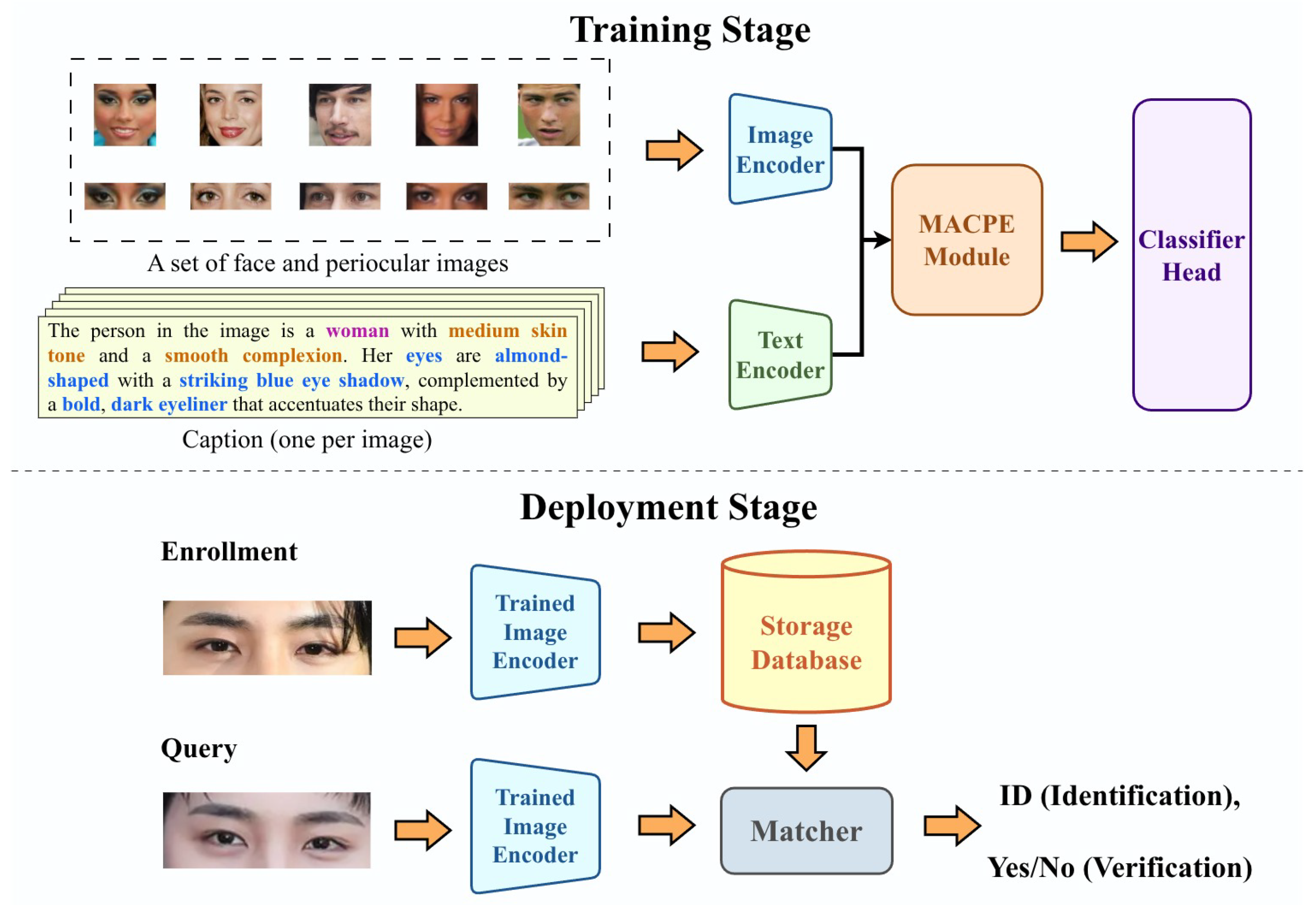
In this paper, we propose Multi-Anchor Conditional Periocular Embedding (MACPE), a conditional biometrics framework that exploits paired face images and automatically generated captions exclusively during training. MACPE learns an anchor-conditioned shared embedding space that aligns periocular representations with complementary facial and textual semantics while explicitly preserving periocular micro-textures. After training, all auxiliary components are removed, and recognition is performed using the periocular encoder alone, as illustrated in Figure 1. The complete architectural design and learning objectives are presented in Section 4.
We summarize the contributions of this work as follows:
- We introduce a conditional periocular recognition setting that utilizes paired face images and automatically generated captions only during training, enabling periocular-only inference while distilling complementary semantic information.
- We propose Multi-Anchor Conditional Periocular Embedding (MACPE), which performs anchor-conditioned alignment among periocular, facial, and textual embeddings using a shared learnable anchor bank and a dedicated loss formulation that mitigates collapse toward face-dominated representations.
- We provide derived multimodal annotations and evaluation protocols, including periocular crops, caption files, and identity-disjoint splits, and demonstrate consistent performance gains across five periocular benchmarks under both identification and verification metrics.
Figure 1.
Overview of the proposed Multi-Anchor Conditional Periocular Embedding (MACPE) model. (Top) Training stage, where periocular and face images together with captions are used to train the MACPE model, comprising image and text encoders and the MACPE module. (Bottom) Deployment stage, showing enrollment and matching using the trained periocular encoder for identification and verification, without requiring face or caption inputs.
2. Related Work
This section reviews prior work on conditional periocular recognition and recent advances in text-conditioned biometrics relevant to this study.
2.1. From Sole Periocular to Conditional Periocular
Early periocular recognition approaches relied on hand-crafted descriptors such as Local Binary Patterns [18], Scale-Invariant Feature Transform [19], and Histogram of Oriented Gradients [20]. These descriptors encode local texture, edge, and gradient information in the eye region and provide basic cues for identity discrimination. However, their representational capacity is limited, and performance degrades markedly under unconstrained conditions [7]. With the emergence of deep learning, research shifted toward learning periocular representations directly from raw images using convolutional and hybrid architectures [8].
Despite these advances, a persistent representational gap remains between periocular and full-face embeddings. The periocular region provides limited spatial coverage and contextual information, and methods that rely primarily on periocular visual cues remain sensitive to pose variation, illumination changes, occlusion, and partial visibility.
To address this limitation, Ng et al. [12,21] introduced face-conditioned periocular recognition networks that learn a shared embedding space for periocular and face modalities through conditional embedding losses, conditional feature fusion, and modality-adaptive weighting. These models demonstrated that a single network can operate flexibly with periocular-only, face-only, or combined inputs while preserving modality-specific characteristics.
Building on this direction, Tiong et al. proposed Multimodal Fusion Attention Vision Transformer [22], which integrates multimodal prompt tuning with attention-map alignment to reduce modality gaps. By employing modality-specific prompts within a shared Transformer backbone, the model learns global identity representations while maintaining modality-adaptive behavior, enabling robust intra-modal and cross-modal recognition even when modalities are absent or mismatched.
Parallel work has focused on more explicit conditioning of periocular embeddings on facial information. Ng et al. [23] proposed a self-attentive contrastive learning framework in which periocular features attend to facial embeddings via a gated convolutional channel-wise self-attention module and are aligned using contrastive objectives. This mechanism strengthens periocular identity representations when periocular information alone provides limited discrimination.
Collectively, these studies indicate that periocular recognition performance improves substantially when periocular embeddings are conditioned on facial information, whether via attention mechanisms, contrastive learning, domain adaptation, or knowledge distillation.
2.2. Text-Conditioned Biometrics Recognition
Beyond visual cues, recent work has investigated using textual descriptions as auxiliary signals to condition biometric representations. Hasan and Nasrabadi [24] introduced Caption-Guided Face Recognition, which refines BERT-based textual embeddings through a Textual Feature Refinement Module and aligns them with visual features using a Contextual Feature Aggregation Module that applies both self- and cross-attention. Building on this line of work, the same authors further extended text-conditioned face recognition to richer alignment and fusion mechanisms [25]. They employ a face-caption alignment module with multi-granularity contrastive losses and a face-caption fusion module that models both fine-grained interactions and coarse-level associations between image and text features.
Most recently, Hasan et al. (2025) [26] introduced CaptionFace. This framework incorporates a GPTFace captioning module to generate detailed textual descriptions when no human-provided captions are available. It employs a multi-scale feature alignment mechanism along with knowledge-adaptation losses to fuse semantic and structural facial information. Together, these studies highlight the value of combining visual and semantic cues to enhance multimodal recognition performance.
As shown in the survey above, prior work has predominantly conditioned periocular representations on facial information or conditioned facial representations on text modalities, whereas conditioning periocular embeddings with both face and text modalities has not yet been explored; this gap motivates the MACPE model proposed in this paper.
Unlike previous methods that focus solely on attention alignment, contrastive objectives, domain adaptation, or knowledge distillation, MACPE embeds periocular features within a shared, anchor-based identity/semantic manifold co-defined by face and text modalities, thereby integrating facial and textual structure into periocular embeddings while maintaining strong discriminability for periocular recognition.
3. Multimodal Dataset Construction
In this section, we describe the construction of the multimodal face-periocular-caption datasets, including image collection, caption generation, and analysis of semantic alignment between visual and text modalities.
3.1. Face and Periocular Images Collection
The face images used for training were taken from the VGGFace [27] and Ethnic [21] datasets, comprising 166,737 face samples from 1054 identities. Periocular images are cropped from these face images [28]. Because the periocular images originate from the same underlying face data, they contain a comparable number of samples and identities. For each identity, the dataset provides multiple images captured in the wild, covering diverse operational scenarios with variations in camera angle, facial expression, pose, and illumination.
Each identity is associated with multiple unconstrained images, yielding a variable number of samples per subject. During training, paired periocular and face inputs are extracted from the same image, and a single automatically generated caption is attached to form a triplet comprising a periocular image, a face image, and a caption. To mitigate the effects of identity-level sample imbalance, mini-batches are constructed by first sampling identities and then sampling images within each identity, which stabilizes both classification learning and contrastive alignment during training.
Five independent datasets, namely Ethnic [21], PubFig [29], FaceScrub [30], IMDb-Wiki (IMDb) [31], and AR [32], were used as benchmark test sets. The details of these test datasets are provided in Section 5.1.
3.2. Caption Generation
We emphasize that this work does not propose a new captioning model. Instead, we employ an off-the-shelf multimodal model exclusively to generate textual descriptions that serve as auxiliary supervision during MACPE training. The primary contributions of this study lie in the proposed MACPE architecture and loss formulation (Section 4), as well as in the derived multimodal annotations and evaluation protocols, including caption files, periocular crops, and identity-disjoint splits, which together enable faithful reproduction of the training-time conditioning setting (Section 3.5).
With the advent of Multimodal Large Language Models (MLLMs) [33], automatically generated captions have attained high semantic fidelity and strong visual grounding, making them useful for fine-grained description tasks. In this paper, we generate a single caption per face image using the Qwen2-VL-7B [34] model; during training, captions are processed in batches together with the corresponding periocular and face inputs. We adopt a template-guided caption generation strategy in which each image is paired with a standardized instruction template that specifies key biometric attributes, including identity cues, facial expressions, gaze direction, accessories, and environmental context. The model then processes this instruction-image pair in inference mode, producing captions that are semantically aligned with the visual content and capture fine-grained biometric details.
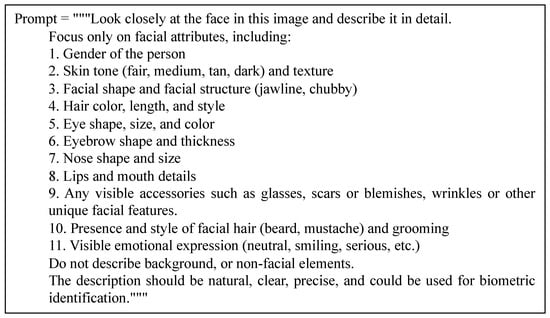
To ensure consistency and coverage, the template-generated text is organized into multiple short sentences, each targeting a distinct attribute group, thereby capturing a broad range of visual and identity-related cues. After evaluating several multimodal captioning models, including BLIP [35] and BLIP-2 [36], we selected Qwen2-VL-7B for its stronger ability to emphasize subtle biometric attributes while preserving linguistic fluency. As illustrated in Figure 2, captions are produced using a carefully designed instruction prompt that guides the model to extract fine-grained identity attributes while suppressing irrelevant or non-biometric information. This automated, template-driven pipeline converts raw face images into identity-aware descriptive captions suitable for downstream biometric analysis.
Figure 2.
The standardized instruction prompt used during caption generation, specifying key biometric attributes, including facial cues, periocular cues, expressions, gaze, and accessories to ensure consistent, fine-grained, and semantically grounded descriptions.
3.3. Statistical Analysis on Generated Captions
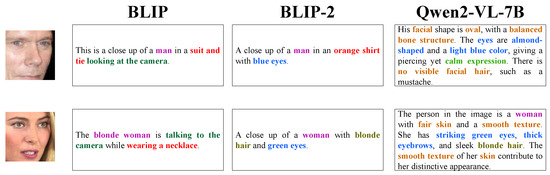
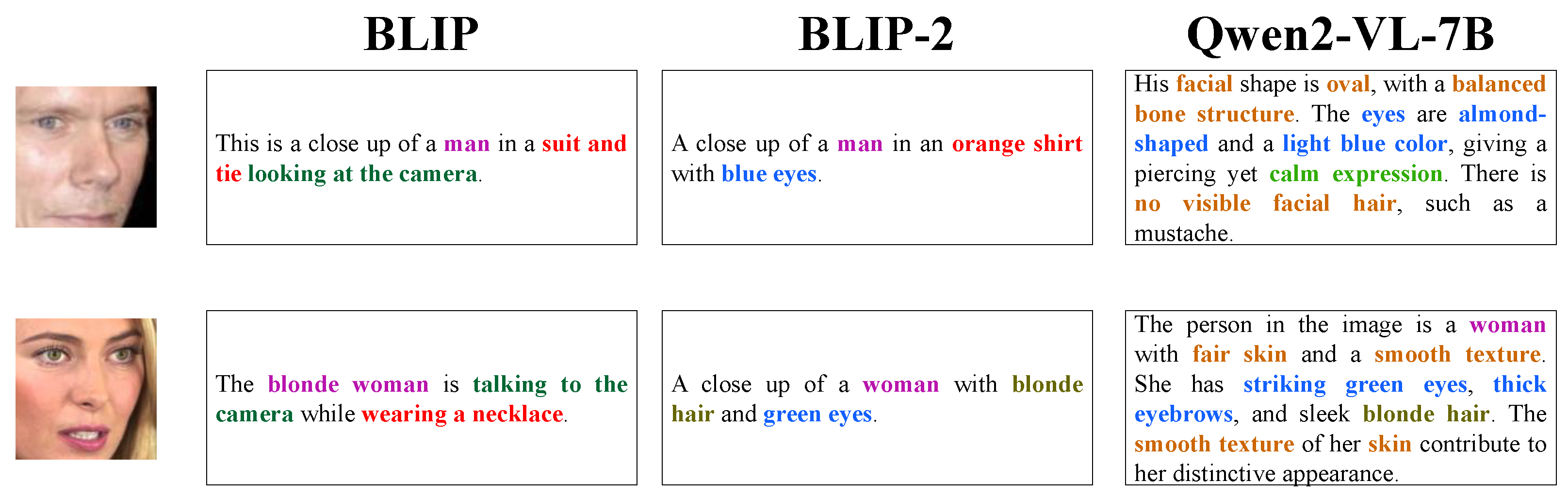
To assess the suitability of generated captions for biometric applications, we compared outputs from BLIP, BLIP-2, and Qwen2-VL-7B. The analysis focuses on the Image-to-Text Matching (ITM) score [37] and on how effectively each model captures key biometric cues, including facial, periocular, gender, hairstyle, and accessory attributes. Captions generated by the three MLLMs for representative images are presented in Figure 3.
Figure 3.
Comparison of captions generated by BLIP, BLIP-2, and Qwen2-VL-7B for representative images, highlighting differences in the models’ descriptive capabilities.
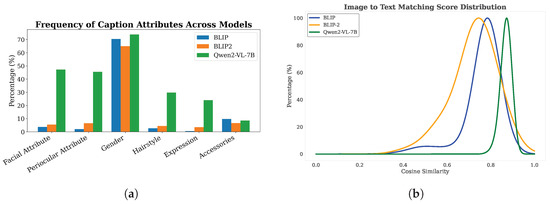
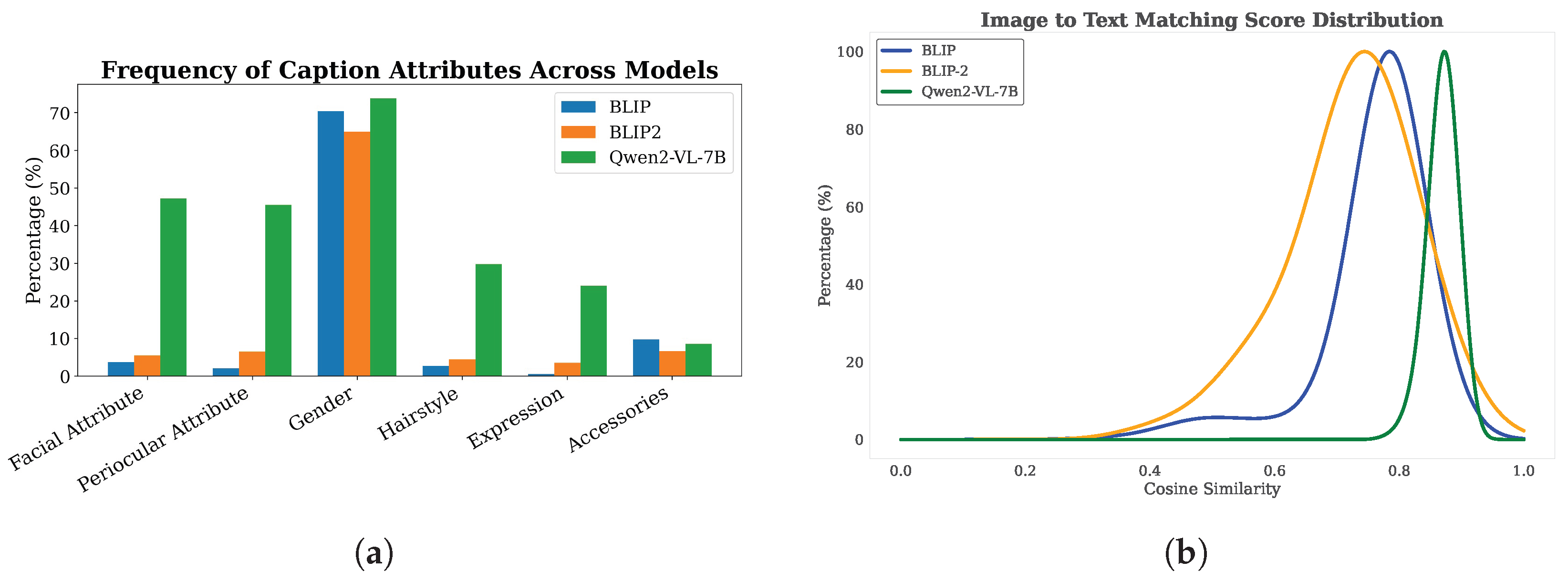
The statistical comparison highlights the superior descriptive capability of Qwen2-VL-7B compared to BLIP and BLIP-2. As shown in Figure 3, which illustrates qualitative examples of generated captions and their visual correspondence, Qwen2-VL-7B produces notably longer captions that capture richer semantic detail than those generated by the other models (BLIP and BLIP-2). In Figure 4a, the substantially higher frequency of descriptive captions with relation to biometric attributes, i.e., periocular and facial, further indicates that Qwen2-VL-7B demonstrates greater precision and contextual awareness in capturing fine-grained biometric characteristics. This is also further exemplified in the depicted Figure 3, in which the number of biometric-related descriptive captions for Qwen2-VL-7B surpasses that of BLIP and BLIP-2.
Figure 4.
Statistical comparison of captions generated by BLIP, BLIP-2, and Qwen2-VL-7B, where (a) illustrates the overall frequency distribution of biometric-related attributes present in the generated descriptions and (b) presents the corresponding ITM-based similarity scores reflecting the alignment quality between images and their captions. All models were evaluated on a randomly selected subset of 700 images to ensure a fair and representative comparison of caption quality across methods.
In the attribute distribution analysis, we first filter the captions to retain only those describing biometric attributes. Among these biometric-relevant captions, facial attributes (e.g., oval face, prominent nose) account for approximately 47.17%, while periocular characteristics (e.g., eyes, eyelashes, eyebrows) represent about 45.46%. Gender-related descriptions constitute 73.86%, whereas hairstyle attributes (e.g., straight hair, blonde hair) and expression attributes (e.g., smile, neutral) comprise 29.74% and 24.0%, respectively. Accessory-related features (e.g., glasses, scarves) account for 8.57% of the overall attribute coverage.
These statistics indicate that Qwen2-VL-7B-Instruct generates contextually relevant captions that capture a wide range of biometric cues for multimodal analysis. Qwen2-VL-7B was selected for this study because its average ITM score distribution, shown in Figure 4b, is shifted closer to 1, indicating stronger semantic alignment between visual and text modalities.
3.4. Semantic Correlation Analysis Between Images and Text
In this section, the ITM score quantifies the semantic consistency between an image and its corresponding caption, computed as the cosine similarity between the image and caption embeddings generated by the Qwen2-VL-7B model. A higher ITM score, particularly when approaching 1, indicates stronger semantic alignment between an image and its caption. Across all five datasets, the ITM scores remain consistently high, ranging from 0.85 to 0.87. Table 1 reports the ITM scores computed using cosine similarity between the image and caption embeddings.
Table 1.
Evaluation of Image-to-Text matching performance of Qwen2-VL-7B across datasets.
3.5. Reproducibility and Release of Derived Assets
To support reproducibility, we provide a complete and transparent description of the derived assets produced in this study, together with the procedures required to regenerate them from the original data sources. All derived assets are generated exclusively from publicly available face datasets.
Starting from the original datasets, we perform the following steps:
- Periocular regions are extracted using a deterministic cropping procedure that follows the protocol described in [28].
- A single caption is generated for each face image using Qwen2-VL-7B with a fixed, template-guided prompt, as illustrated in Figure 2.
- Identity-disjoint split files and evaluation protocols, including gallery and probe partitions, are constructed for each benchmark dataset used in Section 5.
All generated captions and associated metadata, including image identifiers, identity labels, and modality pairings, are stored in plain-text CSV format to enable exact reconstruction of multimodal triplets comprising face images, periocular crops, and captions. To facilitate reproducibility, we will release the complete preprocessing codebase, including scripts for periocular cropping and caption generation, the exact prompting templates, and all split and protocol definition files used to obtain the reported results.
The redistribution of original images is subject to the licenses and usage terms of the respective upstream datasets. Accordingly, we do not redistribute any raw images. Instead, we provide code that operates directly on datasets obtained from their original sources, ensuring compliance with dataset licensing requirements while enabling independent verification and reproduction of our results.
3.6. Ethical Considerations and Limitations of Caption Supervision
This work employs automatically generated captions exclusively as auxiliary supervision during training. Such captions may reflect demographic biases, stereotypes, or attribute noise, including imperfect or inconsistent descriptions of visual attributes such as gender presentation or skin tone. Accordingly, no captioned attribute is treated as a ground-truth demographic label. Instead, captions are used as weak, high-level semantic context to regularize representation learning rather than as explicit supervisory signals.
In practice, captions are generated solely from face images without access to identity information or any form of subject metadata. As a result, the generated descriptions refer to individuals using generic expressions (e.g., “this person” or “this individual”) rather than explicit identifiers. To further mitigate privacy risks, the caption-generation prompt explicitly restricts the output to observable facial and periocular attributes and discourages the inclusion of names, locations, or other personally identifying information, as illustrated in Figure 2.
The same face-derived caption is associated with both the face and periocular images during training. This design choice is motivated by the observation that face images provide richer and more diverse semantic cues for caption generation, whereas periocular images typically yield limited, less informative descriptions focused primarily on the eye and eyebrow regions.
Despite these safeguards, the use of automatically generated captions does not eliminate all sources of bias or noise. As a result, caption-based supervision may introduce systematic errors that vary across demographic groups, capture conditions, and dataset characteristics. The reported results should therefore be interpreted with the understanding that such limitations are inherent to weak semantic supervision derived from large-scale vision language models.
4. Proposed Method
In this section, we provide a comprehensive description of our proposed model, including architectural components, loss functions, and the deployment pipeline.
4.1. Overview
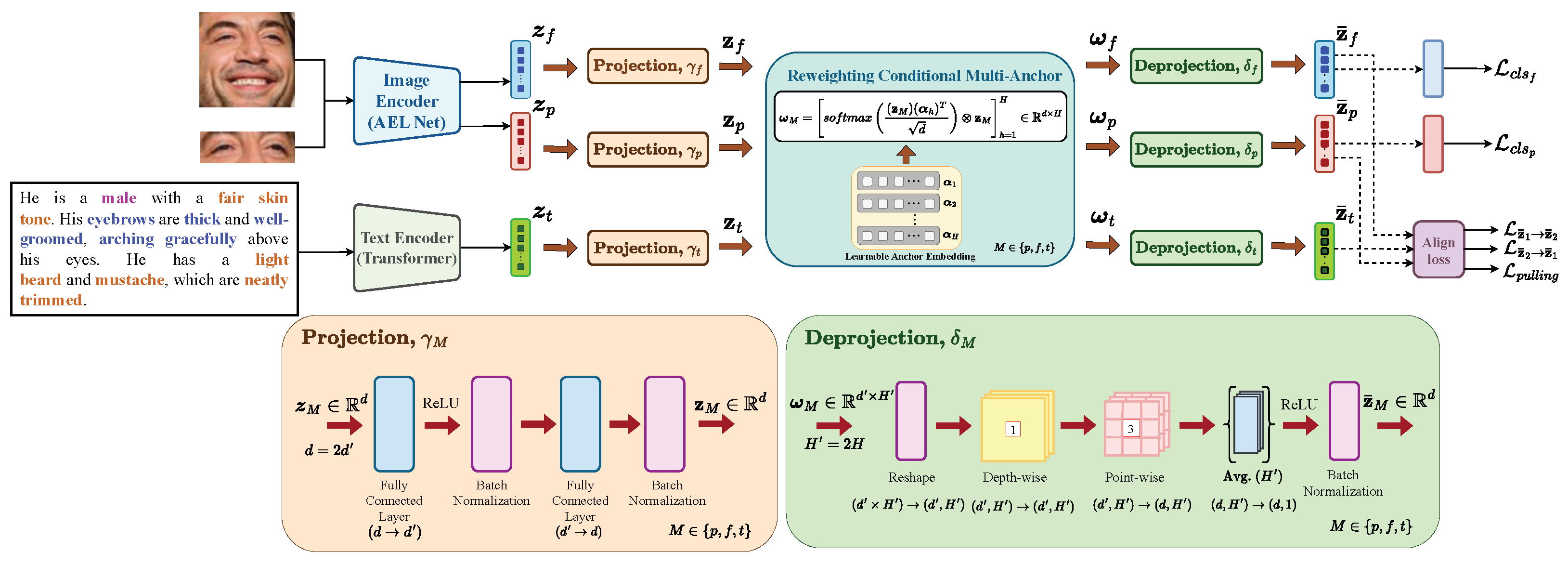
As depicted in Figure 1, the training process involves an image encoder and a text encoder, along with the MACPE module and the classifier head. To facilitate discrimination in periocular recognition, the MACPE model takes periocular, face, and text modalities as inputs, and a classifier head is attached after the MACPE module for loss computation. The MACPE module comprises three core components, as illustrated in Figure 5:
- Modality-specific Projection Networks: Map each modality’s encoder features into a latent space compatible with the anchor bank.
- Reweighting Conditional Multi-Anchor (RCMA) Module: Align modality-specific embeddings through a shared anchor-conditioned mechanism, producing RCMA representations in a common latent space.
- Modality-specific Deprojection Modules: Transform RCMA representations into semantically consistent identity embeddings used for matching.
Figure 5.
An illustration of the MACPE module. MACPE receives modality-specific features from its respective backbone, projects them into an anchor-compatible latent space, and computes anchor-conditioned embeddings using a shared anchor bank. This mechanism encodes complementary semantic relations between input features and anchors, enabling the subsequent modality-specific deprojection modules to interpret and fuse anchor-conditioned responses into a compact, discriminative embedding. During training, face and periocular images are encoded using a shared-weight image encoder; at deployment, only the periocular pathway is retained.
During training, the CNN-based image encoder is applied with shared weights to paired inputs from the same identity, namely a periocular crop and the corresponding full-face image , while the Transformer-based text encoder processes the associated caption . Specifically, captions are tokenized using the CLIP tokenizer [14] to generate subword token indices, which are mapped to learnable token embeddings and processed by a ViT-style Transformer text encoder comprising a token embedding layer with positional encodings followed by a stack of Transformer encoder blocks with multi-head self-attention and feed-forward sublayers; CLIP is used exclusively for tokenization, with no architectural or weight sharing with the CLIP text encoder. The resulting embeddings , where and d denotes the embedding dimension, are computed as:
where denotes the image encoder based on the Attention-aware Ensemble Learning Network (AEL Net) [38], and denotes the text encoder based on the Vision Transformer (ViT) [39]. The symbol represents the parameters of the respective encoders. AEL Net is an attention-augmented variant of MobileFaceNet [40] designed for cross periocular-face matching, retaining the same base configuration while introducing attention-guided feature refinement. Two modality-specific softmax predictors are used for identity discrimination, one for periocular and one for facial embeddings.
During deployment, the text encoder, MACPE module, and softmax predictors are discarded, leaving only the trained image encoder; consequently, no face images or textual inputs are required at inference time. The periocular encoder is trained in a conditioned manner, where supervisory signals derived from the corresponding facial and textual embeddings and are injected through the MACPE module, such that the learned periocular representations implicitly encode this conditioning despite being extracted independently at deployment. Enrollment is therefore performed using periocular embeddings produced by the trained encoder, which are matched against query periocular embeddings .
4.2. MACPE Module
The MACPE module in Figure 5 embeds periocular, face, and text modalities into a shared anchor-based identity-semantic space. Modality-specific projection networks feed each modality into the RCMA module, where a shared learnable anchor bank generates content-dependent anchor distributions, which a deprojection module converts into compact identity embeddings, transferring complementary facial/textual information while preserving periocular modality-specific discriminability within the shared anchor-conditioned identity representation space.
4.2.1. Modality-Specific Projection Networks
The modality-specific projection networks are two-layer MLPs that map facial, periocular, and textual embeddings into a latent space suitable for anchor conditioning. Specifically,
where is the MLP with parameters , and is the d-dimensional projected embedding.
The projection network maps periocular, facial, and textual features to modality-specific yet anchor-compatible embeddings of dimension d, normalizing their scale and reducing encoder-specific idiosyncrasies. This places , , and in a shared space so that an anchor embedding set can serve as a cross-modal semantic basis, making the face- and caption-induced structure visible to the periocular branch and enabling subsequent anchor conditioning.
4.2.2. RCMA Module
To align heterogeneous modality embeddings, we adopt a shared bank of H learnable anchor embeddings , , that acts as a common semantic basis across periocular, face, and text modalities. Each anchor defines a latent semantic direction, and modality features are expressed in this anchor basis through a reweighting mechanism applied in a single shared space rather than distinct value projections.
Given , RCMA module first computes scaled anchor similarity scores as follows:
These scores are normalized into an anchor weight :
which can be interpreted as a probability-like distribution describing how strongly aligns with each semantic anchor. Each coefficient quantifies the contribution of the h-th anchor direction to the current modality instance.
The softmax operator is crucial because it converts the unbounded similarity scores into a non-negative vector, enforcing . This normalization makes invariant to global additive shifts in and ensures that anchors compete: high-score anchors are emphasized while low-score anchors are exponentially suppressed. As a result, becomes a stable anchor weight that can be compared across modalities and identities, providing a well-behaved gating signal for downstream anchor-conditioned representations and contrastive alignment losses.
The RCMA representation is then constructed as the outer product between the anchor weights and the modality embedding:
Here, the h-th row of is an anchor-specific view of the same embedding , scaled by how much is attributed to anchor h. This mechanism decomposes a single modality embedding into H anchor-gated components that together encode both and its distribution over a shared set of semantic factors.
Thus, serves as an anchor-conditioned embedding matrix for modality M, capturing not only what information the modality contains through but also how that information is organized across the learned semantic anchors via .
4.2.3. Modality-Specific Deprojection Modules
The RCMA representations are further processed by modality-specific deprojection networks , which decode anchor patterns into compact, task-ready embeddings:
where denotes the learnable parameters of .
Each is implemented as a lightweight 1D convolutional stack that operates on the RCMA tensor and learns, for each modality, how to transform anchor activity patterns into a semantically organized representation.
Before entering the convolutional block, is reshaped to with and . This split enlarges the effective anchor axis while reducing the channel dimension, enabling efficient convolution over a longer sequence of anchor-conditioned values.
Depthwise convolution. The depthwise convolution operates along the anchor axis independently for each of the channels. This stage models local dependencies between neighboring anchors, capturing how anchor activities co-vary along the anchor sequence for a given modality while keeping the operation lightweight due to the reduced channel dimension.
Pointwise convolution. The pointwise convolution then acts at each anchor position, mixing information across the channels without altering the anchor axis. Simultaneously, it serves as a deprojection layer that maps the intermediate representation back to dimension , combining semantic channels at each anchor index and reconstructing a higher-dimensional embedding space suitable for downstream embedding.
To obtain a single unified feature, the output of the pointwise convolution is aggregated by a global average over the anchor dimension , followed by normalization and nonlinearity: this permutation-invariant pooling merges information across all anchors into a single embedding .
The resulting embedding encodes both the content of the original modality and the aggregate influence of the anchor-conditioned structure, yielding a compact, semantically aligned, and identity-discriminative representation for modality M.
4.3. Loss Computation
To effectively align periocular, facial, and textual embeddings while preserving identity discriminability, the MACPE model is trained with a combination of margin-based classification losses and a symmetric contrastive alignment loss.
4.3.1. Classification Loss for Predictors
We formulate periocular representation learning as a multiclass identity classification task during training, where each identity defines a distinct class. Embeddings are trained with a margin-based CosFace loss to improve inter-class separation and intra-class compactness. During evaluation, the classification layers are discarded, and the learned embeddings are employed for both identification (1:N) and verification (1:1) through cosine similarity between feature vectors for robust matching performance. We adopt the CosFace margin-based angular softmax loss [41], which enlarges inter-class margins while reducing intra-class variation. Given a mini-batch of B samples , where is the identity label of the i-th sample, each embedding of is -normalized and scaled to lie on a hypersphere of radius s. The class weights are also -normalized and act as class prototypes.
For modality , the CosFace loss is defined as:
where denotes the cosine similarity between the -normalized embedding and the class prototype , m is the additive angular margin, and s is the hypersphere scaling factor.
The total classification loss is given by
4.3.2. Symmetric Contrastive Alignment Loss
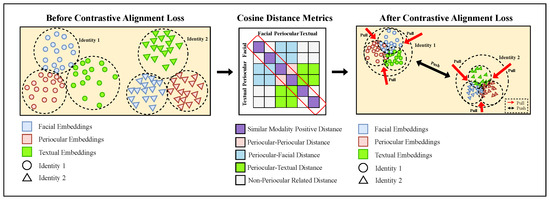
The contrastive alignment loss promotes modality-invariant clustering by identity, transforming modality-separated clusters into identity-centered clusters across periocular, face, and text, as depicted in Figure 6. To realize this effect in practice, we first concatenate the three modalities along the batch dimension to form a unified embedding set. Denote and define the cosine similarity between normalized embeddings as
Figure 6.
Visualization of different modalities’ embeddings behavior before and after contrastive alignment. (Left) Periocular, facial, and textual embeddings show weaker clustering and are further apart from the same identity. (Center) The cosine distance matrix quantifies intra- and inter-modal discrepancies. (Right) Embeddings of the same identity are closer and tighter clustering regardless of modality. In contrast, negative identities are pushed further apart, forming discriminative clusters after optimization with the contrastive alignment loss.
The resulting similarity matrix encodes pairwise correlations across all periocular, facial, and textual embeddings. Since , minimizing the cosine distance encourages compact, semantically consistent cross-modal representations.
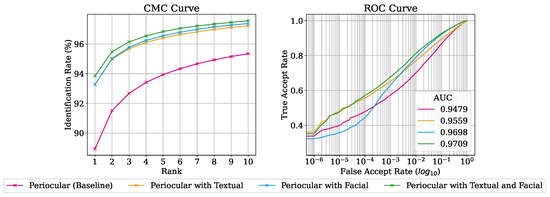
Figure 6 is formed by constructing a joint embedding set through concatenation of the normalized periocular, facial, and textual embeddings within each mini-batch, as defined in Equation (9). The center panel visualizes the resulting pairwise cosine distance matrix computed directly from the normalized dot products. The left and right panels depict the corresponding embedding distributions before and after optimization with the contrastive alignment loss in Equation (10), respectively, using identical embeddings projected into a two-dimensional space for visualization. All plots shown in Figure 7 and Figure 8 are generated from model embeddings using standard Python (v3.11.14) plotting utilities.
Figure 7.
Average Identification CMC and Verification ROC curves of different modality conditioning across five testing datasets.
Figure 8.
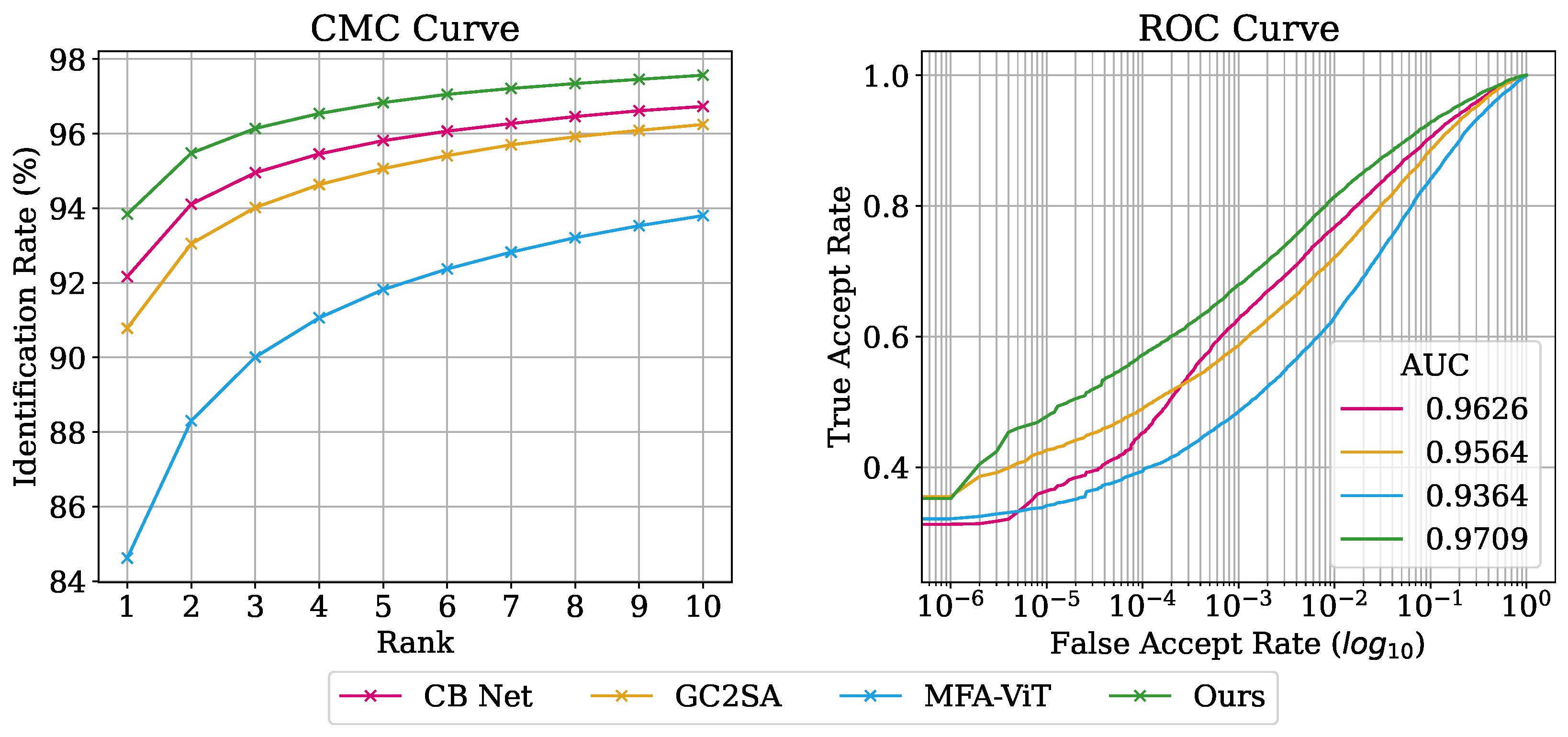
Performance comparison with SoTA models with Identification CMC and Verification ROC curves.
The contrastive alignment loss uses a symmetric InfoNCE objective [42] augmented with a pulling regularizer. The symmetric InfoNCE combines a forward term and a backward term , and the symmetric alignment loss is defined as:
where B is the batch size, is a temperature hyperparameter that controls the sharpness of the distribution. In each InfoNCE term, the numerator corresponds to the positive pair , while the denominator includes all negatives within the batch, driving positive pairs to high similarity and negatives to low similarity.
The pulling loss, weighted by , explicitly encourages embeddings from different modalities of the same sample to be close in the shared space, complementing the symmetric InfoNCE term that focuses on separating positives from negatives. Together, these components promote both inter-identity discrimination and intra-sample, cross-modal coherence in the MACPE embedding space.
4.3.3. Total Loss
In summary, the total loss is a weighted combination of alignment and classification losses:
Through the implementation of this total loss , where enables periocular-only embedding to remain a strong biometric feature, guarantees that the learned anchor-conditioned embedding space catalyzes a shared identity and semantic geometry across modalities. This balance between conditioning and autonomy encourages more robust performance in the periocular modality.
4.4. Computational Complexity
MACPE introduces additional computational overhead during training due to the auxiliary textual pathway and the anchor-conditioning mechanism. For an embedding dimension d and H anchors, the proposed RCMA module computes anchor similarities with a complexity of per M modality and constructs an anchor-conditioned representation of size , which is subsequently processed by a lightweight 1D convolutional deprojection layer. In practice, this additional cost is negligible compared to the forward pass of the image encoder.
Importantly, MACPE incurs no additional computational burden at inference time. All auxiliary components, including the text encoder, the anchor-conditioning module, and the classification heads, are discarded after training, as illustrated in Figure 1. As a result, inference is performed using the periocular encoder alone, and the inference-time computational cost, latency, and memory footprint match those of the underlying periocular encoder used as the baseline.
5. Experimental Results and Analysis
This section outlines the benchmarking datasets, followed by our experimental setup, performance evaluation, comparative analysis, and discussion of results.
5.1. Datasets
The testing datasets are predominantly collected from unconstrained, in-the-wild environments, with the AR dataset being the only exception, included for its challenging occlusions and visual distractions. To enable a comprehensive evaluation, the MACPE model is assessed on five independent benchmark datasets: Ethnic [21], PubFig [29], FaceScrub [30], IMDb-Wiki (IMDb) [31], and AR [32]. A summary of these test datasets is presented in Table 2. Throughout this study, the training and test datasets are strictly disjoint, with no overlapping identities.
Table 2.
Summary of Datasets.
Identity Split Policy
Training and evaluation identities are strictly disjoint. In cases where an evaluation dataset is also included in the training pool, we enforce an identity-level hold-out protocol to ensure that no subject appearing in the evaluation set is observed during training. All identity split definitions, including training, validation, and test identities as well as the corresponding file indices, are fixed and will be publicly released to support reproducibility, as described in Section 3.5.
5.2. Experimental Setup
We perform the one-to-many identification task by matching each probe set against the gallery and reporting the average Rank-1 Identification Rate (IR), defined as the fraction of probe samples whose top-1 nearest neighbor in the gallery (measured by cosine similarity) has the correct identity label. For the one-to-one verification task, positive and negative pairs are constructed by randomly selecting four images per identity from the gallery, yielding 12 genuine pairs and 16 impostor pairs per identity. Verification performance is evaluated using the Equal Error Rate (EER), which corresponds to the operating point where the False Accept Rate (FAR) equals the False Reject Rate (FRR), with FRR defined as . In addition, we report the True Accept Rate (TAR) at specified FAR operating points to provide a finer-grained assessment of system reliability. At a decision threshold , FAR is defined as
while TAR is defined as
Higher TAR indicates correct acceptance of genuine users, whereas lower FAR reflects stronger resistance to impostor acceptance.
Table 3 summarizes the hyperparameters used in all experiments, unless specified otherwise. We adopt the AdamW optimizer with a learning rate of , weight decay of , and a dropout rate of during training. For consistency, both periocular and face images are resized to . Text inputs are tokenized using the CLIP tokenizer [14], with sequences truncated beyond the maximum context length of 77 tokens. For all three modalities, the feature embedding dimension is fixed to .
Table 3.
Hyperparameter Configuration for Experiments.
Randomness control and reported statistics are handled by constructing verification pairs with a fixed random seed and using the same pair list for all compared methods, thereby ensuring a controlled and fair comparison. In Table 4, Table 5, Table 6, Table 7 and Table 8, the reported mean ± standard deviation summarize performance across the five benchmark test datasets (Ethnic, PubFig, FaceScrub, IMDb, and AR), rather than variability arising from repeated training runs.
Experiments were conducted on a workstation equipped with an NVIDIA GeForce RTX 3090 GPU (driver version 580.95.05), an Intel Core i9-10900K CPU, and 64 GB of DDR4 RAM (2 × 32 GB). Training and evaluation fully utilized GPU acceleration, using CUDA 11.8 with PyTorch 2.7.1.
5.3. Experiment Results
In this section, we assess the effectiveness of the proposed MACPE model on five benchmark datasets. We compare periocular biometric performance across configurations conditioned on face-only, caption-only, and jointly on both face and caption. As reported in Table 4, incorporating additional modalities consistently improves both identification and verification over the periocular-only baseline. The baseline attains an average Rank-1 IR of 88.94% and an average EER of 11.80%, while conditioning on caption or face images alone yields clear gains, indicating that each auxiliary modality contributes complementary discriminative cues across evaluated benchmark settings considered here.
Table 4.
Average performance comparison of different modality conditioning across five testing datasets.
The best performance is achieved when all three modalities—periocular, face, and text—are jointly exploited, yielding an average Rank-1 IR of 93.84% and an EER of 8.08%. A consistent pattern appears in average TARs across all FAR thresholds, where the proposed model attains the strongest TAR, rising from 47.91% to 57.22% at FAR and from 86.89% to 92.77% at FAR . These results indicate that combining facial information with semantic textual cues strengthens the learned embeddings, supporting more robust and reliable identity discrimination.
Figure 7 visualizes these gains via CMC and ROC curves, emphasizing the benefits of face- and text-conditioned periocular embeddings over a periocular-only model.
5.4. Comparison with State-of-the-Art Models
In this section, we compare MACPE against recent state-of-the-art conditional periocular models, namely the Conditional Biometrics Network (CB Net) [12], the Gated Convolutional Channel-wise Self-Attention Network (GC2SA) [23], and the Multimodal Fusion Attention Vision Transformer (MFA-ViT) [22]. Although CB Net and GC2SA originally exploit only the face modality for conditioning, we reimplement them using both face and caption modalities to provide a fair comparison with the proposed model. For MFA-ViT, which conditions on face images and facial attributes, we replace the facial attributes with a caption. All methods are trained under the same setup described in Section 4.1.
As reported in Table 5, MACPE attains the best overall performance, achieving an average Rank-1 IR of 93.84% and an average EER of 8.08%, outperforming CB Net by 1.67% in average Rank-1 IR and reducing average EER by 1.52%.
Table 5.
Performance comparison with SoTA models.
At the stringent FAR, our model attains an average TAR of 57.22%, exceeding CB Net, GC2SA, and MFA-ViT by 11.96%, 8.32%, and 17.83%, respectively. Consistent gains are also observed at and FAR, where our method reaches 67.97% and 81.42%. Even under the more permissive FAR, our approach still yields the highest TAR of 92.77%, improving over CB Net by 2.26%, over GC2SA by 4.19%, and over MFA-ViT by 8.64%.
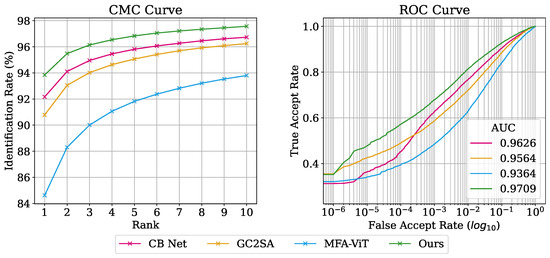
These results collectively indicate that the proposed framework maintains strong verification performance across a wide range of operating points, with particularly pronounced advantages in low-FAR regimes that are essential for high-security biometric deployments. Figure 8 shows the CMC and ROC curves corresponding to the metrics reported in Table 5.
From a qualitative perspective, combining facial context with textual semantics yields more identity-preserving periocular embeddings that remain consistent across datasets. Compared with SoTA models, our method more effectively exploits complementary multimodal information, capturing both visual and semantic correlations that improve periocular recognition accuracy and generalization.
5.5. Ablation Studies
This section evaluates the impact of the number of anchor embeddings, loss functions, and backbone architectures on performance in both identification and verification tasks.
5.5.1. Anchor Embedding Bank
To assess the impact of the number of anchor embeddings in the RCMA module, we conduct an ablation study by varying the size of the anchor bank for both the MobileFaceNet (MFN) [40] and AEL Net [38] backbones.
As shown in Table 6, disabling the RCMA module reduces both backbones to plain periocular models without anchor-conditioned sharing. MFN attains 89.20% Rank-1 IR with 12.29% EER, while AEL Net is similar at 89.34% Rank-1 IR and 11.75% EER. Verification is weak, especially at strict operating points: for AEL Net, TAR at is only 29.4%, and for MFN it is 42.64%. These results indicate that, without anchor-based conditioning, the periocular backbone alone is not sufficiently calibrated at low FAR.
Table 6.
Ablation study of anchor bank size across five test datasets using MFN and AEL Net backbones.
Introducing the RCMA module yields an immediate performance boost. For MFN, moving from the baseline (no anchors) to RCMA with a single anchor raises Rank-1 IR from 89.20% to 92.08% and reduces EER from 12.29% to 10.37%; TAR at improves by about 10 percentage points . The best configuration is two anchors, with 92.44% Rank-1 IR, the lowest EER (10.30%), and the strongest TAR profile across all FARs. Beyond two anchors (4, 8, 12), identification remains above the baseline but oscillates slightly, and verification begins to degrade. The 12-anchor MFN setting collapses particularly at FARs of and (31.39% and 54.25%), suggesting that an over-fragmented anchor bank leads to unstable optimization and poor score calibration relative to the available data.
AEL Net exhibits a similar but smoother pattern. Any RCMA setting with one or more anchors already gives a large gain over the baseline: Rank-1 IR increases from 89.34% to about 93%, and EER drops into the 10–11% range. Verification improves markedly; TAR at rises from 29.40% to roughly 55–56% for 2–8 anchors. The sweet spot lies around 4–8 anchors: 4 anchors achieve the best EER (10.02%) with strong TARs, while eight anchors slightly edge out others in Rank-1 IR (93.28%). At 12 anchors, performance remains clearly above the baseline but shows mild saturation and a small decline in both EER and TARs, indicating diminishing returns once the anchor basis becomes overly fine.
5.5.2. Loss Ablation
As shown in Table 7, we systematically assess the contribution of each loss term, including the periocular classification loss , face classification loss , symmetric contrastive loss , and pulling loss .
Table 7.
Ablation on loss components.
For the MFN baseline trained only with , the model achieves 81.83% Rank-1 IR with a high EER of 22.82%, indicating limited discriminative capability. Thus, we include the face classification loss whenever the face modality is used, so that facial embeddings retain strong identity-discriminative structure and can effectively guide the periocular representation during cross-modal conditioning. A notable improvement is observed when the facial modality embeddings and textual modality embeddings are introduced independently through the symmetric contrastive loss . These additions yield 10.22% and 10.61% increases in Rank-1 IR, and 12.41% and 12.52% reductions in EER for periocular conditioned by facial information and periocular conditioned by textual information, respectively, compared to the baseline periocular model. When all three modalities (, , ) are employed jointly in , MFN attains 92.60% Rank-1 IR and 10.45% EER. Adding the pulling term on top of this configuration yields a further gain to 92.73% Rank-1 IR and 10.24% EER, i.e., an additional 0.13% increase in Rank-1 IR and a 0.21% decrease in EER. At a FAR of , TAR improves from 25.58% for the MFN baseline to 52.87%, and at a FAR of , it rises from 72.00% to 89.48% when periocular features are fused with both facial and textual information under the full loss configuration.
For the AEL Net baseline trained solely with , the model already outperforms the MFN baseline, achieving 88.94% Rank-1 IR and 11.80% EER. Similarly, significant gains are observed when the facial modality embeddings and textual modality embeddings are introduced independently, yielding 4.32% and 4.34% increases in Rank-1 IR, along with corresponding 3.24% and 1.66% reductions in EER for periocular conditioned by facial information and periocular conditioned by textual information, respectively, compared to the baseline. When all three modality embeddings (, , and ) are jointly used in , performance further improves to 93.64% Rank-1 IR and 8.44% EER.
Incorporating the pulling term within provides an additional 0.20% increase in Rank-1 IR and a 0.36% decrease in EER, yielding 93.84% Rank-1 IR and 8.08% EER. At a FAR of , TAR rises from 47.91% for the baseline to 57.22%, and at a FAR of , it improves from 86.89% to 92.77% when periocular features are fused with facial and textual information.
Overall, the progressive improvements from individual losses to combined losses, and then with the inclusion of the pulling term, indicate that enforcing multi-level semantic consistency strengthens the model’s discriminative capability while promoting effective cross-modal alignment through the symmetric contrastive loss. The substantial increases in TAR at lower FAR levels further demonstrate enhanced recognition reliability across different operating points.
5.5.3. Backbone Ablation
We evaluate the backbone architectures under the same experimental setup as above, comparing MFN [40], ResNet50 [43], and AEL Net [38]. All models are trained with identical hyperparameters and embedding dimensionality to ensure a fair comparison.
Table 8 shows that ResNet50 performs poorly in a periocular-to-periocular matching scenario despite being conditioned on the text modality, achieving only limited improvement due to its deep network architecture, which limits its ability to effectively leverage semantic cues from textual descriptions, given that it is largely based on images.
Table 8.
Ablation on network backbone.
In contrast, MFN achieves competitive results due to its lightweight architecture, enabled by a shallower network than ResNet50. This allows better semantic absorption into the image-based network, similarly exhibited by the AEL Net, the upgraded version of the MFN which achieves the best overall performance. Specifically, AEL Net records an average Rank-1 Identification Rate of 93.28% and an Equal Error Rate of 10.14%, surpassing MFN (92.44% Rank-1 IR and 10.30% EER) and significantly outperforming ResNet50 (86.53% Rank-1 IR and 14.93% EER).
Furthermore, when examining the TAR at various FAR thresholds, AEL Net consistently outperforms both MFN and ResNet50, achieving notably higher TAR values, especially at stricter FAR levels such as and , which demonstrates its superior robustness in low FAR operating regimes. This substantial improvement highlights the benefit of incorporating attention mechanisms.
In our study, including textual information alongside periocular embeddings further amplifies this effect by guiding the network to exploit multiple semantic subspaces, yielding richer, more discriminative features.
6. Conclusions
This paper introduced the Multi-Anchor Conditional Periocular Embedding (MACPE) model, a text- and face-conditioned approach for improving periocular recognition under unconstrained settings. MACPE employs modality-shared anchor-conditioned embeddings and cross-attention to reweight identity-relevant information across modalities, allowing periocular features to selectively amplify semantically meaningful cues transferred from facial and textual embeddings while preserving the fine-grained ocular textures essential for discrimination. Through this anchor-driven importance reweighting, periocular, facial, and textual representations are jointly aligned in a unified latent space that supports robust intra-modality conditioning. Extensive experiments on five in-the-wild datasets demonstrate that this principled reweighting-based anchor-conditioned embedding yields consistent performance gains, achieving an average Rank-1 Identification Rate of 93.84% and an Equal Error Rate of 8.08%, surpassing recent state-of-the-art methods such as CB Net, GC2SA, and MFA-ViT. Ablation studies further highlighted the complementary roles of the multiple anchoring mechanisms, contrastive alignment loss, and auxiliary facial and textual supervision in enhancing robustness and generalization. Overall, MACPE establishes a new paradigm for intra-modality conditioning in biometrics by using learned anchors as a principled interface for reweighting semantic-rich and texture-based cues, offering a practical and scalable framework for identity recognition in privacy-constrained environments while opening avenues for adaptive anchor learning and open-set recognition.
Author Contributions
Conceptualization, P.-L.F.; methodology, P.-L.F.; software, P.-L.F.; validation, P.-L.F., T.-S.N. and A.B.J.T.; formal analysis, P.-L.F.; investigation, P.-L.F.; resources, P.-L.F. and A.B.J.T.; data curation, P.-L.F. and T.-S.N.; writing—original draft preparation, P.-L.F.; writing—review and editing, P.-L.F., T.-S.N. and A.B.J.T.; visualization, P.-L.F.; supervision, A.B.J.T.; project administration, A.B.J.T.; funding acquisition, A.B.J.T. All authors have read and agreed to the published version of the manuscript.
Funding
This research received no external funding.
Institutional Review Board Statement
Not applicable.
Informed Consent Statement
Not applicable.
Data Availability Statement
The underlying periocular and face datasets used in this study are available from their original providers under their respective licenses. To facilitate reproducibility, we will release the derived caption files, periocular-cropping scripts, caption-generation prompts and scripts, and identity-disjoint split/protocol files used in our experiments.
Conflicts of Interest
The authors declare no conflicts of interest.
References
- Kortli, Y.; Jridi, M.; Al Falou, A.; Atri, M. Face Recognition Systems: A Survey. Sensors 2020, 20, 342. [Google Scholar] [CrossRef] [Scilit]
- Zeng, D.; Veldhuis, R.; Spreeuwers, L. A survey of face recognition techniques under occlusion. IET Biom. 2021, 10, 581–606. [Google Scholar] [CrossRef] [Scilit]
- Jadhav, S.B.; Deshmukh, N.K.; Lomate, S.M.; Pawar, S.B.; Hambarde, K.A. Integrated multimodal Face, Iris and Fingerprint biometric fusion for advanced person identification using Hybrid Deep Learning. In Proceedings of the National Conference on Machine Learning and Data Science (NCMLDS-2024), Latur, India, 16–17 April 2024. [Google Scholar] [CrossRef]
- Ammour, B.; Boubchir, L.; Bouden, T.; Ramdani, M. Face-Iris Multimodal Biometric Identification System. Electronics 2020, 9, 85. [Google Scholar] [CrossRef] [Scilit]
- Alonso-Fernandez, F.; Bigun, J.; Fierrez, J.; Damer, N.; Proenca, H.; Ross, A. Periocular Biometrics: A Modality for Unconstrained Scenarios. Computer 2024, 57, 40–49. [Google Scholar] [CrossRef] [Scilit]
- Alonso-Fernandez, F.; Bigun, J. Periocular biometrics: Databases, algorithms and directions. In Proceedings of the 2016 4th International Conference on Biometrics and Forensics (IWBF), Limassol, Cyprus, 3–4 March 2016; pp. 1–6. [Google Scholar] [CrossRef] [Scilit]
- Alonso-Fernandez, F.; Bigun, J. A survey on periocular biometrics research. Pattern Recognit. Lett. 2016, 82, 92–105. [Google Scholar] [CrossRef] [Scilit]
- Sharma, R.; Ross, A. Periocular biometrics and its relevance to partially masked faces: A survey. Comput. Vis. Image Underst. 2023, 226, 103583. [Google Scholar] [CrossRef] [Scilit]
- Zanlorensi, L.A.; Laroca, R.; Lucio, D.R.; Santos, L.R.; Britto, A.S.; Menotti, D. A new periocular dataset collected by mobile devices in unconstrained scenarios. Sci. Rep. 2022, 12, 17989. [Google Scholar] [CrossRef] [Scilit]
- Prasanth, N.; Ketineni, T.; Nethi, S.; Chilukuri, U.S.K.; Krishna, C.V.P.; Srinivasu, N.; Pradeepini, G. Convolutional Tri Biometrics: A Unified Approach for Iris, Periocular, and Facial Authentication. J. Theor. Appl. Inf. Technol. 2024, 102, 4516–4525. [Google Scholar]
- Umer, S.; Sardar, A.; Dhara, B.C.; Raout, R.K.; Pandey, H.M. Person Identification Using Fusion of Iris and Periocular Deep Features. Neural Netw. 2020, 122, 407–419. [Google Scholar] [CrossRef] [Scilit] [PubMed]
- Ng, T.S.; Low, C.Y.; Chai, J.C.L.; Teoh, A.B.J. On the Representation Learning of Conditional Biometrics for Flexible Deployment. IEEE Access 2023, 11, 82338–82350. [Google Scholar] [CrossRef] [Scilit]
- Talreja, V.; Rattani, A.; Ross, A. Attribute-based deep periocular recognition: Leveraging soft biometrics to improve periocular recognition. IEEE Trans. Biom. Behav. Identity Sci. 2021, 3, 468–481. [Google Scholar] [CrossRef] [Scilit]
- Jin, C. Semi-Supervised Image Captioning with CLIP. arXiv 2023, arXiv:2306.15111. [Google Scholar] [CrossRef] [Scilit]
- Limbu, M.; Banerjee, D. MedBLIP: Fine-tuning BLIP for Medical Image Captioning. arXiv 2025, arXiv:2505.14726. [Google Scholar]
- Yildirim, T.; Amasyali, M.; Karaca, A.C. LLaVa-RS: A Unified Model for Image and Change Captioning in Remote Sensing. In Proceedings of the 2025 30th Signal Processing and Communications Applications Conference (SIU), Şile, Turkey, 25–28 June 2025; pp. 1–4. [Google Scholar] [CrossRef] [Scilit]
- Bai, J.; Bai, S.; Yang, S.; Wang, S.; Tan, S.; Wang, P.; Lin, J.; Zhou, C.; Zhou, J. Qwen-VL: A Versatile Vision-Language Model for Understanding, Localization, Text Reading, and Beyond. arXiv 2023, arXiv:2308.12966. [Google Scholar]
- Mahalingam, G.; Ricanek, K., Jr. LBP-based periocular recognition on challenging face datasets. EURASIP J. Image Video Process. 2013, 2013, 36. [Google Scholar] [CrossRef] [Scilit]
- Santos, G.; Proença, H. Periocular biometrics: An emerging technology for unconstrained scenarios. In Proceedings of the 2013 IEEE Symposium on Computational Intelligence in Biometrics and Identity Management (CIBIM), Singapore, 16–19 April 2013; pp. 14–21. [Google Scholar] [CrossRef] [Scilit]
- Padole, C.N.; Proenca, H. Periocular recognition: Analysis of performance degradation factors. In Proceedings of the 2012 5th IAPR International Conference on Biometrics (ICB), New Delhi, India, 29 March–1 April 2012; pp. 439–445. [Google Scholar] [CrossRef] [Scilit]
- Ng, T.S.; Low, C.Y.; Long Chai, J.C.; Beng Jin Teoh, A. Conditional Multimodal Biometrics Embedding Learning For Periocular and Face in the Wild. In Proceedings of the 2022 26th International Conference on Pattern Recognition (ICPR), Montreal, QC, Canada, 21–25 August 2022; pp. 812–818. [Google Scholar] [CrossRef] [Scilit]
- Ow Tiong, L.C.; Sigmund, D.; Chan, C.H.; Jin Teoh, A.B. Flexible Biometrics Recognition: Bridging the Multimodality Gap Through Attention, Alignment and Prompt Tuning. In Proceedings of the 2024 IEEE/CVF Conference on Computer Vision and Pattern Recognition (CVPR), Seattle, WA, USA, 16–22 June 2024; pp. 267–276. [Google Scholar] [CrossRef] [Scilit]
- Ng, T.S.; Chai, J.C.L.; Low, C.Y.; Beng Jin Teoh, A. Self-Attentive Contrastive Learning for Conditioned Periocular and Face Biometrics. IEEE Trans. Inf. Forensics Secur. 2024, 19, 3251–3264. [Google Scholar] [CrossRef] [Scilit]
- Hasan, M.M.; Sami, S.M.; Nasrabadi, N.M. Improving Face Recognition from Caption Supervision with Multi-Granular Contextual Feature Aggregation. In Proceedings of the IEEE/CVF Winter Conference on Applications of Computer Vision (WACV), Waikoloa, HI, USA, 2–7 January 2023; pp. 5782–5791. [Google Scholar]
- Hasan, M.M.; Sami, S.M.; Nasrabadi, N.M. Text-Guided Face Recognition using Multi-Granularity Cross-Modal Contrastive Learning. In Proceedings of the IEEE/CVF Winter Conference on Applications of Computer Vision (WACV), Waikoloa, HI, USA, 3–8 January 2024; pp. 5772–5781. [Google Scholar] [CrossRef] [Scilit]
- Hasan, M.M.; Sami, S.M.; Nasrabadi, N.M.; Dawson, J. Learning Multi-Scale Knowledge-Guided Features for Text-Guided Face Recognition. IEEE Trans. Biom. Behav. Identity Sci. 2025, 7, 195–209. [Google Scholar] [CrossRef] [Scilit]
- Parkhi, O.M.; Vedaldi, A.; Zisserman, A. Deep Face Recognition. In Proceedings of the British Machine Vision Conference (BMVC), Swansea, UK, 7–10 September 2015; pp. 41.1–41.12. [Google Scholar] [CrossRef] [Scilit]
- Tiong, L.C.O.; Kim, S.T.; Ro, Y.M. Multimodal facial biometrics recognition: Dual-stream convolutional neural networks with multi-feature fusion layers. Image Vis. Comput. 2020, 102, 103977. [Google Scholar] [CrossRef] [Scilit]
- Kumar, N.; Berg, A.C.; Belhumeur, P.N.; Nayar, S.K. Attribute and simile classifiers for face verification. In Proceedings of the 2009 IEEE 12th International Conference on Computer Vision, Kyoto, Japan, 29 September–2 October 2009; pp. 365–372. [Google Scholar] [CrossRef] [Scilit]
- Ng, H.W.; Winkler, S. A data-driven approach to cleaning large face datasets. In Proceedings of the 2014 IEEE International Conference on Image Processing (ICIP), Paris, France, 27–30 October 2014; pp. 343–347. [Google Scholar] [CrossRef] [Scilit]
- Rothe, R.; Timofte, R.; Van Gool, L. DEX: Deep EXpectation of Apparent Age from a Single Image. In Proceedings of the 2015 IEEE International Conference on Computer Vision Workshop (ICCVW), Santiago, Chile, 7–13 December 2015; pp. 252–257. [Google Scholar] [CrossRef] [Scilit]
- Martinez, A.; Benavente, R. The AR Face Database; Technical Report 24; Computer Vision Center (CVC), Universitat Autònoma de Barcelona (UAB): Barcelona, Spain, 1998. [Google Scholar]
- Yin, S.; Fu, C.; Zhao, S.; Li, K.; Sun, X.; Xu, T.; Chen, E. A survey on multimodal large language models. Natl. Sci. Rev. 2024, 11, nwae403. [Google Scholar] [CrossRef] [Scilit]
- Wang, P.; Bai, S.; Tan, S.; Wang, S.; Fan, Z.; Bai, J.; Chen, K.; Liu, X.; Wang, J.; Ge, W.; et al. Qwen2-VL: Enhancing Vision-Language Model’s Perception of the World at Any Resolution. arXiv 2024, arXiv:2409.12191. [Google Scholar]
- Li, J.; Li, D.; Xiong, C.; Hoi, S. BLIP: Bootstrapping Language-Image Pre-training for Unified Vision-Language Understanding and Generation. In Proceedings of the ICML, Baltimore, MD, USA, 17–23 July 2022. [Google Scholar]
- Li, J.; Li, D.; Savarese, S.; Hoi, S. BLIP-2: Bootstrapping language-image pre-training with frozen image encoders and large language models. In Proceedings of the 40th International Conference on Machine Learning, JMLR.org, ICML’23, Honolulu, HI, USA, 23–29 July 2023. [Google Scholar]
- Zhu, Y.; Xu, H.; Du, A.; Wang, B. Image–Text Matching Model Based on CLIP Bimodal Encoding. Appl. Sci. 2024, 14, 10384. [Google Scholar] [CrossRef] [Scilit]
- Ng, T.; Teoh, A.B.J. Attention-aware ensemble learning for face-periocular cross-modality matching. Appl. Soft Comput. 2025, 175, 113044. [Google Scholar] [CrossRef] [Scilit]
- Dosovitskiy, A.; Beyer, L.; Kolesnikov, A.; Weissenborn, D.; Zhai, X.; Unterthiner, T.; Dehghani, M.; Minderer, M.; Heigold, G.; Gelly, S.; et al. An Image is Worth 16x16 Words: Transformers for Image Recognition at Scale. arXiv 2021, arXiv:2010.11929. [Google Scholar] [CrossRef] [Scilit]
- Chen, S.; Liu, Y.; Gao, X.; Han, Z. MobileFaceNets: Efficient CNNs for Accurate Real-Time Face Verification on Mobile Devices. In Proceedings of the Biometric Recognition, Urumchi, China, 11–12 August 2018; pp. 428–438. [Google Scholar]
- Wang, H.; Wang, Y.; Zhou, Z.; Ji, X.; Gong, D.; Zhou, J.; Li, Z.; Liu, W. CosFace: Large Margin Cosine Loss for Deep Face Recognition. In Proceedings of the 2018 IEEE/CVF Conference on Computer Vision and Pattern Recognition, Salt Lake City, UT, USA, 18–23 June 2018; pp. 5265–5274. [Google Scholar] [CrossRef] [Scilit]
- Cui, J.; Zhang, Y.G.; Liu, H.; Wang, Y. An Inclusive Theoretical Framework of Robust Supervised Contrastive Loss against Label Noise. arXiv 2025, arXiv:2501.01130. [Google Scholar] [CrossRef] [Scilit]
- He, K.; Zhang, X.; Ren, S.; Sun, J. Deep Residual Learning for Image Recognition. In Proceedings of the 2016 IEEE Conference on Computer Vision and Pattern Recognition (CVPR), Las Vegas, NV, USA, 27–30 June 2016; pp. 770–778. [Google Scholar] [CrossRef] [Scilit]

Disclaimer/Publisher’s Note: The statements, opinions and data contained in all publications are solely those of the individual author(s) and contributor(s) and not of MDPI and/or the editor(s). MDPI and/or the editor(s) disclaim responsibility for any injury to people or property resulting from any ideas, methods, instructions or products referred to in the content. |
© 2026 by the authors. Licensee MDPI, Basel, Switzerland. This article is an open access article distributed under the terms and conditions of the Creative Commons Attribution (CC BY) license.