


Featured Application
CAPPERI supports the controlled construction and reuse of data-processing pipelines across related application domains through explicit hierarchical context, typed transformation constraints, and human-guided composition.
Abstract
Data preparation requires heterogeneous operations to be composed into coherent pipelines while respecting application-specific constraints. CAPPERI (Context-Aware data Preparation Pipelines through Explicit Reuse and human Interaction) is an open-source framework that represents transformations as typed edges and application contexts as explicit hierarchical constraints on human-guided composition. Data types and transformations form a typed directed graph, while explicit hierarchical application contexts determine the admissible portion of the graph allowing only transformations compatible with the current state and context to be exposed to step-wise guidance. We evaluated CAPPERI on both a healthcare case study as well as synthetic catalogs so as to assess context-based search-space restriction, retrieval behavior, candidate exposure, and reuse through specialization. At the largest evaluated scale (100K algorithms), explicit context removes about half of the candidate exposure produced by type compatibility alone, while indexed next-step retrieval remains in the microsecond range over the tested catalog sizes. A multidimensional comparison with automated pipeline-search, recommendation, and scientific workflow systems positions CAPPERI at a complementary design point: explicit application knowledge constrains the composition space, while intentional control over the choice among admissible transformations remains with the user. CAPPERI therefore combines explicit domain scope, deterministic local validity enforcement, reuse through specialization, and human intentionality while keeping recommendation, execution, and semantic reasoning as orthogonal extensions.
1. Introduction
Data preparation transforms raw, heterogeneous, incomplete, or noisy data into representations suitable for analysis [1,2,3,4]. It is routinely recognized as one of the most labor-intensive parts of data science, and the challenge is not limited to implementing individual cleaning or transformation operators. A practitioner must decide which operations are appropriate, in which order they can be safely applied, and how generic preparation knowledge should be adapted to the application at hand. Contemporary reviews therefore describe data preparation as a pipeline-level problem spanning profiling, matching, mapping, transformation, repair, workflow construction, interaction, and partial automation [5].
Research has attacked different portions of this problem. Interactive systems such as Alpine Meadow support users during machine-learning pipeline curation and optimization [6]. Automated approaches search large spaces of preprocessing pipelines to maximize downstream predictive performance, including differentiable search [7], combinations of human- and machine-generated pipelines [8], and context-aware automated construction based on learned dataset representations [9]. Other work starts after a pipeline has been defined: fine-grained provenance can make preprocessing steps inspectable and help explain how data items were created, transformed, or removed [10], while provenance-based screening can identify correctness and compliance concerns in machine-learning preparation pipelines [11]. Recent work on scientific workflows has also explored next-operator suggestion from historical workflows [12]. At a larger semantic scale, pipeline metadata knowledge graphs have been proposed to support search and recommendation over large collections of AI pipelines [13]. A complementary body of work shows why domain meaning should enter data preparation and composition explicitly rather than remain implicit in operator names or dataset structure [14,15]. Storey et al. [16] use conceptual models to inject domain knowledge into machine-learning data preparation, with the aim of preserving domain semantics and improving both model performance and process transparency. In context-aware service composition, semantic context models have similarly been used to make context a first-class design concept that constrains discovery and composition [17]. More recently, contextualized ontology networks have been used to make entity context explicit, represent data semantics in context, and support knowledge reuse across different contexts [18]. These results motivate a distinction central to the proposed contribution: context is valuable not only as information for ranking alternatives, but also as an explicit representation of the domain assumptions under which a transformation is meaningful and reusable. Earlier works on multimedia information retrieval provide a complementary precedent for this view. Context-based image similarity showed that the same data object may support different operational meanings depending on the surrounding context and on the user’s current task [19]. Subsequent work organized semantic annotations through multiple tree-structured taxonomies, using hierarchical concepts to represent progressively more specific interpretations of image content [20]. These results reinforce the idea that context and hierarchical conceptual organization can qualify meaning rather than merely annotate data after processing.
Scientific workflow systems provide an additional reference point [21,22,23,24]. Nextflow emphasizes reproducible execution of computational workflows across heterogeneous infrastructures [25], while Galaxy provides a broad, web-based environment for accessible, reproducible, and reusable scientific analyses, including modern workflow authoring and execution support [26,27]. More broadly, existing pipeline and workflow systems span design choices ranging from automated search and optimization to next-operator recommendation and executable workflow management.
These advances leave room for a different design point. Fully automatic pipeline search is attractive when the objective can be expressed by a downstream metric and the transformation space is known in advance. In many data-management settings, however, the person constructing the pipeline has domain knowledge that should remain part of the decision process. At the same time, unrestricted manual composition is error-prone: an operator may be incompatible with the current representation, may belong to a different application domain, or may violate the structural validity of the composed sequence. This motivates a human-guided approach in which the system does not choose the pipeline on behalf of the user, but continuously restricts the choice set to transformations that are admissible in the current state.
Pipeline composition is also a software-engineering problem. A practical environment must coordinate domain abstractions, transformation catalogs, validation rules, persistence, interactive state, and user-facing services without coupling these concerns into a monolithic implementation. Reuse is equally important: common processing knowledge should be defined once and specialized across related domains rather than repeatedly encoded in separate pipelines. Accordingly, a pipeline-composition environment can be viewed as a software-intensive system whose architecture should make the conceptual model, composition mechanism, and reusable abstractions explicit and independently extensible.
This paper presents CAPPERI (Context-Aware data Preparation Pipelines through Explicit Reuse and human Interaction), a context-aware framework for guided composition of reusable data-preparation pipelines. The design was developed in the S-PIC4CHU project, whose broader goal is to support semantics-aware, quality-oriented data preparation. The project view treats data preparation as a sequence of modular building blocks whose composition may require human intervention, and emphasizes that preparation should be tailored to application requirements rather than performed only at the syntactic level [28]. CAPPERI operationalizes a lightweight version of this idea: context is represented explicitly and actively constrains the transformations available during composition. In the current implementation, this representation is deliberately simple: a context is not an ontology and does not provide logical reasoning over domain concepts; rather, it captures a selected portion of application semantics operationally, by making explicit the scope in which object types and algorithms are meaningful and by organizing such scopes through specialization. This design occupies an intermediate point between purely syntactic type compatibility and fully ontology-based semantic composition. The goal of CAPPERI is not to replace workflow engines as execution environments, nor automated pipeline-search systems as optimization mechanisms. Instead, it addresses the intermediate problem of constrained composition, in which explicit application knowledge defines the admissible transformation space while the domain expert retains intentional control over the resulting pipeline. The comparison is therefore architectural and functional rather than a claim of execution-performance superiority.
The contributions of the paper are as follows:
- 1.
- Reusable software abstractions based on Context, ObjectType, Algorithm, and Pipeline separate domain-level processing knowledge from a particular application implementation.
- 2.
- Composition is formulated as a finite typed walk over a context-scoped transformation graph: step-wise checks guarantee contextual admissibility and exact local type compatibility; repeated ObjectTypes and Algorithms are permitted.
- 3.
- Explicit hierarchical application contexts act both as composition constraints and as a reuse-through-specialization mechanism: general elements are inherited by specialized domains, while domain-specific transformations remain locally scoped.
- 4.
- These concepts are realized in a modular software architecture that separates orchestration, composition logic, validation, runtime models, persistence, catalog management, and user interaction.
- 5.
- A systematic design-space analysis positions CAPPERI relative to automated pipeline search, workflow recommendation, and scientific workflow systems along dimensions including automation, human agency, context/domain-knowledge representation, validity, reuse, and execution support.
The closest recent work provides a useful basis for clarifying the design distinction. CtxPipe [9] addresses context-aware data-preparation pipeline construction through a fully automated paradigm: contextual information is extracted from the input data through pretrained embedding models and incorporated into reinforcement-learning-based pipeline search. CAPPERI uses the word context in a fundamentally different sense. Context is not a latent representation learned from a dataset; it is an explicit, first-class representation of an application domain. It determines which object types and algorithms are visible during composition, and its hierarchy specifies how preparation knowledge is inherited and reused across related domains. Consequently, context does not merely help rank candidate operators: it defines the admissible composition space itself.
This distinction also leads to a different allocation of responsibilities between automation and the user. Automated pipeline-search approaches ask the system to select a complete or high-performing preparation pipeline, typically against a downstream objective. CAPPERI deliberately retains the domain expert in the decision loop. Automation enforces hard structural and contextual validity constraints, whereas the user retains intentional control over which admissible transformation is selected. This allocation of responsibilities can be summarized as follows: automation handles validity, while humans retain intentionality. This design is especially relevant when appropriateness depends on domain goals that cannot be faithfully reduced to a single predictive-performance objective.
The contribution therefore does not rely on a claim of being the first “context-aware” pipeline system. Instead, CAPPERI operationalizes a different notion of context-aware composition: explicit hierarchical application context as an active constraint on human-guided pipeline construction. This position is complementary to learned-context automation such as CtxPipe and to next-operator recommendation systems such as FlowPilot [12].
2. Materials and Methods
2.1. Design Goals
The main goal of CAPPERI is to provide a context-aware framework to ease the composition of data-preparation pipelines (modeled as a sequence of steps transforming objects of a certain type into objects of another type) by exploiting four basic requirements:
- Structural consistency requires that the output type of every step match the input type of the next transformation.
- Guided composition requires that the user see only transformations that can be applied in the current state.
- Context awareness requires that the available types and transformations depend on the active application context.
- Reuse requires generic elements to be defined once and inherited by more specialized contexts.
The system intentionally follows a human-in-the-loop design. It does not attempt to infer a globally optimal pipeline or optimize downstream model accuracy. Instead, it constrains the feasible composition space and leaves the final choice among valid alternatives to the user. This choice is useful when pipeline appropriateness depends on domain goals that are difficult to reduce to a single objective function, and it also provides a clear separation between validity (which the system can enforce) and preference (which may remain with the domain expert).
2.2. Context-Aware Pipeline Model
The model contains four entities (Figure 1).
Figure 1.
Conceptual model of CAPPERI: ObjectTypes are nodes of a typed transformation graph, Algorithms are directed edges, and a Pipeline is a finite compositionally valid walk. A hierarchical Context determines which nodes and edges are visible during composition.
- 1.
- An ObjectType denotes a data representation or state, such as RawData, MedicalImage, or TimeSeries.
- 2.
- An Algorithm is a typed transformation , where s and t are ObjectTypes, with an associated non-negative cost.
- 3.
- A Pipeline is a finite ordered sequence of Algorithms.
- 4.
- A Context is a logical application scope; contexts form a rooted hierarchy and declare ObjectTypes and Algorithms.
For a context c, let denote c together with all its ancestors, and let be the union of Algorithms declared in . An Algorithm a is contextually admissible in c if . Given a current ObjectType x, a is locally valid if it is contextually admissible and . A pipeline starting from s is compositionally valid in c if is locally valid for s and, for every , is locally valid for . Thus, validity is a local/compositional safety property; it does not imply that the target is reachable from the current state, nor that the selected sequence is optimal according to cost or another objective.
A pipeline is therefore a finite walk, not necessarily a simple path. No acyclicity constraint is imposed: ObjectTypes and Algorithms may occur multiple times in the same pipeline, allowing for iterative preparation patterns when meaningful for the application. Append-only construction determines the order of the finite sequence but should not be interpreted as cycle prevention in the underlying transformation graph.
For a specialized context, the visible ObjectTypes and Algorithms are inherited from without copying them. Context inheritance applies directly to ObjectTypes and Algorithms: a saved Pipeline remains associated with the Context in which it was created and is not copied or redefined in descendant Contexts; however, ancestor-defined Pipelines are visible and retrievable from descendants under the same ancestry rule. Pipeline reuse is therefore implemented through hierarchical visibility without replication, while component-level reuse is provided by inherited ObjectTypes and Algorithms. Conversely, an element declared in a child context is not visible from its parent or from a sibling branch. From a semantic perspective, the hierarchy can be interpreted as a lightweight contextualization mechanism. An ancestor Context captures processing knowledge intended to remain meaningful across a broader domain, whereas a descendant narrows that domain and introduces additional types and transformations whose meaning is local to the specialization. This interpretation is consistent with work in which explicit context is used to qualify semantics and enable reuse across contexts [18], and with earlier multimedia models in which context disambiguates semantic intent [19]. The use of hierarchical concept taxonomies for semantic image annotation provides a further precedent for progressively specialized conceptual structures [20]. CAPPERI remains intentionally less expressive than ontology-based context models used for semantic service composition [17].
The current CAPPERI version represents ObjectTypes as immutable logical objects and Algorithms as immutable typed edges. A Pipeline maintains its start type and ordered steps; adding a step checks exact equality between the current ObjectType and the Algorithm input type before appending the step. The pipeline cost is the sum of Algorithm costs and is currently informative only.
The current release does not implement a first-class parameter type system. More generally, let denote the compatibility predicate between a current ObjectType and the input ObjectType required by an Algorithm. CAPPERI currently implements , i.e., exact ObjectType equality. In case a configuration needs to distinguish, for example, vectors of different dimensionalities or time series with different structural properties, CAPPERI currently represents them as distinct atomic ObjectTypes (e.g., Vector[128] and Vector[256]), and their internal parameter structure is not interpreted by the type system. Thus, parameter unification, parameter constraints, subtyping, coercion, and semantic subsumption are not performed. A future richer type system can replace exact equality with a more expressive predicate without changing the context-scoped composition model.
2.3. Guided Composition Algorithm
A composition session starts from three user choices, active context c, start ObjectType s, and target ObjectType t, with the constraint that both endpoint types must be visible in the hierarchy of the active context, . The backend then obtains an Algorithm Catalog specific for context c and initializes a session containing the target t and the sequence P of selected algorithms.
At each step, the catalog is queried by current input type , and the resulting set is returned to the user interface. If no admissible transformation remains before the target is reached, the session is reported as a dead end. If the target ObjectType t is reached, the user can select to terminate the pipeline composition and let the sequence persist.
Algorithm 1 conceptually summarizes the overall procedure.
| Algorithm 1: Human-guided composition procedure |
Input: context c, source type s, target type t;
|
This procedure makes human intervention explicit but bounded. A user cannot select an arbitrary operator from the global repository; choices are first restricted by context, then by input-type compatibility. In this sense, context is not metadata attached to a completed workflow; rather, it changes the set of actions available while the workflow is being constructed.
The candidate set in Algorithm 1 guarantees only local validity. It does not test whether a candidate lies on a path that can eventually reach the requested target t. Consequently, a locally valid user choice may lead to a dead end (line 5). Importantly, reachability is a property of the remaining transformation graph relative to a target, whereas local validity is a property of an individual candidate relative to the current composition state; the former is therefore not implied by the latter. Candidate generation performs no target-directed look-ahead: candidates are filtered only by contextual admissibility and current input-type compatibility. Goal reachability could be added as a separate graph-search layer, but it is deliberately not part of the present validity guarantee because CAPPERI separates hard local admissibility from higher-level planning and recommendation.
2.4. Algorithm Catalog
The Algorithm Catalog is the runtime structure used to retrieve applicable transformations. It stores the visible algorithms and maintains dictionary-based indexes by input and output ObjectType. In the current implementation, a lookup by input type therefore avoids scanning the entire catalog. The catalog is constructed from the persistent database after applying the context hierarchy and ObjectType filters, then cached using the context hierarchy as key. Cache invalidation is triggered when ObjectTypes or Algorithms change.
The indexed design matters because guided composition repeatedly asks the same logical question: “which transformations are compatible with the current type?” The catalog moves this operation away from a global linear search by exploiting indexing at the underlying database level, thus allowing scaling when both querying and inserting ObjectTypes and Algorithms.
2.5. Software Architecture and Implementation
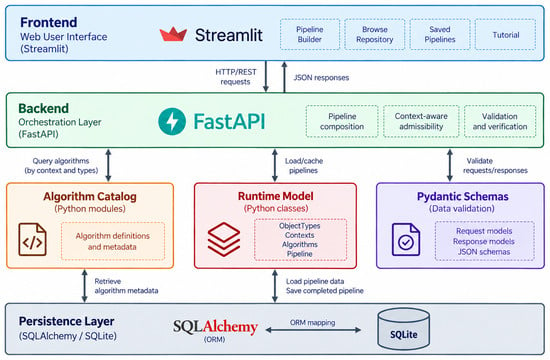
Figure 2 shows the implemented architecture. The backend is written in Python 3.10.11 and exposes REST endpoints through FastAPI. SQLAlchemy maps persistent entities to SQLite tables. Pydantic schemas validate API requests and responses. Runtime classes implement the logical model independently of persistence. A Streamlit frontend manages the user session and invokes the backend without embedding the composition logic itself.
Figure 2.
CAPPERI software architecture: the user interface is separated from the orchestration, validation, runtime model, catalog, and persistence layers.
The Pipeline API maintains temporary composition sessions server-side. Its main operations initialize a session, return admissible next steps, accept a selected step, save a completed pipeline, and retrieve saved pipelines. The separation between runtime models and ORM entities allows the validity rules to be expressed independently of database representation. Database constraints additionally prevent duplicate ObjectTypes and Algorithms within a context and enforce non-negative costs.
The current release is a composition environment, not yet a pipeline execution engine. Algorithms are represented by name, typed input/output signatures, context, and cost; they are not yet bound to executable functions or external services. This boundary is intentional in the present study because it isolates the composition problem. Binding Algorithms to executable modules and adding an execution engine are natural extensions discussed later (see Section 4.8).
2.6. Implementation Availability
The prototype was developed and tested with Python 3.10.11, FastAPI 0.136.3, Streamlit 1.58.0, SQLAlchemy 2.0.50, Pydantic 2.13.4, and SQLite 3.40.1. The software evaluated in this study is publicly available as the stable CAPPERI v1.0.0 release at https://github.com/mpatella/CAPPERI/releases/tag/v1.0.0 (accessed on 27 September 2026). The exact evaluated version corresponds to the immutable Git commit https://github.com/mpatella/CAPPERI/commit/970889ccc79d6e7a36f5e9ed838108763bfcbf6c (accessed on 27 September 2026). The release includes the complete backend and frontend source code, setup and dependency information, documentation, automated tests, example database initialization, experimental scripts, raw benchmark results, reproducibility information, and citation metadata in CITATION.cff. It is distributed under the MIT License.
3. Results
3.1. Multi-Domain Case Study
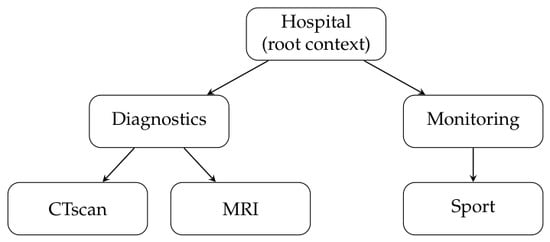
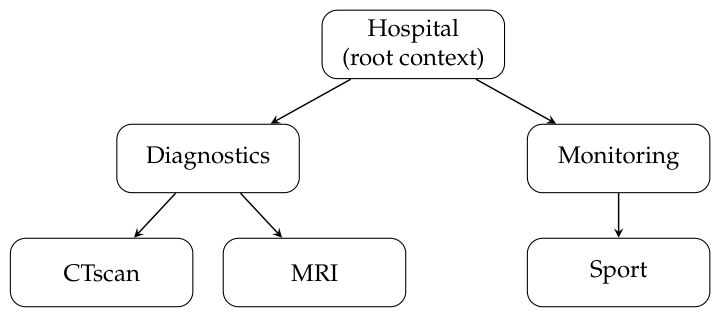
The CAPPERI repository also includes an example database representing a case study of a simple healthcare setting (Figure 3). Hospital is the root context and provides reusable data-processing abstractions that are inherited by progressively specialized contexts. Diagnostics and Monitoring extend the root context, with the former modeling processing of, say, clinical images, while the latter is used for sensor-based analysis. CTscan and MRI specialize Diagnostics, while Sport specializes Monitoring. Generic types such as RawData, CleanData, FeatureData, and Report are declared at the root, whereas domain-specific types are introduced only where needed, such as MedicalImage under Diagnostics and GPSData under Sport.
Figure 3.
Context hierarchy used in the supplied case study: elements defined in an ancestor context are inherited by descendants, while specialized elements remain scoped to their branch.
The hierarchy illustrates the CAPPERI principle of reuse through specialization, whereby common abstractions are inherited and domain-specific elements remain scoped to the corresponding branch.
This basic configuration contains 19 ObjectTypes and 18 Algorithms globally. Context scoping substantially reduces the catalog exposed to a user: at the root, only three generic Algorithms are visible, an 83.3% reduction relative to the global catalog; first-level contexts expose six Algorithms (66.7% reduction), while second-level contexts expose nine (50% reduction). Importantly, reduction in the visible composition space induced by context does not remove generic transformations: reusable transformations defined in ancestor contexts remain available through inheritance.
The case study also demonstrates compositional reuse at the pipeline level, while keeping it distinct from Context inheritance. A generic RawData -> CleanData -> FeatureData -> Report composition can be defined in Hospital using root-level Algorithms. Because these ObjectTypes and Algorithms are inherited by descendant Contexts, the same transformation sequence can be composed there without redefining its constituent processing abstractions. This constitutes compositional reuse rather than automatic inheritance of a persisted Pipeline instance. Diagnostics defines an image-oriented processing sequence from RawData to Diagnosis, while CTscan and MRI extend the inherited image representation with specialized reconstruction and analysis operators. Monitoring introduces a sensor-processing branch, and Sport reuses its inherited SensorData type before adding GPS and activity-specific steps. Saved Pipelines are reusable through hierarchical visibility rather than inheritance by duplication. At retrieval time, a Pipeline defined in an ancestor Context is visible from a descendant because its defining Context belongs to , whereas a Pipeline defined in a child is not exposed to its parent or sibling branches. The stored Pipeline record remains associated with its defining Context and is never copied into the descendant. A descendant may therefore retrieve and reuse an ancestor-defined Pipeline as is, while inherited ObjectTypes and Algorithms also allow the same sequence to be recomposed or specialized locally when additional domain-specific steps are required.
3.2. Step-Wise Guidance
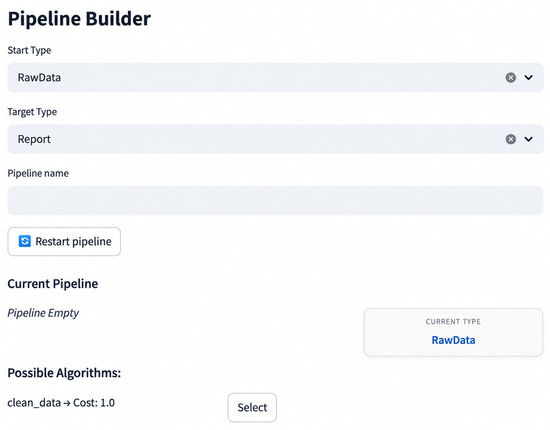
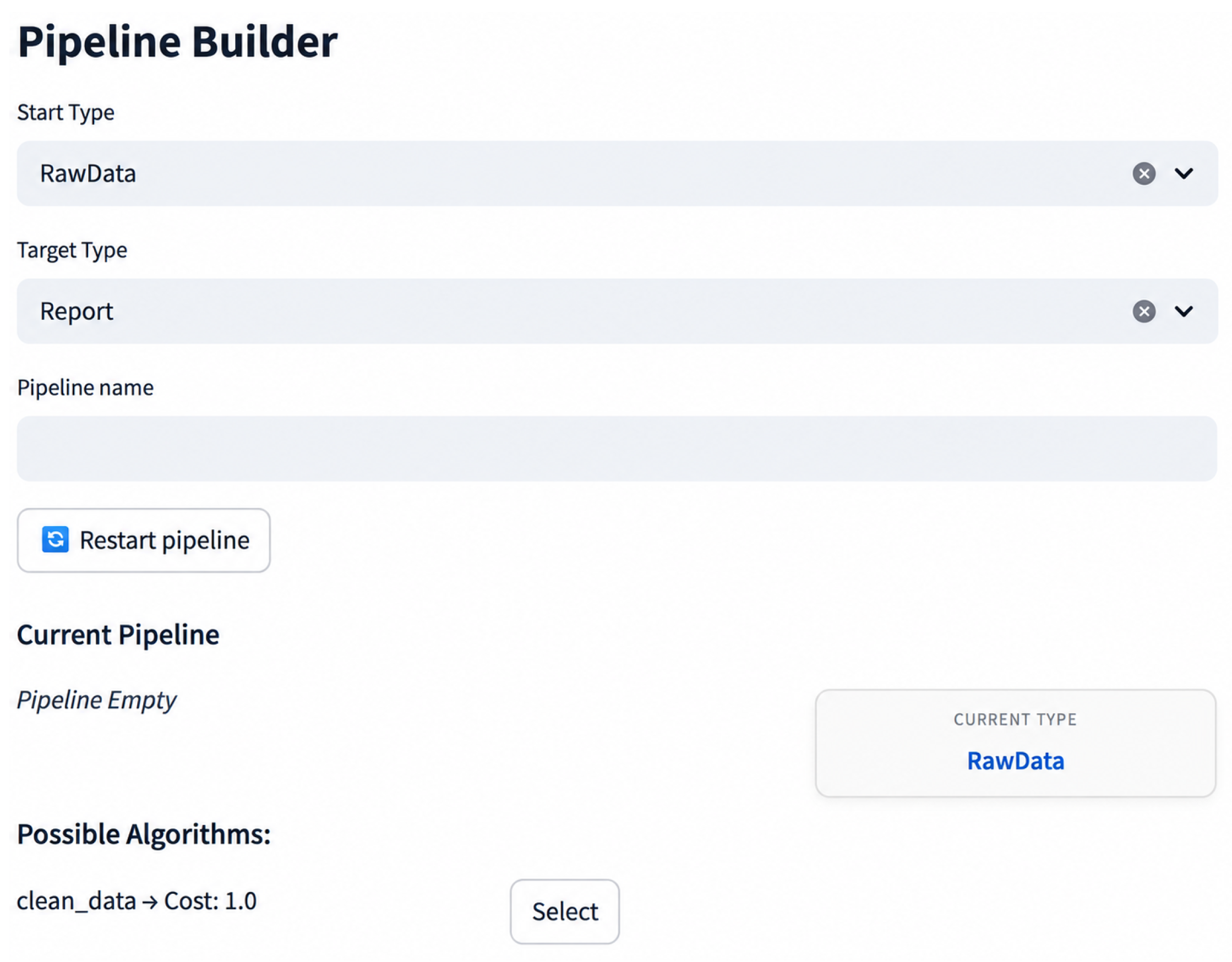
Figure 4 illustrates the composition interface of the CAPPERI pipeline builder. Once a context and endpoint types have been selected, the frontend requests the admissible transformations for the current state. The current ObjectType, accumulated cost, selected steps, and available Algorithms are displayed explicitly. After a selection, the state is updated and the process repeats until the target is reached or no valid continuation exists.
Figure 4.
Guided composition interface shown at enlarged scale. The upper panel reports the selected source and target ObjectTypes; the lower panel focuses on the current pipeline state and the context- and type-admissible Algorithms returned by the backend.
This interaction differs from both unrestricted workflow editors and fully automatic pipeline search. The system does not rank or silently select a next operation; it defines a valid local choice set. This makes the user’s decision traceable and leaves room for domain-specific preferences that are not yet encoded in the system.
3.3. Controlled Scalability and Filtering Evaluation
We include here a controlled synthetic evaluation to complement the small healthcare configuration and isolate the mechanisms claimed by CAPPERI. This is not intended to model the frequency distribution of transformations in a particular application domain; rather, its purpose is to isolate the effects of catalog cardinality and contextual selectivity under reproducible conditions. Global catalogs of 100, 1000, 10,000, 50,000, and 100,000 Algorithms were generated under three independent deterministic seeds. Each workload used a four-level context hierarchy and 500 sampled input-type queries per seed and catalog size. The active context for filtering experiments was the first specialization level. Raw per-seed measurements, scripts, and environment metadata are distributed with the software release (see Section 2.6).
The principal baseline is type-only composition. For a current ObjectType x, let A denote the global Algorithm set and the Algorithms visible from the active Context c and its ancestors. The baseline candidate set is , whereas CAPPERI returns . Both conditions therefore enforce the same (exact) local type-compatibility rule, while only CAPPERI additionally enforces contextual admissibility. The type-only baseline can consequently be interpreted as a controlled ablation of CAPPERI’s explicit-context mechanism. It is not intended as a surrogate for measured human manual construction: it is a controlled composition baseline in which explicit Context is ablated while local type compatibility remains unchanged. The fact that CAPPERI currently does not include reachability pruning allows the type-only comparison to be designed as a controlled ablation in which contextual admissibility is the sole additional filtering factor. Adding target-directed pruning only to CAPPERI would introduce a second experimental factor and would prevent the observed candidate-set reduction from being attributed specifically to explicit context. A quantitative runtime comparison with systems such as CtxPipe, HAIPipe, FlowPilot, Nextflow, or Galaxy would not isolate the same mechanism: those systems optimize, recommend, specify, or execute workflows under different objectives and workloads. Construction-time or throughput comparisons across these design points would therefore confound Context with differences in task, automation level, objective, and interaction model.
Table 1 shows two distinct effects:
- 1.
- Context scoping removes about half of the global catalog at the selected hierarchy level; at 100,000 Algorithms, the visible catalog is reduced by 50.10%.
- 2.
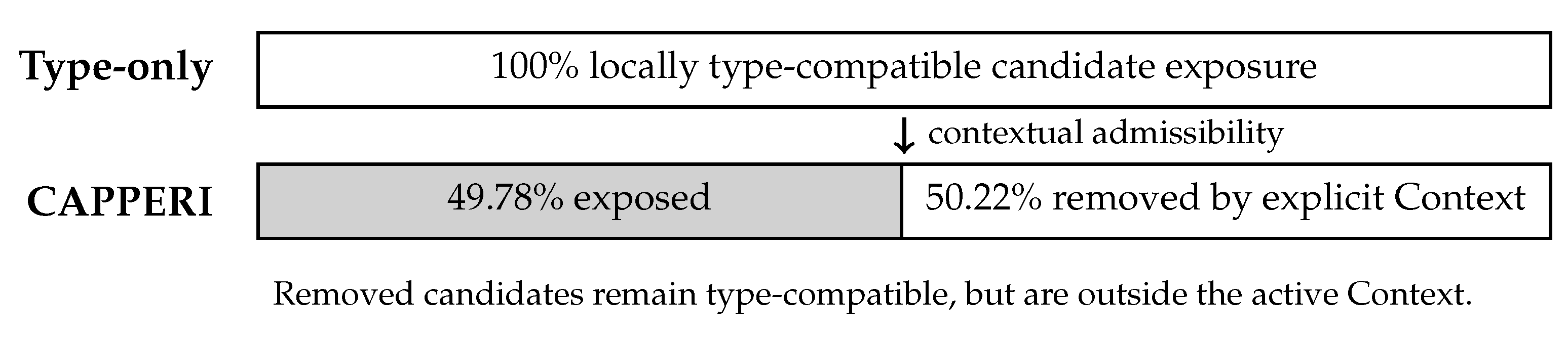
- This reduction transfers directly to the decision surface: 50.22% of candidates that are type-compatible globally are excluded because they fall outside the active application context.
Table 1.
CAPPERI filtering results averaged across three deterministic seeds: warm lookup is indexed retrieval from a cached context-scoped catalog; the type-only baseline scans the global catalog linearly.
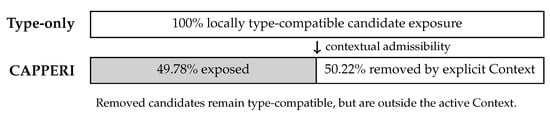
Figure 5 isolates this latter effect. Candidate exposure denotes the alternatives presented across the sampled next-step decisions; context-inappropriate candidate exposure denotes the subset that satisfies exact input-type compatibility but not contextual admissibility.
Figure 5.
Effect of explicit Context on candidate exposure at 100,000 Algorithms: the type-only baseline exposes all locally type-compatible candidates (100%), whereas CAPPERI exposes 49.78% after contextual admissibility is applied; the remaining 50.22% are type-compatible but context-inappropriate candidates removed before user selection (percentage is aggregated across three independently generated catalogs and 500 retrieval queries per seed).
We highlight the fact that, in this experiment, candidate-exposure reduction should not be interpreted as an equivalent reduction in human error rate or cognitive effort. Rather, it quantifies the portion of locally type-compatible alternatives that CAPPERI removes before user selection because they violate the explicit contextual constraint. It therefore provides an objective proxy for decision-space burden and for opportunities for context-inappropriate selection. The exposure analysis gives a quantitative interpretation of CAPPERI’s design principle: automation removes choices that violate explicit contextual constraints, while intentional selection among the remaining admissible alternatives is retained by the user.
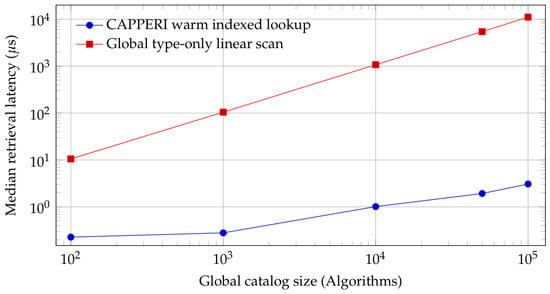
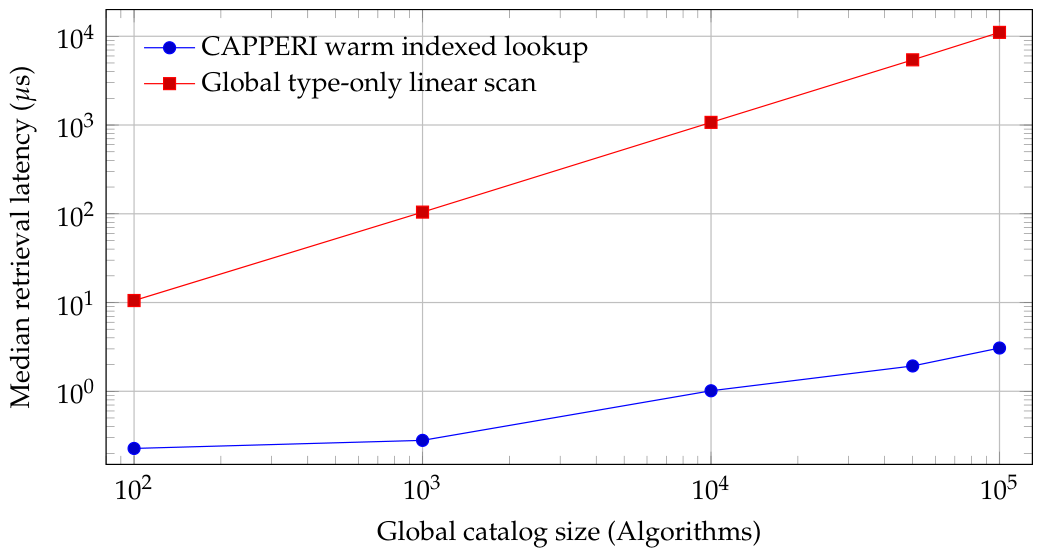
Figure 6 compares retrieval time of CAPPERI vs. the type-only baseline: CAPPERI warm indexed retrieval remains in the microsecond range over the tested sizes (median 3.07 μs at 100,000 Algorithms), whereas the global type-only linear scan reaches 11.07 ms. This result supports the narrower claim that indexed candidate retrieval is compatible with an interactive composition loop in the tested synthetic workload; again, this is not evidence of end-to-end user-interface response time or of superiority over external workflow systems.
Figure 6.
Warm indexed next-step retrieval compared with the global type-only linear-scan baseline as catalog size increases (values summarize three independently generated catalogs per size, with 500 retrieval queries executed for each seed and configuration; absolute timings are machine-dependent): the logarithmic vertical scale highlights the different growth behavior.
3.4. Cold-Cache and End-to-End Backend Cost
Our second experimental result aims to answer the following question: “how efficient is CAPPERI when retrieving contextually admissible Algorithms for the current pipeline construction step?” In Figure 7 and throughout the evaluation,
- “warm” denotes a lookup performed on an already constructed and indexed context-scoped Algorithm Catalog;
- “cold in-memory” includes context filtering, catalog construction and indexing, and the first lookup, but excludes persistence access;
- “cold end-to-end” additionally includes SQLite retrieval and Context-hierarchy resolution before catalog construction and the first lookup.
Figure 7.
Cold catalog construction and first-lookup latency for the in-memory workload and the SQLite-to-catalog backend path: values are averaged over three deterministic seeds (absolute latency clearly depends on hardware and database configuration).
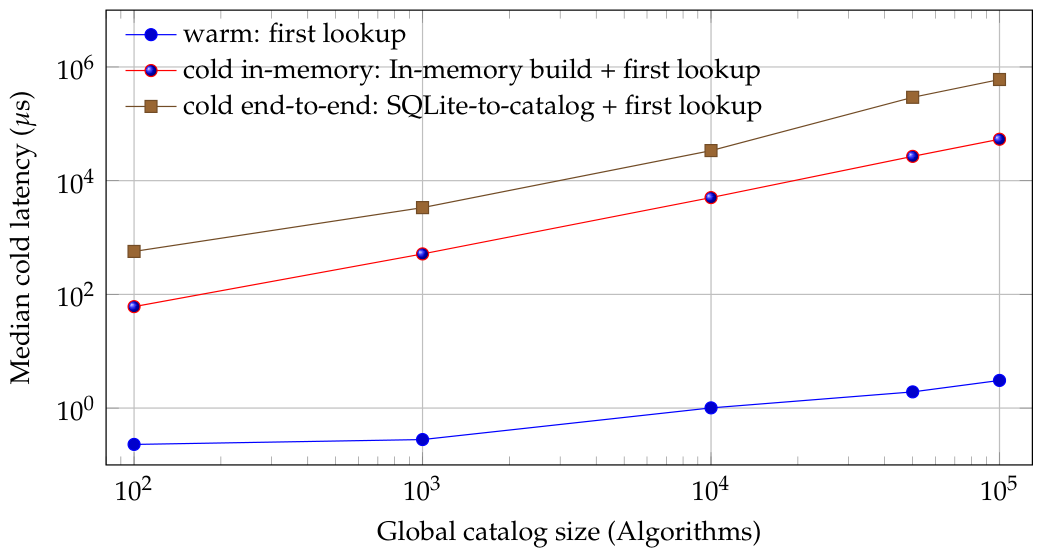
These measurements are separated because catalog construction and persistence costs are amortized by caching during a composition session.
At 100,000 Algorithms, median cold in-memory construction plus first lookup is 53.64 ms, while the more complete SQLite-to-catalog path requires 602.08 ms. The difference identifies persistence and materialization as the dominant cold-start cost at this scale. Since catalogs are cached by context hierarchy, this cost is not paid on every next-step request. The difference between warm and cold measurements is therefore expected: warm retrieval isolates the indexed operation repeatedly exercised during composition, whereas cold measurements include initialization and, in the end-to-end case, persistence access. Consequently, warm lookup latency should not be interpreted as end-to-end system response time, but rather as proof of how internal CAPPERI data structures scale when increasing the catalog size.
3.5. Quantifying Reuse Through Specialization
Reuse was quantified independently of retrieval latency. At the deepest level of the four-level synthetic hierarchy, the inherited ratio is the fraction of visible Algorithms declared in ancestor contexts; the local configuration ratio is the fraction that must be declared in the active context. The number of duplicate definitions avoided includes inherited Algorithms that would otherwise need to be repeated locally in a flat per-context configuration.
As shown in Table 2, the inherited ratio remains close to 75% across scales. At 100,000 Algorithms, 74.95% of the Algorithms visible in the deepest context are inherited, leaving 25.04% to be configured locally and avoiding approximately 74,955 repeated definitions under the synthetic hierarchy. These figures quantify the structural component-reuse mechanism; they are not a pipeline-inheritance rate and they do not claim an equivalent reduction in programmer time, which would require a controlled user study.
Table 2.
Reuse through specialization at the deepest context level, averaged across three seeds.
4. Discussion
4.1. Context as an Active Composition Constraint
The main design claim of CAPPERI is that context should influence pipeline construction before a pipeline exists. This differs from attaching domain labels or provenance metadata to a completed workflow. The active context determines which ObjectTypes and Algorithms can participate in the composition session, and hierarchical inheritance provides a controlled mechanism for reuse. Here, we compare the design principles of CAPPERI with those of systems dealing with automated data-preparation search (like CtxPipe, HAIPipe, DiffPrep), interactive recommendation (FlowPilot), and modern scientific workflow environments (Nextflow and Galaxy).
4.1.1. Positioning in the Pipeline/Workflow Design Space
Table 3 compares the systems most directly related to pipeline construction and scientific workflow design along complementary dimensions. The purpose is not to rank systems, but rather to expose the different design points they address. Automated preparation systems such as DiffPrep, HAIPipe, and CtxPipe primarily search for high-performing ML preparation pipelines [7,8,9]. FlowPilot assists scientific-workflow development through next-operator recommendation based on historical workflow knowledge [12]. Nextflow and Galaxy provide mature mechanisms for workflow specification and execution, with strong emphasis on reproducibility and reusable analyses [25,27]. CAPPERI instead concentrates on context-constrained design-time composition before execution.
Table 3.
Multidimensional positioning of representative pipeline and scientific-workflow systems: for each system, primary design is summarized, rather than claiming absence of capabilities not central to each system’s contribution.
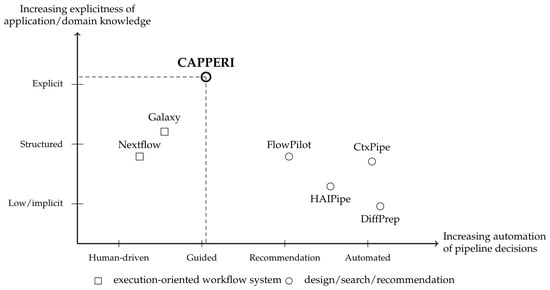
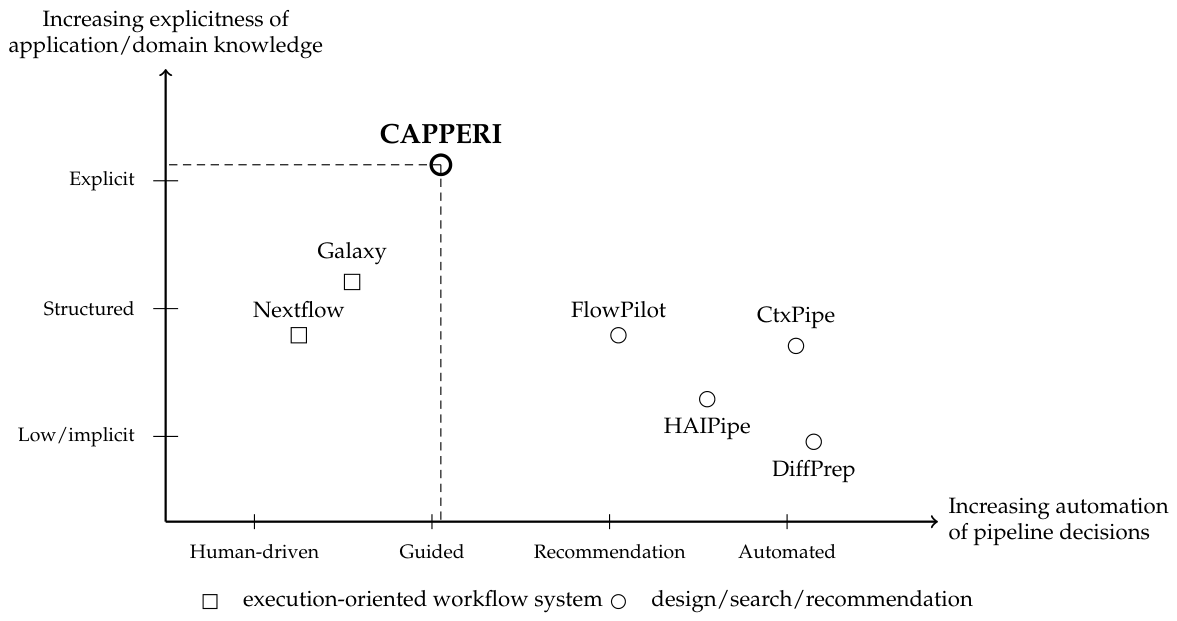
Figure 8 provides a complementary qualitative map using two particularly discriminating dimensions: degree of automation and explicitness of application/domain knowledge. Marker shape distinguishes systems whose primary contribution includes workflow execution from systems centered on design/search/recommendation. Positions are qualitative and are intended to summarize the design emphasis documented in the cited systems, not to define quantitative scores.
Figure 8.
Qualitative design-space positioning of representative systems: CAPPERI occupies a complementary design point combining explicit application/domain knowledge with human-guided constrained composition. Axis positions summarize primary design emphasis and are not quantitative performance scores.
Viewed in this design space, CAPPERI does not compete with workflow engines on execution, nor with automated pipeline-search systems on downstream optimization. Its distinctive role is to use explicit hierarchical application context as a hard constraint on composition while preserving intentional human control over the choice among admissible transformations. In the following, we provide a detailed comparison with CtxPipe to isolate the particularly important difference between learned context for automated search (CtxPipe) and explicit context as an operational composition constraint (CAPPERI).
4.1.2. Different Notions of Context: CAPPERI Versus CtxPipe
The comparison with CtxPipe [9] is particularly informative because both systems use the term context-aware, but they operationalize context at different abstraction levels and for different purposes. Table 4 summarizes the distinction.
Table 4.
Different notions of context-aware pipeline construction in CtxPipe and CAPPERI.
CtxPipe therefore treats context mainly as a learned signal for optimization; CAPPERI treats context as explicit knowledge organization and a hard composition constraint. The latter makes the reason for operator availability directly inspectable: an Algorithm is visible because it belongs to the active Context or an ancestor and because its input type matches the current data state. This makes the reason for candidate availability directly inspectable and preserves explicit user control at composition time. No user study of perceived interpretability is claimed. The trade-off is that domain contexts must currently be curated explicitly rather than inferred automatically.
This distinction is not merely terminological. A transformation may be syntactically applicable to a representation while still being inappropriate for a particular application domain. By scoping types and transformations before composition, CAPPERI can represent such domain boundaries independently of any downstream ML score. Conversely, learned contextual representations could eventually enrich, but need not replace, this explicit domain model.
The same broader distinction applies to HAIPipe and DiffPrep. HAIPipe combines human-generated and machine-generated preparation pipelines [8], while DiffPrep searches differentiable preprocessing spaces for tabular learning [7]. Those systems primarily aim to discover high-performing pipelines for downstream ML. CAPPERI instead aims to make heterogeneous preparation operators safely composable across application domains, including settings where there may be no downstream ML objective at composition time.
4.2. Human Guidance Rather than Full Automation
Interactive curation has long been motivated by the mismatch between statistical/ML expertise and domain expertise [6]. CAPPERI takes a deliberately lightweight position: rather than automatically generating a pipeline and asking the user to validate it, the system narrows the decision space and lets the user choose among valid transformations. This can be understood as a form of constrained human agency.
FlowPilot [12] represents a recent and complementary direction: it recommends the next operator in scientific workflow development using historical workflow knowledge and user feedback. The three paradigms can be distinguished by the question they answer:
- CtxPipe asks which preparation pipeline should be generated automatically for the dataset and downstream task;
- FlowPilot asks which operator is likely to be useful next;
- CAPPERI asks which transformations are admissible here, given the explicit application context and current data state.
This separation suggests a natural two-stage architecture for future assistance. CAPPERI can first apply deterministic context and type constraints to establish the admissible set; a recommender can then rank only those valid alternatives using historical pipelines, semantic similarity, cost, or user preferences. Recommendation and constrained composition are therefore orthogonal: soft ranking can improve guidance without being allowed to violate hard validity constraints.
4.3. Relation to Provenance and Semantic Pipeline Descriptions
Fine-grained provenance work shows why preprocessing pipelines must be treated as first-class objects: preparation steps affect not only accuracy and performance but potentially fairness and other downstream properties [10]. Provenance-based screening extends this perspective toward automated checks over preparation pipelines [11]. CAPPERI addresses the upstream side of the lifecycle. It constrains which transformations can be selected during design; provenance systems can subsequently record what those transformations did during execution.
The semantic direction is equally relevant. The literature provides evidence at several abstraction levels. Conceptual modeling can carry domain knowledge into data preparation so that preparation decisions better preserve what the data represents [16]. Semantic context models can make context a first-class constraint during service discovery and composition [17], while contextualized ontology networks can represent data semantics relative to explicit contexts and promote ontology reuse across them [18]. Together, these works indicate that context and semantics are related but not interchangeable: semantics describes the meaning of data and operations, whereas context qualifies the circumstances or domain scope under which that meaning is intended to hold. The same distinction has also emerged in multimedia data management. Context-based retrieval demonstrated that interpretation can depend on the user’s current semantic intent [19], while semantic taxonomies can bridge low-level representations and conceptual descriptions [20]. More broadly, combining visual content with explicit semantics has been advocated as a way to overcome the semantic gap that arises when automatically extracted features alone cannot capture the meaning relevant to users [29]. These observations are consistent with the role assigned to Context in CAPPERI: the framework does not infer full domain semantics, but makes the application scope in which types and transformations are intended to be meaningful explicit and operational. Venkataramanan et al. [13] demonstrate that explicit pipeline metadata and semantic enrichment can support search and recommendation over very large pipeline collections. The Context abstraction is intentionally lighter than an ontology or knowledge graph, while the separation between context, types, algorithms, and pipelines provides natural attachment points for richer semantics. Accordingly, the claim made here is not that CAPPERI already performs semantic reasoning: its contribution is to make application scope explicit and operational at composition time, thereby providing a software abstraction in which richer semantic descriptions can subsequently be attached without changing the basic human-guided composition paradigm. In the S-PIC4CHU vision, where CAPPERI originates from, semantic information should accompany multiple stages of a Data Preparation Pipeline and support coherent, application-aware preparation [28]. A future version of CAPPERI can therefore replace or enrich string-level ObjectTypes with ontology-backed concepts and semantic compatibility relations.
4.4. Multimedia and Stream-Processing Perspective
The framework was motivated in part by data-preparation settings where representations evolve through multiple stages, including multimedia. Previous work on multimedia retrieval and stream processing has emphasized both feature-level representations and abstraction over distributed processing infrastructures. In particular, SPAF [30] provides an abstraction layer for constructing real-time stream-processing applications independently of specific stream-processing engines. CAPPERI operates at a different level: it focuses on selecting and composing typed preparation steps rather than executing a streaming topology. The two abstractions are compatible: binding CAPPERI Algorithms to SPAF processors or other executable operators would turn a compositionally valid logical preparation walk into an executable pipeline while preserving separation between design and runtime infrastructure.
4.5. Software Architecture, Reusable Abstractions, and Extensibility
The contribution of CAPPERI is not tied to the specific technologies used by the current prototype. FastAPI, SQLAlchemy/SQLite, Pydantic, and Streamlit provide a concrete realization, but the reusable core lies in the separation between domain abstractions, composition rules, catalog services, persistence, and interaction. This separation of concerns is important for a software-intensive system because each layer can evolve without redefining the conceptual model of pipeline composition.
The four abstractions also support reuse at two levels:
- At the model level, ObjectType and Algorithm describe processing knowledge independently of a particular pipeline instance.
- At the domain level, hierarchical Contexts implement component reuse through specialization: generic types and transformations are defined once in an ancestor and automatically become available in descendants, whereas specialized Contexts add only the knowledge particular to their domain. Persisted Pipeline instances are not copied into descendants; ancestor-defined Pipelines remain visible for retrieval under the Context hierarchy, while inherited components additionally support recomposition and specialization in the descendant Context. The healthcare hierarchy used in the evaluation illustrates this mechanism through shared hospital-level operations and progressively specialized diagnostic, imaging, monitoring, and sport-processing branches.
From a software-engineering perspective, this design creates a number of explicit extension points:
- New persistence technologies can replace SQLite without changing runtime composition rules;
- Alternative user interfaces can consume the REST API;
- Richer type systems can extend ObjectType compatibility;
- Executable services can be bound to Algorithm descriptors;
- Recommendation or provenance components can be layered around the existing deterministic validity mechanism.
Reusable abstractions and modular architecture therefore serve not only maintainability but also the controlled evolution of the system toward richer semantics and execution capabilities.
4.6. Threats to Validity and Generalizability
4.6.1. Construct Validity
Candidate-exposure reduction measures how many globally type-compatible but context-inappropriate alternatives are withheld before user selection. It is therefore a structural proxy for decision-space burden and opportunities for context-inappropriate selection, not a measured human error rate, cognitive-effort reduction, usability score, or pipeline-construction time. Similarly, the inherited-component ratio measures reuse of processing abstractions across Context levels and should not be interpreted as an equivalent reduction in software-development effort.
4.6.2. Internal Validity
The synthetic generator provides controlled scale and repeatability, and three independent seeds with 500 queries per seed/configuration reduce dependence on a single generated instance. Nevertheless, Context selectivity and Algorithm distribution are determined by the workload generator and directly influence candidate-exposure and reuse ratios. Consequently, the observed 50.22% exposure reduction and 74.95% inherited-component ratio characterize the evaluated configurations rather than universal properties of CAPPERI. The type-only baseline is intentionally narrow: it isolates explicit Context while keeping the local type-compatibility rule constant.
4.6.3. External Validity
The healthcare hierarchy is a deliberately small, inspectable demonstrative case study rather than a clinical validation: it uses neither real clinical data nor operational hospital workflows. It illustrates the semantics of Context specialization and reuse, while the synthetic evaluation independently tests selected structural and performance properties under controlled scale. Generalization to other domains depends on factors including the quality and granularity of the Context hierarchy, the ObjectType model, the distribution and overlap of Algorithms across domains, and the expertise used to curate domain knowledge. Real multi-domain deployments and controlled user studies remain necessary to establish broader human-centered and application-level effects. The current prototype also assumes that Context hierarchies and their processing knowledge have already been curated; the effort required to construct and maintain such models in a new domain was not measured.
4.6.4. Reproducibility and Performance Validity
Absolute latency values depend on hardware, Python runtime, SQLite configuration, and cache state; they should therefore be interpreted primarily as scaling trends and relative behavior under the reported environment rather than deployment guarantees. The protocol separates cold and warm measurements. All quantitative results were produced with the public CAPPERI v1.0.0 release and the immutable commit reported in the Implementation Availability subsection; the release includes benchmark scripts, fixed seeds, raw measurements, environment metadata, and automated tests. These threats delimit the empirical claims of the present study: the evaluation supports the implemented mechanisms and their behavior under the tested configurations rather than universal performance or human-factor claims.
4.7. Opportunities for Improvement
The current prototype has four principal limitations.
- 1.
- Algorithms are descriptors rather than executable operators, so the system validates composition but does not yet execute the resulting pipeline.
- 2.
- ObjectType compatibility in v1.0.0 is exact equality: semantic subsumption, coercion, first-class parameter constraints, and multi-input/multi-output transformations are not currently represented.
- 3.
- Cost is additive and informational only; no automatic cost-based path optimization is implemented.
- 4.
- Contexts are manually curated and do not yet exploit ontologies, embeddings, or learned metadata.
The evaluation is correspondingly focused on the implemented contribution: context-based search-space restriction, guided validity, reuse in the supplied hierarchy, and catalog retrieval behavior. It does not claim improved downstream model accuracy because the framework does not execute ML pipelines. This distinction is important when comparing against automated pipeline-search systems whose primary outcome is predictive performance.
4.8. Future Development
Future development is organized around three complementary directions.
- Richer composition semantics includes parameter- and ontology-aware compatibility, reachability-aware guidance, and, in a more substantial generalization, multi-input/multi-output transformations. The current model remains deliberately single-input/single-output and linear; general workflow-control constructs such as branching, explicit runtime loops, and exception paths would require graph- or hypergraph-based composition semantics.
- Execution integration can associate Algorithm descriptors with executable functions, scripts, containers, or services while preserving the separation between composition and runtime execution. Dedicated execution environments are natural targets for such adapters; in particular, SPAF [30] provides an execution environment for stream-based processing pipelines. Translating a compositionally valid CAPPERI specification to SPAF processors or other executable operators would preserve context-aware design while delegating scheduling and execution to a specialized runtime. Provenance capture can then be integrated with execution so that a saved pipeline records both its design and the lineage of produced data.
- Assisted authoring, recommendation, and optimization should preserve a layered decision model. Contexts currently encode curated, normative application knowledge. Metadata, historical Pipelines, domain documents, and semantic/ontological resources could assist Context authoring by proposing Contexts, parent–child relations, ObjectTypes, and Algorithm assignments for expert validation; dynamic mechanisms could likewise recommend an active Context without silently changing the hard constraints. After admissibility filtering, a separate recommendation layer could rank legal candidates using historical Pipelines, domain best practices, user preferences, or quality indicators, providing a natural integration point for approaches such as FlowPilot. Global cost-aware optimization is a distinct mode because it requires target-directed look-ahead and an explicit objective. The current scalar cost is informational; a future multidimensional cost vector (considering, e.g., time, computing resources, monetary cost, or data-quality effects) would additionally require a utility/preference model or multi-objective policy. Thus the intended layering is hard context/type admissibility first, followed optionally by recommendation or global optimization.
A particularly relevant next validation step is deployment in an independent application domain, enabling direct measurement of cross-domain abstraction reuse and domain-model configuration effort.
5. Conclusions
CAPPERI addresses a specific gap between unrestricted manual workflow design and fully automated pipeline search. Pipeline construction is formalized as a finite typed walk over a context-scoped transformation graph: CAPPERI guarantees contextual admissibility and exact local/compositional type validity, while goal reachability and optimality remain separate concerns. Repeated ObjectTypes and Algorithms are permitted.
The included experimental evaluation supports the implemented claims of deterministic context filtering, efficient indexed next-step retrieval under the tested workload, and structural reuse. Across three synthetic seeds and catalogs up to 100,000 Algorithms, context scoping reduced the visible catalog by 50.10% and context-inappropriate candidate exposure by 50.22% at the tested context level. Median warm indexed lookup was 3.07 μs, compared with 11.07 ms for a global type-only linear scan; the complete cold SQLite-to-catalog path required 602.08 ms. At the deepest hierarchy level of the evaluated synthetic hierarchy, 74.95% of visible Algorithms were inherited, quantitatively characterizing component reuse through specialization in that controlled configuration. Note that this value is not an intrinsic reuse rate of CAPPERI; rather, it depends on hierarchy depth and on how Algorithms are distributed across ancestor and descendant Contexts.
We also provide a multidimensional comparison of CAPPERI with respect to systems most directly related to pipeline construction and scientific workflow design to further characterize this contribution as a complementary design point between unrestricted manual composition, automated pipeline search/recommendation, and executable workflow management: explicit application knowledge constrains admissibility while the user retains intentional control. The broader implication is that context can be treated as an operational part of pipeline composition rather than passive documentation, providing a foundation on which richer semantics, recommendation, provenance, execution, and quality-aware optimization can be added incrementally.
Author Contributions
Conceptualization, I.B. and M.P.; methodology, I.B. and M.P.; validation, I.B. and M.P.; formal analysis, I.B. and M.P.; investigation, I.B. and M.P.; resources, I.B. and M.P.; writing—original draft preparation, I.B. and M.P.; writing—review and editing, I.B. and M.P.; visualization, I.B. and M.P.; supervision, I.B. and M.P.; project administration, I.B. and M.P.; funding acquisition, I.B. and M.P. All authors have read and agreed to the published version of the manuscript.
Funding
This research was funded by the Italian Ministry of University and Research (MUR) under PRIN 2022 grant 2022XERWK9, “S-PIC4CHU—Semantics-based Provenance, Integrity, and Curation for Consistent, High-quality, and Unbiased data science.”
Institutional Review Board Statement
Not applicable.
Informed Consent Statement
Not applicable.
Data Availability Statement
No new research dataset was generated for this software study. The source code, example configuration, benchmark generators, per-seed raw CSV files, aggregated results, environment metadata, and scripts used to reproduce the reported evaluation are publicly available in the stable CAPPERI v1.0.0 release at https://github.com/mpatella/CAPPERI/releases/tag/v1.0.0 (accessed on 27 September 2026). The exact revision evaluated in this manuscript is commit https://github.com/mpatella/CAPPERI/commit/970889ccc79d6e7a36f5e9ed838108763bfcbf6c (accessed on 27 September 2026). The release is distributed under the MIT License and provides citation metadata through CITATION.cff.
Acknowledgments
Samuele Mazziotti is gratefully acknowledged for his contribution to the software implementation of the CAPPERI prototype. The S-PIC4CHU project partners are also acknowledged for discussions on semantics-aware data preparation. During the preparation of this manuscript, the authors used OpenAI ChatGPT (GPT-5.6 Sol) for grammar and spelling review. After using this service, they carefully reviewed and edited the manuscript as needed and take full responsibility for the content of this publication.
Conflicts of Interest
The authors declare no conflicts of interest. The funders had no role in the design of the study; in the collection, analyses, or interpretation of results; in the writing of the manuscript; or in the decision to publish the results.
References
- Chu, X.; Ilyas, I.F.; Krishnan, S.; Wang, J. Data Cleaning: Overview and Emerging Challenges. In Proceedings of the 2016 International Conference on Management of Data (SIGMOD 2016), San Francisco, CA, USA, 26 June–1 July 2016; pp. 2201–2206. [Google Scholar] [CrossRef] [Scilit]
- Kandel, S.; Paepcke, A.; Hellerstein, J.M.; Heer, J. Wrangler: Interactive Visual Specification of Data Transformation Scripts. In Proceedings of the SIGCHI Conference on Human Factors in Computing Systems (CHI 2011), Vancouver, BC, Canada, 7–12 May 2011; pp. 3363–3372. [Google Scholar] [CrossRef] [Scilit]
- Kandel, S.; Heer, J.; Plaisant, C.; Kennedy, J.; van Ham, F.; Henry Riche, N.; Weaver, C.; Lee, B.; Brodbeck, D.; Buono, P. Research Directions in Data Wrangling: Visualizations and Transformations for Usable and Credible Data. Inform. Vis. 2011, 10, 271–288. [Google Scholar] [CrossRef] [Scilit]
- Raman, V.; Hellerstein, J.M. Potter’s Wheel: An Interactive Data Cleaning System. In Proceedings of the 27th International Conference on Very Large Data Bases (VLDB 2001), Rome, Italy, 11–14 September 2001; pp. 381–390. [Google Scholar]
- Fernandes, A.A.; Koehler, M.; Konstantinou, N.; Pankin, P.; Paton, N.W.; Sakellariou, R. Data Preparation: A Technological Perspective and Review. SN Comput. Sci. 2023, 4, 425. [Google Scholar] [CrossRef] [Scilit]
- Shang, Z.; Zgraggen, E.; Buratti, B.; Kossmann, F.; Eichmann, P.; Chung, Y.; Binnig, C.; Upfal, E.; Kraska, T. Democratizing Data Science through Interactive Curation of ML Pipelines. In Proceedings of the SIGMOD/PODS ’19: International Conference on Management of Data, Amsterdam, The Netherlands, 30 June–5 July 2019; pp. 1171–1188. [Google Scholar] [CrossRef] [Scilit]
- Li, P.; Chen, Z.; Chu, X.; Rong, K. DiffPrep: Differentiable Data Preprocessing Pipeline Search for Learning over Tabular Data. Proc. ACM Manag. Data 2023, 1, 183:1–183:26. [Google Scholar] [CrossRef] [Scilit]
- Chen, S.; Tang, N.; Fan, J.; Yan, X.; Chai, C.; Li, G.; Du, X. HAIPipe: Combining Human-Generated and Machine-Generated Pipelines for Data Preparation. Proc. ACM Manag. Data 2023, 1, 91:1–91:26. [Google Scholar] [CrossRef] [Scilit]
- Gao, H.; Cai, S.; Dinh, T.T.A.; Huang, Z.; Ooi, B.C. CtxPipe: Context-Aware Data Preparation Pipeline Construction for Machine Learning. Proc. ACM Manag. Data 2024, 2, 231:1–231:27. [Google Scholar] [CrossRef] [Scilit]
- Chapman, A.; Missier, P.; Simonelli, G.; Torlone, R. Capturing and Querying Fine-Grained Provenance of Preprocessing Pipelines in Data Science. Proc. VLDB Endow. 2021, 14, 507–520. [Google Scholar] [CrossRef] [Scilit]
- Schelter, S.; Guha, S.; Grafberger, S. Automated Provenance-Based Screening of ML Data Preparation Pipelines. Datenbank-Spektrum 2024, 24, 187–196. [Google Scholar] [CrossRef] [Scilit]
- Esmailoghli, M.; Weidlich, M. FlowPilot: A Suggestion System for Designing Scientific Workflows. Proc. ACM Manag. Data 2026, 4, 39. [Google Scholar] [CrossRef] [Scilit]
- Venkataramanan, R.; Tripathy, A.; Kumar, T.; Serebryakov, S.; Justine, A.; Shah, A.; Bhattacharya, S.; Foltin, M.; Faraboschi, P.; Roy, K.; et al. Constructing a Metadata Knowledge Graph as an Atlas for Demystifying AI Pipeline Optimization. Front. Big Data 2025, 7, 1476506. [Google Scholar] [CrossRef] [Scilit]
- Dey, A.K. Understanding and Using Context. Pers. Ubiquitous Comput. 2001, 5, 4–7. [Google Scholar] [CrossRef] [Scilit]
- Schilit, B.N.; Adams, N.; Want, R. Context-Aware Computing Applications. In Proceedings of the First Workshop on Mobile Computing Systems and Applications (WMCSA 1994), Santa Cruz, CA, USA, 8–9 December 1994; pp. 85–90. [Google Scholar] [CrossRef]
- Storey, V.C.; Parsons, J.; Castellanos Bueso, A.; Chiarini Tremblay, M.; Lukyanenko, R.; Castillo, A.; Maass, W. Domain Knowledge in Artificial Intelligence: Using Conceptual Modeling to Increase Machine Learning Accuracy and Explainability. Data Knowl. Eng. 2025, 160, 102482. [Google Scholar] [CrossRef] [Scilit]
- Furno, A.; Zimeo, E. Context-Aware Composition of Semantic Web Services. Mob. Netw. Appl. 2014, 19, 235–248. [Google Scholar] [CrossRef] [Scilit]
- Rico, M.; Taverna, M.L.; Galli, M.R.; Caliusco, M.L. Context-Aware Representation of Digital Twins’ Data: The Ontology Network Role. Comput. Ind. 2023, 146, 103856. [Google Scholar] [CrossRef] [Scilit]
- Bartolini, I. Context-Based Image Similarity Queries. In Adaptive Multimedia Retrieval: User, Context, and Feedback; Lecture Notes in Computer Science; Springer: Berlin/Heidelberg, Germany, 2006; Volume 3877, pp. 222–235. [Google Scholar] [CrossRef] [Scilit]
- Bartolini, I.; Ciaccia, P. Multi-Dimensional Keyword-Based Image Annotation and Search. In Proceedings of the 2nd International Workshop on Keyword Search on Structured Data (KEYS 2010), Indianapolis, IN, USA, 6 June 2010; pp. 5:1–5:6. [Google Scholar] [CrossRef] [Scilit]
- Altintas, I.; Berkley, C.; Jaeger, E.; Jones, M.; Ludaescher, B.; Mock, S. Kepler: An Extensible System for Design and Execution of Scientific Workflows. In Proceedings of the 16th International Conference on Scientific and Statistical Database Management (SSDBM 2004), Santorini Island, Greece, 21–23 June 2004; pp. 423–424. [Google Scholar] [CrossRef] [Scilit]
- Deelman, E.; Vahi, K.; Juve, G.; Rynge, M.; Callaghan, S.; Maechling, P.J.; Mayani, R.; Chen, W.; Ferreira da Silva, R.; Livny, M.; et al. Pegasus, a Workflow Management System for Science Automation. Future Gener. Comput. Syst. 2015, 46, 17–35. [Google Scholar] [CrossRef] [Scilit]
- Goble, C.A.; Bhagat, J.; Aleksejevs, S.; Cruickshank, D.; Michaelides, D.; Newman, D.; Borkum, M.; Bechhofer, S.; Roos, M.; Li, P.; et al. myExperiment: A Repository and Social Network for the Sharing of Bioinformatics Workflows. Nucleic Acids Res. 2010, 38, W677–W682. [Google Scholar] [CrossRef] [Scilit]
- Wolstencroft, K.; Haines, R.; Fellows, D.; Williams, A.; Withers, D.; Owen, S.; Soiland-Reyes, S.; Dunlop, I.; Nenadic, A.; Fisher, P.; et al. The Taverna Workflow Suite: Designing and Executing Workflows of Web Services on the Desktop, Web or in the Cloud. Nucleic Acids Res. 2013, 41, W557–W561. [Google Scholar] [CrossRef] [Scilit]
- Di Tommaso, P.; Chatzou, M.; Floden, E.W.; Barja, P.P.; Palumbo, E.; Notredame, C. Nextflow Enables Reproducible Computational Workflows. Nat. Biotechnol. 2017, 35, 316–319. [Google Scholar] [CrossRef] [Scilit]
- The Galaxy Community. The Galaxy Platform for Accessible, Reproducible and Collaborative Biomedical Analyses: 2022 Update. Nucleic Acids Res. 2022, 50, W345–W351. [Google Scholar] [CrossRef] [Scilit]
- The Galaxy Community. Galaxy for Accessible, Reproducible, and Collaborative Data Analyses: 2026 Update. Nucleic Acids Res. 2026, 54, W105–W116. [Google Scholar] [CrossRef] [Scilit]
- Alfano, G.; Bartolini, I.; Calvanese, D.; Ciaccia, P.; Greco, S.; Lanti, D.; Lenzi, E.; Martinenghi, D.; Molinaro, C.; Patella, M.; et al. S-PIC4CHU: Semantics-Based Provenance, Integrity, and Curation for Consistent, High-Quality, and Unbiased Data Science. In Proceedings of the 33rd Symposium on Advanced Database Systems (SEBD), Ischia, Italy, 16–19 June 2025. [Google Scholar]
- Bartolini, I. Content Meets Semantics: Smarter Exploration of Image Collections—Presentation of Relevant Use Cases. In Proceedings of the International Conference on Signal Processing and Multimedia Applications (SIGMAP 2012), Rome, Italy, 24–27 July 2012; pp. 186–191. [Google Scholar] [CrossRef] [Scilit][Green Version]
- Bartolini, I.; Patella, M. A Stream Processing Abstraction Framework. Front. Big Data 2023, 6, 1227156. [Google Scholar] [CrossRef] [Scilit]



Disclaimer/Publisher’s Note: The statements, opinions and data contained in all publications are solely those of the individual author(s) and contributor(s) and not of MDPI and/or the editor(s). MDPI and/or the editor(s) disclaim responsibility for any injury to people or property resulting from any ideas, methods, instructions or products referred to in the content. |
© 2026 by the authors. Licensee MDPI, Basel, Switzerland. This article is an open access article distributed under the terms and conditions of the Creative Commons Attribution (CC BY) license.