


Featured Application
Under the evaluated generator configurations and finite observation lengths, BCM-Net provides a complementary empirical screen for differences between candidate and reference sequences.
Abstract
Reliable randomness assessment is essential for evaluating random number generators used in cryptographic systems. This study presents the Bidirectional Convolutional Multi-head Attention Network (BCM-Net), which combines convolutional layers, a bidirectional gated recurrent unit, and multi-head attention for empirical discrimination between candidate and reference sequences. The evaluation uses Random.org reference data, linear congruential generators (LCGs) with moduli from to , and an amplified spontaneous emission-based quantum random number generator under three post-processing settings. BCM-Net flags and , although they pass the reported NIST SP 800-22 tests. In the baseline comparison on , its absolute difference between mean output scores is 52.38 percentage points (pp), compared with 32.88 pp for LSTM, 9.66 pp for CNN, and 0.02 pp for FNN. For the QRNG data, the 11-LSB output is flagged, while the 8-LSB and Toeplitz outputs are not. Under the generator configurations, finite observation lengths, preprocessing, and evaluation protocol examined here, these findings support empirical sequence discrimination as a complementary screening method. They do not establish detection performance for untested fractions of a generator period or certify randomness or cryptographic security.
1. Introduction
Random numbers are a foundational security resource rather than merely data with visually uniform distributions. Cryptographic key generation, nonces, initialization vectors, authentication protocols, secure simulations, and quantum communication all require outputs that are not only statistically well behaved but also unpredictable to an adversary with partial knowledge of the generating process [1]. Quantum random number generators (QRNGs) are especially attractive because they derive entropy from intrinsically probabilistic quantum measurements instead of a deterministic algorithm [2,3]. Nevertheless, quantum indeterminacy at the source does not automatically guarantee that every digitized output bit is uniformly distributed, independent, or free of exploitable side information. The measured signal is produced by an entire physical chain comprising an entropy source, optical and electronic components, an analog-to-digital converter, and a post-processing stage [4,5]. Randomness assurance must therefore evaluate the implemented generator as a system and determine whether residual structure remains in the final sequence.
Conventional assurance is dominated by statistical batteries such as NIST SP 800-22, ENT, Diehard, and TestU01 [6,7,8,9]. These suites are indispensable for detecting predefined anomalies, including frequency imbalance, abnormal runs, template recurrence, spectral peaks, and insufficient linear complexity. However, each test examines a specified statistic under a null hypothesis; passing a finite collection of tests means only that the null hypotheses were not rejected at the selected significance levels, not that the sequence is information-theoretically random or computationally unpredictable. Linear Congruential Generators (LCGs) illustrate this distinction. Their states obey , so the sequence is completely determined by the parameters and current state, has a finite period, and exhibits algebraic constraints in modular state space [10,11]. The modulus m determines the state space and possible period of the sequence; in cryptographic and statistical applications, it is often selected as either a large prime or a high power of two, depending on the implementation setting. This study uses the latter family, with m chosen as powers of two. Increasing m can lengthen the period and make low-order empirical statistics closely resemble those of a random source. Consequently, a large-modulus LCG may pass NIST SP 800-22 on a finite sample while still containing weak, distributed, and potentially learnable dependence. Such a result is not a failure of the test suite; it reflects the fundamental difference between testing selected statistical properties and searching for an unrestricted distinguisher.
This gap has motivated learning-based randomness assessment, with two related but distinct objectives: predicting subsequent outputs and discriminating between sequence sources. Fan and Wang investigated learnable correlations in pseudo-random data [12], while neural RNG evaluation studies examined sequence-level discrimination and the influence of network architecture and input length [13,14,15,16]. Prediction-based entropy assessment follows a different route by relating predictive success to min-entropy estimates. Li et al. used a temporal-pattern-attention LSTM with pruning and quantization to reduce the cost of min-entropy evaluation [17]. Huang et al. proposed MA-DG, which combines 2D-CNN features from transformed sequences with multi-head self-attention for min-entropy evaluation [18]. Han et al. subsequently examined the interpretability and reliability of prediction-based estimates and proposed an adaptive framework for time-varying entropy sources [19]. In a separate next-output prediction task, Tao et al. showed that Transformers can learn LCG sequences under specified training conditions, including unseen parameter settings and, over a more limited range, unseen moduli [20]. These studies establish that attention mechanisms and hybrid feature representations already have precedents in learning-based randomness assessment.
Neural methods have also been applied to distinct tasks: distinguishing a round-reduced block cipher [21], generating pseudo-random numbers with LSTMs [22], and forecasting pseudo-random outputs [23]. These works provide methodological context without evaluating the source-discrimination protocol used here.
Recent classification-based studies further broaden this line of research. Kaner et al. converted bit sequences from FPGA-based and pseudo-random generators into images and evaluated AlexNet, ResNet50, and EfficientNetB0 classifiers [24]. Crespo et al. compared network architectures and preprocessing choices, reporting their best discrimination results with CNNs operating on 5120-byte sequences [25]. Han et al. used grayscale-image classification to distinguish selected raw quantum random data from classical and post-processed quantum data [26]. These findings motivate comparisons of learned representations, but source discrimination alone does not establish cryptographic insecurity or certify a quantum origin. The importance of application-specific evaluation is also illustrated by Dahiya et al., whose PRNG-based attacks manipulated randomized-smoothing robustness certification while evading the randomness tests they examined [27]. Their result concerns adversarially supplied randomness in that application, rather than the universal detection performance of a neural RNG classifier.
Against this background, this study proposes the Bidirectional Convolutional Multi-Head Attention Network (BCM-Net) as a sequence-level binary distinguisher. Its architectural contribution is the serial integration of one-dimensional convolutional feature extraction, bidirectional gated recurrent encoding, and multi-head self-attention before classification. The CNN front end extracts local descriptors from each encoded input window. The Bi-GRU then contextualizes these descriptors using both directions of the observed window, and the attention module relates the resulting contextual representations across positions before the classification stage. Unlike the image-based classifiers discussed above [24,26], this pipeline operates on one-dimensional encoded sequences. It also differs from the Transformer next-output prediction task [20] and the min-entropy estimation objective of MA-DG [18]: BCM-Net is trained to separate candidate and reference windows using binary cross-entropy, rather than to predict the next generator output or directly estimate min-entropy. The contribution lies in integrating these complementary representations into a sequence-level discrimination framework and evaluating its application to pseudo-random and physical random sources.
The motivation for the integration is functional complementarity. Convolution extracts local patterns, bidirectional recurrence supplies within-window context, and attention provides direct interactions between positions in the resulting representation [28,29,30,31,32,33,34,35,36]. Here, “global” attention refers to positions within the finite input window; it does not imply access to the full generator period. Bidirectional processing is appropriate because the task classifies a fully observed window rather than making a causal prediction of an unseen future value. These design choices provide a mechanism for combining local and contextual evidence within a common representation. In practical QRNGs, classical disturbances and imperfect post-processing motivate such complementary empirical checks [37,38,39,40,41,42]. BCM-Net is therefore positioned as a complementary assessment tool alongside physical modeling and entropy analysis.
The contributions of this work are threefold. First, it develops a sequence-level distinguisher in which one-dimensional convolutional descriptors are contextualized by a Bi-GRU and then processed by multi-head self-attention for binary classification. The architectural contribution is the integration and evaluation of these established components for the present discrimination task. Second, it evaluates selected configurations within one LCG family at the reported finite observation lengths and compares their outcomes with ENT, NIST SP 800-22, and FNN, CNN, and LSTM baselines. Varying the modulus also changes the state period, so these comparisons do not isolate the effect of the fraction of a period observed. The tested LCG family is not representative of modern cryptographic PRNGs such as AES-CTR or ChaCha20. The experiments identify configurations that pass the reported NIST tests but are distinguished by BCM-Net under this protocol; is not distinguished under the same protocol. Third, it applies the same framework to an amplified spontaneous emission (ASE)-based QRNG under Toeplitz hashing and different m-LSB settings [38,40,43]. The resulting decisions are compared with the estimated min-entropy constraint, demonstrating how a learning-based distinguisher can provide an additional empirical check on post-processing parameter selection.
The remainder of this paper is organized as follows. Section 2 describes the data sources, sequence encoding, BCM-Net architecture, training procedure, and decision metrics. Section 3 presents the LCG and QRNG experiments and comparisons with statistical and neural baselines. Section 4 discusses the security implications, scope, and limitations of the proposed approach. Section 5 concludes the paper and outlines directions for broader validation.
2. Materials and Methods
This section describes dataset construction, sequence encoding, the BCM-Net architecture, and the evaluation protocol used to reformulate randomness assessment as a binary classification problem.
2.1. Data Acquisition
The experimental design requires both reference random sequences and candidate sequences with controllable non-random structure.
- Standard true random numbers (): A total of 200 MB of true random data generated from atmospheric electromagnetic noise was obtained from Random.org and used as the reference random class.The reference sequence passes the reported NIST SP 800-22 items; its ENT statistics are also reported in Section 3. These checks provide an empirical baseline for the present comparison, but do not establish that the trained classifier is insensitive to properties specific to this reference source. Random.org is the only reference class used here, and the QRNG sequences are evaluated as candidates rather than as alternative reference classes.
- Pseudo-random numbers (): Linear Congruential Generators (LCGs) were used to generate candidate pseudo-random sequences with adjustable structural complexity. The LCG recurrence is given in Equation (1):To compare detection outcomes across selected LCG configurations, the modulus was varied as , while the multiplier a and increment c were fixed at 1103515245 and 12345, respectively.LCGs provide a mathematically specified testbed for examining changes in detection outcomes as the modulus varies; they have also been used in earlier neural RNG evaluation studies [14,15,20]. For the chosen parameters, c is odd, and . The Hull–Dobell conditions therefore give a full state period for every modulus considered here [44]. This full-period property provides a common structural basis for the testbed. The experiment examines modulus variation at fixed a and c, with statistical quality assessed separately using the reported tests.Each LCG configuration is evaluated using a single generator seed, providing a fixed baseline for the parameter comparison. For these full-period recurrences, different initial states select different starting positions on the same state cycle. This common cyclic structure motivates the testbed design. Variability associated with finite-segment starting positions and neural-network initialization remains to be quantified through repeated-seed evaluation.
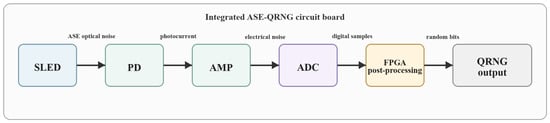
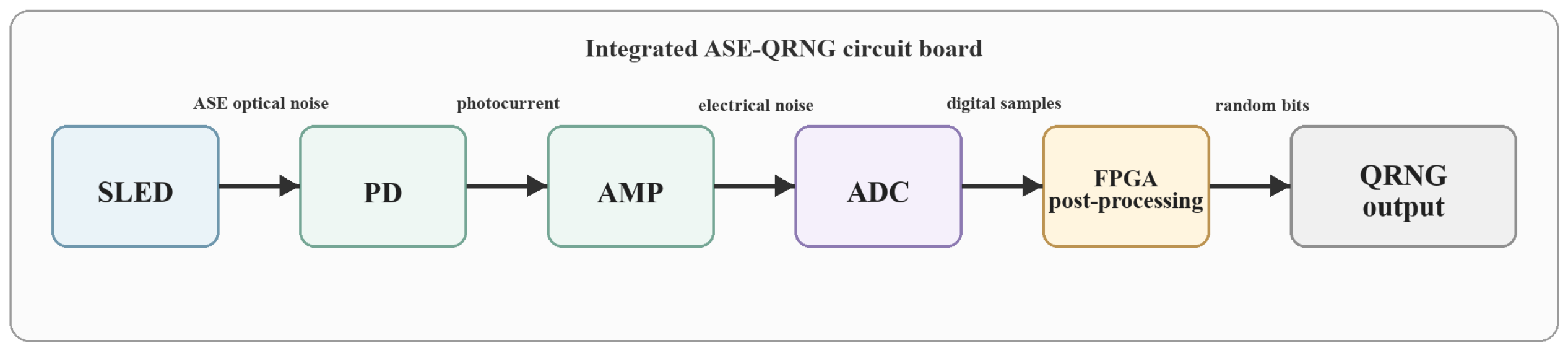
- Quantum random numbers (): To examine applicability to a physical entropy source, sequences were collected from an integrated ASE-based QRNG implemented on a circuit-board platform, as shown in Figure 1. The generator uses a superluminescent light-emitting diode (SLED) as the quantum entropy source. The emitted ASE optical noise is first detected by the photodetector and then amplified by a low-noise amplification circuit; the resulting electrical noise signal is sampled by a 14-bit AD9680-500 analog-to-digital converter (ADC) and delivered to a Xilinx XC7K325T field-programmable gate array (FPGA) for real-time data handling and post-processing. The same hardware acquisition chain was used for all QRNG datasets, while the FPGA/post-processing stage was configured with different extraction settings to produce the evaluated m-LSB and Toeplitz-hashed outputs. The sequences analyzed in this work were produced using either direct m-LSB extraction or Toeplitz hashing [41], following the board-level acquisition and FPGA post-processing chain used in compact ASE-QRNG implementations [45]. The entropy budget for this source was obtained from hardware characterization of the integrated ASE-QRNG system. The min-entropy is defined as , where denotes the maximum probability assigned to any ADC output bin under the fitted noise model. In that characterization, the SLED was first turned off to measure the classical electronic noise E, and then turned on to measure the mixed signal , where Q denotes the quantum noise contribution. Both measured distributions were well fitted by Gaussian models, with variances and , giving . Combining these measured noise parameters with the 14-bit ADC quantization gave a conservative direct min-entropy estimate of bits per raw ADC sample. Since each raw sample contains 14 bits, the corresponding entropy density is .
Figure 1.
Schematic diagram of the integrated ASE-based QRNG circuit-board system. ASE optical noise generated by the SLED is detected by the PD, amplified, digitized by the ADC, and processed by the FPGA to produce the QRNG output sequences.
2.2. Data Preprocessing and Sequence Encoding
To make heterogeneous sequence sources compatible with the neural network, all inputs were mapped into a unified numerical representation.
For binary bitstreams (, , and ), an 8-bit packing procedure was applied to convert bits into unsigned integers in the interval . For LCG outputs (), min–max normalization was used to project the generated integers into the same range.
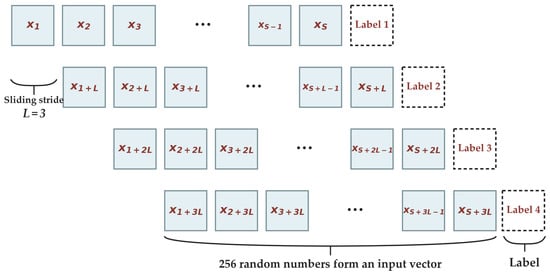
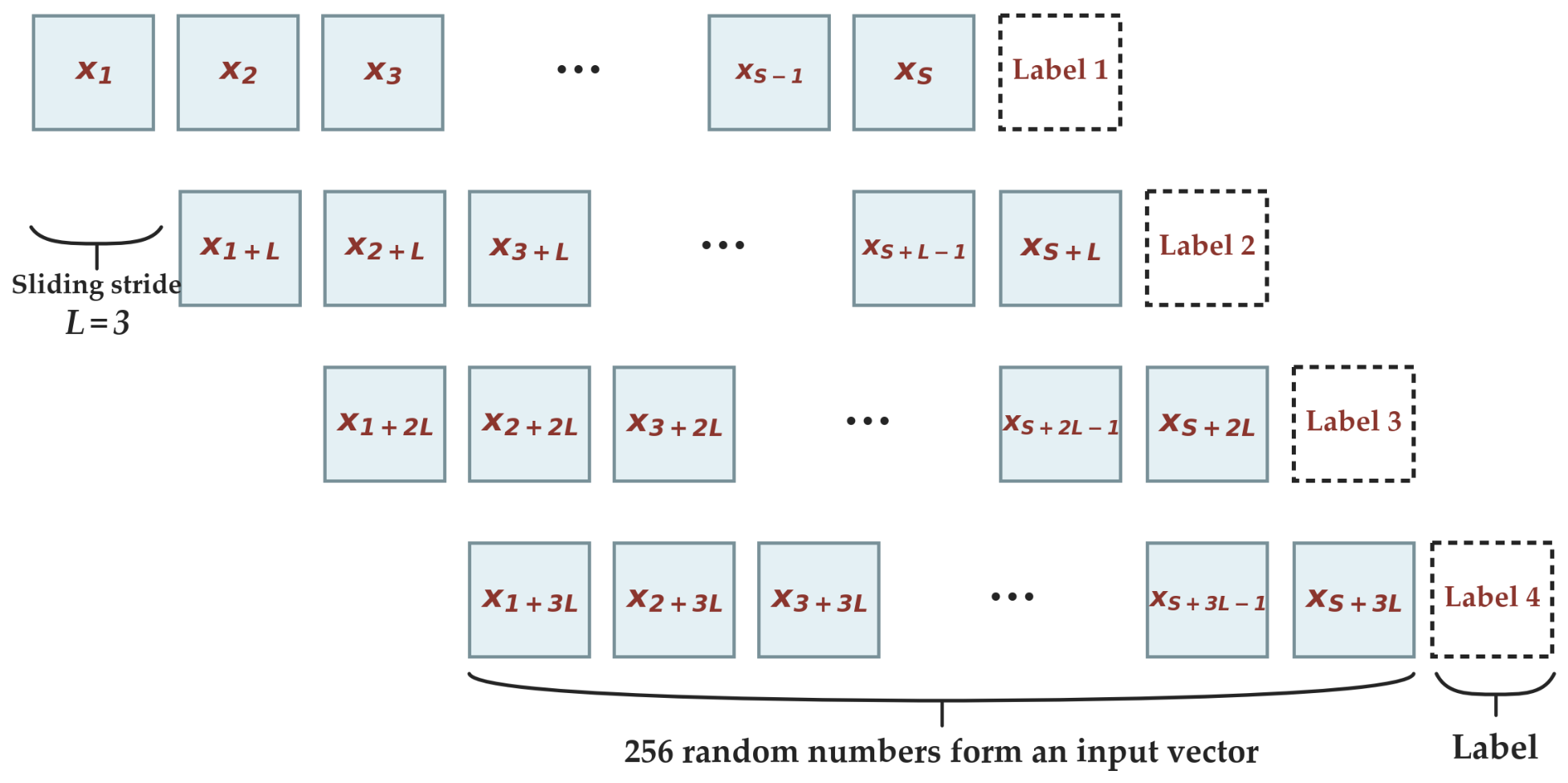
After normalization, a sliding-window strategy was used to construct fixed-length samples. The window length was set to and the stride to . Each 256-element array was treated as one training or testing instance. For supervised learning, the reference true random sequences were labeled as 0, and the candidate sequences under evaluation were labeled as 1. The preprocessing and labeling procedure is illustrated in Figure 2.
Figure 2.
Schematic diagram of the data preprocessing and labeling process using a sliding-window mechanism.
The number of window samples must be distinguished from the length of the underlying stream. Within a single block, n consecutive windows of length S and stride L span encoded elements, rather than independent observations. For a bitstream packed into 8-bit values, one such element represents one byte; for the LCG input, one normalized element represents one generator output, whose storage size is a separate encoding choice. Coverage of the LCG state cycle should therefore be expressed as , where counts consecutive generated states, and is measured in the same units. Training, validation, and test blocks require separate length accounting. Window counts alone do not specify the total raw data consumed by all tests, and the present results do not include a controlled comparison at matched coverage ratios. Here, P refers to the state-cycle period; equality with the period of a normalized or quantized output sequence has not been established. No configuration-specific coverage fraction is inferred from the single-window length.
2.3. BCM-Net Architecture
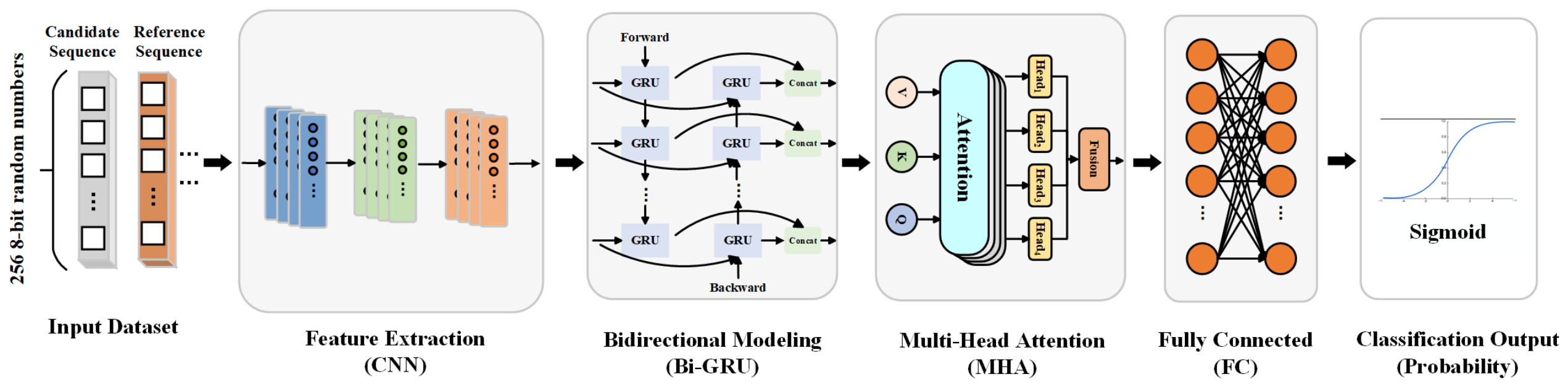
BCM-Net implements a serial CNN–Bi-GRU–multi-head-attention pipeline for binary discrimination between reference and candidate sequences, as shown in Figure 3. The convolutional blocks first produce local feature maps from the one-dimensional encoded input. The Bi-GRU processes these maps in both directions and concatenates the corresponding hidden states at each position. The attention module constructs its queries, keys, and values from this contextual feature sequence, rather than directly from the raw input. The resulting representation is then passed to the classification stage. All stages are optimized jointly using the binary cross-entropy objective. This ordering is the specific integration considered in this work; the individual component operations are established methods.
Figure 3.
Overall architecture of the proposed BCM-Net, integrating CNN feature extraction, Bi-GRU sequence modeling, and multi-head attention. The rightmost panel schematically shows the final sigmoid mapping to a candidate-class score.
2.3.1. Local Feature Extraction via CNNs
The CNN module contains three consecutive convolutional blocks for local feature extraction. Each block consists of a one-dimensional convolutional layer, batch normalization, a Parametric Rectified Linear Unit (PReLU), and dropout. The first convolution uses a kernel size of 3, whereas the following two layers use kernel size 5. All three layers output 64 channels.
Given an input sequence with , the convolutional blocks transform the raw sequence into local feature maps that emphasize short-range statistical regularities. Batch normalization stabilizes optimization, PReLU improves nonlinear expressiveness, and dropout reduces the risk of overfitting during training.
2.3.2. Sequential Dependency Modeling via Bi-GRU
Although CNNs are effective at extracting local patterns, their receptive fields remain limited. A Bidirectional Gated Recurrent Unit (Bi-GRU) layer is therefore introduced to model directional dependence across the full sequence.
The forward GRU processes the convolutional feature sequence chronologically to construct the forward hidden state , while the backward GRU processes the sequence in reverse to capture backward-directed dependencies . The final representation at time step t is obtained by concatenating both states, as shown in Equation (2):
This bidirectional representation allows the model to integrate both forward and backward contextual information before the attention stage.
2.3.3. Global Correlation Capture via Multi-Head Attention (MHA)
Residual non-random structure may occur over widely separated positions. To capture such global interactions, BCM-Net incorporates a multi-head attention (MHA) module that reweights sequence representations across multiple subspaces.
Given the feature sequence H output by the Bi-GRU, the MHA module applies linear projections to construct the query (Q), key (K), and value (V) matrices. The embedding dimension is 256 and is partitioned into four parallel attention heads. The attention output of the j-th head is defined in Equation (3):
The four attention heads are concatenated and linearly transformed to form a global contextual representation. A fully connected layer followed by a sigmoid activation then maps this representation to a candidate-class score for binary classification.
2.4. Experimental Setup and Evaluation Metrics
After preprocessing, reference samples and candidate samples were prepared for each binary-classification task to maintain class balance. To avoid information leakage caused by the highly overlapping sliding-window samples, the dataset split was performed at the raw-sequence level before window extraction. Specifically, for each data source, the original continuous stream was first divided into non-overlapping training, validation, and test blocks. Sliding-window samples were then generated independently within each block, and no raw sequence positions were shared across different splits. The samples were shuffled only within their corresponding splits. This raw-block splitting strategy follows the practice of prior machine learning-based RNG analysis, where continuous random-number streams were separated into training and testing segments before predictive evaluation [46]. Related prediction-based entropy estimation studies also use consecutive samples to predict subsequent values, further motivating the need to clearly specify the split level when overlapping windows are adopted [18].
After raw-block partitioning and window extraction, the samples within the training and validation splits were shuffled and used in an 8:2 ratio for model optimization, while the independent test block was kept separate for final evaluation. For preprocessing operations requiring fitted parameters, such as min–max normalization, the parameters were estimated using only the training block and then applied unchanged to the validation and test blocks. Unless otherwise stated, all experiments used the same architecture and hyperparameter settings to ensure a fair comparison across sequence families.
The network was trained with Binary Cross-Entropy (BCE) loss and optimized using Adam with an initial learning rate of 0.001 and a batch size of 256. Training was capped at 204,800 iterations, and early stopping with a patience of 10 epochs was applied once the validation loss ceased to improve, thereby limiting overfitting.
Following prior neural-network-based RNG evaluation studies, the classifier output is summarized using the average output (AO), namely the mean candidate-class score for each sequence set [14,15]. AO is distinct from classification accuracy: it averages sigmoid scores without thresholding them into predicted labels. With equal class priors and identical input distributions for the two classes, the population-optimal binary cross-entropy predictor is . This provides the theoretical reference for interpreting 0.5 as a neutral score, around which empirical outputs may vary with sampling and training. Kimura et al. used the average output label to examine source differences [15], and Crespo et al. evaluated deviations of AO from 0.5 [14]. For a sequence set X with samples, AO is defined in Equation (4) as
where denotes the sigmoid score assigned to the candidate class (label 1) for the i-th sample. The two source-level averages are considered jointly to characterize both their proximity to the neutral score and their separation from each other. The absolute AO difference between the candidate and reference sets is then computed in Equation (5) as
The quantity measures between-set separability and can be interpreted as an empirical soft-output distinguishing strength. It is not a measure of within-set dispersion such as variance or standard deviation. Following the AO convention in previous neural RNG evaluation work, sigmoid outputs are interpreted as classifier scores; probability calibration is a separate assessment. When AO is expressed as a percentage, is reported in percentage points (pp).
To provide a clear and standardized overview of the implementation, the systematic procedure for randomness detection using BCM-Net is formalized into four primary steps, as summarized in Table 1.
Table 1.
Implementation steps of the randomness detection procedure.
The decision rule follows the qualitative AO-based criterion used in prior neural RNG evaluation. In their HMAC-DRBG versus HMAC-DRBG control experiment, Kimura et al. observed that both average output labels were close to 0.5 and their difference was small; they adopted these two properties as the criterion for non-discrimination [15]. Crespo et al. likewise examined deviations of the AO from 0.5 for the tested and reference generators [14]. Thus, the use of a neutral-output condition together with an inter-source difference condition has precedent in the literature.
In this study, this qualitative criterion is implemented using the symmetric interval and the additional condition pp. The interval allows a 10 pp deviation from the neutral score for each source, while the difference condition requires the two averages to remain mutually close. The literature provides the rationale for this dual criterion, and the numerical tolerances specify its empirical implementation in the present study. A comparison meets the screening criterion when both conditions hold. The decision describes distinguishability under the specified model and protocol; its statistical error rate requires separate calibration. The same-source reference control described in Section 2.5 assesses how often this rule flags the evaluated null comparisons; ROC-AUC and broader uncertainty assessments remain complementary.
2.5. Reference–Reference Null-Control Protocol
To assess false-positive behavior under a same-source null condition, 100 comparisons were performed using two Random.org reference sets, denoted and . Within each repetition, the two sets were formed from mutually non-overlapping raw-sequence blocks and assigned different binary class labels. The raw data were then separated into non-overlapping training, validation, and test blocks before sliding-window extraction, as in the main experiments. The window length (), stride (), architecture, optimizer, learning rate, batch size, and early-stopping settings were kept the same as in the candidate–reference comparisons. For every repetition, BCM-Net was freshly initialized and trained from scratch; the AO values were then calculated on the corresponding held-out test sets.
where . The unchanged screening rule counts a repetition as flagged if either AO is outside or pp. The observed false-positive proportion is
where is the number of flagged null comparisons. This control evaluates the specified same-source protocol; it does not by itself characterize performance for other physical reference sources.
3. Results
3.1. Performance Evaluation on Pseudo-Random Sequences (LCGs)
This subsection evaluates whether BCM-Net distinguishes the tested LCG sequences from the reference under the reported protocol for moduli . The reference random sequences serve as the baseline for comparison.
3.1.1. Baseline Statistical Testing
The LCG sequences were first examined using conventional descriptive and statistical tests.
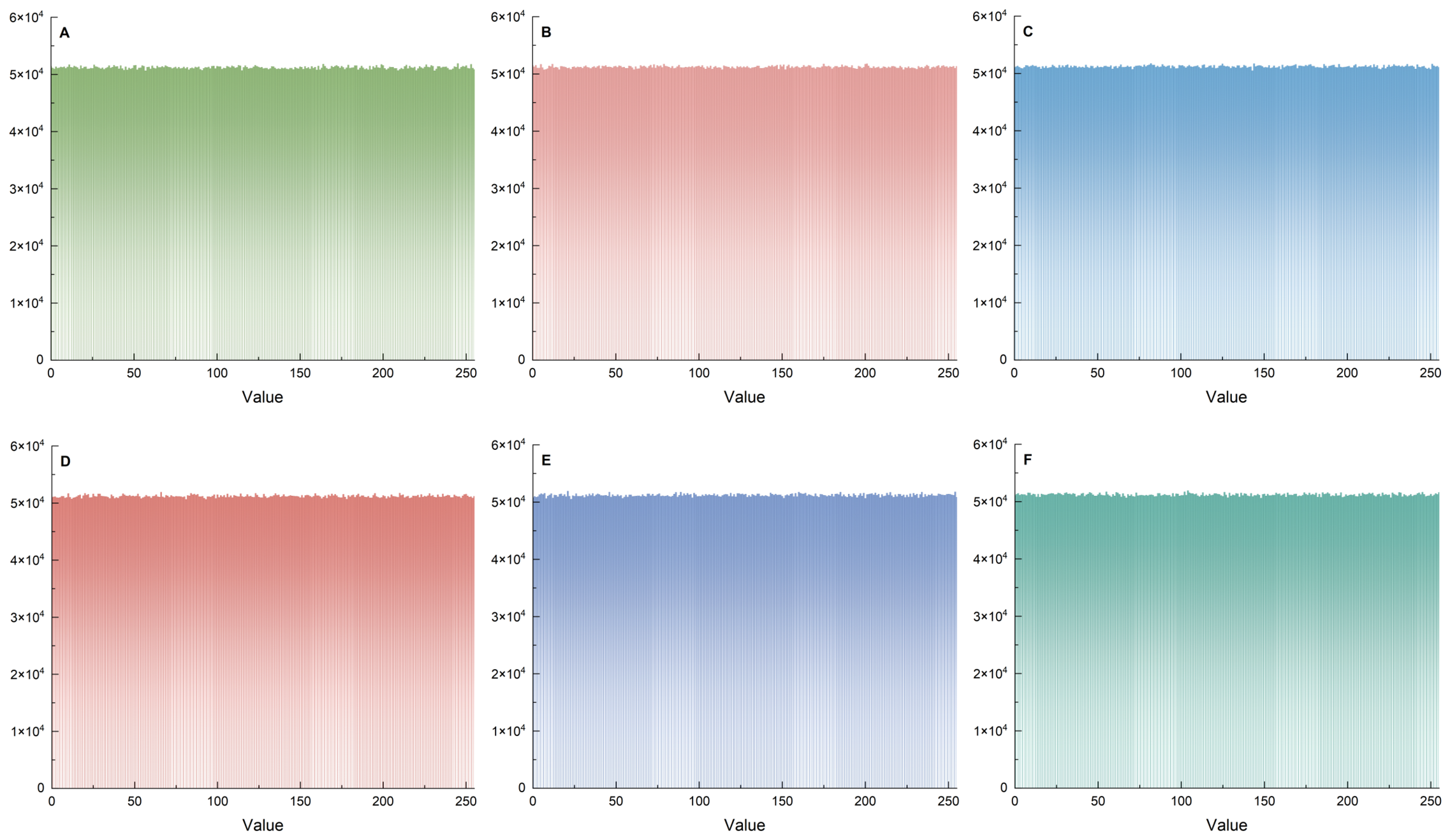
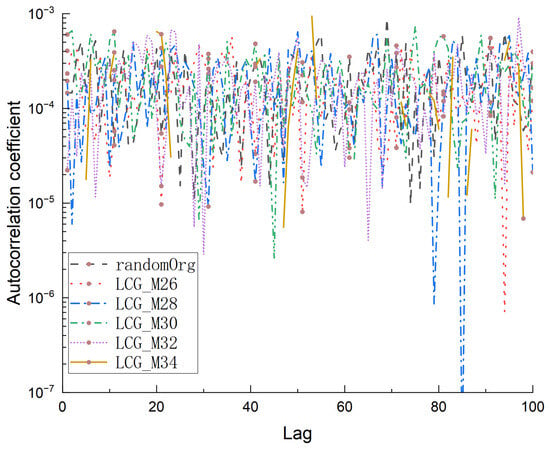
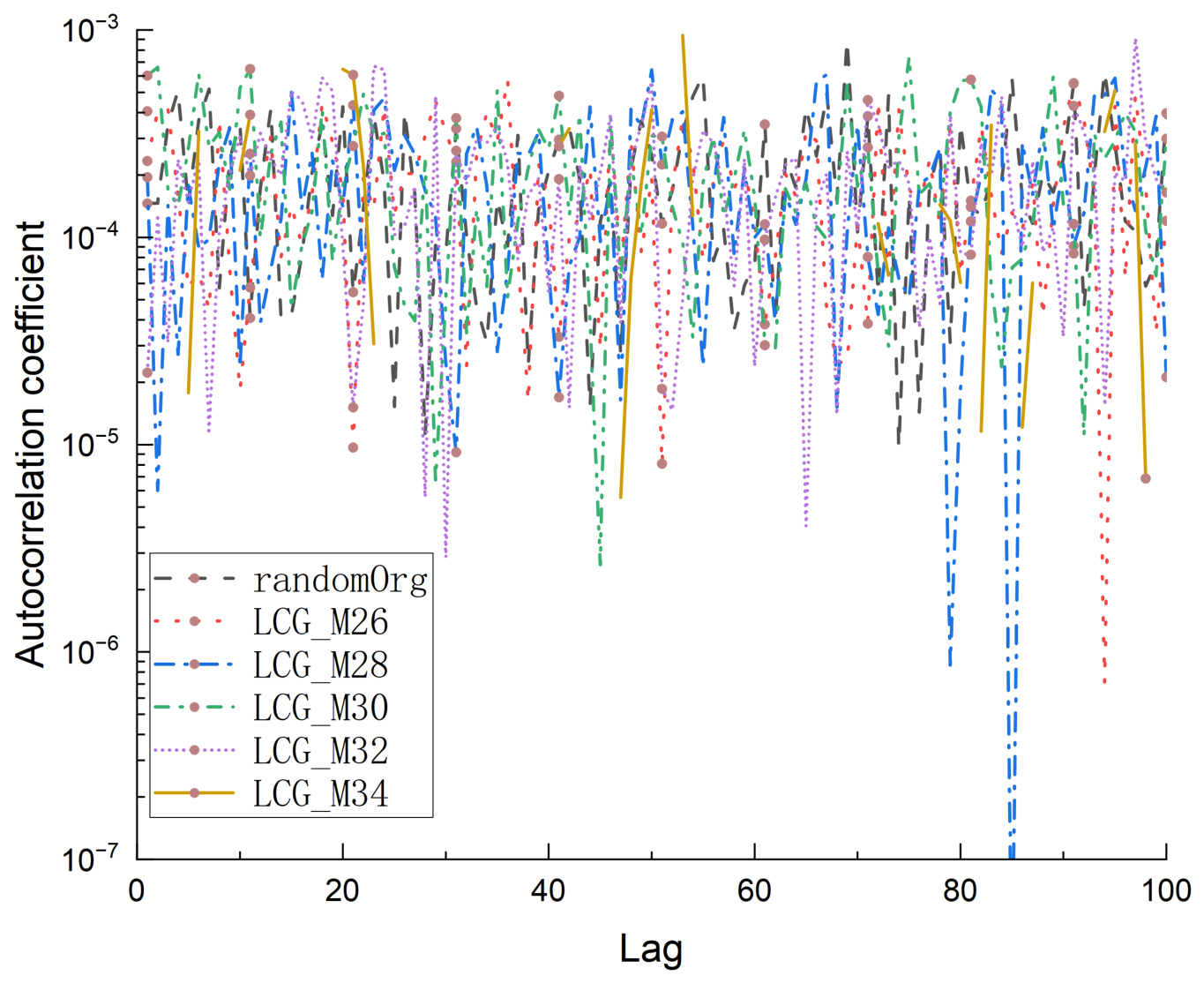
As shown in Figure 4 and Figure 5, all tested sequences exhibit approximately uniform histograms and near-zero autocorrelation at the visual level. A more formal evaluation was therefore conducted using the ENT and NIST SP 800-22 batteries with significance level .
Figure 4.
Statistical distribution histograms of true random numbers () and LCG pseudo-random sequences (). Panels (A–F) show , , , , , and , respectively.
Figure 5.
Autocorrelation coefficients of true random numbers () and LCG pseudo-random sequences ().
The quantitative ENT results are summarized in Table 2, followed by the NIST SP 800-22 results in Table 3.
Table 2.
Results of ENT testing for LCG sequences.
Table 3.
Results of NIST SP 800-22 testing for LCG sequences.
Under the reported test settings, the sequences with and fail selected NIST SP 800-22 items, whereas those with , , and pass the reported items. These results characterize the tested configurations at the available observation lengths. Since the cycle coverage decreases with increasing at a fixed raw length, the observed trend is interpreted jointly in terms of generator parameters and sample coverage. Separating their contributions is a natural objective of a controlled length-versus-period study.
3.1.2. BCM-Net Detection Results
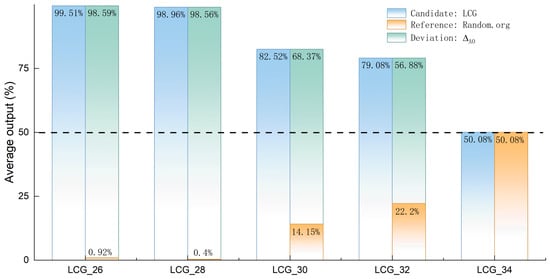
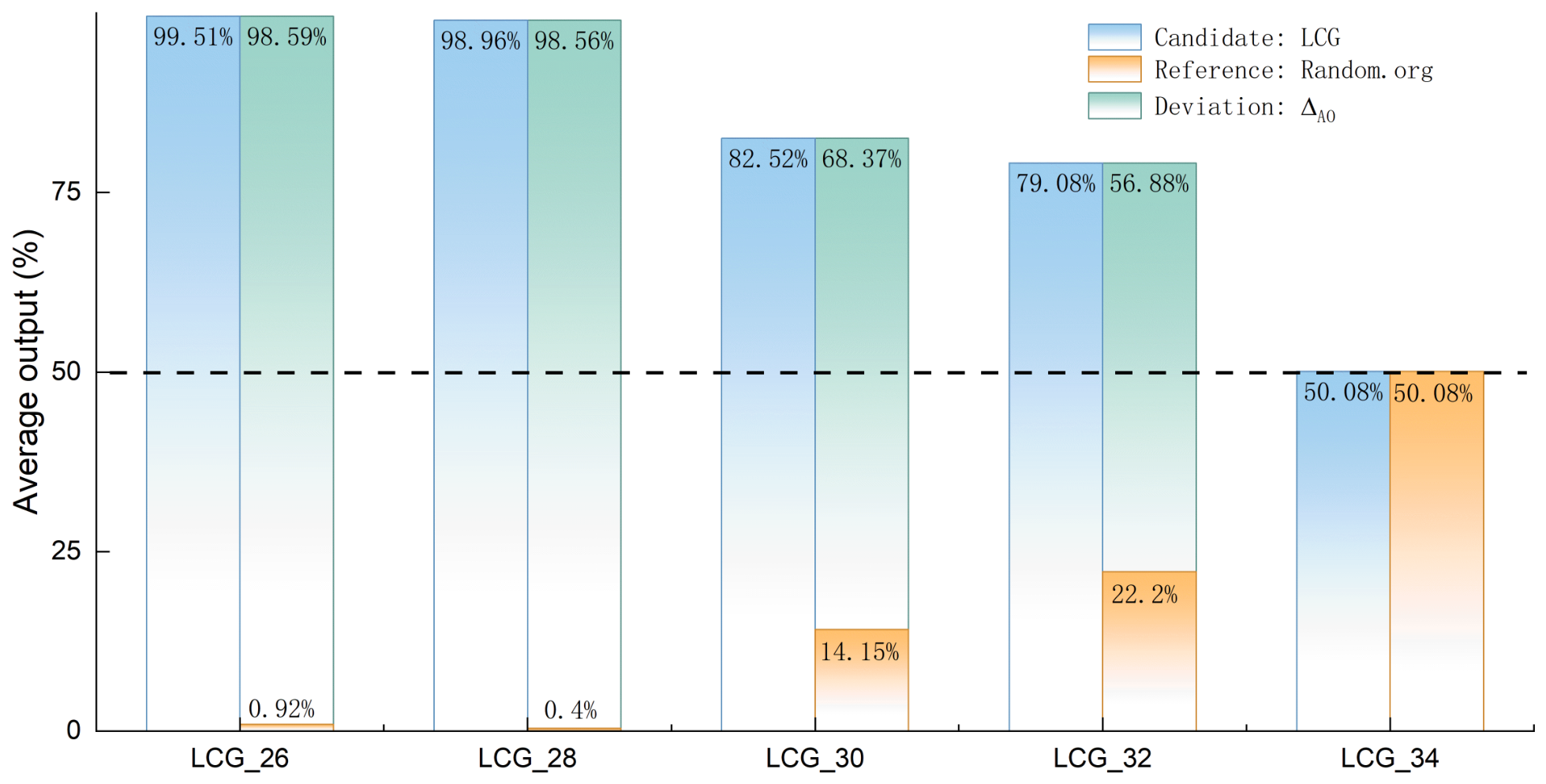
The same LCG sequences were then evaluated using BCM-Net. The corresponding average outputs () and absolute AO differences () are reported in Table 4 and Figure 6.
Table 4.
BCM-Net detection results for LCG sequences.
Figure 6.
Average outputs and absolute AO differences for BCM-Net on LCG sequences with varying moduli.
Figure 6 shows wide separation between the lower-modulus LCG sequences and the reference under the reported encoding. For and , reaches 98.59 and 98.56 pp, respectively. These large AO differences provide direct evidence of separation between the evaluated LCG samples and the reference.
The more important result concerns the larger-modulus cases. Although and pass the NIST SP 800-22 suite (Table 3), BCM-Net still yields values of 68.37 and 56.88 pp, respectively. Because both values exceed the rejection threshold of 10 pp, the model identifies these sequences as distinguishable from the reference random class. The additional separation detected by BCM-Net illustrates the complementary information supplied by learned discrimination alongside the reported NIST pass/fail results.
When the modulus increases to , the AO values for the candidate and reference sequences converge to approximately 50.08%, and approaches 0 pp. This result indicates that the distinguishing capacity of the current model is finite and that the configuration is not separable under the present training and decision setting.
3.1.3. Comparative Analysis with Baseline Neural Networks
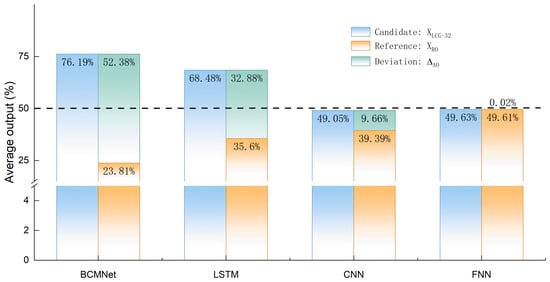
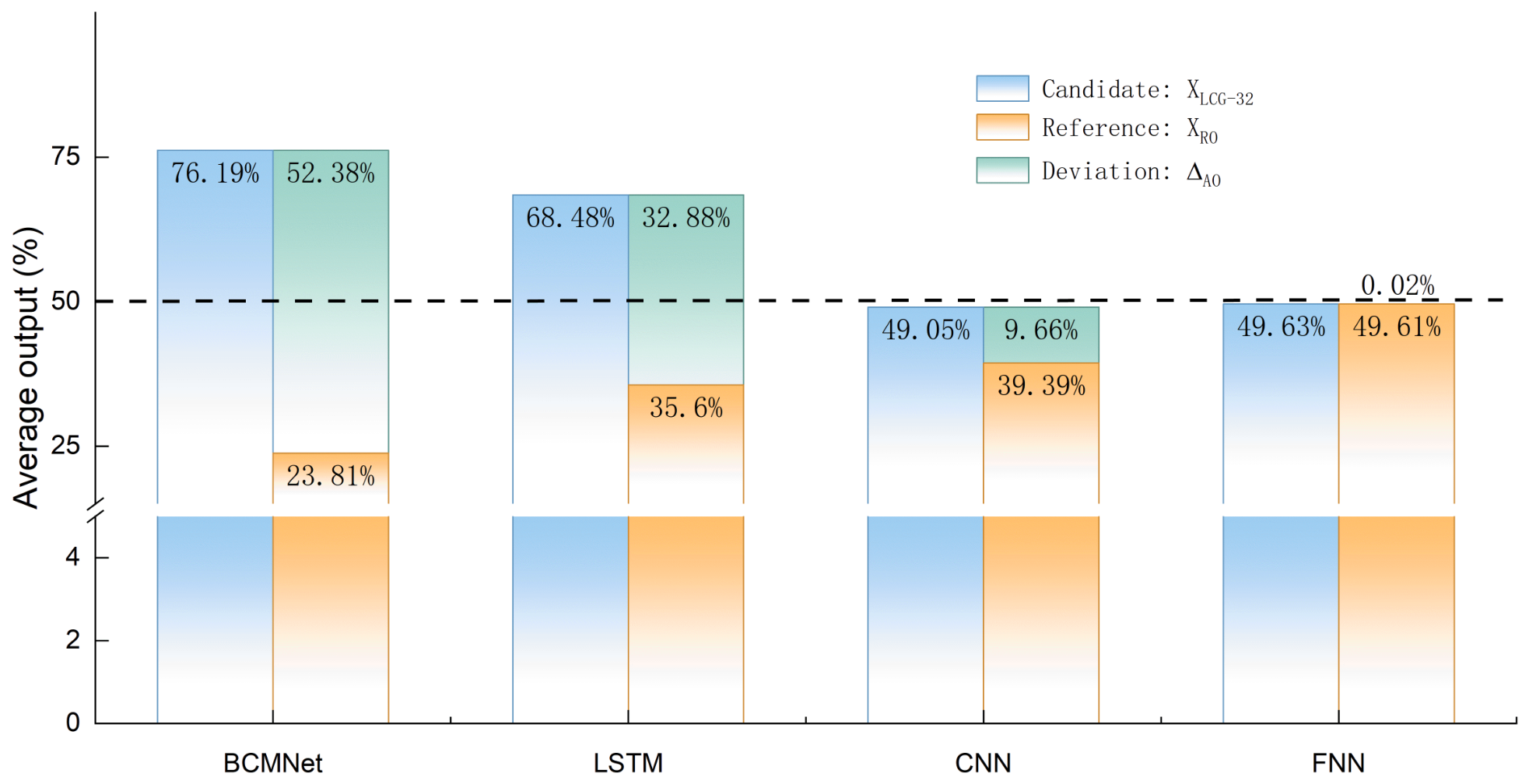
To compare the discrimination performance of the complete BCM-Net model with the selected alternatives, experiments were conducted against several standard deep learning baselines: a Long Short-Term Memory (LSTM) network, a Convolutional Neural Network (CNN), and a shallow Feedforward Neural Network (FNN). The sequence , which passed all reported NIST SP 800-22 items, was selected as the benchmark to evaluate the sensitivity of each model. This baseline comparison was conducted as an independent run under the same data-generation and preprocessing settings; therefore, the BCM-Net AO values differ slightly from the modulus-sweep experiment in Table 4, while the rejection decision remains unchanged. The experimental results are summarized in Table 5 and visualized in Figure 7.
Table 5.
Performance comparison between BCM-Net and baseline models on .
Figure 7.
Average outputs and absolute AO differences for BCM-Net and the baseline models on .
Table 5 shows that BCM-Net has the largest observed AO difference on : 52.38 pp, compared with 32.88 pp for LSTM, 9.66 pp for CNN, and 0.02 pp for FNN. Thus, the complete model produces stronger separation according to this reported statistic in the evaluated run, including on a sequence that passes the reported NIST SP 800-22 tests. The CNN result also illustrates why both parts of the decision rule must be considered: although its AO difference is below 10 pp, its reference AO is 39.39%, outside the neutral interval, so it is rejected under the combined rule.
The comparison evaluates the complete BCM-Net pipeline on the specified LCG configuration and supports its ability to produce a larger AO separation than the tested baselines in this experiment. Component ablations and repeated trials would further characterize how the local, recurrent, and attention-based representations contribute to that separation. Comparisons with recent methods across additional PRNG families constitute a complementary extension under a common evaluation protocol.
3.2. Empirical Evaluation of QRNG Post-Processing
BCM-Net was also applied to an ASE-based QRNG. The hardware characterization in Section 2 reports a model-based raw-sample min-entropy estimate of bits/sample for the 14-bit ADC output. Retaining 8 or 11 least significant bits gives settings below or above this numerical estimate, respectively. For deterministic LSB selection, output uniformity and security additionally depend on the retained-bit distribution and the source model. The Toeplitz input and output lengths, and , give a compression ratio of approximately 0.66, below the estimated per-bit entropy of . This entropy-budget comparison motivates the selected compression ratio. Formal extraction security additionally requires a suitable block entropy bound, relevant side-information and seed assumptions, and a specified extraction error [41]. The following experiments assess the empirical distinguishability of these post-processing settings as a complement to extraction-security analysis.
Three QRNG outputs were considered: generated by Toeplitz hashing with compression ratio , produced with , and produced with . The corresponding ENT and NIST SP 800-22 results are summarized in Table 6 and Table 7.
Table 6.
Results of ENT testing for QRNG sequences under different post-processing methods.
Table 7.
Results of NIST SP 800-22 testing for QRNG sequences under different post-processing methods.
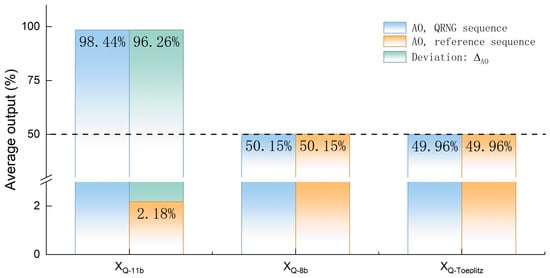
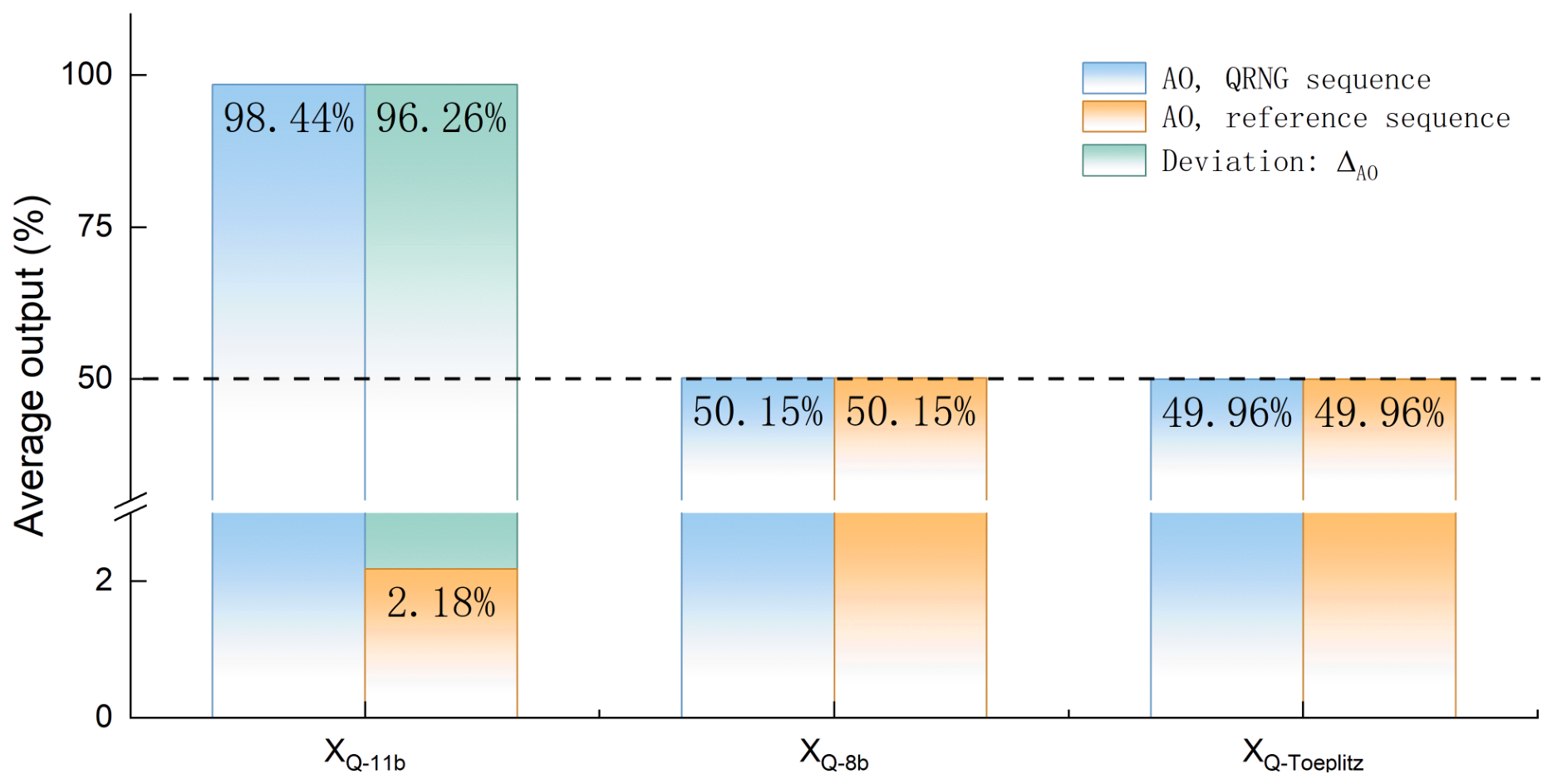
The reported statistical tests distinguish the post-processing settings: and pass the listed items, whereas fails selected tests. BCM-Net was then applied to these sequences, with outputs shown in Table 8 and Figure 8.
Table 8.
BCM-Net detection results for QRNG sequences under different post-processing methods.
Figure 8.
Average outputs and absolute AO differences for BCM-Net on QRNG sequences with different post-processing methods.
As shown in Table 8, the AO values for and are close to 50%, and both satisfy pp. The comparison yields pp and is flagged. Thus, BCM-Net agrees with the reported statistical-test outcomes for these three settings and provides an additional assessment of post-processing behavior. The resulting decisions are interpreted within the empirical screening framework defined in Section 2.4.
3.3. Same-Source Null-Control Results
Across the 100 same-source – null-control repetitions, the mean AO values were 49.6% (standard deviation (SD): 2.4 pp) for and 50.4% (SD: 2.3 pp) for . The mean absolute AO difference was 2.8 pp, with a maximum of 8.4 pp. Both AO values fell within and the AO difference remained below 10 pp in all repetitions (Table 9). The predefined screening rule therefore flagged 0 of 100 same-source null comparisons, yielding an observed false-positive proportion of 0% under this protocol.
Table 9.
Same-source Random.org null-control results over 100 repetitions. AO values are reported as mean (SD) across repetitions; pp denotes percentage points.
4. Discussion
The main finding is that BCM-Net distinguishes and from the reference even though both configurations pass the reported NIST SP 800-22 tests. Conventional batteries examine predefined statistics, while the trained discriminator evaluates features learned from the candidate and reference sequences. Their combined use therefore broadens the empirical assessment of the evaluated sources. In the baseline comparison, BCM-Net produces the largest observed AO difference, supporting the effectiveness of the complete pipeline for the reported task.
The architectural rationale is the combination of local convolutional descriptors, bidirectional contextual encoding, and attention across the resulting representations. The present experiments evaluate this integrated design. Component ablations and repeated trials would quantify the respective contributions of architecture, capacity, and optimization. Recent prediction, entropy-estimation, and source-classification studies [17,19,20,24,25,26] provide complementary perspectives; comparisons under a common protocol would clarify their relative strengths for particular evaluation tasks.
For the evaluated ASE-based QRNG data, agreement between BCM-Net and the reported statistical tests shows that the same screening protocol can be applied to the three tested post-processing settings. This provides an empirical check alongside physical entropy modeling and extraction analysis. Cryptographic security remains a separate, model-dependent assessment requiring the source and extractor assumptions described in Section 3.2.
The experimental scope comprises one parametrized LCG family, one Random.org reference dataset, and three ASE-QRNG post-processing settings. These choices support a focused comparison of the evaluated configurations. Extension to other generator families and independently acquired physical references would assess transfer across sources. Harmonized encoding and acquisition controls would help separate generator-related features from source-specific representation effects; the current experiments do not isolate these contributions. Similarly, full-period LCGs share a common state cycle across seeds, while finite-segment and training variability remain to be evaluated through multiple seeds and network initializations. The dependence of BCM-Net’s detection performance on the observed fraction of the LCG period has not been systematically characterized: observation length and period coverage were not varied in a controlled design. The present evidence therefore cannot quantify how detection changes with that fraction, identify a minimum fraction required for reliable detection, or establish period-independent performance. The reported results apply to the generator configurations, finite observation lengths, preprocessing, and evaluation protocol examined here and should not be extrapolated to untested period-coverage regimes. The result identifies a configuration that is not distinguished under the current protocol and offers a useful case for investigating the relationship between model capacity and observation length.
The dual AO criterion uses empirical tolerances rather than a universal statistical threshold. In the same-source Random.org control, the rule flagged 0 of 100 null comparisons. This observed proportion does not establish a zero underlying false-positive probability or performance across other physical reference sources. Additional acquisitions and source controls would help characterize variability and the tradeoff between detection sensitivity and false-positive decisions. Because adjacent windows overlap, uncertainty estimates based on windows should account for within-stream dependence. Together with computational-cost measurements, these studies would extend the present empirical findings toward calibrated operation and practical deployment.
5. Conclusions
This study presents BCM-Net, a sequence-level randomness screening framework integrating convolutional feature extraction, bidirectional recurrent modeling, and multi-head attention. Under the tested generator configurations and finite observation lengths, the reported experiments demonstrate separation of and from the reference despite their passing the reported NIST SP 800-22 tests. In the separate baseline comparison, BCM-Net achieves the largest observed AO difference among the four evaluated models. Application to the ASE-based QRNG yields consistent screening and statistical-test outcomes across the 11-LSB, 8-LSB, and Toeplitz settings.
These findings support learned sequence discrimination as a complementary tool for RNG assessment and QRNG post-processing evaluation within the studied configurations. The literature-based AO interpretation and explicitly defined decision rule provide a consistent basis for this empirical analysis. A 100-repetition same-source null control yielded no flagged comparisons under the evaluated protocol. These observations neither establish detection performance at untested fractions of a generator period nor prove that unflagged sequences are truly random or cryptographically secure. Future work will assess broader source coverage, component-level contributions, and the variability of screening decisions across acquisitions.
Author Contributions
Conceptualization, F.F. and L.L.; methodology, F.F. and L.L.; software, F.F. and L.L.; validation, F.F., L.L., J.Y., W.H. and Y.L.; formal analysis, F.F. and L.L.; investigation, F.F. and L.L.; resources, B.X.; data curation, F.F. and L.L.; writing—original draft preparation, F.F. and L.L.; writing—review and editing, F.F., L.L., J.Y., W.H., Y.L. and B.X.; visualization, F.F. and L.L.; supervision, B.X.; project administration, B.X.; funding acquisition, B.X., F.F. and L.L. contributed equally to this work. All authors have read and agreed to the published version of the manuscript.
Funding
We acknowledge financial support from the National Key Research and Development Program of China (Grant No. 2020YFA0309704), the National Natural Science Foundation of China (Grants No. 62471446, No. 62171418, No. 62201530, No. U24B20135, and No. 62301517), the Sichuan Science and Technology Program (Grants No. 2024JDDQ0008, No. 2023ZYD0131, No. 2023JDRC0017, No. 2022ZDZX0009, No. 2024NSFSC0470, No. 2024NSFSC0454, No. 2024ZYD0008, and No. 2025ZNSFSC1473), the National Key Laboratory of Security Communication Foundation (6142103042301, 6142103042406), and the Stability Program of National Key Laboratory of Security Communication (WD202413, WD202414, and WD202501). The APC was funded by the National Key Laboratory of Security Communication Foundation (Grant No. 6142103042504).
Institutional Review Board Statement
Not applicable.
Informed Consent Statement
Not applicable.
Data Availability Statement
The original data presented in this study are available from the corresponding author upon reasonable request.
Conflicts of Interest
The authors declare no conflicts of interest.
References
- Shannon, C.E. Communication theory of secrecy systems. Bell Syst. Tech. J. 1949, 28, 656–715. [Google Scholar] [CrossRef] [Scilit]
- Ma, X.; Yuan, X.; Cao, Z.; Qi, B.; Zhang, Z. Quantum random number generation. npj Quantum Inf. 2016, 2, 16021. [Google Scholar] [CrossRef] [Scilit]
- Herrero-Collantes, M.; Garcia-Escartin, J.C. Quantum random number generators. Rev. Mod. Phys. 2017, 89, 015004. [Google Scholar] [CrossRef] [Scilit]
- Stipčević, M.; Koç, Ç.K. True random number generators. In Open Problems in Mathematics and Computational Science; Koç, Ç.K., Ed.; Springer: Cham, Switzerland, 2014; pp. 275–315. [Google Scholar] [CrossRef] [Scilit]
- Bikos, A.; Nastou, P.E.; Petroudis, G.; Stamatiou, Y.C. Random number generators: Principles and applications. Cryptography 2023, 7, 54. [Google Scholar] [CrossRef] [Scilit]
- Bassham, L.E.; Rukhin, A.L.; Soto, J.; Nechvatal, J.R.; Smid, M.E.; Barker, E.B.; Leigh, S.D.; Levenson, M.; Vangel, M.; Banks, D.L.; et al. SP 800-22 Rev. 1a: A Statistical Test Suite for Random and Pseudorandom Number Generators for Cryptographic Applications; NIST Special Publication, National Institute of Standards and Technology: Gaithersburg, MD, USA, 2010. [Google Scholar] [CrossRef] [Scilit]
- Walker, J. ENT: A Pseudorandom Number Sequence Test Program. Fourmilab, 2008. Available online: https://www.fourmilab.ch/random/ (accessed on 26 September 2026).
- Marsaglia, G. The Marsaglia Random Number CDROM Including the Diehard Battery of Tests of Randomness; Department of Statistics, Florida State University: Tallahassee, FL, USA, 1995. [Google Scholar]
- L’Ecuyer, P.; Simard, R. TestU01: A C library for empirical testing of random number generators. ACM Trans. Math. Softw. 2007, 33, 22. [Google Scholar] [CrossRef] [Scilit]
- Knuth, D.E. The Art of Computer Programming, Volume 2: Seminumerical Algorithms, 3rd ed.; Addison-Wesley: Reading, MA, USA, 1997. [Google Scholar]
- Plumstead, J.B. Inferring a sequence generated by a linear congruence. In Proceedings of FOCS 1982; IEEE: Piscataway, NJ, USA, 1982; pp. 153–159. [Google Scholar] [CrossRef] [Scilit]
- Fan, F.; Wang, G. Learning from pseudo-randomness with an artificial neural network—Does God play pseudo-dice? IEEE Access 2018, 6, 22987–22992. [Google Scholar] [CrossRef] [Scilit]
- Feng, Y.; Hao, L. Testing randomness using artificial neural network. IEEE Access 2020, 8, 163685–163693. [Google Scholar] [CrossRef] [Scilit]
- Crespo, J.L.; González-Villa, J.; Gutiérrez, J.; Valle, A. Assessing the quality of random number generators through neural networks. Mach. Learn. Sci. Technol. 2024, 5, 025072. [Google Scholar] [CrossRef] [Scilit]
- Kimura, H.; Isobe, T.; Ohigashi, T. Neural-network-based pseudo-random number generator evaluation tool for stream ciphers. In Proceedings of the 2019 Seventh International Symposium on Computing and Networking Workshops (CANDARW), Nagasaki, Japan, 26–29 November 2019; IEEE: Piscataway, NJ, USA, 2019; pp. 333–338. [Google Scholar] [CrossRef] [Scilit]
- Nagy, I.; Suciu, A. Randomness testing with neural networks. In Proceedings of ICCP 2021; IEEE: Piscataway, NJ, USA, 2021; pp. 431–436. [Google Scholar] [CrossRef] [Scilit]
- Li, H.; Zhang, J.; Li, Z.; Liu, J.; Wang, Y. Improvement of Min-Entropy Evaluation Based on Pruning and Quantized Deep Neural Network. IEEE Trans. Inf. Forensics Secur. 2023, 18, 1410–1420. [Google Scholar] [CrossRef] [Scilit]
- Huang, Y.; Fan, F.; Huang, C.; Yang, H.; Gu, M. MA-DG: Learning features of sequences in different dimensions for min-entropy evaluation via 2D-CNN and multi-head self-attention. IEEE Trans. Inf. Forensics Secur. 2024, 19, 7879–7894. [Google Scholar] [CrossRef] [Scilit]
- Han, D.; Ma, Y.; Chen, T.; Jia, S.; Lv, N.; Zheng, F.; Lu, X. Revisiting Prediction-Based Min-Entropy Estimation: Toward Interpretability, Reliability, and Applicability. IEEE Trans. Inf. Forensics Secur. 2025, 20, 9641–9656. [Google Scholar] [CrossRef] [Scilit]
- Tao, T.; Doshi, D.; Kalra, D.S.; He, T.; Barkeshli, M. (How) Can Transformers Predict Pseudo-Random Numbers? In Proceedings of the 42nd International Conference on Machine Learning; PMLR: Cambridge, MA, USA, 2025; pp. 59103–59131. Available online: https://proceedings.mlr.press/v267/tao25a.html (accessed on 26 September 2026).
- Gohr, A. Improving attacks on round-reduced Speck32/64 using deep learning. In Advances in Cryptology—CRYPTO 2019; Boldyreva, A., Micciancio, D., Eds.; Lecture Notes in Computer Science, Volume 11693; Springer: Cham, Switzerland, 2019; pp. 150–179. [Google Scholar] [CrossRef] [Scilit]
- Jeong, Y.-S.; Oh, K.-J.; Cho, C.-K.; Choi, H.-J. Pseudo-random number generation using LSTMs. J. Supercomput. 2020, 76, 8324–8342. [Google Scholar] [CrossRef] [Scilit]
- Amigo, G.; Dong, L.; Marks, R.J. Forecasting pseudo random numbers using deep learning. In Proceedings of ICSPCS 2021; IEEE: Piscataway, NJ, USA, 2021; pp. 1–7. [Google Scholar] [CrossRef] [Scilit]
- Kaner, S.; Garipcan, A.M.; Erdem, E. A novel deep learning-based statistical randomness evaluation test methodology for cryptographic applications. J. King Saud Univ. Comput. Inf. Sci. 2025, 37, 264. [Google Scholar] [CrossRef] [Scilit]
- Crespo, J.L.; Gutierrez, J.; Valle, A. Neural network design options for RNG’s verification. Cryptology ePrint Archive. 2025, Paper 2025/689. Preprint. Available online: https://eprint.iacr.org/2025/689 (accessed on 26 September 2026).
- Han, Y.; Pei, T.; Zhang, F. Distinction for Quantum Random Number Generators Based on Machine Learning. Electronics 2026, 15, 971. [Google Scholar] [CrossRef] [Scilit]
- Dahiya, P.; Shumailov, I.; Anderson, R. Machine Learning needs Better Randomness Standards: Randomised Smoothing and PRNG-based attacks. In Proceedings of the 33rd USENIX Security Symposium, Philadelphia, PA, USA, 14–16 August 2024; USENIX Association: Berkeley, CA, USA, 2024; pp. 3657–3674. Available online: https://www.usenix.org/conference/usenixsecurity24/presentation/dahiya (accessed on 26 September 2026).
- Hochreiter, S.; Schmidhuber, J. Long short-term memory. Neural Comput. 1997, 9, 1735–1780. [Google Scholar] [CrossRef] [Scilit] [PubMed]
- LeCun, Y.; Bengio, Y.; Hinton, G. Deep learning. Nature 2015, 521, 436–444. [Google Scholar] [CrossRef] [Scilit] [PubMed]
- LeCun, Y.; Bottou, L.; Bengio, Y.; Haffner, P. Gradient-based learning applied to document recognition. Proc. IEEE 1998, 86, 2278–2324. [Google Scholar] [CrossRef] [Scilit]
- Vaswani, A.; Shazeer, N.; Parmar, N.; Uszkoreit, J.; Jones, L.; Gomez, A.N.; Kaiser, Ł.; Polosukhin, I. Attention is all you need. In Proceedings of the 31st International Conference on Neural Information Processing Systems (NIPS’17); Curran Associates Inc.: Red Hook, NY, USA, 2017; pp. 6000–6010. [Google Scholar]
- Bahdanau, D.; Cho, K.; Bengio, Y. Neural machine translation by jointly learning to align and translate. In Proceedings of the 3rd International Conference on Learning Representations (ICLR 2015), San Diego, CA, USA, 7–9 May 2015. [Google Scholar]
- Cho, K.; van Merriënboer, B.; Gulcehre, C.; Bahdanau, D.; Bougares, F.; Schwenk, H.; Bengio, Y. Learning phrase representations using RNN encoder–decoder for statistical machine translation. In Proceedings of the 2014 Conference on Empirical Methods in Natural Language Processing (EMNLP 2014), Doha, Qatar, 25–29 October 2014; Association for Computational Linguistics: Stroudsburg, PA, USA, 2014; pp. 1724–1734. [Google Scholar] [CrossRef] [Scilit]
- Hernández, A.; Amigó, J.M. Attention mechanisms and their applications to complex systems. Entropy 2021, 23, 283. [Google Scholar] [CrossRef] [Scilit] [PubMed]
- Luo, W.; Li, Y.; Urtasun, R.; Zemel, R. Understanding the effective receptive field in deep convolutional neural networks. In Advances in Neural Information Processing Systems 29; Lee, D.D., Sugiyama, M., von Luxburg, U., Guyon, I., Garnett, R., Eds.; Curran Associates, Inc.: Red Hook, NY, USA, 2016; pp. 4898–4906. Available online: https://proceedings.neurips.cc/paper/2016/hash/c8067ad1937f728f51288b3eb986afaa-Abstract.html (accessed on 26 September 2026).
- Pascanu, R.; Mikolov, T.; Bengio, Y. On the difficulty of training recurrent neural networks. In Proceedings of the 30th International Conference on Machine Learning, Atlanta, GA, USA, 17–19 June 2013; Dasgupta, S., McAllester, D., Eds.; Proceedings of Machine Learning Research, Volume 28, No. 3; PMLR: Cambridge, MA, USA, 2013; pp. 1310–1318. Available online: https://proceedings.mlr.press/v28/pascanu13.html (accessed on 26 September 2026).
- Foreman, C.; Yeung, R.; Curchod, F.J. Statistical testing of random number generators and their improvement using randomness extraction. Entropy 2024, 26, 1053. [Google Scholar] [CrossRef] [Scilit] [PubMed]
- Williams, C.R.S.; Salevan, J.C.; Li, X.; Roy, R.; Murphy, T.E. Fast physical random number generator using amplified spontaneous emission. Opt. Express 2010, 18, 23584–23597. [Google Scholar] [CrossRef] [Scilit] [PubMed]
- Guo, Y.; Cai, Q.; Li, P.; Jia, Z.; Xu, B.; Zhang, Q.; Zhang, Y.; Zhang, R.; Gao, Z.; Shore, K.A.; et al. 40 Gb/s quantum random number generation based on optically sampled amplified spontaneous emission. APL Photonics 2021, 6, 066105. [Google Scholar] [CrossRef] [Scilit]
- Duda, C.K.; Meier, K.A.; Newell, R.T. Development of a high min-entropy quantum random number generator based on amplified spontaneous emission. Entropy 2023, 25, 731. [Google Scholar] [CrossRef] [Scilit] [PubMed]
- Ma, X.; Xu, F.; Xu, H.; Tan, X.; Qi, B.; Lo, H.-K. Postprocessing for quantum random-number generators: Entropy evaluation and randomness extraction. Phys. Rev. A 2013, 87, 062327. [Google Scholar] [CrossRef] [Scilit]
- Smith, P.R.; Marangon, D.G.; Lucamarini, M.; Yuan, Z.L.; Shields, A.J. Out-of-band electromagnetic injection attack on a quantum random number generator. Phys. Rev. Appl. 2021, 15, 044044. [Google Scholar] [CrossRef] [Scilit]
- Cao, G.; Zhang, L.; Huang, X.; Hu, W.; Yang, X. 16.8 Tb/s true random number generator based on amplified spontaneous emission. IEEE Photonics Technol. Lett. 2021, 33, 699–702. [Google Scholar] [CrossRef] [Scilit]
- Hull, T.E.; Dobell, A.R. Random Number Generators. SIAM Rev. 1962, 4, 230–254. [Google Scholar] [CrossRef] [Scilit]
- Wei, S.; Fan, F.; Yang, J.; Huang, W.; He, Y.; Li, D.; Xu, B. Ultrafast compact optical quantum random number generator. Chin. J. Lasers 2018, 45, 0512001. [Google Scholar] [CrossRef] [Scilit]
- Truong, N.D.; Haw, J.Y.; Assad, S.M.; Lam, P.K.; Kavehei, O. Machine learning cryptanalysis of a quantum random number generator. IEEE Trans. Inf. Forensics Secur. 2019, 14, 403–414. [Google Scholar] [CrossRef] [Scilit]

Disclaimer/Publisher’s Note: The statements, opinions and data contained in all publications are solely those of the individual author(s) and contributor(s) and not of MDPI and/or the editor(s). MDPI and/or the editor(s) disclaim responsibility for any injury to people or property resulting from any ideas, methods, instructions or products referred to in the content. |
© 2026 by the authors. Licensee MDPI, Basel, Switzerland. This article is an open access article distributed under the terms and conditions of the Creative Commons Attribution (CC BY) license.