


Abstract
The continuous growth of photovoltaic (PV) installations worldwide has increased the need for reliable and sustainable energy conversion systems. Failures occurring in PV modules, power electronic converters, and control units can significantly reduce energy production, accelerate component degradation, and shorten system lifetime. This structured narrative review synthesizes the literature published primarily between 2015 and 2026, with particular emphasis on studies from 2020 to 2026; earlier publications are included selectively when they provide foundational or normative concepts relevant to contemporary PV systems. The review examines recent developments in fault detection, diagnosis, and control techniques, including electrical and model-based methods, thermal and luminescence imaging, artificial intelligence, maximum power point tracking, and fault-tolerant control. Particular attention is given to the integration of diagnostics with predictive maintenance, remaining useful life estimation, digital twins, and operational decision-making. Rather than considering these areas independently, the review links fault occurrence, detection, diagnosis, prognostics, control or maintenance action, reliability improvement, service-life extension, and waste reduction within a common lifecycle-oriented framework. The available evidence indicates that early fault detection, targeted maintenance, and appropriate control can limit secondary damage, reduce unnecessary component replacement, and improve resource utilization, although direct quantitative evidence linking diagnostic actions to additional service years or avoided waste remains comparatively limited. The review also identifies current challenges related to cross-site generalization, multimodal data fusion, edge deployment, second-life qualification, and the integration of reliability and circular-economy indicators.
1. Introduction and Scope of the Review
The broader energy transition is increasingly driven by technological progress, growing environmental awareness, the need to reduce CO2 emissions, improve energy efficiency, and expand the use of renewable energy sources [1]. The dynamic development of photovoltaic energy increases the importance of reliability, durability, and effective management of the entire operating period of PV installations. As the number of systems operating for many years increases, not only the identification of faults but also the possibility of responding sufficiently early to the deteriorating technical condition of components is becoming increasingly important. Diagnostics, control, predictive maintenance, and lifetime prediction should therefore be considered as mutually interconnected elements of a single process, the result of which is maintaining energy yield, increasing reliability, extending the period of use, and limiting premature replacement of components and the generation of waste.
1.1. Reliability as a System-Level Challenge
Photovoltaic (PV) systems are expected to reliably convert solar energy for decades, despite continuously changing conditions of irradiance, temperature, humidity, wind, pollution, and electrical load [2]. Field studies show, however, that long-term changes in parameters cannot be reduced to a single nominal degradation rate. The observed trajectory depends on module technology, the materials used, climate, installation quality, inverter availability, and the occurrence of individual failure events [3,4]. Reliability assessment must therefore distinguish gradual degradation from sudden failures and account for both modules and the remaining balance-of-system (BOS) components [5]. Long-term field studies and analyses of installation fleets indicate that the impact of failures on energy yield may be comparable to that of gradual ageing and, in poorly maintained installations, may even be greater [5,6].
The variability of degradation rates between countries and climate zones is of particular importance when designing diagnostic thresholds [7,8]. A fixed residual or performance ratio threshold may lead to false alarms if the baseline model does not account for seasonal soiling, radiation spectrum, thermal behaviour, or accumulated ageing [8,9]. Conversely, a threshold that is too tolerant may mask a permanent reduction in performance [9]. Data from systems operated under real-world conditions are therefore essential for determining appropriate reference levels and distinguishing natural ageing from changes indicating the development of a fault [10,11].
At the same time, the reliability problem is not limited solely to cells and modules [12]. String wiring, junction boxes, protection devices, sensors, cooling subsystems, and power electronic converters create additional fault pathways [12,13]. Inverters are of particular importance because a local failure of a semiconductor, capacitor, fan, sensor, or control system may lead to a reduction in or complete interruption of energy production in part of the installation [14,15]. The reliability of modern PV systems should therefore be viewed as the result of the interaction between the durability of individual components, operating conditions, and the architecture of the entire system [16].
Studies of large fleets of installations have shifted attention towards the use of field data, the assessment of failure criticality, and the possibility of translating them into service actions [17,18]. The importance of standardized monitoring, consistent fault classification, and linking observed symptoms with actual operational records is emphasized [19,20]. Fault detection is useful primarily when it is possible to determine the location and significance of a fault and to translate diagnostic information into appropriate operational or maintenance action [21].
A similar approach is required for the reliability of the energy conversion stage [22]. Fleet data, service databases, and inverter studies indicate that converter downtime can significantly affect installation availability, while operating conditions and control settings influence the wear of critical components [22,23]. Monitoring should therefore include not only voltage and current on the PV side, but also converter temperature, DC-link parameters, switching conditions, grid parameters, and recorded alarms [24,25]. The integration of these data enables a transition from simple failure reporting to continuous technical condition assessment and maintenance planning [26].
An important aspect of reliability is also its relationship with sustainable development [27]. A prematurely replaced module or inverter means that part of its potential service life remains unused, and that additional materials and energy are consumed in the production of a replacement component [27,28]. Early fault detection, reconfiguration enabling the safe operation of the system in a degraded state, and predictive maintenance may, in turn, limit the development of secondary faults and extend the service life of components [29,30]. This creates a direct link between reliability engineering, service life extension, and waste prevention [31].
1.2. Aim and Significance of the Review
The contemporary literature on the reliability of photovoltaic systems covers a wide spectrum of issues, ranging from physical mechanisms of degradation and faults, through their detection and diagnosis, to advanced control strategies, predictive maintenance, and component lifetime prediction. However, individual research streams are often analyzed separately, which makes it difficult to fully capture the relationships between the detection of abnormalities, assessment of technical condition, making an operational decision, and its long-term consequences.
This fragmentation is also visible in recent literature reviews. Belhachat et al. [32] review recent fault-detection and diagnostic techniques, with the scope restricted primarily to fault localization on the DC side of PV systems. Abdulla et al. [33] provide a systematic review of PV operation and maintenance, integrating maintenance strategies, performance indicators, degradation modelling, and maintenance optimization, but without explicitly connecting individual fault mechanisms and diagnostic outputs to fault-tolerant control and end-of-life material consequences. Chang and Han [34] address condition monitoring, fault diagnosis, and prognostics from the perspective of deep-learning-based photovoltaic prognostics and health management, whereas Alao et al. [35] focus specifically on the opportunities and implementation challenges of digital twins in PV systems. At the opposite end of the lifecycle, Kwok et al. [36] examine end-of-life PV waste, life-cycle assessment, circular-economy strategies, and waste-management policy, rather than the operational diagnostic and control mechanisms that may delay component replacement.
These specialized reviews provide comprehensive syntheses within their respective domains, but the individual stages of the PV lifecycle are predominantly considered separately. The distinguishing contribution of the present review is therefore not merely broader thematic coverage, but the explicit integration of these stages within a single causal and decision-oriented framework. In particular, the review links physical fault mechanisms and multimodal detection with diagnosis, prognostics and remaining useful life estimation, control or maintenance actions, reliability improvement, service-life extension, and ultimately the avoidance or deferral of component replacement and waste generation. In addition, both module-level degradation and failures of power-electronic and control subsystems are considered within the same lifecycle-oriented perspective.
The aim of this review is therefore not to create a catalogue of available algorithms, but to provide a qualitative synthesis of knowledge allowing the determination of how diagnostic information can be used in the process of making decisions concerning the operation of a PV system. The analysis combines physical fault mechanisms, signal- and image-based diagnostics, model-based methods, artificial intelligence (AI), maximum power point tracking (MPPT), fault-tolerant control (FTC), condition-based maintenance, and remaining useful life (RUL) estimation.
The key value of the review is the integration of issues often considered separately into one coherent causal and decision-making sequence: fault occurrence → detection → diagnosis → prognostics → control or maintenance decision → reliability improvement → extension of the operating period → waste reduction. Detection itself is not the ultimate goal of diagnostics.
Information about an abnormality gains practical significance only when it can support the assessment of the nature and rate of fault development and the selection of an appropriate course of action. Early detection may limit secondary damage, proper diagnosis may prevent the unnecessary replacement of functional components, prognostics may indicate the appropriate time for intervention, and control strategies may enable the safe operation of the system until planned service actions are carried out.
Such an approach makes it possible to link diagnostics and control not only with energy yield, safety, and system reliability, but also with the efficient use of resources. Extending the operating period becomes, in this context, the result of sufficiently early technical decisions, while waste reduction becomes one of the long-term effects of effective management of the technical condition of the installation. Diagnostics, fault-tolerant control, predictive maintenance, and prognostics may therefore also be regarded as tools supporting the implementation of circular economy principles (Figure 1).
Figure 1.
Integrated framework linking diagnostics, control, and maintenance to reliability improvement, lifetime extension, and waste reduction in PV systems.
1.3. Review Methodology, Temporal Scope, and Synthesis Protocol
The study employed a structured narrative and review approach, the aim of which is the qualitative integration of research findings representing different technological and methodological areas. Particular importance was assigned to the temporal perspective. The primary scope of the analyzed literature covers the years 2015–2026, with particular emphasis placed on publications from 2020 to 2026, presenting the latest developments in diagnostics, artificial intelligence, advanced control, predictive maintenance, RUL estimation, and digital twins. Older publications were included selectively if they were fundamental in nature and established concepts or methods that remain relevant to contemporary PV systems. The literature search was updated through August 2026, ensuring that the review includes the most recent relevant studies published or officially available online up to that date. In total, 17 of the 264 cited references (6.4%) were published before 2015. These sources were retained only when they served a clearly identifiable foundational or normative purpose, including the establishment of baseline degradation and reliability concepts, early characterization of bypass-diode behaviour, benchmark MPPT algorithms, foundational RUL and PV-recycling methods, or relevant international reliability and safety guidance. They are therefore used as historical, methodological, or normative anchors rather than as evidence representing the recent state of the art.
The literature search was conducted using major multidisciplinary and engineering-oriented scientific databases, including Scopus, Web of Science Core Collection, IEEE Xplore, and Google Scholar. Searches were performed using combinations of terms related to the principal thematic areas of the review. The core search terms included “photovoltaic system” OR “PV system” combined with terms such as “fault detection”, “fault diagnosis”, “condition monitoring”, “degradation”, “reliability”, “artificial intelligence”, “machine learning”, “MPPT”, “fault-tolerant control”, “predictive maintenance”, “remaining useful life”, “digital twin”, “lifetime extension”, “photovoltaic waste”, and “circular economy”. Boolean operators AND and OR were used to combine the terms and adapt the searches to the specific thematic areas addressed in the review.
The inclusion criteria comprised peer-reviewed journal articles, conference papers, review articles, and relevant standards or technical guidance directly related to photovoltaic systems and addressing at least one of the thematic areas considered in this review. Priority was given to studies providing experimental, field-based, modelling, diagnostic, control, reliability, or lifecycle evidence relevant to the objectives of the review. Publications from 2015 to 2026 constituted the primary literature pool, with particular emphasis on studies published from 2020 onward. Earlier publications were retained only when they provided fundamental methods, benchmark algorithms, reliability concepts, or normative guidance that remain relevant to contemporary PV systems.
The exclusion criteria included duplicate publications, studies not directly related to photovoltaic systems, publications outside the thematic scope of the review, papers lacking sufficient methodological or technical information, and studies whose contribution did not provide evidence relevant to fault mechanisms, diagnosis, control, maintenance, reliability, lifetime extension, or waste reduction. Reference selection was performed in stages. Titles and abstracts were first screened for thematic relevance, followed by full-text assessment of potentially eligible studies. In addition, the reference lists of key research papers and recent review articles were examined to identify relevant and foundational studies that might not have been captured during the initial search.
The methodological quality and relevance of eligible sources were assessed qualitatively according to their direct correspondence with the review objectives, transparency of the reported methodology, adequacy of experimental or field validation where applicable, description of operating and environmental conditions, and publication status. For standards and institutional reports, the authority and relevance of the issuing organization were additionally considered. Because the reviewed literature includes heterogeneous evidence types, no single numerical quality score was imposed. The literature selection was conducted iteratively, combining database screening with supplementary citation tracking. The resulting final synthesis comprised 264 sources.
The literature was organized into eight main thematic areas covering reliability under field conditions, fault mechanisms, diagnostics, control, predictive maintenance, circularity, new intelligent methods, and cross-cutting standards and review articles. Because the aim of the study is qualitative integration rather than statistical meta-analysis, the analyzed solutions are compared taking into account their engineering characteristics, in particular measurement requirements, online operation capability, fault localization capability, computational demand, robustness to variability in operating conditions, and consequences for reliability and the entire system life cycle.
The temporal perspective therefore refers both to the scope of the analyzed literature and to the logic of the review itself. It makes it possible to trace the process from the occurrence and development of a fault, through its detection, diagnosis, and prognostics, to decisions affecting the further operating time of the component. As a result, PV system reliability is analyzed as a dynamic process whose effective management may simultaneously lead to increased energy yield, reduced failure risk, extension of the period of use, and a reduction in the amount of waste.
2. Failure Mechanisms and Reliability-Limiting Components
Module-Level Electrical, Mechanical and Environmental Failures
A useful diagnostic architecture begins with a physical fault taxonomy [37]. Field-aged modules exhibit a combination of optical, electrical, mechanical, and chemical degradation, and several mechanisms evolve simultaneously [37,38]. Discoloration and delamination reduce optical transmission or weaken interfaces; corrosion increases resistive losses; microcracks alter current paths; broken interconnects generate local resistance; and moisture ingress accelerates multiple electrochemical processes [38,39,40]. The same electrical symptom can therefore be produced by different physical causes, which explains why single-variable thresholding is often insufficient [40,41].
Potential-induced degradation (PID) illustrates the importance of the operating environment and material configuration [42]. High system voltage, leakage-current paths, temperature, humidity, encapsulant properties, and cell architecture influence both the onset and the spatial pattern of PID [42,43]. Modern bifacial and passivated-contact structures do not remove the problem; rather, the dominant PID mechanism may shift with cell polarity and stack design [44,45]. Accelerated tests and field comparisons show that reliable diagnosis requires awareness of technology-specific signatures rather than a universal power-loss threshold [45,46].
Cracks represent another multi-scale failure process [47]. A crack may initially be electrically inactive, later isolate part of a cell, promote local current crowding, and finally develop into a hotspot or cause a substantial fill-factor loss [47,48]. The progression depends on crack orientation, busbar geometry, encapsulation, thermo-mechanical cycling, and subsequent handling [49,50]. Electrical imaging, electroluminescence, and spatially resolved modelling demonstrate that crack severity is more important than crack count alone, particularly when the crack disconnects active cell area or creates unstable contact [50,51].
Mechanical and interconnection reliability are strongly coupled to thermal cycling [52]. Repeated expansion and contraction can fatigue solder bonds and ribbons, while backsheet embrittlement and indentation may reduce insulation integrity [52,53]. Moisture and ionic contamination intensify corrosion at metallization and interconnects [54]. These mechanisms often manifest electrically as increasing series resistance, intermittent current limitation, abnormal local temperature, or insulation alarms, making combined electrical and material-level inspection valuable for root-cause diagnosis [55,56].
Bypass diodes and partial shading form a distinct reliability pathway because they determine how mismatch is redistributed inside the module [57]. Under shading or cell damage, reverse bias can force a cell into localized dissipation [57,58]. A correctly operating bypass diode limits the affected voltage span, but an open circuit, a short circuit, or thermal degradation of the diode can itself become a failure mode [59,60]. Persistent hotspots accelerate polymer ageing and may promote secondary damage, so detection should distinguish temporary environmental shading from repeated or permanent electrical mismatch [60,61].
DC arc faults represent a high-consequence balance-of-system failure [62]. Their signatures depend on current level, cable and connector condition, inverter switching noise, and the dynamic impedance of the arc [62,63]. Modern approaches exploit spectral, wavelet, resonant-filter, or learning-based features to separate arcing from benign transients [64,65]. The principal engineering difficulty is achieving high sensitivity without nuisance trips across different inverter platforms and operating regimes [65,66]. The main PV failure modes, together with their typical causes, observable symptoms, consequences, and representative diagnostic routes, are summarized in Table 1.
Table 1.
Representative PV failure modes, observable symptoms and representative diagnostic routes.
As shown in Table 1, PV failures produce diverse electrical, thermal, and visual signatures, making combined diagnostic approaches particularly important for reliable fault identification.
3. Fault Detection and Diagnosis Methods
3.1. Electrical and Model-Based Diagnostics
Electrical diagnostics remain attractive because voltage, current, power, and inverter measurements are already available in most monitored plants [71]. I–V and P–V curves encode changes in short-circuit current, open-circuit voltage, series and shunt resistance, mismatch, and bypass-diode activation [71,72]. Pattern recognition can therefore transform a curve from a performance measurement into a fault signature [73,74]. The principal limitation is confounding: irradiance, temperature, soiling, ageing, and several fault types can produce partially overlapping deviations, so normalization and contextual variables are essential [74,75].
Model-based methods address this problem by comparing measured behaviour with an expected response [76]. A physical or empirical model produces a reference voltage, current, or power, and the residual is filtered and evaluated to detect changes [76,77]. Parameter-estimation approaches extend the concept by tracking effective series resistance, shunt resistance, photocurrent, or thermal parameters [78,79]. Their main strength is physical interpretability; their weakness is model mismatch, particularly at low irradiance, during fast transients, and in systems whose parameters have already drifted with age [79,80].
3.2. Infrared, Visible, Electroluminescence and Photoluminescence Imaging
Electroluminescence (EL) imaging provides spatially resolved information that cannot be obtained from conventional electrical monitoring alone. It is particularly sensitive to cell cracks, interrupted metallization fingers, electrically inactive regions, and other local electrical inhomogeneities. Recent developments in image processing, semantic segmentation, and deep learning have substantially improved automated defect detection and localization in EL images, including the analysis of complete modules and different cell architectures [71,72,73,74,75,76,77,78,79].
Image-based diagnostics have also been increasingly extended to visible and thermal inspection. Deep-learning approaches can support automated recognition of visual defects in PV plants and modules [80,81]. Infrared (IR) thermography is particularly useful for identifying abnormal heat generation associated with hotspots, mismatch, defective cells, or other electrically dissipative defects [82,83]. Aerial IR inspection using unmanned aerial vehicle (UAV) platforms can substantially reduce inspection time in large PV plants [84], while electrically stimulated pulsed thermography can provide additional information on cell-level defects [85]. Combined UAV-based IR and red–green–blue (RGB) imaging further enables automated detection, classification, and localization of defects over large installation areas [86]. Machine- and deep-learning methods have consequently been increasingly applied to thermographic data to improve automated fault diagnosis [87,88]. The complementary use of several non-destructive testing techniques can further reduce ambiguity in defect identification [89], while UAV-acquired thermal images combined with deep learning provide an additional scalable route for automated inspection of large PV installations [90].
An important extension of conventional forward-bias EL is reverse-biassed electroluminescence (ReBEL or R-EL), in which local luminescence emission is recorded while the solar cell operates under reverse electrical bias. This technique provides spatially resolved information on local reverse-breakdown regions and leakage-current pathways that may not be clearly distinguished using conventional forward-bias EL. Jia et al. [91] demonstrated that reverse-biassed EL imaging, combined with complementary electrical analysis and distributed circuit modelling, can be used to distinguish defect-induced breakdown, avalanche breakdown, and early breakdown consistent with the Zener effect in monocrystalline silicon solar cells. Such characterization is particularly relevant to PV reliability because local reverse breakdown can occur under severe current mismatch or partial shading and may lead to localized power dissipation and subsequent hotspot formation. More recently, reverse-biassed EL imaging has also been applied to hotspot-risk assessment in tunnel-oxide passivated-contact (TOPCon) solar cells, demonstrating its potential for spatially resolved screening of cells susceptible to excessive local heating [92].
Photoluminescence (PL) imaging provides a complementary luminescence-based diagnostic route because charge carriers are generated by optical rather than electrical excitation. Consequently, PL does not require direct electrical current injection into the investigated cell or module. Although PL imaging is well established under laboratory conditions, recent research has increasingly focused on its application to field-installed PV modules. Outdoor PL measurements can employ sunlight, LED, or laser excitation, but their principal challenge is the separation of the relatively weak luminescence signal from reflected ambient or excitation radiation. Developments in spectral filtering, modulated excitation, image subtraction, and reconstruction techniques have improved the feasibility of field PL imaging [93]. Overall, EL, reverse-bias EL, PL, visible imaging, and IR thermography should be regarded as complementary rather than competing diagnostic techniques: luminescence imaging provides spatial information on electrical activity, recombination, and reverse-breakdown behaviour, whereas IR thermography reveals the thermal consequences of electrical mismatch and local power dissipation. Their combined use can therefore improve defect characterization and support more reliable root-cause diagnosis at both the cell and module levels.
3.3. Machine Learning, Deep Learning and Hybrid Fusion
Machine learning (ML) converts normalized electrical features, thermal descriptors, or image embeddings into fault classes [94]. Classical methods such as support vector machines, random forests, and gradient boosting can perform well when the feature space is engineered, and the number of fault classes is moderate [94,95]. Deep neural networks reduce manual feature design and can learn directly from curves, time series, and images, but their performance depends strongly on label quality and representativeness [96,97]. Laboratory datasets frequently contain clear, balanced faults, whereas field datasets are dominated by normal operation and ambiguous mixed conditions [97,98].
Convolutional, recurrent, and three-dimensional networks have expanded fault classification to multi-channel and temporal data [99,100]. They are particularly useful for distinguishing faults whose signatures evolve with irradiance or temperature [100,101]. However, accuracy reported on a single test set should not be interpreted as deployment readiness [102]. Cross-site validation, confidence calibration, sensitivity to unseen operating conditions, and false-alarm costs are at least as important as aggregate accuracy [102,103]. A comparative overview of the main PV fault-diagnosis approaches, including their data requirements, online applicability, localization capability, strengths, and limitations, is provided in Table 2.
Table 2.
Comparison of major fault-diagnosis approaches for PV systems.
Overall, Table 2 demonstrates that each diagnostic approach offers specific advantages but also presents limitations related to data requirements, localization capability, operating conditions, and model robustness. Consequently, combining complementary electrical, thermal, visual, and data-driven methods appears to be the most promising strategy for improving diagnostic reliability and reducing false alarms in practical PV applications.
From an engineering perspective, the principal diagnostic families exhibit markedly different deployment trade-offs. Threshold- and residual-based methods can often exploit existing supervisory control and data acquisition (SCADA) measurements and therefore require relatively little additional hardware, but their false-alarm risk is strongly influenced by baseline quality, environmental normalization, and model mismatch. I–V/P–V analysis remains physically interpretable but generally requires periodic active acquisition and provides limited spatial localization. IR thermography enables rapid non-contact screening and comparatively good localization, but its robustness depends on irradiance, wind, viewing geometry, and thermal contrast. EL, PL, and reverse-bias EL provide substantially finer cell- or sub-cell-level information but require dedicated imaging hardware and controlled electrical or optical excitation. Machine- and deep-learning methods can improve multi-class discrimination and automate feature extraction, but their deployment depends on representative data, calibration, cross-site generalization, and computational resources. Multimodal fusion can reduce diagnostic ambiguity, but this advantage is obtained at the cost of additional sensors, synchronization requirements, communication load, and processing complexity. Consequently, no diagnostic family is universally superior; method selection should reflect fault criticality, required localization, available instrumentation, acceptable false-alarm risk, and deployment cost.
From a lifecycle-management perspective, diagnosis should therefore be regarded as an input to a decision process rather than as an endpoint. A diagnostically useful output should identify, as far as possible, the affected asset or region, fault type, severity, confidence level, and evidence of progression. These quantities determine whether the subsequent response should be continued operation under normal control, intensified monitoring, derating or reconfiguration, targeted inspection or repair, or component replacement. Prognostic information adds the expected time margin before intervention becomes necessary, while lifecycle criteria determine whether continued use, repair, second-life application, or material recovery preserves the greatest technical and resource value. Section 4, Section 5 and Section 6 follow this decision sequence explicitly.
4. Advanced Control and Fault-Tolerant Strategies
4.1. MPPT Under Non-Uniform and Degraded Conditions
Conventional MPPT methods, such as perturb-and-observe and incremental conductance, are effective when the P–V characteristic has a single dominant maximum and environmental changes are moderate [104,105]. Under partial shading, mismatch, or module degradation, bypass-diode activation creates multiple local maxima, and a locally convergent tracker can lock onto a suboptimal operating point [105,106]. This converts a diagnostic problem into a control problem: the controller must identify whether a change in the power surface is environmental, fault-related, or both, and then search for the true global optimum [107,108].
Bio-inspired and population-based optimization methods were introduced primarily to improve global maximum power point tracking (GMPPT) under multi-peak conditions [109,110]. Differential evolution (DE), flower pollination, particle swarm (PSO), ant colony, and related algorithms can explore a larger operating range than local trackers, but the benefit must be balanced against convergence time, power oscillation, and implementation burden [110,111,112]. Representative experimental results illustrate the magnitude of these trade-offs. Tey et al. [109] reported that an improved differential-evolution MPPT implemented with a SEPIC converter reached the GMPP within 1–2 s under the tested partial-shading patterns, compared with approximately 2–3 s for conventional differential evolution. The proposed method achieved a tracking accuracy above 99% and responded to load variations within approximately 0.1 s. The same study also reduced tuning complexity relative to PSO by requiring fewer adjustable parameters. These values demonstrate that faster global search can be achieved without sacrificing tracking accuracy, although the results remain dependent on converter topology, sampling conditions, and the selected optimization parameters [110,111,112,113,114].
The oscillation–speed trade-off is also evident in intelligent and hybrid MPPT methods. Priyadarshi et al. [115] experimentally demonstrated an adaptive neuro-fuzzy inference system–particle swarm optimization (ANFIS–PSO) MPPT approach with a reported execution time of approximately 0.30 s and zero oscillation around the MPP under the evaluated conditions. However, such performance requires additional algorithmic complexity associated with the neuro-fuzzy model and its optimization stage, even though the method does not require additional irradiance or temperature sensors. Hardware requirements likewise differ considerably between implementations. For example, the hybrid PSO–DE method of Joisher et al. [116,117] was experimentally validated using a boost-converter platform and a TMS320F28335 digital signal processor (DSP; Texas Instruments, Dallas, TX, USA) and was specifically designed for implementation on relatively low-cost embedded hardware. Thus, implementation burden should be assessed not only through convergence time but also through the number of required sensors, tuning parameters, model complexity, processor class, and converter-level computational requirements. In practical systems, an efficient strategy can therefore combine a global search triggered by a detected operating-condition change with a computationally inexpensive local tracker during steady operation [112,113].
Machine-learning and reinforcement-learning MPPT strategies further shift the design toward adaptive control [114,115]. A learned policy can map irradiance-related observations, electrical state, or past actions directly to a converter duty cycle, while ANFIS and neural approximators can predict a suitable operating region [115,116,117]. The key deployment question is not whether such methods can outperform a baseline in simulation, but whether they remain stable and safe under sensor bias, unseen shading patterns, ageing and converter constraints [117,118].
4.2. Fault-Tolerant Control and Reconfiguration
Fault-tolerant control (FTC) can be passive, in which the nominal controller is robust to a bounded set of faults, or active, in which a fault-detection and isolation block triggers a change in the controller, reference, or topology [119,120]. In PV applications, active FTC is attractive because many faults are structurally discrete: an open switch, a failed current sensor, an unavailable converter leg, or a faulty module group can be isolated and bypassed [120,121,122]. Diagnostic latency and certainty determine whether the transition is smooth or whether the plant must first enter a safe shutdown state [122,123].
Converter and inverter reconfiguration strategies exploit hardware redundancy, spare switches, redundant legs, alternative current paths, or battery-supported energy routing [124,125]. Their purpose is not to hide a severe fault indefinitely, but to preserve a controlled operating mode until maintenance can be scheduled [125,126]. For utility-scale plants, this can reduce lost energy and prevent a local electronic fault from causing disproportionate downtime [126,127]. The additional components, switching logic, and failure modes introduced by redundancy must, however, be included in the reliability assessment [127,128].
Sensor faults are particularly suited to analytical redundancy [129]. Observers can reconstruct a current, voltage, or state variable from other measurements and substitute the estimate when a sensor becomes implausible [129,130]. Combined fault detection and isolation–fault-tolerant control (FDI–FTC) structures allow the controller to maintain grid-current quality and DC-link stability while a failed measurement channel is isolated [131,132]. Similar principles apply to converter switch faults, where residuals or current-shape indicators activate fault-tolerant modulation or topology [132,133]. The principal control and maintenance responses to diagnosed PV faults, together with their implementation requirements, reliability benefits, and potential implications for system lifetime, are summarized in Table 3.
Table 3.
Control and maintenance responses to diagnosed PV faults.
Overall, Table 3 highlights that effective fault management in PV systems requires more than accurate diagnosis alone. Adaptive control, fault-tolerant strategies, array reconfiguration, and condition-based maintenance can limit performance degradation, prevent secondary damage, and enable continued operation under selected fault conditions, thereby supporting both system reliability and longer component service life.
5. Predictive Management of Reliability and Lifetime of Photovoltaic Systems
5.1. Condition-Based Maintenance Strategies for PV Systems
Corrective maintenance acts after loss of function, preventive maintenance follows a schedule, and condition-based maintenance acts when measured health indicators show that intervention is justified. Predictive maintenance adds a prognostic layer by estimating how the condition is likely to evolve. For PV fleets, this distinction is economically important because access, troubleshooting, and replacement costs can dominate the value of the failed component. Data-driven prioritization can direct crews towards faults with the largest energy, safety, or lifetime consequences [136,137,138,139,140].
Maintenance records are also a valuable diagnostic dataset. Alarm logs alone indicate what the controller reported, whereas service tickets describe the component that was replaced, the technician’s observations, and whether the intervention restored production. Linking SCADA data to confirmed maintenance outcomes enables supervised learning with physically meaningful labels and supports the calculation of false-alarm costs. Such datasets are difficult to standardize, but they represent one of the most direct routes to operationally useful fault analytics [141,142,143,144,145].
5.2. Influence of Operating Profiles and Hardware-Level Thermal Control on Converter Reliability and Lifetime
Inverter lifetime strongly depends on the operating mission profile [141,142,143,144,145,146]. Irradiance, ambient temperature, reactive-power demand, clipping, grid conditions, cooling-system behaviour, and converter loading determine the electrical stress imposed on semiconductor switches and DC-link capacitors. For a power semiconductor, the instantaneous loss can be considered as the sum of conduction and switching losses, Ploss = Pcond + Psw, where the switching component is approximately proportional to the switching frequency and the turn-on and turn-off switching energies. These energies depend not only on current and DC-link voltage but also on junction temperature and gate-driver parameters. Consequently, electrical operating conditions and control settings are translated through semiconductor losses and thermal impedance into the mean junction temperature Tj,m and junction-temperature swing ΔTj, which are key drivers of thermo-mechanical ageing [134,141,145,146,147,148,149,150]. Repeated temperature cycling promotes fatigue of bond wires, solder layers, and other package interfaces, whereas capacitor lifetime is strongly influenced by ripple-current-induced losses and hotspot temperature [143,144,148].
This electrothermal coupling explains why lifetime assessment cannot be based only on energy throughput or a single representative operating day. The complete chain should include mission profile → electrical loading → conduction and switching losses → junction or hotspot temperature → thermal-cycle distribution → accumulated damage. Mission-profile resolution is therefore important because excessive temporal averaging can suppress short, high-stress events and underestimate temperature excursions and lifetime consumption [142,149,150]. Similarly, reactive-power operation or alternative modulation strategies can modify semiconductor currents and switching losses even when the delivered active energy remains similar [141,145].
Hardware-level active thermal control provides an additional means of modifying this stress trajectory. Instead of treating semiconductor losses as an unavoidable consequence of the operating point, selected control variables can be deliberately adjusted to redistribute or smooth device losses. Reported approaches include switching-frequency adaptation, modulation changes, gate-voltage adjustment, and dynamic gate-resistance manipulation [134,135]. Gate-resistance manipulation is particularly relevant because the gate driver directly influences switching speed and switching energy. A programmable gate resistance can therefore be adapted online to reshape device losses and reduce junction-temperature cycling; experimental work has demonstrated active thermal-cycle reduction using gate-resistance manipulation [151]. Gate-voltage-based active thermal control provides a related mechanism and has been experimentally demonstrated with an estimated lifetime improvement of 43% for the investigated mission profile [135].
These interventions introduce a reliability–efficiency–electromagnetic compatibility trade-off. Increasing switching losses to smooth a thermal cycle may reduce efficiency, while excessively fast switching may increase dv/dt, di/dt, voltage overshoot, electromagnetic interference (EMI), and stress on insulation or protection circuits. Hardware-level lifetime extension should therefore be implemented within the semiconductor safe operating area and coordinated with desaturation protection, gate-driver limits, thermal monitoring, and converter output-quality requirements. For aged hardware, control parameters should not be retuned simply to mask progressive physical damage. Instead, active thermal control should be combined with condition monitoring and derating so that only electrically sound devices are retained in service, while devices showing unsafe leakage, gate degradation, packaging damage, or excessive thermal resistance are replaced. In this sense, diagnostics and gate-level control form a closed reliability loop: health indicators determine the allowable operating envelope, and the converter controller subsequently modifies electrical stress to reduce further lifetime consumption [152,153,154,155,156].
5.3. Lifetime Prognostics, RUL Estimation, and Digital Twins
Remaining useful life (RUL) estimation changes the maintenance question from “is the device faulty?” to “how long can it remain in operation at an acceptable level of risk?” [157]. Degradation trajectory models, stochastic Wiener processes, condition-indicator trends, and deep sequential models can be used to predict the point at which a threshold will be exceeded [157,158]. Uncertainty should be communicated explicitly because the degradation of PV systems is influenced by weather, service activities, changes in operating mode, and discrete events [159,160]. A useful RUL estimate should therefore include a confidence interval and be updated as new data become available [160,161].
Digital twins provide a natural environment for such an updating process [162]. A digital representation can combine a physical model of the PV system/converter with online parameter estimation, environmental measurements, and learned residual models [162,163]. As the real asset ages, the twin is recalibrated, and the discrepancy between its response and the measured behaviour becomes diagnostic information [164,165]. When linked to RUL and maintenance logic, the twin can assess counterfactual scenarios, for example, whether power derating, reconfiguration, or delayed replacement is acceptable [165,166].
The mechanism through which predictive maintenance extends the operating period is therefore causal rather than merely statistical: early detection reduces the duration of abnormal stresses; diagnosis prevents the unnecessary replacement of functional components; prognostics identifies the time window for planned intervention; and control can reduce stresses before repair is performed. This chain has the greatest value in the case of progressive fault mechanisms and when intervention can prevent secondary damage. It is less useful in the case of truly random catastrophic events, for which protection systems and redundancy remain essential.
6. Waste Reduction and Circular Economy Implications
6.1. Extension of the Operating Period as Waste Prevention
PV circularity is often discussed in the context of end-of-life recycling, but the circular economy hierarchy gives priority to maintaining product function and material value before destructive processes [167,168]. A module that remains safe and productive for additional years delays the need for a replacement module and the associated production impacts [169,170]. From this perspective, monitoring, repair, and lifetime extension are waste-prevention strategies rather than exclusively O&M activities [170,171].
Recycling technologies for crystalline silicon modules usually begin with dismantling the frame and junction box, followed by mechanical, thermal, or chemical separation of glass, polymers, cells, and metals [172,173]. Recovery of large masses of aluminum and glass is relatively straightforward, whereas high-value recovery of silver and silicon requires more selective processes [174,175,176]. The environmental benefit depends on recovery purity, energy demand, chemical consumption, avoided primary production, and the subsequent use of the recovered fractions [177,178,179].
The scale of this effect can be illustrated using a simple normalized material-flow calculation. The c-Si recycling life-cycle inventory reported in [180] gives a representative module mass of approximately 13.2 kg m−2 and first-generation recycling mass fractions of approximately 66.2% glass, 12.1% aluminum, 4.4% copper, and 17.3% of a plastic-containing residual fraction. For a steady-state stock of 1000 kg of PV modules, a 30-year service life corresponds to an annualized end-of-life flow of 33.3 kg year−1, whereas extension to 40 years reduces this value to 25.0 kg year−1. The difference is 8.3 kg year−1, or 25%, per tonne of in-service module stock. Using the cited material fractions, this corresponds to approximately 5.5 kg year−1 of glass, 1.0 kg year−1 of aluminum, 0.37 kg year−1 of copper, and 1.44 kg year−1 of the plastic-containing fraction whose entry into the waste stream is deferred within the assessment horizon. This calculation is an illustrative steady-state estimate rather than a measured field outcome; actual waste prevention depends on whether lifetime extension avoids a replacement within the considered system lifetime and on the composition of the specific module technology.
6.2. Repair, Reuse, and High-Value Recovery
A circular decision tree should distinguish between an unsafe module, a degraded but repairable module, and a module that remains functional but is suboptimal for its original location. As illustrated in Figure 2, diagnostic qualification provides the basis for selecting an appropriate circular pathway, including continued operation or second-life use, repair and refurbishment, or high-value material recovery when reuse is no longer feasible. Diagnostic data are crucial for such qualification. Insulation tests, I–V measurements, EL/IR imaging, and visual inspection can determine whether a module is suitable for continued operation, refurbishment, or use in the second-life market. Without reliable testing, reuse may merely transfer failure risk to the next owner instead of creating genuine circular value [180,181].
Figure 2.
Circular decision pathway for repair, reuse, and high-value recovery of photovoltaic modules.
A single universal numerical “admission threshold” for second-life PV modules is difficult to justify because residual power alone does not represent electrical safety, latent degradation, or the future stability of progressive defects. Current reuse frameworks therefore require a distinction between minimum safety criteria and performance-related qualification [182]. Safety-related exclusion criteria should remain independent of climate and should include, at minimum, adequate insulation integrity, absence of critical glass or backsheet damage, safe junction-box and bypass-diode condition, and the absence of severe thermally active defects. A module that fails such a safety gate should not be admitted to conventional second-life operation solely because its measured power remains above a predefined percentage of its original rating. Recent second-life assessments also indicate that proposed residual-power thresholds, such as approximately 70% of original nominal power, should be treated as screening criteria rather than universal indicators of future reliability because harmonized international reuse qualification limits have not yet been established [182].
Modules passing the safety gate should subsequently be evaluated using climate-, technology-, and application-conditioned performance baselines. First-life exposure to temperature, humidity, UV radiation, thermal cycling, system voltage, soiling, and mechanical loading affects both degradation rate and failure progression. Hot-humid environments can accelerate moisture-related degradation, corrosion, and PID, whereas hot-arid environments impose stronger UV, thermal-cycling, and abrasion stresses; microcrack evolution is additionally affected by thermomechanical loading and module construction [7,8,9,10,11,42,43,44,45,46,47,48,49,50,51,183,184]. The intended second-life environment should therefore also be considered, because transferring an aged module into a more severe climatic or electrical stress regime may alter its subsequent degradation trajectory. Qualification should consequently combine residual power and I–V parameters with insulation testing, EL/PL/IR imaging, available first-life operating history, degradation-rate estimation, and uncertainty in remaining useful life. Thus, rather than applying a single global performance threshold, a common safety framework should be complemented by climate- and technology-specific baselines for performance and prognostics. Where first-life exposure history or traceability is unavailable, a more conservative qualification category or additional testing should be considered.
Although the second-life pathway in Figure 2 focuses primarily on PV modules, an analogous qualification principle applies to inverter and converter hardware. Reuse of an aged inverter should not be based solely on its ability to deliver rated power. Qualification should include insulation and protection checks, gate-driver functionality, cooling-system condition, DC-link capacitance and equivalent series resistance (ESR), semiconductor electrical characteristics, thermal-interface condition, recorded fault history, and, where available, accumulated mission-profile and junction-temperature information. Wear-out components such as fans or DC-link capacitors may be replaced selectively, while an electrically sound power stage may subsequently operate under a reduced thermal-stress envelope. Hardware-level interventions can include reliability-oriented derating, switching-frequency or modulation adaptation, and programmable gate-driver adjustment, including gate-resistance or gate-voltage retuning to modify switching losses and junction-temperature cycling [134,135,141,145,146,147,148,149,150]. Such measures can potentially defer complete inverter replacement, but they should not be used to compensate for unsafe semiconductor degradation or insulation damage. Second-life converter operation should therefore combine component-level health screening with a defined safe operating envelope and active thermal management rather than relying on nominal output-power capability alone.
For modules that cannot be reused, high-value recycling aims to preserve material quality [185]. Delamination processes are increasingly designed to recover intact glass sheets or clean glass cullet while simultaneously exposing the cells for metal recovery [185,186]. Hydrometallurgical processes target silver, copper, and other valuable materials, whereas silicon recovery may involve removal of metallisation and damaged surface layers [187,188]. The best process depends on the design of the incoming module and on whether the recovered materials can meet the requirements of high-value secondary applications [188,189].
6.3. Linking Reliability Indicators with Circularity Indicators
Techno-economic and life-cycle analyses show why mass recovery alone is an incomplete measure of circular efficiency [190,191]. Two recycling pathways may achieve a similar share of recovered mass while differing significantly in energy consumption, chemical burden, the quality of recovered materials, and economic value [191,192]. The same logic applies to extending the operating period: an additional year of operation provides greater benefits when the module continues to displace electricity with a high emissions intensity and the repair requires only a small amount of new material [192,193]. Circular decisions therefore require both technical condition information and contextual life-cycle data [193,194].
The most direct contribution of diagnostics and control to waste reduction is the avoidance of premature replacement [195]. If an inverter can safely continue operating at reduced power until a planned service visit, or a module string can be reconfigured to bypass a localized defect, useful operating time is preserved [195,196]. At the fleet scale, even a small reduction in the number of premature replacements can reduce logistics requirements, demand for spare parts, and the waste stream [197,198]. Standardized qualification procedures, traceability, and end-of-life pathways are needed so that technical potential can be translated into measurable circular economy outcomes [198,199]. More broadly, the integration of the Internet of Things (IoT), Big Data, geographic information systems (GIS), and artificial intelligence can support waste-flow monitoring, traceability, predictive planning, and data-driven optimization of recycling and recovery processes, thereby strengthening the digital infrastructure required for circular economy management [200].
6.4. Diagnostic-to-Lifecycle Pathways and Quantitative Evidence of Lifetime Extension and Waste Reduction
The relationship between fault diagnosis, control, maintenance decisions, lifetime extension, and waste prevention can be considered at two complementary levels. The first is mechanism-based and describes how diagnostic information supports targeted repair, reconfiguration, continued operation, component-level replacement, or delayed intervention. The second is quantitative and concerns measurable lifecycle effects, such as avoided replacements, additional operating time, reduced demand for virgin materials, and avoided waste. Table 4 summarizes representative diagnostic-to-lifecycle pathways and illustrates how specific fault conditions, diagnostic methods, and maintenance or control actions can contribute to preserving component functionality and reducing premature replacement.
Table 4.
Representative diagnostic-to-lifecycle pathways linking PV faults with control/maintenance and circularity outcomes.
Although direct quantification of avoided waste resulting from individual diagnostic, predictive-maintenance, or fault-tolerant control interventions remains limited, lifecycle modelling studies provide quantitative evidence of the material benefits associated with improved PV reliability and extended service life. Ovaitt et al. [192], using the PV ICE dynamic material-flow framework, showed that a 10% improvement in module lifetime and reliability can reduce lifecycle waste by approximately 53%. When the analysis was constrained to maintain a target installed capacity, a 10% improvement in reliability resulted in approximately a 4% reduction in virgin material demand and a 90% reduction in lifecycle waste. Conversely, a 10% decrease in reliability resulted in approximately a 7% increase in virgin material demand and a 54% increase in lifecycle waste. These findings indicate that reliability improvement can have a substantial effect on material flows and waste generation at fleet scale.
The importance of avoiding premature replacement is further illustrated by Mirletz et al. [191]. Their PV ICE-based analysis showed that modules with a 15-year lifetime would require approximately 1.2 TW of additional replacement modules by 2050 in order to maintain the targeted installed capacity. In contrast, extending module lifetime to 50 years reduced cumulative virgin material demand by approximately 3%. These results demonstrate that extending effective operating life can significantly reduce replacement requirements and associated material demand, particularly when applied across large PV fleets.
These quantitative results should not be interpreted as evidence that a single diagnostic algorithm, predictive-maintenance strategy, or fault-tolerant control method alone produces the reported reductions. Rather, they quantify the downstream lifecycle benefits that become possible when such strategies prevent premature failures, avoid unnecessary replacements, or extend the effective operating life of PV components. In this sense, fault diagnosis, predictive maintenance, and fault-tolerant control should be regarded as enabling mechanisms within a broader reliability and lifecycle-management framework. Future field studies should therefore complement conventional diagnostic-performance indicators with lifecycle-oriented metrics, including additional operating time, the number of avoided component replacements, kilograms of avoided material replacement, and kilograms of waste prevented.
7. Emerging Research Directions and Integrated Diagnostic-Control Frameworks
7.1. Generalization, Explainability, and Distributed Learning
The next generation of PV diagnostics must address the problem of domain shift [201]. A classifier trained on one module family, inverter platform, or climate often encounters different image textures, thermal contrast, noise spectra, and fault occurrence frequencies at another location [201,202]. Explainable artificial intelligence can increase trust by indicating the measurements or image regions that justify a diagnosis, but explanations should be validated against physical fault mechanisms rather than treated solely as visual overlays [203,204]. Federated learning offers another pathway by enabling multiple installations to jointly improve a model without centralizing raw data [204,205].
Multimodal learning is particularly promising because PV faults are inherently multiphysical [206]. Visible-light images describe surface contamination and structural anomalies; IR images reveal dissipation sites; EL shows electrically inactive cell regions; electrical measurements determine the impact on power; while environmental data explain expected variability [206,207,208]. Architectures combining these modalities can reduce ambiguity, but only when they explicitly account for temporal and spatial synchronization, missing data, and sensor quality [209,210].
7.2. Computational Efficiency, Edge-Oriented Multimodal Fusion, and Adaptation of AI Models
Deployment constraints are becoming as important as benchmark accuracy. Edge devices used on UAVs, in string boxes, or close to inverters operate under limited memory, computational capacity, communication bandwidth, and power budgets. Recent AI-based PV diagnostic approaches demonstrate the increasing effectiveness of deep-learning, visual-analysis, hybrid convolutional–transformer, and transfer-learning models [211,212,213,214], whereas semi-supervised methods can reduce the dependence on extensively labelled fault datasets [215]. However, increasing model complexity or input resolution may directly increase latency, memory usage, and energy consumption. Therefore, practical edge deployment requires lightweight architectures, model compression, and hardware-aware optimization rather than the direct transfer of computationally intensive cloud models. Lightweight neural architecture search and knowledge distillation have already demonstrated the potential to reduce the complexity of PV image-based diagnostics [216,217], while dedicated edge implementations further confirm that low-latency and memory-efficient inference is achievable [218,219].
For heterogeneous and non-equifrequent multimodal data, real-time fusion should not require all raw streams to be resampled to the same frequency or simultaneously retained in memory. A more practical solution is asynchronous, timestamp-based alignment. High-frequency SCADA or electrical measurements can be aggregated within a temporal window associated with an image acquisition and represented by compact statistical, spectral, time–frequency, model-residual, or learned temporal features. In parallel, high-resolution RGB, IR, EL, or PL images can be reduced through module segmentation, region-of-interest extraction, resolution reduction, and lightweight feature encoding. The resulting compact representations can then be fused instead of directly combining raw images with high-frequency signals. Such edge-oriented synchronization, dimensionality reduction, and local preprocessing substantially decrease memory and communication requirements [218,220].
The choice of fusion level introduces a direct computational trade-off. Early fusion of raw data retains the greatest amount of cross-modal information but has the highest memory, bandwidth, and inference cost. Feature-level fusion provides a practical compromise because each modality is first compressed and only low-dimensional representations are combined. Late or decision-level fusion requires the least memory and communication bandwidth because modality-specific models exchange only anomaly scores, probabilities, or health indicators, although subtle cross-modal interactions may be lost. For strongly resource-constrained PV nodes, feature- or decision-level fusion is therefore generally more practical than continuous raw-data fusion. Additional savings can be obtained through quantization, pruning, knowledge distillation, reduced image resolution, and event-triggered processing, in which low-cost electrical monitoring activates computationally expensive image analysis only after an abnormal condition is detected [216,217,219].
A hierarchical edge–cloud architecture can further reduce computational and communication burden. Time-critical preprocessing and first-level anomaly detection can be performed locally, while model retraining, long-term fleet analysis, and digital-twin-based prognostics can remain at the plant-server or cloud level [221,222,223]. Only compact feature embeddings, diagnostic summaries, or selected high-resolution images then need to be transmitted. Edge implementations should therefore be assessed not only by classification accuracy but also by end-to-end latency, peak RAM usage, model size, energy per inference, transmitted data volume, synchronization tolerance, and robustness to missing or delayed modalities [218,219,220]. Safety-critical functions, particularly arc-fault protection, should remain on a deterministic local path and should not depend on slower image modalities or remote multimodal inference [216].
7.3. Digital Twins and Closed-Loop Life-Cycle Optimization
Digital twins can combine diagnostics, prognostics, and control within a single computational entity [224]. Instead of treating a classifier as an isolated endpoint, the twin can assess whether a detected anomaly is consistent with physical behaviour, estimate how the fault changes electrical and thermal stresses, predict the future state, and test alternative control actions [225,226,227]. This closes the loop between condition monitoring and decision-making and creates a pathway toward reliability-aware model predictive control [227,228]. At a broader decision-support level, agent-based AI architectures integrating natural-language interfaces with scalable data-processing and spatial-analysis tools have also been demonstrated for automating complex planning and investment decisions in renewable-energy infrastructure [229].
Future evaluation should therefore go beyond classification accuracy [230]. A diagnostically superior system is one that reduces undetected energy losses, false service dispatches, catastrophic failures, unnecessary replacements, and the environmental burden of the entire life cycle [230,231,232]. Useful indicators include time to detection, fault isolation probability, calibration error, avoided downtime, recovered energy, number of avoided service actions, RUL uncertainty, kilograms of avoided material replacement, and circular recovery value [232,233,234]. The key research gaps, corresponding methodological requirements, and proposed evaluation metrics for next-generation PV diagnostic-control systems are summarized in Table 5; these metrics are intended as an evaluation framework rather than as directly comparable quantitative outcomes across the cited studies.
Table 5.
Research gaps and recommended evaluation criteria for next-generation PV diagnostic-control systems. The entries synthesize evaluation criteria from the literature and should not be interpreted as directly comparable quantitative results across studies.
Overall, Table 5 proposes a set of evaluation dimensions for future PV diagnostic-control systems rather than reporting a cross-study quantitative comparison. Such systems should be evaluated not only in terms of fault-classification performance, but also with respect to robustness, uncertainty, maintenance effectiveness, and lifecycle impact. Integrating cross-site validation, multimodal monitoring, explainable and physics-informed models, prognostics, and circularity-oriented indicators can provide a more comprehensive assessment of how diagnostic technologies contribute to reliability, service-life extension, waste prevention, and sustainable asset management.
8. Synthesis and Conclusions
The evidence reviewed in this paper supports a shift from isolated fault classification towards lifecycle-oriented health management [235]. Contemporary reliability studies and international guidance consistently show that PV performance is shaped by interacting module, converter, environmental, and O&M factors [235,236,237]. Reviews of failure mechanisms, long-term durability, and field inspection emphasize the same practical message: diagnosis is most valuable when the physical consequences of a fault are understood and when the resulting information can inform an operational or maintenance decision [238,239].
For module diagnostics, no single measurement modality is sufficient across all failure classes [240]. IR thermography is effective for detecting thermal anomalies, luminescence imaging is sensitive to cell-level electrical defects, electrical monitoring quantifies system impact, and arc detection addresses a separate, high-consequence safety problem [240,241,242,243]. Standardized imaging and testing guidance provides an important bridge between research algorithms and repeatable field inspection [243,244].
At the control level, the key opportunity is to combine high-yield operation with resilience [245]. Intelligent MPPT can recover energy under non-uniform irradiance, while fault-tolerant converter and sensor strategies maintain safe operation after selected failures [245,246,247]. Predictive maintenance extends this logic over time by estimating degradation trajectories and intervention windows [247,248]. Reviews of fault management and predictive maintenance increasingly point towards integrated architectures rather than independent monitoring tools [248,249].
Sustainability adds a further criterion: a technically correct maintenance decision should also preserve product and material value where feasible [250]. Updated recycling inventories, ecodesign studies, and circularity frameworks reinforce the hierarchy of continued use, repair, refurbishment, reuse, and, finally, recycling [250,251,252,253]. The practical role of fault diagnosis is to support trustworthy triage so that unsafe assets are removed while serviceable assets are not discarded prematurely [253,254].
Standards remain essential for translating advanced analytics into deployable systems [231]. Qualification, safety, commissioning, maintenance, PID testing, outdoor thermography, inverter safety, performance monitoring, and arc protection establish minimum requirements that data-driven methods must complement rather than replace [255,256,257,258]. Future AI-based diagnostic and control systems should therefore be validated not only against curated datasets but also against measurement uncertainty, test procedures, and protection constraints relevant to the intended deployment [258,259].
The principal research priority is the development of closed-loop frameworks in which measured data update a model or digital twin, the diagnostic layer estimates fault type and severity, the prognostic layer predicts risk and RUL, and the decision layer selects control, inspection, repair, derating, or replacement [260,261,262]. Such systems should report uncertainty and lifecycle outcomes [262,263]. Reliability research programmes and standards-development activities provide the institutional basis for converting these concepts into field-qualified methods [263,264].
In summary, advanced fault diagnosis and control can contribute simultaneously to energy yield, safety, reliability, lifetime extension, and waste reduction when they are treated as parts of a single asset-management problem. The strongest future systems will not merely determine whether a PV component is faulty; they will estimate why it is failing, how rapidly the condition will evolve, how the system should respond, and whether intervention extends useful life more effectively than replacement. This transition from fault detection to lifecycle decision support is central to sustainable, high-reliability photovoltaic deployment.
Author Contributions
Conceptualization, I.P., K.B., and P.K.; methodology, I.P. and K.B.; validation, P.K.; formal analysis, K.B.; investigation, I.P. and K.B.; resources, I.P.; writing—original draft preparation, I.P. and K.B.; writing—review and editing, I.P.; visualization, I.P.; supervision, I.P., K.B. and P.K.; project administration, K.B. All authors have read and agreed to the published version of the manuscript.
Funding
This research received no external funding.
Institutional Review Board Statement
Not applicable.
Informed Consent Statement
Not applicable.
Data Availability Statement
No new experimental or observational datasets were generated in this review. All information analyzed in this study is derived from publicly available sources cited in the manuscript.
Conflicts of Interest
The authors declare no conflicts of interest.
Abbreviations
The following abbreviations are used in this manuscript:
| AI | Artificial Intelligence |
| ANFIS | Adaptive Neuro-Fuzzy Inference System |
| BOS | Balance of System |
| DC | Direct Current |
| DE | Differential Evolution |
| DSP | Digital Signal Processor |
| EL | Electroluminescence |
| EMI | Electromagnetic Interference |
| ESR | Equivalent Series Resistance |
| FDI | Fault Detection and Isolation |
| FDI–FTC | Fault Detection and Isolation–Fault-Tolerant Control |
| FTC | Fault-Tolerant Control |
| GIS | Geographic Information System |
| GMPP | Global Maximum Power Point |
| F1 | F1-score |
| GMPPT | Global Maximum Power Point Tracking |
| IoT | Internet of Things |
| IR | Infrared |
| I–V | Current–Voltage |
| ML | Machine Learning |
| MPP | Maximum Power Point |
| MPPT | Maximum Power Point Tracking |
| NIR | Near-Infrared |
| P–V | Power–Voltage |
| PID | Potential-Induced Degradation |
| PL | Photoluminescence |
| PR | Performance Ratio |
| PSO | Particle Swarm Optimization |
| PV | Photovoltaic/Photovoltaics |
| RAM | Random-Access Memory |
| RGB | Red–Green–Blue |
| RUL | Remaining Useful Life |
| SEPIC | Single-Ended Primary-Inductor Converter |
| SCADA | Supervisory Control and Data Acquisition |
| TOPCon | Tunnel-Oxide Passivated Contact |
| UAV | Unmanned Aerial Vehicle |
| UV | Ultraviolet |
References
- Szeląg-Sikora, A.; Oleksy-Gębczyk, A.; Ciuła, J.; Cembruch-Nowakowski, M.; Peter-Bombik, K.; Rydwańska, P.; Zacłona, T. Energy Transformation Within the Framework of Sustainable Development and Consumer Behavior. Energies 2025, 18, 75. [Google Scholar] [CrossRef] [Scilit]
- Jordan, D.C.; Kurtz, S.R. Photovoltaic degradation rates—An analytical review. Prog. Photovolt. Res. Appl. 2013, 21, 12–29. [Google Scholar] [CrossRef] [Scilit]
- Jordan, D.C.; Kurtz, S.R.; VanSant, K.; Newmiller, J. Compendium of photovoltaic degradation rates. Prog. Photovolt. Res. Appl. 2016, 24, 978–989. [Google Scholar] [CrossRef] [Scilit]
- Jordan, D.C.; Marion, B.; Deline, C.; Barnes, T.; Bolinger, M. PV field reliability status—Analysis of 100,000 solar systems. Prog. Photovolt. Res. Appl. 2020, 28, 739–754. [Google Scholar] [CrossRef] [Scilit]
- Atia, D.M.; Hassan, A.A.; El-Madany, H.T.; Eliwa, A.Y.; Zahran, M.B. Degradation and energy performance evaluation of mono-crystalline photovoltaic modules in Egypt. Sci. Rep. 2023, 13, 13066. [Google Scholar] [CrossRef] [Scilit] [PubMed]
- Lillo-Sánchez, L.; López-Lara, G.; Vera-Medina, J.; Pérez-Aparicio, E.; Lillo-Bravo, I. Degradation analysis of photovoltaic modules after operating for 22 years. A case study with comparisons. Sol. Energy 2021, 222, 84–94. [Google Scholar] [CrossRef] [Scilit]
- Dhimish, M. Performance ratio and degradation rate analysis of 10-year field-exposed residential photovoltaic installations in the UK and Ireland. Clean Technol. 2020, 2, 12. [Google Scholar] [CrossRef] [Scilit]
- Singh, R.; Sharma, M.; Yadav, K. Degradation and reliability analysis of photovoltaic modules after operating for 12 years: A case study with comparisons. Renew. Energy 2022, 196, 1170–1186. [Google Scholar] [CrossRef] [Scilit]
- Daher, D.H.; Gaillard, L.; Ménézo, C. Experimental assessment of long-term performance degradation for a PV power plant operating in a desert maritime climate. Renew. Energy 2022, 187, 44–55. [Google Scholar] [CrossRef] [Scilit]
- Segbefia, O.K.; Akhtar, N.; Sætre, T.O. Defects and fault modes of field-aged photovoltaic modules in the Nordics. Energy Rep. 2023, 9, 3104–3119. [Google Scholar] [CrossRef] [Scilit]
- Mohamad Radzi, P.N.L.; Mekhilef, S.; Mohamed Shah, N.; Akhter, M.N.; Hassani, S.; Albaker, A.; Wahyudie, A. Performance evaluation and degradation analysis of grid connected photovoltaic systems for energy efficient buildings in tropical climates. Sci. Rep. 2025, 15, 39103. [Google Scholar] [CrossRef] [Scilit] [PubMed]
- Kunaifi, K.; Reinders, A.; Lindig, S.; Jaeger, M.; Moser, D. Operational performance and degradation of PV systems consisting of six technologies in three climates. Appl. Sci. 2020, 10, 5412. [Google Scholar] [CrossRef] [Scilit]
- Noman, M.; Tu, S.; Ahmad, S.; Zafar, F.U.; Khan, H.A.; Rehman, S.U.; Waqas, M.; Khan, A.D.; Rehman, O.U. Assessing the reliability and degradation of 10–35 years field-aged PV modules. PLoS ONE 2022, 17, e0261066. [Google Scholar] [CrossRef] [Scilit] [PubMed]
- Huang, X.; Wang, H.; Jiang, X.; Yang, H. Performance degradation and reliability evaluation of crystalline silicon photovoltaic modules without and with considering measurement reproducibility: A case study in desert area. Renew. Energy 2023, 219, 119421. [Google Scholar] [CrossRef] [Scilit]
- Olczak, P. Evaluation of degradation energy productivity of photovoltaic installations in long-term case study. Appl. Energy 2023, 343, 121109. [Google Scholar] [CrossRef] [Scilit]
- Straub-Mück, M.; Geyer-Klingeberg, J.; Rathgeber, A.W. Determinants of the long-term degradation rate of photovoltaic modules: A meta-analysis. Renew. Sustain. Energy Rev. 2025, 216, 115697. [Google Scholar] [CrossRef] [Scilit]
- Jordan, D.C.; Kurtz, S.R. Reliability and geographic trends of 50,000 photovoltaic systems in the USA. In Proceedings of the 29th European Photovoltaic Solar Energy Conference and Exhibition, Amsterdam, The Netherlands, 22–26 September 2014; National Renewable Energy Laboratory: Golden, CO, USA, 2014; NREL/CP-5J00-62801. [Google Scholar]
- Kurtz, S.R.; Granata, J.E.; Quintana, M.A. Photovoltaic-reliability R&D toward a solar-powered world. In Reliability of Photovoltaic Cells, Modules, Components, and Systems II; SPIE: Bellingham, WA, USA, 2009; Volume 7412. [Google Scholar] [CrossRef] [Scilit]
- National Renewable Energy Laboratory. Photovoltaic Lifetime Project. Available online: https://www.nlr.gov/pv/lifetime (accessed on 13 September 2026).
- Bolinger, M.; Gorman, W.; Millstein, D.; Jordan, D. System-level performance and degradation of 21 GWDC of utility-scale PV plants in the United States. J. Renew. Sustain. Energy 2020, 12, 043501. [Google Scholar] [CrossRef] [Scilit]
- Lillo-Bravo, I.; González-Martínez, P.; Larrañeta, M.; Guasumba-Codena, J. Impact of energy losses due to failures on photovoltaic plant energy balance. Energies 2018, 11, 363. [Google Scholar] [CrossRef] [Scilit]
- Kull, K.; Asad, B.; Naseer, M.U.; Kallaste, A.; Vaimann, T. Comprehensive diagnostic assessment of inverter failures in a utility-scale solar power plant: A case study based on field and laboratory validation. Sensors 2025, 25, 3717. [Google Scholar] [CrossRef] [Scilit] [PubMed]
- Kulenkampff, F.; Franz, S.; Kiefer, K.; Sans, L. Reliability of inverters in photovoltaic power systems—A detailed field data analysis. In Proceedings of the PCIM Europe 2022—International Exhibition and Conference for Power Electronics, Intelligent Motion, Renewable Energy and Energy Management, Nuremberg, Germany, 10–12 May 2022. [Google Scholar]
- Peters, I.M.; Sinha, P. Value of stability in photovoltaic life cycles. In Proceedings of the 2021 IEEE 48th Photovoltaic Specialists Conference (PVSC), Fort Lauderdale, FL, USA, 20–25 June 2021; pp. 416–419. [Google Scholar] [CrossRef] [Scilit]
- Smith, R.M.; Jordan, D.C.; Kurtz, S.R. Outdoor PV module degradation of current-voltage parameters. In Proceedings of the World Renewable Energy Forum, Denver, CO, USA, 13–17 May 2012; National Renewable Energy Laboratory: Golden, CO, USA, 2012; NREL/CP-5200-53713. [Google Scholar]
- Theristis, M.; Stein, J.S.; Deline, C.; Jordan, D.; Robinson, C.; Sekulic, W.; Anderberg, A.; Colvin, D.J.; Walters, J.; Seigneur, H.; et al. Onymous early-life performance degradation analysis of recent photovoltaic module technologies. Prog. Photovolt. Res. Appl. 2023, 31, 149–160. [Google Scholar] [CrossRef] [Scilit]
- Baldus-Jeursen, C.; Côté, A.; Deer, T.; Poissant, Y. Analysis of photovoltaic module performance and life cycle degradation for a 23 year-old array in Quebec, Canada. Renew. Energy 2021, 174, 547–556. [Google Scholar] [CrossRef] [Scilit]
- Aboagye, B.; Gyamfi, S.; Ofosu, E.A.; Djordjevic, S. Degradation analysis of installed solar photovoltaic (PV) modules under outdoor conditions in Ghana. Energy Rep. 2021, 7, 6921–6931. [Google Scholar] [CrossRef] [Scilit]
- Dhimish, M.; Badran, G. Field study of photovoltaic systems with anti-potential-induced-degradation mechanism: UVF, EL, and performance ratio investigations. Photonics 2023, 10, 225. [Google Scholar] [CrossRef] [Scilit]
- Deline, C.; Jordan, D.; Muller, M.; Perry, K.; White, R.; Deceglie, M.; Springer, M.; Ovaitt, S. PV Fleet Performance Data Initiative: Final Technical Report (FTR); National Renewable Energy Laboratory: Golden, CO, USA, 2025; NREL/TP-5K00-92444. [CrossRef] [Scilit]
- Fennessy, A.; Onea, V.; Walshe, J.; Doran, J.; Purcar, M.; Amarandei, G. Suitability of existing photovoltaic degradation models for agrivoltaic systems. Energies 2025, 18, 1937. [Google Scholar] [CrossRef] [Scilit]
- Belhachat, F.; Larbes, C.; Bennia, R. Recent advances in fault detection techniques for photovoltaic systems: An overview, classification and performance evaluation. Optik 2024, 306, 171797. [Google Scholar] [CrossRef] [Scilit]
- Abdulla, H.; Sleptchenko, A.; Nayfeh, A. Photovoltaic systems operation and maintenance: A review and future directions. Renew. Sustain. Energy Rev. 2024, 195, 114342. [Google Scholar] [CrossRef] [Scilit]
- Chang, Z.; Han, T. Prognostics and health management of photovoltaic systems based on deep learning: A state-of-the-art review and future perspectives. Renew. Sustain. Energy Rev. 2024, 205, 114861. [Google Scholar] [CrossRef] [Scilit]
- Alao, K.T.; Gilani, S.I.U.H.; Sopian, K.; Alao, T.O. A review on digital twin application in photovoltaic energy systems: Challenges and opportunities. JMST Adv. 2024, 6, 257–282. [Google Scholar] [CrossRef] [Scilit]
- Kwok, K.H.; Savaget, P.; Fukushige, S.; Halog, A. The necessity for end-of-life photovoltaic technology waste management policy: A systematic review. J. Clean. Prod. 2024, 461, 142497. [Google Scholar] [CrossRef] [Scilit]
- Quintana, M.A.; King, D.L.; McMahon, T.J.; Osterwald, C.R. Commonly observed degradation in field-aged photovoltaic modules. In Proceedings of the 29th IEEE Photovoltaic Specialists Conference, New Orleans, LA, USA, 19–24 May 2002; pp. 1436–1439. [Google Scholar] [CrossRef] [Scilit]
- Aghaei, M.; Fairbrother, A.; Gok, A.; Ahmad, S.; Kazim, S.; Lobato, K.; Oreski, G.; Reinders, A.; Schmitz, J.; Theelen, M.; et al. Review of degradation and failure phenomena in photovoltaic modules. Renew. Sustain. Energy Rev. 2022, 159, 112160. [Google Scholar] [CrossRef] [Scilit]
- Dhimish, M.; Tyrrell, A.M. Power loss and hotspot analysis for photovoltaic modules affected by potential induced degradation. npj Mater. Degrad. 2022, 6, 11. [Google Scholar] [CrossRef] [Scilit]
- Bouaichi, A.; Merrouni, A.A.; El Amrani, A.; Jaeckel, B.; Hajjaj, C.; Naimi, Z.; Messaoudi, C. Long-term experiment on p-type crystalline PV module with potential induced degradation: Impact on power performance and evaluation of recovery mode. Renew. Energy 2022, 183, 472–479. [Google Scholar] [CrossRef] [Scilit]
- Jamil, Q.; Shahzad, N.; Khalid, H.A.; Iqbal, S.; Waqas, A.; Kamboh, A.H. Experimental investigation of potential induced degradation of poly-crystalline photovoltaic modules: Influence of superstrate and encapsulant types. Sustain. Energy Technol. Assess. 2022, 52, 102162. [Google Scholar] [CrossRef] [Scilit]
- Luo, W.; Hacke, P.; Terwilliger, K.; Liang, T.S.; Wang, Y.; Ramakrishna, S.; Aberle, A.G.; Khoo, Y.S. Elucidating potential-induced degradation in bifacial PERC silicon photovoltaic modules. Prog. Photovolt. Res. Appl. 2018, 26, 859–867. [Google Scholar] [CrossRef] [Scilit]
- Luo, W.; Chen, N.; Ke, C.; Wang, Y.; Aberle, A.G.; Ramakrishna, S.; Duttagupta, S.; Khoo, Y.S. Investigation of polysilicon passivated contact’s resilience to potential-induced degradation. Sol. Energy Mater. Sol. Cells 2019, 195, 168–173. [Google Scholar] [CrossRef] [Scilit]
- Luo, W.; Chen, N.; Shanmugam, V.; Yan, X.; Duttagupta, S.; Wang, Y. Investigation of potential-induced degradation in bifacial n-PERL modules. IEEE J. Photovolt. 2020, 10, 935–939. [Google Scholar] [CrossRef] [Scilit]
- Yamaguchi, S.; Nakamura, K.; Masuda, A.; Ohdaira, K. Rapid progression and subsequent saturation of polarization-type potential-induced degradation of n-type front-emitter crystalline-silicon photovoltaic modules. Jpn. J. Appl. Phys. 2018, 57, 122301. [Google Scholar] [CrossRef] [Scilit]
- Habersberger, B.M.; Hacke, P. Impact of illumination and encapsulant resistivity on polarization-type potential-induced degradation on n-PERT cells. Prog. Photovolt. Res. Appl. 2022, 30, 455–463. [Google Scholar] [CrossRef] [Scilit]
- Ohdaira, K.; Akitomi, M.; Chiba, Y.; Masuda, A. Potential-induced degradation of n-type front-emitter crystalline silicon photovoltaic modules—Comparison between indoor and outdoor test results. Sol. Energy Mater. Sol. Cells 2023, 249, 112038. [Google Scholar] [CrossRef] [Scilit]
- Dhimish, M.; Hu, Y. Rapid testing on the effect of cracks on solar cells output power performance and thermal operation. Sci. Rep. 2022, 12, 12168. [Google Scholar] [CrossRef] [Scilit] [PubMed]
- Dhimish, M.; Lazaridis, P.I. An empirical investigation on the correlation between solar cell cracks and hotspots. Sci. Rep. 2021, 11, 23961. [Google Scholar] [CrossRef] [Scilit] [PubMed]
- Dhimish, M. Micro cracks distribution and power degradation of polycrystalline solar cells wafer: Observations constructed from the analysis of 4000 samples. Renew. Energy 2020, 145, 466–477. [Google Scholar] [CrossRef] [Scilit]
- Dhimish, M.; Holmes, V.; Mehrdadi, B.; Dales, M. The impact of cracks on photovoltaic power performance. J. Sci. Adv. Mater. Devices 2017, 2, 199–209. [Google Scholar] [CrossRef] [Scilit]
- Kikelj, M.; Lipovšek, B.; Bokalič, M.; Topič, M. Spatially resolved electrical modelling of cracks and other inhomogeneities in crystalline silicon solar cells. Prog. Photovolt. Res. Appl. 2021, 29, 124–133. [Google Scholar] [CrossRef] [Scilit]
- Deceglie, M.G.; Silverman, T.J.; Young, E.; Hobbs, W.B.; Libby, C. Field and accelerated aging of cracked solar cells. IEEE J. Photovolt. 2023, 13, 836–841. [Google Scholar] [CrossRef] [Scilit]
- Mathusuthanan, M.; Gembali, M.; Narayanan, K.R.; Jayabal, K. Analysis of micro-cracks evolution in silicon cell during entire solar photovoltaic module manufacturing process. Sol. Energy 2021, 224, 1160–1169. [Google Scholar] [CrossRef] [Scilit]
- Spinella, L.; Bosco, N. Thermomechanical fatigue resistance of low temperature solder for multiwire interconnects in photovoltaic modules. Sol. Energy Mater. Sol. Cells 2021, 225, 111054. [Google Scholar] [CrossRef] [Scilit]
- Asadpour, R.; Sun, X.; Alam, M.A. Electrical signatures of corrosion and solder bond failure in c-Si solar cells and modules. IEEE J. Photovolt. 2019, 9, 759–767. [Google Scholar] [CrossRef] [Scilit]
- Miller, D.C.; Owen-Bellini, M.; Hacke, P.L. Use of indentation to study the degradation of photovoltaic backsheets. Sol. Energy Mater. Sol. Cells 2019, 201, 110082. [Google Scholar] [CrossRef] [Scilit]
- Buerhop-Lutz, C.; Stroyuk, O.; Pickel, T.; Winkler, T.; Hauch, J.; Peters, I.M. PV modules and their backsheets—A case study of a multi-MW PV power station. Sol. Energy Mater. Sol. Cells 2021, 231, 111295. [Google Scholar] [CrossRef] [Scilit]
- Silvestre, S.; Boronat, A.; Chouder, A. Study of bypass diodes configuration on PV modules. Appl. Energy 2009, 86, 1632–1640. [Google Scholar] [CrossRef] [Scilit]
- Dhimish, M.; Chen, Z. Novel open-circuit photovoltaic bypass diode fault detection algorithm. IEEE J. Photovolt. 2019, 9, 1819–1827. [Google Scholar] [CrossRef] [Scilit]
- Ghanbari, T. Permanent partial shading detection for protection of photovoltaic panels against hot spotting. IET Renew. Power Gener. 2017, 11, 123–131. [Google Scholar] [CrossRef] [Scilit]
- Özkalay, E.; Valoti, F.; Caccivio, M.; Virtuani, A.; Friesen, G.; Ballif, C. The effect of partial shading on the reliability of photovoltaic modules in the built-environment. EPJ Photovolt. 2024, 15, 7. [Google Scholar] [CrossRef] [Scilit] [PubMed]
- Han, B.; Zou, G.; Wang, W.; Li, J.; Zhang, X. Photovoltaic DC series arc fault detection method based on two-stage feature comprehensive decision. Sol. Energy 2025, 285, 113084. [Google Scholar] [CrossRef] [Scilit]
- Qian, H.; Lee, B.; Wu, Z.; Wang, G. Research on DC arc fault detection in PV systems based on adjacent multi-segment spectral similarity and adaptive threshold model. Sol. Energy 2023, 264, 112011. [Google Scholar] [CrossRef] [Scilit]
- Sung, Y.; Yoon, G.; Bae, J.-H.; Chae, S. TL–LEDarcNet: Transfer learning method for low-energy series DC arc-fault detection in photovoltaic systems. IEEE Access 2022, 10, 100725–100735. [Google Scholar] [CrossRef] [Scilit]
- Park, H.-P.; Chang, S.-J.; Park, J.-Y.; Kim, M.; Kim, W.; Chae, S. DC series arc fault detection method with resonant filter design for PV systems. IEEE Trans. Power Electron. 2024, 39, 14240–14250. [Google Scholar] [CrossRef] [Scilit]
- Muhammed Ramees, M.K.P.; Ahmad, M.W. A noninvasive sliding mode observer based approach for detecting open-circuit faults in HERIC inverters. e-Prime—Adv. Electr. Eng. Electron. Energy 2024, 10, 100793. [Google Scholar] [CrossRef] [Scilit]
- Plazas-Rosas, R.A.; Orozco-Gutierrez, M.L.; Spagnuolo, G.; Franco-Mejía, É.; Petrone, G. DC-link capacitor diagnosis in a single-phase grid-connected PV system. Energies 2021, 14, 6754. [Google Scholar] [CrossRef] [Scilit]
- Sangwongwanich, A.; Shen, Y.; Chub, A.; Liivik, E.; Vinnikov, D.; Wang, H.; Blaabjerg, F. Design for accelerated testing of DC-link capacitors in photovoltaic inverters based on mission profiles. IEEE Trans. Ind. Appl. 2021, 57, 741–753. [Google Scholar] [CrossRef] [Scilit]
- Saha, S.; Haque, M.E.; Tan, C.P.; Mahmud, M.A.; Arif, M.T.; Lyden, S.; Mendis, N. Diagnosis and mitigation of voltage and current sensors malfunctioning in a grid connected PV system. Int. J. Electr. Power Energy Syst. 2020, 115, 105381. [Google Scholar] [CrossRef] [Scilit]
- Deitsch, S.; Christlein, V.; Berger, S.; Buerhop-Lutz, C.; Maier, A.; Gallwitz, F.; Riess, C. Automatic classification of defective photovoltaic module cells in electroluminescence images. Sol. Energy 2019, 185, 455–468. [Google Scholar] [CrossRef] [Scilit]
- Deitsch, S.; Buerhop-Lutz, C.; Sovetkin, E.; Steland, A.; Maier, A.; Gallwitz, F.; Riess, C. Segmentation of photovoltaic module cells in uncalibrated electroluminescence images. Mach. Vis. Appl. 2021, 32, 84. [Google Scholar] [CrossRef] [Scilit]
- Otamendi, U.; Martinez, I.; Quartulli, M.; Olaizola, I.G.; Viles, E.; Cambarau, W. Segmentation of cell-level anomalies in electroluminescence images of photovoltaic modules. Sol. Energy 2021, 220, 914–926. [Google Scholar] [CrossRef] [Scilit]
- Su, B.; Zhou, Z.; Chen, H.; Cao, X. SIGAN: A novel image generation method for solar cell defect segmentation and augmentation. arXiv 2021, arXiv:2104.04953. [Google Scholar] [CrossRef] [Scilit]
- Xu, C.; Famouri, M.; Bathla, G.; Nair, S.; Shafiee, M.J.; Wong, A. CellDefectNet: A machine-designed attention condenser network for electroluminescence-based photovoltaic cell defect inspection. In Proceedings of the 2022 19th Conference on Robots and Vision (CRV), Toronto, ON, Canada, 31 May–2 June 2022. [Google Scholar] [CrossRef] [Scilit]
- Korovin, A.; Vasilyev, A.; Egorov, F.; Saykin, D.; Terukov, E.; Shakhray, I.; Zhukov, L.; Budennyy, S. Anomaly segmentation model for defects detection in electroluminescence images of heterojunction solar cells. arXiv 2022, arXiv:2208.05994. [Google Scholar] [CrossRef] [Scilit]
- Wang, J.; Bi, L.; Sun, P.; Jiao, X.; Ma, X.; Lei, X.; Luo, Y. Deep-learning-based automatic detection of photovoltaic cell defects in electroluminescence images. Sensors 2023, 23, 297. [Google Scholar] [CrossRef] [Scilit] [PubMed]
- Pratt, L.; Govender, D.; Klein, R. Defect detection and quantification in electroluminescence images of solar PV modules using U-net semantic segmentation. Renew. Energy 2021, 178, 1211–1222. [Google Scholar] [CrossRef] [Scilit]
- Chen, H.; Zhao, H.; Han, D.; Liu, K. Accurate and robust crack detection using steerable evidence filtering in electroluminescence images of solar cells. Opt. Lasers Eng. 2019, 118, 22–33. [Google Scholar] [CrossRef] [Scilit]
- Jumaboev, S.; Jurakuziev, D.; Lee, M. Photovoltaics Plant Fault Detection Using Deep Learning Techniques. Remote Sens. 2022, 14, 3728. [Google Scholar] [CrossRef] [Scilit]
- Venkatesh, S.N.; Jeyavadhanam, B.R.; Moradi Sizkouhi, A.M.; Esmailifar, S.M.; Aghaei, M.; Sugumaran, V. Automatic detection of visual faults on photovoltaic modules using deep ensemble learning network. Energy Rep. 2022, 8, 14382–14395. [Google Scholar] [CrossRef] [Scilit]
- Akram, M.W.; Li, G.; Jin, Y.; Chen, X.; Zhu, C.; Ahmad, A. Automatic detection of photovoltaic module defects in infrared images with isolated and develop-model transfer deep learning. Sol. Energy 2020, 198, 175–186. [Google Scholar] [CrossRef] [Scilit]
- Ali, M.U.; Khan, H.F.; Masud, M.; Kallu, K.D.; Zafar, A. A machine learning framework to identify the hotspot in photovoltaic module using infrared thermography. Sol. Energy 2020, 208, 643–651. [Google Scholar] [CrossRef] [Scilit]
- de Oliveira, A.K.V.; Aghaei, M.; Rüther, R. Automatic fault detection of photovoltaic array by convolutional neural networks during aerial infrared thermography. In Proceedings of the 36th European Photovoltaic Solar Energy Conference and Exhibition (EU PVSEC), Marseille, France, 9–13 September 2019; pp. 1302–1307. [Google Scholar] [CrossRef]
- Bu, C.; Liu, T.; Li, R.; Shen, R.; Zhao, B.; Tang, Q. Electrical pulsed infrared thermography and supervised learning for PV cells defects detection. Sol. Energy Mater. Sol. Cells 2022, 237, 111561. [Google Scholar] [CrossRef] [Scilit]
- Kuo, C.F.J.; Chen, S.H.; Huang, C.Y. Automatic detection, classification and localization of defects in large photovoltaic plants using unmanned aerial vehicles (UAV) based infrared (IR) and RGB imaging. Energy Convers. Manag. 2023, 276, 116495. [Google Scholar] [CrossRef] [Scilit]
- Boubaker, S.; Kamel, S.; Ghazouani, N.; Mellit, A. Assessment of machine and deep learning approaches for fault diagnosis in photovoltaic systems using infrared thermography. Remote Sens. 2023, 15, 1686. [Google Scholar] [CrossRef] [Scilit]
- Benghanem, M.; Mellit, A.; Moussaoui, C. Embedded hybrid model (CNN–ML) for fault diagnosis of photovoltaic modules using thermographic images. Sustainability 2023, 15, 7811. [Google Scholar] [CrossRef] [Scilit]
- Kaplanis, S.; Kaplani, E.; Borza, P.N. PV defects identification through a synergistic set of non-destructive testing (NDT) techniques. Sensors 2023, 23, 3016. [Google Scholar] [CrossRef] [Scilit] [PubMed]
- Kaycı, B.; Demir, B.E.; Demir, F. Deep learning based fault detection and diagnosis in photovoltaic system using thermal images acquired by UAV. J. Polytech. 2024, 27, 91–99. [Google Scholar] [CrossRef] [Scilit]
- Jia, Y.; Wang, Y.; Hu, X.; Xu, J.; Weng, G.; Luo, X.; Chen, S.; Zhu, Z.; Akiyama, H. Diagnosing breakdown mechanisms in monocrystalline silicon solar cells via electroluminescence imaging. Sol. Energy 2021, 225, 463–470. [Google Scholar] [CrossRef] [Scilit]
- Du, Y.; Cheng, Z.; Li, T.; Xin, S.; Hu, T.; Song, J.; Zhang, S.; Tao, Y.; Jiang, Y.; Wang, K.; et al. Hotspot risk assessment model for TOPCon solar cells based on reverse-biased EL imaging. Sol. Energy Mater. Sol. Cells 2026, 297, 114127. [Google Scholar] [CrossRef] [Scilit]
- Vuković, M.; Wiig, M.S.; dos Reis Benatto, G.A.; Olsen, E.; Burud, I. A review of imaging methods for detection of photoluminescence in field-installed photovoltaic modules. Prog. Energy 2024, 6, 032001. [Google Scholar] [CrossRef] [Scilit]
- Lin, W.-T.; Chang, C.-M.; Huang, Y.-C.; Wu, C.-C.; Kuo, C.-C. Fault diagnosis in solar array I–V curves using characteristic simulation and multi-input models. Appl. Sci. 2024, 14, 5417. [Google Scholar] [CrossRef] [Scilit]
- Huang, J.-M.; Wai, R.-J.; Gao, W. Newly-designed fault diagnostic method for solar photovoltaic generation system based on I–V curve measurement. IEEE Access 2019, 7, 70919–70932. [Google Scholar] [CrossRef] [Scilit]
- Gao, W.; Wai, R.-J. A novel fault identification method for photovoltaic array via convolutional neural network and residual gated recurrent unit. IEEE Access 2020, 8, 159493–159510. [Google Scholar] [CrossRef] [Scilit]
- Laurino, M.; Piliougine, M.; Spagnuolo, G. Artificial neural network based photovoltaic module diagnosis by current–voltage curve classification. Sol. Energy 2022, 236, 383–392. [Google Scholar] [CrossRef] [Scilit]
- Mansouri, M.; Trabelsi, M.; Nounou, H.; Nounou, M. Deep learning-based fault diagnosis of photovoltaic systems: A comprehensive review and enhancement prospects. IEEE Access 2021, 9, 126286–126306. [Google Scholar] [CrossRef] [Scilit]
- Hong, Y.-Y.; Pula, R.A. Detection and classification of faults in photovoltaic arrays using a 3D convolutional neural network. Energy 2022, 246, 123391. [Google Scholar] [CrossRef] [Scilit]
- Korkmaz, D.; Acikgoz, H. An efficient fault classification method in solar photovoltaic modules using transfer learning and multi-scale convolutional neural network. Eng. Appl. Artif. Intell. 2022, 113, 104959. [Google Scholar] [CrossRef] [Scilit]
- Haidari, P.; Hajiahmad, A.; Jafari, A.; Nasiri, A. Deep learning-based model for fault classification in solar modules using infrared images. Sustain. Energy Technol. Assess. 2022, 52, 102110. [Google Scholar] [CrossRef] [Scilit]
- Ledmaoui, Y.; El Maghraoui, A.; El Aroussi, M.; Saadane, R. Enhanced fault detection in photovoltaic panels using CNN-based classification with PyQt5 implementation. Sensors 2024, 24, 7407. [Google Scholar] [CrossRef] [Scilit] [PubMed]
- Tao, Y.; Yu, T.; Yang, J. Photovoltaic array fault diagnosis and localization method based on modulated photocurrent and machine learning. Sensors 2025, 25, 136. [Google Scholar] [CrossRef] [Scilit] [PubMed]
- Hussein, K.H.; Muta, I.; Hoshino, T.; Osakada, M. Maximum photovoltaic power tracking: An algorithm for rapidly changing atmospheric conditions. IEE Proc. Gener. Transm. Distrib. 1995, 142, 59–64. [Google Scholar] [CrossRef] [Scilit]
- Esram, T.; Chapman, P.L. Comparison of photovoltaic array maximum power point tracking techniques. IEEE Trans. Energy Convers. 2007, 22, 439–449. [Google Scholar] [CrossRef] [Scilit]
- Ahmed, J.; Salam, Z. A maximum power point tracking (MPPT) for PV system using Cuckoo Search with partial shading capability. Appl. Energy 2014, 119, 118–130. [Google Scholar] [CrossRef] [Scilit]
- Shaiek, Y.; Smida, M.B.; Sakly, A.; Mimouni, M.F. Comparison between conventional methods and GA approach for maximum power point tracking of shaded solar PV generators. Sol. Energy 2013, 90, 107–122. [Google Scholar] [CrossRef] [Scilit]
- Titri, S.; Larbes, C.; Toumi, K.Y.; Benatchba, K. A new MPPT controller based on the ant colony optimization algorithm for photovoltaic systems under partial shading conditions. Appl. Soft Comput. 2017, 58, 465–479. [Google Scholar] [CrossRef] [Scilit]
- Tey, K.S.; Mekhilef, S.; Seyedmahmoudian, M.; Horan, B.; Oo, A.M.T.; Stojcevski, A. Improved differential evolution-based MPPT algorithm using SEPIC for PV systems under partial shading conditions and load variation. IEEE Trans. Ind. Inform. 2018, 14, 4322–4333. [Google Scholar] [CrossRef] [Scilit]
- Diab, A.A.Z.; Rezk, H. Global MPPT based on flower pollination and differential evolution algorithms to mitigate partial shading in building integrated PV system. Sol. Energy 2017, 157, 171–186. [Google Scholar] [CrossRef] [Scilit]
- Ghasemi, M.A.; Foroushani, H.M.; Parniani, M. Partial shading detection and smooth maximum power point tracking of PV arrays under PSC. IEEE Trans. Power Electron. 2016, 31, 6281–6292. [Google Scholar] [CrossRef] [Scilit]
- Rezk, H.; Aly, M.; Al-Dhaifallah, M.; Shoyama, M. Design and hardware implementation of new adaptive fuzzy logic-based MPPT control method for photovoltaic applications. IEEE Access 2019, 7, 106427–106438. [Google Scholar] [CrossRef] [Scilit]
- Phan, B.C.; Lai, Y.-C.; Lin, C.-E. A deep reinforcement learning-based MPPT control for PV systems under partial shading condition. Sensors 2020, 20, 3039. [Google Scholar] [CrossRef] [Scilit] [PubMed]
- Kalogerakis, C.; Koutroulis, E.; Lagoudakis, M.G. Global MPPT based on machine-learning for PV arrays operating under partial shading conditions. Appl. Sci. 2020, 10, 700. [Google Scholar] [CrossRef] [Scilit]
- Priyadarshi, N.; Padmanaban, S.; Holm-Nielsen, J.B.; Blaabjerg, F.; Bhaskar, M.S. An experimental estimation of hybrid ANFIS–PSO-based MPPT for PV grid integration under fluctuating sun irradiance. IEEE Syst. J. 2020, 14, 1218–1229. [Google Scholar] [CrossRef] [Scilit]
- Eltamaly, A.M.; Al-Saud, M.S.; Abokhalil, A.G.; Farh, H.M.H. Simulation and experimental validation of fast adaptive particle swarm optimization strategy for photovoltaic global peak tracker under dynamic partial shading. Renew. Sustain. Energy Rev. 2020, 124, 109719. [Google Scholar] [CrossRef] [Scilit]
- Joisher, M.; Singh, D.; Taheri, S.; Espinoza-Trejo, D.R.; Pouresmaeil, E.; Taheri, H. A hybrid evolutionary-based MPPT for photovoltaic systems under partial shading conditions. IEEE Access 2020, 8, 38481–38492. [Google Scholar] [CrossRef] [Scilit]
- Tao, H.; Ghahremani, M.; Ahmed, F.W.; Jing, W.; Nazir, M.S.; Ohshima, K. A novel MPPT controller in PV systems with hybrid whale optimization-PS algorithm based ANFIS under different conditions. Control Eng. Pract. 2021, 112, 104809. [Google Scholar] [CrossRef] [Scilit]
- Subramanian, A.; Raman, J. Grasshopper optimization algorithm tuned maximum power point tracking for solar photovoltaic systems. J. Ambient Intell. Humaniz. Comput. 2021, 12, 8637–8645. [Google Scholar] [CrossRef] [Scilit]
- Kofinas, P.; Doltsinis, S.; Dounis, A.I.; Vouros, G.A. A reinforcement learning approach for MPPT control method of photovoltaic sources. Renew. Energy 2017, 108, 461–473. [Google Scholar] [CrossRef] [Scilit]
- Ibrahim, M.H.; Ang, S.P.; Dani, M.N.; Rahman, M.I.; Petra, R.; Sulthan, S.M. Optimizing step-size of Perturb & Observe and Incremental Conductance MPPT techniques using PSO for grid-tied PV system. IEEE Access 2023, 11, 13079–13090. [Google Scholar] [CrossRef] [Scilit]
- Refaat, A.; Khalifa, A.-E.; Elsakka, M.M.; Elhenawy, Y.; Kalas, A.; Elfar, M.H. A novel metaheuristic MPPT technique based on enhanced autonomous group Particle Swarm Optimization Algorithm to track the GMPP under partial shading conditions—Experimental validation. Energy Convers. Manag. 2023, 287, 117124. [Google Scholar] [CrossRef] [Scilit]
- Artetxe, E.; Uralde, J.; Barambones, O.; Calvo, I.; Martin, I. Maximum power point tracker controller for solar photovoltaic based on reinforcement learning agent with a digital twin. Mathematics 2023, 11, 2166. [Google Scholar] [CrossRef] [Scilit]
- Jahan, H.K.; Abdolmaleki, N.; Ahmadpour, M.; Chen, J.; Wang, C.; Abapour, M.; Blaabjerg, F. A reconfigurable fault-tolerant PV inverter via integrating HERIC and H5 topologies. Energies 2022, 15, 3403. [Google Scholar] [CrossRef] [Scilit]
- Ben Youssef, F.; Sbita, L. Sensors fault diagnosis and fault tolerant control for grid connected PV system. Int. J. Hydrogen Energy 2017, 42, 8962–8971. [Google Scholar] [CrossRef] [Scilit]
- Saha, S.; Haque, M.E.; Rahman, M.S.; Oo, A.M.T. Sensor fault resilient control approach for grid connected photovoltaic systems. In Proceedings of the 2018 IEEE Power & Energy Society General Meeting (PESGM), Portland, OR, USA, 5–10 August 2018; pp. 1–5. [Google Scholar] [CrossRef] [Scilit]
- Tiar, M.; Betka, A.; Drid, S.; Abdeddaim, S.; Sellali, M.; Medjmadj, S. Fault-tolerant control of a smart PV-grid hybrid system. IET Renew. Power Gener. 2019, 13, 2451–2461. [Google Scholar] [CrossRef] [Scilit]
- Coppola, M.; Guerriero, P.; Dannier, A.; Daliento, S.; Lauria, D.; Del Pizzo, A. Control of a fault-tolerant photovoltaic energy converter in island operation. Energies 2020, 13, 3201. [Google Scholar] [CrossRef] [Scilit]
- Oulad-Abbou, D.; Doubabi, S.; Rachid, A. Power switch failures tolerance of a photovoltaic fed three-level boost DC–DC converter. Microelectron. Reliab. 2019, 92, 87–95. [Google Scholar] [CrossRef] [Scilit]
- Siouane, S.; Jovanović, S.; Poure, P. Open-switch fault-tolerant operation of a two-stage buck/buck–boost converter with redundant synchronous switch for PV systems. IEEE Trans. Ind. Electron. 2019, 66, 3938–3947. [Google Scholar] [CrossRef] [Scilit]
- Babqi, A.J.; Ullah, N.; Althobaiti, A.; Alkhammash, H.I.; Ibeas, A. Current model predictive fault-tolerant control for grid-connected photovoltaic system. AIMS Energy 2022, 10, 273–291. [Google Scholar] [CrossRef] [Scilit]
- Boudjellal, B.; Benslimane, T. Study of an open-switch fault detection algorithm for a three-phase interleaved DC–DC boost converter in a photovoltaic system. Arch. Electr. Eng. 2023, 72, 661–676. [Google Scholar] [CrossRef] [Scilit]
- Karthik, K.; Ponnambalam, P. Design and implementation of time-based fault tolerance technique for solar PV system reliability improvement in different applications. Sci. Rep. 2025, 15, 7377. [Google Scholar] [CrossRef] [Scilit] [PubMed]
- Kuprat, J.; van der Broeck, C.H.; Andresen, M.; Kalker, S.; De Doncker, R.W.; Liserre, M. Research on active thermal control: Actual status and future trends. IEEE J. Emerg. Sel. Top. Power Electron. 2021, 9, 6494–6506. [Google Scholar] [CrossRef] [Scilit]
- van der Broeck, C.H.; Ruppert, L.A.; Lorenz, R.D.; De Doncker, R.W. Active thermal cycle reduction of power modules via gate resistance manipulation. In Proceedings of the IEEE Applied Power Electronics Conference and Exposition (APEC), San Antonio, TX, USA, 4–8 March 2018; pp. 3074–3082. [Google Scholar] [CrossRef] [Scilit]
- Betti, A.; Lo Trovato, M.L.; Leonardi, F.S.; Leotta, G.; Ruffini, F.; Lanzetta, C. Predictive maintenance in photovoltaic plants with a big data approach. In Proceedings of the 33rd European Photovoltaic Solar Energy Conference and Exhibition (EU PVSEC), Amsterdam, The Netherlands, 25–29 September 2017. [Google Scholar] [CrossRef] [Scilit]
- Sarquis Filho, E.A.; Müller, B.; Holland, N.; Reise, C.; Kiefer, K.; Kollosch, B.; Branco, P.J.C. Practical recommendations for the design of automatic fault detection algorithms based on experiments with field monitoring data. Sol. Energy 2022, 244, 227–241. [Google Scholar] [CrossRef] [Scilit]
- Berghout, T.; Benbouzid, M.; Bentrcia, T.; Ma, X.; Djurović, S.; Mouss, L.-H. Machine learning-based condition monitoring for PV systems: State of the art and future prospects. Energies 2021, 14, 6316. [Google Scholar] [CrossRef] [Scilit]
- Gunda, T.; Hackett, S.; Kraus, L.; Downs, C.; Jones, R.; McNalley, C.; Bolen, M.; Walker, A. A machine learning evaluation of maintenance records for common failure modes in PV inverters. IEEE Access 2020, 8, 211610–211620. [Google Scholar] [CrossRef] [Scilit]
- Bucher, C.; Wandel, J.; Joss, D. Life expectancy of PV inverters and optimizers in residential PV systems. In Proceedings of the 8th World Conference on Photovoltaic Energy Conversion (WCPEC-8), Milan, Italy, 26–30 September 2022; pp. 865–873. [Google Scholar]
- Sangwongwanich, A.; Yang, Y.; Sera, D.; Blaabjerg, F. Mission profile-oriented control for reliability and lifetime of photovoltaic inverters. In Proceedings of the IPEC-Niigata 2018—ECCE Asia, Niigata, Japan, 20–24 May 2018; pp. 2512–2518. [Google Scholar] [CrossRef] [Scilit]
- Cupertino, A.F.; Lenz, J.M.; Brito, E.M.S.; Pereira, H.A.; Pinheiro, J.R.; Seleme, S.I., Jr. Impact of the mission profile length on lifetime prediction of PV inverters. Microelectron. Reliab. 2019, 100–101, 113427. [Google Scholar] [CrossRef] [Scilit]
- Lenz, J.M.; Pinheiro, J.R. Mission profile impact on capacitor reliability in PV single-stage inverters. In Proceedings of the 7th International Conference on Renewable Energy Research and Applications (ICRERA), Paris, France, 14–17 October 2018; pp. 976–981. [Google Scholar] [CrossRef] [Scilit]
- Sangwongwanich, A.; Shen, Y.; Chub, A.; Liivik, E.; Vinnikov, D.; Wang, H.; Blaabjerg, F. Mission profile-based accelerated testing of DC-link capacitors in photovoltaic inverters. In Proceedings of the 2019 IEEE Applied Power Electronics Conference and Exposition (APEC), Anaheim, CA, USA, 17–21 March 2019; pp. 2833–2840. [Google Scholar] [CrossRef] [Scilit]
- Thiagarajan, R.; Nagarajan, A.; Hacke, P.; Repins, I. Effects of reactive power on photovoltaic inverter reliability and lifetime. In Proceedings of the 2019 IEEE 46th Photovoltaic Specialists Conference (PVSC), Chicago, IL, USA, 16–21 June 2019. [Google Scholar] [CrossRef] [Scilit]
- Malik, A.; Haque, A.; Kurukuru, V.S.B. Grid-tied PV inverter reliability estimation based on mission profile. In Proceedings of the 2023 International Conference on Recent Advances in Electrical, Electronics & Digital Healthcare Technologies (REEDCON), New Delhi, India, 1–3 May 2023; pp. 31–35. [Google Scholar] [CrossRef] [Scilit]
- Novak, M.; Sangwongwanich, A.; Blaabjerg, F. Monte Carlo-based reliability estimation methods for power devices in power electronics systems. IEEE Open J. Power Electron. 2021, 2, 523–534. [Google Scholar] [CrossRef] [Scilit]
- Narale, S.B.; Nandha Kumar, P.; Ahmad, M.W.; More, D.S.; Anand, S. Mission profile based evaluation of capacitor reliability in two stage grid feeding photovoltaic inverter. In Proceedings of the 2017 National Power Electronics Conference (NPEC), Pune, India, 18–20 December 2017. [Google Scholar] [CrossRef] [Scilit]
- Silva, R.P.; de Barros, R.; Boaventura, W.; Cupertino, A.F.; Pereira, H.A. Correction strategy for wear-out prediction of PV inverters considering the mission profile resolution effects. Microelectron. Reliab. 2022, 135, 114605. [Google Scholar] [CrossRef] [Scilit]
- Zhang, B.; Gao, Y.; Yang, E.; Li, T.; Hu, X. Lifetime evaluation method of PV inverter considering the influence of fundamental frequency and low frequency junction temperature. Energy Rep. 2022, 8, 249–255. [Google Scholar] [CrossRef] [Scilit]
- Chanekar, A.A.; Deshmukh, N.; Arya, A.; Anand, S. Gate voltage-based active thermal control of power semiconductor devices. IEEE Trans. Power Electron. 2023, 38, 11531–11542. [Google Scholar] [CrossRef] [Scilit]
- Alavi, O.; Kaaya, I.; De Jong, R.; De Ceuninck, W.; Daenen, M. Assessing the impact of PV panel climate-based degradation rates on inverter reliability in grid-connected solar energy systems. Heliyon 2024, 10, e25839. [Google Scholar] [CrossRef] [Scilit] [PubMed]
- Roy, S.; Tufail, S.; Tariq, M.; Sarwat, A.I. Photovoltaic inverter failure mechanism estimation using unsupervised machine learning and reliability assessment. IEEE Trans. Reliab. 2024, 73, 1418–1432. [Google Scholar] [CrossRef] [Scilit]
- Lin, J.; Shen, H.; Pei, T.; Wu, Y. Remaining life prediction method for photovoltaic modules based on two-stage Wiener process. Energy Eng. 2025, 122, 331–347. [Google Scholar] [CrossRef] [Scilit]
- Chen, W.; Lei, H.; Pei, T.; Li, X. Remaining life prediction method of photovoltaic modules based on degradation trajectory and Wiener model. Acta Energiae Solaris Sin. 2023, 44, 175–181. [Google Scholar] [CrossRef]
- Laayouj, N.; Jamouli, H.; El Hail, M. Intelligent prognostic framework for degradation assessment and remaining useful life estimation of photovoltaic module. J. Eng. Technol. Sci. 2016, 48, 772–795. [Google Scholar] [CrossRef] [Scilit]
- Sun, X.; Chavali, R.V.K.; Alam, M.A. Real-time monitoring and diagnosis of photovoltaic system degradation only using maximum power point—The Suns-Vmp method. Prog. Photovolt. Res. Appl. 2019, 27, 55–66. [Google Scholar] [CrossRef] [Scilit]
- Sun, J.; Yang, W.; Yin, Y.; Sa, J.; Wen, J.; Wei, F.; Zhou, J.; Ma, H. MCrossFormer: Multi-level cross-scale transformer for photovoltaic power and lifespan prediction. Sci. Rep. 2025, 15, 43925. [Google Scholar] [CrossRef] [Scilit] [PubMed]
- Almas; Sundaram, S.; Dwivedi, U.D. Predictive analysis of power degradation rate in solar PV systems emphasizing hot spots and visual effects-based failure modes. Renew. Energy 2024, 228, 120684. [Google Scholar] [CrossRef] [Scilit]
- Mannino, G.; Tina, G.M.; Cacciato, M.; Merlo, L.; Cucuzza, A.V.; Bizzarri, F.; Canino, A. Photovoltaic module degradation forecast models for onshore and offshore floating systems. Energies 2023, 16, 2117. [Google Scholar] [CrossRef] [Scilit]
- Hong, Y.-Y.; Pula, R.A. Diagnosis of photovoltaic faults using digital twin and PSO-optimized shifted window transformer. Appl. Soft Comput. 2024, 150, 111092. [Google Scholar] [CrossRef] [Scilit]
- Yılmaz, M.; Martinez-Morales, A.A. Fault detection in photovoltaic panels using digital twin technology: A comprehensive study. J. Cogn. Syst. 2024, 8, 28–32. [Google Scholar] [CrossRef] [Scilit]
- Zhang, S.; Yang, X.; Qi, D.; Xu, Z.; Wang, M.; Yan, Y. Predictive maintenance in PV systems: A Copula-based approach with digital twin technique. Energies 2026, 19, 2686. [Google Scholar] [CrossRef] [Scilit]
- Weiß, K.A.; Bruckman, L.S.; French, R.H.; Oreski, G.; Tanahashi, T.; Ascéncio-Vásquez, J.; Castillion-Gandara, L.F.; Eder, G.; Hrelja, N.; van Iseghem, M. Service Life Estimation for Photovoltaic Modules; IEA PVPS Task 13, Report IEA-PVPS T13-16:2021; International Energy Agency Photovoltaic Power Systems Programme; 2021; ISBN 978-3-907281-05-5. [Google Scholar]
- Wen, Y.; Wu, J.; Das, D.; Tseng, T.-L.B. Degradation modeling and RUL prediction using Wiener process subject to multiple change points and unit heterogeneity. Reliab. Eng. Syst. Saf. 2018, 176, 113–124. [Google Scholar] [CrossRef] [Scilit]
- Tang, S.-J.; Guo, X.-S.; Yu, C.-Q.; Zhou, Z.-J.; Zhou, Z.-F.; Zhang, B.-C. Real time remaining useful life prediction based on nonlinear Wiener based degradation processes with measurement errors. J. Cent. South Univ. 2014, 21, 4509–4517. [Google Scholar] [CrossRef] [Scilit]
- Heath, G.A.; Silverman, T.J.; Kempe, M.; Deceglie, M.; Ravikumar, D.; Remo, T.; Cui, H.; Sinha, P.; Libby, C.; Shaw, S.; et al. Research and development priorities for silicon photovoltaic module recycling to support a circular economy. Nat. Energy 2020, 5, 502–510. [Google Scholar] [CrossRef] [Scilit]
- International Energy Agency Photovoltaic Power Systems Programme. Circular Economy in Photovoltaics; IEA PVPS Task 12, Fact Sheet IEA-PVPS T12-02:2024; IEA PVPS: Paris, France, 2024. [Google Scholar] [CrossRef] [Scilit]
- Stolz, P.; Frischknecht, R.; Wambach, K.; Sinha, P.; Heath, G. Life Cycle Assessment of Current Photovoltaic Module Recycling; IEA PVPS Task 12, Report IEA-PVPS T12-13:2018; International Energy Agency Photovoltaic Power Systems Programme: Paris, France, 2018; ISBN 978-3-906042-69-5. [Google Scholar]
- Latunussa, C.E.L.; Ardente, F.; Blengini, G.A.; Mancini, L. Life cycle assessment of an innovative recycling process for crystalline silicon photovoltaic panels. Sol. Energy Mater. Sol. Cells 2016, 156, 101–111. [Google Scholar] [CrossRef] [Scilit]
- Granata, G.; Pagnanelli, F.; Moscardini, E.; Havlik, T.; Toro, L. Recycling of photovoltaic panels by physical operations. Sol. Energy Mater. Sol. Cells 2014, 123, 239–248. [Google Scholar] [CrossRef] [Scilit]
- Klugmann-Radziemska, E.; Ostrowski, P. Chemical treatment of crystalline silicon solar cells as a method of recovering pure silicon from photovoltaic modules. Renew. Energy 2010, 35, 1751–1759. [Google Scholar] [CrossRef] [Scilit]
- Kang, S.; Yoo, S.; Lee, J.; Boo, B.; Ryu, H. Experimental investigations for recycling of silicon and glass from waste photovoltaic modules. Renew. Energy 2012, 47, 152–159. [Google Scholar] [CrossRef] [Scilit]
- Doi, T.; Tsuda, I.; Unagida, H.; Murata, A.; Sakuta, K.; Kurokawa, K. Experimental study on PV module recycling with organic solvent method. Sol. Energy Mater. Sol. Cells 2001, 67, 397–403. [Google Scholar] [CrossRef] [Scilit]
- Azeumo, M.F.; Germana, C.; Ippolito, N.M.; Medici, F.; Piga, L.; Santilli, S. Photovoltaic module recycling, a physical and a chemical recovery process. Sol. Energy Mater. Sol. Cells 2019, 193, 314–319. [Google Scholar] [CrossRef] [Scilit]
- Dias, P.R.; Benevit, M.G.; Veit, H.M. Photovoltaic solar panels of crystalline silicon: Characterization and separation. Waste Manag. Res. 2016, 34, 235–245. [Google Scholar] [CrossRef] [Scilit] [PubMed]
- Granata, G.; Altimari, P.; Pagnanelli, F.; De Greef, J. Recycling of solar photovoltaic panels: Techno-economic assessment in waste management perspective. J. Clean. Prod. 2022, 363, 132384. [Google Scholar] [CrossRef] [Scilit]
- D’Adamo, I.; Ferella, F.; Gastaldi, M.; Ippolito, N.M.; Rosa, P. Circular solar: Evaluating the profitability of a photovoltaic panel recycling plant. Waste Manag. Res. 2023, 41, 1144–1154. [Google Scholar] [CrossRef] [Scilit] [PubMed]
- Daljit Singh, J.K.; Molinari, G.; Bui, J.; Soltani, B.; Rajarathnam, G.P.; Abbas, A. Life cycle assessment of disposed and recycled end-of-life photovoltaic panels in Australia. Sustainability 2021, 13, 11025. [Google Scholar] [CrossRef] [Scilit]
- Deng, R.; Chang, N.L.; Ouyang, Z.; Chong, C.M. A techno-economic review of silicon photovoltaic module recycling. Renew. Sustain. Energy Rev. 2019, 109, 532–550. [Google Scholar] [CrossRef] [Scilit]
- Surowiak, A.; Wahman, M. Thermal–mechanical delamination for recovery of tempered glass from photovoltaic panels. Energies 2024, 17, 4444. [Google Scholar] [CrossRef] [Scilit]
- Oreski, G.; Tsanakas, I. Performance and Reliability Aspects of 2nd Life PV Modules; Oreski, G., Tsanakas, I., Bruckman, L., Jahn, U., Eds.; IEA PVPS Task 13, Report IEA-PVPS T13-37:2026; International Energy Agency Photovoltaic Power Systems Programme: Paris, France, 2026; ISBN 978-1-7642902-8-9. [Google Scholar] [CrossRef] [Scilit]
- Wang, Z.; Liu, S.; Li, J.; Cao, S.-J. Climate drivers of photovoltaic degradation: Regional variability and material pathways. Appl. Energy 2026, 410, 127555. [Google Scholar] [CrossRef] [Scilit]
- Adothu, B.; Kumar, S.; John, J.J.; Oreski, G.; Mathiak, G.; Jäckel, B.; Alberts, V.; Jahangir, J.B.; Alam, M.A.; Gottschalg, R. Comprehensive review on performance, reliability, and roadmap of c-Si PV modules in desert climates: A proposal for improved testing standard. Prog. Photovolt. Res. Appl. 2024, 32, 495–527. [Google Scholar] [CrossRef] [Scilit]
- Wahman, M.; Surowiak, A.; Ebin, B.; Berent, K. PV back sheet recovery from c-Si modules using hot knife technique. Sol. Energy Mater. Sol. Cells 2024, 276, 113067. [Google Scholar] [CrossRef] [Scilit]
- Belançon, M.P.; Sandrini, M.; Tonholi, F.; Herculano, L.S.; Dias, G.S. Towards long term sustainability of c-Si solar panels: The environmental benefits of glass sheet recovery. Renew. Energy Focus 2022, 42, 206–210. [Google Scholar] [CrossRef] [Scilit]
- de Oliveira, L.S.S.; Lima, M.T.W.D.C.; Yamane, L.H.; Siman, R.R. Silver recovery from end-of-life photovoltaic panels. Detritus 2020, 10, 62–74. [Google Scholar] [CrossRef] [Scilit]
- Yue, Y.; Zhuo, Y.; Li, Q.; Shen, Y. Experimental and numerical study of extracting silver from end-of-life c-Si photovoltaic solar cells in rotating systems. Resour. Conserv. Recycl. 2022, 186, 106548. [Google Scholar] [CrossRef] [Scilit]
- Yashas, S.R.; Ruck, E.B.; Demissie, H.; Manor-Korin, N.; Gendel, Y. Catalytic recovery of metals from end-of-life polycrystalline silicon photovoltaic cells: Experimental insights into silver recovery. Waste Manag. 2023, 171, 184–194. [Google Scholar] [CrossRef] [Scilit] [PubMed]
- Iseri, F.; Iseri, H.; Iakovou, E.; Pistikopoulos, E.N. A circular economy systems engineering framework for waste management of photovoltaic panels. Ind. Eng. Chem. Res. 2025, 64, 14986–14997. [Google Scholar] [CrossRef] [Scilit]
- Mirletz, H.; Ovaitt, S.; Sridhar, S.; Barnes, T.M. Circular economy priorities for photovoltaics in the energy transition. PLoS ONE 2022, 17, e0274351. [Google Scholar] [CrossRef] [Scilit] [PubMed]
- Ovaitt, S.; Mirletz, H.; Seetharaman, S.; Barnes, T.M. PV in the circular economy, a dynamic framework analyzing technology evolution and reliability impacts. iScience 2022, 25, 103488. [Google Scholar] [CrossRef] [Scilit] [PubMed]
- Schnatmann, A.K.; Reimers, T.; Hüdepohl, E.; Umlauf, J.; Kleinebekel, P.; Schoden, F.; Schwenzfeier-Hellkamp, E. Investigating the technical reuse potential of crystalline photovoltaic modules with regard to a recycling alternative. Sustainability 2024, 16, 958. [Google Scholar] [CrossRef] [Scilit]
- Basnet, R.; Jones, L.; Adnan Azmie, M.; Jones, M.; McCann, M.; Ernst, M. Advancing circular economy of silicon photovoltaics: Current status and challenges of PV module reuse. Sol. Energy Mater. Sol. Cells 2025, 292, 113816. [Google Scholar] [CrossRef] [Scilit]
- Wambach, K.; Libby, C.; Shaw, S. Advances in Photovoltaic Module Recycling: Literature Review and Update to Empirical Life Cycle Inventory Data and Patent Review; IEA PVPS Task 12, Report IEA-PVPS T12-28:2024; International Energy Agency Photovoltaic Power Systems Programme: Paris, France, 2024; ISBN 978-3-907281-56-7. [Google Scholar] [CrossRef] [Scilit]
- Held, M.; Wessendorf, C. Status of PV Module Take-Back and Recycling in Germany; IEA PVPS Task 12, Report IEA-PVPS T12-27:2024; International Energy Agency Photovoltaic Power Systems Programme: Paris, France, 2024; ISBN 978-3-907281-48-2. [Google Scholar] [CrossRef] [Scilit]
- Latunussa, C.E.L.; Mancini, L.; Blengini, G.A.; Ardente, F.; Pennington, D. Analysis of Material Recovery from Silicon Photovoltaic Panels: Life Cycle Assessment and Implications for Critical Raw Materials and Ecodesign; EUR 27797 EN; Publications Office of the European Union: Luxembourg, 2016. [Google Scholar] [CrossRef] [PubMed]
- Golan, G.; Azoulay, M.; Orr, G. Recycling rejected silicon wafers and dies for high grade PV cells. Bulg. Chem. Commun. 2021, 53, 12–18. [Google Scholar] [CrossRef] [Scilit]
- Weckend, S.; Wade, A.; Heath, G.A. End-of-Life Management: Solar Photovoltaic Panels; IEA PVPS Task 12, Report IEA-PVPS T12-06:2016; International Renewable Energy Agency (IRENA) and International Energy Agency Photovoltaic Power Systems Programme (IEA-PVPS): Paris, France, 2016. [Google Scholar] [CrossRef] [Scilit]
- Kochanek, A.; Angrecka, S.; Pietrucha, I.; Zacłona, T.; Petryk, A.; Generowicz, A.; Akbulut, L.; Atılgan, A. Integration of GIS, Big Data, and Artificial Intelligence in Modern Waste Management Systems—A Comprehensive Review. Sustainability 2026, 18, 385. [Google Scholar] [CrossRef] [Scilit]
- Sairam, S.; Seshadhri, S.; Marafioti, G.; Srinivasan, S.; Mathisen, G.; Bekiroglu, K. Edge-based explainable fault detection systems for photovoltaic panels on edge nodes. Renew. Energy 2022, 185, 1425–1440. [Google Scholar] [CrossRef] [Scilit]
- Liu, Q.; Yang, B.; Wang, Z.; Zhu, D.; Wang, X.; Ma, K.; Guan, X. Asynchronous decentralized federated learning for collaborative fault diagnosis of PV stations. IEEE Trans. Netw. Sci. Eng. 2022, 9, 1680–1696. [Google Scholar] [CrossRef] [Scilit]
- Wang, X.; An, T.; Sui, S.; Huang, F.; Zhu, Q.; Song, J.; Lu, Z.; Zhu, J. Dynamic aggregation-based federated learning for fault diagnosis of distributed PV systems. Electr. Power Syst. Res. 2025, 246, 111648. [Google Scholar] [CrossRef] [Scilit]
- Ait Abdelmoula, I.; Oufettoul, H.; Lamrini, N.; Motahhir, S.; Mehdary, A.; El Aroussi, M. Federated learning for solar energy applications: A case study on real-time fault detection. Sol. Energy 2024, 282, 112942. [Google Scholar] [CrossRef] [Scilit]
- Yu, S.; Gan, F.; Han, T.; Hou, S.; Feng, X.; Chen, K. Multimodal fault detection model for photovoltaic modules. Sci. Rep. 2026, 16, 3278. [Google Scholar] [CrossRef] [Scilit]
- Guo, Y.; Wang, X.; Lin, Z. RFE-YOLO: A study on photovoltaic module fault detection algorithm based on multimodal feature fusion. Sensors 2025, 25, 6774. [Google Scholar] [CrossRef] [Scilit]
- Chao, X.; Zhang, L.; Li, Y.; Huang, C.; Li, J. Photovoltaic fault detection based on infrared and visible image augmentation and fusion. Turk. J. Agric. For. 2024, 48, 430–442. [Google Scholar] [CrossRef] [Scilit]
- He, X.; Tan, J.; Hu, T.; Zhu, L. Multimodal segmentation for photovoltaic module defect detection. IEEE Access 2025, 13, 208652–208665. [Google Scholar] [CrossRef] [Scilit]
- Barraz, Z.; Sebari, I.; Oufettoul, H.; Ait El Kadi, K.; Lamrini, N.; Ait Abdelmoula, I. A holistic multimodal approach for real-time anomaly detection and classification in large-scale photovoltaic plants. Energy AI 2025, 21, 100525. [Google Scholar] [CrossRef] [Scilit]
- Noura, H.N.; Allal, Z.; Salman, O.; Chahine, K. Explainable artificial intelligence of tree-based algorithms for fault detection and diagnosis in grid-connected photovoltaic systems. Eng. Appl. Artif. Intell. 2025, 139, 109503. [Google Scholar] [CrossRef] [Scilit]
- Talaat, F.M.; Salem, M.; Shaban, W.M. AI-driven fault detection and classification in photovoltaic systems using deep learning techniques. Sci. Rep. 2026, 16, 8727. [Google Scholar] [CrossRef] [Scilit]
- Şen, O.; Onsomu, O.N.; Yeşilata, B. AI-based visual analysis of photovoltaic panels for fault detection and maintenance support. Sci. Rep. 2026, 16, 21371. [Google Scholar] [CrossRef] [Scilit]
- Ramadan, E.A.; Moawad, N.M.; Abouzalam, B.A.; Abouzaid, W.F.; El-Banby, G.M. A hybrid convolutional-transformer neural network model for photovoltaic fault detection and localization. Sci. Rep. 2026, 16, 23222. [Google Scholar] [CrossRef] [Scilit]
- Malek, I.I.; Imtiaz, H. Advanced fault detection in PV panels using deep neural networks: Leveraging transfer learning and electroluminescence image processing. Energy Adv. 2026, 5, 180–193. [Google Scholar] [CrossRef] [Scilit]
- Vahidi, A.; Toulabi, M.; Pourmoosavi, M.-A.; Amraee, T. Semi-supervised fault detection and classification in photovoltaic arrays using a modified generative adversarial networks architecture. Energy Rep. 2026, 16, 109516. [Google Scholar] [CrossRef] [Scilit]
- Paul, K.C.; Waldmann, D.; Chen, C.; Wang, Y.; Zhao, T. Artificial intelligence for DC arc fault detection in photovoltaic systems: A comprehensive review. IEEE Access 2025, 13, 90766–90794. [Google Scholar] [CrossRef] [Scilit]
- Zhang, J.; Chen, X.; Wei, H.; Zhang, K. A lightweight network for photovoltaic cell defect detection in electroluminescence images based on neural architecture search and knowledge distillation. Appl. Energy 2024, 355, 122184. [Google Scholar] [CrossRef] [Scilit]
- Lodhi, E.; Liu, X.; Xiong, G.; Khan, M.A.; Lodhi, Z.; Nawaz, T.; Dilawar, A.; Tarkoma, S.; Wang, F. SmartPV-AIoT: An AIoT-integrated framework for fault diagnosis and remote monitoring in photovoltaic systems. Energy Convers. Manag. X 2025, 27, 101117. [Google Scholar] [CrossRef] [Scilit]
- Himavarshini, K.; Raja, B.R.; Reddy, Y.R.M.; Pallakonda, A.; Raj, R.D.A.; Pouresmaeil, E.; Aghaei, J. TinyTripleNet: A lightweight architecture for solar photovoltaic fault detection optimized for edge tensor processing unit hardware deployment. Electr. Power Syst. Res. 2026, 252, 112451. [Google Scholar] [CrossRef] [Scilit]
- Shajahan, M.I.; Michael, J.J.; Prakash, K.B.; Bharathiraja, R.; Alam, M.M.; Hussain, F.; Gulbarga, M.I.; Keçebaş, A. Edge-integrated IoT framework for real-time fault diagnosis and performance degradation analysis in photovoltaic modules. Renew. Energy 2026, 258, 124928. [Google Scholar] [CrossRef] [Scilit]
- Mikołajewska, E.; Mikołajewski, D.; Mikołajczyk, T.; Paczkowski, T. Generative AI in AI-Based Digital Twins for Fault Diagnosis for Predictive Maintenance in Industry 4.0/5.0. Appl. Sci. 2025, 15, 3166. [Google Scholar] [CrossRef] [Scilit]
- International Energy Agency Photovoltaic Power Systems Programme. Digitalisation and Digital Twins in Photovoltaic Systems; IEA PVPS Task 13, Report IEA-PVPS T13-34:2026; IEA PVPS: Paris, France, 2026. [Google Scholar] [CrossRef] [Scilit]
- Jain, P.; Poon, J.; Singh, J.P.; Spanos, C.; Sanders, S.R.; Panda, S.K. A digital twin approach for fault diagnosis in distributed photovoltaic systems. IEEE Trans. Power Electron. 2020, 35, 940–956. [Google Scholar] [CrossRef] [Scilit]
- Seghiour, A.; Bendjeddou, Y.; Mostefaoui, I.M.; Chouder, A.; Alharbi, H.; Bin Humayd, A.S.; Wondimeneh, A.W.; Babqi, A. Fault detection and diagnosis in photovoltaic systems using artificial intelligence and time–frequency analysis. Sci. Rep. 2026, 16, 10056. [Google Scholar] [CrossRef] [Scilit]
- Zhang, Z.; Pei, S.; Hu, C.; Liu, Y.; Liu, J.; Na, G.; Wang, P.; Mei, J.; Liu, C.; Zeng, P.; et al. Near-infrared defect detection method for photovoltaic panels based on the FBCT-YOLOv8 algorithm. Sci. Rep. 2026, 16, 26465. [Google Scholar] [CrossRef] [Scilit]
- da Silveira Junior, C.R.; Sousa, C.E.R.; Fonseca Alves, R.H. Automatic fault classification in photovoltaic modules using denoising diffusion probabilistic model, generative adversarial networks, and convolutional neural networks. Energies 2025, 18, 776. [Google Scholar] [CrossRef] [Scilit]
- Ebied, M.A.; Munshi, A.; Alhuzali, S.A.; El-sotouhy, M.M.; Shehta, A.I.; Elborlsy, M.S. Advanced deep learning modeling to enhance detection of defective photovoltaic cells in electroluminescence images. Sci. Rep. 2025, 15, 31640. [Google Scholar] [CrossRef] [Scilit]
- Karakan, A. Detection of defective solar panel cells in electroluminescence images with deep learning. Sustainability 2025, 17, 1141. [Google Scholar] [CrossRef] [Scilit]
- Kochanek, A.; Zacłona, T.; Szucki, M.; Bulanda, N. Agent Systems and GIS Integration in Requirements Analysis and Selection of Optimal Locations for Energy Infrastructure Facilities. Appl. Sci. 2025, 15, 10406. [Google Scholar] [CrossRef] [Scilit]
- Chahine, K. Tree-based algorithms and incremental feature optimization for fault detection and diagnosis in photovoltaic systems. Eng 2025, 6, 20. [Google Scholar] [CrossRef] [Scilit]
- Guo, Z.; Chang, Y.; Fang, Y. Fault diagnosis of photovoltaic array based on improved honey badger optimization algorithm. Energies 2025, 18, 841. [Google Scholar] [CrossRef] [Scilit]
- Awedat, K.; Comert, G.; Ayad, M.; Mrebit, A. Advanced fault detection in photovoltaic panels using enhanced U-Net architectures. Mach. Learn. Appl. 2025, 20, 100636. [Google Scholar] [CrossRef] [Scilit]
- Xie, X.; Lai, G.; You, M.; Liang, J.; Leng, B. Effective transfer learning of defect detection for photovoltaic module cells in electroluminescence images. Sol. Energy 2023, 250, 312–323. [Google Scholar] [CrossRef] [Scilit]
- Wang, Q.; Michau, G.; Fink, O. Domain adaptive transfer learning for fault diagnosis. In Proceedings of the 2019 Prognostics and System Health Management Conference (PHM-Paris), Paris, France, 2–5 May 2019; pp. 279–285. [Google Scholar] [CrossRef] [Scilit]
- Al Mahdi, H.; Leahy, P.G.; Alghoul, M.; Morrison, A.P. A review of photovoltaic module failure and degradation mechanisms: Causes and detection techniques. Solar 2024, 4, 43–82. [Google Scholar] [CrossRef] [Scilit]
- Dimitriou, T.; Skandalos, N.; Karamanis, D. Progress in improving photovoltaics longevity. Appl. Sci. 2024, 14, 10373. [Google Scholar] [CrossRef] [Scilit]
- Rahman, T.; Al Mansur, A.; Hossain Lipu, M.S.; Rahman, M.S.; Ashique, R.H.; Houran, M.A.; Elavarasan, R.M.; Hossain, E. Investigation of degradation of solar photovoltaics: A review of aging factors, impacts, and future directions toward sustainable energy management. Energies 2023, 16, 3706. [Google Scholar] [CrossRef] [Scilit]
- Köntges, M.; Kurtz, S.; Packard, C.; Jahn, U.; Berger, K.A.; Kato, K.; Friesen, T.; Liu, H.; Van Iseghem, M. Review of Failures of Photovoltaic Modules; IEA PVPS Task 13, Report IEA-PVPS T13-01:2014; International Energy Agency Photovoltaic Power Systems Programme: Paris, France, 2014; ISBN 978-3-906042-16-9. [Google Scholar]
- Köntges, M.; Oreski, G.; Jahn, U.; Herz, M.; Hacke, P.; Weiss, K.-A.; Razongles, G.; Paggi, M.; Parlevliet, D.; Tanahashi, T.; et al. Assessment of PV Module Failures in the Field; IEA PVPS Task 13, Report IEA-PVPS T13-09:2017; International Energy Agency Photovoltaic Power Systems Programme: Paris, France, 2017; ISBN 978-3-906042-54-1. [Google Scholar]
- Jahn, U.; Herz, M.; Köntges, M.; Parlevliet, D.; Paggi, M.; Tsanakas, I.; Stein, J.S.; Berger, K.A.; Ranta, S.; French, R.H.; et al. Review on Infrared and Electroluminescence Imaging for PV Field Applications; IEA PVPS Task 13, Report IEA-PVPS T13-10:2018; International Energy Agency Photovoltaic Power Systems Programme: Paris, France, 2018; ISBN 978-3-906042-53-4. [Google Scholar]
- Song, L.; Lu, C.; Li, C.; Xu, Y.; Liu, L.; Wang, X. Progress of photovoltaic DC fault arc detection based on VOSviewer bibliometric analysis. Energies 2024, 17, 2450. [Google Scholar] [CrossRef] [Scilit]
- Baba, M.; Nor, N.B.M.; Sheikh, M.A.; Gulcharan, N.F.I. Arc fault detection in photovoltaic DC power systems: A comprehensive review of arc modeling, signal processing, and AI-based techniques. IEEE Trans. Instrum. Meas. 2026, 75, 1–34. [Google Scholar] [CrossRef] [Scilit]
- Matusz-Kalász, D.; Bodnár, I.; Jobbágy, M. An overview of CNN-based image analysis in solar cells, photovoltaic modules, and power plants. Appl. Sci. 2025, 15, 5511. [Google Scholar] [CrossRef] [Scilit]
- Villegas-Mier, C.G.; Rodriguez-Resendiz, J.; Álvarez-Alvarado, J.; Rodriguez-Resendiz, H.; Herrera-Navarro, A.; Rodríguez-Abreo, O. Artificial neural networks in MPPT algorithms for optimization of photovoltaic power systems: A review. Micromachines 2021, 12, 1260. [Google Scholar] [CrossRef] [Scilit]
- Rahimpour, S.; Husev, O.; Vinnikov, D.; Kurdkandi, N.V.; Tarzamni, H. Fault management techniques to enhance the reliability of power electronic converters: An overview. IEEE Access 2023, 11, 13432–13446. [Google Scholar] [CrossRef] [Scilit]
- Ahmed, A.M.; Li, L.; Khalilpour, K.R. Predictive maintenance of solar photovoltaic systems: A comprehensive review. IET Renew. Power Gener. 2025, 19, e70152. [Google Scholar] [CrossRef] [Scilit]
- Vichare, R.V.; Gaikwad, S.R. AI-based predictive maintenance of solar photovoltaics systems: A comprehensive review. Energy Inform. 2025, 8, 128. [Google Scholar] [CrossRef] [Scilit]
- Wahman, M.; Surowiak, A. Recycling of silicon-based photovoltaic panels: Benefits, challenges and future directions. Civ. Environ. Eng. Rep. 2025, 35, 116–136. [Google Scholar] [CrossRef] [Scilit]
- Köntges, M.; Lin, J.; Virtuani, A.; Eder, G.C.; Oreski, G.; Hacke, P.; Stein, J.S.; Bruckman, L.; Gebhardt, P.; Barrit, D.; et al. Degradation and Failure Modes in New Photovoltaic Cell and Module Technologies; IEA PVPS Task 13, Report IEA-PVPS T13-30:2025; International Energy Agency Photovoltaic Power Systems Programme: Paris, France, 2025. [Google Scholar] [CrossRef] [Scilit]
- Wambach, K.; Libby, C. Advances in Photovoltaic Module Recycling: Third Update to Empirical Life Cycle Inventory Data; Jones, N., Heath, G., Eds.; IEA PVPS Task 12, Report IEA-PVPS T12-32:2026; International Energy Agency Photovoltaic Power Systems Programme: Paris, France, 2026; ISBN 978-1-923734-05-0. [Google Scholar] [CrossRef] [Scilit]
- Dodd, N.; Espinosa Martinez, M.N.; Van Tichelen, P.; Peeters, K.; Soares, A. Preparatory Study for Solar Photovoltaic Modules, Inverters and Systems; EUR 30468 EN; Publications Office of the European Union: Luxembourg, 2020; JRC122431; ISBN 978-92-76-26345-6. [Google Scholar] [CrossRef]
- Rabaia, M.K.H.; Shehata, N.; Olabi, V.; Abdelkareem, M.A.; Semeraro, C.; Chae, K.-J.; Sayed, E.T. Enabling the circular economy of solar PV through the 10Rs of sustainability: Critical review, conceptualization, barriers, and role in achieving SDGs. Sustain. Horiz. 2024, 11, 100106. [Google Scholar] [CrossRef] [Scilit]
- Chhillar, I.; Sandhu, S.; Parida, S.; Majewski, P. Certification for solar panel reuse: A systematic review of cross-sector practices and gaps. Sustainability 2025, 17, 5995. [Google Scholar] [CrossRef] [Scilit]
- IEC 61215-1:2021; Terrestrial Photovoltaic (PV) Modules—Design Qualification and Type Approval—Part 1: Test Requirements. International Electrotechnical Commission: Geneva, Switzerland, 2021.
- IEC 61730-1:2023; Photovoltaic (PV) Module Safety Qualification—Part 1: Requirements for Construction, 3rd ed. International Electrotechnical Commission: Geneva, Switzerland, 2023.
- IEC 62446-1:2016+AMD1:2018 CSV; Photovoltaic (PV) Systems—Requirements for Testing, Documentation and Maintenance—Part 1: Grid Connected Systems—Documentation, Commissioning Tests and Inspection. International Electrotechnical Commission: Geneva, Switzerland, 2018.
- IEC TS 62804-1:2025; Photovoltaic (PV) Modules—Test Methods for the Detection of Potential-Induced Degradation—Part 1: Crystalline Silicon. International Electrotechnical Commission: Geneva, Switzerland, 2025.
- IEC TS 62446-3:2017; Photovoltaic (PV) Systems—Requirements for Testing, Documentation and Maintenance—Part 3: Photovoltaic Modules and Plants—Outdoor Infrared Thermography. International Electrotechnical Commission: Geneva, Switzerland, 2017.
- IEC 62109-2:2011; Safety of Power Converters for Use in Photovoltaic Power Systems—Part 2: Particular Requirements for Inverters. International Electrotechnical Commission: Geneva, Switzerland, 2011.
- IEC 61724-1:2021; Photovoltaic System Performance—Part 1: Monitoring. International Electrotechnical Commission: Geneva, Switzerland, 2021.
- IEC 63027:2023; Photovoltaic Power Systems—DC Arc Detection and Interruption. International Electrotechnical Commission: Geneva, Switzerland, 2023.
- Repins, I.; Johnston, S. Final Report: R&D to Ensure a Scientific Basis for Qualification Tests and Standards; NREL/TP-5F00-92392; National Renewable Energy Laboratory: Golden, CO, USA, 2024. [CrossRef] [Scilit]
- Repins, I.; Deceglie, M.; Silverman, T.; Miller, D.; Jordan, D.; Woodhouse, M.; Barnes, T. Setting priorities for photovoltaic reliability research using criticality analysis. IEEE J. Photovolt. 2024, 14, 46–52. [Google Scholar] [CrossRef] [Scilit]
- Jordan, D.C.; Haegel, N.; Barnes, T.M. Photovoltaics module reliability for the terawatt age. Prog. Energy 2022, 4, 022002. [Google Scholar] [CrossRef] [Scilit]
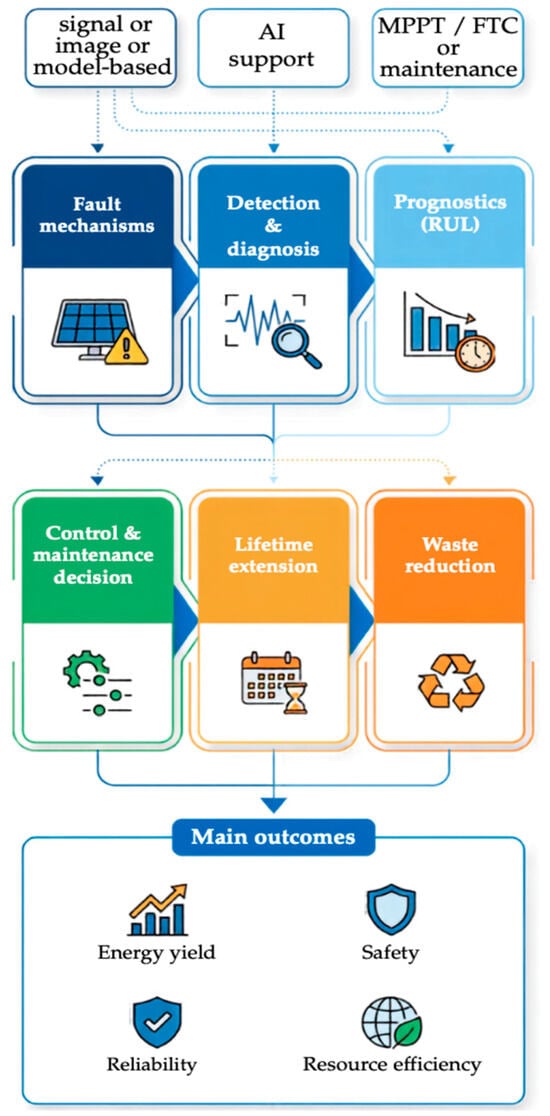
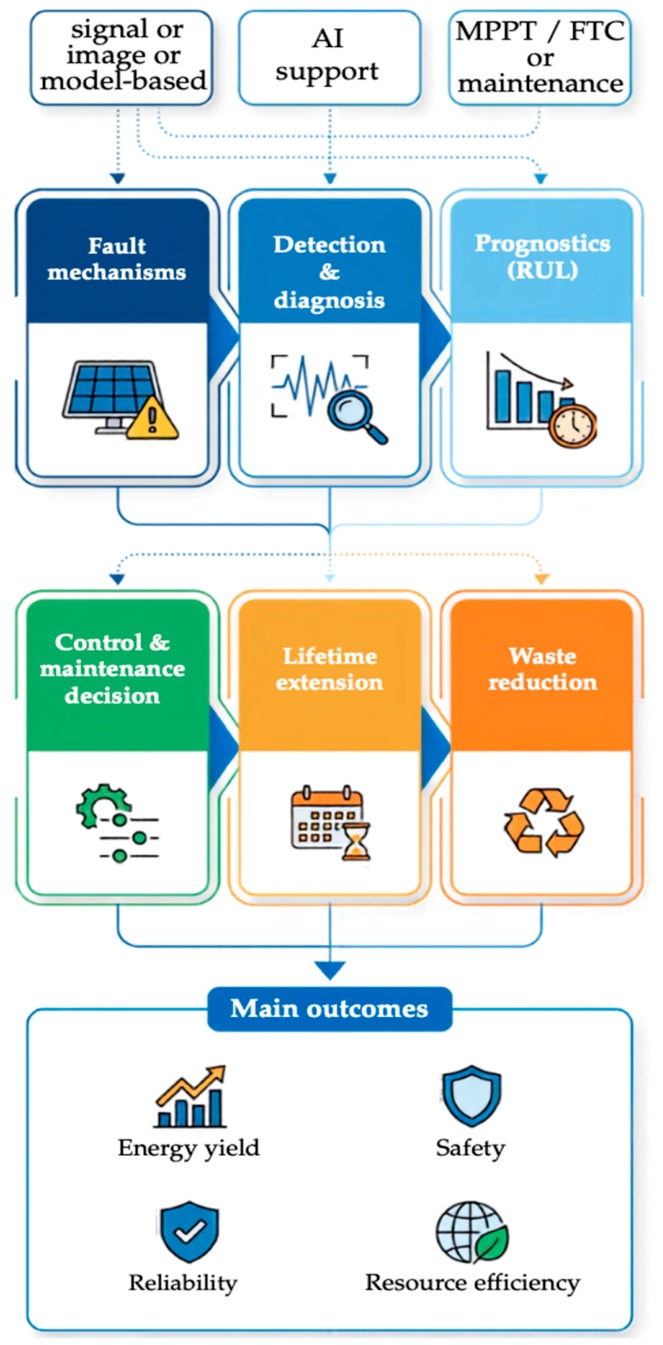
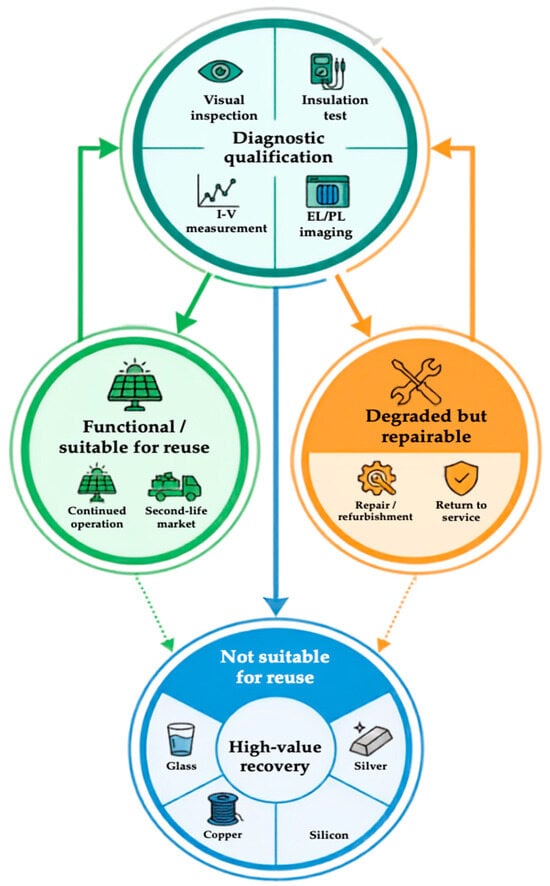
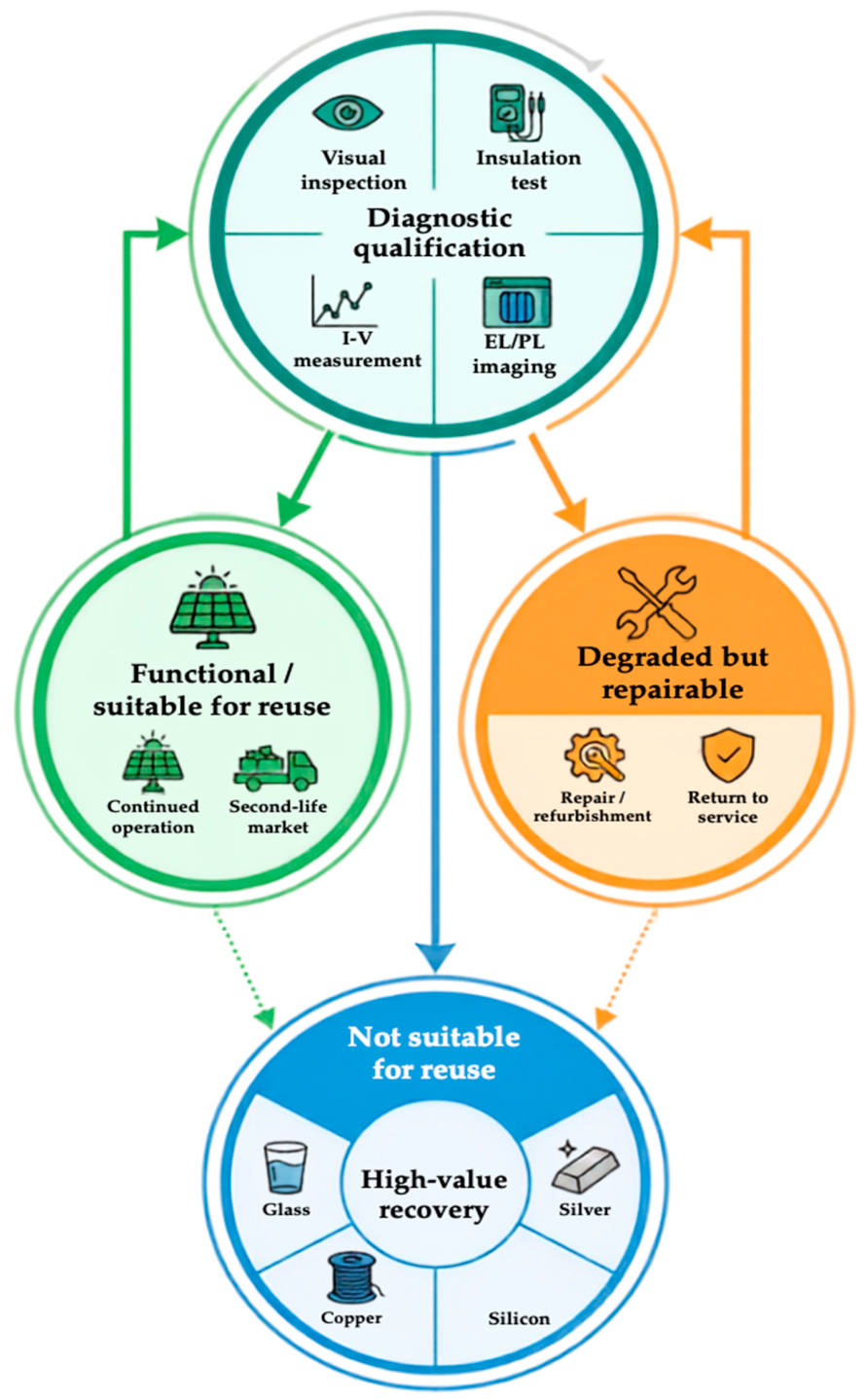

Disclaimer/Publisher’s Note: The statements, opinions and data contained in all publications are solely those of the individual author(s) and contributor(s) and not of MDPI and/or the editor(s). MDPI and/or the editor(s) disclaim responsibility for any injury to people or property resulting from any ideas, methods, instructions or products referred to in the content. |
© 2026 by the authors. Licensee MDPI, Basel, Switzerland. This article is an open access article distributed under the terms and conditions of the Creative Commons Attribution (CC BY) license.