


Abstract
Microwave processing offers a sustainable alternative to conventional fossil-fuel-based high-temperature treatments of steelmaking residues by enabling volumetric and energy-efficient heating. This work develops the first fully coupled electromagnetic–thermal–fluid–chemical Multiphysics model of a continuous microwave rotary kiln for the simultaneous reduction of iron oxides and zinc volatilization from a mixture of Basic Oxygen Furnace (BOF) dust and Blast Furnace (BF) sludge. The model integrates time-harmonic Maxwell’s equations (915 MHz), porous media transport, shrinking-core kinetics for seven heterogeneous reactions, and energy/momentum conservation in a rotating quartz tube reactor. Validation against experimental thermogravimetric and literature thermal data confirmed high accuracy. Simulations achieved microwave coupling efficiencies above 97% with localized heating inside the resonant cavity. At a fixed mass flow rate of 5 kg/h, the degree of reduction reached up to 70% with peak temperatures of 1333–1429 K. Fixed-reduction analysis (70% target) identified a maximum sustainable throughput of 2.37 kg/h, limited by quartz tube thermal constraints. Results reveal a trade-off between thermal/energy efficiency (favored at higher throughput) and specific direct CO2 emissions (lower at reduced throughput due to moderated Boudouard reaction). This modeling framework provides valuable guidelines to design energy-efficient, low-emission microwave-assisted metallurgical processes.
1. Introduction
Amid stringent regulatory frameworks—most notably the European Climate Law, which mandates a 55% reduction in greenhouse gas emissions by 2030 and climate neutrality by 2050 [1]—reducing CO2 emissions from high-temperature industrial processes has become a central challenge in this transition. Among these, the iron and steelmaking production is particularly significant, accounting for 25% of global industrial CO2 emissions [2], making it a priority target for decarbonization efforts. In this industry, as in other high-temperature manufacturing sectors, these emissions broadly stem from a reliance on fossil-fuel combustion, where heat is transferred indirectly to the material through convection, conduction, or radiation [3]. This heating pathway increases processing times and reduces thermal efficiency, which together ultimately drive higher energy consumption—contributing significantly to overall greenhouse gas emissions [4].
A particular instance of this arises in the processing of iron and zinc bearing residues generated during the blast furnace (BF) and basic oxygen furnace (BOF) operation, namely BOF dust and BF sludge [5,6]. Approximately 22 kg of dust and sludge are produced per tonne of crude steel via the BF/BOF route (with reported values ranging from 10 to 40 kg/tonne depending on plant and gas-cleaning configuration) [5]. While much of this material, where zinc content is low, is recycled back into the process without issue, streams with elevated zinc content are routinely landfilled instead [6]—a genuinely environmentally harmful disposal route, since heavy-metal-bearing metallurgical residues of this kind are prone to leaching toxic elements into groundwater and soil while occupying substantial landfill capacity [7]. Yet, this zinc represents a resource worth recovering rather than discarding. Global zinc reserves have been projected to be outrun by demand as early as 2050 without substantial improvement in recovery rates from industrial by-products [8], and as high-quality virgin ore becomes scarcer, the price of zinc is expected to rise accordingly, making recovery from these lower-grade by-products increasingly economically favorable [6].
Recovering, however, is not straightforward, as the blast furnace itself is highly sensitive to zinc; its low boiling point (907 °C), relative to typical furnace temperatures (1600–1650 °C), causes charged zinc to vaporize, rise through the furnace stack, and re-condense as scaffolds on the furnace walls, damaging refractory linings and disrupting gas and solid flow [6,9]. As a result, zinc loading is tightly controlled, with typical permissible limits around 100–120 g of zinc per tonne of hot metal [6]—for a plant producing 10 million tonnes of liquid steel annually, this allows only around 1000 tonnes of zinc to be charged per year, making dilution and direct recycling into the furnace unviable at scale. Since recharging this material into the blast furnace does not recover the zinc—it merely recirculates it—genuine recovery requires a dedicated external treatment route, and in the absence of one, zinc-rich streams are simply landfilled instead.
Compounding this challenge, the composition of these residues is highly variable, both between plants and between batches at the same plant, depending on the scrap and ore mix, furnace operating conditions, and dust-collection method [10]. Properties such as total zinc content, the proportion of zinc present as zinc ferrite—which resists hydrometallurgical extraction [11], the degree of iron oxidation, the CaO/SiO2 basicity of the residue, and trace species introduced via scrap contamination, such as chlorine and fluorine, all influence which recycling route is technically and economically viable for a given feedstock and how the resulting products can be handled downstream [5,6]. These composition-dependent constraints have shaped how such residues are treated in practice [12]. External pyrometallurgical routes—the Waelz kiln and rotary hearth furnace processes such as FASTMET—reduce and volatilize zinc from the dust/sludge mixture at high temperature, yielding a crude zinc oxide product suitable for sale to zinc smelters and a metallized iron-bearing residue that can be reintroduced into ironmaking [6,13,14]. These processes are largely composition-agnostic, but they require substantial external fuel combustion to sustain the necessary temperatures, and the associated capital and operating costs are high enough that a large share of steelmaking dusts are still landfilled rather than processed [15]. Hydrometallurgical alternatives avoid this thermal energy demand but are constrained by the same ferrite chemistry discussed above, since the fraction of zinc locked in ZnFe2O4 resists leaching under realistic industrial conditions [5,11], and only become commercially attractive at higher zinc concentrations [6]. In-process approaches that segregate zinc-rich sub-streams directly at the dust-collection stage [10] reduce the volume requiring dedicated treatment, but do not eliminate the need for a downstream route capable of handling the concentrated fraction.
Microwave heating has emerged as a promising alternative. Microwaves enable volumetric energy deposition, rapid and selective heating, and can achieve reduced thermal gradients and lower overall energy consumption when appropriately tuned [16]. Importantly, several studies have also shown that microwave irradiation can modify reaction thermodynamics and kinetics, allowing key reduction reactions to proceed at substantially lower temperatures than under conventional heating [17,18]. By decreasing reliance on fossil fuels and improving energy efficiency, microwave-based processes can substantially lower the carbon footprint of high-temperature metallurgical operations.
However, scaling microwave technologies from laboratory to industrial levels remains challenging, with megawatt-scale industrial applications still scarce [19]. Real systems often suffer from non-uniform electromagnetic field distributions, geometric constraints of the cavity, and complex interactions with heterogeneous multiphase materials. These factors can produce persistent hot spots, large temperature gradients, and inefficient energy utilization [20,21]. Compounding this, cavity geometry must be tailored to the dielectric properties of the specific material being processed, which govern microwave penetration depth and absorption efficiency and can both vary substantially between feedstocks and evolve with temperature over the course of a reaction [18]; a cavity design optimized for one material and process stage is therefore not readily transferable to another, and the ratio of sample dimension to penetration depth becomes an increasingly limiting factor as reactor scale increases [22].
The design of continuous systems—such as rotary kilns, moving beds, or conveyor reactors—further requires precise control of residence time, mass flow rate, and microwave coupling to ensure uniform heating and consistent reaction progress [23,24]. Overcoming these engineering challenges is critical for industrial deployment, particularly in high-temperature applications where energy efficiency and emission reduction are essential [3].
Advanced numerical modeling has become an indispensable tool for addressing these issues. Multiphysics simulations that fully couple electromagnetic fields, heat transfer, fluid flow, and chemical reactions can predict field non-uniformities, identify conditions leading to hot spots, quantify energy coupling efficiency, and guide the design and optimization of industrial-scale microwave reactors [16,23,24,25]. Such models provide insights that are difficult or impossible to obtain experimentally, especially in continuous high-temperature systems processing complex material mixtures.
The continuous process considered here employs a rotary kiln placed inside a microwave cavity and can be viewed as a microwave-heated variant of the Waelz process described above [13,14], operating at 1273–1473 K to sustain the same carbothermic reduction and zinc-volatilization chemistry. In the conventional, fuel-fired Waelz process, CO2 emissions arise from two sources: the Boudouard reaction, which sustains the reducing environment, and the fuel combustion required to maintain operating temperature; by integrating microwave heating into this system, the emissions associated with fuel combustion can be substantially reduced. This technology was under industrial evaluation within the DESTINY project [26], highlighting the practical relevance of developing predictive numerical models.
The primary objective of this work is to develop a comprehensive mathematical and numerical model capable of simulating the operating conditions of a continuous microwave rotary kiln for zinc removal and iron oxide reduction from a mixture of BOF dust and BF sludge. Previous experimental studies have demonstrated that microwave irradiation effectively promotes zinc volatilization from this mixture under relevant temperature conditions [18]. Building on this prior modeling work [23,24,25], the present study extends this modeling framework to a fully reactive, multi-species chemical system for the first time, introducing the first fully coupled model—in the sense of two-way physics coupling, detailed in Section 2.3. The model enables detailed analysis of process performance and the key parameters governing microwave–material interactions.
2. Material and Methods
2.1. Material Description
The material under study consists of a mixture of Basic Oxygen Furnace (BOF) dust, characterized by high concentrations of iron and zinc oxides, and Blast Furnace (BF) sludge, which serves as the carbon source in the form of metallurgical coke; the mixture is thus self-reducing, with the CO reducing gas generated in situ via the Boudouard reaction.
To ensure consistency with the dielectric characterization, the specific material blend and composition are identical to those utilized in the study done by García-Baños et al. [18].
The raw material composition, adjusted to a stoichiometric C/O ratio of 100%, is detailed in Table 1. Only the mineral phases and oxide constituents relevant to the iron and zinc reduction chemistry are retained in this modeled composition; minor trace species reported in the reference elemental characterization of the same material [18]—Mn, S, Rb, K2O, Pb, and Na2O, the last of which is present at only 0.16 wt%—were not modeled individually. The temperature-dependent dielectric properties associated with this specific mixture are likewise adopted from [18].
Table 1.
Chemical composition in mass fraction for the mixture with C/O = 100%.
2.2. Microwave Rotary Kiln Setup
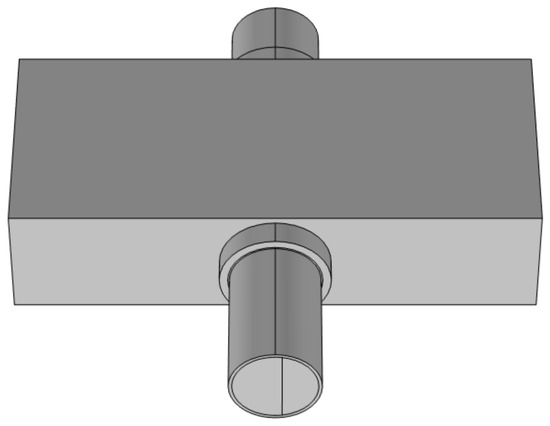
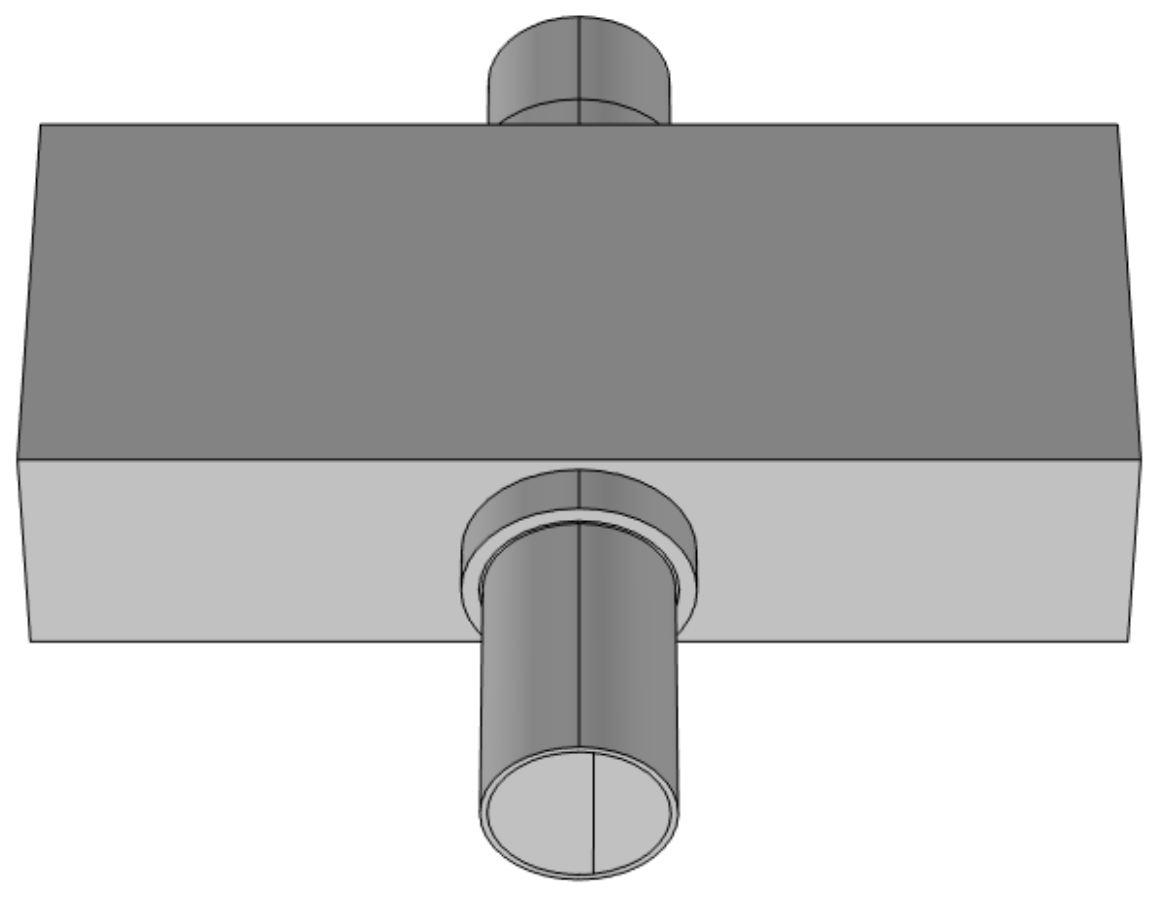
To achieve continuous reduction of the material described above, a microwave rotary kiln reactor was modeled. Figure 1 depicts the configuration considered in this work. The applicator consists of a rotating quartz tube situated within a microwave cavity of specified dimensions, utilizing a WR975 waveguide operating at 915 MHz. The internal rectangular cross-section is 247.65 mm by 123.825 mm with a total length of 500 mm. Inside the cavity, a moving wall (plunger) is employed to adjust the cavity impedance and maximize microwave efficiency, as detailed in previous work [25].
Figure 1.
Geometrical configuration of the microwave cavity and rotating tube apparatus.
The tube, constructed from optically opaque (microwave-transparent) quartz glass with a maximum operating temperature of 1050 °C, has an internal diameter of 100 mm and a total length of 583 mm. It crosses the cavity through its smaller side, rotating at a constant speed of 5 rpm. The geometry is tilted 8° relative to the horizontal plane to provide the material with a forward axial velocity. Thermal management is integrated via a 2 cm insulation layer made from Alkaline Earth Silicate Wool surrounding the cavity, enclosed in a thin aluminum sheet to minimize thermal radiation losses to the ambient environment.
2.3. Mathematical Model
To accurately simulate the continuous reduction of the BOF-BF mixture, a comprehensive fully coupled multi-physics model was developed. The model couples the electromagnetic distribution, heat and mass transport, and the complex chemical kinetics occurring within the rotating kiln. Here, the fully coupled term implies that the governing equations—the time-harmonic Maxwell equations, the Energy Transport equations, the Momentum and Continuity equations, the Species Transport equations, and the kinetic reaction model—exchange information directly through a two-way feedback couple in between them. This numerical framework is designed to better capture the interaction between the microwave energy absorption and the thermo-chemical evolution of the material bed as it progresses through the reactor.
The governing equations are solved across multiple domains, including the microwave cavity, the quartz tube, the porous reacting bed, and the gas-filled freeboard. The following subsections detail the formulation of the chemical kinetics, the transport of species, the electromagnetic field distribution, and the conservation of energy and momentum.
2.3.1. Chemical Reactions and Kinetics
The numerical model incorporates seven heterogeneous reactions. These describe the stepwise reduction of iron and zinc oxides, with carbon monoxide (CO) acting as the primary reducing agent. Hydrogen reduction is excluded from the current scope, and CO is generated in situ via the Boudouard reaction.
The reaction sequence and their corresponding thermal conditions are summarized in Table 2. Notably, the reduction of magnetite (R2–R4) is split based on the 570 °C threshold to account for the stability of wüstite (FeO).
Table 2.
Reduction and gasification reactions implemented in the model.
The kinetic parameters and the governing model equations for each transition are detailed in Table 3. Most reactions are governed by the Shrinking Core Model (SCM), while the initial decomposition of zinc ferrite follows an Avrami-Erofeev nucleation mechanism.
Table 3.
Kinetic parameters and model equations for the modeled reactions.
The intrinsic rate of reactions R1–R6 follows a reversible shrinking-core-model formulation:
where is the volumetric molar rate of reaction f (mol m−3 s−1), is the Arrhenius rate constant built from the pre-exponential factor and activation energy listed in Table 3, is the specific surface area of the (spherical) solid particles of initial radius , is the local degree of conversion, R is the universal gas constant, T is the temperature, and is a reaction-specific driving-force term that vanishes as the local gas-phase composition approaches equilibrium: for R1–R4, for the Boudouard reaction, and for R6, with , , and the local molar concentrations of CO, CO2, and Zn(g), and the temperature-dependent equilibrium constant of reaction f.
The decomposition of zinc ferrite (R7) instead follows an Avrami–Erofeev nucleation mechanism:
where is the volumetric molar rate of the zinc ferrite decomposition reaction, is the initial molar concentration of zinc ferrite in the solid phase, and is built from the pre-exponential factor and activation energy listed in Table 3; itself carries the local CO mole fraction and conversion dependence ().
2.3.2. Gas and Solid Species Transport Equations
The transport of chemical species in the system is modeled separately for the gas and solid phases. Gas species are convected with velocity inside both the porous reacting bed and the freeboard (air region, ). Solid species are confined to the porous bed and transported with a constant solid velocity along the axis of the tube. Additionally, anisotropic molecular diffusion is included to account for the effects of rotational mixing within the bed.
Gaseous Species
The evolution of gas species is described by the conservation equation:
where is the density of species i, its molar mass, the porosity of the bed, is the effective diffusivity, and represents the production or consumption of species i due to reaction f.
Solid Species
The transport of solid species is governed by:
where is the mass fraction of solid species, is the anisotropic diffusion coefficient, the molar mass of the solid species, and accounts for the reaction-induced changes in the solid phase.
2.3.3. Microwave Electromagnetic Field Equations
The microwave heating in the system is modeled using Maxwell’s equations at a fixed frequency. In the frequency domain, these reduce to the time-harmonic Maxwell equations, which for the electric field take the form:
where is the free-space wavenumber, is the dielectric constant, and is the dielectric loss factor, both of which vary with the local temperature [18].
The volumetric heating source resulting from microwave absorption is calculated as:
where is the angular frequency and is the vacuum permittivity.
2.3.4. Energy Transport Equations
The thermal behavior of the system is modeled using a single temperature field T defined across all domains, including the porous reacting bed, freeboard, and solid regions (tube and cavity). While the temperature field is continuous, the material properties (density, specific heat, thermal conductivity) differ between domains to account for the respective physical behavior. Convection due to moving solids () and gases () is considered separately, allowing for independent treatment of the energy transport by each phase.
Porous Reacting Bed
The energy conservation in the porous bed is described by:
where is the bed density, its effective specific heat capacity, its effective thermal conductivity, and are the density and specific heat capacity of the gas, Q represents the microwave heating source and accounts for the heat released or consumed by chemical reactions, with the volumetric molar rate of reaction f defined in Equation (1) and its molar enthalpy of reaction; relates to the per-species rate used in the species transport equations through the stoichiometric coefficient of species i in reaction f, , which is positive for species produced and negative for species consumed.
Freeboard (Air Region)
Energy transport in the freeboard is given by:
where is the thermal conductivity of the gas.
Solid Regions (Tube and Cavity)
Heat transfer in the solid components is described by:
where , , and k are the density, specific heat capacity, and thermal conductivity of the solid material, respectively.
Internal Radiative Losses
The system accounts for internal radiative fluxes, including both absorption and emission by the materials within each domain. These fluxes arise from interactions between the top of the porous bed, the tube walls, and the interior of the microwave cavity.
2.3.5. Momentum and Continuity Equations for Reacting Flows
The velocity and pressure fields in the system are modeled differently for the porous reacting bed and the freeboard. Within the porous bed, the Brinkman equations are used to account for flow through the porous medium. In the freeboard (air region, ), the compressible Navier–Stokes equations are applied.
Porous Reacting Bed
The governing equations for the gas velocity and density in the porous bed are:
where is the dynamic viscosity of the gas, p is the pressure, I is the identity matrix, and is the permeability of the porous bed.
Freeboard
In the freeboard, the compressible Navier–Stokes equations are given by:
Equation of State
To close the compressible flow model, an ideal gas law is used:
where is the molar mass of the gas.
2.3.6. Boundary Conditions
Boundary conditions are applied only at the external surfaces of the model, while internal continuity is automatically enforced by COMSOL Multiphysics (version 5.5).
Energy Equation
- Tube and cavity exterior: Convective heat transfer to the ambient and radiative heat flux based on material properties [31].
- Freeboard and porous bed: Inlet temperature is prescribed at the porous bed inlet; convective outflow at the exits; radiative heat flux is exchanged between the top of the porous bed and the exterior surfaces.
Gas and Solid Species
- Gas species: No-flux boundary at walls; convective outflow at the exits, ensuring the species exit with the gas flow.
- Solid species: Prescribed inlet concentrations at the bed; no-flux at the walls; convective outflow at the exit.
Momentum (Fluid Flow)
- Freeboard and porous bed: No-slip boundary condition at the tube walls, meaning that the fluid velocity matches the wall velocity; convective outflow at the exit.
Electromagnetic Field
- Interior Cavity Walls: Perfect Electric Conductor (PEC) boundary condition at the cavity walls and Rectangular Port Boundary Condition at one wall.
- Tube Walls to Exterior: Scattering boundary condition at the exterior tube walls.
3. Validation and Verification
The numerical model was validated in two distinct stages: first, by verifying the reacting-bed thermal model against the established literature, and second, by calibrating the reaction kinetics using experimental thermogravimetric data.
3.1. Thermal Model and Bed Behavior
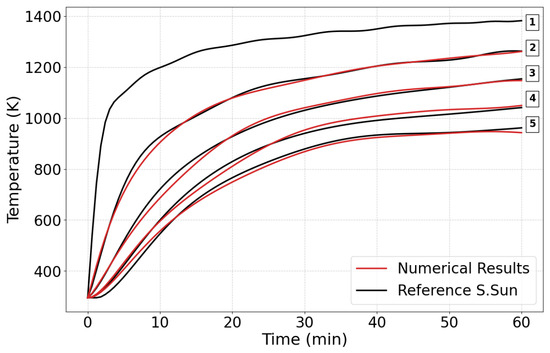
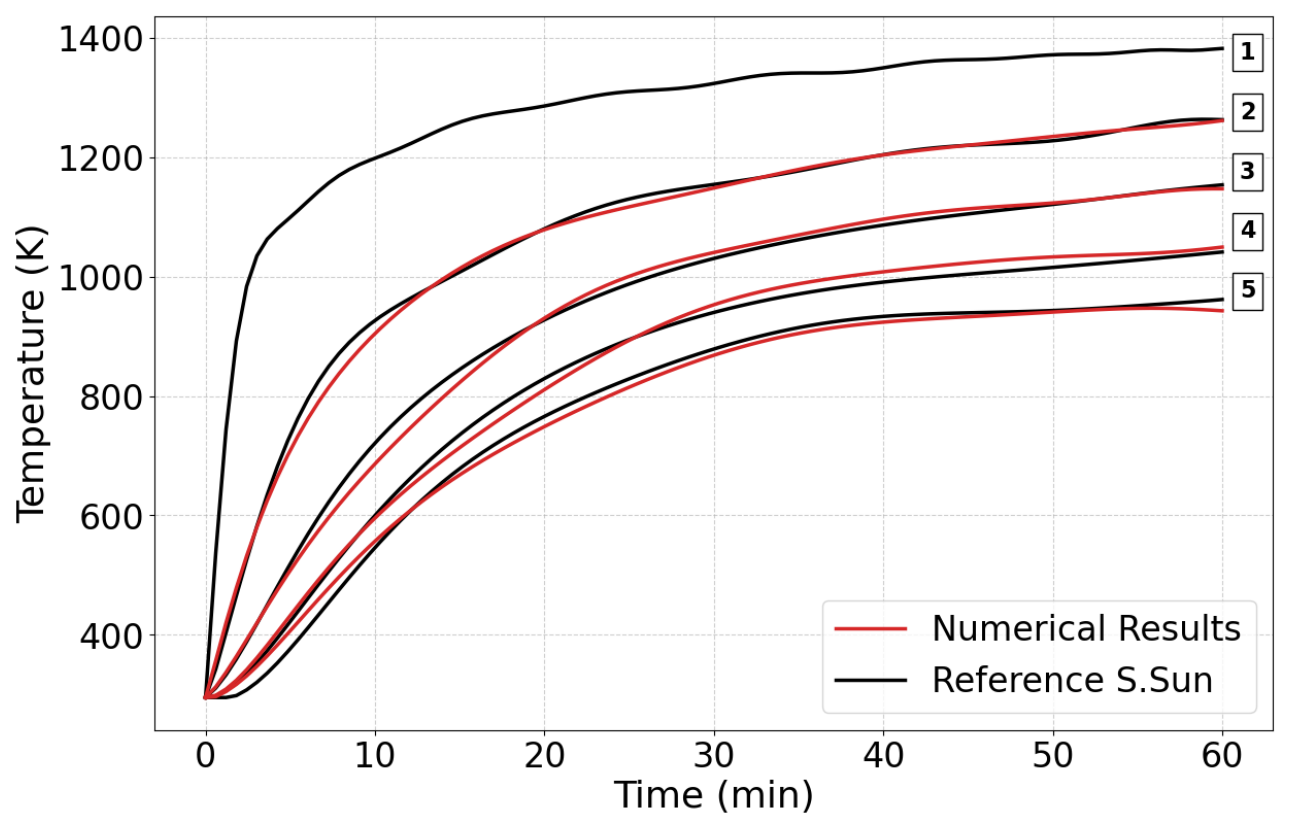
The reacting-bed thermal model was validated against the experimental and numerical work of S. Sun [28]. To ensure compatibility with the reference study, the model was implemented as a 2D axisymmetric simulation neglecting microwave heating. The setup involves a 28 mm cylindrical crucible filled with an 80/20 Fe3O4-C weight ratio mixture, heated from the base. Five sensors (temperature and pressure) were positioned at 7 mm intervals, ranging from the bottom (Point 1) to the top (Point 5).
As shown in Figure 2, the calculated temperatures demonstrate strong agreement with the reference data. Point 1 matches exactly as it serves as the Dirichlet boundary condition. Marginal deviations observed at Points 4 and 5 are attributed to the cumulative influence of spatial and temporal history.
Figure 2.
Temperature profiles at five measurement points compared with results from S. Sun [28].
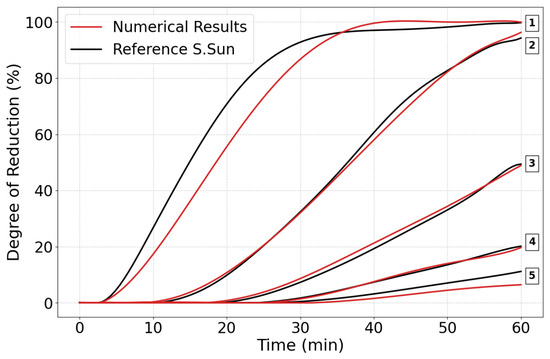
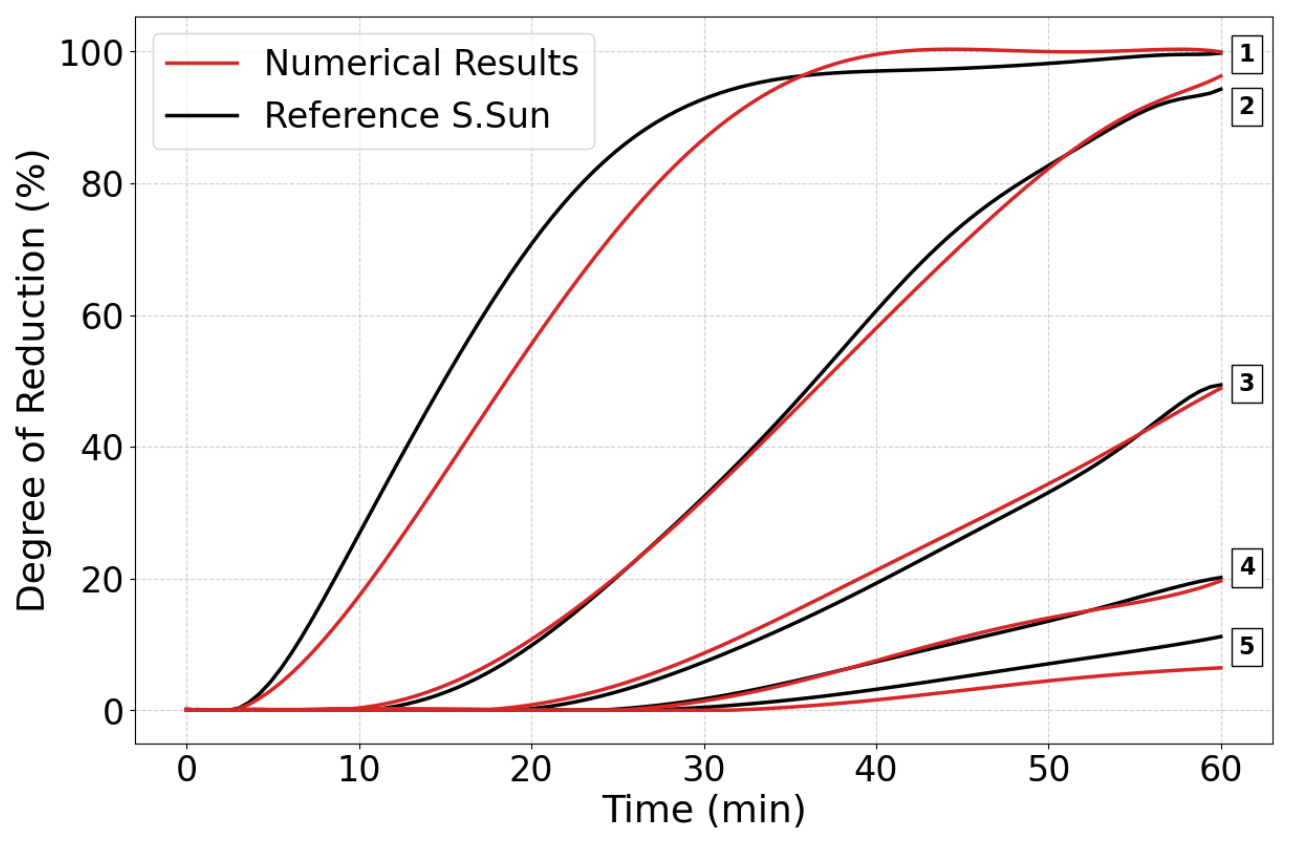
Regarding the reduction degree (Figure 3), the model aligns well with reference values, particularly at Points 2, 3, and 4. While Point 1 exhibits a slight temporal lag—despite identical kinetic parameters and fixed temperatures—the overall trend remains consistent. The slightly lower reduction degree at Point 5 is likely due to localized fluctuations in the CO/CO2 ratio.
Figure 3.
Degree of iron oxide reduction at five measurement points compared with results from S. Sun [28].
3.2. Kinetic Calibration
The second validation stage focused on reaction kinetics, utilizing experimental results from García-Baños et al. [18]. The apparatus consisted of a 40 mg sample in a platinum crucible, heated at 20 °C/min from 35 °C to 1000 °C. This setup was replicated numerically using a 1D reaction model under identical thermal conditions.
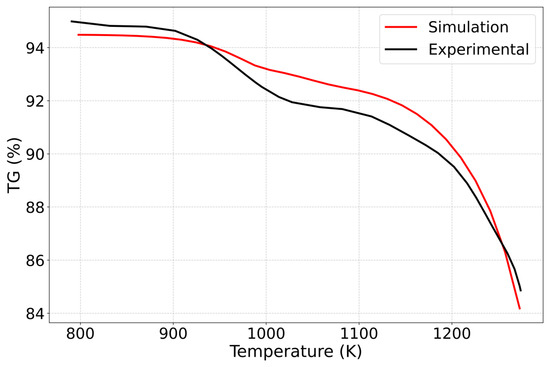
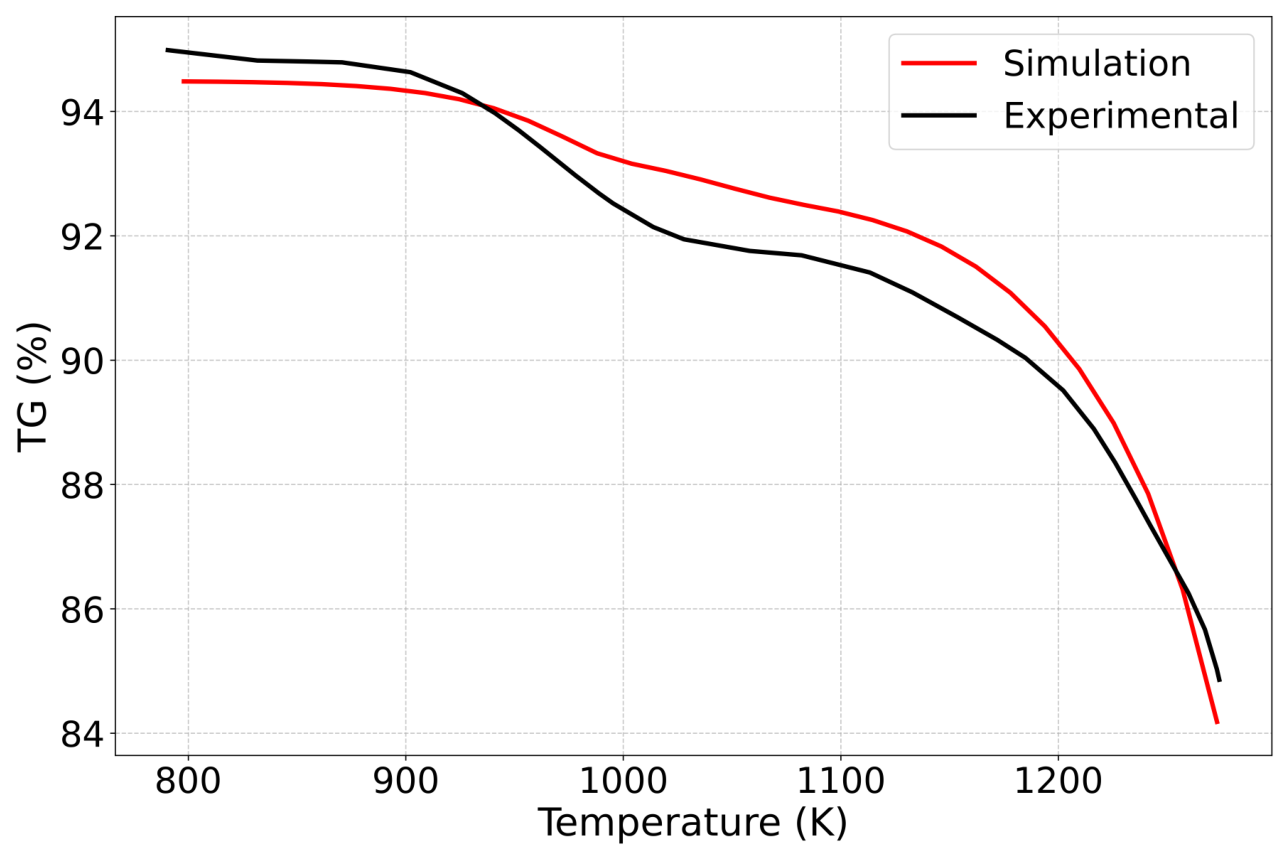
As this study focuses on high-temperature reduction, discrepancies in thermogravimetry (TG) are expected at lower temperatures where secondary reactions or moisture loss may occur. The results above 800 K are presented in Figure 4. The baseline kinetic parameters (Table 3) were originally derived from simpler, single-phase reference systems—a pure Fe3O4–C composite and pure ZnO powder—rather than from the heterogeneous industrial residue studied here. To bridge this gap, a kinetic compensation factor of 0.4 was introduced and calibrated directly against thermogravimetric data for the same BOF-BF blend used throughout this study. With this calibration, the simulation demonstrates a reasonable degree of fidelity to the experimental TG curve, achieving the exact extent of reaction at K.
Figure 4.
Comparison between experimental thermogravimetry (TG) results [18] and the simulation results calibrated with a kinetic compensation factor.
4. Results and Discussion
The numerical results are analyzed under two distinct operational frameworks designed to characterize the interplay between electromagnetic heating, chemical kinetics, and reactor throughput.
The Fixed Mass Flow Rate Analysis (Section 4.1) investigates the fundamental thermal and spatial behavior of the system. With material throughput held constant, incident microwave power is varied to delineate reaction zones and quantify how the microwave field defines the effective “active length” of the reactor.
The Fixed Degree of Reduction Analysis (Section 4.2) adopts an industrial performance perspective. Here, the target metallurgical conversion (70% reduction) is fixed, and incident power is adjusted accordingly as a dependent variable. This approach identifies operational bottlenecks—particularly the thermal limits of reactor materials—and reveals the optimal trade-off between specific energy consumption (SEC) and direct carbon emission intensity.
Together, these frameworks provide a comprehensive map of the microwave-assisted rotary kiln’s performance, ranging from its internal process physics to its macroscopic operational constraints.
To quantify performance in the analyses that follow, two metrics are introduced. The microwave efficiency, , measures the fraction of the incident electromagnetic power that is absorbed by the load:
where is the incident microwave power and is the power absorbed by the material. The thermal efficiency, , in turn measures the fraction of that absorbed power that is retained within the process rather than lost to the surroundings:
where is the total heat loss through all exterior boundaries of the reactor (tube and cavity casing). Together, these two metrics separate electromagnetic coupling losses (field leakage and reflection) from downstream thermal losses (conduction, convection, and radiation to the ambient), allowing each contribution to the overall energy balance to be identified independently.
4.1. Fixed Mass Flow Rate Analysis
The first set of simulations evaluates the thermal and chemical response of the kiln at a constant mass flow rate of 5.0 kg/h (see parameters in Table 4) while varying the incident microwave power.
Table 4.
Simulation results for a constant mass flow rate of 5.0 kg/h.
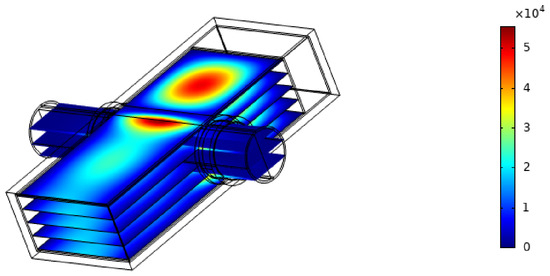
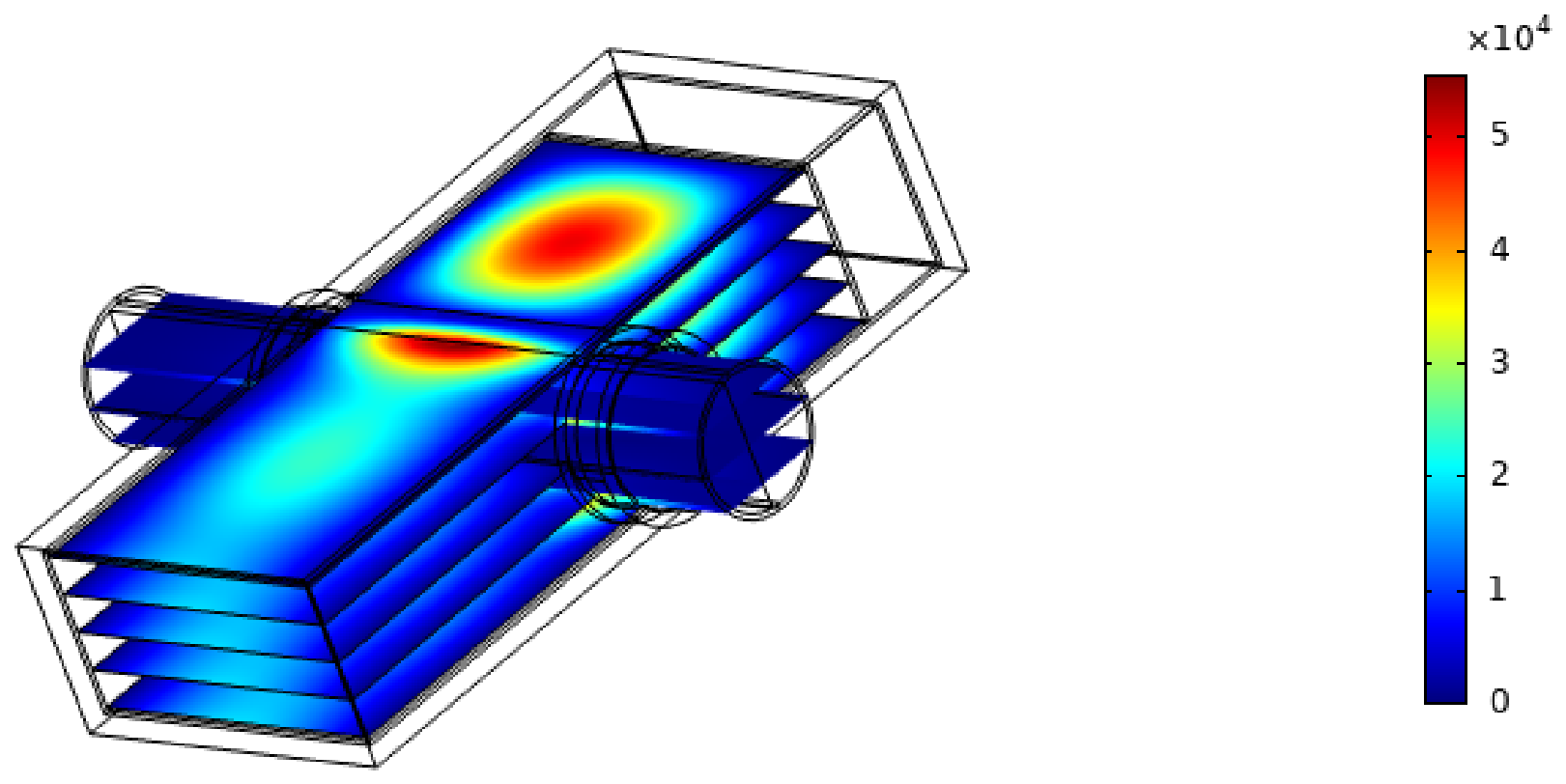
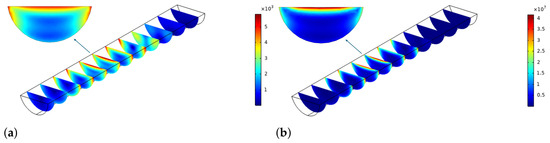
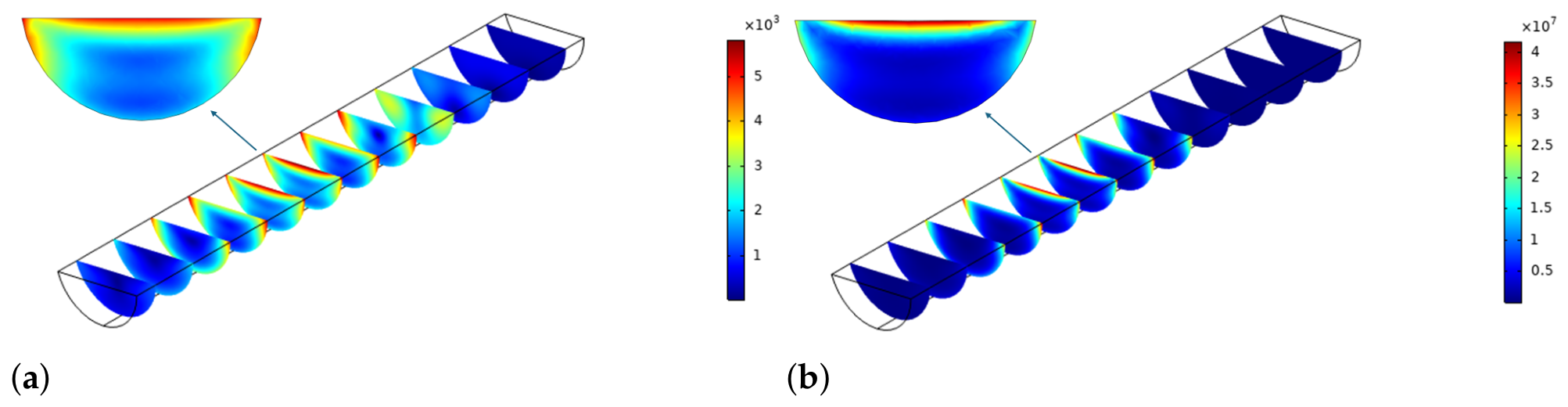
The electric field inside the cavity (Figure 5) corresponds to the dominant TE10 mode, with the tube axis oriented perpendicular to the field polarization. This configuration maximizes microwave coupling efficiency (97.3–97.65%) while minimizing leakage through the kiln apertures (≈0.1%). The electromagnetic field is highly localized within the cavity. As illustrated in Figure 6a, the electric field intensity in the material bed decays rapidly outside the cavity boundaries. The axial distribution is asymmetric due to the temperature-dependent dielectric properties of the reacting bed, which evolve as the material heats and undergoes reduction. This non-uniformity is also evident in the electromagnetic power dissipation profiles (Figure 6b), where the heat source is highest at the bed surface and decreases inward owing to field attenuation in the lossy medium.
Figure 5.
Electric field distribution within the resonant cavity (V/m) for a mass flow rate of 5.0 kg/h and 6500 W.
Figure 6.
Sliced spatial solution across the material bed for 5.0 kg/h and 6500 W: (a) Electric field norm (V/m); (b) Electromagnetic heat source (W/m3).
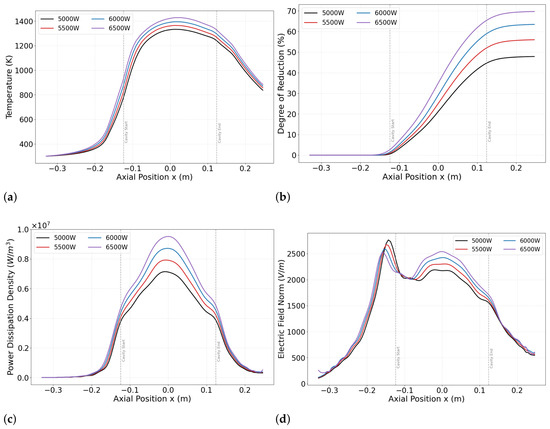
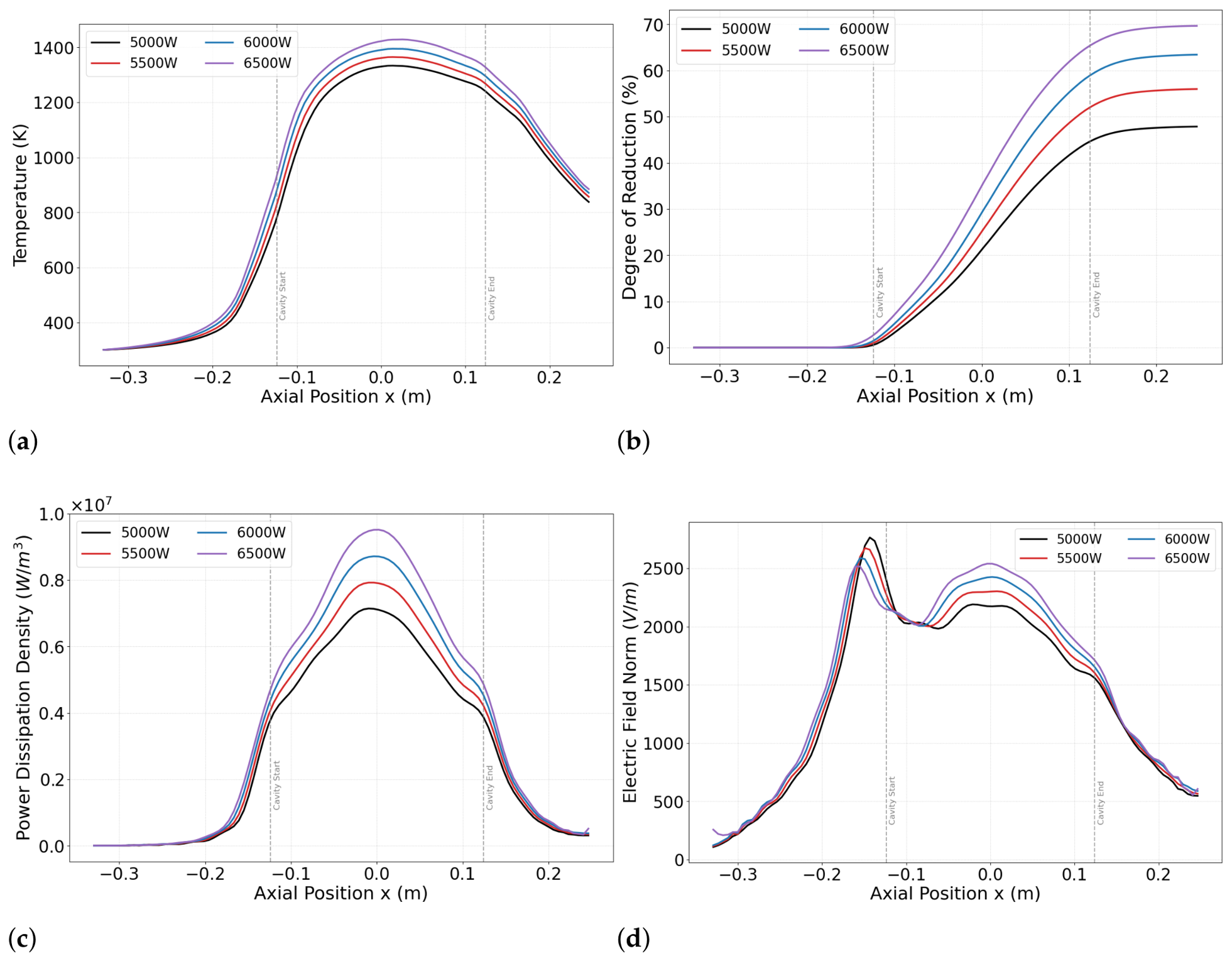
To enable detailed process analysis, key variables were transversely averaged across the bed and plotted along the axial coordinate (Figure 7). The electric field norm (Figure 7d) shows a primary central peak and a secondary maximum just upstream of the cavity entrance. This distribution drives the power dissipation density (Figure 7c), which is sharply confined within the cavity. Power absorption drops to 1% of its peak value within approximately 0.1 m of the cavity interfaces, confirming excellent microwave confinement by the applicator design.
Figure 7.
Transversely averaged axial profiles within the kiln bed for a constant mass flow of 5.0 kg/h: (a) bed temperature (K); (b) degree of chemical reduction (%); (c) microwave power dissipation density (W/m3); and (d) electric field norm (V/m).
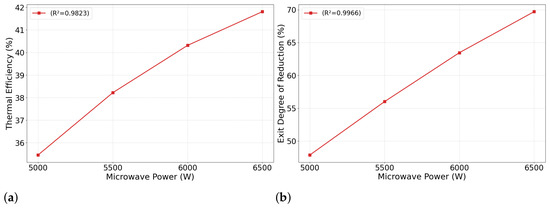
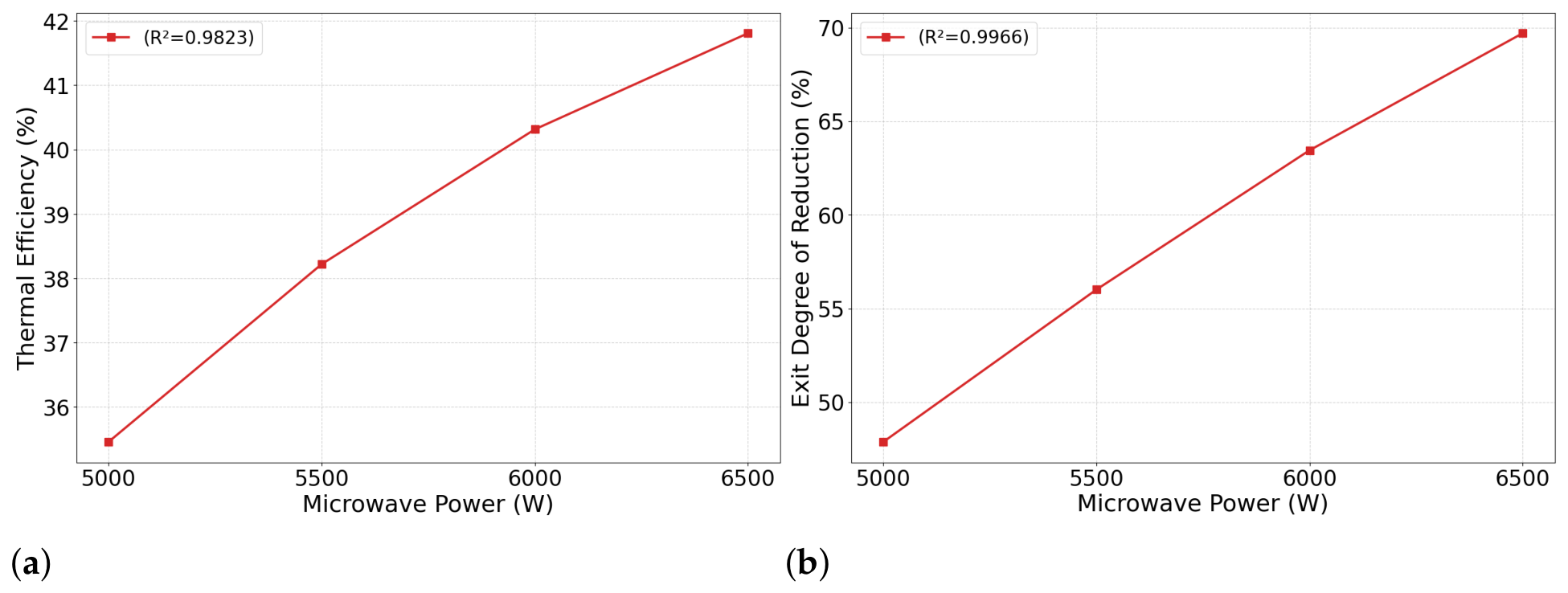
The heating profile (Figure 7a) closely mirrors this energy distribution. However, unlike a conventional rotary kiln where the temperature typically increases monotonically toward a discharge-end burner, the microwave-assisted kiln exhibits a localized thermal maximum centered within the resonant cavity. As detailed in Table 4, peak temperatures range from 1333.3 K to 1428.6 K, depending on the incident power. Both the degree of reduction (Figure 8b) and the maximum temperature exhibit a nearly linear dependence on the input power (), suggesting a highly controllable process where thermal intensity can be precisely modulated via the electromagnetic source.
Figure 8.
Performance metrics as a function of incident power: (a) Thermal Efficiency (%); (b) Exit Degree of reduction (%).
Furthermore, while the microwave coupling efficiency remains remarkably stable between 97.3% and 97.6%, the thermal efficiency increases significantly with higher power levels (Figure 8a). This highlights the energetic advantages of operating at elevated thermal regimes within this specific configuration.
To further characterize the process physics, the kiln was partitioned into functional zones: a pre-heating region, a heating region (extending from a 5% temperature rise to the onset of mass loss), and a reactive region covering active chemical reduction until stabilization. The spatial boundaries and associated residence times for these zones are summarized in Table 4.
Analysis of these spatial boundaries reveals that increasing microwave power results in a marginal extension of the total active process length. This expansion is primarily driven by an upstream shift in the pre-heating start point—displacing from m to m—as higher temperatures facilitate more rapid thermal propagation against the material flow. While the average heating rate of the material increases with power (ranging from 66.77 K/min to 73.29 K/min), this intensification leads to a conversely smaller axial heating region.
Interestingly, although the heating zone decreases in physical length due to these accelerated rates, the net active processing time (excluding pre-heating) remains remarkably constant at approximately 33 min across all power levels. This suggests a strong geometric dependency, where the effective process duration is physically constrained by the cavity dimensions, while the power input primarily dictates the thermal intensity within those boundaries.
As shown in Figure 7b, the active reaction is almost entirely confined within the resonant cavity, concluding approximately 4 cm after the exit boundary. This indicates that the kiln segments extending beyond the cavity act primarily as microwave attenuators rather than active process volumes. Such findings reinforce the conclusion that the core process is spatially locked to the resonant structure, suggesting that under constant mass flow conditions, incident power serves as the highly effective primary control variable to modulate exit reduction degrees.
4.2. Fixed Degree of Reduction Analysis
Following the constant-power simulations, an additional operational analysis was performed by fixing the target reduction degree and varying the solid mass flow rate. The global conversion degree was fixed at 70%. The kinetic calibration underlying this choice (Section 3.2) is based on a single thermogravimetric curve, reaching only an estimated 30% conversion at its endpoint ( K); no additional experimental data were available to validate the kinetics beyond this point. The 70% target used here therefore extrapolates the calibrated kinetics beyond their directly validated range, and the results of this section should be interpreted with this limitation in mind.
For each simulation, the inlet mass flow rate was maintained at a constant value while the incident power was modulated until the target degree of reduction was achieved at the discharge end. This methodology facilitates the establishment of an upper operational limit for mass flow rates, dictated by the maximum temperature thresholds the material can withstand. Given that the maximum operating temperature of the quartz glass tube is 1323.15 K and phase transitions in BOF slag mixtures start at approximately 1473 K [32], a conservative threshold of 90% of these values was adopted to define the safe operating window.
The onset of these phase changes is a critical constraint, as the transition from a solid to a semi-solid or molten state significantly impairs the gas–solid reaction kinetics. Such transitions alter the porosity of the bed and reduce the effective surface area available for gas transport, thereby hindering the reduction process. Consequently, maintaining the process temperature below these thresholds is essential not only for structural integrity but also to ensure efficient chemical transformation throughout the active kiln length.
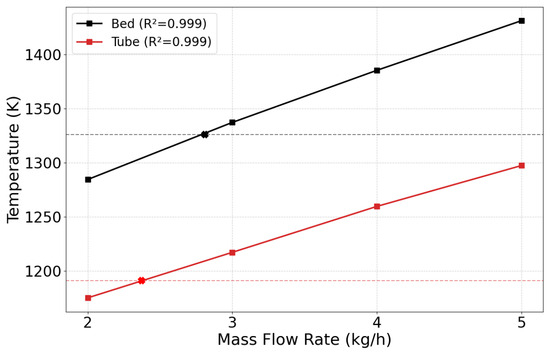
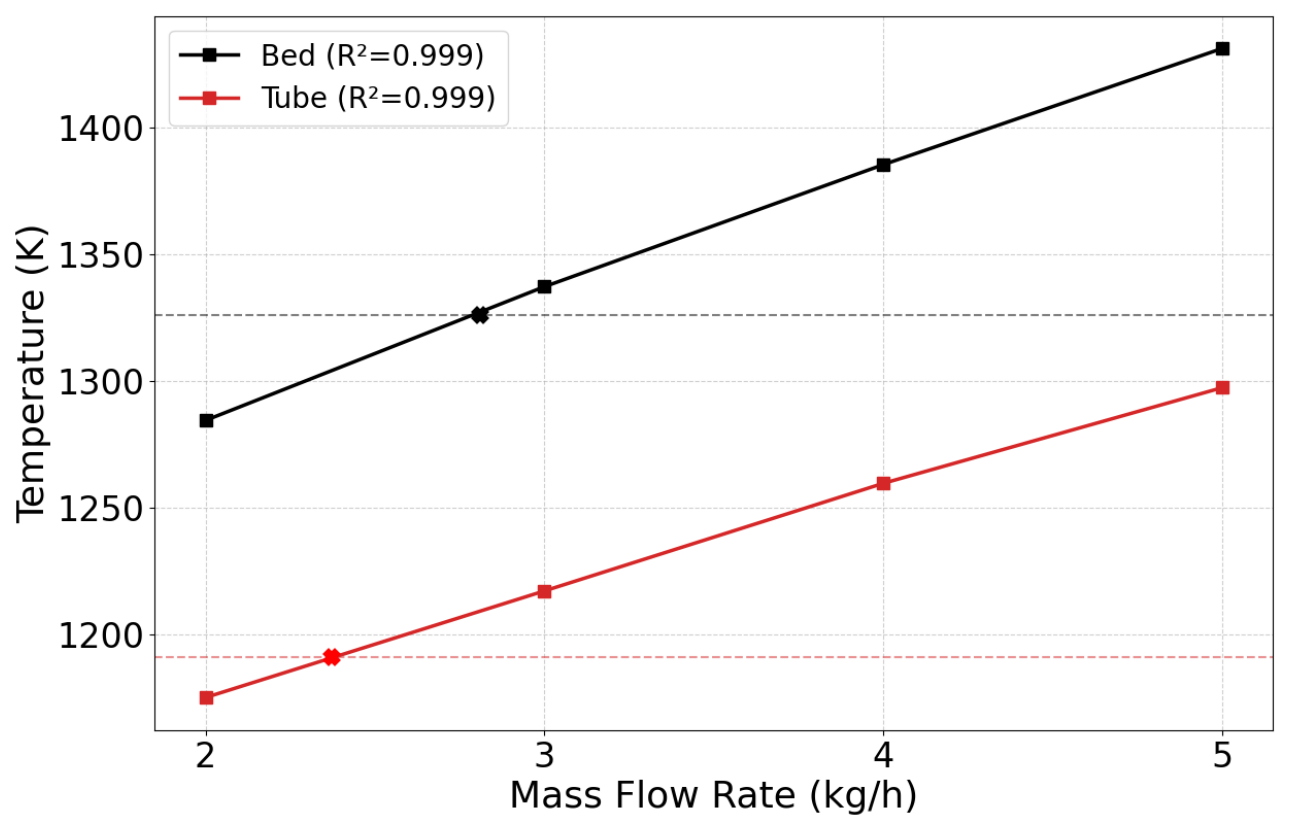
Figure 9 presents the maximum bed and tube temperatures, both of which exhibit a strong linear dependence on the mass flow rate (). Based on the previously defined thermal thresholds, the maximum allowable mass flow rate is determined to be 2.37 kg/h. This limit is dictated by the tube temperature rather than the bed temperature, highlighting a critical physical constraint: while the quartz tube is theoretically transparent to microwave radiation, it is subject to significant indirect heating via conduction and radiation from the processed material. This thermal bottleneck necessitates a trade-off between increasing throughput and preserving the structural limits of the reactor components.
Figure 9.
Maximum bed and tube temperatures as a function of mass flow rate.
It should be noted that, under the 90% thermal-safety threshold defined above (1190.84 K for the quartz tube), the mass flow rate of 5.0 kg/h used in the Fixed Mass Flow Rate Analysis (Section 4.1) exceeds this envelope at every incident power level tested, from 1.6% above threshold at 5000 W up to 8.3% above threshold at 6500 W (97.5% of the tube’s maximum operating temperature)—confirming that Section 4.1 is a deliberately unconstrained exploratory sweep, and underscoring why the present analysis required reducing the flow rate to 2.37 kg/h to restore a safe operating margin.
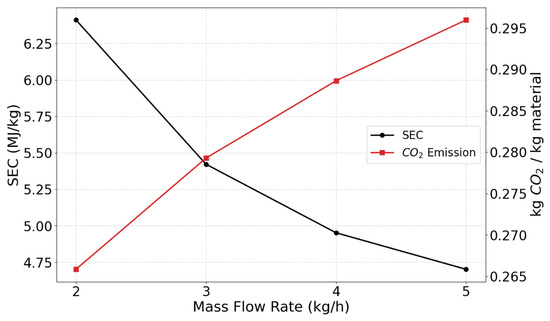
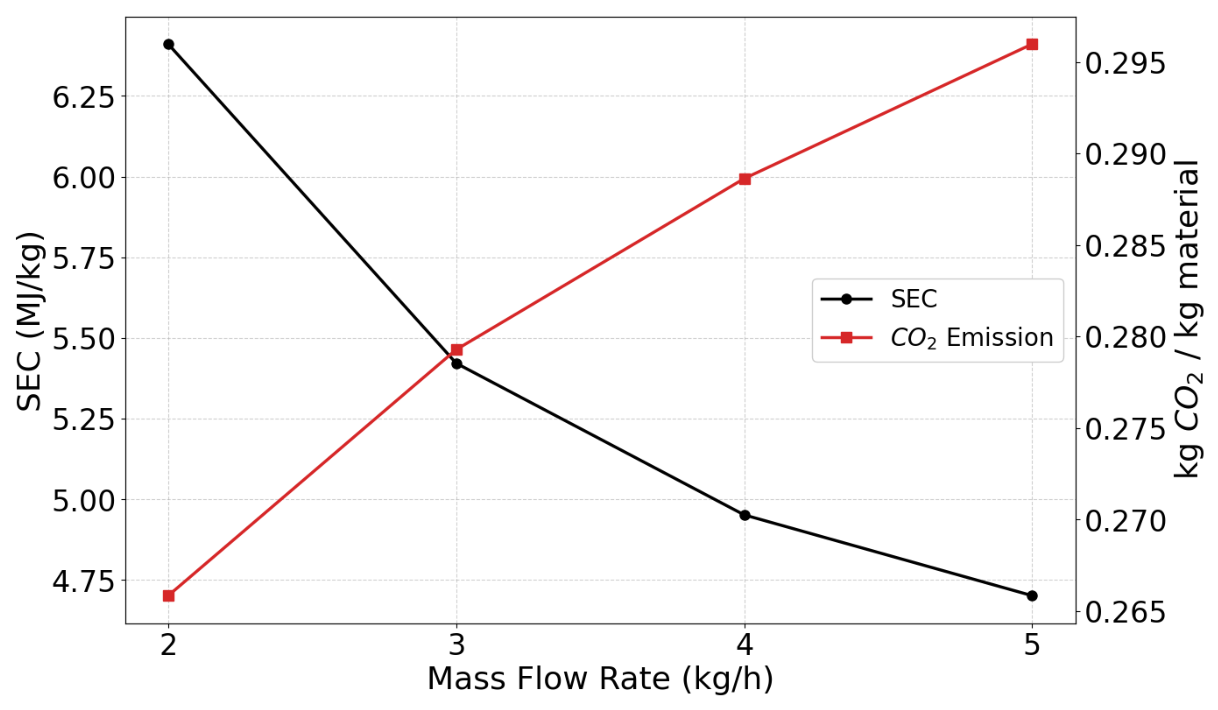
Figure 10 illustrates the Specific Energy Consumption (SEC) alongside the direct CO2 emissions as a function of the mass flow rate. In this context, direct CO2 emissions refer to the carbon species generated by the intrinsic chemical reactions of the process. These are calculated under the assumption of stoichiometric completion—where all carbon consumed is ultimately transformed into CO2—implying that any CO produced by the Boudouard reaction (R5) is fully oxidized.
Figure 10.
Specific Energy Consumption (SEC) and specific CO2 emissions as functions of mass flow rate.
An analysis of these trends reveals a divergent optimization path between energetic and environmental performance. From an energetic perspective, higher mass flow rates are significantly more beneficial due to the improved thermal efficiency associated with higher throughput. Conversely, from an environmental standpoint, lower mass flow rates yield lower direct specific emissions. This phenomenon is rooted in the high temperature dependency of the Boudouard reaction (R5), which governs the production of CO as a reducing agent. As the temperature increases with incident power (required to maintain reduction degrees at higher flows), the equilibrium of (R5) shifts toward greater CO production, thereby increasing the specific carbon consumption and the resulting emission intensity.
This trade-off suggests that while high-throughput operation maximizes energy efficiency, the associated thermal requirements accelerate the carbon-intensive Boudouard cycle, increasing the emission intensity per unit of product.
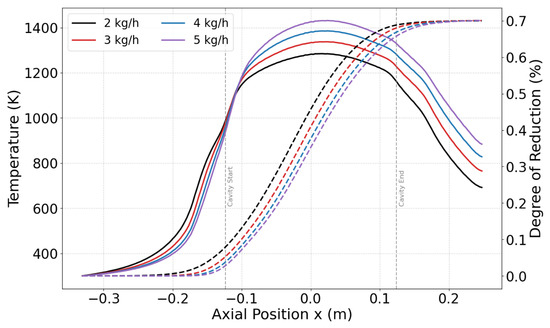
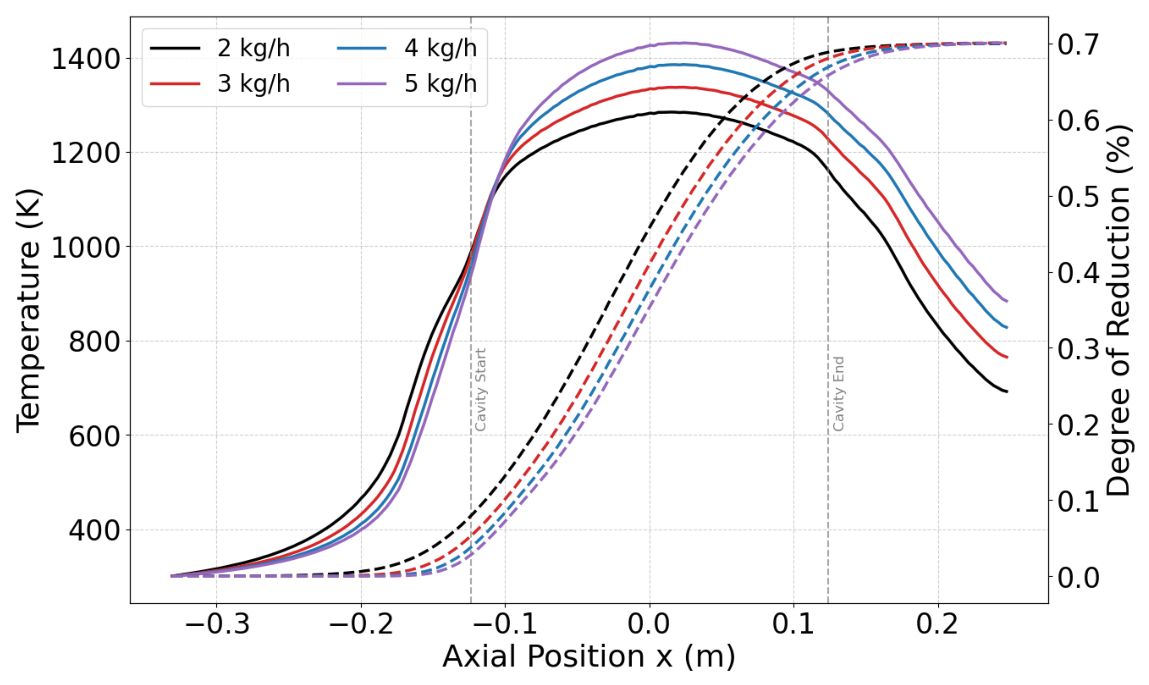
This spatial and thermal behavior is further elucidated by the axial profiles presented in Figure 11. As expected, the pre-heating effect is more pronounced at lower mass flow rates, where the reduced convective load allows for deeper thermal propagation upstream against the material flow. To compensate for the shorter residence times associated with higher throughputs, the peak bed temperature must increase to accelerate the chemical kinetics and satisfy the fixed reduction target.
Figure 11.
Axial profiles of bed temperature (solid lines, left axis) and degree of reduction (dashed lines, right axis) for mass flow rates of 2–5 kg/h at a fixed exit degree of reduction of 70%.
Consequently, at lower mass flow rates, the degree of reduction begins to rise earlier and reaches the target value sooner in the axial path. Nevertheless, the primary reaction zone remains mostly confined within the resonant cavity walls across all cases. This consistency reinforces the conclusion that the microwave field geometry acts as the fundamental spatial governor for the reduction process; the throughput intensity primarily dictates the necessary thermal intensity, while the cavity dimensions define the physical boundaries of the transformation.
Translated to the reductive roasting process itself, these two central findings—the tube-temperature-limited maximum throughput of 2.37 kg/h, and the trade-off observed between specific energy consumption and CO2 emission intensity—indicate that, for the microwave rotary kiln design studied here, industrial throughput is constrained primarily by structural/material limits (the maximum sustainable tube-wall temperature) rather than by the electromagnetic or chemical sub-processes themselves. This is a distinct bottleneck from that typically reported for conventional, fuel-fired Waelz kilns, where throughput is instead constrained by the long residence times—up to 8 h—required for indirect, combustion-driven heat transfer through the burden, and by the associated thermal inefficiency of the process [6].
These findings also carry direct implications for scaling this configuration to industrial throughput. Because the active reaction zone is governed by the resonant cavity geometry rather than by mass flow rate alone, increasing throughput at industrial scale would likely require multiple cavities or waveguide sources arranged along an extended kiln length, rather than a single enlarged cavity, in order to preserve field uniformity and avoid the localized hot-spot behavior discussed above [20,21]. The thermal bottleneck identified at the reactor tube wall is also expected to remain relevant at industrial scale, motivating consideration of alternative reactor materials capable of withstanding higher operating temperatures without compromising microwave transparency, a design trade-off already explored for other continuous microwave systems [23,24]. Finally, the techno-economic balance between capital cost, throughput, and emissions reduction—a trade-off already characterized for conventional rotary hearth furnace scale-up [15]—would need to be re-evaluated for a microwave-based route, particularly given that fossil-fuel-derived heat remains substantially cheaper than electricity in most industrial settings, a disparity that remains a key barrier to industrial process electrification more broadly [4,19].
5. Conclusions
This study presents a fully coupled electromagnetic–thermal–fluid–chemical multiphysics model of a continuous microwave rotary kiln for the simultaneous carbothermic reduction of iron oxides and zinc volatilization from a mixture of basic oxygen furnace (BOF) dust and blast furnace (BF) sludge. By systematically analyzing the system under both fixed mass flow rate and fixed degree of reduction frameworks, the work reveals critical insights into the interplay between microwave energy delivery, heat transfer, and reaction kinetics in a rotating reactor:
- Spatial and Geometric Constraints: The results demonstrate that the active reaction zone is strictly governed by the resonant cavity geometry. While increasing incident power intensifies the thermal regime and accelerates chemical kinetics, the net processing time remains physically constrained by the cavity dimensions. This confirms that microwave power is a highly responsive control variable for modulating exit conditions without necessitating changes to kiln throughput.
- Critical Operational Bottlenecks: A primary thermal limit was identified in the reactor’s structural integrity rather than the material bed. The indirect heating of the quartz tube via radiation and conduction from the processed slag defines the maximum allowable mass flow rate (determined here as 2.37 kg/h). This highlights a critical design trade-off: while quartz is microwave-transparent, its thermal proximity to the lossy load necessitates advanced material selection or active cooling for industrial scaling.
- Energetic vs. Environmental Optimization: A divergent optimization path was identified regarding specific energy consumption (SEC) and carbon intensity. Although higher throughputs, enhance thermal efficiency and reduce SEC, the higher temperatures required to maintain reduction targets accelerate the Boudouard reaction. This leads to an increase in specific CO2 emissions, suggesting that the “optimal” operating point must be selected based on a balance between energy costs and environmental regulations.
- Design Efficiency: The system achieved microwave coupling efficiencies exceeding 97%, with negligible leakage (0.1%) due to the axial orientation of the kiln within the TE10 cavity. This validates the feasibility of the resonant structure for high-temperature metallurgical processing.
- Scale-Up Considerations: Extending this configuration to industrial throughput would require several additional considerations beyond those addressed in the present single-geometry study: redesign of the microwave cavity and waveguide feed—likely via multiple cavities or a multi-magnetron/multi-mode excitation scheme—to preserve field uniformity as the bed cross-section increases; selection of tube material and cooling strategy to accommodate the thermal bottleneck identified in Section 4.2; re-scaling of the resonant active heating length identified in Section 4.1 to the residence time and geometry of a larger reactor; re-evaluation of the kinetic compensation factor (Section 3.2) and the reversible, CO-availability-dependent rate formulation (Section 2.3.1) at industrial bed depths, where internal transport limitations are more likely to become significant than at the laboratory/pilot scale modeled here; and a re-evaluation of the techno-economic balance between capital cost, throughput, and emissions reduction relative to conventional routes.
Overall, the developed modeling framework provides a foundation for future predictive design. It offers quantitative guidelines for enhancing energy efficiency and reducing the carbon footprint of steelmaking residue valorization, as well as expected temperature profiles and processing-zone boundaries that can serve as a reference for future cavity design. Future work should extend the model to include gas-phase chemistry, particle-scale phenomena, and full system integration within industrial flowsheets, further supporting the transition toward sustainable, low-emission metallurgical technologies.
Author Contributions
Conceptualization, J.C.F.P.; methodology, L.M.N.S., J.C.F.P., D.M.S.A.; software, L.M.N.S.; validation, L.M.N.S., J.C.F.P., D.M.S.A.; investigation, L.M.N.S., D.M.S.A., J.C.F.P.; resources, J.C.F.P.; data curation, L.M.N.S.; writing—original draft preparation, L.M.N.S., J.C.F.P., D.M.S.A.; writing—review and editing, L.M.N.S., J.C.F.P.; visualization, L.M.N.S.; supervision, J.C.F.P.; project administration, J.C.F.P.; funding acquisition, J.C.F.P. All authors have read and agreed to the published version of the manuscript.
Funding
This work was supported by European Union’s Horizon 2020 research programme under the grant agreement n° 820783 of project DESTINY and by Fundação para a Ciência e a Tecnologia (FCT) for its financial support via LAETA (project https://doi.org/10.54499/UID/50022/2025). FCT,
through IDMEC, under LAETA, project UIDB/50022/2020.
Data Availability Statement
Further inquiries can be directed to the corresponding author.
Acknowledgments
Luís M. N. Silva acknowledges Fundação para a Ciência e a Tecnologia (FCT) for Scholarship Contract No. 2022. 13975.BD. The authors wish to thank Lukas Schmidt from K1-MET for clarifying doubts of the recycling process. Duarte M. S. Albuquerque acknowledges financial support via National funds from FCT, I.P.—Fundação para a Ciência e a Tecnologia, in the scope of the project UID/00667/2025 (https://doi.org/10.54499/UID/00667/2025) (UNIDEMI). During the preparation of this manuscript, the author(s) used Gemini for the purposes of text generation and organization.
Conflicts of Interest
The authors declare no conflicts of interest. The funders had no role in the design of the study; in the collection, analyses, or interpretation of data; in the writing of the manuscript; or in the decision to publish the results.
References
- European Parliament and Council of the European Union. Regulation (EU) 2021/1119 of the European Parliament and of the Council of 30 June 2021 establishing the framework for achieving climate neutrality and amending Regulations (EC) No 401/2009 and (EU) 2018/1999 (“European Climate Law”). Off. J. Eur. Union 2021, L 243, 1–17. Available online: https://eur-lex.europa.eu/eli/reg/2021/1119/oj (accessed on 14 September 2026).
- Lei, T.; Wang, D.; Yu, X.; Ma, S.; Zhao, W.; Cui, C.; Meng, J.; Tao, S.; Guan, D. Global iron and steel plant CO2 emissions and carbon-neutrality pathways. Nature 2023, 622, 514–520. [Google Scholar] [CrossRef] [Scilit] [PubMed]
- Metaxas, A.C.; Meredith, R.J. Industrial Microwave Heating; IET: London, UK, 1983. [Google Scholar]
- Leicher, J.; Giese, A.; Wieland, C. Electrification or Hydrogen? The Challenge of Decarbonizing Industrial (High-Temperature) Process Heat. J 2024, 7, 439–456. [Google Scholar] [CrossRef] [Scilit]
- Binnemans, K.; Jones, P.T.; Manjón Fernández, Á.; Masaguer Torres, V. Hydrometallurgical Processes for the Recovery of Metals from Steel Industry By-Products: A Critical Review. J. Sustain. Metall. 2020, 6, 505–540. [Google Scholar] [CrossRef] [Scilit]
- Stewart, D.J.; Barron, A.R. Pyrometallurgical removal of zinc from basic oxygen steelmaking dust—A review of best available technology. Resour. Conserv. Recycl. 2020, 157, 104746. [Google Scholar] [CrossRef] [Scilit]
- Wang, Y.; Zhao, H.; Wang, X.; Chong, J.; Huo, X.; Guo, M.; Zhang, M. Transformation and Detoxification of Typical Metallurgical Hazardous Waste into a Resource: A Review of the Development of Harmless Treatment and Utilization in China. Materials 2024, 17, 931. [Google Scholar] [CrossRef] [Scilit] [PubMed]
- Daigo, I.; Osako, S.; Adachi, Y.; Matsuno, Y. Time-series analysis of global zinc demand associated with steel. Resour. Conserv. Recycl. 2014, 82, 35–40. [Google Scholar] [CrossRef] [Scilit]
- Mustafa, S.; Luo, L.; Zheng, B.T.; Wei, C.X.; Christophe, N. Effect of Lead and Zinc Impurities in Ironmaking and the Corresponding Removal Methods: A Review. Metals 2021, 11, 407. [Google Scholar] [CrossRef] [Scilit]
- Ma, N. Recycling of basic oxygen furnace steelmaking dust by in-process separation of zinc from the dust. J. Clean. Prod. 2016, 112, 4497–4504. [Google Scholar] [CrossRef] [Scilit]
- Leclerc, N.; Meux, E.; Lecuire, J.M. Hydrometallurgical extraction of zinc from zinc ferrites. Hydrometallurgy 2003, 70, 175–183. [Google Scholar] [CrossRef] [Scilit]
- Xue, Y.; Hao, X.; Liu, X.; Zhang, N. Recovery of Zinc and Iron from Steel Mill Dust—An Overview of Available Technologies. Materials 2022, 15, 4127. [Google Scholar] [CrossRef] [Scilit] [PubMed]
- Doronin, I.E.; Svyazhin, A.G. Commercial methods of recycling dust from steelmaking. Metallurgist 2011, 54, 673–681. [Google Scholar] [CrossRef] [Scilit]
- Wang, J.; Zhang, Y.; Cui, K.; Fu, T.; Gao, J.; Hussain, S.; AlGarni, T.S. Pyrometallurgical recovery of zinc and valuable metals from electric arc furnace dust—A review. J. Clean. Prod. 2021, 298, 126788. [Google Scholar] [CrossRef] [Scilit]
- Kim, J.; Son, M.; Park, J.; Kim, J. Optimized rotary hearth furnace utilization with blast furnace and electric arc furnace: Techno-economics, CO2 reduction. Fuel Process. Technol. 2022, 237, 107450. [Google Scholar] [CrossRef] [Scilit]
- Lin, B.; Li, H.; Chen, Z.; Zheng, C.; Hong, Y.; Wang, Z. Sensitivity analysis on the microwave heating of coal: A coupled electromagnetic and heat transfer model. Appl. Therm. Eng. 2017, 126, 949–962. [Google Scholar] [CrossRef] [Scilit]
- Hunt, J.; Ferrari, A.; Lita, A.; Crosswhite, M.; Ashley, B.; Stiegman, A.E. Microwave-Specific Enhancement of the Carbon–Carbon Dioxide (Boudouard) Reaction. J. Phys. Chem. C 2013, 117, 26871–26880. [Google Scholar] [CrossRef] [Scilit]
- García-Baños, B.; Catalá-Civera, J.M.; Sánchez, J.R.; Navarrete, L.; López-Buendía, A.M.; Schmidt, L. High Temperature Dielectric Properties of Iron- and Zinc-Bearing Products during Carbothermic Reduction by Microwave Heating. Metals 2020, 10, 693. [Google Scholar] [CrossRef] [Scilit]
- Mallapragada, D.S.; Dvorkin, Y.; Modestino, M.A.; Esposito, D.V.; Smith, W.A.; Hodge, B.M.; Harold, M.P.; Donnelly, V.M.; Nuz, A.; Bloomquist, C.; et al. Decarbonization of the chemical industry through electrification: Barriers and opportunities. Joule 2023, 7, 23–41. [Google Scholar] [CrossRef] [Scilit]
- Jeon, S.; Kim, J.; Yang, D. Design of Large-Scale Microwave Cavity for Uniform and Efficient Plastic Heating. Polymers 2022, 14, 541. [Google Scholar] [CrossRef] [Scilit] [PubMed]
- Zhu, H.; He, J.; Hong, T.; Yang, Q.; Wu, Y.; Yang, Y.; Huang, K. A rotary radiation structure for microwave heating uniformity improvement. Appl. Therm. Eng. 2018, 141, 648–658. [Google Scholar] [CrossRef] [Scilit]
- Aman, B.; Acharya, S.; Reeja-Jayan, B. Making the Case for Scaling Up Microwave Sintering of Ceramics. Adv. Eng. Mater. 2024, 26, 2302065. [Google Scholar] [CrossRef] [Scilit]
- Ramos, P.A.; Albuquerque, D.M.; Pereira, J.C. Enhancing the efficiency of Brown 24 pigment production through continuous microwave heating in conveyor belt and rotary kiln systems: A design and optimization study. Energy 2024, 309, 133123. [Google Scholar] [CrossRef] [Scilit]
- Gonçalves, S.N.; Albuquerque, D.M.; Pereira, J.C. Modelling and energy efficiency analysis of the microwave continuous processing of limestone. J. Clean. Prod. 2024, 467, 142912. [Google Scholar] [CrossRef] [Scilit]
- Ramos, P.A.; Albuquerque, D.M.; Pereira, J.C. Numerical simulation and optimization of the ceramic pigments production process using microwave heating. Chem. Eng. Process.-Process Intensif. 2021, 169, 108567. [Google Scholar] [CrossRef] [Scilit]
- DESTINY H2020 Project. DESTINY H2020 and Beyond. 2021. Available online: https://www.destinyh2020andbeyond.eu/pt/ (accessed on 1 December 2021).
- Kuwauchi, Y.; Barati, M. A Mathematical Model for Carbothermic Reduction of Dust-Carbon Composite Agglomerates. ISIJ Int. 2013, 53, 1097–1105. [Google Scholar] [CrossRef] [Scilit]
- Sun, S.; Lu, W.K. Building of a Mathematical Model for the Reduction of Iron Ore in Ore/Coal Composites. ISIJ Int. 1999, 39, 130–138. [Google Scholar] [CrossRef] [Scilit]
- Guger, C.E.; Manning, F.S. Kinetics of zinc oxide reduction with carbon monoxide. Metall. Trans. 1971, 2, 3083–3090. [Google Scholar] [CrossRef] [Scilit]
- Peng, N.; Pan, Q.; Jiang, G.; Liang, Y.; Wang, G.; Chen, Y.; Ma, G.; Ma, T. Isothermal kinetics of zinc ferrite reduction using a CO-CO2-Ar gas mixture. Thermochim. Acta 2020, 686, 178564. [Google Scholar] [CrossRef] [Scilit]
- Incropera, F.P.; DeWitt, D.P. Fundamentals of Heat and Mass Transfer, 4th ed.; John Wiley & Sons, Inc.: New York, NY, USA, 1996. [Google Scholar]
- Ökvist, L. High Temperature Properties of BOF Slag and its Behaviour in the Blast Furnace. Steel Res. Int. 2004, 75, 792–799. [Google Scholar] [CrossRef] [Scilit]

Disclaimer/Publisher’s Note: The statements, opinions and data contained in all publications are solely those of the individual author(s) and contributor(s) and not of MDPI and/or the editor(s). MDPI and/or the editor(s) disclaim responsibility for any injury to people or property resulting from any ideas, methods, instructions or products referred to in the content. |
© 2026 by the authors. Licensee MDPI, Basel, Switzerland. This article is an open access article distributed under the terms and conditions of the Creative Commons Attribution (CC BY) license.