


Abstract
Traditional electric-drive maize seed-metering systems, when operating at high speeds, are constrained by insufficient control accuracy and sluggish dynamic response, making it difficult to guarantee qualified single-seed placement rates, which directly affects field sowing quality and subsequent maize yield. To address the inherent shortcomings of conventional fuzzy PID control—namely, lagging manual parameter tuning and the susceptibility of standard particle swarm optimization to local optima—this paper proposes an improved particle swarm optimization algorithm. By introducing adaptive inertia weight and chaotic mutation operators to optimize the iterative mechanism of the particle swarm optimization, precise tuning of fuzzy PID control parameters is achieved. Simulink simulations show that the improved algorithm reduces the optimal fitness value by 60.66% compared with the standard algorithm, and increases the convergence speed by 30%. Bench test results confirm that, under operating speeds of 10–14 km/h, the proposed control strategy exhibits superior dynamic and steady-state performance; at the high operating speed of 14 km/h, the seeding quality index and coefficient of variation in plant spacing are 91.2% and 10.8%, respectively, representing significant improvements over PSO-Fuzzy-PID (88.1%, 12.8%) and conventional Fuzzy-PID (83.2%, 16.2%). This study can provide an important theoretical basis for precise control of high-speed maize seeding.
1. Introduction
Maize is one of the cereal crops with the largest planting area and the highest total yield worldwide, and its production efficiency directly determines the adequacy of global food supply. Precision seeding technology serves as a key means to improve maize yield per unit area, and its operational quality has a decisive influence on the stability of maize yield [1,2]. In recent years, electric-drive seed-metering technology has replaced traditional chain drives and has been widely applied in maize precision seeding. For instance, a CANopen-based control system for an electric precision maize planter achieved a qualified index exceeding 89% at operating speeds of 6–12 km/h in field tests [3]. To improve control accuracy, researchers have introduced fuzzy controllers into the field of PID parameter regulation. Yao et al. [4] applied fuzzy PID control to a maize seeding unit driver, and compared with traditional PID, the overshoot was reduced by 0.4%, the rise time and settling time were shortened by 0.12 s and 0.49 s, respectively, and the steady-state error was reduced by 0.3%. However, the core parameters of the fuzzy PID controller, such as quantization factors and scaling factors, usually rely on manual experience for setting, which is highly subjective and difficult to achieve global optimality, thus limiting the improvement of control performance.
The PSO algorithm has a simple structure, fast convergence speed, and strong adaptability, and has been frequently used in recent years to optimize fuzzy PID parameters. Successful applications include a precision maize seeding control system with KF-RTS fusion speed measurement, where a control strategy combining Kalman filtering and PSO-optimized fuzzy PID enabled precise and stable regulation of the seed metering shaft speed [5], and a tractor multi-channel hydraulic tester, where the PSO-tuned fuzzy-PID controller achieved a relative steady-state flow error within ±1.0% and an absolute flow control error within ±0.5 L/min, significantly outperforming the traditional PID controller [6]. Although the introduction of the algorithm enabled self-tuning of the fuzzy PID controller parameters and avoided the subjectivity and non-optimality of manual setting, the standard PSO is prone to falling into local optima and premature convergence, resulting in insufficient parameter search accuracy and low efficiency. Xu et al. [7]. introduced the improved PSO algorithm optimized PID control into a natural rubber robot, and the experimental results showed that the rubber tapping depth system of the improved PSO-PID algorithm had high responsiveness and strong robustness, with an average settling time of 0.419 s and an overshoot rate controllable below 2.5%.
In this study, we take the air-suction maize high-speed electric-drive seed-metering system as the research object and design a control system to ensure seeding stability and precision under high-speed conditions. The proposed system improves the PSO algorithm by introducing adaptive inertia weight adjustment and chaotic mutation operators to enhance global search capability and convergence accuracy, and then optimizes the fuzzy PID controller to construct a high-precision electric-drive seeding control system [4,8,9,10,11,12,13]. To verify the feasibility of the scheme, we build a simulation model in MATLAB to comparatively analyze the dynamic response and anti-interference performance of the improved PSO-Fuzzy-PID, the standard PSO-Fuzzy-PID, and the conventional Fuzzy-PID. Bench tests are also carried out to further validate the actual effects, providing a foundation for further field validation of high-speed maize precision seeding control.
2. Materials and Methods
2.1. Design of the Maize Electric Drive Seed Metering System
2.1.1. Overall System Structure and Principle
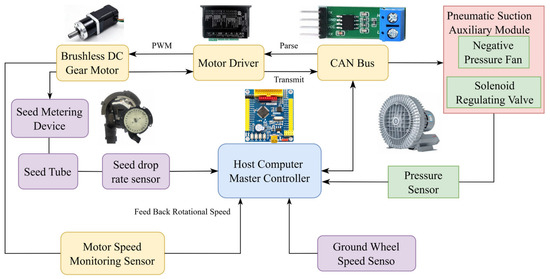
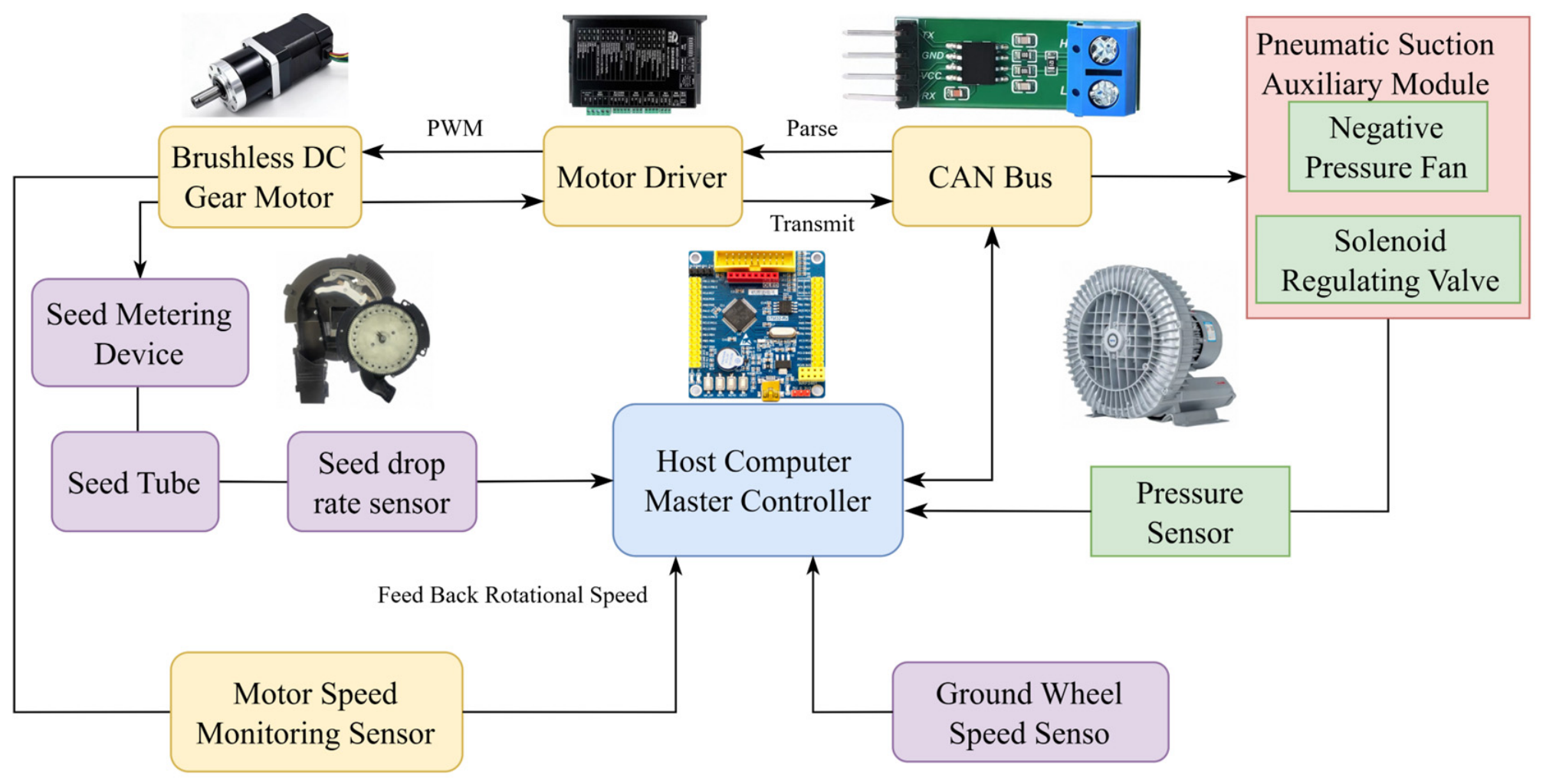
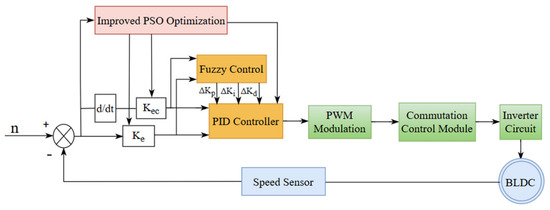
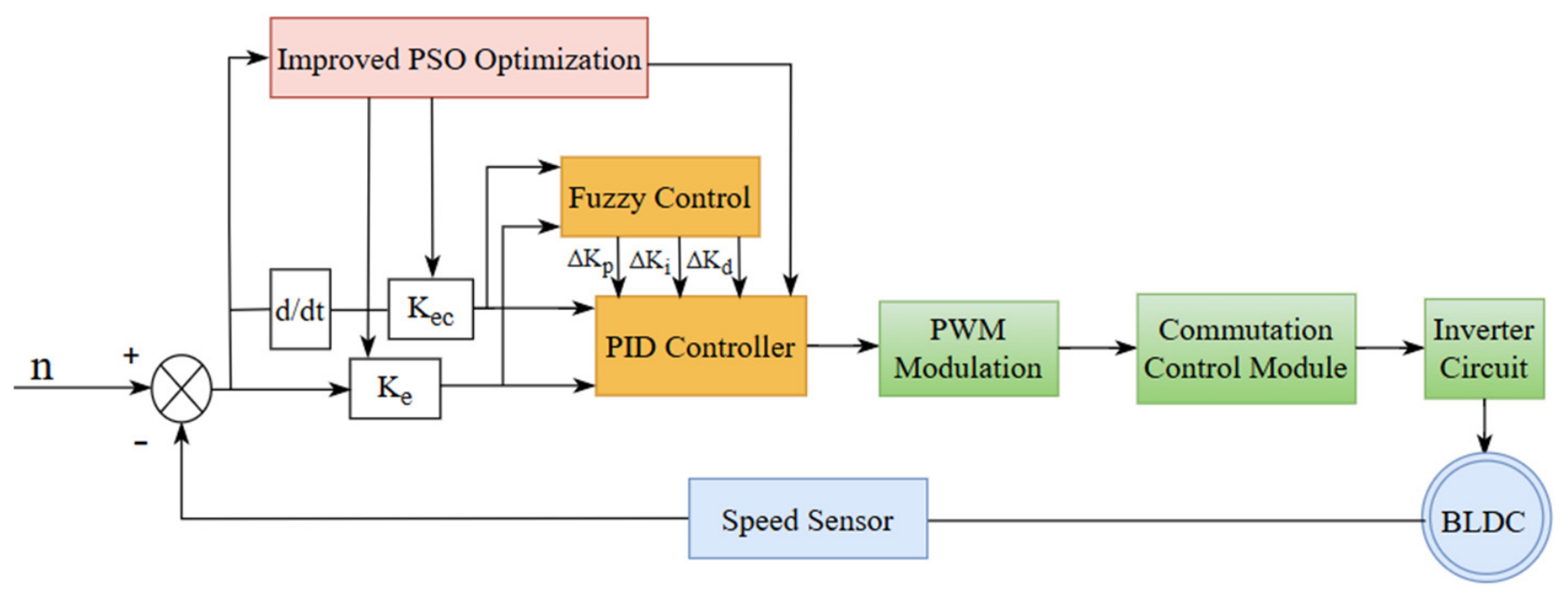
The maize electric drive seed metering system designed in this study achieves precise and uniform seed dispensing by matching the operating speed with the motor speed in real time to drive the rotation of the seed metering plate. The hardware layer of the system mainly comprises a host computer, a main controller, a motor driver, a ground wheel speed sensor, a brushless DC geared motor, a motor speed monitoring sensor, a seed dropping rate monitoring sensor, a pressure sensor, an air-suction auxiliary module, a seed metering plate, a seed delivery tube, and a touch screen (manufactured by Mindray Technology) [14]. The overall structure block diagram of the control system is shown in Figure 1. The control layer is built around a fuzzy PID controller, which adjusts parameters in real time according to the error and the error change rate, and outputs PWM signals to regulate the motor speed. The algorithm layer provides parametric support for the control layer: an improved PSO algorithm is employed to offline optimize the key parameters of the fuzzy PID controller, ensuring globally optimal control parameters. The control principle diagram is presented in Figure 2.
Figure 1.
Overall structure block diagram of the control system.
Figure 2.
Schematic diagram of improved PSO-Fuzzy PID control.
As can be seen from Figure 1, the main controller filters and computes the operating speed collected in real time by the ground wheel speed sensor, and then sends the target speed command via the CAN bus. The driver combines the parameters optimized by the improved PSO algorithm with the fuzzy control rules to output PWM signals that drive the motor. The motor speed sensor feeds back the actual speed in real time to form closed-loop regulation, thereby achieving high-precision tracking and stable control of the seed metering rotational speed [15].
2.1.2. Hardware Design and Selection
Main Controller Selection
This controller is the core component of the system, primarily responsible for signal acquisition, algorithm computation, and control command output. It must meet the requirements of fast computing speed, abundant peripheral interfaces, and strong anti-interference capability. Therefore, the STM32F103RET6 microcontroller (STMicroelectronics, Switzerland.) was selected as the main control core in this study. This chip is based on the ARM Cortex-M3 core with a main frequency of 72 MHz, featuring 512 KB of Flash memory and 64 KB of RAM, which can satisfy the real-time computation demands of the fuzzy PID control algorithm. Furthermore, this microcontroller is equipped with multiple timers, ADC interfaces, GPIO interfaces, and a CAN communication interface, enabling direct connection to the speed sensor and motor drive module without the need for additional peripheral expansion. This simplifies the hardware circuit design. It also possesses strong resistance to electromagnetic interference, making it suitable for the complex environment of field operations.
Drive Motor Selection
This motor is the core actuator of the seed metering device, primarily responsible for precisely driving the metering plate to achieve single-grain seeding. It must meet the requirements of a wide speed regulation range, fast response, high torque, smooth operation, and strong anti-disturbance capability, while also needing to adapt to the metering demands under high-speed operating conditions [16]. Therefore, the Maotian Machinery BLDC-60 brushless DC geared motor (Chongqing Maotian Machinery Co., Ltd., Chongqing, China.) was selected as the seed metering drive motor in this study. This motor features dual control interfaces supporting both PWM pulse control and CAN bus command control, and can provide real-time feedback of critical information such as the motor rotor position. Its core parameters are shown in Table 1.
Table 1.
Core parameters of the BLDC-60 brushless DC geared motor.
Speed Measurement Module Design
This module is a critical component for obtaining real-time operating speed, providing essential input data for the fuzzy PID control algorithm. It must output stable pulse signals during continuous field operation. Therefore, an NPN-type Hall sensor (Standard NPN Hall-effect sensor, commercially available.) was selected and installed on the ground wheel shaft to acquire the operating speed. The Hall sensor generates a single pulse signal for each full revolution of the ground wheel. The main controller counts these pulse signals using the TIM2 timer and calculates the operating speed based on the perimeter of the ground wheel and the pulse count. With this purpose, Equations (1) and (2) were used.
where nw is the rotational speed of the ground wheel, in r/min; Pw is the number of pulses per revolution of the ground wheel; Nw is the number of Hall pulses within time T; v is the operating speed, in km/h; D is the ground wheel diameter, in m.
Based on the operating speed, the target motor speed was calculated according to Equation (3).
where i is the reduction ratio; Z is the number of holes on the seed metering plate; S is the plant spacing, in cm.
The brushless DC motor incorporates three built-in Hall sensors (Hall A/B/C) that output three digital signals with a phase difference of 120°, generating six commutation pulses per revolution [17]. The main controller acquires the commutation pulse signals from the motor’s built-in Hall sensors via a timer, and calculates the actual motor speed using the M method (frequency measurement) using to Equation (4).
where nm is the actual motor speed, in r/min; fHall is the Hall signal pulse frequency; p is the number of motor.
The seed metering device is connected to the motor through a reduction mechanism. Therefore, the actual rotational speed of the seed metering plate was obtained by converting the actual motor speed according to Equation (5).
where ns is the actual rotational speed of the seed metering device, in r/min.
Auxiliary Hardware Design
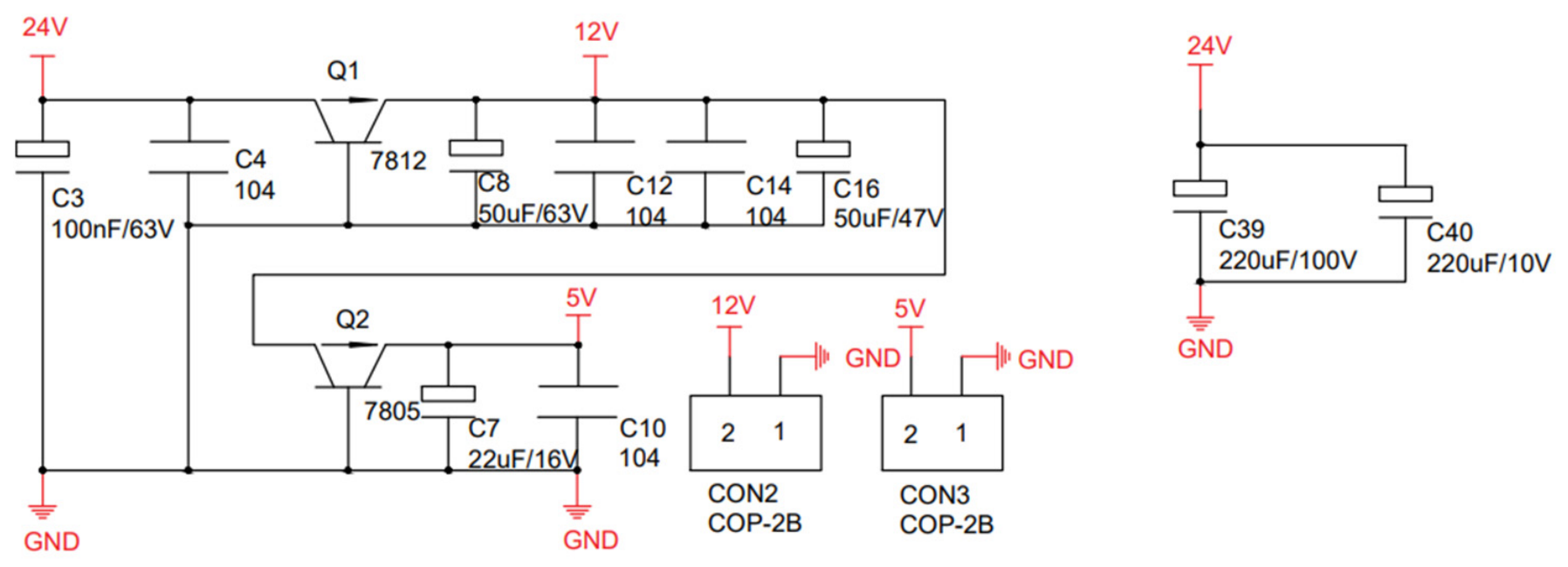
The system incorporates step-down power modules converting 24 V to 12 V and 12 V to 5 V, providing stable power for the sensors, the main controller, and other peripherals. The circuit diagram is shown in Figure 3. To prevent voltage fluctuations from interfering with the system, a voltage regulation and filtering circuit is integrated into the power module, ensuring stable system operation.
Figure 3.
Circuit diagram of buck power supply.
2.2. Design of the Improved PSO-Fuzzy-PID Controller
2.2.1. Design of the Fuzzy-PID Controller
The Fuzzy-PID controller combines fuzzy control with PID control, adjusting the PID parameters in real time through fuzzy inference to satisfy both dynamic response and steady-state accuracy requirements. It can well accommodate the nonlinearity and time-varying characteristics of the maize electric drive seed metering system. The core of the controller design consists of four parts: definition of fuzzy input and output variables, design of membership functions, formulation of fuzzy rules, and adjustment of PID parameters.
Definition of Fuzzy Input and Output Variables
The fuzzy inputs of the Fuzzy-PID controller are the motor speed error e and the error change rate ec, and the fuzzy outputs are the correction quantities of the PID parameters Δkp, Δki, and Δkd. To simplify the fuzzy inference process, the inputs e, ec and the outputs Δkp, Δki, and Δkd are all divided into seven fuzzy subsets: {Negative Big (NB), Negative Medium (NM), Negative Small (NS), Zero (ZO), Positive Small (PS), Positive Medium (PM), Positive Big (PB)} [18].
Design of Membership Functions
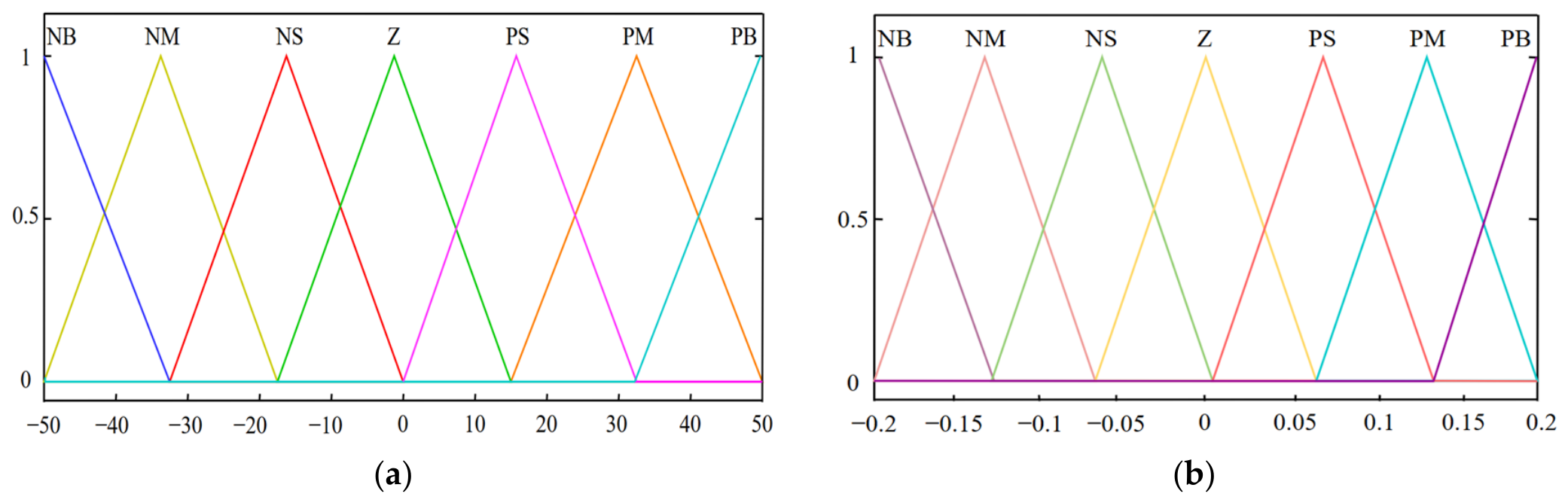
Considering the control accuracy and the computational complexity of the algorithm, triangular membership functions are selected in this study. Figure 4 shows a schematic diagram of the uniformly partitioned triangular membership functions for the input variable e and the output variable Δki. For an input variable acquired at any instant, the degrees of membership to the seven fuzzy subsets can be calculated using these membership functions, thereby completing the conversion from crisp inputs to fuzzy variables and providing the basis for subsequent fuzzy inference.
Figure 4.
Membership functions of input variable e and output variable Δki: (a) input variable “e”; (b) output variable “Δki”. (The colors are used solely for visual distinction among the seven fuzzy subsets and do not imply any comparative relationship between (a) and (b).).
Formulation of Fuzzy Rules
Based on the seven fuzzy subsets defined above, a 7 × 7 fuzzy control rule table is established to achieve accurate fuzzy inference from the inputs e, ec to the outputs Δkp, Δki, and Δkd. The design principles are as follows: when the speed error e is large, Δkp should be increased, while Δki, and Δkd should be decreased, so as to rapidly reduce the error; when the error e is moderate, Δkp should be appropriately decreased, and Δki, Δkd should be increased, to achieve a balance between response speed and steady-state accuracy; when the error e is small, Δkp should be decreased, and Δki, Δkd should be increased, to improve steady-state accuracy and suppress speed fluctuations [19]. In this study, fuzzy rule tables for the output parameters are constructed based on engineering experience. Due to space limitations, only the rule table corresponding to the proportional coefficient Δkp is listed here, as shown in Table 2.
Table 2.
Fuzzy control rules for Δkp.
Adjustment of PID Parameters
The actual output parameters of the Fuzzy-PID controller are composed of the initial parameters and the fuzzy correction quantities using Equations (6)–(8).
where kp0, ki0, and kd0 are the initial parameters optimized by the improved PSO algorithm, and Δkp, Δki, and Δkd are the fuzzy correction quantities obtained from fuzzy inference. By adjusting the PID parameters in real time, the controller can adapt to the varying operating conditions of the seed metering system, achieving stable speed tracking.
2.2.2. Design of the Improved PSO
Principle of the Standard PSO Algorithm
The standard PSO algorithm simulates the foraging behavior of bird flocks, where each set of optimization parameters is regarded as a particle and all particles form a swarm. Through mutual cooperation and information sharing among particles, the global optimal solution is sought [7,20,21]. The velocity and position update formulas for each particle were calculated using Equations (9) and (10).
where vidt is the velocity of particle i in dimension d at time t; xidt is the position of particle i in dimension d at time t; ω is the inertia weight; c1, c2 is the learning factors; r1, r2 is the random numbers in the interval 0–1; pidt is the personal best position of particle i in dimension d; pgd is the global best position of the entire swarm in dimension d.
It can be seen from the formulas that the inertia weight ω in the standard PSO algorithm is fixed and cannot be dynamically adjusted according to the iterative process. Consequently, it is prone to insufficient global search capability in the early iteration stage and inadequate local exploitation ability in the later stage, leading to convergence to local optima. Meanwhile, the particle update process lacks a perturbation mechanism; when particles converge to a local optimum, it is difficult for them to escape from that region, thereby impairing the overall parameter search accuracy [14,22]. In this study, the standard PSO algorithm is improved by incorporating a nonlinear adaptive inertia weight and a chaotic mutation operator. By dynamically adjusting the inertia weight, the algorithm can balance both global exploration and local search accuracy. Meanwhile, the addition of chaotic perturbation can prevent premature convergence and enhance parameter search accuracy [23], thus optimizing the key parameters of the Fuzzy-PID controller.
Adaptive Adjustment Strategy for the Inertia Weight
This study introduces a nonlinear adaptive inertia weight strategy to balance the global exploration and local exploitation capabilities of the algorithm. The inertia weight is modulated by a cosine function so that it decreases slowly at the initial stage of iteration, extending the global search period of the particles, and decreases rapidly at the later stage of iteration, improving the local search accuracy of the algorithm. The weight update was calculated using Equation (11) [24].
where ω(k) is the inertia weight at the k-th iteration; ωmax is the maximum inertia weight, taken as 0.9; ωmin is the minimum inertia weight, taken as 0.4; k is the current iteration number; T is the maximum number of iterations.
Design of the Chaotic Mutation Operator
In this study, a Logistic chaotic map is introduced to prevent the algorithm from falling into local optima and exhibiting premature convergence. A chaotic mutation operator is designed to perturb the global best particle during the iteration process, thereby breaking the local convergence tendency and guiding the particle to continue searching toward a better region [25]. The chaotic mutation is triggered when the relative change in fitness remains below 1% for five consecutive generations. The core procedure is as follows:
(1) Extract the parameter vector of the current global best particle:
where , is the quantization factors; , , is the scaling factors.
(2) Generate a chaotic sequence z using the chaotic map calculated using Equation (13).
where zn is the chaotic variable at the n-th iteration; z0 is the initial chaotic value when n = 0.
By substituting values into the formula, z1, z2, …, zn can be sequentially calculated.
(3) Apply chaotic perturbation to the global best particle calculated using Equation (14).
where X′gbest is the global best particle after perturbation; α is the perturbation coefficient, taken as 0.08.
(4) Restrict the parameters of the perturbed particle within the predefined bounds, then calculate its fitness value. If the fitness value is better than that of the original global best, update the global best particle; otherwise, retain the original global best particle [26].
2.2.3. Procedure for Optimizing Fuzzy-PID Parameters Using the Improved PSO
Optimization Objective and Fitness Function Design
According to the control requirements of the maize electric drive seed metering system, the optimization objective is set as accurate tracking of the motor speed, with overshoot, settling time, and speed deviation serving as evaluation indices to measure the parameter optimization effect. A fitness function Fis constructed using a weighted sum method, aiming to minimize the fitness function value [27]. The function expression is as follows:
where F is the fitness function; α, β, γ is the weighting coefficients (α = 0.3, β = 0.4, γ = 0.3); σ is the overshoot; ts is the settling time; em is the steady-state speed deviation of the motor.
Parameter Encoding and Search Range Determination
Real-number encoding is adopted to optimize the key parameters of the Fuzzy-PID controller. Each particle corresponds to a set of fuzzy PID parameters with a dimension of 5, and the position vector is:
where i is the particle index.
According to the speed regulation requirements of the seed metering motor, the search ranges for the parameters are set as follows: quantization factor ke∈[0.1,0.5], kec∈[0.01,2.0]; scaling factors kup∈[0.1,10.0], kui∈[0.01,1.0], kud∈[0.001,0.5].
Implementation of the Optimization Procedure
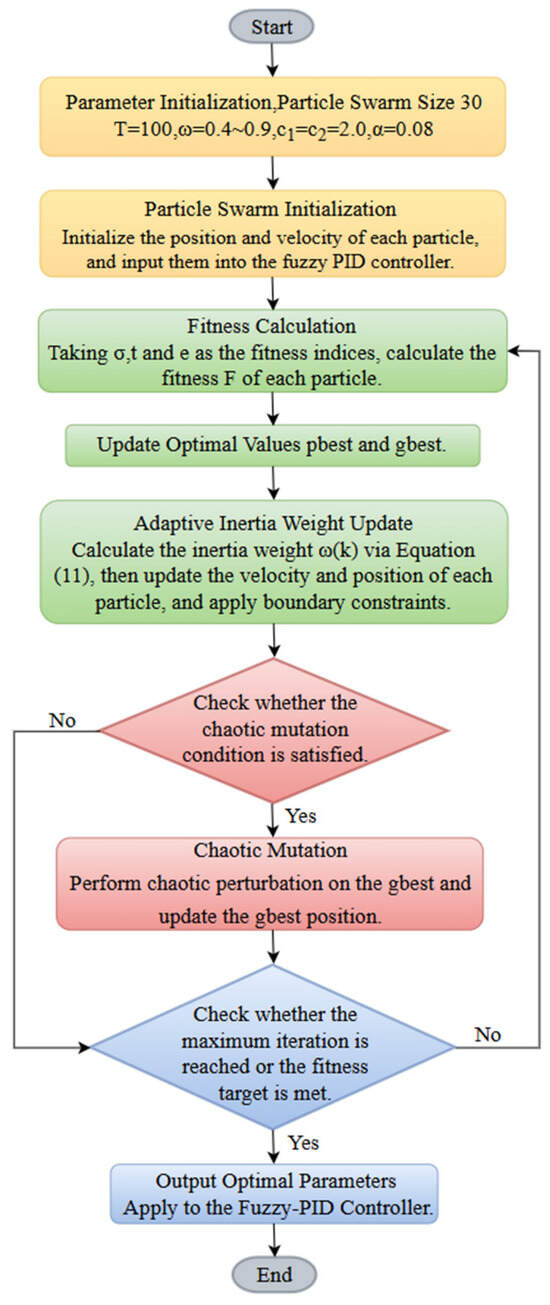
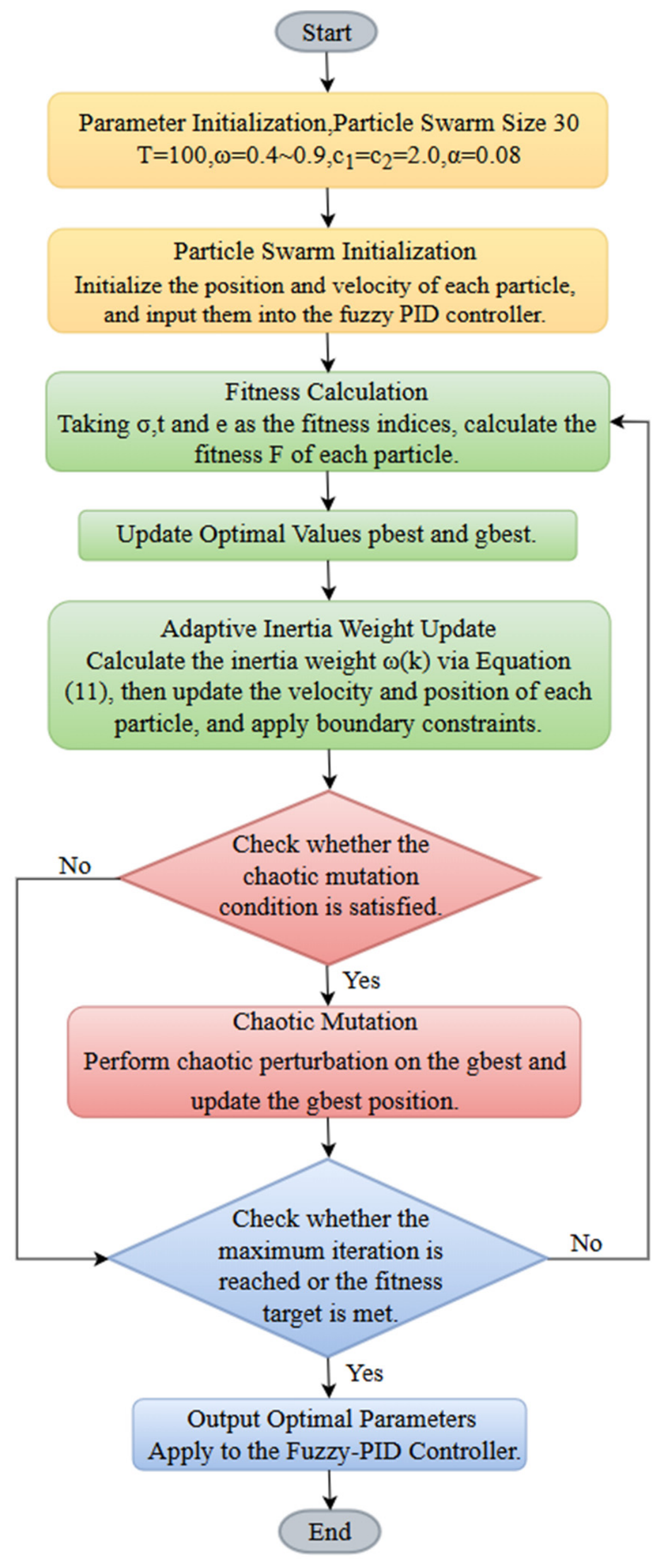
The complete flowchart for optimizing the Fuzzy-PID parameters using the improved PSO is shown in Figure 5 [28,29].
Figure 5.
Flowchart of improved PSO for optimizing Fuzzy-PID parameters.
2.3. Simulation and Experimental Setup
2.3.1. Simulation Platform and Test Scheme
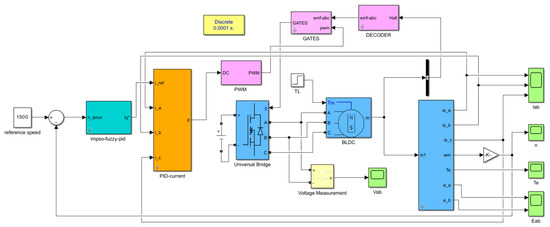
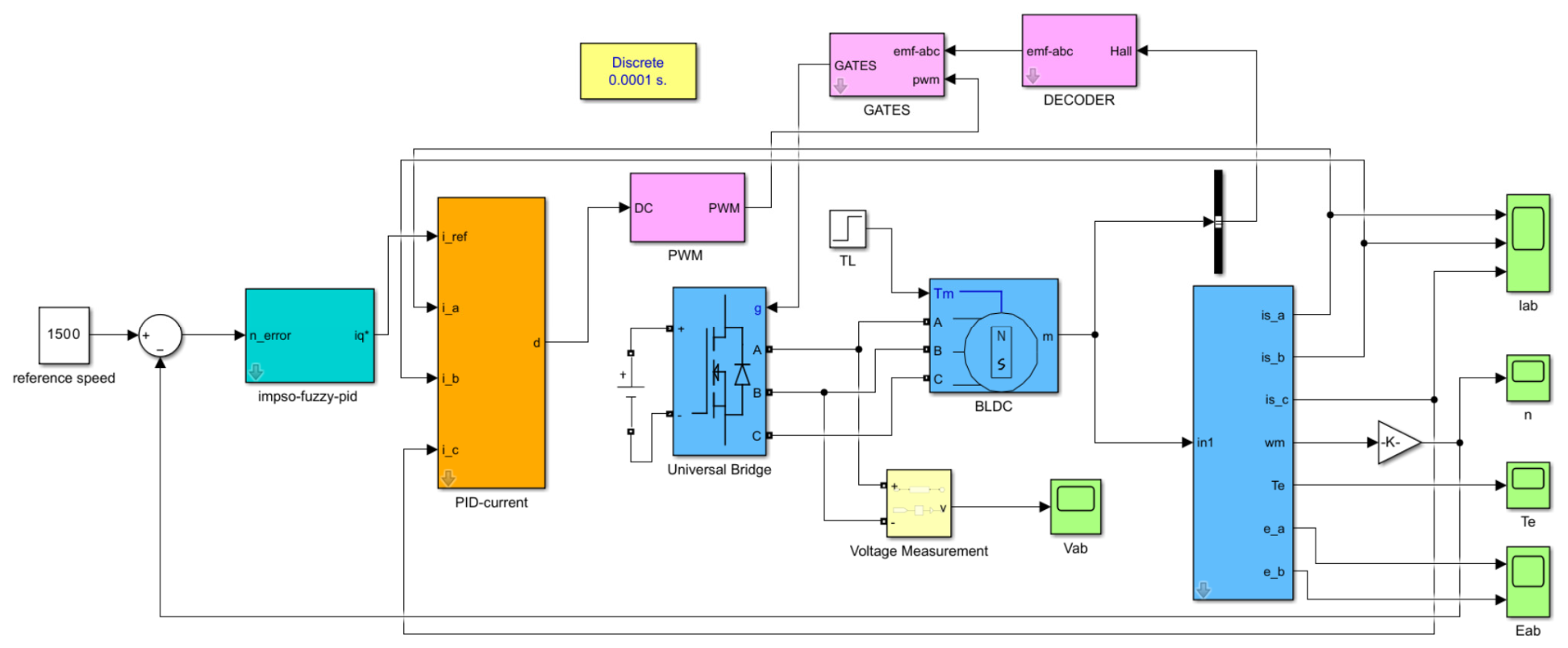
A motor simulation model for the maize electric drive seed metering system was built using the MATLAB/Simulink R2024b platform, with the structure shown in Figure 6.
Figure 6.
Schematic diagram of system simulation model architecture.
The parameters of the PSO algorithm were set as follows: swarm size of 30, maximum number of iterations T = 100, learning factors c1 = c2 = 2.0; the inertia weight ω of the standard PSO algorithm was fixed at 0.6, while the inertia weight of the improved PSO algorithm was adaptively adjusted nonlinearly within the range of 0.4–0.9; the chaotic perturbation coefficient was set to α = 0.08 for both algorithms, and it was ensured that the parameter search ranges of the two algorithms were identical [6,7,23,25].
The simulation test scheme was as follows: the target motor speed was set to 1500 r/min, the simulation time was 1 s, the sampling period was 10 ms, and a load torque disturbance was introduced near 0.5 s. To verify the adaptability under different operating conditions, three additional target speeds were set: 1234 r/min, 1481 r/min, and 1728 r/min, corresponding to maize seeding operation speeds of 10 km/h, 12 km/h, and 14 km/h, respectively, all with a plant spacing of 25 cm.
2.3.2. Bench Test Scheme
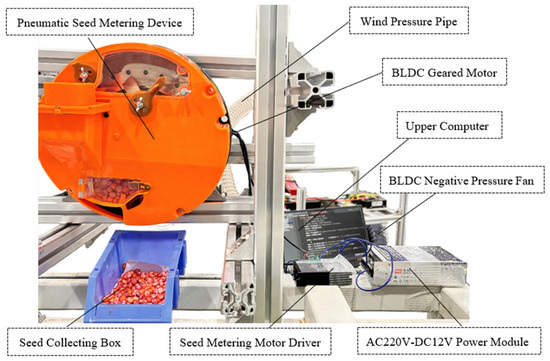
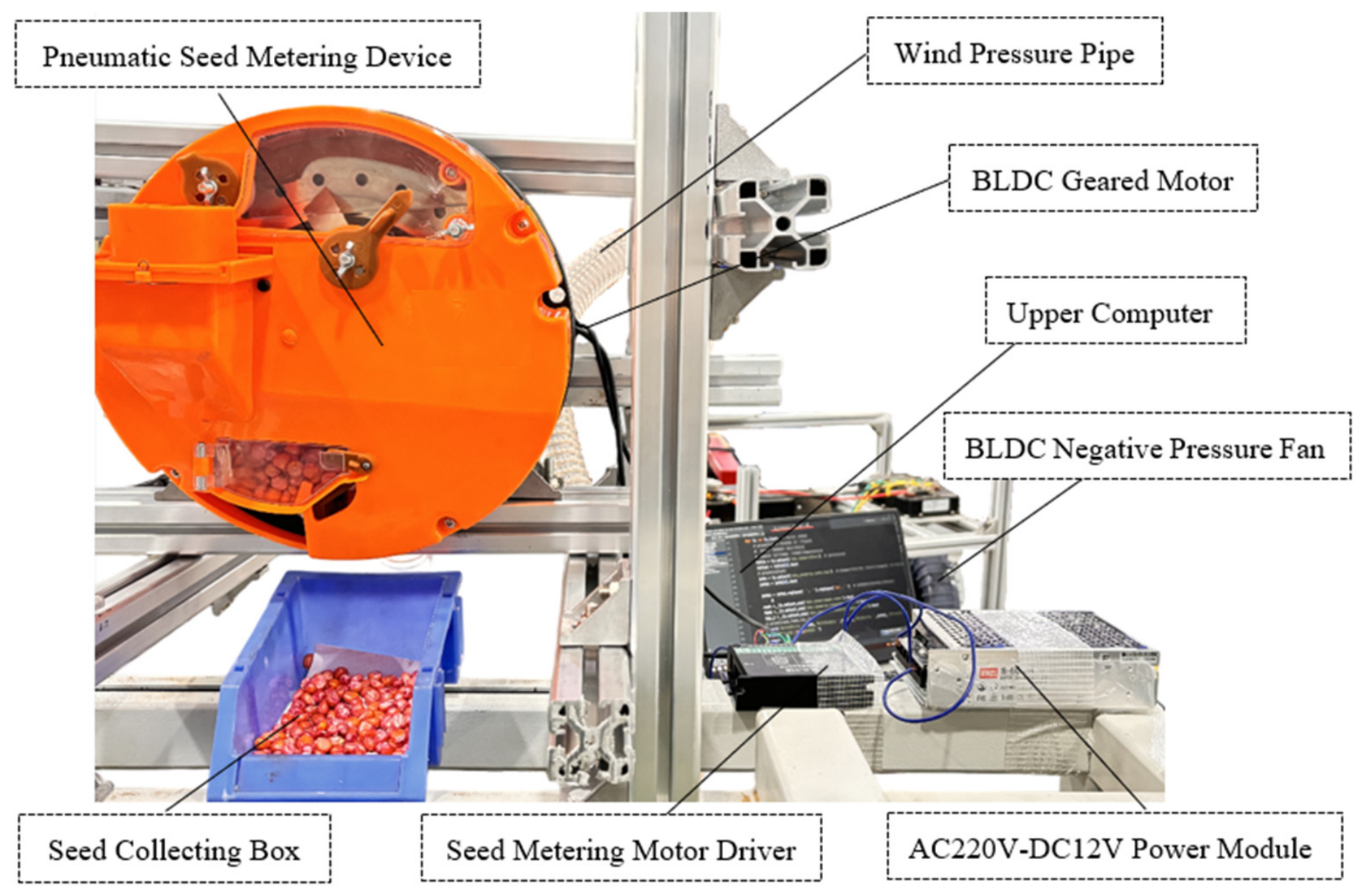
The bench tests were carried out in the pilot workshop of the College of Mechanical and Electrical Engineering, Qingdao Agricultural University, at an ambient temperature of 20–25 °C without vibration interference. The maize variety ‘Zhengdan 958’ was used as the test seed, with a moisture content of 12–14%, an average width of 4.2–4.6 mm, and no damage. The air-suction maize seed metering device (model 2026, Bazhou Youbang, Hebei, China) had a hole diameter of 4.5 mm and 27 holes. A WS4235B type brushless DC negative-pressure fan (manufactured by CHUAN WIND Industrial Co., Ltd.) was selected, with a maximum negative pressure of 7.0 kPa and the working negative pressure set to 4.2 kPa. The rubber air duct (purchased from an industrial hose supplier in Dezhou, Shandong, China) had a diameter of 50 mm, a wall thickness of 1.2 mm, and a length of 2.5 m. The setup of the test bench is shown in Figure 7.
Figure 7.
Single-unit test bench (self-made in our laboratory, Qingdao Agricultural University).
Speed Tracking Performance Test
To verify the actual motor speed tracking accuracy of the improved PSO-optimized fuzzy PID control, a speed tracking performance test was conducted. Three simulated operating speeds were set: 10 km/h, 12 km/h, and 14 km/h, all with a plant spacing of 25 cm. The corresponding target motor speeds were calculated according to Equation (3). Five repeated trials were performed for each operating speed, each lasting 30 s with a sampling period of 10 ms. The built-in Hall sensors of the motor collected signals in real time and uploaded them to the main controller. The controller calculated the actual speed using the M method (frequency measurement), and the data were sent to the host computer via the CAN bus for storage. After the test, the collected data were statistically analyzed to calculate the steady-state speed deviation, overshoot, settling time, and root mean square error (RMSE) of speed tracking, which was calculated using Equation (17).
where nm(i) and nref(i) are the measured and target motor speeds at the i-th sampling instant, respectively, and NS is the total number of samples acquired during each trial.
Seeding Performance Test
To verify the actual influence of the improved PSO-Fuzzy-PID control scheme on seeding quality, a seed metering performance test was conducted. According to GB/T 6973-2005 [30] “Test methods for single-seed (precision) drills”, the quality index (A), reseeding index (D), miss index (M), and coefficient of variation in plant spacing (C) were used as evaluation indicators. The calculation was carried out using Equations (18)–(21).
where n1 is the number of qualified seeds; n2 is the number of multiple seeds; n3 is the number of missed seeds; N is the total number of seeds measured; x is the theoretical plant spacing, in mm; is the average plant spacing, in mm; n is the number of measured plant spacings.
The theoretical plant spacing was set to 25 cm, and the working negative pressure of the fan was 4.2 kPa. Preliminary tests showed that within the speed range of 10–14 km/h, a negative pressure of 4.2 kPa could guarantee a seed pickup rate of ≥98%, without the occurrence of double seed pickup caused by excessive negative pressure. The simulated operating speeds were 10, 12, and 14 km/h. For each group, 250 seeds were tested, and the tests were repeated three times to obtain the average values. Tests were conducted for the three control schemes: improved PSO-Fuzzy-PID, standard PSO-Fuzzy-PID, and conventional Fuzzy-PID, respectively.
We carried out data tabulation and graphical visualization using MATLAB R2024b and Origin 2024b, with Microsoft Excel 2024 used for preliminary data sorting. All statistical metrics were computed in MATLAB.
2.3.3. Statistical Analysis
All data are presented as means ± standard deviation. Statistical analyses were performed using SPSS Statistics (version 26.0). For the speed tracking metrics (steady-state deviation, overshoot, settling time, and RMSE), one-way ANOVA was performed with operating speed as the fixed factor. For the seeding performance metrics, a two-way analysis of variance (ANOVA) was conducted with operating speed and controller type as fixed factors and the quality index (QI) as the dependent variable. Prior to all ANOVA tests, normality and homogeneity of variance were verified by Shapiro–Wilk and Levene’s tests, respectively (p > 0.05). When significant main effects were detected, Tukey’s Honestly Significant Difference (HSD) post-hoc test was used for multiple comparisons. The significance level was set at α = 0.05.
3. Results and Discussion
3.1. Performance Verification of the Improved PSO Algorithm
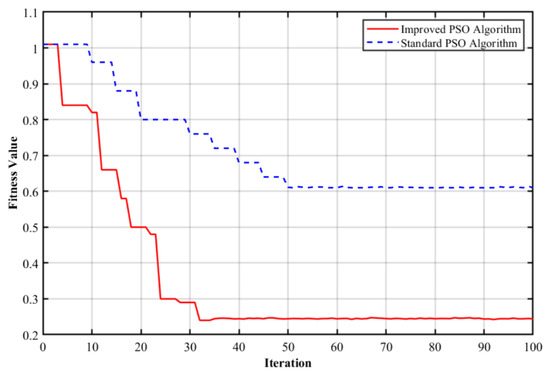
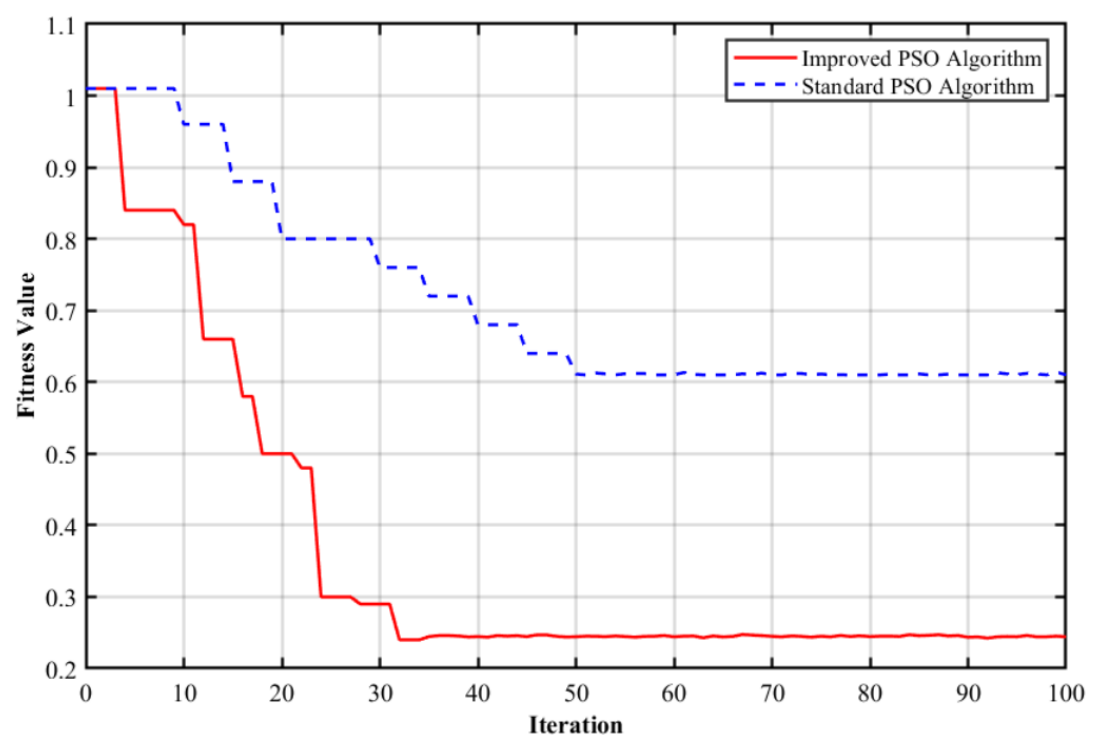
To verify the effectiveness of the improved PSO algorithm in enhancing parameter search accuracy and efficiency, comparative simulations were conducted between the improved PSO algorithm and the standard PSO algorithm, with the convergence curve, optimal fitness value, and convergence speed serving as evaluation indicators. The simulation parameters for both algorithms were kept identical, as detailed in Section 2.3.1. The comparison of the algorithm convergence curves is shown in Figure 8.
Figure 8.
Comparison of convergence curves.
As can be seen from Figure 8, the improved PSO algorithm exhibited stronger search capability and faster convergence speed. Its fitness value decreased rapidly in the early iteration stage, approaching the optimal solution quickly, and tended to converge stably after approximately 35 iterations, with no noticeable fluctuations during the convergence process. In contrast, the convergence curve of the standard PSO algorithm declined slowly, with low optimization efficiency in the early stage, and stabilized only after approximately 50 iterations; moreover, minor fluctuations persisted even after convergence, indicating a tendency to fall into local optima. Furthermore, the fitness value of the improved algorithm remained consistently lower than that of the standard algorithm, indicating higher search accuracy and the ability to find a better combination of Fuzzy-PID parameters.
The comparison of the optimal fitness values and related parameters between the two algorithms is shown in Table 3. Compared with the standard PSO algorithm, the optimal fitness value of the improved PSO algorithm was reduced by 60.66%, the number of iterations required for convergence decreased by 15, and the convergence speed improved by 30%.
Table 3.
Comparison of optimal fitness values.
Through the comparison, it can be concluded that the improved PSO algorithm, by means of adaptive inertia weight adjustment, enhances the global search capability by increasing the weight in the early iteration stage to rapidly explore the parameter space, and strengthens the local exploitation capability by decreasing the weight in the later stage, thereby accelerating convergence. The incorporation of the chaotic mutation operator applies chaotic perturbation to the global best particle, preventing the algorithm from falling into local optima, improving parameter search accuracy, and enabling faster identification of the optimal parameter combination for the Fuzzy-PID controller.
3.2. Comparative Simulation Analysis of Different Control Schemes
In this study, three control schemes—improved PSO-Fuzzy-PID, standard PSO-Fuzzy-PID, and conventional Fuzzy-PID—were selected for comparative simulation analysis to verify the advantages of the improved PSO-Fuzzy-PID control. All three schemes were tested under the same simulation environment and identical disturbance conditions.
3.2.1. Dynamic Response Under Load Disturbance
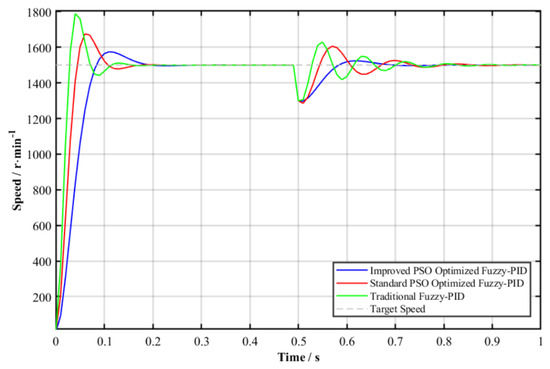
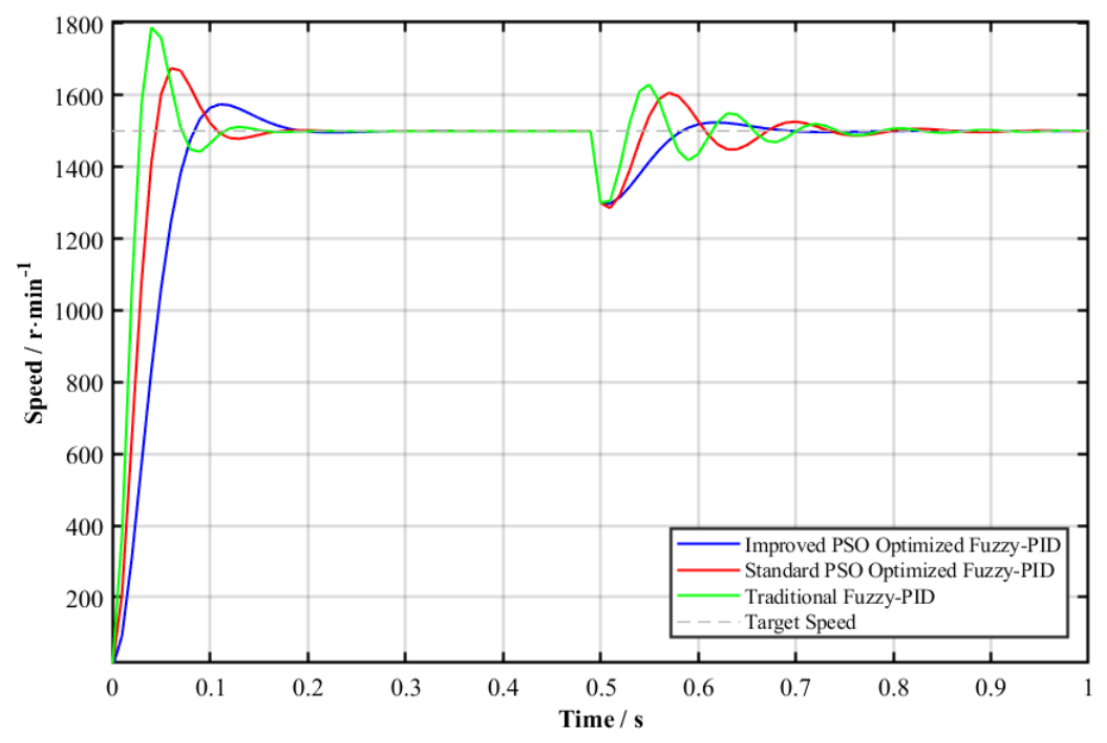
The simulation parameters are as described in Section 2.3.1, and the speed response curves are shown in Figure 9.
Figure 9.
Comparison of rotational speed response curves.
As can be seen from the figure, all three control schemes were able to drive the motor to reach the target speed. The improved PSO-Fuzzy-PID achieved the fastest speed response, the smallest overshoot, and was able to quickly track the target speed. The standard PSO-Fuzzy-PID ranked second in speed response, while the conventional Fuzzy-PID exhibited the slowest response. After being subjected to a load disturbance, the improved PSO-Fuzzy-PID had the shortest recovery time and the smallest overshoot; the standard PSO-Fuzzy-PID showed larger speed fluctuations and a longer recovery time; the conventional Fuzzy-PID had the largest overshoot and the longest fluctuation duration, and was unable to rapidly track the change in target speed.
The comparison of the response performance indices of the three control schemes before and after the disturbance is shown in Table 4. As indicated in the table, before the disturbance, the improved PSO-Fuzzy-PID achieved an overshoot of 4.7%, a settling time of 0.17 s, and a steady-state deviation of 0.06 r/min, all of which were superior to those of the standard PSO-Fuzzy-PID (11.3%, 0.23 s, 0.29 r/min) and the conventional Fuzzy-PID (18.7%, 0.28 s, 0.50 r/min). After the disturbance, the overshoot of the improved PSO-Fuzzy-PID was only 1.2%, the settling time was 0.07 s, and the steady-state deviation was 0.09 r/min, again significantly outperforming the two comparison schemes.
Table 4.
Comparison of response performance indexes.
3.2.2. Control Performance at Different Target Speeds
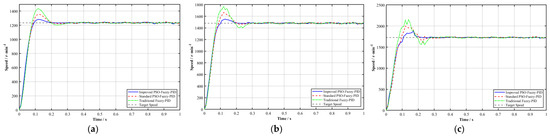
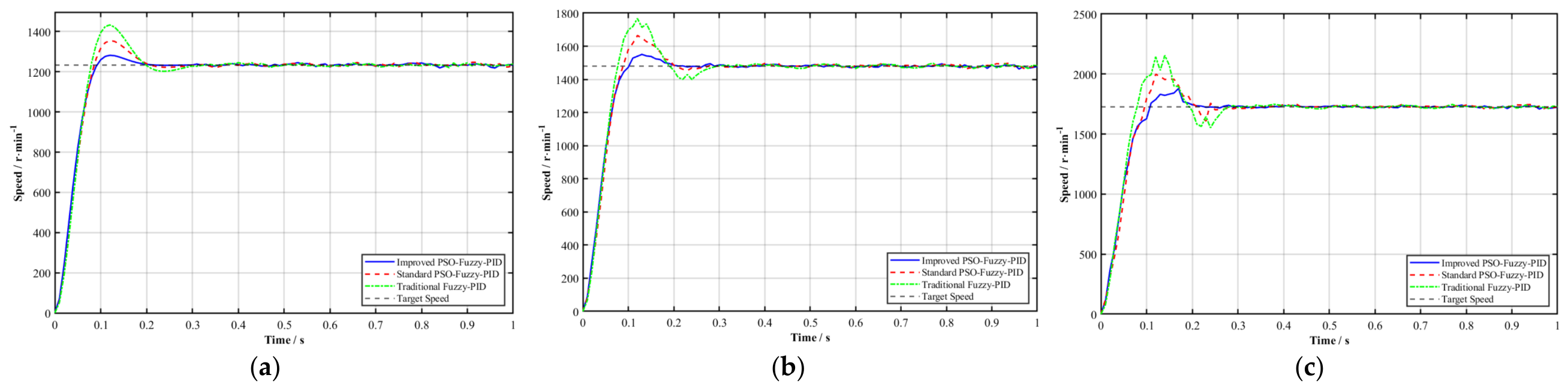
The speed response curves of the three control schemes at different target speeds are shown in Figure 10.
Figure 10.
Comparison of speed response curves at different target rotational speeds: (a) Comparison of speed response curves at a target speed of 1234 r/min; (b) Comparison of speed response curves at a target speed of 1481 r/min; (c) Comparison of speed response curves at a target speed of 1728 r/min.
As can be seen from Figure 10, at the three speed conditions, all three control schemes enabled the motor to reach the target speed. However, the improved PSO-Fuzzy-PID exhibited the fastest speed response and the smallest overshoot, enabling rapid tracking of the target speed. The standard PSO-Fuzzy-PID ranked second in speed response, while the conventional Fuzzy-PID was the slowest.
The comparison of the response performance indices of the three control schemes at different target speeds is shown in Table 5. As indicated in the table, at different target speeds, the overshoot, settling time, and steady-state deviation of the improved PSO-Fuzzy-PID were all significantly better than those of the standard PSO-Fuzzy-PID and the conventional Fuzzy-PID. As the target speed increased, the overshoot and steady-state deviation of all three control schemes increased to some extent, but the variation in the improved PSO-Fuzzy-PID was the smallest: when the target speed increased from 1234 r/min to 1728 r/min, its overshoot increased from 3.9% to 5.4%, an increase of only 1.5 percentage points, and the steady-state deviation increased from 0.04 r/min to 0.08 r/min, an increase of 0.04 r/min. In contrast, the overshoot of the standard PSO-Fuzzy-PID increased from 9.8% to 12.7%, an increase of 2.9 percentage points, and that of the conventional Fuzzy-PID increased from 16.1% to 20.8%, an increase of 4.7 percentage points. This indicates that the improved PSO-Fuzzy-PID possesses better adaptive capability and robustness.
Table 5.
Comparison of Response Performance of Three Control Schemes Under Different Target Speeds.
3.3. Bench Test Results and Analysis
3.3.1. Speed Tracking Performance
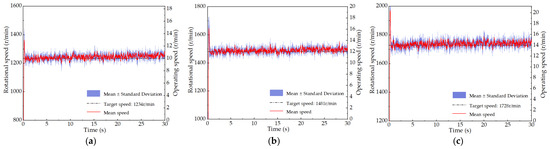
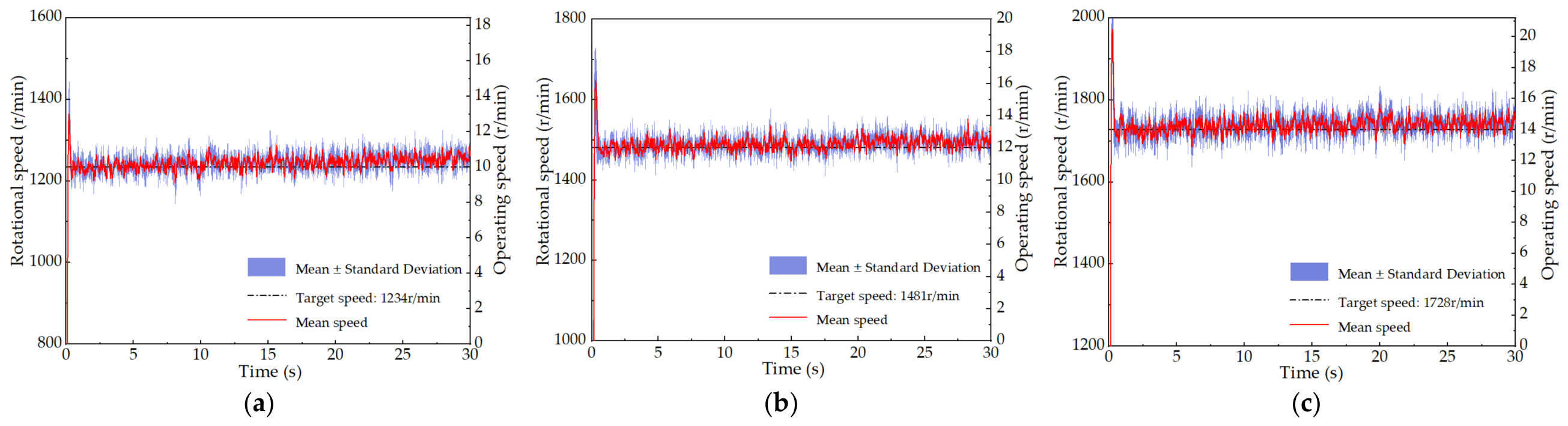
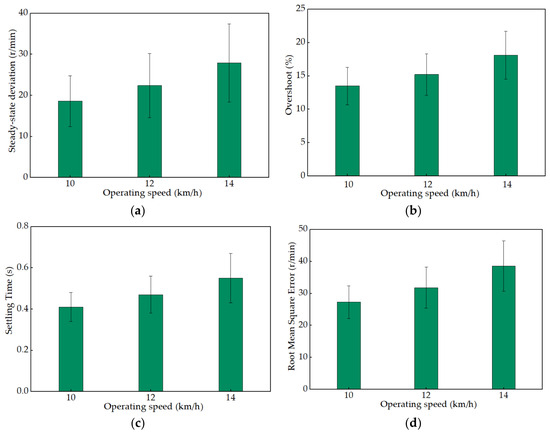
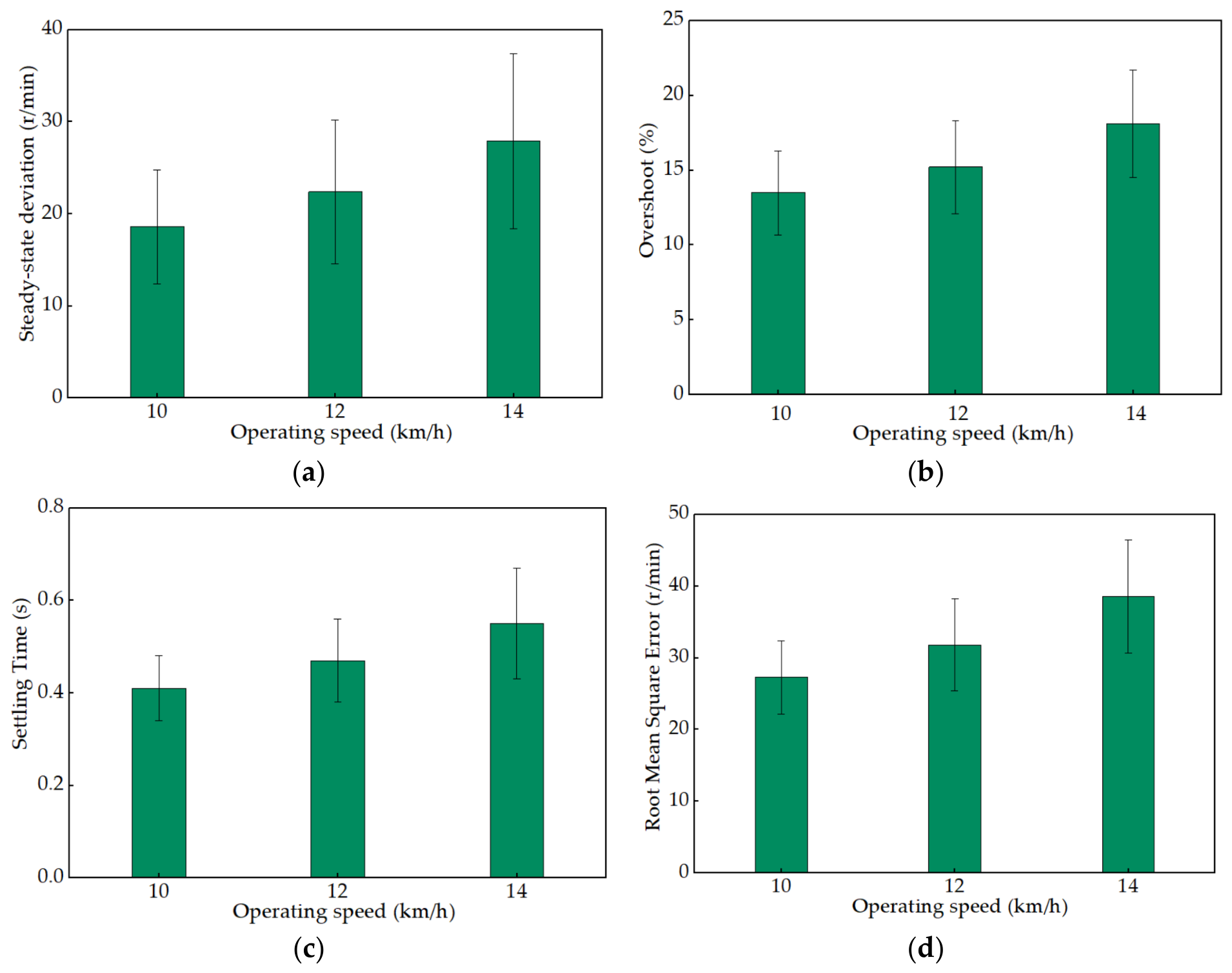
To further illustrate the dynamic tracking process, Figure 11 presents the averaged step response curves of the actual motor speed versus the target speed under the three operating conditions, where each curve represents the mean value calculated from five repeated trials. As shown in the figure, the averaged actual speeds rise smoothly and converge to their respective targets without significant overshoot or sustained oscillation, confirming the stability of the improved controller during the transient phase. The corresponding quantitative performance indices, derived from the same five repeated trials and presented as bar charts with error bars indicating the standard deviation, are summarized in Figure 12.
Figure 11.
Transient response of the improved PSO-Fuzzy-PID-controlled motor speed tracking under representative bench-test conditions: (a) 10 km/h (1234 r/min); (b) 12 km/h (1481 r/min); (c) 14 km/h (1728 r/min).
Figure 12.
Bar chart of speed tracking performance metrics under different operating speeds: (a) steady-state deviation; (b) overshoot; (c) settling time; (d) root mean square error. Error bars represent the standard deviation from five repeated trials.
As can be observed, the improved PSO-Fuzzy-PID control exhibited good speed tracking performance across different operating speeds. Specifically, the steady-state speed deviation increased from 18.6 ± 6.2 r/min at 10 km/h to 27.9 ± 9.5 r/min at 14 km/h, while the overshoot rose from 13.5 ± 2.8 to 18.1 ± 3.6% over the same speed range. The settling time extended moderately from 0.41 ± 0.07 to 0.55 ± 0.12 s, and the root mean square error (RMSE) grew from 27.3 ± 5.1 to 38.5 ± 7.9 r/min. Although all indicators increased slightly with rising operating speed, the increments remained relatively small, indicating that the system maintained effective control even under high-speed operations.
To more clearly visualize the variation trend of each performance indicator with operating speed, these data are also presented as a bar chart (Figure 12).
Compared with the simulation results, all indicators in the bench tests increased significantly. For example, at 14 km/h, the actual overshoot of 18.1% was substantially higher than the simulated value of 5.4%, and the steady-state deviation of 27.9 r/min was much higher than the simulated value of 0.08 r/min. Several factors contribute to this gap. The simulation assumes ideal speed feedback (continuous, zero quantization error), whereas the physical system uses Hall-sensor-based M-method measurement (6 pulses per revolution), which introduces quantization error that becomes more pronounced at higher speeds. Additionally, the simulation applies an ideal step disturbance, while actual seed picking and dropping generate stochastic load fluctuations—at 14 km/h, the miss index of 4.8% and reseeding index of 4.0% indicate the non-negligible presence of such random events. Unmodeled factors including gear backlash (reducer ratio 1:50), electromagnetic interference, and fixed negative pressure under high-speed operation also contribute. It should be noted that 14 km/h represents a challenging condition rather than a routine operating speed, and the simulation was primarily designed for relative comparison and offline parameter initialization. Nonetheless, the improved PSO-Fuzzy-PID still demonstrated good control performance in the actual system, and all indicators met the engineering requirements.
To statistically verify the consistency of speed tracking performance across operating speeds, one-way ANOVA was performed on the steady-state deviation, overshoot, settling time, and RMSE obtained from five repeated trials. The results, summarized in Table 6, show that all four metrics exhibit no significant differences among 10, 12, and 14 km/h, with p-values of 0.217, 0.110, 0.108, and 0.057, respectively. Although the RMSE increased with speed, the difference did not reach statistical significance (p = 0.057), confirming that the proposed controller maintains robust and consistent speed tracking performance across the tested speed range.
Table 6.
ANOVA results for speed tracking performance metrics across different operating speeds.
3.3.2. Comparison of Seeding Performance
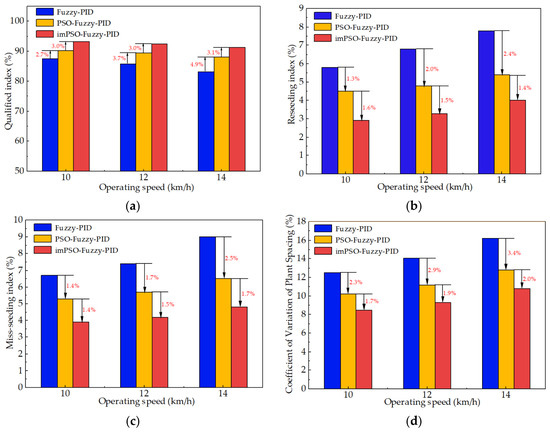
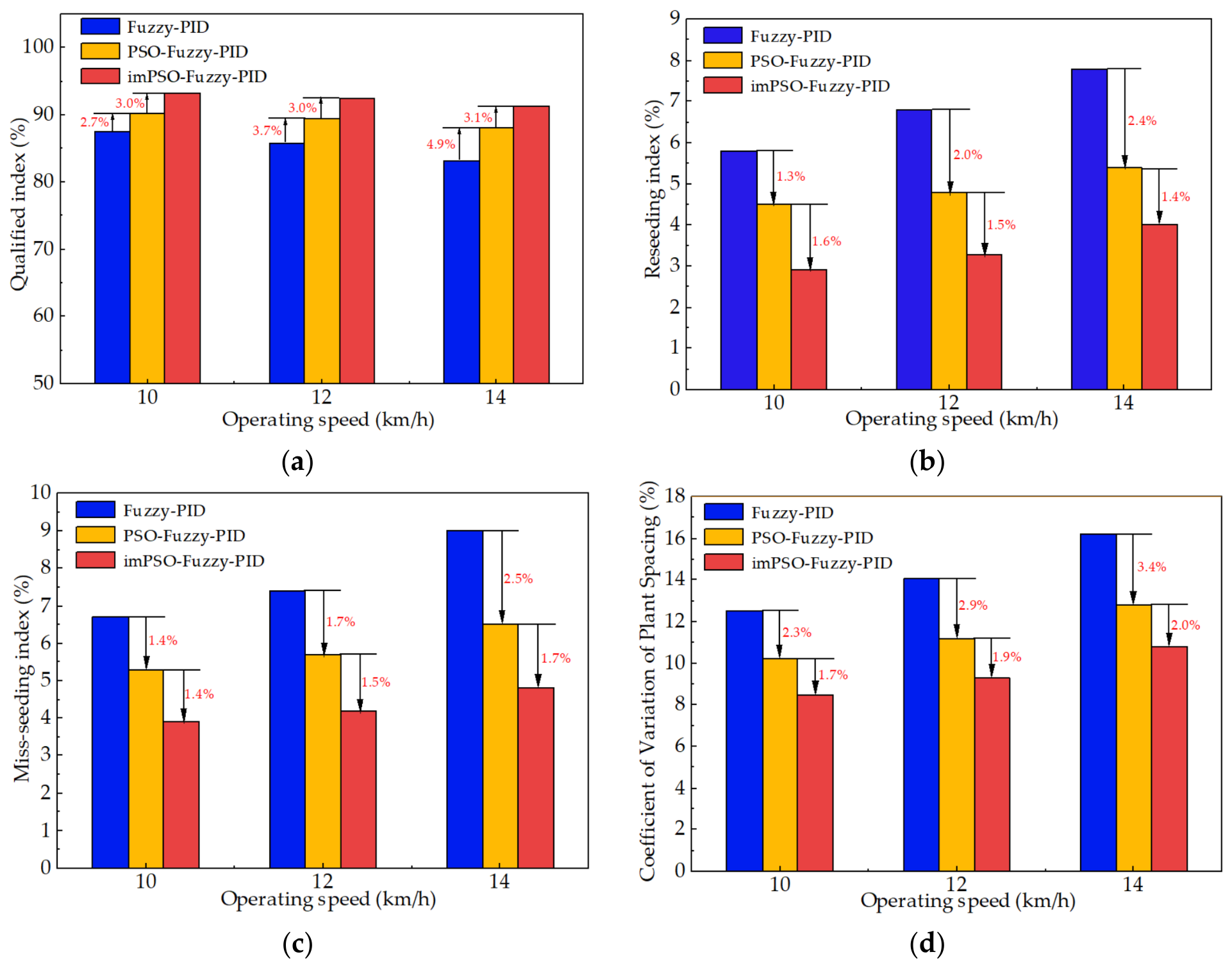
The comparison of seeding performance test results for the three control schemes at different operating speeds is shown in Table 7. As can be seen from the table, at all three operating speeds, the seeding performance of the improved PSO-Fuzzy-PID control scheme was superior to that of the standard PSO-Fuzzy-PID and the conventional Fuzzy-PID.
Table 7.
Comparison test results of seeding performance of different control schemes.
Two-way ANOVA results (Table 8) revealed that both operating speed (F(2,18) = 5.91, p = 0.010) and controller type (F(2,18) = 32.57, p < 0.001) significantly affected the quality index, while their interaction was not significant (F(4,18) = 0.65, p = 0.635). Post-hoc Tukey’s HSD test (Table 9) showed that the Improved PSO-Fuzzy-PID controller significantly outperformed both the Standard PSO-Fuzzy-PID (p = 0.004) and the Conventional Fuzzy-PID (p < 0.001) controllers.
Table 8.
Two-way ANOVA results for the quality index (QI).
Table 9.
Tukey’s HSD post-hoc comparisons of QI among the three controllers.
Taking the 12 km/h condition as an example, the quality index of the improved PSO-Fuzzy-PID was 92.5%, which was 3.0% higher than that of the standard PSO-Fuzzy-PID and 6.7% higher than that of the conventional Fuzzy-PID. The Reseeding Index was 3.3%, which was 1.5% lower than that of the standard PSO-Fuzzy-PID and 3.5% lower than that of the conventional Fuzzy-PID. The miss index was 4.2%, which was 1.5% lower than that of the standard PSO-Fuzzy-PID and 3.2% lower than that of the conventional Fuzzy-PID. The coefficient of variation in plant spacing was 9.3%, which was 1.9% lower than that of the standard PSO-Fuzzy-PID and 4.8% lower than that of the conventional Fuzzy-PID.
To provide a comprehensive visual comparison of the four seeding performance indices among the three control schemes at different operating speeds, the data in Table 7 are also presented as grouped bar charts in Figure 13.
Figure 13.
Comparison of seeding performance indices among three control schemes at operating speeds of 10, 12, and 14 km/h: (a) Qualified rate; (b) multiple rate; (c) miss rate; (d) coefficient of variation.
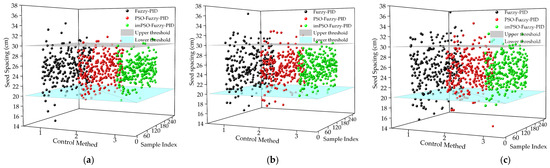
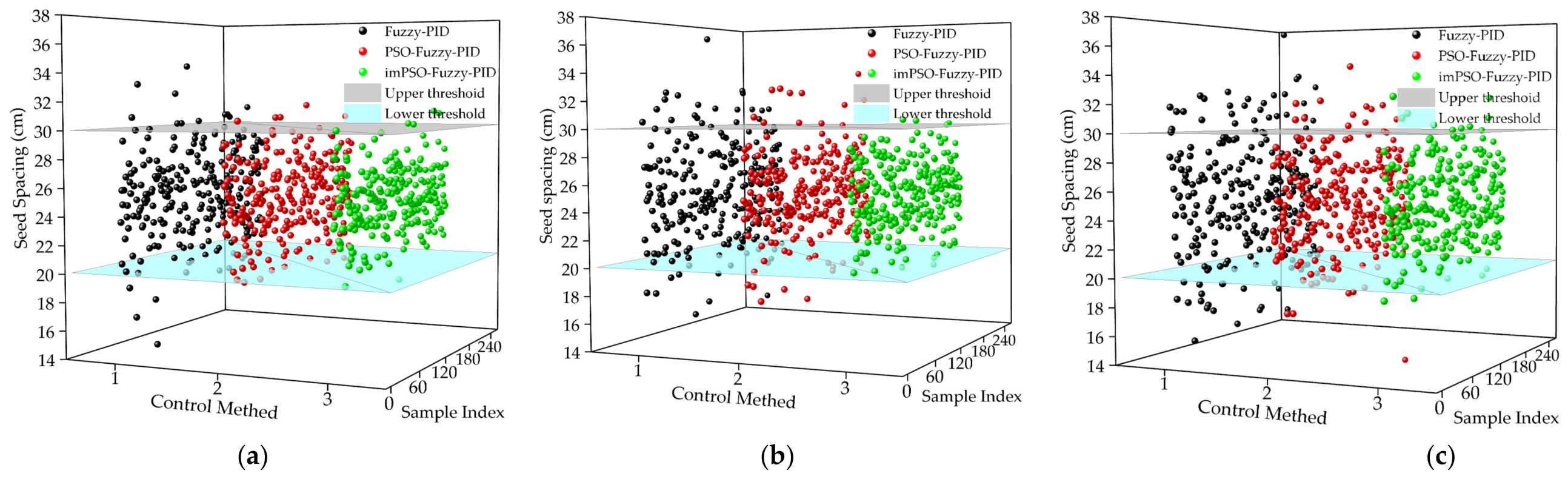
To further visualize the distribution of actual plant spacing under different operating speeds and control schemes, the three-dimensional plant spacing distribution diagram is presented in Figure 14.
Figure 14.
Three-dimensional distribution of seed spacing under three travel speeds with a fixed target seed spacing of 25 cm for three control algorithms: (a) travel speed of 10 km/h; (b) travel speed of 12 km/h; (c) travel speed of 14 km/h.
As the operating speed increased from 10 to 14 km/h, the quality indices of all three control schemes decreased to varying degrees. Under the high-speed condition of 14 km/h, the improved PSO-Fuzzy-PID maintained the best overall performance among the three controllers.
Comparing our results with previous studies, the proposed imPSO-Fuzzy-PID control is generally consistent with, and in several aspects superior to, reported values in the literature. Chen et al. [3] achieved a qualified index exceeding 89% at 6–12 km/h, whereas our controller attained 91.2% at 14 km/h, demonstrating maintained seeding quality at higher speeds. Yao et al. [4] reported a 0.4% overshoot reduction with fuzzy PID over traditional PID; our imPSO-Fuzzy-PID achieved a 15.3% reduction over conventional Fuzzy-PID (from 18.7% to 3.4% in simulation), a substantially larger improvement attributable to the PSO-based offline optimization providing superior initial parameters to manual tuning. Wu et al. [5] and Li et al. [6] validated PSO-fuzzy PID for speed and flow control, respectively, but did not report RMSE values; our bench-test RMSE of 38.5 r/min at 14 km/h (relative error ~2.2%) offers a reference for future comparisons. Xu et al. [7] achieved lower overshoot and settling time in a rubber tapping robot, yet their load conditions are smoother and more predictable than the stochastic disturbances from seed picking and dropping—a difference that underscores the specific challenge of robust control under highly variable conditions addressed in our study. Our results confirm that adaptive inertia weight and chaotic mutation effectively mitigate the local-optimum problem of standard PSO, consistent with recent observations in other agricultural machinery applications [13,24,26]. Collectively, the alignment of our findings with the literature supports the validity of the proposed strategy, while the quantitative gains and operational context demonstrate its practical advantages for high-speed maize precision seeding.
In summary, compared with the standard PSO-Fuzzy-PID and the conventional Fuzzy-PID, the improved PSO-Fuzzy-PID control algorithm proposed in this paper significantly improved the motor speed tracking accuracy and reduced the steady-state deviation, overshoot, and settling time. At the high speed of 14 km/h, the quality index remained at 91.2%, and the coefficient of variation in plant spacing dropped to 10.8%, making the actual plant spacing closer to the theoretical value. This improvement enhanced the uniformity of seed spacing, providing more uniform spatial resources for the growth of individual maize plants, which is conducive to yield improvement, while also increasing the convenience of subsequent field management. However, this study only conducted verification and analysis under indoor bench test conditions, and field test validation has not yet been carried out. It is acknowledged that the bench test verification did not consider the field soil resistance or the vertical vibrations of the planter caused by terrain undulations and uneven furrows; only a single seed variety was used, and the effects of seed size, thousand-grain weight, and flowability differences among different varieties on seeding performance were not taken into account, indicating some discrepancies with actual field applications. Given these constraints, the next phase of our project will focus on field experiments under various soil types, and terrain conditions to obtain real load disturbance data, with test varieties expanded to 3–5 typical maize varieties and weighting coefficients adjusted to adapt to different optimal plant spacing requirements.
4. Conclusions
This paper proposes a high-precision electric-drive seeding control system based on an improved PSO-Fuzzy-PID controller for air-suction maize seed metering under high-speed conditions. The main contributions and findings are summarized as follows:
- By incorporating a nonlinear adaptive inertia weight and a chaotic mutation operator into the standard PSO algorithm, the problems of local optima and insufficient search accuracy are effectively mitigated. The improved PSO achieves significantly lower optimal fitness values and faster convergence compared with the standard version, providing superior initial parameters for the fuzzy PID controller.
- Under simulated load disturbances and at different target speeds, the proposed imPSO-Fuzzy-PID controller consistently outperforms both the standard PSO-Fuzzy-PID and the conventional Fuzzy-PID in terms of overshoot, settling time, and steady-state deviation, demonstrating strong adaptive capability and robustness.
- Bench tests conducted within the operating speed range of 10–14 km/h confirm that the proposed control scheme achieves stable speed tracking and high seeding quality. At 14 km/h, the quality index and coefficient of variation in plant spacing reach 91.2% and 10.8%, respectively, meeting the requirements for high-speed precision maize seeding. Statistical analysis using two-way ANOVA demonstrated that controller type had a highly significant effect on the quality index (F(2,18) = 32.57, p < 0.001), and Tukey’s HSD post-hoc test further indicated that the improved PSO-Fuzzy-PID performed significantly better than both the standard PSO-Fuzzy-PID and the conventional Fuzzy-PID (p < 0.01). These results confirm the robustness and statistical reliability of the proposed strategy under varying operating speeds. Future work will extend the validation to field conditions across multiple soil types and seed varieties, which constitutes the immediate next phase of our ongoing project.
Author Contributions
S.H.: Writing—review and editing, Writing—original draft, Formal analysis, Methodology, Funding acquisition. M.L.: Writing—review and editing, Writing—original draft, Data curation, Conceptualization, Investigation. Y.N.: Writing—review and editing, Formal analysis. Y.D.: Writing—review and editing, Formal analysis. J.W.: Conceptualization, Formal analysis, Funding acquisition. All authors have read and agreed to the published version of the manuscript.
Funding
The authors are grateful for the financial support provided by Shandong Provincial Peanut Industry Technology System Project (Grant NO. SDAIT-04-08), Outstanding Talent “Special Support Program” Foundation of Qingdao Agricultural University (Grant No. 1124010), and Qingdao Key Technology Tackling and Industrialization Demonstration Project (Grant No. 26-1-1-gjgg-74-nsh).
Institutional Review Board Statement
Not applicable.
Informed Consent Statement
Not applicable.
Data Availability Statement
The original contributions presented in this study are included in the article. Further inquiries can be directed to the corresponding authors.
Conflicts of Interest
The authors declare no conflicts of interest. The funders had no role in the design of the study; in the collection, analyses, or interpretation of data; in the writing of the manuscript; or in the decision to publish the results.
Abbreviations
The following abbreviations are used in this manuscript:
| PSO | Particle Swarm Optimization |
| imPSO | improved Particle Swarm Optimization |
| QI | Quality Index |
| RI | Reseeding Index |
| MI | Miss Index |
| CV | Coefficient of Variation in Plant Spacing |
| ANOVA | Analysis of Variance |
| RMSE | Root Mean Square Error |
References
- Jiang, Z.H.; Wu, D.; Guan, S.Q.; Dou, Q.Q.; Shen, J.X.; Sun, Y.T.; Yu, Y. Research Progress on Control Technology of Electric-Drive Maize Planter. J. Agric. Mech. Res. 2025, 47, 257–263. [Google Scholar] [CrossRef]
- Jiang, Y.Y.; Cui, T.; Zhang, D.X.; Yang, L.; Dong, J.Q.; Zhang, C.K. Research on Seeding Depth Control System for Maize Planter Based on Combined Downforce and Compaction Force Control. Trans. Chin. Soc. Agric. Mach. 2025, 56, 83–93. [Google Scholar]
- Chen, J.; Zhang, H.; Pan, F.; Du, M.; Ji, C. Control System of a Motor-Driven Precision No-Tillage Maize Planter Based on the CANopen Protocol. Agriculture 2022, 12, 932. [Google Scholar] [CrossRef] [Scilit]
- Yao, Y.F.; Chen, X.G.; Ji, C.; Chen, J.C.; Zhang, H.; Pan, F. Design and Experiment of a Single-Unit Driver for Maize Precision Planter Based on Fuzzy PID Control. Trans. Chin. Soc. Agric. Eng. 2022, 38, 12–21. [Google Scholar]
- Wu, S.; Shi, F.; Zhang, X.; Liu, J.; Huang, D.; Yuan, J. Development of a Maize Precision Seed Metering Control System Based on Multi-Rate KF-RTS Fusion Speed Measurement. Agriculture 2025, 15, 2582. [Google Scholar] [CrossRef] [Scilit]
- Li, Q.; Bai, X.; Lu, Y.; Deng, X.; Lu, Z. Flow Control of Tractor Multi-Channel Hydraulic Tester Based on AMESim and PSO-Optimized Fuzzy-PID. Agriculture 2025, 15, 1190. [Google Scholar] [CrossRef] [Scilit]
- Xu, R.; Liao, Y.; Liu, J.; Zhang, Z.; Zhang, X. Low-Injury Rubber Tapping Robots: A Novel PSO-PID Approach for Adaptive Depth Control in Hevea brasiliensis. Agriculture 2025, 15, 1089. [Google Scholar] [CrossRef] [Scilit]
- Nayudu, S.G.; Kampara, R.; Venkateswaran, M.; Buduma, P. Adaptive Fuzzy PID Based Control for Voltage Regulation in a DC Microgrid with Performance Comparison against FPID Controller. Eng. Res. Express 2026, 8, 115319. [Google Scholar] [CrossRef] [Scilit]
- Feng, Z.W.; Li, Y.Z.; Liu, S.; Tu, M.J.; Ye, L. Temperature Control of a Central Concentrate Supply System Based on PSO-Improved Fuzzy PID. Mech. Electr. Eng. Technol. 2026, 55, 63–68. [Google Scholar]
- Jia, W.Y.; Yang, J.; Li, Y. Fuzzy PID Control Optimized by Particle Swarm Optimization Algorithm. In Proceedings of the 5th National Conference on Swarm Intelligence and Cooperative Control, Online, 26 February 2022; Chinese Institute of Command and Control: Beijing, China, 2022; pp. 205–210. [Google Scholar] [CrossRef]
- Xiao, H.; Li, T. Electro-Hydraulic Servo System Control Based on PSO-Fuzzy PID. Mach. Tool. Hydraul. 2025, 53, 139–144. [Google Scholar]
- Huang, Y.; Jiang, Z.; Li, J.; Guo, G.; Zhang, J. Design on Automatic Row Guidance System for Corn Harvester Header Based on Improved PSO-PID. Mechatronics 2026, 116, 103490. [Google Scholar] [CrossRef] [Scilit]
- Niu, S.K.; Sun, L.Y. Improved Particle Swarm Optimization Algorithm Based on Adaptive Adjustment of Inertia Weight. J. Liaoning Univ. Technol. (Nat. Sci. Ed.) 2023, 43, 400–403+409. [Google Scholar] [CrossRef]
- Shi, J.M. Design Simulation and Experimental Research on Control System of Electric-Drive Seed Metering Device. Master’s Thesis, Heilongjiang Bayi Agricultural University, Daqing, China, 2025. [Google Scholar]
- Ma, C. Design and Experiment of Electric Drive Control System for Finger-Clamp Seed Metering Device Based on Double Closed-Loop PID Algorithm. Master’s Thesis, Shandong University of Technology, Zibo, China, 2025. [Google Scholar]
- Yang, S.; Wang, X.; Gao, Y.Y.; Zhai, C.Y.; Zhao, X.G.; Zhao, C.J. Research on an Electric Drive Control System for a Maize Precision Seed Metering Device Supporting On-Site Speed Calibration. Trans. Chin. Soc. Agric. Mach. 2020, 51, 47–55. [Google Scholar]
- Zhang, K.Y.; Yu, J.J. Research and Application of Brushless DC Motor Control System. Fujian Comput. 2025, 41, 62–65. [Google Scholar] [CrossRef]
- Zhang, W.; Huang, X.; Sun, S.; Fu, K.; Xiong, Q.; Huang, H. Human-Like Automatic Braking Algorithm Based on Kinematic Cue: Yield Behavior Analysis and Fuzzy Controller Design. SAE Int. J. Veh. Dyn. Stab. NVH 2026, 10, 397–424. [Google Scholar] [CrossRef] [Scilit]
- Yao, Y.F. Design and Research on Electric Drive Seed Metering Control System for Maize High-Speed Precision Planter. Master’s Thesis, Shihezi University, Shihezi, China, 2022. [Google Scholar]
- Wu, T.Y.; Jiang, Y.Z.; Su, Y.Z.; Yeh, W.C. Using Simplified Swarm Optimization on Multiloop Fuzzy PID Controller Tuning Design for Flow and Temperature Control System. Appl. Sci. 2020, 10, 8472. [Google Scholar] [CrossRef] [Scilit]
- Zhu, J.J.; Tian, Y. Research on PID Parameter Optimization Based on Improved Particle Swarm Optimization Algorithm. J. Jilin Inst. Chem. Technol. 2023, 40, 34–39. [Google Scholar] [CrossRef]
- Miao, W.L.; Liu, M.M.; Zhang, M.; Wang, J.G. Research on Optimal Control of HMCVT Speed Tracking Based on Improved PSO Fuzzy PID Controller. Mach. Des. Manuf. 2026, 149–153. [Google Scholar] [CrossRef]
- Jiang, Z.; Zhu, D.; Li, X.Y.; Han, L.B. A Hybrid Adaptive Particle Swarm Optimization Algorithm for Enhanced Performance. Appl. Sci. 2025, 15, 6030. [Google Scholar] [CrossRef] [Scilit]
- Huang, X.Y.; Peng, Z. Research on Adaptive Control Strategy for VSG Parameters Based on Grey Wolf-Particle Swarm Algorithm. Mech. Electr. Eng. Technol. 2025, 54, 35–41+58. [Google Scholar]
- Chu, H.; Yi, J.; Yang, F. Chaos Particle Swarm Optimization Enhancement Algorithm for UAV Safe Path Planning. Appl. Sci. 2022, 12, 8977. [Google Scholar] [CrossRef] [Scilit]
- Shi, C.D. Parameter Identification of Permanent Magnet Synchronous Motor Based on Improved Particle Swarm Optimization Algorithm. Master’s Thesis, Hunan University of Technology, Zhuzhou, China, 2022. [Google Scholar]
- Wang, Z.; Sun, Z.J. Fuzzy PID Control for an Intelligent Facility Drip Irrigation System Under a Time-Varying Universe. Water Sav. Irrig. 2020, 81–84+88. [Google Scholar]
- Long, Z.H.; Liu, Z.H.; Li, S.B.; Hao, H.; Wang, Z.L. Analysis of Automatic Control of Electrical Equipment Based on PID Parameters Optimized by Improved Particle Swarm Algorithm. Electr. Technol. 2025, 196–198+203. [Google Scholar] [CrossRef]
- Sun, Y.; Liu, H.; Sun, Y.; Feng, X.; Zhang, P. Research on Maize Precision Seeding Control Based on RIME-BP-PID. Machines 2025, 14, 47. [Google Scholar] [CrossRef] [Scilit]
- GB/T 6973-2005; Testing Methods of Single Seed Drills (Precision Drills). Standards Press of China: Beijing, China, 2005.

Disclaimer/Publisher’s Note: The statements, opinions and data contained in all publications are solely those of the individual author(s) and contributor(s) and not of MDPI and/or the editor(s). MDPI and/or the editor(s) disclaim responsibility for any injury to people or property resulting from any ideas, methods, instructions or products referred to in the content. |
© 2026 by the authors. Licensee MDPI, Basel, Switzerland. This article is an open access article distributed under the terms and conditions of the Creative Commons Attribution (CC BY) license.