


Abstract
To address the challenge of satisfying strict Service-Level Agreement (SLA) requirements for concurrent smart video surveillance tasks in heterogeneous edge computing environments, an SLA-aware adaptive scheduling algorithm for heterogeneous computing collaboration is proposed. First, a mixed-task flow model is constructed, and a finite-state Markov chain is utilized to dynamically model the time-varying wireless channel. Second, a Dueling Double Deep Q-Network (Dueling DDQN) scheduling algorithm based on SLA awareness and channel adaptation is proposed, with a designed SLA action-masking mechanism. This mechanism advances hard delay constraints to the decision-generation stage, dynamically prunes the action space based on real-time channel conditions and node loads, and filters out actions predicted to violate the SLA before execution. Experimental results show that the proposed algorithm coordinates heterogeneous computing resources between the cloud center and the edge and exhibits earlier empirical reward stabilization and lower task-violation rates than the compared learning-based baselines under the tested workload conditions.
1. Introduction
With the advancement of smart cities and modern social governance, intelligent video surveillance has become a fundamental infrastructure for maintaining public safety [1]. Benefiting from breakthroughs in deep learning algorithms [2], technologies such as object detection and anomaly recognition have enabled security systems to evolve from passive post-event investigation to proactive pre-event warning. However, deep analysis of video streams generates massive volumes of data and imposes substantial computational demands [3,4]. Traditional centralized cloud computing suffers from wide-area network bandwidth congestion and significant end-to-end transmission latency, making it difficult to satisfy the stringent end-to-end deadline requirements of safety-critical applications such as fire early warning. To address these limitations, edge computing has emerged as a promising paradigm by offloading computational capabilities closer to data sources, thereby reducing response latency [5] while simultaneously enhancing the privacy and security of raw data at the physical level.
The scheduling latency considered in this study represents the end-to-end task completion time, including queueing, transmission, and remote computation, rather than the inference latency of an individual video frame.
Accordingly, the adopted SLA range of 120–360 s is intended to model coarse-grained monitoring and task-delivery deadlines in the considered smart-campus/park workload rather than frame-level real-time inference.
Despite its latency advantages, practical edge computing deployment still involves substantial resource-scheduling challenges. Edge environments contain computing nodes with different processing capabilities, architectures, and energy characteristics, while wireless conditions vary over time because of interference and environmental changes. Under these heterogeneous and time-varying conditions, static scheduling policies may lead to uneven resource utilization and task deadline violations. Deep Reinforcement Learning (DRL) [6] provides a framework for learning sequential scheduling policies through interactions with the environment and has therefore been increasingly investigated for dynamic resource allocation.
Nevertheless, existing DRL-based scheduling mechanisms still face significant challenges when deployed in real-world intelligent video surveillance systems. First, constrained reinforcement learning (CRL) and safe reinforcement learning (Safe RL) have provided several principled mechanisms for incorporating safety requirements into policy optimization, including constrained Markov decision processes, policy optimization under explicit cost constraints, and shielding or action-filtering mechanisms. However, these approaches generally formulate safety at the policy-learning or cost-optimization level, while the direct integration of application-specific SLA feasibility prediction into a discrete heterogeneous offloading action space remains insufficiently investigated. Specifically, a task may become infeasible because of the joint effects of queueing delay, wireless transmission delay, heterogeneous inference time, and node capacity, rather than because of a single generic safety cost.
Second, existing action-masking methods mainly focus on removing semantically invalid actions or actions that violate predefined rules. In contrast, the scheduling problem considered in this study involves dynamically changing action feasibility, since the validity of assigning a task to a computing node depends on the current task deadline, queue backlog, wireless channel condition, node-specific processing capability, and buffer capacity. Therefore, a scheduling-oriented feasibility mechanism is required to determine whether an action is physically capable of satisfying the current SLA before it is selected.
Third, many existing edge-scheduling studies rely on homogeneous or simplified computing-resource assumptions and do not explicitly couple hard task deadlines with practical heterogeneous edge hardware and time-varying wireless conditions. These limitations become particularly important in smart video surveillance, where different analytics services, such as fire detection, pedestrian re-identification, and face recognition, have different computational workloads and latency priorities.
Accordingly, the originality of this work does not lie in introducing action-masking as a general reinforcement learning technique. Instead, the main methodological contribution is to develop an SLA-aware, physical-model-based action feasibility mechanism specifically for heterogeneous device–edge–cloud video analytics scheduling. The mechanism estimates the end-to-end response time of each candidate action from the current queueing state, transmission condition, node computation capability, and task deadline, and uses this prediction to construct a state-dependent feasible action set before policy selection. This design connects system-level SLA feasibility analysis with value-based reinforcement learning and transforms constraint handling from a purely reward-driven post-decision mechanism into a decision-stage feasibility filtering mechanism.
The main contributions of this paper are summarized as follows:
- A heterogeneous collaborative scheduling model for multimodal tasks is developed. The model represents a device–edge–cloud architecture consisting of sensing terminals, edge nodes, and a cloud center. An FSMC is used to represent time-varying wireless conditions, while a hybrid task-arrival model captures periodic and bursty surveillance workloads.
- A physical-model-based SLA-aware action-masking mechanism is developed for heterogeneous task-scheduling. Rather than claiming action-masking itself as a new reinforcement learning technique, this study integrates task-specific deadline feasibility prediction with the discrete offloading action space. For each candidate node, queueing delay, transmission delay, computation delay, and node-capacity constraints are jointly evaluated to determine whether the corresponding scheduling action is feasible. The resulting mask is incorporated into both action selection and target-value construction so that actions predicted to violate the modeled SLA are excluded whenever the predicted feasible action set is non-empty.
- A Dueling DDQN-based scheduling framework is developed to learn long-term resource-allocation policies under the dynamically changing feasible action space. The combination of Dueling DDQN and SLA-aware feasibility-masking enables the agent to distinguish between the intrinsic value of the current system state and the relative value of feasible offloading decisions under heterogeneous resource and channel conditions.
- A multi-objective optimization framework is designed to jointly consider task latency, SLA compliance, node overload, and energy consumption. In addition to the main comparison with value-based and heuristic schedulers, the revised study further evaluates the proposed method under different workload intensities, heterogeneous node scales, and channel fluctuation conditions to examine its robustness and scalability.
It should be emphasized that the proposed mechanism provides a model-based feasibility guarantee rather than an unconditional real-world SLA guarantee. When at least one feasible action exists and the physical delay estimator is sufficiently accurate, the selected action belongs to the predicted feasible action set. When all candidate actions become infeasible because the system is physically saturated, the proposed fallback mechanism performs minimum-loss scheduling instead of claiming universal SLA satisfaction.
2. Related Work
2.1. Edge Computing Offloading and Heterogeneous Collaborative Architectures
Computation offloading is a core technology in edge computing, aiming to migrate computationally intensive tasks that cannot be efficiently executed by end devices to edge servers or cloud platforms for processing [7]. Early device–cloud architectures were unable to satisfy real-time requirements due to the high transmission latency and energy consumption associated with wide-area networks. To address these issues, Mao et al. [5] were among the first to investigate dynamic computation offloading strategies in mobile edge computing (MEC) environments. Focusing on energy-harvesting mobile devices, they employed Lyapunov optimization theory to balance execution latency and task failure probability, thereby enabling green edge computing.
However, with the explosive growth in computational demands introduced by deep learning applications, traditional general-purpose computing architectures have become insufficient for real-time inference. Consequently, heterogeneous computing architectures have gradually emerged as a major research focus. Liao et al. [8] comprehensively introduced the design philosophy of the Ascend unified architecture, demonstrating that heterogeneous computing units can efficiently support diverse deep neural network (DNN) models and achieve scalable computing performance from IoT devices to data centers, thereby providing theoretical support for deploying heterogeneous hardware at the network edge. To accommodate the limited resources of edge devices, Han et al. [9] proposed the Deep Compression technique, making it feasible to deploy complex neural networks on embedded platforms.
Regarding multi-tier collaborative architectures, Lu et al. [10] designed a lightweight mobile computation offloading framework, while Ren et al. [11] proposed a distributed edge-based object detection architecture for video surveillance applications, validating the effectiveness of distributed multimedia processing over wireless communication networks. Furthermore, modern video surveillance and access control systems increasingly adopt complex deep vision models, such as Vision Transformer (ViT)-based Siamese networks for robust face recognition [12], which introduce substantial computational complexity and intensify the necessity for efficient edge-collaborative offloading. In highly dynamic scenarios such as the Internet of Vehicles (IoV), Zhang et al. [13] and Guo et al. [14] investigated collaborative schemes that combine task classification with intelligent computation offloading. Overall, edge computing research has evolved from single-layer architectures toward deeply collaborative device–edge–cloud paradigms, effectively alleviating computational bottlenecks at the edge while simultaneously imposing more stringent requirements on Quality of Service (QoS) assurance in complex network environments.
2.2. SLA-Aware Quality of Service Assurance Mechanisms
With the increasing diversification of application scenarios, uniform service models are no longer capable of satisfying the stringent Quality of Service (QoS) requirements of vertical industries. As the primary metric for quantifying service quality [15], the Service-Level Agreement (SLA), particularly the guarantee of deadlines for latency-sensitive tasks, has become a central research topic.
For general SLA assurance, Bai et al. [16] designed an SLA-based cross-domain orchestration framework that employs reinforcement learning to optimize end-to-end latency budget allocation. Ren et al. [17] introduced a digital twin network and leveraged the GraphSAGE algorithm to assist a DRL model in achieving closed-loop SLA management. Hua et al. [18] proposed a generative adversarial network (GAN)-based resource management approach to mitigate environmental noise in network slicing scenarios. Nevertheless, these studies primarily focus on optimizing soft QoS metrics, such as SLA satisfaction ratios.
In contrast, tasks in safety-critical applications such as intelligent video surveillance are typically subject to strict deadline constraints. Mikavica et al. [19] explicitly proposed a deadline-aware computation offloading strategy for fog–cloud environments. Fan et al. [20] employed DRL to jointly minimize task-dropping rates and excessive latency, while Jia et al. [21] optimized Medium Access Control (MAC) layer parameters through hierarchical intelligent scheduling to improve SLA compliance. These studies indicate that the explicit modeling of task deadlines is an important consideration when designing scheduling mechanisms for latency-sensitive applications.
2.3. Recent Advances in Deep Reinforcement Learning Algorithms
Within the highly heterogeneous collaborative architectures described above, satisfying stringent SLA constraints while adapting to the highly dynamic nature of edge environments has made Deep Reinforcement Learning (DRL) one of the mainstream approaches for intelligent resource-scheduling, owing to its perception and sequential decision-making capabilities.
To address the Q-value overestimation problem inherent in the conventional Deep Q-Network (DQN), which often leads to suboptimal policies, the Double DQN (DDQN) proposed by Van Hasselt et al. [22] and the Dueling DDQN architecture proposed by Wang et al. [23] have become the foundation of subsequent research. Building upon these models, Mustafa et al. [24] proposed a sequential quadratic programming-driven Dueling DDQN algorithm that significantly reduced system cost and task loss rate. Song et al. [25] developed a prioritized experience replay Dueling DDQN algorithm, enabling faster convergence under uncertain environments.
Regarding safety and hard-constraint enforcement, Peng et al. [26] proposed an environment-awareness mechanism that analyzes state gradients to explicitly guide agents away from hazardous states, providing valuable insights into improving the safety of reinforcement learning algorithms in practical deployments. Furthermore, Matsuo et al. [27] and Le et al. [6] systematically reviewed the theoretical foundations and applications of DRL in computer vision and sequential decision-making.
Beyond algorithmic advances, DRL and its variants have demonstrated effective optimization performance across a wide range of edge computing applications. Hu et al. [28] employed a tree-sampling-based Dueling DQN algorithm to solve three-dimensional obstacle-avoidance path-planning for unmanned aerial vehicles (UAVs), achieving improved flight trajectories. Zhang et al. [29] proposed a Twin Delayed Deep Deterministic Policy Gradient (TD3)-based algorithm that incorporates the Actor–Critic architecture to optimize computation offloading strategies for 5G network slicing. Zhao et al. [30] addressed satellite resource optimization by utilizing graph neural networks to learn task-dependency features, thereby reducing computation offloading latency and energy consumption.
Overall, existing studies have investigated a range of DRL architectures and resource-allocation applications, but several limitations remain when these methods are applied to deadline-constrained heterogeneous video analytics. Many approaches rely primarily on post-decision penalty terms rather than explicit pre-decision feasibility evaluation, while simplified assumptions regarding computing resources and network conditions may not fully represent heterogeneous device–edge–cloud deployments. These observations motivate the development of a scheduling mechanism that combines task-specific SLA feasibility estimation with heterogeneous computing and time-varying communication states.
2.4. Constrained and Safe Reinforcement Learning with Action-Masking
In addition to conventional deep reinforcement learning, constrained reinforcement learning (CRL) and safe reinforcement learning (Safe RL) have been extensively developed to address sequential decision-making problems where maximizing cumulative rewards alone is insufficient. A standard formulation is the constrained Markov decision process (CMDP), where an agent maximizes the expected cumulative reward subject to expected cumulative cost budgets. Canonical methods, such as Constrained Policy Optimization (CPO) [31], explicitly incorporate safety boundaries into policy updates.
Recent studies have extended this formulation across heterogeneous edge scenarios through distinct constraint-enforcement mechanisms. A graph-attention-based constrained TD3 (GAT-CTD3) algorithm has been proposed for UAV-assisted vehicular edge computing, jointly optimizing UAV hovering position, task-splitting, and resource allocation under a CMDP with long-term energy constraints, using graph attention to capture spatial correlations among vehicular tasks [32]. For data center scheduling, a Constrained Semi-MDP (CSMDP) formulation employs a dual-agent architecture in which a constraint-value network and a shielding mechanism jointly enforce resource-capacity and time-coupling deadline constraints across temporally extended sub-actions [33]. In edge-assisted cognitive radio networks, a Safe Causal-Graph Primal-Dual framework (SCOPE) applies belief-state augmentation and CVaR-based primal-dual optimization to regulate tail-risk violations of latency and energy constraints under a centralized-training, decentralized-execution structure [34].
GAT-CTD3 [32] and SCOPE [34] incorporate constraints through policy optimization and expected or risk-sensitive cost objectives, rather than through deterministic rejection of individual actions based on an instantaneous physical feasibility test. The shielding mechanism in [33] is conceptually closer to action-masking, as it also blocks infeasible actions before execution; however, its feasibility criterion is derived from resource-capacity and task-deadline bookkeeping internal to the CSMDP formulation, rather than from a physically estimated end-to-end response time that integrates wireless transmission, queuing, and heterogeneous computation delay, as in this work.
Action-masking specifically has also been applied to task-offloading in mobile edge computing. AM-DQN introduces a dynamic action-masking mechanism into a DQN model to filter infeasible actions during decision-making, combined with a multi-objective reward balancing latency and energy consumption for the joint task-offloading and resource allocation (TORA) problem [35]. EdgePlus couples a masked cooperative PPO (CCPPO) that enforces feasibility at sampling time with a particle-swarm-optimization outer loop and a lightweight advisory layer for multiagent task allocation under strict SLA gates in 6G edge computing [36].
The proposed mechanism differs from AM-DQN [35] in three respects. First, the masking criterion in AM-DQN is not detailed at the level of an explicit physical delay model, whereas the mask boundary in this work is computed from a decomposed estimator that separately models wireless transmission delay under an FSMC channel, queue waiting time, and heterogeneous computation time (Equation (1)), making the feasible set directly traceable to physical network and hardware states. Second, AM-DQN is formulated for a general TORA setting without task-level priority differentiation, whereas this work couples the mask with an SLA-tiered priority structure, allowing the feasible action set to be conditioned on task criticality. Third, this work explicitly handles the degenerate case in which no action satisfies the deadline constraint under transient overload via a fallback rule that selects the least-infeasible action preserving system liveness—a scenario not discussed in [35]. Relative to EdgePlus [36], which enforces masking within a cooperative multiagent PPO architecture augmented by PSO and advisory control layers, the present work targets a single-agent Dueling DDQN setting and instead concentrates its contribution on the construction of the mask itself as a physically derived, priority-aware feasibility filter, rather than on the surrounding multiagent coordination stack.
This also differs from deadline-aware offloading strategies, which typically pre-allocate resources based on static priority tiers determined offline—for instance, a three-stage DNN inference pipeline in which low-complexity stages are fixed to run locally and only a designated high-complexity stage is marked as offloadable and preemptible, independent of real-time queue occupancy [37]. It further differs from rule-based feasibility filtering, which relies on fixed threshold tables calibrated offline—such as Gaussian membership functions and a static fuzzy-rule table that jointly rank tasks by energy consumption and execution time, but do not recompute their decision boundaries from live queue-state observations once deployed [38]. In contrast, the feasibility set in Equation (2) is recomputed at every decision step from live queue and channel-state observations, allowing the mask boundary itself to contract or expand with system load—a property absent in both static deadline-tiering and fixed-rule filtering schemes.
Building upon this concept, the originality of our proposed mechanism lies in how the mask is constructed and coupled with the edge physical layer. Rather than relying on game rules or structural invariants, our action mask is dynamically derived online from a physical end-to-end response-time estimator:
where the three components denote the estimated wireless transmission delay over the FSMC channel, the queue waiting time, and the heterogeneous computation execution time, respectively. A scheduling candidate is retained only when its predicted response time strictly meets the SLA threshold () and the target node buffer does not exceed its physical capacity limit ().
This distinction can be summarized as follows: conventional CRL optimizes asymptotic expected costs; whereas the proposed SLA-aware mechanism performs online, state-dependent feasibility filtering tailored to heterogeneous edge physical dynamics by pruning the action space to a dynamically feasible subset, as follows:
To empirically examine these conceptual distinctions, Section 5.6 compares the proposed model-based action-masking mechanism with a Lagrangian-based soft-constraint variant (PPO-Lagrangian) under the same task-arrival and network conditions, allowing the performance characteristics of pre-decision feasibility filtering and soft-constraint optimization to be evaluated under a common setting.
3. System Model and Problem Formulation
This section presents the system model and problem formulation of the proposed SLA-aware task scheduling framework. To facilitate the description of the system model and subsequent mathematical formulations, the main symbols and their corresponding definitions are summarized in Table 1.
Table 1.
Symbols and descriptions.
3.1. System Overview
This study focuses on intelligent security surveillance scenarios in smart campuses and industrial parks and constructs a practical device–edge–cloud three-tier heterogeneous collaborative computing architecture, as illustrated in Figure 1. The proposed system is organized into three core layers from both physical and logical perspectives: the sensing terminal layer, the edge computing layer, and the cloud computing center.
Figure 1.
Overall architecture diagram of the intelligent monitoring system.
The sensing terminal layer consists of high-definition surveillance cameras deployed at different geographical locations, including campus entrances, main roads, and park areas. These cameras continuously capture raw video streams and serve as the data sources for security surveillance tasks.
At the edge layer, the proposed model employs embedded computing nodes represented by the Huawei Atlas 200I DK A2 development board (Huawei Technologies Co., Ltd., Shenzhen, China). The built-in DaVinci architecture Neural Processing Unit (NPU) is specifically designed for matrix multiplication and accumulation operations in deep neural networks, providing up to 8 TOPS of INT8 inference performance under low power consumption. Consequently, it is well suited for conventional inference tasks requiring low latency and moderate computational complexity. However, due to the limitations of memory bandwidth, the inference latency of edge nodes increases significantly when processing large-scale deep learning models with massive parameter sizes.
Complementing the edge layer is the cloud computing center, which consists of a central server equipped with higher computational capacity than the edge nodes. Besides executing computation-intensive tasks, the cloud server serves as the deployment platform for the global intelligent scheduling engine. It continuously collects the workload information of heterogeneous computing nodes and issues computation offloading decisions accordingly.
Mathematically, let the set of computing nodes in the system be , where node index 0 denotes the cloud server, and node indices 1 to M represent the distributed edge computing nodes. The capability of each computing node is characterized by the feature tuple , which respectively denotes the effective computation processing rate, computational execution power consumption, and network communication receiving the power consumption of node j.
3.2. Multimodal Task Attribute Modeling for Video Surveillance
Unlike the homogeneous tasks found in traditional cloud computing scenarios, task flows under smart video surveillance scenarios exhibit pronounced multimodal and heterogeneous characteristics. At any discrete decision-making slot t, the pending tasks arriving at the central server scheduling queue can be abstracted into an attribute tuple of three-dimensional key features:
represents the input data size of the i-th task, which determines the network transmission overhead and channel occupancy time during the offloading process.
represents the computational workload required to complete the task, reflecting the computing power demands of the visual deep learning model during the inference process.
represents the SLA deadline of the task, i.e., the maximum tolerable latency of the task. The SLA deadline is the primary task-level latency constraint considered in this study. For safety-critical tasks such as fire detection, the complete queueing–transmission–computation process is required to remain within the task-specific deadline. Any response exceeding this deadline is counted as an SLA violation. To represent both routine and bursty workloads, this study adopts a hybrid task-flow generation strategy combining periodic arrivals with stochastic Poisson arrivals.
3.3. Dynamic Communication Model and Latency Calculation
In a centralized scheduling architecture, the task-processing cycle strictly follows a serial logic of “transmission–queuing–computation” in terms of timing. This study targets smart park and campus security scenarios. To model network transmission, we account for the asymmetry between uplink and downlink data volumes in smart security contexts. In the task-offloading link, the transmitted data consists of raw video streams, image frames, and massive feature maps. Due to this large volume, it is highly susceptible to network bandwidth fluctuations and serves as a critical bottleneck for system latency; hence, its transmission delay is explicitly modeled. Conversely, the data returned to the server upon computation completion consists of identification results—such as fire alarm texts, target bounding boxes, and personnel IDs—which are very small in volume. Because the returned result data are substantially smaller than the input video data, their transmission delay is assumed to be negligible relative to the task-offloading delay and is therefore omitted from the present model. Consequently, the network latency bottleneck of the system is primarily concentrated in the task-dispatching stage. To simulate the fluctuations in wireless channel quality caused by the park environment, this paper introduces a Finite-State Markov Chain (FSMC) to model the downlink wireless channel from the central server to the edge nodes. The channel state space is partitioned into several discrete quality levels, such as good, medium, and poor.
Considering that various wireless edge nodes are deployed within the same smart park and thus experience similar environmental conditions and slow-fading statistical characteristics, this paper assumes that all wireless nodes share the same state transition probability matrix. The evolution of the channel state for each node j follows a Markov transition process described by its independent spatial probability matrix. According to Shannon’s formula, at time t, the instantaneous downlink transmission rate from the central server to the j-th edge node is calculated as follows:
When a task is dispatched to edge node j for execution, its transmission latency is
If the task is retained for execution on the local server (j = 0), the transmission latency is identically zero.
Regarding computation latency, let denote the effective processing rate of the j-th node. The pure model inference execution time of a task incorporates a random perturbation factor . In real physical hardware operating environments, underlying OS process scheduling, cache misses, and thermal throttling mechanisms can all cause minor jitters in inference time. To address this, this paper assumes that the perturbation factor follows a truncated normal distribution and its absolute value is restricted to not exceed 10% of the baseline execution time, thereby more realistically capturing the fluctuations in computing power within actual environments. The computation latency formula is
The system maintains a task-queuing model based on the First-In, First-Out (FIFO) rule. Let be the total accumulated backlog of workload in the queue of node j. The queuing wait time for a task is
By combining the three components mentioned above, the total end-to-end response time of task i at node j is
The adoption of FSMC for abstract wireless channel modeling in this paper represents an engineering trade-off tailored to specific physical scenarios. On the one hand, in smart campus and park security monitoring scenarios, the positions of sensing terminals and computing nodes are relatively fixed, resulting in a relatively stable network topology in which slow channel variations can be approximated using a finite-state model. On the other hand, this discrete abstraction introduces certain simplifications: it does not fully capture high-frequency small-scale fading or dynamic co-channel interference during concurrent transmissions in harsh industrial electromagnetic environments. In such highly volatile settings, severe multipath fading or packet collisions may cause transient SINR degradation, leading to a temporary underestimation of the transmission delay in Equation (5). Consequently, an action predicted to be feasible may occasionally violate its SLA during actual execution. In the current framework, unpredicted SLA violations caused by such estimation errors are reflected in the reward feedback and may influence subsequent policy updates; however, this mechanism does not eliminate the underlying mismatch between the simplified channel model and the actual physical channel. For deployment in highly volatile industrial environments, the physical delay estimator could be further enhanced by incorporating a dynamic fading margin or MAC-layer collision feedback, which represents an important direction for future work.
3.4. Energy Consumption Model and System Optimization Objectives
Energy consumption is a critical constraint for outdoor devices in edge computing. When a task is dispatched to the edge for execution, the total energy consumption consists of the communication-receiving energy consumption and the computation-execution energy consumption:
Based on the preceding system models, the task-offloading problem is formulated as a sequential decision-making problem with a high-dimensional state representation, a discrete action space, and time-varying system dynamics. Directly enumerating scheduling decisions becomes increasingly costly as the number of candidate nodes and system states grows. This motivates the use of reinforcement learning to approximate a long-term scheduling policy from interactions with the modeled environment.
4. SLA-Aware Adaptive Scheduling Algorithm
This section presents SLA-DDQN, a Dueling DDQN-based scheduling method incorporating model-based action-masking. The masking mechanism evaluates the predicted feasibility of each candidate scheduling action before policy selection and excludes actions predicted to violate the modeled SLA whenever feasible alternatives exist. The following subsections describe the MDP formulation, network architecture, masking procedure, training process, and theoretical properties of the proposed method.
4.1. Markov Decision Process for Dependency Task-Scheduling
The scheduling problem is formulated as an MDP whose state representation includes the current heterogeneous node loads, channel conditions, and task attributes. The state, action, and reward definitions are given as follows:
- (1)
- State Space: Comprehensive consideration of the real-time load conditions of the edge cluster and the characteristics of security tasks leads to defining the system state at decision time t as St. This state space characterizes network congestion, node computing power load, and current task attributes, expressed concretely as
represents the normalized queue-backlog vector of the computing cluster. It is used to represent buffer occupancy and to identify whether a target queue has reached its configured capacity limit. The maximum queue capacity is set to 20 tasks in the baseline experiments. Queue length is not used directly to estimate waiting time, which is represented separately by .
represents a five-dimensional multi-level priority task distribution state vector. Relying solely on total queue length fails to reflect the hidden load of nodes. Therefore, the system separately counts and normalizes the number of tasks from P1 to P5 within the queue. The priority distribution provides additional information about the composition and urgency of the queued workload beyond the aggregate queue length.
denotes the continuous waiting-time estimate associated with the queued workload at each computing node. Unlike the normalized queue backlog , which represents buffer occupancy, accumulates the estimated execution time of tasks already waiting in the node queue and is used directly in the response-time calculation. The value is normalized using an upper bound of 300 s before being included in the state representation. Separating queue occupancy from the continuous waiting-time estimate allows the state representation to capture both buffer utilization and accumulated execution time without estimating task waiting time solely from the number of queued tasks.
represents the dynamic channel bandwidth state characterized via one-hot encoding. Channel quality is discretized into four states: wired direct link, wireless good, wireless medium, and wireless poor. For instance, when the central server is on the backbone network, its channel state is fixedly encoded as ; meanwhile, edge nodes dynamically assign state values according to their current wireless network environment. This feature provides the agent with information about the current communication condition of each candidate node.
represents the attribute vector of the task currently awaiting scheduling, including its service type, input data size, and SLA priority. Fire detection, pedestrian re-identification, and face recognition are encoded as task-type identifiers and normalized before being included in the state vector. The task data size represents the communication workload associated with offloading, while the priority attribute identifies the task-specific SLA level. Together, these attributes allow the policy to account for differences in computation demand, transmission overhead, and SLA priority during action selection.
- (2)
- Action Space: In the terminal-edge-cloud architecture of this paper, the central server is responsible for unified task-offloading command dispatch. To allocate tasks reasonably to heterogeneous computing nodes, the system’s discrete action space is defined as . At time slot t, the action output by the agent is . Specifically, indicates that the current task is retained for local execution on the central server; indicates that the current task is packaged and dispatched via the wireless network to the j-th remote edge development board for execution.
- (3)
- Reward Function: The immediate reward combines SLA compliance, latency, energy consumption, and node-overload considerations. After each scheduling action, the environment returns the composite reward:where α and β control the relative weights assigned to latency and energy consumption, respectively. These coefficients define the operating preference of the multi-objective reward rather than universally optimal parameters. Their influence is examined through the sensitivity analysis in Section 5.2, and a fixed operating point is subsequently used for all algorithm comparisons.
On the other hand, acting as scale alignment factors, they scale the components to uniform ranges, eliminating inconsistencies caused by mismatched units. The composite reward function consists of four components. First, the latency efficiency reward aims to encourage the agent to select nodes that can complete tasks faster, calculated as
where is the deadline of the task, and is the actual end-to-end response time. The faster the task is completed, the larger the surplus time relative to the deadline, and the higher this reward item. The energy efficiency reward is used to constrain the overall computation and transmission energy consumption of the system. To eliminate order-of-magnitude differences across different nodes, the system adopts a non-linear mapping defined as . This represents a normalized ratio relative to the baseline energy consumption; lower system energy consumption yields a larger energy reward value, asymptotically approaching 1.
The SLA-violation penalty assigns a fixed negative reward when the realized response time exceeds the task deadline; otherwise, this term is zero. The node-overload penalty is applied when the target queue exceeds the configured occupancy threshold. These penalty terms influence policy learning through reward feedback, whereas explicit pre-decision feasibility restriction is provided separately by the action-masking mechanism in Section 4.2.
4.2. Dueling Algorithm Architecture and SLA Action-Masking Mechanism
SLA-DDQN adopts the Dueling DDQN architecture introduced by Wang et al. [23] as its value-function approximator. The network separates state-value and action-advantage estimation before recombining the two streams to obtain action values, as illustrated in Figure 2.
Figure 2.
SLA-DDQN structure diagram.
Unlike the traditional DQN, which directly outputs the Q-value for each action, the Dueling architecture divides the terminal layer of the neural network into two independent streams: the state-value stream, which outputs a scalar reflecting the current network congestion level and overall load balance, and the action-advantage stream, which outputs a vector evaluating the relative advantage of offloading the task to different nodes under the current state. The network ultimately recombines the two paths of output into the preliminary Q-value via an aggregation layer. To resolve the mathematical uniqueness issue, a centering constraint is applied during the calculation process, as shown in the following formula:
In Equation (13), denotes the estimated action value, denotes the state-value stream, and denotes the action-advantage stream. Subtracting the mean advantage resolves the identifiability ambiguity between the value and advantage components by constraining the mean advantage to zero. This is the standard aggregation formulation used in the Dueling architecture.
Although action-masking is an established technique in discrete reinforcement learning, its effectiveness critically depends on how the feasible action set is defined. In the present study, the purpose of masking is not to introduce a new generic reinforcement learning operation, but to integrate a physical SLA feasibility model into the action-selection process of Dueling DDQN.
For the current task i and candidate computing node j, the scheduler first estimates the end-to-end response time using the physical system models defined in Section 3.3:
where the three terms denote the estimated wireless transmission delay, queue waiting delay, and computation execution delay, respectively. Let denote the complete candidate action space at state . The SLA-feasible action subset that satisfies both the latency deadline and buffer capacity constraints is defined as
where represents the SLA deadline of task i, and represents the physical queue capacity limit of the target node.
The SLA action mask is subsequently formulated with a loss-minimization fallback mechanism:
The masked Q-values are obtained by adding the mask vector directly to the raw output of the Dueling network:
Therefore, under normal conditions where , the greedy action selection is strictly restricted to within the feasible space:
This formulation creates an explicit separation between feasibility and optimization. The physical model determines whether a scheduling action is feasible with respect to the current SLA and capacity conditions, whereas the Dueling DDQN determines which feasible action provides the highest long-term expected return. In this way, the proposed method does not claim that action-masking itself is a reinforcement learning primitive. Its contribution lies in constructing an SLA-specific, state-dependent feasible action set from heterogeneous computing and communication conditions and integrating this feasibility set into both policy execution and value-target computation.
An important limitation should also be noted. The masking mechanism provides a model-based feasibility guarantee only when at least one feasible action exists and the physical response-time estimator is sufficiently accurate. If , the system is physically infeasible under the current state, and no scheduling policy can simultaneously satisfy all hard constraints. In this case, the proposed minimum-loss fallback mechanism is activated to select the action with the smallest estimated violation severity. Thus, the proposed method should be interpreted as proactive SLA feasibility filtering rather than an unconditional guarantee of zero real-world deadline violations.
Having defined the state space, action space, reward function, and network architecture, the training and parameter-update process of SLA-DDQN is described as follows and illustrated in Figure 3. The training procedure incorporates dynamic exploration, prioritized experience replay, and dual-network target updates to support policy learning under heterogeneous and time-varying system conditions.
Figure 3.
SLA-DDQN training diagram.
During training, the TD target is computed from the immediate reward and the estimated value of the subsequent state. To maintain consistency between policy execution and target construction, the same feasibility mask is applied when selecting the next action used in the target-value calculation:
The TD error is calculated from the difference between the current Q-value estimate and the corresponding TD target. Huber loss is used to reduce sensitivity to large TD errors, and the sample weights generated by prioritized experience replay are incorporated into the loss:
Subsequently, the system utilizes gradient clipping techniques and the Adam optimizer to propagate updates backward through the main network parameters , and periodically synchronizes the main network parameters to the target network parameters . This closed-loop update procedure, together with SLA action-masking, is intended to improve training stability while restricting action selection to the predicted feasible region.
4.3. Theoretical Analysis of the SLA-Aware Masking Mechanism
- (1)
- Model-Based Feasibility Property
Proposition 1: For any state s, if the predicted feasible action set is non-empty, the masking rule restricts action selection to . If , the fallback rule selects the action with the smallest predicted SLA violation margin. Therefore, the masking procedure always returns a well-defined action, while actual SLA satisfaction remains dependent on the accuracy of the response-time estimator and the availability of physically feasible actions.
- (2)
- Convergence Considerations
Consider the idealized finite-state masked MDP in which the predicted feasible action set is deterministic for each state and non-empty. The corresponding masked Bellman optimality operator can be written as
For any two bounded action-value functions and ,
Thus, under the standard tabular assumptions, restricting the maximization operation to the same state-dependent feasible action set preserves the -contraction property of the Bellman operator and therefore yields a unique fixed point for the masked MDP.
This result characterizes the value-update structure of the idealized masked MDP rather than providing a convergence theorem for the implemented SLA-DDQN. The actual algorithm uses nonlinear neural-network function approximation, experience replay, a periodically updated target network, and a feasible set derived from a model-based response-time estimator. Therefore, formal convergence of the implemented deep Q-learning algorithm is not claimed in this study. The empirical training results presented in Section 5.3 are used only to describe empirical training behavior under the tested configurations.
- (3)
- Computational Complexity
At each decision step, the masking mechanism evaluates the predicted end-to-end response time for every candidate computing node using the queue, channel, and computation states defined in Section 3.3 and Section 3.4. Given the currently available state variables, each candidate-action feasibility check requires constant-time arithmetic operations. Therefore, constructing the feasibility mask over an action space of size requires operations. The masking procedure is executed once before Q-network action selection and introduces a linear preprocessing cost with respect to the number of candidate computing nodes. The subsequent Q-network forward pass follows the computational complexity of the fixed Dueling DDQN architecture. Thus, the additional complexity introduced specifically by SLA-masking scales linearly with the action-space size.
To complement the asymptotic complexity analysis, the execution time of each decision component was measured on the central server under different node scales, as summarized in Table 2. Across the tested configurations, the masking computation remains below 0.3 ms on average. When the system contains 11 candidate devices, the average masking time is 0.2596 ms, while the Q-network forward pass takes 0.4854 ms and the total decision latency is 0.7449 ms. These measurements are consistent with the linear per-action feasibility evaluation described above and show that the complete scheduling decision remains below 1 ms across the tested node scales.
Table 2.
Empirical measurement of decision latency components under varying node scales.
- (4)
- Impact on Policy Optimality
Action-masking changes the optimization domain from the original action space to the predicted feasible subset . Consequently, SLA-DDQN searches for high-return actions only within the set retained by the feasibility model whenever . If the feasibility estimator is accurate and does not exclude actions that are feasible in the underlying system, this restriction removes only actions that violate the modeled constraints. However, if the estimator incorrectly classifies a feasible action as infeasible, the corresponding action is unavailable to the policy and the best policy achievable under the masked action space may differ from that of the true constrained problem. Therefore, this study does not claim global or constrained policy optimality; rather, the masking mechanism defines a model-dependent feasible action domain within which the value-based policy is learned.
5. Experimental Results
5.1. Experimental Environment and Parameter Settings
This study evaluates the performance of the SLA-DDQN algorithm through a numerical simulation approach. The experiments were conducted on a server running the Windows 10 operating system, using the PyTorch (version 2.1.0) deep learning framework implemented in Python (version 3.9). In the heterogeneous edge-collaborative cluster topology, the central node deployment consists of a high-performance server configured with an i5 14,600KF and an RTX 3060 12G. The edge nodes simulate several deployment blocks. The core experiment configures 7 Huawei Atlas 200I DK A2 developer boards; these nodes are computing-power-constrained but feature high energy-efficiency.
To represent time-varying wireless conditions, all edge nodes use wireless links whose downlink rates switch among 500 Mbps (Good), 200 Mbps (Medium), and 50 Mbps (Poor) according to the FSMC defined in Table 3.
Table 3.
State transition probability matrix.
The key constant parameters and their functional roles in the reward mechanism are detailed in Table 4, and the core hyperparameters used for model training are listed in Table 5.
Table 4.
Constants, values, and roles.
Table 5.
Hyperparameters.
For the task-generation model, the system simulates a hybrid security task flow containing three typical application services: first, fire identification tasks with data sizes ranging from 1 to 5 MB, small computational workloads, and priority tags P4~P5; second, pedestrian re-identification tasks with data sizes ranging from 10 to 15 MB and priority tags P3~P4; and third, face-recognition tasks with data sizes ranging from 5 to 10 MB and priority tags P1~P3. To simulate task SLA hard constraints, different priority tasks are randomly assigned varying deadline thresholds ranging from 120 s to 360 s.
The computation-latency parameters used in the simulator were calibrated using measurements from a hardware testbed consisting of one central server and three Huawei Atlas 200I DK A2 edge boards. Fire-detection, pedestrian re-identification, and face-recognition workloads were executed on the testbed, and the resulting execution-time measurements were used to fit the computation-time functions described in Section 3. Training was then conducted in the simulator rather than directly on the physical devices to reduce experimental time and enable repeated DRL interactions. Because the fitted model is an approximation of the measured hardware behavior, residual modeling errors may remain. The profiling data and implementation used in the experiments are provided in the accompanying GitHub repository (version 1.0, https://github.com/Mrsongjj/SLA-DDQN-Edge-Scheduling, accessed on 20 July 2026).
Regarding the hyperparameters of the DRL algorithm, the main network and target network of the SLA-DDQN agent both consist of an input layer, sharing hidden layers, and an output layer. The sharing feature-extraction layers comprise two fully connected layers, with neural network hidden dimensions configured as 256 and 128, respectively. The state-value stream and action-advantage stream hidden units are both set to 64. The model training utilizes the Huber loss function paired with the prioritized experience replay mechanism and is optimized via the Adam optimizer, with a learning rate set to and a reward discount factor . The experience replay buffer capacity is set to 50,000, and the mini-batch size sampled during each training step is 256. The initial value of the -greedy exploration policy is 1.0, decaying exponentially at a smooth rate of 0.05 per training step. The target network synchronization frequency K is set to update once every 1000 steps.
5.2. Impact of Reward Weights
The composite reward function contains two primary weighting coefficients, and , which control the relative importance of latency and energy consumption, respectively. Rather than evaluating only a small number of manually selected operating modes, a broader sensitivity analysis was conducted to examine how different weight combinations affect scheduling performance.
Nine representative weight configurations were evaluated by varying one coefficient while fixing the other, covering both latency-oriented and energy-oriented preferences. For each configuration, the average reward, SLA violation rate, and total energy consumption were recorded. The results are summarized in Table 6.
Table 6.
Multi-objective sensitivity and Pareto front analysis.
The results demonstrate a clear trade-off between SLA compliance and energy consumption. Increasing the relative emphasis on latency generally improves deadline compliance, although the relationship is not strictly monotonic because the learned scheduling policy is affected by the nonlinear interaction among queueing state, wireless conditions, heterogeneous computing capability, and the reward components. The configuration (1.0, 1.0) achieves the lowest SLA violation rate of 36.50 ± 13.87%, whereas (0.2, 1.0) achieves the lowest energy consumption of 1386.70 ± 101.91 kJ. These two configurations form the observed Pareto frontier because neither simultaneously dominates the other in both the SLA violation rate and energy consumption.
The Pareto analysis indicates that no single weighting configuration minimizes all objectives simultaneously, as illustrated in Figure 4. Therefore, the weight selection should be interpreted as a preference-dependent operating-point selection rather than as a globally optimal parameter choice.
Figure 4.
Pareto frontier of SLA violation rate and energy consumption under different reward weights.
For consistency with the reliability-oriented objective of the proposed smart video surveillance system, the main experiments adopt (, ) = (1.0, 0.5). This setting assigns twice as much weight to latency as to energy consumption and therefore represents a reliability-oriented operating point that still retains an explicit energy-efficiency consideration. The selection is not claimed to be universally Pareto-optimal; instead, it provides a fixed and reproducible operating point for comparing different scheduling algorithms under the same objective preference.
Importantly, the subsequent experiments do not change the selected reward weights across algorithms. Therefore, the performance comparisons in Section 5.3, Section 5.4, Section 5.5, Section 5.6, Section 5.7 and Section 5.8 evaluate the scheduling mechanisms under an identical objective configuration rather than allowing each algorithm to use a separately optimized reward preference.
The observed Pareto frontier further illustrates the trade-off induced by the reward weights. Moving from the energy-oriented non-dominated configuration (0.2, 1.0) to the reliability-oriented configuration (1.0, 1.0) reduces the SLA violation rate by 8.71 percentage points, while increasing energy consumption by approximately 17.78 kJ. This result indicates that improving deadline compliance requires additional computational and communication resources under the considered workload. Therefore, the proposed scheduler should be interpreted as a preference-sensitive multi-objective optimization framework rather than a method that simultaneously minimizes all system costs.
Discussion on Long-Term Viability for Battery-Constrained Edge Devices
In our baseline experiments, edge nodes are assumed to be powered by steady utility power, which justifies prioritizing latency over energy consumption. However, for edge devices relying strictly on batteries or energy-harvesting, such as outdoor surveillance cameras and mobile patrol units, continuously executing compute-intensive tasks can accelerate battery depletion, risking permanent node outages and surveillance coverage holes.
Two aspects of the present framework are relevant to energy-constrained deployments:
First, the multi-objective reward formulation allows different fixed operating points to be selected according to the relative importance of SLA compliance and energy consumption. As shown by the Pareto analysis in Section 5.2, the energy-oriented configuration (α, β) = (0.2, 1.0) yields a lower energy consumption of 1386.70 kJ than the reliability-oriented configurations, although this is accompanied by a change in latency and SLA performance. These results indicate that deployments with tighter energy budgets may select a different operating point from that used in the main experiments.
Second, the device-edge-cloud architecture provides the structural possibility of redirecting computation from resource-constrained edge nodes to the central server. However, the current state representation does not explicitly include battery state-of-charge, and therefore the present scheduler does not perform battery-aware offloading.
In future work, the node state of charge (SoC) could be incorporated into the state space St and the feasibility conditions used by the action mask, allowing for energy availability to be considered explicitly during scheduling.
5.3. Empirical Training Behavior
Figure 5 presents the average cumulative reward trajectories of SLA-DDQN, standard Dueling DDQN, and standard DQN over 10,000 training episodes. During the early training stage, DQN and Dueling DDQN exhibit larger reward fluctuations and remain at lower reward levels for a longer period, whereas SLA-DDQN reaches a relatively stable reward region earlier under the tested workload.
Figure 5.
Training reward trajectories of the compared DRL algorithms.
This behavior is consistent with the intended role of the action-masking mechanism, which removes actions predicted to violate the modeled SLA and thereby restricts exploration to the predicted feasible action region whenever feasible actions are available. At later training stages, the reward trajectory of SLA-DDQN stabilizes at a higher level than those of the two unmasked baselines. These observations characterize the empirical training behavior under the tested configuration and should not be interpreted as evidence of formal convergence or as direct proof that Q-value overestimation has been eliminated.
5.4. Performance Comparison Between SLA-DDQN and Other Methods
To compare the scheduling performance of SLA-DDQN with representative baseline methods, four metrics are considered: average reward, SLA violation rate, average latency, and energy consumption. Five baseline methods are included in the comparison:
- (1)
- Dueling DDQN: This baseline uses the same Dueling DDQN architecture as SLA-DDQN but disables the SLA action-masking mechanism. It therefore provides a direct comparison for examining the contribution of model-based feasibility filtering while retaining the same underlying value-network structure.
- (2)
- DQN: This baseline uses a conventional single-stream Deep Q-Network without the Dueling architecture or SLA action-masking. It is included to examine the combined effects of value-network architecture and feasibility filtering.
- (3)
- Greedy-Load: This heuristic assigns tasks according to the current load and priority information. Unlike SLA-DDQN, it does not explicitly incorporate the predicted end-to-end response time associated with heterogeneous computing capability and time-varying channel conditions.
- (4)
- Round Robin: This method represents the traditional static polling strategy. It operates independently of any real-time environmental feedback, distributing incoming system tasks sequentially to all computing nodes within the heterogeneous cluster in a round-robin manner.
- (5)
- Random: This baseline selects a target computing node uniformly at random without using task attributes or current resource states.
Table 7 summarizes the performance of the compared algorithms. SLA-DDQN achieves the highest average reward among the evaluated methods, whereas Round Robin and Random obtain substantially lower rewards. The difference is consistent with the use of system-state information by SLA-DDQN, Dueling DDQN, and Greedy-Load, while Round Robin and Random do not adapt their decisions to the current heterogeneous resource and channel states.
Table 7.
Comparison of different algorithms.
In terms of SLA-related performance, SLA-DDQN achieves a violation rate of 40.86% and an average latency of 43.68 s, compared with 45.66% and 50.71 s for Dueling DDQN. Because the two methods share the same Dueling DDQN architecture and differ primarily in the use of SLA action-masking, this comparison provides evidence regarding the contribution of the feasibility-filtering mechanism under the tested configuration. Introducing-masking reduces the violation rate by 4.80 percentage points and is associated with a higher average reward. These results are consistent with the intended role of the mask in excluding actions predicted to violate the modeled SLA before execution.
Although SLA-DDQN achieves the lowest violation rate among the methods in Table 7, its absolute violation rate remains 40.86%. This relatively high value reflects the high-load setting of the baseline experiment, in which the aggregate task demand can temporarily exceed the available computing and communication capacity. Under such conditions, some deadline violations are unavoidable regardless of the scheduling policy. When no predicted feasible action exists, SLA-DDQN activates the minimum-loss fallback rule and selects the action with the smallest estimated violation severity. Under the lower-load settings examined subsequently in Figure 6, the violation rate decreases to approximately 3.2% as additional computing resources become available.
Figure 6.
Impact of node size expansion on algorithm performance under low-load mode.
In terms of total system energy consumption, SLA-DDQN (994 kJ) consumes slightly more energy than Dueling DDQN (979 kJ). Under the “Latency-First” reward setting, the scheduler preferentially selects nodes with higher computing capability or more favorable channel conditions to reduce task completion time and improve compliance with the modeled SLA constraints. Although Random achieves a lower energy consumption of 800 kJ, it is associated with a higher task violation rate of 57.91% under the tested setting. These results indicate a trade-off between energy consumption and deadline compliance under the reliability-oriented operating point adopted in this study.
To examine the effect of system scale and workload intensity, the number of heterogeneous edge nodes is varied among 3, 5, 7, 10, and 13, and three task-arrival regimes are considered, as summarized in Table 8.
Table 8.
Three types of task-arrival rate distribution.
Under the low-load environment, which represents low-traffic periods such as late night or holidays, Figure 6a,b show the effect of node scaling on scheduling performance. As the number of nodes increases, the available computing capacity also increases, and the average rewards of both SLA-DDQN and Greedy-Load improve. SLA-DDQN maintains the highest mean reward among the compared methods and reaches its maximum value at 13 nodes. In contrast, the performance of DQN deteriorates when the number of nodes exceeds five, suggesting increased exploration difficulty as the discrete action space expands. In terms of SLA compliance, the violation rate of SLA-DDQN decreases from 25.0% at three nodes to 3.2% at 13 nodes. By comparison, the DQN violation rate increases to above 50% at larger node scales. These observations indicate that action-space restriction is beneficial for maintaining scheduling performance as the number of candidate computing nodes increases.
Under the medium-load environment, which represents routine campus activity, the available computing resources and task demand become more closely balanced, making scheduling decisions more sensitive to node heterogeneity and channel conditions. As shown in Figure 7a,b, the average rewards of both SLA-DDQN and Greedy-Load increase with node scale, while the difference between the two methods becomes more pronounced. The SLA violation rate of SLA-DDQN decreases continuously and reaches 11.7% at the largest tested node scale, whereas Greedy-Load remains at approximately 20%. This difference is consistent with the fact that SLA-DDQN incorporates task attributes, estimated completion time, and heterogeneous node states into its decision process, whereas Greedy-Load relies primarily on load-based heuristic information.
Figure 7.
Impact of node size scaling on algorithm performance under medium-load mode.
Under the high-load environment, which represents highly concurrent conditions associated with sudden public safety events, the system approaches a saturated state in which the aggregate workload temporarily exceeds the available computing and communication capacity. As shown in Figure 8a,b, all algorithms exhibit negative rewards under severe resource contention. As the node scale increases, the reward of SLA-DDQN improves and approaches zero at 13 nodes, while the DQN reward remains substantially lower. This pattern indicates that, when deadline violations cannot be completely avoided, the proposed scheduler reallocates limited resources toward actions predicted to result in smaller SLA losses and gives greater priority to higher-priority tasks through the combined masking and reward mechanisms. At 13 nodes, SLA-DDQN achieves a violation rate of 55.1%, compared with 59% for Greedy-Load and 69% for Random. Thus, under the tested high-load condition, SLA-DDQN results in an increase of approximately 4 to 14 percentage points in tasks completed within their deadlines compared to these two baselines.
Figure 8.
Impact of node size expansion on algorithm performance under high load mode.
Across the tested load levels, SLA-DDQN yields lower SLA violation rates and higher rewards than DQN in the evaluated node-scale configurations. These results suggest that restricting action selection to the predicted feasible subset can reduce ineffective exploration as the discrete action space expands.
5.5. Ablation Study of the Core Components
To examine the contribution of the main components of SLA-DDQN, an ablation study is conducted under the seven-node configuration using Alibaba Cluster Trace-driven workloads. Two workload settings are considered: a medium-load setting with an arrival rate of 0–1.0 tasks per step and a high-load setting with an arrival rate of 0–1.5 tasks per step.
Four ablation variants are evaluated under the same network topology and channel-state settings. The variant without masking disables the physical model-based feasibility filtering and relies entirely on post-decision soft penalties. The variant without the Dueling architecture replaces the decoupled state-value and action-advantage network streams with a standard single-stream Double DQN. The variant without priority reward replaces the priority-scaled base reward term with a uniform baseline value to remove differentiated incentives across task priority tiers. The variant without prioritized experience replay substitutes the prioritized buffer with a standard uniform experience replay mechanism.
Table 9 summarizes the ablation results under the medium workload. Removing the action-masking mechanism increases the average latency from 20.61 s to 36.57 s and the SLA violation rate from 7.6% to 12.6%. Removing the Dueling architecture increases the violation rate to 15.2%, while replacing prioritized experience replay with uniform replay results in a violation rate of 11.5% and an average latency of 28.65 s. The variant without priority-dependent rewards shows slightly lower aggregate latency and violation rate but also a lower cumulative reward. These results indicate that the individual components affect different aspects of scheduling performance and that the priority-aware reward introduces an explicit trade-off between aggregate efficiency and the differentiated treatment of higher-priority tasks.
Table 9.
Ablation study on core components under medium workload (Arrival Rate 0–1.0).
Table 10 reports the ablation results under the high-workload setting, where task demand frequently approaches or exceeds the available system capacity. Under this condition, all variants obtain negative average rewards, and their SLA violation rates range from approximately 40% to 49%. The variant without prioritized experience replay has the lowest average reward (−28,150.6) and the highest average latency (103.70 s), whereas the variant without masking has the highest SLA violation rate (48.7%). The variants without the Dueling structure or priority-dependent rewards exhibit lower aggregate latency and lower overall violation rates than the full model in this particular high-load setting. This result reflects the priority-dependent objective of the complete SLA-DDQN framework: aggregate metrics alone do not capture how violations are distributed across task-priority classes. The priority-specific results in Section 5.8 are therefore used to examine this trade-off in greater detail.
Table 10.
Ablation study on core components under high workload (Arrival Rate 0–1.5).
5.6. Validation on Alibaba Cluster Trace
To further evaluate the proposed method under a workload distribution beyond the synthetic task-generation settings used in the preceding experiments, we conducted an additional trace-driven evaluation based on the Alibaba Cluster Trace. Task-related attributes, including resource requests, task types, priorities, and temporal arrival characteristics, were extracted from the trace and mapped to the heterogeneous edge-monitoring task model described in Section 3. Compared with the artificially controlled arrival-rate settings used in Section 5.4, this trace-driven evaluation introduces a more irregular and bursty workload pattern and therefore provides an additional test of the scheduling methods under non-stationary resource contention.
During revision, the evaluation protocol was further refined to ensure a fair episode-level comparison among the scheduling methods. In the previous implementation, although each algorithm was evaluated over the same number of episodes, the algorithms were executed sequentially while the stochastic task-arrival process, wireless-channel transitions, and trace positions continued to evolve. Consequently, corresponding evaluation episodes were not strictly matched across algorithms, which could introduce workload-dependent variability into the comparison. To remove this potential confounding factor, all methods were re-evaluated using the same 20 matched workload realizations. For each corresponding episode, identical task-arrival randomness, wireless-channel randomness, and Alibaba Cluster Trace starting positions were used across all algorithms.
Table 11 reports the mean and standard deviation over these 20 matched evaluation episodes. In addition to SLA-DDQN, the comparison includes PPO-Lagrangian, PPO, Soft Actor–Critic (SAC), a penalty-based Constrained DQN, Greedy-Load, and Round Robin. These methods represent Lagrangian-based constrained reinforcement learning, policy-gradient reinforcement learning, entropy-regularized reinforcement learning, penalty-based constraint handling, heuristic load balancing, and static scheduling, respectively.
Table 11.
Performance comparison on the Alibaba Cluster Trace-driven workload.
Under the matched trace-driven workload, SLA-DDQN achieves a mean SLA violation rate of 41.6 ± 12.6%, compared with 47.8 ± 8.6% for Greedy-Load, 52.8 ± 4.9% for PPO, 54.5 ± 2.9% for PPO-Lagrangian, and 56.0 ± 8.9% for Constrained DQN. Its mean latency is also the lowest among the methods reported in Table 11. Because the magnitude and variability of the differences differ across baselines, formal statistical claims are limited to comparisons for which paired tests were performed.
Because Greedy-Load exhibited the closest overall performance to SLA-DDQN in Table 11 and was specifically identified as an important comparison, an episode-level paired statistical analysis was conducted between the two methods. Since both methods were evaluated on the same 20 workload realizations, two-sided paired t-tests were applied to the four principal metrics. The paired mean difference and corresponding 95% confidence interval were also calculated. Cohen’s was used to assess the paired effect size, while the Wilcoxon signed-rank test was additionally performed as a non-parametric sensitivity analysis.
As shown in Table 12, SLA-DDQN reduced the SLA violation rate by an average of 6.16 percentage points relative to Greedy-Load, with a 95% confidence interval from −8.97 to −3.35 percentage points (). The corresponding paired effect size was large ( = −1.03). Average latency was also reduced by 8.55 s (95% CI: −12.86 to −4.24 s, ), with a large paired effect size ( = −0.93). In addition, SLA-DDQN achieved a higher cumulative reward, with a paired mean difference of 2853.93 (95% CI: 873.49–4834.37, ; = 0.67).
Table 12.
Paired statistical comparison between SLA-DDQN and Greedy-Load under matched workloads.
In contrast, the energy-consumption difference between the two methods was small. SLA-DDQN consumed 1445.98 ± 56.66 kJ, compared with 1448.04 ± 56.40 kJ for Greedy-Load, corresponding to a paired difference of −2.06 kJ. The 95% confidence interval included zero (−4.18 to 0.07 kJ), and the paired t-test did not reach the conventional significance threshold (). The Wilcoxon signed-rank test produced consistent conclusions for SLA violation, latency, and reward, whereas the energy comparison was borderline (). Given this discrepancy between the parametric and non-parametric tests, no robust energy-efficiency advantage is claimed for SLA-DDQN over Greedy-Load. Overall, the matched evaluation indicates that the principal differences between SLA-DDQN and Greedy-Load under the tested trace-driven workload are observed in SLA compliance, latency, and cumulative reward rather than in energy consumption. SLA-DDQN also shows lower mean SLA violation rates and latency than the remaining learning-based baselines; however, these differences are treated descriptively because formal paired comparisons were not conducted for those methods.
Training-Seed Robustness Check
The matched evaluation above quantifies episode-level variability for a fixed trained model, but the performance of learning-based schedulers may also depend on stochastic network initialization and training trajectories. To examine whether the observed performance of SLA-DDQN is attributable to a single favorable training run, SLA-DDQN, PPO-Lagrangian, and the penalty-based Constrained DQN were independently trained using three random seeds (42, 123, and 2024).
For each training seed, the resulting model was evaluated over 20 episodes, and the episode-level results were averaged to obtain one performance estimate per seed. Table 13 reports the mean ± standard deviation across the three independently trained models. Because only three training seeds were used, these results are interpreted as a robustness check rather than as the basis for formal hypothesis testing.
Table 13.
Training-seed robustness check (mean ± std across three independent seeds).
Across the three independent training seeds, SLA-DDQN maintains the lowest mean SLA violation rate among the three constraint-aware learning methods. The relatively small seed-to-seed variation suggests that the observed ranking is not specific to the single initialization used in the main experiment. Given the limited number of independent training seeds, however, these results are interpreted only as a robustness check rather than as formal evidence of statistical superiority.
5.7. Robustness Analysis Under Dynamic Channel Environments
To examine the sensitivity of scheduling performance to channel-state dynamics, three wireless fluctuation regimes are constructed by varying the state-retention probabilities of the FSMC model. The quasi-static setting uses a state-retention probability of 0.95 to represent slowly varying wireless conditions. The routine-fluctuation setting uses state-retention probabilities between 0.5 and 0.7 to represent moderate temporal variations in channel quality. The high-frequency-jitter setting uses a state-retention probability of 0.30 to represent more rapidly varying wireless conditions.
Under each channel-transition setting, SLA-DDQN, Dueling DDQN, DQN, and Greedy-Load are evaluated under low-, medium-, and high-load conditions. Table 14, Table 15 and Table 16 report the corresponding SLA violation rates.
Table 14.
Impact of channel fluctuation on task violation rate under low load (%).
Table 15.
Impact of channel fluctuation on task violation rate under medium load (%).
Table 16.
Impact of channel fluctuation on task violation rate under high load (%).
Under the low-load quasi-static setting, Greedy-Load achieves a mean violation rate of 7.80%, compared with 8.69% for SLA-DDQN (Table 14). This numerical difference is small relative to the reported episode-level variability and is therefore treated descriptively rather than as evidence of statistical superiority.
Under routine and high-frequency channel variations, the mean violation rates of SLA-DDQN remain within a similar range to those observed under the quasi-static setting. The following comparisons therefore focus on the sensitivity of each method to the tested channel-transition conditions rather than on claiming significance for individual differences that were not subjected to formal statistical testing.
Across the three channel-transition settings, SLA-DDQN exhibits relatively small changes in mean violation rate under medium and high loads. Specifically, the mean violation rate varies by less than 0.5 percentage points across the three channel conditions in Table 15 and Table 16, although episode-level variability remains as reflected by the reported standard deviations. These results indicate limited sensitivity of the observed SLA violation rate to the tested FSMC transition settings.
Compared with the unmasked Dueling DDQN, SLA-DDQN exhibits lower mean violation rates across the three tested channel conditions, including the high-load setting in which all algorithms experience increased violations.
5.8. Priority-Differentiated Performance Under Complex Workloads
Under the low-load condition, most methods achieve low violation rates for higher-priority tasks because computing resources are relatively abundant. Greedy-Load records no P1 violations and a P5 violation rate of 1.0%, while SLA-DDQN records a P5 violation rate of 0.6%. Dueling DDQN and DQN also record no P5 violations in this setting. These results indicate that priority-dependent differences are relatively small when resource contention is limited.
Under the medium-load condition, SLA violations increase across most priority classes as resource contention becomes stronger. SLA-DDQN records a P5 violation rate of 0.4%, compared with 7.1% for Dueling DDQN, 11.1% for DQN, and 4.9% for Greedy-Load. At the same time, the violation rates of P1–P3 tasks remain high for SLA-DDQN, ranging from 78.2% to 81.4%. This pattern indicates that the priority-aware reward function shifts scheduling preference toward higher-priority tasks when available resources become constrained.
Under the high-load condition, violation rates for P1–P3 tasks exceed 83% for all compared methods, indicating severe resource contention. For higher-priority tasks, SLA-DDQN records a P4 violation rate of 30.8% and no P5 violations in the evaluated task flow. In comparison, the P5 violation rates are 15.9% for Dueling DDQN, 16.0% for DQN, and 3.3% for Greedy-Load. These results show that the priority-aware SLA-DDQN policy allocates a larger share of the constrained scheduling capacity to higher-priority tasks under the tested high-load workload, at the cost of high violation rates for lower-priority classes.
Fairness and Starvation Considerations
The service disparity between P1–P3 and P4–P5 tasks under medium-to-high load, as shown in Table 17, raises an important fairness consideration. This behavior results from the priority-weighted reward design, which encourages the scheduler to allocate limited resources preferentially to higher-priority tasks under contention. In the workload considered in this study, P1–P3 tasks correspond primarily to routine identification workloads, whereas P4–P5 tasks include pedestrian re-identification and fire-detection alerts. The observed difference therefore reflects an explicit priority-dependent trade-off rather than uniform service allocation across task classes.
Table 17.
Comparison of SLA violation rates for different priorities across algorithms under various loads (%).
We note, however, that the current design does not include an explicit minimum-service or starvation-prevention mechanism for lower-priority tasks, and prolonged deferral of P1–P3 tasks may have operational consequences. The priority-reward parameters (base_reward_factor and base_reward_const in Section 5.1) can be adjusted to reduce this disparity, although doing so may increase the violation risk of higher-priority tasks. Future work will investigate aging-based scheduling mechanisms that temporarily increase the effective priority of repeatedly deferred tasks, with the aim of limiting worst-case waiting times for lower-priority tasks while retaining the model-based feasibility protection applied to higher-priority tasks.
6. Conclusions
This paper proposes an SLA-aware adaptive scheduling method for heterogeneous computing collaboration in smart video surveillance scenarios with heterogeneous computing resources and deadline-constrained tasks. The main methodological contribution is a model-based SLA action-masking mechanism that estimates the end-to-end response time of each candidate scheduling action using the current queue, channel, and computation states. Actions predicted to violate the modeled SLA are excluded from the feasible action set whenever at least one predicted feasible action exists, thereby reducing exploration over predicted infeasible scheduling decisions.
The experimental results show that, under the matched Alibaba Cluster Trace-driven evaluation, SLA-DDQN achieves the lowest mean SLA violation rate and average latency among the compared methods. Relative to Greedy-Load, the SLA violation rate is lower by 6.16 percentage points and the average latency by 8.55 s, with both differences supported by paired statistical tests (p < 0.001). The cumulative reward is also higher (p = 0.007), whereas no robust statistical evidence of an energy-consumption difference is observed. Under high-load conditions, the priority-aware policy allocates a larger proportion of the constrained scheduling capacity to higher-priority tasks, while overall SLA satisfaction remains limited by the available physical resources and the accuracy of the response-time model.
The present study adopts a simplified finite-state Markov model for wireless channel dynamics and therefore does not explicitly represent effects such as small-scale fading, co-channel interference, or concurrent medium-access contention. Future work will incorporate more detailed physical- and MAC-layer models and investigate multi-agent reinforcement learning for larger and more dynamically changing heterogeneous edge environments.
Author Contributions
Conceptualization, J.S. and S.Y.; methodology, J.S. and J.W.; software, J.S. and J.Y.; validation, J.S. and P.M.; formal analysis, J.S. and J.W.; investigation, J.S. and P.M.; resources, J.W. and S.Y.; data curation, J.S. and J.Y.; writing—original draft preparation, J.S.; writing—review and editing, J.S., J.W. and S.Y.; visualization, J.S.; supervision, J.W. and S.Y.; project administration, J.S. and S.Y.; funding acquisition, J.W. and S.Y. All authors have read and agreed to the published version of the manuscript.
Funding
This research was funded by the National Natural Science Foundation of China, grant numbers 42176175 and 61806123; and the Shanghai Pujiang Program under the Magnolia Talent Plan, grant number 25PJA052.
Institutional Review Board Statement
Not applicable.
Informed Consent Statement
Not applicable.
Data Availability Statement
The code and datasets generated during and/or analyzed during the current study are available in the GitHub repository at https://github.com/Mrsongjj/SLA-DDQN-Edge-Scheduling (accessed on 20 July 2026).
Acknowledgments
The authors would like to thank He Wang for his valuable assistance with experimental validation, and the anonymous reviewers for their insightful comments and suggestions.
Conflicts of Interest
The authors declare no conflicts of interest. The funders had no role in the design of the study; in the collection, analyses, or interpretation of data; in the writing of the manuscript; or in the decision to publish the results.
References
- Patel, A.S.; Vyas, R.; Vyas, O.P.; Ojha, M. A Study on Video Semantics; Overview, Challenges, and Applications. Multimed. Tools Appl. 2022, 81, 6849–6897. [Google Scholar] [CrossRef] [Scilit]
- LeCun, Y.; Bengio, Y.; Hinton, G. Deep Learning. Nature 2015, 521, 436–444. [Google Scholar] [CrossRef] [Scilit]
- Shi, W.; Cao, J.; Zhang, Q.; Li, Y.; Xu, L. Edge Computing: Vision and Challenges. IEEE Internet Things J. 2016, 3, 637–646. [Google Scholar] [CrossRef] [Scilit]
- Satyanarayanan, M. The Emergence of Edge Computing. Computer 2017, 50, 30–39. [Google Scholar] [CrossRef] [Scilit]
- Mao, Y.; Zhang, J.; Letaief, K.B. Dynamic Computation Offloading for Mobile-Edge Computing with Energy Harvesting Devices. IEEE J. Sel. Areas Commun. 2016, 34, 3590–3605. [Google Scholar] [CrossRef] [Scilit]
- Le, N.; Rathour, V.S.; Yamazaki, K.; Luu, K.; Savvides, M. Deep Reinforcement Learning in Computer Vision: A Comprehensive Survey. Artif. Intell. Rev. 2022, 55, 2733–2819. [Google Scholar] [CrossRef] [Scilit]
- Madani, S.S.; Shabeer, Y.; Fowler, M.; Panchal, S.; Chaoui, H.; Mekhilef, S.; Dou, S.X.; See, K. Artificial Intelligence and Digital Twin Technologies for Intelligent Lithium-Ion Battery Management Systems: A Comprehensive Review of State Estimation, Lifecycle Optimization, and Cloud-Edge Integration. Batteries 2025, 11, 298. [Google Scholar] [CrossRef] [Scilit]
- Liao, H.; Tu, J.; Xia, J.; Liu, H.; Zhou, X.; Yuan, H.; Hu, Y. Ascend: A Scalable and Unified Architecture for Ubiquitous Deep Neural Network Computing: Industry Track Paper. In Proceedings of the 2021 IEEE International Symposium on High-Performance Computer Architecture (HPCA), Seoul, Republic of Korea, 27 February–3 March 2021; IEEE: Piscataway, NJ, USA, 2021; pp. 789–801. [Google Scholar]
- Han, S.; Mao, H.; Dally, W.J. Deep Compression: Compressing Deep Neural Networks with Pruning, Trained Quantization and Huffman Coding. arXiv 2016, arXiv:1510.00149. [Google Scholar]
- Lu, J.; Li, Q.; Guo, B.; Li, J.; Shen, Y.; Li, G.; Su, H. A Multi-Task Oriented Framework for Mobile Computation Offloading. IEEE Trans. Cloud Comput. 2022, 10, 187–201. [Google Scholar] [CrossRef] [Scilit]
- Ren, J.; Guo, Y.; Zhang, D.; Liu, Q.; Zhang, Y. Distributed and Efficient Object Detection in Edge Computing: Challenges and Solutions. IEEE Netw. 2018, 32, 137–143. [Google Scholar] [CrossRef] [Scilit]
- Khan, M.; Saeed, M.; El Saddik, A.; Gueaieb, W. ARTriViT: Automatic Face Recognition System Using ViT-Based Siamese Neural Networks with a Triplet Loss. In Proceedings of the 2023 IEEE 32nd International Symposium on Industrial Electronics (ISIE), Helsinki, Finland, 19–21 June 2023; IEEE: Piscataway, NJ, USA, 2023; pp. 1–6. [Google Scholar]
- Zhang, R.; Wu, L.; Cao, S.; Hu, X.; Xue, S.; Wu, D.; Li, Q. Task Offloading with Task Classification and Offloading Nodes Selection for MEC-Enabled IoV. ACM Trans. Internet. Technol. 2022, 22, 51. [Google Scholar] [CrossRef] [Scilit]
- Guo, H.; Liu, J.; Ren, J.; Zhang, Y. Intelligent Task Offloading in Vehicular Edge Computing Networks. IEEE Wirel. Commun. 2020, 27, 126–132. [Google Scholar] [CrossRef] [Scilit]
- Radha, K.; Babu, S.M.; Rao, B.T. A Relative Study on Service Level Agreements in Cloud Computing. In Proceedings of the 2015 Global Conference on Communication Technologies (GCCT), Thuckalay, India, 23–24 April 2015; IEEE: Piscataway, NJ, USA, 2015; pp. 66–71. [Google Scholar]
- Bai, H.; Zhang, Y.; Zhang, Z.; Yuan, S. Latency Equalization Policy of End-to-End Network Slicing Based on Reinforcement Learning. IEEE Trans. Netw. Serv. Manag. 2023, 20, 88–103. [Google Scholar] [CrossRef] [Scilit]
- Ren, Y.; Guo, S.; Cao, B.; Qiu, X. End-to-End Network SLA Quality Assurance for C-RAN: A Closed-Loop Management Method Based on Digital Twin Network. IEEE. Trans. Mob. Comput. 2024, 23, 4405–4422. [Google Scholar] [CrossRef] [Scilit]
- Hua, Y.; Li, R.; Zhao, Z.; Chen, X.; Zhang, H. GAN-Powered Deep Distributional Reinforcement Learning for Resource Management in Network Slicing. IEEE J. Sel. Areas Commun. 2020, 38, 334–349. [Google Scholar] [CrossRef] [Scilit]
- Mikavica, B.; Kostic-Ljubisavljevic, A.; Perakovic, D.; Cvitic, I. Deadline-Aware Task Offloading and Resource Allocation in a Secure Fog-Cloud Environment. Mob. Netw. Appl. 2024, 29, 133–146. [Google Scholar] [CrossRef] [Scilit]
- Fan, Y.; Ge, J.; Zhang, S.; Wu, J.; Luo, B. Decentralized Scheduling for Concurrent Tasks in Mobile Edge Computing via Deep Reinforcement Learning. IEEE. Trans. Mob. Comput. 2024, 23, 2765–2779. [Google Scholar] [CrossRef] [Scilit]
- Jia, Y.; Zhang, C.; Li, N.; Huang, Y.; Quek, T.Q.S. Hierarchical Intelligence Enabled Joint RAN Slicing and MAC Scheduling for SLA Guarantee. IEEE Trans. Commun. 2025, 73, 6081–6094. [Google Scholar] [CrossRef] [Scilit]
- Van Hasselt, H.; Guez, A.; Silver, D. Deep Reinforcement Learning with Double Q-Learning. Proc. AAAI Conf. Artif. Intell. 2016, 30, 2094–2100. [Google Scholar] [CrossRef] [Scilit]
- Wang, Z.; Schaul, T.; Hessel, M.; van Hasselt, H.; Lanctot, M.; de Freitas, N. Dueling Network Architectures for Deep Reinforcement Learning. In Proceedings of the 33rd International Conference on Machine Learning, New York, NY, USA, 19–24 June 2016. [Google Scholar]
- Mustafa, E.; Shuja, J.; Rehman, F.; Namoun, A.; Bilal, M.; Bilal, K. Deep Reinforcement Learning and SQP-Driven Task Offloading Decisions in Vehicular Edge Computing Networks. Comput. Netw. 2025, 262, 111180. [Google Scholar] [CrossRef] [Scilit]
- Song, H.; Liu, Y.; Zhao, J.; Liu, J.; Wu, G. Prioritized Replay Dueling DDQN Based Grid-Edge Control of Community Energy Storage System. IEEE Trans. Smart Grid 2021, 12, 4950–4961. [Google Scholar] [CrossRef] [Scilit]
- Peng, P.; Zhu, F.; Liu, Q.; Zhao, P.; Wu, W. Achieving Safe Deep Reinforcement Learning via Environment Comprehension Mechanism. Chin. J. Electron. 2021, 30, 1049–1058. [Google Scholar] [CrossRef] [Scilit]
- Matsuo, Y.; LeCun, Y.; Sahani, M.; Precup, D.; Silver, D.; Sugiyama, M.; Uchibe, E.; Morimoto, J. Deep Learning, Reinforcement Learning, and World Models. Neural Netw. 2022, 152, 267–275. [Google Scholar] [CrossRef] [Scilit]
- Hu, M.; Cao, S.H.; Wang, Y. 3D Obstacle Avoidance Path Planning Scheme for UAVs Based on Tree Sampling Dueling-DQN. Mini-Micro Syst. 2025, 46, 1616–1624. (In Chinese) [Google Scholar]
- Zhang, J.J.; Wang, P.; Chen, Z. Computation Offloading Towards 5G Network Slicing in Mobile Edge Computing. J. Chin. Comput. Syst. 2024, 45, 2285–2293. (In Chinese) [Google Scholar]
- Zhao, L.; Zhao, Y.; Huang, A. Dependent Task Offloading Approach via Deep Reinforcement Learning in Satellite Edge Computing Networks. J. Chin. Comput. Syst. 2025, 46, 2747–2754. (In Chinese) [Google Scholar]
- Achiam, J.; Held, D.; Tamar, A.; Abbeel, P. Constrained Policy Optimization. In Proceedings of the 34th International Conference on Machine Learning (ICML), Sydney, Australia, 6–11 August 2017; PMLR: Cambridge, MA, USA, 2017; Volume 70, pp. 22–31. [Google Scholar]
- Zhang, P.; Zheng, X.; Kostromitin, K.I.; Zhang, W.; Shi, H.; Tan, L. Graph-Attention Constrained DRL for Joint Task Offloading and Resource Allocation in UAV-Assisted Internet of Vehicles. Drones 2026, 10, 201. [Google Scholar] [CrossRef] [Scilit]
- Zhang, Y.; Ye, Y.; Hu, J.; Hu, H.; Zhang, X.; Xu, D. Constrained Semi-MDP Formulation and Perception-Enhanced Safe Policy Learning for Efficient Dynamic Task Scheduling of Data Centers. IEEE Trans. Smart Grid 2026, 17, 1209–1224. [Google Scholar] [CrossRef] [Scilit]
- Kannan, T.; Lavanya, M.; Ponraj, A.; Nalayini, C.M. Safe Causal-Graph Primal-Dual Multi-Agent Scheduling for Energy- and Latency-Constrained Edge-Assisted Cognitive Radio Networks. Sci. Rep. 2026, 16, 26946. [Google Scholar] [CrossRef] [Scilit]
- Van Hoa, L.; Nguyen, P.T.; Nhat, V.V.M. AM-DQN: Action-Masked Deep Q-Network for Task Offloading and Resource Allocation in Mobile Edge Computing. Pervasive Mob. Comput. 2026, 123, 102273. [Google Scholar] [CrossRef] [Scilit]
- Taher, B.H.; Luo, J.; Ghrabat, F.; Qiao, Y. EdgePlus: A Multiagent Reinforcement Learning Framework for Dynamic Task Allocation in 6G Edge Computing. IEEE Internet Things J. 2026, 13, 15514–15532. [Google Scholar] [CrossRef] [Scilit]
- Cotter, J.; Castiñeiras, I.; O’Shea, D.; Cionca, V. Preemption Aware Task Scheduling for Priority and Deadline Constrained DNN Inference Task Offloading in Homogeneous Mobile-Edge Networks. arXiv 2025, arXiv:2504.16792. [Google Scholar]
- Lin, P. Fuzzy Based Priority Aware Task Scheduling Optimization for Mobile Edge Computing Environments. Sci. Rep. 2025, 15, 39998. [Google Scholar] [CrossRef] [Scilit]
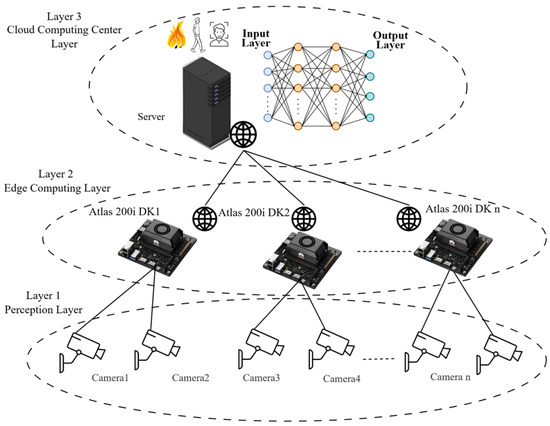
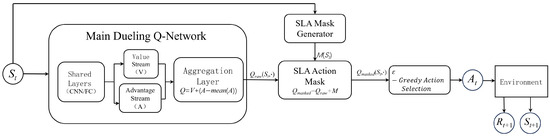
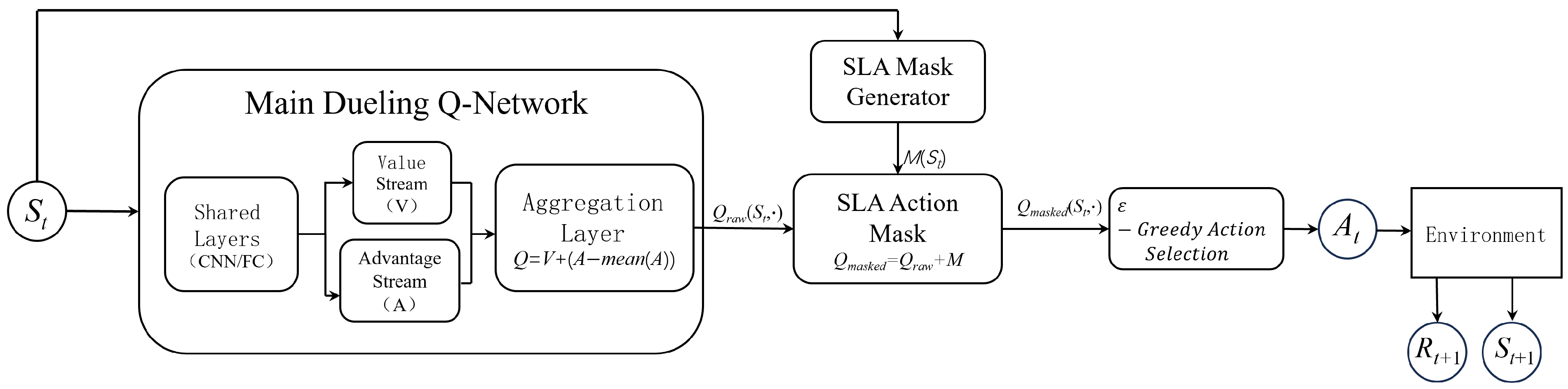
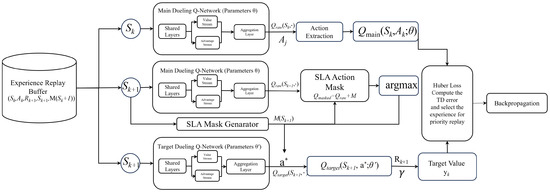
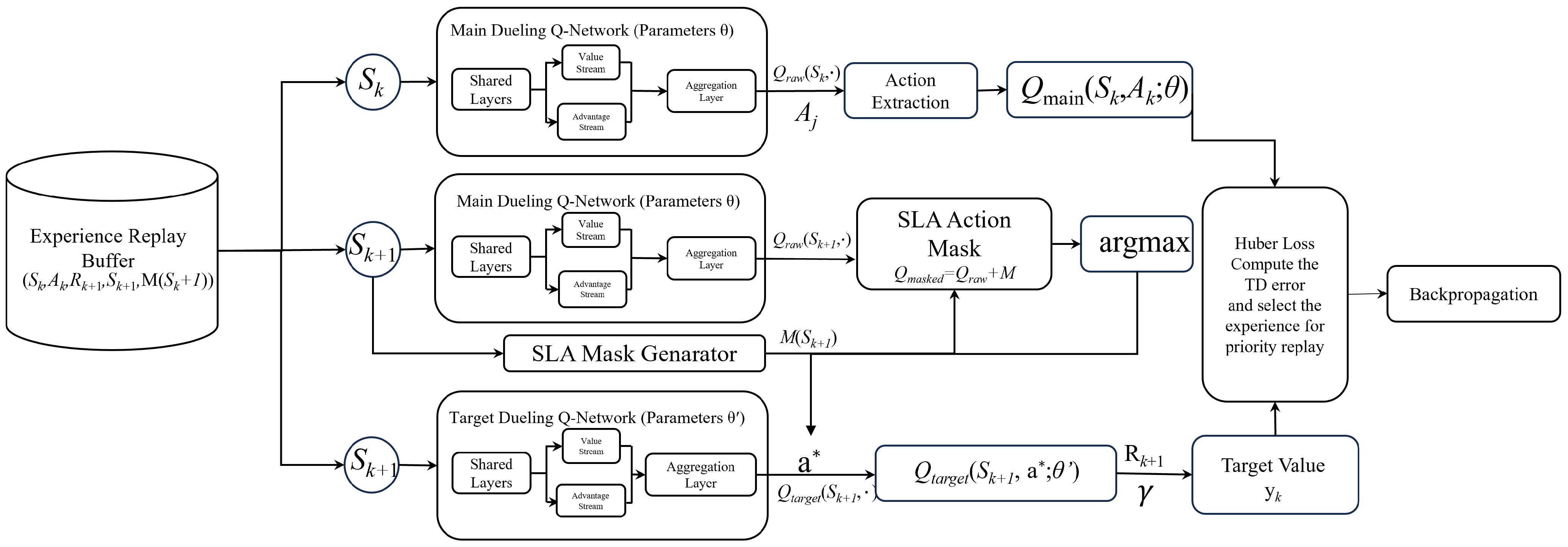
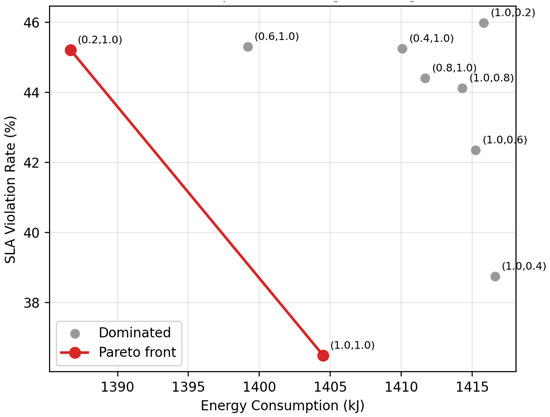
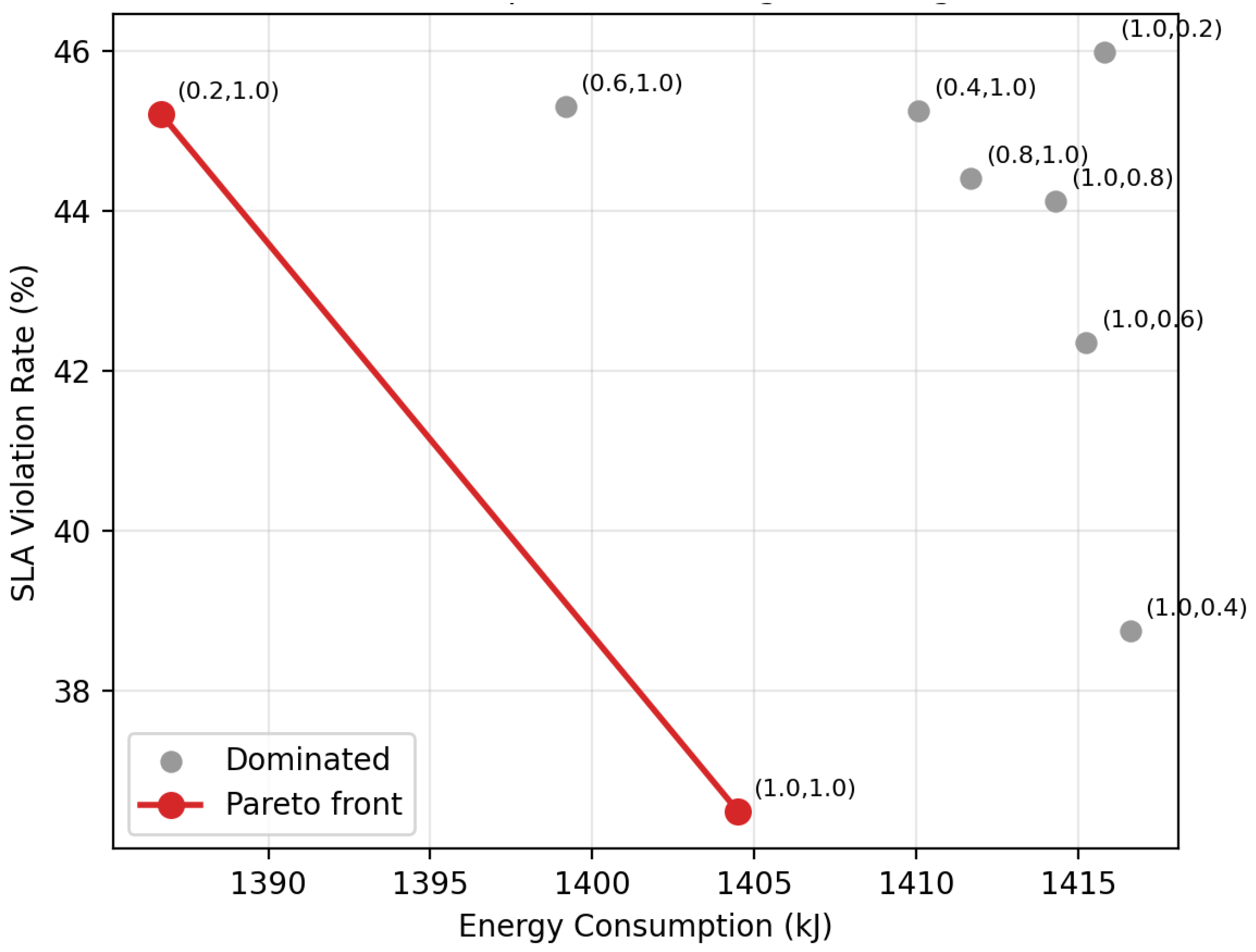
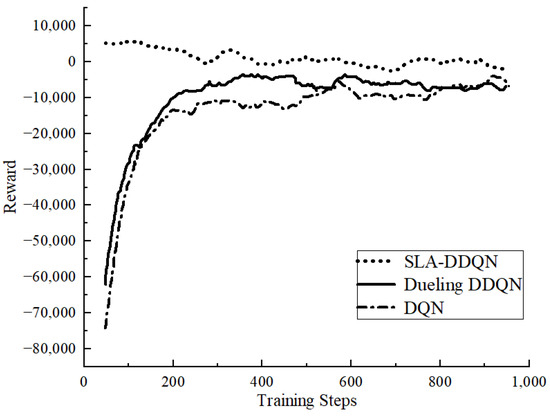
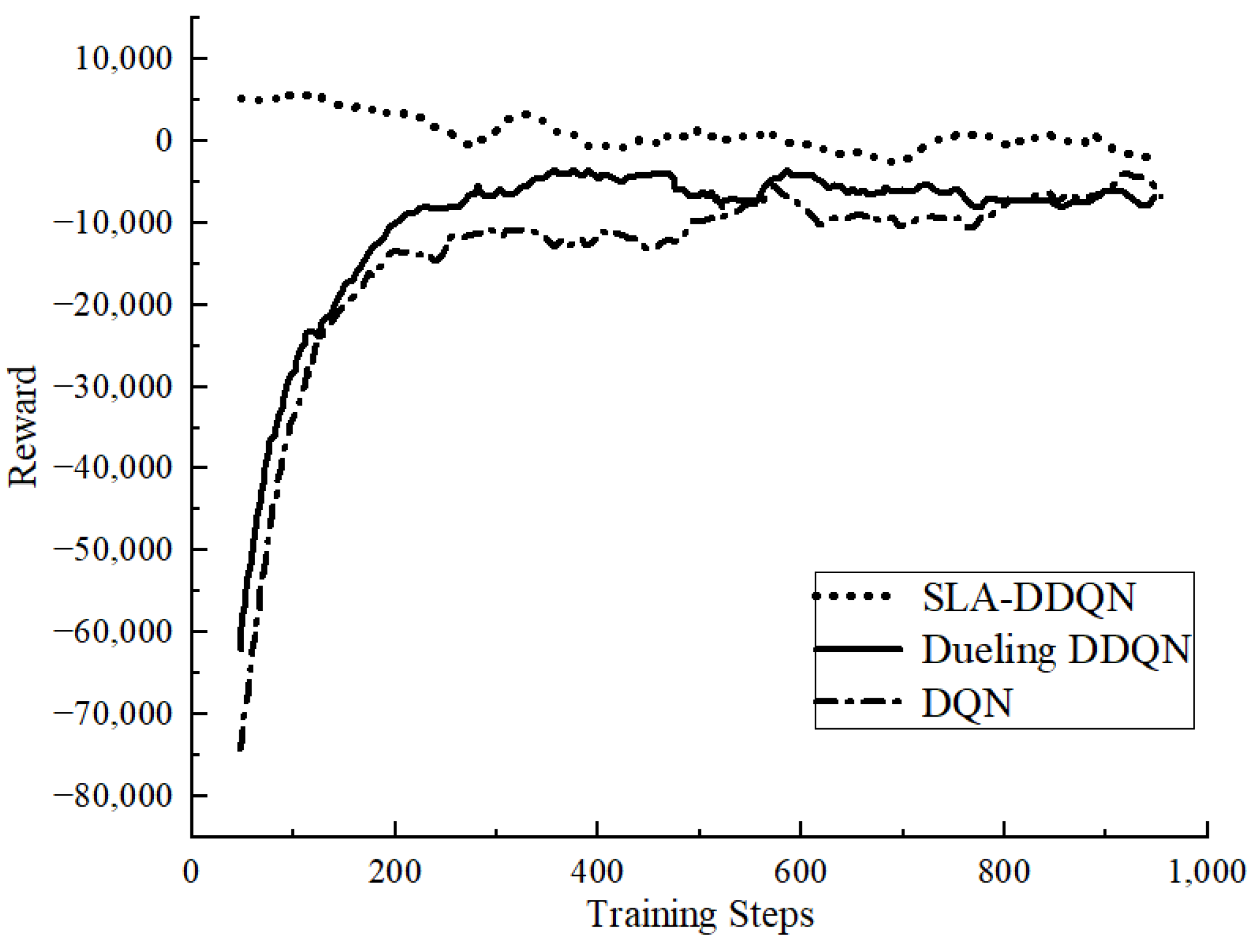
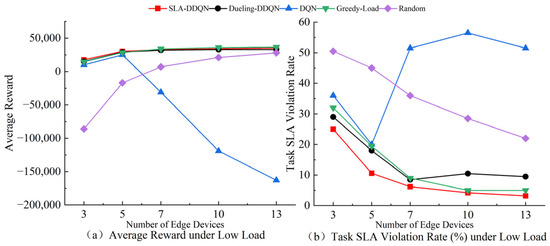
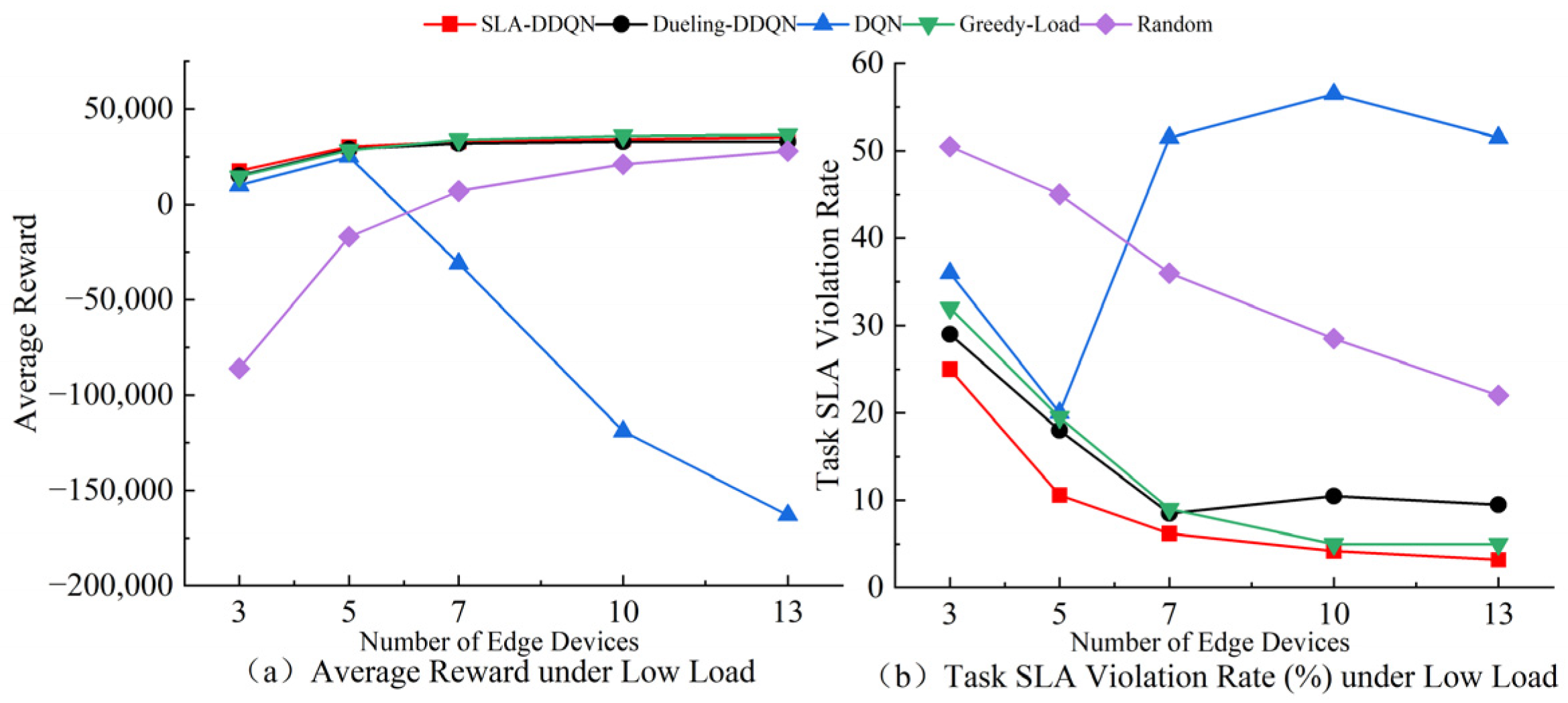
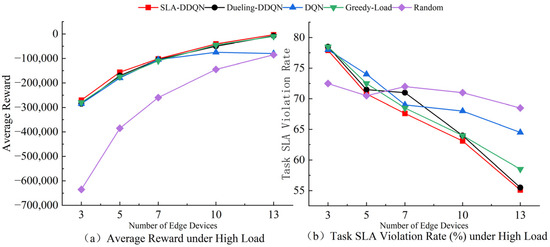
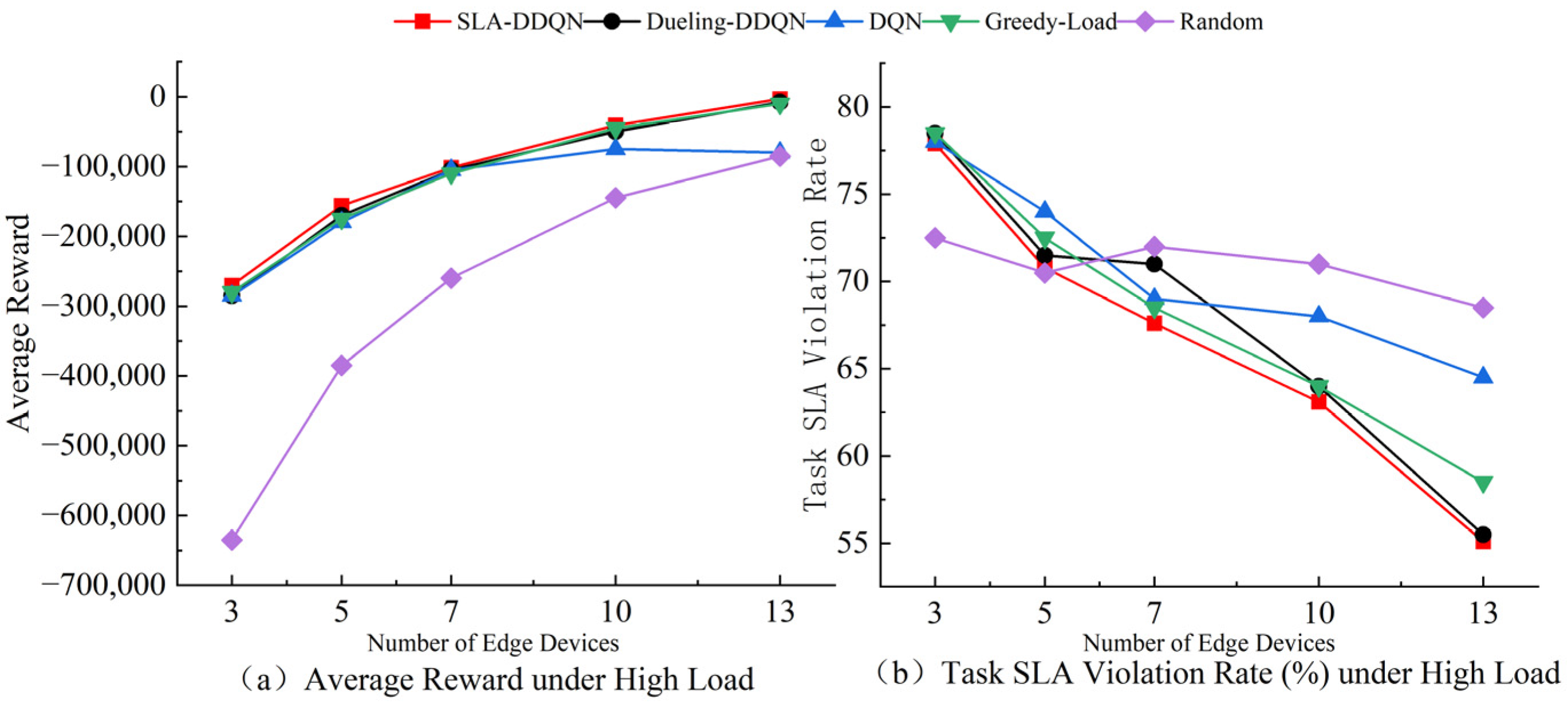
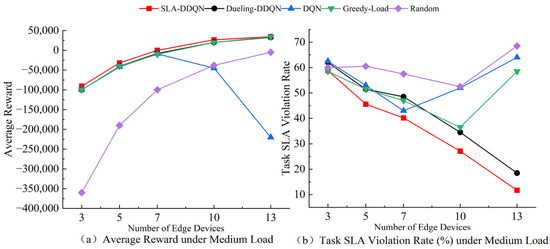
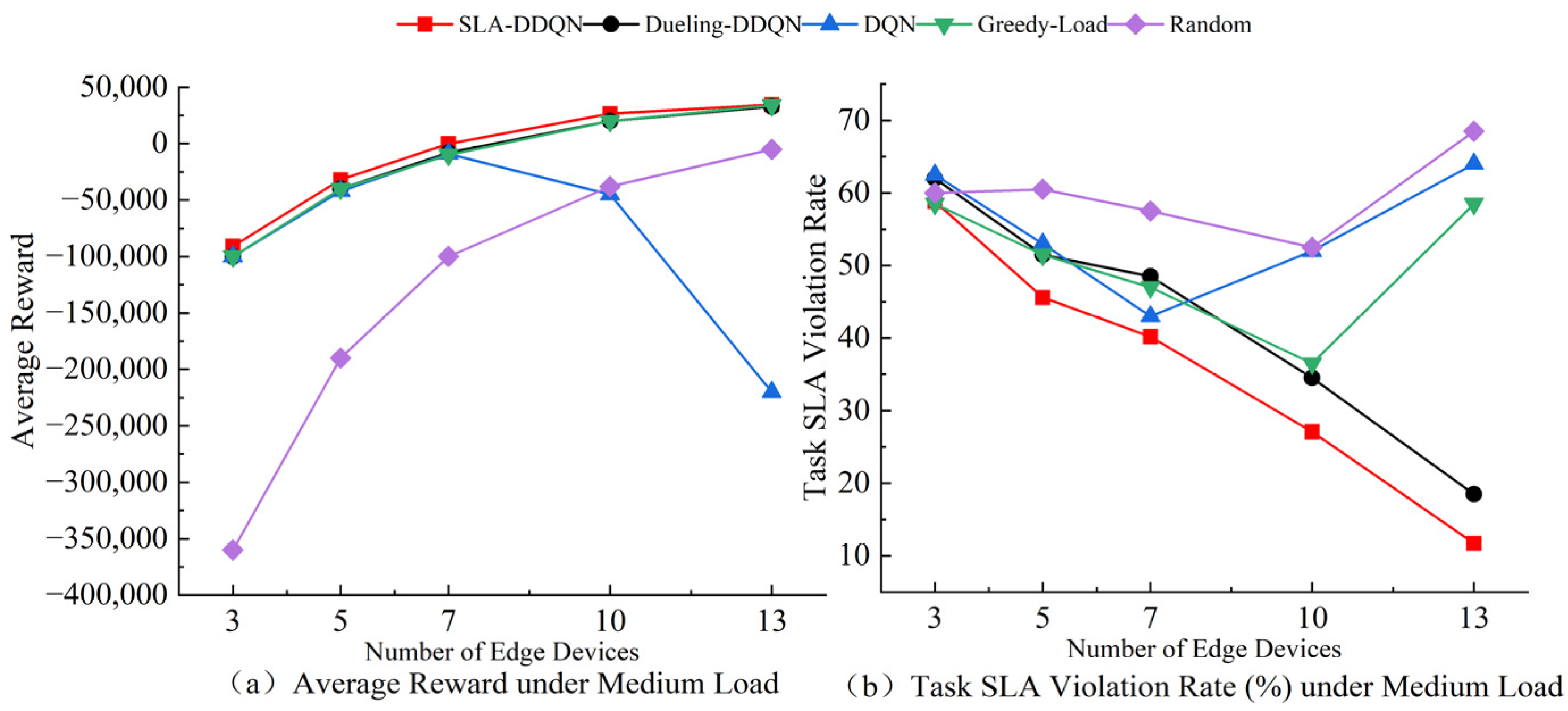

Disclaimer/Publisher’s Note: The statements, opinions and data contained in all publications are solely those of the individual author(s) and contributor(s) and not of MDPI and/or the editor(s). MDPI and/or the editor(s) disclaim responsibility for any injury to people or property resulting from any ideas, methods, instructions or products referred to in the content. |
© 2026 by the authors. Licensee MDPI, Basel, Switzerland. This article is an open access article distributed under the terms and conditions of the Creative Commons Attribution (CC BY) license.