


Abstract
Medical tourism is among the fastest-growing segments of the global travel industry, and Taiwan’s internationally recognised healthcare system positions it well to compete in this market. Yet the companies best placed to lead this development have traditionally been identified through online word-of-mouth or personal recommendation rather than objective evidence, and performance criteria are rarely weighted to reflect both subjective opinion and objective data. This study addresses both gaps with a hybrid framework that uses main path analysis to identify, objectively, the companies most active in medical aesthetic technology, and integrates the Best–Worst Method (BWM), Entropy, Game Theory, and Grey-based TOPSIS to weight a four-dimensional, seventeen-criterion framework and rank company performance in medical tourism. An empirical application to seven Taiwanese companies engaged in medical aesthetics alongside medical tourism, drawing on industry expert assessments, shows that Service and Healthcare Resources is the most influential dimension, and that cloud-based customisation, multilingual personnel, and professional in-trip medical care are the most important criteria. Sensitivity analysis across nine weighting scenarios and comparison against four alternative ranking methods confirm the robustness of the ranking. The framework offers a replicable, objective template for evaluating medical tourism performance and provides managerial guidance for companies and policymakers seeking to strengthen Taiwan’s position in this market.
1. Introduction
Medical tourism, travel undertaken wholly or partly to obtain medical treatment, has become one of the fastest-growing segments of the global travel industry. Affordable international travel and easy access to medical information online have made obtaining healthcare abroad an increasingly ordinary choice rather than a last resort. Following the 2008 global financial crisis, governments in Latin America, the Middle East, and Asia invested deliberately in medical tourism as a lever for economic growth, building healthcare infrastructure aimed at attracting foreign patients. The COVID-19 pandemic interrupted but did not reverse this trajectory: rising domestic medical costs, long waiting times for elective procedures, and improving medical technology abroad continue to drive demand.
Taiwan is unusually well positioned within this market. Its National Health Insurance system and hospital quality have received sustained international recognition: Taiwan ranked second globally in a 2000 world health ranking published by The Economist and eighth of 64 countries in the International Institute for Management Development’s 2021 World Competitiveness [1] assessment of healthcare infrastructure, and its achievements have been covered by outlets including National Geographic, The New York Times, Time, and CNN. Between 2018 and 2019, the proportion of visitors from the ten ASEAN member states seeking treatment in Taiwan overtook the proportion from mainland China, with outpatient visits and health check-ups the most common services sought. This trajectory continues to attract scholarly and policy attention: a recent policy analysis underscores the sector’s strategic importance to national economic planning [2], the medical tourism literature has grown rapidly in recent years [3], and cross-country evidence confirms that higher medical tourism revenues are associated with measurable growth in the domestic healthcare sector [4]. Tourism operators have accordingly sought to integrate travel and healthcare more deliberately, and medical aesthetics, cosmetic treatment ranging from injectables to surgery, has emerged as a particularly promising niche, since aesthetic patients are typically financially stable, require an extended in-country recovery period, and are consequently well placed to combine treatment with sightseeing, generating accommodation, transport, and dining revenue for the destination. This niche has continued to expand since the pandemic: longitudinal data show sustained growth in cross-border cosmetic-procedure demand across multiple destination countries [5], and public search interest in aesthetic treatment abroad remains persistently high across major markets [6], underscoring that the competitive positioning problem this study addresses is a continuing rather than transient feature of the market.
Despite this promise, the empirical literature on medical tourism performance evaluation has three persistent limitations. First, the companies or destinations evaluated have almost always been identified subjectively, through expert judgement or literature review, rather than through any observable, replicable indicator of a company’s actual technological or commercial engagement with the sector. Second, where multi-criteria decision-making (MCDM) frameworks have been applied to rank medical tourism destinations or providers, criterion weights have typically been derived from either purely subjective judgement (for example, Fuzzy SWARA) or purely objective data variation, but rarely both, so that expert insight and empirical variation are not jointly exploited. Nilashi et al. [7], for instance, used DEMATEL to map the relationships among factors influencing Malaysia’s medical tourism development but could not distinguish operators’ service performance; Dang et al. [8] ranked Asian medical tourism destinations using Grey Relational Analysis on measured data alone, without allowing experts to weight the criteria; and Ghasemi et al. [9] combined Fuzzy SWARA with PROMETHEE to rank Iranian residents’ destination preferences, but did not address the uncertainty inherent in linguistic expert judgement or reconcile it with objective performance data. More recently, Arsav et al. [10] combined a Group Best–Worst Method with TOPSIS and goal programming to assign patients to health institutions in a Turkish health tourism setting, but, like its predecessors, relied on a single, group-averaged subjective weighting scheme rather than reconciling expert judgement with objective performance data, and did not extend to the aesthetic-tourism segment. Third, where subjective and objective weights have both been calculated, they have generally been combined by simple averaging, a procedure that gives no principled treatment to disagreement between the two schemes and can be dominated by outlying values.
This study addresses all three gaps directly. To generate an objective set of alternatives, we use a patent search rather than expert nomination: companies engaged in medical aesthetics are identified through a keyword-based search of patents relating to the three principal categories of injectable treatment, botulinum toxin, hyaluronic acid, and collagen, filtered to Taiwan, and ranked by the depth of their patent portfolio. Because service quality varies considerably across Taiwan’s cosmetic surgery industry, and substandard technical competence has, on occasion, given rise to medical disputes or even litigation, patent analysis serves a further purpose beyond objectivity: a company’s sustained depth of patenting activity is taken as an indication that its medical aesthetic technology has reached sufficient technical maturity, so that only companies meeting this threshold, alongside the online-review screening described in Section 3.2, are carried forward as candidate alternatives. To weight the resulting 17-criterion, four-dimension evaluation framework, subjective weights are obtained from a panel of 12 tourism, government, and healthcare experts using the Bayesian Best–Worst Method (Bayesian BWM), which extends the original Best–Worst Method (BWM) by modelling each expert’s pairwise comparisons probabilistically and aggregating them through a Dirichlet-based hierarchical Bayesian model rather than a simple arithmetic mean, so that the full sample of expert opinion, not just its average, informs the group weight. Objective weights are obtained from company self-assessment data using Entropy weighting, which assigns greater weight to criteria whose measured performance varies more across companies. Here “objective” refers to the mechanical, data-driven character of the weighting algorithm itself rather than to independently verified input data, since the underlying performance matrix is self-reported by the companies. The two weighting schemes are then integrated using Game Theory, which treats the subjective and objective weight vectors as two “players” and finds the linear combination minimising the aggregate deviation from both, rather than simply averaging them. Finally, company performance is ranked using Grey-based TOPSIS, which augments classical TOPSIS distance-to-ideal-solution logic with a grey correlational coefficient, allowing the ranking to account for the incomplete, uncertain information characteristic of an early-stage market such as medical tourism, while avoiding the limitations of Euclidean distance in multidimensional, non-linear data.
The principal advantage of this combination is that each component method addresses a specific weakness of the others: patent search removes the subjectivity of alternative selection; Bayesian BWM removes the information loss inherent in averaging individual BWM solutions and reduces the number of pairwise comparisons required relative to the Analytic Hierarchy Process; Entropy supplies an objective counterweight to expert opinion; Game Theory integrates the two in a way that is provably optimal rather than ad hoc; and Grey-based TOPSIS produces a final ranking robust to the multidimensional, partially known character of the underlying data. The empirical contribution is a ranked, criterion-level performance profile of seven Taiwanese companies engaged in medical aesthetics alongside medical tourism, together with a robustness check across nine sensitivity scenarios and four alternative ranking methods. The practical contribution is a set of criterion-level managerial recommendations concerning cloud-based service customisation, multilingual staffing, and in-trip medical care that companies and policymakers can use to strengthen Taiwan’s competitive position in medical aesthetic tourism.
In summary, this study contributes to the literature in four ways: (i) it substitutes an objective, replicable patent-search procedure for the subjective expert-nomination procedures used throughout prior medical tourism performance studies; (ii) it is, to our knowledge, the first application of Bayesian BWM to a medical tourism evaluation problem, exploiting its Credal Ranking output to report explicit confidence levels for the criterion ranking rather than a single deterministic order; (iii) it uses Game Theory, rather than simple averaging, to integrate subjective and objective criterion weights, and shows that the resulting combination is itself informative about the relative reliability of expert judgement versus measured performance; and (iv) it validates the ranking through both sensitivity analysis and comparison against four alternative MCDM ranking methods, a level of robustness checking uncommon in single-application tourism performance studies. Together, these contributions provide both a validated methodological template transferable to other destinations and market segments, and a concrete evidence base for managerial and policy decisions concerning Taiwan’s medical aesthetic tourism sector.
The remainder of the paper is organised as follows. Section 2 reviews the literature on medical tourism, medical aesthetic tourism evaluation frameworks, patent analysis, and the four component methods, and identifies the gap this study addresses. Section 3 sets out the methodology. Section 4 presents the empirical application: patent-based identification of alternatives, criteria weights, the Grey-based TOPSIS ranking, and sensitivity and comparative robustness checks. Section 5 discusses theoretical and practical contributions and derives managerial implications. Section 6 concludes and outlines future research directions.
2. Literature Review
This section reviews the literature underlying the study: the medical tourism and medical aesthetic tourism context, evaluation frameworks and objective alternative identification, MCDM weighting and ranking methods, and a synthesis identifying the research gap.
2.1. Medical Tourism and Medical Aesthetic Tourism
Medical tourism refers to travel undertaken to obtain medical care, historically understood as patients from less developed countries travelling to better-resourced destinations for treatment unavailable at home, but increasingly also patients from developed countries travelling to lower-cost destinations for comparable or superior care at a fraction of domestic prices [11]. Ganguli and Ebrahim [12] documented Singapore’s success in aligning tourism and healthcare policy; Jaapar et al. [13] found dental tourists to Malaysia motivated primarily by care quality and pre-visit information; Moghavvemi et al. [14] compared how private hospital websites in India, Malaysia, and Thailand addressed prospective patients’ informational needs; and Tham [15] identified cost, quality, and speed of access as the three principal drivers of domestic medical tourism in Australia, noting that fragmented cooperation among providers remained a persistent barrier. Comparative country studies, Nilashi et al. [6] on Malaysia, Perkumienė et al. [16] on Lithuania, Dang et al. [8] across Asia, and Ghasemi et al. [9] on Iranian residents’ destination preferences, converge on a common set of success factors: technological capability, organisational management, policy environment, and service quality.
Medical aesthetic tourism is a specific and commercially significant sub-segment of this market. Because cosmetic treatment is elective and rarely covered by insurance, patients bear the full cost and are correspondingly cost-sensitive [17], which is precisely why lower-cost, high-quality destinations abroad are attractive: Thacoor et al. [18] report that roughly 97% of people seeking cosmetic procedures over the past decade would consider having them performed abroad, and Pereira et al. [19] identify low cost, short waiting times, and affordable travel as the central pull factors. Park et al. [20], studying Korean medical aesthetic tourism, propose a two-stage consumer decision model in which the traveller first selects a destination country and then a specific provider, implying that provider-level performance evaluation, of the kind undertaken here, is decision-relevant at the second stage, once the destination itself has been chosen.
2.2. Evaluation Frameworks and Objective Alternative Identification
The dimensions and criteria used to evaluate medical tourism performance in the literature cluster around four broad themes, adopted here as the evaluation framework. The first, Information and Technology, covers information systems, wearable sensing and IoT integration, telemedicine, and cloud-based service customisation; the rise of internet-enabled hospital accessibility and the movement of medical technology toward 5G-connected, sensor-driven personalisation are the principal justifications for this dimension [7,21,22]. The second, Internal Organisational Management, covers management commitment to sustainability, financial capacity, infrastructure, and international strategic alliances, reflecting the view that quality improvement in healthcare organisations begins with management-level commitment and that sound financial policy reduces operational and solvency risk [7,23]. The third, External Environmental Influence, covers government policy fairness, domestic and foreign-patient healthcare policy, investment climate, and transport arrangements; this dimension lies substantially outside any individual company’s control, concerning macro-policy questions such as the equity implications of granting paying medical tourists preferential access to services also used by domestic patients [22,24,25,26]. The fourth, Service and Healthcare Resources, covers multilingual communication, hotel service quality, in-trip professional medical care, and long-term practitioner training, and is repeatedly identified as the dimension travellers weight most heavily when undergoing treatment, as distinct from selecting a destination [9,27,28]. Each of these studies contributes a partial view of what drives medical tourism performance; collectively they justify a four-dimension, multi-criteria framework, but none evaluates specific companies against it using an objective sampling procedure, the first gap this study addresses.
Establishing what companies should be evaluated against is only half the problem, since the companies themselves must also be identified, and prior studies have relied almost exclusively on subjective procedures, such as expert interviews or literature review, rather than any observable indicator of a company’s actual technological engagement with the sector. Patent data record an organisation’s technological output and are widely used as an objective proxy for innovative and competitive activity [29]. Main Path Analysis, introduced by Hummon and Dereian [30] and developed further by Liu, Lu, and Ho [31], traces the citation network of a patent field to reconstruct its technological trajectory; Ploskas et al. [32] ranked patents using an eight-criterion linear weighting model combined with TOPSIS; and Lai et al. [29] corrected for patent-family bias in tracing thin-film solar cell technology. These studies show that patent search and citation analysis can objectively identify the technologically active organisations within a field, yet this capability has not, to our knowledge, been used to identify the alternatives in a medical tourism performance study, a role it can plausibly fill, since medical aesthetic technologies, injectable treatments in particular, generate a rich and searchable patent record.
2.3. MCDM Weighting and Ranking Methods
The Best–Worst Method [33] derives criterion weights from pairwise comparisons of the best and worst criteria against all others, requiring only 2n − 3 comparisons rather than the n(n − 1)/2 required by the Analytic Hierarchy Process, and deriving weights through optimisation rather than eigenvector estimation, which improves consistency. Its principal limitation is that it can process only one decision-maker at a time; aggregating multiple experts’ individual BWM solutions by arithmetic mean, the conventional practice, discards information about the spread of opinion and is sensitive to outliers. Mohammadi and Rezaei [34] resolved this with Bayesian BWM, which treats each criterion’s weight as a random variable, models the group’s pairwise comparison vectors under a multinomial-Dirichlet hierarchical structure, and derives the optimal group weight through Markov Chain Monte Carlo (MCMC) simulation of the posterior distribution, together with a Credal Ranking procedure reporting the confidence with which one criterion can be said to outrank another. Recent applications include Guo et al. [35] on Chinese power grid investment risk, Yang et al. [36] on sustainable sports tourism in Taichung, Huang et al. [37] on airport resilience, and Ak et al. [38] on occupational risk in textile manufacturing, but none in the medical tourism domain.
Entropy weighting [39], building on Clausius’s 1865 concept of thermodynamic entropy, derives objective weights directly from the variability of measured performance data, assigning greater weight to criteria that discriminate more strongly among alternatives. It has been combined with subjective methods across many domains: Yuan et al. [40] with ANP for coal-fired power plant investment risk, Du et al. [41] with AHP for machine-tool remanufacturing, Li et al. [42] with Fuzzy DEMATEL for machine-tool selection, and Li et al. [43] with AHP and Game Theory for solar power station siting, demonstrating a consistent pattern: subjective and objective weights are frequently combined, but the combination method matters. Simple averaging, used in several of these studies, is the most common approach, but Game Theory offers a principled alternative: Wang, Xu, and Xu [44] formalised its use for combining expert-derived and objective weighting methods, and Li et al. [43] and Zhu et al. [45] applied Game Theory to integrate AHP and Entropy weights in energy-infrastructure siting and power-grid risk contexts respectively, in each case finding the linear combination coefficients that minimise the total squared deviation between the combined weight vector and each input vector, a solution optimal in a well-defined sense rather than an arbitrary compromise.
Once criterion weights have been derived, they must be combined with alternatives’ performance data to produce a final ranking. TOPSIS [46] ranks alternatives by their Euclidean distance to a positive and a negative ideal solution, but Euclidean distance performs poorly with multidimensional, non-linear, or incompletely known data. Grey-based TOPSIS, built on Deng’s Grey System Theory and Grey Relational Analysis [47], replaces Euclidean distance with a grey correlational coefficient, which measures the similarity of multidimensional geometric shapes rather than straight-line distance, and is explicitly designed to handle the “grey”, partially known, information characterising emerging markets and self-reported performance data [8,48]. Singh, Misra, and Kumar [49] applied a related Grey-DEMATEL/DANP/Grey-TOPSIS combination to risk ranking in product lifecycle management, and Lo et al. [48] combined ITARA-derived weights with Grey-based TOPSIS to identify critical product and system failure modes, demonstrating the method’s robustness across domains, though again not in medical tourism.
Two further observations about this literature are worth making explicit. First, the choice between Grey-based TOPSIS and its principal rivals is not merely technical: Modified TOPSIS retains Euclidean distance and therefore cannot represent the uncertainty inherent in self-reported, early-stage-market performance data, while VIKOR’s compromise-solution logic addresses conflict among criteria but not measurement uncertainty. Grey-based TOPSIS is the only commonly used ranking method that addresses both limitations simultaneously, which is why it is adopted here as the primary ranking method, with the others retained as robustness checks (Section 4.7) rather than discarded. Second, although Bayesian BWM, Entropy, and Game Theory have each individually been validated across a wide range of domains, energy infrastructure, transport, manufacturing, and occupational risk among others reviewed above, their combination has not previously been assembled into a single pipeline and tested against a tourism performance problem, a further, more specific form of the gap this study addresses.
2.4. Synthesis and Research Gap
Taken together, the literature establishes (i) a credible four-dimension, 17-criterion framework for evaluating medical tourism performance; (ii) patent analysis as an objective, underused tool for identifying the organisations to be evaluated within such a framework; (iii) Bayesian BWM and Entropy as complementary, well-validated methods for deriving subjective and objective criterion weights; (iv) Game Theory as a principled alternative to simple averaging for integrating those weight vectors; and (v) Grey-based TOPSIS as a ranking method suited to the uncertain, multidimensional performance data typical of an early-stage industry. No prior study, to our knowledge, combines all five elements, and none applies any comparable framework to medical aesthetic tourism specifically, the gap this study is designed to close.
3. Methodology
This section sets out the proposed hybrid methodology: an overview of the four-stage framework, the patent search procedure, Bayesian Best–Worst Method, Entropy weighting, Game Theory weight integration, and Grey-based TOPSIS.
3.1. Overall Framework
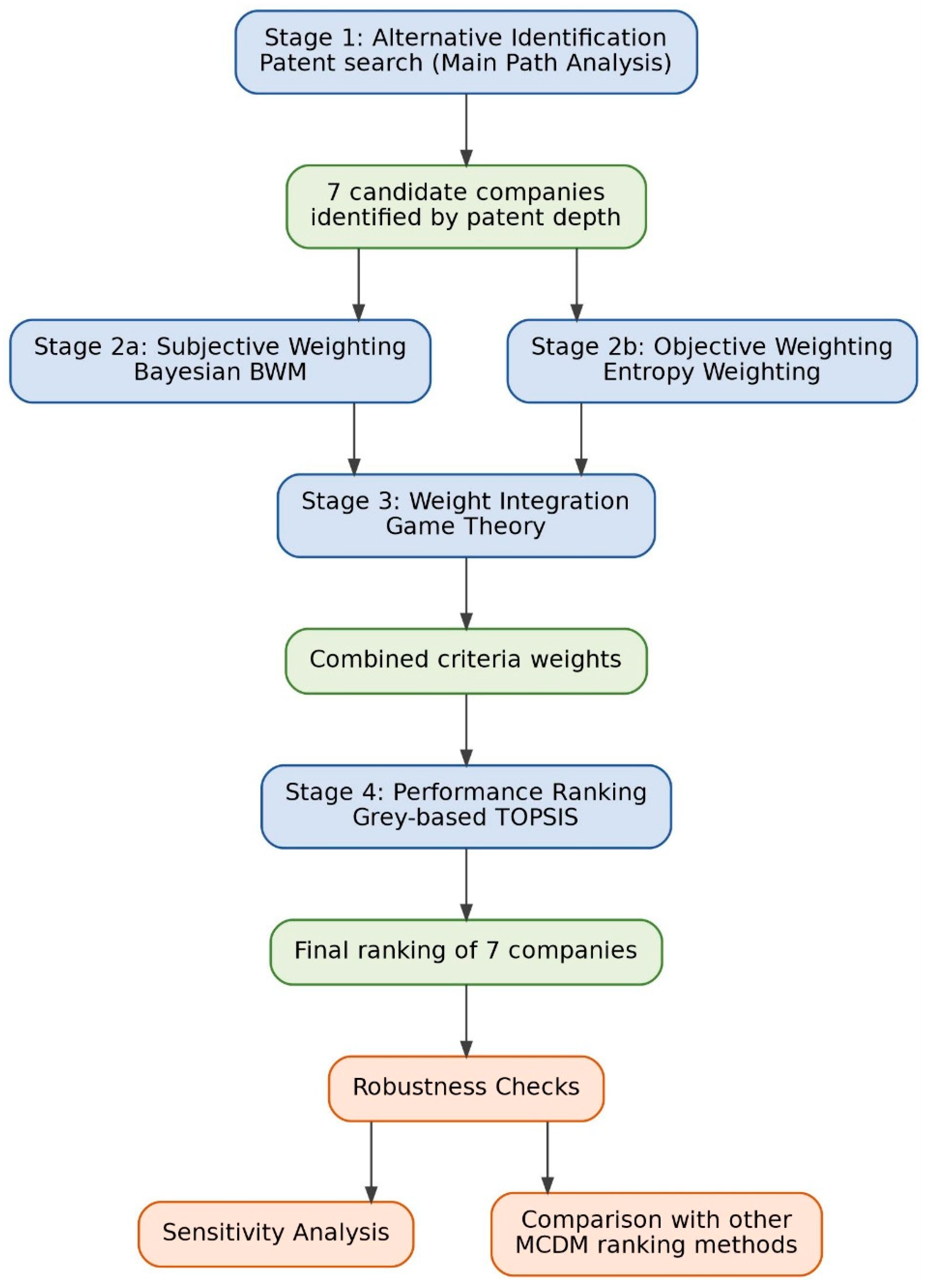
The proposed framework proceeds in four stages. First, patent search identifies the alternatives: companies engaged in medical aesthetics alongside medical tourism development, selected objectively by the depth of their patent portfolio rather than by expert nomination. Second, a 12-expert panel completes a Best–Worst Method questionnaire against the four-dimension, 17-criterion evaluation framework described in Section 2.2, and the resulting pairwise comparisons are processed using Bayesian BWM to obtain subjective group weights. Third, the same seven companies self-report their performance against each of the 17 criteria on a six-point scale, and Entropy weighting is applied to this performance matrix to obtain objective weights. Fourth, Game Theory integrates the subjective and objective weight vectors into a combined weight vector, used within Grey-based TOPSIS to rank the seven companies’ overall performance. The robustness of the ranking is verified through sensitivity analysis and comparison against four alternative ranking methods (Section 4). The overall flow chart is illustrated in Figure 1.
Figure 1.
Framework of the proposed methodology.
3.2. Main Path Analysis for Patent Search
The patent search follows a seven-step procedure. The relevant literature is first reviewed to confirm that cosmetic surgery is the most common form of medical tourism and that, within medical aesthetics, injectable treatments (botulinum toxin, hyaluronic acid, and collagen) carry a particularly rich patent record. Injectable procedures were chosen as the search domain, rather than energy-based treatments or surgery, because they are performed at a substantially higher volume in Taiwan’s medical aesthetic tourism sector and because, unlike surgical procedures, their formulations and delivery devices are more consistently protected through patent filing, which yields a denser and more comparable patent record for identifying the most active operators; Section 5.3 discusses the resulting limitation that companies whose competitive strength lies in energy-based or surgical treatments may be under-represented among the alternatives evaluated. Because provider quality in Taiwan’s cosmetic surgery industry varies considerably, with substandard technical competence occasionally giving rise to medical disputes or litigation, the candidate pool is next screened by online review rating, and only providers with above-average reviews are retained, so that the subsequent patent search is restricted to providers whose service quality has already been vetted by consumers. Specifically, ratings were collected from Google Reviews between Jan. 2023 and May 2023, covering 445 candidate providers with a minimum of 100 reviews each; “above-average” was defined as a mean rating at or above 4.82, e.g., the sample mean of 4.82 out of 5 across the candidate pool, and providers below this threshold were excluded prior to the patent search described below. Keywords are then compiled from the medical tourism websites of Taiwan’s three largest metropolitan areas (Taipei, Taichung, and Kaohsiung), yielding the core terms “botulinum toxin”, “hyaluronic acid”, and “collagen”, supplemented with “whitening”, “cosmetic”, “person”, “skin”, and “dermis” and restricted to Taiwan (TW) via Boolean AND/OR/NOT syntax. The resulting query,
TW-TAC:(“botulinum toxin” “hyaluronic acid” “whitening” “collagen”) AND TAC:(“cosmetic” “person” “skin” “dermis”),
is executed in the MTrends patent information system, and the retrieved patents are analysed at the management level to identify the companies with the deepest, most consistent patent filings in the field; these companies constitute the alternatives evaluated in Section 4.
Two clarifications are warranted. First, Main Path Analysis was used to trace the patent citation network following Hummon and Dereian [30] and Liu, Lu, and Ho [31], confirming a technologically coherent field and identifying companies with central positions in the main path. However, company selection was based on patent counts and filing consistency, rather than main-path centrality, because the two measures closely coincided in this concentrated patent landscape. The count-based criterion was therefore preferred for transparency and reproducibility. Second, patent activity serves as a proxy for sustained and verifiable investment in medical aesthetic technologies, rather than service quality. The tourism-performance assessment is conducted separately using the service, organisational, environmental, and technological criteria weighted in Section 4.2 and Section 4.4. Thus, patent-active companies may not necessarily perform best on non-technological criteria, a limitation further discussed in Section 5.3.
3.3. Bayesian Best–Worst Method
Bayesian BWM [34] extends the original BWM [33] by modelling multiple decision-makers’ pairwise comparisons probabilistically rather than averaging their individually optimised weight vectors. Given n criteria, each decision-maker first identifies the best (most important) and worst (least important) criterion and rates every other criterion against each on a 1–9 scale, generating a Best-to-Others (BO) vector and an Others-to-Worst (OW) vector as Equations (1) and (2).
Because each criterion Cj is treated as a random event with probability equal to its weight wj, and the BO and OW vectors are positive-integer-valued, they are modelled as realisations of a multinomial distribution. A Dirichlet distribution, Equation (3), serves as the prior over the weight vector w, and, combined across the experts’ BO and OW vectors under an assumption of conditional independence, yields a Bayesian hierarchical model in which the individual experts’ optimal weights w are drawn from a Dirichlet distribution centred on the group-optimal weight vector wagg, which is itself Dirichlet-distributed.
where w is the probability distribution. Under the multinomial distribution, the probability associated with Cj (wj) is proportional to the frequency of its occurrence relative to the total number of trials, as shown in Equation (4).
The weight of the least important criterion can be expressed mathematically in the following Equation (5).
Combining wj and wW yields the following mathematical expression:
Markov Chain Monte Carlo simulation of the resulting posterior distribution yields the group-optimal weight for each criterion, computed in this study using MATLAB2024b with 900,000 posterior samples, whose mean is taken as the final weight. Convergence was confirmed by discarding an initial burn-in period, running multiple independent chains from dispersed starting values, and verifying that posterior means agreed closely across chains with no residual drift in the trace plots. This study does not involve a train-test split or model weight initialisation in the sense used for supervised learning, since Bayesian BWM and Entropy weighting are not fitted to labelled data; the corresponding stochastic element here is the MCMC sampling itself, and running multiple independent chains from dispersed starting values, as described above, is the direct analogue of testing sensitivity to random initialisation. We did not further vary the composition of the expert panel or company sample, since these are fixed, fully enumerated populations (12 experts, 7 patent-identified companies) rather than a sample drawn from a larger pool. A Credal Ranking procedure additionally reports, for any pair of criteria i and j, the posterior probability that i is more important than j, providing a direct confidence measure for the criterion ranking rather than a single deterministic order. Detailed procedures can be found in [33].
3.4. Entropy Weight
Entropy weighting [38] derives criterion weights directly from the dispersion of measured performance data, on the principle that a criterion whose values vary more across alternatives is more discriminating and should receive greater weight. Throughout this paper, “objective” describes the weighting algorithm rather than the underlying data: Entropy weighting is objective in the sense that it derives weights mechanically from the dispersion of a performance matrix without further human judgement, but the performance matrix itself is built from the seven companies’ self-assessed scores (Section 4.1) and therefore is not an independently, objectively measured input. This algorithmic sense of “objective”, as distinct from expert-elicited (Bayesian BWM) weights, is the sense intended wherever the term is used below. The steps are as follows.
- Step 1. Constructing the initial evaluation matrix of the decision system
Experts assess the performance of the alternatives based on the established evaluation criteria. Assuming the evaluation system comprises j criteria and i alternatives, experts judge the performance of each alternative and assign evaluation values accordingly. Through joint discussion, the experts determine the initial decision values for all alternatives, yielding the initial decision matrix as Equation (7).
- Step 2. Normalising the initial evaluation matrix
The purpose of normalisation is to unify the units of the evaluation criteria by converting them into dimensionless pure values, thereby facilitating comparison and weighting across indicators with different units. The original data are proportionally scaled to the [0, 1] interval, using the following normalisation Equation (8).
where .
- Step 3. Calculating the entropy value of each criterion
- Step 4. Calculating the weight of each criterion
3.5. Game Theory for Weight Integration
Game Theory originates from the premise that each player has a strategy and seeks to defeat other players by maximising gains or minimising losses, providing insight into how to select the most advantageous strategy for an optimal goal. In MADM methods, Game Theory integrates two sets of weights by identifying the combination among different weight-determination methods that minimises the deviation between the combined weights and the original weights. The execution and derivation steps are detailed as follows:
- Step 1. Combining the subjective weight (W1) and the objective weight (W2)
- Step 2. In order to minimise the deviation between the combined weight and the original weights, the objective is set as a payoff function, so as to optimise the combination coefficients and . The game model is as follows
Differentiating Equation (12) once yields the following expression.
- Step 3. Normalising the combination coefficients, the mathematical expression for the optimal combined weight coefficients is as in Equation (14)
- Step 4. Calculating the optimal combined weight as in Equation (15)
is the coefficient of the subjective weight, and is the coefficient of the objective weight. Multiplying each coefficient by its corresponding weight value yields the combined weight.
3.6. Grey-Based TOPSIS
After obtaining the combined weights of criteria by Game Theory, Grey-based TOPSIS, combining Grey Relational Analysis [46] with TOPSIS [45], ranks the seven alternatives using the following procedure.
- Step 1. Construct the decision matrix
This step is the same as Equation (7).
- Step 2. Calculation of the weighted normalised decision matrix
Given that the criteria possess different degrees of importance, the criteria weights integrated by Game Theory are multiplied by the normalised decision matrix to obtain the weighted normalised decision matrix.
where denotes the criteria weights integrated by Game Theory.
- Step 3. Determination of the positive ideal solution and negative ideal solution
Based on the concept of aspiration level, the positive ideal solution of the alternatives is defined as the minimum value, whereas the negative ideal solution is defined as the maximum value. Accordingly, the positive ideal solution and negative ideal solution of the alternatives are calculated as follows:
- Step 4. Calculation of the grey relational coefficients between the alternatives and the positive ideal solution and negative ideal solution
- Step 5. Calculation of the closeness coefficient
The closeness coefficient (Ci) considers the distances of all alternatives from the positive ideal solution and the negative ideal solution, thereby overcoming the shortcomings of the ranking index originally proposed in TOPSIS. The closer Ci is to 1, the better the performance of the alternative; conversely, the closer it is to −1, the poorer the performance
where , when the decision-maker shows no preference for either the positive ideal solution or the negative ideal solution.
- Step 6. Ranking of the alternatives
The alternatives are ranked in descending order of Ci, with a larger Ci indicating a better alternative.
The closeness coefficient Ci ranges from –1 to 1 and sums to zero across alternatives; ranking companies by descending Ci yields the final performance ranking reported in Section 4.5.
4. Empirical Analysis
This section reports the empirical application of the proposed framework, covering the problem description and data, patent-based identification of alternatives, criteria weighting, performance ranking, sensitivity analysis, and comparison with other MCDM methods.
4.1. Problem Description and Data
The empirical problem addressed in this section is twofold: (i) which companies in Taiwan are, in objective terms, most actively engaged in medical aesthetics alongside medical tourism development, and (ii) how do those companies perform relative to one another once evaluated against a criterion set reflecting both expert judgement and measured variation in company self-assessment? Answering the first question requires an alternative to the expert-nomination procedure used throughout the prior literature (Section 2.4); answering the second requires criterion weights that integrate subjective and objective information without simply averaging them, and a ranking method suited to incomplete, self-reported performance data. Data were collected in two stages: a Best–Worst Method survey completed by 12 experts drawn from tourism operators, the Tourism Bureau, and medical institutions (with between five and over twenty years of relevant experience, and education ranging from bachelor’s to doctoral level), used to derive subjective criterion weights. The panel was drawn from tourism operators, the Tourism Bureau, and medical institutions rather than patients because the Best–Worst Method questionnaire asks respondents to weight operational and policy-level criteria, such as cloud-based service customisation, financial capacity, and government policy fairness, that require managerial, regulatory, or clinical familiarity with how these criteria are delivered rather than direct experience of receiving treatment; the 17-criterion framework itself, developed from the medical tourism literature reviewed in Section 2.2, does draw on studies documenting patient priorities, so patient perspectives inform what is weighted even though patients did not participate directly in the weighting exercise. A performance assessment, on a six-point scale, was separately completed by the seven companies identified through patent search, used both to derive objective criterion weights and as input to the Grey-based TOPSIS ranking. To limit the risk of self-serving over-reporting, each scale point was accompanied by an anchored behavioural description rather than an unlabelled number, and respondents were asked to provide a concrete example supporting any rating of five or six; this procedure narrows, but as discussed in Section 5.3 does not eliminate, the potential for optimistic self-reporting.
This two-stage design is deliberate: separating the expert panel that weights the criteria from the companies whose performance is being weighted avoids the conflict of interest that would arise if the same respondents both defined what matters and reported how well they meet it, and allows the Game Theory integration step to combine two genuinely independent sources of information rather than two correlated views of the same respondents’ opinions. Because the target population, companies with a sustained patent presence in medical aesthetics, is inherently small, the study does not rely on the Entropy weights in isolation: they are combined with the independently derived Bayesian BWM weights through Game Theory (Section 3.5), and Section 4.6 shows that the final ranking is robust across nine dimension-weighting scenarios, so that the modest size of the self-reporting sample does not translate directly into an unstable ranking. The sections that follow present the results in the order the framework is applied: alternative identification, criteria weighting, performance ranking, and two robustness checks, sensitivity analysis and comparison against alternative MCDM methods.
4.2. Construction of the Framework for Evaluating Medical Aesthetic Tourism
Based on a review of prior studies related to medical tourism, this study identifies the evaluation dimensions and criteria, comprising four dimensions: information and technology, internal organisational management, external environmental influence, and service and medical resources. Each dimension is divided into several criteria, and a total of 17 evaluation criteria are used to construct the framework, as shown in Table 1. The 17 criteria are treated as mutually independent when deriving both the Bayesian BWM and Entropy weights, consistent with standard practice for these two methods and for the great majority of prior applications reviewed in Section 2.3; this assumption keeps the pairwise-comparison burden on experts and the self-assessment burden on companies tractable.
Table 1.
Dimensions and criteria for evaluating medical aesthetic tourism.
Most prior studies have applied multi-attribute decision-making methods to evaluate the performance of candidate alternatives, typically identifying the alternatives to be examined in a subjective manner through expert interviews and relevant literature. In contrast, this study employs a patent search system, which is based on the main path analysis to objectively identify companies engaged in medical aesthetics that have jointly developed medical tourism and that hold a substantial number of patent applications, using these as the alternatives for the multi-attribute decision analysis. Interviews were conducted with tourism industry experts in Taiwan who are currently planning to develop in the direction of medical tourism, and a BWM survey was designed and administered to these experts to assess the importance of the 17 evaluation criteria. Patent analysis was then used to identify companies currently engaged in medical aesthetics in conjunction with medical tourism development in Taiwan.
4.3. Patent-Based Identification of Alternatives
Because the quality of providers in Taiwan’s cosmetic surgery industry varies considerably, with substandard technical competence frequently giving rise to medical disputes or even litigation, this study first restricted the patent search to providers whose online reviews were above average, so as to help ensure the medical competence of the providers under consideration. Then, executing the search query described in Section 3.2 in the MTrends system returned 1430 patents filed between 1990 and 2022 relating to botulinum toxin, hyaluronic acid, collagen, and whitening; the annual count of these filings rose steadily over the period, reaching a cumulative total of 161 medical-aesthetics-related patents by 2021. Management-level analysis of the patent applicants identified seven companies with the deepest and most consistent filing histories in this field; these companies, labelled A1–A7, constitute the alternatives evaluated in the remainder of the study. Table 2 summarises their patent counts, market share of the filings analysed, and a short profile of each company’s positioning.
Table 2.
Alternative companies: patent counts, share, and profile.
4.4. Criteria Weights
After constructing the evaluation framework and identifying the alternative companies, the criteria weights are calculated. This study considers both subjective and objective weights and combines them using Game Theory. The detailed procedure is described as follows.
- Step 1. Bayesian BWM
The expert panel’s pairwise comparisons were processed using Bayesian BWM as described in Section 3.3, generating 900,000 posterior weight samples via MCMC simulation in MATLAB2024b. At the dimension level, Service and Healthcare Resources (D4) was identified as the most important dimension (weight 0.291), followed by Information and Technology (D1, 0.270), External Environmental Influence (D3, 0.239), and Internal Organisational Management (D2, 0.200); Table 3 reports the Credal Ranking confidence that each dimension outranks each other dimension, for example, the confidence that D4 outranks D2 was 95.12%, and that D1 outranks D2 was 91.22%. At the criterion level, cloud computing systems for real-time, customised medical services (C14), multilingual and communication capability (C41), and long-term practitioner training (C44) were the three most influential criteria overall (Table 4).
Table 3.
Dimension weights (Bayesian BWM) and pairwise ranking confidence.
Table 4.
Subjective weights of dimension and criteria.
This study utilises MATLAB software to compute the BO and OW vectors of the 12 experts established in Section 4.1, ultimately generating a posterior probability distribution of 900,000 sets of weights, from which the mean value is taken as the optimal group weight. After separately calculating the weights of the dimensions and their corresponding evaluation criteria, the dimension weights are multiplied by the corresponding criterion weights to obtain the criteria weights used in this study for evaluating the development of medical aesthetic tourism, as shown in Table 4.
- Step 2. Entropy weight
In this study, operators were asked to self-assess their companies’ performance in developing medical aesthetic tourism, using a scale ranging from 1 to 6, with 6 denoting excellent and 1 very poor performance for each of the 17 evaluation criteria established under the hierarchical framework. The average initial evaluation matrix is shown in Table 5.
Table 5.
Performance matrix of alternatives.
Applying Entropy weighting to the seven companies’ assessed performance across the 17 criteria produced a different ordering, dominated by criteria whose measured performance varied most across companies: professional in-trip medical care (C43), transport arrangements (C35), and domestic healthcare policy (C32) were the three most influential criteria from an objective standpoint (Table 6), markedly different from the subjective ranking, in which technology and personnel criteria dominated.
Table 6.
Subjective, objective, and combined weights of the 17 criteria.
Comparing the entropy values of each alternative against each criterion yields the criterion weights; the objective weight of each criterion, obtained using Equations (7)–(10), is shown in Table 6, column 5.
From an objective perspective, professional in-trip medical care (C43), transport arrangements (C35), and national healthcare policy (C32) are confirmed as the three most influential criteria in the medical aesthetic tourism evaluation framework.
- Step 3. Combined Weights using Game Theory
Integrating the subjective and objective weight vectors via Game Theory (Section 3.5) yielded normalised combination coefficients of 0.904 for the subjective (Bayesian BWM) weights and 0.096 for the objective (Entropy) weights, indicating that expert judgement carries substantially greater influence than measured performance variation in the combined weighting, while the objective weights still exert a discernible corrective effect. This asymmetry reflects the relative dispersion of the two input vectors rather than any weakness in the integration procedure: the Bayesian BWM weights are well differentiated, reflecting the high Credal Ranking confidence reported in Table 3, whereas the Entropy weights, derived from only seven companies’ self-reported scores, are comparatively compressed, since Entropy weighting assigns weight in proportion to observed variability and a small sample offers less scope for such variability to emerge. Because Game Theory selects the coefficients minimising the aggregate squared deviation from both input vectors, it naturally defers more heavily to the vector carrying greater informational contrast, without this deference being an imposed assumption. Under the combined weighting, the five most influential criteria were cloud computing systems for customised medical services (C14), multilingual communication capability (C41), professional in-trip medical care (C43), long-term practitioner training (C44), and comprehensive medical information systems (C11) (Table 6).
This asymmetric split is itself informative rather than a nuisance parameter. A coefficient close to 0.9 for the subjective weights indicates that the expert panel’s collective judgement was substantially more consistent with the criteria that actually discriminate among companies than a naïve 50/50 blend would assume, yet it does not reach 1.0, which would imply the objective data carried no information at all. In practical terms, the correction moves three criteria up the combined ranking relative to where they would sit under Bayesian BWM alone: C43 rises from fourth to third, and C32 and C35, both driven by strong objective weights in Table 3, retain materially higher combined weights than under a purely subjective scheme. This is precisely the behaviour Game Theory integration is designed to produce: it lets objective evidence pull the final weighting away from expert consensus where the data disagree most strongly, while leaving the ordering largely intact where the two sources agree.
4.5. Performance Ranking (Grey-Based TOPSIS)
Using the Game-Theory-combined weights, the seven companies’ weighted normalised performance was compared against the positive and negative ideal solutions using Grey-based TOPSIS (Section 3.6). Table 7 reports each company’s grey correlational coefficients to the positive and negative ideal solutions and the resulting closeness coefficient. Company A6 achieved the highest closeness coefficient (0.031), followed by A7 (0.029) and A3 (0.018); A2 and A4 achieved small positive coefficients (0.004 and 0.002); and A5 (–0.026) and A1 (–0.058) recorded negative coefficients, indicating below-average performance. The resulting ranking is A6 ≻ A7 ≻ A3 ≻ A2 ≻ A4 ≻ A5 ≻ A1.
Table 7.
Grey-based TOPSIS results for the seven alternatives.
4.6. Sensitivity Analysis
Because Service and Healthcare Resources (D4) was identified as the most important dimension under Bayesian BWM, its robustness was tested by varying D4’s weight from 0.1 to 0.9 across nine runs, adjusting the remaining three dimensions’ weights proportionally so that all weights continued to sum to one (Table 8), re-integrating with the Entropy weights via Game Theory, and re-running Grey-based TOPSIS at each step. The resulting ranking, A6 ≻ A7 ≻ A3 ≻ A2 ≻ A4 ≻ A5 ≻ A1, was identical across all nine runs (Table 9), indicating that the ranking is not an artefact of the dimension weights obtained from the expert panel and that the hybrid model is robust to substantial reweighting of its most influential dimension.
Table 8.
Dimension weight configurations for the sensitivity analysis.
Table 9.
Alternative ranking across the nine sensitivity analysis runs.
4.7. Comparison with Other MCDM Methods
To verify that the ranking is not an artefact of the Grey-based TOPSIS procedure itself, the Game-Theory-combined weights were also used within four alternative ranking methods, GRA, Modified TOPSIS, VIKOR, and WASPAS, and the resulting rankings compared using Spearman’s rank correlation coefficient (Table 10). Grey-based TOPSIS correlated at 0.929 with Modified TOPSIS and 0.964 with VIKOR, indicating high agreement across methods; GRA reproduced the Grey-based TOPSIS ranking exactly. The minor divergences that occur—Modified TOPSIS ranks A3 above A4 and A7, for instance—are attributable to Modified TOPSIS’s reliance on Euclidean distance alone, without accounting for either uncertainty in the underlying information, as Grey-based TOPSIS does, or a compromise-solution logic, as VIKOR does; Grey-based TOPSIS incorporates both, supporting its selection as the primary ranking method here.
Table 10.
Alternative rankings under five MCDM methods.
5. Discussion
This section discusses the study’s theoretical contributions (Section 5.1), practical and managerial implications (Section 5.2), and limitations (Section 5.3).
5.1. Theoretical Contributions
This study makes five theoretical contributions to the medical tourism and multi-criteria decision-making literature. First, it demonstrates that patent search can serve as an objective substitute for expert nomination in identifying the alternatives evaluated in a medical tourism performance study, addressing a methodological limitation that runs through the prior literature reviewed in Section 2.2. Second, it is, to our knowledge, the first application of Bayesian BWM within the medical tourism domain, showing that the method’s core advantage over the original BWM, aggregating the full distribution of expert opinion rather than the arithmetic mean of individually optimised solutions, translates into an interpretable set of criterion weights together with an explicit Credal Ranking confidence measure, here showing, for example, 95.12% confidence that Service and Healthcare Resources outranks Internal Organisational Management. Third, it shows that subjective (Bayesian BWM) and objective (Entropy) weights, derived from the same criterion set, can diverge substantially in emphasis, experts prioritised technology and personnel criteria, while measured performance variation prioritised in-trip care, transport, and policy criteria, reinforcing the theoretical case, made by Wang, Xu, and Xu [43] and others, for combining the two rather than relying on either alone. Fourth, it applies Game Theory, rather than simple averaging, to integrate the two weight vectors, showing empirically that the resulting combination coefficients (0.904 subjective, 0.096 objective) are not a foregone 50/50 split but are themselves informative about the relative reliability of expert judgement versus company self-report in this context. Fifth, through nine sensitivity runs and comparison against four alternative ranking methods, it demonstrates that Grey-based TOPSIS produces a ranking robust both to substantial reweighting of the most influential dimension and to the choice of ranking method, lending the hybrid framework a level of validated robustness rarely demonstrated in single-method MCDM applications to tourism performance evaluation.
Taken together, these contributions reframe medical tourism performance evaluation as a problem addressable with the same methodological rigour applied to risk assessment and infrastructure siting in other domains (Section 2.2 and Section 2.3), rather than treated as an inherently qualitative exercise reliant on interview-based case studies. This matters because the underlying decision, which companies or destinations deserve investment, partnership, or policy support, is ultimately a resource-allocation problem of exactly the kind MCDM methods were designed to address, and the results reported here show that the necessary inputs, patent records, expert panels, self-reported performance data, are no harder to obtain in this domain than in domains where such methods are already standard practice.
5.2. Practical Contributions and Managerial Implications
Beyond its methodological contribution, the study yields several actionable implications for companies and policymakers seeking to strengthen Taiwan’s position in medical aesthetic tourism. First, because cloud computing systems for real-time, customised medical services (C14) ranked as the single most influential criterion under both the subjective and combined weightings, companies should prioritise investment in cloud-based platforms capable of ingesting traveller sensor and consultation data and translating it into individualised care recommendations; this is a technology investment rather than a service-culture change, and therefore a comparatively fast lever for companies currently lagging on this criterion. Second, because multilingual and communication capability (C41) and long-term practitioner training (C44) both rank in the top four criteria under the combined weighting, companies should treat staff language training and continuing medical education as core, not peripheral, investments, consistent with Nilashi et al.’s [6] finding that human factors are the most important influence on medical tourism adoption in a comparable Southeast Asian market. Third, because professional in-trip medical care (C43) is simultaneously the most influential criterion under the objective (Entropy) weighting and a top-five criterion under the combined weighting, companies should ensure that disease treatment, physical examination, recovery tracking, and convalescent care are integrated into the travel itinerary itself, rather than delivered before or after the trip. Fourth, the two lowest-ranked companies (A1 and A5) should specifically reassess their cloud technology, information systems, and consultation platforms (C11, C14), the criteria on which top-ranked company A6 holds the clearest advantage and which also carry the greatest combined weight; targeted investment here is likely to yield a disproportionate improvement in overall competitive position. Fifth, because domestic healthcare policy (C32) and transport arrangements (C35) rank highly under the objective weighting despite lying outside individual companies’ direct control, the results imply a role for policymakers, particularly the Tourism Bureau and Ministry of Health and Welfare, in coordinating transport infrastructure and clarifying insurance and healthcare policy for foreign patients, complementing what individual companies can achieve alone.
5.3. Limitations
Six limitations of the present study should be borne in mind. First, the patent search was restricted to injectable-treatment technologies and to patents filed and indexed within the MTrends system; companies whose competitive strength lies primarily in energy-based treatments or surgical procedures, or whose patents are filed through channels not indexed by MTrends, may be under-represented among the seven alternatives evaluated. Second, the performance data underlying the Entropy weighting and the Grey-based TOPSIS ranking are self-reported by the companies on a six-point scale, which, notwithstanding the grey-correlational treatment of uncertainty, cannot fully substitute for independently verified metrics such as patient volumes, complication rates, or revenue. Relatedly, the Entropy weights are estimated from only seven companies’ self-reported scores per criterion; with so few observations, the resulting dispersion measures, and therefore the Entropy weights themselves, are more sensitive to individual extreme responses than they would be with a larger sample, a consideration that reinforces rather than duplicates the sensitivity analysis in Section 4.6, which varies the dimension weights rather than the underlying Entropy calculation. Third, the 12-expert panel, while spanning tourism operators, the Tourism Bureau, and medical institutions, is modest relative to the 17-criterion framework being evaluated, and a larger or more diverse panel, including patients themselves, might shift the Bayesian BWM weights, although the sensitivity analysis in Section 4.6 suggests the final ranking is unlikely to be highly sensitive to such shifts. Fourth, the study evaluates performance at a single point in time; medical tourism, and medical aesthetic technology in particular, is a fast-moving field, and the ranking reported here should be understood as a snapshot rather than a permanent ordering. Fifth, patent depth and filing consistency demonstrate sustained technological investment but do not directly demonstrate tourism-service quality, patient care, or medical outcomes; the framework addresses this by evaluating patent-identified companies against service, organisational, environmental, and technological criteria separately, but a company could in principle score well on patent depth while performing poorly on non-technological criteria, and the ranking should be read as performance conditional on already having passed the patent-based screening rather than as an unconditional judgement of overall market quality. Sixth, the 12 experts and 7 companies are fixed, fully enumerated populations rather than samples drawn from a larger pool, so conventional resampling checks such as alternative train-test partitions do not directly apply; the corresponding stochastic element, MCMC sampling in the Bayesian BWM estimation, was checked for stability across multiple chains and seeds, but the panel and company populations themselves were not varied, and replicating the framework with an independently recruited panel or an expanded company pool, as patent activity in the field grows, would further test the stability of the reported weights and ranking.
6. Conclusions
Motivated by Taiwan’s internationally recognised healthcare system and the growing importance of medical aesthetic tourism as a commercially attractive niche within the broader medical tourism market, this study set out to address three persistent limitations in the literature: the subjective, expert-nominated selection of alternatives; reliance on either purely subjective or purely objective criterion weighting rather than a principled integration of both; and the use of ranking methods poorly suited to the incomplete, multidimensional information characteristic of an early-stage market. The hybrid framework, patent search for objective alternative identification, Bayesian BWM for subjective weighting, Entropy for objective weighting, Game Theory for weight integration, and Grey-based TOPSIS for final ranking, was applied to seven Taiwanese companies engaged in medical aesthetics alongside medical tourism development, drawing on assessments from a 12-expert panel. The results show that Service and Healthcare Resources is the most important evaluation dimension, that cloud-based service customisation, multilingual personnel, and professional in-trip medical care are the most influential criteria, and that Company A6 is the top-performing alternative, with a ranking (A6 ≻ A7 ≻ A3 ≻ A2 ≻ A4 ≻ A5 ≻ A1) robust across nine sensitivity scenarios and four alternative ranking methods. These findings provide both a validated methodological template for future medical tourism performance studies and concrete, criterion-level guidance for companies and policymakers seeking to strengthen Taiwan’s competitive position in this market.
Four extensions would strengthen and generalise the present findings. First, the expert questionnaire used a crisp semantic scale; incorporating fuzzy set theory into the Bayesian BWM and Entropy stages would let the framework represent the linguistic uncertainty inherent in expert judgement more directly. Second, this study assumed the 17 criteria were mutually independent when deriving both weight sets; where interdependencies are suspected, DEMATEL combined with the DEMATEL-based Analytic Network Process (DANP) could replace or supplement Bayesian BWM, and CRiteria Importance Through Inter-criteria Correlation (CRITIC) could replace or supplement Entropy, to capture criterion interdependence explicitly. Third, the patent search was restricted to injectable-treatment technologies (botulinum toxin, hyaluronic acid, and collagen); extending it to energy-based treatments and surgical procedures would broaden the pool of alternatives and strengthen the reliability of the patent-based screening stage. Fourth, replicating the framework in other national contexts, and comparing the resulting criterion weights and rankings across countries, would help establish which findings reported here, particularly the dominance of Service and Healthcare Resources and cloud-based customisation, generalise beyond the Taiwanese context studied.
Author Contributions
Conceptualization, J.J.H.L. and H.-Y.C.; methodology, H.-Y.C. and J.J.H.L.; software, C.-Y.H.; validation, H.-Y.C., C.-Y.H. and K.-Y.C.; formal analysis, H.-Y.C. and C.-Y.H.; investigation, C.-Y.H. and K.-Y.C.; resources, K.-Y.C.; data curation, C.-Y.H. and K.-Y.C.; writing—original draft preparation, H.-Y.C.; writing—review and editing, J.J.H.L.; visualisation, H.-Y.C.; supervision, J.J.H.L.; project administration, J.J.H.L. All authors have read and agreed to the published version of the manuscript.
Funding
This research received no external funding.
Institutional Review Board Statement
Under the Human Subjects Research Act and the relevant regulations of the Institutional Review Board (IRB) of National Taipei University of Technology, “human subjects research” is defined as interventional or observational research conducted on human subjects, whether patients, healthy individuals, organs, cadavers, embryos, or foetuses, involving physiological, psychological, genetic, behavioural, or social dimensions, with probable or unpredictable outcomes. As this research project only invites experts to provide professional judgement on managerial decision criteria, it does not meet the aforementioned definition of human subjects research; therefore, it is, in accordance with applicable regulations, exempt from human research ethics review (IRB review) in January 2026.
Informed Consent Statement
Informed consent was obtained from all subjects involved in the study.
Data Availability Statement
The data supporting the findings of this study are available from the corresponding author upon request.
Conflicts of Interest
The authors declare no conflicts of interest.
Abbreviations
The following abbreviations are used in this manuscript:
| BWM | Best–Worst Method |
| MCDM | Multi-Criteria Decision-Making |
| TOPSIS | Technique for Order Preference by Similarity to Ideal Solution |
| MCMC | Markov Chain Monte Carlo |
| GRA | Grey Relational Analysis |
| VIKOR | VIseKriterijumska Optimizacija I Kompromisno Resenje |
| WASPAS | Weighted Aggregated Sum Product Assessment |
| DANP | DEMATEL-based Analytic Network Process |
| CRITIC | CRiteria Importance Through Inter-criteria Correlation |
| PIS/NIS | Positive Ideal Solution/Negative Ideal Solution |
References
- IDM World Competitiveness Ranking. 2021. Available online: https://www.imd.org/centers/wcc/world-competitiveness-center/rankings/world-competitiveness-ranking/ (accessed on 24 August 2026).
- Yu, Y.J.; Huang, N.; Kuo, H.S. The analysis of the medical tourism expansion policy in Taiwan: A policy analysis using Kingdon’s multiple streams. Health Res. Policy Syst. 2024, 22, 106. [Google Scholar] [CrossRef] [Scilit] [PubMed]
- Wong, A.K.F.; Vongvisitsin, T.B.; Li, P.; Pan, Y.; Ryan, C. Revisiting medical tourism research: Critical reviews and implications for destination management and marketing. J. Destin. Mark. Manag. 2024, 33, 100924. [Google Scholar] [CrossRef] [Scilit]
- Gholipour, H.F.; Esfandiar, K. Does medical tourism promote growth in healthcare sector? Eur. J. Health Econ. 2025, 26, 233–241. [Google Scholar] [CrossRef] [Scilit] [PubMed]
- Sinha, K.; Lipinski, A.W.; Rames, J.D.; Sharaf, B.A. Global dynamics in cosmetic tourism. Aesthet. Plast. Surg. 2025, 50, 5552–5560. [Google Scholar] [CrossRef] [Scilit] [PubMed]
- Rahmani, B.; Escobar-Domingo, M.J.; Park, J.B.; Foppiani, J.A.; Lee, D.; Mahmoud, A.A.; Lin, S.J.; Lee, B.T. Navigating aesthetic pursuits: A Google Trends insight into cosmetic tourism. Aesthet. Plast. Surg. 2024, 48, 4041–4050. [Google Scholar] [CrossRef] [Scilit] [PubMed]
- Nilashi, M.; Samad, S.; Manaf, A.A.; Ahmadi, H.; Rashid, T.A.; Munshi, A.; Ahmed, O.H. Factors influencing medical tourism adoption in Malaysia: A DEMATEL-Fuzzy TOPSIS approach. Comput. Ind. Eng. 2019, 137, 106005. [Google Scholar] [CrossRef] [Scilit]
- Dang, H.S.; Nguyen, T.M.T.; Wang, C.N.; Day, J.D.; Dang, T.M.H. Grey system theory in the study of medical tourism industry and its economic impact. Int. J. Environ. Res. Public Health 2020, 17, 961. [Google Scholar] [CrossRef] [Scilit] [PubMed]
- Ghasemi, P.; Mehdiabadi, A.; Spulbar, C.; Birau, R. Ranking of sustainable medical tourism destinations in Iran: An integrated approach using fuzzy SWARA-PROMETHEE. Sustainability 2021, 13, 683. [Google Scholar] [CrossRef] [Scilit]
- Arsav, M.S.; Ayvaz-Çavdaroğlu, N.; Şenyiğit, E. The problem of assigning patients to appropriate health institutions using multi-criteria decision making and goal programming in health tourism. Mathematics 2025, 13, 1684. [Google Scholar] [CrossRef] [Scilit]
- Lee, M.; Han, H.; Lockyer, T. Medical tourism, attracting Japanese tourists for medical tourism experience. J. Travel Tour. Mark. 2012, 29, 69–81. [Google Scholar] [CrossRef] [Scilit]
- Ganguli, S.; Ebrahim, A.H. A qualitative analysis of Singapore’s medical tourism competitiveness. Tour. Manag. Perspect. 2017, 21, 74–84. [Google Scholar] [CrossRef] [Scilit]
- Jaapar, M.; Musa, G.; Moghavvemi, S.; Saub, R. Dental tourism: Examining tourist profiles, motivation and satisfaction. Tour. Manag. 2017, 61, 538–552. [Google Scholar] [CrossRef] [Scilit]
- Moghavvemi, S.; Ormond, M.; Musa, G.; Isa, C.R.M.; Thirumoorthi, T.; Mustapha, M.Z.B.; Chandy, J.J.C. Connecting with prospective medical tourists online: A cross-sectional analysis of private hospital websites promoting medical tourism in India, Malaysia and Thailand. Tour. Manag. 2017, 58, 154–163. [Google Scholar] [CrossRef] [Scilit]
- Tham, A. Sand, surgery and stakeholders: A multi-stakeholder involvement model of domestic medical tourism for Australia’s Sunshine Coast. Tour. Manag. Perspect. 2018, 25, 29–40. [Google Scholar] [CrossRef] [Scilit]
- Perkumienė, D.; Vienąžindienė, M.; Švagždienė, B. Cooperation perspectives in sustainable medical tourism: The case of Lithuania. Sustainability 2019, 11, 3584. [Google Scholar] [CrossRef] [Scilit]
- Venditto, C.; Gallagher, M.; Hettinger, P.; Havlik, R.; Zarb, R.; Argenta, A.; Jensen, J. Complications of cosmetic surgery tourism: Case series and cost analysis. Aesthet. Surg. J. 2021, 41, 627–634. [Google Scholar] [CrossRef] [Scilit] [PubMed]
- Thacoor, A.; van den Bosch, P.; Akhavani, M.A. Surgical management of cosmetic surgery tourism-related complications: Current trends and cost analysis study of the financial impact on the UK National Health Service (NHS). Aesthet. Surg. J. 2019, 39, 786–791. [Google Scholar] [CrossRef] [Scilit] [PubMed]
- Pereira, R.T.; Malone, C.M.; Flaherty, G.T. Aesthetic journeys: A review of cosmetic surgery tourism. J. Travel Med. 2018, 25, tay042. [Google Scholar] [CrossRef] [Scilit] [PubMed]
- Park, J.; Le, H.T.P.M.; Amendah, E.R.; Kim, D. A look at collaborative service provision: Case for cosmetic surgery medical tourism at Korea for Chinese patients. Int. J. Environ. Res. Public Health 2021, 18, 13329. [Google Scholar] [CrossRef] [Scilit] [PubMed]
- Rahman, M.K. Medical tourism: Tourists’ perceived services and satisfaction lessons from Malaysian hospitals. Tour. Rev. 2019, 74, 739–758. [Google Scholar] [CrossRef] [Scilit]
- Choi, Y.; Ashurova, Z.; Lee, H. Sustainable governance on the intention of medical tourism in Uzbekistan. Sustainability 2021, 13, 6915. [Google Scholar] [CrossRef] [Scilit]
- Pessot, E.; Spoladore, D.; Zangiacomi, A.; Sacco, M. Natural resources in health tourism: A systematic literature review. Sustainability 2021, 13, 2661. [Google Scholar] [CrossRef] [Scilit]
- Xu, Q.; Purushothaman, V.; Cuomo, R.E.; Mackey, T.K. A bilingual systematic review of South Korean medical tourism: A need to rethink policy and priorities for public health? BMC Public Health 2021, 21, 658. [Google Scholar] [CrossRef] [Scilit] [PubMed]
- Dalen, J.E.; Alpert, J.S. Medical tourists: Incoming and outgoing. Am. J. Med. 2019, 132, 9–10. [Google Scholar] [CrossRef] [Scilit] [PubMed]
- Suess, C.; Kang, S.; Dogru, T.; Mody, M. Understanding the influence of ‘feeling at home’ on healthcare travelers’ well-being: A comparison of Airbnb and hotel homescapes. J. Travel Tour. Mark. 2020, 37, 479–494. [Google Scholar] [CrossRef] [Scilit]
- Shin, J.; Lee, Y.J.; Shin, J.S.; Lee, J.; Kim, H.; Kim, M.R.; Ha, I.H. Utilization status and satisfaction with medical services in nonresidential foreign medical tourists visiting a Korean medicine hospital. Evid.-Based Complement. Altern. Med. 2018, 2018, 6586352. [Google Scholar] [CrossRef] [Scilit] [PubMed]
- Awano, N.; Takamoto, T.; Kawakami, J.; Genda, A.; Ninomiya, A.; Ikeda, M.; Kunitoh, H. Issues associated with medical tourism for cancer care in Japan. Jpn. J. Clin. Oncol. 2019, 49, 708–713. [Google Scholar] [CrossRef] [Scilit] [PubMed]
- Lai, K.K.; Bhatt, P.C.; Kumar, V.; Chen, H.C.; Chang, Y.H.; Su, F.P. Identifying the impact of patent family on the patent trajectory: A case of thin film solar cells technological trajectories. J. Informetr. 2021, 15, 101143. [Google Scholar] [CrossRef] [Scilit]
- Hummon, N.P.; Dereian, P. Connectivity in a citation network: The development of DNA theory. Soc. Netw. 1989, 11, 39–63. [Google Scholar] [CrossRef] [Scilit]
- Liu, J.S.; Lu, L.Y.; Ho, M.H.C. A few notes on main path analysis. Scientometrics 2019, 119, 379–391. [Google Scholar] [CrossRef] [Scilit]
- Ploskas, N.; Zhang, T.; Sahinidis, N.V.; Castillo, F.; Sankaranarayanan, K. Evaluating and ranking patents with multiple criteria: How many criteria are required to find the most promising patents? Comput. Chem. Eng. 2019, 123, 317–330. [Google Scholar] [CrossRef] [Scilit]
- Rezaei, J. Best-worst multi-criteria decision-making method. Omega 2015, 53, 49–57. [Google Scholar] [CrossRef] [Scilit]
- Mohammadi, M.; Rezaei, J. Bayesian best-worst method: A probabilistic group decision making model. Omega 2019, 96, 102075. [Google Scholar] [CrossRef] [Scilit]
- Guo, S.; Zhang, W.; Gao, X. Business risk evaluation of electricity retail company in China using a hybrid MCDM method. Sustainability 2020, 12, 2040. [Google Scholar] [CrossRef] [Scilit]
- Yang, J.J.; Chuang, Y.C.; Lo, H.W.; Lee, T.I. A two-stage MCDM model for exploring the influential relationships of sustainable sports tourism criteria in Taichung City. Int. J. Environ. Res. Public Health 2020, 17, 2319. [Google Scholar] [CrossRef] [Scilit] [PubMed]
- Huang, C.N.; Liou, J.J.; Lo, H.W.; Chang, F.J. Building an assessment model for measuring airport resilience. J. Air Transp. Manag. 2021, 95, 102101. [Google Scholar] [CrossRef] [Scilit]
- Ak, M.F.; Yucesan, M.; Gul, M. Occupational health, safety and environmental risk assessment in textile production industry through a Bayesian BWM-VIKOR approach. Stoch. Environ. Res. Risk Assess. 2021, 35, 2653–2666. [Google Scholar] [CrossRef] [Scilit]
- Shannon, C.E. A mathematical theory of communication. Bell Syst. Tech. J. 1948, 27, 379–423. [Google Scholar] [CrossRef] [Scilit]
- Yuan, J.; Li, X.; Xu, C.; Zhao, C.; Liu, Y. Investment risk assessment of coal-fired power plants in countries along the Belt and Road initiative based on ANP-Entropy-TODIM method. Energy 2019, 176, 623–640. [Google Scholar] [CrossRef] [Scilit]
- Du, Y.; Zheng, Y.; Wu, G.; Tang, Y. Decision-making method of heavy-duty machine tool remanufacturing based on AHP-entropy weight and extension theory. J. Clean. Prod. 2020, 252, 119607. [Google Scholar] [CrossRef] [Scilit]
- Li, H.; Wang, W.; Fan, L.; Li, Q.; Chen, X. A novel hybrid MCDM model for machine tool selection using fuzzy DEMATEL, entropy weighting and later defuzzification VIKOR. Appl. Soft Comput. 2020, 91, 106207. [Google Scholar] [CrossRef] [Scilit]
- Li, C.; Xu, C.; Li, X. A multi-criteria decision-making framework for site selection of distributed PV power stations along high-speed railway. J. Clean. Prod. 2020, 277, 124086. [Google Scholar] [CrossRef] [Scilit]
- Wang, H.; Xu, C.; Xu, Z. An approach to evaluate the methods of determining experts’ objective weights based on evolutionary game theory. Knowl. Based Syst. 2019, 182, 104862. [Google Scholar] [CrossRef] [Scilit]
- Zhu, D.; Wang, R.; Duan, J.; Cheng, W. Comprehensive weight method based on game theory for identifying critical transmission lines in power system. Int. J. Electr. Power Energy Syst. 2021, 124, 106362. [Google Scholar] [CrossRef] [Scilit]
- Hwang, C.L.; Yoon, K. Multiple Attribute Decision Making: Methods and Applications; Lecture Notes in Economics and Mathematical Systems; Springer: Berlin/Heidelberg, Germany, 1981; Volume 186, pp. 1–259. [Google Scholar]
- Deng, J.L. Control problems of grey systems. Syst. Control Lett. 1982, 1, 288–294. [Google Scholar] [CrossRef] [Scilit]
- Lo, H.W.; Hsu, C.C.; Huang, C.N.; Liou, J.J. An ITARA-TOPSIS based integrated assessment model to identify potential product and system risks. Mathematics 2021, 9, 239. [Google Scholar] [CrossRef] [Scilit]
- Singh, S.; Misra, S.C.; Kumar, S. Identification and ranking of the risk factors involved in PLM implementation. Int. J. Prod. Econ. 2020, 222, 107496. [Google Scholar] [CrossRef] [Scilit]

Disclaimer/Publisher’s Note: The statements, opinions and data contained in all publications are solely those of the individual author(s) and contributor(s) and not of MDPI and/or the editor(s). MDPI and/or the editor(s) disclaim responsibility for any injury to people or property resulting from any ideas, methods, instructions or products referred to in the content. |
© 2026 by the authors. Licensee MDPI, Basel, Switzerland. This article is an open access article distributed under the terms and conditions of the Creative Commons Attribution (CC BY) license.