


Abstract
Dye-containing wastewater poses environmental risks and requires treatment alternatives that are based on renewable and low-cost materials. This study evaluated saline extracts obtained from walnut shells and eucalyptus bark as biocoagulants for apparent color removal from synthetic wastewater containing methylene blue as a model cationic dye at an initial concentration of 10 mg L−1. The effects of extraction time, extraction pH, and salt concentration were investigated using Response Surface Methodology and a three-factor Box–Behnken design. Apparent color removal was subsequently evaluated at biocoagulant dosages of 0.5, 1.0, and 1.5 mL per 100 mL of synthetic wastewater. Walnut shell and eucalyptus bark extracts were prepared using NaCl and KCl, respectively, and apparent color removal was evaluated after the interaction with the dye. Walnut-shell extracts achieved a maximum apparent color-removal efficiency of 47% after 24 h of extraction at pH 6, using 0.5 M NaCl and a dosage of 1.0 mL per 100 mL. Eucalyptus bark extracts achieved a maximum apparent color-removal efficiency of 48% after 12 h of extraction at pH 7, using 1.0 M KCl and a dosage of 1.5 mL per 100 mL. Although the maximum apparent efficiencies were similar, eucalyptus bark showed greater statistical consistency and better predictive model performance. Both residues demonstrated potential as renewable materials for apparent color removal, particularly as pretreatment agents or components of combined wastewater treatment systems.
1. Introduction
Freshwater resources are under increasing pressure because urban and industrial growth has intensified water demand and wastewater generation. In recent decades, industrial activities have produced increasingly complex effluents containing suspended solids, synthetic dyes, heavy metals, persistent organic compounds, and other pollutants.
Industries such as textiles, pulp and paper, mining, petroleum refining, food processing, sugar production, distilleries, tanneries, petrochemicals, and cosmetics consume large volumes of freshwater and generate wastewater with different combinations of organic matter, inorganic compounds, metals, suspended particles, and substances that are difficult to degrade [1,2,3]. When these effluents are inadequately treated or directly discharged into rivers, lakes, or groundwater, they may damage aquatic ecosystems, affect human health, and reduce the availability of water for domestic, agricultural, and industrial purposes [4,5]. Therefore, efficient treatment and water reuse strategies are essential to reduce pollutant discharge and pressure on freshwater resources.
Among these industrial activities, textile production is particularly important because it requires large amounts of water for dyeing, washing, finishing, and printing. Textile effluents may contain residual fibers, sizing agents, auxiliary chemicals, salts, and dyes that are not bound to the fabric. Azo and anthraquinone dyes are widely used because of their intense colors, strong affinity for textile fibers, and high color stability. However, these properties also make them persistent and difficult to remove from wastewater [6].
The environmental impact of textile production is considerable. The sector has been associated with approximately 4% of global greenhouse gas emissions, 5% of nutrient overload affecting marine ecosystems, 4% of impacts related to water scarcity, and nearly 20% of industrial water pollution resulting from dyeing and treatment processes [7]. Estimates for 2015 indicated that the global textile and apparel industry consumed approximately 79 billion m3 of water, generated 1.715 billion tons of CO2 emissions, and produced approximately 92 million tons of waste. In the European Union, textile consumption was identified in 2020 as the third-largest source of pressure on water and land use and the fifth-largest contributor to raw material consumption and greenhouse gas emissions [8].
The sector is also economically important in Brazil and Portugal. In Brazil, the textile production chain includes cotton cultivation, fiber production, spinning, weaving, finishing, clothing manufacturing, and retail. In 2018, it comprised approximately 25,500 formally registered companies, produced around 1.2 million tons of fabrics, and was the second-largest employer in the Brazilian manufacturing industry [9]. In Portugal, textile and clothing activities are strongly concentrated in the northern region, where dyeing and finishing units are an important part of the industrial chain. Although national data on the total volume of textile wastewater remain limited, the economic relevance of the sector and geographical concentration of these water-intensive activities reinforce the importance of wastewater treatment and water reuse in the country [8].
A major environmental problem is that part of the dye used during textile processing does not bind to the fibers and is discharged with wastewater. This increases both the visible color and chemical oxygen demand. Even low dye concentrations can produce a noticeable coloration in receiving waters. Colored compounds reduce light penetration and limit the photosynthetic activity of algae and aquatic plants. Many textile dyes are resistant to natural degradation and may persist in the environment, enter food chains, and accumulate in living organisms [10,11].
Some residual dyes and dye-related compounds may also be toxic, carcinogenic, teratogenic, or mutagenic. In addition, certain dye formulations may introduce metals such as chromium, copper, lead, and cadmium into textile wastewater [9]. Therefore, color removal is important not only to improve the visual quality of treated water but also to reduce the discharge of persistent and potentially harmful compounds into aquatic environments [10,11].
Coagulation–flocculation is widely used to treat municipal and industrial wastewater because it promotes the aggregation and removal of suspended particles and colorants. Conventional systems commonly use inorganic coagulants, such as aluminum sulfate, ferric chloride, and polyaluminum chloride, because they are widely available, relatively inexpensive, and effective [12,13,14,15]. These chemicals reduce the electrical repulsion between particles, allowing them to form larger flocs that can settle and separate from the water.
Despite their effectiveness, inorganic coagulants have environmental and operational limitations. They may generate large volumes of metal-rich sludge, thereby increasing the costs of dewatering, transportation, handling, and final disposal [16]. Residual aluminum or iron may also remain in the treated water, raising concerns about their possible effects on human health and the environment [17,18]. Moreover, some chemical coagulants can alter the water pH and require additional reagents for correction purposes. However, their performance may be limited for certain persistent dyes and emerging contaminants [2,3,19].
These limitations have increased the interest in natural coagulants, also known as biocoagulants. These materials are obtained from renewable biological sources and may contain proteins, polysaccharides, tannins, and other polyphenolic compounds that interact with suspended and dissolved contaminants in wastewater. Several materials have been investigated, including Moringa oleifera seeds, Jatropha extracts, plant starches, seed extracts, algae, and tannin-rich tree barks [12,15,18,19,20].
Biocoagulants primarily promote particle aggregation through charge neutralization and polymer bridging. In simple terms, their active compounds reduce the repulsion between particles and connect them into larger flocs, facilitating sedimentation. Their use may reduce sludge generation and avoid the addition of aluminum- or iron-based salts to treated water [18,21]. Additionally, the production of biocoagulants from agro-industrial and forestry residues can convert low-value biomass into useful materials and support circular economy strategies [22,23].
In this context, walnut shells and eucalyptus bark are promising lignocellulosic materials. Lignocellulosic biomass generally presents a compact and recalcitrant structure composed mainly of cellulose, hemicellulose, and lignin, and pretreatment or extraction conditions can influence the disruption of this structure and the recovery of its functional fractions [24]. Walnut shells are abundant agro-industrial residues that are rich in lignin, cellulose, and polyphenolic compounds. Eucalyptus bark is an important by-product of the forestry and pulp industries and contains tannins and other reactive constituents [25,26,27,28,29,30]. These compounds contain functional groups that can interact with water contaminants. Because the composition and extractability of these constituents differ between lignocellulosic residues, the same extraction variables may produce substantially different treatment responses.
Previous studies have investigated walnut-derived materials for turbidity removal, adsorption, and water clarification, whereas eucalyptus-derived materials have mainly been evaluated as tannin-based coagulants, adsorbents, and chemically modified polymers [30,31,32,33,34,35,36]. However, direct comparative studies involving non-carbonized saline liquid extracts obtained from walnut shells and eucalyptus bark remain scarce, particularly for the evaluation of apparent color removal from synthetic wastewater. In addition, the combined influence of extraction time, extraction pH, salt concentration, and extract dosage on the performance of these two biomasses has not been systematically compared using the same experimental framework. Consequently, it remains unclear whether walnut shells and eucalyptus bark exhibit similar operational responses and statistical behavior when subjected to comparable extraction-factor ranges.
Therefore, the originality of this study lies in the comparative evaluation of saline liquid extracts prepared from two distinct lignocellulosic residues using a common Box–Behnken experimental framework. Walnut-shell and eucalyptus-bark extracts were prepared using NaCl and KCl, respectively, and evaluated for apparent color removal from synthetic wastewater containing methylene blue as a model cationic dye. Response surface methodology was used to investigate the effects of extraction time, extraction pH, and salt concentration, followed by evaluation at different extract dosages. This approach enabled the two biomasses to be compared not only in terms of maximum apparent color-removal efficiency, but also in terms of the statistical significance, consistency, and operational sensitivity of their responses to the extraction conditions.
2. Materials and Methods
2.1. Materials and Reagents
This study used walnut shells (Juglans regia) and eucalyptus bark (Eucalyptus spp.) as lignocellulosic raw materials for the production of natural coagulant extracts. Sodium chloride (NaCl) was used for walnut-shell extraction, whereas potassium chloride (KCl) was used for eucalyptus-bark extraction. Methylene blue was employed as a model cationic dye to prepare synthetic colored wastewater. Distilled water was used for all extraction procedures, solution preparation, and apparent color-removal experiments.
2.2. Biomass Pretreatment
Before extraction, the walnut shells were separated from the kernels and broken into smaller pieces. The eucalyptus bark was fragmented to facilitate cleaning, drying, and milling. Both biomasses were washed with distilled water and dried in an oven at 60 °C for 24 h.
The dried materials were milled to increase the surface area available for extraction and subsequently dried again at 60 °C for an additional 24 h to remove residual moisture. The ground biomass was then sieved. Walnut-shell particles ranging from 106 to 160 µm were used, whereas eucalyptus-bark particles smaller than 53 µm were selected for the extract preparation. The difference in particle size was related to the distinct physical properties of the biomasses. Walnut shells were harder and more resistant to milling than eucalyptus bark. Therefore, the reported particle-size fractions corresponded to the smallest fractions consistently obtained for each material. In both cases, the smallest technically obtainable fraction was selected to maximize the surface area available for extraction.
2.3. Preparation of Saline Biocoagulant Extracts
Preliminary experiments were conducted to select the most suitable saline extraction medium for each biomass. Three extracting agents were initially evaluated: 1.0 M NaCl, 1.0 M KCl, and 0.05 M NaOH. In these preliminary tests, 5 g of biomass was added to 100 mL of the extracting solution, and the mixtures were subjected to orbital agitation at 160 rpm for 24 h at room temperature. Walnut-shell extracts showed the best apparent color-removal performance when NaOH and NaCl were used, whereas eucalyptus-bark extracts achieved the highest apparent color-removal efficiencies with NaOH and KCl. Although NaOH extracts showed favorable apparent color-removal performance, saline extraction was selected because it offered more favorable operational and handling conditions.
Walnut shell extracts were produced using NaCl solutions at concentrations of 0.5, 1.0, and 1.5 M, whereas eucalyptus bark extracts were prepared using KCl solutions at the same concentrations. Based on the preliminary experiments, extraction pH values of 6, 7, and 8 were selected for walnut shells, whereas pH values of 5, 6, and 7 were selected for eucalyptus bark. The pH was adjusted using NaOH and H2SO4 solutions.
The biomass–salt mixtures were subjected to orbital agitation at 160 rpm at room temperature for extraction periods of 12, 24, or 36 h, according to the experimental design. After extraction, the mixtures were vacuum-filtered to separate the insoluble biomass from the liquid extracts. The obtained extracts were stored in closed containers at 4 °C until use in apparent color-removal experiments.
2.4. Preparation of Synthetic Colored Wastewater
A methylene blue stock solution was prepared by dissolving 1 g of the dye in 1 L of distilled water, resulting in a concentration of 1000 mg L−1. Working solutions were prepared by diluting the stock solution.
A calibration curve was obtained using methylene blue solutions ranging from 0 to 10 mg L−1. The absorbance was measured using a UV–Vis spectrophotometer (Jasco, model V-530, Hachioji, Japan) at 664 nm. The calibration equation and coefficient of determination were used to calculate the dye concentrations before and after the treatment.
The initial methylene blue concentration used in the apparent color removal experiments was 10 mg L−1.
2.5. Color-Removal Experiments
Apparent color-removal experiments were conducted using 100 mL of synthetic methylene-blue wastewater with biocoagulant doses of 0.5, 1.0, and 1.5 mL for each 100 mL sample.
After the addition of the biocoagulant extract, the samples were subjected to rapid mixing at 200 rpm for 5 min, followed by slow mixing at 50 rpm for 30 min. The suspensions were then allowed to settle for 1 h.
After settling, an aliquot of the supernatant was collected, and its absorbance was measured at 664 nm using a spectrophotometer. The initial and final absorbance values were used to determine the percentage of apparent absorbance reduction at 664 nm, which was calculated using Equation (1).
where () is the initial color value and () is the final color value after treatment.
A methylene blue control without biocoagulant was subjected to the same mixing, settling, and analytical conditions used in the apparent color-removal experiments. No relevant difference was observed between the initial and final absorbance values, indicating that methylene blue remained stable during the experimental period in the absence of the biocoagulant. Extract blanks without methylene blue, saline controls without biomass, and specific pH controls were not included in the original experimental design. Therefore, the final absorbance values were not corrected for the intrinsic absorbance of the plant extracts.
2.6. Experimental Design and Statistical Analysis
The effects of extraction time, operational pH, extracting salt concentration on apparent color removal were investigated using Response Surface Methodology (RSM) associated with a Box–Behnken Design (BBD). Biocoagulant dosage was evaluated separately by fitting independent models for each dosage.
Three independent variables were evaluated at three coded levels (−1, 0, and +1). For the walnut-shell and eucalyptus bark extracts, the variables were extraction time (X1), extraction pH (X2), and salt concentration (X3).
The factor levels used in the Box–Behnken Design were selected based on preliminary experiments conducted separately for each biomass. An extraction time of 24 h and a salt concentration of 1.0 M were initially adopted as central conditions. Based on the preliminary responses, the ranges were expanded to evaluate shorter and longer extraction periods and lower and higher salt concentrations. The extraction pH levels were also selected according to the most promising preliminary results obtained for each biomass. Consequently, biomass-specific pH ranges were adopted to optimize the saline extraction conditions for each material, rather than to compare the biomasses under fully identical extraction conditions. The coded levels and experimental ranges are presented in Table 1 and Table 2.
Table 1.
Coded factor table for the walnut shells.
Table 2.
Coded factor table for the eucalyptus bark.
The BBD comprised 17 experimental runs for each biomass, including five replicates at the central point, to estimate the experimental error, evaluate the reproducibility, and detect the curvature in the RSM.
The experimental data were fitted to a second-order polynomial model, as shown in Equation (2):
where () is the predicted apparent color removal efficiency, () is the intercept, (), (), and () are the linear, quadratic, and interaction coefficients, respectively, and () and () are the coded independent variables.
Statistical analyses were performed using Minitab Statistical Software 22, and analysis of variance was used to evaluate the significance of the regression models and the individual, quadratic, and interaction effects of the investigated variables. The model performance was evaluated using F-values, p-values, coefficient of determination (R2), adjusted coefficient of determination (R2adj), and lack-of-fit. Additional statistical information, including complete ANOVA tables, model coefficients, fitted regression equations, fitted values, residual diagnostics, and observed-versus-predicted and residual-versus-fitted plots, is provided in the Supplementary Materials.
3. Results
3.1. Box–Behnken Experimental Results
The complete Box–Behnken experimental results are presented in Table 3 and Table 4 for the walnut-shell and eucalyptus-bark extracts, respectively.
Table 3.
Walnut shells results for color removal.
Table 4.
Eucalyptus bark results for color removal.
The apparent color-removal efficiency varied from 4% to 47% for the walnut-shell biocoagulant. The highest apparent color-removal efficiency of 47% was obtained using an extract prepared for 24 h at an extraction pH of 6 and NaCl concentration of 0.5 M, with a biocoagulant dosage of 1.0 mL per 100 mL of synthetic dye wastewater.
The apparent color removal by the eucalyptus bark biocoagulant varied from 7% to 48%. The highest apparent color-removal efficiency of 48% was obtained using an extract prepared for 12 h at an extraction pH of 7 and a KCl concentration of 1.0 M, with a biocoagulant dosage of 1.5 mL per 100 mL of synthetic dye wastewater.
3.2. ANOVA Results
3.2.1. Walnut-Shell Biocoagulant
The results of the ANOVA using walnut shells are presented in Table 5. Different statistical behaviors were observed for apparent color removal depending on the biocoagulant dosage. The model corresponding to the 0.5 mL dosage was not statistically significant (p = 0.964) and showed low explanatory power, with (R2 = 25.9%) and (R2adj = 0.0%), indicating a limited model performance.
Table 5.
Apparent color removal using walnut shells (ANOVA).
In contrast, the 1.0 mL dosage exhibited the most robust statistical behavior. The model was significant (p = 0.030), with a high coefficient of determination (R2 = 85.2%) and a satisfactory adjusted coefficient (R2adj = 66.3%), indicating good model adequacy.
At this dosage, the quadratic effect of NaCl concentration was statistically significant (p = 0.036). Moreover, the interaction between extraction pH and NaCl concentration was highly significant and represented the most influential term in the model.
For the 1.5 mL dosage, the overall model was not statistically significant (p = 0.484), and the adjusted coefficient of determination was very low (R2adj = 2.91%), indicating poor predictive reliability. However, the quadratic effect of NaCl concentration remained statistically significant as an individual term (p = 0.037), suggesting that ionic strength continued to influence apparent color removal under the higher dosage condition.
The loss of overall model significance at 1.5 mL may indicate that the system exceeded the most favorable dosage range for apparent color removal. One possible explanation is that the addition of excess extract increased the concentration of soluble organic compounds and active binding sites beyond the amount required for dye destabilization. Under these conditions, partial saturation of the available interactions, steric effects, or restabilization of previously destabilized particles may have occurred, reducing the systematic influence of extraction time, pH, and NaCl concentration on the response.
Consequently, the intermediate dosage of 1.0 mL may have provided a more favorable balance between the concentration of active compounds and the amount of dye present in the solution. Further experiments involving particle-size distribution, zeta potential, and dissolved organic matter measurements would be required to confirm this hypothesis.
3.2.2. Eucalyptus-Bark Biocoagulant
The results of the ANOVA using eucalyptus bark are presented in Table 6.
Table 6.
Apparent color removal using eucalyptus bark (ANOVA).
The statistical behavior of the eucalyptus bark biocoagulant was stronger, particularly at dosages of 1.0 and 1.5 mL.
For the 0.5 mL dosage, the model was not statistically significant (p = 0.114), although it showed moderate explanatory capacity, with (R2 = 76.73%) and (R2adj = 46.82%). Under these conditions, the extraction time (p = 0.036) and quadratic effect of extraction pH (p = 0.014) were statistically significant.
At the 1.0 mL dosage, the model was statistically significant (p = 0.016), with (R2 = 87.98%) and (R2adj = 72.51%). Extraction time (p = 0.006), quadratic effect of extraction pH (p = 0.003), and interaction between extraction pH and KCl concentration (p = 0.034) were statistically significant.
At the 1.5 mL dosage, the model presented the highest coefficients of determination, with (R2= 91.27%) and (R2adj = 80.05%), and was statistically significant (p = 0.006). Under these conditions, the extraction time (p < 0.001) and the quadratic effect of extraction pH (p = 0.006) were highly significant.
3.3. Contour Plot Analysis
3.3.1. Walnut-Shell Biocoagulant
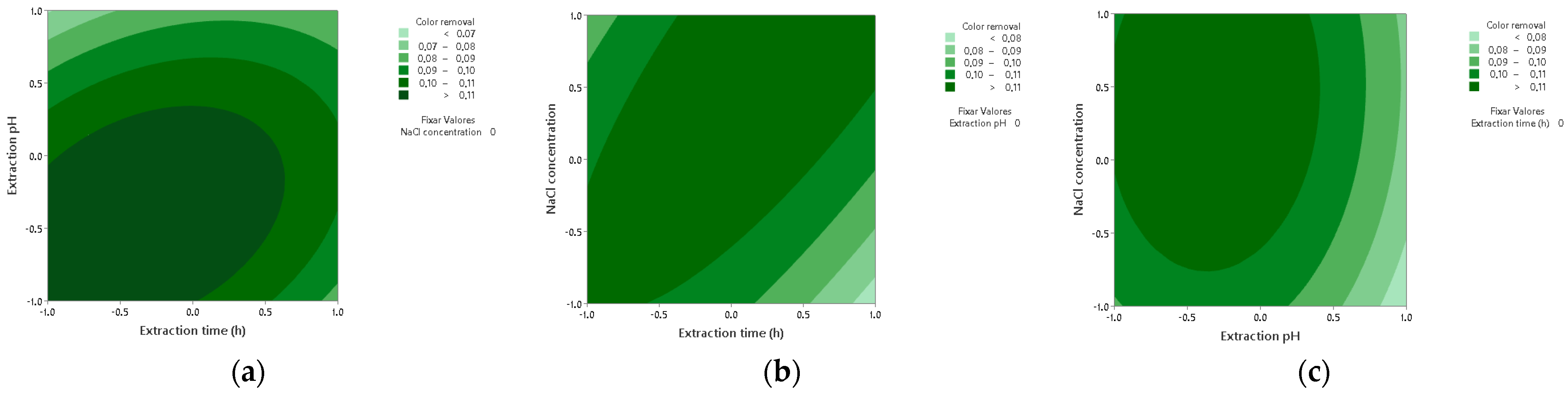
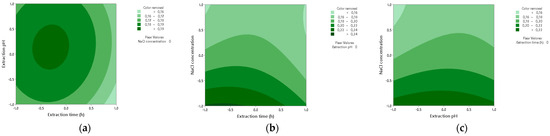
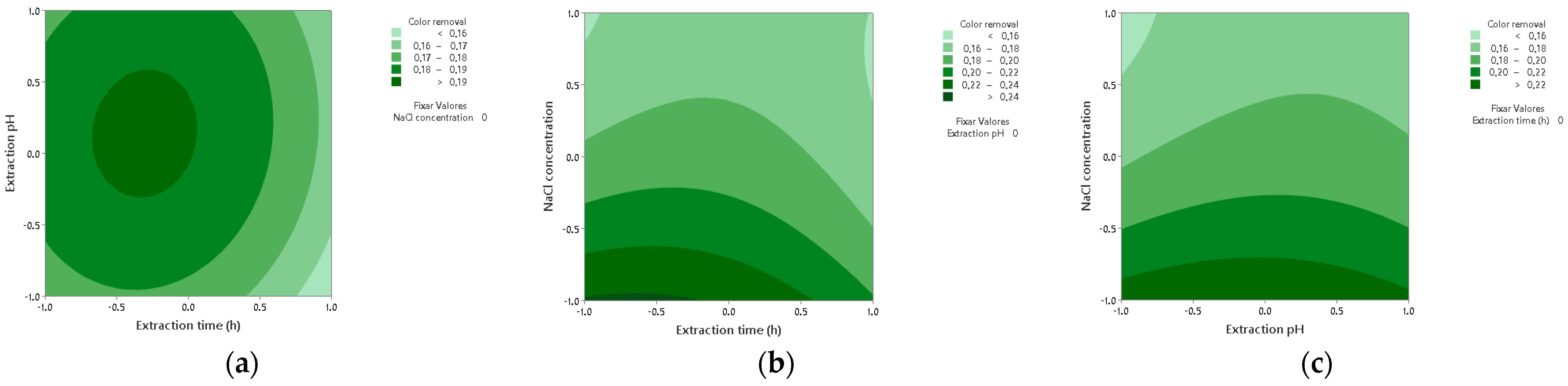
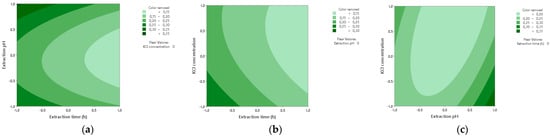
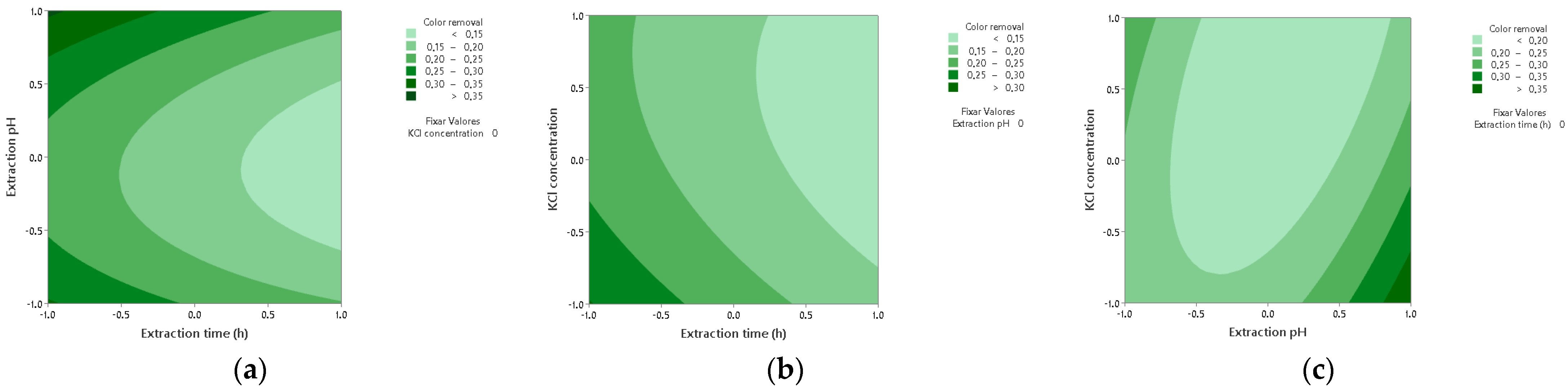
The contour plots presented in Figure 1, Figure 2 and Figure 3 illustrate the effects of extraction pH, extraction time, and NaCl concentration on apparent color removal efficiency using walnut-shell biocoagulant at dosages of 0.5, 1.0, and 1.5 mL. Based on the ANOVA results, the contour plots obtained at 0.5 and 1.5 mL are interpreted as exploratory graphical representations, whereas the statistically significant model obtained at 1.0 mL supports a more reliable interpretation of the fitted response regions. In the contour plots, the coded factor levels (−1, 0, and +1) correspond to the actual experimental values presented in Table 1. The response values displayed in the plots are expressed as fractional values corresponding to the apparent color-removal efficiency in percentage terms (e.g., 0.10 corresponds to 10%).
Figure 1.
Contour plots for apparent color removal efficiency using walnut-shell biocoagulant at a dosage of 0.5 mL as a function of: (a) extraction pH versus extraction time; (b) NaCl concentration versus extraction time; and (c) NaCl concentration versus extraction pH.
Figure 2.
Contour plots for apparent color removal efficiency using walnut-shell biocoagulant at a dosage of 1.0 mL as a function of (a) extraction pH versus extraction time; (b) NaCl concentration versus extraction time; and (c) NaCl concentration versus extraction pH.
Figure 3.
Contour plots for apparent color removal efficiency using walnut-shell biocoagulant at a dosage of 1.5 mL as a function of: (a) extraction pH versus extraction time; (b) NaCl concentration versus extraction time; and (c) NaCl concentration versus extraction pH.
At the lowest dosage, as shown in Figure 1, the fitted surfaces displayed broad and relatively symmetric response patterns. Higher fitted responses appeared under moderately acidic to near-neutral extraction conditions, intermediate extraction times, and intermediate-to-high NaCl concentrations. However, because this model was not statistically significant, these graphical patterns are considered exploratory and should not be used to define optimal conditions or support predictive conclusions.
At the intermediate dosage, as shown in Figure 2, the contour plots became more concentrated and exhibited steeper response gradients. Extraction conditions close to pH 6 became more influential, particularly when combined with low NaCl concentrations of 0.5 M and intermediate extraction times of approximately 18–24 h.
The highest apparent color removal efficiencies, above 40%, were obtained through the combined effect of lower extraction pH and reduced ionic strength. Compared with the 0.5 mL dosage, the optimal regions were narrower and more localized. The diagonal response pattern observed in the NaCl–pH interaction plot also indicated a stronger interaction between the ionic strength and extraction pH at this dosage.
At the highest dosage, as shown in Figure 3, the fitted surfaces appeared smoother, with higher fitted responses occurring mainly at the lowest NaCl concentration evaluated. Nevertheless, because the overall model was not statistically significant, these patterns should be interpreted only as exploratory. The surfaces were therefore not used to define optimal conditions or to draw predictive conclusions regarding the effects of extraction pH, extraction time, and NaCl concentration.
3.3.2. Eucalyptus-Bark Biocoagulant
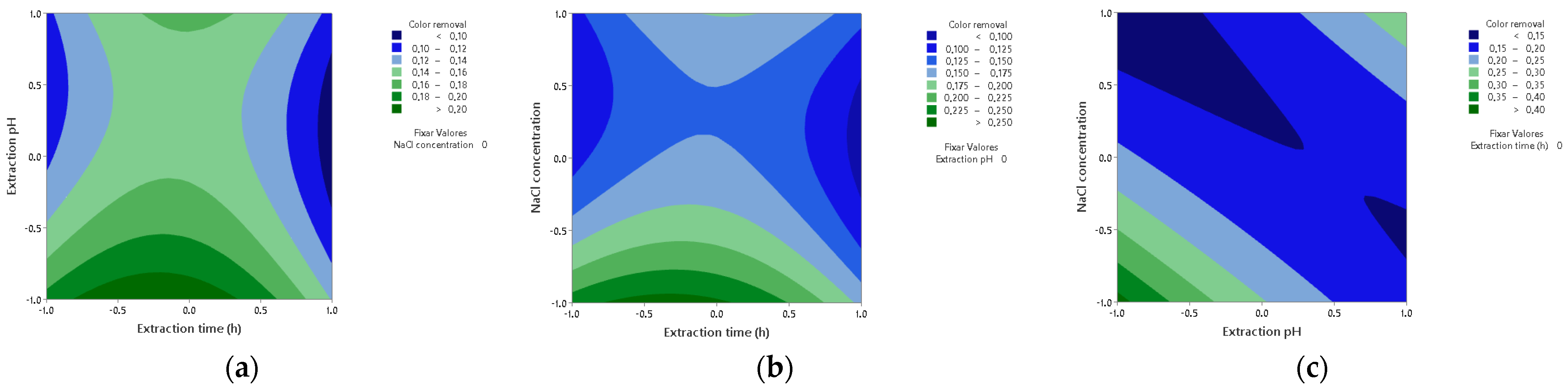
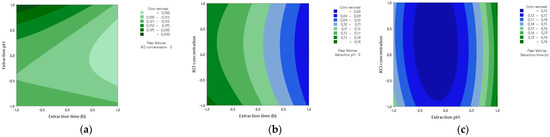
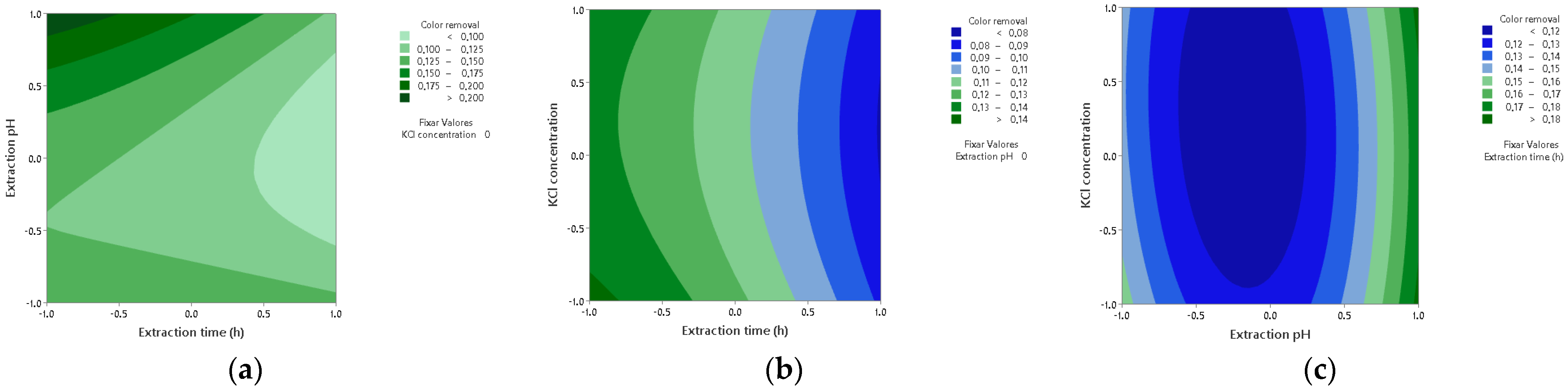
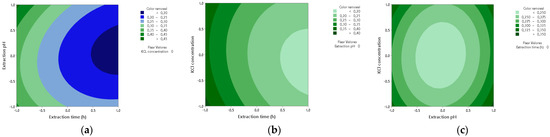
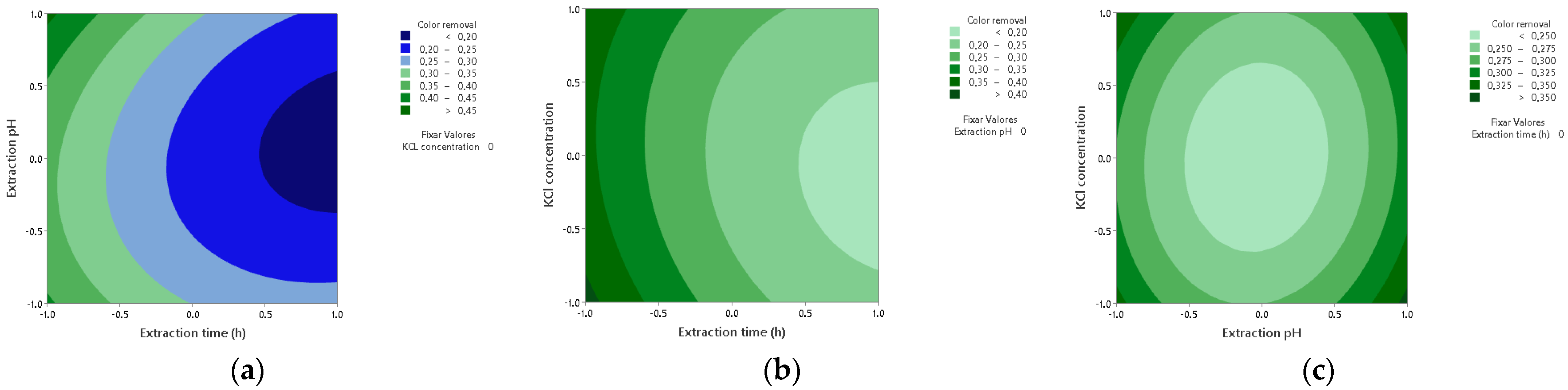
The contour plots presented in Figure 4, Figure 5 and Figure 6 illustrate the effects of extraction pH, extraction time, and KCl concentration on apparent color removal efficiency using eucalyptus bark biocoagulant at dosages of 0.5, 1.0, and 1.5 mL. In the contour plots, the coded factor levels (−1, 0, and +1) correspond to the actual experimental values presented in Table 2. The response values displayed in the plots are expressed as fractional values corresponding to the apparent color-removal efficiency in percentage terms.
Figure 4.
Contour plots for apparent color removal efficiency using eucalyptus-bark biocoagulant at a dosage of 0.5 mL as a function of: (a) extraction pH versus extraction time; (b) KCl concentration versus extraction time; and (c) KCl concentration versus extraction pH.
Figure 5.
Contour plots for apparent color removal efficiency using eucalyptus-bark biocoagulant at a dosage of 1.0 mL as a function of (a) extraction pH versus extraction time; (b) KCl concentration versus extraction time; and (c) KCl concentration versus extraction pH.
Figure 6.
Contour plots for apparent color removal efficiency using eucalyptus-bark biocoagulant at a dosage of 1.5 mL as a function of (a) extraction pH versus extraction time; (b) KCl concentration versus extraction time; and (c) KCl concentration versus extraction pH.
At the lowest dosage, as shown in Figure 4, the fitted surfaces displayed broader and more heterogeneous response patterns. Higher fitted responses appeared at pH 7, short extraction times, and low KCl concentrations. However, because the overall model was not statistically significant, these patterns are interpreted as exploratory and not as reliable evidence of optimal conditions.
At the intermediate dosage, as shown in Figure 5, the contour plots became more concentrated and exhibited stronger nonlinear interaction effects. The highest apparent color-removal efficiencies, above 35%, were observed at short extraction times of 12 h, particularly at pH 5 and pH 7.
The contour plots also demonstrated that low KCl concentrations (0.5) were strongly associated with high apparent color removal efficiencies. Compared with the 0.5 mL dosage, the optimal regions became more localized and asymmetric, indicating a highly interactive system in which the effect of extraction pH increasingly depended on the KCl concentration.
At the highest dosage, as shown in Figure 6, the fitted response surface indicated favorable regions mainly associated with extraction at pH 7, short extraction times, and relatively low KCl concentrations. However, the highest individual experimental apparent color-removal efficiency of 48% was obtained at 1.0 M KCl. This apparent difference reflects the distinction between the maximum observed response at a specific experimental run and the broader response pattern estimated by the fitted model. Therefore, the contour plots were used to describe favorable response regions within the experimental domain rather than to redefine the experimentally observed maximum.
The fitted surface also showed smoother transitions across the evaluated conditions than those observed at the lower dosages. Nevertheless, these broader response patterns should be interpreted as model-estimated tendencies rather than as evidence that 0.5 M KCl produced the highest experimental apparent color removal. Within the experimental data, the maximum observed response remained associated with 1.0 M KCl.
Independent confirmatory experiments were not performed under the model-predicted conditions. Therefore, the favorable regions identified in the contour plots should be interpreted as model-estimated response regions rather than experimentally validated optimum operating conditions. Additional experimental verification would be required to compare the predicted and observed responses and confirm the reliability of the statistically significant RSM models.
3.4. Experimental Trend Plots
3.4.1. Walnut-Shell Biocoagulant
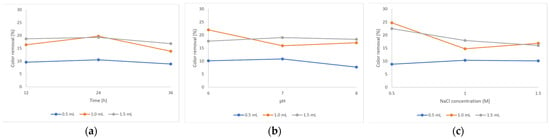
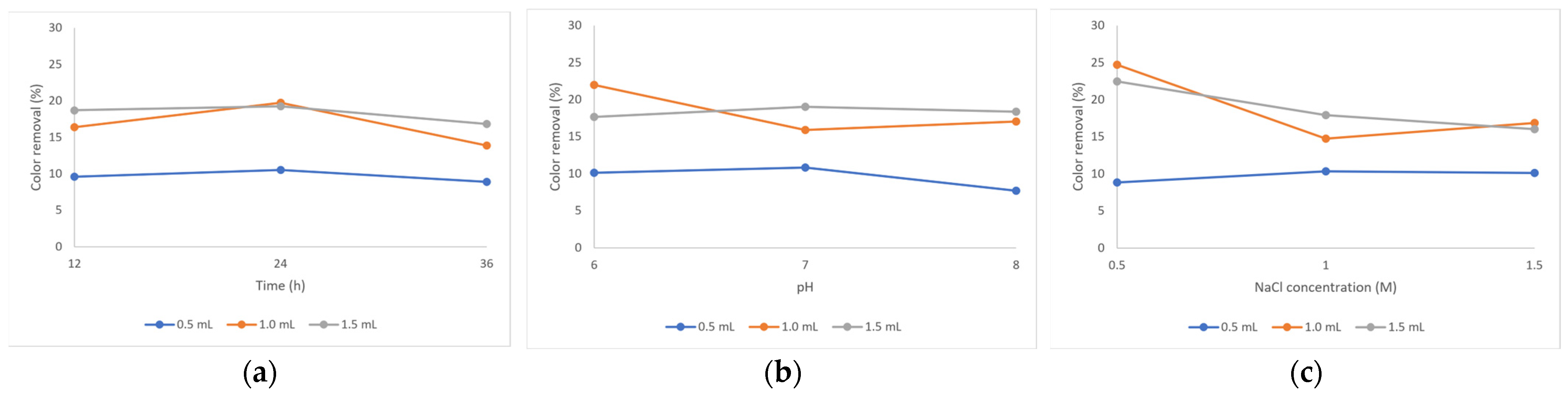
The trend plots presented in Figure 7 provide an overall representation of the effects of extraction time, extraction pH, and NaCl concentration on apparent color removal efficiency at biocoagulant dosages of 0.5, 1.0, and 1.5 mL.
Figure 7.
Trend plots for apparent color removal efficiency using walnut shell biocoagulant, effect of: (a) extraction time; (b) extraction pH; and (c) NaCl concentration.
As shown in Figure 7a, the extraction time had only a limited effect at the 0.5 mL dosage, whereas the 1.0 and 1.5 mL dosages exhibited their highest average apparent color-removal efficiencies at approximately 24 h. A decrease in apparent color removal was observed after 36 h, particularly at the 1.0 mL dosage of the coagulant.
The influence of extraction pH depended on the applied biocoagulant dosage, as shown in Figure 7b. At 1.0 mL, the highest average apparent color removal was obtained at pH 6, followed by a decrease at pH 7, and a slight increase at pH 8. At 1.5 mL, the apparent color removal increased from pH 6 to pH 7 and remained relatively stable at pH 8. The 0.5 mL dosage showed only small variations between pH 6 and 7, followed by a reduction at pH 8.
NaCl concentration produced a more pronounced effect at the 1.0 and 1.5 mL dosages Figure 7c. The highest average apparent color removal efficiencies were obtained at the lowest concentration evaluated (0.5 M), followed by a decrease as the NaCl concentration increased. At the 0.5 mL dosage, the response varied only slightly across the evaluated concentrations.
Overall, the trend plots indicate that an intermediate extraction time of approximately 24 h favored apparent color removal, particularly at higher biocoagulant dosages. The effects of extraction pH varied according to dosage, whereas low NaCl concentrations generally favored apparent color removal at 1.0 and 1.5 mL dosages. For the 1.0 mL dosage, these descriptive tendencies were consistent with the statistically supported response-surface pattern. At 0.5 and 1.5 mL, the trends represent only the observed experimental averages.
3.4.2. Eucalyptus-Bark Biocoagulant
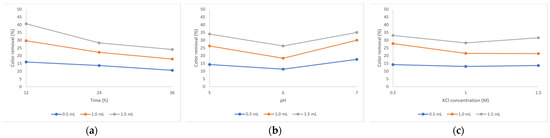
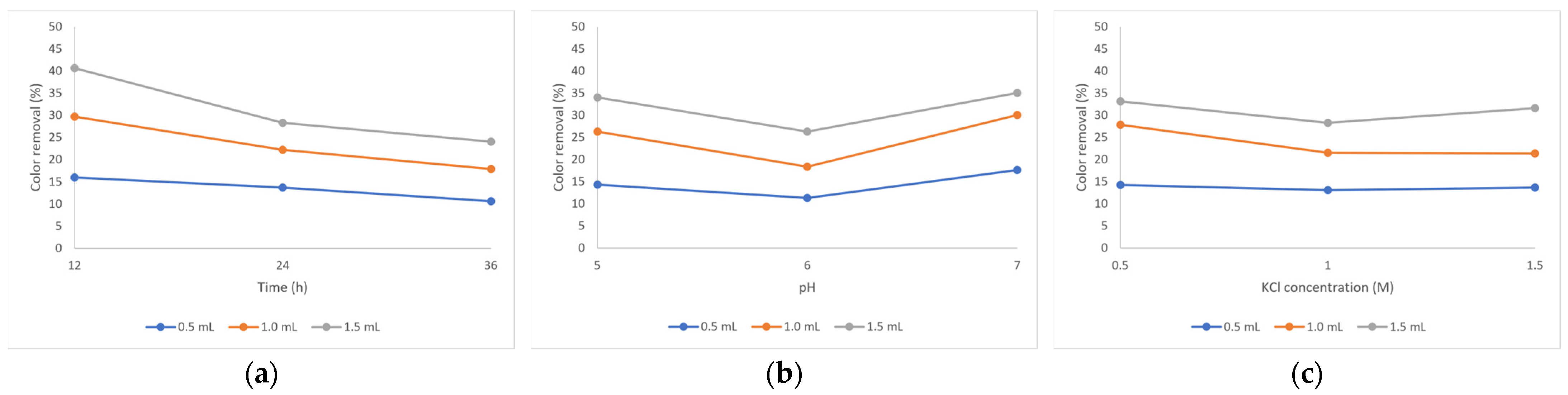
Complementary experimental trend plots based on the observed apparent color removal efficiencies are presented in Figure 8. The plots were generated using the average apparent color removal efficiencies obtained at each evaluated operational level and provided an overall representation of the effects of extraction time, extraction pH, and KCl concentration at eucalyptus bark biocoagulant dosages of 0.5, 1.0, and 1.5 mL.
Figure 8.
Trend plots for apparent color removal efficiency using eucalyptus bark biocoagulant, effect of: (a) extraction time; (b) extraction pH; and (c) KCl concentration.
As shown in Figure 8a, shorter extraction times favored apparent color removal efficiency at all evaluated dosages. The highest average responses were obtained after 12 h, followed by a progressive decrease after 24 h and 36 h. This trend was more pronounced at 1.0 and 1.5 mL dosages, whereas the 0.5 mL dosage showed a smaller variation with the extraction time.
The effect of pH followed a similar nonlinear pattern at all dosages (Figure 8b). The apparent color-removal efficiency decreased from pH 5 to pH 6 and subsequently increased at pH 7. The highest average responses were generally obtained at pH 7, particularly at the 1.0 and 1.5 mL dosages, whereas pH 6 produced the lowest average responses.
KCl concentration had a less pronounced effect than extraction time and pH, as shown in Figure 8c. At 1.0 and 1.5 mL dosages, the highest average apparent color removal efficiencies were obtained at the lowest KCl concentration (0.5 M). A decrease was observed at 1.0 M, followed by either stabilization or a slight increase at 1.5 M KCl concentration. At the 0.5 mL dosage, apparent color removal remained relatively stable across the evaluated KCl concentrations.
The biocoagulant dosage also had a clear influence on the overall response, with the 1.5 mL dosage consistently producing the highest average apparent color removal efficiencies, followed by 1.0 and 0.5 mL dosages. Overall, the trend plots indicate that short extraction times, extraction conditions at pH 7, and low KCl concentrations generally favored apparent color removal, particularly at higher biocoagulant dosages. These tendencies were consistent with the response-surface patterns obtained for the statistically significant models at 1.0 and 1.5 mL.
4. Discussion
A comparative analysis of walnut shell and eucalyptus bark biocoagulants revealed differences in apparent color removal performance and statistical behavior of the fitted models. Although the maximum apparent color-removal efficiencies were similar, reaching 47% for walnut shells and 48% for eucalyptus bark, the two materials differed in terms of operational response, statistical consistency, and model predictability.
The results obtained for both biocoagulants indicated that apparent color removal was influenced by the extraction conditions, ionic strength, and biocoagulant dosage. For eucalyptus bark, the significant models obtained at 1.0 and 1.5 mL supported a more consistent interpretation of the response surfaces. For walnut shells, statistically supported response-surface interpretation was restricted to the 1.0 mL dosage, whereas the surfaces obtained at 0.5 and 1.5 mL were considered exploratory.
Studies addressing color removal under different experimental conditions were selected to contextualize the results obtained in the present study. The comparison includes conventional chemical coagulants and plant-based treatment materials prepared as solid biomasses, aqueous extracts, saline extracts, or adsorption-based materials. Because the studies differed substantially in terms of target pollutant, wastewater matrix, initial concentration, treatment dosage, pH, contact time, and preparation method, the reported efficiencies should not be interpreted as a direct ranking of treatment performance. The selected studies are summarized in Table 7.
Table 7.
Comparison of color-removal performance reported for conventional chemical coagulants and plant-based treatment materials under different experimental conditions.
As shown in Table 7, conventional chemical coagulants and several plant-based materials achieved higher color-removal efficiencies than the apparent color-removal efficiencies obtained in the present study. However, the chemical coagulants were generally evaluated using textile wastewaters containing reactive, acid, or sulfur dyes and were frequently applied with coagulant aids or under strongly adjusted pH conditions. In addition, several plant-based studies used solid biomass, higher material concentrations, or adsorption-based systems. In contrast, the present study evaluated simple saline liquid extracts applied at low volumetric dosages to synthetic wastewater containing methylene blue as a model cationic dye. Therefore, the differences in color-removal efficiency should be interpreted in light of the substantial differences in material preparation, treatment configuration, target dye, dosage, and experimental conditions among the studies, rather than as a direct comparison of treatment effectiveness. The maximum apparent color-removal efficiencies of 47% and 48% obtained in the present study were lower than several values reported in Table 7 and should therefore be interpreted as evidence of partial apparent color removal and potential use in pretreatment or combined treatment systems rather than as performance equivalent to conventional chemical coagulation. Importantly, the novelty of this study does not rely on achieving higher absolute apparent color-removal efficiencies than previously reported materials. Rather, it lies in the systematic evaluation of how extraction time, extraction pH, salt concentration, and extract dosage influence the subsequent apparent color-removal performance of saline liquid extracts obtained from two distinct lignocellulosic residues. By applying a Box–Behnken experimental framework, the study provides information on the relationship between extraction conditions and treatment performance, as well as on the statistical significance, operational sensitivity, and predictability of the responses obtained for walnut shells and eucalyptus bark.
Pretreatment and extraction methods play an important role in disrupting lignocellulosic structures and determining the recovery and accessibility of functional biomass components [24]. In the present study, salt-assisted extraction may alter the solubility and dissociation of coagulating compounds through salting-in effects, directly influencing the recovery of active substances at different ionic strengths [41]. According to the Hofmeister framework, these effects depend not only on salt concentration but also on the specific ions present in the extraction medium. Although NaCl and KCl share the same chloride anion, Na+ and K+ occupy different positions in the Hofmeister cation series and exhibit distinct hydration and ion–solute interaction behaviors. These ion-specific properties may influence the hydration of charged and polar groups and, consequently, the solubilization of active compounds from plant biomass [42].
Therefore, NaCl and KCl should not be expected to produce identical extraction responses. Differences in the interaction of Na+ and K+ with water and biomacromolecules may affect the recovery of proteins, polysaccharides, tannins, and polyphenolic compounds. In plant-derived biocoagulants, these compounds may provide active sites capable of interacting with dissolved dye molecules through electrostatic attraction, hydrogen bonding, surface adsorption, pore filling, and other molecular interactions [21,33,43]. However, because NaCl and KCl were not directly compared under identical extraction conditions for each biomass in the present study, the individual contribution of each cation could not be isolated. Thus, the different performances observed for walnut-shell and eucalyptus-bark extracts may reflect both the intrinsic composition of each biomass and salt-specific extraction effects.
The decrease in methylene blue absorbance indicates apparent color removal under the evaluated conditions but does not, by itself, identify the predominant removal mechanism. The observed response may be associated with interactions between methylene blue and soluble or colloidal organic compounds transferred from the lignocellulosic biomass to the saline extracts. Walnut shells contain lignin, cellulose, and polyphenolic compounds [25,26], whereas eucalyptus bark contains tannins and other reactive lignocellulosic constituents [27,28,29,30]. During saline extraction, part of these potentially active compounds may be transferred to the liquid phase, making functional groups available for interaction with the dye molecules. In walnut-derived materials, oxygen-containing functional groups, particularly alcoholic and carboxylic groups, have been implicated in interactions with positively charged methylene blue, supporting adsorption and charge neutralization through electrostatic interactions as possible removal mechanisms [33]. Therefore, compounds transferred from walnut shells to the saline phase in the present study may provide functional sites capable of interacting with the cationic dye, although these interactions were not directly characterized in the extracts evaluated here. For eucalyptus-based materials, electrostatic attraction, hydrogen bonding, and surface adsorption have also been reported as possible mechanisms involved in dye removal [44]. The association of methylene blue with extracted organic compounds or residual biomass-derived colloidal particles may consequently favor aggregation and subsequent settling, decreasing the amount of dye remaining in the supernatant. Previous studies have used inactive controls and complementary analyses, including FTIR spectroscopy and toxicity assays, to distinguish degradation from passive adsorption [6]. Since measurements of floc formation, zeta potential, particle-size distribution, sludge characteristics, or structural changes in methylene blue were not performed, the observed apparent color removal should not be attributed exclusively to coagulation–flocculation. Therefore, the results are consistent with a combination of dye–extract interactions, adsorption or association with extracted organic compounds and residual colloidal particles, followed by aggregation and settling, rather than with a single experimentally demonstrated removal mechanism.
For walnut shells, apparent color removal was more dependent on specific extraction and dosage conditions. The models obtained at 0.5 and 1.5 mL were not statistically significant. A statistically significant model was obtained only at the 1.0 mL dosage (p = 0.030), with (R2 = 85.24%) and (R2adj = 66.27%). Under these conditions, the main effects were associated with the interaction between extraction pH and NaCl concentration (p = 0.004) and the quadratic effect of NaCl concentration (p = 0.036).
The statistically significant interaction between extraction pH and NaCl concentration indicated that apparent color removal depended on the combined effect of pH-dependent surface charge and ionic strength. These variables may influence both the extraction of active compounds and their subsequent interactions with methylene blue molecules. The greater variability observed for walnut shells is consistent with previous reports on lignocellulosic natural coagulants, whose performance depends strongly on extraction conditions, ionic strength, and the availability of active polymeric compounds [21].
In contrast, eucalyptus bark exhibited a stronger apparent color removal performance and more consistent statistical behavior. Apparent color-removal efficiencies above 40% were obtained under several operational conditions, whereas walnut shells reached similar values under more restricted conditions. Significant models were obtained for eucalyptus bark at both 1.0 mL (p = 0.016), (R2 = 87.98%), and (R2adj = 72.51%) and 1.5 mL (p = 0.006), (R2 = 91.27%), and (R2adj = 80.05%). At the 1.5 mL dosage, extraction time (p < 0.001) and the quadratic effect of extraction pH (p = 0.006) were highly significant factors.
The most favorable responses for eucalyptus-bark extracts were associated with extraction conditions at pH 7, short extraction times, and low KCl concentrations. Previous studies have reported that eucalyptus-based materials may exhibit affinity for dye molecules because of functional groups capable of promoting electrostatic attraction, hydrogen bonding, pore filling, and surface adsorption [43]. Therefore, the influence of extraction pH, ionic strength, and extraction time may be associated with changes in the extraction and availability of potential adsorption sites. However, these sites were not directly characterized in the present study.
The recurring significance of extraction time and the quadratic effect of extraction pH on eucalyptus bark indicate a more stable and mechanistically coherent response. This behavior may also be associated with the presence of tannins, lignocellulosic compounds, and other active functional groups capable of contributing to coagulation–flocculation, adsorption mechanisms, electrostatic interactions, hydrogen bonding, and association with dissolved dye molecules [43,44].
Plant-based coagulants rich in natural polymers commonly exhibit adsorption-related removal mechanisms that are strongly affected by the extraction conditions and solution chemistry [21]. These mechanisms may explain the progressive stabilization of the response surfaces observed for both biocoagulants, as well as the influence of NaCl concentration on walnut-shell extracts and KCl concentration on eucalyptus-bark extract.
Overall, eucalyptus bark demonstrated greater statistical consistency and better model predictability, particularly at higher biocoagulant dosage levels. The broader occurrence of apparent color-removal efficiencies above 40% also indicated a more stable response across the evaluated experimental conditions. Nevertheless, walnut shells showed relevant apparent color-removal potential, particularly at the 1.0 mL dosage, but required a narrower combination of extraction pH and NaCl concentration to achieve their highest apparent efficiency.
From a broader perspective, the use of walnut shells and eucalyptus bark as sources of natural treatment agents may contribute to the development of more sustainable wastewater-treatment strategies based on the valorization of agro-industrial and forestry residues. Recent studies have demonstrated that lignocellulosic wastes can be converted into functional materials or renewable reagents for environmental and resource-recovery applications. Li et al. [45], for example, used coffee shells as a biomass-derived reducing agent for iron recovery from pyrite cinder, illustrating how low-value agricultural residues may replace conventional reagents and contribute to circular-economy strategies. In another study, Li et al. [46] converted lignin into a hierarchical porous carbon adsorbent for contaminant removal from water, demonstrating the potential for the high-value utilization of lignocellulosic resources. Although the preparation routes and applications investigated in these studies differ substantially from the saline extraction process evaluated here, they reinforce the broader potential of lignocellulosic residues as renewable feedstocks for environmental technologies. Converting walnut shells and eucalyptus bark into functional treatment materials may reduce waste generation, support circular-economy practices, and decrease dependence on conventional metal-based coagulants. Saline extraction under relatively mild conditions may also represent a simpler preparation route than processes involving extensive chemical modification or thermal conversion.
From an engineering perspective, the practical application of the saline extracts depends on aspects that were not fully evaluated in the present study. Although plant-based treatment agents may avoid the generation of metal-containing sludge associated with conventional coagulants, the amount, composition, settling behavior, and dewaterability of the solids generated after treatment remain unknown. The extracts were stored at 4 °C until use; however, specific storage-stability tests were not performed to determine whether their composition and apparent color-removal performance remained unchanged over time. In addition, scale-up would require the assessment of biomass availability, extraction volume, salt consumption, solid–liquid separation, mixing, settling, and extract dosage. Therefore, sludge characterization, storage-stability tests, and pilot-scale evaluation are necessary before practical implementation can be established.
From an economic and operational perspective, the feasibility of the extraction process would depend on biomass availability, extraction duration, chemical consumption, energy requirements, and solid–liquid separation. Longer extraction periods may increase equipment occupancy and the energy consumption associated with agitation. Higher salt concentrations increase reagent consumption and may create additional requirements for managing the saline extraction solutions. If these solutions are discharged without adequate treatment, they may increase the salinity and ionic load of the resulting wastewater, potentially affecting subsequent biological treatment processes and receiving water bodies. At larger scales, strategies such as reuse of the extraction solution in successive cycles or recovery and recirculation of the saline phase should be investigated to reduce chemical consumption and waste generation. However, these alternatives were not evaluated in the present study, and their feasibility would depend on maintaining extraction performance while preventing the accumulation of dissolved organic compounds and other impurities. Adjustment of the extraction pH also requires the use of acidic or alkaline reagents, which should be considered in a full-scale cost assessment. Although walnut shells and eucalyptus bark are low-value agro-industrial and forestry residues, the costs associated with collection, transportation, drying, milling, extraction, filtration, storage, and application of the extracts were not quantified in the present study. Therefore, mass-balance studies and a detailed environmental and techno-economic analysis are required before the economic feasibility and scalability of the proposed process can be established.
However, the maximum apparent color-removal efficiencies remained below 50% under the evaluated conditions; therefore, these biocoagulants should not be considered complete substitutes for conventional treatment processes. Nevertheless, both residues have potential as renewable raw materials for the production of natural treatment agents.
The present study was limited to synthetic wastewater containing methylene blue as a single model cationic dye at an initial concentration of 10 mg L−1. Because dye charge, molecular structure, size, and functional groups may substantially influence interactions with plant-derived treatment agents, the observed apparent color-removal performance cannot be directly extrapolated to anionic dyes or other classes of textile colorants. The results should also not be generalized to real textile or industrial wastewater, which may contain mixtures of cationic and anionic dyes, salts, surfactants, suspended solids, organic matter, and variable pH conditions.
Future studies should evaluate both extracts using individual cationic and anionic dyes, as well as binary and multicomponent dye mixtures. These experiments should investigate possible competitive, synergistic, and inhibitory interactions among dye molecules and determine how these effects influence the selectivity and overall color-removal efficiency of the extracts. Real textile wastewater containing mixtures of dyes, salts, surfactants, suspended solids, and organic matter should also be investigated to determine the broader applicability of the proposed treatment agents. Chemical characterization of the extracts, including the identification and quantification of tannins, polyphenols, proteins, polysaccharides, and other potentially active compounds, would help clarify the mechanisms responsible for color removal. Confirmatory experiments should also be performed under the favorable conditions predicted by the statistically significant RSM models to compare the predicted and experimental responses and validate the model estimates. Beyond conventional response-surface approaches, machine-learning methods have recently been applied to model complex interactions and support predictive optimization in textile wastewater-treatment systems [47]. Such approaches may be explored in future studies using larger experimental datasets.
Further research should address the industrial applicability of the proposed extracts. Pilot-scale studies are needed to evaluate process scale-up, operational performance, salt management, and the behavior of the extracts under continuous or semi-continuous treatment conditions. Long-term storage studies should determine whether extract composition, microbial stability, and color-removal efficiency change over time. The reproducibility of the process should also be assessed using walnut shells and eucalyptus bark obtained from different geographical sources, harvest periods, species or cultivars, and processing batches, because natural variations in biomass composition may affect extraction yield and treatment performance. Finally, techno-economic and life-cycle assessments should quantify the environmental impacts associated with biomass collection, transportation, drying, milling, saline extraction, salt consumption, extract storage, application, and waste management, and compare them with those associated with conventional treatment agents. These assessments are necessary to determine the practical, environmental, and economic feasibility of the proposed materials.
5. Conclusions
This study evaluated saline extracts obtained from walnut shells and eucalyptus bark for apparent color removal from synthetic wastewater containing methylene blue as a model cationic dye at an initial concentration of 10 mg L−1. Extraction time, extraction pH, and salt concentration were investigated using Response Surface Methodology and a three-factor Box–Behnken experimental design, whereas biocoagulant dosage was evaluated separately by fitting independent models for each dosage.
Both biomasses demonstrated potential for apparent color removal from the evaluated synthetic methylene-blue wastewater. The walnut-shell and eucalyptus-bark extracts achieved apparent color-removal efficiencies of 4–47% and 7–48%, respectively. Although the maximum apparent efficiencies were similar, eucalyptus bark showed greater statistical consistency and better model predictability with significant models obtained at dosages of 1.0 and 1.5 mL, and apparent color removal efficiencies above 40% were observed under several experimental conditions. Walnut shells also showed relevant apparent color-removal potential, particularly at the 1.0 mL dosage; however, their performance depended on a specific combination of extraction pH and NaCl concentration.
Overall, the results indicate that walnut shells and eucalyptus bark can serve as renewable raw materials for the production of natural treatment agents, contributing to the valorization of agro-industrial and forestry residues. However, the present findings are limited to synthetic wastewater containing methylene blue as a model cationic dye at an initial concentration of 10 mg L−1. Therefore, the results should not be generalized to anionic dyes, other dye classes, binary or multicomponent dye mixtures, or real textile wastewater, in which competition among contaminants may affect the selectivity and overall apparent color-removal performance of the extracts. In addition, because the maximum apparent color-removal efficiencies remained below 50%, these extracts may be more suitable as pretreatment agents or as components of combined treatment systems rather than as complete substitutes for conventional processes. Further research should include the evaluation of individual cationic and anionic dyes, binary and multicomponent dye mixtures, competitive interactions among different dye molecules, independent confirmatory experiments under the favorable conditions predicted by the statistically significant models, application to real textile wastewater, and chemical characterization of the extracts. Pilot-scale studies should also assess process scale-up, long-term storage stability, salt management, and the reproducibility of extracts prepared from biomass obtained from different sources, harvest periods, and processing conditions. Finally, techno-economic and life-cycle assessments are required to determine the environmental and industrial feasibility of the proposed materials.
Supplementary Materials
The following supporting information can be downloaded at: https://www.mdpi.com/article/10.3390/app16178444/s1. Supplementary Section S1: Walnut Shell Biocoagulant and Supplementary Section S2: Eucalyptus Bark Biocoagulant.
Author Contributions
Conceptualization, I.A., R.M. and J.M.T.d.A.P.; methodology, I.A., R.M. and J.M.T.d.A.P.; validation, R.M. and J.M.T.d.A.P.; formal analysis, I.A.; investigation, I.A.; data curation, I.A.; writing—original draft preparation, I.A.; writing—review and editing, I.A., R.M. and J.M.T.d.A.P.; visualization, I.A.; supervision, R.M. and J.M.T.d.A.P.; project administration, R.M. All authors have read and agreed to the published version of the manuscript.
Funding
This research was funded by the Base Funding UIDB/00690/2020 of the Centro de Investigação de Montanha (CIMO)-funded by national funds through FCT/MCTES (PIDDAC).
Data Availability Statement
The original contributions presented in this study are included in the article/Supplementary Materials. Further inquiries can be directed to the corresponding author.
Acknowledgments
The authors thank the Superior School of Technology and Management, Bragança Polytechnic University, Portugal for their support.
Conflicts of Interest
The authors declare no conflicts of interest.
Abbreviations
The following abbreviations are used in this manuscript:
| ANOVA | Analysis of variance |
| BBD | Box–Behnken Design |
| RSM | Response surface methodology |
| UV–Vis | Ultraviolet–visible spectroscopy |
References
- Carneiro, P.A.; Umbuzeiro, G.A.; Oliveira, D.P.; Zanoni, M.V.B. Assessment of water contamination caused by a mutagenic textile effluent/dyehouse effluent bearing disperse dyes. J. Hazard. Mater. 2010, 174, 694–699. [Google Scholar] [CrossRef] [Scilit]
- Khan, N.A.; López-Maldonado, E.A.; Majumder, A.; Singh, S.; Varshney, R.; López, J.R.; Méndez, P.F.; Ramamurthy, P.C.; Khan, M.A.; Khan, A.H.; et al. A state-of-art-review on emerging contaminants: Environmental chemistry, health effect, and modern treatment methods. Chemosphere 2023, 344, 140264. [Google Scholar] [CrossRef] [Scilit]
- Patel, H. Removal of COD, BOD and color of different industrial effluents using activated neem char. Environ. Adv. 2024, 16, 100553. [Google Scholar] [CrossRef] [Scilit]
- Vilela, C.L.S.; Bassin, J.P.; Peixoto, R.S. Water contamination by endocrine disruptors: Impacts, microbiological aspects and trends for environmental protection. Environ. Pollut. 2018, 235, 546–559. [Google Scholar] [CrossRef] [Scilit]
- Menezes, H.C.; Orlando, R.M.; Augusti, R.; Macedo, A.N.; Almeida, M.R.; Cardeal, Z.L.; Valenzuela, E.F.; Ribeiro, C.C.; Avelar, M.C.F.; de Freitas, M.C.; et al. Analysis of contaminants in surface water after the collapse of the Córrego do Feijão mine dam in Brumadinho, Brazil. Sci. Total Environ. 2025, 990, 179954. [Google Scholar] [CrossRef] [Scilit] [PubMed]
- Lin, W.; Lin, W.; Yang, L.; Zhang, C.; Li, X.; Xiao, J.; Chen, X.; Cai, F.; Chen, C.; Zhang, M.; et al. Characterization of a novel Dye-Decolorizing peroxidase from Brevibacillus agri and its application in detoxification of textile industry wastewater. Bioresour. Technol. 2025, 440, 133430. [Google Scholar] [CrossRef] [Scilit]
- Greeshma, B.S.; Khanna, R.; Sankar, B. Bridging the gap: India’s circularity and sustainability landscape in apparel and textiles compared to global trend. Soc. Sci. Humanit. Open 2026, 13, 102734. [Google Scholar] [CrossRef] [Scilit]
- Lucas, A.M.B. A Sustentabilidade no Setor Têxtil em Portugal: Soeiro: Um Caso do Mercado Nacional. Master’s Thesis, Universidade Católica Portuguesa, Lisboa, Portugal, 8 April 2024. [Google Scholar]
- Ramos, M.D.N.; Lima, J.P.P.; Aquino, S.F.; Aguiar, A. A critical analysis of the alternative treatments applied to effluents from Brazilian textile industries. J. Water Process Eng. 2021, 43, 102273. [Google Scholar] [CrossRef] [Scilit]
- Al-Tohamy, R.; Ali, S.S.; Li, F.; Okasha, K.M.; Mahmoud, Y.A.-G.; Elsamahy, T.; Jiao, H.; Fu, Y.; Sun, J. A critical review on the treatment of dye-containing wastewater: Ecotoxicological and health concerns of textile dyes and possible remediation approaches for environmental safety. Ecotoxicol. Environ. Saf. 2022, 231, 113160. [Google Scholar] [CrossRef] [Scilit]
- Fahad, A.; Darwish, M.; Ethaib, S.; Aris, A.; Ali, I.M.; Ali, N.; Mustafa, S. Innovative approaches to textile wastewater treatment: State-of-the-art technologies and future horizons. Sci. Afr. 2026, 32, e03341. [Google Scholar] [CrossRef] [Scilit]
- Abdo, S.M.; Mahmoud, R.H.; Youssef, M.; El-Naggar, M.E. Cationic starch and polyaluminum chloride as coagulants for River Nile water treatment. Groundw. Sustain. Dev. 2020, 10, 100331. [Google Scholar] [CrossRef] [Scilit]
- Lim, H.R.; Choo, C.M.; Chong, C.H.; Wong, V.-L. Optimization studies for water defluoridation with two-stage coagulation processes using new industrial-based chemical coagulants. J. Water Process Eng. 2021, 42, 102179. [Google Scholar] [CrossRef] [Scilit]
- Lima, P.R.; Almeida, I.V.; Vicentini, V.E.P. Os diferentes tipos de coagulantes naturais para o tratamento de água: Uma revisão. Evidência Biociências Saúde Inov. 2020, 20, 9–12. [Google Scholar] [CrossRef] [Scilit]
- Ndayako, A.; Sani, B.; Abubakar, U.; Isama, S.; Yakubu, A. Assessing the efficacy of bio-coagulants in water treatment. Eur. J. Appl. Sci. Eng. Technol. 2023, 1, 20–29. [Google Scholar] [CrossRef] [Scilit]
- Kumar, A.; Srivastava, N.K.; Gera, P. Removal of color from pulp and paper mill wastewater—Methods and techniques: A review. J. Environ. Manag. 2021, 298, 113527. [Google Scholar] [CrossRef] [Scilit]
- Uwanta, E.J.; Nicholas, E.-O.S.; Ukoha, P.O.; Agala, C.T. Evaluation of the phytochemical properties of Eucalyptus citriodora exudates and its potency as coagulant in water purification. Chem. Mater. Res. 2022, 14, 13–20. [Google Scholar] [CrossRef] [Scilit]
- Benalia, A.; Derbal, K.; Amrouci, Z.; Baatache, O.; Khalfaoui, A.; Pizzi, A. Application of plant-based coagulants and their mechanisms in water treatment: A review. J. Renew. Mater. 2024, 12, 675–702. [Google Scholar] [CrossRef] [Scilit]
- Husen, A.K.; Bidira, F.; Desta, W.M.; Asaithambi, P. COD, color, and turbidity reduction from surface water using natural coagulants: Investigation and optimization. Prog. Eng. Sci. 2024, 1, 100007. [Google Scholar] [CrossRef] [Scilit]
- Al-Hanaktah, A.; Pérez, S.M. Natural coagulants extracted from leaf, shell, and kernel of Jatropha curcas for turbidity treatment. Appl. Sci. Eng. Prog. 2026, 19, 7847. [Google Scholar] [CrossRef] [Scilit]
- Choy, S.Y.; Prasad, K.M.N.; Wu, T.Y.; Raghunandan, M.E.; Ramanan, R.N. Utilization of plant-based natural coagulants as future alternatives towards sustainable water clarification. J. Environ. Sci. 2014, 26, 2178–2189. [Google Scholar] [CrossRef] [Scilit]
- Geissdoerfer, M.; Savaget, P.; Bocken, N.M.P.; Hultink, E.J. The circular economy—A new sustainability paradigm? J. Clean. Prod. 2017, 143, 757–768. [Google Scholar] [CrossRef] [Scilit]
- Kirchherr, J.; Reike, D.; Hekkert, M. Conceptualizing the circular economy: An analysis of 114 definitions. Resour. Conserv. Recycl. 2017, 127, 221–232. [Google Scholar] [CrossRef] [Scilit]
- Ma, H.; Fu, P.; Zhao, J.; Lin, X.; Wu, W.; Yu, Z.; Xia, C.; Wang, Q.; Gao, M.; Zhou, J. Pretreatment of wheat straw lignocelluloses by deep eutectic solvent for lignin extraction. Molecules 2022, 27, 7955. [Google Scholar] [CrossRef] [Scilit]
- Jahanban-Esfahlan, A.; Jahanban-Esfahlan, R.; Tabibiazar, M.; Roufegarinejad, L.; Amarowicz, R. Recent advances in the use of walnut (Juglans regia L.) shell as a valuable plant-based bio-sorbent for the removal of hazardous materials. RSC Adv. 2020, 10, 7026–7047. [Google Scholar] [CrossRef] [Scilit]
- Acoglu Celik, B.; Celik, M.A.; Jūrienė, L.; Jovaišaitė, J.; Kazernavičiūtė, R.; Bekar, E.; Yolci Omeroglu, P.; Venskutonis, P.R.; Kamiloglu, S. Biorefining of walnut shells into polyphenol-rich extracts using ultrasound-assisted, enzyme-assisted, and pressurized liquid extraction coupled with chemometrics. Foods 2025, 14, 2245. [Google Scholar] [CrossRef] [Scilit]
- Miranda, I.; Gominho, J.; Mirra, I.; Pereira, H. Fractioning and chemical characterization of barks of Betula pendula and Eucalyptus globul. Ind. Crops Prod. 2013, 41, 299–305. [Google Scholar] [CrossRef] [Scilit]
- Chemetova, C.; Fabião, A.; Gominho, J.; Ribeiro, H. Range analysis of Eucalyptus globulus bark low-temperature hydrothermal treatment to produce a new component for growing media industry. Waste Manag. 2018, 79, 1–7. [Google Scholar] [CrossRef] [Scilit]
- Grenda, K.; Gamelas, J.A.F.; Arnold, J.; Pellizzer, L.; Cayre, O.J.; Rasteiro, M.G. Evaluation of anionic eco-friendly flocculants prepared from eucalyptus pulps with diverse lignin contents for application in effluent treatment. Polymers 2021, 13, 25. [Google Scholar] [CrossRef] [Scilit]
- Tomasi, I.T.; Santos, S.C.R.; Boaventura, R.A.R.; Botelho, C.M.S. Microwave-assisted extraction of polyphenols from eucalyptus bark—A first step for a green production of tannin-based coagulants. Water 2023, 15, 317. [Google Scholar] [CrossRef] [Scilit]
- Siddique, M.; Soomro, S.; Jatoi, A.; Unar, I. Removal of turbidity from turbid water by bio-coagulant prepared from walnut shell. J. Appl. Emerg. Sci. 2016, 6, 66–68. [Google Scholar]
- Zedan, T.; Mossad, M.; Fouad, M.; Mahanna, H. Potential application of natural coagulant extraction from walnut seeds for water turbidity removal. Water Pract. Technol. 2022, 17, 684–698. [Google Scholar] [CrossRef] [Scilit]
- Zourif, A.; Benbiyi, A.; Kouniba, S.; El Guendouzi, M. Valorization of walnut husks as a natural coagulant for optimized water decolorization. Arab. J. Chem. 2024, 17, 105399. [Google Scholar] [CrossRef] [Scilit]
- Nujkic, M.; Milić, S.; Papludis, A.; Stanković, S.; Radojevic, A.; Alagić, S.; Spalović, B. Walnut shell as a biosorbent for removal of heavy metal ions from different sample solutions. In Proceedings of the 28th International Conference EcoTER’20, Kladovo, Serbia, 16–19 June 2020. [Google Scholar]
- Klumb, A.K.; Faria, O.L.V. Produção de coagulante vegetal catiônico a partir de cascas de Eucalipto (Eucalyptus tereticornis). VETOR Rev. Ciênc. Exatas Eng. 2013, 22, 71–80. [Google Scholar]
- Grenda, K.; Gamelas, J.A.F.; Arnold, J.; Cayrec, O.J.; Rasteiro, M.G. Cationization of eucalyptus wood waste pulps with diverse lignin contents for potential application in colored wastewater treatment. RSC Adv. 2019, 9, 34857–34869. [Google Scholar] [CrossRef] [Scilit]
- Semassel, S.E.; Elhadeuf, K.; Bougdah, N.; Messikh, N. Enhancing the clarification of Azzaba landfill leachate using biocoagulants with optimization by Box–Behnken design. Chem. Chem. Technol. 2025, 19, 307–326. [Google Scholar] [CrossRef] [Scilit]
- Sivalingam, S.; Vijayaraghavan, G.; Vimalkumar, A. Efficient removal of magenta dye from water by both natural and chemical coagulants. Rasayan J. Chem. 2023, 16, 307–311. [Google Scholar] [CrossRef] [Scilit]
- Hadadi, A.; Imessaoudene, A.; Bollinger, J.-C.; Cheikh, S.; Assadi, A.A.; Amrane, A.; Kebir, M.; Mouni, L. Parametrical study for the effective removal of Mordant Black 11 from synthetic solutions: Moringa oleifera seed extracts versus alum. Water 2022, 14, 4109. [Google Scholar] [CrossRef] [Scilit]
- Verma, A.K.; Dash, R.R.; Bhunia, P. A review on chemical coagulation/flocculation technologies for removal of colour from textile wastewaters. J. Environ. Manag. 2012, 93, 154–168. [Google Scholar] [CrossRef] [Scilit]
- Yin, C.-Y. Emerging usage of plant-based coagulants for water and wastewater treatment. Process Biochem. 2010, 45, 1437–1444. [Google Scholar] [CrossRef] [Scilit]
- Kang, B.; Tang, H.; Zhao, Z.; Song, S. Hofmeister Series: Insights of Ion Specificity from Amphiphilic Assembly and Interface Property. ACS Omega 2020, 5, 6229–6239. [Google Scholar] [CrossRef] [Scilit]
- Anastopoulos, I.; Ahmed, M.J.; Hummadi, E.H. Eucalyptus-based materials as adsorbents for heavy metals and dyes removal from (waste)waters. J. Mol. Liq. 2022, 356, 118864. [Google Scholar] [CrossRef] [Scilit]
- Khelladi, R.M.B.; Chiboub Fellah, A.; Benyagoub, M.; Chiboub Fellah, F.Z.; Rahmani, Z.; Benadda, L. Enhanced coagulation-flocculation of domestic wastewater using sustainable plant-based material: A comparative study of nopal, agave, and eucalyptus. Water SA 2026, 52, 151–160. [Google Scholar] [CrossRef] [Scilit]
- Li, X.; Ran, R.; Zeng, W.; Ren, S.; Wang, Y.; Zhu, A.; Zheng, C. Coffee shell as a green reductant for iron recovery from pyrite cinder: Synergy of biomass-driven reduction and acid leaching. Miner. Eng. 2025, 234, 109747. [Google Scholar] [CrossRef] [Scilit]
- Li, X.; Li, Y.; Li, Y.; Zhang, M.; Zhu, J. Synthesis of lignin-derived hierarchical porous carbon via hydrothermal–phosphoric acid synergistic activation for enhanced adsorption of tetracycline. Molecules 2026, 31, 447. [Google Scholar] [CrossRef] [Scilit]
- Yan, Z.; Xing, J.; Hong, X.; Song, Y.; Ding, Y.; Wei, G.; Zhang, H.; Chen, S.; Quan, X. Machine learning-guided prediction for practical flux of nanofiltration membranes in textile wastewater reclamation. J. Membr. Sci. 2026, 756, 125810. [Google Scholar] [CrossRef] [Scilit]

Disclaimer/Publisher’s Note: The statements, opinions and data contained in all publications are solely those of the individual author(s) and contributor(s) and not of MDPI and/or the editor(s). MDPI and/or the editor(s) disclaim responsibility for any injury to people or property resulting from any ideas, methods, instructions or products referred to in the content. |
© 2026 by the authors. Licensee MDPI, Basel, Switzerland. This article is an open access article distributed under the terms and conditions of the Creative Commons Attribution (CC BY) license.