


Abstract
The coefficient of earth pressure at rest, K0, is central to defining initial stress states in soils, yet its estimation remains uncertain because formulations differ in calibration basis, governing variables, and physical meaning. This review examines and compares more than 40 analytical, empirical, experimental, and constitutive-model-based approaches for estimating K0. The formulations are classified by soil type, stress history, determination method, and limitations, covering friction-angle- and OCR-based correlations, laboratory testing, in situ inference, and field-oriented developments. The comparison shows that values reported under the common notation K0 are not necessarily equivalent, because they may represent different loading paths, material states, or interpretations of zero lateral strain. For the selected friction-angle-based formulations, extreme predictions define a relatively broad envelope, whereas most expressions cluster within a narrower band. However, this variability does not translate uniformly into engineering response. Its significance depends on soil type, stress history, and whether the initial stress state persists or is modified by construction-induced deformation and stress redistribution. The unresolved issue is therefore not the absence of estimation methods but their limited transferability across geotechnical contexts. K0 should consequently be selected as a modelling parameter with explicit consideration of its physical basis, applicability, and expected influence on the problem under analysis.
1. Introduction
The coefficient of earth pressure at rest, , defines the ratio between horizontal and vertical effective stresses in soil under zero lateral strain conditions. It is widely used to define the initial stress state, estimate lateral stresses acting on non-yielding retaining structures, and initialize numerical models. However, its determination in practice remains inconsistent, particularly regarding the selection, interpretation, and applicability of available formulations in relation to the physical state they represent and the conditions under which they were developed [1,2].
Although numerous methods have been proposed for estimating , they do not always produce consistent predictions. Differences among methods may alter the assumed initial stress state and, in problems sensitive to stress initialization, may influence modelling outcomes or design decisions [3,4]. The central difficulty is therefore not the absence of estimation methods, but the limited basis for transferring formulations across different soil types, stress histories, measurement procedures, and engineering contexts.
This difficulty is compounded by the fact that different formulations do not necessarily represent equivalent physical conditions, even when the same notation is used. The at-rest coefficient characterizes a stress state associated with negligible lateral strain before substantial stress redistribution caused by lateral deformation. Its interpretation therefore depends on the loading path, material state, stress history, and procedure used to measure or infer it. Neglecting these distinctions may introduce additional dispersion when correlations developed under specific conditions are applied more broadly. This issue has accompanied the development of the concept, from early attempts to distinguish pressures acting on non-yielding structures from mobilized earth pressures to later discussions concerning the physical basis of classical formulations [5,6,7].
Within this context, this paper presents a comparative assessment of methods used to estimate , with explicit attention to their physical basis, governing variables, applicability, and engineering implications. More than 40 analytical, empirical, experimental, and constitutive-model-based approaches are reviewed and classified according to soil type, stress history, determination method, basis of development, and reported limitations.
This paper is structured as a targeted critical review rather than as a bibliometric systematic review. The literature was selected to cover foundational historical works, predictive expressions, laboratory and in situ determination methods, constitutive and geophysical approaches, material-specific developments, and critical reassessments published up to 2026, using targeted keyword searches and citation tracking from seminal contributions. Sources were included when they introduced, evaluated, applied, or critically reassessed a formulation or determination approach or when they contributed directly to the physical interpretation of the at-rest condition. Sources in which was only used as an assumed input parameter, without methodological discussion or clear relation to the at-rest stress state, were not included. Repeated derivations or reformulations were not treated as independent methods unless they introduced a distinct governing variable, calibration basis, soil condition, stress-history interpretation, or determination procedure. Empirical formulations with local or material-specific calibration were retained only when they contributed to the interpretation of transferability, and their limited applicability is identified in Table 1.
Table 1.
Summary and classification of formulations, determination approaches, and historical observations related to the coefficient of earth pressure at rest .
The historical development of the at-rest condition is examined to clarify the origins of the different interpretations associated with . On this basis, the review addresses three linked research questions: (i) what physical meaning and governing variables are represented by the different formulations; (ii) under which soil types, stress histories, and determination procedures these formulations can be considered applicable; and (iii) under which conditions the dispersion among estimates may affect geotechnical modelling or design.
2. From Earth Pressure Theory to the At-Rest Earth Pressure Coefficient K0
The historical development of the at-rest condition reflects a progressive shift from earth pressure interpreted as a mobilized limit state to K0 as an initial stress ratio associated with constrained lateral deformation. This evolution has been governed by a persistent tension between the practical value of simple formulations and the need to represent the effects of stress history, soil state, and determination procedure. In the absence of a formal theory of lateral earth pressure, retaining structures were initially designed using geometric proportions, empirical rules, and accumulated construction experience [48,49].
During the 17th century, quantifiable parameters began to be incorporated into the design of support systems. Bullet [50] proposed a geometric representation of earth pressure in granular materials, while Gautier [51] introduced measurements of unit weight and natural slope angle. These developments marked a transition from empirical rules toward descriptions based on measurable parameters, although still without an explicit formulation of the stress state associated with the at-rest condition [49].
Coulomb [52] later formulated lateral earth pressure in terms of limit equilibrium, incorporating friction, cohesion, and failure surfaces. Rankine [53] extended this framework through a more general formulation based on the equilibrium of a granular mass. However, both approaches were developed under failure or near-failure conditions and did not explicitly address the stress state corresponding to zero lateral deformation.
By the late 19th century, the distinction between mobilized earth pressure and the at-rest condition became more clearly defined. Mohr [54] noted that experimental procedures at the time determined earth pressure only after movement had initiated and therefore did not represent the state corresponding to a wall without lateral displacement. Similarly, Darwin [55] highlighted the lack of experimental data needed to verify existing theories, while Leygue [56] demonstrated through direct testing that earth pressure determination depended fundamentally on observation and its physical representation, rather than solely on analytical formulation.
In this context, Donath [9] introduced a key advance by explicitly recognizing the pressure exerted on a wall without lateral displacement as a distinct condition from that associated with movement. This formulation represents one of the earliest systematic attempts to identify the stress state later interpreted as the at-rest condition, shifting the focus from mobilized pressure to the characterization of the soil state in the absence of lateral deformation.
In the first half of the 20th century, attention shifted toward characterizing the soil stress state before lateral deformation, rather than the pressure mobilized after wall movement. Jaky [5] introduced a decisive contribution by relating the at-rest condition to the internal friction angle through the analysis of stresses within a sand prism. Its practical strength was the reduction of a complex stress state to a simple parameter-based expression. This simplification also constitutes its principal limitation, because stress history and soil state are not explicitly represented, while the physical validity of the assumed stress field remains disputed [5,7,13].
In subsequent decades, Brooker and Ireland [19], Alpan [21], and later Mayne and Kulhawy [30] incorporated OCR and loading–unloading history into the estimation of . This development recognized that the at-rest stress state is path-dependent rather than governed solely by frictional strength. However, OCR provides only a condensed representation of stress history and does not uniquely describe the loading path or distinguish its effects from those of ageing, densification, and soil structure. These formulations therefore extended the analysis beyond virgin loading but did not eliminate the ambiguity or dispersion among estimates.
Complementary developments questioned whether agreement with classical expressions was sufficient evidence of physical validity. Mesri and Hayat [6] emphasized the constant-volume friction angle in defining the at-rest state, whereas Michalowski [7] showed that the practical performance of Jaky’s expression does not necessarily validate its idealized sand-prism derivation. The central tension at this stage was therefore between predictive agreement and theoretical consistency, since similar numerical estimates could result from formulations based on different interpretations of the soil state [6,7,34].
Since the late 20th century, the analysis of has incorporated a broader range of determination methods, including modified oedometer tests, constitutive modelling, shear-wave-velocity-based approaches, and other forms of in situ inference. These methods sought a closer representation of field conditions but introduced a further source of dependence because the estimated value became conditioned by the test procedure, constitutive framework, or indirect correlation used to infer it. The problem therefore shifted from selecting among equations to establishing whether estimates obtained through different procedures represent equivalent stress states [2,4,57].
Viewed as a whole, this evolution does not represent a linear replacement of earlier formulations by progressively superior ones. Each stage addressed a limitation of the preceding approach—movement-dependent earth pressures, omission of stress history, or inadequate representation of the in situ state—but introduced new assumptions and restrictions. The continued validation and application of Jaky’s expression illustrate this non-linear development: subsequent approaches have broadened the interpretation of without definitively superseding the original relationship. Consequently, remains a context-dependent stress parameter rather than a uniquely defined material constant.
3. Comparative Assessment of K0 Estimation Approaches
Methods used to estimate can be classified according to the parameters, measurements, or interpretative models on which they are based. This classification allows their physical basis, scope of application, underlying assumptions, and principal limitations to be compared.
3.1. Correlations Based on
Correlations based on represent the most widely used starting point for estimating , primarily due to the broad adoption of Jaky’s expression for normally consolidated soils. Their main advantage is operational, as they relate to a parameter commonly used in geotechnical practice. However, this simplicity relies on a strong assumption, namely that the selected friction angle adequately represents the stress state associated with the at-rest condition.
This assumption is not trivial. In the present review, denotes the peak effective friction angle, whereas formulations expressed in terms of constant-volume or mobilized friction angles retain the notation and , respectively. The critical-state effective friction angle, , is distinguished conceptually from the peak value; although and may be close in granular soils, they are not treated as interchangeable unless this is consistent with the original source. The validity of these correlations therefore depends on the definition of the angular parameter, as well as on stress level, density, and stress history [2,6,18]. Accordingly, each expression should be interpreted in relation to the friction-angle definition and physical condition on which it was developed.
3.2. Extensions Based on OCR and Stress History
Formulations that incorporate OCR arise from the need to overcome the limitations of models based exclusively on . The expression proposed by Mayne and Kulhawy represents a key development in this line of work by establishing that depends not only on shear strength but also on the stress history of the soil. Its subsequent widespread use is further supported by its development from experimental data covering clays, silts, sands, and gravels, which provides a broader range of applicability than many correlations formulated for a specific soil type [4,30].
However, incorporating OCR does not eliminate dispersion; rather, it shifts it to the level of interpretation. Different formulations assign varying weights to the effect of overconsolidation and do not always clearly distinguish OCR from other processes that also influence lateral response, such as densification, ageing, or soil structure. This difficulty can be particularly pronounced in sands, although it is not limited to them. In this context, differences among expressions do not necessarily reflect greater or lower accuracy but instead correspond to different ways of representing the stress state.
It should also be noted that some empirical expressions have been proposed in terms of index properties such as liquid limit or plasticity index, particularly for clays and other fine-grained soils [21,22,26,28]. These correlations may be useful in practice, but they were generally developed for specific soil classes and should therefore be interpreted as empirical formulations of limited transferability rather than as broadly applicable expressions for the at-rest condition.
It is worth noting that, from an idealized perspective, elasticity theory relates to Poisson’s ratio through under conditions of zero lateral strain. However, this relationship is more appropriately viewed as a conceptual reference and, in some cases, as a basis for interpreting unloading or overconsolidation, rather than as a general expression for soils, since it does not explicitly account for shear strength, stress history, or soil structure.
3.3. Laboratory Testing and In Situ Inference
Experimental methods help explain why the validation of correlations is not straightforward. In the laboratory, tests designed to impose or approximate zero lateral strain provide better kinematic control, but their results depend on sample preparation, system friction, and the actual ability to maintain the zero-lateral-strain condition [58]. In the field, in situ methods are applied to the natural deposit, but they introduce local disturbance and uncertain boundary conditions and require to be inferred from tests such as CPT and DMT, whose interpretation depends on specific models and correlations [2,29].
A particular subset of in situ inference methods includes those based on shear wave velocity, seismic anisotropy, and other geophysical measurements. These techniques offer the advantage of characterizing the natural deposit with less local disturbance, but the estimation of depends on indirect relationships between dynamic or physical properties and the lateral stress state. In this context, Teerachaikulpanich et al. [58] include among the non-destructive approaches those based on shear wave velocity and its anisotropy, whereas Tong et al. [4] evaluated the feasibility of estimating from relationships between shear wave velocity and electrical resistivity. Accordingly, the resulting estimate is conditioned both by measurement quality and by the validity of the model used to transform that response into an estimate of at-rest lateral stress.
A limited data-driven contribution based on artificial neural networks has also been reported for sands [35]. In this review, it is treated as an empirical inference approach whose applicability depends on the calibration database, soil state, stress history, and reference values used for training or validation, rather than as a general physical formulation of the at-rest condition.
Because these methods differ in the degree to which is measured or inferred, a direct ranking based on universal error intervals is not technically consistent. Laboratory -consolidation or modified oedometer procedures provide greater kinematic control, but their representativeness depends on sample quality, boundary conditions, and the ability to reproduce zero lateral strain. The self-boring pressuremeter provides a more direct in situ evaluation of the horizontal stress state at selected depths, but its reliability depends on installation quality and disturbance control. DMT, CPT, and shear-wave-velocity-based methods are more suitable for identifying stratification trends and spatial variability, but their estimates remain correlation- or model-dependent.
The different approaches used to estimate should consequently not be treated as interchangeable methods directed toward a unique value. Method selection should depend on the scale and purpose of the investigation. For representative critical depths, direct or laboratory-controlled methods are preferable when soil conditions, sampling quality, and execution procedures are compatible with the method assumptions. For stratified profiles, DMT, CPT, and shear-wave-velocity-based methods provide more continuous information and are useful for identifying layer boundaries and spatial trends, but their estimates remain dependent on empirical correlations or model assumptions. Their comparison therefore requires explicit consideration of soil type, stress history, loading path, measurement procedure, depth of interest, stratification, and calibration context.
To make the soil-type applicability of the reviewed formulations explicit, the expressions in Table 1 can be read in three main groups. For clayey soils, the applicable formulations are mainly linked to plasticity, OCR, and unloading or stress-history effects, including PI-, LL-, and OCR-based relationships [19,20,21,22,26,28,30]. For sandy soils, the relevant formulations and experimental reassessments are mainly associated with friction angle, density, fines content, fabric, and loading–unloading path, including Jaky-type expressions and subsequent developments for clean sands, silty sands, granular media, and overconsolidated cohesionless soils [3,5,6,13,18,24,27,31,35,38,39,40,44,47]. Coral sands require a separate interpretation because particle crushing, density, morphology, particle size, and stress level may strongly affect ; therefore, the recent expressions for coral sands should be treated as material-specific formulations rather than as general sand correlations [45,46].
Special soils and non-standard material conditions provide useful examples of the limits of transferability of conventional formulations. In coral sands, particle crushing, morphology, particle size, density, and stress level may affect the at-rest stress state. In organic or highly plastic soft clays, may be influenced by plasticity, fabric, compressibility, organic content, and stress history. In compacted fills, the artificial stress history induced by placement and compaction may generate lateral stresses that are not equivalent to those of normally consolidated natural deposits. These cases reinforce the need to select formulations according to soil behavior, stress history, and calibration basis rather than by soil name alone.
Table 1 compiles and organizes more than 40 formulations and determination approaches for estimating or interpreting , covering analytical, empirical, experimental, field-based, and constitutive-model contributions across a wide range of soils and stress histories. The soil-type and stress-history column allows the formulations to be read together with the clay, sand, and coral-sand distinctions summarized above. Each entry is presented together with its governing parameters, basis of development, applicable soil or stress conditions, reported quantitative support, and principal limitations. The entries are arranged chronologically to show the evolution of the ways in which the at-rest stress state has been defined and estimated, rather than a progression in predictive accuracy.
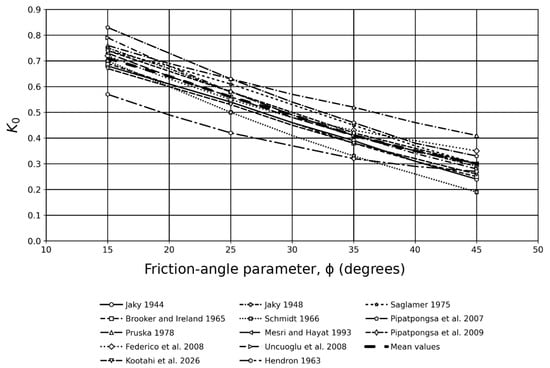
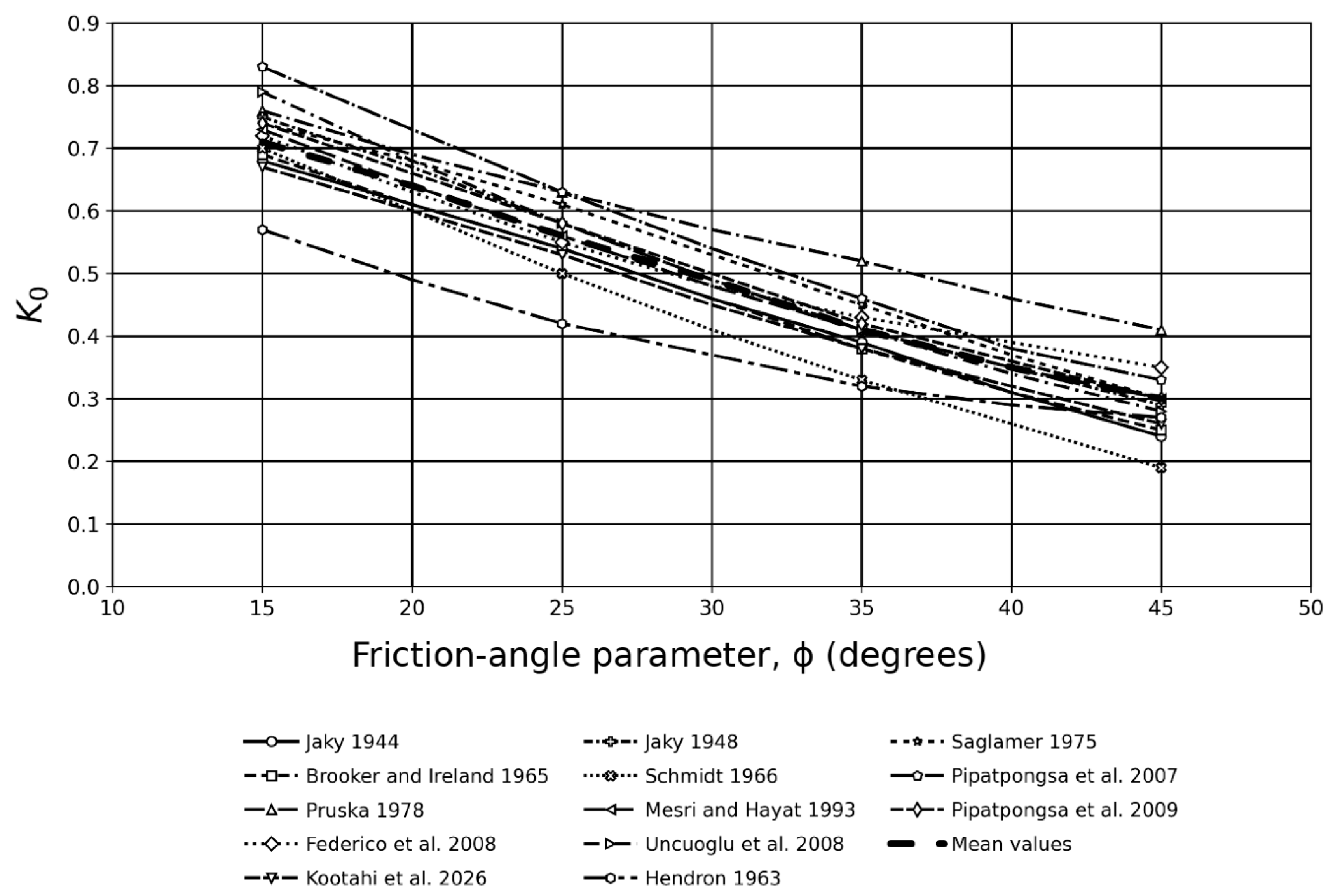
Some contributions do not introduce a predictive equation and are retained because they provide historical evidence, experimental observations, field application, constitutive interpretation, or critical reassessment of established formulations. These entries should not be interpreted as methods equivalent to formally derived predictive expressions. In Table 1, they are identified as observations, conceptual contributions, or reassessments when no explicit predictive equation is proposed. Their inclusion is intended to document the evolution and interpretation of the at-rest condition, whereas direct quantitative comparison is restricted to formulations that share a common parameter basis, as illustrated in Figure 1 for selected friction-angle-based expressions. The notation and parameters presented in Table 1 were reviewed and standardized to facilitate comparison while preserving the physical meaning and scope of the original formulations. Definitions of the standardized symbols and abbreviations are provided at the end of the table.
Figure 1.
Variability of thirteen selected friction-angle-based formulations and their descriptive mean on a common angular axis, Jaky (1944) [5], Jaky (1948) [13], Hendron (1963) [18], Brooker and Ireland (1965) [19], Schmidt (1966) [20], Saglamer (1975) [24], Pruska (1978) [27], Mesri and Hayat (1993) [6], Federico et al. (2008) [34], Pipatpongsa et al. (2007) [33], Uncuoglu et al. (2008) [35], Pipatpongsa et al. (2009) [36], and Kootahi et al. (2026) [47].
4. Engineering Significance of Variability in Estimated K0
Variability in the estimation of becomes relevant to engineering practice to the extent that the initial lateral stress state affects either the modelling approach or the resulting design decisions. Since under zero lateral strain conditions, any variation in the adopted value is directly transferred to the lateral stress field assumed for the ground. Its practical relevance is therefore greater in cases where the geostatic condition significantly governs the evolution of stresses and deformations in the system.
The support for this interpretation is derived from complementary levels of comparison. Table 1 provides the methodological basis by showing that the reviewed approaches differ in governing variables, calibration basis, stress-history assumptions, soil type, determination procedure, and reported limitations. The soil-type and special-condition discussion in Section 3 further illustrates that these differences are not merely algebraic but are linked to the physical state represented by each formulation. Figure 1 then provides a representative quantitative demonstration for the subset of friction-angle-based expressions, where several formulations can be compared on a common parameter axis. Therefore, Figure 1 is not intended to represent all estimation methods but to illustrate the dispersion that may arise even within a restricted family of formulations. The general conclusion regarding the non-equivalence of estimates follows from the combined evidence of the classification in Table 1, the soil-type discussion, the numerical comparison in Figure 1, and the practical compatibility synthesis in Table 2.
Table 2.
Practical guidance for selecting estimation approaches.
To visualize the dispersion among formulations on a common basis for comparison, Figure 1 presents thirteen selected expressions that can be evaluated as a function of an angular friction parameter. The plotted formulations correspond to Jaky [5,13], Hendron [18], Brooker and Ireland [19], Schmidt [20], Saglamer [24], Pruska [27], Mesri and Hayat [6], Federico et al. [34], Pipatpongsa et al. [33,36], Uncuoglu et al. [35], and Kootahi et al. [47]. Expressions based primarily on OCR, PI, LL, CPT/DMT parameters, shear-wave velocity, density, stress level, or material-specific coral-sand parameters were not included in this figure, because they cannot be compared on a single angular axis without introducing additional assumptions. The angular parameter was evaluated on a common graphical axis only to illustrate the dispersion among formulations with a comparable algebraic dependency; this does not imply equivalence among the soil types, stress histories, or friction-angle definitions involved.
For example, in the Jaky-type reference expression , a 5° increase in the angular parameter reduces from 0.577 to 0.500 between 25° and 30°, from 0.426 to 0.357 between 35° and 40°, and from 0.293 to 0.234 between 45° and 50°. Therefore, differences in friction-angle definition may change by approximately 0.06–0.08 in absolute terms over the range considered in Figure 1, with larger peak friction angles producing lower values in formulations where decreases with increasing .
In global terms, the descriptive envelope of the plotted curves shows appreciable dispersion: for , values range approximately from 0.58 to 0.83; for , from 0.36 to 0.58; and for , from 0.19 to 0.41. In the plotted set, the lower bound at and is associated with the Jaky [5] formulation, whereas the upper bounds are associated approximately with Hendron [18] at and Pruska [27] at . These bounds are descriptive values obtained from deterministic evaluation of the selected equations, not statistical confidence limits. Accordingly, no standard error or confidence interval is assigned to the plotted curves. However, most expressions cluster within a narrower band than that defined by the extreme values; in the intermediate range, many formulations remain within a band corresponding approximately to relative differences of 10–20%. From a practical standpoint, the critical issue lies less in the selection of a specific expression than in whether the estimated value of actually affects modelling outcomes or design decisions.
For a given vertical effective stress, the relative variation in the initial horizontal effective stress is equal to the relative variation in , since . Thus, the ranges discussed above imply that differences among formulations may be transferred directly to the initial horizontal stress field when the at-rest condition remains representative. This effect can be illustrated by the limiting case of a rigid non-yielding retaining wall, for which the at-rest resultant and base moment are and , respectively. For m and kN/m3, increasing from 0.40 to 0.48 increases from 129.6 to 155.5 kN/m and from 259.2 to 311.0 kNm/m. Therefore, in this limiting condition, a 20% increase in produces a 20% increase in the calculated at-rest force and moment. However, this does not mean that internal forces or deformations in all supporting structures vary in the same proportion. Once soil–structure interaction, construction sequence, stiffness, and stress redistribution are involved, acts as an initial-condition parameter rather than as a direct predictor of the final response. Therefore, the engineering relevance of different estimates should be evaluated through the sensitivity of the specific problem to the initial stress state, rather than through a generic numerical example alone.
This sensitivity to the initial stress state becomes particularly relevant in retaining systems with restricted displacements, such as rigid walls, braced excavations, or embedded systems with limited lateral deformation, where the at-rest condition is commonly adopted as the reference for defining the initial stress state. In such cases, the selected value of forms part of the underlying modelling assumption, and, therefore, even moderate differences among formulations may lead to different initial conditions for subsequent stress redistribution. However, this variation does not necessarily translate proportionally into the final stresses, deformations, or demands of the soil–structure system, since its effect depends on structural stiffness, construction sequence, the degree of stress redistribution, and the level of subsequent ground mobilization. Added to this dependence on the specific situation under analysis is the fact that design guides and technical documents do not always provide a uniform criterion regarding the expression that should be used to estimate , so its selection often remains tied to engineering judgement. Consequently, once an expression compatible with soil type and stress condition has been adopted, the practical issue is not simply whether the value of can be further refined but whether the expected variation among formulations produces a sufficiently relevant impact on modelling, on the response of the soil–structure system, or on the associated design decisions.
The practical influence of variability in tends to diminish when the at-rest condition is rapidly overtaken by significant stress redistribution or by displacements sufficient to mobilize clearly active or passive conditions. This may be the case for walls or retaining systems whose response evolves toward an active condition behind the wall, as well as for excavations where ground deformation substantially modifies the initial stress field. Under such circumstances, although the definition of remains necessary as an initial condition, its effect may become subordinate to other factors controlling the overall response of the problem.
The comparison among formulations should therefore not be directed toward identifying a universally superior expression but toward establishing the situations in which the estimation of constitutes a first-order decision and those in which a reasonable approximation is sufficient for engineering purposes. First, the selection of an expression for estimating should consider its compatibility with soil type and with the stress history of the deposit. Second, the role of the initial stress state in the situation under analysis should be evaluated, since its influence is decisive in configurations where the geostatic condition governs the response but may become secondary when later stress redistributions predominate. In this way, the selection of an expression for estimating is conditioned more by the problem under analysis than by an abstract preference among available formulations. Table 2 summarizes this interpretation as a practical compatibility check, rather than as a ranking of methods, considering soil type, stress history, available parameters, calibration basis, and the sensitivity of the problem to the initial horizontal stress state.
5. Limitations and Research Needs
Despite the large number of available formulations, the estimation of still faces a fundamental limitation, since many expressions are applied outside the context for which they were originally developed. In practice, this involves transferring correlations across soils, stress histories, and scales of observation that are not always equivalent. Added to this is a further difficulty, less evident but equally relevant, associated with the measurement process itself. In several laboratory and in situ methods, the intervention required to estimate may alter, to some extent, the initial stress state that the method seeks to characterize, even when the procedure is properly executed. In the laboratory, this difficulty may arise from sample preparation, system friction, or the actual ability to maintain zero lateral strain; in the field, it may be associated with local disturbance induced by device insertion or by the boundary conditions of the test. Consequently, a relevant part of the dispersion among estimates arises not only from uncertainty associated with the parameter itself and from the limited transferability across application conditions, but also from the disturbing effect introduced by the very method used to estimate it.
Because these disturbance effects are method-, soil-, and reference-dependent, the reviewed literature does not provide homogeneous error intervals for comparing determination methods. Accordingly, this review does not assign universal error ranges; instead, Table 1 reports the quantitative support available in each source, whereas Table 2 summarizes the practical cautions associated with the main method categories.
A second underlying limitation is that not all formulations represent the same physical state or rest on the same theoretical basis. Some expressions rely primarily on , others on OCR, others on specific loading–unloading paths, and others on indirect inferences derived from field tests or geotechnical proxies. As a result, the use of a common notation for may encourage the assumption of equivalence among values that, in fact, correspond to different stress states. Taken together, these limitations show that current approaches still lack a sufficiently general and consistent framework for transferring different expressions safely across geotechnical contexts.
These limitations suggest that the transfer of estimates should be evaluated against the soil condition, stress history, determination procedure, and intended engineering use, particularly when uncertainty in the initial horizontal stress state may affect the design decision. Future work could therefore focus on comparative measurements in which laboratory, stress-oriented in situ, geophysical, and field-based estimates are obtained for the same deposits, allowing the method-dependent variability and the effects of sampling, test execution, and reference stress state on the inferred to be assessed more directly.
6. Conclusions
This review shows that the central issue in estimating does not arise merely from the coexistence of multiple equations but from the assumption that formulations developed under different conditions represent physically equivalent states. The dispersion among methods should therefore not be interpreted solely as a numerical discrepancy but also as a consequence of different representations of the at-rest condition and different levels of inference used to estimate it.
Correlations based on friction angle, OCR-dependent expressions, laboratory procedures, and in situ inference should be understood as complementary but not interchangeable approaches. The comparison indicates three practical selection rules. For normally consolidated or virgin-loading sands, friction-angle-based formulations, including Jaky-type expressions, provide a practical first-order category, provided that the friction-angle definition and calibration basis are respected. For clayey soils, plasticity-, OCR-, and stress-history-based formulations are generally more appropriate than purely friction-angle-based expressions. For overconsolidated soils, OCR- or unloading-based relationships should be preferred, but their use must remain consistent with the soil class and unloading path for which they were developed.
The engineering significance of this variability depends on the role of the initial stress state in the problem under analysis. When the geostatic condition substantially influences modelling or design, as may occur in retaining systems with restricted displacements or in analyses sensitive to stress initialization, the selection of may require particular attention. Conversely, when subsequent deformation and stress redistribution substantially modify the initial stress field or mobilize active or passive conditions, the influence of the adopted value may become secondary relative to other governing factors.
The comparison among approaches should therefore not be directed toward identifying a universally superior expression. Instead, the selected method should satisfy a compatibility criterion: it should match the soil type, stress history, physical condition, and calibration basis of the problem under analysis. This criterion is particularly important for coral sands and other crushable granular materials, for which particle crushing, morphology, density, and stress level may require material-specific formulations. The required level of refinement should ultimately depend on whether the plausible range of values materially affects the predicted response or the associated engineering decision.
In this sense, the main outcome of this review is not a universal equation but a structured basis for selecting formulation categories according to soil behavior, stress history, and engineering relevance.
Author Contributions
Conceptualization, E.G.D.-S.; methodology, E.G.D.-S. and J.G.-B.; investigation, E.G.D.-S. and J.G.-B.; formal analysis, E.G.D.-S. and J.G.-B.; writing—original draft preparation, E.G.D.-S.; writing—review and editing, E.G.D.-S. and J.G.-B.; visualization, E.G.D.-S.; supervision, E.G.D.-S.; project administration, E.G.D.-S.; funding acquisition, E.G.D.-S. All authors have read and agreed to the published version of the manuscript.
Funding
This research was funded by DI–VINCI, Pontificia Universidad Católica de Valparaíso, grant number 044.766/2026.
Institutional Review Board Statement
Not applicable.
Informed Consent Statement
Not applicable.
Data Availability Statement
No new data are created or analyzed in this study. Data sharing is not applicable to this article.
Acknowledgments
The authors acknowledge the support provided by DI–VINCI, Pontificia Universidad Católica de Valparaíso, under Project No. 044.766/2026.
Conflicts of Interest
The authors declare no conflict of interest.
References
- Bohac, J.; Masin, D.; Malat, J.; Novak, M.; Rott, M. Methods of determination of K0 in overconsolidated clay. In Proceedings of the 18th International Conference on Soil Mechanics and Geotechnical Engineering; French Society for Soil Mechanics and Geotechnical Engineering (CFMS): Paris, France, 2013; Volume 1, pp. 203–206. [Google Scholar]
- Nam, D.; Abbas, Q.; Lee, J. A method for estimating coefficient of lateral earth pressure based on cone penetration tests. Soils Found. 2024, 64, 101474. [Google Scholar] [CrossRef] [Scilit]
- Hanna, A.; Al-Romhein, R. At-rest earth pressure of overconsolidated cohesionless soil. J. Geotech. Geoenviron. Eng. 2008, 134, 408–412. [Google Scholar] [CrossRef] [Scilit]
- Tong, L.; Liu, L.; Cai, G.; Du, G. Assessing the coefficient of the earth pressure at rest from shear wave velocity and electrical resistivity measurements. Eng. Geol. 2013, 163, 122–131. [Google Scholar] [CrossRef] [Scilit]
- Jaky, J. The coefficient of earth pressure at rest. J. Soc. Hung. Archit. Eng. 1944, 78, 355–358. [Google Scholar]
- Mesri, G.; Hayat, T.M. The coefficient of earth pressure at rest. Can. Geotech. J. 1993, 30, 647–666. [Google Scholar] [CrossRef] [Scilit]
- Michalowski, R.L. Coefficient of earth pressure at rest. J. Geotech. Geoenviron. Eng. 2005, 131, 1429–1433. [Google Scholar] [CrossRef] [Scilit]
- Lamé, G.; Clapeyron, B. Mémoire sur l’équilibre intérieur des corps solides homogènes. (Suite du mémoire). J. Reine Angew. Math. 1831, 7, 381–413. [Google Scholar]
- Donath, A.D. Untersuchungen ueber den Erddruck auf Stuetzwaende. Z. Bauwes. 1891, 41, 491–518. [Google Scholar]
- Terzaghi, K. Old Earth-pressure theories and new test results. Eng. News-Rec. 1920, 85, 632–637. [Google Scholar]
- Terzaghi, K. Principles of soil mechanics: II-Compressive strength of clay. Eng. News-Rec. 1925, 95, 796–800. [Google Scholar]
- Kjellman, W. Report on an apparatus for consummate investigation of the mechanical properties of soils. In Proceedings of the 1st International Conference on Soil Mechanics and Foundation Engineering, Cambridge, MA, USA, 22–26 June 1936; pp. 16–20. [Google Scholar]
- Jaky, J. Pressure in silos. In Proceedings of the 2nd International Conference on Soil Mechanics and Foundation Engineering; Gebr. Keesmaat: Haarlem, The Netherlands, 1948; Volume 1, pp. 103–107. [Google Scholar]
- Bayliss, J.R. Design, Calibration and Use of the Lateral Earth Pressuremeter. Master’s Thesis, University of Illinois, Urbana, IL, USA, 1948. [Google Scholar]
- Tschebotarioff, G.P. Discussion of “Earth pressure on horizontal conduits”. In Proceedings of the 2nd International Conference on Soil Mechanics and Foundation Engineering; Gebr. Keesmaat: Rotterdam, The Netherlands, 1948; Volume 1, pp. 108–111. [Google Scholar]
- Rowe, P.W. A stress-strain theory for cohesionless soil with applications to earth pressures at rest and moving walls. Géotechnique 1954, 4, 70–88. [Google Scholar] [CrossRef] [Scilit]
- Bjerrum, L.; Kringstad, S.; Kummeneje, O. The shear strength of a fine sand. In Proceedings of the 5th International Conference on Soil Mechanics and Foundation Engineering; Dunod: Paris, France, 1961; Volume 1, pp. 29–37. [Google Scholar]
- Hendron, A.J. The Behavior of Sand in One-Dimensional Compression. Ph.D. Thesis, University of Illinois, Urbana, IL, USA, 1963. [Google Scholar]
- Brooker, E.W.; Ireland, H.O. Earth pressures at rest related to stress history. Can. Geotech. J. 1965, 2, 1–15. [Google Scholar] [CrossRef] [Scilit]
- Schmidt, B. Earth pressures at rest related to stress history. Can. Geotech. J. 1966, 3, 239–242. [Google Scholar] [CrossRef] [Scilit]
- Alpan, I. The empirical evaluation of the coefficient K0 and K0R. Soils Found. 1967, 7, 31–40. [Google Scholar] [CrossRef] [Scilit]
- Sherif, M.A.; Koch, D.E. Coefficient of earth pressure at rest as related to soil precompression ratio and liquid limit. Highw. Res. Rec. 1970, 323, 39–48. [Google Scholar]
- Wroth, C.P. General theories of earth pressure and deformation. In Proceedings of the 5th European Conference on Soil Mechanics and Foundation Engineering; Sociedad Española de Mecánica del Suelo y Cimentaciones: Madrid, Spain, 1973; pp. 33–52. [Google Scholar]
- Saglamer, A. Soil parameters affecting coefficient of earth pressure at rest of cohesionless soils. In Proceedings of the Istanbul Conference on Soil Mechanics and Foundation Engineering; Istanbul Technical University, Faculty of Civil Engineering Press: Istanbul, Turkey, 1975; Volume 1, pp. 9–16. [Google Scholar]
- Meyerhof, G.G. Bearing capacity and settlement of pile foundations. J. Geotech. Eng. Div. 1976, 102, 195–228. [Google Scholar] [CrossRef] [Scilit]
- Larsson, R. Basic Behaviour of Scandinavian Soft Clays; Swedish Geotechnical Institute: Linköping, Sweden, 1977. [Google Scholar]
- Pruska, L. At-rest lateral earth pressure coefficient of a granular medium. Soil Mech. Found. Eng. 1978, 15, 56–61. [Google Scholar] [CrossRef] [Scilit]
- Massarsch, K.R. Lateral earth pressure in normally consolidated clay. In Proceedings of the 7th European Conference on Soil Mechanics and Foundation Engineering; British Geotechnical Society: London, UK, 1979; Volume 2, pp. 245–249. [Google Scholar]
- Marchetti, S. In situ tests by flat dilatometer. J. Geotech. Eng. Div. 1980, 106, 299–321. [Google Scholar] [CrossRef] [Scilit]
- Mayne, P.W.; Kulhawy, F.H. K0-OCR relationships in soil. J. Geotech. Eng. Div. 1982, 108, 851–872. [Google Scholar] [CrossRef] [Scilit]
- Feda, J. K0-Coefficient of sand in triaxial apparatus. J. Geotech. Eng. 1984, 110, 519–524. [Google Scholar] [CrossRef] [Scilit]
- Kulhawy, F.; Jackson, C.; Mayne, P. First-order estimation of K0 in sands and clays. In Proceedings of the 12th International Conference on Soil Mechanics and Foundation Engineering; A.A. Balkema: Rio de Janeiro, Brazil, 1989; pp. 121–124. [Google Scholar]
- Pipatpongsa, T.; Takeyama, T.; Ohta, H.; Iizuka, A. Coefficient of earth pressure at rest derived from the Sekiguchi–Ohta model. In Proceedings of the 13th Asian Regional Conference on Soil Mechanics and Geotechnical Engineering; The Japanese Geotechnical Society: Kolkata, India, 2007; pp. 1–4. [Google Scholar]
- Federico, A.; Elia, G.; Germano, V. A short note on the earth pressure and mobilized angle of internal friction in one-dimensional compression of soils. J. Geoengin. 2008, 3, 41–46. [Google Scholar]
- Uncuoglu, E.; Laman, M.; Saglamer, A.; Kara, H.B. Prediction of lateral effective stresses in sand using artificial neural network. Soils Found. 2008, 48, 141–153. [Google Scholar] [CrossRef] [Scilit]
- Pipatpongsa, T.; Heng, S.; Iizuka, A.; Ohta, H. Rationale for coefficient of earth pressure at rest derived from prismatic sand heap. In Proceedings of the 17th International Conference on Soil Mechanics and Geotechnical Engineering; IOS Press: Alexandria, Egypt, 2009; pp. 182–185. [Google Scholar]
- Ku, T.; Mayne, P.W. Feasibility and sensitivity analysis of at-rest lateral stress coefficient (K0) evaluations using paired shear wave velocity modes. In Proceedings of the GeoCongress 2012: State of the Art and Practice in Geotechnical Engineering; Geotechnical Special Publication: Oakland, CA, USA, 2012; pp. 2639–2648. [Google Scholar]
- Gao, Y.; Wang, Y.H. Experimental and DEM examinations of K0 in sand under different loading conditions. J. Geotech. Geoenviron. Eng. 2014, 140, 04014012. [Google Scholar] [CrossRef] [Scilit]
- Lee, J.; Lee, D.; Park, D. Experimental investigation on the coefficient of lateral earth pressure at rest of silty sands: Effect of fines. Geotech. Test. J. 2014, 37, 967–979. [Google Scholar] [CrossRef] [Scilit]
- Hossain, A.M.; Andrus, R.D. At-rest lateral stress coefficient in sands from common field methods. J. Geotech. Geoenviron. Eng. 2016, 142, 06016016. [Google Scholar] [CrossRef] [Scilit]
- Baldi, G.; Bellotti, R.; Ghionna, V.N.; Jamiolkowski, M.; Marchetti, S.; Pasqualini, E. Flat dilatometer tests in calibration chambers. In Use of In Situ Tests in Geotechnical Engineering; Clemence, S.P., Ed.; ASCE Geotechnical Special Publication No. 6; ASCE Geotechnical Special Publication: Blacksburg, VA, USA, 1986; pp. 431–446. [Google Scholar]
- Pegah, E.; Liu, H.; Dastanboo, N. Evaluation of the lateral earth pressure coefficients at-rest in granular soil deposits using the anisotropic components of S-wave velocity. Eng. Geol. 2017, 230, 55–63. [Google Scholar] [CrossRef] [Scilit]
- Wang, J.J.; Yang, Y.; Bai, J.; Hao, J.Y.; Zhao, T.L. Coefficient of earth pressure at rest of a saturated artificially mixed soil from oedometer tests. KSCE J. Civ. Eng. 2018, 22, 1691–1699. [Google Scholar] [CrossRef] [Scilit]
- Li, L.; Dai, Z.; Liu, R.; Jian, F. Experimental study on the coefficient of earth pressure at rest for sand. Buildings 2023, 13, 1276. [Google Scholar] [CrossRef] [Scilit]
- Zhang, J.; Peng, W.; Liu, X.; Luo, M. Estimation of coefficient of earth pressure at rest for coral sand considering the effect of density and stress. Acta Geotech. 2024, 19, 7545–7561. [Google Scholar] [CrossRef] [Scilit]
- Hou, H.; Chen, Z.; Wang, B. Study on the influence of particle crushing on the coefficient of earth pressure at rest of coral sand. Chin. J. Geotech. Eng. 2025, 47, 62–67. (In Chinese) [Google Scholar] [CrossRef]
- Kootahi, K.; Leung, A.K.; Karimzadeh, A.A. Influence of particle morphology on hysteretic K0 of granular soils. J. Geotech. Geoenviron. Eng. 2026, 152, 04025196. [Google Scholar] [CrossRef] [Scilit]
- Kerisel, J. (Ed.) History of retaining wall design. In Retaining Structures; A.A. Balkema: Rotterdam, The Netherlands, 1993; pp. 1–20. [Google Scholar]
- Hettler, A.; Kurrer, K.E. Earth Pressure; Wiley: Berlin, Germany, 2020; pp. 1–394. [Google Scholar]
- Bullet, P. L’Architecture Pratique, qui Comprend le Détail du Toisé et du Devis des Ouvrages de Maçonnerie, Charpenterie, Menuiserie, Serrurerie, Plomberie, Vitrerie, Ardoise, Tuile, Pavé de Grès et Impression, avec une Explication de la Coutume de Paris sur le Fait des Bâtiments; Chez Estienne Michallet: Paris, France, 1691. [Google Scholar]
- Gautier, H. Dissertation sur L’epaisseur des Culées des Ponts…sur L’effort et la Pesanteur des Arches…et sur les Profiles de Maçonnerie qui Doivent Supporter des Chaussées, des Terrasses, et des Remparts; André Cailleau: Paris, France, 1717. [Google Scholar]
- Coulomb, M. Essai sur une application des règles de Maximis & Minimis à quelques Problèmes de Statique, relatifs à l’Architecture. In Mémoires de L’académie Royale des Sciences; De l’Imprimerie Royale: Paris, France, 1776; pp. 343–382. [Google Scholar]
- Rankine, W.J.M. On the stability of loose earth. Philos. Trans. R. Soc. Lond. 1857, 147, 9–27. [Google Scholar] [CrossRef] [Scilit]
- Mohr, O. Beitrag zur theorie des erddrucks. Z. Archit. Ing.-Ver. Hann. 1871, 17, 344–372. [Google Scholar]
- Darwin, G.H. On the horizontal thrust of a mass of sand. Minutes Proc. Inst. Civ. Eng. 1883, 71, 350–377. [Google Scholar] [CrossRef] [Scilit]
- Leygue, L. Nouvelle recherche sur la poussée des terres et le profil de revêtement le plus économique. Ann. Ponts Chaussées 1885, 10, 788–1000. [Google Scholar]
- Cai, G.; Liu, S.; Puppala, A.J.; Tong, L. Assessment of the coefficient of lateral earth pressure at rest (K0) from in situ seismic tests. Geotech. Test. J. 2011, 34, 310–320. [Google Scholar] [CrossRef] [Scilit]
- Teerachaikulpanich, N.; Okumura, S.; Matsunaga, K.; Ohta, H. Estimation of coefficient of earth pressure at rest using modified oedometer test. Soils Found. 2007, 47, 349–360. [Google Scholar] [CrossRef] [Scilit]

Disclaimer/Publisher’s Note: The statements, opinions and data contained in all publications are solely those of the individual author(s) and contributor(s) and not of MDPI and/or the editor(s). MDPI and/or the editor(s) disclaim responsibility for any injury to people or property resulting from any ideas, methods, instructions or products referred to in the content. |
© 2026 by the authors. Licensee MDPI, Basel, Switzerland. This article is an open access article distributed under the terms and conditions of the Creative Commons Attribution (CC BY) license.