


Featured Application
The one-tube nested real-time PCR-HRM assay evaluated in this study provides a gel-free, closed-tube molecular workflow for qualitative detection of Tritrichomonas foetus DNA in feline fecal extracts. The method was designed as an adaptation of an established single-tube nested PCR approach, replacing agarose gel electrophoresis with HRM-based endpoint interpretation. The assay may be useful for diagnostic laboratories processing inhibitor-rich stool extracts, although the present study should be interpreted as a preliminary analytical evaluation and method agreement assessment rather than as a full diagnostic accuracy validation.
Abstract
Feline tritrichomonosis caused by Tritrichomonas foetus is an important cause of chronic or intermittent large-bowel diarrhea in cats. Nested PCR is useful for detecting low parasite burdens in fecal samples, but gel-based endpoint interpretation requires post-amplification handling and may increase the risk of amplicon contamination. This study describes a one-tube nested real-time PCR-HRM assay for qualitative detection of T. foetus DNA in feline fecal extracts. The assay was adapted from a previously described single-tube nested PCR workflow by integrating real-time fluorescence monitoring and high-resolution melting analysis as a closed-tube endpoint. Analytical evaluation included post-extraction matrix-matched sensitivity testing, an exclusivity panel, matrix blank assessment, a checkerboard carryover experiment, and within-platform repeatability assessment of HRM temperatures. Method agreement was assessed using 147 fecal samples from diarrheic cats and compared with gel-based single-tube nested PCR and outer-primer PCR. Both nested methods detected 16/147 samples, whereas outer-primer PCR detected 5/147 samples. All 16 nested-positive amplicons were confirmed by Sanger sequencing and showed 99.51–100.00% identity to T. foetus reference sequences. Across 95 target-associated dual-peak HRM reactions, the low-temperature melting domain showed a mean Tm of 76.18 ± 0.24 °C, and the high-temperature melting domain showed a mean Tm of 81.57 ± 0.42 °C. However, because no independent reference standard was available, diagnostic sensitivity and specificity were not determined. The assay should therefore be interpreted as a preliminary analytical evaluation and method-agreement study of a closed-tube alternative to gel-based nested PCR.
1. Introduction
Tritrichomonas foetus is a flagellated protozoan that inhabits the feline large intestine and is acknowledged as a clinically important cause of chronic or intermittent large-bowel diarrhea in cats. The infection is most frequently reported in cats in high-density environments and in younger animals, where transmission and persistence are facilitated [1,2,3]. Recent regional data further support that T. foetus is not rare in routine diagnostic assessments and should be considered in the differential diagnosis of feline large-bowel diarrhea [4].
In clinical practice, diagnosis is still challenging. Shedding of fragile trophozoites may be intermittent, and direct microscopic examination is insensitive and strongly operator-dependent. Culture can enhance detection, but it is still susceptible to the effects of sample quality, transport, and organism viability. In contrast, nucleic acid-based methods typically offer a higher diagnostic efficiency and are amenable to centralized testing [2].
PCR-based assays are frequently applied for T. foetus detection from fecal samples. In comparison to conventional two-round nested PCR workflows, the single-tube nested PCR design introduced for feline feces was a methodological advance that increased analytical sensitivity and limited tube opening [5]. Still, a large number of laboratory implementations continue to depend on post-amplification agarose gel electrophoresis for endpoint interpretation. This method introduces additional opportunities for amplicon contamination and increases the time spent manipulating the sample, which is especially important when utilizing nested amplification strategies [2,5].
High-resolution melting (HRM) analysis offers a closed-tube approach for discriminating amplicons based on melting behavior using saturating DNA dyes, enabling rapid confirmation of target-specific amplification without gel electrophoresis [6]. Analytical evaluation of a newly adapted laboratory workflow should include matrix-relevant sensitivity assessment, specificity/exclusivity testing, carryover assessment, and method-comparison data against an established workflow [7,8].
The objective of this study was to develop and verify a one-tube nested real-time PCR-HRM assay for the detection of T. foetus in feline feces. The method represents a modification and adaptation of the previously described single-tube nested PCR strategy, redesigned into a closed-tube format integrating sequential outer/inner amplification in one tube, real-time fluorescence monitoring, and HRM-based confirmation of target-specific products [5,6]. We assessed analytical specificity using an exclusivity panel including common enteric bacteria, Giardia duodenalis, Cryptosporidium felis, Cryptosporidium canis, and non-target trichomonads and evaluated clinical agreement on 147 fecal samples from diarrheic cats by comparison across three approaches (outer-primer PCR, gel-based single-tube nested PCR, and one-tube nested real-time PCR-HRM) [7,8].
2. Materials and Methods
2.1. Study Design and Clinical Specimens
Clinical agreement was assessed using 147 feline fecal samples submitted for routine diagnostic testing in January 2026. All samples were obtained from cats reported as presenting with diarrhea or abnormal fecal consistency. Available metadata included age, sex, fecal consistency at submission, and submitting voivodeship. Fecal consistency was categorized as formed, loose, or watery. Breed, lifestyle/housing status, outdoor access, housing density, and previous treatment history were not available because the samples were submitted as routine diagnostic specimens. DNA was extracted from stool samples using the TANBead Maelstrom 4800 Nucleic Acid Extraction System (Taiwan Advanced Nanotech Inc., Taoyuan City, Taiwan) following the manufacturer’s instructions.
2.2. Comparator Methods: Outer-Primer PCR, Single-Tube Nested PCR and One-Tube Nested Real-Time PCR-HRM
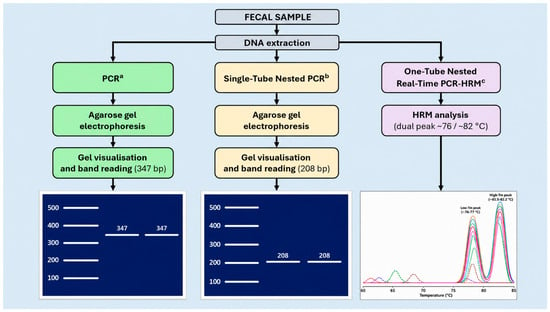
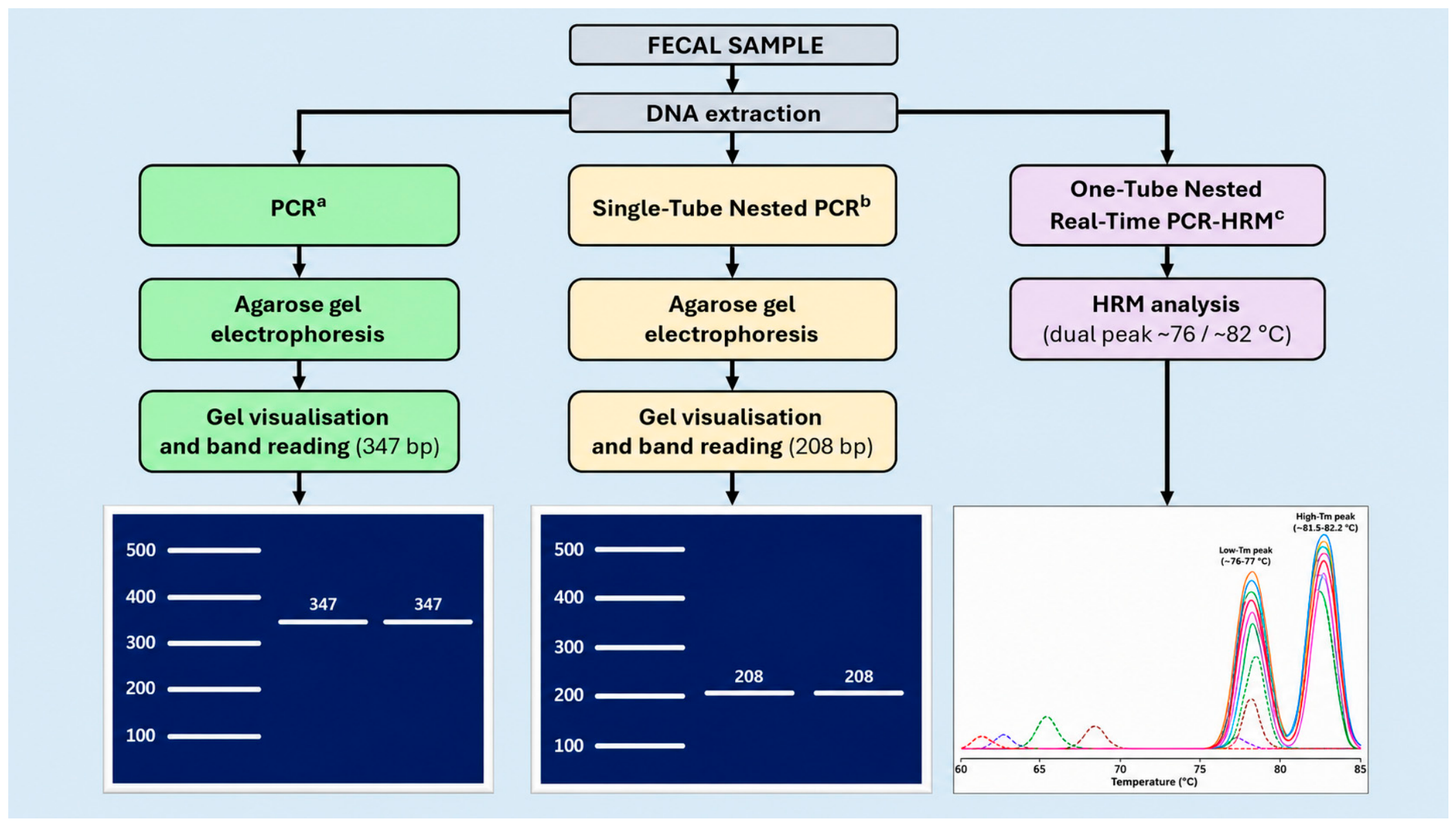
Three molecular approaches were compared (Figure 1). Outer-primer conventional PCR (347 bp) was performed using only the external primers from the published nested assay and endpoint detection by agarose gel electrophoresis [5]. Single-tube nested PCR was performed using external and internal primers in a closed-tube nested design, with endpoint detection by agarose gel electrophoresis [5]. The third method was adapted from the single-tube nested PCR using the same primers, but modified for real-time and HRM analysis (Table 1). Outer-primer PCR and single-tube nested PCR were performed using a MultiGene optiMAX thermocycler (Labnet International, Taoyuan, Taiwan), whereas real-time PCR with HRM analysis was carried out on a Gentier 48E real-time PCR system (Xi’an Tianlong Science and Technology Co., Ltd., Xi’an, China).
Figure 1.
Workflow comparison of three molecular approaches used for detection of Tritrichomonas foetus in feline fecal samples. Following DNA extraction, (a) outer-primer PCR produces a 347 bp amplicon and requires agarose gel electrophoresis with band visualization for endpoint interpretation; (b) the single-tube nested PCR described by Gookin et al. [5] generates a 208 bp nested product and is likewise read by agarose gel electrophoresis; and (c) the proposed one-tube nested real-time PCR-HRM assay replaces gel-based readout with closed-tube high-resolution melting analysis, where positivity is defined by Ct detection and a characteristic dual-peak HRM signature (≈76–77 °C and ≈81–82 °C) according to the predefined 2/2 duplicate concordance rule.
Table 1.
Reaction composition, final primer concentrations, and thermal cycling conditions for the three PCR-based assays used to detect Tritrichomonas foetus DNA in feline fecal samples.
2.3. Index Test: One-Tube Nested Real-Time PCR-HRM
A one-tube nested real-time PCR-HRM assay was developed as a closed-tube modification of the single-tube nested concept, integrating real-time detection and HRM-based endpoint confirmation without gel electrophoresis. Reactions were performed in a 20 µL volume with EvaGreen chemistry and run under a two-stage amplification protocol: preincubation (95 °C, 5 min) and outer preamplification (20 cycles: 95 °C 15 s; 72 °C 30 s; no fluorescence acquisition), followed by nested real-time amplification (40 cycles: 95 °C 15 s; 57 °C 20 s; 72 °C 30 s; fluorescence acquisition at 72 °C) and melting from 55–98 °C with 0.5 °C increments.
2.4. HRM Signature and Calling Algorithm
The HRM interpretation algorithm was based on Ct detection combined with a target-associated dual-peak derivative melting profile. This dual-peak profile was empirically established using sequencing-confirmed positive controls and representative positive clinical fecal extracts. A replicate was considered HRM-concordant only when two melting domains were present: a low-temperature melting domain at approximately 76 °C and a high-temperature melting domain at approximately 81–82 °C. Because HRM profiles may be influenced by amplicon sequence, reaction chemistry, and instrument-specific melting behavior, acceptance windows were interpreted relative to the run-internal positive control rather than as universal fixed thresholds.
The notation 2/2, 1/2, and 0/2 refers to the number of duplicate wells fulfilling the complete positivity criterion. Thus, 2/2 means that both duplicate wells showed Ct detection and the target-associated dual-peak HRM profile; 1/2 means that only one duplicate fulfilled these criteria; and 0/2 means that neither duplicate fulfilled the complete criterion. A sample was reported as positive only if 2/2 duplicate wells fulfilled the Ct plus dual-peak HRM criteria. Samples with 0/2 or 1/2 concordant replicates were retested in duplicate from the same DNA extract under identical conditions. If the repeat test still did not achieve 2/2 concordance, the sample was classified as negative for reporting.
All amplicons obtained from clinical samples classified as positive by both nested workflows were subjected to bidirectional Sanger sequencing to confirm target identity. Sequencing was performed commercially by Oligo.pl (Warsaw, Poland), using both primers flanking the expected 208 bp nested amplicon. Forward and reverse chromatograms were inspected visually using Chromas v. 2.6.6. Low-quality terminal regions were trimmed manually, and positions with ambiguous, unresolved, or overlapping peaks were excluded from the final consensus sequence. Consensus sequences were accepted for downstream analysis only when the forward and reverse reads were concordant and covered the expected 208 bp ITS1-5.8S rRNA target fragment with clearly readable base calls. The final sequences were compared with reference sequences available in GenBank using BLAST. Sequences obtained in this study and selected reference sequences representing Tritrichomonas foetus, Pentatrichomonas hominis, Trichomonas vaginalis, and Trichomonas gallinae were aligned and used for phylogenetic analysis. The phylogenetic tree was constructed in MEGA6 using the Neighbor-Joining method with the Kimura 2-parameter model, and bootstrap support was calculated from 1000 replicates.
2.5. Within-Platform Repeatability of HRM Temperatures
Within-platform repeatability of the HRM domains was assessed using exported derivative melting-peak tables from controlled positive, dilution, and matrix-matched eluate runs performed on the same real-time PCR platform. The target-positive material used for this repeatability assessment consisted of fecal DNA extracts obtained from cats sampled in 2025 and previously classified as positive by the gel-based single-tube nested PCR workflow. These extracts were used as target-positive fecal DNA material in controlled HRM runs. Reactions were included in this analysis only if they showed the empirical target-associated dual-peak profile. For each included reaction, Ct, low-Tm peak, high-Tm peak, and corresponding derivative peak values were recorded. Mean, standard deviation, and observed range were calculated separately for the low-temperature and high-temperature melting domains. Individual reaction-level values are provided in Supplementary Table S1.
2.6. Post-Extraction Matrix-Matched Analytical Sensitivity
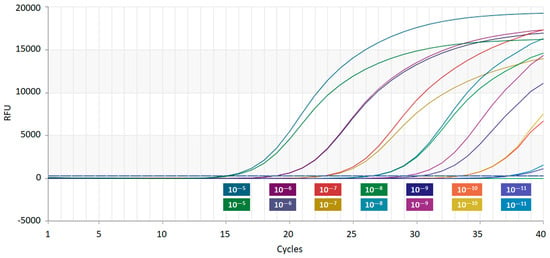
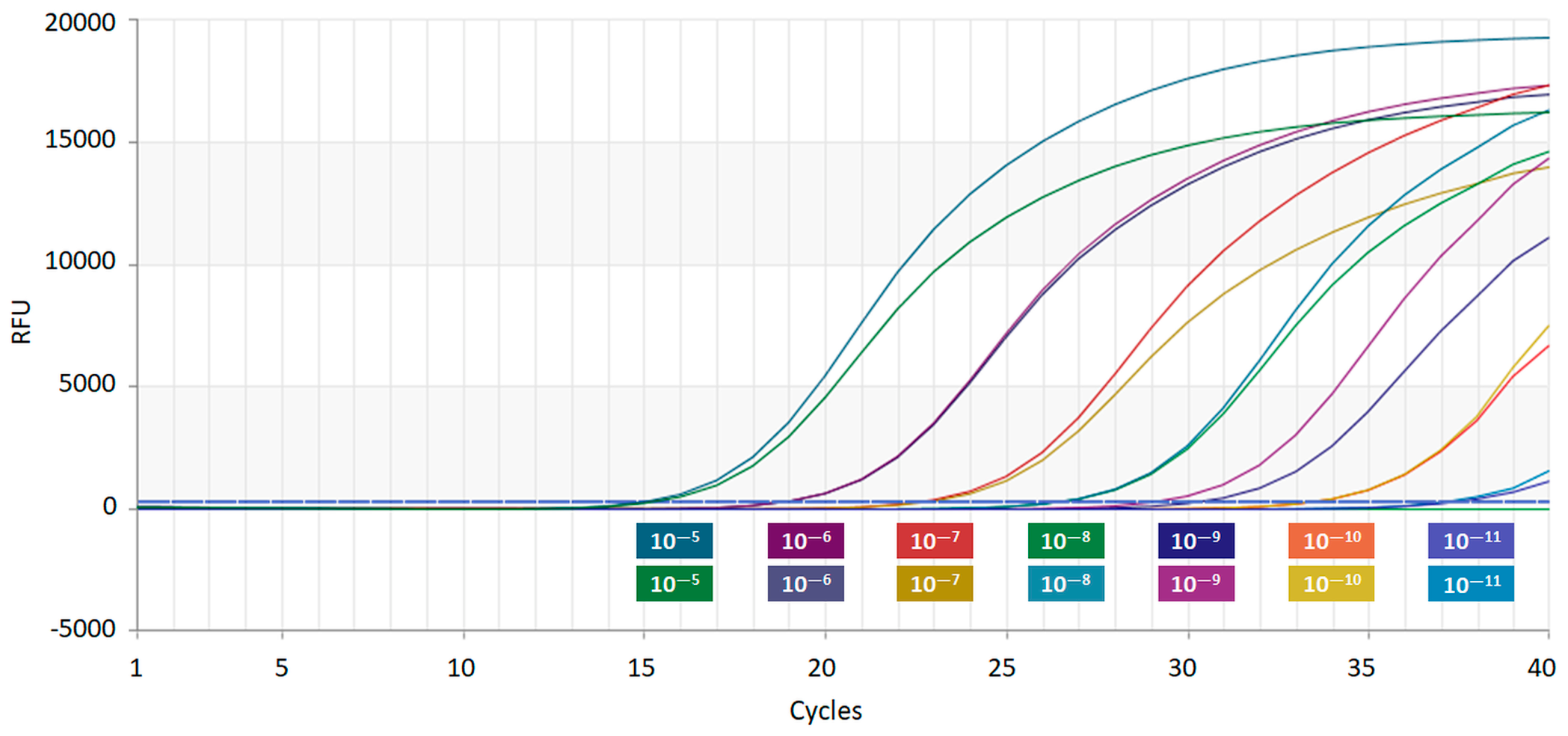
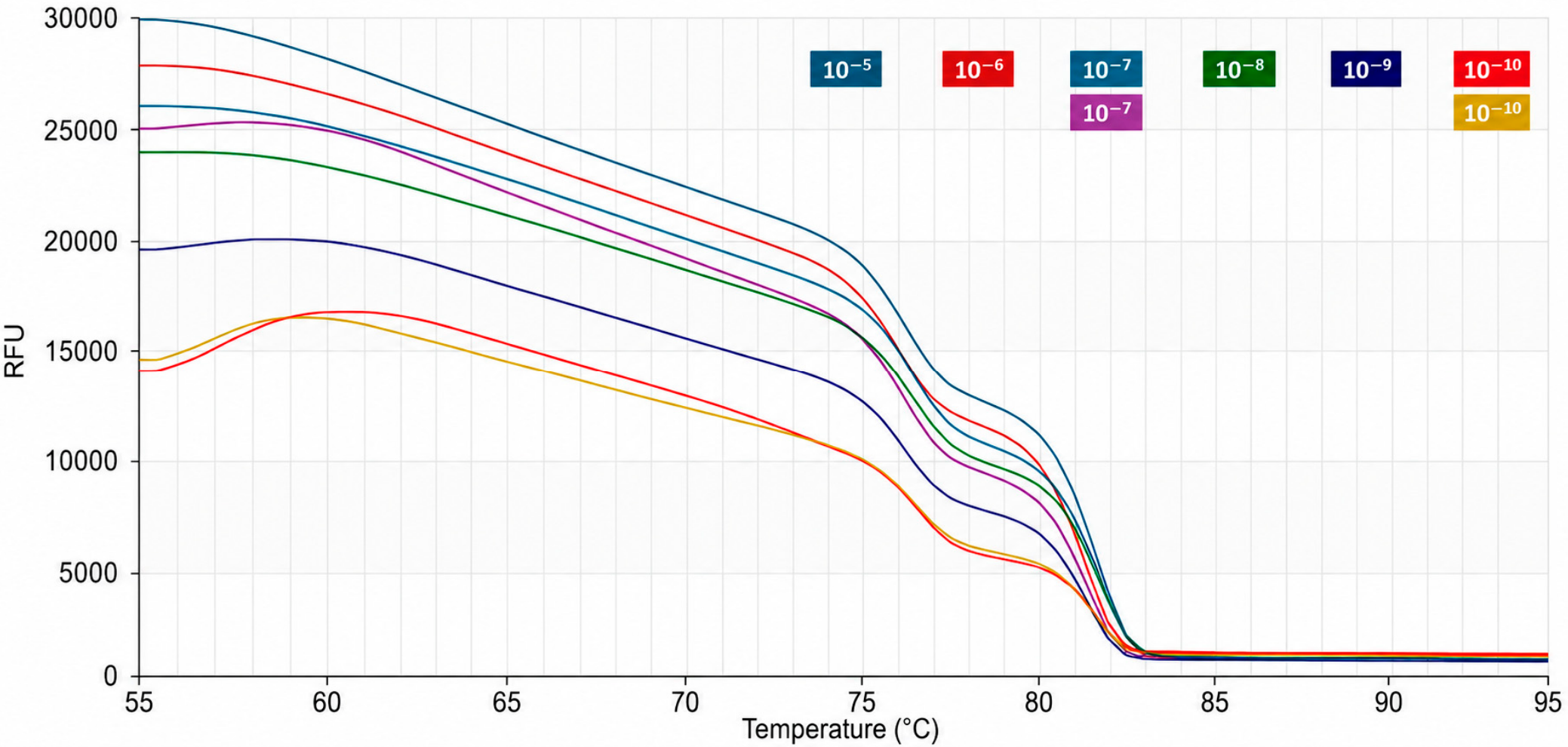
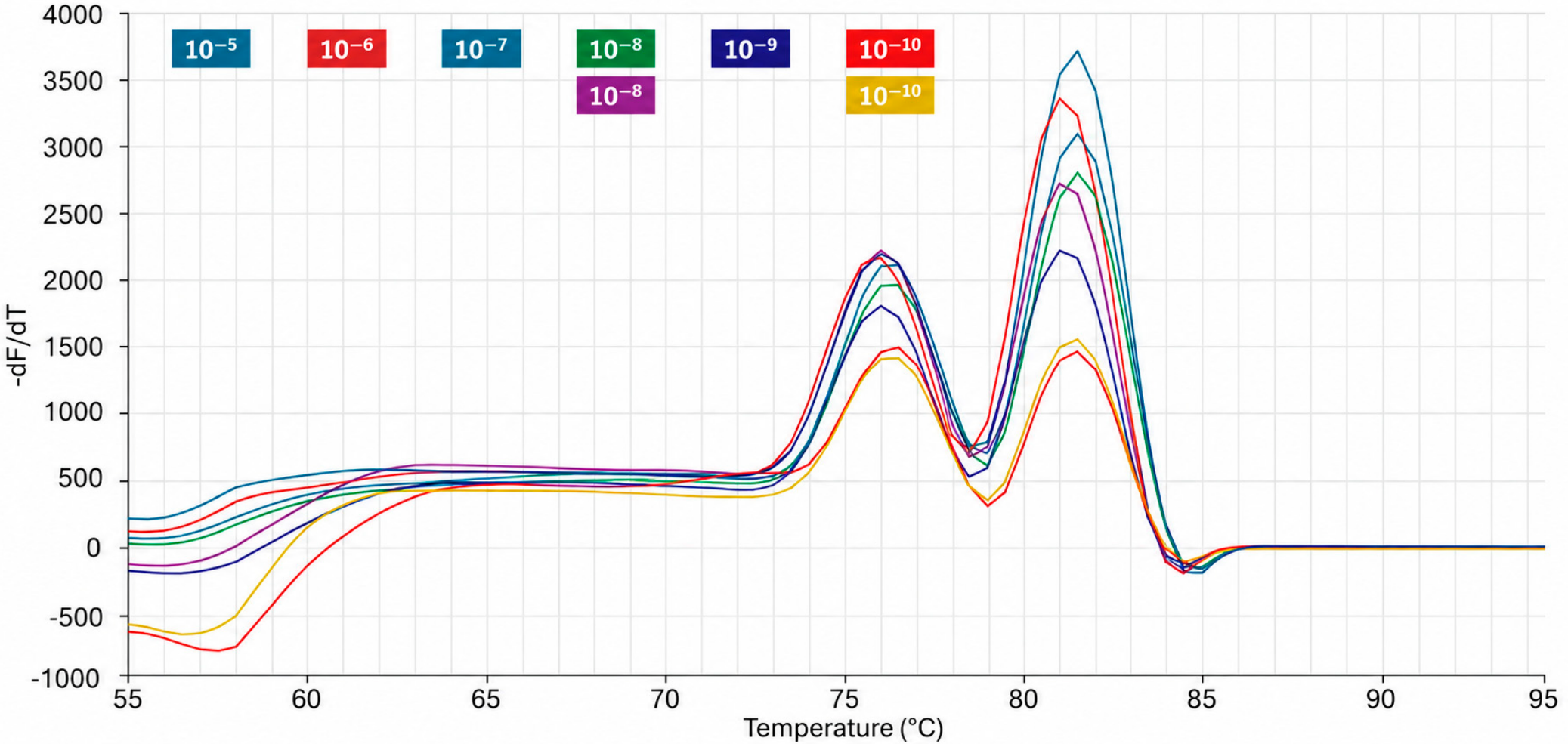
Analytical sensitivity was assessed using a quantified T. foetus amplicon (2.01347 × 10¹² copies/µL) serially diluted in pooled negative fecal eluate. This design was intended to evaluate amplification-stage performance in a fecal matrix background after DNA extraction. It should therefore be interpreted as a post-extraction matrix-matched analytical sensitivity assessment rather than an extraction-inclusive limit-of-detection experiment. Two-fold dilution steps were tested at high replicate numbers around the detection boundary, and detection was defined as Ct detection accompanied by the required dual-peak HRM profile. Representative ten-fold serial dilution curves are shown in Figure 2, Figure 3 and Figure 4.
Figure 2.
Representative real-time PCR amplification curves obtained for serial dilutions of Tritrichomonas foetus DNA using the one-tube nested real-time PCR-HRM assay. Curves correspond to ten-fold serial dilutions ranging from 10−5 to 10−11, with consistent color coding used across all subsequent melting and HRM analyses. Earlier amplification was observed in samples with higher template concentration, whereas delayed amplification was recorded in lower DNA dilutions. The figure illustrates the concentration-dependent shift in quantification cycle values and the analytical performance of the assay across the tested dilution range.
Figure 3.
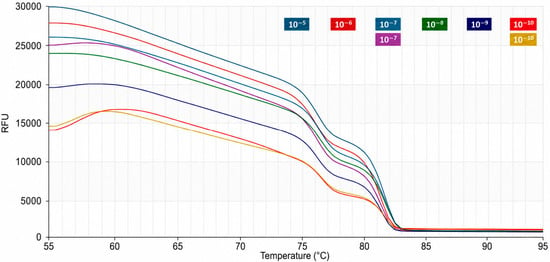
Representative melting curves of amplification products generated from serial dilutions of Tritrichomonas foetus DNA using the one-tube nested real-time PCR-HRM assay. The same color coding as in Figure 2 is used to identify individual DNA dilutions from 10−5 to 10−11. The melting profiles show fluorescence loss during gradual temperature increase and demonstrate comparable melting behavior of the specific amplification products across the tested dilution series.
Figure 4.
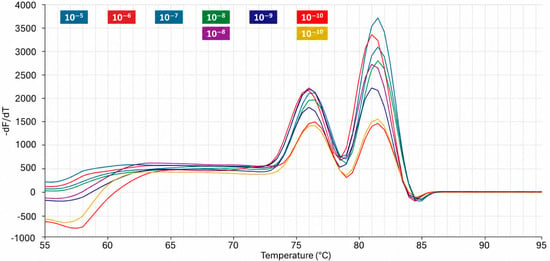
Representative derivative melting peak profiles of amplification products obtained from serial dilutions of Tritrichomonas foetus DNA using the one-tube nested real-time PCR-HRM assay. DNA dilutions from 10−5 to 10−11 are presented using the same color coding as in Figure 2 and Figure 3. The derivative plots demonstrate characteristic melting peak profiles of the expected amplicon and enable visual discrimination of specific products from non-specific or atypical melting signals. Peak temperature consistency across positive dilutions supports the specificity of the amplified target.
2.7. Negative Controls and Matrix Blank Behavior
No-template controls (NTCs; nuclease-free water) were included to monitor contamination. Pooled negative fecal eluate (matrix blank) was also tested to characterize background amplification signals typical of inhibitor-rich stool extracts; Ct-positive reactions lacking the required dual-peak HRM signature were classified as negative. Moreover, selected reactions showing nonspecific HRM patterns were subjected to Sanger sequencing when sufficient product was available.
2.8. Carryover Experiment
Amplicon carryover was assessed using an alternating checkerboard layout across 48 wells (8 × 6), consisting of 24 positive-control wells and 24 no-template control (NTC) wells. Carryover was defined as any NTC well showing Ct detection together with the required dual-peak HRM signature. Runs were performed under the final assay cycling and HRM conditions.
2.9. Analytical Specificity
Cross-reactivity was evaluated using an exclusivity panel including common bacterial isolates (Salmonella spp., Escherichia coli, Enterobacter cloacae, Klebsiella oxytoca, Proteus mirabilis, Enterococcus faecium, Enterococcus faecalis, Streptococcus canis, Streptococcus suis), feline fecal DNA containing Giardia duodenalis cysts, Cryptosporidium felis, Cryptosporidium canis, and non-target flagellates (Pentatrichomonas hominis derived from canine feces; Trichomonas gallinae derived from pigeon feces). Non-target templates were derived from previously confirmed diagnostic-positive materials or characterized isolates. Each template was tested in triplicate; cross-reactivity was defined as Ct positivity with a target-concordant dual-peak HRM profile.
2.10. Statistical Analysis
Method comparison was performed on paired outcomes for each specimen. Detection rates are reported as n/N (%) with 95% confidence intervals where appropriate. The outer-primer PCR was compared against each nested method using McNemar’s exact test. Agreement between gel-based single-tube nested PCR and one-tube nested real-time PCR-HRM is summarized as overall agreement and Cohen’s κ. Age distributions are summarized as median and interquartile range (IQR) and compared between positive and negative cats using the Mann–Whitney U test. Sex association with positivity was evaluated using Fisher’s exact test. Fecal consistency categories were compared using the Fisher–Freeman–Halton exact test. Geographic distribution is summarized descriptively because several voivodeship-level strata contained small numbers of positive samples. A two-sided p < 0.05 was considered statistically significant.
2.11. Template Input Optimization and Assessment of Matrix Inhibition in Clinical Fecal Extracts
Because fecal DNA extracts are inhibitor-rich and total DNA concentration does not reflect target copy number, an empirical template-input assessment was performed using three sequencing-confirmed T. foetus-positive clinical fecal DNA extracts (A–C) rather than purified target DNA. Extracts represented routine diagnostic samples from diarrheic cats that were positive by outer-primer PCR and by the nested workflow. The total DNA concentration of the extracts was measured (A: 92.66 ng/µL; B: 27.49 ng/µL; C: 14.19 ng/µL). Each extract was tested under the final one-tube nested real-time PCR-HRM conditions using three template input volumes (1, 2, and 3 µL per 20 µL reaction) at four dilution levels (1×, 10×, 100×, and 1000×). A replicate was considered positive only if Ct detection was accompanied by the predefined dual-peak HRM signature (~76–77 °C and ~81–82 °C), and final reporting followed the strict 2/2 duplicate concordance rule with retesting as described above. Because absorbance-based purity metrics are not reliable acceptance criteria for stool matrices, inhibition was assessed empirically by this template-input and dilution approach using Ct plus dual-peak HRM concordance.
3. Results
3.1. Matrix-Matched Analytical Sensitivity
In pooled negative fecal eluate, detection was consistent at higher inputs of approximately 940 and 470 copies/reaction, with 45/45 wells positive at each level. The lowest tested concentration with at least 95% observed per-well positivity was approximately 188 copies/reaction, where 44/45 wells (97.8%) showed Ct detection with the expected dual-peak HRM profile. Detection dropped markedly at approximately 94 copies/reaction and below. Therefore, approximately 188 copies/reaction were interpreted as the empirical post-extraction matrix-matched ≥95% detection level under the tested conditions. Because this analysis used target DNA diluted after extraction, it does not account for variation in fecal homogenization, trophozoite disruption, DNA extraction efficiency, or uneven parasite distribution in stool. The full dilution results are summarized in Table 2 and representative amplification, melting, and derivative melting profiles are shown in Figure 2, Figure 3 and Figure 4.
Table 2.
Matrix-matched analytical sensitivity of the one-tube nested real-time PCR-HRM assay.
3.2. Within-Platform Repeatability of the HRM Domains
Within-platform repeatability of the target-associated HRM domains was assessed using 95 dual-peak reactions from controlled positive, dilution, and matrix-matched eluate runs performed on the same real-time PCR platform. Across these reactions, the low-temperature melting domain showed a mean Tm of 76.18 ± 0.24 °C, with an observed range of 75.76–76.93 °C. The high-temperature melting domain showed a mean Tm of 81.57 ± 0.42 °C, with an observed range of 80.92–82.74 °C. Individual Ct, low-Tm, high-Tm, and derivative peak-height values are provided in Supplementary Table S1. These data support descriptive within-platform repeatability of the empirical dual-peak HRM profile, although inter-instrument, inter-operator, reagent-lot, and inter-laboratory reproducibility were not assessed.
3.3. Negative Controls and Matrix Blank
No-template controls and matrix blanks were interpreted using the same Ct plus HRM criteria as clinical samples. Sporadic Ct-positive reactions without the target-associated dual-peak HRM profile were classified as nonspecific and negative. This observation supports the use of HRM as an endpoint specificity filter and indicates that Ct detection alone is insufficient for result interpretation in this assay.
3.4. Carryover Experiment
In the 48-well checkerboard arrangement, three of the 24 NTC wells generated Ct values (Ct 29.441, 33.910, and 37.949), whereas the remaining 21 NTC wells showed no detectable amplification. Importantly, none of the NTC wells produced the predefined target-associated dual-peak HRM profile. Therefore, no target-concordant carryover event was detected according to the assay definition. However, the occurrence of Ct-positive NTC wells indicates that nonspecific late amplification or trace background signal cannot be excluded when Ct is interpreted alone. The Ct-positive NTC reactions did not show a target-associated HRM profile and did not yield a discrete target-concordant product suitable for sequencing. These findings support cautious interpretation and reinforce the requirement for HRM concordance rather than Ct-only positivity (Table 3).
Table 3.
Checkerboard carryover experiment summary (48 wells).
3.5. Analytical Specificity
No cross-reactivity was observed for any non-target template tested, including Giardia duodenalis, Cryptosporidium felis, Cryptosporidium canis, Pentatrichomonas hominis, and Trichomonas gallinae, as well as the tested bacterial isolates. All non-target templates were negative in the one-tube nested real-time PCR-HRM assay, with no Ct plus target-concordant dual-peak HRM profile observed in triplicate testing.
3.6. Template Input Optimization in Clinical Fecal Extracts
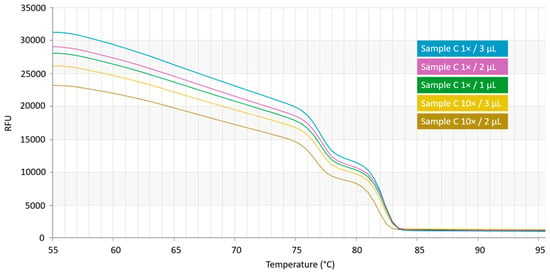
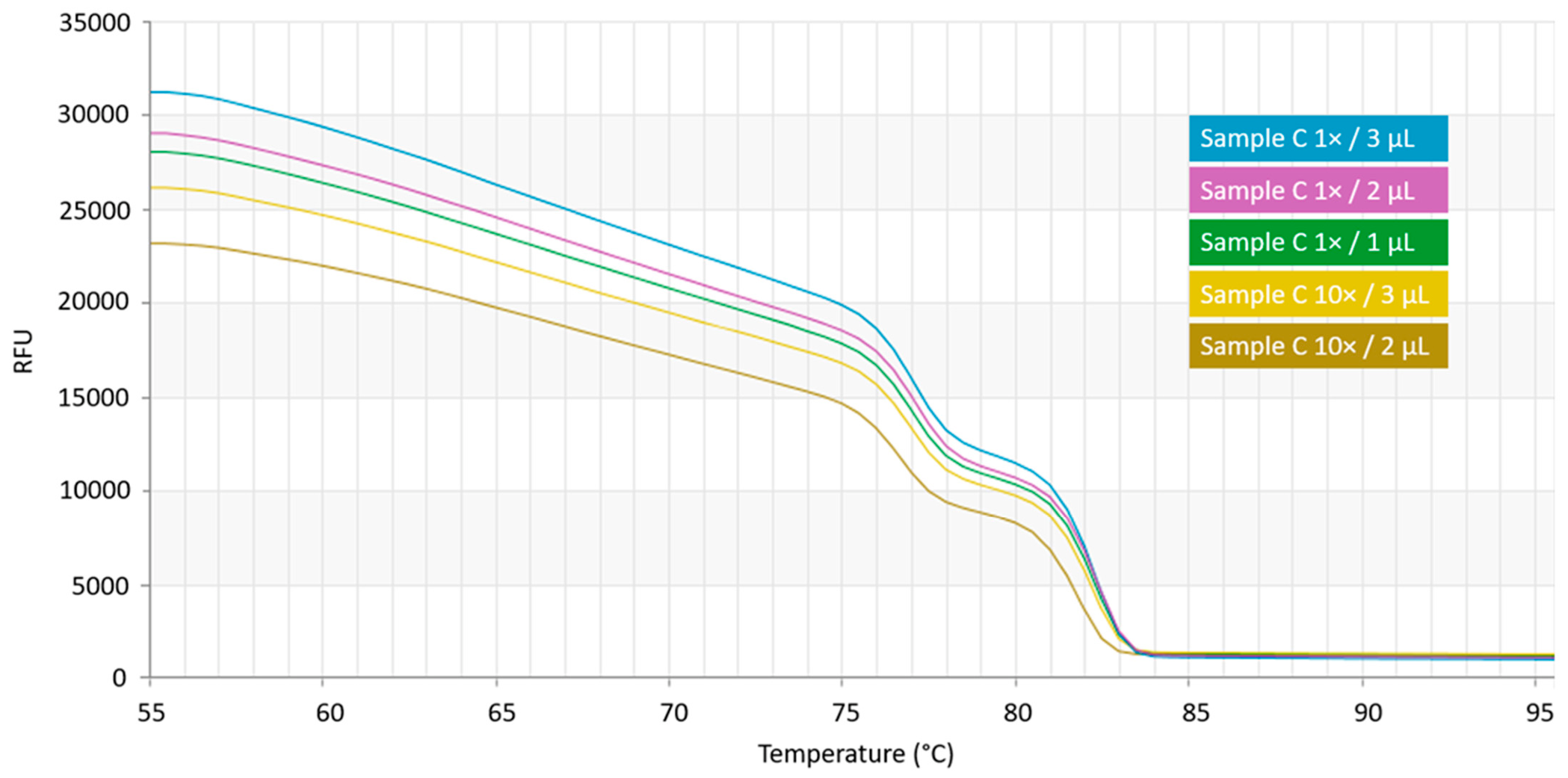
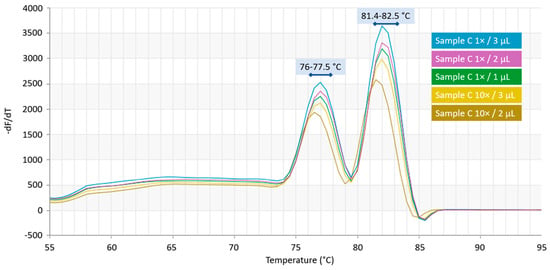
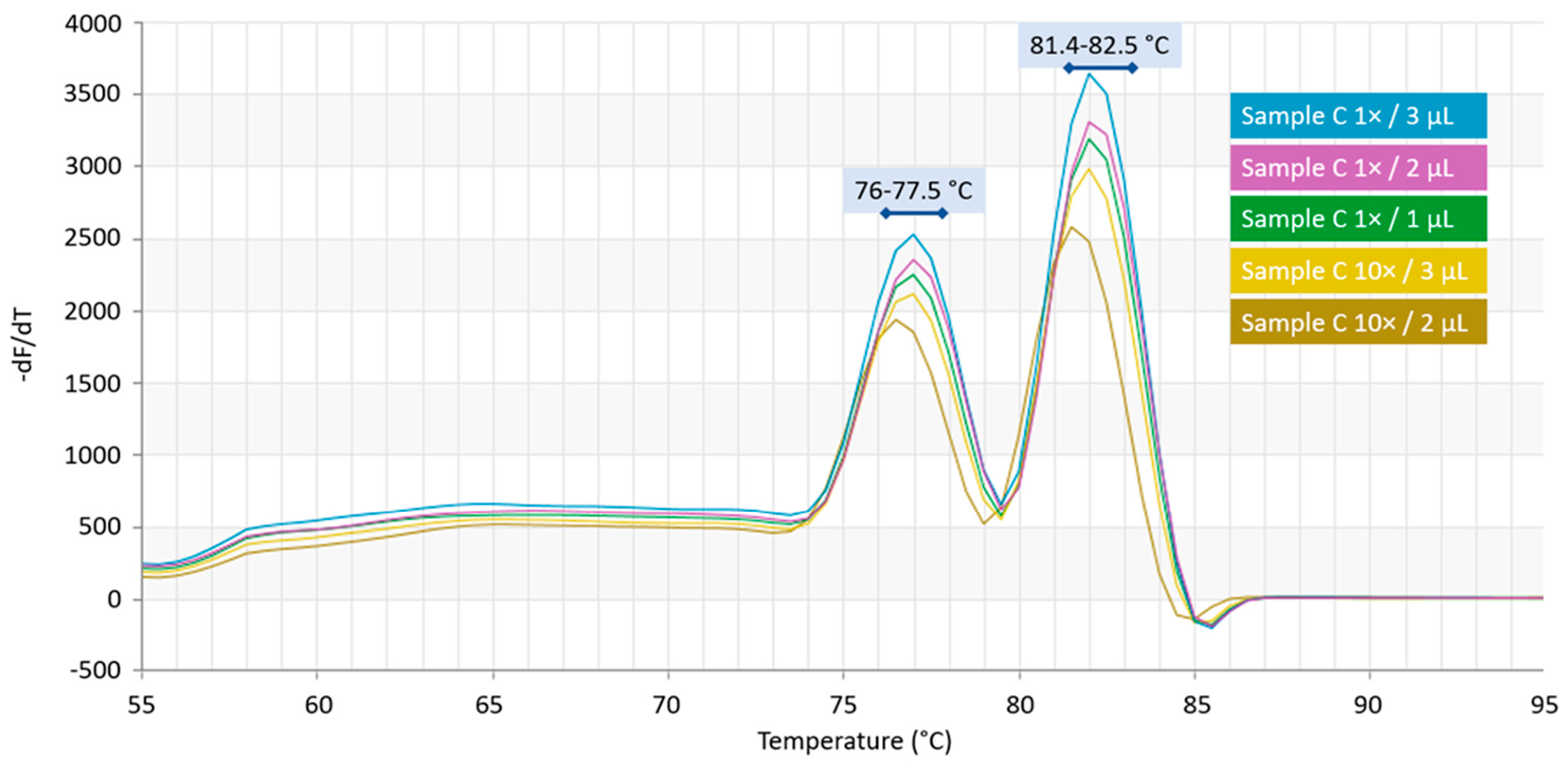
To optimize template input for inhibitor-rich fecal DNA, three sequencing-confirmed T. foetus-positive clinical fecal extracts (A-C) were tested at template inputs of 1–3 µL and at serial dilutions (1× to 1000×), with D included as the positive control under the same run conditions (Table 4, Figure 5 and Figure 6). Sample-dependent behavior was observed: extract C showed strong amplification and maintained the expected dual-peak HRM signature across dilutions, whereas extract B lost concordant detection at higher template volume (3 µL) and/or upon dilution, consistent with inhibition and/or low target load. These findings supported using 2 µL DNA input as the routine condition and reinforced HRM as a specificity filter in inhibitor-rich matrices.
Table 4.
Template input (1–3 µL) and DNA dilution (1×–1000×) in sequencing-confirmed fecal extracts (A–C) and positive control (D) tested by one-tube nested real-time PCR-HRM.
Figure 5.
Representative melting curves obtained for Tritrichomonas foetus-positive sample C using the one-tube nested real-time PCR-HRM assay. Different reaction variants are shown, including undiluted template DNA added at 3 µL, 2 µL, and 1 µL per reaction, as well as 10-fold diluted template DNA added at 3 µL and 2 µL per reaction. The gradual decrease in fluorescence with increasing temperature reflects dissociation of double-stranded amplification products. Comparable melting profiles across template volumes and dilutions indicate reproducible amplification behavior, although differences in fluorescence intensity are visible between reaction variants.
Figure 6.
Representative derivative melting peak profiles of Tritrichomonas foetus-positive sample C analyzed using the one-tube nested real-time PCR-HRM assay. The same reaction variants as in Figure 5 are shown: undiluted template DNA added at 3 µL, 2 µL, and 1 µL per reaction, and 10-fold diluted template DNA added at 3 µL and 2 µL per reaction. Two characteristic melting peak regions were observed, with a lower-temperature peak at approximately 76.0–77.5 °C and a dominant higher-temperature peak at approximately 81.4–82.5 °C. The consistent dual-peak profile across reaction variants supports reproducible detection of the target-associated HRM signature and demonstrates that the melting pattern is retained despite changes in template input volume and dilution.
3.7. Clinical Characteristics and Comparison of Three Molecular Methods
The clinical and demographic characteristics of the 147 cats included in the method-comparison cohort are summarized in Table 5. All samples were submitted in January 2026 from cats with diarrhea or abnormal fecal consistency. Cats positive for T. foetus were significantly younger than negative cats (median 1.5 vs. 4.2 years; p = 0.00046). Sex was not significantly associated with positivity (p = 0.792). Fecal consistency at submission was not significantly associated with positivity (p = 0.111), although loose feces were proportionally more frequent among positive cats than among negative cats.
Table 5.
Clinical and demographic characteristics of the 147 cats included in the method-comparison cohort.
Across 147 specimens, outer-primer PCR targeting the 347 bp fragment detected 5/147 positive samples (3.4%; 95% CI, 1.1–7.8%), whereas both nested approaches detected 16/147 positive samples (10.9%; 95% CI, 6.4–17.1%). After applying the predefined calling algorithm for the one-tube nested real-time PCR-HRM assay, based on Ct detection, the target-associated dual-peak HRM profile, the 2/2 duplicate rule, and retesting of non-concordant duplicates, the final classification obtained with this method was identical to that of the gel-based single-tube nested PCR for all specimens. Overall agreement between the gel-based single-tube nested PCR and the one-tube nested real-time PCR-HRM assay was therefore 100% (147/147; 95% CI, 97.5–100.0%), with Cohen’s κ = 1.00. In contrast, outer-primer PCR detected only a subset of nested-positive samples (5/16) and missed 11 samples classified as positive by both nested methods. Paired comparison using McNemar’s exact test confirmed a significantly higher detection rate for the nested approaches compared with outer-primer PCR (p = 0.00098).
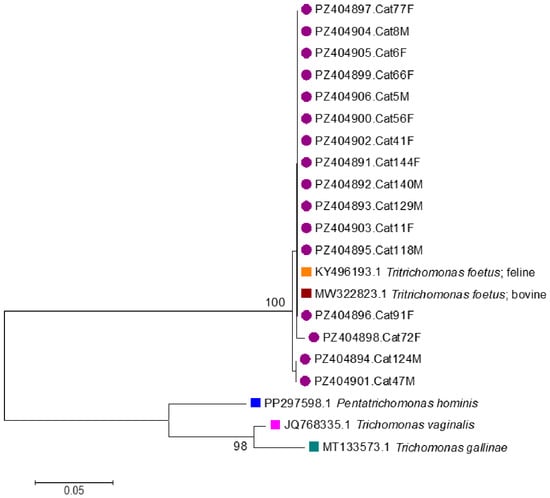
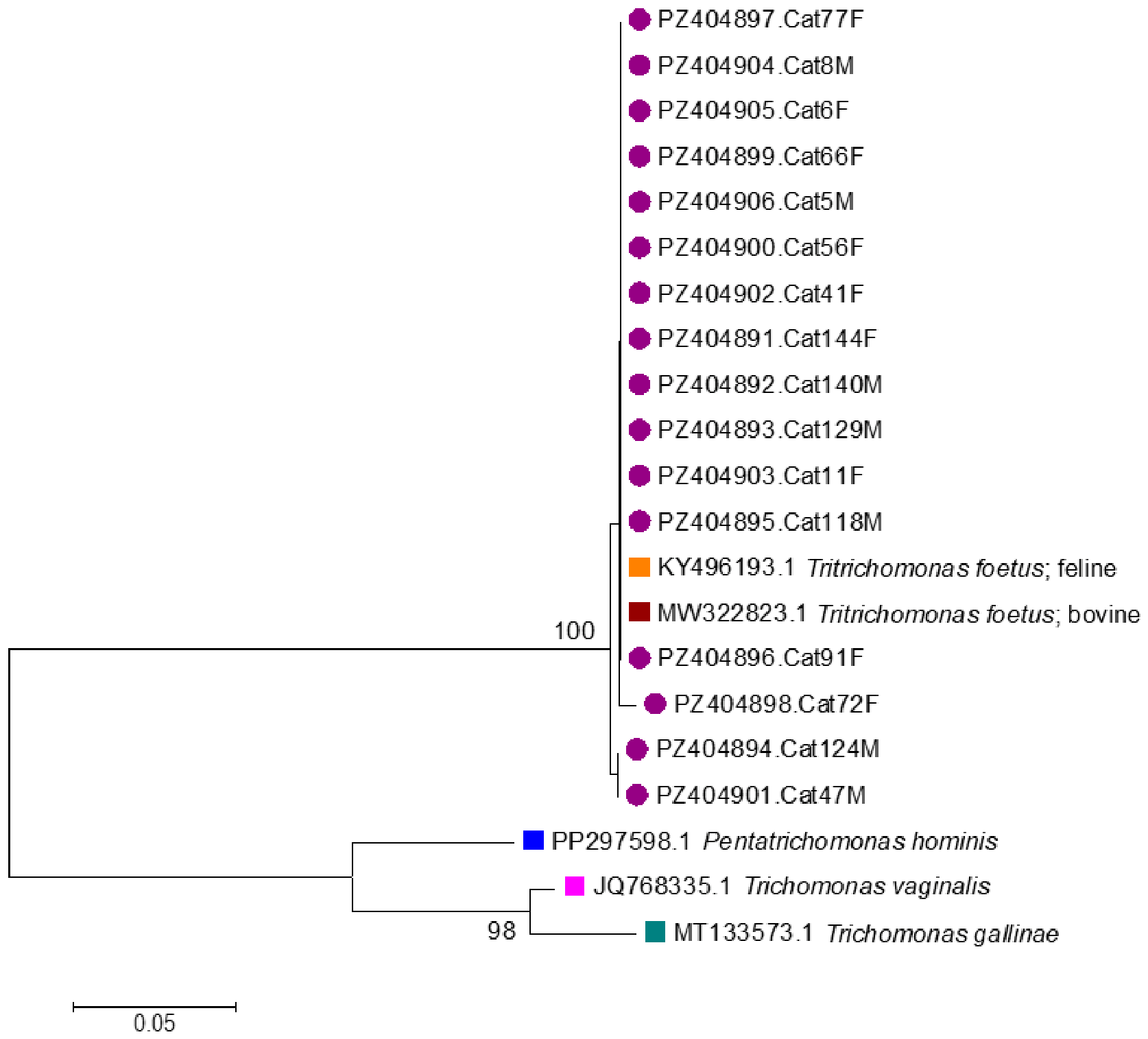
All 16 amplicons obtained from nested-positive clinical samples were subjected to Sanger sequencing. BLAST analysis confirmed the identity of all 16 sequences as Tritrichomonas foetus, with nucleotide identity ranging from 99.51% to 100.00%. The sequences were deposited in GenBank under accession numbers PZ404891–PZ404906. Phylogenetic analysis based on the ITS1-5.8S rRNA region showed that all sequences obtained in this study clustered with reference T. foetus sequences from feline and bovine hosts and were clearly separated from Pentatrichomonas hominis, Trichomonas vaginalis, and Trichomonas gallinae (Figure 7).
Figure 7.
Phylogenetic analysis of Tritrichomonas foetus sequences obtained from feline fecal samples based on the partial ITS1-5.8S rRNA region. All 16 nested-positive clinical samples were included in the analysis. The tree was constructed in MEGA6 using the Neighbor-Joining method with the Kimura 2-parameter model. Bootstrap values were calculated from 1000 replicates, and only bootstrap values of at least 70% are shown. Sequences obtained in this study are marked with purple circles and clustered with reference T. foetus sequences from feline and bovine hosts, while remaining clearly separated from Pentatrichomonas hominis, Trichomonas vaginalis, and Trichomonas gallinae. The scale bar represents the number of substitutions per site.
4. Discussion
Feline tritrichomonosis remains an important and often underrecognized cause of chronic or intermittent large-bowel diarrhea, particularly in younger cats and in multi-cat environments where transmission and persistence are facilitated [1,2,3]. Recent regional prevalence data, including routine diagnostic submissions, further support that T. foetus should be consistently considered in the differential diagnosis of feline chronic colitis [4]. The diagnostic challenge in clinical practice arises from trophozoite fragility, intermittent shedding, and the low sensitivity and strong operator dependence of direct microscopy, whereas culture and nucleic-acid-based approaches provide higher diagnostic yield and are compatible with centralized testing [2]. In this context, the present study addresses two persistent bottlenecks in fecal molecular diagnostics: the need for nested amplification to overcome low target burden and inhibition in stool matrices and the practical and biosafety limitations of gel-based endpoint readouts, including increased hands-on time and amplicon carryover risk.
4.1. Clinical Agreement Supports Further Evaluation of the HRM Workflow as a Gel-Free Alternative
A key finding of this study is that the one-tube nested real-time PCR-HRM workflow yielded the same final classification as gel-based single-tube nested PCR in the clinical cohort, whereas outer-primer PCR detected substantially fewer positives. This is consistent with the diagnostic rationale for nested amplification in fecal matrices, where target abundance may be low and inhibitors may be present. However, this comparison should be interpreted as a method-agreement assessment rather than a diagnostic accuracy study. Because no independent reference standard or composite diagnostic standard was used, the study does not establish true clinical sensitivity or specificity. Therefore, the data support further evaluation of the HRM workflow as a gel-free alternative to gel-based nested PCR, but they do not by themselves prove diagnostic superiority or full routine replacement.
4.2. Why HRM Matters Here: Closed-Tube Endpoint Confirmation and Reduced Contamination Opportunity
The practical advantage of HRM is that it enables homogeneous, closed-tube, post-PCR discrimination of products based on melt behavior, avoiding the tube opening required for agarose gel electrophoresis [6,9]. This point is not merely convenience: tube opening after nested amplification is a well-known contamination vulnerability, particularly in laboratories processing large sample volumes. Closed-tube approaches reduce opportunities for carryover contamination and are compatible with higher throughput workflows, with melting analysis requiring only minutes once amplification is complete [10]. In microbiological diagnostics, HRM has been widely discussed as a low-cost, single-step, closed-tube approach that can support rapid discrimination of clinically relevant targets and variants, while also requiring careful assay design and interpretation rules [11]. In practice, HRM also preserves an important advantage: because the reaction remains intact, ambiguous cases can still be reflexed to gel analysis or sequencing if needed, without making gel electrophoresis the default endpoint [10].
In the present assay, HRM replaces gel-based reading with a predefined dual-peak signature. This design directly addresses a recurrent issue in stool matrices: late Ct signals and nonspecific amplification can occur in negative extracts or matrix blanks, but can be filtered out if the melt profile does not match the target signature. Similar logic—using HRM to minimize reliance on post-PCR manipulations and to reduce contamination opportunity relative to nested PCR or multi-step workflows—has been emphasized in other diagnostic HRM implementations [12].
4.3. Reduced Cycling Burden (30 + 50 → 20 + 40) Without Loss of Clinical Classification
A particularly relevant methodological contribution is the reduction in cycling burden from the conventional nested scheme (30 outer + 50 nested cycles) to a shorter two-stage program (20 outer + 40 nested cycles) while maintaining the same clinical classification on 147 samples. This matters for throughput and interpretability. Fewer cycles shorten runtime and can reduce the accumulation of late-cycle nonspecific products that complicate endpoint interpretation in fecal matrices. While nested amplification remains essential for sensitivity in stool extracts [5], the combined real-time monitoring and HRM endpoint confirmation appears to provide sufficient analytical headroom to permit fewer cycles without compromising real-world clinical classification. Conceptually, this aligns with the view that robust HRM performance depends on generating a clean dominant product—product mixtures complicate melt interpretation and increase the likelihood of ambiguous curves [9,13]. Therefore, cycle reduction is not only a speed optimization but may also improve interpretability by limiting the extent of nonspecific late amplification.
4.4. Dual-Peak HRM Signature + Strict 2/2 Duplicates: Specificity First, Particularly for Fecal Matrices
HRM methods are most reliable when interpretation is based on predefined melt behaviors and run-internal controls, rather than Ct alone [9,11,13]. Fecal extracts, however, amplify this requirement: inhibitors, variable background DNA, and sporadic artifacts can produce late Ct values in otherwise negative samples. In our assay, positivity is defined by Ct detection plus the dual-peak HRM signature in both duplicates (2/2), with retesting of non-concordant samples prior to final classification. This decision intentionally prioritizes reporting specificity and reproducibility. From a laboratory perspective, this is defensible because the diagnostic consequences of sporadic false positives (triggering unnecessary treatment or confusion in chronic diarrhea workups) are substantial, and nested PCR workflows are inherently sensitive to contamination and nonspecificity if interpretation is lax [7,8]. The dual-peak requirement functions as an internal specificity filter: even when late Ct signals occur (including in matrix blanks or NTC wells), they are not reported unless both characteristic peaks are present within defined temperature windows. The occurrence of sporadic late Ct signals in NTC wells without the target-concordant HRM signature emphasizes that Ct alone is insufficient for interpretation in this assay. These findings support the use of HRM confirmation and strict duplicate concordance as safeguards against nonspecific or artifactual amplification signals. This approach parallels broader HRM best practice: melt profiles should be treated as primary discriminators, and Ct should not be used as the sole determinant of positivity when product mixtures or nonspecific artifacts are plausible [11,13]. HRM’s value in discriminating sequence- or product-specific outcomes in microbiology has been repeatedly highlighted, but the same literature also stresses that assay-specific interpretive rules and validation are essential for reliable deployment [11].
4.5. Analytical Sensitivity in Matrix-Matched Conditions and What It Means for Routine Diagnostics
Analytical sensitivity was assessed using serial dilutions in pooled negative fecal eluate (matrix-matched). The reported LoD should be interpreted as a post-extraction, matrix-matched analytical LoD. It accounts for amplification-stage matrix effects but does not include variation introduced during fecal homogenization, lysis, or DNA extraction. This is an appropriate design to model amplification-stage inhibition typical for stool extracts and aligns with validation frameworks emphasizing matrix-relevant sensitivity assessment rather than idealized water/buffer conditions [7,8]. The data show a steep transition around the practical limit, which is expected when approaching low copy numbers in inhibitor-rich matrices, where stochastic sampling and inhibition effects combine. Importantly, because the clinical calling rule requires 2/2, the “reportable” detection boundary is necessarily higher than a single-well LoD, but this is precisely what improves reliability of reported positives in routine settings. Such tradeoffs are common and acceptable in diagnostic assay validation, particularly for complex clinical matrices, and should be explicitly presented as part of the assay’s intended use and reporting rules [7,8].
The sensitivity estimate reported here should not be interpreted as an extraction-inclusive LoD. Because the target was diluted into pooled negative fecal eluate after extraction, the experiment accounts for amplification-stage matrix effects but not for variability in fecal homogenization, trophozoite disruption, DNA extraction efficiency, or uneven parasite distribution in stool. Future work should include pre-extraction spiking of fecal material with quantified trophozoites or standardized cellular material to estimate extraction-inclusive analytical sensitivity.
4.6. Dye Choice and HRM Performance: Relevance of EvaGreen Chemistry
HRM performance depends on instrumentation and dye chemistry; saturating dyes are generally preferred for high-resolution melt discrimination [6,9,13]. EvaGreen has been widely used as an economical dye compatible with qPCR and post-PCR melt analysis, and comparative work has supported its suitability for HRM applications in terms of detectable polymorphism classes and practical workflow cost-effectiveness [14]. In our implementation, EvaGreen chemistry supports real-time amplification monitoring and HRM endpoint confirmation within the same closed tube, consistent with the general rationale that HRM can be integrated into routine workflows without labeled probes and without gel electrophoresis [9]. While dye selection alone does not guarantee assay performance, it is an enabling component of a workflow designed for high-throughput diagnostics rather than research-only genotyping.
4.7. HRM in Microbiology and Parasitology: Positioning the Assay Within Broader Practice
Beyond human genetics, HRM has become a mainstream tool in clinical microbiology and related fields, supporting rapid discrimination of microbial targets and variants and offering a low-cost closed-tube alternative to gel-dependent workflows [11]. Importantly, for this Special Issue, HRM has also been discussed as a useful molecular tool in parasitology-adjacent applications (including parasite monitoring and discrimination in field and wildlife contexts), illustrating that HRM is not limited to mutation scanning but can serve as an efficient diagnostic readout in parasitological workflows [15]. This broader context supports the practical relevance of the present implementation: adapting a well-known nested PCR target (for feline feces) into a faster, closed-tube, gel-free diagnostic workflow that remains compatible with routine laboratory operations and validation expectations [7,8,11,15]. However, the limitations and caveats of HRM in practical deployment, including platform dependence, assay-specific optimization, and interpretive constraints, should be considered when HRM-based workflows are transferred or expanded [16]. Reported detection rates and clinical contexts for feline T. foetus vary among studies, including cat-show and cattery populations, diarrheic referral cohorts, rescue or multi-cat environments, and broader fecal enteropathogen panels [17,18,19,20,21,22]. This variability emphasizes that the present cohort should not be used to infer population prevalence or diagnostic accuracy. The absence of breed, housing density, outdoor access, and previous treatment data further limits epidemiological interpretation. In addition, fecal collection technique and treatment history may influence PCR results, which reinforces the need to interpret routine diagnostic submissions cautiously [22].
4.8. Limitations and Future Directions
Several limitations must be acknowledged. First, no independent reference standard or composite diagnostic standard was available. Therefore, clinical sensitivity, clinical specificity, positive predictive value, and negative predictive value could not be estimated. The clinical component of this study should be interpreted as a method-comparison and agreement assessment against an established gel-based single-tube nested PCR workflow rather than as a full diagnostic accuracy study.
Second, the analytical sensitivity experiment was performed using target DNA diluted into pooled negative fecal eluate after extraction. This design is useful for assessing amplification-stage performance in a matrix background but does not account for fecal homogenization, trophozoite disruption, DNA extraction efficiency, or uneven distribution of organisms within stool. An extraction-inclusive LoD would require spiking fecal material before lysis and DNA extraction.
Third, the exclusivity panel was limited and was not designed to reproduce the full complexity of polymicrobial feline fecal samples. Mixed infections, high-template non-target challenges, and broader panels of feline enteric pathogens were not assessed. Therefore, the absence of cross-reactivity in the tested panel should be interpreted as preliminary analytical exclusivity rather than definitive diagnostic specificity.
Fourth, HRM interpretation is inherently platform-, chemistry-, and amplicon-dependent. Although within-platform repeatability of the dual-peak melting domains was supported by 95 target-associated reactions, inter-instrument, inter-operator, reagent-lot, and inter-laboratory reproducibility were not assessed. Acceptance windows should therefore be established relative to a run-internal positive control when the assay is transferred to another instrument, reagent lot, or laboratory.
Finally, the strict 2/2 duplicate rule prioritizes reporting specificity and reproducibility, but it may reduce positivity near the detection boundary. This tradeoff is appropriate for a preliminary closed-tube diagnostic workflow in inhibitor-rich fecal matrices, but its impact on clinical sensitivity should be evaluated in larger, prospectively collected cohorts.
Overall, the one-tube nested real-time PCR-HRM assay showed complete classification agreement with the gel-based single-tube nested PCR comparator in this cohort and provided a closed-tube HRM endpoint that may reduce reliance on gel electrophoresis. However, the assay should be regarded as a preliminary analytically evaluated method with demonstrated within-platform HRM repeatability and method agreement, not as a fully diagnostically validated replacement. Additional extraction-inclusive sensitivity testing, broader exclusivity testing, and inter-laboratory reproducibility studies are needed before broad implementation claims can be made.
5. Conclusions
This study describes a gel-free one-tube nested real-time PCR-HRM assay for qualitative detection of Tritrichomonas foetus DNA in feline fecal extracts. The assay showed complete classification agreement with the gel-based single-tube nested PCR comparator in a cohort of 147 diarrheic cats, and all nested-positive clinical amplicons were confirmed by Sanger sequencing. The HRM endpoint provided an additional closed-tube specificity filter, particularly for distinguishing target-associated profiles from atypical late amplification signals. Within-platform repeatability of the empirical dual-peak HRM signature was supported by 95 target-associated reactions. However, the study did not include an independent diagnostic reference standard, extraction-inclusive analytical sensitivity testing, inter-instrument reproducibility assessment, or inter-laboratory transferability analysis. Therefore, the assay should be regarded as a preliminary analytically evaluated, gel-free alternative to the established nested PCR workflow rather than as a fully diagnostically validated replacement.
Supplementary Materials
The following supporting information can be downloaded at https://www.mdpi.com/article/10.3390/app16147124/s1, Table S1. Individual HRM melting-temperature values from 95 target-associated dual-peak reactions used to assess within-platform repeatability of the Tritrichomonas foetus one-tube nested real-time PCR-HRM assay.
Author Contributions
Conceptualization, D.J.; methodology, D.J.; software, D.J.; validation, D.J. and J.K.; formal analysis, D.J.; investigation, D.J. and J.K.; resources, D.J.; data curation, J.K. and M.A.; writing—original draft preparation, D.J.; writing—review and editing, R.W.; visualization, D.J.; supervision, R.W.; project administration, D.J. All authors have read and agreed to the published version of the manuscript.
Funding
This research received no external funding.
Institutional Review Board Statement
The study was carried out in accordance with the standards recommended by the EU Directive 2010/63/EU for animal experiments and Good Laboratory Practice and the Act of Polish Parliament of 15 January 2015 on protection of animals used for scientific purposes (Act of 15 January 2015 on the Protection of Animals Used for Scientific or Educational Purposes. Journal of Laws of the Republic of Poland 2015, item 266. Available online: https://isap.sejm.gov.pl/isap.nsf/DocDetails.xsp?id=WDU20150000266 (accessed on 2 May 2026). All procedures were in line with Polish law regulations. Samples were submitted by veterinarians as a part of the laboratory service tests; therefore, the Ethic Commission Agreement was not required.
Informed Consent Statement
Not applicable.
Data Availability Statement
The data presented in this study are available on reasonable request from the corresponding author. The data are not publicly available because they originate from routine veterinary diagnostic submissions and may contain potentially identifiable clinical metadata related to animals, owners, or submitting veterinary practices. The nucleotide sequences generated in this study have been deposited in GenBank under accession numbers PZ404891–PZ404906.
Conflicts of Interest
The authors declare no conflicts of interest.
Abbreviations
The following abbreviations are used in this manuscript:
| Bp | base pairs |
| Ct | cycle threshold |
| DNA | deoxyribonucleic acid |
| DP | dual peak |
| HRM | high-resolution melting |
| IQR | interquartile range |
| LoD | limit of detection |
| NTC | no-template control |
| PCR | polymerase chain reaction |
| qPCR | quantitative polymerase chain reaction |
| QC | quality control |
| Tm | melting temperature |
| ND | not detected |
References
- Yao, C.; Köster, L.S. Tritrichomonas foetus Infection, a Cause of Chronic Diarrhea in the Domestic Cat. Vet. Res. 2015, 46, 35. [Google Scholar] [CrossRef] [Scilit] [PubMed]
- Tolbert, M.K.; Gookin, J.L. Tritrichomonas foetus: A New Agent of Feline Diarrhea. Compend. Contin. Educ. Vet. 2009, 31, 374–381, 390; quiz 381. [Google Scholar] [PubMed]
- Crisi, P.E.; Paoletti, B.; Morelli, S.; Simonato, G.; Colombo, M.; Tiscar, P.G.; Boari, A. Tritrichomonas foetus in Cats from Central Italy: Clinical Signs and Risk Factors. Vet. Parasitol. Reg. Stud. Rep. 2021, 24, 100577. [Google Scholar] [CrossRef] [Scilit] [PubMed]
- Jańczak, D.; Szczepaniak, K.; Jeleniewska, J.; Szaluś-Jordanow, O. Prevalence of Tritrichomonas foetus among Cats in Poland between 2020 and 2024. Pathogens 2025, 14, 458. [Google Scholar] [CrossRef] [Scilit]
- Gookin, J.L.; Birkenheuer, A.J.; Breitschwerdt, E.B.; Levy, M.G. Single-Tube Nested PCR for Detection of Tritrichomonas foetus in Feline Feces. J. Clin. Microbiol. 2002, 40, 4126–4130. [Google Scholar] [CrossRef] [Scilit] [PubMed]
- Wittwer, C.T.; Reed, G.H.; Gundry, C.N.; Vandersteen, J.G.; Pryor, R.J. High-Resolution Genotyping by Amplicon Melting Analysis Using LCGreen. Clin. Chem. 2003, 49, 853–860. [Google Scholar] [CrossRef] [Scilit] [PubMed]
- Burd, E.M. Validation of Laboratory-Developed Molecular Assays for Infectious Diseases. Clin. Microbiol. Rev. 2010, 23, 550–576. [Google Scholar] [CrossRef] [Scilit] [PubMed]
- Clinical and Laboratory Standards Institute. Validation and Verification of Multiplex Nucleic Acid Assays, 2nd ed.; CLSI Guideline MM17; Clinical and Laboratory Standards Institute: Wayne, PA, USA, 2018. [Google Scholar]
- Erali, M.; Voelkerding, K.V.; Wittwer, C.T. High Resolution Melting Applications for Clinical Laboratory Medicine. Exp. Mol. Pathol. 2008, 85, 50–58. [Google Scholar] [CrossRef] [Scilit] [PubMed]
- Tong, S.Y.C.; Giffard, P.M. Microbiological Applications of High-Resolution Melting Analysis. J. Clin. Microbiol. 2012, 50, 3418–3421. [Google Scholar] [CrossRef] [Scilit] [PubMed]
- Thomsen, N.; Ali, R.G.; Ahmed, J.N.; Arkell, R.M. High Resolution Melt Analysis (HRMA); a Viable Alternative to Agarose Gel Electrophoresis for Mouse Genotyping. PLoS ONE 2012, 7, e45252. [Google Scholar] [CrossRef] [Scilit] [PubMed]
- Wittwer, C.T. High-Resolution DNA Melting Analysis: Advancements and Limitations. Hum. Mutat. 2009, 30, 857–859. [Google Scholar] [CrossRef] [Scilit] [PubMed]
- Li, Y.-D.; Chu, Z.-Z.; Liu, X.-G.; Jing, H.-C.; Liu, Y.-G.; Hao, D.-Y. A Cost-Effective High-Resolution Melting Approach Using the EvaGreen Dye for DNA Polymorphism Detection and Genotyping in Plants. J. Integr. Plant Biol. 2010, 52, 1036–1042. [Google Scholar] [CrossRef] [Scilit] [PubMed]
- Bernal-Martínez, L.; Gil, H.; Rivero-Menéndez, O.; Gago, S.; Cuenca-Estrella, M.; Mellado, E.; Alastruey-Izquierdo, A. Development and Validation of a High-Resolution Melting Assay to Detect Azole Resistance in Aspergillus fumigatus. Antimicrob. Agents Chemother. 2017, 61, e01083-17. [Google Scholar] [CrossRef] [Scilit] [PubMed]
- Héritier, L.; Verneau, O.; Breuil, G.; Meistertzheim, A.-L. The High Resolution Melting Analysis (HRM) as a Molecular Tool for Monitoring Parasites of the Wildlife. Parasitology 2017, 144, 563–570. [Google Scholar] [CrossRef] [Scilit] [PubMed]
- Słomka, M.; Sobalska-Kwapis, M.; Wachulec, M.; Bartosz, G.; Strapagiel, D. High Resolution Melting (HRM) for High-Throughput Genotyping—Limitations and Caveats in Practical Case Studies. Int. J. Mol. Sci. 2017, 18, 2316. [Google Scholar] [CrossRef] [Scilit] [PubMed]
- Gookin, J.L.; Stebbins, M.E.; Hunt, E.; Burlone, K.; Fulton, M.; Hochel, R.; Talaat, M.; Poore, M.; Levy, M.G. Prevalence of and Risk Factors for Feline Tritrichomonas foetus and Giardia Infection. J. Clin. Microbiol. 2004, 42, 2707–2710. [Google Scholar] [CrossRef] [Scilit]
- Gunn-Moore, D.A.; McCann, T.M.; Reed, N.; Simpson, K.E.; Tennant, B. Prevalence of Tritrichomonas foetus Infection in Cats with Diarrhoea in the UK. J. Feline Med. Surg. 2007, 9, 214–218. [Google Scholar] [CrossRef] [Scilit] [PubMed]
- Frey, C.F.; Schild, M.; Hemphill, A.; Stünzi, P.; Müller, N.; Gottstein, B.; Burgener, I.A. Intestinal Tritrichomonas foetus Infection in Cats in Switzerland Detected by In Vitro Cultivation and PCR. Parasitol. Res. 2009, 104, 783–788. [Google Scholar] [CrossRef] [Scilit] [PubMed]
- Queen, E.V.; Marks, S.L.; Farver, T.B. Prevalence of Selected Bacterial and Parasitic Agents in Feces from Diarrheic and Healthy Control Cats from Northern California. J. Vet. Intern. Med. 2012, 26, 54–60. [Google Scholar] [CrossRef] [Scilit] [PubMed]
- Xenoulis, P.G.; Lopinski, D.J.; Read, S.A.; Suchodolski, J.S.; Steiner, J.M. Intestinal Tritrichomonas foetus Infection in Cats: A Retrospective Study of 104 Cases. J. Feline Med. Surg. 2013, 15, 1098–1103. [Google Scholar] [CrossRef] [Scilit] [PubMed]
- Hedgespeth, B.A.; Stauffer, S.H.; Robertson, J.B.; Gookin, J.L. Association of Fecal Sample Collection Technique and Treatment History with Tritrichomonas foetus Polymerase Chain Reaction Test Results in 1717 Cats. J. Vet. Intern. Med. 2020, 34, 734–741. [Google Scholar] [CrossRef] [Scilit] [PubMed]

Disclaimer/Publisher’s Note: The statements, opinions and data contained in all publications are solely those of the individual author(s) and contributor(s) and not of MDPI and/or the editor(s). MDPI and/or the editor(s) disclaim responsibility for any injury to people or property resulting from any ideas, methods, instructions or products referred to in the content. |
© 2026 by the authors. Licensee MDPI, Basel, Switzerland. This article is an open access article distributed under the terms and conditions of the Creative Commons Attribution (CC BY) license.