1. Introduction
Excessive use of water resources leads to various problems; however, wastewater reuse presents a solution to address these issues. Improper use of wastewater causes unstable crop production, environmental damage, lowering of the groundwater table, and mixing of salty and fresh water in coastal areas. In integrated water use, water needs are met by two sources: surface and groundwater [
1,
2]. Iran is a dry country where its precipitation is less than one-third of the global average rainfall. According to studies by the Meteorological Organization, Iran is currently among the countries facing water stress, and the severity of this stress increases each year. Based on international standards, cities with a per capita water share between 1000 and 1700 cubic meters per year are considered water-stressed, while those with less than 1000 cubic meters per year are classified as water-scarce.
The reuse of treated wastewater, especially in developing countries with limited freshwater resources, is on the rise. It has been well established that inadequate treatment and poor management of wastewater lead to public health issues through the spread of infectious diseases. The need for integrated management becomes more evident when the environmental quality of consumed water differs across sectors, and the amount of waste and wastewater generated in each sector also varies. Therefore, disposal, treatment, recovery, and reuse methods differ depending on the types of needs, as well as economic, social, and environmental aspects [
3]. Integrated water resources management aims to ensure the sustainable use of water resources. Integrated water resources management is the only comprehensive solution for actions such as reducing traditional water consumption, imposing restrictions on the quantity and environmental quality of consumed water, and making changes in population and production patterns to achieve sustainable development [
4].
The reuse of treated wastewater and its distribution through urban networks—particularly for green space irrigation and industrial purposes—began in the United States in 1928. In countries such as Japan, the Arab states of the Persian Gulf, and Brazil, which face water scarcity, the reuse of wastewater for urban and agricultural purposes is increasing day by day [
5]. The use of untreated wastewater in agriculture poses serious risks, threatening the health of consumers of these products. Additionally, urban wastewater can contain various chemical and biological contaminants, and in many low-income countries, the pollution levels in human wastewater have been reported to be very high. Considering the impending water crisis, the management of water resources is essential. With the increasing global challenges associated with water scarcity and the growing complexity of sustainable water resources management, decision-making in water allocation and reuse requires systematic and multi-criteria approaches. In such contexts, water management problems typically involve multiple, and often conflicting, criteria, including environmental, economic, social, and technical dimensions. Therefore, multi-criteria decision-making methods have been widely recognized as effective tools for simultaneously handling these diverse criteria and addressing uncertainty in complex environmental decision problems. One of the tools for sustainable water resource management is the use of urban and agricultural wastewater for industry, the establishment of eco-parks, and the cultivation of timber-producing (non-fruit-bearing) trees, which is the main focus of the present study [
6].
The aim of this study is to propose optimal scenarios for wastewater management in the cultivation of timber trees, eco-park applications, and industrial uses with a focus on sustainable development. The use of wastewater for irrigation of green spaces, agriculture, and industry as a supplementary water resource can help mitigate the water scarcity crisis. The wastewater entering the Shahrekord region is subject to quality degradation mainly due to anthropogenic pressures, particularly agricultural runoff and industrial discharges. Based on regional water quality monitoring reports, the dominant pollutants include elevated biochemical oxygen demand (BOD) and chemical oxygen demand (COD), increased concentrations of nitrogen and phosphorus compounds, and higher levels of suspended solids, along with trace industrial contaminants. This pollution profile indicates a moderate to high organic and nutrient load, which directly affects the suitability of treated wastewater for different reuse applications. Therefore, the selection of wastewater reuse scenarios in this study (ecological park development, industrial use, and timber tree cultivation) is directly aligned with the physicochemical characteristics of the available effluent and regional environmental capacity. Therefore, evaluating the potential scenarios for utilizing this wastewater, considering both technical and economic aspects, is essential. To analyze the scenarios for wastewater use, snowball sampling, fuzzy Shannon entropy, and fuzzy ARAS methods were employed. Fuzzy Shannon Entropy was selected due to its capability to generate objective weights based on information entropy, reducing subjectivity in comparison with methods such as AHP and Best-Worst Method. Fuzzy ARAS was chosen for its efficiency and robustness in ranking alternatives under uncertainty, compared with commonly used MCDM methods including TOPSIS, VIKOR, and PROMETHEE. Initially, snowball sampling was used to collect data and expert opinions. Then, to assess the criteria, fuzzy Shannon entropy was applied to reduce uncertainties and determine the significance of the criteria more accurately. Finally, using fuzzy ARAS, different wastewater scenarios were modeled and prioritized. These methods, particularly in complex and uncertain conditions, helped make optimal decisions. There are several advantages of applying the fuzzy Shannon entropy method to derive weights of criteria: (a) Objective weighting: Weights are calculated based on the data distribution without relying on expert opinions. (b) Uncertainty management: It is capable of quantifying uncertainties and supporting decision-making in complex and ambiguous conditions. (c) Computational efficiency: Due to simpler calculations, optimization is performed faster and with minimal complexity [
7]. Furthermore, applying fuzzy ARAS to prioritize scenarios has several advantages, such as: (a) Simple ranking: Using aggregated utility functions, alternatives are ranked easily and efficiently. (b) Multi-criteria evaluation: The ability to simultaneously assess multiple criteria for balanced decision-making. (c) Flexibility: The ability to integrate with other multi-criteria decision-making (MCDM) methods [
7].
Although Dehkordi et al. [
7] developed an integrated fuzzy Shannon Entropy–fuzzy ARAS model for risk-based evaluation of water resource management scenarios in the same region, the present study extends this methodological line by moving beyond risk-oriented ranking toward structured decision-support architecture for sustainability-driven wastewater reuse planning. In particular, the contribution of the current study is not limited to methodological reuse, but lies in redefining the decision problem at the system level, where wastewater reuse alternatives are evaluated as integrated socio-environmental planning options rather than isolated risk scenarios. Furthermore, the study enriches the evaluation logic by embedding a multi-dimensional sustainability structure (environmental, social, economic, and technical dimensions) and reinforcing the model with Delphi-based expert consensus, thereby improving interpretability, robustness, and policy applicability under uncertainty.
The selection of timber tree cultivation, ecological park development, and industrial reuse scenarios is based on regional land-use priorities, effluent quality compatibility, sectoral water demand requirements, and the semi-arid climatic constraints of the study area. These alternatives were selected as the most feasible and practically implementable options for treated wastewater reuse compared to other agricultural uses with higher water quality demands.
The main research questions of this study are: (i) which wastewater reuse scenario (timber tree cultivation, ecological park development, or industrial use) is most sustainable under regional conditions; (ii) how different environmental, economic, social, and technical criteria influence the prioritization of these scenarios; and (iii) how the fuzzy Shannon Entropy–fuzzy ARAS framework can support robust decision-making under uncertainty in wastewater reuse planning.
The remaining structure of the paper is as follows:
Section 2 is devoted to the theoretical foundations and literature review.
Section 3 explains the conceptual framework of the study and the study area, and extracts the risk and sustainability indicators used to evaluate wastewater scenarios.
Section 4 provides a detailed explanation of the fuzzy Shannon entropy and fuzzy ARAS methods.
Section 5 presents the implementation of these methods to evaluate wastewater scenarios and discusses the results. Finally,
Section 6 is dedicated to the summary and conclusions.
2. Theoretical Foundations and Literature Review
Water is one of the most important and valuable resources for mankind, animals and plants. Without water, no life can exist on the planet. In 2010, the United Nations General Assembly recognized access to clean water and sanitation as a human right [
8]. In their Agenda 2030, the global community has set 17 ambitious goals—the Sustainable Development Goals (SDGs). One of them is goal number 6—Ensure access to water and sanitation for all [
9]. Also, the European Union (EU), as a part of its Green Deal, consistently implements both the zero-pollution policy agreed in the Green Deal and the polluter-pays principle for water management. As one of the means, the EU Wastewater Directive (revised in 2024) establishes EU-wide rules for the collection, treatment, and discharge of wastewater to protect the environment. The directive provides more comprehensive treatment, particularly the removal of micropollutants, nutrients (nitrogen and phosphorus), and improved stormwater management. In the future, wastewater treatment plants are also intended to contribute to energy neutrality, and the costs of removing micropollutants are to be passed on to the polluters to a greater extent [
10].
Worldwide, there is an increasing water need as a result of fast population growth, urbanization and growing water demands from industry, agriculture, and energy sectors [
9]. In 2022, 2.2 billion people did not have safe access to clean drinking water and 3.5 billion people had no access to adequate sanitation in 2022 [
11]. Nevertheless, the proportion of the population with a safely managed drinking water supply increased from 69% to 73% between 2015 and 2022 [
11].
Despite some advances, progress in water and sanitation remains insufficient. Wastewater treatment can be used to combat water scarcity. The treated wastewater can either be used directly to supply drinking water or to recharge groundwater and reservoirs to increase the overall amount of drinking water. However, wastewater treatment worldwide must be increased to protect this valuable resource. According to reports from 140 countries and territories, only 58% of household wastewater was safely treated. Far fewer countries reported industrial wastewater generation or treatment [
11].
Global water use efficiency [
12] between 2015 and 2021 increased by around 19% across all economic sectors, with the largest increase in agriculture at 36%, followed by industry at 31% and the service sector at 6.3% [
11]. However, there is a great variety resulting from the country’s economic structure and the sectoral distribution of water.
Although global water use efficiency has improved, it remains below the global average in more than half of all countries, with considerable regional disparities [
11]. In addition to infrastructure modernization and improved irrigation, wastewater reuse has become an important strategy for enhancing water use efficiency. Pochiraju et al. [
13] identified five key drivers for advancing water reuse: sustainability and resilience, innovation and the circular economy, finance and affordability, integrated water governance, and equity and community engagement. Supporting these priorities, various studies have proposed tools and approaches for risk management, wastewater quality control, contamination assessment, and water distribution optimization [
14,
15,
16,
17].
Wastewater reuse has emerged as a sustainable solution to address growing water scarcity, providing significant environmental and economic benefits, particularly in agriculture and industry. In agriculture, treated wastewater serves as an alternative irrigation source while recycling valuable nutrients, whereas in industry it reduces freshwater demand, lowers operational costs, and supports sustainable production. Overall, wastewater reuse promotes resource efficiency, environmental protection, and long-term water security [
18]. Asano [
18] presented wastewater as a reliable and renewable water source and reviewed major reuse categories, regulatory considerations, and multi-barrier treatment strategies to support safe and sustainable integrated water resources management.
Amerasinghe et al. [
19] demonstrated that treated wastewater can effectively support agricultural irrigation when crop water requirements and environmental conditions are considered. Similarly, Gu et al. [
20] confirmed that treated wastewater met WHO standards for irrigation after adequate treatment, while Wilson et al. [
21] reported its suitability for irrigating green spaces under appropriate environmental conditions.
Sgroi et al. [
22] discussed the technical feasibility and sustainability of wastewater reuse within a circular economy framework, emphasizing water, nutrient, and energy recovery. The study highlighted that successful and cost-effective reuse depends on selecting appropriate treatment technologies while considering local needs and regulatory frameworks. Bradshaw et al. [
23] presented modeling approaches for groundwater recharge using recycled water, supporting the design and evaluation of wastewater reuse projects.
Morris et al. [
24] conducted a systematic review identifying policy, economic, social, and technological barriers to wastewater reuse and proposed recommendations for their implementation. Kesari et al. [
25] highlighted wastewater reuse as a sustainable response to water scarcity, emphasizing its benefits for resource recovery alongside the need for effective treatment, monitoring, and regulatory frameworks to address health risks. Narayanamoorthy et al. [
26] proposed an integrated fuzzy multi-criteria decision-making approach for selecting wastewater treatment technologies, demonstrating its effectiveness in supporting sustainable decision-making and promoting energy recovery.
Al Nasir et al. [
27] applied fuzzy multi-criteria decision-making methods to identify the most suitable urban wastewater treatment technology based on criteria such as cost, treatment efficiency, energy consumption, and reliability, providing decision support for sustainable urban wastewater management. Dehkordi et al. [
7] integrated fuzzy Shannon entropy and fuzzy ARAS to evaluate water resource management strategies under uncertainty, demonstrating that changes in cropping patterns had the greatest impact on water conservation. Han Fang et al. [
28] evaluated water management strategies using TOPSIS and fuzzy TOPSIS, showing that fuzzy TOPSIS effectively addresses uncertainty in sustainability assessments. Similarly, Sezer and Durna Pişkin [
29] developed a fuzzy multi-criteria decision support system for wastewater treatment technology selection, identifying electrocoagulation as the preferred alternative due to its high efficiency and low energy consumption.
Fuzzy MCDM methods such as fuzzy TOPSIS, fuzzy VIKOR, fuzzy AHP, and fuzzy ARAS are widely used in water and wastewater management, but each has limitations regarding uncertainty handling, ranking stability, or dependence on subjective weights. In contrast, entropy-based methods (e.g., Shannon entropy) provide an objective criterion for weighting by measuring information dispersion. Therefore, integrating Fuzzy Shannon Entropy with Fuzzy ARAS improves decision robustness by combining objective weighting with stable ranking under uncertainty.
The existing literature on water resource management and wastewater reuse can be categorized into three main research streams, including global water scarcity and policy frameworks, technical and environmental aspects of wastewater reuse, and multi-criteria decision-making approaches under uncertainty.
The literature review conducted in this study follows a narrative (thematic) approach rather than a systematic review protocol. Relevant studies were identified based on their relevance to wastewater reuse, sustainability indicators, and multi-criteria decision-making methods.
In recent years, water resource management and wastewater reuse have increasingly been supported by smart sanitation systems and digital water technologies. These systems integrate real-time monitoring, sensor networks, and data-driven analytics to improve the efficiency and reliability of water quality assessment and infrastructure operation. The application of digital tools, including IoT-based monitoring and intelligent control systems, enables continuous tracking of key water quality parameters and supports more responsive and adaptive decision-making processes. In this context, decision-support frameworks for water reuse are progressively evolving toward data-enhanced and technology-enabled approaches, where advanced monitoring systems complement traditional MCDM methods to improve robustness under uncertainty.
Although wastewater reuse has been widely studied, previous research has not systematically incorporated sustainability indicators into the evaluation of reuse options. Most studies focus on technical efficiency or environmental risks, while comprehensive sustainability-based assessments—covering environmental, economic, and social dimensions—are largely missing. Moreover, no study has applied such sustainability criteria to wastewater reuse for non-fruit-bearing trees, industrial uses, or eco-park development. This gap underscores the need for a structured decision-making framework grounded in sustainability indicators.
Recent studies have increasingly applied the ARAS method in environmental management. For example, Polat [
30] used the fuzzy ARAS method to classify the environmental significance levels of production-oriented operational activities, while Karagöz et al. [
31] employed an interval type-2 fuzzy ARAS framework to evaluate recycling facility location alternatives under sustainability criteria. These applications demonstrate the growing relevance of ARAS in sustainability-oriented decision-making.
The 20 criteria used in this study were directly derived from the main themes identified in the literature review. Environmental and resource-efficiency criteria stem from global water sustainability studies, technical criteria from research on wastewater treatment and reuse technologies, and economic and social criteria from recent MCDM-based evaluations. Thus, the selected criteria reflect a concise synthesis of the most frequently emphasized sustainability factors in prior research.
A comparison of previous studies with the present research shows that, to date, no study has addressed the optimal use of wastewater in the cultivation of non-fruit-bearing trees, industry, and eco-park applications by leveraging sustainable development indicators. Therefore, this study can be considered pioneering in this field. To analyze and evaluate various options related to wastewater reuse in this context, two reliable methods—fuzzy Shannon entropy and fuzzy ARAS—will be employed. By combining these methods, the present study not only analyzes the optimal use of wastewater but also adopts a transparent and systematic approach to selecting the best strategies for achieving sustainable development goals. This integration can serve as an efficient model for managing water and waste resources in various industries, especially in water-scarce regions. A summary of the most relevant previous studies on wastewater reuse and the MCDM methods applied in this field is presented in
Table 1.
3. Case Study and Conceptual Framework
Shahrekord County, located in Chaharmahal and Bakhtiari Province in western Iran, is a key area for water resource management due to its abundant water resources and diverse climatic conditions. This province, home to important rivers such as the Karun and Zayandeh Rud, and characterized by unique geographical features like the Zagros mountain range and vast plains, is recognized as one of the country’s water-rich regions. However, due to climate change, decreased precipitation, and population growth, significant pressure has been placed on the water resources of this area. One of the critical solutions to address the existing challenges is the use of wastewater. As an additional and indispensable resource in this province, wastewater can be utilized across various agricultural, industrial, and urban sectors, playing a significant role in reducing pressure on natural water resources. In this study, three scenarios for the use of wastewater in Chaharmahal and Bakhtiari Province have been designed. The wastewater considered in this study consists of treated municipal wastewater generated by the Shahrekord wastewater treatment plant, which serves the urban population of Shahrekord County. These scenarios are based on the specific geographical, climatic, and economic characteristics of the province and are described as follows:
Use of wastewater in the cultivation of non-fruit-bearing trees (A1): Considering the province’s climatic diversity and the presence of arid and semi-arid areas, using wastewater for the cultivation of non-fruit-bearing trees can be an appropriate solution. Due to their low water requirements, non-fruit-bearing trees are suitable candidates for wastewater use in the province’s water-scarce regions. These trees can be planted along riverbanks and plains, where, besides preventing soil erosion, they serve as sustainable vegetation cover that helps maintain ecological balance. Utilizing wastewater in this sector reduces pressure on water resources and promotes the optimal use of wastewater to enhance vegetation cover.
Establishment of natural park ecosystems (Eco-park A2): An ecological park is a water-efficient green space designed for arid and semi-arid regions, composed of drought-resistant vegetation and irrigated mainly with treated wastewater to reduce pressure on freshwater resources while improving urban environmental quality. Given urban growth and the need for green spaces, the use of wastewater in the development of eco-parks is another proposed scenario. Wastewater can be used to irrigate plants and trees in these parks, especially in areas with limited water resources, thereby helping to reduce pressure on drinking and agricultural water supplies. Moreover, the creation of natural parks and urban ecosystems can improve air quality in cities and increase the per capita green space in the province. This initiative can lead to better public health and enhanced quality of life in urban areas.
Use of wastewater in the province’s industries (A3): The use of wastewater in various industries in the province, especially in the food, textile, and steel sectors, can be effective in reducing the consumption of natural water resources and improving the efficiency of these industries. This scenario can be a suitable option for preserving water resources and meeting industrial needs, particularly when natural water supplies are limited. Large industries in the province can significantly reduce their water consumption by employing water recycling technologies and reusing wastewater, utilizing these resources for indirect production processes. The typical water demand ranges are approximately 20–80 m3/ton for steel-related processes (depending on recycling rate), 100–200 m3/ton for textile industries, and 3–10 m3/ton for food processing, depending on the level of processing and technology employed.
The selection of the three scenarios is based on regional land-use conditions, water scarcity, and industrial demand in Shahrekord County. Non-fruit trees and eco-parks were selected due to their suitability for marginal lands and low water requirements, while industrial reuse reflects local water-intensive industrial activities. Other options such as aquifer recharge and large-scale agricultural irrigation were excluded due to hydrogeological limitations, regulatory constraints, and competition with existing agricultural water demands.
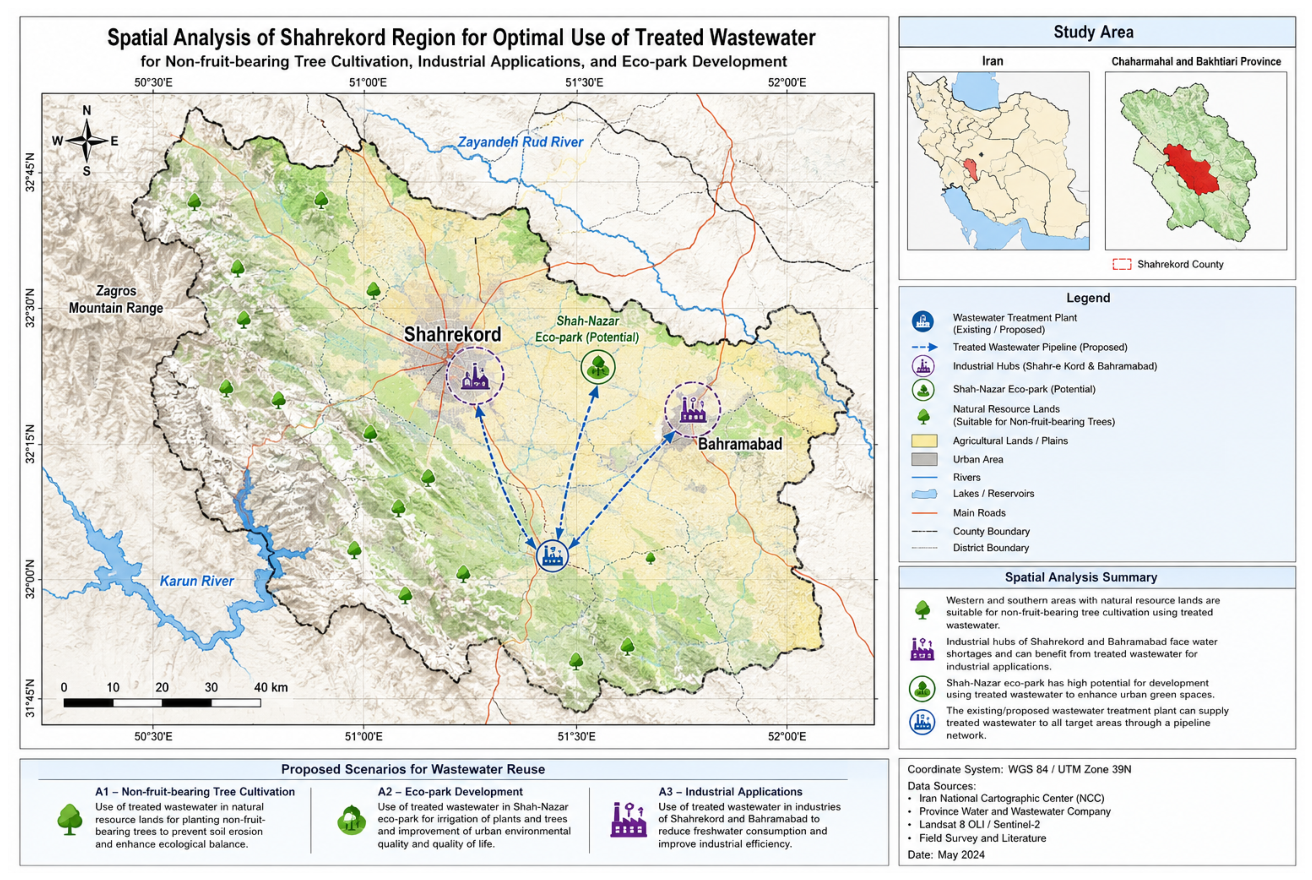
A spatial analysis of the study area—considering the presence of natural resource lands (suitable for cultivating timber-producing trees or shrubs), the industrial hubs of Shahr-e Kord and Bahramabad (which face water shortages), and the potential of the Shah-Nazar eco-park—indicates that the use of treated wastewater in the region is feasible. To better illustrate the spatial characteristics of the study area and the basis of the proposed wastewater reuse alternatives, a location map of Shahrekord County is presented in
Figure 1. The map identifies the main industrial centers, natural resource lands suitable for non-fruit-bearing tree cultivation, the proposed Shah-Nazar eco-park area, and the existing wastewater treatment infrastructure considered in the spatial analysis.
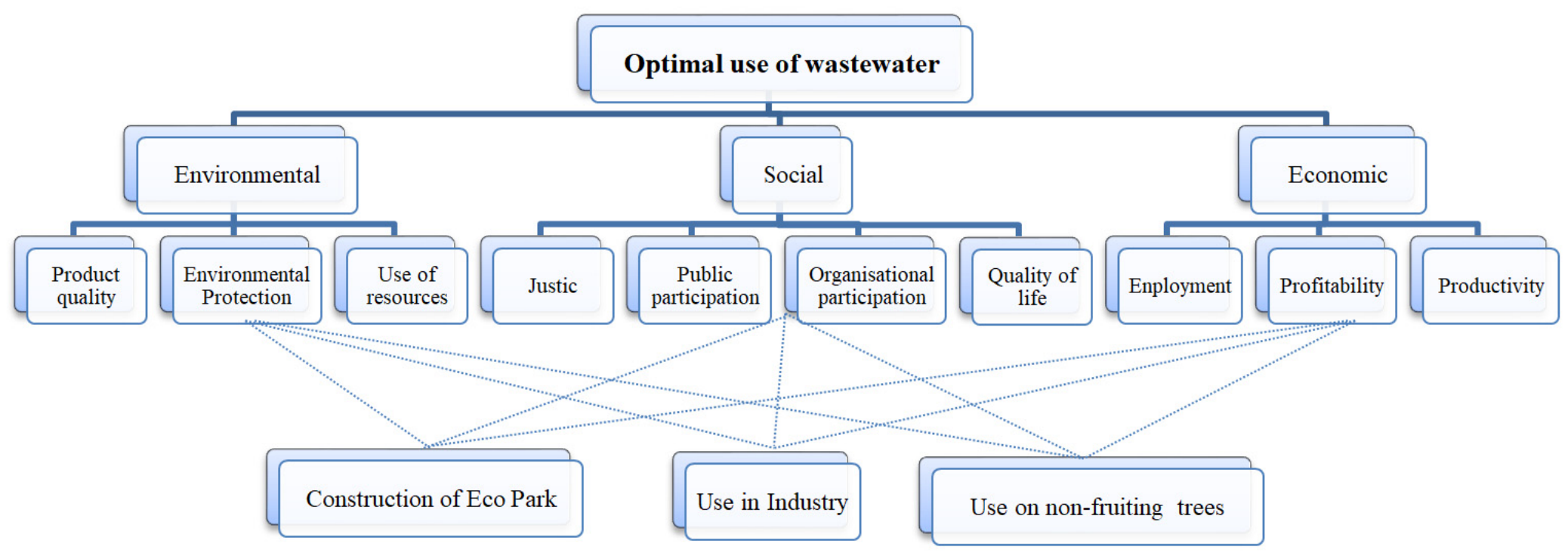
The main objective of the present study is the optimal use of treated wastewater in the study area for non-fruit-bearing tree cultivation, industrial applications, and eco-park development, based on sustainable development indicators. The selected indicators, derived from the literature review and relevant sources, are summarized in
Figure 2.
In this study, 20 criteria were identified across social, economic, and environmental domains. By applying the snowball technique, as described in
Section 5, 10 of these criteria were selected as the main indicators for prioritizing the options. The sources related to these 10 criteria are presented in
Table 2.
The estimated wastewater generation in Shahrekord County is about 42,000–64,000 m3/day, based on population data and standard per capita wastewater production coefficients used in urban water and wastewater engineering design in Iran and similar semi-arid regions. The existing treatment infrastructure has a design capacity of approximately 60,000–90,000 m3/day (effective capacity: 45,000–75,000 m3/day), indicating that the system is generally sufficient to treat the generated wastewater under normal operating conditions.
The initial 20 criteria were developed through a deductive literature-based approach using established studies and international frameworks on sustainable water management and wastewater reuse. The indicators were grouped into environmental, social, and economic dimensions to ensure comprehensive coverage of sustainability aspects relevant to the study context before applying the Delphi technique for refinement.
4. Materials and Methods
This study is applied in terms of its objective and falls within the category of survey research in terms of data collection. The required data were gathered through the review of various sources such as academic articles, field visits, existing plans and theses, as well as interviews with experts and specialists from relevant organizations, including the Ministry of Industry, Mine and Trade, the Industrial Estates Company, the Agricultural Jihad Organization, the Regional Water Authority, and academic professionals. To identify and extract indicators relevant to the research topic, both domestic and international sources with high frequency and relevance were reviewed. Based on these sources, key elements were identified and categorized within the conceptual framework of the study under three main dimensions of sustainable development—economic, social, and environmental—and nine sub-categories, as illustrated in
Figure 2. The sustainability, consistency, and accuracy of the selected indicators were evaluated and validated using the confirmatory Delphi technique, which is commonly employed to identify and screen the most important decision-making indicators.
Given that the main objective of this study is the sustainable management of treated wastewater reuse in Shahr-e Kord for the development of reuse scenarios—including irrigation of non-fruit trees, industrial applications, and utilization in an eco-park—fuzzy Shannon entropy and fuzzy ARAS techniques were applied. The statistical population of this study includes researchers and scholars in the relevant field, as well as managers from related organizations such as the Ministry of Industry, Mine and Trade, the Industrial Estates Company, the Agricultural Organization, and other experts. A purposive sampling method was used to determine the number of participants. This type of non-probability sampling relies on human judgment rather than random selection; therefore, the probability of each unit being included in the sample is unknown and cannot be determined. Accordingly, purposive sampling combined with the snowball technique was employed, and sampling continued until data saturation was reached. The expert panel consisted of professionals from multidisciplinary backgrounds, including engineering, environmental sciences, agricultural planning, industrial management, and water resources policy. The participants included both academic researchers and practitioners with extensive experience in wastewater management and regional development, with most having more than 10 years of professional experience. This heterogeneous composition ensured balanced representation of the economic, social, and environmental dimensions of the study and minimized potential disciplinary bias. In order to maintain confidentiality and comply with standard research ethics in expert-based studies, no individual identifiers are reported. Ultimately, 10 experts in the field were identified. It is worth noting that the selection process continued until theoretical saturation was achieved. Although the sample size is limited to 10 experts, this is consistent with the requirements of fuzzy MCDM approaches, in which the emphasis is placed on the quality and expertise of respondents rather than statistical generalization. In such methods, small but highly specialized expert panels are commonly used when participants possess sufficient domain knowledge and homogeneous expertise. In this study, all experts were selected from relevant academic and executive institutions with substantial experience in water resource and environmental management. Data collection continued until stability and convergence of expert opinions were achieved, indicating saturation of judgments.
4.1. Fuzzy Theory and the Fuzzy Delphi Method
Individuals’ judgments regarding preferences are often imprecise when it comes to estimating exact numerical values. Moreover, fuzzy logic is useful for addressing problems characterized by ambiguity and uncertainty. Therefore, given the nature of the present study and the inherent uncertainty in the responses, the fuzzy method was employed. The Fuzzy Delphi Method is a combination of the traditional Delphi method and fuzzy set theory [
38]. In the present study, the following steps were applied in the implementation of the Fuzzy Delphi Method: identification of research indicators through a comprehensive review of the theoretical foundations and the use of the Confirmatory Delphi Method; collection of expert opinions through a questionnaire. It should be noted that the questionnaires were completed by a panel of experts to determine the relevance of the identified indicators to the main subject of the study and to screen them accordingly. Linguistic variables, as presented in
Table 3, were used to express the importance of each indicator. Furthermore, triangular fuzzy numbers were employed in this study. The linguistic variables and their triangular fuzzy numbers were adopted from commonly used scales in fuzzy MCDM studies. The five-level scale was selected due to its simplicity and effectiveness in representing uncertainty in expert judgments, and the triangular membership functions ensure smooth transitions between linguistic terms [
7].
4.2. Fuzzy Shannon Entropy
The fuzzy Shannon entropy technique is one of the well-known methods for extracting the weights of criteria from decision matrix data. Hosseinzadeh lotfi and Fallahnejad [
39] extended this method to cases where the data in the decision matrix are presented as intervals or fuzzy numbers, and introduced the fuzzy Shannon entropy technique. In this study, in order to determine the weights of the criteria (the nine criteria aligned with the research’s conceptual framework), and considering that the data in the decision matrix are fuzzy, the fuzzy Shannon entropy method is applied. Shannon entropy is one of the methods used for calculating the weights of indices in MCDM models. According to Dorkhosh et al. [
40] and Jamshidi et al. [
41], the steps of this method, depending on the approach used, include: forming the decision matrix, converting the fuzzy decision matrix into an interval matrix, normalizing the decision matrix, determining the entropy of each index, calculating the degree of divergence of each index, and finally determining the weights of the indices. The steps for extracting the weights of criteria using the fuzzy Shannon entropy method are as follows:
Step 1: Convert fuzzy data into interval data using alpha-cut sets.
Suppose is an element of the decision matrix located in row -th and column -th, defined as a triangular fuzzy number. Here, i represents the alternatives, ranging from 1 to , and j denotes the criteria, ranging from 1 to . The alpha-cut set for the fuzzy variable refers to the set of real values whose membership degree in this fuzzy variable is at least equal to the alpha value.
The alpha-cut set can be expressed in interval form as follows:
where
. According to Equation (2), fuzzy data are converted into interval data. In this study, the
α-cut level was set to 0.5. This value represents a balanced trade-off between optimistic and pessimistic interpretations of fuzzy uncertainty and is commonly adopted in fuzzy multi-criteria decision-making studies to ensure stable interval transformation and comparability of results.
Step 2: Normalization of the decision matrix.
The above matrix is normalized, and each normalized element is denoted by
To normalize, each element in a column is divided by the sum of that column.
Step 3: Determining the entropy of each criterion.
The lower and upper bounds of the entropy interval can be calculated using the following equations:
Step 4: Determining the degree of divergence of each criterion.
The lower and upper bounds of the degree of divergence are calculated as follows.
where
and
represent the lower and upper bounds of the divergence range, respectively.
Step 5: Determining the weights of the criteria.
The upper and lower bounds for the weight of the
-th criterion are calculated using the following equation.
where
and
represent the lower and upper bounds of the weight interval for criterion
-th, respectively.
4.3. Fuzzy ARAS Method
The ARAS method is one of the well-known approaches for solving multi-criteria decision-making problems. It is also recognized as one of the most effective methods in this field. In this method, the sum of the weighted and normalized criteria values for each alternative is divided by the sum of the weighted and normalized values of the best alternative. This ratio is known as the degree of optimality. Alternatives are then ranked based on their degree of optimality [
42]. In this study, the fuzzy ARAS method is employed to evaluate water resource management scenarios under fuzzy conditions. The steps for implementing the fuzzy ARAS method are as follows [
42]. All criteria were converted to a benefit-oriented scale by transforming cost-type indicators so that higher values consistently represent more desirable performance, ensuring comparability across indicators within the ARAS framework.
Step 1. Constructing the decision matrix
In the first step, a fuzzy decision matrix must be constructed, with its elements denoted by , where represents the -th alternative and represents the -th criterion. Moreover, indicates the evaluation value of alternative with respect to criterion , expressed as a triangular fuzzy number.
Step 2. Determining the ideal values
In this step, an ideal alternative, denoted as
, is constructed as the ideal solution. Its values correspond to the highest values for beneficial criteria and the lowest values for non-beneficial criteria. These values are obtained as follows:
where
is the optimal value of criterion
j, expressed as a triangular fuzzy number.
Step 3. Normalizing the decision matrix
In this step, the fuzzy decision matrix is normalized based on the following equation.
where the symbol
is used to denote the normalized decision matrix. Beneficial criteria are normalized as follows:
Additionally, cost-type (non-beneficial) criteria are normalized as follows:
Step 4. Weighting the normalized decision matrix
In this step, it is assumed that
is the weight of criterion
j. The normalized decision matrix is then multiplied by the criterion weights to obtain the weighted normalized decision matrix, denoted as (
). It is worth noting that the criterion weights in our proposed model have already been calculated using the fuzzy Shannon entropy method.
where
represents the weight (importance) of criterion
, and
denotes the normalized evaluation of criterion
.
where
represents the value of the optimality function for alternative
. The highest value indicates the best alternative, and the lowest value indicates the worst. Since
is a triangular fuzzy number expressed as
, it can be defuzzified using the following formulas.
Finally, the utility degree of alternative
is obtained by comparing the utility of alternative
with the ideal best value
. The alternatives can then be prioritized based on their utility degrees. The utility degree of an alternative is expressed as follows:
where
represents the utility degree of alternative
, which can take a value within the range [0, 1]. The larger the value of
, the more preferable the alternative.
5. Results and Discussion
Based on the conducted analyses and expert opinions—and considering the variability in these opinions—it can be concluded that environmental quality variables offer greater flexibility to the experts. Individuals’ perceptions of environmental quality variables, such as whether they are low or high, are not uniform. Since experts possess different characteristics, they also hold different mental frameworks. Therefore, if they respond to the options based on differing mindsets, the analysis of variables would lose its validity. However, by defining the range of environmental quality variables, experts will respond to the questions with a shared understanding. As a result, environmental quality variables are defined using triangular fuzzy numbers (
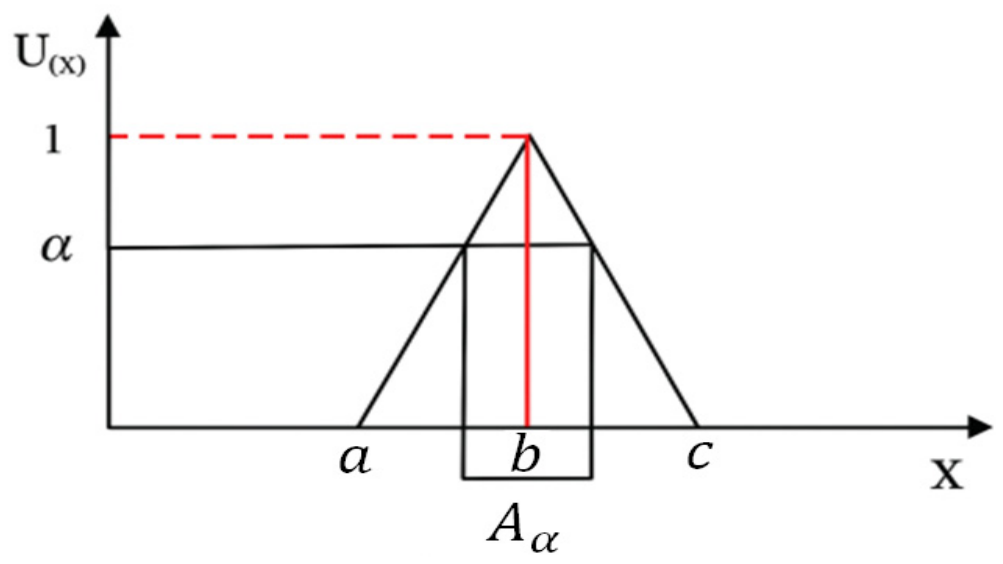
Figure 3) as follows: Very Low: (0, 0, 0.25), Low: (0, 0.25, 0.5), Medium: (0.25, 0.5, 0.75), High: (0.5, 0.75, 1), Very High: (0.75, 1, 1). According to
Figure 3, a triangular fuzzy number is a fuzzy number represented by a triplet
where
is the lower bound,
is the most probable value with a membership degree of 1, and
is the upper bound. Furthermore,
denotes a α-cut set that is a crisp interval containing all elements whose membership degree is greater than or equal to
.
After identifying the experts, the Delphi method was repeated in three rounds. In the first round, a list of criteria influencing the assessment of effectiveness—extracted from the literature—was provided to the experts. In the next step, the average of the experts’ opinions regarding the importance of each criterion was calculated using the following formulas. In Equation (16), represents the viewpoint of the -th expert, and in Equation (17), denotes the average of the experts’ viewpoints. Additionally, represent the parameters of the triangular fuzzy number. At this stage, experts were asked to rate the importance of each criterion using the options: Very Low, Low, Medium, High, and Very High. In the next round, each expert’s updated opinion was formed based on the overall responses from all experts as well as their own previous opinion. The disagreement of each expert was calculated using Equation (17). In fact, according to this equation, each expert could compare their own opinion with the average opinions and, if desired, revise their previous responses. Using Equation (18), the experts’ disagreements were calculated and compiled into a questionnaire. Subsequently, each expert reviewed their previous responses and provided updated opinions accordingly. At this stage, by calculating the difference between the mean values of the first and second rounds and using the distance formulas between fuzzy numbers, the level of consensus among the experts was determined. If the calculated difference was less than 0.2, the fuzzy Delphi process was terminated. In this study, components that fell within the “Very Low” range were excluded from the research based on expert opinions.
Given that the difference in means for some of the criteria related to the optimal use of wastewater exceeds 0.2, it can be concluded that there is still no acceptable level of consensus among the experts. Therefore, after calculating each expert’s deviation from the mean using Equation (18) and
Table 4, a revised questionnaire was developed by making the necessary adjustments to the factors. This new questionnaire, along with each expert’s previous opinion and the extent of its deviation from the average opinions of other experts, was then redistributed to the experts. After compiling the questionnaires from this stage, the disagreements were calculated, and the results indicated that the difference for all factors was less than 0.2, leading to the termination of the fuzzy Delphi process. The differences in
Table 4 are based on aggregated absolute deviations of fuzzy expert scores between Delphi rounds before normalization; values may exceed 1, whereas the consensus threshold (<0.2) is applied to normalized distance measures used for stopping the process. Based on the final results, only components with an importance score higher than 0.7 were considered as criteria for evaluating the effectiveness of research projects, which are presented in
Table 5.
Finally, using the fuzzy Delphi method, 10 criteria were identified as the most important factors affecting the optimal use of wastewater in the cultivation of non-fruit trees, industry, and eco-park applications, utilizing sustainable development indicators. These indicators were confirmed in
Table 5 and are presented in
Table 6.
5.1. Results of Applying Fuzzy Shannon Entropy
The next step after identifying the effective criteria, based on expert opinions, is weighting them according to their relative importance. In this phase, questionnaires were prepared for each project using these criteria and a 5-point Likert scale, and were distributed among experts, supervisors, and relevant individuals. Considering that the number of experts in this stage was 10, each of them rated the criteria based on the effective indicators identified in the previous stage. Considering the fact that individuals have different perceptions and that each criterion and indicator possesses unique characteristics that collectively prevent overlapping effects on the results, the fuzzy Shannon entropy technique was employed to weight these indicators based on the given ratings. In this technique, instead of using the 10 identified effective indicators by name, the English labels C
1, C
2, …, and C
10 were assigned to represent them respectively. The table of effective indicators and their corresponding labels (
Table 7), as well as the final table showing the weights of these indicators obtained through the fuzzy entropy technique, are presented below.
In this section, based on the steps outlined in the research methodology regarding the fuzzy Shannon entropy method, the final weight of each dimension—as a criterion—was calculated using the fuzzy questionnaire data collected from experts.
Table 8 presents the constructed decision matrix. In the present study, the “criteria” refer to the ten identified indicators, and the “alternatives” refer to the three options: use in non-fruit tree cultivation, use in industry, and use in eco-park development, which are denoted as A1, A2, and A3, respectively. The fuzzy decision matrix is converted to a distance matrix, which is reported in
Table 9.
Table 10 reports the normalized distance matrix.
Next, in order to calculate the entropy of each indicator, the normalized distance matrix is divided into two matrices: the first matrix contains the lower bound elements, and the second matrix contains the upper bound elements. To determine the divergence of each indicator—which was calculated in the previous step (entropy calculation)—each entropy value is subtracted from one to obtain the corresponding divergence value. Subsequently, to determine the weight of each indicator, and based on the formulas provided in the Materials and Methods section, the lower and upper bounds of the interval numbers are also presented in the corresponding table.
After determining the weights of the indicators, it is necessary to convert the fuzzy weights into crisp values. As shown in
Table 11, each indicator has a lower and an upper weight bound, and to derive the final crisp weight, the average of these two bounds is calculated for each indicator. The results are presented in
Table 11.
Based on the conducted analysis, it can be concluded that, according to the fuzzy Shannon entropy method, the environmental quality indicator holds the highest weight among the criteria. It is followed, in order, by the indicators of optimal resource utilization, profitability, public participation, and others. The environmental quality indicator plays a critical role in the sustainable management of wastewater reuse. This indicator reflects the extent to which wastewater reuse practices contribute to the protection and improvement of environmental conditions, including soil, water, and air quality. Sustainable reuse of treated wastewater should ensure that it does not lead to the accumulation of harmful substances in the environment, such as heavy metals or pathogens. Monitoring and enhancing environmental quality not only safeguards ecosystems but also builds public trust in wastewater reuse initiatives. Therefore, prioritizing environmental quality in decision-making processes is essential to achieve long-term sustainability and ecological balance.
Although the Dasht-e-Shahrekord region faces economic pressures and development needs, experts assigned higher weights to Environmental Protection (C10) and Environmental Quality (C8) because sustainable wastewater reuse depends primarily on preserving environmental resources. Experts considered that environmental degradation, groundwater contamination, and ecosystem damage could generate long-term economic and social costs that exceed short-term economic benefits. Therefore, environmental sustainability was viewed as a prerequisite for long-term regional development.
5.2. Results of Applying Fuzzy ARAS for Ranking Wastewater Utilization Sites
After determining the crisp and subsequently the normalized weights of the ten research indicators using the fuzzy Shannon entropy method, the fuzzy ARAS method was employed to rank the three alternatives in the study. The first step in this method is the construction of the fuzzy decision matrix, which was previously used in the fuzzy Shannon entropy process as well. Additionally, in this method, the ideal values for the indicators are determined using Equation (8).
Table 12 presents the fuzzy decision matrix.
Among the risk indicators, all are considered as optimal (or desirable) criteria. It is noteworthy that at this stage, the criteria are used to form the normalized fuzzy decision matrix, which is presented in
Table 13. To obtain the weighted normalized decision matrix, weights derived through the fuzzy Shannon entropy method are used. Finally, using Equation (10), the weighted normalized fuzzy decision matrix is obtained, which is reported in
Table 14.
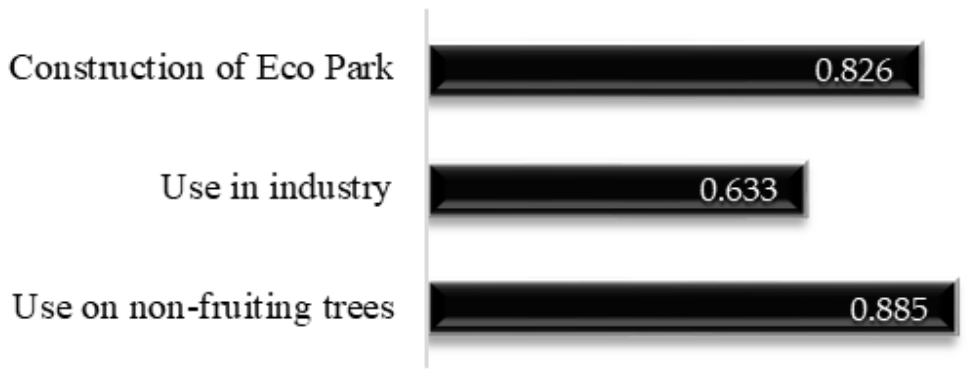
To calculate the utility function of each option, Equation (13) is used. Then, these values are converted into crisp numbers using Equation (14). Finally, using Equation (15), the desirability of each option is calculated, and the ranking is performed accordingly. The results are presented in
Table 15 and
Figure 4. Based on the evaluations, the prioritization of scenarios related to wastewater reuse is as follows: 1. Use in non-fruit-bearing trees ranks first, 2. Construction of an eco-park ranks second, 3. Use in industry ranks third. The results indicate that the optimal use of wastewater in the Dasht-e-Shahrekord area should initially focus on non-fruit-bearing trees. The second priority is the use of wastewater for eco-park construction in Dasht-e-Shahrekord. The third priority is allocated to the use of wastewater in the industry sector of Dasht-e-Shahrekord. To evaluate the robustness of the obtained rankings, a sensitivity analysis was performed by varying the weights of the two most important criteria (Environmental Protection and Environmental Quality) by ±10%. The results showed that the ranking order of the alternatives remained unchanged (A1 > A3 > A2), indicating that the proposed fuzzy Shannon entropy–ARAS framework is relatively stable against moderate changes in expert-derived weights. It is noted that factors such as transportation distance, infrastructure costs, and detailed wastewater quality parameters were not explicitly included in the model, as the study focuses on sustainability-based decision-making at the regional planning level.
5.3. Discussion on the Highest Priority Scenario
Although the evaluated alternatives differ in implementation time horizons, they were assessed within a unified sustainability-based framework. The aim of this study was not to compare projects based on temporal scale, but to evaluate their overall environmental, social, economic, and technical performance. Therefore, both short-term (eco-park development) and long-term (tree cultivation and industrial reuse) applications were considered comparable decision alternatives. For the use of water in non-fruit-bearing trees, special attention must be paid to the quality of the water used. Non-fruit-bearing trees are generally planted for non-agricultural purposes such as soil protection, erosion control, shading, or landscaping, but they still require water of suitable quality. In the Shahrekord plain, several non-fruit tree species commonly used for afforestation and green space development, such as poplar (Populus spp.), elm (Ulmus spp.), and cypress (Cupressus sempervirens), show relatively good tolerance to treated wastewater when salinity and pollutant concentrations are adequately controlled. These species are widely adapted to the climatic conditions of the region and can contribute to soil stabilization, erosion control, and landscape improvement. Therefore, the reuse of treated wastewater for irrigating such non-fruit trees can provide environmental benefits while reducing pressure on limited freshwater resources in the study area. The water used for these trees must be free from harmful substances to prevent damage to the roots, tree growth, and overall health. Non-fruit-bearing trees are particularly sensitive to certain water parameters, which include:
Concentration of toxic substances and pollutants: Like other plants, non-fruit-bearing trees may suffer serious damage when exposed to water contaminated with heavy metals or other chemical compounds. These substances can harm the roots and plant tissues and may even be transferred to leaves and branches.
Water pH: Non-fruit-bearing trees are sensitive to drastic changes in water pH. Water with an inappropriate pH (too acidic or too alkaline) can affect nutrient absorption by the roots and disrupt tree growth.
Water hardness: Water hardness, caused by the presence of salts and calcium, may negatively impact the growth of non-fruit-bearing trees. High hardness can lead to salt deposits on the roots, reducing water and nutrient uptake.
Microbial contamination: The presence of bacteria or microbial contaminants in the irrigation water can cause plant diseases and harm the health of non-fruit-bearing trees. Therefore, disinfection and treatment of water before use are very important.
Precise adjustment of water requirements: Non-fruit-bearing trees may require less irrigation than fruit-bearing ones, but their water needs must be carefully calculated and met. Using advanced irrigation methods, such as drip irrigation, and precisely timing irrigation can help reduce water waste and improve tree health.
In summary, for the effective use of water in non-fruit-bearing trees, water quality parameters must be carefully controlled to ensure optimal growth and prevent damage caused by polluted or unsuitable water. Similar studies conducted in arid and semi-arid regions have also highlighted the importance of environmental considerations in wastewater reuse planning. However, the relative importance of criteria and the final ranking of alternatives may vary depending on local environmental, economic, and social conditions. Therefore, while the general emphasis on environmental sustainability is consistent with previous studies, the prioritization obtained in the Dasht-e-Shahrekord area reflects the specific characteristics of the study region.
Despite being the highest-ranked scenario, its implementation faces practical constraints. These include the need for investment in irrigation infrastructure, particularly drip systems, and continuous monitoring of wastewater quality parameters such as salinity and microbial contamination. Therefore, successful application depends on both technical capacity and infrastructure availability.
6. Conclusions
Wastewater reuse in Dasht-e-Shahrekord is prioritized for non-fruit-bearing trees, eco-parks, and industry. In water-scarce Iran, treated wastewater is a reliable, cost-effective alternative to desalination, supporting agriculture, saving freshwater and supplying nutrients for plants. In this study, the fuzzy Shannon entropy method was applied to determine the significance of the evaluation criteria, while the Fuzzy ARAS method was employed to assess and rank the alternatives for wastewater utilization in tree cultivation, eco-park development, and industrial applications. Furthermore, the snowball sampling technique was used to identify and prioritize the influential criteria. Through this process, 10 of the original 20 criteria were eliminated, leading to the selection of 10 key and impactful criteria. The results of applying these methods show that the best option for wastewater reuse is non-fruitful trees. Wastewater used for non-fruit-bearing trees must meet quality standards, as excess salts, heavy metals, or improper pH can harm tree growth and soil health. Controlling toxic substances and key parameters like hardness and pH is essential to protect the trees and enhance productivity. Eco-parks, as the second priority for wastewater reuse in Dasht-e-Shahrekord, combine recreation with environmental education. Given population growth, waste generation, and environmental challenges, their establishment is essential for raising awareness and advancing sustainable urban development. The third priority for wastewater reuse in Dasht-e-Shahrekord is industrial use. Treated wastewater, if meeting health and environmental standards, can be applied in non-food industries for processes such as cooling, washing, or as process water, while avoiding risks to public health and equipment. In Chaharmahal and Bakhtiari Province, strict adherence to wastewater treatment standards and continuous quality monitoring are essential to prevent water and soil pollution. Implementing rigorous protocols and complying with national and international standards, especially in sensitive industries, must be prioritized to protect the environment, workers’ health, and local communities. The results of this study are specifically valid for the province under investigation and cannot be directly generalized to other regions. This limitation is due to differences in environmental characteristics and local water resources, which may influence experts’ responses in different areas. Therefore, to extend the applicability of the results, it is necessary to distribute the questionnaires separately in each region and conduct a detailed analysis of local data. Accordingly, to enhance the generalizability and global applicability of the findings, it is recommended that in future studies, the proposed model be implemented in various environments and more comprehensive analyses of local features, potential challenges, and adaptation requirements of the model be conducted. The fuzzy MCDM approach applied in this study has some inherent limitations. The results depend on expert judgments, which may introduce a degree of subjectivity despite the use of fuzzy logic. In addition, converting linguistic terms into fuzzy numbers and the sensitivity of entropy-based weighting may influence the final rankings. Therefore, the results should be interpreted as decision-support outputs rather than absolute rankings. From a policy perspective, the results suggest that wastewater reuse should be incorporated into regional water planning as a strategic resource. Priority should be given to investment in treatment and irrigation infrastructure, along with the establishment of monitoring and regulatory systems to ensure water quality and minimize environmental and health risks. In addition, effective implementation requires coordination between technical, environmental, and governance institutions rather than relying solely on engineering solutions.
For local water management authorities (e.g., the Regional Water Authority), practical actions should focus on upgrading wastewater treatment capacity, implementing regular water quality monitoring (e.g., salinity, heavy metals, and microbial load), and establishing clear enforcement guidelines for safe wastewater reuse in agriculture, forestry, and industrial sectors. Coordination with environmental and agricultural agencies is also necessary to ensure integrated water resource management.
Future research should focus on integrating the proposed fuzzy MCDM framework with real-time effluent monitoring systems. This would enable dynamic updating of input data based on continuously measured water quality parameters, improving the responsiveness and practical applicability of wastewater reuse decision-making under changing environmental conditions.
Overall, the main objective of this study was to develop a fuzzy multi-criteria decision-making framework for evaluating and prioritizing wastewater reuse options in the Dasht-e-Shahrekord region. The results demonstrate that the proposed integrated fuzzy Shannon entropy–ARAS approach effectively supports structured decision-making under uncertainty and identifies non-fruit-bearing trees as the most suitable option for wastewater reuse in the study area. This confirms that the developed framework successfully achieves its intended purpose of providing a systematic and reliable tool for prioritizing wastewater reuse strategies in water-scarce regions.
Future research should focus on extending the present framework through more comprehensive and structured sensitivity analyses, benchmarking the proposed fuzzy Shannon entropy–ARAS approach against alternative multicriteria decision-making methods, and validating its applicability in regions with diverse environmental and socioeconomic conditions.




 ,
,