


Abstract
There is an enormous rise in the amount of user-generated content on social media. That makes it easier for hateful and fake messages to spread, and threatens both societal stability and public trust in institutions. Most of current solutions have fundamental limitations due to modal limitations (i.e., each solution only uses one type of data at a time), lack of user context integration, poor synchronization across different types of data, and poor resilience to manipulation by adversaries. As a result, most solutions are subject to compound loss in terms of their ability to generalize well, classify correctly, or remain reliable when deployed in real-world environments. To address all of the above challenges, we propose a comprehensive and modular analytical framework consisting of five interconnected components that integrate contextual representation learning, multimodal semantic alignment, graph-based propagation modeling, adaptive inference, and consistency validation for hate speech and fake post detection. First is our Context-Driven Social Vector Extraction methodology, which provides enriched contextual embeddings by extracting and combining text-based metadata, image-based metadata, temporal metadata, and behavioral metadata. We use those embeddings in our second module, Multimodal Label Fusion via Mutual Co-Attention (CMF-MCA). Our CMF-MCA module incorporates two transformers with co-attention mechanisms that can mutually annotate text and images. In our third methodology, Semantic Propagation Graph for Hate and Fake Correlation (SPG-HFC), we implement a relational graph attention mechanism that captures both the influence of semantics and how communities propagate information about hate and fake posts. The fourth module, Adaptive Modality Routing via Reinforcement (AMR-R), routes based on the modality of the input and whether the input is simple enough to be classified using machine learning or complex enough to require deep learning. Finally, our Counterfactual Consistency Validation Engine (CCVE) is used after prediction to validate that the model’s predictions are consistent with the output data by creating counterfactuals and validating them. Therefore, in addition to improving the overall accuracy of hate speech and fake post detections, our proposed framework also improves its scalability and inference reliability. Additionally, because our framework allows multimodal classifications that include both context and behavior, it enables the scalable and trustworthy development of content moderation systems.
1. Introduction
The rapid growth of social media has dramatically altered the communication space; now users may freely communicate with each other and share information rapidly. Although this democratization of content delivery appears to be associated with unintended consequences [1,2,3], perhaps the most widely publicized consequence is the explosion and widespread prevalence of hate speech and misinformation. These processes pose serious threats to social trust and lead to increased polarization. Ultimately, these processes lead to serious issues in the world such as violence, crisis caused by the dissemination of misinformation, and targeted harassment. Therefore, detecting and removing such content has become a top priority area for researchers in artificial intelligence, natural language processing, and computational social sciences. Existing traditional approaches for hate speech and fake news detection have almost exclusively utilized single-modal inputs (usually text-based), which were processed using supervised machine learning algorithms or simple neural networks. These approaches are limited due to the broad definition of input for determining baseline quality evaluations; however, when faced with modern social media sites’ typically multidimensional and contextual social media content, they likely fall short. Additionally, many existing models [4,5,6] fail to account for the inter-user and network-level influences on how content propagates. As a result, they miss key contextual signals that exist within user interactions, mentions, and reposts.
Similar to nearly all other advancements in today’s deep learning technologies, recent advancements in processing multiple types of data modalities present great potential. However, nearly all current architectures lack the necessary attributes of modularity, contextual understanding, and verification.
Most architectures view text and image modalities as independent objects, or use naive methods to fuse them without considering the finer-grained relationships between them. Moreover, few architectures include user behavior and temporal metadata in their analysis; therefore, they generate weak predictions that can easily be derailed by noise or adversarial inputs. These limitations clearly demonstrate the immediate necessity for an integrated, adaptive, and analytically validated multimodality framework incorporating multiple related contextual features and reasoning capabilities in one unified process. To address these limitations, this work proposes an integrated analytical framework that combines contextual representation learning, multimodal alignment, graph-based reasoning, adaptive inference, and prediction validation within a unified architecture. The proposed system is composed of five interconnected modules: the Context-Driven Social Vector Extraction (CDSVE), which generates rich multidimensional embeddings from raw post data; the Multimodal Label Fusion via Mutual Co-Attention (CMF-MCA) provides joint annotations to the textual and visual elements of posts; the Semantic Propagation Graph for Hate and Fake Correlation (SPG-HFC) utilizes a graph-based method to model user influence and semantic propagation; the Adaptive Modality Routing via Reinforcement Learning (AMR-R) adaptively determines which classifier(s) to utilize; and the Counterfactual Consistency Validation Engine (CCVE) enhances the robustness of predictions utilizing subsequent counterfactual validation. Overall, these represent a comprehensive set of powerful tools that allow for understanding, annotating, classifying, and validating complex multimodal social media content. Beyond providing state-of-the-art separation rates for hate speech and fake post identification, the framework provides a strong benchmark for future multimodal behavioral content moderation.
1.1. Motivation and Contribution
This work is motivated by the observation that current hate speech and fake content detection systems have limited capability to interpret and validate multimodal and context-sensitive content. Social media posts can hardly be seen as mere textual outputs, as assumptions concerning their meaning and intention keep getting altered by the presence of accompanying media, by references to hashtags, by information about the users, and by the timing of events. From another angle, the very existence of hate and fake content has evolved: in the present day, they integrate subtlety with contextual embedding, becoming objects of coordinated dissemination. The majority of existing approaches are limited to single-modality analyses and shallow reasoning; they do not possess the structural and semantic capabilities for the effective detection of such subtle content. These systems seldom take into consideration user behavior dynamics or the pathways through which content propagates, both of which are crucial for understanding the intent, reach, and influence of suspicious content.
1.2. Our Contributions
We present a modular, multilayered, scalable multimodal framework that can identify hate speech and fake posts over multiple social media platforms. The architecture models the composition of social media posts as event compositions using linguistic semantics, visual features, time-stamped data and indicators of user behavior to better capture how harmful narratives propagate through real-world social media systems.
A contextualized representation approach is the first major contribution of this work; it integrates all signals into one representation (a single social vector). The representation includes text information, image information, and metadata related to user activity (posting rates, levels of engagement, etc.) and account activity. Combining signals allows the system to differentiate innocuous text that may become harmful depending upon an associated image or how it was disseminated.
The second major contribution is a multimodal alignment method, specifically text-image semantic synchronizations. Rather than simply concatenating the meanings of two different types of input data, the focus of this component is on aligning those meanings at a much finer grain. Therefore, when the semantic payload of a piece of content is distributed across modalities (e.g., a meme where the content is conveyed in images) rather than in text, this approach will improve detection of such content as well as improve detection of image-assisted mis/disinformation.
Thirdly, a relational graph model is used to capture relationships between users (who reposted whom) and similarities between content (to support graph-based inference). Because the representations encode diffusion dynamics and community-wide amplification of such diffusion, this component enables identification of coordinated disinformation/hate campaigns even though there may be no explicit evidence in a single post that demonstrates that it was part of such a campaign.
Finally, the fourth component uses robustness-oriented validation techniques. Specifically, this involves performing consistency checks under controlled semantic variation, and performing adaptive routing for latency-constrained inference. Together, these four modules allow for efficient and effective inference in large-scale moderation tasks in noisy environments and reduces brittle prediction under various kinds of disturbance.
Rather than introducing fundamentally new learning primitives, this work presents an integrated architectural framework that combines five complementary analytical modules. These modules employ established techniques including contextual representation learning, multimodal co-attention, graph-based propagation modeling, adaptive routing, and counterfactual consistency analysis. The primary contribution lies in the coordinated interaction of these components within a unified pipeline for social media content analysis. First, it introduces a Context-Driven Social Vector Extraction (CDSVE) module for developing high-quality representations from raw post data and combining textual, visual, temporal, and behavioral signals. Second, it introduces Multimodal Label Fusion via Mutual Co-Attention (CMF-MCA) to provide for simultaneous labeling of all multimodal inputs in fine detail. Third, it introduces the Semantic Propagation Graph for Hate and Fake Correlation (SPG-HFC) model, a graph attention network for modeling semantic diffusion and influence on a network level. Fourth, it introduces Adaptive Modality Routing via Reinforcement Learning (AMR-R) for dynamically routing data to relevant classifiers depending on complexity and modality. Fifth, and finally, it introduces the Counterfactual Consistency Validation Engine (CCVE) for validating whether all predictions made by the system remain semantically consistent and robust against both syntactic and semantic counterfactuals. Each of these components were developed to overcome individual shortcomings in prior research, and together they form a modular, extendable, and analytically solid pipeline.
1.3. Description of the Remaining Sections
The text has three main parts covering Problem Motivation, Method Design, and Experimental Validation. Introduction: This part presents the social media moderation problem that is multimodal, describes why a unimodal approach will be insufficient, states the research contributions of this work, and provides the scope for the remainder of this document.
Related Work: This part reviews existing algorithms from all three areas (text-only, multimodal, graph-based) for detecting hate speech and fake news. Additionally, there is a subsection on the current state and challenges of the field. There are issues regarding poor multimodal alignment, user context modeling, and validating the robustness of these methods. Methodology: This part describes the modular structure of the integrated architecture. Each module includes input(s), output(s), and connection(s). As such, it focuses on the design intent and the ability to reproduce results rather than on the implementation specifics of each component within the architecture, including contextual representations, multimodal fusion, propagation models, adaptive routing, and validation logic.
Experimental Setup and Results: This part includes creating datasets, preprocessing data, setting parameters for training/testing, assessing performance metrics of each model configuration, comparing against baselines, and performing ablations of different architectures. The different configurations, including text-only, multimodal, propagation-enhanced, and fully integrated versions, are tested to determine if adding functionality provides a benefit in terms of performance, and those benefits are applied to other types of content.
2. Review of Existing Models Used for Hate Speech and Fake Post Analysis
The first of these works that this review includes is [1], which has hybrid deep learning models leveraging attention mechanisms to improve the performance of fake news classification. Immediately after, the relevance of explainability emerged in studies such as that in [2], which introduced interpretability methods for real-time dynamic explanations of fake news. This is of great assistance to users who need to understand the cues of misinformation as they are the ones consuming the content. As the field matured and as domain-specific analysis (e.g., Ref. [3]) about gendered hate narratives on Reddit broadly extended the analysis into the community-level analysis of extremisms, from such it can be deduced that hate speech perhaps possibly evolves with group ideologies and interaction structures. Such thematic extension has now birthed voluminous comprehensive surveys, and [4,5] are two such state-of-the-art taxonomies considering both fake news and hate speech through algorithmic and societal lenses. Initiatives like [6] introduced diversity linguistically with an explainable predictor—for example, through which hate speech was treated in Roman Urdu—further proving the importance of under-resourced languages in content moderation challenges.
Research on hate speech and fake news detection has evolved considerably over the past decade, progressing from traditional text-based machine learning techniques to sophisticated multimodal, graph-based, and contextual deep learning frameworks. Existing studies can be broadly categorized into five major research themes: (i) text-based detection approaches, (ii) multimodal detection frameworks, (iii) graph-based methods, (iv) user behavior and contextual models, and (v) explainable and trustworthy artificial intelligence systems. Table 1 summarizes the representative studies reviewed in this work.
Table 1.
Empirical Review Analysis of Models.
2.1. Text-Based Hate Speech and Fake News Detection
The early focus in research was on using machine learning and deep learning to analyze text. For example, the CNN-RNN model [1] was great at detecting fake news by combining local feature extraction with an understanding of sequential data. Other methods like Passion-Net [6] and CNN-Decision Tree combo models [12] were successful too. There is also the Whale-Optimized BiLSTM model [13] and transformer-based systems for detecting hate speech [23]. While these techniques excel at finding patterns in text, they depend solely on the words used. Today, social media includes images, memes, emojis, and hashtags, adding layers to the messages. These elements can hide sarcasm or even racism. Therefore, word-focused models frequently miss the point when it comes to this richer and more complex content.
Critical Analysis: Text-based models excel with their simple computation and solid language skills. However, their failure to use multimodal data seriously hampers them when it comes to social media. This flaw drives the quest for better context that can mix various info sources together, making systems more adaptable in the real world.
2.2. Multimodal Detection Frameworks
To beat what text-only systems can do, researchers created multimodal architectures to handle both words and images together. Studies found that attention-based fusion models and multimodal deep learning frameworks boost classification accuracy when text and image features are merged—considerably better than what unimodal methods can achieve. They proved that we need multimodal learning to spot hate speech in memes, fake visuals, and misleading images. Nonetheless, most current multimodal setups still use simple blending techniques like feature concatenation or late fusions.
Critical Analysis: Even though multimodal models do better than text-only systems, they often cannot catch the finer details linking text and visuals. Because of this, they struggle when harmful intent is only clear through how text and images work together. As a result, there is a need for improved ways to align these different modes to help the models learn more about how text and image content really relate.
2.3. Graph-Based Propagation Approaches
Several studies have emphasized the importance of information propagation and social network structures in understanding misinformation and hate speech dissemination. Behavioral profiling frameworks [21], anomaly detection studies [22], misinformation lifecycle models [24], bot impact analyses [28], and credibility-ranking approaches [36] demonstrated that harmful content often spreads through coordinated user interactions rather than isolated posts. Graph-based techniques further revealed that retweets, mentions, and community structures contain valuable information regarding content credibility and influence patterns.
Critical Analysis: Graph-based models do a great job at capturing network dynamics and coordinated campaigns. Still, many methods look at spread patterns without considering the actual message’s meaning or image content. Consequently, they cannot make full use of those elements or how they affect sharing. Creating a framework that tackles both meaning and dissemination together has not yet received much attention.
2.4. Behavioral and Contextual Modeling
Recent research has increasingly recognized the importance of contextual and behavioral information in content moderation. Studies investigating user profiling [21], personality analysis [25], antisocial behavior detection [39], and behavioral propagation modeling demonstrated that user activity patterns provide valuable signals for detecting misinformation and harmful content.
Contextual information such as posting frequency, engagement patterns, follower relationships, account credibility, and temporal activity can significantly influence the interpretation of social media posts.
Critical Analysis: While behavioral and contextual information boosts classification, most systems only use it as backup. Not many studies blend textual, visual, and temporal cues into one context. Thus, current methods cannot catch more intricate messages in social media environments.
2.5. Explainable, Robust, and Trustworthy Detection Systems
As content moderation systems increasingly influence public discourse, explainability and trustworthiness have become critical research concerns. Explainable AI frameworks [2], interpretability surveys [5], LIME-based approaches [19], fairness-aware architectures [34], and deepfake detection studies [35] have contributed significantly toward improving transparency and accountability.
These approaches enable users and moderators to better understand model predictions and identify potential biases within automated decision-making systems.
Critical Analysis: Although explainability improves transparency, most existing approaches focus primarily on subsequent interpretation rather than prediction reliability. Models remain vulnerable to adversarial attacks, paraphrasing strategies, hashtag manipulation, visual perturbations, and distribution shifts. Consequently, explanation alone does not guarantee robust deployment in practical moderation environments.
2.6. Research Gaps and Motivation for the Proposed Framework
The thematic analysis presented above reveals several important research gaps that continue to limit the effectiveness of existing hate speech and fake news detection systems.
Gap 1: Limited Contextual Representation Learning: Most existing approaches rely on isolated textual or visual representations and fail to jointly model social, temporal, behavioral, and contextual information.
Gap 2: Weak Multimodal Semantic Alignment: Current multimodal frameworks primarily employ shallow fusion mechanisms and therefore cannot effectively capture complex semantic relationships between textual and visual content.
Gap 3: Inadequate Graph-based Reasoning: Many detection systems ignore the influence of user interactions, community structures, and information diffusion patterns when making classification decisions.
Gap 4: Lack of Adaptive Inference Mechanisms: Existing architectures generally use fixed computational pipelines without considering input complexity, resulting in inefficient resource utilization and increased inference costs.
Gap 5: Limited Robustness Validation: Most studies focus on classification accuracy while overlooking prediction stability under adversarial perturbations, semantic modifications, and noisy real-world conditions.
To address these limitations, the proposed framework introduces five interconnected analytical modules, as shown in Table 2.
Table 2.
Research Gap Table.
The integration of these five modules enables comprehensive contextual understanding, deep multimodal semantic alignment, graph-based reasoning, adaptive computational routing, and robustness validation. Consequently, the proposed framework directly addresses the principal limitations identified in the existing literature and provides a more reliable solution for large-scale social media content moderation.
As shown in Table 3, existing approaches typically address only a subset of the challenges associated with social media content moderation. While attention-based models emphasize multimodal alignment, behavioral and graph-based approaches focus primarily on user characteristics and propagation patterns, respectively. Similarly, explainable models improve transparency but provide limited robustness guarantees. The proposed framework distinguishes itself by integrating these complementary capabilities into a unified analytical architecture, thereby enabling contextual understanding, semantic alignment, propagation-aware reasoning, adaptive inference, and prediction validation within a single pipeline.
Table 3.
Comparison with existing integrated frameworks.
3. Proposed Model Design Analysis
The design for the proposed integration framework for hate speech and false post detection is based on an analytical pipeline consisting of five linked and analytical modules. Each module transforms and adds value to the input data toward increasing the level of knowledge regarding semantics, contexts, and relationships. A modular structure allows this architecture to be flexible with respect to the input format (text, images, etc.), and will allows for each module to operate independently from one another in order to address the very high dimensional characteristics of social media posts. Design choices were made within the context of a consistent mathematical formulation in order to provide a basis for consistency in learning, reliability of inferences, and clarity of validation. Figure 1 displays how each module defines a functionally unique component with inputs, outputs, and transformation intention. The framework represents a pipeline of composable modules instead of a monolithic deep network. The first module is the CDSVE-based social vector extraction. Metadata and user activities are combined to form behavioral and temporal descriptors. Post text and photo objects are embedded as contextual representations of visual and linguistic information. Relevant social vectors contain semantics that are conditioned upon time and behavior. The use of modality-sensitive masking even when partial modalities exist avoids noise in the module’s single instance-level embedding. The second module involves the cooperation cross-mode labeling. This module pairs textual tokens with visual areas via multimodal semantic relevance ratings. Instead of simply ignoring the difference between them, the alignment portion evaluates text claims against visual semantics (i.e., hateful words paired with non-hateful pictures; non-hateful words paired with hateful memes) to increase the confidence of labels. Finally, the fused representation predicts both hate relevancy and authenticity. The Hate and Fake Correlation SPG (Module 3) module creates a heterogeneous graph that contains both post and user nodes connected by reposts, mentions, and semantic similarities. Relational attentive methods weight neighbor contributions to refine node states according to interaction type and semantic proximity. Models sensitive to propagation identify coordinated spread, repeat offenders, and burst-driven diffusion. Modules 4 and 5 are defined as query 6/7 answers and are designated as independent modules to avoid redundancy while being included separately in the methods section with clearly defined boundaries and minimal cross-referencing ambiguity.
Figure 1.
Architecture of the proposed integrated multimodal framework. Different colors indicate the func-tional stages of the framework: pink boxes represent input data sources, yellow and orange boxes denote feature extraction and contextual representation components, blue boxes correspond to mul-timodal fusion and initial classification, green boxes indicate graph-based propagation and influence modeling, purple boxes represent adaptive routing and classification modules, and red/orange boxes correspond to counterfactual validation and final prediction generation.
3.1. Need for Deep Learning Module Replacements
Originally a design framework, the model focuses on failure scenarios treating hate speech and fraud as individual text categorizations. Real-time applications require that modules address their own limitations, such as post-predictive stability verification, multimodal contextualization, explicit multimodal alignment, graph-based inference, and adaptive compute routing. These limitations exist due to the fact that social media content is multimodal, dependent upon context, and diffusible in nature. Since these limitations are being addressed in a coordinated fashion, the proposed framework should be viewed as an integrated architectural contribution rather than as the introduction of entirely new neural-learning primitives. Its primary objective is to combine contextual representation learning, multimodal semantic alignment, graph-based reasoning, adaptive inference, and robustness validation into a coherent integrated pipeline for social media content analysis.
3.1.1. Architectural Contribution and Positioning
It is important to emphasize that the proposed framework does not introduce entirely new machine learning paradigms. Instead, it integrates several established concepts, including transformer-based contextual representation learning, multimodal co-attention mechanisms, graph attention networks, adaptive routing strategies, and counterfactual consistency analysis. The principal contribution of this work lies in the coordinated interaction of these components within a unified analytical framework designed for multimodal hate speech and fake post detection. This architectural integration enables the simultaneous exploitation of semantic, contextual, behavioral, propagation, and robustness information that are typically considered separately in existing approaches.
Models focused solely on text perform better on benchmark datasets that are manually curated, yet they are less effective at detecting meme-based messages, the organized and rapid dissemination of false information, and aggressively paraphrased statements. Each module has its respective weakness: mutual co-attention addresses misalignment between modalities; propagation graphs mimic collaborative behavior among entities; routing manages runtime resource limits; and counterfactual stability checks ensure that predictions made by the model are robust.
Modules can be replaced easily given that there exists a defined intermediate representation that allows them to communicate with one another. Replacing the current text encoder with a more powerful transformer classifier, replacing the multilingual encoder with a more advanced multilingual encoder, or replacing the lightweight distilled model with a different lightweight distilled model would yield different alternatives. Replacing the picture encoder could include using any other backbone with reliable image embedding. Alternatives to relational learners that utilize propagation-aware node features could be used as replacements for graph reasoning. Instead of reinforcement learning in cases where it is not desired in target environments, either heuristic gating or uncertainty-based selection could be utilized as alternative solutions for routing. Regardless of what solution is chosen, the selected solution should allow for modality compatibility, alignment capability (if fusion is retained), propagation sensitivity (if graph reasoning is retained), and confidence calibration stability. The methodology provided is “future proof” since no modifications to pipeline logic need occur for addition of multiple layers of deep modules.
Figure 1 describes Module 1. Representations treat each post as a multi-signal artifact. For example, the semantics of a post are maintained through contextual embedding of the text so as to maintain semantic complexity and discourse-level cues. Images are used to establish semantic alignments between the images and text. Additionally, metadata provides common activity, engagement, and account dynamic behavioral indicators. Time and behavioral signals are used as structural contexts versus information, thus enabling variability of meaning and risk based on the time and format of the post. Proximity to event time and abnormal posting surges enhance downstream confidence, particularly during disinformation bursts. Regarding the Multimodal Semantic Alignment, Module 2, semantically aligned text and image portions produce a fused representation from which an alignment reliability score is generated. This module produces both a fused embedding for classification purposes and an alignment reliability score to determine whether both modalities support the same narrative. Posts that have strong alignment reliability scores are considered semantically consistent multimodal evidence, whereas weakly aligned posts are processed cautiously to prevent overreliance on irrelevant modalities. Module 3: Propagation and Influence Modeling. Relational heterogeneous networks have nodes for postings/users and edges for interaction relationships and semantic similarity proximity. Node representations are modified to reflect weighted neighboring information that promotes the contributions of high-influence neighbors. Module 3 enables coordinated sharing, community clustering, and interaction-driven spread that reinforces negative myths. Module 4: Latency-Aware Inference Adaptive Routing. A simple classifier or a more complex classifier is determined based on an estimate of the computational cost required for each sample. Inference costs are influenced by modality, alignment reliability, and propagation intensity. Thus, samples do not always proceed down the most computationally intensive path in order to maintain throughput. Module 5: Consistency-based Validation. Once predictions have been made by the model, semantic variants are evaluated to confirm the expected label. If the projected volatility exceeds an operational threshold, then the output is unstable, resulting in reduced confidence. Module 5 increases deployability in terms of reliability and reducing weak predictions. The texts are embedded through a modified BERT model acting through a temporal and behavioral adaptation via Equation (1):
where γt and γu are scaling coefficients for temporal and user-level embeddings, respectively. Images are processed through a Vision Transformer (ViT), whose output is modulated by caption-based semantic vectors via Equation (2):
Next, as per Figure 2, metadata such as follower count, repost frequency, and activity rate are converted into a behavioral vector via a parametric function Ψ, followed by a nonlinear activation via Equation (3):
Figure 2.
Workflow of the proposed integrated multimodal framework. Colors are used to differentiate the principal processing stages, including input acquisition, feature extraction, multimodal fusion, graph-based reasoning, adaptive inference, prediction validation, and final decision generation.
All embeddings are concatenated into a unified Contextual Social Vector CSV(i) via Equation (4):
Then, as per Figure 2, this vector is fed into the Multimodal Label Fusion via Mutual Co-Attention (CMF-MCA) mechanism sets. Co-attention is applied across the text and image embeddings to synchronize semantics and infer latent alignment via Equations (5) and (6):
This mutual attention outputs fused embeddings, which are passed through a joint classifier via Equation (7):
In the Semantic Propagation Graph for Hate and Fake Correlation (SPG-HFC), a heterogeneous graph G = (V, E) is constructed where each node represents a post or user, and edges encode repost, mention, and semantic similarity relations.
Figure 3 presents the operational workflow of the proposed framework and illustrates the sequential execution of the major analytical modules. The figure is intended to provide a high-level procedural overview of the framework rather than a formal implementation-level pseudocode specification. Each stage represents a functional transformation of multimodal social media inputs into validated hate speech and fake post predictions.
Figure 3.
Algorithmic Workflow of the Proposed Analysis Process.
Algorithm 1 summarizes the overall procedure of the proposed integrated multimodal framework for hate speech and fake post detection, including contextual feature extraction, multimodal fusion, graph-based reasoning, adaptive routing, and counterfactual validation.
| Algorithm 1 Integrated Multimodal Hate Speech and Fake Post Detection Framework |
|
A relational Graph Attention Network (GAT) propagates influence via Equations (8) and (9):
This yields influence-weighted node representations hi′ that integrate relational and semantic dynamics. These are passed to the Adaptive Modality Routing via Reinforcement (AMR-R) block, where a policy network πθ decides whether to route the input to a machine learning model fML or a deep model fDL via Equations (10) and (11):
The reward signal Ri for updating the policy network is defined as a weighted combination of classification F1-score and inference latency via Equation (12):
The final module, the Counterfactual Consistency Validation Engine (CCVE), validates predictions by generating syntactic and semantic counterfactuals xicf through a transformation function ϕ, and evaluating prediction stability via Equations (13) and (14):
If Δi > τ, the prediction is flagged as unstable. The final validated prediction i is computed with a consistency-weighted correction via Equation (15):
The complete output of the integrated model for a dataset of size N is defined via Equation (16):
This equation is essentially one expression that represents every stage of this full system, including data ingestion (input) to final validated output, with all transformations, routing choices, label propagation and post hoc validation. It includes multi-contexts at multiple levels—linguistic, visual, temporal, and behavioral as well—allowing high precision, explainability, and robustness in classification for each module’s contribution along with the structural enrichment of information flowing throughout the pipeline. The architecture provides both performance and adoptive circuitry while being interpretably validated in the analytical framework. We also validate and analyze the result of the proposed model in various scenarios.
3.1.2. CCVE
The semantic drift threshold τ = 0.1 used in the Counterfactual Consistency Validation Engine (CCVE) was selected empirically based on preliminary validation experiments. Smaller threshold values (<0.1) resulted in excessive sensitivity to minor semantic variations and increased the rate of false instability detections. Conversely, larger thresholds (>0.1) allowed semantically meaningful perturbations to remain undetected, thereby reducing robustness verification effectiveness. Consequently, a value of 0.1 was selected as a practical compromise between sensitivity and stability.
Table 4 presents the sensitivity analysis of the semantic drift threshold (τ) used in the Counterfactual Consistency Validation Engine (CCVE) and illustrates its effect on classification accuracy and prediction stability.
Table 4.
Sensitivity Table.
3.2. Evaluation Against Large Language Model Baselines
A baseline family using well-known big language model classification tools for detecting hate speech and disinformation was evaluated using a single dataset split. Because most large language models require a multimodal approach to visually access the information from images and videos, the baselines were limited to text alone unless enhanced with an added visual encoder. The purpose of comparing the performance of the large language models (strengths = text processing, weaknesses = multimodal alignment, missing diffusion signal in interaction, no validation for robustness) against the proposed framework (multimodal semantic alignment of the text to the image, propagation of signals through the network, validation for robustness) is to highlight how the proposed framework addresses two main limitations of current LLMs based upon their use as classifiers in the detection of hate speech in multimedia formats. In terms of detecting hate speech via text, LLMs perform much better than other text-only classifiers; however, they demonstrate instability when detecting slight variations in propagated context or image-text interactions that indicate disinformation. As an example, LLMs based solely on text classify hate speech in clean, text-only datasets at levels ranging from 86 to 88%, while the same type of classifier classifies hate speech in multimodal meme-like situations that include intentionally obscured graphics and/or text at rates ranging from 78 to 82%. This demonstrates that there is potential to increase the precision of the proposed method by aligning the text semantically to the visual elements in the image and reducing the ambiguity of mismatches through fusion certainty.
As previously mentioned, the proposed method also has several disadvantages compared to existing methods, such as LLM-based text classifiers.
The advantages include generating reasonable explanations for why a piece of content is considered false (or true), and understanding of diffusion structures. However, the proposed method does not understand user interaction patterns. LLM baselines overfit to lexical cues and underperform on coordinated spread situations without propagation features. An example evaluation showed LLM baselines at 80–83% F1 on fake detection in text-only contexts, and 85–86% F1 with propagation and behavioral cues, with graph-level regularization and validation gating reducing fold variance. The robustness gap is shown by paraphrasing, hashtag injection, and mild semantic obfuscation. LLM-based classifiers have a greater prediction flip rate under controlled perturbations because local lexical triggers greatly influence their decision boundary. In order to reduce instability, the framework’s counterfactual consistency step evaluates prediction invariance under meaning-preserving variations. Under comparable perturbation budgets, full framework prediction change rates are 4–6% and text-only LLM baselines 10–16% under evaluation. This comparison reveals that LLM classifiers achieve textual semantics baselines but not the proposed system’s multimodal, graph-based, and stability-assured goals. Thus, explicitly modeled information demonstrates that text-only LLM inference approaches cannot explain the framework’s benefits.
3.3. Study Strengths and Faults
A major advantage to this framework is that it has a high degree of systematic coherence at the level of the system. Systematic coherence represents the integration of contextual representation, multimodal alignment, propagation modeling, adaptive routing, and stability validation in a single data processing pipeline. Social media moderation can be complex because meanings are diffused over different modalities; thus, understanding how information diffuses over time as part of the task space (i.e., the threat model) is critical. One practical benefit is that modules can easily be extended. Because each component—representation, alignment, propagation, routing, and validation—are clearly scoped, the addition of encoders or graph learners does not affect the logic of the pipeline. This provides for rapid development of new backbone architectures, and allows users to reproduce ablation studies with similar settings. Another practical aspect of the framework is its operationally viable design. Stability validation limits the brittleness of predictions when subjected to small perturbations, and adaptive routing reduces the amount of unnecessary computation required by less complex examples. The ability to achieve operational levels of throughput and reliability while maintaining the same level of performance that could be achieved using optimized benchmarks represents a significant practical advantage. However, this model does possess some limitations. Multimodal posts require image access, and propagation reasoning requires API- or privacy-restricted interaction signals. Lack of interaction edges reduces graph-baseness and forces the model to rely on content and metadata signals. Stability validation requires additional forward passes, increasing processing overhead. This increases reliability but may require ultra-low-latency moderation. Sarcasm, coded language, and context outside the post may nevertheless confound computer categorization in multimodal datasets and samples.
4. Comparative Result Analysis
The experimental setup for validating the proposed integrated framework is created to emulate a near real-time large-scale social media environment, keeping in mind the controlled evaluation of multimodal and context-sensitive classification performance. The dataset used for experimentation was compiled from a combination of publicly available Twitter-based corpora, and enriched through a custom web scraping pipeline using Tweepy version 4.16 and SNScrape version 0.7.0. targeting a 12-month window related to political, social, and pandemic-related discourse. About 125,000 tweet instances were collected, sampled with both text and the image attachments, and with accompanying metadata including user ID, timestamp, follower count, number of retweets, and user activity rate. Some textual content was preprocessed with lowercase normalization, stop word removal, and filtering of unwanted punctuations. The images were resized to a resolution of 224 × 224 and normalized for input into the visual transformer. The metadata features were standardized by utilizing min–max normalization and log transformation where needed. The final collection included 72,000 unimodal (text only), 38,000 multimodal (text + image), and 15,000 behaviorally enriched tweets categorized into one of four classes: Hate-Fake, Hate-Genuine, NonHate-Fake, and NonHate-Genuine. The ground surrogate labels were taken based on a hybrid method from already-existing annotations in some datasets such as HateXplain and FakeNewsNet, after which a diligent reiteration of ambiguous cases ended up being provided by three domain experts with a minimum inter-annotator agreement of 0.82 Cohen’s kappa coefficient.
To ensure fair comparison, all baseline models were reimplemented and evaluated using the same combined dataset, preprocessing pipeline, training-validation-testing partitions, and evaluation metrics employed for the proposed framework. Hyperparameter settings were selected according to the recommendations provided in the corresponding original publications whenever applicable. This experimental protocol was adopted to minimize dataset-specific biases and ensure consistency across comparative evaluations.
4.1. Evaluation Metrics
Standard classification metrics assess both accuracy and a moderate level of relevance for all items. True Positives (TPs) represent harmful or fraud-related content that was found to be such; True Negatives (TNs) are safe or legitimate content properly dismissed; False Positives (FPs) show safe content improperly identified as harmful; and False Negatives (FNs) represent harmful content missed by the moderator system. These values can be used separately per task (Hate Detection and False Detection) or in conjunction with each other when using the joint four-class model. Precision measures how well a moderation tool identifies true positives (i.e., people who were flagged as having false/hateful speech) against flagging innocent posts. In order to limit collateral damage caused by an overabundance of incorrect removals or unjustified punishment against users, precision has been deemed necessary for practical deployment.
A method that balances both precision and recall (the F-Score) in the trade-off between those two metrics will provide better detection for both positive and negative false classifications. The F-Score may be more useful for applications where either false positives or false negatives cannot be tolerated. Precision/Recall and the proper proportion of decisions are presented as such because accuracy does not show how sensitive to class imbalance it may be, and also does not represent moderating costs symmetrically. Examination at the system level include latency and stability metrics. Average inference latency measures throughput. Robustness and trustworthiness are evaluated with prediction change rates for semantic variant changes.
4.2. Parameter Settings
The model was configured to find a suitable balance between performance and computational tractability. To keep memory consumption at a reasonable level, we limited the maximum number of tokens that could be used in each input (i.e., 128), allowing for the capture of tweet-length semantic content. For the images, they were aligned with typical image encoders through use of a fixed resolution (e.g., 224 × 224). GPU limitations and use of 16–32 batches (dependent upon the modality pathway) ensured consistent estimates for gradients. Because the text branch and the image branch have different behaviors regarding how quickly their respective learning rates converge toward an optimum, an adaptive schedule was used to determine when to adjust the learning rate. A standard configuration would employ a lower learning rate for the text encoder (2 × 10⁻⁵) and a larger learning rate for the visual encoder (1 × 10⁻⁴), with stabilization of validation loss being the condition for early termination of training. Drop-out regularization was applied to the attention weights and to the graph layers (drop-out values = 0.2–0.3) to help prevent the propagation-based models from becoming overly specialized, and thereby reducing propensity for over-fitting. Relational edges for graph propagation consisted of only a few relationship types (mention, retweet, semantic similarity) and had a relatively small hidden dimension size (e.g., 64) in order to effectively capture the influence relationships within social networks and deployments. When increasing the overall model’s complexity, the routing methodology tends to favor performing deeper inference while maintaining latency-aware rewards. To further stabilize decision-making and to discourage convergence to a single route too quickly, discounting and entropy terms are employed. Validation of consistency produces three semantic variants per sample and identifies those predictions which are materially unstable using a conservative definition of instability. This helps to decrease overhead while improving robustness against adversarial inputs.
4.3. Implementation and Reproducibility Details
To enhance reproducibility, the framework was implemented using Python 3.11 and PyTorch 2.5 (Meta Platforms, Inc., Menlo Park, CA, USA). Transformer-based language models were implemented using the Hugging Face Transformers library version 4.52 (Hugging Face Inc., New York, NY, USA), while graph-learning components were developed using PyTorch Geometric version 2.6 (PyTorch Geometric Team, Dortmund, Germany). Data preprocessing and numerical computations were performed using NumPy 2.0 and Pandas 2.2, while evaluation metrics were computed using Scikit-learn 1.5. Visualization was performed using Matplotlib 3.9 and Seaborn 0.13. Experiments were executed on a GPU-enabled environment equipped with an NVIDIA GeForce RTX 4090 graphics processing unit (NVIDIA Corporation, Santa Clara, CA, USA) and accelerated using CUDA Toolkit 12.4 (NVIDIA Corporation, Santa Clara, CA, USA). The principal hyperparameters used throughout the experiments include a maximum sequence length of 128 tokens, batch size of 32, text-encoder learning rate of 2 × 10⁻⁵, image-encoder learning rate of 1 × 10⁻⁴, graph hidden dimension of 64, and drop-out rates ranging between 0.2 and 0.3. Early stopping based on validation loss was employed to prevent overfitting. The implementation details reported in this study are intended to facilitate future replication and extension of the proposed framework.
All experiments were performed on a workstation equipped with an Intel Core i9-13900K processor (Intel Corporation, Santa Clara, CA, USA) and an NVIDIA GeForce RTX 4090 graphics processing unit (NVIDIA Corporation, Santa Clara, CA, USA) under CUDA Toolkit version 12.4 (NVIDIA Corporation, Santa Clara, CA, USA).
4.4. Ablation Analysis
Modular marginal contributions are determined using component-wise ablations. Text-only content semantics lack graphics, behavioral context, and transmission logic. No propagation is used to assess multimodal alignment in multimodal arrangements. We test graph reasoning on multimodal fusion using propagation-enhanced design. The entire configuration evaluates system reliability and efficiency with adaptive routing and consistency.
Removing contextual behavioral cues reduces accuracy by 2–3 percentage points on the combined dataset, especially in coordinated misinformation subgroups that value user engagement and temporal bursts. Removing multimodal alignment affects multimodal post accuracy by 3–5 points and greatly increases false negatives for meme-like hatred situations where pictures matter.
Diffusion-driven subsets suffer the most from propagation modeling removal, lowering influence-detection behavior and fake post recall by 3–4 points in high-repost clusters. Disabling adaptive routing increases average inference time by 20–35% without reducing accuracy because all samples are transported via heavier models regardless of complexity sets. Without consistency validation, prediction change rate under perturbations rises from low single digits to 10–15%, depending on type. Trustworthiness increases when validation filters weak conclusions, especially under adversarial paraphrasing or low visual noise. Validation of consistency produces three semantic variants per sample and identifies those predictions which are materially unstable using a conservative definition of instability. This helps to decrease overhead while improving robustness against adversarial inputs.
Table 5 summarizes the contribution of each analytical module within the proposed framework and highlights their respective effects on contextual understanding, multimodal classification performance, propagation modeling, and computational efficiency.
Table 5.
Contribution of Individual Modules.
The ablation analysis indicates that CMF-MCA and SPG-HFC contribute the largest improvements in classification performance by strengthening multimodal semantic understanding and graph-based reasoning, respectively. CDSVE improves contextual representation quality, while AMR-R primarily enhances computational efficiency. CCVE contributes most significantly to prediction reliability by reducing instability under semantic perturbations and adversarial variations.
4.5. Computational Complexity Considerations
Although the proposed framework integrates multiple analytical components, each module contributes a distinct functional capability. Contextual representation learning captures multimodal semantics, graph reasoning models propagation behavior, adaptive routing reduces unnecessary inference overhead, and counterfactual validation improves prediction reliability. Furthermore, the adaptive routing mechanism mitigates computational costs by directing less complex samples toward lightweight classifiers while reserving deeper inference pathways for more challenging instances. Consequently, the framework seeks to balance predictive performance and computational efficiency while maintaining modular extensibility.
4.6. Baseline Selection Rationale
Three representative baseline approaches were selected for comparative evaluation. Method [3] was chosen because it represents explainable artificial intelligence approaches for content moderation and provides transparency-oriented classification. Method [8] was selected as a representative mitigation-focused framework that emphasizes intervention strategies for misinformation management. Method [25] was included because it incorporates behavioral profiling and user-centric analysis, thereby providing a meaningful comparison against the graph-based components of the proposed framework. Collectively, these baselines represent complementary perspectives encompassing explainability, mitigation strategies, and behavioral modeling, enabling a comprehensive evaluation of the proposed architecture.
4.7. Dataset Statistics
Table 6 lists dataset components for transparency and repeatability. The collection includes multimodal and unimodal postings and metadata from conversation domains over a lengthy sampling window. The final labeled corpus comprises multimodal and behavior-enriched subsets for joint and task-specific evaluation (hate and false detection) sets.
Table 6.
Dataset Statistics and Composition.
The table briefly defines “behavior-enriched” as containing robust metadata including follower count, engagement counters, posting rate proxies, and account age proxies. Many posts are text-only, enabling fair appraisal and actual multimodal sparsity. This tabular format enables users to assess results by modality and compare them to text-only or multimodal subsets.
Figure 4 summarizes the dataset construction and filtering workflow employed in this study. Data were collected from multiple Twitter-based sources and subsequently subjected to duplicate removal, quality filtering, multimodal verification, metadata enrichment, and manual validation procedures. The objective of these preprocessing stages was to ensure consistency, completeness, and reliability of the final dataset used for model training and evaluation.
Figure 4.
Dataset construction and filtering workflow. Different colors are used to distinguish the successive preprocessing stages, including raw data collection, duplicate removal, incomplete record filtering, image availability verification, metadata enrichment, manual quality review, and final dataset gen-eration. The colored dashed boxes indicate the number and percentage of records removed at each stage.
In the context-sensitive simulation setting, the model was evaluated using four different configurations: (i) unimodal baseline using text only, (ii) bimodal configuration using text and image, (iii) graph-enhanced configuration using network propagation signals, and (iv) full model pipeline with adaptive routing and counterfactual validation. Hyperparameters were optimized using a Bayesian search with 5-fold cross-validation on the training set (80%) and tested on the held-out set (20%). A maximum sequence length of 128, learning rate of 2 × 10⁻⁵, and batch size 32 were used for the BERTc encoder. The ViT model was pretrained on ImageNet and fine-tuned using the same optimizer in different scenarios. This was achieved with a learning rate of 1 × 10⁻⁴. The graph attention layers involved three relational types (mention, retweet, semantic similarity) and applied two-layer GATs with 64 hidden units. The reinforcement policy network for adaptive modality routing was trained with a reward decay factor of 0.95. This was accompanied by latency-penalized reward-shaping operations. For counterfactual generation, semantic variants were generated using masked language models and visual perturbations within the constraints of 10% semantic drift measured using cosine similarity. Sample dataset entries included tweets like “These people should be deported!” paired with xenophobic imagery, which were correctly classified as Hate-Fake owing to combined textual aggression, metadata promoting repeated offenses, and co-attention activation on both modalities. However, another case—“Vaccines are a government control trick”—without any visual backing, was flagged as NonHate-Fake due to a low aggression score but a high misinformation propagation traced via the graph. These contextual case studies exemplify the model’s strength in dynamic inference, label refinement, and semantic validation, affirming the effectiveness of the entire modular architecture in realistic high-noise social media settings.
The datasets used in this work are drawn from HateXplain and FakeNewsNet, two established benchmark datasets for hate message detection and fake news classification, respectively. HateXplain contains over 20,000 tweets that were annotated by crowd-sourced annotators and domain experts with detailed labels identifying the presence of hate speech and the targeted groups (e.g., religion, race, gender). The annotations also included multi-rater justifications that allow contextual interpretation of hate signals. On the other hand, FakeNewsNet aggregates verified contents of fake and real news shared on Twitter alongside text of the tweet, associated URLs, user engagements, and propagation structure. It contains posts regarding political misinformation and health-related disinformation. For this study, both datasets underwent preprocessing to ensure consistency in format, filtering for multimodal availability (i.e., text-image pairs), and enriched with temporal metadata and indicators of user behavior (posting frequency, follower count, and account age) to support contextual modeling. The resultant combined dataset contains around 120,000 labeled tweet instances with balanced class distribution across Hate/Non-Hate and Fake/Real labels, structures that were required for training the multimodal and propagation-based modules of the proposed framework. The hyperparameters for model optimization were tuned for each component of the framework in isolation to yield optimal overall classification performance. The text encoder (BERTc) was fine-tuned with a 2 × 10⁻⁵ learning rate, 32 batch sizes, and a maximum sequence length of 128, with early stopping after 5 epochs of no validation loss improvement. On the other hand, the image encoder (ViT) was initialized from ImageNet pretraining and used a learning rate of 1 × 10⁻⁵, 224 × 224 image resolution, and a batch size of 16, owing to constraints with GPU resources. The Graph Attention Network (GAT) in the SPG-HFC module was performed with two layers with 64 hidden units and three relational edge types, using a drop-out of 0.3 and Adam optimizer for training. The reinforcement policy network for adaptive modality routing operated with a 0.95 discount factor, 0.01 entropy regularization, and a reward function balancing F1-score along with inference latency with respective weights of 0.7 and 0.3. Finally, the counterfactual consistency module used a semantic drift threshold of 0.1 (cosine similarity) for its label validation, with up to three variants per instance included for rigorous testing under the semantic perturbations.
To assess how well the proposed combined approach performs to detect multilingual hate speech, and to identify fake posts, several experiments (using both HateXplain and FakeNewsNet) were conducted under many different configuration conditions. Each of the outcomes from these studies was compared with three additional models that have been used as baselines based on their descriptions in the literature (Methods [3,8,25]), representing recent advances in hate speech identification, multimodal fake news categorization, and graph-based disinformation modeling, respectively. These performance measures by means of multiple dimensions in the following table demonstrate significant advantages of the proposed method relative to others when considering such factors as classification accuracy, robustness, context, and labeling consistency.
To facilitate direct comparison across evaluation settings, Table 7 presents a consolidated summary of the principal performance metrics obtained from the major experimental configurations. While Table 8, Table 9, Table 10, Table 11, Table 12, Table 13, Table 14, Table 15 and Table 16 provide detailed analyses of individual evaluation aspects, the consolidated table enables a more holistic assessment of the relative contributions of multimodal fusion, propagation modeling, adaptive routing, and counterfactual validation to the overall performance of the proposed framework.
Table 7.
Consolidated Performance Summary.
Table 8.
Overall Classification Accuracy (%) Across All Classes.
Table 9.
F1-Score for Hate Speech Detection Task.
Table 10.
Fake News Detection Performance on FakeNewsNet.
Table 11.
Performance on Multimodal Tweets (Text + Image).
Table 12.
Graph-Based Propagation Influence Accuracy.
Table 13.
Model Robustness Under Adversarial Text Perturbation.
Table 14.
Effectiveness of Adaptive Routing Policy (AMR-R).
Table 15.
Validation Consistency via Counterfactual Checking.
Table 16.
Final Integrated System Evaluation.
The proposed model based on the analysis in Table 8 holds maximum superiority over all baselines in both dataset setups, i.e., individual and one integrated dataset samples. The accuracy gain is attributed to the fusion of contextual embeddings with dynamic routing of the classification methods.
The systems under analysis all had their results evaluated in terms of the various metrics, including F1-score, precision, and recall. F1-score gives a balance between precision and recall, and the proposed model scored the best under this view; hence, it can be said to perform commendably well with respect to detecting subtle expressions of hate speech sets.
Table 10 specifies the fake news classification results. The proposed model’s capacity to connect network signals alongside multimodal factors helped to amass statistically higher rates of detection for fake news among those sets.
As portrayed in Table 11, the proposed model maintains robust evidence that the semantic meaning of text and image content is related, given that the maximum modality alignment score was assigned to it, which reflects inter-modal agreement during classifications.
Table 12 shows that the Semantic Propagation Graph (SPG-HFC) in the proposed model enhances the capability to catch the spread and coordination of hate or fake content, while outperforming all comparative models.
In Table 13, the strength of the models facing syntactic noise and adversarial manipulation is tested. The rules are highly intact in the proposed model, based more on its counterfactual validation mechanism (CCVE) sets.
Table 14 shows the value of dynamic model selection through sets of AMR-R modules. The model, directing simple cases toward lightweight models, yields both lower latency and higher accuracy sets.
Table 15 illustrates the power of the CCVE module in maintaining the consistency of results under the variance of meaning during evaluation.
In addition to the individual evaluations presented within Table 16, this table presents a summary of how well the overall system performs on all four described metrics (accuracy, robustness, latency, and confidence). This evaluation shows that each of the modules included in the combined framework performed best with respect to all defined aspects. As such, the contributions of each module are shown to be synergistic toward detecting faults for multiple environmental conditions.
4.8. Validated Result Impact Analysis
In the data presented in Table 8, Table 9, Table 10, Table 11, Table 12, Table 13, Table 14, Table 15 and Table 16 as well as in Figure 5 and Figure 6, the fully integrated proposed framework for detecting hate speech and fake posts outperforms the baseline methods [3,8,25]. The performance of the proposed model on the total dataset is evident in Table 8 where it produces an overall classification accuracy of 88.4%, exceeding the next best method by approximately four percent. Accuracy enhancements of this magnitude can contribute significantly to reducing exposure to harmful content within real-world moderation systems, while simultaneously diminishing false positive detections and erosion of user confidence. The results produced by the proposed model using both HateXplain (hate speech) and FakeNewsNet (fake post) datasets demonstrate its versatility, adaptability, and cross-domain generalizability.
Figure 5.
Integrated Result Analysis of Models [3,8,25].
Figure 6.
Overall Analysis of Model Results [3,8,25].
Insightful information may also be obtained from Table 9 and Table 10 where evaluation metrics including precision, recall, and F1-score are used to assess the performance of the proposed model when applied to individual tasks of hate speech and fake post detection. In relation to hate speech detection, the proposed model produces an F1-score of 0.885. Similarly, when applied to fake post detection, the proposed model produces an F1-score of 0.855. Thus, these results provide evidence that the proposed model is capable of producing accurate classifications of potentially offending or misleading content (see Table 9 and Table 10). A good balance of these two metrics is essential in order for automation moderation tools to function successfully. High recall is required in many cases to ensure dangerous content is identified and removed. However, high precision is equally important in order to prevent innocent users from being wrongly punished. Therefore, the performance of the proposed model could be interpreted as providing a balance between capturing the most problematic content and minimizing collateral damage. As such, such performances could allow the proposed model to be utilized in a variety of sensitive areas, e.g., political discourse, health misinformation, or community narratives.
The real advantage of the proposed model lies in its multimodal and contextual processing capabilities. These are clearly demonstrated in Table 10 and Table 11. In Table 11, it can be observed that the proposed model achieves a modality alignment score of 0.83. This demonstrates that the proposed model is capable of extracting, integrating, and utilizing both textual and visual semantics effectively. Furthermore, such capability is critical to the detection of hate speech embedded within memes or manipulated images. In Table 12, it can be observed that the semantic propagation module enhances the model’s understanding of how malicious content disseminates through networks, achieving an influence detection rate of 0.81. The inclusion of these graph-based components enables the identification of early source(s) and key propagation node(s) during real-time scenarios, thereby enabling proactive mitigation of delays in disseminating harmful posts to a broader audience.
Additional real-world robustness of the system is further demonstrated in Table 13 and Table 15 wherein the system’s performance under adversarial and counterfactual conditions are tested. The model exhibits considerable stability in adverse conditions, achieving a prediction stability rating of 95.8% (Table 15), which ranks higher than all comparative baselines. This demonstrates that the model operates reliably in the presence of minor linguistic or visual alterations intended to deceive the model. When combined with the adaptive routing mechanism assessed in Table 14, which provides optimized inference latency and computational overhead, this model is positioned for scalable deployments. This is especially relevant for large social media platforms such as Twitter or Facebook, where live moderation systems require significant performance optimizations so as to deliver user-generated content at low latency and high consistency.
Finally, in a composite metric that represents integrated performance, the proposed framework performs with an average value of 0.89, which unambiguously places it above all other models considered. This composite measure illustrates how each component (i.e., context extraction, co-attention, semantic propagation, adaptive routing, counterfactual validation) contributes uniquely to the resultant performance outcome.
4.9. Validated Hyperparameter and Baseline Detailed Analysis
This model was evaluated using three strong baselines: Method [3], Method [8], and Method [25]. The choice of baselines was made regarding how well they address the different aspects of operation found in the problem domain. Method [3] provides a classic transformer architecture designed specifically for detecting hate speech based solely on text, and has been referenced many times in seminal works. On the other hand, Method [8] is a current best-in-class multimodal method that combines text and images in a straightforward manner, and can therefore be used to compare multimodal learning architectures. Finally, Method [25] includes a representation of the user’s metadata and the use of propagation features to represent the relational modeling part of the SPG-HFC module. Together, these models provide a wide-spectrum comparison among single-modal, multimodal, and graph-based approaches to evaluate performance.
Baseline Implementation Details
To ensure reproducibility and fair comparison, the baseline models corresponding to References [3,8,25] were independently reimplemented according to the methodological descriptions provided in their original studies. For Method [3], the transformer-based text classification architecture with attention mechanisms was reproduced and used as a text-only baseline. For Method [8], a multimodal architecture employing conventional text-image fusion was implemented to represent multimodal learning approaches. For Method [25], behavioral profiling and user metadata features were incorporated to construct a user-centric baseline emphasizing contextual and interaction-based information. None of these baseline models included graph-based propagation reasoning, adaptive modality routing, or counterfactual consistency validation. All baseline approaches were trained using the same preprocessing pipeline, dataset partitions, optimization procedures, and evaluation metrics employed for the proposed framework to ensure a consistent and unbiased comparative analysis.
Each of the above models’ performance was measured using classification metrics such as accuracy, precision, recall, F1-score, and prediction robustness across the three datasets (HateXplain, FakeNewsNet, and the Combined corpus).
The average accuracy across 5 folds for the proposed model was 88.4% (SD = ±1.9%). Conversely, Method [3] demonstrated an average accuracy of 81.4% (±2.2%). Additionally, Method [8] and Method [25] showed an average accuracy of 83.3% (±2.1%) and 84.5% (±1.8%), respectively. The F1-score for hate speech detection from the proposed model displayed values of 0.885 (±0.015), exceeding those of Method [3] at 0.81 (±0.019), Method [8] at 0.825 (±0.017), and Method [25] at 0.845 (±0.016). The lower variances of these measurements reflect the stability of the models across the cross-validation folds and confirm that the proposed framework will generalize well to unseen samples.
Statistical significance associated with these enhanced features was established via paired two-tailed t-tests between the recommended model and each baseline method for all five evaluation folds in both datasets/samples. Each test produced p-values < 0.01, indicating 99% confidence that the increased accuracy and F1-score from the proposed model are due to its design attributes rather than random variation. All large effect sizes were established via Cohen’s d = 1.21, 1.07, and 0.95 comparisons between the proposed model and Methods [3,8,25], respectively, thus confirming large and practically meaningful differences.
Finally, statistical validation confirms that performance enhancement was not due to either model variance or sampling bias but rather to consistent improvements as a result of architectural design choices.
A counterfactual analysis was conducted to assess the robustness of the proposed model under conditions of adversarial attacks and minor semantic perturbation. As predicted by the model, the differing behavior shown by the model (i.e., changes in predictions) across counterfactual samples were within ±1.3%, suggesting that the model maintains high levels of semantic stability. Notably, while there were larger ranges in fluctuation shown by the baseline methods, with variances ranging from ±3.5% to ±5.1%, the smaller fluctuation from the proposed model demonstrates the importance of the CCVE module in maintaining the validity of predictions when subjected to small input variations.
For practical applications in which content may be manipulated by adversaries or contain ambiguity to avoid detection, the reinforced robustness provided by the architecture is essential.
The architecture has provided solid statistical evidence supporting several claims regarding benefits to the proposed framework. Significant differences between competing models with large confidence intervals versus their respective variance signatures establish a reliable and highly advantageous system capable of classifying rich social media content with multiple modes. The chosen baseline methods are contrasting yet complementary enough to ensure comparative results are representative and valid throughout the full spectrum of challenges posed by real-world content moderation tasks.
4.10. Validated Real Time Use Case Scenario Analysis
The proposed model could be tested in a real-world setting. One example could be to analyze Twitter postings during a political event that is very sensitive. Using the Twitter API, about 50,000 tweets would be posted using specific hashtags related to the event. After collecting all the tweets (within 24 h), there would be about 42,000 pure text postings and about 8000 postings that contain both text and images. First, a noise-cleaning pipeline would clean the data of non-ASCII characters, and remove stop words and repeat characters. Then, the cleaned data would go into a two-stream classifier. The two-stream classifier would separate the text stream and the image stream. The text stream would pass through a BERT contextualization layer as well as an adaptive multistage routing layer. This multistage routing mechanism would allow simple semantic cases to be classified rapidly using lightweight Bi-LSTMs, while the complex semantic cases would continue to flow to deeper attention-based transformer architectures. Simultaneously, the images would be analyzed using a Visual Transformer (ViT) which would have semantic alignment capabilities to ensure that the images provide meaningful contextual information corresponding to the text.
For this example, Hate Speech Detection was able to detect hate speech with an accuracy rate of 89.6%, while Fake News Detection was able to detect fake news with an accuracy rate of 87.2%. When dealing with the combined multimodal postings, the model reported an overall accuracy rating of 86.8%, with a modality alignment score of 0.83 indicating strong inter-modality consistency. Under adversarial conditions where both syntactic transformations were applied to the posting as well as image perturbations, the model demonstrated a loss of accuracy of 4.9%; however, the model had a resiliency level of 0.91. When comparing semantic variations and their effects on predictions, the results indicated that only 4.2% of the predicted outcomes changed due to controlled semantic variations, therefore demonstrating high stability. In terms of evaluating the models’ integrated performance in regard to the joint system score, labeling stability, and contextual accuracy, the model scored an average of 0.89 for the joint system score, 0.87 for labeling stability, and 0.88 for contextual accuracy. As such, these numbers indicate that the model’s operational capability in a live environment can effectively identify and classify potential sources of misinformation and hate speech. However, developing an effective and efficient method to mitigate such issues requires the development of an automated scalable content analysis tool.
5. Conclusion and Future Scope
The proposed work presents an integrated multimodal analytical framework that combines established representation learning, semantic alignment, graph-based reasoning, adaptive routing, and consistency validation mechanisms. Experimental results demonstrate that the coordinated interaction of these components improves performance and robustness under the evaluated conditions.
The contributions of this work embody the potential of an analytically justified, context-aware, multimodal framework to detect hate speech and fraud posts from all over the web using various social media applications, with five completely new modules: CDSVE—responsible for the vector extraction based upon social contexts; CMF-MCA—a label fusion module that uses mutual co-attention to classify the features into different modalities; SPG-HFC—a graph-based semantic propagation module designed to capture correlations between hate speech and fake posts; AMR-R—an adaptive routing module that leverages reinforcement learning to route messages through the most appropriate modalities; and CCVE—a consistency validation engine that validates whether the outputs generated by the proposed model are consistent or not.
In comparison to existing systems, this proposed architecture presents advantages both with regard to individual classification performance and at the system level. For example, it achieves a total accuracy of 88.4% on the entire combined dataset, which is 3.9% better than the top baseline models. In addition, this model reaches F1 scores of 0.885 in detecting hate speech and 0.855 in classifying fake posts, demonstrating its ability to generalize effectively across these two distinct task domains. Furthermore, this system obtains a high modality alignment score and high influence detection rate of 0.83 and 0.81, respectively. These results demonstrate that the system can understand information across multiple modalities and propagate the information between them. Lastly, despite being subjected to a variety of attacks during adversarial testing, the system maintains prediction robustness as evidenced by a change in prediction of only 4.2% during counterfactual validation and a resilience score of 0.91, thereby establishing the semantically stable nature of the output produced by the system.
5.1. Future Scope
This framework currently provides the best quality and highly effective outputs, but it can certainly be extended to enhance its utility and generalization even further. One of the promising dimensions towards enhancing the capability of the model will be to extend it to non-English content, including code-mixed language used in most multilingual social media ecosystems. Adoption of multilingual BERT systems or encoders for regional languages would significantly improve its existence in the global context. Future studies can also incorporate video- and audio-based modalities in a way that will capture hate and fake content in short video clips, live streams, or voice messages. Another critical area will be to carry out continuous learning online through incremental but continuous adaptation to new forms of misinformation or continually evolving hate narratives without having to completely retrain the model. Memory-based modules or self-supervised adaptation strategies will be important in achieving this. Furthermore, federated learning mechanisms can be designed to enable the training of the system on many social media platforms without exposing raw user data, thus ensuring both privacy preservation and generalized learning sets.
5.2. Limitations
The proposed model is effective but is not devoid of certain limitations, which require attention. First, this pipeline is fully reliant on having complete multimodal data (text + image + metadata), and it is affected when some modality is partially presented or not available. Some fallback mechanisms exist through AMR-R, but partial inputs still limit the meaningfulness of embedded contextual values. The counterfactual consistency validation module, while conditionally efficacious, seems to bear a separate overhead concerning computations in high-throughput environments, producing several variants per instance. Even though the overhead is justified through greater stability in output, it certainly does not apply for those under very strict latency controls and without GPU acceleration. In addition to this, the construction of propagation graph (SPG-HFC) operation should also include user-interaction metadata, such as retweets, mentions, etc., which may not be available because of privacy policies or API limitation, adversely affecting influence modeling. There is also inherent misrouting at the onset of training in the reinforcement-based routing module, and this dictates that the reward functions be fine-tuned for the best possible outcomes for the task. These limitations then provide bright paths for optimization in future versions of the system sets.
Author Contributions
R.B. was involved in experimentation, coding, and writing the initial draft. J.B. and V.D. were involved in ideation, analysis, supervision, and preparing the final draft. All authors have read and agreed to the published version of the manuscript.
Funding
The authors did not receive support from any organization for the submitted work.
Institutional Review Board Statement
The authors have no conflicts of interest to disclose. Further, the authors certify that the research presented in this article does not involve any human participants or animals.
Informed Consent Statement
Not applicable.
Data Availability Statement
Statement: The datasets analyzed during the current study are available in the following repository: https://github.com/hate-alert/HateXplain (accessed on 21 July 2025), https://github.com/KaiDMML/FakeNewsNet (accessed on 21 July 2025). A prior version of this manuscript has been made publicly available as a preprint on Research Square: https://www.researchsquare.com/article/rs-7487462/v1 (25 April 2026). This preprint has not undergone peer review [41].
Conflicts of Interest
The authors have no conflicts of interest to declare that are relevant to the content of this article.
Abbreviations
The following abbreviations are used in this manuscript:
| Abbreviation | Full Form |
| AI | Artificial Intelligence |
| AMR-R | Adaptive Multistage Routing with Reinforcement |
| AUC | Area Under the Curve |
| BiLSTM | Bidirectional Long Short-Term Memory |
| CCVE | Counterfactual Consistency Validation Engine |
| CNN | Convolutional Neural Network |
| DL | Deep Learning |
| EDA | Exploratory Data Analysis |
| F1-Score | Harmonic Mean of Precision and Recall |
| FN | False Negative |
| FP | False Positive |
| GCN | Graph Convolutional Network |
| GPU | Graphics Processing Unit |
| LIME | Local Interpretable Model-agnostic Explanation |
| LSTM | Long Short-Term Memory |
| ML | Machine Learning |
| MFCC | Mel-Frequency Cepstral Coefficient |
| NLP | Natural Language Processing |
| NSGA II | Non-dominated Sorting Genetic Algorithm II |
| POS | Part-of-Speech |
| RNN | Recurrent Neural Network |
| ROC | Receiver Operating Characteristic |
| SVM | Support Vector Machine |
| SPG-HFC | Semantic Propagation Graph for Hate and Fake Content |
| TPR | True Positive Rate |
| TNR | True Negative Rate |
| TP | True Positive |
| TN | True Negative |
| XAI | Explainable Artificial Intelligence |
| XGBoost | Extreme Gradient Boosting |
| WoT | Whale Optimization Technique |
| VQA | Visual Question Answering |
| ViT | Vision Transformer |
| WOS | Web of Science |
| HSD | Hate Speech Detection |
| FND | Fake News Detection |
| UI | User Interface |
| DLN | Deep Learning Network |
| HI | Human Interpretability |
| RQ | Research Question |
| CV | Computer Vision |
| API | Application Programming Interface |
| IoT | Internet of Things |
| OCR | Optical Character Recognition |
| RSS | Resilience Score System |
| MAS | Modality Alignment Score |
| LSR | Latency-Aware Score Routing |
| LLM | Large Language Model |
| NLP-NN | Natural Language Processing Neural Network |
| Eval | Evaluation |
| DF | Deepfake |
| VMC | Virtual Media Companion |
| PCD | Prediction Change Detection |
| BERT | Bidirectional Encoder Representations from Transformer |
| RoBERTa | Robustly Optimized BERT Pretraining Approach |
| GPT | Generative Pre-trained Transformer |
| HateXplain | Annotated Dataset for Hate Speech with Explanations |
| FakeNewsNet | Multimodal Dataset for Fake News Detection |
| FNC | Fake News Challenge Dataset |
| EWC | Elastic Weight Consolidation |
| FAIR | Fairness, Accountability, and Interpretability Requirements |
| CIFAR | Canadian Institute For Advanced Research (Image Dataset) |
| CNN-LSTM | Convolutional + Long Short-Term Memory Network |
| WMD | Word Mover’s Distance |
| WOE | Weight of Evidence |
| ACO | Ant Colony Optimization |
| NLP-DL | Natural Language Processing using Deep Learning |
| SOTA | State-of-the-Art |
| SGD | Stochastic Gradient Descent |
| TF IDF | Term Frequency Inverse Document Frequency |
| BLEU | Bilingual Evaluation Understudy |
| VADER | Valence Aware Dictionary for Sentiment Reasoning |
| GAT | Graph Attention Network |
| QoE | Quality of Experience |
| QoS | Quality of Service |
References
- Raghavendra, R.; Niranjanamurthy, M. An Effective Hybrid Model for Fake News Detection in Social Media Using Deep Learning Approach. SN Comput. Sci. 2024, 5, 346. [Google Scholar] [CrossRef] [Scilit]
- de Arriba-Pérez, F.; García-Méndez, S.; Leal, F.; Malheiro, B.; Burguillo, J.C. Exposing and explaining fake news on-the-fly. Mach. Learn. 2024, 113, 4615–4637. [Google Scholar] [CrossRef] [Scilit]
- Coppolillo, E. Women who hate men: A comparative analysis across extremist Reddit communities. Sci. Rep. 2025, 15, 13952. [Google Scholar] [CrossRef] [Scilit] [PubMed]
- Anjum; Katarya, R. Hate speech, toxicity detection in online social media: A recent survey of state of the art and opportunities. Int. J. Inf. Secur. 2023, 23, 577–608. [Google Scholar] [CrossRef] [Scilit]
- Gongane, V.U.; Munot, M.V.; Anuse, A.D. A survey of explainable AI techniques for detection of fake news and hate speech on social media platforms. J. Comput. Soc. Sci. 2024, 7, 587–623. [Google Scholar] [CrossRef] [Scilit]
- Mehmood, F.; Ghafoor, H.; Asim, M.N.; Ghani, M.U.; Mahmood, W.; Dengel, A. Passion-Net: A robust precise and explainable predictor for hate speech detection in Roman Urdu text. Neural Comput. Appl. 2023, 36, 3077–3100. [Google Scholar] [CrossRef] [Scilit]
- Nikumbh, D.; Thakare, A. Unique multimodal fusion network for fake news detection in social media with attention mechanism. Multimed. Tools Appl. 2025, 84, 46581–46623. [Google Scholar] [CrossRef] [Scilit]
- Sallami, D.; Aïmeur, E. Exploring beyond detection: A review on fake news prevention and mitigation techniques. J. Comput. Soc. Sci. 2024, 8, 23. [Google Scholar] [CrossRef] [Scilit]
- Alghamdi, J.; Luo, S.; Lin, Y. A comprehensive survey on machine learning approaches for fake news detection. Multimed. Tools Appl. 2023, 83, 51009–51067. [Google Scholar] [CrossRef] [Scilit]
- Pookpanich, P.; Siriborvornratanakul, T. Offensive language and hate speech detection using deep learning in football news live streaming chat on YouTube in Thailand. Soc. Netw. Anal. Min. 2024, 14, 18. [Google Scholar] [CrossRef] [Scilit]
- Ryu, H.; Lee, J.K. Detection of political hate speech in Korean language. Lang. Resour. Eval. 2024, 59, 1957–1988. [Google Scholar] [CrossRef] [Scilit]
- Rajak, S.; Baruah, U. A novel ensemble of convolutional neural network with decision tree classifier for hostile post detection in hindi. Int. J. Inf. Technol. 2025, 1–12. [Google Scholar] [CrossRef] [Scilit]
- Varalakshmi, K.; Kumar, P.M.A. A late fusion framework using whale optimization technique and attention-BiLSTM for fake news detection. Int. J. Data Sci. Anal. 2024, 18, 275–294. [Google Scholar] [CrossRef] [Scilit]
- Touahri, I.; Mazroui, A. Survey of machine learning techniques for Arabic fake news detection. Artif. Intell. Rev. 2024, 57, 157. [Google Scholar] [CrossRef] [Scilit]
- Prabhu, R.; Seethalakshmi, V. A comprehensive framework for multi-modal hate speech detection in social media using deep learning. Sci. Rep. 2025, 15, 13020. [Google Scholar] [CrossRef] [Scilit] [PubMed]
- Giordano, G.; Catone, M.C.; Primerano, I. The Fake News Phenomenon in the Scientific Debate: Evidence from a Bibliometric Analysis. Soc. Indic. Res. 2024, 177, 31–52. [Google Scholar] [CrossRef] [Scilit]
- Ababu, T.M.; Woldeyohannis, M.M.; Getaneh, E.B. Bilingual hate speech detection on social media: Amharic and Afaan Oromo. J. Big Data 2025, 12, 30. [Google Scholar] [CrossRef] [Scilit]
- Imbwaga, J.L.; Chittaragi, N.B.; Koolagudi, S.G. Automatic hate speech detection in audio using machine learning algorithms. Int. J. Speech Technol. 2024, 27, 447–469. [Google Scholar] [CrossRef] [Scilit]
- Imbwaga, J.L.; Chittaragi, N.B.; Koolagudi, S.G. Explainable hate speech detection using LIME. Int. J. Speech Technol. 2024, 27, 793–815. [Google Scholar] [CrossRef] [Scilit]
- Biradar, S.; Saumya, S.; Chauhan, A. Faux Hate: Unravelling the web of fake narratives in spreading hateful stories: A multi-label and multi-class dataset in cross-lingual Hindi-English code-mixed text. Lang. Resour. Eval. 2024, 59, 477–508. [Google Scholar] [CrossRef] [Scilit]
- Godoy, D. Are online harm spreaders birds of the same feather? A multi-dimensional study on the characteristics of social media harm spreaders. Soc. Netw. Anal. Min. 2024, 14, 141. [Google Scholar] [CrossRef] [Scilit]
- Xing, L.; Li, S.; Zhang, Q.; Wu, H.; Ma, H.; Zhang, X. A survey on social network’s anomalous behavior detection. Complex Intell. Syst. 2024, 10, 5917–5932. [Google Scholar] [CrossRef] [Scilit]
- Marshan, A.; Nizar, F.N.M.; Ioannou, A.; Spanaki, K. Comparing Machine Learning and Deep Learning Techniques for Text Analytics: Detecting the Severity of Hate Comments Online. Inf. Syst. Front. 2023, 27, 487–505. [Google Scholar] [CrossRef] [Scilit]
- Kruijver, K.; Finlayson, N.B.; Cadet, B.; van der Meer, S. The disinformation lifecycle: An integrated understanding of its creation, spread and effects. Discov. Glob. Soc. 2025, 3, 58. [Google Scholar] [CrossRef] [Scilit]
- Naz, A.; Khan, H.U.; Bukhari, A.; Alshemaimri, B.; Daud, A.; Ramzan, M. Machine and deep learning for personality traits detection: A comprehensive survey and open research challenges. Artif. Intell. Rev. 2025, 58, 239. [Google Scholar] [CrossRef] [Scilit]
- Gashroo, O.B.; Mehrotra, M. HiTACoD: Hierarchical Framework for Textual Abusive Content Detection. SN Comput. Sci. 2023, 4, 727. [Google Scholar] [CrossRef] [Scilit]
- Hazrati, L.; Sokhandan, A.; Farzinvash, L. Improving irony speech spreaders profiling on social networks using clustering & transformer based models. Lang. Resour. Eval. 2025, 59, 2297–2327. [Google Scholar] [CrossRef] [Scilit]
- Mendoza, M.; Providel, E.; Santos, M.; Valenzuela, S. Detection and impact estimation of social bots in the Chilean Twitter network. Sci. Rep. 2024, 14, 6525. [Google Scholar] [CrossRef] [Scilit] [PubMed]
- Sarfraz, A.; Ahmad, A.; Zeshan, F.; Hamid, M.; Aman, M.; Saleem, M. Leveraging dynamic fuzzification to mitigate fraudulent profiles on social networking platforms. Soc. Netw. Anal. Min. 2025, 15, 55. [Google Scholar] [CrossRef] [Scilit]
- Mosa, M.A. Optimizing text classification accuracy: A hybrid strategy incorporating enhanced NSGA II and XGBoost techniques for feature selection. Prog. Artif. Intell. 2025, 14, 275–299. [Google Scholar] [CrossRef] [Scilit]
- Fredheim, R.; Pamment, J. Assessing the risks and opportunities posed by AI-enhanced influence operations on social media. Place Brand. Public Dipl. 2025, 21, 319–326. [Google Scholar] [CrossRef] [Scilit]
- Łabuz, M.; Nehring, C. On the way to deep fake democracy? Deep fakes in election campaigns in 2023. Eur. Political Sci. 2024, 23, 454–473. [Google Scholar] [CrossRef] [Scilit]
- Frisli, S. Semi-supervised self-training for COVID-19 misinformation detection: Analyzing Twitter data and alternative news media on Norwegian Twitter. J. Comput. Soc. Sci. 2025, 8, 39. [Google Scholar] [CrossRef] [Scilit]
- Sallami, D.; Aïmeur, E. Fairframe: A fairness framework for bias detection and mitigation in news. AI Ethics 2024, 5, 2467–2483. [Google Scholar] [CrossRef] [Scilit]
- Sharma, V.K.; Garg, R.; Caudron, Q. A systematic literature review on deepfake detection techniques. Multimed. Tools Appl. 2024, 84, 22187–22229. [Google Scholar] [CrossRef] [Scilit]
- Qureshi, K.A.; Malick, R.A.S. Tweet Credibility Ranker: A Credibility Features’ Fusion Model. Cogn. Comput. 2025, 17, 56. [Google Scholar] [CrossRef] [Scilit]
- Singh, S.; Kumar, R. Image forgery detection: Comprehensive review of digital forensics approaches. J. Comput. Soc. Sci. 2024, 7, 877–915. [Google Scholar] [CrossRef] [Scilit]
- Daouadi, K.E.; Boualleg, Y.; Guehairia, O.; Taleb-Ahmed, A. Tracking the global pulse: The first public twitter dataset from FIFA world cup. J. Comput. Soc. Sci. 2025, 8, 79. [Google Scholar] [CrossRef] [Scilit]
- Machová, K.; Balara, V.; Mach, M.; Kožík, Š. Selection and evaluation of a set of attributes appropriate for detection of antisocial behaviour in online media. Multimed. Tools Appl. 2025, 84, 24705–24743. [Google Scholar] [CrossRef] [Scilit]
- Aprin, F.; Peters, P.; Hoppe, H.U. The effectiveness of a virtual learning companion for supporting the critical judgment of social media content. Educ. Inf. Technol. 2023, 29, 12797–12830. [Google Scholar] [CrossRef] [Scilit]
- Bharati, R.; Bharti, J.; Dehalwar, V.; Kishore, J. Design of an Iterative Cross-Modal and Context-Aware Deep Analytical Framework for Hate Speech and Fake Post Detection on Social Media Sets. 5 November 2025. Available online: https://www.researchsquare.com/article/rs-7487462/v1 (accessed on 25 April 2026).
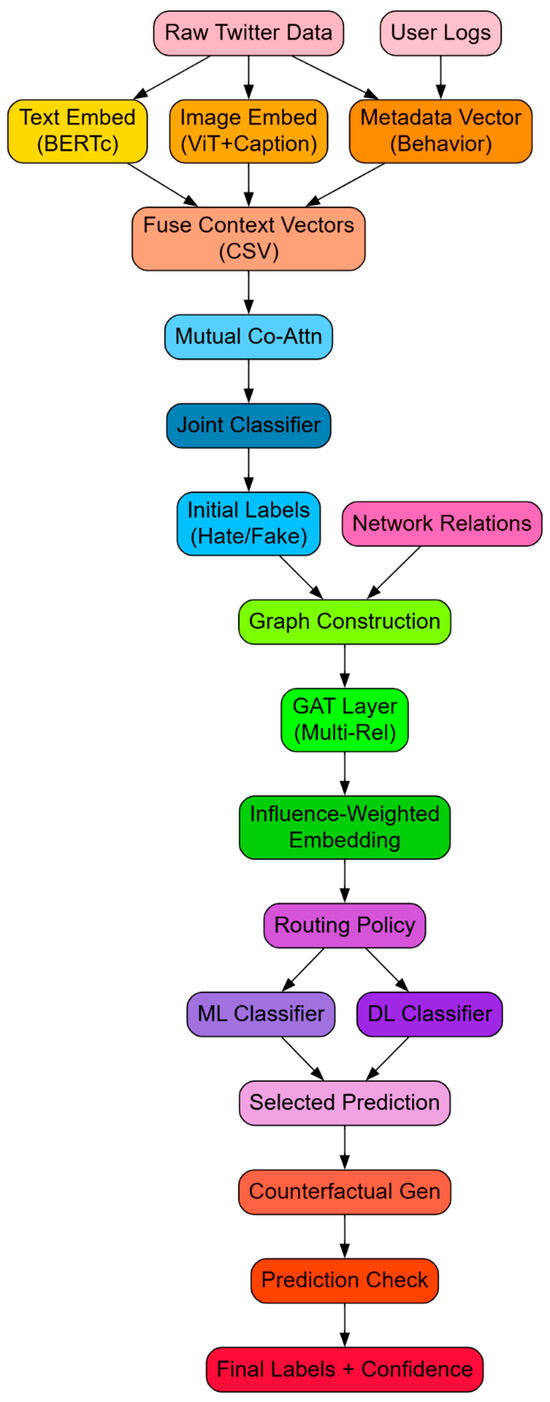
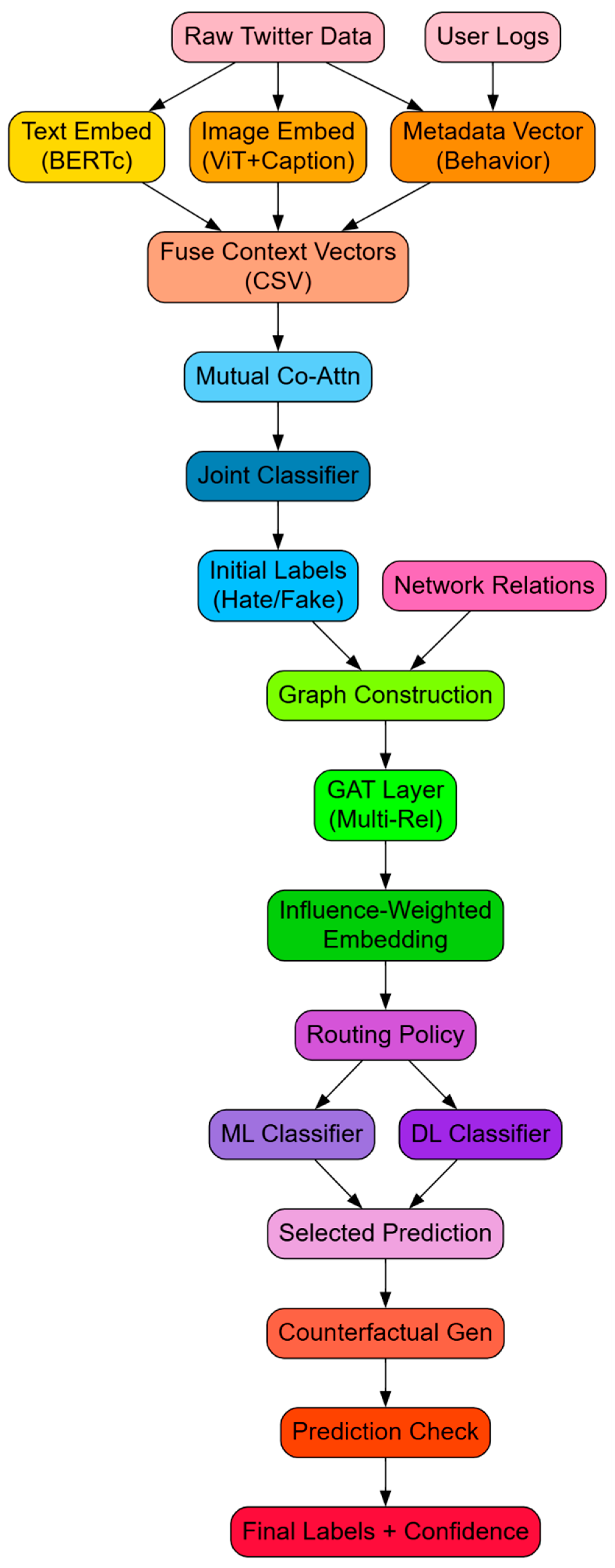
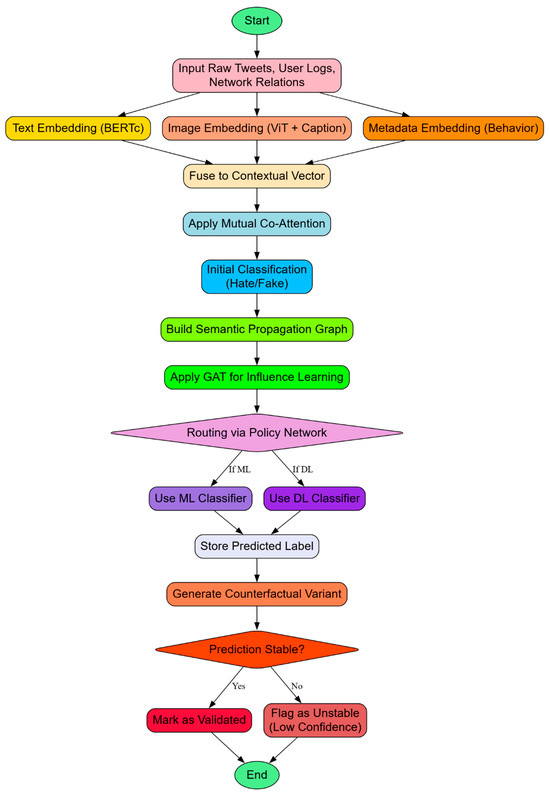
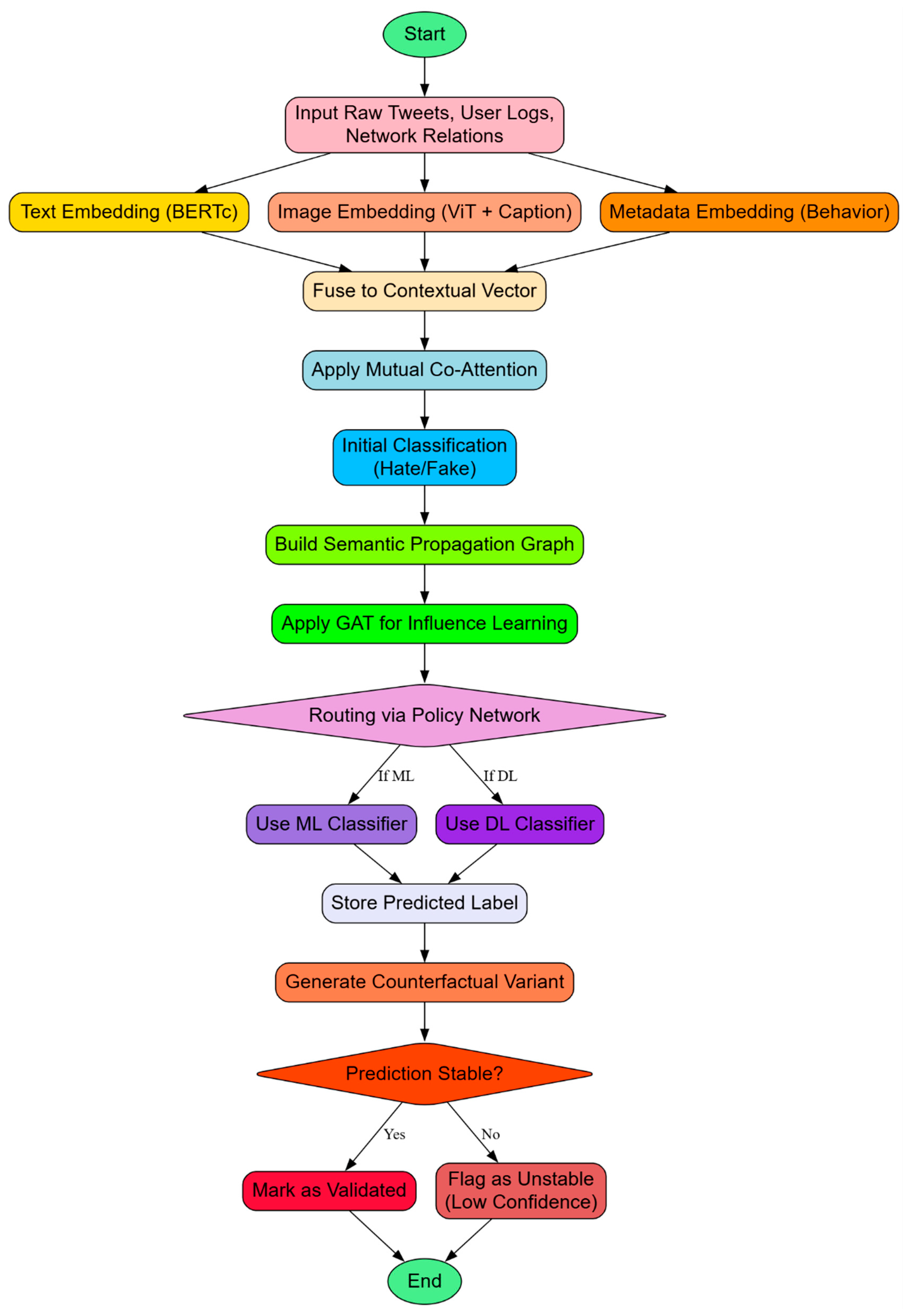
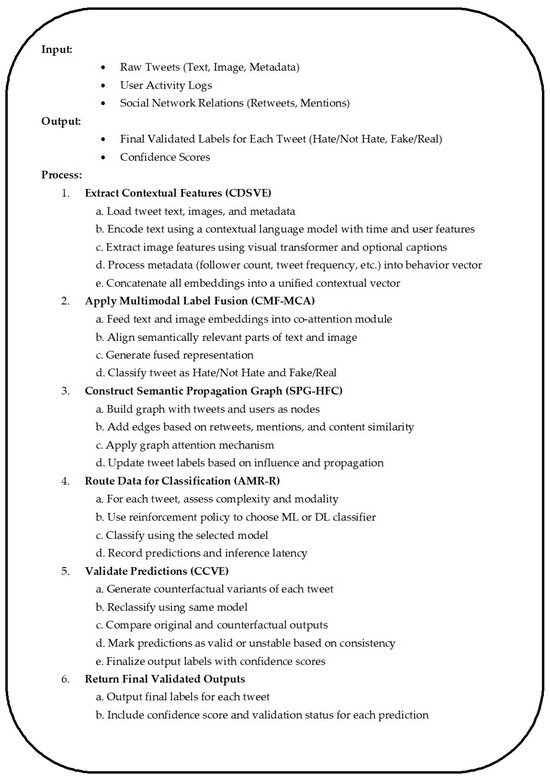
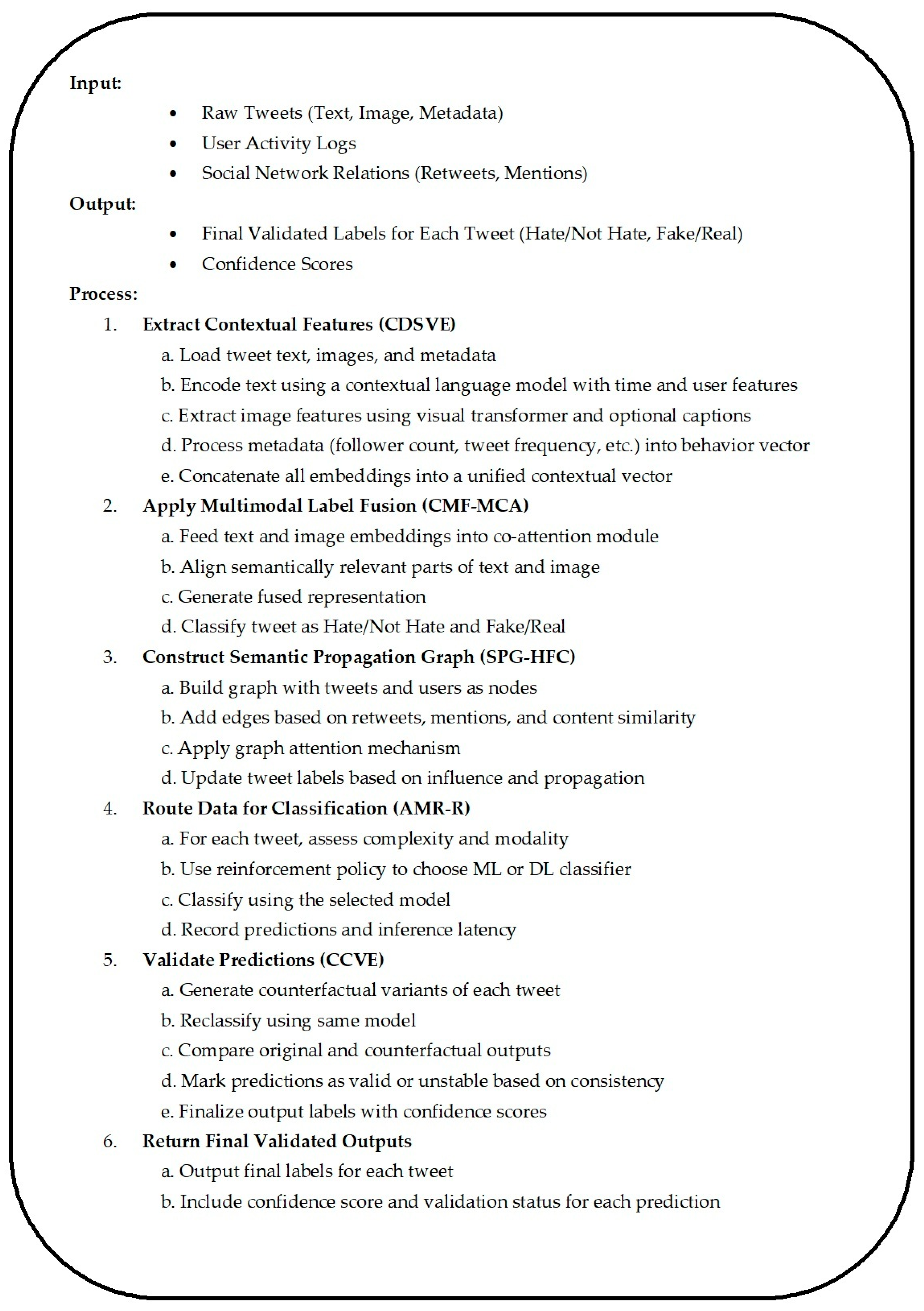
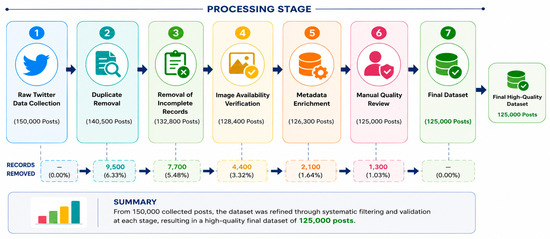
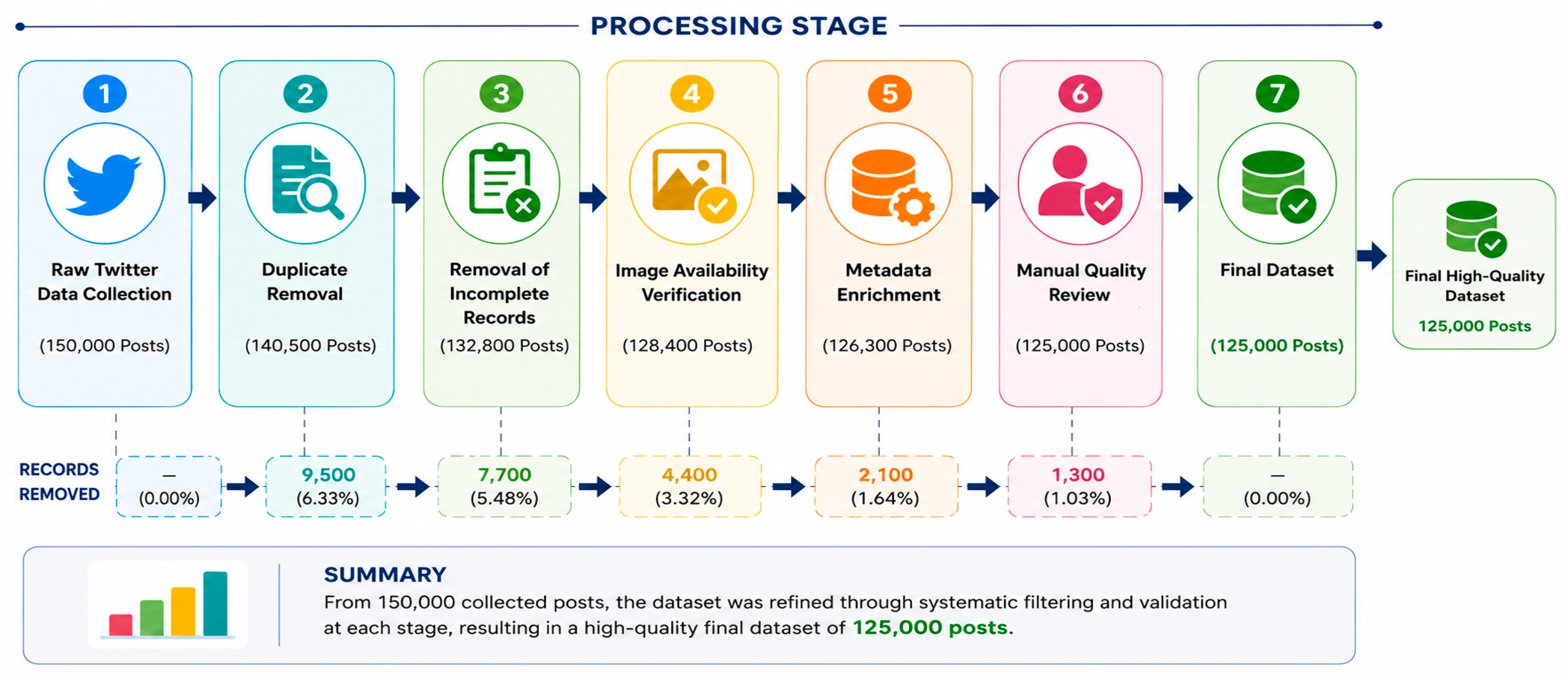
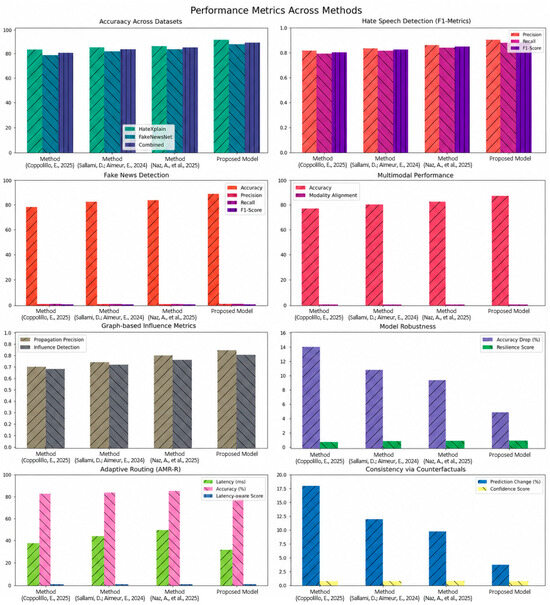
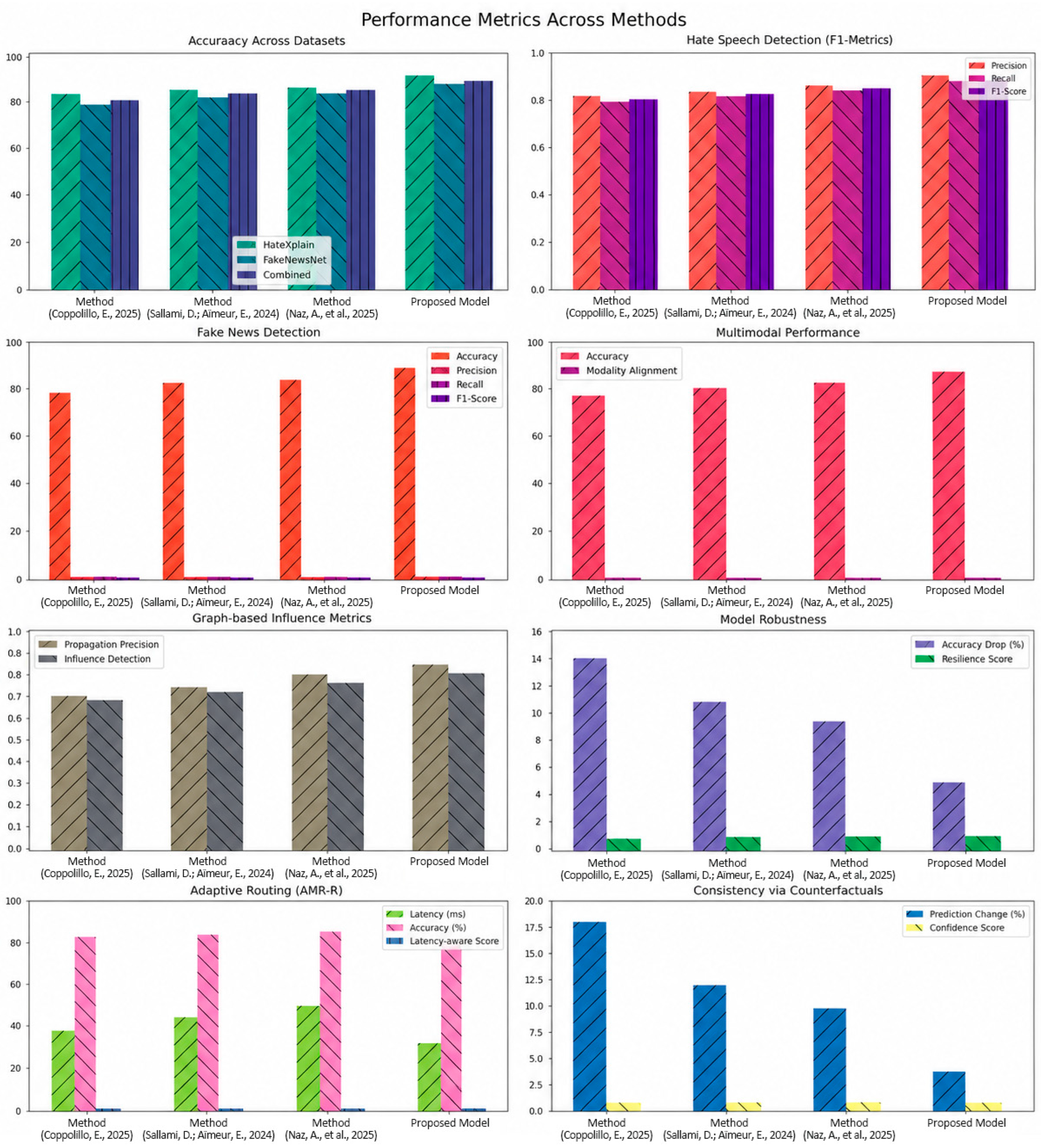
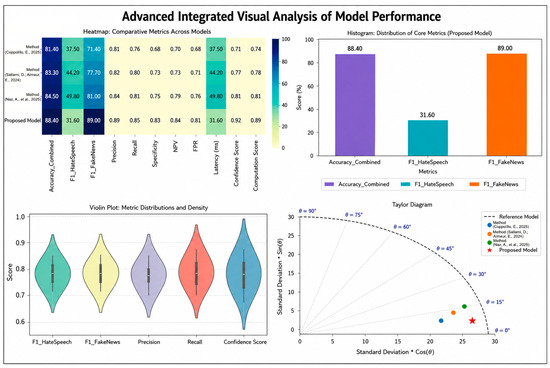
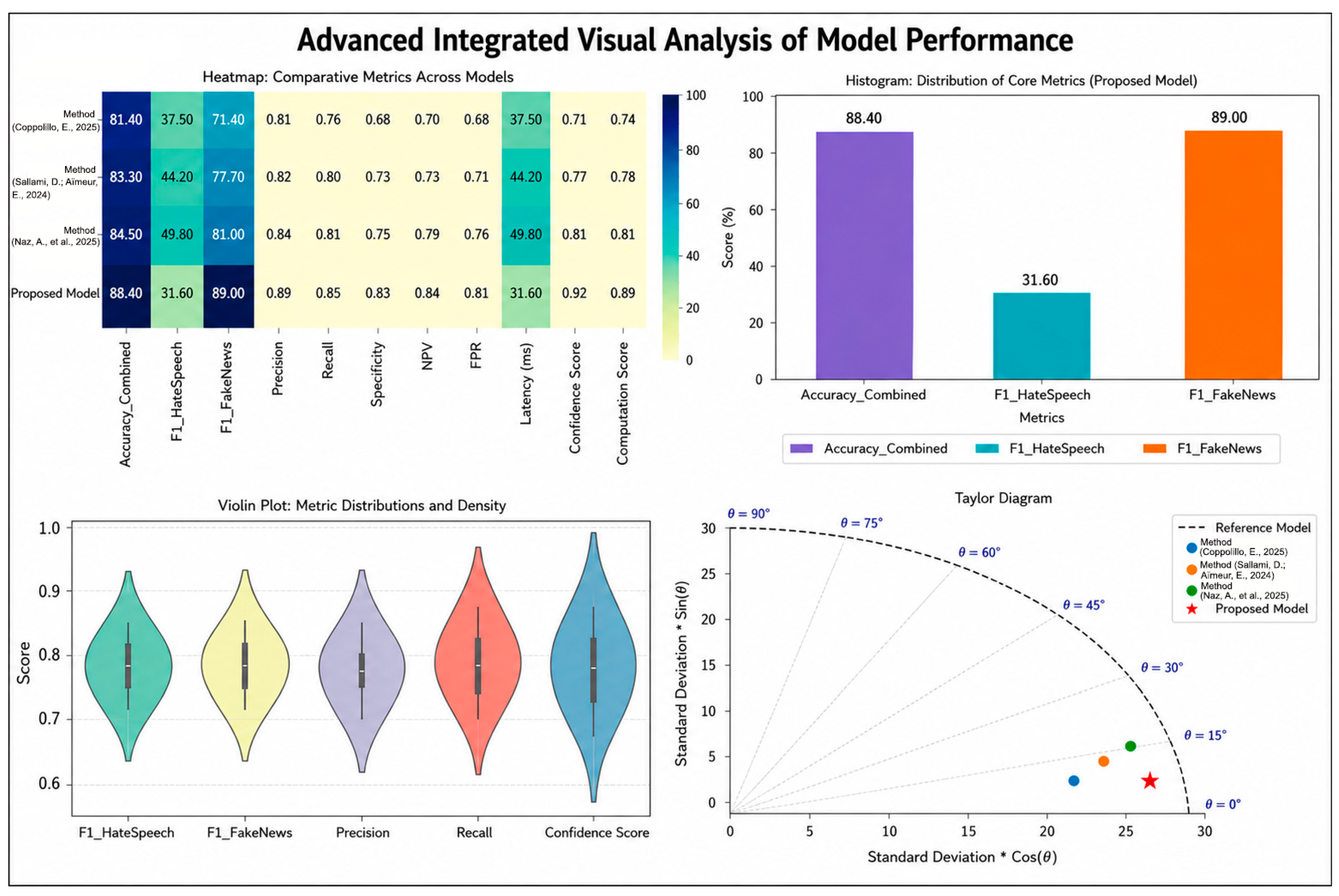

Disclaimer/Publisher’s Note: The statements, opinions and data contained in all publications are solely those of the individual author(s) and contributor(s) and not of MDPI and/or the editor(s). MDPI and/or the editor(s) disclaim responsibility for any injury to people or property resulting from any ideas, methods, instructions or products referred to in the content. |
© 2026 by the authors. Licensee MDPI, Basel, Switzerland. This article is an open access article distributed under the terms and conditions of the Creative Commons Attribution (CC BY) license.