


Abstract
Understanding the advance ticket purchase behavior of air–rail intermodal passengers is essential for travel demand forecasting, schedule coordination optimization, and revenue management. Using actual booking data, this study investigates passengers’ advance purchase time (APT) decisions. A Bayesian network (BN) model integrating expert knowledge and data-driven learning is established, with socioeconomic attributes and ticket characteristics as input variables and APT as the output variable. Based on this BN, group analysis is conducted across four routes of varying distances: Tianjin–Shanghai, Tianjin–Changsha, Tianjin–Guangzhou, and Tianjin–Sanya. The results indicate that socioeconomic and ticket attributes influence advance purchase behavior both directly and indirectly through interactive effects. Inferential analysis reveals that elderly passengers, male travelers, morning departures, and longer-distance trips are associated with earlier ticket purchases. Sensitivity analysis shows that fare, transfer time, and age exert heterogeneous effects across routes. Compared with short- and medium-haul journeys, airfare, rail travel time, and transfer time impose stronger impacts on long-haul intermodal trips. Finally, targeted revenue management strategies are proposed to improve air–rail ticket sales.
1. Introduction
Air–rail integrated services (ARISs) provide passengers with integrated travel services through the coordinated operation of high-speed rail (HSR) and aviation [1]. The distributional advantage of HSR in the short-haul market effectively expands the service catchment area of hub airports [2], while air transport from hub airports offers efficient and convenient services for the long-haul passenger market [3]. ARISs are important in alleviating hub airport congestion [4], reducing environmental pollution [5] and improving coordinated resource allocation [6]. However, some problems remain in the existing air–rail integrated market, such as inconvenient ticket purchasing, complex trip links, long transfer times, poor travel experience and low willingness to pay [7,8,9], which seriously weaken the competitiveness of ARISs. As a result, the actual share of ARISs in the transport market is relatively low [9,10]. In addition, studies on the travel demand of air–rail passengers are scarce, which has limited the basis for formulating air–rail trip plans and sales strategies and may lead to low performance in the coordinated operation of aviation and HSR. Increasing the market share of ARISs requires a better ability to predict the travel demand of air–rail passengers with a focus on their advance ticket purchase behavior.
Compared with urban transport, the operation schedule and lines of intercity transport are relatively fixed [11]. The travel distance and travel time of intercity passengers are longer, and their travel cost is generally higher [12]. Therefore, airlines and railway companies often encourage passengers to plan their trip itineraries and purchase the corresponding tickets in advance. Through a trade-off among travel time, travel path, transfer time, travel mode and travel cost, passengers choose a travel scheme to maximize their travel utility and complete the decision-making for ticket purchases in advance [13]. Airlines and railway companies can know the real-time travel demands in advance through passengers’ advance ticket purchase records [14]. Accordingly, managers can reasonably guide and meet the travel demands of air–rail passengers by dynamically adjusting fares and optimizing schedules [15,16]. Meanwhile, managers can also guide passengers to complete ticket purchases through differentiated pricing strategies [17]. For example, price-sensitive passengers are encouraged to complete early ticket purchases by implementing an advance ticket purchase discount, and time-sensitive passengers are recommended to buy tickets with a higher guarantee. These different advance ticket purchase behaviors influence revenue management, pricing strategies, collaborative scheduling and seat allocation by service managers.
To facilitate passengers’ queries about and purchase of air–rail integrated tickets, the air–rail intermodal agreement stipulates that the HSR train number is entered into the civil aviation sales information system as a virtual flight [7]. Therefore, when passengers make a decision to buy integrated tickets in advance, they are restricted by multiple factors from different travel stages, including rail-leg, transfer and air-leg trips. For example, to ensure on-time flight check-in, passengers may choose to depart earlier by rail and reserve a longer transfer time. If we ignore the impact of unique ARISs attributes (HSR-leg, transfer and air-leg trip) on the advance ticket purchase behavior of air–rail passengers, it will lead to deviation in the demand prediction of ARISs and eventually cause failure of revenue management.
In addition, previous studies often only take the total travel distance as an indicator variable in the model and find that the total travel distance is a key factor affecting passengers’ advance ticket purchase behavior [16,17,18]. However, there are some limitations regarding the use of total travel distance as an indicator variable. First, we can easily identify total travel distance as a significant contributing factor for advance purchase behavior, but some questions about total travel distance remain unanswered, such as how we should formulate ticket sales or revenue management strategies for ARISs with different distance markets. Second, the effect of total travel distance on other ticket attributes is ignored when total travel distance is used as an indicator variable. Obviously, the total travel distance is strongly correlated with the total travel time, total travel cost, departure time and other factors. For example, long-distance trips are often accompanied by an increase in travel time and travel cost. Therefore, studying passengers’ advance ticket purchase behavior under different travel distances can not only deepen the understanding of the nature of advance purchase behavior but can also help to predict the travel demand and formulate specific pricing strategies in different distance markets in the later stage. In summary, it is necessary to consider the unique product characteristics of ARISs and study the advance purchase behavior of air–rail passengers under different travel distances.
This study raises two main questions: (1) what are the key factors influencing advance purchase behavior? (2) Is there any difference in advance purchase behavior among air–rail passengers with different travel distances, and what factors are the main causes of these differences? To answer these questions, this paper has two main purposes: (1) to build a diagram network model of advance ticket purchase behavior, including passengers’ socioeconomic attributes and integrated ticket attributes, and (2) to use the ticket booking transaction data of air–rail passengers. This paper trains the constructed model and analyzes the differences in the advance ticket purchase behavior of intermodal passengers on four routes of different distances.
The paper is structured as follows: first, the literature on ARISs and advance ticket purchase behavior is reviewed. Then, the ticket booking data of air–rail passengers are prepared and analyzed. Third, the methodology of the Bayesian network (BN) model is introduced. Then, the results of structure learning, parameter learning and reference analysis are discussed. Finally, the conclusion, recommendations and future study directions are given.
2. Literature Review
Studies of the travel behavior of air–rail passengers mainly focus on willingness to pay, demand analysis, passenger preference and ARISs satisfaction, as presented in Table 1. These studies mainly collect travel behavior data of air–rail passengers based on RP or SP surveys. Although RP survey data are considered to accurately reflect the actual travel experience of intermodal passengers, the survey cost is high, especially for larger sample sizes [19]. SP surveys collect the travel behavior of passengers in different situations but are limited by the complexity of the hypothetical environment considered, which often differs from people’s actual experience. In addition, ticket booking transactions are a rich source of valuable data. Passenger social demographical data, ticket attributes and ticket purchase timing information are all recorded in one dataset. This type of data is registered accurately by an advanced computer ticket management system [20]. However, few studies have used ticket booking data to analyze advance purchase behavior [21].
Table 1.
Related studies on travel behavior of air–rail passengers.
Studies of advance purchase behavior focus on a single transportation mode, such as aviation, HSR, and on-demand transport service, as shown in Table 2. Among them, Chiou and Liu [13,14] used ticket transaction data to study the advance ticket purchase behavior of air passengers by applying a discrete choice model. The results showed that factors such as fare, price uncertainty and departure time have a significant impact on advance purchase behavior. Hotle et al. [24] used the click stream data of air passengers to explore the impact of the deadline for advance ticket purchases on passengers’ query and purchase behavior. The results show that passengers’ query and purchase behavior changes with the minimum air fare, departure time and travel distance. Furthermore, Wen and Chen [15] used survey data to explore the advance ticket purchase time of low-cost air passengers through a continuous logit model. The results show that price-sensitive passengers will complete the advance ticket purchase earlier, and lower fare prices will induce passengers to order earlier.
Table 2.
Studies on advance purchase behavior.
In addition, Hetrakul and Cirillo [18] used the online booking data of railway passengers to analyze advance ticket purchase time through a discrete choice model. They found that fare, departure time and travel distance significantly impact advance ticket purchase behavior. Sun et al. [16] used HSR ticket transaction data to study the advance ticket purchase time, train type and seat class choice of HSR passengers through a machine learning method. They indicate that ticket attributes such as departure time, ticket price and travel time can be used to predict advance purchase behavior with high accuracy. Interestingly, Kieu et al. [25] used transaction data on on-demand transport services in rural areas to predict advance booking behavior and travel demand through a class-specific soft voting model. Table 2 shows that previous studies on advance ticket purchase behavior are concentrated in the field of aviation and rail, and studies on the advance ticket purchase behavior of air–rail passengers are virtually absent.
As shown in Table 2, previous studies mainly apply discrete choice models or machine learning methods to analyze or predict the advance ticket purchase time. Although discrete choice models exhibit good performance in revealing the effects of different attributes on advance purchase behavior, passengers’ preferences for advance purchase behavior, and estimating advance purchase time (APT), they are constrained by various assumptions, such as random utility theory, mutual independence between variables, and data distribution assumptions [26]. In this study, the correlation between ticket attributes is obvious. For example, air fare is often influenced by factors such as travel time, departure time and arrival time. The transfer time is related to the travel time of the HSR-leg and air-leg trips. If the complex interaction between random variables is ignored, the fitting result of discrete choice models will not be satisfied, potentially leading to biased fitting results. In addition, although machine learning models such as support vector machine and neural network models have high prediction accuracy for APT, the interpretability of these models is low, and the complex causal relationship between variables cannot be distinguished [16]. The BN model, also known as the causal probability network, can be used to model complex interactions among multiple variables [27]. As a popular machine learning method, the BN model has been successfully applied to multimode choice behavior modeling and imputation [28,29,30], airport security process monitoring [31,32], travel demand generation [33], travel time estimation [34,35,36,37] and long-term mobility decisions [38]. However, few studies use a BN model to analyze advance purchase behavior.
In summary, existing studies use questionnaire data or ticket transaction data to analyze the advance ticket purchase behavior of HSR or air passengers. However, studies on the advance ticket purchase behavior of air–rail passengers are virtually absent [39]. To address these research gaps, this study applies a BN model to analyze the advance purchase behavior of air–rail passengers [40].
3. Data Preparation
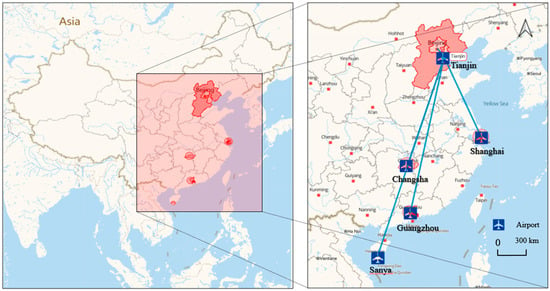
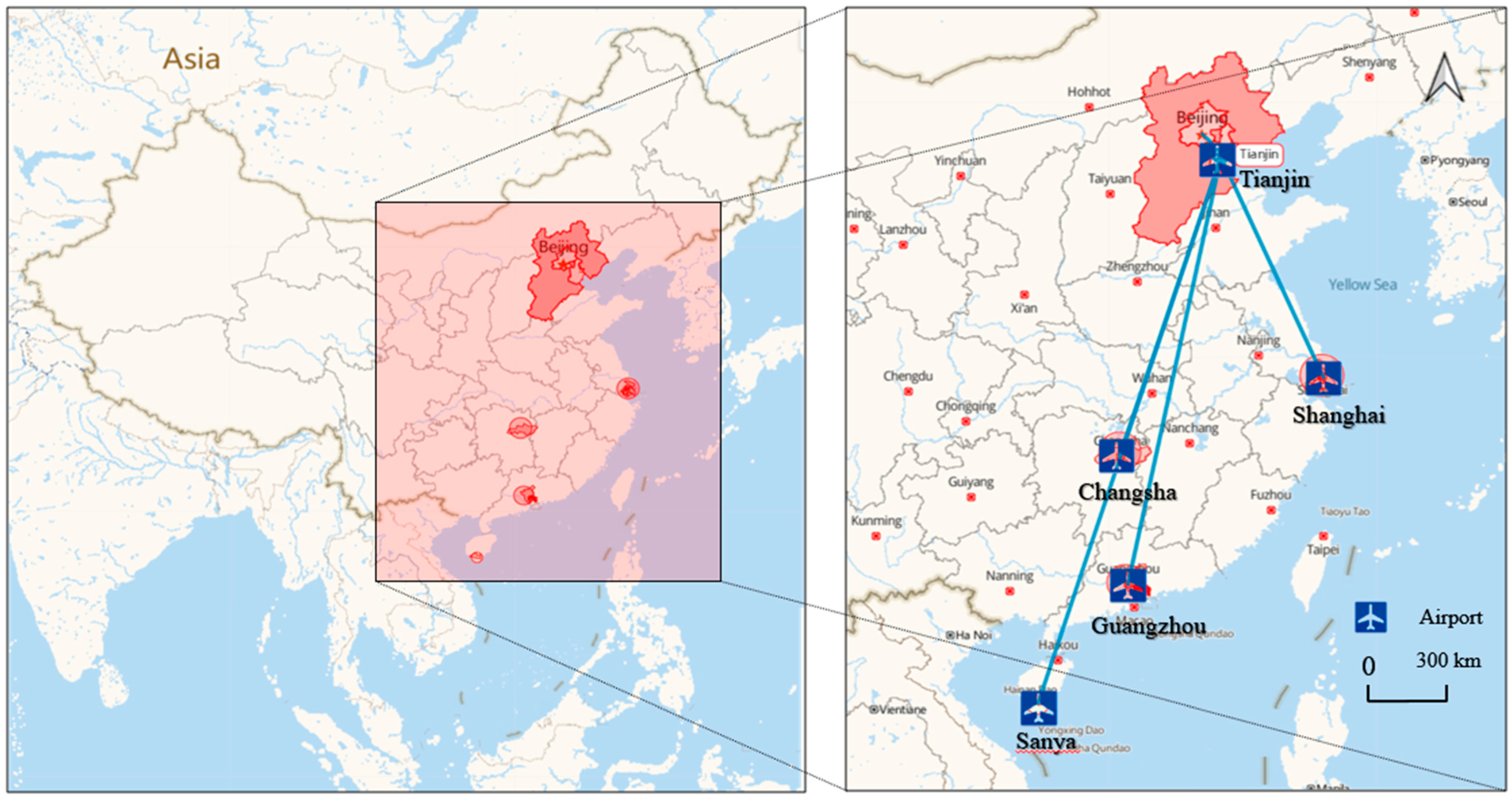
As the largest city cluster in northern China, the Beijing–Tianjin–Hebei Urban Agglomeration (BTHUA) comprises 14 cities, including Beijing, Tianjin and Shijiazhuang, with a total population of more than 100 million, as shown in Figure 1. Among them, Beijing and Tianjin, as the core cities of the BTHUA, play a pivotal role in the internal and external transport of urban agglomeration. As the only super large comprehensive hub airport in the BTHUA, Beijing Capital International Airport (PEK) plays an important role in domestic and international air transport. In 2018, the annual passenger flow of PEK exceeded 100 million, and the flight schedule was saturated. In addition, as one of the large hub airports in the BTHUA, Tianjin Binhai International Airport (TSN) had an annual passenger flow of more than 20 million in 2018, but there remains considerable airport capacity to be developed. The Chinese government issued a white paper on the integrated development of multimodal transport in the BTHUA to alleviate the pressure of large passenger volume on PEK. In 2014, TSN launched an ARISs to encourage passengers to arrive in Tianjin by plane and then proceed to Beijing via intercity HSR. To attract more passengers to purchase ARISs, TSN reimburses the HSR fare for air–rail passengers. As of July 2016, the TSN has provided ARISs for 368,000 air–rail passengers. At present, TSN still provides ARISs for intermodal passengers, and the ARISs has been upgraded. The upgraded ARISs no longer reimburses passengers for the HSR fare but provides intermodal passengers with baggage through-handling, free baggage storage, and free airport transfer services and extends the service area to the whole BTHUA region.
Figure 1.
Study area.
To facilitate the inquiry and booking of ARISs, some online ticketing companies, such as 12306.cn and Ctrip.com, provide passengers with air–rail intermodal trip schemes. Passengers can easily purchase air–rail integrated ticketing with one click on these online ticketing platforms. When a passenger orders an air–rail integrated ticket online, the transaction data are recorded in the ticket sales database. The third-party ticketing company provided booking transaction data on air–rail passengers of the TSN from 10 July 2020 to 20 November 2020, with a total of 6729 valid records. Before being provided to the authors, the booking transaction data were anonymized by the third-party ticketing company. All direct personal identifiers, such as passenger names, phone numbers, identity numbers, payment information, and detailed order identifiers, were removed. The dataset used in this study only contains aggregated or categorical information related to passenger demographics, ticket attributes, travel itinerary characteristics, and APT. Therefore, no individual passenger can be identified from the analytical dataset. The data were used only for academic research purposes and were stored and processed under confidentiality requirements.
It should be noted that the booking records used in this study were collected from 10 July 2020 to 20 November 2020, during the COVID-19 period. However, this period corresponded to the stage of normalized epidemic prevention and control in China rather than the initial outbreak stage. From July to November 2020, domestic civil aviation passenger volume recovered to 89.5% of the same period in 2019, while national railway passenger volume recovered to 76.5%, indicating that passenger mobility had gradually recovered and that the impact of COVID-19 on travel demand had weakened compared with the early outbreak period. Nevertheless, the pandemic context may still have influenced passengers’ perceived travel risk and advance purchase decisions. In addition, the original dataset contained 6729 valid booking records across multiple TSN-based air–rail routes, among which 4408 records from the four high-frequency routes were retained for route-specific comparison. The remaining records belonged to lower-frequency routes and were not excluded due to data-quality problems. Therefore, the findings should be interpreted within the context of normalized epidemic prevention and control and the selected major TSN-based air–rail routes.
Given the significant economic, climatic and geographical differences between eastern and western China, four routes with the highest passenger flow and flight frequency of air–rail services in eastern China were selected to eliminate the influence of regional differences: Tianjin–Shanghai (1003 records), Tianjin–Changsha (849 records), Tianjin–Guangzhou (1669 records) and Tianjin–Sanya (887 records). A total of 4408 valid records were screened out, as shown in Figure 1. The studied air–rail passengers first choose to take the HSR from cities in the BTHUA to Tianjin and then take a plane from TSN to Shanghai (1003 km), Changsha (1277 km), Guangzhou (1815 km), or Sanya (2436 km).
The ticket booking data include social demographic attributes (such as gender and age), ticket attributes (such as origin station, destination airport, departure time, transfer time, arrival time, HSR fare, and air fare), and advance ticket purchase time [41]. As shown in Table 3, the air–rail passengers are mainly young and middle-aged (<45 years old, 87.2%) and men (63%). The rail-leg travel time of most passengers is less than 1 h (70.8%), and the air-leg travel time is longer than 2.5 h (60.5%). Moreover, the transfer time of most passengers (59.6%) is within four hours. Finally, most passengers choose to purchase tickets in advance within one week before departure (79.1%).
Table 3.
Descriptive statistical analysis results of ticket booking data.
For air–rail passengers on four different routes, there are differences in travel distance, departure time of day, air-leg travel time and air fare [42]. Compared with that of the other three routes, the proportion of short-haul passengers from Tianjin to Shanghai departing by plane in the morning (22.6%) is the highest, but the proportion of those arriving in Shanghai in the early morning (1.8%) is the lowest. In addition, the air-leg travel time of such passengers is generally within 2.5 h (99.8%), and the proportion of air fares less than 500 RMB (40%) is the highest. Meanwhile, the proportion of such passengers whose transfer time is more than 4 h is the highest (53.8%). The travel characteristics of passengers from Tianjin to Changsha and Tianjin to Guangzhou are similar. Air–rail passengers traveling along these two routes prefer to depart by plane in the afternoon (55.8% and 53.3%) and arrive at their destination airport at night (55.4% and 40.5%). In addition, the transfer time of most passengers on these two routes is within four hours (64.6% and 66%), and their air fares are mainly less than 750 RMB (64.3% and 62.4%). Compared with other passengers, passengers from Tianjin to Sanya have the longest travel distance. The proportions of passengers who choose to depart from TSN in the afternoon (63%) and arrive at their destination in the early morning (31.4%) are the highest. Meanwhile, the air-leg travel times of such passengers all exceed 3.5 h (100%), and the proportion of air fares greater than 1000 RMB (38.9%) is the highest.
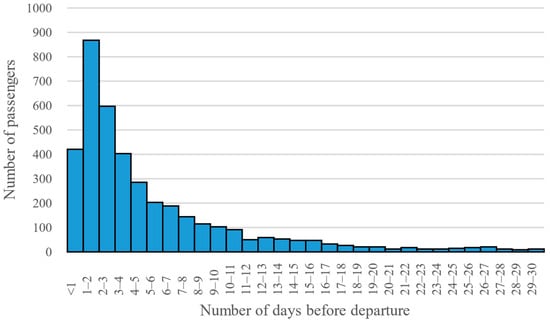
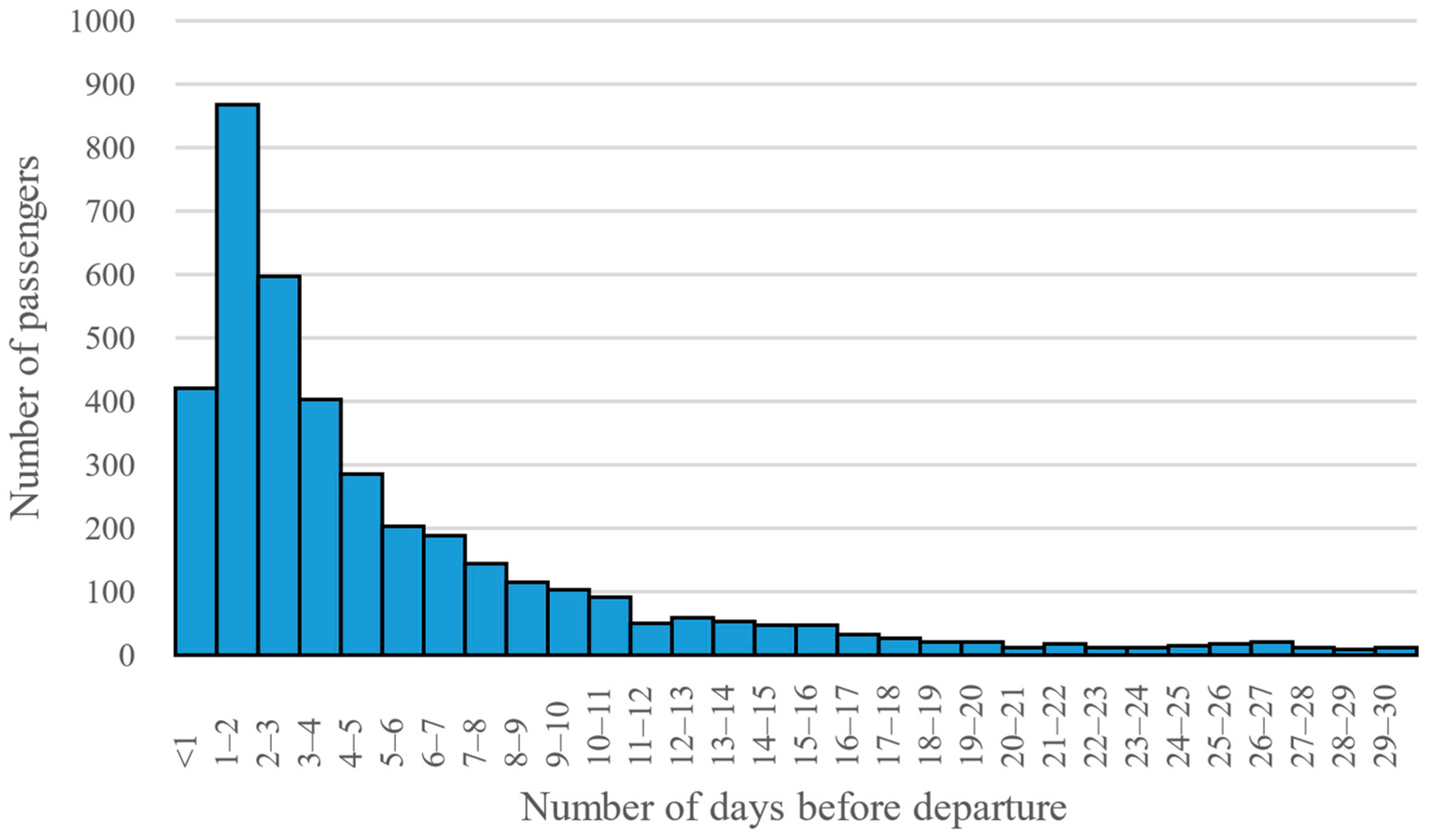
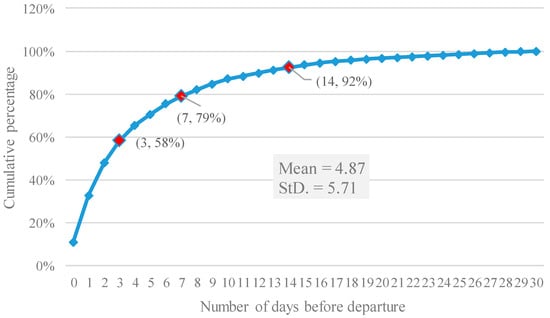
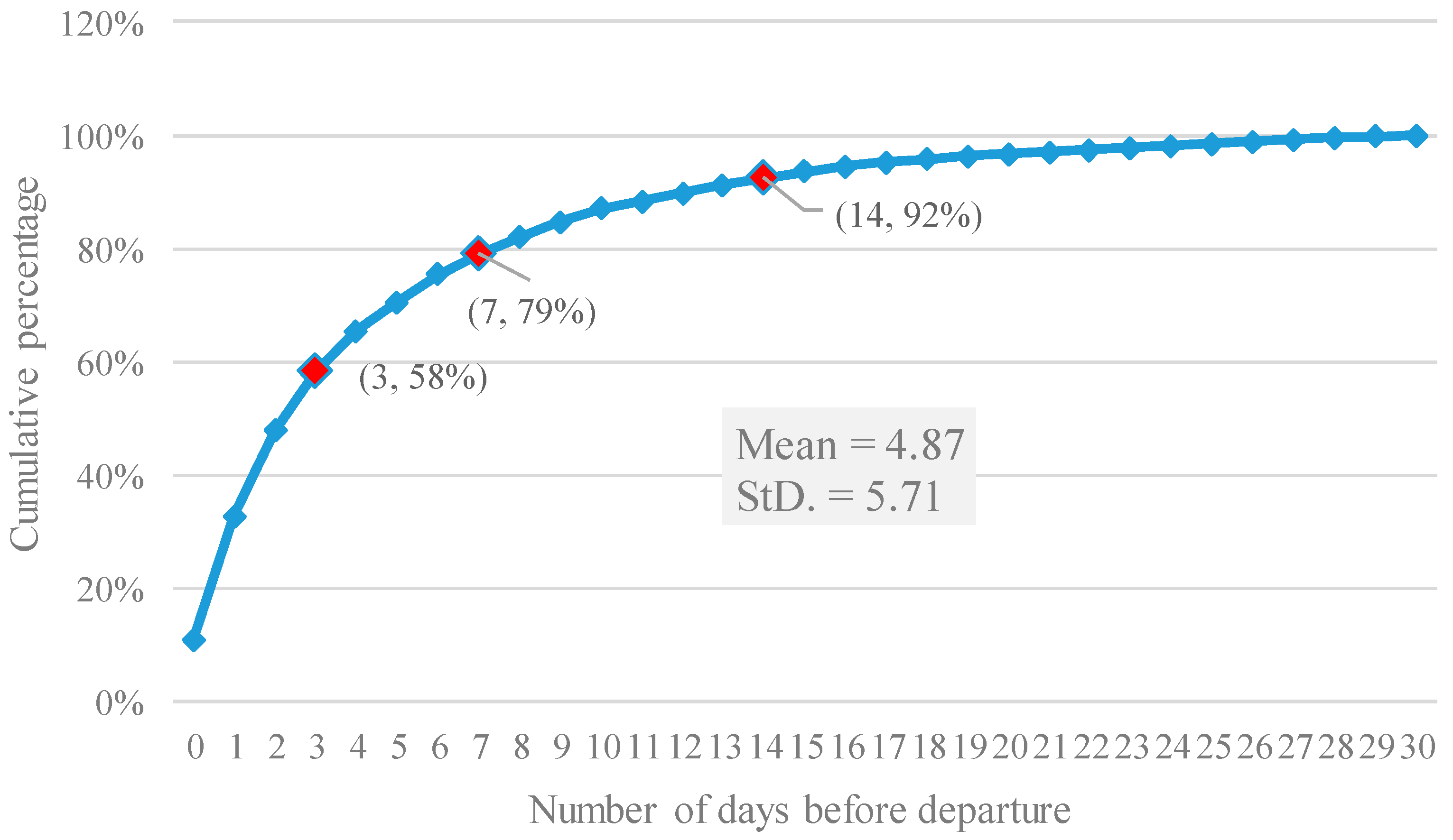
This paper attempts to use ticket booking data from air–rail passengers to study the impact of demographic attributes and ticket product attributes on advance purchase time (APT). APT is the time interval between advance ticket purchase date and actual departure date , i.e., . In China, customers can purchase HSR tickets up to 30 days in advance through online ticket purchase platforms (such as 12306.cn and Ctrip.com). Due to this limitation, we define the time horizon of advance ticket purchase time to within 30 days before departure. In addition, Chinese airlines generally adjust their fares three days, one week, two weeks and more than two weeks before departure [13]. Accordingly, we discretize APT into four parts: <3 days (APT 1), 3–7 days (APT 2), 8–14 days (APT 3), and 15–30 days (APT 4). Figure 2 shows the frequency distribution of advance purchase days for air–rail passengers. Figure 2 shows that the frequency of advance purchasing tickets within one week is high, and the frequency of purchasing tickets 1–2 days in advance is the highest. Figure 3 shows the cumulative percentage distribution of the APT. As indicated in Figure 3, more than half of the passengers (58.1%) choose to purchase tickets within three days of departure, most passengers (79.1%) choose to purchase tickets within one week before travel, and only a small proportion of passengers (7.6%) choose to purchase tickets two weeks or more in advance.
Figure 2.
Frequency distribution of advance purchase days.
Figure 3.
Cumulative percentage distribution of advance purchase days.
4. Methodology
This section presents the mathematical formulation, applicability, construction process and inference analysis of the BN. For a series of random variables , a BN model can be expressed as , where is the network structure and are the network parameters. The network structure is a directed acyclic graph (DAG). The nodes in the graph represent random variables , and the arrows represent the probability dependence between variables. If two nodes are connected by an arrow , then the start point is defined as the parent node of , expressed as , and the end point is defined as the child node of . The network parameters represent a series of parameters for quantifying the network structure , specifically the conditional probability table of each possible child node with its parent node set , which is recorded as . In a BN model , the joint probability distribution of a child node is equal to the product of conditional probability of its parent node , and the formula is as follows:
where denotes the random variable node i and is the parent node of node . is a set of local probability distributions associated with each variable.
Compared with the traditional discrete choice model and neural network model, the BN model has the following advantages [43]. First, the BN model describes the relationship between variables through graphical methods and enables learning of the causal relationship between variables. In this study, there are many attributes that may affect advance purchase behavior, and complex interactions between these attributes may exist. It is helpful to understand and analyze ticket booking data by learning the causal relationships among these attributes and graphically representing them. Second, expert knowledge, theoretical relationships and empirical data can be integrated into structural learning; that is, the network structure can be determined by learning from data and/or assisted by expert knowledge. Finally, the constructed causality network is used for reference analysis, which is very suitable for assessing the impact of new evidence on the APT.
The construction process of a BN model includes two main steps: structural learning and parameter learning. Structural learning learns the direct or indirect causal relationships among variables based on data. The greedy thick thinning (GTT) algorithm is adopted for structural learning to effectively integrate expert knowledge and data-driven learning. The GTT algorithm consists of three steps: drawing, thickening and thinning. First, the mutual information between all pairs of nodes in the graph is calculated to represent the closeness between nodes; see Equation (2). A draft network can be formed according to the closeness between nodes. Then, the GTT algorithm uses a conditional independence test to repeatedly add or delete arcs between nodes on the network draft until no arc increase or decrease will lead to a positive increase in the marginal likelihood value. For more details about the description of the GTT algorithm, please refer to the paper of Jie et al. [44].
where represents the closeness between node and node ; represents the joint probability between node and node ; represents the probability of node for state ; represents the probability of node for state .
For a given network structure, parameter learning aims to optimize the parameters in the network by means of an iterative algorithm to obtain the conditional probability distribution of each node. In this paper, the expectation–maximization (EM) algorithm is adopted to perform parameter learning. The EM algorithm is composed of an alternating E-step and M-step, and its robustness is not affected by the selection of initial value [45]. The EM algorithm is widely used in parameter learning of the BN model due to its easy implementation of iterative rules and processing of latent variables or missing values of data [46,47,48].
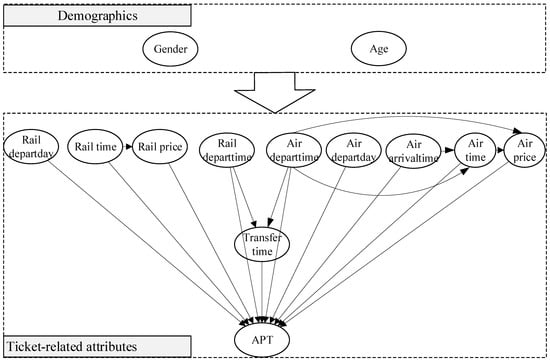
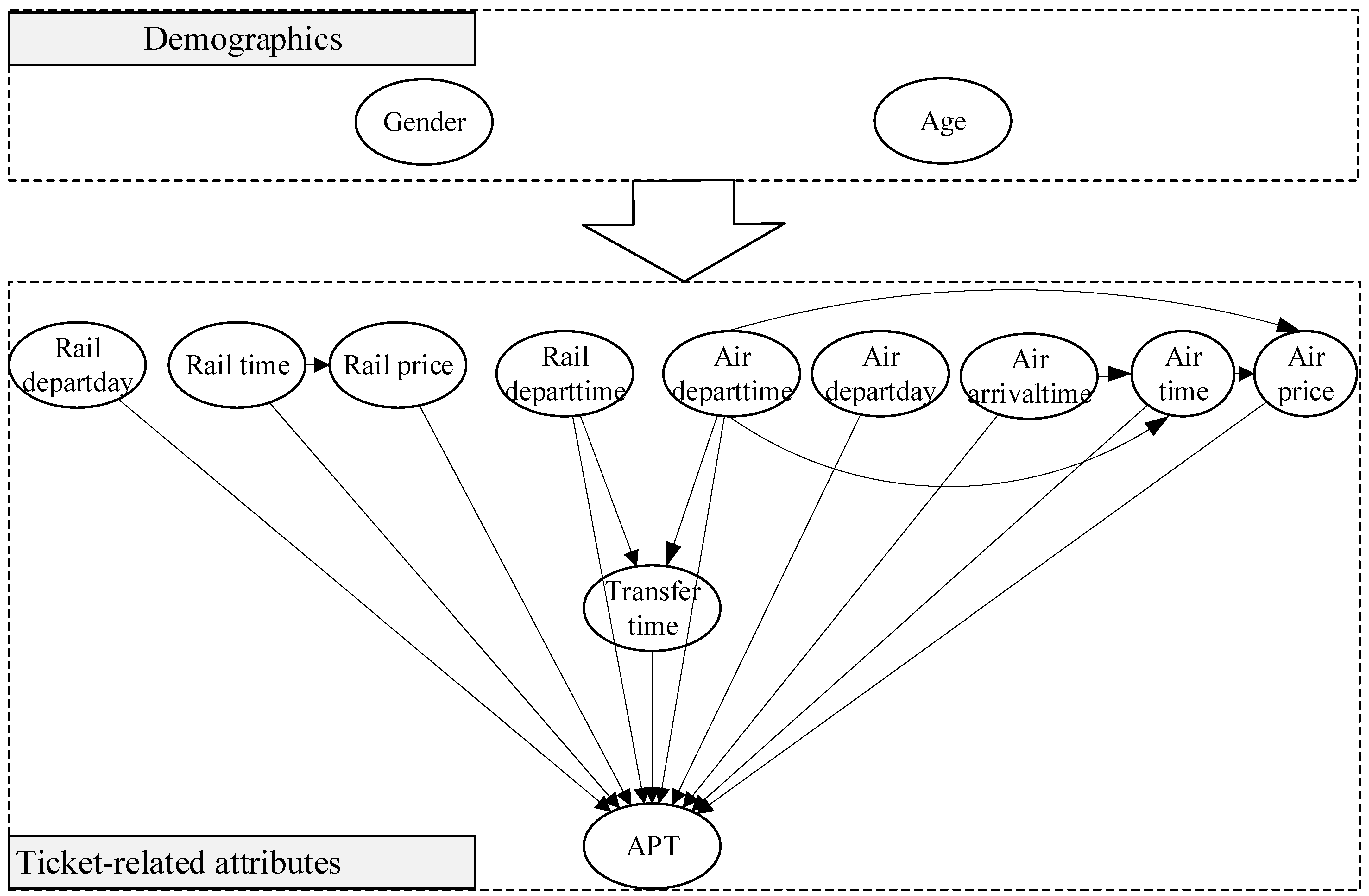
Structural learning via empirical data only is affected by the sample size and data distribution, and eventually the learned structure may become inconsistent with theory or practice. To avoid biased structural learning, a common practice is to force certain relationships between variables according to domain knowledge [49]. Table 4 summarizes the key factors affecting advance ticket purchase behavior. The key factors are identified from three dimensions, namely, socioeconomic attributes, ticket product attributes and trip characteristics. Meanwhile, previous studies also confirm that socioeconomic attributes and ticket product attributes have a significant impact on advance purchase behavior. Therefore, in the initial BN model, we set the socioeconomic attributes and ticket product attributes as the parent nodes of the advance purchase time (APT). In addition, since passenger demographics are difficult to change in a short time, we allow demographics to impact ticket product attributes and APT and prohibit the impact of ticket product attributes and APT on passenger demographics. In addition, the HSR fares are generally determined by the travel distance and travel time. Therefore, we take the HSR-leg travel time as the parent node of the HSR fare. Similarly, air fares are generally affected by flight departure time and air-leg travel time. Therefore, flight departure time and air-leg travel time are regarded as the parent nodes of air fares. In addition, the transfer time is determined by the HSR departure time and air departure time. Therefore, the HSR departure time and air departure time are regarded as the parent nodes of the transfer time. The initial BN model is shown in Figure 4.
Table 4.
Key factors affecting advance purchase behavior.
Figure 4.
Initial network constructed by domain knowledge.
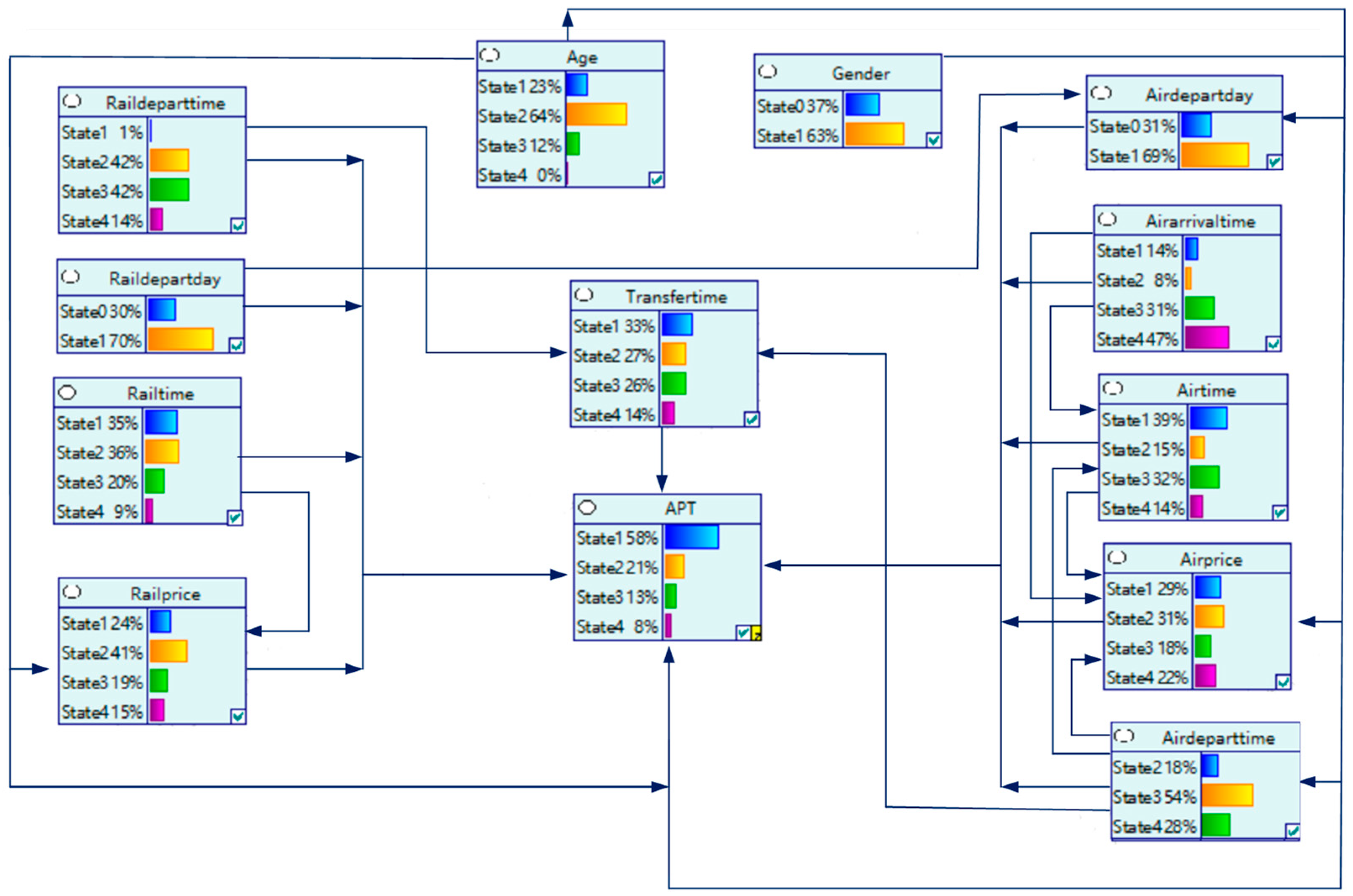
To improve the transparency of the transition from the initial domain-knowledge network in Figure 4 to the final learned BN structure, the GTT algorithm was implemented as a constrained structure-learning procedure. The drawing phase started from the initial network constructed using domain knowledge and previous empirical findings. Prior structural relationships, such as rail-leg travel time → rail fare and rail departure time/air departure time → transfer time, were specified according to the operational logic of air–rail ticketing. At the same time, logically implausible directions were prohibited. For example, ticket attributes were not allowed to influence demographic variables such as gender and age, and APT was treated as the target variable and was not allowed to point to other explanatory variables. Based on these constraints, the initial skeleton was further informed by pairwise mutual information, as shown in Equation (2).
Starting from this constrained baseline, the thickening phase added candidate arcs to capture additional conditional dependencies supported by the empirical data. Candidate arcs were retained only when they improved the marginal likelihood score and satisfied both the directed acyclic graph condition and the predefined structural constraints. This step allows the model to identify interaction relationships among ticket attributes and operational variables, such as air arrival time of day → air fare and HSR departure day → air departure day. Subsequently, the thinning phase examined whether existing arcs were redundant after conditioning on the updated network structure. If removing an arc did not reduce the explanatory power of the network, the arc was deleted. This pruning process helps distinguish direct dependencies from indirect dependency paths, such as age → rail fare → APT and gender → air departure time → air fare → APT. Therefore, the final BN structure in Figure 5 was obtained through a constrained data-driven learning process that balances model fit and structural parsimony, rather than through arbitrary manual modification.
Figure 5.
Learned BN model.
Upon completion of network and parameter learning, inference analysis is conducted using the trained BN model. After setting specific evidence for relevant variables, reference analysis uses the corresponding algorithm to update the network and finally obtain the posterior probability distribution of APT given the new evidence. In this study, when new evidence of variable is input, the network is updated using the belief propagation algorithm [27]. Then, a new probability distribution of APT is calculated, which is recorded as . In addition, the prior probability distribution of APT is recorded as . By calculating the D-value, i.e., , we can accurately infer the impact of new evidence on APT. The belief propagation algorithm transmits information through the probability dependence between nodes and calculates the probability distribution of each variable in the network. The mathematical formulas of the belief propagation algorithm are as follows:
where is the parent node set of and is the child node set of . represents information transmitted from node to , and represents information transmitted from to node . is the indicative function of evidence and takes a value of 1 if evidence is input into and 0 otherwise. represents the joint probability distribution of and after inputting evidence . represents the marginal probability of after inputting evidence . represents the marginal probability of after inputting evidence .
5. Estimation Results
5.1. BN Model Estimation
GeNIe (version 2.3) was used to perform structural and parameter learning. The learned network is shown in Figure 5. We used K-fold cross-validation to evaluate the model learning performance [50]. K-fold cross-validation divides the total data into K subsets, where (K-1) subsets are used as the training data and the Kth subset is used as the test set. In this study, K was set to 10 to evaluate the learning performance and obtain the confusion matrix, as shown in Table 5. The confusion matrix records the actual observed frequency distribution and predicted frequency distribution of APT. In Table 5, the diagonal value represents the number of predicted correct classifications, and the non-diagonal value represents the number of predicted wrong classifications. As shown in Table 5, the learned BN model makes accurate predictions of APT. The accuracy of APT 1, APT 2, APT 3 and APT 4 are 92.2%, 83.8%, 81.3% and 87.5%, respectively, and the overall prediction accuracy is 88.3%. Thus, the prediction accuracy of the BN model is high, and the overall performance of the model is acceptable.
Table 5.
Confusion matrix.
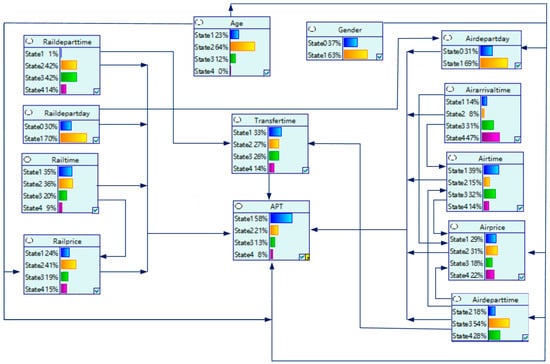
Figure 5 shows the final BN model after learning and training. As shown in Figure 5, gender and age have a direct effect on ticket attributes (HSR fare, air fare, air departure day, air departure time, etc.) and APT [51]. In addition, ticket attributes have a direct impact on APT. Meanwhile, complex interactions between different ticket attributes and demographics are obtained, such as HSR departure day → air departure day, air arrival time → air fare, and gender → air fare. Finally, in addition to the direct relationship, an indirect relationship between socioeconomic attributes and ticket attributes on the APT is also observed in the network; for example, HSR departure time → transfer time → APT, age → HSR fare → APT, and gender → air departure time → air fare → APT.
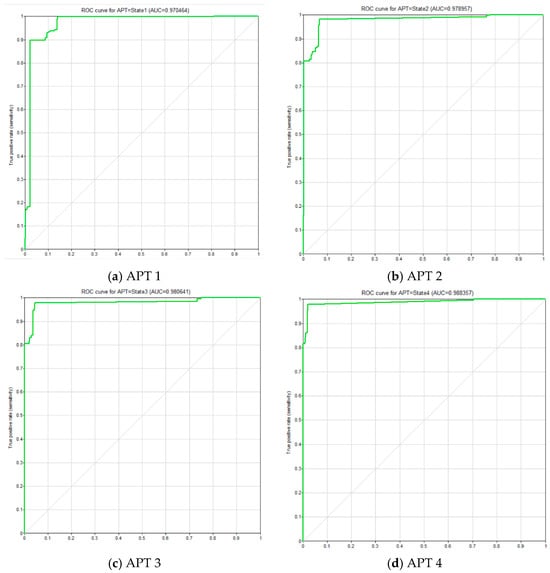
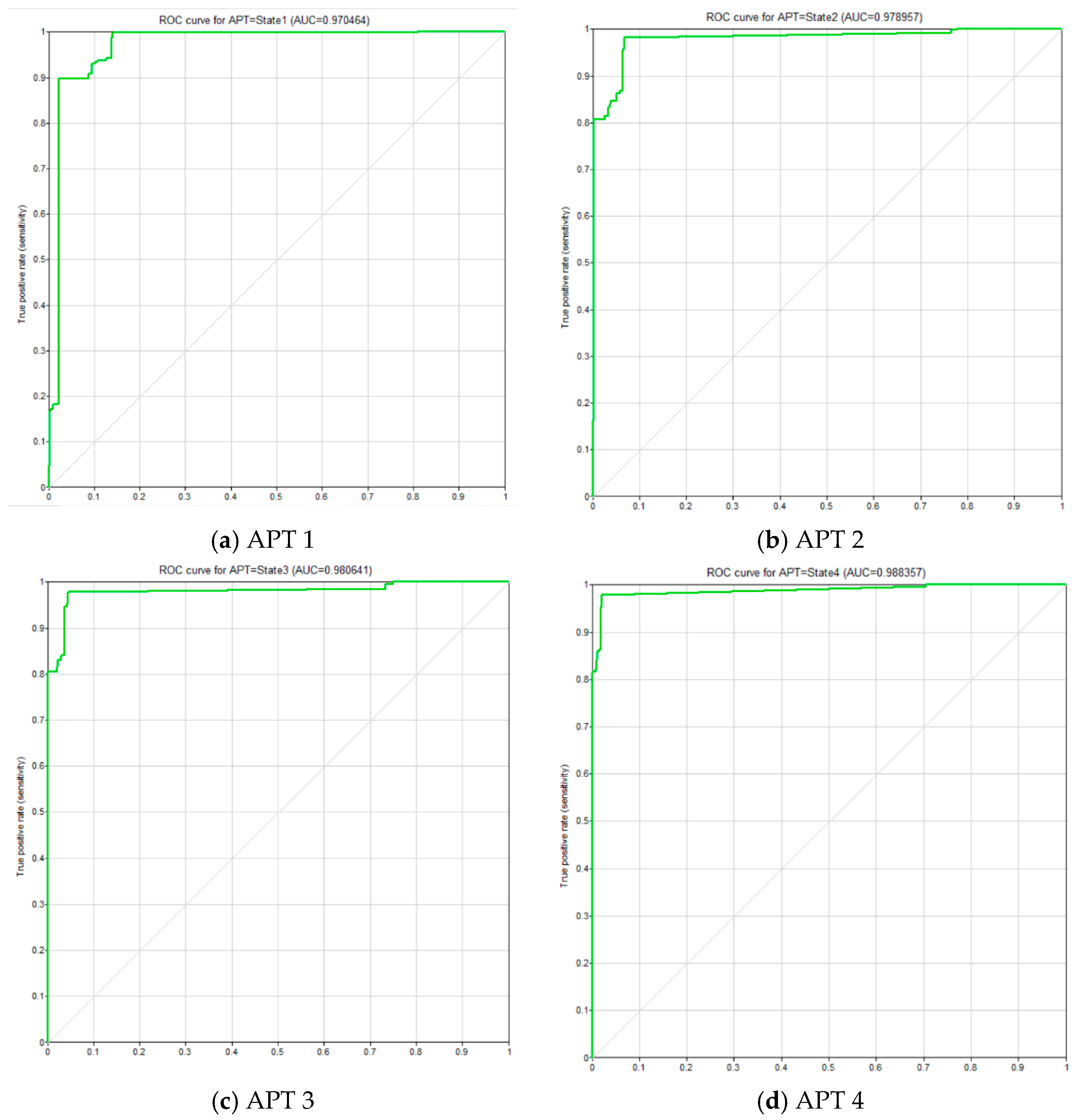
To evaluate the overall model performance, we performed receiver operating characteristic (ROC) curve analysis, as shown in Figure 6. The ROC curve can be used to diagnose the quality of model classification results [52]. In the ROC curve graph, the vertical axis is the true positive rate, indicating the proportion of events correctly predicted by the model in the sample. The horizontal axis is the false positive rate, which represents the proportion of events incorrectly predicted by the model in the sample. An ROC curve close to the upper left corner of the graph indicates high prediction accuracy and good overall model performance. Figure 6a–d show that the ROC curves of APT are above the diagonal and very close to the upper-left corner of the graph, indicating that this BN model works well on APT. Another popular index, the area under the ROC curve (AUC), is used to quantify the overall model performance. The AUC takes a value between 0 and 1; the closer the AUC is to 1, the better the performance. In this study, the AUC values of APT are greater than 0.97, indicating that the performance of the learned BN model is acceptable.
Figure 6.
ROC curve of APT.
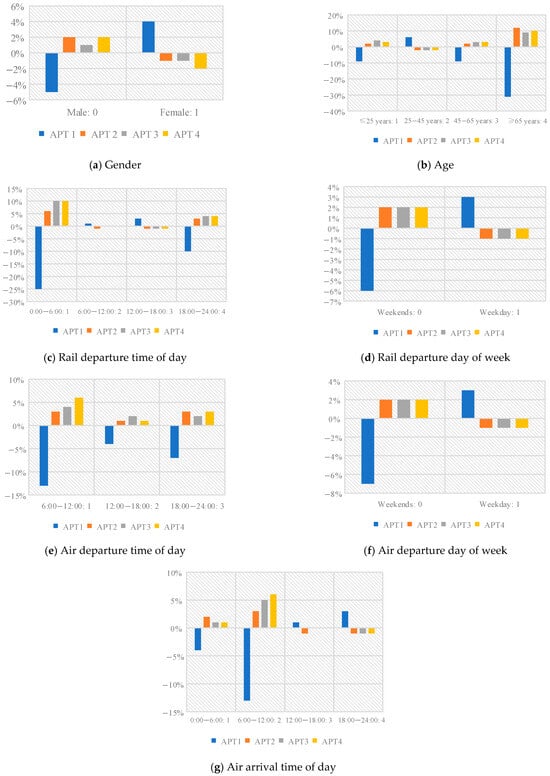
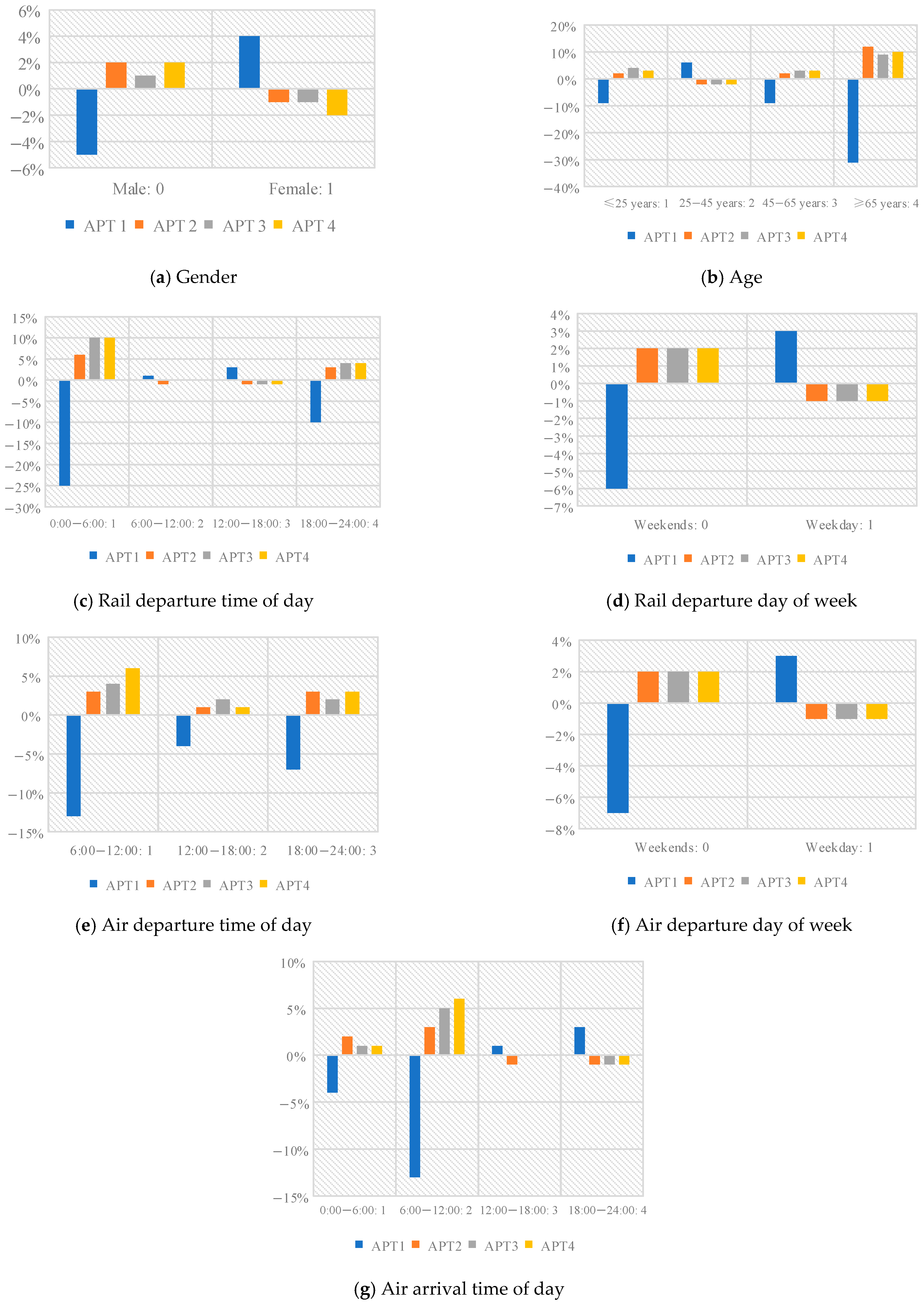
Figure 7 and Figure 8 show the reference results of the different variables that might influence the passenger’s APT decision. Figure 7a shows that when gender is set to male, the probability of male passengers purchasing tickets within three days in advance (APT 1) decreases by 5%, and the probability of male passengers purchasing tickets within one week (APT 2), two weeks (APT 3) and more than two weeks (APT 4) in advance increases by 2%, 1% and 2%, respectively, compared with the initial APT state. In contrast, the probability of female passengers purchasing tickets within three days in advance (APT 1) increases by 4%, and the probability of APT 2 (−1%), APT 3 (−1%), and APT 4 (−2%) decreases accordingly. These findings are consistent with the fact that male passengers planned their trips more thoroughly, and female passengers preferred spontaneous trips. Interestingly, compared with young and middle-aged passengers, the probability of elderly passengers booking tickets within three days in advance (APT 1) decreases the most (−31%), which indicates that elderly passengers are more willing to purchase tickets earlier in advance. This finding may be related to the fact that elderly passengers are more sensitive to prices and tend to spend more time planning their travel [53].
Figure 7.
Effects of socioeconomic and schedule-related variables on APT.
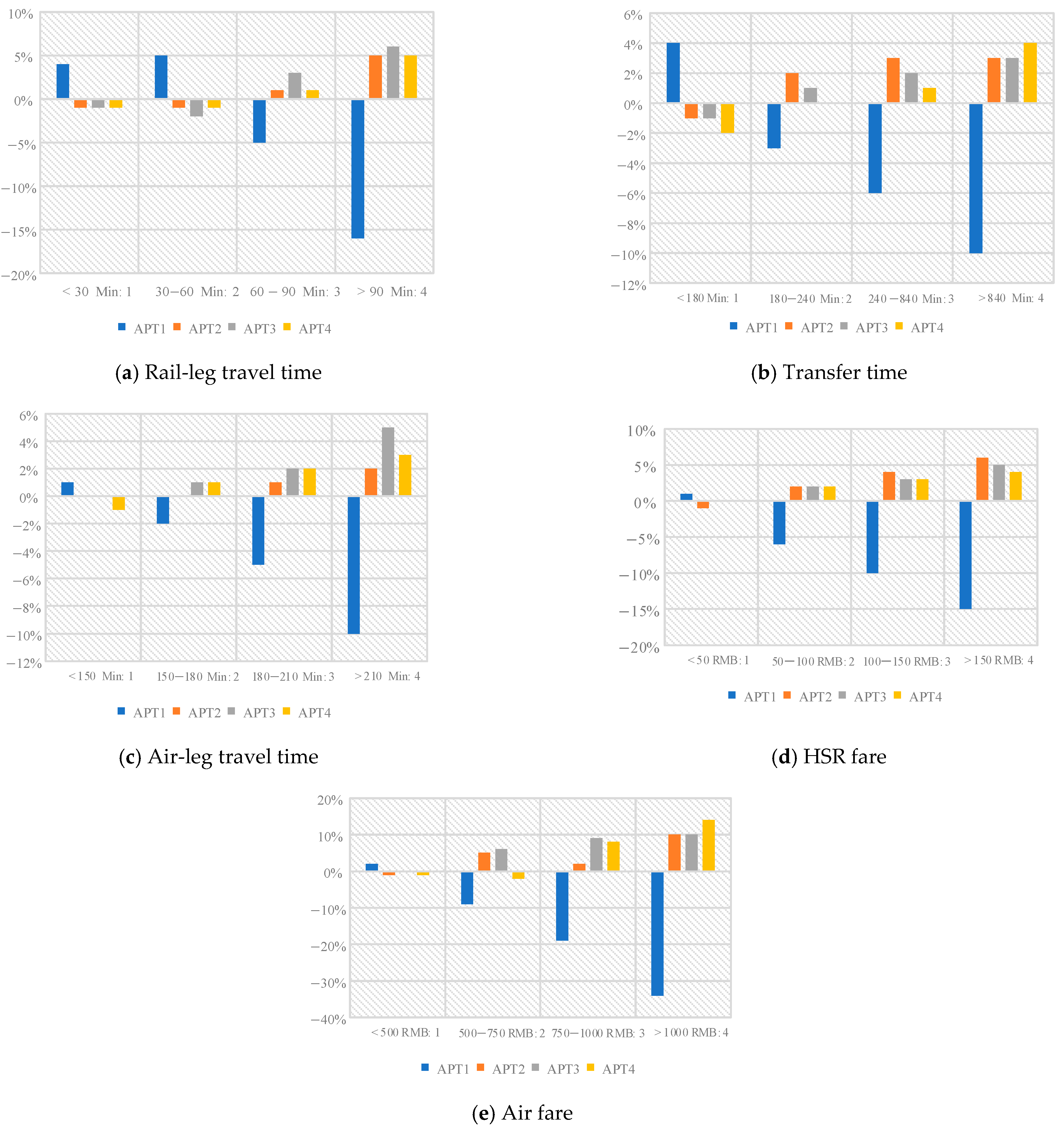
Figure 8.
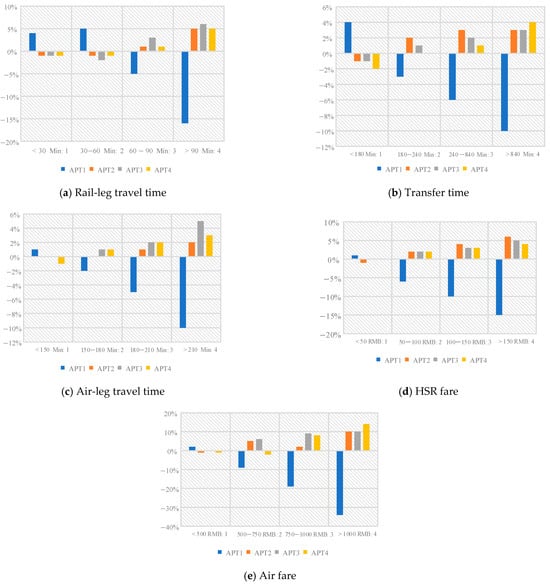
Effects of travel-time and fare-related variables on APT.
When passengers depart in the early morning or evening by HSR, the probability of APT 1 is decreased substantially (−25% and −10%), which means the probability of passengers purchasing tickets earlier in advance (APT 2, APT 3, APT 4) will increase. Compared with departure during the day, the risk of departure at night is higher, so passengers are more willing to purchase tickets earlier in advance. In addition, compared with working days, the probability of passengers departing on weekends purchasing tickets within three days in advance (APT 1) is much lower (−6%). Meanwhile, the probability of passengers departing on weekends purchasing tickets within one week (2%), two weeks (2%) and more than two weeks (2%) in advance is increased. This result is consistent with the fact that the intercity passenger flow increases on weekends, ticket purchases become difficult because of the shortage of ticket sources, and passengers have to purchase tickets earlier in advance [54].
Figure 7e–g show the impact of the air departure time and arrival time on advance purchase behavior. The probability of passengers departing (−13%) or arriving (−13%) by air in the morning to purchase tickets within three days in advance decreases the most, which means that passengers departing or arriving by air in the morning are more willing to purchase tickets earlier in advance. This finding is related to the fact that airports are generally located in the suburbs, and passengers must spend more time accessing or egressing the airport. If an intermodal passenger needs to depart in the morning, they must arrive at the airport in the early morning or the night before. Therefore, tickets for flights departing in the morning are generally less expensive, which will induce price-sensitive passengers to purchase tickets earlier in advance.
Figure 8a–c show the impact of rail-leg travel time, transfer time and air-leg travel time on advance purchase behavior. When the rail-leg travel time is longer than 1 h, the probability of passengers purchasing tickets within three days in advance decreases. Meanwhile, as the rail-leg travel time increases, the probability of passengers purchasing tickets earlier (APT 2, APT 3, APT 4) in advance increases. With the increase in rail-leg travel time, passengers spend more energy on travel. Therefore, passengers must purchase tickets earlier in advance to ensure a comfortable seat. Similarly, as the air-leg travel time increases, the probability of passengers purchasing tickets earlier (APT 2, APT 3, APT 4) also increases. This finding is consistent with the fact that passengers pay more attention to the trip arrangement of long-term travel and purchase tickets earlier in advance. Interestingly, rail-leg travel time and transfer time have a considerable impact on the APT. Therefore, timetable coordination between airlines and HSR must be considered and transfer guidance and service must be implemented to ensure the seamless connection of the whole travel process of air–rail passengers.
Figure 8d,e show the impact of HSR fares and air fares on advance purchase behaviors. Compared with other variables, air fares have the greatest impact on APT [42]. As the air fare increases, the probability of passengers purchasing tickets within three days in advance decreases. When the air fare is greater than 1000 RMB, the probability of passengers purchasing tickets earlier in advance is the highest. In fact, when the air fare is high, passengers will pay more attention to the dynamic ticket price and purchase earlier in advance to save travel costs.
5.2. Group Analysis of Different Routes
To analyze the difference in the advance ticket purchase behavior of air–rail passengers on different routes, ticket booking data on four different routes (from Tianjin to Shanghai, Tianjin to Changsha, Tianjin to Guangzhou and Tianjin to Sanya) are extracted to build separate BN models [11]. To ensure the comparability of the model results, based on the advance purchase network model constructed in Figure 4, the same fitting algorithm was implemented in GeNIe (version 2.3). Table 6 shows the accuracy results for different advance ticket purchase times on the four routes. The prediction accuracy of the BN model for each APT on different routes is greater than 70%, and the AUC is greater than 0.8. In addition, the overall prediction accuracy (OPA) of the model is higher than 80%, indicating that the overall performance of BN models for the advance purchase behavior on different routes is acceptable.
Table 6.
Estimated index values of BN models for different routes.
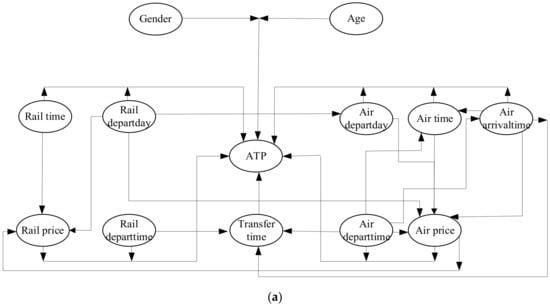
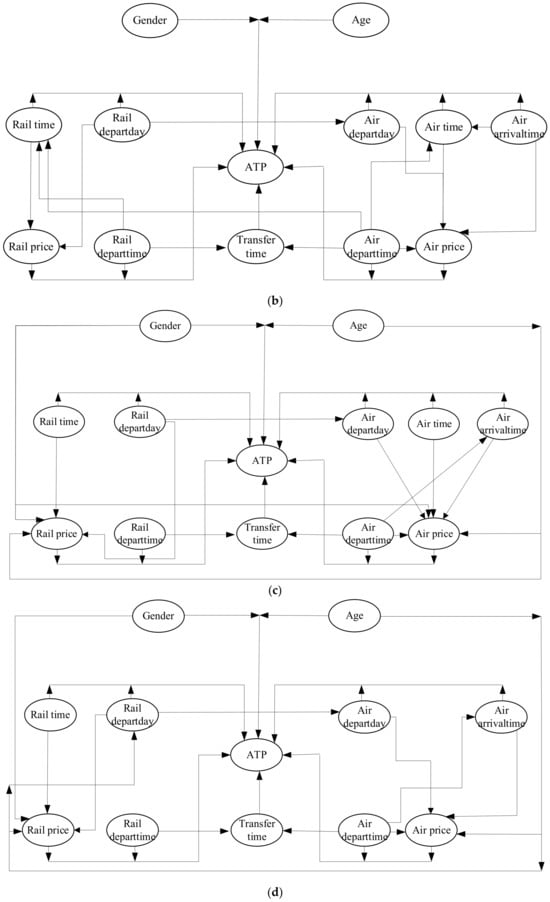
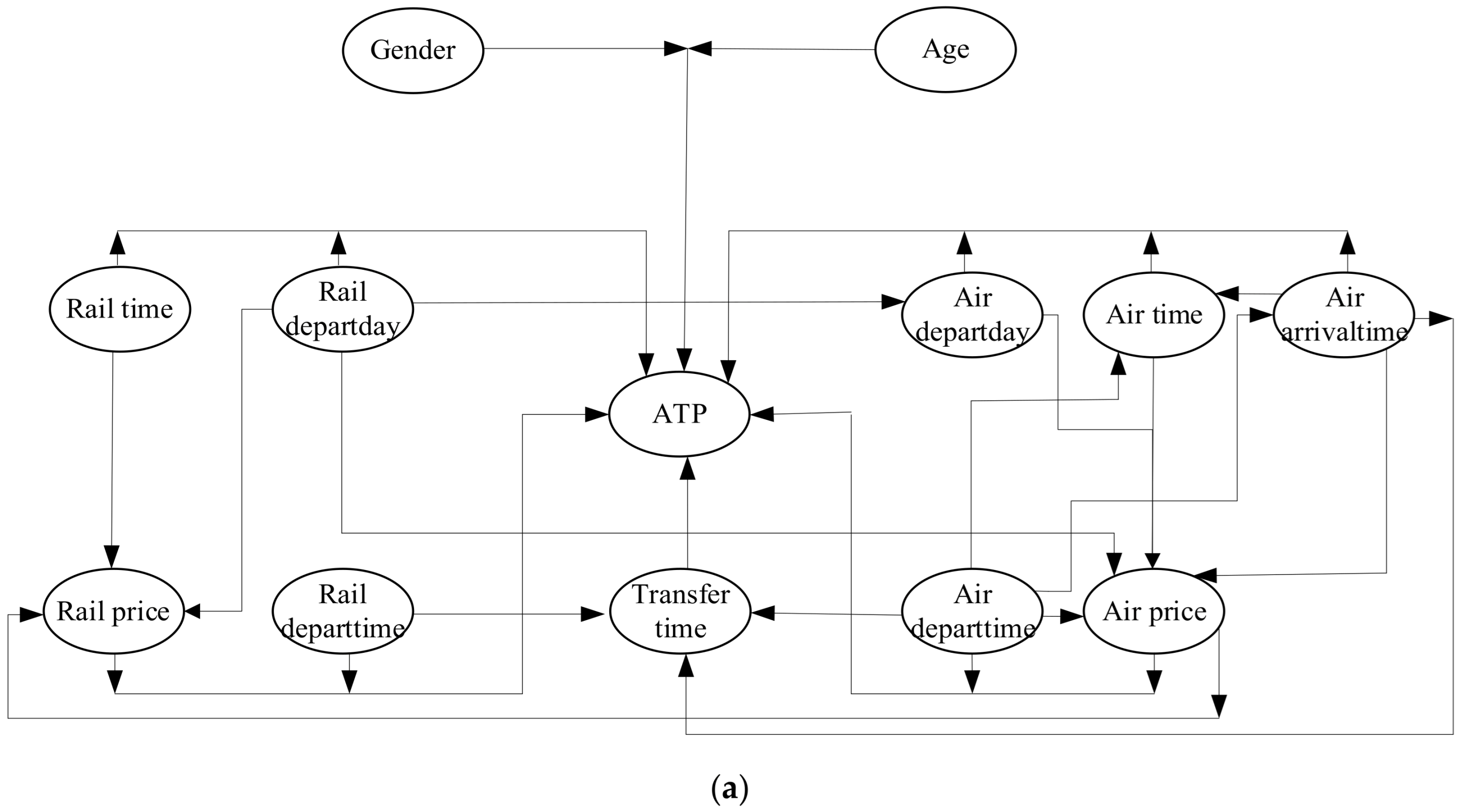
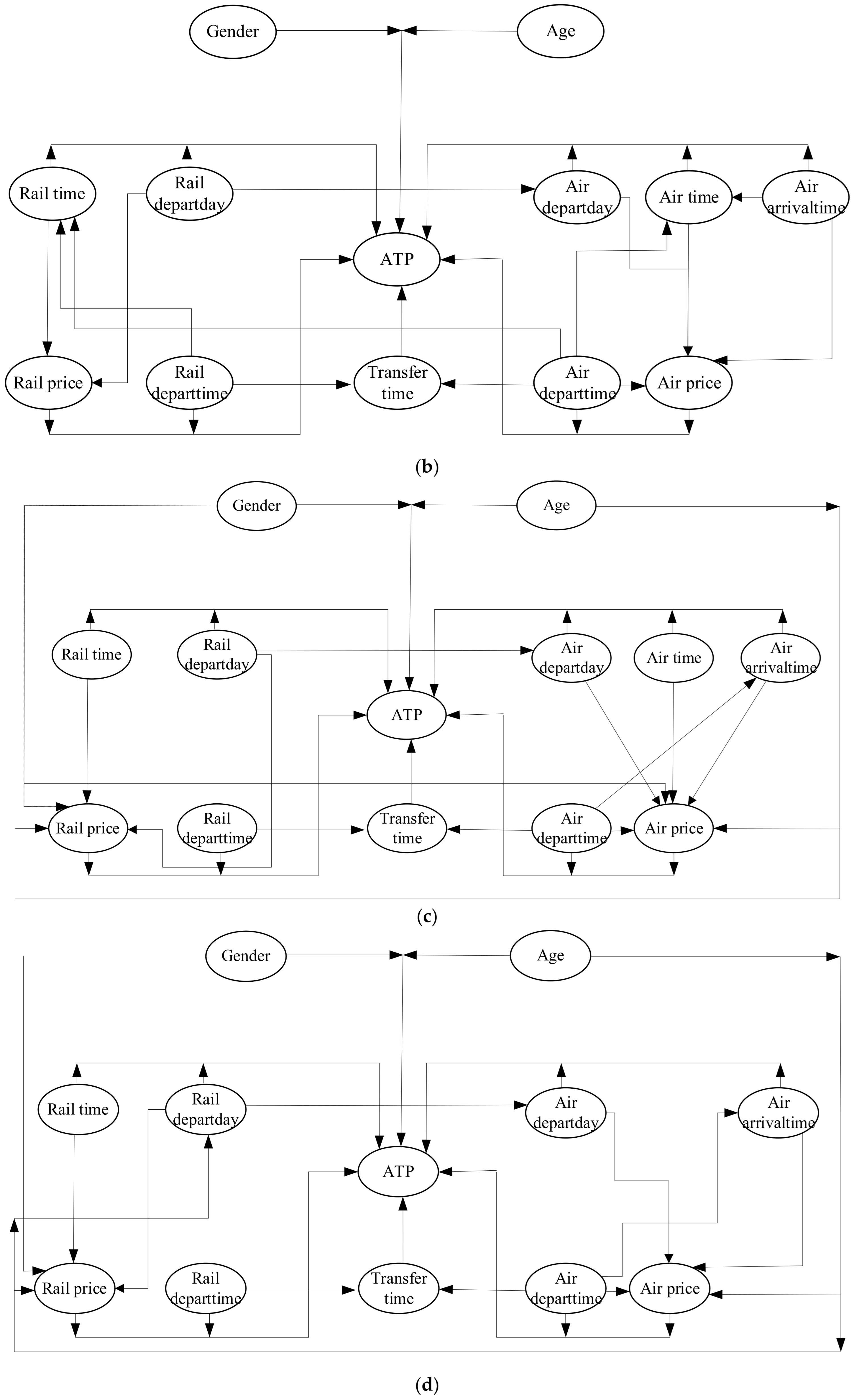
Figure 9a–d show the learned BN model results for the four different routes. The network structures of the four routes with different travel distances differ. The network structures of the medium- and short-haul (Tianjin to Shanghai and Tianjin to Changsha) routes are similar, and the network structures of the long-haul (Tianjin to Guangzhou and Tianjin to Sanya) routes are similar. Gender and age only affect the APT in the short- and medium-haul transport markets, and the interaction between ticket attributes is more complex in the short- and medium-haul transport markets than in the long-haul market. This is consistent with the fact that there are more flexible air–rail integrated schemes and more fierce market competition in the medium- and short-haul transport markets. However, the gender and age of long-haul passengers influence not only the APT but also the HSR fare, air fare and rail departure time. Interestingly, the relationship between ticket attributes is relatively simple for long-haul passengers. This may be related to the less frequent operation of long-haul air flights and the reduced availability of options for ARISs.
Figure 9.
(a) Learned BN model of Tianjin–Shanghai (1003 km). (b) Learned BN model of Tianjin–Changsha (1277 km). (c) Learned BN model of Tianjin–Guangzhou (1815 km). (d) Learned BN model of Tianjin–Sanya (2436 km).
To facilitate the analysis of the differences in advance purchase behavior on different routes, we performed a sensitivity analysis of APT on the four routes, as shown in Table 7. Sensitivity analysis can be used to quantify the explanation degree of different input variables (demographics and ticket attributes) to the change in the probability distribution of target variables (APT). For categorical or ordinal-scale target variables, the model sensitivity can be calculated in terms of entropy reduction; more details can be found in the paper of Marcot [52]. In the sensitivity analysis results, the greater the sensitivity of a variable is, the stronger the impact of the variable on the target variable.
Table 7.
Sensitivity analysis results.
As shown in Table 7, the sensitivity of demographics and ticket attributes to the APT on different routes differs. The APT of passengers flying to Shanghai is greatly affected by age (18%), gender (14%), air arrival time of day (14%), and rail departure time of day (10%). In addition, the APT of passengers flying to Changsha is greatly affected by age (15%), rail departure day of week (10%), gender (9%), and air departure time of day (9%). Furthermore, the APT of passengers flying to Guangzhou is greatly affected by the air fare (25%), age (20%), gender (15%) and air departure day of week (12%).
For short- or medium-distance trips (Shanghai and Changsha), the APT is greatly affected by age and gender. However, for long-distance trips (Guangzhou and Sanya), the APT is most affected by the air fare. Compared with that of long-distance trips, the cost of medium- or short-distance trips is lower, and the travel scheme is more flexible. Therefore, the APT is less affected by the product price. Similarly, Table 7 indicates that the APT of medium- or short-distance passengers is less affected by rail-leg travel time, transfer time and rail fare. However, as travel distance increases, the sensitivity of rail-leg travel time and transfer time on APT increases. This result is consistent with the fact that compared with medium- and short-distance trips, long-distance trips consume more passenger energy, which leads to greater consideration of different trip links before travel [46]. Therefore, different factors in the whole trip link are sensitive to passengers’ decision-making related to APT.
5.3. Discussion
The empirical results suggest that advance purchase behavior should not be interpreted merely as a direct response to observable ticket attributes. Instead, it can be understood as a travel-planning decision under uncertainty. Air–rail passengers may face uncertainty regarding future fare changes, ticket availability, transfer reliability, and the coordination between rail and air schedules. Therefore, earlier ticket purchase can be regarded as a risk-reduction strategy, particularly when passengers face higher air fares, longer travel times, or more complex transfer arrangements. From the perspective of bounded rationality, passengers may not be able to fully predict future prices or service availability, but they can make purchase timing decisions based on observable information such as fare level, departure time, transfer time, and route distance.
The inference results further demonstrate that different explanatory variables affect APT through both direct and indirect paths. For example, fare and travel-time attributes directly change the posterior probability distribution of APT, while some schedule-related variables affect APT indirectly through transfer time or air fare. This indicates that advance purchase behavior in air–rail intermodal travel is shaped by the whole trip chain rather than by a single ticket attribute. This interpretation is in line with previous ticket-booking-based research, which identified transfer-time heterogeneity as an important behavioral characteristic of air–rail intermodal passengers [55].
The route-specific results further indicate that air–rail passengers are behaviorally heterogeneous. For short- and medium-distance routes, advance purchase behavior is more closely associated with demographic characteristics and departure-time attributes, suggesting that passengers on these routes may have more flexible travel choices and more diverse planning preferences. In contrast, for long-distance routes, air fare, rail-leg travel time, and transfer time exert stronger effects, indicating that passengers become more sensitive to monetary cost and itinerary complexity as travel distance increases. This finding implies that route distance does not simply represent a physical attribute, but also reflects differences in travel risk, planning burden, and decision-making complexity.
These findings have implications for demand forecasting and behavioral segmentation. For demand forecasting, the results suggest that air–rail passengers should not be treated as a homogeneous group; instead, route distance, fare level, travel-time attributes, and transfer conditions should be incorporated into prediction models. For behavioral segmentation, passengers on long-distance routes may be more price- and reliability-sensitive, whereas passengers on short- and medium-distance routes may require more flexible products and departure-time options. Therefore, the BN results provide both explanatory and operational value by linking probabilistic dependencies among ticket attributes to actionable passenger segments.
6. Conclusions
This study investigated the advance purchase behavior of air–rail intermodal passengers using real ticket booking transaction data. The main contribution of this study is to provide a data-driven and interpretable modeling framework for analyzing passengers’ APT decisions in an integrated air–rail ticketing context. Unlike previous studies that mainly focused on single-mode air or rail passengers, this study considered the full intermodal trip chain, including socioeconomic attributes, rail-leg characteristics, transfer conditions, air-leg characteristics, and ticket fare attributes. By integrating domain knowledge with empirical data, the BN model can reveal both direct and indirect probabilistic dependencies among passenger attributes, ticket characteristics, and APT.
The novelty of this study is reflected in three aspects. First, this study uses actual air–rail ticket booking transaction data rather than stated-preference survey data, which allows observed purchase behavior to be analyzed more directly. Second, a BN model is applied to capture complex interactions among demographic attributes, travel-time attributes, fare attributes, transfer conditions, and APT, thereby improving the interpretability of passenger purchase timing analysis. Third, four routes with different travel distances are compared to identify route-specific heterogeneity in advance purchase behavior. Therefore, this study extends advance purchase behavior analysis from single-mode transport to the integrated air–rail intermodal context.
The key findings can be summarized as follows. First, socioeconomic and ticket attributes influence APT through both direct and indirect paths. Gender, age, departure time, travel time, transfer time, and fare level are all associated with passengers’ purchase timing decisions. Second, passengers tend to purchase tickets earlier when facing higher air fares, longer travel times, or more complex transfer arrangements. This suggests that earlier purchase may serve as a risk-reduction strategy under uncertainty, especially when passengers need to secure preferred itineraries or reduce potential fare and connection risks. Third, route distance plays an important role in shaping behavioral heterogeneity. For short- and medium-distance routes, APT is more strongly associated with demographic and departure-time characteristics, whereas for long-distance routes, air fare, rail-leg travel time, and transfer time exert stronger effects. This indicates that long-distance air–rail passengers are more sensitive to monetary cost, travel burden, and itinerary complexity.
From an applied transport engineering perspective, this study provides a data-driven and interpretable framework for analyzing passenger behavior in integrated air–rail ticketing systems. By combining real booking transaction data with a BN model, the proposed approach can support passenger behavior analysis, demand forecasting, ticketing strategy design, and service coordination in intelligent transport systems. These practical application possibilities are consistent with the applied research orientation of transport engineering and data-driven mobility management. For long-distance routes, operators may provide earlier fare information, advance-purchase discounts, and transfer guidance to reduce passengers’ uncertainty and improve itinerary reliability. For short- and medium-distance routes, ticketing strategies should focus more on flexible product design, departure-time coordination, and service accessibility for different passenger groups. In the Chinese context, integrated air–rail ticketing strategies should not be interpreted solely as profit-oriented revenue management. Since railway transport also undertakes public-service responsibilities, ticketing and capacity allocation strategies should balance operational efficiency, passenger demand guidance, service accessibility, and fairness.
Several limitations should be acknowledged. First, due to the nature of ticket booking transaction data, this study only considers passengers’ gender, age, and observable ticket attributes when analyzing advance purchase behavior. Other important factors, such as income, educational background, family structure, travel purpose, price expectations, risk perception, and other psychological or behavioral factors, were not included. These unobserved variables may also influence passengers’ advance purchase decisions. Therefore, future studies could combine ticket booking data with survey data or other multisource data to incorporate socioeconomic, psychological, and behavioral decision-making factors more comprehensively. Second, the empirical data were collected during the COVID-19 period. Although the study period was already within the stage of normalized epidemic prevention and control in China, and passenger transport demand had gradually recovered compared with the early outbreak period, the pandemic may still have affected passengers’ perceived travel risk, travel demand, and ticket purchase timing. Third, the data used in this study are limited to air–rail passengers in the context of the BTHUA. Therefore, the findings should be generalized to other regions or air–rail hubs with caution. As the scale of ARISs continues to expand, the proposed model can be further verified and updated using larger-scale, multi-route, multi-hub, and post-pandemic ticket booking datasets.
Author Contributions
Conceptualization, Y.Y.; Literature Curation and Format Revision, W.R.; Methodology and software, S.Z. All authors have read and agreed to the published version of the manuscript.
Funding
This research was funded by the China Postdoctoral Science Foundation (2023M741160), Natural Science Foundation of Jiangxi, China (20242BAB20247), Science and Technology Project of Education Department of Jiangxi, China (GJJ2200666), and Higher Education Institution Humanities and Social Sciences Research Project of Jiangxi, China (GL25214).
Institutional Review Board Statement
Not applicable.
Informed Consent Statement
Not applicable.
Data Availability Statement
The original contributions presented in this study are included in the article. Further inquiries can be directed to the corresponding author.
Conflicts of Interest
The authors declare no conflicts of interest.
Abbreviations
The following abbreviations are used in this manuscript:
| APT | Advance purchase time. |
| ARISs | Air–rail integrated services. |
| HSR | High-speed rail. |
| BTHUA | Beijing–Tianjin–Hebei Urban Agglomeration. |
| PEK | Beijing Capital International Airport. |
| BN | Bayesian network. |
| GTT | Greedy thick thinning. |
| TSN | Tianjin Binhai International Airport. |
| EM | Expectation–maximization. |
References
- Givoni, M.; Banister, D. Airline and Railway Integration. Transp. Policy 2006, 13, 386–397. [Google Scholar] [CrossRef] [Scilit]
- Gu, H.; Wan, Y. Can Entry of High-Speed Rail Increase Air Traffic? Price Competition, Travel Time Difference and Catchment Expansion. Transp. Policy 2020, 97, 55–72. [Google Scholar] [CrossRef] [Scilit]
- Li, Z.-C.; Sheng, D. Forecasting Passenger Travel Demand for Air and High-Speed Rail Integration Service: A Case Study of Beijing-Guangzhou Corridor, China. Transp. Res. Part A Policy Pract. 2016, 94, 397–410. [Google Scholar] [CrossRef] [Scilit]
- Wang, K.; Jiang, C.; Ng, A.K.Y.; Zhu, Z. Air and Rail Connectivity Patterns of Major City Clusters in China. Transp. Res. Part A Policy Pract. 2020, 139, 35–53. [Google Scholar] [CrossRef] [Scilit]
- Chiambaretto, P.; Decker, C. Air–Rail Intermodal Agreements: Balancing the Competition and Environmental Effects. J. Air Transp. Manag. 2012, 23, 36–40. [Google Scholar] [CrossRef] [Scilit]
- Chen, X.; Lin, L. The Integration of Air and Rail Technologies: Shanghai’s Hongqiao Integrated Transport Hub. J. Urban Technol. 2016, 23, 23–46. [Google Scholar] [CrossRef] [Scilit]
- Chiambaretto, P.; Baudelaire, C.; Lavril, T. Measuring the Willingness-to-Pay of Air-Rail Intermodal Passengers. J. Air Transp. Manag. 2013, 26, 50–54. [Google Scholar] [CrossRef] [Scilit]
- Xia, W.; Zhang, A. Air and High-Speed Rail Transport Integration on Profits and Welfare: Effects of Air-Rail Connecting Time. J. Air Transp. Manag. 2017, 65, 181–190. [Google Scholar] [CrossRef] [Scilit]
- Yuan, Y.; Yang, M.; Feng, T.; Rasouli, S.; Li, D.; Ruan, X. Heterogeneity in Passenger Satisfaction with Air-Rail Integration Services: Results of a Finite Mixture Partial Least Squares Model. Transp. Res. Part A Policy Pract. 2021, 147, 133–158. [Google Scholar] [CrossRef] [Scilit]
- Jiang, Y.; Timmermans, H.J.P.; Chen, C.; Sun, J.; Yao, B. Determinants of Air-Rail Integration Service of Shijiazhuang Airport, China: Analysis of Historical Data and Stated Preferences. Transp. A Transp. Sci. 2019, 7, 1572–1587. [Google Scholar] [CrossRef] [Scilit]
- Román, C.; Martín, J.C.; Espino, R.; Cherchi, E.; Ortúzar, J.d.D.; Rizzi, L.I.; Amador, F.J. Valuation of Travel Time Savings for Intercity Travel: The Madrid-Barcelona Corridor. Transp. Policy 2014, 36, 105–117. [Google Scholar] [CrossRef] [Scilit]
- Hess, S.; Spitz, G.; Bradley, M.; Coogan, M. Analysis of Mode Choice for Intercity Travel: Application of a Hybrid Choice Model to Two Distinct US Corridors. Transp. Res. Part A Policy Pract. 2018, 116, 547–567. [Google Scholar] [CrossRef] [Scilit]
- Chiou, Y.-C.; Liu, C.-H. Advance Purchase Behaviors of Air Passengers: A Continuous Logit Model. Transp. Res. Part E Logist. Transp. Rev. 2016, 93, 474–484. [Google Scholar] [CrossRef] [Scilit]
- Chiou, Y.-C.; Liu, C.-H. Advance Purchase Behaviors of Air Tickets. J. Air Transp. Manag. 2016, 57, 62–69. [Google Scholar] [CrossRef] [Scilit]
- Wen, C.-H.; Chen, P.-H. Passenger Booking Timing for Low-Cost Airlines: A Continuous Logit Approach. J. Air Transp. Manag. 2017, 64, 91–99. [Google Scholar] [CrossRef] [Scilit]
- Sun, Y.; Jiang, Z.; Gu, J.; Zhou, M.; Li, Y.; Zhang, L. Analyzing High Speed Rail Passengers’ Train Choices Based on New Online Booking Data in China. Transp. Res. Part C Emerg. Technol. 2018, 97, 96–113. [Google Scholar] [CrossRef] [Scilit]
- Cirillo, C.; Hetrakul, P.; Toobaie, S. Discrete Choice Model for Amtrak Acela Express Revenue Management. J. Revenue Pricing Manag. 2011, 10, 492–513. [Google Scholar] [CrossRef] [Scilit]
- Hetrakul, P.; Cirillo, C. Accommodating Taste Heterogeneity in Railway Passenger Choice Models Based on Internet Booking Data. J. Choice Model. 2013, 6, 1–16. [Google Scholar] [CrossRef] [Scilit]
- Bratu, S.; Barnhart, C. An Analysis of Passenger Delays Using Flight Operations and Passenger Booking Data. Air Traffic Control Q. 2005, 13, 1–27. [Google Scholar] [CrossRef] [Scilit]
- Guan, Y.; Wu, B.; Jia, J. Does Online Ticket Booking System Make People Better off? An Empirical Study on Railway Service. Transp. Res. Part F Traffic Psychol. Behav. 2020, 73, 143–154. [Google Scholar] [CrossRef] [Scilit]
- Lu, J.; Wang, Z.; Gu, Y.; Yang, W. Modelling the Air Ticket Purchase Behavior Incorporating Latent Class Model. Math. Probl. Eng. 2020, 2020, 2046106. [Google Scholar] [CrossRef] [Scilit]
- Jiang, Y.; Yu, S.; Guan, W.; Gao, S.; Feng, T. Ground Access Behaviour of Air-Rail Passengers: A Case Study of Dalian ARIS. Travel Behav. Soc. 2021, 24, 152–163. [Google Scholar] [CrossRef] [Scilit]
- Román, C.; Martín, J.C. Integration of HSR and Air Transport: Understanding Passengers’ Preferences. Transp. Res. Part E Logist. Transp. Rev. 2014, 71, 129–141. [Google Scholar] [CrossRef] [Scilit]
- Hotle, S.L.; Castillo, M.; Garrow, L.A.; Higgins, M.J. The Impact of Advance Purchase Deadlines on Airline Consumers’ Search and Purchase Behaviors. Transp. Res. Part A Policy Pract. 2015, 82, 1–16. [Google Scholar] [CrossRef] [Scilit]
- Kieu, L.; Ou, Y.; Truong, L.T.; Cai, C. A Class-Specific Soft Voting Framework for Customer Booking Prediction in on-Demand Transport. Transp. Res. Part C Emerg. Technol. 2020, 114, 377–390. [Google Scholar] [CrossRef] [Scilit]
- Ghader, S.; Carrion, C.; Zhang, L. Autoregressive Continuous Logit: Formulation and Application to Time-of-Day Choice Modeling. Transp. Res. Part B Methodol. 2019, 123, 240–257. [Google Scholar] [CrossRef] [Scilit]
- Pearl, J. Fusion, Propagation, and Structuring in Belief Networks. Artif. Intell. 1986, 29, 241–288. [Google Scholar] [CrossRef] [Scilit]
- Ma, T. Bayesian Networks for Multimodal Mode Choice Behaviour Modelling: A Case Study for the Cross Border Workers of Luxembourg. Transp. Res. Procedia 2015, 10, 870–880. [Google Scholar] [CrossRef] [Scilit]
- Feng, T.; Timmermans, H.J.P. Transportation Mode Recognition Using GPS and Accelerometer Data. Transp. Res. Part C Emerg. Technol. 2013, 37, 118–130. [Google Scholar] [CrossRef] [Scilit]
- Feng, T.; Timmermans, H.J.P. Comparison of Advanced Imputation Algorithms for Detection of Transportation Mode and Activity Episode Using GPS Data. Transp. Plan. Technol. 2016, 39, 180–194. [Google Scholar] [CrossRef] [Scilit]
- Di Pietro, L.; Guglielmetti Mugion, R.; Musella, F.; Renzi, M.F.; Vicard, P. Monitoring an Airport Check-in Process by Using Bayesian Networks. Transp. Res. Part A Policy Pract. 2017, 106, 235–247. [Google Scholar] [CrossRef] [Scilit]
- Huang, P.; Lessan, J.; Wen, C.; Peng, Q.; Fu, L.; Li, L.; Xu, X. A Bayesian Network Model to Predict the Effects of Interruptions on Train Operations. Transp. Res. Part C Emerg. Technol. 2020, 114, 338–358. [Google Scholar] [CrossRef] [Scilit]
- Joubert, J.W.; de Waal, A. Activity-Based Travel Demand Generation Using Bayesian Networks. Transp. Res. Part C Emerg. Technol. 2020, 120, 102804. [Google Scholar] [CrossRef] [Scilit]
- Prokhorchuk, A.; Dauwels, J.; Jaillet, P. Estimating Travel Time Distributions by Bayesian Network Inference. IEEE Trans. Intell. Transp. Syst. 2020, 21, 1867–1876. [Google Scholar] [CrossRef] [Scilit]
- Ulak, M.B.; Yazici, A.; Zhang, Y. Analyzing Network-Wide Patterns of Rail Transit Delays Using Bayesian Network Learning. Transp. Res. Part C Emerg. Technol. 2020, 119, 102749. [Google Scholar] [CrossRef] [Scilit]
- Wang, S.; Huang, W.; Lo, H.K. Combining Shockwave Analysis and Bayesian Network for Traffic Parameter Estimation at Signalized Intersections Considering Queue Spillback. Transp. Res. Part C Emerg. Technol. 2020, 120, 102807. [Google Scholar] [CrossRef] [Scilit]
- Yang, Z.; Yang, Z.; Yin, J. Realising Advanced Risk-Based Port State Control Inspection Using Data-Driven Bayesian Networks. Transp. Res. Part A Policy Pract. 2018, 110, 38–56. [Google Scholar] [CrossRef] [Scilit]
- Guo, J.; Feng, T.; Timmermans, H.J.P. Modeling Co-Dependent Choice of Workplace, Residence and Commuting Mode Using an Error Component Mixed Logit Model. Transportation 2020, 47, 911–933. [Google Scholar] [CrossRef] [Scilit]
- Liao, F.; Tian, Q.; Arentze, T.; Huang, H.; Timmermans, H.J.P. Travel Preferences of Multimodal Transport Systems in Emerging Markets: The Case of Beijing. Transp. Res. Part A Policy Pract. 2020, 138, 250–266. [Google Scholar] [CrossRef] [Scilit]
- Rafiq, R.; McNally, M.G. Heterogeneity in Activity-Travel Patterns of Public Transit Users: An Application of Latent Class Analysis. Transp. Res. Part A Policy Pract. 2021, 152, 1–18. [Google Scholar] [CrossRef] [Scilit]
- Xu, G.; Yang, H.; Liu, W.; Shi, F. Itinerary Choice and Advance Ticket Booking for High-Speed-Railway Network Services. Transp. Res. Part C Emerg. Technol. 2018, 95, 82–104. [Google Scholar] [CrossRef] [Scilit]
- Yang, C.-W.; Chang, C.-C. Applying Price and Time Differentiation to Modeling Cabin Choice in High-Speed Rail. Transp. Res. Part E Logist. Transp. Rev. 2011, 47, 73–84. [Google Scholar] [CrossRef] [Scilit]
- Chen, C.; Zhang, G.; Wang, H.; Yang, J.; Jin, P.J.; Michael Walton, C. Bayesian Network-Based Formulation and Analysis for Toll Road Utilization Supported by Traffic Information Provision. Transp. Res. Part C Emerg. Technol. 2015, 60, 339–359. [Google Scholar] [CrossRef] [Scilit]
- Jie, C.; Bell, D.A.; Liu, W. An Algorithm for Bayesian Belief Network Construction from Data. In Proceedings of the AI & Statistics, Fort Lauderdale, FL, USA, 4–7 January 1997; pp. 83–90. [Google Scholar]
- Dempster, A.P.; Laird, N.M.; Rubin, D.B. Maximum Likelihood from Incomplete Data via the EM Algorithm. J. R. Stat. Soc. Ser. B 1977, 39, 1–38. [Google Scholar] [CrossRef] [Scilit]
- Li, D.; Miwa, T.; Morikawa, T. Modeling Time-of-Day Car Use Behavior: A Bayesian Network Approach. Transp. Res. Part D Transp. Environ. 2016, 47, 54–66. [Google Scholar] [CrossRef] [Scilit]
- Yang, M.; Wu, J.; Rasouli, S.; Cirillo, C.; Li, D. Exploring the Impact of Residential Relocation on Modal Shift in Commute Trips: Evidence from a Quasi-Longitudinal Analysis. Transp. Policy 2017, 59, 142–152. [Google Scholar] [CrossRef] [Scilit]
- Guo, J.; Feng, T.; Timmermans, H.J.P. Time-Varying Dependencies among Mobility Decisions and Key Life Course Events: An Application of Dynamic Bayesian Decision Networks. Transp. Res. Part A Policy Pract. 2019, 130, 82–92. [Google Scholar] [CrossRef] [Scilit]
- Salini, S.; Kenett, R.S. Bayesian Networks of Customer Satisfaction Survey Data. J. Appl. Stat. 2009, 36, 1177–1189. [Google Scholar] [CrossRef] [Scilit]
- Mohd Suki, N.; Mohd Suki, N. Flight Ticket Booking App on Mobile Devices: Examining the Determinants of Individual Intention to Use. J. Air Transp. Manag. 2017, 62, 146–154. [Google Scholar] [CrossRef] [Scilit]
- Mandhani, J.; Nayak, J.K.; Parida, M. Interrelationships among Service Quality Factors of Metro Rail Transit System: An Integrated Bayesian Networks and PLS-SEM Approach. Transp. Res. Part A Policy Pract. 2020, 140, 320–336. [Google Scholar] [CrossRef] [Scilit]
- Marcot, B.G. Metrics for Evaluating Performance and Uncertainty of Bayesian Network Models. Ecol. Model. 2012, 230, 50–62. [Google Scholar] [CrossRef] [Scilit]
- Seo, K.; Go, S.; Kim, B. Pricing Strategies under Markets with Time Gap between Purchase and Consumption. J. Bus. Res. 2020, 120, 312–320. [Google Scholar] [CrossRef] [Scilit]
- Han, Y.; Zhang, T.; Wang, M. Holiday Travel Behavior Analysis and Empirical Study with Integrated Travel Reservation Information Usage. Transp. Res. Part A Policy Pract. 2020, 134, 130–151. [Google Scholar] [CrossRef] [Scilit]
- Yuan, Y.; Yang, M.; Feng, T.; Ma, Y.; Ren, Y.; Ruan, X. Heterogeneity in the Transfer Time of Air-Rail Intermodal Passengers Based on Ticket Booking Data. Transp. Res. Part A Policy Pract. 2022, 165, 533–552. [Google Scholar] [CrossRef] [Scilit]

Disclaimer/Publisher’s Note: The statements, opinions and data contained in all publications are solely those of the individual author(s) and contributor(s) and not of MDPI and/or the editor(s). MDPI and/or the editor(s) disclaim responsibility for any injury to people or property resulting from any ideas, methods, instructions or products referred to in the content. |
© 2026 by the authors. Licensee MDPI, Basel, Switzerland. This article is an open access article distributed under the terms and conditions of the Creative Commons Attribution (CC BY) license.