


Abstract
Few studies have examined robot voice, appearance, and ambient sound within a single framework to understand the user experience. To address this gap, this study explores how these three factors influence the user experience, specifically focusing on the appearance-voice matching effect, user likability, and user satisfaction when robots serve as museum docents, thereby offering design-oriented strategic insights for robot deployment in museums. Audio recordings of museum docents were collected and clustered into four categories. Accordingly, four distinct voice models were synthesized, and subjective user perceptions of these models were evaluated. Subsequently, three different agents, including an iPad, a self-designed robot prototype and a Yanshee robot, were employed as experimental platforms. These agents were each equipped with different voice models to conduct the experiments. The experimental data were analyzed by repeated measures ANOVA and mixed-model analysis. The results indicate that robot appearance significantly affects the appearance-voice matching effect, while its voice moderates this relationship in a museum scenario. Robot voice primarily drives user likability and satisfaction. In contrast, robot appearance shapes the two dimensions differently. Appropriate ambient sound significantly enhances the perceived appearance-voice congruence, and significantly affects naturalness and liveliness within user likability, as well as the fun of the experience and pleasantness of use within user satisfaction. The congruence can positively predict user likability and satisfaction, but this predictive effect has boundaries. These findings can provide references from the perspective of design strategies for human–robot interaction in museums.
1. Introduction
Social robots are now widely used in various scenarios such as education, entertainment, and healthcare, taking on tasks originally performed by humans, including educational communication, guided tours and commentary, and personalized services [1,2,3,4]. When robots are initially deployed in these scenarios, users may be motivated to try using them due to the novelty effect triggered by factors such as the robots’ appearance and anthropomorphic expressions, etc. [5,6]. With the continuous advancement of robotic technology and the increasing integration of robots into people’s daily lives, people tend to interact enthusiastically at first but easily lose interest after a while [7]. Hence, it is of critical importance to study the user experience in human–robot interaction (HRI), which can reduce the possibility of robotic products being discontinued [8]. Combining robot appearance with the design of interaction cues is a feasible and promising approach. However, relatively few studies have been conducted from the perspective of the joint influence of robot appearance and interaction cues.
Similar to human–human interaction, people have natural inclinations in HRIs and create initial perceptions about social robots based on design features such as sound, voice or appearance, etc. [9]. For example, robots with more realistic voices tend to be anthropomorphized more strongly, are rated as more pleasant, and attain the highest levels of user acceptance in various practical application scenarios [10]. A robot of human or animal likeness affects its perceived likability, and the robot with the least humanlike appearance receives the lowest likability score [11]. The matching effect for integrating a robot voice and appearance is also discussed in some studies [12]. For example, the robot voice and body should be matched in terms of anthropomorphism to avoid feelings of eeriness [13]. The inclusion of speech (real) significantly enhances the impression formation of a real human appearance; conversely, when speech (machine-like) is incorporated, the perceptions of the virtual avatars become more negative in HRI [14]. These findings indicate that the congruence between a robot voice and appearance influences the user experience.
This paper mainly focuses on social robots that are employed as docents in museums and explores their impact from the perspective of user experience. In such scenarios, human docents primarily use speech to introduce exhibits to visitors, while ambient sound is also played in the environment. When a social robot serves as a docent in such a scenario, it is worth examining how its voice, appearance, and the ambient sound of the environment influence the user experience. Moreover, multimedia is extensively employed in museums to present exhibits, enhancing the user experience through multimodal formats such as video and audio. Audio can influence users’ experience with interactive systems and the context in HRI can influence the perception of the interaction [15,16,17]. Hence, given that the congruence between a robot voice and appearance matters, and that user satisfaction facilitates long-term, beneficial human–robot interaction while likability increases individuals’ willingness to engage with robots in the future [18,19], this study proposes the following three research questions from the perspective of appearance, voice and ambient sound, to explore the effects on user likability and satisfaction, as well as the further influence arising from the matching effect between robot appearance and voice.
Research question 1 (RQ1): Irrespective of whether the museum guide agent is a screen or a robot, do ambient sound, agent appearance and agent voice have a significant impact on users’ subjective perceptions of the congruence between the agent’s appearance and its voice?
Research question 2 (RQ2): When a robot is serving as a docent, do ambient sound, the robot’s appearance, and its voice have a significant impact on user’s likability and satisfaction?
Research question 3 (RQ3): When a robot is serving as a docent, does the matching effect between its appearance and voice positively predict user likability and satisfaction?
The structure of this paper is organized as follows. Section 2 reviews the related work. Section 3 presents the voice design and provides the experimental details. Section 4 proposes the hypotheses. Section 5 analyzes the results, including the matching effect between agent appearance and voice, as well as user likability and satisfaction. Section 6 discusses the findings. Section 7 offers the concluding remarks.
2. Related Works
2.1. Social Robots in Museums
Social robots in museums can communicate with users through interaction cues such as voice, body movements and guide their focus on specific items. This characteristic enables museums to introduce social robots to provide users with diversified services such as explanation, education, etc. Hellou et al. reviewed the methods and algorithms employed for social robots in museum settings, as well as the various abilities that characterize a successful social guide robot [20]. Additionally, researchers have conducted studies concerning the design strategies of interaction cues for social robots employed in museums. For example, Iio et al. developed an autonomous human-like guide robot for a science museum, capable of proactively approaching visitors, providing explanations with an autonomous gaze, engaging in relationship-building behaviors such as greeting visitors by name, and showing a friendlier attitude toward repeat visitors [21]. Gehle et al. studied the appropriate moment to open an interaction between a robot and a visitor in a museum scenario, and proposed a behavior design strategy for the robot by distinguishing between two types of visitors [22]. Díaz et al. found that additional communication prompts are necessary to regulate the “walking together” and “following the robot” behaviors between robots and visitors through a field trial at the CosmoCaixa Science Museum in Barcelona [23]. Velentza et al. compared conventional audio guides with robots of different personalities in a museum setting and found that people remember significantly more information when guided by a cheerful robot than by a serious one or a conventional audio system [24]. Yoon et al. investigated the immediately interpretable behavioral cues of a robot that can evoke a sense of personalization, and found that recognition accuracy enhanced the perceptions of anthropomorphism, animacy, likability, and competence, while knowledge alignment, preference inquiry, and memory-based continuity selectively strengthened perceived personalization [25]. A summary of some representative studies is shown in Table 1. These studies demonstrate, from different perspectives, the impact of different interaction cue design strategies on the user experience when social robots are employed in museums.
Table 1.
A summary of some representative studies of robots employed in museum scenarios.
2.2. Classification of Robot Appearance
The appearance of robots can have a positive impact on the user experience and facilitate human–robot interaction in different environments. An unattractive appearance can be a barrier to robot adoption [26]. Keskin et al. found that differences in robot appearance may influence a user’s initial inclination to approach a robot and that first impressions affected the warmth felt toward social robots [27]. Currently, commercial and laboratory robots come in a variety of appearances, and several studies have explored the classification of robot appearances from different perspectives. For example, Walters et al. employed a three-category classification (mechanoid, humanoid, and android robots) to study people’s perceptions of different robot appearances and their associated attention-seeking features and behaviors [28]. Drawing on this robot classification, Zhang et al. explored the impact of robot appearance on customer purchase behavior, decision time, and degree of hesitation [29]. FakhrHosseini et al. classified robots as mechanistic and biomimetic to discuss human expectations about robot characteristics and behaviors [30]. Chesher et al. developed a classification of robot faces, including realistic, symbolic, blank, tech, and screen, through qualitative visual analysis [31]. Zhang et al. classified robot appearances into high, moderate, and low levels of anthropomorphism and examined the emotional responses elicited by each level, and found that moderately anthropomorphic service robots evoked more positive emotions than their high or low anthropomorphic counterparts [32]. Ma et al. employed a classification of cute and mature appearances to explore the role of congruity in service robot design [33]. Voges et al. employed a creative toolkit to explore the expectations of robot-inexperienced users, finding that the resulting robot appearance designs from participants fell into three categories: humanoid, mechanical, and animal-like [34]. Song et al. considered the distinction between a human-like face and a machine-like face in the anthropomorphism dimension of their developed “Facial Anthropomorphic Trustworthiness towards Social Robots (FATSR-17)” scale [35]. These studies on the classification of robot appearances can provide support for the design of human–robot interaction strategies in multiple scenarios.
2.3. The Matching Effect for Integrating Robot Appearance and Voice
Although auditory cueing can effectively facilitate visual attention [36], for robot design, congruence between a robot’s appearance and its communicative characteristics is a crucial determinant of user acceptance, and a harmonious interplay between its voice and appearance is equally important [37,38]. Users might expect different embodiments for different robot voices [39]. Even when the content of spoken utterances is unintelligible, users still associate voices with robot appearances, suggesting that assigning a mismatched voice to a robot could introduce confounding effects [38]. The study by Ma et al. also found that a matched or congruent combination of a service robot’s appearance and voice design in HRI leads to a more favorable consumer usage intention [33]. Kavuza et al. found that greater perceived voice-appearance matching in robots corresponds to higher perceived competence and agency [40]. These studies all highlight the importance of the matching effect between robot appearance and voice, as well as its necessity in HRI design. Some researchers have also begun to develop corresponding strategies from the perspective of congruity. For example, Van Rijn et al. developed a robot voice creation tool that can assess robot attributes and predict the best voice for an unseen robot, thereby confirming the feasibility of predicting suitable and consistent voices for previously unseen robots [41]. Li et al. proposed a Kansei Engineering approach for the simultaneous affective design of both the appearance and voice of humanoid robots [42].
2.4. The Likability and Satisfaction in HRI
An individual’s first impression of others is largely influenced by auditory and visual information such as their face, voice, etc. [43]. The likability formed based on this impression often leads to a more positive evaluation of that individual, and a similar phenomenon also exists in HRI [44]. Multiple interaction factors, such as conversational feedback and interaction context, can significantly influence users’ emotional responses during HRI [45]. User acceptance of robots is associated with their likability, which depends not only on physical features such as appearance but also on the behaviors of the robot [46,47]. Some studies have explored the impact of robot appearance and the design of behavioral interaction cues from the perspective of likability. For example, Lehmann et al. designed movement synchrony for a non-anthropomorphic robot and found that this behavior significantly enhanced the robot’s likability and perceived intelligence, which can increase users’ social acceptance and positive perception of the robot [48]. Hsieh et al. designed variations in voice and movement speed/exaggeration to explore how the robot’s imitation of human behaviors affects likeability, and found that such imitation may enhance people’s affinity for robots [49]. Castro-González et al. found that a robot that moved naturalistically was more likable regardless of whether its full body was visible [47]. Prakash et al. found that task and robot human-likeness had an interactive effect on people’s likability toward robots [50].
The appearance and voice of social robots can shape user satisfaction, which subsequently impacts users’ continuance intention and the long-term success of robots in different contexts [51,52]. Several studies have explored user satisfaction with robots from the perspective of HRI design strategies, including enjoyment, trust, behavior design, etc. For example, Shi et al. indicated that the enjoyment experienced during HRI plays a key role in enhancing satisfaction and user engagement [53]. Shin et al. applied the Kano model to identify key art museum attributes affecting visitor satisfaction and to determine how each attribute contributes to satisfaction or dissatisfaction [54]. The study by Seo et al. revealed that increased trust in a robot service enhances satisfaction, with the robotic restaurant image positively predicting satisfaction, which in turn predicts revisit intention [55,56]. Phan et al. examined user preferences between direct handovers and table placement when robots deliver objects, and their findings revealed that table placement significantly improves the user experience across multiple dimensions, including satisfaction [57]. Kwon et al. also examined elements related to satisfaction within the service design for developing digital companion robots [58]. Zhang et al. explored the trade-offs between user control over robot behavior and preserving the robot’s perceived social agency, and their findings suggest that moderate customization without excessive granularity may enhance the overall satisfaction and acceptance of robots [59]. Ren et al. found that spaces with good acoustic quality positively correlate with intelligibility and user experience, whereas distracting background sounds significantly reduce speech recognition accuracy and user satisfaction [60]. These studies suggest that examining the user experience through the lenses of user likeability and satisfaction toward robots greatly facilitates the sustained adoption of robots in HRI.
Existing literature has made significant progress in areas such as social robots in museums, robot appearance classification, voice–appearance matching effects, and user likability and satisfaction in HRI. However, several limitations remain. First, most studies examine the effects of robot appearance or voice in isolation, rarely exploring the combined effects of these two factors together with ambient sound. Second, user likability and satisfaction are often treated as general outcome variables without distinguishing their specific sub-dimensions. Third, ambient sound, as a common feature in real museum settings, is rarely incorporated into experimental designs to examine its potential moderating role. Hence, this study systematically explores the independent and interactive effects of robot voice, appearance, and ambient sound on the matching effect of voice–appearance, user likability, and user satisfaction within a simulated museum context.
3. Materials and Methods
3.1. The Voice Design
3.1.1. The Design of Voice Models
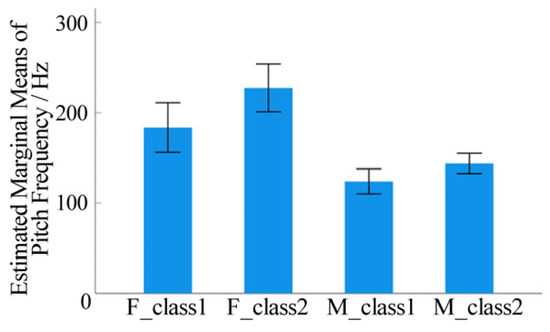
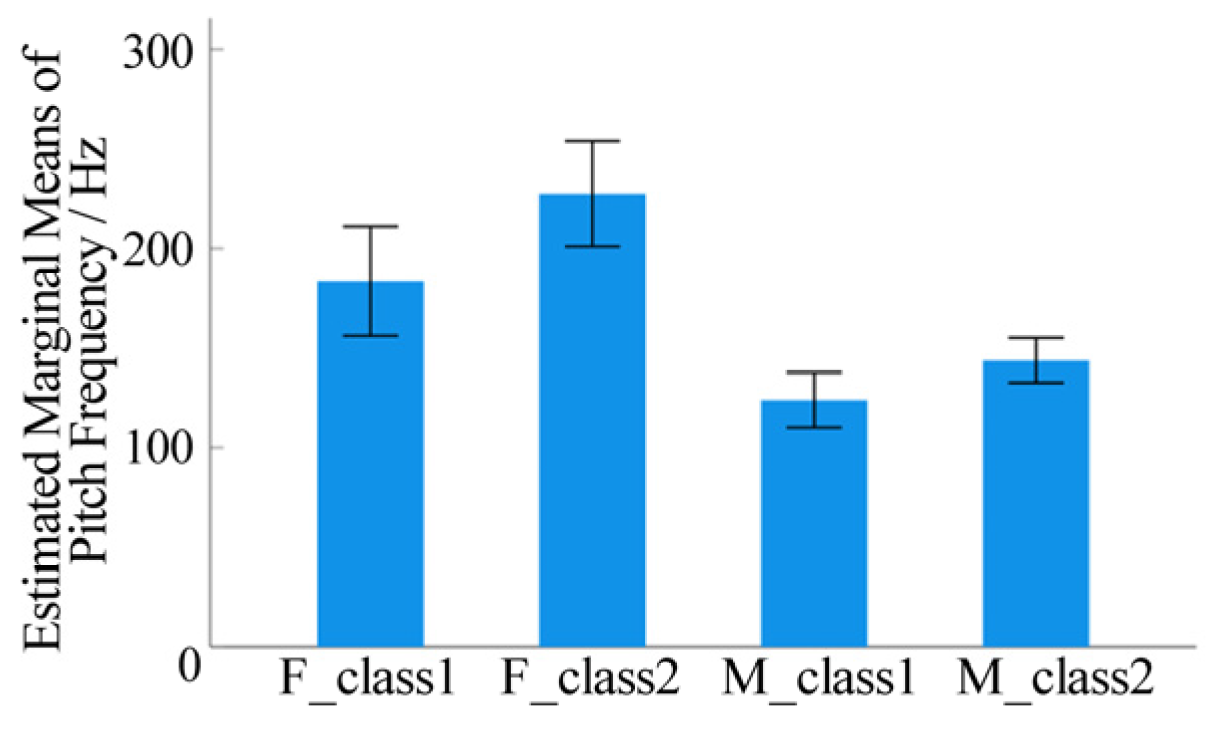
The collection of audio commentaries was downloaded from the Ximalaya audio platform and contains recordings of exhibit narrations by museum docents from various provinces in China. It consists of 40 speech recordings without background music, contributed by 20 male and 20 female speakers. The software, Praat, was employed to extract the pitch frequency (F0) of all audio recordings. Then, the software, JASP 0.18.1, was employed for statistical analysis. A hierarchical clustering method was employed to conduct a cluster analysis on the data of F0 of male and female speakers, respectively, classifying each group into two distinct categories. The categories of the female voice groups are named as F_class1 and F_class2, while those of the male voice groups are named as M_class1 and M_class2. The overall distribution of the F0 data for each group are shown in Figure 1. The M-values and SD values of F_class1, F_class2, M_class1 and M_class2 are M = 183.8 Hz, SD = 13.7 Hz; M = 227.6 Hz, SD = 13.2 Hz; M = 124 Hz, SD = 6.9 Hz; and M = 144 Hz, SD = 5.7 Hz, respectively.
Figure 1.
The overall distribution of the data F0 for each voice group.
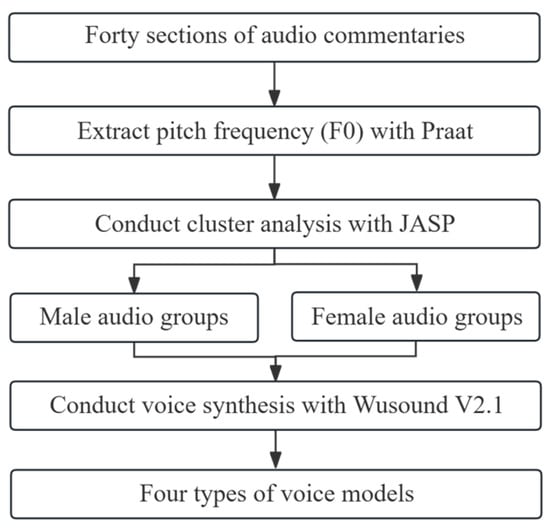
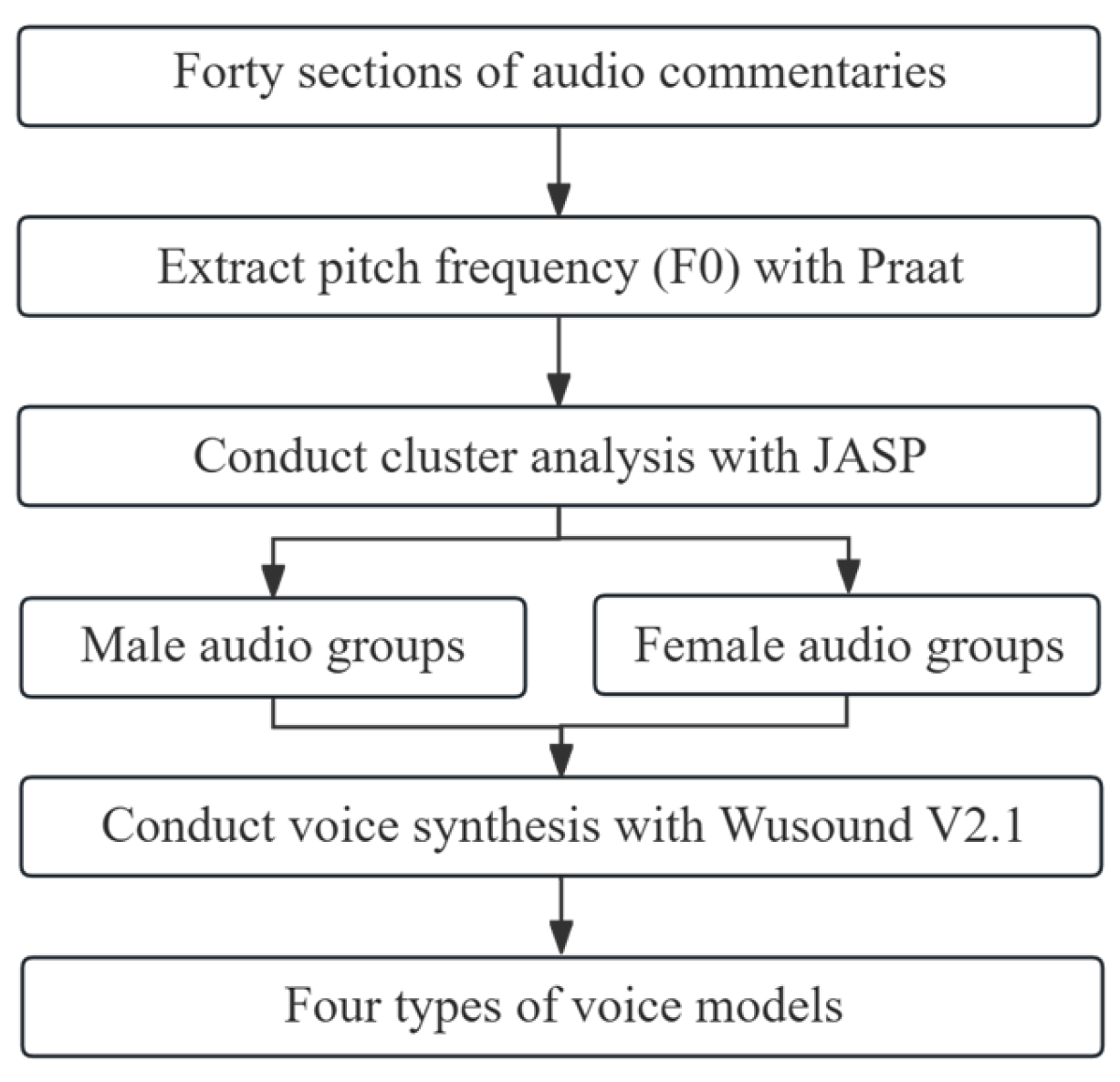
Based on the above classification, two types of voice models (male and female) were synthesized using the Wusound V2.1 Speech Synthesis Platform. They were named sequentially as VM1 and VM2 (for the male voice types) and VF1 and VF2 (for the female voice types). VM1 corresponds to M_class1, VM2 to M_class2, VF1 to F_class1, and VF2 to F_class2. The acoustic parameters, including formants F1, F2, F3, and F4, and the Harmonic-to-Noise-Ratio (HNR)of all voice models are shown in Table 2. They were used to imitate the voices of museum docents. The main flow of the voice model design process is shown in Figure 2.
Table 2.
The parameters of different voice models.
Figure 2.
The main flow of the voice model design process.
3.1.2. The Subjective Auditory Perception of Designed Voice Models
To investigate users’ subjective perception of these four voice models, the Semantic Differential Method (SDM) was employed, which uses bipolar adjective scales to quantify subjective responses to auditory stimuli. Compared with free-response verbal descriptions, SDM offers a standardized, quantifiable, and replicable approach that captures subtle perceptual differences with fewer items while maintaining intuitiveness for participants. Two adjective pairs were used: “Loud vs. Soft” and “Light vs. Heavy”. The first pair assesses psychological loudness, while the second pair relates to auditory texture. Together, these two dimensions form the basis for users’ perceptions of synthetic voice. Thirty participants were recruited (M = 24.93, SD = 1.51). All participants had normal hearing and provided informed consent with details of the experiment’s purpose. In a quiet environment, they listened to the same audio generated by the various voice models, with the playback order randomized. The main content of the audio welcomed visitors to the museum. After listening to each audio, they completed a questionnaire and took a short break. The questionnaire scores ranged from −6 to 6. The positive or negative sign indicates the direction: the closer to 6, the closer to the adjective on the right, and the closer to −6, the closer to the adjective on the left.
The data obtained from the questionnaires were analyzed using statistical methods and followed an approximately normal distribution. For the dimensions of psychological loudness and auditory texture, the scores of M-values and standard deviations (SDs) for the four voice models are shown in Table 3. The correlation between psychological loudness and auditory texture was analyzed using the Spearman correlation test. The resulting correlation coefficient was 0.546 with p < 0.001. This indicates that the correlation is moderate [61], and that the dimensions of psychological loudness and auditory texture show adequate discriminant validity. A repeated-measure ANOVA was employed. The results indicate that, for the dimension of psychological loudness, the two male voice models were not significantly different (p > 0.05, F = 1.886, η2 = 0.061), and neither were the two female voice models (p > 0.05, F = 3.908, η2 = 0.119). For the dimension of auditory texture, the two male voice models were significantly different (p < 0.001, F = 14.523, η2 = 0.334), and the same applied to the two female voice models (p < 0.001, F = 26.644, η2 = 0.479). According to Table 3, VM1 was heavier than VM2, but they shared the same loudness level, a trend that was also observed for VF1 and VF2.
Table 3.
The M-values and the SDs of different voice models.
3.2. The Experiments
3.2.1. The Agents Explaining Exhibits
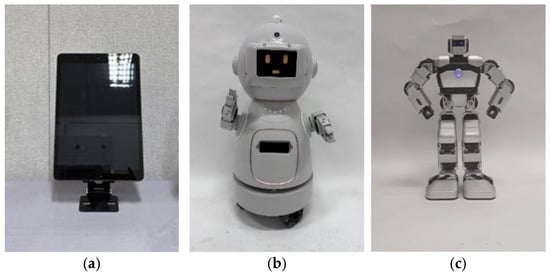
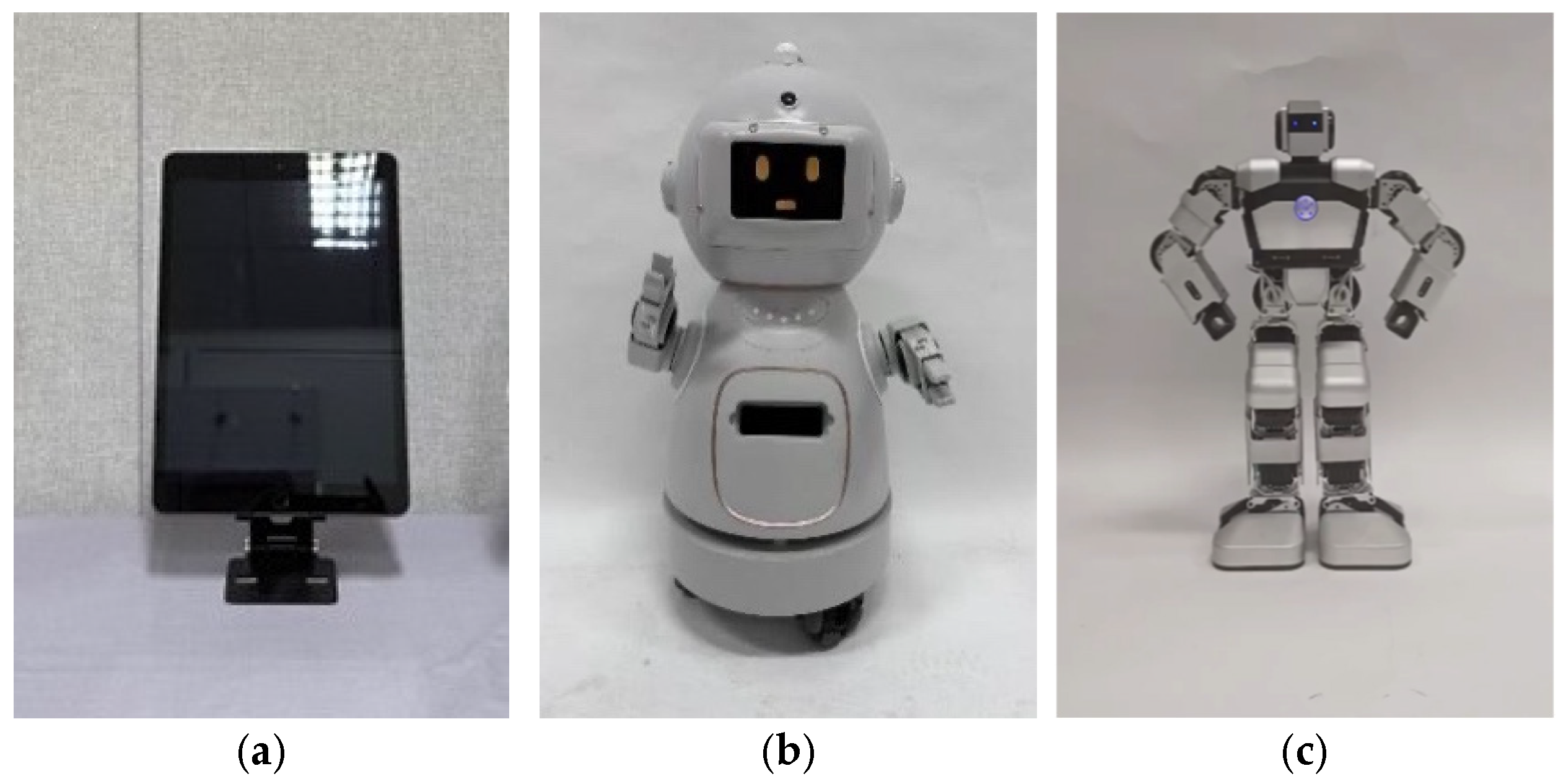
Three different agents were employed as shown in Figure 3. The iPad was employed as a baseline condition to simulate a screen-based multimedia agent. It can help to separate the independent contributions of physical embodiment and voice output to the user experience [62]. A self-designed robot prototype and a Yanshee robot served as robot docents. The self-designed robot prototype was designed by our research team, and its body is entirely 3D printed, equipped with built-in speakers, and features an omnidirectional wheel chassis at the base. The Yanshee robot has 17 degrees of freedom, and can interact with users through multiple interaction cues such as voice, body language, etc. They can play audio clearly and smoothly to explain the exhibits. According to the classification of robots shown in Ref. [28], the self-designed robot prototype and the Yanshee robot are categorized as cartoon-like and human-like robots, respectively.
Figure 3.
The agents employed in experiments: (a) the screen-based iPad; (b) the self-designed robot prototype; and (c) the Yanshee robot.
3.2.2. Experimental Procedure
A 3 × 4 × 2 experiment was designed, involving three appearances, four voice models, and two environments (with and without ambient sound). The three appearances are shown as Figure 3, and the four voice models are shown in Table 2. The ambient sound is sourced from the background music used in the TV program National Treasure when introducing exhibits, and the same program also provided the content for the exhibit introductions.
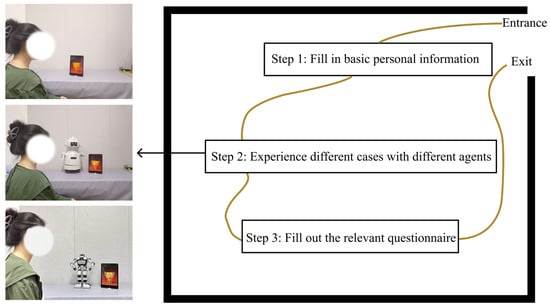
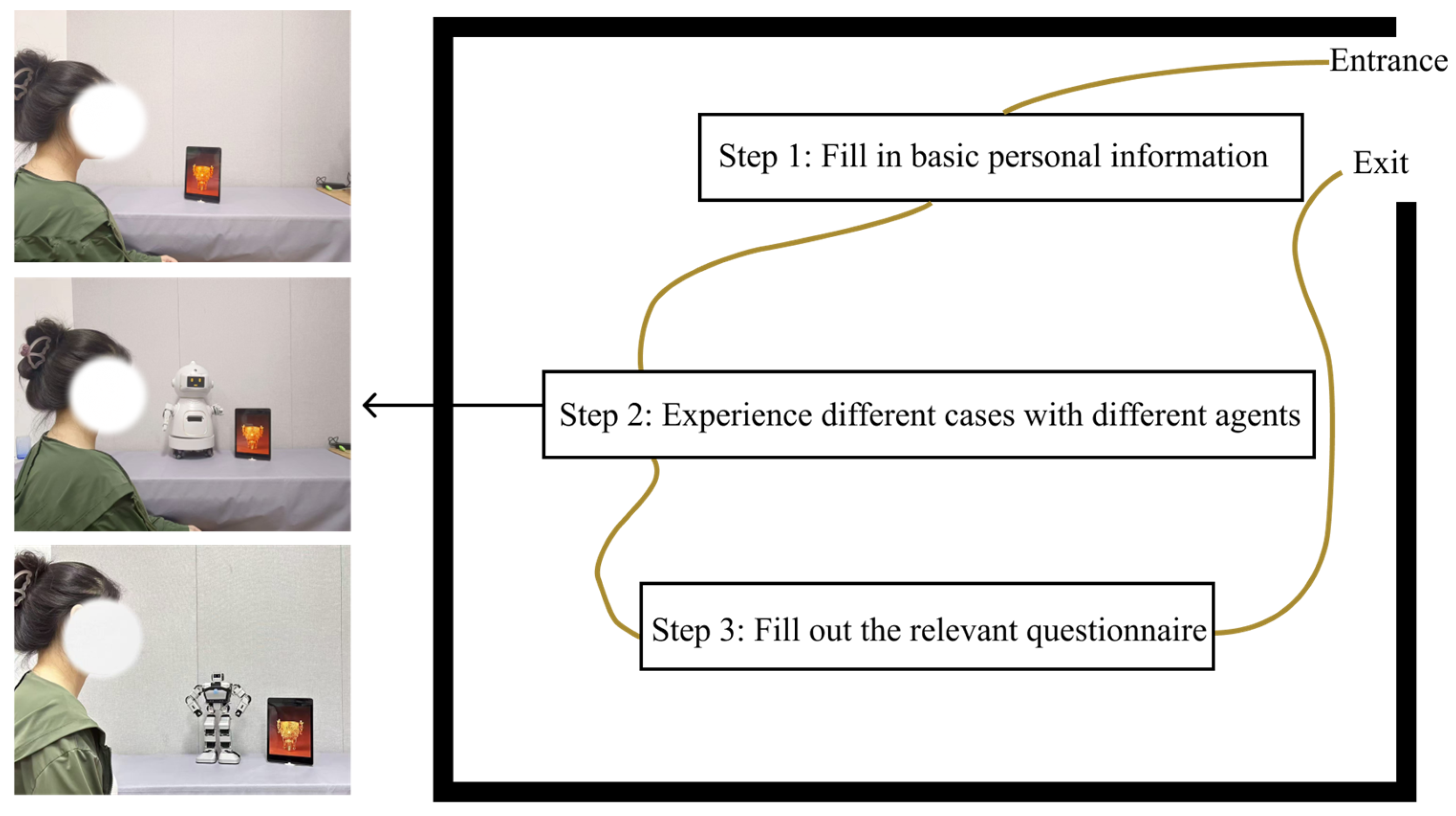
We used G*Power 3.1 to determine that the minimum number of participants was 11. Then 24 participants were randomly recruited on a university campus, of whom 12 were males and 12 were females, with M = 24.04, SD = 1.517. Before the experiments, all participants were informed of the study details, and all of them provided written informed consent forms for their participation. Based on their self-reports, all participants had normal hearing, and their vision was either normal or corrected-to-normal. Then, they were asked to watch and listen to the introductions of exhibits presented by different agents and different voice models with or without ambient sound, randomly, in a quiet room. The exhibits were shown as pictures, with the introduction content identical to that in the TV program National Treasure. The flow of participants in the experiment and the examples of exhibit explanations by the screen-based multimedia agent, the self-designed robot prototype and the Yanshee robot were shown in Figure 4. The robots only played audio and did not perform any body movements. Between the different cases, a short break was provided. After each case, participants were asked to complete the questionnaires as shown in Table 4. In total, they experienced 24 cases. A 7-point Likert scale, in which seven corresponded to “strong” and one corresponded to “weak”, was used here. The specific questions regarding likability and satisfaction were derived and analyzed from Refs. [44,62,63].
Figure 4.
The participant flow in the experiment and the examples of explaining exhibits.
Table 4.
The descriptions of user experience from different dimensions.
4. Hypotheses
To address RQ1, Hypothesis 1 (H1) proposes that ambient sound, agent appearance, and agent voice significantly influence the matching effect between a docent agent’s appearance and its voice in the museum, as detailed below.
H1a.
Ambient sound has a significant effect on the matching effect between a docent’s agent appearance and its voice.
H1b.
Agent appearance has a significant effect on the matching effect between a docent’s agent appearance and its voice.
H1c.
Agent voice has a significant effect on the matching effect between a docent’s agent appearance and its voice.
To answer RQ2, Hypothesis 2 (H2) is primarily concerned with the significant impacts of ambient sound, agent appearance, and agent voice on user likability and satisfaction, as detailed below.
H2a.
Ambient sound has a significant effect on user likability.
H2b.
Agent appearance has a significant effect on user likability.
H2c.
Agent voice has a significant effect on user likability.
H2d.
Ambient sound has a significant effect on user satisfaction.
H2e.
Agent appearance has a significant effect on user satisfaction.
H2f.
Agent voice has a significant effect on user satisfaction.
To answer RQ3, Hypothesis 3 (H3) is primarily concerned with the predictive effect of the matching effect between robot appearance and voice on user likability and satisfaction, as detailed below.
H3a.
The matching effect between robot appearance and voice positively predicts user likability.
H3b.
The matching effect between robot appearance and voice positively predicts user satisfaction.
5. Results
The data obtained from the questionnaires were analyzed using statistical methods, mainly including repeated-measure ANOVA and mixed-model analysis. The data for each case followed an approximately normal distribution.
5.1. Reliability and Validity of Questionnaire
The maximum and minimum values of Cronbach’s α reliability coefficients across the 24 cases were 0.95 and 0.816, respectively. The maximum and minimum values of Kaiser–Meyer–Olkin (KMO) across the 24 cases were 0.885 and 0.72, respectively. All significance values of Bartlett’s Test of Sphericity were less than 0.01. For the dimensions of user likability and satisfaction, the maximum and minimum values of Cronbach’s α reliability coefficients and KMO across the 24 cases are shown in Table 5.
Table 5.
The maximum and minimum values of Cronbach’s α reliability coefficients and KMO across the 24 cases for the dimensions of user likability and satisfaction.
5.2. The Results of Repeated-Measures ANOVA
5.2.1. The Results of Matching Effect
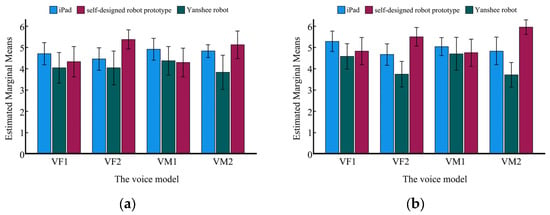
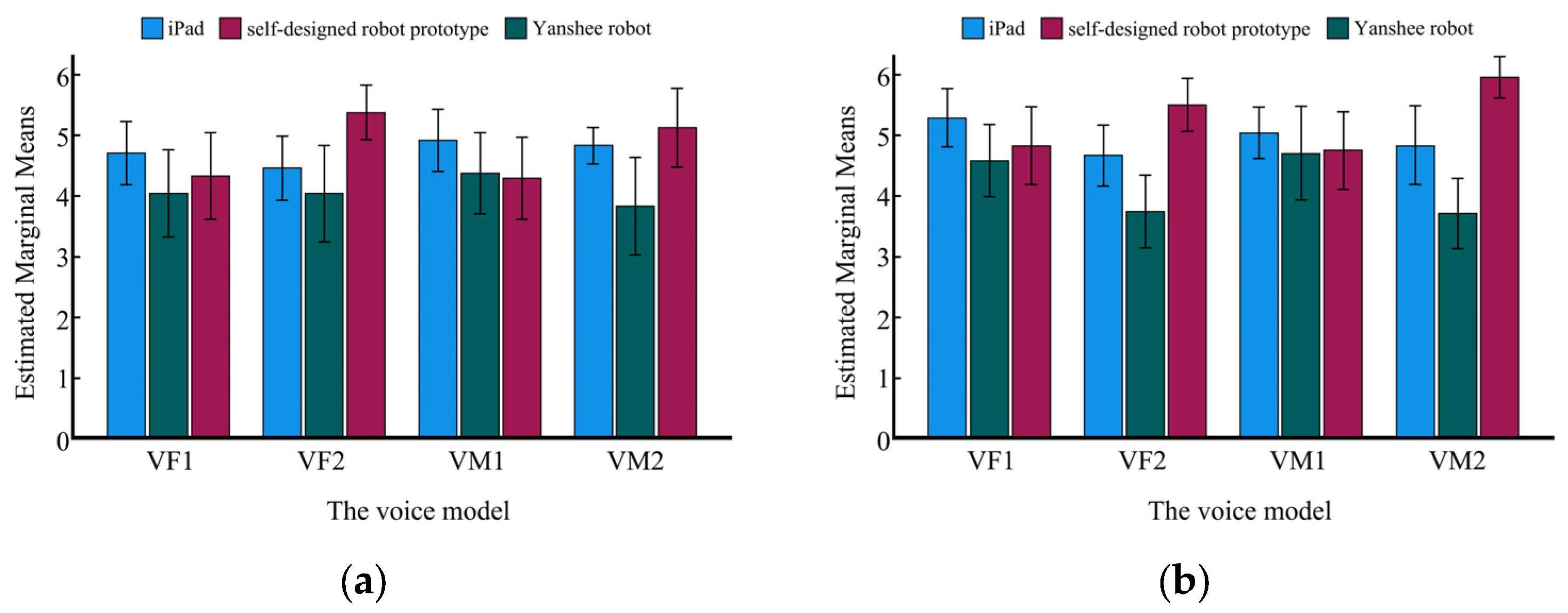
A three-way repeated-measure analysis of variance (ANOVA) was performed. Considering the p values of the Mauchly’s test of sphericity, the results of the tests of within-subjects effects are shown in Table 6, and the corresponding estimated marginal means are illustrated in Figure 5. Since the p values of ambient sound and agent appearance shown in Table 6 were smaller than 0.05, pairwise comparisons were implemented. Compared to the no-ambient-sound case (M = 4.528, SE = 0.162), users’ perception to the matching effect were significantly higher in the ambient-sound case (M = 4.802, SE = 0.155). Pairwise comparisons with Bonferroni correction revealed a significant difference in users’ perceptions to the matching effect between the self-designed robot (M = 4.13, SE = 0.267) and the Yanshee robot (M = 5.02, SE = 0.159), p = 0.003. No significant differences were observed between the iPad and either the self-designed robot or the Yanshee robot (p > 0.05).
Table 6.
The results of the tests of within-subjects effects by the three-way repeated-measure ANOVA for analyzing the matching effect.
Figure 5.
The estimated marginal means for the matching effect. (a) without ambient sound. (b) with ambient sound.
Moreover, as shown in Table 6, the main effect of the voice model was not significant, but its interaction with agent appearance was significant (p < 0.001), indicating that the effect of voice varied depending on agent appearance. Hence, the differences in voice models at different levels of agent appearance were examined. For the iPad, all the p-values were larger than 0.05, which means that the four voice models showed no significant differences. For the self-designed robot prototype, VM1 elicited significantly higher matching effect perceptions (M = 4.54, S = 0.32) than VM2 (M = 3.77, SE = 0.30), with p = 0.005, and all other pairwise comparisons were non-significant (p > 0.05). For the Yanshee robot, pairwise comparisons revealed that VF2 (M = 5.44, SE = 0.18) and VM2 (M = 5.54, SE = 0.21) each produced significantly higher matching effect ratings than VF1 (M = 4.58, SE = 0.25), with p = 0.037 and p = 0.029, respectively, while VM2 was rated significantly higher than VM1 (M = 4.52, SE = 0.28), with p = 0.027, and no other pairwise differences reached statistical significance.
5.2.2. The Results of User Likeability
A three-way repeated-measure ANOVA was performed to examine user likability from the perspectives of naturalness, friendliness, and liveliness respectively. According to the p values of the Mauchly’s test of sphericity, the corresponding results of the tests of within-subjects effects are shown in Table 7.
Table 7.
The results of the tests of within-subjects effects by the three-way repeated-measure ANOVA for analyzing user likeability.
For naturalness, a significant main effect of ambient sound was observed, F(1, 23) = 8.087, p = 0.009, η2 = 0.26. Specifically, naturalness ratings were significantly higher when ambient sound was present (M = 5.59, SE = 0.16) compared to when it was absent (M = 5.25, SE = 0.18). The main effect of voice model was likewise significant, F(3, 69) = 6.699, p < 0.001, η2 = 0.226. Pairwise comparisons with Bonferroni correction indicated that both VF1 (M = 5.715, SE = 0.18) and VM1 (M = 5.646, SE = 0.162) scored significantly higher than VF2 (M = 5.09, SE = 0.161). The results also showed that all interaction effects were non-significant (p > 0.05). In addition, some partial η2 showed medium effect sizes, which are often considered to have practical importance [64].
For friendliness, the main effect of ambient sound was significant, F(1, 23) = 2.527, p = 0.042, η2 = 0.167, while the main effect of the voice model was also significant, F(3, 69) = 31.677, p = 0.042, η2 = 0.579. Pairwise comparisons showed that friendliness ratings were significantly higher with ambient sound present (M = 5.524, SE = 0.131) than when it was absent (M = 5.323, SE = 0.149). For the voice models, VF1 (M = 5.882, SE = 0.125) scored significantly higher than both VF2 (M = 4.854, SE = 0.147) and VM2 (M = 5.222, SE = 0.171). Meanwhile, VM1 (M = 5.736, SE = 0.131) scored significantly higher than both VF2 and VM2. The results also showed that a significant interaction effect was observed between agent appearance and voice, while the main effect of agent appearance was not significant; however, all other interaction effects were non-significant, though some of them showed medium effect sizes, as shown in Table 7. Hence, the differences in voice models at different levels of agent appearance were also examined. For the iPad, there was no significant difference between VF1 (M = 5.958, SE = 0.173) and VM1 (M = 5.667, SE = 0.194); however, all other pairwise comparisons among voice models were significant (p < 0.05). For the self-designed robot prototype, significant differences were found between VF1 (M = 5.813, SE = 0.153) and both VF2 (M = 4.729, SE = 0.188), and VM2 (M = 5.104, SE = 0.156), with p < 0.001 and p = 0.004, respectively. VM1 (M = 5.854, SE = 0.152) also differed significantly from both VF2 and VM2 (p < 0.001). For the Yanshee robot, pairwise comparisons further revealed that VF2 differed significantly from both VF1 and VM1 (p = 0.033 and p = 0.028, respectively), with VF1 (M = 5.875, SE = 0.193) and VM1 (M = 5.688, SE = 0.192) both receiving significantly higher ratings than VF2 (M = 5.188, SE = 0.19).
For liveliness, the main effects of ambient sound and voice models were significant; with F(1, 23) = 5.346, p = 0.03, η2 = 0.189 and F(3, 69) = 25.635, p = <0.001, η2 = 0.527, respectively. By pairwise comparisons, liveliness ratings were significantly higher with ambient sound present (M = 5.365, SE = 0.122) than absent (M = 5.16, SE = 0.122). Meanwhile, VF1 (M = 5.826, SE = 0.115) scored significantly higher than both VF2 (M = 4.618, SE = 0.153) and VM2 (M = 5.049, SE = 0.176), and VM1 (M = 5.556, SE = 0.116) scored significantly higher than both VF2 and VM1. The results also showed that a significant interaction effect was observed between agent appearance and voice, while the main effect of agent appearance was not significant; however, all other interaction effects were non-significant. The differences in voice models at different levels of agent appearance were also examined. For iPad, all differences between voice models were significant (p < 0.05), with the sole exception of the comparison between VM1 and VM2. Specifically, VF1 (M = 6.063, SE = 0.157) scored the highest, whereas VF2 (M = 4.313, SE = 0.178) scored the lowest. VM1 (M = 5.458, SE = 0.204) and VM2 (M = 5. 5.167, SE = 0.251) were intermediate and did not differ significantly from each other. For the self-designed robot prototype, except for VF1 (M = 5.708, SE = 0.156) vs. VM1 (M = 5.563, SE = 0.16), and VF2 (M = 4.646, SE = 0.182) vs. VM2 (M = 4.917, SE = 0.192), all other comparisons among voice models were statistically significant (p < 0.05). For the Yanshee robot, pairwise comparisons revealed that VF1 (M = 5.71, SE = 0.17) scored significantly higher than both VF2 (M = 4.90, SE = 0.20, p = 0.009) and VM2 (M = 5.06, SE = 0.22, p = 0.023). VM1 (M = 5.65, SE = 0.19) scored significantly higher than VF2 (p = 0.007).
5.2.3. The Results of User Satisfaction
A three-way repeated-measure ANOVA was performed to analyze user satisfaction, as measured by the four questions, Q1~Q4, listed under the dimension of user satisfaction in Table 4. According to the p values of the Mauchly’s test of sphericity, the corresponding results of the tests of within-subjects effects are shown in Table 8.
Table 8.
The results of the tests of within-subjects effects by the three-way repeated-measures ANOVA for analyzing user satisfaction.
For Q1, the main effect of voice models was significant with F(3, 69) = 12.382, p < 0.001, η2 = 0.35, while the main effects of ambient sound and agent appearance were non-significant. Further, VF1 (M = 5.375, SE = 0.165) scored significantly higher than VF2 (M = 4.59, SE = 0.136), while VF2 scored significantly lower than VM1 (M = 5.25, SE = 0.137). A significant interaction effect was observed between agent appearance and voice, while all other interaction effects were non-significant. For the iPad, pairwise comparisons with Bonferroni correction revealed that all differences between the voice models were significant (p < 0.05), with the exception of VF1 vs. VM2 and VM1 vs. VM2. Specifically, VF1 (M = 5.563, SE = 0.207) scored the highest, VM1 (M = 5.021, SE = 0.218) scored the second highest, and VF2 (M = 4.063, SE = 0.23) scored the lowest. For the self-designed robot prototype, except for VF1 vs. VM1 and VF2 vs. VM2, all other comparisons among voice models were significant (p < 0.05). Among them, VF1 (M = 5.229, SE = 0.206) and VM1 (M = 5.229, SE = 0.178) scored the highest and did not differ from each other, while VF2 (M = 4.479, SE = 0.214) scored the lowest. For the Yanshee robot, all pairwise comparisons had p-values greater than 0.05, indicating that there were no significant differences among any of the voice models.
For Q2, the main effects of ambient sound, agent appearance, and voice models were significant as shown in Table 8. By pairwise comparisons, Q2 ratings were significantly higher when ambient sound was present (M = 5.135, SE = 0.148) compared to when it was absent (M = 4.771, SE = 0.139). VF1 (M = 5.403, SE = 0.179) scored significantly higher than both VF2 (M = 4.507, SE = 0.167, p < 0.001) and VM2 (M = 4.833, SE = 0.162, p = 0.023). Furthermore, VM1 (M = 5.069, SE = 0.133) scored significantly higher than VF2 (p = 0.002). For agent appearance, the iPad (M = 4.646, SE = 0.174) and the self-designed robot prototype (M = 4.802, SE = 0.176) were rated significantly lower than the Yanshee robot (M = 5.411, SE = 0.169), p = 0.008 and p = 0.005, respectively, while no significant difference was found between the iPad and the self-designed robot prototype. The results also revealed that the three-way interaction effect among ambient sound, agent appearance, and agent voice was significant. Meanwhile, the two-way interaction effects between ambient sound and agent appearance, as well as between agent appearance and agent voice, were also significant.
For Q3, the main effects of agent appearance and voice models were significant as shown in Table 8. Both the iPad (M = 4.687, SE = 0.189) and the self-designed robot prototype (M = 4.729, SE = 0.167) scored significantly lower than the Yanshee robot (M = 5.38, SE = 0.161), with p values of 0.014 and 0.002, respectively. VF1 (M = 5.313, SE = 0.175) scored significantly higher than VF2 (M = 4.542, SE = 0.158, p < 0.001) and VM2 (M = 4.778, SE = 0.164, p = 0.026). Additionally, VM1 (M = 5.097, SE = 0.13) scored significantly higher than VF2 (p = 0.003). The results also showed that a significant interaction effect was observed between agent appearance and voice. All other interaction effects were non-significant, and the three-way interaction effect showed a medium effect size.
For Q4, the main effects of ambient sound, agent appearance and voice models were significant as shown in Table 8. By pairwise comparisons, Q4 ratings were significantly higher when ambient sound was present (M = 5.073, SE = 0.139) compared to when it was absent (M = 4.75, SE = 0.153). The self-designed robot prototype (M = 4.80,2 SE = 0.178) was rated significantly lower than the Yanshee robot (M = 5.234, SE = 0.165), p < 0.05. VF1 (M = 5.278, SE = 0.178) scored significantly higher than both VF2 (M = 4.549, SE = 0.166) and VM2 (M = 4.743, SE = 0.157), and VM1 (M = 5.076, SE = 0.143) scored significantly higher than VF2. The interaction effect was similar to that observed for Q3. For the self-designed robot prototype, VF1 (M = 5.25, SE = 0.193) was rated significantly higher than VF2 (M = 4.354, SE = 0.226, p = 0.002) and VM2 (M = 4.521, SE = 0.205, p = 0.001), and VM1 (M = 5.083, SE = 0.208) was rated significantly higher than VF2 (p = 0.001) and VM2 (p = 0.030). For the Yanshee robot, there were no significant differences among any of the voice models.
5.3. The Results of Mixed Model Analysis
To examine the prediction of the matching effect between robot appearance and voice on user likability and satisfaction, a mixed-model analysis was performed. The model included the cases that participant experienced with different robots and voice models as random intercepts and entered congruence as a fixed effect. The results of the corresponding fixed effect estimates and covariance parameter estimates are shown in Table 9. Then, since the results shown in Section 5.2.1 revealed that the presence versus absence of ambient sound significantly affected the perception of the matching effect, mixed model analyses were performed separately for the scenarios with and without ambient sound. The corresponding results are shown in Table 10.
Table 9.
Mixed model analysis results for all scenarios considering robot appearance–voice congruence.
Table 10.
Mixed model analysis results for scenarios with and without ambient sound respectively.
As shown in Table 9 and Table 10, the matching effect significantly and positively predicted naturalness, friendliness, and dimensions of likability (Q1~Q3), as well as Q1–Q4 of satisfaction (all p < 0.05). For naturalness, Q1 of likability under all scenarios, and the satisfaction with the format, Q1 of satisfaction in the scenario with ambient sound, the estimated variances of the random intercept were 0, suggesting no significant baseline differences across cases. For the remaining cases, the p-values of estimates of covariance parameters were not 0, supporting the necessity of including the case as a random effect.
6. Discussion
6.1. The Impacts of Ambient Sound, Agent Appearance, and Voice on the Congruence Between Agent Appearance and Voice
H1a is supported, as users’ perceptions of the matching effects were significantly higher in the presence of ambient sound than in its absence. H1b is supported, and the effect of agent appearance is moderated by the agent voice. This is due to the fact that the p-value for agent appearance in Table 6 is below 0.05, and its interaction with voice is significant (p < 0.001). H1c is not supported as a main effect, but the agent voice has a significant interactive effect with agent appearance on their congruence.
More specifically, when a robot serves as a docent, ambient sound enhances users’ perception of appearance–voice congruence. Robot appearance significantly affects this congruence perception, while robot voice moderates this effect. From the perspective of congruence, the optimal voice models for the self-designed robot prototype are VF1 and VM1, while for the Yanshee robot, the optimal choices are VF2 and VM2. According to the analysis results of subjective auditory perception shown in Table 3, the self-designed robot prototype matches better with heavier, relatively lower-pitched voices, while the Yanshee robot matches better with lighter, relative higher-pitched voices. This pattern remains consistent across both the male and female voice model groups.
6.2. The Impacts of Ambient Sound, Robot Appearance, and Voice on the User Likability
According to the analysis in Section 5.2.2 and Table 7, H2a is partially supported, as users’ ratings of naturalness and liveliness were significantly higher in the presence of ambient sound than in its absence, while no significant difference was found for friendliness ratings. H2b is partially supported. While interaction effects between agent appearance and voice were observed for friendliness and liveliness, agent appearance itself did not have a significant main effect on any perspective of user likability. H2c is supported, given that the voice model exerted a significant main effect on naturalness, friendliness, and liveliness.
Specifically, when a robot serves as a docent, ambient sound can significantly impact the naturalness and liveliness. Robot voice significantly affects user likability, while its appearance moderates the friendliness and liveliness in this dimension. VF1 and VM1 are the optimal voice models for the self-designed prototype across naturalness, friendliness, and liveliness. For the Yanshee robot, VF1 is optimal for liveliness, while both VF1 and VM1 are optimal for naturalness and friendliness. This also suggests that when performing the docent task, user likability ratings are biased toward voices that are lower in pitch and heavier in auditory texture, while the robot’s appearance does not exert a significant influence.
6.3. The Impacts of Ambient Sound, Robot Appearance, and Voice on the User Satisfaction
According to the analysis in Section 5.2.3 and Table 8, H2d is partially supported. With respect to Q2 (fun to experience) and Q4 (pleasant to use), user ratings were significantly higher under the condition with ambient sound than under the condition without ambient sound. In contrast, for Q1 (satisfaction with the format) and Q3 (satisfaction with the operation way), ambient sound did not yield any significant differences. H2e is also partially supported. The Yanshee robot received significantly higher scores than both the iPad and the self-designed robot, and agent appearance has a significant impact on user satisfaction as reflected in Q2, Q3, and Q4. But in terms of Q1, user ratings do not show any significant differences based on agent appearance alone, while a significant interaction effect was found between agent appearance and voice. H2f is supported, as user ratings for Q1~Q4 showed significant differences, with VF1 consistently receiving significantly higher scores than VF2 and VM2.
Specifically, when a robot serves as a docent, ambient sound can significantly impact Q2 (fun to experience) and Q4 (pleasant to use). This indicates that ambient sound has a significant impact on affective satisfaction. Robot appearance yielded significant differences among the robots on Q2, Q3 (satisfaction with the operation way), and Q4, indicating its significant impact on both operational and affective satisfaction. For the self-designed robot prototype, VF1 and VM1 perform better on Q1 (satisfaction with format) and Q4 (pleasant to use), whereas all four voice models were acceptable on Q2 (fun to experience) and Q3 (satisfaction with operation way). For the Yanshee robot, all four voice models are acceptable across Q1 to Q4. VF1 and VM1 show better M-values, but the differences were non-significant relative to the others. Considering voice preferences for the two robots in terms of user satisfaction, this to some extent indicates that voices with lower pitch values and heavier textures perform better in terms of satisfaction. This result is consistent with the study by Ren et al. [58], which found that higher pitch values in robots are associated with poorer satisfaction.
6.4. The Impacts of Matching Effect of Robot Appearance and Voice on the User Likability and Satisfaction
H3a is supported. Table 9 shows that the matching effect between robot appearance and voice robustly and positively predicts naturalness, friendliness, and liveliness in the dimension of user likability, with each one-point increase in the matching effect corresponding to an average increase of 0.242, 0.175, and 0.193 points, respectively. H3b is also supported. Based on Table 9, the matching effect between robot appearance and voice robustly and positively predicts Q1~Q4 in the dimension of user satisfaction, with each one-point increase in the matching effect corresponding to an average increase of 0.348, 0.386, 0.341 and 0.364 points, respectively. Comparing the results for scenarios with and without ambient sound in Table 10, the predictive effect of the matching effect between robot appearance and voice on naturalness and friendliness within the user likability dimension is stronger in the scenario without ambient sound. Specifically, for every one-point increase in the matching effect, naturalness and friendliness increase by 0.292 and 0.222 points, respectively, in the scenario without ambient sound, compared to only 0.180 and 0.119 points in the scenario with ambient sound. For others, the observed differences are limited.
Moreover, as discussed in the subsections above, in terms of congruence for a docent robot, the optimal voice models were VF1 and VM1. Furthermore, in terms of user likability and satisfaction, for the self-designed robot, adopting either VF1 or VM1 is an optimal strategy, which validates the positive predictive effect of congruence on likability and satisfaction. However, for the Yanshee robot, while VF2 and VM2 were the best in terms of congruence, VF1 was the optimal choice when likability and satisfaction were considered holistically. Therefore, further analysis was conducted on user ratings of the voice models for the iPad cases. The results revealed that, with appearance removed, VF1 significantly outperformed all other voice models across user likability and satisfaction, either matching VM1 with no significant difference while surpassing the others, or significantly exceeding all models. This means that VF1 voice preference advantage is independent of robot appearance and remains consistent across scenarios.
7. Conclusions
This paper primarily examines how robot appearance, voice, and ambient sound in museums affect three aspects of the user experience, including the matching effect between robot voice and appearance, user likability, and user satisfaction. We collected audio recordings of museum docents from multiple museums, performed cluster analysis to classify these recordings into four categories, and then synthesized four distinct voice models. Subsequently, subjective user perceptions of these four voice models were collected. With psychoacoustic loudness maintained at a consistent level, the four voice models presented distinguishable auditory textures. Three different agents, including an iPad, a self-designed robot prototype and a Yanshee robot, were employed for the implementation of the experiments. The iPad was used as a baseline, while the self-designed robot prototype and the Yanshee robot served as robot docents. The contributions of this paper are as follows.
- Robot appearance significantly affects users’ perception of appearance–voice congruence when a robot is serving as a docent in a museum. In terms of user likability, appearance moderates the effects of friendliness and liveliness, with medium practical effect sizes. In terms of user satisfaction, appearance moderates the effect of satisfaction with the format. Meanwhile, appearance also has a significant direct impact on the operation way, fun to experience, and pleasant to use.
- Robot voice moderates the users’ perception of appearance–voice congruence when a robot is serving as a docent in a museum. In terms of user likability, the robot voice significantly affects naturalness, friendliness and liveliness. In terms of user satisfaction, it also significantly affects satisfaction with the format, the operation way, fun to experience, and pleasant to use.
- Appropriate ambient sound in a museum setting can significantly enhance perceived appearance–voice congruence, elevate naturalness and liveliness within user likability, and boost affective satisfaction, as reflected in fun to experience and pleasant to use.
- When a robot is serving as a docent in a museum, the congruence between the robot appearance and voice has a positive predictive effect on user likability and satisfaction, but this effect has boundaries. When users have a clear preference for a particular voice, such a voice preference can override the congruence effect and emerge as the predominant determinant of user likability and satisfaction.
This study has the following limitations. First, due to practical constraints, we were unable to conduct field experiments in real museum settings, but in a simulated interaction scenario. Crowd noise, movement, and other visitors’ behaviors that typically occur in a real museum and influence the user experience were not taken into consideration. Second, the sample was limited to young adults, which restricts the generalizability of the findings to a broader museum-going audience, especially older visitors who may exhibit systematic differences from young people in auditory sensitivity, the perception of speech naturalness, the acceptance of new technologies, and preferences regarding robot appearance [65,66]. Third, this study primarily relied on subjective evaluations and did not employ physiological or behavioral sensing technologies to record objective data such as users’ visual attention, interaction time, etc., which may affect the multidimensional understanding of user experience. Fourth, users’ preferences for voices may exhibit environmental adaptability. The generalizability of the findings in this paper to other scenarios still requires further empirical research. Future work will be carried out to address these limitations across the four outlined areas. Moreover, the effects of gender and prior experience with robots on user experiences could be further considered, as these aspects have received relatively little attention so far. Nonetheless, by examining the user experience from the perspectives of robot appearance, voice, and ambient sound, this study offers practical insights for facilitating the sustained deployment of robots in museum contexts, improving visitor acceptance of robot docents, and informing design practices for museum robots.
Author Contributions
Conceptualization, methodology, data curation, writing—draft preparation, writing—revised preparation, funding acquisition, W.G.; investigation, data curation, visualization, writing—draft preparation, writing—revised preparation, G.C.; data curation, visualization, W.Z.; data curation, visualization, writing—revised preparation, F.G., visualization, investigation, funding acquisition, J.L., visualization, investigation, Y.M. All authors have read and agreed to the published version of the manuscript.
Funding
This research was funded by the National Natural Science Foundation of China, grant number 52105262, and the Jiangsu Provincial Social Science Fund Project, grant number 22SHC012.
Institutional Review Board Statement
The study was determined to be free from conflicts of interest, ethical or moral violations, and legal noncompliance. The protocol was approved by the Institutional Review Board of College of Furnishings and Industrial Design, Nanjing Forestry University (protocol code 2025005 and 6 January 2025 of approval).
Informed Consent Statement
Informed consent was obtained from all subjects involved in the study.
Data Availability Statement
The data presented in this study are available on request from the corresponding author. The data are not publicly available due to privacy.
Acknowledgments
The author would like to thank all the participants for their valuable input in this study.
Conflicts of Interest
The authors declare no conflicts of interest.
References
- Gasteiger, N.; Hellou, M.; Ahn, H.S. Deploying social robots in museum settings: A quasi-systematic review exploring purpose and acceptability. Int. J. Adv. Robot. Syst. 2021, 18, 172988142110667. [Google Scholar] [CrossRef] [Scilit]
- Rosa, S.; Randazzo, M.; Landini, E.; Bernagozzi, S.; Sacco, G.; Piccinino, M.; Natale, L. Tour guide robot: A 5G-enabled robot museum guide. Front. Robot. AI 2024, 10, 1323675. [Google Scholar] [CrossRef] [Scilit] [PubMed]
- Lopes, S.L.; Ferreira, A.I.; Prada, R. The use of robots in the workplace: Conclusions from a health promoting intervention using social robots. Int. J. Soc. Robot. 2023, 15, 893–905. [Google Scholar] [CrossRef] [Scilit]
- Maniscalco, U.; Minutolo, A.; Storniolo, P.; Esposito, M. Towards a more anthropomorphic interaction with robots in museum settings: An experimental study. Rob. Auton. Syst. 2024, 171, 104561. [Google Scholar] [CrossRef] [Scilit]
- Xie, L.; Liu, X.; Li, D. The mechanism of value cocreation in robotic services: Customer inspiration from robotic service novelty. Hosp. Mark. Manag. 2022, 31, 962–983. [Google Scholar] [CrossRef] [Scilit]
- Huang, D.; Chen, Q.; Huang, J.; Kong, S.; Li, Z. Customer-robot interactions: Understanding customer experience with service robot. Int. J. Hosp. Manag. 2021, 99, 103078. [Google Scholar] [CrossRef] [Scilit]
- Fu, C.; Yoshikawa, Y.; Iio, T.; Ishiguro, H. Sharing experiences to help a robot present its mind and sociability. Int. J. Soc. Robot. 2021, 13, 341–352. [Google Scholar] [CrossRef] [Scilit]
- Kamino, W.; Abanović, S.; Jung, M.F. The lifecycle of social robots: Obsolescence and values in repair. In Proceedings of the 2024 33rd IEEE International Conference on Robot and Human Interactive Communication (RO-MAN), Pasadena, CA, USA, 26–30 August 2024. [Google Scholar]
- Zhong, V.J.; Mürset, N.; Jäger, J.; Schmiedel, T. Exploring variables that affect robot likeability. In Proceedings of the 2022 17th ACM/IEEE International Conference on Human-Robot Interaction (HRI), Sapporo, Japan, 7–10 March 2022. [Google Scholar]
- Schreibelmayr, S.; Mara, M. Robot voices in daily life: Vocal human-likeness and application context as determinants of user acceptance. Front. Psychol. 2022, 13, 787499. [Google Scholar] [CrossRef] [Scilit]
- Li, D.; Rau, P.L.P.; Li, Y. A cross-cultural study: Effect of robot appearance and task. Int. J. Soc. Robot. 2010, 2, 175–186. [Google Scholar] [CrossRef] [Scilit]
- Torre, I.; Latupeirissa, A.B.; McGinn, C. How context shapes the appropriateness of a robot’s voice. In Proceedings of the 2020 29th IEEE International Conference on Robot and Human Interactive Communication (RO-MAN), Naples, Italy, 31 August–4 September 2020. [Google Scholar]
- Mitchell, W.J.; Szerszen, K.A.; Lu, A.S.; Schermerhorn, P.W.; Scheutz, M.; MacDorman, K.F. A mismatch in the human realism of face and voice produces an uncanny valley. i-Perception 2011, 2, 10–12. [Google Scholar] [CrossRef] [Scilit]
- Gurung, N.; Grant, J.B.; Hearth, D. The uncanny effect of speech: The impact of appearance and speaking on impression formation in human–robot interactions. Int. J. Soc. Robot. 2024, 16, 1265–1280. [Google Scholar] [CrossRef] [Scilit]
- Salem, M.; Ziadee, M.; Sakr, M. Effects of politeness and interaction context on perception and experience of HRI. In Proceedings of the 5th International Conference on Social Robotics (ICSR), Bristol, UK, 27–29 October 2013. [Google Scholar]
- Zhou, C.; Luo, Y.; Zhan, W.; Huang, T.; Kaner, J. A music interaction system based on the emotional recognition of older adults in smart homes: Cross-sectional experimental study. JMIR Aging 2026, 9, e77218. [Google Scholar] [CrossRef] [Scilit]
- Zhou, C.; Feng, M.; Zhang, X.; Kaner, J. Soundscapes in home environments: The impact of home types and soundscapes on the recovery benefits of psychophysiological stress. Build. Environ. 2026, 248, 112337. [Google Scholar] [CrossRef] [Scilit]
- Finkel, M.; Erle, L.; Timm, L.; Arntz, A.; Helgert, A.; Straßmann, C.; Eimler, S.C. Need satisfaction in human-robot interactions in public spaces—A positive computing approach. Int. J. Soc. Robot. 2026, 18, 21. [Google Scholar] [CrossRef] [Scilit]
- Salem, M.; Eyssel, F.; Rohlfing, K.; Kopp, S.; Joublin, F. To err is human(-like): Effects of robot gesture on perceived anthropomorphism and likability. Int. J. Soc. Robot. 2013, 5, 313–323. [Google Scholar] [CrossRef] [Scilit]
- Hellou, M.; Lim, J.Y.; Gasteiger, N.; Jang, M.; Ahn, H.S. Technical methods for social robots in museum settings: An overview of the literature. Int. J. Soc. Robot. 2022, 14, 1767–1786. [Google Scholar] [CrossRef] [Scilit]
- Iio, T.; Satake, S.; Kanda, T.; Hayashi, K.; Ferreri, F.; Hagita, N. Human-like guide robot that proactively explains exhibits. Int. J. Soc. Robot. 2020, 12, 549–566. [Google Scholar] [CrossRef] [Scilit]
- Gehle, R.; Pitsch, K.; Dankert, T.; Wrede, S. How to open an interaction between robot and museum visitor? Strategies to establish a focused encounter in HRI. In Proceedings of the 2017 ACM/IEEE International Conference on Human-Robot Interaction (HRI), Vienna, Austria, 6–9 March 2017. [Google Scholar]
- Díaz, M.; Paillacho, D.; Angulo, C.; Torres, O.; González, J.; Albo-Canals, J. A week-long study on robot-visitors spatial relationships during guidance in a sciences museum. In Proceedings of the 2014 ACM/IEEE International Conference on Human-Robot Interaction (HRI), Bielefeld, Germany, 3–6 March 2014. [Google Scholar]
- Velentza, A.-M.; Heinke, D.; Wyatt, J. Museum robot guides or conventional audio guides? An experimental study. Adv. Robot. 2020, 34, 1571–1580. [Google Scholar] [CrossRef] [Scilit]
- Yoon, H.; Kim, M.-G.; Kim, S.; Suh, J.-H. Designing personalization cues for museum robots: Docent observation and controlled studies. Sensors 2025, 25, 7095. [Google Scholar] [CrossRef] [Scilit]
- Wang, X.; Zhang, Z.; Huang, D.; Li, Z. Consumer resistance to service robots at the hotel front desk: A mixed-methods research. Tour. Manag. Perspect. 2023, 46, 101074. [Google Scholar] [CrossRef] [Scilit]
- Keskin, M.O.; Akay, S.; Dogan, A.; Koçyigit, B.; Kanero, J.; Aydogan, R. You look nice, but I am here to negotiate: The influence of robot appearance on negotiation dynamics. In Proceedings of the Companion of the 2024 ACM/IEEE International Conference on Human-Robot Interaction (HRI), Boulder, CO, USA, 11–15 March 2024. [Google Scholar]
- Walters, M.L.; Syrdal, D.S.; Dautenhahn, K.; Te Boekhorst, R.; Koay, K.L. Avoiding the uncanny valley: Robot appearance, personality, and consistency of behavior in an attention seeking home scenario for a robot companion. Auton. Robot. 2008, 24, 159–178. [Google Scholar] [CrossRef] [Scilit]
- Zhang, S.; Tang, G.; Li, X.; Ren, A. The effects of appearance personification of service robots on customer decision-making in the product recommendation context. Ind. Manag. Data Syst. 2022, 123, 578–595. [Google Scholar] [CrossRef] [Scilit]
- FakhrHosseini, S.M.; Hilliger, S.; Barnes, J.; Jeon, M.; Park, C.H.; Howard, A.M. Love at first sight: Mere exposure to robot appearance leaves impressions similar to interactions with physical robots. In Proceedings of the 2017 26th IEEE International Symposium on Robot and Human Interactive Communication (RO-MAN), Lisbon, Portugal, 28–31 August 2017. [Google Scholar]
- Chesher, C.; Andreallo, F. Robotic faciality: The philosophy, science and art of robot faces. Int. J. Soc. Robot. 2021, 13, 83–96. [Google Scholar] [CrossRef] [Scilit]
- Zhang, Y.; Cao, Y.; Proctor, R.W.; Liu, Y. Emotional experiences of service robots’ anthropomorphic appearance: A multimodal measurement method. Ergonomics 2023, 66, 2039–2057. [Google Scholar] [CrossRef]
- Ma, C.; Fan, A.; Lee, S.A. Unveiling the role of congruity in service robot design and deployment. Int. J. Contemp. Hosp. Manag. 2024, 36, 4150–4170. [Google Scholar] [CrossRef] [Scilit]
- Voges, A.; Foster, M.E.; Cross, E.S. Human, animal, or machine? A design-based exploration of social robot embodiment with a creative toolkit. In Proceedings of the 2024 33rd IEEE International Conference on Robot and Human Interactive Communication (RO-MAN), Pasadena, CA, USA, 26–30 August 2024. [Google Scholar]
- Song, Y.; Luximon, A.; Luximon, Y. Facial anthropomorphic trustworthiness scale for social robots: A hybrid approach. Biomimetics 2023, 8, 335. [Google Scholar] [CrossRef] [Scilit] [PubMed]
- Zhang, J.; Zhu, X.; Tang, W.; Ge, W.; Zhang, Y.; Li, J. Enhancing Alarm Localization in Multi-Window Map Interfaces with Spatialized Auditory Cues: An Eye-Tracking Study. ISPRS Int. J. Geo-Inf. 2026, 15, 69. [Google Scholar] [CrossRef] [Scilit]
- Mara, M.; Appel, M. Effects of lateral head tilt on user perceptions of humanoid and android robots. Comput. Hum. Behav. 2015, 44, 326–334. [Google Scholar] [CrossRef] [Scilit]
- McGinn, C.; Torre, I. Can you tell the robot by the voice? An exploratory study on the role of voice in the perception of robots. In Proceedings of the 2019 14th ACM/IEEE International Conference on Human-Robot Interaction (HRI), Daegu, Republic of Korea, 11–14 March 2019. [Google Scholar]
- Mara, M.; Schreibelmayr, S.; Berger, F. Hearing a nose? User expectations of robot appearance induced by different robot voices. In Proceedings of the Companion of the 2020 ACM/IEEE International Conference on Human-Robot Interaction (HRI), Cambridge, UK, 23–26 March 2020. [Google Scholar]
- Kavuza, N.F.; Garcia Goo, H.; Truong, K.P. Do I sound as capable as I look? Impact of robot communication style and appearance on user perception. In Proceedings of the 25th ACM International Conference on Intelligent Virtual Agents (IVA), Chicago, IL, USA, 15–18 September 2025. [Google Scholar]
- Van Rijn, P.; Mertes, S.; Janowski, K.; Weitz, K.; Jacoby, N.; André, E. Giving robots a voice: Human-in-the-loop voice creation and open-ended labeling. In Proceedings of the 2024 CHI Conference on Human Factors in Computing Systems (CHI ’24), Honolulu, HI, USA, 11–16 May 2024. [Google Scholar]
- Li, M.; Zhang, J.; Guo, F.; Liao, Y.; Hu, X.; Ham, J. Audiovisual affective design of humanoid robot appearance and voice based on Kansei engineering. Int. J. Soc. Robot. 2025, 17, 15–37. [Google Scholar] [CrossRef] [Scilit]
- Mileva, M. Multimodal person evaluation: First impressions from faces, voices, and names. J. Pers. Soc. Psychol. 2026, 130, 1–15. [Google Scholar] [CrossRef] [Scilit]
- Bartneck, C.; Kulić, D.; Croft, E.; Zoghbi, S. Measurement instruments for the anthropomorphism, animacy, likeability, perceived intelligence, and perceived safety of robots. Int. J. Soc. Robot. 2009, 1, 71–81. [Google Scholar] [CrossRef] [Scilit]
- Gao, W.; Cen, G.; Zhai, W.; Gao, F.; Li, J.; Miao, Y. Exploring the effects of multi-factors on user emotions in scenarios of interaction errors in human–robot interaction. Appl. Sci. 2024, 14, 8164. [Google Scholar] [CrossRef] [Scilit]
- Benítez Sandoval, E.; Brandstatter, J.; Yalcin, U.; Bartneck, C. Robot likeability and reciprocity in human robot interaction: Using ultimatum game to determine reciprocal likeable robot strategies. Int. J. Soc. Robot. 2020, 12, 851–862. [Google Scholar] [CrossRef] [Scilit]
- Castro-Gonzalez, A.; Admoni, H.; Scassellati, B. Effects of form and motion on judgments of social robots’ animacy, likability, trustworthiness and unpleasantness. Int. J. Hum.-Comput. Stud. 2016, 90, 27–38. [Google Scholar] [CrossRef] [Scilit]
- Lehmann, H.; Saez-Pons, J.; Syrdal, D.S.; Dautenhahn, K. In good company? Perception of movement synchrony of a non-anthropomorphic robot. PLoS ONE 2015, 10, e0127747. [Google Scholar] [CrossRef] [Scilit] [PubMed]
- Hsieh, W.F.; Sato-Shimokawara, E.; Yamaguchi, T. Investigation of robot expression style in human-robot interaction. J. Robot. Mechatron. 2020, 32, 224–235. [Google Scholar] [CrossRef] [Scilit]
- Prakash, A.; Rogers, W.A. Why some humanoid faces are perceived more positively than others: Effects of human-likeness and task. Int. J. Soc. Robot. 2015, 7, 309–331. [Google Scholar] [CrossRef] [Scilit]
- Premathilake, G.W.; Li, H.; Li, C.; Liu, Y.; Han, S. Understanding the effect of anthropomorphic features of humanoid social robots on user satisfaction: A stimulus-organism-response approach. Ind. Manag. Data Syst. 2025, 125, 768–796. [Google Scholar] [CrossRef] [Scilit]
- Premathilake, G.W.; Li, H. Users’ responses to humanoid social robots: A social response view. Telemat. Inform. 2024, 91, 102146. [Google Scholar] [CrossRef] [Scilit]
- Shi, Y.; Zhan, W.; Lin, C. The impact of hotel robots’ service quality on continuance intention: The moderating effect of personal innovation. Front. Robot. AI 2025, 12, 1667123. [Google Scholar] [CrossRef] [Scilit]
- Shin, S.; Ko, S.B.; Kang, J. Sustainable tourist satisfaction in art museums: Identifying attributes that enhance visitor experience for sustainable cultural management. Sustainability 2026, 18, 1367. [Google Scholar] [CrossRef] [Scilit]
- Seo, K.H.; Lee, J.H. The emergence of service robots at restaurants: Integrating trust, perceived risk, and satisfaction. Sustainability 2021, 13, 4431. [Google Scholar] [CrossRef] [Scilit]
- Seo, K.H.; Lee, J.H. The impact of service quality on perceived value, image, satisfaction, and revisit intention in robotic restaurants for sustainability. Sustainability 2025, 17, 7422. [Google Scholar] [CrossRef] [Scilit]
- Phan, T.L.; Cosgun, A. Placing objects on table is preferred over direct handovers when users are occupied. Sensors 2025, 25, 2140. [Google Scholar] [CrossRef] [Scilit] [PubMed]
- Kwon, J.Y.; Ju, D.Y. Living lab-based service interaction design for a companion robot for seniors in South Korea. Biomimetics 2023, 8, 609. [Google Scholar] [CrossRef] [Scilit]
- Zhang, A.W.; Queiroz, R.; Sebo, S.S. Balancing user control and perceived robot social agency through the design of end-user robot programming interfaces. In Proceedings of the 2025 20th ACM/IEEE International Conference on Human-Robot Interaction (HRI), Melbourne, Australia, 4–6 March 2025. [Google Scholar]
- Ren, Q.; Hou, Y.; Botteldooren, D.; Belpaeme, T. No more mumbles: Enhancing robot intelligibility through speech adaptation. IEEE Robot. Autom. Lett. 2024, 9, 6162–6169. [Google Scholar] [CrossRef] [Scilit]
- Zhou, Y.; Liu, J.; Jin, L.; Li, G.; Zhou, G.; Lin, M.; Ou, S.; Tong, L.; Zhang, W.; Wang, X.; et al. Physicochemical characteristics and their variation of coal dust originating from underground mining sites. ACS Omega 2025, 10, 5379–5394. [Google Scholar] [CrossRef] [Scilit]
- Mirnig, N.; Stadler, S.; Stollnberger, G.; Giuliani, M.; Tscheligi, M. Robot humor: How self-irony and Schadenfreude influence people’s rating of robot likability. In Proceedings of the 2016 25th IEEE International Symposium on Robot and Human Interactive Communication (RO-MAN), New York, NY, USA, 26–31 August 2016. [Google Scholar]
- Dantas, C.; Jegundo, A.L.; Quintas, J.; Martins, A.I.; Queirós, A.; Rocha, N.P. European Portuguese validation of usefulness, satisfaction and ease of use questionnaire (USE). In Proceedings of the World Conference on Information Systems and Technologies (WorldCIST’17), Madeira, Portugal, 11–12 April 2017. [Google Scholar]
- Roesler, E.; Manzey, D.; Onnasch, L. A meta-analysis on the effectiveness of anthropomorphism in human-robot interaction. Sci. Robot. 2021, 6, eabj5425. [Google Scholar] [CrossRef] [Scilit]
- Hsu, L.J.; Khoo, W.; Randall, N.; Kamino, W.; Joshi, S.; Sato, H.; Crandall, D.J.; Tsui, K.M.; Šabanović, S. Finding its Voice: The Influence of Robot Voice on Fit, Social Attributes, and Willingness to Use Among Older Adults in the U.S. and Japan. In Proceedings of the 2023 32nd IEEE International Conference on Robot and Human Interactive Communication (RO-MAN), Busan, Republic of Korea, 28–31 August 2023. [Google Scholar]
- Straßmann, C.; Krämer, N.C.; Buschmeier, H.; Yaghoubzadeh, R.; Cimiano, P. Age-related differences in the evaluation of a virtual health agent’s appearance and embodiment in a health-related interaction: Experimental lab study. J. Med. Internet Res. 2020, 22, e13726. [Google Scholar] [CrossRef] [Scilit]

Disclaimer/Publisher’s Note: The statements, opinions and data contained in all publications are solely those of the individual author(s) and contributor(s) and not of MDPI and/or the editor(s). MDPI and/or the editor(s) disclaim responsibility for any injury to people or property resulting from any ideas, methods, instructions or products referred to in the content. |
© 2026 by the authors. Licensee MDPI, Basel, Switzerland. This article is an open access article distributed under the terms and conditions of the Creative Commons Attribution (CC BY) license.