


Abstract
Complex agricultural question answering often requires multi-step reasoning over domain-specific knowledge and reliable retrieval of heterogeneous evidence. However, existing retrieval-augmented generation (RAG) methods usually rely on one-shot retrieval and provide limited control over whether the retrieved evidence is sufficient, accurate, and consistent for answering complex agricultural questions. To address this limitation, this paper proposes an agent-driven question-answering framework for the agricultural planting domain based on a Planning–Execution–Feedback (PEF) closed-loop mechanism. The framework decomposes complex queries into executable subtasks, performs knowledge acquisition through a knowledge-graph-guided hybrid retrieval module, and iteratively refines the reasoning process according to retrieval-quality feedback. Specifically, in the retrieval stage, a two-stage strategy is introduced to first localize candidate entities in the knowledge graph and then conduct context-enhanced dense retrieval with entity-consistency reranking, thereby reducing semantic drift and improving domain alignment. In the feedback stage, the agent evaluates the adequacy of the retrieved evidence and determines whether to continue execution, re-retrieve evidence, or replan the workflow. Experimental results on the AgroQA dataset show that the proposed method achieves 88.9%, 79.1%, and 92.6% on the Answer-C, Answer-R, and CR metrics, respectively, outperforming traditional retrieval-augmented and general large language model baselines. In addition, a three-dimensional digital human interface is implemented as an application prototype to demonstrate the feasibility of integrating the proposed framework into interactive agricultural knowledge services.
1. Introduction
With the rapid development of smart agriculture and digital agriculture, agricultural production increasingly requires precise knowledge services and intelligent decision support. Question-answering systems for agricultural planting scenarios can provide farmers and agricultural technicians with timely guidance on crop cultivation, pest and disease management, irrigation, fertilization, and field operations, and are therefore becoming an important technical component of agricultural digital transformation [1,2,3].
In recent years, large language models (LLMs) and retrieval-augmented generation (RAG) have significantly advanced open-domain question answering and created new opportunities for building agricultural knowledge services. By combining parametric generation with external knowledge retrieval, RAG-based systems can improve the factuality and informativeness of generated responses. However, agricultural question answering differs from general open-domain QA in several important respects. Agricultural questions often involve multi-step reasoning, strong dependence on domain knowledge, and practical constraints related to crop type, pest or disease category, management stage, and environmental conditions. As a result, directly transferring general-purpose QA frameworks to agricultural scenarios remains challenging [4,5].
Most existing approaches still follow a one-shot retrieve–generate paradigm, in which evidence is retrieved once and then directly passed to the generator. Although this paradigm is effective for many simple QA tasks, it provides limited support for structured multi-step reasoning and offers little control over whether the retrieved evidence is sufficient, accurate, and contextually appropriate for the current question. In agricultural scenarios, this may lead to missing key domain constraints, semantic drift, or the generation of answers that appear plausible but are insufficiently grounded in relevant evidence [6].
Recent studies have attempted to improve retrieval quality by incorporating knowledge graphs, hybrid retrieval strategies, or agent-based reasoning mechanisms. These methods provide useful directions for integrating structured knowledge and enhancing reasoning flexibility. Nevertheless, current agricultural QA systems still face three major limitations. First, most systems provide limited support for explicit process control in complex multi-step reasoning. Second, although some studies improve evidence access through knowledge graphs or hybrid retrieval, they usually do not explicitly model whether the retrieved evidence is sufficient and reliable for the current question. Third, feedback is often weakly modeled, making it difficult for the system to determine whether to continue execution, retrieve additional evidence, revise the reasoning workflow, or terminate the process. These limitations are particularly critical in agricultural scenarios, where high-quality answers depend on the coordinated use of structured domain knowledge and adaptive reasoning strategies [5,6].
To address these limitations, this paper proposes an agent-driven agricultural question-answering framework based on a Planning–Execution–Feedback (PEF) closed loop. Rather than treating retrieval as a single pre-generation step, the proposed framework explicitly models question answering as an iterative decision process. In the planning stage, the system analyzes the complexity of the user query and generates an executable reasoning plan. In the execution stage, it acquires evidence through a knowledge-graph-guided hybrid retrieval module that combines graph-based entity localization with context-enhanced dense retrieval. In the feedback stage, the system evaluates the adequacy of the retrieved evidence and determines whether the current execution should be accepted, supplemented with further retrieval, or revised through replanning. In this way, the proposed framework introduces process-level control into agricultural question answering and improves the alignment between retrieved evidence and answer generation. To further demonstrate the practical integration of the proposed framework, we implement a digital human interface as an application prototype for interactive agricultural knowledge services.
The novelty of this work lies in formulating agricultural question answering as a feedback-controlled decision process rather than as a one-shot retrieve–generate pipeline. Different from conventional RAG, the proposed framework evaluates whether the retrieved evidence is sufficient before answer generation. Different from GraphRAG, the knowledge graph is used not only for evidence expansion but also for extracting structured agricultural constraints that participate in reranking and workflow control. Different from Self-RAG, feedback is modeled as an operational routing signal that determines whether the system should generate an answer, retrieve supplementary evidence, or replan the reasoning process. Therefore, the main contribution of this work is the process-level coupling of planning, graph-guided retrieval, and feedback-based control under agricultural domain constraints.
The main contributions of this paper are summarized as follows:
- (1)
- We propose a closed-loop agent framework for agricultural question answering that explicitly models the reasoning process as a Planning–Execution–Feedback workflow. Unlike standard one-shot retrieval–generation pipelines, the framework introduces feedback-based control to determine whether retrieved evidence should be accepted, supplemented, or followed by replanning.
- (2)
- We design a knowledge-graph-guided hybrid retrieval method for agricultural question answering. The method combines graph-based entity localization, context-enhanced dense retrieval, and entity-consistency reranking to improve the domain relevance and completeness of retrieved evidence.
- (3)
- We evaluate the proposed framework on the AgroQA dataset through quantitative and qualitative experiments. In addition, we implement a digital human interface as a prototype application to demonstrate the practical integration of the framework in interactive agricultural knowledge services.
2. Related Work
2.1. Knowledge Graph Question Answering and Graph-Enhanced Retrieval
Knowledge graph question answering (KGQA) aims to map natural-language questions to entities, relations, and reasoning paths over structured knowledge graphs, thereby producing interpretable answers [7,8]. Early KGQA methods mainly relied on semantic parsing, in which questions were translated into logical forms or structured queries such as SPARQL and executed over knowledge bases [8,9]. Although effective in well-defined settings, these approaches are often sensitive to schema design, annotation quality, and the surface form of the input question.
With the development of representation learning, knowledge graph embedding methods such as TransE, ConvE, and CompGCN have improved the representation of entities and relations in multi-relational graphs [10,11,12]. These models have enhanced link prediction and graph completion capabilities, providing stronger structural representations for graph-based reasoning and retrieval.
More recently, several works have explored the integration of graph evidence and text evidence for open-domain or complex question answering. GRAFT-Net jointly models text and knowledge base information within a question-relevant subgraph, while PullNet iteratively expands question-related subgraphs to support multi-hop retrieval and reasoning [13,14]. In retrieval-augmented generation settings, GraphRAG constructs graph-based indices to organize and aggregate evidence, HybridRAG combines knowledge graph retrieval with vector retrieval, and KG2RAG uses graph relations to improve evidence coherence and diversity [15,16,17]. These studies demonstrate that graph structure is useful for improving evidence organization and reducing purely semantic retrieval errors.
However, existing graph-enhanced QA and retrieval methods mainly focus on how to improve evidence access, whereas they less explicitly address whether the currently retrieved evidence is adequate for answering the question, and how the system should adapt its workflow when evidence remains insufficient or structurally mismatched. This limitation is particularly important in agricultural QA, where questions often involve multiple coupled constraints such as crop type, pest or disease category, management stage, and operational scenario. Our work builds on graph-enhanced retrieval, but differs in that the knowledge graph is used not only as a retrieval resource, but also as a source of structured constraints for evidence localization and process control.
2.2. Retrieval-Augmented Generation and Hybrid Retrieval
Retrieval-augmented generation (RAG) addresses the limitations of static parametric knowledge in large language models by introducing external evidence during generation [18]. The original RAG framework integrates a dense retriever with a sequence generator and has become a representative paradigm for knowledge-intensive question answering [18]. Dense Passage Retrieval (DPR) further demonstrated the effectiveness of dense vector retrieval for open-domain QA [19], while methods such as ColBERT, HyDE, and BM25-based retrieval improved the trade-off between semantic recall, fine-grained matching, and lexical precision [20,21,22].
To improve retrieval quality in more complex settings, recent studies increasingly adopt hybrid retrieval strategies that combine dense retrieval with sparse retrieval or structured knowledge sources. Such methods are particularly useful when questions contain both semantic ambiguity and domain-specific terminology. In parallel, survey papers have emphasized that RAG systems still face major challenges in retrieval granularity, knowledge organization, controllable reasoning, and evidence quality evaluation [23,24,25,26].
Despite these advances, most RAG-based approaches still treat retrieval primarily as a pre-generation step. Even when multiple retrieval rounds are involved, the dominant focus remains on improving recall or relevance, rather than explicitly evaluating whether the current evidence is sufficient, structurally aligned, and reliable enough for the target question. In contrast, our work treats retrieval not as a one-time support module, but as part of a closed-loop decision process in which evidence adequacy is evaluated and used to determine whether further retrieval or replanning is required.
2.3. Planning, Retrieval Refinement, and Feedback in LLM Agents
Large language models have shown strong capabilities as planners, tool users, and reasoning agents [27]. Chain-of-Thought (CoT), Self-Ask, and Tree-of-Thoughts (ToT) improve reasoning performance by making intermediate reasoning steps explicit or searchable [28,29,30]. ReAct and Toolformer further demonstrate that language models can interleave reasoning with tool invocation and external information access [31,32]. IRCoT shows that retrieval and reasoning can be interleaved across multiple steps so that later retrieval depends on earlier reasoning results [33]. More recently, Self-RAG introduces self-reflection into generation, allowing the model to critique retrieved evidence and trigger refinement [34], while SELF-DISCOVER explores the automatic assembly of task-specific reasoning structures [35].
These studies are highly relevant to our work because they show that planning, retrieval refinement, and feedback can all improve complex question answering. However, our objective differs in two important ways. First, we focus on domain-specific agricultural QA, where evidence must satisfy explicit constraints on crop, scenario, and management context. Second, rather than using feedback mainly as a generation-time self-reflection signal, we formulate feedback as a process-control mechanism that evaluates evidence adequacy and determines whether the workflow should continue, perform additional retrieval, or be replanned.
2.4. Agricultural Knowledge Graphs and Question Answering
Agricultural production increasingly requires knowledge services that support crop cultivation, pest and disease diagnosis, irrigation, fertilization, and field management. Recent studies have shown that agricultural QA systems are evolving from corpus-based retrieval toward knowledge-graph-supported and LLM-enabled knowledge services [36,37]. Knowledge graphs are particularly valuable in agriculture because they can represent crops, growth stages, diseases, pesticides, environments, and management actions as structured entity–relation networks, which supports both interpretability and domain-specific retrieval [38,39,40,41,42].
At the application level, several studies have explored agricultural QA datasets and systems, including benchmark datasets such as AgXQA and domain-oriented QA systems for crop cultivation and pest management [34,43,44]. In addition, multimodal and interactive extensions, such as visual QA or intelligent interfaces for agricultural consultation, have received increasing attention [45].
Nevertheless, current agricultural QA systems still exhibit three limitations. First, many systems rely on template matching, rule-based retrieval, or single-turn generation, and therefore provide limited support for complex multi-constraint reasoning. Second, although knowledge graphs are increasingly used in agriculture, they are often treated as static knowledge repositories rather than dynamic constraint structures for retrieval control. Third, feedback is usually weakly modeled, which makes it difficult for the system to judge whether retrieved evidence is adequate and how the reasoning workflow should adapt when evidence is incomplete or mismatched. Our work addresses these limitations by combining knowledge-graph-guided evidence localization with a Planning–Execution–Feedback closed loop.
2.5. Comparison with Representative Baseline Pipelines
To further clarify the distinction between the proposed framework and representative retrieval-augmented pipelines, Table 1 compares their process-level differences. The proposed PEF framework differs from existing methods mainly in how feedback is used. In PEF, feedback is not only a reflection signal or an evidence expansion strategy, but a routing mechanism that controls whether the workflow should proceed to answer generation, perform supplementary retrieval, or replan the reasoning process.
Table 1.
Comparison with representative retrieval-augmented pipelines.
Compared with Naive RAG, PEF introduces explicit planning, evidence adequacy assessment, and feedback-based routing. Compared with GraphRAG, PEF uses graph-derived constraints not only to organize evidence but also to regulate retrieval and decision control. Compared with Self-RAG, PEF moves feedback from generation-time reflection to evidence-level workflow routing before final answer generation.
3. Method
3.1. Overall Architecture of the Agent
To support controllable multi-step reasoning and reliable knowledge acquisition for complex agricultural question answering, we formulate the proposed agent as a Planning–Execution–Feedback (PEF) process. Instead of treating retrieval as a one-shot pre-generation step, the PEF framework models question answering as an iterative decision loop in which evidence acquisition and workflow control are jointly optimized. This design is particularly suitable for agricultural scenarios, where correct answers often depend on multiple coupled constraints such as crop type, pest or disease category, management stage, and operational context.
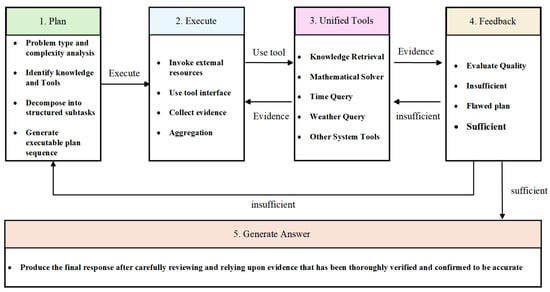
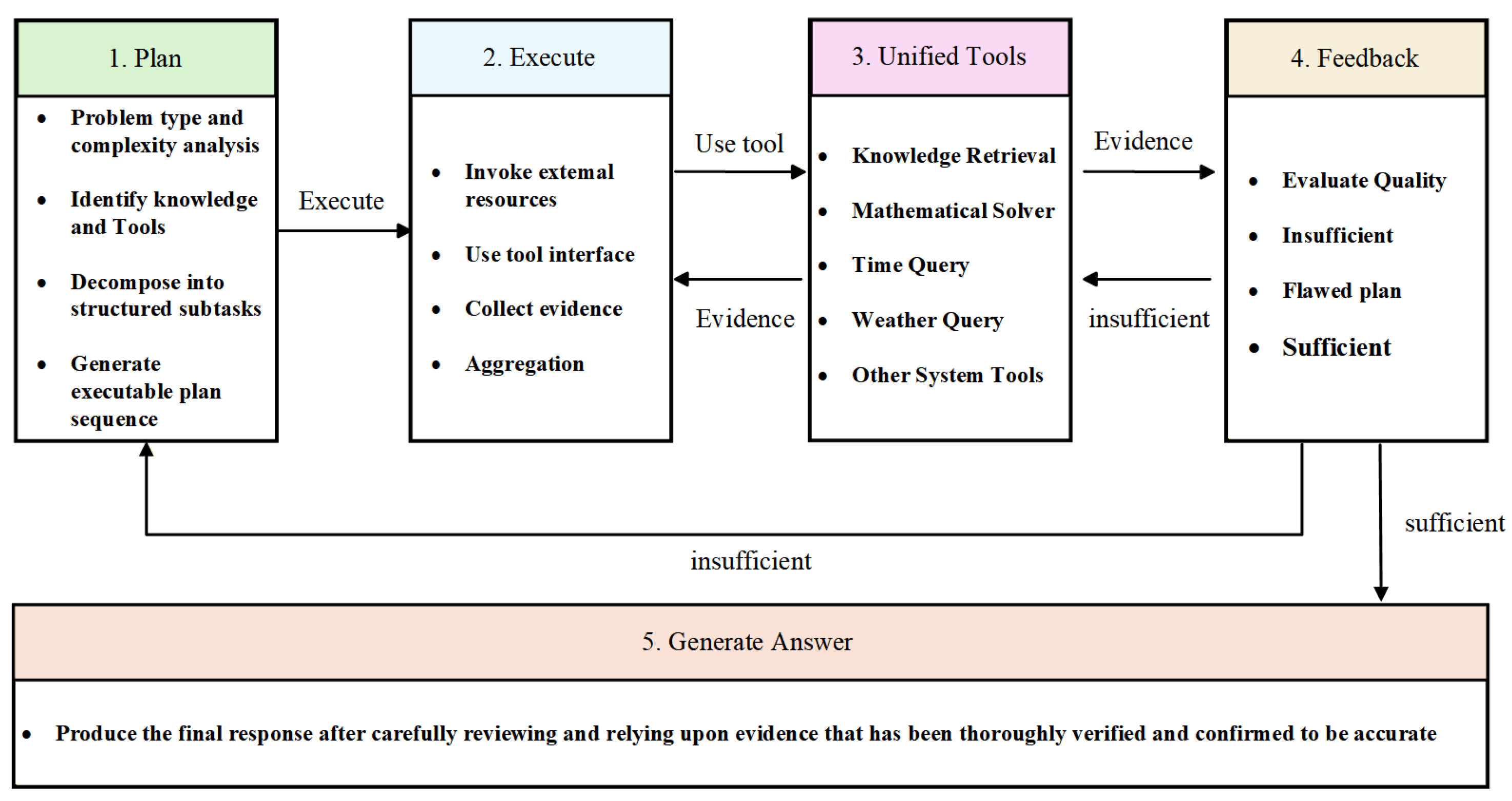
As illustrated in Figure 1, the framework consists of three tightly coupled modules—Plan, Execute, and Feedback—which together form a closed-loop workflow. The architecture diagram separates the main functional modules, evidence flow, and feedback-routing paths. The forward path represents normal evidence acquisition and answer generation, whereas the feedback path controls supplementary retrieval or replanning when the evidence is insufficient.
Figure 1.
Overall architecture of the Planning–Execution–Feedback agent. The diagram highlights the forward reasoning path, evidence acquisition process, and feedback-based routing mechanism for supplementary retrieval and replanning.
Given a user query q, the agent maintains a reasoning state , where denotes the current execution plan, the retrieved evidence set, the action history, and t the iteration index. The available actions include planning, execution, additional retrieval, replanning, and answer generation.
At the planning stage, the system analyzes the type, complexity, and information requirements of the query and generates a structured execution plan , which is composed of subtasks such as identifying the crop entity, retrieving agronomic evidence, or invoking an auxiliary tool. By decomposing the original question into explicit subtasks, the framework makes the reasoning process more transparent and reduces the ambiguity of direct one-step generation.
At the execution stage, the agent executes the current plan by invoking the retrieval module and, when required, external tools such as mathematical computation, time query, or weather query services. The main evidence acquisition component is the proposed knowledge-graph-guided hybrid retrieval method described in Section 3.2. The output of this stage is a ranked evidence set .
At the feedback stage, the agent evaluates whether the current evidence is adequate for answer generation. To avoid a purely conceptual description, we define three feedback signals: retrieval relevance , constraint coverage , and structured consistency . Retrieval relevance is computed as the mean normalized dense-retrieval score over the current evidence set. Constraint coverage measures how many key constraints extracted from the query are covered by the retrieved evidence. Structured consistency is computed as the mean entity-consistency score of the retrieved evidence items.
To make the feedback mechanism operational and reproducible, the three feedback signals are computed at the evidence-set level. Let denote the retrieved evidence set for query q, and let denote the structured constraint set extracted from the query and graph-localized entities. The constraint set may include crop entities, pest or disease entities, growth stage, management scenario, operation type, and treatment target when available.
Retrieval relevance is computed as the average normalized retrieval score of the Top-k evidence items:
The normalization is performed by min–max scaling over the candidate evidence pool returned by the retriever for the current query, which makes comparable across queries with different score distributions.
Constraint coverage measures the proportion of query-side constraints covered by the retrieved evidence set:
where is the union of structured constraints recognized from the retrieved evidence. A constraint is considered covered if the corresponding entity or its synonym appears in the evidence text or is connected to the evidence item through a knowledge-graph relation.
Structured consistency further measures whether individual evidence items are structurally aligned with the query-side constraints:
Here, denotes the constraints matched by the i-th evidence item. Therefore, captures global evidence sufficiency, while captures local structural alignment.
The overall evidence-adequacy score is defined as
where , , and denote retrieval relevance, constraint coverage, and structured consistency, respectively, and the weights satisfy . The values of , , and are selected on the validation set.
The routing rules are controlled by the evidence adequacy threshold , the minimum coverage threshold , the minimum relevance threshold , and the minimum consistency threshold . These values are selected on the validation set and fixed during test evaluation. In this study, we set , , , and . The maximum number of feedback iterations is set to 3.
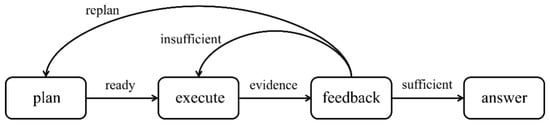
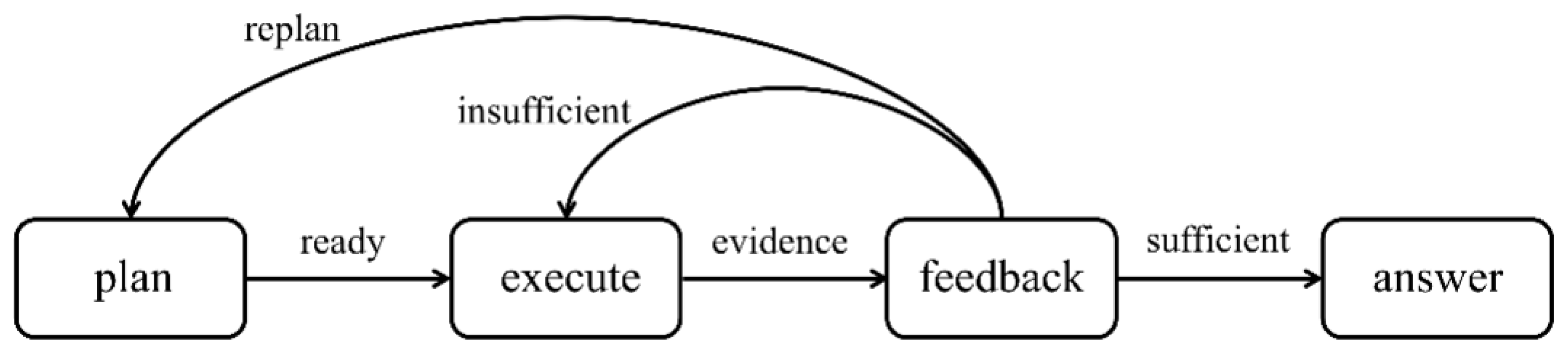
If and , the evidence is considered adequate and the system proceeds to answer generation. If but , the evidence is semantically relevant but lacks sufficient agricultural constraints, and supplementary retrieval is triggered. If or , the evidence is treated as mismatched with the query intention, and replanning is performed. When the maximum number of iterations is reached, the answer is generated using the evidence set with the highest adequacy score observed during the feedback process.
To further formalize the workflow, we model PEF as a directed state graph, as shown in Figure 2. The system performs conditional routing among the nodes plan, execute, feedback, and generate_answer. Through explicit state transitions and iteration control, the framework supports structured management of multi-step reasoning and evidence acquisition.
Figure 2.
The transition of PEF state.
Within the execution module, the framework adopts a unified tool invocation mechanism to support interaction with external resources. The current system includes a knowledge retrieval tool for agricultural domain knowledge queries, which adopts the knowledge-graph-guided two-stage hybrid retrieval strategy described in Section 3.2, as well as auxiliary tools for mathematical computation, time query, and weather query. All tools follow a unified interface and support modular extensibility, enabling flexible capability composition.
Overall, the key contribution of the PEF architecture is not merely the combination of planning, retrieval, and answer generation, but the introduction of a closed-loop control mechanism that evaluates evidence adequacy and adapts the workflow accordingly. This process-level control is particularly important in agricultural QA, where a plausible answer may still be unreliable if key constraints are missing from the supporting evidence.
3.2. Knowledge-Graph-Guided Hybrid Retrieval
To improve retrieval precision and reduce semantic drift in agricultural question answering, we design a knowledge-graph-guided hybrid retrieval method, termed Two-Stage Knowledge Retrieval and Localization (TS-KRL). The key idea is to use the knowledge graph not only as an auxiliary knowledge source, but also as a structured constraint layer that narrows the candidate search space before dense retrieval. This design is motivated by the observation that agricultural queries often contain multiple interacting constraints, and purely semantic retrieval may return text that is topically related but structurally mismatched to the actual question. The complete TS-KRL procedure is summarized in Algorithm 1.
The agent maintains two complementary knowledge sources: a structured knowledge graph and an unstructured vector knowledge base. The knowledge graph organizes agricultural concepts—such as crops, pests and diseases, management actions, and control measures—in the form of entity–relation triples, and semantic embeddings are precomputed for each entity. The vector knowledge base stores evidence-oriented agronomic knowledge entries together with their vector representations to support nearest-neighbor search. These entries serve as supporting evidence for retrieval and reasoning, rather than as direct answer targets. This dual-repository design allows structured prior knowledge and semantic generalization capability to complement each other.
The retrieval process consists of two stages: graph-based entity localization and context-enhanced dense retrieval with entity-consistency reranking.
In the first stage, the system performs graph-based entity localization. Given a query q, let denote the text encoder. We first compute the query embedding with and apply normalization. For each entity in the knowledge graph, let denote its embedding, which is normalized in the same manner. The similarity between the query and entity is then defined as
which is equivalent to cosine similarity because both vectors are -normalized.
| Algorithm 1 TS-KRL Knowledge-Graph-Guided Hybrid Retrieval | |
| Input: query q; knowledge graph entity set E with embeddings; vector knowledge base V | |
| with embeddings; hyperparameters , and maximum context length | |
| Output: evidence set | |
| Stage I: Graph-based Entity Localization | |
| 1: | Encode the query q and normalize its embedding. |
| 2: | Compute the query–entity similarity for all entities in E. |
| 3: | Retain the Top-k entities above threshold to form the candidate entity set . |
| 4: | Extract neighboring triples, relation labels, and textual descriptions for entities in . |
| 5: | Rank the extracted graph fragments by relevance to the query and truncate them to form graph context . |
| 6: | Derive the query-side structured constraint set from the graph-localized entities and relations. |
| Stage II: Context-Enhanced Dense Retrieval and Entity-Consistency Reranking | |
| 7: | Construct the enhanced query by combining the original query with graph context. |
| 8: | Encode and compute dense retrieval scores for candidate entries in V. |
| 9: | For each candidate entry , derive its matched constraint set . |
| 10: | Compute the entity-consistency score . |
| 11: | Compute the final reranking score . |
| 12: | Return the Top-K entries under the reranking score as evidence set . |
| 13: | If dense retrieval returns fewer than three valid evidence items or the maximum retrieval score is below 0.45, invoke BM25 fallback retrieval within the graph-localized candidate corpus. |
Based on these scores, the system retains the Top-k entities whose scores exceed a threshold , obtaining a candidate entity set . For each entity in , one-hop neighboring triples, textual descriptions, and relation labels are first extracted from the knowledge graph to construct the graph context . If the extracted context is insufficient, two-hop triples are further expanded through relation types related to crop, pest or disease, prevention method, treatment operation, growth stage, and management scenario. To prevent uncontrolled context growth, graph fragments are ranked according to query–entity similarity, relation-type priority, and textual overlap with the original query. The final serialized graph context is truncated to 512 tokens, and duplicate fragments are removed before concatenation.
In addition to graph context construction, the localized entities are used to derive a query-side structured constraint set . Specifically, contains the key structured constraints implied by the query and the graph-localized entities, including crop, pest or disease, scenario, and task information when available. Thus, and are derived from the same localization stage but serve different purposes: is used to enhance dense retrieval, whereas is used for post-retrieval consistency reranking.
In the second stage, the system performs context-enhanced dense retrieval and entity-consistency reranking. The original query and graph context are concatenated to form an enhanced query . Its embedding is computed by the same encoder and normalized in the same way as in the first stage. Let denote the j-th entry in the vector knowledge base. The dense retrieval score between the enhanced query and is defined as
which again corresponds to cosine similarity under normalization. This stage improves semantic matching by injecting graph-derived context into the retrieval query.
To incorporate structured constraints from the knowledge graph into the final ranking, we define an entity-consistency score. Let denote the subset of structured constraints matched in candidate entry . The entity-consistency score is defined as
where ranges from 0 to 1 and measures how well a candidate entry satisfies the structural constraints implied by the query. A higher score indicates that the candidate evidence is more consistent with the query-side constraints.
The final reranking score is then computed as
where is a consistency-weight coefficient tuned on the validation set. A larger places more emphasis on structural alignment, while a smaller makes the ranking rely more heavily on semantic similarity. The final evidence set is obtained by selecting the Top-K entries that satisfy the retrieval criterion under this reranking score.
When dense retrieval returns fewer than three valid evidence items or the maximum retrieval score is below 0.45, the system activates BM25 fallback retrieval within the graph-localized candidate corpus rather than over the full knowledge base. This design preserves the structural narrowing effect of graph localization while improving retrieval robustness under sparse or ambiguous queries.
Overall, the first stage performs coarse-grained entity localization in the structured knowledge space, thereby narrowing the candidate search scope and injecting domain priors into retrieval. The second stage then performs context-enhanced dense retrieval and entity-consistency reranking, which improves both semantic relevance and structural alignment between the retrieved evidence and the query constraints.
3.3. Digital Human Interface as a Prototype Application
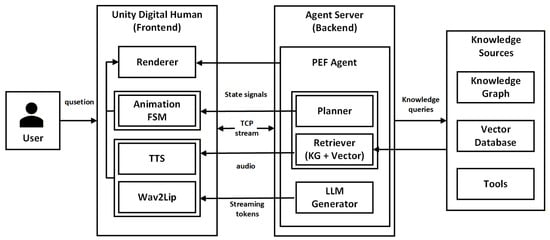
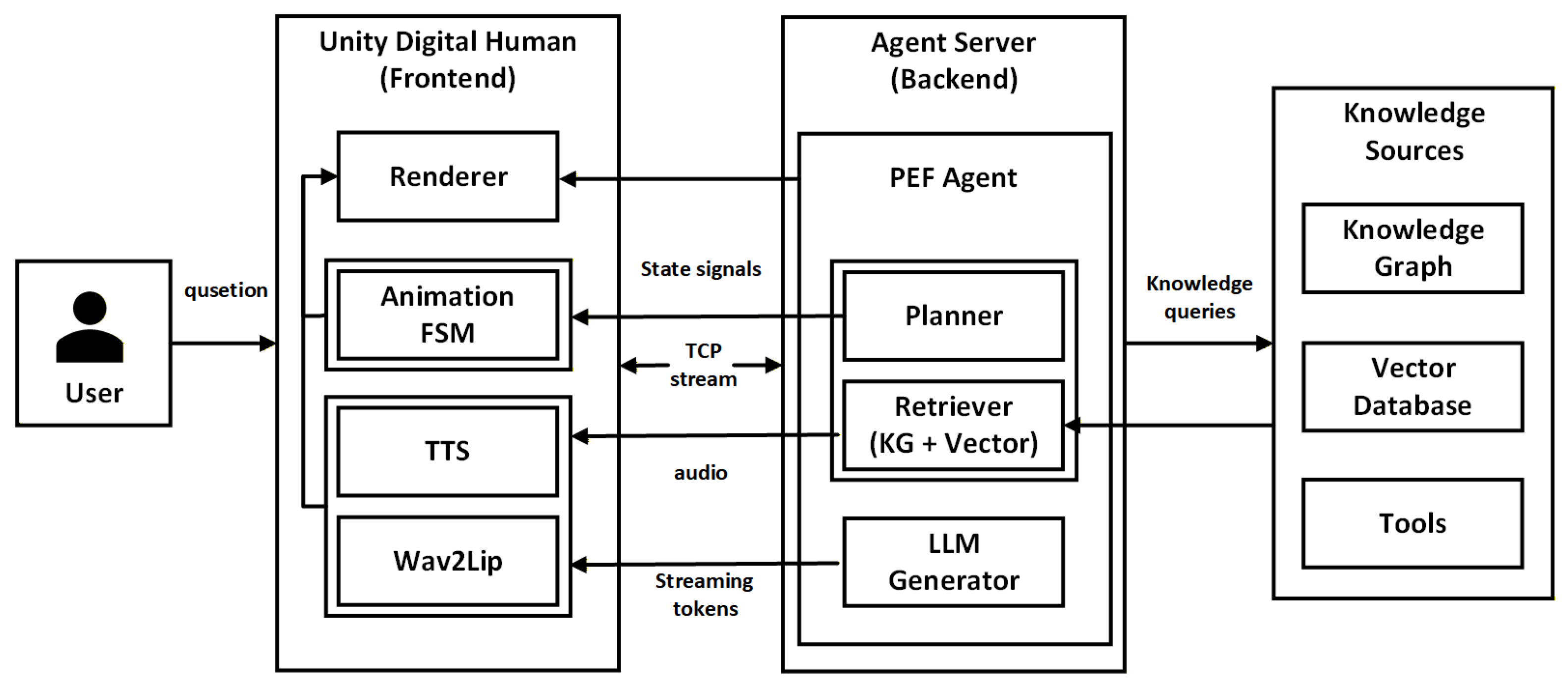
To demonstrate the practical integration of the proposed framework in interactive agricultural knowledge services, we implement a digital human interface as a prototype application. The backend agent is responsible for query understanding, evidence retrieval, feedback-driven control, and answer generation, while the frontend renders visual behaviors and speech output in real time. The two modules communicate through a persistent connection that supports incremental transmission of intermediate states and generated responses. The overall communication workflow is illustrated in Figure 3.
Figure 3.
Agent–Digital Human communication pipeline.
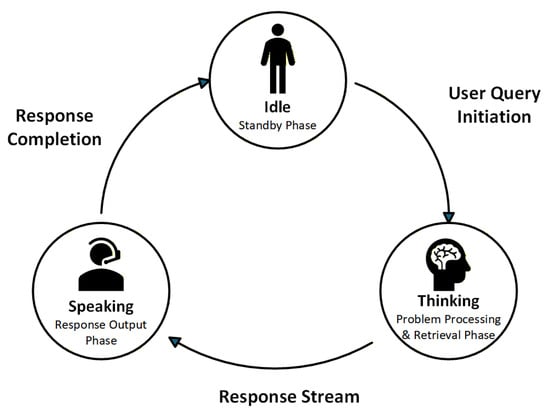
The digital human adopts a frontend–backend decoupled architecture. When the frontend receives user input, the query is transmitted to the backend agent. During planning, retrieval, and generation, the backend continuously returns intermediate states and text fragments, which are used to drive synchronized animation and speech playback on the frontend. A lightweight finite-state controller maps the backend states to three visible interaction states—Idle, Thinking, and Speaking—so that users can perceive the system’s ongoing reasoning and response process.
For speech presentation, the system combines text-to-speech generation with an audio-driven lip synchronization module, enabling the visual behavior of the digital human to remain aligned with the generated response. The digital human is used as a prototype demonstrator rather than as a core algorithmic component. Its role is to provide an interactive interface through which the proposed PEF-based agricultural QA framework can be delivered to end users. Therefore, the scientific contribution of this paper mainly lies in the feedback-controlled QA framework and the knowledge-graph-guided retrieval method, while the digital human module demonstrates the application feasibility of the proposed framework in an interactive agricultural consultation scenario.
4. Experiment
4.1. Dataset
This study uses the agricultural question-answering dataset AgroQA as the main evaluation benchmark. AgroQA covers multiple agricultural crops and management scenarios, including maize, cassava, and beans, as well as general agricultural management topics such as irrigation, fertilization, soil conservation, and pest control. The dataset contains 3044 question–answer instances and is therefore suitable for evaluating domain-specific agricultural QA performance under heterogeneous crop and scenario settings.
To ensure reproducibility, the dataset is divided into training, validation, and test subsets in a ratio of 7:1:2, corresponding to 2131, 304, and 609 instances, respectively. The validation split is used for hyperparameter selection, threshold tuning, and model selection, while the test split is used only for final evaluation.
An example of the data format is shown in Table 2. AgroQA can be formally represented as a triple . Here, denotes the natural language question of the i-th sample, represents the context or background knowledge related to the question, and is the human-annotated reference answer. This triple structure not only supports the evaluation of answer correctness but also enables verification of whether the generated content is grounded in the provided evidence, thereby measuring the system’s knowledge dependency and interpretability.
Table 2.
Example data from the AgroQA dataset.
4.2. Experimental Settings and Evaluation Protocol
All experiments in this study were conducted under a unified software and hardware environment. The experimental setup includes an Intel i9-13900K processor, an NVIDIA RTX 4090 GPU, and 64 GB of memory to support high-concurrency vector retrieval and graph-structure queries. The core inference pipeline is implemented using PyTorch, while the vector retrieval layer employs FAISS to construct approximate nearest neighbor search. The structured knowledge graph is managed by Neo4j to support entity–relation retrieval and path expansion. The output dimension of the text encoder is set to 768, and embedding vectors are precomputed offline and cached to reduce latency during online inference.
To improve reproducibility, the main hyperparameters are reported in Table 3. All hyperparameters are selected on the validation split and fixed during test evaluation.
Table 3.
Hyperparameter settings.
To ensure comprehensive evaluation, this study adopts a combined evaluation paradigm consisting of automatic metrics and user subjective evaluation. The automatic metrics are used to measure answer correctness, semantic consistency, and evidence dependency, while subjective evaluation assesses perceived expertise, trustworthiness, and interaction experience in real interactive scenarios. The automatic evaluation metrics include Answer-C, Answer-R, and Contextual Reliability (CR), which are calculated according to Equations (9)–(11), respectively.
Answer-C measures the factual correctness of the predicted answer relative to the ground-truth answer and is defined using an accuracy-based matching statistic, where TP and FP denote the numbers of correct and incorrect predictions, respectively. Answer-R evaluates the semantic similarity between the predicted answer and the reference answer, where A1 and A2 represent the semantic embedding vectors of the two answers, and the similarity is computed using cosine similarity in the vector space.
The CR metric measures the degree to which the predicted answer depends on background knowledge. Here, denotes the number of tokens in the generated answer that originate from the background evidence, while represents the total number of tokens in the background information. In this way, the metric quantifies how much of the generated answer can be supported by the retrieved evidence.
The subjective evaluation adopts a five-point Likert scale. The assessment is conducted across four dimensions: Professionalism, Trustworthiness, Naturalness, and Overall Satisfaction.
To control for order effects, the presentation order of outputs generated by different methods is randomized. Each participant independently evaluates the outputs of each method for every question, and the final results are reported as the mean scores.
4.3. Experimental Results
4.3.1. Main Quantitative Results
To ensure a comprehensive comparison, the experimental baselines include four representative paradigms. General large language models (LLM-only) include Qwen3, ChatGLM4, ChatGPT5.1, and DeepSeek, which generate answers without introducing external evidence retrieval. Traditional Retrieval-Augmented Generation (RAG) follows the standard two-stage retrieve–generate pipeline. Self-RAG, a reflection-enhanced RAG method, introduces self-evaluation and reflection mechanisms during generation to trigger re-retrieval or correction. GraphRAG incorporates graph-structured information to expand retrieval and organize evidence chains.
For fair comparison, all retrieval-based methods are implemented under the same AgroQA corpus, train/validation/test split, embedding encoder, vector index, and generation setting unless otherwise specified. Therefore, the differences among retrieval-based methods mainly reflect retrieval organization, evidence assessment, and workflow control rather than differences in data resources or evaluation protocol.
Table 4 presents the quantitative experimental results of different methods on the AgroQA dataset. From the results in Table 4, several observations can be made. First, general large language models without retrieval tend to perform relatively poorly in Contextual Reliability (CR). Although the four LLM-only methods achieve acceptable performance in Answer-C (answer correctness) and Answer-R (answer relevance), their CR values are significantly lower than those of retrieval-augmented approaches. This indicates that in agricultural domain question answering, relying solely on the internal knowledge of large language models is more likely to produce answers that are semantically plausible but insufficiently supported by evidence, thereby affecting the traceability and reliability of the generated responses.
Table 4.
Main automatic evaluation results on AgroQA.
Traditional RAG, after introducing external evidence, not only significantly improves CR but also simultaneously enhances Answer-C. This indicates that retrieved evidence not only strengthens the citability of generated content but also contributes to improving factual accuracy. In particular, the increase in CR reflects a stronger consistency between the generated content and the background information.
Self-RAG and GraphRAG perform better in terms of evidence coverage. Self-RAG improves the assessment of evidence sufficiency through a reflection mechanism, while GraphRAG expands the coverage of evidence by leveraging graph-structured information. Both approaches outperform traditional RAG in terms of CR. However, in mixed datasets involving multiple crops and scenarios, if graph expansion lacks explicit constraints on crops or scenarios, it may still introduce adjacent but not fully matching evidence, thereby limiting further improvements in Answer-C and Answer-R.
The PEF method consistently outperforms the baselines across all three metrics, with especially notable gains in CR. These improvements are primarily attributable to the combination of structured prior constraints and feedback-driven correction. Specifically, the knowledge-graph-guided stage explicitly introduces composite constraints among crop entities, tasks, and scenarios to reduce topic drift. Meanwhile, the feedback stage evaluates evidence sufficiency and triggers re-retrieval or plan adjustment when necessary, thereby suppressing the error amplification effect caused by mismatched one-time retrieval and forming a closed-loop optimization process.
To examine whether the improvements are statistically reliable, paired significance tests are conducted between PEF and the strongest baseline, GraphRAG. For Answer-C, McNemar’s test is used because the metric is based on instance-level correctness. For Answer-R and CR, paired bootstrap resampling with 1000 iterations is adopted because the two metrics are continuous instance-level scores. The statistical test results are shown in Table 5.
Table 5.
Statistical significance test between PEF and GraphRAG.
The results show that PEF significantly outperforms GraphRAG on all three metrics at the 0.05 significance level. The improvement is most pronounced on CR, which is consistent with the motivation of improving evidence-grounded reliability in agricultural question answering.
4.3.2. Ablation Study
To determine which components contribute most to the reported gains, we conduct an ablation study and report the results in Table 6. Specifically, we compare the full system with the following reduced variants: w/o Feedback, where the feedback-driven routing is removed and the system performs only a single execution pass; w/o KG Localization, where graph-based entity localization is removed and dense retrieval is performed directly from the original query; w/o Consistency Reranking, where candidate evidence is ranked only by semantic retrieval score; and Dense Retrieval Only, where both graph guidance and feedback control are removed.
Table 6.
Ablation results of the proposed framework.
The ablation results show that all three proposed components contribute to the final performance. In particular, removing the feedback module causes a notable drop in all three metrics, especially in CR, indicating that the gain does not come only from better retrieval, but also from the ability to identify evidence insufficiency and adapt the workflow. Removing graph localization and consistency reranking also degrades performance, showing that the knowledge graph contributes not only as a static knowledge repository but also as a structural constraint source for retrieval control.
The module-level ablation results in Table 6 show that graph localization, consistency reranking, and feedback control all contribute to the final performance. To further examine the internal contribution of the feedback mechanism, we conduct a fine-grained ablation study by removing each feedback signal and routing action from the full framework. The results are shown in Table 7.
Table 7.
Fine-grained ablation of feedback signals and routing actions.
Removing constraint coverage leads to the largest decrease in CR, indicating that explicit coverage of crop, pest or disease, scenario, and task constraints is essential for reliable agricultural QA. Removing structured consistency also reduces performance, showing that evidence items should not only be semantically relevant but also structurally aligned with the query. The performance drops caused by removing supplementary retrieval and replanning further show that the gain of PEF does not come from static reranking alone, but from feedback-controlled workflow adaptation.
4.3.3. Sensitivity Analysis
To examine the robustness of the threshold-based feedback mechanism, we conduct sensitivity analysis on the main adequacy threshold . This threshold controls whether the current evidence is accepted for answer generation or further retrieval and replanning are required. The results are shown in Table 8.
Table 8.
Sensitivity analysis of adequacy threshold .
The results show that the framework performs best when is around 0.78. A lower threshold may accept incomplete evidence prematurely, while a higher threshold increases the number of feedback iterations and may introduce additional context without clear performance gains. Therefore, when is 0.78, it provides a reasonable balance between answer quality and inference efficiency.
4.3.4. Qualitative Analysis
To more intuitively illustrate the behavioral differences among various methods in real agricultural knowledge question answering, this section adopts a case-driven qualitative analysis approach. Instead of relying solely on abstract summaries, the retrieved evidence and generated results of different methods for the same question are presented side by side. By listing the Top-K retrieved entries along with the corresponding generated answers, it becomes possible to directly observe differences in evidence relevance, domain alignment, and the professionalism of responses, thereby explaining the sources of improvement in the quantitative metrics discussed earlier. As shown in Table 9 and Table 10, two representative agricultural production scenarios are selected for comparative analysis.
Table 9.
Comparison of retrieval results and generated answers for different methods on a maize pest control question (Case 1).
Table 10.
Comparison of retrieval results and generated answers for different methods on a bean storage pest control question (Case 2).
From Table 9, it can be directly observed that the retrieval results of traditional RAG are mainly concentrated on general pest management texts, with only a few entries involving maize and those limited to single-pest scenarios. The evidence therefore exhibits a clear phenomenon of topic generalization. This occurs because single-stage vector retrieval primarily ranks results based on semantic similarity to “pest control,” making it difficult to impose explicit constraints on the key entity “maize.” As a result, relevant domain information may be missing.
In contrast, the proposed method first localizes maize-related entities through the knowledge graph and then performs refined retrieval within the candidate subspace. Consequently, the returned evidence is directly related to maize production and covers multiple strategies such as agricultural regulation, resistant breeding, and chemical control. As a result, the generated answers are more systematic and actionable. This shift from “generic recommendations” to “crop-specific decision strategies” clearly demonstrates the effectiveness of graph-guided retrieval in improving domain precision.
Compared with Case 1, this question simultaneously involves three semantic constraints—pest (bean weevil), crop (bean), and scenario (storage)—which places higher demands on retrieval accuracy. As shown in Table 10, traditional RAG fails to recognize the core condition “storage.” Most retrieved entries still relate to field pests or general crop management, and even include cases concerning unrelated crops, resulting in complete evidence mismatch.
Although general large language models can generate some common-sense suggestions, such as keeping crops dry or using sealed containers, these responses lack support from specific agricultural techniques. In contrast, the proposed method leverages entity relationships in the knowledge graph—such as bean weevil–storage–PICS bag/fumigant—to perform structured localization. This allows the system to directly retrieve professional knowledge highly relevant to the control of bean weevils during storage. Consequently, the generated answers include practical agricultural techniques such as PICS hermetic storage bags and aluminum phosphide fumigation, significantly improving both professionalism and practical applicability.
Across the two cases, it can be observed that traditional RAG primarily relies on global semantic similarity ranking, which may lead to topic drift or the neglect of key scenario constraints. General large language models, lacking external knowledge support, tend to produce responses based on general experience. In contrast, the proposed method employs graph-guided localization and context-enhanced retrieval, ensuring that evidence satisfies the structured consistency of “crop–pest–scenario” before entering the generation stage. This results in more precise, professional, and interpretable agricultural decision recommendations. These visualized case studies are consistent with the improvements observed in the quantitative metrics presented earlier, further demonstrating the effectiveness and reliability of the PEF framework in complex agricultural knowledge question answering tasks.
4.3.5. Subjective Evaluation
Ten evaluators participated in the subjective evaluation, mainly including undergraduate and master’s students majoring in agronomy. These evaluators had received formal agricultural training and possessed general domain knowledge related to crop cultivation, pest and disease control, and agricultural production management. Therefore, they were considered suitable for assessing the generated answers from the perspective of domain-aware users.
The subjective evaluation was conducted using a five-point Likert scale across four dimensions: Professionalism, Trustworthiness, Naturalness, and Overall Satisfaction. For each question, the answers generated by different methods were anonymized and presented to the evaluators in a randomized order. The evaluators were not informed of the system identity corresponding to each answer. Each evaluator independently rated the responses, and the final subjective scores were calculated as the mean scores across evaluators and questions. The subjective evaluation results are shown in Table 11.
Table 11.
Subjective evaluation results.
Overall, the subjective evaluation results show a trend consistent with the automatic metrics. Retrieval-augmented methods generally receive higher scores than standalone LLMs, especially in Professionalism and Trustworthiness. The proposed PEF method achieves the highest average scores in these dimensions, suggesting that feedback-controlled evidence acquisition and graph-guided retrieval may improve the perceived domain appropriateness and reliability of agricultural QA responses.
Because the subjective evaluation was conducted by ten agronomy students with general agricultural-domain knowledge rather than by full-time agricultural extension experts, the results should be interpreted as perceived quality assessments from domain-aware users rather than expert-level agronomic validation.
Because only aggregated subjective scores were retained in the current evaluation, we report descriptive statistics rather than inferential significance tests for the subjective ratings. Therefore, the subjective evaluation results should be interpreted as indicative user-perception trends rather than statistically confirmed differences.
The subjective evaluation results show that retrieval-augmented methods generally receive higher ratings than standalone LLMs, particularly in Professionalism and Trustworthiness. This trend suggests that incorporating external evidence can improve the perceived domain appropriateness and reliability of agricultural QA responses.
Compared with GraphRAG, PEF achieves higher average scores in Professionalism and Trustworthiness. This improvement may be attributed to the feedback-controlled evidence acquisition and graph-guided retrieval mechanism, which helps reduce irrelevant or structurally mismatched evidence. In contrast, the differences in Naturalness are relatively small, suggesting that response fluency is less affected by retrieval and workflow control than evidence grounding and domain relevance.
Although methods with higher Trustworthiness scores also tend to obtain higher Satisfaction scores in our evaluation, this observation indicates an association rather than a causal relationship. Since no formal causal analysis was conducted, we do not claim that improved trustworthiness directly causes higher satisfaction. The evidence-grounded answers may be associated with improved user preference in agricultural consultation scenarios.
4.3.6. Runtime and Deployment-Oriented Analysis
Because the proposed framework introduces planning, graph-based localization, context-enhanced retrieval, reranking, and feedback-driven routing, it is important to quantify the associated runtime cost. We therefore report retrieval latency, first-token latency, and end-to-end response time in Table 12. The reported values are averaged over the test queries under the same hardware and software environment used for the main experiments.
Table 12.
Runtime and latency analysis of the proposed framework.
The results show that the proposed method incurs additional overhead relative to one-shot RAG because of its multi-stage pipeline and the possibility of multiple feedback-driven retrieval or replanning rounds. Self-RAG and GraphRAG also exhibit noticeably higher latency than Naïve RAG, which is consistent with their additional reflection and graph-structured retrieval mechanisms. Compared with these baselines, the proposed method does not necessarily have the highest single-pass retrieval latency, but it has the longest end-to-end response time because the system may execute more than one reasoning cycle before generating the final answer. Under the current experimental setup, the proposed method achieves an average retrieval latency of 137 ms, a first-token latency of 2.58 s, and an end-to-end response time of 9.86 s. These results support the feasibility of the proposed architecture as an interactive prototype, while also indicating a clear runtime trade-off relative to simpler retrieval-augmented baselines.
4.3.7. Visualization Results of the Digital Human Prototype
To further demonstrate the practical integration of the proposed framework in an interactive agricultural consultation setting, we evaluate the digital human interface at the prototype level through visualization-based system demonstration.
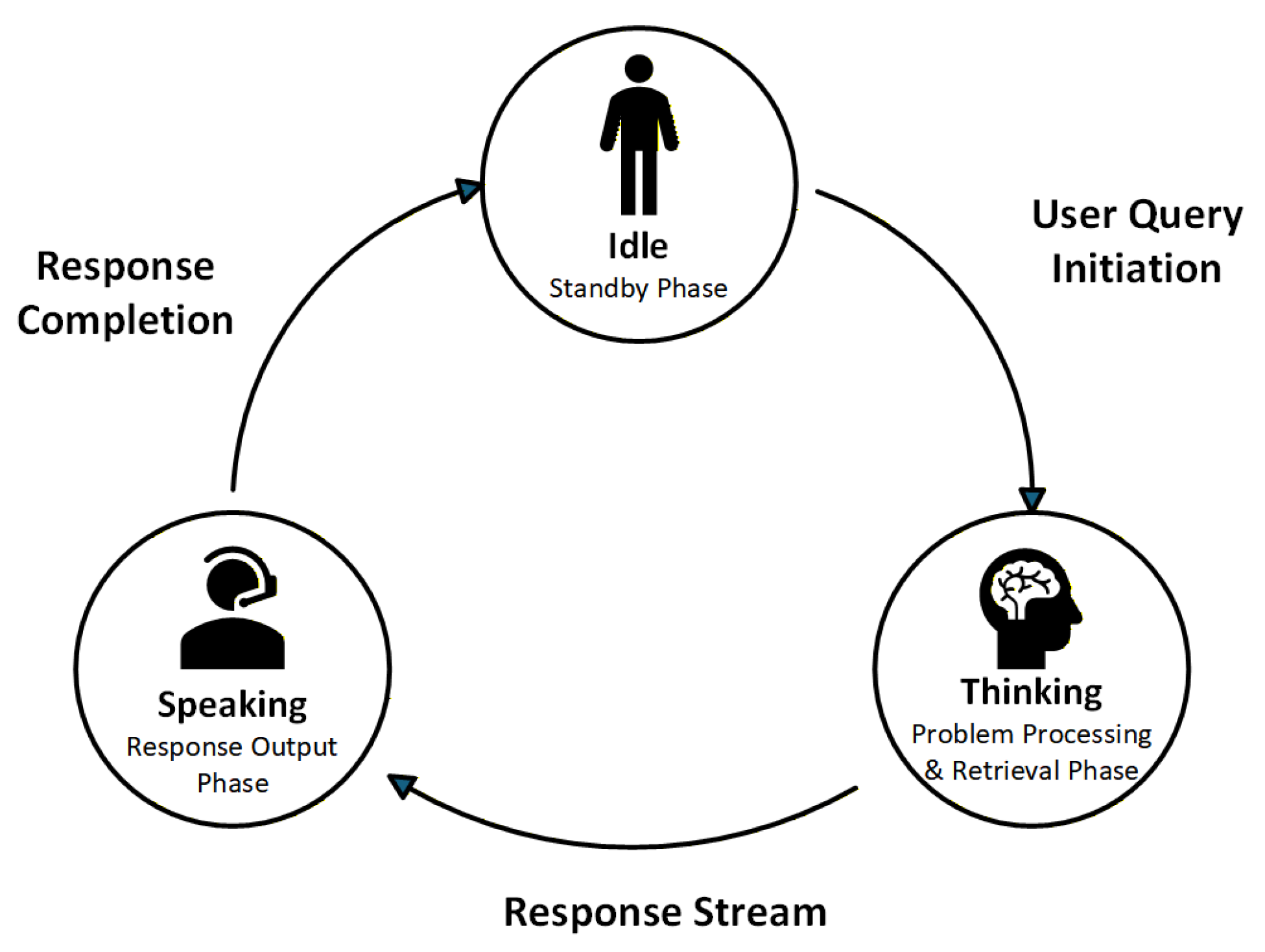
As shown in Figure 4, a finite-state-machine-based behavior mapping strategy is designed with three states—Idle, Thinking, and Speaking—to ensure that the external actions of the digital human remain consistent with the internal reasoning process of the agent. This design enables the system to externalize part of the reasoning process as perceivable interaction cues, thereby improving interaction transparency during agricultural consultation.
Figure 4.
Finite-state animation controller of the digital human.
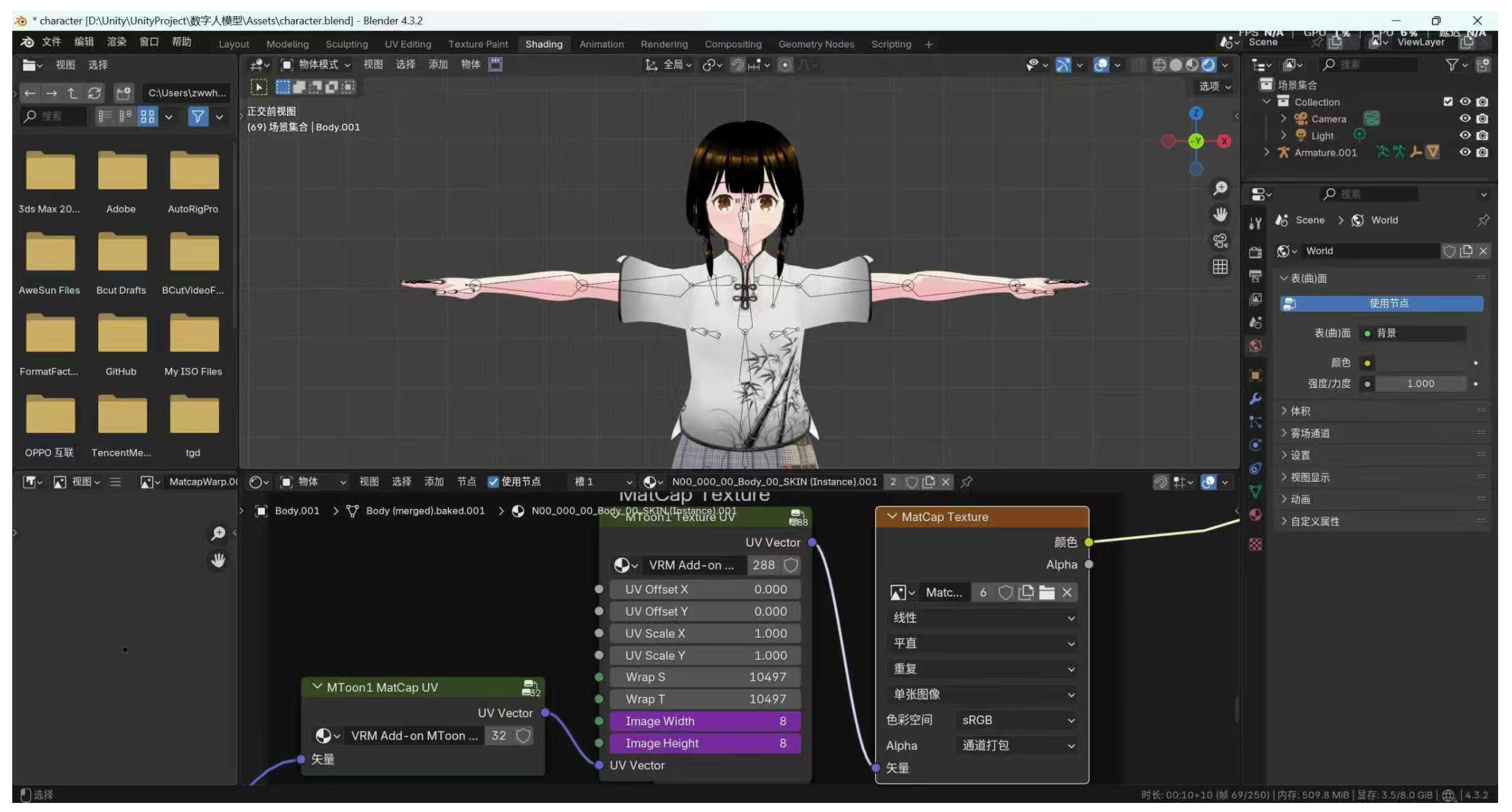
To present the visual appearance of the prototype, Figure 5 shows the rendering configuration used to construct the final digital human presentation in the frontend system. The model is configured with materials and lighting settings using Blender’s node-based material system. By constructing a material node network, texture maps are combined with MatCap to achieve a stylized visual appearance for the digital human. As shown in Figure 5, the node editor is used to connect and adjust material textures, enabling real-time rendering effects of the model within the viewport.
Figure 5.
Material nodes and rendering configuration.
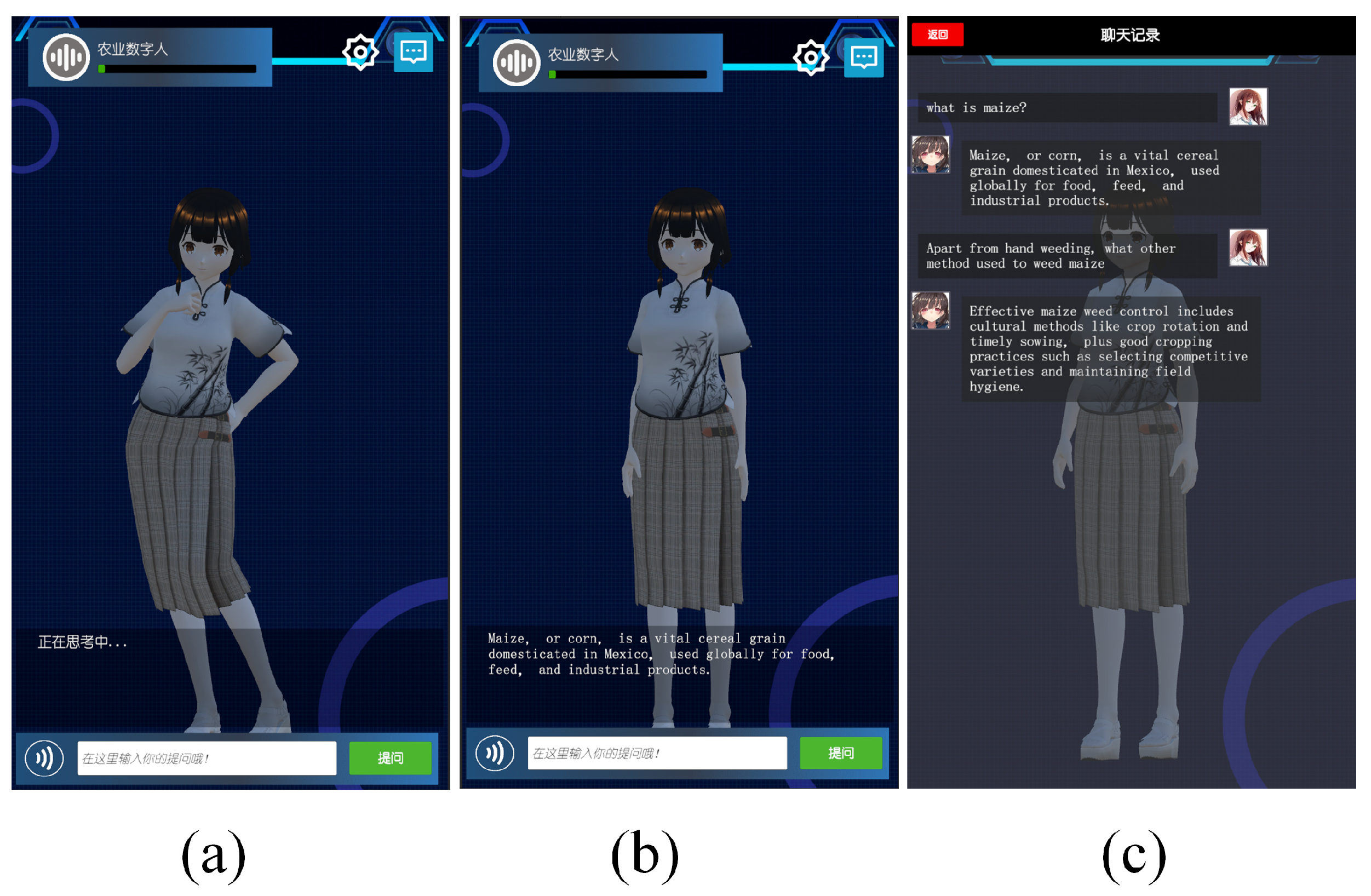
The operational performance of the system is then evaluated through visualization, as illustrated in Figure 6. During system deployment, when the frontend receives user voice or text input, the request is first transmitted to the backend agent through a TCP persistent connection. The agent then sequentially performs planning, knowledge-graph-guided retrieval, evidence fusion, and answer generation, and returns intermediate textual outputs token by token in a streaming manner. The digital human module simultaneously receives the generated content and triggers speech synthesis and animation in real time, enabling an interaction mode in which responses are generated and broadcast simultaneously. Compared with the traditional blocking process—where responses are played only after generation is completed—this mechanism significantly reduces the initial response latency, allowing users to perceive system feedback earlier and thereby improving overall interaction smoothness and immersion.
Figure 6.
Operational Visualization of the agricultural digital human system. Subfigure (a) illustrates the reasoning process upon user input. Subfigure (b) displays the generated response to user queries. Subfigure (c) denotes the chat interface supporting historical record retrieval.
When the system is performing planning and retrieval, the digital human enters the Thinking state and displays corresponding thinking animations. When answer generation begins, the state automatically switches to Speaking, accompanied by synchronized speech playback. After the response is completed, the system returns to the Idle state. This design transforms the abstract backend reasoning process into intuitive behavioral feedback, helping users better understand the system’s “thinking–responding” workflow and thereby enhancing interaction transparency and user trust.
In addition, the system incorporates the Wav2Lip model to achieve audio-driven lip synchronization rendering, ensuring that mouth movements are precisely aligned with the rhythm of speech. Compared with traditional rule-based interpolation methods, this learning-based lip-sync approach produces more natural and stable results under different speaking speeds and pronunciation conditions, effectively improving the realism and expressive continuity of the digital human. In multi-round question–answering tests, the system operates stably and continuously performs real-time knowledge retrieval and streaming generation, demonstrating the engineering feasibility of the proposed agent framework in practical agricultural consultation scenarios.
5. Conclusions
In this study, we proposed an agent-driven question-answering framework for the agricultural planting domain based on a Planning–Execution–Feedback (PEF) closed-loop mechanism. The framework was designed to address an important limitation of existing retrieval-augmented generation methods in agricultural QA, namely that retrieved evidence is often used in a one-shot manner without explicit control over whether it is sufficient, accurate, and structurally aligned with the requirements of the current question. To address this issue, the proposed framework introduces process-level control into question answering by combining structured planning, knowledge-graph-guided hybrid retrieval, and feedback-driven workflow adjustment.
More specifically, the framework first analyzes the input query and generates a structured execution plan, and then performs evidence acquisition through a two-stage knowledge-graph-guided retrieval method. By combining graph-based entity localization, context-enhanced dense retrieval, and entity-consistency reranking, the retrieval module improves the alignment between retrieved evidence and query-side structured constraints. On this basis, the feedback module evaluates evidence adequacy and determines whether the current workflow should proceed, retrieve more evidence, or be revised through replanning. In this way, the proposed method goes beyond a conventional retrieve–generate pipeline and formulates agricultural question answering as a closed-loop reasoning process.
Experimental results on the AgroQA benchmark show that the proposed framework achieves improved performance in answer correctness, semantic relevance, and evidence-grounded reliability compared with representative baselines. The ablation, qualitative, runtime, significance, and sensitivity analyses further suggest that the observed gains are associated with the coordinated effect of graph-guided retrieval, structured consistency reranking, and feedback-controlled workflow adaptation. These results support the effectiveness of introducing structured constraints and closed-loop control into agricultural QA under the benchmark setting considered in this study.
At the application level, a digital human interface was implemented as a prototype to demonstrate the practical integration of the proposed framework in interactive agricultural knowledge services. The prototype shows the feasibility of connecting feedback-controlled agricultural QA with a user-facing consultation interface.
This study still has several limitations. First, although the subjective evaluation involved ten agronomy students with general agricultural-domain knowledge and adopted anonymous scoring, the number of evaluators remains limited. Therefore, the subjective findings should be interpreted as indicative evidence of perceived answer quality from domain-aware users rather than definitive expert-level agronomic validation. Second, the proposed PEF framework introduces additional runtime overhead due to graph localization, reranking, and possible feedback iterations. Although the current latency remains acceptable for prototype-level interaction, further optimization is needed for large-scale deployment.
Future work will focus on three directions. First, we will further expand and diversify agricultural knowledge resources to reduce dataset bias and improve generalization across crops and scenarios. Second, we will improve the formalization of the feedback and routing mechanism so that the closed-loop control process can be analyzed more systematically. Third, we will enhance the interactive system from a prototype perspective by improving latency, robustness, and multimodal integration for practical agricultural consultation settings.
Author Contributions
Conceptualization: B.B. and X.M.; methodology: B.B.; software: B.B. and J.X.; vali-dation: B.B. and X.M.; formal analysis: B.B. and Q.G.; investigation: B.B.; resources: J.X. and C.Z.; data curation: B.B. and C.Z.; writing-original draft preparation: B.B.; writing-review and editing: B.B. and X.M.; visualization: C.Z.; supervision: X.M.; project administration: X.M.; funding acquisition: X.M. All authors have read and agreed to the published version of the manuscript.
Funding
This work is supported by the Provincial Key S&T Program of Xinjiang (2022A02011) and The second batch of the “Tianshan Talents” cultivation program for educational and teaching masters in the autonomous region (2024–2026).
Institutional Review Board Statement
Not applicable.
Informed Consent Statement
Not applicable.
Data Availability Statement
The data presented in this study are available on request from the corresponding author.
Conflicts of Interest
The authors declare no conflicts of interest.
References
- Wolfert, S.; Ge, L.; Verdouw, C.; Bogaardt, M.J. Big data in smart farming—A review. Agric. Syst. 2017, 153, 69–80. [Google Scholar] [CrossRef] [Scilit]
- Liakos, K.G.; Busato, P.; Moshou, D.; Pearson, S.; Bochtis, D. Machine learning in agriculture: A review. Sensors 2018, 18, 2674. [Google Scholar] [CrossRef] [Scilit] [PubMed]
- Kamilaris, A.; Prenafeta-Boldú, F.X. Deep learning in agriculture: A survey. Comput. Electron. Agric. 2018, 147, 70–90. [Google Scholar] [CrossRef] [Scilit]
- Kuska, M.T.; Wahabzada, M.; Paulus, S. AI for crop production—Where can large language models (LLMs) provide substantial value? Comput. Electron. Agric. 2024, 221, 108924–108927. [Google Scholar] [CrossRef] [Scilit]
- Li, H.; Wu, H.; Li, Q.; Zhao, C. A review on enhancing agricultural intelligence with large language models. Artif. Intell. Agric. 2025, 15, 671–685. [Google Scholar] [CrossRef] [Scilit]
- Jiang, J.; Yan, L.; Liu, H.; Xia, Z.; Wang, H.; Yang, Y.; Guan, Y. Knowledge assimilation: Implementing knowledge-guided agricultural large language model. Knowl.-Based Syst. 2025, 314, 113197. [Google Scholar] [CrossRef] [Scilit]
- Nickel, M.; Murphy, K.; Tresp, V.; Gabrilovich, E. A review of relational machine learning for knowledge graphs. Proc. IEEE 2015, 104, 11–33. [Google Scholar] [CrossRef] [Scilit]
- Berant, J.; Chou, A.; Frostig, R.; Liang, P. Semantic parsing on freebase from question-answer pairs. In Proceedings of the 2013 Conference on Empirical Methods in Natural Language Processing, Seattle, WA, USA, 18–21 October 2013; Association for Computational Linguistics: Stroudsburg, PA, USA, 2013; pp. 1533–1544. [Google Scholar]
- Lehmann, J.; Isele, R.; Jakob, M.; Jentzsch, A.; Kontokostas, D.; Mendes, P.N.; Hellmann, S.; Morsey, M.; Van Kleef, P.; Auer, S.; et al. Dbpedia—A large-scale, multilingual knowledge base extracted from wikipedia. Semant. Web 2015, 6, 167–195. [Google Scholar] [CrossRef] [Scilit]
- Bordes, A.; Usunier, N.; Garcia-Duran, A.; Weston, J.; Yakhnenko, O. Translating embeddings for modeling multi-relational data. Adv. Neural Inf. Process. Syst. 2013, 26, 1–9. [Google Scholar]
- Dettmers, T.; Minervini, P.; Stenetorp, P.; Riedel, S. Convolutional 2d knowledge graph embeddings. In Proceedings of the AAAI Conference on Artificial Intelligence, New Orleans, LA, USA, 2–7 February 2018; Volume 32, pp. 1–8. [Google Scholar]
- Vashishth, S.; Sanyal, S.; Nitin, V.; Talukdar, P. Composition-based multi-relational graph convolutional networks. arXiv 2019, arXiv:1911.03082. [Google Scholar]
- Sun, H.; Dhingra, B.; Zaheer, M.; Mazaitis, K.; Salakhutdinov, R.; Cohen, W. Open domain question answering using early fusion of knowledge bases and text. In Proceedings of the 2018 Conference on Empirical Methods in Natural Language Processing, Brussels, Belgium, 31 October–4 November 2018; Association for Computational Linguistics: Stroudsburg, PA, USA, 2018; pp. 4231–4242. [Google Scholar]
- Sun, H.; Bedrax-Weiss, T.; Cohen, W. Pullnet: Open domain question answering with iterative retrieval on knowledge bases and text. In Proceedings of the 2019 Conference on Empirical Methods in Natural Language Processing and the 9th International Joint Conference on Natural Language Processing (EMNLP-IJCNLP), Hong Kong, China, 3–7 November 2019; Association for Computational Linguistics: Stroudsburg, PA, USA, 2019; pp. 2380–2390. [Google Scholar]
- Edge, D.; Trinh, H.; Cheng, N.; Bradley, J.; Chao, A.; Mody, A.; Truitt, S.; Metropolitansky, D.; Ness, R.O.; Larson, J. From local to global: A graph rag approach to query-focused summarization. arXiv 2024, arXiv:2404.16130. [Google Scholar]
- Sarmah, B.; Mehta, D.; Hall, B.; Rao, R.; Patel, S.; Pasquali, S. Hybridrag: Integrating knowledge graphs and vector retrieval augmented generation for efficient information extraction. In Proceedings of the 5th ACM International Conference on AI in Finance, Brooklyn, NY, USA, 14–17 November 2024; pp. 608–616. [Google Scholar]
- Zhu, X.; Xie, Y.; Liu, Y.; Li, Y.; Hu, W. Knowledge graph-guided retrieval augmented generation. In Proceedings of the 2025 Conference of the Nations of the Americas Chapter of the Association for Computational Linguistics: Human Language Technologies (Volume 1: Long Papers), Albuquerque, NM, USA, 29 April–4 May 2025; Association for Computational Linguistics: Stroudsburg, PA, USA, 2025; pp. 8912–8924. [Google Scholar]
- Lewis, P.; Perez, E.; Piktus, A.; Petroni, F.; Karpukhin, V.; Goyal, N.; Küttler, H.; Lewis, M.; Yih, W.t.; Rocktäschel, T.; et al. Retrieval-augmented generation for knowledge-intensive nlp tasks. Adv. Neural Inf. Process. Syst. 2020, 33, 9459–9474. [Google Scholar]
- Karpukhin, V.; Oguz, B.; Min, S.; Lewis, P.; Wu, L.; Edunov, S.; Chen, D.; Yih, W.t. Dense passage retrieval for open-domain question answering. In Proceedings of the 2020 Conference on Empirical Methods in Natural Language Processing (EMNLP), Online, 16–20 November 2020; Association for Computational Linguistics: Stroudsburg, PA, USA, 2020; pp. 6769–6781. [Google Scholar]
- Khattab, O.; Zaharia, M. Colbert: Efficient and effective passage search via contextualized late interaction over bert. In Proceedings of the 43rd International ACM SIGIR Conference on Research and Development in Information Retrieval, Xi’an, China, 25–30 July 2020; pp. 39–48. [Google Scholar]
- Gao, L.; Ma, X.; Lin, J.; Callan, J. Precise zero-shot dense retrieval without relevance labels. In Proceedings of the 61st Annual Meeting of the Association for Computational Linguistics (Volume 1: Long Papers), Toronto, ON, Canada, 9–14 July 2023; Association for Computational Linguistics: Stroudsburg, PA, USA, 2023; pp. 1762–1777. [Google Scholar]
- Robertson, S.; Zaragoza, H. The Probabilistic Relevance Framework: BM25 and Beyond; Now Publishers Inc.: Hanover, MA, USA, 2009; Volume 4. [Google Scholar]
- Gao, Y.; Xiong, Y.; Gao, X.; Jia, K.; Pan, J.; Bi, Y.; Dai, Y.; Sun, J.; Wang, H.; Wang, H.; et al. Retrieval-augmented generation for large language models: A survey. arXiv 2023, arXiv:2312.10997. [Google Scholar]
- Huang, Y.; Huang, J.X. A survey on retrieval-augmented text generation for large language models. ACM Comput. Surv. 2024, 58, 1–36. [Google Scholar] [CrossRef] [Scilit]
- Hu, Y.; Lu, Y. Rag and rau: A survey on retrieval-augmented language model in natural language processing. arXiv 2024, arXiv:2404.19543. [Google Scholar]
- Arslan, M.; Ghanem, H.; Munawar, S.; Cruz, C. A Survey on RAG with LLMs. Procedia Comput. Sci. 2024, 246, 3781–3790. [Google Scholar] [CrossRef] [Scilit]
- Brown, T.; Mann, B.; Ryder, N.; Subbiah, M.; Kaplan, J.D.; Dhariwal, P.; Neelakantan, A.; Shyam, P.; Sastry, G.; Askell, A.; et al. Language models are few-shot learners. Adv. Neural Inf. Process. Syst. 2020, 33, 1877–1901. [Google Scholar]
- Wei, J.; Wang, X.; Schuurmans, D.; Bosma, M.; Ichter, B.; Xia, F.; Chi, E.; Le, Q.V.; Zhou, D. Chain-of-thought prompting elicits reasoning in large language models. Adv. Neural Inf. Process. Syst. 2022, 35, 24824–24837. [Google Scholar]
- Press, O.; Zhang, M.; Min, S.; Schmidt, L.; Smith, N.A.; Lewis, M. Measuring and narrowing the compositionality gap in language models. In Proceedings of the Findings of the Association for Computational Linguistics: EMNLP 2023, Singapore, 6–10 December 2023; pp. 5687–5711. [Google Scholar]
- Yao, S.; Yu, D.; Zhao, J.; Shafran, I.; Griffiths, T.; Cao, Y.; Narasimhan, K. Tree of thoughts: Deliberate problem solving with large language models. Adv. Neural Inf. Process. Syst. 2023, 36, 11809–11822. [Google Scholar]
- Yao, S.; Zhao, J.; Yu, D.; Du, N.; Shafran, I.; Narasimhan, K.R.; Cao, Y. React: Synergizing reasoning and acting in language models. In Proceedings of the Eleventh International Conference on Learning Representations, Virtually, 25–29 April 2022; pp. 1–33. [Google Scholar]
- Schick, T.; Dwivedi-Yu, J.; Dessì, R.; Raileanu, R.; Lomeli, M.; Hambro, E.; Zettlemoyer, L.; Cancedda, N.; Scialom, T. Toolformer: Language models can teach themselves to use tools. Adv. Neural Inf. Process. Syst. 2023, 36, 68539–68551. [Google Scholar]
- Trivedi, H.; Balasubramanian, N.; Khot, T.; Sabharwal, A. Interleaving retrieval with chain-of-thought reasoning for knowledge-intensive multi-step questions. In Proceedings of the 61st Annual Meeting of the Association for Computational Linguistics (Volume 1: Long Papers), Toronto, ON, Canada, 9–14 July 2023; Association for Computational Linguistics: Stroudsburg, PA, USA, 2023; pp. 10014–10037. [Google Scholar]
- Bhensdadia, P.H.; Bhensdadia, C. An Ontology-Based Intelligent Interactive Knowledge Interface for Groundnut Crop Information. Int. J. Adv. Comput. Sci. Appl. 2024, 15, 1–20. [Google Scholar] [CrossRef] [Scilit]
- Zhou, P.; Pujara, J.; Ren, X.; Chen, X.; Cheng, H.T.; Le, Q.V.; Chi, E.D.; Zhou, D.; Mishra, S.; Zheng, H.S.; et al. Self-discover: Large language models self-compose reasoning structures. Adv. Neural Inf. Process. Syst. 2024, 37, 126032–126058. [Google Scholar]
- Yang, T.; Mei, Y.; Xu, L.; Yu, H.; Chen, Y. Application of question answering systems for intelligent agriculture production and sustainable management: A review. Resour. Conserv. Recycl. 2024, 204, 107497. [Google Scholar] [CrossRef] [Scilit]
- Gong, R.; Li, X. The application progress and research trends of knowledge graphs and large language models in agriculture. Comput. Electron. Agric. 2025, 235, 110396. [Google Scholar] [CrossRef] [Scilit]
- Bhuyan, B.P.; Tomar, R.; Gupta, M.; Ramdane-Cherif, A. An ontological knowledge representation for smart agriculture. In Proceedings of the 2021 IEEE International Conference on Big Data (Big Data), Orlando, FL, USA, 15–18 December 2021; IEEE: New York, NY, USA, 2021; pp. 3400–3406. [Google Scholar]
- Peng, C.; Xia, F.; Naseriparsa, M.; Osborne, F. Knowledge graphs: Opportunities and challenges. Artif. Intell. Rev. 2023, 56, 13071–13102. [Google Scholar] [CrossRef] [Scilit]
- Qin, H.; Yao, Y. Agriculture knowledge graph construction and application. J. Phys. Conf. Ser. 2021, 1756, 012010. [Google Scholar] [CrossRef] [Scilit]
- Bhuyan, B.P.; Tomar, R.; Cherif, A.R. A systematic review of knowledge representation techniques in smart agriculture (urban). Sustainability 2022, 14, 15249. [Google Scholar] [CrossRef] [Scilit]
- Zhang, H.; Si, H.; Ma, X.; Xi, L.; Xu, X. Research and application of agriculture knowledge graph. In Proceedings of the 2021 5th International Conference on Electronic Information Technology and Computer Engineering, Xiamen, China, 22–24 October 2021; pp. 680–688. [Google Scholar]
- Kpodo, J.; Kordjamshidi, P.; Nejadhashemi, A.P. AgXQA: A benchmark for advanced Agricultural Extension question answering. Comput. Electron. Agric. 2024, 225, 109349. [Google Scholar] [CrossRef] [Scilit]
- Li, Y. A knowledge graph-based Q and A system for agricultural planting technology. In Proceedings of the Second International Conference on Electronic Information Engineering and Computer Communication (EIECC 2022), Xi’an, China, 25–27 November 2022; SPIE: Bellingham, WA, USA, 2023; Volume 12594, pp. 235–240. [Google Scholar]
- Nanavaty, A.; Sharma, R.; Pandita, B.; Goyal, O.; Rallapalli, S.; Mandal, M.; Singh, V.K.; Narang, P.; Chamola, V. Integrating deep learning for visual question answering in Agricultural Disease Diagnostics: Case Study of Wheat Rust. Sci. Rep. 2024, 14, 28203. [Google Scholar] [CrossRef] [Scilit]
- Yang, A.; Li, A.; Yang, B.; Zhang, B.; Hui, B.; Zheng, B.; Yu, B.; Gao, C.; Huang, C.; Lv, C.; et al. Qwen3 technical report. arXiv 2025, arXiv:2505.09388. [Google Scholar] [CrossRef] [Scilit]
- Glm, T.; Zeng, A.; Xu, B.; Wang, B.; Zhang, C.; Yin, D.; Zhang, D.; Rojas, D.; Feng, G.; Zhao, H.; et al. Chatglm: A family of large language models from glm-130b to glm-4 all tools. arXiv 2024, arXiv:2406.12793. [Google Scholar]
- Gallifant, J.; Fiske, A.; Levites Strekalova, Y.A.; Osorio-Valencia, J.S.; Parke, R.; Mwavu, R.; Martinez, N.; Gichoya, J.W.; Ghassemi, M.; Demner-Fushman, D.; et al. Peer review of GPT-4 technical report and systems card. PLoS Digit. Health 2024, 3, e0000417. [Google Scholar] [CrossRef] [Scilit] [PubMed]
- Deng, Z.; Ma, W.; Han, Q.L.; Zhou, W.; Zhu, X.; Wen, S.; Xiang, Y. Exploring DeepSeek: A survey on advances, applications, challenges and future directions. IEEE/CAA J. Autom. Sin. 2025, 12, 872–893. [Google Scholar] [CrossRef] [Scilit]
- Asai, A.; Wu, Z.; Wang, Y.; Sil, A.; Hajishirzi, H. Self-rag: Learning to retrieve, generate, and critique through self-reflection. In Proceedings of the Twelfth International Conference on Learning Representations, Vienna, Austria, 1–5 May 2023. [Google Scholar]


Disclaimer/Publisher’s Note: The statements, opinions and data contained in all publications are solely those of the individual author(s) and contributor(s) and not of MDPI and/or the editor(s). MDPI and/or the editor(s) disclaim responsibility for any injury to people or property resulting from any ideas, methods, instructions or products referred to in the content. |
© 2026 by the authors. Licensee MDPI, Basel, Switzerland. This article is an open access article distributed under the terms and conditions of the Creative Commons Attribution (CC BY) license.