


Featured Application
This study presents a vibration-based method for evaluating the contact condition of special threaded connections, with direct applications in oilfield assembly quality control and in-service monitoring. The method enables rapid, non-destructive detection of insufficient tightening or loosening, thereby enhancing operational safety and maintenance efficiency.
Abstract
This study experimentally investigates the evolution of natural frequencies of premium threaded connections under varying interface contact stiffness, aiming to establish a non-destructive vibration-based method for evaluating sealing contact conditions. The sealing interface features a sphere-on-cone configuration, and Hertzian contact theory is used to derive the contact pressure distribution, which shows a nonlinear increase in peak pressure with increasing normal load. Modal experiments were conducted under free–free boundary conditions using an impact hammer on a Φ88.9 mm × 6.45 mm P110 premium threaded connection. Three make-up torque levels (4081 N·m, 4393 N·m and 4691 N·m) were applied to create distinct contact states, and the first five orders of natural frequencies were extracted from the measured acceleration responses, using frequency response function (FRF) analysis with peak-picking identification. The results demonstrate that natural frequencies increase significantly with make-up torque, following a power-law relationship f = αT^β with R2 > 0.97 for the first three modes. A critical torque range of 4200–4400 N·m is identified, below which frequencies rise sharply and above which the increase slows due to contact stiffness saturation. Lower-order modes are more sensitive to contact stiffness variations than higher-order modes. The findings confirm that natural frequency can serve as an effective non-destructive indicator for assessing tightening quality and detecting loosening in premium threaded connections, offering practical guidance for torque optimisation and structural health monitoring in oilfield operations. Although only three torque levels are used, the observed trend is physically consistent with contact mechanics theory and widely reported joint stiffening behavior. Therefore, the fitted relationship should be interpreted as a physically guided empirical model rather than a purely statistical fit.
1. Introduction
Premium threaded connections are critical components in oil and gas development, serving as key elements for connecting tubing strings and establishing flow channels between underground reservoirs and surface facilities. Their sealing performance directly determines the integrity of the tubing string and the safety of production operations [1]. The sealing capability of such connections is primarily governed by the interfacial contact conditions, where the distribution, magnitude, and state of contact stress resulting from interference fitting play a decisive role [2].
Current research on the sealing performance of premium threaded connections encompasses theoretical modeling, numerical simulation, and experimental investigation. From a theoretical perspective, Hertzian contact theory has been widely employed to establish contact models for various sealing configurations. Wang and Gao [3] developed a design methodology based on Hertz theory for cone-on-cone configurations. For sphere-on-cone sealing interfaces, which are the focus of the present study, Cui et al. [4] proposed design criteria for gas-tight premium threads, and Yu et al. [5] characterized sealability using a surface fractal function. Xu et al. [6] developed an analytical method for static contact stress distribution on thread teeth but did not consider dynamic response or the evolution of natural frequencies with tightening torque. Strelkov and Murashkin [7] further analyzed sealability under creep conditions. These studies have established the foundation for understanding contact stress distributions under different interference conditions [8].
In numerical studies, finite element methods have been extensively used to investigate the effects of tightening loads and external forces on contact stress distribution. Chen et al. [9] studied the sealing mechanism under complex loads using three-dimensional FE models. Li et al. [10] analyzed contact performance of sealing interfaces in deep in situ pressure-preserved coring systems, and Tong et al. [11] systematically investigated the influence of contact form and angle on the sealing performance of conical metal seals in casing hangers. Chen et al. [12] examined stress characteristics and sealing mechanisms of steel-titanium heterogeneous drill pipe joints. Li et al. [13] studied the sealing performance of K-type metal sealing rings for subsea Christmas tree applications. Ernens et al. [14] conducted comprehensive research on the sealability of metal-to-metal seals with application to premium casing and tubing connections. Chen et al. [15] investigated critical load and sealing capacity of mandrel hanger wellhead connections. These numerical approaches have enabled quantitative relationships between contact stress and sealing performance, though they remain largely limited to static or quasi-static conditions.
In experimental investigations, direct measurement of contact pressure is challenging due to the confined geometry. Oku et al. [16] investigated fretting fatigue on thread roots using indentation scanning. Han et al. [17,18,19,20] developed ultrasonic testing and phased array methods for evaluating sealing performance. However, the quantitative relationship between these indicators and sealing performance remains an area of active investigation.
A parallel and relevant body of literature concerns vibration-based state identification of bolted and jointed structures. Ibrahim and Pettit [21] provided a comprehensive review establishing that nonlinearities in joint interfaces significantly affect structural dynamic response. Jalali et al. [22] developed stochastic modeling and updating methods for joint contact interfaces, demonstrating that contact parameters can be inversely identified from vibration measurements. Chang et al. [23] proposed a hybrid method for bolted joint modeling considering multi-scale contact mechanics. More broadly, vibration-based structural health monitoring (SHM) has emerged as a mature field, with natural frequencies serving as one of the most widely used damage-sensitive features [24,25]. These advances provide a compelling foundation for extending vibration-based techniques to premium threaded connections.
The foregoing review reveals three specific gaps in the current understanding. Existing work on premium threaded connections has focused almost entirely on static contact stress distributions, leaving the dynamic vibrational response uncharacterized. Vibration-based state identification, though well developed for bolted flange connections [21,22,23], has not been extended to the sphere-on-cone sealing geometry characteristic of premium casing threads. Most critically, no quantitative relationship between make-up torque and natural frequency has been reported for any threaded connection geometry—a relationship that would provide a direct basis for NDE applications.
This study addresses these gaps through a combined theoretical and experimental approach. A Hertzian contact stiffness formulation is adapted to the sphere-on-cone seal geometry, and its coupling to the structural natural frequencies is analyzed via a series-stiffness model. The resulting power-law relationship is tested experimentally on a full-scale P110 premium threaded connection across three make-up torque levels (4081–4691 N·m). Analysis of the frequency–torque data reveals a critical transition range (4200–4400 N·m) separating stiffness-hardening and stiffness-saturation regimes. Building on these findings, a vibration-based non-destructive evaluation framework is proposed for field assessment of connection tightening quality.
2. Contact Mechanics Model of the Sealing Interface in Premium Threaded Connections
The sphere-on-cone configuration is a common sealing structure in premium threaded connections. Under the action of tightening torque, initial contact occurs between the spherical and conical sealing surfaces. As the applied load increases, both the contact area and contact pressure gradually expand, forming an annular sealing band along the interface. This contact process is characterized by nonlinear evolution, in which the distribution and magnitude of contact pressure vary with the applied load.
2.1. Hertzian Contact Formulation for Sphere-on-Cone Interface
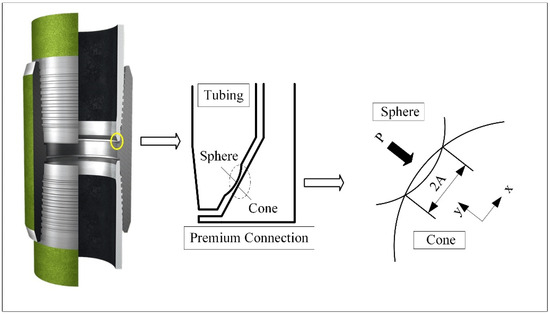
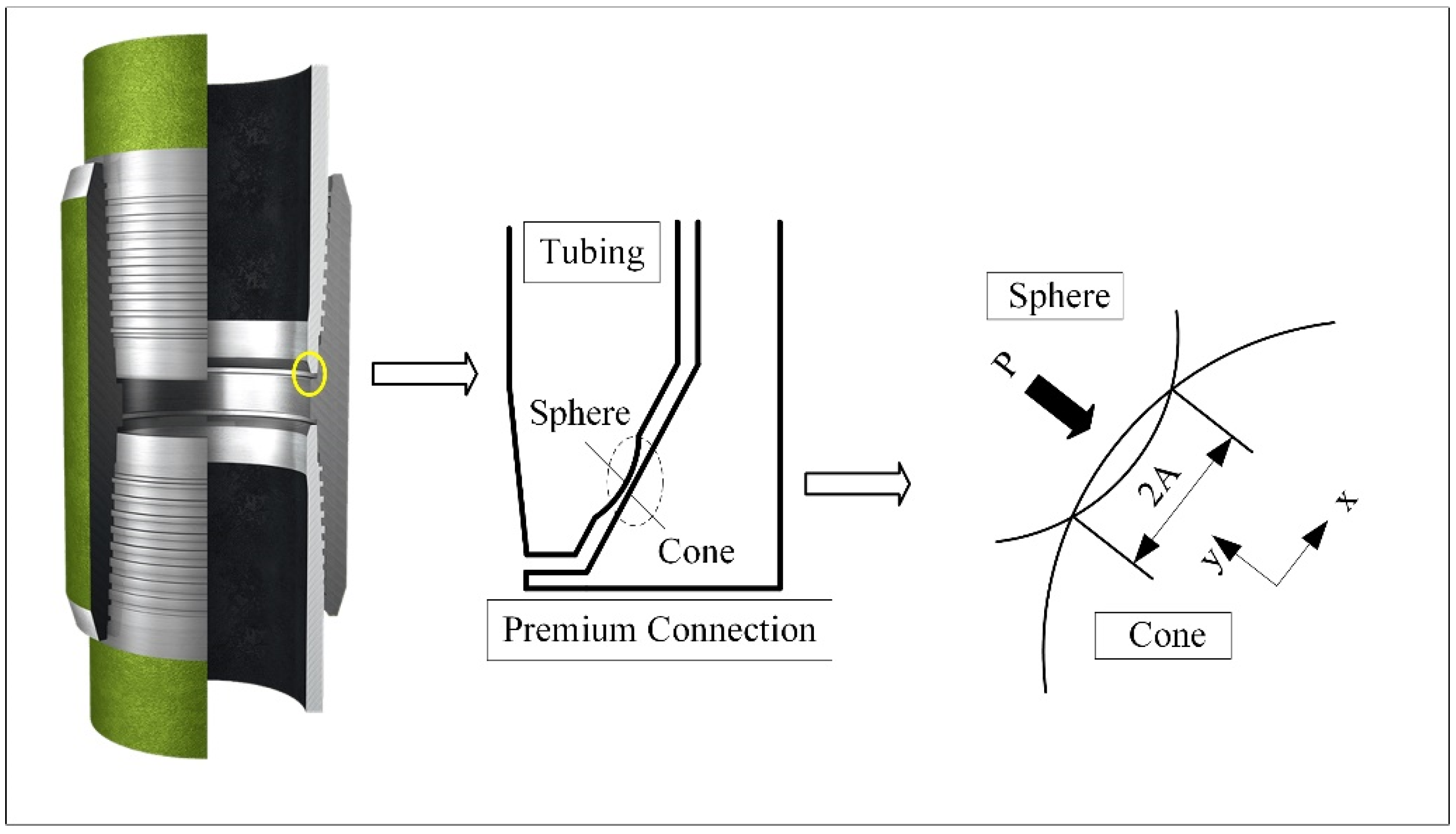
As illustrated in Figure 1, the sealing interface consists of a spherical surface in contact with a conical surface, forming a non-conformal contact pair. According to classical Hertzian contact theory [26], when two elastic bodies with smooth surfaces are pressed together, elastic deformation occurs within the contact region.
Figure 1.
Schematic diagram of the sealing interface contact in a premium threaded connection.
For the sphere-on-cone configuration, a rectangular contact region is formed along the circumferential direction, with a half-width A. Following the formulation in Refs. [4,5,26], the half-width can be expressed as:
The contact pressure distribution, p(x), as a function of the distance x from the center of the contact region, can be expressed as [26]:
where P is the normal load applied to the spherical surface (N); x is the horizontal coordinate within the contact region (m); E1 and E2 are the elastic moduli of the two contacting materials (Pa); v1 and v2 are the Poisson’s ratios of the materials (dimensionless); and R1 and R2 represent the curvature radii of the spherical and conical contact surfaces, respectively (m). The derivation follows the standard Hertzian procedure of solving the elastic half-space problem [26].
By introducing a dimensionless formulation, a generalized expression for the contact pressure p(x) is
where x ∈ [−A, A] and pmax is the maximum contact pressure at x = 0.
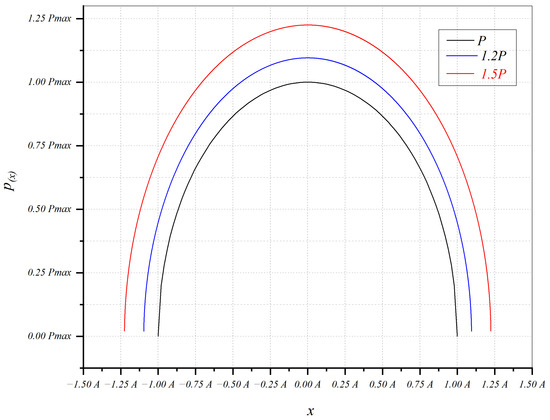
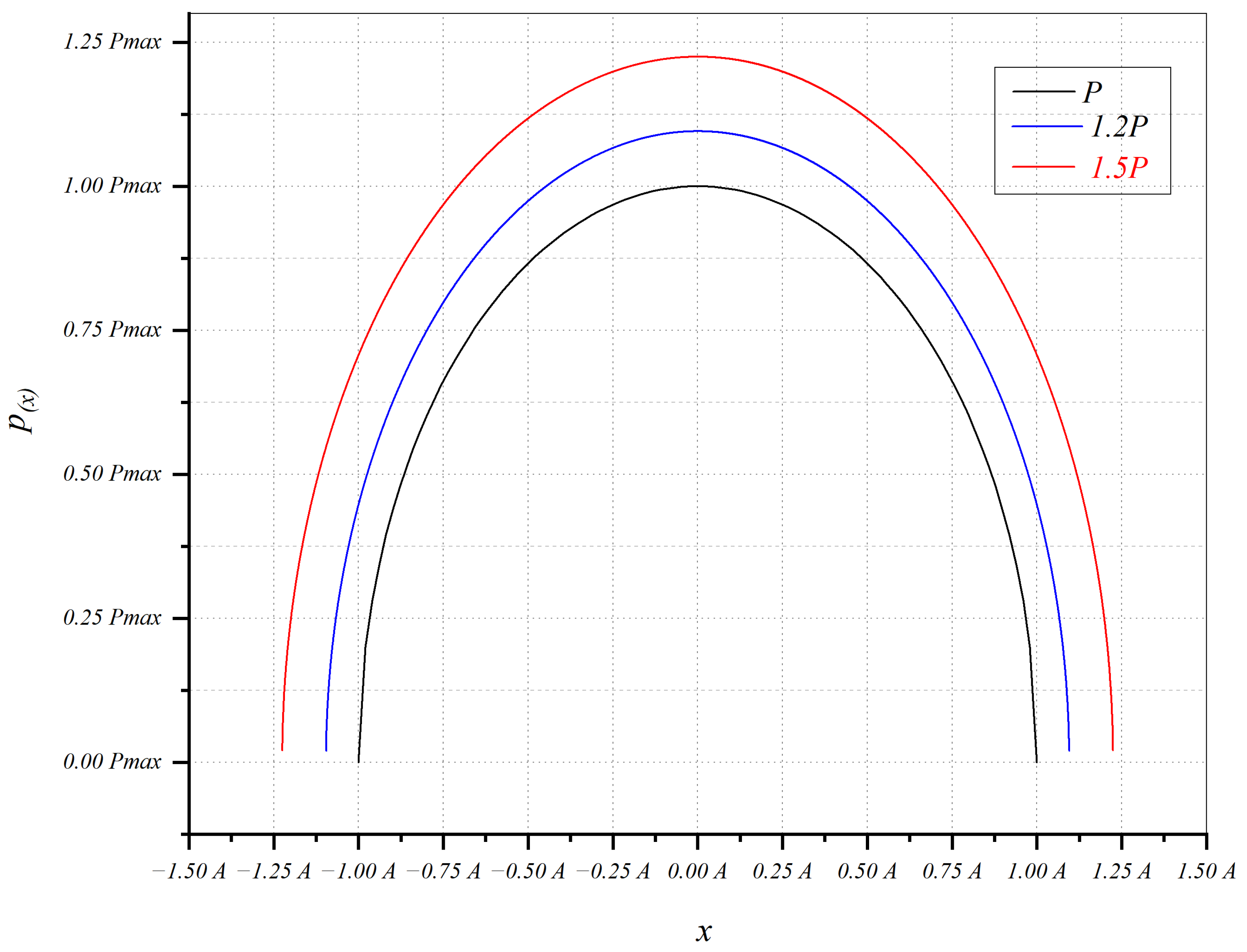
As illustrated in Figure 2, as the normal load P increases to 1.2P and 1.5P, the contact region expands; however, the increase in contact area is not proportional to the load. Based on the Hertzian solution, A scales with P1/2 and pmax also scales with P1/2, but with different constants. The combined effect produces a superlinear increase in integrated contact stiffness. The contact pressure distribution evolves into a sharper, narrower peak with increasing load, indicating that contact pressure becomes increasingly concentrated near the central region—the key mechanism underlying the nonlinear stiffening behavior.
Figure 2.
Contact pressure distribution p(x) versus contact position along the interface.
2.2. Relationship Between Contact Stiffness and Structural Natural Frequency
The local contact stiffness kc at the sealing interface is defined as the derivative of normal load with respect to normal elastic displacement
where kc is the contact stiffness (N/m) and dδ is the normal displacement (m). Physically, kc represents the incremental resistance to further deformation and depends nonlinearly on material properties and instantaneous contact geometry.
As the load increases, the contact interface stiffens because: (i) the real contact area increases, bringing more asperities into load-bearing contact; and (ii) the mean contact pressure increases, further compressing already-contacting asperities.
To relate interfacial contact stiffness to global dynamic characteristics, the connection is modeled as a structure whose overall stiffness decomposes into pipe body stiffness kbody and interfacial stiffness kinterface. These act in series for the relevant deformation modes:
When loosely connected, kinterface is small and dominates keff. As T increases, kinterface grows and keff asymptotically approaches kbody—the stiffness saturation regime.
For a linear elastic structure, the natural frequency f relates to effective stiffness and modal mass m by:
Since T ≈ K·D·P, where K is the nut factor and D is the nominal diameter and pmax ∝ P1/2 ∝ T1/2, the dependence of f on T exhibits superlinear behavior in the low-torque regime (kinterface ≪ kbody) transitioning to sublinear behavior in the high-torque regime (kinterface ≫ kbody). Based on this reasoning, f ∝ Tβ, with β > 1 reflecting stiffness hardening and β < 1 reflecting stiffness saturation. The transition defines the critical torque range of practical importance.
This framework provides the physical basis for interpreting the experimental results. The above analysis is based on idealized Hertzian assumptions and a simplified series-stiffness model; actual interfaces involve surface roughness, potential plastic deformation, and complex 3D stress states. These limitations are further discussed in Section 4.2.4.
3. Dynamic Response of Premium Threaded Connections Under Different Interfacial Contact Conditions
Under different normal loads, significant variations are observed in the contact area and peak contact pressure of the sphere-on-cone sealing interface. At the initial stage of contact, when the spherical and conical surfaces just come into contact, no effective contact pressure is generated, resulting in a relatively low contact stiffness and high damping. As the contact develops, the contact pressure at the sealing interface can reach up to 1600 MPa [5], leading to a substantial increase in stiffness. Therefore, variations in interfacial contact conditions indirectly influence the overall structural stiffness and dynamic response.
3.1. Experimental Setup
The test specimen is a premium threaded connection of a P110 tubing with dimensions of Φ88.9 mm × 6.45 mm, with both ends connected to tubing sections of 600 mm in length. Measurement points were marked along the axial direction of the pipe at intervals of 100 mm, as illustrated in Figure 3. Three accelerometers were mounted at positions 1, 6, and 12 using adhesive bonding to ensure firm attachment.
Figure 3.
Schematic diagram of sensor locations.
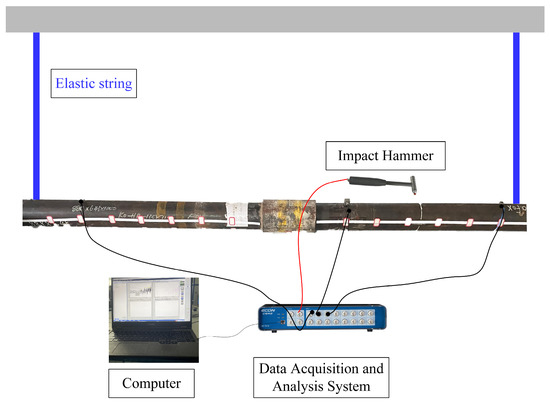
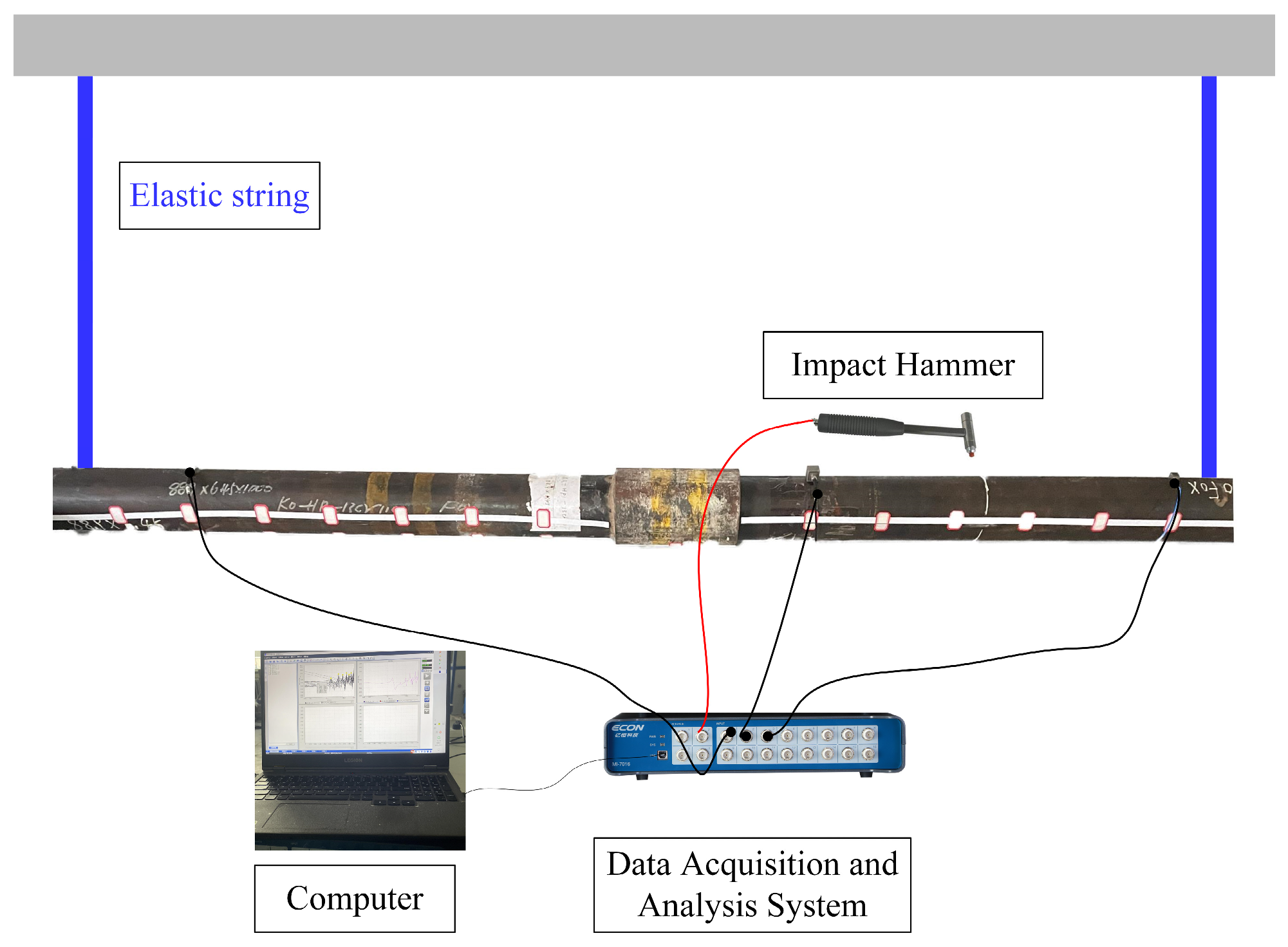
A free–free boundary condition was implemented by suspending the specimen using elastic ropes at both ends. The experimental setup is shown in Figure 4. An impact hammer was used to excite the structure, and the vibration responses were collected using a modal acquisition and analysis system. The sensitivity of the impact hammer is 2.45 mV/N. The acceleration sensors include two triaxial accelerometers and one uniaxial accelerometer, and their sensitivities are listed in Table 1.
Figure 4.
Experimental setup for dynamic response measurement of the threaded connection.
Table 1.
Sensitivity parameters of the accelerometers.
3.2. Establishment of Different Interfacial Contact Conditions
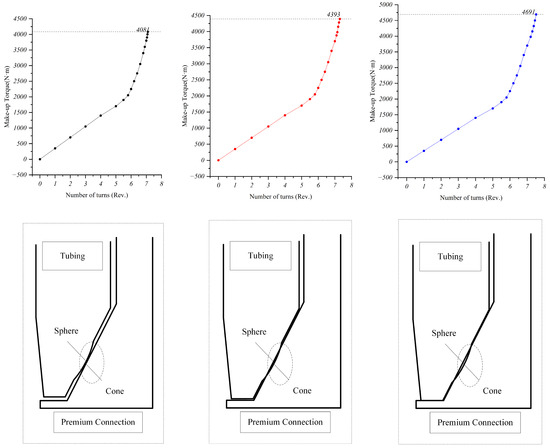
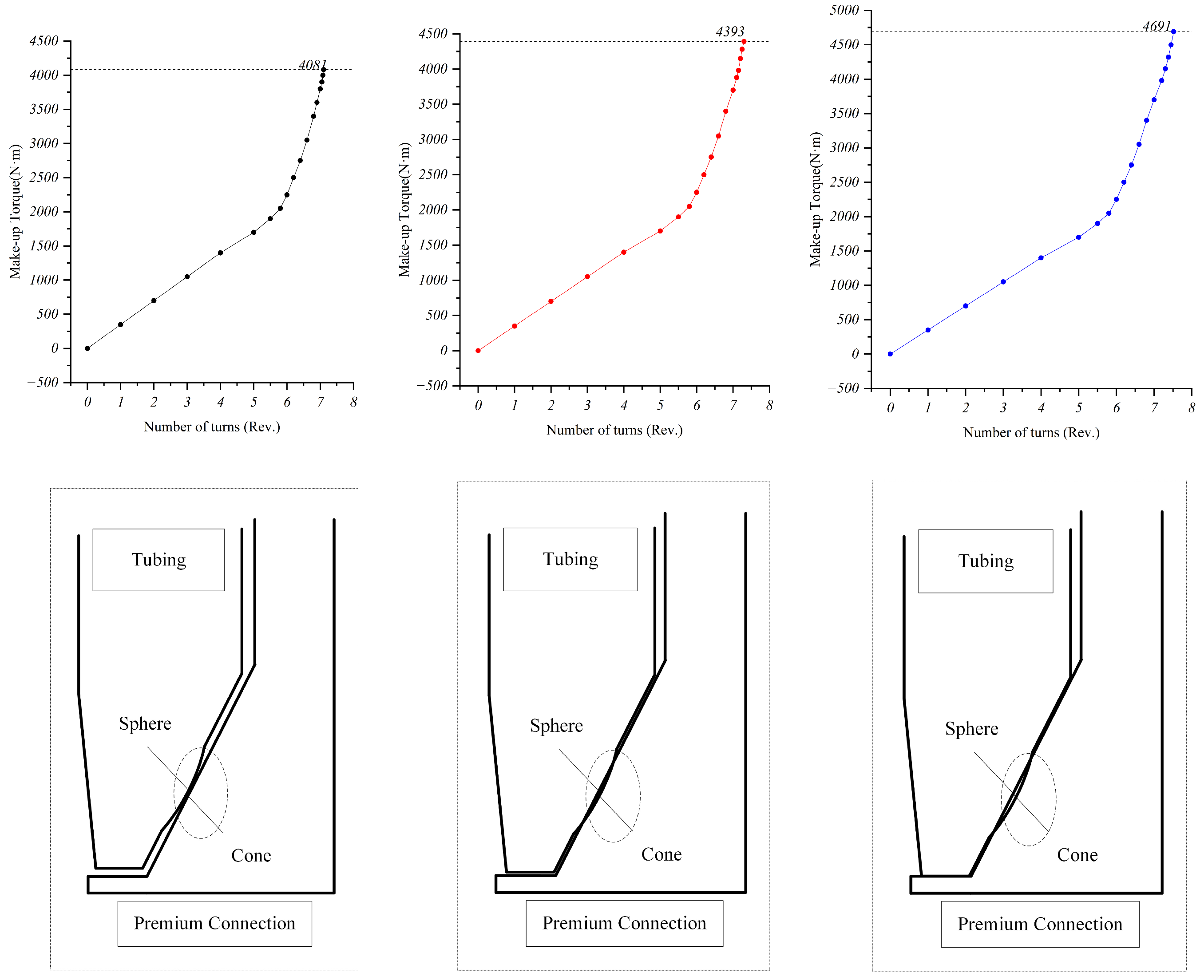
Three tightening torque levels were applied using a hydraulic power tong equipped with a calibrated torque transducer (accuracy: ±2% of full scale). The torque levels were selected to span the practical operating range from minimum recommended make-up torque to near the maximum allowable torque. The transducer continuously recorded torque during the process.
Figure 5 presents the recorded tightening torque curves as a function of rotation angle (turns). In the initial shoulder engagement stage, torque increases gradually as threads engage. Torque then rises sharply during sealing surface contact, reflecting progressive compression of the sphere-on-cone interface. The plateau regions correspond to final target torque values. Differences in slope and plateau levels among the three curves directly reflect varying degrees of interfacial compression and distinct contact states. These curves were recorded directly by the data acquisition system integrated with the hydraulic power tong.
Figure 5.
Tightening torque curves under three different interfacial contact conditions.
3.3. Experimental Data and Dynamic Response Analysis
For each contact condition, impact excitation was sequentially applied at 13 marked positions starting from Position 1. The acceleration responses were recorded by the sensors at three measurement locations and processed using the data acquisition system to obtain the dynamic characteristics of the structure. Each impact test was repeated ten times to ensure the consistency of the measured data and to minimize the influence of random disturbances.
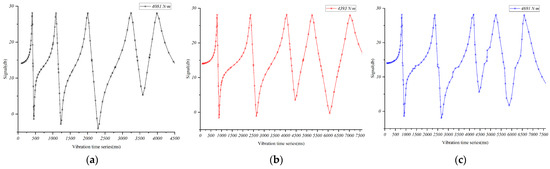
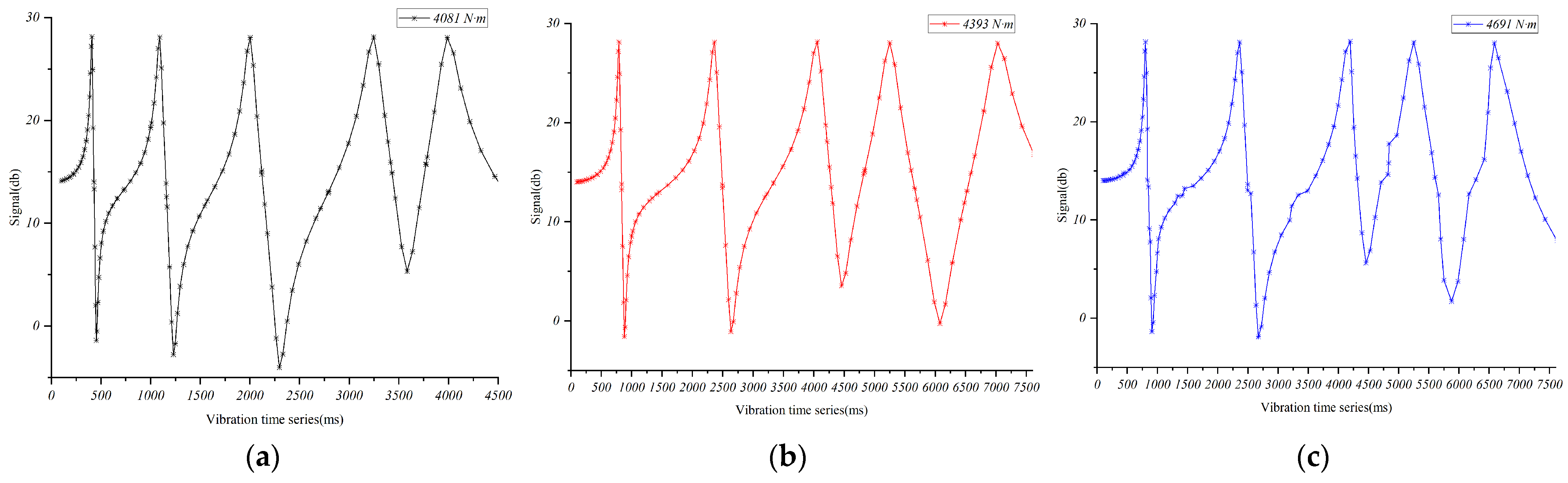
The dynamic responses of the premium threaded connection under different contact conditions are shown in Figure 6.
Figure 6.
Dynamic responses of the threaded connection under three different interfacial contact conditions: (a) Contact condition at 4081 N⋅m; (b) Contact condition at 4393 N⋅m.; (c) Contact condition at 4691 N⋅m.
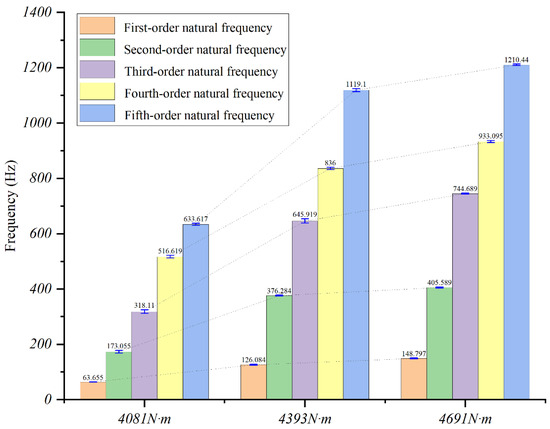
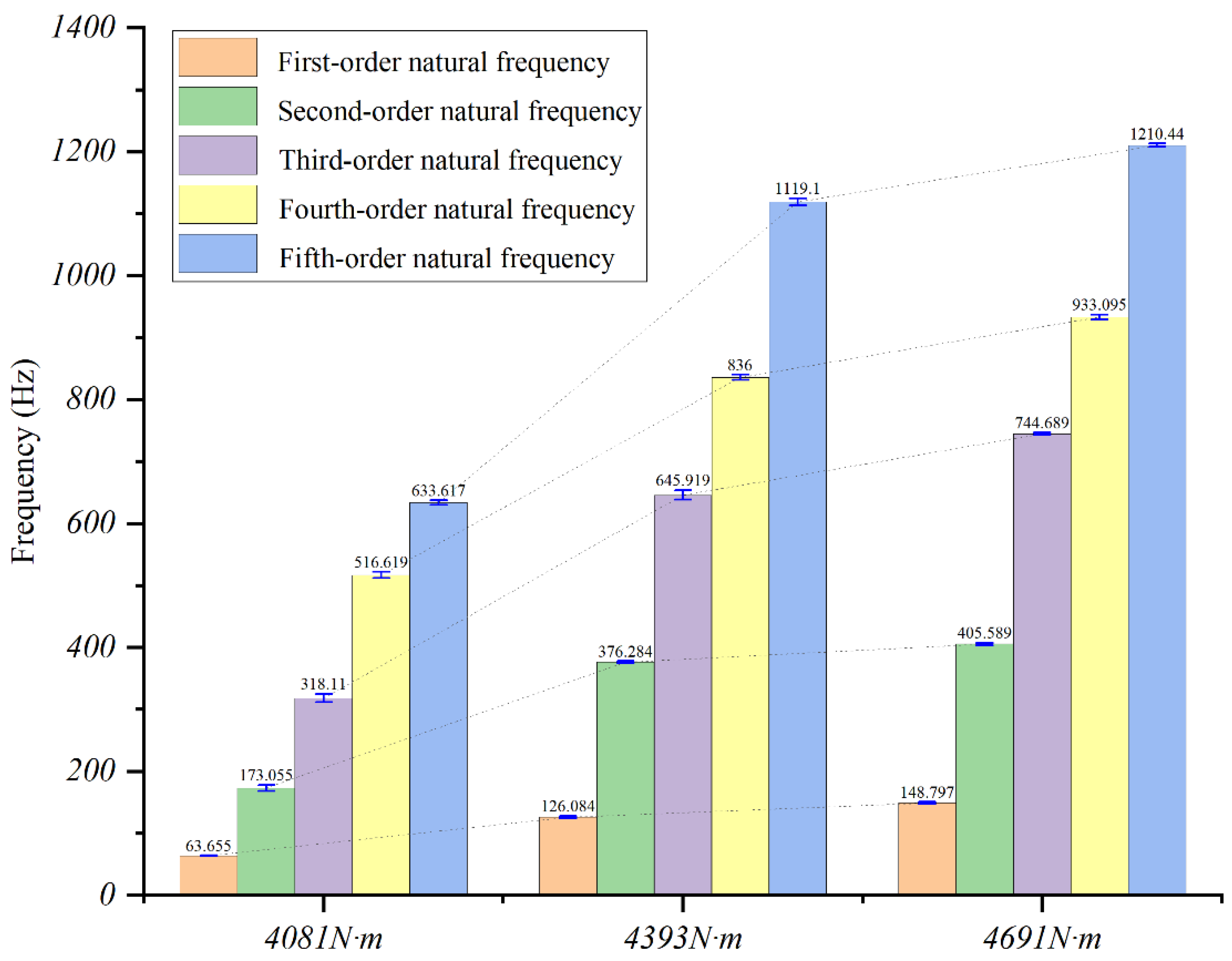
Frequency regression analysis yielded the natural frequencies summarized in Table 2. At 4081 N·m, the first three mean natural frequencies are 63.655 Hz, 173.055 Hz, and 318.110 Hz. At 4393 N·m, frequencies rise to 126.084 Hz, 376.284 Hz, and 645.919 Hz. At 4691 N·m, they reach 148.797 Hz, 405.589 Hz, and 744.689 Hz. The interfacial contact condition significantly influences dynamic characteristics—the rate of frequency increase exceeds the rate of torque increase, confirming nonlinear stiffening behavior.
Table 2.
Natural frequencies of the premium threaded connection under different interfacial contact conditions (mean ± standard deviation).
3.4. Data Processing and Frequency Extraction Methodology
To ensure transparency and reproducibility, the complete data processing pipeline is described here. The methodology involves signal preprocessing, frequency identification, and regression analysis.
3.4.1. Signal Preprocessing
Raw acceleration time histories were inspected for signal quality. A Hanning window was applied to both force and acceleration signals to minimize spectral leakage. Signals were transformed to the frequency domain via FFT with 0.125 Hz resolution. The frequency response function FRF(ω) = Sxf(ω)/Sff(ω) was computed for each channel, where Sxf is the cross-power spectral density between acceleration and force, and Sff is the force auto-power spectrum. The coherence function γ2(ω) assessed FRF quality; only points with γ2 ≥ 0.90 near resonance peaks were retained.
3.4.2. Natural Frequency Identification
Frequencies were identified from FRF magnitude and phase spectra using the peak-picking method. Each candidate peak was verified against: (i) a corresponding 180° phase shift; (ii) a local coherence peak (γ2 ≥ 0.90); and (iii) consistent peak shape across multiple measurement locations. Mode shapes were qualitatively assessed by comparing FRF magnitudes and phases across the three accelerometer positions, enabling assignment of each peak to a specific mode order (1st–5th). For each torque condition, the natural frequency of each mode was extracted from ten repeated tests. The mean and standard deviation in Table 2 were computed from these repetitions.
4. Discussion and Analysis
4.1. Overall Influence of Tightening Torque on Natural Frequencies
As shown in Figure 7, the natural frequencies of the premium threaded connection exhibit a significant increasing trend across all vibration modes as the tightening torque increases from 4081 N⋅m to 4393 N⋅m and further to 4691 N⋅m. Taking the first-order frequency as an example, when the torque increases from 4081 N⋅m to 4393 N⋅m, the frequency rises sharply from 63.655 Hz to 126.084 Hz, corresponding to an increase of approximately 98%. In contrast, when the torque further increases from 4393 N⋅m to 4691 N⋅m, the frequency only increases from 126.084 Hz to 148.797 Hz, with a much smaller increment of about 18%.
Figure 7.
Natural frequencies of the threaded connection under three different interfacial contact conditions.
This behavior is explained by the series-stiffness model (Section 2.2). At low torque, kinterface ≪ kbody and dominates keff; modest torque increases produce substantial stiffness gains. Beyond the transition region (4393–4691 N·m), kinterface approaches kbody, and further torque increases yield only marginal stiffness enhancement.
Ibrahim and Pettit [21] reviewed similar stiffness-hardening behavior in bolted joints, and Jalali et al. [22] demonstrated that contact parameters in bolted interfaces can be inversely identified from vibration measurements. The power-law stiffening observed here for sphere-on-cone seals mirrors these bolted-joint findings, though the curvature-concentrated pressure distribution in the present geometry produces a steeper stiffness gradient in the low-torque regime than is typically reported for flat bolted interfaces.
4.2. Quantitative Relationship Between Natural Frequency and Tightening Torque
4.2.1. Model Selection
Considering the physical characteristics of interfacial contact stiffness—namely rapid stiffening at low torque followed by gradual saturation at higher torque levels (as reflected by the sharpening of the contact pressure distribution in Figure 2)—a linear model is insufficient to describe the observed behavior. Therefore, a power-law model is adopted in the following form, as Equation (8)
where α is a scaling coefficient and β is the power exponent. The model captures monotonic growth with varying curvature; β > 1 indicates net superlinear growth, β < 1 indicates sublinear behavior.
4.2.2. Fitting Results
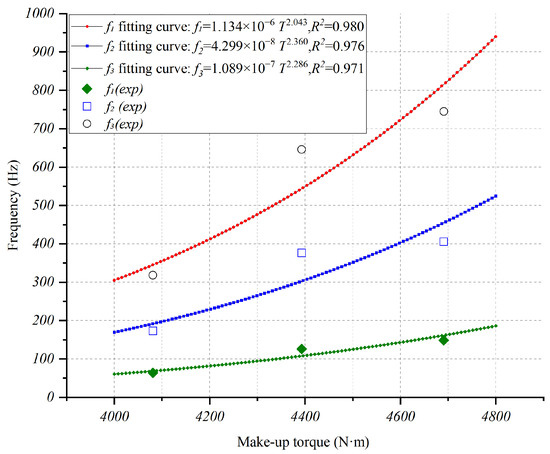
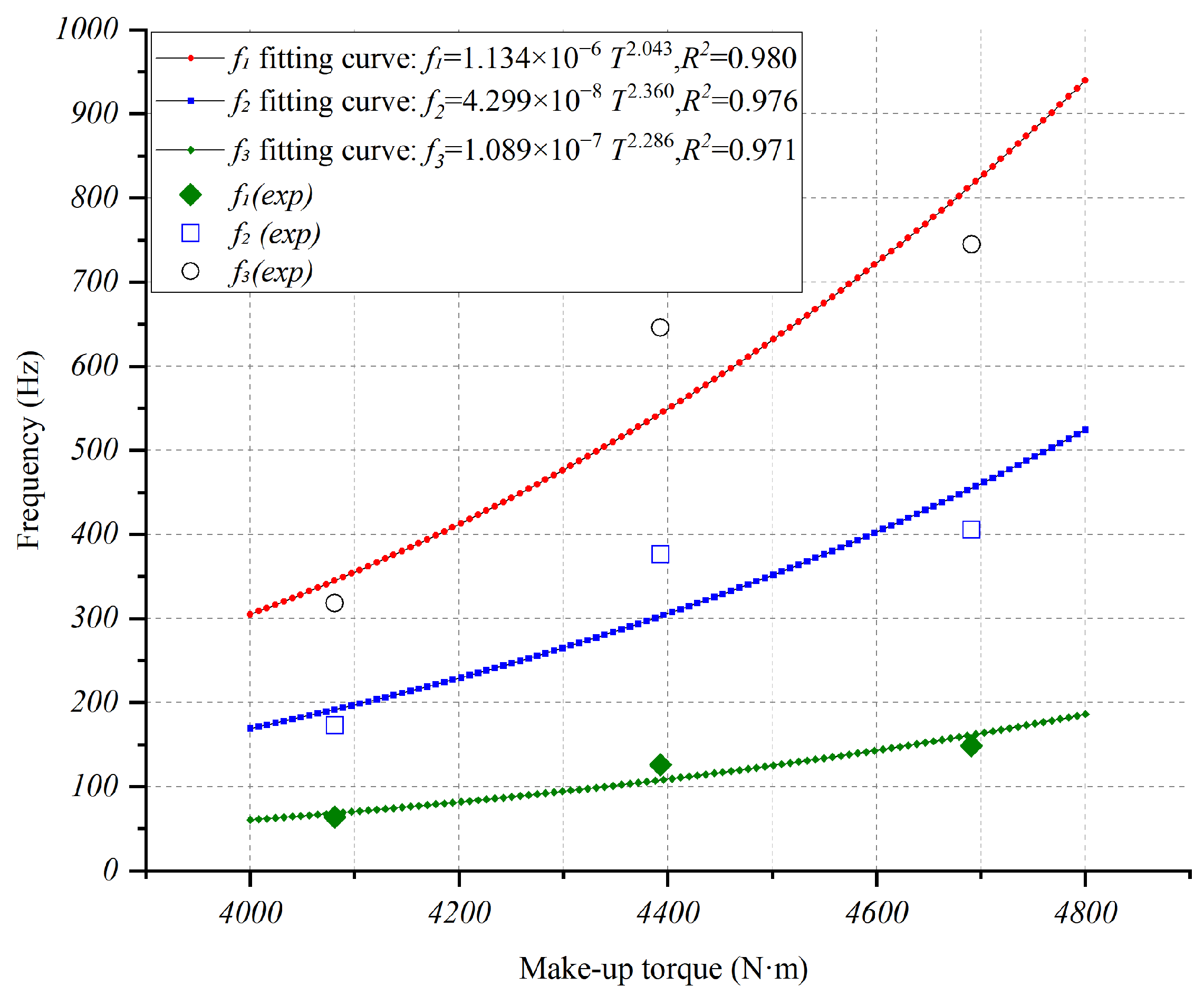
Using the mean values listed in Table 2, power-law fitting was performed for the first three vibration modes. The power-law model was fitted to mean frequency values using nonlinear least-squares regression with the Levenberg–Marquardt algorithm. Initial parameter estimates were obtained from the linearized form via ordinary least squares. R2 was computed as R2 = 1 − Σ(fi − )2/Σ(fi − )2. It is important to acknowledge that only three data points were used; while R2 measures fit quality for available data, three points cannot fully validate the model’s functional form. Fitted parameters should be interpreted as indicative trends rather than definitively validated constitutive relationships. Results are summarized in Table 3 and Figure 8.
Table 3.
Power-law fitting parameters and goodness of fit.
Figure 8.
Power-law fitting of natural frequency versus tightening torque.
All R2 values exceed 0.97, indicating excellent agreement between the model and experimental data.
A notable feature is the non-monotonic β variation: β2nd (2.360) > β3rd (2.286) > β1st (2.043). This can be understood via modal deformation patterns. The first bending mode involves largely rigid-body-like global deformation with uniform contact pressure modulation. The second and third modes involve greater rotational deformation at the interface, more effectively modulating local contact pressure and exhibiting higher sensitivity. The slight decrease from second to third mode may reflect the more localized third-mode deformation engaging a smaller portion of the sealing interface.
4.2.3. Physical Interpretation and Critical Torque Range
Although the global β exceeds unity, the local sensitivity df/dT decreases with increasing torque: for the first mode, sensitivity drops from 0.049 Hz/(N·m) at 4081 N·m to 0.037 at 4393 N·m to 0.032 at 4691 N·m. This reflects the transition from stiffness hardening to stiffness saturation predicted by the series-stiffness model.
A critical torque transition range of 4200–4400 N·m is identified. Selecting torque near the upper bound ensures near-maximum stiffness while avoiding plastic damage. This principle aligns with established bolted joint design practice [21]. The transition boundaries are estimated from interpolation between three discrete torque levels, with uncertainty of approximately ±200 N·m.
4.2.4. Model Applicability and Limitations
The model is based on only three torque levels. While R2 > 0.97 demonstrates internal consistency, three points are mathematically insufficient to uniquely validate a two-parameter nonlinear model—any monotonic two-parameter function would achieve a near-perfect fit to three points, leaving only one effective residual degree of freedom.
Despite the small sample size, three factors argue for treating the fitted relationship as physically meaningful rather than a statistical artifact: the power-law form follows directly from the nonlinearity of Hertzian sphere-on-cone contact; the three torque levels (4081, 4393, 4691 N·m) bracket the full practical make-up range for this connection size; and joint stiffening with increasing preload is a widely reported phenomenon in bolted and threaded assemblies [21,22]. However: (1) Parameters α and β are valid only within 4081–4691 N·m; extrapolation is not supported. Future work should include additional torque levels (e.g., 3500, 4000, 4200, 4500, 5000 N·m). (2) The low-torque asymptotic behavior (f → 0 as T → 0) has not been experimentally validated. (3) Standard deviations have not been propagated through regression to quantify parameter uncertainty—a formal uncertainty analysis (e.g., Monte Carlo or Bayesian regression) would provide more rigorous confidence intervals. (4) The model does not account for hysteresis, rate dependence, or long-term preload relaxation under service conditions.
4.3. Sensitivity of Different Vibration Modes to Contact Stiffness
By comparing the relative increases in natural frequencies across different torque intervals, as summarized in Table 4, it can be observed that the lower-order modes (1st–3rd) are significantly more sensitive to variations in contact stiffness than the higher-order modes. In particular, the frequency increments of the lower-order modes exceed 100% in the low-torque range (4081–4393 N⋅m), whereas the increases for the 4th and 5th modes are relatively moderate.
Table 4.
Percentage increase in natural frequencies with increasing tightening torque.
This difference can be attributed to the distinct deformation characteristics of different vibration modes. The lower-order modes are dominated by global bending or overall oscillation of the structure, in which the sealing interface undergoes relatively large deformation. Consequently, variations in interfacial contact stiffness have a pronounced effect on these modes.
In contrast, higher-order modes are typically associated with localized bending or wave-like deformation of the pipe wall. In such cases, the contribution of the sealing interface stiffness to the overall structural response is relatively reduced, resulting in smaller frequency variations. Furthermore, higher-order modes tend to be more sensitive to mass distribution and boundary conditions, which further diminishes the relative influence of contact stiffness on their dynamic behavior. Chang et al. [23] observed comparable mode-dependent sensitivity in bolted structures and attributed it to the varying degree to which different deformation modes engage the contact interface. The present data reinforce this mechanism: the second bending mode, which produces the largest relative angular displacement at the threaded joint among the first five modes, yields the highest power-law exponent (β = 2.36), whereas the predominantly axial first mode shows the lowest sensitivity (β = 2.04). This non-monotonic β distribution—Mode 2 (2.360) > Mode 3 (2.286) > Mode 1 (2.043)—is consistent with the expectation that modes involving larger sealing-interface deformation are more responsive to torque-induced contact stiffening.
4.4. Analysis of Data Dispersion (Standard Deviation)
Based on the standard deviation values presented in Table 2, noticeable differences in data dispersion can be observed under different tightening torque levels. At 4081 N⋅m, the standard deviation of the first-order frequency is relatively small (0.498 Hz), whereas those of the second- and third-order frequencies are significantly larger (4.592 Hz and 6.760 Hz, respectively). This indicates that, under low torque conditions, higher-order modes are more sensitive to experimental uncertainties, such as impact location, sensor attachment quality, and hammer excitation angle.
In contrast, at higher torque levels (4393 N⋅m and 4691 N⋅m), the standard deviations of all modes are generally lower (mostly within the range of 2–5 Hz), suggesting that increased tightening torque leads to more stable and uniform interfacial contact conditions, thereby improving the repeatability of the measurements.
In this study, each impact test was repeated ten times and averaged to reduce random errors. The remaining variability may be attributed to several factors: (1) slight variations in the impact angle of the hammer, resulting in inconsistent excitation directions; (2) minor boundary disturbances introduced by the elastic suspension system; (3) manufacturing tolerances of the threaded connection, leading to non-uniform contact at the sealing interface; and (4) small deviations in the placement of accelerometers.
Overall, the reduced standard deviation at higher torque levels demonstrates that increasing tightening torque enhances the stability of the contact interface and mitigates the influence of experimental uncertainties on the measured dynamic response.
4.5. Implications for Engineering Practice
Based on the above analysis and discussion, several practical implications for engineering applications can be drawn:
- Accurate control of tightening torque is essential.
The dynamic characteristics of premium threaded connections, particularly the natural frequency, are highly sensitive to the interfacial contact condition. Insufficient tightening torque results in low structural stiffness, increasing the risk of loosening or sealing failure under vibrational conditions. Conversely, excessive torque may induce excessive plastic deformation of the sealing surface, potentially leading to galling or damage. Therefore, it is recommended to select the target torque within the transition region of the frequency–torque curve, specifically beyond the inflection point but before full stiffness saturation. Under the present experimental conditions, this range is approximately 4300–4500 N⋅m.
- 2.
- Natural frequency as a non-destructive evaluation (NDE) indicator.
Given the strong dependence of natural frequency on interfacial contact conditions, and considering the simplicity and repeatability of vibration testing, natural frequency can serve as an effective non-destructive indicator. Field measurements (e.g., impact testing combined with accelerometer-based acquisition systems) can be used to rapidly assess whether the connection has reached the desired tightening torque or to detect potential loosening during service. This method offers advantages of being non-destructive, cost-effective, and efficient, making it suitable for on-site quality control and in-service monitoring in oilfield applications.
- 3.
- Guidance for finite element model calibration.
The experimental data obtained in this study can be utilized to calibrate contact stiffness models of premium threaded connections. In particular, they provide a basis for parameter identification of the contact pressure–gap relationship in sphere-on-cone sealing structures. By comparing simulated natural frequencies with experimental results, appropriate contact stiffness parameters can be inversely determined, thereby improving the predictive accuracy of finite element analyses.
4.6. Limitations and Future Work
Despite the promising results obtained in this study, several limitations should be acknowledged and addressed in future research:
- Limited number of torque levels.
Only three tightening torque levels were considered in this study, with relatively large intervals between them. Future work should include a wider range of torque values (e.g., from 3500 N⋅m to 5000 N⋅m with smaller increments) to establish a more comprehensive frequency–torque relationship and to more precisely identify the stiffness transition threshold.
- 2.
- Simplified boundary conditions.
The experiments were conducted under free–free boundary conditions using elastic suspension, which differ from actual service conditions where the tubing is connected to wellhead or string systems. Further studies should investigate different boundary conditions (e.g., fixed–free and fixed–fixed) to evaluate their influence on the frequency evolution behavior.
- 3.
- Neglect of damping characteristics.
Only frequency changes were analyzed; damping characteristics from micro-slip and friction may provide complementary diagnostic information. Future work should extract damping ratios (e.g., half-power bandwidth method) and evaluate combined frequency-damping signatures.
- 4.
- Lack of numerical validation.
Finite element simulations were not incorporated in this study. Future work should integrate experimental results with numerical modal analysis to establish contact models considering nonlinear interface behavior. By comparing simulated and measured natural frequencies, the proposed contact pressure distribution model in Section 2 can be further validated and refined, providing a more reliable basis for the optimal design of premium threaded connections.
5. Conclusions
This study experimentally investigated the evolution of natural frequencies of premium threaded connections under varying interfacial contact stiffness, aiming to establish a vibration-based NDE method for assessing tightening quality. Modal tests were conducted on a full-scale P110 premium threaded connection under three tightening torque levels. The main conclusions are:
- (1)
- Natural frequencies exhibit a pronounced nonlinear increase with tightening torque, well described by a power-law model f = αTβ with β > 2 for all three analyzed modes (β = 2.043, 2.360, 2.286; R2 > 0.97). This superlinear behavior is consistent with nonlinear stiffening predicted by the Hertzian contact model applied to the sphere-on-cone sealing interface.
- (2)
- A critical torque transition range of approximately 4200–4400 N·m was identified, marking the boundary between stiffness-hardening and stiffness-saturation regimes. Below this range, frequencies increase sharply (98% first-mode increase between 4081 and 4393 N·m); above it, growth diminishes substantially (18% between 4393 and 4691 N·m).
- (3)
- Lower-order modes (1st–3rd) exhibit substantially higher sensitivity to contact stiffness variations than higher-order modes (4th–5th), with frequency increases exceeding 100% for lower modes versus 62–77% for higher modes in the low-torque range. This hierarchy has direct implications for monitoring mode selection in NDE applications.
- (4)
- Measurement repeatability improves systematically with increasing torque, indicating that the method is most reliable for detection under tightening conditions where frequency deviations substantially exceed measurement uncertainty.
- (5)
- Monitoring the natural frequencies of lower-order modes (1st–3rd) in the stiffness-hardening regime below approximately 4400 N·m provides a quantifiable, non-destructive basis for detecting under-tightening, with frequency deviations exceeding 10% for torque shortfalls of 300 N·m or more—well above the measurement repeatability threshold of ±0.5% established in this study.
The scientific contribution lies in experimentally establishing the quantitative power-law relationship between make-up torque and natural frequency for premium threaded connections with sphere-on-cone sealing geometry, and in identifying a critical stiffness transition range. The series-stiffness model provides a physically grounded framework for interpreting the observed hardening-to-saturation transition.
Several limitations constrain generalizability: conclusions are based on three torque levels from a single P110 specimen under free–free boundary conditions; the power-law model parameters lack independent out-of-sample validation; and damping characteristics were not investigated. Future work should: (i) extend the experimental dataset with finer torque resolution; (ii) incorporate damping ratio analysis; (iii) develop FE simulations with nonlinear contact models; (iv) investigate realistic boundary conditions; and (v) test across varying connection sizes, materials, and geometries to establish generalizability and predictive scaling relationships.
Author Contributions
Conceptualization, S.X. and Y.Y.; methodology, S.X. and Y.Y.; software, Y.C.; validation, J.S. and Y.D.; formal analysis, S.X.; investigation, S.X.; resources, Y.Y.; data curation, Y.C.; writing—original draft preparation, S.X.; writing—review and editing, Y.Y. and Y.D.; visualization, J.S.; supervision, Y.Y.; project administration, Y.Y.; funding acquisition, Y.Y. All authors have read and agreed to the published version of the manuscript.
Funding
This research was funded by the National Natural Science Foundation of China (grant number 52374039), Key Scientific Research Program of Shaanxi Provincial Department of Education (grant number 25JR018) and the Key Project of Shaanxi Institute of Technology (grant number Pt25-04). The APC was funded by the authors.
Institutional Review Board Statement
Not applicable.
Informed Consent Statement
Not applicable.
Data Availability Statement
The data presented in this study are available on request from the corresponding author due to ongoing research.
Acknowledgments
During the preparation of this manuscript, the authors used ChatGPT (GPT-5.5, OpenAI)for language polishing. The authors have reviewed and edited the output and take full responsibility for the content of this publication.
Conflicts of Interest
The authors declare no conflicts of interest.
Abbreviations
The following abbreviations are used in this manuscript:
| NDE | Non-destructive evaluation |
| FRF | Frequency response function |
| SD | Standard deviation |
References
- Alsubaih, A.A.S.; Sepehrnoori, K.; Delshad, M.; Alsaedi, A. A Comprehensive Review of Well Integrity Challenges and Digital Twin Applications Across Conventional, Unconventional, and Storage Wells. Energies 2025, 18, 4757. [Google Scholar] [CrossRef] [Scilit]
- Teodoriu, C.; Bello, O.; Rinne, J. Experimental Investigations of Thread Compounds Viscosity Degradation towards Long Term Threaded Connections Leak Resistance. J. Nat. Gas. Sci. Eng. 2020, 84, 103677. [Google Scholar] [CrossRef] [Scilit]
- Wang, C.; Gao, L. Design of Premium Threaded Connections for Oil Casing Based on Herz Theory. J. Mech. Sci. Technol. 2024, 38, 6583–6590. [Google Scholar] [CrossRef] [Scilit]
- Cui, F.; Li, W.; Wang, G.; Gu, Z.; Wang, Z. Design and Study of Gas-Tight Premium Threads for Tubing and Casing. J. Pet. Sci. Eng. 2015, 133, 208–217. [Google Scholar] [CrossRef] [Scilit]
- Yu, Y.; Qu, Z.; Cao, Y.; Dou, Y.; Li, J. Sealability Analyses of Premium Connections Characterized by a Surface Fractal Function. Appl. Sci. 2023, 13, 6467. [Google Scholar] [CrossRef] [Scilit]
- Xu, H.; Shi, T.; Zhang, Z.; Shi, B. Loading and Contact Stress Analysis on the Thread Teeth in Tubing and Casing Premium Threaded Connection. Math. Probl. Eng. 2014, 2014, 287076. [Google Scholar] [CrossRef] [Scilit]
- Strelkov, K.S.; Murashkin, E.V. Sealability of Premium Threaded Connections under Creep. Mech. Solids 2025, 60, 6583–6590. [Google Scholar] [CrossRef] [Scilit]
- Yu, H.; Wang, H.; Lian, Z. An Assessment of Seal Ability of Tubing Threaded Connections: A Hybrid Empirical-Numerical Method. J. Energy Resour. Technol. 2022, 145, 043201. [Google Scholar] [CrossRef] [Scilit]
- Chen, W.; Di, Q.; Zhang, H.; Chen, F.; Wang, W. The Sealing Mechanism of Tubing and Casing Premium Threaded Connections under Complex Loads. J. Pet. Sci. Eng. 2018, 171, 724–730. [Google Scholar] [CrossRef] [Scilit]
- Li, J.N.; Wang, J.; Hu, Y.Q.; You, Z.X.; Xu, M.; Wang, Y.W.; Zou, Z.J.; Kang, Q.Y. Contact Performance Analysis of Pressure Controller’s Sealing Interface in Deep In-Situ Pressure-Preserved Coring System. Pet. Sci. 2022, 19, 1334–1346. [Google Scholar] [CrossRef] [Scilit]
- Tong, L.; Qifei, D.; Ning, W.; Yuhan, Z.; Junhao, W.; Dongwenxu, W.; Yu, C.; Yi, W. Contact Form and Angle of Conical Metal Sealing in Casing Hangers: Influence on Sealing Performance. Pet. Res. 2025. advance online publication. [Google Scholar] [CrossRef] [Scilit]
- Chen, F.; Liu, J.Q.; Yang, S.Y.; Zhang, S.N.; Zhang, J.N.; Wang, W.C.; Di, Q.F. Stress Characteristics and Sealing Mechanism of Steel-Titanium Heterogeneous Drill Pipe Joints. Pet. Sci. 2026. advance online publication. [Google Scholar] [CrossRef] [Scilit]
- Li, Y.F.; Ye, S.B.; Wang, Y.Y.; Lin, Z.Q.; Li, N.; Wang, B.F. Study on the Sealing Performance of the K-Type Metal Sealing Ring of the Subsea Christmas Tree. Pet. Sci. 2026, 23, 1519–1532. [Google Scholar] [CrossRef] [Scilit]
- Ernens, D.; Pérez-Ràfols, F.; Hoecke, D.V.; Roijmans, R.F.; van Riet, E.J.; Vande Voorde, J.B.; Almqvist, A.; de Rooij, M.B.; Roggeband, S.M.; van Haaften, W.M.; et al. On the Sealability of Metal-to-Metal Seals with Application to Premium Casing and Tubing Connections. SPE Drill. Complet. 2019, 34, 382–396. [Google Scholar] [CrossRef] [Scilit]
- Chen, Y.; Xiao, G.; Yi, H.; Ding, Y.; Tan, J. Investigation on Critical Load and Sealing Capacity of Mandrel Hanger Wellhead. Int. J. Press. Vessel. Pip. 2022, 199, 104767. [Google Scholar] [CrossRef] [Scilit]
- Oku, Y.; Sugino, M.; Ando, Y.; Makino, T.; Komoda, R.; Takazaki, D.; Kubota, M. Fretting Fatigue on Thread Root of Premium Threaded Connections. Tribol. Int. 2017, 108, 111–120. [Google Scholar] [CrossRef] [Scilit]
- Han, T.; Fan, J.; Huang, B.; Liu, S. Study on Ultrasonic Testing Method for Sealing Performance of Premium Threaded Tubing. China Pet. Mach. 2021, 49, 144–150. [Google Scholar] [CrossRef]
- Han, T.; Fan, J.; Tian, C. Method for Detecting Sealing of Premium Connection Tubing Based on Magnetic-Acoustic. Lubr. Eng. 2021, 46, 6–12. [Google Scholar] [CrossRef]
- Han, T.; Fan, J. Measurement and Evaluation of Metal-to-Metal Seals Sealability by Ultrasonic Phased Array. Metals 2023, 13, 1032. [Google Scholar] [CrossRef] [Scilit]
- Tian, C.; Fan, J.; Hu, J. Phased Array Ultrasonic Image Characteristic Analysis of Premium Tubing Sealing Surface. China Pet. Mach. 2024, 52, 123–129. [Google Scholar] [CrossRef]
- Ibrahim, R.A.; Pettit, C.L. Uncertainties and Dynamic Problems of Bolted Joints and Other Fasteners. J. Sound Vib. 2005, 279, 857–936. [Google Scholar] [CrossRef] [Scilit]
- Jalali, H.; Khodaparast, H.H.; Madinei, H.; Friswell, M.I. Stochastic Modelling and Updating of a Joint Contact Interface. Mech. Syst. Signal Process. 2019, 129, 645–658. [Google Scholar] [CrossRef] [Scilit]
- Chang, Y.; Ding, J.; Fan, H.; Ding, Y.; Lu, H.; Chen, Y.; Shehzad, A.; Zhuang, H.; Chen, P. A Hybrid Method for Bolted Joint Modeling Considering Multi-Scale Contact Mechanics. Precis. Eng. 2022, 78, 171–188. [Google Scholar] [CrossRef] [Scilit]
- Doebling, S.W.; Farrar, C.R.; Prime, M.B. A Summary Review of Vibration-Based Damage Identification Methods. Shock Vib. Dig. 1998, 30, 91–105. [Google Scholar] [CrossRef] [Scilit]
- Carden, E.P.; Fanning, P. Vibration Based Condition Monitoring: A Review. Struct. Health Monit. 2004, 3, 355–377. [Google Scholar] [CrossRef] [Scilit]
- Johnson, K.L. Contact Mechanics; Cambridge University Press: Cambridge, UK, 1985. [Google Scholar] [CrossRef] [Scilit]



Disclaimer/Publisher’s Note: The statements, opinions and data contained in all publications are solely those of the individual author(s) and contributor(s) and not of MDPI and/or the editor(s). MDPI and/or the editor(s) disclaim responsibility for any injury to people or property resulting from any ideas, methods, instructions or products referred to in the content. |
© 2026 by the authors. Licensee MDPI, Basel, Switzerland. This article is an open access article distributed under the terms and conditions of the Creative Commons Attribution (CC BY) license.