Article

Stability-Aware Uplift Policy Selection for Customer Retention: From Predictive Scores to Actionable Segments


by
Massimo Pacella
1,*,
Gabriele Papadia
1 and
Vincenzo Giliberti
2
1
Department of Engineering for Innovation, University of Salento, 73100 Lecce, Italy
2
IN & OUT S.p.A. a Socio Unico Teleperformance S.E., 74121 Taranto, Italy
*
Author to whom correspondence should be addressed.
Appl. Sci. 2026, 16(10), 4918; https://doi.org/10.3390/app16104918
Submission received: 17 April 2026 / Revised: 8 May 2026 / Accepted: 11 May 2026 / Published: 14 May 2026

Abstract

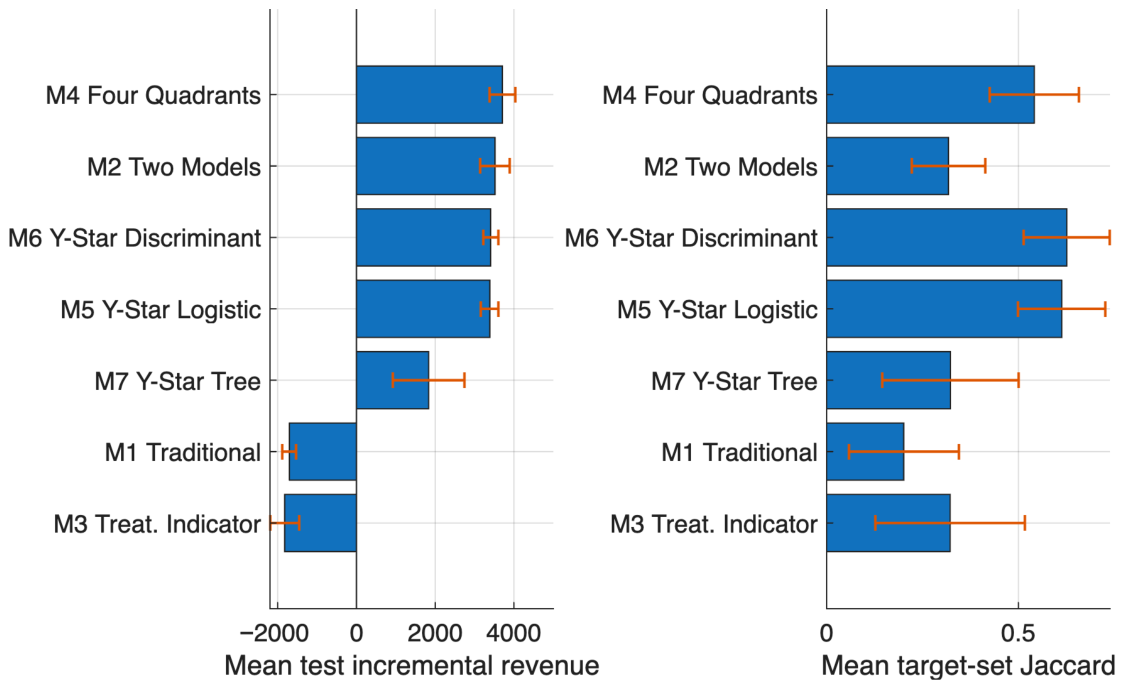
Uplift modeling optimizes intervention-based campaigns by identifying customers whose behavior changes exclusively due to specific treatments, moving beyond standard baseline risk predictions. However, in real-world deployments, algorithms that maximize traditional causal ranking metrics (e.g., the Qini coefficient) often fail to be optimal in practice. The inherent variance of Conditional Average Treatment Effect (CATE) estimators exposes critical trade-offs between expected economic value, algorithmic stability, and policy interpretability. To address this gap, this study proposes a stability-aware, value-driven computational framework for selecting an uplift policy. The pipeline evaluates multiple causal and non-causal algorithmic families, including traditional baselines, multimodel approaches, and transformed-outcome variants, within a repeated-run validation protocol. Candidate policies are assessed primarily through incremental revenue and target-set stability, whereas a post hoc surrogate tree distillation step is used to translate the selected policy into interpretable rule-based customer segments. An empirical evaluation of the publicly available Telco Customer Churn dataset under two distinct regimes (a causally controlled semisynthetic scenario and an observational proxy scenario) reveals that the highest-yielding causal policy frequently suffers from severe targeting instability, inducing a clear risk–return trade-off. Furthermore, uplift models outperform traditional baselines in the causally controlled regime, whereas traditional baselines remain economically superior in the confounded proxy settings. Overall, this study establishes that jointly assessing economic utility, algorithmic stability, and transparent segmentation is essential for deploying robust and defensible causal machine learning in production environments.
Keywords: uplift modeling; customer retention; policy selection; incremental revenue; stability analysis; customer segmentation uplift modeling; customer retention; policy selection; incremental revenue; stability analysis; customer segmentation