


Abstract
Optimizing high-speed railway (HSR) timetables requires coordinated decisions on train stopping patterns and local feasibility constraints, such as headway separation and service ordering, particularly at stations where consecutive trains share infrastructure. As network size and service density increase, station-level interactions can induce strategic behavior among trains competing for overlapping passenger markets. This study introduces a delayed-feedback evolutionary game framework to model interactions between two trains under incomplete information. Here, “delayed feedback” represents the lag in information transmission and periodic strategy updates, rather than operational train delays. We first formulate replicator dynamics for the non-delayed scenario, deriving equilibrium points and local stability conditions. The model is then extended to include delayed feedback in payoff evaluation, and the impact of delay parameters on stability and convergence is analyzed. To account for operational heterogeneity, two station layouts are considered: (i) two tracks per direction, representing small stations with limited overtaking and stop–pass combinations, and (ii) four tracks per direction, representing large stations that allow simultaneous stopping and richer operational patterns. Numerical simulations examine convergence, oscillatory behavior, and parameter sensitivity. Results indicate that delayed feedback significantly influences system dynamics: small delays maintain convergence to evolutionarily stable strategies, whereas larger delays induce persistent oscillations and complex transient trajectories. Station layout further affects stability regions and long-term strategy profiles. This study is based on analytical derivation and numerical simulation rather than sample-based statistical inference; therefore, non-parametric hypothesis testing is not applicable in the present framework. This framework provides a game-theoretic and stability-oriented tool for station-level timetable analysis, offering methodological guidance for timetable design under delayed decision feedback in HSR operations.
1. Introduction
By the end of December 2024, China’s high-speed railway (HSR) mileage reached 48,000 km. It is the largest HSR network in the world [1]. Operating technologies keep improving [2]. Service density keeps increasing on busy corridors. Capacity margins become tighter. Timetable design becomes more important. A key decision is whether a train stops at intermediate stations. A stop can attract local passengers. It can increase boarding revenue [3]. A stop also increases travel time. It also increases operating cost. A pass can reduce travel time. It can improve end-to-end attractiveness. A pass can reduce intermediate demand.
Stop and pass decisions are not independent. They interact with timetable feasibility. The interaction happens at stations. It also happens between consecutive trains. Two trains may share station infrastructure. They may share tracks or platforms. Headway constraints then become binding [4,5]. Train ordering constraints also become binding. A stop decision by one train can restrict feasible actions for the other train. Many studies have substantially advanced train operation management from several complementary perspectives. Early studies investigated disturbance propagation and simulation in railway operations [1]. Other studies focused on timetable compilation and automation [2,3]. Recent reviews further show that railway timetable rescheduling under uncertainty has developed into a mature research area with rich methodological foundations and clearly identified future directions [6].
At the planning level, previous studies examined energy-saving timetables and train driving strategies [7,8,9,10,11], stop-scheme optimization and capacity utilization [12], as well as headway and tracking interval constraints in stations [13,14]. Studies have also developed optimization models for multi-track corridors [15]. More recently, integrated optimization research has jointly considered stop planning, timetabling, and rolling stock planning for high-speed railway operations [16], and has further extended joint stop-planning and timetabling models to time-dependent passenger and freight demand settings [17].
In parallel, a large body of research has focused on real-time dispatching and timetable rescheduling under disruptions [18,19]. Some studies have also applied learning-based methods to train operation and control [20]. More recent deep reinforcement learning and graph-neural-network-based studies have shown promising capability in generating high-quality timetable rescheduling decisions in real time, with good computational efficiency and competitive performance against benchmark approaches [21,22]. A recent review of reinforcement learning in railway timetabling likewise shows that learning-based railway scheduling is developing rapidly, although many applications remain at an early stage and are still limited in scale [23].
These studies provide important tools for timetable optimization, dispatching, and control. However, most of them primarily address centralized planning or real-time adjustment from a system-level perspective. Comparatively less attention has been paid to station-level stop/pass interactions as an adaptive strategic process, especially when decision-makers operate under incomplete information and revise strategies gradually rather than instantaneously. In this sense, the present study does not aim to replace existing optimization- or rescheduling-based methods. Instead, it focuses on a more specific and complementary question: how two consecutive trains sharing station resources adjust stop/pass strategies over time when payoffs are observed with delay and decisions evolve through repeated adaptation.
Compared with system-level timetable optimization and rescheduling problems, this issue is particularly relevant at the station level, where local infrastructure directly shapes the feasible combinations of stopping and passing decisions. In particular, station layout determines which stop/pass action pairs are operationally feasible. In smaller stations with fewer tracks per direction, overtaking opportunities are limited, and some lead–follow action pairs may become infeasible. For example, when the leading train stops, the following train may be unable to pass and may instead have to stop or delay entry. By contrast, in larger stations with richer track layouts, simultaneous stopping and more flexible stop/pass combinations become feasible, thereby enlarging the interaction space.
In addition, strategy revision in practice is rarely instantaneous. Decisions are often adjusted in planning cycles, information may arrive with delay, and passenger responses may also evolve gradually. In this study, delayed feedback refers to such lags in payoff observation and strategy adjustment rather than to train delays themselves. Under this interpretation, payoffs are observed with delay and strategies are revised through lagged feedback. Evolutionary game theory provides a suitable framework for describing bounded rationality and gradual adaptation, while delayed feedback may alter dynamic behavior, induce oscillations, and reduce system stability [24,25,26,27,28,29]. This effect is potentially important for high-speed railway scheduling, yet it remains insufficiently quantified at the station level.
Motivated by this station-level interaction problem, this study develops a delayed-feedback evolutionary game framework for analyzing stop/pass decisions between two consecutive trains sharing station resources. One train is designated as the preceding train and the other as the following train. Each train chooses between stopping and passing, and strategy updates are governed by replicator dynamics under delayed feedback. Rather than claiming superiority over mature timetable optimization or rescheduling methods, the proposed model is intended to complement them by characterizing long-run strategy adjustment, stability conditions, and the influence of delayed feedback under incomplete information. It is important to emphasize that the proposed evolutionary-game framework is not intended to describe the safety-critical movement-control layer of high-speed railway operations, which is governed by deterministic signaling, headway protection, route control, and dispatching rules. Instead, the model is designed for the planning and strategy-adjustment layer, where stop/pass patterns may be revised gradually across planning cycles under incomplete information, heterogeneous local payoffs, and delayed feedback. Under this interpretation, the evolutionary dynamics represent boundedly rational adaptation in timetable-related decision-making rather than randomness in train control itself. The main contributions of this study are as follows:
- We formulate a station-level evolutionary game for stop/pass interactions between two consecutive trains under incomplete information and derive the corresponding non-delayed replicator dynamics.
- We extend the model to a delayed-feedback setting and analyze how feedback delays affect equilibrium stability and convergence behavior.
- We represent infrastructure heterogeneity through two-track and four-track station scenarios, thereby capturing differences in feasible operational interactions.
- We conduct numerical simulations to illustrate convergence patterns, oscillatory behavior, and parameter sensitivity, with emphasis on the operational implications of delayed information updating and station feasibility constraints.
The proposed framework is intended as a mechanism-oriented analytical model at the station level. Rather than replacing mature network-level timetable optimization or real-time rescheduling approaches, it complements them by revealing adaptive interaction and stability properties that are difficult to capture in static formulations.
2. Evolutionary Game Model for Two-Train Interactions at the Same Station and on the Same Track
This section develops the evolutionary game model for two consecutive high-speed trains sharing the same track and platform at a station. One train is the preceding train, and the other is the following train. Each train chooses between stopping or passing, and their interactions affect headway feasibility and service ordering. The model captures bounded rationality and incomplete information using replicator dynamics.
2.1. Operational Setting and Managerial Motivation
This study focuses on a local station-level train operation management problem involving two consecutive high-speed trains traveling in the same direction and interacting at a shared station. At this level, the practical decision of interest is whether each train should stop or pass at the station, subject to trade-offs among passenger-service benefit, running-time loss, and headway-related operational feasibility.
The problem considered here is not whole-network timetable generation. Instead, it is a local interaction problem embedded in timetable planning and adjustment, where consecutive trains may compete for station resources and for passenger demand associated with intermediate stops. The operational consequences of one train’s stop/pass decision can affect the feasible and beneficial actions of the other train, especially when the station infrastructure is limited.
To capture this practical distinction, the paper considers two representative station settings. The first is a relatively constrained setting with fewer tracks per direction, corresponding to smaller stations where overtaking and simultaneous stop/pass combinations are limited. The second is a more flexible setting with richer track resources, corresponding to larger stations where more combinations of train movements are feasible.
Another key feature of the practical problem is that decisions and responses are not updated instantaneously. In actual railway operations and planning, information about demand, conflict outcomes, or operational responses may be observed with delay, and strategy revision may occur only in periodic planning cycles. For this reason, the paper models delayed feedback as a lag in payoff observation and strategy updating. Under this interpretation, the purpose of the proposed framework is to analyze how local train interaction evolves over time, how delay changes convergence and stability, and what this implies for timetable robustness at the station level.
Rather than proposing a benchmarked optimization algorithm, this study provides a modeling and analytical framework for explaining the mechanism through which delayed feedback affects station-level timetable interactions.
2.2. Non-Delayed Evolutionary Game Model for Same-Track Interactions
It should be noted that the present study is a theoretical and simulation-based analysis. The results are obtained from equilibrium derivation, local stability analysis, and numerical simulation of the replicator dynamic system, rather than from sample-based statistical inference. Therefore, non-parametric tests are not applicable in the present methodological setting.
2.2.1. Model Assumptions
The non-delayed model assumes the following:
Assumption 1. Each train is a boundedly rational player with incomplete information about the other train’s payoff. Strategies are updated based on payoff comparisons.
Assumption 2. Both trains follow the same corridor and interact at the same station using identical infrastructure.
Assumption 3. Trains move in the same direction, and the game focuses on local interaction at one station.
The main variables used in the same-track two-train interaction model are summarized in Table 1.
Table 1.
Variables for the same-track two-train interaction model.
We assume when the preceding train stops and if it passes. Headway losses satisfy .
2.2.2. Payoff Functions
Consider a two-player evolutionary game between the preceding train and the following train. Each player chooses one of two pure strategies, namely stop or pass. Let denote the probability that the preceding train chooses the stop strategy, and let denote the probability that the following train chooses the stop strategy. The corresponding payoff matrix is shown in Table 2.
Table 2.
Payoff matrix.
2.2.3. Equilibrium Points and Stability
The expected payoff function characterizes the utility accrued by each player under a given strategy choice. It is determined by the player’s type and the associated strategic environment. The payoff analysis aims to identify an optimal strategy for each train. An optimal strategy is defined as the feasible strategy that maximizes expected utility. In this study, the expected payoff function comprises two components. It includes the expected payoff of the preceding train and that of the following train. This decomposition captures their respective strategic choices and their interaction within the timetable framework. For the preceding train , the expected payoff comprises three components: the payoff associated with the stop strategy, the payoff associated with the pass strategy, and the average expected payoff. The expected payoff of choosing the stop strategy, which incorporates passenger boarding gains, time losses, and headway penalties, is given by
For the preceding train , the expected payoff consists of the payoff associated with choosing the stop strategy, the payoff associated with choosing the pass strategy, and the corresponding average expected payoff.
The expected payoff of choosing the pass strategy is expressed as
Accordingly, Equation (3) gives the expected payoff of the preceding train when choosing the pass strategy.
The average expected payoff of the preceding train, derived from its mixed strategy with stopping probability xi, is defined by
Based on Equations (2) and (3), the average expected payoff of the preceding train under mixed strategy selection is given by Equation (4).
Expected payoff function of the preceding train . The expected payoff function of the following train mainly consists of three components: the expected payoff when choosing the stop strategy, the expected payoff when choosing the pass strategy, and the average expected payoff of the following train.
represents the expected payoff of the following train when choosing the stop strategy.
Similarly, for the following train , Equation (5) defines the expected payoff when the stop strategy is selected.
represents the expected payoff of the following train when choosing the pass strategy.
Equation (6) represents the expected payoff of the following train when the pass strategy is selected.
represents the average expected payoff of the following train.
On this basis, Equation (7) gives the average expected payoff of the following train under mixed-strategy selection.
The evolutionary game selection mechanism determines the replicator dynamic equations based on the payoff matrix, which represent the fundamental dynamic model in evolutionary game theory. These equations can reasonably capture the strategic behavior and evolutionary trends of boundedly rational participants. For the evolution model of the non-delayed high-speed train timetable, the replicator dynamic equations describe the strategy evolution of the preceding and following trains.
Here, and are time-dependent mixed-strategy proportions, representing the evolving probabilities that the preceding and following trains choose the stop strategy, respectively. Based on Equations (4) and (7), the replicator dynamic system for the non-delayed game is written as:
(1) Equilibrium points of the evolutionary model: After long-term evolution, the stable equilibrium attained by both participants corresponds to the stable equilibrium points of the autonomous system defined by the above differential equations. The total payoffs associated with different strategies generally differ between the two participants. Building on the concept of an evolutionarily stable strategy (ESS) in evolutionary game theory, we conduct a differential-equation-based stability analysis. The equilibrium points of the evolutionary system for high-speed train scheduling are determined. The system possesses exactly five equilibrium points, which are as follows:
After a sufficiently long period of evolution, both participants in the game eventually reach a stable equilibrium state. For each participant, the total payoff obtained by choosing different strategies generally differs [30]. The corresponding autonomous system of higher-order differential equations can be expressed as follows:
To examine the local stability of these equilibrium points, we compute the Jacobian matrix of the replicator dynamic system and evaluate it at each equilibrium point. The Jacobian matrix is given by.
To study which of these equilibrium points are evolutionarily stable, we evaluate the Jacobian matrix of the replicator dynamic system at each equilibrium point [31].
where
By substituting each equilibrium point into the Jacobian matrix, the local stability properties can be classified. The corresponding results are summarized in Table 3.
Table 3.
Local stability of equilibrium points for the non-delayed game on the same track.
The analysis shows that the system has a single evolutionarily stable strategy (ESS), namely (0, 0), which means that the preceding train and the following train both eventually choose the pass strategy under the parameter setting considered here.
As shown in Table 3, the evolutionarily stable strategy (ESS) of the system is (0, 0). That is, the preceding train chooses the pass strategy, and the following train also chooses the pass strategy. The saddle point represents the dynamic equilibrium of the interactions between the preceding and following trains, reflecting the proportion of each train adopting the respective strategy in the evolutionary process.
2.3. Delayed-Feedback Evolutionary Game Model
In the delayed feedback evolutionary game, the delayed feedback is incorporated into the group payoffs of the game, such that the expected intraspecific payoff of the preceding train at time and of the following train at time depends on their interactions at earlier times. Accordingly, the expected payoff functions of the two participants are redefined to capture this dynamic effect. Specifically, and denote the delayed expected payoffs of the preceding train, while and denote the delayed expected payoffs of the following train. Each delayed payoff depends on the corresponding feedback delay through the lagged state variables.
The average expected payoff of the preceding train at time is defined by the current mixed-strategy proportion together with the delayed payoff evaluation, namely,:
Similarly, the average expected payoff of the following train at time is:
Payoffs with Delayed Feedback
In the delayed-feedback setting, payoff evaluation is based on lagged strategy information rather than instantaneous observation. Specifically, the delayed payoff of the preceding train depends on the historical strategy of the following train, while the delayed payoff of the following train depends on the historical strategy of the preceding train. Accordingly, the delayed expected payoffs are defined in Equations (11)–(14), and the corresponding average expected payoffs are given by Equations (15) and (16).
Based on these delayed payoff expressions, the explicit delayed replicator dynamic equations for the preceding and following trains can be written as follows:
If the delayed system converges to constant equilibrium values and , then the lagged terms also converge to the same constants. Therefore, the equilibrium equations reduce to the same algebraic form as those of the corresponding non-delayed system. This means that delayed feedback does not change the equilibrium locations, although it may substantially affect the transient dynamics and stability properties. The effects of delayed feedback are therefore investigated numerically in the next section.
(2) Equilibrium points of the evolution model: To facilitate the Laplace-transform analysis of the delayed differential equations, let and . Using the derivative property of the Laplace transform, Equations (17) and (18) yield [32,33,34],
Assuming the initial conditions are sum , the equation can be transformed into:
To further simplify the equations, the convolution property (21) and the delayed feedback property (22) of the Laplace transform are applied:
Thus, the Laplace-transformed equations corresponding to (23) and (24) can be rewritten as:
To discuss the steady-state equilibrium locations, we consider the stationary condition and . If the delayed system converges to constant equilibrium values and , then the lagged terms also converge to the same constants, namely → and → . Therefore, the equilibrium equations of the delayed system reduce to the same algebraic form as those of the non-delayed system. This indicates that the delays do not change the equilibrium locations, although they may significantly affect the transient dynamics and local stability.
When , the delayed-feedback system is symmetric, and the equilibrium locations remain the same as those in the non-delayed case. When , the equilibrium positions also remain unchanged in the steady-state sense, but the dynamic behavior becomes more complicated. In particular, the delayed exponential terms appear in the transformed system and may substantially affect the transient evolution and the stability region.
Equations (25) and (26) are only used to explain why the equilibrium positions remain unchanged under unequal delays. They do not provide a complete analytical stability proof for the delayed system. Therefore, the stability under delayed feedback is further investigated numerically in the following section.
2.4. Summary of Simulation Results
This section reports simulation results for the evolutionary game system. All parameters are treated as dimensionless. The simulations illustrate strategy evolution under different delayed-feedback settings. The simulations also test parameter sensitivity. When the preceding train stops at the station, the relevant parameter variables are as follows: [35,36,37].
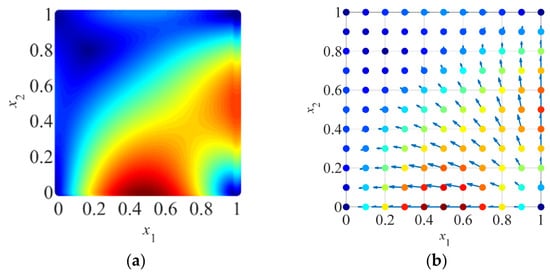
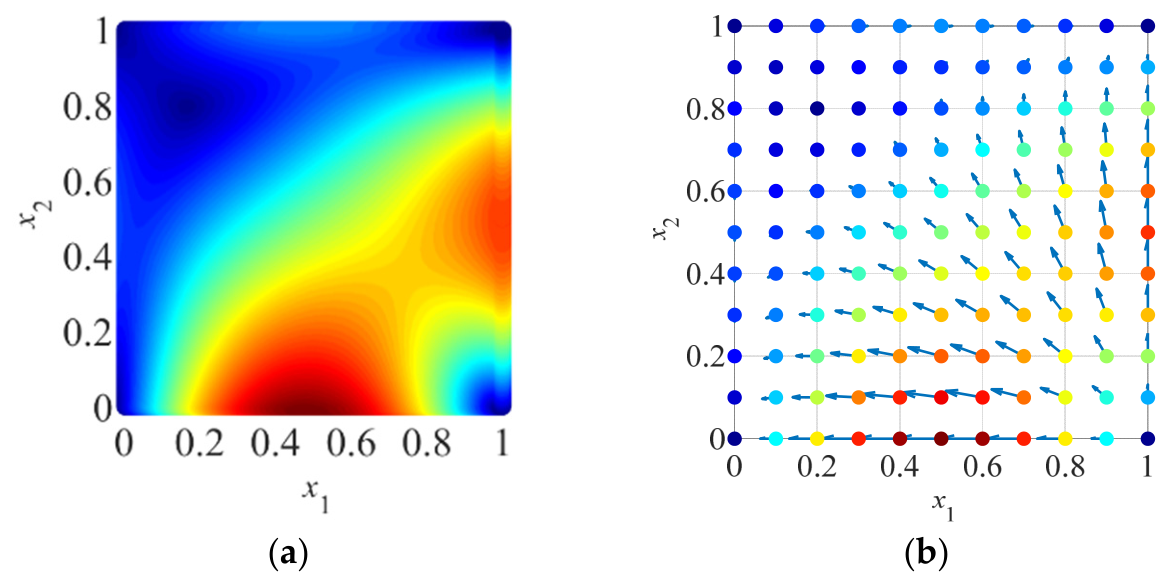
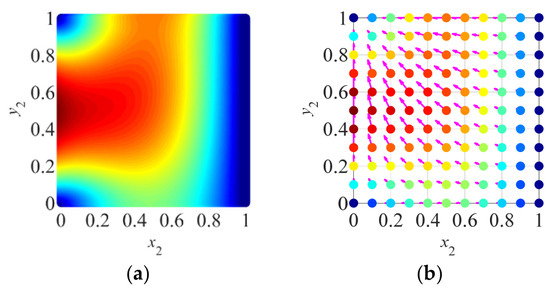
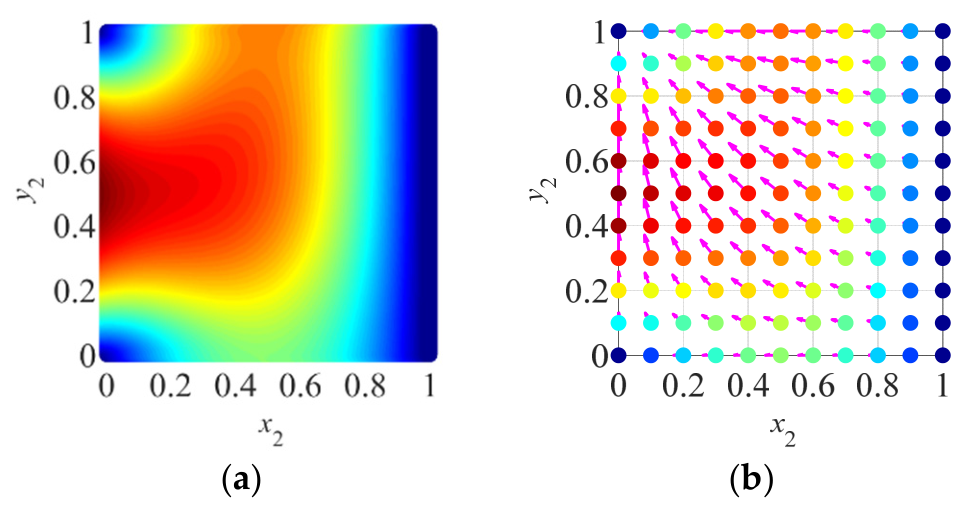
Assumption1: When , the system corresponds to a non-delayed evolutionary model. The simulation results obtained are presented in Figure 1.
Figure 1.
Non-delayed evolutionary game diagram: (a) evolutionary game; (b) evolutionary phase vector diagram.
As shown in Figure 1, the evolutionary system reaches a steady state regardless of the initial values of the game participants. The non-delayed high-speed train evolutionary game model has five equilibrium points: (0, 0), (0, 1), (1, 0), (1, 1) and . When the system reaches this steady state, the strategies of all participants remain unchanged. Therefore, the influence of system parameters on the stability of the evolutionary system must be taken into account.
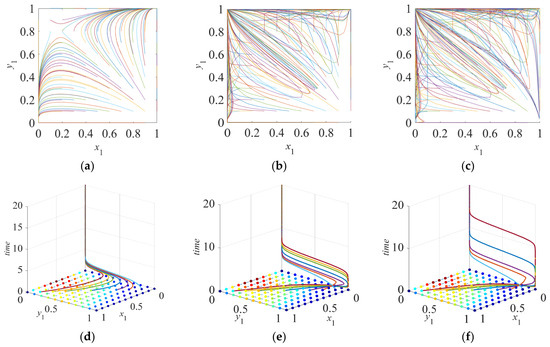
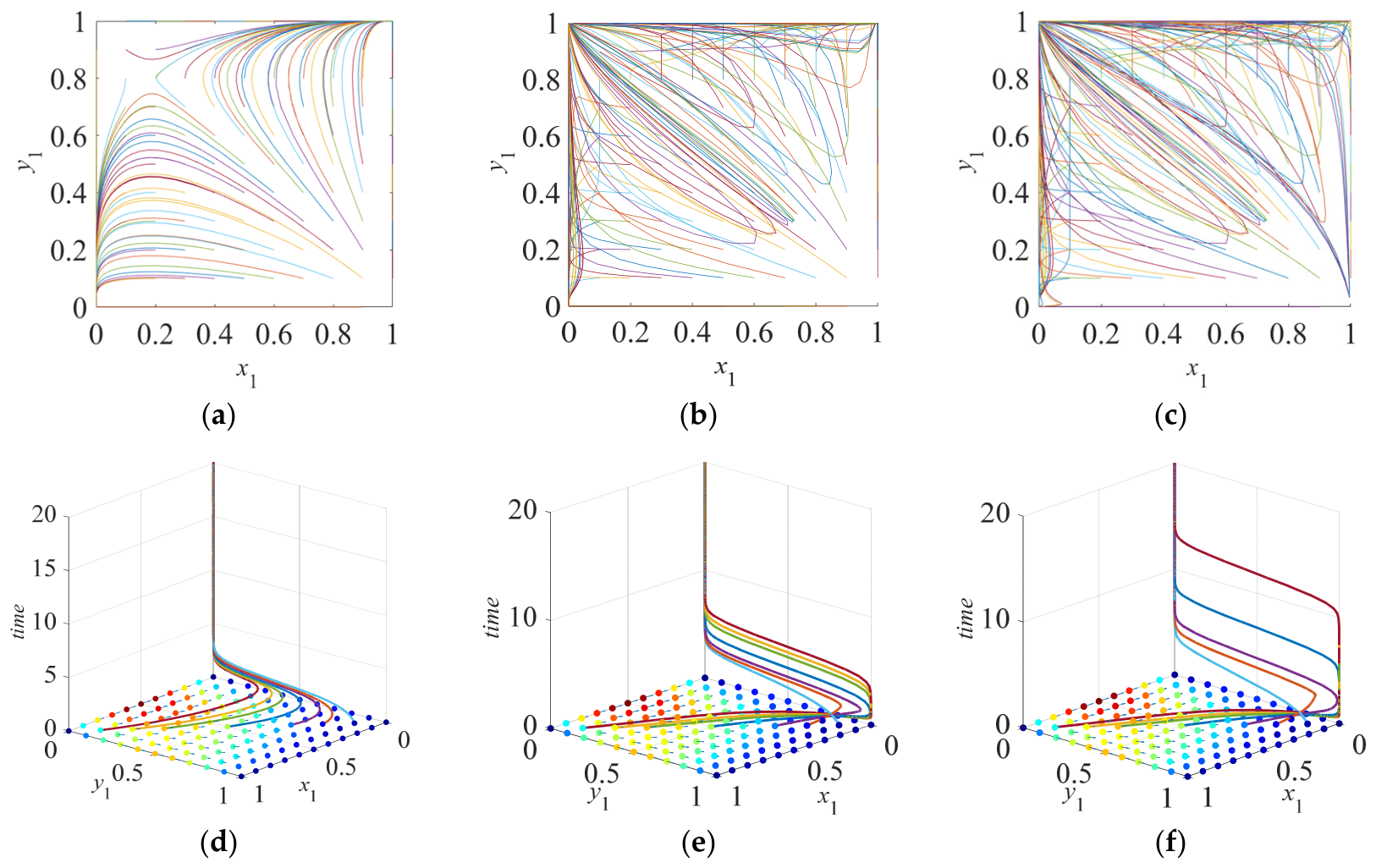
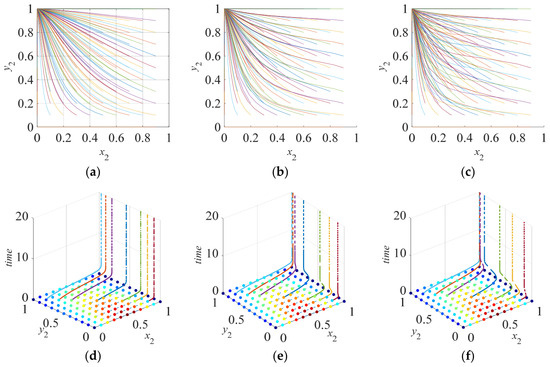
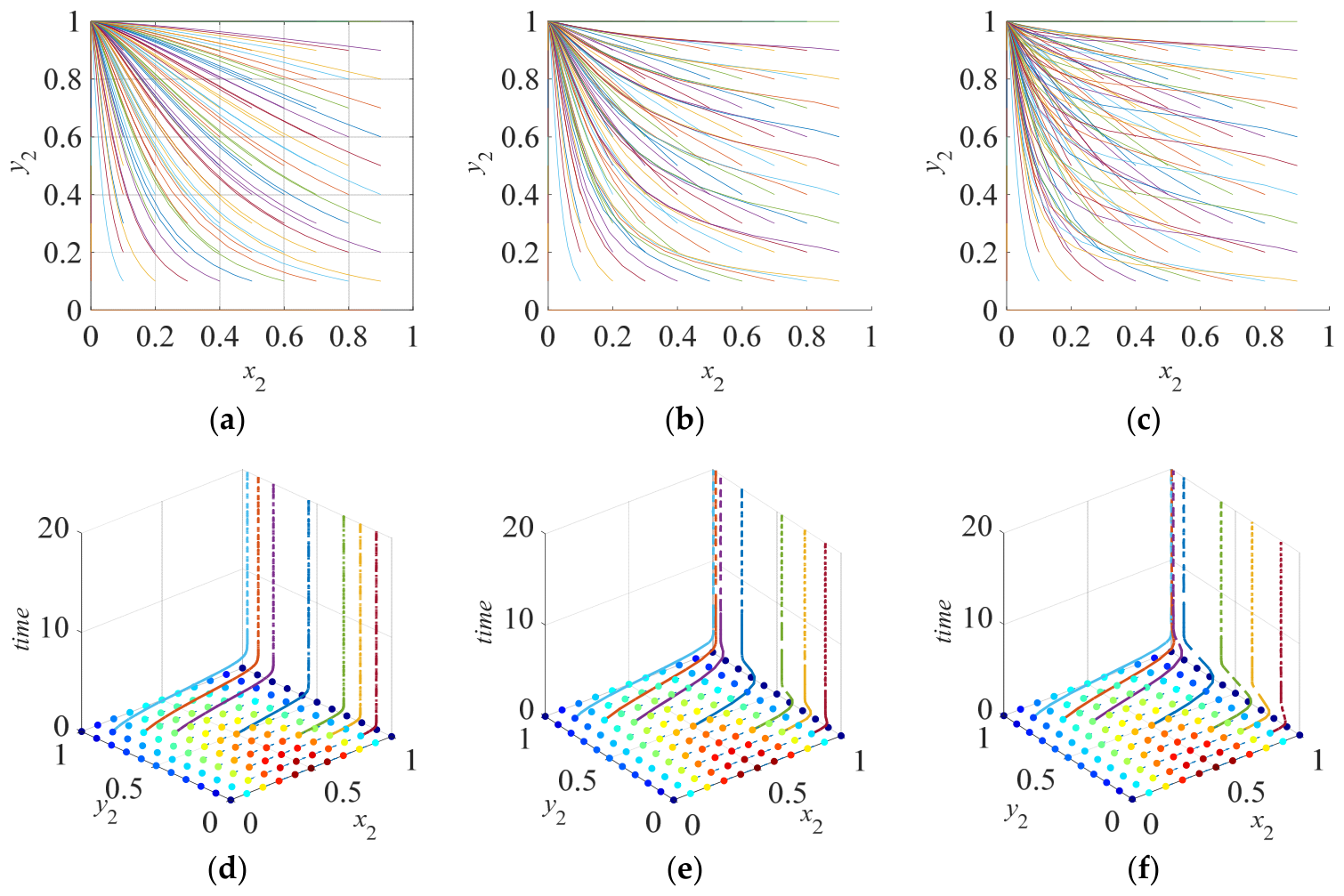
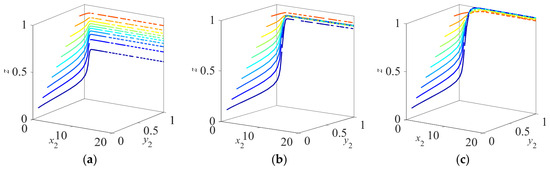
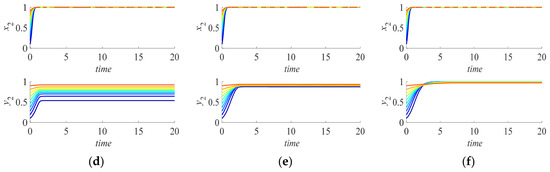
Assumption 2: When , the evolutionary game model of the high-speed train timetable with delayed feedback incorporates additional factors. While the game parameters remain unchanged, the system considers both the non-delayed and delayed feedback states of the high-speed train timetable. The corresponding two-dimensional and three-dimensional evolutionary game processes are illustrated in Figure 2.
Figure 2.
Two-dimensional evolutionary game diagram: (a) Non-delayed 2D vector; (b) 2D vector; (c) 2D vector; (d) Non-delayed 3D vector; (e) 3D vector; (f) 3D vector.
As shown in Figure 2a,d, under the non-delayed condition, the overall evolutionary trajectory of the system is regular, exhibiting rapid convergence and no signs of oscillatory or chaotic behavior, indicating strong global stability. In contrast, when delayed feedback is introduced, the strategies in the evolutionary game model display significant fluctuations, with the amplitude of these fluctuations positively correlated with the delay parameter. Further observations from Figure 2a,d reveal that the system trajectory becomes disturbed and exhibits more complex dynamic behavior; however, it still eventually converges. This indicates that group decision-making is influenced by information from previous time points.
The presence of delayed feedback causes a lag in information transmission and feedback, thereby increasing the complexity of the system’s dynamic evolution. When the delayed feedback is further increased to , the system exhibits increasingly complex dynamics. As illustrated in Figure 2c,f, the two-dimensional trajectories show pronounced interweaving and entanglement, while the three-dimensional trajectories reveal stronger nonlinear characteristics, including slower convergence, intensified oscillations, and unpredictable convergence paths. This suggests that larger delayed feedback may induce multistability, quasi-periodicity, or even chaotic dynamics, thereby undermining the system’s original convergence and stability.
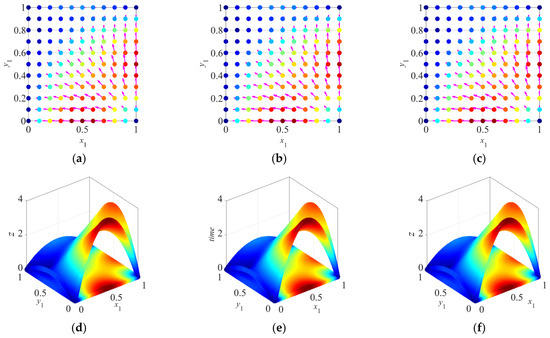
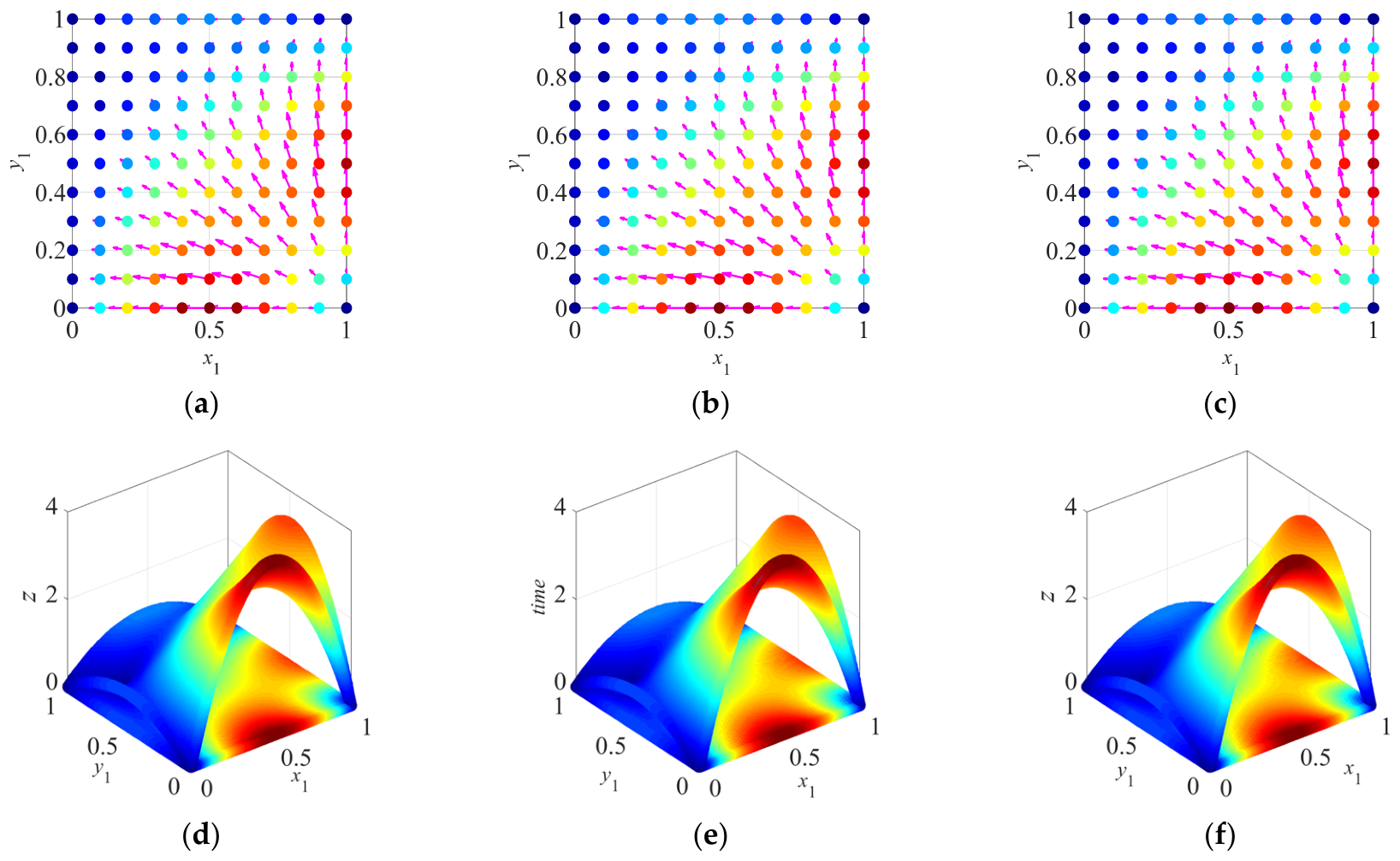
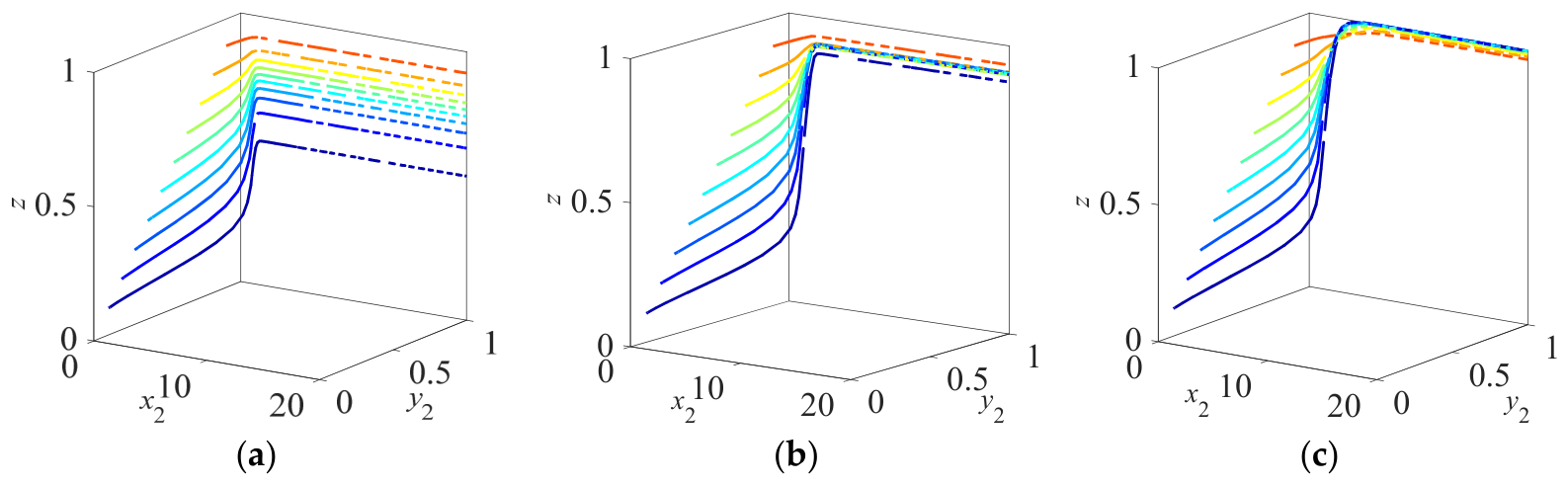
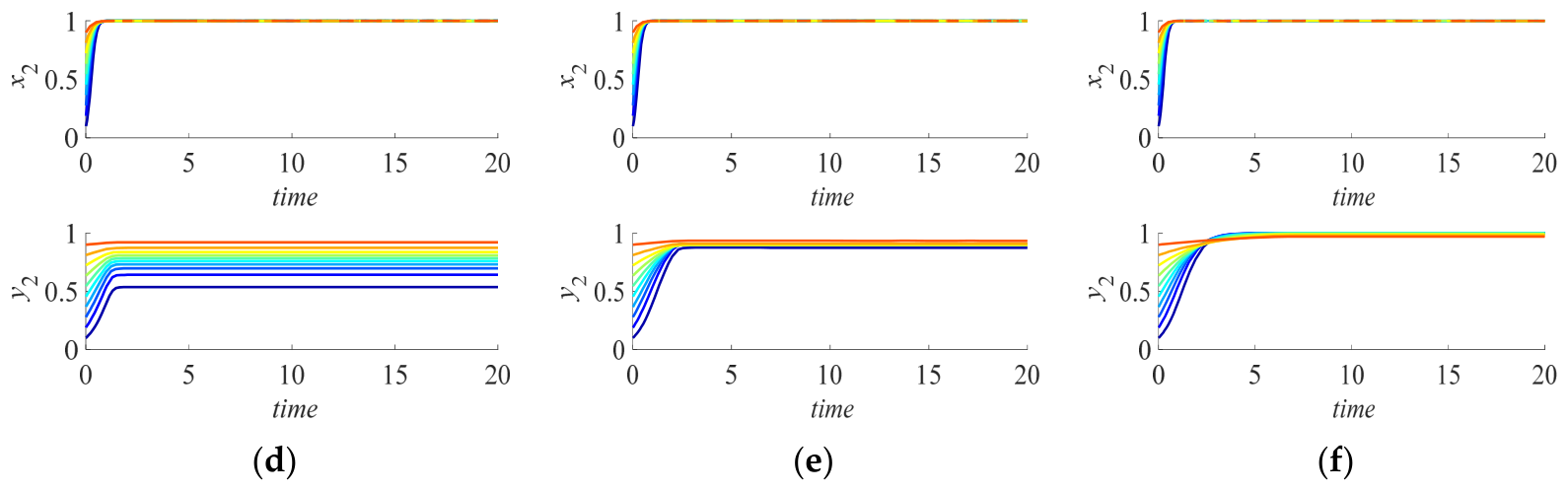
The vector field of the evolutionary game for high-speed train operations with delayed feedback is illustrated in Figure 3.
Figure 3.
Two-dimensional and 3D vector-field illustrations: (a) Non-delayed 2D vector; (b) ; (c) ; (d) Non-delayed 3D vector; (e) ; (f) .
As shown in Figure 3, The vector-field plots for the delayed and non-delayed games are visually identical in both two- and three-dimensional representations. This occurs because the vector fields are evaluated using only the instantaneous state variables. The delayed terms are not included as independent variables in the computation. In contrast, delayed-feedback dynamics depend on historical states. Such history dependence cannot be shown in these vector plots. The plots only display the instantaneous derivatives at the current state and therefore omit past-state information. To reveal delay effects, one can either numerically integrate the delayed system and plot the resulting trajectories, or augment the model by introducing delay-related variables in a higher-dimensional phase space.
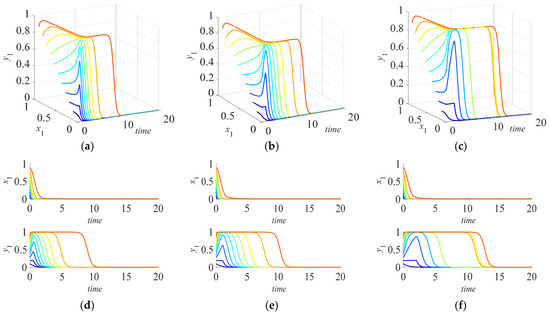
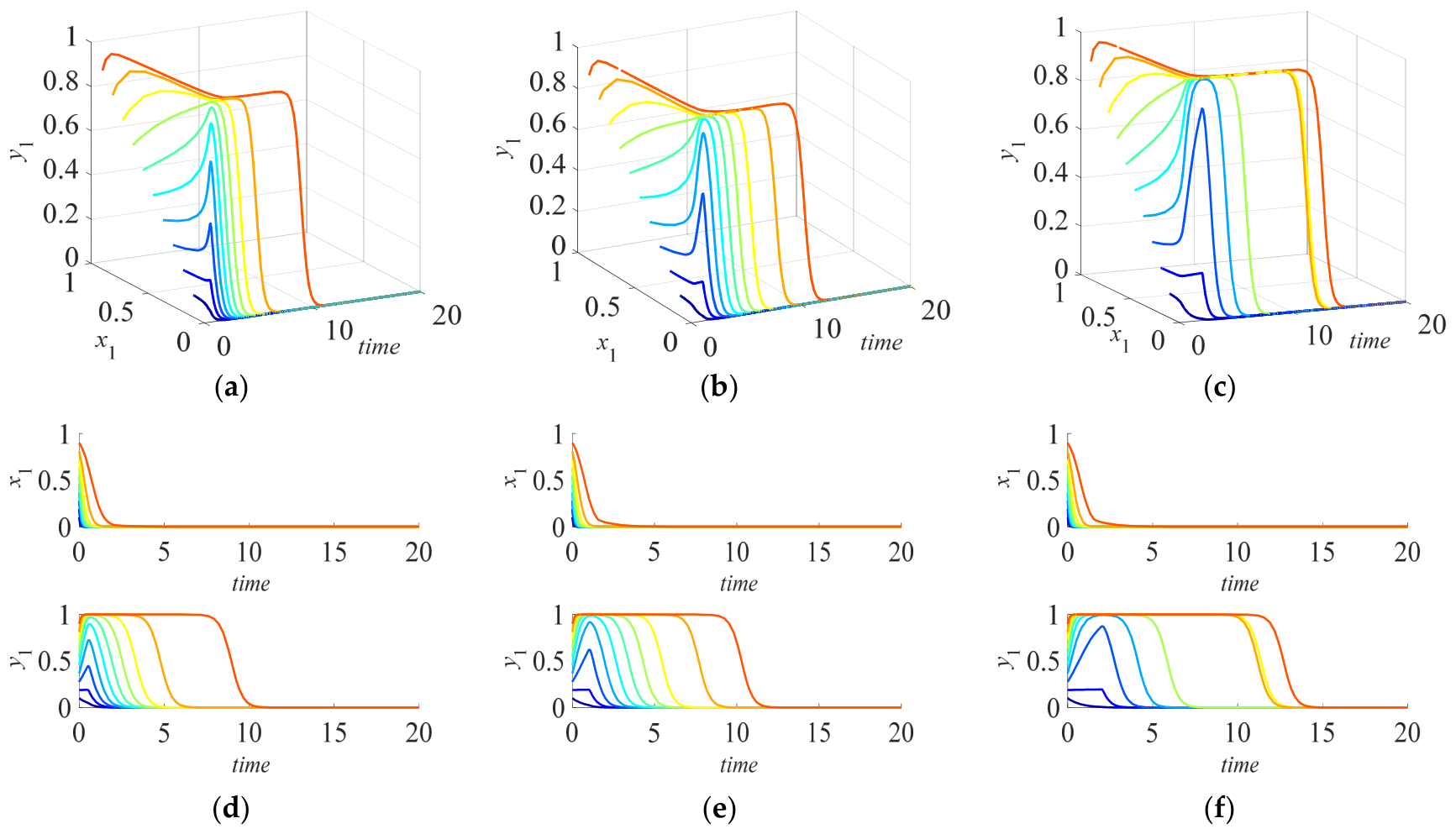
Assumption 3: When , the simulation results of the delayed feedback evolutionary game model of the high-speed train timetable, excluding the static case, are presented in Figure 4.
Figure 4.
Evolution curve: (a) ; (b) ; (c) ; (d) ; (e) ; (f) .
Numerical simulations depict the evolution of the state variables in the delayed-feedback evolutionary game system. Different combinations of delay parameters are examined. (), as shown in Figure 4. Both the two- and three-dimensional trajectory plots reveal that the system is highly sensitive to the magnitudes of the delay parameters. Specifically, when and are relatively small, the system rapidly converges to a stable equilibrium, exhibiting a smooth evolution process and fast convergence rate. In contrast, larger or markedly asymmetric delay values introduce significant oscillations and lag during the transient phase, resulting in more complex and nonlinear evolutionary trajectories. Notably, as shown in Figure 4c,f, the system exhibits pronounced dynamic lag in its evolutionary trajectory, yet it eventually converges to a stable state.
These results indicate that delayed feedback does not affect only system stability. It also plays a critical role in the complexity and responsiveness of strategy adjustment trajectories. Therefore, when developing evolutionary game models and selecting parameters, the structural effects of delay should be carefully considered. This is essential for accurately characterizing the dynamic evolution process.
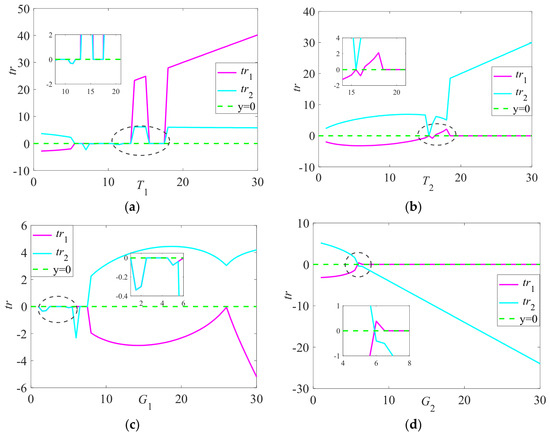
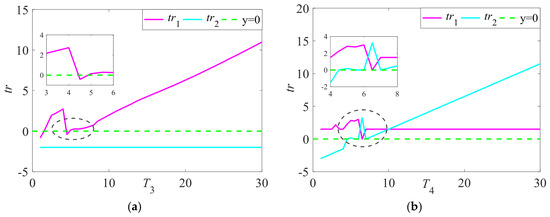
To examine the influence of different parameters on the stability of the evolutionary game system, the eigenvalues of the Jacobian matrix were analyzed. The corresponding simulation results are presented in Figure 5.
Figure 5.
Impact of parameters on Jacobian eigenvalues: (a) ; (b) ; (c) ; (d) .
As shown in Figure 5, the plots illustrate how variations in the parameters and affect the eigenvalues and of the Jacobian matrix in the evolutionary game system. According to linear stability theory, the real parts of the eigenvalues determine the stability of the equilibrium points: negative real parts imply local stability, whereas positive real parts indicate instability. The detailed analyses are as follows.
In Figure 5a, when the parameter , varies approximately within the interval [10,20], the eigenvalue exhibits pronounced oscillations between positive and negative regions, while remains close to zero. This behavior identifies a critical region in which the system undergoes potential stability transitions. In Figure 5b, when varies within [15,20], the eigenvalue shows substantial fluctuations and clearly crosses the zero axis, indicating that changes in exert a strong influence on the system’s stability properties.
Figure 5c,d demonstrate that the parameters and , when approaching specific threshold values (indicated by dashed circles), induce sensitive variations in the eigenvalue trajectories. These sensitivity peaks suggest the presence of qualitative stability transitions associated with these critical parameter regions. Overall, the analysis indicates that the system’s stability is highly dependent on the parameters and , each of which contributes differently to the onset of instability and potential bifurcation behavior.
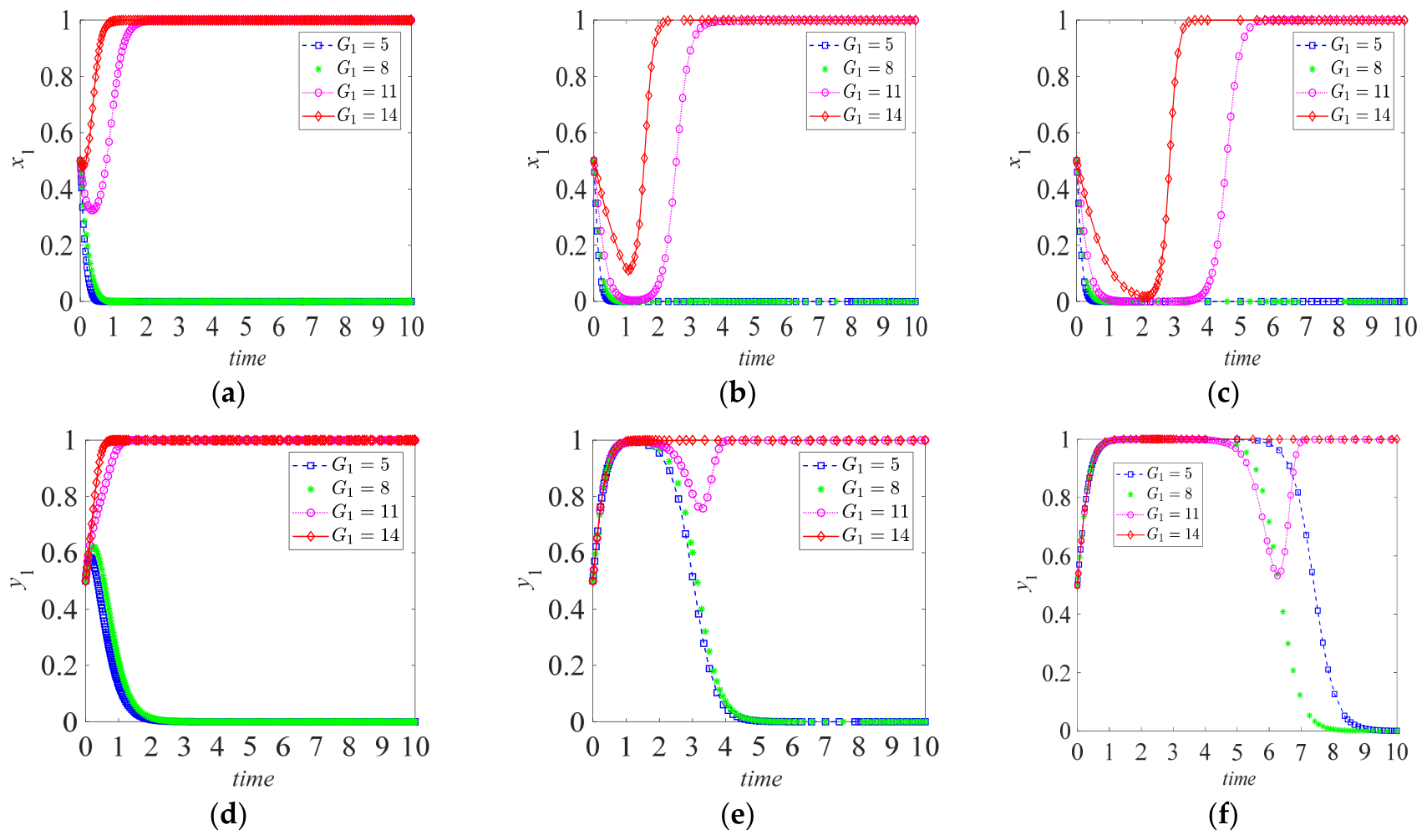
In the evolutionary simulation, the revenue for the preceding train’s stop strategy is kept constant, while the revenue for the following train’s stop strategy is incrementally increased from 5 to 14. The results of the evolutionary process under these conditions are shown in Figure 6.
Figure 6.
Effect of stop revenue on evolution: (a) Non-delayed decision-making; (b) ; (c) ; (d) Non-delayed decision-making; (e) ; (f) .
Figure 6 illustrates the evolution of the game system under different values of the parameter, both with and without delayed feedback. In Figure 6a, where decision-making is no-free, the evolution of the preceding train’s stop strategy () is shown over time for various values of . As increases from 5 to 14, the system reaches equilibrium quicker, and the dynamics become smoother. In contrast, when delayed feedback is introduced in Figure 6b,c (, and ), the evolution of becomes more complex, exhibiting oscillations and slower convergence, especially as increases.
Figure 6d–f show the corresponding evolution of the following train’s stop strategy () under the same conditions. The introduction of delays leads to a more gradual convergence to equilibrium, with more pronounced fluctuations in the system as increases. In all cases, the final system states indicate that both the preceding and following trains ultimately reach evolutionary equilibrium, although the process is notably influenced by the delay and the value of .
In summary, the evolution of game strategies is highly influenced by the parameters and . Lower values of these parameters lead to faster and smoother convergence to equilibrium, while higher values tend to introduce oscillations and extend the time required for stabilization. This analysis provides valuable insights into how different conditions can impact strategic decision-making within the game.
4. Numerical Experiments and Result Analysis
4.1. Experimental Settings
To examine the dynamic properties of the proposed evolutionary game model and its applicability to stop/overtaking decisions in high-speed railway operations, numerical experiments are conducted based on the Shanghai–Hangzhou High-Speed Railway. The simulation scenarios are constructed by incorporating timetable standards, train-type composition, stopping patterns, and operational disturbances.
Trains are divided into two categories: 350-class trains and 250-class trains. According to the available timetable standard data, the 350-class trains adopt the through-running time associated with the highest speed level, while the 250-class trains use the through-running time corresponding to 250 km/h. The end-to-end basic running time is approximately 41.03 min for 350-class trains and 45.08 min for 250-class trains, which captures the efficiency difference between the two train classes.
In terms of stopping structure, Jiaxing South Station is defined as the major stop, with an additional stopping time of 180 s, while all other intermediate stations are treated as minor stops, each with an additional stopping time of 90 s. The stopping probability at Jiaxing South is set to 1, meaning that all trains stop there.
For the weekday off-peak scenario, the average departure headway is set to 240 s, the safe tracking interval to 180 s, and the mean and standard deviation of the initial disturbance to 30 s and 20 s. For the holiday peak scenario, the average departure headway is reduced to 240 s, while the safe tracking interval remains 240 s; the mean and standard deviation of the initial disturbance increase to 90 s and 45 s, the feedback delay parameter is set to 3, the delay penalty coefficient to 2.5, and the conflict penalty coefficient to 4.0. The definitions and values of all parameters are listed in Table 7.
Table 7.
Parameter Definitions and Values.
The payoff function incorporates delay loss, conflict cost, additional stopping time, and time corrections for different train classes under different strategies, thereby capturing the trade-off between efficiency and stability in stop/overtaking decisions on high-speed railways.
4.2. Simulation Result Analysis
The simulation results reveal clear differences between the weekday off-peak and holiday peak scenarios in both strategy evolution and operational performance.
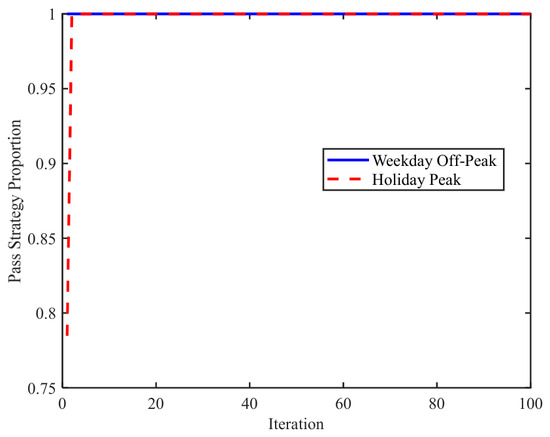
Figure 11 shows the evolution of the pass/overtaking strategy proportion. Under the weekday off-peak scenario, the strategy proportion changes smoothly and reaches a stable state within relatively few iterations. This suggests that when train density is lower, headways are longer, and disturbances are weaker, the system is more likely to form a stable stop/overtaking strategy structure. In contrast, the holiday peak scenario exhibits stronger fluctuations and slower convergence, indicating that strategy adjustment becomes more complex under high-density operating conditions and that the system is more sensitive to disturbances and delayed feedback.
Figure 11.
Evolution of the pass strategy proportion.
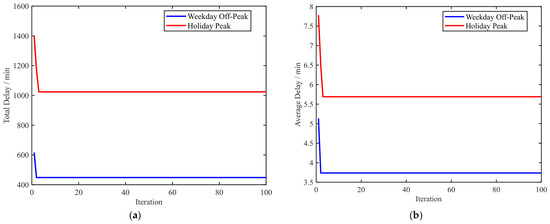
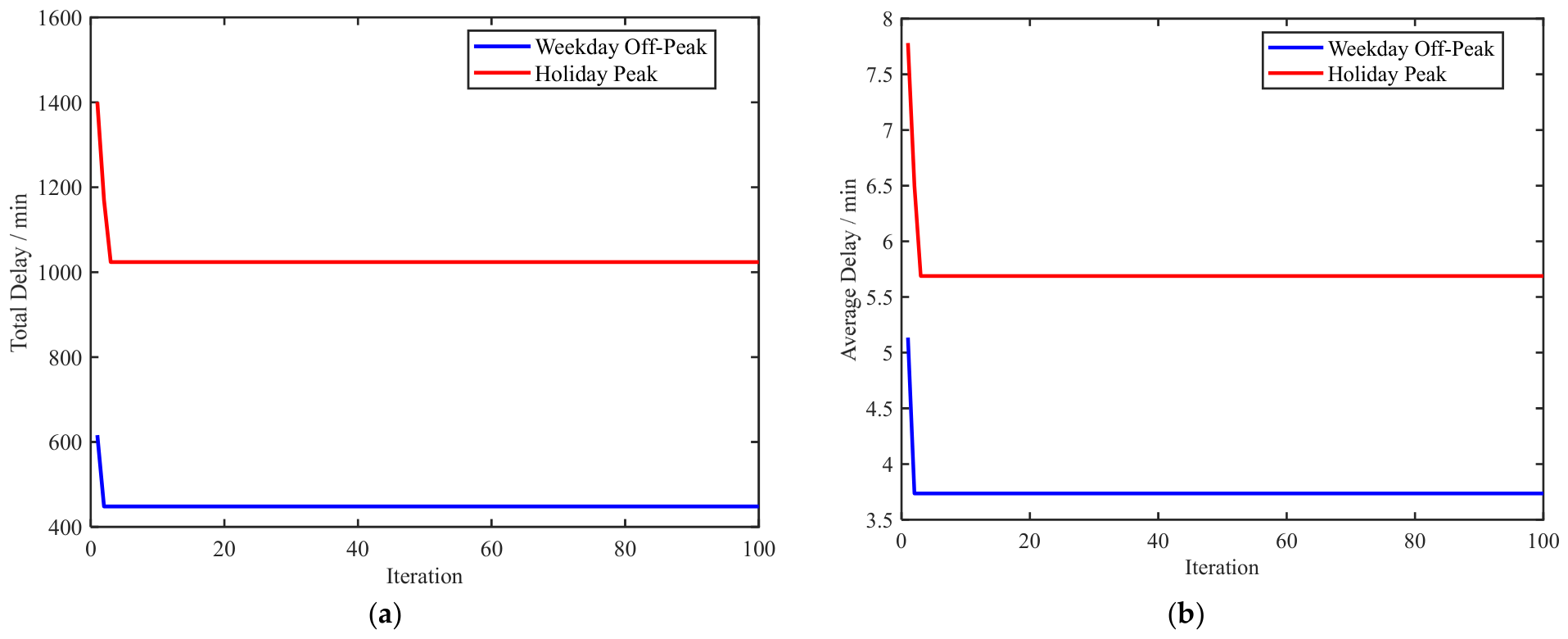
Figure 12 presents the evolution of total delay and average delay, respectively. In the weekday off-peak scenario, both indicators remain relatively low and gradually stabilize. In the holiday peak scenario, however, both total delay and average delay increase significantly. This indicates that as the number of trains increases, headways are compressed, and initial disturbances intensify, delays become more likely to accumulate and propagate through the train sequence. The increase in average delay further suggests that not only overall system delay rises, but the operational quality of individual trains also deteriorates in the peak scenario.
Figure 12.
Evolution of total and average delay: (a) evolution of total delay, (b) evolution of average delay.
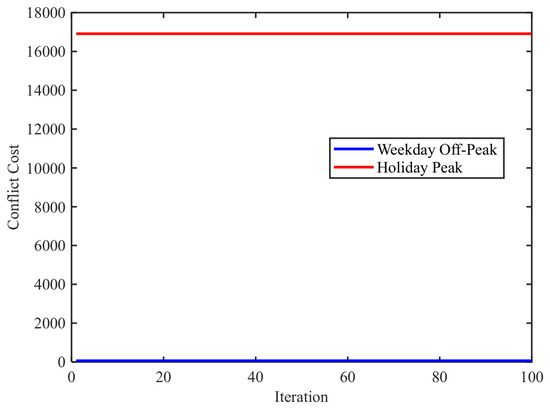
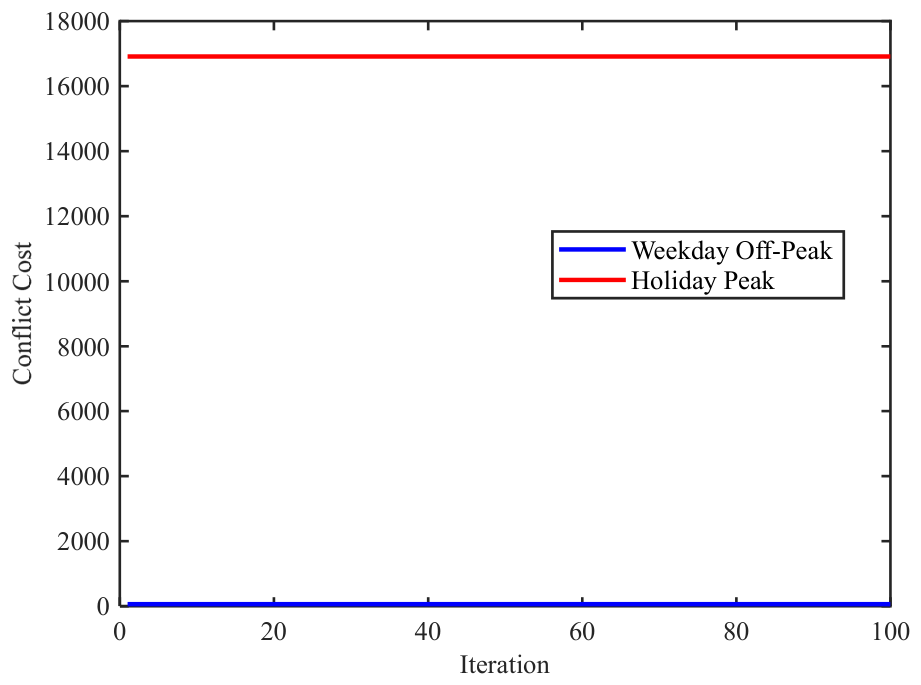
Figure 13 illustrates the variation in conflict cost. In the weekday off-peak scenario, conflict cost remains low and stable, suggesting that train interactions are relatively mild and that the system can absorb local disturbances effectively. By contrast, the holiday peak scenario shows substantially higher and more volatile conflict cost, indicating that more trains and shorter headways make operational conflicts more likely, while the higher conflict penalty amplifies their impact on system performance.
Figure 13.
Evolution of conflict cost.
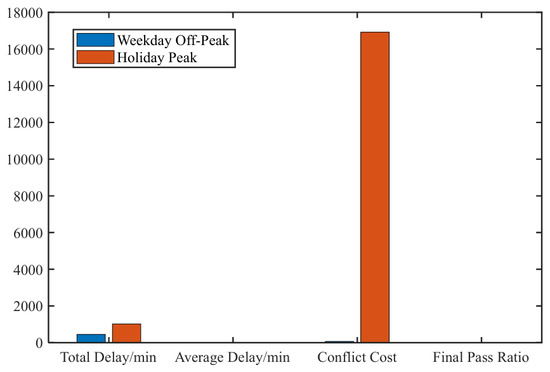
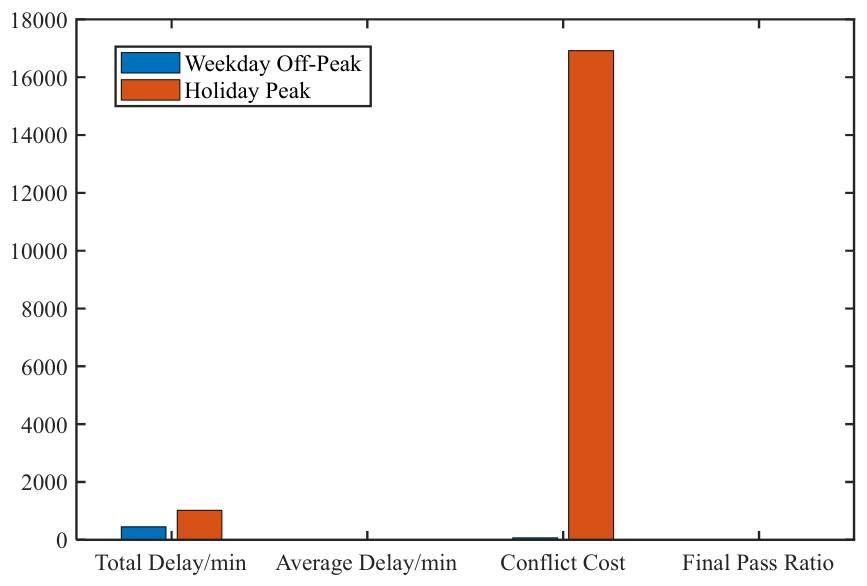
Figure 14 compares the final operational indicators under the two scenarios. The holiday peak scenario shows higher total delay, higher average delay, and higher conflict cost than the weekday off-peak scenario, while the final proportion of the pass/overtaking strategy is also typically higher. This suggests that under peak conditions, the system tends to increase the use of pass/overtaking strategies to reduce delay and improve throughput, although this comes at the expense of higher conflict risk.
Figure 14.
Comparison of final operational indicators.
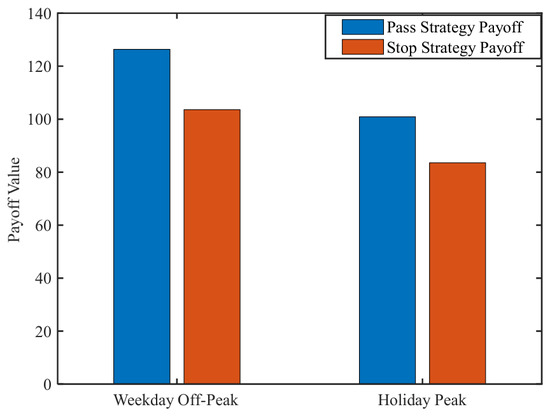
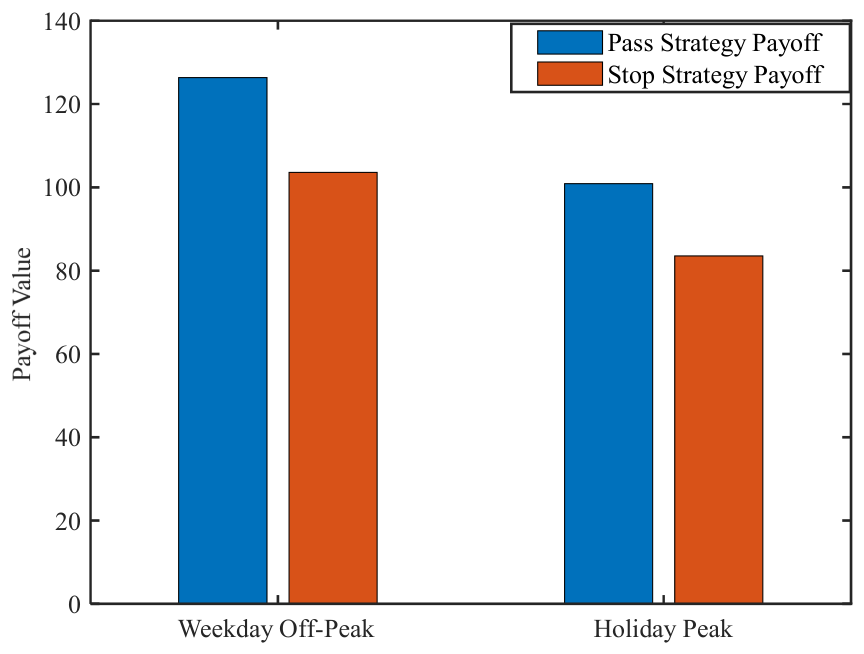
Figure 15 further compares the final strategy payoffs. In the weekday off-peak scenario, the payoff difference between the two strategies is relatively small, indicating that both strategies remain viable under normal operating conditions. In the holiday peak scenario, the payoff difference becomes more pronounced, suggesting that high-density operation amplifies the effect of strategy choice on system performance.
Figure 15.
Comparison of final strategy payoffs.
Overall, the proposed model captures the dynamic evolution of stop/overtaking decisions under different operating intensities reasonably well. Under off-peak conditions, the system more easily reaches a stable strategy structure, with lower delay and conflict cost. Under peak conditions, delay, conflict, and strategy fluctuations all become more pronounced, implying that high-density operation places greater demands on dispatching coordination and feedback efficiency. These results provide scenario-based simulation evidence for the explanatory capability of the proposed framework.
4.3. Sensitivity Analysis
To examine the robustness of the model conclusions and the influence of key parameters on strategy evolution, a joint sensitivity analysis is conducted on three parameters: feedback delay, delay penalty coefficient, and conflict penalty coefficient. These parameters correspond to dispatching responsiveness, preference for operational efficiency, and safety-related constraints, respectively, and play a central role in shaping the evolution process and outcomes.
The feedback delay parameter reflects the lag in information transmission and state feedback. As this parameter increases, strategy updating relies more heavily on earlier payoff information, making it harder for the system to respond promptly to current operating conditions. The results show that under the weekday off-peak scenario, a smaller feedback delay is associated with smoother strategy evolution and faster convergence, whereas under the holiday peak scenario, a larger feedback delay leads to stronger fluctuations and slower convergence. This indicates that high-density operation is more sensitive to information lag, and that greater delay in feedback tends to intensify strategy oscillation and delay propagation.
The delay penalty coefficient reflects the importance attached to train delay. A larger value means that delay is penalized more strongly in the payoff function, encouraging the system to reduce running time and suppress delay. In this study, the coefficient is set to 1.5 for the weekday off-peak scenario and 2.5 for the holiday peak scenario. The results suggest that a stronger delay penalty tends to increase the proportion of the pass/overtaking strategy, especially under peak conditions. This implies that when train density is higher and disturbances propagate more rapidly, the system becomes more inclined to pursue operational efficiency. However, if delay reduction is weighted too heavily, the system may become overly aggressive, thereby increasing the risk of tracking conflicts.
The conflict penalty coefficient reflects the importance attached to operational conflict and safety margin. A larger value means that insufficient headway and intensified resource competition are penalized more strongly. In this study, the coefficient is set to 2.0 for the weekday off-peak scenario and 4.0 for the holiday peak scenario. The simulation results show that increasing the conflict penalty strengthens the restraint on aggressive overtaking strategies and makes conflict cost more influential in determining strategy payoff. In other words, a higher conflict penalty helps limit the risk expansion caused by an excessive pursuit of throughput under peak conditions, although an overly strong penalty may also make the system too conservative and increase the time loss associated with stopping and yielding.
Taken together, feedback delay, delay penalty, and conflict penalty jointly shape the balance between efficiency and stability. Feedback delay mainly affects stability and convergence speed, the delay penalty mainly affects the preference for efficiency, and the conflict penalty mainly affects the emphasis on safety margin and operational order. Compared with the weekday off-peak scenario, the holiday peak scenario is more sensitive to changes in these parameters, indicating that high-density operation requires more refined parameter settings and more efficient feedback mechanisms. These findings further support the applicability of the proposed model to dynamic stop/overtaking decision analysis on high-speed railways.
It should be noted that the numerical experiments in this chapter mainly aim to examine the dynamic evolution characteristics and scenario adaptability of the proposed model. The experiments are designed to show how stop/overtaking strategies evolve under different operating intensities, rather than to provide a direct superiority comparison with existing dispatching methods. Therefore, the results should be interpreted as supporting the rationality and explanatory capability of the proposed evolutionary game perspective. A systematic benchmark comparison will be conducted in future research once comparable benchmark settings and consistent evaluation indicators are established.
5. Discussion
The present study developed an evolutionary game model with feedback delay to describe stop/overtaking decisions in high-speed railway operations and examined its behavior through scenario-based simulations on the Shanghai–Hangzhou High-Speed Railway. The results suggest that the proposed framework can capture the dynamic interactions among operational disturbance, strategy adjustment, and conflict propagation under different traffic conditions.
A main implication of this study is that stop/overtaking decisions should not be viewed as purely static choices. In practical operations, such decisions are continuously affected by delay transmission, train heterogeneity, stopping patterns, and the timeliness of dispatching information. In this context, the evolutionary game framework provides a suitable representation of how strategy proportions may evolve over time rather than being fixed a priori. This feature is particularly relevant under dense traffic conditions, where local disturbances are more likely to spread and where dispatching decisions need to be repeatedly adjusted in response to changing system states.
The simulation results further indicate that the model output is sensitive to operational intensity. Under the weekday off-peak scenario, the strategy evolution tends to be smoother, and the corresponding delay and conflict cost remain at relatively low levels. By contrast, under the holiday peak scenario, the system exhibits stronger fluctuations, higher delay, and greater conflict cost. This difference is consistent with the basic characteristics of high-speed railway operations: when train volume increases and headways are compressed, the operating system becomes more vulnerable to disturbance propagation and conflict accumulation. Therefore, although the current analysis is simulation-based, the model appears capable of reflecting meaningful differences between low-density and high-density operating environments.
Another important finding is the role of key parameters in shaping system behavior. The sensitivity analysis shows that feedback delay, delay penalty, and conflict penalty all have a clear influence on the evolution outcome. A larger feedback delay slows convergence and amplifies oscillation, indicating the importance of timely dispatching information. A larger delay penalty strengthens the system preference for efficiency-oriented strategies, whereas a larger conflict penalty restrains overly aggressive strategy shifts and highlights the role of safety-related constraints. These results imply that the model is not driven by a single fixed parameter setting, but rather responds to parameter variation in a logically consistent manner.
It is important to clarify the intended positioning of this study. The proposed framework is not presented as a new dispatching algorithm that has been proven to outperform all existing methods. Instead, it is intended as an alternative and complementary analytical perspective for understanding stop/overtaking decisions under incomplete information and delayed feedback. The main value of the model lies in its ability to describe the adaptive evolution of strategy proportions, the stability implications of delayed feedback, and the interaction between efficiency-oriented and conflict-constrained decisions. In this sense, the present study focuses on mechanism explanation and dynamic interpretation rather than on comprehensive benchmark superiority.
At the same time, several limitations should be acknowledged. First, although the parameter settings were selected with reference to line characteristics and operational logic, some of them remain assumption-based and have not yet been calibrated using large-scale real dispatching data. Second, because the present study is positioned as a mechanism-oriented and simulation-based analysis, it mainly focuses on the rationality, interpretability, and scenario adaptability of the model output. A strict empirical comparison with alternative dispatching approaches is therefore beyond the scope of the current work and will be addressed in future research. Third, the current framework considers only two train-speed classes and a simplified stopping structure. Additional practical factors, such as station capacity, section capacity fluctuations, passenger transfer demand, and bidirectional interactions, were not incorporated and should be addressed in future work.
Overall, the study contributes to the literature by introducing an evolutionary game perspective into the analysis of stop/overtaking decisions on high-speed railways. The results suggest that this perspective can provide a useful dynamic description of strategy adjustment under disturbance. From an application viewpoint, the model may serve as a basis for further studies on data-driven calibration, comparative evaluation, and more refined dispatching support models.
6. Conclusions
This study proposed an evolutionary game model with feedback delay for stop/overtaking decisions in high-speed railway operations and applied it to numerical experiments based on the Shanghai–Hangzhou High-Speed Railway. The main conclusions can be summarized as follows.
First, the proposed model can describe the dynamic adjustment of stop/overtaking strategy proportions under disturbed operating conditions. Compared with static decision formulations, the model explicitly incorporates payoff differences, delayed feedback, and conflict effects, making it more suitable for representing the adaptive nature of dispatching decisions in high-density railway operations.
Second, the simulation results show clear differences between the weekday off-peak and holiday peak scenarios. Under the weekday off-peak scenario, the system reaches a relatively stable strategy structure more easily, and total delay, average delay, and conflict cost remain comparatively low. Under the holiday peak scenario, increased train volume, reduced headway, stronger disturbance, and larger feedback delay lead to more pronounced strategy fluctuations and significantly higher delay and conflict cost. These findings indicate that stop/overtaking decisions are closely related to both transport efficiency and operational stability, especially under dense traffic conditions.
Third, the sensitivity analysis confirms that feedback delay, delay penalty, and conflict penalty are critical parameters affecting the evolution results. Feedback delay mainly influences convergence speed and oscillation intensity, the delay penalty mainly affects the preference for efficiency-oriented strategies, and the conflict penalty mainly affects the emphasis placed on safety and operational order. The holiday peak scenario is more sensitive to these parameter changes, suggesting that efficient feedback mechanisms and refined parameter settings are particularly important under high-density operations.
In summary, the results suggest that the proposed evolutionary game model provides a reasonable and interpretable framework for analyzing stop/overtaking decisions in high-speed railway systems. It should be emphasized that the current study does not aim to establish comprehensive superiority over existing dispatching, rescheduling, or optimization-based approaches. Rather, the proposed model should be regarded as an alternative analytical perspective that helps explain how stop/overtaking strategies evolve under disturbance, incomplete information, and delayed feedback. Future research will further extend this work by calibrating the model with real dispatching data, incorporating additional operational constraints, and conducting systematic benchmark comparisons with recent rule-based, heuristic, learning-based, and optimization-based methods under unified simulation settings.
Author Contributions
Conceptualization, A.L.; Methodology, A.L.; Visualization, A.L.; Writing—original draft, A.L.; Funding acquisition, Q.H.; Supervision, Q.H.; Writing—review & editing, Q.H., X.W. and A.A. All authors have read and agreed to the published version of the manuscript.
Funding
This research was mainly supported by the following projects, Henan Provincial Key Science and Technology Research and Development Program (182102310004); Research Fund of China Rail-way Shanghai Group Co., Ltd. (2022001).
Institutional Review Board Statement
Not applicable.
Informed Consent Statement
Not applicable.
Data Availability Statement
The data supporting the findings of this study are available from the corresponding: author upon reasonable request. Due to the ongoing nature of this research project and to preserve the integrity of subsequent studies, the dataset is not publicly available at this stage.
Acknowledgments
The authors would like to thank the editors and reviewers for their constructive comments and suggestions.
Conflicts of Interest
The authors declare that they have no known competing financial interests or personal relationships that could have appeared to influence the work reported in this manuscript.
References
- Hua, W.; Sun, P.A. Research on train operation disturbance propagation analysis and simulation research on high-speed railway. J. Railw. Transp. Econ. 2024, 6, 26–32. [Google Scholar] [CrossRef]
- Zheng, Y.; Lu, Q.; Zhou, Y.; Ju, L. Force performance analysis of long stator linear synchronous motor considering the change of suspension guide clearance. Micro Spec. Mot. 2024, 52, 22–27. [Google Scholar] [CrossRef]
- Jian, X.; Yan, H.; Zhang, S. Optimization model of high-speed railway train stop scheme based on capacity utilization. J. Traffic Transp. Eng. Inf. Technol. 2019, 17, 146–152. [Google Scholar] [CrossRef]
- Hu, C.; Wei, Y.; Yu, Z. Effect of turnout selection on throat length and tracking interval of high-speed railway station. China Railw. Sci. 2024, 45, 159–167. [Google Scholar] [CrossRef]
- Sun, Y.; Ye, Y.; Luo, S.; Sun, H.; Pan, Z.; Peng, Q. Analysis of technical conditions for 400 km/h high-speed railway to achieve 3 min tracking interval. Railw. Transp. Econ. 2024, 46, 10–16+25. [Google Scholar] [CrossRef]
- Zhan, S.; Xie, J.; Wong, S.; Zhu, Y.; Corman, F. Handling uncertainty in train timetable rescheduling: A review of the literature and future research directions. Transp. Res. E Logist. Transp. Rev. 2024, 183, 103429. [Google Scholar] [CrossRef] [Scilit]
- Zhu, J.; Li, B.; Fan, J. System based on cloud platform design and key technology of train working diagram compilation. Railw. Transp. Econ. 2023, 45, 1–10. [Google Scholar] [CrossRef]
- Andy; Wu, J.; Zhang, Y. Integrated automatic timetabling method for high-speed railway. J. China Railw. Soc. 2024, 46, 12–21. [Google Scholar] [CrossRef]
- Shen, G.; Zhang, Y.; Ji, Y. Research status and prospect of energy-saving optimization of high-speed train timetable. Railw. Transp. Econ. 2024, 6, 8–16. [Google Scholar] [CrossRef]
- Ge, X.; Zhang, Y. Energy-saving optimization method of high-speed train timetable considering driving strategy. Traffic Inf. Saf. 2022, 40, 118–126+136. [Google Scholar] [CrossRef]
- Deng, L.; Duan, K.; Wang, Q.; Shi, F. Energy-efficient optimization method for urban rail transit timetable. Syst. Eng. Theory Pract. 2021, 41, 1486–1495. [Google Scholar] [CrossRef] [Scilit]
- Shangguan, W.; Dun, Y.; Cai, B.; Liu, J.; Song, H. Multi-objective optimization of high-speed train formation operation based on group cooperative evolution. J. China Railw. Soc. 2023, 45, 99–109. [Google Scholar] [CrossRef]
- Zheng, Y.; Li, Y.; Li, Y.; Jin, W. Energy-saving optimization of subway train timetable under regenerative braking. J. S. China Univ. Technol. (Nat. Sci. Ed.) 2021, 49, 1–7. [Google Scholar] [CrossRef]
- Pouryousef, H.; Lautala, P.; Watkins, D. Development of hybrid optimization of train schedules model for N-track rail corridors. Transp. Res. Part C Emerg. Technol. 2016, 67, 169–192. [Google Scholar] [CrossRef] [Scilit]
- Lei, A.; Hu, Q.; Wu, X. A Hierarchical Multi-Objective Timetable Optimization Method for High-Speed Railways under Minimum Headway Constraints. Appl. Sci. 2026, 16, 3682. [Google Scholar] [CrossRef] [Scilit]
- Yang, L.; Li, D.; Wang, H.; Gao, Y. Integrating stop planning, timetabling and rolling stock planning on high-speed railway lines: A multi-objective optimization approach. Expert Syst. Appl. 2024, 237, 121515. [Google Scholar] [CrossRef] [Scilit]
- Qi, J.; Zhou, Y.; Meng, F.; Yang, L.; Luo, Q.; Zhang, C. Joint optimization of train stop planning and timetabling with time-dependent passenger and freight demands in high-speed railway. Transp. Res. Part C Emerg. Technol. 2025, 172, 105025. [Google Scholar] [CrossRef] [Scilit]
- Corman, F. Interactions and equilibrium between rescheduling train traffic and routing passengers in microscopic delay management: A game theoretical study. Transp. Sci. 2020, 54, 785–822. [Google Scholar] [CrossRef] [Scilit]
- Zhang, L.; Zhou, M.; Yang, F. Elastic tracking operation method for high-speed railway using deep reinforcement learning. IEEE Trans. Consum. Electron. 2023, 70, 3384–3391. [Google Scholar] [CrossRef] [Scilit]
- Tang, T.; Gan, J. Train running time prediction model based on domestic and foreign railway operation data. China Saf. Sci. J. 2022, 32, 123–130. [Google Scholar] [CrossRef]
- Tang, T.; Chai, S.; Wu, W.; Yin, J.; D’Ariano, A. A multi-task deep reinforcement learning approach to real-time railway train rescheduling. Transp. Res. E Logist. Transp. Rev. 2025, 194, 103900. [Google Scholar] [CrossRef] [Scilit]
- Huang, P.; Peng, Z.; Li, Z.; Peng, Q. Solving the railway timetable rescheduling problem with graph neural networks. Railw. Eng. Sci. 2025, 1–22. [Google Scholar] [CrossRef] [Scilit]
- Wang, Y.; Fan, J.; Han, R.; Chen, A.; He, J.; Li, B.; Zhou, P.; Wei, J. A literature review of reinforcement learning in railway timetabling. In ICTTS 2024; Lecture Notes in Civil Engineering; Springer: Singapore, 2024; Volume 617, pp. 541–550. [Google Scholar] [CrossRef] [Scilit]
- Raturi, V.; Verma, A. A game-theoretic approach to analyse inter-modal competition between high-speed rail and airlines in the Indian context. Transp. Plan. Technol. 2020, 43, 20–47. [Google Scholar] [CrossRef] [Scilit]
- Guo, J.; Wang, Y.; Guo, X.; Guo, J.; D’Ariano, A.; Bosi, T.; Zhang, Y. Structure-optimized deep forest model for railway port container reloading time prediction: A hybrid integer programming and Bayesian optimization approach. Adv. Eng. Inform. 2026, 71, 104309. [Google Scholar] [CrossRef] [Scilit]
- Wang, Z.; Fu, S.; Wang, J.; Zhao, X. Strategy consensus of networked evolutionary games with time invariant delays. Dyn. Games Appl. 2024, 14, 981–996. [Google Scholar] [CrossRef] [Scilit]
- Aliano, M.; Ragni, S. Game-based modeling of delayed risk contagion in cryptocurrency exchanges. Ann. Oper. Res. 2025, 356, 277–299. [Google Scholar] [CrossRef] [Scilit]
- Traulsen, A.; Glynatsi, N.E. The future of theoretical evolutionary game theory. Phil. Trans. R. Soc. B 2023, 378, 20210508. [Google Scholar] [CrossRef] [Scilit] [PubMed]
- Hu, K.; Li, Z.; Shi, L.; Perc, M. Evolutionary games with two species and delayed reciprocity. Nonlinear Dyn. 2023, 111, 7899–7910. [Google Scholar] [CrossRef] [Scilit]
- Molina, C.; Earn, D.J.D. Effects of group size and population size on the evolutionary stability of cooperation. Proc. R. Soc. A 2024, 480, 20230305. [Google Scholar] [CrossRef] [Scilit]
- Lei, A.; Hu, Q.; Wu, X.; Siyuan, Q. Game model of high-speed railway delay and passenger choice behavior under incomplete information. J. Jilin Univ. Eng. Technol. Ed. 2024, 54, 3496–3504. [Google Scholar] [CrossRef]
- Guo, J.; Wang, Y.; Chen, Z.-S.; Chiclana, F.; Pedrycz, W. Enhancing multivariate time series forecasting for container reloading operations: An improved adaptive multi-granularity cascade forest model integrating. Transp. Res. E Logist. Transp. Rev. 2026, 211, 104847. [Google Scholar] [CrossRef] [Scilit]
- Babakordi, F.; Allahviranloo, T.; Shahriari, M.; Catak, M. Fuzzy Laplace transform method for a fractional fuzzy economic model based on market equilibrium. Inf. Sci. 2024, 665, 120308. [Google Scholar] [CrossRef] [Scilit]
- Ibrahim, K.A.; Ding, F. Parameter estimation methods for time-invariant continuous-time systems from dynamical discrete output responses based on the Laplace transforms. Int. J. Adapt. Control Signal Process. 2024, 38, 3213–3232. [Google Scholar] [CrossRef] [Scilit]
- Gong, H.; Xiang, H.; Wang, Y.; Gao, H.; Meng, X. Strategy evolution of a novel cooperative game model induced by reward feedback and a delayed feedback. AIMS Math. 2024, 9, 33161–33184. [Google Scholar] [CrossRef] [Scilit]
- Su, T.; Wu, L.; Zhang, J. Evolutionary game and simulation analysis of food safety regulation under delayed feedback effect. Mathematics 2024, 12, 1181. [Google Scholar] [CrossRef] [Scilit]
- Xie, B.; Gao, X.; Cheng, Y.; Niu, M.; Liu, S. Game theoretic research on strategies for medical carbon neutrality stakeholders under delayed feedback effects. Front. Public Health 2025, 13, 1640294. [Google Scholar] [CrossRef] [Scilit] [PubMed]

Disclaimer/Publisher’s Note: The statements, opinions and data contained in all publications are solely those of the individual author(s) and contributor(s) and not of MDPI and/or the editor(s). MDPI and/or the editor(s) disclaim responsibility for any injury to people or property resulting from any ideas, methods, instructions or products referred to in the content. |
© 2026 by the authors. Licensee MDPI, Basel, Switzerland. This article is an open access article distributed under the terms and conditions of the Creative Commons Attribution (CC BY) license.