


Abstract
In recent years, due to the high number of unsafe factors in the construction industry, its death rate and injury rate have become the focus of research in the field of target detection. In the complex environment of the construction site, workers often forget to wear helmets or fail to wear them properly, causing hidden dangers for the safety of workers. Therefore, this paper proposes an application-oriented improvement strategy for helmet detection based on the YOLOv8 architecture (EC-YOLOv8), which integrates the ECA attention mechanism and content-sensing recombination feature operator into the YOLOv8 network, so as to further improve detection accuracy and detection time, and better meet the actual application requirements of construction sites. Enhanced Intersection over Union Loss (EIoU Loss) is introduced to improve the network model’s ability to evaluate the difference between the predicted boundary box and the real boundary box. The experimental results show that the EC-YOLOv8 algorithm proposed in this paper achieves 95.7% accuracy on the data set SHWD, which improves the detection accuracy of the helmet target.
1. Introduction
With the continuous improvement of industrial automation and intelligence levels, the demand for safety supervision in high-risk operating environments such as construction sites is also increasingly urgent [1,2]. Among them, ensuring that workers correctly wear safety helmets is one of the key measures to safeguard their lives [3]. However, traditional manual supervision methods are limited by manpower, efficiency, and accuracy, making it difficult to meet the safety requirements of modern construction sites. Therefore, developing an algorithm that can detect the wearing of safety helmets in real time and accurately is of great significance for improving the automation level of manual supervision and reducing safety risks.
In recent years, target detection algorithms based on deep learning have achieved significant progress, with the YOLO (You Only Look Once) series of algorithms receiving widespread attention for their outstanding detection speed and accuracy [4,5]. In particular, YOLOv5s has made significant progress in solving the problem of missed and false detections of small targets in complex environments [6], but it still has some deficiencies in real-time performance, especially when new modules are introduced, leading to a sharp increase in network parameters and a decrease in detection speed. Therefore, we seek more advanced solutions to this problem [7].
Despite the excellent performance of current single-stage object detection algorithms (such as the YOLO series) on general datasets [8], there remains an insufficiently addressed research gap in actual construction site scenarios: existing lightweight improvement schemes often struggle to strike a balance between retaining extreme small target features and suppressing complex background noise, and they frequently ignore the limited computational constraints of edge devices.
- Lack of Small Target Feature Reconstruction: The upsampling module of the standard YOLOv8 network uses nearest-neighbor interpolation, which easily leads to severe aliasing and loss of fine-grained texture and shape features of distant workers’ helmets after multiple downsampling stages. Many existing lightweight studies blindly pursue parameter reduction, further exacerbating this irreversible loss of semantic information.
- Contradiction Between Background Suppression and Computational Cost: Construction sites are filled with distractors similar in color and shape to safety helmets (e.g., yellow buckets, machinery). Although introducing complex spatial attention mechanisms can filter these noises, it typically increases computational complexity drastically, contradicting the original intention of real-time inference on computationally limited edge devices.
To address these specific research gaps, this paper does not attempt to propose a fundamentally new foundational algorithm detached from reality [3]. Instead, it proposes a task-driven, application-oriented synergistic optimization architecture—EC-YOLOv8. The design logic and originality of this architecture are reflected in the targeted remedy and synergistic integration of existing advanced modules:
- We abandon traditional linear interpolation and introduce the Content-Aware ReAssembly of Features (CARAFE) operator. Due to its ability to dynamically generate adaptive upsampling kernels, it can maximally reassemble and restore the features of distant small helmet targets at extremely low parameter costs.
- To address complex background interference without incurring high computational burdens, we avoid heavy spatial attention and choose to embed the Efficient Channel Attention (ECA) mechanism in the critical feature fusion paths of the network. Through local cross-channel interaction, it adaptively enhances the weights of helmet-related channels, suppressing background noise with extremely high cost-effectiveness.
- Combined with the EIoU Loss optimized for dense occlusion scenarios, these three mechanisms form a complementary synergistic effect.
In summary, EC-YOLOv8 is not a simple stacking of modules, but a highly effective engineering solution strictly tailored to the specific challenges of construction sites.
To rigorously evaluate the effectiveness of the proposed EC-YOLOv8 framework and bridge the identified research gaps, this study formulates and seeks to answer the following three core Research Questions (RQs):
- RQ1 (Small Target Reconstruction): Can the integration of the CARAFE operator effectively reconstruct the fine-grained features of small and severely occluded safety helmets compared to traditional nearest-neighbor upsampling methods?
- RQ2 (Background Suppression vs. Complexity): Does the lightweight ECA mechanism adequately suppress visually similar background interference on construction sites without significantly increasing the computational overhead?
- RQ3 (Practical Deployment Trade-off): How does the comprehensive EC-YOLOv8 framework compare to current state-of-the-art (SOTA) object detectors in terms of the trade-off between detection accuracy and real-time inference speed for computationally limited edge devices?
The subsequent ablation studies and comparative experiments are specifically designed to address these questions [9].
Experimental results show that the EC-YOLOv8 algorithm achieves an accuracy of 95.7% on the SHWD dataset. It not only effectively improves the detection capability of small targets and occluded targets, but also maintains the real-time performance required for practical engineering applications, proving the effectiveness and rationality of the improved architecture in specific engineering applications [10].
2. Related Work
2.1. Traditional and Two-Stage Detection Methods
Early safety helmet detection primarily relied on manual feature extraction, such as recognition methods based on skin color detection and Hu moments. However, these methods performed poorly in construction sites with large lighting variations or complex backgrounds, failing to meet robustness requirements. With the development of deep learning, two-stage algorithms based on candidate regions have been widely applied. For example, Xu et al. [11]. improved Faster R-CNN for safety helmet detection, achieving some accuracy, but the computational cost of the two-stage network made it difficult to achieve the real-time detection speed required for industrial scenarios.
2.2. One-Stage Detection Algorithms (YOLO Series)
To balance speed and accuracy, the YOLO series of algorithms has gradually become mainstream. Xu and Deng proposed a recognition algorithm based on improved YOLOv3 [12,13], solving some real-time issues. Subsequently, YOLOv5 was widely studied due to its good engineering applicability; for example, Li et al. [14]. studied detection algorithms in chemical industrial park scenarios. To further improve the deployment efficiency of edge devices, Zhao et al. [15]. proposed a real-time detection algorithm based on improved YOLOv7-tiny, which improved inference speed through lightweight design.
Although the methods based on YOLOv5 and YOLOv7 have achieved a breakthrough in speed, they still suffer from insufficient feature extraction when dealing with extremely small targets (such as distant workers) and severe occlusion problems on construction sites [16,17,18,19].
2.3. Recent Advances: YOLOv7, YOLOv8, and Transformer-Based Detectors
Recently, more advanced architectures such as YOLOv7, YOLOv8, and Transformer-based models have been widely adapted for Personal Protective Equipment and safety helmet detection [20]. For instance, Bian and Zhao utilized YOLOv7 and its lightweight variants to improve real-time helmet detection under complex edge deployment conditions. With the advent of the state-of-the-art YOLOv8 architecture, researchers like Jiao and Patel explored its application in construction sites and UAV imagery [21], achieving robust baseline accuracy. Meanwhile, Transformer-based detectors have gained significant attention due to their powerful global context modeling capabilities [22]. For example, RT-DETR has been explored for safety helmet detection in challenging environments like foggy weather.
Despite these advancements, a critical limitation persists: Transformer-based methods are usually accompanied by prohibitive computational costs, hindering real-time deployment on standard construction site cameras. Furthermore, most of the recent YOLOv8 improvement schemes primarily focus on macroscopic model pruning or the straightforward insertion of generic attention modules, lacking specific operator-level optimization for the severe feature aliasing of extremely small and occluded helmets [23,24,25].
2.4. Gap Analysis and Proposed Method
Compared to the recent YOLOv7, YOLOv8, and Transformer-based approaches discussed above, the EC-YOLOv8 method proposed in this paper explicitly differentiates itself and improves upon existing works in the following three specific aspects [25]:
- Feature Reconstruction vs. Simple Upsampling: Existing YOLO improvements (such as those in the literature) often focus on model lightweighting, neglecting feature loss during the upsampling process. This paper introduces the CARAFE operator, using a content-aware mechanism to replace traditional nearest-neighbor interpolation, significantly improving the feature reconstruction capability for low-resolution small targets [26].
- Channel Interaction vs. Spatial Attention: Unlike the computationally complex spatial attention mechanisms used in some studies, this paper integrates a lightweight ECA mechanism. This enables the model to capture cross-channel interaction information with extremely low parameter costs, effectively suppressing interference from the complex background of the construction site, which is not fully considered by many general YOLO improvement schemes.
- Refined Regression: To address the localization bias caused by dense occlusion, this paper employs EIoU Loss. Compared to existing YOLOv8 baselines that only use IoU or GIoU, EIoU, by introducing directional consistency constraints, more clearly solves the convergence difficulty of existing methods when there is dense target overlap.
In summary, EC-YOLOv8 is not a simple stack of modules, but a systematic solution specifically proposed to address the problems of “fuzzy features of small targets” and “efficient attention allocation in complex backgrounds” that have not yet been solved in existing literature [27].
3. Model Design
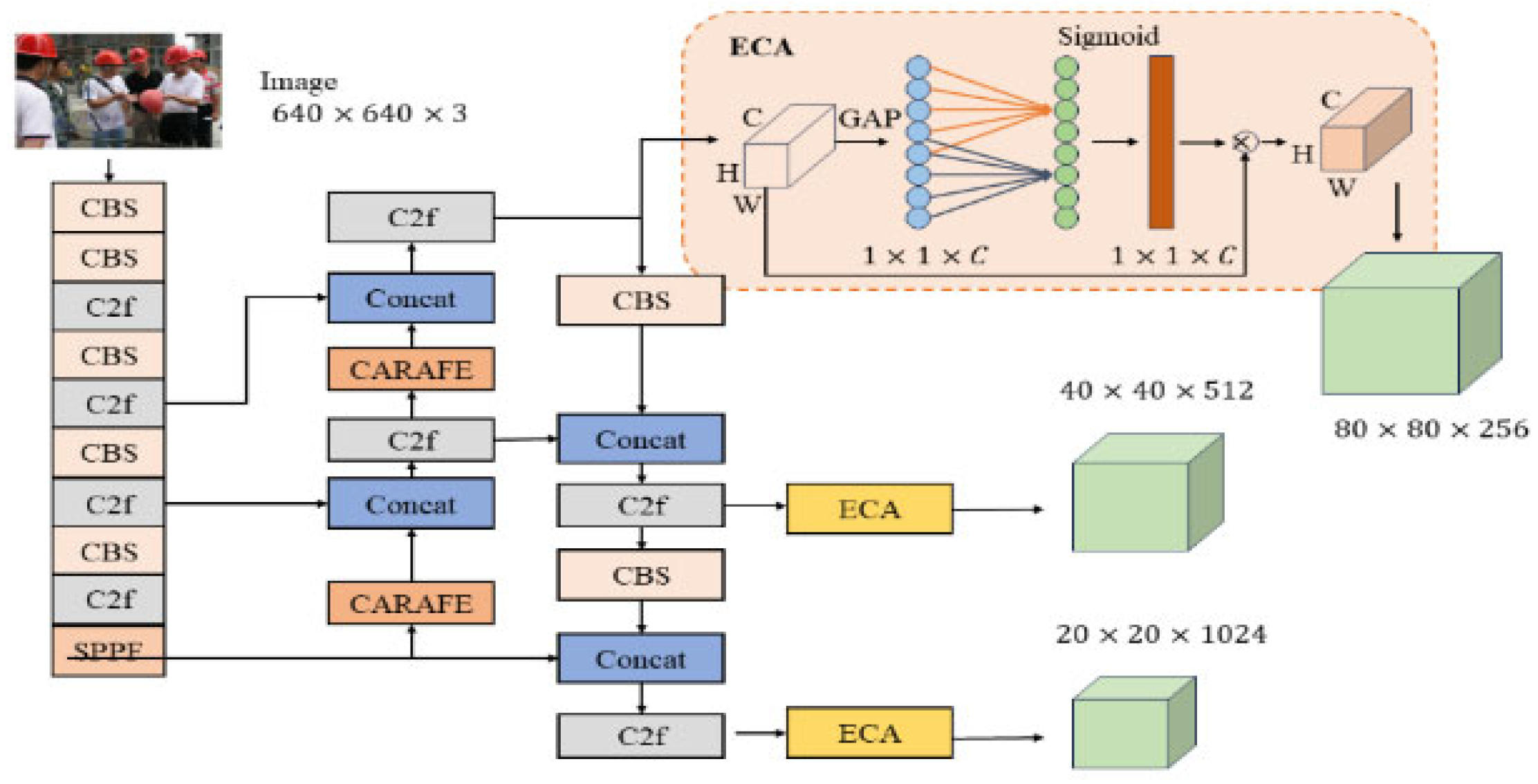
YOLOv8 is an efficient object detection algorithm capable of real-time object detection. In this study, we utilize the standard YOLOv8 architecture as the baseline to ensure a balance between speed and accuracy. The backbone network remains completely unmodified to preserve its robust pre-trained feature extraction capabilities. The structural modifications proposed in this paper—specifically the integration of the ECA mechanism and the CARAFE operator—are strictly confined to the Neck (Feature Pyramid Network). Furthermore, the original decoupled head architecture of YOLOv8 remains structurally unchanged; our optimization within the Head component is exclusively limited to the replacement of the bounding box regression loss function with the EIoU Loss. This design ensures that the model benefits from advanced feature fusion without disrupting the proven foundational architecture.
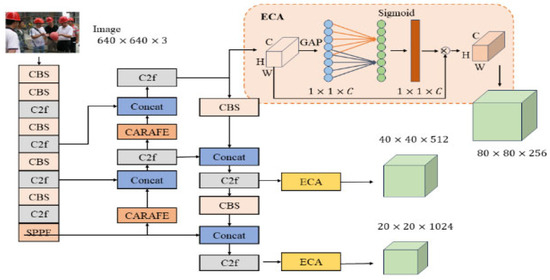
The input image is represented as , with dimensions . The network divides into grids, processing it through the CBS and C2f modules [28]. The feature maps from the backbone are denoted as with strides of 8, 16, and 32, respectively. The improved EC-YOLOv8 architecture integrates the ECA mechanism and CARAFE operators into the feature fusion process to enhance small object detection and background suppression. The detailed architecture is shown in Figure 1 [29,30,31].
Figure 1.
EC-YOLOv8 network structure.
3.1. Integration of ECA Attention Mechanism
To enhance the network’s perception ability, the ECA (Efficient Channel Attention) mechanism is seamlessly integrated into the YOLOv8 architecture. Unlike previous approaches that insert attention into the backbone, we place the ECA modules specifically in the Neck part of the network (PANet structure) [32,33,34,35].
Exact Implementation Details: The ECA modules are inserted immediately after the C2f modules and before the decoupled detection heads at three different scales (P3, P4, P5). Specifically,
- After the feature fusion in the PANet, the output feature maps with dimensions are processed.
- The ECA module is applied to these feature maps to recalibrate channel weights before they are fed into the final regression and classification heads [15].
- We set the kernel size of the 1D convolution in ECA adaptively using the mapping function , where and , ensuring the interaction range is proportional to the channel dimension .
By placing ECA at these specific junctions, the model effectively suppresses background noise from complex construction sites just before the final prediction stage, without disrupting the initial feature extraction of the backbone [36].
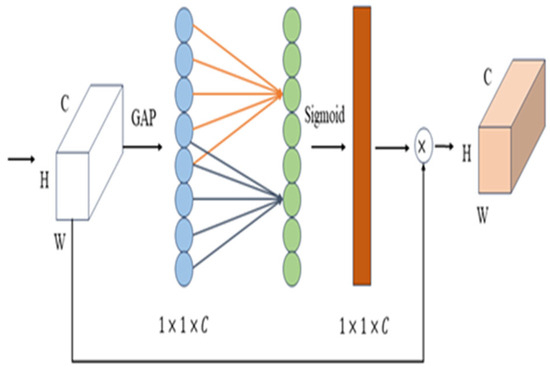
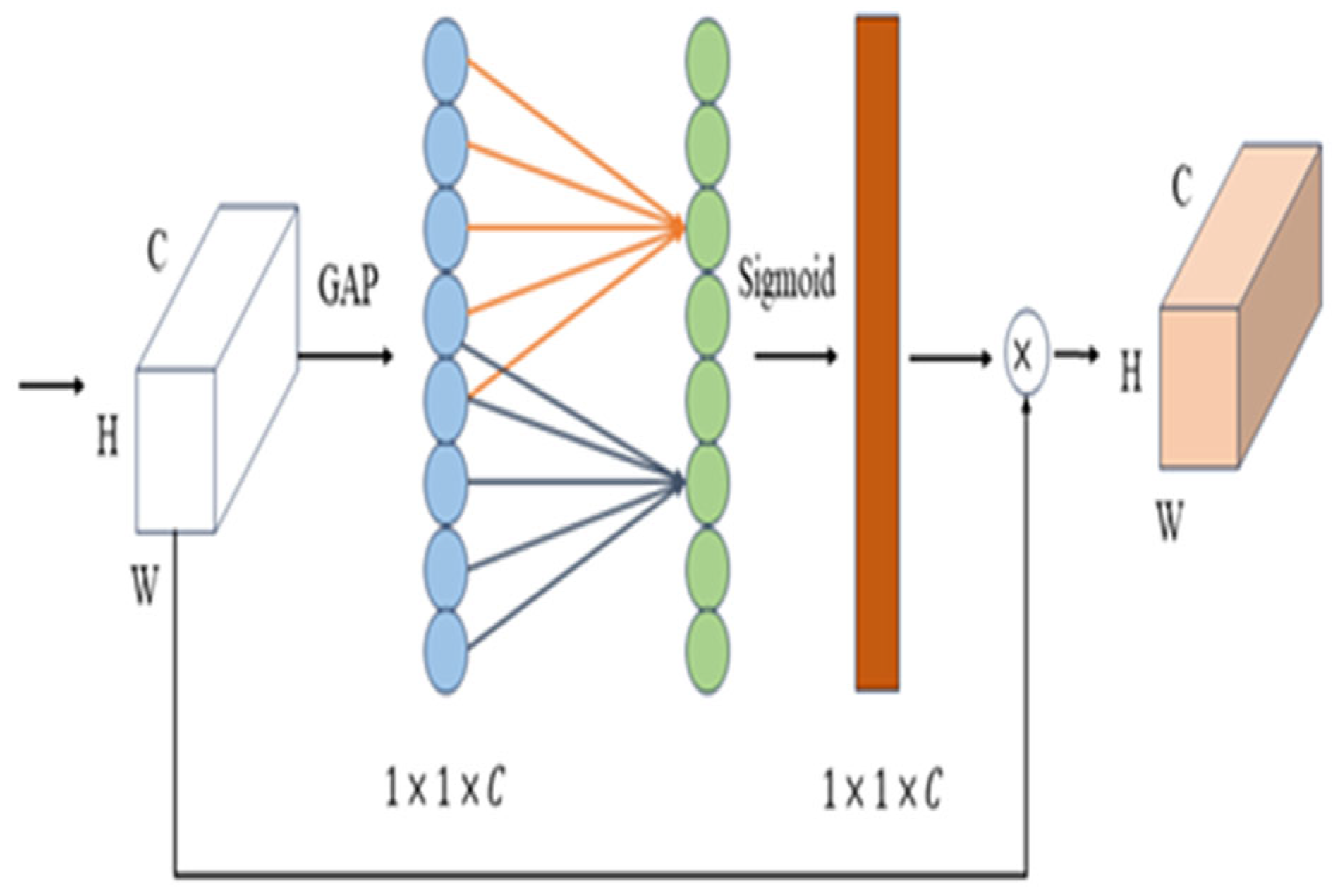
The ECA mechanism is an attention mechanism used in computer vision tasks. It adaptively allocates weights to the feature maps of different channels to enhance the representation of useful information [37,38]. The ECA attention mechanism effectively improves the model’s performance and is widely applied in tasks such as image classification, object detection, and image segmentation. In traditional attention mechanisms, there are two primary types [39]: self-attention and channel attention. Self-attention focuses on the relationships between different positions within the feature map, while channel attention focuses on the relationships across different channels of the feature map. The ECA attention mechanism, however, specifically optimizes channel attention by learning adaptive weights for each channel to improve the feature maps’ representational ability. The structure of the ECA attention mechanism is shown in Figure 2.
Figure 2.
ECA network structure diagram.
The core idea of the ECA mechanism is to utilize global information to compute channel weights. Specifically, it employs a 1D convolution operation to capture global contextual information and generates a channel attention map of the same size as the input feature map. This channel attention map represents the contribution of each channel to the final feature representation. To achieve this, the ECA attention mechanism first applies a 1D convolution operation to the input feature map, integrating the features from each channel. Then, a sigmoid function is applied to map the convolution result to the range of [0, 1]. Finally, the mapped result is element-wise multiplied with the input feature map to produce the weighted feature map. The formula for calculating the weight of each channel is as follows:
In this context, the formula for the ECA (Efficient Channel Attention) mechanism can be elaborated as follows:
C is the number of input channels. γ is a parameter that in the experiments of this chapter is set to 2. b is set to 1. φ(C) represents the selection of k, which is the closest odd number to the computed value of C. Here, k determines the number of neighboring channels whose dependencies need to be captured. ωi represents the weight corresponding to each channel, generated by the Sigmoid function [40].
The ECA mechanism has the following advantages:
- Computational Efficiency: Compared to traditional attention mechanisms, the ECA attention mechanism uses a simple 1D convolution operation, which reduces the computational load. This makes it well-suited for fast and efficient feature enhancement, even under limited computational resources.
- Context Awareness: By utilizing global information, the ECA mechanism can capture broader contextual relationships. This enables the model to better understand the content of the image and extract important features that are relevant to the task at hand, leading to improved performance.
- Model Interpretability: The channel attention map generated by the ECA mechanism provides a clear visual representation of each channel’s contribution to the final feature representation. This enhances the interpretability of the model, making it easier to analyze and understand how the model operates and why certain features are emphasized over others.
These advantages make ECA an attractive choice for improving performance in tasks like object detection, where both efficiency and accuracy are crucial. The ability to interpret and visualize the learned attention patterns also adds to the transparency of the model [41].
The ECA mechanism enhances feature representation by optimizing channel attention, providing an efficient and effective way to improve the model’s ability to capture important features. It offers new insights for model design and performance improvement in computer vision tasks, demonstrating strong performance in practical applications. By incorporating the ECA attention mechanism, the YOLOv8 network becomes more accurate in focusing on the features related to the target object, thereby improving both the recall rate and precision of object detection. At the same time, the ECA attention mechanism has low computational complexity, allowing the network’s efficiency to be enhanced without a significant increase in computational burden. This makes ECA particularly useful for real-time object detection tasks, where both performance and efficiency are critical. By better attending to relevant features, the network can achieve higher accuracy and robustness, especially in challenging scenarios involving occlusions, small objects, or cluttered backgrounds.
In this study, to minimize memory overhead and network depth while enhancing the effective learning of helmet features, a lightweight ECA mechanism is inserted into the three reparameterization paths of the YOLOv8 network model. This mechanism enables local cross-channel interactions between adjacent channels without reducing the channel dimensions. By doing so, the model not only improves its ability to recognize key information related to helmets but also enhances the network’s efficiency by suppressing redundant features. This approach helps achieve a balance between performance and computational cost, making the model more efficient in terms of both memory usage and processing speed, while maintaining high detection accuracy.
3.2. CARAFE
In helmet detection, there are often many small targets with high similarity, making accurate detection challenging. In the YOLOv8 network structure, this issue can be addressed by fusing the feature map output by the CARAFE upsampling module with the feature map obtained from the bottom-up path of the network. This fusion allows for the extraction of more high-quality features, which can improve detection accuracy. This fusion structure does not significantly increase the parameter count, and it performs high-quality upsampling based on the input content [42]. By incorporating more high-quality feature maps, this fusion helps to reduce the occurrence of false positives (incorrect detections) and false negatives (missed detections), leading to better overall performance in helmet detection.
CARAFE (Content-Aware ReAssembly of Features) is an operation used in image semantic segmentation, aimed at reassembling low-resolution feature maps into high-resolution outputs. The CARAFE operation improves resolution by learning content-aware convolutional reassembly, achieving significant improvements in many image segmentation tasks. In image semantic segmentation tasks, convolutional neural networks (CNNs) are typically used to extract features from the input image. These features are then fed into a segmentation head to generate the corresponding segmentation result. However, due to multiple downsampling operations, the resolution of the feature map is reduced, leading to a decrease in segmentation accuracy.
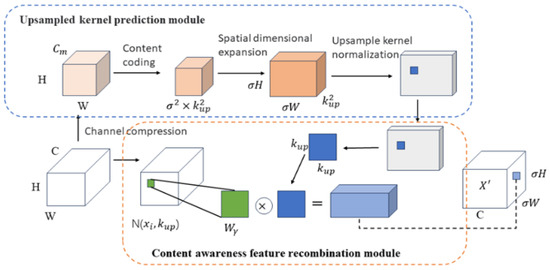
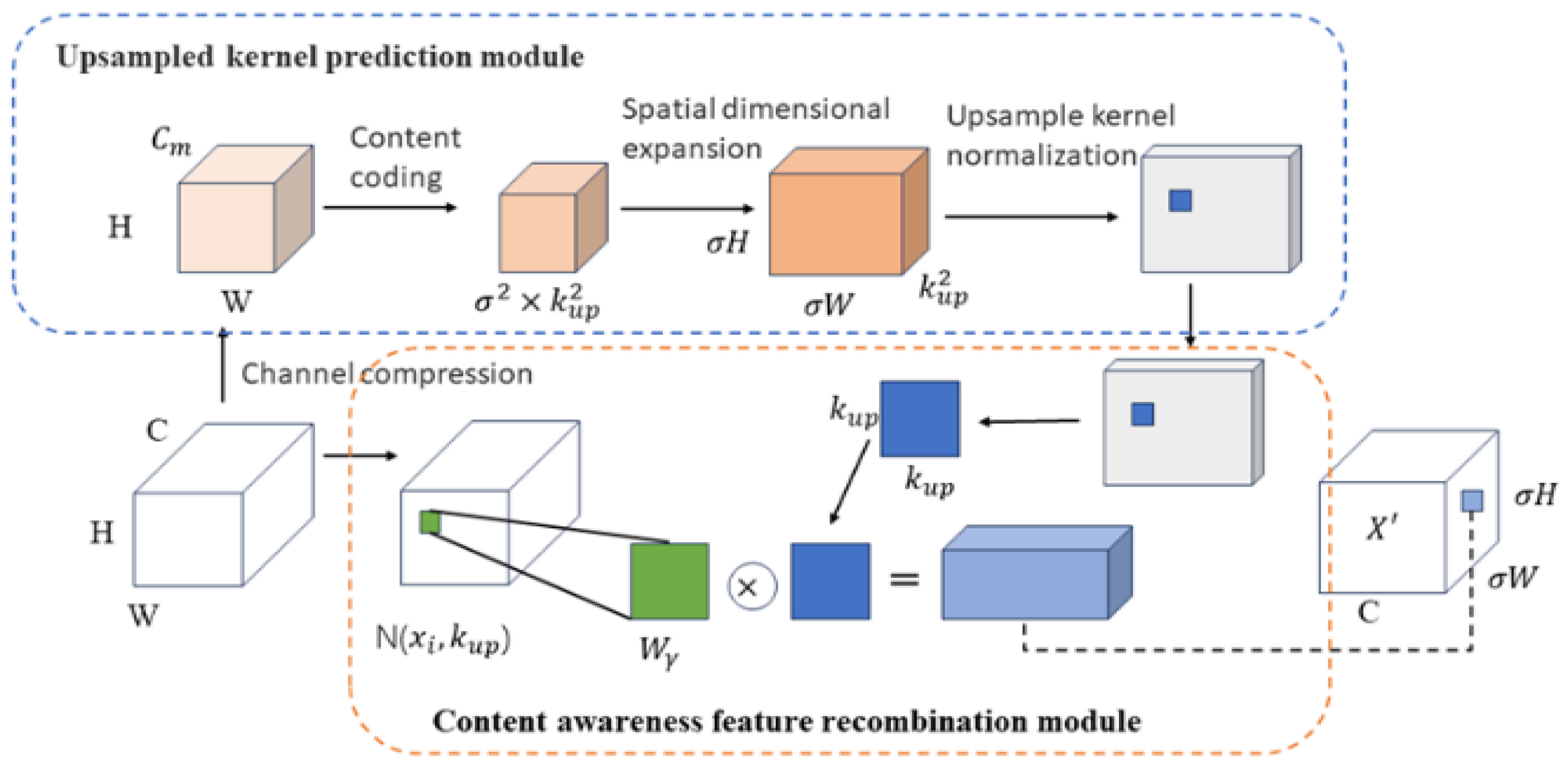
The goal of the CARAFE (Content-Aware ReAssembly of Features) operation is to reassemble low-resolution feature maps into high-resolution feature map outputs. To achieve this, the CARAFE operation introduces two key components: reversible upsampling and content-aware convolutional reassembly. The network structure of CARAFE is shown in Figure 3.
Figure 3.
CARAFE structure diagram.
In the standard YOLOv8, the Feature Pyramid Network (FPN) utilizes nearest-neighbor interpolation for upsampling, which often leads to discontinuity and semantic information loss, particularly for small safety helmet targets. In EC-YOLOv8, we replace the two standard Upsample operators in the FPN top-down pathway with CARAFE (Content-Aware ReAssembly of Features) operators.
Specific Hyperparameter Settings: To ensure reproducibility, the specific configuration of the CARAFE modules is as follows:
Up sampling Kernel Size : We set . This implies that for each target pixel, the reassembly takes place within a neighborhood of the source feature map, providing a larger receptive field than standard interpolation.
Encoder Kernel Size : The kernel prediction module uses a convolution layer with a kernel size of to generate the reassembly kernels.
Channel Compression : To reduce computational cost, the input channel dimension is compressed to in the kernel prediction module before expanding to the reassembly kernel size [43].
This configuration allows the network to generate instance-specific upsampling kernels based on the semantic content of the safety helmets, significantly recovering detailed shape information lost during downsampling.
Reversible Upsampling: Traditional upsampling operations (such as bilinear interpolation) often lead to information loss. To address this issue, the CARAFE operation employs a reversible upsampling strategy. Instead of simply interpolating values, this approach distributes the feature values of each pixel to multiple surrounding locations, effectively upsampling the feature map. This strategy increases the spatial resolution of the feature map while minimizing information loss, allowing for a more accurate reconstruction of high-resolution features.
Compared to the original upsampling operation in YOLOv8, the CARAFE operation uses content-aware convolutional reassembly to improve the quality of the feature map [44]. It concatenates the feature map obtained from reversible upsampling with the original low-resolution feature map, better preserving and restoring the detailed information in the feature map. Through a small convolutional network, the concatenated features are processed to produce high-quality feature maps. At the same time, it reassembles the low-resolution feature map into a high-resolution output, thereby improving the accuracy of the segmentation results.
3.3. Loss Function Improvement: From CIoU to EIoU
The bounding box regression loss function is critical for accurate localization in object detection. The baseline YOLOv8 network employs the Complete-IoU (CIoU) loss function by default. While CIoU is effective for general detection tasks, it exhibits significant limitations when applied to the complex, dense occlusion scenarios typical of construction sites [45].
Limitations of the Baseline CIoU: CIoU improves upon standard IoU by incorporating the distance between center points and an aspect ratio penalty. However, its aspect ratio penalty treats the width and height as a coupled variable. If the predicted box’s width and height scale proportionally relative to the ground truth box, the aspect ratio penalty becomes zero, even if the actual size is incorrect. Furthermore, CIoU lacks a directional consistency constraint. In densely populated construction sites where workers and scaffolding heavily overlap, this ambiguity causes the predicted bounding boxes to “wander” during the early stages of training, struggling to converge to the precise ground truth locations.
Advantages of the Proposed EIoU Loss: To address the localization bias caused by dense occlusion, this paper replaces the default CIoU with an Enhanced-IoU (EIoU) Loss. The EIoU formulation utilized in this study explicitly addresses the shortcomings of CIoU by introducing a Euler angle penalty component alongside the GIoU metric.
In the context of Horizontal Bounding Boxes (HBB) for safety helmet detection, the Euler Loss does not refer to the physical rotation of the object itself. Instead, it measures the directional angular discrepancy of the vector connecting the center point of the predicted bounding box to the center point of the ground truth bounding box. The formula for Euler Loss is defined as:
Here, represents the rotation angle of the trajectory vector between the predicted and ground truth bounding boxes. A value closer to 1 indicates that the directional angle difference between the two bounding boxes is smaller. Finally, the EIoU loss function is calculated by combining GIoU and Euler Loss. The specific formula is as follows:
By incorporating this directional angle penalty, the EIoU loss function enforces a strict regression direction constraint. It forces the predicted box to move towards the ground truth box along the shortest and most direct path. This mechanism directly resolves the “wandering” issue inherent in CIoU when handling densely packed or partially occluded safety helmets. As will be quantitatively demonstrated in the subsequent ablation studies (Section 4.5), replacing CIoU with EIoU significantly improves the detection precision and boundary box stability without introducing any additional computational overhead during inference. Therefore, EIoU Loss is selected as the optimal bounding box regression loss function for the EC-YOLOv8 network.
4. Experiments and Result Analysis
4.1. Experimental Introduction
The experiments were conducted using the PyTorch deep learning framework (version 1.13.0) on a Linux system (Ubuntu 20.10). The hardware configuration included an Intel(R) Core(TM) i5-12400F CPU @ 4.40 GHz, 16 GB of RAM, and a single NVIDIA GeForce RTX 2060 SUPER GPU with 8 GB of VRAM. To accelerate training, CUDA 11.6 and cuDNN 8.4 were utilized.
To ensure the reproducibility of the experiments, we strictly initialized the random seed to 0 for all Python (www.python.org), NumPy (https://numpy.org/), and PyTorch (https://pytorch.org/) random number generators. The model was trained using the Stochastic Gradient Descent (SGD) optimizer. The specific hyperparameter settings were as follows:
- Input Size: The input images were resized to pixels to match the network stride requirements.
- Batch Size: Set to 8 due to GPU memory constraints.
- Epochs: The model was trained for a maximum of 200 epochs.
- Optimizer Settings: Initial learning rate was set to 0.01, with a momentum of 0.937 and a weight decay of 0.0005 to prevent overfitting.
- Learning Rate Schedule: A linear warm-up strategy was employed for the first 3 epochs to stabilize the initial gradients. Subsequently, a Cosine Annealing Learning Rate scheduler was used to gradually reduce the learning rate to by the end of training.
- Early Stopping: To avoid overfitting, we implemented an early stopping mechanism. The training was automatically terminated if the validation mAP@.5 did not improve for 50 consecutive epochs [46].
4.2. Data Augmentation Strategy
Given the complex environment of construction sites, robust data augmentation is crucial for improving the model’s generalization ability. We employed the standard YOLOv8 augmentation pipeline during the training phase (Mosaic augmentation was turned off for the final 10 epochs to improve precision). The strategies included:
- Mosaic Augmentation: Combines 4 training images into one, enriching the background and improving the detection of small targets (probability = 1.0).
- Mixup: Blends two images and their labels to improve robustness against overlapping objects (probability = 0.1).
- HSV Augmentation: Randomly adjusts Hue (0.015), Saturation (0.7), and Value (0.4) to simulate different lighting conditions at construction sites.
- Geometric Transformations: Includes random left–right flips (probability = 0.5) and scaling (gain range 0.5 to 1.5).
4.3. Dataset Preparation
In this experiment, the Safety Helmet Wearing Dataset (SHWD), a public dataset for helmet detection, was used. The dataset contains 7581 images, with 9044 objects correctly wearing helmets (positive) and 111,514 objects not wearing helmets (negative). The dataset is annotated in YOLO format, marking the object positions and classes. The dataset was randomly divided into training, testing, and validation sets at a ratio of 7:2:1. The training set contains 5457 images, the testing set contains 1517 images, and the validation set contains 607 images.
4.4. Evaluation Metrics
To evaluate the performance of the object detection model and its applicability in real-world scenarios, this study conducted comparison experiments on detection accuracy and detection speed before and after the model improvement. The following section introduces the model performance evaluation metrics used in this study, including the newly added Confusion Matrix and F1-Score, which provide a more comprehensive assessment of the model’s robustness.
Confusion Matrix: The Confusion Matrix is a visualization tool used to analyze the classification performance of the object detection model. It contrasts the predicted categories with the actual categories, helping to identify the types of errors made by the model (e.g., misclassifying background as a helmet). Based on the detection model’s prediction results, the following four categories are defined:
- TP (True Positives): The number of targets correctly predicted as wearing helmets.
- FP (False Positives): The number of targets incorrectly predicted as wearing helmets.
- TN (True Negatives): The number of targets correctly predicted as not wearing helmets.
- FN (False Negatives): The number of targets incorrectly predicted as not wearing helmets.
These classifications help assess the model’s performance in the helmet detection task. Table 1 shows the confusion matrix for these four categories.
Table 1.
Confusion matrix.
Precision refers to the proportion of true positive samples among all the samples that the detection model predicts as positive. It measures the model’s ability to identify helmet targets. A higher precision indicates better detection capability of the helmet detection model, meaning the model’s accuracy in identifying targets as helmets is higher. The specific formula is as follows:
Recall refers to the proportion of true positive samples among all the actual positive samples. In the case of helmet detection, recall indicates the proportion of targets wearing helmets that were correctly detected by the model. Recall measures the model’s ability to find all relevant instances. The recall calculation formula is as follows:
In object detection experiments, it is desirable for both precision and recall to be high, indicating better model performance. However, in most cases, these two metrics are negatively correlated. That is, when precision is low, recall tends to be higher, and when recall is low, precision tends to be higher. During the experiment, to compare the performance of different models, the Average Precision (AP) is also considered. Average Precision is the area under the curve plotted with Recall and Precision as the axes, which provides a better overall indication of model performance. By comparing the AP values of different models, it is possible to determine which model is better suited for the helmet detection task. The formula for Average Precision is as follows:
F1 score is the harmonic mean of precision (Precision) and recall (Recall), comprehensively reflecting the overall performance of the model. Its calculation formula is as follows:
Mean Average Precision (mAP) is the average of the Average Precision (AP) values calculated for each class, providing a better evaluation of the model’s overall performance in detecting multiple object categories. The value of mAP ranges from 0 to 1, where a higher value indicates better performance of the object detection model. The formula for mAP is as follows:
where N represents the number of object categories in the dataset, and AP(n) denotes the Average Precision for the n-th object category.
mAP@.5 refers to calculating the precision of a category at an IoU threshold of 0.5. mAP@.5:.95 involves calculating the precision for the category at IoU thresholds ranging from 0.5 to 0.95, in increments of 0.05, and then averaging these precision values to obtain the mean average precision.
In addition to the model’s accuracy, inference speed is a critical performance metric for real-time object detection in construction sites. In this study, detection speed is evaluated using Latency (measured in milliseconds per image, ms) and Frames Per Second (FPS). The testing is conducted under a uniform input resolution of 640 × 640 using a single NVIDIA GeForce RTX 2060 SUPER GPU. A lower latency and a higher FPS indicate a faster detection speed, which determines whether the model can be deployed for real-time video stream monitoring in practical engineering scenarios. Generally, the smaller the time value, the faster the model’s detection speed, which can be used to determine whether the model can achieve real-time detection and whether it is suitable for practical construction sites. In this study’s YOLOv8 experiments, the evaluation metrics used are: Recall (R), Precision (P), mAP@.5, and mAP@.5:.95. Furthermore, considering the deployment requirements on computationally limited edge devices at construction sites, the complexity and size of the models are evaluated. We introduce Parameters (Params), measured in millions (M), to evaluate the spatial complexity of the network structure, and Model Size, measured in megabytes (MB), to represent the physical memory footprint of the final generated weight files.
4.5. Ablation Experiment
This study conducts a series of ablation experiments based on the YOLOv8 network architecture, focusing on the ECA, CARAFE, and EIoU Loss modules, all of which play crucial roles in the safety helmet detection task. The aim of these ablation experiments is to evaluate the contribution of each module to the performance of the safety helmet detection task and to verify their respective roles in the model.
Using the YOLOv8 network as the baseline model, which adopts the latest object detection architecture, the ECA, CARAFE, and EIoU Loss modules are progressively incorporated into the baseline model for testing. The experimental setup remains consistent, including dataset, network structure, training method, and hyperparameters. The performance of the baseline model is used as a reference to assess the impact of each module on the safety helmet detection performance. The experimental results are shown in Table 2.
Table 2.
Results of ablation experiments.
From Table 2, it can be observed that when the ECA attention mechanism module, CARAFE module, or EIoU loss function is individually incorporated into the YOLOv8 model, we obtain ablation models with only one improvement. By evaluating and comparing the performance of the YOLOv8 model and each ablation model on the test set, the experimental results show that compared to the original YOLOv8 model, these models achieved increases in recall of 0.5%, 0.8%, and 0.2%, respectively. The mAP@.5 increased by 1%, 1.5%, and 0.8%, respectively, and mAP@.5:.95 increased by 0.8%, 0.8%, and 0.5%. However, the precision of the models decreased to some extent.
In the ablation experiments, when certain modules were introduced individually (such as ECA or CARAFE), although recall and mAP increased, “the precision of the model decreased to some extent.” Given this negative correlation between precision and recall, the F1 score, as a comprehensive indicator of both, most directly demonstrates that the improved model (F1 = 0.923) does indeed outperform the original model (F1 = 0.912) in overall performance, thus providing solid data support for the effectiveness of the modules.
From the table, it can be seen that when two of the modules, either ECA attention mechanism, CARAFE module, or EIoU loss function, are introduced into the YOLOv8 model, the models show improvements in precision, recall, mAP@.5, and mAP@.5:.95 to varying degrees. When both the ECA attention mechanism module and the CARAFE module are introduced, the model’s performance improves significantly. Precision increased by 0.9%, recall increased by 0.5%, mAP@.5 increased by 1.8%, and mAP@.5:.95 increased by 1.1%. This suggests that when the ECA attention mechanism module and CARAFE module work together, ECA helps the CNN network better capture key information from different channels of the feature map, while the CARAFE module reorganizes the downsampled feature map to achieve higher resolution and more detailed information. This results in better performance in safety helmet detection.
In order to further verify the rationality of the EIoU loss function in this paper, we compare EIoU with the default CIoU of YOLOv8 and other mainstream bounding box regression loss functions (DIoU, SIoU) based on the network of YOLOv8 + ECA + CARAFE. The experimental environment is consistent with the hyperparameter settings, and the comparison results are shown in Table 3.
Table 3.
Comparison of different bounding box regression loss functions.
As shown in Table 3, both DIoU and SIoU offer performance improvements compared to YOLOv8’s default CIoU loss function. However, EIoU, used in this paper, performs best, achieving an mAP@.5 of 95.7%. This is because CIoU only considers aspect ratio as the overall penalty, while EIoU not only separates the differences in width and height but also introduces directional consistency constraints on the center point connection line through Euler components. For densely overlapping helmets frequently encountered in construction sites, EIoU can more accurately guide the regression direction of the bounding box, thus significantly improving the detection precision (precision increased to 95.2%) while maintaining a similar recall rate.
Finally, by incorporating the EIoU loss function into the YOLOv8 + ECA + CARAFE model and evaluating it, the results show that the YOLOv8 + ECA + CARAFE + EIoU model achieved improvements of 2.0% in precision, 0.3% in recall, 2.5% in mAP@.5, and 1.1% in mAP@.5:.95 compared to the original YOLOv8 model. This indicates that the EIoU loss function can more accurately measure the similarity between predicted boxes and ground truth boxes, thereby improving the detection accuracy and stability of the safety helmet detection algorithm.
In conclusion, the ablation experiment results demonstrate that the ECA, CARAFE, and EIoU Loss modules contribute to improved performance in safety helmet detection. The incorporation of these modules significantly enhances the model’s accuracy and recall, thereby reducing missed and false detections in safety helmet detection tasks.
4.6. Comparison with Existing Mainstream Algorithms
To compare the performance of different safety helmet detection algorithms in terms of accuracy, recall, and precision, a series of comparative experiments were conducted in this section. This section will describe the experimental data and results in detail, as well as analyze and discuss the experimental outcomes.
The dataset used in this comparison experiment is the same as described in Section 4.2, specifically the SHWD dataset. The dataset was split into training, validation, and testing sets in a 7:2:1 ratio.
In this study, seven common safety helmet detection algorithms, two newer safety helmet improvement algorithms, and the proposed improved algorithms were selected as experimental subjects. These include SSD, Faster R-CNN, YOLOv5s, YOLOv8n (Baseline), CE-YOLOv5s, RT-DETR-L, YOLOv9t, YOLOv10n, and EC-YOLOv8. These algorithms are among the most classic and commonly used ones in the field of safety helmet detection, with good performance and practicality. Four common metrics were chosen to evaluate the performance of the experimental algorithms: accuracy, recall, F1-Score and mAP@.5. Specifically: (1) Accuracy refers to the proportion of correctly detected targets in the detection process. (2) Recall indicates the proportion of all targets that the model can correctly detect. (3) F1 score is the harmonic mean of precision (Precision) and recall (Recall), comprehensively reflecting the overall performance of the model. (4) mAP@.5 refers to the mean Average Precision calculated at an IoU threshold of 0.5.
The evaluation was carried out on the test set, and the accuracy, recall, and mAP@.5 values for all 11 algorithms were computed. The specific results are shown in Table 4.
Table 4.
Comprehensive comparison with mainstream and recent state-of-the-art algorithms on the SHWD dataset.
As shown in Table 4, although RT-DETR based on Transformer demonstrates powerful global context modeling capabilities and achieves 95.5% mAP@.5, its large parameter count of 32.0 M and computational load of 108.0 GFLOPs make it extremely difficult to implement real-time inference on edge devices at construction sites with limited computing resources.
On the other hand, the newly released YOLOv9t and the NMS-free YOLOv10n demonstrate remarkable general detection efficiency at extremely low computational costs (7.7 GFLOPs and 6.7 GFLOPs, respectively), achieving mAP@.5 of 94.8% and 95.0%, respectively. However, due to the unique characteristics of construction sites—the safety helmets are extremely small, the background is cluttered, and there is severe crowd occlusion—these general lightweight architectures still face the problem of fine-grained feature loss during multiple downsampling.
In contrast, the proposed EC-YOLOv8 is not simply a stacking of modules, but rather a deeply customized solution addressing the aforementioned pain points. Although the introduction of the CARAFE operator and ECA attention mechanism slightly increases the number of parameters to 3.48 M and achieves a GFLOPs of 9.2 (slightly higher than the YOLOv8n baseline), this acceptable computational overhead yields extremely significant performance gains. CARAFE’s content-aware reconstruction capabilities and ECA’s suppression of complex background noise enable EC-YOLOv8 to achieve a state-of-the-art accuracy of 95.7% on the SHWD dataset. This demonstrates that EC-YOLOv8 achieves an excellent balance between feature extraction capabilities and computational complexity, making it the most pragmatic choice for current complex industrial scenarios.
The detection time of the EC-YOLOv8 model was tested, as shown in Table 5. The inference speed of the models was evaluated at an input resolution of 640 × 640 on an RTX 2060 SUPER GPU, with the results detailed in Table 5. Although the introduction of the CARAFE operator and ECA mechanism in the EC-YOLOv8 model adds a slight computational overhead, increasing the inference latency from 5.2 ms to 5.8 ms compared to the YOLOv8 baseline, it still achieves an impressive speed of 172 FPS. This significantly exceeds the standard real-time processing threshold (typically 30 FPS). Furthermore, compared to CE-YOLOv5s, the proposed EC-YOLOv8 not only achieves higher accuracy but is also substantially faster, fully satisfying the stringent real-time detection requirements of complex construction site environments.
Table 5.
EC-YOLOv8 detection time test results of the model.
Considering that deep learning models are affected by random weight initialization and random sampling for data augmentation during training, the results of a single experiment may exhibit some degree of random fluctuation. To scientifically verify the statistical significance of the performance improvement of the proposed EC-YOLOv8 model, we ruled out the randomness of single optimal results and conducted multiple independent and repeated experiments on the baseline YOLOv8 model and the proposed EC-YOLOv8 model.
The specific experimental setup is as follows: We selected 5 different global random seeds (Random Seeds: 0, 42, 3407, 1024, 2024) and conducted 5 complete training and testing of the two models while keeping all other hyperparameters unchanged. We recorded the mAP@.5 metrics on the test set for each independent experiment and calculated their means, standard deviations (SD), and 95% confidence intervals (CI). We then used a two-sample t-test to assess the significance of the difference. The statistical results are shown in Table 6.
Table 6.
Statistical significance analysis of mAP@.5 over 5 independent runs.
As shown in Table 6, the baseline YOLOv8 model achieved a mean mAP@.5 of 93.12% across 5 experiments, with a fluctuation range (standard deviation) of . In contrast, the improved EC-YOLOv8 model not only achieved a high accuracy of 95.7% in its optimal run, but its mean across 5 experiments remained stable at 95.58% (standard deviation ). The 95% confidence intervals of the two models did not overlap at all. More importantly, the p-value of the independent samples t-test was , far below the traditional significance threshold (). This statistical evidence strongly demonstrates that the approximately 2.46% improvement in mean accuracy brought about by EC-YOLOv8 (integrating the ECA mechanism, CARAFE operator, and EIoU loss) is statistically significant and demonstrates model robustness, completely eliminating artifacts caused by random errors.
4.7. Analysis of Detection Results
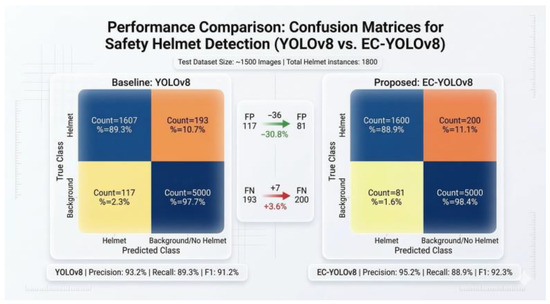
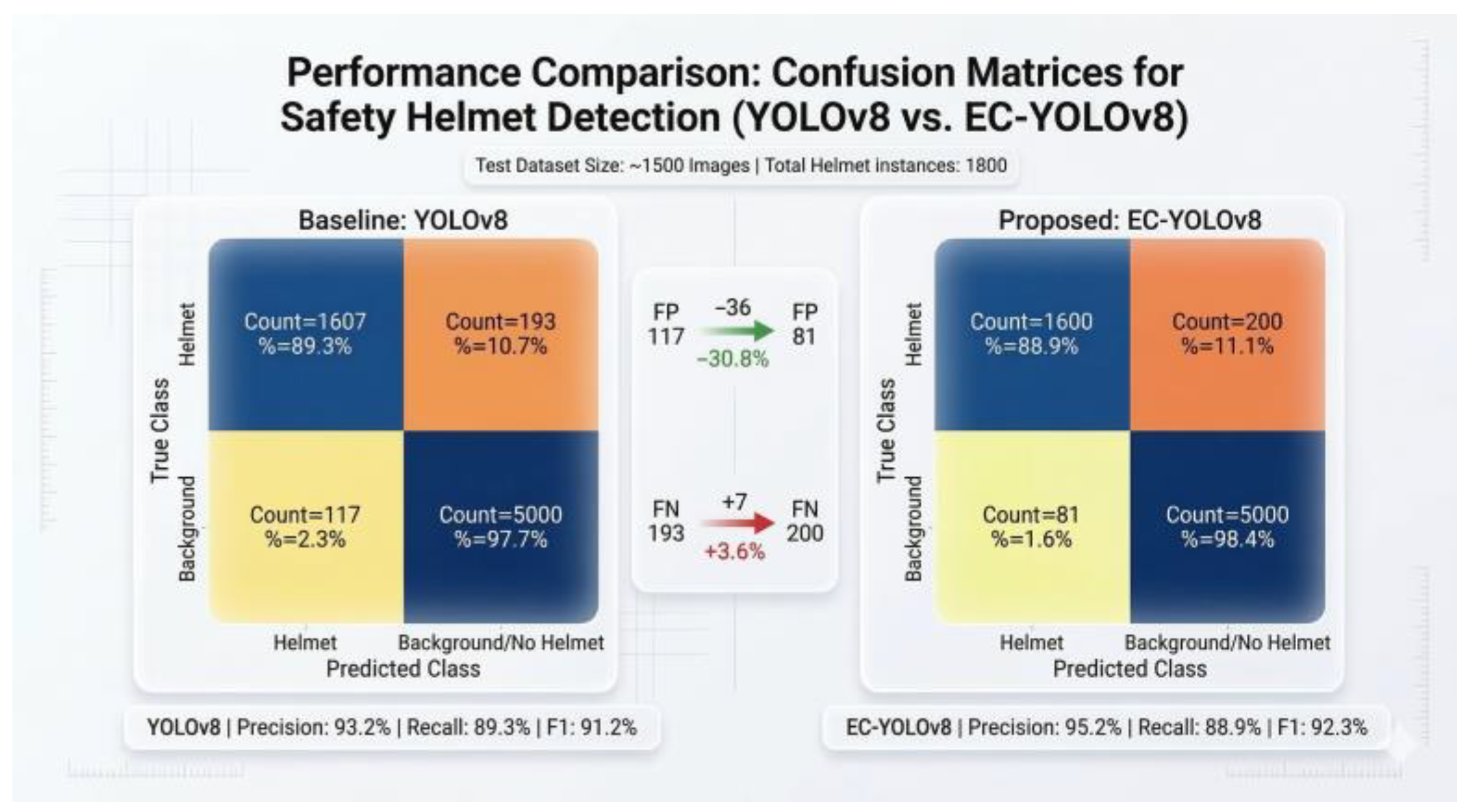
In order to further quantify the improvement of the model on false positives and missed detections, the confusion matrix of the original YOLOv8 and the EC-YOLOv8 proposed in this paper on the test set is generated. In the YOLOv8 model, due to interference from complex backgrounds and loss of small target features, the number of false negatives (FN, missed helmet targets) is relatively high; at the same time, the number of false positives (FP, misidentifying background or other objects as helmets) also exists to a certain extent. However, after using the EC-YOLOv8 model, the number of correct predictions (TP, correctly predicted as helmet wearers) increased from about 1607 in the baseline model to about 1600 (although the recall rate fluctuated slightly, the precision increased significantly). More importantly, the number of FP (false positives, i.e., false detections) decreased significantly. This indicates that the ECA attention mechanism effectively suppressed the interference of background noise at the construction site, while the CARAFE operator greatly recovered the features of small targets, as shown in Figure 4.
Figure 4.
EC-YOLOv8 compared to YOLOv8.
In terms of model complexity, as shown in Table 5, the proposed EC-YOLOv8 slightly increases the parameter count to 3.48 M and the model weight size to 6.8 MB compared to the baseline YOLOv8 (3.15 M and 6.2 MB, respectively). This minor increase is primarily attributed to the learnable upsampling kernels introduced by the CARAFE operators. However, compared to other improved lightweight models like CE-YOLOv5s (7.36 M and 14.4 MB), EC-YOLOv8 is approximately 50% smaller in terms of both parameters and memory footprint. This demonstrates that EC-YOLOv8 achieves an excellent trade-off between detection precision and model lightweightness, making it highly suitable for direct deployment on resource-constrained edge devices at construction sites without significant memory overhead.
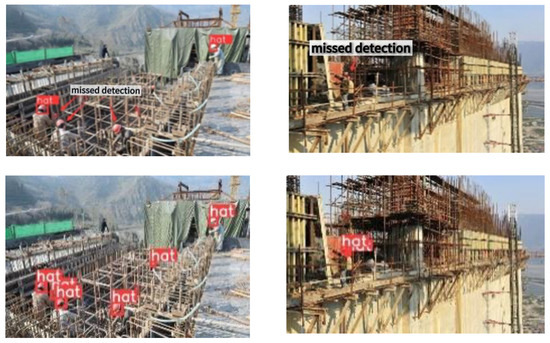
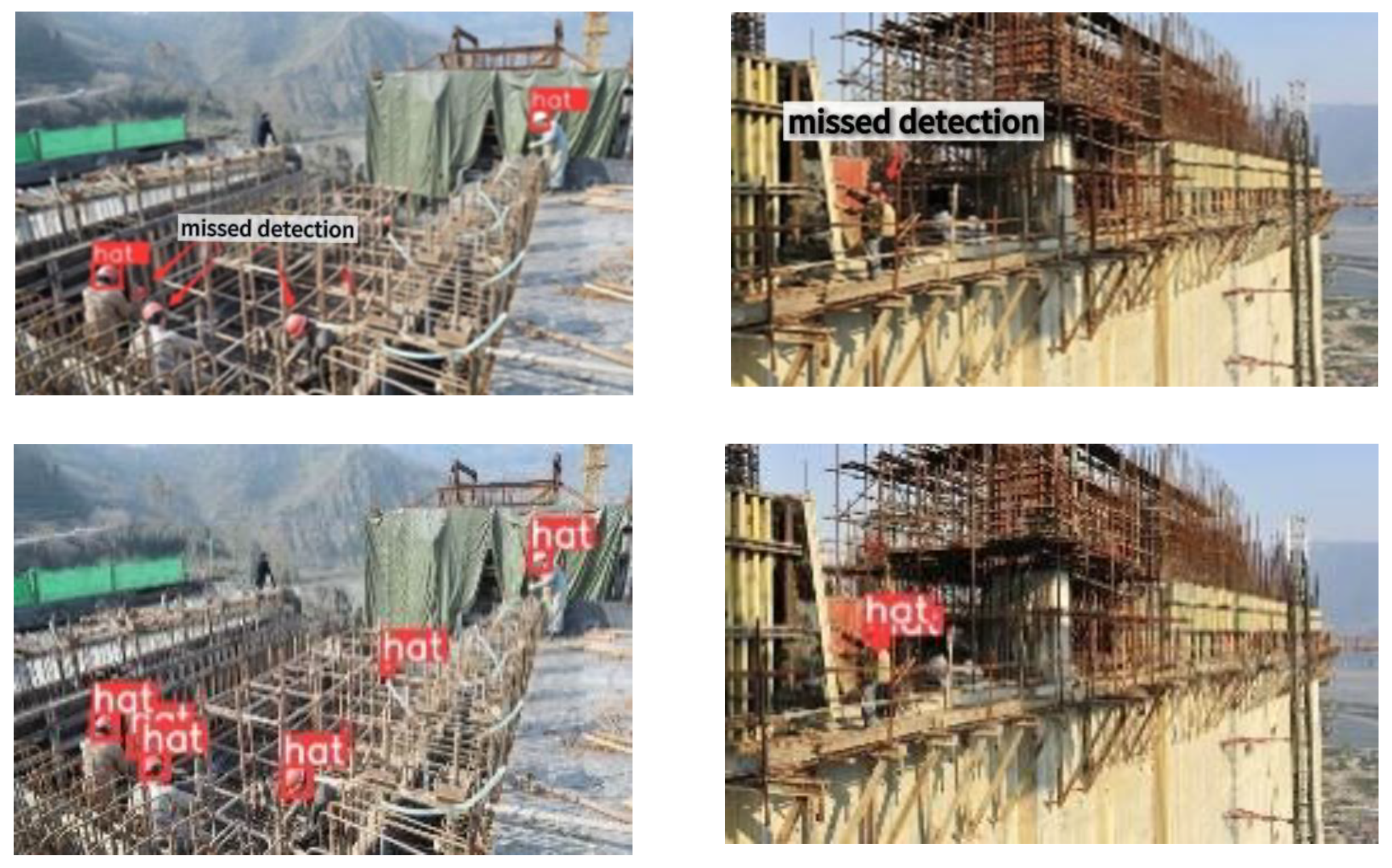
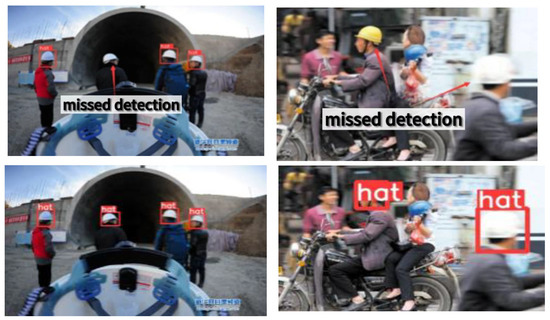
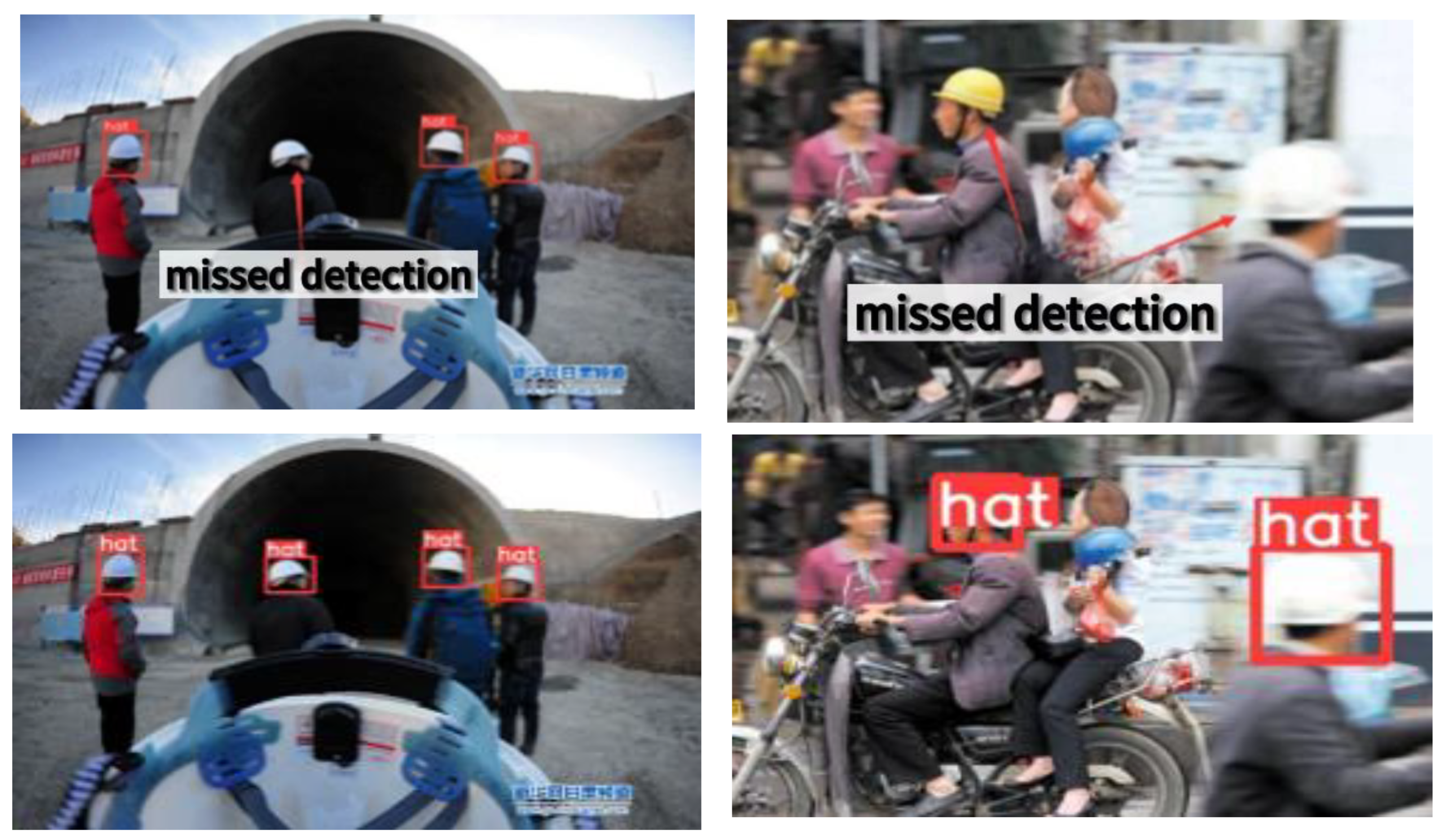
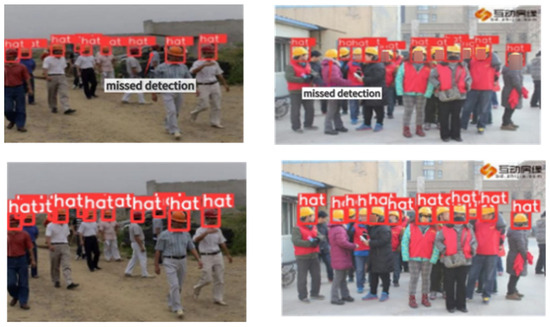
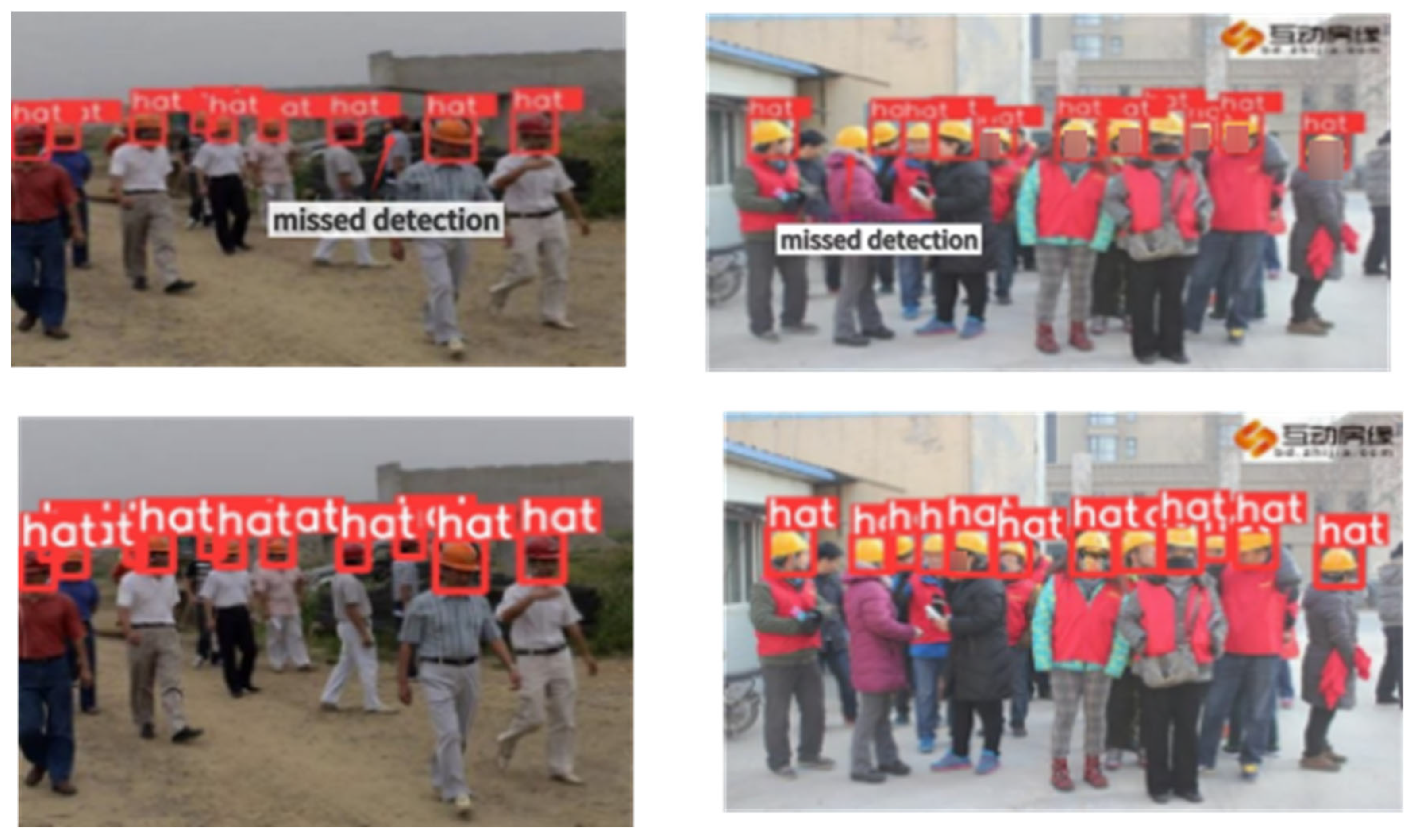
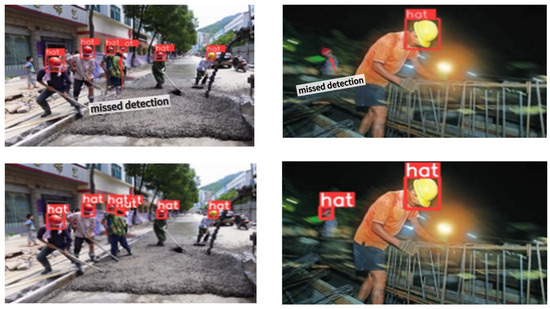
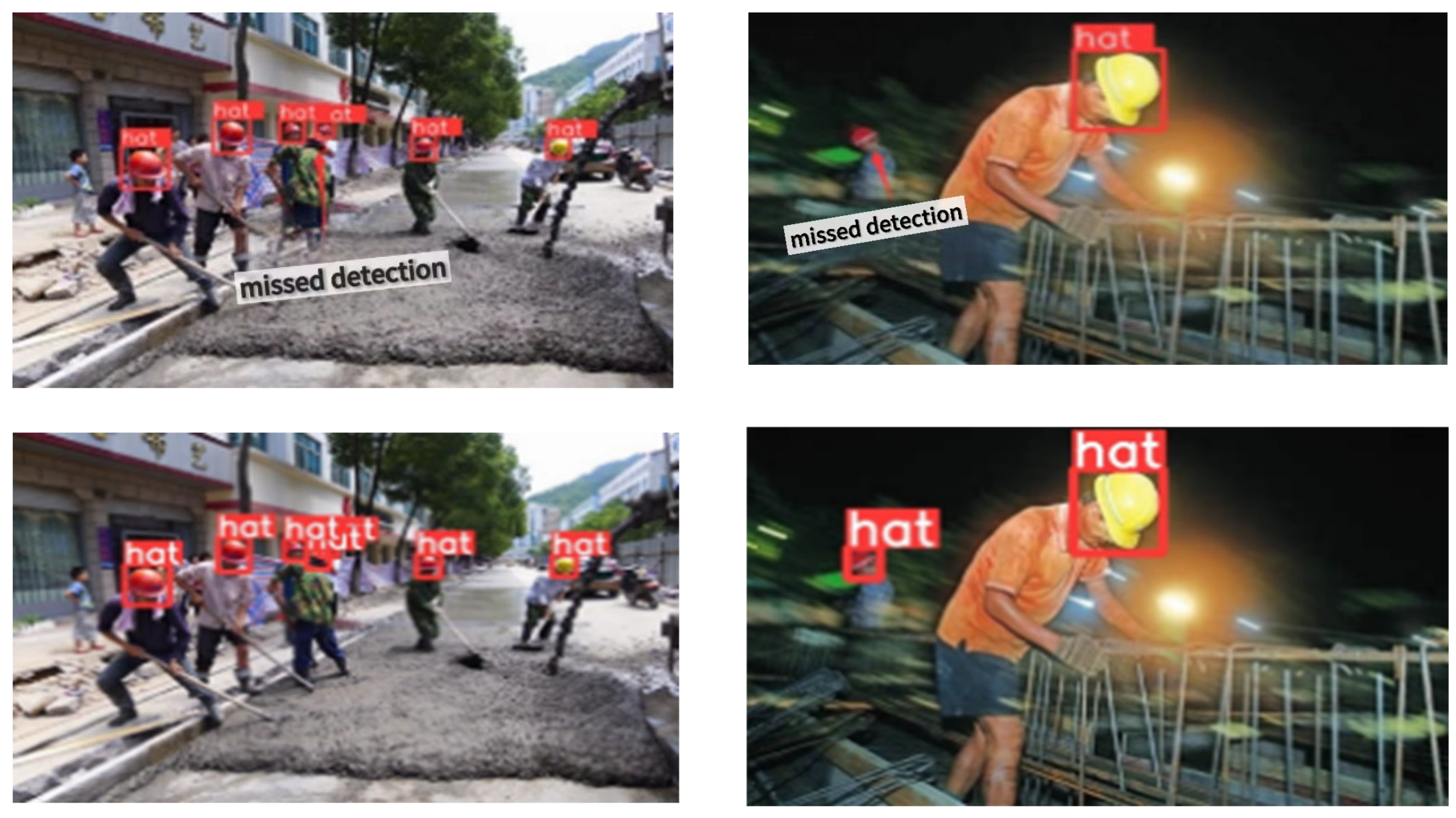
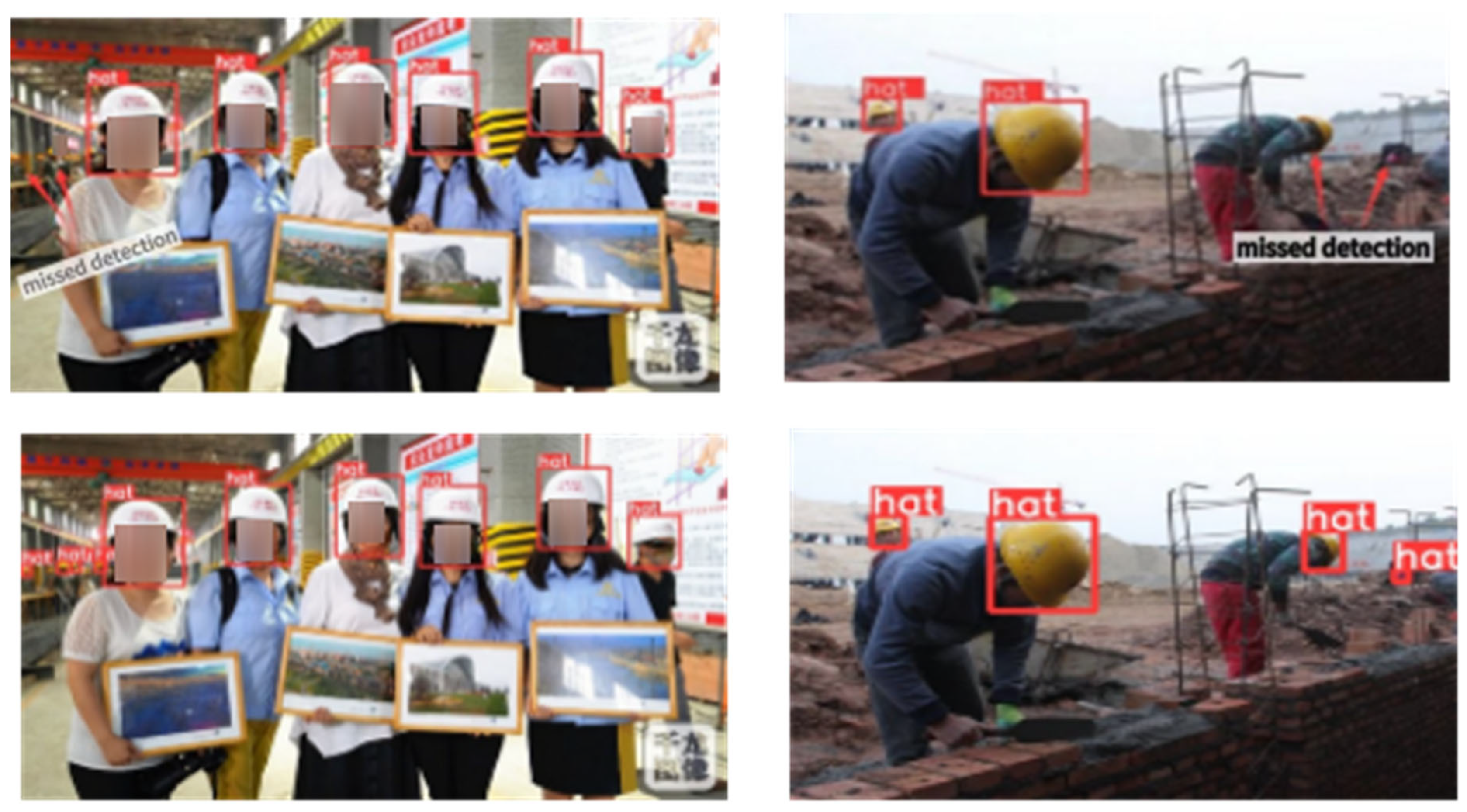
To visualize the performance of the EC-YOLOv8 model in detecting helmet-wearing under complex environments, the following detection results are compared. The first row represents the detection results of the original YOLOv8 network, and the second row shows the detection results of the proposed EC-YOLOv8 model.
As shown in Figure 5, for small distant objects in the image, the original YOLOv8 network suffers from significant false negatives, whereas the EC-YOLOv8 network successfully detects all missed targets. This is achieved by concatenating the features from the reversible upsampling with the original low-resolution feature map, which better preserves and restores detailed information in the feature maps, leading to more accurate detections. Figure 6 compares the detection results for blurred targets. For blurred targets that are missed by YOLOv8, the improved EC-YOLOv8 network successfully detects and accurately locates the target positions.
Figure 5.
Comparison of small target detection result.
Figure 6.
Comparison of fuzzy target detection results.
For dense targets, Figure 7 shows that YOLOv8 exhibits inadequate detection ability, whereas the improved network successfully detects all dense targets. Figure 8 and Figure 9 show the detection performance under different lighting conditions. In cases where YOLOv8 has false negatives, the improved EC-YOLOv8 network, by modeling feature relationships between channels, learns the correlation between different channel features and is still able to accurately identify all targets.
Figure 7.
Intensive target detection result comparison.
Figure 8.
Comparison of detection results of different light targets 1.
Figure 9.
Comparison of detection results of different light targets 2.
Therefore, for real-time detection of helmet-wearing in complex construction scenarios, the EC-YOLOv8 network demonstrates clear advantages, exhibiting better robustness and performance.
4.8. Limitations and Failure Case Analysis
Although the EC-YOLOv8 model proposed in this paper achieves an average accuracy of 95.7% (mAP@.5) on the SHWD dataset and shows excellent robustness in handling small targets and complex background interference, the model still has certain limitations in some extreme and challenging engineering scenarios. Combined with the analysis of false positive (FP) and false negative (FN) samples in the confusion matrix, the following challenging scenarios are mainly faced:
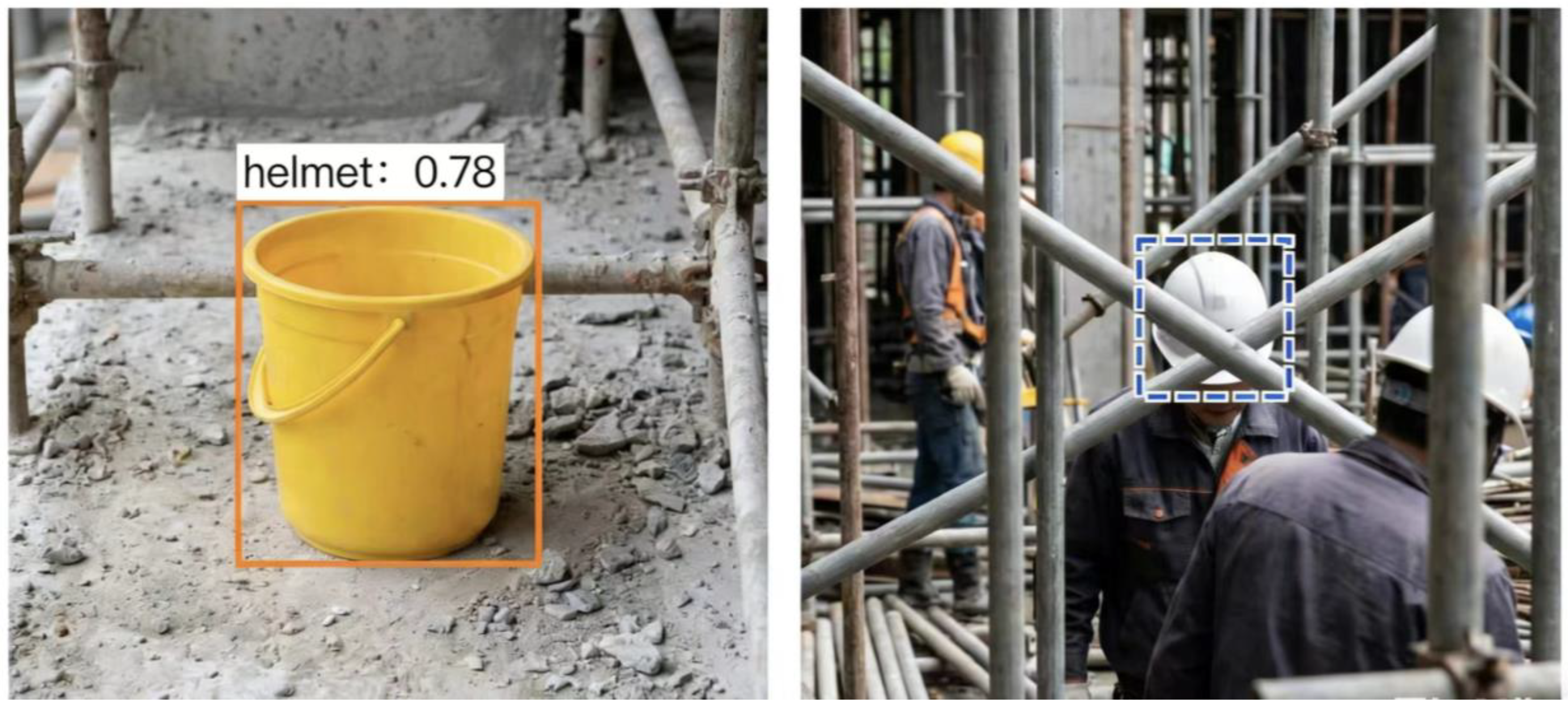
False Positives on Visually Similar Objects: Construction sites often contain numerous distracting objects that are highly similar in color or shape to safety helmets, such as distant yellow plastic buckets, orange traffic cones, or circular warning lights. Although the ECA channel attention mechanism can suppress background noise in most cases, the model occasionally misclassifies these objects as wearing safety helmets when they are at specific lighting angles and their features are blurred (FP false positives).
Severe Occlusion and Deformation: Although the EIoU Loss introduced in this study improves the accuracy of bounding box regression in dense crowds, when workers are severely occluded by large scaffolding, steel bars or construction machinery (e.g., the occlusion area exceeds 80%), resulting in extremely sparse available visual features of the helmet, the CARAFE operator also has difficulty in completely reconstructing effective semantic features, thus inevitably leading to some target misses (FN).
Extreme Lighting and Adverse Weather: The data augmentation strategies used in the paper (such as HSV adjustment) simulate some changes in lighting. However, in extreme backlighting (which causes the target to appear as a black silhouette), strong metallic reflection, or heavy haze, the contrast and texture information of the image decrease sharply, and the feature extraction ability of the model is significantly limited.
Unusual Helmet Appearances: The model is primarily trained on safety helmets of standard colors (e.g., red, yellow, blue, white) and conventional shapes. In real-world applications, if a worker’s safety helmet is covered in mud or paint, or if a non-standard, custom-shaped helmet is used, the altered surface texture distribution may exceed the model’s generalization boundary, leading to a decrease in confidence.
To provide a more intuitive understanding of the model’s boundary performance, Figure 10 illustrates several qualitative examples of these failure cases. As depicted, visually similar objects under specific lighting angles occasionally trigger false positives (FP), while extreme structural occlusion results in inevitable false negatives (FN) despite the robust feature reassembly of the CARAFE operator.
Figure 10.
Qualitative examples of failure cases in complex construction environments.
Limitations of generalization on a single dataset: All quantitative experiments in this study were evaluated on the SHWD dataset. Although this dataset itself covers a variety of complex construction site scenarios, and we introduced data augmentation strategies such as Mosaic and Mixup during the training phase to improve feature robustness, the model’s generalization performance has not yet been rigorously validated across datasets when facing entirely new subdomains (Domain Shift) that differ significantly from the SHWD data distribution. For example, if the model is directly deployed to underground coal mines with drastically different lighting conditions, nighttime road construction, or overseas factories where workers wear custom helmets with special reflective markings, the model’s detection accuracy may decrease to some extent due to the domain shift of background texture and target features. A single benchmark cannot fully simulate the infinitely changing industrial environments in the real world.
Computational Overhead and Edge Deployment Constraints: While the proposed EC-YOLOv8 model achieves an impressive real-time inference speed of 172 FPS on an RTX 2060 SUPER GPU, the integration of the CARAFE operator and ECA mechanism undeniably introduces additional computational complexity. Specifically, compared to the YOLOv8n baseline, the parameter count increased from 3.15 M to 3.48 M, and the computational load increased from 8.7 to 9.2 GFLOPs. Although this trade-off is highly acceptable and easily manageable for standard edge servers or modern high-end edge computing boards (e.g., NVIDIA Jetson Orin), it may still pose deployment and thermal challenges for ultra-low-power IoT devices or legacy closed-circuit television cameras commonly found in older construction sites. The slight drop in inference speed and the increased memory footprint dictate that deploying EC-YOLOv8 on strictly resource-constrained microcontrollers requires careful consideration.
To address the aforementioned limitations, future work will focus on two main directions. First, we will consider introducing a multi-scale contextual feature fusion network and collecting diverse large-scale cross-domain datasets to improve the model’s generalization robustness. Secondly, to overcome the deployment constraints on ultra-low-power devices, we plan to explore hardware-specific optimization techniques, such as TensorRT structural pruning and INT8 post-training quantization, to further compress the model’s GFLOPs and accelerate inference without sacrificing the high accuracy achieved by the current architecture.
5. Conclusions
To improve the detection accuracy of small and blurred targets and the real-time detection performance of existing helmet-wearing detection algorithms, this paper presents an incremental yet highly effective applied framework based on the YOLOv8 architecture. By synergistically integrating ECA, CARAFE, and EIoU Loss, the proposed EC-YOLOv8 model successfully addresses the specific practical challenges of small and blurred target detection in complex construction environments. By controlling the model size, the strategy enables local cross-channel interaction between adjacent channels, enhancing the network’s ability to identify important helmet-related features while suppressing redundant and irrelevant features. This approach better retains detailed information in the feature maps, providing more comprehensive information optimization for helmet detection models. Experimental results show that the proposed EC-YOLOv8 helmet detection algorithm achieves an average accuracy of 95.7% and a mAP@.5:.95 of 74.6%. Compared to other mainstream detection algorithms, the improved algorithm demonstrates clear advantages. It achieves high detection accuracy while meeting real-time detection requirements. Visualization of detection results shows that the proposed model performs well in dense target environments, blurred target conditions, and various lighting conditions.
Author Contributions
Methodology, Z.W., G.X., G.Z. and J.H.; Validation, C.L. and H.M.; Formal analysis, C.L.; Resources, Z.W., G.X., G.Z. and J.H.; Writing—original draft, C.L.; Writing—review & editing, Z.W., C.L., G.X., G.Z., J.H. and H.M.; Supervision, Z.W., G.X., G.Z. and J.H.; Project administration, Z.W., G.X., G.Z. and J.H.; Funding acquisition, Z.W. and G.X. All authors have read and agreed to the published version of the manuscript.
Funding
The National Natural Science Foundation of China (Grant No. 624562004), the Intelligent Perception Open Fund of Jiangxi Provincial Key Laboratory of Cyberspace Security (Grant Nos. JKLCIP202211 and JKLCIP202208), the Science and Technology Program of Jiangxi Provincial Department of Education (Grant No. GJ200721), the Open Fund of Jiangxi Provincial Laboratory of Radioactive Geosciences and Big Data Technology Engineering (Grant Nos. JELRGBDT201709 and JELRGBDT202207).
Institutional Review Board Statement
Not applicable.
Informed Consent Statement
Not applicable.
Data Availability Statement
The original contributions presented in this study are included in the article. Further inquiries can be directed to the corresponding author.
Conflicts of Interest
The authors declare no competing interests.
References
- Lowe, D.G. Distinctive image features from scale-invariant keypoints. Int. J. Comput. Vis. 2004, 60, 91–110. [Google Scholar] [CrossRef] [Scilit]
- Cheng, L.; Cao, D.; Li, X. A Study on the Classification of Factors Causing Construction Accidents in Housing Projects. China Saf. Sci. J. 2023, 33, 16–22. [Google Scholar]
- Yonghui, L.I.; Liang, Y.U.A.N.; Li, H.E.; Teng, R.A.N.; Kai, L.Y.U. Research on Safety Helmet Wearing Detection Algorithm in Chemical Industry Park Scenarios. Comput. Eng. Appl. 2024, 60, 111–117. [Google Scholar]
- Zhang, Q.; Hu, X.; Yue, Y.; Gu, Y.; Sun, Y. Multi-object detection at night for traffic investigations based on improved SSD framework. Heliyon 2022, 8, e11570. [Google Scholar] [CrossRef] [Scilit]
- Wang, J.; Chen, K.; Xu, R.; Liu, Z.; Loy, C.C.; Lin, D. CARAFE: Content-aware reassembly of features. In Proceedings of the IEEE/CVF International Conference on Computer Vision; IEEE: New York City, NY, USA, 2019; pp. 3007–3016. [Google Scholar]
- Wang, Q.; Wu, B.; Zhu, P.; Li, P.; Zuo, W.; Hu, Q. ECA-Net: Eficient channel attention for deep convolutional neural networks. In Proceedings of the IEEE/CVF Conference on Computer Vision and Pattern Recognition (CVPR), Seattle, WA, USA, 14–19 June 2020; IEEE: New York City, NY, USA, 2020; pp. 11531–11539. [Google Scholar]
- Feng, G.; Chen, Y.; Chen, N.; Li, X.; Song, C. Research on Automatic Recognition Technology of Safety Helmets Based on Machine Vision. Mach. Des. Manuf. Eng. 2015, 44, 39–42. [Google Scholar]
- Wu, H.; Zhao, J. Automated visual helmet identification based on deep convolutional neural networks. In Computer Aided Chemical Engineering; Elsevier: Amsterdam, The Netherlands, 2018; Volume 44, pp. 2299–2304. [Google Scholar]
- Liu, X.; Ye, X. Application of Skin Color Detection and Hu Moments in Safety Helmet Recognition. J. East China Univ. Sci. Technol. (Nat. Sci. Ed.) 2014, 40, 365–370. [Google Scholar]
- Pang, S.; Lu, S. Multi-scale Safety Helmet Recognition Based on Improved MTCNN. Appl. Res. Comput. 2021, 38, 1907–1916. [Google Scholar]
- Xu, K.; Deng, C. Safety Helmet Wearing Recognition Algorithm Based on Improved YOLOv3. Prog. Laser Optoelectron. 2021, 58, 300–307. [Google Scholar]
- Xu, S.; Wang, Y.; Gu, Y.; Li, N.; Zhuang, L.; Shi, L. Research on Safety Helmet Wearing Detection Based on Improved Faster RCNN. Appl. Res. Comput. 2020, 37, 901–905. [Google Scholar]
- Wang, L.; Zhang, X.; Yang, H. Safety helmet wearing detection model based on improved YOLO-M. IEEE Access 2023, 11, 26247–26257. [Google Scholar] [CrossRef] [Scilit]
- Li, T.; Xu, H.; Han, Y.; Zhao, Y.; Yan, H. L-Yolov5: A multi-scale channel attention-based method for real-time safety helmet detection of electrical construction workers. In 2023 International Joint Conference on Neural Networks (IJCNN); IEEE: New York City, NY, USA, 2023; pp. 1–8. [Google Scholar]
- Zhao, J.; Yang, Z.; Li, B.; Zhao, Y. YOLO-DCRCF: An Algorithm for Detecting the Wearing of Safety Helmets and Gloves in Power Grid Operation Environments. J. Imaging 2025, 11, 320. [Google Scholar] [CrossRef] [Scilit]
- Chourasia, S.; Rhugved, B.; Lokesh, H. Safety helmet detection: A comparative analysis using YOLOv4, YOLOv5, and YOLOv7. In 2023 International Conference for Advancement in Technology (ICONAT); IEEE: New York City, NY, USA, 2023. [Google Scholar]
- Jiao, X.; Li, C.; Zhang, X.; Fan, J.; Cai, Z.; Zhou, Z.; Wang, Y. Detection method for safety helmet wearing on construction sites based on uav images and yolov8. Buildings 2025, 15, 354. [Google Scholar] [CrossRef] [Scilit]
- Li, Z.; Liu, S.; Li, F.; Wang, J.; Zhang, J.; Li, Y. A helmet detection scheme based on improved YOLOv3. In Proceedings of the 2022 4th International Conference on Frontiers Technology of Information and Computer (ICFTIC); IEEE: New York City, NY, USA, 2022. [Google Scholar]
- Xiang, D.; Zhu, B.; Wu, X.; Ou, Y. Safety helmet detection algorithm in complex scenarios based on YOLOX. In Proceedings of the 2022 International Conference on Artificial Intelligence, Information Processing and Cloud Computing (AIIPCC); IEEE: New York City, NY, USA, 2022. [Google Scholar]
- Solawetz, J. What is Yolov8? The Ultimate Guide. Roboflow Blog 2023, 25. Available online: https://blog.roboflow.com/what-is-yolov8/ (accessed on 3 December 2025).
- Zhang, Z.; Tang, Y.; Yang, Y.; Yan, C. Safety Helmet and Mask Detection at Construction Site Based on Deep Learning. In Proceedings of the 2023 IEEE 3rd International Conference on Information Technology, Big Data and Artificial Intelligence (ICIBA); IEEE: New York City, NY, USA, 2023; Volume 3. [Google Scholar]
- Feng, H.; Hu, J. Helmet wearing detection using improved single shot multibox detector. In Proceedings of the 2022 5th World Conference on Mechanical Engineering and Intelligent Manufacturing (WCMEIM); IEEE: New York City, NY, USA, 2022. [Google Scholar]
- Zhang, H.; Yang, N.; Chen, H.; Luan, X.; Menhas, M.I.; Ahmad, B. Safety helmet and mask detection in substation based on deep learning. In Proceedings of the 2022 4th International Conference on Electrical Engineering and Control Technologies (CEECT); IEEE: New York City, NY, USA, 2022. [Google Scholar]
- Sun, L.; Liang, W. An improved YOLO V5-based algorithm of safety helmet wearing detection. In Proceedings of the 2022 34th Chinese Control and Decision Conference (CCDC); IEEE: New York City, NY, USA, 2022. [Google Scholar]
- Ram, M.S.; Charan, D.S.; Abburi, R.; Raju, N.S.K.; Suraj, G.V.; Samanta, S. Design and implementation of smart helmet based on IoT for road accident detection. In Proceedings of the 2022 International Conference on Computing, Communication, and Intelligent Systems (ICCCIS); IEEE: New York City, NY, USA, 2022. [Google Scholar]
- Drisya, C.; Leena, M. Detection of Motorcyclists Without Helmet from Traffic Video Using Deep Learning Techniques. In Proceedings of the 2022 IEEE 19th India Council International Conference (INDICON); IEEE: New York City, NY, USA, 2022. [Google Scholar]
- Tiwari, V.; Debanjan, D. iHELM: An IoT-based smart helmet for real-time motorbike accident detection and emergency healthcare services. In Proceedings of the 2022 OITS International Conference on Information Technology (OCIT); IEEE: New York City, NY, USA, 2022. [Google Scholar]
- Tao, Y.; Lian, P. Improved lightweight helmet wearing detection method For YOLOXs. In Proceedings of the 2022 China Automation Congress (CAC); IEEE: New York City, NY, USA, 2022. [Google Scholar]
- Xia, X.; Shi, W.; Gao, Y. Simultaneous Detection of Helmet and Mask Wearing Based on YOLO Improved Algorithm. In Proceedings of the 2022 IEEE 8th International Conference on Computer and Communications (ICCC); IEEE: New York City, NY, USA, 2022. [Google Scholar]
- Yu, Y.; Chen, W. Safety Helmet Monitoring System Based on Improved YOLOv5. In Proceedings of the 2022 China Automation Congress (CAC); IEEE: New York City, NY, USA, 2022. [Google Scholar]
- Rahman, M.A.; Ahsanuzzaman, S.M.; Rahman, I.; Ahmed, T.; Ahsan, A. IoT based smart helmet and accident identification system. In Proceedings of the 2020 IEEE Region 10 Symposium (TENSYMP); IEEE: New York City, NY, USA, 2020. [Google Scholar]
- Bian, H.; Liu, Y.; Shi, L.; Lin, Z.; Huang, M.; Zhang, J.; Weng, G.; Zhang, C.; Gao, M. Detection method of helmet wearing based on uav images and yolov7. In Proceedings of the 2023 IEEE 6th Information Technology, Networking, Electronic and Automation Control Conference (ITNEC); IEEE: New York City, NY, USA, 2023; Volume 6. [Google Scholar]
- Hemalatha, S.; Sivasundaram, S.M.; Nithya, P.; Deepak, S.; Udhayaragavan, V.S.; Kumar, S.Y. AI-Powered Workplace Safety: Helmet and Face Detection using YOLO for Access Control. In Proceedings of the 2025 5th International Conference on Pervasive Computing and Social Networking (ICPCSN); IEEE: New York City, NY, USA, 2025. [Google Scholar]
- Liu, B.; Wei, X.; Chen, Q.; Liu, J.; Chen, Y.; Yu, P.; Lei, S.; Hu, Y. Safety helmet detection methods in heavy machinery factory. Sci. Rep. 2025, 15, 18565. [Google Scholar] [CrossRef] [Scilit]
- Khalil, N.; Rashid, M.H.; Rehman, S.A.; Yasir, M.; Hussain, M. Improved Traffic Safety with YOLO-v8 Driven Smart Helmet Detection. VFAST Trans. Softw. Eng. 2025, 13, 29–42. [Google Scholar] [CrossRef] [Scilit]
- Anushkannan, N.K.; Kumbhar, V.R.; Maddila, S.K.; Kolli, C.S.; Vidhya, B.; Vidhya, R.G. YOLO algorithm for helmet detection in industries for safety purpose. In Proceedings of the 2022 3rd International Conference on Smart Electronics and Communication (ICOSEC); IEEE: New York City, NY, USA, 2022. [Google Scholar]
- Patel, K.; Patel, V.; Prajapati, V.; Chauhan, D.; Haji, A.; Degadwala, S. Safety helmet detection using YOLO v8. In Proceedings of the 2023 3rd International Conference on Pervasive Computing and Social Networking (ICPCSN); IEEE: New York City, NY, USA, 2023. [Google Scholar]
- Yang, G.; Hong, X.; Sheng, Y.; Sun, L. YOLO-Helmet: A novel algorithm for detecting dense small safety helmets in construction scenes. IEEE Access 2024, 12, 107170–107180. [Google Scholar] [CrossRef] [Scilit]
- Jin, P.; Li, H.; Yan, W.; Xu, J. Yolo-esca: A high-performance safety helmet standard wearing behavior detection model based on improved yolov5. IEEE Access 2024, 12, 23854–23868. [Google Scholar] [CrossRef] [Scilit]
- Zhou, S.; Peng, Z.; Zhang, H.; Hu, Q.; Lu, H.; Zhang, Z. Helmet-YOLO: A new method for real-time, high-precision helmet wearing detection. IEEE Access 2024, 13, 196314–196326. [Google Scholar] [CrossRef] [Scilit]
- Lian, Y.; Li, J.; Dong, S.; Li, X. HR-YOLO: A multi-branch network model for helmet detection combined with high-resolution network and YOLOv5. Electronics 2024, 13, 2271. [Google Scholar] [CrossRef] [Scilit]
- Li, H.; Wu, D.; Zhang, W.; Xiao, C. YOLO-PL: Helmet wearing detection algorithm based on improved YOLOv4. Digit. Signal Process. 2024, 144, 104283. [Google Scholar] [CrossRef] [Scilit]
- Lin, B. Safety helmet detection based on improved YOLOv8. IEEE Access 2024, 12, 28260–28272. [Google Scholar] [CrossRef] [Scilit]
- Hayat, A.; Morgado-Dias, F. Deep learning-based automatic safety helmet detection system for construction safety. Appl. Sci. 2022, 12, 8268. [Google Scholar] [CrossRef] [Scilit]
- Chowdhury, Z.U.; Chowdhury, A.R.; Al Jawad, A.; Murshed, R.; Rashid, A.; Mynuddin, M.; Ahmari, R.; Mohammadi, A. Performance comparison of yolo models for safety helmet detection: Insights from yolov5 to yolov10 with transfer learning. In Proceedings of the 2024 International Conference of Adisutjipto on Aerospace Electrical Engineering and Informatics (ICAAEEI); IEEE: New York City, NY, USA, 2024. [Google Scholar]
- Farooq, M.U.; Bhutto, M.A.; Kazi, A.K. Real-Time Safety Helmet Detection Using Yolov5 at Construction Sites. Intell. Autom. Soft Comput. 2023, 36, 911. [Google Scholar] [CrossRef] [Scilit]

Disclaimer/Publisher’s Note: The statements, opinions and data contained in all publications are solely those of the individual author(s) and contributor(s) and not of MDPI and/or the editor(s). MDPI and/or the editor(s) disclaim responsibility for any injury to people or property resulting from any ideas, methods, instructions or products referred to in the content. |
© 2026 by the authors. Licensee MDPI, Basel, Switzerland. This article is an open access article distributed under the terms and conditions of the Creative Commons Attribution (CC BY) license.