1. Introduction
Structural health monitoring (SHM) refers to a technology that utilizes on-site non-destructive sensing techniques to analyze structural system characteristics, including structural responses, for detecting structural damage or degradation [
1]. Engineering structures typically face two types of risks: sudden damage and cumulative damage. Sudden damage is caused by unexpected disasters such as earthquakes, floods, and explosions, while cumulative damage refers to the gradual deterioration of structures during long-term service, such as material fatigue of LNG storage tanks in low-temperature environments and crack propagation in prestressed concrete outer tanks [
2].
The SHM technology originated in 1954, initially focusing on load monitoring. With the development of engineering structures towards large-scale, complex, and intelligent directions, its connotation has expanded to multiple dimensions, including damage detection, localization, residual life prediction, and even automatic repair [
3], and has been widely applied in civil engineering fields such as bridges, high-rise buildings, and large-span spatial structures. In the field of seismic monitoring and performance evaluation of major infrastructure, relevant research has also continued to deepen: Zhang et al. [
4] proposed a real-time strong earthquake monitoring and early warning system based on callback functions and polling commands to address the contradiction between daily low-frequency monitoring and post-earthquake high-frequency requirements in dam health monitoring, providing a reliable technical solution for the seismic protection of hydraulic engineering; Omenzetter et al. [
5] constructed a priority ranking method for bridge monitoring systems based on seismic risk, integrating four major factors, including seismic hazard, structural vulnerability, failure impact, and data uncertainty, which was effectively verified through the case of bridges in Wellington, New Zealand.
As a key infrastructure for the storage and transportation of clean energy, the safety and reliability of liquefied natural gas (LNG) storage tanks are directly related to the stability of energy supply and the safety of the surrounding environment. Constructing a scientific seismic hazard risk monitoring method is crucial for ensuring energy security [
6]. Currently, significant progress has been made in research on the seismic resistance of LNG storage tanks in various aspects such as experimental research, risk assessment, numerical simulation, and seismic isolation and damping technology, providing abundant support for the seismic design and safety guarantee of tank structures.
In terms of experimental research, shaking table tests have become a key means to verify the effectiveness of numerical models. By acquiring acceleration and displacement response data of LNG storage tanks under different seismic waves (such as El Centro and Wenchuan waves), a reliable basis is provided for the calibration of finite element models [
7]. De Angelis et al. [
8] conducted 1:14 scaled shaking table tests on steel tanks with floating roofs, systematically verifying the seismic protection effects of high damping rubber bearings (HDRBs) and sliding isolation equipment with elasto-plastic dampers (SIEPD); Chen et al. [
9] compared the seismic response differences between non-isolated and lead rubber bearing-isolated LNG storage tanks through shaking table tests of scaled models, verifying the high fitting degree between the three-degree-of-freedom simplified mechanical model and the test results.
In terms of risk assessment, relevant research focuses on the optimization of fragility analysis and risk quantification methods. Bezir et al. [
10] integrated 4509 sets of measured damage data from 31 earthquakes and 101 sets of LS-DYNA finite element simulation data, constructed seismic fragility curves of tanks using various statistical models, and proposed a five-level damage state classification standard, providing a new evaluation framework for the quantitative assessment of tank seismic risk; Tsipianitis et al. [
11] conducted seismic vulnerability assessment of tanks with sliding isolation systems through multi-step dynamic analysis methods, revealing the excellent displacement adaptability of multi-stage adaptive isolation devices under near-field strong earthquake environments.
In terms of seismic isolation and damping technology, relevant research focuses on the development and performance optimization of new isolation devices. Wu et al. [
12] developed a novel three-dimensional isolation system composed of self-centering friction pendulum bearings (FPBs) and vertical isolation devices, which was verified through numerical simulation to be capable of isolating both horizontal and vertical seismic motions simultaneously; the research by Chen et al. [
9] confirmed that lead rubber bearings can effectively reduce the base shear force (average isolation rate of 66%) and acceleration (average isolation rate of 47.1%) of tanks; and the research by Tsipianitis et al. [
11] further revealed the excellent performance of multi-stage adaptive isolation devices under near-field strong earthquake environments.
In terms of numerical simulation, relevant research has continuously improved modeling methods and coupling mechanisms. Some studies have established refined finite element models using software such as ADINA and ANSYS, verifying the ability of the finite element method to simulate the seismic response of tanks [
13]; other studies have proposed simplified mechanical models by separating the impulsive and convective components of liquids [
14]. Zhao et al. [
15,
16] adopted the smoothed particle hydrodynamics–finite element method (SPH-FEM) coupled algorithm to systematically analyze the seismic response of 160,000 m
3 LNG prestressed tanks under different liquid levels and four types of site conditions, further verifying the amplification of tank dynamic response on soft soil sites (Class III–IV), quantifying the resulting increase in displacement and base shear, and identifying that inner tank stress approaches material yield strength at high liquid levels (75–100%); Bui [
17] adopted a hybrid modeling method combining the finite volume method (FVM) and finite element method (FEM) to explore the influence of bidirectional fluid–structure interaction on the dynamic characteristics of flexible tanks; Jin et al. [
18] compared the seismic performance of 270,000 m
3 above-ground and underground LNG storage tanks through fluid–structure–soil interaction analysis coupled with the VOF model and finite element method based on Ansys software; and Chen et al. [
19] confirmed the reliability of the numerical model in reflecting the tank’s acceleration response and spectral characteristics through dual verification of ANSYS numerical simulation and scaled model tests.
In the field of tank seismic fragility analysis, early studies were constrained by two critical limitations: the scarcity of real earthquake damage data and the high computational cost of strongly nonlinear numerical simulations [
20]. O’Rourke and So [
21] developed fragility curves indexed by peak ground acceleration (PGA) using logistic regression, based on damage records from over 400 on-grade steel storage tanks across nine earthquakes. These curves were aligned with the five damage states defined in HAZUS, and revealed the effects of height-to-diameter ratio and liquid fill level on seismic performance. Berahman and Behnamfar [
22,
23] constructed seismic fragility curves for unanchored steel storage tanks using a Bayesian approach with the American Lifeline Alliance (ALA) tank database, accounting for both aleatory and epistemic uncertainties to derive point and interval estimates. In subsequent work, they focused on two critical failure modes—elephant-foot buckling and shell-to-bottom welding failure—and built probabilistic seismic demand models using finite element data. By calibrating model parameters via Bayesian updating, they achieved accurate fragility assessments for individual tanks, with results in strong agreement with damage observations of 21 tanks in the ALA database. Cortes and Prinz [
24] proposed a simplified mass-spring model to simulate base uplift and rocking of unanchored tanks. Combined with incremental dynamic analysis, they considered two failure modes: shell buckling and ultra-low-cycle fatigue, and developed fragility curves for four tank geometries. The study clarified the influences of height-to-diameter ratio, tank volume, plate thickness, and ground motion intensity on damage probability. D’Amico and Buratti [
25] compiled damage data for 5829 atmospheric steel storage tanks from 24 earthquakes, establishing a large-scale dataset that included undamaged tanks. Using Bayesian regression, they derived fragility curves that incorporated the coupled effects of height-to-diameter ratio, fill level, and anchorage condition. This framework corrected the overestimation of tank fragility caused by small sample sizes in previous studies, and confirmed that slender tanks, tanks with high fill levels, and unanchored tanks are more vulnerable to seismic damage. Phan and Paolacci [
26] focused on unanchored steel storage tanks and explicitly addressed uncertainties in modeling parameters—including material properties, geometric dimensions, and boundary conditions. They quantified the variability of these parameters through probabilistic methods and refined conventional fragility models, thereby improving the accuracy of damage probability predictions.
For the seismic failure analysis of storage tanks, Rotter [
27] numerically investigated the elastoplastic instability of thin-walled cylindrical shells under combined axial compression and internal pressure, revealed the failure mechanism of elephant-foot buckling at the tank base, derived interaction formulas for buckling under axial compression and internal pressure, and filled the research gap for this local failure mode. Virella et al. [
28] proposed a simplified nonlinear static procedure based on the capacity spectrum method to rapidly evaluate the critical PGA for elastic buckling of anchored steel tanks; this method features high computational efficiency and yields conservative results, making it suitable for quick engineering verification. Sobhan et al. [
29] employed both static pushover analysis (SPO) and incremental dynamic analysis (IDA) to investigate the buckling behavior of anchored tanks under simultaneous horizontal and vertical seismic excitations, proposed a reasonable horizontal-to-vertical acceleration ratio, and demonstrated that vertical ground motion significantly reduces the critical buckling acceleration and base shear of tanks. Budiansky and Roth [
30] developed a dynamic buckling criterion for spherical shells, which was later extended and widely applied to evaluate dynamic buckling of thin-walled storage tanks. Virella et al. [
31] used the added-mass method in ABAQUS to simulate tank–liquid dynamic interaction, conducted dynamic buckling analyses on anchored steel tanks with three height-to-diameter ratios, determined the critical PGA using the Budiansky–Roth criterion, and clarified that the elastic buckling at the tank top is mainly induced by the impulsive hydrodynamic pressure effect. Djermane et al. [
32] established numerical tank models using shell elements, calculated the critical dynamic PGA for broad and tall tanks under multiple ground motion records, and compared the results with provisions in AWWA-D100, EC8, and other standards; they verified the code’s applicability for broad tanks while identifying deficiencies in predicting buckling of tall tanks. Roopkumdee and Mamaghani [
33] performed nonlinear buckling analyses on perfect and initially imperfect cylindrical steel liquid storage tanks using ANSYS; systematically examined the effects of diameter-to-thickness ratio, height-to-diameter ratio, and initial geometric imperfections on buckling strength; and provided practical buckling strength formulas and curves for direct engineering design.
However, in the application of monitoring technology, although the concept of optimized sensor deployment has been maturely applied in the health monitoring of traditional civil engineering structures such as bridges and high-rise buildings, further research is still needed on how to optimize the sensor layout based on seismic response characteristics for LNG storage tanks, which have unique structural and mechanical properties such as large diameter, thin wall thickness, and significant fluid–structure–soil multi-field coupling effects [
34]. Existing seismic monitoring schemes for LNG storage tanks mostly rely on engineering experience for sensor deployment, lacking systematic guidance based on structural seismic vulnerability analysis. They fail to achieve precise coverage of vulnerable parts such as the tank wall bottom and dome revealed by finite element analysis and experimental research, making it difficult for monitoring data to fully capture the real seismic state of key structural parts and impossible to provide reliable support for risk assessment and early warning; in addition, traditional monitoring methods often rely on high-density sensor arrays to achieve full-range coverage, which not only leads to high construction, operation, and maintenance costs of the monitoring system but also may cause slight disturbances to the structural integrity of the tank due to sensor installation, further limiting its engineering applicability [
35].
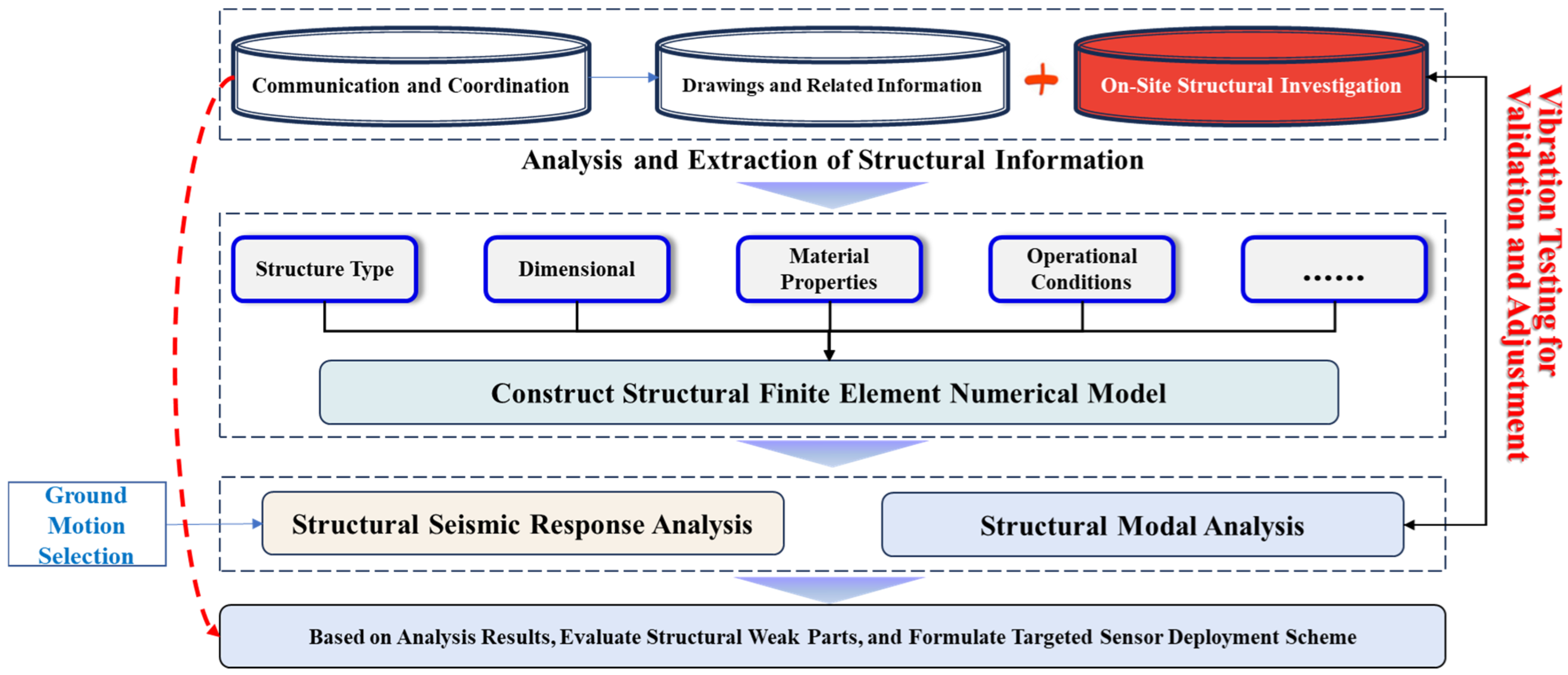
Aiming at the problem that existing structural health monitoring of LNG storage tanks is strictly constrained by explosion-proof safety and engineering conditions, rendering dense sensor deployment impractical, this study takes a practical large full-containment LNG storage tank project as the research object and establishes a complete technical framework of “numerical modeling–experimental validation–seismic response analysis–weak part identification–targeted sensor deployment–engineering application” (see
Figure 1). Specifically, a refined finite element model of the tank is established using ADINA software and verified through modal analysis combined with on-site ambient vibration testing. Typical seismic records are selected for seismic response analysis to clarify the displacement response laws and seismic weak part distribution of the tank under earthquake action. Based on the characteristics of weak parts and on-site explosion-proof conditions, a targeted monitoring sensor deployment scheme under limited measuring point constraints is formulated and implemented in engineering. This method provides a new technical path for structural health monitoring of large storage tanks under explosion-proof constraints, and its core concepts are extendable to similar thin-walled storage tanks and clean energy storage and transportation infrastructure.
3. Modal Analysis of Finite Element Model
3.1. Modal Analysis
Modal analysis is a key method for studying structural dynamic characteristics. By identifying structural natural frequencies, vibration modes, mode participation factors, etc., the vibration characteristics of structures under different modes and their contributions to the overall dynamic response are revealed. Therefore, modal analysis is usually the basic content before conducting dynamic analysis. Through modal analysis, the contribution degree of different frequencies to structural vibration response can be identified, and the influence of the order of each mode is different. Usually, low-order modes dominate the overall dynamic response, determining the main vibration characteristics of the structure under external excitation, while high-order modes mainly affect local vibration behavior.
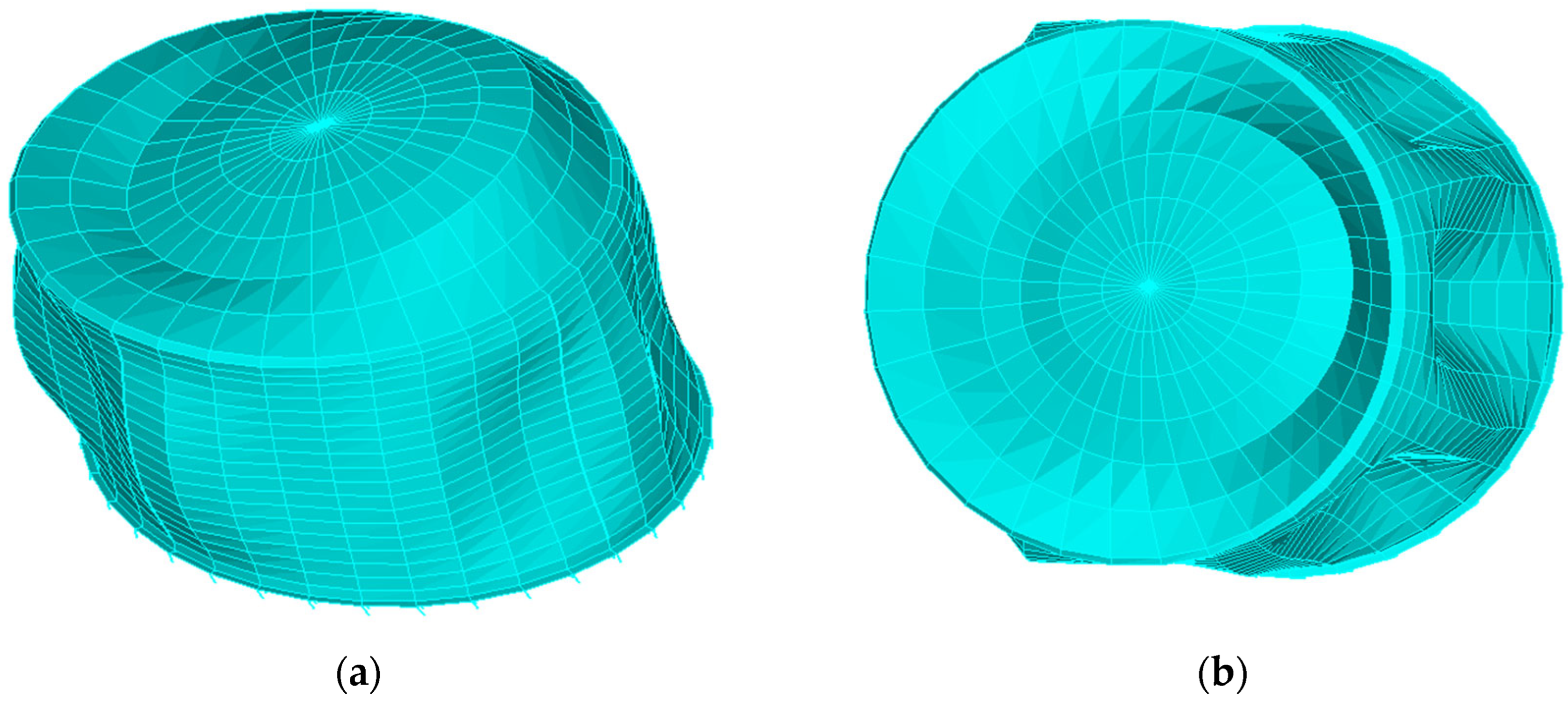
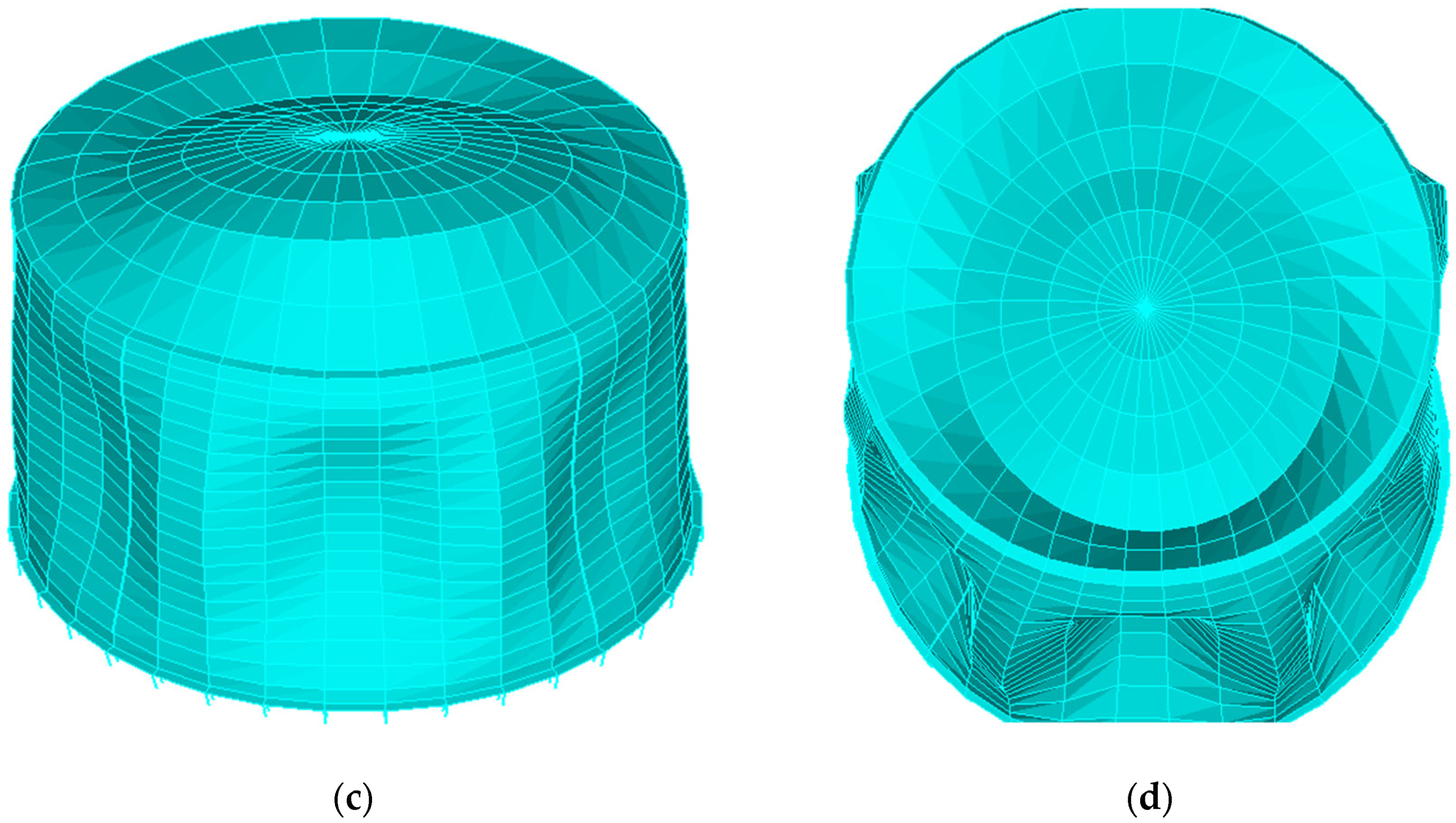
When performing modal analysis on the storage tank, the extracted main vibration mode characteristics are mainly manifested as the overall horizontal vibration of the outer tank wall. Under this vibration mode, the amplitude at the connection part between the buttress columns and the dome roof is relatively significant, indicating that this region is subject to concentrated forces under the horizontal vibration mode and is a key part of the structural response. Further analysis shows that if the displacement of the dome roof is constrained, the vibration mode of the storage tank is transformed into beam-like vibration. At present, most of the relevant design codes for storage tanks in various countries adopt the beam-like vibration mode frequency as the natural frequency of the outer tank. This approach is also mentioned in many studies; beam-like vibration plays a leading role in the vibration of storage tanks and is one of the main dynamic characteristics of storage tanks.
Figure 8 shows the first-order vibration mode of the storage tank finite element model displayed from different angles.
The first-order natural frequency and the modal mass participation ratio are listed in
Table 3.
3.2. On-Site Vibration Testing
Field vibration testing of LNG storage tanks based on the ambient excitation method is primarily aimed at acquiring the natural frequencies of the tanks to identify their dynamic characteristics. Meanwhile, through comparative analysis with the calculation results of the finite element model, the accuracy and engineering applicability of the model are verified. During the sensor layout phase, emphasis should be placed on identifying the natural frequencies of the structure in the two horizontal directions (X and Y directions) to ensure the collection of clear translational vibration signals. For this test, the tops of the tank’s buttress columns and the tank roof were selected as measurement points: on one hand, both locations are significant areas with obvious changes in the stiffness of the tank wall, exhibiting high sensitivity to horizontal vibration responses and enabling accurate capture of the horizontal vibration characteristics of the outer tank; on the other hand, they are both horizontal platforms, facilitating the deployment of low-frequency seismometers and data acquisition equipment. The specific layout scheme is as follows: low-frequency seismometers were arranged along the X (north–south), Y (east–west), and Z directions at the tops of the buttress columns. Among them, the Z-direction layout is mainly used to identify potential vertical modal frequencies and effectively eliminate the influence of environmental noise and vertical interference on horizontal modal identification, ensuring the reliability of test data; simultaneously, sensors were synchronously deployed at the top of the cap and the ground free field to further exclude external interference signals. During the data acquisition process, considering the complex and diverse spectral components of ambient excitation, the single sampling duration was set to no less than 5 min to ensure that the sampled data could fully characterize the dynamic characteristics of the structure; in addition, to suppress the interference of high-frequency background noise and make the low-frequency components in the test results more consistent with the actual structural response, the sampling frequency of the instrument was adjusted to 51.2 Hz for this test.
The on-site ambient vibration test employed the 941B ultra-low-frequency vibration measuring instrument developed by the Institute of Engineering Mechanics, China Earthquake Administration. This moving-coil reciprocating pickup utilizes passive closed-loop servo technology to achieve excellent ultra-low-frequency characteristics. The sensor provides four measurement modes: acceleration, small velocity, medium velocity, and large velocity. The acceleration mode was adopted for this test, with a sensitivity of 0.3 V·s2/m, maximum range of 20 m/s2 (0-p), frequency bandwidth of 0.25–80 Hz (+1/−3 dB), and output load resistance of 1000 kΩ. When paired with the 941-type six-channel amplifier, the acceleration resolution reaches 5 × 10⁻⁸ m/s2. The amplifier offers adjustable amplification from 10 to 5000; for this test, the frequency band was set to 0.25–25 Hz with a low-pass filter slope of −40 dB/oct, input impedance of ≥1000 kΩ, and input noise of ≤1 μV under DC power supply. The sensor measures 63 × 63 × 80 mm and weighs 1 kg, while the amplifier measures 380 × 240 × 110 mm and weighs 5 kg. The operating environment ranges from −10 °C to +50 °C with humidity ≤80%, and the power supply is ±5 to ±12 VDC or 220 VAC.
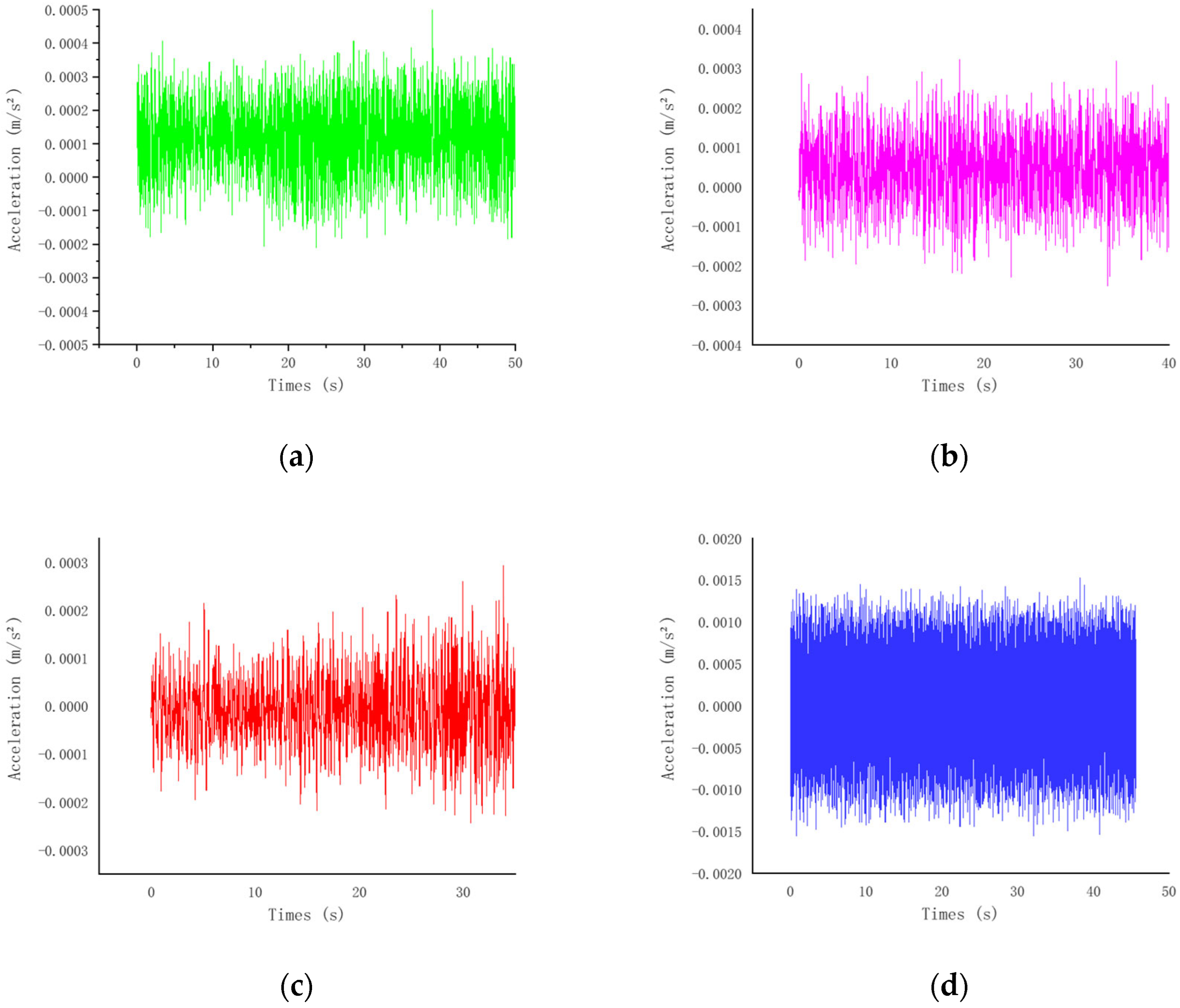
Schematic diagrams of the intercepted partial wavebands of on-site test waveforms for each measurement point are shown in
Figure 9.
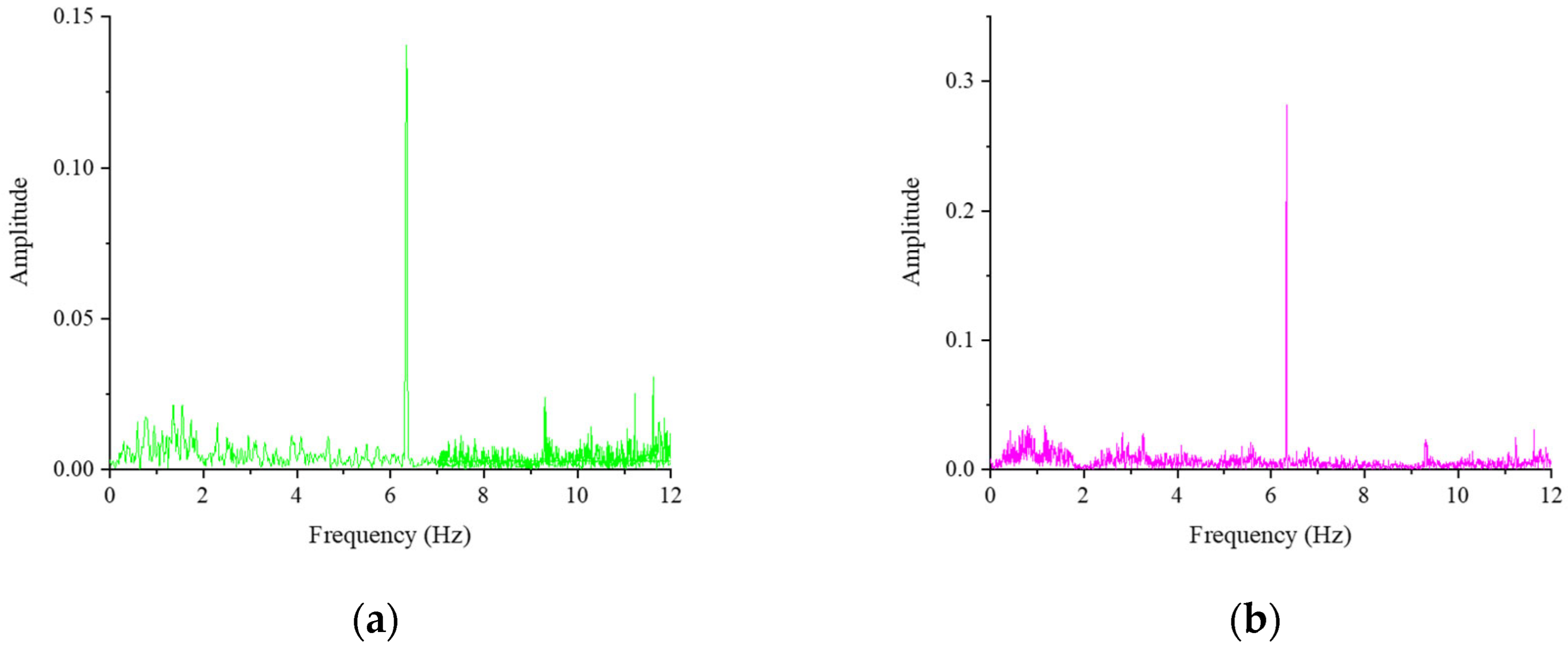
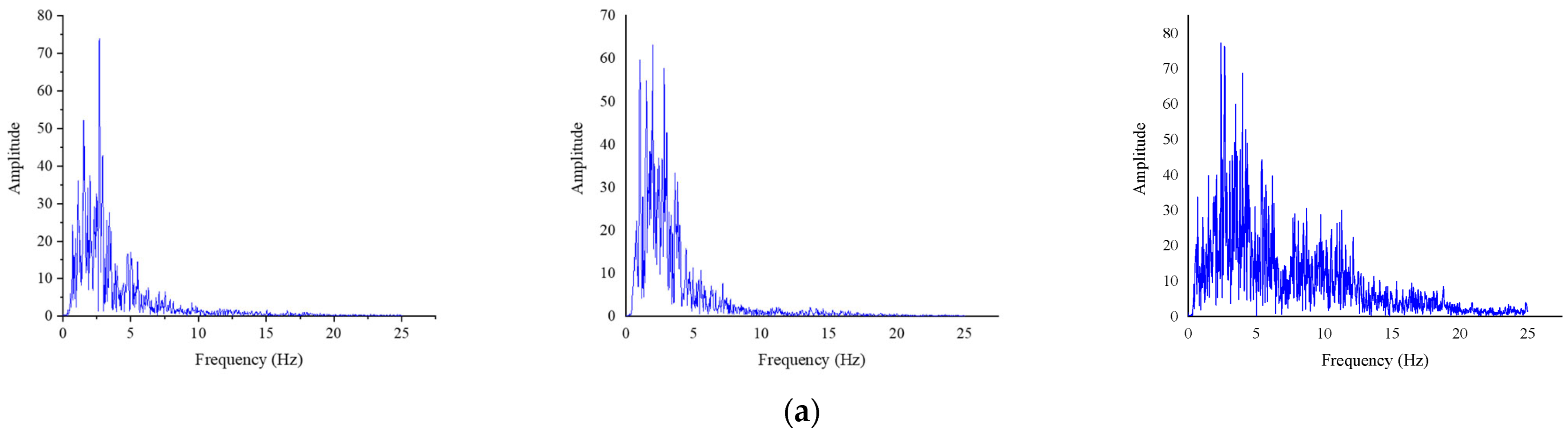
To facilitate comparison with the modal analysis results of the finite element model, FFT transformation was performed on the data from the tank roof and buttress column top measurement points, as these locations effectively reflect the global natural frequency. The corresponding FFT spectra are shown in
Figure 10.
The comparative analysis between the modal analysis results and the on-site vibration test results is shown in
Table 4.
This test was carried out during the normal operation of the LNG storage tank, and the structural working condition was consistent with the empty outer tank state set in the finite element modal analysis of this chapter. It can be seen from
Table 3 that the measured frequency is in good agreement with the horizontal vibration mode frequency under simulation calculation, which verifies the applicability and accuracy of the finite element model of the LNG storage tank in this study.
4. Seismic Response Analysis of Storage Tank Finite Element Model
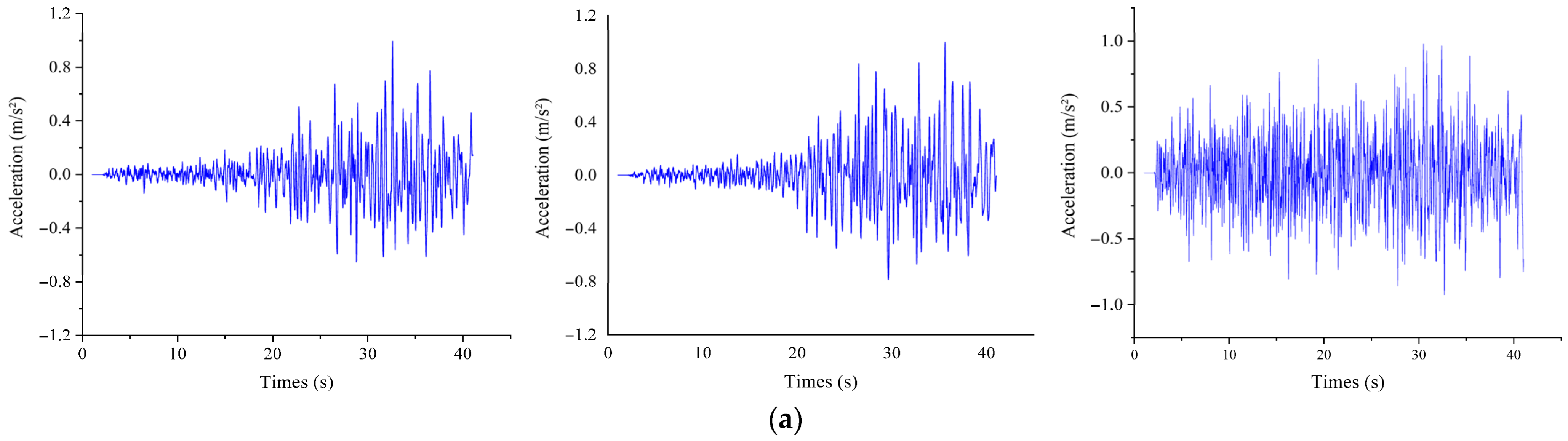
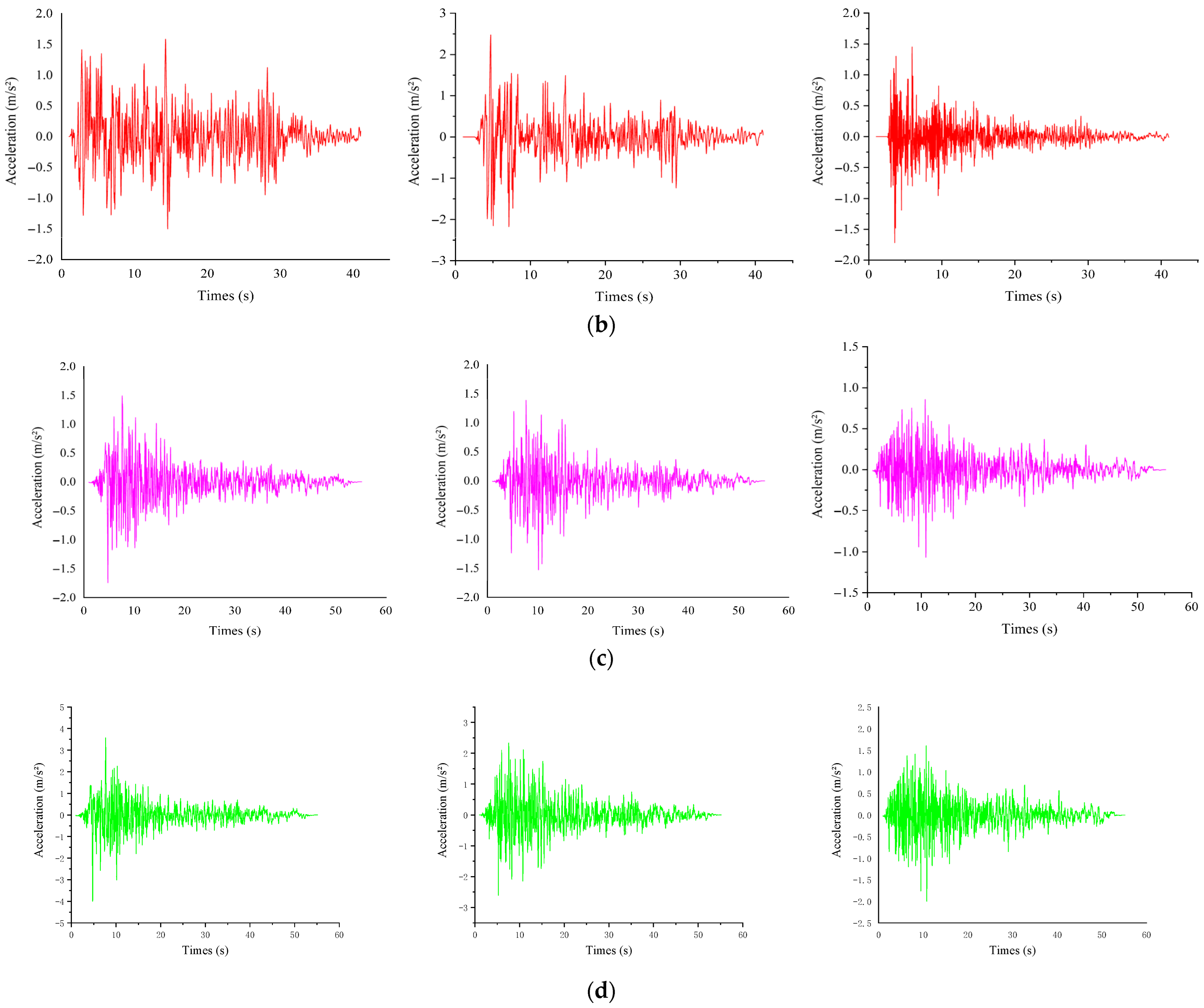
This study selects four typical seismic records—El Centro, Tangshan, TAFT, and TAFT2—as input ground motions. The selection criteria encompass five dimensions: classical status, site representativeness, spectral characteristics, duration coverage, and intensity level. The LNG storage tank project is located on a site between Class II and Class III, so the selected records need to cover the features of both site classes.
The El Centro record is the measured ground motion of the 1940 Imperial Valley earthquake in the United States, representing the most classical far-field seismic wave in structural seismic analysis, applicable to Class II hard sites, with rich spectral components and a duration of approximately 40 s, widely used for dynamic response verification of various structures.
The Tangshan record is the measured ground motion of the 1976 Tangshan M7.8 earthquake at Hong-Shan station, representing the most classical strong earthquake record in Chinese structural seismic analysis, applicable to Class III medium–soft sites, widely used for dynamic response verification and seismic code calibration of large storage tanks and high-rise buildings.
The TAFT record is the measured ground motion of the 1952 Kern County earthquake at Taft station in the United States, with an original peak ground acceleration of 0.16 g (1.6 m/s2), representing a classical far-field medium-to-long period seismic wave, applicable to Class II to Class III medium–hard sites, with a duration of approximately 54 s, weak high-frequency energy and relatively prominent long-period components, widely used for dynamic response verification and seismic performance assessment of long-period flexible structures (storage tanks, high-rise buildings, long-span bridges). TAFT2 is a scaled version of the TAFT record, with a peak ground acceleration of 0.3 g, used for dynamic response assessment of storage tanks under higher seismic fortification intensities, forming an intensity contrast with the original TAFT record.
The above combination of seismic records covers different site types, spectral characteristics, durations, and intensity levels, satisfying the representativeness requirements for seismic input in structural seismic analysis.
The basic information of ground motions is shown in
Table 5.
The acceleration time–history curves are shown in
Figure 11.
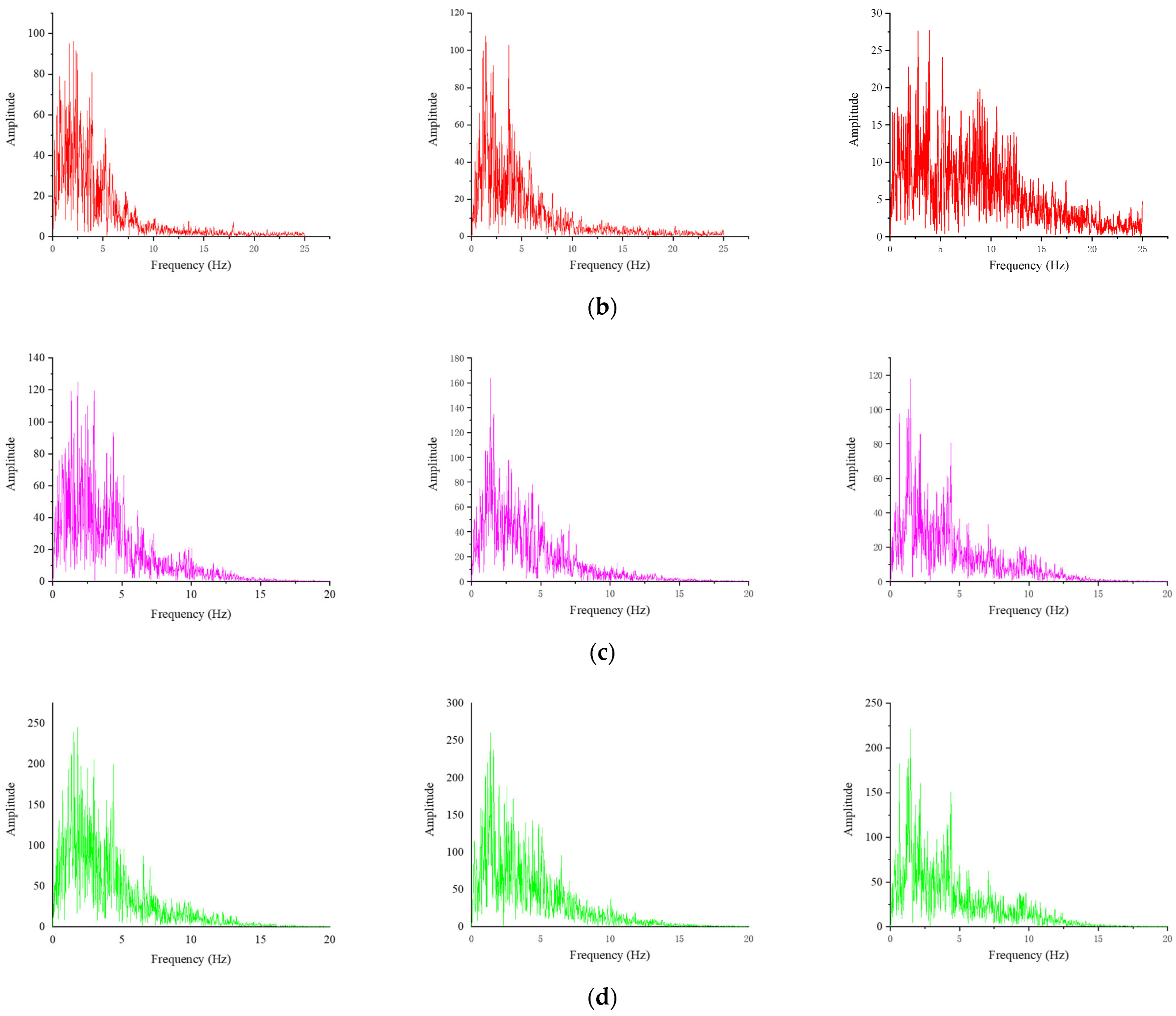
The FFT spectra of selected ground motions are shown in
Figure 12.
4.1. Tangshan
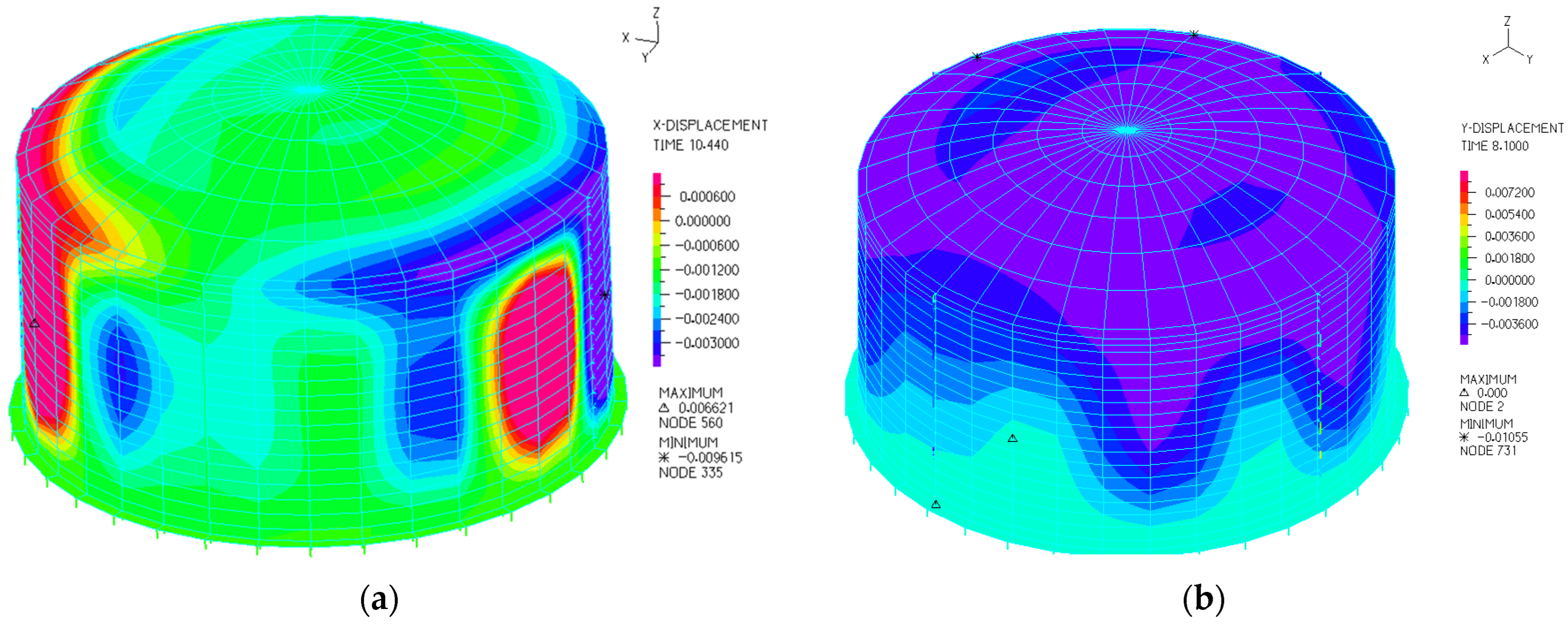
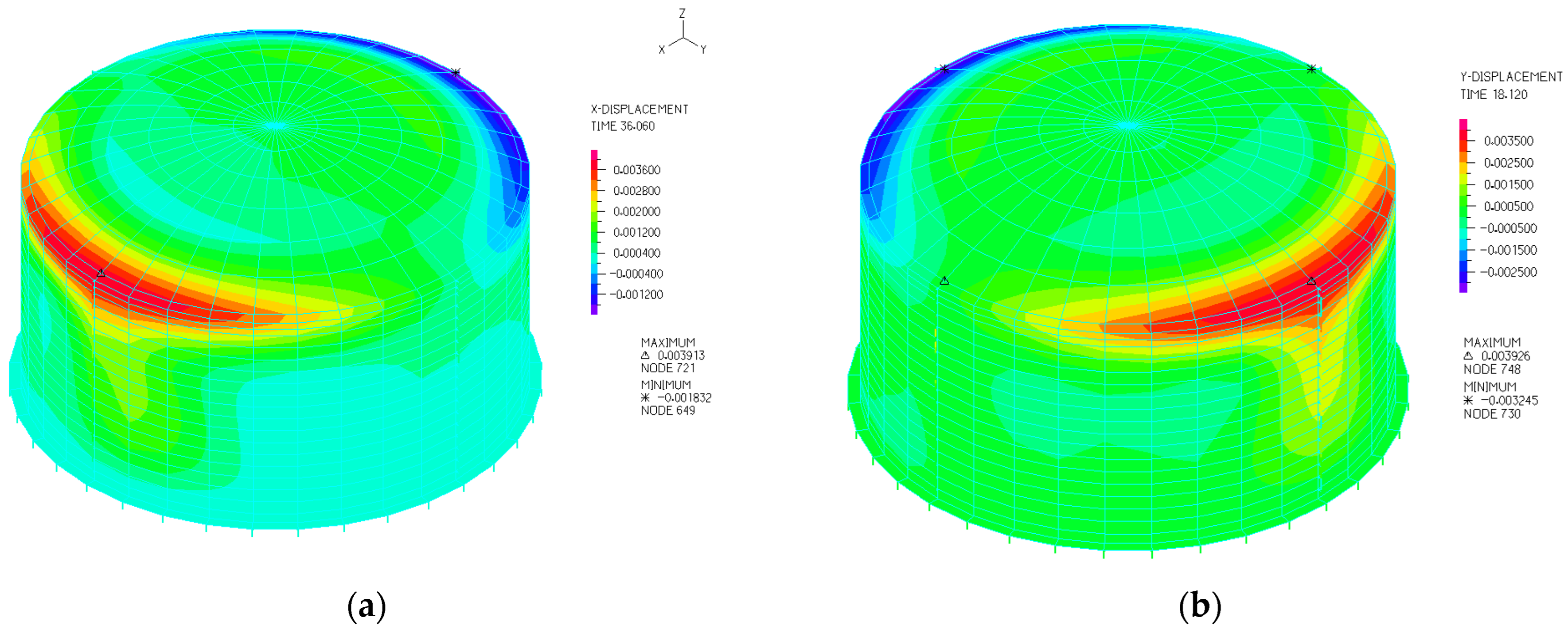
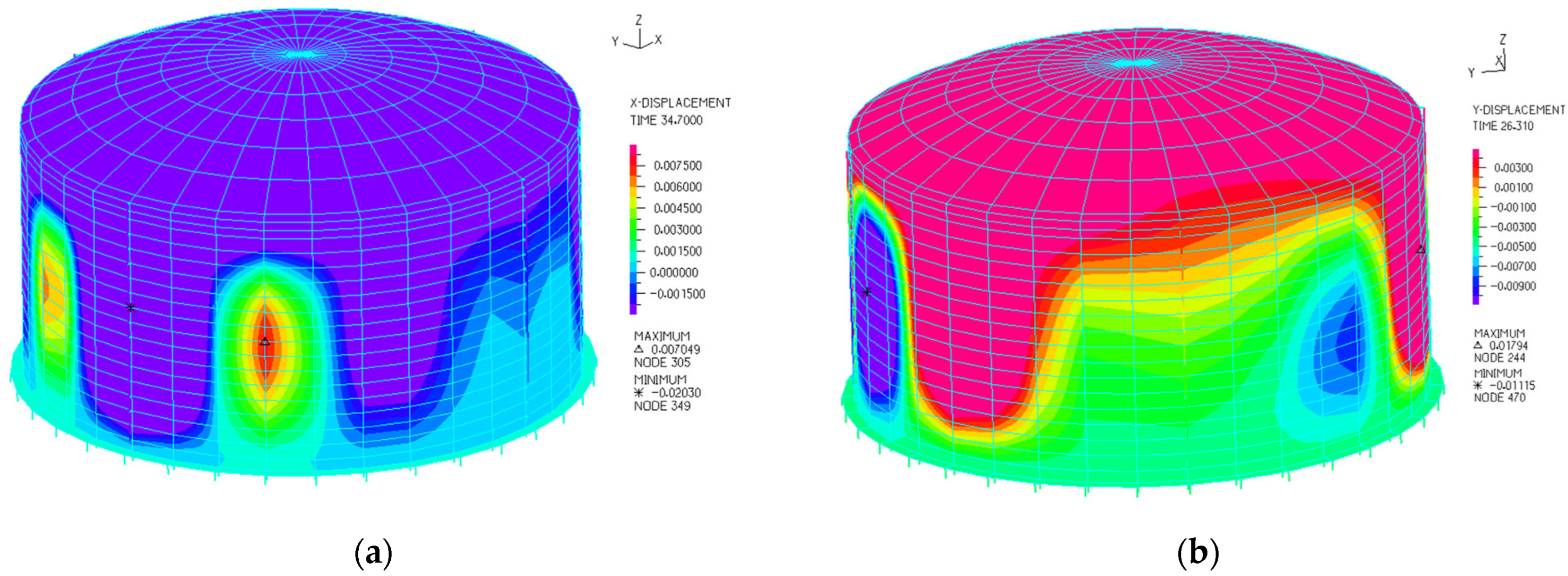
X: It can be seen from the displacement contour diagram that the displacement is concentrated at the junction between the dome roof and the tank wall (red arc band), which is significantly affected by horizontal seismic waves and generates the maximum displacement, indicating that the connection position of the dome roof side wall is the weak position of the concrete outer tank; the displacement of the tank wall and the bottom is small, and the overall response is dominated by the top (as shown in
Figure 13). Potential risks: Stress concentration at the connection, which may cause cracks or buckling; high risk of top equipment being affected by deformation.
Y: It can be seen from the displacement contour diagram that in the Y direction, two significant arc-shaped high displacement areas (red and orange) are formed at the junction between the dome roof and the tank wall, indicating that this area is significantly affected by seismic waves; the displacement at the middle buttress column is small, while obvious displacement step changes occur at the tank wall below the arc band, and the displacement of the middle and lower parts and the bottom of the tank wall is relatively small (as shown in
Figure 13). Potential risks: High displacement at the junction between the dome roof and the tank wall may cause stress concentration, with a risk of cracks, buckling, or fatigue failure; structural damage may be caused by local stress concentration at the displacement step change of the tank wall.
4.2. El Centro
X: It can be seen from the displacement contour diagram that the displacement of the tank wall is most concentrated in the X direction, which is the main risk area; the top displacement shows a gradient distribution, and the elastic deformation is relatively significant; and the displacement difference between the tank wall and the bottom is large, resulting in stress concentration (as shown in
Figure 14). Potential risks: Local buckling and instability of the tank wall; failure of top auxiliary equipment due to deformation; possible cracks or local instability at the tank bottom.
Y: It can be seen from the displacement contour diagram that the overall displacement distribution of the storage tank is relatively uniform in the Y direction, but the displacement at the bottom of the tank wall is relatively concentrated, which is the main risk area; the top displacement shows a small gradient distribution, and the elastic deformation is limited; and the displacement difference between the tank wall and the bottom is still large, with stress concentration (as shown in
Figure 14). Potential risks: Local buckling and instability at the bottom of the tank wall; although the deformation of top auxiliary equipment is small, attention should be paid to connection failure caused by slight displacement accumulation; abnormal local stress at the tank bottom may lead to cracks or uneven settlement instability.
4.3. TAFT
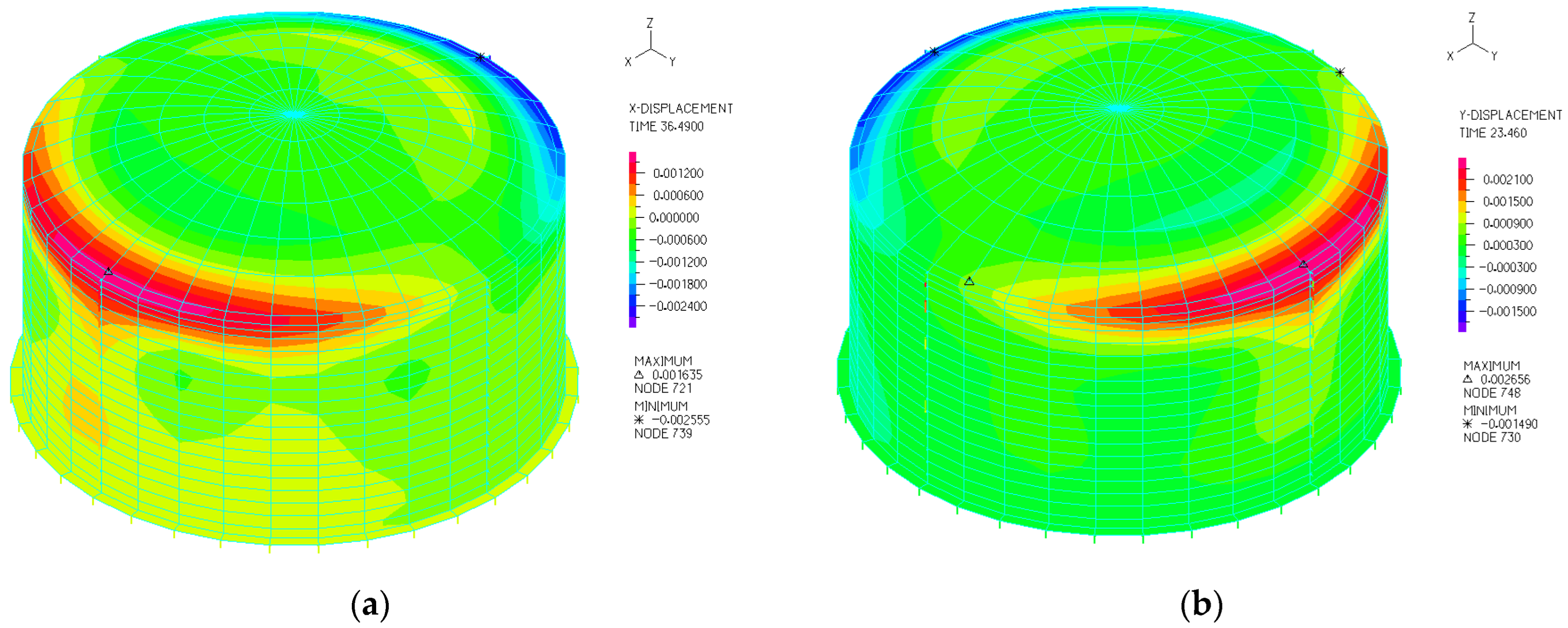
X: It can be seen from the displacement contour diagram that the displacement is concentrated at the junction between the dome roof and the tank wall (red arc band), which is significantly affected by horizontal seismic waves and generates the maximum displacement, indicating that the connection position of the dome roof side wall is the weak part of the concrete outer tank; the displacement of the tank wall and the bottom is small, and the overall response is dominated by the top (as shown in
Figure 15). Potential risks: Stress concentration at the connection, which may cause cracks or buckling; high risk of top equipment being affected by deformation.
Y: It can be seen from the displacement contour diagram that in the Y direction, a significant arc-shaped high displacement area (red and orange) is formed at the junction between the dome roof and the tank wall, indicating that this area is significantly affected by seismic waves; the displacement at the middle buttress column is small, while obvious displacement step changes occur at the tank wall below the arc band, and the displacement of the middle and lower parts and the bottom of the tank wall is relatively small (as shown in
Figure 15). Potential risks: High displacement at the junction between the dome roof and the tank wall may cause stress concentration, with a risk of cracks, buckling, or fatigue failure; structural damage may be caused by local stress concentration at the displacement step change of the tank wall.
4.4. TAFT2
X: It can be seen from the displacement contour diagram that in the X direction, the displacement of the local areas of the two tank walls (yellow to green areas) is significant, and the buttress columns are located in the middle of the high displacement area, which is the key point of stress transmission; the top displacement is uniform, and the elastic deformation is small; and the displacement difference between the tank wall and the bottom is small, and the overall foundation is relatively stable (as shown in
Figure 16). Potential risks: Local buckling or fatigue damage of the tank walls on both sides of the buttress columns may be caused by high displacement; failure may occur at the connection between the buttress columns and the tank wall due to stress concentration; although the top deformation is small, attention should be paid to the long-term stress reliability of the buttress column connections; the tank bottom area is relatively stable, but secondary cracks may be caused by local stress transfer induced by the buttress columns.
Y: It can be seen from the displacement contour diagram that a significant strip-shaped high displacement area (red and orange) is formed locally on the tank wall, indicating that this area is most severely affected by seismic waves; the top displacement is uniform, and the deformation is small; and the gradient at the junction between the tank wall and the bottom is obvious, and there may be stress concentration (as shown in
Figure 16). Potential risks: Local buckling or fatigue damage may be caused in the strip-shaped high displacement area; cracks or interface failure may occur at the bottom junction; the top area is stable, but the cumulative effect of long-term vibration needs to be evaluated.
5. Sensor Deployment Scheme for Structural Health Monitoring
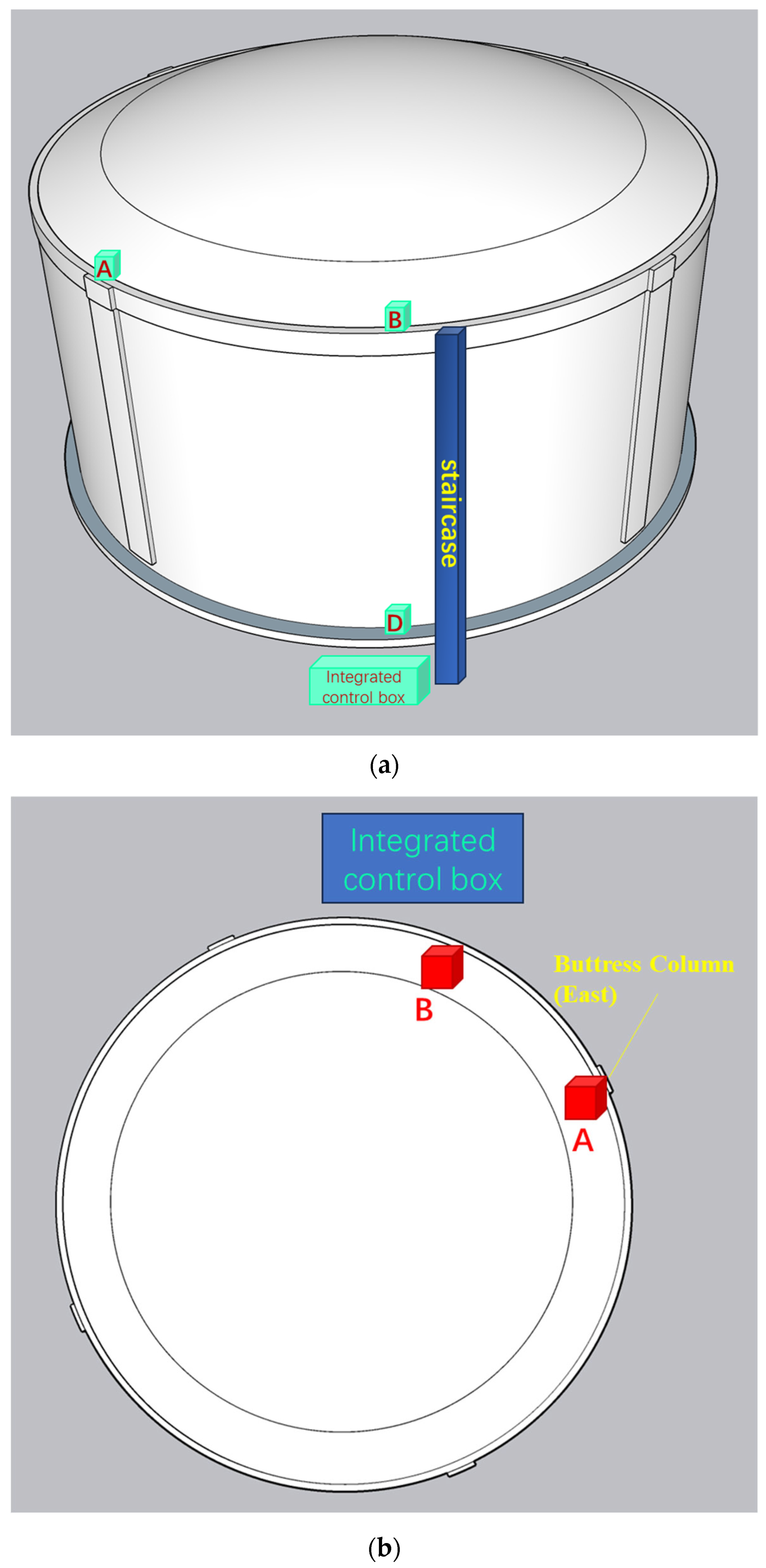
Based on the seismic response analysis results of the LNG storage tank and combined with the on-site actual working conditions, a long-term monitoring sensor deployment scheme is formulated. In this seismic risk monitoring, four monitoring points are set (including one strong motion monitoring point). Four three-component accelerometers are deployed at these monitoring points, totaling 12 acquisition channels. The schematic diagram of the specific layout is shown in
Figure 17.
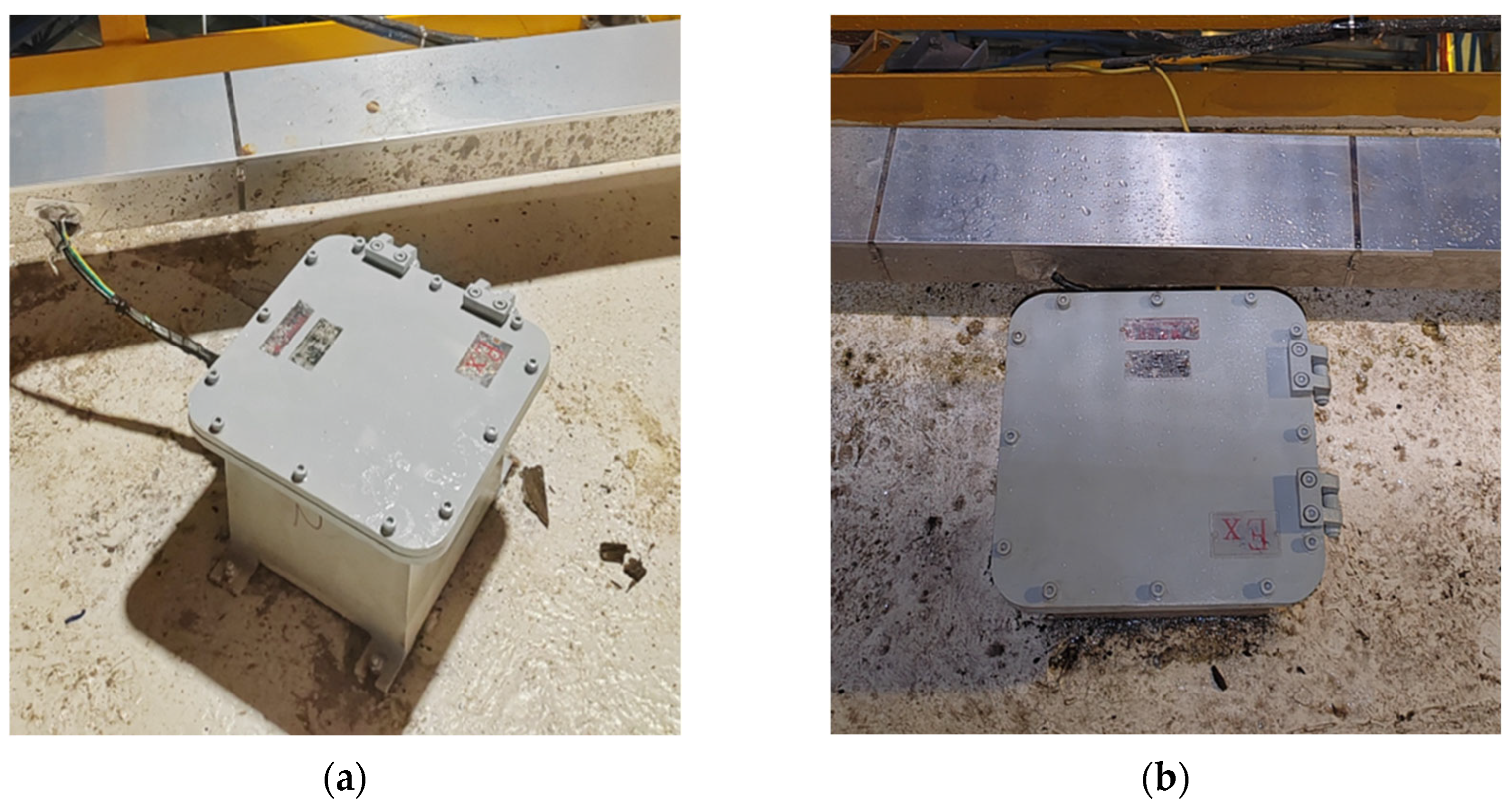
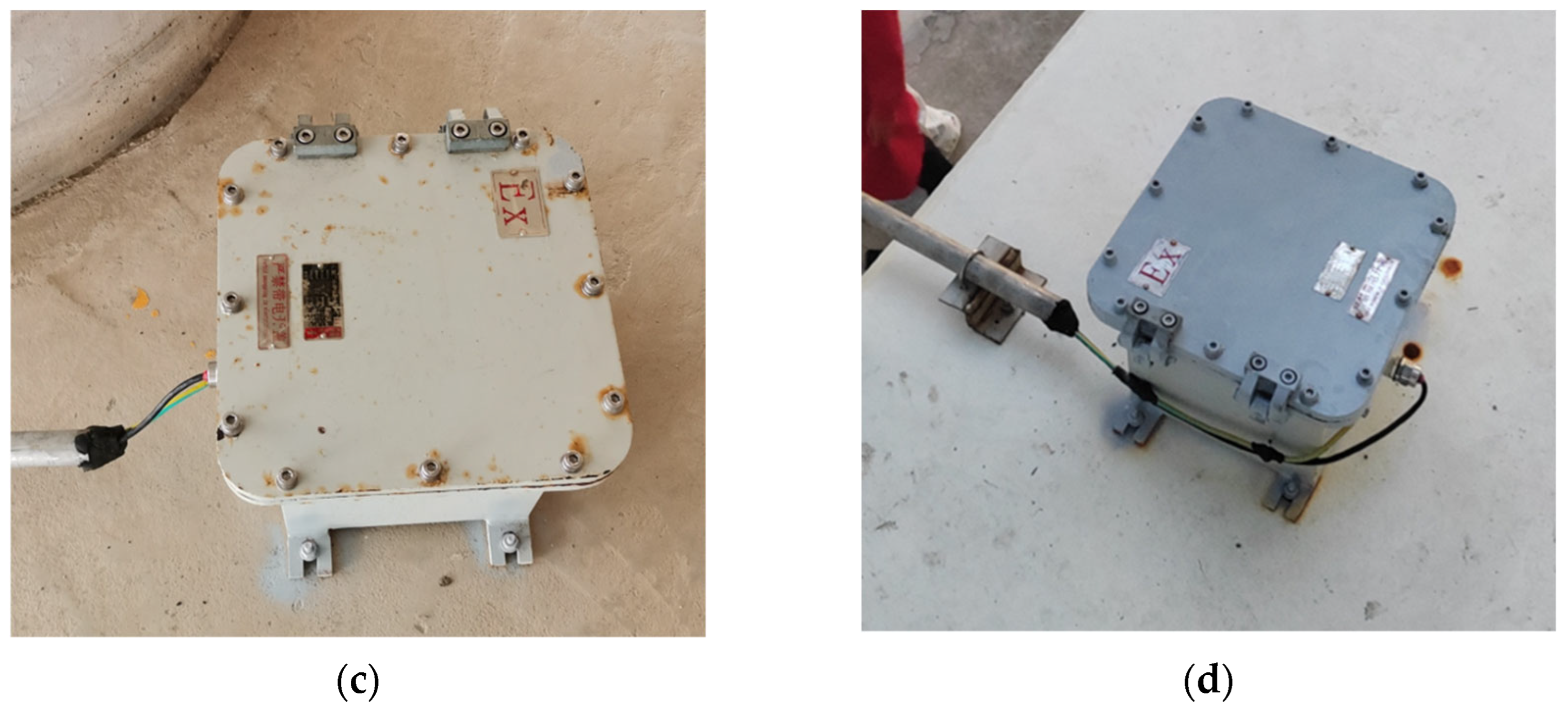
The specific arrangement is as follows, with some actual on-site engineering photos shown in
Figure 18:
① Measuring point A is located at the top of the east buttress column of the LNG storage tank. When the storage tank undergoes the sixth and seventh overall horizontal vibration modes, the overall horizontal vibration response of the storage tank is mainly concentrated in the upper part of the tank wall and the junction between the buttress columns and the dome roof. At the same time, due to the large stiffness mutation at the junction between the buttress columns and the dome roof, the horizontal amplitude at the top of the buttress columns is more significant. Deploying a three-component accelerometer here can effectively capture the dynamic responses of the LNG storage tank in the X and Y horizontal directions.
② Measuring point B is located at the top ring beam of the tank wall between two buttress columns, at the same horizontal plane as measuring point A. The top ring beam is located at the antinode area of the second to fifth circumferential multi-wave vibration modes of the LNG storage tank. In addition, obvious horizontal amplitude also appears at the middle ring beam during the overall horizontal vibration mode of the storage tank. Therefore, deploying a three-component accelerometer here can effectively capture the local vibration response of the storage tank, especially the circumferential multi-wave vibration under low-order modes. Combined with the monitoring data of measuring point A (at the top of the buttress column), measuring point C can supplement the monitoring of the overall horizontal vibration of the storage tank, thereby further improving the accuracy and comprehensiveness of the seismic risk monitoring of the storage tank.
③ Measuring point C is located on the free field at the central pile foundation of the LNG storage tank bottom. A three-component accelerometer on the free field is deployed to record the seismic motion of the LNG storage tank project site. Through independent free field data, environmental interference during normal operation, such as equipment vibration, personnel activities, and wind pulsation, can be effectively eliminated from the monitoring signals, thereby ensuring that the recorded data mainly reflects the true structural dynamic response of the storage tank.
④ Measuring point D is located at the bottom pile cap of the LNG storage tank, near the staircase. In the modal analysis of the LNG storage tank, the vibration response at the pile cap is small, and no obvious horizontal amplitude appears. Deploying a three-component accelerometer here can be used as a reference point for this seismic risk monitoring, and the monitoring data can be compared and analyzed with the sensors at other measuring points to ensure the accuracy and consistency of the monitoring data.
For real-time monitoring in the engineering application, an integrated triaxial accelerometer was employed, which houses three orthogonally oriented (X, Y, Z) 941B-type pickups within a single encapsulated unit to achieve synchronous three-directional measurement. The sensor assembly was mounted inside an explosion-proof enclosure, which was rigidly connected and firmly fixed to the tank structure to ensure coherent motion between the sensor and the structure, eliminating relative slippage or local vibration interference and guaranteeing the accuracy and reliability of monitoring data.
6. Conclusions
Taking a large full-containment LNG storage tank as the research object, a refined finite element model was established using ADINA software. After verifying the model reliability through modal analysis and on-site ambient vibration testing, typical seismic records, including El Centro, Tangshan, and TAFT, were selected for seismic response analysis to identify structural seismic weak parts. Finally, a four-measuring-point targeted monitoring sensor deployment scheme was formulated and applied in engineering in combination with practical project conditions. This study systematically explored the dynamic characteristics, seismic response laws, and structural health monitoring methods of the LNG storage tank. The main conclusions are as follows:
The established finite element model of the LNG storage tank shows a high degree of consistency with engineering practice, with the maximum deviation between modal analysis results and on-site vibration test results being only 2.3%. This verifies the rationality of the modeling method, which not only provides reliable numerical support for the seismic response analysis of the storage tank, but also offers a reference for the finite element modeling of similar LNG storage tanks.
The displacement responses of the LNG storage tank under different seismic waves show significant regional differences, with weak parts mainly concentrated at the junction of the dome roof and tank wall, the connection of buttress columns and tank wall, the upper part of the tank wall, and local tank wall areas. Distinct action characteristics are observed for different seismic waves, and this regularity clarifies the key areas for seismic protection of the storage tank, providing a core basis for the targeted deployment of monitoring points.
The four-measuring-point targeted monitoring sensor deployment scheme formulated based on the seismic response characteristics of the storage tank achieves coverage of critical regions and improved monitoring efficiency under strict constraints of explosion-proof safety and engineering conditions. Using integrated triaxial accelerometers, each monitoring point achieves functional complementarity, capable of capturing both the global and local vibration responses of the storage tank simultaneously, effectively eliminating environmental interference and ensuring the reliability of monitoring data.
The structural health monitoring method for LNG storage tanks constructed in this study, featuring “model verification–weak part identification–monitoring scheme customization,” provides a new approach for tank monitoring under explosion-proof safety constraints and partially addresses the limitations of traditional empirical deployment. This method covers the full cycle of routine operation, seismic response, and post-earthquake assessment, providing methodological support for the structural health monitoring of LNG storage tanks, and its core concepts can also serve as a reference for the structural health monitoring of similar large-scale thin-walled storage tanks.
The research results provide technical support for the seismic design and structural health monitoring of LNG storage tanks, and the identified weak part patterns and formulated deployment scheme can offer direct references for the monitoring practice of similar LNG storage tank projects. This study was only carried out for a full-containment LNG storage tank with specific specifications, leaving room for expanding the engineering applicability of the research results. Follow-up research will be further deepened, focusing on model accuracy improvement, technology integration, and data mining, with specific future research prospects as follows:
In terms of model refinement, it is necessary to improve the coupled simulation mechanism for complex effects, integrate research findings of fluid–structure interaction theory and liquid sloshing effect analysis, and optimize the coupling algorithm of the finite element model, with a focus on enhancing the simulation accuracy of nonlinear sloshing under strong earthquakes and the dynamic interaction between the tank wall and liquid [
36,
37,
38]. It should be noted that the finite element model in this study is established under the linear elastic assumption, with all structural components assigned isotropic linear elastic material properties. This assumption is adopted based on the following considerations: the core objective of this study is to identify structural weak parts and optimize sensor deployment through seismic response analysis, rather than precisely predicting damage evolution or ultimate collapse under strong earthquakes; linear analysis is sufficient to reveal the spatial distribution of displacement/stress responses and dominant vibration mode characteristics. Modal analysis results show excellent agreement with on-site ambient vibration testing (maximum frequency deviation of only 2.3%), validating the capability of the linear elastic model to capture small-amplitude dynamic characteristics under operational conditions. Moreover, given the large scale of the tank model and the need for seismic loading analysis, the linear elastic assumption offers significant computational efficiency advantages. The following nonlinear effects are not considered in the current model: concrete cracking at the dome–wall junction, prestress loss in the tank wall, pile–soil interaction, and material yielding under strong earthquakes. These effects may lead to local stiffness degradation, frequency drift, or stress redistribution, and the current analysis results should be regarded as upper-bound references under extreme seismic actions. Future research will introduce concrete damage plasticity models, pile–soil interaction boundaries, and fluid–structure coupling algorithms to progressively enhance the simulation accuracy of the model under strong nonlinear conditions.
In terms of multi-technology integration, it is essential to strengthen the collaborative innovation of numerical simulation and experimental research. For example, combined with large-scale shaking table test technology, prototype or large-scale model tests of storage tanks under various working conditions should be carried out to obtain measured data under extreme working conditions and verify the universality of the finite element model [
39]. In addition, in-depth analysis and mining of long-term monitoring data should be conducted to explore its potential patterns. For instance, the integration of measured data enables the rapid and accurate assessment of structural damage degrees post-earthquake [
40]; the accurate identification of structural residual bearing capacity from seismic monitoring data and effective quantification of post-earthquake bearing capacity degradation can provide an objective basis for post-earthquake safety assessment and decision-making [
41]. Through the above measures, the scientific rigor and effectiveness of structural health monitoring, post-earthquake assessment, and damage alerting will be further enhanced, promoting the in-depth transformation of research results into engineering practice, and providing more comprehensive technical support for the structural safety assurance of LNG storage tanks and similar large-scale clean energy storage and transportation infrastructure.