


Abstract
Landfill leachate is highly concentrated wastewater containing non-biodegradable organic compounds and toxic substances. For this reason, advanced treatment methods are necessary for its treatment. The article discusses the possibility of treating leachate in a hybrid system combining ultrasonic pretreatment and anaerobic co-digestion with dairy wastewater in an anaerobic membrane bioreactor. Two laboratory-scale submerged anaerobic membrane reactors with a capillary module with membranes with a pore size of 0.1 μm and an effective filtration area of 0.35 m2 were used in this study. An ultrasound disintegrator at 22 kHz (amplitude 14 µm) was used for leachate pretreatment. It was found that, as a result of leachate sonification (time > 10 min), the BOD5/COD ratio in the wastewater increased from 0.1 to 0.4, and the content of dissolved organic compounds accounted for more than 40% of the total COD. Preliminary sonication of the leachate resulted in improved co-digestion efficiency in a reactor fed with conditioned leachate. A 92% reduction in organic pollutants was achieved, as well as a biogas production rate of 0.5 L biogas/g COD removed.
1. Introduction
The rapid growth in living standards and industrial development observed in recent years has led to a steady increase in the amount of municipal and industrial waste generated. According to a World Bank report, there is a risk of a global waste crisis due to the projected alarming increase in waste production to 3.40 × 10⁹ tons by 2050 r. For economic reasons, landfilling remains a common method of final waste disposal [1]. The operation of landfills is associated with the problem of leachate generation and the need to treat it. Leachate is wastewater that permeates the landfill and washes out organic and mineral contaminants. During waste landfilling, biochemical processes occur that determine the qualitative composition of the leachate. With the age of the landfill, the concentration of easily degradable volatile organic acids and other low-molecular compounds in the leachate decreases, while the amount of non-biodegradable fulvic and humic acids increases. High concentrations of pollutants in leachate, their variable composition related to the landfill’s age, high concentrations of refractory substances, and varying volumes throughout the seasons make the treatment of this type of wastewater significantly more challenging than treating municipal wastewater [2]. Various landfill leachate treatment technologies have been developed, including physical, chemical, and biological technologies [3,4]. Physical methods, such as adsorption, are effective for removing low-molecular-weight organic compounds; however, they are not suitable for removing high-molecular-weight pollutants from landfill leachate [5]. Biological methods are widely used to remove nitrogen and organic compounds from young landfill leachate. A common method is co-treatment with municipal wastewater using the activated sludge method. As shown in previous studies by the authors of this article, biological co-treatment of dairy wastewater is also possible, both aerobic and anaerobic [6,7]. However, due to the very high biodegradability and high concentration of organic pollutants in dairy wastewater, anaerobic treatment is more suitable for treatment. Moreover, the anaerobic treatment process generates less sludge and requires lower nutrient inputs, making it more popular and widely used in dairy wastewater treatment [8,9]. The co-treatment of dairy wastewater and landfill leachate in the co-digestion process enables the utilization of difficult-to-treat landfill leachate with simultaneous energy recovery.
Co-digestion is the simultaneous anaerobic treatment of two or more substrates mixed in specific proportions to produce biogas. Numerous studies have demonstrated that co-digestion enhances methane production by facilitating the proper interaction between microorganisms and supplying the necessary nutrients for an optimal anaerobic digestion process (AD) [10,11].
However, as landfill age increases, poorly degradable compounds such as humic and fulvic acids render biological processes ineffective. Numerous research results indicate that it is not feasible to treat leachate effectively using a single unit process. The most commonly used are hybrid systems that combine biological methods with physicochemical processes, such as membrane methods, activated carbon sorption processes, or advanced oxidation processes (AOPs) [12,13].
Recently, it has been reported that the use of membrane bioreactors (MBRs) is an important and effective process for treating wastewater, including difficult-to-treat landfill leachate [14]. Additionally, MBR technology has become a more suitable option for treating complex and poorly biodegradable compounds compared to conventional activated sludge systems. The Anaerobic MBR (AnMBR) is a promising technology for treating landfill leachate, offering significant advantages over conventional anaerobic and aerobic technologies. Compared to aerobic treatment, anaerobic treatment offers several benefits, including energy recovery, eliminating the need for aeration, overcoming oxygen transfer limitations at high organic loads, and resulting in lower sludge production. An anaerobic membrane bioreactor is an integrated anaerobic digestion and membrane filtration process in which the membrane can completely retain all suspended solids, including slow-growing methanogens, to achieve complete separation of solids retention time (SRT) from hydraulic retention time (HRT) [15].
On the other hand, due to the complex nature of leachates and their decreasing biodegradability as the landfill ages, their susceptibility to decomposition in biological reactors decreases. Therefore, additional pretreatment methods are necessary to improve the efficiency of their biodegradation in bioreactors. In recent years, increasing attention has been paid to the possibility of using advanced oxidation processes for this purpose [16]. A common feature of advanced oxidation processes is the use of an oxidizing agent—highly reactive hydroxyl radicals with a high oxidation-reduction potential, capable of oxidizing many organic compounds. The use of AOPs leads to the mineralization of pollutants, i.e., their oxidation to CO2, water, and inorganic compounds. Among the advanced oxidation methods, ultrasonics deserve special attention, as their beneficial effects have already been confirmed in water disinfection, activated sludge wastewater treatment, sanitation, and sewage sludge thickening. Ultrasonication improves the biodegradability of recalcitrant pollutants, does not require the addition of chemical reagents, may occur under mild environmental conditions, and can be used both as a pre- and post-treatment process. The degradation of pollutants in wastewater during ultrasonication is the result of numerous phenomena occurring when an ultrasonic wave passes through a liquid medium, including mainly cavitation, i.e., the formation of pulsating bubbles in the liquid. During bubble vibrations, rapid collapse are observed, resulting in a significant increase in temperature (approx. 5000 K) and pressure (>500 bar). The implosion of cavitation bubbles generates a strong shock wave. High pressure and temperature values cause secondary phenomena of various types, including sonochemical reactions. During cavitation bubble compression, thermal dissociation of water molecules occurs, forming free radicals, ozone, and hydrogen peroxide. Sonochemical reactions occur inside, on the surface, and in the immediate vicinity of cavitation bubbles. However, it is believed that they occur most intensively at the interfacial surface due to the highest concentration of radicals at the bubble-liquid boundary. The free radicals produced react with various compounds contained in the liquid, causing their oxidation, decomposition, or destabilization.
There are also numerous reports on its effectiveness in the preliminary treatment of leachate before biological treatment in SBR reactors [17]. However, there are few reports in the literature on the impact of sonification on the efficiency of their treatment under anaerobic conditions. The assessment of the effects of preliminary conditioning of leachate on the degree of organic pollutant removal and biogas production is conducted in short-term experiments that do not account for variable process parameters, such as the retention time of wastewater in the reactor or its organic pollutant load [18].
Taking into account the above literature reports, the following research hypotheses were formulated: (1) application of ultrasounds to mature landfill leachate pretreatment increases its biodegradability; (2) pretreatment of mature landfill leachate creates the possibility of achieving a highly efficient co-treatment of mature leachate with raw dairy wastewater at the biological treatment stage with AnMBR.
To the best of our knowledge, this study is the first to systematically evaluate the effect of ultrasonic pretreatment on the anaerobic co-digestion (AcD) performance of mature landfill leachate and dairy wastewater in a continuous AnMBR system. Previously published studies have focused on short-term batch experiments or aerobic systems.
The objective of this study is to assess the application of an ultrasonic field for improving leachate and dairy wastewater AcD in terms of COD removal, biogas production, energy balance, and membrane filtration performance with various process parameters. The results obtained in this study may shed light on the efficiency of landfill leachate co-treatment with other easily biodegradable industrial wastewaters using AnMBR and contribute to the commercialization of this novel hybrid technology.
2. Materials and Methods
2.1. Ultrasound Pretreatment
A UD-20 type disintegrator (TECHPAN, Warsaw, Poland)) was used for ultrasonic treatment of the leachate. Ultrasonic energy, generated in a sandwich-type ceramic transducer powered by a generator with an output power of 180 W and a continuous wave frequency of 22 kHz, was introduced into the tested medium (leachate) through a sonotrode with a diameter of d = 2.0 cm and a cross-sectional area of S = 3.14 cm2. An amplitude of 14 µm and a variable exposure time of 3 to 20 min were used for ultrasonic treatment of landfill leachate. The 14 µm amplitude was selected based on the authors’ previous research [6].
2.2. AnMBR Setup and Operational Condition
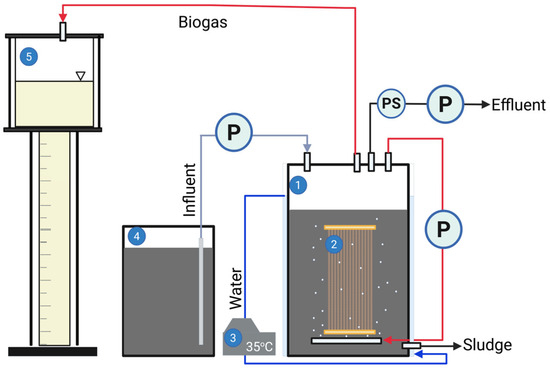
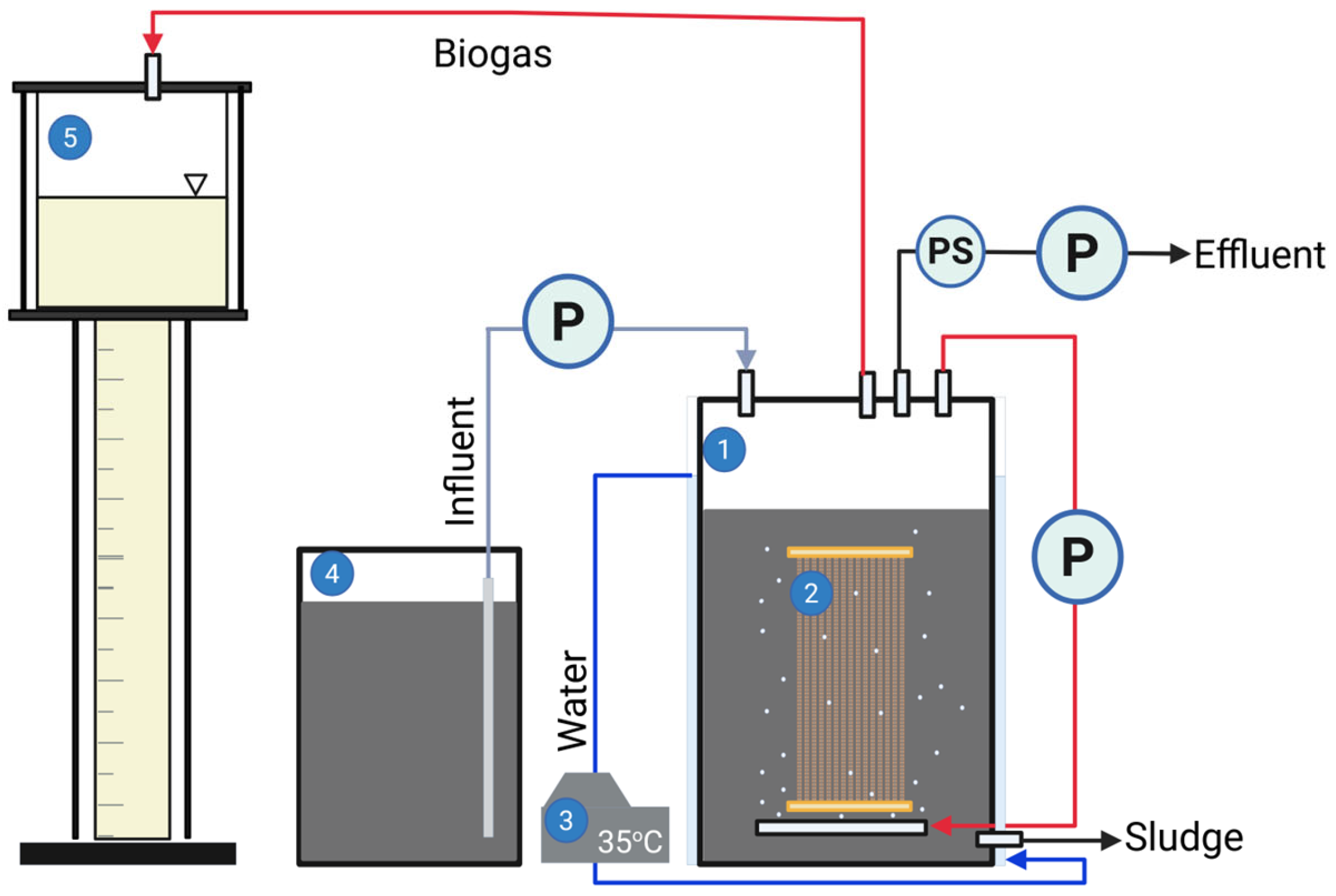
The study was conducted using two laboratory-scale anaerobic membrane bioreactors (AnMBR) working in parallel (Figure 1). Each reactor had a total volume of 30 L, a working volume of 20 L, and was operated at 35 ± 1 °C. The volume of the headspace was approximately 10 L to prevent foaming problems that could be caused by biogas recirculation. Two peristaltic pumps (MasterFlex L/S 7554-95, Cole Palmer Instrument Co, Vernon Hills, IL, USA) were used for influent feeding and effluent extraction. A capillary membrane module (Zakłady Automatyki Rotametr, Gliwice, Poland) with a filtration area of 0.35 m2 was directly immersed in the bioreactor. The membrane was made of polyvinylidene difluoride (PVDF) with a nominal pore size of 0.1 μm. To scour the membrane and mix the anaerobic sludge suspension, a portion of the biogas from the bioreactor headspace was recycled by a vacuum pump (Millipore, XF5423050, Poznań, Poland) at a crossflow velocity of approximately 71 m/h and forced through a diffuser located under the membrane module.
Figure 1.
Schematic diagram of the lab-scale AnMBR setup: 1—reactor; 2—a capillary membrane module; 3—water bath; 4—feed tank; 5—water displacement gas measurement system; P—pump; PS—pressure sensor.
The amount of produced biogas was manually measured daily by the water displacement method with a portable gas analyzer (DP-27 BIO+, NANOSENS, Wysogotowo, Poland). The composition of biogas was determined at standard temperature and pressure.
2.3. Feed and Inoculum
The landfill leachate used in the experiment was obtained from a sanitary landfill site in southern Poland (Silesian Region) (50.73413390° N, 19.0790069° E). Leachate is collected and stored at the landfill site in designated basins. Some of the leachate is treated at a local treatment plant using reverse osmosis, and the excess is transported to a municipal wastewater treatment plant. Industrial wastewater from a medium-sized dairy plant (Silesian Region, Poland). The characteristics of landfill leachates and dairy wastewater are presented in Table 1.
Table 1.
Characteristic of the municipal landfill leachates and dairy wastewater.
Anaerobic granular sludge from a brewery wastewater treatment plant was used as inoculum in bioreactors. The dry weight of the sludge was 86.0 g/L, of which dry organic matter accounted for approximately 76%.
2.4. Experimental Procedure
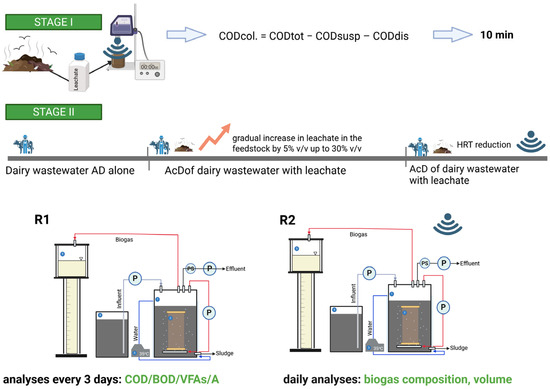
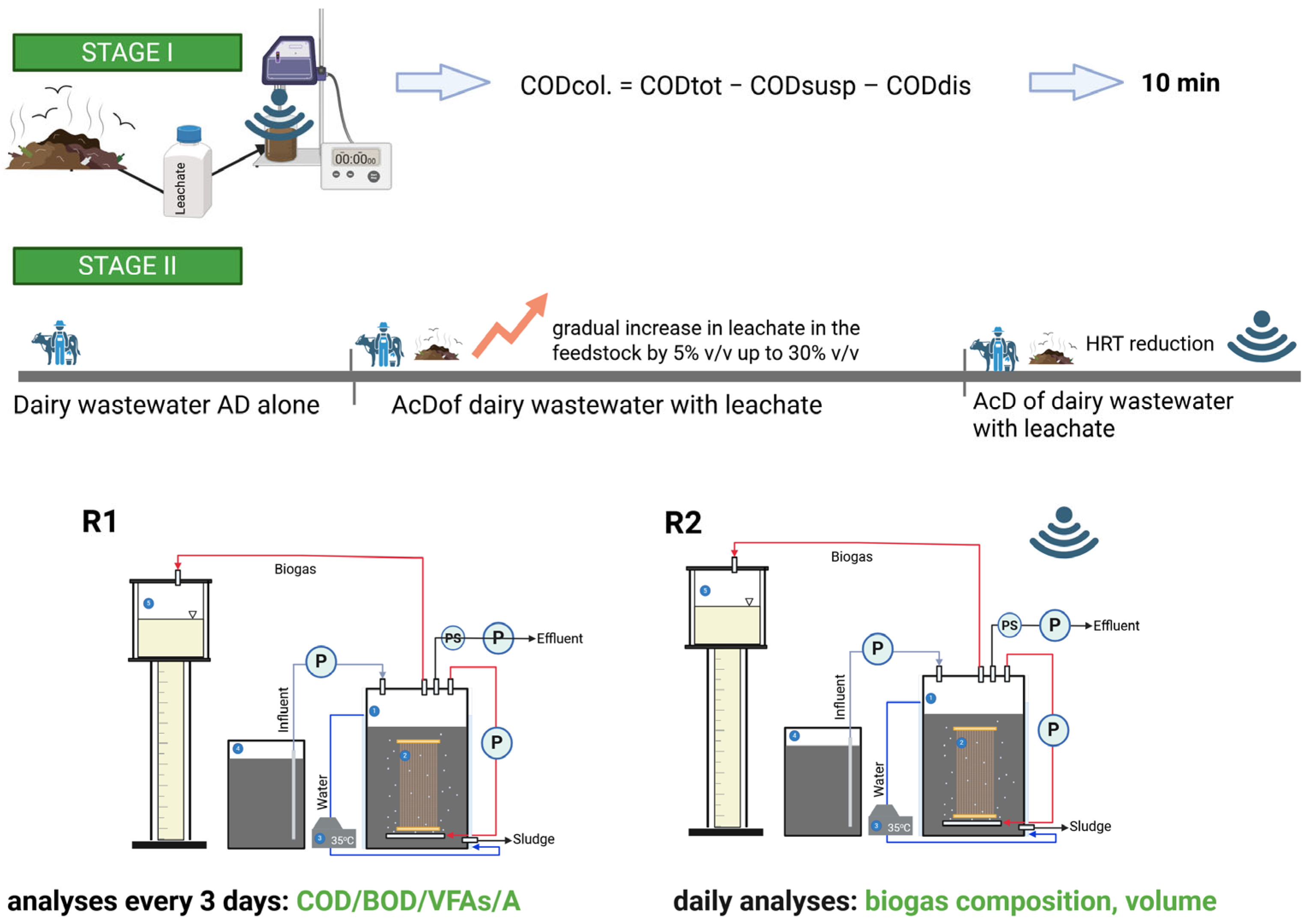
The experiment was divided into two stages (Figure 2). In the first stage, the optimum sonication time for the solubilization of organic matter in the leachate samples was investigated. The amplitude of the ultrasonic field was selected based on the authors’ previous research results [6]. The optimal conditioning time was selected based on the values of the CODdis and the BOD5/COD ratio.
Figure 2.
Experimental scheme.
- —total COD (sum of all COD fractions)
- —suspended COD fraction (organic matter in particulate form)
- —colloidal COD fraction (organic matter in colloidal form)
- —dissolved COD fraction (organic matter in truly soluble form)
In the second stage of the study, a mixture of leachate (30%, v/v) and dairy wastewater (70% v/v) was treated in membrane bioreactors. During the first 30 days, AnMBR reactors were fed only with dairy wastewater. After sludge acclimatization, the addition of landfill leachate in the influent was gradually increased from 5% to 30%. The selection of the mixing ratio of landfill leachate and dairy wastewater was based on the physicochemical characteristics of both substrates and on operational constraints reported in previous studies on the co-treatment of mature landfill leachate. Mature leachate is known to exhibit very low biodegradability (BOD5/COD ≈ 0.1) and high concentrations of ammonium nitrogen, which may inhibit methanogenic activity. In contrast, dairy wastewater provides readily biodegradable organic matter and a favorable C/N ratio that supports process stability [7,8,16]. Only a limited number of studies have assessed the co-treatment of landfill leachate and dairy wastewater. Neczaj et al. [19] demonstrated that such mixtures can be effectively treated in an SBR system using a leachate dilution of 25% (v/v), and similar ranges (10–30% v/v) have been reported in other aerobic and bioelectrochemical configurations [20].
The first reactor (R1) was fed with unconditioned leachate, while the second reactor (R2) was fed with a mixture of sonicated wastewater. The AnMBR setup lasted for around 130 days, which could be divided into five phases corresponding to the stepwise increase in average operational flux from 0.5 to 2.5 L/m2/h, resulting in a decrease in HRT from 1 to 3 days. It should be noted that during the experiment, no maintenance chemical cleaning was conducted due to the limited fouling propensity at low flux (max 2.5 LMH). When the transmembrane pressure (TMP) exceeded 40 kPa, backwashing with treated wastewater was used to remove foulants and recover membrane permeability. Solid retention time (SRT) was maintained at approximately 150 d by manual extraction of a small amount of sludge once per week.
2.5. Sample Analyses
The following parameters were investigated in the study: pH (pH meter Cole Parmer Model No. 59002-00, Bunker Court, Vernon Hills, IL, USA), chemical oxygen demand (COD) (Hach method, spectrophotometer Hach DR/4000, Loveland, CO, USA), 5-day biochemical oxygen demand (BOD5) (respirometric method, OxiTop® Control, WTW, Weilheim, Germany), Kjeldahl nitrogen (TKN) (steam distillation with BÜCHI K-355 after mineralization with digestion unit K-435, BÜCHI, Flawil, Switzerland), ammonium nitrogen (N-NH4+) (steam distillation, BÜCHI K-355, Flawil, Switzerland), total suspended solids (TSS) (weight method after drying at 105 ◦C with ovens SL115, POL-EKO, Wodzislaw Slaski, Poland), total phosphate by ascorbic acid method after mineralization with digestion unit (K-435, BÜCHI, Flawil, Switzerland) phosphates (PO43−) (ascorbic acid method, spectrophotometer Hach DR/4000, Loveland, CO, USA), chloride (argentometric method). All of the mentioned analyses were performed according to the APHA Standard Methods for the Examination of Water and Wastewater [21].
Due to the occurrence of organic compounds in suspended, colloidal, and dissolved forms, the percentage share of individual fractions in landfill leachate was determined after conditioning with an ultrasonic field. For this purpose, the leachate was filtered sequentially through a membrane filter with a pore diameter of 4.4 µm (removing organic compounds present in the form of suspended CODsusp) and then through a membrane filter with a pore size of 0.45 μm (the remaining liquid being dissolved organic substances CODdis). The proportion of organic compounds in colloidal form (CODcol) was calculated based on the following relationship [6]:
CODtot—total COD (sum of all COD fractions).
CODcol = CODtot − CODsusp − CODdis
In this study, volatile solids were not monitored during long-term reactor operation, because process performance was primarily evaluated based on COD and BOD5 removal and biogas production, which are more relevant indicators for high-strength liquid wastewaters treated in AnMBR systems.
2.6. Model of BOD5/COD Saturation
To describe the relationship between biodegradability and sonication time, the experimental BOD5/COD data were fitted to an exponential saturation model. The model expresses the asymptotic increase of BOD5/COD with increasing sonication time according to the equation:
where y is the BOD5/COD ratio, x is the sonication time (min), a represents the asymptotic (maximum) value, and b is the rate constant of biodegradability increase.
Model parameters (a and b) were estimated by nonlinear least-squares fitting using the curve fit function in the SciPy library (Python 3.11). Goodness-of-fit was evaluated using the coefficient of determination (R2) and residual analysis. Additionally, the time required to reach 95% of the maximum biodegradability (t95) was calculated from the model equation as:
This parameter was used to determine the optimal sonication duration, corresponding to the point at which further ultrasonic exposure produced negligible improvement in the BOD5/COD ratio.
2.7. Principal Component Analysis (PCA)
Principal Component Analysis (PCA) was applied to explore relationships among the measured physicochemical parameters during ultrasonic pretreatment. The dataset included total and fractionated COD (CODtot, CODsusp, CODcol, CODdis), biochemical oxygen demand (BOD5), the BOD5/COD ratio, and pH, obtained at six sonication times (0, 3, 5, 10, 15, and 20 min).
Before analysis, all variables were autoscaled (mean-centered and divided by their standard deviations) to eliminate the influence of different measurement units. PCA was performed using the scikit-learn package in Python. The results are expressed as scores (sample coordinates in the space of principal components) and loadings (contributions of each variable to the components). A biplot was constructed to visualize both the grouping of samples (according to sonication time) and the directions of variable influence.
2.8. Analysis of Variance (ANOVA)
Statistical analyses were performed using the STATISTICA software package (STATISTICA 12 PL, StatSoft Poland Ltd., Cracow, Poland). A comprehensive statistical evaluation was carried out to assess the influence of the leachate proportion in the feed mixture on the analyzed parameters, as well as to examine changes in the BOD5/COD ratio at different sonication times.
The one-way analysis of variance (ANOVA) and the Kruskal–Wallis test were applied to determine statistically significant differences among the tested conditions. The assumptions of normality and homogeneity of variances were verified using the Shapiro–Wilk and Levene’s tests, respectively. When these assumptions were met, ANOVA was employed; otherwise, the non-parametric Kruskal–Wallis test was used.
To analyze the BOD5/COD ratio, a one-way ANOVA was performed to assess the statistical significance of changes across the tested sonication times (0–20 min). The null hypothesis assumed that there were no significant differences between the mean values at different times. When significant effects were detected (p < 0.05), post hoc comparisons were conducted using Tukey’s Honestly Significant Difference (HSD) test for ANOVA and the Dunn–Bonferroni procedure for the Kruskal–Wallis test to identify specific differences between treatment levels.
2.9. Regression Analysis
To further quantify the relationships between the leachate share and the analyzed parameters, regression analysis was performed. Both linear and polynomial models were fitted to the experimental data to describe the direction and strength of observed trends. Model significance was assessed using the F-test, and the quality of fit is expressed by the coefficient of determination (R2). The slope coefficients (β1) were used to evaluate the nature of parameter changes with increasing leachate proportion, while second-order polynomial terms (p(x2) < 0.05) were applied when non-linear relationships were identified.
2.10. Energy Balance of Ultrasonic Pretreatment
To assess the energetic feasibility of ultrasonic disintegration, an energy balance was made for the reactors fed with non-pretreated (R1) and sonicated leachate (R2). The specific electrical energy input of ultrasound, EUD,feed (kWh/m3 feed), was calculated from the nominal power of the ultrasonic generator (P), the sonication time (t) and the volume of feedstock into the AnMBR:
In all calculations, it was assumed that 30% (v/v) of the influent flow was subjected to ultrasonic conditioning before mixing with the remaining 70% of the dairy wastewater.
The specific energy recovered as methane in reactors R1 and R1, ECH4,R1 and ECH4,R2 (kWh/m3 feed), was obtained from the measured methane yield and the lower heating value of methane (LHV = 9.94 kWh/m3). The additional methane energy attributable to ultrasound was calculated as:
ΔECH4 = ECH4,R2 − ECH4,R1
While, an energy efficiency ratio (EER) was defined as:
EER = ΔECH4/EUD,feed
3. Results and Discussion
3.1. Landfill Leachate Pretreatment
In the first step of the study, the impact of ultrasound pretreatment on the biodegradability of landfill leachate was investigated. To assess the biodegradability of organic pollutants, it is essential to determine the proportions of suspended, colloidal, and dissolved fractions. Determining individual fractions is difficult due to the lack of clear definitions. Some authors classify the colloidal fraction as suspended solids, while others classify it as dissolved compounds [22,23]. At the same time, it should be noted that organic compounds in colloidal form are among the most difficult to biodegrade [24]. The type of substrate available influences the effectiveness of the biological degradation of organic compounds. It is assumed that the easily degradable dissolved fraction contains compounds that can be directly assimilated and metabolized by microorganisms. The slowly degradable fraction, on the other hand, consists of compounds that must first be broken down by extracellular enzymes [25,26]. The physicochemical properties of raw leachate from a landfill site, used as a co-substrate in the anaerobic digestion process, as presented in Table 1, indicate its very poor biodegradability. The BOD5/COD ratio in the leachate remained at 0.1, and the concentration of ammonium nitrogen, which can inhibit the anaerobic digestion process, was high. Table 2 presents the changes in the concentration of individual COD fractions, BOD5, and pH in treated landfill leachate resulting from the application of an ultrasonic field with an amplitude of 14 µm and varying exposure times. The conversion of organic compounds into a soluble form is crucial for biodegradability. Microorganisms can readily metabolize dissolved organic compounds (CODdis). A significant increase in BOD indicates an improvement in the leachate’s susceptibility to biochemical degradation with increasing sonication time. These transformations are driven by acoustic cavitation, where collapsing microbubbles generate local hot spots (T > 5000 K, p > 1000 atm) that produce hydroxyl (•OH) and hydrogen (•H) radicals, together with strong shear forces and micro-jets capable of disrupting humic macromolecules and cell walls. This leads to fragmentation and partial oxidation of recalcitrant organics, enhancing solubilization and biodegradability [18,27,28].
Table 2.
The concentration of individual COD fractions, BOD5, and pH in treated landfill leachate.
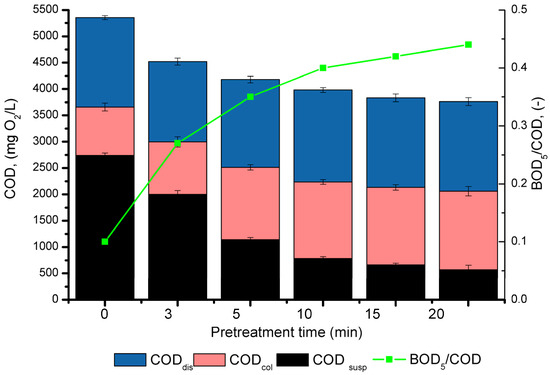
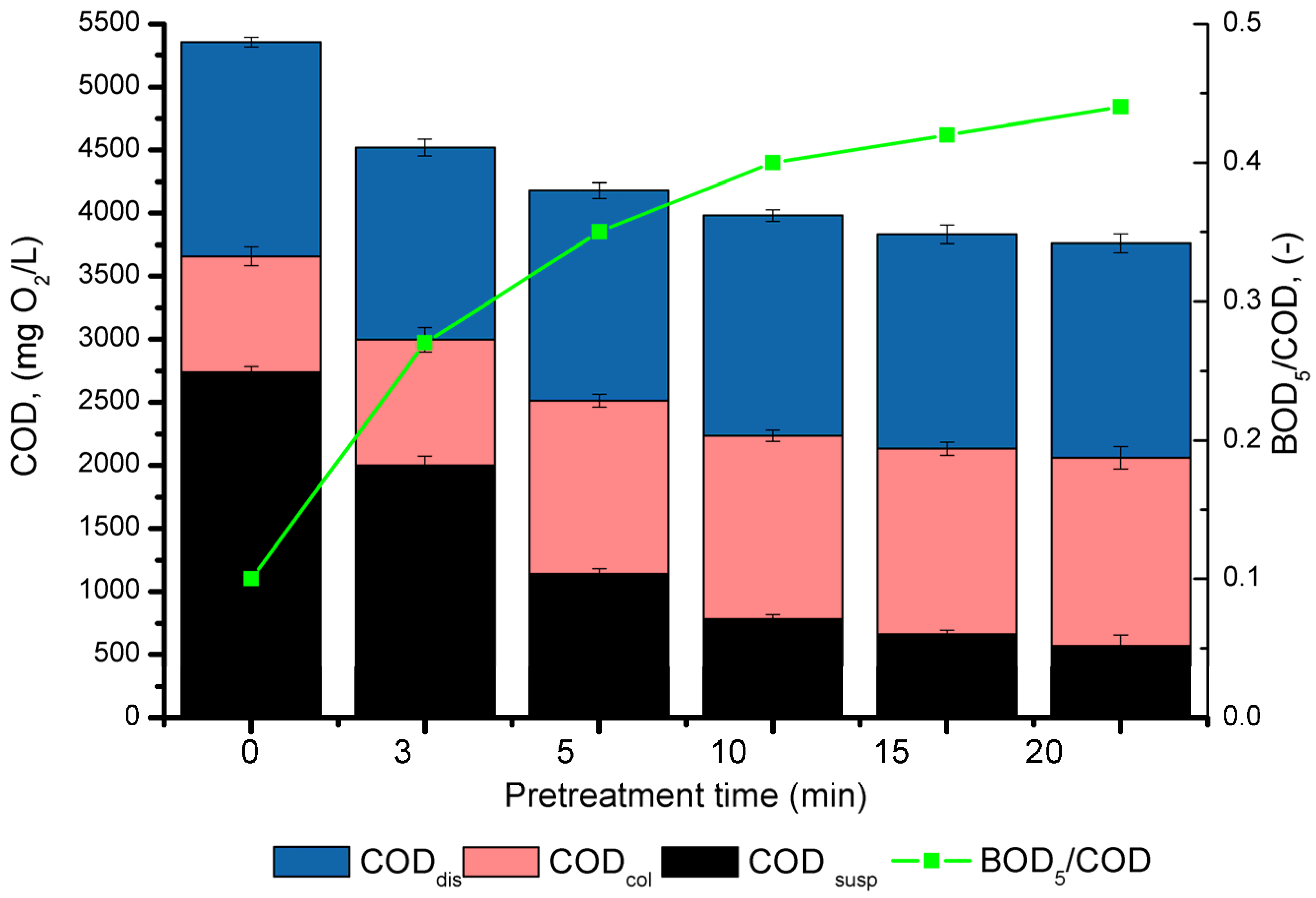
As the ultrasonication time increased, a change in the distribution of individual COD fractions in the landfill leachate was observed (Figure 3). At sonication times above 10 min, the share of CODdis was over 43%, while CODcol was above 35%. The increase in the dissolved COD fraction resulted in an increase in the BOD5/COD ratio from 0.1 to 0.44.
Figure 3.
Distribution of COD fraction with different pretreatment times.
The four-fold improvement in the BOD5/COD ratio observed in this study (0.10 → 0.40) was greater than that reported by Grosser et al. [29], who obtained an increase up to ~0.30 under higher frequencies and shorter sonication times. This enhanced effect can be attributed to the stronger cavitation intensity characteristic of low-frequency ultrasound (22 kHz), which promotes the disruption of humic aggregates and the release of soluble organic compounds [28].
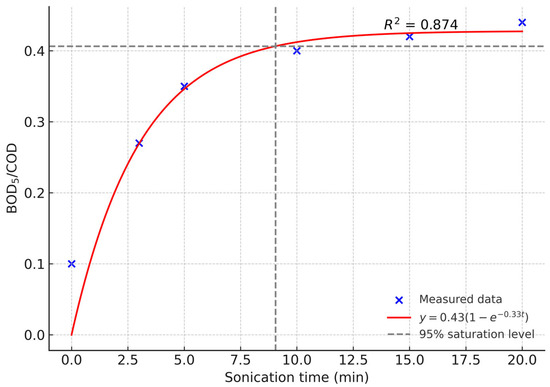
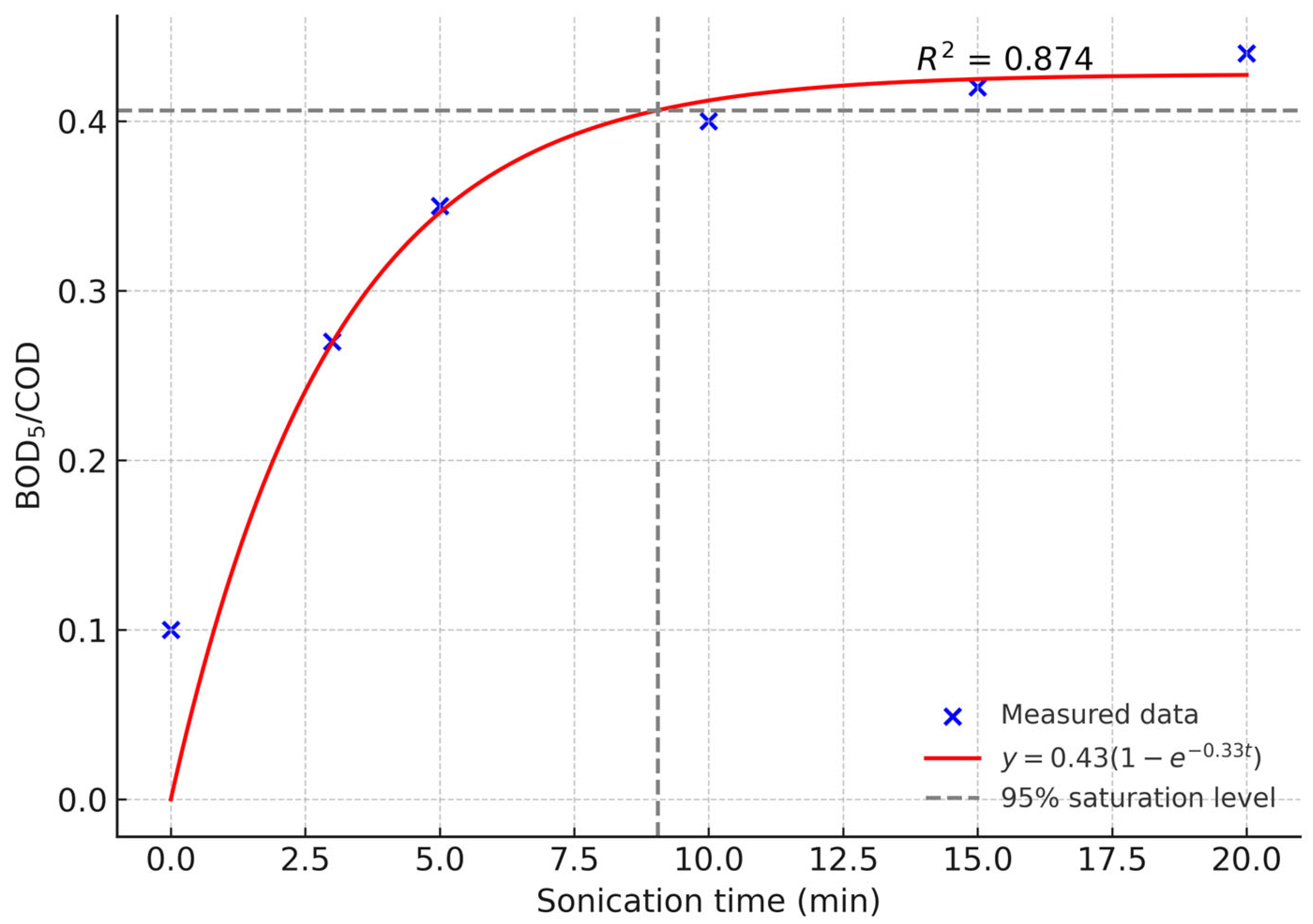
The relationship between the BOD5/COD ratio and sonication time was successfully described using an exponential saturation model yielding a maximum (asymptotic) biodegradability value of a = 0.43, and a rate constant of b = 0.33, with a coefficient of determination R2 = 0.87 (Figure 4). The time required to reach 95% of the maximum biodegradability (t95) was approximately 9 min, indicating that sonication beyond this time did not yield a further improvement. The model curve exhibited a rapid increase in biodegradability during the first 5–10 min of ultrasonic exposure, followed by gradual stabilization, confirming that most of the readily disintegrable organic matter was solubilized within this period. This trend is consistent with the known mechanism of cavitation-driven disintegration, in which ultrasound disrupts floc structures and cell walls, releasing soluble, biodegradable organic compounds.
Figure 4.
BOD5/COD ratio as a function of sonication time.
The results of one-way ANOVA further confirmed that sonication time had a highly significant effect on the BOD5/COD ratio (F = 1183.5, p < 0.001), with post hoc Tukey’s HSD tests indicating that all times up to 10 min differed significantly from the untreated sample (p < 0.05) (Table 3). In contrast, differences among 10, 15, and 20 min were not statistically significant. These findings corroborate the saturation model, suggesting that approximately 10 min represents the optimal sonication duration for improving biodegradability while maintaining energy efficiency.
Table 3.
Tukey HSD post hoc test (α = 0.05).
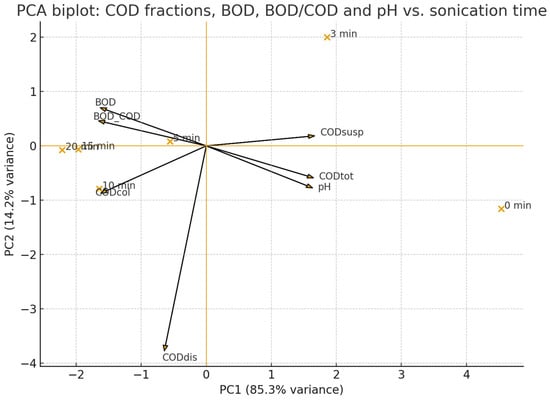
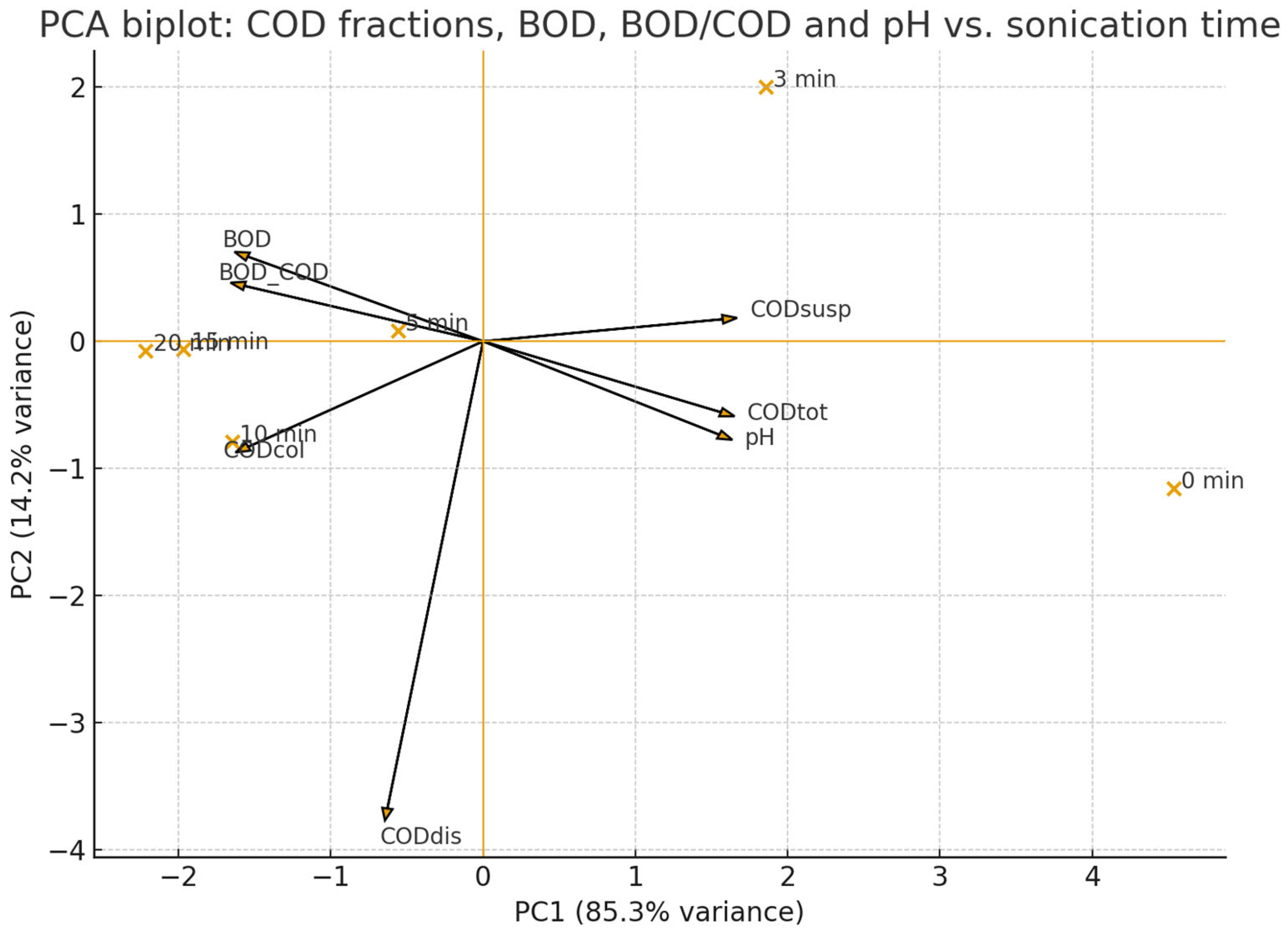
Principal component analysis (PCA) was performed to evaluate the relationships among COD fractions (CODtot, CODsusp, CODcol, CODdis), BOD5, the BOD5/COD ratio, and pH during ultrasonic pretreatment (Figure 5). The first two principal components explained 99.5% of the dataset’s total variance, with PC1 and PC2 accounting for 85.3% and 14.2%, respectively. The variables that contributed most strongly to PC1 were CODtot, CODsusp, BOD5, and the BOD5/COD ratio, indicating that this component describes the significant transformation of organic matter during sonication. Samples corresponding to the initial sonication times (0–3 min) were positioned on the positive side of PC1, characterized by high total and suspended COD values and low biodegradability (low BOD5/COD ratio). With increasing sonication time (5–10 min), samples shifted toward the negative PC1 axis, reflecting the disintegration of suspended solids and the concurrent increase in colloidal and dissolved fractions. This trend coincided with a marked improvement in biodegradability, as expressed by the rise in the BOD5/COD ratio.
Figure 5.
PCA biplot: COD fractions, BOD, BOD5/COD and pH vs. sonication time.
The second principal component (PC2) was primarily associated with CODdis and pH, suggesting that it reflects secondary changes related to the release of soluble organic compounds and the accompanying decrease in pH during prolonged sonication. The trajectory of the samples on the PCA biplot indicates a clear directional shift from suspended to more soluble, biodegradable organic matter. After approximately 10–15 min of sonication, the system reached a stable state, with only minor shifts in component scores, suggesting that further sonication did not significantly alter the organic composition. Overall, the PCA confirmed that ultrasonic pretreatment promotes a progressive breakdown of particulate COD into more biodegradable forms, with an optimal sonication duration of around 10 min. A similar trend was reported by Olivera et al. [30], who observed that ultrasonic pretreatment of sewage sludge enhanced the solubilization of particulate and colloidal organic matter, thereby improving substrate availability and overall biodegradability.
Overall, the combined results of the saturation model, ANOVA, and PCA analyses consistently demonstrate that 10 min of ultrasonic pretreatment constitutes the optimal operational time, providing the maximum improvement in biodegradability (BOD5/COD) and organic matter solubilization while avoiding unnecessary energy input.
Despite clear changes in the concentrations of individual COD fractions, no significant degree of mineralization of organic pollutants was observed. The CODtot concentration decreased by only about 28% after 20 min of sonication. It suggests that the sonication time is too short to achieve complete oxidation. Comparable behavior was observed by Hosseinzadeh et al. [28] and Wei [31] who reported that low-frequency ultrasound primarily enhances the solubilization and biodegradability of organics without substantial mineralization. Their findings suggest that ultrasonic pretreatment primarily improves the physicochemical accessibility of organic matter for microbial degradation rather than inducing direct oxidative breakdown of pollutants. As demonstrated by studies from numerous authors, the sonochemical mineralization of organic compounds typically requires sonication for several hundred minutes. Nazimudheen et al. [18] achieved a 66% reduction in CODtot concentration in landfill leachate after 60 min of sonication using a UD disintegrator (40 kHz, power output 22 W). Tiehm and Neis [32] conducted research on the dehalogenation and reduction in the toxicity of trichlorophenol using a variable-frequency disintegrator operating at frequencies ranging from 41 kHz to 3.2 MHz. The most favorable results were obtained at a frequency of 360 kHz, at which the full effect of compound decomposition was achieved after 180 min. The authors also demonstrated a significant decrease in wastewater toxicity as a result of the use of ultrasound. However, long ultrasonication times are associated with high energy consumption [33]. The very high energy consumption required for the complete sonolytic mineralization of pollutants makes the use of ultrasonic disintegration alone as a unit process in wastewater treatment economically unjustified; therefore, this process should be combined with other conventional treatment methods [34]. The same authors, researching ultrasonic assistance in the biological treatment of wastewater from the spirits industry, demonstrated that the ultrasonic field has a greater impact on altering the structures of organic compounds in wastewater, thereby rendering them more susceptible to decomposition.
3.2. Co-Digestion of Landfill Leachate and Dairy Wastewater in MBR Reactor
Co-treatment of a mixture of dairy wastewater and no-conditioned landfill leachate (30% by volume) in an AnMBR reactor was carried out with a variable wastewater retention time in the bioreactor ranging from 3.0 to 1.0 d.
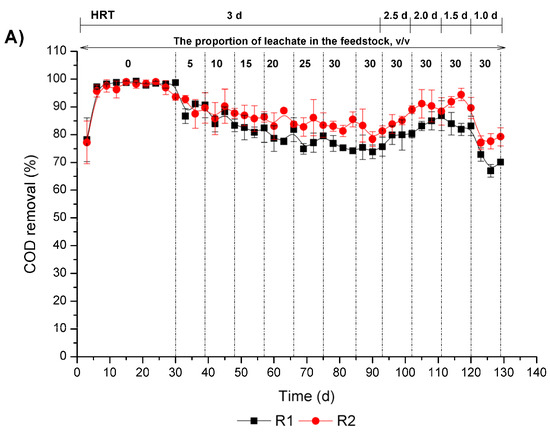
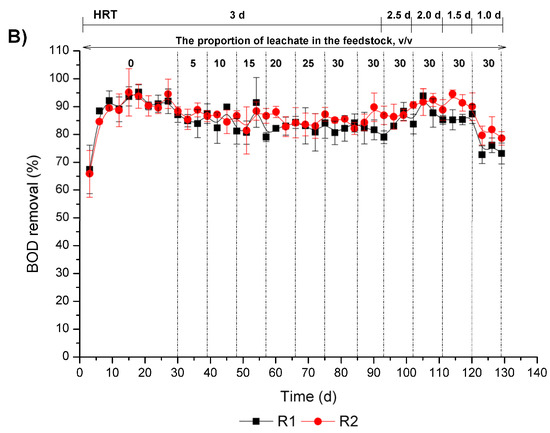
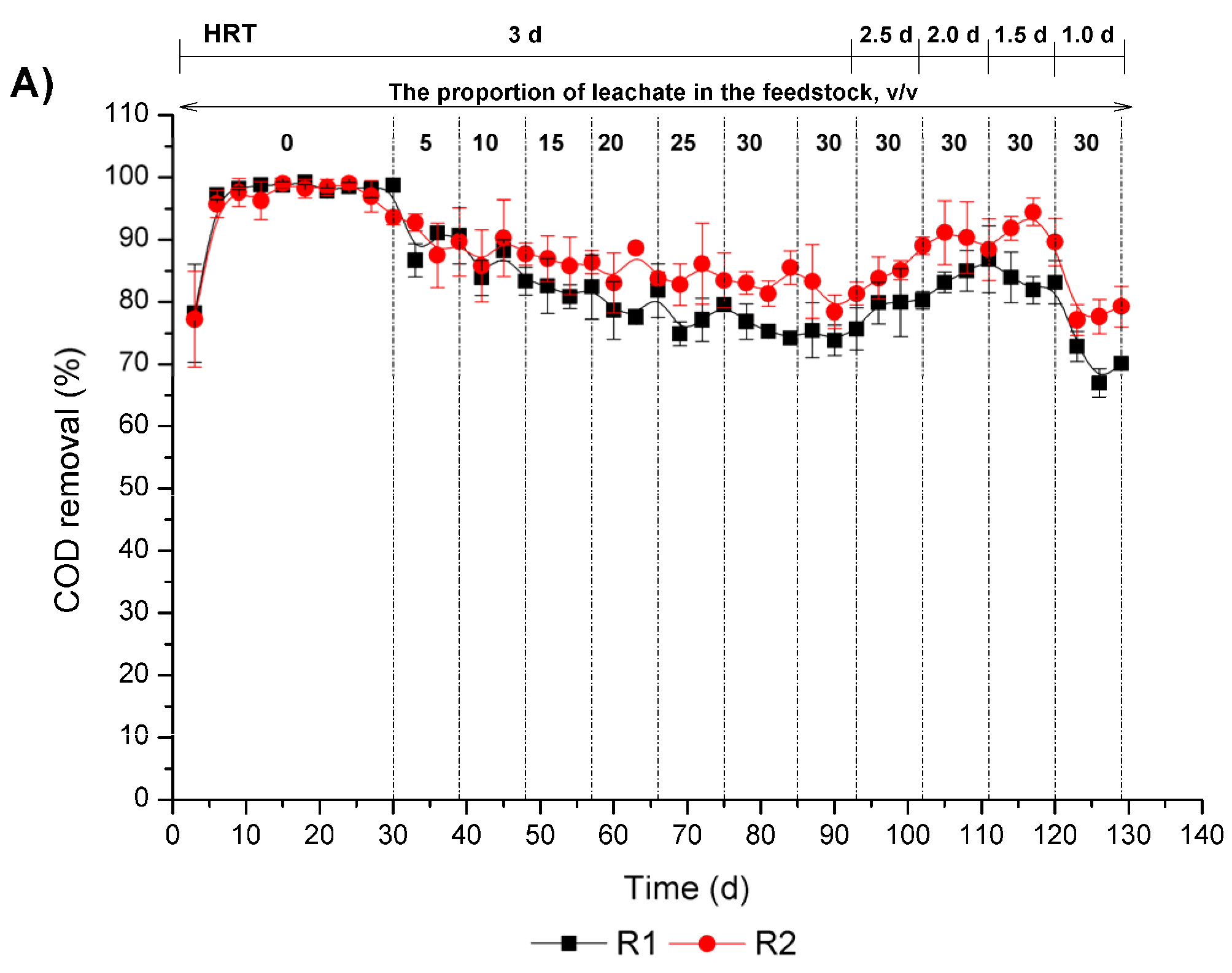
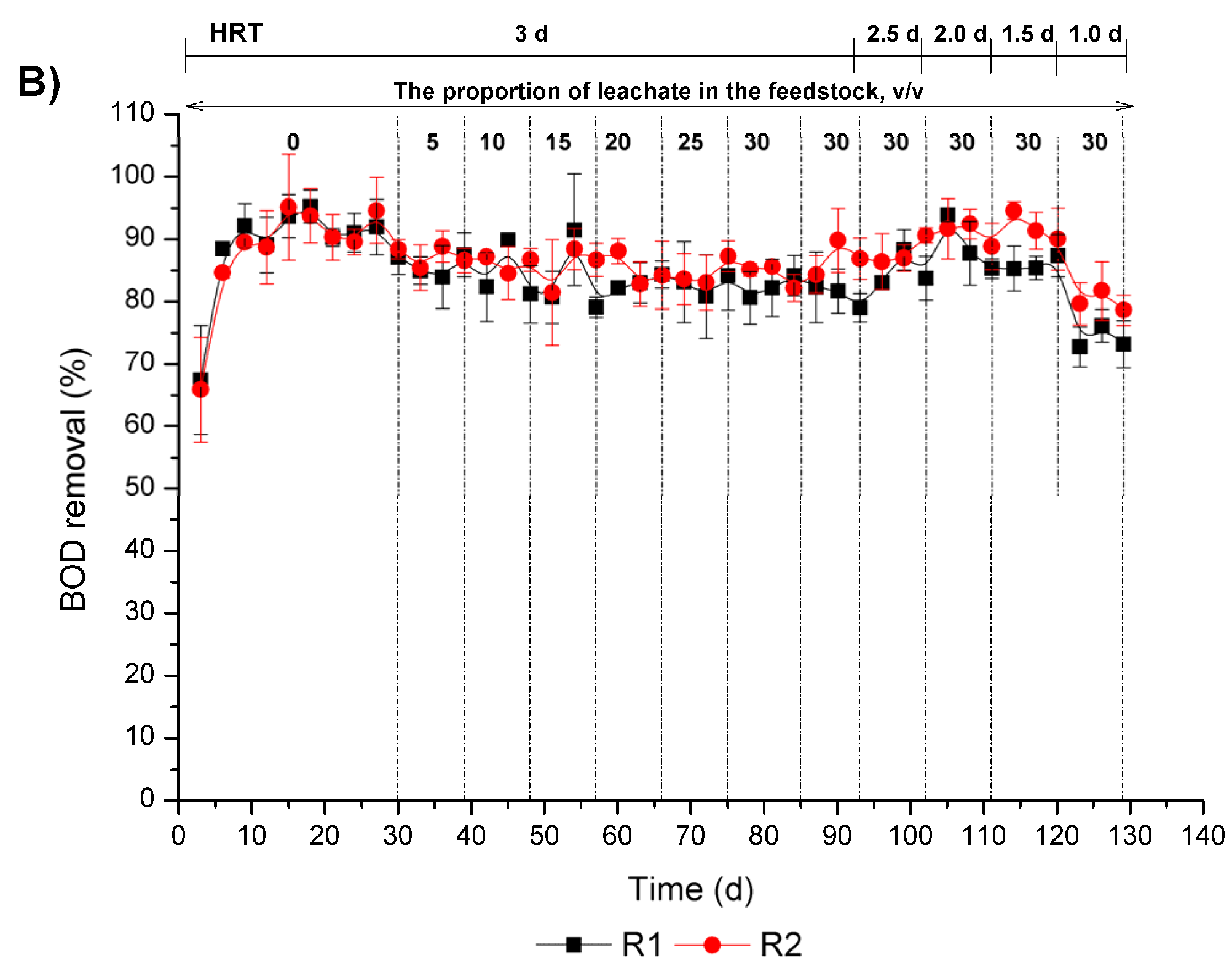
After biomass acclimatization to dairy wastewater, both reactors (R1—fed with non-pretreated leachate, and R2—fed with sonicated leachate) showed similar organic pollutant removal efficiency, averaging 98% COD and 91% BOD5 for pure dairy wastewater (Figure 6). The gradual addition of landfill leachate (from 5% to 30% v/v) resulted in a slight decrease in removal performance in both reactors. When the proportion of landfill leachate in the influent reached 30%, the COD and BOD5 removal efficiencies were 87% and 82%, respectively, for R1, and 85% and 82%, respectively, for R2.
Figure 6.
COD (A) and BOD (B) removal efficiency. R1—fed with non-pretreated leachate, and R2—fed with sonicated leachate.
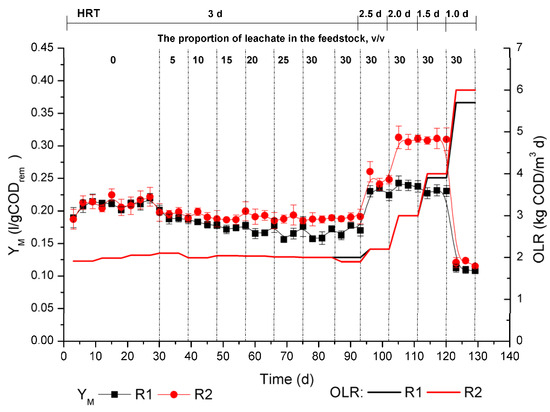
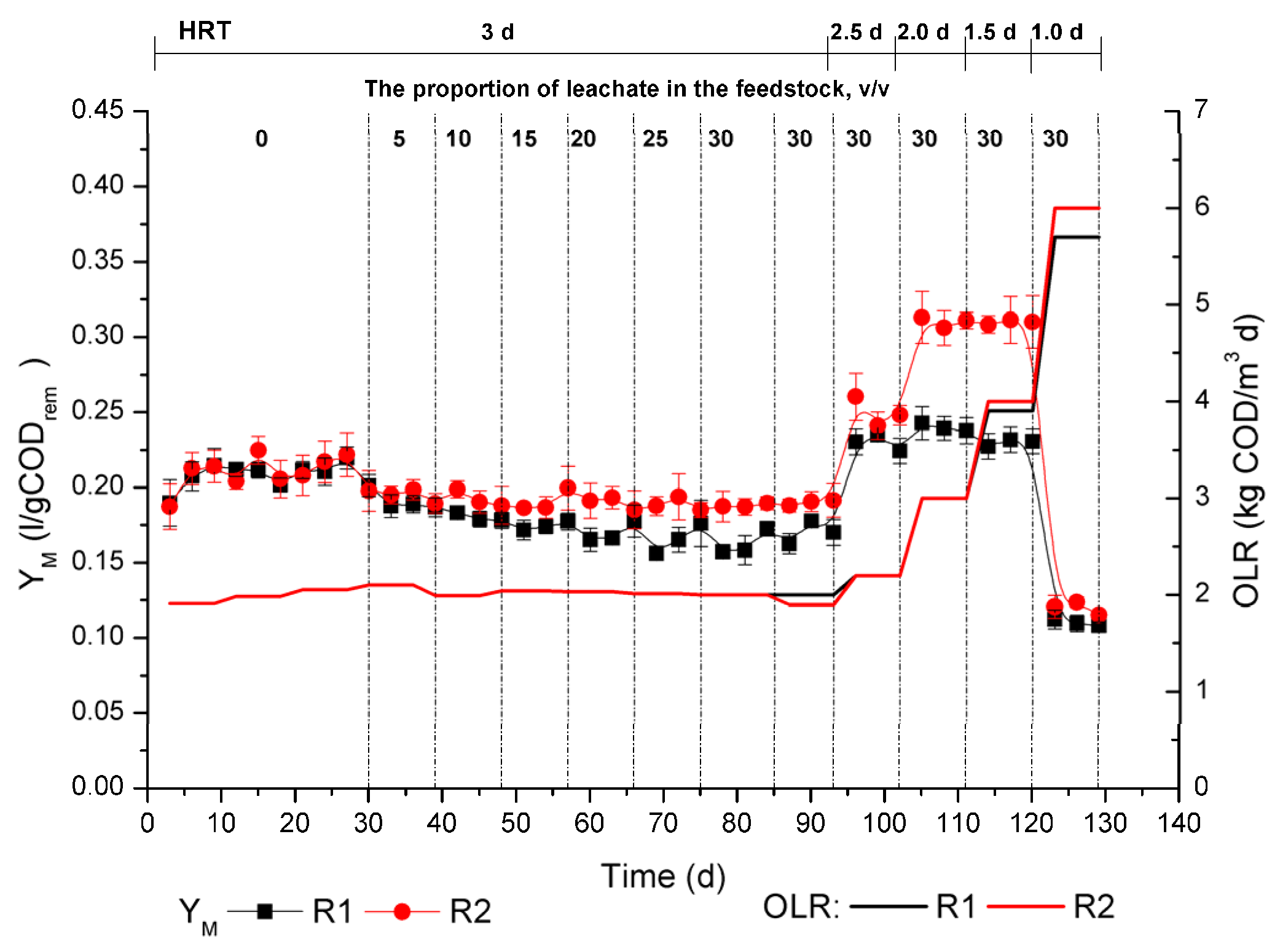
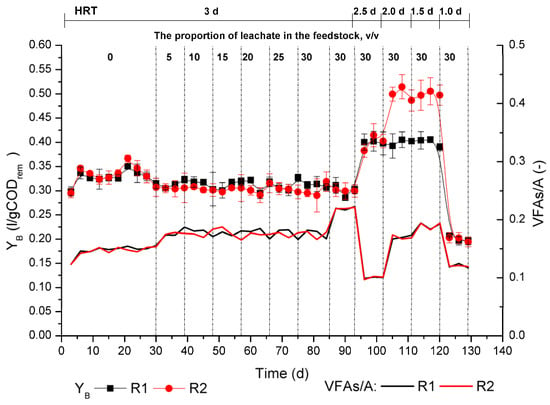
The reactors operated at variable hydraulic retention times (HRT = 3.0–1.0 d) and corresponding organic loading rates (OLR = 2.0–5.7 kg COD/m3 d). Shortening the HRT from 3 to 2.5 days resulted in a 5% increase in COD removal and a 4% increase in BOD5 removal, respectively, and nearly doubled daily biogas production. The highest treatment efficiency was achieved at HRT = 2 days (OLR ≈ 3 kg COD/m3 d), when the effluent COD and BOD5 concentrations reached 900 mg O2/L and 308 mg O2/L, and the methane yield (YM) was 0.23 L CH4/g CODrem (Figure 7). Further increasing OLR (HRT = 1.5 d) improved COD and BOD5 reduction to 92%, with maximum biogas yield (YB = 0.5 L/g CODrem) and methane content ≈ 62% (Figure 8). However, shortening HRT to 1 d (OLR ≈ 6 kg COD/m3 d) led to process deterioration, as reflected in decreased COD and BOD5 removal (−14% and −12%) and reduced methane yield (YM = 0.11 L CH4/g CODrem).
Figure 7.
Methane yield and OLR. R1—fed with non-pretreated leachate, and R2—fed with sonicated leachate.
Figure 8.
Biogas yield and VFAs/A ratio. R1—fed with non-pretreated leachate, and R2—fed with sonicated leachate.
An increase in the permeate flow to 2.5 m3/m2 h resulted in an increase in transmembrane pressure above 40 kPa, which indicates the occurrence of membrane fouling. After backwashing with treated wastewater, the pressure dropped below the permissible value and remained stable until the end of the experiment
Dairy wastewater in the feedstock provided readily biodegradable carbon, improved the C/N ratio, and alleviated ammonia inhibition from landfill leachate, thereby stabilizing the methanogenic population. Similar buffering and nutrient-balancing effects of co-digestion were observed by Moretto et al. [10].
The reactor fed with ultrasonically conditioned leachate (R2) consistently exhibited slightly higher COD removal and methane yields than the one fed with raw leachate (R1). This phenomenon can be directly linked to the higher fraction of soluble and readily biodegradable organics generated during ultrasonic pretreatment. A similar enhancement in hydrolysis and methane production following low-frequency ultrasound conditioning was reported by Hosseinzadeh et al. [28] and Farsad et al. [27]. The increased solubilization of organics after sonication accelerated acidogenesis and improved substrate availability for methanogens, leading to higher methane productivity.
During the process at HRT in the range of 1.5–2 d, stable methanogenic activity and a low VFA/alkalinity ratio (<0.3) were observed, confirming the absence of volatile fatty acid accumulation and adequate buffering capacity of the system. Even at the shortest HRT tested (1 d), no signs of process acidification were detected. This indicates a high resilience of the AnMBR system, consistent with the operational stability described for similar configurations treating high-strength wastewaters.
The maximum methane yield obtained in this study (0.31 L CH4/g CODrem) was higher than that reported for conventional SBR and UASB systems co-treating landfill leachate and municipal wastewater, typically ranging between 0.20 and 0.25 L CH4/g CODrem [7].
Overall, the integration of low-frequency ultrasonic pretreatment with AnMBR co-digestion substantially improved organic removal, methane yield, and process stability while enabling shorter optimal retention times. These results demonstrate that ultrasonic conditioning of landfill leachate before co-digestion with nutrient-rich substrates, such as dairy wastewater, is a practical and energy-efficient strategy for treating recalcitrant industrial effluents.
A comprehensive statistical evaluation demonstrated that the proportion of leachate in the feed mixture had a statistically significant effect on all analyzed operational parameters. The one-way analysis of variance (ANOVA) and the Kruskal–Wallis test confirmed significant differences among leachate addition levels for OLR, COD removal, BOD removal, VFA/A, YB, and YM (p < 0.05) (Table 4). The assumptions of normality and homogeneity of variances were satisfied only for OLR and YM; therefore, these parameters were analyzed using ANOVA, while the remaining variables were assessed using the non-parametric Kruskal–Wallis test. Post hoc comparisons (Tukey’s HSD and Dunn–Bonferroni tests) revealed that the most pronounced changes occurred between the control (0%) and mixtures containing ≥25% leachate, indicating a marked decline in process performance under higher leachate loads.
Table 4.
Statistical test results (ANOVA and Kruskal–Wallis) for the analyzed parameters as affected by the proportion of leachate in the mixture.
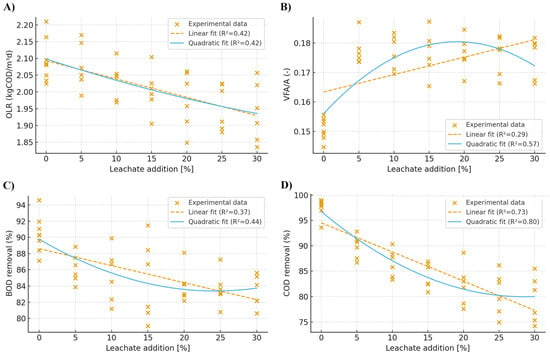
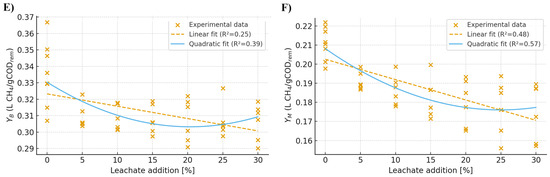
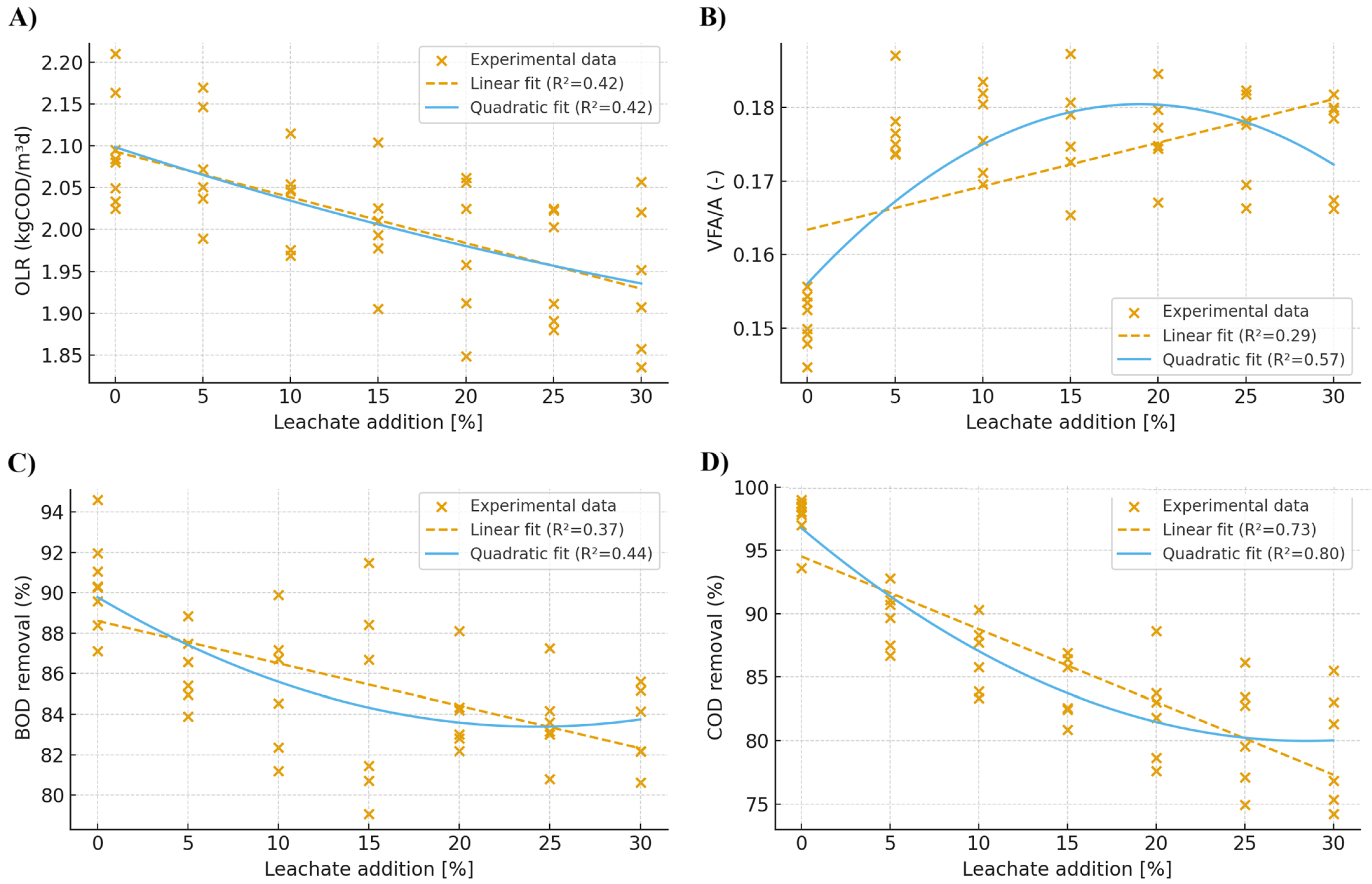
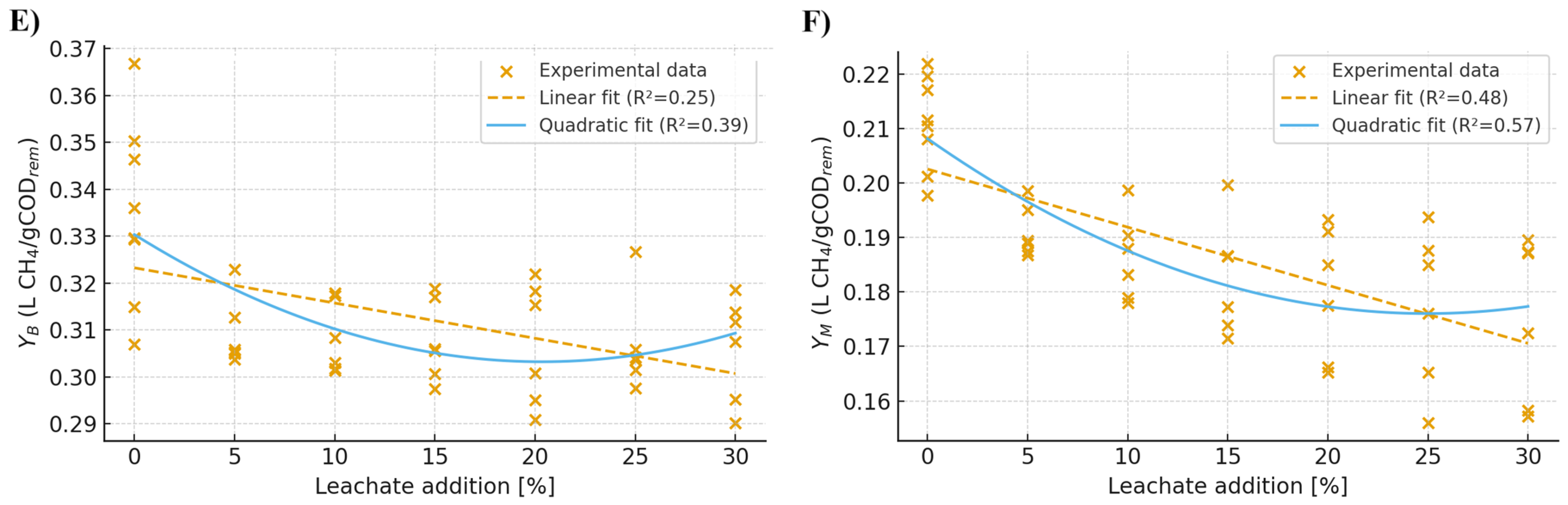
Regression analysis further quantified these relationships. Statistically significant linear models (p < 0.001) were obtained for all parameters, with coefficients of determination (R2) ranging from 0.25 to 0.73 (Figure 9). Negative slope coefficients (β1) for OLR, COD, BOD, YB, and YM confirmed a gradual decrease in process efficiency and methane yield with increasing leachate share. In contrast, the positive β1 value for the VFA/A ratio suggested a temporary accumulation of intermediate metabolites at moderate leachate levels, likely reflecting a transient shift in metabolic balance rather than process inhibition. Polynomial regression improved the model fit for COD, BOD, YB, YM, and VFA/A (p(x2) < 0.05), indicating nonlinear system responses, particularly at leachate shares exceeding 20–25%, although without evidence of process inhibition.
Figure 9.
Regression analysis results: (A) OLR as a function of leachate addition; (B) VFAs/A as a function of leachate addition; (C) BOD removal as a function of leachate addition; (D) COD removal as a function of leachate addition; (E) YB as a function of leachate addition; (F) YM as a function of leachate addition.
A two-way ANOVA revealed that both ultrasonic pretreatment and organic load rate had a significant impact on the selected process parameters. For the efficiency of COD removal, both UD pretreatment (F = 94.08; p < 0.001) and OLR values (F = 57.56; p < 0.001) had a very strong influence on the efficiency of COD removal, while the interaction between UD and OLR was not significant (p = 0.384). In the case of biogas yield and methane yield indicators, a significant effect of OLR was also observed (YB: F = 28.59; p < 0.001; YM: F = 29.67; p < 0.001). In addition, a significant effect of ultrasonic pretreatment was demonstrated for the YM parameter (F = 5.61; p = 0.028). Importantly, significant interactions between pretreatment and OLR were identified for both YB (F = 3.56; p = 0.024) and YM (F = 3.24; p = 0.033).
The direction of the interaction indicates that the effect of the ultrasonic field increased with increasing organic load rate, resulting in higher YB and YM values at medium and high OLR levels. Tukey’s post hoc tests confirmed significant differences between these levels (p < 0.05). However, at the highest OLR, a decrease in process efficiency was observed, suggesting that excessive system load limited microbial activity and organic matter conversion efficiency despite the earlier stimulating effect of UD. The impact of ultrasonic pretreatment on BOD parameters and the VFA/A ratio was found to be statistically insignificant (p > 0.05).
Table 5 presents the energy balance for co-digestion of sonicated landfill leachate and dairy wastewater. The key parameter for assessing the feasibility of using ultrasound as a leachate pretreatment method is the energy efficiency ratio (EER), which is a function of the specific electrical energy input of ultrasound, EUD,feed (kWh/m3 feed), and the additional methane energy attributable to ultrasound, ΔECH4. Ultrasonic disintegration is considered economically viable if the value of this parameter exceeds 1 [35]. The analysis showed that the highest EER values were obtained for HRT 1.5 d and 2 d, reaching 2.49 and 1.49, respectively.
Table 5.
Energy balance.
4. Conclusions
The results presented in this study confirm the thesis that an ultrasonic field at 22 kHz enhances the susceptibility of organic compounds in landfill leachate to biochemical decomposition and enables their co-treatment with dairy wastewater in an anaerobic membrane bioreactor. Based on the obtained results, the following conclusions were drawn:
- As a result of sonification of landfill leachate with a UD field at an amplitude of 14 µm and an exposure time of more than 10 min, the BOD5/COD ratio in the wastewater increased from 0.1 to 0.4. Dissolved organic compounds, expressed by the CODdis parameter, accounted for more than 40% of the total COD.
- The combined results of the saturation model analysis, ANOVA, and PCA showed that 10 min of ultrasonic pretreatment is the optimal treatment time, yielding the maximum improvement in biodegradability (BOD5/COD) and solubility of organic matter, while avoiding excessive energy consumption.
- During the fermentation of sonicated landfill leachate with dairy wastewater, a higher degree of organic pollutant removal was achieved with a shorter HRT of wastewater in the AnMBR reactor compared to the process carried out for non-sonicated leachate. The efficiency of the treatment process, measured by the decrease in COD of the wastewater in the MBR reactor, was 85%. Preliminary sonication of leachate with a UD field shortened the process duration to HRT of 2 d, at which the highest (92%) degree of organic pollutant removal and the highest biogas yield (0.5 L/g CODrem) were achieved.
- Overall, the integration of ultrasonic conditioning and membrane-based anaerobic co-digestion provides an energy-efficient and scalable strategy for treating refractory landfill leachates. The hybrid UD–AnMBR configuration outperformed conventional SBR and UASB systems in both organic removal (92% vs. ≤85%) and methane yield (0.31 L CH4/g COD removed vs. 0.20–0.25 L CH4/g COD removed), demonstrating its potential for industrial applications.
However, anaerobic co-treatment of landfill leachate and dairy wastewater in the AnMBR requires further research. For the full-scale application of this technology, it is crucial to investigate the membrane fouling that occurs with longer treatment durations, as this significantly impacts OPEX costs. The possibility of generating potential oxidation by-products of organic pollutants present in the leachate as a result of sonochemical reactions, whose presence may affect the toxicity of the AnMBR effluent, also requires investigation. Furthermore, it is crucial to examine process efficiency, accounting for the variability in leachate composition with age.
Author Contributions
Conceptualization, E.N. and K.B.; methodology, K.B. and A.G.; software A.G.; validation, E.N. and A.G.; formal analysis, E.N. and K.B.; investigation, E.N. and A.G.; resources, I.R.-K. and K.B.; data curation, E.N. and A.G.; writing—original draft preparation, E.N. and A.G.; writing—review and editing, I.R.-K., E.N. and K.B.; visualization, A.G.; supervision, E.N. and K.B.; project administration, E.N. and A.G.; funding acquisition, E.N. All authors have read and agreed to the published version of the manuscript.
Funding
This research was funded by the statutory subvention of Czestochowa University of Technology, Faculty of Infrastructure and Environment (BS/PB-400-301/25). This research was also partially supported by the Ministry of Science and Higher Education as part of statutory funds (Poland).
Institutional Review Board Statement
Not applicable.
Informed Consent Statement
Not applicable.
Data Availability Statement
The original contributions presented in this study are included in the article. Further inquiries can be directed to the corresponding author.
Conflicts of Interest
The authors declare no conflicts of interest.
Abbreviations
The following abbreviations are used in this manuscript:
| A | Alkalinity |
| AD | Anaerobic digestion |
| AcD | Anaerobic co-digestion |
| AnMBR | Anaerobic Membrane Bioreactor |
| HRT | Hydraulic retention time |
| OLR | Organic Loading Rate |
| UD | Ultrasound |
| YB | Biogas yield |
| YM | Methane yield |
| VFAs | Volatile fatty acids |
References
- Sikder, S.; Toha, M.; Mostafizur Rahman, M. An Overview on Municipal Solid Waste Characteristics and Its Impacts on Environment and Human Health. In Technical Landfills and Waste Management Volume 1: Landfill Impacts, Characterization and Valorisation; Springer: Berlin/Heidelberg, Germany, 2024; pp. 135–155. [Google Scholar]
- Ma, S.; Zhou, C.; Pan, J.; Yang, G.; Sun, C.; Liu, Y.; Chen, X.; Zhao, Z. Leachate from Municipal Solid Waste Landfills in a Global Perspective: Characteristics, Influential Factors and Environmental Risks. J. Clean. Prod. 2022, 333, 130234. [Google Scholar] [CrossRef] [Scilit]
- Xiang, R.; Wei, W.; Mei, T.; Wei, Z.; Yang, X.; Liang, J.; Zhu, J. A Review on Landfill Leachate Treatment Technologies: Comparative Analysis of Methods and Process Innovation. Appl. Sci. 2025, 15, 3878. [Google Scholar] [CrossRef] [Scilit]
- Dhamsaniya, M.; Sojitra, D.; Modi, H.; Shabiimam, M.A.; Kandya, A. A Review of the Techniques for Treating the Landfill Leachate. Mater. Today Proc. 2023, 77, 358–364. [Google Scholar] [CrossRef] [Scilit]
- Liu, J.; Chen, S.; Liao, X.; Shi, H.; Huang, J. Unveiling the Molecular Responses of Dissolved Organic Matter in Landfill Leachate to Activated Carbon Adsorption. Sep. Purif. Technol. 2024, 330, 125335. [Google Scholar] [CrossRef] [Scilit]
- Neczaj, E. Ultrasound Improvement of Landfill Leachate Biological Treatment Process; Czestochowa University of Technology: Czestochowa, Poland, 2010. [Google Scholar]
- Ranjan, K.; Chakraborty, S.; Verma, M.; Iqbal, J.; Kumar, R.N. Co-Treatment of Old Landfill Leachate and Municipal Wastewater in Sequencing Batch Reactor (SBR): Effect of Landfill Leachate Concentration. Water Qual. Res. J. Can. 2016, 51, 377–387. [Google Scholar] [CrossRef] [Scilit]
- Hassan, A.N.; Nelson, B. Invited Review: Anaerobic Fermentation of Dairy Food Wastewater. J. Dairy Sci. 2012, 95, 6188–6203. [Google Scholar] [CrossRef] [Scilit]
- Kolev Slavov, A. General Characteristics and Treatment Possibilities of Dairy Wastewater—A Review. Food Technol. Biotechnol. 2017, 55, 14–28. [Google Scholar] [CrossRef] [Scilit]
- Moretto, G.; Ardolino, F.; Piasentin, A.; Girotto, L.; Cecchi, F. Integrated Anaerobic Codigestion System for the Organic Fraction of Municipal Solid Waste and Sewage Sludge Treatment: An Italian Case Study. J. Chem. Technol. Biotechnol. 2020, 95, 418–426. [Google Scholar] [CrossRef] [Scilit]
- Suksaroj, C.; Jearat, K.; Cherypiew, N.; Rattanapan, C.; Suksaroj, T.T. Promoting Circular Economy in the Palm Oil Industry through Biogas Codigestion of Palm Oil Mill Effluent and Empty Fruit Bunch Pressed Wastewater. Water 2023, 15, 2153. [Google Scholar] [CrossRef] [Scilit]
- Tałałaj, A.; Bartkowska, I.; Biedka, P. Treatment of Young and Stabilized Landfill Leachate by Integrated Sequencing Batch Reactor (SBR) and Reverse Osmosis (RO) Process. Environ. Nanotechnol. Monit. Manag. 2021, 16, 100502. [Google Scholar]
- Seifi, M.; Kamran-Pirzaman, A.; Dehghani Kiadehi, A.; Rahimnejad, M. A Comprehensive Comparison of Various Methods and Hybrid Systems in Leachate Treatment: A Review. Int. J. Environ. Sci. Technol. 2025, 22, 8425–8520. [Google Scholar] [CrossRef] [Scilit]
- Ahmad, I.; Jasni, A.B.; Abdullah, N.; Krishnan, S.; Koji, I.; Chelliapan, S.; Yuzir, A.; Nasrullah, M. Landfill Management and Efficacy of Anaerobic Reactors in the Treatment of Landfill Leachate. In Techno-Economics and Life Cycle Assessment of Bioreactors; Elsevier: Amsterdam, The Netherlands, 2022; pp. 69–92. [Google Scholar]
- Rahman, T.U.; Roy, H.; Islam, M.R.; Tahmid, M.; Fariha, A.; Mazumder, A.; Tasnim, N.; Pervez, M.N.; Cai, Y.; Naddeo, V. The Advancement in Membrane Bioreactor (MBR) Technology toward Sustainable Industrial Wastewater Management. Membranes 2023, 13, 181. [Google Scholar] [CrossRef] [Scilit] [PubMed]
- Gopalakrishnan, G.; Jeyakumar, R.B.; Somanathan, A. Challenges and Emerging Trends in Advanced Oxidation Technologies and Integration of Advanced Oxidation Processes with Biological Processes for Wastewater Treatment. Sustainability 2023, 15, 4235. [Google Scholar] [CrossRef] [Scilit]
- Kundu, A.; Reddy, C.V.; Singh, R.K.; Kalamdhad, A.S. Critical Review with Science Mapping on the Latest Pre-Treatment Technologies of Landfill Leachate. J. Environ. Manag. 2023, 336, 117727. [Google Scholar] [CrossRef] [Scilit]
- Nazimudheen, G.; Roy, K.; Sivasankar, T.; Moholkar, V.S. Mechanistic Investigations in Ultrasonic Pretreatment and Anaerobic Digestion of Landfill Leachates. J. Environ. Chem. Eng. 2018, 6, 1690–1701. [Google Scholar] [CrossRef] [Scilit]
- Neczaj, E.; Kacprzak, M.; Kamizela, T.; Lach, J.; Okoniewska, E. Sequencing Batch Reactor System for the Co-Treatment of Landfill Leachate and Dairy Wastewater. Desalination 2008, 222, 404–409. [Google Scholar] [CrossRef] [Scilit]
- Bolognesi, S.; Cecconet, D.; Callegari, A.; Capodaglio, A.G. Bioelectrochemical Treatment of Municipal Solid Waste Landfill Mature Leachate and Dairy Wastewater as Co-Substrates. Environ. Sci. Pollut. Res. 2021, 28, 24639–24649. [Google Scholar] [CrossRef] [Scilit]
- American Public Health Association. Standard Methods for the Examination of Water and Wastewater, 20th ed.; American Public Health Association: Washington, DC, USA, 1998. [Google Scholar]
- Canals, J.; Cabrera-Codony, A.; Carbó, O.; Torán, J.; Martín, M.; Baldi, M.; Gutiérrez, B.; Poch, M.; Ordóñez, A.; Monclús, H. High-Rate Activated Sludge at Very Short SRT: Key Factors for Process Stability and Performance of COD Fractions Removal. Water Res. 2023, 231, 119610. [Google Scholar] [CrossRef] [Scilit]
- Akhiar, A.; Guilayn, F.; Torrijos, M.; Battimelli, A.; Shamsuddin, A.H.; Carrère, H. Correlations between the Composition of Liquid Fraction of Full-Scale Digestates and Process Conditions. Energies 2021, 14, 971. [Google Scholar] [CrossRef] [Scilit]
- Elmitwalli, T.A.; Van Dun, M.; Bruning, H.; Zeeman, G.; Lettinga, G. The Role of Filter Media in Removing Suspended and Colloidal Particles in an Anaerobic Reactor Treating Domestic Sewage. Bioresour. Technol. 2000, 72, 235–242. [Google Scholar] [CrossRef] [Scilit]
- Carrasquero-Ferrer, S.; Pino-Rodríguez, J.; Díaz-Montiel, A. Sequencing Batch Reactor: A Sustainable Wastewater Treatment Option for the Canned Vegetable Industry. Sustainability 2025, 17, 818. [Google Scholar] [CrossRef] [Scilit]
- Lin, T.-C.; Yang, Y.-R.; Nguyen, Q.K.; Chiu, M.-C.; Yen, H.-M.; Chen, K.-H.; Chuang, S.-H. The Significance of Slowly Biodegradable COD on Denitrification in the OAO Process. J. Environ. Manag. 2025, 378, 124805. [Google Scholar] [CrossRef] [Scilit] [PubMed]
- Farsad, S.; Ben Hamou, A.; Chaoui, A.; Amjlef, A.; Lhanafi, S.; Et-Taleb, S.; El Alem, N. Maximizing Bio-Methane Potential from Municipal Landfill Leachate through Ultrasonic Pretreatment. Heliyon 2023, 9, e21347. [Google Scholar] [CrossRef] [Scilit] [PubMed]
- Hosseinzadeh, A.; Gitipour, S.; Mehrdadi, N. The Biogas Upgrading from Landfill Leachate Pretreated with Low-Frequency Ultrasonic: Anaerobic Digestion Performances and Energy Balance. Sci. Rep. 2024, 14, 652. [Google Scholar] [CrossRef] [Scilit]
- Grosser, A.; Neczaj, E.; Madela, M.; Celary, P. Ultrasound-Assisted Treatment of Landfill Leachate in a Sequencing Batch Reactor. Water 2019, 11, 516. [Google Scholar] [CrossRef] [Scilit]
- Olivera, M.; Barriga, F.; Neumann, P.; Gómez, G.; Vidal, G. Effects of Short Retention Times and Ultrasound Pretreatment on Ammonium Concentration and Organic Matter Transformation in Anaerobic Digesters Treating Sewage Sludge. Fermentation 2024, 10, 63. [Google Scholar] [CrossRef] [Scilit]
- Wei, N. Effect of Ultrasonic Pretreatment for the Anaerobic Digestion of Sewage Sludge. Adv. Mater. Res. 2012, 531, 528–531. [Google Scholar] [CrossRef] [Scilit]
- Tiehm, A.; Neis, U. Ultrasonic Dehalogenation and Toxicity Reduction of Trichlorophenol. Ultrason. Sonochem. 2005, 12, 121–125. [Google Scholar] [CrossRef] [Scilit]
- Goskonda, S.; Catallo, W.J.; Junk, T. Sonochemical Degradation of Aromatic Organic Pollutants. Waste Manag. 2002, 22, 351–356. [Google Scholar] [CrossRef] [Scilit]
- Sangave, P.C.; Pandit, A.B. Ultrasound Pre-Treatment for Enhanced Biodegradability of the Distillery Wastewater. Ultrason. Sonochem. 2004, 11, 197–203. [Google Scholar] [CrossRef] [Scilit]
- Paritosh, K.; Balan, V.; Vijay, V.K.; Vivekanand, V. Simultaneous Alkaline Treatment of Pearl Millet Straw for Enhanced Solid State Anaerobic Digestion: Experimental Investigation and Energy Analysis. J. Clean. Prod. 2020, 252, 119798. [Google Scholar] [CrossRef] [Scilit]

Disclaimer/Publisher’s Note: The statements, opinions and data contained in all publications are solely those of the individual author(s) and contributor(s) and not of MDPI and/or the editor(s). MDPI and/or the editor(s) disclaim responsibility for any injury to people or property resulting from any ideas, methods, instructions or products referred to in the content. |
© 2025 by the authors. Licensee MDPI, Basel, Switzerland. This article is an open access article distributed under the terms and conditions of the Creative Commons Attribution (CC BY) license (https://creativecommons.org/licenses/by/4.0/).