


Abstract
In the context of increasing concern over long-term environmental impacts of closed landfill sites, this study investigates the composition of groundwater and leachate at a municipal waste landfill in southwestern Poland, two decades after its closure. The research, conducted in 2023, aimed to assess groundwater quality using 11 physico-chemical and 13 microplastic indicators. Groundwater and leachate samples were collected seasonally to assess of groundwater quality around landfill, including presence of heavy metals (Cd, Cr6+, Cu, Pb), PAHs and TOC, and microplastics. The results revealed persistent environmental degradation, with elevated concentrations of total organic carbon (24.8 mg/L) and cadmium (0.0211 mg/L), particularly in the second half of the year. Additionally, PET microplastics were detected in correlation with increased precipitation and leachate generation. These findings indicate that pollutants continue to migrate from the waste deposit into the surrounding groundwater, with seasonal patterns amplifying their presence. The study confirms that even decades after closure, municipal landfills can remain significant sources of both chemical and microplastic contamination, underlining the need for long-term monitoring and remediation strategies to protect groundwater resources.
1. Introduction
Analysis of different waste management methods (landfilling, incineration, composting) shows that municipal solid waste (MSW) disposal in most countries still relies heavily on landfilling due to its relatively low cost and minimal technical requirements [1,2]. As a result, municipal waste landfills remain a significant source of chemical pollution and may pose a threat to both environmental and human health [3,4,5]. One of the major by-products of landfilling is leachate, defined as the liquid formed when rainwater percolates through solid waste stored in landfills [6]. Leachate is considered one of the most serious environmental threats associated with waste storage, particularly when landfills are unsealed or poorly managed [7].
Existing disused landfill sites also pose a significant threat to the environment, with potential impacts on both water and air quality [8]. Landfill leachate are generally classified into two main categories: acetogenic and methanogenic, depending on the stage of waste degradation and the associated temporal parameters [9]. Another classification distinguishes between organic and inorganic components, including heavy metals, which contribute to the overall toxicity of leachate [10,11]. Microplastics, increasingly recognized as emerging pollutants, also have a significant environmental impact, with landfill sites identified as a potential source [12,13]. In the context of groundwater quality assessment, the concept of the natural background level is essential. According to Directive 2006/118/EC, it refers to “the concentration of a substance or indicator in a body of groundwater corresponding to conditions unaffected or only slightly affected by human activity” [14].
Several researchers have investigated closed municipal waste landfill sites [15,16,17,18,19]. To assess the environmental impact of such sites, various indicators are commonly used, including pH, electrical conductivity (EC), chemical oxygen demand (COD), biochemical oxygen demand (BOD), and concentrations of heavy metals such as cadmium (Cd), chromium (Cr), copper (Cu), iron (Fe), lead (Pb), manganese (Mn), mercury (Hg), nickel (Ni), and zinc (Zn) [18,19,20,21,22].
Due to the potential threats that leachate poses to the environment and human health, it is essential to monitor environmental conditions in the vicinity of landfill sites [23,24]. As water infiltrates and percolates through landfill waste, it mobilizes and transports pollutants, increasing the risk of contamination in surrounding ecosystems [25]. It is also important to note that both the qualitative and quantitative characteristics of landfill leachate are key parameters in assessing the environmental impact and life cycle of a landfill site [26].
Landfill sites are locations where various types of waste: such as plastics, paper, wood, food residues, and chemicals are deposited [27]. Improper management of plastic waste leads to its accumulation in the environment, posing a serious threat to living organisms and disrupting ecosystem functioning [28]. Plastics are classified by size: particles larger than 5 mm are considered macro plastics, while those smaller than 5 mm are classified as microplastics. Due to their small size, large surface area, and hydrophobic nature, microplastics are easily ingested by organisms and can facilitate the leaching of plasticizers, as well as the adsorption and desorption of hazardous chemicals and pathogens in aquatic environments [29,30,31]. Common microplastic polymers include polyethylene (PE), polyamide (PA), polyvinyl chloride (PVC), polyethylene terephthalate (PET), polyurethane (PU), tire rubber, and polymer-modified bitumen [12]. In addition to assessing physico-chemical pollution in aquatic environments, it is increasingly important to evaluate microplastic contamination due to the growing environmental pressure these particles exert [32,33].
The aim of this study was to characterize the composition of groundwater and leachate in the vicinity of a landfill that has been closed since 2001, through an analysis of the presence of physicochemical pollutants and microplastics during two periods of 2023.
The research hypothesis assumes that the composition of groundwater and leachate around this closed landfill site, which has been in the post-operational phase for over 20 years, has deteriorated. This deterioration reflects the landfill’s continued negative impact on the aquatic environment, as evidenced by environmental monitoring, including the integration of microplastics as emerging indicators of pollution.
2. Materials and Methods
2.1. Study Area
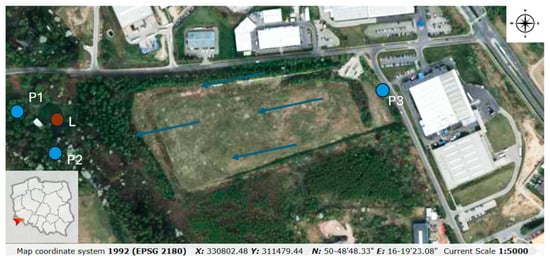
The study was conducted at three research sites: point P-3, representing the groundwater inflow, and monitoring points P-1 and P-2, representing the outflow. For microplastic analysis, water samples were collected at representative locations downstream of the landfill at point P-1, while leachate samples were obtained from a reservoir. The research was carried out in two phases during 2023, once in each half of the year, considering both physicochemical parameters and microplastics (the latter assessed in the second half of 2023). Prior to groundwater sampling, test pumping was performed in each of the monitored wells. Leachate samples (prior to pre-treatment) were collected from a tank (pond) located within the landfill area (Figure 1). The study included the analysis of 11 physicochemical indicators and 13 types of microplastics, along with measurements of atmospheric precipitation and leachate volume. Due to the I and II-half periods of 2023 studies, basic statistics were included in the work: minimum, maximum and arithmetic mean.
Figure 1.
Location of the closed landfill site in southwestern Poland; groundwater monitoring points are marked as P-1, P-2—outflow, and P-3—inflow, and L—leachate collection point.
As part of the study, groundwater and leachate samples were collected to assess a range of physicochemical parameters. These included groundwater level, pH, specific electrical conductivity (EC), and the concentrations of selected heavy metals: hexavalent chromium (Cr6+), lead (Pb), cadmium (Cd), copper (Cu), zinc (Zn), and mercury (Hg). Additionally, total organic carbon (TOC) and the sum of polycyclic aromatic hydrocarbons (PAHs) were measured, following the methodology described by Koda et al. [34]. The presence of microplastics was also investigated, targeting 13 polymer types: Acrylonitrile Butadiene Styrene (ABS), Polyamide (PA), Polybutadiene/Butadiene Rubber (BR), Polycarbonate (PC), Polyethylene (PE), Polyethylene Terephthalate (PET), Polymethyl Methacrylate (PMMA), Polypropylene (PP), Polystyrene (PS), Polytetrafluoroethylene (PTFE), Polyurethane (PU), Polyvinyl Chloride (PVC), and Rayon.
2.2. Physico-Chemical Parameters and Microplastics
Groundwater samples were collected from three piezometers using a portable submersible pump, after earlier out pumping water from piezometers. Raw leachate was manually collected from the tank using a clean bucket and transferred into sterilized high-density polyethylene containers, following established procedures [35]. Immediately after the collection of groundwater and untreated landfill leachate samples, pH and electrical conductivity were measured using the electrochemical method with a portable multifunction meter. At each sampling location, instruments were calibrated, and measurements were carried out on-site using high-precision equipment (±1% of the reading value ±1 digit), ensuring the accuracy and reliability of the physicochemical data. Additionally, groundwater levels in piezometers were recorded using an electronic hydrogeological logger. After that, the collected samples groundwater and leachate were transported in low temperature in 24 h to an accredited laboratory were determined the concentrations of Cr6+, Cd, Cu, Pb, Hg, PAHs, and TOC. Specifically, the concentrations of heavy metals (Cd, Cr6+, Cu, Pb) were measured using atomic absorption spectroscopy (AAS). TOC concentrations were determined spectrophotometrically by measuring absorbance values, while PAHs were analyzed using high-performance liquid chromatography (HPLC) with fluorescence detection following liquid–liquid extraction. Mercury (Hg) concentrations were determined using the cold vapor atomic absorption spectroscopy (CVAAS) technique, as described by Almeida et al. [36] and Przydatek and Kanownik [37], and the studies were in the required number of repetitions in each analytical run usually, one of the control samples was analyzed as a repeat sample but analyses were repeated twice if any exceedances were detected, if results were outside the calibration curve, or if atypical results were obtained for a given matrix.
As part of recent research on the sources, pollution, transport, and harmful effects of microplastics, the storage and recovery methods proposed by Frias and Nash [38] have been increasingly adopted. The collected water and leachate samples underwent pre-treatment to remove organic matter and isolate microplastic particles.
Micro-FTIR analysis was used to identify 13 types of plastic polymers, based on a qualitative match of over 80%, with a detection limit of 20 µm. Each sample was placed in 20 mL of ultrapure water and sonicated for 10 min. Fenton’s reagent was then added to digest organic material, with the reaction allowed to proceed for 24 h. The resulting solution was filtered through a 13 mm, 0.2 µm alumina membrane filter and dried prior to micro-FTIR analysis.
The samples were cleaned, filtered, and analyzed using µ-FTIR spectroscopy. The full spectra obtained were compared and validated against established libraries of plastics, polymers, and additives, which were then used in the abundance analysis. FTIR or µ-FTIR spectroscopy provided detailed information on the specific chemical bonds within the particles.
Additionally, microplastic analysis using pyrolysis–gas chromatography–mass spectrometry (PY–GC–MS) offered insights into contaminant mass concentrations. Quantitative analysis was based on selected marker compounds and their characteristic ions for each polymer type. The methodology applied for microplastic determination in landfill samples was consistent with that used by Yu et al. [39].
2.3. Precipitation and Leachate Volume
Rainfall data were provided by the operator of an active landfill site located within 10 km of the study area. In contrast, the volume of leachate at the outflow was determined based on measurements recorded by a flow meter installed at the investigated closed landfill site.
2.4. Basis of Analysis
The assessment of groundwater quality in the analyzed piezometers was conducted in accordance with the applicable regulatory frameworks, including Regulation (2019) [40] and Regulation (2017) [41]. For the evaluation of leachate quality, Regulation (2016) [42] and Regulation (2019) [43] were applied.
The analysis considered minimum, maximum, and arithmetic mean values. In certain cases, where measurement results fell below the limit of quantification, values were assumed to be half of the specified quantification limit, following the approach described by Przydatek and Kanownik [37].
For analytical purposes, precipitation data recorded at a nearby operational landfill and the measured volume of leachate were also included in the assessment.
3. Description of Researched Object
The investigation of municipal solid waste landfill was in operation between 1974 and 2001 and occupies an area of 12 hectares (Figure 1). The study was conducted at three monitoring points: point P-3 (431 m above sea level), located at the groundwater inflow (from northwest to southeast), and points P-1 (391.18 m a.s.l.) and P-2 (391.49 m a.s.l.), located at the groundwater outflow. Sampling and measurements were carried out from the first half of 2023 to the second half of 2023.
The distance between research points P-3 and P-2 was 620 m, while the distance between P-3 and P-1 was 570 m. All three points are located outside the boundaries of the closed landfill site. The elevation differences at these locations are 39.82 m for P-2 and 39.51 m for P-1, respectively.
Following its closure in the early 2000s, the landfill underwent both technical and biological recultivation. The surface was sealed using a layer of mineral soil and a bentonite mat. Due to the lack of documentation, stemming from the landfill’s operation beginning in the 1970s, the quantity and composition of the deposited waste could not be determined.
Leachate generated within the closed landfill is collected via a drainage system and directed into three storage tanks. Any excess leachate is discharged into the sewage network and subsequently treated at a wastewater treatment plant. Additionally, a perimeter ditch equipped with channels was constructed around the landfill site to collect rainwater, which is then discharged into a nearby pond.
4. Results
4.1. Groundwater Research Results
The results of groundwater testing conducted in the vicinity of the examined closed municipal landfill site are presented in Table 1. The shallowest groundwater level was recorded at the outflow point (P-2), at 1.04 m below ground level. In contrast, during the first half of 2023, the deepest groundwater level was observed at the inflow point (P-3), reaching 3.85 m below ground level. The highest average groundwater depth, 3.1 m, was also recorded at P-3.
Table 1.
Quality of leachate at a non-operational municipal landfill site.
The groundwater pH values ranged from 6.9 to 7.6 during the first half of 2023, with the highest average pH of 7.3 observed at P-2. The lowest pH value, 6.9, was recorded at P-3, indicating slightly more acidic conditions at the inflow point.
Electrical conductivity (EC) values showed significant variation across the monitoring points. The lowest EC value was 430 μS/cm, recorded at P-1 in the second half of 2023, while the highest value, 2772 μS/cm, was measured at P-2 in the first half of 2023. A noticeable decreasing trend in EC was observed over time. The highest average EC value of 1707.5 μS/cm at P-2 suggests a deterioration in groundwater quality downstream of the landfill site. This value exceeds the permissible limit for drinking water and corresponds to Class II water quality, indicating moderate contamination.
The concentration of total organic carbon (TOC) ranged from 3.81 mg/L to 35.8 mg/L, measured at the outflow points P-1 (second half of 2023) and P-2 (first half of 2023), respectively. The average TOC concentration at P-2 was 24.8 mg/L, exceeding the permissible threshold for groundwater at the outflow, indicating potential organic contamination.
The concentrations of lead (Pb), chromium (Cr), mercury (Hg), and polycyclic aromatic hydrocarbons (PAHs) in the analyzed groundwater samples remained below the regulatory limits. However, copper (Cu) concentrations exceeded the permissible values for drinking water, as defined by the 2017 regulation. Cadmium (Cd) concentrations ranged from below the detection limit (<0.004 mg/L) at all points in the first half of 2023 to a maximum of 0.042 mg/L at P-2 in the second half of 2023. The highest average Cd concentration, 0.0211 mg/L, was also recorded at P-2, confirming that the regulatory limit for drinking water was exceeded. Zinc (Zn) concentrations ranged from below the detection limit (<0.030 mg/L) to 0.086 mg/L, recorded at P-2 and P-1, respectively, during the first half of 2023. The highest average Zn concentration, 0.06 mg/L, was observed at P-1, indicating a deterioration in groundwater quality at the outflow point. According to the 2019 regulation, this corresponds to Class II water quality (Table 1).
4.2. Leachate Research Results
The results of leachate testing at the closed municipal landfill site are presented in Table 2. The leachate exhibited an alkaline pH, ranging from 8.6 in the first half of 2023 to 8.3 in the second half of 2023, with an average value of 8.5, consistent with the findings reported by Tian et al. [44]. Electrical conductivity (EC) values ranged from 1304 μS/cm (first half of 2023) to 1477 μS/cm (second half of 2023), with an average EC of 1390.5 μS/cm, indicating a moderate level of dissolved ionic species in the leachate. The concentration of total organic carbon (TOC) varied between 18.9 mg/L and 25.7 mg/L in the first and second halves of 2023, respectively, with an average concentration of 22.3 mg/L. These values reflect the presence of biodegradable organic matter resulting from ongoing waste decomposition processes. Zinc (Zn) concentrations in the leachate ranged from below the detection limit (<0.01 mg/L) to 0.061 mg/L during the reporting period, with an average concentration of 0.03 mg/L. The concentrations of other monitored parameters: lead (Pb), copper (Cu), cadmium (Cd), mercury (Hg), and polycyclic aromatic hydrocarbons (PAHs) remained below the permissible limits throughout the monitoring period (Table 2).
Table 2.
Leachate Quality at a Non-Operational Municipal Landfill Site.
4.3. Microplastics
The results presented in Table 3 include data from the second half of 2023 and have not been corrected for the procedural blank value associated with microplastic detection. The analysis revealed the presence of polyethylene (PE) and polyethylene terephthalate (PET) in groundwater samples collected from point P-1, located downstream of the landfill site. In contrast, only polyethylene terephthalate (PET) was identified in the leachate samples. Quality control results, also included in Table 3, confirmed that the microplastic analysis was conducted under clean laboratory conditions to minimize the risk of cross-contamination. Under these controlled conditions, only polyamide (PA) was detected, indicating that the presence of PE and PET in environmental samples is likely attributable to actual contamination rather than laboratory artifacts.
Table 3.
Identified polymer types and QA/QC data for microplastics analysis in groundwater and leachate samples from the closed landfill site (period: second half of 2023).
4.4. Relationship Between Precipitation and Leachate Generation at the Closed Landfill Site
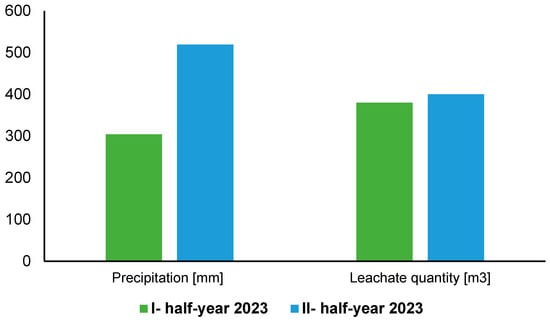
In the area surrounding the closed landfill site, the recorded precipitation in 2023 increased from 304.2 mm in the first half of the year to 519 mm in the second half, indicating a significant upward trend. Correspondingly, the volume of leachate collected from the landfill also showed an increase, ranging from 380 m3 in the first half of 2023 to 400 m3 in the second half (Figure 2). This parallel growth suggests a potential correlation between precipitation levels and leachate generation within the landfill system.
Figure 2.
Volume of atmospheric precipitation and leachate collected at a closed municipal waste landfill during the first and second halves of 2023.
4.5. Highest Measured Values of Groundwater and Leachate Quality Indicators
The analysis of 11 variables: including physicochemical parameters, 13 types of microplastics, the volume of atmospheric precipitation, and the amount of leachate, revealed that the highest values were recorded predominantly in the second half of 2023, with a seven-fold dominance compared to the first half (Table 4).
Table 4.
Matrix of maximum values of selected indicators in groundwater and leachate samples.
During this period, maximum concentrations in leachate were observed for lead (Pb), copper (Cu), and chromium (Cr). These peaks coincided with increased precipitation and leachate volumes in the landfill area, suggesting a potential link between hydrological input and contaminant mobilization.
In groundwater, the highest cadmium (Cd) concentration was recorded at the outflow point P-2, while polyethylene (PE) was detected at P-1. Additionally, polyethylene terephthalate (PET) was identified in the leachate samples.
In contrast, during the first half of 2023, the lowest groundwater level was observed downstream of the landfill site, while the highest values were recorded for electrical conductivity (EC), total organic carbon (TOC), and zinc (Zn). The leachate during this period exhibited the highest pH, along with elevated concentrations of copper (Cu) and lead (Pb).
5. Discussion
The analysis of 24 variables, including physicochemical indicators, microplastic fractions, atmospheric precipitation, and leachate volumes, revealed a predominance of maximum values in the second half of 2023. Leachate from closed landfill sites contains various pollutants that may contribute to the deterioration of groundwater quality. One of the key factors influencing groundwater degradation near landfill sites is the groundwater level itself [45].
The shallowest groundwater depth in the landfill area was recorded at the outflow point (P-2), measuring 1.04 m below ground level, while the deepest level of 3.85 m was observed at the inflow point (P-3). This variation of over 2.0 m was most pronounced in the first half of 2023.
The volume of leachate generated is strongly influenced by atmospheric precipitation [46]. Accordingly, the highest recorded values for both precipitation and leachate volume occurred in the second half of 2023. Moreover, precipitation may facilitate the mobilization of microplastics from the landfill surface [47].
Bazene et al. [48] noted that precipitation can also affect leachate composition, including its pH. Reaction conditions are among the most critical factors influencing the speciation and distribution of metals [49]. The groundwater outflow the landfill site exhibited a medium alkaline pH, with the highest average value of 7.3, while the leachate showed a higher pH of 8.5. Similar pH values in leachate were reported by Li et al. [50], and Mojiri et al. [51] considered such conditions characteristic of aged landfill sites. Furthermore, Mortula et al. [52] demonstrated that pH significantly affects plastic leachability and leachate turbidity, with alkaline conditions being more aggressive toward plastics than neutral pH.
The electrical conductivity (EC) indicator exhibited a notable seasonal variation, with values decreasing from 2772 μS/cm in the first half of 2023 to 430 μS/cm in the second half. The highest average EC value, 1707.5 μS/cm, indicates a deterioration in groundwater quality outflow the landfill site, corresponding to Class II water quality and exceeding the permissible threshold for drinking water. In contrast, the average EC value in leachate was lower, at 1390.5 μS/cm, further supporting the presence of seasonal variability in groundwater composition, as also reported by Abiriga et al. [53].
The organic composition of leachate varies depending on the characteristics of the stored waste, landfill age, and climatic conditions [54]. The highest concentration of total organic carbon (TOC): 35.8 mg/L, was recorded in groundwater outflow the landfill site during the first half of the year, while the highest TOC in leachate, 25.7 mg/L, was observed in the second half. The average TOC concentration in groundwater at the outflow point was 24.8 mg/L, exceeding the permissible limit and surpassing the average TOC in leachate, which was 2.5 mg/L.
Similar exceedances of TOC levels in groundwater have been reported by Koda et al. [34], who attributed them to site-specific conditions. In contrast, significantly higher TOC concentrations in leachate were documented by Koc-Jurczyk and Jurczyk [55]. On the other hand, the total concentration of polycyclic aromatic hydrocarbons (PAHs) in leachate remained below the regulatory threshold, consistent with findings by Almouallem et al. [56].
The concentrations of Pb, Cr, and Hg in the tested water samples were below the permissible limits. Such low levels of heavy metals may result from attenuation processes that reduce their impact, occurring both at the landfill site and within the aquifer. According to Abirga et al. [53], these processes include dilution, cation exchange, sorption, and precipitation, which may limit the migration distance of contaminants.
However, in the case of Cu, the concentration exceeded the permissible limit for drinking water. In groundwater, the highest concentration of Cd (0.042 mg/L) was recorded in the outflow during the second half of 2023, with an average concentration of 0.0211 mg/L, above the standards for both groundwater and drinking water quality. A similar exceedance of Cd levels was reported by Boateng et al. [57].
In leachate, the Cd concentration reached up to <0.060 mg/L, with an average of 0.03 mg/L. Potential sources of cadmium include plastics and electronic waste [58]. The deterioration of water quality near the landfill site is also indicated by increased Zn concentrations in groundwater outflows, likely due to the presence of fluorescent lamps and batteries in the waste [59].
According to Adoleppo et al. [60], heavy metals can persist in landfill sites for up to 150 years. The concentrations of other heavy metals: Pb, Cr, and Hg, in the tested leachate were also below permissible limits. Similar findings of low heavy metal content in landfill areas were reported by Karagozoglu and Askar [61].
The presence of micro- and nanoplastics in groundwater is of significant concern due to their potential impact on human health Natesan et al. [62]. Plastic waste can also act as a source of other pollutants, such as heavy metals [63]. Polyethylene Terephthalate (PET) and Polyamide (PA) have been detected in both groundwater outflow the landfill site and in leachate. These polymers, which constitute approximately 5% of the total polymer composition [64], are among the most common microplastics found in leachate [65]. This suggests the potential release of microplastics from the landfill into surrounding waters, which may also carry toxic and hazardous substances [66].
Zhou et al. [67] reported a decrease in plastic content in older or closed landfill sites compared to newer ones. The predominance of high concentrations of pollutants, including heavy metals and microplastics, in groundwater outflow the closed landfill sites during the second half of 2023 confirms the infiltration of leachate from the waste deposit. This contributes to the degradation of groundwater quality in the vicinity of the studied site. The results of this study provide a scientific basis for extending groundwater monitoring during the post-operational phase with the new parameter—microplastics, which is sustainable for the environment [68]. Koda et al. [69], considering the negative impact of inactive landfills on the aquatic environment, pointed to the need to use drainage and vertical sealing of mineral soil and plastic around such facilities.
6. Conclusions
Based on the analysis of 11 variables, including physicochemical indicators, 13 types of microplastics, atmospheric waste particle size, and the volume of leachate, conducted more than two decades after the landfill closure, the following conclusions can be drawn:
Groundwater quality in the vicinity of the closed landfill site exhibits seasonal variation. In the first half of 2023, elevated concentrations were observed at the outflow, including Zn at 0.086 mg/L and a high TOC value of 24.8 mg/L, corresponding to the peak groundwater level. In leachate, the pH was notably alkaline at 8.6. In the second half of 2023, Zn concentrations at the outflow decreased to 0.061 mg/L. However, groundwater still showed elevated Cd levels (0.0211 mg/L), and PET polymers were detected in both groundwater and leachate. These findings correlate with increased precipitation and leachate volume during this period.
The concentrations of Pb, Cr, and Hg in both groundwater and leachate remained below permissible limits, likely due to natural attenuation processes such as decomposition and sorption.
The presence of residual pollutants and microplastics beneath the closed landfill site confirms their migration from the waste deposit, contributing to the ongoing degradation of groundwater quality in the surrounding area.
This study indicates the presence of various pollutants, including heavy metals and microplastics, in groundwater, and thus its negative impact on the environment; hence, in order to minimize the impact of closed landfill on the aquatic environment in the following years, it is advisable to use a drainage system and vertical sealing barrier made of minerals and plastics around the landfill.
Author Contributions
Conceptualization, G.P. and J.C.; methodology, G.P.; software, J.C. and E.M.; validation, D.M., N.B. and E.M.; formal analysis, G.P.; investigation, J.C.; resources, G.P.; data curation, G.P., J.C. and E.M.; writing—original draft preparation, G.P., J.C., E.M. and D.M.; writing—review and editing, D.M. and E.M.; visualization, N.B.; supervision, E.M.; project administration, G.P.; funding acquisition, G.P., J.C. and E.M. All authors have read and agreed to the published version of the manuscript.
Funding
This research was partly funded by the University of Applied Sciences in Nowy Sącz, Poland (Grant No. 3/2023, microplastics research).
Institutional Review Board Statement
Not applicable.
Informed Consent Statement
Not applicable.
Data Availability Statement
The original contributions presented in this study are included in the article. Further inquiries can be directed to the corresponding authors.
Acknowledgments
The authors thank the authorities of the municipal company in Poland for providing essential materials that supported the preparation of this article.
Conflicts of Interest
The authors declare no conflicts of interest.
References
- Vaverková, M.D. Landfill impacts on the environment. Geosciences 2019, 9, 431. [Google Scholar] [CrossRef] [Scilit]
- Feng, S.-J.; Chen, Z.-W.; Chen, H.-X.; Zheng, Q.-T.; Liu, R. Slope stability of landfills considering leachate recirculation using vertical wells. Eng. Geol. 2018, 241, 76–85. [Google Scholar] [CrossRef] [Scilit]
- Słomczyńska, B.; Słomczyński, T. Physico-chemical and toxicological characteristics of leachates from MSW landfills. Pol. J. Environ. Stud. 2004, 13, 627–637. [Google Scholar]
- Žaltauskaitė, J.; Vaitonyte, I. Toxicological assessment of closed municipal solid-waste landfill impact to the environment. Environ. Res. Eng. Manag. 2016, 72, 8–16. [Google Scholar] [CrossRef] [Scilit]
- Przydatek, G.; Kochanek, A.; Basta, M. Analysis of changes in municipal waste management at the county level. J. Ecol. Eng. 2017, 18, 72–80. [Google Scholar] [CrossRef] [Scilit] [PubMed]
- Dhamsaniya, M.; Sojitra, D.; Modi, H.; Shabiimam, M.; Kandya, A. A review of the techniques for treating the landfill leachate. Mater. Today Proc. 2023, 77, 358–364. [Google Scholar] [CrossRef] [Scilit]
- Hussein, M.; Yoneda, K.; Zaki, Z.M.; Othman, N.A.; Amir, A. Leachate characterizations and pollution indices of active and closed unlined landfills in Malaysia. Environ. Nanotechnol. Monit. Manag. 2019, 12, 100232. [Google Scholar] [CrossRef] [Scilit]
- Bong, C.P.C.; Lim, L.Y.; Ho, W.S.; Lim, J.S.; Klemeš, J.J.; Towprayoon, S.; Ho, C.S.; Lee, C.T. A review on the global warming potential of cleaner composting and mitigation strategies. J. Clean. Prod. 2017, 146, 149–157. [Google Scholar] [CrossRef] [Scilit]
- Wijekoon, P.; Koliyabandara, P.A.; Cooray, A.T.; Lam, S.S.; Athapattu, B.C.; Vithanage, M. Progress and prospects in mitigation of landfill leachate pollution: Risk, pollution potential, treatment and challenges. J. Hazard. Mater. 2022, 421, 126627. [Google Scholar] [CrossRef] [Scilit] [PubMed]
- Mojiri, A.; Aziz, H.A.; Zaman, N.Q.; Aziz, S.Q.; Zahed, M.A. Metals removal from municipal landfill leachate and wastewater using adsorbents combined with biological method. Desalination Water Treat. 2014, 57, 2819–2833. [Google Scholar] [CrossRef] [Scilit]
- Al-Yaqout, A.; Hamoda, M.F. Long-term Temporal Variations in Characteristics of Leachates from a Closed Landfill in an Arid Region. Water Air Soil Pollut. 2020, 231, 319. [Google Scholar] [CrossRef] [Scilit]
- Silva, A.L.; Prata, J.C.; Duarte, A.C.; Soares, A.M.; Barceló, D.; Rocha-Santos, T. Microplastics in landfill leachates: The need for reconnaissance studies and remediation technologies. Case Stud. Chem. Environ. Eng. 2021, 3, 100072. [Google Scholar] [CrossRef] [Scilit]
- Van Praagh, M.; Liebmann, B. Microplastics in landfill leachates in three Nordic countries. J. Detritus 2021, 17, 58–70. [Google Scholar] [CrossRef] [Scilit]
- Chidichimo, F.; De Biase, M.; Straface, S. Groundwater pollution assessment in landfill areas: Is it only about the leachate? Waste Manag. 2020, 102, 655–666. [Google Scholar] [CrossRef] [Scilit] [PubMed]
- Jovanov, D.; Vujić, B.; Vujić, G. Optimization of the monitoring of landfill gas and leachate in closed methanogenic landfills. J. Environ. Manag. 2018, 216, 32–40. [Google Scholar] [CrossRef] [Scilit] [PubMed]
- Talalaj, I.A.; Biedka, P. Use of the landfill water pollution index (LWPI) for groundwater quality assessment near the landfill sites. Environ. Sci. Pollut. Res. 2016, 23, 24601–24613. [Google Scholar] [CrossRef] [Scilit] [PubMed]
- Wdowczyk, A.; Szymańska-Pulikowska, A. Differences in the composition of leachate from active and non-operational municipal waste landfills in Poland. Water 2020, 12, 3129. [Google Scholar] [CrossRef] [Scilit]
- Przydatek, G.; Kanownik, W. Physicochemical indicators of the influence of a lined municipal landfill on groundwater quality: A case study from Poland. Environ. Earth Sci. 2021, 80, 456. [Google Scholar] [CrossRef] [Scilit]
- Essien, J.P.; Ikpe, D.I.; Inam, E.D.; Okon, A.O.; Ebong, G.A.; Benson, N.U. Occurrence and spatial distribution of heavy metals in landfill leachates and impacted freshwater ecosystem: An environmental and human health threat. PLoS ONE 2022, 17, e0263279. [Google Scholar] [CrossRef] [Scilit] [PubMed]
- Maiti, S.; De, S.; Hazra, T.; Debsarkar, A.; Dutta, A. Characterization of leachate and its impact on surface and groundwater quality of a closed dumpsite—A case study at Dhapa, Kolkata, India. Procedia Environ. Sci. 2016, 35, 391–399. [Google Scholar] [CrossRef] [Scilit]
- Ma, S.; Zhou, C.; Pan, J.; Yang, G.; Sun, C.; Liu, Y.; Chen, X.; Zhao, Z. Leachate from municipal solid waste landfills in a global perspective: Characteristics, influential factors and environmental risks. J. Clean. Prod. 2022, 333, 130234. [Google Scholar] [CrossRef] [Scilit]
- Jolaosho, T.L. Characterization of potentially toxic elements in leachates from active and closed landfills in Nigeria and their effects on groundwater systems using spatial, indexical, chemometric and health risk techniques. Chemosphere 2024, 369, 143678. [Google Scholar] [CrossRef] [Scilit] [PubMed]
- Bhatt, A.H.; Karanjekar, R.V.; Altouqi, S.; Sattler, M.L.; Hossain, M.S.; Chen, V.P. Estimating landfill leachate BOD and COD based on rainfall, ambient temperature, and waste composition: Exploration of a MARS statistical approach. Environ. Technol. Innov. 2017, 8, 1–16. [Google Scholar] [CrossRef] [Scilit]
- Ciuła, J.; Generowicz, A.; Gaska, K.; Gronba-Chyła, A. Efficiency analysis of the generation of energy in a biogas CHP system and its management in a waste landfill—Case study. J. Ecol. Eng. 2022, 23, 143–156. [Google Scholar] [CrossRef] [Scilit]
- Abdel-Shafy, H.I.; Ibrahim, A.M.; Al-Sulaiman, A.M.; Okasha, R.A. Landfill leachate: Sources, nature, organic composition, and treatment: An environmental overview. Ain Shams Eng. J. 2024, 15, 102293. [Google Scholar] [CrossRef] [Scilit]
- Yang, N.; Damgaard, A.; Kjeldsen, P.; Shao, L.-M.; He, P.-J. Quantification of regional leachate variance from municipal solid waste landfills in China. J. Waste Manag. 2015, 46, 362–372. [Google Scholar] [CrossRef] [Scilit] [PubMed]
- Rani, A.; Negi, S.; Hussain, A.; Kumar, S. Treatment of urban municipal landfill leachate utilizing garbage enzyme. Bioresour. Technol. 2020, 297, 122437. [Google Scholar] [CrossRef] [Scilit] [PubMed]
- Prata, J.C.; Silva, A.L.P.; Da Costa, J.P.; Mouneyrac, C.; Walker, T.R.; Duarte, A.C.; Rocha-Santos, T. Solutions and integrated strategies for the control and mitigation of plastic and microplastic pollution. Int. J. Environ. Res. Public Health 2019, 16, 2411. [Google Scholar] [CrossRef] [Scilit] [PubMed]
- Eerkes-Medrano, D.; Thompson, R.C.; Aldridge, D.C. Microplastics in freshwater systems: A review of the emerging threats, identification of knowledge gaps and prioritisation of research needs. Water Res. 2015, 75, 63–82. [Google Scholar] [CrossRef] [Scilit] [PubMed]
- Prata, J.C. Airborne microplastics: Consequences to human health? Environ. Pollut. 2018, 234, 115–126. [Google Scholar] [CrossRef] [Scilit] [PubMed]
- Pereira, J.M.; Rodríguez, Y.; Blasco-Monleon, S.; Porter, A.; Lewis, C.; Pham, C.K. Microplastic in the stomachs of open-ocean and deep-sea fishes of the North-East Atlantic. Environ. Pollut. 2020, 265, 115060. [Google Scholar] [CrossRef] [Scilit] [PubMed]
- De-la-Torre, G.E.; Dioses-Salinas, D.C.; Pizarro-Ortega, C.I.; Santillán, L. New plastic formations in the Anthropocene. Sci. Total Environ. 2021, 754, 142216. [Google Scholar] [CrossRef] [Scilit] [PubMed]
- Siddiqua, A.; Hahladakis, J.N.; Al-Attiya, W.A.K. An overview of the environmental pollution and health effects associated with waste landfilling and open dumping. Environ. Sci. Pollut. Res. 2022, 29, 58514–58536. [Google Scholar] [CrossRef] [Scilit] [PubMed]
- Koda, E.; Miszkowska, A.; Sieczka, A. Levels of organic pollution indicators in groundwater at the old landfill and waste management site. Appl. Sci. 2017, 7, 638. [Google Scholar] [CrossRef] [Scilit]
- Przydatek, G. Multi-indicator analysis of the influence of old municipal landfill sites on the aquatic environment: Case study. Environ. Monit. Assess. 2019, 191, 773. [Google Scholar] [CrossRef] [Scilit] [PubMed]
- Almeida, I.L.; Oliveira, M.D.; Silva, J.B.; Coelho, N.M. Suitable extraction of soils and sediments for mercury species and determination combined with the cold vapor generation atomic absorption spectrometry technique. Microchem. J. 2016, 124, 326–330. [Google Scholar] [CrossRef] [Scilit]
- Przydatek, G.; Kanownik, W. Impact of small municipal solid waste landfill on groundwater quality. Environ. Monit. Assess. 2019, 191, 169. [Google Scholar] [CrossRef] [Scilit] [PubMed]
- Frias, J.P.; Nash, R. Microplastics: Finding a consensus on the definition. Mar. Pollut. Bull. 2019, 138, 145–147. [Google Scholar] [CrossRef] [Scilit] [PubMed]
- Yu, F.; Wu, Z.; Wang, J.; Li, Y.; Chu, R.; Pei, Y.; Ma, J. Effect of landfill age on the physical and chemical characteristics of waste plastics/microplastics in a waste landfill sites. Environ. Pollut. 2022, 306, 119366. [Google Scholar] [CrossRef] [Scilit] [PubMed]
- Regulation of the Minister of Maritime Economy and Inland Navigation of October 11, a., Journal of Laws of 2019, Item 2148. Warsaw, Poland. Available online: http://g.ekspert.infor.pl/p/_dane/akty_pdf/DZU/2019/216/2148.pdf (accessed on 2 June 2025). (In Polish)
- FAO. Global Food Losses and Food Waste—Extent, Causes and Prevention; FAO: Rome, Italy, 2011. [Google Scholar]
- Regulation of the Minister of Environment of 19 July 2016 on the Forms and Methods of Monitoring Groundwater and Surface Water Bodies. Journal of Laws 2016 Item 1178. Warsaw, Poland. Available online: https://eli.gov.pl/api/acts/DU/2016/1178/text/O/D20161178.pdf (accessed on 2 June 2025). (In Polish)
- Regulation of the Minister of Maritime Economy and Inland Navigation of 12 July 2019 Journal of Laws 2019 Item 1311. Warsaw, Poland. Available online: https://eli.gov.pl/api/acts/DU/2019/1311/text/O/D20191311.pdf (accessed on 2 June 2025). (In Polish)
- Tian, T.; Zhou, J.; Zhu, F.; Ye, Y.; Guo, Y.; Hartley, W.; Xue, S. Effect of amendments on the leaching behavior of alkaline anions and metal ions in bauxite residue. J. Environ. Sci. 2019, 85, 74–81. [Google Scholar] [CrossRef] [Scilit]
- Farzaneh, G.; Khorasani, N.; Ghodousi, J.; Panahi, M. Assessment of surface and groundwater resources quality close to municipal solid waste landfill using multiple indicators and multivariate statistical methods. Int. J. Environ. Res. 2021, 15, 383–394. [Google Scholar] [CrossRef] [Scilit]
- Fatta, D.; Papadopoulos, A.; Loizidou, M. A study on the landfill leachate and its impact on the groundwater quality of the greater area. Environ. Geochem. Health 1999, 21, 175–190. [Google Scholar] [CrossRef] [Scilit]
- Wijesekara, S.; Mayakaduwa, S.S.; Siriwardana, A.; De Silva, N.; Basnayake, B.; Kawamoto, K.; Vithanage, M. Fate and transport of pollutants through a municipal solid waste landfill leachate in Sri Lanka. Environ. Earth Sci. 2014, 72, 1707–1719. [Google Scholar] [CrossRef] [Scilit]
- Baziene, K.; Vasarevicius, S.; Baltrenas, P.; Baltrenaite, E. Influence of total precipitation and air temperature on the composition of municipal landfill leachate. Environ. Eng. Manag. J. 2013, 12, 175–182. [Google Scholar] [CrossRef] [Scilit]
- Xie, S.; Ma, Y.; Strong, P.; Clarke, W. Fluctuation of dissolved heavy metal concentrations in the leachate from anaerobic digestion of municipal solid waste in commercial scale landfill bioreactors: The effect of pH and associated mechanisms. J. Hazard. Mater. 2015, 299, 577–583. [Google Scholar] [CrossRef] [Scilit] [PubMed]
- Li, X.; Zhao, Q.; Hao, X. Ammonium removal from landfill leachate by chemical precipitation. Waste Manag. 1999, 19, 409–415. [Google Scholar] [CrossRef] [Scilit]
- Mojiri, A.; Zhou, J.L.; Ratnaweera, H.; Ohashi, A.; Ozaki, N.; Kindaichi, T.; Asakura, H. Treatment of landfill leachate with different techniques: An overview. J. Water Reuse 2021, 11, 66–96. [Google Scholar] [CrossRef] [Scilit]
- Mortula, M.M.; Atabay, S.; Fattah, K.P.; Madbuly, A. Leachability of microplastic from different plastic materials. J. Environ. Manag. 2021, 294, 112995. [Google Scholar] [CrossRef] [Scilit] [PubMed]
- Abiriga, D.; Vestgarden, L.S.; Klempe, H. Groundwater contamination from a municipal landfill: Effect of age, landfill closure, and season on groundwater chemistry. Sci. Total Environ. 2020, 737, 140307. [Google Scholar] [CrossRef] [Scilit] [PubMed]
- Koś, K.; Zawisza, E. Landfill liners from dam reservoir sediments. Ann. Wars. Univ. Life Sci.–SGGW 2016, 48, 41–52. [Google Scholar] [CrossRef] [Scilit]
- Koc-Jurczyk, J.; Jurczyk, Ł. The characteristics of organic compounds in landfill leachate biologically treated under different technological conditions. J. Ecol. Eng. 2020, 21, 104–111. [Google Scholar] [CrossRef] [Scilit] [PubMed]
- Almouallem, W.; Michel, J.; Dorge, S.; Joyeux, C.; Trouvé, G.; Le Nouen, D. A comparative study of the sorption of O-PAHs and PAHs onto soils to understand their transport in soils and groundwater. J. Environ. Sci. 2023, 124, 61–75. [Google Scholar] [CrossRef] [Scilit] [PubMed]
- Boateng, T.K.; Opoku, F.; Akoto, O. Heavy metal contamination assessment of groundwater quality: A case study of Oti landfill site, Kumasi. Appl. Water Sci. 2019, 9, 33. [Google Scholar] [CrossRef] [Scilit]
- Han, D.; Tong, X.; Currell, M.J.; Cao, G.; Jin, M.; Tong, C. Evaluation of the impact of an uncontrolled landfill on surrounding groundwater quality, Zhoukou, China. J. Geochem. Explor. 2014, 136, 24–39. [Google Scholar] [CrossRef] [Scilit]
- Kanmani, S.; Gandhimathi, R. Investigation of physicochemical characteristics and heavy metal distribution profile in groundwater system around the open dump site. Appl. Water Sci. 2013, 3, 387–399. [Google Scholar] [CrossRef] [Scilit]
- Adelopo, A.; Haris, P.I.; Alo, B.; Huddersman, K.; Jenkins, R. Multivariate analysis of the effects of age, particle size and landfill depth on heavy metals pollution content of closed and active landfill precursors. Waste Manag. 2018, 78, 227–237. [Google Scholar] [CrossRef] [Scilit] [PubMed]
- Karagozoglu, M.B.; Asar, M. Physico-chemical characteristics of leachate from landfills and its impact on surface water quality: Case study in Osmaniye/Turkey. Sustain. Water Resour. Manag. 2023, 9, 125. [Google Scholar] [CrossRef] [Scilit]
- Natesan, U.; Vaikunth, R.; Kumar, P.; Ruthra, R.; Srinivasalu, S. Spatial distribution of microplastic concentration around landfill sites and its potential risk on groundwater. Chemosphere 2021, 277, 130263. [Google Scholar] [CrossRef] [Scilit] [PubMed]
- Pandey, P. Plastic Waste Management in UAE. Ecomena. Available online: https://www.ecomena.org/plastic-uae/ (accessed on 20 July 2025).
- Hsuan, Y.C.Y.; Lin, C.H.; Chang, C.P.; Lin, M.T. Mesenchymal stem cell-based treatments for stroke, neural trauma, and heat stroke. Brain Behav. 2016, 6, e00526. [Google Scholar] [CrossRef] [Scilit] [PubMed]
- Kabir, M.S.; Wang, H.; Luster-Teasley, S.; Zhang, L.; Zhao, R. Microplastics in landfill leachate: Sources, detection, occurrence, and removal. Environ. Sci. Ecotechnol. 2023, 16, 100256. [Google Scholar] [CrossRef] [Scilit] [PubMed]
- Shen, M.; Xiong, W.; Song, B.; Zhou, C.; Almatrafi, E.; Zeng, G.; Zhang, Y. Microplastics in landfill and leachate: Occurrence, environmental behavior and removal strategies. Chemosphere 2022, 305, 135325. [Google Scholar] [CrossRef] [Scilit] [PubMed]
- Zhou, C.; Fang, W.; Xu, W.; Cao, A.; Wang, R. Characteristics and the recovery potential of plastic wastes obtained from landfill mining. J. Clean. Prod. 2014, 80, 80–86. [Google Scholar] [CrossRef] [Scilit]
- Viaroli, S.; Lancia, M.; Re, V. Microplastics contamination of groundwater: Current evidence and future perspectives. A review. Sci. Total. Environ. 2022, 824, 153851. [Google Scholar] [CrossRef] [Scilit] [PubMed]
- Koda, E.; Osiński, P.; Podlasek, A.; Markiewicz, A.; Winkler, J.; Vaverková, M.D. Geoenvironmental approaches in an old municipal waste landfill reclamation process: Expectations vs reality. Soils Found. 2023, 63, 101273. [Google Scholar] [CrossRef] [Scilit]

Disclaimer/Publisher’s Note: The statements, opinions and data contained in all publications are solely those of the individual author(s) and contributor(s) and not of MDPI and/or the editor(s). MDPI and/or the editor(s) disclaim responsibility for any injury to people or property resulting from any ideas, methods, instructions or products referred to in the content. |
© 2025 by the authors. Licensee MDPI, Basel, Switzerland. This article is an open access article distributed under the terms and conditions of the Creative Commons Attribution (CC BY) license (https://creativecommons.org/licenses/by/4.0/).