


Abstract
Ensuring cybersecurity in power monitoring systems is of paramount importance to maintain the operational safety and stability of modern power grids. With the rapid expansion of grid infrastructure and increasing sophistication of cyber threats, existing manual alarm-tracing methods face significant challenges in handling the massive volume of security alerts, leading to delayed responses and potential system vulnerabilities. Current approaches often lack the capability to effectively model complex relationships among alerts and are hindered by imbalanced data distributions, which degrade tracing accuracy. To this end, this paper proposes a power monitor system cybersecurity alarm-tracing method based on the knowledge graph (KG) and graph convolutional neural networks (GCNN). Specifically, a cybersecurity KG is constituted based on the historical alert, accurately representing the entities and relationships in massive alerts. Then, a GCNN with attention mechanisms is applied to sufficiently extract the topological features along alarms in KG so that it can precisely and effectively trace the massive alarms. Most importantly, to mitigate the influence of imbalanced alarms for tracing, a specialized data process and model ensemble strategy by adaptively weighted imbalance sample is proposed. Finally, based on 70,000 alarm information from a regional power grid, by applying the method proposed in this paper, an alarm traceability accuracy rate of 96.59% was achieved. Moreover, compared with the traditional manual method, the traceability efficiency was improved by more than 80%.
1. Introduction
The secure operation of power systems is the foundation and lifeline of national economic development. The cybersecurity of power monitoring systems serves as the guardian for the safe and stable operation of power systems [1]. Traditional power cybersecurity (referred to as PowerCyberSec) systems rely on expert experience to trace alert information and require practiced staff in monitoring centers to analyze and identify alerts’ causes [2]. However, when faced with a large influx of alerts, manual judgment cannot achieve rapid tracing [3]. As power systems expand and more sensors are deployed, alert information has become increasingly complex and diverse [4,5]. This deteriorates the drawbacks of relying heavily on human expertise in PowerCyberSec systems [6]. With the development of the power system, the number of sites and IP addresses that need to be constantly monitored has increased exponentially. However, the number of personnel involved in the monitoring work cannot increase proportionally. As a result, the efficiency of each staff member in processing information has been greatly affected. Therefore, the PowerCyberSec system needs to be more intelligent to quickly and accurately identify the causes of alarms and provide references for handling various types of alarms.
With the development of artificial intelligence, scholars suggest a tracing method based on AI technology, including machine learning and deep learning categories. Machine learning traces alarms by constructing artificial intelligence agents to learn the knowledge information. Deep learning enhances the traceability performance of machine learning by inputting big data information into artificial intelligence agents.
Machine learning methods like SVMs have been applied to alert tracing studies [7]. As a popular research topic in new power systems, AI technology, with its efficient processing speed and independence from human assistance, offers new approaches to solving PowerCyberSec challenges [8,9,10]. These methods require fewer samples for training, feature simple model structures, and offer fast tracing speeds. However, refs. [11,12] indicate that with the continuous expansion of the power grid scale, the deployment of new monitoring equipment, and the integration of intermittent clean energy, early warning information has become increasingly complex and massive. Simple-structured machine learning methods struggle to accurately trace alerts within big data, failing to meet current grid requirements.
As for deep learning methods, they are adept at handling large datasets and address the limitations of machine learning in utilizing PowerCyberSec big data [12]. Researchers now employ deep learning methods like CNN [13,14], LSTM [15,16], GCN [17], and RNN [18] to trace power grid monitoring signals by vectorizing alert information and using vectorized PowerCyberSec big data as input, enhancing the accuracy of alert tracing systems. However, existing AI-based alarm-tracing approaches frequently suffer from two critical limitations:
- Inability to model relational knowledge among alarms, devices, and system states.
- Poor generalization performance on rare alarm categories, due to imbalanced data distributions.
Those intelligent methods still suffer from the complex structure of PowerCyberSec alert information. Vectorized inputs via CNN and similar methods cannot accurately or succinctly represent high-dimensional alert information, limiting the accuracy of tracing.
In contrast, KG, which organizes data in a graph structure, offers more precise knowledge representation capabilities [19]. They can accurately characterize massive alert entities and succinctly represent relationships between entities. Therefore, it is necessary to develop research on constructing KG and deep learning that characterizes massive PowerCyberSec alert information [20]. However, prior work that combined KGs with traditional machine learning models (e.g., KG + SVM) or even CNN-based feature extraction (KG + CNN) has faced limitations in fully exploiting the topological structure of the KG. These approaches typically treat subgraphs as independent instances or use shallow feature extractors, which fail to capture deep relational patterns across multiple hops in the graph.
To address these shortcomings, this paper proposes a novel integration of KG with graph convolutional neural networks (GCNNs) enhanced by attention mechanisms, enabling end-to-end learning over the graph-structured alert data. Unlike previous methods, our approach directly operates on the graph topology, extracting hierarchical and contextual features from multi-hop neighborhoods. Moreover, the attention mechanism allows the model to dynamically weigh the importance of different neighbors during feature aggregation, leading to more accurate and interpretable alarm tracing.
In real-world PowerCyberSec data, specific alert causes, such as equipment operations or regional alerts, occur with very low probability, leading to imbalanced training samples. This imbalance causes GCNN or GAT to be biased towards more common alert causes, resulting in lower accuracy in alert tracing. To address this issue, oversampling and ensemble learning techniques are widely used to handle sample imbalance problems. Oversampling techniques increase the proportion of underrepresented samples by augmenting them [21]. At the same time, based on the error-ambiguity decomposition theory, ensemble learning adaptively selects the optimal base learners. It assigns higher weights to those better at identifying low-proportion samples [22]. These methods provide effective solutions for addressing sample imbalance.
To this end, this paper relies on the knowledge in historical alarm data, constructing a cybersecurity domain-informed knowledge graph. It can freeze the cybersecurity experience and construct the alarm-tracing knowledge. Then, construct a cybersecurity tracing GCNN, with the advantage of GCNN’s ability to process complex graph information. It is capable of conducting traceability analysis on the alarm information solidified in the form of graphs in KG. Considering that the imbalance of alarm data in the actual working process leads to the tendency of the traceability agent, a specialized data process and model ensemble strategy is proposed. The contributions of this article are as follows: the alarm traceability was conducted for 70,107 word-form PowerCyberSec alarm information provided by an actual power company, and the accuracy rate reached 96.59%.
- (1)
- A cybersecurity domain-informed knowledge graph is constituted based on the historical alert. By taking advantage of the knowledge graph’s ability to solidify information, entities are used to represent the sites, IPs, and other information in the alarm information. The relationships between information are represented in the form of entity links, achieving the solidification of knowledge and manual processing experience in the alarm information. When facing a massive influx of alerts, achieve rapid analysis of the alerts.
- (2)
- A cybersecurity alarm-tracing GCNN is constructed. It takes advantage of the GCNN’s strength in graph data analysis and processing to conduct traceability analysis on the knowledge information from alerts solidified by KG, achieving accurate traceability of alarm causes.
- (3)
- A specialized data process and model ensemble strategy by an adaptively weighted imbalance sample is proposed. In order to mitigate the influence of imbalanced alarms for tracing. It introduces an oversampling enhancement module and an ensemble tracing module based on error-diversity matrices, significantly improving the traceability accuracy of alarm and early warning.
2. Materials and Methods
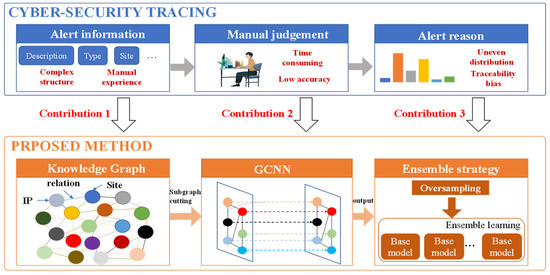
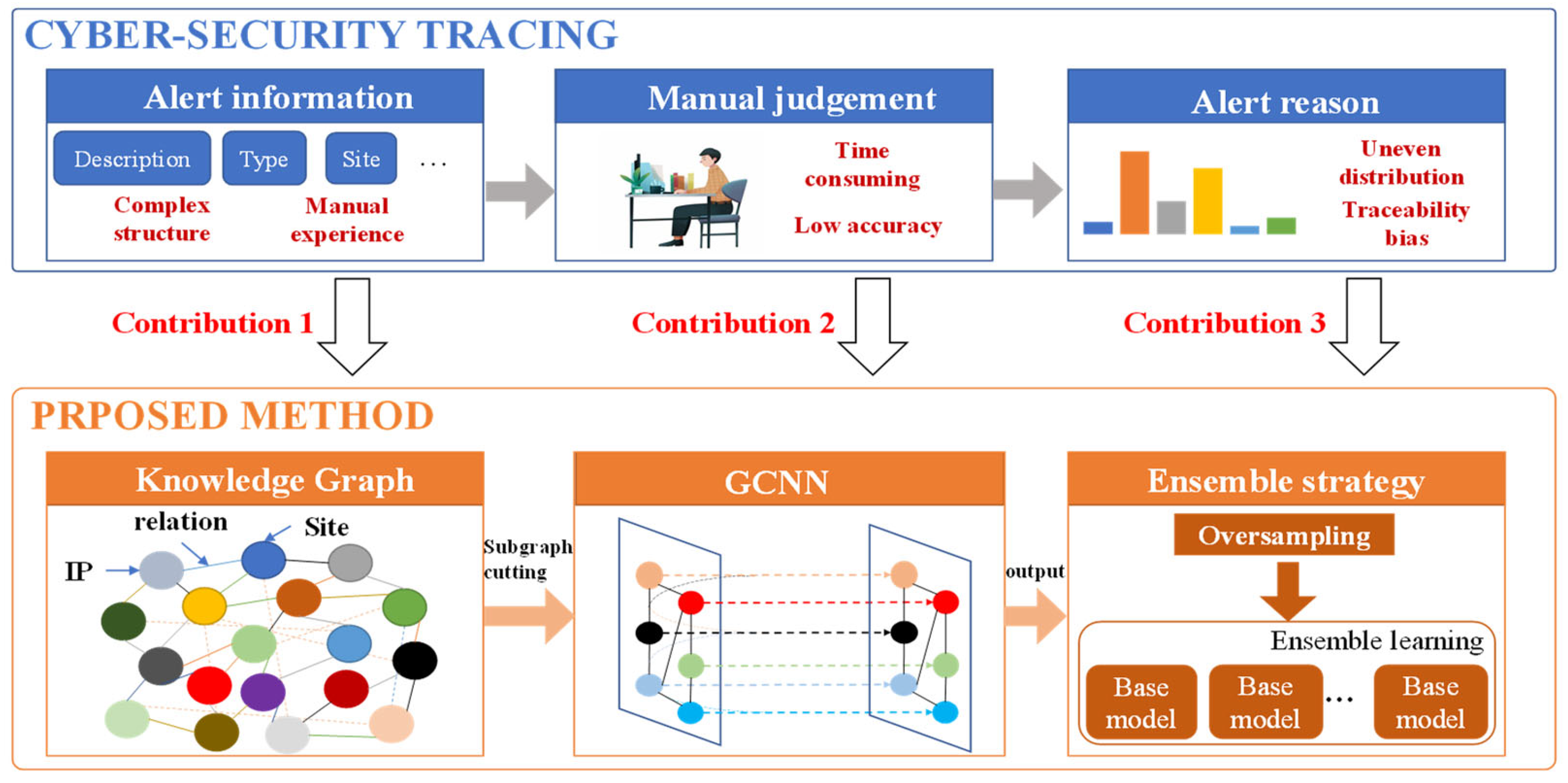
The cybersecurity tracing analyzes the causes corresponding to the alarm information in PowerCyberSec. As shown in Figure 1, the alarm information includes alarm descriptions, types, and sites. Its structure is complex and challenging to analyze comprehensively. Usually, the operator traces the alarm based on the compilation file of typical alarm cases compiled by the State Grid of China. The above-mentioned assembly file solidifies PowerCyberSec’s experience through text, but machines find it difficult to make judgments directly based on the assembly file. Meanwhile, the manual experience in the traceability process is challenging to repeatedly learn and utilize, posing a challenge to improving the accuracy of cybersecurity traceability.
Figure 1.
Contribution of the proposed method compared to existing methods.
Figure 1 introduces the conventional cybersecurity traceability process, including analysis, alert information, manual judgment, and generating alert reasons. It mainly relies on manual judgment, requiring many experienced staff to make judgments based on relevant rules and experience. This process is not only time-consuming, but the accuracy of traceability depends on the experience and work concentration of the staff, which cannot guarantee a high accuracy rate of traceability. Meanwhile, the occurrence frequencies of different alarm causes vary, and avoiding bias in the traceability process is impossible.
Considering the aforementioned challenges in the cybersecurity tracing problem, we proposed a cybersecurity alarm-tracing method in this paper.
2.1. Cybersecurity Domain-Informed Knowledge Graph Construction
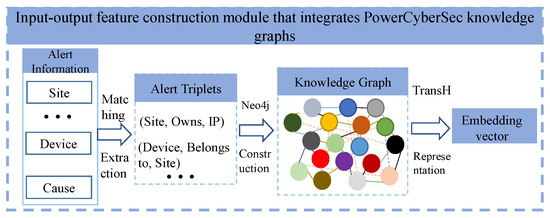
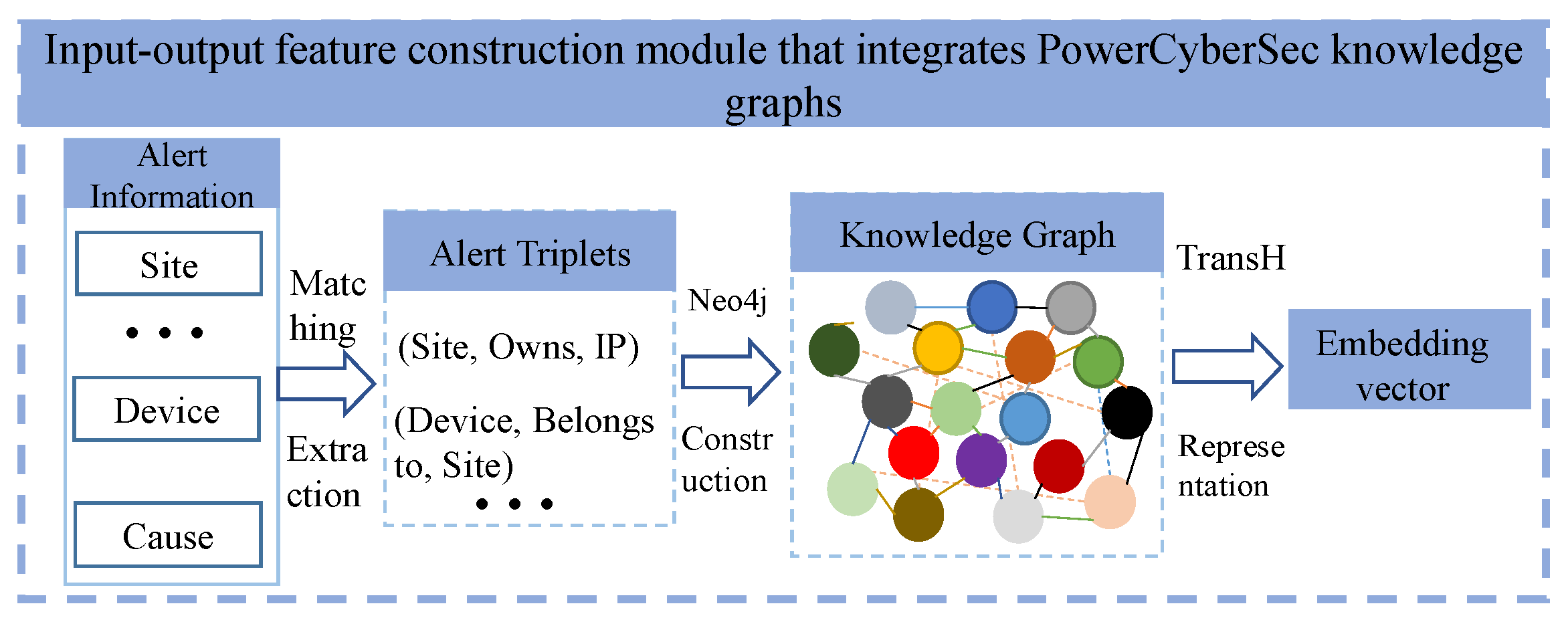
This section introduces the power system cybersecurity problem and constructs the related cybersecurity domain-informed knowledge graph based on the massive historical alerts. As shown in Figure 2, in this section, the original text information is transformed into alarm triples through knowledge extraction and relationship matching. Then, a knowledge graph (KG) is constructed using Neo4j. Finally, the text information is vectorized using the TransH technology, providing input for the subsequent traceability process.
Figure 2.
Framework for Constructing Knowledge Graph.
2.1.1. A Brief Introduction to the Power System Cybersecurity
To illustrate the problems faced by power system cybersecurity, this paper introduces the input and output of this problem with a practical case. As shown in Table 1, the alarm content consists of four parts: alarm description, alarm type, alarm site, and alarm equipment.
Table 1.
Alarm Content.
After manual analysis by the staff, the alarm reasons are generated, and then the relevant units generate handling plans based on the alarm causes. It can be seen from the example that analyzing the cause of the alarm requires a comprehensive analysis in combination with the alarm site, IP, and alarm description. The process of comprehensive analysis of multi-source data is complex and difficult to fully learn by humans. KG utilizes entities to represent information such as sites and IPs, and uses the links between entities to represent the complex relationships in alarm descriptions. By generating entities and relationships to construct graphs, complex information can be fully solidified, providing a basis for rapid analysis of alarm information.
2.1.2. Cybersecurity Knowledge Extraction
(Step 1) Since the input of PowerCyberSec is a piece of text, it is necessary to segment the text segment object in combination with the semantic characteristics of the power system. In this paper, Jieba word segmentation is adopted to segment the alarm information in the form of text segments into word forms. The Jieba word segmentation library is utilized to conduct dictionary model matching and word segmentation for common words such as “discovery”, “policy”, and “access” in the PowerCyberSec alert information. In addition, a probabilistic model is adopted to segment industry-specific terms (such as the reserved addresses, ports, and substations in the PowerCyberSec alert information). For example, the segmentation result of “Alarm Station” is “110/KV/xx/Substation”. These results provide input for the subsequent extraction of entities and relations.
(Step 2) To construct the knowledge graph, triplet matching is carried out on the word-based alarm information obtained in step 1 based on the semantic characteristics of the alarm entities. There are two types of relationships between any two types of alarm entities: “belong to” and “possess”. For example, a site “belongs to” a voltage level, a site “owns” a device, and an IP “owns” a port. Finally, based on the entities extracted from each alert message and the defined relationships, a PowerCyberSec alert text triplet in the format of (head entity, relationship, tail entity) is formed. Considering that there are only two types of relationships (“own” and “belong”), but for the massive entities of various types such as sites, devices, and Ips, there exist the following three types of alarm text triples: ① One-to-one: (Substation A, belong, 110 KV), (Power Plant B, belong, 220 KV); ② One-to-many: (10.70.xxx. Xxx, has, port A), (10.70.xxx. xxx, has port C); and ③ Many-to-one: (Wind farm C, belonging, 220 KV), (Solar power station D, belonging, 220 KV).
(Step 3) Finally, a knowledge graph is constructed using the Neo4j database. If a certain entity does not exist in the graph, a new node is used to represent the entity. In KG, the system checks whether there is a relationship between the head and tail entities specified in the triplet. If there is no relationship between these two entities, a new connection is created to represent this relationship. By iterating through all PowerCyberSec alert text triples, the Neo4j database constructed a cybersecurity domain-informed knowledge graph, achieving the solidification of alert information knowledge.
2.1.3. Cybersecurity Knowledge Embedding
(Step 3) Finally, a knowledge graph is constructed using the Neo4j database. If a certain entity does not exist in the graph, a new node is used to represent the entity. In KG, the system checks whether there is a relationship between the head and tail entities specified in the triplet. If there is no relationship between these two entities, a new connection is created to represent this relationship. By iterating through all PowerCyberSec alert text triples, the Neo4j database constructed a cybersecurity domain-informed knowledge graph, achieving the solidification of alert information knowledge.
Considering that the input data in text form cannot be used as the input of the neural network, the embedding method is adopted to vectorize the knowledge in text form.
Traditional embedding models like TransE represent entities’ feature vectors (the head entity, relation, and tail entity in a triple) as vectors , , and , respectively [23]. The operations between these vectors are shown in Equation (1).
However, in PowerCyberSec alert information, there are numerous one-to-many (, , ) () and many-to-one (, , ) () types of triples. According to Equation (1), traditional flat translation models would represent as the same head entity vector and as the same tail entity vector , leading to incorrect representation of alert entities. Therefore, we construct the PowerCyberSec embedding model based on TransH. The operations between entity vectors and relation vectors in the spatial knowledge embedding model are shown in Equations (2)–(4).
In the spatial knowledge embedding model, each relation r corresponds to a hyperplane, with its projection on the hyperplane denoted as . The normal vector of the hyperplane is . As shown in Equations (3) and (4), the original vectors of the head entity and the tail entity are projected onto the hyperplane along to obtain the projected vectors and . The relationship between , , and is given by Equation (2). For one-to-many triples (, , ), different tail entity vectors are projected onto the same vector on the hyperplane. For many-to-one triples (, , ), different head entity vectors are projected onto the same vector on the hyperplane. This approach satisfies the operations between entity vectors and relation vectors as described in Equation (1), while avoiding the incorrect representation of head entities and tail entities as the same vectors and in traditional flat translation models.
2.2. Cybersecurity Alarm-Tracing GCNN
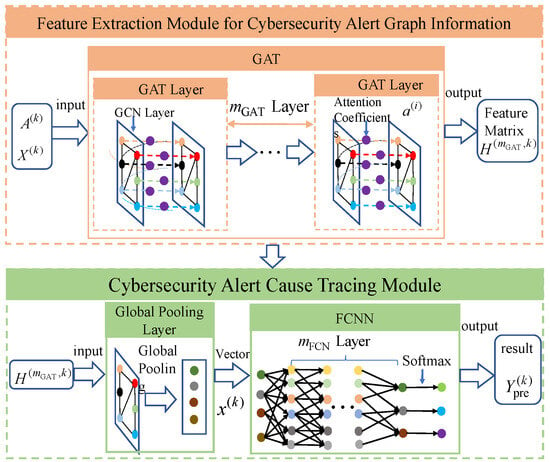
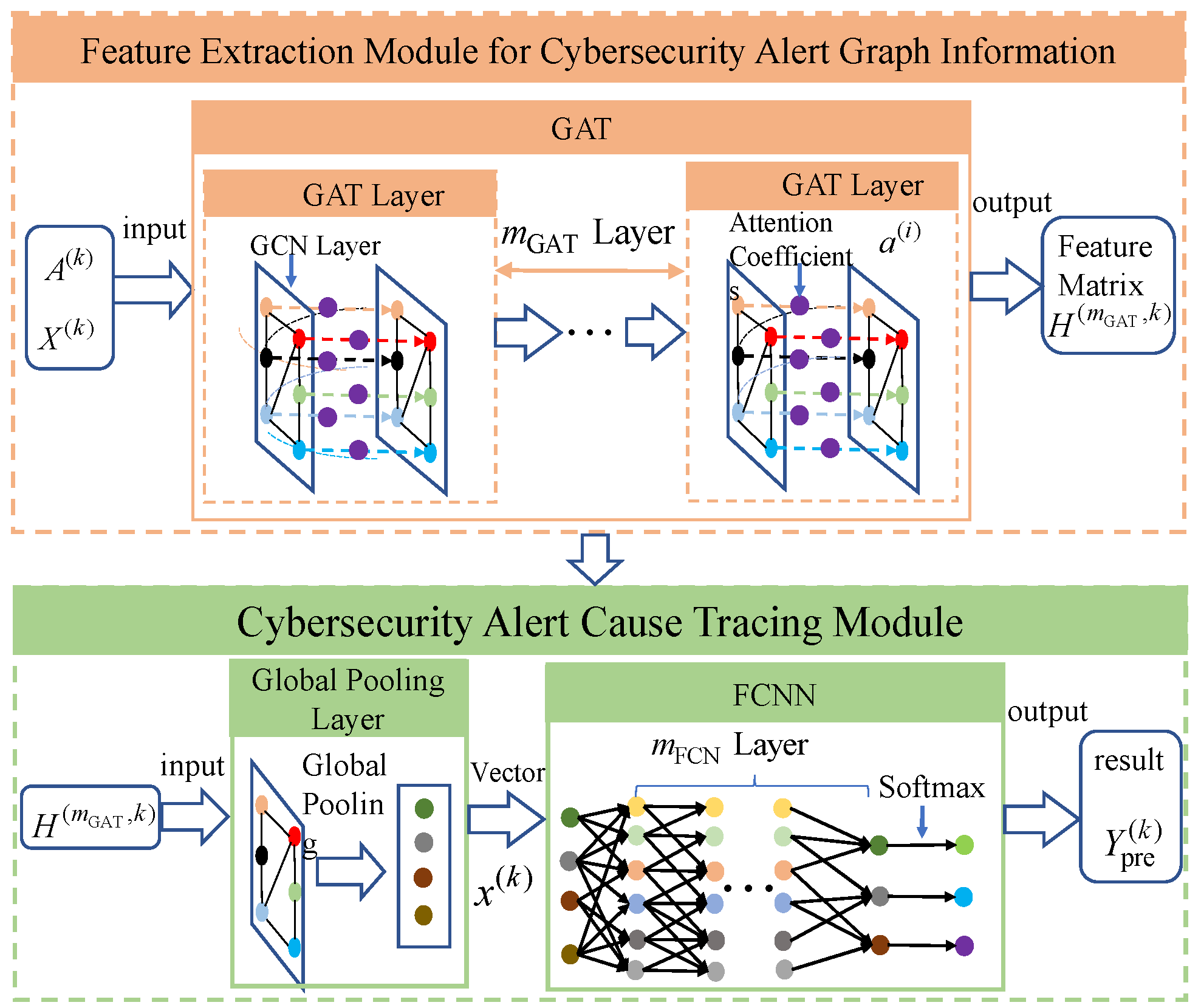
To address the issue that traditional artificial intelligence methods, which take vectors as input, cannot fully utilize the graph data from PowerCyberSec KG. This section proposes a cybersecurity alarm-tracing GCNN, aiming to achieve exact and intelligent tracing of alert causes. The framework is shown in Figure 3, with a detailed introduction provided below.
Figure 3.
Efficient and Accurate Intelligent Traceability Method Framework.
2.2.1. Building GCNN Input
Since the alarm information has been processed by embedding, this subsection is to construct the input data for PowerCyberSec alarm traceability, and to build the vectorized information into the A and X matrices required for GCNN input.
Assuming there are alert messages in the PowerCyberSec alert sample set, containing alert entities and relationships. According to the definition of an adjacency matrix, the adjacency matrix corresponding to the k-th PowerCyberSec alert message, which includes alert entities, can be constructed as follows. The dimension of is , where .
denotes the element in the i-th row and j-th column of the adjacency matrix ; where .
According to the definition of the feature matrix X, the feature matrix for the k-th PowerCyberSec alert message, is shown in Equation (6). represents the feature vector corresponding to the i-th alert entity, where . The dimension of is , where represents the dimension of the feature vector .
2.2.2. Cybersecurity Alarm Tracing
For the input-output feature construction module that integrates a cybersecurity domain-informed KG. Firstly, an adjacency matrix and a feature matrix are generated for each of the alert messages, where . Secondly, a one-hot encoding technique is used to vectorize the types of alert reasons, resulting in an -dimensional alert label vector , where the “1” is located at the l-th dimension, indicating that it belongs to the l-th type of alert reason, with . The adjacency matrix , feature matrix , and alert label vector corresponding to the alert information together form the sample set for the PowerCyberSec alert tracing GCNN.
The feature extraction module addresses the fact that traditional deep learning methods, which take vectors as input, cannot fully utilize the graph information from PowerCyberSec alerts. This is achieved by constructing a multi-layer GNN with an integrated attention mechanism. First, this subsection constructs a feature extraction module based on layers of graph convolutional layers. Each graph node’s initial feature dimension is , and the feature dimension output by each layer is , where . The forward propagation process is shown in Equation (7).
is the output of the i-th layer feature matrix. When , ; is the weight matrix of the i-th layer in the GCN, with dimensions . When , ; is the bias of the i-th layer in the GCN, with dimensions .
To further consider the varying importance of different types of entities, such as sites, IPs, and devices in alert information during traceability analysis, a graph attention mechanism-based neural network for PowerCyberSec traceability feature extraction is designed. In each layer of the graph convolutional network, attention parameters with dimensions are added. These parameters dynamically assign attention weights to entities such as sites, IPs, and devices during the feature extraction process, as shown in Equation (8). Combining this with Equation (7), the forward propagation expression for the PowerCyberSec alert information feature extraction graph attention network is obtained, as shown in Equation (9). Ultimately, it outputs a feature matrix with dimensions , achieving precise feature extraction from PowerCyberSec alert graph information.
The PowerCyberSec alert cause traceability module achieves precise traceability of alert causes by constructing a global pooling layer and multi-layer fully connected networks for PowerCyberSec alert feature matrices. First, a global pooling layer is built for the PowerCyberSec alert feature matrix to reduce dimensionality. Given that the number of nodes in the adjacency matrix corresponding to different alert information can vary, the global pooling layer reduces the feature matrix to an -dimensional feature vector . Further, an alert cause traceability module based on layers of fully connected networks has been constructed. After activation using the Softmax function, it generates an alert traceability vector with dimensions , as shown in Equation (10).
When , is the ReLU function; when , is the Softmax function, where . is the output of the j-th fully connected layer. When , is the weight matrix of the j-th fully connected layer, with dimensions ; is the bias of the j-th fully connected layer, with dimensions .
For the alert label vector and the alert traceability vector , the binary cross-entropy loss function is used to compute the loss. The weights and , attention parameter , and biases and in the graph attention network and fully connected network, are optimized using the stochastic gradient descent (SGD) algorithm. Here, and . This process ultimately completes the construction of the feature extraction module and the traceability module.
This section constructs a cybersecurity alarm-tracing GCNN. This approach not only fully extracts the graph information features of PowerCyberSec alerts that traditional deep learning methods cannot directly utilize but also accounts for the varying importance of different entities in traceability analysis, thereby improving the accuracy of tracing PowerCyberSec alerts.
2.3. Tracing Method for Powercybersec Alerts Considering Sample Imbalance
To address the issue of sample imbalance caused by infrequent alert reasons, such as device operations or regional alerts, which leads to a strong bias in the intelligent tracing method for high-proportion PowerCyberSec alerts, this section proposes an error-ambiguity decomposition strategy for PowerCyberSec alert sample imbalance, improving the accuracy of tracing low-proportion alert reasons. By integrating the KG construction and representation techniques and the graph attention network-based intelligent tracing method, this section introduces a tracing method for PowerCyberSec alerts considering sample imbalance, thereby enhancing the accuracy of tracing various types of PowerCyberSec alert causes.
2.3.1. Error-Ambiguity Decomposition Strategy
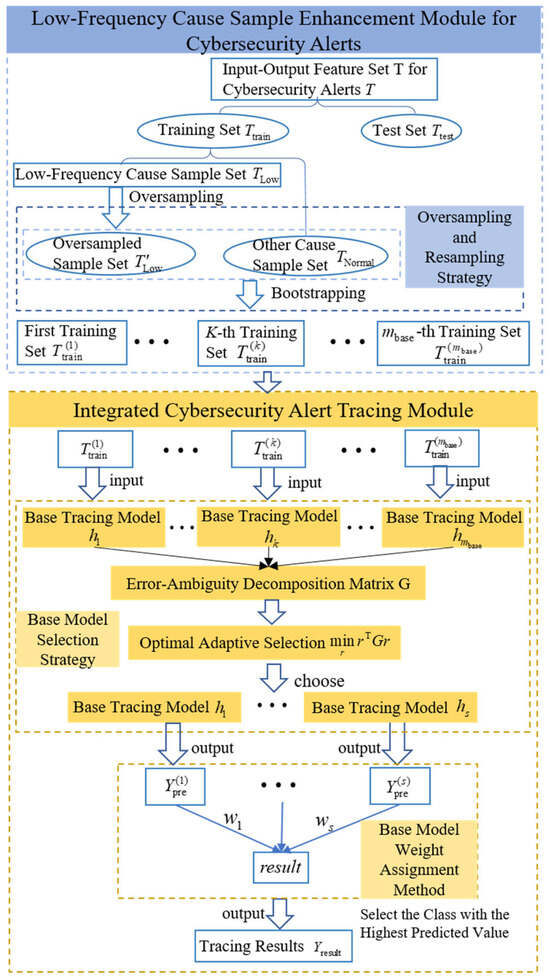
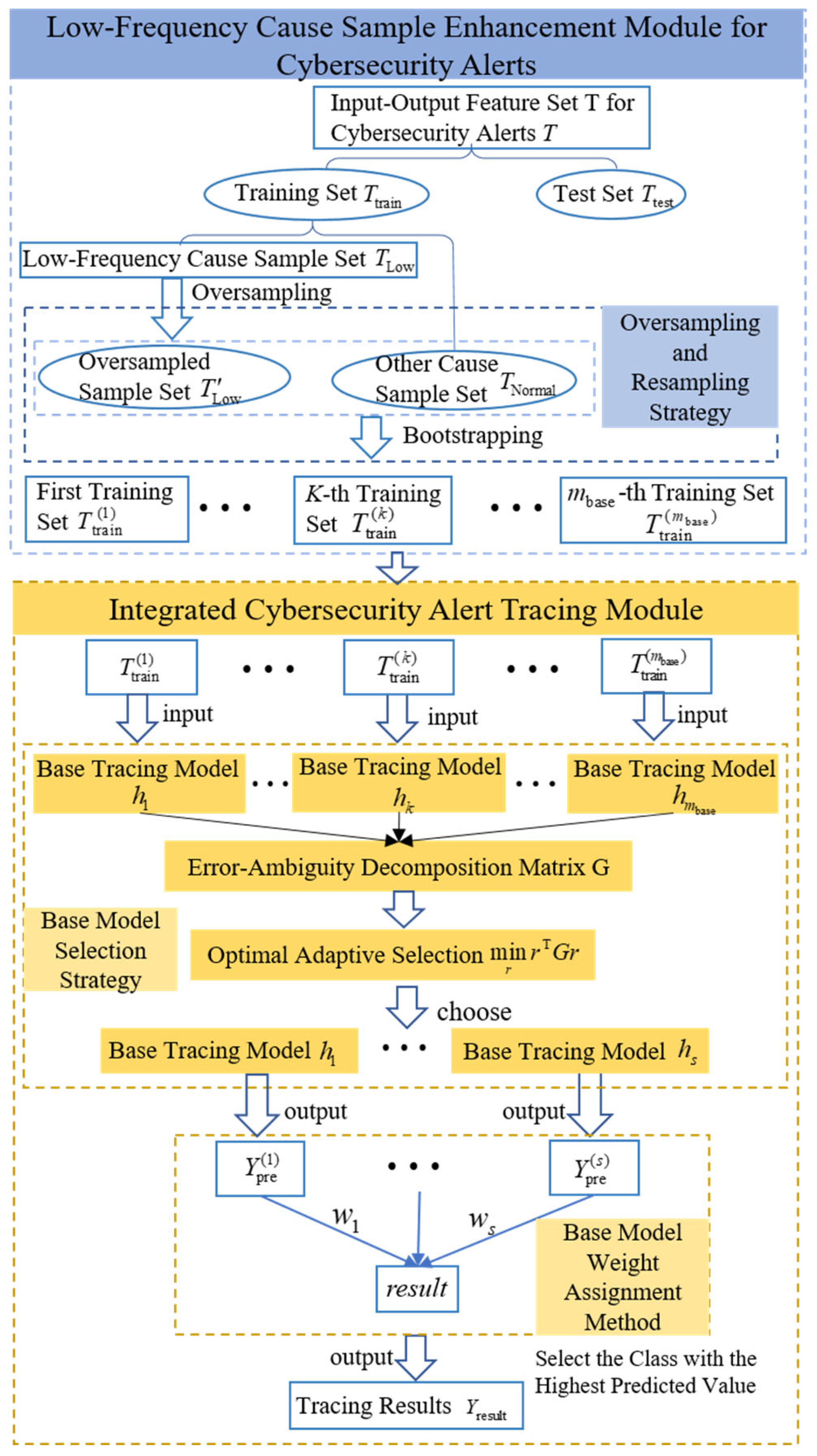
The sample imbalance handling strategy proposed in this subsection consists of two modules: enhancement of low-proportion cause samples for PowerCyberSec alerts and integrated tracing of PowerCyberSec alerts. The framework is illustrated in Figure 4.
Figure 4.
Strategy Framework for Dealing with Unbalanced Problems.
The PowerCyberSec low-ratio cause sample augmentation module enhances the proportion of low-ratio alert causes in the dataset by constructing oversampling and bootstrapping strategies. First, the PowerCyberSec alert text dataset is transformed into an input-output feature set T. Therefore, T is divided proportionally into a training set and a test set . The samples corresponding to low-ratio alert causes in are then oversampled to generate an oversampled dataset . Next, the bootstrapping algorithm is applied to and other cause datasets for sampling with replacement, generating subsets needed for training base models, where .
The PowerCyberSec alert integrated traceability module enhances the overall model’s accuracy in tracing low-ratio alert causes by employing a base model selection strategy based on error-diversity decomposition theory and a method for calculating base model weights that considers the traceability of low-ratio samples. First, the PowerCyberSec alert feature extraction and traceability module is used as the base learner, combined with bagging ensemble learning to obtain PowerCyberSec traceability base models , where [24]. For PowerCyberSec alert samples, , , are the traceability results obtained from the k-th PowerCyberSec alert traceability base model , i.e., . Next, a base model selection strategy based on error-diversity decomposition theory is proposed to adaptively select s-base models with high accuracy and diversity from the base models, as shown in Equations (11) and (12). An optimal adaptive selection model is established to optimally and adaptively select s-base models.
; .
Furthermore, a method for calculating the weights of base models is proposed, considering the traceability capability for low-ratio causes. This method assigns higher weights to base models with stronger traceability capabilities for low-ratio causes. As shown in Equation (13), the traceability accuracy of s-base models for types of low-ratio causes are calculated, resulting in an s-dimensional base model weight vector .
represents the weight of the k-th base model; represents the prediction accuracy of the k-th base model for the l-th type of low-ratio alert cause; ; .
Finally, the weighted voting method is used to generate an -dimensional prediction vector for the types of PowerCyberSec alert causes, as shown in Equation (14). According to Equation (15), the alert result is determined by selecting the category with the highest value in the prediction vector.
is the alert traceability vector output by the k-th base model; is the predicted value for the l-th type of alert cause.
In summary, the strategy proposed in this subsection for handling the imbalance in PowerCyberSec alert traceability samples, based on the error-disagreement decomposition theory, can improve the accuracy of tracing low-proportion alert causes.
2.3.2. A Power Monitor System Cybersecurity Alarm-Tracing Method Based on Knowledge Graph and GCNN
Based on the cybersecurity domain-informed knowledge graph, the cybersecurity alarm-tracing GCNN, and the model ensemble strategy, we can develop a power monitor system cybersecurity alarm-tracing method based on KG and GCNN. The specific steps are as follows:
Step 1: Construct PowerCyberSec Alert KG and vector library. Firstly, the PowerCyberSec alert sentences are split into word forms through knowledge extraction. Next, convert the word-form PowerCyberSec alert information into PowerCyberSec alert text triples and construct the KG. Finally, based on the PowerCyberSec alert text triples and KG, the TransH technology was used to vectorize the text information, achieving the solidification of the PowerCyberSec alert information.
Step 2: Construct PowerCyberSec alert traceability training subsets and test set . First, construct the matrix A and X according to Equations (1) and (2). Using the vectorized encoding method proposed to generate the alert label vectors, forming the input-output feature set T for PowerCyberSec alerts. Then, dividing the data into a PowerCyberSec alert traceability test set according to a certain proportion. Using the oversampling strategy to augment the low-proportion cause samples from the remaining data in T. Employ the bootstrapping algorithm to randomly sample and generate the training subsets for the PowerCyberSec alert traceability model, where .
Step 3: Construct and train the base models for PowerCyberSec alert traceability based on GAT. First, construct base models for PowerCyberSec alert traceability. Each base model includes a feature extraction module based on layers of graph attention layers and a traceability module based on global pooling layers and layers of fully connected networks. Next, input and from the training subsets into the corresponding base traceability models to obtain the alert traceability vector subsets . Finally, using the binary cross-entropy loss function, calculate the loss between the alert label vectors and the alert traceability vectors . Train the models using stochastic gradient descent optimization to obtain the weights W, biases b, and attention parameters a for each network structure, thereby completing the training of the base models .
Step 4: Build a power monitor system cybersecurity alarm-tracing method based on KG and GCNN. First, construct the base model selection strategy proposed to select s-base models from the traceability base models based on their higher accuracy and diversity. Next, using the base model weight calculation method that considers the traceability capability for low-proportion samples, compute the output weight vector for the s-base models according to Equation (13). Finally, obtain the alert results of the integrated model using Equations (14) and (15), thereby completing the construction of the integrated intelligent tracing model for PowerCyberSec alerts.
3. Results and Discussion
In this section, based on 70,107 pieces of data provided by a certain actual power company, through comparisons of seven methods in terms of traceability accuracy and traceability efficiency, it was found that the method proposed in this paper has an accuracy improvement of more than 20% compared to traditional methods, and a traceability efficiency improvement of more than 80% compared to manual methods. This proves that the proposed method in this paper has relatively high accuracy and traceability efficiency.
3.1. Case Settings
To validate the proposed method’s effectiveness and accuracy, a case study analysis was conducted using 70,107 alert messages provided by an actual power company. Table 2 shows the relevant parameters used in the intelligent tracing method.
Table 2.
Model Parameters.
In this section, the PowerCyberSec alert traceability sample dataset is used to train and test the effectiveness of the proposed intelligent traceability method. Validation methods M0-M6 are set up, and a comparison table of the precision of seven traceability methods is obtained, as shown in Table 3. By comparing the accuracy of various methods in tracing different types of alert causes and their ROC effect plots, it is verified that the proposed intelligent traceability method M0 can achieve precise and intelligent traceability for various types of alert causes.
Table 3.
Influence of Knowledge Graph and Knowledge Representation Techniques on Traceability Accuracy.
M0: The intelligent alert traceability method proposed in this paper is based on KG and graph attention networks, and it addresses the issue of sample imbalance.
M1: Traceability Method Based on KG and Graph Attention Networks;
M2: Traceability Method Based on KG and Graph Convolutional Networks;
M3: The Traceability Method Based on Tf-idf Text Vectorization and SVM Proposed in ref. [7];
M4: An Improved Traceability Method Based on KG and SVM, Considering Sample Imbalance, Derived from ref. [7]’s Approach;
M5: The Traceability Method Based on Tf-idf Text Vectorization and Convolutional Neural Networks Proposed in ref. [14];
M6: An Improved Traceability Method Based on KG and CNN, Derived from ref. [14]’s Approach.
The PowerCyberSec alert tracing dataset consists of 70,107 alert messages in sentence form, each containing details such as the alert time, alert level, alert type, alert description, alert site, source site, destination site, alert device, and alert cause. The alert causes are categorized into “Routine Device Operation” (R1) with 737 entries, “Zone 4 and Zone 5 Alerts” (R2) with 32 entries, “User Attempted Access (R3)” with 632 entries, “Excessive Service” (R4) with 66,347 entries, and “Other” (R5) with 2359 entries.
3.2. Validation of the Effectiveness of the PowerCyberSec Knowledge Graph
First, using the PowerCyberSec alert information segmentation technique based on the Jieba word segmentation library, sentences in the PowerCyberSec alert traceability sample set are split into word forms. Next, based on semantic matching technology, alert entities are extracted and text triples are generated. From 70,107 word-form PowerCyberSec alert messages, 12,914 alert entities were extracted, combined with “possesses” and “belongs to” relationships to generate 23,930 text triples. Further, a KG is constructed based on PowerCyberSec alert text triples and the Neo4j database. Nodes and connections are created in the Neo4j graph database to build a PowerCyberSec alert KG with 12,914 nodes. Finally, using the spatial knowledge embedding model, a 50-dimensional feature vector is generated for each alert entity. According to Equations (1) and (2), 70,107 adjacency matrices A and feature matrices X are constructed, and according to the vectorization method, 70,107 alert label vectors are obtained.
To verify that the proposed PowerCyberSec alert KG and knowledge representation techniques can achieve precise storage and characterization, this section compares models M0, M5, and M6, with the results shown in Table 2. Among these, M5 and M6 use CNN for traceability, with the main difference being the feature representation of alert information using either TF-idf text vectorization or the proposed KG construction and spatial knowledge embedding model. As shown in Table 2, when using TF-IDF text vectorization to construct input features for a convolutional neural network, it completely misjudges alerts related to routine equipment operations. In contrast, M6, which uses KG construction for input features, can compensate for this deficiency. Even under highly imbalanced data conditions, M6 can maintain traceability for low-sample alerts. Meanwhile, M0, which employs GAT for traceability and strategies for handling imbalanced samples, achieves the highest traceability accuracy. These results validate the effectiveness of the proposed KG construction and spatial knowledge embedding model for accurate storage and representation of alert information.
3.3. Validation of the Effectiveness of the Traceability Baseline Model
In this section, the PowerCyberSec alert data is processed using PowerCyberSec KG and knowledge representation techniques to obtain accurate input features for characterizing PowerCyberSec alert data. Subsequently, methods M0-M2 and M6 are compared, as shown in Table 3 and Table 4. By comparing the baseline models M1, M2, and M6, it is evident that replacing the CNN proposed in Literature [24] with GCNN significantly improves the overall accuracy of PowerCyberSec alert traceability. Furthermore, introducing an attention mechanism into the Graph Convolutional Network enhances the traceability accuracy for various low-frequency alert causes and the overall accuracy. This demonstrates the effectiveness of the proposed method based on GAT for precise traceability of PowerCyberSec alerts.
Table 4.
The Purpose of the Comparison Method Setting.
3.4. Validation of the Effectiveness of Sample Imbalance Handling Strategies
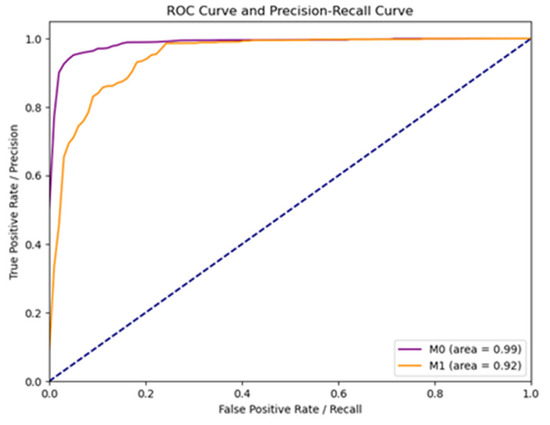
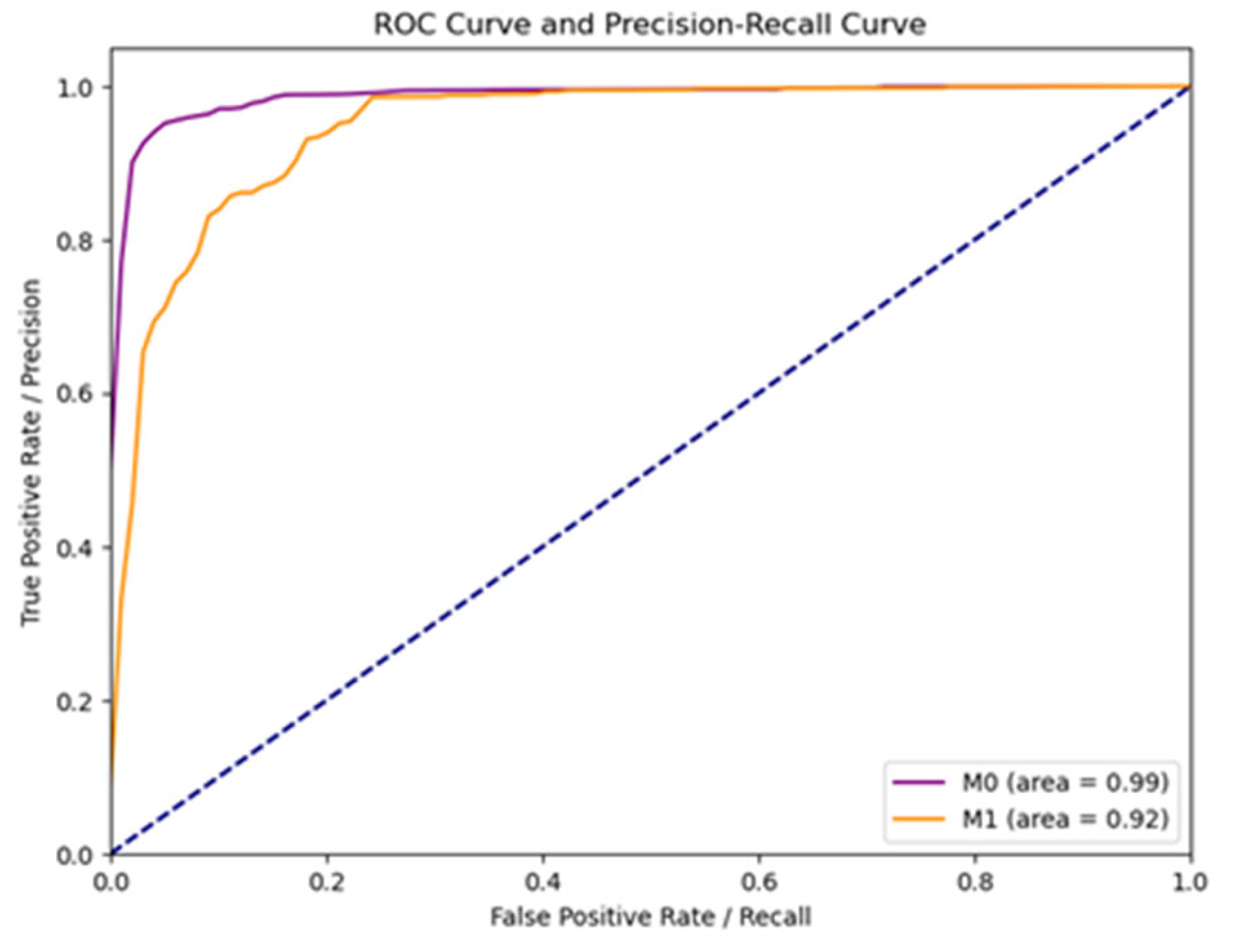
This section compares methods M0, M1, and M4 to validate the effectiveness of the proposed PowerCyberSec alert traceability method. As shown in Table 3, the accuracy of M1 for tracing low-frequency alert causes is below 90%, while M0 shows a significant improvement in accuracy for each type of low-frequency alert cause compared to M1, achieving an overall traceability accuracy of 96.59%. The performance metrics of M0 and M1 are converted into ROC curves, as depicted in Figure 5. The area under the curve (AUC) for method M0 is 0.99, indicating that the classifier represented by M0 is nearly perfect. This demonstrates that the proposed intelligent traceability method for PowerCyberSec alerts, which addresses sample imbalance issues, significantly enhances the accuracy of alert traceability compared to methods that do not consider sample balance. Additionally, comparing the proposed method M0 with the method M4 from Literature [17], M0 outperforms M4 in both overall traceability accuracy and accuracy for low-frequency causes. This confirms that the proposed method is more accurate than existing methods in the field of PowerCyberSec traceability.
Figure 5.
Influence of Sample Unbalanced Treatment Strategies on ROC Results.
3.5. Validation of the Traceability Efficiency of the Intelligent Traceability Model
To validate that the proposed intelligent traceability model can achieve rapid traceability when dealing with massive amounts of alert information, this section compares the traceability times of M0 under different test set sizes. As shown in Table 5, for 15,760 alert messages, M0 can complete the traceability process within 187 s, significantly enhancing the efficiency of cybersecurity alert traceability in power monitoring systems.
Table 5.
M0 Traceability Efficiency Under Different Test Set Sizes.
In summary, this paper constructs a power monitor system cybersecurity alarm-tracing method based on KG and GCNN to accurately store and characterize PowerCyberSec alert information, providing input features for intelligent traceability of PowerCyberSec alerts. Then, it proposes a foundational model for intelligent alert traceability based on GCNN, facilitating the accurate mining of alert data features. Finally, it utilizes error-disagreement decomposition theory to address the issue of sample imbalance in PowerCyberSec alerts. Through comparative validation on 70,107 alert messages, the proposed method demonstrates significant advantages in the precise traceability of PowerCyberSec alerts.
4. Conclusions
To address the issues of intelligence, precision, and sample imbalance in the current cybersecurity tracing process of power monitoring systems, this paper proposes a power monitor system cybersecurity alarm-tracing method based on KG and GCNN. There are three main contributions in the paper. First, KG, based on a massive PowerCyberSec alert, is constructed. It takes the IP, devices, etc., as nodes and constructs a KG with 12,000 nodes to accurately represent massive alarm information. Additionally, it provides accurate input data for subsequent traceability. Second, a precise tracing method for PowerCyberSec alerts using GCNN and attention mechanisms is applied to sufficiently extract the topological features along alarms in KG so that it can precisely and effectively trace the massive alarms. It constructs an input-output feature module integrating PowerCyberSec KG to extract adjacency and feature matrices. By analyzing the relationship between nodes and relationships, alarms can be accurately traced. Third, the error-ambiguity decomposition strategy for PowerCyberSec alert sample imbalance is proposed. It introduces a low-frequency sample enhancement module using oversampling and an ensemble tracing module that optimally selects learners based on error-diversity matrices. Combined with KG techniques, this method enhances tracing accuracy for infrequent alerts.
However, several limitations should be acknowledged. First, the scalability of the current model may be constrained when applied to large-scale power grids with millions of nodes, due to the computational complexity of graph-based learning. Second, the performance of the model heavily depends on the quality and completeness of the KG, including the correctness of entity relations and the coverage of historical alarm data. Third, while the attention mechanism provides some interpretability by highlighting important neighbors during aggregation, the overall model interpretability remains limited, particularly compared to rule-based or symbolic reasoning approaches.
Looking ahead, future work can explore several promising directions. These include integrating temporal information into the KG to support dynamic alarm tracing, incorporating additional modalities such as log data and network traffic for richer contextual analysis, and investigating lightweight GCNN architectures for real-time deployment in large-scale power monitoring environments. Furthermore, the application of reinforcement learning or active learning could be explored to continuously improve the system’s adaptability and reduce dependency on labeled data.
Author Contributions
Conceptualization, J.Y., M.G. and Z.Y.; methodology, T.M.; software, T.M. and M.G.; validation, B.W., J.Y. and T.M.; formal analysis, T.M. and M.G.; investigation, B.W.; resources, Y.L. and M.F.; data curation, T.M.; writing—original draft preparation, T.M.; writing—review and editing, J.Y. and Z.Y.; visualization, T.M.; supervision, J.Y. and Z.Y.; project administration, J.Y. and Z.Y.; funding acquisition, Y.L. and M.F. All authors have read and agreed to the published version of the manuscript.
Funding
This research is supported by the Autonomous Region Key Research and Development Plan Project (2023B01007-2).
Institutional Review Board Statement
Not applicable.
Informed Consent Statement
Not applicable.
Data Availability Statement
The datasets presented in this article are not readily available because these data form part of an ongoing research project. Requests to access the datasets should be directed to T.M.
Conflicts of Interest
Authors Yajie Li and Mao Fan were employed by the company The State Grid Xinjiang Electric Power Co., Ltd. The remaining authors declare that the research was conducted in the absence of any commercial or financial relationships that could be construed as a potential conflict of interest.
References
- Sarjan, H.; Ameli, A.; Ghafouri, M. Cyber-Security of Industrial Internet of Things in Electric Power Systems. IEEE Access 2022, 10, 92390–92409. [Google Scholar] [CrossRef] [Scilit]
- Asit Kumar Majhi, A.; Mohanty, S. A Comprehensive Review on Internet of Things Applications in Power Systems. IEEE Internet Things J. 2024, 11, 34896–34923. [Google Scholar] [CrossRef] [Scilit]
- Borghesi, A.; Burrello, A.; Bartolini, A. ExaMon-X: A Predictive Maintenance Framework for Automatic Monitoring in Industrial IoT Systems. IEEE Internet Things J. 2023, 10, 2995–3005. [Google Scholar] [CrossRef] [Scilit]
- Chen, X.; Qu, G.; Tang, Y.; Low, S.; Li, N. Reinforcement Learning for Selective Key Applications in Power Systems: Recent Advances and Future Challenges. IEEE Trans. Smart Grid 2022, 13, 2935–2958. [Google Scholar] [CrossRef] [Scilit]
- Maghami, M.R.; Mutambara, A.G.O.; Gomes, C. Assessing Cyber Attack Vulnerabilities of Distributed Generation in Grid-Connected Systems; Environment, Development and Sustainability; Springer: Berlin/Heidelberg, Germany, 2025. [Google Scholar]
- Ahmad, T.; Madonski, R.; Zhang, D.; Huang, C.; Mujeeb, A. Data-Driven Probabilistic Machine Learning in Sustainable Smart Energy/Smart Energy Systems: Key Developments, Challenges, and Future Research Opportunities in the Context of Smart Grid Paradigm. Renew. Sust. Energy Rev. 2022, 160, 112128. [Google Scholar] [CrossRef] [Scilit]
- Xiong, X.; Hu, S.; Sun, D.; Hao, S.; Li, H.; Lin, G. Detection of False Data Injection Attack in Power Information Physical System Based on SVM-GAB Algorithm. Energy Rep. 2022, 8, 1156–1164. [Google Scholar] [CrossRef] [Scilit]
- Khan, A.A.; Laghari, A.A.; Rashid, M.; Li, H.; Javed, A.R.; Gadekallu, T.R. Artificial Intelligence and Blockchain Technology for Secure Smart Grid and Power Distribution Automation: A State-of-the-Art Review. Sustain. Energy Technol. Assess. 2023, 57, 103282. [Google Scholar]
- Chang, M.; Chen, K.-H.; Chen, Y.-S.; Hsu, C.-C.; Chu, C.-C. Developments of AI-Assisted Fault Detection and Failure Mode Diagnosis for Operation and Maintenance of Photovoltaic Power Stations in Taiwan. IEEE Trans. Ind. Appl. 2024, 60, 5269–5281. [Google Scholar] [CrossRef] [Scilit]
- Zareian Jahromi, M.; Yaghoubi, E.; Yaghoubi, E.; Maghami, M.R.; Chamorro, H. An Innovative Real-Time Recursive Framework for Techno-Economical Self-Healing in Large Power Microgrids Against Cyber–Physical Attacks Using Large Change Sensitivity Analysis. Energies 2025, 18, 190. [Google Scholar] [CrossRef] [Scilit]
- Cao, B.; Yan, Y.; Wang, Y.; Liu, X.; Lin, J.C.-W.; Sangaiah, A.K.; Lv, Z. A Multiobjective Intelligent Decision-Making Method for Multistage Placement of PMU in Power Grid Enterprises. IEEE Trans. Ind. Inform. 2023, 19, 7636–7644. [Google Scholar] [CrossRef] [Scilit]
- Egeland-Eriksen, T.; Hajizadeh, A.; Sartori, S. Hydrogen-Based Systems for Integration of Renewable Energy in Power Systems: Achievements and Perspectives. Int. J. Hydrogen Energy 2021, 46, 31963–31983. [Google Scholar] [CrossRef] [Scilit]
- Shao, J.; Wang, J.; Pan, X.; Wang, R.; Liu, S.; Wang, Z.; Zhao, Y. Fault Diagnosis of Power Transformer Using Data Enhancement–Input Feature Preference Learning Framework. IEEE Trans. Ind. Appl. 2025, 74, 2508412. [Google Scholar] [CrossRef] [Scilit]
- Zhao, M.; Barati, M. A Real-Time Fault Localization in Power Distribution Grid for Wildfire Detection Through Deep Convolutional Neural Networks. IEEE Trans. Ind. Appl. 2021, 57, 4316–4326. [Google Scholar] [CrossRef] [Scilit]
- Zhen, Z.; Li, Z.; Wang, F.; Xu, F.; Li, G.; Zhao, H.; Ma, H.; Zhang, Y.; Ge, X.; Li, J. CNN-LSTM Networks Based Sand and Dust Storms Monitoring Model Using FY-4A Satellite Data. IEEE Trans. Ind. Appl. 2024, 60, 5130–5141. [Google Scholar] [CrossRef] [Scilit]
- Zhu, Y.; Zhu, C.; Tan, J.; Tan, Y.; Rao, L. Anomaly Detection and Condition Monitoring of Wind Turbine Gearbox Based on LSTM-FS and Transfer Learning. Renew. Energy 2022, 189, 90–103. [Google Scholar] [CrossRef] [Scilit]
- Zhou, X.; Liang, W.; Li, W.; Yan, K.; Shimizu, S.; Wang, K.I.-K. Hierarchical Adversarial Attacks Against Graph-Neural-Network-Based IoT Network Intrusion Detection System. IEEE Internet Things J. 2022, 9, 9310–9319. [Google Scholar] [CrossRef] [Scilit]
- Wang, Y.; Zhang, Z.; Ma, J.; Jin, Q. KFRNN: An Effective False Data Injection Attack Detection in Smart Grid Based on Kalman Filter and Recurrent Neural Network. IEEE Internet Things J. 2022, 9, 6893–6904. [Google Scholar] [CrossRef] [Scilit]
- Choi, S.; Jung, Y. Knowledge Graph Construction: Extraction, Learning, and Evaluation. Appl. Sci. 2025, 15, 3727. [Google Scholar] [CrossRef] [Scilit]
- Qiu, S.; Shao, Z.; Wang, J.; Xu, S.; Fei, J. Research on Power Cyber-Physical Cross-Domain Attack Paths Based on Graph Knowledge. Appl. Sci. 2024, 14, 6189. [Google Scholar] [CrossRef] [Scilit]
- Zhu, T.; Liu, X.; Zhu, E. Oversampling With Reliably Expanding Minority Class Regions for Imbalanced Data Learning. IEEE Trans. Knowl. Data Eng. 2023, 35, 6167–6181. [Google Scholar] [CrossRef] [Scilit]
- Wang, Z.; Zheng, M.; Liu, P.X. A Novel Classification Method Based on Stacking Ensemble for Imbalanced Problems. IEEE Trans. Instrum. Meas. 2023, 72, 2515913. [Google Scholar] [CrossRef] [Scilit]
- Song, D.; Zhang, F.; Lu, M.; Yang, S.; Huang, H. DTransE: Distributed Translating Embedding for Knowledge Graph. IEEE Trans. Parallel Distrib. Syst. 2021, 32, 2509–2523. [Google Scholar] [CrossRef] [Scilit]
- Pamir; Javaid, N.; Akbar, M.; Aldegheishem, A.; Alrajeh, N.; Mohammed, E.A. Employing a Machine Learning Boosting Classifiers Based Stacking Ensemble Model for Detecting Non-Technical Losses in Smart Grids. IEEE Access 2022, 10, 121886–121899. [Google Scholar] [CrossRef] [Scilit]

Disclaimer/Publisher’s Note: The statements, opinions and data contained in all publications are solely those of the individual author(s) and contributor(s) and not of MDPI and/or the editor(s). MDPI and/or the editor(s) disclaim responsibility for any injury to people or property resulting from any ideas, methods, instructions or products referred to in the content. |
© 2025 by the authors. Licensee MDPI, Basel, Switzerland. This article is an open access article distributed under the terms and conditions of the Creative Commons Attribution (CC BY) license (https://creativecommons.org/licenses/by/4.0/).