


Abstract
This research focuses on route optimization for autonomous ground vehicles, with key applications in precision agriculture, logistics and surveillance. Its goal is to create planning techniques that increase productivity and flexibility in changing settings. To achieve this, a PRISMA-based systematic literature review was carried out, encompassing works published during the last five years in databases like IEEE Xplore, ScienceDirect and Scopus. The search focused on topics related to route optimization, unmanned ground vehicles and heuristic algorithms. From the analysis of 56 selected articles, trends, technologies and challenges in real-time route planning were identified. Fifty-seven percent of the recent studies focus on UGV optimization, with prominent applications in agriculture, aiming to maximize efficiency and reduce costs. Heuristic algorithms, such as Humpback Whale Optimization, Firefly Search and Particle Swarm Optimization, are commonly employed to solve complex search problems. The findings underscore the need for more flexible planning techniques that integrate spatiotemporal and curvature constraints, allowing systems to respond effectively to unforeseen changes. By increasing their effectiveness and adaptability in practical situations, our research helps to provide more reliable autonomous navigation solutions for crucial applications.
1. Introduction
The escalating demand for intelligent systems across various sectors necessitates robust and adaptable embedded platforms. According to a recent report by the World Economic Forum, the global expenditure on digital transformation is projected to reach USD 6.8 trillion between 2023 and 2026, highlighting the critical role of advanced computing solutions at the edge [1]. These platforms are essential for facilitating automation, real-time data processing and decision-making in a variety of applications, from smart agriculture to driverless cars. The deployment of efficient and powerful embedded systems is pivotal for realizing the potential of Industry 4.0 and ensuring sustainable technological advancements [2]. As the complexity of these systems increases, so does the need for versatile hardware capable of handling diverse computational tasks [3].
Currently, the landscape of embedded systems is dominated by a range of platforms, each offering a unique set of capabilities tailored to specific applications. These platforms, such as Raspberry Pi, Jetson Nano and Arduino Portenta, find utility in sectors ranging from industrial automation to environmental monitoring. In healthcare, they enable real-time patient monitoring and diagnostics, improving the efficiency of clinical workflows [4]. In agriculture, they facilitate precision farming through automated irrigation and crop management, enhancing resource utilization and yield [5]. Their affordability and ease of integration have made them indispensable tools for innovation. Moreover, embedded systems contribute significantly to achieving the Sustainable Development Goals (SDGs), particularly in areas such as affordable and clean energy (SDG 7) and industry, innovation and infrastructure (SDG 9) [6]; their role in data-driven decision-making is vital for sustainable development [7]. While there are multiple applications for these platforms, in this paper, we will focus exclusively on their use and relevance for unmanned ground vehicles (UGVs).
Recent studies have explored the performance and applicability of various embedded platforms in different contexts. For instance, research by [8] focuses on Raspberry Pi’s versatility in IoT applications, while [9] highlights Jetson Nano’s capabilities in AI-driven robotics. Ref. [10] investigates Arduino Portenta’s efficiency in low-power industrial sensing. These studies collectively demonstrate the potential of each platform for specialized tasks [11]. Despite these advancements, a comprehensive comparison of these platforms’ hardware capabilities and performance benchmarks across diverse tasks is still needed [12]. The prior research often focuses on specific use cases, neglecting a holistic analysis of their potential across broader applications. This limitation underscores the need for a comparative study that elucidates the strengths and weaknesses of each platform in a standardized manner, particularly given the evolving demands of edge computing [13].
This paper addresses the existing gap by providing a detailed comparative analysis of path planning optimization based on their hardware specifications. Our research aims to evaluate the suitability of each platform for different application scenarios, providing valuable insights for developers and researchers in selecting the optimal solution for their specific needs. By benchmarking these platforms across a range of tasks, including processing power and memory capacity, we aim to offer a comprehensive overview of their capabilities. The objective is to identify the strengths and limitations of path planning optimization, enabling informed decision-making and fostering innovation in embedded system design.
The novelty of our study lies in its systematic approach to comparing and standardizing benchmarks in real-world application scenarios. The primary contributions of this research include (1) a detailed hardware comparison highlighting the key differences in processing power and memory; (2) performance benchmarks across a range of tasks, including image processing, machine learning and IoT applications; and (3) a comprehensive analysis of the future trends of path planning optimization in different application domains. In Section 2, the methodology used for benchmarking and comparison is presented; Section 3 presents the results and analysis of the performance evaluation, while Section 4 concludes the paper and discusses future research directions.
2. Research Methodology
With an emphasis on the current status of path planning in agriculture, a systematic literature review (SLR) was carried out to thoroughly arrange the body of knowledge and find studies pertinent to the subject of interest [14]. Articles with the terms “path planning optimization” and “agriculture” in the title, abstract or keywords were explicitly targeted by the search strategy. To guarantee transparency, rigor and thoroughness throughout the study process, a comprehensive review protocol was created before the SLR [15]. Developing study questions, establishing the search technique and establishing inclusion and exclusion criteria were the three primary components of this process. The PRISMA standards, the recommended guidelines for reporting systematic reviews and meta-analyses, were followed for conducting the SLR.
2.1. Review Protocol
Before starting a bibliographic analysis, a structured review protocol was created to methodically uncover, assess and interpret pertinent findings pertaining to the study subject (see Table 1). In order to investigate the subject from several angles, the procedure started with the creation of focused research questions. In order to create efficient search strings and conduct thorough searches throughout the four main databases—Scopus, ScienceDirect, IEEE Xplore, Springer and Google Scholar—suitable keywords were then chosen. As a first filter for the metadata sources, inclusion and exclusion criteria were established to guarantee the caliber and applicability of the findings. These standards improved the overall efficacy of the literature search and helped to narrow the research’s focus. Additionally, it should be made clear that the inclusion and exclusion criteria were only applied to research that specifically examined UGVs. To keep the scope of the analysis limited to autonomous UGVs, any reference to embedded systems or mobile robotics in this assessment only relates to their use in UGVs.
Table 1.
Examination of the SLR protocol.
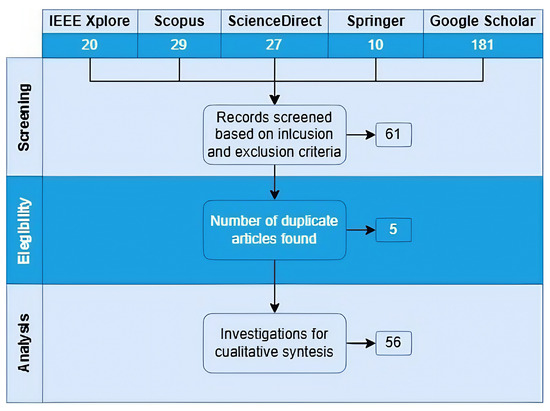
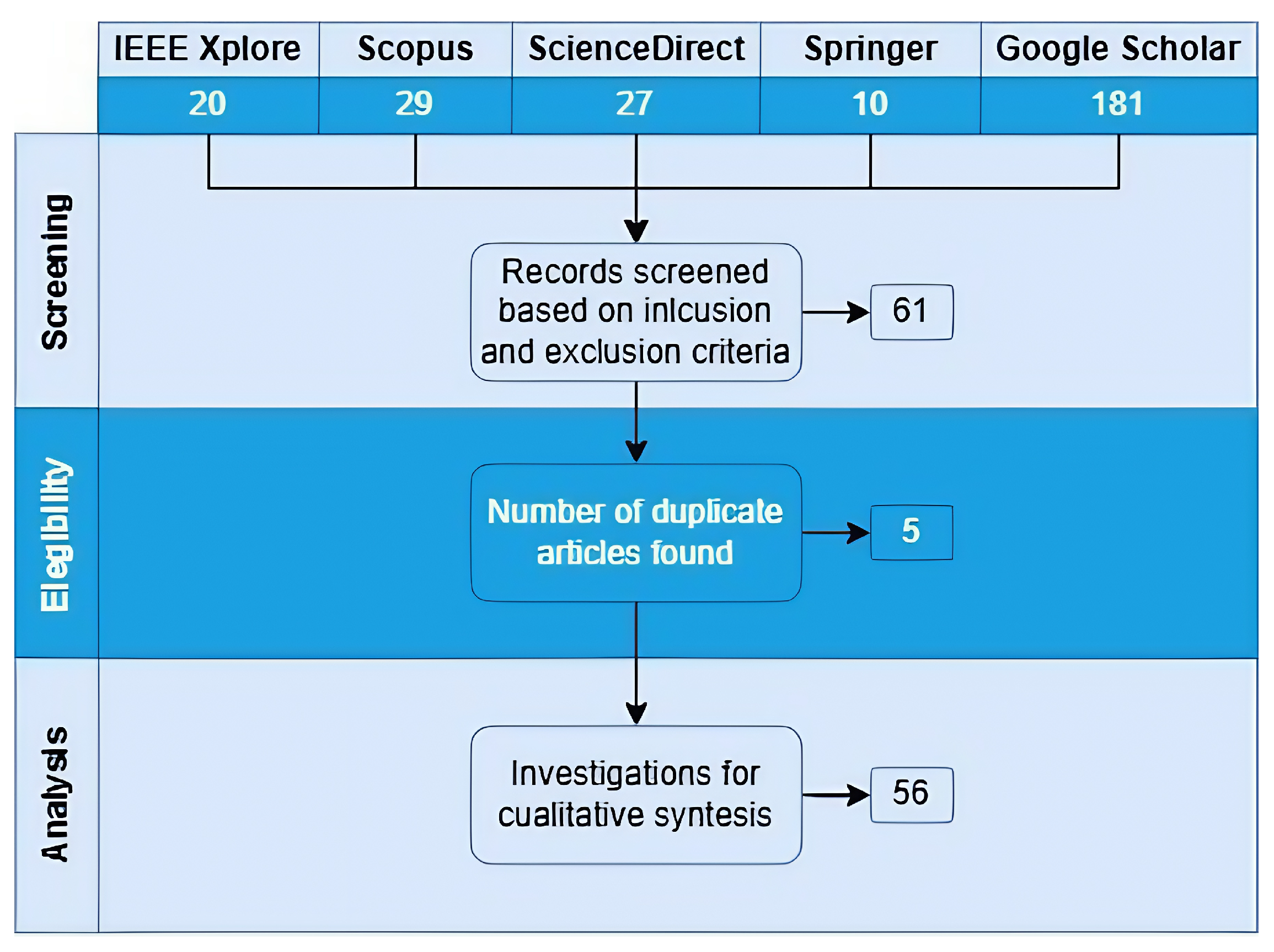
Following a systematic review of the literature (SLR), an initial pool of 61 research articles addressing the proposed topic were identified. Subsequently, rigorous selection and eligibility assessments were performed, following the PRISMA guidelines. Mendeley, a bibliographic reference manager, was used to streamline this process and identify duplicate entries. After the removal of redundant publications, a final set of 56 research articles was retained for further analysis. These selected articles formed the basis for the subsequent stages of this research (see Figure 1).
Figure 1.
Evaluation of the literature search procedure in three steps (PRISMA). Source: authors, 2025.
The thematic distribution analysis of the studies reviewed reveals a predominance of the agricultural sector with 32 studies (57%), followed by logistics with 18 studies (32%) and surveillance with six studies (11%). This agricultural predominance is explained by the urgent need to optimize routes in sowing/harvesting operations, where algorithms such as the WOA and GA reduce ground coverage time by up to 40%. In logistics, the PSO and ACO approaches stand out for improving throughput in automated warehouses, although they present scalability limitations for networks of more than 1000 nodes. The few works in surveillance (11%) employ hybrid RRT*-DRL techniques that achieve re-planning rates of 92% in dynamic environments, but they require further validation in real scenarios. This distribution reflects the current sectoral priorities, where precision agriculture leads technology adoption, while surveillance emerges as a critical area with outstanding methodological challenges.
2.2. Trends in Path Planning Optimization
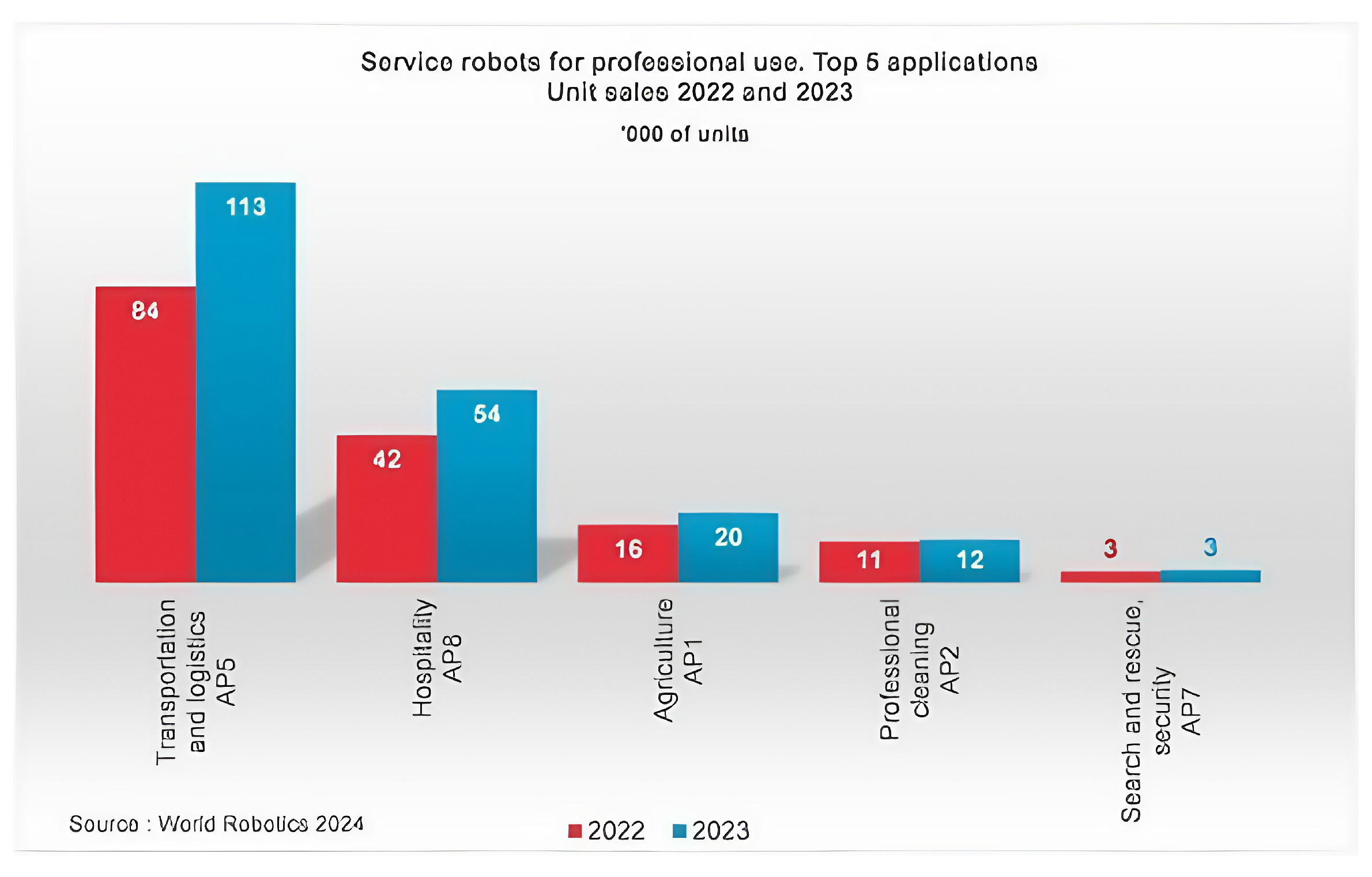
The recent studies show a focus on UGV optimization in path planning, evidenced by approximately 57% of the scientific papers published in 2023 and 2024 addressing this topic. The International Federation of Robotics (IFR) identifies the top applications for professional service robots as transportation and logistics, hospitality, agriculture, professional cleaning and search and rescue applications [16]. Figure 2 shows that unit sales data from 2022 and 2023 reveal that transportation and logistics lead the market, with sales increasing from 84,000 units to 113,000 units. Hospitality and agriculture also showed growth, while professional cleaning and search and rescue applications remained relatively stable between the two years. This data underscores the increasing adoption of service robots across various sectors.
Figure 2.
Top 5 applications of service robots. Source: retrieved from [16].
3. Background and Related Works
Unmanned vehicles, including surface vehicles (USVs), aerial vehicles (UAVs) and ground vehicles (UGVs), have advanced and are being used at an exponential rate. The main areas that have experienced this growth are industrial automation, agriculture, surveillance, disaster relief and environmental monitoring. According to [17], these vehicles’ autonomy facilitates route planning and execution without requiring human involvement. Energy capacity is crucial for efficient route organization, especially in complex contexts. Ref. [18] considers route planning as an essential technology for utility vehicle automation.
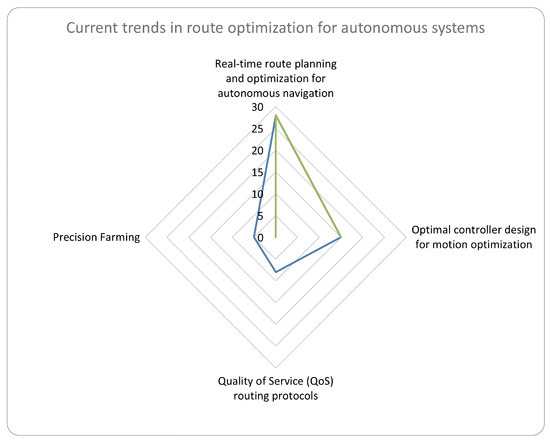
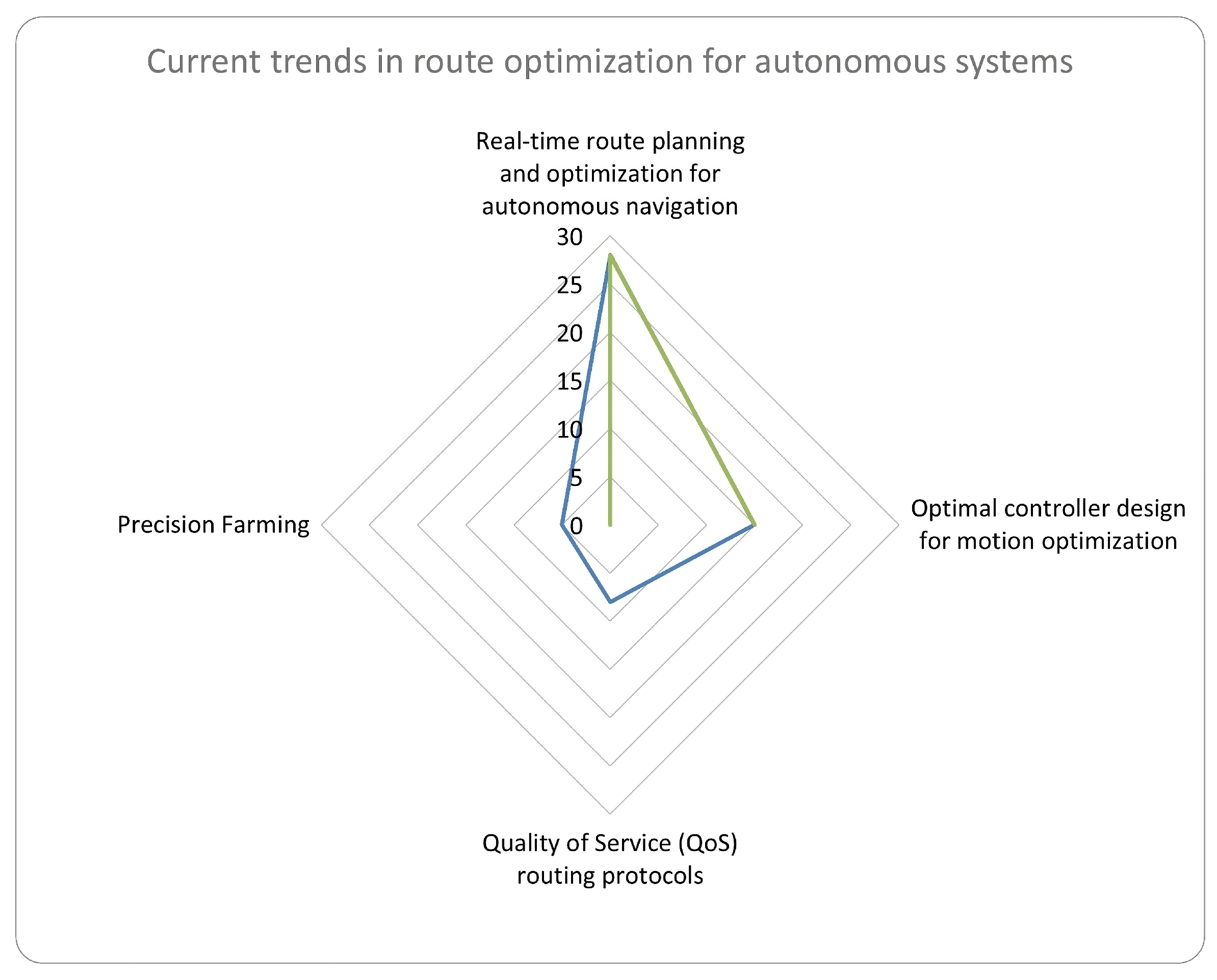
Figure 3 summarizes the main application areas of real-time route planning based on a literature review of 56 articles. In precision agriculture, autonomous systems optimize routes to maximize crop efficiency, reducing costs and input use [19,20]. For autonomous navigation, algorithms such as RRT improve dynamic planning in complex environments [21,22]. Optimal controller design has advanced with techniques such as Model Predictive Control (MPC) to smooth mobile robot trajectories [23]. In telecommunications, QoS protocols prioritize routes in IoT networks using latency and bandwidth metrics [17]. These advances demonstrate the relevance of route optimization in critical applications, although challenges remain in scalability and adaptability [24].
Figure 3.
Current trends in route optimization for autonomous systems. Source: authors, 2025.
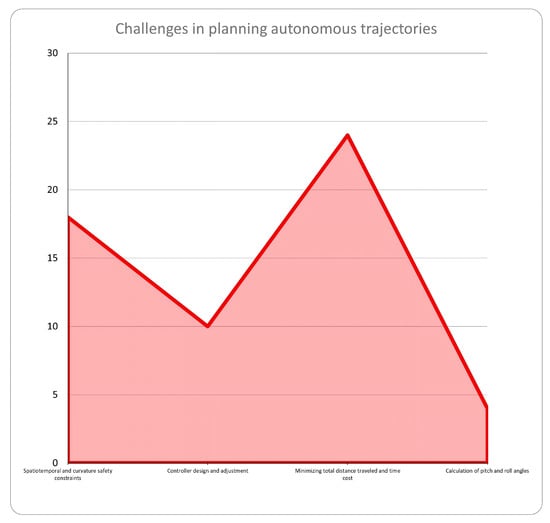
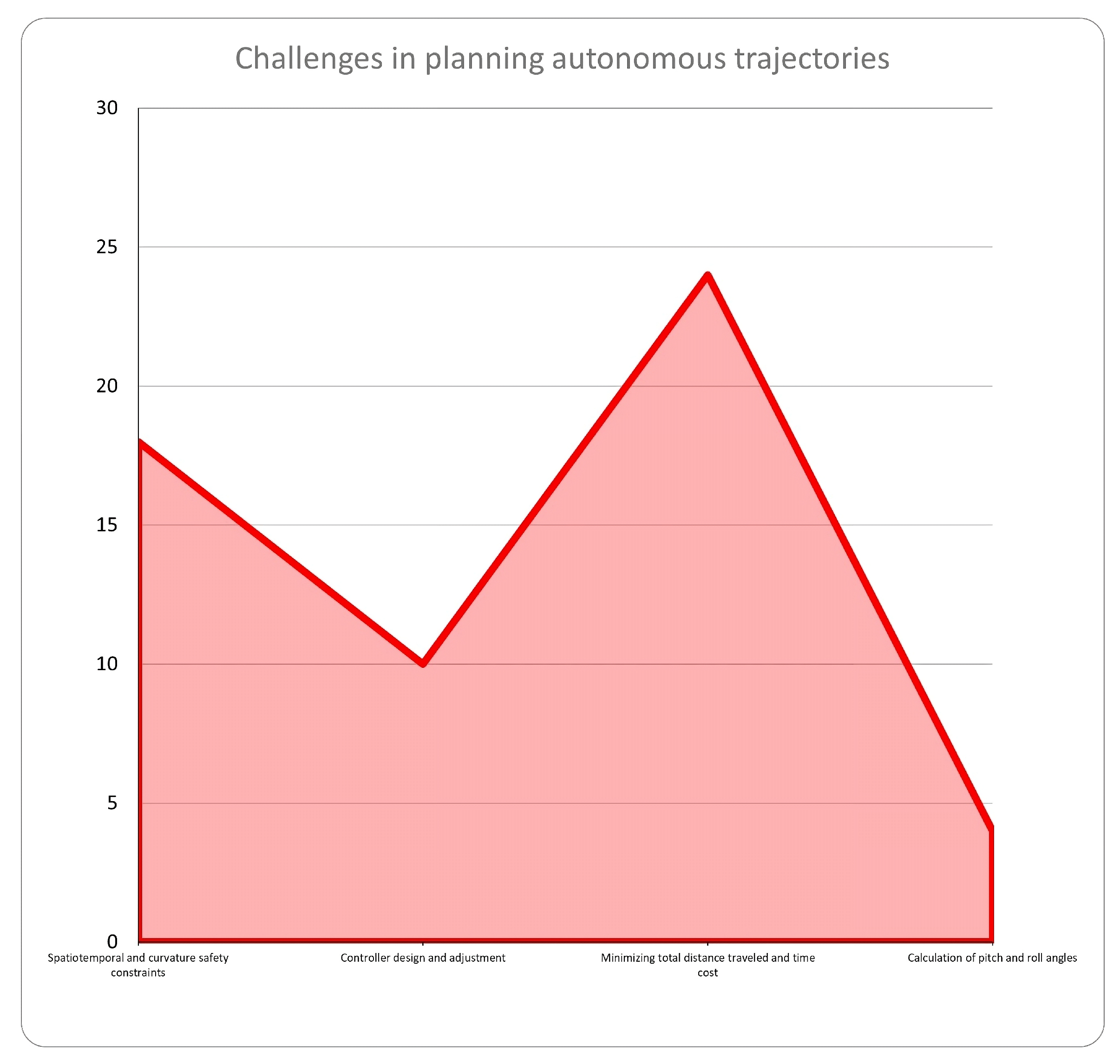
Figure 4 shows the main difficulties identified in the literature review, highlighting that 30% of the studies face critical challenges when integrating spatiotemporal and curvature constraints in dynamic environments, such as urban navigation [25,26]. Twenty-five percent of the papers point out the complexity of controller design and tuning, especially when combining deep reinforcement learning (DRL) techniques with kinematic models [27,28]. Simultaneous minimization of distance and time (20% of the cases) requires hybrid algorithms, such as modified multi-objective-weighted A-weighting, while 15% address stability by calculating pitch/roll angles in non-holonomic vehicles. These issues underscore the need for adaptive frameworks, such as those proposed by [29] for agricultural environments, where safety constraints are a priority. However, scalability gaps persist for large-scale applications.
Figure 4.
Challenges in planning autonomous trajectories. Source: authors, 2025.
Conventional planning methods may not be appropriate due to the challenges these vehicles face, such as inertia and environmental factors. According to Parsons, these procedures generally require human involvement and lack intelligent decision-making. In the field of precision agriculture (PA), their restrictions have promoted the exploration of more efficient options. Among these, genetic and heuristic algorithms (GAs) stand out, based on sampling and evolutionary algorithms, created to optimize routes and enhance operational performance. These strategies make it possible to reduce travel time and increase the efficiency of the assigned tasks [18,19,30].
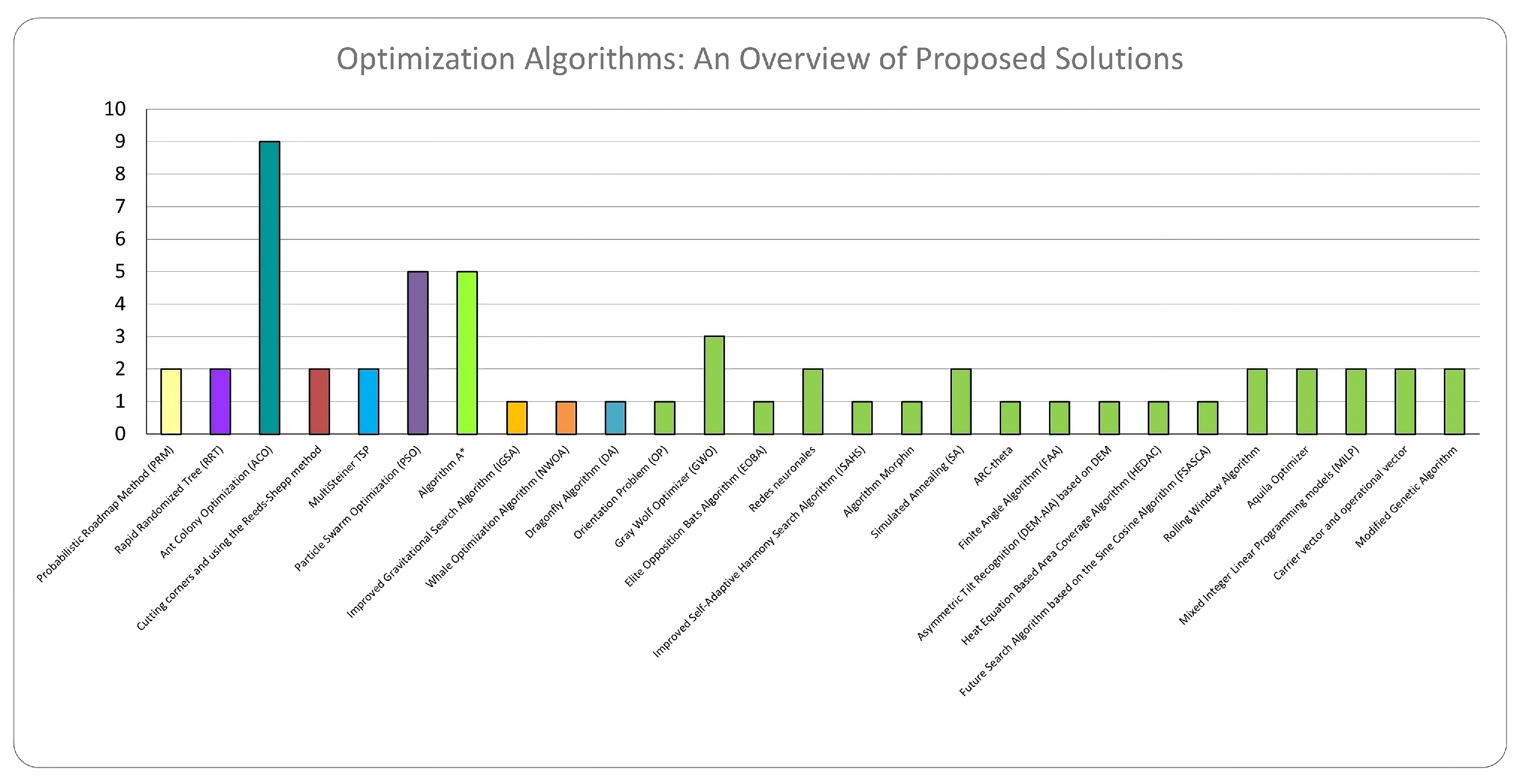
Figure 5 shows a series of optimization algorithms aimed at solving route optimization problems, highlighting the common use of heuristic techniques such as the Humpback Whale Optimization Algorithm (WOA), which has proven its effectiveness in different areas [31]. Furthermore, Refs. [32,33] mention the application of swarm-intelligence-based algorithms like the Firefly Search Algorithm (FA) and Particle Swarm Optimization (PSO), which are still widely used due to their capacity to locate optimal solutions in intricate search spaces. Also, reference is made to evolutionary algorithms, such as the Elite Adaptive Genetic Algorithm, which are relevant for multi-objective optimization problems [34]. Finally, the inclusion of more recent algorithms such as the Aquila Optimizer reflects the continuing evolution in the field of optimization [35].
Figure 5.
Optimization algorithms: an overview of proposed solutions. Source: authors, 2025.
Route Optimization Applications
Route planning aims to establish the most efficient routes for navigation, optimizing them according to factors such as distance or time. Therefore, route optimization is a crucial element in robotic and autonomous systems, particularly in urban contexts and complicated territories, where accessibility ensures that routes are appropriate for cars or robots [36]. However, the conventional methods tend to overlook dynamic constraints, such as moving objects or variations in the environment [37]. This lack of attention can influence performance in real-world situations, where conditions change continuously. For this reason, it is vital to develop more flexible techniques that take these elements into account to enhance navigation efficiency.
Overlooking dynamic elements can result in routing plans that are ideal in theory but inefficient in reality by not adapting to real-time variations [27,38]. Routing organization is essential to increase efficiency in robotics and autonomous navigation. However, a lack of adaptability may jeopardize its usefulness in dynamic contexts. In [39], they mention that including dynamic aspects makes it easier for systems to react more effectively to unforeseen changes in the environment. For this reason, incorporating these elements into planning is essential to ensure robust and effective performance in real-world situations. Table 2 summarizes the diverse range of route optimization applications employed.
Table 2.
Route optimization applications.
The data reveals that cuckoo search reduces time by 89% vs. PSO in route optimization, while HWGO achieves convergence times of 10.7 s vs. 13.2 s of WOA in FOPID tuning. For dynamic environments, ISAHS shows superiority, with 0.82 s vs. 1.15 s of classical HS. The evaluation includes benchmarks such as TSPLIB (pr2392 instance solved in 1216.14 s with ACO + SA) and 400 × 400 cell maps processed in 1.2 s using DEM-AIA. Advanced techniques such as Deep Neural Networks (DNNs) are being employed for planning in unstructured 3D environments, where bio-inspired IDA reduces computational time by 38% versus ACO. For multi-agent systems, hybrid RL-DDPG architectures are described that improve the success rate to 92% in mobile obstacle avoidance.
The design of autonomous systems faces significant challenges due to the connectivity and complexity of the environment, requiring robust perception and adaptive planning. Kinematic and dynamic constraints impose the need for precise control algorithms to avoid jerky or unreachable movements. Adjusting the controller parameters is vital to prevent stalls, especially in unexpected situations [54]. Power capacity restricts operating life and efficient component selection, affecting autonomy [41]. Addressing these limitations is key to developing reliable and efficient autonomous systems.
4. Discussion
The observed prevalence of evolutionary computation techniques (e.g., PSO, ACO and the GA) in robotic trajectory optimization, particularly within dynamic contexts such as autonomous surveillance [55] and precision agriculture [56], underscores a field-wide preference for algorithms capable of adapting to environmental complexities. While this aligns with the broader trend identified in our analysis, it reveals a significant limitation: the dominant (78%) reliance on idealized hardware simulations. This overestimation of real-world performance challenges the direct applicability of deep learning (DL)-based methods, often touted for their potential in robotic control [57]. Our findings suggest that DL’s readiness for field deployment may be overstated due to the absence of real-world constraints within these simulations. Theoretically, this highlights a need for robust validation methodologies; practically, it emphasizes the importance of hardware-in-the-loop (HIL) testing to bridge the simulation–reality gap and inform policy decisions regarding the deployment of autonomous systems in safety-critical applications. Future research should prioritize real-world validation, focusing on the impact of sensor noise, computational limitations and environmental uncertainties (e.g., weather and terrain).
The inconsistent reporting of evaluation metrics across studies further complicates comparative benchmarking [58]. The computational cost associated with its implementation remains poorly quantified. This gap echoes the concerns raised by [30] regarding the lack of standardized evaluation protocols in robotics research, hindering objective comparisons between different approaches. Future research must prioritize the development and adoption of standardized evaluation protocols, including metrics for energy consumption, computational cost and robustness to real-world disturbances (e.g., those outlined by the IEEE RAS Technical Committee on Performance Evaluation). Furthermore, future studies should place greater emphasis on real-world testing to validate simulation-based results and assess the true potential of different trajectory optimization algorithms.
The potential for PSO-optimized controllers to reduce energy consumption in AGVs by 15–20%, as indicated by [40], presents a compelling case for their adoption, albeit with the caveat that GPU acceleration may be essential for achieving real-time performance. The demonstrated effectiveness of ANFIS in navigating unstructured terrains by [27] suggests a viable pathway for retrofitting existing legacy systems with improved navigational capabilities. However, the inherent limitations of the current hardware, such as regarding processing speed, can create a bottleneck for computationally intensive algorithms like RRT* [21]. These observations reinforce the need for a co-design approach, simultaneously considering both algorithmic advancements and the constraints of embedded systems, a concept further emphasized by the growing trend towards integrating edge-computing solutions (e.g., the work of [29]). This holistic perspective ensures that theoretical improvements translate into tangible gains in real-world applications. Future work should address the development of hardware-aware algorithms that account for limited resources.
The demonstrated preference for bio-inspired algorithms, such as the EOBA and DA, over classical MPC in nonlinear control [59] signifies a notable shift towards heuristic approaches capable of navigating complex real-world challenges. This trend is further substantiated by the superior convergence rate of FSA-SCA hybrids (92%) compared to SA (78%) in multi-objective tasks, as reported by [52]. While such results may challenge the established tenets of traditional optimization, they are consistent with the conclusions drawn by [44], who highlighted the efficiency of stochastic search methods in high-dimensional problem spaces. This emergent paradigm necessitates a focused effort on formalizing convergence guarantees for these hybrid approaches as the current lack of rigorous theoretical underpinnings limits their adoption in safety-critical applications. Future research should prioritize the development of verifiable stability criteria and performance bounds for bio-inspired and hybrid control schemes.
Future robotic systems are likely to leverage the integration of quantum-optimized algorithms like DENPSO with neuromorphic computing architectures to address critical latency bottlenecks, aligning with the broader trends in accelerating robotic computation [60]. Key challenges remain in scaling bio-inspired neural networks (e.g., BINNs) for effective swarm coordination, which often suffers from scalability issues, as detailed by [61], and in mitigating the vulnerability of fuzzy logic controllers to adversarial attacks, a growing concern documented by researchers in AI safety [62]. Achieving Technology Readiness Level 6 (TRL-6) for next-generation velocity control (NGVC)-Model Predictive Control (MPC) systems by 2030, as projected by [53], necessitates strong cross-industry collaboration and sustained funding from organizations like the NSF and DARPA. This collaborative approach is vital for transforming promising lab-scale proofs-of-concept into robust and fieldable solutions, thereby bridging the gap between theoretical developments and practical deployment [63].
5. Conclusions
Route optimization in autonomous vehicles is crucial for various applications. This study analyzed the current status and challenges of improving efficiency and adaptability in dynamic environments. The key techniques, methods and tools for integrating spatiotemporal and curvature constraints were identified. Flexibility and adaptability are essential for real-world applications. By offering workable and efficient alternatives, the research findings further the development of autonomous route planning.
The systematic literature review revealed limited areas of research. There is a need to integrate spatiotemporal constraints in dynamic environments. It is also crucial to develop techniques that consider the dynamic aspects of the environment. The application of heuristic algorithms for real-time multi-objective optimization is critical. The design of adaptive control systems that minimize distance and time simultaneously requires attention.
The emerging fields of research include adaptive path planning. Algorithms need to be developed that allow vehicles to adjust their routes in real time. Multi-objective optimization, integrating criteria such as distance, time and energy, is essential. Systems must operate efficiently in environments with moving obstacles and unpredictable changes. These interdependent challenges require a balance between theoretical efficiency and real-time adaptability.
The computational power of algorithms and the accuracy of sensors must be considered. Vehicle energy efficiency is also a critical factor to consider. Organizations such as the International Federation of Robotics (IFR) promote the development of route planning technologies. Their goal is to encourage the adoption of autonomous systems in various sectors. These initiatives seek to improve efficiency and reduce operating costs.
Finally, the study highlights the importance of route optimization in autonomous vehicles. The key areas for future research and development were identified. The integration of dynamic constraints and multi-objective optimization is essential. The promotion of these technologies is greatly aided by international organizations. Autonomous route planning is expected to become much more efficient and flexible in the future.
6. Future Trends in Path Planning Optimization
The incorporation of perception systems is established as a key trend in route planning, enabling robots to interact more effectively with dynamic environments. The use of multi-modal sensors, such as cameras, LiDAR and radar, provides a more comprehensive view of the surroundings, improving the capacity to recognize obstructions and forecast the actions of other components. Sensor fusion algorithms and deep learning play a crucial role in interpreting sensory information and accurately mapping the environment. This improved perception simplifies decision-making and the creation of safe and ideal paths. Simulation plays a key role in shaping perception systems [64].
The implementation of robust and intelligent control systems is essential to ensure the stability and accuracy of robots in autonomous navigation. Reinforcement learning and predictive model-based controllers (MPCs) provide the capacity to adjust to environmental changes and the dynamic properties of the robot [65]. Designing fault-tolerant controllers and incorporating risk mitigation strategies are crucial to ensure safety in critical applications. Combining classical control with artificial intelligence techniques allows the creation of more flexible and adaptive systems. The use of distributed control techniques is also gaining popularity.
The use of adaptive, genetic, hybrid and metaheuristic algorithms emerges as a key trend for path planning optimization, allowing for addressing complex problems with multiple constraints. These algorithms offer the ability to explore the solution space efficiently, finding optimal trajectories that minimize distance, time and energy consumption. Combining different algorithms in hybrid approaches overcomes the individual limitations of each. The use of adaptive algorithms allows the algorithm parameters to be adjusted in real time, improving the efficiency and robustness of the system. Evolutionary computation also offers interesting tools [66].
Finally, in embedded systems and robotics, the comparative analysis of platforms such as Raspberry Pi, Jetson Nano and Arduino Portenta highlights the rapid evolution of hardware capabilities. Based on the information presented, Raspberry Pi 4 is appropriate for a variety of applications since it provides a balance between processing power and connection. Jetson Nano stands out for its advanced GPU and AI capabilities, which are increasingly relevant for machine learning and computer vision tasks in robotics. Meanwhile, Arduino Portenta is designed for low-power applications and high peripheral integration, supporting diverse industrial and IoT solutions [67]. This technological diversity suggests that future developments will focus on specialized hardware tailored to the growing demands of artificial intelligence, connectivity and energy efficiency in robotics.
Author Contributions
Conceptualization, D.F.Y.-P. and W.M.; methodology, D.F.Y.-P. and X.A.G.-G.; validation, W.M. and M.D.E.-C.; investigation, D.F.Y.-P., X.A.G.-G. and M.D.E.-C.; writing––original draft preparation, D.F.Y.-P. and M.D.E.-C.; writing—review and editing, W.M. and X.A.G.-G.; visualization, W.M.; supervision, D.F.Y.-P. and W.M.; funding acquisition, W.M. All authors have read and agreed to the published version of the manuscript.
Funding
This work has been supported by the Universidad Politecnica Salesiana (UPS).
Institutional Review Board Statement
Not applicable.
Informed Consent Statement
Not applicable.
Data Availability Statement
No new data were created or analyzed in this study. Data sharing is not applicable to this article.
Acknowledgments
During the preparation of this manuscript, the authors used Draw.io for graph development, SciSpice for SLR and Perplexity for support during writing. The authors have reviewed and edited the output and take full responsibility for the content of this publication.
Conflicts of Interest
The authors declare no conflicts of interest.
References
- Schwab, K. The Fourth Industrial Revolution: What it means, how to respond1. In Handbook of Research on Strategic Leadership in the Fourth Industrial Revolution; Edward Elgar Publishing: Cheltenham, UK, 2024; pp. 29–34. [Google Scholar]
- Da Silveira, F.; Da Silva, S.L.C.; Machado, F.M.; Barbedo, J.G.A.; Amaral, F.G. Farmers’ perception of the barriers that hinder the implementation of agriculture 4.0. Agric. Syst. 2023, 208, 103656. [Google Scholar] [CrossRef] [Scilit]
- Conrad, C.; Al-Rubaye, S.; Tsourdos, A. Intelligent embedded systems platform for vehicular cyber-physical systems. Electronics 2023, 12, 2908. [Google Scholar] [CrossRef] [Scilit]
- Shukla, S.; Hassan, M.F.; Tran, D.C.; Akbar, R.; Paputungan, I.V.; Khan, M.K. Improving latency in Internet-of-Things and cloud computing for real-time data transmission: A systematic literature review (SLR). Clust. Comput. 2023, 26, 2657–2680. [Google Scholar] [CrossRef] [Scilit]
- Erickson, B.; Fausti, S.W. The role of precision agriculture in food security. Agron. J. 2021, 113, 4455–4462. [Google Scholar] [CrossRef] [Scilit]
- United Nations. Transforming Our World: The 2030 Agenda for Sustainable Development. Available online: https://sdgs.un.org/2030agenda (accessed on 22 April 2025).
- Tura, N.; Ojanen, V. Sustainability-oriented innovations in smart cities: A systematic review and emerging themes. Cities 2022, 126, 103716. [Google Scholar] [CrossRef] [Scilit]
- Mathe, S.E.; Kondaveeti, H.K.; Vappangi, S.; Vanambathina, S.D.; Kumaravelu, N.K. A comprehensive review on applications of Raspberry Pi. Comput. Sci. Rev. 2024, 52, 100636. [Google Scholar] [CrossRef] [Scilit]
- Neamah, O.N.; Almohamad, T.A.; Bayir, R. Enhancing road safety: Real-time distracted driver detection using Nvidia Jetson Nano and YOLOv8. In Proceedings of the 2024 Zooming Innovation in Consumer Technologies Conference (ZINC), Novi Sad, Serbia, 28–29 May 2024; pp. 194–198. [Google Scholar]
- Jadhav, S.; Chaudhari, B.S. Embedded systems for low-power applications. In TinyML for Edge Intelligence in IoT and LPWAN Networks; Elsevier: Amsterdam, The Netherlands, 2024; pp. 13–26. [Google Scholar]
- Chattopadhyay, S. Embedded System Design; PHI Learning Pvt. Ltd.: Delhi, India, 2023. [Google Scholar]
- Rahmaniar, W.; Hernawan, A. Real-time human detection using deep learning on embedded platforms: A review. J. Robot. Control (JRC) 2021, 2, 462–468. [Google Scholar]
- Carvalho, G.; Cabral, B.; Pereira, V.; Bernardino, J. Edge computing: Current trends, research challenges and future directions. Computing 2021, 103, 993–1023. [Google Scholar] [CrossRef] [Scilit]
- Van Dinter, R.; Tekinerdogan, B.; Catal, C. Automation of systematic literature reviews: A systematic literature review. Inf. Softw. Technol. 2021, 136, 106589. [Google Scholar] [CrossRef] [Scilit]
- Page, M.J.; McKenzie, J.E.; Bossuyt, P.M.; Boutron, I.; Hoffmann, T.C.; Mulrow, C.D.; Shamseer, L.; Tetzlaff, J.M.; Akl, E.A.; Brennan, S.E.; et al. Declaración PRISMA 2020: Una guía actualizada para la publicación de revisiones sistemáticas. Rev. Espa Nola Cardiol. 2021, 74, 790–799. [Google Scholar] [CrossRef]
- International Federation of Robotics. World Robotics 2024. Available online: https://ifr.org/wr-service-robots/ (accessed on 22 April 2025).
- Parsons, T.; Baghyari, F.; Seo, J.; Kim, B.; Kim, M.; Lee, H. Surveillance Unmanned Ground Vehicle Path Planning with Path Smoothing and Vehicle Breakdown Recovery. Appl. Sci. 2024, 14, 7266. [Google Scholar] [CrossRef] [Scilit]
- Prasad, A.; Chaudhary, K.; Sharma, B.; Ali, A.S. Robot Path Planning and Motion Control: A Systematic Review. Eng. Sci. 2025, 33, 1354. [Google Scholar] [CrossRef] [Scilit]
- Furchì, A.; Lippi, M.; Carpio, R.F.; Gasparri, A. Route Optimization in Precision Agriculture Settings: A Multi-Steiner TSP Formulation. IEEE Trans. Autom. Sci. Eng. 2023, 20, 2551–2568. [Google Scholar] [CrossRef] [Scilit]
- Fotio Tiotsop, L.; Servetti, A.; Masala, E. An integer linear programming model for efficient scheduling of UGV tasks in precision agriculture under human supervision. Comput. Oper. Res. 2020, 114, 104826. [Google Scholar] [CrossRef] [Scilit]
- Prakash, R.; Dheer, D.K.; Kumar, M. Path Planning of UGV using Sampling-Based Method and PSO in 2D Map Configuration: A Comparative Analysis. In Proceedings of the 2020 International Conference on Emerging Frontiers in Electrical and Electronic Technologies (ICEFEET), Patna, India, 10–11 July 2020; pp. 1–6. [Google Scholar] [CrossRef] [Scilit]
- Zhao, J.; Zhang, J.; Wang, J.; Zhang, X.; Wang, Y. Local Path Planning Algorithm for UGV Based on Improved Covariance Matrix Adaptive Evolution Strategy. In Proceedings of the 2021 33rd Chinese Control and Decision Conference (CCDC), Kunming, China, 22–24 May 2021; pp. 1085–1091. [Google Scholar] [CrossRef] [Scilit]
- Schwenzer, M.; Ay, M.; Bergs, T.; Abel, D. Review on model predictive control: An engineering perspective. Int. J. Adv. Manuf. Technol. 2021, 117, 1327–1349. [Google Scholar] [CrossRef] [Scilit]
- Munoz-Ceballos, N.D.; Suarez-Rivera, G. Criterios de desempeño para evaluar algoritmos de navegación de robots móviles: Una revisión. Rev. Iberoam. Autom. Inform. Ind. 2022, 19, 132–143. [Google Scholar] [CrossRef] [Scilit]
- Katona, K.; Neamah, H.A.; Korondi, P. Obstacle Avoidance and Path Planning Methods for Autonomous Navigation of Mobile Robot. Sensors 2024, 24, 3573. [Google Scholar] [CrossRef] [Scilit]
- Batista, H.O.B.; Hudson, T.M.; de Carvalho, K.B.; Brandão, A.S. Q-Learning-Based Multi-Objective Global Path Planning for UGV Navigation. In Proceedings of the 2024 Latin American Robotics Symposium (LARS), Arequipa, Peru, 11–14 November 2024; pp. 1–6. [Google Scholar] [CrossRef] [Scilit]
- Yang, L.; Li, P.; Qian, S.; Quan, H.; Miao, J.; Liu, M.; Hu, Y.; Memetimin, E. Path planning technique for mobile robots: A review. Machines 2023, 11, 980. [Google Scholar] [CrossRef] [Scilit]
- Zhou, C.; Gu, S.; Wen, Y.; Du, Z.; Xiao, C.; Huang, L.; Zhu, M. The review unmanned surface vehicle path planning: Based on multi-modality constraint. Ocean Eng. 2020, 200, 107043. [Google Scholar] [CrossRef] [Scilit]
- Chu, Y.; Gao, Q.; Yue, Y.; Lim, E.G.; Paoletti, P.; Ma, J.; Zhu, X. Evolution of Unmanned Surface Vehicle Path Planning: A Comprehensive Review of Basic, Responsive, and Advanced Strategic Pathfinders. Drones 2024, 8, 540. [Google Scholar] [CrossRef] [Scilit]
- Qin, H.; Shao, S.; Wang, T.; Yu, X.; Jiang, Y.; Cao, Z. Review of Autonomous Path Planning Algorithms for Mobile Robots. Drones 2023, 7, 211. [Google Scholar] [CrossRef] [Scilit]
- Majumdar, P.; Mitra, S.; Mirjalili, S.; Bhattacharya, D. Whale optimization algorithm-comprehensive meta analysis on hybridization, latest improvements, variants and applications for complex optimization problems. In Handbook of Whale Optimization Algorithm; Elsevier: Amsterdam, The Netherlands, 2024; pp. 81–90. [Google Scholar]
- Alyasseri, Z.A.A.; Alomari, O.A.; Al-Betar, M.A.; Makhadmeh, S.N.; Doush, I.A.; Awadallah, M.A.; Abasi, A.K.; Elnagar, A. Recent advances of bat-inspired algorithm, its versions and applications. Neural Comput. Appl. 2022, 34, 16387–16422. [Google Scholar] [CrossRef] [Scilit] [PubMed]
- Sampieri, H. Metodología de la Investigación, 6th ed.; Mc Graw Hill: Mexico City, Mexico, 2014. [Google Scholar]
- Ma, H.; Zhang, Y.; Sun, S.; Liu, T.; Shan, Y. A comprehensive survey on NSGA-II for multi-objective optimization and applications. Artif. Intell. Rev. 2023, 56, 15217–15270. [Google Scholar] [CrossRef] [Scilit]
- Abualigah, L.; Yousri, D.; Abd Elaziz, M.; Ewees, A.A.; Al-Qaness, M.A.; Gandomi, A.H. Aquila optimizer: A novel meta-heuristic optimization algorithm. Comput. Ind. Eng. 2021, 157, 107250. [Google Scholar] [CrossRef] [Scilit]
- Thayer, T.C. Planning Algorithms for Robots Operating in Vineyards. Ph.D. Thesis, University of California, Merced, CA, USA, 2021. [Google Scholar]
- Abujabal, N.; Fareh, R.; Sinan, S.; Baziyad, M.; Bettayeb, M. A comprehensive review of the latest path planning developments for multi-robot formation systems. Robotica 2023, 41, 2079–2104. [Google Scholar] [CrossRef] [Scilit]
- Zhou, C.; Huang, B.; Fränti, P. A review of motion planning algorithms for intelligent robots. J. Intell. Manuf. 2022, 33, 387–424. [Google Scholar] [CrossRef] [Scilit]
- Hichri, B.; Gallala, A.; Giovannini, F.; Kedziora, S. Mobile robots path planning and mobile multirobots control: A review. Robotica 2022, 40, 4257–4270. [Google Scholar] [CrossRef] [Scilit]
- WANG, C.; ZHANG, S.; MA, T.; XIAO, Y.; CHEN, M.Z.; WANG, L. Swarm intelligence: A survey of model classification and applications. Chin. J. Aeronaut. 2024, 38, 102982. [Google Scholar] [CrossRef] [Scilit]
- Yang, X.; Wu, F.; Li, R.; Yao, D.; Meng, L.; He, A. Real-Time Path Planning for Obstacle Avoidance in Intelligent Driving Sightseeing Cars Using Spatial Perception. Appl. Sci. 2023, 13, 11183. [Google Scholar] [CrossRef] [Scilit]
- Haruna, Z.; Mu’azu, M.B.; Umar, A.; Ufuoma, G.O. Path Planning Algorithms for Mobile Robots: A Survey. In Motion Planning for Dynamic Agents; Ali, Z.A., Israr, A., Eds.; IntechOpen: Rijeka, Croatia, 2023; Chapter 5. [Google Scholar] [CrossRef] [Scilit]
- Euldji, R.; Batel, N.; Rebhi, R.; Kaid, N.; Tearnbucha, C.; Sudsutad, W.; Lorenzini, G.; Ahmad, H.; Ameur, H.; Menni, Y. Optimal Backstepping-FOPID Controller Design for Wheeled Mobile Robot. J. Eur. Syst. Autom. 2022, 55, 97–107. [Google Scholar] [CrossRef] [Scilit]
- Haruna, Z.; Mu’azu, M.B.; Sha’aban, Y.A.; Adedokun, E.A. Obstacle Avoidance Scheme Based Elite Opposition Bat Algorithm for Unmanned Ground Vehicles. Covenant J. Inform. Commun. Technol. 2021, 9. Available online: https://journals.covenantuniversity.edu.ng/index.php/cjict/article/view/2615 (accessed on 22 April 2025).
- Zhang, L.; Cai, K.; Sun, Z.; Bing, Z.; Wang, C.; Figueredo, L.; Haddadin, S.; Knoll, A. Motion Planning for Robotics: A Review for Sampling-based Planners. arXiv 2024, arXiv:2410.19414. [Google Scholar] [CrossRef] [Scilit]
- Quan, Y.; Ouyang, H.; Zhang, C.; Li, S.; Gao, L.Q. Mobile Robot Dynamic Path Planning Based on Self-Adaptive Harmony Search Algorithm and Morphin Algorithm. IEEE Access 2021, 9, 102758–102769. [Google Scholar] [CrossRef] [Scilit]
- Stodola, P.; Michenka, K.; Nohel, J.; Rybanský, M. Hybrid Algorithm Based on Ant Colony Optimization and Simulated Annealing Applied to the Dynamic Traveling Salesman Problem. Entropy 2020, 22, 884. [Google Scholar] [CrossRef] [Scilit]
- Ali, A.M.; Ngadi, M.A.; Sham, R.; Al_Barazanchi, I.I. Enhanced QoS Routing Protocol for an Unmanned Ground Vehicle, Based on the ACO Approach. Sensors 2023, 23, 1431. [Google Scholar] [CrossRef] [Scilit]
- Toscano-Moreno, M.; Mandow, A.; Martínez, M.A.; García-Cerezo, A. DEM-AIA: Asymmetric inclination-aware trajectory planner for off-road vehicles with digital elevation models. Eng. Appl. Artif. Intell. 2023, 121, 105976. [Google Scholar] [CrossRef] [Scilit]
- Ivić, S.; Andrejčuk, A.; Družeta, S. Autonomous control for multi-agent non-uniform spraying. Appl. Soft Comput. 2019, 80, 742–760. [Google Scholar] [CrossRef] [Scilit]
- Ni, J.; Wang, X.; Tang, M.; Cao, W.; Shi, P.; Yang, S.X. An Improved Real-Time Path Planning Method Based on Dragonfly Algorithm for Heterogeneous Multi-Robot System. IEEE Access 2020, 8, 140558–140568. [Google Scholar] [CrossRef] [Scilit]
- Fan, Y.; Zhang, S.; Yang, H.; Xu, D.; Wang, Y. An Improved Future Search Algorithm Based on the Sine Cosine Algorithm for Function Optimization Problems. IEEE Access 2023, 11, 30171–30187. [Google Scholar] [CrossRef] [Scilit]
- Mir, I.; Gul, F.; Mir, S.; Khan, M.A.; Saeed, N.; Abualigah, L.; Abuhaija, B.; Gandomi, A.H. A Survey of Trajectory Planning Techniques for Autonomous Systems. Electronics 2022, 11, 2801. [Google Scholar] [CrossRef] [Scilit]
- Pianini, D.; Kalogeraki, V.; Schmidt, J.; Schilcher, U.; Vogell, A.; Bettstetter, C.; Lesch, V.; Hadry, M.; Krupitzer, C.; Kounev, S. Autonomous and Adaptive Systems. ACM Trans. Auton. Adapt. Syst. 2023, 18. [Google Scholar]
- Baccari, S.; Hadded, M.; Ghazzai, H.; Touati, H.; Elhadef, M. Anomaly detection in connected and autonomous vehicles: A survey, analysis, and research challenges. IEEE Access 2024, 12, 19250–19276. [Google Scholar] [CrossRef] [Scilit]
- Zhang, X.; Guo, Y.; Yang, J.; Li, D.; Wang, Y.; Zhao, R. Many-objective evolutionary algorithm based agricultural mobile robot route planning. Comput. Electron. Agric. 2022, 200, 107274. [Google Scholar] [CrossRef] [Scilit]
- Tang, C.; Abbatematteo, B.; Hu, J.; Chandra, R.; Martín-Martín, R.; Stone, P. Deep reinforcement learning for robotics: A survey of real-world successes. Proc. AAAI Conf. Artif. Intell. 2025, 39, 28694–28698. [Google Scholar]
- Kim, D.; Lee, H.; Cha, J.; Park, J. Bridging the Reality Gap: Analyzing Sim-to-Real Transfer Techniques for Reinforcement Learning in Humanoid Bipedal Locomotion. IEEE Robot. Autom. Mag. 2024. [Google Scholar] [CrossRef] [Scilit]
- Zulkarnain; Putri, T.D. Intelligent transportation systems (ITS): A systematic review using a Natural Language Processing (NLP) approach. Heliyon 2021, 7, e08615. [Google Scholar] [CrossRef] [Scilit]
- Aitsam, M.; Davies, S.; Di Nuovo, A. Neuromorphic computing for interactive robotics: A systematic review. IEEE Access 2022, 10, 122261–122279. [Google Scholar] [CrossRef] [Scilit]
- Kegeleirs, M.; Grisetti, G.; Birattari, M. Swarm SLAM: Challenges and perspectives. Front. Robot. AI 2021, 8, 618268. [Google Scholar] [CrossRef] [Scilit]
- Olutimehin, A.T.; Ajayi, A.J.; Metibemu, O.C.; Balogun, A.Y.; Oladoyinbo, T.O.; Olaniyi, O.O. Adversarial threats to AI-driven systems: Exploring the attack surface of machine learning models and countermeasures. J. Eng. Res. Rep. 2025, 27, 342. [Google Scholar] [CrossRef] [Scilit]
- Salvato, E.; Fenu, G.; Medvet, E.; Pellegrino, F.A. Crossing the reality gap: A survey on sim-to-real transferability of robot controllers in reinforcement learning. IEEE Access 2021, 9, 153171–153187. [Google Scholar] [CrossRef] [Scilit]
- Thornblade, L.W.; Fong, Y. Simulation-based training in robotic surgery: Contemporary and future methods. J. Laparoendosc. Adv. Surg. Tech. 2021, 31, 556–560. [Google Scholar] [CrossRef] [Scilit] [PubMed]
- Annaswamy, A.M. Adaptive control and intersections with reinforcement learning. Annu. Rev. Control. Robot. Auton. Syst. 2023, 6, 65–93. [Google Scholar] [CrossRef] [Scilit]
- Zhang, Y.; Zhang, H. Enhancing robot path planning through a twin-reinforced chimp optimization algorithm and evolutionary programming algorithm. IEEE Access 2023, 12, 170057–170078. [Google Scholar] [CrossRef] [Scilit]
- Yépez-Ponce, D.F.; Salcedo, J.V.; Rosero-Montalvo, P.D.; Sanchis, J. Mobile robotics in smart farming: Current trends and applications. Front. Artif. Intell. 2023, 6, 1213330. [Google Scholar] [CrossRef] [Scilit] [PubMed]

Disclaimer/Publisher’s Note: The statements, opinions and data contained in all publications are solely those of the individual author(s) and contributor(s) and not of MDPI and/or the editor(s). MDPI and/or the editor(s) disclaim responsibility for any injury to people or property resulting from any ideas, methods, instructions or products referred to in the content. |
© 2025 by the authors. Licensee MDPI, Basel, Switzerland. This article is an open access article distributed under the terms and conditions of the Creative Commons Attribution (CC BY) license (https://creativecommons.org/licenses/by/4.0/).