


Abstract
Training wheelchair skills are vital for enhancing independence and safety. Traditional training methods require significant time and resources, limiting accessibility. Virtual reality (VR) offers an innovative solution by simulating real-life environments for training, reducing risks and costs. However, the effectiveness of VR in complementing real-life training remains underexplored. This review investigates how VR can complement traditional wheelchair training by assessing the strengths and limitations of existing VR systems. A literature review of 28 studies on VR applications for wheelchair training from 2017 to 2024 was conducted, focusing on studies that detailed VR environments and training programs. It was found that most VR systems were designed for powered wheelchair users with joystick navigation. VR environments included tasks from basic navigation to complex real-world scenarios. While VR showed potential in improving skills and engagement, challenges included the lack of standard methods for evaluating effectiveness and cybersickness. Overall, VR can be a valuable complementary tool for wheelchair training, especially for powered users. Future research should standardise protocols, and address side effects.
1. Introduction
According to the World Health Organization (WHO), over 80 million people require the aid of a wheelchair (WC) to gain mobility [1]. In the UK alone, 1.2 million people are wheelchair users (WU) [2]. To maximise participation of individuals with restricted mobility, it is important they undergo some sort of training [3], especially during initial rehabilitation for new WUs [4]. This sort of training enables WUs to drive the wheelchair safely, to manage their daily activities and, therefore, to improve their independence [4,5,6]. Moreover, training enables WUs to avoid being placed in long-term care facilities [7,8], participate in society [7,9,10], and return to work [7,11]. A training system should be comprehensive, including everything from learning to drive a wheelchair to learning to drive an adapted car, both of which play a crucial role in making a positive change in one’s life [12]. For example, some studies have shown that those who travel further and longer in a day with their wheelchair were more likely to be employed [13]. An appropriate training system may also reduce the physical risks someone faces when driving a wheelchair without prior experience. In fact, driving a wheelchair can lead to injury to self, due to prolonged seating or loss of balance, injury to others, due to collision, and the destruction of the wheelchair or nearby objects [14]. These physical risks further stress the importance of undergoing wheelchair skills training.
In this respect, various training methods have been developed, including training in real environments and in virtual reality (VR) environments [15]. To train a new wheelchair user in real life, programs include allowing the user to drive through various controlled environments such as obstacle courses or following a track on the floor [15,16,17,18], and through uncontrolled environments such as rehabilitation centres, homes, schools, outdoors, and having the user interacting with the environment, like approaching objects [15,19,20]. However, the training of WUs has also been standardised using the wheelchair skills training program (WSTP) [21]. The WSTP is a training method that provides a standardised way of enhancing and assessing the skills of a manual or powered wheelchair user; it tests the WUs on individual tasks (e.g., driving straight, backwards, through obstacles, turning, etc.), which allow users to deal with various real-life situations such as going shopping [21]. In this context, two review papers [22,23] analysed the effectiveness of the WSTP compared to other real-life training methods for both manual and power WUs.
Real-life training methods are often time and resource-intense [24,25], rarely allowing individuals to drive through uncontrolled environments, as would happen on a day-to-day basis, and encounter the danger of collisions. These limitations are something VR training can mitigate [24]. VR is a set of technologies that create a world beyond physical reality. Consumer-grade VR systems can deliver experiences that are: non-immersive (via monitor screens), semi-immersive (using systems which project virtual environments onto walls), or fully immersive (utilising head-mounted displays HMDs). HMDs can be mobile or stationary, and are typically controlled using handheld controllers [26]. In specialised contexts, such as those for wheelchair skills training, alternative VR controllers have been developed that are tailored to users’ specific needs, including wheel-mounted sensors [27], eye-tracking devices [28], or electroencephalography (EEG) signals [29]. By aligning with an individual’s motor abilities, these methods enhance accessibility for a wider range of users. Training wheelchair skills in VR environments can have a number of benefits: it can be more motivating, it has lower risks [30], it increases safe and independent learning opportunities, and it enhances engagement with tasks [24]. VR has also been successfully used to simulate the driving of other vehicles such as cars, trains, and aircrafts [31]. These are the reasons of its increasing popularity in the general rehabilitation field, together with its potential to overcome barriers present in other more traditional training methods such as high costs and lack of time [24]. VR can also be highly realistic through stimulating the users’ senses to enhance the learning experience by targeting various feedback mechanisms such as auditory, visual, vestibular, and force feedback [31]. The immersion and involvement in a VR environment elicits the Sense of Presence (SoP), defined as “experiencing the computer-generated environment rather than the actual physical locale”, which positively correlates with the effectiveness of VR-based training [31].
Two reviews have been published focusing on VR for wheelchair skills training [24,31]. Arlati et al. [31] specifically looked at the correlation between Sense of Presence (SoP) and the effectiveness of wheelchair training in VR. Lam et al. [24], on the other hand, provided an overview of the current VR technologies for wheelchair skills training. With the exponential growth of technology, VR methods are likely to increase in popularity although there are aspects of real-life training methods that might not be replaceable with technology. Thus, it is important to develop VR training systems which can best complement real-life ones. To do so, it is beneficial to identify how VR could support real-life training by reviewing the strengths and limitations of current VR training systems. Specifically, our review aims to answer the following question: How can VR be used to complement real-life training for wheelchair users? While, it has the following two main objectives: (1) to identify gaps of real-life training methods that can be addressed by VR; (2) to study the main features of VR training systems in order to identify their strengths and weaknesses. In order to answer our research question and address our objectives, our review investigates recent papers published in peer-reviewed journals from 2017 onwards about VR for wheelchair skills training (more details about the selection criteria can be found in Section 2) by extracting key information regarding their simulation hardware, their software features, their data analysis methods, their conclusions and limitations. This qualitative analysis of the included papers allows for a comprehensive overview of their developed systems, thus proving us with the information necessary to meet the aim of our paper. However, limitations of this analysis method may be a lack of comparison analyses between the papers and a quantitative evaluation of the effectives of VR systems.
2. Materials and Methods
To gain an overview of existing research about VR applications for wheelchair training, a range of papers were investigated and analysed in a literature review. We first reviewed two existing review papers on real-life training [22,23], which compare the effectiveness of the WSTP to other training methods used. Then, we reviewed two review papers on VR; the first one, published in 2018, includes articles from 1990 to 2016 with the objective to present the current state of knowledge regarding VR for wheelchair skills training [24]; the second one, published in 2020, focuses on articles from 2000 to March 2017 and aims to assess the extent of knowledge about sense of presence (SoP) and effectiveness of the systems in regards to VR-based wheelchair training programs [31]. Yet, due to the field’s fast-growing pace, important and more recent papers needed to be studied, therefore, papers from 2017 onwards, together with the above-mentioned reviews, were analysed.
Inclusion/Exclusion Criteria and Data Sources
We included studies that met the following criteria: published from 2017 onwards, provided a comprehensive description of the virtual environment training features, published in peer-reviewed journals, published in the English language. According to this criterion, we excluded studies with the following specifications: published before 2017, discussed mainly the hardware (i.e., electronic and mechanical) side of their systems rather than the software features, were not published peer-reviewed journals, published a language other than English.
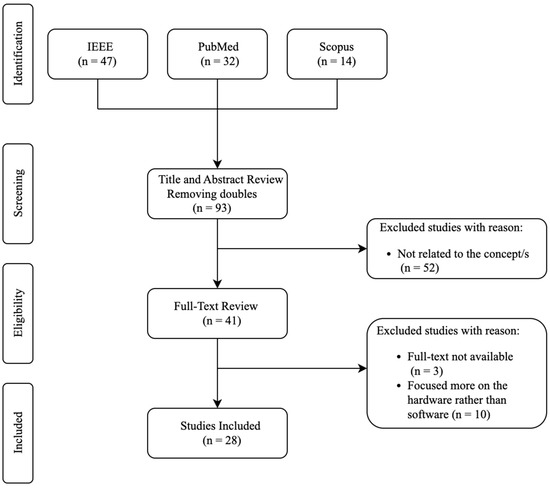
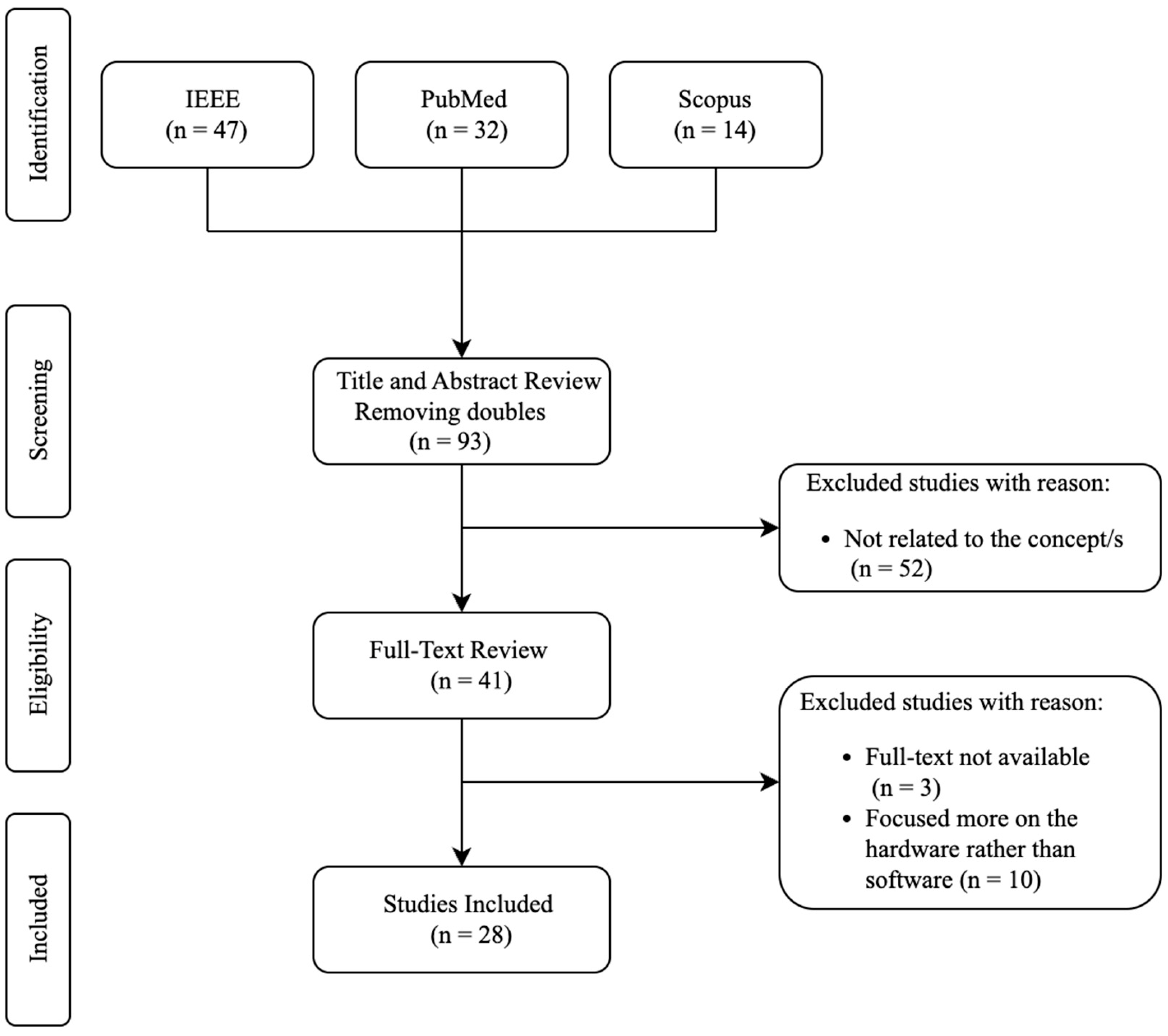
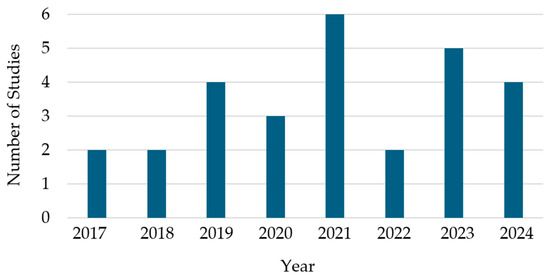
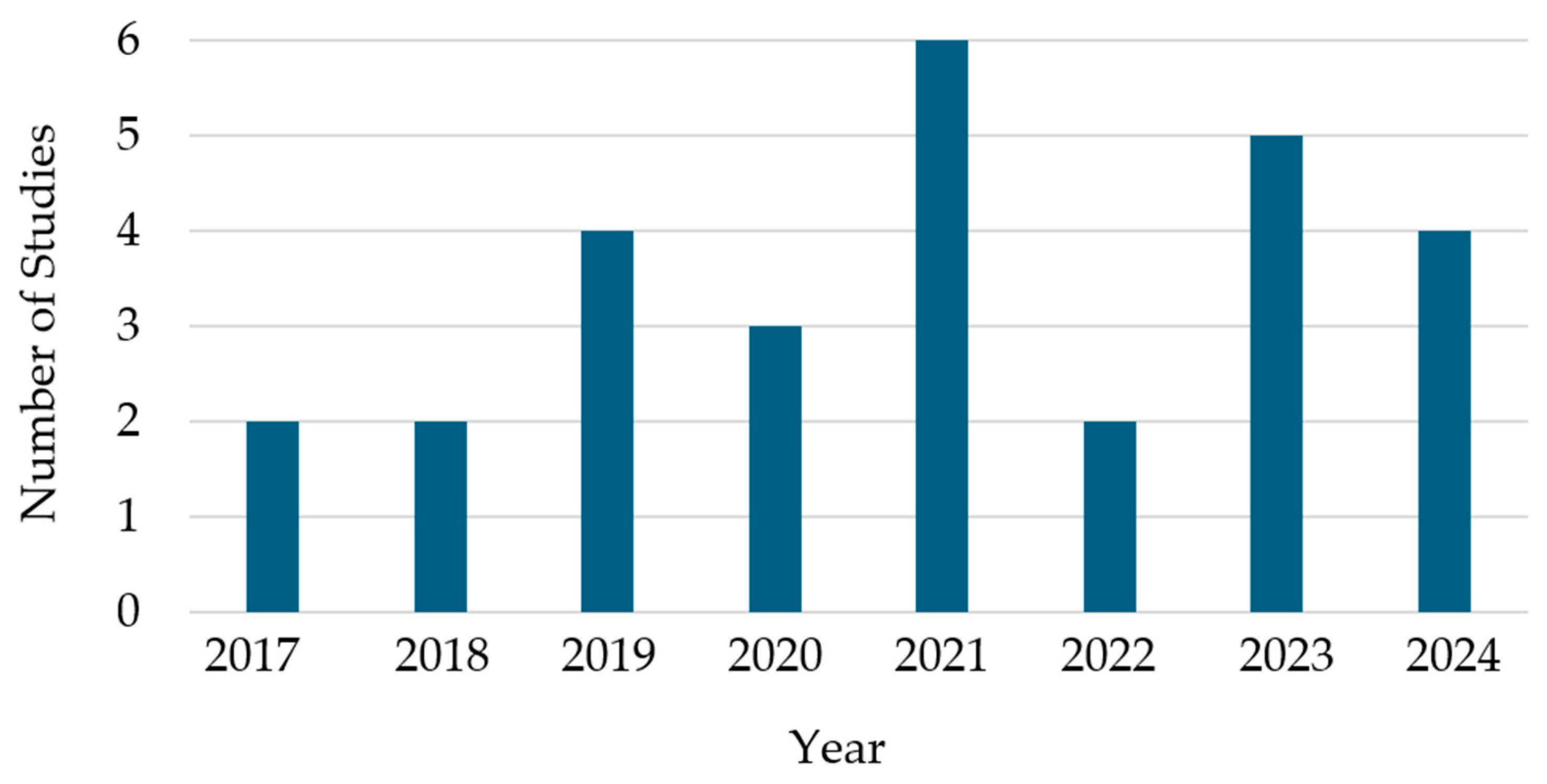
For our review, we searched in IEEE, PubMed, and Scopus with the keywords ‘Virtual Reality’ AND ‘Wheelchair Training’, for relevant papers dating from 2017 to 2024. A total of 47, 32, and 14 articles were found from the above-mentioned search engines, respectively; this led to 93 possibly useful studies. After reading their abstract, eliminating doubles, 41 were deemed to be relevant. A thorough review was done of the remaining 41 papers, which resulted in only 28 fitting the criteria of our study. A flow diagram of the study selection process can be seen in Figure 1, while a yearly distribution of the included studies is presented in Figure 2.
Figure 1.
Study selection process flowchart.
Figure 2.
Yearly distribution of studies.
3. Results
The following data were extracted from the reviewed studies: overview of real-life training, simulator hardware of VR systems, software features of VR systems, data analysis performed by the studies, conclusions drawn by the studies, and limitations reported by the studies. A general discussion for each topic is provided in the respective subsections, with references to the two review papers [24,31], followed by a table presenting the data for each study.
3.1. Real-Life Training
Real-life wheelchair skills training can vary in nature, and often consists in completing tasks within controlled environments, such as obstacle courses, and measures speed and time completion to assess improvement [15]. Other methods, though less popular, are ‘ecological’ in nature where the user drives through real environments, while also interacting with them, such as schools and homes [15]; the interactions can mimic what someone would do daily like reaching for objects, writing, and opening doors [15]. Due to the heterogeneity of real-life trainings, a way to standardise them has been developed that is called the wheelchair skills training programme (WSTP) [21]. This programme can be used for manual and powered WUs and mobility scooters. The programme consists of a set of tasks that a person needs to successfully complete to be deemed able to drive a wheelchair independently. Specifically, it tests the WUs on individual tasks (e.g., driving forward, backward, through obstacles, and turning), with the aim of teaching users to deal with various real-life situations such as going shopping [21].
The efficacy of the WSTP was analysed by Tu et al. [23] who reviewed 10 randomised controlled trials (RCTs), and 7 non-RCTs to analyse the short-term and long-term retention of skills following WSTP. In the RCTs, participants undergoing the WSTP showed higher improvement in the short-term (immediately to one-week after) retention of skills than those undergoing other methods, for manual WUs. For long-term effects (after 3–12 months), instead, no significant difference was noticed compared to other training methods. In non-RCTs, instead, manual WUs undergoing the WSTP showed better improvement within 5 weeks as compared to other methods. Although the results show the effectiveness of the WSTP for short- and medium-term improvement of skills of manual Wus, insufficient evidence was reported for powered WUs as not enough studies reviewed by the authors investigated the effects of the WSTP in the acquisition of driving skills. A similar review was conducted by Keeler et al. [22], who reviewed 13 RCTs that used the WSTP to train manual and powered WUs, as well as mobility scooters. Keeler et al. concluded that the WSTP has a meaningful effect on the improvement of skills compared to no training or other methods [22]. Furthermore, in addition to being an effective training method, the WSTP consists in performing tasks in a safe and controlled environment, thus allowing WUs to be more confident during the training [22].
It must be stressed that the WSTP rarely contains tasks that mimic real-world driving experiences such as driving in different environments and interacting with them [15]. Importantly, real-life training requires a lot of time and resources which are not available to everyone [24]. Powered wheelchairs are also heavier than manual ones, and can go at moderately high speeds, thus incidents during real-life training can be very harmful and therefore training must be conducted in a careful manner.
3.2. Simulator Hardware of VR Systems
This section details the hardware used in the different systems to interact with the VR environments. These differ from one study to another, as shown in Table 1. Most studies, 20 out of 28, developed a VR system for powered WUs and thus used a joystick to conduct navigation [28,29,30,32,33,34,35,36,37,38,39,40,41,42,43,44,45,46,47,48]. These varied from a real powered wheelchair joystick to an adapted gaming joystick. Furthermore, some of the studies that used a joystick also had training groups using alternative ways to drive the simulation, such as eye-trackers [28,45] and BCI caps [49]. For manual WUs to drive the VR simulation, on the other hand, sensors attached to the wheels can be used, such as what was done by Li et al. [27] who placed VIVE trackers on the wheels to drive the simulation in VR; alternatively, the wheelchair can be placed on a platform that translates the movements of the wheel to the VR environment, such as the miWe simulator [50]. Regardless of the interaction method used in the various studies, each study took into account their end-user’s motor abilities to determine the VR interaction method.
Table 1.
Simulator hardware of VR system.
Similar results were found by Lam et al. [24], in which the majority of studies used a joystick, and Arlati et al. [31], in which it was pointed out that all the studies using a power wheelchair used a joystick to control the VR environment. In those studies with manual wheelchairs, instead, the VR environment was controlled by a platform equipped with sensors, which were able to detect the movements of the actual wheelchair. Nevertheless, it is essential to note that powered wheelchair joysticks exhibit substantial variation across different wheelchair models, which can be a challenge when developing VR training solutions.
3.3. Software Features of VR Systems
This section gives an overview of VR environments developed for the studies we analysed, and highlights the software design requirements of a VR training system. VR, which can be non-immersive, semi-immersive and immersive, was mainly used with immersive (HMDs [27,28,29,30,34,35,36,38,39,42,46,47,49,53]), with only a few studies including semi-immersive (CAVE [37,54]) and non-immersive (monitor screen [33,42,45]) VR hardware in the analysed studies. Although HMDs provide a greater degree of immersion and SoP, compared to monitor screens [42], and are more effective in training skills transferable to real life, they cause cybersickness. Cybersickness is caused due to sensory conflict between vestibular and visual motion cues and leads to various discomforts such as nausea, disorientation, oculomotor disturbances, and drowsiness [56]. Nigel et al. [42] had participants split into three groups (a control group, a HMD group and a monitor screen group); the group using the HMD had the highest retention of driving skills which were transferred to the real world, even though participants showed more symptoms of cybersickness. Further, Hernandez-Hossa et al. [28], split participants into two groups, one using a HMD and one using just a projector screen; they found that the HMD group had a higher feeling of general presence, spatial presence and involvement. Similar results were shown by Govindarajan et al. [53], who found that HMDs resulted in a higher SoP, though they provoked more intense symptoms of cybersickness.
The features of the VR environments differ between various studies, as seen in Table 2. The tasks to complete in the different training environments normally have various levels of difficulties, some of which are relatively basic such as passing through doorways [36,41], mazes [34,35,36,42], or obstacle courses [29,32,33,34,35,37,38,42,44,46,47,48,49,50,51,54,55], while others are more complex such as collecting blue balls in a room while avoiding red balls to teach hand-eye coordination [42]. Salgado et al. [47] did not lay out any specific tasks, as the purpose of the study was to simply trial the training system; Rodriguez et al. [45] gave the user the option of roaming around freely in addition to its pre-defined paths. Interestingly, some studies included tasks inspired by the standardise assessment developed for real life training, namely the WSTP [34,35,40]. Similarly, Devigne et al. [37] used the WSTP as a pre-training assessment in VR prior to completing the actual VR training. Lam et al. [24], also highlighted a study [57] which used the WSTP as a baseline for its tasks. Regardless of the high variance between the tasks completed within studies, most of the studies attempted to teach real-life skills.
Table 2.
Software features of VR systems.
All studies developed completely virtual environments, except one which also had a mixed reality environment [36], and most of the designs attempted to represent a realistic environment. Examples of these environments range from a simple laboratory room [35], to a virtual replica of a rehabilitation unit of a hospital [30]. Only one study, [45], purposely developed an unrealistic environment, because the target users for their platform were children with multiple disabilities and adding realism could have caused difficulties to the children’s perception. A description of the environments, their respective tasks and the software used to develop them can be found in Table 2.
Furthermore, Lam et al. [24], pointed out that most studies did not explicitly describe the environment, rather they referred to images instead. The lack of detail in the developed environment makes it difficult for clinicians to understand which VE would be appropriate for their patients. In the papers we reviewed, the environments and their respective tasks were described in detail, thus allowing clinicians for an easier interpretation of the benefits of the VE. For studies to provide a solid base for future research, a standard for the description could be proposed, outlining the essential details a paper should include.
3.4. Data Analysis Performed by the Studies
It is important to highlight the ways the various studies measured the participants’ performance, as improvements on these measures could be used to assess the success of their training system. In order to analyse the acquired data, which most commonly includes collision [27,29,33,36,37,42,47,53], completion time [27,28,29,32,33,34,35,36,37,38,39,41,42,44,47,53,55], joystick events [28,32,34,35,37,46,47], and cybersickness [34,35,36,38,39,42,46,47,53], the studies used statistical analysis, specifically most used the ANOVA test [27,33,34,36,42,43,46,50,53,54] which compares the means of different samples. Lam et al. [24], similarly to us, found that data were collected quantitatively mainly for task completion time, number of collisions, number of joysticks movements, cybersickness, and the user’s SoP. The most used test to determine cybersickness is the Simulator Sickness Questionnaire (SSQ) [58], which asks participants to assign a score (from 0 to 3) to 16 possible symptoms of simulator sickness. The measures acquired in the different studies are reported in Table 3, together with the purpose of the studies to justify why specific data was collected. The most popular type of acquired data is quantitative, which can be objectively analysed and interpreted, however, at times, qualitative data collection is needed for a better understanding of the participants’ subjective experience of the VR application. In fact, some of the studies [30,48,50,51] collected data in terms of interviews and focus groups for an in-depth understanding of the usability and feasibility of their developed system.
Table 3.
Data analysis performed by the studies.
3.5. Conclusions Drawn by the Different Studies
Table 4 discusses the conclusions extracted from the analysed studies. While all the studies claimed their research to be promising for wheelchair training, four studies explicitly stated that the skills acquired with their simulators can be transferred to real life [28,34,42,48]. We found that no two studies performed by different authors assessed their systems in the same way, which agrees with Lam et al. [24], who concluded that there was a lack of standard measures to determine the effectiveness of a VR training system. Zorzi et al. [34] have noticed this limitation in the research and have suggested standardised approaches to conduct VR training. Furthermore, some studies suggest that VR can be used to complement real-life training [32,50], rather than being used to completely replace real-life training.
Table 4.
Conclusions drawn by the studies.
3.6. Limitations Reported by the Different Studies
The limitations of the studies we reviewed are reported in Table 5. Nine articles did not mention any limitations [29,32,35,37,38,45,49,52,54]. Common limitations mentioned are cybersickness, a very common side effect of VR [36,42], small participant sample size [30,33,34,40,44,46,50], and having participants who were non-WUs [34,46,51,53,55]; limitations were mentioned but they were specific to the individual study. The systematic reviews [24,31] did not explicitly report any limitations related to the studies they reviewed.
Table 5.
Limitations reported by the studies.
4. Discussion
Our review presented the state-of-the-art of VR technology for training WUs, with the aim of finding how it can complement real-life training. Our first objective is to identify gaps of real-life training methods that can be addressed by VR. We found that real-life training is often very controlled, and rarely the user is exposed to environments that allow to practice everyday skills. In terms of standardised assessment methods, the WSTP has been proven to be more effective than other training programs, however the evidence only supports this for the case of manual WUs. There are fewer studies that used WSTP for powered WUs, therefore there is a need to do more research on training methods for this population. Furthermore, the WSTP does not train the user to navigate around real-life environments, and distractions and obstacles are minimal [21]. VR could mitigate these limitations given that it is a more resource efficient training system, through being more cost effective and allowing the training of driving skills in virtual “dangerous” environments without putting the user in danger. Furthermore, as the WSTP has been proven to be effective for manual WUs in particular [22,23], and most VR training systems are designed for powered wheelchairs, it is reasonable to suggest that VR training systems may more suitable for powered WUs. In this regard, VR could complement real life training by developing VR systems based on the WSTP [21] for powered WUs.
Our second objective is to understand the main features of the VR training system. These include the virtual environment design, the hardware and the way the effectiveness of the system is assessed. However, due to the high design heterogeneity amongst VR studies, including differences between tasks and assessment methods, it is currently unclear what methods are more effective than others. Importantly, the target audience needs to be kept in mind when developing a VR environment, in fact, different users may well have completely different disabilities and therefore needs. Nonetheless, the use of realistic VR environments is common, suggesting that realism is an important aspect to consider when developing VR training applications. This is the case unless the target audience requires an abstract environment due to other conditions they may have [45]. Further, making the VR environment more engaging is also important for the training experience to be more enjoyable [48]. Regarding the tasks to complete, some studies laid out specific tasks for the users to complete, normally ranging in complexity. These studies proposed various parameters to assess the user’s performance improvements and therefore to test the success of a system. The hardware used in the different studies also varied significantly. However, most studies used a joystick [28,29,30,32,33,34,35,36,37,38,39,40,41,42,43,44,45,46,47,48] or similar, as a controller for the VR navigation, given that VR training systems are predominantly developed for powered WUs. Some studies developed more accessible controller hardware such as BCI [29], eye-trackers [28], sensors on the wheels [27], to find the requirements of their users.
Although all studies aim to use VR as a system to teach driving skills which can be transferred to real-life scenarios, only fewer studies directly tested this by having the user navigate in a specific real environment before and after the VR training [32,33,34,35,36,39,42]. It is our advice that any future research should implement real-life tests comparing pre- and post-training performances to provide evidence of transferable skills. Additionally, each study used its own measures and analyses on which to base its conclusions on the usefulness of its system. The use of different data analyses makes it challenging to compare the outcomes of different systems and, therefore, to design better ones in the future. Standardised assessments would be of great interest and can be achieved by identifying a list of parameters that can be measured by any VR system. Task completion time and number of collisions are good candidates, as they are already commonly used; further, number of collisions are also used in the WST to assess whether skills have been acquired. In terms of statistical approaches to analyse the data, most studies used some sort of statistical analysis test, most commonly the ANOVA test; all types of analysis used by the studies are outlined in Table 3. Quantitative data analysis, such as the ANOVA test, could be useful to compare the performance of a new wheelchair users before and after VR training to determine whether acquisition of skills was successful in a standardisation protocol. A standardisation in which different studies acquire the same kind of data and perform the same statistical tests, as those we suggested, would allow for an easier comparison between the effectiveness of the system of different studies, and thus it would be easier to identify the areas in which different systems are effective.
Furthermore, to successfully use VR, its limitations must be considered. A major limitation found by the different studies is cybersickness, a common side effect of VR due to the disorientation to the user’s sense of motion [56]. This effect is mainly observed when using a HMD for VR, as John et al. [42] found when comparing to monitor screens, and they found that HMD provoke much more symptoms of it. The assessment of cybersickness and the implementation of mitigating approaches should be incorporated into future VR training systems. At the moment, cybersickness is mainly assessed using self-reported questionnaires for SoP and users. However, some studies have shown that these aspects can be measured using implicit performance metrics such as users’ HR during training [34,35,46,47]. In fact, Salgado et al. [47] found a positive relationship between simulator sickness scores and HR measures, thus showing that the perceived level of cybersickness corresponds to an increased HR. This provides a promising starting point for future research, where the training of wheelchair skills in VR can incorporate the analysis of physiological measurements to better understand how the user is feeling in real time. Future research should also focus on how to best limit cybersickness, rather than simply assessing it. It would be useful to include regular breaks throughout the training to avoid prolonged exposure to a system that may cause cybersickness. Further, cybersickness has been shown to be reduced when participants have a fixed object to focus on as it limits their field-of-view [35]. These findings provide a promising start point for developing systems that provoke limited cybersickness. Future research could also investigate how VR can serve as a comprehensive rehabilitation tool by incorporating applications that address needs beyond acquiring wheelchair driving skills. For example, transitioning to a wheelchair involves not only physical adjustments but also psychological challenges, and VR has proven to be effective in supporting mental health [59] and for cognitive rehabilitation [60]. Thus, VR could play a role in supporting people who are transitioning to wheelchair use adjust to the new changes of their physical body by stimulating self-compassion and empathy [61], in addition to supporting their physical rehabilitation.
5. Conclusions
This review aimed to present the most current VR technology for training WUs, to understand how training in VR can be used to complement conventional training in real life. To answer this, attention was given to existing systems, their respective outcomes, and limitations. All the studies analysed in this review demonstrate that VR has significant potential for wheelchair skill training, ranging from activities of simple navigation to more complex tasks such as moving within restricted spaces and with moving obstacles. In addition, developing VR for powered wheelchairs is more cost effective than for manual wheelchairs as to control the VR environment all that is needed is a joystick, while manual wheelchairs require platforms equipped with sensors to control navigation. Furthermore, VR has the potential to be used in conjunction with various navigation simulators for powered WUs, ranging from a classic joystick to eye tracking or EEG signals, thus allowing a wider group of users to benefit from virtual training. It was also found that real-life training for manual WUs is more effective using the WSTP, while for powered Wus it remains unclear whether a specific program is more effective than another. Thus, VR could complement traditional training methods, in particular for the training of powered WUs. However, a standardised approach for VR training should be developed as current methods vary greatly between one another. This review also suggests ideas for future research: more focus should be put on limiting the side effects of VR (such as cybersickness), finding a quantitative approach to assess how the user is feeling throughout the training, and developing standardised assessments of the effectiveness of VR systems in translating skills to the real word.
Author Contributions
Conceptualization, C.Z. and G.M.; methodology, C.Z.; analysis, C.Z.; writing—original draft preparation, C.Z.; writing—review and editing, G.M. and A.C.; supervision, G.M. and A.C. All authors have read and agreed to the published version of the manuscript.
Funding
This work was supported by the Engineering and Physical Science Research Council [EP/T518141/1] and by the Assistive Devices for Empowering Disabled People through Robotic Technologies (ADAPT) project. ADAPT was selected for funding by the INTERREG VA France (Channel) England Programme, which is co-financed by the European Regional Development Fund (ERDF). The European Regional Development Fund (ERDF) is one of the main financial instruments of the European Unions (EU) cohesion policy.
Institutional Review Board Statement
Not applicable.
Informed Consent Statement
Not applicable.
Data Availability Statement
No new data were created or analyzed in this study. Data sharing is not applicable to this article.
Acknowledgments
We would like to thank the funding agencies mentioned above for allowing us to conduct this research.
Conflicts of Interest
The authors declare no conflicts of interest.
References
- World Health Organization. Wheelchair Provision Guidelines; World Health Organization: Geneva, Switzerland, 2023. [Google Scholar]
- NIHR: WSTP Structured Training Improves Wheelchair Skills. Available online: https://www.csp.org.uk/frontline/article/nihr-wstp-structured-training-improves-wheelchair-skills (accessed on 5 February 2024.).
- Wheelchair Skills. Available online: https://www.physio-pedia.com/Wheelchair_Skills (accessed on 5 February 2024).
- Morgan, K.A.; Engsberg, J.R.; Gray, D.B. Important wheelchair skills for new manual wheelchair users: Health care professional and wheelchair user perspectives. Disabil. Rehabil. Assist. Technol. 2017, 12, 28–38. [Google Scholar] [CrossRef] [Scilit] [PubMed]
- Riggins, M.S.; Kankipati, P.; Oyster, M.L.; Cooper, R.A.; Boninger, M.L. The relationship between quality of life and change in mobility 1 year postinjury in individuals with spinal cord injury. Arch. Phys. Med. Rehabil. 2011, 92, 1027–1033. [Google Scholar] [CrossRef] [Scilit] [PubMed]
- Oztürk, A.; Ucsular, F.D. Effectiveness of a wheelchair skills training programme for community-living users of manual wheelchairs in Turkey: A randomized controlled trial. Clin. Rehabil. 2011, 25, 416–424. [Google Scholar] [CrossRef] [Scilit]
- Kirby, R.L.; Doucette, S.P. Relationships Between Wheelchair Services Received and Wheelchair User Outcomes in Less-Resourced Settings: A Cross-Sectional Survey in Kenya and the Philippines. Arch. Phys. Med. Rehabil. 2019, 100, 1648–1654.e9. [Google Scholar] [CrossRef] [Scilit]
- Taylor, D.H.; Hoenig, H. The effect of equipment usage and residual task difficulty on use of personal assistance, days in bed, and nursing home placement. J. Am. Geriatr. Soc. 2004, 52, 72–79. [Google Scholar] [CrossRef] [Scilit]
- Kilkens, O.J.E.; Post, M.W.M.; Dallmeijer, A.J.; Van Asbeck, F.W.A.; Van Der Woude, L.H.V. Relationship between manual wheelchair skill performance and participation of persons with spinal cord injuries 1 year after discharge from inpatient rehabilitation. J. Rehabil. Res. Dev. 2005, 42, 65. [Google Scholar] [CrossRef] [Scilit]
- Krause, J.; Carter, R.E.; Brotherton, S. Association of mode of locomotion and independence in locomotion with long-term outcomes after spinal cord injury. J. Spinal Cord Med. 2009, 32, 237–247. [Google Scholar] [CrossRef] [Scilit]
- Velzen, J.M.v.; Groot, S.d.; Post, M.W.M.; Slootman, J.H.R.; Bennekom, C.A.M.v.; Woude, L.H.V.v.d. Return to work after spinal cord injury: Is it related to wheelchair capacity at discharge from clinical rehabilitation? Am. J. Phys. Med. Rehabil. 2009, 88, 47–56. [Google Scholar] [CrossRef] [Scilit]
- Sydor, M.; Wieczorek, M.; Hitka, M.; Gejdoš, M. Experimental Study of Persons with Disability, Wheelchairs, and Car Interaction. Syst. Logistyczne Wojsk 2023, 59, 263–286. [Google Scholar] [CrossRef] [Scilit]
- Oyster, M.L.; Karmarkar, A.M.; Patrick, M.; Read, M.S.; Nicolini, L.; Boninger, M.L. Investigation of factors associated with manual wheelchair mobility in persons with spinal cord injury. Arch. Phys. Med. Rehabil. 2011, 92, 484–490. [Google Scholar] [CrossRef] [Scilit]
- Sydor, M.; Krauss, A.; Krauss, H. Risk analysis for operating active wheelchairs in non-urban settings. Ann. Agric. Environ. Med. 2017, 24, 532–536. [Google Scholar] [CrossRef] [Scilit] [PubMed]
- Bigras, C.; Owonuwa, D.D.; Miller, W.C.; Archambault, P.S. A scoping review of powered wheelchair driving tasks and performance-based outcomes. Disabil. Rehabil. Assist. Technol. 2020, 15, 76–91. [Google Scholar] [CrossRef] [Scilit] [PubMed]
- Dawson, J.; Thornton, H. Can Patients with Unilateral Neglect following Stroke Drive Electrically Powered Wheelchairs? Br. J. Occup. Ther. 2003, 66, 496–504. [Google Scholar] [CrossRef] [Scilit]
- Jipp, M. Individual differences and their impact on the safety and the efficiency of human-wheelchair systems. Hum. Factors J. Hum. Factors Ergon. Soc. 2012, 54, 1075–1086. [Google Scholar] [CrossRef] [Scilit]
- Punt, T.D.; Kitadono, K.; Hulleman, J.; Humphreys, G.W.; Riddoch, M.J. From both sides now: Crossover effects influence navigation in patients with unilateral neglect. J. Neurol. Neurosurg. Psychiatry 2008, 79, 363. [Google Scholar] [CrossRef] [Scilit]
- Cooper, R.A.; Jones, D.K.; Fitzgerald, S.; Boninger, M.L.; Albright, S.J. Analysis of position and isometric joysticks for powered wheelchair driving. IEEE Trans. Biomed. Eng. 2000, 47, 902–910. [Google Scholar] [CrossRef]
- Huang, W.P.; Wang, C.C.; Hung, J.H.; Chien, K.C.; Liu, W.-Y.; Cheng, C.-H.; Ng, H.-H.; Lin, Y.-H. Joystick-controlled video console game practice for developing power wheelchairs users’ indoor driving skills. J. Phys. Ther. Sci. 2015, 27, 495–498. [Google Scholar] [CrossRef] [Scilit]
- Wheelchair Skills Program. Available online: https://wheelchairskillsprogram.ca/en/ (accessed on 1 October 2024).
- Keeler, L.; Kirby, R.L.; Parker, K.; McLean, K.D.; Hayden, J.A. Effectiveness of the Wheelchair Skills Training Program: A systematic review and meta-analysis. Disabil. Rehabil. Assist. Technol. 2019, 14, 391–409. [Google Scholar] [CrossRef] [Scilit]
- Tu, C.-J.; Liu, L.; Wang, W.; Du, H.-P.; Wang, Y.-M.; Xu, Y.-B.; Li, P. Effectiveness and safety of wheelchair skills training program in improving the wheelchair skills capacity: A systematic review. Clin. Rehabil. 2017, 31, 1573–1582. [Google Scholar] [CrossRef] [Scilit]
- Lam, J.-F.; Gosselin, L.; Rushton, P.W. Use of Virtual Technology as an Intervention for Wheelchair Skills Training: A Systematic Review. Arch. Phys. Med. Rehabil. 2018, 99, 2313–2341. [Google Scholar] [CrossRef] [Scilit]
- Best, K.L.; Routhier, F.; Miller, W.C. A description of manual wheelchair skills training: Current practices in Canadian rehabilitation centers. Disabil. Rehabil. Assist. Technol. 2015, 10, 393–400. [Google Scholar] [CrossRef] [Scilit] [PubMed]
- Anthes, C.; García-Hernández, R.J.; Wiedemann, M.; Kranzlmüller, D. State of the art of virtual reality technology. In Proceedings of the IEEE Aerospace Conference, Big Sky, MT, USA, 5–12 March 2016; pp. 1–19. [Google Scholar]
- Li, W.; Talavera, J.; Samayoa, A.G.; Lien, J.-M.; Yu, L.-F. Automatic Synthesis of Virtual Wheelchair Training Scenarios. In Proceedings of the Conference on Virtual Reality and 3D User Interfaces (VR), Atlanta, GA, USA, 22–26 March 2020. [Google Scholar]
- Hernandez-Ossa, K.A.; Montenegro-Couto, E.H.; Longo, B.; Bissoli, A.; Sime, M.M.; Lessa, H.M.; Enriquez, I.R.; Frizera-Neto, A.; Bastos-Filho, T. Simulation System of Electric-Powered Wheelchairs for Training Purposes. Sensors 2020, 20, 3565. [Google Scholar] [CrossRef] [Scilit] [PubMed]
- Younis, H.; Ramzan, F.; Khan, J.; Ghani Khan, M.U. Wheelchair Training Virtual Environment for People with Physical and Cognitive Disabilities. In Proceedings of the 15th International Conference on Emerging Technologies (ICET), Peshawar, Pakistan, 2–3 December 2019; pp. 1–6. [Google Scholar]
- Nunnerley, J.; Gupta, S.; Snell, D.; King, M. Training wheelchair navigation in immersive virtual environments for patients with spinal cord injury—End-user input to design an effective system. Disabil. Rehabil. Assist. Technol. 2017, 12, 417–423. [Google Scholar] [CrossRef] [Scilit] [PubMed]
- Arlati, S.; Colombo, V.; Ferrigno, G.; Sacchetti, R.; Sacco, M. Virtual reality-based wheelchair simulators: A scoping review. Assitive Technol. 2019, 32, 294–305. [Google Scholar] [CrossRef] [Scilit]
- Araújo, C.; Valentini, M.; Martins, F.R.; de Sá, A.A.R.; Lázaro, E.; Naves, M. Training protocol for driving power wheelchairs using virtual environment: Preliminary results from a pilot study. Health Technol. 2024, 14, 339–350. [Google Scholar] [CrossRef] [Scilit]
- Bigras, C.; Kairy, D.; Archambault, P.S. Augmented feedback for powered wheelchair training in a virtual environment. J. NeuroEngineering Rehabil. 2019, 16, 12. [Google Scholar] [CrossRef] [Scilit]
- Zorzi, C.; Tabbaa, L.; Covaci, A.; Sirlantzis, K.; Marcelli, L. A Standardized and Cost-Effective VR Approach for Powered Wheelchair Training. IEEE Access 2023, 11, 66921–66933. [Google Scholar] [CrossRef] [Scilit]
- Zorzi, C.; Tabbaa, L.; Covaci, A.; Sirlantzis, K.; Marcelli, L. Train vs. Play: Evaluating the Effects of Gamified and Non-Gamified Wheelchair Skills Training Using Virtual Reality. Bioengineering 2023, 10, 1269. [Google Scholar] [CrossRef] [Scilit]
- Day, T.W.; John, N.W. Training Powered Wheelchair Manoeuvres in Mixed Reality. In Proceedings of the 11th International Conference on Virtual Worlds and Games for Serious Applications (VS-Games), Vienna, Austria, 4–6 September 2019. [Google Scholar]
- Devigne, L.; Babel, M.; Nouviale, F.; Narayanan, V.K.; Pasteau, F.; Gallien, P. Design of an immersive simulator for assisted power wheelchair driving. In Proceedings of the International Conference on Rehabilitation Robotics (ICORR), London, UK, 17–20 July 2017. [Google Scholar]
- Fraudet, B.; Leblong, E.; Piette, P.; Nicolas, B.; Gouranton, V.; Babel, M.; Devigne, L.; Pasteau, F.; Gallien, P. Evaluation of power wheelchair driving performance in simulator compared to driving in real-life situations: The SIMADAPT (simulator ADAPT) project—A pilot study. J. Neuroeng. Rehabil. 2024, 21, 60. [Google Scholar] [CrossRef] [Scilit]
- Vailland, G.; Devigne, L.; Pasteau, F.; Nouviale, F.; Fraudet, B.; Leblong, E.; Babel, M.; Gouranton, V. VR based Power Wheelchair Simulator: Usability Evaluation through a Clinically Validated Task with Regular Users. In Proceedings of the IEEE Virtual Reality and 3D User Interfaces (VR), Lisboa, Portugal, 27 March–1 April 2021. [Google Scholar]
- Gefen, N.; Archambault, P.S.; Rigbi, A.; Weiss, P.L. Pediatric powered mobility training: Powered wheelchair versus simulator-based practice. Assist. Technol. 2023, 35, 389–398. [Google Scholar] [CrossRef] [Scilit]
- Gefen, N.; Rigbi, A.; Archambault, P.S.; Weiss, P.L. Comparing children’s driving abilities in physical and virtual environments. Disabil. Rehabil. Assist. Technol. 2021, 16, 653–660. [Google Scholar] [CrossRef] [Scilit] [PubMed]
- John, N.W.; Pop, S.R.; Day, T.W.; Ritsos, P.D.; Headleand, C.J. The Implementation and Validation of a Virtual Environment for Training Powered Wheelchair Manoeuvres. IEEE Trans. Vis. Comput. Graph. 2018, 24, 1867–1878. [Google Scholar] [CrossRef] [Scilit] [PubMed]
- Kenyon, L.K.; Farris, J.P.; Veety, L.; Kleikamp, B.; Harrington, K.; Jenkinson, J.; Montgomery, A.; Otieno, S.; Russell, I.M.; Zondervan, D.K. The IndieTrainer system: A small-scale trial exploring a new approach to support powered mobility skill acquisition in children. Disabil. Rehabil. Assist. Technol. 2024, 7, 2953–2961. [Google Scholar] [CrossRef] [Scilit]
- Martins, F.R.; Naves, E.L.M.; Morère, Y.; Sá, A.A.R.d. Preliminary assessment of a multimodal electric-powered wheelchair simulator for training of activities of daily living. J. Multimodal User Interfaces 2021, 16, 193–205. [Google Scholar] [CrossRef] [Scilit]
- Rodriguez, N. Identifying Accessibility Conditions for Children with Multiple Disabilities: A Virtual Reality Wheelchair Simulator. In Proceedings of the International Symposium on Mixed and Augmented Reality Adjunct (ISMAR-Adjunct), Munich, Germany, 16–20 October 2018; pp. 370–372. [Google Scholar]
- Salgado, D.P.; Flynn, R.; Murray, N.; Naves, E.L.z.M. A Questionnaire-based and Physiology-inspired Quality of Experience Evaluation of an Immersive Multisensory Wheelchair Simulator. In Proceedings of the MMSys’22: 13th ACM Multimedia Systems Conference, Athlone, Ireland, 14–17 June 2022. [Google Scholar]
- Salgado, D.P.; Flynn, R.; Naves, E.L.M.; Murray, N. The Impact of Jerk on Quality of Experience and Cybersickness in an Immersive Wheelchair Application. In Proceedings of the Twelfth International Conference on Quality of Multimedia Experience (QoMEX), Athlone, Ireland, 26–28 May 2020; pp. 1–6. [Google Scholar]
- Torkia, C.; Ryan, S.E.; Reid, D.; Boissy, P.; Lemay, M.; Routhier, F.; Contardo, R.; Woodhouse, J.; Archambault, P.S. Virtual community centre for power wheelchair training: Experience of children and clinicians. Disabil. Rehabil. Assist. Technol. 2019, 14, 46–55. [Google Scholar] [CrossRef] [Scilit]
- Thomas, A.; Chen, J.; Hella-Szabo, A.; Kelly, M.; Carlson, T. High stimuli virtual reality training for a brain controlled robotic wheelchair. In Proceedings of the IEEE International Conference on Robotics and Automation (ICRA), Yokohama, Japan, 13–17 May 2024. [Google Scholar]
- Chaar, F.; Archambault, P.S. Usability of a virtual reality manual wheelchair simulator. Disabil. Rehabil. Assist. Technol. 2023, 18, 1489–1499. [Google Scholar] [CrossRef] [Scilit]
- Yan, H.; Archambault, P.S. Augmented feedback for manual wheelchair propulsion technique training in a virtual reality simulator. J. NeuroEngineering Rehabil. 2021, 18, 142. [Google Scholar] [CrossRef] [Scilit]
- Yang, Y.-S.; Koontz, A.M.; Hsiao, Y.-H.; Pan, C.-T.; Chang, J.-J. Assessment of Wheelchair Propulsion Performance in an Immersive Virtual Reality Simulator. Int. J. Environ. Res. Public Health 2021, 18, 8016. [Google Scholar] [CrossRef] [Scilit]
- Mrityunjaya, A.A.G.; Philippe, S.A.; Youri, L.-E.H. Comparing the usability of a virtual reality manual wheelchair simulator in two display conditions. Rehabil. Assist. Technol. Eng. 2022, 9, 20556683211067174. [Google Scholar] [CrossRef] [Scilit]
- Salimi, Z.; Ferguson-Pell, M.W. Motion sickness and sense of presence in a virtual reality environment developed for manual wheelchair users, with three different approaches. PLoS ONE 2021, 16, e0255898. [Google Scholar] [CrossRef] [Scilit]
- Faure, C.; Routhier, F.; Lettre, J.; Choukou, M.-A.; Archambault, P.S. Effectiveness of the miWe Simulator Training on Powered Wheelchair-driving Skills: A Randomized Controlled Trial. Arch. Phys. Med. Rehabil. 2023, 14, 1371–1377. [Google Scholar] [CrossRef] [Scilit] [PubMed]
- Stanney, K.; Lawson, B.D.; Rokers, B.; Dennison, M.; Fidopiastis, C.; Stoffregen, T.; Weech, S.; Fulvio, J.M. Identifying Causes of and Solutions for Cybersickness in Immersive Technology: Reformulation of a Research and Development Agenda. Int. J. Hum. Comput. Interact. 2020, 36, 1783–1803. [Google Scholar] [CrossRef] [Scilit]
- Archambault, P.S.; Tremblay, S.; Cachecho, S.; Routhier, F.; Boissy, P. Driving performance in a power wheelchair simulator. Disabil. Rehabil. Assist. Technol. 2012, 7, 226–233. [Google Scholar] [CrossRef] [Scilit]
- Kennedy, R.S.; Lane, N.E.; Berbaum, K.S.; Lilienthal, M.G. Simulator Sickness Questionnaire (SSQ). Appl. Ergon. 1993. [Google Scholar] [CrossRef] [Scilit]
- Rowland, D.P.; Casey, L.M.; Ganapathy, A.; Cassimatis, M.; Clough, B.A. A Decade in Review: A Systematic Review of Virtual Reality Interventions for Emotional Disorders. Psychosoc. Interv. 2022, 31, 1–20. [Google Scholar] [CrossRef] [Scilit]
- Salva, A.M.; Alban, A.J.; Wiederhold, M.D.; Wiederhold, B.K.; Kong, L. Physiologically driven rehabilitation using virtual reality. In Foundations of Augmented Cognition. Neuroergonomics and Operational Neuroscience, Proceedings of the 5th International Conference, FAC 2009 Held as Part of HCI International, San Diego, CA, USA, 19–24 July 2009; Springer: Berlin/Heidelberg, Germany, 2009; pp. 836–845. [Google Scholar]
- Cebolla, A.; Herrero, R.; Ventura, S.; Miragall, M.; Bellosta-Batalla, M.; Llorens, R.; Baños, R.M. Putting oneself in the body of others: A pilot study on the efficacy of an embodied virtual reality system to generate self-compassion. Front. Psychol. 2019, 10, 1521. [Google Scholar] [CrossRef] [Scilit]

Disclaimer/Publisher’s Note: The statements, opinions and data contained in all publications are solely those of the individual author(s) and contributor(s) and not of MDPI and/or the editor(s). MDPI and/or the editor(s) disclaim responsibility for any injury to people or property resulting from any ideas, methods, instructions or products referred to in the content. |
© 2024 by the authors. Licensee MDPI, Basel, Switzerland. This article is an open access article distributed under the terms and conditions of the Creative Commons Attribution (CC BY) license (https://creativecommons.org/licenses/by/4.0/).