


Abstract
The integration of Artificial Intelligence (AI) and smart technologies into safety management is a pivotal aspect of the Fourth Industrial Revolution or Industry 4.0. This study conducts a systematic literature review to identify and analyze how AI and smart technologies enhance safety management across various sectors within the Safety 4.0 paradigm. Focusing on peer-reviewed journal articles that explicitly mention “Smart”, “AI”, or “Artificial Intelligence” in their titles, the research examines key safety management factors, such as accident prevention, risk management, real-time monitoring, and ethical implementation, across sectors, including construction, industrial safety, disaster and public safety, transport and logistics, energy and power, health, smart home and living, and other diverse industries. AI-driven solutions, such as predictive analytics, machine learning algorithms, IoT sensor integration, and digital twin models, are shown to proactively identify and mitigate potential hazards, optimize energy consumption, and enhance operational efficiency. For instance, in the energy and power sector, intelligent gas meters and automated fire suppression systems manage gas-related risks effectively, while in the health sector, AI-powered health monitoring devices and mental health support applications improve patient and worker safety. The analysis reveals a significant trend towards shifting from reactive to proactive safety management, facilitated by the convergence of AI with IoT and Big Data analytics. Additionally, ethical considerations and data privacy emerge as critical challenges in the adoption of AI technologies. The study highlights the transformative role of AI in enhancing safety protocols, reducing accident rates, and improving overall safety outcomes across industries. It underscores the need for standardized protocols, robust AI governance frameworks, and interdisciplinary research to address existing challenges and maximize the benefits of AI in safety management. Future research directions include developing explainable AI models, enhancing human–AI collaboration, and fostering global standardization to ensure the responsible and effective implementation of AI-driven safety solutions.
1. Introduction
The Industrial Revolution has fundamentally transformed human lifestyles and production methods. The First Industrial Revolution enabled mechanized production through the invention of the steam engine, and the Second Industrial Revolution established mass production systems with the introduction of electricity. The Third Industrial Revolution saw the advancement of information technology, leading to automation and informatization. Currently, we are entering the era of the Fourth Industrial Revolution, or Industry 4.0, characterized by the convergence of advanced technologies such as Cyber-Physical Systems (CPS), the Internet of Things (IoT), Big Data, and Artificial Intelligence (AI) [1,2].
Industry 4.0 maximizes the efficiency and flexibility of production systems, enabling customized mass production and enhancing competitiveness through the efficient use of resources and optimization of production processes [1,2]. However, these technological innovations drastically change existing industrial structures and work environments, potentially causing new types of risks and safety issues [3,4]. For example, the adoption of CPS and IoT increases cybersecurity risks, and unexpected accidents may occur in the interactions between automated systems and human workers [2,3].
In this context, Safety 4.0 has emerged as a new safety management paradigm within the Industry 4.0 environment [5,6]. Safety 4.0 aims to prevent accidents and enhance safety awareness by leveraging advanced technologies and integrating the core technologies of Industry 4.0 into safety management to simultaneously improve safety and productivity [3,6]. Alcácer and Cruz-Machado [1] analyzed the impact of Industry 4.0’s core technologies on manufacturing systems and suggested that these technologies could also be applied to safety management.
AI has emerged as a key element in implementing Safety 4.0, enabling prediction and real-time response through its ability to analyze vast amounts of data and recognize patterns [2,7]. For instance, machine learning algorithms can detect anomalies in equipment in advance to prevent breakdowns, and deep learning-based image analysis technologies can monitor hazardous factors in the work environment in real time [2,8]. Chen et al. [8] demonstrated the application of deep learning models for real-time safety monitoring, such as detecting safety helmet violations in engineering environments. The application of these AI technologies can significantly contribute to protecting workers’ safety and reducing accident rates.
Moreover, the application of human-centered technology is emphasized as an important factor in Safety 4.0 [5,9]. Romero et al. [5] proposed the concept of Operator 4.0, aiming for human–machine symbiosis by enhancing workers’ capabilities and safety through advanced technologies. Kaasinen et al. [9] elaborated on solutions like wearable devices, Augmented Reality (AR), and collaborative robotics to empower and engage industrial workers, ultimately improving operational safety and productivity.
However, several challenges exist in implementing Safety 4.0 [6]. Martinetti et al. [6] discussed the applications and challenges of Safety 4.0, pointing out obstacles such as data security concerns, lack of standardization, and organizational cultural changes. Additionally, Kitchenham and Charters [10] emphasized the importance of systematic reviews to synthesize fragmented research and provide comprehensive insights, particularly in fields like safety management, where interdisciplinary approaches are critical. This fragmentation leads to redundant studies and overlooks critical areas, hindering effective technology adoption.
Therefore, to maximize the effectiveness of AI utilization in safety management during the Safety 4.0 era, a systematic analysis of existing studies is necessary. A systematic literature review is essential to identify current research trends, application areas, and technological limitations and to suggest future research directions and practical application strategies [4,10]. Through this, we can prevent research duplication, promote efficient resource utilization, and proactively recognize and strategize responses to technical, organizational, and ethical issues that may arise when adopting AI technologies [7].
The purpose of this study is to systematically identify and analyze how Artificial Intelligence (AI) and smart technologies are currently utilized to enhance safety management factors across various industries within the Safety 4.0 paradigm. Through a comprehensive literature review focused on studies explicitly mentioning “Smart”, “AI”, or “Artificial Intelligence” in their titles, we aim to achieve the following:
- Examine the specific applications of AI and smart technologies in safety management, including the technologies used, algorithms implemented, and the contexts in which they are applied.
- Identify patterns, trends, and insights from the current body of research that can inform future developments and practical implementations in safety management.
By conducting this in-depth analysis, we seek to provide a comprehensive understanding of the role of AI and smart technologies in transforming safety management practices.
2. Materials and Methods
2.1. Methodology
This study conducted a systematic literature review to identify and analyze the application of Artificial Intelligence (AI) and smart technologies in safety management across various industries within the Safety 4.0 paradigm. To enhance focus and relevance, the literature search was performed exclusively based on article titles, as title-based searches reduce the number of retrieved studies while capturing research explicitly addressing AI and smart technologies in the context of safety management.
The Literature Search Strategy
The search was conducted using the following databases:
- IEEE Xplore.
- ScienceDirect.
- Google Scholar.
The search strategy applied the following keywords:
((safety management) AND ((smart) OR (AI) OR (artificial intelligence))).
Inclusion Criteria
- Peer-reviewed journal articles published up to 16 July 2024.
- Articles explicitly mentioning “Safety management” and “Smart”, “AI”, or “Artificial Intelligence” in their titles.
Exclusion Criteria
- Conference proceedings, unpublished research papers, theses, dissertations, newspapers, and books were excluded to ensure the inclusion of high-quality journal articles.
- Studies not explicitly mentioning the key terms in their titles were excluded to maintain relevance to the research objectives.
2.2. Study Selection Process
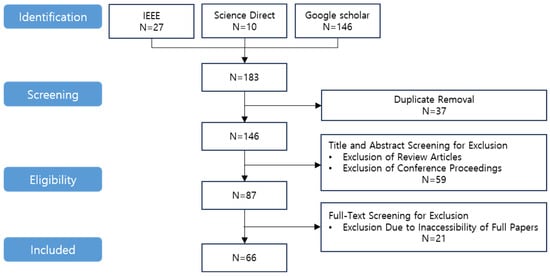
The systematic literature review followed the PRISMA (Preferred Reporting Items for Systematic Reviews and Meta-Analyses) guidelines to ensure a transparent and methodical selection process. The study selection steps are summarized as follows:
Initial Identification (N = 187):
The initial search across databases (IEEE Xplore, ScienceDirect, Google Scholar) identified a total of 187 studies. For ScienceDirect, the search was conducted in three separate queries—(safety management) AND (Smart), (safety management) AND (AI), and (safety management) AND (Artificial Intelligence)—due to search limitations, and the results were integrated for analysis. The search was restricted to titles only, as keyword-based searches yielded an unmanageable number of results, making the process impractical within the study’s timeframe. However, this approach excluded searches in the Web of Science database, as it did not return results under the title-only search constraint. These studies were retrieved based on their relevance to the research keywords ((safety management) AND ((Smart) OR (AI) OR (Artificial Intelligence))).
Step 1: Duplicate Removal (Excluded: N = 37):
Studies with identical or overlapping content were excluded. After this step, 146 unique studies remained for further screening.
Step 2: Title and Abstract Screening (Excluded: N = 59):
A comprehensive screening of titles and abstracts was conducted, excluding the following:
- Review articles.
- Conference proceedings.
This step ensured that only original peer-reviewed journal articles focusing on the application of AI and smart technologies in safety management were retained. A total of 87 studies passed this phase.
Step 3: Full-Text Screening (Excluded: N = 21):
The full texts of the 87 selected studies were reviewed. Studies were excluded if they exhibited the following:
- Full papers were inaccessible or unavailable.
- After this stage, 66 studies were finalized for inclusion in the systematic review.
Final Inclusion (N = 66):
The 65 studies selected through this rigorous process were included in the final analysis and categorization. These studies form the basis of the insights and findings presented in this review.
This systematic review adhered to the PRISMA (Preferred Reporting Items for Systematic Reviews and Meta-Analyses) guidelines. The PRISMA flow diagram (Figure 1) summarizes the study identification, screening, eligibility, and inclusion process. This rigorous approach identified recurring research themes and methodologies, focusing on the integration of AI and smart technologies in safety management across diverse sectors. The findings are synthesized into detailed tables, providing a clear overview of how advanced technologies are transforming safety management practices. The final dataset includes 65 studies, categorized into eight industry sectors: construction, industrial safety, disaster and public safety, transport and logistics, energy and power, health, smart home and living, and other sectors.
Figure 1.
Systematic selection process of AI and smart technology applications in safety management.
3. Results
3.1. Analysis of Methodological Characteristics of the Selected Literature
The systematic literature review identified 65 relevant research methods from the selected studies. These methodologies were categorized into four main safety management factors across eight industry sectors, ensuring a coherent and logical grouping of research approaches.
Categorization Across Sectors: The selected studies were categorized into the following industry sectors, each addressing specific safety management factors:
- Construction sector.
- Industrial safety sector.
- Disaster and public safety sector.
- Transport and logistics sector.
- Energy and power sector.
- Health sector.
- Smart home and living sector.
- Other sectors.
Safety Management Factors: Each sector addressed one or more of the following safety management factors:
- Accident prevention and risk management.
- Workplace and facility safety management.
- Quality assurance and reliability management.
- System-based safety enhancement.
Key Findings:
- Accident prevention and risk management: Predominantly involved AI-driven predictive analytics and sensor-based monitoring systems.
- Workplace and facility safety management: Focused on real-time surveillance using IoT sensors and computer vision technologies.
- Quality assurance and reliability management: Utilized anomaly detection algorithms and ISO/IEC standards to ensure product and process reliability.
- System-based safety enhancement: Emphasized AI-driven automation, smart control systems, and digital twin models to optimize operations and reduce human risk exposure.
Prevalent Themes and Technologies:
- Machine learning and predictive modeling: Widely used for risk prediction and anomaly detection.
- IoT and sensor networks: Essential for real-time data collection and monitoring.
- Digital twin models: Facilitated simulation and assessment of safety scenarios.
- Human-centric technologies: Enhanced worker safety and efficiency through Augmented Reality and wearable devices.
The analysis revealed a significant trend towards integrating AI with IoT and Big Data to shift safety management from reactive to proactive approaches.
Table 1 categorizes the selected studies into eight distinct industry sectors: construction, industrial safety, disaster and public safety, transport and logistics, energy and power, health, smart home and living, and other sectors, highlighting their focus on specific safety management factors.
Table 1.
Categorization of selected studies across industry sectors.
3.2. Analysis of AI and Smart Technology Applications Across Industry Sectors
The selected studies were systematically analyzed and categorized into eight distinct industry sectors to understand the specific applications of AI and smart technologies in safety management. This sector-wise classification provides a detailed overview of how different industries leverage advanced technologies to enhance safety protocols and mitigate risks.
3.2.1. Integration of AI and Smart Technologies in Safety Management for the Construction Sector
Recent advancements in the construction industry have emphasized the integration of Artificial Intelligence (AI) and smart technologies to enhance safety management. AI-driven solutions address various safety management factors, such as real-time hazard detection, predictive analytics, and enhanced training. For instance, AI-powered smart safety management systems utilize Internet of Things (IoT) sensors, BLE Beacons, and cloud computing to monitor safety data in real time, thereby improving decision-making processes. AI algorithms are employed for accident prevention by analyzing patterns to predict potential hazards, while computer vision detects unsafe behaviors through automated image recognition. Additionally, AI-enhanced Virtual Reality (VR) and Augmented Reality (AR) technologies provide immersive training environments, improving hazard recognition and response in high-risk areas like tunnels.
Moreover, innovative approaches like QR code-based safety inspections are augmented with AI analytics, enabling efficient equipment checks via mobile applications. Cyber-Physical Systems (CPSs) integrated with AI synchronize risk data between virtual and physical construction sites, allowing real-time hazard management and control. The development of IoT helmets equipped with sensors, CCTV, and GPS technologies further enhances continuous safety monitoring. Case studies and field experiments have validated the effectiveness of these smart systems in complex and high-risk environments, such as tunnels, by leveraging AI-based data analysis and real-time monitoring. These applications demonstrate how AI and smart technologies are transforming safety practices in the construction sector, leading to safer work environments and reduced accident rates. These applications demonstrate how AI and smart technologies are transforming safety practices in the construction sector, leading to safer work environments and reduced accident rates. Table 2 shows AI and smart technology research methods for safety management factors in the construction sector. By explicitly incorporating AI-related content into our analysis, we address the critical role of AI in enhancing safety management factors within the industry.
Table 2.
AI and smart technology research methods for safety management factors in the construction sector.
3.2.2. Integration of AI and Smart Technologies in Safety Management for the Industrial Safety Sector
In the industrial safety sector, the integration of Artificial Intelligence (AI) and smart technologies is transforming safety management practices by addressing key factors such as technology-centered approaches, data-driven decision-making, and real-time monitoring. The reviewed studies highlight the use of AI algorithms, machine learning, and IoT devices to enhance safety outcomes. For example, AI-powered predictive analytics analyze vast amounts of safety incident data, enabling the identification of risk factors in real time and improving Safety Performance Indicators (SPIs). Smart environments equipped with AI and IoT facilitate real-time monitoring, allowing for immediate responses to hazards and enhancing overall safety efficiency.
Moreover, the implementation of frameworks like PIPSC/CMF integrates indoor GIS with Bluetooth and RFID-based positioning technologies to support comprehensive fire detection systems and command platforms. AI-powered disaster response platforms combine historical disaster data, intelligent CCTV, sensors, satellite information, and social network data to support real-time emergency management. Smart street lighting systems, designed with GSM, GPS, cameras, LED lighting, and emergency buttons, have been prototyped using Arduino and ATMEGA 32 microprocessors to improve urban safety.
AI contributes to efficiency and cost reduction by automating safety processes and providing quantitative metrics-based evaluations through Big Data Analysis (BD Analysis) and digital twin simulations. These technological advancements support a cultural shift towards proactive safety management, emphasizing teamwork and continuous improvement. By leveraging AI and smart technologies, organizations can transition from traditional reactive approaches to predictive and preventive strategies, resulting in reduced workplace accidents and improved working conditions. Table 3 presents AI and smart technology research methods for safety management factors in the industrial sector. The convergence of these technologies in safety management demonstrates a paradigm shift across various industries, showcasing the critical role of AI in enhancing industrial safety practices.
Table 3.
AI and smart technology research methods for safety management factors in the industrial safety sector.
3.2.3. Integration of AI and Smart Technologies in Safety Management for Disaster and Public Safety Sector
In the disaster and public safety sector, key safety management factors such as urbanization and public safety management, disaster and fire safety management, hazardous workplaces and industrial safety, and the integration of smart technologies with public safety are being significantly enhanced through the integration of Artificial Intelligence (AI) and smart technologies. AI-driven solutions address these critical factors by leveraging advanced frameworks, real-time monitoring systems, and predictive analytics. For instance, the design of the PIPSC/CMF framework integrates indoor GIS with Bluetooth and RFID-based positioning technologies to develop comprehensive fire detection systems and command platforms. Additionally, AI-powered disaster response platforms combine historical disaster data, intelligent CCTV, sensors, satellite information, and social network data to support real-time emergency management.
Smart street lighting systems, designed with GSM, GPS, cameras, LED lighting, and emergency buttons, are prototyped using Arduino and ATMEGA 32 microprocessors to enhance urban safety. These systems not only provide illumination but also integrate crime statistics analysis and case studies to optimize safety measures. Furthermore, the implementation of safety tags equipped with accelerometer sensors detects workers’ immobilization, while command unit terminals use two-way wireless communication to issue escape commands during emergencies. Centralized control servers are developed to manage resources efficiently across multiple organizations. AI governance frameworks ensure the responsible use of AI systems in smart cities, protecting public safety while adhering to regulatory standards. Data mining and statistical analysis techniques are utilized to analyze fire occurrence patterns and causes, while Big Data Analysis (BD Analysis) identifies temporal and spatial fire hotspots and simulates fire scenarios to optimize firefighting and evacuation strategies.
These applications demonstrate how AI and smart technologies address critical safety challenges in the disaster and public safety sector, leading to improved operational efficiency and enhanced safety outcomes. Table 4 summarizes AI and smart technology research methods for safety management factors in the disaster and public safety sector. By explicitly incorporating AI-related methodologies into safety management, the disaster and public safety sector can achieve significant improvements in safety protocols, emergency response effectiveness, and overall public safety.
Table 4.
AI and smart technology research methods for safety management factors in the disaster and public safety sector.
3.2.4. Integration of AI and Smart Technologies in Safety Management for the Transport and Logistics Sector
In the transport and logistics sector, key safety management factors such as traffic accident prevention and collision avoidance, railway safety and worker protection, maritime and industrial site safety management, and public transport safety management are being significantly enhanced through the integration of Artificial Intelligence (AI) and smart technologies. AI-based predictive models and machine learning algorithms analyze real-time traffic data, vehicle behavior, and environmental conditions to predict and prevent traffic accidents. These technologies enable proactive traffic management and collision avoidance systems in vehicles, reducing collision risks and improving overall road safety.
For railway safety, AI algorithms process data from IoT sensors to detect equipment anomalies and predict maintenance needs, ensuring system reliability and preventing accidents caused by equipment failure. Additionally, literature reviews and accident statistics analyses identify common accident types among railway workers, informing the design of safety management systems that utilize smartphone GPS technologies. The effectiveness of Safety Management Systems (SMSs) is further evaluated through case studies, such as the Lac-Mégantic accident, and comparative analyses of regulatory models.
In maritime safety, AI-driven navigation systems and autonomous vessels utilize AI to prevent collisions at sea. Predictive analytics support industrial site safety by automating the monitoring of hazardous conditions. Public transport safety management is enhanced by AI-enhanced surveillance systems employing facial recognition and behavioral analysis to detect suspicious activities. Furthermore, Big Data analytics optimize safety protocols and emergency responses, ensuring timely and effective measures in public transportation environments.
These applications demonstrate how AI and smart technologies address critical safety challenges in the transport and logistics sector, leading to improved operational efficiency and enhanced safety outcomes. Table 5 presents AI and smart technology research methods for safety management factors in the transport and logistics sector.
Table 5.
AI and smart technology research methods for safety management factors in the transport and logistics sector.
3.2.5. Integration of AI and Smart Technologies in Safety Management for the Energy and Power Sector
In the energy and power sector, key safety management factors such as gas safety and risk management, power grid and energy management, real-time monitoring and alert systems, urban gas facility risk management, and resource consumption and energy efficiency management are significantly enhanced through the integration of Artificial Intelligence (AI) and smart technologies. AI-driven solutions include the development of intelligent gas meters and automated fire suppression systems, effectively managing gas-related risks. Wireless modularization and networking technologies enable robust real-time monitoring and alert systems, ensuring immediate responses to hazards. Additionally, web-based safety management systems support data-driven decision-making by integrating comprehensive safety data for analysis.
Smart meters are crucial for power grid management, automatically controlling power supply based on appliance priority, detecting faulty cabling, and identifying recalled appliances to ensure safety. Resource consumption and energy efficiency are optimized through low-cost appliance control solutions using advanced power distribution systems. Urban gas facility risk management is enhanced by Smart Home Gas Safety Management Systems (S-GSMSs), which are validated through scenario-based assessments and system tests.
AI governance frameworks ensure responsible AI use in smart cities, protecting public safety while complying with regulations. Data mining and Big Data Analysis (BD Analysis) identify fire hotspots and simulate scenarios to optimize firefighting and evacuation strategies. Digital twin models provide real-time safety scenario simulations, offering immersive fire monitoring and enhancing overall safety management.
These applications demonstrate how AI and smart technologies address critical safety challenges in the energy and power sector, leading to improved operational efficiency, enhanced safety outcomes, and sustainable energy management. Table 6 provides AI and smart technology research methods for safety management factors in the energy and power sector. Incorporating AI methodologies into safety management enables significant advancements in safety protocols, emergency response, and energy efficiency.
Table 6.
AI and smart technology research methods for safety management factors in the energy and power sector.
3.2.6. Integration of AI and Smart Technologies in Safety Management for the Health Sector
In the health sector, AI and smart technologies significantly enhance safety management by addressing critical factors such as occupational risk management and prevention, smart health monitoring and prevention, mental health management and prevention, and technological integration with ethical implementation. For occupational risk management and prevention, AI-based predictive analytics and machine learning algorithms analyze data on healthcare workers’ exposure to risks like infectious diseases and ergonomic hazards. This enables proactive measures to prevent workplace accidents and improve safety protocols. In smart health monitoring and prevention, wearable devices equipped with AI and IoT sensors collect real-time physiological data such as heart rate and blood pressure. AI algorithms process these data to detect anomalies, predict health events, and provide personalized recommendations, enhancing patient safety through early detection and timely intervention. Mental health management and prevention are addressed through AI chatbots and applications using natural language processing to offer mental health support, assess emotional states, and provide immediate assistance. Machine learning models identify signs of mental health issues, facilitating timely interventions and access to professional help. Lastly, technological integration and ethical implementation ensure the responsible use of AI in healthcare. AI ethics frameworks and secure data management practices protect patient privacy and ensure transparency. Explainable AI (XAI) makes AI decisions interpretable by healthcare professionals, promoting ethical implementation and acceptance of AI technologies in safety management.
These applications demonstrate how AI and smart technologies address essential safety challenges in the health sector, leading to improved operational efficiency, enhanced safety outcomes, and sustainable health management. Table 7 shows AI and smart technology research methods for safety management factors in the health sector. By integrating AI methodologies into safety management, the health sector can achieve significant advancements in safety protocols, emergency response effectiveness, and overall health outcomes.
Table 7.
AI and smart technology research methods for safety management factors in the health sector.
3.2.7. Integration of AI and Smart Technologies in Safety Management for Smart Home and Living
In the smart home and living sector, AI and smart technologies significantly enhance safety management by addressing critical factors such as accident prevention, legal compliance, human life protection, property protection, operational efficiency, fire and CO poisoning prevention, energy management, and health management. AI-driven solutions include ontology-based approaches using Web Ontology Language (OWL) and Semantic Web Rule Language (SWRL) to build comprehensive risk recognition systems. Intelligent gas meters and automated fire suppression systems manage gas-related risks effectively, while Non-Intrusive Appliance Load Monitoring (NIALM) utilizes machine learning algorithms to monitor and control appliance usage, optimizing energy consumption and preventing electrical faults. Smart health monitoring systems integrate IoT sensors and predictive models to continuously assess residents’ health and environmental conditions. AI-powered security systems employ computer vision and anomaly detection to protect property by identifying unauthorized access or unusual activities. Additionally, AI governance frameworks ensure the ethical implementation of these technologies, safeguarding data privacy and promoting transparency. Real-time monitoring and alert systems leverage wireless modularization and networking technologies to provide immediate responses to potential hazards, enhancing overall safety and operational efficiency.
Furthermore, digital twin models simulate safety scenarios in real time, offering immersive fire and CO poisoning prevention through advanced sensor integration and predictive analytics. Table 8 provides information on AI and smart technology research methods for safety management factors in the smart home and living sector. These applications demonstrate how AI and smart technologies effectively address safety challenges in smart homes, leading to improved safety, security, efficiency, and health outcomes for residents.
Table 8.
AI and smart technology research methods for safety management factors in the smart home and living sector.
3.2.8. Integration of AI and Smart Technologies in Safety Management for Other Sectors
In the “other sectors”, AI and smart technologies significantly enhance safety management by addressing critical factors such as accident prevention and risk management, workplace and facility safety management, quality assurance and reliability management, and system-based safety enhancement. AI-driven solutions leverage sensor networks, location-based services (LBSs), and natural language processing to proactively identify and mitigate potential hazards. For instance, the u-Food System utilizes sensor tags and LBS to monitor and ensure the quality of food distribution, while predictive modeling combines public and internal recall data to forecast and prevent food-related risks.
Workplace safety and facility safety are improved through AI-powered monitoring systems that employ IoT sensors and computer vision to detect equipment malfunctions and unsafe behaviors in real time. Quality assurance is enhanced by anomaly detection algorithms that identify defects early in the production process, ensuring compliance with safety standards and increasing product reliability. Additionally, system-based safety enhancements are achieved through AI-driven automation and smart control systems, which optimize operations and reduce human exposure to hazardous tasks. Table 9 organizes and presents AI and smart technology research methods for safety management factors in the other sectors. The ISO/IEC/IEEE 15288:2023 standard, titled “Systems and Software Engineering—System Life Cycle Processes”, is implemented to identify stakeholders and establish Measures of Effectiveness (MOEs), ensuring alignment with operational goals and safety protocols. This standard also guides the implementation of AI-based system requirements decomposition and stakeholder satisfaction assessments, contributing to a structured approach to safety management and technological integration. These integrations of AI and smart technologies demonstrate their effectiveness in addressing diverse safety challenges, leading to improved safety outcomes and enhanced operational efficiency across various industries [77].
Table 9.
AI and smart technology research methods for safety management factors in the other sectors.
4. Discussion
The rapid advancement of Artificial Intelligence (AI) and smart technologies within the Safety 4.0 paradigm has fundamentally transformed safety management practices across various sectors. This study systematically identified and analyzed how AI and smart technologies are currently utilized to enhance safety management factors, examining specific applications, technologies used, algorithms implemented, and the contexts in which they are applied. The analysis revealed patterns, trends, insights, and future directions that inform developments and practical implementations in safety management.
4.1. AI Applications in Safety Management Across Industries
4.1.1. Construction Sector
In the construction sector, AI and smart technologies address safety factors such as real-time hazard detection, predictive analytics, and enhanced training. These innovations help mitigate workplace accidents, improving worker safety and reducing the economic burden of injuries. For example, AI-powered safety management systems utilize IoT sensors and machine learning algorithms to monitor safety data in real time, predicting potential hazards and enabling proactive interventions. Furthermore, computer vision technologies detect unsafe behaviors through automated image recognition, while Virtual Reality (VR) and Augmented Reality (AR) provide immersive training environments, improving hazard recognition and response. These systems enhance both operational efficiency and worker protection, highlighting AI’s societal and practical impact on construction safety [78,79].
4.1.2. Industrial Safety Sector
In the industrial safety sector, AI contributes to data-driven decision-making and real-time monitoring, enhancing safety performance and operational productivity. Machine learning models analyze vast amounts of safety incident data to identify risk factors and improve Safety Performance Indicators (SPIs). AI-powered monitoring systems with IoT sensors facilitate immediate hazard detection and mitigation, reducing human error and operational costs. These technologies also support proactive safety cultures, where resources are allocated efficiently using multi-criteria decision analysis (MCDA) frameworks to minimize risks in high-stress industrial environments [79,80].
4.1.3. Disaster and Public Safety Sector
AI technologies significantly enhance urbanization and disaster management by improving public safety through advanced analytics and integration of Big Data. Predictive models forecast disasters like floods and fires, while digital twin technologies simulate disaster scenarios, improving preparedness and response strategies. These systems minimize casualties and property damage, demonstrating AI’s societal relevance in addressing large-scale safety challenges. AI-driven platforms that incorporate real-time data from intelligent CCTV and social networks further optimize emergency management [78,79].
4.1.4. Transport and Logistics Sector
AI addresses safety factors in the transport and logistics sector, including traffic accident prevention, railway safety, maritime safety, and public transport safety. Predictive models and machine learning algorithms analyze real-time traffic data to prevent accidents, enhance safety protocols, and reduce operational disruptions. For example, AI-powered IoT systems detect equipment anomalies in railways, optimizing maintenance schedules. Similarly, AI-driven navigation systems in maritime contexts prevent collisions, while enhanced surveillance in public transport improves security and operational efficiency [81].
4.1.5. Energy and Power Sector
In the energy and power sector, AI improves safety management factors such as gas safety and risk management, power grid and energy optimization, and real-time monitoring. Intelligent gas meters and automated fire suppression systems effectively manage gas-related risks, while smart meters prioritize power supply to prevent electrical faults. AI governance frameworks ensure responsible and efficient resource use, further supported by Big Data Analysis (BD Analysis) to identify fire hotspots and optimize firefighting strategies. These applications contribute to societal resilience and industrial sustainability [78,79].
4.1.6. Health Sector
AI enhances safety in the health sector by addressing occupational risks, smart health monitoring, mental health management, and ethical implementation. Predictive analytics help prevent workplace accidents by analyzing healthcare workers’ exposure to risks. Wearable devices integrated with IoT sensors monitor physiological data in real time, detecting anomalies and offering personalized health recommendations. These innovations support not only worker well-being but also operational safety, aligning with societal goals for health and safety [81].
4.1.7. Smart Home and Living Sector
In the smart home and living sector, AI technologies address critical safety and efficiency factors such as accident prevention, fire and CO poisoning prevention, and energy management. Ontology-based approaches and Natural Language Processing (NLP) systems enhance hazard recognition, while AI-driven monitoring systems detect risks like gas leaks and electrical faults. These technologies optimize operational efficiency and protect human lives, underscoring their societal significance in improving living conditions [78].
4.1.8. Other Sectors
Across other sectors, AI enhances safety management through accident prevention, workplace safety optimization, and quality assurance. Predictive analytics and sensor networks proactively mitigate potential hazards, while anomaly detection algorithms ensure reliability in production processes. These advancements demonstrate AI’s transformative role in addressing safety and operational challenges, contributing to societal well-being and industrial sustainability [79,80].
4.2. Patterns, Trends, and Insights
4.2.1. Shift from Reactive to Proactive Safety Management
A significant trend across sectors is the shift from reactive to proactive safety management enabled by AI. Predictive analytics and real-time monitoring allow organizations to anticipate and mitigate risks before incidents occur, enhancing overall safety outcomes.
4.2.2. Integration of AI with IoT and Big Data
The convergence of AI with IoT devices and Big Data analytics facilitates real-time data collection, analysis, and decision-making. This integration enhances the speed and accuracy of safety interventions, leading to more efficient and effective safety management practices.
4.2.3. Ethical Considerations and Data Privacy
As AI becomes more integrated into safety management, ethical considerations and data privacy emerge as critical concerns. Ensuring transparent, explainable AI (XAI) models and securing personal and sensitive data are essential for maintaining trust and compliance with regulations.
4.3. Future Directions of Safety 4.0 and AI Development
4.3.1. Expansion into Underexplored Safety Management Factors
Future research should explore AI applications in safety management factors that are currently underrepresented, such as mental health management in high-stress industries and ethical AI implementation.
4.3.2. Advancement of Explainable AI (XAI)
Developing explainable AI models is crucial for ensuring that AI decisions are interpretable by stakeholders, fostering trust and facilitating the adoption of AI in safety-critical applications.
4.3.3. Integration of AI with Emerging Technologies
Combining AI with emerging technologies like Edge Computing, 5G connectivity, and Blockchain can further enhance safety management by improving data processing speeds, ensuring secure data transmission, and maintaining tamper-proof records.
4.3.4. Addressing AI-Related Risks and Ethical Issues
AI development must consider potential risks such as algorithmic bias and over-reliance on automated systems. Establishing ethical guidelines and regulatory frameworks will help mitigate these risks and promote responsible AI deployment.
4.3.5. Enhancing Human–AI Collaboration
Promoting effective collaboration between humans and AI systems can leverage the strengths of both, enhancing overall system performance and safety outcomes through user-friendly interfaces and intuitive interaction methods.
4.3.6. Global Standardization and Best Practices
Developing international standards and best practices for AI integration in safety management will promote consistency and reliability across industries, ensuring that safety measures are universally effective and trustworthy.
4.3.7. Fostering Interdisciplinary Research and Education
Encouraging interdisciplinary research that brings together experts in AI, safety management, ethics, and human factors will drive comprehensive solutions. Educational programs that equip professionals with both technical and domain-specific knowledge are essential for the effective implementation of AI in safety management.
4.4. Limitations
This study focused on the literature with “Safety management” and “Smart”, “AI”, or “Artificial Intelligence” in the titles, potentially overlooking relevant studies without these keywords. Consequently, the analysis may not fully represent the breadth of AI applications in safety management. Future research should employ broader search strategies, including keywords like “Machine Learning”, “Deep Learning”, and “Data-Driven”, and consider full-text searches to capture a more comprehensive range of studies.
5. Conclusions
This study systematically identified and analyzed how Artificial Intelligence (AI) and smart technologies are currently utilized to enhance safety management factors across various sectors within the Safety 4.0 paradigm. By examining specific applications, technologies used, algorithms implemented, and the contexts in which they are applied, a comprehensive understanding of AI’s transformative role in safety management practices was achieved.
AI facilitates predictive analytics, real-time monitoring, and automated decision-making, enabling proactive and adaptive safety strategies. These strategies reduce risks, optimize resources, and improve operational efficiency, ultimately fostering safer and more sustainable industrial ecosystems. Successful implementation requires a multidisciplinary approach that integrates organizational commitment, regulatory compliance, and ethical oversight. Human factors—such as workforce training, technology acceptance, and user-centered design—are equally critical. Ensuring transparency and accountability through explainable AI (XAI) models builds stakeholder trust and supports widespread adoption.
Future research should address underrepresented safety factors, including mental health in high-stress industries while exploring emerging technologies like edge computing, Blockchain, and 5G within safety frameworks. Developing standardized protocols and industry-specific guidelines will bridge the gap between theoretical research and practical application, allowing industries to fully leverage AI’s potential for reducing accidents and achieving long-term sustainability.
Embracing AI and smart technologies under the Safety 4.0 paradigm will not only revolutionize safety management but also advance societal well-being and sustainable industrial growth. This paradigm shift paves the way for a safer, more resilient future for all stakeholders.
Author Contributions
Data curation, J.P. and D.K.; funding acquisition, J.P.; investigation, J.P. and D.K.; methodology, J.P.; conceptualization, J.P. and D.K.; project administration, J.P.; visualization, J.P.; formal analysis, J.P. and D.K.; writing—original draft preparation, J.P. and D.K.; writing—review and editing, J.P. and D.K. All authors have read and agreed to the published version of the manuscript.
Funding
This paper was supported by a grant from Wonkwang University, Republic of Korea, in 2024.
Informed Consent Statement
All participants in this study will provide informed consent.
Data Availability Statement
The authors will make the data available upon reasonable request.
Conflicts of Interest
The authors declare no conflicts of interest.
References
- Alcácer, V.; Cruz-Machado, V. Scanning the Industry 4.0: A Literature Review on Technologies for Manufacturing Systems. Eng. Sci. Technol. Int. J. 2019, 22, 13–30. [Google Scholar] [CrossRef] [Scilit]
- Lee, J.; Bagheri, B.; Kao, H.-A. A Cyber-Physical Systems Architecture for Industry 4.0-Based Manufacturing Systems. Manuf. Lett. 2015, 3, 18–23. [Google Scholar] [CrossRef] [Scilit]
- Wang, S.; Wan, J.; Li, D.; Zhang, C. Implementing Smart Factory of Industrie 4.0: An Outlook. Int. J. Distrib. Sens. Netw. 2016, 12, 3159805. [Google Scholar] [CrossRef] [Scilit]
- O’Donovan, P.; Leahy, K.; Bruton, K.; O’Sullivan, D.T.J. Big Data in Manufacturing: A Systematic Mapping Study. J. Big Data 2015, 2, 20. [Google Scholar] [CrossRef] [Scilit]
- Romero, D.; Bernus, P.; Noran, O.; Stahre, J.; Fast-Berglund, Å. The Operator 4.0: Human Cyber-Physical Systems & Adaptive Automation Towards Human–Automation Symbiosis Work Systems. In Advances in Production Management Systems. Initiatives for a Sustainable World; Nääs, I., Vendrametto, O., Mendes Reis, J., Gonçalves, R.F., Fugisawa, L.A., Yamanaka, L., Eds.; Springer: Cham, Switzerland, 2016; pp. 677–686. [Google Scholar] [CrossRef] [Scilit]
- Martinetti, A.; Chemweno, P.; Kaulio, E.; Göransson, N. Safety 4.0 Applications and Challenges in Maintenance and Safety Engineering. In Sustainable Design and Manufacturing 2020; Campana, G., Howlett, R.J., Setchi, R., Cimatti, B., Eds.; Springer: Cham, Switzerland, 2020; pp. 73–83. [Google Scholar] [CrossRef] [Scilit]
- Müller, J.M.; Kiel, D.; Voigt, K.-I. What Drives the Implementation of Industry 4.0? The Role of Opportunities and Challenges in the Context of Sustainability. Sustainability 2018, 10, 247. [Google Scholar] [CrossRef] [Scilit]
- Chen, F.; Wang, M.; Chen, D. Deep Learning-Based Safety Helmet Detection in Engineering Management. J. Adv. Comput. Intell. Intell. Inform. 2018, 22, 1021–1026. [Google Scholar]
- Kaasinen, E.; Schmalfuß, F.; Öztürk, C.; Aromaa, S.; Boubekeur, M.; Heilala, J.; Heikkilä, P.; Kuula, T.; Liinasuo, M.; Mach, S.; et al. Empowering and Engaging Industrial Workers with Operator 4.0 Solutions. Comput. Ind. Eng. 2019, 139, 105678. [Google Scholar] [CrossRef] [Scilit]
- Kitchenham, B.; Charters, S. Guidelines for Performing Systematic Literature Reviews in Software Engineering; EBSE Technical Report, Version 2.3; Keele University: Newcastle, UK; Durham University: Durham, UK, 2007; Available online: https://www.elsevier.com/__data/promis_misc/525444systematicreviewsguide.pdf (accessed on 7 December 2024).
- Cho, J.H.; Lim, J.C.; Ko, Y.W.; Kang, K.S. A Study on the Safety Management of construction equipment Using Smart Phone Technology (Focused on poclain and mobile elevated work platform). J. Korea Saf. Manag. Sci. 2012, 14, 1–9. [Google Scholar] [CrossRef] [Scilit]
- Park, M.; Kim, E.; Lee, H.S.; Lee, K.; Suh, S.W. Real time safety management framework at construction site based on smart mobile. Korean J. Constr. Eng. Manag. 2013, 14, 3–14. [Google Scholar] [CrossRef] [Scilit]
- Seo, K.B.; Min, S.D.; Lee, S.H.; Hong, M. Design and implementation of construction site safety management system using smart helmet and BLE beacons. J. Internet Comput. Serv. 2019, 20, 61–68. [Google Scholar] [CrossRef]
- Kamarudin, S.S.; Pang, C.S.; Osman, N.A. Smart sensor system in enhancing construction site safety management. INTI J. 2020, 2020, 4. [Google Scholar]
- Jiang, W.; Ding, L.; Zhou, C. Cyber physical system for safety management in smart construction site. Eng. Constr. Archit. Manag. 2021, 28, 788–808. [Google Scholar] [CrossRef] [Scilit]
- Zhang, Y. Safety management of civil engineering construction based on artificial intelligence and machine vision technology. Adv. Civ. Eng. 2021, 2021, 3769634. [Google Scholar] [CrossRef] [Scilit]
- Kasim, N.B.; Razali, S.A.; Ariffin, K.M. Smart Emergency Detection Framework by IR4. 0 for Safety Management among G7 Contractors: A Pilot Study. Int. J. Sustain. Constr. Eng. Technol. 2021, 12, 322–333. [Google Scholar] [CrossRef] [Scilit]
- Getuli, V.; Capone, P.; Bruttini, A.; Sorbi, T. A smart objects library for BIM-based construction site and emergency management to support mobile VR safety training experiences. Constr. Innov. 2022, 22, 504–530. [Google Scholar] [CrossRef] [Scilit]
- Lee, J.; Park, S.H.; Chung, Y.; Byon, C. A study on the application of smart construction safety management system to tunnel construction based on worker location monitoring technology. Preprints 2023. [Google Scholar] [CrossRef] [Scilit]
- Lee, J.; Shin, D.P.; Park, S.H.; Byon, C. Development and Application of Smart Construction Objects and Management System for an Efficient and Cost-Effective Safety Management. Buildings 2023, 13, 1383. [Google Scholar] [CrossRef] [Scilit]
- Okonkwo, C.; Okpala, I.; Awolusi, I.; Nnaji, C. Overcoming barriers to smart safety management system implementation in the construction industry. Results Eng. 2023, 20, 101503. [Google Scholar] [CrossRef] [Scilit]
- Qian, Y.; Liu, H.; Mao, P.; Zheng, X. Evaluation of safety management of smart construction sites from the perspective of resilience. Buildings 2023, 13, 2205. [Google Scholar] [CrossRef] [Scilit]
- Rane, N. Integrating Building Information Modelling (BIM) and Artificial Intelligence (AI) for Smart Construction Schedule, Cost, Quality, and Safety Management: Challenges and Opportunities. Cost Qual. Saf. Manag. Chall. Oppor. 2023. [Google Scholar] [CrossRef] [Scilit]
- Kim, S.; Kim, E.; Kim, C. Development of Web-based Construction-Site-Safety-Management Platform Using Artificial Intelligence. J. Comput. Struct. Eng. Inst. Korea. 2024, 37, 77–84. [Google Scholar] [CrossRef] [Scilit]
- Fang, Q.; Castro-Lacouture, D.; Li, C. Smart safety: Big data–enabled system for analysis and management of unsafe behavior by construction workers. J. Manag. Eng. 2024, 40, 04023053. [Google Scholar] [CrossRef] [Scilit]
- Oh, J.S.; Sung, J.G.; Kim, Y.D. Developing Network Infrastructure and Smart Service for Safety Management of City-gas Facilities. J. Korean Inst. Gas 2011, 15, 46–53. [Google Scholar] [CrossRef] [Scilit]
- Park, M.S.; Kim, E.J.; Lee, H.S.; Lee, K.P. Construction Safety Management Framework based on Smart Mobile. J. Constr. Eng. Proj. Manag. 2012, 2, 48–57. [Google Scholar] [CrossRef] [Scilit]
- Teimourikia, M.; Fugini, M. Ontology development for run-time safety management methodology in Smart Work Environments using ambient knowledge. Future Gener. Comput. Syst. 2017, 68, 428–441. [Google Scholar] [CrossRef] [Scilit]
- Bieder, C. Societal risk communication—Towards smart risk governance and safety management. In Risk Communication for the Future Towards Smart Risk Governance and Safety Management; Springer: Cham, Switzerland, 2018; p. 155. [Google Scholar]
- Wang, B.; Wu, C.; Huang, L.; Kang, L. Using data-driven safety decision-making to realize smart safety management in the era of big data: A theoretical perspective on basic questions and their answers. J. Clean. Prod. 2019, 210, 1595–1604. [Google Scholar] [CrossRef] [Scilit]
- Jeong, P.S.; Cho, Y.H. Smart factory safety management system using Bluetooth. J. Korea Converg. Soc. 2019, 10, 47–53. [Google Scholar] [CrossRef]
- Eom, J.H. An Architecture of a Smart Safety Management System to prevent safety Accidents in Workplace. J. Digit. Contents Soc. 2020, 21, 817–823. [Google Scholar] [CrossRef] [Scilit]
- Zhao, Z.; Shen, L.; Yang, C.; Wu, W.; Zhang, M.; Huang, G.Q. IoT and digital twin enabled smart tracking for safety management. Comput. Oper. Res. 2021, 128, 105183. [Google Scholar] [CrossRef] [Scilit]
- Yi, X.; Wu, J. Research on safety management of construction engineering personnel under “big data + artificial intelligence”. Open J. Bus. Manag. 2020, 8, 1059. Available online: http://creativecommons.org/licenses/by/4.0/ (accessed on 24 June 2024). [CrossRef]
- Abainza, S.A.M.; Aguilar, R.E.M.; Edmondson, H.C. Smart Construction Vest: A New Step Towards the Future of Occupational Health and Safety Management System for Construction in the Philippines. Int. J. Occup. Saf. Ergon. 2020, 26, 761–769. [Google Scholar]
- Selvik, J.T.; Bansal, S.; Abrahamsen, E.B. On the use of criteria based on the SMART acronym to assess quality of performance indicators for safety management in process industries. J. Loss Prev. Process Ind. 2021, 70, 104392. [Google Scholar] [CrossRef] [Scilit]
- Ansaldi, S.M.; Bragatto, P. Widespread sensors and Artificial Intelligence for a novel Safety Management System at the Seveso sites. Chem. Eng. Trans. 2022, 90, 577–582. [Google Scholar] [CrossRef]
- Huang, X.; Wang, B.; Wu, C. Realizing smart safety management in the era of safety 4.0: A new method towards sustainable safety. Sustainability 2022, 14, 13915. [Google Scholar] [CrossRef] [Scilit]
- Lyu, Q.; Fu, G.; Wang, Y.; Li, J.; Han, M.; Peng, F.; Yang, C. How accident causation theory can facilitate smart safety management: An application of the 24Model. Process Saf. Environ. Prot. 2022, 162, 878–890. [Google Scholar] [CrossRef] [Scilit]
- Tiikkaja, M.; Kannisto, H.; Nurmi, A.; Puro, V.; Heikkilä, T.; Kivimäki, I.; Asikainen, I.; Teperi, A.M. Ai-Supported Safety Management-Analysing Occupational Safety Data Using Machine Learning within the Framework of Human Factors. 2024. Available online: https://papers.ssrn.com/sol3/papers.cfm?abstract_id=4879013 (accessed on 24 June 2024).
- Liu, Y.; Yu, L.; Chi, T.; Yang, B.; Yao, X.; Yang, L.; Zhang, X.; Ren, Y.; Liu, S.; Cui, S.; et al. Design and implementation of community safety management oriented public information platform for a smart city. In Proceedings of the 2017 Forum on Cooperative Positioning and Service (CPGPS), Harbin, China, 19–21 May 2017; IEEE: Piscataway, NJ, USA, 2017; pp. 330–332. [Google Scholar] [CrossRef] [Scilit]
- Kang, H.J. Established smart disaster safety management response system based on the 4th industrial revolution. J. Digit. Contents Soc. 2018, 19, 561–567. [Google Scholar] [CrossRef]
- Pradhan, S.K.; Holo, V.; Bhusan, S. GSM and ADHAR based safety management system through Smart Poles: A step towards safety for humanistic Society (Women). Int. Res. J. Eng. Technol. 2018, 5, 1943–1947. [Google Scholar]
- Kim, S.; Hwang, I.; Kim, D.; Moon, B.; Oh, S. A study on IoT/ICT convergence smart safety management system for safety of high-risk workers. J. Soc. Disaster Inf. 2019, 15, 39–48. [Google Scholar] [CrossRef]
- Seo, S.H.; Kim, B.H. Design of Real-time Disaster Safety management Solution in a Smart Environment. J. Digit. Converg. 2020, 18, 31–36. [Google Scholar] [CrossRef]
- Zhao, H. Artificial intelligence-based public safety data resource management in smart cities. Open Comput. Sci. 2023, 13, 20220271. [Google Scholar] [CrossRef] [Scilit]
- Almatared, M.; Liu, H.; Abudayyeh, O.; Hakim, O.; Sulaiman, M. Digital-twin-based fire safety management framework for smart buildings. Buildings 2023, 14, 4. [Google Scholar] [CrossRef] [Scilit]
- Li, G.; Wang, J.; Wang, X. Construction and path of urban public safety governance and crisis management optimization model integrating artificial intelligence technology. Sustainability 2023, 15, 7487. [Google Scholar] [CrossRef] [Scilit]
- Qian, X. Evaluation on sustainable development of fire safety management policies in smart cities based on big data. Math. Biosci. Eng. 2023, 20, 17003–17017. [Google Scholar] [CrossRef] [Scilit]
- Park, S.; Lee, S.; Jang, H.; Yoon, G.; Choi, M.I.; Kang, B.; Cho, K.; Lee, T.; Park, S. Smart Fire Safety Management System (SFSMS) Connected with Energy Management for Sustainable Service in Smart Building Infrastructures. Buildings 2023, 13, 3018. [Google Scholar] [CrossRef] [Scilit]
- Zhang, X.; Jiang, Y.; Wu, X.; Nan, Z.; Shi, J. AIoT-enabled digital twin system for smart tunnel fire safety management. Dev. Built Environ. 2024, 18, 100381. [Google Scholar] [CrossRef] [Scilit]
- Lee, S.H.; Jang, K.S.; Ryu, S.H.; Shin, D.R. Context-Aware Smart Railroad Crossing Safety Management System based on OSGi Framework. J. Inst. Internet Broadcast. Commun. 2010, 10, 169–177. [Google Scholar]
- Lee, S.H.; Cho, D.U. Development of Smart-Car Safety Management System Focused on Drunk Driving Control. J. Korean Inst. Commun. Inf. Sci. 2012, 37, 565–575. [Google Scholar] [CrossRef] [Scilit]
- Ku, J.H.; Park, D.K. Developing safety management systems for track workers using smart phone GPS. Int. J. Control. Autom. 2013, 6, 137–148. Available online: https://www.earticle.net/Article/A205355 (accessed on 24 June 2024). [CrossRef] [Scilit]
- Alsarhan, A.; Al-Dubai, A.Y.; Min, G.; Zomaya, A.Y.; Bsoul, M. A new spectrum management scheme for road safety in smart cities. IEEE Trans. Intell. Transp. Syst. 2018, 19, 3496–3506. [Google Scholar] [CrossRef]
- Sundaramoorthy, R.; Ilango, Y.; Tamilarasan, A.K. Smart bus passengers information and safety management system. Int. J. Pure Appl. Math. 2018, 119, 795–800. [Google Scholar]
- Łosiewicz, Z.; Nikończuk, P.; Pielka, D. Application of artificial intelligence in the process of supporting the ship owner’s decision in the management of ship machinery crew in the aspect of shipping safety. Procedia Comput. Sci. 2019, 159, 2197–2205. [Google Scholar] [CrossRef] [Scilit]
- Kaul, A.; Altaf, I. Vanet-TSMA: A traffic safety management approach for smart road transportation in vehicular ad hoc networks. Int. J. Commun. Syst. 2022, 35, e5132. [Google Scholar] [CrossRef] [Scilit]
- Lee, D.; Lim, D.; Park, J.; Woo, S.; Moon, Y.; Jung, A. Management Architecture with Multi-modal Ensemble AI Models for Worker Safety. Saf. Health Work 2024, 15, 373–378. [Google Scholar] [CrossRef] [Scilit] [PubMed]
- Park, G.T.; Lyu, G.J.; Kim, Y.G.; Kim, Y.D.; Kim, H.S. A study on the effective gas safety management using smart appliances. Adv. Eng. Forum 2011, 2–3, 649–654. [Google Scholar] [CrossRef] [Scilit]
- Oh, J.S.; Sung, J.G.; Kim, Y.D. Smart wireless system for city-gas safety management. WIT Trans. Ecol. Environ. 2012, 155, 1173–1183. [Google Scholar]
- Park, G.; Lyu, G.; Jo, Y.; Gu, J.; Eun, J.; Kim, H. Development of gas safety management system for smart-home services. Int. J. Distrib. Sens. Netw. 2013, 9, 591027. [Google Scholar] [CrossRef] [Scilit]
- Tan, R.; Nguyen, H.H.; Yau, D.K. Collaborative load management with safety assurance in smart grids. ACM Trans. Cyber-Phys. Syst. 2017, 1, 1–27. [Google Scholar] [CrossRef] [Scilit]
- Rahman, M.S.; Kabir, M.H. Social Internet of Things (SIoT) Enabled System Model for Smart Integration of Building’s Energy, Water and Safety Management: Dhaka City, Bangladesh Perspective. AIUB J. Sci. Eng. 2019, 18, 19–26. [Google Scholar] [CrossRef] [Scilit]
- Lee, P.; Kim, H.; Kim, Y.; Choi, W.; Zitouni, M.S.; Khandoker, A.; Jelinek, H.F.; Hadjileontiadis, L.; Lee, U.; Jeong, Y. Beyond pathogen filtration: Possibility of smart masks as wearable devices for personal and group health and safety management. JMIR mHealth uHealth 2022, 10, e38614. [Google Scholar] [CrossRef] [Scilit]
- Waqar, A.; Qureshi, A.H.; Almujibah, H.R.; Tanjung, L.E.; Utami, C. Evaluation of success factors of utilizing AI in digital transformation of health and safety management systems in modern construction projects. Ain Shams Eng. J. 2023, 14, 102551. [Google Scholar] [CrossRef] [Scilit]
- Tang, K.H.D. Artificial Intelligence in Occupational Health and Safety Risk Management of Construction, Mining, and Oil and Gas Sectors: Advances and Prospects. J. Eng. Res. Rep. 2024, 26, 241–253. [Google Scholar] [CrossRef] [Scilit]
- Ćosić, K.; Popović, S.; Wiederhold, B.K. Enhancing aviation safety through AI-driven mental health management for pilots and air traffic controllers. Cyberpsychol. Behav. Soc. Netw. 2024, 27, 588–598. [Google Scholar] [CrossRef] [Scilit]
- Huang, X.; Yi, J.; Zhu, X.; Chen, S. A semantic approach with decision support for safety service in smart home management. Sensors 2016, 16, 1224. [Google Scholar] [CrossRef] [Scilit] [PubMed]
- Jeong, H.S.; Sung, K.S.; Oh, H.S. A Study on the Smart Home Safety Management System Based on NIALM. J. Korea Acad.-Ind. Coop. Soc. 2017, 18, 55–63. [Google Scholar] [CrossRef]
- Chang, C.-Y.; Ko, K.-S.; Guo, S.-J.; Hung, S.-S.; Lin, Y.-T. CO multi-forecasting model for indoor health and safety management in smart home. J. Internet Technol. 2020, 21, 275–286. [Google Scholar] [CrossRef]
- Kim, J.H.; Kim, J.Y.; Kim, B.S. Status of ICT convergence smart quality distribution technology for food quality and safety management. Agribus. Inf. Manag. 2014, 6, 13–23. [Google Scholar] [CrossRef] [Scilit]
- Kim, H.M.; Yoon, S.J.; Hong, D.G.; Suh, S.H. Design for Smart Safety Management System: From Worker and Mobile Equipment Perspectives. J. Korean Soc. Syst. Eng. 2015, 11, 41–49. [Google Scholar] [CrossRef] [Scilit]
- Stoitsis, G.; Manouselis, N. The use of big data in food safety management: Predicting food safety risks using big data and artificial intelligence. In Food Safety Management; Academic Press: Cambridge, MA, USA, 2023; pp. 513–520. [Google Scholar] [CrossRef] [Scilit]
- Lee, E.J.; Seo, S.H.; Moon, H.K. Hygiene Monitoring of Food for Children’s Foodservice Using the IoT-based Smart Food Safety Management System (iMEAL). J. Korean Diet. Assoc. 2024, 30, 61–73. [Google Scholar] [CrossRef]
- Xiao, X. Smart sensing for laboratory safety management. J. Artif. Intell. 2024, 1, 11–16. [Google Scholar] [CrossRef] [Scilit]
- ISO/IEC/IEEE 15288:2023; Systems and Software Engineering—System Life Cycle Processes. International Organization for Standardization (ISO): Geneva, Switzerland, 2023.
- Peron, M.; Arena, S.; Paltrinieri, N.; Sgarbossa, F.; Boustras, G. Risk assessment for handling hazardous substances within the European industry: Available methodologies and research streams. Risk Anal. 2023, 43, 1434–1462. [Google Scholar] [CrossRef] [Scilit] [PubMed]
- Zavadskas, E.K.; Turskis, Z.; Kildienė, S. Multi-criteria decision-making (MCDM) methods in economics: An overview. Technol. Econ. Dev. Econ. 2015, 21, 165–179. [Google Scholar] [CrossRef] [Scilit]
- Huang, H.; Kao, W. Decision analysis for safety management in high-risk industries. Decis. Sci. 2017, 48, 1170–1190. [Google Scholar]
- Wang, Y.; Chung, S.H. Artificial intelligence in safety-critical systems: A systematic review. Ind. Manag. Data Syst. 2021, 122, 442–470. [Google Scholar] [CrossRef] [Scilit]

Disclaimer/Publisher’s Note: The statements, opinions and data contained in all publications are solely those of the individual author(s) and contributor(s) and not of MDPI and/or the editor(s). MDPI and/or the editor(s) disclaim responsibility for any injury to people or property resulting from any ideas, methods, instructions or products referred to in the content. |
© 2024 by the authors. Licensee MDPI, Basel, Switzerland. This article is an open access article distributed under the terms and conditions of the Creative Commons Attribution (CC BY) license (https://creativecommons.org/licenses/by/4.0/).