1. Introduction
Non-linear systems are almost ubiquitous in daily life and exist widely in various applications, such as motor [
1], power [
2], and electrical systems [
3]. After more than half a century of development, the control of non-linear systems has made considerable progress, and various control methods and strategies have emerged, e.g., backstepping control strategies [
4], neural networks [
5], fuzzy-based control [
6], and system identification [
7].
For example, scenario-based model predictive control (MPC) approaches can mitigate the conservatism inherent in robust open-loop MPC. Reference [
8] presents a method for evaluating the confidence intervals of RBNN predictions and determines the number of samples required to estimate the confidence interval for a given confidence level. The authors of [
9] propose a security-model-based reinforcement learning approach to control nonlinear systems described by linear parameter variation models.
In order to improve control accuracy, these methods require feedback. For example, a state feedback Smith predictive controller was proposed for the effective temperature control of a cement rotary kiln precalcining furnace [
10]. The authors of [
11] present a fully distributed adaptive tracking control scheme for multi-agent systems with a strict feedback form. Generally, this type of state feedback control requires all systems’ internal state information, which is challenging to achieve in reality.
Therefore, control methods based on system output have also been proposed. These control algorithms require only the system’s output information to complete the control process. For example, the authors of [
12] studied a linear–quadratic (LQ) control problem with irregular output feedback in which a noisy linear system measured the state. In [
13], the authors discuss the collaborative design of output-dependent switching functions and full-order affine filters for discrete-time switched affine systems. This control method has a certain degree of versatility and has achieved good application results. However, the controlled system does not have a strict feedback form.
Strict feedback systems present a good lower triangle form, while the control systems for a flexible manipulator and some temperatures are in a strict feedback form. Commonly, the backstepping control method is used for such systems, e.g., in [
14], a neural-network-based adaptive gain scheduling backward sliding mode control (NNAGS-BSMC) method is proposed for a class of non-linear systems with uncertain strict feedback. Reference [
15] presents a novel tracking controller utilizing an event-triggering implementation for uncertain rigor feedback systems. Adaptive fuzzy decentralized optimal control problems for a class of large-scale non-linear systems with a strict feedback form have also been studied [
16]. A backstepping method usually has specific prerequisite requirements for the system or control strategy and needs to calculate a higher differential, imposing a high calculation complexity. Such problems have been improved to a certain extent by combining some improved backstepping methods with adaptive control ideas. For example, [
17] addresses the adaptive event-triggered control of non-linear continuous-time strict feedback systems. However, the overall calculation process of this method must meet trigger conditions before it is carried out, prohibiting it from meeting real-time performance requirements.
With the development of neural networks, new methods have been proposed for non-linear control problems, exploiting the appealing approximation characteristics of neural networks. For example, [
18] addresses the compound learning control of a perturbed uncertain strict feedback system. In [
19], the authors studied the data-based compound neural control of an uncertain strict feedback system’s online record using a backstepping framework. This algorithm provides a relatively general idea for non-linear control to a certain extent, but as neuron cardinality increases, the computational complexity increases geometrically. The multi-dimensional Taylor network is a newly proposed control structure. Due to its simple structure and convenient application, some promising results have been achieved. For example, the authors of [
20] studied non-linear time-delay systems with uncertainties. However, the use of the MTN control algorithm for a strict feedback system has not been thoroughly studied.
Spurred by this, this paper proposes an output feedback control method for a strict non-linear system based on an MTN so that the system’s output can automatically track the desired signal. Our method initially transforms the original non-linear strict feedback system and redefines the state variables to obtain the new standard form. The state observer then completes the identification process of the adaptive system with the MTN’s good approximation characteristics. The adaptive control law completes the system’s tracking output based on this. Finally, a numerical simulation of a servo-hydraulic system model is carried out, verifying the effectiveness of the proposed algorithm.
The main contributions of this paper are as follows:
The traditional MTN control method relies on the unique performance of its basic structure and is designed and used for general controlled objects. Therefore, some characteristics of the controlled object itself are not fully considered and utilized. Therefore, this paper applies the MTN to strictly nonlinear feedback systems for the first time, taking full advantage of the characteristics that different parameters of the MTN can have different outputs with the same result and that processing two sets of internal parameters at the same time can effectively improve control efficiency.
In the control process, a set of variable representation rules is designed so that the general strict feedback system can be expressed in a standard form. On this basis, an adaptive parameter-adjustment rule based on a state observer is designed to bring the tracking error close to 0. Thanks to the simple structure of the MTN, compared with a neural network algorithm, it can effectively reduce the number of calculations.
The remainder of this paper is organized as follows.
Section 2 introduces the strict feedback system and transforms the original system into a standard form.
Section 3 presents the design of the state observer, while
Section 4 introduces the multi-dimensional Taylor network and its basic structure.
Section 5 introduces a parameter identification method based on a multi-dimensional Taylor network, and
Section 6 presents the controller’s design and a stability analysis of the system.
Section 7 illustrates the effectiveness of the proposed control scheme through a numerical simulation of a hydraulic control system. Finally,
Section 8 concludes this paper.
2. System Model
Consider the following strictly non-linear feedback system:
where
,
is the system state variable,
is the system control input,
is the system output,
,
is the non-linear system mapping,
,
is the system’s non-linear control gain function, and
, …,
are not equal to 0.
The main task of this paper is designing an MTN-based output feedback controller for the above-mentioned strictly non-linear feedback system, affording the output of the system to track a given signal .
Traditional control methods usually require all state variable information for such problems, that is, . At the same time, the multi-step backstepping controller design suffers from error accumulation, and the process is complicated and cumbersome. Thus, this paper proposes a feedback algorithm based only on the output to simplify the control algorithm and reduce the calculation burden. In order to realize the control algorithm, the original strict feedback system needs to be transformed.
We define the state variables as
Setting
and
, we obtain
By analogy, Equation (5) can be expressed as
where
and
.
After the above changes, the original strict-feedback non-linear system can be expressed as
In addition, and include the unknown non-linear mappings and of the original system. Since in the original hypothesis is not equal to 0, it is assumed that the gain function is a bounded function greater than 0 and that , where and are constants greater than 0.
After the transformation, the original strict feedback system has a general standard shape. Since , after the transformation, the system output is unchanged, and the original control target is consistent. However, and are unknown, and except for , the higher-order state is unavailable, so a state observer needs to be designed.
3. State Observer
According to [
21], for the above-mentioned strict feedback system, the following state observer can be constructed to observe the high-order state of
.
where
is the observation gain and
is the estimation of the state quantity
. It has been proven in the literature that the above observer converges in a finite time.
4. Experimental Investigation
The MTN can approximate any non-linear functions with a finite point of discontinuity. A neat structure is the merit of the MTN, whose terms are easy to adjust. For further details on the MTN, the reader is referred to [
22,
23,
24,
25,
26,
27,
28].
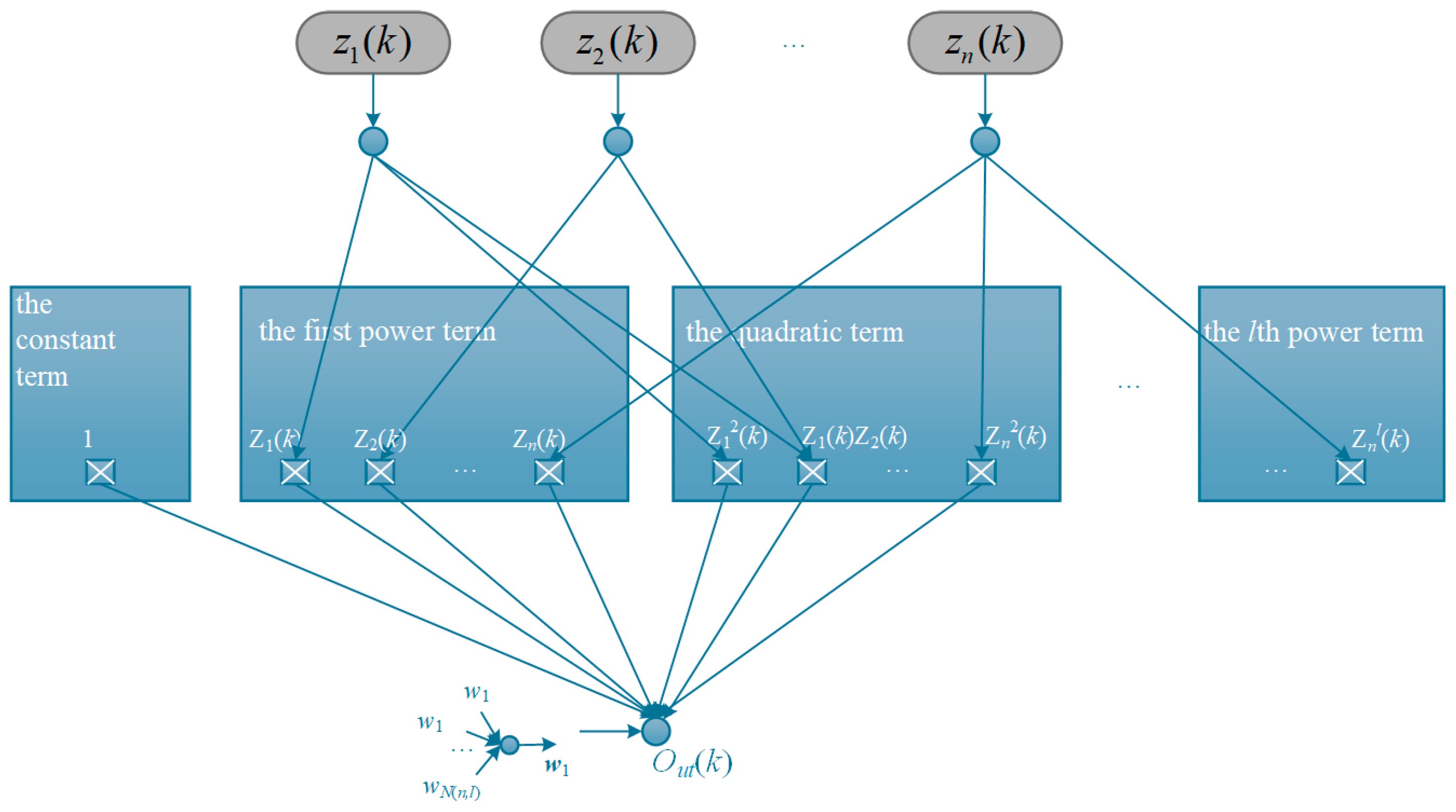
The basic structure of the MTN is illustrated in
Figure 1.
In other words, there exists a set of parameter vectors
such that the output of the MTN
can be expressed as
where
is the total number of the expansion,
is the weight of the product term,
is the power of
in the
th product term, and
.
Setting
, we obtain
Similar to Reference [
29], there is no fixed standard for the highest power of the MTN, but with an increase in the power of the MTN, the internal function will increase, and it is usually appropriate to choose three times in practice.
5. Adaptive System Identification
In order to design an ideal feedback controller, and are required; thus, system identification is involved, with traditional identification methods usually considering and separately. Due to problems in such as zero crossing, it is easy to cause singularity problems like system divergence. To solve this difficulty, we modify the system as follows.
We rewrite the last subsystem and obtain
Therefore, the system can be identified for the two unknowns and to avoid the singularity problem.
According to the basic structure of MTN, we obtain
where
is the polynomial combination of MTN.
Since is unknown, it can be replaced by from the foregoing equation. Despite an error between them, it can be compensated through weight adjustment. and are ideal-weight MTN vectors.
Unlike traditional neural network methods, our technique requires two sets of basis vectors in which each is calculated separately, imposing a significant computational burden. Moreover, there is a suitable polynomial combination compared with the MTN, i.e., the identification effect can be achieved only by changing the parameter value.
By introducing the MTN, the system input value can be rewritten as
where
is the total error of the MTN.
In the above formula,
is unknown and can be replaced by
, so we can obtain
where
is the total system identification error.
Since the unknown network weights and have not been estimated, the control strategy described below is designed.
In the above calculations, only
is estimated, while the derivative of the system
, i.e.,
, is unknown. Thus, a low-pass filter
is introduced where
is the filter constant. Using the inverse Laplace transform and without considering the influence of the initial value, the following formula can be obtained:
letting the initial value of
be 0, i.e.,
.
Correspondingly, the low-pass filter can be applied to other variables, and the initial value is set to 0.
Lemma 1. Consider the continuous function , where and are both continuous mappings. After applying the low-pass filter, the following conclusions can be drawn: where and are the functions of and passing through the low-pass filter and is the high-order truncation error. Substituting the previous formula, we obtain
where
is the lumped error,
is the generalized weight vector, and
is the generalized control vector of input
.
6. Adaptive Control Law Design
By adjusting to make it infinitely close to , we finally achieve the control purpose. To this end, we designed an error-based adaptive adjustment rate that is .
Parameter definition:
where
and
are positive constants.
We design two auxiliary variables,
and
, based on
:
Since both and are greater than 0, it can be guaranteed that and are both bounded.
We calculate the above formula to obtain
By setting
, we obtain
where the norm of
is a bounded function, that is,
.
The error vector is defined as
By subtracting the above two formulas, we obtain
Then, after the low-pass filter, the auxiliary variables
,
, and
are calculated and
is obtained. An adaptive rate based on
can be designed as
where
is an adaptive adjustment step.
Theorem 1. If the above-mentioned adaptive rate is used, the weight error vector finally converges near the 0 point under the condition of a continuous excitation of .
Proof. We define the Lyapunov function as
Deriving the above formula provides
Since
continues to excitate, there is a normal number,
, for
:
It can be seen from the auxiliary variable
that
For simplicity, we define
and obtain
Since both and are greater than 0, it can be known from the Lyapunov theorem that and the error vector converge to around 0 according to the exponential law.
The proof is complete. □
Compared with the traditional gradient method, the auxiliary variables , , and are constructed in this paper, and then an adaptive rate based on is designed, ensuring that the error vector converges to near 0, i.e., is infinitely close to . Thus, the system estimation affords guaranteed accuracy.
Controller Design and Stability Analysis
In order to achieve the ultimate control goal, we define the error vector and the generalized Hurwitz polynomial
where
are the tracking target and its higher-order derivative.
Set
where
makes
satisfy the Hurwitz polynomial.
When converges and is bounded, also converges and is bounded accordingly.
Here, the observation state
is used instead of
, and the actual errors
and
are defined accordingly. That is,
The difference between the replacement and the original state is represented by
and
, as shown below.
Taking the derivative of
, we obtain
We multiply both ends of the equation by
, substitute the expressions above, and sort them to obtain
We replace
with the observation state
. Let
be the augmented polynomial vector, and let
be the sum of the approximation errors of the differential observer and the MTN network. Then, we obtain
In order to achieve the final control purpose, the control quantity
is constructed as shown below.
Where is the gain parameter, and and are estimates of the ideal weight vectors and .
We substitute
to obtain
Similar to Theorem 1, the following adaptive law is designed:
where
is the adaptive adjustment step and
is the correction parameter.
Theorem 2. Given the strict feedback system of Equation (1), when the differential state observer of Equation (8), the control input of Equation (41), the parameter vector adaptive law of Equation (43), and the MTN polynomial preserve a continuous motivation, then all signals in a closed-loop system are bounded and the error variables and and the weight vector error all converge to a compact set near the 0 point.
Proof. From the definition of the observation error, we obtain
Let be the observation error of the differentiator and bounded, that is, , where is a normal constant.
We choose the Lyapunov function as follows:
By deriving the above formula, we obtain
Substituting the previous form into Equation (41), we obtain
From Equation (35), we know that
, so we obtain
Therefore, can be established by setting a larger .
From Theorem 1, we know that
, so we have
By applying Young’s inequality to
,
, and
, and substituting the result into the above formula, we obtain
Equation (50) reveals that by appropriately increasing the gain parameter
and the correction parameter
, it can be ensured that
From the Lyapunov theorem, we know that the errors and are bounded and converge to a compact set near the 0 point. At the same time, from Equations (35) and (43), and since is bounded, we conclude that , , and are bounded and that the weight vector is bounded. From Equation (41), the control signal is bounded.
The proof is completed. □
In this paper, the adaptive law based on an MTN ensures that the estimated weight vector approaches the true weight vector in a direction with infinitely small errors. At the same time, compared with the traditional dual-neural-network identification method, the number of calculations is reduced, and the identification process of the unknown dynamics of the entire system is completed.
7. Simulation Example
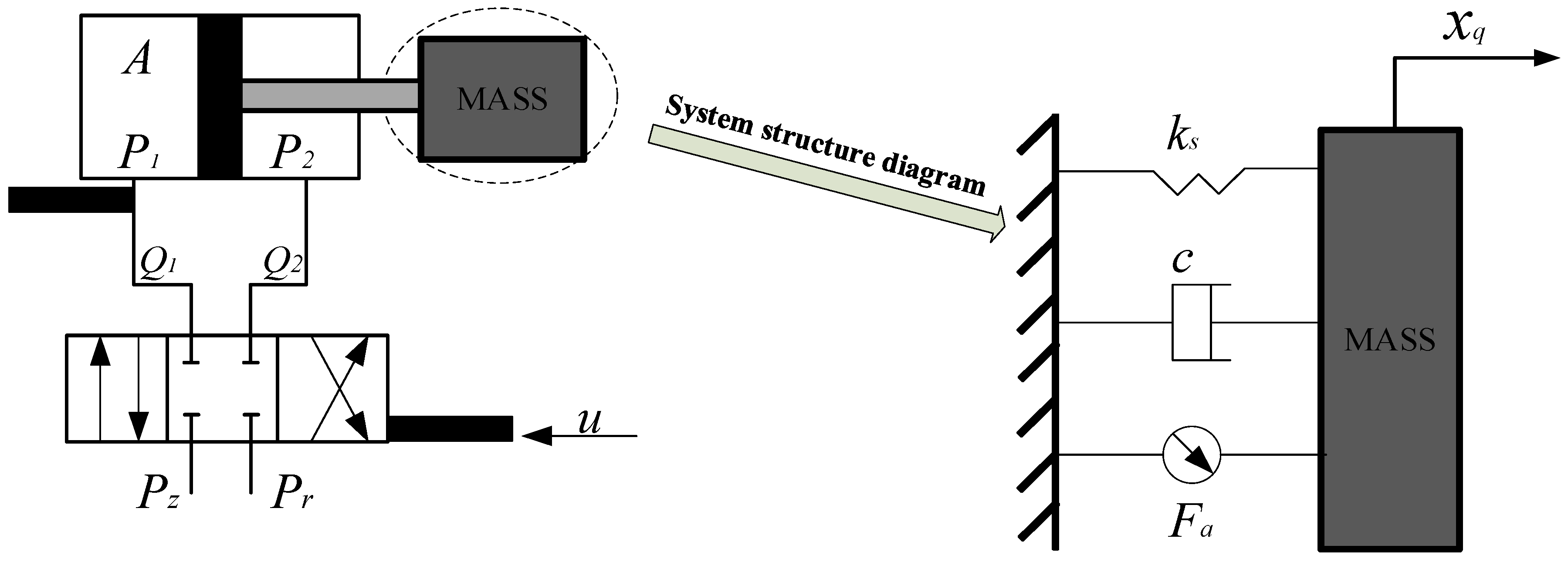
Consider the servo-hydraulic system of [
28], as illustrated in
Figure 2.
The system has typical strict-feedback non-linear characteristics where is the output displacement, is the output driving force of the hydraulic drive, is the pressure, is the mass of the load, is the spring coefficient, and is the damping coefficient.
The system model is as follows:
where
,
,
,
, and
.
is the total volume of the hydraulic cylinder, is the elastic modulus of the hydraulic fluid, is the effective acting area of the piston in the hydraulic cylinder, and is the effective conversion ratio of the servo valve input and output.
In order to verify the validity, we select data close to reality:
; ; ; ; ; ; ; .
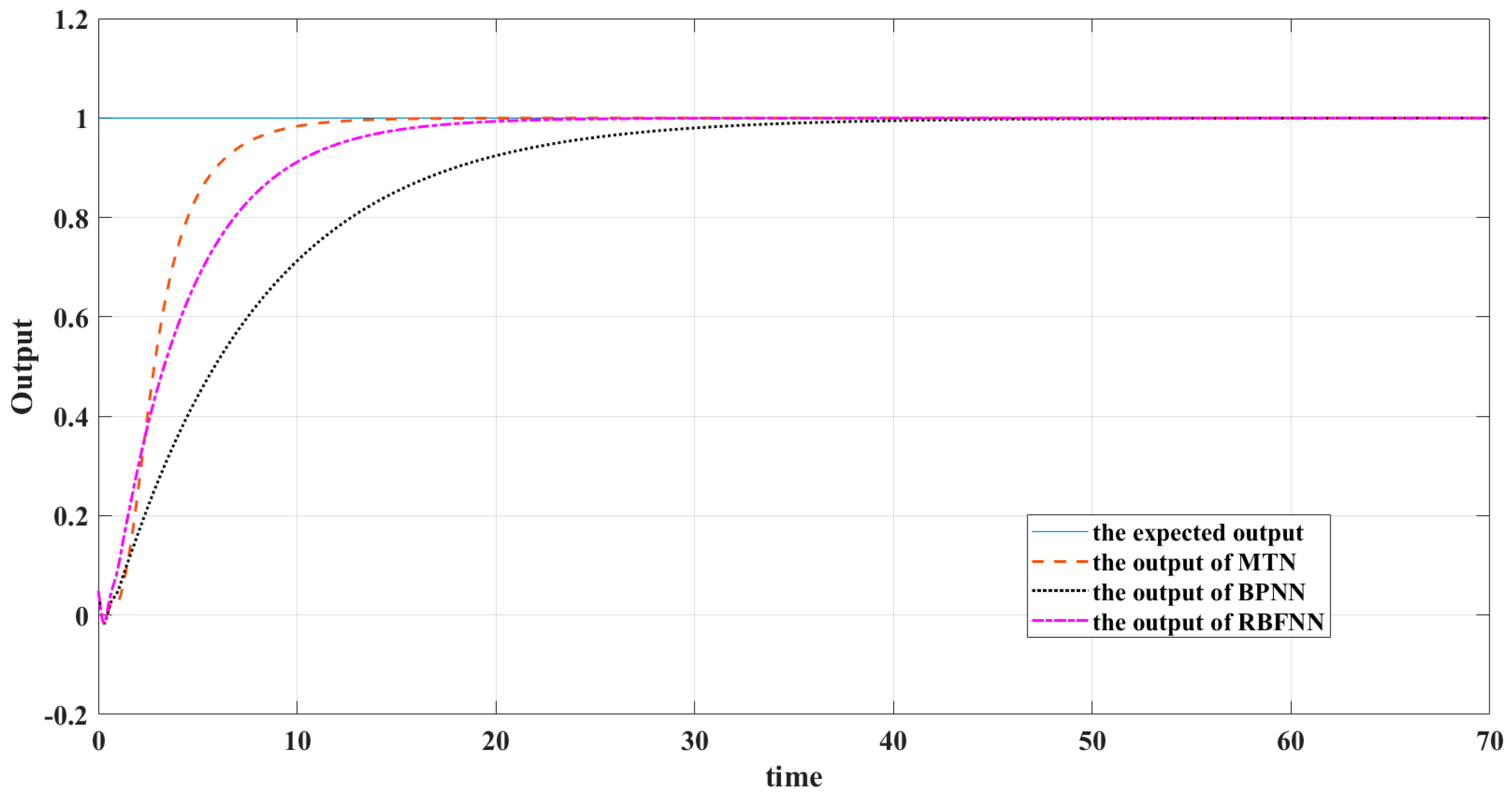
The unit step response curve of the MTN is illustrated in
Figure 3.
In
Figure 3, the BPNN controller and RBFNN controller are given. As traditional control methods, the neural network controllers work well and have the ability to resist disturbance. From these experimental results, it is shown that the method proposed in this paper is faster than another.
To accurately assess the performance of the three control methods, we employed three error metrics: the (1) Root Mean Square Error (RMSE), which represents the square root of the ratio of the squared differences between the actual values and the predicted values and is sensitive to outliers in the data; (2) the Mean Absolute Error (MAE), which measures the average distance between the model’s predicted values and the actual values and is less sensitive to outliers; and (3) the Mean Absolute Percentage Error (MAPE), which is a relative measure that quantifies the accuracy of predictions using relative error. The values of these metrics obtained using the three control methods are shown in
Table 1.
As shown in
Table 1, the proposed method outperforms the NN and the RBF in terms of most metrics.
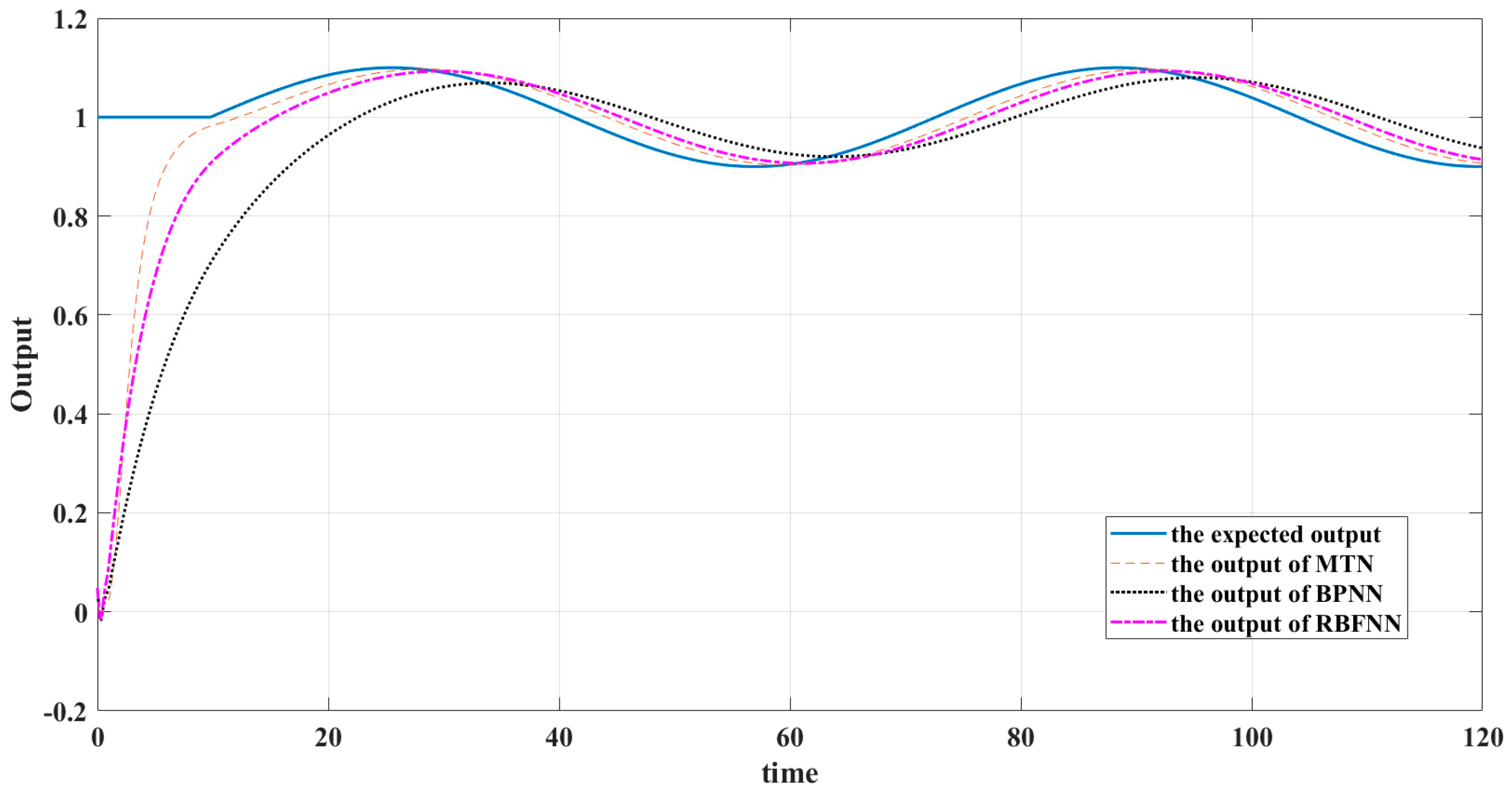
In order to verify the tracking performance of the system,
was chosen as the desired signal, and the system outputs are illustrated in
Figure 4.
Similarly, the results of the three indicators are shown in
Table 2.
The latter figure presents the system output and the ideal tracking signal, highlighting that the system has a good tracking performance, i.e., the effectiveness of the proposed method is highlighted from the simulation results.
8. Discussion
This paper proposes an output feedback control method based on the MTN that is appropriate for non-linear strict systems so that the system output can automatically track the desired signal. The original strict-feedback system is first transformed in the proposed method, and the state variables are redefined to obtain the new standard form. A state observer is then designed to complete the identification process of the adaptive system under the good approximation characteristics of the MTN. Based on this, the adaptive control law is designed to complete the system tracking process. Numerical simulations on a servo-hydraulic system model as the control object verify the effectiveness of the suggested method.