


Abstract
The capabilities of autonomous mobile robotic systems have been steadily improving due to recent advancements in computer science, engineering, and related disciplines such as cognitive science. In controlled environments, robots have achieved relatively high levels of autonomy. In more unstructured environments, however, the development of fully autonomous mobile robots remains challenging due to the complexity of understanding these environments. Many autonomous mobile robots use classical, learning-based or hybrid approaches for navigation. More recent learning-based methods may replace the complete navigation pipeline or selected stages of the classical approach. For effective deployment, autonomous robots must understand their external environments at a sophisticated level according to their intended applications. Therefore, in addition to robot perception, scene analysis and higher-level scene understanding (e.g., traversable/non-traversable, rough or smooth terrain, etc.) are required for autonomous robot navigation in unstructured outdoor environments. This paper provides a comprehensive review and critical analysis of these methods in the context of their applications to the problems of robot perception and scene understanding in unstructured environments and the related problems of localisation, environment mapping and path planning. State-of-the-art sensor fusion methods and multimodal scene understanding approaches are also discussed and evaluated within this context. The paper concludes with an in-depth discussion regarding the current state of the autonomous ground robot navigation challenge in unstructured outdoor environments and the most promising future research directions to overcome these challenges.
1. Introduction
The use of autonomous mobile robotic systems is rapidly expanding in many scientific and commercial fields, and the capabilities of these robots have been growing due to continuous research and industrial efforts. The range of different research application areas in autonomous mobile robotics is wide, including areas such as surveillance, space exploration, defence, petrochemical, industrial automation, disaster management, construction, marine, personal assistance, extreme environments, sports entertainment, agriculture, transportation logistics, and many other industrial and non-industrial applications [1]. Many different types of robot platforms have been and continue to be developed for these applications, and autonomous mobile robotics is a global and continuously evolving scientific field. Robots that move in contact with ground surfaces are commonly referred to as mobile ground robots, and these robots may be deployed in different working environments, including indoor or outdoor, structured or unstructured, and in proximity to static or dynamic actors. Each of these environments creates various challenges for robot applications. The overall system configuration of a robot mostly depends on the relevant operating environment; for example, a robot designed for a static environment may not effectively adapt to dynamic situations that arise within the environment [2]. The development of ground robotic systems is particularly challenging when the intended application area of autonomous vehicles/robots falls into the unstructured off-road category, making this a very active area of research. The difficulties mainly arise due to the weak scene understanding of robots in these unstructured environment scenarios. Mobile ground robots have recently shown increasingly sophisticated scene-understanding capabilities in indoor environments (e.g., Amazon Robotics warehouse robots [3]). However, in outdoor robot navigation, the environments are generally much less structured and more unpredictable (e.g., lighting, shadows, occlusions and texture) than in indoor robot navigation application scenarios. Due to these particular challenges and the more limited level of progress achieved to date to address them, this work seeks to provide a thorough review of existing research works in this field in order to provide directions for advancing robot navigation in unstructured outdoor environments. The agriculture industry is one example of a relevant application area to deploy scene understanding based on off-road autonomous robotic systems. In recent times, the agriculture industry has shown a growing adoption of robotics technologies, but in general, the involvement of novel technologies depends on economic sustainability. Ground mobile robots and manipulators are already used in precision farming to pick fruits, harvest vegetables, and remove undesirable vegetation, but their application areas are generally fairly narrow due to limited scene understanding capability. In the past few years, self-driving vehicles have gradually grown in technological capability and market size within the automobile industry [3,4]. Despite these developments, autonomous driving is still a very challenging problem, and in complex scenarios, the performance level remains below that of an average human operator. This is particularly true when the intended application area of autonomous vehicles/robots includes off-road areas. This low performance mainly arises due to the weak external environment understanding of robots. In general, application areas such as disaster management, environment exploration, defence, mining and transportation are associated with complex and unstructured environments. Therefore, these fields are also driving further research on mobile robot scene understanding as it relates to the broader topic of autonomous robot navigation. The following challenges for the classical autonomous robot navigation pipeline remain for current robotic systems:
- Perception;
- Localisation and mapping; and
- Scene understanding.
In robot perception, robots sense environments using different sensors and extract actionable information via the sensor data. Perception plays an important role in the realisation of autonomous robots. For robots to perform effectively in unstructured outdoor environments in real time, it is essential that they possess accurate, reliable, and robust perception capabilities. To achieve these characteristics, in general, autonomous robots in complex scenarios are equipped with several sensor modalities (that can be exteroceptive or proprioceptive) [5,6]. Different modalities such as sound, pressure, temperature, light, and contact have been used in robot environmental perception applications [7]. Sensor fusion (combining different sensor modalities) has been applied in many recent autonomous mobile robot/self-driving applications [8]. Multimodal sensor fusion brings the complementary properties of different sensors together to achieve better environment perception across a range of conditions [9]. Many recent deep learning-based sensor fusion methods have shown higher robustness in perception than conventional mono-sensor methodologies [6,10]. Camera, Light Detection and Ranging (LiDAR), radar, ultrasonic, Global Navigation Satellite System (GNSS), inertial measurement unit (IMU) and odometry sensors are used in many mobile ground robot perception applications. The most frequently used robot vision-based sensor fusion methods combine camera images with LiDAR point clouds. Research into sensor fusion techniques remains an important component of achieving better sensing capabilities for unstructured outdoor environments.
In the second stage of the autonomous robot navigation pipeline, the information retrieved from perception sensors is used for robot localisation and to map their external environments. Autonomous mobile robots require accurate and reliable environmental mappings and localisation at a sophisticated level based on the application context. The Simultaneous Localisation and Mapping (SLAM) approach is a commonly used technique in autonomous mobile robot systems to represent the robot positions and the map of their external environments when both the robot pose and environmental map are previously unknown. Many SLAM systems use LiDAR sensors and vision-based sensors such as Red-Green-Blue (RGB)/RGB-Depth (RGB-D) cameras that can retrieve visual or proximity information, and the fusion of these sensors has achieved better robustness than using either camera or LiDAR sensors alone [11]. LiDAR sensors use highly accurate Time-of-Flight laser range finding for the detection of objects. An example of a lightweight and low-cost semantic environment classification approach for indoor robot navigation is introduced in [12]. Semantic classification becomes challenging with the variation of the lighting, shadows, occlusions, texture and the number of unseen semantic classes. Dynamic agents present another problem, [13] has proposed a LiDAR-based concept to segment large areas with dynamic agents. It can use LiDAR range view representations and further categorise objects in the images into semantic classes. Several research works have incorporated the fusion of camera and LiDAR data for improving scene understanding of outdoor environments [14].
A fundamental aim of robotic vision is to interpret the semantic information present in a scene to provide scene understanding. Scene understanding goes beyond object detection and requires analysis and elaboration of the data retrieved by the sensors [15]. This concept is used in many practical applications, such as self-driving vehicles, surveillance, transportation, mobile robot navigation, and activity recognition. Understanding scenes using images or videos is a complex problem, however, and requires more steps than just recording and extracting features [16]. Scene understanding can be aided by taking advantage of multiple sensor modalities, which is usually termed multimodal scene understanding [17]. One of the requirements for autonomous robots operating in unstructured environments is the capacity to understand the surrounding environment. Scene understanding comprises subtasks such as depth estimation, scene categorisation, object detection, object tracking, and event categorisation [18]. These scene-understanding sub-tasks can describe different aspects of a scene acquired by perception sensors. In scene understanding, a representation is given to a scene by carrying out some of the above tasks jointly to obtain a holistic understanding of the retrieved scene. To generate this overall representation, the information observed from the above-mentioned scene understanding subtasks must be combined meaningfully. Some of the early methods used to obtain scene understanding included using a block world assumption [19] or bottom-up, top-down inference [20]. Many of these early works depended on heuristics rather than learning-based methods and, thus, were not suitable for generalisation to unstructured real-world scenarios [21]. The most used recent methods try to acquire information from deep learning-based (i.e., convolutional neural networks (CNNs), graph neural networks, vision transformers) approaches. Scene understanding in unstructured outdoor environments using multimodal scene understanding concepts is a challenging task. Many modern scene understanding methods use feature-based high-level representations of environments. In unstructured environments, however, the detection of useful object features is challenging. Therefore, it is difficult to reliably interpret visual information from unstructured or dynamic environments [22]. However, to attain real-world effectiveness, robots should understand their operating environments up to a level that is accurate enough to execute real-time and goal-oriented decisions.
One of the key capabilities required for autonomous robot operation is autonomous path planning for robot navigation. Many ground robot navigation applications in unstructured environments require traversal of uneven terrains. Some challenges in robot unstructured environment navigation, including traversal of previously unseen unstructured grounds, can be addressed by adequately designing robot structure, path planning and control [23,24]. Path planning is generally separated into global and local planning. For global planning, previous knowledge of the operating environment is necessary, and this planning method is also identified as an off-line mode for robot path planning. Robot local path planning, also known as online robot path planning, allows for real-time decisions to be made by the robot in response to the perception of the local environment. Autonomous robot local path planning for optimal terrain traversal in unstructured outdoor environments is an important challenge to solve for robots operating in off-road conditions. This is due to the limitations of standard path planning algorithms, which are incapable of performing the desired tasks in dynamic or unstructured environments where the system lacks prior knowledge and/or already existing maps [25]. Artificial potential fields, simulated annealing, fuzzy logic, artificial neural networks, and dynamic window [26] approaches are some of the algorithms that have been used in robot local path planning [21]. An optimal local path planning approach should enable robots to adaptably deal with their environments, such as assisting in avoiding dynamic obstacles or identifying traversable routes through varying terrain conditions. In unstructured environments, classical path planning concepts such as Rapidly exploring Random Tree (RRT) variants, Batch Informed Tree (BIT), D* algorithm variants, artificial potential field methods, A* algorithm variants and learning-based path planning methods have been used [27]. Over the past years, deep learning has been used to enhance the performance of sensor fusion [28], multimodal scene understanding [29], and robot local path planning [30] techniques.
For autonomous navigation, a robot must have the ability to understand both its pose and enough about the external environment to determine an optimal and traversable path to safely reach a goal position without human assistance in the robot control loop. However, fully autonomous navigation in unstructured environments has not yet been achieved despite significant advancements in computing and engineering technology. Autonomous vehicle navigation on urban roads has been of great interest due to its emerging commercial applications around the world. As a result, autonomous perception technologies are developing continuously due to the competitiveness of this industry [31]. Compared to the level of development of methods for autonomous navigation in urban settings [32], however, autonomous navigation in off-road scenarios has not been studied to the same extent, meaning there are significant opportunities for new research in this area. A large number of autonomous navigation techniques have been explored, and these can be broadly divided into two subsections according to the approach used to execute control commands following the processing of the input sensory data.
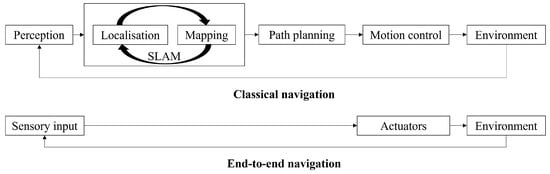
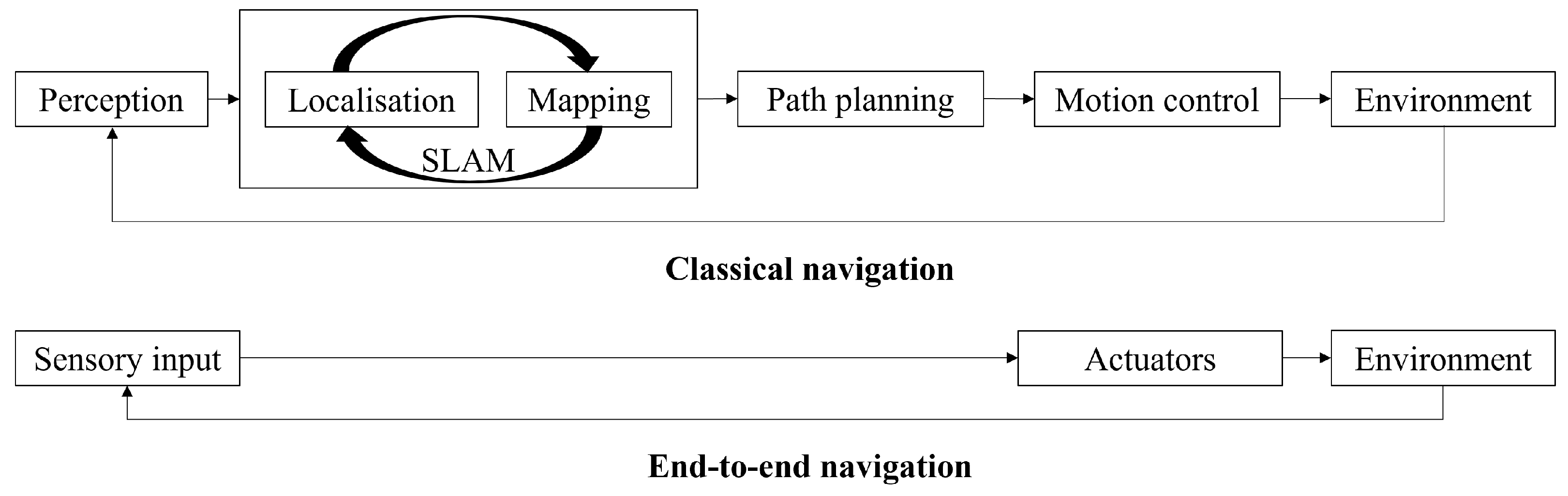
As shown in Figure 1, autonomous navigation methods can be categorised as the classical modular pipeline or end-to-end learning-based approaches. The modular pipeline architecture includes intermediate representations that humans can interpret and that can provide information related to the failure modes of the approach. Furthermore, the system development can be parallelised among several expert teams because of its modular nature. Perception, localisation and mapping, path planning and robot control modules may consist of classical, learning-based or hybrid methods [8,33]. Due to algorithmic and modelling limitations, however, the modular approach may not be optimal for general autonomous navigation applications. In addition, machine learning-based modules must be separately trained and validated using auxiliary loss functions, which can create suboptimality across the system as a whole. In contrast, end-to-end learning-based systems learn policies from observations of the outcomes that result from the actions of autonomous systems [18,34]. In these systems, Deep Reinforcement Learning (DRL) is used to refine the control algorithms used to determine autonomous actions. However, commonly employed methods like imitation learning can suffer from overfitting and cause problems with the poor generalisation of the system behaviour when deploying in different environment scenarios [11]. In addition, when errors occur in an end-to-end system, it can be complex to investigate because the origin of these errors is hidden in the holistic neural network-based architectures [8,35]. It is clear, however, that future development of autonomous robot navigation will rely on further advancements in robot environmental perception and machine learning.
Figure 1.
Classical and end-to-end autonomous navigation approaches.
This paper provides a comprehensive review of the current state of research and the most promising advancements relevant to the field of ground robot navigation in unstructured environments, including perception and sensor fusion, scene understanding, and path planning. The most promising state-of-the-art methods used in classical outdoor robot navigation pipelines are discussed and evaluated, along with emerging learning-based approaches; promising future research directions are then highlighted. Readers of this paper will gain insights and knowledge regarding current state-of-the-art capabilities, as well as trends and emerging opportunities in the autonomous robot outdoor scene understanding and navigation research field. The remainder of this paper is structured in the following manner. A discussion of robot vision and the types of active ranging sensors that are used for robot environment perception is presented in Section 2. This section also discusses deep learning-based camera and LiDAR sensor fusion methods for depth estimation, object detection, and semantic and instance segmentation. Section 3 describes modern mobile ground robot scene understanding techniques and scene representations that are utilised in robot navigation. Robot path planning algorithms at the global and local levels are discussed in Section 4. In Section 5, the details of robot vision and ranging sensors, fusion methods, scene understanding concepts, and local navigation approaches are summarised. Section 6 provides an overview of the research challenges related to the topic. Additionally, it offers some potential future research directions. Finally, the conclusion of the review can be found in Section 7.
4. Mobile Robot Local Path Planning
Approaches for path planning of robots in local environments can be broadly classified into either classical methods or learning-based methods that attempt to modify the path-planning based on factors such as environmental conditions and prior experience [131,132]. The classical methods follow a modular architecture with environmental perception, planning of paths relative to generated global maps, and trajectory following. Many classical techniques are applicable for robot navigation in static environments. However, their suitability can substantially diminish in unstructured or dynamic environments [133]. In general, these methods can be used effectively in indoor mobile robot applications but may not be suitable for outdoor off-road navigation conditions (e.g., terrain with grass might be traversable despite appearing blocked, and ground with mud or sand may not be suitable for pathing, despite appearing clear), hence the requirement to investigate machine learning-based navigation approaches. Several global and local motion planning methods for ground robot navigation are compared in Table 4 and Table 5.
Table 4.
Global path planning algorithms.
Table 5.
Local path planning algorithms.
The A* and Dijkstra algorithms have been well-researched in the past decades, and these methods have shown their potential by extensively being applied with the Robot Operating System (ROS) in many real-world robotics applications. Combining these two path-planning methods with heuristic searching is effective in relatively low-complexity 2D environments. However, these methods require heavy computational capabilities in high-dimensional environments or may struggle in unstructured and dynamic working environments.
Random sampling-based path planning algorithms generally consist of BITs and RRTs. Regionally Accelerated Batch Informed Trees (RABIT) are more widely used and perform better in high dimensional and dynamic environments [134] in comparison to graph search-based path planning algorithms. Bionic-based intelligent robot path planning methods simulate the behaviours of insects to generate evolving paths. These evolutionary methods include the ant colony, particle swarm optimisation, and genetic and artificial bee colony algorithms. Many other optimised versions of these algorithms have been proposed to improve calculation efficiency and avoid local minimum problems. A welding robot system developed in [135] had a combination of genetic and particle swarm optimisation algorithms to solve for the shortest route while avoiding obstacles. The artificial potential field method, ant colony optimisation, and geometry optimisation path methods were combined in another research study [136] to search the globally optimal path in 2D scenarios using computer simulations. This method showed fast solutions and reduced the risk of trapping robots in local minimum points. A multi-objective hierarchical particle swarm optimisation method has been proposed by [137] to plan global optimal path trajectories in cluttered environments. This method utilises three layers to generate the robot navigation trajectories. The triangular decomposition method [138] is applied in the first layer, the Dijkstra algorithm is used in the second, and a modified particle swarm optimisation algorithm is applied in the last layer.
In general, the local path planning strategies that have been discussed use the available sensor data of robots regarding their surroundings to map, understand, and generate local paths while avoiding obstacles. These local path planning methods are effective in mobile robotic applications because the data captured by sensors varies in real-time in response to the dynamics of environments. In comparison to global path planning strategies, local path planning is more critical for practical robot operation and usually serves as a bridge between global planning and the direct control of robots. However, local path planners have one notable drawback in that they often lead robots to local minimum points. Many classical local path planning algorithms can generate optimal paths in the local environments while avoiding local minimum problems. These methods include techniques such as the Fuzzy Logic algorithm, artificial potential field method, and simulated annealing algorithm. In general, these methods do not evaluate the relative velocities between robots and dynamic environment objects, however, which can lead to difficulties. In many worst-case scenarios, even the velocity profiles of these obstacles can be hard to acquire for the robots. Visual-inertial odometry methods show success in outdoor environment navigation scenarios but are not suitable for navigating in off-road conditions without pre-built maps or GPS assistance.
Machine learning methods have been applied for mobile robot navigation to learn semantic information [139,140,141] and statistical patterns [142,143] of environments. Several other research works [144,145,146,147] have used machine learning to achieve robustness in path following. In recent years, many Reinforcement Learning (RL) and imitation learning methods and approaches based on self-supervised learning [148,149,150,151] have been applied in mobile robot navigation policy design and for training supervision. Many classical modular and deep learning-based approaches have been utilised in the navigation modules of outdoor mobile robots [152]. RL uses strategies to learn optimal robot decisions from experiences. The interconnection between environments and robots is modelled as a Markov Decision Process (MDP). Robots receive rewards as feedback signals for training while traversing different environments. The basic RL process is illustrated in Figure 2. RL methods can be separated into model-free and model-based learning scenarios. In model-free RL, the robots are not required to evaluate the MDP model rewards or policies directly and can obtain these directly through what the robot experiences. Model-free RL approaches have several subcategories such as value-based, policy-based, and Actor-Critic (improved versions of the policy-based algorithms) [153,154].
Figure 2.
Robot RL approach.
In value-based methods, optimal policies are obtained by iteratively updating the value functions. Policy gradient-based methods directly approximate a policy network and update the policy parameters to obtain an optimal policy that maximises the reward value. Deep Q network (DQN) and Double DQN are the two main value-based DRL methods. A DQN-based end-to-end navigation method has been introduced in [155]. In this work, a feature-extracting network used an edge segmentation method to improve the efficiency of the network training process. The simulated models were transferred to the real world without significant performance loss. Discrete robot actions were implemented based on a grid map. The robot exploration framework is divided into decision, planning, and mapping modules. The learning-based decision module has shown good performance, efficiency, and adaptability in novel environments. A graph-based technique has been implemented for the mapping module. The applied path planning module includes the A* algorithm as the global planner along with a timed elastic band [156] local planner.
Value-based DRL methods produce discrete actions, meaning they are not appropriate for the continuous robot action space. The policy-based DRL methods provide continuous motion commands for robots. Combining the policy gradient with the value function creates the Actor-Critic RL method. In general, Actor-Critic algorithms are well-suited for the continuous motion space of autonomous mobile robots. The Actor approximates the policy used to generate actions in the environment. The Critic architecture is accountable for using a reward function to evaluate robot actions iteratively and guides the Actor in successive iterations. The Critic uses deep learning value functions such as DQN and Double DQN to evaluate each iteration step. The Actor-Critic approach includes learning methods such as Depth Deterministic Policy Gradient algorithm (DDPG), Trust Region Policy Optimisation (TRPO), Proximal Policy Optimisation (PPO), Asynchronous Advantage Actor-Critic (A3C), and Soft Actor-Critic (SAC) [21]. An extended Actor-Critic algorithm was proposed in [157]. The visual navigation module of the deep neural network consisted of depth map prediction and semantic segmentation auxiliary tasks. The proposed learning network requires an image of the target and an observed image as inputs. This network architecture was proposed to obtain a visual navigation policy for indoor environments. A summary of DRL motion planning methods is included in Table 6.
Table 6.
DRL motion planning methods.
Model-based robot RL methods generate models of external environments using supervised training and implement value functions to learn actions that maximise the return. Model-based RL has faster convergence and high sample efficiency. Ref. [158] presents a biped robot that learns on a rotating platform by combining model-based and model-free machine-learning methods. This paper has addressed the overfitting problem of model-based robots. The research has simulated the robot in a 2D scenario and has shown a reduction in learning time compared to model-free RL algorithms. Imitation learning is another related approach that uses demonstrations by experts operating robots for specific tasks to obtain policy functions. Mobile robots learn mappings between observations of these demonstrations and appropriate robot actions. Path trajectories can be rapidly generated by manipulating learned policies from expert demonstrations. However, the capacity of the robot to practically record these demonstration results from real-world experiments can be challenging. Ref. [159] has introduced a method to acquire a mapping from actions to states using ego-centric videos collected by a human demonstrator using a mobile phone camera. The policy learning step was executed within a simulation platform; then, the developed navigation policy was tested on a Clearpath Jackal wheeled robot in an indoor environment. The robot and the trained videos had view-point mismatches, but the model was robust to those changes. The system was successfully able to map camera sensor inputs to actuator commands using the developed imitation learning policy.
Inverse RL is another approach capable of learning reward functions from expert demonstrations. However, inverse RL is more appropriate for exploring novel environments because imitation learning tries to directly follow a demonstrator rather than improve beyond that knowledge level. The creation of an inverse RL network by employing a vision-based imitation learning method was presented by [160]. This method approximates a value function from one middle layer of a policy trained by imitation learning. The related experiments were carried out on a real-world setup and using the ROS Gazebo simulation platform. This proposed method has shown the capability of generalising the system for unseen environments by producing usable cost maps. Traditional geometric-based SLAM procedures lack the capacity to capture dynamic objects in external environments and are thus only suitable for planning robot actions in static environments. RL-based techniques, however, can learn policies by considering dynamic obstacles in outdoor environments, although the sample efficiency is lower compared to imitation learning and model-based learning. The implementation of learning-based maps and traditional path planners is one way to improve sample efficiency. A mobile robot affordance map generation using the RL policy-based method was introduced by [161]. This research used metric cost maps (attaching semantics and geometry) for robot navigation. The A* classical path planner was implemented for path generation. This learning-based SLAM approach was implemented using simulation software. Semantic, dynamic, and behavioural attributes of unseen environments have been learnt by the model using the simulation scheme. Local path planning remains a highly challenging task, particularly in environments with dynamic actors or challenging terrain features such as unpredictably varying topography or varying ground conditions. Modern machine learning approaches, coupled with advanced SLAM techniques, show promise for enabling effective navigation planning, but methods that can effectively handle all of these challenges do not yet exist, and considerable further work will be required to enable fully autonomous navigation in all conditions.
5. Summary of the Current State-of-the-Art Techniques
Autonomous navigation can be broadly categorised into the classical modular pipeline methods and end-to-end learning approaches. The modular pipeline approach has limitations due to the requirement for high levels of human intervention in designing the modules, the loss of information through each module, and the overall lack of robustness when conditions vary beyond anticipated limits. The end-to-end learning approach suffers from problems such as over-fitting and poor generalisation. Both modular and end-to-end robot navigation approaches rely on sensors to capture information about the environment or internal robot attributes. Researchers have investigated different sensor modalities to improve robot perception, including raw input types such as sound, pressure, light, and magnetic fields, as well as common robot perception sensor modalities such as cameras, LiDAR, radar, sonar, GNSS, IMU, and odometry sensors. It is crucial to have a reliable real-time understanding of external 3D environments to ensure safe robot navigation. While cameras are commonly used in mobile robotics, relying on a single sensor is not always robust. Different sensor modalities are often combined in robotic applications to improve perception reliability and robustness. Camera and LiDAR fusion has been a popular approach in the robotics community. This fusion method has shown better performance than other vision-based dual sensor fusion approaches, and recent advances in deep learning algorithms have further improved its performance. Monocular and stereo cameras are commonly used with LiDAR sensors to fuse images and point cloud data. However, the technical challenges and cost of sensors and processing power requirements still limit the widespread application of these methods for regular use. Computer vision has experienced rapid growth in the past decade, with deep learning methods accelerating its development. Object detection, depth estimation, semantic segmentation, instance segmentation, scene reconstruction, motion estimation, object tracking, scene understanding, and end-to-end learning are among the subtopics of computer vision. These methods have been widely applied in autonomous navigation, but their accuracy and reliability can be limited, prompting ongoing efforts to improve their quality. Benchmarking datasets, such as KITTI, Waymo, A2D2, nuScenes, Cityscapes, RELLIS-3D, RUGD, Freiburg [29], and WildDash [162], have been used to compare the performance of different vision methods in autonomous urban driving and off-road driving applications.
Semantic SLAM techniques provide geometric and semantic details of external environments. However, existing semantic SLAM techniques may not be adequate for the safe navigation of robots in outdoor unstructured environments due to challenges in feature detection, uneven terrain conditions (which can lead to robot localisation errors, detection errors, etc.) and effects of wind on vegetation, which can lead to sensor noise and ambiguous results. Therefore, terrain traversability analysis and improved scene understanding using deep learning methods have been developed that are showing promise in assisting robot navigation in outdoor unstructured environments.
Many classical robot path-planning approaches are used for navigation in local environments. These classical approaches rely on a modular architecture to perceive the environment, plan paths relative to generated maps, and follow trajectories. However, these classical methods are often challenged in dynamic or deformable environments and are not well-suited for off-road navigation conditions where terrains may be unpredictable. Learning-based methods have been developed to improve robot path-planning abilities under different environmental conditions and have shown promise in addressing these challenges. In particular, learning-based navigation methods have been shown to be better suited for off-road navigation conditions, where terrains can be highly variable and unpredictable.
7. Conclusions
This paper has provided a comprehensive review of the current state-of-the-art in autonomous mobile ground robot navigation, identified research gaps and challenges, and suggested promising future research directions for improved autonomous navigation in outdoor unstructured terrains. A broad review of robot sensing, camera-LiDAR sensor fusion, robot scene understanding, and local path planning techniques has been provided to deliver a comprehensive discussion of their essential methodologies and current capabilities and limitations. The use of deep learning, multimodal sensor fusion, incremental scene understanding concepts, scene representations that preserve input data topology and spatial geometry, and learning-based hierarchical path planning concepts are identified as promising research domains to investigate in order to realise fully autonomous navigation in unstructured outdoor environments. Our review has indicated that applying these techniques to outdoor unstructured terrain robot navigation research can likely improve robot domain adaptability, scene understanding and conscious decision-making abilities.
Author Contributions
Conceptualisation, A.R., D.C. and L.W.; writing—original draft, L.W.; writing—review and editing, A.R. and D.C.; supervision, A.R. and D.C. All authors have read and agreed to the published version of the manuscript.
Funding
This research received no external funding.
Institutional Review Board Statement
Not applicable.
Informed Consent Statement
Not applicable.
Data Availability Statement
Not applicable.
Conflicts of Interest
The authors declare no conflict of interest.
References
- Rubio, F.; Valero, F.; Llopis-Albert, C. A review of mobile robots: Concepts, methods, theoretical framework, and applications. Int. J. Adv. Robot. Syst. 2019, 16, 1729881419839596. [Google Scholar] [CrossRef] [Scilit]
- Abdulsaheb, J.A.; Kadhim, D.J. Classical and heuristic approaches for mobile robot path planning: A survey. Robotics 2023, 12, 93. [Google Scholar] [CrossRef] [Scilit]
- Bogue, R. Warehouse robot market boosted by Covid pandemic and technological innovations. Ind. Robot. Int. J. Robot. Res. Appl. 2022, 49, 181–186. [Google Scholar] [CrossRef] [Scilit]
- Quarles, N.; Kockelman, K.M.; Lee, J. America’s fleet evolution in an automated future. Res. Transp. Econ. 2021, 90, 101107. [Google Scholar] [CrossRef] [Scilit]
- Zhang, S.; Yao, J.; Wang, R.; Liu, Z.; Ma, C.; Wang, Y.; Zhao, Y. Design of intelligent fire-fighting robot based on multi-sensor fusion and experimental study on fire scene patrol. Robot. Auton. Syst. 2022, 154, 104122. [Google Scholar] [CrossRef] [Scilit]
- Li, Q.; Kroemer, O.; Su, Z.; Veiga, F.F.; Kaboli, M.; Ritter, H.J. A review of tactile information: Perception and action through touch. IEEE Trans. Robot. 2020, 36, 1619–1634. [Google Scholar] [CrossRef] [Scilit]
- Alatise, M.B.; Hancke, G.P. A review on challenges of autonomous mobile robot and sensor fusion methods. IEEE Access 2020, 8, 39830–39846. [Google Scholar] [CrossRef] [Scilit]
- Feng, D.; Haase-Schütz, C.; Rosenbaum, L.; Hertlein, H.; Glaeser, C.; Timm, F.; Wiesbeck, W.; Dietmayer, K. Deep multi-modal object detection and semantic segmentation for autonomous driving: Datasets, methods, and challenges. IEEE Trans. Intell. Transp. Syst. 2020, 22, 1341–1360. [Google Scholar] [CrossRef] [Scilit]
- Hu, C.; Yang, C.; Li, K.; Zhang, J. A forest point cloud real-time reconstruction method with single-line LiDAR based on visual-IMU fusion. Appl. Sci. 2022, 12, 4442. [Google Scholar] [CrossRef] [Scilit]
- Jin, X.B.; Su, T.L.; Kong, J.L.; Bai, Y.T.; Miao, B.B.; Dou, C. State-of-the-art mobile intelligence: Enabling robots to move like humans by estimating mobility with artificial intelligence. Appl. Sci. 2018, 8, 379. [Google Scholar] [CrossRef] [Scilit]
- Huang, Z.; Lv, C.; Xing, Y.; Wu, J. Multi-modal sensor fusion-based deep neural network for end-to-end autonomous driving with scene understanding. IEEE Sens. J. 2021, 21, 11781–11790. [Google Scholar] [CrossRef] [Scilit]
- Alenzi, Z.; Alenzi, E.; Alqasir, M.; Alruwaili, M.; Alhmiedat, T.; Alia, O.M. A semantic classification approach for indoor robot navigation. Electronics 2022, 11, 2063. [Google Scholar] [CrossRef] [Scilit]
- Zhao, H.; Liu, Y.; Zhu, X.; Zhao, Y.; Zha, H. Scene understanding in a large dynamic environment through a laser-based sensing. In Proceedings of the 2010 IEEE International Conference on Robotics and Automation, Anchorage, AK, USA, 3–7 May 2010; pp. 127–133. [Google Scholar]
- Zhang, F.s.; Ge, D.y.; Song, J.; Xiang, W.j. Outdoor scene understanding of mobile robot via multi-sensor information fusion. J. Ind. Inf. Integr. 2022, 30, 100392. [Google Scholar] [CrossRef] [Scilit]
- Moon, J.; Lee, B.H. PDDL planning with natural language-based scene understanding for UAV-UGV cooperation. Appl. Sci. 2019, 9, 3789. [Google Scholar] [CrossRef] [Scilit]
- Yang, M.; Rosenhahn, B.; Murino, V. Multimodal Scene Understanding: Algorithms, Applications and Deep Learning; Academic Press: London, UK, 2019; pp. 1–7. [Google Scholar]
- Zhang, Y.; Sidibé, D.; Morel, O.; Mériaudeau, F. Deep multimodal fusion for semantic image segmentation: A survey. Image Vis. Comput. 2021, 105, 104042. [Google Scholar] [CrossRef] [Scilit]
- Janai, J.; Güney, F.; Behl, A.; Geiger, A. Computer vision for autonomous vehicles: Problems, datasets and state of the art. Found. Trends® Comput. Graph. Vis. 2020, 12, 1–308. [Google Scholar] [CrossRef] [Scilit]
- Gupta, A.; Efros, A.A.; Hebert, M. Blocks world revisited: Image understanding using qualitative geometry and mechanics. In Proceedings of the 11th European Conference on Computer Vision, Heraklion, Crete, Greece, 5–11 September 2010; pp. 482–496. [Google Scholar]
- Wang, W.; Shen, J.; Cheng, M.M.; Shao, L. An iterative and cooperative top-down and bottom-up inference network for salient object detection. In Proceedings of the IEEE/CVF Conference on Computer Vision and Pattern Recognition (CVPR), Long Beach, CA, USA, 15–20 June 2019; pp. 5968–5977. [Google Scholar]
- Sun, H.; Zhang, W.; Yu, R.; Zhang, Y. Motion planning for mobile robots—Focusing on deep reinforcement learning: A systematic review. IEEE Access 2021, 9, 69061–69081. [Google Scholar] [CrossRef] [Scilit]
- Kocić, J.; Jovičić, N.; Drndarević, V. Sensors and sensor fusion in autonomous vehicles. In Proceedings of the 26th Telecommunications Forum (TELFOR), Serbia, Belgrade, 20–21 November 2018; pp. 420–425. [Google Scholar]
- Chen, Z.; Li, J.; Wang, S.; Wang, J.; Ma, L. Flexible gait transition for six wheel-legged robot with unstructured terrains. Robot. Auton. Syst. 2022, 150, 103989. [Google Scholar] [CrossRef] [Scilit]
- Chen, Z.; Li, J.; Wang, J.; Wang, S.; Zhao, J.; Li, J. Towards hybrid gait obstacle avoidance for a six wheel-legged robot with payload transportation. J. Intell. Robot. Syst. 2021, 102, 60. [Google Scholar] [CrossRef] [Scilit]
- Muñoz-Bañón, M.Á.; Candelas, F.A.; Torres, F. Targetless camera-LiDAR calibration in unstructured environments. IEEE Access 2020, 8, 143692–143705. [Google Scholar] [CrossRef] [Scilit]
- Li, A.; Cao, J.; Li, S.; Huang, Z.; Wang, J.; Liu, G. Map construction and path planning method for a mobile robot based on multi-sensor information fusion. Appl. Sci. 2022, 12, 2913. [Google Scholar] [CrossRef] [Scilit]
- Santos, L.C.; Santos, F.N.; Pires, E.S.; Valente, A.; Costa, P.; Magalhães, S. Path planning for ground robots in agriculture: A short review. In Proceedings of the IEEE International Conference on Autonomous Robot Systems and Competitions (ICARSC), Ponta Delgada, Portugal, 15–16 April 2020; pp. 61–66. [Google Scholar]
- Fayyad, J.; Jaradat, M.A.; Gruyer, D.; Najjaran, H. Deep learning sensor fusion for autonomous vehicle perception and localization: A review. Sensors 2020, 20, 4220. [Google Scholar] [CrossRef] [Scilit]
- Valada, A.; Oliveira, G.L.; Brox, T.; Burgard, W. Deep multispectral semantic scene understanding of forested environments using multimodal fusion. In Proceedings of the International Symposium on Experimental Robotics, Tokyo, Japan, 3–6 October 2016; pp. 465–477. [Google Scholar]
- Lei, X.; Zhang, Z.; Dong, P. Dynamic path planning of unknown environment based on deep reinforcement learning. J. Robot. 2018, 2018, 5781591. [Google Scholar] [CrossRef] [Scilit]
- Crespo, J.; Castillo, J.C.; Mozos, O.M.; Barber, R. Semantic information for robot navigation: A survey. Appl. Sci. 2020, 10, 497. [Google Scholar] [CrossRef] [Scilit]
- Galvao, L.G.; Abbod, M.; Kalganova, T.; Palade, V.; Huda, M.N. Pedestrian and vehicle detection in autonomous vehicle perception systems—A review. Sensors 2021, 21, 7267. [Google Scholar] [CrossRef] [Scilit]
- Hewawasam, H.; Ibrahim, M.Y.; Appuhamillage, G.K. Past, present and future of path-planning algorithms for mobile robot navigation in dynamic environments. IEEE Open J. Ind. Electron. Soc. 2022, 3, 353–365. [Google Scholar] [CrossRef] [Scilit]
- Martini, M.; Cerrato, S.; Salvetti, F.; Angarano, S.; Chiaberge, M. Position-agnostic autonomous navigation in vineyards with deep reinforcement learning. In Proceedings of the IEEE 18th International Conference on Automation Science and Engineering (CASE), Mexico City, Mexico, 20–24 August 2022; pp. 477–484. [Google Scholar]
- Hamza, A. Deep Reinforcement Learning for Mapless Mobile Robot Navigation. Master’s Thesis, Luleå University of Technology, Luleå, Sweden, 2022. [Google Scholar]
- Carrasco, P.; Cuesta, F.; Caballero, R.; Perez-Grau, F.J.; Viguria, A. Multi-sensor fusion for aerial robots in industrial GNSS-denied environments. Appl. Sci. 2021, 11, 3921. [Google Scholar] [CrossRef] [Scilit]
- Li, R.; Wang, S.; Gu, D. DeepSLAM: A robust monocular SLAM system with unsupervised deep learning. IEEE Trans. Ind. Electron. 2020, 68, 3577–3587. [Google Scholar] [CrossRef] [Scilit]
- Aguiar, A.; Santos, F.; Sousa, A.J.; Santos, L. Fast-fusion: An improved accuracy omnidirectional visual odometry system with sensor fusion and GPU optimization for embedded low cost hardware. Appl. Sci. 2019, 9, 5516. [Google Scholar] [CrossRef] [Scilit]
- Li, Y.; Brasch, N.; Wang, Y.; Navab, N.; Tombari, F. Structure-SLAM: Low-drift monocular SLAM in indoor environments. IEEE Robot. Autom. Lett. 2020, 5, 6583–6590. [Google Scholar] [CrossRef] [Scilit]
- Zaffar, M.; Ehsan, S.; Stolkin, R.; Maier, K.M. Sensors, SLAM and long-term autonomy: A review. In Proceedings of the NASA/ESA Conference on Adaptive Hardware and Systems (AHS), Edinburgh, UK, 6–9 August 2018; pp. 285–290. [Google Scholar]
- Sabattini, L.; Levratti, A.; Venturi, F.; Amplo, E.; Fantuzzi, C.; Secchi, C. Experimental comparison of 3D vision sensors for mobile robot localization for industrial application: Stereo-camera and RGB-D sensor. In Proceedings of the 12th International Conference on Control Automation Robotics & Vision (ICARCV), Guangzhou, China, 5–7 December 2012; pp. 823–828. [Google Scholar]
- Tölgyessy, M.; Dekan, M.; Chovanec, L.; Hubinskỳ, P. Evaluation of the Azure Kinect and its comparison to Kinect V1 and Kinect V2. Sensors 2021, 21, 413. [Google Scholar] [CrossRef] [Scilit] [PubMed]
- Evangelidis, G.D.; Hansard, M.; Horaud, R. Fusion of range and stereo data for high-resolution scene-modeling. IEEE Trans. Pattern Anal. Mach. Intell. 2015, 37, 2178–2192. [Google Scholar] [CrossRef] [Scilit] [PubMed]
- Glover, A.; Bartolozzi, C. Robust visual tracking with a freely-moving event camera. In Proceedings of the IEEE/RSJ International Conference on Intelligent Robots and Systems (IROS), Vancouver, BC, Canada, 24–28 September 2017; pp. 3769–3776. [Google Scholar]
- Gallego, G.; Delbrück, T.; Orchard, G.; Bartolozzi, C.; Taba, B.; Censi, A.; Leutenegger, S.; Davison, A.J.; Conradt, J.; Daniilidis, K.; et al. Event-based vision: A survey. IEEE Trans. Pattern Anal. Mach. Intell. 2020, 44, 154–180. [Google Scholar] [CrossRef] [Scilit] [PubMed]
- Yuan, W.; Li, J.; Bhatta, M.; Shi, Y.; Baenziger, P.S.; Ge, Y. Wheat height estimation using LiDAR in comparison to ultrasonic sensor and UAS. Sensors 2018, 18, 3731. [Google Scholar] [CrossRef] [Scilit]
- Moosmann, F.; Stiller, C. Velodyne SLAM. In Proceedings of the IEEE Intelligent Vehicles Symposium, Baden-Baden, Germany, 5–9 June 2011; pp. 393–398. [Google Scholar]
- Li, K.; Li, M.; Hanebeck, U.D. Towards high-performance solid-state-lidar-inertial odometry and mapping. IEEE Robot. Autom. Lett. 2021, 6, 5167–5174. [Google Scholar] [CrossRef] [Scilit]
- Poulton, C.V.; Yaacobi, A.; Cole, D.B.; Byrd, M.J.; Raval, M.; Vermeulen, D.; Watts, M.R. Coherent solid-state LIDAR with silicon photonic optical phased arrays. Opt. Lett. 2017, 42, 4091–4094. [Google Scholar] [CrossRef] [Scilit]
- Behroozpour, B.; Sandborn, P.A.; Wu, M.C.; Boser, B.E. LiDAR system architectures and circuits. IEEE Commun. Mag. 2017, 55, 135–142. [Google Scholar] [CrossRef] [Scilit]
- Xu, X.; Zhang, L.; Yang, J.; Cao, C.; Wang, W.; Ran, Y.; Tan, Z.; Luo, M. A review of multi-sensor fusion SLAM systems based on 3D LIDAR. Remote Sens. 2022, 14, 2835. [Google Scholar] [CrossRef] [Scilit]
- Li, Y.; Yu, A.W.; Meng, T.; Caine, B.; Ngiam, J.; Peng, D.; Shen, J.; Lu, Y.; Zhou, D.; Le, Q.V.; et al. Deepfusion: LiDAR-camera deep fusion for multi-modal 3D object detection. In Proceedings of the IEEE/CVF Conference on Computer Vision and Pattern Recognition (CVPR), New Orleans, LA, USA, 18–24 June 2022; pp. 17182–17191. [Google Scholar]
- Zheng, W.; Xie, H.; Chen, Y.; Roh, J.; Shin, H. PIFNet: 3D object detection using joint image and point cloud features for autonomous driving. Appl. Sci. 2022, 12, 3686. [Google Scholar] [CrossRef] [Scilit]
- Cui, Y.; Chen, R.; Chu, W.; Chen, L.; Tian, D.; Li, Y.; Cao, D. Deep learning for image and point cloud fusion in autonomous driving: A review. IEEE Trans. Intell. Transp. Syst. 2021, 23, 722–739. [Google Scholar] [CrossRef] [Scilit]
- Du, X.; Ang, M.H.; Karaman, S.; Rus, D. A general pipeline for 3D detection of vehicles. In Proceedings of the 2018 IEEE International Conference on Robotics and Automation (ICRA), Brisbane, Australia, 21–25 May 2018; pp. 3194–3200. [Google Scholar]
- Yang, Z.; Sun, Y.; Liu, S.; Shen, X.; Jia, J. Ipod: Intensive point-based object detector for point cloud. arXiv 2018, arXiv:1812.05276. [Google Scholar] [CrossRef] [Scilit]
- Qi, C.R.; Liu, W.; Wu, C.; Su, H.; Guibas, L.J. Frustum pointnets for 3D object detection from RGB-D data. In Proceedings of the IEEE/CVF Conference on Computer Vision and Pattern Recognition, Salt Lake City, UT, USA, 18–23 June 2018; pp. 918–927. [Google Scholar]
- Shin, K.; Kwon, Y.P.; Tomizuka, M. Roarnet: A robust 3D object detection based on region approximation refinement. In Proceedings of the IEEE Intelligent Vehicles Symposium (IV), Paris, France, 9–12 June 2019; pp. 2510–2515. [Google Scholar]
- Qi, C.R.; Su, H.; Mo, K.; Guibas, L.J. PointNet: Deep learning on point sets for 3D classification and segmentation. In Proceedings of the IEEE Conference on Computer Vision and Pattern Recognition (CVPR), Honolulu, HI, USA, 21–26 July 2017; pp. 652–660. [Google Scholar]
- Tran, D.; Bourdev, L.; Fergus, R.; Torresani, L.; Paluri, M. Learning spatiotemporal features with 3D convolutional networks. In Proceedings of the IEEE International Conference on Computer Vision (ICCV), Santiago, Chile, 7–13 December 2015; pp. 4489–4497. [Google Scholar]
- Maturana, D.; Scherer, S. Voxnet: A 3D convolutional neural network for real-time object recognition. In Proceedings of the IEEE/RSJ International Conference on Intelligent Robots and Systems (IROS), Hamburg, Germany, 28 September–2 October 2015; pp. 922–928. [Google Scholar]
- Xu, D.; Anguelov, D.; Jain, A. Pointfusion: Deep sensor fusion for 3D bounding box estimation. In Proceedings of the IEEE/CVF Conference on Computer Vision and Pattern Recognition, Salt Lake City, UT, USA, 18–23 June 2018; pp. 244–253. [Google Scholar]
- Ku, J.; Mozifian, M.; Lee, J.; Harakeh, A.; Waslander, S.L. Joint 3D proposal generation and object detection from view aggregation. In Proceedings of the IEEE/RSJ International Conference on Intelligent Robots and Systems (IROS), Madrid, Spain, 1–5 October 2018; pp. 1–8. [Google Scholar]
- Liang, M.; Yang, B.; Wang, S.; Urtasun, R. Deep continuous fusion for multi-sensor 3D object detection. In Proceedings of the 15th European Conference on Computer Vision (ECCV), Munich, Germany, 8–14 September 2018; pp. 641–656. [Google Scholar]
- Sindagi, V.A.; Zhou, Y.; Tuzel, O. MVX-Net: Multimodal voxelnet for 3D object detection. In Proceedings of the International Conference on Robotics and Automation (ICRA), Montreal, QC, Canada, 20–24 May 2019; pp. 7276–7282. [Google Scholar]
- Chen, X.; Ma, H.; Wan, J.; Li, B.; Xia, T. Multi-view 3D object detection network for autonomous driving. In Proceedings of the IEEE Conference on Computer Vision and Pattern Recognition (CVPR), Honolulu, HI, USA, 21–26 July 2017; pp. 1907–1915. [Google Scholar]
- Geiger, A.; Lenz, P.; Stiller, C.; Urtasun, R. Vision meets robotics: The KITTI dataset. Int. J. Robot. Res. 2013, 32, 1231–1237. [Google Scholar] [CrossRef] [Scilit]
- Sun, P.; Kretzschmar, H.; Dotiwalla, X.; Chouard, A.; Patnaik, V.; Tsui, P.; Guo, J.; Zhou, Y.; Chai, Y.; Caine, B.; et al. Scalability in perception for autonomous driving: Waymo open dataset. In Proceedings of the IEEE/CVF Conference on Computer Vision and Pattern Recognition (CVPR), Seattle, WA, USA, 13–19 June 2020; pp. 2446–2454. [Google Scholar]
- Geyer, J.; Kassahun, Y.; Mahmudi, M.; Ricou, X.; Durgesh, R.; Chung, A.S.; Hauswald, L.; Pham, V.H.; Mühlegg, M.; Dorn, S.; et al. A2d2: Audi autonomous driving dataset. arXiv 2020, arXiv:2004.06320. [Google Scholar] [CrossRef] [Scilit]
- Caesar, H.; Bankiti, V.; Lang, A.H.; Vora, S.; Liong, V.E.; Xu, Q.; Krishnan, A.; Pan, Y.; Baldan, G.; Beijbom, O. nuscenes: A multimodal dataset for autonomous driving. In Proceedings of the IEEE/CVF Conference on Computer Vision and Pattern Recognition (CVPR), Seattle, WA, USA, 13–19 June 2020; pp. 11621–11631. [Google Scholar]
- Cordts, M.; Omran, M.; Ramos, S.; Rehfeld, T.; Enzweiler, M.; Benenson, R.; Franke, U.; Roth, S.; Schiele, B. The cityscapes dataset for semantic urban scene understanding. In Proceedings of the IEEE Conference on Computer Vision and Pattern Recognition (CVPR), Las Vegas, NV, USA, 27–30 June 2016; pp. 3213–3223. [Google Scholar]
- Ma, F.; Cavalheiro, G.V.; Karaman, S. Self-supervised sparse-to-dense: Self-supervised depth completion from lidar and monocular camera. In Proceedings of the International Conference on Robotics and Automation (ICRA), Montreal, QC, Canada, 20–24 May 2019; pp. 3288–3295. [Google Scholar]
- Ma, F.; Karaman, S. Sparse-to-dense: Depth prediction from sparse depth samples and a single image. In Proceedings of the IEEE international conference on robotics and automation (ICRA), Brisbane, Australia, 21–25 May 2018; pp. 4796–4803. [Google Scholar]
- He, K.; Zhang, X.; Ren, S.; Sun, J. Deep residual learning for image recognition. In Proceedings of the IEEE Conference on Computer Vision and Pattern Recognition (CVPR), Las Vegas, NV, USA, 27–30 June 2016; pp. 770–778. [Google Scholar]
- Cheng, X.; Wang, P.; Yang, R. Depth estimation via affinity learned with convolutional spatial propagation network. In Proceedings of the European Conference on Computer Vision (ECCV), Munich, Germany, 8–14 September 2018; pp. 103–119. [Google Scholar]
- Cheng, X.; Wang, P.; Guan, C.; Yang, R. CSPN++: Learning context and resource aware convolutional spatial propagation networks for depth completion. In Proceedings of the 34th AAAI Conference on Artificial Intelligence, New York, NY, USA, 7–12 February 2020; pp. 10615–10622. [Google Scholar]
- Cheng, X.; Zhong, Y.; Dai, Y.; Ji, P.; Li, H. Noise-aware unsupervised deep LiDAR-stereo fusion. In Proceedings of the IEEE/CVF Conference on Computer Vision and Pattern Recognition (CVPR), Long Beach, CA, USA, 15–20 June 2019; pp. 6339–6348. [Google Scholar]
- Jalal, A.S.; Singh, V. The state-of-the-art in visual object tracking. Informatica 2012, 36, 1–22. [Google Scholar]
- Tang, P.; Wang, X.; Wang, A.; Yan, Y.; Liu, W.; Huang, J.; Yuille, A. Weakly supervised region proposal network and object detection. In Proceedings of the 15th European Conference on Computer Vision (ECCV), Munich, Germany, 8–14 September 2018; pp. 352–368. [Google Scholar]
- Uijlings, J.R.; Van De Sande, K.E.; Gevers, T.; Smeulders, A.W. Selective search for object recognition. Int. J. Comput. Vis. 2013, 104, 154–171. [Google Scholar] [CrossRef] [Scilit]
- Hong, M.; Li, S.; Yang, Y.; Zhu, F.; Zhao, Q.; Lu, L. SSPNet: Scale selection pyramid network for tiny person detection from UAV images. IEEE Geosci. Remote Sens. Lett. 2021, 19, 1–5. [Google Scholar] [CrossRef] [Scilit]
- Girshick, R. Fast R-CNN. In Proceedings of the IEEE International Conference on Computer Vision (ICCV), Santiago, Chile, 7–13 December 2015; pp. 1440–1448. [Google Scholar]
- Ren, S.; He, K.; Girshick, R.; Sun, J. Faster R-CNN: Towards real-time object detection with region proposal networks. IEEE Trans. Pattern Anal. Mach. Intell. 2015, 39, 1–9. [Google Scholar] [CrossRef] [Scilit]
- Kim, J.; Cho, J. Exploring a multimodal mixture-of-YOLOs framework for advanced real-time object detection. Appl. Sci. 2020, 10, 612. [Google Scholar] [CrossRef] [Scilit]
- Gupta, S.; Girshick, R.; Arbeláez, P.; Malik, J. Learning rich features from RGB-D images for object detection and segmentation. In Proceedings of the 13th European Conference on Computer Vision (ECCV), Zurich, Switzerland, 6–12 September 2014; pp. 345–360. [Google Scholar]
- Simonyan, K.; Zisserman, A. Very deep convolutional networks for large-scale image recognition. In Proceedings of the International Conference on Learning Representations, San Diego, CA, USA, 7–9 May 2015. [Google Scholar]
- Zhou, Y.; Tuzel, O. Voxelnet: End-to-end learning for point cloud based 3D object detection. In Proceedings of the IEEE/CVF Conference on Computer Vision and Pattern Recognition (CVPR), Salt Lake City, UT, USA, 18–23 June 2018; pp. 4490–4499. [Google Scholar]
- Meyer, G.P.; Charland, J.; Hegde, D.; Laddha, A.; Vallespi-Gonzalez, C. Sensor fusion for joint 3D object detection and semantic segmentation. In Proceedings of the IEEE/CVF Conference on Computer Vision and Pattern Recognition Workshops (CVPRW), Long Beach, CA, USA, 16–17 June 2019; pp. 1–8. [Google Scholar]
- Meyer, G.P.; Laddha, A.; Kee, E.; Vallespi-Gonzalez, C.; Wellington, C.K. Lasernet: An efficient probabilistic 3D object detector for autonomous driving. In Proceedings of the IEEE/CVF Conference on Computer Vision and Pattern Recognition (CVPR), Long Beach, CA, USA, 15–20 June 2019; pp. 12677–12686. [Google Scholar]
- Guo, Z.; Huang, Y.; Hu, X.; Wei, H.; Zhao, B. A survey on deep learning based approaches for scene understanding in autonomous driving. Electronics 2021, 10, 471. [Google Scholar] [CrossRef] [Scilit]
- Zoph, B.; Vasudevan, V.; Shlens, J.; Le, Q.V. Learning transferable architectures for scalable image recognition. In Proceedings of the IEEE/CVF Conference on Computer Vision and Pattern Recognition (CVPR), Salt Lake City, UT, USA, 18–23 June 2018; pp. 8697–8710. [Google Scholar]
- Valada, A.; Mohan, R.; Burgard, W. Self-supervised model adaptation for multimodal semantic segmentation. Int. J. Comput. Vis. 2020, 128, 1239–1285. [Google Scholar] [CrossRef] [Scilit]
- Caltagirone, L.; Bellone, M.; Svensson, L.; Wahde, M. LIDAR–camera fusion for road detection using fully convolutional neural networks. Robot. Auton. Syst. 2019, 111, 125–131. [Google Scholar] [CrossRef] [Scilit]
- Dai, A.; Nießner, M. 3DMV: Joint 3D-multi-view prediction for 3D semantic scene segmentation. In Proceedings of the European Conference on Computer Vision (ECCV), Munich, Germany, 8–14 September 2018; pp. 452–468. [Google Scholar]
- Chiang, H.Y.; Lin, Y.L.; Liu, Y.C.; Hsu, W.H. A unified point-based framework for 3D segmentation. In Proceedings of the International Conference on 3D Vision (3DV), Québec, QC, Canada, 16–19 September 2019; pp. 155–163. [Google Scholar]
- Qi, C.R.; Yi, L.; Su, H.; Guibas, L.J. Pointnet++: Deep hierarchical feature learning on point sets in a metric space. Adv. Neural Inf. Process. Syst. 2017, 30, 1–10. [Google Scholar]
- Jaritz, M.; Gu, J.; Su, H. Multi-view pointnet for 3D scene understanding. In Proceedings of the IEEE/CVF International Conference on Computer Vision Workshop (ICCVW), Seoul, Republic of Korea, 27–28 October 2019; pp. 1–9. [Google Scholar]
- Su, H.; Jampani, V.; Sun, D.; Maji, S.; Kalogerakis, E.; Yang, M.H.; Kautz, J. Splatnet: Sparse lattice networks for point cloud processing. In Proceedings of the IEEE/CVF Conference on Computer Vision and Pattern Recognition, Salt Lake City, UT, USA, 18–23 June 2018; pp. 2530–2539. [Google Scholar]
- Hou, J.; Dai, A.; Nießner, M. 3D-SIS: 3D semantic instance segmentation of RGB-D scans. In Proceedings of the IEEE/CVF Conference on Computer Vision and Pattern Recognition (CVPR), Long Beach, CA, USA, 15–20 June 2019; pp. 4421–4430. [Google Scholar]
- Narita, G.; Seno, T.; Ishikawa, T.; Kaji, Y. Panopticfusion: Online volumetric semantic mapping at the level of stuff and things. In Proceedings of the IEEE/RSJ International Conference on Intelligent Robots and Systems (IROS), Macau, China, 4–8 November 2019; pp. 4205–4212. [Google Scholar]
- Elich, C.; Engelmann, F.; Kontogianni, T.; Leibe, B. 3D bird’s-eye-view instance segmentation. In Proceedings of the 41st DAGM German Conference on Pattern Recognition, Dortmund, Germany, 10–13 September 2019; pp. 48–61. [Google Scholar]
- Comaniciu, D.; Meer, P. Mean shift: A robust approach toward feature space analysis. IEEE Trans. Pattern Anal. Mach. Intell. 2002, 24, 603–619. [Google Scholar] [CrossRef] [Scilit]
- Kochanov, D.; Ošep, A.; Stückler, J.; Leibe, B. Scene flow propagation for semantic mapping and object discovery in dynamic street scenes. In Proceedings of the IEEE/RSJ International Conference on Intelligent Robots and Systems (IROS), Daejeon, Republic of Korea, 9–14 October 2016; pp. 1785–1792. [Google Scholar]
- Yue, Y.; Zhao, C.; Li, R.; Yang, C.; Zhang, J.; Wen, M.; Wang, Y.; Wang, D. A hierarchical framework for collaborative probabilistic semantic mapping. In Proceedings of the IEEE International Conference on Robotics and Automation (ICRA), Paris, France, 31 May–31 August 2020; pp. 9659–9665. [Google Scholar]
- Rosinol, A.; Violette, A.; Abate, M.; Hughes, N.; Chang, Y.; Shi, J.; Gupta, A.; Carlone, L. Kimera: From SLAM to spatial perception with 3D dynamic scene graphs. Int. J. Robot. Res. 2021, 40, 1510–1546. [Google Scholar] [CrossRef] [Scilit]
- Tian, Y.; Chang, Y.; Arias, F.H.; Nieto-Granda, C.; How, J.P.; Carlone, L. Kimera-multi: Robust, distributed, dense metric-semantic slam for multi-robot systems. IEEE Trans. Robot. 2022, 38, 2022–2038. [Google Scholar] [CrossRef] [Scilit]
- Kim, U.H.; Park, J.M.; Song, T.J.; Kim, J.H. 3-D scene graph: A sparse and semantic representation of physical environments for intelligent agents. IEEE Trans. Cybern. 2019, 50, 4921–4933. [Google Scholar] [CrossRef] [Scilit]
- Liu, H.; Yao, M.; Xiao, X.; Cui, H. A hybrid attention semantic segmentation network for unstructured terrain on Mars. Acta Astronaut. 2023, 204, 492–499. [Google Scholar] [CrossRef] [Scilit]
- Humblot-Renaux, G.; Marchegiani, L.; Moeslund, T.B.; Gade, R. Navigation-oriented scene understanding for robotic autonomy: Learning to segment driveability in egocentric images. IEEE Robot. Autom. Lett. 2022, 7, 2913–2920. [Google Scholar] [CrossRef] [Scilit]
- Badrinarayanan, V.; Kendall, A.; Cipolla, R. Segnet: A deep convolutional encoder-decoder architecture for image segmentation. IEEE Trans. Pattern Anal. Mach. Intell. 2017, 39, 2481–2495. [Google Scholar] [CrossRef] [Scilit] [PubMed]
- Guan, T.; Kothandaraman, D.; Chandra, R.; Sathyamoorthy, A.J.; Weerakoon, K.; Manocha, D. GA-Nav: Efficient terrain segmentation for robot navigation in unstructured outdoor environments. IEEE Robot. Autom. Lett. 2022, 7, 8138–8145. [Google Scholar] [CrossRef] [Scilit]
- Wigness, M.; Eum, S.; Rogers, J.G.; Han, D.; Kwon, H. A RUGD dataset for autonomous navigation and visual perception in unstructured outdoor environments. In Proceedings of the IEEE/RSJ International Conference on Intelligent Robots and Systems (IROS), Macau, China, 4–8 November 2019; pp. 5000–5007. [Google Scholar]
- Jiang, P.; Osteen, P.; Wigness, M.; Saripalli, S. RELLIS-3D dataset: Data, benchmarks and analysis. In Proceedings of the IEEE international conference on robotics and automation (ICRA), Xi’an, China, 31 May–4 June 2021; pp. 1110–1116. [Google Scholar]
- Ma, L.; Stückler, J.; Kerl, C.; Cremers, D. Multi-view deep learning for consistent semantic mapping with RGB-D cameras. In Proceedings of the IEEE/RSJ International Conference on Intelligent Robots and Systems (IROS), Vancouver, BC, Canada, 24–28 September 2017; pp. 598–605. [Google Scholar]
- Hazirbas, C.; Ma, L.; Domokos, C.; Cremers, D. Fusenet: Incorporating depth into semantic segmentation via fusion-based CNN architecture. In Proceedings of the 13th Asian Conference on Computer Vision, Taipei, Taiwan, 20–24 November 2016; pp. 213–228. [Google Scholar]
- Henein, M.; Zhang, J.; Mahony, R.E.; Ila, V. Dynamic SLAM: The need for speed. In Proceedings of the 2020 IEEE International Conference on Robotics and Automation (ICRA), Paris, France, 31 May–31 August 2020; pp. 2123–2129. [Google Scholar]
- Huang, J.; You, S. Point cloud labeling using 3D convolutional neural network. In Proceedings of the 23rd International Conference on Pattern Recognition (ICPR), Cancun, Mexico, 4–8 December 2016; pp. 2670–2675. [Google Scholar]
- LeCun, Y.; Bottou, L.; Bengio, Y.; Haffner, P. Gradient-based learning applied to document recognition. Proc. IEEE 1998, 86, 2278–2324. [Google Scholar] [CrossRef] [Scilit]
- Song, S.; Yu, F.; Zeng, A.; Chang, A.X.; Savva, M.; Funkhouser, T. Semantic scene completion from a single depth image. In Proceedings of the IEEE Conference on Computer Vision and Pattern Recognition (CVPR), Honolulu, HI, USA, 21–26 July 2017; pp. 1746–1754. [Google Scholar]
- Riegler, G.; Osman Ulusoy, A.; Geiger, A. OctNet: Learning deep 3D representations at high resolutions. In Proceedings of the IEEE Conference on Computer Vision and Pattern Recognition (CVPR), Honolulu, HI, USA, 21–26 July 2017; pp. 3577–3586. [Google Scholar]
- Tatarchenko, M.; Park, J.; Koltun, V.; Zhou, Q.Y. Tangent convolutions for dense prediction in 3D. In Proceedings of the IEEE/CVF Conference on Computer Vision and Pattern Recognition, Salt Lake City, UT, USA, 18–23 June 2018; pp. 3887–3896. [Google Scholar]
- Wang, F.; Yang, Y.; Wu, Z.; Zhou, J.; Zhang, W. Real-time semantic segmentation of point clouds based on an attention mechanism and a sparse tensor. Appl. Sci. 2023, 13, 3256. [Google Scholar] [CrossRef] [Scilit]
- Wu, W.; Qi, Z.; Fuxin, L. Pointconv: Deep convolutional networks on 3D point clouds. In Proceedings of the IEEE/CVF Conference on Computer Vision and Pattern Recognition (CVPR), Long Beach, CA, USA, 15–20 June 2019; pp. 9621–9630. [Google Scholar]
- Hua, B.S.; Tran, M.K.; Yeung, S.K. Pointwise convolutional neural networks. In Proceedings of the IEEE/CVF Conference on Computer Vision and Pattern Recognition (CVPR), Salt Lake City, UT, USA, 18–23 June 2018; pp. 984–993. [Google Scholar]
- Zamorski, M.; Zięba, M.; Klukowski, P.; Nowak, R.; Kurach, K.; Stokowiec, W.; Trzciński, T. Adversarial autoencoders for compact representations of 3D point clouds. Comput. Vis. Image Underst. 2020, 193, 102921. [Google Scholar] [CrossRef] [Scilit]
- Ye, X.; Li, J.; Huang, H.; Du, L.; Zhang, X. 3D recurrent neural networks with context fusion for point cloud semantic segmentation. In Proceedings of the 15th European Conference on Computer Vision (ECCV), Munich, Germany, 8–14 September 2018; pp. 403–417. [Google Scholar]
- Wang, Y.; Sun, Y.; Liu, Z.; Sarma, S.E.; Bronstein, M.M.; Solomon, J.M. Dynamic graph CNN for learning on point clouds. ACM Trans. Graph. 2019, 38, 1–12. [Google Scholar] [CrossRef] [Scilit]
- Qi, X.; Liao, R.; Jia, J.; Fidler, S.; Urtasun, R. 3D graph neural networks for RGB-D semantic segmentation. In Proceedings of the IEEE International Conference on Computer Vision (ICCV), Venice, Italy, 22–29 October 2017; pp. 5199–5208. [Google Scholar]
- Landrieu, L.; Simonovsky, M. Large-scale point cloud semantic segmentation with superpoint graphs. In Proceedings of the IEEE/CVF Conference on Computer Vision and Pattern Recognition, Salt Lake City, UT, USA, 18–23 June 2018; pp. 4558–4567. [Google Scholar]
- Li, J.; Chen, B.M.; Lee, G.H. SO-Net: Self-organizing network for point cloud analysis. In Proceedings of the IEEE/CVF Conference on Computer Vision and Pattern Recognition, Salt Lake City, UT, USA, 18–23 June 2018; pp. 9397–9406. [Google Scholar]
- Thrun, S. Probabilistic robotics. Commun. ACM 2002, 45, 52–57. [Google Scholar] [CrossRef] [Scilit]
- Siegwart, R.; Nourbakhsh, I.R.; Scaramuzza, D. Introduction to Autonomous Mobile Robots, 2nd ed.; MIT Press: Cambridge, MA, USA, 2011. [Google Scholar]
- Sivakumar, A.N.; Modi, S.; Gasparino, M.V.; Ellis, C.; Velasquez, A.E.B.; Chowdhary, G.; Gupta, S. Learned visual navigation for under-canopy agricultural robots. In Proceedings of the 17th Robotics: Science and Systems, Virtual. 12–16 July 2021. [Google Scholar]
- Atas, F.; Cielniak, G.; Grimstad, L. Benchmark of sampling-based optimizing planners for outdoor robot navigation. In International Conference on Intelligent Autonomous Systems; Springer: Cham, Switzerland, 2022; pp. 231–243. [Google Scholar]
- Wang, X.; Shi, Y.; Ding, D.; Gu, X. Double global optimum genetic algorithm–particle swarm optimization-based welding robot path planning. Eng. Optim. 2016, 48, 299–316. [Google Scholar] [CrossRef] [Scilit]
- Zhu, S.; Zhu, W.; Zhang, X.; Cao, T. Path planning of lunar robot based on dynamic adaptive ant colony algorithm and obstacle avoidance. Int. J. Adv. Robot. Syst. 2020, 17, 1729881419898979. [Google Scholar] [CrossRef] [Scilit]
- Mac, T.T.; Copot, C.; Tran, D.T.; De Keyser, R. A hierarchical global path planning approach for mobile robots based on multi-objective particle swarm optimization. Appl. Soft Comput. 2017, 59, 68–76. [Google Scholar] [CrossRef] [Scilit]
- Ghita, N.; Kloetzer, M. Trajectory planning for a car-like robot by environment abstraction. Robot. Auton. Syst. 2012, 60, 609–619. [Google Scholar] [CrossRef] [Scilit]
- Zhu, Y.; Mottaghi, R.; Kolve, E.; Lim, J.J.; Gupta, A.; Fei-Fei, L.; Farhadi, A. Target-driven visual navigation in indoor scenes using deep reinforcement learning. In Proceedings of the IEEE international conference on robotics and automation (ICRA), Singapore, 29 May–3 June 2017; pp. 3357–3364. [Google Scholar]
- Wijmans, E.; Kadian, A.; Morcos, A.S.; Lee, S.; Essa, I.; Parikh, D.; Savva, M.; Batra, D. DD-PPO: Learning near-perfect pointgoal navigators from 2.5 billion frames. In Proceedings of the International Conference on Learning Representations, New Orleans, LA, USA, 6–9 May 2019. [Google Scholar]
- Gupta, S.; Davidson, J.; Levine, S.; Sukthankar, R.; Malik, J. Cognitive mapping and planning for visual navigation. Int. J. Comput. Vis. 2020, 128, 1311–1330. [Google Scholar] [CrossRef] [Scilit]
- Datta, S.; Maksymets, O.; Hoffman, J.; Lee, S.; Batra, D.; Parikh, D. Integrating egocentric localization for more realistic point-goal navigation agents. In Proceedings of the 4th Conference on Robot Learning (CoRL), Virtual, 16–18 November 2020; pp. 313–328. [Google Scholar]
- Kumar, A.; Gupta, S.; Fouhey, D.; Levine, S.; Malik, J. Visual memory for robust path following. Adv. Neural Inf. Process. Syst. 2018, 31, 1–10. [Google Scholar]
- Pan, Y.; Cheng, C.A.; Saigol, K.; Lee, K.; Yan, X.; Theodorou, E.A.; Boots, B. Imitation learning for agile autonomous driving. Int. J. Robot. Res. 2020, 39, 286–302. [Google Scholar] [CrossRef] [Scilit]
- Sadeghi, F.; Levine, S. CAD2RL: Real single-image flight without a single real image. In Proceedings of the Robotics: Science and Systems, Cambridge, MA, USA, 12–16 July 2017. [Google Scholar]
- Ross, S.; Melik-Barkhudarov, N.; Shankar, K.S.; Wendel, A.; Dey, D.; Bagnell, J.A.; Hebert, M. Learning monocular reactive UAV control in cluttered natural environments. In Proceedings of the IEEE International Conference on Robotics and Automation (ICRA), Karlsruhe, Germany, 6–10 May 2013; pp. 1765–1772. [Google Scholar]
- Gandhi, D.; Pinto, L.; Gupta, A. Learning to fly by crashing. In Proceedings of the IEEE/RSJ International Conference on Intelligent Robots and Systems (IROS), Vancouver, BC, Canada, 24–28 September 2017; pp. 3948–3955. [Google Scholar]
- Gasparino, M.V.; Sivakumar, A.N.; Liu, Y.; Velasquez, A.E.; Higuti, V.A.; Rogers, J.; Tran, H.; Chowdhary, G. Wayfast: Navigation with predictive traversability in the field. IEEE Robot. Autom. Lett. 2022, 7, 10651–10658. [Google Scholar] [CrossRef] [Scilit]
- Sathyamoorthy, A.J.; Weerakoon, K.; Guan, T.; Liang, J.; Manocha, D. TerraPN: Unstructured terrain navigation using online self-supervised learning. In Proceedings of the IEEE/RSJ International Conference on Intelligent Robots and Systems (IROS), Kyoto, Japan, 23–27 October 2022; pp. 7197–7204. [Google Scholar]
- Hirose, N.; Shah, D.; Sridhar, A.; Levine, S. ExAug: Robot-conditioned navigation policies via geometric experience augmentation. In Proceedings of the 2023 IEEE International Conference on Robotics and Automation (ICRA), London, UK, 29 May–2 June 2023; pp. 4077–4084. [Google Scholar]
- Kahn, G.; Abbeel, P.; Levine, S. Badgr: An autonomous self-supervised learning-based navigation system. IEEE Robot. Autom. Lett. 2021, 6, 1312–1319. [Google Scholar] [CrossRef] [Scilit]
- Gyagenda, N.; Hatilima, J.V.; Roth, H.; Zhmud, V. A review of GNSS-independent UAV navigation techniques. Robot. Auton. Syst. 2022, 152, 104069. [Google Scholar] [CrossRef] [Scilit]
- Zhu, K.; Zhang, T. Deep reinforcement learning based mobile robot navigation: A review. Tsinghua Sci. Technol. 2021, 26, 674–691. [Google Scholar] [CrossRef] [Scilit]
- Mousavi, S.S.; Schukat, M.; Howley, E. Deep reinforcement learning: An overview. In Proceedings of the SAI Intelligent Systems Conference (IntelliSys), London, UK, 6–7 September 2018; Springer: Cham, Switzerland, 2018; Volume 2, pp. 426–440. [Google Scholar]
- Li, H.; Zhang, Q.; Zhao, D. Deep reinforcement learning-based automatic exploration for navigation in unknown environment. IEEE Trans. Neural Networks Learn. Syst. 2019, 31, 2064–2076. [Google Scholar] [CrossRef] [Scilit]
- Wu, J.; Ma, X.; Peng, T.; Wang, H. An improved timed elastic band (TEB) algorithm of autonomous ground vehicle (AGV) in complex environment. Sensors 2021, 21, 8312. [Google Scholar] [CrossRef] [Scilit]
- Kulhánek, J.; Derner, E.; De Bruin, T.; Babuška, R. Vision-based navigation using deep reinforcement learning. In Proceedings of the European Conference on Mobile Robots (ECMR), Prague, Czech Republic, 4–6 September 2019; pp. 1–8. [Google Scholar]
- Xi, A.; Mudiyanselage, T.W.; Tao, D.; Chen, C. Balance control of a biped robot on a rotating platform based on efficient reinforcement learning. IEEE/CAA J. Autom. Sin. 2019, 6, 938–951. [Google Scholar] [CrossRef] [Scilit]
- Karnan, H.; Warnell, G.; Xiao, X.; Stone, P. Voila: Visual-observation-only imitation learning for autonomous navigation. In Proceedings of the 2022 International Conference On Robotics And Automation (ICRA), Philadelphia, PA, USA, 23–27 May 2022; pp. 2497–2503. [Google Scholar]
- Lee, K.; Vlahov, B.; Gibson, J.; Rehg, J.M.; Theodorou, E.A. Approximate inverse reinforcement learning from vision-based imitation learning. In Proceedings of the IEEE International Conference on Robotics and Automation (ICRA), Xi’an, China, 31 May–4 June 2021; pp. 10793–10799. [Google Scholar]
- Qi, W.; Mullapudi, R.T.; Gupta, S.; Ramanan, D. Learning to move with affordance maps. In Proceedings of the International Conference on Learning Representations, Addis Ababa, Ethiopia, 26–30 April 2020. [Google Scholar]
- Zendel, O.; Honauer, K.; Murschitz, M.; Steininger, D.; Dominguez, G.F. Wilddash-creating hazard-aware benchmarks. In Proceedings of the 15th European Conference on Computer Vision (ECCV), Munich, Germany, 8–14 September 2018; pp. 402–416. [Google Scholar]
- Tang, J.; Chen, Y.; Kukko, A.; Kaartinen, H.; Jaakkola, A.; Khoramshahi, E.; Hakala, T.; Hyyppä, J.; Holopainen, M.; Hyyppä, H. SLAM-aided stem mapping for forest inventory with small-footprint mobile LiDAR. Forests 2015, 6, 4588–4606. [Google Scholar] [CrossRef] [Scilit]
- Chen, W.; Shang, G.; Ji, A.; Zhou, C.; Wang, X.; Xu, C.; Li, Z.; Hu, K. An overview on visual SLAM: From tradition to semantic. Remote Sens. 2022, 14, 3010. [Google Scholar] [CrossRef] [Scilit]
- Chghaf, M.; Rodriguez, S.; Ouardi, A.E. Camera, LiDAR and multi-modal SLAM systems for autonomous ground vehicles: A survey. J. Intell. Robot. Syst. 2022, 105, 2. [Google Scholar] [CrossRef] [Scilit]
- Xue, H.; Hein, B.; Bakr, M.; Schildbach, G.; Abel, B.; Rueckert, E. Using deep reinforcement learning with automatic curriculum learning for mapless navigation in intralogistics. Appl. Sci. 2022, 12, 3153. [Google Scholar] [CrossRef] [Scilit]



Disclaimer/Publisher’s Note: The statements, opinions and data contained in all publications are solely those of the individual author(s) and contributor(s) and not of MDPI and/or the editor(s). MDPI and/or the editor(s) disclaim responsibility for any injury to people or property resulting from any ideas, methods, instructions or products referred to in the content. |
© 2023 by the authors. Licensee MDPI, Basel, Switzerland. This article is an open access article distributed under the terms and conditions of the Creative Commons Attribution (CC BY) license (https://creativecommons.org/licenses/by/4.0/).