


Abstract
Background: The scientific literature was reviewed with the aim of determining the current state of the research on relationships between physical activity programmes and addiction treatment. Methods: The search was carried out in the WOS, Scopus and PubMed databases, restricting the publication language to English and Spanish, and it was limited to studies conducted in the last 5 years, i.e., between 1 January 2016 and 31 November 2021, selecting only open-access articles with physical activity programmes for the treatment of addictions to harmful substances. Results: Of the 38 initial articles selected, a total of 10 articles were ultimately included, as they met the established eligibility criteria after performing a more exhaustive analysis. The results show a positive relationship between physical activity and adherence to addiction cessation treatment. Conclusions: Physical activity has been incorporated into coadjuvant treatments in combination with other pharmacological or behavioural treatments. These results strengthen the importance of promoting physical activity in rehabilitation and substance-withdrawal treatments. Complementarily, physical activity programmes improve other health variables that influence the quality of life, such as sleep quality and mood, and reduce the risk of social exclusion. Physical activity also directly reduces a sedentary lifestyle, which is responsible for more than 40 diseases and chronic disorders.
1. Introduction
Addictions are physical and psycho-emotional diseases that create a dependency on or need for a substance, activity or relationship; they are a set of signs and symptoms that are influenced by biological, genetic, psychological and social factors. Addictions are progressive and fatal diseases characterised by continuous episodes of lack of control, thought distortions and denial of the disease [1].
Drug dependencies are complex disorders that affect different aspects of the lives of people who suffer from them, such as their general health, family and social relationships, school or work activity, leisure habits, personal hygiene behaviours, economic situation, etc., which causes associated problems and consequences in the affected people and their environment [2]. Considering the benefits of physical activity on physical and mental health, several authors have explored its effectiveness as a treatment for different pathologies, including addictive disorders [3]. Addiction is a disease with multiple relapses, but they can be prevented. Stress is one of the main factors that can cause the patient to relapse, so therapeutic interventions are required to eliminate or reduce such a possibility. One of these modalities is therapy with physical activity programmes, an important factor for reducing the main symptoms of stress (depression, anxiety, disorders of sleep, concentration and fatigue) and, therefore, relapses in patients with addiction problems [4].
Several studies have shown positive results of the combined intervention of physical activity together with conventional treatments for substance withdrawal [5,6,7,8,9] and a reduction in withdrawal symptoms and levels of depression and anxiety [10]. These results have been reported in sedentary populations and in people who already performed physical activity regularly [11]. Therefore, due to the influence of physical activity on a large number of health factors, some studies mention sports and physical activity as a “poly-pill”, since, currently, there is no pharmacological treatment that can act on so many aspects of health, and the practice of physical activity has few adverse effects [12]. Its influence on the lives of people is important not only for the improvement of the quality of life but also as a preventive and effective factor in combined treatments for some pathologies, such as addictions.
The clinical evidence from studies about the impact of physical exercise on issues such as smoking or alcohol and/or drug abuse suggests that sports can directly affect the use of stimulants and mitigate the symptoms of withdrawal [13]. In this sense, a recent meta-analysis about exercise programmes, such as intervention for alcohol dependence, showed significant positive effects on the physical state and depression [14]. The models of the interventions included in these works were aerobic exercise, a combination of aerobic exercise, strength training and/or calisthenics, and yoga/stretching [14].
As was reported by the WHO [15], physical activity is good for the heart, body and mind. Therefore, this study was conducted to observe the effect of sports on addictions, since, despite the findings and manifestations of knowledge of the multiple benefits of physical activity and sports on people, few studies have analysed the effectiveness of physical exercise, alone or combined with other therapies, for the treatment of addictions. On the other hand, understanding all of the positive effects of physical activity should be taken into account. Physical activity acts directly on the cause of more than 40 chronic diseases and disorders; this cause is called physical inactivity [16]. It is now known that the promotion of regular physical activity (PA) in childhood, adulthood and old age is one of the keys to good health throughout life, and therefore, physical exercise is considered one of the main non-pharmacological measures proposed for older subjects. In fact, according to a study published by Lin et al. [17] in 2016, some physical fitness parameters, such as aerobic endurance, mobility, muscle strength or balance, were associated with a healthier life. Therefore, health promotion strategies based on physical activity interventions will be aspects of great relevance for public health organisations that aim to design population strategies that allow reaching a more satisfactory level of general health.
Siñol et al. [3] asserted that physical activity is a type of intervention that has been well-accepted by the addict population, which makes it an especially useful tool in people who are under treatment for an addictive disorder. The aim of this work was to obtain information based on published studies to help to understand the determining link between physical activity programmes and addiction treatment. Therefore, the main objective of this study was to carry out a systematic review of the scientific literature in order to understand the real state of the research on the relationships between these variables.
2. Materials and Methods
We carried out a systematic review of research articles that had conducted interventions related to sports aimed at preventing or treating addictions. The PRISMA statement criteria for systematic reviews [18] were applied to analyse the selected articles exhaustively.
2.1. Selection Criteria
The systematic review was performed in the months of October and November 2021 in the Web of Science (WOS), SCOPUS and PubMed databases, restricting the language to English and Spanish in at least the title and the abstract. The search was limited to studies conducted in the last 5 years [19], between 1 January 2016 and 31 November 2021, selecting only open-access articles.
2.2. Search Strategy
For the search approach, we selected the following search profiles: for WOS (Abstract: addiction* OR dependence* AND prevention* OR treatment* AND sport* OR fitness* OR physical activity* AND intervention* OR quasi-experimental* OR randomised controlled trial*); for SCOPUS (TITLE-ABS-KEY (addiction* OR dependence*) AND TITLE-ABS-KEY (prevention* OR treatment*) AND TITLE-ABS-KEY (sport* OR fitness* OR physical AND activity*) AND TITLE-ABS-KEY (intervention* OR quasi-experimental* OR randomized AND controlled AND trial)) AND (LIMIT-TO (OA, “all”)) AND (LIMIT-TO (PUBYEAR, 2021) OR LIMIT-TO (PUBYEAR, 2020) OR LIMIT-TO (PUBYEAR, 2019) OR LIMIT-TO (PUBYEAR, 2018) OR LIMIT-TO (PUBYEAR, 2017)) AND (LIMIT-TO (DOCTYPE, “ar”)) AND (LIMIT-TO (LANGUAGE, “English”) OR LIMIT-TO (LANGUAGE, “Spanish”); and for PubMed (addiction* [Title/Abstract] OR dependence* [Title/Abstract]) AND (prevention* [Title/Abstract] OR treatment* [Title/Abstract])) AND (sport* [Title/Abstract] OR fitness* [Title/Abstract] OR physical [Title/Abstract] AND activity* [Title/Abstract])) AND (Intervention* [Title/Abstract] OR quasi-experimental* [Title/Abstract] OR randomized [Title/Abstract])) AND (controlled [Title/Abstract] AND trial [Title/Abstract]).
2.3. Inclusion and Exclusion Criteria
The following inclusion criteria were used: (a) studies in which an intervention was carried out; (b) articles published in journals; (c) research carried out in at least one control group and one experimental group; and (d) studies with an experimental or quasi-experimental design, with a pre-test and post-test that measured the intervention results. Therefore, only original articles were included. The following documents were excluded: reviews, letters to editors, commentaries, opinions, perspectives, guidelines and regulations, and cases or case series. The adjustment of the selected articles to the aim of this study and to the inclusion criteria, with the aim of increasing the reliability and certainty of the process, was conducted independently by two of the authors of the study (F.-J.G.-V. and E.C.-V.). Upon reviewing the title, abstract and keywords, if doubts arose about the inclusion of an article, a third author (E.M.-S.) mediated the decision to include or exclude it.
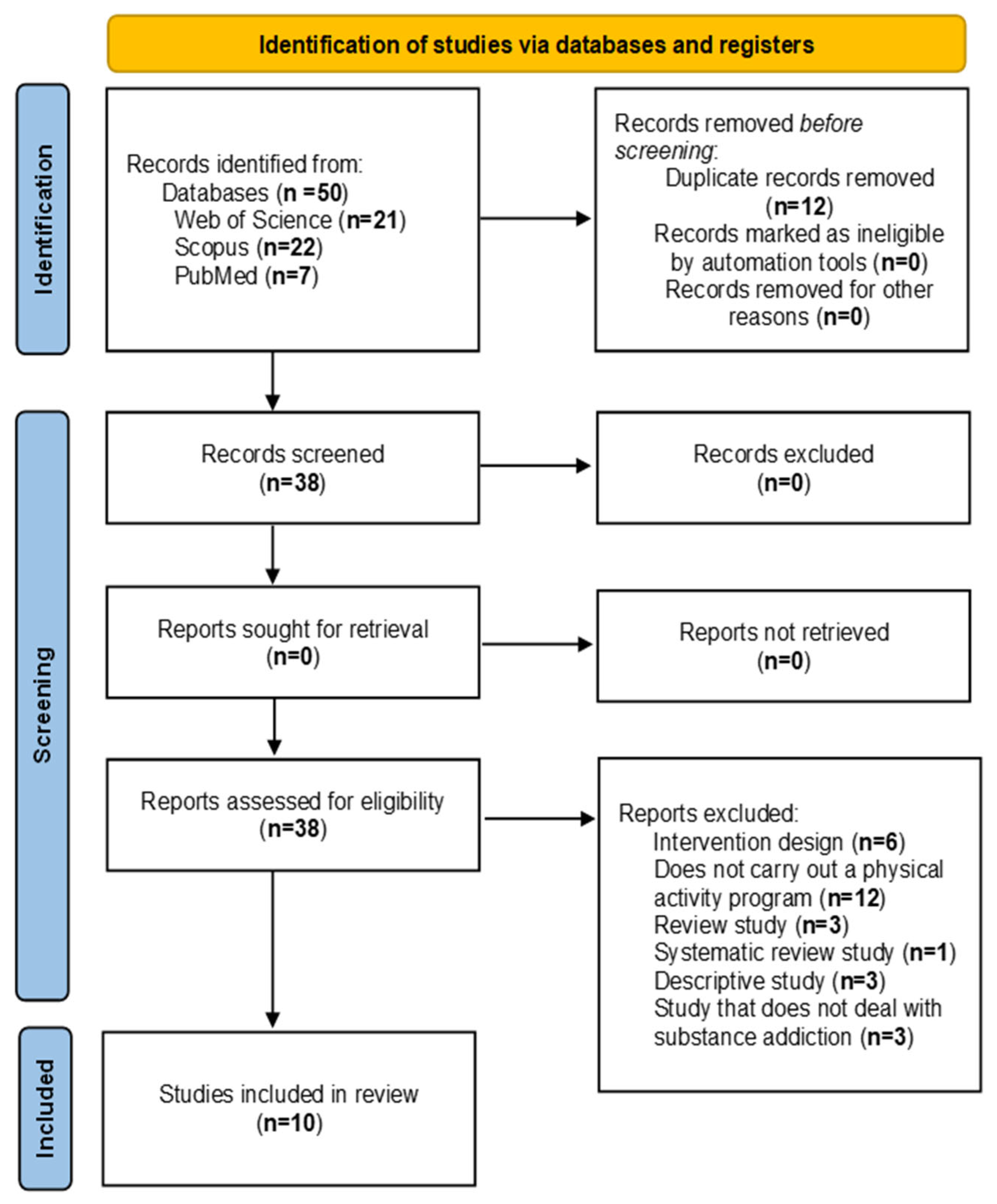
The identification and selection of articles (both included and excluded) and the reason for their exclusion in the screening and selection phase are shown in the flowchart in Figure 1, in compliance with the Preferred Reporting Items for Systematic reviews and Meta-Analyses (PRISMA) [18].
Figure 1.
Flowchart of the systematic review process according to the PRISMA protocol declarations.
2.4. Data Extraction
From the titles, abstracts, keywords and full-text articles, in relation to the questions of interest, the data were extracted as they were found in their respective studies when they were reviewed and are thus included in Table 1. This systematic review included variables following the PICOS acronym (P: participants; I: interventions; C: comparisons; O: outcomes; S: study design). In addition, the research included other variables that the authors considered relevant: authors, publication year, country, type of study, comparisons, study objective, participants, measurement variables and instruments, interventions and results.
2.5. Presentation of the Results: Adherence to Quality Initiatives (PRISMA)
The presentation of the conclusions of the primary research papers, obtained through a systematic and reproducible methodology, was performed in a qualitative and quantitative manner (study selection; view Figure 1).
2.6. Quality Evaluation
For the selection of articles, a quality analysis was conducted following the quality assessment components and ratings of the EPHPP instrument [20]. With this instrument, a general rating of each study is made, evaluating six components (Table 1). Those with no weak ratings and at least four strong ratings are considered strong. Those with fewer than four strong ratings and one weak rating are considered moderate. Finally, those with two or more weak ratings are considered weak [20].
The conclusions of this analysis are shown in Table 1. Of the ten articles included, one had a strong global score [21], five had a moderate global score [22,23,24,25,26] and four had a weak global score [27,28,29,30]. However, despite the fact that four of the articles presented weak global scores, the components of study design and data gathering were prioritised in order to include these articles in the present review, since they are relevant to the study objective. It is worth highlighting that nine of the ten articles included in this work had a strong score in the components of design and confounding factors, except one of them, which, although it had a weak score in these factors, obtained a strong score in data gathering [30]. Another strong aspect of most of the studies included in this work was data gathering, in which nine of the ten articles showed a strong score, since they used validated and reliable instruments. One of the articles had a moderate score, since no evidence of validity or reliability was found [28], and another article obtained a moderate score, since, although the validity of the data gathering tools was demonstrated, no reliability data were provided [25].
Table 1.
Quality assessment components and ratings of the EPHPP instrument.
3. Results
3.1. Selection of Studies and Data Extraction Process
After the search, the title, abstract and keywords of each article were reviewed, with the aim of selecting those that could be relevant and discarding those that did not meet the inclusion criteria.
The searches were conducted, and the inclusion criteria were applied, obtaining a total result of 50 articles. The first search was performed in the Web of Science (WOS), where 21 articles were found; the second search was performed in the Scopus database, gathering a sum of 22 articles; and the third search was conducted in PubMed, obtaining 7 articles.
A total of 12 duplicate articles were discarded, obtaining a final result of 38 articles for full-text review. After the application of the eligibility criteria, 28 articles were excluded. Thus, 10 articles were ultimately selected. The reason for discarding the 28 articles excluded from the systematic review was that, although they initially met the inclusion criteria, after reading them thoroughly, some of them were intervention designs (n = 6), reviews (n = 3), systematic reviews (n = 1) or descriptive studies (n = 3), whereas others did not apply physical activity programmes in their treatment (n = 12), and others did not focus on substance addiction but other types of addiction (n = 3). With the aim of reducing the selection bias, each article was reviewed independently by two of the researchers (E.M.-S. and E.C.-V.), who decided whether each document fit the established criteria. If these researchers did not reach a consensus on the inclusion of an article, a third researcher (F.-J.G.-V.) mediated the decision.
3.2. Characteristics of the Studies: Results Synthesis
Table 2 presents the following data from each of the studies: authors, publication year, country, type of study, comparisons, study objectives, participants, measurement variables and instruments, interventions and outcomes.
Table 2.
Characteristics of the studies included in the systematic review and meta-analysis.
Of the ten research articles included in this review, nine (90%) were randomised trials [21,22,23,24,25,26,27,28,29], and one (10%) was a quasi-experimental, longitudinal study [30]. Regarding the countries in which the different studies were carried out, there were three (30%) conducted in the USA [26,29,30], two (20%) in China [23,27], one (10%) in Denmark [21], one (10%) in Sweden [24], one (10%) in Poland [28], one (10%) in Italy [22] and one (10%) in England [25]. Of these studies, eight (80%) used one experimental group and one control group [22,23,24,25,26,27,28,29], one (10%) used one control group and two experimental groups [21], and one (10%) used only one experimental group [30].
Regarding the study population in terms of sex, four (40%) studies analysed both men and women [21,24,25,29], four (40%) analysed variables only in women [23,26,28,30], and two (20%) only analysed men [22,27].
With respect to the type of addiction, five (50%) studies explored the relationship between a physical activity programme and people addicted to smoking [25,26,28,29,30], four (40%) investigated such a relationship in drug addicts [22,23,24,27], and one (10%) analysed it in alcohol addicts [21].
In relation to the type of physical activity programme applied in the different studies, five of them conducted programmes with aerobic exercise [21,22,24,28,29], one employed a cardiovascular programme [26], one used fitness activities [30], and three implemented body techniques such as yoga [25,27] or Tai Chi [23,27]. All ten articles included in this review carried out pre-test and post-test measurements of their study variables.
Of the ten articles analysed, nine (90%) concluded that the physical activity programmes used in their studies provided benefits for people with addiction [21,22,23,25,26,27,28,29,30], and one (10%) did not find a positive correlation [24].
3.3. Association between Mood, Physical Activity Programmes and Addiction
With regard to the relationship between physical activity, mood and addiction, many of the works included in this review show relevant results. In particular, three studies [23,27,30] reported that the physical activity programmes reduced the stress of their participants, improving their adherence to the treatment of addiction. Moreover, two studies [26,29] found that, with physical activity programmes, their participants improved their depressive states and, consequently, their commitment to the treatment for quitting the addiction.
4. Discussion
The aim of this review was to understand the real state of the studies on the effectiveness of physical exercise treatment, combined with other therapies, for the treatment of addictions.
Regarding the link between mood and the practice of physical activity, Abrantes et al. [29] concluded that interventions aimed at increasing the enjoyment of physical activity may ultimately help to improve the mood-related experience of exercise and, thus, the chances of quitting smoking, especially in people who smoke and present elevated symptoms of depression. Taking into account that depression is linked to a lower probability of quitting smoking [31,32] and to a lower access to physical activity interventions [33,34], these findings may have important implications for the treatment of this addiction. Works conducted along the same lines, but only with female populations, showed that supervised vigorous exercise was feasible and improved the abandonment of the smoking habit in the short term among depressed smokers [26].
Furthermore, Fallin-Bennett et al. [30] showed that women who used physical activity programmes to quit smoking presented a lower dependence on nicotine and thus smoked less. The findings of these works associated a decrease in stress with sports practice and, therefore, with the contribution to smoking cessation. Stress has been shown to be a barrier to abandoning the smoking habit [35,36], which is surprising, given the level of perceived stress in the population and the strong link documented between this physiological reaction and smoking in the general population [37]. On the other hand, scientific evidence has also shown that people with stress have more difficulty performing physical activity, so other stress reduction measures should also be taken into account in these people to first reduce it and then be able to start engaging in sports [38].
In this review, we analysed another study that showed a triple association between addiction to smoking, sports practice and genetic predisposition. Podgórski et al. [28] concluded that genetically predisposed people who want to quit smoking and decide to carry out aerobic training together with concentration training are much more likely to quit smoking successfully. This fact could be related to the evidence of the association of the D4DR gene with the personality trait of novelty seeking, where people who carry allele 7 try to improve their results more frequently than those individuals without allele 7 [39].
In addition to studies related to aerobic or cardiovascular physical exercise interventions to show their influence on the treatment of addictions, some authors have also conducted intervention studies based on therapies such as yoga for this type of treatment. The scientific evidence shows that yoga, along with standard counselling to quit smoking based on cognitive-behavioural therapy, is an effective intervention to abandon the smoking habit [40]. Similarly, one of the studies included in this review [25] concluded that yoga seems to intensify the probability of successfully abstaining from smoking, particularly among light smokers.
For another type of addiction that was addressed in this work, namely, alcohol abuse, Roessler et al. [21] showed that physical exercise was effective as a complementary treatment for alcohol use disorder. This research found that a moderate level of physical activity protects against the excessive consumption of alcohol. With respect to these conclusions, it is important to take into account that people with addictions often have poor physical health and comorbid mental problems associated with this consumption disorder, which can improve through the practice of physical exercise, thereby reducing their dependence on this substance [13]. In addition, it has been shown that physical exercise can stimulate the production of proteins such as brain-derived neurotrophic factor, an element that helps neuroplasticity, neurogenesis/plasticity, neuroimmune signalling and the neural vasculature, all of which play a role in addiction [41].
Moreover, in addition to the application of physical activity interventions as a complementary treatment for addiction to alcohol and smoking, programmes have also been similarly applied for drug addiction (substance abuse). One of the toxic substances with greater addiction potential is methamphetamine. People addicted to these substances show a deterioration of their cognitive functions and deficient psychological well-being. Therefore, cognitive function must be considered an important element in the treatment of methamphetamine dependence [42]. Interventions such as yoga can reduce the intake of substances, alleviate stress and help people with addiction to recover their normal lives [43]. In the same vein, numerous studies have demonstrated the positive effects of yoga in patients addicted to opium, heroin, alcohol and smoking, including the improvement of the body–mind environment, depressive symptoms and emotional state and a decrease in anxiety [44,45,46]. One of the studies included in this review, i.e., the one conducted by Zhu et al. [27], concluded that people who carry out a physical activity programme with yoga for the treatment of addiction to substances have better physical condition and mental health than those who perform the usual physical rehabilitation method, thus improving their adherence to the treatment. Other interventions in the same vein, applying similar programmes such as Tai Chi, have also shown that, in the long term, they can be a complementary, low-cost potential treatment for people addicted to amphetamine stimulants [23]. That is, yoga, Tai Chi, meditation and other relaxation therapies decrease sympathetic activity, decrease sympathetic–adrenal reactivity and improve parasympathetic production. In turn, they can decrease the prevalence and severity of vasomotor disorders and sleep alteration, thereby enhancing the effect of adherence to conventional treatments for substance abuse [47].
In addition to yoga and Tai Chi, moderate-intensity aerobic–anaerobic training combined with group behavioural training has been shown to be an effective programme for people addicted to substances, improving their coping skills, resilience and physical aptitude, with 100% adherence to exercise [22]. The improvement of coping skills could be related to the fact that physical and sports activities are also estimated to be an important tool for the social inclusion of people at risk of social exclusion [48]. At the behavioural level, physical activity also plays an important role in addictions, since it promotes factors such as motivation or habit [49].
However, another work included in this study [24] demonstrated that people who received a physical activity intervention with the treatment of addiction did not improve their results in the abandonment of alcohol or drugs or in their lifestyles compared to those who only received treatment for addiction. These contradicting results could be due to the intervention time. It was observed that, in most of the studies that applied physical activity interventions and in which there were no dissimilarities between the experimental and control groups, the intervention time was shorter than in studies that reported differences [50].
Lastly, it is important to highlight that this work presents some limitations, such as the relative paucity of studies that have analysed the research question of this review. In addition, the search was performed only on open-access articles and in the English and Spanish languages. Despite the difficulty in generalising the results found, this review shows that the research question is recent, and studies related to this topic have been carried out in very few countries. In this sense, in order to delve into the relationship between physical activity interventions and addiction, it would be interesting to carry out more in-depth systematic reviews with more articles and languages. It would also be desirable to carry out further randomised trials with different physical activity interventions in different countries and with different populations.
5. Conclusions
The conclusions of the research included in this review show a positive relationship between physical activity and adherence to the treatment of addictions. Physical activity has been included in coadjuvant treatments, along with other pharmacological or behavioural interventions. These results reinforce the importance of promoting physical activity in rehabilitation and detoxication treatments.
Complementarily, physical activity programmes improve other health variables that influence the quality of life, such as sleep quality and mood, and they prevent the risk of social exclusion.
This work shows the usefulness of physical activity as a treatment tool in rehabilitation from addictions, although it is necessary to carry out further studies that analyse the role of physical activity and sports intervention programmes as preventive elements against addictions.
Author Contributions
Conceptualisation, E.C.-V. and F.-J.G.-V.; methodology, F.-J.G.-F.-G.; validation, M.-T.A.-R., E.M.-S. and E.C.-V.; formal analysis, F.-J.G.-V.; investigation, F.-J.G.-F.-G.; resources, M.-T.A.-R.; data curation, E.M.-S.; writing—original draft preparation, E.C.-V.; writing—review and editing, F.-J.G.-V.; visualisation, F.-J.G.-F.-G.; supervision, M.-T.A.-R. and E.M.-S. All authors contributed to editorial changes in the manuscript. All authors have read and agreed to the published version of the manuscript.
Funding
This research received no external funding.
Institutional Review Board Statement
The study was conducted according to the guidelines of the Declaration of Helsinki. This study is registered in PROSPERO (International prospective register of systematic reviews) with registration number 342303.
Informed Consent Statement
Not applicable.
Data Availability Statement
The data presented in this study are available on request from the corresponding author.
Conflicts of Interest
The authors declare no conflict of interest.
References
- Organización Mundial de la Salud. Informe OMS Sobre la epidemia Mundial de Tabaquismo. Hacer Cumplir las Prohibiciones Sobre Publicidad, Promoción y Patrocinio del Tabaco. Ginebra, Suiza.: Servicio de Producción de Documentos de la OMS. 2013. Available online: https://apps.who.int/iris/handle/10665/85382 (accessed on 3 February 2022).
- Hernangil, E.; Lastres, J.; Valcárcel, P. Actividad Físico-Deportiva en el Tratamiento de las Drogodependencias. Asociación de Técnicos para el Desarrollo de Programas Sociales. 2011. Available online: https://www.fundacioncsz.org/ArchivosPublicaciones/291.pdf (accessed on 20 July 2022).
- Siñol, N.; Martínez-Sánchez, E.; Guillamó, E.; Campins, M.J.; Larger, F.; Trujols, J. Efectividad del ejercicio físico como intervención coadyuvante en las adicciones: Una revisión. Adicciones 2013, 25, 71–85. [Google Scholar] [CrossRef] [Scilit] [PubMed]
- Pérez, R.; Instituto Nacional de Salud Mental Honorio Delgado—Hideyo Noguchi. “Manual de Terapia Física en Adicciones” Primera Edición. 2017. Lima-Perú. Available online: http://www.insm.gob.pe/investigacion/archivos/manuales/M-2010-TFA.pdf (accessed on 1 September 2022).
- Brown, R.A.; Abrantes, A.M.; Read, J.P.; Marcus, B.H.; Jakicic, J.; Strong, D.R.; Gordon, A.A. A pilot study of aerobic exercise as an adjunctive treatment for drug dependence. Ment. Health Phys. Act. 2010, 3, 27–34. [Google Scholar] [CrossRef] [Scilit] [PubMed]
- Prapavessis, H.; Cameron, L.; Baldi, J.C.; Robinson, S.; Borrie, K.; Harper, T.; Grove, J.R. The effects of exercise and nicotine replacement therapy on smoking rates in women. Addict. Behav. 2007, 32, 1416–1432. [Google Scholar] [CrossRef] [Scilit] [PubMed]
- Roessler, K.K. Exercise treatment for drug abuse—A Danish pilot study. Scand. J. Public Health 2010, 38, 664–669. [Google Scholar] [CrossRef] [Scilit] [PubMed]
- Ussher, M.; West, R.; McEwen, A.; Taylor, A.; Steptoe, A. Efficacy of exercise counselling as an aid for smoking cessation: A randomized controlled trial. Addiction 2003, 98, 523–532. [Google Scholar] [CrossRef] [Scilit]
- Ciccolo, J.T.; Dunsiger, S.I.; Williams, D.M.; Bartholomew, J.B.; Jennings, E.G.; Ussher, M.H.; Marcus, B.H. Resistance training as an aid to standard smoking cessation treatment: A pilot study. Nicotine Tob. Res. 2011, 13, 756–760. [Google Scholar] [CrossRef] [Scilit]
- Donaghy, M.E.; Ussher, M.H. Exercise interventions in drug and alcohol rehabilitation. In Exercise Health and Mental Health: Emerging Relationships; En, G.E., Faulkner, Y., Taylor, A.H., Eds.; Routledge: New York, NY, USA, 2005; pp. 48–69. [Google Scholar]
- Abrantes, A.M.; Strong, D.R.; Lloyd-Richardson, E.E.; Niaura, R.; Kahler, C.W.; Brown, R.A. Regular exercise as a protective factor in relapse following smoking cessation treatment. Am. J. Addict. 2009, 18, 100–101. [Google Scholar] [CrossRef] [Scilit]
- Fiuza-Luces, C.; Garatachea, N.; Berger, N.A.; Lucia, A. Exercise is the real polypill. Physiology 2013, 28, 330–358. [Google Scholar] [CrossRef] [Scilit]
- Greer, T.L.; Ring, K.M.; Warden, D.; Grannemann, B.D.; Church, T.S.; Somoza, E.; Blair, S.N.; Szapocznik, J.; Stoutenberg, M.; Rethorst, C.; et al. Rationale for Using Exercise in the Treatment of Stimulant Use Disorders. J. Glob. Drug Policy Pract. 2013, 6, 1–22. Available online: http://ctndisseminationlibrary.org/display/825.htm (accessed on 20 July 2022).
- Hallgren, M.; Vancampfort, D.; Giesen, E.S.; Lundin, A.; Stubbs, B. El ejercicio como tratamiento para los trastornos por consumo de alcohol: Revisión sistemática y metanálisis. Br. J. Sports Med. 2017, 51, 1058–1064. [Google Scholar] [CrossRef] [Scilit] [PubMed]
- Organización Mundial de la Salud. Washington: Centro de Prensa; actualizado Abr 2016; citado 5 May 2017 [aprox. 2 pantallas]. Available online: http://www.who.int/mediacentre/factsheets/fs220/es/ (accessed on 3 February 2022).
- Booth, F.W.; Roberts, C.K.; Thyfault, J.P.; Ruegsegger, G.N.; Toedebusch, R.G. Role of Inactivity in Chronic Diseases: Evolutionary Insight and Pathophysiological Mechanisms. Physiol. Rev. 2017, 97, 1351–1402. [Google Scholar] [CrossRef] [Scilit]
- Lin, P.S.; Hsieh, C.C.; Cheng, H.S.; Tseng, T.J.; Su, S.C. Association between Physical Fitness and Successful Aging in Taiwanese Older Adults. PLoS ONE 2016, 11, e0150389. [Google Scholar] [CrossRef] [Scilit]
- Page, M.J.; McKenzie, J.E.; Bossuyt, P.M.; Boutron, I.; Hoffmann, T.C.; Mulrow, C.D.; Shamseer, L.; Tetzlaff, J.M.; Moher, D. Updating guidance for reporting systematic reviews: Development of the PRISMA 2020 statement. J. Clin. Epidemiol. 2020. Submitted. [Google Scholar] [CrossRef] [Scilit]
- Henríquez-Fierro, E.; Zepeda-González, M.I. Elaboración De Un Artículo De Investigación Científica. Cienc. Enfermo 2004, 10, 17–21. [Google Scholar] [CrossRef] [Scilit]
- Thomas, B.H.; Ciliska, D.; Dobbins, M.; Micucci, S. A process for systematically reviewing the literature: Providing the research evidence for public health nursing interventions. Worldviews Evid. Based Nurs. 2004, 1, 176–184. [Google Scholar] [CrossRef] [Scilit]
- Roessler, K.-K.; Bilberg, R.; Søgaard-Nielsen, A.-A.; Jensen, K.; Ekstrøm, C.-T.; Sari, S. Exercise as adjunctive treatment for alcohol use disorder: A randomized controlled trial. PLoS ONE 2017, 12, e0186076. [Google Scholar] [CrossRef] [Scilit]
- Fischetti, F.; Cataldi, S.; Di-Terlizzi, P.; Greco, G. Multilateral methodology in physical education improves coping skills, resilience and physical fitness in drug addicts. J. Hum. Sport Exerc. 2020, 15, 367–379. [Google Scholar] [CrossRef] [Scilit]
- Zhu, D.; Dai, G.; Xu, D.; Xu, X.; Geng, J.; Zhu, W.; Jiang, X.; Theeboom, M. Long-Term Effects of Tai Chi Intervention on Sleep and Mental Health of Female Individuals with Dependence on Amphetamine-Type Stimulants. Front. Psychol. 2018, 9, 1476. [Google Scholar] [CrossRef] [Scilit]
- Hovhannisyan, K.; Rasmussen, M.; Adami, J.; Wikström, M.; Tönnesen, H. Evaluation of Very Integrated Program: Health Promotion for Patients with Alcohol and Drug Addiction-A randomized Trial. Alcohol. Clin. Exp. Res. 2020, 44, 1456–1467. [Google Scholar] [CrossRef] [Scilit]
- Bock, B.-C.; Dunsiger, S.-I.; Rosen, R.-K.; Thind, H.; Jennings, E.; Fava, J.-L.; Becker, B.-M.; Carmody, J.; Marcus, B.-H. Yoga as a Complementary Therapy for Smoking Cessation: Results from Breath Easy, a Randomized Clinical Trial. Nicotine Tob. Res. 2019, 21, 1517–1523. [Google Scholar] [CrossRef] [Scilit]
- Patten, C.-A.; Bronars, C.-A.; Douglas, K.-S.-V.; Ussher, M.-H.; Levine, J.-A.; Tye, S.-J.; Hughes, C.-A.; Brockman, T.-A.; Decker, P.-A.; DeJesus, R.-S.; et al. Supervised, vigorous intensity exercise intervention for depressed female smokers: A pilot study. Nicotine Tob. Res. 2017, 19, 77–86. [Google Scholar] [CrossRef] [Scilit] [PubMed]
- Zhu, D.; Jiang, M.; Xu, D.; Schöllhorn, W.-I. Long-Term Effects of Mind-Body Exercises on the Physical Fitness and Quality of Life of Individuals with Substance Use Disorder-A Randomized Trial. Front. Psychiatry 2020, 11, 528373. [Google Scholar] [CrossRef] [Scilit] [PubMed]
- Podgórski, T.; Szmyt, G.; Szmyt, A.; Gronek, J.; Celka, R.; Gronek, P. Aerobic and concentration training and allele 7 in the dopamine receptor D4 (D4DR) gene increase chances of smoking cessation in young Polish women. Arch. Med. Sci. 2017, 14, 199–206. [Google Scholar] [CrossRef] [Scilit] [PubMed]
- Abrantes, A.-M.; Farris, S.-G.; Garnaat, S.-L.; Minto, A.-B.-A.; Brown, R.-A.; Price, L.-H.; Uebelacker, L.-A. The role of physical activity enjoyment on the acute mood experience of exercise among smokers with elevated depressive symptoms. Ment. Health Phys. Act. 2017, 12, 37–43. [Google Scholar] [CrossRef] [Scilit]
- Fallin-Bennett, A.; Barnett, J.; Ducas, L.; Wiggins, A.-T.; McCubbin, A.; Ashford, K. Pilot Tobacco Treatment Intervention for Women in Residential Treatment for Substance Use Disorder. J. Obstet. Gynecol. Neonatal Nurs. 2018, 47, 749–759. [Google Scholar] [CrossRef] [Scilit] [PubMed]
- Cinciripini, P.M.; Wetter, D.W.; Fouladi, R.T.; Blalock, J.A.; Carter, B.L.; Cinciripini, L.G.; Baile, W.F. The effects of depressed mood on smoking cessation: Mediation by postcessation self-efficacy. J. Consult. Clin. Psychol. 2003, 71, 292–301. [Google Scholar] [CrossRef] [Scilit] [PubMed]
- Hitsman, B.; Papandonatos, G.D.; McChargue, D.E.; DeMott, A.; Herrera, M.J.; Spring, B.; Borrelli, B.; Niaura, R. Past major depression and smoking cessation outcome: A systematic review and meta-analysis update. Addiction 2013, 108, 294–306. [Google Scholar] [CrossRef] [Scilit]
- Arikawa, A.Y.; O’Dougherty, M.; Kaufman, B.C.; Schmitz, K.H.; Kurzer, M.S. Attrition and adherence of young women to aerobic exercise: Lessons from the WISER study Contemp. Clin. Trials 2012, 33, 298–301. [Google Scholar] [CrossRef] [Scilit]
- Aggarwal, B.; Liao, M.; Mosca, L. Predictors of physical activity at 1 year in a randomized controlled trial of family members of patients with cardiovascular disease. J. Cardiovasc. Nurs. 2010, 25, 444–449. [Google Scholar] [CrossRef] [Scilit]
- Fallin-Bennett, A.; Parker, K.A.; Miller, A.; Ashford, K.; Hahn, E.J. Smoking and tobacco-free policies in women’s residential substance use disorder treatment facilities: A Community-engaged approach. Nicotine Tob. Res. 2017, 20, 1386–1392. [Google Scholar] [CrossRef] [Scilit]
- Fallin, A.; Miller, A.; Ashford, K. Smoking among pregnant women in outpatient treatment for opioid dependence: A qualitative inquiry. Nicotine Tob. Res. 2016, 18, 1727–1732. [Google Scholar] [CrossRef] [Scilit]
- Sperlich, S.; Maina, M.N.; Noeres, D. The effect of psychosocial stress on single mothers’ smoking. BMC Public Health 2013, 13, 1125. [Google Scholar] [CrossRef] [Scilit]
- Stults-Kolehmainen, M.A.; Sinha, R. The effects of stress on physical activity and exercise. Sports Med. 2014, 44, 81–121. [Google Scholar] [CrossRef] [Scilit]
- Kotler, M.; Cohen, H.; Segman, R. Exceso de alelo de siete repeticiones del exón III del receptor de dopamina D4 (D4DR) en sujetos dependientes de opioides. Psiquiatr. Mol. 1997, 2, 251–254. [Google Scholar]
- Fiore, M.C.; Jaen, C.R.; Baker, T.B. Treating Tobacco Use and Dependence: 2008 Update: Clinical Practice Guideline; US Department of Health and Human Services, Public Health Service: Rockville, MD, USA, 2008. [Google Scholar]
- Cid, F.M. Plasticidad Sináptica, Bdnf Y Ejercicio Físico. Revista Digital de Educación Física 2016 Año 7, 40. Available online: http://emasf.webcindario.com (accessed on 1 September 2022).
- Zhong, N.; Jiang, H.; Du, J.; Zhao, Y.; Sun, H.; Xu, D.; Li, C.; Zhuang, W.; Li, X.; Hashimoto, K. Las deficiencias cognitivas y el bienestar psicológico de los pacientes dependientes de la metanfetamina en comparación con los controles de salud. Prog. Neuropsychopharmacol. Biol. Psychiatry 2016, 69, 31–37. [Google Scholar] [CrossRef] [Scilit]
- Wimberley, A.S. Cómo el yoga impacta el uso de sustancias de las personas que viven con el VIH que están reingresando de la prisión o la cárcel: Un estudio cualitativo. Complement. Ther. Med. 2019, 47, 102074. [Google Scholar] [CrossRef] [Scilit]
- Dhawan, A.; Chopra, A.; Jain, R.; Yadav, D. Vedamurthachar Effectiveness of yogic breathing intervention on quality of life of opioid dependent users. Int. J. Yoga 2015, 8, 144–147. [Google Scholar] [CrossRef] [Scilit]
- Shahab, L.; Sarkar, B.K.; West, R. The acute effects of yogic breathing exercises on craving and withdrawal symptoms in abstaining smokers. Psychopharmacology 2013, 225, 875–882. [Google Scholar] [CrossRef] [Scilit]
- Zhuang, S.M.; An, S.H.; Zhao, Y. Yoga effects on mood and quality of life in Chinese women undergoing heroin detoxification: A randomized controlled trial. Nurs. Res. 2013, 62, 260. [Google Scholar] [CrossRef] [Scilit]
- Innes, K.E.; Selfe, T.K.; Vishnu, A. Terapias de mente y cuerpo para los síntomas de la menopausia: Una revisión sistemática. Maturitas 2010, 66, 135–149. [Google Scholar] [CrossRef] [Scilit]
- Coalter, F. Deporte, inclusión social y reducción delictiva. In Salud del Ejercicio y Salud, Mental; En Faulkner, G., Taylor, A.H., Eds.; Routledge: Londres, UK, 2005; pp. 190–209. [Google Scholar] [CrossRef] [Scilit]
- Mora-García, J.E.; Agraso-López, A.D.; Pérez-Soto, J.J.; Rosa-Guillamón, A.; Tárraga-Marcos, M.L.; García-Cantó, E.; Tárraga López, P.J. Práctica de actividad física según adherencia a la dieta mediterránea, consumo de alcohol y motivación en adolescentes. Nutr. Hosp. 2019, 36, 420–427. [Google Scholar] [CrossRef] [Scilit]
- Jakobsen, A.S.; Speyer, H.; Nørgaard, H.C.B.; Karlsen, M.; Birk, M.; Hjorthøj, C.; Mors, O.; Krogh, J.; Gluud, C.; Pisinger, C.; et al. Efecto del asesoramiento sobre el estilo de vida frente a la coordinación de la atención frente al tratamiento habitual en personas con enfermedad mental y sobrepeso: Dos años de seguimiento del ensayo aleatorio. CHANGE 2017, 12, e0185881. [Google Scholar]

Publisher’s Note: MDPI stays neutral with regard to jurisdictional claims in published maps and institutional affiliations. |
© 2022 by the authors. Licensee MDPI, Basel, Switzerland. This article is an open access article distributed under the terms and conditions of the Creative Commons Attribution (CC BY) license (https://creativecommons.org/licenses/by/4.0/).