


Abstract
Key elements of Industry 4.0 are the digitization of products and production, enterprise information systems, robotic workplaces, communication infrastructure, and of course, employees. Industry 4.0 transforms production from stand-alone automated units to fully integrated automated and continuously optimized production environments. According to the prediction of Industry 4.0, new global networks will be created based on the interconnection of production equipment into CPS systems. These systems will be the basic building block of the so-called “smart factories”, and will be able to exchange information autonomously, trigger the necessary actions in response to current conditions and mutually independent inspections. The aim of this article is to describe the issue of readiness models for the Industry 4.0 concept, which are commonly used as tools for conceptualizing and measuring the maturity of an organization or process related to a specific target state. Characteristic for the models is their use because, on this basis, it is possible to identify the current readiness for the concept of Industry 4.0 comprehensively in the whole company or in various sub-areas.
1. Introduction
While the previous industrial phase brought computers and robots to the industry, the Fourth Industrial Revolution connected them and taught them to communicate with each other. The key to the concept of smart factories is the ability to interconnect all operating machines and equipment [1], and only within the manufacturing sector. However, the pace of adoption of the Industry 4.0 concept varies across industries and companies [2], and the concept is at the heart of many futuristic visions. However, we need more information on the current state of preparedness in industry and especially in mechanical engineering—i.e., a key industry for the implementation of the Industry 4.0 concept [3].
The aim of this article is to describe the issue of readiness models for the Industry 4.0 concept [4], which they commonly use as tools for conceptualizing and measuring the maturity of an organization or process related to a specific target state. Characteristic for the models is their use, because on this basis, it is possible to identify the current readiness for the concept of Industry 4.0 comprehensively in the whole company or in various sub-areas.
The concept of Industry 4.0 is also inflected in the field of logistics with the introduction of automation, robotics, or modern warehouse systems with a key element of digitization [5]. Development based on these principles presents huge challenges for the logistics sector as well as opportunities for further growth and development. However, it is important to be more specific because the field of logistics is very large. Industry 4.0 technology will also be reflected in internal logistics processes. Internal logistics, as stated by [6,7,8], is a very important part of production processes [9], only areas such as warehousing and supply of production lines with input materials are among the key processes of the company. This process is different according to the types of production. For series production, it is possible to automate, for example, using automatically guided vehicles [10,11]. For small series production, this is still very difficult due to the complexity and irregularity of the process. Based on the concept of Industry 4.0, the irregularity of processes can be changed into an autonomous form and, for example, self-learning robots [12] can be a link that can eliminate this short-coming.
If we start from this concept, all warehousing operations will be fully automated, from the receipt of goods, through storage to picking and assembly into production. A software-controlled warehouse connected to the material flow is one of the central aspects of the concept. At the end, there should be self-sufficient production, where the machines themselves ensure the order and import of parts or materials from the production or input warehouse. Based on the complete interconnection of the warehouse and production [13,14,15], as presented by most operations, these will be managed automatically and the internal logistics will have a central function in the management of material flows [16]. Enterprise information systems coordinate logistics flows in the company in real time, which eliminates logistics downtime, provides up-to-date and accurate information on material movements in the company and on movements of finished components between warehouses and production, and automatically integrates relevant data.
After these positive aspects of the applicability of Industry 4.0 to the field of internal logistics [17,18,19], we can ask the question, what impact will the process of digital transformation have on individual companies and how great will be its potential for internal logistics? Most possible solutions in the field of internal logistics are related to automation and robotics. Robotic handling equipment can operate without added infrastructure and is un-restricted on fixed routes, offering great progress in terms of flexibility, utilization, and productivity.
When managing and monitoring handling processes in connection with Industry 4.0, there is a constant increase in the volume of transmitted and processed data [20]. Data is necessary for monitoring, self-management, and visualization of the handling process in real time. Devices with artificial intelligence are also self-maintainable. After the above advantages and benefits of logistics in combination with the principles of Industry 4.0, it is evident why it is important to solve logistics processes within this concept. However, it is important to become more concrete in terms of the broad scope of logistics. Therefore, an important step is to focus on internal logistics within the company. [21]
The company’s management should create a strategy in which it evaluates the readiness of internal logistics processes for the Industry 4.0 concept. This is part of the works of [22,23,24,25] Readiness will be evaluated on the basis of the use of the proposed tool. The methodology is designed for industrial enterprises that have certain characteristics and these may be different. It is appropriate to design the methodology so that it can be fully applied and obtain quality results for specific types of companies,
With the help of this created tool, internal logistics processes will be evaluated in terms of readiness for the Industry 4.0 concept. Part of this can be found in the works of [26,27,28]. Objective evaluation with a multi-level system is expedient, and therefore internal logistics is structured into sub-areas. The highest levels represent the full applicability of principles and technologies according to Industry 4.0.
2. Materials and Methods
The aim of this part of the article is to describe the issue of readiness models for the Industry 4.0 concept, which are commonly used as tools for conceptualizing and measuring the maturity of an organization or process related to a specific target state. Characteristic for the models is their use because on this basis, it is possible to identify the current readiness for the concept of Industry 4.0 comprehensively in the whole company or in various sub-areas. Alternatively, the models try to find potential places to improve the state of preparedness. Models come in many modifications, ranges, and complex ones should equip companies with practical knowledge of the following aspects:
- What is Industry 4.0 and what are the tangible benefits it could bring?
- What is the level of readiness of the company, sub-areas or individual facilities?
- How can a company gradually and purposefully improve and increase its level?
Businesses must be ready for development according to Industry 4.0. Readiness is assessed according to preparedness models, which companies divide into different areas. The highest rating corresponds to the technologies of Industry 4.0. In international sources, the models are professionally called the “Maturity Model” or “Readiness Model” [29]; German sources use the name “Reifegradmodell” [30]. In general, the model has its definition, there are different types, and it is a mathematical concept, however, within this area of the dissertation [31], the model is taken as an alternative to the concept of readiness assessment tool, and there is no focus on mathematical details.
The key concept behind most types of preparedness models is the Capability Maturity Model (CMM), the later developed Capability Maturity Model Integration (CMMI), and the added word “integrated” means that the model integrates several standards together. The model was created under the auspices of SEI at Carnegie Mellon University. The default name can be freely translated from the original language as a tiered maturity model [32].
CMMIs focus on improving processes in the organization and determine the rules that teams should follow [33]. They contain the basic elements of effective processes for one or more disciplines and describe the path of evolutionary improvement from immature processes to disciplined, mature processes with improved quality and efficiency. This is in contrast to other similar standards because it uses maturity levels with a possible gradual increase in perfection [34]. CMMIs provide guidance on how to proceed in process development; in general, they focus primarily on consistent organization, planning, and monitoring of processes. The actual processes used in an organization depend on many factors, including the application domains and the structure and size of the organization. The level reached by the team in the company is assessed by an assessment carried out by a trained internal or external assessor in a manner defined by the author organization as the standard [35].
Today, the CMMI model is an application of the principles and concepts introduced almost a century ago into this endless cycle of process improvement. The value of this approach to process improvement has been confirmed over time. For example, the benefits for organizations have been increased productivity and quality, shorter cycle times, and more accurate and predictable plans and budgets [36]. The main goal and purpose of the model is to help the organization plan, define, implement, develop, evaluate and improve processes. These are so-called “best practices”, i.e., practices that have proved their worth in the past and can be adopted as a framework for process management in organizations It is not a methodology, but a model that determines the goals that the company should achieve without precisely prescribed procedures. So it basically doesn’t matter how the company fulfills them. However, recommendations are made on how to achieve the mandatory objectives. However, the recommendations are voluntary and not interlinked, so together they do not create a methodology [37].
Readiness models for Industry 4.0 concept always work with the main parameters, which are the analyzed areas (dimensions) and levels. Areas define the model, so some multi-dimensional models are more complex and cover a wider range of business areas; some are profiled in detail for a specific area for a change. The second main parameter is levels of evaluation.
The CMMI tiered model defines maturity levels, so companies can develop their processes. It thus provides a framework for organizing evolutionary steps into five levels of maturity, which will lay the foundations for continuous process improvement. These five levels of maturity define the scale of order for measuring the maturity of an organization’s software process and its ability to evaluate the process [38]. The level of maturity is a well-defined development platform for achieving an advanced process. Each level of maturity provides a layer as a basis for continuous process improvement [39].
In CMM, these are the following levels of maturity:
- 1.
- Initial: Teams at this level do not perform defined processes or only partially.
- 2.
- Managed: Project management is established and activities are planned.
- 3.
- Defined: Procedures are defined, documented and controlled.
- 4.
- Quantitatively controlled: Products and processes are quantitatively controlled.
- 5.
- Optimizing: The team is constantly optimizing its activities [40].
Analyzed Models of Readiness
As mentioned above, CMMI model serves as a key concept for most types of preparedness models. During our research, around fifty models were found, which assessed the company’s readiness for the Industry 4.0 concept. After the first selection in terms of quality and suitability for further research, a total of 35 models were analyzed. Some are very complex, some more concise ones. For the analyzed dimensions, the focus of the models plays a role. Some models are designed more for production areas, some for logistics or information security. Only their name and source will be listed in this subchapter. A detailed analysis with all the main parameters important for this research concerned the following Industry 4.0 readiness models:
- 1.
- Impulse—Industry 4.0 Readiness [41,42].
- 2.
- SIMMI 4.0—A Maturity Model for Classifying the Enterprise [43].
- 3.
- PwC Maturity Model 4.0: Building the Digital Enterprise [44].
- 4.
- A Maturity Model for Assessing Industry 4.0 Readiness and Maturity.
- 5.
- A Maturity Model for Assessing the Digital Readiness of Manufacturing [45].
- 6.
- Development of an Assessment Model for Industry 4.0: Industry 4.0-MM [46].
- 7.
- M2DDM—A Maturity Model for Data-Driven Manufacturing [47].
- 8.
- The Singapore Smart Industry Readiness Index [48].
- 9.
- Rockwell—The Connected Enterprise Maturity Model [49].
- 10.
- Model according to the Working Group of the company firma4.cz [50].
- 11.
- Digitalization Degree in the Manufacturing Industry in Germany [51].
- 12.
- Digital Maturity & Transformation Study St. Gallen [52].
- 13.
- Capgemini-Asset Performance Management Maturity Model [53].
- 14.
- Towards a Smart Manufacturing Maturity Model for SMEs [54].
- 15.
- Preliminary Maturity Model for Leveraging Digitalization in Manufacturing [55].
- 16.
- The Logistics 4.0 Maturity Model [56].
- 17.
- Cybersecurity in the context of Industry 4.0 [57].
- 18.
- Study based analysis on the current digitalization degree in the manufacturing [58]
- 19.
- Concept for an evolutionary maturity based Industry 4.0 migration model [58].
- 20.
- Roadmapping towards industrial digitization based on an Industry 4.0 [59].
- 21.
- Contextualizing the outcome of a maturity assessment for Industry 4.0 [60].
- 22.
- The Reference Architectural Model Industrie 4.0 [61].
- 23.
- A Categorical Framework of Manufacturing for Industry 4.0 and Beyond [62].
- 24.
- Acatech Industrie 4.0 Maturity Index [63].
- 25.
- An Overview of a Smart Manufacturing System Readiness Assessment [64].
- 26.
- Maturity and Readiness Model for Industry 4.0 Strategy [65].
- 27.
- A Smartness Assessment Framework for Smart Factories [66].
- 28.
- Three stage maturity model in SME’s toward Industry 4.0 [67].
- 29.
- Intelligent Logistics For Intelligent Production Systems [68]
- 30.
- Logistics maturity of the service industry [69].
- 31.
- Defining and assessing industry 4.0 maturity levels—Case of the defence sector [70].
- 32.
- Maturity Levels For Logistics 4.0 Based On Nrw’S Industry 4.0 Maturity Model [71].
- 33.
- Logistics 4.0 Maturity in Service Industry: Empirical Research Results [72].
The readiness models for the Industry 4.0 concept always work with the main parameters, which are the analyzed areas (dimensions) and levels. Areas define the model, so some multi-dimensional models are more complex and cover a wider range of business areas [73,74], some are profiled in detail for a change. The second main parameter is the evaluation levels. Models use different numbers, characteristics, and definitions. However, there are other attributes that the models have and it is important to know them. Using scientific terminology, in the form of a method of analysis and comparison, the mentioned models were searched. In addition to these methods, the method of abstraction is also performed, where the potential of evaluation of internal logistics in some of the dimensions is sought in the models.
3. Results
After reviewing and analyzing the readiness models, it can be stated that none of the models comprehensively evaluates the readiness of the company within the concept of Industry 4.0 in the field of internal logistics. The assessment is not comprehensive and therefore sufficient even for models that are directly designed for internal logistics. Models are more in the form of “frameworks”. For most preparedness models, logistics is generally included within one dimension, or partial dimensions or isolated questions in evaluation forms are addressed.
The models work with different levels of readiness and each contains the minimum requirements that must be met. Levels are usually defined terminologically from the lowest role of an outsider, through beginner, advanced, experienced, professional to the greatest expert, some models use levels with brief characteristics from digital novice, integrated and interoperable, fully implemented to fully digitally oriented entity.
Attitudes are most often ascertained through direct questioning of respondents. In connection with the measurement of attitudes based on questioning, the general so-called “scaling” is used. In standardized questioning, closed questions are mainly used, where the respondent selects from a specified range of answers, i.e., answers through a scale. The scale is made up of items expressing a certain level of evaluation and the degree of agreement, so it is made up of categories. Levels are usually determined numerically with a brief description.
After analyses of the existing readiness models, we can conclude that there is no model involving logistics into the company’s readiness for Industry 4.0. Existing models are presented often as a “framework”. Most of them only mention logistics as a sub-part of a bigger company module (structure).
Despite the fact that the area of internal logistics has great potential in the modernization of most internal processes, there is no comprehensive methodology that would assess the readiness of internal logistics processes in Industry 4.0 in detail. The already developed methodologies and models, which were analyzed and compared, served as inspiration for the creation of a new methodology focused on internal logistics in the company, which includes a new key factor for assessment-Industry 4.0. As mentioned from the point of view of scientific research, the attributes of novelty and originality of the solution are important, which are fully observed within the framework of this methodology for the fulfillment of the main goal of the article.
The methodology is proposed for industrial enterprises that have certain characteristics and these may be different. It is appropriate to design the methodology so that it can be fully applied and obtain quality results for specific types of companies, at the expense of a wide range of usability for all companies with complex data collection and poor quality results. Therefore, several implementation conditions enter into the draft methodology, which are described for clarity and must be incorporated into the draft methodology. Enterprises may differ in size, type of production and its repeatability, sector of production and then their individual logistics conditions, which relate to the logistics system of the enterprise or the complexity of logistics operations.
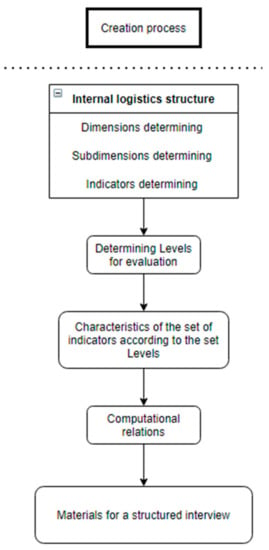
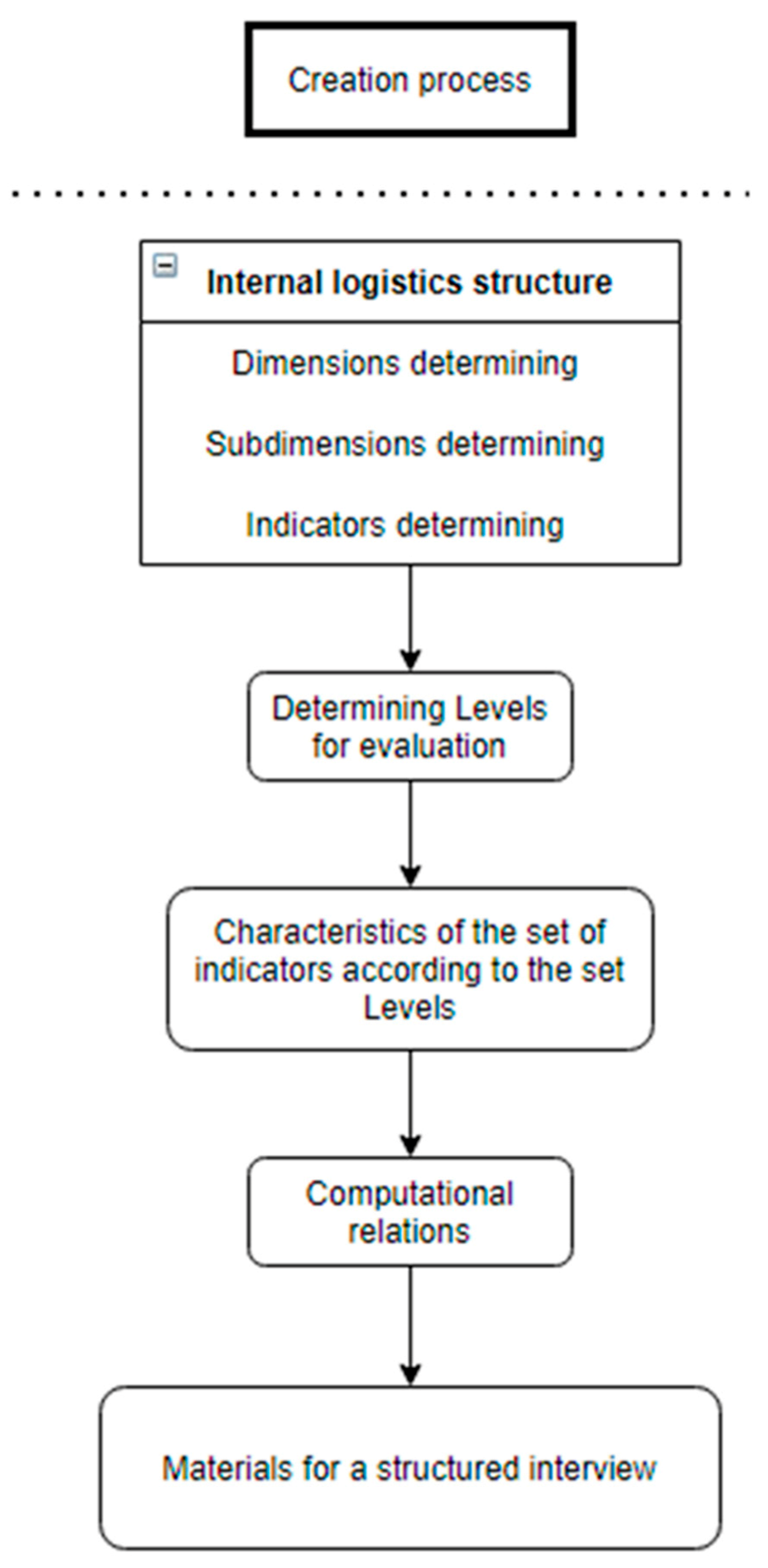
In order for the final readiness assessment to be objective and to cover the area of internal logistics as much as possible, it must first be structured in a certain way. Therefore, the primary starting point for the proposed methodology is the internal logistics structure design, which will then be the subject of evaluation. Based on the criteria, this area is gradually analyzed into several phases and the distribution of internal logistics within the company then covers the main and secondary logistics activities. The structure has “three phases” and characterizes the relationships between internal logistics activities.
- The main dimensions of internal logistics;
- Subdimensions of the main dimensions;
- A set of indicators covering a given subdimension.
The methodology itself with all the steps is described on Figure 1 below in the text.
Figure 1.
Methodology creation.
Calculation Relationships for Evaluation
This part concerns the creation of data before real application into practice and builds on the previous part concerning set levels and created indicators. As its name suggests, the main content is the calculation relationships for the values obtained. The obtained values are the levels of all indicators, which are input data into the methodology (see other chapters) and the calculation of the relationships. The goal is to find a “mathematical function” that will allocate levels of sub- and main dimensions from already set indicator levels. All dimensions are intertwined.
Computational relationships are used when the following inputs are known: Values of indicators obtained from a structured interview.
Therefore, we know the levels of the indicators and it is necessary to continue the evaluation for their superior subdimensions and then the dimensions. The final result is an evaluation of the preparedness of the logistics area from Industry 4.0 point of view. Using computational relations, we obtain the following outputs:
- Subdimension level values;
- Dimension level values.
An important aspect and an essential part of the methodology is the evaluation system, i.e., how the evaluation of internal logistics processes will take place from the beginning of data collection through their processing and the resulting evaluation. Data collection from the company takes place in the form of a structured interview with a responsible person with expertise in the field of internal logistics, in which the questions are answered. Closed questions are created for all indicators. Based on its current status, the company is classified at the appropriate level and evaluated in terms of readiness for Industry 4.0 in the field of internal logistics. The results are interpreted in an analytical and graphical form directly by the company, for example, in a logistics audit or separately.
Computational Formulations
After assigning the value to the indicators, it is then necessary to calculate the values for the 2nd phase of the structure-subdimension and for the 1st phase of the internal logistics structure-dimension. The purpose of the calculations is known, and for this, it is possible to find several methods, the use of which depends on the amount and quality of information required, as well as on the very purpose of evaluation. It was, therefore, appropriate to find such a method that will be the most advantageous for the assessment and will not only meet the character of the best and fastest solution. The aim was, therefore, to select a mathematical system with formulations which would fulfill a certain compromise with objective results which have a telling ability and which can be further worked with. For a better understanding of the computer system, it is also mentioned in this section that the collection of input data takes place in the form of a structured interview, where levels are assigned to all indicators. This indicator level value is the input for calculations.
Furthermore, we describe the partial steps of the mathematical apparatus.
- 1.
- System of evaluation and determination of final levels
As the most optimal solution here was using points proportionally, which represents the ratio between achieved and maximum possible points in the examined area. The indicators are marked on the scale from 0 to 5. The general formulation of the operation of the proportions of the achieved and maximum possible points is in Formula (1).
The resulting value of the coefficient 𝑥 takes values in the interval 𝑥 ∈ <0; 1>.
- 𝑏𝑖—number of points achieved in question 𝑖.
- 𝐵𝑖—maximum possible number of points of the question 𝑖.
- 2.
- Division of the interval into values.
To divide the interval between <0; 1>, we decided to use and an exponential function. It was used mainly to extend the range of intervals for lower levels, i.e., the lower the level, the more points need to be obtained. This is due to the expected investment intensity for obtaining higher levels of readiness (costs are rising sharply, but the shift is small). For this reason, a linear function was not used, thanks to which the distribution of intervals (ranges) would be the same.
The basic form of the exponential function is given in Formula (2):
- 𝐾 is the basis where 𝐾 ≠ 1.
- 𝑥 is the exponent, 𝑥∈𝑅.
In order to adapt the exponential function to the required distribution, the shape of the function is controlled by constants A, B, and C. We get the formula of the function (3) with constants:
- A, B and C—function parameters (constants).
The readiness level value is calculated by Formula (4):
- 3.
- Function properties
The input value is the value of the coefficient 𝑥 ∈ <0; 1>. The value of the integral should take the values ∈ <0; 6>.
Level = 0 to 4
Level = 5
- —calculated value of readiness level (value of integral);
- —the resulting value of the readiness level;
- —lower limit for a certain level;
- —upper limit for a certain level.
- 4.
- Interval division
The generally defined level 2 is used as the main criterion and starting point for dividing the interval <0; 1> Level 2 is defined as the established process control with full digitization. It was therefore estimated and, in consultation with the experts, that the company at this Level 2 should obtain at least 40% of the points.
Substituting into Formula (4) for the coefficient 𝑥 = 0.4 we get Formula (7):
The value of the constants A, B, and C was numerically calculated based on the condition in Formula (8),
Calculated function parameters:
- 𝐴 = 2.862, 𝐵 = 2.381, 𝐶 = 1.4448.
Thus, after substituting parameters A, B, and C, the function has the form given in Formula (9):
- 5.
- Function f(x) graph and proposed intervals
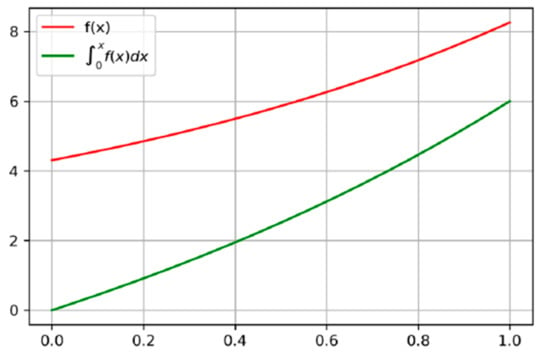
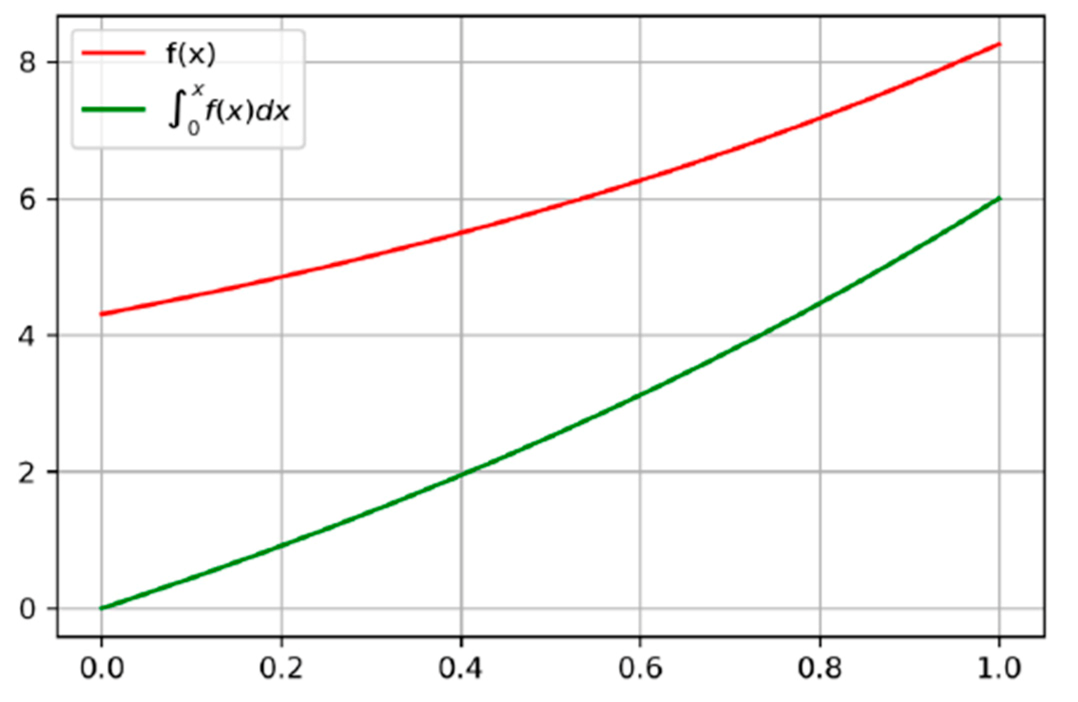
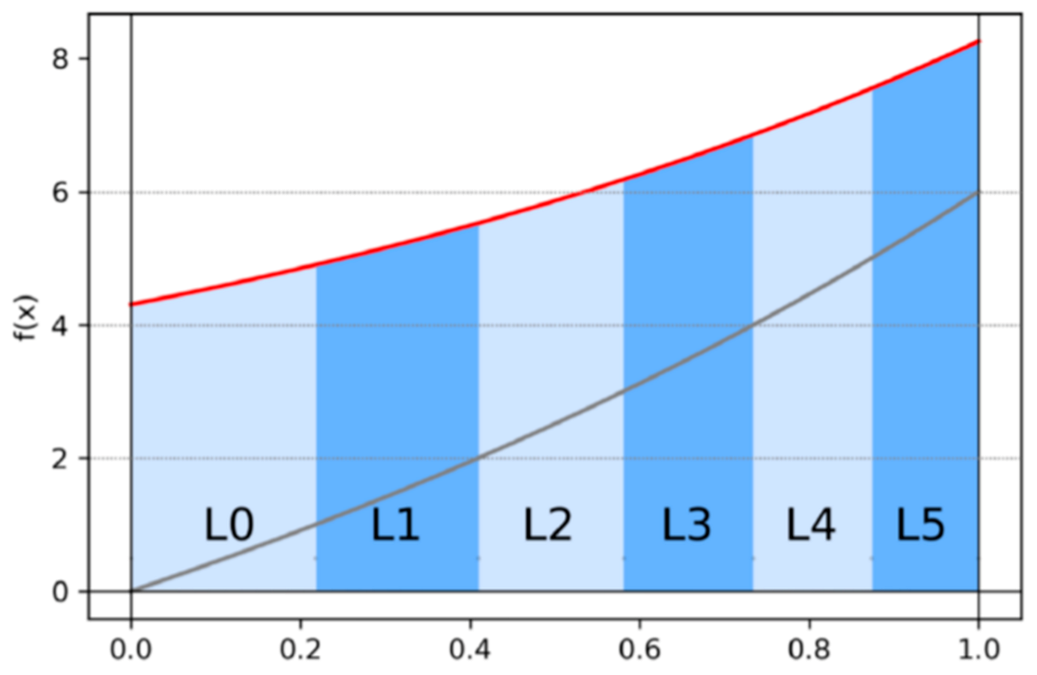
Figure 2 shows the functions that are used to divide the individual levels into which the calculated coefficient values are included. The function f(x) is shown with red color. The area under the curve f(x), presented by the green curve, is calculated by integrating the function f(x).
Figure 2.
The value of the readiness level depends on the value of the exponent.
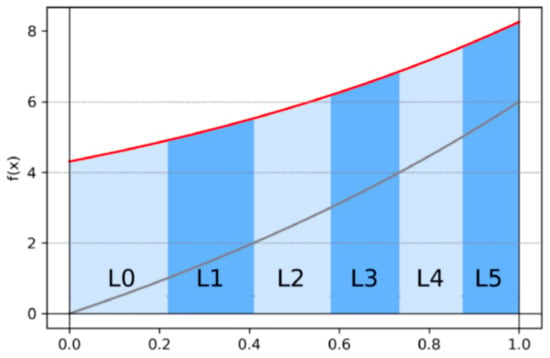
Levels are represented by the area under the red curve. The achieved level is the largest integer multiple of the area of size 1 (size of each level), and can be realized on the interval <0, x> (see Figure 3). In addition, individual level sizes are presented in the picture. Figure 3 shows this distribution of the interval between the 6 levels. Level 1 is defined as a controlled process with certified process management, however without digitization and vice versa Level 3 is that the company has controlled processes that are partially automated and connected to an external data source. This point does not mean that the company has all the technologies according to “Industry 4.0”. It marks the beginning of digitization; 40% of the points is not Industry 4.0, it is just the beginning of digitization. First it is necessary to digitize the company, then it is possible to implement Industry 4.0. 40% is the point from which we start, is not a threshold, it is a border of digitization and it is chosen practically.
Figure 3.
Interval distribution for preparedness levels.
Table 1 shows the calculated range for the interval <0; 1> for each of the six preparedness levels.
Table 1.
Interval range and corresponding levels.
Interval limits are designed in accordance with Formulas (5) and (6).
An exponential function was chosen to divide the interval <0; 1>. This feature was used mainly to extend the range of intervals for lower levels, i.e., the lower the level, the more points you need to get. This is due to the expected investment intensity for obtaining higher levels of readiness (costs are rising sharply, but the shift is small). For this reason, the linear function was not used.
Level 4 and especially level 5 represent the highest readiness and correspond to Industry 4.0. principles. In particular, Level 5 is designed with such a philosophy that it fully fulfills the vision, mission, and assumptions of Industry 4.0. That is, the company has not only partially applied technologies, which can be in level 3 or level 4, but comprehensive coverage of the entire logistics internal area.
4. Discussion
The proposed methodology is processed and created within the “creation process”. These are fixed documents consisting of partial steps that have already been introduced [75]. When applying the methodology and collecting input data for the analysis and evaluation of companies, this process is also divided into sub-phases. See the tables (Table A1, Table A2 and Table A3) in Appendix A. A similarity is also visible in recent works of [76,77,78,79,80]. The aim is basically to determine the current state of readiness for the concept of Industry 4.0 for all internal logistics processes in the entire company without restrictions and after the creation of solid documents must be described how the methodology is applied.
For future research, the methodology will be applied and verified in 29 industrial enterprises from the region. The resulting data will be analyzed according to several aspects. Enterprises are divided according to industry, their size, or type of production. Several models with similarities can be found in [81,82,83]. As part of the data analysis, the output data of the companies will be compared with each other and it is then possible to evaluate the level of readiness of the company’s internal logistics within different groups according to the criteria.
Theoretical benefits of this research are based on a thorough study of available professional resources [84,85] on topics that correspond to the output of the work. The first and important phase was, therefore, to study and evaluate the literature [86,87,88] and the opinions of experts who deal with this development. Despite the fact that the area of internal logistics has great potential in the modernization of most processes, there is no comprehensive methodology [89,90,91,92] that would assess the readiness for Industry 4.0 in detail.
Created methodology, based on a defined theoretical basis, mutual relations between individual areas
- A new method of evaluation, which is based on set six levels (0–5) for the evaluation of indicators, sub-dimensions, and dimensions;
- Evaluation, which uses a suitable mathematical basis applicable for the entire field of internal logistics;
- An innovative scoring system based on a point system divided into six intervals using an exponential function.
The benefit for business practice is, therefore, the creation of a comprehensive independent evaluation tool in the form of a methodology. The purpose is to analyze the current state and evaluate readiness, which can also be seen in works [93,94,95]. It is also useful that evaluations with this tool can be used repeatedly by companies. Thus, it is possible to compare the results over a period of time by repeated evaluation. This is already individual according to the companies and due to the measures and implementation of new facilities.
5. Conclusions
The evaluation brings two areas of results into the company—an overall assessment of readiness for the entire area and detection of weaknesses in the structure of internal logistics affecting low evaluation. Certain assumptions for the methodology were mentioned in the introduction and these were observed. The methodology is applied to all types of companies in terms of size, but the main group are medium and large companies. The overall level of readiness for Industry 4.0 depends to some extent on the business size. It is very similar for companies with different types of production according to repeatability. From the point of view of industrial sector, the assumption was met and the methodology was applied within the manufacturing industry among the branches of the automotive, engineering and electrical engineering industries. Because it is a structured interview with a defined scale technologically and numerically, the individual evaluations are not mutually influenced and the evaluation can be performed at any time and it is possible to repeat this evaluation. In addition, in case of similar companies evaluated according to aspects such as type of production and company size, the evaluation allows comparison in key areas of internal logistics.
Internal logistics in a company is a very large area intertwining with processes across the company. The same is true for the Industry 4.0 concept. It is the intersection of these topics and the combination of internal logistics and the concept of Industry 4.0 that has potential and creates a lot of space for further research. Recommendations for further research and work on the mentioned issues also depend, among other things, on the degree of processing of individual parts. Despite the detailed elaboration, it is such an extensive issue that it contains a lot of potential for future research. For example, other methods, as for example multi-criteria decision-making methods (MCDM) could be used. The use of MCDM methods and models will allow obtaining a more adequate assessment of the readiness of logistics for Industry 4.0
However, as the main topic for further continuation of research on this issue is the possible continuation and connection to the analytical part. This could be followed by a design phase (corrective and preventive), which would contribute to the improvement or streamlining, and in particular, to increase the readiness of internal logistics in the company.
One of the initial steps would be to focus in detail on the results and identify the worst areas of internal logistics with a set target level. The next steps are to decide whether to optimize the whole area or only a partial indicator, which is then selected and partial measures are set for it. It includes defining ways to achieve improvement in each of the key areas. Thus, the methodology would be not only a diagnostic tool, but a complete methodology also enabling design measures. A comprehensive expert system would be created in the future as a part of ongoing research projects.
Industrial practice also has to deal with possible obsolescence of the proposed model and this preparedness assessment tool needs to be updated over time. The main parameters, evaluation system, mathematical evaluation do not need to be changed, however, the indicator’s characteristics will need to be adjusted in terms of potential future development of new technologies.
Author Contributions
Conceptualization, M.Z. and P.P.; methodology, M.Z. and P.P.; software, M.Z.; validation, M.Z., P.P. and M.S.; formal analysis, P.P.; investigation, M.Z.; resources, M.Z.; data curation, P.P.; writing—original draft preparation, M.Z. and P.P; writing—review and editing, P.P.; visualization, M.Z. and P.P.; supervision, M.S.; project administration, M.Z., P.P. and M.S.; funding acquisition, M.S. All authors have read and agreed to the published version of the manuscript.
Funding
This research was created by the support of the project SGS-2021-028 ‘Developmental and training tools for the interaction of man and the cyber-physical production system’ under the Internal Grant Agency of the University of West Bohemia.
Institutional Review Board Statement
Not applicable.
Informed Consent Statement
Informed consent was obtained from all subjects involved in the study.
Data Availability Statement
The data presented in this study are available on request from the corresponding author.
Conflicts of Interest
The authors declare no conflict of interest.
Appendix A. A Table with All Companies with the Main Description and Their Readiness for Industry 4.0.
Table A1.
Companies with the main description and their readiness for Industry 4.0.
In addition, a list of companies with points earned from the questionnaire.
Table A2.
List of companies with points earned from the questionnaire.
Table A3.
Value of the pointer, subdimension, and dimension, then the value of the whole area of internal logistics.
References
- Krajcovic, M.; Bulej, V.; Kuric, I.; Sapietova, A. Intelligent manufacturing systems in concept of digital factory. Commun.-Sci. Lett. Univ. Zilina 2013, 15, 77–87. [Google Scholar]
- Ancarani, A.; Di Mauro, C.; Mascali, F. Backshoring strategy and the adoption of Industry 4.0: Evidence from Europe. J. World Bus. 2019, 54, 360–371. [Google Scholar] [CrossRef] [Scilit]
- Hoyer, C.; Gunawan, I.; Reaiche, C.H. The Implementation of Industry 4.0–A Systematic Literature Review of the Key Factors. Syst. Res. Behav. Sci. 2020, 37, 557–578. [Google Scholar] [CrossRef] [Scilit]
- Sony, M.; Naik, S. Key ingredients for evaluating Industry 4.0 readiness for organizations: A literature review. Benchmarking Int. J. 2019, 27, 2213–2232. [Google Scholar] [CrossRef] [Scilit]
- Zoubek, M.; Koubovská, M.; Šimon, M. A New Approach for the Evaluation of Internal Logistics Processes and Their Readiness for the Industry 4.0 Concept. In Design, Simulation, Manufacturing: The Innovation Exchange; Springer: Cham, Switzerland, 2021; pp. 275–285. [Google Scholar]
- Allen, W.B. The logistics revolution and transportation. ANNALS Am. Acad. Polit. Soc. Sci. 1997, 553, 106–116. [Google Scholar] [CrossRef] [Scilit]
- Klaus, P. Logistics research: A 50 years’ march of ideas. Logist. Res. 2009, 1, 53–65. [Google Scholar] [CrossRef] [Scilit]
- Zvirgzdiņa, B.; Tolujevs, J. Simulation-Based Metaheuristic Optimization of Logistics Systems. In Proceedings of the 12th International Conference Reliability and Statistics in Transportation and Communication, Riga, Latvia, 17–20 October 2012; pp. 17–20. [Google Scholar]
- Curcio, D.; Longo, F. Inventory and internal logistics management as critical factors affecting the supply chain performances. Int. J. Simul. Process. Model. 2009, 5, 278–288. [Google Scholar] [CrossRef] [Scilit]
- Jiang, C.; Chau, K.T.; Liu, C.; Lee, C.H.; Han, W.; Liu, W. Move-and-charge system for automatic guided vehicles. IEEE Trans. Magn. 2018, 54, 1–5. [Google Scholar] [CrossRef] [Scilit]
- Herrero-Perez, D.; Martinez-Barbera, H. Modeling distributed transportation systems composed of flexible automated guided vehicles in flexible manufacturing systems. IEEE Trans. Ind. Inform. 2010, 6, 166–180. [Google Scholar] [CrossRef] [Scilit]
- Simons, J.; Brussel, H.; De Schutter, J.; Verhaert, J. A self-learning automaton with variable resolution for high precision assembly by industrial robots. IEEE Trans. Autom. Control 1982, 27, 1109–1113. [Google Scholar] [CrossRef] [Scilit]
- Antonio, P.; Gianluca, E.; Christian, C.; Sirio, C.R. Interconnection System with Software Able to Interconnect 4.0 Generation Machines with the Whole Enterprise System. Contemput. Eng. Sci. 2018, 11, 3109–3127. [Google Scholar] [CrossRef] [Scilit]
- Zhuang, Y.; Yang, S. Design of Enterprise Network Information System Based on Industrial Interconnection. In Data Processing Techniques and Applications for Cyber-Physical Systems (DPTA 2019); Springer: Singapore, 2020; pp. 799–807. [Google Scholar]
- Zhao, S.; Li, Z.; Zhou, L. Construction of logistics network system based on Internet+. J. Phys. Conf. Ser. 2019, 1176, 022027. [Google Scholar] [CrossRef] [Scilit]
- Kuhn, H.; Sternbeck, M.G. Integrative retail logistics: An exploratory study. Oper. Manag. Res. 2013, 6, 2–18. [Google Scholar] [CrossRef] [Scilit]
- Sternad, M.; Lerher, T.; Gajšek, B. Maturity levels for logistics 4. In 0 based on NRW’s Industry 4.0 maturity model. In Proceedings of the Business Logistics in Modern Management, Osijek, Croatia, 11–12 October 2018. [Google Scholar]
- Skapinyecz, R.; Illés, B.; Bányai, Á. Logistic aspects of Industry 4.0. In IOP Conference Series: Materials Science and Engineering; IOP Publishing: Bristol, UK, 2018; Volume 448, p. 12014. [Google Scholar]
- Strandhagen, J.W.; Alfnes, E.; Strandhagen, J.O.; Vallandingham, L.R. The fit of Industry 4.0 applications in manufacturing logistics: A multiple case study. Adv. Manuf. 2017, 5, 344–358. [Google Scholar] [CrossRef] [Scilit]
- Mourtzis, D.; Vlachou, E.; Milas, N.J.P.C. Industrial big data as a result of IoT adoption in manufacturing. Procedia CIRP 2016, 55, 290–295. [Google Scholar] [CrossRef] [Scilit]
- Zoubek, M.; Simon, M. Evaluation of the Level and Readiness of Internal Logistics for Industry 4.0 in Industrial Companies. Appl. Sci. 2021, 11, 6130. [Google Scholar] [CrossRef] [Scilit]
- Rakic, S.; Pavlovic, M.; Marjanovic, U. A Precondition of Sustainability: Industry 4.0 Readiness. Sustainability 2021, 13, 6641. [Google Scholar] [CrossRef] [Scilit]
- Trstenjak, M.; Opetuk, T. Industry 4.0 Readiness Factor Calculation and Process Planning: State-of-the-Art Review. Trans. FAMENA 2020, 44. [Google Scholar] [CrossRef] [Scilit]
- Rejikumar, G.; Arunprasad, P.; Persis, J.; Sreeraj, K.M. Industry 4.0: Key findings and analysis from the literature arena. Benchmarking Int. J. 2019, 26, 2514–2542. [Google Scholar]
- Nick, G.; Kovács, T.; Kő, A.; Kádár, B. Industry 4.0 readiness in manufacturing: Company Compass 2.0, a renewed framework and solution for Industry 4.0 maturity assessment. Procedia Manuf. 2021, 54, 39–44. [Google Scholar] [CrossRef] [Scilit]
- Temur, G.T.; Bolat, H.B.; Gözlü, S. Evaluation of industry 4.0 readiness level: Cases from Turkey. In the International Symposium for Production Research; Springer: Cham, Switzerland, 2018; pp. 412–425. [Google Scholar]
- Kohnová, L.; Papula, J.; Salajová, N. Internal factors supporting business and technological transformation in the context of Industry 4.0. Bus. Theory Pract. 2019, 20, 137–145. [Google Scholar] [CrossRef] [Scilit]
- Luthra, S.; Mangla, S.K. Evaluating challenges to Industry 4.0 initiatives for supply chain sustainability in emerging economies. Process. Saf. Environ. Prot. 2018, 117, 168–179. [Google Scholar] [CrossRef] [Scilit]
- Schumacher, A.; Erol, S.; Sihn, W. A maturity model for assessing Industry 4.0 readiness and maturity of manufacturing enterprises. Procedia CIRP 2016, 52, 161–166. [Google Scholar] [CrossRef] [Scilit]
- Jodlbauer, H.; Schagerl, M. Reifegradmodell Industrie 4.0—Ein Vorgehensmodell zur Identifikation von Industrie 4.0 Potentialen. Informatik 2016, 259, 1473–1487. [Google Scholar]
- Zoubek, M. Methodology for Evaluating the Readiness of Internal Logistics Processes for Industry 4.0, Dissertation Work; Faculty of Mechanical Engineering, Department of Industrial Engeneering and Management, University of West Bohemia: Pilsen, Czech Republic, 2021. [Google Scholar]
- Chrissis, M.B.; Konrad, M.; Shrum, S. CMMI for Development: Guidelines for Process Integration and Product Improvement; Pearson Education: London, UK, 2011. [Google Scholar]
- Torrecilla-Salinas, C.J.; Sedeño, J.; Escalona, M.J.; Mejías, M. Agile, Web Engineering and Capability Maturity Model Integration: A systematic literature review. Inf. Softw. Technol. 2016, 71, 92–107. [Google Scholar] [CrossRef] [Scilit]
- Kneuper, R. CMMI: Improving Software and Systems Development Processes Using Capability Maturity Model Integration; Rocky Nook: San Rafael, CA, USA, 2008. [Google Scholar]
- Kim, D.Y.; Grant, G. E-government maturity model using the capability maturity model integration. J. Syst. Inf. Technol. 2010, 12, 230–244. [Google Scholar] [CrossRef] [Scilit]
- Gibson, D.L.; Goldenson, D.R.; Kost, K. Performance Results of CMMI-Based Process Improvement; Software Engineering Institute: Pittsburgh, PA. USA, 2006. [Google Scholar]
- Mutafelija, B.; Stromberg, H. Process Improvement with CMMI v1. 2 and ISO Standards; CRC Press: Boca Raton, FL, USA, 2008. [Google Scholar]
- CMMI Product Team. CMMI for Software Engineering, Version 1.1, Continuous Representation (CMMI-SW, V1.1, Continuous); CMU/SEI-2002-TR-028; Software Engineering Institute, Carnegie Mellon University: Pittsburgh, PA, USA, 2002. [Google Scholar]
- Paulk, M.C.; Curtis, B.; Chrissis, M.B.; Weber, C.V. Capability maturity model for software, version 1.1. In Software Engineering Institute (No. 52.219617), CMU/SEI-93-TR-24, DTIC Number ADA263403; IEEE: Piscataway, NJ, USA, 1993; Volume 10. [Google Scholar]
- Amaral, A.; Jorge, D.; Peças, P. Small Medium Enterprises and Industry 4.0: Current Models’ Ineptitude and The Proposal of a Methodology to Successfully Implement Industry 4.0 In Small Medium Enterprises. Procedia Manuf. 2020, 41, 1103–1110. [Google Scholar] [CrossRef] [Scilit]
- Lichtblau, K.; Stich, V.; Bertenrath, R.; Blum, M.; Bleider, M.; Millack, A.; Schröter, M. Industrie 4.0-Readiness Online Self-Check for Businesses. Recuper. Em 2015, 10, 1–12. [Google Scholar]
- VDMA. German Mechanical Engineering Industry Association 2020. VDMA Members. Available online: https://www.vdma.org/en/mitglieder (accessed on 13 November 2021).
- Leyh, C.; Bley, K.; Schäffer, T.; Forstenhäusler, S. SIMMI 4.0-a maturity model for classifying the enterprise-wide it and software landscape focusing on Industry 4.0. In Proceedings of the 2016 Federated Conference on Computer Science and Information Systems (Fedcsis), Gdansk, Poland, 11–14 September 2016; pp. 1297–1302. [Google Scholar]
- Geissbauer, R.; Vedso, J.; Schrauf, S. Industry 4.0: Building the Digital Enterprise. 2016. Available online: https://www.pwc.com/gx/en/industries/industries-4.0/landing-page/industry-4.0-building-your-digital-enterprise-april-2016.pdf (accessed on 12 November 2021).
- De Carolis, A.; Macchi, M.; Negri, E.; Terzi, S. Guiding manufacturing companies towards digitalization a methodology for supporting manufacturing companies in defining their digitalization roadmap. In Proceedings of the 2017 International Conference on Engineering, Technology and Innovation (ICE/ITMC), Madeira, Portugal, 27–29 June 2017; pp. 487–495. [Google Scholar]
- Gökalp, E.; Şener, U.; Eren, P.E. Development of an assessment model for industry 4.0: Industry 4.0-MM. In International Conference on Software Process Improvement and Capability Determination; Springer: Cham, Switzerland, 2017; pp. 128–142. [Google Scholar]
- Weber, C.; Königsberger, J.; Kassner, L.; Mitschang, B. M2DDM–A Maturity Model for Data-Driven Manufacturing. Procedia CIRP 2017, 63, 173–178. [Google Scholar] [CrossRef] [Scilit]
- Singapore EDB. The Singapore Smart Industry Readiness Index; Singapore EDB: Raffles City, Singapore, 2018. [Google Scholar]
- Rong, H.; Automation, R. The-Connected-Enterprise-Maturity Model, Doctoral Dissertation. 2014. Available online: https://www.gov.sg/~/sgpcmedia/media_releases/edb/press_release/P-20171113-1/attachment/The%20Singapore%20Smart%20Industry%20Readiness%20Index%20-%20Whitepaper_final.pdf (accessed on 12 November 2021).
- Firma4: Pracovní Skupina pro Implementaci Průmyslu 4.0. Available online: http://firma4.cz/hodnoceni-digitalni-zralosti-firmy/ (accessed on 12 November 2021).
- Bogner, E.; Voelklein, T.; Schroedel, O.; Franke, J. Study based analysis on the current digitalization degree in the manufacturing industry in Germany. Procedia CIRP 2016, 57, 14–19. [Google Scholar] [CrossRef] [Scilit]
- Back, A.; Berghaus, S.; Kaltenrieder, B. Digital Maturity Transformation Studie; Institut für Wirtschaftsinformatik: St. Gallen, Switzerland, 2015. [Google Scholar]
- Dennis, M.; Ramaswamy, C.; Ameen, M.N.; Jayaram, V. Asset Performance Management Maturity Model Strategic Roadmap to Digital Manufacturing; Capgemini: Paris, France, 2018. [Google Scholar]
- Mittal, S.; Romero, D.; Wuest, T. Towards a smart manufacturing maturity model for SMEs (SM 3 E). In IFIP International Conference on Advances in Production Management Systems; Springer: Cham, Swizerland, 2018; pp. 155–163. [Google Scholar]
- Sjödin, D.R.; Parida, V.; Leksell, M.; Petrovic, A. Smart Factory Implementation and Process Innovation. Res.-Technol. Manag. 2018, 61, 22–31. [Google Scholar] [CrossRef] [Scilit]
- Oleśków-Szłapka, J.; Stachowiak, A. The framework of logistics 4.0 maturity model. In International Conference on Intelligent Systems in Production Engineering and Maintenance; Springer: Cham, Switzerland, 2018; pp. 771–781. [Google Scholar]
- Corallo, A.; Lazoi, M.; Lezzi, M. Cybersecurity in the context of industry 4.0: A structured classification of critical assets and business impacts. Comput. Ind. 2020, 114, 103165. [Google Scholar] [CrossRef] [Scilit]
- Stefan, L.; Thom, W.; Dominik, L.; Dieter, K.; Bernd, K. Concept for an evolutionary maturity based Industrie 4.0 migration model. Procedia CIRP 2018, 72, 404–409. [Google Scholar] [CrossRef] [Scilit]
- Schumacher, A.; Nemeth, T.; Sihn, W. Roadmapping towards industrial digitalization based on an Industry 4.0 maturity model for manufacturing enterprises. Procedia CIRP 2019, 79, 409–414. [Google Scholar] [CrossRef] [Scilit]
- Colli, M.; Madsen, O.; Berger, U.; Møller, C.; Wæhrens, B.V.; Bockholt, M. Contextualizing the outcome of a maturity assessment for Industry 4.0. IFAC-Pap. 2018, 51, 1347–1352. [Google Scholar] [CrossRef] [Scilit]
- Hankel, M.; Rexroth, B. Industrie 4.0: The Reference Architectural Model Industrie 4.0 (RAMI 4.0). Frankfurt am Main, Germany: ZVEI-German Electrical and Electronic Manufacturers’ Association. ZVEI 2015, 2, 4–9. [Google Scholar]
- Qin, J.; Liu, Y.; Grosvenor, R. A Categorical Framework of Manufacturing for Industry 4.0 and Beyond. Procedia CIRP 2016, 52, 173–178. [Google Scholar] [CrossRef] [Scilit]
- Zeller, V.; Hocken, C.; Stich, V. Acatech Industrie 4.0 Maturity Index-A Multidimensional Maturity Model. In IFIP International Conference on Advances in Production Management Systems; Springer: Cham, Swizerland, 2018; pp. 105–113. ISBN 978-3-319-99707-0. [Google Scholar]
- Jung, K.; Kulvatunyou, B.; Choi, S.; Brundage, M.P. An Overview of a Smart Manufacturing System Readiness Assessment. IFIP Adv. Inf. Commun. Technol. 2017, 488, 705–712. [Google Scholar]
- Akdil, K.Y.; Ustundag, A.; Cevikcan, E. Maturity and Readiness Model for Industry 4.0 Strategy. In Industry 4.0: Managing The Digital Transformation; Springer Series in Advanced Manufacturing; Springer: Cham, Switzerland, 2018. [Google Scholar] [CrossRef] [Scilit]
- Lee, J.; Jun, S.; Chang, T.W.; Park, J. A Smartness Assessment Framework for Smart Factories Using Analytic Network Process. Sustainability 2017, 9, 794. [Google Scholar] [CrossRef] [Scilit]
- Jaione, G.; Nekane, E. Three stage maturity model in SME’s toward industry 4.0. J. Ind. Eng. Manag. (JIEM) OmniaScience Barc. 2016, 9, 1119–1128. [Google Scholar]
- Krajcovic, M.; Grznar, P.; Fusko, M.; Skokan, R. Intelligent Logistics for Intelligent Production Systems. Commun.-Sci. Lett. Univ. Zilina 2018, 20, 16–23. [Google Scholar] [CrossRef] [Scilit]
- Werner-Lewandowska, K.; Kosacka-Olejnik, M. Logistics maturity of the service industry—Research results. Prace Nauk. Uniw. Ekon. We Wrocławiu 2019, 63, 233–248. [Google Scholar] [CrossRef] [Scilit]
- Bibby, L.; Dehe, B. Defining and assessing industry 4.0 maturity levels—Case of the defence sector. Prod. Plan. Control 2018, 29, 1030–1043. [Google Scholar] [CrossRef] [Scilit]
- Facchini, F.; Oleśków-Szłapka, J.; Ranieri, L.; Urbinati, A. A Maturity Model for Logistics 4.0: An Empirical Analysis and a Roadmap for Future Research. Sustainability 2020, 12, 86. [Google Scholar] [CrossRef] [Scilit]
- Tang, C.S.; Veelenturf, L.P. The strategic role of logistics in the industry 4.0 era. Transp. Res. Part E Logist. Transp. Rev. 2019, 129, 1–11. [Google Scholar] [CrossRef] [Scilit]
- Birkel, H.S.; Müller, J.M. Potentials of industry 4.0 for supply chain management within the triple bottom line of sustainability–A systematic literature review. J. Clean. Prod. 2020, 289, 125612. [Google Scholar] [CrossRef] [Scilit]
- Lassnig, M.; Müller, J.M.; Klieber, K.; Zeisler, A.; Schirl, M. A digital readiness check for the evaluation of supply chain aspects and company size for Industry 4.0. J. Manuf. Technol. Manag. 2021. [Google Scholar] [CrossRef] [Scilit]
- Jovčić, S.; Průša, P.; Dobrodolac, M.; Švadlenka, L. A proposal for a decision-making tool in third-party logistics (3PL) provider selection based on multi-criteria analysis and the fuzzy approach. Sustainability 2019, 11, 4236. [Google Scholar] [CrossRef] [Scilit]
- Eriksson, P.; Kovalainen, A. Qualitative Methods in Business Research: A Practical Guide to Social Research; Sage: Newcastle upon Tyne, UK, 2015. [Google Scholar]
- Kjaer, L.L.; Høst-Madsen, N.K.; Schmidt, J.H.; McAloone, T.C. Application of environmental input-output analysis for corporate and product environmental footprints—Learnings from three cases. Sustainability 2015, 7, 11438–11461. [Google Scholar] [CrossRef] [Scilit]
- Behzadian, M.; Kazemzadeh, R.B.; Albadvi, A.; Aghdasi, M. Promethee: A comprehensive literature review on methodologies and applications. Eur. J. Oper. Res. 2010, 200, 198–215. [Google Scholar] [CrossRef] [Scilit]
- Wang, K. Applying data mining to manufacturing: The nature and implications. J. Intell. Manuf. 2007, 18, 487–495. [Google Scholar] [CrossRef] [Scilit]
- Trianni, A.; Cagno, E.; Farné, S. Barriers, drivers and decision-making process for industrial energy efficiency: A broad study among manufacturing small and medium-sized enterprises. Appl. Energy 2016, 162, 1537–1551. [Google Scholar] [CrossRef] [Scilit]
- Frank, A.G.; Dalenogare, L.S.; Ayala, N.F. Industry 4.0 technologies: Implementation patterns in manufacturing companies. Int. J. Prod. Econ. 2019, 210, 15–26. [Google Scholar] [CrossRef] [Scilit]
- Cagno, E.; Trianni, A. Evaluating the barriers to specific industrial energy efficiency measures: An exploratory study in small and medium-sized enterprises. J. Clean. Prod. 2014, 82, 70–83. [Google Scholar] [CrossRef] [Scilit]
- Matana, G.; Simon, A.; Godinho Filho, M.; Helleno, A. Method to assess the adherence of internal logistics equipment to the concept of CPS for industry 4.0. Int. J. Prod. Econ. 2020, 228, 107845. [Google Scholar] [CrossRef] [Scilit]
- Kostrzewski, M.; Varjan, P.; Gnap, J. Solutions dedicated to internal logistics 4.0. In Sustainable Logistics and Production in Industry 4.0; Springer: Cham, Swizerland, 2020; pp. 243–262. [Google Scholar]
- Colli, M.; Berger, U.; Bockholt, M.; Madsen, O.; Møller, C.; Wæhrens, B.V. A maturity assessment approach for conceiving context-specific roadmaps in the Industry 4.0 era. Annu. Rev. Control 2019, 48, 165–177. [Google Scholar] [CrossRef] [Scilit]
- Todorovic, T.; Lalic, B.; Majstorovic, V.; Marjanovic, U.; Tasic, N. General Readiness Assessment of Industry 4.0: Evidence from Serbian Manufacturing Industry. In IFIP International Conference on Advances in Production Management Systems; Springer: Cham, Swizerland, 2020; pp. 139–146. [Google Scholar]
- Götz, M.; Jankowska, B. Adoption of Industry 4.0 Technologies and Company Competitiveness: Case Studies from a Post-Transition Economy. Foresight STI Gov. 2020, 14, 61–78. [Google Scholar] [CrossRef] [Scilit]
- Pozzi, R.; Rossi, T.; Secchi, R. Industry 4.0 technologies: Critical success factors for implementation and improvements in manufacturing companies. Prod. Plan. Control 2021, 1, 1–21. [Google Scholar] [CrossRef] [Scilit]
- Mittal, S.; Khan, M.A.; Romero, D.; Wuest, T. A critical review of smart manufacturing Industry 4.0 maturity models: Implications for small and medium-sized enterprises (SMEs). J. Manuf. Syst. 2018, 49, 194–214. [Google Scholar] [CrossRef] [Scilit]
- Saad, S.M.; Bahadori, R.; Jafarnejad, H. The smart SME technology readiness assessment methodology in the context of industry 4.0. J. Manuf. Technol. Manag. 2021, 32, 1037–1065. [Google Scholar] [CrossRef] [Scilit]
- Sadeghi-Niaraki, A. Industry 4.0 development multi-criteria assessment: An integrated fuzzy DEMATEL, ANP and VIKOR methodology. IEEE Access 2020, 8, 23689–23704. [Google Scholar] [CrossRef] [Scilit]
- Vrchota, J.; Pech, M. Readiness of enterprises in Czech Republic to implement industry 4.0: Index of industry 4.0. Appl. Sci. 2019, 9, 5405. [Google Scholar] [CrossRef] [Scilit]
- Basl, J.; Doucek, P. A metamodel for evaluating enterprise readiness in the context of Industry 4.0. Information 2019, 10, 89. [Google Scholar] [CrossRef] [Scilit]
- Mrugalska, B.; Stasiuk-Piekarska, A. Readiness and maturity of manufacturing enterprises for industry 4.0. In International Conference on Applied Human Factors and Ergonomics; Springer: Cham, Swizerland, 2020; pp. 263–270. [Google Scholar]
- Hajoary, P.K.; Akhilesh, K.B. Conceptual framework to assess the maturity and readiness towards Industry 4.0. In Industry 4.0 and Advanced Manufacturing; Springer: Singapore, 2021; pp. 13–23. [Google Scholar]

Publisher’s Note: MDPI stays neutral with regard to jurisdictional claims in published maps and institutional affiliations. |
© 2021 by the authors. Licensee MDPI, Basel, Switzerland. This article is an open access article distributed under the terms and conditions of the Creative Commons Attribution (CC BY) license (https://creativecommons.org/licenses/by/4.0/).